EP1375018B1 - Bandführunsgvorichtung - Google Patents
Bandführunsgvorichtung Download PDFInfo
- Publication number
- EP1375018B1 EP1375018B1 EP03291378A EP03291378A EP1375018B1 EP 1375018 B1 EP1375018 B1 EP 1375018B1 EP 03291378 A EP03291378 A EP 03291378A EP 03291378 A EP03291378 A EP 03291378A EP 1375018 B1 EP1375018 B1 EP 1375018B1
- Authority
- EP
- European Patent Office
- Prior art keywords
- deflector
- strip
- generatrix
- deflectors
- fact
- Prior art date
- Legal status (The legal status is an assumption and is not a legal conclusion. Google has not performed a legal analysis and makes no representation as to the accuracy of the status listed.)
- Expired - Lifetime
Links
- 238000011144 upstream manufacturing Methods 0.000 claims description 25
- 239000000835 fiber Substances 0.000 claims description 10
- 230000000694 effects Effects 0.000 claims description 4
- 230000000750 progressive effect Effects 0.000 claims description 3
- 238000005452 bending Methods 0.000 claims 1
- 238000009434 installation Methods 0.000 description 15
- 238000011282 treatment Methods 0.000 description 9
- 239000002184 metal Substances 0.000 description 6
- 229910000831 Steel Inorganic materials 0.000 description 2
- 238000005097 cold rolling Methods 0.000 description 2
- 230000006866 deterioration Effects 0.000 description 2
- 239000010959 steel Substances 0.000 description 2
- 238000004804 winding Methods 0.000 description 2
- 238000009825 accumulation Methods 0.000 description 1
- 239000002253 acid Substances 0.000 description 1
- 238000000137 annealing Methods 0.000 description 1
- 238000010924 continuous production Methods 0.000 description 1
- 238000005238 degreasing Methods 0.000 description 1
- 230000005489 elastic deformation Effects 0.000 description 1
- 238000005098 hot rolling Methods 0.000 description 1
- 238000002513 implantation Methods 0.000 description 1
- 238000004519 manufacturing process Methods 0.000 description 1
- 239000000463 material Substances 0.000 description 1
- 238000005554 pickling Methods 0.000 description 1
- 238000011084 recovery Methods 0.000 description 1
- 230000000717 retained effect Effects 0.000 description 1
- 238000005096 rolling process Methods 0.000 description 1
- 239000000126 substance Substances 0.000 description 1
Images

Classifications
-
- B—PERFORMING OPERATIONS; TRANSPORTING
- B65—CONVEYING; PACKING; STORING; HANDLING THIN OR FILAMENTARY MATERIAL
- B65H—HANDLING THIN OR FILAMENTARY MATERIAL, e.g. SHEETS, WEBS, CABLES
- B65H23/00—Registering, tensioning, smoothing or guiding webs
- B65H23/04—Registering, tensioning, smoothing or guiding webs longitudinally
- B65H23/32—Arrangements for turning or reversing webs
-
- B—PERFORMING OPERATIONS; TRANSPORTING
- B21—MECHANICAL METAL-WORKING WITHOUT ESSENTIALLY REMOVING MATERIAL; PUNCHING METAL
- B21B—ROLLING OF METAL
- B21B41/00—Guiding, conveying, or accumulating easily-flexible work, e.g. wire, sheet metal bands, in loops or curves; Loop lifters
-
- B—PERFORMING OPERATIONS; TRANSPORTING
- B65—CONVEYING; PACKING; STORING; HANDLING THIN OR FILAMENTARY MATERIAL
- B65H—HANDLING THIN OR FILAMENTARY MATERIAL, e.g. SHEETS, WEBS, CABLES
- B65H23/00—Registering, tensioning, smoothing or guiding webs
- B65H23/02—Registering, tensioning, smoothing or guiding webs transversely
- B65H23/032—Controlling transverse register of web
- B65H23/038—Controlling transverse register of web by rollers
-
- B—PERFORMING OPERATIONS; TRANSPORTING
- B65—CONVEYING; PACKING; STORING; HANDLING THIN OR FILAMENTARY MATERIAL
- B65H—HANDLING THIN OR FILAMENTARY MATERIAL, e.g. SHEETS, WEBS, CABLES
- B65H2404/00—Parts for transporting or guiding the handled material
- B65H2404/10—Rollers
- B65H2404/13—Details of longitudinal profile
- B65H2404/131—Details of longitudinal profile shape
- B65H2404/1312—Details of longitudinal profile shape tapered shape
-
- B—PERFORMING OPERATIONS; TRANSPORTING
- B65—CONVEYING; PACKING; STORING; HANDLING THIN OR FILAMENTARY MATERIAL
- B65H—HANDLING THIN OR FILAMENTARY MATERIAL, e.g. SHEETS, WEBS, CABLES
- B65H2701/00—Handled material; Storage means
- B65H2701/10—Handled articles or webs
- B65H2701/17—Nature of material
- B65H2701/173—Metal
Definitions
- the subject of the invention is a device for guiding a strip product intended especially for production and processing installations for hot-rolled or cold-rolled metal strips.
- the steel and metallurgical industry makes available to users and processors various types of products having various sizes and, in particular, flat products consisting of sheets of varying thickness depending on use, and which are generally wound in coils.
- each treatment therefore requires a specific installation and a scrolling speed adapted to the treatment. Therefore, previously, the various treatments were normally performed in separate sections each associated with a unwinder and a winder placed, respectively, upstream and downstream in the direction of travel. In this case, the web runs to pass into the processing section and is wound at the exit thereof forming a reel which is transported to the next processing facility.
- the weight of the coil obviously depends on the thickness of the sheet and the rolled length, as well as the nature of the metal but it is still very important.
- the weight of a coil is commonly 15 to 25 tons. It is therefore necessary to lifting and handling equipment adapted to the dimensions and weight of the reels for transporting them from one processing section to the next.
- the strip may form, between two successive treatment sections, a free loop suspended between two deflection rolls whose axes can be oriented differently to change the direction of scrolling.
- a free loop is subjected only to its own weight and it is therefore necessary to provide, upstream and downstream, tensioning devices for reducing the tensile force on the strip to the value necessary in the other sections. This increases the size of the installation and complicates the control of the scrolling of the band.
- the angular deflection is relatively low, for example 20 ° and that the distance between two consecutive rollers is of the order five times the width of the strip. Therefore, to make a deflection, for example, of 90 °, it is necessary to multiply the number of rolls.
- the difference in level between two consecutive rolls must be in the order of 7 to 10 meters for a bandwidth of between 1.5 and 2 meters.
- the band normally arrives near the small base of the conical roller and progressively moves away towards the large base during its rotation.
- the orientation of the strip with respect to the successive generatrices of the cone on which it is based varies progressively as well as the tangential speed and it is therefore necessary, in order to avoid deterioration of the strip, to apply it to a set of rollers rotatably mounted about axes perpendicular to the direction of travel and which are divided into series each defining a bearing generatrix of a virtual conical surface enveloping all the rollers.
- the support rollers of the strip are mounted on a fixed support. Their orientation and their spacing must therefore vary from one series to another to follow the progress of the tape. However, because of the conicity of the bearing surface, the band tends to slide towards the large base and must therefore be maintained laterally.
- the use of two baffles placed upside down, as described in the document JP-A-59-229230 allows, however, to avoid this disadvantage.
- the object of the invention is to solve all of these problems by means of a device that is simpler and less expensive than the known devices and also makes it possible to maintain the orientation of the strip with respect to its support members by thus reducing the risk of slipping and deterioration of its surface.
- such a device provides many possibilities of deflection and change of direction to adapt simply and inexpensively to an existing or new plant, using shorter hall lengths and a number of lifting bridges less important than in a conventional installation.
- the invention therefore relates to a device for guiding a strip product moving along a longitudinal axis and comprising at least two conical deflectors each having a right end and a wide end and arranged head to tail, the narrow end of one deflectors being placed on the same side, with respect to the axis of the strip as the wide end of the other deflector.
- each deflector comprises each deflector comprises a fixed support on which are mounted, in the manner of satellites, a plurality of rollers of guiding distributed over an angular deflector deflector sector and rotatably mounted about axes forming the same angle (A) with an axis of the deflector and, the strip being applied under tension on each deflector, along a passing virtual conical surface by an external generatrix of each roller, the axes of the deflectors are oriented relative to the longitudinal axis of travel of the strip so that it comprises successively, in the direction of travel, an upstream portion tangent to a generator of input to a first deflector and having an axis perpendicular to said input generator, a central portion tangent, upstream to an output generator of the first deflector and, downstream, to an input generator on the second deflector and having a longitudinal axis perpendicular to said generatrices, respectively output and input, and a downstream portion tangent to a
- the strip can be subjected to a tensile stress determined according to the rigidity of the strip so as to produce an application under tension with elastic deformation of the strip on the set of rollers of each of the deflectors, the head-to-tail assembly of said deflectors compensating for differences in elongation on both sides of the strip, on either side of the longitudinal axis and determining a centering effect of the strip with a progressive rotation of its longitudinal axis capable of maintaining the perpendicularity of the latter with the external generatrix of each of the rollers of the deflector.
- the tensile force applied to the strip is distributed over the width of the latter gradually increasing from its inner edge located on the narrow side of the deflector to the outer side of the bank on the broad side, with a gradual elongation of the fibers of the web, so that the tangential velocity of each fiber along a external generator of each satellite roller is substantially constant from one bank to another.
- each roll of a deflector has a curved outer profile, with a central portion of diameter slightly greater than the ends, and the tensile force applied to the strip determines a self-centering of the strip of which the longitudinal axis remains in the central portion and orthogonal to the external generatrix of each of the rollers of the deflector.
- the device comprises an even number of baffles associated two by two, the two baffles of each pair having the same angle (A) of inclination of the guide rollers.
- the axes of two successive deflectors are oriented so that the output generator of the first deflector and the input generator on the second deflector are parallel and placed in the same tangent plane common to the two deflectors, in which extends the central portion of the strip.
- the output generator of the first deflector and the input generator on the second deflector are placed in two planes parallel to each other and perpendicular to the axis of the central portion of the strip and are between they have a non-zero angle, said generatrices being spaced apart by a sufficient distance so that the longitudinal median plane of the central part rotates progressively about the axis.
- the two baffles are placed on the same side of the strip and thus perform an inversion of the direction of travel.
- the invention makes it possible to vary, on the one hand, the angle at the apex of the baffles, and on the other hand, their relative positions and their orientations to determine a lateral offset or an angular deviation of the band.
- A being the angle at the apex of each deflector and H the distance between the two scroll planes respectively upstream and downstream of the strip.
- the axes of the two deflectors are oriented so that the input generators on the first deflector and output of the second deflector are between them a non-zero angle, the upstream part and the downstream part of the band. being centered, respectively, on two longitudinal median planes forming between them the same non-zero angle.
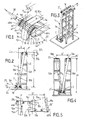
- the figure 1 shows, in perspective, a satellite roller deflector according to the invention.
- the figure 2 is a front view of a device with two baffles according to the invention.
- the figure 3 is a perspective view of the device of the figure 2 .
- the figure 4 shows, in front view, a lateral offset device with four deflectors.
- the figure 5 is a schematic view from above of the device of the figure 4 .
- the figure 6 shows, in perspective, an angular deflection device.
- the figure 7 shows an angular deflection device of two substantially horizontal strands.
- the figure 8 is a side view of the device of the figure 7 .
- the figure 9 is a top view of the entire device of the figure 7 .
- the baffle roller modifies the direction of the plane of travel of the two parts, respectively upstream and downstream of the strip tangential to the baffle rollers, but these remain centered in the same longitudinal median plane orthogonal to the axis of rotation of the roll. cylindrical.
- the object of the invention is a new type of conical deflector constituted, as shown in FIG. figure 1 , a fixed support 3 carrying a plurality of cylindrical rollers 4 distributed on its periphery in the manner of satellites.
- Each satellite roll 4 is rotatably mounted about an axis 40 on two bearings 41, 41 'housed in housings fixed respectively on two ends, respectively enlarged 31 and thinned 31' of the support 3 which, in the example shown is limited by a conical face 33 of revolution about an axis 30, having an angle at the apex A.
- the support 3 carries rollers 4 only on an angular sector 32 of winding of the band 1. Therefore, the conical face 33 of the support rollers 4 could be limited to this angular sector 32 which, most often will cover substantially a quadrant.
- the axes of the rollers 4 are parallel to this conical face 33 and are therefore themselves placed in a virtual conical surface centered on the same axis 30 and having the same angle at the apex A.
- the band 1 rotates around the deflector 2 following a virtual conical surface 43, symbolized in dashed line on the figure 6 , which passes through the generatrices of support 5 by wrapping all the rollers 4.
- the strip comes into contact with the deflector 2 only along the external generatrices 5 of the rollers 4 which rotate about their axis 40.
- the strip to be guided is normally a metal strip which, given its rigidity, must be subjected to a large tensile force to apply on the baffle roll.
- the axis 30 of the deflector is oriented with respect to the general running direction of the strip so that the axis 10a of the upstream portion 1a thereof is perpendicular to the external generator. 5a of the first roller 4a and that the axis 10b of the downstream portion 1b is perpendicular to the external generator 5b of the last roller 4b of the series.
- the strip is made of an elastoplastic material such as a metal and is kept under tension, it can be progressively deflected while remaining orthogonal to each roll and elastically deforming between two successive rolls, the elongation rate of the fibers longitudinally of the strip gradually increasing from its inner edge 12 facing the narrower end 31 'of the support 3 to the outer edge 13 facing the enlarged end 31.
- this variation in the elongation rates of the longitudinal fibers of the strip is compensated in a guiding device according to the invention which comprises two baffles 2, 2 'having the same angle at the apex A and placed head to tail, of the as shown in the other figures, the narrow end of one of the deflectors 2 being placed on the same side as the wide end of the other deflector 2 'relative to the longitudinal axis of travel of the strip.
- each roller 4 is not rigorously cylindrical but may be slightly curved, the diameter of its central portion 44 being a little larger than that of the ends. 42.
- the figure 2 shows, in front view, such a guiding device shown in perspective on the figure 3 and comprising two deflector members 2, 2 'mounted on a frame C at two different levels.
- Each deflector 2, 2 ' is of the type shown in the figure 1 and therefore comprises a support 3 centered on an axis 30 and on which are mounted a plurality of satellite rollers 4 each rotating about an axis making, with the axis 30 of the support, an angle A which constitutes the angle at the apex of the conical deflector.
- the two baffles 2, 2 ' have parallel axes and inclined at the same angle A with respect to the horizontal. In this way, as we see on the figure 3 , the band 1 which arrives at a lower level in a running direction F successively passes on the two deflectors 2, 2 'and leaves in the opposite direction F', at a higher level.
- the axis 30 of the lower baffle 2 is parallel to the plane of the figure and inclined relative to the horizontal of the angle at the apex A.
- the part 1a of the band arriving upstream of the lower baffle 2 is centered on a horizontal axis perpendicular to the plane of the figure and the lower generatrix 5a of the deflector 2 which constitutes the input generator on it.
- the band wraps around the lower deflector 2 by elastically deforming, and its central portion 1b between the two deflectors 2, 2 'is centered on an axis 10b perpendicular to the output generator 5b which is placed in an inclined plane of the angle A with respect to the horizontal.
- the longitudinal axis 10b of the central portion 1b is therefore inclined at the same angle A with respect to the vertical and perpendicular to the inlet generator 5'a on the second deflector 2 ', which is itself placed in an inclined plane the same angle A with respect to the horizontal.
- the band 2 then winds on a quadrant of the upper deflector 2 'and its downstream part 1c leaves the device in a horizontal direction F' perpendicular to the plane of the figure 2 and the output generator 5'b of the upper baffle 2 '.
- the output generator 5b of the first deflector 2 and the input generator 5'a on the second deflector 2 ' are not parallel.
- the central portion 1b of the strip is thus subjected to a slight twist which does not, however, have any disadvantage if the height H is large relative to the width of the strip.
- the longitudinal axis 10b being perpendicular to the two generatrices, respectively 5b output and input 5'a, the two banks 12b, 13b of the central portion 1b of the strip have the same length and mounting head- spade of the two deflectors 2, 2 'makes it possible to compensate for the differences in elongation along each conical deflector, so that the paths followed by the different longitudinal fibers of the strip have the same length.
- deflector members having a conical winding surface provides multiple possibilities of arrangement of said conical deflectors whose number and orientations can be varied in order to optimally respond to the installation requirements of the different sections of an installation, in particular for the modernization of an existing installation.
- Figures 4 and 5 show another arrangement for making a large transverse shift on two parallel strands of the strip moving in the same direction.
- two deflectors 2, 2 ' are used which are placed head to tail at the same level and associated with two other deflectors 25, 25' placed at a higher level.
- the axes of all the deflectors 25, 2, 2 ', 25' are placed in vertical planes parallel to the plane of the figure 6 and are oriented so that, in the order of succession of the deflectors, the input generators of the odd-order members and the output generatrices of the even-rank members are all horizontal and parallel.
- the band 1, which is wound successively on each of the four deflectors 25, 2, 2 ', 25' comprises an inlet strand 15a which arrives in the direction of movement F and is tangential to a horizontal inlet generator 45a of the first conical baffle 25, a descending oblique strand 15b, a horizontal strand 15c, an upward oblique strand 15d and an output strand 15e tangential and perpendicular to an output generator 45'b of the last deflector 25 '.
- odd input generators 5a and 5'a respectively on the first 25 and the third deflector 2 'and the even output generatrices, respectively 5b of the second deflector 2 and 45'b of the fourth deflector 25', are all horizontal and parallel to each other so that the incoming strand 15a and the outgoing strand 15e scroll horizontally and in the same direction along parallel directions F, F '.
- the oblique strands 15b, 15d are slightly twisted, but this torsion effect is not disadvantageous if the difference in level H between the input and output generators of each pair of deflectors, respectively 25, 2 and 2. ', 25' is large relative to the width of the strip 1.
- this arrangement thus makes it possible to double the misalignment without modifying the direction of travel of the strip.
- rollers 25, 25 are not necessarily at the same level and that one can adjust their positions relative to the two lower rollers 2, 2 'so as to achieve the desired misalignment.
- the two successive deflectors of 2, 2 ' can be arranged so that the generatrix 5b output of the first deflector 2 and the generator 5'a input on the second deflector 2' are parallel and placed in the same plane of scrolling of the central part 1b of the band.
- the input generatrix 5a on the first deflector 2 and the output generator 5'b of the second deflector 2 ' are still placed in two parallel planes but make an angle between them 2A', A 'being the projection of the angle at the apex A on a horizontal plane.
- the directions F and F 'of the upstream portion 1a and the downstream portion 1c are between them the same angle 2A'.
- the height offset of the two parts, respectively upstream 1a and downstream 1c of the band can be reduced in the case where the central portion 1b remains flat.
- a deflection angle of about 45 ° can be achieved.
- both deflectors can be placed so that the intermediate strand is horizontal.
- the axes of the supports 3, 3' can be oriented so as to increase the deflection angle between the input and output generators and, therefore, between the axes 10a, 10c of the strands entering 1a and outgoing 1c.
- the angular sector 32 of application of the strip on a deflector is not necessarily straight and the input 1a and output 1c strands may not be horizontal but form, on the contrary, an upward or downward ramp.
- the invention therefore provides multiple possibilities of arrangement of the successive sections of a treatment plant, in particular for the realization of a continuous line in an existing plant.
Landscapes
- Engineering & Computer Science (AREA)
- Mechanical Engineering (AREA)
- Registering, Tensioning, Guiding Webs, And Rollers Therefor (AREA)
- Gears, Cams (AREA)
- Pharmaceuticals Containing Other Organic And Inorganic Compounds (AREA)
- Solid-Sorbent Or Filter-Aiding Compositions (AREA)
- Medicines Containing Material From Animals Or Micro-Organisms (AREA)
- Preliminary Treatment Of Fibers (AREA)
- Projection-Type Copiers In General (AREA)
Claims (15)
- Führungsvorrichtung für ein Produkt in Bandform (1), das entlang einer Längsachse (10) läuft und mindestens zwei konische Ablenker (2, 2') enthält, die jeweils ein schmales (22, 22') und ein breites Ende (23, 23') haben und einander gegenüber angeordnet sind, so dass das schmale Ende (22) des einen der beiden Ablenker (2) im Verhältnis zur Achse (10) des Bands (1) sich auf derselben Seite wie das breite Ende (23') des anderen Ablenkers (2') befindet, dadurch gekennzeichnet, dass jeder Ablenker (2, 2') eine feste Auflage umfasst (3, 3'), auf der nach Art von Satelliten mehrere Leitrollen (4, 4') montiert sind, verteilt auf einem im Winkel stehenden Umlenkbereich des Ablenkers (2, 2'), um Achsen (40, 40') drehbar montiert, die im gleichen Winkel (A) zu einer Achse (30, 30') des Ablenkers (2, 2') stehen; dass das Band (1) unter Spannung auf jeden Ablenker (2, 2') aufgebracht wird, entlang einer virtuellen konischen Oberfläche (43), vorbei an einer äußeren Mantellinie (5) jeder Rolle (4), und dass die Achsen (30, 30') der Ablenker (2, 2') so an der Längsachse (10) der Laufrichtung des Bands (1) ausgerichtet sind, dass das Band nacheinander, in Laufrichtung, einen oberen Teil (1a), der eine Eingangsmantellinie (5a) auf einem ersten Ablenker (2) tangiert und eine rechtwinklige Achse (10a) zur genannten Eingangsmantellinie (5a) bildet, einen mittleren Teil (1b), der in Aufwärtsrichtung eine Ausgangsmantellinie (5b) des ersten Ablenkers (2) und in Abwärtsrichtung eine Eingangsmantellinie (5'a) des zweiten Ablenkers (2') tangiert und eine Längsachse (10b) hat, die rechtwinklig zu den genannten Ausgangs- (5b) und Eingangsmantellinien (5'a) steht, sowie einen unteren Teil (1c), der eine Ausgangsmantellinie (5'b) des zweiten Ablenkers (2') tangiert und eine Längsachse (10c) rechtwinklig zur genannten Ausgangsmantellinie (5'b) hat, umfasst.
- Führungsvorrichtung nach Anspruch 1, dadurch gekennzeichnet, dass das Band (1) je nach seiner Steifigkeit unter Zug gesetzt wird, so dass das Band (1) unter Spannung und elastischer Verformung auf alle Rollen (4) jedes Ablenkers (2, 2') aufgebracht wird, wobei die gegenüberliegende Positionierung dieser Ablenker (2, 2') zwischen den beiden Seiten des Bands (1) auf beiden Seiten der Längsachse (10) die Unterschiede der Längenausdehnung ausgleicht, und einen Zentrierungseffekt des Bands (1) mit zunehmender Rotation seiner Längsachse (10) regelt, der dazu geeignet ist, die Rechtwinkligkeit dieser Achse zur äußeren Mantellinie (5, 5') jeder Rolle (4, 4') des Ablenkers (2, 2') zu erhalten.
- Führungsvorrichtung nach Anspruch 2, in dem jeder Teil des Bands, der sich auf einem Ablenker befindet, am schmalen Ende (22) des Ablenkers eine innere Kante (12) zeigt, und am breiten Ende (23) eine äußere Kante (13), dadurch gekennzeichnet, dass die auf das Band (1) angewendete Zugkraft sich auf die Breite desselben verteilt und dabei kontinuierlich von der inneren Kante (12) zur äußeren Kante (13) zunimmt, mit einer progressiven Verlängerung der Längsfasern des Bands, so dass die tangentiale Laufgeschwindigkeit jeder Faser entlang einer äußeren Mantellinie (5) jeder Satellitenrolle (4) von einer Kante zur anderen etwa konstant ist.
- Führungsvorrichtung nach einem der vorigen Ansprüche, dadurch gekennzeichnet, dass jede Rolle (4, 4') eines Ablenkers (2, 2') ein gewölbtes externes Profil aufweist, mit einem Mittelteil (44), dessen Durchmesser etwas größer ist als an den Enden (45), und dass die auf das Band (1) angewendete Zugkraft eine automatische Zentrierung des Bands (1) regelt, wobei die Längsachse (10) im Mittelteil (44) erhalten und rechtwinklig zu einer äußeren Auflagemantellinie (5, 5') auf jeder Rolle (4, 4') des Ablenkers (2, 2') bleibt.
- Führungsvorrichtung nach einem der vorigen Ansprüche, dadurch gekennzeichnet, dass das Band (1) auf einen im Winkel stehenden Bereich von etwa einem Quadranten jedes Ablenkers (2, 2') aufgebracht wird.
- Führungsvorrichtung nach einem der vorigen Ansprüche, dadurch gekennzeichnet, dass sie eine gerade Anzahl Ablenker (2, 2') enthält, die paarweise zusammengefasst sind, wobei jedes Paar (2, 2') denselben Neigungswinkel (A) an den Leitrollen (4, 4') aufweist.
- Führungsvorrichtung nach einem der vorigen Ansprüche, dadurch gekennzeichnet, dass die Achsen (30, 30') der beiden aufeinander folgenden Ablenker (2, 2') so angelegt sind, dass die Ausgangsmantellinie (5b) des ersten Ablenkers (2) und die Eingangsmantellinie (5'a) des zweiten Ablenkers (2') parallel sind und Teil einer gemeinsamen, tangential zu beiden Ablenkern (2, 2') liegenden Ebene sind, in der sich der Mittelteil (1b) des Bands (1) befindet.
- Führungsvorrichtung nach einem der Ansprüche 1 bis 6, dadurch gekennzeichnet, dass die Ausgangsmantellinie (5b) des ersten Ablenkers (2) und die Eingangsmantellinie (5'a) des zweiten Ablenkers (2') sich in zwei zueinander parallelen Ebenen befinden und rechtwinklig auf die Achse (10b) des Mittelteils (1b) des Bands (1) stehen sowie zueinander einen Winkel ungleich Null bilden.
- Führungsvorrichtung nach einem der vorigen Ansprüche, dadurch gekennzeichnet, dass die beiden Ablenker (2, 2') auf zwei gegenüber liegenden Seiten des Bands (1) aufliegen und eine seitliche Entfernung der Längsachse (10c) des oberen Teils (1c) des Bands (1) zur Längsachse (10a) des unteren Teils (1a) regeln, wobei die allgemeine Laufrichtung (F) beibehalten wird.
- Führungsvorrichtung nach einem der Ansprüche 1 bis 8, dadurch gekennzeichnet, dass die beiden Ablenker (2, 2') auf derselben Seite des Bands aufliegen und eine seitliche Entfernung der Längsachse (10c) des oberen Teils (1c) des Bands (1) zur Längsachse (10a) des unteren Teils (1a) regeln, wobei die Laufrichtung (F) umgekehrt wird.
- Führungsvorrichtung nach einem der Ansprüche 9 oder 10, dadurch gekennzeichnet, dass die beiden Ablenker (2, 2') so positioniert sind, dass die Eingangsmantellinie (5a) des ersten Ablenkers (2) und die Ausgangsmantellinie (5'b) des zweiten Ablenkers (2') sich in zwei parallelen Führungsebenen befinden, jeweils des oberen Teils (1a) und des unteren Teils (1c) des Bands (1), und dass die Längsachsen (10a, 10c) dieser oberen (1a) und unteren (1c) Teile auf Höhe dieser Eingangsmantellinien (5a) und Ausgangsmantellinien (5'b) voneinander eine Entfernung von

aufweisen, wobei A der Winkel an der Spitze jedes Ablenkers (2, 2') ist und H die Entfernung zwischen den beiden Führungsebenen, jeweils im oberen und unteren Teil des Bands. - Führungsvorrichtung nach einem der Ansprüche 9, 10 oder 11, dadurch gekennzeichnet, dass die beiden Ablenker (2, 2') so positioniert sind, dass die Ausgangsmantellinie (5b) des ersten Ablenkers (2) parallel zur Eingangsmantellinie (5'a) des zweiten Ablenkers (2') ist, wobei der mittlere Teil (1b) des Bands (1) eben ist.
- Führungsvorrichtung nach Anspruch 12, dadurch gekennzeichnet, dass die Eingangsmantellinie (5a) des ersten Ablenkers (2) und die Ausgangsmantellinie (5'b) des zweiten Ablenkers (2') jeweils zu einer gemeinsamen Ebene parallel sind und untereinander einen Winkel von 2A' bilden, wobei A' die Projektion des Winkels an der Spitze (A) jedes Ablenkers (2, 2') in der genannten Mantellinienebene ist, und die mittleren Längsebenen der oberen (1a) und unteren (1b) Teile des Bands (1) denselben Winkel (2A') bilden.
- Führungsvorrichtung nach einem der Ansprüche 9 bis 11, dadurch gekennzeichnet, dass die beiden Ablenker (2, 2') so positioniert sind, dass die Eingangs- (5a) und Ausgangsmantellinien (5'b) jeweils des ersten (2) und zweiten (2') Ablenkers sich in parallelen Ebenen befinden und zueinander einen Winkel ungleich Null bilden, wobei die mittleren Längsebenen der oberen (1a) und unteren (1c) Teile des Bands rechtwinklig zu den genannten Eingangs- (5a) und Ausgangsmantellinien (5'b) liegen und zueinander denselben Winkel ungleich Null bilden.
- Führungsvorrichtung nach Anspruch 11, dadurch gekennzeichnet, dass die jeweilige Eingangsmantellinie (5a) des ersten Ablenkers (2) und Ausgangsmantellinie (5'b) des zweiten Ablenkers (2') parallel sind und dass der obere Teil (1a) und der untere Teil (1c) des Bands (1) jeweils zentriert auf zwei mittleren Längsebenen liegen, die parallel zueinander sind und eine Entfernung von D = H tg A aufweisen.
Applications Claiming Priority (2)
| Application Number | Priority Date | Filing Date | Title |
|---|---|---|---|
| FR0207317A FR2840827B1 (fr) | 2002-06-13 | 2002-06-13 | Dispositif de guidage d'un produit en bande |
| FR0207317 | 2002-06-13 |
Publications (2)
| Publication Number | Publication Date |
|---|---|
| EP1375018A1 EP1375018A1 (de) | 2004-01-02 |
| EP1375018B1 true EP1375018B1 (de) | 2008-11-05 |
Family
ID=29595229
Family Applications (1)
| Application Number | Title | Priority Date | Filing Date |
|---|---|---|---|
| EP03291378A Expired - Lifetime EP1375018B1 (de) | 2002-06-13 | 2003-06-10 | Bandführunsgvorichtung |
Country Status (7)
| Country | Link |
|---|---|
| US (1) | US6874727B2 (de) |
| EP (1) | EP1375018B1 (de) |
| CN (1) | CN1250351C (de) |
| AT (1) | ATE413239T1 (de) |
| DE (1) | DE60324502D1 (de) |
| ES (1) | ES2312733T3 (de) |
| FR (1) | FR2840827B1 (de) |
Families Citing this family (6)
| Publication number | Priority date | Publication date | Assignee | Title |
|---|---|---|---|---|
| JP5243305B2 (ja) * | 2009-03-02 | 2013-07-24 | ユニ・チャーム株式会社 | ウェブ搬送装置及び吸収性物品の製造方法 |
| CN102371315A (zh) * | 2011-09-28 | 2012-03-14 | 安徽永钰过滤器有限公司 | 支撑中心管板材送料张紧结构 |
| DE102011115881B4 (de) * | 2011-10-12 | 2014-11-20 | Multivac Sepp Haggenmüller Gmbh & Co. Kg | Tiefziehverpackungsmaschine mit einseitiger Folienvorschubeinrichtung |
| DE102016006275B3 (de) * | 2016-05-25 | 2017-11-09 | Karl Wiedemann | Kanalreinigungsvorrichtung |
| CN109363835B (zh) * | 2018-12-03 | 2023-05-05 | 广东佰分爱卫生用品有限公司 | 一种制备纸尿裤用的无纺布运动位置矫正设备 |
| JP7644483B2 (ja) * | 2021-05-21 | 2025-03-12 | 株式会社デュプロ | 包装装置及び包装材ガイド部材 |
Family Cites Families (13)
| Publication number | Priority date | Publication date | Assignee | Title |
|---|---|---|---|---|
| US3095131A (en) * | 1959-07-06 | 1963-06-25 | Mount Hope Machinery Ltd | Web guiding method and apparatus |
| US3827617A (en) * | 1973-04-16 | 1974-08-06 | Eastman Kodak Co | Helical web path processing device utilizing force counter-acting spools |
| US4131925A (en) * | 1977-08-02 | 1978-12-26 | Eastman Kodak Company | Edge guide for cooperation with a coaxial reel cassette |
| JPS58135049A (ja) * | 1982-02-06 | 1983-08-11 | Mitsubishi Heavy Ind Ltd | 帯状材の進行方向変更装置 |
| JPS59179210A (ja) * | 1983-03-31 | 1984-10-11 | Ishikawajima Harima Heavy Ind Co Ltd | ストリツプ方向転換装置 |
| JPS59229230A (ja) * | 1983-06-13 | 1984-12-22 | Mitsubishi Heavy Ind Ltd | 帯状材の進行方向変更装置 |
| US4687125A (en) * | 1984-06-19 | 1987-08-18 | Mitsubishi Jukogyo Kabushiki Kaisha | Apparatus for changing the traveling direction of a web-like material |
| DE4302698B4 (de) * | 1993-02-01 | 2007-09-27 | Sms Demag Ag | Verfahren und Vorrichtung zum Führen eines Stahlbandes während seines Durchlaufs durch eine kontinuierliche Behandlungsanlage |
| JP2578307B2 (ja) * | 1993-04-19 | 1997-02-05 | 三菱重工業株式会社 | 帯状材の進行方向変更装置 |
| JP2578306B2 (ja) * | 1993-04-19 | 1997-02-05 | 三菱重工業株式会社 | 帯状材の進行方向変更装置 |
| DE19620714A1 (de) * | 1996-05-23 | 1997-11-27 | Bielomatik Leuze & Co | Vorrichtung zur Führung von Lagenbahnen aus Papier o. dgl. |
| CA2214486C (en) * | 1996-09-04 | 2006-06-06 | Consolidated Papers, Inc. | Method and apparatus for minimizing web-fluting in heat-set, web-offset printing presses |
| US6457623B1 (en) * | 1999-02-03 | 2002-10-01 | Giorgio A. Rey | Roll quadrant with strip centering action |
-
2002
- 2002-06-13 FR FR0207317A patent/FR2840827B1/fr not_active Expired - Fee Related
-
2003
- 2003-06-10 DE DE60324502T patent/DE60324502D1/de not_active Expired - Fee Related
- 2003-06-10 EP EP03291378A patent/EP1375018B1/de not_active Expired - Lifetime
- 2003-06-10 AT AT03291378T patent/ATE413239T1/de not_active IP Right Cessation
- 2003-06-10 ES ES03291378T patent/ES2312733T3/es not_active Expired - Lifetime
- 2003-06-12 US US10/459,707 patent/US6874727B2/en not_active Expired - Fee Related
- 2003-06-13 CN CN03133037.1A patent/CN1250351C/zh not_active Expired - Fee Related
Also Published As
| Publication number | Publication date |
|---|---|
| CN1250351C (zh) | 2006-04-12 |
| US6874727B2 (en) | 2005-04-05 |
| CN1478616A (zh) | 2004-03-03 |
| ATE413239T1 (de) | 2008-11-15 |
| FR2840827B1 (fr) | 2004-08-27 |
| ES2312733T3 (es) | 2009-03-01 |
| DE60324502D1 (de) | 2008-12-18 |
| EP1375018A1 (de) | 2004-01-02 |
| FR2840827A1 (fr) | 2003-12-19 |
| US20030230619A1 (en) | 2003-12-18 |
Similar Documents
| Publication | Publication Date | Title |
|---|---|---|
| EP2205369B1 (de) | Vorrichtung zur prüfung eines blechstreifens | |
| EP2895410B1 (de) | Verfahren zur neupositionierung flacher objekte | |
| EP1375018B1 (de) | Bandführunsgvorichtung | |
| FR2458495A1 (fr) | Dispositif transporteur pour objets en forme de feuilles | |
| EP1155753B1 (de) | Verfahren und Anlage zum Kaltwalzen | |
| WO2014127864A1 (fr) | Installation et méthode de laminage d'une bande métallique | |
| EP1685934A1 (de) | Drahtsägevorrichtung und Verfahren | |
| FR2465530A1 (fr) | Procede et dispositif pour redresser des materiaux allonges et etires de section circulaire | |
| EP1917113B1 (de) | Überprüfungsverfahren | |
| FR2580527A1 (fr) | Procede et dispositif tendeur pour le dressage en continu, en particulier de bandes metalliques minces | |
| EP0742170A2 (de) | Vorrichtung zum Zuführen einer kontinuierlich ankommenden Bahn in einer Station, die sie in angehaltenem Zustand bearbeitet | |
| EP0466570B1 (de) | Umkehrbares Walzverfahren | |
| EP1448322A1 (de) | Verfahren und vorrichtung zur stabilisierung eines mit grosser geschwindigkeit laufenden bandförmigen produktes | |
| EP1802407A1 (de) | Verfahren und vorrichtung zum aufrollen eines streifens | |
| EP0935505A1 (de) | Wickelmaschine | |
| FR2628029A1 (fr) | Dispositif d'etirage d'un film de matiere plastique | |
| EP0031286B1 (de) | Vorrichtung zum Aufwickeln von Maschendraht-Viereckgeflecht | |
| FR2486424A1 (fr) | Procede et appareil de laminage a forte reduction par passe | |
| FR2566686A1 (fr) | Procede et dispositif pour le dressage de bobines de bandes laminees a chaud, notamment de bobines simplement degrossies | |
| EP2745976A1 (de) | Vorrichtung zum Verschieben einer Anordnung zum Schweißen von Metallbändern | |
| FR2901720A1 (fr) | Jeu de rouleaux tendeurs pour laminoir. | |
| BE651925A (de) | ||
| BE432669A (de) | ||
| BE358605A (de) | ||
| BE470807A (de) |
Legal Events
| Date | Code | Title | Description |
|---|---|---|---|
| PUAI | Public reference made under article 153(3) epc to a published international application that has entered the european phase |
Free format text: ORIGINAL CODE: 0009012 |
|
| AK | Designated contracting states |
Kind code of ref document: A1 Designated state(s): AT BE BG CH CY CZ DE DK EE ES FI FR GB GR HU IE IT LI LU MC NL PT RO SE SI SK TR |
|
| AX | Request for extension of the european patent |
Extension state: AL LT LV MK |
|
| 17P | Request for examination filed |
Effective date: 20040702 |
|
| AKX | Designation fees paid |
Designated state(s): AT BE BG CH CY CZ DE DK EE ES FI FR GB GR HU IE IT LI LU MC NL PT RO SE SI SK TR |
|
| GRAP | Despatch of communication of intention to grant a patent |
Free format text: ORIGINAL CODE: EPIDOSNIGR1 |
|
| GRAS | Grant fee paid |
Free format text: ORIGINAL CODE: EPIDOSNIGR3 |
|
| GRAA | (expected) grant |
Free format text: ORIGINAL CODE: 0009210 |
|
| AK | Designated contracting states |
Kind code of ref document: B1 Designated state(s): AT BE BG CH CY CZ DE DK EE ES FI FR GB GR HU IE IT LI LU MC NL PT RO SE SI SK TR |
|
| REG | Reference to a national code |
Ref country code: GB Ref legal event code: FG4D Free format text: NOT ENGLISH |
|
| REG | Reference to a national code |
Ref country code: CH Ref legal event code: EP |
|
| REG | Reference to a national code |
Ref country code: IE Ref legal event code: FG4D Free format text: LANGUAGE OF EP DOCUMENT: FRENCH |
|
| REF | Corresponds to: |
Ref document number: 60324502 Country of ref document: DE Date of ref document: 20081218 Kind code of ref document: P |
|
| REG | Reference to a national code |
Ref country code: ES Ref legal event code: FG2A Ref document number: 2312733 Country of ref document: ES Kind code of ref document: T3 |
|
| NLV1 | Nl: lapsed or annulled due to failure to fulfill the requirements of art. 29p and 29m of the patents act | ||
| PG25 | Lapsed in a contracting state [announced via postgrant information from national office to epo] |
Ref country code: AT Free format text: LAPSE BECAUSE OF FAILURE TO SUBMIT A TRANSLATION OF THE DESCRIPTION OR TO PAY THE FEE WITHIN THE PRESCRIBED TIME-LIMIT Effective date: 20081105 |
|
| PG25 | Lapsed in a contracting state [announced via postgrant information from national office to epo] |
Ref country code: FI Free format text: LAPSE BECAUSE OF FAILURE TO SUBMIT A TRANSLATION OF THE DESCRIPTION OR TO PAY THE FEE WITHIN THE PRESCRIBED TIME-LIMIT Effective date: 20081105 Ref country code: SI Free format text: LAPSE BECAUSE OF FAILURE TO SUBMIT A TRANSLATION OF THE DESCRIPTION OR TO PAY THE FEE WITHIN THE PRESCRIBED TIME-LIMIT Effective date: 20081105 Ref country code: NL Free format text: LAPSE BECAUSE OF FAILURE TO SUBMIT A TRANSLATION OF THE DESCRIPTION OR TO PAY THE FEE WITHIN THE PRESCRIBED TIME-LIMIT Effective date: 20081105 |
|
| REG | Reference to a national code |
Ref country code: IE Ref legal event code: FD4D |
|
| PG25 | Lapsed in a contracting state [announced via postgrant information from national office to epo] |
Ref country code: EE Free format text: LAPSE BECAUSE OF FAILURE TO SUBMIT A TRANSLATION OF THE DESCRIPTION OR TO PAY THE FEE WITHIN THE PRESCRIBED TIME-LIMIT Effective date: 20081105 Ref country code: DK Free format text: LAPSE BECAUSE OF FAILURE TO SUBMIT A TRANSLATION OF THE DESCRIPTION OR TO PAY THE FEE WITHIN THE PRESCRIBED TIME-LIMIT Effective date: 20081105 Ref country code: IE Free format text: LAPSE BECAUSE OF FAILURE TO SUBMIT A TRANSLATION OF THE DESCRIPTION OR TO PAY THE FEE WITHIN THE PRESCRIBED TIME-LIMIT Effective date: 20081105 Ref country code: BG Free format text: LAPSE BECAUSE OF FAILURE TO SUBMIT A TRANSLATION OF THE DESCRIPTION OR TO PAY THE FEE WITHIN THE PRESCRIBED TIME-LIMIT Effective date: 20090205 Ref country code: RO Free format text: LAPSE BECAUSE OF FAILURE TO SUBMIT A TRANSLATION OF THE DESCRIPTION OR TO PAY THE FEE WITHIN THE PRESCRIBED TIME-LIMIT Effective date: 20081105 |
|
| PG25 | Lapsed in a contracting state [announced via postgrant information from national office to epo] |
Ref country code: CZ Free format text: LAPSE BECAUSE OF FAILURE TO SUBMIT A TRANSLATION OF THE DESCRIPTION OR TO PAY THE FEE WITHIN THE PRESCRIBED TIME-LIMIT Effective date: 20081105 Ref country code: PT Free format text: LAPSE BECAUSE OF FAILURE TO SUBMIT A TRANSLATION OF THE DESCRIPTION OR TO PAY THE FEE WITHIN THE PRESCRIBED TIME-LIMIT Effective date: 20090406 Ref country code: SE Free format text: LAPSE BECAUSE OF FAILURE TO SUBMIT A TRANSLATION OF THE DESCRIPTION OR TO PAY THE FEE WITHIN THE PRESCRIBED TIME-LIMIT Effective date: 20090205 |
|
| PGFP | Annual fee paid to national office [announced via postgrant information from national office to epo] |
Ref country code: FR Payment date: 20090616 Year of fee payment: 7 Ref country code: IT Payment date: 20090624 Year of fee payment: 7 |
|
| PLBE | No opposition filed within time limit |
Free format text: ORIGINAL CODE: 0009261 |
|
| STAA | Information on the status of an ep patent application or granted ep patent |
Free format text: STATUS: NO OPPOSITION FILED WITHIN TIME LIMIT |
|
| PG25 | Lapsed in a contracting state [announced via postgrant information from national office to epo] |
Ref country code: SK Free format text: LAPSE BECAUSE OF FAILURE TO SUBMIT A TRANSLATION OF THE DESCRIPTION OR TO PAY THE FEE WITHIN THE PRESCRIBED TIME-LIMIT Effective date: 20081105 |
|
| 26N | No opposition filed |
Effective date: 20090806 |
|
| BERE | Be: lapsed |
Owner name: VAI CLECIM Effective date: 20090630 |
|
| PG25 | Lapsed in a contracting state [announced via postgrant information from national office to epo] |
Ref country code: MC Free format text: LAPSE BECAUSE OF NON-PAYMENT OF DUE FEES Effective date: 20090630 |
|
| REG | Reference to a national code |
Ref country code: CH Ref legal event code: PL |
|
| GBPC | Gb: european patent ceased through non-payment of renewal fee |
Effective date: 20090610 |
|
| PG25 | Lapsed in a contracting state [announced via postgrant information from national office to epo] |
Ref country code: LI Free format text: LAPSE BECAUSE OF NON-PAYMENT OF DUE FEES Effective date: 20090630 Ref country code: CH Free format text: LAPSE BECAUSE OF NON-PAYMENT OF DUE FEES Effective date: 20090630 |
|
| PG25 | Lapsed in a contracting state [announced via postgrant information from national office to epo] |
Ref country code: GB Free format text: LAPSE BECAUSE OF NON-PAYMENT OF DUE FEES Effective date: 20090610 |
|
| PG25 | Lapsed in a contracting state [announced via postgrant information from national office to epo] |
Ref country code: BE Free format text: LAPSE BECAUSE OF NON-PAYMENT OF DUE FEES Effective date: 20090630 Ref country code: DE Free format text: LAPSE BECAUSE OF NON-PAYMENT OF DUE FEES Effective date: 20100101 |
|
| REG | Reference to a national code |
Ref country code: ES Ref legal event code: FD2A Effective date: 20090612 |
|
| PG25 | Lapsed in a contracting state [announced via postgrant information from national office to epo] |
Ref country code: ES Free format text: LAPSE BECAUSE OF NON-PAYMENT OF DUE FEES Effective date: 20090612 Ref country code: GR Free format text: LAPSE BECAUSE OF FAILURE TO SUBMIT A TRANSLATION OF THE DESCRIPTION OR TO PAY THE FEE WITHIN THE PRESCRIBED TIME-LIMIT Effective date: 20090206 |
|
| REG | Reference to a national code |
Ref country code: FR Ref legal event code: ST Effective date: 20110228 |
|
| PG25 | Lapsed in a contracting state [announced via postgrant information from national office to epo] |
Ref country code: IT Free format text: LAPSE BECAUSE OF NON-PAYMENT OF DUE FEES Effective date: 20100610 |
|
| PG25 | Lapsed in a contracting state [announced via postgrant information from national office to epo] |
Ref country code: LU Free format text: LAPSE BECAUSE OF NON-PAYMENT OF DUE FEES Effective date: 20090610 |
|
| PG25 | Lapsed in a contracting state [announced via postgrant information from national office to epo] |
Ref country code: FR Free format text: LAPSE BECAUSE OF NON-PAYMENT OF DUE FEES Effective date: 20100630 |
|
| PG25 | Lapsed in a contracting state [announced via postgrant information from national office to epo] |
Ref country code: HU Free format text: LAPSE BECAUSE OF FAILURE TO SUBMIT A TRANSLATION OF THE DESCRIPTION OR TO PAY THE FEE WITHIN THE PRESCRIBED TIME-LIMIT Effective date: 20090506 |
|
| PG25 | Lapsed in a contracting state [announced via postgrant information from national office to epo] |
Ref country code: TR Free format text: LAPSE BECAUSE OF FAILURE TO SUBMIT A TRANSLATION OF THE DESCRIPTION OR TO PAY THE FEE WITHIN THE PRESCRIBED TIME-LIMIT Effective date: 20081105 |
|
| PG25 | Lapsed in a contracting state [announced via postgrant information from national office to epo] |
Ref country code: CY Free format text: LAPSE BECAUSE OF FAILURE TO SUBMIT A TRANSLATION OF THE DESCRIPTION OR TO PAY THE FEE WITHIN THE PRESCRIBED TIME-LIMIT Effective date: 20081105 |