EP1375681A2 - Acier à haute résistance et tenacité éléveés, procédé pour sa fabrication et procédé de fabrication des tubes d'acier à haute résistance et tenacité éléveés - Google Patents
Acier à haute résistance et tenacité éléveés, procédé pour sa fabrication et procédé de fabrication des tubes d'acier à haute résistance et tenacité éléveés Download PDFInfo
- Publication number
- EP1375681A2 EP1375681A2 EP03011866A EP03011866A EP1375681A2 EP 1375681 A2 EP1375681 A2 EP 1375681A2 EP 03011866 A EP03011866 A EP 03011866A EP 03011866 A EP03011866 A EP 03011866A EP 1375681 A2 EP1375681 A2 EP 1375681A2
- Authority
- EP
- European Patent Office
- Prior art keywords
- steel
- toughness
- affected zone
- low temperature
- weld heat
- Prior art date
- Legal status (The legal status is an assumption and is not a legal conclusion. Google has not performed a legal analysis and makes no representation as to the accuracy of the status listed.)
- Granted
Links
Images
Classifications
-
- C—CHEMISTRY; METALLURGY
- C22—METALLURGY; FERROUS OR NON-FERROUS ALLOYS; TREATMENT OF ALLOYS OR NON-FERROUS METALS
- C22C—ALLOYS
- C22C38/00—Ferrous alloys, e.g. steel alloys
- C22C38/02—Ferrous alloys, e.g. steel alloys containing silicon
-
- C—CHEMISTRY; METALLURGY
- C22—METALLURGY; FERROUS OR NON-FERROUS ALLOYS; TREATMENT OF ALLOYS OR NON-FERROUS METALS
- C22C—ALLOYS
- C22C38/00—Ferrous alloys, e.g. steel alloys
-
- C—CHEMISTRY; METALLURGY
- C21—METALLURGY OF IRON
- C21D—MODIFYING THE PHYSICAL STRUCTURE OF FERROUS METALS; GENERAL DEVICES FOR HEAT TREATMENT OF FERROUS OR NON-FERROUS METALS OR ALLOYS; MAKING METAL MALLEABLE, e.g. BY DECARBURISATION OR TEMPERING
- C21D8/00—Modifying the physical properties of ferrous metals or ferrous alloys by deformation combined with, or followed by, heat treatment
- C21D8/02—Modifying the physical properties of ferrous metals or ferrous alloys by deformation combined with, or followed by, heat treatment during manufacturing of plates or strips
- C21D8/0221—Modifying the physical properties of ferrous metals or ferrous alloys by deformation combined with, or followed by, heat treatment during manufacturing of plates or strips characterised by the working steps
- C21D8/0226—Hot rolling
-
- C—CHEMISTRY; METALLURGY
- C21—METALLURGY OF IRON
- C21D—MODIFYING THE PHYSICAL STRUCTURE OF FERROUS METALS; GENERAL DEVICES FOR HEAT TREATMENT OF FERROUS OR NON-FERROUS METALS OR ALLOYS; MAKING METAL MALLEABLE, e.g. BY DECARBURISATION OR TEMPERING
- C21D8/00—Modifying the physical properties of ferrous metals or ferrous alloys by deformation combined with, or followed by, heat treatment
- C21D8/10—Modifying the physical properties of ferrous metals or ferrous alloys by deformation combined with, or followed by, heat treatment during manufacturing of tubular bodies
-
- C—CHEMISTRY; METALLURGY
- C22—METALLURGY; FERROUS OR NON-FERROUS ALLOYS; TREATMENT OF ALLOYS OR NON-FERROUS METALS
- C22C—ALLOYS
- C22C38/00—Ferrous alloys, e.g. steel alloys
- C22C38/18—Ferrous alloys, e.g. steel alloys containing chromium
- C22C38/40—Ferrous alloys, e.g. steel alloys containing chromium with nickel
- C22C38/42—Ferrous alloys, e.g. steel alloys containing chromium with nickel with copper
-
- C—CHEMISTRY; METALLURGY
- C22—METALLURGY; FERROUS OR NON-FERROUS ALLOYS; TREATMENT OF ALLOYS OR NON-FERROUS METALS
- C22C—ALLOYS
- C22C38/00—Ferrous alloys, e.g. steel alloys
- C22C38/18—Ferrous alloys, e.g. steel alloys containing chromium
- C22C38/40—Ferrous alloys, e.g. steel alloys containing chromium with nickel
- C22C38/44—Ferrous alloys, e.g. steel alloys containing chromium with nickel with molybdenum or tungsten
-
- C—CHEMISTRY; METALLURGY
- C22—METALLURGY; FERROUS OR NON-FERROUS ALLOYS; TREATMENT OF ALLOYS OR NON-FERROUS METALS
- C22C—ALLOYS
- C22C38/00—Ferrous alloys, e.g. steel alloys
- C22C38/18—Ferrous alloys, e.g. steel alloys containing chromium
- C22C38/40—Ferrous alloys, e.g. steel alloys containing chromium with nickel
- C22C38/46—Ferrous alloys, e.g. steel alloys containing chromium with nickel with vanadium
-
- C—CHEMISTRY; METALLURGY
- C22—METALLURGY; FERROUS OR NON-FERROUS ALLOYS; TREATMENT OF ALLOYS OR NON-FERROUS METALS
- C22C—ALLOYS
- C22C38/00—Ferrous alloys, e.g. steel alloys
- C22C38/18—Ferrous alloys, e.g. steel alloys containing chromium
- C22C38/40—Ferrous alloys, e.g. steel alloys containing chromium with nickel
- C22C38/58—Ferrous alloys, e.g. steel alloys containing chromium with nickel with more than 1.5% by weight of manganese
-
- C—CHEMISTRY; METALLURGY
- C21—METALLURGY OF IRON
- C21D—MODIFYING THE PHYSICAL STRUCTURE OF FERROUS METALS; GENERAL DEVICES FOR HEAT TREATMENT OF FERROUS OR NON-FERROUS METALS OR ALLOYS; MAKING METAL MALLEABLE, e.g. BY DECARBURISATION OR TEMPERING
- C21D2211/00—Microstructure comprising significant phases
- C21D2211/002—Bainite
-
- C—CHEMISTRY; METALLURGY
- C21—METALLURGY OF IRON
- C21D—MODIFYING THE PHYSICAL STRUCTURE OF FERROUS METALS; GENERAL DEVICES FOR HEAT TREATMENT OF FERROUS OR NON-FERROUS METALS OR ALLOYS; MAKING METAL MALLEABLE, e.g. BY DECARBURISATION OR TEMPERING
- C21D2211/00—Microstructure comprising significant phases
- C21D2211/008—Martensite
-
- C—CHEMISTRY; METALLURGY
- C21—METALLURGY OF IRON
- C21D—MODIFYING THE PHYSICAL STRUCTURE OF FERROUS METALS; GENERAL DEVICES FOR HEAT TREATMENT OF FERROUS OR NON-FERROUS METALS OR ALLOYS; MAKING METAL MALLEABLE, e.g. BY DECARBURISATION OR TEMPERING
- C21D8/00—Modifying the physical properties of ferrous metals or ferrous alloys by deformation combined with, or followed by, heat treatment
- C21D8/12—Modifying the physical properties of ferrous metals or ferrous alloys by deformation combined with, or followed by, heat treatment during manufacturing of articles with special electromagnetic properties
- C21D8/1244—Modifying the physical properties of ferrous metals or ferrous alloys by deformation combined with, or followed by, heat treatment during manufacturing of articles with special electromagnetic properties characterised by the heat treatment
- C21D8/1261—Modifying the physical properties of ferrous metals or ferrous alloys by deformation combined with, or followed by, heat treatment during manufacturing of articles with special electromagnetic properties characterised by the heat treatment following hot rolling
-
- Y—GENERAL TAGGING OF NEW TECHNOLOGICAL DEVELOPMENTS; GENERAL TAGGING OF CROSS-SECTIONAL TECHNOLOGIES SPANNING OVER SEVERAL SECTIONS OF THE IPC; TECHNICAL SUBJECTS COVERED BY FORMER USPC CROSS-REFERENCE ART COLLECTIONS [XRACs] AND DIGESTS
- Y10—TECHNICAL SUBJECTS COVERED BY FORMER USPC
- Y10S—TECHNICAL SUBJECTS COVERED BY FORMER USPC CROSS-REFERENCE ART COLLECTIONS [XRACs] AND DIGESTS
- Y10S148/00—Metal treatment
- Y10S148/902—Metal treatment having portions of differing metallurgical properties or characteristics
- Y10S148/909—Tube
Definitions
- the present invention relates to methods for producing an ultra-high-strength hot-rolled steel having a tensile strength of not lower than 800 MPa, in particular not lower than 900 MPa, and being excellent in toughness of a base steel and toughness at a weld heat-affected zone in the temperature range from -60°C to 0°C (hereunder referred to as "low temperature toughness” and "weld heat-affected zone toughness”), and for producing a steel plate and a steel pipe made of the hot-rolled steel.
- Such ultra-high-strength hot-rolled steels are, after being further processed and welded, widely used for line pipes for the transport of natural gas or crude oil, pressure vessels, welded structures and the like.
- a steel plate for a line pipe, for water pumping (for a penstock for example), or for a pressure vessel is required to have improved high strength and low temperature toughness.
- various studies have already been undertaken with regard to the production of an ultra-high-sfrength steel plate having a tensile strength of not lower than 800 MPa (not lower than X100 in the API standard) and high-strength steels excellent in low temperature toughness, weld heat-affected zone toughness and weldability are disclosed in Japanese Patent Nos. 3244986 and 3262972.
- an ultra-high-strength line pipe having a tensile strength of not lower than 900 MPa and the production method thereof are disclosed in JP-A- 2000-199036.
- the present inventors proposed a method for improving low temperature toughness by contriving a welding method described in Japanese Patent Application No. 2001-336670.
- the proposed method was not immediately applicable because it was not suitable for mass production and required the introduction of new equipment.
- the development of a high-strength line pipe excellent in low temperature toughness at both a base steel and a weld is required.
- the present invention provides an ultra-high-strength steel having a tensile strength of not lower than 800 MPa and a steel pipe made thereof, the steel being excellent in weld heat-affected zone toughness, particularly in shelf energy at a weld heat-affected zone when multi-layer welding is applied; having a charpy absorbed energy of a base steel at -40°C being not lower than 200 J on the average and with little dispersion; having excellent low temperature toughness; and further being easily weldable at a site.
- shelf energy is Charpy absorbed energy measured in the temperature range where a material ductilely fractures at one hundred percent when a Charpy impact test is applied at various temperatures to the material that brittlely fractures at a low temperature.
- the present inventors carried out intensive studies on the chemical components of a steel material and the microstructure thereof for obtaining a high-strength steel having a tensile strength of not lower than 800 MPa (not lower than X100 in the API standard); having shelf energy of not lower than 100J at a weld heat-affected zone to which multi-layer welding is applied; having Charpy absorbed energy of a base steel not lower than 200 J on the average and with little dispersion in the temperature range of not higher than -40°C ; and further being easily weldable on site.
- the present inventors found that the deterioration of low temperature toughness in double layer welding was caused by Nb carbonitride and that the reduction of an Nb amount was extremely effective in avoiding the deterioration.
- the present inventors found that the low Charpy absorbed energy was caused by coarse grains which are partially existing, and found that the reduction of an Nb amount was extremely effective as a countermeasure.
- the present invention of a high-strength steel excellent in low temperature toughness and weld heat-affected zone toughness was accomplished by further controlling a P value that was an index of hardenability in an appropriate range for enhancing strength that was lowered once by the decrease in an Nb amount.
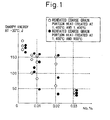
- weld heat-affected zone toughness is explained hereunder. Two-pass welding was applied to various kinds of ultra-high-strength steels and then the toughness at welds and weld heat-affected zones at -20°c was evaluated by applying a Charpy impact test to specimens each of which had a notch at an intersection of outer and inner welds or at a portion 1 mm away from an intersection of the outer and inner welds.
- a mating portion means a point where the beads of double-layer weld intersect with each other on the cross section perpendicular to a welding direction.
- the brittle fracture originated from the following portions: (1) the region from a mating portion to a portion 1 mm away therefrom in a weld heat-affected zone that was heated once to a temperature immediately below the melting point and then reheated to a temperature immediately above the Ac 3 point, (2) the region that was reheated to a temperature immediately below the melting point, and (3) the region that was heated once to a temperature immediately below the melting point.
- the probability of the occurrence of brittle fracture at the respective regions was about 60% in (1), about 30% in (2), and about 10% in (3).
- the result means that toughness at a reheated portion, where grains are coarsened by the influence of the one time heating, must be improved.
- the present inventors confirmed that Nb combined carbonitride existed at the initiation point of the brittle fracture and found the possibility of improving toughness at a weld heat-affected zone, particularly at a reheated coarse grain portion that was influenced twice heat affects, by decreasing an Nb amount.
- the present inventors investigated the influence of Nb on weld heat-affected zone toughness by simulating the influence of heat caused by double layer welding through weld reproducing heat cycle test.
- Steel plates were produced by controlling the addition amounts of the elements other than Nb in the range specified in claim 1 or 2 and varying the Nb amount in the range from 0.001 to 0.04 in terms of mass percent and test pieces were prepared.
- the heat cycle conditions corresponding to 2.5 kJ/mm in terms of heat input were adopted. That is, the first heat treatment was applied to the test pieces under the conditions that a test piece was heated at a heating rate of 100°c/sec.
- test pieces of a standard dimension for v-notch Charpy impact tests were prepared in conformity with JIS Z 2202 and the Charpy impact tests were performed at -40°C in conformity with JIS z 2242.
- the present inventors applied charpy impact tests to base steels at -60°C and precisely investigated the structures in the vicinity of fractured portions of the test pieces that could not achieve the Charpy absorbed energy of not lower than 200 J. As a result of the investigation, it was found that coarse grains 10 to 100 ⁇ m in diameter existed in a structure and they caused the reduction of Charpy absorbed energy.
- the cast structure of a continuously cast casting containing relatively small amount of alloying elements and having a tensile strength of not higher than 800 MPa is generally composed of a composite structure of ferrite and bainite or of ferrite and pearlite.
- new austenite is generated abundantly mainly from ferrite grain boundaries and, when the heating temperature is around 950°C, that is, immediately above the Ac 3 point, the composite structure transforms into grain adjusted austenite about 20 ⁇ m in average grain diameter.
- the structure When a steel plate is produced through succeeding hot rolling, the structure has a finer grain due to recrystallization and becomes an almost uniform grain adjusted structure having austenite grains about 5 ⁇ m in average diameter.
- the present inventors investigated the influence of components on a structure in detail and found that, when an Nb amount was reduced to less than 0.01%, grains after hot rolling became fine and coarse grains partially existing disappeared.
- the effect of the reduction of an Nb amount can be explained as follows.
- the structure of a casting after it is cooled to the room temperature is made to consist of a single phase of coarse bainite (hereunder referred to as "bainite"), the crystal grain diameter of which is not smaller than 1 mm in terms of prior austenite grain diameter, a single phase of martensite (hereunder referred to as “martensite”), or a structure mainly composed of bainite and martensite (hereunder referred to as "bainite and martensite dominant structure”).
- Such a structure contains fine retained austenite in its grains. Note that, though the structures of both bainite and martensite are lath structures and they can hardly be identified with an optical microscope, they can be identified by hardness measurement.
- Nb combined carbide that acts as pinning grains dissolves and the growth of grains generated by ordinary austenite transformation from prior austenite grain boundaries, namely secondary recrystallization, is accelerated, and, by so doing, the size of austenite grains is properly adjusted.
- Nb combined carbide that acts as pinning grains dissolves and the growth of grains generated by ordinary austenite transformation from prior austenite grain boundaries, namely secondary recrystallization, is accelerated, and, by so doing, the size of austenite grains is properly adjusted.
- a casting having such a structure is hot rolled, though the average grain diameter increases to some extent, coarse grains about 50 ⁇ m in size are not observed at all. However, coarse grains smaller than about 20 ⁇ m in size still remain.
- the present inventors found that, even in a casting to which alloying elements with a high hardenability were added relatively abundantly for high-strengthening and which had a single phase of bainite, a single phase of martensite, or a bainite and martensite dominant structure, those being apt to generate coarse austenite grains partially by abnormal ferrite/austenite transformation during heating, it was possible to conspicuously suppress the generation of coarse grains by reducing an Nb amount to less than 0.01%.
- the present inventors succeeded in the development of a high-strength steel as a base steel having excellent low temperature toughness of not lower than 200 J in terms of Charpy absorbed energy when the base steel was subjected to a Charpy impact test in the temperature range from -60°C to lower than -40°C.
- the present inventors investigated the behavior of austenite recrystallization in a steel to which 0.005% Nb was added and a steel to which 0.012% Nb was added, both the steels containing, in mass, 0.05% C, 0.25% Si, 2% Mn, 0.01% P, 0.001% S, 0.5% Ni, 0.1% Mo, 0.015% Ti, 0.0010% B, 0.015% Al, 0.0025% N, 0.5% Cu and 0.5% Cr.
- the recrystallization temperature of either of the steels was in the temperature range from 900°C to 950°C regardless of the addition amount of Nb. and, in a steel to which Mn, Ni, cu, Cr and Mo were added abundantly, the recrystallization temperature did not change regardless of the addition of Nb. Therefore, it was proved that it was not essential to add Nb from the viewpoint of the recrystallization of austenite.
- the present inventors studied the addition amount of elements to enhance hardenability and contrived to secure both strength and low temperature toughness simultaneously by controlling a P value, that was an index of hardenability, in an appropriate range.
- the present inventors succeeded in obtaining a good balance between the target strength and low temperature toughness without the impairment of weld heat-affected zone toughness and weldability on site.
- the lower limit of a C content is set at 0.02% in order to achieve a target strength by making a structure consist of bainite, martensite, or a bainite and martensite dominant structure.
- the upper limit of a C content is set at 0.10%.
- a C content it is preferable to set the upper limit of a C content at 0.07% to further improve low temperature toughness.
- strength is too high, the shape of a steel pipe may be impaired after pipe expansion and the roundness may deteriorate, and therefore it is preferable to control the C content to less than 0.05%.
- roundness is obtained by measuring the diameter of a steel pipe at plural portions, for example measuring the diameter passing through the center of a steel pipe at four portions apart from the seam-weld at an every angle of 45 degrees, calculating the average value, deducting the minimum diameter from the maximum diameter, and then dividing the deduction by the average value.
- Si has the function of deoxidation and the effect of enhancing strength. However, when Si is added excessively, weld heat-affected zone toughness and weldability on site are remarkably deteriorated and therefore the upper limit of an Si content is set at 0.8%. A preferable upper limit of an Si amount is 0.6%.
- Al and Ti also have the function of deoxidation, like Si, in a steel according to the present invention, it is preferable to adjust an Si content according to the contents of Al and Ti.
- the lower limit of an Si content is not particularly specified but Si is generally contained by not less than about 0.01% as an impurity in a steel.
- Mn is an indispensable element for making the microstructure of a steel according to the present invention consist of a bainite and martensite dominant structure and securing a good balance between strength and low temperature toughness, and thus the lower limit of an Mn content is set at 1.5%
- the upper limit of an Mn content is set at 2.5%.
- center segregation means the state wherein the segregation of components generated caused by solidification in the vicinity of the center of a casting in a casting process does not disappear even after being subjected to the subsequent processes and remains in the vicinity of the center of the thickness of the steel plate.
- P and S are inevitably included impurity elements.
- P accelerates center segregation and, at the same time, improves low temperature toughness by intergranular fracture.
- S lowers ductility and toughness by the influence of MnS, that elongates during hot rolling, in a steel. Therefore, in the present invention, the upper limits of a P content and an S content are set at 0.015% and 0.003% respectively for further improving low temperature toughness and weld heat-affected zone toughness.
- P and S are impurities and the lower limits of their contents are about 0.003% and 0.0001% respectively under current technology. Further it is possible to suppress the precipitation of sulfide such as Mns in a steel by restricting an S content to not more than 0.001%. For that reason, it is preferable to restrict an S content to not more than 0.001% for suppressing the deterioration of ductility and toughness.
- Ni compared with Mn, Cr or Mo, is able to reduce a formation of a hardened structure which is harmful to low temperature toughness at a center segregation zone formed at hot rolling.
- Ni is also effective to increase toughness at weld heat-affected zone. Since the effects are insufficient with an Ni content of less than 0.01%, the lower limit thereof is set at 0.01%. Further, it is preferable to set the lower limit of an Ni content at 0.3% for the improvement of weld heat-affected zone toughness.
- the upper limit of an Ni content is set at 2.0%.
- the addition of Ni is also effective in the prevention of surface cracks caused by Cu during continuous casting and hot rolling. when Ni is added for that purpose, it is preferable to add Ni to not less than one-third of the Cu content.
- Mo is added for improving the hardenability of a steel and obtaining bainite, martensite, or a bainite and martensite dominant structure, those being excellent in a balance between strength and low temperature toughness.
- the effects are enhanced further by adding Mo in combination with the addition of B.
- Mo in combination with the addition of B.
- the effects of suppressing the recrystallization of austenite during controlled rolling and thus fining an austenite structure are obtained.
- the lower limit of an Mo content is set at 0.2% in the case of a steel to which B is not added, and the same is set at 0.1% in the case of a steel to which B is added.
- the upper limit of an Mo content is set at 0.8%.
- a preferable upper limit of an Mo content is 0.6%.
- Nb suppresses the recrystallization of austenite during controlled rolling, makes an austenite structure fine by the precipitation of carbonitride, and also concernses to the improvement of hardenability.
- the effect of the improvement of hardenability by the addition of Nb is synergistically enhanced by its coexistence with B.
- Nb is added to not less than 0.01%, coarse grains are partially generated, thus a percent fracture in an impact test is lowered and weld heat-affected zone toughness is deteriorated when double or more layer welding is applied. Further, in that case, weldability at a site is also deteriorated.
- the upper limit of an Nb content is set at less than 0.01%.
- Ti forms fine nitride in a steel and suppresses the coarsening of austenite during reheating. Further, in a B added steel, Ti reduces dissolved N that is harmful to the improvement of hardenability by fixing N as nitride and thus improves hardenability further. Furthermore, when an Al content is not more than 0.005%, Ti forms an oxide in a steel. The Ti oxide functions as intragranular transformation product nuclei at a weld heat-affected zone and thus makes the structure of the weld heat-affected zone fine. It is preferable to set the lower limit of a Ti content to 0.001% for securing the aforementioned effects of Ti addition.
- the lower limit of a Ti content it is preferable to regulate the lower limit of a Ti content to not less than 3.4N for stably obtaining the effects caused by the formation of nitride and the fixation of dissolved N.
- an addition amount of Ti is excessive, nitride coarsens, fine carbide is generated, precipitation hardening occurs and, therefore, weld heat-affected zone toughness is deteriorated.
- the upper limit of a Ti content is set at 0.030%.
- Al is added in a steel as a deoxidizer and also has the function of fining a structure.
- the Al content exceeds 0.1%, nonmetallic inclusions of an aluminium oxide system increase, thus the cleanliness of a steel is impaired, and also the toughness of a steel material and at a weld heat-affected zone is deteriorated.
- the upper limit of an Al content is set at 0.1%.
- a preferable upper limit thereof is 0.07% and the optimum Al content is not more than 0.06%.
- Si and Ti also have the same function of deoxidation as Al has, in a steel according to the present invention, it is preferable to control an A1 content in consideration of the contents of Si and Ti.
- the lower limit of an Al content is not specified, but Al is usually contained at not less than 0.005%.
- the upper limit of an N content is set at 0.008%.
- a preferable upper limit of an N content is 0.006%.
- the lower limit of an N content is not specified because the lower the N content, the better, but N is usually contained at about 0.003% as an impurity.
- a steel according to the present invention contains the components explained above as basic components.
- one or more of B, V, Cu, Cr, Ca, REM and Mg may be added to the contents specified below.
- B is an element effective in enhancing the hardenability of a steel by adding a trace amount of B and in obtaining a bainite and/or martensite dominant structure that is one of the objects of the present invention. Further, B enhances the effect of Mo in improving the hardenability of a steel according to the present invention and accelerates the effect of improving hardenability synergistically by the coexistence of B with Nb. Those effects are not secured when the B content is less than 0.0003%. Therefore, the lower limit of a B content is set at 0.0003%.
- the upper limit of a B content is set at 0.0030%.
- V has almost the same function as Nb has. Though the effects of V are weaker than those of Nb with a single addition of V, the coexistence of v with Nb further enhances the effects of improving low temperature toughness and weld heat-affected zone toughness. Since those effects are insufficient with a V content of less than 0.001%, it is preferable to set the lower limit thereof to 0.001%.
- weld heat-affected zone toughness particularly weld heat-affected zone toughness when double or more layer welding is applied, is deteriorated, coarse grains caused by abnormal ferrite/austenite transformation during heating for hot rolling are generated, thus low temperature toughness is deteriorated and, further, weldability on site is impaired.
- a still preferable upper limit of a V content is 0.1%.
- Cu and Cr are elements that enhance strength of a base steel and at a weld heat-affected zone, and it is necessary to contain them at not less than 0.01% respectively to obtain those effects.
- the content of Cu or Cr is excessive, weld heat-affected zone toughness and weldability on site are deteriorated considerably. Therefore, each of the upper limits of the contents of Cu and Cr is set at 1.0%.
- Ca and REM have the functions of controlling the shape of sulfide such as MnS in a steel and improving the low temperature toughness of the steel. It is preferable to set each of the lower limits of the contents of Ca and REM at 0.0001%. On the other hand, if Ca is added in excess of 0.01% or REM in excess of 0.02%, Cao-Cas or REM-Cas is generated in large quantities, which forms large clusters and large inclusions and, thus, the cleanliness of a steel is impaired and weldability on site is deteriorated. For those reasons, it is preferable to set the upper limits of the contents of Ca and REM at 0.01% and 0.02% respectively. Further, a still preferable upper limit of a Ca content is 0.006%.
- Mg has the functions of forming finely dispersed oxide, suppressing the coarsening of austenite grains at a weld heat-affected zone, and thus improving low temperature toughness.
- the lower limit of an Mg content is set at 0.0001% for securing those effects.
- the upper limit of an Mg content is set at 0.006%.
- the present invention regulates a P value, that is an index of hardenability within an appropriate range, to obtaining an excellent balance between strength and low temperature toughness.
- a P value is less than 1.9 in a steel without B addition or less than 2.5 in a steel with B addition, tensile strength of not lower than 800 MPa is not obtained, and therefore those values are determined to be the lower limits in respective steels.
- a P value exceeds 4.0 in either of the steels weld heat-affected zone toughness and weldability at a site are deteriorated, and therefore the value is determined to be the upper limit in either of the steels.
- an adequate range of a P value is determined to be: from 1.9 to 4.0, preferably from 1.9 to 3.5, in a steel without B addition; and from 2.5 to 4.0 in a steel with B addition.
- a bainite and martensite fraction is in the range from 90 to 100% is defined by the following two conditions.
- tensile strength and a C amount satisfy the following expression: 0.7 x (3,720C + 869) ⁇ TS, wherein TS is tensile strength [in terms of MPa] of a steel obtained and C is a C amount [in terms of mass percent],
- prior austenite is required to consist of unrecrystallized austenite and also the average grain diameter thereof is limited to not larger than 10 ⁇ m.
- the diameter of prior austenite grains means the diameter of grains including a deformation band and a twin boundary that have the same function as an austenite grain boundary.
- the diameter of prior austenite grains is determined, for example in conformity with JIS G 0551, by dividing the full length of a straight line drawn in the direction of the steel sheet thickness by the number of the points where the straight line intersects with the grain boundaries of the prior austenite existing on the straight line, by using an optical micrograph.
- the lower limit of the average diameter of prior austenite grains is not specified, but the detectable lower limit is about 1 ⁇ m according to a test with an optical micrograph.
- a preferable range of a prior austenite grain diameter is from 3 to 5 ⁇ m.
- a reheating temperature is determined to be in a temperature range wherein the structure of a casting substantially consists of a single austenite phase, namely the Ac 3 point is determined to be the lower limit of a reheating temperature.
- a reheating temperature exceeds 1,300°C, crystal grains coarsen and, therefore, it is preferable to limit a reheating temperature to not higher than 1,300°C. with regard to rolling after the reheating, it is preferable to firstly carry out recrystallization rolling and secondly carry out unrecrystallization rolling.
- a recrystallization temperature varies according to steel components, it is in the range from 900°C to the reheating temperature, and therefore the preferable temperature range during recrystallization rolling is from 900°C to 1,100°C and the preferable temperature range during unrecrystallization rolling is from 750°c to 880°c.
- cooling is applied at a cooling rate of not lower than l°C/sec. up to an arbitrary temperature of not higher than 550°C.
- the upper limit of a cooling rate is not particularly specified, but a preferable range thereof is from 10 to 40°C/sec.
- the lower limit of a cooling end temperature is neither particularly specified, but a preferable range thereof is from 200°C to 450°C.
- an ultra-high-strength steel sheet excellent in low temperature toughness can be obtained. Further, by cold-forming the hot-rolled steel plate into a pipe and thereafter applying double or more layer seam welding to an abutted portion, an ultra-high-strength steel pipe excellent in low temperature toughness and weld heat-affected zone toughness can be produced. That is, by the present invention, it is made possible to mitigate welding conditions in the production of a steel pipe having such a sheet thickness when double or more layer welding is required, It is preferable to employ arc welding, particularly submerged arc welding, for seam welding.
- the size of a high-strength steel pipe used for a line pipe according to the present invention is usually about 450 to 1,500 mm in diameter and about 10 to 40 mm in wall thickness.
- the production method preferably includes the processes of: producing a pipe in a UO process where a steel plate is formed into a U-shape and then into an o-shape; tack-welding the abutted portion; thereafter applying submerged arc welding from the inner and outer sides, and thereafter securing roundness by pipe expansion.
- Submerged arc welding is the one wherein the dilution of a weld metal by a base steel is large. Therefore, for controlling the chemical components of a weld metal in a range wherein desired properties are obtained, it is necessary to select a weld material in consideration of the dilution by a base steel.
- welding may be carried out by using: a weld wire containing Fe as the main component, 0.01 to 0.12% C, not more than 0.3% si, 1.2 to 2.4% Mn, 4.0 to 8.5% Ni, and 3.0 to 5.0 % Cr + Mo + V; and a flux of a agglomerated type or a fused type.
- the ratio of dilution by a base steel varies depending on welding conditions, particularly a weld heat input, and, in general, the ratio of dilution by a base steel increases with the increase of a heat input. However, under the condition of slow welding speed, the ratio of dilution by a base steel does not increase even when a heat input increases. For securing sufficient weld penetration when one pass welding is applied to an abutted portion from the outer side and the inner side thereof, it is preferable to limit a heat input and a welding speed to the following ranges.
- a heat input When a heat input is less than 2.5 kJ/mm, weld penetration decreases but, on the other hand, when a heat input is larger than 5.0 kJ/mm, a weld heat-affected zone softens and weld heat-affected zone toughness somewhat deteriorates. Therefore, it is preferable to limit a heat input in the range from 2.5 to 5.0 kJ/mm.
- a welding speed is lower than 1 m/min.
- the welding work is somewhat inefficient as seam welding for a line pipe but, on the other hand, when a welding speed exceeds 3 m/min., a bead shape is hardly stable. Therefore, it is preferable to limit a welding speed in the range from 1 to 3 m/mm.
- Roundness can be improved by applying pipe expansion after seam welding. It is preferable to set a pipe expansion rate at not less than 0.7% for improving roundness by applying plastic deformation. On the other hand, if a pipe expansion rate exceeds 2%, the toughness of both a base steel and a weld deteriorates to some extent caused by plastic deformation. For those reasons, it is preferable to determine a pipe expansion rate to be in the range from 0.7 to 2%.
- a pipe expansion rate is defined by the value obtained by subtracting a circumference before pipe expansion from a circumference after pipe expansion, dividing the resulting value by the circumference before pipe expansion, and expressing the resulting value as a percentage.
- a massive mixture of martensite and austenite (referred to as "MA") generated at a weld heat-affected zone can be decomposed into a bainite and martensite dominant structure and fine hard cementite and, therefore, weld heat-affected zone toughness improves.
- MA martensite and austenite
- a heating temperature exceeds 500°C, a base steel softens.
- the influence of time is not large, it is preferable that the time is about 30 seconds to 60 minutes. A preferable range thereof is about 30 seconds to 50 minutes.
- a processing strain converging at the toe of a weld recovers and thus weld heat-affected zone toughness improves.
- an MA formed at a weld heat-affected zone is entirely composed of a white massive substance.
- an MA is heated to 300°C to 500°C, it is decomposed into a bainite and martensite dominant structure having fine precipitates in the grains and cementite, and these can be distinguished from the MA.
- an MA can be distinguished from another MA decomposed into a bainite and martensite dominant structure and cementite by judging whether or not fine precipitates exist in grains.
- a weld heat-affected zone is the area within about 3 mm from an intersection of a weld metal and a base steel and therefore it is preferable to heat at least the area including a base steel within 3 mm from an intersection of a weld metal and a base steel.
- a gas burner of a radiation type or an induction heater can be adopted for the heating of a seam weld.
- the present invention makes it possible to produce an ultra-high-strength steel plate having a tensile strength of not lower than 800 MPa and a steel pipe made thereof: the steel plate being excellent in weld heat-affected zone toughness when double or more layer welding is applied; Charpy absorbed energy of the base steel in the temperature range of not higher than -40°C being not lower than 200 J on the average and little dispersing; the steel plate having excellent low temperature toughness; and further the steel plate being excellent in weldability at a site.
- the steel plate and the steel pipe for a line pipe for the transport of natural gas or crude oil, a steel plate for water pumping, a pressure vessel, a welded structure or the like, these being used in harsh environments.
- An average diameter of prior austenite grains was obtained by the straight line crossing segment method in the thickness direction conformity with JIS G 0551.
- a bainite and martensite fraction was obtained by the following procedures. To begin with, it was confirmed that polygonal ferrite was not generated by observing a structure in an optical micrograph in conformity with JIS G 0551. Then, the Vickers hardness was measured imposing a weight of 1 Kg and the measured value was defined as Hv BM in conformity with JIS Z 2244.
- a bainite and martensite fraction F BM 100 x (1/3 x ⁇ BM + 2/3).
- Yield strength and tensile strength in the direction of the rolling of a steel plate (hereunder referred to as "L direction”) and in the direction perpendicular to the rolling direction (hereunder referred to as "C direction”) were evaluated by the API full thickness tensile test.
- a charpy impact test was carried out at -40°C with the test repetition frequency n being three in conformity with JIS Z 2242 by using V-notched test pieces of a standard size, the length of the test pieces being in the L and C directions, prepared in conformity with JIS Z 2202.
- a Charpy absorbed energy was evaluated as the average of the values obtained by the three repeated measurements.
- Weld heat-affected zone toughness was evaluated by subjecting a specimen to heat treatments corresponding to welding twice, each welding having a heat input of 2.5 kJ/mm, using a weld reproducing heat cycle test apparatus. That is, the first heat treatment was applied to a specimen under the conditions that the specimen was heated at a heating rate of 100° C/sec. to a temperature of 1,400°C, retained at the temperature for one second, and thereafter cooled at a cooling rate of 15°C/sec. in the temperature range from 500°C to 800°C, and, in addition to that, the second heat treatment was applied thereto under the conditions that the heating temperature was set at 1,400°C or 900°C with the conditions of heating rate, retention time, cooling temperature and cooling rate being identical to the first heat treatment.
- V-notched test pieces of standard dimension were prepared in conformity with JIS Z 2202, and the Charpy impact test was applied to the test pieces at -30°C with the repetition frequency n being three in conformity with JIS Z 2242, and Charpy absorbed energy was evaluated by the average of the values obtained by the three repeated measurements.
- Steels A to E are the ones that contain components within the ranges specified in the present invention and fulfill the target levels of strength, low temperature toughness and weld heat-affected zone toughness.
- steel F has a C amount and steel I an Mn amount smaller than those in the ranges specified in the present invention and therefore the strength is low.
- Steel G has a C amount, steel H an Si amount, steel J an Mn amount, and steel K an Mo amount larger than those in the ranges specified in the present invention and therefore low temperature toughness, low temperature toughness reliability and weld heat-affected zone toughness are deteriorated.
- Steel L has an Nb amount larger than that in the range specified in the present invention, and therefore, though the Charpy absorbed energy at -40°C is good, low temperature toughness reliability and weld heat-affected zone toughness are deteriorated.
- Steel M has a still larger Nb amount than steel L and therefore low temperature toughness, low temperature toughness reliability and weld heat-affected zone toughness are deteriorated.
- Steels N, o, p and R have a Ti amount, a V amount, an N amount and an S amount, respectively, larger than those in the ranges specified in the present invention, and therefore, low temperature toughness, low temperature toughness reliability and weld heat-affected zone toughness are deteriorated.
- Steel Q has an Al amount larger than that in the range specified in the present invention and therefore weld heat-affected zone toughness is deteriorated.
- Chemical components (mass percent), Ceq and Pcm of steel material Steel Chemical components (mass percent) C Si Mn P S Ni Mo Nb Ti Al N A 0.03 0.10 1.95 0.005 0.0005 0.50 0.30 0.005 0.008 0.015 0.0023 B 0.05 0.25 1.85 0.008 0.0006 0.90 0,45 0.007 0.005 0.020 0.0015 C 0.04 0.15 1.90 0.003 0.0008 2.00 0.20 0.009 0.010 0.0081 0.0030 D 0.06 0.25 1.90 0.004 0.0003 1.80 0,40 0.003 0.009 0.010 0.0025 E 0.05 0.10 1.96 0.004 0.0010 1.00 0.10 0.009 0.005 0.020 0.0015 F 0.01 0.25 1.85 0.005 0.0010 1.20 0.35 0.004 0.011 0.015 0.0032 G 0.15 0.15 1.
- tensile properties of each of the steels were evaluated by the API full thickness tensile test.
- Low temperature toughness was evaluated, as in Example 1, by the average value of absorbed energy and the low temperature toughness reliability of a Charpy impact test piece prepared so that the length thereof may be in the C direction.
- weld heat-affected zone toughness was evaluated by subjecting a test piece having a notch at an intersection or a portion 1 mm apart from an intersection to another Charpy impact test at -30°C.
- the tensile strength of the base steel is not lower than 800 MPa, the toughness of the base steel is extremely good; the Charpy absorbed energy at -40°C is not lower than 200 J and the low temperature toughness reliability is not less than 85%. with respect to a weld heat-affected zone, the Charpy absorbed energy at -30°C is not lower than 100 J and the weld heat-affected zone toughness is also excellent.
- Example 1 In the same manner as Example 1, castings were produced from a steel containing chemical components of steel A shown in Tables 1 and 2 and, thereafter, the castings were hot rolled under the conditions shown in Table 5 and cooled and, by so doing, steel plates 10 to 20 mm in thickness were produced. In the same manner as Example 1, an average diameter of prior austenite grains and a bainite and martensite fraction were obtained, and tensile properties were evaluated by the API full thickness tensile test. Low temperature toughness was evaluated, as for Example 1/ by the average value of absorbed energy and the low temperature toughness reliability of a Charpy impact test piece prepared so that the length thereof may be in the C direction. Weld heat-affected zone toughness was evaluated by subjecting a test piece to a weld-reproducing heat cycle test and then a Charpy impact test at -30°C.
- the tensile strength of the base steel is not lower than 800 MPa, with respect to the toughness of the base steel, the Charpy absorbed energy at -40°c is not lower than 200 J and the low temperature toughness reliability is not less than 85% and, with respect to the weld heat-affected zone, the Charpy absorbed energy at - 30°C is not lower than 100 J and, therefore, an ultra-high-strength steel plate excellent in weld heat-affected zone toughness is obtained. Further, steels 27 and 28 produced under the conditions in the ranges specified in claim 6 have more excellent low temperature toughness reliability than steels 24 to 26 produced under conditions different from those specified in claim 6.
- Yield strength and tensile strength in the C direction of a steel sheet were evaluated by the APT full thickness tensile test.
- a Charpy absorbed energy was evaluated by carrying out a Charpy impact test at -40°C with the test repetition frequency n being three in conformity with JIS Z 2242 by using V-notched test pieces of a standard size, the length of the test pieces being in the C direction, prepared in conformity with JIS Z 2202.
- Weld heat-affected zone toughness was evaluated in the same manner as Example 1.
- specimens were subjected to heat treatment twice, then heated to 350°C and held for five minutes at the temperature.
- TS/0.7(3,720C + 869) was calculated from a value of tensile strength and a C amount. when a bainite and martensite fraction is within the range from 90 to 100%, the following expression is satisfied; TS/(3,720C + 869) > 0.7, wherein TS is tensile strength of a steel obtained (in terms of MPa) and C is a C amount (in terms of mass percent).
- steels AA to AF, AH, AJ, AK, and AP to AR are the ones that contain components within the ranges specified in the present invention, and have the target levels of strength, low temperature toughness and weld heat-affected zone toughness.
- steel AG has a C amount larger than that in the range specified in the present invention and therefore the low temperature toughness of the base steel and the weld heat-affected zone toughness are deteriorated.
- steel AI has an Mn amount smaller than that in the range specified in the present invention and therefore the microstructure does not consist of a bainite and martensite dominant structure and the strength and the low temperature toughness are deteriorated.
- Steels AL and AM have an Nb amount and steel AN a Ti amount larger than those in the ranges specified in the present invention and, therefore, coarse crystal grains are partially generated, the Charpy absorbed energy of the base steel is deteriorated in some of the test pieces, and also the weld heat-affected zone toughness is deteriorated.
- Steel AO has a P value smaller than that in the range specified in the present invention and therefore the tensile strength is deteriorated.
- the steel plates containing the chemical components of steels AA to AE shown in Table 7 were produced in the same manner as Example 4, then formed into pipes in a UO process, and subjected to submerged arc welding at a heat input of 2.0 to 3.0 kJ/mm on each of the inner surfaces and at a heat input of 2.0 to 3.0 kJ/mm on each of the outer surfaces. Subsequently, some of the steel pipes were heated to 350°C at the seam welds by induction heating and then held for five minutes, and thereafter cooled to the room temperature and subjected to pipe expansion, while some of the steel pipes were subjected to pipe expansion without heating the seam welds.
- Example 4 For investigating the mechanical properties of the base steels of those steel pipes, in the same manner as in Example 4, an API full thickness tensile test and a Charpy impact test were carried out, the Charpy impact test being carried out at -40°C using test pieces having the length in the C direction.
- the Charpy absorbed energy was obtained by measuring it with the repetition frequency n being three and averaging the three measured values.
- weld heat-affected zone toughness was obtained by carrying out another Charpy impact test at -30°C with the repetition frequency n being three using test pieces each having a notch at an intersection or a portion 1 mm apart from an intersection and then averaging the resulting values.
- the tensile strength of the base steel is not lower than 900 MPa and, with respect to the toughness of the base steel, the Charpy absorbed energy at -40°C is not lower than 200 J, and with respect to the toughness at the weld heat-affected zone, the Charpy absorbed energy at -30°C is not lower than 100 J. Therefore, high-strength steel pipes excellent in the low temperature toughness of the base steel and weld heat-affected zone toughness are obtained.
Landscapes
- Chemical & Material Sciences (AREA)
- Engineering & Computer Science (AREA)
- Materials Engineering (AREA)
- Mechanical Engineering (AREA)
- Metallurgy (AREA)
- Organic Chemistry (AREA)
- Crystallography & Structural Chemistry (AREA)
- Physics & Mathematics (AREA)
- Thermal Sciences (AREA)
- Manufacturing & Machinery (AREA)
- Heat Treatment Of Steel (AREA)
- Heat Treatment Of Articles (AREA)
- Arc Welding In General (AREA)
- Butt Welding And Welding Of Specific Article (AREA)
Applications Claiming Priority (4)
| Application Number | Priority Date | Filing Date | Title |
|---|---|---|---|
| JP2002152379 | 2002-05-27 | ||
| JP2002152379 | 2002-05-27 | ||
| JP2002377829 | 2002-12-26 | ||
| JP2002377829A JP3968011B2 (ja) | 2002-05-27 | 2002-12-26 | 低温靱性および溶接熱影響部靱性に優れた高強度鋼とその製造方法および高強度鋼管の製造方法 |
Publications (3)
| Publication Number | Publication Date |
|---|---|
| EP1375681A2 true EP1375681A2 (fr) | 2004-01-02 |
| EP1375681A3 EP1375681A3 (fr) | 2004-02-11 |
| EP1375681B1 EP1375681B1 (fr) | 2012-09-19 |
Family
ID=29718393
Family Applications (1)
| Application Number | Title | Priority Date | Filing Date |
|---|---|---|---|
| EP03011866A Expired - Lifetime EP1375681B1 (fr) | 2002-05-27 | 2003-05-26 | Acier à haute résistance et tenacité éléveés, procédé pour sa fabrication et procédé de fabrication des tubes d'acier à haute résistance et tenacité éléveés |
Country Status (6)
| Country | Link |
|---|---|
| US (1) | US7601231B2 (fr) |
| EP (1) | EP1375681B1 (fr) |
| JP (1) | JP3968011B2 (fr) |
| KR (1) | KR100524331B1 (fr) |
| CA (1) | CA2429439C (fr) |
| RU (1) | RU2258762C2 (fr) |
Cited By (15)
| Publication number | Priority date | Publication date | Assignee | Title |
|---|---|---|---|---|
| EP1746175A4 (fr) * | 2004-05-11 | 2007-07-04 | Sumitomo Metal Ind | Tube d"acier uoe d"ultrahaute résistance et procédé de fabrication de celui-ci |
| CN1330786C (zh) * | 2005-12-27 | 2007-08-08 | 东北大学 | 一种抗拉强度780MPa级复相钢板及制造方法 |
| EP2036995A4 (fr) * | 2006-07-04 | 2010-09-08 | Nippon Steel Corp | Tuyau en acier à haute résistance présentant une excellente dureté à basse température pour tuyau de revetement, tole en acier à haute résistance pour tuyau de revetement et procédé pour les fabriquer |
| EP2028284A4 (fr) * | 2006-03-28 | 2010-12-22 | Nippon Steel Corp | Tuyau en acier sans soudure hautement resistant avec une tenacite et une soudabilite excellentes pour structure mecanique et procede de fabrication de celui-ci |
| EP2267177A4 (fr) * | 2008-09-17 | 2011-06-22 | Nippon Steel Corp | Tôle d'acier à haute résistance et son procédé de fabrication |
| EP2105513A4 (fr) * | 2006-12-04 | 2011-06-29 | Nippon Steel Corp | Tube d'acier soudé possédant une excellente résistance à basse température pour tuyau de canalisation à paroi mince de résistance élevée et procédé de production de ce tube |
| CN102618799A (zh) * | 2012-03-22 | 2012-08-01 | 宝山钢铁股份有限公司 | 低碳当量80公斤级高性能调质钢板及其制造方法 |
| CN102994876A (zh) * | 2012-12-21 | 2013-03-27 | 首钢总公司 | 一种油气管道加压站场用热轧钢板及其生产方法 |
| US8500924B2 (en) | 2008-11-11 | 2013-08-06 | Nippon Steel & Sumitomo Metal Corporation | High-strength steel plate and producing method therefor |
| EP2434027A4 (fr) * | 2009-05-22 | 2014-01-22 | Jfe Steel Corp | Matériau en acier apte au soudage avec un apport calorifique élevé |
| CN103526120A (zh) * | 2013-09-25 | 2014-01-22 | 安徽宏源线路器材有限公司 | 输电铁塔用耐低温冲击角钢 |
| EP2436797A4 (fr) * | 2009-05-27 | 2014-06-11 | Nippon Steel & Sumitomo Metal Corp | Tôle d'acier à haute résistance, tôle d'acier métallisée par immersion à chaud et tôle d'acier immergée à chaud dans un alliage qui présente d'excellentes caractéristiques de fatigue, d'allongement et au choc et procédé de fabrication pour lesdites tôles d'acier |
| US8974610B2 (en) | 2010-02-04 | 2015-03-10 | Nippon Steel & Sumitomo Metal Corporation | High-strength welded steel pipe and method for producing the same |
| EP3421630A4 (fr) * | 2016-02-25 | 2019-01-02 | The Japan Steel Works, Ltd. | Cuivre faiblement allié à teneur en cu présentant un excellent équilibre entre résistance et ténacité à basse température et son procédé de production |
| EP4116444A1 (fr) * | 2021-07-08 | 2023-01-11 | SSAB Technology AB | Produit d'acier laminé à chaud résistant aux intempéries et son procédé de fabrication |
Families Citing this family (83)
| Publication number | Priority date | Publication date | Assignee | Title |
|---|---|---|---|---|
| US6892926B2 (en) * | 2002-10-11 | 2005-05-17 | Exxonmobil Upstream Research Company | Toughness-optimized weld joints and methods for producing said weld joints |
| KR20080082015A (ko) * | 2003-12-19 | 2008-09-10 | 신닛뽄세이테쯔 카부시키카이샤 | 초고강도 라인파이프용 강판 및 우수한 저온 인성을 갖는 초고강도 라인파이프, 및 그 제조 방법 |
| JPWO2006049036A1 (ja) * | 2004-11-05 | 2008-05-29 | 住友金属工業株式会社 | 高強度溶接鋼管 |
| KR20090004840A (ko) * | 2005-10-24 | 2009-01-12 | 엑손모빌 업스트림 리서치 캄파니 | 낮은 항복 비, 높은 인성 및 탁월한 용접성을 갖는 고강도복합조직 강 |
| JP4778779B2 (ja) * | 2005-11-04 | 2011-09-21 | 株式会社神戸製鋼所 | 溶接熱影響部の低温靭性に優れた高張力鋼板 |
| KR100711371B1 (ko) * | 2005-12-20 | 2007-04-30 | 주식회사 포스코 | 극저온 인성이 우수한 라인파이프용 후강판 및 그 제조방법 |
| KR100723156B1 (ko) | 2005-12-23 | 2007-05-30 | 주식회사 포스코 | 변형능 및 취성파괴 정지 특성이 우수한 항복강도552MPa 급 라인파이프용 후강판 및 그 제조방법 |
| EP1995339B1 (fr) * | 2006-03-16 | 2017-10-18 | Nippon Steel & Sumitomo Metal Corporation | Tole d'acier pour soudage a l'arc sous flux en poudre |
| JP4969915B2 (ja) * | 2006-05-24 | 2012-07-04 | 新日本製鐵株式会社 | 耐歪時効性に優れた高強度ラインパイプ用鋼管及び高強度ラインパイプ用鋼板並びにそれらの製造方法 |
| KR101111023B1 (ko) * | 2006-07-13 | 2012-02-13 | 수미도모 메탈 인더스트리즈, 리미티드 | 벤드관 및 그 제조 방법 |
| RU2337976C2 (ru) * | 2006-09-01 | 2008-11-10 | Федеральное Государственное Унитарное Предприятие "Центральный Научно-Исследовательский Институт Конструкционных Материалов "Прометей" (Фгуп "Цнии Км "Прометей") | Способ производства листов из хладостойкой стали |
| KR100851189B1 (ko) * | 2006-11-02 | 2008-08-08 | 주식회사 포스코 | 저온인성이 우수한 초고강도 라인파이프용 강판 및 그제조방법 |
| BRPI0718935B1 (pt) * | 2006-11-30 | 2016-08-23 | Nippon Steel & Sumitomo Metal Corp | tubos soldados para tubulação de alta resistência superior em tenacidade à baixa temperatura e método de produção dos mesmos. |
| WO2008069289A1 (fr) | 2006-11-30 | 2008-06-12 | Nippon Steel Corporation | Tube en acier soudé présentant une excellente ténacité à basse température pour tuyauterie de grande résistance et son procédé de fabrication |
| RU2368692C2 (ru) * | 2006-12-20 | 2009-09-27 | Ниппон Стил Корпорейшн | Сталь, обладающая отличной ударной вязкостью в зоне термического влияния нагрева при сварке |
| RU2336320C1 (ru) * | 2006-12-25 | 2008-10-20 | Открытое акционерное общество "Оскольский электрометаллургический комбинат" | Трубная заготовка из микролегированной стали |
| RU2338807C1 (ru) * | 2007-03-05 | 2008-11-20 | Юлия Алексеевна Щепочкина | Сталь |
| US8361248B2 (en) | 2007-12-07 | 2013-01-29 | Nippon Steel Corporation | Steel superior in CTOD properties of weld heat-affected zone and method of production of same |
| KR100957990B1 (ko) * | 2007-12-24 | 2010-05-17 | 주식회사 포스코 | 항복강도와 저온인성이 우수한 고강도 강판 및 그 제조방법 |
| KR100957961B1 (ko) * | 2007-12-26 | 2010-05-17 | 주식회사 포스코 | 용접부 인성이 우수한 고강도 라인파이프 강재 및 그제조방법 |
| RU2361960C1 (ru) * | 2008-06-16 | 2009-07-20 | Юлия Алексеевна Щепочкина | Сталь |
| RU2361957C1 (ru) * | 2008-06-16 | 2009-07-20 | Юлия Алексеевна Щепочкина | Сталь |
| RU2384646C1 (ru) * | 2008-07-08 | 2010-03-20 | Открытое акционерное общество "Магнитогорский металлургический комбинат" | Низколегированная горячекатаная листовая сталь |
| EP2309014B1 (fr) * | 2008-07-31 | 2013-12-25 | JFE Steel Corporation | Tôles d'acier épaisses laminées à chaud présentant une résistance élevée à la traction et une excellente résistance à basse température, et procédé de production de celles-ci |
| WO2010047416A1 (fr) * | 2008-10-23 | 2010-04-29 | 新日本製鐵株式会社 | Plaque épaisse en acier à haute résistance à la traction présentant une excellente aptitude au soudage et une résistance à la traction de 780 mpa ou plus, et procédé de fabrication de celle-ci |
| JP4819185B2 (ja) * | 2008-11-06 | 2011-11-24 | 新日本製鐵株式会社 | 超高強度ラインパイプ用鋼板および鋼管の製造方法 |
| RU2458996C1 (ru) * | 2008-11-06 | 2012-08-20 | Ниппон Стил Корпорейшн | Способ получения толстолистовой стали и стальных труб для ультравысокопрочного трубопровода |
| JP4819186B2 (ja) * | 2008-11-07 | 2011-11-24 | 新日本製鐵株式会社 | 超高強度ラインパイプ用鋼板および鋼管の製造方法 |
| JP4853575B2 (ja) * | 2009-02-06 | 2012-01-11 | Jfeスチール株式会社 | 耐座屈性能及び溶接熱影響部靭性に優れた低温用高強度鋼管およびその製造方法 |
| RU2382827C1 (ru) * | 2009-03-13 | 2010-02-27 | Юлия Алексеевна Щепочкина | Сталь |
| KR101040062B1 (ko) * | 2009-03-16 | 2011-06-09 | 주식회사 엘파니 | 멤브레인 스위치 |
| RU2458174C1 (ru) | 2009-05-19 | 2012-08-10 | Ниппон Стил Корпорейшн | Сталь для сварных конструкций и способ ее получения |
| TWI365915B (en) | 2009-05-21 | 2012-06-11 | Nippon Steel Corp | Steel for welded structure and producing method thereof |
| JP5439973B2 (ja) * | 2009-06-22 | 2014-03-12 | Jfeスチール株式会社 | 優れた生産性と溶接性を兼ね備えた、pwht後の落重特性に優れた高強度厚鋼板およびその製造方法 |
| RU2420603C1 (ru) * | 2009-09-11 | 2011-06-10 | Открытое акционерное общество "Северсталь" (ОАО "Северсталь") | Штрипсовая сталь и изделие, выполненное из нее |
| CN102549189B (zh) * | 2009-09-30 | 2013-11-27 | 杰富意钢铁株式会社 | 具有低屈服比、高强度以及高韧性的钢板及其制造方法 |
| RU2478133C1 (ru) * | 2009-10-28 | 2013-03-27 | Ниппон Стил Корпорейшн | Стальной лист для производства магистральной трубы с превосходной прочностью и пластичностью и способ изготовления стального листа |
| JP6027302B2 (ja) * | 2009-12-22 | 2016-11-16 | 株式会社神戸製鋼所 | 高強度焼戻し省略ばね用鋼 |
| WO2011090205A1 (fr) * | 2010-01-25 | 2011-07-28 | 新日本製鐵株式会社 | Tôle d'acier pour forgeage à froid et procédé de production de celle-ci |
| CN102959114B (zh) * | 2010-06-30 | 2016-05-25 | 新日铁住金株式会社 | 热轧钢板及其制造方法 |
| FI20106275A (fi) * | 2010-12-02 | 2012-06-03 | Rautaruukki Oyj | Ultraluja rakenneteräs ja menetelmä ultralujan rakenneteräksen valmistamiseksi |
| JP6000970B2 (ja) * | 2010-12-17 | 2016-10-05 | マグナ インターナショナル インコーポレイテッド | レーザビーム溶接 |
| US10974349B2 (en) * | 2010-12-17 | 2021-04-13 | Magna Powertrain, Inc. | Method for gas metal arc welding (GMAW) of nitrided steel components using cored welding wire |
| US9403242B2 (en) | 2011-03-24 | 2016-08-02 | Nippon Steel & Sumitomo Metal Corporation | Steel for welding |
| CN102851616B (zh) * | 2011-06-30 | 2014-03-19 | 宝山钢铁股份有限公司 | 焊接性优良的60公斤级低温调质钢板及其制造方法 |
| RU2496906C2 (ru) * | 2011-09-02 | 2013-10-27 | Открытое акционерное общество "ОМК-Сталь" (ОАО "ОМК-Сталь") | Низкоуглеродистая сталь и прокат из низкоуглеродистой стали повышенной стойкости к водородному растрескиванию и повышенной хладостойкости |
| RU2576567C2 (ru) * | 2011-09-30 | 2016-03-10 | Ниппон Стил Энд Сумитомо Метал Корпорейшн | Легированный, гальванизированный погружением стальной лист |
| EP2762603B1 (fr) * | 2011-09-30 | 2019-03-20 | Nippon Steel & Sumitomo Metal Corporation | Feuille d'acier galvanisée par immersion à chaud à haute résistance |
| KR101351267B1 (ko) * | 2011-10-21 | 2014-02-13 | 한양대학교 산학협력단 | 저온인성이 우수한 1GPa급 고강도 용접부 |
| RU2471003C1 (ru) * | 2011-12-02 | 2012-12-27 | Министерство Промышленности И Торговли Российской Федерации | Способ производства проката с повышенным сопротивлением водородному и сероводородному растрескиванию |
| KR101617115B1 (ko) * | 2012-01-05 | 2016-04-29 | 신닛테츠스미킨 카부시키카이샤 | 열연 강판 및 그 제조 방법 |
| JP5375981B2 (ja) * | 2012-01-10 | 2013-12-25 | Jfeスチール株式会社 | 耐溶接割れ性に優れた耐摩耗溶接鋼管およびその製造方法 |
| JP5516785B2 (ja) * | 2012-03-29 | 2014-06-11 | Jfeスチール株式会社 | 低降伏比高強度鋼板およびその製造方法並びにそれを用いた高強度溶接鋼管 |
| JP5516784B2 (ja) * | 2012-03-29 | 2014-06-11 | Jfeスチール株式会社 | 低降伏比高強度鋼板およびその製造方法並びにそれを用いた高強度溶接鋼管 |
| CN104520049B (zh) | 2012-08-09 | 2016-11-02 | 杰富意钢铁株式会社 | 埋弧焊方法、通过该焊接方法形成的焊接接头以及具有该焊接接头的钢管 |
| CA2904122C (fr) * | 2013-03-14 | 2018-07-10 | Nippon Steel & Sumitomo Metal Corporation | Plaque d'acier a resistance mecanique elevee dotee d'excellentes caracteristiques de resistance a la destruction retardee et d'une tenacite a faible temperature, et organe a hauteresistance mecanique fabrique a l'aide de celle-ci |
| EP3026140B1 (fr) * | 2013-07-25 | 2018-09-05 | Nippon Steel & Sumitomo Metal Corporation | Tôle d'acier pour tube de canalisation et tube de canalisation |
| JP6082866B2 (ja) * | 2013-09-27 | 2017-02-22 | 国立研究開発法人産業技術総合研究所 | ステンレス鋼部材の接合方法およびステンレス鋼 |
| EP3162489B1 (fr) * | 2014-06-30 | 2020-05-06 | JFE Steel Corporation | Procédé de soudage en bout de plaques d'acier et joint soudé en bout de plaques d'acier |
| BR112017004711A2 (pt) | 2014-09-17 | 2017-12-05 | Nippon Steel & Sumitomo Metal Corp | chapa de aço laminada a quente |
| RU2593810C1 (ru) * | 2015-03-04 | 2016-08-10 | Открытое акционерное общество "Магнитогорский металлургический комбинат" | Способ производства высокопрочной листовой стали |
| RU2612109C2 (ru) * | 2015-04-27 | 2017-03-02 | Открытое акционерное общество "Российский научно-исследовательский институт трубной промышленности" (ОАО "РосНИТИ") | Стальной лист и его применение для трубы магистрального трубопровода |
| JP6515299B2 (ja) * | 2015-07-28 | 2019-05-22 | 日本製鉄株式会社 | 隅肉アーク溶接継手及びその製造方法 |
| RU2609155C1 (ru) * | 2015-12-07 | 2017-01-30 | Юлия Алексеевна Щепочкина | Сталь |
| JP6665515B2 (ja) * | 2015-12-15 | 2020-03-13 | 日本製鉄株式会社 | 耐サワー鋼板 |
| BR102016001063B1 (pt) | 2016-01-18 | 2021-06-08 | Amsted Maxion Fundição E Equipamentos Ferroviários S/A | liga de aço para componentes ferroviários, e processo de obtenção de uma liga de aço para componentes ferroviários |
| TWI756226B (zh) * | 2016-06-30 | 2022-03-01 | 瑞典商伍德赫爾恩股份有限公司 | 用於工具架之鋼 |
| RU2681094C2 (ru) * | 2016-12-23 | 2019-03-04 | Российская Федерация, от имени которой выступает Министерство промышленности и торговли Российской Федерации (Минпромторг России) | Хладостойкая свариваемая arc-сталь повышенной прочности |
| US20190381593A1 (en) * | 2017-04-04 | 2019-12-19 | Nippon Steel Corporation | Longitudinal seam welded steel pipe |
| JP6855962B2 (ja) * | 2017-07-04 | 2021-04-07 | 日本製鉄株式会社 | 溶接鋼管 |
| KR101998952B1 (ko) * | 2017-07-06 | 2019-07-11 | 주식회사 포스코 | 재질편차가 적고 표면품질이 우수한 초고강도 열연강판 및 그 제조방법 |
| KR102164107B1 (ko) * | 2018-11-30 | 2020-10-13 | 주식회사 포스코 | 저온파괴인성 및 연신율이 우수한 고강도 강판 및 그 제조방법 |
| CN117568718A (zh) * | 2019-01-23 | 2024-02-20 | 杰富意钢铁株式会社 | 厚钢板及其制造方法 |
| CN111715725A (zh) * | 2019-03-20 | 2020-09-29 | 天津市同鑫泰钢管制造有限公司 | 一种长距离流体传输螺旋钢管及其制造方法 |
| KR102237486B1 (ko) * | 2019-10-01 | 2021-04-08 | 주식회사 포스코 | 중심부 극저온 변형시효충격인성이 우수한 고강도 극후물 강재 및 그 제조방법 |
| DE102019217369A1 (de) | 2019-11-11 | 2021-05-12 | Robert Bosch Gmbh | Umwandlungsträge Stahllegierung, Verfahren zur Herstellung der umwandlungsträgen Stahllegierung und Wasserstoffspeicher mit einer Komponente aus der umwandlungsträgen Stahllegierung |
| RU2746483C1 (ru) * | 2020-04-21 | 2021-04-14 | Акционерное общество "Первоуральский новотрубный завод" (АО "ПНТЗ") | Способ производства электросварных холодноформированных труб |
| CN113832387B (zh) * | 2020-06-23 | 2022-11-15 | 宝山钢铁股份有限公司 | 一种低成本超厚1000MPa级钢板及其制造方法 |
| CN113025915B (zh) * | 2021-03-04 | 2022-02-01 | 东北大学 | 一种高强韧性钒氮微合金化热轧钢管及其制造方法 |
| KR20230078073A (ko) * | 2021-11-26 | 2023-06-02 | 주식회사 포스코 | 용접 열영향부 인성이 우수한 강재 및 그 제조방법 |
| CN114674971B (zh) * | 2022-03-21 | 2023-06-13 | 华电电力科学研究院有限公司 | 一种scr脱硝催化剂综合性能评定方法 |
| CN115058566B (zh) * | 2022-05-31 | 2023-06-20 | 大冶特殊钢有限公司 | 一种改善Cr-Mo-V耐热合金钢管晶粒均匀性的方法 |
| CN117626140B (zh) * | 2024-01-25 | 2024-04-05 | 河北科技大学 | 一种中锰钢板材及其制备方法 |
Family Cites Families (26)
| Publication number | Priority date | Publication date | Assignee | Title |
|---|---|---|---|---|
| JPS5873717A (ja) * | 1981-10-28 | 1983-05-04 | Kawasaki Steel Corp | 低温用鋼の製造方法 |
| JPS58153730A (ja) * | 1982-03-05 | 1983-09-12 | Sumitomo Metal Ind Ltd | 低温用高張力鋼板の製造方法 |
| US5134267A (en) * | 1989-07-06 | 1992-07-28 | Kawasaki Steel Corporation | Method of conducting circumferential welding of electric welded steel line pipe to be laid by reel barge |
| JPH03136130A (ja) | 1989-10-23 | 1991-06-10 | Hokuriku Nippon Denki Software Kk | コマンドプロシージャによるバッチジョブ投入方式 |
| US5454883A (en) * | 1993-02-02 | 1995-10-03 | Nippon Steel Corporation | High toughness low yield ratio, high fatigue strength steel plate and process of producing same |
| JP3244986B2 (ja) | 1995-02-06 | 2002-01-07 | 新日本製鐵株式会社 | 低温靭性の優れた溶接性高張力鋼 |
| DE69608179T2 (de) * | 1995-01-26 | 2001-01-18 | Nippon Steel Corp., Tokio/Tokyo | Schweissbarer hochfester stahl mit ausgezeichneter tieftemperaturzähigkeit |
| JP3262972B2 (ja) | 1995-07-31 | 2002-03-04 | 新日本製鐵株式会社 | 低降伏比を有する低温靭性に優れた溶接性高強度鋼 |
| CA2187028C (fr) | 1995-02-03 | 2001-07-31 | Hiroshi Tamehiro | Acier de canalisation extremement resistant possedant un rapport d'ecoulement peu eleve et une excellente resistance a basse temperature |
| JP3161285B2 (ja) | 1995-06-22 | 2001-04-25 | 住友金属工業株式会社 | 大径溶接鋼管の製造方法 |
| JPH0949025A (ja) | 1995-08-07 | 1997-02-18 | Sumitomo Metal Ind Ltd | 耐コラプス性に優れたuoe鋼管の製造法 |
| JPH09165621A (ja) * | 1995-12-14 | 1997-06-24 | Nkk Corp | 低降伏比の建築用厚肉耐火鋼管の製造方法 |
| JPH09165620A (ja) * | 1995-12-14 | 1997-06-24 | Nkk Corp | 低降伏比の建築用厚肉耐火鋼管の製造方法 |
| JP3408385B2 (ja) * | 1996-04-17 | 2003-05-19 | 新日本製鐵株式会社 | 溶接熱影響部靭性の優れた鋼 |
| CA2230396C (fr) | 1997-02-25 | 2001-11-20 | Sumitomo Metal Industries, Ltd. | Acier a haute tenacite et resistance et methode de fabrication |
| CA2231985C (fr) * | 1997-03-26 | 2004-05-25 | Sumitomo Metal Industries, Ltd. | Description et methodes de fabrication de structures soudees en acier tres resistant |
| JP3387371B2 (ja) | 1997-07-18 | 2003-03-17 | 住友金属工業株式会社 | アレスト性と溶接性に優れた高張力鋼および製造方法 |
| UA57797C2 (uk) | 1997-07-28 | 2003-07-15 | Ексонмобіл Апстрім Рісерч Компані | Низьколегована, боровмісна сталь |
| JP3812108B2 (ja) | 1997-12-12 | 2006-08-23 | 住友金属工業株式会社 | 中心部特性に優れる高張力鋼およびその製造方法 |
| JP3599556B2 (ja) | 1998-02-16 | 2004-12-08 | 株式会社神戸製鋼所 | 母材および大入熱溶接熱影響部の靱性に優れた高張力鋼板およびその製造方法 |
| JP2000119749A (ja) | 1998-10-15 | 2000-04-25 | Sumitomo Metal Ind Ltd | 機械構造用Cr−Mo系継目無鋼管の製造方法 |
| JP3519966B2 (ja) | 1999-01-07 | 2004-04-19 | 新日本製鐵株式会社 | 低温靱性に優れた超高強度ラインパイプおよびその製造法 |
| JP4649753B2 (ja) * | 2000-03-31 | 2011-03-16 | Jfeスチール株式会社 | 溶接部靱性に優れた高強度厚肉溶接ベンド鋼管用の素管およびその製造方法 |
| JP2001303191A (ja) * | 2000-04-19 | 2001-10-31 | Nippon Steel Corp | 溶接部haz靱性に優れた超高強度ラインパイプ鋼管とその製造方法 |
| JP4608739B2 (ja) * | 2000-06-14 | 2011-01-12 | Jfeスチール株式会社 | 自動車ドア補強用鋼管の製造方法 |
| JP3702216B2 (ja) | 2001-11-01 | 2005-10-05 | 新日本製鐵株式会社 | シーム溶接部靭性に優れた内外面サブマージアーク溶接鋼管の製造方法 |
-
2002
- 2002-12-26 JP JP2002377829A patent/JP3968011B2/ja not_active Expired - Fee Related
-
2003
- 2003-05-23 CA CA002429439A patent/CA2429439C/fr not_active Expired - Fee Related
- 2003-05-23 US US10/444,743 patent/US7601231B2/en not_active Expired - Fee Related
- 2003-05-26 KR KR10-2003-0033314A patent/KR100524331B1/ko not_active Expired - Fee Related
- 2003-05-26 RU RU2003115595/02A patent/RU2258762C2/ru not_active IP Right Cessation
- 2003-05-26 EP EP03011866A patent/EP1375681B1/fr not_active Expired - Lifetime
Non-Patent Citations (1)
| Title |
|---|
| None |
Cited By (23)
| Publication number | Priority date | Publication date | Assignee | Title |
|---|---|---|---|---|
| EP1746175A4 (fr) * | 2004-05-11 | 2007-07-04 | Sumitomo Metal Ind | Tube d"acier uoe d"ultrahaute résistance et procédé de fabrication de celui-ci |
| CN1330786C (zh) * | 2005-12-27 | 2007-08-08 | 东北大学 | 一种抗拉强度780MPa级复相钢板及制造方法 |
| EP2028284A4 (fr) * | 2006-03-28 | 2010-12-22 | Nippon Steel Corp | Tuyau en acier sans soudure hautement resistant avec une tenacite et une soudabilite excellentes pour structure mecanique et procede de fabrication de celui-ci |
| EP2036995A4 (fr) * | 2006-07-04 | 2010-09-08 | Nippon Steel Corp | Tuyau en acier à haute résistance présentant une excellente dureté à basse température pour tuyau de revetement, tole en acier à haute résistance pour tuyau de revetement et procédé pour les fabriquer |
| US9719615B2 (en) | 2006-07-04 | 2017-08-01 | Nippon Steel & Sumitomo Metal Corporation | High strength steel pipe for line pipe superior in low temperature toughness and high strength steel plate for line pipe and methods of production of the same |
| US8764918B2 (en) | 2006-07-04 | 2014-07-01 | Nippon Steel & Sumitomo Metal Corporation | High strength steel pipe for line pipe superior in low temperature toughness and high strength steel plate for line pipe and methods of production of the same |
| EP2105513A4 (fr) * | 2006-12-04 | 2011-06-29 | Nippon Steel Corp | Tube d'acier soudé possédant une excellente résistance à basse température pour tuyau de canalisation à paroi mince de résistance élevée et procédé de production de ce tube |
| US8084144B2 (en) | 2006-12-04 | 2011-12-27 | Nippon Steel Corporation | High strength thick welded steel pipe for line pipe superior in low temperature toughness and method of production of the same |
| EP2267177A4 (fr) * | 2008-09-17 | 2011-06-22 | Nippon Steel Corp | Tôle d'acier à haute résistance et son procédé de fabrication |
| US8216400B2 (en) | 2008-09-17 | 2012-07-10 | Nippon Steel Corporation | High-strength steel plate and producing method therefor |
| US8500924B2 (en) | 2008-11-11 | 2013-08-06 | Nippon Steel & Sumitomo Metal Corporation | High-strength steel plate and producing method therefor |
| EP2434027A4 (fr) * | 2009-05-22 | 2014-01-22 | Jfe Steel Corp | Matériau en acier apte au soudage avec un apport calorifique élevé |
| EP2436797A4 (fr) * | 2009-05-27 | 2014-06-11 | Nippon Steel & Sumitomo Metal Corp | Tôle d'acier à haute résistance, tôle d'acier métallisée par immersion à chaud et tôle d'acier immergée à chaud dans un alliage qui présente d'excellentes caractéristiques de fatigue, d'allongement et au choc et procédé de fabrication pour lesdites tôles d'acier |
| US8888933B2 (en) | 2009-05-27 | 2014-11-18 | Nippon Steel & Sumitomo Metal Corporation | High-strength steel sheet, hot-dipped steel sheet, and alloy hot-dipped steel sheet that have excellent fatigue, elongation, and collision characteristics, and manufacturing method for said steel sheets |
| US8974610B2 (en) | 2010-02-04 | 2015-03-10 | Nippon Steel & Sumitomo Metal Corporation | High-strength welded steel pipe and method for producing the same |
| CN102618799B (zh) * | 2012-03-22 | 2014-07-23 | 宝山钢铁股份有限公司 | 低碳当量80公斤级高性能调质钢板及其制造方法 |
| CN102618799A (zh) * | 2012-03-22 | 2012-08-01 | 宝山钢铁股份有限公司 | 低碳当量80公斤级高性能调质钢板及其制造方法 |
| CN102994876A (zh) * | 2012-12-21 | 2013-03-27 | 首钢总公司 | 一种油气管道加压站场用热轧钢板及其生产方法 |
| CN102994876B (zh) * | 2012-12-21 | 2014-12-24 | 首钢总公司 | 一种油气管道加压站场用热轧钢板及其生产方法 |
| CN103526120A (zh) * | 2013-09-25 | 2014-01-22 | 安徽宏源线路器材有限公司 | 输电铁塔用耐低温冲击角钢 |
| CN103526120B (zh) * | 2013-09-25 | 2016-09-07 | 安徽宏源线路器材有限公司 | 输电铁塔用耐低温冲击角钢 |
| EP3421630A4 (fr) * | 2016-02-25 | 2019-01-02 | The Japan Steel Works, Ltd. | Cuivre faiblement allié à teneur en cu présentant un excellent équilibre entre résistance et ténacité à basse température et son procédé de production |
| EP4116444A1 (fr) * | 2021-07-08 | 2023-01-11 | SSAB Technology AB | Produit d'acier laminé à chaud résistant aux intempéries et son procédé de fabrication |
Also Published As
| Publication number | Publication date |
|---|---|
| US7601231B2 (en) | 2009-10-13 |
| JP3968011B2 (ja) | 2007-08-29 |
| EP1375681A3 (fr) | 2004-02-11 |
| JP2004052104A (ja) | 2004-02-19 |
| KR20030091792A (ko) | 2003-12-03 |
| KR100524331B1 (ko) | 2005-10-28 |
| CA2429439C (fr) | 2008-10-07 |
| US20040031544A1 (en) | 2004-02-19 |
| RU2003115595A (ru) | 2005-01-10 |
| EP1375681B1 (fr) | 2012-09-19 |
| CA2429439A1 (fr) | 2003-11-27 |
| RU2258762C2 (ru) | 2005-08-20 |
Similar Documents
| Publication | Publication Date | Title |
|---|---|---|
| US7601231B2 (en) | High-strength steel pipe excellent in low temperature toughness and toughness at weld heat-affected zone | |
| US6183573B1 (en) | High-toughness, high-tensile-strength steel and method of manufacturing the same | |
| JP4853575B2 (ja) | 耐座屈性能及び溶接熱影響部靭性に優れた低温用高強度鋼管およびその製造方法 | |
| EP2484792B1 (fr) | Plaque d'acier possédant un faible coefficient d'élasticité, une grande résistance et une grande ténacité et son procédé de fabrication | |
| EP1473376B1 (fr) | Tole d'acier haute resistance et procede de production | |
| KR101603461B1 (ko) | 변형 성능과 저온 인성이 우수한 고강도 강관, 고강도 강판 및 상기 강판의 제조 방법 | |
| AU726316B2 (en) | High-tensile-strength steel and method of manufacturing the same | |
| US4521258A (en) | Method of making wrought high tension steel having superior low temperature toughness | |
| JP5251089B2 (ja) | 低温靱性に優れた高強度厚肉ラインパイプ用溶接鋼管及びその製造方法 | |
| JP4252949B2 (ja) | 音響異方性が小さく、溶接性に優れた低降伏比高張力鋼板およびその製造方法 | |
| EP2039793A1 (fr) | Tuyau d'acier de haute résistance présentant une excellente insensibilité au vieillissement par déformation pour tube de canalisation, plaque d'acier de haute résistance pour tube de canalisation et procédés de production de ces derniers | |
| EP2832889A1 (fr) | Plaque d'acier à haute résistance, à faible rapport d'élasticité, ayant une résistance supérieure au vieillissement après déformation, son procédé de fabrication et tuyau en acier soudé à haute résistance utilisant cette plaque | |
| US20070125462A1 (en) | Steel plates for ultra-high-strength linepipes and ultra-high-strength linepipes having excellent low-temperature toughness and manufacturing methods thereof | |
| JP5141073B2 (ja) | X70グレード以下の低降伏比高強度高靱性鋼管およびその製造方法 | |
| US20220106654A1 (en) | High-strength steel product and method of manufacturing the same | |
| EP1541252A1 (fr) | Tuyau en acier uoe presentant une excellente resistance aux impacts, et procede de fabrication du tuyau en acier uoe | |
| JP2007260715A (ja) | 超高強度溶接鋼管の製造方法 | |
| JP2003003233A (ja) | 高強度鋼とその製造方法 | |
| EP2441854B1 (fr) | Tuyau en acier à haute résistance et son procédé de fabrication | |
| RU2136775C1 (ru) | Высокопрочная свариваемая сталь и ее варианты | |
| Sage | Physical metallurgy of high-strength, low-alloy line-pipe and pipe-fitting steels | |
| JPH1180833A (ja) | 耐hic性に優れた高強度ラインパイプ用鋼板の製造方法 | |
| JP3244986B2 (ja) | 低温靭性の優れた溶接性高張力鋼 | |
| JP2008095152A (ja) | 音響異方性が小さく溶接性に優れる引張強さ570MPa級以上の超大入熱溶接用高張力鋼板およびその製造方法 | |
| JP4456292B2 (ja) | 溶接部の疲労特性に優れた溶接構造用鋼およびその製造方法 |
Legal Events
| Date | Code | Title | Description |
|---|---|---|---|
| PUAI | Public reference made under article 153(3) epc to a published international application that has entered the european phase |
Free format text: ORIGINAL CODE: 0009012 |
|
| PUAL | Search report despatched |
Free format text: ORIGINAL CODE: 0009013 |
|
| 17P | Request for examination filed |
Effective date: 20030626 |
|
| AK | Designated contracting states |
Kind code of ref document: A2 Designated state(s): AT BE BG CH CY CZ DE DK EE ES FI FR GB GR HU IE IT LI LU MC NL PT RO SE SI SK TR |
|
| AX | Request for extension of the european patent |
Extension state: AL LT LV MK |
|
| AK | Designated contracting states |
Kind code of ref document: A3 Designated state(s): AT BE BG CH CY CZ DE DK EE ES FI FR GB GR HU IE IT LI LU MC NL PT RO SE SI SK TR |
|
| AX | Request for extension of the european patent |
Extension state: AL LT LV MK |
|
| AKX | Designation fees paid |
Designated state(s): DE FR GB IT |
|
| 17Q | First examination report despatched |
Effective date: 20041115 |
|
| 17Q | First examination report despatched |
Effective date: 20041115 |
|
| GRAP | Despatch of communication of intention to grant a patent |
Free format text: ORIGINAL CODE: EPIDOSNIGR1 |
|
| GRAS | Grant fee paid |
Free format text: ORIGINAL CODE: EPIDOSNIGR3 |
|
| GRAA | (expected) grant |
Free format text: ORIGINAL CODE: 0009210 |
|
| RAP1 | Party data changed (applicant data changed or rights of an application transferred) |
Owner name: NIPPON STEEL CORPORATION |
|
| AK | Designated contracting states |
Kind code of ref document: B1 Designated state(s): DE FR GB IT |
|
| REG | Reference to a national code |
Ref country code: GB Ref legal event code: FG4D |
|
| REG | Reference to a national code |
Ref country code: DE Ref legal event code: R096 Ref document number: 60342128 Country of ref document: DE Effective date: 20121115 |
|
| RAP2 | Party data changed (patent owner data changed or rights of a patent transferred) |
Owner name: NIPPON STEEL & SUMITOMO METAL CORPORATION |
|
| REG | Reference to a national code |
Ref country code: DE Ref legal event code: R081 Ref document number: 60342128 Country of ref document: DE Owner name: NIPPON STEEL & SUMITOMO METAL CORPORATION, JP Free format text: FORMER OWNER: NIPPON STEEL CORP., TOKIO/TOKYO, JP Effective date: 20120919 Ref country code: DE Ref legal event code: R082 Ref document number: 60342128 Country of ref document: DE Representative=s name: VOSSIUS & PARTNER, DE Effective date: 20130227 Ref country code: DE Ref legal event code: R081 Ref document number: 60342128 Country of ref document: DE Owner name: NIPPON STEEL & SUMITOMO METAL CORPORATION, JP Free format text: FORMER OWNER: NIPPON STEEL CORPORATION, TOKIO/TOKYO, JP Effective date: 20130227 Ref country code: DE Ref legal event code: R082 Ref document number: 60342128 Country of ref document: DE Representative=s name: VOSSIUS & PARTNER PATENTANWAELTE RECHTSANWAELT, DE Effective date: 20130227 |
|
| PLBE | No opposition filed within time limit |
Free format text: ORIGINAL CODE: 0009261 |
|
| STAA | Information on the status of an ep patent application or granted ep patent |
Free format text: STATUS: NO OPPOSITION FILED WITHIN TIME LIMIT |
|
| 26N | No opposition filed |
Effective date: 20130620 |
|
| REG | Reference to a national code |
Ref country code: DE Ref legal event code: R097 Ref document number: 60342128 Country of ref document: DE Effective date: 20130620 |
|
| REG | Reference to a national code |
Ref country code: FR Ref legal event code: PLFP Year of fee payment: 14 |
|
| REG | Reference to a national code |
Ref country code: FR Ref legal event code: PLFP Year of fee payment: 15 |
|
| REG | Reference to a national code |
Ref country code: FR Ref legal event code: PLFP Year of fee payment: 16 |
|
| REG | Reference to a national code |
Ref country code: DE Ref legal event code: R082 Ref document number: 60342128 Country of ref document: DE Representative=s name: VOSSIUS & PARTNER PATENTANWAELTE RECHTSANWAELT, DE Ref country code: DE Ref legal event code: R081 Ref document number: 60342128 Country of ref document: DE Owner name: NIPPON STEEL CORPORATION, JP Free format text: FORMER OWNER: NIPPON STEEL & SUMITOMO METAL CORPORATION, TOKYO, JP |
|
| PGFP | Annual fee paid to national office [announced via postgrant information from national office to epo] |
Ref country code: IT Payment date: 20190527 Year of fee payment: 17 Ref country code: DE Payment date: 20190514 Year of fee payment: 17 |
|
| PGFP | Annual fee paid to national office [announced via postgrant information from national office to epo] |
Ref country code: FR Payment date: 20190410 Year of fee payment: 17 |
|
| PGFP | Annual fee paid to national office [announced via postgrant information from national office to epo] |
Ref country code: GB Payment date: 20190522 Year of fee payment: 17 |
|
| REG | Reference to a national code |
Ref country code: DE Ref legal event code: R119 Ref document number: 60342128 Country of ref document: DE |
|
| GBPC | Gb: european patent ceased through non-payment of renewal fee |
Effective date: 20200526 |
|
| PG25 | Lapsed in a contracting state [announced via postgrant information from national office to epo] |
Ref country code: FR Free format text: LAPSE BECAUSE OF NON-PAYMENT OF DUE FEES Effective date: 20200531 Ref country code: GB Free format text: LAPSE BECAUSE OF NON-PAYMENT OF DUE FEES Effective date: 20200526 |
|
| PG25 | Lapsed in a contracting state [announced via postgrant information from national office to epo] |
Ref country code: DE Free format text: LAPSE BECAUSE OF NON-PAYMENT OF DUE FEES Effective date: 20201201 |
|
| PG25 | Lapsed in a contracting state [announced via postgrant information from national office to epo] |
Ref country code: IT Free format text: LAPSE BECAUSE OF NON-PAYMENT OF DUE FEES Effective date: 20200526 |