EP1379138B1 - Dermal applizierbare flüssige formulierungen zur bekämpfung von parasitierenden insekten an tieren - Google Patents
Dermal applizierbare flüssige formulierungen zur bekämpfung von parasitierenden insekten an tieren Download PDFInfo
- Publication number
- EP1379138B1 EP1379138B1 EP02766612A EP02766612A EP1379138B1 EP 1379138 B1 EP1379138 B1 EP 1379138B1 EP 02766612 A EP02766612 A EP 02766612A EP 02766612 A EP02766612 A EP 02766612A EP 1379138 B1 EP1379138 B1 EP 1379138B1
- Authority
- EP
- European Patent Office
- Prior art keywords
- imidacloprid
- spp
- group
- weight
- alkyl
- Prior art date
- Legal status (The legal status is an assumption and is not a legal conclusion. Google has not performed a legal analysis and makes no representation as to the accuracy of the status listed.)
- Expired - Lifetime
Links
- 0 **(C(N)=*N)N Chemical compound **(C(N)=*N)N 0.000 description 3
- WCXDHFDTOYPNIE-RIYZIHGNSA-N C/C(/N(C)Cc(cc1)cnc1Cl)=N\C#N Chemical compound C/C(/N(C)Cc(cc1)cnc1Cl)=N\C#N WCXDHFDTOYPNIE-RIYZIHGNSA-N 0.000 description 1
Classifications
-
- A—HUMAN NECESSITIES
- A01—AGRICULTURE; FORESTRY; ANIMAL HUSBANDRY; HUNTING; TRAPPING; FISHING
- A01N—PRESERVATION OF BODIES OF HUMANS OR ANIMALS OR PLANTS OR PARTS THEREOF; BIOCIDES, e.g. AS DISINFECTANTS, AS PESTICIDES OR AS HERBICIDES; PEST REPELLANTS OR ATTRACTANTS; PLANT GROWTH REGULATORS
- A01N53/00—Biocides, pest repellants or attractants, or plant growth regulators containing cyclopropane carboxylic acids or derivatives thereof
-
- A—HUMAN NECESSITIES
- A61—MEDICAL OR VETERINARY SCIENCE; HYGIENE
- A61P—SPECIFIC THERAPEUTIC ACTIVITY OF CHEMICAL COMPOUNDS OR MEDICINAL PREPARATIONS
- A61P33/00—Antiparasitic agents
-
- A—HUMAN NECESSITIES
- A61—MEDICAL OR VETERINARY SCIENCE; HYGIENE
- A61P—SPECIFIC THERAPEUTIC ACTIVITY OF CHEMICAL COMPOUNDS OR MEDICINAL PREPARATIONS
- A61P33/00—Antiparasitic agents
- A61P33/14—Ectoparasiticides, e.g. scabicides
-
- A—HUMAN NECESSITIES
- A61—MEDICAL OR VETERINARY SCIENCE; HYGIENE
- A61P—SPECIFIC THERAPEUTIC ACTIVITY OF CHEMICAL COMPOUNDS OR MEDICINAL PREPARATIONS
- A61P43/00—Drugs for specific purposes, not provided for in groups A61P1/00-A61P41/00
-
- A—HUMAN NECESSITIES
- A61—MEDICAL OR VETERINARY SCIENCE; HYGIENE
- A61P—SPECIFIC THERAPEUTIC ACTIVITY OF CHEMICAL COMPOUNDS OR MEDICINAL PREPARATIONS
- A61P9/00—Drugs for disorders of the cardiovascular system
- A61P9/08—Vasodilators for multiple indications
Definitions
- the present invention relates to novel, skin-friendly, dermally administrable liquid formulations containing permethrin and agonists or antagonists of nicotinergic acetylcholine receptors of insects to combat parasitic Insects on animals.
- Agonists or antanogists of the nicotinergic acetylcholine receptors of insects are known, e.g. from agonists or antanogists of nicotinergic acetylcholine receptors of insects are known e.g. from European published patent application no.
- the disadvantage of the permethrin-based spot-on formulations lies in the low level Efficacy against ticks and fleas.
- Spot-on formulations based on agonists or antagonists of the nicotinergic acetylcholine receptors generally have very good flea efficacy on. However, they have the disadvantage that they are ineffective against ticks.
- Object of the present invention was therefore to provide a skin and environmentally friendly, user-friendly, against parasitic insects, in particular against ticks and fleas, effective formulation for dermal application containing permethrin and agonists or antinogists of nicotinergic Acetylcholine receptors of insects.
- the present invention relates
- the percentages by weight are based on the total weight.
- the agents according to the invention are usually liquid and are suitable for the dermal application, in particular as so-called pour-on or spot-on formulations.
- the agents according to the invention are outstandingly suitable for use in the Parasite control.
- Siphonaptera for example, Ctenocephalides spp., Echidnophaga spp., Ceratophyllus spp., Pulex spp. From the order of metastigmata eg Hyalomma spp., Rhipicephalus spp., Boophilus spp., Amblyomma spp., Haemaphysalis spp., Dermacentor spp., Ixodes spp., Argas spp., Ornithodorus spp., Otobius spp .; from the order of the Mesostigmata eg Dermanyssus spp., Ornithonyssus spp., Pneumonyssus spp.
- Mesostigmata eg Dermanyssus spp., Ornithonyssus spp., Pneumonyssus spp.
- compositions of the invention are particularly useful in the control of Ectoparasites, preferably of ticks and / or fleas, on animals, in particular warm-blooded animals.
- the agents according to the invention are preferably added Small animals used. Small animals are especially dogs, cats and other warm-blooded animals no bigger than dogs, understood; i.e. she have a body weight of usually not more than 90 kg, preferably not more than 50 kg.
- the agents according to the invention were particularly preferred Dogs and cats, especially in dogs used.
- the treated animals usually also a certain amount of the used Distribute in the environment, eg. B. by friction or with debris, the occurs Effect of the agents according to the invention optionally not only directly on the animal but also to a corresponding degree in their environment.
- the preferred Isomeric mixture consists of 35-45% cis- and 55-65% trans-permethrin.
- the Particularly preferred isomer mixture consists of 37.5- 42.5% cis- as well 57.5 - 62.5% trans-permethrin.
- the permethrin levels in the composition according to the invention can be between 35-60%. be varied widely. Quantities in the range 45-60% are preferred, especially The agent according to the invention preferably contains permethrin in the range 47.5-55%.
- imidacloprid or imidacloprid analog can vary between 2.5 - 12.5% can be varied as broadly, with quantities ranging from 5.0-10.0% to are preferred. Particularly preferred is imidacloprid or the imidacloprid analog used in the inventive compositions in amounts ranging from 7.5 to 10%.
- formulations may be further suitable Contain active ingredients.
- Examples include growth-inhibiting agents and synergists Pyriproxyfen ⁇ 2- [1-methyl-2- (4-phenoxyphenoxy) -ethoxy] -pyridines CAS No .: 95737-68-1 ⁇ , methoprene [(E, E) -1-methylethyl-11-methoxy-3,7,11-trimethyl-2,4-dodecadienoate CAS No. 40596-69-8] and triflumuron ⁇ 2-chloro-N - [[[4- (trifluoro-methoxy) -phenyl] -amino] -carbonyl] -benzamide CAS No .: 64628-44-0 ⁇ .
- agonists or antanogists of the nicotinergic acetylcholine receptors of Insects are preferably called the imidacloprid analogues.
- Subst. Represents one of the abovementioned substituents, in particular halogen, especially chlorine, A, Z, X and E have the meanings given above, Specifically, the following particularly preferred compounds (imidacloprid and analogs) may be mentioned:
- the amount of N-methylpyrrolidone can be varied in the range of 27.5 to 62.5% by weight become. Preferably, it is 35 to 50 wt .-%, particularly preferably 40 to 45 Wt .-%.
- the antioxidant levels can be varied in the range 0 - 0.5% wide, with amounts in the range of 0.05-0.25% being preferred. Quantities in the range 0.05 -0.15% are particularly useful for the preparation of the compositions of the invention preferably used.
- phenolic antioxidants such as e.g. Butylhydroxytoluene, butylhydroxyanisole, tocopherol.
- the amount of organic acid can be varied in the range 0 - 0.5% wide, with amounts in the range 0.05-0.25% being preferred. Quantities in the range 0.05 -0.15% are particularly useful for the preparation of the compositions of the invention preferably used.
- suitable all pharmaceutically acceptable organic acids especially carboxylic acids, such as. Citric acid, tartaric acid, lactic acid, succinic acid and malic acid.
- the organic acids are citric acid and malic acid. All especially preferred is citric acid. Your amount can be especially in the field Be varied 0.05 to 0.25 wide. The quantities in the range 0.075 - 0.15% again particularly preferred.
- the amounts of co-solvent can vary widely in the range from 2.5 to 10% by weight with amounts in the range 2.5-7.5% by weight being preferred. amounts in the range 3.5-6.0 wt .-% are particularly in the inventive compositions preferably used.
- Co-solvents are organic solvents with a boiling point > 80 ° C and a flame point> 75 ° C into consideration.
- the co-solvents are preferred a spreading effect. In this context, be on higher boiling aliphatic and aromatic alcohols, aliphatic polyethers, aliphatic and / or aromatic esters, cyclic and / or acyclic carbonates pointed.
- compositions for the preparation of the inventive compositions, however, are preferably aliphatic acyclic or cyclic ethers or polyethers and fatty acid esters in particular Triglycerides used.
- Ethers or polyethers are suitable for use in the compositions according to the invention for example from the series Diethylenglykolmonoethylther, dipropylene glycol monomethyl ether, Tetrahydrofurfuryl alcohol and tetrahydrofurfuryl ethoxylate, wherein the the latter are particularly preferred.
- fatty acid esters and triglycerides include: isopropyl myristate, Miglyol 810, Miglyol 812, Miglyol 818, Miglyol 829, Miglyol 840 and Miglyol 8810 (for the definition of the Miglyole see for example H.P. Fiedler encyclopedia of excipients for pharmacy, cosmetics and adjacent areas, pages 1008-1009, Vol. 2, Edito Cantor Verlag Aulendorf (1996)).
- compositions of the invention contain other conventional pharmaceutically acceptable excipients.
- excipients such as Spreitffen and surfactants.
- Spreitffen are, for example, spreading oils such as adipic acid di-2-ethylhexylester, Isopropyl myristate, dipropylene glycol pelargonate, cyclic and acyclic silicone oils, such as dimetikone and also their copolymers and terpolymers with ethylene oxide, Propylene oxide and formalin, fatty acid esters, triglycerides, fatty alcohols.
- spreading oils such as adipic acid di-2-ethylhexylester, Isopropyl myristate, dipropylene glycol pelargonate, cyclic and acyclic silicone oils, such as dimetikone and also their copolymers and terpolymers with ethylene oxide, Propylene oxide and formalin, fatty acid esters, triglycerides, fatty alcohols.
- nonionic surfactants for example polyoxyethylated castor oil, polyoxyethylated sorbitan monooleate, sorbitan monostearate, glycerol monostearate, polyoxyethyl stearate, alkylphenol polyglycol ethers; ampholytic surfactants such as di-Na-N-lauryl- ⁇ -iminodipropionate or lecithin; anionic surfactants such as Na lauryl sulfate, fatty alcohol ether sulfates, mono / dialkyl polyglycol orthophosphoric acid ester monoethanolamine salt; cationic surfactants such as cetyltrimethylammonium chloride.
- nonionic surfactants for example polyoxyethylated castor oil, polyoxyethylated sorbitan monooleate, sorbitan monostearate, glycerol monostearate, polyoxyethyl stearate, alkylphenol polygly
- the agents according to the invention can be prepared by customary processes, for example, in which the active ingredients with stirring with the other ingredients mixed and produces a solution. This may optionally be filtered become.
- plastic tubes are suitable for filling.
- the liquid formulations according to the invention are distinguished by their outstanding properties Storage stability of at least three years in all climates. by virtue of the very good effectiveness, the application volume can be kept small become.
- the preferred application volumes are 0.075-0.25 ml / 1.0 kg [Body weight of the small animal to be treated], preferably 0.1-0.15 ml / 1.0 kg [Body weight of the small animal to be treated].
- compositions of the invention are also excellent skin-friendly and have low toxicity.
- the animals After counting the fleas, the animals are treated. The dogs of the control group are not treated.
- the drugs to be tested according to Examples 1 to 18 are dermal animals as spot-on with an application amount of 0.1 ml / kg body weight administered. The application takes place once on the day 0. It Only clinically healthy animals are used.
- a formulation is considered to be highly effective if, on day 1 and on respectively second day after reinfestation an efficacy> 95% is detected and this Effect persists for at least 3-4 weeks.
- the infestation success in the dog is checked by the awake animal looking for ticks. Intensive is sought in the head and ear area Including ear crease, in the area of the neck, on the lower abdomen, on the lower breast, on the lateral flank and between toes and limbs. The number of Acquired live ticks are logged. Dead ticks are removed.
- the animals After counting the ticks, the animals are treated. The dogs of the control group are not treated. The drugs to be tested are given to the animals dermal administered as spot-on. The application takes place once on the day 0. It Only clinically healthy animals are used.
- a formulation is considered to be highly effective if, on day 2 and on respectively second day after reinfestation an efficacy> 90% is detected and this Effect persists for at least 3 weeks.
Landscapes
- Health & Medical Sciences (AREA)
- Life Sciences & Earth Sciences (AREA)
- General Health & Medical Sciences (AREA)
- Veterinary Medicine (AREA)
- Engineering & Computer Science (AREA)
- Organic Chemistry (AREA)
- Chemical Kinetics & Catalysis (AREA)
- Pharmacology & Pharmacy (AREA)
- Animal Behavior & Ethology (AREA)
- Nuclear Medicine, Radiotherapy & Molecular Imaging (AREA)
- Medicinal Chemistry (AREA)
- General Chemical & Material Sciences (AREA)
- Public Health (AREA)
- Chemical & Material Sciences (AREA)
- Wood Science & Technology (AREA)
- Environmental Sciences (AREA)
- Zoology (AREA)
- Dentistry (AREA)
- Plant Pathology (AREA)
- Pest Control & Pesticides (AREA)
- Agronomy & Crop Science (AREA)
- Bioinformatics & Cheminformatics (AREA)
- Tropical Medicine & Parasitology (AREA)
- Cardiology (AREA)
- Heart & Thoracic Surgery (AREA)
- Pharmaceuticals Containing Other Organic And Inorganic Compounds (AREA)
- Agricultural Chemicals And Associated Chemicals (AREA)
- Medicinal Preparation (AREA)
- Acyclic And Carbocyclic Compounds In Medicinal Compositions (AREA)
- Medicines That Contain Protein Lipid Enzymes And Other Medicines (AREA)
- Thiazole And Isothizaole Compounds (AREA)
- Pyridine Compounds (AREA)
- Plural Heterocyclic Compounds (AREA)
- Cosmetics (AREA)
- Organic Low-Molecular-Weight Compounds And Preparation Thereof (AREA)
Description
- gute Löslichkeit der Wirkstoffe
- gute Hautverträglichkeit
- geringe Toxizität
- geringe Hautpenetration (da die Wirkstoffe vorzugsweise nicht-systemisch wirken sollen)
- hohe Wirksamkeit.

- R
- für Wasserstoff, gegebenenfalls substituierte Reste der Gruppe Acyl, Alkyl, Aryl, Aralkyl, Heteroaryl oder Heteroarylalkyl steht;
- A
- für eine monofunktionelle Gruppe aus der Reihe Wasserstoff, Acyl, Alkyl, Aryl steht oder für eine bifunktionelle Gruppe steht, die mit dem Rest Z verknüpft ist;
- E
- für einen elektronenziehenden Rest steht;
- X
- für die Reste -CH= oder =N- steht, wobei der Rest -CH= anstelle eines H-Atoms mit dem Rest Z verknüpft sein kann;
- Z
- für eine monofunktionelle Gruppe aus der Reihe Alkyl, -O-R, -S-R,

wobei die Substituenten der oben aufgeführten gegebenenfalls substituierten Reste ausgewählt sind aus: Alkyl mit 1 bis 4 Kohlenstoffatomen, Alkoxy mit 1 bis 4 Kohlenstoffatomen, Alkylthio mit 1 bis 4 Kohlenstoffatomen, Halogenalkyl mit 1 bis 4 Kohlenstoffatomen und 1 bis 5 Halogenatomen, wobei die Halogenatome gleich oder verschieden sind; Hydroxy; Halogen; Cyano; Nitro; Amino; Monoalkyl- und Dialkylamino mit 1 bis 4 Kohlenstoffatomen, Carboxyl; Carbalkoxy mit 2 bis 4; Sulfo (-SO3H); Alkylsulfonyl mit 1 bis 4 Kohlenstoffatomen; Arylsulfonyl mit 6 oder 10 Arylkohlenstoffatomen sowie Heteroarylamino und Heteroarylalkylamino;
aus der Ordnung der Mallophaga z.B. Trimenopon spp., Menopon spp., Eomenacanthus spp., Menacanthus spp., Trichodectes spp., Felicola spp., Damalinea spp., Bovicola spp;
aus der Ordnung der Diptera z.B. Aedes spp., Culex spp., Simulium spp., Phlebotomus spp., Chrysops spp., Tabanus spp., Musca spp., Hydrotaea spp., Muscina spp., Haemato-bosca spp., Haematobia spp., Stomoxys spp., Fannia spp., Glossina spp., Lucilia spp., Calliphora spp., Auchmero-myia spp., Cordylobia spp., Cochliomyia spp., Chrysomyia spp., Sarcophaga spp., Wohlfartia spp., Gasterophilus spp., Oesteromyia spp., Oedemagena spp., Hypoderma spp., Oestrus spp., Rhinoestrus spp., Melophagus spp., Hippo-bosca spp..
Aus der Ordnung der Metastigmata z.B. Hyalomma spp., Rhipicephalus spp., Boophilus spp., Amblyomma spp., Haemaphysalis spp., Dermacentor spp., Ixodes spp., Argas spp., Ornithodorus spp., Otobius spp.;
aus der Ordnung der Mesostigmata z.B. Dermanyssus spp., Ornithonyssus spp., Pneumonyssus spp..
Aus der Ordnung der Prostigmata z.B. Cheyletiella spp., Psorergates spp., Myobia spp., Demodex spp., Neotrombi-cula spp.;
aus der Ordnung der Astigmata z.B. Acarus spp., Myocop-tes spp., Psoroptes spp., Chorioptes spp., Otodectes spp., Sarcoptes spp., Notoedres spp., Knemidocoptes spp., Neoknemidocoptes spp. Cytodites spp., Lamino-sioptes spp..
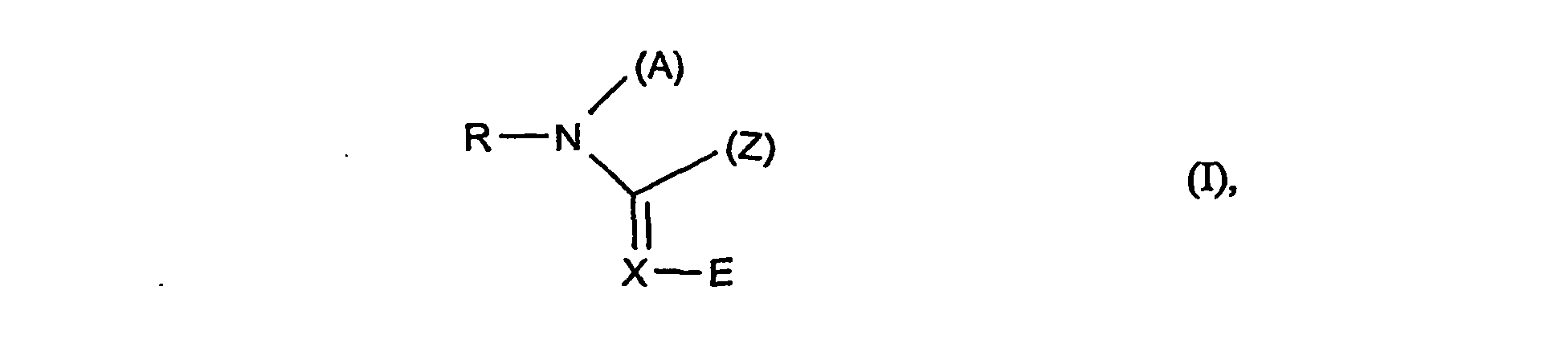
- R
- für Wasserstoff, gegebenenfalls substituierte Reste der Gruppe Acyl, Alkyl, Aryl, Aralkyl, Heteroaryl oder Heteroarylalkyl steht;
- A
- für eine monofunktionelle Gruppe aus der Reihe Wasserstoff, Acyl, Alkyl, Aryl steht oder für eine bifunktionelle Gruppe steht, die mit dem Rest Z verknüpft ist;
- E
- für einen elektronenziehenden Rest steht;
- X
- für die Reste -CH= oder =N- steht, wobei der Rest -CH= anstelle eines H-Atoms mit dem Rest Z verknüpft sein kann;
- Z
- für eine monofunktionelle Gruppe aus der Reihe Alkyl, -O-R, -S-R,

- R
- steht für Wasserstoff sowie für gegebenenfalls substituierte Reste aus der
Reihe Acyl, Alkyl, Aryl, Aralkyl, Heteroaryl, Heteroarylalkyl.
Als Acylreste seien genannt Formyl, Alkylcarbonyl, Arylcarbonyl, Alkylsulfonyl, Arylsulfonyl, (Alkyl-)-(Aryl-)-phosphoryl, die ihrerseits substituiert sein können.
Als Alkyl seien genannt C1-10-Alkyl, insbesondere C1-4-Alkyl, im einzelnen Methyl, Ethyl, i-Propyl, sec.- oder t.-Butyl, die ihrerseits substituiert sein können.
Als Aryl seien genannt Phenyl, Naphthyl, insbesondere Phenyl.
Als Aralkyl seien genannt Phenylmethyl, Phenethyl.
Als Heteroaryl seien genannt Heteroaryl mit bis zu 10 Ringatomen und N, O, S insbesondere N als Heteroatomen. Im einzelnen seien genannt Thienyl, Furyl, Thiazolyl, Imidazolyl, Pyridyl, Benzthiazolyl.
Als Heteroarylalkyl seien genannt Heteroarylmethyl, Heteroarylethyl mit bis zu 6 Ringatomen und N, O, S, insbesondere N als Heteroatomen.
Als Substituenten seien beispielhaft und vorzugsweise aufgeführt:
Alkyl mit vorzugsweise 1 bis 4, insbesondere 1 oder 2 Kohlenstoffatomen, wie Methyl, Ethyl, n- und i-Propyl und n-, i- und t-Butyl; Alkoxy mit vorzugsweise 1 bis 4, insbesondere 1 oder 2 Kohlenstoffatomen, wie Methoxy, Ethoxy, n- und i-Propyloxy und n-, i- und t-Butyloxy; Alkylthio mit vorzugsweise 1 bis 4, insbesondere 1 oder 2 Kohlenstoffatomen, wie Methylthio, Ethylthio, n- und i-Propylthio und n-, i- und t-Butylthio; Halogenalkyl mit vorzugsweise 1 bis 4, insbesondere 1 oder 2 Kohlenstoffatomen und vorzugsweise 1 bis 5, insbesondere 1 bis 3 Halogenatomen, wobei die Halogenatome gleich oder verschieden sind und als Halogenatome, vorzugsweise Fluor, Chlor oder Brom, insbesondere Fluor stehen, wie Trifluormethyl; Hydroxy; Halogen, vorzugsweise Fluor, Chlor, Brom und Jod, insbesondere Fluor, Chlor und Brom; Cyano; Nitro; Amino; Monoalkyl- und Dialkylamino mit vorzugsweise 1 bis 4, insbesondere 1 oder 2 Kohlenstoffatomen je Alkylgruppe, wie Methylamino, Methyl-ethyl-amino, n- und i-Propylamino und Methyl-n-butylamino; Carboxyl; Carbalkoxy mit vorzugsweise 2 bis 4, insbesondere 2 oder 3 Kohlenstoffatomen, wie Carbomethoxy und Carboethoxy; Sulfo (-SO3H); Alkylsulfonyl mit vorzugsweise 1 bis 4, insbesondere 1 oder 2 Kohlenstoffatomen, wie Methylsulfonyl und Ethylsulfonyl; Arylsulfonyl mit vorzugsweise 6 oder 10 Arylkohlenstoffatomen, wie Phenylsulfonyl sowie Heteroarylamino und Heteroarylalkylamino wie Chlorpyridylamino und Chlorpyridylmethylamino. - A
- steht besonders bevorzugt für Wasserstoff sowie für gegebenenfalls substituierte Reste aus der Reihe Acyl, Alkyl, Aryl, die bevorzugt die bei R angegebenen Bedeutungen haben. A steht ferner für eine bifunktionelle Gruppe. Genannt sei gegebenenfalls substituiertes Alkylen mit 1-4, insbesondere 1-2 C-Atomen, wobei als Substituenten die weiter oben aufgezählten Substituenten genannt seien und wobei die Alkylengruppen durch Heteroatome aus der Reihe N, O, S unterbrochen sein können.
- A und Z
- können gemeinsam mit den Atomen, an welche sie gebunden sind, einen
gesättigten oder ungesättigten heterocyclischen Ring bilden. Der heterocyclische
Ring kann weitere 1 oder 2 gleiche oder verschiedene Heteroatome
und/oder Heterogruppen enthalten. Als Heteroatome stehen vorzugsweise
Sauerstoff, Schwefel oder Stickstoff und als Heterogruppen N-Alkyl, wobei
Alkyl der N-Alkyl-Gruppe vorzugsweise 1 bis 4, insbesondere 1 oder 2
Kohlenstoffatome enthält. Als Alkyl seien Methyl, Ethyl, n- und i-Propyl und
n-, i- und t-Butyl genannt. Der heterocyclische Ring enthält 5 bis 7, vorzugsweise
5 oder 6 Ringglieder.
Als Beispiele für den heterocyclischen Ring seien Pyrrolidin, Piperidin, Piperazin, Hexamethylenimin, Hexahydro-1,3,5-triazin, Morpholin genannt, die gegebenenfalls bevorzugt durch Methyl substituiert sein können. - E
- steht für einen elektronentziehenden Rest, wobei insbesondere NO2, CN, Halogenalkylcarbonyl wie 1,5-Halogen-C1-4-carbonyl, insbesondere COCF3 genannt seien.
- X
- steht für -CH= oder -N=
- Z
- steht für gegebenenfalls substituierte Reste Alkyl, -OR, -SR, -NRR, wobei R und die Substituenten bevorzugt die oben angegebene Bedeutung haben.
- Z
- kann außer dem obengenannten Ring gemeinsam mit dem Atom, an welches
es gebunden ist und dem Rest
an der Stelle von X einen gesättigten oder ungesättigten heterocyclischen Ring bilden. Der heterocyclische Ring kann weitere 1 oder 2 gleiche oder verschiedene Heteroatome und/oder Heterogruppen enthalten. Als Heteroatome stehen vorzugsweise Sauerstoff, Schwefel oder Stickstoff und als Heterogruppen N-Alkyl, wobei die Alkyl oder N-Alkyl-Gruppe vorzugsweise 1 bis 4, insbesondere 1 oder 2 Kohlenstoffatome enthält. Als Alkyl seien Methyl, Ethyl, n- und i-Propyl und n-, i- und t-Butyl genannt. Der heterocyclische Ring enthält 5 bis 7, vorzugsweise 5 oder 6 Ringglieder.

Als Beispiele für den heterocyclischen Ring seien Pyrrolidin, Piperidin, Piperazin, Hexamethylenimin, Morpholin und N-Methylpiperazin genannt.


- n
- für 1 oder 2 steht,
A, Z, X und E die oben angegebenen Bedeutungen haben,
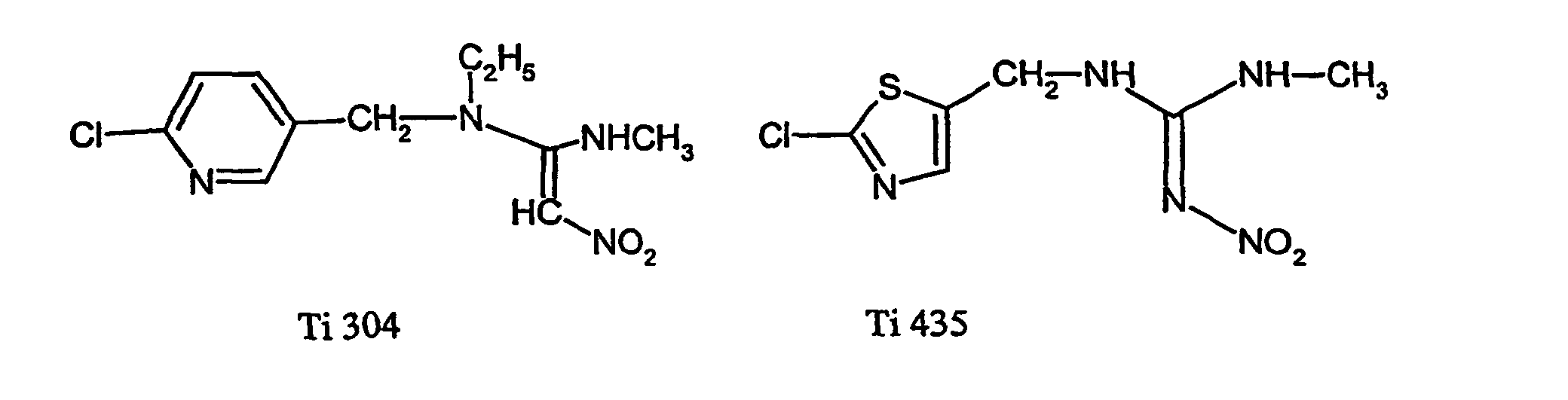
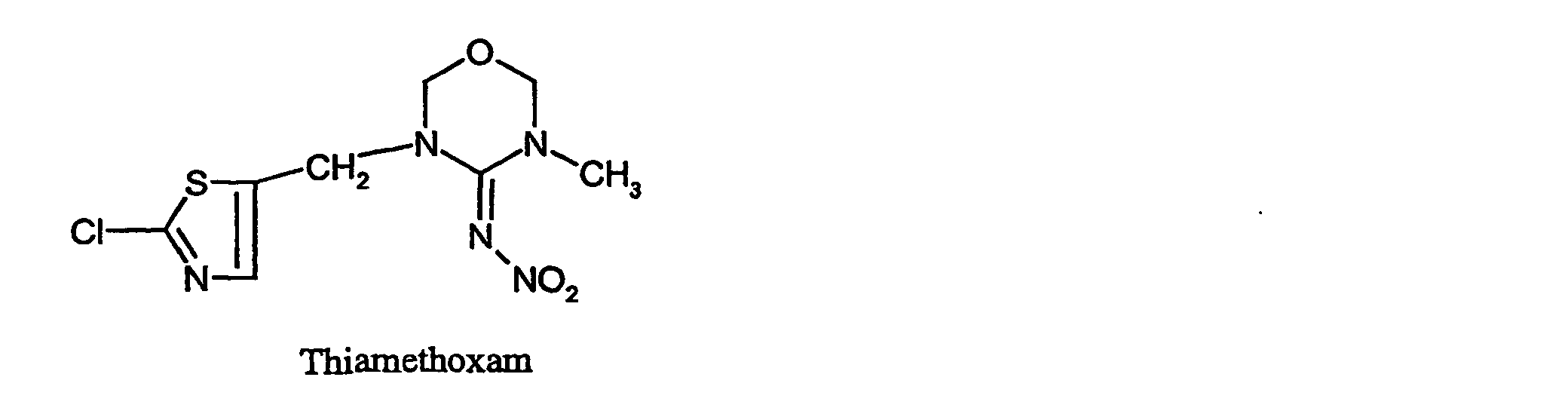
Im einzelnen seien folgende besonders bevorzugte Verbindungen (Imidacloprid und Analoga) genannt:


ampholytische Tenside wie Di-Na-N-lauryl-β-iminodipropionat oder Lecithin;
anionaktive Tenside, wie Na-Laurylsulfat, Fettalkoholethersulfate, Mono/Dialkylpolyglykoletherorthophosphorsäureester-monoethanolaminsalz;
kationaktive Tenside wie Cetyltrimethylammoniumchlorid.

Claims (9)
- Mittel enthaltend,a) 35 - 60 Gew.-% des Wirkstoffs Permethrinb) 2.5 - 12.5 Gew.-% Imidacloprid oder Imidaclopridanalogon der Formel (I):in welcher

- R
- für Wasserstoff, gegebenenfalls substituierte Reste der Gruppe Acyl, Alkyl, Aryl, Aralkyl, Heteroaryl oder Heteroarylalkyl steht;
- A
- für eine monofunktionelle Gruppe aus der Reihe Wasserstoff, Acyl, Alkyl, Aryl steht oder für eine bifunktionelle Gruppe steht, die mit dem Rest Z verknüpft ist;
- E
- für einen elektronenziehenden Rest steht;
- X
- für die Reste -CH= oder =N- steht, wobei der Rest -CH= anstelle eines H-Atoms mit dem Rest Z verknüpft sein kann;
- Z
- für eine monofunktionelle Gruppe aus der Reihe Alkyl, -O-R,
-S-R,
steht, oder für eine bifunktionelle Gruppe steht, die mit dem Rest A oder dem Rest X verknüpft ist,

wobei die Substituenten der oben aufgeführten gegebenenfalls substituierten Reste ausgewählt sind aus: Alkyl mit 1 bis 4 Kohlenstoffatomen, Alkoxy mit 1 bis 4 Kohlenstoffatomen, Alkylthio mit 1 bis 4 Kohlenstoffatomen, Halogenalkyl mit 1 bis 4 Kohlenstoffatomen und 1 bis 5 Halogenatomen, wobei die Halogenatome gleich oder verschieden sind; Hydroxy; Halogen; Cyano; Nitro; Amino; Monoalkyl- und Dialkylamino mit 1 bis 4 Kohlenstoffatomen, Carboxyl; Carbalkoxy mit 2 bis 4; Sulfo (-SO3H); Alkylsulfonyl mit 1 bis 4 Kohlenstoffatomen; Arylsulfonyl mit 6 oder 10 Arylkohlenstoffatomen sowie Heteroarylamino und Heteroarylalkylamino;
c) 27.5 - 62.5 Gew.-% N-Methylpyrrolidond) 0 - 5 Gew.-% Wassere) 0 - 0,5 Gew.-% phenolische Antioxidantien undf) 0 - 0,5 Gew.-% organische Säuren. - Mittel gemäß Anspruch 1, enthaltend als Komponente b) 2.5 - 12.5 Gew.-% Imidacloprid oder Imidaclopridanalogon der Formeln (II) oder (III):
 in welchen
- n
- für 1 oder 2 steht,
Subst. für einen der in Anspruch 1 aufgeführten Substituenten, insbesondere für Halogen steht,
A, Z, X und E die in Anspruch 1 angegebenen Bedeutungen haben.
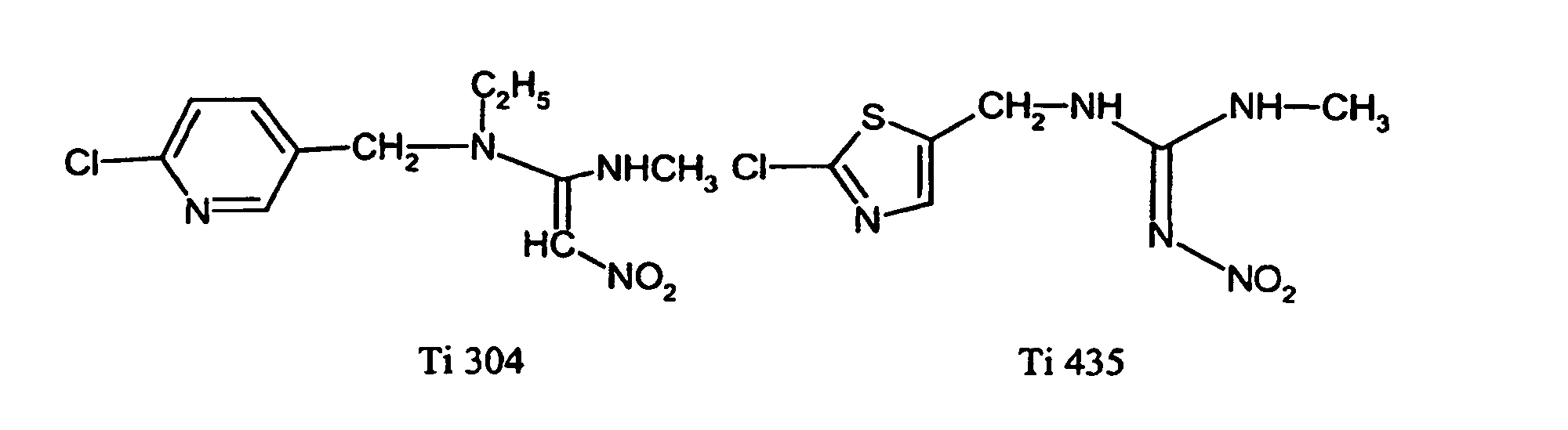
- Mittel gemäß Anspruch 1, enthaltend als Komponente b) 2.5 - 12.5 Gew.-% Imidacloprid oder eine Imidaclopridanalogon, ausgewählt aus:



- Mittel gemäß einem der vorstehenden Ansprüche, zusätzlich enthaltendg) 2,5 - 10 Gew.-% Co-Lösungsmittel.
- Verfahren zur Herstellung von Mitteln gemäß einem der vorstehenden Ansprüche, dadurch gekennzeichnet, dass man Permethrin und Imidacloprid oder Imidacloprid-Analogon gemäß einem der Ansprüche 1 bis 4 mit den übrigen in den Ansprüchen 1 bis 4 genannten Bestandteilen unter Rühren vermischt und eine Lösung herstellt.
- Verwendung des Mittels gemäß einem der Ansprüche 1 bis 4 zur Herstellung von Arzneimitteln zur Bekämpfung von Parasiten an Tieren.
- Verwendung gemäß Anspruch 6, zur Bekämpfung von Zecken und/oder Flöhen an warmblütigen Tieren.
- Verwendung gemäß einem der Ansprüche 6 oder 7, zur Bekämpfung von Zecken und/oder Flöhen an Hunden.
- Verwendung gemäß einem der Ansprüche 6 oder 7, zur Bekämpfung von Zecken und/oder Flöhen an Katzen.
Priority Applications (1)
| Application Number | Priority Date | Filing Date | Title |
|---|---|---|---|
| SI200230249T SI1379138T1 (sl) | 2001-04-09 | 2002-04-02 | Tekoce formulacije, ki se dajo dermalno aplicirati, za zatiranje parazitskih zuzelk pri zivalih |
Applications Claiming Priority (3)
| Application Number | Priority Date | Filing Date | Title |
|---|---|---|---|
| DE10117676A DE10117676A1 (de) | 2001-04-09 | 2001-04-09 | Dermal applizierbare flüssige Formulierungen zur Bekämpfung von parasitierenden Insekten an Tieren |
| DE10117676 | 2001-04-09 | ||
| PCT/EP2002/003619 WO2002087338A1 (de) | 2001-04-09 | 2002-04-02 | Dermal applizierbare flüssige formulierungen zur bekämpfung von parasitierenden insekten an tieren |
Publications (2)
| Publication Number | Publication Date |
|---|---|
| EP1379138A1 EP1379138A1 (de) | 2004-01-14 |
| EP1379138B1 true EP1379138B1 (de) | 2005-11-16 |
Family
ID=7680960
Family Applications (1)
| Application Number | Title | Priority Date | Filing Date |
|---|---|---|---|
| EP02766612A Expired - Lifetime EP1379138B1 (de) | 2001-04-09 | 2002-04-02 | Dermal applizierbare flüssige formulierungen zur bekämpfung von parasitierenden insekten an tieren |
Country Status (28)
| Country | Link |
|---|---|
| US (1) | US7728011B2 (de) |
| EP (1) | EP1379138B1 (de) |
| JP (2) | JP4767478B2 (de) |
| KR (1) | KR100883848B1 (de) |
| CN (2) | CN101036648A (de) |
| AT (1) | ATE309702T1 (de) |
| AU (1) | AU2002338488B2 (de) |
| BR (1) | BR0208733B1 (de) |
| CA (1) | CA2443159C (de) |
| CO (1) | CO5540359A2 (de) |
| CR (1) | CR7089A (de) |
| CZ (1) | CZ302251B6 (de) |
| DE (2) | DE10117676A1 (de) |
| DK (1) | DK1379138T3 (de) |
| EE (1) | EE05477B1 (de) |
| ES (1) | ES2250701T3 (de) |
| HR (1) | HRP20030904B1 (de) |
| HU (1) | HU229934B1 (de) |
| IL (2) | IL158068A0 (de) |
| MX (1) | MXPA03009134A (de) |
| NO (1) | NO330537B1 (de) |
| NZ (1) | NZ528664A (de) |
| PL (1) | PL205958B1 (de) |
| RU (1) | RU2296466C2 (de) |
| SK (1) | SK286434B6 (de) |
| UA (1) | UA77411C2 (de) |
| WO (1) | WO2002087338A1 (de) |
| ZA (1) | ZA200307816B (de) |
Cited By (2)
| Publication number | Priority date | Publication date | Assignee | Title |
|---|---|---|---|---|
| WO2014131786A1 (en) * | 2013-02-27 | 2014-09-04 | Krka, D.D., Novo Mesto | Veterinary composition for dermal application |
| EP4545067A1 (de) | 2023-10-25 | 2025-04-30 | Infectopharm Arzneimittel und Consilium GmbH | Hochdosierte dermal applizierbare permethrin-zubereitung mit erhöhtem drugload im zielkompartiment zur verbesserten behandlung von ektoparasiten befall |
Families Citing this family (32)
| Publication number | Priority date | Publication date | Assignee | Title |
|---|---|---|---|---|
| DE4417742A1 (de) * | 1994-05-20 | 1995-11-23 | Bayer Ag | Nicht-systemische Bekämpfung von Parasiten |
| US20020103233A1 (en) * | 2000-11-30 | 2002-08-01 | Arther Robert G. | Compositions for enhanced acaricidal activity |
| DE10301906A1 (de) * | 2003-01-17 | 2004-07-29 | Bayer Healthcare Ag | Repellentmittel |
| DE10320505A1 (de) * | 2003-05-08 | 2004-11-25 | Bayer Healthcare Ag | Mittel zum Bekämpfen von Parasiten an Tieren |
| DE10337305A1 (de) * | 2003-07-02 | 2005-02-03 | Andresen, Uwe, Prof. Dr. | Parasitizide, repellierende Zusammensetzung und Verfahren zu ihrer Herstellung und ihrer Verwendung |
| ES2378769T3 (es) * | 2004-01-09 | 2012-04-17 | Nippon Soda Co., Ltd. | Composiciones de bifentrina/acetamiprida para el control de plagas domésticas generales |
| CN100525625C (zh) | 2004-01-09 | 2009-08-12 | Fmc有限公司 | 用于控制常见家庭害虫的杀虫组合物 |
| DE102004006324A1 (de) * | 2004-02-10 | 2005-08-25 | Bayer Cropscience Ag | Wirkstoffkombinationen mit insektiziden Eigenschaften |
| US8133499B2 (en) * | 2004-03-25 | 2012-03-13 | Fmc Corporation | Liquid termiticide compositions of pyrethroids and neonicitinoids |
| DE102004020721A1 (de) * | 2004-04-28 | 2005-11-24 | Bayer Healthcare Ag | Dermal applizierbare flüssige Formulierungen zur Bekämpfung von parasitierenden Insekten an Tieren |
| DE102004053964A1 (de) * | 2004-11-09 | 2006-05-11 | Bayer Healthcare Ag | Mittel gegen Demodikose |
| WO2006068768A2 (en) * | 2004-11-24 | 2006-06-29 | Hanna Skubatch | Methods and compositions for treating conditions |
| FR2880269B1 (fr) * | 2004-12-31 | 2008-11-07 | Cardon Pharmaceuticals Nv Sa | Produit traitant pour animaux et moyens pour sa preparation |
| ITMI20061825A1 (it) * | 2006-09-26 | 2008-03-27 | Giuliani Spa | Composizione antipediculosi provvista di attivita' di soffocamento dei pidocchi |
| TW200846029A (en) * | 2007-02-09 | 2008-12-01 | Wyeth Corp | High dose, long-acting ectoparasiticide for extended control |
| DE102007025609A1 (de) * | 2007-05-31 | 2008-12-11 | Meyer, Ulrich, Dr. | Mittel zur Zeckenentfernung |
| US8404260B2 (en) | 2008-04-02 | 2013-03-26 | Bayer Cropscience Lp | Synergistic pesticide compositions |
| CH702717A2 (de) | 2010-02-26 | 2011-08-31 | Solnova Ag | Spot-on-Präparat. |
| UA108641C2 (uk) | 2010-04-02 | 2015-05-25 | Паразитицидна композиція, яка містить чотири активних агенти, та спосіб її застосування | |
| JO3626B1 (ar) * | 2012-02-23 | 2020-08-27 | Merial Inc | تركيبات موضعية تحتوي على فيبرونيل و بيرميثرين و طرق استخدامها |
| DE202012004045U1 (de) | 2012-04-16 | 2012-05-02 | Solnova Ag | Spot-on-Präparat |
| WO2015007923A1 (es) * | 2013-07-18 | 2015-01-22 | König Lab, S.L. | Procedimiento de desparasitación de animales mediante la aplicación simultánea de dos o más agentes parasiticidas por vía dérmica y dispositivo para su puesta en práctica |
| US10721930B2 (en) | 2014-12-23 | 2020-07-28 | Cap Innovet, Inc. | Dermal compositions |
| DK3324736T3 (da) | 2015-07-17 | 2019-06-03 | Evergreen Animal Health Llc | Hidtil ukendt spot-on-aktivstofformulering |
| CN105567105B (zh) * | 2015-12-30 | 2018-03-16 | 天津德高化成光电科技有限责任公司 | 高折射率芯片级封装led白光芯片荧光胶膜及制备方法 |
| ES2792056T3 (es) | 2017-01-17 | 2020-11-06 | Evergreen Animal Health Llc | Novedosa formulación de un principio activo para unción puntual |
| US10172359B2 (en) * | 2017-05-17 | 2019-01-08 | Sergeant's Pet Care Products, Inc. | Solvent system for use with spot-on pesticide compositions |
| AU2018329158A1 (en) * | 2017-09-06 | 2020-03-05 | Bayer Animal Health Gmbh | Topically administrable formulation for the control and prevention of animal parasites |
| AU2020208145B2 (en) | 2019-01-16 | 2023-02-02 | Boehringer Ingelheim Vetmedica Gmbh | Topical compositions comprising a neonicotinoid and a macrocyclic lactone, methods and uses thereof |
| EP3771335A1 (de) | 2019-07-31 | 2021-02-03 | Athenion AG | Abweisende zusammensetzung |
| PL435706A1 (pl) * | 2020-10-16 | 2022-04-19 | Tg Pharma Spółka Z Ograniczoną Odpowiedzialnością | Permetryna do zastosowania w leczeniu zewnętrznym infestacji Demodex spp. |
| CN113616653A (zh) * | 2021-09-04 | 2021-11-09 | 浙江海正动物保健品有限公司 | 一种低温稳定性好的含吡虫啉的复方制剂及其制备方法 |
Family Cites Families (71)
| Publication number | Priority date | Publication date | Assignee | Title |
|---|---|---|---|---|
| GB8323061D0 (en) | 1983-08-26 | 1983-09-28 | Shell Int Research | Pesticidal heterocyclic compounds |
| JPH0629256B2 (ja) * | 1983-10-06 | 1994-04-20 | 日本バイエルアグロケム株式会社 | ニトロメチレン−テトラヒドロピリミジン誘導体,その製法及び殺虫,殺ダニ,殺センチユウ剤 |
| JPS60172976A (ja) * | 1984-02-16 | 1985-09-06 | Nippon Tokushu Noyaku Seizo Kk | ニトロメチレン誘導体,その製法及び殺虫,殺ダニ,殺センチユウ剤 |
| ZW5085A1 (en) * | 1984-04-13 | 1985-09-18 | Nihon Tokushu Noyaku Seizo Kk | Nitromethylene derivatives,intermediates thereof,processes for production thereof,and insecticides |
| GB8500863D0 (en) | 1985-01-14 | 1985-02-20 | Fine Organics Ltd | Preparation of thiazine derivatives |
| EP0192060B1 (de) * | 1985-02-04 | 1991-09-18 | Nihon Bayer Agrochem K.K. | Heterocyclische Verbindungen |
| JPH072736B2 (ja) * | 1985-08-27 | 1995-01-18 | 日本バイエルアグロケム株式会社 | ニトロメチレン誘導体、その製法及び殺虫剤 |
| JPH0717621B2 (ja) * | 1986-03-07 | 1995-03-01 | 日本バイエルアグロケム株式会社 | 新規ヘテロ環式化合物 |
| JPH085859B2 (ja) * | 1986-07-01 | 1996-01-24 | 日本バイエルアグロケム株式会社 | 新規アルキレンジアミン類 |
| JPH07121909B2 (ja) * | 1986-09-10 | 1995-12-25 | 日本バイエルアグロケム株式会社 | 新規複素環式化合物及び殺虫剤 |
| DE3634755A1 (de) * | 1986-10-11 | 1988-04-14 | Bayer Ag | Dermale behandlung von wurmerkrankungen der katze mit praziquantel |
| DE3639877A1 (de) | 1986-11-21 | 1988-05-26 | Bayer Ag | Hetarylalkyl substituierte 5- und 6-ringheterocyclen |
| US4963574A (en) * | 1987-02-24 | 1990-10-16 | Ciba-Geigy Corporation | N-cyanoisothiourea compounds useful in pest control |
| DE3712307A1 (de) | 1987-04-10 | 1988-10-20 | Bayer Ag | 3-substituierte 1-(2-chlor-thiazol-5-yl-methyl)-2- nitroimino-1,3-diazacycloalkane |
| JPS63287764A (ja) | 1987-05-21 | 1988-11-24 | Nippon Tokushu Noyaku Seizo Kk | N−3−シアノベンジル−ヘテロ環式化合物及び殺虫剤 |
| JP2597095B2 (ja) | 1987-06-09 | 1997-04-02 | 日本バイエルアグロケム株式会社 | シアノアルキル―ヘテロ環式化合物を含有する殺虫剤 |
| CH673557A5 (de) * | 1987-07-20 | 1990-03-30 | Ciba Geigy Ag | |
| IL100688A (en) | 1987-08-01 | 1995-08-31 | Takeda Chemical Industries Ltd | Intermediates for the production of unsaturated amines in position A and the process for their preparation |
| DE3887800D1 (de) * | 1987-08-04 | 1994-03-24 | Ciba Geigy | Substituierte Guanidine. |
| US4918086A (en) * | 1987-08-07 | 1990-04-17 | Ciba-Geigy Corporation | 1-nitro-2,2-diaminoethylene derivatives |
| EP0303570A3 (de) * | 1987-08-12 | 1990-11-07 | Ciba-Geigy Ag | Substituierte Isothioharnstoffe |
| JP2583429B2 (ja) * | 1987-11-06 | 1997-02-19 | 日本バイエルアグロケム株式会社 | イミダゾリン類及び殺虫剤 |
| US5074252A (en) * | 1988-03-25 | 1991-12-24 | Morgan Jr Charles | Rechargeable insecticide dispenser providing controlled release of an insecticide composition |
| JP2884412B2 (ja) | 1988-10-21 | 1999-04-19 | 日本バイエルアグロケム株式会社 | 殺虫性シアノ化合物 |
| JPH0699777B2 (ja) | 1988-11-02 | 1994-12-07 | 株式会社東芝 | 低熱膨張鋳鉄の製造方法 |
| GB8826539D0 (en) * | 1988-11-14 | 1988-12-21 | Shell Int Research | Nitromethylene compounds their preparation & their use as pesticides |
| JP2779403B2 (ja) | 1988-11-29 | 1998-07-23 | 日本バイエルアグロケム株式会社 | 殺虫性ニトロ化合物 |
| IE960441L (en) * | 1988-12-27 | 1990-06-27 | Takeda Chemical Industries Ltd | Guanidine derivatives, their production and insecticides |
| JP2822050B2 (ja) | 1989-02-04 | 1998-11-05 | 日本バイエルアグロケム株式会社 | 2―ニトロイミノイミダゾリジン類の製法 |
| DE69004452T2 (de) | 1989-02-13 | 1994-03-10 | Bayer Agrochem Kk | Nitroverbindungen als Insektizide. |
| JP2610988B2 (ja) * | 1989-03-09 | 1997-05-14 | 日本バイエルアグロケム 株式会社 | 新規ヘテロ環式化合物及び殺虫剤 |
| EP0387663B1 (de) | 1989-03-17 | 1993-09-01 | Bayer Ag | Mittel gegen Keratinschädlinge |
| JPH03200768A (ja) | 1989-10-24 | 1991-09-02 | Agro Kanesho Co Ltd | ニトログアニジン化合物及び殺虫剤 |
| US6187773B1 (en) | 1989-11-10 | 2001-02-13 | Agro-Kanesho Co., Ltd. | Hexahydrotriazine compounds and insecticides |
| JP2943246B2 (ja) | 1990-01-11 | 1999-08-30 | 日本曹達株式会社 | ニトロエチレン誘導体、その製造方法及び殺虫剤 |
| JP2867345B2 (ja) | 1990-01-23 | 1999-03-08 | 日本バイエルアグロケム株式会社 | 殺虫性トリフルオロアセチル誘導体 |
| JP3220176B2 (ja) | 1990-02-20 | 2001-10-22 | 株式会社日立製作所 | 描画データ作成方法、データ変換方法、及びデータ変換装置 |
| US5253182A (en) * | 1990-02-20 | 1993-10-12 | Hitachi, Ltd. | Method of and apparatus for converting design pattern data to exposure data |
| ES2103807T3 (es) * | 1990-03-05 | 1997-10-01 | Mallinckrodt Veterinary Inc | Composicion parasiticida y metodos para su fabricacion y utilizacion. |
| JPH03279359A (ja) | 1990-03-27 | 1991-12-10 | Ishihara Sangyo Kaisha Ltd | ニトログアニジン誘導体、それらの製造方法及びそれらを含有する有害生物防除剤 |
| US5192778A (en) | 1990-04-03 | 1993-03-09 | Mitsui Toatsu Chemicals, Inc. | Dialkoxymethylimidazolidine derivatives, preparation thereof, insecticides containing same as an effective ingredient and intermediates therefor |
| EP0530259A1 (de) | 1990-05-17 | 1993-03-10 | E.I. Du Pont De Nemours And Company | Arthropodizide nitroäthylene und nitroguanidine |
| JP2924102B2 (ja) | 1990-06-15 | 1999-07-26 | 住友化学工業株式会社 | ダニ防除剤 |
| JPH0739430B2 (ja) | 1990-07-06 | 1995-05-01 | アグロカネショウ株式会社 | 有機リン化合物、その製造法および該化合物を含有する殺虫、殺ダニ、殺線虫剤 |
| IL99161A (en) | 1990-08-17 | 1996-11-14 | Takeda Chemical Industries Ltd | History of guanidine A process for their preparation and preparations from pesticides that contain them |
| FR2689729B1 (fr) * | 1992-04-09 | 1994-06-03 | Roussel Uclaf | Nouvelles compositions pesticides renfermant un pyrethrinouide. |
| JP3279359B2 (ja) | 1992-10-15 | 2002-04-30 | オリンパス光学工業株式会社 | 長尺紙搬送装置 |
| JPH0789803A (ja) | 1993-09-24 | 1995-04-04 | Japan Carlit Co Ltd:The | 無臭性防蟻剤 |
| US6267947B1 (en) | 1993-12-23 | 2001-07-31 | Sun Glitz Corporation | Water resistant pesticide composition |
| JP3713582B2 (ja) * | 1994-02-27 | 2005-11-09 | 日本農薬株式会社 | 土壌処理用白蟻類防除組成物及び防除方法 |
| JPH07247203A (ja) | 1994-03-10 | 1995-09-26 | Osaka Seiyaku:Kk | ノミ防除剤 |
| DE4417742A1 (de) * | 1994-05-20 | 1995-11-23 | Bayer Ag | Nicht-systemische Bekämpfung von Parasiten |
| JP3493476B2 (ja) * | 1994-09-30 | 2004-02-03 | バイエルクロップサイエンス株式会社 | 白蟻防除剤組成物 |
| DE4443888A1 (de) * | 1994-12-09 | 1996-06-13 | Bayer Ag | Dermal applizierbare Formulierungen von Parasitiziden |
| DE19654079A1 (de) * | 1996-12-23 | 1998-06-25 | Bayer Ag | Endo-ekto-parasitizide Mittel |
| JP3255072B2 (ja) | 1997-02-17 | 2002-02-12 | 日本ピー・エム・シー株式会社 | ロジン系物質の水性エマルションの製造方法、その水性エマルション組成物及びサイズ剤 |
| RU2127517C1 (ru) * | 1997-03-11 | 1999-03-20 | Открытое акционерное общество "Арнест" | Инсектицидная композиция |
| RU2130259C1 (ru) * | 1997-05-07 | 1999-05-20 | Открытое акционерное общество "Арнест" | Аэрозольное средство для уничтожения моли и кожеедов |
| CN1176052A (zh) * | 1997-07-23 | 1998-03-18 | 张天良 | 一种杀虫剂 |
| JP3239207B2 (ja) * | 1997-09-05 | 2001-12-17 | 大日本除蟲菊株式会社 | 防蟻・防腐処理剤 |
| DE19807633A1 (de) * | 1998-02-23 | 1999-08-26 | Bayer Ag | Dermal applizierbare wasserhaltige Formulierungen von Parasitiziden |
| CN1236547A (zh) * | 1998-05-21 | 1999-12-01 | 张天良 | 一种杀虫剂 |
| AU744790B2 (en) | 1998-07-27 | 2002-03-07 | Sumitomo Chemical Company, Limited | Ectoparasite controlling agent for animals |
| US6080796A (en) * | 1998-08-19 | 2000-06-27 | Nova Chemicals Inc. | Dissolving insecticide in monomer |
| US6033731A (en) | 1998-08-19 | 2000-03-07 | Nova Chemicals, Inc. | Impregnating polymer beads with insecticide |
| JP3460590B2 (ja) * | 1998-09-03 | 2003-10-27 | アース製薬株式会社 | 溶解剤及び殺虫液剤 |
| FR2784011B1 (fr) * | 1998-10-05 | 2006-08-25 | Rhone Poulenc Agrochimie | Composition insecticide comprenant de la cypermethrine et de l' acetamiprid |
| CN1234181A (zh) * | 1999-01-08 | 1999-11-10 | 吕玉成 | 高效氯氰菊脂吡虫啉乳油 |
| BR0017618B1 (pt) | 1999-03-12 | 2013-04-09 | composiÇço inseticida sinÉrgica, e, processos para controle de insetos, e para proteger plantas contra infestaÇço e ataque de insetos. | |
| US6660690B2 (en) * | 2000-10-06 | 2003-12-09 | Monsanto Technology, L.L.C. | Seed treatment with combinations of insecticides |
| US20020103233A1 (en) * | 2000-11-30 | 2002-08-01 | Arther Robert G. | Compositions for enhanced acaricidal activity |
-
2001
- 2001-04-09 DE DE10117676A patent/DE10117676A1/de not_active Withdrawn
-
2002
- 2002-02-04 UA UA20031110065A patent/UA77411C2/uk unknown
- 2002-04-02 CZ CZ20032724A patent/CZ302251B6/cs not_active IP Right Cessation
- 2002-04-02 WO PCT/EP2002/003619 patent/WO2002087338A1/de not_active Ceased
- 2002-04-02 EE EEP200300490A patent/EE05477B1/xx unknown
- 2002-04-02 EP EP02766612A patent/EP1379138B1/de not_active Expired - Lifetime
- 2002-04-02 BR BRPI0208733-2B1A patent/BR0208733B1/pt active IP Right Grant
- 2002-04-02 SK SK1235-2003A patent/SK286434B6/sk not_active IP Right Cessation
- 2002-04-02 IL IL15806802A patent/IL158068A0/xx active IP Right Grant
- 2002-04-02 CN CNA2007100936717A patent/CN101036648A/zh active Pending
- 2002-04-02 AU AU2002338488A patent/AU2002338488B2/en not_active Expired
- 2002-04-02 DE DE50204946T patent/DE50204946D1/de not_active Expired - Lifetime
- 2002-04-02 NZ NZ528664A patent/NZ528664A/en not_active IP Right Cessation
- 2002-04-02 RU RU2003132544/15A patent/RU2296466C2/ru active
- 2002-04-02 CN CNB028079345A patent/CN100337545C/zh not_active Expired - Lifetime
- 2002-04-02 HU HU0303840A patent/HU229934B1/hu unknown
- 2002-04-02 CA CA2443159A patent/CA2443159C/en not_active Expired - Lifetime
- 2002-04-02 ES ES02766612T patent/ES2250701T3/es not_active Expired - Lifetime
- 2002-04-02 AT AT02766612T patent/ATE309702T1/de active
- 2002-04-02 JP JP2002584703A patent/JP4767478B2/ja not_active Expired - Lifetime
- 2002-04-02 MX MXPA03009134A patent/MXPA03009134A/es active IP Right Grant
- 2002-04-02 DK DK02766612T patent/DK1379138T3/da active
- 2002-04-02 KR KR1020037012476A patent/KR100883848B1/ko not_active Expired - Lifetime
- 2002-04-02 PL PL367026A patent/PL205958B1/pl unknown
- 2002-04-02 HR HR20030904A patent/HRP20030904B1/xx not_active IP Right Cessation
-
2003
- 2003-09-23 IL IL158068A patent/IL158068A/en unknown
- 2003-10-01 CR CR7089A patent/CR7089A/es unknown
- 2003-10-07 ZA ZA200307816A patent/ZA200307816B/en unknown
- 2003-10-08 NO NO20034512A patent/NO330537B1/no not_active IP Right Cessation
- 2003-10-09 US US10/682,127 patent/US7728011B2/en not_active Expired - Lifetime
- 2003-11-07 CO CO03098927A patent/CO5540359A2/es active IP Right Grant
-
2010
- 2010-01-18 JP JP2010008388A patent/JP2010155844A/ja active Pending
Cited By (5)
| Publication number | Priority date | Publication date | Assignee | Title |
|---|---|---|---|---|
| WO2014131786A1 (en) * | 2013-02-27 | 2014-09-04 | Krka, D.D., Novo Mesto | Veterinary composition for dermal application |
| EP2931041B1 (de) | 2013-02-27 | 2016-11-16 | KRKA, d.d., Novo mesto | Veterinäre zusammensetzung zur dermalen anwendung |
| EA028544B1 (ru) * | 2013-02-27 | 2017-11-30 | КРКА, д.д., НОВО МЕСТО | Ветеринарная композиция для борьбы с паразитами для накожного применения и ее применение |
| EP4545067A1 (de) | 2023-10-25 | 2025-04-30 | Infectopharm Arzneimittel und Consilium GmbH | Hochdosierte dermal applizierbare permethrin-zubereitung mit erhöhtem drugload im zielkompartiment zur verbesserten behandlung von ektoparasiten befall |
| WO2025088039A1 (de) | 2023-10-25 | 2025-05-01 | Infectopharm Arzneimittel Und Consilium Gmbh | Hochkonzentrierte dermal applizierbare permethrin-zubereitung mit erhöhtem drugload im zielkompartiment zur verbesserten behandlung von ektoparasiten-befall |
Also Published As
Similar Documents
| Publication | Publication Date | Title |
|---|---|---|
| WO2002087338A1 (de) | Dermal applizierbare flüssige formulierungen zur bekämpfung von parasitierenden insekten an tieren | |
| EP1587368B1 (de) | Repellentmittel | |
| EP2104428B1 (de) | Kombinationsprodukt zur bekämpfung von parasiten an tieren | |
| EP1624756B1 (de) | Mittel zum bekämpfen von parasiten an tieren | |
| EP1241943B1 (de) | Verwendung von polysiloxanen mit quartären aminogruppen als formulierungshilfsmittel und mittel enthaltend dieselben | |
| US20200245622A1 (en) | Dermal compositions | |
| DE102004020721A1 (de) | Dermal applizierbare flüssige Formulierungen zur Bekämpfung von parasitierenden Insekten an Tieren | |
| EP2104426B1 (de) | Mittel zur bekämpfung von parasiten an tieren |
Legal Events
| Date | Code | Title | Description |
|---|---|---|---|
| PUAI | Public reference made under article 153(3) epc to a published international application that has entered the european phase |
Free format text: ORIGINAL CODE: 0009012 |
|
| 17P | Request for examination filed |
Effective date: 20031110 |
|
| AK | Designated contracting states |
Kind code of ref document: A1 Designated state(s): AT BE CH CY DE DK ES FI FR GB GR IE IT LI LU MC NL PT SE TR |
|
| AX | Request for extension of the european patent |
Extension state: AL LT LV MK RO SI |
|
| 17Q | First examination report despatched |
Effective date: 20040909 |
|
| GRAP | Despatch of communication of intention to grant a patent |
Free format text: ORIGINAL CODE: EPIDOSNIGR1 |
|
| GRAS | Grant fee paid |
Free format text: ORIGINAL CODE: EPIDOSNIGR3 |
|
| GRAA | (expected) grant |
Free format text: ORIGINAL CODE: 0009210 |
|
| AK | Designated contracting states |
Kind code of ref document: B1 Designated state(s): AT BE CH CY DE DK ES FI FR GB GR IE IT LI LU MC NL PT SE TR |
|
| AX | Request for extension of the european patent |
Extension state: SI |
|
| PG25 | Lapsed in a contracting state [announced via postgrant information from national office to epo] |
Ref country code: FI Free format text: LAPSE BECAUSE OF FAILURE TO SUBMIT A TRANSLATION OF THE DESCRIPTION OR TO PAY THE FEE WITHIN THE PRESCRIBED TIME-LIMIT Effective date: 20051116 |
|
| REG | Reference to a national code |
Ref country code: GB Ref legal event code: FG4D Free format text: NOT ENGLISH |
|
| REG | Reference to a national code |
Ref country code: CH Ref legal event code: EP |
|
| REF | Corresponds to: |
Ref document number: 50204946 Country of ref document: DE Date of ref document: 20051222 Kind code of ref document: P |
|
| REG | Reference to a national code |
Ref country code: IE Ref legal event code: FG4D Free format text: LANGUAGE OF EP DOCUMENT: GERMAN |
|
| PG25 | Lapsed in a contracting state [announced via postgrant information from national office to epo] |
Ref country code: SE Free format text: LAPSE BECAUSE OF FAILURE TO SUBMIT A TRANSLATION OF THE DESCRIPTION OR TO PAY THE FEE WITHIN THE PRESCRIBED TIME-LIMIT Effective date: 20060216 Ref country code: GR Free format text: LAPSE BECAUSE OF FAILURE TO SUBMIT A TRANSLATION OF THE DESCRIPTION OR TO PAY THE FEE WITHIN THE PRESCRIBED TIME-LIMIT Effective date: 20060216 |
|
| GBT | Gb: translation of ep patent filed (gb section 77(6)(a)/1977) |
Effective date: 20060227 |
|
| REG | Reference to a national code |
Ref country code: DK Ref legal event code: T3 |
|
| REG | Reference to a national code |
Ref country code: ES Ref legal event code: FG2A Ref document number: 2250701 Country of ref document: ES Kind code of ref document: T3 |
|
| PG25 | Lapsed in a contracting state [announced via postgrant information from national office to epo] |
Ref country code: MC Free format text: LAPSE BECAUSE OF NON-PAYMENT OF DUE FEES Effective date: 20060430 |
|
| REG | Reference to a national code |
Ref country code: CH Ref legal event code: NV Representative=s name: E. BLUM & CO. PATENTANWAELTE |
|
| ET | Fr: translation filed | ||
| PLBE | No opposition filed within time limit |
Free format text: ORIGINAL CODE: 0009261 |
|
| STAA | Information on the status of an ep patent application or granted ep patent |
Free format text: STATUS: NO OPPOSITION FILED WITHIN TIME LIMIT |
|
| 26N | No opposition filed |
Effective date: 20060817 |
|
| REG | Reference to a national code |
Ref country code: CH Ref legal event code: PFA Owner name: BAYER HEALTHCARE AG Free format text: BAYER HEALTHCARE AG# #51368 LEVERKUSEN (DE) -TRANSFER TO- BAYER HEALTHCARE AG# #51368 LEVERKUSEN (DE) |
|
| PG25 | Lapsed in a contracting state [announced via postgrant information from national office to epo] |
Ref country code: LU Free format text: LAPSE BECAUSE OF NON-PAYMENT OF DUE FEES Effective date: 20060402 Ref country code: TR Free format text: LAPSE BECAUSE OF FAILURE TO SUBMIT A TRANSLATION OF THE DESCRIPTION OR TO PAY THE FEE WITHIN THE PRESCRIBED TIME-LIMIT Effective date: 20051116 |
|
| PG25 | Lapsed in a contracting state [announced via postgrant information from national office to epo] |
Ref country code: CY Free format text: LAPSE BECAUSE OF FAILURE TO SUBMIT A TRANSLATION OF THE DESCRIPTION OR TO PAY THE FEE WITHIN THE PRESCRIBED TIME-LIMIT Effective date: 20051116 |
|
| REG | Reference to a national code |
Ref country code: PT Ref legal event code: PC4A Owner name: BAYER ANIMAL HEALTH GMBH, DE Effective date: 20090113 |
|
| REG | Reference to a national code |
Ref country code: CH Ref legal event code: PUE Owner name: BAYER ANIMAL HEALTH GMBH Free format text: BAYER HEALTHCARE AG# #51368 LEVERKUSEN (DE) -TRANSFER TO- BAYER ANIMAL HEALTH GMBH# #51368 LEVERKUSEN (DE) |
|
| REG | Reference to a national code |
Ref country code: SI Ref legal event code: SP73 Owner name: BAYER ANIMAL HEALTH GMBH; DE Effective date: 20090302 |
|
| BECA | Be: change of holder's address |
Owner name: BAYER ANIMAL HEALTH G.M.B.H., D-51368 LEVERKUSEN Effective date: 20090709 |
|
| BECH | Be: change of holder |
Owner name: BAYER ANIMAL HEALTH G.M.B.H. Effective date: 20090709 |
|
| NLS | Nl: assignments of ep-patents |
Owner name: BAYER ANIMAL HEALTH GMBH Effective date: 20090622 |
|
| REG | Reference to a national code |
Ref country code: GB Ref legal event code: 732E Free format text: REGISTERED BETWEEN 20090917 AND 20090923 |
|
| REG | Reference to a national code |
Ref country code: FR Ref legal event code: TP |
|
| REG | Reference to a national code |
Ref country code: PT Ref legal event code: PC4A Owner name: BAYER INTELLECTUAL PROPERTY GMBH, DE Effective date: 20121119 |
|
| REG | Reference to a national code |
Ref country code: CH Ref legal event code: PUE Owner name: BAYER INTELLECTUAL PROPERTY GMBH, DE Free format text: FORMER OWNER: BAYER ANIMAL HEALTH GMBH, DE |
|
| REG | Reference to a national code |
Ref country code: DE Ref legal event code: R081 Ref document number: 50204946 Country of ref document: DE Owner name: BAYER INTELLECTUAL PROPERTY GMBH, DE Free format text: FORMER OWNER: BAYER ANIMAL HEALTH GMBH, 51373 LEVERKUSEN, DE Effective date: 20121119 |
|
| REG | Reference to a national code |
Ref country code: SI Ref legal event code: SP73 Owner name: BAYER INTELLECTUAL PROPERTY GMBH; DE Effective date: 20090302 |
|
| REG | Reference to a national code |
Ref country code: FR Ref legal event code: TP Owner name: BAYER INTELLECTUAL PROPERTY GMBH, DE Effective date: 20130320 |
|
| REG | Reference to a national code |
Ref country code: ES Ref legal event code: PC2A Owner name: BAYER INTELLECTUAL PROPERTY GMBH Effective date: 20130417 |
|
| REG | Reference to a national code |
Ref country code: AT Ref legal event code: PC Ref document number: 309702 Country of ref document: AT Kind code of ref document: T Owner name: BAYER INTELLECTUAL PROPERTY GMBH, DE Effective date: 20131211 |
|
| REG | Reference to a national code |
Ref country code: GB Ref legal event code: 732E Free format text: REGISTERED BETWEEN 20140306 AND 20140312 |
|
| REG | Reference to a national code |
Ref country code: NL Ref legal event code: SD Effective date: 20140820 |
|
| REG | Reference to a national code |
Ref country code: FR Ref legal event code: PLFP Year of fee payment: 15 |
|
| REG | Reference to a national code |
Ref country code: FR Ref legal event code: PLFP Year of fee payment: 16 |
|
| REG | Reference to a national code |
Ref country code: FR Ref legal event code: PLFP Year of fee payment: 17 |
|
| REG | Reference to a national code |
Ref country code: DE Ref legal event code: R008 Ref document number: 50204946 Country of ref document: DE Ref country code: DE Ref legal event code: R039 Ref document number: 50204946 Country of ref document: DE |
|
| REG | Reference to a national code |
Ref country code: DE Ref legal event code: R040 Ref document number: 50204946 Country of ref document: DE |
|
| REG | Reference to a national code |
Ref country code: DE Ref legal event code: R040 Ref document number: 50204946 Country of ref document: DE |
|
| PGFP | Annual fee paid to national office [announced via postgrant information from national office to epo] |
Ref country code: IE Payment date: 20210326 Year of fee payment: 20 Ref country code: CH Payment date: 20210318 Year of fee payment: 20 Ref country code: FR Payment date: 20210324 Year of fee payment: 20 Ref country code: NL Payment date: 20210322 Year of fee payment: 20 Ref country code: PT Payment date: 20210326 Year of fee payment: 20 |
|
| PGFP | Annual fee paid to national office [announced via postgrant information from national office to epo] |
Ref country code: GB Payment date: 20210331 Year of fee payment: 20 Ref country code: DK Payment date: 20210326 Year of fee payment: 20 Ref country code: BE Payment date: 20210319 Year of fee payment: 20 |
|
| PGFP | Annual fee paid to national office [announced via postgrant information from national office to epo] |
Ref country code: DE Payment date: 20210318 Year of fee payment: 20 Ref country code: IT Payment date: 20210415 Year of fee payment: 20 |
|
| PGFP | Annual fee paid to national office [announced via postgrant information from national office to epo] |
Ref country code: ES Payment date: 20210505 Year of fee payment: 20 Ref country code: AT Payment date: 20210326 Year of fee payment: 20 |
|
| REG | Reference to a national code |
Ref country code: DE Ref legal event code: R071 Ref document number: 50204946 Country of ref document: DE |
|
| REG | Reference to a national code |
Ref country code: DK Ref legal event code: EUP Expiry date: 20220402 |
|
| REG | Reference to a national code |
Ref country code: NL Ref legal event code: MK Effective date: 20220401 |
|
| REG | Reference to a national code |
Ref country code: CH Ref legal event code: PL |
|
| REG | Reference to a national code |
Ref country code: BE Ref legal event code: MK Effective date: 20220402 |
|
| REG | Reference to a national code |
Ref country code: GB Ref legal event code: PE20 Expiry date: 20220401 |
|
| PG25 | Lapsed in a contracting state [announced via postgrant information from national office to epo] |
Ref country code: GB Free format text: LAPSE BECAUSE OF EXPIRATION OF PROTECTION Effective date: 20220401 |
|
| REG | Reference to a national code |
Ref country code: AT Ref legal event code: MK07 Ref document number: 309702 Country of ref document: AT Kind code of ref document: T Effective date: 20220402 |
|
| REG | Reference to a national code |
Ref country code: IE Ref legal event code: MK9A |
|
| PG25 | Lapsed in a contracting state [announced via postgrant information from national office to epo] |
Ref country code: PT Free format text: LAPSE BECAUSE OF EXPIRATION OF PROTECTION Effective date: 20220412 Ref country code: IE Free format text: LAPSE BECAUSE OF EXPIRATION OF PROTECTION Effective date: 20220402 |
|
| REG | Reference to a national code |
Ref country code: ES Ref legal event code: FD2A Effective date: 20220805 |
|
| PG25 | Lapsed in a contracting state [announced via postgrant information from national office to epo] |
Ref country code: ES Free format text: LAPSE BECAUSE OF EXPIRATION OF PROTECTION Effective date: 20220403 |