EP1451972B1 - Verfahren zur bildung eines heimnetzes - Google Patents
Verfahren zur bildung eines heimnetzes Download PDFInfo
- Publication number
- EP1451972B1 EP1451972B1 EP02783439A EP02783439A EP1451972B1 EP 1451972 B1 EP1451972 B1 EP 1451972B1 EP 02783439 A EP02783439 A EP 02783439A EP 02783439 A EP02783439 A EP 02783439A EP 1451972 B1 EP1451972 B1 EP 1451972B1
- Authority
- EP
- European Patent Office
- Prior art keywords
- bidirectional
- elements
- constituting
- home automation
- automation network
- Prior art date
- Legal status (The legal status is an assumption and is not a legal conclusion. Google has not performed a legal analysis and makes no representation as to the accuracy of the status listed.)
- Expired - Lifetime
Links
- 238000000034 method Methods 0.000 title claims description 36
- 230000002457 bidirectional effect Effects 0.000 claims description 72
- 230000005540 biological transmission Effects 0.000 claims description 15
- 238000012546 transfer Methods 0.000 claims description 5
- 230000002045 lasting effect Effects 0.000 claims 2
- 238000009434 installation Methods 0.000 description 14
- 230000006854 communication Effects 0.000 description 10
- 238000004891 communication Methods 0.000 description 10
- 238000007726 management method Methods 0.000 description 5
- 230000008901 benefit Effects 0.000 description 4
- 230000000295 complement effect Effects 0.000 description 3
- 238000004519 manufacturing process Methods 0.000 description 3
- 230000000750 progressive effect Effects 0.000 description 3
- 101100536354 Drosophila melanogaster tant gene Proteins 0.000 description 2
- 240000008042 Zea mays Species 0.000 description 2
- 238000010438 heat treatment Methods 0.000 description 2
- 238000003825 pressing Methods 0.000 description 2
- 238000012550 audit Methods 0.000 description 1
- 230000007175 bidirectional communication Effects 0.000 description 1
- 230000008859 change Effects 0.000 description 1
- 238000010367 cloning Methods 0.000 description 1
- 238000010276 construction Methods 0.000 description 1
- 238000001816 cooling Methods 0.000 description 1
- 238000001514 detection method Methods 0.000 description 1
- 230000000694 effects Effects 0.000 description 1
- 230000006870 function Effects 0.000 description 1
- 238000003780 insertion Methods 0.000 description 1
- 230000037431 insertion Effects 0.000 description 1
- 230000003993 interaction Effects 0.000 description 1
- 238000013021 overheating Methods 0.000 description 1
- 230000000704 physical effect Effects 0.000 description 1
- 238000005096 rolling process Methods 0.000 description 1
- 238000012549 training Methods 0.000 description 1
- 230000002747 voluntary effect Effects 0.000 description 1
Images
Classifications
-
- H—ELECTRICITY
- H04—ELECTRIC COMMUNICATION TECHNIQUE
- H04L—TRANSMISSION OF DIGITAL INFORMATION, e.g. TELEGRAPHIC COMMUNICATION
- H04L63/00—Network architectures or network communication protocols for network security
- H04L63/08—Network architectures or network communication protocols for network security for authentication of entities
-
- H—ELECTRICITY
- H04—ELECTRIC COMMUNICATION TECHNIQUE
- H04L—TRANSMISSION OF DIGITAL INFORMATION, e.g. TELEGRAPHIC COMMUNICATION
- H04L12/00—Data switching networks
- H04L12/28—Data switching networks characterised by path configuration, e.g. LAN [Local Area Networks] or WAN [Wide Area Networks]
- H04L12/2803—Home automation networks
-
- H—ELECTRICITY
- H04—ELECTRIC COMMUNICATION TECHNIQUE
- H04L—TRANSMISSION OF DIGITAL INFORMATION, e.g. TELEGRAPHIC COMMUNICATION
- H04L63/00—Network architectures or network communication protocols for network security
- H04L63/04—Network architectures or network communication protocols for network security for providing a confidential data exchange among entities communicating through data packet networks
- H04L63/0428—Network architectures or network communication protocols for network security for providing a confidential data exchange among entities communicating through data packet networks wherein the data content is protected, e.g. by encrypting or encapsulating the payload
Definitions
- the invention relates to the field of networks of the home automation type and more particularly relates to a method of constituting an elementary network or a network comprising an association of elementary networks, said network enabling communication between products intended for the management of networks. safety or comfort within a building, and particularly in the home, when these products communicate via a non-wired link, and in particular by radio waves.
- the remaining problems are those due to the installation of the various components that are actuated by actuators, controlled by transmitters, sensors or any other control devices. Indeed, the installer must build the network, often without any special knowledge, and moreover he must have new equipment recognized and new groups of products in an existing installation, this in the simplest way, without both know sophisticated techniques of implementation.
- a learning procedure allows the receiver of an element to store an identification code contained in the transmitter of the other element, or vice versa.
- the identification code may consist of a physical address or a logical address and may be encrypted during the training transmission.
- the known rolling code or hopping code methods make it possible to avoid directly transmitting the image of the identification code.
- the identification code is itself totally variable and it is simply a "seed" used by a receiver algorithm that allows the latter to predict the next or the values of the identification code. Only the germ is then transmitted during the learning procedure, as described in the patent US 6,191,701 .
- the establishment of a link is achieved by storing a common key, created and exchanged during a pairing procedure between two elements.
- the installer designates, by pressing a specific button, each item to be linked.
- Patent is still known US 5,844,888 , a method of making a network composed of identical elementary cells communicating bidirectionally with each other. Each cell receives an identifier during its manufacture. A device for grouping the cells makes it possible to access the identifier specific to each cell and to group the cells by assigning them a group identifier. Once the network is installed, the cells can group themselves. This grouping is based on the sharing, between the cells, of a group identifier. The sending of identifier makes it possible to determine which cells are transmitters, which cells are receivers and which cells are transmission relays.
- Patent is known US5,420,572 , a device for configuring a communication network.
- This device comprises means enabling it to temporarily connect to the elements constituting the communication network in order to exchange information making it possible to structure it.
- the prior art therefore does not solve the problem of coexistence in a home automation network of both unidirectional and bidirectional devices.
- the method of building a home automation network comprising bidirectional elements such as actuators, at least one unidirectional control elements (Transmitters, sensors), bidirectional control elements, is of the type which consists in putting into a durable functional relationship at least two elements, and is characterized in that the durable functional connection causes at least one transfer of a bidirectional element. to another bidirectional element of at least one information structuring the network and creating a hierarchical relationship between these two elements.
- the information creating a hierarchical relationship between these two elements includes a group name.
- the information creating a hierarchical relationship between these two elements includes the identity of the links already established with the element issuing the information.
- the method according to the invention can be such that the durable functional connection between two bidirectional elements is under the control of a third element, itself previously authenticated to one of the elements during an operation. 'learning. This is particularly interesting when one of the bidirectional elements is difficult to access.
- the functional connection of a bidirectional control element with a bidirectional element is performed under the control of an at least one unidirectional control element.
- the invention allows the coexistence in the same home automation network of control elements or other unidirectional with bidirectional elements.
- the invention makes it possible to change nothing in the way the installer does, when he associates first and individually the simple control points with the actuators to be controlled, before proceeding with the association of the control point or points.
- the invention makes it possible to change nothing in the way the installer does, when he associates first and individually the simple control points with the actuators to be controlled, before proceeding with the association of the control point or points.
- said actuators and allows a more direct matching mode when the installer has a set of supervision.
- An important advantage of the invention is also to allow the constitution of a network containing at least several elements on which no direct physical action of the installer is possible to explicitly designate the product or products to be connected.
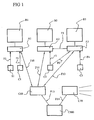
- the communication network to which the invention applies and which is illustrated by way of example in the figure 1 comprises a partial or total combination of bidirectional elements associated with actuators and / or sensors, unidirectional elements associated with sensors, unidirectional elements associated with remote controls, bidirectional elements associated with control commands distance to which a first hierarchical level is assigned and, finally, bidirectional elements associated with remote control and supervision functions with which a higher hierarchical level is associated.
- the hierarchical level of a bidirectional element is preferentially defined by the manufacturer and is mentioned in the communication frame.
- the physical communication between elements of the network preferably operates in a multi-master / multi-slave mode.
- the figure 1 represents an example of a network comprising a set of actuators (A1, A2, A3), commands (C1, C3), a sensor (S1), placed in the same building.
- the actuators (A1, A2, A3) are controlled by radio. They can themselves integrate specific sensors, for example position, force detection or obstacle. For simplicity, however, they are designated by the single term "Actuators”. Placed inside the products which they train, the actuators are not directly accessible, if only by the intermediary of a button, or are of a simply difficult access.
- a terrace awning (B1) integrating a first bidirectional actuator (A1) has been put in place, as well as a first unidirectional wind-sun weather sensor (S1), intended for automatic control of the actuator (A1), which is intended to be also controlled directly by the user, using a first unidirectional radio control (C1).
- the installer will first have to pair the first radio control (C1) with the first actuator (A1) in a conventional manner, using, for example, the so-called programming button placed on the control, and a property of the unpaired (blank) actuators to accept any pairing control as described in the prior art.
- This first pairing is represented at figure 1 by the arrow (F1).
- the first actuator (A1) accepts a new pairing command only if it comes from a command that it already knows.
- the pairing of the sensor (S1) with the first actuator (A1) will be done by the installer under control of the first command (C1).
- the installer By pressing the programming button of the first command (C1), the installer transmits by this first command (C1) to the first actuator (A1) a request of learning, thereby validating the acquisition by said first actuator (A1) of the next transmitted code.
- the installer presses the programming control of the first sensor (S1).
- the identification of the first sensor (S1) is then recorded by the first actuator (A1). This method makes it possible to record several identifiers of the different commands in the same actuator.
- This second pairing is represented at figure 1 by the arrow (F2).
- the building then knows a second phase of installation, with implementation of two shutters (B2, B3) each incorporating an actuator (A2, A3), namely, a second bidirectional actuator ( A2), controlled by a first unidirectional control (C2) for the first roller shutter (B2) and a third bidirectional actuator (A3) controlled by a third unidirectional control (C3) for the second roller shutter (B3).
- the pairing of the second control (C2) with the second actuator (A2) and the third control (C3) with the third actuator (A3) is carried out as previously, by successive operations represented in FIG. figure 1 by the arrows (F3) and (F4).
- This preliminary mode of communication consists in that the newly connected virgin products independently establish a relationship of order allowing them not to react simultaneously to an order from the installer, and thus facilitating the individual matching of the products.
- Such a method could equally well have been used here prior to the pairing of the second and third commands (C2, C3).
- the provisional bidirectional communication represented by the double arrow (F5) established on this occasion concerns only the virgin products and can not be assimilated to the constitution of network described here, whose goal is to establish durable links between elements.
- the second control (C2) can also control the second shutter normally activated by the third actuator (A3).
- the installer must therefore make this third actuator (A3) learn to recognize the instructions of the second command (C2).
- This operation represented by the arrow (F6), is carried out under the control of the third control (C3), exactly as the first actuator (A1) had learned to recognize the instructions of the first sensor (S1) under control of the first command ( C1).
- the second actuator (A2) and said first general control (C60) are put into relation (F11), under cover of the second command (C2), the second actuator (A2) transmits to the first general command (C60) the known identifier, namely, the second command (C2), and finally, when the third actuator (A3) is connected (F12) with the first general command (C60), under cover from the third command (C3), the third actuator (A3) transmits to the first general command (C60) the identifiers of the second and third commands (C2, C3).
- the group name (NG1) is advantageously constituted from the identifier of the first general command (C60). All actuators, namely, the first, second and third actuators (A1, A2, A3) then know that they are part of the same group (NG1).
- the first general command (C60) therefore has a table, preferably structured, giving the topology of the group (NG1), as follows: NG1- C60 A1 C1 S1 A2 C2 A3 C3 C2
- the second general command (C70) contains, as before, the (structured) list of all the identifiers of the group NG2.
- the second general command (C70) contains the identifiers of the two actuators, that is to say the fourth actuator (A4) and the fifth actuator (A5) themselves controlled by their corresponding command (C4) and ( C5), as well as by the second sensor (S2).
- This additional general control is, for example, a centralized control equipped with comfort management programs requiring the interaction of products of different trades.
- the supplementary command (C800) transmits to the first general command (C60) its group name (NG3), while this general command (C60) transmits the additional command (C800) its group name (NG1).
- this general command (C60) transmits the additional command (C800) its group name (NG1).
- group names NG2 and NG3
- the identifiers included in each table are also transmitted.
- NG3 - C800 NG1- C60 A1 C1 S1 A2 C2 A3 C3 C2 NG2 - C70 A4 C4 AT 5 C5 S2
- the first general command (C60) and the second general command (C70) can now belong to the same set (NG3), and can possibly propagate this information to the elements they control.
- the communication between elements of the network is carried out in any possible way and, for example, in multi-master / multi-slave form, the network is functionally structured by the very way in which it was constituted.
- the first, the second and the third command (C1, C2, C3) are unidirectional elements, but it could be otherwise, because one or the other, if not all, of the commands could be of the bidirectional type, if only to exchange an acknowledgment of receipt, for example.
Landscapes
- Engineering & Computer Science (AREA)
- Computer Hardware Design (AREA)
- Computer Security & Cryptography (AREA)
- Computing Systems (AREA)
- General Engineering & Computer Science (AREA)
- Computer Networks & Wireless Communication (AREA)
- Signal Processing (AREA)
- Selective Calling Equipment (AREA)
- Small-Scale Networks (AREA)
Claims (14)
- Verfahren zur Bildung eines domotischen Netzwerks, das bidirektionale Elemente wie Aktuatoren (A1, A2, A3), mindestens eindirektionale Steuermittel (C1, C2, C3, S1), bidirektionale Steuerelemente (C60, C70, C800) umfasst, das darin besteht, mindestens zwei Elemente in dauerhafte funktionelle Beziehung zu versetzen, dadurch gekennzeichnet, dass das Versetzen in dauerhafte funktionelle Beziehung mindestens einen Transfer mindestens einer netzstrukturierenden Information von einem bidirektionalen Element zu einem anderen bidirektionalen Element bewirkt und eine hierarchische Beziehung zwischen diesen beiden Elementen schafft.
- Verfahren zur Bildung eines domotischen Netzwerks nach Anspruch 1, dadurch gekennzeichnet, dass die Information, die eine hierarchische Beziehung zwischen diesen beiden Elementen schafft, einen Gruppennamen (NG1; NG2) umfasst.
- Verfahren zur Bildung eines domotischen Netzwerks nach Anspruch 2, dadurch gekennzeichnet, dass die Übertragung des Gruppennamens (NG1; NG2) gemäß einem Verschlüsselungsalgorithmus codiert ist.
- Verfahren zur Bildung eines domotischen Netzwerks nach Anspruch 1, dadurch gekennzeichnet, dass die Information, die eine hierarchische Beziehung zwischen diesen beiden Elementen schafft, die Identität der bereits mit dem Element, das die Information sendet, hergestellten Verbindungen umfasst.
- Verfahren zur Bildung eines domotischen Netzwerks nach einem der vorangehenden Ansprüche, dadurch gekennzeichnet, dass das Versetzen in dauerhafte funktionelle Beziehung zwischen zwei bidirektionalen Elementen unter der Kontrolle eines dritten Elements erfolgt, das ebenfalls zuvor bei einer Lernmaßnahme von einem der Elemente authentifiziert wurde.
- Verfahren zur Bildung eines domotischen Netzwerks nach einem der vorangehenden Ansprüche, dadurch gekennzeichnet, dass das Versetzen in funktionelle Beziehung eines bidirektionalen Steuerelements (C60) mit einem bidirektionalen Element (A1, A2, A3) unter der Kontrolle eines mindestens eindirektionalen Steuerelements (C1, C2, C3) erfolgt.
- Verfahren zur Bildung eines domotischen Netzwerks nach einem der vorangehenden Ansprüche, dadurch gekennzeichnet, dass das Versetzen in funktionelle Beziehung eines mindestens eindirektionalen Steuerelements (C1, C2, C3, S1) mit einem bidirektionalen Element (A1, A2, A3) unter der Kontrolle eines bidirektionalen Steuerelements (C60) erfolgt.
- Verfahren zur Bildung eines domotischen Netzwerks nach einem der vorangehenden Ansprüche, dadurch gekennzeichnet, dass das Versetzen in funktionelle Beziehung von zwei bidirektionalen Steuerelementen (C60, C70) derselben hierarchischen Ebene durch das Versetzen in Beziehung jedes der bidirektionalen Steuerelemente mit einem Steuerelement höherer hierarchischer Ebene (C800) gesichert ist.
- Verfahren zur Bildung eines domotischen Netzwerks nach einem der vorangehenden Ansprüche, dadurch gekennzeichnet, dass das Versetzen in funktionelle Beziehung von zwei bidirektionalen Elementen (A1, A2, A3) durch das schrittweise Versetzen in funktionelle Beziehung jedes von ihnen mit einem selben bidirektionalen Steuerelement (C60) gesichert ist.
- Verfahren zur Bildung eines domotischen Netzwerks nach einem der vorangehenden Ansprüche, dadurch gekennzeichnet, dass beim Versetzen in eine funktionelle Beziehung eines bidirektionalen Steuerelements (C60, C70 oder C800) mit einem anderen Element dieses dem bidirektionalen Steuerelement alle Kennwörter kommuniziert, die sich auf Elemente beziehen, mit denen es bereits in Beziehung steht.
- Verfahren zur Bildung eines domotischen Netzwerks nach einem der vorangehenden Ansprüche, dadurch gekennzeichnet, dass bei einer Herstellung einer funktionellen Beziehung zwischen zwei Steuerelementen unterschiedlicher hierarchischer Ebene die Informationsübermittlung über bereits hergestellte Beziehungen vom Element unterer Ebene zum Element höherer Ebene stattfindet.
- Verfahren zur Bildung eines domotischen Netzwerks nach einem der vorangehenden Ansprüche, dadurch gekennzeichnet, dass beim Versetzen in eine funktionelle Beziehung eines bidirektionalen Steuerelements (C60, C70 oder C800) mit einem anderen Element ein Gruppenname NG ausgetauscht wird, der für alle Elemente unteren Niveaus gemeinsam wird, die mit dem bidirektionalen Steuerelement in Beziehung versetzt sind.
- Verfahren zur Bildung eines domotischen Netzwerks nach Anspruch 12, dadurch gekennzeichnet, dass die Übertragung des Gruppennamens (NG1; NG2) gemäß einem Verschlüsselungsalgorithmus codiert ist.
- Netzwerk, auf das das Verfahren nach einem der Ansprüche 1 bis 13 angewendet wird.
Applications Claiming Priority (3)
| Application Number | Priority Date | Filing Date | Title |
|---|---|---|---|
| FR0115880 | 2001-12-05 | ||
| FR0115880A FR2833126B1 (fr) | 2001-12-05 | 2001-12-05 | Constitution de reseau domotique |
| PCT/IB2002/004973 WO2003049375A2 (fr) | 2001-12-05 | 2002-11-27 | Procede de constitution d'un reseau domotique |
Publications (2)
| Publication Number | Publication Date |
|---|---|
| EP1451972A2 EP1451972A2 (de) | 2004-09-01 |
| EP1451972B1 true EP1451972B1 (de) | 2013-03-06 |
Family
ID=8870250
Family Applications (1)
| Application Number | Title | Priority Date | Filing Date |
|---|---|---|---|
| EP02783439A Expired - Lifetime EP1451972B1 (de) | 2001-12-05 | 2002-11-27 | Verfahren zur bildung eines heimnetzes |
Country Status (7)
| Country | Link |
|---|---|
| US (1) | US7102502B2 (de) |
| EP (1) | EP1451972B1 (de) |
| JP (1) | JP2005512402A (de) |
| AU (1) | AU2002347505A1 (de) |
| ES (1) | ES2224909T1 (de) |
| FR (1) | FR2833126B1 (de) |
| WO (1) | WO2003049375A2 (de) |
Families Citing this family (58)
| Publication number | Priority date | Publication date | Assignee | Title |
|---|---|---|---|---|
| FR2869134B1 (fr) * | 2004-04-16 | 2008-10-03 | Somfy Soc Par Actions Simplifiee | Procede de transmission d'informations entre objets bidirectionnels |
| US8024360B2 (en) * | 2004-12-10 | 2011-09-20 | Centrify Corporation | Method and apparatus for maintaining multiple sets of identity data |
| US7274975B2 (en) | 2005-06-06 | 2007-09-25 | Gridpoint, Inc. | Optimized energy management system |
| US10277519B2 (en) | 2006-01-31 | 2019-04-30 | Silicon Laboratories Inc. | Response time for a gateway connecting a lower bandwidth network with a higher speed network |
| US20150187209A1 (en) * | 2006-01-31 | 2015-07-02 | Sigma Designs, Inc. | Method and system for synchronization and remote control of controlling units |
| US10326537B2 (en) | 2006-01-31 | 2019-06-18 | Silicon Laboratories Inc. | Environmental change condition detection through antenna-based sensing of environmental change |
| US7496627B2 (en) | 2006-03-16 | 2009-02-24 | Exceptional Innovation, Llc | Automation control system having digital logging |
| US8001219B2 (en) | 2006-03-16 | 2011-08-16 | Exceptional Innovation, Llc | User control interface for convergence and automation system |
| US8155142B2 (en) | 2006-03-16 | 2012-04-10 | Exceptional Innovation Llc | Network based digital access point device |
| US7587464B2 (en) | 2006-03-16 | 2009-09-08 | Exceptional Innovation, Llc | Device automation using networked device control having a web services for devices stack |
| US7509402B2 (en) | 2006-03-16 | 2009-03-24 | Exceptional Innovation, Llc | Automation control system having a configuration tool and two-way ethernet communication for web service messaging, discovery, description, and eventing that is controllable with a touch-screen display |
| US8209398B2 (en) | 2006-03-16 | 2012-06-26 | Exceptional Innovation Llc | Internet protocol based media streaming solution |
| US7966083B2 (en) | 2006-03-16 | 2011-06-21 | Exceptional Innovation Llc | Automation control system having device scripting |
| US8725845B2 (en) | 2006-03-16 | 2014-05-13 | Exceptional Innovation Llc | Automation control system having a configuration tool |
| DE102006013028B3 (de) * | 2006-03-20 | 2007-10-18 | SCHÜCO International KG | Fenster |
| WO2007126781A2 (en) | 2006-03-27 | 2007-11-08 | Exceptional Innovation Llc | Set top box for convergence and automation system |
| FR2900263B1 (fr) | 2006-04-19 | 2009-11-06 | Somfy Sas | Procede de test et d'installation d'une telecommande domotique |
| WO2007124453A2 (en) | 2006-04-20 | 2007-11-01 | Exceptional Innovation Llc | Touch screen for convergence and automation system |
| US8103389B2 (en) | 2006-05-18 | 2012-01-24 | Gridpoint, Inc. | Modular energy control system |
| US7667968B2 (en) | 2006-05-19 | 2010-02-23 | Exceptional Innovation, Llc | Air-cooling system configuration for touch screen |
| US9030315B2 (en) * | 2006-08-29 | 2015-05-12 | Siemens Industry, Inc. | Binding methods and devices in a building automation system |
| US20080055073A1 (en) * | 2006-09-06 | 2008-03-06 | Lutron Electronics Co., Inc. | Method of discovering a remotely-located wireless control device |
| US7880639B2 (en) * | 2006-09-06 | 2011-02-01 | Lutron Electronics Co., Inc. | Method of establishing communication with wireless control devices |
| US7768422B2 (en) * | 2006-09-06 | 2010-08-03 | Carmen Jr Lawrence R | Method of restoring a remote wireless control device to a known state |
| US7755505B2 (en) * | 2006-09-06 | 2010-07-13 | Lutron Electronics Co., Inc. | Procedure for addressing remotely-located radio frequency components of a control system |
| US7962130B2 (en) | 2006-11-09 | 2011-06-14 | Exceptional Innovation | Portable device for convergence and automation solution |
| US20080111491A1 (en) * | 2006-11-13 | 2008-05-15 | Spira Joel S | Radio-frequency lighting control system |
| WO2008117244A1 (en) * | 2007-03-27 | 2008-10-02 | Koninklijke Philips Electronics N.V. | Control circuit, system for operating a device and device for programming such a control circuit |
| US20090206983A1 (en) * | 2008-02-19 | 2009-08-20 | Lutron Electronics Co., Inc. | Communication System for a Radio-Frequency Load Control System |
| US8009042B2 (en) | 2008-09-03 | 2011-08-30 | Lutron Electronics Co., Inc. | Radio-frequency lighting control system with occupancy sensing |
| USRE47511E1 (en) | 2008-09-03 | 2019-07-09 | Lutron Technology Company Llc | Battery-powered occupancy sensor |
| US9148937B2 (en) | 2008-09-03 | 2015-09-29 | Lutron Electronics Co., Inc. | Radio-frequency lighting control system with occupancy sensing |
| US8228184B2 (en) | 2008-09-03 | 2012-07-24 | Lutron Electronics Co., Inc. | Battery-powered occupancy sensor |
| US7940167B2 (en) | 2008-09-03 | 2011-05-10 | Lutron Electronics Co., Inc. | Battery-powered occupancy sensor |
| US9277629B2 (en) | 2008-09-03 | 2016-03-01 | Lutron Electronics Co., Inc. | Radio-frequency lighting control system with occupancy sensing |
| US8190275B2 (en) * | 2008-09-26 | 2012-05-29 | Michael Alan Chang | Peer-to-peer home automation management |
| US8199010B2 (en) * | 2009-02-13 | 2012-06-12 | Lutron Electronics Co., Inc. | Method and apparatus for configuring a wireless sensor |
| WO2011028908A1 (en) * | 2009-09-03 | 2011-03-10 | Lutron Electronics Co., Inc. | Method of selecting a transmission frequency of a one-way wireless remote control device |
| FR2955688B1 (fr) * | 2010-01-28 | 2012-02-24 | Somfy Sas | Procede de configuration d'une installation domotique |
| EP2601758A1 (de) * | 2010-08-05 | 2013-06-12 | Nice S.p.A. | Verfahren zun hinzufügen/ersetzen von komponenten in einem drahtlsoen domotiksystem |
| US8598978B2 (en) | 2010-09-02 | 2013-12-03 | Lutron Electronics Co., Inc. | Method of configuring a two-way wireless load control system having one-way wireless remote control devices |
| WO2012125423A1 (en) | 2011-03-11 | 2012-09-20 | Lutron Electronics Co., Inc. | Low power radio frequency receiver |
| WO2013012547A1 (en) | 2011-06-30 | 2013-01-24 | Lutron Electronics Co., Inc. | Load control device having internet connectivity, and method of programming the same using a smart phone |
| US9544977B2 (en) | 2011-06-30 | 2017-01-10 | Lutron Electronics Co., Inc. | Method of programming a load control device using a smart phone |
| US9386666B2 (en) | 2011-06-30 | 2016-07-05 | Lutron Electronics Co., Inc. | Method of optically transmitting digital information from a smart phone to a control device |
| US20130222122A1 (en) | 2011-08-29 | 2013-08-29 | Lutron Electronics Co., Inc. | Two-Part Load Control System Mountable To A Single Electrical Wallbox |
| US9413171B2 (en) | 2012-12-21 | 2016-08-09 | Lutron Electronics Co., Inc. | Network access coordination of load control devices |
| US10244086B2 (en) | 2012-12-21 | 2019-03-26 | Lutron Electronics Co., Inc. | Multiple network access load control devices |
| US10019047B2 (en) | 2012-12-21 | 2018-07-10 | Lutron Electronics Co., Inc. | Operational coordination of load control devices for control of electrical loads |
| US10135629B2 (en) | 2013-03-15 | 2018-11-20 | Lutron Electronics Co., Inc. | Load control device user interface and database management using near field communication (NFC) |
| US9300484B1 (en) | 2013-07-12 | 2016-03-29 | Smartlabs, Inc. | Acknowledgement as a propagation of messages in a simulcast mesh network |
| US10149369B2 (en) | 2013-11-21 | 2018-12-04 | Lutron Electronics Co., Inc. | Method of associating wireless control devices |
| US10637681B2 (en) | 2014-03-13 | 2020-04-28 | Silicon Laboratories Inc. | Method and system for synchronization and remote control of controlling units |
| US9438573B2 (en) | 2014-11-12 | 2016-09-06 | Smartlabs, Inc. | Systems and methods to securely install network devices using physical confirmation |
| US9425979B2 (en) | 2014-11-12 | 2016-08-23 | Smartlabs, Inc. | Installation of network devices using secure broadcasting systems and methods from remote intelligent devices |
| US9531587B2 (en) | 2014-11-12 | 2016-12-27 | Smartlabs, Inc. | Systems and methods to link network controllers using installed network devices |
| US10637673B2 (en) | 2016-12-12 | 2020-04-28 | Silicon Laboratories Inc. | Energy harvesting nodes in a mesh network |
| US11553618B2 (en) | 2020-08-26 | 2023-01-10 | PassiveLogic, Inc. | Methods and systems of building automation state load and user preference via network systems activity |
Family Cites Families (16)
| Publication number | Priority date | Publication date | Assignee | Title |
|---|---|---|---|---|
| GB2023899B (en) | 1978-06-14 | 1982-10-27 | Hitachi Ltd | Remote-controlled automatic control apparatus |
| SE429884B (sv) | 1979-06-05 | 1983-10-03 | Thelin & Co Id Select | Elektroniskt las |
| US4750118A (en) | 1985-10-29 | 1988-06-07 | Chamberlain Manufacturing Corporation | Coding system for multiple transmitters and a single receiver for a garage door opener |
| GB2167274A (en) | 1984-11-14 | 1986-05-21 | Philips Electronic Associated | Local area network |
| US4689786A (en) | 1985-03-21 | 1987-08-25 | Apple Computer, Inc. | Local area network with self assigned address method |
| US4918690A (en) | 1987-11-10 | 1990-04-17 | Echelon Systems Corp. | Network and intelligent cell for providing sensing, bidirectional communications and control |
| US4988992A (en) | 1989-07-27 | 1991-01-29 | The Chamberlain Group, Inc. | System for establishing a code and controlling operation of equipment |
| US5420572A (en) * | 1990-12-03 | 1995-05-30 | Echelon Corporation | Configuration device for use in a networked communication system |
| FR2681492B1 (fr) | 1991-09-16 | 1993-11-26 | Somfy | Installation comportant des emetteurs et des recepteurs codes. |
| DE69212997T2 (de) | 1992-06-19 | 1997-05-28 | Euro Cp Sarl | Verfahren zur Adressierung einer Betriebseinrichtung und zur Verbindung von zwei Betriebseinrichtungen; Betriebseinrichtung und Anlage dafür |
| FR2706642B1 (fr) | 1993-06-18 | 1995-08-18 | Euro Cp Sarl | Procédé d'attribution d'adresse, ainsi qu'unité fonctionnelle et installation s'y rapportant. |
| DE4327809C2 (de) | 1993-08-18 | 2001-08-09 | Tridonic Bauelemente | Verfahren zum Adressieren von mit einer zentralen Steuereinheit verbundenen elektronischen Vorschaltgeräten |
| US6191701B1 (en) | 1995-08-25 | 2001-02-20 | Microchip Technology Incorporated | Secure self learning system |
| DE19616399A1 (de) | 1996-04-24 | 1997-10-30 | Marantec Antrieb Steuerung | Fernbedienung |
| FR2755259B1 (fr) | 1996-10-25 | 1999-01-22 | Somfy | Procede de mise en correspondance d'un boitier de commande de groupe avec un boitier de commande et/ou un boitier d'action et/ou un boitier de mesure |
| FR2761183B1 (fr) | 1997-03-24 | 1999-05-28 | Somfy | Dispositif de commande d'un actionneur telecommande |
-
2001
- 2001-12-05 FR FR0115880A patent/FR2833126B1/fr not_active Expired - Fee Related
-
2002
- 2002-11-27 US US10/497,446 patent/US7102502B2/en not_active Expired - Lifetime
- 2002-11-27 EP EP02783439A patent/EP1451972B1/de not_active Expired - Lifetime
- 2002-11-27 ES ES02783439T patent/ES2224909T1/es active Pending
- 2002-11-27 WO PCT/IB2002/004973 patent/WO2003049375A2/fr not_active Ceased
- 2002-11-27 AU AU2002347505A patent/AU2002347505A1/en not_active Abandoned
- 2002-11-27 JP JP2003550443A patent/JP2005512402A/ja active Pending
Also Published As
| Publication number | Publication date |
|---|---|
| ES2224909T1 (es) | 2005-03-16 |
| EP1451972A2 (de) | 2004-09-01 |
| US7102502B2 (en) | 2006-09-05 |
| FR2833126B1 (fr) | 2007-01-12 |
| WO2003049375A3 (fr) | 2004-06-03 |
| WO2003049375A2 (fr) | 2003-06-12 |
| JP2005512402A (ja) | 2005-04-28 |
| AU2002347505A1 (en) | 2003-06-17 |
| FR2833126A1 (fr) | 2003-06-06 |
| US20040267909A1 (en) | 2004-12-30 |
Similar Documents
| Publication | Publication Date | Title |
|---|---|---|
| EP1451972B1 (de) | Verfahren zur bildung eines heimnetzes | |
| EP1587044B1 (de) | Verfahren zur Datenübertragung zwischen bidirektionalen Gegenständen | |
| EP0520876B1 (de) | Verfahren und System zum Übertragen von Nachrichten und Steuerdaten in einem Hausnetz | |
| EP2633506B1 (de) | Verfahren für den betrieb einer mobilen steuereinheit einer domotikanlage | |
| EP1410360A1 (de) | Verfahren zur zuordnung von sender zu empfanger | |
| EP1459276A1 (de) | Verfahren zum anpassen von sendern und eines empfängers | |
| EP3318019B1 (de) | Heimautomatisierungssystem und verfahren zur erzeugung von topologie eines heimautomatisierungssystems | |
| EP1884100A1 (de) | Verfahren zur steuerung der verbindung eines peripheriegeräts mit einem zugangspunkt, entsprechender zugangspunkt und peripheriegerät | |
| EP3318018B1 (de) | Verfahren zum registrieren einer zentralen steuereinheit einer heimautomatisierungsanlage und entsprechende computerprogrammprodukte | |
| EP2632084B1 (de) | Konfigurationsverfahren einer Heimanlage | |
| EP3679689B1 (de) | Verfahren zur konfiguration und / oder wartung eines heimautomatisierungssystems für ein gebäude und zugehöriges heimautomatisierungssystem | |
| FR2837966A1 (fr) | Dispositif de commande a distance d'un actionneur dans une installation de protection et/ou de confort avec moyens de transfert de programme executable et procede de mise en oeuvre | |
| EP3384635B1 (de) | Verfahren zur konfiguration, steuerung oder überwachung einer heimautomationsanlage | |
| EP3829101B1 (de) | Verfahren zur sicherung von daten zwischen einer kommunikationseinrichtung und einem entfernten endgerät | |
| EP3679688B1 (de) | Heimautomationssystem für gebäude, gebäude mit einem solchen heimautomationssystem, und konfigurationssystem | |
| WO2019043223A1 (fr) | Interface réseau pour un équipement domotique, système domotique pour un bâtiment contenant cet équipement domotique et bâtiment comportant un tel système domotique | |
| FR3153956A1 (fr) | Procédé et dispositif de contrôle d’exécution d’au moins une action par un objet connecté dans un réseau de communication | |
| FR3070809A1 (fr) | Procede de communication mis en oeuvre dans un systeme domotique pour batiment et systeme domotique associe | |
| FR2985072A1 (fr) | Procede de gestion d'une installation domotique | |
| FR2895816A1 (fr) | Systeme, dispositif portable et procede pour la configuration d'un dispositif communicant dans un reseau | |
| EP1723788B1 (de) | Prozess zur verwaltung der handhabung von daten des bedingten zugangs durch mindestens zwei decodierer | |
| FR2842376A1 (fr) | Procede de communication selective entre objets | |
| FR3122265A1 (fr) | procédé de gestion d’un historique du suivi par un installateur d’une installation domotique. | |
| WO2005002147A1 (fr) | Architecture de reseau local sans fil | |
| FR2988252A1 (fr) | Dispositif electronique configure pour etre relie a un reseau local et passerelle d'acces a un reseau local |
Legal Events
| Date | Code | Title | Description |
|---|---|---|---|
| PUAI | Public reference made under article 153(3) epc to a published international application that has entered the european phase |
Free format text: ORIGINAL CODE: 0009012 |
|
| 17P | Request for examination filed |
Effective date: 20040617 |
|
| AK | Designated contracting states |
Kind code of ref document: A2 Designated state(s): AT BE BG CH CY CZ DE DK EE ES FI FR GB GR IE IT LI LU MC NL PT SE SK TR |
|
| AX | Request for extension of the european patent |
Extension state: AL LT LV MK RO SI |
|
| 17Q | First examination report despatched |
Effective date: 20110627 |
|
| REG | Reference to a national code |
Ref country code: DE Ref legal event code: R079 Ref document number: 60244613 Country of ref document: DE Free format text: PREVIOUS MAIN CLASS: H04L0012280000 Ipc: H04L0029060000 |
|
| GRAP | Despatch of communication of intention to grant a patent |
Free format text: ORIGINAL CODE: EPIDOSNIGR1 |
|
| RIC1 | Information provided on ipc code assigned before grant |
Ipc: H04L 29/06 20060101AFI20120831BHEP |
|
| GRAS | Grant fee paid |
Free format text: ORIGINAL CODE: EPIDOSNIGR3 |
|
| GRAA | (expected) grant |
Free format text: ORIGINAL CODE: 0009210 |
|
| AK | Designated contracting states |
Kind code of ref document: B1 Designated state(s): AT BE BG CH CY CZ DE DK EE ES FI FR GB GR IE IT LI LU MC NL PT SE SK TR |
|
| REG | Reference to a national code |
Ref country code: GB Ref legal event code: FG4D Free format text: NOT ENGLISH |
|
| REG | Reference to a national code |
Ref country code: CH Ref legal event code: EP Ref country code: AT Ref legal event code: REF Ref document number: 600157 Country of ref document: AT Kind code of ref document: T Effective date: 20130315 |
|
| REG | Reference to a national code |
Ref country code: IE Ref legal event code: FG4D Free format text: LANGUAGE OF EP DOCUMENT: FRENCH |
|
| REG | Reference to a national code |
Ref country code: DE Ref legal event code: R096 Ref document number: 60244613 Country of ref document: DE Effective date: 20130502 |
|
| REG | Reference to a national code |
Ref country code: CH Ref legal event code: NV Representative=s name: BUGNION S.A., CH |
|
| REG | Reference to a national code |
Ref country code: AT Ref legal event code: MK05 Ref document number: 600157 Country of ref document: AT Kind code of ref document: T Effective date: 20130306 |
|
| PG25 | Lapsed in a contracting state [announced via postgrant information from national office to epo] |
Ref country code: SE Free format text: LAPSE BECAUSE OF FAILURE TO SUBMIT A TRANSLATION OF THE DESCRIPTION OR TO PAY THE FEE WITHIN THE PRESCRIBED TIME-LIMIT Effective date: 20130306 Ref country code: AT Free format text: LAPSE BECAUSE OF FAILURE TO SUBMIT A TRANSLATION OF THE DESCRIPTION OR TO PAY THE FEE WITHIN THE PRESCRIBED TIME-LIMIT Effective date: 20130306 Ref country code: BG Free format text: LAPSE BECAUSE OF FAILURE TO SUBMIT A TRANSLATION OF THE DESCRIPTION OR TO PAY THE FEE WITHIN THE PRESCRIBED TIME-LIMIT Effective date: 20130606 Ref country code: ES Free format text: LAPSE BECAUSE OF FAILURE TO SUBMIT A TRANSLATION OF THE DESCRIPTION OR TO PAY THE FEE WITHIN THE PRESCRIBED TIME-LIMIT Effective date: 20130617 |
|
| REG | Reference to a national code |
Ref country code: NL Ref legal event code: T3 |
|
| PG25 | Lapsed in a contracting state [announced via postgrant information from national office to epo] |
Ref country code: GR Free format text: LAPSE BECAUSE OF FAILURE TO SUBMIT A TRANSLATION OF THE DESCRIPTION OR TO PAY THE FEE WITHIN THE PRESCRIBED TIME-LIMIT Effective date: 20130607 Ref country code: FI Free format text: LAPSE BECAUSE OF FAILURE TO SUBMIT A TRANSLATION OF THE DESCRIPTION OR TO PAY THE FEE WITHIN THE PRESCRIBED TIME-LIMIT Effective date: 20130306 |
|
| PG25 | Lapsed in a contracting state [announced via postgrant information from national office to epo] |
Ref country code: CZ Free format text: LAPSE BECAUSE OF FAILURE TO SUBMIT A TRANSLATION OF THE DESCRIPTION OR TO PAY THE FEE WITHIN THE PRESCRIBED TIME-LIMIT Effective date: 20130306 Ref country code: EE Free format text: LAPSE BECAUSE OF FAILURE TO SUBMIT A TRANSLATION OF THE DESCRIPTION OR TO PAY THE FEE WITHIN THE PRESCRIBED TIME-LIMIT Effective date: 20130306 Ref country code: SK Free format text: LAPSE BECAUSE OF FAILURE TO SUBMIT A TRANSLATION OF THE DESCRIPTION OR TO PAY THE FEE WITHIN THE PRESCRIBED TIME-LIMIT Effective date: 20130306 Ref country code: PT Free format text: LAPSE BECAUSE OF FAILURE TO SUBMIT A TRANSLATION OF THE DESCRIPTION OR TO PAY THE FEE WITHIN THE PRESCRIBED TIME-LIMIT Effective date: 20130708 |
|
| PG25 | Lapsed in a contracting state [announced via postgrant information from national office to epo] |
Ref country code: CY Free format text: LAPSE BECAUSE OF FAILURE TO SUBMIT A TRANSLATION OF THE DESCRIPTION OR TO PAY THE FEE WITHIN THE PRESCRIBED TIME-LIMIT Effective date: 20130306 |
|
| PLBE | No opposition filed within time limit |
Free format text: ORIGINAL CODE: 0009261 |
|
| STAA | Information on the status of an ep patent application or granted ep patent |
Free format text: STATUS: NO OPPOSITION FILED WITHIN TIME LIMIT |
|
| PG25 | Lapsed in a contracting state [announced via postgrant information from national office to epo] |
Ref country code: DK Free format text: LAPSE BECAUSE OF FAILURE TO SUBMIT A TRANSLATION OF THE DESCRIPTION OR TO PAY THE FEE WITHIN THE PRESCRIBED TIME-LIMIT Effective date: 20130306 |
|
| 26N | No opposition filed |
Effective date: 20131209 |
|
| REG | Reference to a national code |
Ref country code: DE Ref legal event code: R097 Ref document number: 60244613 Country of ref document: DE Effective date: 20131209 |
|
| PG25 | Lapsed in a contracting state [announced via postgrant information from national office to epo] |
Ref country code: MC Free format text: LAPSE BECAUSE OF FAILURE TO SUBMIT A TRANSLATION OF THE DESCRIPTION OR TO PAY THE FEE WITHIN THE PRESCRIBED TIME-LIMIT Effective date: 20130306 |
|
| REG | Reference to a national code |
Ref country code: IE Ref legal event code: MM4A |
|
| PG25 | Lapsed in a contracting state [announced via postgrant information from national office to epo] |
Ref country code: IE Free format text: LAPSE BECAUSE OF NON-PAYMENT OF DUE FEES Effective date: 20131127 |
|
| PG25 | Lapsed in a contracting state [announced via postgrant information from national office to epo] |
Ref country code: TR Free format text: LAPSE BECAUSE OF FAILURE TO SUBMIT A TRANSLATION OF THE DESCRIPTION OR TO PAY THE FEE WITHIN THE PRESCRIBED TIME-LIMIT Effective date: 20130306 |
|
| PG25 | Lapsed in a contracting state [announced via postgrant information from national office to epo] |
Ref country code: LU Free format text: LAPSE BECAUSE OF NON-PAYMENT OF DUE FEES Effective date: 20131127 |
|
| REG | Reference to a national code |
Ref country code: FR Ref legal event code: PLFP Year of fee payment: 14 |
|
| REG | Reference to a national code |
Ref country code: DE Ref legal event code: R082 Ref document number: 60244613 Country of ref document: DE |
|
| REG | Reference to a national code |
Ref country code: FR Ref legal event code: PLFP Year of fee payment: 15 |
|
| REG | Reference to a national code |
Ref country code: FR Ref legal event code: PLFP Year of fee payment: 16 |
|
| PGFP | Annual fee paid to national office [announced via postgrant information from national office to epo] |
Ref country code: NL Payment date: 20181015 Year of fee payment: 17 |
|
| PGFP | Annual fee paid to national office [announced via postgrant information from national office to epo] |
Ref country code: IT Payment date: 20181113 Year of fee payment: 17 |
|
| REG | Reference to a national code |
Ref country code: CH Ref legal event code: PL |
|
| REG | Reference to a national code |
Ref country code: NL Ref legal event code: MM Effective date: 20191201 |
|
| PG25 | Lapsed in a contracting state [announced via postgrant information from national office to epo] |
Ref country code: CH Free format text: LAPSE BECAUSE OF NON-PAYMENT OF DUE FEES Effective date: 20191130 Ref country code: LI Free format text: LAPSE BECAUSE OF NON-PAYMENT OF DUE FEES Effective date: 20191130 |
|
| REG | Reference to a national code |
Ref country code: BE Ref legal event code: MM Effective date: 20191130 |
|
| PG25 | Lapsed in a contracting state [announced via postgrant information from national office to epo] |
Ref country code: NL Free format text: LAPSE BECAUSE OF NON-PAYMENT OF DUE FEES Effective date: 20191201 |
|
| PG25 | Lapsed in a contracting state [announced via postgrant information from national office to epo] |
Ref country code: IT Free format text: LAPSE BECAUSE OF NON-PAYMENT OF DUE FEES Effective date: 20191127 |
|
| PG25 | Lapsed in a contracting state [announced via postgrant information from national office to epo] |
Ref country code: BE Free format text: LAPSE BECAUSE OF NON-PAYMENT OF DUE FEES Effective date: 20191130 |
|
| REG | Reference to a national code |
Ref country code: DE Ref legal event code: R081 Ref document number: 60244613 Country of ref document: DE Owner name: SOMFY ACTIVITES SA, FR Free format text: FORMER OWNER: SOMFY SAS, CLUSES, FR |
|
| REG | Reference to a national code |
Ref country code: DE Ref legal event code: R079 Ref document number: 60244613 Country of ref document: DE Free format text: PREVIOUS MAIN CLASS: H04L0029060000 Ipc: H04L0065000000 |
|
| PGFP | Annual fee paid to national office [announced via postgrant information from national office to epo] |
Ref country code: DE Payment date: 20211026 Year of fee payment: 20 Ref country code: GB Payment date: 20211025 Year of fee payment: 20 Ref country code: FR Payment date: 20211118 Year of fee payment: 20 |
|
| REG | Reference to a national code |
Ref country code: DE Ref legal event code: R071 Ref document number: 60244613 Country of ref document: DE |
|
| REG | Reference to a national code |
Ref country code: GB Ref legal event code: PE20 Expiry date: 20221126 |
|
| PG25 | Lapsed in a contracting state [announced via postgrant information from national office to epo] |
Ref country code: GB Free format text: LAPSE BECAUSE OF EXPIRATION OF PROTECTION Effective date: 20221126 |