EP1453378B1 - Herbizide mittel enthaltend benzoylpyrazole und safener - Google Patents
Herbizide mittel enthaltend benzoylpyrazole und safener Download PDFInfo
- Publication number
- EP1453378B1 EP1453378B1 EP02792759A EP02792759A EP1453378B1 EP 1453378 B1 EP1453378 B1 EP 1453378B1 EP 02792759 A EP02792759 A EP 02792759A EP 02792759 A EP02792759 A EP 02792759A EP 1453378 B1 EP1453378 B1 EP 1453378B1
- Authority
- EP
- European Patent Office
- Prior art keywords
- alkyl
- methyl
- hydrogen
- chloro
- alkoxy
- Prior art date
- Legal status (The legal status is an assumption and is not a legal conclusion. Google has not performed a legal analysis and makes no representation as to the accuracy of the status listed.)
- Expired - Lifetime
Links
- 239000004009 herbicide Substances 0.000 title claims abstract description 40
- UYMQWGLCXYHTES-UHFFFAOYSA-N phenyl(1h-pyrazol-5-yl)methanone Chemical class C=1C=CC=CC=1C(=O)C1=CC=NN1 UYMQWGLCXYHTES-UHFFFAOYSA-N 0.000 title description 3
- 230000002363 herbicidal effect Effects 0.000 claims abstract description 50
- 150000001875 compounds Chemical class 0.000 claims abstract description 47
- 239000001257 hydrogen Substances 0.000 claims abstract description 19
- 229910052739 hydrogen Inorganic materials 0.000 claims abstract description 19
- 229910052736 halogen Inorganic materials 0.000 claims abstract description 17
- 150000002367 halogens Chemical class 0.000 claims abstract description 16
- 239000000203 mixture Substances 0.000 claims description 38
- 241000196324 Embryophyta Species 0.000 claims description 30
- -1 benzoylmethyl Chemical group 0.000 claims description 28
- 125000004178 (C1-C4) alkyl group Chemical group 0.000 claims description 24
- UFHFLCQGNIYNRP-UHFFFAOYSA-N Hydrogen Chemical compound [H][H] UFHFLCQGNIYNRP-UHFFFAOYSA-N 0.000 claims description 16
- 125000002496 methyl group Chemical group [H]C([H])([H])* 0.000 claims description 13
- 125000000229 (C1-C4)alkoxy group Chemical group 0.000 claims description 12
- 125000004765 (C1-C4) haloalkyl group Chemical group 0.000 claims description 11
- 240000008042 Zea mays Species 0.000 claims description 11
- 235000002017 Zea mays subsp mays Nutrition 0.000 claims description 11
- 150000003839 salts Chemical class 0.000 claims description 10
- 125000004169 (C1-C6) alkyl group Chemical group 0.000 claims description 9
- 125000005913 (C3-C6) cycloalkyl group Chemical group 0.000 claims description 9
- 240000007594 Oryza sativa Species 0.000 claims description 8
- 235000007164 Oryza sativa Nutrition 0.000 claims description 8
- 125000001495 ethyl group Chemical group [H]C([H])([H])C([H])([H])* 0.000 claims description 8
- 235000009566 rice Nutrition 0.000 claims description 8
- 125000001424 substituent group Chemical group 0.000 claims description 7
- 125000002023 trifluoromethyl group Chemical group FC(F)(F)* 0.000 claims description 7
- QWWHRELOCZEQNZ-UHFFFAOYSA-N 2,2-dichloro-1-(1-oxa-4-azaspiro[4.5]decan-4-yl)ethanone Chemical compound ClC(Cl)C(=O)N1CCOC11CCCCC1 QWWHRELOCZEQNZ-UHFFFAOYSA-N 0.000 claims description 6
- OHXLAOJLJWLEIP-UHFFFAOYSA-N 2-(dichloromethyl)-2-methyl-1,3-dioxolane Chemical compound ClC(Cl)C1(C)OCCO1 OHXLAOJLJWLEIP-UHFFFAOYSA-N 0.000 claims description 6
- 125000000882 C2-C6 alkenyl group Chemical group 0.000 claims description 6
- 239000000729 antidote Substances 0.000 claims description 6
- 238000000034 method Methods 0.000 claims description 6
- 125000001997 phenyl group Chemical group [H]C1=C([H])C([H])=C(*)C([H])=C1[H] 0.000 claims description 6
- 235000021307 Triticum Nutrition 0.000 claims description 5
- 235000005824 Zea mays ssp. parviglumis Nutrition 0.000 claims description 5
- ICJSJAJWTWPSBD-UHFFFAOYSA-N cloquintocet Chemical compound C1=CN=C2C(OCC(=O)O)=CC=C(Cl)C2=C1 ICJSJAJWTWPSBD-UHFFFAOYSA-N 0.000 claims description 5
- 235000005822 corn Nutrition 0.000 claims description 5
- MCNOFYBITGAAGM-UHFFFAOYSA-N 2,2-dichloro-1-[5-(furan-2-yl)-2,2-dimethyl-1,3-oxazolidin-3-yl]ethanone Chemical compound C1N(C(=O)C(Cl)Cl)C(C)(C)OC1C1=CC=CO1 MCNOFYBITGAAGM-UHFFFAOYSA-N 0.000 claims description 4
- PFJJMJDEVDLPNE-UHFFFAOYSA-N Benoxacor Chemical compound C1=CC=C2N(C(=O)C(Cl)Cl)C(C)COC2=C1 PFJJMJDEVDLPNE-UHFFFAOYSA-N 0.000 claims description 4
- 125000003601 C2-C6 alkynyl group Chemical group 0.000 claims description 4
- YRMLFORXOOIJDR-UHFFFAOYSA-N Dichlormid Chemical compound ClC(Cl)C(=O)N(CC=C)CC=C YRMLFORXOOIJDR-UHFFFAOYSA-N 0.000 claims description 4
- NRFQZTCQAYEXEE-UHFFFAOYSA-N Fenclorim Chemical compound ClC1=CC(Cl)=NC(C=2C=CC=CC=2)=N1 NRFQZTCQAYEXEE-UHFFFAOYSA-N 0.000 claims description 4
- UKSLKNUCVPZQCQ-UHFFFAOYSA-N Fluxofenim Chemical compound C=1C=C(Cl)C=CC=1C(C(F)(F)F)=NOCC1OCCO1 UKSLKNUCVPZQCQ-UHFFFAOYSA-N 0.000 claims description 4
- 240000005979 Hordeum vulgare Species 0.000 claims description 4
- 235000007340 Hordeum vulgare Nutrition 0.000 claims description 4
- WFVUIONFJOAYPK-KAMYIIQDSA-N Oxabetrinil Chemical compound C=1C=CC=CC=1C(/C#N)=N\OCC1OCCO1 WFVUIONFJOAYPK-KAMYIIQDSA-N 0.000 claims description 4
- 240000000111 Saccharum officinarum Species 0.000 claims description 4
- 235000007201 Saccharum officinarum Nutrition 0.000 claims description 4
- MKQSWTQPLLCSOB-UHFFFAOYSA-N benzyl 2-chloro-4-(trifluoromethyl)-1,3-thiazole-5-carboxylate Chemical compound N1=C(Cl)SC(C(=O)OCC=2C=CC=CC=2)=C1C(F)(F)F MKQSWTQPLLCSOB-UHFFFAOYSA-N 0.000 claims description 4
- 125000001797 benzyl group Chemical group [H]C1=C([H])C([H])=C(C([H])=C1[H])C([H])([H])* 0.000 claims description 4
- COYBRKAVBMYYSF-UHFFFAOYSA-N heptan-2-yl [(5-chloroquinolin-8-yl)oxy]acetate Chemical group C1=CN=C2C(OCC(=O)OC(C)CCCCC)=CC=C(Cl)C2=C1 COYBRKAVBMYYSF-UHFFFAOYSA-N 0.000 claims description 4
- 125000004768 (C1-C4) alkylsulfinyl group Chemical group 0.000 claims description 3
- 125000004769 (C1-C4) alkylsulfonyl group Chemical group 0.000 claims description 3
- 125000004767 (C1-C4) haloalkoxy group Chemical group 0.000 claims description 3
- 125000004191 (C1-C6) alkoxy group Chemical group 0.000 claims description 3
- 125000004737 (C1-C6) haloalkoxy group Chemical group 0.000 claims description 3
- PYKLUAIDKVVEOS-RAXLEYEMSA-N (e)-n-(cyanomethoxy)benzenecarboximidoyl cyanide Chemical compound N#CCO\N=C(\C#N)C1=CC=CC=C1 PYKLUAIDKVVEOS-RAXLEYEMSA-N 0.000 claims description 3
- 125000006418 4-methylphenylsulfonyl group Chemical group 0.000 claims description 3
- 235000007319 Avena orientalis Nutrition 0.000 claims description 3
- 244000075850 Avena orientalis Species 0.000 claims description 3
- WKBOTKDWSSQWDR-UHFFFAOYSA-N Bromine atom Chemical group [Br] WKBOTKDWSSQWDR-UHFFFAOYSA-N 0.000 claims description 3
- 125000004399 C1-C4 alkenyl group Chemical group 0.000 claims description 3
- ZAMOUSCENKQFHK-UHFFFAOYSA-N Chlorine atom Chemical group [Cl] ZAMOUSCENKQFHK-UHFFFAOYSA-N 0.000 claims description 3
- 229920000742 Cotton Polymers 0.000 claims description 3
- PYKLUAIDKVVEOS-UHFFFAOYSA-N Cyometrinil Chemical compound N#CCON=C(C#N)C1=CC=CC=C1 PYKLUAIDKVVEOS-UHFFFAOYSA-N 0.000 claims description 3
- PXGOKWXKJXAPGV-UHFFFAOYSA-N Fluorine Chemical group FF PXGOKWXKJXAPGV-UHFFFAOYSA-N 0.000 claims description 3
- 244000068988 Glycine max Species 0.000 claims description 3
- 235000010469 Glycine max Nutrition 0.000 claims description 3
- 235000007238 Secale cereale Nutrition 0.000 claims description 3
- 244000082988 Secale cereale Species 0.000 claims description 3
- 125000004093 cyano group Chemical group *C#N 0.000 claims description 3
- 150000002148 esters Chemical class 0.000 claims description 3
- 125000006125 ethylsulfonyl group Chemical group 0.000 claims description 3
- LQPRNRFJJUSONA-UHFFFAOYSA-N methyl 2-benzhydryloxyacetate Chemical compound C=1C=CC=CC=1C(OCC(=O)OC)C1=CC=CC=C1 LQPRNRFJJUSONA-UHFFFAOYSA-N 0.000 claims description 3
- 125000004170 methylsulfonyl group Chemical group [H]C([H])([H])S(*)(=O)=O 0.000 claims description 3
- 125000006124 n-propyl sulfonyl group Chemical group 0.000 claims description 3
- 125000003170 phenylsulfonyl group Chemical group C1(=CC=CC=C1)S(=O)(=O)* 0.000 claims description 3
- SJWOCKTZFQIKHZ-UHFFFAOYSA-N (1-ethoxy-1-oxopropan-2-yl) 3,6-dichloro-2-methoxybenzoate Chemical compound CCOC(=O)C(C)OC(=O)C1=C(Cl)C=CC(Cl)=C1OC SJWOCKTZFQIKHZ-UHFFFAOYSA-N 0.000 claims description 2
- LOHXCLHVVJGTLU-UHFFFAOYSA-N 2-oxopropyl 2-(5-chloroquinolin-8-yl)oxyacetate Chemical compound C1=CN=C2C(OCC(=O)OCC(=O)C)=CC=C(Cl)C2=C1 LOHXCLHVVJGTLU-UHFFFAOYSA-N 0.000 claims description 2
- QMNWXSUXINMZIM-UHFFFAOYSA-N 4-methylpentan-2-yl 2-(5-chloroquinolin-8-yl)oxyacetate Chemical compound C1=CN=C2C(OCC(=O)OC(C)CC(C)C)=CC=C(Cl)C2=C1 QMNWXSUXINMZIM-UHFFFAOYSA-N 0.000 claims description 2
- NNYRZQHKCHEXSD-UHFFFAOYSA-N Daimuron Chemical compound C1=CC(C)=CC=C1NC(=O)NC(C)(C)C1=CC=CC=C1 NNYRZQHKCHEXSD-UHFFFAOYSA-N 0.000 claims description 2
- GRSMWKLPSNHDHA-UHFFFAOYSA-N Naphthalic anhydride Chemical compound C1=CC(C(=O)OC2=O)=C3C2=CC=CC3=C1 GRSMWKLPSNHDHA-UHFFFAOYSA-N 0.000 claims description 2
- YNQSILKYZQZHFJ-UHFFFAOYSA-N R-29148 Chemical compound CC1CN(C(=O)C(Cl)Cl)C(C)(C)O1 YNQSILKYZQZHFJ-UHFFFAOYSA-N 0.000 claims description 2
- 240000006394 Sorghum bicolor Species 0.000 claims description 2
- 235000011684 Sorghum saccharatum Nutrition 0.000 claims description 2
- GDTBXPJZTBHREO-UHFFFAOYSA-N bromine Chemical group BrBr GDTBXPJZTBHREO-UHFFFAOYSA-N 0.000 claims description 2
- 229910052794 bromium Chemical group 0.000 claims description 2
- 239000000460 chlorine Chemical group 0.000 claims description 2
- 229910052801 chlorine Inorganic materials 0.000 claims description 2
- JEMXUSHXYOXNFL-UHFFFAOYSA-N ethyl 2-(5-chloroquinolin-8-yl)oxyacetate Chemical compound C1=CN=C2C(OCC(=O)OCC)=CC=C(Cl)C2=C1 JEMXUSHXYOXNFL-UHFFFAOYSA-N 0.000 claims description 2
- 229910052731 fluorine Inorganic materials 0.000 claims description 2
- 239000011737 fluorine Chemical group 0.000 claims description 2
- JCHMGYRXQDASJE-UHFFFAOYSA-N metcamifen Chemical compound C1=CC(NC(=O)NC)=CC=C1S(=O)(=O)NC(=O)C1=CC=CC=C1OC JCHMGYRXQDASJE-UHFFFAOYSA-N 0.000 claims description 2
- NDQZMBNEHYSVPL-UHFFFAOYSA-N methyl 2-(5-chloroquinolin-8-yl)oxyacetate Chemical compound C1=CN=C2C(OCC(=O)OC)=CC=C(Cl)C2=C1 NDQZMBNEHYSVPL-UHFFFAOYSA-N 0.000 claims description 2
- NYDKNJDNBUFWRJ-UHFFFAOYSA-N n-[4-(dimethylcarbamoylamino)phenyl]sulfonyl-2-methoxybenzamide Chemical compound COC1=CC=CC=C1C(=O)NS(=O)(=O)C1=CC=C(NC(=O)N(C)C)C=C1 NYDKNJDNBUFWRJ-UHFFFAOYSA-N 0.000 claims description 2
- ZYAOTFVRVOXVSD-UHFFFAOYSA-N n-[4-(dimethylcarbamoylamino)phenyl]sulfonylnaphthalene-1-carboxamide Chemical compound C1=CC(NC(=O)N(C)C)=CC=C1S(=O)(=O)NC(=O)C1=CC=CC2=CC=CC=C12 ZYAOTFVRVOXVSD-UHFFFAOYSA-N 0.000 claims description 2
- 125000000449 nitro group Chemical group [O-][N+](*)=O 0.000 claims description 2
- 229910052757 nitrogen Inorganic materials 0.000 claims description 2
- 125000004433 nitrogen atom Chemical group N* 0.000 claims description 2
- 125000000719 pyrrolidinyl group Chemical group 0.000 claims description 2
- 125000004435 hydrogen atom Chemical group [H]* 0.000 claims 9
- 244000299507 Gossypium hirsutum Species 0.000 claims 1
- 244000098338 Triticum aestivum Species 0.000 claims 1
- 244000045561 useful plants Species 0.000 claims 1
- 125000000217 alkyl group Chemical group 0.000 abstract description 3
- 150000002431 hydrogen Chemical class 0.000 abstract description 2
- 125000001188 haloalkyl group Chemical group 0.000 abstract 1
- 239000004480 active ingredient Substances 0.000 description 24
- 238000009472 formulation Methods 0.000 description 16
- 239000008187 granular material Substances 0.000 description 15
- 239000013543 active substance Substances 0.000 description 12
- XLYOFNOQVPJJNP-UHFFFAOYSA-N water Substances O XLYOFNOQVPJJNP-UHFFFAOYSA-N 0.000 description 9
- 244000038559 crop plants Species 0.000 description 8
- 230000009261 transgenic effect Effects 0.000 description 8
- 239000004495 emulsifiable concentrate Substances 0.000 description 7
- 229910052708 sodium Inorganic materials 0.000 description 7
- 239000011734 sodium Substances 0.000 description 7
- DGAQECJNVWCQMB-PUAWFVPOSA-M Ilexoside XXIX Chemical compound C[C@@H]1CC[C@@]2(CC[C@@]3(C(=CC[C@H]4[C@]3(CC[C@@H]5[C@@]4(CC[C@@H](C5(C)C)OS(=O)(=O)[O-])C)C)[C@@H]2[C@]1(C)O)C)C(=O)O[C@H]6[C@@H]([C@H]([C@@H]([C@H](O6)CO)O)O)O.[Na+] DGAQECJNVWCQMB-PUAWFVPOSA-M 0.000 description 6
- 235000016383 Zea mays subsp huehuetenangensis Nutrition 0.000 description 6
- 239000003795 chemical substances by application Substances 0.000 description 6
- 239000000839 emulsion Substances 0.000 description 6
- 239000003112 inhibitor Substances 0.000 description 6
- 235000009973 maize Nutrition 0.000 description 6
- 239000000843 powder Substances 0.000 description 6
- 239000000126 substance Substances 0.000 description 6
- 239000004094 surface-active agent Substances 0.000 description 6
- 239000004562 water dispersible granule Substances 0.000 description 6
- 235000013339 cereals Nutrition 0.000 description 5
- 230000000694 effects Effects 0.000 description 5
- 239000003995 emulsifying agent Substances 0.000 description 5
- RTZKZFJDLAIYFH-UHFFFAOYSA-N ether Substances CCOCC RTZKZFJDLAIYFH-UHFFFAOYSA-N 0.000 description 5
- 239000000463 material Substances 0.000 description 5
- 229920000151 polyglycol Polymers 0.000 description 5
- 239000010695 polyglycol Substances 0.000 description 5
- 241000209140 Triticum Species 0.000 description 4
- JHIVVAPYMSGYDF-UHFFFAOYSA-N cyclohexanone Chemical compound O=C1CCCCC1 JHIVVAPYMSGYDF-UHFFFAOYSA-N 0.000 description 4
- 235000014113 dietary fatty acids Nutrition 0.000 description 4
- 239000000194 fatty acid Substances 0.000 description 4
- 229930195729 fatty acid Natural products 0.000 description 4
- 230000000885 phytotoxic effect Effects 0.000 description 4
- 239000011814 protection agent Substances 0.000 description 4
- 150000003254 radicals Chemical class 0.000 description 4
- 230000009467 reduction Effects 0.000 description 4
- 239000007787 solid Substances 0.000 description 4
- 239000002904 solvent Substances 0.000 description 4
- 239000005995 Aluminium silicate Substances 0.000 description 3
- 239000004372 Polyvinyl alcohol Substances 0.000 description 3
- VYPSYNLAJGMNEJ-UHFFFAOYSA-N Silicium dioxide Chemical compound O=[Si]=O VYPSYNLAJGMNEJ-UHFFFAOYSA-N 0.000 description 3
- 239000002253 acid Substances 0.000 description 3
- 235000012211 aluminium silicate Nutrition 0.000 description 3
- 239000000969 carrier Substances 0.000 description 3
- 239000000084 colloidal system Substances 0.000 description 3
- 239000006185 dispersion Substances 0.000 description 3
- 150000002191 fatty alcohols Chemical class 0.000 description 3
- 239000003337 fertilizer Substances 0.000 description 3
- NLYAJNPCOHFWQQ-UHFFFAOYSA-N kaolin Chemical compound O.O.O=[Al]O[Si](=O)O[Si](=O)O[Al]=O NLYAJNPCOHFWQQ-UHFFFAOYSA-N 0.000 description 3
- 238000002156 mixing Methods 0.000 description 3
- 239000003960 organic solvent Substances 0.000 description 3
- 229920002451 polyvinyl alcohol Polymers 0.000 description 3
- 238000002360 preparation method Methods 0.000 description 3
- 239000002689 soil Substances 0.000 description 3
- 239000007921 spray Substances 0.000 description 3
- 238000001694 spray drying Methods 0.000 description 3
- 239000000725 suspension Substances 0.000 description 3
- 241000219310 Beta vulgaris subsp. vulgaris Species 0.000 description 2
- VTYYLEPIZMXCLO-UHFFFAOYSA-L Calcium carbonate Chemical compound [Ca+2].[O-]C([O-])=O VTYYLEPIZMXCLO-UHFFFAOYSA-L 0.000 description 2
- IAYPIBMASNFSPL-UHFFFAOYSA-N Ethylene oxide Chemical class C1CO1 IAYPIBMASNFSPL-UHFFFAOYSA-N 0.000 description 2
- 241000219146 Gossypium Species 0.000 description 2
- ZMXDDKWLCZADIW-UHFFFAOYSA-N N,N-Dimethylformamide Chemical compound CN(C)C=O ZMXDDKWLCZADIW-UHFFFAOYSA-N 0.000 description 2
- LRHPLDYGYMQRHN-UHFFFAOYSA-N N-Butanol Chemical compound CCCCO LRHPLDYGYMQRHN-UHFFFAOYSA-N 0.000 description 2
- 229920002472 Starch Polymers 0.000 description 2
- 235000021536 Sugar beet Nutrition 0.000 description 2
- 239000000654 additive Substances 0.000 description 2
- 125000003545 alkoxy group Chemical group 0.000 description 2
- 125000004414 alkyl thio group Chemical group 0.000 description 2
- 239000011324 bead Substances 0.000 description 2
- 238000009835 boiling Methods 0.000 description 2
- 239000012141 concentrate Substances 0.000 description 2
- 239000003085 diluting agent Substances 0.000 description 2
- 201000010099 disease Diseases 0.000 description 2
- 208000037265 diseases, disorders, signs and symptoms Diseases 0.000 description 2
- 238000005516 engineering process Methods 0.000 description 2
- 150000002170 ethers Chemical class 0.000 description 2
- 150000004665 fatty acids Chemical class 0.000 description 2
- 238000005469 granulation Methods 0.000 description 2
- 230000003179 granulation Effects 0.000 description 2
- 239000004615 ingredient Substances 0.000 description 2
- 239000002917 insecticide Substances 0.000 description 2
- 239000007788 liquid Substances 0.000 description 2
- 238000004519 manufacturing process Methods 0.000 description 2
- 239000002480 mineral oil Substances 0.000 description 2
- 239000003921 oil Substances 0.000 description 2
- 239000000575 pesticide Substances 0.000 description 2
- 238000009331 sowing Methods 0.000 description 2
- 238000001228 spectrum Methods 0.000 description 2
- 239000008107 starch Substances 0.000 description 2
- 235000019698 starch Nutrition 0.000 description 2
- 239000007858 starting material Substances 0.000 description 2
- 239000004546 suspension concentrate Substances 0.000 description 2
- 239000000454 talc Substances 0.000 description 2
- 229910052623 talc Inorganic materials 0.000 description 2
- 238000012360 testing method Methods 0.000 description 2
- 238000009736 wetting Methods 0.000 description 2
- JNYAEWCLZODPBN-JGWLITMVSA-N (2r,3r,4s)-2-[(1r)-1,2-dihydroxyethyl]oxolane-3,4-diol Chemical class OC[C@@H](O)[C@H]1OC[C@H](O)[C@H]1O JNYAEWCLZODPBN-JGWLITMVSA-N 0.000 description 1
- 0 *c1n[n](*)c(O*)c1C(c1ccc(*)cc1S)=O Chemical compound *c1n[n](*)c(O*)c1C(c1ccc(*)cc1S)=O 0.000 description 1
- XUJLWPFSUCHPQL-UHFFFAOYSA-N 11-methyldodecan-1-ol Chemical compound CC(C)CCCCCCCCCCO XUJLWPFSUCHPQL-UHFFFAOYSA-N 0.000 description 1
- CMJUNAQINNWKAU-KTKRTIGZSA-N 2-[[(z)-2-oxononadec-10-enyl]amino]ethanesulfonic acid Chemical compound CCCCCCCC\C=C/CCCCCCCC(=O)CNCCS(O)(=O)=O CMJUNAQINNWKAU-KTKRTIGZSA-N 0.000 description 1
- FOGYNLXERPKEGN-UHFFFAOYSA-N 3-(2-hydroxy-3-methoxyphenyl)-2-[2-methoxy-4-(3-sulfopropyl)phenoxy]propane-1-sulfonic acid Chemical compound COC1=CC=CC(CC(CS(O)(=O)=O)OC=2C(=CC(CCCS(O)(=O)=O)=CC=2)OC)=C1O FOGYNLXERPKEGN-UHFFFAOYSA-N 0.000 description 1
- HBAQYPYDRFILMT-UHFFFAOYSA-N 8-[3-(1-cyclopropylpyrazol-4-yl)-1H-pyrazolo[4,3-d]pyrimidin-5-yl]-3-methyl-3,8-diazabicyclo[3.2.1]octan-2-one Chemical class C1(CC1)N1N=CC(=C1)C1=NNC2=C1N=C(N=C2)N1C2C(N(CC1CC2)C)=O HBAQYPYDRFILMT-UHFFFAOYSA-N 0.000 description 1
- 241000894006 Bacteria Species 0.000 description 1
- 240000002791 Brassica napus Species 0.000 description 1
- 235000004977 Brassica sinapistrum Nutrition 0.000 description 1
- OYPRJOBELJOOCE-UHFFFAOYSA-N Calcium Chemical compound [Ca] OYPRJOBELJOOCE-UHFFFAOYSA-N 0.000 description 1
- 229940126062 Compound A Drugs 0.000 description 1
- GSNUFIFRDBKVIE-UHFFFAOYSA-N DMF Natural products CC1=CC=C(C)O1 GSNUFIFRDBKVIE-UHFFFAOYSA-N 0.000 description 1
- 102000016680 Dioxygenases Human genes 0.000 description 1
- 108010028143 Dioxygenases Proteins 0.000 description 1
- 102000004190 Enzymes Human genes 0.000 description 1
- 108090000790 Enzymes Proteins 0.000 description 1
- 241000233866 Fungi Species 0.000 description 1
- 241001295925 Gegenes Species 0.000 description 1
- 208000011616 HELIX syndrome Diseases 0.000 description 1
- NLDMNSXOCDLTTB-UHFFFAOYSA-N Heterophylliin A Natural products O1C2COC(=O)C3=CC(O)=C(O)C(O)=C3C3=C(O)C(O)=C(O)C=C3C(=O)OC2C(OC(=O)C=2C=C(O)C(O)=C(O)C=2)C(O)C1OC(=O)C1=CC(O)=C(O)C(O)=C1 NLDMNSXOCDLTTB-UHFFFAOYSA-N 0.000 description 1
- 241000238631 Hexapoda Species 0.000 description 1
- 239000005909 Kieselgur Substances 0.000 description 1
- 229920001732 Lignosulfonate Polymers 0.000 description 1
- 235000007688 Lycopersicon esculentum Nutrition 0.000 description 1
- 240000003183 Manihot esculenta Species 0.000 description 1
- 235000016735 Manihot esculenta subsp esculenta Nutrition 0.000 description 1
- JCXJVPUVTGWSNB-UHFFFAOYSA-N Nitrogen dioxide Chemical class O=[N]=O JCXJVPUVTGWSNB-UHFFFAOYSA-N 0.000 description 1
- 240000004713 Pisum sativum Species 0.000 description 1
- 235000010582 Pisum sativum Nutrition 0.000 description 1
- 229920001214 Polysorbate 60 Polymers 0.000 description 1
- ZLMJMSJWJFRBEC-UHFFFAOYSA-N Potassium Chemical compound [K] ZLMJMSJWJFRBEC-UHFFFAOYSA-N 0.000 description 1
- GOOHAUXETOMSMM-UHFFFAOYSA-N Propylene oxide Chemical compound CC1CO1 GOOHAUXETOMSMM-UHFFFAOYSA-N 0.000 description 1
- DBMJMQXJHONAFJ-UHFFFAOYSA-M Sodium laurylsulphate Chemical compound [Na+].CCCCCCCCCCCCOS([O-])(=O)=O DBMJMQXJHONAFJ-UHFFFAOYSA-M 0.000 description 1
- 229920002125 Sokalan® Polymers 0.000 description 1
- 240000003768 Solanum lycopersicum Species 0.000 description 1
- 244000061456 Solanum tuberosum Species 0.000 description 1
- 235000002595 Solanum tuberosum Nutrition 0.000 description 1
- 244000062793 Sorghum vulgare Species 0.000 description 1
- 240000000359 Triticum dicoccon Species 0.000 description 1
- 241001464837 Viridiplantae Species 0.000 description 1
- 241000700605 Viruses Species 0.000 description 1
- 230000000895 acaricidal effect Effects 0.000 description 1
- 239000000642 acaricide Substances 0.000 description 1
- 230000009471 action Effects 0.000 description 1
- 230000000996 additive effect Effects 0.000 description 1
- 239000000853 adhesive Substances 0.000 description 1
- 230000001070 adhesive effect Effects 0.000 description 1
- 230000000274 adsorptive effect Effects 0.000 description 1
- 238000005054 agglomeration Methods 0.000 description 1
- 230000002776 aggregation Effects 0.000 description 1
- 239000003905 agrochemical Substances 0.000 description 1
- 125000001931 aliphatic group Chemical group 0.000 description 1
- 125000003342 alkenyl group Chemical group 0.000 description 1
- 125000002877 alkyl aryl group Chemical group 0.000 description 1
- 125000004390 alkyl sulfonyl group Chemical group 0.000 description 1
- 125000000304 alkynyl group Chemical group 0.000 description 1
- 150000001412 amines Chemical class 0.000 description 1
- 230000002528 anti-freeze Effects 0.000 description 1
- 229940075522 antidotes Drugs 0.000 description 1
- 125000004429 atom Chemical group 0.000 description 1
- 239000000440 bentonite Substances 0.000 description 1
- 229910000278 bentonite Inorganic materials 0.000 description 1
- SVPXDRXYRYOSEX-UHFFFAOYSA-N bentoquatam Chemical compound O.O=[Si]=O.O=[Al]O[Al]=O SVPXDRXYRYOSEX-UHFFFAOYSA-N 0.000 description 1
- 239000011575 calcium Substances 0.000 description 1
- 229910052791 calcium Inorganic materials 0.000 description 1
- 229910000019 calcium carbonate Inorganic materials 0.000 description 1
- 159000000007 calcium salts Chemical class 0.000 description 1
- OOCMUZJPDXYRFD-UHFFFAOYSA-L calcium;2-dodecylbenzenesulfonate Chemical compound [Ca+2].CCCCCCCCCCCCC1=CC=CC=C1S([O-])(=O)=O.CCCCCCCCCCCCC1=CC=CC=C1S([O-])(=O)=O OOCMUZJPDXYRFD-UHFFFAOYSA-L 0.000 description 1
- 239000002775 capsule Substances 0.000 description 1
- 125000004432 carbon atom Chemical group C* 0.000 description 1
- 238000006243 chemical reaction Methods 0.000 description 1
- 239000004927 clay Substances 0.000 description 1
- 239000007859 condensation product Substances 0.000 description 1
- 238000007796 conventional method Methods 0.000 description 1
- 239000003599 detergent Substances 0.000 description 1
- 239000002270 dispersing agent Substances 0.000 description 1
- 239000003814 drug Substances 0.000 description 1
- 229940079593 drug Drugs 0.000 description 1
- 239000000428 dust Substances 0.000 description 1
- 238000010410 dusting Methods 0.000 description 1
- 239000000975 dye Substances 0.000 description 1
- 230000001804 emulsifying effect Effects 0.000 description 1
- 238000011156 evaluation Methods 0.000 description 1
- 238000001704 evaporation Methods 0.000 description 1
- 230000008020 evaporation Effects 0.000 description 1
- 238000002474 experimental method Methods 0.000 description 1
- 238000001125 extrusion Methods 0.000 description 1
- 239000000945 filler Substances 0.000 description 1
- 239000012530 fluid Substances 0.000 description 1
- 239000000417 fungicide Substances 0.000 description 1
- 238000000227 grinding Methods 0.000 description 1
- 230000012010 growth Effects 0.000 description 1
- 239000003630 growth substance Substances 0.000 description 1
- 125000004438 haloalkoxy group Chemical group 0.000 description 1
- 125000005843 halogen group Chemical group 0.000 description 1
- 239000003815 herbicide antidote Substances 0.000 description 1
- 229930195733 hydrocarbon Natural products 0.000 description 1
- 150000002430 hydrocarbons Chemical class 0.000 description 1
- 239000002563 ionic surfactant Substances 0.000 description 1
- 125000000959 isobutyl group Chemical group [H]C([H])([H])C([H])(C([H])([H])[H])C([H])([H])* 0.000 description 1
- 125000001449 isopropyl group Chemical group [H]C([H])([H])C([H])(*)C([H])([H])[H] 0.000 description 1
- 230000007246 mechanism Effects 0.000 description 1
- 244000005700 microbiome Species 0.000 description 1
- 239000003094 microcapsule Substances 0.000 description 1
- 235000019713 millet Nutrition 0.000 description 1
- 235000010446 mineral oil Nutrition 0.000 description 1
- 125000004108 n-butyl group Chemical group [H]C([H])([H])C([H])([H])C([H])([H])C([H])([H])* 0.000 description 1
- 125000001280 n-hexyl group Chemical group C(CCCCC)* 0.000 description 1
- 125000000740 n-pentyl group Chemical group [H]C([H])([H])C([H])([H])C([H])([H])C([H])([H])C([H])([H])* 0.000 description 1
- 125000004123 n-propyl group Chemical group [H]C([H])([H])C([H])([H])C([H])([H])* 0.000 description 1
- 239000002736 nonionic surfactant Substances 0.000 description 1
- 229920000847 nonoxynol Polymers 0.000 description 1
- SNQQPOLDUKLAAF-UHFFFAOYSA-N nonylphenol Chemical class CCCCCCCCCC1=CC=CC=C1O SNQQPOLDUKLAAF-UHFFFAOYSA-N 0.000 description 1
- 229920002113 octoxynol Polymers 0.000 description 1
- 244000052769 pathogen Species 0.000 description 1
- 230000000149 penetrating effect Effects 0.000 description 1
- 235000020030 perry Nutrition 0.000 description 1
- 239000003090 pesticide formulation Substances 0.000 description 1
- 231100000208 phytotoxic Toxicity 0.000 description 1
- 230000008635 plant growth Effects 0.000 description 1
- 239000004584 polyacrylic acid Substances 0.000 description 1
- 229920000570 polyether Polymers 0.000 description 1
- 229920001522 polyglycol ester Polymers 0.000 description 1
- 229920000136 polysorbate Polymers 0.000 description 1
- 239000011591 potassium Substances 0.000 description 1
- 229910052700 potassium Inorganic materials 0.000 description 1
- 230000008569 process Effects 0.000 description 1
- 229910052903 pyrophyllite Inorganic materials 0.000 description 1
- 239000010453 quartz Substances 0.000 description 1
- 230000000384 rearing effect Effects 0.000 description 1
- 239000004576 sand Substances 0.000 description 1
- 229920006395 saturated elastomer Polymers 0.000 description 1
- 125000002914 sec-butyl group Chemical group [H]C([H])([H])C([H])([H])C([H])(*)C([H])([H])[H] 0.000 description 1
- 235000019333 sodium laurylsulphate Nutrition 0.000 description 1
- 229920005552 sodium lignosulfonate Polymers 0.000 description 1
- 239000004550 soluble concentrate Substances 0.000 description 1
- 239000000243 solution Substances 0.000 description 1
- 238000001179 sorption measurement Methods 0.000 description 1
- 238000005507 spraying Methods 0.000 description 1
- 230000003068 static effect Effects 0.000 description 1
- 230000000707 stereoselective effect Effects 0.000 description 1
- BDHFUVZGWQCTTF-UHFFFAOYSA-M sulfonate Chemical compound [O-]S(=O)=O BDHFUVZGWQCTTF-UHFFFAOYSA-M 0.000 description 1
- 125000000999 tert-butyl group Chemical group [H]C([H])([H])C(*)(C([H])([H])[H])C([H])([H])[H] 0.000 description 1
- 235000013311 vegetables Nutrition 0.000 description 1
- 230000000007 visual effect Effects 0.000 description 1
- 239000001993 wax Substances 0.000 description 1
- 238000001238 wet grinding Methods 0.000 description 1
- 239000004563 wettable powder Substances 0.000 description 1
- 239000000080 wetting agent Substances 0.000 description 1
- 239000002023 wood Substances 0.000 description 1
Classifications
-
- A—HUMAN NECESSITIES
- A01—AGRICULTURE; FORESTRY; ANIMAL HUSBANDRY; HUNTING; TRAPPING; FISHING
- A01N—PRESERVATION OF BODIES OF HUMANS OR ANIMALS OR PLANTS OR PARTS THEREOF; BIOCIDES, e.g. AS DISINFECTANTS, AS PESTICIDES OR AS HERBICIDES; PEST REPELLANTS OR ATTRACTANTS; PLANT GROWTH REGULATORS
- A01N43/00—Biocides, pest repellants or attractants, or plant growth regulators containing heterocyclic compounds
- A01N43/48—Biocides, pest repellants or attractants, or plant growth regulators containing heterocyclic compounds having rings with two nitrogen atoms as the only ring hetero atoms
- A01N43/56—1,2-Diazoles; Hydrogenated 1,2-diazoles
Definitions
- the invention relates to the technical field of pesticides, in particular herbicide-antidote combinations (drug-safener combinations), which are suitable for use against competing harmful plants in crops.
- herbicidal active compounds are known as inhibitors of the enzyme p-hydroxyphenyl pyruvate dioxygenase (HPPD). More recently, for example, WO 99/58509 and DE 10016116.2 have disclosed further such active substances.
- these HPPD inhibitors are also not always sufficiently compatible with (i.e., not selective enough in) some important crops, such as corn, rice, or corn, that their use is limited. Therefore, they can not be used in some cultures or only in such low application rates that the desired broad herbicidal activity against harmful plants is not guaranteed.
- many of the herbicides mentioned can not be used completely selectively against harmful plants in maize, rice, cereals, sugar cane and some other crops.
- WO 99/66795 and WO 00/30447 describe various combinations of numerous inhibitors of HPPD with a large number of safeners.
- WO 00/30447 also describes, inter alia, benzoylpyrazoles in combination with various safeners.
- a safener is to be understood as meaning a compound which abolishes or reduces the phytotoxic properties of a herbicide against crop plants, without the herbicidal activity against harmful plants being substantially reduced.
- the object of the present invention was to provide further combinations of herbicides from the group of HPPD inhibitors with safeners, which are suitable for increasing the selectivity of these herbicides against important crop plants.
- Antidote effective amount in the context of the invention means an amount of one or more safeners, which is suitable to counteract at least partially the phytotoxic effect of a herbicide or herbicide mixture on a crop.
- Alkyl including in its compound meanings such as alkoxy or haloalkoxy, means, for example, methyl, ethyl, n- or i-propyl, n-, i-, t- or 2-butyl, n-pentyl and n-hexyl. Analogously, the meanings of alkenyl and alkynyl are to be understood.
- Suitable herbicidal active compounds according to the invention are those compounds of the general formula (I) which can not be used alone or not optimally in crops of useful plants such as cereal crops, rice or maize because they excessively damage the crop plants.
- Herbicides of the general formula (I) are known, for example, from DE 10016116.2.
- the compounds of group B1 are known from US 5,703,008 and US 5,700,758.
- the compounds of group B2 are known from WO 95/07897 and literature cited therein.
- the chemical structures of the group B3 active substances mentioned by their common names are known, for example, from "The Pesticide Manual” 12th edition, 2000, British Crop Protection Council.
- the compounds of group B4 are known, for example, from EP-A-0 086 750, EP-A-0 94349 (US 4,902,340), EP-A-0 191736 (US 4,881,966) and EP-A-0 492 366 and literature cited therein ,
- the compounds of group B5 are described in WO-A-97/45016, that of group B6 in German patent application 197 42 951.3.
- the abovementioned publications contain detailed information on production processes and starting materials. These documents are expressly referred to, they are by quotation as part of this description.
- herbicidal compositions which comprise a herbicidal active ingredient of the formula (Ia) comprising the compounds A1, A2, A3 and A4: No. R 1 R 2 R 3 R 4 R 5 n (A1) CH 3 CF 3 H CH 3 H 2 (A2) CH 3 CF 3 CH 3 CH 3 H 2 (A3) CH 3 CF 3 CH 3 CH 2 CH 3 H 2 (A4) CH 3 CF 3 H CH 2 CH 3 H 2
- herbicidal compositions containing as safener one or more compounds from the group comprising the compounds mefenpyr-diethyl (B1.1), oxabetrinil (B3.1), fluxofenim (B3.2), fenclorim (B3.3), flurazole ( B3.4), cloquintocet-mexyl (B3.5), dichlormid (B3.6), benoxacor (B3.7), furilazole (B3.8) and the compounds B2.1, B2.2, B2.3, B5 .1, B5.2, B5.3, B5.4, B5.5, B5.6 and B5.7:
- herbicidal active compounds of the formula (I) reduce or prevent phytotoxic effects that can occur when using the herbicidal active compounds of the formula (I) in crops without significantly impairing the effectiveness of these herbicidal active compounds against harmful plants.
- the field of application of conventional crop protection agents can be significantly extended and, for example, be extended to crops such as wheat, barley, rice and maize, in which hitherto a use of herbicides was not possible or only limited, that is, in low dosages with little broader effect was possible.
- the herbicidal active compounds and the safeners mentioned can be used together (as a finished formulation or in the tank mix method) or in any order be applied one after the other.
- the weight ratio of safener to herbicidal active ingredient can vary within wide limits and is preferably in the range from 1: 100 to 100: 1, in particular from 1:10 to 10: 1.
- the respective optimal amounts of herbicidal active ingredient and safener depend on the type of herbicidal active ingredient used or on the safener used and on the type of plant stock to be treated and can be determined on a case-by-case basis by simple, routine preliminary tests.
- the combinations of the invention are used to control undesirable weeds in crops of maize and cereals, e.g. Wheat, rye, barley, oats, rice, sorghum, as well as cotton, sugar beet, sugarcane and soybean, preferably cereals, rice and maize.
- crops of maize and cereals e.g. Wheat, rye, barley, oats, rice, sorghum, as well as cotton, sugar beet, sugarcane and soybean, preferably cereals, rice and maize.
- the safeners used according to the invention can be used for pretreatment of the seed of the crop (seed dressing) or introduced into the seed furrows before sowing or applied together with the herbicide before or after emergence of the plants.
- Pre-emergence treatment includes both the treatment of the cultivated area prior to sowing and the treatment of the sown, but not overgrown cultivated areas.
- Preferred is the joint application with the herbicide.
- tank mixes or finished formulations can be used.
- the required application rates of the safeners can vary within wide limits and are generally in the range from 0.001 to 5 kg, preferably 0.005 to 0.5 kg of active ingredient per hectare.
- the present invention therefore also relates to a process for the protection of crop plants against phytotoxic side effects of herbicides of the formula (I), which is characterized in that an antidote effective amount of one or more compounds of component B before, after or simultaneously with the herbicidal active compound A of the formula (I) is applied to the plants, plant seeds or the acreage.
- the herbicide-safener combination according to the invention can also be used for controlling harmful plants in crops of known or yet to be developed genetically modified plants.
- the transgenic plants are usually characterized by particular advantageous properties, for example by resistance to certain crop protection agents, resistance to plant diseases or pathogens of plant diseases such as certain insects or microorganisms such as fungi, bacteria or viruses. Other special properties relate to z.
- transgenic plants with increased starch content or altered quality of the starch or those with other fatty acid composition of Emteguts are known.
- the application of the combinations according to the invention in economically important crops of transgenic crops, eg.
- cereals such as wheat, barley, rye, oats, millet, rice, cassava and corn or even crops of sugar beet, sugar cane, cotton, soybean, rapeseed, potato, tomato, pea and other vegetables.
- the invention therefore also relates to the use of the combination according to the invention for controlling harmful plants in transgenic crop plants.
- the optionally necessary formulation auxiliaries such as inert materials, surfactants, solvents and other additives, are likewise known and described, for example, in: Watkins, "Handbook of Insecticides Dust Diluents and Carriers", 2nd Ed., Darland Books, Caldwell NJ, Hv Olphen, "Introduction to Clay Colloid Chemistry "; 2nd Ed., J. Wiley & Sons, NY; C. Marsden, “Solvents Guide”; 2nd Ed., Interscience, NY 1963; McCutcheon's "Detergents and Emulsifiers Annual", MC Publ. Corp., Ridgewood NJ; Sisley and Wood, “Encyclopedia of Surface Active Agents ", Chem. Publ. Co.
- Injectable powders are preparations which are uniformly dispersible in water and contain surfactants of the ionic and / or nonionic type (wetting agents, dispersants) in addition to the active ingredient except a diluent or inert substance.
- the herbicidal active compounds are finely ground, for example, in customary apparatus, such as hammer mills, blower mills and air jet mills, and mixed simultaneously or subsequently with the formulation auxiliaries.
- Emulsifiable concentrates are, for example, by dissolving the active ingredient in an organic solvent such as butanol, cyclohexanone, DMF or higher boiling hydrocarbons such as saturated or unsaturated aliphatic or Alicyclen, aromatics or mixtures of organic solvents with the addition of one or more ionic and / or nonionic surfactants (Emulsifiers) produced.
- organic solvent such as butanol, cyclohexanone, DMF or higher boiling hydrocarbons such as saturated or unsaturated aliphatic or Alicyclen, aromatics or mixtures of organic solvents.
- emulsifiers which can be used are: alkylarylsulfonic acid calcium salts, such as calcium dodecylbenzenesulfonate, or nonionic emulsifiers, such as fatty acid polyglycol esters, alkylaryl polyglycol ethers, fatty alcohol polyglycol ethers, propylene oxide / ethylene oxide condensation products, Alkyl polyethers, sorbitan esters such as sorbitan fatty acid esters, or polyoxyethylene sorbitan esters such as polyoxyethylene sorbitan fatty acid esters. Dusts are generally obtained by grinding the active ingredient with finely divided solid substances, for example talc, natural clays, such as kaolin, bentonite and pyrophyllite, or diatomaceous earth.
- alkylarylsulfonic acid calcium salts such as calcium dodecylbenzenesulfonate
- nonionic emulsifiers such as fatty acid polyglycol esters
- Suspension concentrates may be water or oil based. They can be prepared, for example, by wet grinding using commercially available bead mills and, if appropriate, addition of surfactants, as described, for example, in US Pat. are already listed in the other formulation types.
- Emulsions e.g. Oil-in-water (EW) emulsions may be prepared, for example, by means of stirrers, colloid mills and / or static mixers using aqueous organic solvents and optionally surfactants such as those described e.g. listed in the other formulation types.
- EW Oil-in-water
- Granules can either be prepared by atomizing the active ingredient on adsorptive, granulated inert material or by applying active substance concentrates by means of adhesives, e.g. Polyvinyl alcohol, polyacrylic acid sodium or mineral oils, on the surface of carriers, such as sand, kaolinites or granulated inert material. It is also possible to granulate suitable active ingredients in the manner customary for the production of fertilizer granules, if desired in admixture with fertilizers. Water-dispersible granules are generally prepared by the usual methods, such as spray-drying, fluidized-bed granulation, plate granulation, mixing with high-speed mixers and extrusion without solid inert material.
- the agrochemical preparations generally contain from 0.1 to 99% by weight, in particular from 0.1 to 95% by weight, of active substances from group B or of the herbicide / antidote active substance mixture (I) / B and from 1 to 99, 9 wt .-%, in particular 5 to 99.8 wt .-%, of a solid or liquid additive and 0 to 25 wt .-%, in particular 0.1 to 25 wt .-% of a surfactant.
- the drug concentration is e.g. about 10 to 90 wt.%
- the balance to 100 wt .-% consists of conventional formulation ingredients.
- the concentration is about 1 to 80 wt .-%.
- Dusty formulations contain about 1 to 20 wt .-% of active ingredients, sprayable solutions about 0.2 to 20 wt .-% of active ingredients.
- the active ingredient content depends, in part, on whether the active compound is liquid or solid. As a rule, the content of the water-dispersible granules is between 10 and 90% by weight.
- the active substance formulations mentioned optionally contain the customary adhesion, wetting, dispersing, emulsifying, penetrating, preserving, antifreeze and solvent, fillers, carriers and dyes, antifoams, evaporation inhibitors and the pH and the Viscosity-influencing agent.
- the required application rate of the herbicides of the formula (I) varies. It can be varied within wide limits, for example between 0.001 and 10.0 kg / ha or more of active substance, but is preferably between 0.005 and 5 kg / ha.
- a water-dispersible, wettable powder is obtained by adding 25 parts by weight of a group B compound or active ingredient mixture of a herbicidal active ingredient of the formula (I) and a group B compound, 64 parts by weight of kaolin-containing quartz inert, 10% by weight Parts lignosulfonate potassium and 1 part by weight oleoylmethyltaurinsaures sodium as wetting and dispersing mixed and ground in a pin mill.
- a dispersion concentrate readily dispersible in water is obtained by mixing 20 parts by weight of a compound of group B or of an active ingredient mixture of a herbicidal active ingredient of the formula (I) and a compound of group B, 6 parts by weight of alkylphenol polyglycol ether (®Triton X 207 ), 3 parts by weight of isotridecanol polyglycol ether (8 EO) and 71 parts by weight of paraffinic mineral oil (boiling range, for example, about 255 to more than 277 C) and ground in a ball mill to a fineness of less than 5 microns.
- alkylphenol polyglycol ether ®Triton X 207
- isotridecanol polyglycol ether 8 EO
- paraffinic mineral oil ground in a ball mill to a fineness of less than 5 microns.
- An emulsifiable concentrate is obtained from 15 parts by weight of a compound of group B or an active ingredient mixture of a herbicidal active ingredient of the formula (I) and a compound of group B, 75 parts by weight of cyclohexanone as solvent and 10 parts by weight ethoxylated nonylphenol as emulsifier.
- a water-dispersible granules are obtained by 75 parts by weight a compound of group B or a mixture of active substances of a herbicidal active substance of formula (I) and a compound of group B, 10 " lignosulfonic acid calcium, 5 " sodium lauryl sulfate, 3 " Polyvinyl alcohol and 7 " kaolin milled, ground on a pin mill and granulated the powder in a fluidized bed by spraying water as Granulier crampkeit.
- a water-dispersible granules are also obtained by 25 parts by weight a compound of group B or a mixture of active substances of a herbicidal active substance of formula (I) and a compound of group B, 5 " 2,2'-dinaphthylmethane-6,6'-disulfonic acid sodium, 2 " oleoylmethyl tauric acid sodium, 1 " polyvinyl alcohol, 17 " Calcium carbonate and 50 " water Homogenized on a colloid mill and pre-crushed, then ground on a bead mill and the resulting suspension in a spray tower by means of a Einstoffdüse atomized and dried.
- B Biological examples 5 " 2,2'-dinaphthylmethane-6,6'-disulfonic acid sodium, 2 " oleoylmethyl tauric acid sodium, 1 " polyvinyl alcohol, 17 “ Calcium carbonate and 50 " water Homogenized on a colloid mill and pre-crushed, then ground on a be
- Seeds of crops are laid out in soil in the ground and covered with soil.
- the plants are sprayed with the formulated as emulsifiable concentrates or dusts herbicides and safeners in the form of aqueous dispersions or suspensions or emulsions sprayed with a water application rate of 300 to 8001 / ha in different dosages on the green plant parts.
- the visual evaluation of crop damage takes place 14 days after treatment. The results show that the use of the agents according to the invention containing herbicide and safener can significantly reduce the damage in the crop plants compared to the sole use of the herbicide. Depending on the application rate, type of crop and type of agent according to the invention the damage is reduced by up to 100% compared to the sole use of the herbicide.
- Table 2 shows the reduction in damage to the crop wheat when using the agents of the invention over the sole use of the herbicide.
- Table 3 shows the reduction in damage to the crop maize of various varieties when using the agents according to the invention versus the sole use of the herbicide.
- Table 2 connection Dosage [g ai / ha] Harm reduction in wheat A2 + B1.1 75 + 15 -56% connection
- A2 + B2.3 150 + 150 -100% (variety "HELIX)
Landscapes
- Life Sciences & Earth Sciences (AREA)
- Agronomy & Crop Science (AREA)
- Pest Control & Pesticides (AREA)
- Plant Pathology (AREA)
- Health & Medical Sciences (AREA)
- Engineering & Computer Science (AREA)
- Dentistry (AREA)
- General Health & Medical Sciences (AREA)
- Wood Science & Technology (AREA)
- Zoology (AREA)
- Environmental Sciences (AREA)
- Agricultural Chemicals And Associated Chemicals (AREA)
- Plural Heterocyclic Compounds (AREA)
Abstract
Description
- Die Erfindung betrifft das technische Gebiet der Pflanzenschutzmittel, insbesondere Herbizid-Antidot-Kombinationen (Wirkstoff-Safener-Kombinationen), die für den Einsatz gegen konkurrierende Schadpflanzen in Nutzpflanzenkulturen geeignet sind.
- Zahlreiche herbizide Wirkstoffe sind als Inhibitoren des Enzyms p-Hydroxyphenyl-Pyruvat-Dioxygenase (HPPD) bekannt. In jüngerer Zeit wurden beispielsweise in, WO 99/58509 und DE 10016116.2 weitere solcher Wirkstoffe offenbart.
- Wie bei vielen anderen herbiziden Wirkstoffen sind auch diese Inhibitoren der HPPD nicht immer ausreichend verträglich mit (d.h. nicht selektiv genug bei) einigen wichtigen Kulturpflanzen, wie Mais, Reis oder Getreide, so daß ihrem Einsatz enge Grenzen gesetzt sind. Sie können deshalb in manchen Kulturen nicht oder nur in so geringen Aufwandmengen eingesetzt werden, daß die erwünschte breite herbizide Wirksamkeit gegenüber Schadpflanzen nicht gewährleistet ist. Speziell können viele der genannten Herbizide nicht vollständig selektiv gegen Schadpflanzen in Mais, Reis, Getreide, Zuckerrohr und einigen anderen Kulturen eingesetzt werden.
- Zur Überwindung dieser Nachteile ist es bekannt, herbizide Wirkstoffe in Kombination mit einem sogenannten Safener oder Antidot einzusetzen. So sind beispielsweise in WO 99/66795 und WO 00/30447 verschiedene Kombinationen von zahlreichen Inhibitoren der HPPD mit einer Vielzahl von Safenem beschrieben. WO 00/30447 beschreibt unter anderem auch Benzoylpyrazole in Kombination mit verschiedenene Safenem.
- Unter einem Safener ist eine Verbindung zu verstehen, die die phytotoxischen Eigenschaften eines Herbizides gegenüber Nutzpflanzen aufhebt oder verringert, ohne daß die herbizide Wirkung gegenüber Schadpflanzen wesentlich vermindert wird.
- Die Auffindung eines Safeners für eine bestimmte Gruppe von Herbiziden ist nach wie vor eine schwierige Aufgabe, da die genauen Mechanismen, durch die ein Safener die Schadwirkung von Herbiziden verringert, nicht bekannt sind. Die Tatsache, daß eine Verbindung in Kombination mit einem bestimmten Herbizid als Safener wirkt, läßt daher keine Rückschlüsse darauf zu, ob eine solche Verbindung auch mit anderen Gruppen von Herbiziden Safenerwirkung aufweist. So hat sich bei der Anwendung von Safenem zum Schutz der Nutzpflanzen vor Schädigungen des Herbizids gezeigt, daß die Safener in vielen Fällen immer noch gewisse Nachteile aufweisen können. Dazu zählen:
- der Safener vermindert die Wirkung der Herbizide gegen die Schadpflanzen,
- die nutzpflanzenschützenden Eigenschaften sind nicht ausreichend,
- in Kombination mit einem gegebenen Herbizid ist das Spektrum der Nutzpflanzen, in denen der Safener/Herbizid-Einsatz erfolgen soll, nicht ausreichend groß,
- ein gegebener Safener ist nicht mit einer ausreichend großen Anzahl von Herbiziden kombinierbar.
- Aufgabe der vorliegenden Erfindung war es, weitere Kombinationen von Herbiziden aus der Gruppe der HPPD-Inhibitoren mit Safeneren bereit zu stellen, die geeignet sind, die Selektivität dieser Herbizide gegenüber wichtigen Kulturpflanzen zu steigern.
- Es wurden nun neue Kombinationen von bestimmten Herbiziden aus der Gruppe der HPPD-Inhibitoren, speziell aus der Gruppe der Benzoylpyrazole, die in 2- und 4-Position des Benzolyteils ausgewählte Substituenten tragen, mit einigen ausgewählten Safenem gefunden, die die Selektivität dieser Herbizide gegenüber wichtigen Kulturpflanzen erhöhen.
- Gegenstand der Erfindung ist daher ein herbizid wirksames Mittel, enthaltend
- A) eine herbizid wirksame Menge an an einer oder mehreren Verbindungen der Formel (I), gegebenenfalls auch in Form ihrer Salze,

- R1
- Methyl oder Ethyl;
- R2
- Trifluormethyl, Fluor, Chlor oder Brom;
- R3
- Wasserstoff oder Methyl;
- R4
- Methyl oder Ethyl;
- R5
- Wasserstoff, Methylsulfonyl, Ethylsulfonyl, n-Propylsulfonyl, Phenylsulfonyl, 4-Methylphenylsulfonyl, Benzyl, Benzoylmethyl, Nitrobenzoylmethyl oder 4-Fluorbenzoylmethyl und
- n
- 0, 1, oder 2 bedeuten, und
- B) einer antidotisch wirksamen Menge an mindestens einer Verbindung (Komponente B) aus einer der Gruppen B1 bis B6:
- B1
- Verbindungen der Formel II,

- B2
- Verbindungen der Formel III,

- B3
- oxabetrinil, fluxofenim, fenclorim, flurazole, cloquintocet-mexyl, dichlormid, benoxacor, furilazole, 4-Dichloracetyl-1-oxa-4-aza-spiro[4,5]decan (AD-67);
- B4
- 1,8-Naphthalsäureanhydrid, Methyl-diphenylmethoxyacetat, Cyanomethoxyimino(phenyl)acetonitril (Cyometrinil), 2-Dichlormethyl-2-methyl-1,3-dioxolan (MG-191), N-(4-Methylphenyl)-N'-(1-methyl-1-phenylethyl)hamstoff (Dymron), 1-[4-(N-2-Methoxybenzoylsulfamoyl)phenyl]-3-methylhamstoff, 1-[4-(N-2-Methoxybenzoylsulfamoyl)phenyl]-3,3-dimethylhamstoff, 1-[4-(N-4,5-Dimethylbenzoylsulfamoyl)phenyl]-3-methylhamstoff, 1-[4-(N-Naphthoylsulfamoyl)phenyl]-3,3-dimethylhamstoff, 1-(Ethoxycarbonyl)ethyl 3,6-dichlor-2-methoxybenzoat (Lactidichlor) sowie deren Salze und Ester, vorzugsweise (C1-C8), 3-dichoroacetyl-2,2,5-trimethyloxazolidine, (5-Chlor-8-chinolinoxy)essigsäure-(1,3-dimethyl-but-1-yl)-ester, (5-Chlor-8-chinolinoxy)essigsäure-4-allyl-oxy-butylester, (5-Chlor-8-chinolinoxy)essigsäure-1-allyloxy-prop-2-ylester, (5-Chlor-8-chinolinoxy)essigsäureethylester, (5-Chlor-8-chinolinoxy)essigsäuremethylester, (5-Chlor-8-chinolinoxy)essigsäureallylester, (5-Chlor-8-chinolinoxy)essigsäure-2-(2-propyliden-iminoxy)-1-ethylester, (5-Chlor-8-chinolinoxy)essigsäure-2-oxo-prop-1-ylester;
- B5
- Acylsulfamoylbenzoesäureamide der Formel (IV) gegebenenfalls auch in Salzform,

X CH oder N;
R9 Wasserstoff, (C1-C6)-Alkyl, (C3-C6)-Cycloalkyl, (C2-C6)-Alkenyl, (C2-C6)-Alkinyl, wobei die vier letztgenannten Reste gegebenenfalls durch einen oder mehrere, gleiche oder verschiedene Substituenten aus der Gruppe Halogen, (C1-C6)-Alkoxy, (C1-C6)-Haloalkoxy, (C1-C2)-Alkylsulfinyl, (C1-C2)-Alkylsulfonyl, (C3-C6)-Cycloalkyl, (C1-C4)-Alkoxycarbonyl, (C1-C4)-Alkylcarbonyl und im Falle cyclischer Reste auch (C1-C4)-Alkyl und (C1-C4)-Haloalkyl substituiert sind;
R10 Wasserstoff, (C1-C6)-Alkyl, (C2-C6)-Alkenyl, (C2-C6)-Alkinyl, wobei die drei letztgenannten Reste gegebenenfalls durch einen oder mehrere, gleiche oder verschiedene Substituenten aus der Gruppe Halogen, (C1-C4)-Alkyl, (C1-C4)-Alkoxy und (C1-C4)-Alkylthio substituiert sind, oder
R9 und R10 bilden gemeinsam mit dem dem sie tragenden Stickstoffatom einen Pyrrolidinyl- oder Piperidinyl-Rest;
R11 Wasserstoff, (C1-C4)-Alkyl, (C2-C4)-Alkenyl oder (C1-C4)-Alkinyl;
R12 gleich oder verschieden Halogen, Nitro, (C1-C4)-Alkyl, (C1-C4)-Haloalkyl, (C1-C4)-Haloalkoxy, (C1-C4)-Alkoxy, Cyano, (C1-C4)-Alkylthio, (C1-C4)-Alkylsulfinyl, (C1-C4)-Alkylsulfonyl,
m ist 0, 1 oder 2; - B6
- N-Acylsulfonamide der Formel (V) und ihre Salze,

- R13
- Wasserstoff, (C1-C6)-Alkyl, (C3-C6)-Cycloalkyl, wobei jeder der letztgenannten 2 Reste unsubstituiert oder durch einen oder mehrere Substituenten aus der Gruppe Halogen, (C1-C4)-Alkoxy, Halogen-(C1-C6)-alkoxy und (C1-C4)-Alkylthio und im Falle cyclischer Reste auch (C1-C4)-Alkyl und (C1-C4)-Haloalkyl substituiert ist,
- R14
- Halogen, (C1-C4)-Alkyl, (C1-C4)-Halogenalkyl, wie Trifluormethyl, Halogen-(C1-C4)-alkoxy, (C1-C4)-Alkoxy oder (C1-C4)-Alkylthio,
- t
- 1 oder 2 bedeuten,
- Antidotisch wirksame Menge bedeutet im Sinne der Erfindung eine Menge an einem oder mehreren Safenern, die geeignet ist, der phytotoxischen Wirkung eines Herbizids oder Herbizidgemisches an einer Nutzpflanze zumindest teilweise entgegenzuwirken.
- Sofern es im einzelnen nicht anders definiert wird, gelten für die Reste in den Formeln (I) im allgemeinen die nachfolgend genannten Definitionen.
- Alkyl, auch in seinen zusammengesetzten Bedeutungen wie Alkoxy oder Haloalkoxy bedeutet beispielsweise Methyl, Ethyl, n- oder i-Propyl, n-, i-, t- oder 2-Butyl, n-Pentyl und n-Hexyl. Analog sind die Bedeutungen von Alkenyl und Alkinyl zu verstehen.
- In den Verbindungen der Formeln (I) bis (V) umfaßt sind auch alle Stereoisomeren, welche die gleiche topologische Verknüpfung der Atome aufweisen, und deren Gemische. Solche Verbindungen enthalten ein oder mehrere asymmetrische C-Atome und/oder Doppelbindungen. Die durch ihre spezifische Raumform definierten möglichen Enantiomere und/oder Diastereomere können nach üblichen Methoden aus Gemischen der Stereoisomeren erhalten oder auch durch stereoselektive Reaktionen in Kombination mit dem Einsatz von stereochemisch reinen Ausgangsstoffen hergestellt werden.
- Als herbizide Wirkstoffe eignen sich erfindungsgemäß solche Verbindungen der allgemeinen Formel (I), die allein nicht oder nicht optimal in Nutzpflanzenkulturen wie Getreidekulturen, Reis oder Mais eingesetzt werden können, weil sie die Kulturpflanzen zu stark schädigen.
- Herbizide der allgemeinen Formel (I) sind z.B. aus DE 10016116.2 bekannt. Die Verbindungen der Gruppe B1 sind aus US 5,703,008 und US 5,700,758 bekannt. Die Verbindungen der Gruppe B2 sind aus WO 95/07897 und dort zitierter Literatur bekannt. Die chemischen Strukturen der mit ihren Common Names genannten Wirkstoffe der Gruppe B3 sind beispielsweise aus "The Pesticide Manual" 12. Auflage, 2000, British Crop Protection Council, bekannt. Die Verbindungen der Gruppe B4 sind beispielsweise aus EP-A-0 086 750, EP-A-0 94349 (US 4,902,340), EP-A-0 191736 (US 4,881,966) und EP-A-0 492 366 und dort zitierter Literatur bekannt. Die Verbindungen der Gruppe B5 sind in der WO-A-97/45016, die der Gruppe B6 in der deutschen Patentanmeldung 197 42 951.3 beschrieben. Die vorgenannten Schriften enthalten ausführliche Angaben zu Herstellungsverfahren und Ausgangsmaterialien. Auf diese Schriften wird ausdrücklich Bezug genommen, sie gelten durch Zitat als Bestandteil dieser Beschreibung.
- Im Rahmen der vorliegenden Anmeldung sind die Begriffe "Herbizide Mittel" und "Herbizid-Safener-Kombinationen" als gleichbedeutend zu verstehen.
- Bevorzugt sind herbizide Mittel, die einen herbiziden Wirkstoff der Formel (la) umfassend die Verbindungen A1, A2, A3 und A4 enthalten:

Nr. R 1 R 2 R 3 R 4 R 5 n (A1) CH3 CF3 H CH3 H 2 (A2) CH3 CF3 CH3 CH3 H 2 (A3) CH3 CF3 CH3 CH2CH3 H 2 (A4) CH3 CF3 H CH2CH3 H 2 - Bevorzugt sind auch herbizide Mittel enthaltend als Safener eine oder mehrere Verbindungen aus der Gruppe umfassend die Verbindungen mefenpyr-diethyl (B1.1), oxabetrinil (B3.1), fluxofenim (B3.2), fenclorim (B3.3), flurazole (B3.4), cloquintocet-mexyl (B3.5), dichlormid (B3.6), benoxacor (B3.7), furilazole (B3.8) und die Verbindungen B2.1, B2.2, B2.3, B5.1, B5.2, B5.3, B5.4, B5.5, B5.6 und B5.7:


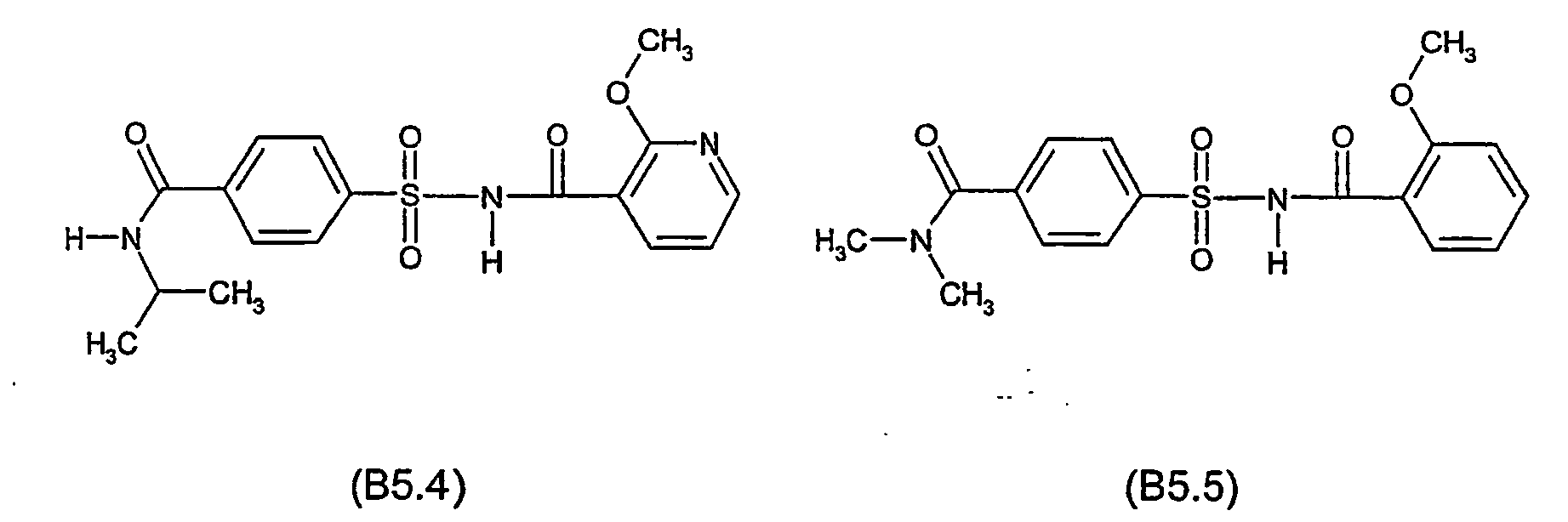

- Besonders bevorzugt sind herbizide Mittel enthaltend folgende Kombinationen von zwei Verbindungen (A) + (B):
- (A1)+(B1.1), (A1)+(B2.1), (A1)+(B2.2), (A1)+(B2.3), (A1)+(B3.1), (A1)+(B3.2), (A1)+(B3.3), (A1)+(B3.4), (A1)+(B3.5), (A1)+(B3.6), (A1)+(B3.7), (A1)+(B3.8), (A1)+(B5.1), (A1)+(B5.2), (A1)+(B5.3), (A1)+(B5.4), (A1)+(B5.5), (A1)+(B5.6), (A1)+(B5.7);
- (A2)+(B1.1), (A2)+(B2.1), (A2)+(B2.2), (A2)+(B2.3), (A2)+(B3.1), (A2)+(B3.2), (A2)+(B3.3), (A2)+(B3.4), (A2)+(B3.5), (A2)+(B3.6), (A2)+(B3.7), (A2)+(B3.8), (A2)+(B5.1), (A2)+(B5.2), (A2)+(B5.3), (A2)+(B5.4), (A2)+(B5.5), (A2)+(B5.6), (A2)+(B5.7);
- (A3)+(B1.1), (A3)+(B2.1), (A3)+(B2.2), (A3)+(B2.3), (A3)+(B3.1), (A3)+(B3.2), (A3)+(B3.3), (A3)+(B3.4), (A3)+(B3.5), (A3)+(B3.6), (A3)+(B3.7), (A3)+(B3.8), (A3)+(B5.1), (A3)+(B5.2), (A3)+(B5.3), (A3)+(B5.4), (A3)+(B5.5), (A3)+(B5.6), (A3)+(B5.7);
- (A4)+(B1.1), (A4)+(B2.1), (A4)+(B2.2), (A4)+(B2.3), (A4)+(B3.1), (A4)+(B3.2), (A4)+(B3.3), (A4)+(B3.4), (A4)+(B3.5), (A4)+(B3.6), (A4)+(B3.7), (A4)+(B3.8), (A4)+(B5.1), (A4)+(B5.2), (A4)+(B5.3), (A4)+(B5.4), (A4)+(B5.5), (A4)+(B5.6), (A4)+(B5.7).
- Die hier als Safener (Antidote) genannten Verbindungen, reduzieren oder unterbinden phytotoxische Effekte, die beim Einsatz der herbiziden Wirkstoffe der Formel (I) in Nutzpflanzenkulturen auftreten können, ohne die Wirksamkeit dieser herbiziden Wirkstoffe gegen Schadpflanzen wesentlich zu beeinträchtigen. Hierdurch kann das Einsatzgebiet herkömmlicher Pflanzenschutzmittel ganz erheblich erweitert und z.B. auf Kulturen wie Weizen, Gerste, Reis und Mais ausgedehnt werden, in denen bisher ein Einsatz der Herbizide nicht möglich oder nur beschränkt, das heißt, in niedrigen Dosierungen mit wenig Breitenwirkung möglich war.
- Die herbiziden Wirkstoffe und die erwähnten Safener können zusammen (als fertige Formulierung oder im Tank-Mix-Verfahren) oder in beliebiger Reihenfolge nacheinander ausgebracht werden. Das Gewichtsverhältnis Safener zu herbizider Wirkstoff kann innerhalb weiter Grenzen variieren und ist vorzugsweise im Bereich von 1:100 bis 100:1, insbesondere von 1:10 bis 10:1. Die jeweils optimalen Mengen an herbizidem Wirkstoff und Safener sind vom Typ des verwendeten herbiziden Wirkstoffs oder vom verwendeten Safener sowie von der Art des zu behandelnden Pflanzenbestandes abhängig und lassen sich von Fall zu Fall durch einfache, routinemäßige Vorversuche ermitteln.
- Bevorzugt werden die erfindungsgemäßen Kombinationen zur Bekämpfung von unerwünschten Schadpflanzen in Kulturen von Mais und Getreide, z.B. Weizen, Roggen, Gerste, Hafer, Reis, Sorghum, sowie Baumwolle, Zuckerrübe, Zuckerrohr und Sojabohne, vorzugsweise Getreide, Reis und Mais, verwendet.
- Die erfindungsgemäß eingesetzten Safener können je nach ihren Eigenschaften zur Vorbehandlung des Saatgutes der Kulturpflanze (Beizung der Samen) verwendet werden oder vor der Saat in die Saatfurchen eingebracht oder zusammen mit dem Herbizid vor oder nach dem Auflaufen der Pflanzen angewendet werden. Vorauflaufbehandlung schließt sowohl die Behandlung der Anbaufläche vor der Aussaat als auch die Behandlung der angesäten, aber noch nicht bewachsenen Anbauflächen ein. Bevorzugt ist die gemeinsame Anwendung mit dem Herbizid. Hierzu können Tankmischungen oder Fertigformulierungen eingesetzt werden.
- Die benötigten Aufwandmengen der Safener können je nach Indikation und verwendetem herbiziden Wirkstoff innerhalb weiter Grenzen schwanken und liegen in der Regel im Bereich von 0,001 bis 5 kg, vorzugsweise 0,005 bis 0,5 kg Wirkstoff je Hektar.
- Gegenstand der vorliegenden Erfindung ist deshalb auch ein Verfahren zum Schutz von Kulturpflanzen vor phytotoxischen Nebenwirkungen von Herbiziden der Formel (I), das dadurch gekennzeichnet ist, daß eine antidotisch wirksame Menge einer oder mehrerer Verbindungen der Komponente B vor, nach oder gleichzeitig mit dem herbiziden Wirkstoff A der Formel (I) auf die Pflanzen, Pflanzensamen oder die Anbaufläche appliziert wird.
- Die erfindungsgemäße Herbizid-Safener Kombination kann auch zur Bekämpfung von Schadpflanzen in Kulturen von bekannten oder noch zu entwickelnden gentechnisch veränderten Pflanzen eingesetzt werden. Die transgenen Pflanzen zeichnen sich in der Regel durch besondere vorteilhafte Eigenschaften aus, beispielsweise durch Resistenzen gegenüber bestimmten Pflanzenschutzmitteln, Resistenzen gegenüber Pflanzenkrankheiten oder Erregern von Pflanzenkrankheiten wie bestimmten Insekten oder Mikroorganismen wie Pilzen, Bakterien oder Viren. Andere besondere Eigenschaften betreffen z. B. das Emtegut hinsichtlich Menge, Qualität, Lagerfähigkeit, Zusammensetzung und spezieller Inhaltsstoffe. So sind transgene Pflanzen mit erhöhtem Stärkegehalt oder veränderter Qualität der Stärke oder solche mit anderer Fettsäurezusammensetzung des Emteguts bekannt.
- Bevorzugt ist die Anwendung der erfindungsgemäßen Kombinationen in wirtschaftlich bedeutenden Kulturen von transgenen Nutzpflanzen, z. B. von Getreide wie Weizen, Gerste, Roggen, Hafer, Hirse, Reis, Maniok und Mais oder auch Kulturen von Zuckerrübe, Zuckerrohr, Baumwolle, Soja, Raps, Kartoffel, Tomate, Erbse und anderen Gemüsesorten.
- Bei der Anwendung der erfindungsgemäßen Kombinationen in transgenen Kulturen treten neben den in anderen Kulturen zu beobachtenden Wirkungen gegenüber Schadpflanzen oftmals Wirkungen auf, die für die Applikation in der jeweiligen transgenen Kultur spezifisch sind, z.B. ein verändertes oder speziell erweitertes Unkrautspektrum, das bekämpft werden kann, veränderte Aufwandmengen, die für die Applikation eingesetzt werden können, vorzugsweise gute Kombinierbarkeit mit den Herbiziden, gegenüber denen die transgene Kultur resistent ist, sowie Beeinflussung von Wuchs und Ertrag der transgenen Kulturpflanzen.
- Gegenstand der Erfindung ist deshalb auch die Verwendung der erfindungsgemäßen Kombination zur Bekämpfung von Schadpflanzen in transgenen Kulturpflanzen.
- Die Safener der Komponente B und deren Kombinationen mit einem oder mehreren der genannten herbiziden Wirkstoffe der Formel (I) können auf verschiedene Art formuliert werden, je nachdem welche biologischen und/oder chemischphysikalischen Parameter vorgegeben sind. Als Formulierungsmöglichkeiten kommen beispielsweise in Frage:
- Spritzpulver (WP), emulgierbare Konzentrate (EC), wasserlösliche Pulver (SP), wasserlösliche Konzentrate (SL), konzentrierte Emulsionen (BW) wie Öl-in-Wasser und Wasser-in-Öl-Emulsionen, versprühbare Lösungen oder Emulsionen, Kapselsuspensionen (CS), Dispersionen auf Öl- oder Wasserbasis (SC), Suspoemulsionen, Suspensionskonzentrate, Stäubemittel (DP), ölmischbare Lösungen (OL), Beizmittel, Granulate (GR) in Form von Mikro-, Sprüh-, Aufzugs- und Adsorptionsgranulaten, Granulate für die Boden- bzw. Streuapplikation, wasserlösliche Granulate (SG), wasserdispergierbare Granulate (WG), ULV-Formulierungen, Mikrokapseln und Wachse.
- Diese einzelnen Formulierungstypen sind im Prinzip bekannt und beispielsweise beschrieben in: Winnacker-Küchler, "Chemische Technologie" Band 7, C. Hauser Verlag München, 4. Aufl. 1986; Wade van Valkenburg, "Pesticide Formulations", Marcel Dekker N.Y., 1973; K. Martens, "Spray Drying Handbook", 3rd Ed. 1979, G. Goodwin Ltd. London.
- Die gegebenenfalls notwendigen Formulierungshilfsmittel, wie Inertmaterialien, Tenside, Lösungsmittel und weitere Zusatzstoffe, sind ebenfalls bekannt und beispielsweise beschrieben in: Watkins, "Handbook of Insecticide Dust Diluents and Carriers", 2nd Ed., Darland Books, Caldwell N.J., H.v. Olphen, "Introduction to Clay Colloid Chemistry"; 2nd Ed., J. Wiley & Sons, N.Y.; C. Marsden, "Solvents Guide"; 2nd Ed., Interscience, N.Y. 1963; McCutcheon's "Detergents and Emulsifiers Annual", MC Publ. Corp., Ridgewood N.J.; Sisley and Wood, "Encyclopedia of Surface Active Agents", Chem. Publ. Co. Inc., N.Y. 1964; Schönfeldt, "Grenzflächenaktive Äthylenoxidaddukte", Wiss. Verlagsgesell., Stuttgart 1976; Winnacker-Küchler, "Chemische Technologie", Band 7, C. Hauser Verlag München, 4. Aufl. 1986.
- Auf der Basis dieser Formulierungen lassen sich auch Kombinationen mit anderen als Pflanzenschutzmitteln wirksamen Stoffen, wie Insektiziden, Akariziden, Herbiziden, Fungiziden, sowie mit Safenern, Düngemitteln und/oder Wachstumsregulatoren herstellen, z.B. in Form einer Fertigformulierung oder als Tankmix.
- Spritzpulver sind in Wasser gleichmäßig dispergierbare Präparate, die neben dem Wirkstoff außer einem Verdünnungs- oder Inertstoff noch Tenside ionischer und/oder nichtionischer Art (Netzmittel, Dispergiermittel), z.B. polyoxyethylierte Alkylphenole, polyoxethylierte Fettalkohole, polyoxethylierte Fettamine, Fettalkoholpolyglykolethersulfate, Alkansulfonate, Alkylbenzolsulfonate, ligninsulfonsaures Natrium, 2,2'-dinaphthylmethan-6,6'-disulfonsaures Natrium, dibutylnaphthalin-sulfonsaures Natrium oder auch oleoylmethyltaurinsaures Natrium enthalten. Zur Herstellung der Spritzpulver werden die herbiziden Wirkstoffe beispielsweise in üblichen Apparaturen, wie Hammermühlen, Gebläsemühlen und Luftstrahlmühlen, feingemahlen und gleichzeitig oder anschließend mit den Formulierungshilfsmitteln vermischt.
- Emulgierbare Konzentrate werden z.B. durch Auflösen des Wirkstoffes in einem organischen Lösungsmittel, wie Butanol, Cyclohexanon, DMF oder auch höhersiedende Kohlenwasserstoffe wie gesättigte oder ungesättigte Aliphaten oder Alicyclen, Aromaten oder Mischungen der organischen Lösungsmittel unter Zusatz von einem oder mehreren Tensiden ionischer und/oder nichtionischer Art (Emulgatoren) hergestellt. Als Emulgatoren können beispielsweise verwendet werden: Alkylarylsulfonsaure Calzium-Salze, wie Ca-dodecylbenzolsulfonat, oder nichtionische Emulgatoren, wie Fettsäurepolyglykolester, Alkylarylpolyglykolether, Fettalkoholpolyglykolether, Propylenoxid-Ethylenoxid-Kondensationsprodukte, Alkylpolyether, Sorbitanester, wie Sorbitanfettsäureester, oder Polyoxyethylensorbitanester, wie Polyoxyethylensorbitanfettsäureester. Stäubemittel erhält man im allgemeinen durch Vermahlen des Wirkstoffes mit fein verteilten festen Stoffen, z.B. Talkum, natürlichen Tonen, wie Kaolin, Bentonit und Pyrophyllit, oder Diatomeenerde.
- Suspensionskonzentrate können auf Wasser- oder Ölbasis sein. Sie können beispielsweise durch Naß-Vermahlung mittels handelsüblicher Perlmühlen und gegebenenfalls Zusatz von Tensiden, wie sie z.B. bei den anderen Formulierungstypen bereits aufgeführt sind, hergestellt werden.
- Emulsionen, z.B. Öl-in-Wasser-Emulsionen (EW), lassen sich beispielsweise mittels Rührern, Kolloidmühlen und/oder statischen Mischern unter Verwendung von wäßrigen organischen Lösungsmitteln und gegebenenfalls Tensiden, wie sie z.B. bei den anderen Formulierungstypen bereits aufgeführt sind, herstellen.
- Granulate können entweder durch Verdüsen des Wirkstoffes auf adsorptionsfähiges, granuliertes Inertmaterial hergestellt werden oder durch Aufbringen von Wirkstoffkonzentraten mittels Klebemitteln, z.B. Polyvinylalkohol, polyacrylsaurem Natrium oder auch Mineralölen, auf die Oberfläche von Trägerstoffen, wie Sand, Kaolinite oder von granuliertem Inertmaterial. Auch können geeignete Wirkstoffe in der für die Herstellung von Düngemittelgranulaten üblichen Weise - gewünschtenfalls in Mischung mit Düngemitteln - granuliert werden. Wasserdispergierbare Granulate werden in der Regel nach den üblichen Verfahren, wie Sprühtrocknung, Wirbelbett-Granulierung, Teller-Granulierung, Mischung mit Hochgeschwindigkeitsmischern und Extrusion ohne festes Inertmaterial, hergestellt.
- Zur Herstellung von Teller-, Fließbett-, Extruder- und Sprühgranulaten siehe z.B. in "Spray-Drying Handbook" 3rd ed. 1979, G. Goodwin Ltd., London; J.E. Browning, "Agglomeration", Chemical and Engineering 1967, Seiten 147 ff; "Perry's Chemical Engineer's Handbook", 5th Ed., McGraw-Hill, New York 1973, S. 8-57.
- Für weitere Einzelheiten zur Formulierung von Pflanzenschutzmitteln siehe z.B. G.C. Klingman, "Weed Control as a Science", John Wiley and Sons, Inc., New York, 1961, Seiten 81-96 und J.D. Freyer, S.A. Evans, "Weed Control Handbook", 5th Ed., Blackwell Scientific Publications, Oxford, 1968, Seiten 101-103.
- Die agrochemischen Zubereitungen enthalten in der Regel 0,1 bis 99 Gew.-%, insbesondere 0,1 bis 95 Gew.-%, Wirkstoffe aus der Gruppe B oder des Herbizid/Antidot-Wirkstoffgemischs (I) / B und 1 bis 99,9 Gew.-%, insbesondere 5 bis 99,8 Gew.-%, eines festen oder flüssigen Zusatzstoffes und 0 bis 25 Gew.-%, insbesondere 0,1 bis 25 Gew.-% eines Tensides.
- In Spritzpulvern beträgt die Wirkstoffkonzentration z.B. etwa 10 bis 90 Gew.%, der Rest zu 100 Gew.-% besteht aus üblichen Formulierungsbestandteilen. Bei emulgierbaren Konzentraten beträgt die Konzentration etwa 1 bis 80 Gew.-%. Staubförmige Formulierungen enthalten etwa 1 bis 20 Gew.-% an Wirkstoffen, versprühbare Lösungen etwa 0,2 bis 20 Gew.-% Wirkstoffe. Bei Granulaten, wie wasserdispergierbaren Granulaten, hängt der Wirkstoffgehalt zum Teil davon ab, ob die wirksame Verbindung flüssig oder fest vorliegt. In der Regel liegt der Gehalt bei den in Wasser dispergierbaren Granulaten zwischen 10 und 90 Gew.-%.
- Daneben enthalten die genannten Wirkstofformulierungen gegebenenfalls die jeweils üblichen Haft-, Netz-, Dispergier-, Emulgier-, Penetrations-, Konservierungs-, Frostschutz- und Lösungsmittel, Füll-, Träger- und Farbstoffe, Entschäumer, Verdunstungshemmer und den pH-Wert und die Viskosität beeinflussende Mittel.
- Mit den äußeren Bedingungen wie Temperatur, Feuchtigkeit, der Art des verwendeten Herbizids, u.a. variiert die erforderliche Aufwandmenge der Herbizide der Formel (I). Sie kann innerhalb weiter Grenzen variiert werden, z.B. zwischen 0,001 und 10,0 kg/ha oder mehr Aktivsubstanz, vorzugsweise liegt sie jedoch zwischen 0,005 und 5 kg/ha.
- Folgende Beispiele dienen zur Erläuterung der Erfindung:
A Formulierungsbeispiele
a) Ein Staubmittel wird erhalten, indem man 10 Gew.-Teile einer Verbindung der Gruppe B oder eines Wirkstoffgemischs aus einem herbiziden Wirkstoff der Formel (I) und einer Verbindung der Gruppe B und 90 Gew.-Teile Talkum als Inertstoff mischt und in einer Schlagmühle zerkleinert.
b) Ein in Wasser leicht dispergierbares, benetzbares Pulver wird erhalten, indem man 25 Gewichtsteile einer Verbindung der Gruppe B oder eines Wirkstoffgemischs aus einem herbiziden Wirkstoff der Formel (I) und einer Verbindung der Gruppe B, 64 Gewichtsteile kaolinhaltigen Quarz als Inertstoff, 10 Gewichts-teile ligninsulfonsaures Kalium und 1 Gew.-Teil oleoylmethyltaurinsaures Natrium als Netz- und Dispergiermittel mischt und in einer Stiftmühle mahlt.
b) Ein in Wasser leicht dispergierbares Dispersionskonzentrat wird erhalten, indem man 20 Gewichtsteile einer Verbindung der Gruppe B oder eines Wirkstoffgemischs aus einem herbiziden Wirkstoff der Formel (I) und einer Verbindung der Gruppe B, 6 Gew.-Teilen Alkylphenolpolyglykolether (®Triton X 207), 3 Gew.-Teilen lsotridecanolpolyglykolether (8 EO) und 71 Gew.-Teilen paraffinischem Mineralöl (Siedebereich z.B. ca. 255 bis über 277 C) mischt und in einer Reibkugelmühle auf eine Feinheit von unter 5 Mikron vermahlt.
d) Ein emulgierbares Konzentrat wird erhalten aus 15 Gew.-Teilen einer Verbindung der Gruppe B oder eines Wirkstoffgemischs aus einem herbiziden Wirkstoff der Formel (I) und einer Verbindung der Gruppe B, 75 Gew.Teilen Cyclohexanon als Lösemittel und 10 Gew.-Teilen oxethyliertes Nonylphenol als Emulgator.
e) Ein in Wasser dispergierbares Granulat wird erhalten, indem man75 Gew.-Teile einer Verbindung der Gruppe B oder eines Wirkstoffgemischs aus einem herbiziden Wirkstoff der Formel (I) und einer Verbindung der Gruppe B, 10 " ligninsulfonsaures Calcium, 5 " Natriumlaurylsulfat, 3 " Polyvinylalkohol und 7 " Kaolin
f) Ein in Wasser dispergierbares Granulat wird auch erhalten, indem man25 Gew.-Teil(e) einer Verbindung der Gruppe B oder eines Wirkstoffgemischs aus einem herbiziden Wirkstoff der Formel (I) und einer Verbindung der Gruppe B, 5 " 2,2'-dinaphthylmethan-6,6'-disulfonsaures Natrium, 2 " oleoylmethyltaurinsaures Natrium, 1 " Polyvinylalkohol, 17 " Calciumcarbonat und 50 " Wasser
B Biologische Beispiele - Samen von Nutzpflanzen werden im Freiland in Erde ausgelegt und mit Erde bedeckt. Im Dreiblattstadium, d.h. etwa drei Wochen nach Beginn der Aufzucht werden die Pflanzen mit den als emulgierbare Konzentrate oder Stäubemittel formulierten Herbiziden und Safenem in Form wäßriger Dispersionen oder Suspensionen bzw. Emulsionen behandelt mit einer Wasseraufwandmenge von umgerechnet 300 bis 8001/ha in unterschiedlichen Dosierungen auf die grünen Pflanzenteile gesprüht. Die optische Bewertung der Schäden an den Nutzpflanzen erfolgt 14 Tage nach der Behandlung. Die Ergebnisse zeigen, daß durch die Verwendung der erfindungsgemäßen Mittel enthaltend Herbizid und Safener die Schäden in den Nutzpflanzen gegenüber der alleinigen Verwendung des Herbizids deutlich gemindert werden können. Je nach Aufwandmenge, Art der Nutzpflanze und Art des erfindungsgemäßen Mittels werden die Schäden um bis 100% gegenüber der alleinigen Verwendung des Herbizid gemindert.
- In den nachfolgenden Tabellen sind die Versuchsergebnisse einiger erfindungsgemäßer herbizider Mittel enthaltend Herbizid und Safener aufgeführt. Tabelle 2 zeigt die Verminderung der Schädigung der Kulturpflanze Weizen bei Einsatz der erfindungsgemäßen Mittel gegenüber der alleinigen Verwendung des Herbizids. Tabelle 3 zeigt die Verminderung der Schädigung der Kulturpflanze Mais verschiedener Sorten bei Einsatz der erfindungsgemäßen Mittel gegenüber der alleinigen Verwendung des Herbizids.
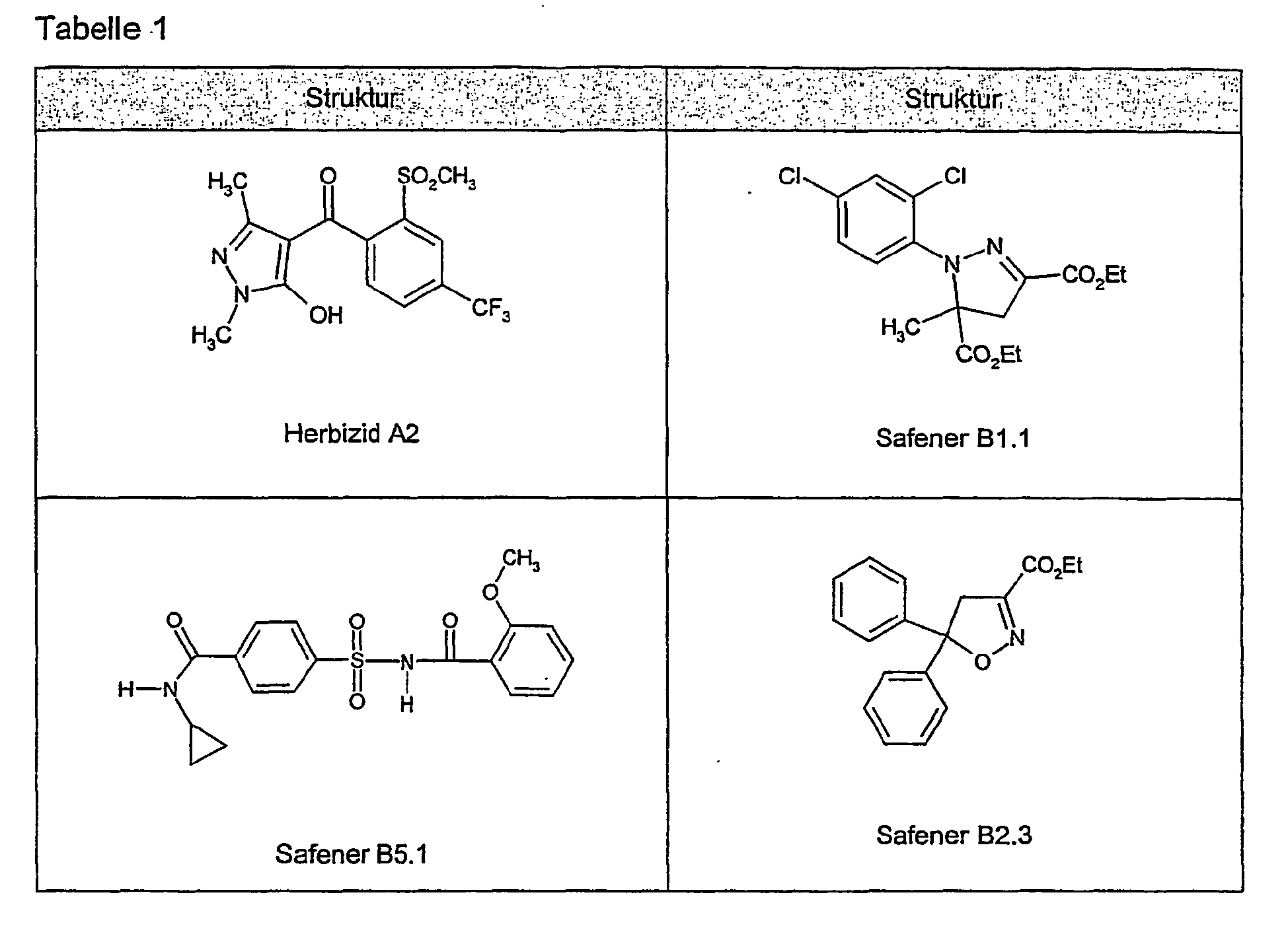
Tabelle 2 Verbindung Dosierung [g a.i./ha] Schadensminderung in Weizen A2 + B1.1 75 + 15 -56% Tabelle 3 Verbindung Dosierung [g a.i./ha] Schadensminderung in Mais A2 + B5.1 200 + 100 -100% (Sorte "DEA") A2 + B2.3 150 + 150 -100% (Sorte "HELIX")
Claims (6)
- Herbizides Mittel, enthaltendA) eine herbizid wirksame Menge an an einer oder mehreren Verbindungen der Formel (I), gegebenenfalls auch in Form ihrer Salze,
 R1 Methyl oder Ethyl;R2 Trifluormethyl, Fluor, Chlor oder Brom;R3 Wasserstoff oder Methyl;R4 Methyl oder Ethyl;R5 Wasserstoff, Methylsulfonyl, Ethylsulfonyl, n-Propylsulfonyl, Phenylsulfonyl, 4-Methylphenylsulfonyl, Benzyl, Benzoylmethyl, Nitrobenzoylmethyl oder 4-Fluorbenzoylmethyl undn 0, 1, oder 2 bedeuten, undB) einer antidotisch wirksamen Menge an mindestens einer Verbindung (Komponente B) aus einer der Gruppen B1 bis B6:einschließlich der Stereoisomeren und der in der Landwirtschaft gebräuchlichen Salze.B1 Verbindungen der Formel II,
 B2 Verbindungen der Formel III,
 B3 oxabetrinil, fluxofenim, fenclorim, flurazole, cloquintocet-mexyl, dichlormid, benoxacor, furilazole, 4-Dichloracetyl-1-oxa-4-aza-spiro[4,5]decan (AD-67);B4 1,8-Naphthalsäureanhydrid, Methyl-diphenylmethoxyacetat, Cyanomethoxyimino(phenyl)acetonitril (Cyometrinil), 2-Dichlormethyl-2-methyl-1,3-dioxolan (MG-191), N-(4-Methylphenyl)-N'-(1-methyl-1-phenylethyl)harnstoff (Dymron), 1-[4-(N-2-Methoxybenzoylsulfamoyl)phenyl]-3-methylharnstoff, 1-[4-(N-2-Methoxybenzoylsulfamoyl)phenyl]-3,3-dimethylharnstoff, 1-[4-(N-4,5-Dimethylbenzoylsulfamoyl)phenyl]-3-methylharnstoff, 1-[4-(N-Naphthoylsulfamoyl)phenyl]-3,3-dimethylharnstoff, 1-(Ethoxycarbonyl)ethyl 3,6-dichlor-2-methoxybenzoat (Lactidichlor) sowie deren Salze und Ester, vorzugsweise (C1-C8), 3-dichloroacetyl-2,2,5-trimethyloxazolidine, (5-Chlor-8-chinolinoxy)essigsäure-(1,3-dimethyl-but-1-yl)-ester, (5-Chlor-8-chinolinoxy)essigsäure-4-allyl-oxy-butylester, (5-Chlor-8-chinolinoxy)essigsäure-1-allyloxy-prop-2-ylester, (5-Chlor-8-chinolinoxy)essigsäureethylester, (5-Chlor-8-chinolinoxy)essigsäuremethylester, (5-Chlor-8-chinolinoxy)essigsäureallylester, (5-Chlor-8-chinolinoxy)essigsäure-2-(2-propyliden-iminoxy)-1-ethylester, (5-Chlor-8-chinolinoxy)essigsäure-2-oxo-prop-1-ylester;B5 Acylsulfamoylbenzoesäureamide der Formel (IV) gegebenenfalls auch in Salzform,
X CH oder N;
R9 Wasserstoff, (C1-C6)-Alkyl, (C3-C6)-Cycloalkyl, (C2-C6)-Alkenyl, (C2-C6)-Alkinyl, wobei die vier letztgenannten Reste gegebenenfalls durch einen oder mehrere, gleiche oder verschiedene Substituenten aus der Gruppe Halogen, (C1-C6)-Alkoxy, (C1-C6)-Haloalkoxy, (C1-C2)-Alkylsulfinyl, (C1-C2)-Alkylsulfonyl, (C3-C6)-Cycloalkyl, (C1-C4)-Alkoxycarbonyl, (C1-C4)-Alkylcarbonyl und im Falle cyclischer Reste auch (C1-C4)-Alkyl und (C1-C4)-Haloalkyl substituiert sind;
R10 Wasserstoff, (C1-C6)-Alkyl, (C2-C6)-Alkenyl, (C2-C6)-Alkinyl, wobei die drei letztgenannten Reste gegebenenfalls durch einen oder mehrere, gleiche oder verschiedene Substituenten aus der Gruppe Halogen, (C1-C4)-Alkyl, (C1-C4)-Alkoxy und (C1-C4)-Alkylthio substituiert sind, oder
R9 und R10 bilden gemeinsam mit dem dem sie tragenden Stickstoffatom einen Pyrrolidinyl- oder Piperidinyl-Rest;
R11 Wasserstoff, (C1-C4)-Alkyl, (C2-C4)-Alkenyl oder (C1-C4)-Alkinyl;
R12 gleich oder verschieden Halogen, Nitro, (C1-C4)-Alkyl, (C1-C4)-Haloalkyl, (C1-C4)-Haloalkoxy, (C1-C4)-Alkoxy, Cyano, (C1-C4)-Alkylthio, (C1-C4)-Alkylsulfinyl, (C1-C4)-Alkylsulfonyl,
m ist 0, 1 oder 2;B6 N-Acylsulfonamide der Formel (V) und ihre Salze, R13 Wasserstoff, (C1-C6)-Alkyl, (C3-C6)-Cycloalkyl, wobei jeder der letztgenannten 2 Reste unsubstituiert oder durch einen oder mehrere Substituenten aus der Gruppe Halogen, (C1-C4)-Alkoxy, Halogen-(C1-C6)-alkoxy und (C1-C4)-Alkylthio und im Falle cyclischer Reste auch (C1-C4)-Alkyl und (C1-C4)-Haloalkyl substituiert ist,R14 Halogen, (C1-C4)-Alkyl, (C1-C4)-Halogenalkyl, wie Trifluormethyl, Halogen-(C1-C4)-alkoxy, (C1-C4)-Alkoxy oder (C1-C4)-Alkylthio,t 1 oder 2 bedeuten,
 - Herbizide Mittel nach Anspruch 1, worinR1 Methyl;R2 Trifluormethyl;R3 Wasserstoff oder Methyl;R4 Methyl oder Ethyl;R5 Wasserstoff undn 2bedeuten.
- Herbizides Mittel nach Anspruch 1 oder 2, dadurch gekennzeichnet, daß das Gewichtsverhältnis Herbizid:Safener 1:100 bis 100:1 beträgt.
- Verfahren zur Bekämpfung von Schadpflanzen in Kulturen von Nutzpflanzen, dadurch gekennzeichnet, daß man eine herbizid wirksame Menge an einer Herbizid-Safener-Kombination gemäß einem oder mehreren der Ansprüche 1 bis 3 auf die Schadpflanzen, Pflanzen, Pflanzensamen oder die Fläche, auf der die Pflanzen wachsen, aufbringt.
- Verfahren gemäß Anspruch 4, dadurch gekennzeichnet, daß die Pflanzen aus der Gruppe Mais, Weizen, Roggen, Gerste, Hafer, Reis, Sorghum, Baumwolle, Zuckerrohr und Soja stammen.
- Verfahren gemäß Anspruch 4 oder 5, dadurch gekennzeichnet, daß die Pflanzen gentechnisch verändert sind.
Applications Claiming Priority (3)
| Application Number | Priority Date | Filing Date | Title |
|---|---|---|---|
| DE10157545 | 2001-11-23 | ||
| DE10157545A DE10157545A1 (de) | 2001-11-23 | 2001-11-23 | Herbizide Mittel enthaltend Benzoylpyrazole und Safener |
| PCT/EP2002/012673 WO2003043423A1 (de) | 2001-11-23 | 2002-11-13 | Herbizide mittel enthaltend benzoylpyrazole und safener |
Publications (2)
| Publication Number | Publication Date |
|---|---|
| EP1453378A1 EP1453378A1 (de) | 2004-09-08 |
| EP1453378B1 true EP1453378B1 (de) | 2006-08-23 |
Family
ID=7706743
Family Applications (1)
| Application Number | Title | Priority Date | Filing Date |
|---|---|---|---|
| EP02792759A Expired - Lifetime EP1453378B1 (de) | 2001-11-23 | 2002-11-13 | Herbizide mittel enthaltend benzoylpyrazole und safener |
Country Status (23)
| Country | Link |
|---|---|
| US (2) | US6872691B2 (de) |
| EP (1) | EP1453378B1 (de) |
| JP (1) | JP4348187B2 (de) |
| KR (1) | KR20050044572A (de) |
| CN (1) | CN1306871C (de) |
| AR (1) | AR037664A1 (de) |
| AT (1) | ATE336896T1 (de) |
| AU (1) | AU2002358502B2 (de) |
| BR (1) | BR0214378A (de) |
| CA (4) | CA2715710C (de) |
| DE (2) | DE10157545A1 (de) |
| EA (1) | EA006676B1 (de) |
| ES (1) | ES2269798T3 (de) |
| HR (1) | HRP20040454A2 (de) |
| HU (1) | HUP0401958A2 (de) |
| IL (1) | IL162107A0 (de) |
| MA (1) | MA26381A1 (de) |
| MX (1) | MXPA04004864A (de) |
| PL (1) | PL206161B1 (de) |
| RS (1) | RS41604A (de) |
| UA (1) | UA77038C2 (de) |
| WO (1) | WO2003043423A1 (de) |
| ZA (1) | ZA200403327B (de) |
Families Citing this family (25)
| Publication number | Priority date | Publication date | Assignee | Title |
|---|---|---|---|---|
| DE10157545A1 (de) | 2001-11-23 | 2003-06-12 | Bayer Cropscience Gmbh | Herbizide Mittel enthaltend Benzoylpyrazole und Safener |
| DE10325659A1 (de) * | 2003-06-06 | 2004-12-23 | Bayer Cropscience Gmbh | Herbizide Mittel enthaltend 3-Aminobenzoylpyrazole und Safener |
| DE102004059302A1 (de) * | 2004-12-09 | 2006-06-14 | Bayer Cropscience Gmbh | 3-Cyclopropyl-4-(3-amino-2-methylbenzoyl)pyrazole und ihre Verwendung als Herbizide |
| DE102005014944A1 (de) * | 2005-04-01 | 2006-10-05 | Bayer Cropscience Gmbh | Synergistische kulturpflanzenverträgliche herbizide Mittel enthaltend Herbizide aus der Gruppe der Benzoylpyrazole |
| DE102005031789A1 (de) | 2005-07-07 | 2007-01-18 | Bayer Cropscience Gmbh | Kulturpflanzenverträgliche herbizide Mittel enthaltend Herbizide Safener |
| DE102006056083A1 (de) | 2006-11-28 | 2008-05-29 | Bayer Cropscience Ag | Synergistisch wirkende und kulturpflanzenverträgliche herbizide Mittel enthaltend Herbizide aus der Gruppe der Benzoylpyrazole |
| AU2013200370B2 (en) * | 2006-11-28 | 2014-07-31 | Bayer Cropscience Aktiengesellschaft | Synergistic and crop-plant-compatible herbicidal compositions comprising herbicides from the group of the benzoylpyrazoles |
| US8110530B2 (en) * | 2006-12-21 | 2012-02-07 | Kumiai Chemical Industry Co., Ltd. | Herbicidal composition |
| WO2009089165A2 (en) * | 2008-01-07 | 2009-07-16 | Auburn University | Combinations of herbicides and safeners |
| EP2755484A1 (de) * | 2011-09-16 | 2014-07-23 | Bayer Intellectual Property GmbH | Verwendung von 5-phenyl- oder 5-benzyl-2-isoxazolin-3-carboxylaten für erhöhten pflanzenertrag |
| WO2013124228A1 (de) * | 2012-02-21 | 2013-08-29 | Bayer Intellectual Property Gmbh | Herbizid wirksame 3 - ( sulfin- /sulfonimidoyl) - benzamide |
| JP2013184913A (ja) * | 2012-03-07 | 2013-09-19 | Sumitomo Chemical Co Ltd | 除草用組成物 |
| JP6347334B2 (ja) * | 2013-06-27 | 2018-06-27 | 石原産業株式会社 | 植物安全性が向上した除草組成物 |
| RS60906B1 (sr) | 2014-10-06 | 2020-11-30 | Vertex Pharma | Modulatori regulatora transmembranske provodljivosti za cističnu fibrozu |
| ES2946970T3 (es) | 2016-03-31 | 2023-07-28 | Vertex Pharma | Regulador de conductancia transmembrana de moduladores de fibrosis quística |
| LT3519401T (lt) | 2016-09-30 | 2021-11-25 | Vertex Pharmaceuticals Incorporated | Cistinės fibrozės transmembraninio laidumo reguliavimo moduliatorius, farmacinės kompozicijos, gydymo būdai ir moduliatoriaus gamybos būdas |
| PT3551622T (pt) | 2016-12-09 | 2020-11-12 | Vertex Pharma | Modulador do regulador da condutância transmembrana da fibrose quística, composições farmacêuticas, métodos de tratamento e processo de fabrico do modulador |
| US11253509B2 (en) | 2017-06-08 | 2022-02-22 | Vertex Pharmaceuticals Incorporated | Methods of treatment for cystic fibrosis |
| WO2019018395A1 (en) | 2017-07-17 | 2019-01-24 | Vertex Pharmaceuticals Incorporated | METHODS OF TREATING CYSTIC FIBROSIS |
| TWI799435B (zh) | 2017-08-02 | 2023-04-21 | 美商維泰克斯製藥公司 | 製備化合物之製程 |
| US10654829B2 (en) | 2017-10-19 | 2020-05-19 | Vertex Pharmaceuticals Incorporated | Crystalline forms and compositions of CFTR modulators |
| CA3085006A1 (en) | 2017-12-08 | 2019-06-13 | Vertex Pharmaceuticals Incorporated | Processes for making modulators of cystic fibrosis transmembrane conductance regulator |
| TWI810243B (zh) | 2018-02-05 | 2023-08-01 | 美商維泰克斯製藥公司 | 用於治療囊腫纖化症之醫藥組合物 |
| US11414439B2 (en) | 2018-04-13 | 2022-08-16 | Vertex Pharmaceuticals Incorporated | Modulators of cystic fibrosis transmembrane conductance regulator, pharmaceutical compositions, methods of treatment, and process for making the modulator |
| AU2024297318A1 (en) | 2023-07-13 | 2026-01-29 | Adama Agan Ltd. | Synergistic herbicidal mixtures of pyrasulfotole |
Family Cites Families (15)
| Publication number | Priority date | Publication date | Assignee | Title |
|---|---|---|---|---|
| US4744815A (en) * | 1985-05-11 | 1988-05-17 | Nissan Chemical Industries, Ltd. | 4-benzoyl-1-alkyl (alkenyl) - pyrazoles, composition containing them, herbicidal method of using them, and intermediate in their preparation |
| AR012142A1 (es) * | 1997-03-24 | 2000-09-27 | Dow Agrosciences Llc | Compuestos de 1-alquil-4-benzoil-5-hiroxipirazol, composiciones herbicidas que los contienen; metodo para controlar vegetacion no deseada y compuestosintermediarios utiles para preparar dichos compuestos |
| PT1852424E (pt) | 1998-05-11 | 2012-05-07 | Basf Se | Processo para a preparação de isoxazolino-3-ilacilbenzenos |
| DE19827855A1 (de) | 1998-06-23 | 1999-12-30 | Hoechst Schering Agrevo Gmbh | Kombinationen aus Herbiziden und Safenern |
| DE19853827A1 (de) | 1998-11-21 | 2000-05-25 | Aventis Cropscience Gmbh | Kombinationen aus Herbiziden und Safenern |
| CZ299375B6 (cs) * | 1998-11-30 | 2008-07-09 | Nihon Nohyaku Co., Ltd. | Ftalamidové deriváty nebo jejich soli, zemedelsko-zahradnický insekticid je obsahující a jeho použití |
| DE19961465A1 (de) * | 1998-12-21 | 2000-07-06 | Novartis Ag | Herbizides Mittel |
| RS50472B (sr) * | 1999-10-26 | 2010-03-02 | Bayer Cropscience Ag. | Herbicidna sredstva |
| DE19953136A1 (de) * | 1999-11-04 | 2001-05-10 | Aventis Cropscience Gmbh | Benzoylcyclohexandione und Benzoylpyrazole, Verfahren zu ihrer Herstellung und ihre Verwendung als Herbizide und Pflanzenwachstumsregulatoren |
| RS50437B (sr) * | 2000-03-31 | 2009-12-31 | Bayer Cropscience Ag., | Benzoilpirazoli i njihova primena u ulozi herbicida |
| DE10127328A1 (de) * | 2001-06-06 | 2002-12-19 | Bayer Cropscience Gmbh | Herbizide Mittel enthaltend Benzoylpyrazole und Safener |
| US7539606B2 (en) * | 2001-11-15 | 2009-05-26 | Nintendo Co. Ltd. | System and method for efficiently simulating and imaging realistic water surface and other effects |
| DE10157545A1 (de) | 2001-11-23 | 2003-06-12 | Bayer Cropscience Gmbh | Herbizide Mittel enthaltend Benzoylpyrazole und Safener |
| DE10159659A1 (de) * | 2001-12-05 | 2003-06-26 | Bayer Cropscience Ag | Herbizide auf Basis von substituierten Carbonsäureaniliden |
| DE10237461A1 (de) * | 2002-08-16 | 2004-02-26 | Bayer Cropscience Gmbh | Herbizide Mittel enthaltend Benzoylpyrazole und Safener |
-
2001
- 2001-11-23 DE DE10157545A patent/DE10157545A1/de not_active Withdrawn
-
2002
- 2002-11-13 CA CA2715710A patent/CA2715710C/en not_active Expired - Lifetime
- 2002-11-13 AT AT02792759T patent/ATE336896T1/de active
- 2002-11-13 RS YU41604A patent/RS41604A/sr unknown
- 2002-11-13 DE DE50207953T patent/DE50207953D1/de not_active Expired - Lifetime
- 2002-11-13 AU AU2002358502A patent/AU2002358502B2/en not_active Expired
- 2002-11-13 CA CA2715555A patent/CA2715555C/en not_active Expired - Lifetime
- 2002-11-13 ES ES02792759T patent/ES2269798T3/es not_active Expired - Lifetime
- 2002-11-13 EA EA200400672A patent/EA006676B1/ru not_active IP Right Cessation
- 2002-11-13 CA CA2467978A patent/CA2467978C/en not_active Expired - Lifetime
- 2002-11-13 WO PCT/EP2002/012673 patent/WO2003043423A1/de not_active Ceased
- 2002-11-13 EP EP02792759A patent/EP1453378B1/de not_active Expired - Lifetime
- 2002-11-13 HR HR20040454A patent/HRP20040454A2/hr not_active Application Discontinuation
- 2002-11-13 UA UA20040604958A patent/UA77038C2/uk unknown
- 2002-11-13 IL IL16210702A patent/IL162107A0/xx unknown
- 2002-11-13 HU HU0401958A patent/HUP0401958A2/hu unknown
- 2002-11-13 BR BR0214378-0A patent/BR0214378A/pt not_active Application Discontinuation
- 2002-11-13 CA CA2715709A patent/CA2715709C/en not_active Expired - Lifetime
- 2002-11-13 KR KR1020047007780A patent/KR20050044572A/ko not_active Withdrawn
- 2002-11-13 PL PL370994A patent/PL206161B1/pl not_active IP Right Cessation
- 2002-11-13 MX MXPA04004864A patent/MXPA04004864A/es active IP Right Grant
- 2002-11-13 CN CNB028232127A patent/CN1306871C/zh not_active Expired - Lifetime
- 2002-11-13 JP JP2003545114A patent/JP4348187B2/ja not_active Expired - Fee Related
- 2002-11-20 US US10/300,353 patent/US6872691B2/en not_active Expired - Lifetime
- 2002-11-21 AR ARP020104476A patent/AR037664A1/es unknown
-
2004
- 2004-05-03 ZA ZA2004/03327A patent/ZA200403327B/en unknown
- 2004-05-13 MA MA27677A patent/MA26381A1/fr unknown
-
2005
- 2005-02-28 US US11/069,222 patent/US7579301B2/en not_active Expired - Lifetime
Also Published As
Similar Documents
| Publication | Publication Date | Title |
|---|---|---|
| EP1903863B1 (de) | Kulturpflanzenverträgliche herbizide mittel enthaltend herbizide und acylsulfamoylbenzoesäureamide safener | |
| DE10157545A1 (de) | Herbizide Mittel enthaltend Benzoylpyrazole und Safener | |
| EP1104232B2 (de) | Herbizide mittel | |
| EP2140763B1 (de) | Synergische herbizide Mittel | |
| EP2434884B1 (de) | Synergistische herbizid-kombinationen enthaltend tembotrione | |
| EP1530420B1 (de) | Herbizide mittel enthaltend benzoylpyrazole und safener | |
| EP1600056B1 (de) | Herbizide Mittel | |
| EP2096913B1 (de) | Synergetisch wirkende und kulturpflanzenverträgliche herbizide mittel enthaltend herbizide aus der gruppe der benzoylpyrazole | |
| EP1903865B1 (de) | Synergistische kulturpflanzenverträgliche herbizide mittel enthaltend herbizide aus der gruppe der benzoylcyclohexadione | |
| EP1296558B1 (de) | Herbizide mittel | |
| EP0943240B1 (de) | Kombinationen aus Herbiziden und pflanzenschützenden Stoffen | |
| EP1399022B1 (de) | Herbizide mittel enthaltend benzoylpyrazole und safener | |
| EP0569944A2 (de) | Synergistisch wirksame Herbizidkombinationen | |
| EP1453379B1 (de) | Synergistische herbizide mittel enthaltend herbizide aus der gruppe der benzoylpyrazole | |
| EP0596899B1 (de) | Neue mischungen aus herbiziden und antidots | |
| DE4236475A1 (de) | Herbizide Mittel zur Unkrautbekämpfung in Reiskulturen | |
| WO2006103002A1 (de) | Synergistische kulturpflanzenverträgliche herbizide mittel enthaltend herbizide aus der gruppe der benzoylpyrazole | |
| EP0547546A1 (de) | Kombination aus ALS-Hemmstoffen, Insektiziden und Safenern, Verfahren zu deren Herstellung und deren Verwendung als pflanzenschützende Mittel | |
| DD298341A5 (de) | Herbizide mittel | |
| DE4336953A1 (de) | Herbizide Mittel zur Unkrautbekämpfung in Reiskulturen | |
| DE10325659A1 (de) | Herbizide Mittel enthaltend 3-Aminobenzoylpyrazole und Safener | |
| DE3816994A1 (de) | Herbizide mittel auf der basis von 4-hydroxypyrimidin-derivaten |
Legal Events
| Date | Code | Title | Description |
|---|---|---|---|
| PUAI | Public reference made under article 153(3) epc to a published international application that has entered the european phase |
Free format text: ORIGINAL CODE: 0009012 |
|
| 17P | Request for examination filed |
Effective date: 20040623 |
|
| AK | Designated contracting states |
Kind code of ref document: A1 Designated state(s): AT BE BG CH CY CZ DE DK EE ES FI FR GB GR IE IT LI LU MC NL PT SE SK TR |
|
| AX | Request for extension of the european patent |
Extension state: AL LT LV MK RO SI |
|
| 17Q | First examination report despatched |
Effective date: 20040907 |
|
| RIN1 | Information on inventor provided before grant (corrected) |
Inventor name: HACKER, ERWIN Inventor name: ROSINGER, CHRISTOPHER Inventor name: BIERINGER, HERMANN Inventor name: ZIEMER, FRANK Inventor name: WILLMS, LOTHAR Inventor name: HUFF, HANS, PHILIPP Inventor name: SCHMITT, MONIKA |
|
| GRAP | Despatch of communication of intention to grant a patent |
Free format text: ORIGINAL CODE: EPIDOSNIGR1 |
|
| GRAS | Grant fee paid |
Free format text: ORIGINAL CODE: EPIDOSNIGR3 |
|
| GRAA | (expected) grant |
Free format text: ORIGINAL CODE: 0009210 |
|
| AK | Designated contracting states |
Kind code of ref document: B1 Designated state(s): AT BE BG CH CY CZ DE DK EE ES FI FR GB GR IE IT LI LU MC NL PT SE SK TR |
|
| AX | Request for extension of the european patent |
Extension state: LT LV RO SI |
|
| PG25 | Lapsed in a contracting state [announced via postgrant information from national office to epo] |
Ref country code: IT Free format text: LAPSE BECAUSE OF FAILURE TO SUBMIT A TRANSLATION OF THE DESCRIPTION OR TO PAY THE FEE WITHIN THE PRESCRIBED TIME-LIMIT;WARNING: LAPSES OF ITALIAN PATENTS WITH EFFECTIVE DATE BEFORE 2007 MAY HAVE OCCURRED AT ANY TIME BEFORE 2007. THE CORRECT EFFECTIVE DATE MAY BE DIFFERENT FROM THE ONE RECORDED. Effective date: 20060823 Ref country code: CZ Free format text: LAPSE BECAUSE OF FAILURE TO SUBMIT A TRANSLATION OF THE DESCRIPTION OR TO PAY THE FEE WITHIN THE PRESCRIBED TIME-LIMIT Effective date: 20060823 Ref country code: IE Free format text: LAPSE BECAUSE OF FAILURE TO SUBMIT A TRANSLATION OF THE DESCRIPTION OR TO PAY THE FEE WITHIN THE PRESCRIBED TIME-LIMIT Effective date: 20060823 Ref country code: SK Free format text: LAPSE BECAUSE OF FAILURE TO SUBMIT A TRANSLATION OF THE DESCRIPTION OR TO PAY THE FEE WITHIN THE PRESCRIBED TIME-LIMIT Effective date: 20060823 Ref country code: GB Free format text: LAPSE BECAUSE OF FAILURE TO SUBMIT A TRANSLATION OF THE DESCRIPTION OR TO PAY THE FEE WITHIN THE PRESCRIBED TIME-LIMIT Effective date: 20060823 Ref country code: FI Free format text: LAPSE BECAUSE OF FAILURE TO SUBMIT A TRANSLATION OF THE DESCRIPTION OR TO PAY THE FEE WITHIN THE PRESCRIBED TIME-LIMIT Effective date: 20060823 Ref country code: NL Free format text: LAPSE BECAUSE OF FAILURE TO SUBMIT A TRANSLATION OF THE DESCRIPTION OR TO PAY THE FEE WITHIN THE PRESCRIBED TIME-LIMIT Effective date: 20060823 |
|
| REG | Reference to a national code |
Ref country code: GB Ref legal event code: FG4D Free format text: NOT ENGLISH |
|
| REG | Reference to a national code |
Ref country code: CH Ref legal event code: EP |
|
| REG | Reference to a national code |
Ref country code: IE Ref legal event code: FG4D Free format text: LANGUAGE OF EP DOCUMENT: GERMAN |
|
| REF | Corresponds to: |
Ref document number: 50207953 Country of ref document: DE Date of ref document: 20061005 Kind code of ref document: P |
|
| PG25 | Lapsed in a contracting state [announced via postgrant information from national office to epo] |
Ref country code: DK Free format text: LAPSE BECAUSE OF FAILURE TO SUBMIT A TRANSLATION OF THE DESCRIPTION OR TO PAY THE FEE WITHIN THE PRESCRIBED TIME-LIMIT Effective date: 20061123 Ref country code: BG Free format text: LAPSE BECAUSE OF FAILURE TO SUBMIT A TRANSLATION OF THE DESCRIPTION OR TO PAY THE FEE WITHIN THE PRESCRIBED TIME-LIMIT Effective date: 20061123 Ref country code: SE Free format text: LAPSE BECAUSE OF FAILURE TO SUBMIT A TRANSLATION OF THE DESCRIPTION OR TO PAY THE FEE WITHIN THE PRESCRIBED TIME-LIMIT Effective date: 20061123 |
|
| PG25 | Lapsed in a contracting state [announced via postgrant information from national office to epo] |
Ref country code: BE Free format text: LAPSE BECAUSE OF NON-PAYMENT OF DUE FEES Effective date: 20061130 Ref country code: MC Free format text: LAPSE BECAUSE OF NON-PAYMENT OF DUE FEES Effective date: 20061130 Ref country code: LI Free format text: LAPSE BECAUSE OF NON-PAYMENT OF DUE FEES Effective date: 20061130 Ref country code: CH Free format text: LAPSE BECAUSE OF NON-PAYMENT OF DUE FEES Effective date: 20061130 |
|
| LTIE | Lt: invalidation of european patent or patent extension |
Effective date: 20060823 |
|
| PG25 | Lapsed in a contracting state [announced via postgrant information from national office to epo] |
Ref country code: PT Free format text: LAPSE BECAUSE OF FAILURE TO SUBMIT A TRANSLATION OF THE DESCRIPTION OR TO PAY THE FEE WITHIN THE PRESCRIBED TIME-LIMIT Effective date: 20070125 |
|
| NLV1 | Nl: lapsed or annulled due to failure to fulfill the requirements of art. 29p and 29m of the patents act | ||
| GBV | Gb: ep patent (uk) treated as always having been void in accordance with gb section 77(7)/1977 [no translation filed] |
Effective date: 20060823 |
|
| REG | Reference to a national code |
Ref country code: IE Ref legal event code: FD4D |
|
| ET | Fr: translation filed | ||
| REG | Reference to a national code |
Ref country code: ES Ref legal event code: FG2A Ref document number: 2269798 Country of ref document: ES Kind code of ref document: T3 |
|
| RAP2 | Party data changed (patent owner data changed or rights of a patent transferred) |
Owner name: BAYER CROPSCIENCE AG |
|
| PLBE | No opposition filed within time limit |
Free format text: ORIGINAL CODE: 0009261 |
|
| STAA | Information on the status of an ep patent application or granted ep patent |
Free format text: STATUS: NO OPPOSITION FILED WITHIN TIME LIMIT |
|
| REG | Reference to a national code |
Ref country code: CH Ref legal event code: PL |
|
| 26N | No opposition filed |
Effective date: 20070524 |
|
| BERE | Be: lapsed |
Owner name: BAYER CROPSCIENCE G.M.B.H. Effective date: 20061130 |
|
| PG25 | Lapsed in a contracting state [announced via postgrant information from national office to epo] |
Ref country code: GR Free format text: LAPSE BECAUSE OF FAILURE TO SUBMIT A TRANSLATION OF THE DESCRIPTION OR TO PAY THE FEE WITHIN THE PRESCRIBED TIME-LIMIT Effective date: 20061124 |
|
| PG25 | Lapsed in a contracting state [announced via postgrant information from national office to epo] |
Ref country code: EE Free format text: LAPSE BECAUSE OF FAILURE TO SUBMIT A TRANSLATION OF THE DESCRIPTION OR TO PAY THE FEE WITHIN THE PRESCRIBED TIME-LIMIT Effective date: 20060823 |
|
| PG25 | Lapsed in a contracting state [announced via postgrant information from national office to epo] |
Ref country code: LU Free format text: LAPSE BECAUSE OF NON-PAYMENT OF DUE FEES Effective date: 20061113 Ref country code: TR Free format text: LAPSE BECAUSE OF FAILURE TO SUBMIT A TRANSLATION OF THE DESCRIPTION OR TO PAY THE FEE WITHIN THE PRESCRIBED TIME-LIMIT Effective date: 20060823 |
|
| PG25 | Lapsed in a contracting state [announced via postgrant information from national office to epo] |
Ref country code: CY Free format text: LAPSE BECAUSE OF FAILURE TO SUBMIT A TRANSLATION OF THE DESCRIPTION OR TO PAY THE FEE WITHIN THE PRESCRIBED TIME-LIMIT Effective date: 20060823 |
|
| REG | Reference to a national code |
Ref country code: FR Ref legal event code: TP |
|
| PGFP | Annual fee paid to national office [announced via postgrant information from national office to epo] |
Ref country code: AT Payment date: 20101110 Year of fee payment: 9 Ref country code: FR Payment date: 20101123 Year of fee payment: 9 |
|
| PGFP | Annual fee paid to national office [announced via postgrant information from national office to epo] |
Ref country code: DE Payment date: 20101021 Year of fee payment: 9 |
|
| PGFP | Annual fee paid to national office [announced via postgrant information from national office to epo] |
Ref country code: IT Payment date: 20101115 Year of fee payment: 9 |
|
| PGFP | Annual fee paid to national office [announced via postgrant information from national office to epo] |
Ref country code: ES Payment date: 20101217 Year of fee payment: 9 |
|
| REG | Reference to a national code |
Ref country code: FR Ref legal event code: ST Effective date: 20120731 |
|
| PG25 | Lapsed in a contracting state [announced via postgrant information from national office to epo] |
Ref country code: IT Free format text: LAPSE BECAUSE OF NON-PAYMENT OF DUE FEES Effective date: 20111113 |
|
| REG | Reference to a national code |
Ref country code: DE Ref legal event code: R119 Ref document number: 50207953 Country of ref document: DE Effective date: 20120601 |
|
| REG | Reference to a national code |
Ref country code: AT Ref legal event code: MM01 Ref document number: 336896 Country of ref document: AT Kind code of ref document: T Effective date: 20111113 |
|
| PG25 | Lapsed in a contracting state [announced via postgrant information from national office to epo] |
Ref country code: FR Free format text: LAPSE BECAUSE OF NON-PAYMENT OF DUE FEES Effective date: 20111130 |
|
| PG25 | Lapsed in a contracting state [announced via postgrant information from national office to epo] |
Ref country code: AT Free format text: LAPSE BECAUSE OF NON-PAYMENT OF DUE FEES Effective date: 20111113 |
|
| PG25 | Lapsed in a contracting state [announced via postgrant information from national office to epo] |
Ref country code: DE Free format text: LAPSE BECAUSE OF NON-PAYMENT OF DUE FEES Effective date: 20120601 |
|
| REG | Reference to a national code |
Ref country code: ES Ref legal event code: FD2A Effective date: 20131023 |
|
| PG25 | Lapsed in a contracting state [announced via postgrant information from national office to epo] |
Ref country code: ES Free format text: LAPSE BECAUSE OF NON-PAYMENT OF DUE FEES Effective date: 20111114 |
|
| P01 | Opt-out of the competence of the unified patent court (upc) registered |
Effective date: 20230507 |