EP1492152A2 - Microscope électronique - Google Patents
Microscope électronique Download PDFInfo
- Publication number
- EP1492152A2 EP1492152A2 EP20040253856 EP04253856A EP1492152A2 EP 1492152 A2 EP1492152 A2 EP 1492152A2 EP 20040253856 EP20040253856 EP 20040253856 EP 04253856 A EP04253856 A EP 04253856A EP 1492152 A2 EP1492152 A2 EP 1492152A2
- Authority
- EP
- European Patent Office
- Prior art keywords
- specimen
- image
- electron microscope
- signal processing
- processing circuit
- Prior art date
- Legal status (The legal status is an assumption and is not a legal conclusion. Google has not performed a legal analysis and makes no representation as to the accuracy of the status listed.)
- Granted
Links
- 238000000034 method Methods 0.000 claims abstract description 27
- 238000003325 tomography Methods 0.000 claims abstract description 20
- 238000003917 TEM image Methods 0.000 claims description 31
- 238000010894 electron beam technology Methods 0.000 claims description 7
- 229910052704 radon Inorganic materials 0.000 claims description 6
- SYUHGPGVQRZVTB-UHFFFAOYSA-N radon atom Chemical compound [Rn] SYUHGPGVQRZVTB-UHFFFAOYSA-N 0.000 claims description 6
- 239000000284 extract Substances 0.000 claims description 5
- 230000000694 effects Effects 0.000 claims description 2
- 230000005540 biological transmission Effects 0.000 abstract description 51
- 238000001228 spectrum Methods 0.000 description 9
- 238000002247 constant time method Methods 0.000 description 7
- 238000001493 electron microscopy Methods 0.000 description 5
- 238000005520 cutting process Methods 0.000 description 3
- 238000009826 distribution Methods 0.000 description 2
- 238000000605 extraction Methods 0.000 description 2
- 238000010521 absorption reaction Methods 0.000 description 1
- 238000004458 analytical method Methods 0.000 description 1
- 230000001419 dependent effect Effects 0.000 description 1
- 238000005286 illumination Methods 0.000 description 1
- 238000004519 manufacturing process Methods 0.000 description 1
- 238000001000 micrograph Methods 0.000 description 1
- 238000012986 modification Methods 0.000 description 1
- 230000004048 modification Effects 0.000 description 1
- 238000012876 topography Methods 0.000 description 1
- 230000001131 transforming effect Effects 0.000 description 1
- 238000004627 transmission electron microscopy Methods 0.000 description 1
Images


Classifications
-
- H—ELECTRICITY
- H01—ELECTRIC ELEMENTS
- H01J—ELECTRIC DISCHARGE TUBES OR DISCHARGE LAMPS
- H01J37/00—Discharge tubes with provision for introducing objects or material to be exposed to the discharge, e.g. for the purpose of examination or processing thereof
- H01J37/02—Details
- H01J37/22—Optical, image processing or photographic arrangements associated with the tube
-
- H—ELECTRICITY
- H01—ELECTRIC ELEMENTS
- H01J—ELECTRIC DISCHARGE TUBES OR DISCHARGE LAMPS
- H01J37/00—Discharge tubes with provision for introducing objects or material to be exposed to the discharge, e.g. for the purpose of examination or processing thereof
- H01J37/26—Electron or ion microscopes; Electron or ion diffraction tubes
-
- H—ELECTRICITY
- H01—ELECTRIC ELEMENTS
- H01J—ELECTRIC DISCHARGE TUBES OR DISCHARGE LAMPS
- H01J2237/00—Discharge tubes exposing object to beam, e.g. for analysis treatment, etching, imaging
- H01J2237/22—Treatment of data
- H01J2237/226—Image reconstruction
-
- H—ELECTRICITY
- H01—ELECTRIC ELEMENTS
- H01J—ELECTRIC DISCHARGE TUBES OR DISCHARGE LAMPS
- H01J2237/00—Discharge tubes exposing object to beam, e.g. for analysis treatment, etching, imaging
- H01J2237/26—Electron or ion microscopes
- H01J2237/2611—Stereoscopic measurements and/or imaging
Definitions
- the present invention relates to a transmission electron microscope (TEM) capable of analyzing the three-dimensional structure of a specimen without sectioning it.
- TEM transmission electron microscope
- CT computerized tomography
- the present invention has been proposed. It would be desirable to provide an electron microscope capable of analyzing the three-dimensional structure of a specimen without sectioning it by making use of computerized tomography. It would also be desirable to provide an electron microscope permitting application of computerized tomography to general cases by solving the problems intrinsically occurring when computerized tomography is applied to the electron microscope, i.e., limitations on the tilt angle of the specimen stage and problems associated with identification of the axis of rotation and rotation and shift of the image.
- an electron microscope which addresses the above-described problems and acts to direct an electron beam at a specimen supported tiltably and to gain TEM images based on electrons transmitted through the specimen.
- the microscope is fitted with a signal processing circuit for implementing computerized tomography based on data about the gained TEM images of the specimen.
- the signal processing circuit selects and extracts the same field of view from a series of TEM images obtained by tiling the specimen by plural angles by two-dimensional correlation processing between each TEM image and a reference image. Thus, positional deviation of the specimen is corrected.
- a method of analyzing a three-dimensional structure using an electron microscope (1) fitted with a signal processing circuit (2) , the method comprising the steps of : directing an electron beam at a specimen (S) supported tiltably; gaining TEM images based on electrons transmitted through the specimen; implementing computerized tomography according to data about the gained TEM images of the specimen, wherein said signal processing circuit performs two-dimensional correlation processing between each of a series of TEM images obtained from the specimen tilted by plural angles and a reference image to thereby select and extract an identical field of view, whereby correcting positional deviation of the specimen.
- the method also comprises steps discernible from claims 2 to 6.
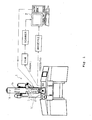
- Fig. 1 is a perspective view of an electron microscope according to one embodiment of the invention, showing its whole appearance.
- the electron microscope is a transmission electron microscope (TEM) and has an electron gun 1a emitting an electron beam, an illumination lens system 1b (condenser lens system) for directing the beam at a specimen S, a focusing lens system 1c for focusing a TEM image based on electrons transmitted through the specimen, and a TEM image detector 1d for detecting the focused TEM image.
- TEM transmission electron microscope
- the electron microscope 1 performs a three-dimensional reconstruction of the TEM image by CT (computerized tomography) .
- the microscope 1 is fitted with a signal processing circuit (computer) 2 for implementing a CT procedure based on the TEM image of the specimen gained by the TEM image detector 1d.
- the specimen is supported on a specimen stage 3 capable of being rotated and tilted.
- the stage 3 can be automatically moved under control of the signal processing circuit 2.
- the signal processing circuit 2 accepts necessary information while moving the specimen stage 3 in various kinds of processing (described later) and performs these kinds of processing automatically.
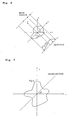
- Fig. 2 is a plan view illustrating the principle of computerized tomography (CT) applied to the electron microscope according to the present embodiment of the invention.
- CT computerized tomography
- the integral transform that makes f (x,y) correspond to p (r, ⁇ ) as mentioned previously is known as the Radon transform.
- the cross-sectional reconstruction from the projections is carried out by an inverse process of this transform, i.e., inverse Radon transform (back projection). This is hereinafter referred to as the back projection.
- Fig. 3 is a plan view showing the resulting state.
- a two-dimensional (2D) Fourier spectrum of cross sections of the specimen can be found by Fourier-transforming projections from all directions through the specimen and arraying the resulting spectra in a Fourier space.
- Cross-sectional images of the specimen can be obtained by inverse-Fourier transforming the 2D Fourier spectrum.
- a two-dimensional image (cross-sectional image) can be reconstructed from one-dimensional projections. Since a TEM image is a 2D projection, a three-dimensional image can be reconstructed simply by rotating the specimen along the axis of rotation.
- Fig. 4 is a perspective view illustrating the process for reconstructing a three-dimensional image. That is, a data array in a direction perpendicular to the axis of rotation is regarded as a 1D projection. A cross-sectional image is reconstructed from projections from various angles. A 3D image can be obtained by stacking 2D images obtained in this way along the axis of rotation.
- a series of transmission images is obtained by tilting the specimen in incremental angular steps.
- the same field of view is selected and extracted from the series of transmission images by two-dimensional correlation processing. In this way, the problem of positional deviation of the specimen is solved.
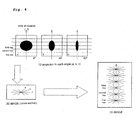
- Fig. 5 is a front elevation illustrating the process for selecting and extracting the same field of view from a series of transmission images by two-dimensional correlation processing, the series of transmission images being obtained by tilting a specimen in incremental angular steps.
- two-dimensional correlation processing is performed between each obtained transmission image and a reference image.
- Parts of the transmission images which have the same field of view as the reference image are extracted from the transmission images at different angles.
- Computerized tomography is done using the extracted images.
- the reference image is obtained by extracting an image of a part of field of view from the transmission image obtained when the specimen stage is at some tilt angle (e.g., 0°).
- the accuracy at which transmission images are extracted by two-dimensional correlation processing can be improved by removing the trend in the transmission images (i.e., by removing first-order component or bias component).
- the reliability that the identified maximum value is a true maximum value is low. In this case, the reliability of the alignment (extraction of image) is deteriorated severely.
- [Ave] is the average value of the correlation over the whole transmission image.
- cofEq. (9) or (10) described later is used, for example.
- c (i, j) ⁇ f ( x , y ) g ( x - i , y - j ) dx dy
- the degree of similarity is calculated in succession while translating the reference image within the image of interest. Because of the characteristics of the electronmicroscope, rotational movement is produced between the reference image and the image of interest.
- Eq. (9) is modified into Eq. (10) by adding a rotation through ⁇ within the xy plane with respect to a point within the image.
- This point within the image does not need to be the center of the image as long as it is a fixed point.
- c ( i , j , ⁇ ) ⁇ f ( x , y ) g ( x - i , y -j, ⁇ ) dx dy d ⁇
- an image of a field of view that will become a reference image is extracted from a transmission image when the specimen stage is at some tilt angle (e.g., 0°). Then, 2D correlation processing is performed between the reference image and a transmission image derived when the specimen stage is at a different tilt angle. A field of view producing a maximum amount of correlation is extracted. The extracted field of view is rotated or tilted in the direction of ⁇ within the transmission image. Each such a field of view is multiplied with the reference image, and the total sum is taken. An image closest to the reference image can be obtained by adopting the maximum value of those values. That is, the rotation (tilt) in the direction of ⁇ within the transmission image is corrected. This processing is carried out repetitively. In consequence, images of the same field of view can be accurately extracted regarding transmission images at all tilt angles.
- some tilt angle e.g., 0°
- 2D correlation processing is performed between the reference image and a transmission image derived when the specimen stage is at a different tilt angle.
- an image extracted from the transmission image obtained when the specimen stage is at some tilt angle is not used for transmission images at all tilt angles . Rather, an image of the same field of view extracted from a transmission image at a different tilt angle using some reference image is used as a new reference image for 2D correlation processing between the reference image and a transmission image at a further tilt angle.
- Fig. 6 is a front elevation showing one example of process of performing 2D correlation processing using successively new reference images.
- an image of the same field of view is extracted from a transmission image obtained when the tilt angle of the stage is 30°.
- an image of the same field of view is extracted from a transmission image obtained when the tilt angle of the stage is 60° . Consequently, it is possible to avoid the problem that the difference in tilt angle of specimen stage between the reference image and the image to be processed is too large to perform the processing.
- the amount of deviation between the center of range in which a 3D image is reconstructed and the mechanical axis of rotation is added during back projection. This offers latitude in selecting a field of view. Therefore, an accurate reconstructed image is obtained.
- the amount of deviation can be found probabilistically from successive projection images. For example, the amount of deviation is optimized such that a good reconstructed image is obtained.
- the aforementioned problem is circumvented by taking the practically achievable maximum tilt angles of ⁇ 60° as recommended conditions for obtaining transmission images and adj usting the operating conditions under which 3D images are observed.
- two-dimensional correlation processing is performed between each of a series of transmission images obtained by tilting the specimen by plural angles and a reference image to thereby select and extract the same field of view. Positional deviation of the specimen is corrected. Therefore, an accurate 3D image can be reconstructed.
- the effects of the trend of the contrast of each transmission image are removed before the aforementioned two-dimensional correlation processing is performed. Consequently, the accuracy at which the transmission images are extracted by the 2D correlation processing can be improved.
- a certain decision criterion is established about the maximum value of the correlation results of the 2D correlation processing. Values not satisfying the criterion are not used as the results of the 2D correlation processing. Hence, the reliability of the correlation results of the 2D correlation processing can be secured.
- an image of the same field of view is extracted from a transmission image at a different tilt angle by the use of a reference image.
- the extracted image is used as a new reference image. 2D correlation processing is performed between this new reference image and a transmission image at a still other tilt angle.
- the amount of deviation between the center of the range of reconstruction of a 3D image and the mechanical axis of rotation is added during inverse Radon transform. This offers latitude in selecting a field of view. Hence, an accurate reconstructed image
- the present invention makes it possible to analyze the three-dimensional structure of a specimen without sectioning it, by making use of computerized tomography. Furthermore, problems intrinsically occurring when computerized tomography is applied to electron microscopy, i.e., limitations on the tilt angle of the specimen stage and problems associated with identification of the axis of rotation and rotation and shift of the image, are solved. As a result, an electron microscope that can utilize the computerized tomography in general cases can be offered.
Landscapes
- Chemical & Material Sciences (AREA)
- Analytical Chemistry (AREA)
- Analysing Materials By The Use Of Radiation (AREA)
- Length-Measuring Devices Using Wave Or Particle Radiation (AREA)
Applications Claiming Priority (2)
| Application Number | Priority Date | Filing Date | Title |
|---|---|---|---|
| JP2003182739A JP2005019218A (ja) | 2003-06-26 | 2003-06-26 | 電子顕微鏡装置 |
| JP2003182739 | 2003-06-26 |
Publications (3)
| Publication Number | Publication Date |
|---|---|
| EP1492152A2 true EP1492152A2 (fr) | 2004-12-29 |
| EP1492152A3 EP1492152A3 (fr) | 2008-03-19 |
| EP1492152B1 EP1492152B1 (fr) | 2015-09-02 |
Family
ID=33411103
Family Applications (1)
| Application Number | Title | Priority Date | Filing Date |
|---|---|---|---|
| EP04253856.1A Expired - Lifetime EP1492152B1 (fr) | 2003-06-26 | 2004-06-28 | Microscope électronique |
Country Status (3)
| Country | Link |
|---|---|
| US (1) | US7064326B2 (fr) |
| EP (1) | EP1492152B1 (fr) |
| JP (1) | JP2005019218A (fr) |
Cited By (3)
| Publication number | Priority date | Publication date | Assignee | Title |
|---|---|---|---|---|
| EP2648206A4 (fr) * | 2010-11-30 | 2018-03-14 | Hitachi High-Technologies Corporation | Microscope électronique, système de reconstruction d'image de microscope électronique et procédé de reconstruction d'image de microscope électronique |
| CN109916928A (zh) * | 2019-03-15 | 2019-06-21 | 浙江大学 | 一种判断各向异性纳米晶体择优取向性组装结果的方法 |
| EP4167267A1 (fr) * | 2021-10-13 | 2023-04-19 | Jeol Ltd. | Système à faisceau de particules chargées et son procédé de commande |
Families Citing this family (14)
| Publication number | Priority date | Publication date | Assignee | Title |
|---|---|---|---|---|
| JP3813798B2 (ja) * | 2000-07-13 | 2006-08-23 | 株式会社日立製作所 | 電子顕微鏡 |
| JP4822920B2 (ja) * | 2006-04-27 | 2011-11-24 | 日本電子株式会社 | 3次元像構築方法および透過電子顕微鏡 |
| JP4538472B2 (ja) | 2007-03-15 | 2010-09-08 | 株式会社日立ハイテクノロジーズ | 画像形成方法、及び電子顕微鏡 |
| JP5309552B2 (ja) * | 2007-12-21 | 2013-10-09 | 富士通株式会社 | 電子線トモグラフィ法及び電子線トモグラフィ装置 |
| RU2010152658A (ru) * | 2008-05-23 | 2012-06-27 | Те Острейлиан Нэшнл Юниверсити (Au) | Обработка данных изображения |
| JP4988662B2 (ja) * | 2008-07-25 | 2012-08-01 | 株式会社日立ハイテクノロジーズ | 荷電粒子線装置 |
| JP5339368B2 (ja) * | 2009-09-18 | 2013-11-13 | 独立行政法人産業技術総合研究所 | 電子顕微鏡における三次元像構築画像処理方法 |
| JP5670096B2 (ja) * | 2009-11-17 | 2015-02-18 | 日本電子株式会社 | トモグラフィー法を用いた試料の3次元画像取得方法及び装置 |
| JP5492115B2 (ja) * | 2011-02-10 | 2014-05-14 | 日本電子株式会社 | 電子顕微鏡用針状試料の作製方法 |
| USD708244S1 (en) * | 2012-11-30 | 2014-07-01 | Hitachi High-Technologies Corporation | Electron microscope |
| EP2916342A1 (fr) * | 2014-03-05 | 2015-09-09 | Fei Company | Fabrication d'une lamelle pour analyse tomographique corrélative avec résolution atomique |
| JP6272153B2 (ja) * | 2014-06-10 | 2018-01-31 | 株式会社日立ハイテクノロジーズ | 荷電粒子線装置、三次元画像の再構成画像処理システム、方法 |
| JP6796609B2 (ja) * | 2018-02-23 | 2020-12-09 | 日本電子株式会社 | 収差測定方法および電子顕微鏡 |
| EP4206664A1 (fr) * | 2021-12-30 | 2023-07-05 | FEI Company | Procédés et systèmes d'imagerie par microscopie tomographique |
Citations (1)
| Publication number | Priority date | Publication date | Assignee | Title |
|---|---|---|---|---|
| JPH04337236A (ja) | 1991-05-15 | 1992-11-25 | Hitachi Ltd | 電子顕微鏡装置及び電子顕微方法 |
Family Cites Families (2)
| Publication number | Priority date | Publication date | Assignee | Title |
|---|---|---|---|---|
| US5866905A (en) * | 1991-05-15 | 1999-02-02 | Hitachi, Ltd. | Electron microscope |
| AU3267501A (en) * | 1999-11-02 | 2001-05-14 | Gary Greenberg | Tomographic microscope for high resolution imaging and method of analyzing specimens |
-
2003
- 2003-06-26 JP JP2003182739A patent/JP2005019218A/ja active Pending
-
2004
- 2004-06-24 US US10/876,300 patent/US7064326B2/en not_active Expired - Fee Related
- 2004-06-28 EP EP04253856.1A patent/EP1492152B1/fr not_active Expired - Lifetime
Patent Citations (2)
| Publication number | Priority date | Publication date | Assignee | Title |
|---|---|---|---|---|
| JPH04337236A (ja) | 1991-05-15 | 1992-11-25 | Hitachi Ltd | 電子顕微鏡装置及び電子顕微方法 |
| EP0513776B1 (fr) | 1991-05-15 | 1998-09-30 | Hitachi, Ltd. | Instrument et procédé pour observer un arrangement tridimensional d'atomes |
Cited By (3)
| Publication number | Priority date | Publication date | Assignee | Title |
|---|---|---|---|---|
| EP2648206A4 (fr) * | 2010-11-30 | 2018-03-14 | Hitachi High-Technologies Corporation | Microscope électronique, système de reconstruction d'image de microscope électronique et procédé de reconstruction d'image de microscope électronique |
| CN109916928A (zh) * | 2019-03-15 | 2019-06-21 | 浙江大学 | 一种判断各向异性纳米晶体择优取向性组装结果的方法 |
| EP4167267A1 (fr) * | 2021-10-13 | 2023-04-19 | Jeol Ltd. | Système à faisceau de particules chargées et son procédé de commande |
Also Published As
| Publication number | Publication date |
|---|---|
| JP2005019218A (ja) | 2005-01-20 |
| US7064326B2 (en) | 2006-06-20 |
| EP1492152A3 (fr) | 2008-03-19 |
| EP1492152B1 (fr) | 2015-09-02 |
| US20050029452A1 (en) | 2005-02-10 |
Similar Documents
| Publication | Publication Date | Title |
|---|---|---|
| EP1492152A2 (fr) | Microscope électronique | |
| US7260253B2 (en) | Method for correction of relative object-detector motion between successive views | |
| US5497007A (en) | Method for automatically establishing a wafer coordinate system | |
| US5402460A (en) | Three-dimensional microtomographic analysis system | |
| US11636598B2 (en) | Imaging data processing apparatus and imaging data processing program to perform image alignment by deforming images such that imaged observation target sites coincide | |
| US5278408A (en) | Instrument and method for 3-dimensional atomic arrangement observation | |
| EP2197018A1 (fr) | Procédé pour déterminer les distorsions dans un appareil optique corpusculaire | |
| US20040264764A1 (en) | Apparatus and method for three-dimensional coordinate measurement | |
| EP0641020A2 (fr) | Méthode à balayage multiple pour analyse des particules sur une plaquette semi-conductrice | |
| EP2652537B1 (fr) | Imagerie automatisée de zones prédéterminées dans des séries de coupes | |
| Falco et al. | An Estimate of H 0 from Keck Spectroscopy of the Gravitational Lens System 0957+ 561 | |
| EP2648206B1 (fr) | Microscope électronique à transmission pour reconstruction de structures en trois dimensions, et procédé de reconstruction d'image pour microscope électronique à transmission | |
| MX2007016046A (es) | Sistema y metodo para re-ubicar un objeto en una muestra en un portaobjetos con un dispositivo de imagen de microscopio. | |
| US20100309304A1 (en) | Method and Device for the Reconstruction of the Shape of an Object from a Sequence of Sectional Images of Said Object | |
| JP7138066B2 (ja) | 歳差電子回折データマッピングのために走査型透過電子顕微鏡を自動的にアライメントする方法 | |
| US6777679B2 (en) | Method of observing a sample by a transmission electron microscope | |
| US7838834B2 (en) | Image forming method and electron microscope | |
| Ito et al. | Super-resolution method for SEM images based on pixelwise weighted loss function | |
| Yuan et al. | Accurate post-mortem alignment for focused ion beam and scanning electron microscopy (FIB-SEM) tomography | |
| Hein et al. | Three‐dimensional reconstruction of fracture surfaces: Area matching algorithms for automatic parallax measurements | |
| US7049616B2 (en) | Methods, apparatus, and software for adjusting the focal spot of an electron beam | |
| EP3474309A1 (fr) | Procédé de reconstruction d'image tridimensionnelle | |
| Pollak et al. | Differential image distortion correction | |
| Nakamura et al. | Automated specimen search in cryo-TEM observation with DIFF-defocus imaging | |
| Kalukin et al. | Methods to remove distortion artifacts in scanned projections |
Legal Events
| Date | Code | Title | Description |
|---|---|---|---|
| PUAI | Public reference made under article 153(3) epc to a published international application that has entered the european phase |
Free format text: ORIGINAL CODE: 0009012 |
|
| AK | Designated contracting states |
Kind code of ref document: A2 Designated state(s): AT BE BG CH CY CZ DE DK EE ES FI FR GB GR HU IE IT LI LU MC NL PL PT RO SE SI SK TR |
|
| AX | Request for extension of the european patent |
Extension state: AL HR LT LV MK |
|
| PUAL | Search report despatched |
Free format text: ORIGINAL CODE: 0009013 |
|
| AK | Designated contracting states |
Kind code of ref document: A3 Designated state(s): AT BE BG CH CY CZ DE DK EE ES FI FR GB GR HU IE IT LI LU MC NL PL PT RO SE SI SK TR |
|
| AX | Request for extension of the european patent |
Extension state: AL HR LT LV MK |
|
| 17P | Request for examination filed |
Effective date: 20080918 |
|
| AKX | Designation fees paid |
Designated state(s): DE NL |
|
| 17Q | First examination report despatched |
Effective date: 20110509 |
|
| GRAP | Despatch of communication of intention to grant a patent |
Free format text: ORIGINAL CODE: EPIDOSNIGR1 |
|
| INTG | Intention to grant announced |
Effective date: 20150316 |
|
| GRAS | Grant fee paid |
Free format text: ORIGINAL CODE: EPIDOSNIGR3 |
|
| GRAA | (expected) grant |
Free format text: ORIGINAL CODE: 0009210 |
|
| AK | Designated contracting states |
Kind code of ref document: B1 Designated state(s): DE NL |
|
| REG | Reference to a national code |
Ref country code: DE Ref legal event code: R096 Ref document number: 602004047797 Country of ref document: DE |
|
| REG | Reference to a national code |
Ref country code: NL Ref legal event code: FP |
|
| REG | Reference to a national code |
Ref country code: DE Ref legal event code: R097 Ref document number: 602004047797 Country of ref document: DE |
|
| PGFP | Annual fee paid to national office [announced via postgrant information from national office to epo] |
Ref country code: NL Payment date: 20160510 Year of fee payment: 13 |
|
| PLBE | No opposition filed within time limit |
Free format text: ORIGINAL CODE: 0009261 |
|
| STAA | Information on the status of an ep patent application or granted ep patent |
Free format text: STATUS: NO OPPOSITION FILED WITHIN TIME LIMIT |
|
| PGFP | Annual fee paid to national office [announced via postgrant information from national office to epo] |
Ref country code: DE Payment date: 20160622 Year of fee payment: 13 |
|
| 26N | No opposition filed |
Effective date: 20160603 |
|
| REG | Reference to a national code |
Ref country code: DE Ref legal event code: R119 Ref document number: 602004047797 Country of ref document: DE |
|
| REG | Reference to a national code |
Ref country code: NL Ref legal event code: MM Effective date: 20170701 |
|
| PG25 | Lapsed in a contracting state [announced via postgrant information from national office to epo] |
Ref country code: NL Free format text: LAPSE BECAUSE OF NON-PAYMENT OF DUE FEES Effective date: 20170701 |
|
| PG25 | Lapsed in a contracting state [announced via postgrant information from national office to epo] |
Ref country code: DE Free format text: LAPSE BECAUSE OF NON-PAYMENT OF DUE FEES Effective date: 20180103 |