EP1503392A2 - Ensemble commutateur. - Google Patents
Ensemble commutateur. Download PDFInfo
- Publication number
- EP1503392A2 EP1503392A2 EP04103226A EP04103226A EP1503392A2 EP 1503392 A2 EP1503392 A2 EP 1503392A2 EP 04103226 A EP04103226 A EP 04103226A EP 04103226 A EP04103226 A EP 04103226A EP 1503392 A2 EP1503392 A2 EP 1503392A2
- Authority
- EP
- European Patent Office
- Prior art keywords
- knob
- switch assembly
- switch
- manipulation knob
- shuttle body
- Prior art date
- Legal status (The legal status is an assumption and is not a legal conclusion. Google has not performed a legal analysis and makes no representation as to the accuracy of the status listed.)
- Granted
Links
Images


Classifications
-
- H—ELECTRICITY
- H01—ELECTRIC ELEMENTS
- H01H—ELECTRIC SWITCHES; RELAYS; SELECTORS; EMERGENCY PROTECTIVE DEVICES
- H01H13/00—Switches having rectilinearly-movable operating part or parts adapted for pushing or pulling in one direction only, e.g. push-button switch
- H01H13/70—Switches having rectilinearly-movable operating part or parts adapted for pushing or pulling in one direction only, e.g. push-button switch having a plurality of operating members associated with different sets of contacts, e.g. keyboard
-
- H—ELECTRICITY
- H01—ELECTRIC ELEMENTS
- H01H—ELECTRIC SWITCHES; RELAYS; SELECTORS; EMERGENCY PROTECTIVE DEVICES
- H01H25/00—Switches with compound movement of handle or other operating part
- H01H25/06—Operating part movable both angularly and rectilinearly, the rectilinear movement being along the axis of angular movement
-
- H—ELECTRICITY
- H01—ELECTRIC ELEMENTS
- H01H—ELECTRIC SWITCHES; RELAYS; SELECTORS; EMERGENCY PROTECTIVE DEVICES
- H01H19/00—Switches operated by an operating part which is rotatable about a longitudinal axis thereof and which is acted upon directly by a solid body external to the switch, e.g. by a hand
- H01H19/54—Switches operated by an operating part which is rotatable about a longitudinal axis thereof and which is acted upon directly by a solid body external to the switch, e.g. by a hand the operating part having at least five or an unspecified number of operative positions
- H01H19/60—Angularly-movable actuating part carrying no contacts
- H01H19/63—Contacts actuated by axial cams
-
- H—ELECTRICITY
- H01—ELECTRIC ELEMENTS
- H01H—ELECTRIC SWITCHES; RELAYS; SELECTORS; EMERGENCY PROTECTIVE DEVICES
- H01H1/00—Contacts
- H01H1/58—Electric connections to or between contacts; Terminals
- H01H1/5805—Connections to printed circuits
-
- H—ELECTRICITY
- H01—ELECTRIC ELEMENTS
- H01H—ELECTRIC SWITCHES; RELAYS; SELECTORS; EMERGENCY PROTECTIVE DEVICES
- H01H19/00—Switches operated by an operating part which is rotatable about a longitudinal axis thereof and which is acted upon directly by a solid body external to the switch, e.g. by a hand
- H01H19/02—Details
- H01H19/03—Means for limiting the angle of rotation of the operating part
-
- H—ELECTRICITY
- H01—ELECTRIC ELEMENTS
- H01H—ELECTRIC SWITCHES; RELAYS; SELECTORS; EMERGENCY PROTECTIVE DEVICES
- H01H3/00—Mechanisms for operating contacts
- H01H3/32—Driving mechanisms, i.e. for transmitting driving force to the contacts
- H01H3/46—Driving mechanisms, i.e. for transmitting driving force to the contacts using rod or lever linkage, e.g. toggle
- H01H2003/466—Driving mechanisms, i.e. for transmitting driving force to the contacts using rod or lever linkage, e.g. toggle using a living hinge to connect the levers
-
- H—ELECTRICITY
- H01—ELECTRIC ELEMENTS
- H01H—ELECTRIC SWITCHES; RELAYS; SELECTORS; EMERGENCY PROTECTIVE DEVICES
- H01H21/00—Switches operated by an operating part in the form of a pivotable member acted upon directly by a solid body, e.g. by a hand
- H01H21/02—Details
- H01H21/18—Movable parts; Contacts mounted thereon
- H01H21/22—Operating parts, e.g. handle
- H01H21/24—Operating parts, e.g. handle biased to return to normal position upon removal of operating force
-
- H—ELECTRICITY
- H01—ELECTRIC ELEMENTS
- H01H—ELECTRIC SWITCHES; RELAYS; SELECTORS; EMERGENCY PROTECTIVE DEVICES
- H01H2221/00—Actuators
- H01H2221/036—Return force
- H01H2221/044—Elastic part on actuator or casing
Definitions
- the present invention relates to switch assembly comprising a switch mounted behind a manually operable switch actuating means for operating the switch.
- VCRs video cassette tape recorders
- VTR video tape recorders
- DVDP digital video disk players
- PCB printed circuit board
- Figure 1 is a cross-sectional view of a conventional switch assembly and Figure 2 is an exploded perspective view of the assembly shown in Figure 1.
- a conventional switch assembly 100 includes a shuttle unit 120 and a plurality of tact switches 131, 132 disposed on a printed circuit board (PCB) 110, a shuttle knob 140 for operating the shuttle unit 120 and a switch knob 150 for closing and opening the tact switches 131, 132.
- the conventional switch assembly 100 further includes a board holder 160 and a button knob holder 170 interposed between the switches 131, 132 and the button knob 150.
- the tact switches 131, 132 are arranged around the shuttle unit 120, which is rotatably disposed on the PCB 110.
- the tact switches 131, 132 are located at predetermined intervals and signal the performance of different functions, i.e. play, stop, pause and load/eject.
- the board holder 160 which is located on the front surface of the PCB 110 with the tact switches 131, 132, compensates for a step between the tact switches 131, 132 and the PCB 110.
- the button knob 150 When assembled with the button knob holder 170, the button knob 150 is connected to the front surface of the PCB 110 where the board holder 160 is disposed.
- the button knob holder 170 is provided with a plurality of pips 171, 172 protruding therefrom and aligned with the tact switches 131, 132 fixed to the PCB 110.
- the pips 171, 172 When one side of the button knob 150 is pressed, the pips 171, 172 the corresponding tact switch 131, 132 is closed.
- the shuttle knob 140 is connected to the shuttle unit 120 and can rotate through 360° clockwise and anticlockwise.
- the button knob 150 includes a plurality of tension ribs 155 spaced from the shuttle knob 140 by a predetermined distance. A user can, for example, adjust the volume of an audio output by rotating the shuttle knob 140.
- the conventional switch assembly 100 has a complicated construction, requiring assembly of the shuttle knob 140, the button knob 150, the button knob holder 170 and the board holder 160 with the shuttle unit 120.
- a switch assembly is characterised in that the actuating means comprises a rotary knob and a force transmission member configured such that rotation of the knob applies a force to the force transmission member causing the force transmission member to operate the switch.
- the rotary knob bears against an inclined surface of the force transmission member.
- a cam surface on the knob could be arranged to bear against a cam follower on the force transmission member. In both cases, the rotary motion of the knob is converted into a pressing action. More preferably, the rotary knob has a radial extension which bears against said inclined surface.
- the force transmission member is L-shaped.
- a pivot may be provided at the angle of the L.
- a structure is provided on which the knob is rotatably mounted and with which the force transmission member is integrally formed.
- a further switch and further force transmission member for operating the further switch may be included with the knob mounted to the further force transmission member.
- the further transmission member is preferably integrally formed with said structure.
- a push-operated switch and a manually operable actuator for the push-operated switch are included with the manually operable actuator being integrally formed with said structure.
- a PCB printed circuit board
- a PCB may be mounted to said structure and itself support the or each switch.
- the structure may be a moulded structure.
- an electronic product 1 includes a body (not shown), having an opening formed at its front, and a front panel 3 blocking the opening of the body.
- the body houses a plurality of parts and a printed circuit board (PCB) 11.
- PCB printed circuit board
- a switching assembly 17, tact switches 21, 22, 23, 24, 25, 26 and a display unit 28 are mounted to the PCB 11.
- a door 4 and a display window 5 are located, one above the other, in the centre portion of the front panel 3.
- the door 4 is pivotable about a horizontal axis for opening and closing.
- the door 4 enables media, such as video tapes or discs, is inserted and ejected.
- the display window 5 is made of a transparent material to expose an operating state displayed by the display unit 28 to the outside.
- Functions keys 6 protrude through the display window 5 to enable the user to select the functions of recording, adjusting a channel or adjusting a screen by turning on/off the respective tact switches 26.
- the front panel 3 is also provided with a power button 13 and an eject button 14, located to one side of the door 4 and the display window 5.
- An external input unit 15, having a plurality of external input ports, is preferably located under the power button 13 and the eject button 14.
- Knob holes 7, 8, 9 are formed in the front panel 3 on the side opposite the power button 13 and the eject button 14. The knob holes 7, 8, 9 allow control knobs 71, 84, 85, which form the switch assembly 17, to protrude through the front panel 3.
- the front panel 3 has a plurality of connection tabs 10 located at predetermined intervals along the length of the rear edge panel 3.
- the connection tabs 10 include a connection hole or a hook. If the connection tabs 10 have connection holes, the connection tabs 10 are connected to the case body using an extra connection member (not shown). However, if the connection ribs 10 have connection hooks, the connection tabs 10 are connected to the case body using a hook hole formed in the body.
- the switch assembly 17 includes the tact switches 21, 22, 23, 24, 25, 26 disposed on the PCB 11, a shuttle body 20 mounted to the front panel 3 and the control knob 71 movably connected to the shuttle body 20 for shuttle rotation.
- the switch assembly 17 further includes a spring member 81 for returning the control knob 71 to an original position.
- the tact switches 21, 22, 23, 24, 25, 26 individually command separate functions.
- the third switch 23 may be located between the first and the second tact switches 21, 22 and command another predetermined function.
- the fourth and fifth tact switches 24, 25 are located outside of the second tact switch 22 to command functions such as pause and stop.
- the shuttle body 20 includes a frame 20', fixed to the front panel 3 (not shown), and first and second resilient fingers 31, 32 for operating the first and the second tact switches 21, 22 (not shown) and a knob-holding shaft 51 connected to the control knob 71.
- the first and the second resilient fingers 31, 32 extend from a lower portion of the frame 20' toward the first and the second tact switches 21, 22 (not shown) parallel to each other.
- the first and the second resilient fingers 31, 32 are elastically deformable in a vertical direction with respect to the frame 20'. As the first and the second resilient fingers 31, 32 are elastically deformed, they close/open the corresponding first and the second tact switches 21, 22 (not shown).
- the first and the second resilient fingers 31, 32 include respective protrusions 41, 42 upwardly protruding from the roots of the fingers 31, 32 and inclined portions 47, 48 formed at the ends of the protrusions 41, 42.
- the inclined portions 47, 48 are arcuate and curve around the knob-holding shaft 51, and are maintained at a predetermined angle with respect to the corresponding protrusions 41, 42.
- the inclined portions 47, 48 are pressed and released by an operating portion 72 of the control knob 71, which will be described in greater detail below. Accordingly, the first and the second resilient fingers 31, 32 are elastically deformed in unison with the inclined portions 47, 48.
- a third resilient finger 33 extends between the first and the second resilient fingers 31 and 32 toward the third tact switch 23 (not shown).
- the third resilient finger 33 has a protrusion 43 protruding upwardly for being pressed with the control knob 71.
- the protrusion 43 is elastically deformed backward when being pressed at the front portion and in association with this, the third resilient finger 33 is elastically deformed to close/open the third tact switch 23.
- Fourth and fifth resilient fingers 34, 35 for operating the fourth and the fifth tact switches 24, 25 are located outside the second resilient finger 32. Like the first to third resilient fingers 31, 32, 33, the fourth and the fifth resilient fingers 34, 35 have protrusions 44, 45 protruding upwardly.
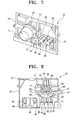
- the control knobs 84, 85 (shown in Figure 7) are connected to the protrusions 44, 45 of the fourth and fifth resilient fingers 34, 35 and are exposed to the outside through the knob holes 8, 9 formed in the front panel 3. When the control knobs 84, 85 are pressed backward, the fourth and fifth resilient fingers 34, 35 are elastically deformed in unison with the protrusions 44, 45, thereby closing/opening the corresponding tact switches 24, 25 (not shown).
- the knob-holding shaft 51 is located in the centre above the first and the second resilient fingers 31, 32.
- the knob-holding shaft 51 extends from a plate surface of the shuttle body 20 in a forward direction and has a shaft hole 51 a formed in its centre.
- guide recesses 61, 65 are located around the knob holding shaft 51 opposite each other. The ends of each guide recess 61, 65 prevent excessive forward and reverse rotation of the control knob 71.
- an arcuate wall 63 is located between the knob-holding shaft 51 and the guide recesses 61, 65 (shown in Figure 8).
- a spring recess for housing a spring member 81 is formed between the wall 63 and the knob holding shaft 51.
- the spring member 81 may be a torsion spring.
- the wall 63 has a cut out formed in a lower portion to hold opposite ends 82, 83 of the spring member 81 downward. The opposite ends of the spring member 81 held by the cut out are elastically deformed only in compression.
- the shuttle body 20 with the above construction is integrally formed by injection moulding.
- the first and the second resilient fingers 31, 32 may take various forms that are capable of directly co-operating with the operating portions 72, 73 of the control knob 71 without the protrusion 41, 42 and the inclined portions 47, 48.
- the first and the second resilient fingers 31, 32 each have an inclined surface formed along the length of their front surface.
- the control knob 71 includes a rotary shaft 75 connected to the shaft hole 51a of the knob holding shaft 51, the operating portions 72 and 73 operating with the first and the second resilient fingers 31 and 32, and connecting portions 76 and 77 movably received in the guide recesses (holes) 61 and 65.
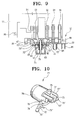
- the rotary shaft 75 protrudes toward the shuttle body 20 (not shown) along a center axis of the control knob 71 to be rotatably connected to the shaft hole 51a of the knob holding shaft 51 (as shown in Figure 5).
- the control knob 71 is rotatably connected to the knob-holding shaft 51 and is partially exposed to the outside of the front panel 3.
- a knurling 78 is preferably formed around the circumference on the outer surface of the control knob 71 for the user to grip.
- connection portions 76, 77 are provided in pairs and extend from the rear of the control knob 71 toward the shuttle body 20 and have hooks 76', 77' protruding outwards from the ends of the connection portions 76, 77.
- the connection portions 76, 77 are received in the guide recesses or holes 61, 65 of the shuttle body 20 to shuttle-rotate along the length of the guide recesses or holes 61, 65.
- the hooks 76', 77' are hooked into the guide holes or recesses 61, 65 to prevent the control knob 71 from being turned further than the length of the guide recesses or holes 61, 65.
- the operating portions 72, 73 are provided in pairs and protrude outward from the outer surface of the control knob 71 in a radial direction. Operating portion 72 is at a predetermined distance from operating portion 73; the predetermined distance corresponding to the angle between the opposite ends 82, 83 of the spring member 81. Also, the operating portions 72, 73 have contact protrusions 72', 73' formed at their ends to contact the inclined portions 47, 48 of the first and second resilient fingers 31, 32.
- the contact protrusions 72', 73' move in unison with the inclined portions 47, 48 of the first and second resilient fingers 31, 32.
- the contact protrusions 72', 73' move along the inclined portions 47, 48 in the forward and reverse directions, they press or release the first and second resilient fingers 31, 32, thereby closing and opening the corresponding tact switches 21,22.
- the operating portions 72, 73 have locking protrusions 72", 73" protruding toward the spring member 81.
- the locking protrusions 72", 73” operate with the opposite ends of the spring member 81 received in the spring recess of the shuttle body 20. That is, the opposite ends 82, 83 of the spring member 81 elastically press the locking protrusions 72", 73" toward the outside so that the control knob 71 is maintained at a position to press and release the first and second resilient fingers 31, 32.
- the spring member 81 is received in the spring recess of the shuttle body 20.
- the rotary shaft 75 of the control knob 71 is inserted into the shaft hole 51a of the knob-holding shaft 51 of the shuttle body 20.
- the locking protrusions 72", 73" of the operating portions 72, 73 correspond to the opposite ends 82, 83 of the spring member 81 at the outside. Accordingly, due to the elasticity of the spring member 81, it is possible for the control knob 71 to shuttle-rotate between a position where the control knob 71 releases the first and second resilient fingers 31, 32 and a position where the control knob 71 presses the first and the second resilient fingers 31, 32.
- the shuttle body 20, assembled with the control knob 71, is fixed to the rear surface of the front panel 3.
- the frame 20' of the shuttle body 20 has a connection recess (reference numeral 27 of Figure 8), formed along its longitudinal direction, into which the shuttle body 20 is fixed.
- a plurality of connection members (not shown), formed on the rear surface of the front panel 3, are connected to the connection recess so that the shuttle body 20 is fixed to the front panel 3.
- a shuttle ring (reference numeral 91 of Figure 4) be located between the front panel 3 and the shuttle body 20.
- the shuttle ring 91 aids the smooth rotation of the control knob 71, which extends through the knob hole 7 to the exterior of the front panel 3.
- the tact switches 21, 22, 23, 24, 25, 26 are fixed onto pre-set positions on the PCB 11.
- the PCB 11 has tact switches 21, 22, 23, 24, 25, 26 installed on it and is connected to a predetermined position on the bottom of the case body. Accordingly, as the front panel 3 is assembled with the case body, the first and second resilient fingers 31, 32 of the shuttle body 20 correspond to the first and second tact switches 21, 22 located on the PCB 11.
- a user can grip the control knob 71 positioned at a press-release position and shuttle-rotate it in the forward and reverse directions.
- the operating portions 72, 73 elastically deform the first and the second resilient fingers 31, 32.
- the first and the second tact switches 21, 22 are operated to command the corresponding functions.
- the spring member 81 returns to the press-release position by the recovering force thereof.
- an elastic supporting rib (a reference numeral 29 of Figure 7) is formed at a position corresponding to the third resilient finger 33 with respect to the knob holding shaft 51. The elastic supporting rib 29 presses the control knob 71 forward, thereby preventing the third resilient finger 33 from operating freely.
- assembling and disassembling of the switch assembly 17 becomes easy and simple because the shuttle body 20 is integrally formed with the knob holding shaft 51 by the injection moulding and the tact switches are located on the PCB. Accordingly, manufacturing costs and maintenance costs can be reduced.
- the switch assembly 17 with a simple compact construction reduces the overall size of the product and allows the user to manipulate it with ease and convenience.
Landscapes
- Switches With Compound Operations (AREA)
- Rotary Switch, Piano Key Switch, And Lever Switch (AREA)
- Switch Cases, Indication, And Locking (AREA)
Applications Claiming Priority (2)
| Application Number | Priority Date | Filing Date | Title |
|---|---|---|---|
| KR1020030052432A KR100985580B1 (ko) | 2003-07-29 | 2003-07-29 | 작동스위치 조립체 |
| KR2003052432 | 2003-07-29 |
Publications (3)
| Publication Number | Publication Date |
|---|---|
| EP1503392A2 true EP1503392A2 (fr) | 2005-02-02 |
| EP1503392A3 EP1503392A3 (fr) | 2007-03-14 |
| EP1503392B1 EP1503392B1 (fr) | 2012-04-11 |
Family
ID=33536455
Family Applications (1)
| Application Number | Title | Priority Date | Filing Date |
|---|---|---|---|
| EP04103226A Expired - Lifetime EP1503392B1 (fr) | 2003-07-29 | 2004-07-07 | Ensemble commutateur. |
Country Status (5)
| Country | Link |
|---|---|
| US (1) | US7586054B2 (fr) |
| EP (1) | EP1503392B1 (fr) |
| JP (1) | JP4173117B2 (fr) |
| KR (1) | KR100985580B1 (fr) |
| CN (1) | CN100337292C (fr) |
Cited By (1)
| Publication number | Priority date | Publication date | Assignee | Title |
|---|---|---|---|---|
| CN103489666A (zh) * | 2013-10-24 | 2014-01-01 | 田作刚 | 可拆分的电路连接装置 |
Families Citing this family (9)
| Publication number | Priority date | Publication date | Assignee | Title |
|---|---|---|---|---|
| CN1239305C (zh) | 2000-08-04 | 2006-02-01 | 株式会社日立制作所 | 成形金属模清扫用片与使用该片的半导体装置的制造方法 |
| SE0403219D0 (sv) * | 2004-12-30 | 2004-12-30 | Electrolux Ab | Control knob assembly |
| FR2882447B1 (fr) * | 2005-02-22 | 2007-05-04 | Valeo Systemes Thermiques | Bouton de controle d'organes fonctionnels, notamment d'une installation de ventilation, de chauffage et/ou de climatisation d'un vehicule |
| US7973257B2 (en) * | 2007-11-29 | 2011-07-05 | Sagi Faifer | Rocker switch within a device holder |
| KR101411303B1 (ko) * | 2012-11-26 | 2014-06-24 | 주식회사 마그마 | 스위치장치, 스위치장치에 사용되는 스위치조립체 및 스위치조립체의 제조방법 |
| KR102056158B1 (ko) * | 2014-06-13 | 2019-12-16 | 현대자동차 주식회사 | 차량의 전자장비 조작 버튼 |
| CN104107091B (zh) * | 2014-07-30 | 2016-05-04 | 深圳市理邦精密仪器股份有限公司 | 一种医疗设备的飞梭及具有该飞梭的医疗设备 |
| US10248153B2 (en) | 2016-06-07 | 2019-04-02 | Electrolux Home Products, Inc. | Self-centering mechanism for a rotatable shaft |
| CN113359009B (zh) * | 2021-06-01 | 2022-07-19 | 广东拓斯达科技股份有限公司 | 承托扎针机构及其载具 |
Citations (1)
| Publication number | Priority date | Publication date | Assignee | Title |
|---|---|---|---|---|
| WO1993023862A1 (fr) | 1992-05-13 | 1993-11-25 | Moto Meter Gmbh | Dispositif pour la mise en circuit et hors circuit d'un consommateur electrique, en particulier pour instruments de controle sur un tableau de bord d'un vehicule automobile |
Family Cites Families (31)
| Publication number | Priority date | Publication date | Assignee | Title |
|---|---|---|---|---|
| US3718786A (en) * | 1971-08-05 | 1973-02-27 | Tri Line Electric Co Inc | Rotary switch assembly |
| US3797907A (en) * | 1972-09-18 | 1974-03-19 | Us Navy | Fresnel lens scatter plate for data reduction holography |
| JP2668212B2 (ja) * | 1987-03-04 | 1997-10-27 | アンリツ株式会社 | スイッチ付きダイヤル装置 |
| JPH0574277A (ja) | 1991-09-17 | 1993-03-26 | Aiwa Co Ltd | 操作部機構 |
| US5180050A (en) * | 1991-10-15 | 1993-01-19 | Delco Electronics Corporation | Pushbutton rotary switch |
| US5227595A (en) * | 1992-05-20 | 1993-07-13 | Carlingswitch, Inc. | Rotary switch with common contact terminal |
| JP3219353B2 (ja) | 1994-08-26 | 2001-10-15 | アルプス電気株式会社 | 回転操作型スイッチおよび多方向入力装置 |
| US5589671A (en) * | 1995-08-22 | 1996-12-31 | Us Controls Corp. | Rotary switch with spring stabilized contact control rotor |
| DE19532822A1 (de) * | 1995-09-06 | 1997-03-13 | Diehl Gmbh & Co | Betriebsartenwahlschalter |
| KR0135187Y1 (ko) | 1996-07-15 | 1999-10-01 | 삼성전자주식회사 | 조그셔틀기능과 택트기능을 구비한 스위치구조 |
| JPH10112244A (ja) | 1996-10-03 | 1998-04-28 | Hosiden Corp | 中点自動復帰式ロータリスイッチ |
| KR200155303Y1 (ko) | 1997-06-19 | 1999-08-16 | 전주범 | 셔틀 스위치 조립체 |
| KR19990015341U (ko) * | 1997-10-15 | 1999-05-15 | 전주범 | 노브 스위치 보강구조 |
| DE19756052C2 (de) * | 1997-12-17 | 2002-06-27 | Trw Automotive Electron & Comp | Mehrfunktionsschalter |
| JP3054817U (ja) * | 1998-06-10 | 1998-12-18 | 船井電機株式会社 | ジョグルスイッチ |
| JP2000149713A (ja) | 1998-11-12 | 2000-05-30 | Funai Electric Co Ltd | ジョグつまみ装置 |
| US6079401A (en) * | 1998-12-10 | 2000-06-27 | Ranco Incorporated Of Delaware | Single knob rotary oven control apparatus providing continuous and discrete control information |
| JP2000182798A (ja) * | 1998-12-15 | 2000-06-30 | Olympus Optical Co Ltd | 電子機器の操作装置 |
| US6096985A (en) * | 1999-08-13 | 2000-08-01 | Thomson Licensing S.A. | Button assembly |
| DE19964133A1 (de) * | 1999-11-22 | 2001-06-13 | Preh Elektro Feinmechanik | Drehschalter |
| JP2001243759A (ja) * | 2000-02-29 | 2001-09-07 | Sony Corp | 電子機器における回転操作機構 |
| JP2001250453A (ja) * | 2000-03-07 | 2001-09-14 | Stanley Electric Co Ltd | ロータリースイッチ |
| JP3651584B2 (ja) | 2000-09-13 | 2005-05-25 | 株式会社東芝 | 電子写真画像形成装置 |
| JP2002133967A (ja) | 2000-10-30 | 2002-05-10 | Asahi National Lighting Co Ltd | ロータリースイッチのボディ製造法 |
| KR200230688Y1 (ko) | 2001-02-05 | 2001-07-19 | 엘지전자 주식회사 | 조그 및 방향전환기능을 갖는 복합형 스위치구조 |
| JP2002270065A (ja) | 2001-03-14 | 2002-09-20 | Zexel Valeo Climate Control Corp | 中点自動復帰式シャトルスイッチ機構 |
| JP2002343192A (ja) * | 2001-05-14 | 2002-11-29 | Alps Electric Co Ltd | 複合操作型入力装置 |
| US6525281B2 (en) * | 2001-07-11 | 2003-02-25 | Reitter & Schefenacker Gmbh & Co. Kg | Emergency call button for vehicles, in particular, motor vehicles |
| JP2003346603A (ja) * | 2002-05-29 | 2003-12-05 | Tokai Rika Co Ltd | スイッチ装置 |
| KR200298262Y1 (ko) | 2002-09-19 | 2002-12-16 | 대우전자주식회사 | 브이씨알의 셔틀노브 조립체 |
| US6797907B1 (en) * | 2003-11-18 | 2004-09-28 | Emerson Electric Co. | Rotary switch assembly |
-
2003
- 2003-07-29 KR KR1020030052432A patent/KR100985580B1/ko not_active Expired - Fee Related
-
2004
- 2004-03-31 JP JP2004108011A patent/JP4173117B2/ja not_active Expired - Fee Related
- 2004-06-29 CN CNB2004100619520A patent/CN100337292C/zh not_active Expired - Fee Related
- 2004-07-07 EP EP04103226A patent/EP1503392B1/fr not_active Expired - Lifetime
- 2004-07-27 US US10/899,114 patent/US7586054B2/en not_active Expired - Fee Related
Patent Citations (1)
| Publication number | Priority date | Publication date | Assignee | Title |
|---|---|---|---|---|
| WO1993023862A1 (fr) | 1992-05-13 | 1993-11-25 | Moto Meter Gmbh | Dispositif pour la mise en circuit et hors circuit d'un consommateur electrique, en particulier pour instruments de controle sur un tableau de bord d'un vehicule automobile |
Cited By (2)
| Publication number | Priority date | Publication date | Assignee | Title |
|---|---|---|---|---|
| CN103489666A (zh) * | 2013-10-24 | 2014-01-01 | 田作刚 | 可拆分的电路连接装置 |
| CN103489666B (zh) * | 2013-10-24 | 2015-08-05 | 田作刚 | 可拆分的电路连接装置 |
Also Published As
| Publication number | Publication date |
|---|---|
| US7586054B2 (en) | 2009-09-08 |
| EP1503392B1 (fr) | 2012-04-11 |
| CN1577672A (zh) | 2005-02-09 |
| JP2005050784A (ja) | 2005-02-24 |
| KR20050013849A (ko) | 2005-02-05 |
| KR100985580B1 (ko) | 2010-10-06 |
| CN100337292C (zh) | 2007-09-12 |
| EP1503392A3 (fr) | 2007-03-14 |
| JP4173117B2 (ja) | 2008-10-29 |
| US20050023121A1 (en) | 2005-02-03 |
Similar Documents
| Publication | Publication Date | Title |
|---|---|---|
| US6525277B2 (en) | Multiple operation type input device | |
| EP1503392B1 (fr) | Ensemble commutateur. | |
| EP1617446B1 (fr) | Dispoaitif d'entrée et de sélection rotatif. | |
| US4704651A (en) | Cassette tape deck operating mechanism | |
| US5877939A (en) | Snap door for a household electric appliance | |
| US6980431B1 (en) | Controlling device for controlling slot shutter | |
| JP3708309B2 (ja) | 押釦装置 | |
| JP3751787B2 (ja) | ロック機構 | |
| JPS6338507Y2 (fr) | ||
| JP3777619B2 (ja) | 操作釦装置及び電子機器 | |
| JP2001118469A (ja) | 操作装置 | |
| US7326868B2 (en) | Button apparatus for disk drive | |
| JP3644040B2 (ja) | 携帯電子機器 | |
| JP3401814B2 (ja) | 電子機器のホールド・オン/オフ機構 | |
| JP3146595B2 (ja) | 電子機器のスイッチ装置 | |
| KR0126768Y1 (ko) | 전자제품의 로터리형 스위치 | |
| JP2917452B2 (ja) | カセットテープレコーダー | |
| KR930007694Y1 (ko) | 로터리식 디지털 콘트롤 스위치 장치 | |
| JPH0717171Y2 (ja) | 電子機器のスイッチ操作部 | |
| JP3235300B2 (ja) | 電子機器 | |
| JPH0531744Y2 (fr) | ||
| JPH09298842A (ja) | 電子機器 | |
| JPS6128357Y2 (fr) | ||
| JPS60145555A (ja) | カセツト装填/イジエクト機構 | |
| JPH112060A (ja) | スイッチ付きプッシュラッチ装置 |
Legal Events
| Date | Code | Title | Description |
|---|---|---|---|
| PUAI | Public reference made under article 153(3) epc to a published international application that has entered the european phase |
Free format text: ORIGINAL CODE: 0009012 |
|
| AK | Designated contracting states |
Kind code of ref document: A2 Designated state(s): AT BE BG CH CY CZ DE DK EE ES FI FR GB GR HU IE IT LI LU MC NL PL PT RO SE SI SK TR |
|
| AX | Request for extension of the european patent |
Extension state: AL HR LT LV MK |
|
| PUAL | Search report despatched |
Free format text: ORIGINAL CODE: 0009013 |
|
| AK | Designated contracting states |
Kind code of ref document: A3 Designated state(s): AT BE BG CH CY CZ DE DK EE ES FI FR GB GR HU IE IT LI LU MC NL PL PT RO SE SI SK TR |
|
| AX | Request for extension of the european patent |
Extension state: AL HR LT LV MK |
|
| 17P | Request for examination filed |
Effective date: 20070404 |
|
| AKX | Designation fees paid |
Designated state(s): DE GB NL |
|
| 17Q | First examination report despatched |
Effective date: 20110318 |
|
| GRAP | Despatch of communication of intention to grant a patent |
Free format text: ORIGINAL CODE: EPIDOSNIGR1 |
|
| GRAS | Grant fee paid |
Free format text: ORIGINAL CODE: EPIDOSNIGR3 |
|
| GRAA | (expected) grant |
Free format text: ORIGINAL CODE: 0009210 |
|
| AK | Designated contracting states |
Kind code of ref document: B1 Designated state(s): DE GB NL |
|
| REG | Reference to a national code |
Ref country code: GB Ref legal event code: FG4D |
|
| REG | Reference to a national code |
Ref country code: DE Ref legal event code: R096 Ref document number: 602004037255 Country of ref document: DE Effective date: 20120606 |
|
| REG | Reference to a national code |
Ref country code: NL Ref legal event code: T3 |
|
| RAP2 | Party data changed (patent owner data changed or rights of a patent transferred) |
Owner name: SAMSUNG ELECTRONICS CO., LTD. |
|
| PLBE | No opposition filed within time limit |
Free format text: ORIGINAL CODE: 0009261 |
|
| STAA | Information on the status of an ep patent application or granted ep patent |
Free format text: STATUS: NO OPPOSITION FILED WITHIN TIME LIMIT |
|
| 26N | No opposition filed |
Effective date: 20130114 |
|
| REG | Reference to a national code |
Ref country code: DE Ref legal event code: R097 Ref document number: 602004037255 Country of ref document: DE Effective date: 20130114 |
|
| PGFP | Annual fee paid to national office [announced via postgrant information from national office to epo] |
Ref country code: GB Payment date: 20170621 Year of fee payment: 14 |
|
| PGFP | Annual fee paid to national office [announced via postgrant information from national office to epo] |
Ref country code: NL Payment date: 20170622 Year of fee payment: 14 |
|
| PGFP | Annual fee paid to national office [announced via postgrant information from national office to epo] |
Ref country code: DE Payment date: 20170621 Year of fee payment: 14 |
|
| REG | Reference to a national code |
Ref country code: DE Ref legal event code: R119 Ref document number: 602004037255 Country of ref document: DE |
|
| REG | Reference to a national code |
Ref country code: NL Ref legal event code: MM Effective date: 20180801 |
|
| GBPC | Gb: european patent ceased through non-payment of renewal fee |
Effective date: 20180707 |
|
| PG25 | Lapsed in a contracting state [announced via postgrant information from national office to epo] |
Ref country code: DE Free format text: LAPSE BECAUSE OF NON-PAYMENT OF DUE FEES Effective date: 20190201 Ref country code: GB Free format text: LAPSE BECAUSE OF NON-PAYMENT OF DUE FEES Effective date: 20180707 |
|
| PG25 | Lapsed in a contracting state [announced via postgrant information from national office to epo] |
Ref country code: NL Free format text: LAPSE BECAUSE OF NON-PAYMENT OF DUE FEES Effective date: 20180801 |