EP1505437A1 - Matériau photographique couleur à l' halogénure d' argent - Google Patents
Matériau photographique couleur à l' halogénure d' argent Download PDFInfo
- Publication number
- EP1505437A1 EP1505437A1 EP04103160A EP04103160A EP1505437A1 EP 1505437 A1 EP1505437 A1 EP 1505437A1 EP 04103160 A EP04103160 A EP 04103160A EP 04103160 A EP04103160 A EP 04103160A EP 1505437 A1 EP1505437 A1 EP 1505437A1
- Authority
- EP
- European Patent Office
- Prior art keywords
- colour
- sensitive
- silver halide
- sensitivity
- coupler
- Prior art date
- Legal status (The legal status is an assumption and is not a legal conclusion. Google has not performed a legal analysis and makes no representation as to the accuracy of the status listed.)
- Withdrawn
Links
Images
Classifications
-
- G—PHYSICS
- G03—PHOTOGRAPHY; CINEMATOGRAPHY; ANALOGOUS TECHNIQUES USING WAVES OTHER THAN OPTICAL WAVES; ELECTROGRAPHY; HOLOGRAPHY
- G03C—PHOTOSENSITIVE MATERIALS FOR PHOTOGRAPHIC PURPOSES; PHOTOGRAPHIC PROCESSES, e.g. CINE, X-RAY, COLOUR, STEREO-PHOTOGRAPHIC PROCESSES; AUXILIARY PROCESSES IN PHOTOGRAPHY
- G03C7/00—Multicolour photographic processes or agents therefor; Regeneration of such processing agents; Photosensitive materials for multicolour processes
- G03C7/30—Colour processes using colour-coupling substances; Materials therefor; Preparing or processing such materials
- G03C7/305—Substances liberating photographically active agents, e.g. development-inhibiting releasing couplers
- G03C7/30594—Combination of substances liberating photographically active agents
-
- G—PHYSICS
- G03—PHOTOGRAPHY; CINEMATOGRAPHY; ANALOGOUS TECHNIQUES USING WAVES OTHER THAN OPTICAL WAVES; ELECTROGRAPHY; HOLOGRAPHY
- G03C—PHOTOSENSITIVE MATERIALS FOR PHOTOGRAPHIC PURPOSES; PHOTOGRAPHIC PROCESSES, e.g. CINE, X-RAY, COLOUR, STEREO-PHOTOGRAPHIC PROCESSES; AUXILIARY PROCESSES IN PHOTOGRAPHY
- G03C7/00—Multicolour photographic processes or agents therefor; Regeneration of such processing agents; Photosensitive materials for multicolour processes
- G03C7/30—Colour processes using colour-coupling substances; Materials therefor; Preparing or processing such materials
- G03C7/3022—Materials with specific emulsion characteristics, e.g. thickness of the layers, silver content, shape of AgX grains
- G03C2007/3025—Silver content
-
- G—PHYSICS
- G03—PHOTOGRAPHY; CINEMATOGRAPHY; ANALOGOUS TECHNIQUES USING WAVES OTHER THAN OPTICAL WAVES; ELECTROGRAPHY; HOLOGRAPHY
- G03C—PHOTOSENSITIVE MATERIALS FOR PHOTOGRAPHIC PURPOSES; PHOTOGRAPHIC PROCESSES, e.g. CINE, X-RAY, COLOUR, STEREO-PHOTOGRAPHIC PROCESSES; AUXILIARY PROCESSES IN PHOTOGRAPHY
- G03C2200/00—Details
- G03C2200/29—Green-sensitive layer
-
- G—PHYSICS
- G03—PHOTOGRAPHY; CINEMATOGRAPHY; ANALOGOUS TECHNIQUES USING WAVES OTHER THAN OPTICAL WAVES; ELECTROGRAPHY; HOLOGRAPHY
- G03C—PHOTOSENSITIVE MATERIALS FOR PHOTOGRAPHIC PURPOSES; PHOTOGRAPHIC PROCESSES, e.g. CINE, X-RAY, COLOUR, STEREO-PHOTOGRAPHIC PROCESSES; AUXILIARY PROCESSES IN PHOTOGRAPHY
- G03C7/00—Multicolour photographic processes or agents therefor; Regeneration of such processing agents; Photosensitive materials for multicolour processes
- G03C7/30—Colour processes using colour-coupling substances; Materials therefor; Preparing or processing such materials
- G03C7/3022—Materials with specific emulsion characteristics, e.g. thickness of the layers, silver content, shape of AgX grains
-
- G—PHYSICS
- G03—PHOTOGRAPHY; CINEMATOGRAPHY; ANALOGOUS TECHNIQUES USING WAVES OTHER THAN OPTICAL WAVES; ELECTROGRAPHY; HOLOGRAPHY
- G03C—PHOTOSENSITIVE MATERIALS FOR PHOTOGRAPHIC PURPOSES; PHOTOGRAPHIC PROCESSES, e.g. CINE, X-RAY, COLOUR, STEREO-PHOTOGRAPHIC PROCESSES; AUXILIARY PROCESSES IN PHOTOGRAPHY
- G03C7/00—Multicolour photographic processes or agents therefor; Regeneration of such processing agents; Photosensitive materials for multicolour processes
- G03C7/30—Colour processes using colour-coupling substances; Materials therefor; Preparing or processing such materials
- G03C7/305—Substances liberating photographically active agents, e.g. development-inhibiting releasing couplers
-
- G—PHYSICS
- G03—PHOTOGRAPHY; CINEMATOGRAPHY; ANALOGOUS TECHNIQUES USING WAVES OTHER THAN OPTICAL WAVES; ELECTROGRAPHY; HOLOGRAPHY
- G03C—PHOTOSENSITIVE MATERIALS FOR PHOTOGRAPHIC PURPOSES; PHOTOGRAPHIC PROCESSES, e.g. CINE, X-RAY, COLOUR, STEREO-PHOTOGRAPHIC PROCESSES; AUXILIARY PROCESSES IN PHOTOGRAPHY
- G03C7/00—Multicolour photographic processes or agents therefor; Regeneration of such processing agents; Photosensitive materials for multicolour processes
- G03C7/30—Colour processes using colour-coupling substances; Materials therefor; Preparing or processing such materials
- G03C7/305—Substances liberating photographically active agents, e.g. development-inhibiting releasing couplers
- G03C7/30541—Substances liberating photographically active agents, e.g. development-inhibiting releasing couplers characterised by the released group
-
- G—PHYSICS
- G03—PHOTOGRAPHY; CINEMATOGRAPHY; ANALOGOUS TECHNIQUES USING WAVES OTHER THAN OPTICAL WAVES; ELECTROGRAPHY; HOLOGRAPHY
- G03C—PHOTOSENSITIVE MATERIALS FOR PHOTOGRAPHIC PURPOSES; PHOTOGRAPHIC PROCESSES, e.g. CINE, X-RAY, COLOUR, STEREO-PHOTOGRAPHIC PROCESSES; AUXILIARY PROCESSES IN PHOTOGRAPHY
- G03C7/00—Multicolour photographic processes or agents therefor; Regeneration of such processing agents; Photosensitive materials for multicolour processes
- G03C7/30—Colour processes using colour-coupling substances; Materials therefor; Preparing or processing such materials
- G03C7/305—Substances liberating photographically active agents, e.g. development-inhibiting releasing couplers
- G03C7/30541—Substances liberating photographically active agents, e.g. development-inhibiting releasing couplers characterised by the released group
- G03C7/30552—Mercapto
Definitions
- the object underlying the invention is to achieve sufficient sensitivity at a very low silver application rate without colour reproduction being impaired on pictures illuminated with fluorescent light and in particular without there being an observable green cast.
- the present invention accordingly provides a colour photographic recording material having a support, at least two blue-sensitive, yellow coupler-containing silver halide emulsion layers of differing photographic sensitivity, at least two green-sensitive, magenta coupler-containing silver halide emulsion layers of differing photographic sensitivity and at least two red-sensitive, cyan coupler-containing silver halide emulsion layers of differing photographic sensitivity, characterised in that the silver application rate is less than 3.2 g of silver per m 2 , camera sensitivity is at least ISO 100 (International Organization for Standardization, doubling the ISO value indicates a doubling of film sensitivity) and wherein, when an exposure is made of a grey card of density 0.6 with fluorescent light of light colour 21, the recording material gives rise to a hue on the print which, in CIELab values (Commission International de l'Eclairage, 1976; CIELab coordinates result in linear, equidistant spacing of the colours when three independent variables are used based on the colour pairs black-white, red-green, yellow
- daylight is taken to mean a continuous light spectrum with a colour temperature of 5500 K, the light possibly being, for example, sunlight or light from an incandescent lamp in conjunction with conversion filters.
- fluorescent light is taken to mean both that from conventional long fluorescent lamps and that from compact fluorescent lamps from various manufacturers, for example from Philips and Osram.
- the manufacturers state the light colour of such fluorescent lamps both as number codes and as corresponding descriptions, with light colour 21 also being designated, depending on the manufacturer, as light colour 840 (international ID no.), as "neutral white” or as "cool white”.
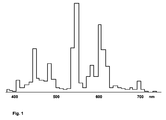
- This light as shown in Fig. 1, is composed of several emission lines and has a colour temperature of 4000 K.
- a print should be taken to mean a reflection print which is obtained from the recording material according to the invention by means of a printing process.
- the recording material comprises a colour negative film which, once exposed and processed, gives rise to a colour negative, which is then exposed with a photographic printer onto colour negative paper, from which the print is obtained after processing.
- the set of printer settings used for a particular film to obtain neutral prints is known as the print filter pack.
- DIR couplers in the green-sensitive package of layers is of particular significance as their properties coupling speed, diffusibility and inhibition interact with the silver halide emulsion properties spectral sensitivity, development time behaviour and susceptibility to inhibition to determine their impact on colour reproduction.
- the CIELab values may furthermore be established by known measures, such as for example by adjusting the spectral sensitivity distribution and absorption spectra of the image dyes of the colour photographic recording material.
- a material with a particularly low silver content is, however, obtained if the material contains at least two different DIR couplers in the green-sensitive colour package or in a reactive relationship therewith.
- colour package is taken to mean a unit of at least two silver halide emulsion layers with different sensitivity which are sensitised to the same range of the visible spectrum (blue, green or red).
- the spectral sensitivity distribution within the colour package may vary from layer to layer within the particular range of the spectrum, but the spectral sensitivity distribution within the colour package is preferably as uniform as possible.
- a colour package may also contain 3, 4 or more silver halide emulsion layers of differing sensitivity and, in particular for the red-and green-sensitive colour package, it is preferred if the package in each case has at least three silver halide emulsion layers of differing sensitivity.
- the DIR couplers according to the invention are preferably used directly in a silver halide emulsion layer, but may also be used in a reactive relationship therewith.
- the latter phrase means that the DIR couplers are used in a layer which does not itself contain any silver halide emulsion, but the developer oxidation product (DOP) released during development of the recording material according to the invention is nevertheless able to reach the layer with the DIR coupler.
- Such layers in particular comprise interlayers directly adjacent to a silver halide emulsion, said interlayers preferably containing no DOP scavenger.
- the DIR couplers according to the invention are contained in the silver halide emulsion layer or colour package, the embodiment in which they are in a reactive relationship with the silver halide emulsion layer or colour package is always also understood.
- the green-sensitive silver halide emulsion layer with the highest sensitivity contains at least two different DIR couplers.
- the total quantity of the DIR couplers blended according to the invention is preferably 0.2 to 100 mg/m 2 and particularly preferably 5-50 mg/m 2 .
- Each of the at least two DIR couplers according to the invention is used in the blend in an amount of at last 10 mol%, preferably of at least 25 mol% and particularly preferably of at least 35 mol%.
- the DIR couplers are selected from among compounds of the structures Ia, Ib or II: in which
- alkyl residues may be linear, branched or cyclic.
- Alkyl, aryl and heteroaryl groups may, for example, be substituted, wherein substituents which may be considered are for example, alkyl, alkenyl, alkynyl, alkylene, aryl, heterocyclyl, hydroxy, carboxy, halogen, alkoxy, aryloxy, heterocyclyloxy, alkylthio, arylthio, heterocyclylthio, alkylseleno, arylseleno, heterocyclylseleno, acyl, acyloxy, acylamino, cyano, nitro, amino, thiono or mercapto groups, and wherein heterocyclyl denotes a saturated, unsaturated or aromatic heterocycle and acyl denotes the residue of an aliphatic, olefinic or aromatic carboxylic, carbamic, carbonic, sulfonic, amidosulfonic, phosphoric, phosphonic, phosphorous, phosphinic or sul
- R 1 is preferably alkoxy; R 2 and R 4 are preferably hydrogen atoms; R 3 is preferably a chlorine atom; R 6 is preferably an optionally substituted phenyl residue.
- Suitable DIR couplers of the formula (I) according to the invention are:
- An alkoxy residue represented by R 7 in formula II may, for example, contain up to 16 C atoms.
- a sulfamoyl residue represented by R 7 may be mono- or disubstituted, for example with alkyl, cycloalkyl, aralkyl or aryl; two such substituents may also form a 5- or 6-membered ring together with the nitrogen atom.
- a cycloalkyl residue represented by R 8 or contained in R 7 or R 8 is preferably cyclohexyl.
- a benzoyl residue represented by Z in formula II may be substituted, for example with alkoxy, preferably in para position.
- a carbamoyl residue represented by Z in formula II is preferably derived from phenylcarbamic acid, in which the phenyl ring may be substituted, for example with Cl, alkoxycarbonyl and/or a group in which X, R 8 and n have the meaning already stated.
- the residue with a silver halide development inhibition function represented by Y in formula II is of the formula -(TIME) n -INH.
- INH is a silver halide development inhibitor
- n 0 or 1
- the linking member represented by TIME is a group which, after elimination from the coupler's coupling site when the coupler couples with the silver halide developer oxidation product, is capable of releasing the inhibitor attached thereto in a subsequent reaction.
- the TIME group is also known as a time control member because, in the presence of such a group, the inhibitor attached thereto is in many cases released in delayed manner and may become active.
- Known time control members are for example an group, wherein the O atom is attached to the coupling site of the coupler and the C atom is attached to an N atom of an inhibitor (for example DE-A-27 03 145), a group which, after elimination from the coupler, is subject to an intramolecular nucleophilic displacement reaction, so releasing the inhibitor (for example DE-A-28 55 697), a group in which, after elimination from the coupler, electron transfer may proceed along a conjugated system, so releasing the inhibitor (for example DE-A-31 05 026) or an group, in which X (for example -O-) is attached to the coupling site of the coupler and the C atom is attached to an atom of the inhibitor and in which R for example denotes aryl (for example EP-A-0 127 063).
- an inhibitor for example DE-A-27 03 145
- the inhibitor for example DE-A-28 55 697
- silver halide development inhibitors are those from the 1,2,3-triazole or 1,2,4-triazole series.
- the number and arrangement of the photosensitive layers may be varied in order to achieve specific results. For example, all high sensitivity layers may be grouped together in one package of layers and all low sensitivity layers may be grouped together in another package of layers in order to increase sensitivity (DE-25 30 645).
- colour couplers may be found in Research Disclosure 37254, part 4 (1995), page 288, in Research Disclosure 37038, part II (1995), page 80 and in Research Disclosure 38957, part X.B (1996), page 616.
- the maximum absorption of the dyes formed from the couplers and the colour developer oxidation product is preferably within the following ranges: yellow coupler 430 to 460 nm, magenta coupler 540 to 560 nm, cyan coupler 630 to 700 nm.
- Colour couplers which are usually hydrophobic, as well as other hydrophobic constituents of the layers, are conventionally dissolved or dispersed in high-boiling organic solvents. These solutions or dispersions are then emulsified into an aqueous binder solution (conventionally a gelatine solution) and, once the layers have dried, are present as fine droplets (0.05 to 0.8 ⁇ m in diameter) in the layers.
- aqueous binder solution conventionally a gelatine solution
- fine droplets 0.05 to 0.8 ⁇ m in diameter
- the non-photosensitive interlayers generally arranged between layers of different spectral sensitivity may contain agents which prevent an undesirable diffusion of developer oxidation products from one photosensitive layer into another photosensitive layer with a different spectral sensitisation.
- Suitable compounds may be found in Research Disclosure 37254, part 7 (1995), page 292, in Research Disclosure 37038, part III (1995), page 84 and in Research Disclosure 38957, part X.D (1996), pages 621 et seq..
- the photographic material may also contain UV light absorbing compounds, optical brighteners, spacers, filter dyes, formalin scavengers, light stabilisers, antioxidants, D min dyes, plasticisers (latices), biocides and additives to improve coupler and dye stability, to reduce colour fogging and to reduce yellowing, and others.
- Suitable compounds may be found in Research Disclosure 37254, part 8 (1995), page 292, in Research Disclosure 37038, parts IV, V, VI, VII, X, XI and XIII (1995), pages 84 et seq. and in Research Disclosure 38957, parts VI, VIII, IX and X (1996), pages 607 and 610 et seq..
- the layers of colour photographic materials are conventionally hardened, i.e. the binder used, preferably gelatine, is crosslinked by appropriate chemical methods.
- a colour photographic recording material for colour negative development (layer structure 1A) was produced by applying the following layers in the stated sequence onto a transparent layer support of cellulose triacetate. Quantities are stated in each case per 1 m 2 .
- the silver halide application rate is stated as the corresponding quantities of Ag; the silver halides are stabilised with 0.5 g of 4-hydroxy-6-methyl-1,3,3a,7-tetraazaindene per mol of AgNO 3 .
- Layer structures 1A-1F differ in the 7th layer, which contains the following silver application rates and DIR couplers: Layer structure Silver application rate 7th layer DIR coupler [g/m 2 ] 7th layer [g Ag/m 2 ] II-13 Ia-1 II-15 Ib-3 1A 0.55 0.008 0 0 0 0 Comparison 1B 0.55 0 0.020 0 0 Comparison 1C 0.55 0 0 0.015 0 Comparison 1D 0.70 0.009 0 0 0 Comparison 1E 0.70 0.008 0.005 0 0 Comparison IF 0.55 0.004 0.013 0 0 Invention 1G 0.55 0.004 0.013 0.010 0 Invention 1H 0.55 0.004 0.013 0 0.012 Invention
- Layer structure 2a contains a blend of the DIR couplers in the 3rd layer (red-sensitive sub-package) instead of D-1:
Landscapes
- Physics & Mathematics (AREA)
- General Physics & Mathematics (AREA)
- Silver Salt Photography Or Processing Solution Therefor (AREA)
Applications Claiming Priority (2)
| Application Number | Priority Date | Filing Date | Title |
|---|---|---|---|
| DE10335728 | 2003-08-05 | ||
| DE10335728A DE10335728B3 (de) | 2003-08-05 | 2003-08-05 | Farbfotografisches Silberhalogenidmaterial |
Publications (1)
| Publication Number | Publication Date |
|---|---|
| EP1505437A1 true EP1505437A1 (fr) | 2005-02-09 |
Family
ID=33521542
Family Applications (1)
| Application Number | Title | Priority Date | Filing Date |
|---|---|---|---|
| EP04103160A Withdrawn EP1505437A1 (fr) | 2003-08-05 | 2004-07-05 | Matériau photographique couleur à l' halogénure d' argent |
Country Status (4)
| Country | Link |
|---|---|
| US (1) | US20050032005A1 (fr) |
| EP (1) | EP1505437A1 (fr) |
| JP (1) | JP2005055911A (fr) |
| DE (1) | DE10335728B3 (fr) |
Citations (6)
| Publication number | Priority date | Publication date | Assignee | Title |
|---|---|---|---|---|
| JPS59149359A (ja) * | 1983-02-15 | 1984-08-27 | Konishiroku Photo Ind Co Ltd | ハロゲン化銀写真感光材料 |
| EP0577183A1 (fr) * | 1992-06-24 | 1994-01-05 | Eastman Kodak Company | Matériau photographique comprenant une combinaison de copulants formant colorants enlevables par lavage |
| JPH06273900A (ja) * | 1993-03-18 | 1994-09-30 | Fuji Photo Film Co Ltd | ハロゲン化銀カラー写真感光材料及びその処理方法 |
| DE19932618A1 (de) * | 1999-07-13 | 2001-01-18 | Agfa Gevaert Ag | Farbfotografisches Aufzeichnungsmaterial |
| US20020018971A1 (en) * | 2000-02-29 | 2002-02-14 | Jorg Hagemann | Colour photographic silver halide material |
| EP1324127A1 (fr) * | 2001-12-20 | 2003-07-02 | Eastman Kodak Company | Un élément négatif couleur destiné au balayage |
Family Cites Families (5)
| Publication number | Priority date | Publication date | Assignee | Title |
|---|---|---|---|---|
| JPS5943736B2 (ja) * | 1976-01-26 | 1984-10-24 | 富士写真フイルム株式会社 | カラ−写真画像の形成方法 |
| JPS56114946A (en) * | 1980-02-15 | 1981-09-09 | Konishiroku Photo Ind Co Ltd | Silver halide photographic sensitive material |
| DE3319428A1 (de) * | 1983-05-28 | 1984-11-29 | Agfa-Gevaert Ag, 5090 Leverkusen | Fotografisches aufzeichnungsmaterial mit einer vorlaeuferverbindung einer fotografisch wirksamen verbindung |
| DE69325410T2 (de) * | 1992-04-16 | 1999-10-28 | Eastman Kodak Co., Rochester | Photographisches Silberhalogenidmaterial mit tafelförmigen Silberhalogenid-Körnern und verteilten Absorber-Farbstoffen |
| US5466560A (en) * | 1993-10-13 | 1995-11-14 | Eastman Kodak Company | Limited use cameras and films |
-
2003
- 2003-08-05 DE DE10335728A patent/DE10335728B3/de not_active Expired - Fee Related
-
2004
- 2004-07-05 EP EP04103160A patent/EP1505437A1/fr not_active Withdrawn
- 2004-07-23 US US10/897,510 patent/US20050032005A1/en not_active Abandoned
- 2004-08-04 JP JP2004228550A patent/JP2005055911A/ja active Pending
Patent Citations (6)
| Publication number | Priority date | Publication date | Assignee | Title |
|---|---|---|---|---|
| JPS59149359A (ja) * | 1983-02-15 | 1984-08-27 | Konishiroku Photo Ind Co Ltd | ハロゲン化銀写真感光材料 |
| EP0577183A1 (fr) * | 1992-06-24 | 1994-01-05 | Eastman Kodak Company | Matériau photographique comprenant une combinaison de copulants formant colorants enlevables par lavage |
| JPH06273900A (ja) * | 1993-03-18 | 1994-09-30 | Fuji Photo Film Co Ltd | ハロゲン化銀カラー写真感光材料及びその処理方法 |
| DE19932618A1 (de) * | 1999-07-13 | 2001-01-18 | Agfa Gevaert Ag | Farbfotografisches Aufzeichnungsmaterial |
| US20020018971A1 (en) * | 2000-02-29 | 2002-02-14 | Jorg Hagemann | Colour photographic silver halide material |
| EP1324127A1 (fr) * | 2001-12-20 | 2003-07-02 | Eastman Kodak Company | Un élément négatif couleur destiné au balayage |
Non-Patent Citations (2)
| Title |
|---|
| DATABASE WPI Section Ch Week 198441, Derwent World Patents Index; Class G06, AN 1984-252491, XP002301047 * |
| PATENT ABSTRACTS OF JAPAN vol. 0186, no. 89 (P - 1850) 26 December 1994 (1994-12-26) * |
Also Published As
| Publication number | Publication date |
|---|---|
| JP2005055911A (ja) | 2005-03-03 |
| DE10335728B3 (de) | 2005-01-20 |
| US20050032005A1 (en) | 2005-02-10 |
Similar Documents
| Publication | Publication Date | Title |
|---|---|---|
| US6218097B1 (en) | Color photographic silver halide material | |
| US4830954A (en) | Color photographic negative film | |
| US6033841A (en) | Colour photographic silver halide material | |
| EP0136603B1 (fr) | Matériel multicouche photographique couleur sensible à la lumière | |
| JP2926663B2 (ja) | 色相再現性に優れたカラー写真感光材料 | |
| EP0486929B1 (fr) | Compositions de copulants photographiques comprenant alcools avec groupes ballastes et procédés | |
| GB1560965A (en) | Colour photographic silver halide recording material | |
| EP1505437A1 (fr) | Matériau photographique couleur à l' halogénure d' argent | |
| JPH0588320A (ja) | バラスト化スルホキシド及びスルホンを含んで成る写真カプラー組成物並びにその製造方法 | |
| US6379879B2 (en) | Color photographic silver halide material | |
| US6017689A (en) | Color photographic silver halide material | |
| EP0523640B1 (fr) | Compositions photographiques à base de coupleurs contenant des carbonamides et procédés | |
| US5853971A (en) | Color photographic silver halide material | |
| US5856076A (en) | Color photographic recording material having elevated sensitivity and improved color reproduction | |
| US6562557B2 (en) | Color photographic silver halide material | |
| JPH07159948A (ja) | ハロゲン化銀カラー写真感光材料 | |
| US5885760A (en) | Color photographic recording material | |
| DE4101179A1 (de) | Farbfotografisches negativ-aufzeichnungsmaterial mit dir-verbindungen | |
| US6060227A (en) | Color negative film | |
| JPH06502731A (ja) | 感光性写真ハロゲン化銀カラー材料 | |
| JPH07152119A (ja) | ハロゲン化銀カラー写真感光材料 | |
| US5922524A (en) | Colour photographic recording material | |
| US6093524A (en) | Color photographic film | |
| JP2881330B2 (ja) | 色相再現に優れたカラー写真感光材料 | |
| JP3020105B2 (ja) | 色相再現性に優れたカラー写真感光材料 |
Legal Events
| Date | Code | Title | Description |
|---|---|---|---|
| PUAI | Public reference made under article 153(3) epc to a published international application that has entered the european phase |
Free format text: ORIGINAL CODE: 0009012 |
|
| AK | Designated contracting states |
Kind code of ref document: A1 Designated state(s): AT BE BG CH CY CZ DE DK EE ES FI FR GB GR HU IE IT LI LU MC NL PL PT RO SE SI SK TR |
|
| AX | Request for extension of the european patent |
Extension state: AL HR LT LV MK |
|
| RAP1 | Party data changed (applicant data changed or rights of an application transferred) |
Owner name: AGFAPHOTO GMBH |
|
| AKX | Designation fees paid | ||
| REG | Reference to a national code |
Ref country code: DE Ref legal event code: 8566 |
|
| 19U | Interruption of proceedings before grant |
Effective date: 20060101 |
|
| 19W | Proceedings resumed before grant after interruption of proceedings |
Effective date: 20100401 |
|
| STAA | Information on the status of an ep patent application or granted ep patent |
Free format text: STATUS: THE APPLICATION IS DEEMED TO BE WITHDRAWN |
|
| 18D | Application deemed to be withdrawn |
Effective date: 20050810 |