EP1521848B1 - Verfahren zur bestimmung der kopienzahl einer nukleotidsequenz - Google Patents
Verfahren zur bestimmung der kopienzahl einer nukleotidsequenz Download PDFInfo
- Publication number
- EP1521848B1 EP1521848B1 EP03771498A EP03771498A EP1521848B1 EP 1521848 B1 EP1521848 B1 EP 1521848B1 EP 03771498 A EP03771498 A EP 03771498A EP 03771498 A EP03771498 A EP 03771498A EP 1521848 B1 EP1521848 B1 EP 1521848B1
- Authority
- EP
- European Patent Office
- Prior art keywords
- nucleotide sequence
- copy number
- sequence
- amplification
- determined
- Prior art date
- Legal status (The legal status is an assumption and is not a legal conclusion. Google has not performed a legal analysis and makes no representation as to the accuracy of the status listed.)
- Expired - Lifetime
Links
- 239000002773 nucleotide Substances 0.000 title claims abstract description 90
- 125000003729 nucleotide group Chemical group 0.000 title claims abstract description 90
- 238000000034 method Methods 0.000 title claims abstract description 44
- 230000003321 amplification Effects 0.000 claims abstract description 49
- 238000003199 nucleic acid amplification method Methods 0.000 claims abstract description 49
- 239000000523 sample Substances 0.000 claims description 38
- 239000013598 vector Substances 0.000 claims description 20
- 108091028043 Nucleic acid sequence Proteins 0.000 claims description 19
- 238000006243 chemical reaction Methods 0.000 claims description 8
- 238000010790 dilution Methods 0.000 claims description 7
- 239000012895 dilution Substances 0.000 claims description 7
- 239000013068 control sample Substances 0.000 claims description 4
- 239000003153 chemical reaction reagent Substances 0.000 claims description 2
- 230000002759 chromosomal effect Effects 0.000 claims description 2
- 101100042793 Gallus gallus SMC2 gene Proteins 0.000 claims 1
- 238000003753 real-time PCR Methods 0.000 abstract description 2
- 238000011088 calibration curve Methods 0.000 abstract 1
- 210000004027 cell Anatomy 0.000 description 27
- 150000007523 nucleic acids Chemical group 0.000 description 23
- 108020004707 nucleic acids Proteins 0.000 description 19
- 102000039446 nucleic acids Human genes 0.000 description 19
- 108020004414 DNA Proteins 0.000 description 18
- 108090000623 proteins and genes Proteins 0.000 description 11
- 108020005196 Mitochondrial DNA Proteins 0.000 description 10
- 108091008874 T cell receptors Proteins 0.000 description 10
- 102000016266 T-Cell Antigen Receptors Human genes 0.000 description 10
- 238000012360 testing method Methods 0.000 description 8
- 210000000349 chromosome Anatomy 0.000 description 6
- 102100031988 Tumor necrosis factor ligand superfamily member 6 Human genes 0.000 description 5
- 108010039471 Fas Ligand Protein Proteins 0.000 description 4
- 108091093105 Nuclear DNA Proteins 0.000 description 4
- 210000004698 lymphocyte Anatomy 0.000 description 4
- 238000005259 measurement Methods 0.000 description 4
- 210000003470 mitochondria Anatomy 0.000 description 4
- 238000011002 quantification Methods 0.000 description 4
- 108091032973 (ribonucleotides)n+m Proteins 0.000 description 2
- 238000007399 DNA isolation Methods 0.000 description 2
- TWRXJAOTZQYOKJ-UHFFFAOYSA-L Magnesium chloride Chemical compound [Mg+2].[Cl-].[Cl-] TWRXJAOTZQYOKJ-UHFFFAOYSA-L 0.000 description 2
- 108010066717 Q beta Replicase Proteins 0.000 description 2
- 238000012937 correction Methods 0.000 description 2
- 239000007850 fluorescent dye Substances 0.000 description 2
- 238000007834 ligase chain reaction Methods 0.000 description 2
- 239000000463 material Substances 0.000 description 2
- 230000002093 peripheral effect Effects 0.000 description 2
- 230000008707 rearrangement Effects 0.000 description 2
- 230000010076 replication Effects 0.000 description 2
- 238000010561 standard procedure Methods 0.000 description 2
- BZTDTCNHAFUJOG-UHFFFAOYSA-N 6-carboxyfluorescein Chemical compound C12=CC=C(O)C=C2OC2=CC(O)=CC=C2C11OC(=O)C2=CC=C(C(=O)O)C=C21 BZTDTCNHAFUJOG-UHFFFAOYSA-N 0.000 description 1
- 230000004544 DNA amplification Effects 0.000 description 1
- 241000588724 Escherichia coli Species 0.000 description 1
- 241000206602 Eukaryota Species 0.000 description 1
- 102000018932 HSP70 Heat-Shock Proteins Human genes 0.000 description 1
- 108010027992 HSP70 Heat-Shock Proteins Proteins 0.000 description 1
- 241000282412 Homo Species 0.000 description 1
- 102000006746 NADH Dehydrogenase Human genes 0.000 description 1
- 108010086428 NADH Dehydrogenase Proteins 0.000 description 1
- 238000012408 PCR amplification Methods 0.000 description 1
- 108091081062 Repeated sequence (DNA) Proteins 0.000 description 1
- 210000001744 T-lymphocyte Anatomy 0.000 description 1
- 108010006785 Taq Polymerase Proteins 0.000 description 1
- 108050002568 Tumor necrosis factor ligand superfamily member 6 Proteins 0.000 description 1
- 241000700605 Viruses Species 0.000 description 1
- 230000002159 abnormal effect Effects 0.000 description 1
- QSIYTPCKNAPAJY-UHFFFAOYSA-N aluminum;ethoxy-oxido-oxophosphanium;2-(trichloromethylsulfanyl)isoindole-1,3-dione Chemical compound [Al+3].CCO[P+]([O-])=O.CCO[P+]([O-])=O.CCO[P+]([O-])=O.C1=CC=C2C(=O)N(SC(Cl)(Cl)Cl)C(=O)C2=C1 QSIYTPCKNAPAJY-UHFFFAOYSA-N 0.000 description 1
- 238000004458 analytical method Methods 0.000 description 1
- 210000000628 antibody-producing cell Anatomy 0.000 description 1
- 239000000427 antigen Substances 0.000 description 1
- 108091007433 antigens Proteins 0.000 description 1
- 102000036639 antigens Human genes 0.000 description 1
- 238000003556 assay Methods 0.000 description 1
- 238000000376 autoradiography Methods 0.000 description 1
- 210000003719 b-lymphocyte Anatomy 0.000 description 1
- 230000009286 beneficial effect Effects 0.000 description 1
- 210000004369 blood Anatomy 0.000 description 1
- 239000008280 blood Substances 0.000 description 1
- 230000000295 complement effect Effects 0.000 description 1
- 239000002299 complementary DNA Substances 0.000 description 1
- 238000000205 computational method Methods 0.000 description 1
- 230000001351 cycling effect Effects 0.000 description 1
- 230000009089 cytolysis Effects 0.000 description 1
- 230000007423 decrease Effects 0.000 description 1
- 238000004925 denaturation Methods 0.000 description 1
- 230000036425 denaturation Effects 0.000 description 1
- 238000010217 densitometric analysis Methods 0.000 description 1
- 238000001514 detection method Methods 0.000 description 1
- 230000029087 digestion Effects 0.000 description 1
- 210000001840 diploid cell Anatomy 0.000 description 1
- 238000006073 displacement reaction Methods 0.000 description 1
- 230000000694 effects Effects 0.000 description 1
- 238000002474 experimental method Methods 0.000 description 1
- 230000002349 favourable effect Effects 0.000 description 1
- 238000010353 genetic engineering Methods 0.000 description 1
- 210000005260 human cell Anatomy 0.000 description 1
- 238000000338 in vitro Methods 0.000 description 1
- 238000001727 in vivo Methods 0.000 description 1
- 208000032839 leukemia Diseases 0.000 description 1
- 229910001629 magnesium chloride Inorganic materials 0.000 description 1
- 239000000203 mixture Substances 0.000 description 1
- 238000010369 molecular cloning Methods 0.000 description 1
- 238000012544 monitoring process Methods 0.000 description 1
- 239000013612 plasmid Substances 0.000 description 1
- 102000004169 proteins and genes Human genes 0.000 description 1
- 238000000746 purification Methods 0.000 description 1
- 108091008146 restriction endonucleases Proteins 0.000 description 1
- 108020004418 ribosomal RNA Proteins 0.000 description 1
- 238000012206 semi-quantitative assay Methods 0.000 description 1
- 230000035945 sensitivity Effects 0.000 description 1
- 241000894007 species Species 0.000 description 1
- MPLHNVLQVRSVEE-UHFFFAOYSA-N texas red Chemical compound [O-]S(=O)(=O)C1=CC(S(Cl)(=O)=O)=CC=C1C(C1=CC=2CCCN3CCCC(C=23)=C1O1)=C2C1=C(CCC1)C3=[N+]1CCCC3=C2 MPLHNVLQVRSVEE-UHFFFAOYSA-N 0.000 description 1
Images


Classifications
-
- C—CHEMISTRY; METALLURGY
- C12—BIOCHEMISTRY; BEER; SPIRITS; WINE; VINEGAR; MICROBIOLOGY; ENZYMOLOGY; MUTATION OR GENETIC ENGINEERING
- C12Q—MEASURING OR TESTING PROCESSES INVOLVING ENZYMES, NUCLEIC ACIDS OR MICROORGANISMS; COMPOSITIONS OR TEST PAPERS THEREFOR; PROCESSES OF PREPARING SUCH COMPOSITIONS; CONDITION-RESPONSIVE CONTROL IN MICROBIOLOGICAL OR ENZYMOLOGICAL PROCESSES
- C12Q1/00—Measuring or testing processes involving enzymes, nucleic acids or microorganisms; Compositions therefor; Processes of preparing such compositions
- C12Q1/68—Measuring or testing processes involving enzymes, nucleic acids or microorganisms; Compositions therefor; Processes of preparing such compositions involving nucleic acids
- C12Q1/6844—Nucleic acid amplification reactions
- C12Q1/6851—Quantitative amplification
Definitions
- the present invention relates to a method of determining the copy number of a nucleotide sequence I in a sample using an amplification technique, said method comprising the steps of
- Most eukaryotic diploid cells contain two copies of a single gene; one on each chromosome of a pair of chromosomes.
- the chromosomes of a pair of chromosomes being derived from each parent, the genes may be different and, for example, one of them may result in a abnormal protein.
- the number of functional genes is not necessarily 2 in an eukaryote, and can be 1 or even 0. While often genes are present in one copy per chromosome of a particular pair of chromosomes, some genes are present in multiple copies, for example in tandem repeat sequences.
- Another exception to the general rule of 2 copies per cel is mitochondrial DNA. A cell contains many mitochondria, the number being dependant on the type of cell.
- the number of mitochondria may vary. Typical numbers are between 100 and 1000 mitochondria per cell, and each mitochondrion contains several copies of mitochondrial DNA. In addition, the typical copy number is not necessarily equal to larger than 2 per cell.
- Some nucleotide sequences are very rare among cells (despite being of one and the same subject, such as a human being). This is, for example, after gene rearrangement. This is, for example, the case with antibody producing cells (B-lymphocytes) or receptor-carrying T-lymphocytes. Of a large number of lymphocytes, only a few will contain a particular nucleotide sequence defining the variable region of a particular antibody (or of the T-cell receptor), capable of recognizing a particular antigen. In the art, a need exists to reliably determine the copy number of a nucleotide sequence, which may comprise the nucleotide sequence of a gene or part thereof. A method according to the preamble is known in the art.
- EP-A-0 959 140 discloses a method for determining a quantity of a nucleic acid sequence in a sample, comprising the steps of forming a plurality of standard samples (II) which each contain a known starting quantity of a nucleic acid control sequence (II') and a known starting quantity of a nucleic acid target sequence therein (I'); forming a test sample containing a known starting quantity of the nucleic acid control sequence and an unknown starting quantity of the nucleic acid target sequence (I); amplifying quantities of the nucleic acid control and target sequences in each of the standard samples and the test sample, during an amplification time interval; measuring indicia of the amplified quantities of the nucleic acid control and target sequences in each of the standard samples and the test sample; determining an amplification ratio from the measured indicia of the amplified quantities of the nucleic acid control and target sequences in the standard samples; and determining a magnitude of the starting quantity of the nucleic acid target sequence in the test
- EP-A-1 138 783 discloses a method for the quantification of a target nucleic acid in a sample comprising the following steps: a) determination of the amplification efficiency of the target nucleic acid under defined amplification conditions b) amplification of the target nucleic acid contained in the sample under the same defined reaction conditions c) measuring the amplification in real-time d) quantification of the original amount of target nucleic acid in the sample by correction of the original amount derived from step c) with the aid of the determined amplification efficiency.
- the different standard sequences do not reside on the same vector.
- the object of the present invention is to improve this method for reliably determining the copy number of a nucleotide sequence even if it is present in extreme amounts, such as lots of copies per cell or only few copies per many cells.
- an object of the present invention is to provide a method which has reduced sensitivity to the efficiency with which DNA was extracted from the cells containing a nucleotide sequence I for which the copy number has to be determined.
- the method according to the present invention is characterized in that at least one pair of amplification reactions chosen from i) a) and b), and ii) c) and d) is performed in a single container and monitored spectrophotometrically during amplification, and the third nucleotide sequence I' and fourth nucleotide sequence II' resides on a single vector.
- Suitable spectrophotometrical methods are known in the art. More specifically, such methods rely on internal probes for real time measurements, for example real time PCR. Internal probes are known in the art, and are disclosed by, for example, Winer et al (Anal. Biochem 270, pp. 41-49 (1999)). Measurements can be done either continuously, or after finishing an amplification cycle. While specific reference is made to standard curves, it goes without saying that this can be done using computational methods without an actual graph being made. Hence, in the present application the phrase "making a standard curve" involves any method using at least two reference points to determine a (relative) concentration.
- the method according to the invention is not only highly accurate, but it is also very efficient if performed for multiple samples. That is, for each nucleotide sequence I for which it is desired to determine the copy number, only a single standard curve SC II' has to be made. With respect to the term "corresponding" as used in the present invention in conjunction with nucleotide sequences, this is intended to mean that the nucleotide sequences I and I' (and II and II'), or more specifically the nucleotide sequence of one and the complementary sequence of the other, are capable of hybridizing under stringent conditions. If the sequences I and I' (and II and II') do not have the same length, the shortest of the two is preferably at most 50% shorter, more preferably at most 30% shorter.
- the third nucleotide sequence I' and fourth nucleotide sequence II' residing on the same vector allows their ratio to be constant and exactly known (for example 1:1). This allows for the most accurate measurements possible. It is possible to subject the vector containing both nucleotide sequence I' and II' to a digestion using one or more restriction enzymes, optionally followed by purification, to yield a linear molecule containing both both nucleotide sequence I' and II', and using this molecule for the amplifications required for the standard curves.
- a vector is understood to be any nucleotide sequence consisting of or containing the nucleotide sequence(s) to be amplified.
- a vector capable of being replicated in vitro or in vivo it is easy to obtain that particular nucleotide sequence in desired quantities. It is also very easy to determine the DNA concentration and hence the copy number of the nucleotide sequence per volume.
- a vector capable of replication or being replicated may be any such vector known in the art, such as a plasmid, a cosmid, a virus etc.
- the vectors can be used (or mixed) at any desired ratio to accommodate expected differences in copy number in the sample.
- Douek et al (Nature 396, pp. 690-695 (1998)) describe a method for detecting the products of the rearrangements of T-cell receptors (TREC) using a semi-quantitative assay.
- TREC T-cell receptors
- a known amount of a DNA competitor are prepared.
- sample DNA containing the nucleotide sequence to be determined are added to the tube.
- a PCR amplification reaction is carried out in the presence of radiolabeled deoxynucleotide.
- the resulting amplification products are run on a gel to separate the sample DNA PCR product from the competitor DNA product.
- the amount of nucleotide sequence to be determined is calculated using densitometric analysis from the ratio between a band of competitor DNA and a band of the sample DNA. The result is expressed as the number of copies of TREC per microgram total DNA.
- 4 tubes containing scalar amounts of competitor DNA are used, to which fixed amounts of sample DNA are added.
- the disadvantage of this method is that when DNA is extracted from cells, it must be assumed that this is all the DNA present in the cells. That is, it is assumed that no cell escaped lysis and all DNA present in the cells was extracted and isolated. This is not necessarily the case.
- Another disadvantage of this method is that it is sensitive to differences in amplification efficiency.
- the European patent publication EP 0 959 140 discloses a method and apparatus for determining quantities of nucleic acid sequences in samples using standard curves and amplification ratio estimates.
- a plurality of standard samples each containing a known quantity of a nucleic acid control sequence, and a test sample containing a known quantity of the nucleic acid control sequence plus a nucleic acid sequence in an unknown concentration, are subjected to an amplification reaction.
- the concentration of the nucleic acid present in an unknown concentration in the test sample is determined.
- the European patent publication EP 1 138 783 discloses a method for the quantification of a nucleic acid in a test sample, by determining the amplification efficiency under defined conditions, and performing the quantification of said nucleic acid under the same defined conditions, allowing correction of the concentration determined for said nucleic acid.
- the absolute copy number is determined by multiplying the copy number CN by the absolute copy number of sequence II per cell.
- nucleotide sequences II the number of copies of per cell is known.
- Many nucleotide sequences of genes are very suitable because they generally are present in a known number of copies in every cell of the species from which the DNA is derived.
- the efficiency with which DNA material is extracted from the cells is not important (although, in case nucleotide sequence I is on a different molecule as nucleotide sequence II, it is important that they are extracted with the same efficiency).
- this embodiment allows determination of the absolute copynumber of the nucleotide sequence I per cell.
- At least two different third nucleotide sequences I' for measuring a corresponding number of different first nucleotide sequences I reside on a single vector.
- a single vector requiring its concentration to be determined only once, can carry multiple third nucleotide sequences I', which allows, for example, the copy numbers of many different genes to be determined.
- the sequence of the first nucleotide sequence I is the same as the third nucleotide sequence I' .
- sequence of the second nucleotide sequence II is the same as the fourth nucleotide sequence II'.
- the present invention is described with reference to DNA, the present invention also applies to the determination of the number of RNA sequences present in a cell. Use can be made of methods known in the art to multiply RNA, for example by preparing cDNA. This application does not attempt to teach an interested layman how to become a person skilled in the art, for which reason the layman is referred to general text books and in particular to a proper university to learn the required techniques that a person skilled in the art knows how to apply these techniques to work the present invention.
- the method according to the invention will be illustrated using two Examples.
- the first relates to the quantitive analysis of mitochondrial DNA (mtDNA) and demonstrates the technique for determining multiple copies per cell.
- the second Example demonstrates the quantitative determination of a fractional copy number of a particular nucleotide sequence per cell.
- the nucleotide sequence I was a stretch having a length of 102 nucleotides, and corresponds to part of the enzyme NADH dehydrogenase as coded for by mtDNA. Amplification of nucleotide sequence I was performed using a set of primers, each having a length of 21 nucleotides and synthesized using standard procedures. The sequences of both primers were checked to be unique for human mtDNA using Blast software, through the NCBI site at NIH (http://www.ncbi.nlm.nih.gov/blast/).
- the nucleotide sequence II (nuclear DNA) serving as a reference, was a stretch having a length of 104 nucleotides and part of the FasL gene, which comes with two copies per human cell. Amplification of nucleotide sequence II was performed using a set of primers, each having a length of 21 and 24 nucleotides respectively.
- a probe was used for nucleotide sequence I, the probe having a length of 23 nucleotides, having a FAM (carboxy fluorescein) fluorescent probe at the 5' end and a BlackHole Quencher1 TM group at the 3' end.
- FAM carboxy fluorescein
- the probe used for nucleotide II had a length of 22 nucleotides and contained TexasRed as the fluorescent label and and a BlackHole Quencher2 TM group at the 3' end (MWG).
- DNA was isolated from HL60, a promyelocytic leukaemia cell line, using a DNA isolation kit from Qiagen, Hilden, Germany according to the instructions of the manufacturer.
- a vector was constructed, using pGEM-11Z (Promega) containing the sequences I' and II' head to tail, using standard genetic engineering techniques, as all too familiar from Sambrook et al. (Molecular cloning. A lab manual. (1989)) in E. coli.
- the nucleotide sequences I' and II' were identical to their respective I and II counterparts, and present on the vector in a highly defined 1:1 ratio.
- Amplification was performed using an iCycler Thermal cycler (BioRad, Hercules, CA, USA) using standard procedures. The amplification is performed in plates having 96 wells. This instrument allows monitoring of fluoresence in up to 4 different channels. In short, one cycle of denaturation (95 °C for 6 min) was performed, followed by 45 cycles of amplification (94 °C for 30 s, 60 °C for 60 s). The amplification was performed in a mix that consisted of: Promega PCR buffer 1X (Promega, Madison, WI, USA), 3.0 mM MgCl2, 400 pmol of primers for mtDNA, 0.2 mM dNTP and 2 U of Taq polymerase (Promega).
- nucleotide sequences I and II were performed in a single well, and the same is true for nucleotide sequences I' and II' (for determining the standard curves). Data were analysed using the software of the iCycler.
- the standard curves were made by introducing a known number of copies of vector per well.
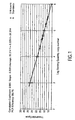
- Fig. 1 shows the standard curve for nucleotide sequence I' and Fig. 2 shows the standard curve for the nucleotide sequence II' based on FasL. Note the excellent correlation coefficients of 0.995 and 0.996 respectively, indicating the excellent accuracy of the method according to the invention.
- concentration of nucleotide sequences I and II shown as squares in Figs. 1 and 2) were determined.
- the nucleotide sequence for FasL and more specifically for the probe for nucleotide II/II'
- the number of copies of nucleotide sequence I per cell is twice as high, i.e. 160.
- Example 2 Basically, the same method was used as described in Example 1, except that the nucleotide sequence I corresponded to part of the sequence of the delta locus of the T-cell receptor.
- the method was used to determine the number of copies of TREC per cell, in particular peripheral lymphocytes in blood, in three age groups (healthy humans of 20, 60 or 100 years. The number of people were respectively 16 (10), 17 (10), and 21 (17), with the number of women between parentheses)
- Fig. 5 shows that the number of copies of TREC decreases with age (averages per age group shown as a horizontal line) from about 3.2 to 0.1 per 100 cells.
- Such amplification techniques comprise, apart from the ones mentioned above, CP (Cycling Probe Reaction), bDNA (Branched DNA amplification), SSR (Self-Sustained Sequence Replication), SOA (Strand Displacement Amplification), QBR (Q-Beta Replicase), Re-AMP (Formerly RAMP), NASBA (Nucleic Acid Sequence Based Amplification), RCR (Repair Chain Reaction), LCR (Ligase Chain Reaction), TAS (Transorption Based Amplification System), and HCS (amplifies ribosomal RNA).
Landscapes
- Chemical & Material Sciences (AREA)
- Life Sciences & Earth Sciences (AREA)
- Organic Chemistry (AREA)
- Engineering & Computer Science (AREA)
- Zoology (AREA)
- Wood Science & Technology (AREA)
- Proteomics, Peptides & Aminoacids (AREA)
- Health & Medical Sciences (AREA)
- Biophysics (AREA)
- Chemical Kinetics & Catalysis (AREA)
- Immunology (AREA)
- Microbiology (AREA)
- Molecular Biology (AREA)
- Analytical Chemistry (AREA)
- Physics & Mathematics (AREA)
- Biotechnology (AREA)
- Biochemistry (AREA)
- Bioinformatics & Cheminformatics (AREA)
- General Engineering & Computer Science (AREA)
- General Health & Medical Sciences (AREA)
- Genetics & Genomics (AREA)
- Measuring Or Testing Involving Enzymes Or Micro-Organisms (AREA)
- Saccharide Compounds (AREA)
Claims (5)
- Verfahren zur Bestimmung der Kopiezahl einer Nukleotidsequenz I in einer Probe unter Verwendung einer Amplifikationstechnik, wobei das Verfahren die folgenden Schritte umfasst:1) Zugabe von Nukleotiden, Primern, Polymerase und jeglichen weiteren Reagenzien, falls nötig, die für die Amplifikationstechnik, die verwendet wird, benötigt werden zu der Probe,2) Durchführung von ein oder mehreren Amplifikationszyklen, um die Nukleotidsequenz I zu amplifizieren, für die die Kopiezahl bestimmt werden soll;wobei die Probe eine chromosomale zweite Nukleotidsequenz II enthält, unda) die erste Nukleotidsequenz I amplifiziert wird,b) die zweite Nukleotidsequenz II amplifiziert wird,c) eine dritte Nukleotidsequenz I', korrespondierend zu der ersten Nukleotidsequenz I, und die in einer Kontrollprobe vorliegt, wird in verschiedenen Verdünnungen amplifiziert, undd) eine vierte Nukleotidsequenz II', korrespondierend zu der zweiten Nukleotidsequenz II, und die in einer Kontrollprobe vorliegt, wird in verschiedenen Verdünnungen amplifiziert,wobei das Verhältnis der Konzentrationen der Nukleotidsequenzen I' und II' bekannt ist,
wobei die Amplifikationen der dritten und vierten Nukleotidsequenzen I' und II' bei unterschiedlichen Verdünnungen Standardkurven SCi ermöglichen, wobei i I oder II ist, wobei die Konzentrationen von I und II unter Verwendung der jeweiligen Standardkurve SCi bestimmt werden und die relativen Konzentrationen es ermöglichen, die relative Kopiezahl CN der Sequenz I (gegenüber der Nukleotidsequenz II) unter Verwendung der Formel:
zu bestimmen, wobeiCN die relative Kopiezahl von I gegenüber II in der Probe ist;[I]SCI' die Konzentration von I ist, bestimmt unter Verwendung der Standardkurve SCI'; und[II]SCwobeiII' ist die Konzentration von II, bestimmt unter Verwendung der Standardkurve SCII',
mindestens ein Paar von Amplifikationsreaktionen, gewählt aus i) a) und b) und ii) c) und d), in einem Einzelbehälter durchgeführt und spektrofotometrisch während der Amplifikation überwacht wird, und
die dritte Nukleotidsequenz I' und die vierte Nukleotidsequenz II' auf einem einzelnen Vektor vorliegen. - Verfahren gemäss Anspruch 1, dadurch gekennzeichnet, dass die absolute Kopiezahl durch Multiplikation der Kopiezahl CN mit der absoluten Kopiezahl der Sequenz II pro Zelle bestimmt wird.
- Verfahren gemäss Anspruch 1 oder 2, dadurch gekennzeichnet, dass mindestens zwei und auch mehr unterschiedliche dritte Nukleotidsequenzen I' zur Messung einer korrespondierenden Zahl unterschiedlicher erster Nukleotidsequenzen I auf einem einzelnen Vektor vorliegen.
- Verfahren gemäss einem der vorstehenden Ansprüche, dadurch gekennzeichnet, dass die Sequenz der ersten Nukleotidsequenz I dieselbe ist wie die der dritten Nukleotidsequenz I'.
- Verfahren gemäss einem der vorstehenden Ansprüche, dadurch gekennzeichnet, dass die Sequenz der zweiten Nukleotidsequenz II dieselbe ist wie die der vierten Nukleotidsequenz II'.
Applications Claiming Priority (3)
| Application Number | Priority Date | Filing Date | Title |
|---|---|---|---|
| NL1021160A NL1021160C2 (nl) | 2002-07-26 | 2002-07-26 | Werkwijze voor het bepalen van het kopieaantal van een nucleotidevolgorde. |
| NL1021160 | 2002-07-26 | ||
| PCT/NL2003/000545 WO2004011678A1 (en) | 2002-07-26 | 2003-07-28 | Method of determining the copy number of a nucleotide sequence |
Publications (2)
| Publication Number | Publication Date |
|---|---|
| EP1521848A1 EP1521848A1 (de) | 2005-04-13 |
| EP1521848B1 true EP1521848B1 (de) | 2007-01-17 |
Family
ID=31185863
Family Applications (1)
| Application Number | Title | Priority Date | Filing Date |
|---|---|---|---|
| EP03771498A Expired - Lifetime EP1521848B1 (de) | 2002-07-26 | 2003-07-28 | Verfahren zur bestimmung der kopienzahl einer nukleotidsequenz |
Country Status (9)
| Country | Link |
|---|---|
| US (1) | US7604964B2 (de) |
| EP (1) | EP1521848B1 (de) |
| AT (1) | ATE351925T1 (de) |
| AU (1) | AU2003253515A1 (de) |
| DE (1) | DE60311263T2 (de) |
| DK (1) | DK1521848T3 (de) |
| ES (1) | ES2280812T3 (de) |
| NL (1) | NL1021160C2 (de) |
| WO (1) | WO2004011678A1 (de) |
Families Citing this family (4)
| Publication number | Priority date | Publication date | Assignee | Title |
|---|---|---|---|---|
| US20050153381A1 (en) * | 2002-02-14 | 2005-07-14 | Marusich Michael F. | Immunocapture of mitochondrial protein complexes |
| NL1021160C2 (nl) | 2002-07-26 | 2004-01-27 | Multigen Internat B V | Werkwijze voor het bepalen van het kopieaantal van een nucleotidevolgorde. |
| DK2002016T3 (da) * | 2006-04-12 | 2010-03-29 | Medical Res Council | Fremgangsmåde til bestemmelse af kopital |
| WO2014089368A1 (en) * | 2012-12-05 | 2014-06-12 | Bio-Rad Laboratories, Inc | Methods for polymerase chain reaction copy number variation assays |
Family Cites Families (13)
| Publication number | Priority date | Publication date | Assignee | Title |
|---|---|---|---|---|
| US5389512A (en) * | 1988-10-07 | 1995-02-14 | Hoffman-La Roche Inc. | Method for determining the relative amount of a viral nucleic acid segment in a sample by the polymerase chain reaction |
| GB9112251D0 (en) * | 1991-06-07 | 1991-07-24 | Amersham Int Plc | Quantitative detection of nucleic acid amplification products |
| EP1134293A3 (de) * | 1992-03-04 | 2004-01-07 | The Regents of The University of California | Vergleichende Genomhybridisierung |
| US6015664A (en) * | 1995-11-03 | 2000-01-18 | Mcw Research Foundation | Multiplex PCR assay using unequal primer concentrations to detect HPIV 1,2,3 and RSV A,B and influenza virus A, B |
| FR2755149B1 (fr) * | 1996-10-30 | 1999-01-15 | Pasteur Institut | Procede de diagnostic de maladies genetiques par peignage moleculaire et coffret de diagnostic |
| US5863736A (en) * | 1997-05-23 | 1999-01-26 | Becton, Dickinson And Company | Method, apparatus and computer program products for determining quantities of nucleic acid sequences in samples |
| US5888740A (en) * | 1997-09-19 | 1999-03-30 | Genaco Biomedical Products, Inc. | Detection of aneuploidy and gene deletion by PCR-based gene- dose co-amplification of chromosome specific sequences with synthetic sequences with synthetic internal controls |
| US6066458A (en) * | 1998-05-18 | 2000-05-23 | Becton, Dickinson And Company | Methods, apparatus and computer program products for determining quantities of nucleic acid sequences in samples using standard curves and amplification ratio estimates |
| US6441149B1 (en) | 1998-06-15 | 2002-08-27 | Mitokor | Diagnostic method based on quantification of extramitochondrial DNA |
| DE10045521A1 (de) * | 2000-03-31 | 2001-10-04 | Roche Diagnostics Gmbh | Nukleinsäureamplifikationen |
| US6691041B2 (en) * | 2000-03-31 | 2004-02-10 | Roche Molecular Systems, Inc. | Method for the efficiency-corrected real-time quantification of nucleic acids |
| IL159047A0 (en) * | 2001-05-29 | 2004-05-12 | Univ British Columbia | Pharmacological applications of mitochondrial dna assay |
| NL1021160C2 (nl) | 2002-07-26 | 2004-01-27 | Multigen Internat B V | Werkwijze voor het bepalen van het kopieaantal van een nucleotidevolgorde. |
-
2002
- 2002-07-26 NL NL1021160A patent/NL1021160C2/nl not_active IP Right Cessation
-
2003
- 2003-07-28 AT AT03771498T patent/ATE351925T1/de active
- 2003-07-28 EP EP03771498A patent/EP1521848B1/de not_active Expired - Lifetime
- 2003-07-28 ES ES03771498T patent/ES2280812T3/es not_active Expired - Lifetime
- 2003-07-28 US US10/522,405 patent/US7604964B2/en not_active Expired - Fee Related
- 2003-07-28 WO PCT/NL2003/000545 patent/WO2004011678A1/en not_active Ceased
- 2003-07-28 DK DK03771498T patent/DK1521848T3/da active
- 2003-07-28 AU AU2003253515A patent/AU2003253515A1/en not_active Abandoned
- 2003-07-28 DE DE60311263T patent/DE60311263T2/de not_active Expired - Lifetime
Also Published As
| Publication number | Publication date |
|---|---|
| ES2280812T3 (es) | 2007-09-16 |
| DE60311263T2 (de) | 2007-05-31 |
| ATE351925T1 (de) | 2007-02-15 |
| AU2003253515A8 (en) | 2004-02-16 |
| NL1021160C2 (nl) | 2004-01-27 |
| DK1521848T3 (da) | 2007-04-10 |
| DE60311263D1 (de) | 2007-03-08 |
| EP1521848A1 (de) | 2005-04-13 |
| WO2004011678A1 (en) | 2004-02-05 |
| US7604964B2 (en) | 2009-10-20 |
| AU2003253515A1 (en) | 2004-02-16 |
| US20060105334A1 (en) | 2006-05-18 |
Similar Documents
| Publication | Publication Date | Title |
|---|---|---|
| Ahmadian et al. | Analysis of the p53 tumor suppressor gene by pyrosequencing | |
| JP2846018B2 (ja) | 核酸配列の増幅および検出 | |
| EP1241266A1 (de) | Methode zum nachweis von nukleinsäurepolymorphismen | |
| EP1977002A1 (de) | Verfahren zur quantifizierung von nukleinsäuren, insbesondere mit bisulfit behandelter dna | |
| JP2802125B2 (ja) | 核酸の検出方法 | |
| FI112094B (fi) | Parannettu menetelmä nukleiinihapon kvantitoimiseksi | |
| EP0443823B1 (de) | Quantitative DNS-Polymerasebestimmung und Testkit dafür | |
| CN111334573A (zh) | 一种高血压用药基因检测试剂盒及使用方法 | |
| WO2003083051A2 (en) | Multiplex standardized reverse transcriptase-polymerase chain reaction method for assessment of gene expression in small biological samples | |
| WO1993002215A1 (en) | Quantitative nucleic acid amplification | |
| WO2005047462A2 (en) | Universal control for nucleic acid amplification | |
| EP1521848B1 (de) | Verfahren zur bestimmung der kopienzahl einer nukleotidsequenz | |
| EP2660332B1 (de) | Positives Steuerkonzept | |
| US8597938B2 (en) | System for providing control reactions for real time RT-PCR | |
| Rhoermoja et al. | Detection of quantitative polymerase chain reaction products by hybridization on magnetic support with 125I-radiolabeled probes: quantification of c-myc copy numbers | |
| EP1780289A2 (de) | Verfahren zum Testen des Reg IV mRNA | |
| JPH03119999A (ja) | 核酸を増幅して検出するための方法及び診断試験キット | |
| WO2007039101A1 (en) | Method for the quantification of nucleic acids, in particular bisulfite treated dna | |
| Godfrey et al. | Single-Tube, Switched Temperature Amplicon Barcoding for Multiplex Detection of Rare Mutations in Circulating Tumor DNA | |
| EP1693467A1 (de) | Stanniocalcin (STC1) mRNS Untersuchungsverfahren | |
| Mecklenburg | Design of high-annealing-temperature PCR primers and their use in the development of a versatile low-copy-number amplification protocol | |
| Fernando et al. | Quantitation of gene-specific DNA damage by competitive PCR | |
| CN114164279A (zh) | 一种筛选人类LncROR基因含量多态性的引物组及检测方法 | |
| US20110117547A1 (en) | Target dna detection method and target dna detection kit | |
| Suomalainen et al. | Quantitative analysis of RNA species by PCR and solid-phase minisequencing |
Legal Events
| Date | Code | Title | Description |
|---|---|---|---|
| PUAI | Public reference made under article 153(3) epc to a published international application that has entered the european phase |
Free format text: ORIGINAL CODE: 0009012 |
|
| 17P | Request for examination filed |
Effective date: 20050126 |
|
| AK | Designated contracting states |
Kind code of ref document: A1 Designated state(s): AT BE BG CH CY CZ DE DK EE ES FI FR GB GR HU IE IT LI LU MC NL PT RO SE SI SK TR |
|
| AX | Request for extension of the european patent |
Extension state: AL LT LV MK |
|
| DAX | Request for extension of the european patent (deleted) | ||
| GRAP | Despatch of communication of intention to grant a patent |
Free format text: ORIGINAL CODE: EPIDOSNIGR1 |
|
| GRAS | Grant fee paid |
Free format text: ORIGINAL CODE: EPIDOSNIGR3 |
|
| RAP1 | Party data changed (applicant data changed or rights of an application transferred) |
Owner name: GENEMORE HOLDING S.A. Owner name: VIETOR, HENDRIK ENGELBERTUS |
|
| GRAA | (expected) grant |
Free format text: ORIGINAL CODE: 0009210 |
|
| AK | Designated contracting states |
Kind code of ref document: B1 Designated state(s): AT BE BG CH CY CZ DE DK EE ES FI FR GB GR HU IE IT LI LU MC NL PT RO SE SI SK TR |
|
| PG25 | Lapsed in a contracting state [announced via postgrant information from national office to epo] |
Ref country code: SI Free format text: LAPSE BECAUSE OF FAILURE TO SUBMIT A TRANSLATION OF THE DESCRIPTION OR TO PAY THE FEE WITHIN THE PRESCRIBED TIME-LIMIT Effective date: 20070117 Ref country code: FI Free format text: LAPSE BECAUSE OF FAILURE TO SUBMIT A TRANSLATION OF THE DESCRIPTION OR TO PAY THE FEE WITHIN THE PRESCRIBED TIME-LIMIT Effective date: 20070117 |
|
| REG | Reference to a national code |
Ref country code: GB Ref legal event code: FG4D |
|
| REG | Reference to a national code |
Ref country code: CH Ref legal event code: EP |
|
| REG | Reference to a national code |
Ref country code: IE Ref legal event code: FG4D |
|
| REF | Corresponds to: |
Ref document number: 60311263 Country of ref document: DE Date of ref document: 20070308 Kind code of ref document: P |
|
| REG | Reference to a national code |
Ref country code: SE Ref legal event code: TRGR |
|
| REG | Reference to a national code |
Ref country code: DK Ref legal event code: T3 |
|
| PG25 | Lapsed in a contracting state [announced via postgrant information from national office to epo] |
Ref country code: BG Free format text: LAPSE BECAUSE OF EXPIRATION OF PROTECTION Effective date: 20070418 |
|
| REG | Reference to a national code |
Ref country code: CH Ref legal event code: NV Representative=s name: DR. GRAF & PARTNER INTELLECTUAL PROPERTY |
|
| RAP2 | Party data changed (patent owner data changed or rights of a patent transferred) |
Owner name: GENEMORE HOLDING S.A. |
|
| PG25 | Lapsed in a contracting state [announced via postgrant information from national office to epo] |
Ref country code: PT Free format text: LAPSE BECAUSE OF FAILURE TO SUBMIT A TRANSLATION OF THE DESCRIPTION OR TO PAY THE FEE WITHIN THE PRESCRIBED TIME-LIMIT Effective date: 20070618 |
|
| NLT2 | Nl: modifications (of names), taken from the european patent patent bulletin |
Owner name: GENEMORE HOLDING S.A. Effective date: 20070516 |
|
| ET | Fr: translation filed | ||
| REG | Reference to a national code |
Ref country code: ES Ref legal event code: FG2A Ref document number: 2280812 Country of ref document: ES Kind code of ref document: T3 |
|
| PLBE | No opposition filed within time limit |
Free format text: ORIGINAL CODE: 0009261 |
|
| STAA | Information on the status of an ep patent application or granted ep patent |
Free format text: STATUS: NO OPPOSITION FILED WITHIN TIME LIMIT |
|
| PG25 | Lapsed in a contracting state [announced via postgrant information from national office to epo] |
Ref country code: SK Free format text: LAPSE BECAUSE OF FAILURE TO SUBMIT A TRANSLATION OF THE DESCRIPTION OR TO PAY THE FEE WITHIN THE PRESCRIBED TIME-LIMIT Effective date: 20070117 |
|
| NLS | Nl: assignments of ep-patents |
Owner name: GENEMORE HOLDING S.A. Effective date: 20070912 |
|
| 26N | No opposition filed |
Effective date: 20071018 |
|
| PG25 | Lapsed in a contracting state [announced via postgrant information from national office to epo] |
Ref country code: CZ Free format text: LAPSE BECAUSE OF FAILURE TO SUBMIT A TRANSLATION OF THE DESCRIPTION OR TO PAY THE FEE WITHIN THE PRESCRIBED TIME-LIMIT Effective date: 20070117 Ref country code: RO Free format text: LAPSE BECAUSE OF FAILURE TO SUBMIT A TRANSLATION OF THE DESCRIPTION OR TO PAY THE FEE WITHIN THE PRESCRIBED TIME-LIMIT Effective date: 20070117 |
|
| PG25 | Lapsed in a contracting state [announced via postgrant information from national office to epo] |
Ref country code: GR Free format text: LAPSE BECAUSE OF FAILURE TO SUBMIT A TRANSLATION OF THE DESCRIPTION OR TO PAY THE FEE WITHIN THE PRESCRIBED TIME-LIMIT Effective date: 20070418 |
|
| REG | Reference to a national code |
Ref country code: CH Ref legal event code: PUEA Owner name: GENEMORE HOLDING S.A. Free format text: GENEMORE HOLDING S.A.#15, BOULEVARD ROOSEVELT#2450 LUXEMBOURG (LU) $ VI?TOR, HENDRIK ENGELBERTUS#JACOB VAN GAASBEEKLAAN 6#1391 CE ABCOUDE (NL) -TRANSFER TO- GENEMORE HOLDING S.A.#15, BOULEVARD ROOSEVELT#2450 LUXEMBOURG (LU) |
|
| REG | Reference to a national code |
Ref country code: GB Ref legal event code: 732E |
|
| PG25 | Lapsed in a contracting state [announced via postgrant information from national office to epo] |
Ref country code: EE Free format text: LAPSE BECAUSE OF FAILURE TO SUBMIT A TRANSLATION OF THE DESCRIPTION OR TO PAY THE FEE WITHIN THE PRESCRIBED TIME-LIMIT Effective date: 20070117 |
|
| REG | Reference to a national code |
Ref country code: FR Ref legal event code: TP |
|
| PG25 | Lapsed in a contracting state [announced via postgrant information from national office to epo] |
Ref country code: CY Free format text: LAPSE BECAUSE OF FAILURE TO SUBMIT A TRANSLATION OF THE DESCRIPTION OR TO PAY THE FEE WITHIN THE PRESCRIBED TIME-LIMIT Effective date: 20070117 |
|
| PG25 | Lapsed in a contracting state [announced via postgrant information from national office to epo] |
Ref country code: HU Free format text: LAPSE BECAUSE OF FAILURE TO SUBMIT A TRANSLATION OF THE DESCRIPTION OR TO PAY THE FEE WITHIN THE PRESCRIBED TIME-LIMIT Effective date: 20070718 |
|
| REG | Reference to a national code |
Ref country code: CH Ref legal event code: PFA Owner name: GENEMORE HOLDING S.A. Free format text: GENEMORE HOLDING S.A.#15, BOULEVARD ROOSEVELT#2450 LUXEMBOURG (LU) -TRANSFER TO- GENEMORE HOLDING S.A.#15, BOULEVARD ROOSEVELT#2450 LUXEMBOURG (LU) |
|
| PGFP | Annual fee paid to national office [announced via postgrant information from national office to epo] |
Ref country code: DE Payment date: 20101107 Year of fee payment: 8 |
|
| PGFP | Annual fee paid to national office [announced via postgrant information from national office to epo] |
Ref country code: LU Payment date: 20110729 Year of fee payment: 9 Ref country code: NL Payment date: 20110524 Year of fee payment: 9 |
|
| PGFP | Annual fee paid to national office [announced via postgrant information from national office to epo] |
Ref country code: DK Payment date: 20110801 Year of fee payment: 9 Ref country code: CH Payment date: 20110801 Year of fee payment: 9 Ref country code: IE Payment date: 20110726 Year of fee payment: 9 Ref country code: MC Payment date: 20110722 Year of fee payment: 9 |
|
| PGFP | Annual fee paid to national office [announced via postgrant information from national office to epo] |
Ref country code: ES Payment date: 20110825 Year of fee payment: 9 Ref country code: SE Payment date: 20110726 Year of fee payment: 9 Ref country code: FR Payment date: 20110810 Year of fee payment: 9 Ref country code: GB Payment date: 20110729 Year of fee payment: 9 Ref country code: TR Payment date: 20110714 Year of fee payment: 9 Ref country code: AT Payment date: 20110726 Year of fee payment: 9 |
|
| PGFP | Annual fee paid to national office [announced via postgrant information from national office to epo] |
Ref country code: IT Payment date: 20110721 Year of fee payment: 9 Ref country code: BE Payment date: 20110826 Year of fee payment: 9 |
|
| BERE | Be: lapsed |
Owner name: GENEMORE HOLDING S.A. Effective date: 20120731 |
|
| REG | Reference to a national code |
Ref country code: NL Ref legal event code: V1 Effective date: 20130201 |
|
| PG25 | Lapsed in a contracting state [announced via postgrant information from national office to epo] |
Ref country code: MC Free format text: LAPSE BECAUSE OF NON-PAYMENT OF DUE FEES Effective date: 20120731 |
|
| REG | Reference to a national code |
Ref country code: CH Ref legal event code: PL |
|
| REG | Reference to a national code |
Ref country code: SE Ref legal event code: EUG |
|
| REG | Reference to a national code |
Ref country code: AT Ref legal event code: MM01 Ref document number: 351925 Country of ref document: AT Kind code of ref document: T Effective date: 20120728 |
|
| GBPC | Gb: european patent ceased through non-payment of renewal fee |
Effective date: 20120728 |
|
| REG | Reference to a national code |
Ref country code: DK Ref legal event code: EBP |
|
| REG | Reference to a national code |
Ref country code: FR Ref legal event code: ST Effective date: 20130329 |
|
| PG25 | Lapsed in a contracting state [announced via postgrant information from national office to epo] |
Ref country code: CH Free format text: LAPSE BECAUSE OF NON-PAYMENT OF DUE FEES Effective date: 20120731 Ref country code: LI Free format text: LAPSE BECAUSE OF NON-PAYMENT OF DUE FEES Effective date: 20120731 Ref country code: NL Free format text: LAPSE BECAUSE OF NON-PAYMENT OF DUE FEES Effective date: 20130201 Ref country code: SE Free format text: LAPSE BECAUSE OF NON-PAYMENT OF DUE FEES Effective date: 20120729 Ref country code: DE Free format text: LAPSE BECAUSE OF NON-PAYMENT OF DUE FEES Effective date: 20130201 Ref country code: FR Free format text: LAPSE BECAUSE OF NON-PAYMENT OF DUE FEES Effective date: 20120731 Ref country code: GB Free format text: LAPSE BECAUSE OF NON-PAYMENT OF DUE FEES Effective date: 20120728 |
|
| REG | Reference to a national code |
Ref country code: IE Ref legal event code: MM4A |
|
| PG25 | Lapsed in a contracting state [announced via postgrant information from national office to epo] |
Ref country code: IT Free format text: LAPSE BECAUSE OF NON-PAYMENT OF DUE FEES Effective date: 20120728 Ref country code: BE Free format text: LAPSE BECAUSE OF NON-PAYMENT OF DUE FEES Effective date: 20120731 |
|
| PG25 | Lapsed in a contracting state [announced via postgrant information from national office to epo] |
Ref country code: AT Free format text: LAPSE BECAUSE OF NON-PAYMENT OF DUE FEES Effective date: 20120728 |
|
| PG25 | Lapsed in a contracting state [announced via postgrant information from national office to epo] |
Ref country code: DK Free format text: LAPSE BECAUSE OF NON-PAYMENT OF DUE FEES Effective date: 20120731 Ref country code: IE Free format text: LAPSE BECAUSE OF NON-PAYMENT OF DUE FEES Effective date: 20120728 |
|
| REG | Reference to a national code |
Ref country code: DE Ref legal event code: R119 Ref document number: 60311263 Country of ref document: DE Effective date: 20130201 |
|
| REG | Reference to a national code |
Ref country code: ES Ref legal event code: FD2A Effective date: 20131018 |
|
| PG25 | Lapsed in a contracting state [announced via postgrant information from national office to epo] |
Ref country code: ES Free format text: LAPSE BECAUSE OF NON-PAYMENT OF DUE FEES Effective date: 20120729 |
|
| PG25 | Lapsed in a contracting state [announced via postgrant information from national office to epo] |
Ref country code: TR Free format text: LAPSE BECAUSE OF NON-PAYMENT OF DUE FEES Effective date: 20120728 |
|
| PG25 | Lapsed in a contracting state [announced via postgrant information from national office to epo] |
Ref country code: LU Free format text: LAPSE BECAUSE OF NON-PAYMENT OF DUE FEES Effective date: 20120728 |