EP1524109A2 - PVC-freier Mehrschichtschlauch mit verbesserter Peelsicherheit für medizinische Zwecke, Verfahren zu dessen Herstellung und Verwendung - Google Patents
PVC-freier Mehrschichtschlauch mit verbesserter Peelsicherheit für medizinische Zwecke, Verfahren zu dessen Herstellung und Verwendung Download PDFInfo
- Publication number
- EP1524109A2 EP1524109A2 EP04023738A EP04023738A EP1524109A2 EP 1524109 A2 EP1524109 A2 EP 1524109A2 EP 04023738 A EP04023738 A EP 04023738A EP 04023738 A EP04023738 A EP 04023738A EP 1524109 A2 EP1524109 A2 EP 1524109A2
- Authority
- EP
- European Patent Office
- Prior art keywords
- layer
- plastic material
- multilayer
- hose according
- pvc
- Prior art date
- Legal status (The legal status is an assumption and is not a legal conclusion. Google has not performed a legal analysis and makes no representation as to the accuracy of the status listed.)
- Granted
Links
Images
Classifications
-
- B—PERFORMING OPERATIONS; TRANSPORTING
- B32—LAYERED PRODUCTS
- B32B—LAYERED PRODUCTS, i.e. PRODUCTS BUILT-UP OF STRATA OF FLAT OR NON-FLAT, e.g. CELLULAR OR HONEYCOMB, FORM
- B32B27/00—Layered products comprising a layer of synthetic resin
- B32B27/32—Layered products comprising a layer of synthetic resin comprising polyolefins
-
- B—PERFORMING OPERATIONS; TRANSPORTING
- B32—LAYERED PRODUCTS
- B32B—LAYERED PRODUCTS, i.e. PRODUCTS BUILT-UP OF STRATA OF FLAT OR NON-FLAT, e.g. CELLULAR OR HONEYCOMB, FORM
- B32B25/00—Layered products comprising a layer of natural or synthetic rubber
- B32B25/04—Layered products comprising a layer of natural or synthetic rubber comprising rubber as the main or only constituent of a layer, which is next to another layer of the same or of a different material
- B32B25/08—Layered products comprising a layer of natural or synthetic rubber comprising rubber as the main or only constituent of a layer, which is next to another layer of the same or of a different material of synthetic resin
-
- B—PERFORMING OPERATIONS; TRANSPORTING
- B32—LAYERED PRODUCTS
- B32B—LAYERED PRODUCTS, i.e. PRODUCTS BUILT-UP OF STRATA OF FLAT OR NON-FLAT, e.g. CELLULAR OR HONEYCOMB, FORM
- B32B1/00—Layered products having a non-planar shape
- B32B1/08—Tubular products
-
- B—PERFORMING OPERATIONS; TRANSPORTING
- B32—LAYERED PRODUCTS
- B32B—LAYERED PRODUCTS, i.e. PRODUCTS BUILT-UP OF STRATA OF FLAT OR NON-FLAT, e.g. CELLULAR OR HONEYCOMB, FORM
- B32B27/00—Layered products comprising a layer of synthetic resin
- B32B27/06—Layered products comprising a layer of synthetic resin as the main or only constituent of a layer, which is next to another layer of the same or of a different material
- B32B27/08—Layered products comprising a layer of synthetic resin as the main or only constituent of a layer, which is next to another layer of the same or of a different material of synthetic resin
-
- A—HUMAN NECESSITIES
- A61—MEDICAL OR VETERINARY SCIENCE; HYGIENE
- A61J—CONTAINERS SPECIALLY ADAPTED FOR MEDICAL OR PHARMACEUTICAL PURPOSES; DEVICES OR METHODS SPECIALLY ADAPTED FOR BRINGING PHARMACEUTICAL PRODUCTS INTO PARTICULAR PHYSICAL OR ADMINISTERING FORMS; DEVICES FOR ADMINISTERING FOOD OR MEDICINES ORALLY; BABY COMFORTERS; DEVICES FOR RECEIVING SPITTLE
- A61J1/00—Containers specially adapted for medical or pharmaceutical purposes
- A61J1/05—Containers specially adapted for medical or pharmaceutical purposes for collecting, storing or administering blood, plasma or medical fluids ; Infusion or perfusion containers
- A61J1/10—Bag-type containers
-
- A—HUMAN NECESSITIES
- A61—MEDICAL OR VETERINARY SCIENCE; HYGIENE
- A61J—CONTAINERS SPECIALLY ADAPTED FOR MEDICAL OR PHARMACEUTICAL PURPOSES; DEVICES OR METHODS SPECIALLY ADAPTED FOR BRINGING PHARMACEUTICAL PRODUCTS INTO PARTICULAR PHYSICAL OR ADMINISTERING FORMS; DEVICES FOR ADMINISTERING FOOD OR MEDICINES ORALLY; BABY COMFORTERS; DEVICES FOR RECEIVING SPITTLE
- A61J1/00—Containers specially adapted for medical or pharmaceutical purposes
- A61J1/14—Details; Accessories therefor
- A61J1/1475—Inlet or outlet ports
-
- A—HUMAN NECESSITIES
- A61—MEDICAL OR VETERINARY SCIENCE; HYGIENE
- A61J—CONTAINERS SPECIALLY ADAPTED FOR MEDICAL OR PHARMACEUTICAL PURPOSES; DEVICES OR METHODS SPECIALLY ADAPTED FOR BRINGING PHARMACEUTICAL PRODUCTS INTO PARTICULAR PHYSICAL OR ADMINISTERING FORMS; DEVICES FOR ADMINISTERING FOOD OR MEDICINES ORALLY; BABY COMFORTERS; DEVICES FOR RECEIVING SPITTLE
- A61J15/00—Feeding-tubes for therapeutic purposes
- A61J15/0015—Gastrostomy feeding-tubes
- A61J15/0023—Gastrostomy feeding-tubes inserted by using a sheath
-
- A—HUMAN NECESSITIES
- A61—MEDICAL OR VETERINARY SCIENCE; HYGIENE
- A61M—DEVICES FOR INTRODUCING MEDIA INTO, OR ONTO, THE BODY; DEVICES FOR TRANSDUCING BODY MEDIA OR FOR TAKING MEDIA FROM THE BODY; DEVICES FOR PRODUCING OR ENDING SLEEP OR STUPOR
- A61M2207/00—Methods of manufacture, assembly or production
-
- B—PERFORMING OPERATIONS; TRANSPORTING
- B32—LAYERED PRODUCTS
- B32B—LAYERED PRODUCTS, i.e. PRODUCTS BUILT-UP OF STRATA OF FLAT OR NON-FLAT, e.g. CELLULAR OR HONEYCOMB, FORM
- B32B2535/00—Medical equipment, e.g. bandage, prostheses or catheter
-
- Y—GENERAL TAGGING OF NEW TECHNOLOGICAL DEVELOPMENTS; GENERAL TAGGING OF CROSS-SECTIONAL TECHNOLOGIES SPANNING OVER SEVERAL SECTIONS OF THE IPC; TECHNICAL SUBJECTS COVERED BY FORMER USPC CROSS-REFERENCE ART COLLECTIONS [XRACs] AND DIGESTS
- Y10—TECHNICAL SUBJECTS COVERED BY FORMER USPC
- Y10T—TECHNICAL SUBJECTS COVERED BY FORMER US CLASSIFICATION
- Y10T156/00—Adhesive bonding and miscellaneous chemical manufacture
- Y10T156/11—Methods of delaminating, per se; i.e., separating at bonding face
-
- Y—GENERAL TAGGING OF NEW TECHNOLOGICAL DEVELOPMENTS; GENERAL TAGGING OF CROSS-SECTIONAL TECHNOLOGIES SPANNING OVER SEVERAL SECTIONS OF THE IPC; TECHNICAL SUBJECTS COVERED BY FORMER USPC CROSS-REFERENCE ART COLLECTIONS [XRACs] AND DIGESTS
- Y10—TECHNICAL SUBJECTS COVERED BY FORMER USPC
- Y10T—TECHNICAL SUBJECTS COVERED BY FORMER US CLASSIFICATION
- Y10T156/00—Adhesive bonding and miscellaneous chemical manufacture
- Y10T156/11—Methods of delaminating, per se; i.e., separating at bonding face
- Y10T156/1168—Gripping and pulling work apart during delaminating
-
- Y—GENERAL TAGGING OF NEW TECHNOLOGICAL DEVELOPMENTS; GENERAL TAGGING OF CROSS-SECTIONAL TECHNOLOGIES SPANNING OVER SEVERAL SECTIONS OF THE IPC; TECHNICAL SUBJECTS COVERED BY FORMER USPC CROSS-REFERENCE ART COLLECTIONS [XRACs] AND DIGESTS
- Y10—TECHNICAL SUBJECTS COVERED BY FORMER USPC
- Y10T—TECHNICAL SUBJECTS COVERED BY FORMER US CLASSIFICATION
- Y10T428/00—Stock material or miscellaneous articles
- Y10T428/13—Hollow or container type article [e.g., tube, vase, etc.]
- Y10T428/1352—Polymer or resin containing [i.e., natural or synthetic]
- Y10T428/139—Open-ended, self-supporting conduit, cylinder, or tube-type article
- Y10T428/1393—Multilayer [continuous layer]
Definitions
- the invention relates to a PVC-free multi-layer hose for medical purposes with improved peelability safety according to The preamble of claim 1, a kink injury-free Schlauchkringel comprising the multi-layer hose, a process for producing such PVC-free Multilayer hoses according to claim 17 and the use of PVC-free multi-layer tubes according to the invention.
- Hoses with only one layer are known, for example, from D1.
- This will be one Tubing presented for medical purposes, which forms a blend Polyurethane polyester, and that both a sterilization treatment in Autoclave can be subjected to heat-sealable as well as high-frequency Energy is sealable and fusible.
- a base layer A) consists of a first Plastic material with at least one Konnetechnischs harsh B) from a second plastic material is connected, wherein the first plastic material has at least one polymer which is a heat sterilization at ⁇ 121 ° C without Form damage, a hardness Shore D ⁇ 32 has, at ⁇ 121 ° C a Residual stress sufficient to connect at a junction Press fit to form, and from which a squiggle or a loop with a Diameter of up to 60 mm can be formed without kink damage, while the second plastic material comprises at least one polymer, the during a heat sterilization at 121 ° C below the formation of a Press fit resulting bonding pressure tends to flow and a hardness Shore A) ⁇ 65, so that the dimensional stability of the plastic material given at temperatures ⁇ 121 ° C and that of the second plastic material no more.
- one flexible hose to provide after heat sterilization is transparent, which has sufficient kink stability and with Hose clamps or the like is sealable and the beyond in addition has the capability, with a built-in part, a medical bag or a connector to make a strong and tight connection, namely extremely simple during a possible heat sterilization treatment, is the Hose of the D2 in one respect still in need of improvement.
- Hoses can be transported to save space and without the risk of confusion.
- Hoses can be connected by threads, wires or clamps in squiggles being held.
- the tubes on their Outer layer so peelably welded together that they form Kringel.
- the squiggle can be easily pulled apart, without first a holding means must be solved and is incurred as waste. This also facilitates handling.
- the preparation of such peelbar Welded rings are state of the art (see documents D3 - D5).
- the new tube is intended easy to be made into rings and welded together Ringlets should be easy and safe to solve each other, especially without Functional impairment.
- the new hose should have an individual Adaptation to many different, especially on polypropylene or Polycarbonate-based connector or bag materials permit.
- the new tubing it would be desirable for the new tubing to have a strong bond without additional adhesion promoter or the like is possible.
- the new multilayer tube also be sufficiently flexible, elastic and soft and nevertheless as little as possible kink-prone, relatively rigid and thermally stable be.
- the hose should be in contact with the usual in medicine Fluids also do not release dangerous substances into these fluids and ever be inert to medical solutions.
- the aim of the invention is In addition, a method for producing such a multi-layer tube specify. Furthermore, the indication of uses of the Tubing according to the invention object of the invention.
- the multi-layer tube comprises at least three layers, of which a base layer A) of a first plastic material with at least one Konnetechnischs slaughter B) of a second plastic material by means of at least one between A) and B) arranged buffer layer C) is connected from a third plastic material and wherein one can form of the multi-layer tube a curl or a loop with a diameter of up to 50 mm without kink damage, both the first and the second plastic material to 25th Wt .-% or more than 25 wt .-% based on the weight of the respective layer A) or B) consist of polyolefins , while the third plastic material has a content of thermoplastic elastomer, which is not polyolefin, of more than 75 wt. -% based on the total weight of the layer C) , it succeeds a Surprisingly, to improve the safety of Peel sadness a Schlauchk
- the present invention is therefore i.a. the thought underlies, between the Base or inner layer of a multilayer tube and the Konnetechnischs- or Outer layer to insert another buffer layer as a middle layer.
- this is much softer and mechanically weaker than the base and connection layer (s).
- Between the Buffer layer and the inner or outer layer is therefore also a lesser Liability. This can lead to the opening of the kringle, though Outer layer ruptures, instead of exfoliating at the weld. But the crack leads regularly only up to the buffer layer and never continues into the inner layer. Either outer layer or buffer and outer layer are delaminated. Because the inner lining is not damaged, the problem occurs unusable hoses no longer at lower temperatures.
- the different Plastic layers in the multilayer tubing according to the invention so coordinated that at least one layer as a base or Inner layer acting a sufficient thermal to the tubing Stability in the sterilization confers, while at least one other layer acting as a connection or outer layer, the formation of a solid and tight connection with a bag, spigot, connector or a other hose may allow without additional adhesive, sealing or Sealants or aids should be used or others Sealing method (high-frequency energy or similar) to apply would.
- Peel sadness or the improved safety peelability plays in the context of the invention a special role for the quality of inventive multi-layer tubes. It is intended for the invention under “Peelability” or “peelability” are understood to be a property which the solubility of each other at welding temperatures of 400 ° C or more peripherally welded ring of a multilayer tube, which after the Crinkling was sterilized, under the action of a defined load describes. This load is spent with a drop weight. This is a Test hammer with a weight of 5 kg at the outermost peripheral welded squiggles attached. After a free fall of 33 cm, the welded donut loaded jerkily. Under the influence of the load, the Kringle forcibly opened. happenss the solution of adjacent kringle from each other without loss of function of the hose, the hose is peelable.
- the buffer layer C) substantially "more elastic” or “softer” than the base layer A) and the Connection layer B). This is due to the relatively high elastomer content of greater than 75% by weight, preferably greater than or equal to 80% by weight in layer C) causes.
- Particularly useful is the proportion of thermoplastic elastomer in the layer C) equal to or greater than 90 wt .-%, particularly preferably consists of Buffer layer C) to 100 wt .-% of thermoplastic elastomer, wherein the Quantities are based on the total weight of the layer C). at the thermoplastic elastomers which can be used for the layer C), these are polymeric materials which are not polyolefins.
- Polyolefins as used in the present specification are described in U.S.P. broadest sense polymers of alkenes. These include, among others, polyalkanes. Examples include in particular polymethylene, polyethylenes such as PE-LD, PE-HD, PE-LLD, mPE-LLD, modified polyethylenes such as PE-X, VPE or XLPE, Polypropylene, poly-1-butene and higher poly (alpha-olefin) e. It can do this homopolymers, copolymers, both as block and statistical Copolymers, and terpolymers act. Special importance come the Polymers and copolymers of propylene at.
- both the first and the second Plastic material in each case 25 wt .-% or more than 25 wt .-%, especially expedient to more than 30 wt .-% based on the total weight of respective layers A) and B) polyolefins. This will both the Base as well as the connection layer less elastic than the buffer layer, mechanically but stronger or more stable than the buffer layer.
- the first Plastic material of the base layer is a relatively hard material.
- the first plastic material has a hardness Shore D of less than or equal to 35.
- the second plastic material for the connection layer is expediently compared to a slightly softer plastic material with the plastic material of the first layer ..
- plastic materials for the second plastic material which have a hardness Shore D less than or equal to 60.
- Shore D> 32 is preferred.
- the third Plastic material has a value for hardness Shore A, which is less than the value for the hardness Shore A of the second plastic material.
- plastic materials for the buffer layer with a value for the Hardness Shore A of ⁇ 60, in particular ⁇ 55, very particularly preferably ⁇ 50.
- multi-layer hose are used Differences.
- the inventive multi-layer tubes in particular a steam sterilization in an autoclave with strained water vapor of at least 121 ° C, corresponding to about one atmosphere of overpressure, the so-called autoclaving or resist autoclaving treatment without being damaged.
- a criterion for the selection and assignment of a polymer according to the invention to a plastic material and thus to a specific functional layer of the Multilayer PVC-free tubing for medical purposes can also be used Represent dimensional stability during heat sterilization.
- a plastic material is considered in this sense as dimensionally stable, if a Tube sample of at least 10 mm in length, an inner diameter of 5 mm and an outer diameter of 7 mm hot steam sterilization at 121 ° C with at least 15 min. Heating time, at least 15 min. Holding time and at least 10 min. Cooling time without optically visible change in shape "collapse” or "ovality", etc. survives.
- the indicated temperatures refer in each case to the pressure at Steam sterilization, so about one atmosphere overpressure. It goes without saying, that the pressure dependence of the softening temperature in the considered range between normal pressure and the overpressure necessary for steam sterilization in Generally negligible.
- the multilayer tube according to the invention is characterized by a sequence of the layers A) C) B) or B) A) C) B), in each case from the inside to the outside.
- a Schlauchkringel of the multi-layer hose according to the invention can be solved without problems.
- the hose according to the invention is intended for insertion into a hollow part whose inner surface consists of suitable material for forming a connection, while in the arrangement of two connecting layers (outside and inside) in the PVC-free multi-layer hose according to the invention, the two said connection options are either or simultaneously feasible ,
- the first plastic material for the inner layer is for the most part a synthetic rubber based on isoprene or polypropylene with a density of 0.9 g / cm 3 and the second plastic material for the outer layer for the most part a polypropylene copolymer with a low ethylene content of about 4%.
- the buffer layer therebetween is preferably a SEBS or a mixture of SEBS polymers having a styrene content of 13 to 30%.
- This combination for each base layer A), outer layer B) and buffer layer C) can already fulfill a multiplicity of required properties.
- Particularly advantageous for the invention is a polymer use according to the following list. Percentages mean each weight percent.
- the Layers A), B) and / or C) each additionally up to 40 wt .-%, based on 100% by weight of their composition as defined and defined above, of that plastic material which is used to form a or both adjacent layers of the PVC-free multi-layer hose is used.
- the hoses themselves may be required in all and customary thicknesses and sizes.
- the PVC-free multi-layer hose according to the invention more than 96-98 vol.%, based on the total volume of the tubing from the base layer A).
- Multilayer tube characterized in that the base layer A) a Thickness in the range of 800 - 1000 microns has.
- Base layers A) having a thickness of> 900 microns, preferably from about 910-930 microns, more preferably 920-980 microns.
- the outer layer B has a thickness in the range of 15-100 ⁇ m.
- the Multilayer hose of the present invention characterized in that the buffer layer C) has a thickness in the range of 10 - 30 microns, especially suitably has a thickness in the range of about 20 - 30 microns.
- Such embodiments of the invention are advantageous Mehr harshschlauches, in which the thickness of the buffer layer C) relative to Thickness of the outer layer B) is smaller. This will ensure a safe peeling of welded together hose circlings or components of the hose possible without endangering the sensitive inner layer of the hose.
- Plastic materials or layers are chosen so that all layers of the PVC-free multilayer tube essentially Polyolefin homopolymers and / or Polyolefincopolmeren exist, or from based thereon polymers such as e.g. Modifications of polyoefins (e.g. SEBS, SBS and the like).
- the plastic materials prefferably be selected in order to form a PVC-free multilayer tube so that all layers of the tube can additionally contain up to 40% by weight of the material of the respectively adjacent layer or layers. This can be compensated to a certain extent for low adhesion between two adjacent layers.
- After the actual shaping of the tube obtained can be further processed in the usual ways. Preferably, it is shock cooled after molding with water.
- the PVC-free multi-layer hose according to the invention is outstandingly suitable for use in the medical field.
- the materials of the multi-layer tube are all selected so that the tube is transparent, kink resistant and flexible, but in particular sterilizable hot and by simultaneously exerted by the hose pressing force with a corresponding connector firmly and bacteria safe connectable.
- the non-PVC multilayer tubing of the invention is also biocompatible. The use of PVC, which always contains a proportion of plasticizers, is avoided, as well as no adhesion promoters are needed, which could possibly diffuse through the plastic material layers.
- the inventive PVC-free multilayer tube Due to its excellent material and performance characteristics of the inventive PVC-free multilayer tube with a particularly great advantage as a fluid-carrying conduit in dialysis, infusion or artificial nutrition used. For this purpose, it can be advantageously provided that at least the connection area for connection to the storage bag with a Welding lip is provided.
- Connectors or bags can be provided with a rough surface, on which an inventive PVC-free multi-layer hose is plugged, so that the inner surface of the PVC-free multi-layer hose with the Konnetechnischs slaughter B) of the hose press fit with the rough Outer surface of the connector or bag (possibly connecting piece of the Bag).
- connection layer B) of the hose used plastic materials in a proportion between 1 and 40 wt .-%, based on 100 wt .-% of the material of the Konnetechnischs slaughter with a Plastic material from which the connector or the connecting piece of the Bag consists of blinded.
- the connection can be made by roughening the Surface to be improved.
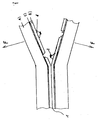
- the figure shows a schematic diagram of a PVC-free multi-layer hose.
- FIG. 1 In the illustration according to the figure is a principal Illustration of a multi-layer hose.
- A) denotes the inner layer of a multi-layered hose according to the invention.
- B) stands for the outer layer of a multilayer tube according to the invention, while C) describes the intermediate or buffer layer which is arranged between the layers A) and B).
- the reference numeral 1 stands for the weld, which is obtainable by welding two sections of the outer layer of the multilayer tube according to the invention. It can be seen in the illustrated schematic sketch areas in which the weld between the outer layer B) of the multi-layer hose was opened, while in other areas, the weld is still intact, the two sections or rings of the hose are still welded together.
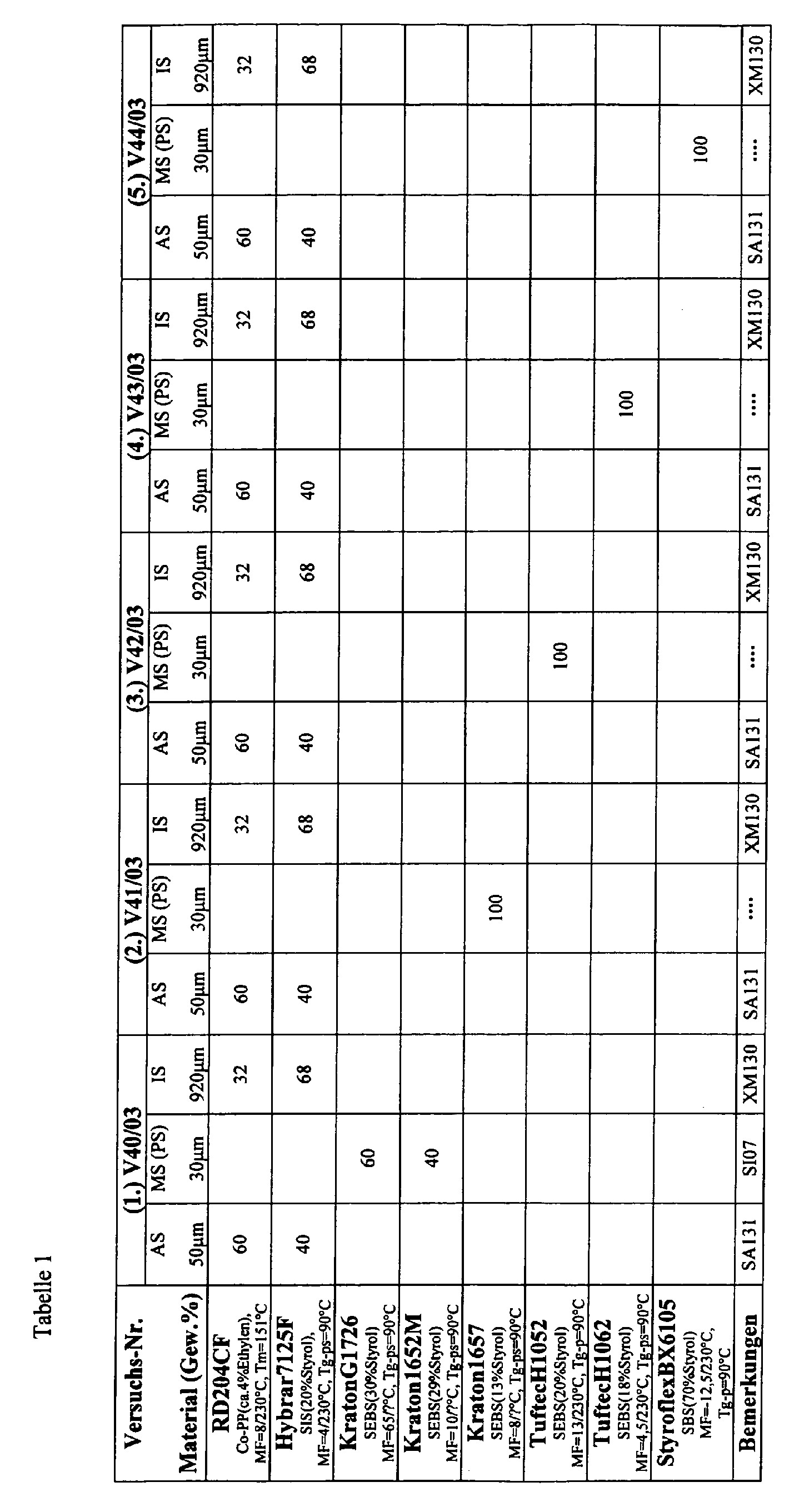
- Table 1 (below), the composition of the layers specified according to the invention multi-layer tubes.
- Table 1 means AS: outer layer, MS: middle layer or here buffer layer and IS: Inner layer. All materials listed in the first column of the table are, in the case of blends, previously compounded and granulated. It deals not dryblends.
- the MFI of blends SA131 was 5.9 (as outer layer)
- the MFI of the blend SI07 was 15 (as a buffer layer)
- MFI of XM130 4.6 (as inner layer).
- the rings were made according to the state of the art, then welded at the temperatures indicated in Tables 3 and 4 and sterilized by conventional methods and then four days under the tables 3 and 4 specified test temperatures stored.
Landscapes
- Engineering & Computer Science (AREA)
- Mechanical Engineering (AREA)
- Laminated Bodies (AREA)
- Materials For Medical Uses (AREA)
- Infusion, Injection, And Reservoir Apparatuses (AREA)
- Media Introduction/Drainage Providing Device (AREA)
- Adhesives Or Adhesive Processes (AREA)
- External Artificial Organs (AREA)
- Rigid Pipes And Flexible Pipes (AREA)
Abstract
dadurch gekennzeichnet, dass
sowohl das erste als auch das zweite Kunststoffmaterial jeweils 25 Gew.-% oder mehr als 25 Gew.-% bezogen auf das gesamte Gewicht der jeweiligen Schicht A) beziehungsweise B) aus Polyolefinen bestehen, während das dritte Kunststoffmaterial einen Anteil an thermoplastischem Elastomer, welches nicht Polyolefin ist, von mehr als 75 Gew.-% bezogen auf das Gesamtgewicht der Schicht C) besitzt.
Description
WO-A-92/11820 (= D1),
EP-A-0765740 (= D2),
US-A-5,466,322 (= D3),
US-A-5,804,151 (= D4) und
US-A-5,958,167 (= D5) genannt.
In jedem Fall kann ein Schlauchkringel aus dem erfindungsgemäßen Mehrschichtschlauch ohne Probleme gelöst werden. Im ersten Fall ist der erfindungsgemäße Schlauch zum Einführen in ein Hohlteil gedacht, dessen Innenoberfläche aus geeignetem Material zur Ausbildung einer Verbindung besteht, während bei Anordnung zweier Verbindungsschichten (außen und innen) beim erfindungsgemäßen PVC-freien Mehrschichtschlauch die beiden genannten Verbindungsmöglichkeiten wahlweise oder gleichzeitig realisierbar sind.
| Innenschicht: | Dicke: 900 - 980 µm bei ca. 1 mm Wandstärke des Schlauchs |
| Blend aus 50 - 75 % SIS | (HVS/3, Kuraray oder Hybrar 7125F, Kuraray) |
| und 50 - 25 % PP-R | (PP 23M10cs264, REXENE); - PP mit Shore D ≤ 32, ρ = 0,9 g/cm3; (z.B. Adflex 100 G, Himont, mit bis zu 50 % Kautschukanteil, z.B. PIB, Styrol-Ethylen-Butylen-Kautschuk, Styrol-Ethylen-Propylen-Kautschuk, SIS oder (RD204CF, Borealis A/S); - PP-Copolymer |
| Außenschicht: | Dicke 15 - 100 µm |
| Blend aus | |
| 50 - 75 % PP-R | (PP 23M10cs264, REXENE oder |
| RD 204 CF, Borealis A/S) und | |
| 25 - 50 % SIS | (HVS/3, Kuraray oder Hybrar 7125 F, Kuraray); |
| Pufferschicht: | Dicke 10 - 50 µm |
| 100 % SEBS | (Kraton 1657, Shell) |
| SEBS mit 13 % Styrol oder | |
| (Tuftec H 1052, Asahi) | |
| SEBS mit 20 % Styrol oder | |
| (Tuftec H 1062, Asahi) | |
| SEBS mit 18 % Styrol | |
| oder | |
| 100 % SBS | (Styroflex BX 6105, BASF) |
| SBS mit 70 % Styrol | |
| oder | |
| Blend aus | |
| 50 - 90 % SEBS | (z.B. Kraton G 1726, Shell) und |
| 10 - 50 % SEBS | (z.B. Kraton 1625M, Shell) |
| SEBS mit 29 % Styrol; |
- PP-R =
- Polypropylen-Randomcopolymer
- SIS =
- Styrol-Isopren-Styrol
- SEBS =
- Styrol-Ethylen-Butylen-Styrol-Kautschuk
- SBS =
- Styrol-Butylen-Styrol-Kautschuk
Weiterhing ist es beim erfindungsgemäßen Verfahren vorteilhaft möglich, dass man zu Formung eines PVC-freien Mehrschichtschlauches die Kunststoffmaterialien so auswählt, dass alle Schichten des Schlauches zusätzlich bis zu 40 Gew.-% des Materials der jeweils benachbarten Schicht oder Schichten enthalten können. Hierdurch kann in gewissem Maße eine geringe Haftung zwischen zwei benachbarten Schichten kompensiert werden. Nach der eigentlichen Formung kann der erhalten Schlauch auf übliche Arten weiter bearbeitet werden. Bevorzugt wird er nach dem Formen mit Wasser schockgekühlt. Hierdurch wird wegen des "Einfrierens" des amorphen Zustandes ein optimaler Verbund mit hoher Flexibilität und ausreichender Steifigkeit erreicht, aber vor allem wird durch das schockartige Kühlen der Schmelze die Transparenz des Schlauches verbessert, weil sich keine kristallinen Bereiche ausbilden können. Dies führt zu einem geringen Kristallinitätsgrad und damit zur hohen Transparenz und Zähigkeit.
Der erfindungsgemäße PVC-freie Mehrschichtschlauch eignet sich hervorragend für eine Verwendung im medizinischen Bereich. Die Materialien des Mehrschichtschlauches sind alle so ausgewählt, dass der Schlauch durchsichtig, knickbeständig und flexibel, insbesondere aber heißsterilisierbar und durch gleichzeitig vom Schlauch ausgeübte Presskraft mit einem entsprechenden Konnektor fest und bakteriensicher verbindbar ist. Zusätzlich ist der Non-PVC-Mehrschichtschlauch der Erfindung auch noch biokompatibel. Die Verwendung von PVC, welches immer einen Anteil an Weichmachern enthält, wird vermieden, ebenso werden keine Haftvermittler benötigt, die gegebenenfalls durch die Kunststoffmaterialschichten hindurch diffundieren könnten.
In der Figur werden zwei miteinander an der Oberfläche der Schicht B) verschweißte Abschnitte eines erfindungsgemäßen Mehrschichtschlauches gezeigt. Das Bezugszeichen 1 steht für die Schweißnaht, welche durch Verschweißen zweier Abschnitte der Außenschicht des erfindungsgemäßen Mehrschichtschlauches erhältlich ist. Man erkennt in der dargestellten Prinzipsskizze Bereiche, in welchen die Schweißnaht zwischen der Außenschicht B) des Mehrschichtschlauches geöffnet wurde, während in anderen Bereichen die Schweißnaht noch intakt ist, die zwei Abschnitte oder Kringel des Schlauches also noch miteinander verschweißt sind. Durch Anwendung einer Kraft F, die in der durch die Pfeilrichtung angedeuteten Weise auf die miteinander verschweißten Kringel des Mehrschichtschlauches einwirkt, kommt es zum Lösen der beiden miteinander verschweißten Schlauchkringel. Dabei bleibt der Innenschlauch A) vollständig intakt, während sich, wie bspw. an dem Bezugszeichen 2 dargestellt, für den Fall des Einreißens der Außenschicht B) spätestens im Bereich der Pufferschicht C) eine saubere, zerstörungsfreie Trennung zwischen den Schlauchkringeln ergibt. Mithin lässt sich selbst bei Einreißen der Außenschicht die Funktionsfähigkeit des Mehrschichtschlauches gemäß der Erfindung aufrecht erhalten. Der erfindungsgemäße Schlauch lässt sich sicher peelen.
| 1. Hersteller der Materialien: | |||||
| Handelsname | Material | Hersteller | |||
| RD204CF | PP-Copolemer | Borealis A/S | |||
| Hybrar 7125F | SIS-Elastomer | Kuraray Co., Ltd. | |||
| KratonG1726 | SEBS-Elastomer | Shell Chemical Company | |||
| Kraton1652M | SEBS-Elastomer | ||||
| Kraton1657 | SEBS-Elastomer | ||||
| TuftecH1052 | SEBS-Elastomer | Asahi Chemical Industry Co., Ltd. Asahi Chemical Industry Co., Ltd. | |||
| TuftecH1062 | SEBS-Elastomer | ||||
| 2. Einige Eigenschaften der Materialien | |||||
| Handelsname | Gruppe | Ethylen bzw. Styrol [%] | Tm bzw. Tg [°C] | MFI [g/10min] | Shore A |
| RD204CF | I | 4 | 151 | 8 | viel härter! |
| Hybrar7125F | 20 | 90 u. -15 | 4 | 64 | |
| KratonG1726 | 30 | 90 u. -45 | 65 | 60 | |
| Kraton1652M | II | 29 | 90 u. -45 | 10 | 75r |
| Kraton1657 | 13 | 90 u. -55 | 8 | 65 | |
| TuftecH1052 | 20 | 90 u. -26 | 13 | 67 | |
| TuftecH1062 | 18 | 90 u. -32 | 4,5 | 67 |
| Prüf-Temperatur | Fehlerart Schweißtmp. | Sterile Musterschläuche Schweißtemperaturstufe I | |||||
| Standard 400°C | V40 410°C | V41 410°C | V42 410°C | V43 410°C | V44 430°C | ||
| 5°C (je 15 Coils) | Komplettriss (> 10mm, Ruptur) | 0 | 0 | 0 | 0 | 0 | 0 |
| Durchriss (≥ 1 mm, Loch!) | 1 (7%) | 0 | 0 | 0 | 0 | 0 | |
| Starkriss (300µ~<1mm) | 3 (20%) | 0 | 0 | 0 | 0 | 0 | |
| Leichtriss (100µ~300µ) | 8 (53%) | 0 | 0 | 0 | 0 | 0 | |
| Peelen/ Delaminieren | 3 (20%) | 15 (100%) | 15 (100%) | 15 (100%) | 15 (100%) | 15 (100%) | |
| 16°C (je 15 Coils) | Komplettriss (>10mm, Ruptur) | 0 | 0 | 0 | 0 | 0 | 0 |
| Durchriss (≥1mm, Loch!) | 2 (13%) | 0 | 0 | 0 | 0 | 0 | |
| Starkriss (300µ~<1mm) | 3 (20%) | 0 | 0 | 0 | 0 | 0 | |
| Leichtriss (100µ~300µ) | 3 (20%) | 0 | 0 | 0 | 0 | 0 | |
| Peelen/ Delaminieren | 7 (47%) | 15 (100%) | 15 (100%) | 15 (100%) | 15 (100%) | 15 (100%) | |
| 22 °C (je 15 Coils) | Komplettriss (>10mm, Ruptur) | 0 | 0 | 0 | 0 | 0 | 0 |
| Durchriss (≥1mm, Loch!) | 0 | 0 | 0 | 0 | 0 | 0 | |
| Starkriss (300µ~<1mm) | 0 | 0 | 0 | 0 | 0 | 0 | |
| Leichtriss (100µ~300µ) | 9 (60%) | 0 | 0 | 0 | 0 | 0 | |
| Peelen/ Delaminieren | 6 (40%) | 15 (100%) | 15 (100%) | 15 (100%) | 15 (100%) | 15 (100%) |
| Prüf-Temperatur | Fehlerart Schweißtmp. | Sterile Musterschläuche Schweißtemperaturstufe II | |||||
| Standard 430°C | V40 440°C | V41 440°C | V42 440°C | V43 440°C | V44 460°C | ||
| 5°C (je 15 Coils) | Komplettriss (> 10mm, Ruptur) | 0 | 0 | 0 | 0 | 0 | 0 |
| Durchriss (≥1mm, Loch!) | 1 (7%) | 0 | 0 | 0 | 0 | 0 | |
| Starkriss (300µ~<1mm) | 7 (47%) | 0 | 0 | 0 | 0 | 0 | |
| Leichtriss (100µ~300µ) | 5 (33%) | 0 | 0 | 0 | 0 | 0 | |
| Peelen/ Delaminieren | 2 (13%) | 15 (100%) | 15 (100%) | 15 (100%) | 15 (100%) | 15 (100%) | |
| 16°C (je 15 Coils) | Komplettriss (>10mm, Ruptur) | 0 | 0 | 0 | 0 | 0 | 0 |
| Durchriss (≥1mm, Loch!) | 1 (7%) | 0 | 0 | 0 | 0 | 0 | |
| Starkriss (300µ~<1mm) | 2 (13%) | 0 | 0 | 0 | 0 | 0 | |
| Leichtriss (100µ~300µ) | 2 (13%) | 0 | 0 | 0 | 0 | 0 | |
| Peelen/ Delaminieren | 10 (67%) | 15 (100%) | 15 (100%) | 15 (100%) | 15 (100%) | 15 (100%) | |
| 22°C (je 15 Coils) | Komplettriss (>10mm, Ruptur) | 0 | 0 | 0 | 0 | 0 | 0 |
| Durchriss (≥1mm, Loch!) | 0 | 0 | 0 | 0 | 0 | 0 | |
| Starkriss (300µ~<1mm) | 6 (40%) | 0 | 0 | 0 | 0 | 0 | |
| Leichtriss (100µ~300µ) | 3 (20%) | 0 | 0 | 0 | 0 | 0 | |
| Peelen/ Delaminieren | 6 (40%) | 15 (100%) | 15 (100%) | 15 (100%) | 15 (100%) | 15 (100%) |
Claims (21)
- PVC-freier Mehrschichtschlauch für medizinische Zwecke mit verbesserter Sicherheit der Peelbarkeit, wobei der Mehrschichtschlauch wenigstens drei Schichten umfasst, von denen eine Basisschicht A) aus einem ersten Kunststoffmaterial mit wenigstens einer Konnektionsschicht B) aus einem zweiten Kunststoffmaterial mittels wenigstens einer zwischen A) und B) angeordneten Pufferschicht C) aus einem dritten Kunststoffmaterial verbunden ist und wobei man aus dem Mehrschichtschlauch einen Kringel oder eine Schlaufe mit einem Durchmesser von bis zu 50 mm ohne Knickschädigung formen kann,
dadurch gekennzeichnet, dass
sowohl das erste als auch das zweite Kunststoffmaterial jeweils 25 Gew.-% oder mehr als 25 Gew.-% bezogen auf das gesamte Gewicht der jeweiligen Schicht A) beziehungsweise B) aus Polyolefinen bestehen, während das dritte Kunststoffmaterial einen Anteil an thermoplastischem Elastomer, welches nicht Polyolefin ist, von mehr als 75 Gew.% bezogen auf das Gesamtgewicht der Schicht C) besitzt. - Mehrschichtschlauch nach Anspruch 1, dadurch gekennzeichnet, dass das erste Kunststoffmaterial bei Temperaturen von mehr als 121 °C ohne Formschädigung hitzsterilisierbar ist, so dass die Basisschicht A) bei Temperaturen ≥ 121°C noch formbeständig ist.
- Mehrschichtschlauch nach Anspruch 1 oder 2, dadurch gekennzeichnet, dass das erste und/oder das zweite Kunststoffmaterial jeweils zu 30 Gew.-% oder mehr und besonders bevorzugt zu 50 Gew.-% oder mehr jeweils bezogen auf das gesamte Gewicht der jeweiligen Schicht A) beziehungsweise B) aus Polyolefinen bestehen.
- Mehrschichtschlauch nach einem der vorhergehenden Ansprüche, dadurch gekennzeichnet, dass das erste Kunststoffmaterial und zweite Kunststoffmaterial jeweils zum überwiegenden Teil ein Polypropylen mit einer Dichte ρ ≤ 0,9 g/cm3 beziehungsweise ein synthetischer Kautschuk auf Isopren-Basis, zweckmäßig ein SIS, sind.
- Mehrschichtschlauch nach einem der vorhergehenden Ansprüche, dadurch gekennzeichnet, dass das dritte Kunststoffmaterial einen Anteil an thermoplastischem Elastomer, welches nicht Polyolefin ist, von größer als 80 Gew.-%, besonders zweckmäßig von 100 Gew.-%, bezogen auf das Gesamtgewicht der Schicht C) besitzt.
- Mehrschichtschlauch nach einem der vorhergehenden Ansprüche, dadurch gekennzeichnet, dass das dritte Kunststoffmaterial zum überwiegenden Teil ein SEBS oder SBS Kautschuk ist.
- Mehrschichtschlauch nach einem der vorhergehenden Ansprüche, dadurch gekennzeichnet, dass das erste Kunststoffmaterial eine Härte Shore D ≤ 35, vorzugsweise eine Härte Shore D ≤ 32, hat.
- Mehrschichtschlauch nach einem der vorhergehenden Ansprüche, dadurch gekennzeichnet, dass das zweite Kunststoffmaterial eine Härte Shore D ≤ 60, vorzugsweise eine Härte Shore D ≤ 65, besonders bevorzugt eine Härte Shore D ≤ 55 aufweist.
- Mehrschichtschlauch nach einem der vorhergehenden Ansprüche, dadurch gekennzeichnet, dass das dritte Kunststoffmaterial einen Wert für die Härte Shore A aufweist, der größer ist als der Wert für die Härte Shore A des zweiten Kunststoffmaterials.
- Mehrschichtschlauch nach einem der vorhergehenden Ansprüche, dadurch gekennzeichnet, dass die Basisschicht A) eine Dicke im Bereich vom 800 bis 1000 µm aufweist.
- Mehrschichtschlauch nach einem der vorhergehenden Ansprüche, dadurch gekennzeichnet, dass die Konnektionsschicht B) eine Dicke im Bereich vom 15 bis 100 µm aufweist.
- Mehrschichtschlauch nach einem der vorhergehenden Ansprüche, dadurch gekennzeichnet, dass die Pufferschicht C) eine Dicke von weniger als 100 µm aufweist.
- Mehrschichtschlauch nach einem der vorhergehenden Ansprüche, dadurch gekennzeichnet, dass die Pufferschicht C) eine Dicke im Bereich von 10 bis 30 µm aufweist.
- Mehrschichtschlauch nach einem der vorhergehenden Ansprüche, dadurch gekennzeichnet, dass die Dicke der Pufferschicht C) geringer ist als die Dicke der Konnektionsschicht B).
- Mehrschichtschlauch nach einem der vorhergehenden Ansprüche, gekennzeichnet durch eine Abfolge der Schichten A) C) B) oder B) A) C) B), jeweils von innen nach außen.
- Verschweißter knickschädigungsfreier Schlauchkringel mit verbesserter Sicherheit der Peelbarkeit aufweisend einen Durchmesser von größeren Durchmessern herab bis zu nur 50 mm Durchmesser und umfassend einen PVC-freien Mehrschichtschlauch für medizinische Zwecke gemäß den Ansprüchen 1 bis 15.
- Verfahren zur Herstellung eines knickschädigungsfreien und PVC-freien Mehrschichtschlauches für medizinische Zwecke mit verbesserter Sicherheit der Peelbarkeit gemäß den Ansprüchen 1 bis 15, bei dem man zur Erzeugung eines wenigstens dreischichtigen Mehrschichtschlauches aus Kunststoff das erste Kunststoffmaterial zur Ausbildung der Basisschicht A), das zweite Kunststoffmaterial zur Ausbildung der Konnektionsschicht B) und das dritte Kunststoffmaterial zur Ausbildung einer zwischen A) und B) angeordneten Pufferschicht C) miteinander coextrudiert und während der Coextrusion einen im Wesentlichen koaxialen und zylindrischen Mehrschichtschlauch formt.
- Verfahren nach Anspruch 17, dadurch gekennzeichnet, dass man den Schlauch nach dem Formen mit Wasser schockkühlt.
- Verwendung des PVC-freien Mehrschichtschlauches nach einem der Ansprüche 1 bis 15 oder des verschweißten Schlauchkringels nach Anspruch 16 für medizinische Zwecke.
- Verwendung nach Anspruch 19 als fluidführende Leitung in der Dialyse, Infusion oder künstlichen Ernährung.
- Verwendung nach Anspruch 19 als Blutschlauch.
Applications Claiming Priority (2)
| Application Number | Priority Date | Filing Date | Title |
|---|---|---|---|
| DE10349011A DE10349011A1 (de) | 2003-10-17 | 2003-10-17 | PVC-freier Mehrschichtschlauch mit verbesserter Peelsicherheit für medizinische Zwecke, Verfahren zu dessen Herstellung und Verwendung |
| DE10349011 | 2003-10-17 |
Publications (3)
| Publication Number | Publication Date |
|---|---|
| EP1524109A2 true EP1524109A2 (de) | 2005-04-20 |
| EP1524109A3 EP1524109A3 (de) | 2005-10-05 |
| EP1524109B1 EP1524109B1 (de) | 2013-12-04 |
Family
ID=34353483
Family Applications (1)
| Application Number | Title | Priority Date | Filing Date |
|---|---|---|---|
| EP04023738.0A Expired - Lifetime EP1524109B1 (de) | 2003-10-17 | 2004-10-06 | Verwendung eines PVC-freien Mehrschichtschlauchs mit verbesserter Peelsicherheit für medizinische Zwecke |
Country Status (6)
| Country | Link |
|---|---|
| US (1) | US7641753B2 (de) |
| EP (1) | EP1524109B1 (de) |
| JP (1) | JP5019703B2 (de) |
| KR (1) | KR101148040B1 (de) |
| CN (1) | CN100434125C (de) |
| DE (1) | DE10349011A1 (de) |
Cited By (2)
| Publication number | Priority date | Publication date | Assignee | Title |
|---|---|---|---|---|
| EP3053849A4 (de) * | 2014-04-09 | 2017-03-22 | Kuraray Co., Ltd. | Flüssigkeitsverpackungsbehälter |
| US11674019B2 (en) | 2017-11-17 | 2023-06-13 | Compagnie Generale Des Etablissements Michelin | Tire provided with an outer sidewall comprising a liquid plasticizer having a low glass transition temperature |
Families Citing this family (14)
| Publication number | Priority date | Publication date | Assignee | Title |
|---|---|---|---|---|
| US20100137838A1 (en) * | 2007-04-11 | 2010-06-03 | Choongwae Corporation | Non-pvc system tube for biomedical |
| TWI385330B (zh) * | 2008-10-31 | 2013-02-11 | Saint Gobain Performance Plast | 多層撓性管材 |
| CN102782036B (zh) | 2009-12-29 | 2016-01-27 | 美国圣戈班性能塑料公司 | 柔性管材和用于形成该材料的方法 |
| DE202010006308U1 (de) * | 2010-04-30 | 2011-09-06 | Rehau Ag + Co. | Flexibler Schlauch |
| US9861733B2 (en) | 2012-03-23 | 2018-01-09 | Nxstage Medical Inc. | Peritoneal dialysis systems, devices, and methods |
| JP6049685B2 (ja) | 2011-03-23 | 2016-12-21 | ネクステージ メディカル インコーポレイテッド | 腹膜透析使い捨てユニット、コントローラ、腹膜透析システム |
| IN2014DN10660A (de) | 2012-06-06 | 2015-08-28 | Saint Gobain Performance Plast | |
| KR20150036587A (ko) * | 2012-07-26 | 2015-04-07 | 생-고뱅 퍼포먼스 플라스틱스 코포레이션 | 다층 유연성 튜브 |
| DE102013105251A1 (de) | 2013-05-23 | 2014-11-27 | Contitech Schlauch Gmbh | Flexibler Schlauch |
| US11504517B2 (en) | 2015-12-11 | 2022-11-22 | Nxstage Medical, Inc. | Fluid line connector devices methods and systems |
| WO2018237375A1 (en) | 2017-06-24 | 2018-12-27 | Nxstage Medical, Inc. | Peritoneal dialysis fluid preparation and/or treatment devices methods and systems |
| CA3092575A1 (en) | 2018-02-28 | 2019-09-06 | Nxstage Medical, Inc. | Fluid preparation and treatment devices, methods, and systems |
| AU2021373614A1 (en) * | 2020-11-09 | 2023-06-22 | Carefusion 303, Inc. | Multilayer medical tubing with low sorbability |
| KR20230101159A (ko) * | 2021-12-29 | 2023-07-06 | 주식회사 아이브이에스 | 다층 구조 튜브 및 다층 구조 튜브 제조 방법 |
Family Cites Families (18)
| Publication number | Priority date | Publication date | Assignee | Title |
|---|---|---|---|---|
| JPH0696024B2 (ja) * | 1986-12-22 | 1994-11-30 | 宇部日東化成株式会社 | 人工血管用基材およびその製造方法 |
| JP3120180B2 (ja) | 1990-12-31 | 2000-12-25 | バクスター、インターナショナル、インコーポレイテッド | 医療用グレードのチューブのための改良された材料 |
| US5356709A (en) * | 1992-05-14 | 1994-10-18 | Baxter International, Inc. | Non-PVC coextruded medical grade port tubing |
| ES2108980T3 (es) | 1993-02-04 | 1998-01-01 | Baxter Int | Conjunto de elementos de plastico alargados y procedimiento y dispositivo para su realizacion. |
| US5840151A (en) * | 1993-02-04 | 1998-11-24 | Baxter International Inc. | Apparatus and dies for forming peelable tube assemblies |
| JP2739420B2 (ja) * | 1993-09-03 | 1998-04-15 | 株式会社人工血管技術研究センター | 人工血管 |
| US5998019A (en) * | 1993-11-16 | 1999-12-07 | Baxter International Inc. | Multi-layered polymer structure for medical products |
| DE4447626C5 (de) * | 1994-03-29 | 2007-01-25 | Fresenius Ag | Medizinischer Mehrkammerbeutel |
| JP3919815B2 (ja) * | 1995-06-07 | 2007-05-30 | バクスター インターナショナル インコーポレイテッド | ハロゲンを含まない、レトルト可能な多層バリアーフィルム |
| DE19534455C1 (de) * | 1995-09-16 | 1996-12-12 | Fresenius Ag | PVC-freier-Mehrschichtschlauch für medizinische Zwecke, Verfahren zu dessen Herstellung und Verwendung |
| DE19534413C1 (de) * | 1995-09-16 | 1997-05-28 | Fresenius Ag | Verbindungsanorndung und Verfahren zum Verbinden zweier Einzelteile eines medizinischen Systems |
| CA2229846C (en) * | 1996-07-03 | 2006-05-30 | Baxter International Inc. | Method of sealing a port tube in a container |
| DE19727446A1 (de) * | 1997-06-27 | 1999-01-07 | Fresenius Medical Care De Gmbh | Polymermaterial zur Herstellung medizinischer Arbeitsmittel |
| US5804151A (en) | 1997-09-16 | 1998-09-08 | Cyprus Amax Minerals Company | Process for autoclaving molybdenum disulfide |
| US5958167A (en) | 1997-09-29 | 1999-09-28 | Medtronic, Inc. | Method of making tubing coil assemblies for medical devices |
| BE1012589A3 (fr) * | 1999-04-08 | 2000-12-05 | Solvay | Structure thermoplastique multicouche. |
| US6869653B2 (en) * | 2001-01-08 | 2005-03-22 | Baxter International Inc. | Port tube closure assembly |
| US7621884B2 (en) | 2002-03-20 | 2009-11-24 | Gambro Lundia Ab | Tube for medical applications and circuit incorporating such tube |
-
2003
- 2003-10-17 DE DE10349011A patent/DE10349011A1/de not_active Ceased
-
2004
- 2004-10-06 EP EP04023738.0A patent/EP1524109B1/de not_active Expired - Lifetime
- 2004-10-15 KR KR1020040082838A patent/KR101148040B1/ko not_active Expired - Lifetime
- 2004-10-18 CN CNB2004100861399A patent/CN100434125C/zh not_active Expired - Lifetime
- 2004-10-18 JP JP2004302944A patent/JP5019703B2/ja not_active Expired - Lifetime
- 2004-10-18 US US10/968,378 patent/US7641753B2/en active Active
Cited By (2)
| Publication number | Priority date | Publication date | Assignee | Title |
|---|---|---|---|---|
| EP3053849A4 (de) * | 2014-04-09 | 2017-03-22 | Kuraray Co., Ltd. | Flüssigkeitsverpackungsbehälter |
| US11674019B2 (en) | 2017-11-17 | 2023-06-13 | Compagnie Generale Des Etablissements Michelin | Tire provided with an outer sidewall comprising a liquid plasticizer having a low glass transition temperature |
Also Published As
| Publication number | Publication date |
|---|---|
| JP2005199036A (ja) | 2005-07-28 |
| JP5019703B2 (ja) | 2012-09-05 |
| US7641753B2 (en) | 2010-01-05 |
| US20050147779A1 (en) | 2005-07-07 |
| EP1524109B1 (de) | 2013-12-04 |
| CN1608690A (zh) | 2005-04-27 |
| DE10349011A1 (de) | 2005-05-19 |
| KR101148040B1 (ko) | 2012-05-25 |
| EP1524109A3 (de) | 2005-10-05 |
| KR20050037389A (ko) | 2005-04-21 |
| CN100434125C (zh) | 2008-11-19 |
Similar Documents
| Publication | Publication Date | Title |
|---|---|---|
| EP0765740B1 (de) | PVC-freier-Mehrschichtschlauch für medizinische Zwecke, Verfahren zu dessen Herstellung und Verwendung | |
| EP0769516B1 (de) | Verbindungsanordnung und Verfahren zum Verbinden zweier Einzelteile eines medizinischen Systems | |
| EP1524109B1 (de) | Verwendung eines PVC-freien Mehrschichtschlauchs mit verbesserter Peelsicherheit für medizinische Zwecke | |
| EP0119469B1 (de) | Aufbewahrungsbeutel | |
| EP0765654B1 (de) | Medizinischer Beutel | |
| DE69818190T2 (de) | Flexible verbindung für fluide | |
| EP0739713B2 (de) | Non-PVC-Mehrschichtfolie | |
| EP0700280B1 (de) | Peelfähige polymere mehrschichtfolie für einen medizinischen mehrkammerbeutel und verfahren zu dessen herstellung | |
| DE2926572A1 (de) | Teilbarer kurzkatheter aus kunststoff | |
| EP0083778B1 (de) | Aufbewahrungsbeutel | |
| DE60005298T2 (de) | Mehrkammerbehälter für medizinische lösungen | |
| EP2349387B1 (de) | Einwegbeutel umfassend eine mehrschichtfolie | |
| DE69019506T2 (de) | Schlagfest modifizierter medizinischer Film. | |
| EP1237720B1 (de) | Autoklavierbare, pvc-freie mehrschichtfolie, insbesondere für die verpackung von flüssigen, medizinischen produkten, verfahren zur herstellung sowie verwendung | |
| EP0892830A1 (de) | Mehrlagenfolie, verfahren zu ihrer herstellung und ihre verwendung | |
| CH662276A5 (de) | Blutbeutelvorrichtung. | |
| DE60316107T2 (de) | Eine Druckwandlerschutzvorrichtung für biomedizinische Hämodialyseleitungen | |
| DE69908665T2 (de) | Verbesserter Medizinqualitätsschlauch und Methode zu seiner Kupplung | |
| DE10361851B4 (de) | Hitzesterilisierbare Mehrschichtfolie und Verwendung derselben | |
| EP1285023B1 (de) | Elastische folie |
Legal Events
| Date | Code | Title | Description |
|---|---|---|---|
| PUAI | Public reference made under article 153(3) epc to a published international application that has entered the european phase |
Free format text: ORIGINAL CODE: 0009012 |
|
| AK | Designated contracting states |
Kind code of ref document: A2 Designated state(s): AT BE BG CH CY CZ DE DK EE ES FI FR GB GR HU IE IT LI LU MC NL PL PT RO SE SI SK TR |
|
| AX | Request for extension of the european patent |
Extension state: AL HR LT LV MK |
|
| PUAL | Search report despatched |
Free format text: ORIGINAL CODE: 0009013 |
|
| AK | Designated contracting states |
Kind code of ref document: A3 Designated state(s): AT BE BG CH CY CZ DE DK EE ES FI FR GB GR HU IE IT LI LU MC NL PL PT RO SE SI SK TR |
|
| AX | Request for extension of the european patent |
Extension state: AL HR LT LV MK |
|
| RIC1 | Information provided on ipc code assigned before grant |
Ipc: 7F 16L 11/06 B Ipc: 7B 32B 27/32 A |
|
| 17P | Request for examination filed |
Effective date: 20051109 |
|
| AKX | Designation fees paid |
Designated state(s): AT BE BG CH CY CZ DE DK EE ES FI FR GB GR HU IE IT LI LU MC NL PL PT RO SE SI SK TR |
|
| 17Q | First examination report despatched |
Effective date: 20060213 |
|
| GRAP | Despatch of communication of intention to grant a patent |
Free format text: ORIGINAL CODE: EPIDOSNIGR1 |
|
| INTG | Intention to grant announced |
Effective date: 20130612 |
|
| GRAS | Grant fee paid |
Free format text: ORIGINAL CODE: EPIDOSNIGR3 |
|
| GRAA | (expected) grant |
Free format text: ORIGINAL CODE: 0009210 |
|
| AK | Designated contracting states |
Kind code of ref document: B1 Designated state(s): AT BE BG CH CY CZ DE DK EE ES FI FR GB GR HU IE IT LI LU MC NL PL PT RO SE SI SK TR |
|
| REG | Reference to a national code |
Ref country code: GB Ref legal event code: FG4D Free format text: NOT ENGLISH |
|
| REG | Reference to a national code |
Ref country code: CH Ref legal event code: EP |
|
| REG | Reference to a national code |
Ref country code: IE Ref legal event code: FG4D Free format text: LANGUAGE OF EP DOCUMENT: GERMAN Ref country code: AT Ref legal event code: REF Ref document number: 643358 Country of ref document: AT Kind code of ref document: T Effective date: 20140115 |
|
| REG | Reference to a national code |
Ref country code: DE Ref legal event code: R096 Ref document number: 502004014451 Country of ref document: DE Effective date: 20140130 |
|
| REG | Reference to a national code |
Ref country code: SE Ref legal event code: TRGR |
|
| REG | Reference to a national code |
Ref country code: NL Ref legal event code: VDEP Effective date: 20131204 |
|
| PG25 | Lapsed in a contracting state [announced via postgrant information from national office to epo] |
Ref country code: FI Free format text: LAPSE BECAUSE OF FAILURE TO SUBMIT A TRANSLATION OF THE DESCRIPTION OR TO PAY THE FEE WITHIN THE PRESCRIBED TIME-LIMIT Effective date: 20131204 Ref country code: NL Free format text: LAPSE BECAUSE OF FAILURE TO SUBMIT A TRANSLATION OF THE DESCRIPTION OR TO PAY THE FEE WITHIN THE PRESCRIBED TIME-LIMIT Effective date: 20131204 |
|
| PG25 | Lapsed in a contracting state [announced via postgrant information from national office to epo] |
Ref country code: CY Free format text: LAPSE BECAUSE OF FAILURE TO SUBMIT A TRANSLATION OF THE DESCRIPTION OR TO PAY THE FEE WITHIN THE PRESCRIBED TIME-LIMIT Effective date: 20131204 |
|
| PG25 | Lapsed in a contracting state [announced via postgrant information from national office to epo] |
Ref country code: EE Free format text: LAPSE BECAUSE OF FAILURE TO SUBMIT A TRANSLATION OF THE DESCRIPTION OR TO PAY THE FEE WITHIN THE PRESCRIBED TIME-LIMIT Effective date: 20131204 |
|
| PG25 | Lapsed in a contracting state [announced via postgrant information from national office to epo] |
Ref country code: RO Free format text: LAPSE BECAUSE OF FAILURE TO SUBMIT A TRANSLATION OF THE DESCRIPTION OR TO PAY THE FEE WITHIN THE PRESCRIBED TIME-LIMIT Effective date: 20131204 Ref country code: PT Free format text: LAPSE BECAUSE OF FAILURE TO SUBMIT A TRANSLATION OF THE DESCRIPTION OR TO PAY THE FEE WITHIN THE PRESCRIBED TIME-LIMIT Effective date: 20140404 Ref country code: ES Free format text: LAPSE BECAUSE OF FAILURE TO SUBMIT A TRANSLATION OF THE DESCRIPTION OR TO PAY THE FEE WITHIN THE PRESCRIBED TIME-LIMIT Effective date: 20131204 Ref country code: SK Free format text: LAPSE BECAUSE OF FAILURE TO SUBMIT A TRANSLATION OF THE DESCRIPTION OR TO PAY THE FEE WITHIN THE PRESCRIBED TIME-LIMIT Effective date: 20131204 Ref country code: CZ Free format text: LAPSE BECAUSE OF FAILURE TO SUBMIT A TRANSLATION OF THE DESCRIPTION OR TO PAY THE FEE WITHIN THE PRESCRIBED TIME-LIMIT Effective date: 20131204 Ref country code: PL Free format text: LAPSE BECAUSE OF FAILURE TO SUBMIT A TRANSLATION OF THE DESCRIPTION OR TO PAY THE FEE WITHIN THE PRESCRIBED TIME-LIMIT Effective date: 20131204 |
|
| REG | Reference to a national code |
Ref country code: DE Ref legal event code: R097 Ref document number: 502004014451 Country of ref document: DE |
|
| PLBE | No opposition filed within time limit |
Free format text: ORIGINAL CODE: 0009261 |
|
| STAA | Information on the status of an ep patent application or granted ep patent |
Free format text: STATUS: NO OPPOSITION FILED WITHIN TIME LIMIT |
|
| PG25 | Lapsed in a contracting state [announced via postgrant information from national office to epo] |
Ref country code: DK Free format text: LAPSE BECAUSE OF FAILURE TO SUBMIT A TRANSLATION OF THE DESCRIPTION OR TO PAY THE FEE WITHIN THE PRESCRIBED TIME-LIMIT Effective date: 20131204 |
|
| 26N | No opposition filed |
Effective date: 20140905 |
|
| REG | Reference to a national code |
Ref country code: DE Ref legal event code: R097 Ref document number: 502004014451 Country of ref document: DE Effective date: 20140905 |
|
| PG25 | Lapsed in a contracting state [announced via postgrant information from national office to epo] |
Ref country code: SI Free format text: LAPSE BECAUSE OF FAILURE TO SUBMIT A TRANSLATION OF THE DESCRIPTION OR TO PAY THE FEE WITHIN THE PRESCRIBED TIME-LIMIT Effective date: 20131204 |
|
| PG25 | Lapsed in a contracting state [announced via postgrant information from national office to epo] |
Ref country code: LU Free format text: LAPSE BECAUSE OF FAILURE TO SUBMIT A TRANSLATION OF THE DESCRIPTION OR TO PAY THE FEE WITHIN THE PRESCRIBED TIME-LIMIT Effective date: 20141006 Ref country code: MC Free format text: LAPSE BECAUSE OF FAILURE TO SUBMIT A TRANSLATION OF THE DESCRIPTION OR TO PAY THE FEE WITHIN THE PRESCRIBED TIME-LIMIT Effective date: 20131204 |
|
| REG | Reference to a national code |
Ref country code: CH Ref legal event code: PL |
|
| PG25 | Lapsed in a contracting state [announced via postgrant information from national office to epo] |
Ref country code: BE Free format text: LAPSE BECAUSE OF NON-PAYMENT OF DUE FEES Effective date: 20141031 |
|
| PG25 | Lapsed in a contracting state [announced via postgrant information from national office to epo] |
Ref country code: CH Free format text: LAPSE BECAUSE OF NON-PAYMENT OF DUE FEES Effective date: 20141031 Ref country code: LI Free format text: LAPSE BECAUSE OF NON-PAYMENT OF DUE FEES Effective date: 20141031 |
|
| REG | Reference to a national code |
Ref country code: FR Ref legal event code: PLFP Year of fee payment: 12 |
|
| REG | Reference to a national code |
Ref country code: AT Ref legal event code: MM01 Ref document number: 643358 Country of ref document: AT Kind code of ref document: T Effective date: 20141006 |
|
| PG25 | Lapsed in a contracting state [announced via postgrant information from national office to epo] |
Ref country code: AT Free format text: LAPSE BECAUSE OF NON-PAYMENT OF DUE FEES Effective date: 20141006 |
|
| PG25 | Lapsed in a contracting state [announced via postgrant information from national office to epo] |
Ref country code: BG Free format text: LAPSE BECAUSE OF FAILURE TO SUBMIT A TRANSLATION OF THE DESCRIPTION OR TO PAY THE FEE WITHIN THE PRESCRIBED TIME-LIMIT Effective date: 20131204 |
|
| PG25 | Lapsed in a contracting state [announced via postgrant information from national office to epo] |
Ref country code: GR Free format text: LAPSE BECAUSE OF FAILURE TO SUBMIT A TRANSLATION OF THE DESCRIPTION OR TO PAY THE FEE WITHIN THE PRESCRIBED TIME-LIMIT Effective date: 20140305 |
|
| PG25 | Lapsed in a contracting state [announced via postgrant information from national office to epo] |
Ref country code: HU Free format text: LAPSE BECAUSE OF FAILURE TO SUBMIT A TRANSLATION OF THE DESCRIPTION OR TO PAY THE FEE WITHIN THE PRESCRIBED TIME-LIMIT; INVALID AB INITIO Effective date: 20041006 |
|
| REG | Reference to a national code |
Ref country code: FR Ref legal event code: PLFP Year of fee payment: 13 |
|
| REG | Reference to a national code |
Ref country code: FR Ref legal event code: PLFP Year of fee payment: 14 |
|
| REG | Reference to a national code |
Ref country code: FR Ref legal event code: PLFP Year of fee payment: 15 |
|
| P01 | Opt-out of the competence of the unified patent court (upc) registered |
Effective date: 20230602 |
|
| PGFP | Annual fee paid to national office [announced via postgrant information from national office to epo] |
Ref country code: TR Payment date: 20230926 Year of fee payment: 20 Ref country code: IT Payment date: 20230920 Year of fee payment: 20 Ref country code: IE Payment date: 20230921 Year of fee payment: 20 Ref country code: GB Payment date: 20230920 Year of fee payment: 20 |
|
| PGFP | Annual fee paid to national office [announced via postgrant information from national office to epo] |
Ref country code: SE Payment date: 20230922 Year of fee payment: 20 Ref country code: FR Payment date: 20230920 Year of fee payment: 20 |
|
| PGFP | Annual fee paid to national office [announced via postgrant information from national office to epo] |
Ref country code: DE Payment date: 20230920 Year of fee payment: 20 |
|
| REG | Reference to a national code |
Ref country code: DE Ref legal event code: R071 Ref document number: 502004014451 Country of ref document: DE |
|
| REG | Reference to a national code |
Ref country code: GB Ref legal event code: PE20 Expiry date: 20241005 |
|
| REG | Reference to a national code |
Ref country code: SE Ref legal event code: EUG |
|
| REG | Reference to a national code |
Ref country code: IE Ref legal event code: MK9A |
|
| PG25 | Lapsed in a contracting state [announced via postgrant information from national office to epo] |
Ref country code: GB Free format text: LAPSE BECAUSE OF EXPIRATION OF PROTECTION Effective date: 20241005 |
|
| PG25 | Lapsed in a contracting state [announced via postgrant information from national office to epo] |
Ref country code: IE Free format text: LAPSE BECAUSE OF EXPIRATION OF PROTECTION Effective date: 20241006 |
|
| PG25 | Lapsed in a contracting state [announced via postgrant information from national office to epo] |
Ref country code: IE Free format text: LAPSE BECAUSE OF EXPIRATION OF PROTECTION Effective date: 20241006 Ref country code: GB Free format text: LAPSE BECAUSE OF EXPIRATION OF PROTECTION Effective date: 20241005 |