EP1541108A1 - Bewegliches bett - Google Patents
Bewegliches bett Download PDFInfo
- Publication number
- EP1541108A1 EP1541108A1 EP03797526A EP03797526A EP1541108A1 EP 1541108 A1 EP1541108 A1 EP 1541108A1 EP 03797526 A EP03797526 A EP 03797526A EP 03797526 A EP03797526 A EP 03797526A EP 1541108 A1 EP1541108 A1 EP 1541108A1
- Authority
- EP
- European Patent Office
- Prior art keywords
- bed
- platform
- safety switch
- stage
- adjustable
- Prior art date
- Legal status (The legal status is an assumption and is not a legal conclusion. Google has not performed a legal analysis and makes no representation as to the accuracy of the status listed.)
- Withdrawn
Links
Images




Classifications
-
- A—HUMAN NECESSITIES
- A47—FURNITURE; DOMESTIC ARTICLES OR APPLIANCES; COFFEE MILLS; SPICE MILLS; SUCTION CLEANERS IN GENERAL
- A47C—CHAIRS; SOFAS; BEDS
- A47C19/00—Bedsteads
- A47C19/04—Extensible bedsteads, e.g. with adjustment of length, width, height
- A47C19/045—Extensible bedsteads, e.g. with adjustment of length, width, height with entire frame height or inclination adjustments
-
- A—HUMAN NECESSITIES
- A47—FURNITURE; DOMESTIC ARTICLES OR APPLIANCES; COFFEE MILLS; SPICE MILLS; SUCTION CLEANERS IN GENERAL
- A47C—CHAIRS; SOFAS; BEDS
- A47C20/00—Head-, foot- or like rests for beds, sofas or the like
- A47C20/04—Head-, foot- or like rests for beds, sofas or the like with adjustable inclination
- A47C20/041—Head-, foot- or like rests for beds, sofas or the like with adjustable inclination by electric motors
-
- A—HUMAN NECESSITIES
- A61—MEDICAL OR VETERINARY SCIENCE; HYGIENE
- A61G—TRANSPORT, PERSONAL CONVEYANCES, OR ACCOMMODATION SPECIALLY ADAPTED FOR PATIENTS OR DISABLED PERSONS; OPERATING TABLES OR CHAIRS; CHAIRS FOR DENTISTRY; FUNERAL DEVICES
- A61G7/00—Beds specially adapted for nursing; Devices for lifting patients or disabled persons
-
- A—HUMAN NECESSITIES
- A61—MEDICAL OR VETERINARY SCIENCE; HYGIENE
- A61G—TRANSPORT, PERSONAL CONVEYANCES, OR ACCOMMODATION SPECIALLY ADAPTED FOR PATIENTS OR DISABLED PERSONS; OPERATING TABLES OR CHAIRS; CHAIRS FOR DENTISTRY; FUNERAL DEVICES
- A61G7/00—Beds specially adapted for nursing; Devices for lifting patients or disabled persons
- A61G7/002—Beds specially adapted for nursing; Devices for lifting patients or disabled persons having adjustable mattress frame
- A61G7/008—Beds specially adapted for nursing; Devices for lifting patients or disabled persons having adjustable mattress frame tiltable around longitudinal axis, e.g. for rolling
-
- A—HUMAN NECESSITIES
- A61—MEDICAL OR VETERINARY SCIENCE; HYGIENE
- A61G—TRANSPORT, PERSONAL CONVEYANCES, OR ACCOMMODATION SPECIALLY ADAPTED FOR PATIENTS OR DISABLED PERSONS; OPERATING TABLES OR CHAIRS; CHAIRS FOR DENTISTRY; FUNERAL DEVICES
- A61G7/00—Beds specially adapted for nursing; Devices for lifting patients or disabled persons
- A61G7/002—Beds specially adapted for nursing; Devices for lifting patients or disabled persons having adjustable mattress frame
- A61G7/012—Beds specially adapted for nursing; Devices for lifting patients or disabled persons having adjustable mattress frame raising or lowering of the whole mattress frame
-
- A—HUMAN NECESSITIES
- A61—MEDICAL OR VETERINARY SCIENCE; HYGIENE
- A61G—TRANSPORT, PERSONAL CONVEYANCES, OR ACCOMMODATION SPECIALLY ADAPTED FOR PATIENTS OR DISABLED PERSONS; OPERATING TABLES OR CHAIRS; CHAIRS FOR DENTISTRY; FUNERAL DEVICES
- A61G7/00—Beds specially adapted for nursing; Devices for lifting patients or disabled persons
- A61G7/002—Beds specially adapted for nursing; Devices for lifting patients or disabled persons having adjustable mattress frame
- A61G7/015—Beds specially adapted for nursing; Devices for lifting patients or disabled persons having adjustable mattress frame divided into different adjustable sections, e.g. for Gatch position
-
- A—HUMAN NECESSITIES
- A61—MEDICAL OR VETERINARY SCIENCE; HYGIENE
- A61G—TRANSPORT, PERSONAL CONVEYANCES, OR ACCOMMODATION SPECIALLY ADAPTED FOR PATIENTS OR DISABLED PERSONS; OPERATING TABLES OR CHAIRS; CHAIRS FOR DENTISTRY; FUNERAL DEVICES
- A61G7/00—Beds specially adapted for nursing; Devices for lifting patients or disabled persons
- A61G7/002—Beds specially adapted for nursing; Devices for lifting patients or disabled persons having adjustable mattress frame
- A61G7/018—Control or drive mechanisms
-
- A—HUMAN NECESSITIES
- A61—MEDICAL OR VETERINARY SCIENCE; HYGIENE
- A61G—TRANSPORT, PERSONAL CONVEYANCES, OR ACCOMMODATION SPECIALLY ADAPTED FOR PATIENTS OR DISABLED PERSONS; OPERATING TABLES OR CHAIRS; CHAIRS FOR DENTISTRY; FUNERAL DEVICES
- A61G7/00—Beds specially adapted for nursing; Devices for lifting patients or disabled persons
- A61G7/05—Parts, details or accessories of beds
-
- A—HUMAN NECESSITIES
- A61—MEDICAL OR VETERINARY SCIENCE; HYGIENE
- A61G—TRANSPORT, PERSONAL CONVEYANCES, OR ACCOMMODATION SPECIALLY ADAPTED FOR PATIENTS OR DISABLED PERSONS; OPERATING TABLES OR CHAIRS; CHAIRS FOR DENTISTRY; FUNERAL DEVICES
- A61G2203/00—General characteristics of devices
- A61G2203/70—General characteristics of devices with special adaptations, e.g. for safety or comfort
- A61G2203/72—General characteristics of devices with special adaptations, e.g. for safety or comfort for collision prevention
Definitions
- the present invention relates to an adjustable bed for use in nursing care and the like, and particularly to a safety mechanism of the adjustable bed.
- adjustable beds used as postural change assistance beds assist postural changes of a care recipient in order to prevent the occurrence of decubitus ulcers, more commonly known as bedsore.
- bedsore more commonly known as bedsore.
- an adjustable bed tilts at least part of the mattress on which the person is lying at an angle (see Japanese Published Patent Publication No. 6-14824).
- the majority of these types of beds employ a mechanism that tilts the mattress toward one side from a horizontal position.
- a driving mechanism (moving mechanism) for the above adjustable bed is normally provided below a platform of the bed and in an exposed condition. Consequently, there is a danger that a hand of caregivers, care recipients, or their family members gets caught in the moving mechanism. For the sake of safety in operation, the movable bed needs to be improved.
- the present invention is made in view of the above problems, and aims to provide an adjustable bed having a safety mechanism allowing a care giver, a care recipient, and a family member to safely operate the bed.
- an adjustable bed including: amovingmechanismoperable to at least tilt or move up and down a platform of the bed; and a safety switch operable to turn ON and OFF in response to movement of the platform.
- the moving mechanism is suspended when a power ON-OFF state of the safety switch is changed due to displacement of the safety switch from a predetermined position.
- the adjustable bed may further include a changeover member operable, in response to movement of the platform, to change the power ON-OFF state of the safety switch.
- the moving mechanism is made to stop operating upon displacement of the safety switch from the predetermined position.
- the moving mechanism stops operating, before being excessively stressed and damaged.
- the present invention effectively restricts unnecessary accesses to the moving mechanism.
- the present invention provides significantly improved security by immediately suspending the operation of the adjustable bed when a foreign object or a part of human body gets caught in the moving mechanism.
- the adjustable bed may further include a cover disposed so as to cover an outer surface of the moving mechanism.
- the safety switch is disposed at a position determined relative to a position of the cover. The power ON-OFF state of the safety switch is changed upon displacement of the cover from the position.
- the moving mechanism may include: a flexing mechanism operable to flex the platform to form a flexion position that includes at least one of an upper body elevation and a knee flexion; and a tilting mechanism operable to laterally tilt the platform.
- the flexing and tilting mechanisms are each operable when the other mechanism is operating.
- the cover is mounted to the tilting mechanism.
- the adjustable bed may further include: a side member disposed on a side of the platform, and a side member raising mechanism for raising the side member relative to the platform.
- the tilting mechanism downwardly tilts the platform toward the side member raised by the side member raising mechanism.
- FIG. 1 is an oblique view showing the overall structure of an adjustable bed 1 according to the embodiment 1 of the present invention.
- the bed 1 shown in the figure is constituted such that a bed frame 10 is placed on an adjustable stage 20 which in turn is placed on a fixed stage 30.
- the bed frame 10 has a surface area that is composed of four platform members 11a-11d for suitably receiving four articulations (the upper body, lower body, upper leg, and lower leg regions) of the care recipient' s body when lying on the bed.
- the four platform members 11a-11d are movably coupled to constitute a coupled platform. More specifically, the bed frame 10 is composed of an upper-body member 11a, a lower-back member 11b, an upper-leg member 11c, and a lower-leg member 11d coupled in the stated order.
- the lower-back member 11b is directly secured to the adjustable stage 20 by welding, for example.
- the platform members 11a-11d are each flanked by respective pairs of side members 12Ra-12Rd and 12La-12Ld coupled thereto from the right and left.
- the side members 12Ra-12Rd and 12La-12Ld support the care recipient' s body from the side at the time of postural change.
- the upper-body member 11a of the bed frame 10 is coupled to the shaft of a direct-acting actuator M1 via an L-shaped coupler 211, whereas the upper-leg member 11c is coupled to the shaft of a direct-acting actuator M2 via an L-shaped coupler 212.
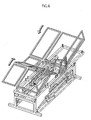
- the actuators M1 and M2 are disposed on a center beam 21A of the adjustable stage 20. (See FIG. 3 showing a top view of the bed.) Thus, by the action of the actuators M1 and M2, the bed' s profile is adjusted to bring the care recipient into a flexion posture (see FIG. 6 showing a state of the bed and FIG. 8B showing a side view of the bed).
- each of the platform members 11a-11d as well as the side members 12Ra-12Rd and 12La-12Ld are covered by wire mesh.
- the wire mesh is omitted to show the frames of the platform members 11a-11d and of the side members 12Ra-12Rd and 12La-12Ld in order to clearly illustrate the structure and operation of the bed.
- the fixed stage 30 is provided with mechanics covers 370R and 370L serving as a safety mechanism, the mechanics covers 370R and 370L are shown in FIGs. 9 and onward.
- FIGs. 6-8 showing bed operations in addition, some of the constituent elements, such as side-member support frames 24R and 24L, are omitted so as to clearly illustrate the bed operations.
- the side members 12Rc and 12Lc are located at positions corresponding to the upper-legs of the care recipient.
- the side members 12Rc and 12Lc are each provided, on the surface, with an envelope-like pocket that is approximately the same size as the side members 12Rc and 12Lc (see FIG. 8D showing a side view of the bed).
- the side members 12Rd and 12Ld located at positions corresponding to the lower-legs of the care recipient are coupled, along the edge, to fan-shaped members 13R and 13L, respectively (13R is not illustrated).
- the fan-shaped members 13R and 13L are housed in the above-mentioned pockets of the side members 12Rc and 12Lc.
- the fan-shaped members 13R and 13L come out of the pockets to support the care recipient's knees.
- the adjustable stage 20 has a rectangular frame construction formed from the center beam 21A, side beams 21R and 21L, and two parallel frames each connecting the respective ends of the center and side beams.
- the side beams 21R and 21L are provided with rollers 200, 201, 202, and 203 allowing sliding movement of the side beams 21R and 21L along a roller slide frame 300 in the direction of y (the roller 203 is hidden beneath the bed frame 10).
- the side beam 21R of the adjustable stage 20 is provided with a pair of bars 22R and 23R extending along the side beam 21R, as well as with connecting bars 231R and 232R.
- the pair of bars 22R and 23R and the connecting bars 231R and 232R together constitute a ladder-like side-member support frame 24R.
- the side beam 21L is provided with a ladder-like side-member support frame 24L constituted of a pair of bars 22L and 23L extending along the side frame 21L, as well as of connecting bars 231L and 232L.
- the bars 22R, 23R, 22L, and 23L each have bends defining a concave along its lengthwise direction.
- the concaves are formed at positions where the side members 12Rb and 12Lb engage against the side-member support frames 24R and 24L, respectively. Consequently, the side member 12Rb fits within the concave (see FIG. 3 showing the top view of bed). Being fit within the respective concaves, the side members 12Rb and 12Lb obstruct neither the side members 12Ra and 12La nor the side members 12Rc and 12Lc in the thickness directions even when bed frame 10 is adjusted to the flexion position.
- the bar 22R is coupled to the side beam 21R by couplers 236Ra and 236Rb
- the bar 22L is coupled to the side beam 21L by couplers 236La and 236Lb.
- the bars 22R and 22L are allowed to freely rotate on their axes while remaining secured to the side beams 21R and 21L.
- the side-member support frames 24R and 24L By rotating the side-member support frames 24R and 24L on the axes of the rotating bars 22R and 22L to a vertical position (in the z direction), the side members 12Ra-12Rd and 12La-12Ld are pushed upward to a risen position.
- FIGs. 2A-2C are schematic sectional views of the adjustable stage 20 and the bed frame 10, taken laterally across the lower-back member 11c to illustrate the operations of the actuators.
- the adjustable stage 20 is provided with the above-described actuators M1 and M2 for changing the profile of the bed frame 10.
- the adjustable stage 20 is provided with direct-acting actuators M3R andM3L disposed in laterally symmetric relation to the center beam 21A.
- the actuators M3R and M3L are disposed on the right and left of the y direction correspondingly to the couplers 236Ra and 236La.
- each shaft of the actuators M3R and M3L is respectively coupled to the L-shaped members 235R and 235L, which are hung from the respective rotating bars 22R and 22L.
- the L-shaped members 235R and 235L and the bars 23R and 23L rotate on the rotating bars 22R and 22L.
- the side-member support frames 24R and 24L rise from the horizontal surface of the bed to form a right angle with respect to the bed surface (FIGs. 2A ⁇ 2B ⁇ 2C).
- stage bars 27R and 27L are provided on the underside of the side beams 21R and 21L.
- stage-bar receives 36R and 36L On the fixed stage 30 are provided stage-bar receives 36R and 36L having a U-shaped cross section to receive the stage bars 27R and 27L, respectively.
- Reverse L-shape pawls are disposed inside each of the stage-bar bearings 36R and 36L along the width-wise direction. The pawls engage around the stage bars 27R and 27L received in the stage-bar bearings 36R and 36L, so that the adjustable stage 20 is fixed against the vertical movement. Yet, when the adjustable stage 20 is tilted, one of the stage bars 27R and 27L are lifted and detached from the respective one of the stage-bar bearings 36R and 36L.
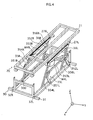
- FIG. 4 is an oblique view of the fixed stage 30.
- the fixed stage 30 is provided with a rectangular frame 31.
- One of a pair of shorter opposite sides of the rectangular frame 31 constitutes the roller slide frame 300 along which the rollers 200-203 of the adjustable stage 20 slide back and forth.
- Side beams 32R and 32L of the fixed stage 30 constitute sliding channels substantially defining a laterally oriented U-shape in cross section with their openings facing each other.
- Support arms 354R and 356R are both coupled at one end to the stage-bar bearings 36R, and to the side beam 32R at the other end in a manner freely slidable along the side beam 32R.
- support arms 354L and 356L are both coupled at one end to the stage-bar bearing 36L, and to the side beam 32L at the other end in a manner freely slidable along the side beam 32L.
- the support arms 354R, 356R, 354L, and 356L are separately linked to reverse L-shaped rotating arms 351R, 352R, 351L, and 352L.
- the rotating arms 351R, 352R, 351L, and 352L are coupled at one end to the side beams 32R and 32L, and also to horizontal links 353R and 353L the other end.
- An actuator M4R is disposed at an angle between the stage-bar bearing 36R and the horizontal link 353R.
- an actuator M4L is disposed at an angle between the stage-bar bearing 36L and the horizontal link 353L.
- parallelogram mechanisms 35R and 35L are constituted one on each lateral side of the fixed stage 30.
- the rotating arms 351R, 352R, 351L, and 352L make a circular motion about the linked points on the side beams 32R and 32L.
- the ends of the support arms 354R, 356R, 354L, and 356L move back and forth within the grooves of the side beams 32R and 32L.
- the adjustable stage 20 as well as the bed frame 10 supported by the stage-bar bearings 36R and 36L vertically moves away from or toward the right and left sides of fixed stage 30. That is to say, the bed 1 is capable of up and down movement within a narrow space and is of a space-saving configuration.
- the rollers 200-203 and the parallelogram mechanisms 35R and 35L enable the postural change operations without requiring much space.
- the bed 1 By driving one of the parallelogram mechanisms 35R and 35L at a time for the movement of either of the side beams 32R and 32L, the bed 1 is adjusted its profile for the postural change from a supine posture to a lateral side-lying posture. On the other hand, driving both the parallelogram mechanisms 35R and 35L at the same time, the High/Low operation of the bed 1 is carried out.
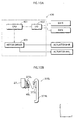
- the drive of the actuators M1, M2, M3R, andM3L are controlled by a motor driver 403 and a CPU 401 provided with in a control unit 400, all of which are described later.
- the drive setting including pre-programming may be made automatically or manually by the caregiver using a controller (not illustrated) at hand. Furthermore, with the use of a remote controller of an infrared, wired, or wireless type, the drive setting may be made by the care recipient.
- the structure of the adjustable bed 1 described above 1 is one example.
- the mechanics covers 370R and 370L which are a feature of the present invention, may be applied to an adjustable bed having a different structure.
- the adjustable bed having the above structure is put to actual use with a mattress overlaid on the bed frame 10.
- the detailed description of the mattress is described later in detail.
- the platform members 11a-11d and the side members 12Ra-12Rd and 12La-12Ld are all disposed substantially horizontal and together constitute a bed surface, as shown in FIG. 1.
- a user selects and executes on the controller a menu for a postural change from a supine and flexion posture to a left side-lying and flexion posture.
- the actuator M3L attached to the adjustable stage 20 is activated and extends its shaft.
- the bar 23L and the L-shaped member 235L coupled to the end of the shaft rotate about the rotating bar 22L.
- the side-member support frame 24L comes to rise and form a right angle with respect to the horizontal bed surface.
- the direct-acting actuators M1 and M2 attached to the center beam 21A of the adjustable stage 20 extend their shafts, thereby separately pushing, via the L-shaped couplers 211 and 212, the upper-body member 11a and the lower-back member 11c of the bed frame 10 from the rear.
- the bed is adjusted to a position for the care recipient to be in a flexion posture with the upper body raised and the knees up (see FIG. 6 showing an oblique view of the bed in the flexion position; and FIGs. 8A ⁇ 8B showing side views of the bed in this state).
- the side members 12La-12Ld also change their positions accordingly.
- the fan-shaped members 13L comes out from the pocket of the side member 12Lc to support parts of the mattress around the care recipient' s knees (see FIGs. 8C ⁇ 8D showing side views of the bed in this state).
- the actuator M4R disposed on the side beam 32R of the fixed stage 30 then extends its shaft to widen the distance between the stage-bar bearing 36R and the horizontal link 353R.
- the support arms 354R and 356R slide in the sliding groove of the side beam 32R to a more upright position.
- the parallelogram mechanism 35R works.
- the two support arms 354R and 356R or 354L and 356L come to vertically lift the right side of the adjustable stage 20 in response to the circular motion of the two rotating arms 351R and 352R or 351L and 352L.
- the right side of the adjustable stage 20 is vertically lifted to a level higher than the fixed stage 30, thereby causing the rollers 201-204 to run on the roller slide frame 300. Consequently, the bed frame 10 downwardly inclines toward the side beam 32L of the fixed stage 30, i.e. toward the left side of the bed (see FIG. 7 showing the bed in the inclined state).
- the inclination angle of the bed to the horizontal surface falls within the range of about 30° to 70°, for example about 50°.
- the care recipient is assisted to smoothly change the posture from a supine to a lateral position while being supported by the platform members 11a-11d and the side members 12La-12Ld, after firstly being placed in a supine flexion position with the upper body raised and the knees flexed.
- the above postural change is smoothly carried out as if the care recipient' body rolls along the hands of caregiver put to support the care recipient.
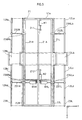
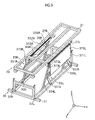
- FIG. 9 is a view showing the adjustable bed provided with a safety mechanism. More specifically, the figure shows the structure around the fixed stage of the bed.
- the parallelogram mechanisms 35R and 35L are provided with the mechanics cover 370R and 370L, respectively.
- Each mechanics cover is shaped like a plate and covers the respective parallelogram mechanism from outside.
- each of the mechanics covers 370R and 370L is made of a styrene board.
- the mechanics cover 370R is attached to the stage-bar bearing 36R by engagement between U-shaped metal pieces 372R and 373R (not illustrated).
- the mechanics cover 370L is attached to the stage-bar bearing 3 6L by engagement between U-shapedmetal pieces 372L and 373L.
- the mechanics covers 370R and 370L are hung upon the respective stage-bar bearings 36R and 36L along the lengthwise direction.
- a safety switch is provided between each pair of engaging metal pieces 372R and 373R as well as 372L and 372R.
- micro switches MSR and MSL are disposed between the respective pairs of metal pieces.
- the state of the micro switches MSR and MSL (SW R and SW L) is monitored by the CPU 401 via the I/O 402 of the control unit 400.
- the micro switches MSR and MSL are in ON state under the weight of the mechanics covers 370R and 370L.
- any foreignobject an armof the caregiver, for example
- lifts either of the mechanics covers 370R and 370L from underneath a corresponding one of the metal piece pairs is disengaged.
- the CPU 401 of the control unit 400 stops the drive of the actuators M4R and M4L in the parallelogram mechanisms 35R and 35L.
- the mechanics covers 370R and 370L function as elements triggering the ON/OFF state changeover of the micro switches MSR and MSL.
- the actuators M1 and M2 which are driven to change the bed to a Gatch position, are also made to stop.
- the micro switches MSR and MSL are employed in this example, other types of switches are applicable, including a push switch, a lever switch, and a slide switch.
- the drive of the bed is immediately suspended in the case where the caregiver, care recipient, or family member accidentally places his hand in or around the parallelogram mechanisms while the bed is being driven. It is because when either of the mechanics covers 370R and 370L is lifted as a result of a contact with the hand, the pair of U-shapedmetal pieces 372R and 373R or 372L and 373L is disengaged.
- the adjustable bed ensures significantly improved safety.
- the provision of the mechanics covers 370R and 370L offers a safety measurement to prevent that the caregiver, the care recipient, or a family member accidentally places a part of the body (a limb, for example) inside the bed to reach the moving parts, such as the parallelogram mechanisms 35R and 35L.
- the provision of the mechanics covers 370R and 370L serves to hide the moving parts, such as the parallelogram mechanisms 35R and 35L, from view.
- the present invention is not limited to the above configuration of suspending the drive of the bed upon disengagement of the pair of U-shaped metal pieces 372R and 373R or 372L and 373L.
- the present invention may be configured so as to switch off the drive of the parallelogram mechanisms 35R and 35L based on the detection signal from the micro switches, at the time when the pair of U-shaped metal pieces is lifted.
- the present invention is not limited to the configuration employing the U-shaped metal pieces 372R, 373R, 372L, and 373L. Any configuration is applicable as long as the displacement of mechanics covers from the predetermined positions (where the mechanics covers are normally hung on) is detected, and the parallelogram mechanisms 35R and 35L are switched off in response to the detection signal.
- the mechanics covers 370R and 370L cover the parallelogram mechanisms 35R and 35L, as shown in FIG. 9.
- the mechanics covers 370R and 370L may be as large in lengthwise as the adjustable stage 20 in the direction X.
- the above description is directed to the example in which the mechanics covers composed of styrene boards are disposed to cover the moving parts including the parallelogram mechanisms 35R and 35L from outside.
- the mechanics covers 370R and 370L may be composed of metallic or plastic frames (the overall size of the frames is preferably equal to the mechanics covers 370R and 370L as in the above example).
- a lattice or a plate made of a translucent resin may be applicable.
- the material and configuration of the mechanics covers 370R and 370L may be suitably altered.
- the above example is directed to the case where the micro switches MSR and MSL are arranged between the pairs of the U-shaped metal pieces 372R and 372L as well as 373L and 373R that in turn arranged at the upper part of the parallelogram mechanisms 35R and 35L.
- the micro switches MSR and MSL may be arranged on any of the following elements 353R and 353L, 354R and 354L and 356R and 356L.
- the micro switches MSR and MSL may be each provided with a pole-like member or wire-like member as the triggering mechanism used in conjunction with, for example, the above-described U-shape metal pieces.
- the above embodiment 1 is directed to the bed structure employing the parallelogram mechanisms. Yet, the present invention is not limited to such a structure, and the adjustable bed may be of another structure as follows.
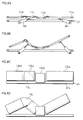
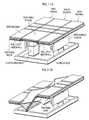
- An adjustable bed shown in FIG. 11A is provided with vertically disposed direct-acting actuators. Using elevating mechanisms, either of left and right side members is moved up or down, thereby inclining a platform placed on an adjustable stage.
- the bed is provided with a rectangular frame serving as a fixed stage, and a pair of direct-acting actuators having columnar shape. On the top of the actuators is provided a bed frame supported by a flexible frame.
- the platform of the bed is constituted by coupling a plurality of platform members, so as to receive the upper body, lower back, upper leg, and lower leg regions of the care recipient's body.
- the one receiving the lower back of the care recipient's body is securely fixed to the platform frame serving as the movable frame.
- a driving unit for driving an actuator mechanism used to change the bed to a flexion position.
- the mechanics covers serving as a safety mechanism according to the present invention are disposed along a lateral side of each columnar actuator.
- side members of the bed are disposed on the top of the columnar actuators.
- the side members each have a housing slot formed therein, and a pullout wall is housed in each housing slot.
- the pullout walls are coupled to each other along a lengthwise direction of the bed.
- the side members are coupled to the adjustable stage via the respective pullout walls.
- Each pullout wall is biased toward inside the housing slot by a tension spring, for example. When the force puling out the pullout walls weakens, the pullout walls are automatically retracted back into the housing slots.
- the coupledplatform is first changed its profile to a flexion position, as shown in FIG. 11B. Then, one of the columnar actuators starts operating to descend either right or left side members. As a result, the adjustable stage, as well as the coupled platform, is laterally inclined. On the downwardly inclined lateral side of the adjustable stage, the pullout walls are pulled out from the housing slots to rise relatively to the coupled platform. In other words, the pullout walls are hung from the coupled platform so as to form a smaller angle therebetween. Correspondingly to the above profile change, the side members come to rise relative to the surface of the platform.
- the care recipient is suitably supported from the side by the pullout walls while in a flexion posture, thereby assisting the postural change as effectively as the embodiment 1.
- the mechanics covers operate just as in the embodiment 1 and provide a suitable safety mechanism.
- the micro switches are normally ON, and turned OFF upon detection of a foreign object.
- the present invention is not limited to the above structure.
- the micro switches may be normally OFF, and turned ON upon detection of a foreign object.
- the ON/OFF state of the micro switches may be adapted to either way, depending on the circuitry configuration.
- the CPU 401 controls the drive of the actuators.
- the drive control may be carried out without a CPU through the hardware structure (for example, a structure that interrupts the power supply to the driving systems such as the actuators when any of the micro switches are tuned OFF)
- the adjustable bed according to the present invention is suitably used as a nursing care bed or a reclining bed.
Landscapes
- Health & Medical Sciences (AREA)
- Nursing (AREA)
- General Health & Medical Sciences (AREA)
- Life Sciences & Earth Sciences (AREA)
- Animal Behavior & Ethology (AREA)
- Public Health (AREA)
- Veterinary Medicine (AREA)
- Invalid Beds And Related Equipment (AREA)
Applications Claiming Priority (3)
| Application Number | Priority Date | Filing Date | Title |
|---|---|---|---|
| JP2002251233 | 2002-08-29 | ||
| JP2002251233 | 2002-08-29 | ||
| PCT/JP2003/010730 WO2004026211A1 (ja) | 2002-08-29 | 2003-08-26 | 可動ベッド |
Publications (2)
| Publication Number | Publication Date |
|---|---|
| EP1541108A1 true EP1541108A1 (de) | 2005-06-15 |
| EP1541108A4 EP1541108A4 (de) | 2008-03-05 |
Family
ID=32024495
Family Applications (1)
| Application Number | Title | Priority Date | Filing Date |
|---|---|---|---|
| EP03797526A Withdrawn EP1541108A4 (de) | 2002-08-29 | 2003-08-26 | Bewegliches bett |
Country Status (6)
| Country | Link |
|---|---|
| US (1) | US20060085913A1 (de) |
| EP (1) | EP1541108A4 (de) |
| JP (1) | JPWO2004026211A1 (de) |
| KR (1) | KR20050034743A (de) |
| TW (1) | TWI235056B (de) |
| WO (1) | WO2004026211A1 (de) |
Cited By (3)
| Publication number | Priority date | Publication date | Assignee | Title |
|---|---|---|---|---|
| EP2095744A1 (de) * | 2008-02-28 | 2009-09-02 | SHL Group AB | Bett |
| ITRM20090184A1 (it) * | 2009-04-22 | 2010-10-23 | Alberto Costantini | Rete a ribalta per letto sospeso |
| FR3051112A1 (fr) * | 2016-05-12 | 2017-11-17 | Telecom Sante | Procede et dispositif de pilotage d'un lit motorise |
Families Citing this family (36)
| Publication number | Priority date | Publication date | Assignee | Title |
|---|---|---|---|---|
| JP2003310668A (ja) * | 2002-02-22 | 2003-11-05 | Sanyo Electric Co Ltd | 可動ベッド |
| US7469306B2 (en) * | 2002-06-28 | 2008-12-23 | Nxp B.V. | Method for communicating with first and second device that includes reference to metadata wherein third device modifies the metadata based on specific operations by first device |
| JP3960885B2 (ja) * | 2002-08-21 | 2007-08-15 | 三洋電機株式会社 | 可動ベッド用マット |
| US8091164B2 (en) * | 2003-10-06 | 2012-01-10 | Olympus Corporation | Introduction-assisting apparatus for capsule medical device |
| KR100621349B1 (ko) | 2006-05-12 | 2006-09-07 | 주식회사 해피베드 | 분할된 등받이부의 각도 조절이 가능한 환자용 침대 |
| KR100621350B1 (ko) * | 2006-05-12 | 2006-09-07 | 주식회사 해피베드 | 하지 관절 운동이 가능한 작동구조를 갖는 환자용 침대 |
| KR100661870B1 (ko) | 2006-05-12 | 2006-12-27 | 주식회사 해피베드 | 밀림방지구조를 갖는 각도 조절식 환자용 침대 |
| DE202007017534U1 (de) * | 2007-12-13 | 2009-04-23 | Dewert Antriebs- Und Systemtechnik Gmbh | Elektromotorischer Möbel-Doppelantrieb |
| JP5566079B2 (ja) * | 2009-11-02 | 2014-08-06 | 株式会社モルテン | 昇降式ベッド |
| WO2011155769A2 (ko) * | 2010-06-09 | 2011-12-15 | 한국생산기술연구원 | 사용자 체형에 따라 회전축을 가변시킬 수 있는 욕창방지용 전동침대 플랫폼 및 이의 자세변환주기 제어방법 |
| WO2012092513A1 (en) * | 2010-12-29 | 2012-07-05 | Malakhov Mikhail | Devices and systems for supporting a user |
| CN104000701B (zh) * | 2013-02-25 | 2016-12-28 | 温绣蔺 | 烧伤综合治疗床 |
| US9572735B2 (en) * | 2013-03-15 | 2017-02-21 | Kap Medical, Inc. | Bed systems and method |
| CN104207900B (zh) * | 2013-05-31 | 2016-08-31 | 姚聪 | 医用创面治疗床 |
| US10188569B2 (en) | 2013-09-06 | 2019-01-29 | Stryker Corporation | Patient support usable with bariatric patients |
| GB2584802B (en) | 2013-09-06 | 2021-04-07 | Stryker Corp | Patient support usable with bariatric patients |
| US9049942B2 (en) * | 2013-11-05 | 2015-06-09 | Apex Health Care Mfg. Inc. | Movable bed |
| JP6734012B2 (ja) * | 2014-06-25 | 2020-08-05 | 川崎重工業株式会社 | 介護用ベッド |
| EP3777808B1 (de) | 2014-11-13 | 2023-10-25 | Kap Medical, Inc. | Bettsysteme |
| US9648961B1 (en) * | 2015-02-16 | 2017-05-16 | Angela Laverne Lovely | Translocatable child care changing station |
| JP5982662B1 (ja) * | 2015-10-06 | 2016-08-31 | 林金属工業株式会社 | 介護用ベッド |
| DK178773B1 (en) * | 2016-04-06 | 2017-01-16 | Gdv Tech Aps | Bed system that can be attached to a hospital bed |
| US11241346B1 (en) | 2016-06-07 | 2022-02-08 | Albert F. Haas | Portable body positioning bed frame assembly |
| US10842701B2 (en) | 2016-10-14 | 2020-11-24 | Stryker Corporation | Patient support apparatus with stabilization |
| US10881567B2 (en) * | 2016-10-28 | 2021-01-05 | Stryker Corporation | Patient support apparatus |
| TWM540570U (zh) * | 2017-02-18 | 2017-05-01 | Ulife Healthcare Inc | 輕量化床架裝置 |
| US10441084B2 (en) * | 2017-02-18 | 2019-10-15 | Ulife Healthcare Inc. | Lightweight modular bed |
| US11039964B2 (en) | 2017-03-06 | 2021-06-22 | Stryker Corporation | Systems and methods for facilitating movement of a patient transport apparatus |
| TWM559120U (zh) * | 2018-02-01 | 2018-05-01 | Ulife Healthcare Inc | 電動傢俱床 |
| CN109745190A (zh) * | 2019-01-31 | 2019-05-14 | 青岛阿玛苏康养医疗有限公司 | 一种医用移动装置及其使用方法 |
| US11622633B2 (en) * | 2019-10-08 | 2023-04-11 | Jiahuan Liu | Multifunctional motion simulation bed |
| CA3229548A1 (en) * | 2021-09-08 | 2023-03-16 | Burling Aged Care Solutions Pty Ltd | A bed for turning patients |
| US12178769B2 (en) * | 2022-06-02 | 2024-12-31 | Life Concepts, Inc. | Adjustable hospital bed for laterally positioning a patient and related methods |
| CN115105344B (zh) * | 2022-06-28 | 2023-06-16 | 中国人民解放军空军军医大学 | 一种多功能检查床 |
| TWI803397B (zh) * | 2022-07-21 | 2023-05-21 | 施權航 | 電動床 |
| CN116059052B (zh) * | 2023-02-08 | 2023-09-19 | 厚福医疗装备有限公司 | 一种半卧位可调的大角度侧翻护理床 |
Family Cites Families (13)
| Publication number | Priority date | Publication date | Assignee | Title |
|---|---|---|---|---|
| DE2251808C3 (de) * | 1972-10-21 | 1984-09-06 | Siemens AG, 1000 Berlin und 8000 München | Zahnärztlicher Patientenstuhl mit Parallelogrammtragarm |
| US4463463A (en) * | 1980-03-28 | 1984-08-07 | Aisin Seiki Kabushiki Kaisha | Adjustable bed |
| US4470030A (en) * | 1983-05-18 | 1984-09-04 | Ledex, Inc. | Trip solenoid |
| US4534077A (en) * | 1983-10-03 | 1985-08-13 | Simmons Universal Corporation | Hospital bed having safety mechanism |
| JPS6134949U (ja) * | 1984-08-06 | 1986-03-04 | フランスベッド株式会社 | 起床式ベツド装置 |
| US4724554A (en) * | 1986-09-12 | 1988-02-16 | Standex International | Tilting patient treatment table having safety switch mat mechanism |
| GB9121217D0 (en) * | 1991-10-05 | 1991-11-20 | Smiths Industries Plc | Patient support tables |
| US5625913A (en) * | 1994-02-14 | 1997-05-06 | Singleton; William H. | Oscillatory bed |
| JPH0994271A (ja) * | 1995-10-02 | 1997-04-08 | Dream Sogo Kenkyusho:Kk | 起伏式ベッドの安全装置 |
| FR2770396B1 (fr) * | 1997-11-06 | 2000-03-10 | Sunrise Medical Sa | Lit comprenant un cadre reglable en hauteur et un dispositif de securite de descente dudit cadre |
| DE19814269C2 (de) * | 1998-03-31 | 2001-09-27 | Okin Ges Fuer Antriebstechnik | Sicherheitseinrichtung bei einem Möbel |
| US6516478B2 (en) * | 2001-05-31 | 2003-02-11 | Health & Technology, Inc. | Adjustable height bed |
| US7239906B1 (en) * | 2002-04-18 | 2007-07-03 | Fonar Corporation | Magnetic resonance imaging system including a transpolar fixture |
-
2003
- 2003-08-26 WO PCT/JP2003/010730 patent/WO2004026211A1/ja not_active Ceased
- 2003-08-26 EP EP03797526A patent/EP1541108A4/de not_active Withdrawn
- 2003-08-26 KR KR1020057003213A patent/KR20050034743A/ko not_active Withdrawn
- 2003-08-26 US US10/526,044 patent/US20060085913A1/en not_active Abandoned
- 2003-08-26 JP JP2004537536A patent/JPWO2004026211A1/ja not_active Withdrawn
- 2003-08-27 TW TW092123533A patent/TWI235056B/zh not_active IP Right Cessation
Cited By (3)
| Publication number | Priority date | Publication date | Assignee | Title |
|---|---|---|---|---|
| EP2095744A1 (de) * | 2008-02-28 | 2009-09-02 | SHL Group AB | Bett |
| ITRM20090184A1 (it) * | 2009-04-22 | 2010-10-23 | Alberto Costantini | Rete a ribalta per letto sospeso |
| FR3051112A1 (fr) * | 2016-05-12 | 2017-11-17 | Telecom Sante | Procede et dispositif de pilotage d'un lit motorise |
Also Published As
| Publication number | Publication date |
|---|---|
| JPWO2004026211A1 (ja) | 2006-01-12 |
| KR20050034743A (ko) | 2005-04-14 |
| TWI235056B (en) | 2005-07-01 |
| TW200404529A (en) | 2004-04-01 |
| WO2004026211A1 (ja) | 2004-04-01 |
| US20060085913A1 (en) | 2006-04-27 |
| EP1541108A4 (de) | 2008-03-05 |
| WO2004026211B1 (ja) | 2004-05-13 |
Similar Documents
| Publication | Publication Date | Title |
|---|---|---|
| EP1541108A1 (de) | Bewegliches bett | |
| JP3960885B2 (ja) | 可動ベッド用マット | |
| US10874567B2 (en) | Patient bed having footboard pedal apparatus for physical therapy | |
| EP2583652B1 (de) | Intelligentes krankenhausbett | |
| EP1486191A1 (de) | Bewegliches bett | |
| WO2004021955A1 (ja) | 可動ベッド | |
| KR101227967B1 (ko) | 의료용 욕창방지 침대 | |
| EP0813853B1 (de) | Bettvorrichtung | |
| US20120153687A1 (en) | Bed, and combining method and separating method of bed | |
| US20190150627A1 (en) | Bed device | |
| EP3574880A1 (de) | Bettvorrichtung | |
| KR101224447B1 (ko) | 틸팅기능을 구비한 전동식 의료용침대 | |
| JP2001293037A (ja) | 可動ベッド | |
| EP1266597A1 (de) | Gelenkiges Bett | |
| JP2002125807A (ja) | 挟まれ防止機能を有する床部昇降機構を備えたベッド | |
| JP3610451B2 (ja) | ベッド | |
| JP2004097239A (ja) | 可動ベッド | |
| JP2019110976A (ja) | ベッド装置 | |
| JP2019058575A (ja) | ベッド装置 | |
| CA3224736A1 (en) | Patient support apparatus with deck section lift-off limiter | |
| CN121511067A (zh) | 用于患者支承设备的第五从动轮的展开与缩回的控制组件 | |
| JPH08266573A (ja) | 座椅子装置 | |
| JPH08154978A (ja) | ベッド | |
| HK1072711A (en) | Movable bed |
Legal Events
| Date | Code | Title | Description |
|---|---|---|---|
| PUAI | Public reference made under article 153(3) epc to a published international application that has entered the european phase |
Free format text: ORIGINAL CODE: 0009012 |
|
| 17P | Request for examination filed |
Effective date: 20050323 |
|
| AK | Designated contracting states |
Kind code of ref document: A1 Designated state(s): AT BE BG CH CY CZ DE DK EE ES FI FR GB GR HU IE IT LI LU MC NL PT RO SE SI SK TR |
|
| RBV | Designated contracting states (corrected) |
Designated state(s): DE ES GB |
|
| A4 | Supplementary search report drawn up and despatched |
Effective date: 20080206 |
|
| STAA | Information on the status of an ep patent application or granted ep patent |
Free format text: STATUS: THE APPLICATION IS DEEMED TO BE WITHDRAWN |
|
| 18D | Application deemed to be withdrawn |
Effective date: 20080507 |