EP1547778B1 - Tintenstrahlkopf, Ansteuerverfahren dafür und Tintenstrahlaufzeichnungsgerät - Google Patents
Tintenstrahlkopf, Ansteuerverfahren dafür und Tintenstrahlaufzeichnungsgerät Download PDFInfo
- Publication number
- EP1547778B1 EP1547778B1 EP04030115A EP04030115A EP1547778B1 EP 1547778 B1 EP1547778 B1 EP 1547778B1 EP 04030115 A EP04030115 A EP 04030115A EP 04030115 A EP04030115 A EP 04030115A EP 1547778 B1 EP1547778 B1 EP 1547778B1
- Authority
- EP
- European Patent Office
- Prior art keywords
- film
- ink jet
- heat
- jet head
- thickness
- Prior art date
- Legal status (The legal status is an assumption and is not a legal conclusion. Google has not performed a legal analysis and makes no representation as to the accuracy of the status listed.)
- Expired - Lifetime
Links
- 238000000034 method Methods 0.000 title claims description 22
- 239000010408 film Substances 0.000 claims description 215
- 238000009825 accumulation Methods 0.000 claims description 55
- 238000009413 insulation Methods 0.000 claims description 42
- 239000010409 thin film Substances 0.000 claims description 21
- VYPSYNLAJGMNEJ-UHFFFAOYSA-N Silicium dioxide Chemical compound O=[Si]=O VYPSYNLAJGMNEJ-UHFFFAOYSA-N 0.000 claims description 18
- 238000007599 discharging Methods 0.000 claims description 9
- 229910052681 coesite Inorganic materials 0.000 claims description 8
- 229910052906 cristobalite Inorganic materials 0.000 claims description 8
- 239000000377 silicon dioxide Substances 0.000 claims description 8
- 229910052682 stishovite Inorganic materials 0.000 claims description 8
- 229910052905 tridymite Inorganic materials 0.000 claims description 8
- 229910000510 noble metal Inorganic materials 0.000 claims description 7
- 239000000758 substrate Substances 0.000 claims description 5
- 229910045601 alloy Inorganic materials 0.000 claims description 4
- 239000000956 alloy Substances 0.000 claims description 4
- 239000005380 borophosphosilicate glass Substances 0.000 claims description 3
- 229910052814 silicon oxide Inorganic materials 0.000 claims description 2
- 239000010410 layer Substances 0.000 description 66
- 230000005587 bubbling Effects 0.000 description 41
- 238000004088 simulation Methods 0.000 description 20
- 230000003247 decreasing effect Effects 0.000 description 19
- 239000000463 material Substances 0.000 description 19
- 238000012546 transfer Methods 0.000 description 18
- 238000010292 electrical insulation Methods 0.000 description 8
- 230000000694 effects Effects 0.000 description 6
- 230000008859 change Effects 0.000 description 5
- 230000004907 flux Effects 0.000 description 5
- 238000006243 chemical reaction Methods 0.000 description 4
- 238000004140 cleaning Methods 0.000 description 4
- 239000011229 interlayer Substances 0.000 description 4
- 238000004519 manufacturing process Methods 0.000 description 4
- XUIMIQQOPSSXEZ-UHFFFAOYSA-N Silicon Chemical compound [Si] XUIMIQQOPSSXEZ-UHFFFAOYSA-N 0.000 description 3
- 239000007788 liquid Substances 0.000 description 3
- 229910052710 silicon Inorganic materials 0.000 description 3
- 239000010703 silicon Substances 0.000 description 3
- XLYOFNOQVPJJNP-UHFFFAOYSA-N water Substances O XLYOFNOQVPJJNP-UHFFFAOYSA-N 0.000 description 3
- 229910000838 Al alloy Inorganic materials 0.000 description 2
- 238000003763 carbonization Methods 0.000 description 2
- 239000000470 constituent Substances 0.000 description 2
- 238000000151 deposition Methods 0.000 description 2
- 238000013461 design Methods 0.000 description 2
- 238000010586 diagram Methods 0.000 description 2
- 238000009826 distribution Methods 0.000 description 2
- 230000020169 heat generation Effects 0.000 description 2
- 239000000203 mixture Substances 0.000 description 2
- 230000008569 process Effects 0.000 description 2
- 239000002356 single layer Substances 0.000 description 2
- 229910016570 AlCu Inorganic materials 0.000 description 1
- 229910004200 TaSiN Inorganic materials 0.000 description 1
- 229910052782 aluminium Inorganic materials 0.000 description 1
- XAGFODPZIPBFFR-UHFFFAOYSA-N aluminium Chemical compound [Al] XAGFODPZIPBFFR-UHFFFAOYSA-N 0.000 description 1
- 238000009835 boiling Methods 0.000 description 1
- 230000015556 catabolic process Effects 0.000 description 1
- 239000000919 ceramic Substances 0.000 description 1
- 238000005229 chemical vapour deposition Methods 0.000 description 1
- 238000004891 communication Methods 0.000 description 1
- 238000006731 degradation reaction Methods 0.000 description 1
- 230000008021 deposition Effects 0.000 description 1
- 238000005137 deposition process Methods 0.000 description 1
- 238000011161 development Methods 0.000 description 1
- 230000018109 developmental process Effects 0.000 description 1
- 239000006185 dispersion Substances 0.000 description 1
- 230000001747 exhibiting effect Effects 0.000 description 1
- 239000004744 fabric Substances 0.000 description 1
- 239000000835 fiber Substances 0.000 description 1
- 230000006870 function Effects 0.000 description 1
- 239000011521 glass Substances 0.000 description 1
- 230000009545 invasion Effects 0.000 description 1
- 230000033001 locomotion Effects 0.000 description 1
- 230000015654 memory Effects 0.000 description 1
- 229910052751 metal Inorganic materials 0.000 description 1
- 239000002184 metal Substances 0.000 description 1
- 239000007769 metal material Substances 0.000 description 1
- 230000003647 oxidation Effects 0.000 description 1
- 238000007254 oxidation reaction Methods 0.000 description 1
- 239000004033 plastic Substances 0.000 description 1
- 238000003825 pressing Methods 0.000 description 1
- 238000012545 processing Methods 0.000 description 1
- 238000011084 recovery Methods 0.000 description 1
- 238000004904 shortening Methods 0.000 description 1
- 238000006467 substitution reaction Methods 0.000 description 1
- 239000002023 wood Substances 0.000 description 1
Images



Classifications
-
- B—PERFORMING OPERATIONS; TRANSPORTING
- B41—PRINTING; LINING MACHINES; TYPEWRITERS; STAMPS
- B41J—TYPEWRITERS; SELECTIVE PRINTING MECHANISMS, i.e. MECHANISMS PRINTING OTHERWISE THAN FROM A FORME; CORRECTION OF TYPOGRAPHICAL ERRORS
- B41J2/00—Typewriters or selective printing mechanisms characterised by the printing or marking process for which they are designed
- B41J2/005—Typewriters or selective printing mechanisms characterised by the printing or marking process for which they are designed characterised by bringing liquid or particles selectively into contact with a printing material
- B41J2/01—Ink jet
- B41J2/135—Nozzles
- B41J2/14—Structure thereof only for on-demand ink jet heads
- B41J2/14016—Structure of bubble jet print heads
- B41J2/14088—Structure of heating means
- B41J2/14112—Resistive element
- B41J2/14129—Layer structure
-
- B—PERFORMING OPERATIONS; TRANSPORTING
- B41—PRINTING; LINING MACHINES; TYPEWRITERS; STAMPS
- B41J—TYPEWRITERS; SELECTIVE PRINTING MECHANISMS, i.e. MECHANISMS PRINTING OTHERWISE THAN FROM A FORME; CORRECTION OF TYPOGRAPHICAL ERRORS
- B41J2/00—Typewriters or selective printing mechanisms characterised by the printing or marking process for which they are designed
- B41J2/005—Typewriters or selective printing mechanisms characterised by the printing or marking process for which they are designed characterised by bringing liquid or particles selectively into contact with a printing material
- B41J2/01—Ink jet
- B41J2/015—Ink jet characterised by the jet generation process
- B41J2/04—Ink jet characterised by the jet generation process generating single droplets or particles on demand
- B41J2/045—Ink jet characterised by the jet generation process generating single droplets or particles on demand by pressure, e.g. electromechanical transducers
- B41J2/04501—Control methods or devices therefor, e.g. driver circuits, control circuits
- B41J2/04538—Control methods or devices therefor, e.g. driver circuits, control circuits involving calculation of heater resistance
-
- B—PERFORMING OPERATIONS; TRANSPORTING
- B41—PRINTING; LINING MACHINES; TYPEWRITERS; STAMPS
- B41J—TYPEWRITERS; SELECTIVE PRINTING MECHANISMS, i.e. MECHANISMS PRINTING OTHERWISE THAN FROM A FORME; CORRECTION OF TYPOGRAPHICAL ERRORS
- B41J2/00—Typewriters or selective printing mechanisms characterised by the printing or marking process for which they are designed
- B41J2/005—Typewriters or selective printing mechanisms characterised by the printing or marking process for which they are designed characterised by bringing liquid or particles selectively into contact with a printing material
- B41J2/01—Ink jet
- B41J2/135—Nozzles
- B41J2/14—Structure thereof only for on-demand ink jet heads
- B41J2002/14387—Front shooter
-
- B—PERFORMING OPERATIONS; TRANSPORTING
- B41—PRINTING; LINING MACHINES; TYPEWRITERS; STAMPS
- B41J—TYPEWRITERS; SELECTIVE PRINTING MECHANISMS, i.e. MECHANISMS PRINTING OTHERWISE THAN FROM A FORME; CORRECTION OF TYPOGRAPHICAL ERRORS
- B41J2/00—Typewriters or selective printing mechanisms characterised by the printing or marking process for which they are designed
- B41J2/005—Typewriters or selective printing mechanisms characterised by the printing or marking process for which they are designed characterised by bringing liquid or particles selectively into contact with a printing material
- B41J2/01—Ink jet
- B41J2/135—Nozzles
- B41J2/14—Structure thereof only for on-demand ink jet heads
- B41J2002/14403—Structure thereof only for on-demand ink jet heads including a filter
Definitions
- the present invention relates to a method for driving an ink jet head and an ink jet recording apparatus, which discharge ink according to an ink jet method to perform recording onto a recording medium, particularly relates to the method for driving an ink jet head and the ink jet recording apparatus, which utilize heat energy in order to discharge the ink.
- the term of "recording” shall mean not only to provide an image, such as characters and drawings, having a meaning to a recording medium, but also to provide the image, such as patterns, having no meaning to the recording medium.
- recording apparatuses are used for a printer, a copying machine, a facsimile with a communication system, apparatus such as a word processor with a printer unit, and a recording apparatus combined with various processing apparatus.
- These recording apparatuses perform the recording to a recording medium such as paper, a string, fiber, cloth, metal, plastic, glass, wood, and ceramic.
- a recording medium such as paper, a string, fiber, cloth, metal, plastic, glass, wood, and ceramic.
- High-speed recording, high resolution, high image quality, low noise, and the like are demanded for the recording apparatuses.
- An ink jet recording apparatus can be cited as an example of the recording apparatus responding to such demands.
- an ink jet head having a discharge port is used to eject an ink (recording solution) droplet, and the ink droplet adheres to the recording medium to perform the recording. Because the ink jet head is not in contact with the recording medium in the ink jet recording apparatus, extremely stable recording image can be obtained.
- the ink jet head which utilizes heat energy to discharge the ink can array many discharge ports in high density. Therefore, the ink jet head which utilizes heat energy to discharge the ink has advantages that high-resolution recording can be performed and the downsizing can easily be achieved.
- the high density is achieved by arraying a plurality of heat generating members in line on a base body such as silicon, and a common heat accumulation layer and a common electrical insulation film are formed for the plurality of heat generating members (see Japanese Patent Application Laid-Open No. 2001-171127 and related document EP 1090763 A2 as well as Japanese Patent Application Laid-Open No. 2002-11886 ).
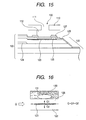
- Fig. 15 is a schematic sectional view showing a heat generating member (heater) of the conventional ink jet head which utilizes the heat energy.
- an ink jet head 100 has a base body 120 in which a heat generating member 123 is formed and a nozzle material 110 which is connected onto the base body 120.
- the base body 120 has a heat accumulation layer 122 in which a plurality of layers such as a thermal oxide film are formed on a surface of a silicon substrate, the heat generating member 123 which is partially formed on the heat accumulation layer 122, electrode wirings 124 and 125 which supplied electric power to the heat generating member 123, an electrical insulation film 126 which is formed so that the heat generating member 123 and the heat accumulation layer 122 are covered with the electrical insulation film 126, and a cavitation-resistant film 127 which is formed on the electrical insulation film 126 and made of Ta.
- Both the electrical insulation film 126 and the cavitation-resistant film 127 constitute a protection film 128.
- the nozzle material 110 is bonded to the base body 120 to form a liquid path including an ink chamber 112 located above the heat generating member 123.
- a discharge port 111 is formed at an opposite position to the heat generating member 123.
- the ink chamber 112 is filled with the ink, and the heat generating member 123 is heated by applying voltage to the heat generating member 123 through the electrode wirings 124 and 125.
- the ink in the ink chamber 112 is abruptly heated to generate film boiling by heat generation of the heat generating member 123. Therefore, a bubble is generated in the ink, and the ink is discharged from the discharge port 111 by pressure based on growth of the bubble.
- heat quantity Q is applied to the heat generating member 123 by energizing the heat generating member 123.
- the heat quantity Q is vertically dispersed to become heat quantities Q1 and Q2.
- the heat quantity Q1 dispersed upward is transferred to ink 130 on the protection film 128 formed by the electrical insulation film and the cavitation-resistant film. This allows a bubble 131 to be generated in the ink 130 to perform the discharge as described above.
- An object of the invention is to optimize heat transfer efficiency to the ink while insulation reliability of the protection film is not decreased and cavitation-resistant characteristics are not decreased.
- the invention provides the ink jet head base body according to claim 1, the ink jet head according to claim 15, the method for driving an inkjet head according to claim 16, and the ink jet recording apparatus according to claim 17.
- the other claims relate to further developments.
- the protection film is formed so that heat conductivity is relatively low and the film thickness is thinned.
- the protection film also has a function of electrically insulating the heat generating resistance member from the ink.
- the protection film has the thickness lower than 0.2 ⁇ m, there is a possibility that cut-off is easy to occur in the protection film by a step having the thickness of the electrode wiring, which is generated in a boundary portion between the electrode wiring and the heat generating resistance member.
- the protection film is too thick, the heat generated in the heat generating resistance member is difficult to be transferred to the ink to worsen energy efficiency.
- the layer below the heat generating resistance member is determined by a manufacturing method or durability of the heat generating resistance member.
- An idea of shortening the drive energization time (pulse width) of the heat generating resistance member has been proposed from a viewpoint of high-speed recording. For example, when 16-divided drive is performed at a drive frequency of 30 kHz, it is necessary to drive the pulse lower than about 2 ⁇ s. In consideration of a margin of the drive, the shorter pulse is preferable.
- the drive energization time is shortened, and heat flux is increased, thereby the bubbling can stably be obtained.
- the stable bubbling has a large effect in the discharging method in which the bubble is communicated with atmosphere.
- the drive energization time ranges from about 0.5 to about 1.2 ⁇ s.
- the discharge efficiency can further be improved by dividing the drive pulse into the plurality of pulses to perform double pass or triple pass.
- the thickness of the protection film has the limitation as thin as 0.2 ⁇ m in consideration of variations in production. Even if a material having good heat conductivity is used as the protection film, sometimes the insulation properties are insufficient, and the heat spreads toward an in-plane direction on the surface of the protection film. This results in a vicious cycle of the decrease in efficiency. The appropriate thickness and heat conductivity are unknown in the protection film.
- the cavitation-resistant film made of Ta is formed on the surface of the protection film in order to prevent discharge degradation caused by a thermal reaction of the ink or by the adhesion of "kogation" which is generated by carbonization of ink compositions.
- a noble metal material such as Ir exhibiting high durability to the cavitation-resistant film is studied in order to improve the cavitation-resistant characteristics.
- Ir has the high heat conductivity, the heat energy generated by the heat generating resistance member spreads toward the in-plane direction of the film when the film thickness of Ir is increased in order to provide the sufficient covering characteristics, which results in the problem in that the discharge efficiency is decreased.
- the appropriate thickness and heat conductivity are unknown in the cavitation-resistant film.
- heat generating member or “heat generating resistance member” shall mean not the whole of the layer formed on the heat accumulation layer, but a part of the layer where the heat generated by the energization is transferred to the ink, namely the part which is directly in contact with the ink to heat the ink unless the protection film is formed.
- the embodiment of the invention has a configuration in which the protection film on the heat generating resistance member has the proper heat resistance.
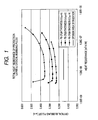
- the ink jet head having the film structure shown in Fig. 15 assuming that the empirically optimum value of the protection film thickness on the heat generating resistance member ranges from 0.3 ⁇ m (3000 ⁇ ) to 0.5 ⁇ m (5000 ⁇ ) from viewpoints of insulation reliability and cavitation-resistant characteristics, the total heat resistance of the protection film is changed by changing the heat conductivity of the protection film, and the change in bubbling efficiency caused by the change in heat conductivity of the protection film is computed using the three-dimensional heat conductivity simulation. The results of the change in bubbling efficiency are shown in Fig. 1 .
- Fig. 1 is a graph showing a relationship between a heat resistance value of the protection film and a critical bubbling pulse width.
- the critical bubbling pulse is an indicator of the heat conductivity, and the critical bubbling pulse is minimum drive energization time necessary to discharge the ink.
- the thickness of the heat generating resistance member is set to 0.05 ⁇ m
- the thickness of an electrode wiring is set to 0.2 ⁇ m
- the electrode wiring is made of aluminum.
- the input energy per unit area in the heat generating resistance member is set to 4.55 ⁇ 10 16 W/m 3 . This corresponds to the case in which a resistance value is 100 ⁇ and the current of 120 mA is passed in a square heat generating resistance member having a side of 26 ⁇ m.
- critical bubbling pulse a time during which the water at room temperature located directly above the center of the heat generating resistance member reaches 300°C is computed to be referred to as critical bubbling pulse.
- critical bubbling pulse width the critical bubbling pulse width is decreased, the bubbling is generated with the smaller energy, so that bubbling efficiency of the heat generating resistance member is improved.
- the same tendencies are shown in the film thicknesses of 0.3 ⁇ m (3000 ⁇ ), 0.4 ⁇ m (4000 ⁇ ), and 0.5 ⁇ m (5000 ⁇ ), and the critical bubbling pulse width becomes the minimum when the heat resistance value of the protection film ranges from about 5 ⁇ 10 -9 m 2 ⁇ K/W to about 10 ⁇ 10 -9 m 2 ⁇ K/W. That is, the maximum point in which the bubbling efficiency of the heat generating resistance member is maximized is found.
- the heat resistance value is about 2.5 ⁇ 10 -7 m 2 ⁇ K/W.
- an area where the critical bubbling pulse width is minimized is relatively broad and the bubbling efficiency is not largely changed up to about 50 ⁇ 10 -9 m 2 ⁇ K/W which is higher than 10 ⁇ 10 -9 m 2 ⁇ K/W.
- the most preferable heat resistance value ranges from 5 ⁇ 10 -9 m 2 ⁇ K/W to 10 ⁇ 10 -9 m 2 ⁇ K/W.
- Fig. 1 also shows the result of the simulation when the thickness of the protection film ranges from 0.3 ⁇ m to 0.5 ⁇ m, and the simulation confirms that similar characteristics are shown when the thickness of the protection film ranges from 0.2 ⁇ m to 0.6 ⁇ m.
- the heat conductivity of the protection film is calculated.
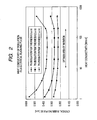
- the cavitation films shown in Fig. 15 are used (material: Ta, and film thickness: 0.23 ⁇ m) so that conditions for the conventional ink jet head are not changed as much as possible, and the thickness (0.1 ⁇ m (1000 ⁇ ), 0.2 ⁇ m (2000 ⁇ ), and 0.3 ⁇ m (3000 ⁇ )) and the heat conductivity of the protection film are changed to perform the computation again.
- the heat conductivity of Ta constituting the cavitation-resistance film is larger than that of SiN constituting the insulation film, so that Ta has little effect on the bubbling efficiency, namely the bubbling efficiency depends mainly on the insulation film.
- the heat conductivity of the thin film is changed depending on the film thickness or a deposition process.
- the specific value of the heat conductivity used for the simulation is one which is usually obtained from references.
- 54 W/m ⁇ K is used as the heat conductivity of the thin film Ta
- 1.2 W/m.K is used as the heat conductivity of the thin film SiN.
- the heat conductivity of the thin film SiN is changed in the range from about 1.2 to about 32 W/m.K, the heat conductivity of the thin film SiN is still lower than the heat conductivity of Ta.
- Fig. 2 shows a relationship between the heat conductivity and the critical bubbling pulse width, which is determined by the simulation.
- the critical bubbling pulse width is minimized when the heat conductivity of the insulation film ranges from 10 to 200 W/m.K. In the range from 10 to 200 W/m.K, it is found that the critical bubbling pulse width is not substantially changed and the good bubbling efficiency is obtained.
- Fig. 2 shows the result of the simulation when the thickness of the insulation film ranges from 0.1 to 0.3 ⁇ m, the same characteristics are also obtained when the thickness of the insulation film ranges from 0.3 to 0.4 ⁇ m.
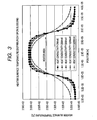
- Fig. 3 shows a temperature distribution on the protection film which is in contact with the water, when the water directly above the heat generating resistance member becomes about 300°C, namely immediately before the bubbling by changing the heat conductivity of the insulation film in the range from 2 to 500 W/m ⁇ K.
- a surface area of the heat generating resistance member whose temperature becomes 300°C is decreased. This is because, as described above, the heat energy generated by the heat generating resistance member disperses in the in-plane direction when the heat conductivity is high.
- the dispersion of the heat energy toward the in-plane direction does not occur substantially up to the heat conductivity of about 100 W/m ⁇ K, and the simulation result is similar to the heat conductivity of the insulation film in the conventional ink jet head.
- the heat conductivity becomes about 500 W/m ⁇ K, it is found that an equilibrium area of 300 °C is substantially eliminated and the heat energy disperses in the in-plane direction.
- the heat conductivity of the insulation film ranges from 10 to 200 W/m ⁇ K, it is more preferable that the heat conductivity of the insulation film ranges from 10 to 100 W/m ⁇ K, and it is most preferable that the heat conductivity of the insulation film ranges from 10 to 50 W/m ⁇ K.
- the critical bubbling pulse width ranges from about 0.2 to about 0.6 ⁇ s.
- the drive pulse in which the critical bubbling pulse width is increased at a constant ratio is provided, so that the drive pulse becomes substantially equal to the conventional drive condition ranging from 0.5 to 1.2 ⁇ s, which is of the proper condition of the high heat flux in order to perform the stable discharge in the discharging method in which the bubble is communicated with the atmosphere.
- the drive pulse width for discharging the ink ranges from 0.2 to 2.0 ⁇ s.
- the present inventors study an influence of the heat accumulation layer on the heat transfer efficiency of the ink.
- the ink jet head having the film structure shown in Fig. 15
- the protection film is formed by the SiN film (insulation film) whose thickness is 0.3 ⁇ m and the Ta film (cavitation-resistant film) whose thickness is 0.23 ⁇ m
- the change in surface temperature and the elapsed time since the drive pulse is applied to the heat generating resistance member is computed for the case where the heat accumulation layer is formed by the SiO 2 film whose thickness is 2.5 ⁇ m and the case where the heat accumulation layer is formed by the SiO 2 film whose thickness is 1.5 ⁇ m using a three-dimensional heat conduction simulation.
- Fig. 4 shows the result of the simulation.
- the two heat accumulation layers are similar to each other in that the maximum peak temperature is about 500 °C, and the temperature is rapidly decreased in the heat accumulation layer formed by the SiO 2 film whose thickness is 1.5 ⁇ m. From these results, it is thought that the heat conductivity to the ink is not decreased even if the thickness of the heat accumulation is decreased.
- Fig. 5 shows the result of the simulation.
- Fig. 5 is a graph showing a relationship between the thickness of the heat accumulation layer and ink critical bubbling energy per unit area of the heat generating resistance member, which is obtained by the simulation.
- the ink critical bubbling energy per unit area of the heat generating resistance member is an index of the heat transfer efficiency to the ink.
- the ink critical bubbling energy is the critical heat energy which is necessary for the surface temperature of the heat generating resistance member to exceed 300 °C which is of the bubbling temperature of the ink. As the ink critical bubbling energy is increased, the heat transfer efficiency becomes worsened.
- the computation is performed while the heat energy applying time (Pw) which is of the drive energization time is change in the range of 0.5 ⁇ s to 3.0 ⁇ s.
- the heat energy applying time includes the appropriate condition of the high heat flux in order to perform the stable discharge in the discharging method in which the bubble is communicated with the atmosphere, namely the drive energization time ranging from 0.5 to 1.2 ⁇ s.
- the thickness of the heat accumulation layer is lower than about 0.7 ⁇ m, the heat transfer efficiency to the ink is abruptly worsened. From Fig. 5 , it is found that the thickness of at least 0.7 ⁇ m is required for the heat accumulation layer. In the heat accumulation layer whose thickness is lower than 0.7 ⁇ m, it is difficult to stably perform the deposition.
- Fig. 5 shows that the heat transfer efficiency is worsened as the heat energy applying time (Pw) is increased, and that the influence of the thickness of the heat accumulation layer is increased as PW is increased. Specifically, when Pw ranges from 1.2 ⁇ s to 2 ⁇ s, the heat transfer efficiency is not decreased as long as the thickness of the heat accumulation layer is not lower than 1.0 ⁇ m. When Pw is not more than 1.2 ⁇ s which is of the condition of the high heat flux, the heat transfer efficiency is not decreased even if the thickness of the heat accumulation layer is not lower than 0.7 ⁇ m.
- the thickness of the heat accumulation layer made of SiO 2 is not lower than 1.0 ⁇ m.
- the thickness of the heat accumulation layer is not lower than 0.7 ⁇ m.
- the drive energization time is not limited to one pulse, and it is possible that the pulse is divided into the plurality of pulses to perform the pulse drive. In this case, the total energization time of each pulse width corresponds to Pw. The relationship shown in Fig. 5 is also obtained in the later-mentioned sample head.
- the invention is not limited to the above examples.
- the invention is one in which the applied heat energy is efficiently transferred to the ink, so that a heat resistance ratio can be substituted for the above-described conditions.
- Fig. 6 shows the substitution result.
- Fig. 6 shows a relationship between the thickness of the heat generating resistance member accumulation layer and the heat resistance ratio of heat accumulation layer/protection film, in which the heat resistance ratio of the heat accumulation layer to the protection film is substituted for the condition of the heat accumulation layer in the above-described conditions of the protection film.
- the SiN thin film and the Ta thin film are set to the values described above, and the SiO 2 thin film is set to 1.38 W/m ⁇ K which is generally obtained from the references.
- the heat resistance value of the multi-layered film is one in which the heat resistance values of the films constituting the multi-layered film are added.
- the ratio of the heat resistance of the heat accumulation layer to heat resistance of the protection film is more than two times.
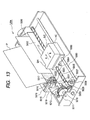
- Fig. 13 is a perspective view schematically showing an example of the ink jet recording apparatus of the invention.
- a lead screw 5004 in which a spiral groove 5005 is made is journaled in a main body frame.
- the lead screw 5004 is connected with normal and reverse rotations of a drive motor 5013, and the lead screw 5004 is rotated through drive force transfer gears 5009 to 5011.
- a guide rail 5003 which slidably guides a carriage HC is fixed to the main body frame.
- a pin (not shown) which engages the spiral groove 5005 is provided in the carriage HC.
- the carriage HC can reciprocally be moved in directions of an arrow a and an arrow b by rotating the lead screw 5004 by the rotation of the drive motor 5013.
- a paper pressing plate 5002 presses a recording medium P against a platen 5000 across the moving direction of the carriage HC.
- An ink jet recording unit IJC is mounted on the carriage HC. It is possible that the ink jet recording unit IJC has a form in which the ink jet head is integrated with an ink tank IT, or it is possible that the ink jet recording unit IJC has the form in which the ink jet head and the ink tank IT are separately formed and detachably combined.
- the ink jet recording unit IJC is fixed to and supported by the carriage HC with positioning means and an electrical contact which are provided in the carriage HC, and the ink jet recording unit IJC is provided while being detachable to the carriage HC.
- Photocouplers 5007 and 5008 constitute home position detecting means which confirms existence of a lever 5006 of the carriage HC in this area to reverse a rotating direction or the like of the drive motor 5013.
- a capping member 5022 which caps a front face (surface in which discharge ports are opened) of the ink jet head is supported by a supporting member 5016.
- the capping member 5022 includes a sucking means 5015, and the capping member 5022 sucks and recovers the ink jet head through a cap inner opening 5023.
- a support plate 5019 is attached to a main body support plate 5018, and a cleaning blade 5017 slidably supported by the support plate 5019 is moved in a fore-and-aft direction by driving means (not shown).
- a lever 5021 is one which starts the suction and recovery operation of the ink jet head.
- the lever 5021 is moved according to the movement of a cam 5020 abutting on the carriage HC, and the drive force from the drive motor 5013 is controlled by well-known transferring means such as a gear 5010 and a latch switch.
- Each of the capping, the cleaning, and the sucking and recovering processes is performed at each corresponding position by working of the lead screw 5004 when the carriage HC is moved to the home position side area.
- each process can be applied to the invention.
- Fig. 14 shows a block diagram of a control circuit which controls the operation of the ink jet recording apparatus.
- the control circuit shown in Fig. 14 has an interface 1700 to which a recording signal is input from an external apparatus such as a computer, a control unit which controls the operation of the ink jet recording apparatus based on the recording signal input through the interface 1700, a head driver 1705 which drives a recording head (ink jet head) 1708, a motor driver 1706 which drives a conveying motor 1709 which conveys the recording medium (rotates the platen 5000 shown in Fig. 14 ), and a motor driver 1707 which drives a carrier motor 1710 (corresponding to the drive motor 5013 of Fig. 13 ).
- the control unit has a gate array (G.A.) 1704 which receives the recording signal from the interface 1700 to control provision of recording data to the recording head 1708, MPU 1701, ROM 1702 in which a control program executed by MPU 1701 is stored, and DRAM 1703 in which the recording signal and various kinds of data such as the recording data provided to the recording head 1708 are stored.
- the gate array 1704 also controls the data transfer between MPU 1701 and DRAM 1703.
- the recording signal When the recording signal is input to the interface 1700, the recording signal is converted into the recording data for the recording between the gate array 1704 and MPU 1701. While the motor drivers 1706 and 1707 drive the conveying motor 1709 and the carrier motor 1710 respectively, the recording head 1708 is driven according to the recording data transmitted to the head driver 1705, and the recording is performed.
- the drive energization time of the heat generating resistance member is also controlled by MPU 1701.
- Fig. 7 is a plan view showing a main part of an example of the ink jet head preferably used for the invention when viewed from the discharge port side
- Fig. 8 is an enlarged plan view showing one heat generating resistance member shown in Fig. 7 .
- a nozzle material 10 is shown as a perspective drawing.
- An ink jet head 1 has a base body 20 in which a plurality of heat generating resistance members 23 are formed and the nozzle material 10 which is connected to the base body 20.
- the heat generating resistance members 23 are arranged in line.
- a plurality of lines of heat generating resistance members 23 are arranged in each color.
- a discharge port 11 is formed at the opposite position to each heat generating resistance member 23 while the center of the discharge port is located above the center of the heat generating resistance member 23.
- a nozzle wall 13 which separates the adjacent heat generating resistance members 23 from each other is formed in the nozzle material 10, and a liquid path in which the discharge port 11 is opened is formed in each heat generating resistance member 23 by bonding the base body 20 and the nozzle material 10.
- supply port (not shown) is formed in the base body 20 while piercing through the base body 20.
- the supply port is opened to an ink chamber which is common to each liquid path.
- a filter 29 which is of a columnar structure is provided between the ink chamber and each channel in order to prevent the invasion of a foreign material into the channel.
- the insulation film (not shown in Fig. 8 ) and a cavitation-resistant film 27 are provided while all the heat generating resistance members 23 arranged in line are covered with both the insulation film and the cavitation-resistant film 27.
- an electrode wiring 25 is connected to the heat generating resistance member 23.
- the ink is supplied from the supply port into the channel to flow onto the heat generating resistance member 23.
- the bubbling of the ink on the heat generating resistance member 23 occurs by energizing the heat generating resistance member 23 via the electrode wiring 25 to generate the heat energy, which discharges the ink from the discharge port 11.
- the ink jet head 1 is referred to as a side shoot type of ink jet head in which the heat generating resistance member 23 is opposed to the discharge port 11.
- the discharging method for the side shoot type of ink jet head 1 mainly includes the method in which the bubble generated by driving the heat generating resistance member 23 is communicated with the atmosphere and the method in which the bubble is not communicated with the atmosphere. In the method in which the bubble is not communicated with the atmosphere, the generated bubble vanishes without communicating with the atmosphere.
- the invention can be applied to both the methods.
- Fig. 9 is a sectional view taken on line IX-IX of the ink jet head shown in Fig. 7 . Referring to Fig. 9 , a layer structure of the base body 20 in the ink jet head 1 of the example 1 will be mainly described.
- the base body 20 has a substrate 21 made of silicon, a heat accumulation layer 22 which is formed on the surface of the substrate 21 and also acts as the electrical insulation film, the heat generating resistance member 23 which is partially formed on the heat accumulation layer 22, electrode wirings 24 and 25 which provides the electric power to the heat generating resistance member 23, an insulation film 26 with which the heat generating resistance member 23 and the heat accumulation layer 22 are covered, and a cavitation-resistant film 27 which is partially formed on the insulation film 26.
- the heat accumulation layer 22 has a triple-layer structure in which a thermal oxide film 22a and interlayer films 22b and 22c are laminated in the order from the substrate 21 side.
- the thermal oxide film 22a and the interlayer films 22b and 22c are made of SiO 2
- the total thickness of the heat accumulation layer 22 is set so that the total heat resistance of the heat accumulation layer 22 is not lower than double the total heat resistance of the film (insulating film 26 and cavitation-resistant film 27) formed while the heat generating resistance member 23 is covered with the film, namely the protection film.
- the material of the films constituting the heat accumulation layer 22 and the number of layers and the structure of the heat accumulation layer 22 can arbitrarily be changed in the range in which the total heat resistance satisfies the above condition.
- At least one layer in the heat accumulation layer 22 can be formed by an SiO x film or a BPSG (Boro-Phospho Silicate Glass) film.
- An arbitrary method such as thermal oxidation method and a CVD method can be adopted as the deposition method.
- the heat generating resistance member 23 is made of TaSiN.
- the electrode wirings 24 and 25 are made of AlCu.
- the electrode wirings 24 and 25 are not limited to the Al Cu.
- the electrode wirings 24 and 25 can be made of AL or Al alloys. It is possible that the thickness of the electrode wiring ranges from 0.1 to 1.0 ⁇ m.
- the insulation film 26 has a double-layer structure in which an SiC film 26b is formed on an SiN film 26a.
- the thickness of the SiN film 26a is set to 0.05 ⁇ m, and the thickness of the SiC film 26b is set to 0.2 ⁇ m.
- the heat resistance can be decreased and the insulation reliability can be optimized with respect to the covering at the step of the electrode wiring 25 by forming the insulation film 26 with the plurality of layers.
- the structure of the insulation film 26 is not limited to the example 1.
- the insulation film can be formed by at least three layers, it is possible that the thickness of the SiC film 26b is set to the value not lower than 0.2 ⁇ m, or it is possible that the thickness of the SiN film 26a is set to the value not lower than 0.05 ⁇ m.
- the cavitation-resistant film 27 is made of Ta, and the thickness of the cavitation-resistant film 27 is set to 0.23 ⁇ m. That is, in the example 1, the total thickness of the protection film on the heat generating resistance member 23 is set to 0.48 ⁇ m.
- the nozzle material 10 is bonded to the base body 20 to form an ink chamber 12 between the heat generating resistance member 23 and the discharge port 11.
- the heat resistance values of the insulation film 26 and the cavitation-resistant film 27 which are of the protection film on the heat generating resistance member 23 are set to appropriate values.
- the protection film is formed by the SiN insulation film whose thickness is 0.3 ⁇ m and the Ta cavitation-resistant film whose thickness is 0.23 ⁇ m.
- the heat conductivity of the Ta thin film is 54 W/m.K
- the heat conductivity of the SiN thin film is 1.2 W/m ⁇ K
- the heat conductivity of the SiC thin film is 70 W/m.K
- the heat resistance value of the protection film becomes about 2.5 ⁇ 10 -7 m 2 ⁇ K/W.
- the heat resistance value becomes about 48 ⁇ 10 -9 m 2 ⁇ K/W.
- the thickness of the thermal oxide film 22a is set to 1.0 ⁇ m
- the thickness of the interlayer film 22b is set to 0.8 ⁇ m
- the thickness of the interlayer film 22c is set to 0.7 ⁇ m.
- the heat conductivity of the SiO 2 thin film is set to 1.38 W/m ⁇ K
- the heat resistance value of the heat accumulation layer 22 becomes about 1.81 ⁇ 10 -6 m 2 ⁇ K/W. Accordingly, in the example 1, the total heat resistance value of the heat accumulation layer 22 becomes about 39 times of the total heat resistance of the protection film.
- a plane size of the heat generating resistance member 23 is formed in the square of 26 ⁇ m by 26 ⁇ m.
- the size of the heat generating resistance member 23 is not limited to the example 1, and it is confirmed that the heat generating resistance member 23 formed in the square ranging from 16 ⁇ m by 16 ⁇ m to 39 ⁇ m by 39 ⁇ m can be used for the invention.
- the shape of the heat generating resistance member 23 is not limited to the square.
- the heat generating resistance member 23 can also be formed in a rectangle.
- the number of heat generating resistance members per one discharge port 11 can be at least two. It is possible that the heat generating resistance member 23 is formed by the two rectangular heat generating resistance members whose size is 10 ⁇ m by 24 ⁇ m while the two heat generating resistance members are connected in series.
- Fig. 10 is a sectional view showing another example of the ink jet head preferably used for the invention.
- the same constituent as Fig. 9 is represented by the same reference numeral as Fig. 9 .
- the ink jet head of the example 2 differs from the ink jet head of the example 1 in that the insulation film 26 has a single layer and the cavitation-resistant film 27 has the double-layer structure.
- Other configurations of the example 2 are similar to the example 1.
- the insulation film 26 is made of SiC, and the thickness of the insulation film 26 is set to 0.35 ⁇ m.
- the cavitation-resistant film 27 has the structure in which a Ta film 27a and an Ir film 27b are laminated in the order from the insulation film 26 side.
- the thickness of the Ta film 27a is set to 0.2 ⁇ m, and the thickness of the Ir film 27b is set to 0.05 ⁇ m. Accordingly, the total thickness of the protection film on the heat generating resistance member 23 becomes 0.6 ⁇ m.
- the cavitation-resistant film 27 in the double-layer structure, not only the heat resistance can be decreased while the covering properties is maintained, but also the decrease in discharge characteristics caused by the thermal reaction of the ink or by the "kogation" which is generated by the carbonization of ink compositions can be prevented.
- the cavitation-resistant film 27 has the double-layer structure in the example 2, it is also possible that the cavitation-resistant film 27 has the structure in which at least three layers are laminated.
- a part of the cavitation-resistant film 27 is made of Ir in the example 2, instead of Ir, it is also possible to use a noble metal such as Pt or an alloy of the noble metal which has the film thickness not lower than 0.05 ⁇ m.
- the heat conductivity of the Ir thin film is 127 W/m ⁇ K
- the heat resistance value of the protection film is computed in the example 2
- the heat resistance value of about 9.1 ⁇ 10 -2 m 2 ⁇ K/W is obtained. Since the total heat resistance value of the heat accumulation layer 22 is equal to the example 1, the total heat resistance value of the heat accumulation layer 22 becomes about 199 times of the total heat resistance value of the protection film in the example 2.
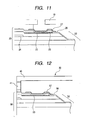
- Fig. 11 is a sectional view showing still another example of the ink jet head preferably used for the invention.
- the same constituent as Fig. 9 is represented by the same reference numeral as Fig. 9 .
- the ink jet head of the example 3 differs from the ink jet heads of the example 1 and the example 2 in that the insulation film 26 and the cavitation-resistant film 27 have the single layer structure respectively.
- the insulation film 26 is formed by the SiC film whose thickness is 0.35 ⁇ m
- the cavitation-resistant film 27 is formed by the Ta film whose thickness is 0.2 ⁇ m. Accordingly, the total thickness of the protection film on the heat generating resistance member 23 becomes 0.55 ⁇ m.
- the heat resistance value of about 8.7 ⁇ 10 -9 m 2 ⁇ K/W is obtained.
- the heat resistance of the example 3 has the smallest value in the configuration examples 1 to 3 of the ink jet head. That is, the bubbling efficiency of the example 3 is optimized in the configuration examples 1 to 3 of the ink jet head.
- the bubbling efficiency is further improved by setting the smaller heat resistance value in the range from 5 ⁇ 10 -9 m 2 ⁇ K/W to 50 ⁇ 10 -9 m 2 ⁇ K/W.
- the total heat resistance value of the heat accumulation layer 22 becomes about 208 times of the total heat resistance value of the protection film in the example 3.
- the edge shoot type of ink jet head 30 has a base body 50 and a nozzle material 40 which is bonded to the base body 50.
- the edge shoot type of ink jet head differs from the side shoot type of ink jet head in the structure of the nozzle material 40.
- a discharge port 41 is not located at the opposite position to the heat generating resistance member 53, but the discharge port 41 is formed in an end face of the nozzle material 40, and the ink is discharged toward the direction substantially parallel to an upper surface of the base body 50.
- the same effect as the side shoot type of ink jet head can be obtained by applying the configuration of the invention to the configurations of a heat accumulation layer 52 and the protection film including an insulation film 56 and a cavitation-resistant film 57.
- the total thickness of the protection film formed on the heat generating resistance member is set to the range from about 0.2 to about 0.6 ⁇ m
- the total heat resistance value of the protection film is set to the range from 5 ⁇ 10 -9 m 2 ⁇ K/W to 50 ⁇ 10 -9 m 2 ⁇ K/W
- the heat resistance value of the heat accumulation layer below the heat generating resistance member is set to at least double the heat resistance value of the protection film. Therefore, the heat transfer efficiency to the ink can be optimized without decreasing the insulation reliability of the protection film and without decreasing the performance of the cavitation resistance.
- any film structure can be adopted when the heat resistance value is in the above-described range, various materials can be used as long as the covering reliability of the heat generating resistance member is maintained, and a degree of freedom can be increased in design.
- the film structure which further improves the covering reliability can also be formed, and the invention also has a cost-reduction effect.
- the film structure can freely be designed so that the heat resistance is in the above-described range. Therefore, the film structure in which the thermal reaction-resistant characteristics and the kogation-adhesion-resistant characteristics are further improved can be formed, so that not only the degree of freedom of the design is increased, but also the durability is improved.
Landscapes
- Particle Formation And Scattering Control In Inkjet Printers (AREA)
Claims (17)
- Tintenstrahlkopfgrundkörper (20),
bei welchem eine Wärmeakkumulationsschicht (22), ein Heizer (23), der zum Austragen von Tinte benutzte Wärmeenergie erzeugt, und eine den Heizer schützende Schutzschicht (26, 27) auf einem Substrat (21) sequentiell erzeugt sind,
und bei welchem eine Gesamtdicke eines Abschnittes in der Schutzschicht oberhalb vom Heizer im Bereich von 0,2 µm bis 0,6 µm liegt,
dadurch gekennzeichnet, dass
ein Wärmewiderstandswert des Abschnittes in der Schutzschicht oberhalb vom Heizer im Bereich von 5x10⁻⁹ m2·K/W bis 50x10-9 m2·K/W liegt und
der Wärmewiderstandswert eines Abschnittes in der Wärmeakkumulationsschicht unterhalb vom Heizer nicht kleiner ist als das Doppelte des Wärmewiderstandswertes des Abschnittes in der Schutzschicht oberhalb vom Heizer. - Körper nach Anspruch 1, wobei
ein Gesamtwärmewiderstandswert der Schutzschicht im Bereich von 5x10⁻⁹ m2·K/W bis 10x10-9 m2·K/W liegt. - Körper nach Anspruch 1 oder 2, wobei die Schutzschicht von mehreren Dünnschichten gebildet ist.
- Körper nach Anspruch 1 oder 2, wobei die Schutzschicht eine SiC-Schicht (26b) aufweist, deren Schichtdicke nicht kleiner ist als 0,2 µm.
- Körper nach Anspruch 1 oder 2, wobei die Schutzschicht eine SiN-Schicht (26a) aufweist, deren Schichtdicke nicht kleiner ist als 0,05 µm.
- Körper nach Anspruch 1 oder 2, wobei die Schutzschicht eine Ta-Schicht (27a) aufweist, deren Schichtdicke nicht kleiner ist als 0,2 µm.
- Körper nach Anspruch 6, wobei
die Schutzschicht folgende Schichten aufweist:eine Isolationsschicht (26), bei welcher die Schichtdicke im Bereich von 0,1 µm bis 0,4 µm liegt und die Wärmeleitfähigkeit im Bereich von 10 W/m·K bis 200 W/m·K liegt, undeine kavitationsbeständige Schicht (27), welche erzeugt ist auf der Isolationsschicht und die Ta-Schicht aufweist. - Körper nach Anspruch 7, wobei
die Isolationsschicht die SiC-Schicht aufweist, deren Schichtdicke nicht kleiner ist als 0,2 µm. - Körper nach Anspruch 8, wobei ferner die Isolationsschicht die SiN-Schicht aufweist.
- Körper nach Anspruch 7, wobei ferner die kavitationsbeständige Schicht eine Dünnschicht (27b) aufweist, welche aus Edelmetall oder einer Edelmetalllegierung gefertigt ist.
- Körper nach Anspruch 1 oder 2, wobei die Schutzschicht eine Dünnschicht aufweist, welche aus Edelmetall oder einer Edelmetalllegierung, deren Schichtdicke nicht kleiner ist als 0,05 µm, gefertigt ist.
- Körper nach Anspruch 1 oder 2, wobei die Wärmeakkumulationsschicht gebildet ist durch wenigstens eine aus SiO2 gefertigte Dünnschicht (22a, 22b, 22c) und die Gesamtdicke der Wärmeakkumulationsschicht nicht kleiner ist als 0,7 µm.
- Körper nach Anspruch 1 oder 2, wobei die Wärmeakkumulationsschicht gebildet ist durch die mehreren Dünnschichten (22a, 22b, 22c) und wenigstens eine der mehreren Dünnschichten gefertigt ist aus einer SiOx-Schicht oder einer Borphosphorsilicat-Glasschicht.
- Körper nach einem der Ansprüche 1 bis 13, wobei
eine Elektrodenverdrahtung (24, 25) zum Erregen des Heizers gefertigt ist aus Al oder einer Al-Legierung und die Dicke der Elektrodenverdrahtung im Bereich von 0,1 µm bis 1,0 µm liegt. - Tintenstrahlkopf (1), umfassend:den Tintenstrahlkopfgrundkörper gemäß einem der Ansprüche 1 bis 14 undeinen Austragdurchlass (11) zum Austragen von Tinte der entsprechend dem Heizer im Tintenstrahlkopfgrundkörper vorgesehen ist.
- Verfahren zum Ansteuern des Tintenstrahlkopfes nach Anspruch 15, wobei
der Heizer in einem Tintenstrahlgrundkörper des Tintenstrahlkopfes angesteuert wird für eine Ansteuererregungszeit, die im Bereich von 0,2 µs bis 2 µs liegt, um die Tinte aus einem Austragdurchlass des Tintenstrahlkopfes auszutragen. - Tintenstrahlaufzeichnungsvorrichtung, umfassend:den Tintenstrahlkopf gemäß Anspruch 15 undeine Ansteuerungseinrichtung (1701) zum Ansteuern des Heizers in einem Tintenstrahlgrundkörper des Tintenstrahlkopfes für eine Ansteuererregungszeit, die im Bereich von 0,2 µs bis 2 µs liegt.
Applications Claiming Priority (2)
| Application Number | Priority Date | Filing Date | Title |
|---|---|---|---|
| JP2003434519 | 2003-12-26 | ||
| JP2003434519 | 2003-12-26 |
Publications (3)
| Publication Number | Publication Date |
|---|---|
| EP1547778A2 EP1547778A2 (de) | 2005-06-29 |
| EP1547778A3 EP1547778A3 (de) | 2006-05-31 |
| EP1547778B1 true EP1547778B1 (de) | 2010-09-15 |
Family
ID=34545103
Family Applications (1)
| Application Number | Title | Priority Date | Filing Date |
|---|---|---|---|
| EP04030115A Expired - Lifetime EP1547778B1 (de) | 2003-12-26 | 2004-12-17 | Tintenstrahlkopf, Ansteuerverfahren dafür und Tintenstrahlaufzeichnungsgerät |
Country Status (6)
| Country | Link |
|---|---|
| US (1) | US7172268B2 (de) |
| EP (1) | EP1547778B1 (de) |
| KR (1) | KR20050067041A (de) |
| CN (1) | CN100346973C (de) |
| DE (1) | DE602004029132D1 (de) |
| TW (1) | TWI252174B (de) |
Families Citing this family (6)
| Publication number | Priority date | Publication date | Assignee | Title |
|---|---|---|---|---|
| JP5153092B2 (ja) * | 2006-06-27 | 2013-02-27 | キヤノンファインテック株式会社 | 画像形成装置及び画像形成方法 |
| JP5312202B2 (ja) * | 2008-06-20 | 2013-10-09 | キヤノン株式会社 | 液体吐出ヘッド及びその製造方法 |
| US8684501B2 (en) * | 2010-04-29 | 2014-04-01 | Hewlett-Packard Development Company, L.P. | Fluid ejection device |
| JP6270358B2 (ja) * | 2013-07-09 | 2018-01-31 | キヤノン株式会社 | 液体吐出ヘッド |
| US10322578B2 (en) | 2017-06-20 | 2019-06-18 | Canon Kabushiki Kaisha | Liquid ejection head and liquid ejection apparatus |
| JP7686476B2 (ja) | 2021-07-07 | 2025-06-02 | キヤノン株式会社 | 記録装置及び制御方法 |
Family Cites Families (12)
| Publication number | Priority date | Publication date | Assignee | Title |
|---|---|---|---|---|
| CA1127227A (en) * | 1977-10-03 | 1982-07-06 | Ichiro Endo | Liquid jet recording process and apparatus therefor |
| JP3054450B2 (ja) * | 1991-02-13 | 2000-06-19 | 株式会社リコー | 液体噴射記録ヘッド用基体及び液体噴射記録ヘッド |
| EP0576017B1 (de) | 1992-06-23 | 2000-03-22 | Canon Kabushiki Kaisha | Flüssigkeitsstrahlaufzeichnungskopf und Verfahren seiner Herstellung |
| JPH09187936A (ja) * | 1996-01-08 | 1997-07-22 | Canon Inc | インクジェット記録ヘッド用基体、インクジェット記録ヘッドおよびインクジェット記録装置 |
| JP3501619B2 (ja) * | 1997-05-07 | 2004-03-02 | キヤノン株式会社 | インクジェット記録ヘッド |
| JP3382525B2 (ja) * | 1997-12-15 | 2003-03-04 | キヤノン株式会社 | インクジェット記録装置および記録制御方法並びに記録制御プログラムを記録した記録媒体 |
| JP4666739B2 (ja) | 1999-10-05 | 2011-04-06 | キヤノン株式会社 | インクジェット記録ヘッド用基体、インクジェット記録ヘッド、インクジェット記録ユニット、インクジェット記録装置、インクジェット記録ヘッド用基体の製造方法及びインクジェット記録ヘッドの製造方法 |
| US6435660B1 (en) * | 1999-10-05 | 2002-08-20 | Canon Kabushiki Kaisha | Ink jet recording head substrate, ink jet recording head, ink jet recording unit, and ink jet recording apparatus |
| JP2002011886A (ja) | 2000-06-30 | 2002-01-15 | Canon Inc | インクジェット記録ヘッド用基板、インクジェット記録ヘッド、および該ヘッド用基板の作成方法 |
| JP3720689B2 (ja) * | 2000-07-31 | 2005-11-30 | キヤノン株式会社 | インクジェットヘッド用基体、インクジェットヘッド、インクジェットヘッドの製造方法、インクジェットヘッドの使用方法およびインクジェット記録装置 |
| KR100425306B1 (ko) * | 2001-10-12 | 2004-03-30 | 삼성전자주식회사 | 버블젯 방식의 잉크젯 프린트헤드 |
| JP2003127379A (ja) * | 2001-10-29 | 2003-05-08 | Kyocera Corp | インクジェットヘッド |
-
2004
- 2004-12-16 US US11/012,288 patent/US7172268B2/en not_active Expired - Fee Related
- 2004-12-17 EP EP04030115A patent/EP1547778B1/de not_active Expired - Lifetime
- 2004-12-17 DE DE602004029132T patent/DE602004029132D1/de not_active Expired - Lifetime
- 2004-12-23 TW TW093140336A patent/TWI252174B/zh not_active IP Right Cessation
- 2004-12-24 KR KR1020040111728A patent/KR20050067041A/ko not_active Ceased
- 2004-12-24 CN CNB2004100115001A patent/CN100346973C/zh not_active Expired - Fee Related
Also Published As
| Publication number | Publication date |
|---|---|
| US20050140734A1 (en) | 2005-06-30 |
| CN100346973C (zh) | 2007-11-07 |
| TW200530046A (en) | 2005-09-16 |
| US7172268B2 (en) | 2007-02-06 |
| DE602004029132D1 (de) | 2010-10-28 |
| EP1547778A3 (de) | 2006-05-31 |
| EP1547778A2 (de) | 2005-06-29 |
| CN1636735A (zh) | 2005-07-13 |
| KR20050067041A (ko) | 2005-06-30 |
| TWI252174B (en) | 2006-04-01 |
Similar Documents
| Publication | Publication Date | Title |
|---|---|---|
| TWI332441B (en) | Liquid jet head | |
| US6474789B1 (en) | Recording apparatus, recording head and substrate therefor | |
| CN1221392C (zh) | 具有薄膜层叠片的全集成热喷墨打印头 | |
| US9216575B2 (en) | Recording-element substrate and liquid ejection apparatus | |
| JPH05185594A (ja) | 記録ヘッド、記録ヘッド用基板およびインクジェット記録装置 | |
| US6474788B1 (en) | Substrate for use of ink jet head, ink jet head, ink jet cartridge, and ink jet recording apparatus | |
| KR101313946B1 (ko) | 액체 토출 헤드용 기판, 그 제조 방법 및 액체 토출 헤드 | |
| JP3229472B2 (ja) | インクジェット記録ヘッドおよびインクジェット記録装置 | |
| EP1547778B1 (de) | Tintenstrahlkopf, Ansteuerverfahren dafür und Tintenstrahlaufzeichnungsgerät | |
| EP1547777B1 (de) | Tintenstrahlkopf, Ansteuerungsverfahren des Kopfes, und Tintenstrahldrucker | |
| JP3200098B2 (ja) | インクジェット記録ヘッドおよびインクジェット記録装置 | |
| EP0380366A2 (de) | Trägerschicht für Aufzeichnungskopf und Aufzeichnungskopf | |
| JP2005205892A (ja) | インクジェットヘッド用の基体、インクジェットヘッド、該インクジェットヘッドの駆動方法およびインクジェット記録装置 | |
| JPH08118635A (ja) | 記録ヘッド用基板、記録ヘッド及び記録装置 | |
| JPH06238901A (ja) | インク噴射記録装置 | |
| JP4497869B2 (ja) | 回路基板の製造方法 | |
| JPH11240157A (ja) | インクジェット記録ヘッド、該ヘッド用基板、該基板の製造方法及びインクジェット記録装置 | |
| JP2007008084A (ja) | 液体吐出用基板およびその製造方法、ならびに液体吐出装置 | |
| JP2005205891A (ja) | インクジェットヘッド用の基体、インクジェットヘッド、該インクジェットヘッドの駆動方法およびインクジェット記録装置 | |
| JPH07144406A (ja) | インクジェット記録ヘッドおよびインクジェット記録装置 | |
| JP2000343704A (ja) | 液体吐出ヘッド、ヘッドカートリッジ、液体吐出装置、および前記液体吐出ヘッドの製造方法 | |
| JP2003145767A (ja) | 液体吐出ヘッド、その製造方法及び液体吐出装置 | |
| JPH10166584A (ja) | インクジェットヘッドおよびその製造方法ならびにインクジェットカートリッジおよびインクジェット装置 | |
| JPH09131872A (ja) | インクジェット記録ヘッドおよびインクジェット記録装置 | |
| JP2001071500A (ja) | 記録ヘッド、該記録ヘッド用基体及び記録装置 |
Legal Events
| Date | Code | Title | Description |
|---|---|---|---|
| PUAI | Public reference made under article 153(3) epc to a published international application that has entered the european phase |
Free format text: ORIGINAL CODE: 0009012 |
|
| AK | Designated contracting states |
Kind code of ref document: A2 Designated state(s): AT BE BG CH CY CZ DE DK EE ES FI FR GB GR HU IE IS IT LI LT LU MC NL PL PT RO SE SI SK TR |
|
| AX | Request for extension of the european patent |
Extension state: AL BA HR LV MK YU |
|
| PUAL | Search report despatched |
Free format text: ORIGINAL CODE: 0009013 |
|
| AK | Designated contracting states |
Kind code of ref document: A3 Designated state(s): AT BE BG CH CY CZ DE DK EE ES FI FR GB GR HU IE IS IT LI LT LU MC NL PL PT RO SE SI SK TR |
|
| AX | Request for extension of the european patent |
Extension state: AL BA HR LV MK YU |
|
| 17P | Request for examination filed |
Effective date: 20061130 |
|
| AKX | Designation fees paid |
Designated state(s): DE FR GB IT |
|
| 17Q | First examination report despatched |
Effective date: 20070731 |
|
| GRAP | Despatch of communication of intention to grant a patent |
Free format text: ORIGINAL CODE: EPIDOSNIGR1 |
|
| GRAS | Grant fee paid |
Free format text: ORIGINAL CODE: EPIDOSNIGR3 |
|
| GRAA | (expected) grant |
Free format text: ORIGINAL CODE: 0009210 |
|
| AK | Designated contracting states |
Kind code of ref document: B1 Designated state(s): DE FR GB IT |
|
| REG | Reference to a national code |
Ref country code: GB Ref legal event code: FG4D |
|
| REF | Corresponds to: |
Ref document number: 602004029132 Country of ref document: DE Date of ref document: 20101028 Kind code of ref document: P |
|
| PG25 | Lapsed in a contracting state [announced via postgrant information from national office to epo] |
Ref country code: IT Free format text: LAPSE BECAUSE OF FAILURE TO SUBMIT A TRANSLATION OF THE DESCRIPTION OR TO PAY THE FEE WITHIN THE PRESCRIBED TIME-LIMIT Effective date: 20100915 |
|
| PLBE | No opposition filed within time limit |
Free format text: ORIGINAL CODE: 0009261 |
|
| STAA | Information on the status of an ep patent application or granted ep patent |
Free format text: STATUS: NO OPPOSITION FILED WITHIN TIME LIMIT |
|
| 26N | No opposition filed |
Effective date: 20110616 |
|
| REG | Reference to a national code |
Ref country code: FR Ref legal event code: ST Effective date: 20110831 |
|
| REG | Reference to a national code |
Ref country code: DE Ref legal event code: R097 Ref document number: 602004029132 Country of ref document: DE Effective date: 20110616 |
|
| PG25 | Lapsed in a contracting state [announced via postgrant information from national office to epo] |
Ref country code: FR Free format text: LAPSE BECAUSE OF NON-PAYMENT OF DUE FEES Effective date: 20110103 |
|
| PGFP | Annual fee paid to national office [announced via postgrant information from national office to epo] |
Ref country code: GB Payment date: 20171228 Year of fee payment: 14 |
|
| PGFP | Annual fee paid to national office [announced via postgrant information from national office to epo] |
Ref country code: DE Payment date: 20180228 Year of fee payment: 14 |
|
| REG | Reference to a national code |
Ref country code: DE Ref legal event code: R119 Ref document number: 602004029132 Country of ref document: DE |
|
| GBPC | Gb: european patent ceased through non-payment of renewal fee |
Effective date: 20181217 |
|
| PG25 | Lapsed in a contracting state [announced via postgrant information from national office to epo] |
Ref country code: DE Free format text: LAPSE BECAUSE OF NON-PAYMENT OF DUE FEES Effective date: 20190702 |
|
| PG25 | Lapsed in a contracting state [announced via postgrant information from national office to epo] |
Ref country code: GB Free format text: LAPSE BECAUSE OF NON-PAYMENT OF DUE FEES Effective date: 20181217 |