EP1561464A2 - Verwendung des Cyclopamins zur Behandlung des basalen Zellkarzinoms und anderer Tumoren - Google Patents
Verwendung des Cyclopamins zur Behandlung des basalen Zellkarzinoms und anderer Tumoren Download PDFInfo
- Publication number
- EP1561464A2 EP1561464A2 EP05008758A EP05008758A EP1561464A2 EP 1561464 A2 EP1561464 A2 EP 1561464A2 EP 05008758 A EP05008758 A EP 05008758A EP 05008758 A EP05008758 A EP 05008758A EP 1561464 A2 EP1561464 A2 EP 1561464A2
- Authority
- EP
- European Patent Office
- Prior art keywords
- cyclopamine
- bcc
- cells
- medicament
- use according
- Prior art date
- Legal status (The legal status is an assumption and is not a legal conclusion. Google has not performed a legal analysis and makes no representation as to the accuracy of the status listed.)
- Withdrawn
Links
Images

Classifications
-
- A—HUMAN NECESSITIES
- A61—MEDICAL OR VETERINARY SCIENCE; HYGIENE
- A61K—PREPARATIONS FOR MEDICAL, DENTAL OR TOILETRY PURPOSES
- A61K31/00—Medicinal preparations containing organic active ingredients
- A61K31/33—Heterocyclic compounds
- A61K31/395—Heterocyclic compounds having nitrogen as a ring hetero atom, e.g. guanethidine or rifamycins
- A61K31/435—Heterocyclic compounds having nitrogen as a ring hetero atom, e.g. guanethidine or rifamycins having six-membered rings with one nitrogen as the only ring hetero atom
- A61K31/4353—Heterocyclic compounds having nitrogen as a ring hetero atom, e.g. guanethidine or rifamycins having six-membered rings with one nitrogen as the only ring hetero atom ortho- or peri-condensed with heterocyclic ring systems
- A61K31/4355—Heterocyclic compounds having nitrogen as a ring hetero atom, e.g. guanethidine or rifamycins having six-membered rings with one nitrogen as the only ring hetero atom ortho- or peri-condensed with heterocyclic ring systems the heterocyclic ring system containing a five-membered ring having oxygen as a ring hetero atom
-
- A—HUMAN NECESSITIES
- A61—MEDICAL OR VETERINARY SCIENCE; HYGIENE
- A61P—SPECIFIC THERAPEUTIC ACTIVITY OF CHEMICAL COMPOUNDS OR MEDICINAL PREPARATIONS
- A61P17/00—Drugs for dermatological disorders
-
- A—HUMAN NECESSITIES
- A61—MEDICAL OR VETERINARY SCIENCE; HYGIENE
- A61P—SPECIFIC THERAPEUTIC ACTIVITY OF CHEMICAL COMPOUNDS OR MEDICINAL PREPARATIONS
- A61P17/00—Drugs for dermatological disorders
- A61P17/06—Antipsoriatics
-
- A—HUMAN NECESSITIES
- A61—MEDICAL OR VETERINARY SCIENCE; HYGIENE
- A61P—SPECIFIC THERAPEUTIC ACTIVITY OF CHEMICAL COMPOUNDS OR MEDICINAL PREPARATIONS
- A61P35/00—Antineoplastic agents
-
- A—HUMAN NECESSITIES
- A61—MEDICAL OR VETERINARY SCIENCE; HYGIENE
- A61P—SPECIFIC THERAPEUTIC ACTIVITY OF CHEMICAL COMPOUNDS OR MEDICINAL PREPARATIONS
- A61P43/00—Drugs for specific purposes, not provided for in groups A61P1/00-A61P41/00
Definitions
- This invention concerns the use of cyclopamine in vivo on basal cell carcinomas (BCC's) to achieve therapeutic effect by causing differentiation of the tumor cells and, at the same time, apoptotic death and removal of these tumor cells while preserving the normal tissue cells, including the undifferentiated cells of the normal epidermal basal layer and hair follicles.
- BCC's basal cell carcinomas
- Basal cell carcinoma is a common epithelial tumor. Its incidence Increases with increasing age.
- Current treatments for BCC's include the surgical excision of the tumor together with a margin of normal tissue and, when surgery is not feasible or desirable, destruction of the tumor cells by ionizing radiation or other means. Although scarring and disfigurement are potential side effects, surgical excisions that do not leave neoplastic cells behind can provide cure.
- Radiation therapy acts by causing irreparably high quantity of DNA-damage which, in turn, triggers apoptotic death of the tumor cells.
- This mode of action of radiation-therapy i.e. apoptosis secondary to DNA-damage, is similar to those of many chemotherapeutic agents that are currently used in the treatment of cancers.
- BCC's frequently show inactivating mutations of the gene patched which encodes a transmembrane protein acting as a receptor for the hedgehog proteins identified first by their effect on the patterning of tissues during development.
- the patched protein acts to inhibit intracellular signal transduction by another transmembrane protein, smoothened. Binding of hedgehog to the patched causes relieving of this inhibition. Intracellular signal transduction by the relieved smoothened then initiates a series of cellular events resulting ultimately in alterations of the expressions of the hedgehog target genes and of cellular behaviour.
- General features of this hedgehog / smoothened pathway of signal transduction, first identified in Drosophila are conserved in diverse living organisms from Drosophila to Human.
- Cyclopamine a steroid alkaloid, has the chemical formula shown below.
- cyclopamine can be dissolved in ethanol or another suitable solvent and mixed with a suitable base cream, ointment or gel. Cyclopamine may also be entrapped in hydrogels or in other pharmaceutical forms enabling controlled release and may be adsorbed onto dermal patches.
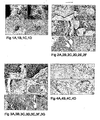
- the effects shown in figures Fig 1A to Fig 1D, Fig 2A to Fig 2F, Fig 3A to Fig 3G and Fig 4A to Fig 4D have been obtained by a cream preparation obtained by mixing a solution of cyclopamine in ethanol with a base cream so as to get a final concentration of 18 mM cyclopamine in cream.
- the base cream used is made predominantly of heavy paraffin oil (10% w/w), vaseline (10% w/w), stearyl alcohol (8% w/w), polyoxylsteareth-40 (3% w/w) and water (68% w/w) but another suitably formulated base cream is also possible.
- Optimal concentration of cyclopamine in a pharmaceutical form as well as the optimal dosing and application schedules can obviously be affected by such factors as the particular pharmaceutical form, the localisation and characteristics of the skin containing the tumor (e.g. thickness of the epidermis) and the tumor size; however these can be determined by following well known published optimisation methods.
- Fig 1A BCC on the nasolabial fold, ⁇ 4x5 mm on surface
- Fig 1C BCC on the forehead, ⁇ 4x4 mm on surface
- Night-time applications, avoided in this schedule because of possible loss of cream from the patient skin to linens during sleep, can be performed by suitable dermal patches.
- preservation of the undifferentiated cells in the normal epidermis and in hair follicles following exposure to cyclopamine provide information about the tolerable doses in other possible modes of administration as well; e.g. direct intratumoral injection of an aqueous solution or systemic administration of the same or of cyclopamine entrapped in liposomes.
- Fig 1A, Fig 1B, Fig 1C and Fig 1D show rapid clinical regressions of the BCC's following exposure to cyclopamine. Besides the visual disappearence of several tumor areas within less than a week of cyclopamine exposure, there is a loss in the typically translucent appearance of the BCC's as seen by the comparison of Fig 1B to Fig 1A and of Fig 1D to Fig 1C.
- Fig 2A to Fig 2F show microscopic appearences of the tumor areas subjected to surgical excisions together with a margin of normal tissue on the fifth and sixth days of cyclopamine applications when the BCC's had lost most of their pre-treatment areas but still possessed few regions that, although markedly decreased in height, had not yet completely disappeared and therefore had residual tumor cells for microscopic analyses.
- Fig 2A and Fig 2B show, on tissue sections, the skin areas corresponding to the visually disappeared tumor nodules. The tumors are seen to have disappeared to leave behind large cystic structures containing little material inside and no detectable tumor cells.
- Fig 2C shows microscopic appearance of a skin area that contained still visible BCC in vivo. These regions are seen to contain residual BCC's displaying large cysts in the tumor center and smaller cystic structures of various sizes located among the residual BCC cells towards the periphery.
- Fig 2D and Fig 2E show 1000X magnified appearances from the interior and palisading peripheral regions of these residual BCC's and show the presence of massive apoptotic activity among the residual BCC cells regardless of the tumor region.
- These high magnifications show greatly Increased frequency of the BCC cells displaying apoptotic morphology and formation of the cystic structures by the apoptotic removal of cells as exemplified on Fig 2D by the imminent joining together of the three smaller cysts into a larger one upon removal of the apoptotic septal cells.
- Fig 2F shows that the BCC's treated with the placebo cream (i.e. the cream preparation identical to the cydopamine cream except for the absence of cyclopamine In placebo) show, by contrast, the typical neoplastic BCC cells and no detectable apoptotic activity.
- the placebo cream i.e. the cream preparation identical to the cydopamine cream except for the absence of cyclopamine In placebo
- Fig 3A, Fig 3B and the quantitative data on Table show that, while Ber-Ep4 strongly labels all peripheral palisading cells and over 90% of the interior cells of the placebo-treated BCC's, none of the residual peripheral or interior cells of the cydopamine-treated BCC's are labelled by Ber-Ep4. Differentiation of the BCC's under the influence of cyclopamine, hitherto unknown by any other means and highly unusual because of achievement of it in vivo and in all cells by immunohistochemical criteria, has Independent value in the treatment of cancer.
- Another differentiation marker, Ulex Europaeus lectin type 1 normally does not label the BCC's or the basal layer cells of normal epidermis but labels the differentiated upper layer cells.
- Fig 3C showing the heterogenous labelling of the residual cells of cyclopamine-treated BCC's, with this lectin, shows differentiation of some of the BCC cells beyond the differentiation step detected by Ber-Ep4 all the way to the step detected by Ulex Europaeus lectin type 1.
- the p53 is a master regulator of the cellular response to DNA-damage. Amount of this protein is known to increase in the cell nucleus following exposure of cells to genotoxic agents. When the DNA-damage is increased beyond a threshold, p53 serves for the apoptotic death of cells. Radiation therapy of cancer and the genotoxic cancer chemotherapeutics that are currently common, act largely by this mechanism, i.e. by causation of apoptosis secondary to the damaging of DNA.
- the monoclonal antibody DO-7 can bind both normal and missense mutant (i.e., nonfunctional) forms of p53 and is known to be capable of detecting the increase of p53 in the cells following exposure to DNA-damaging agents.
- Fig 3D, Fig 3E and the quantitative data in Table I show that both the DO-7 labelling Intensity and the frequency of labelled cells are markedly decreased in cyclopamine-treated BCC's in comparison to the placebo-treated BCC's.
- cyclopamine causes, not an increase, but rather a decrease of p53 in the nuclei of cyclopamine-treated BCC cells. Since expression of p53 is known to decrease in epidermal cells upon differentiation, the decreased DO-7 labelling of the cyclopamine-treated BCC's is likely to be secondary to the cyclopamine-induced differentiation of the BCC cells.
- massive apoptotic activity in the cyclopamine-treated BCC's despite markedly decreased p53 expression means that the cyclopamine-induced apoptosis of these tumor cells is by a non-genotoxic mechanism.
- Fig 4A to Fig 4D show Ber-Ep4 labelling of the normal skin tissue found on and around the cyclopamine-treated BCC's. Different epidermal areas that were treated with cyclopamine are seen in Fig 4A, Fig 4B and Fig 4C to display normal pattern of labelling with Ber-Ep4, i.e. labelling of the basal layer cells. Similarly Fig 4D shows normal Ber-Ep4 labelling of a hair follicle exposed to cyclopamine. Thus the undifferentiated cells of normal epidermis and of hair follicles are preserved despite being exposed to the same schedule and doses of cyclopamine as the BCC's.
- cyclopamine or a pharmaceutically acceptable salt of cyclopamine in the topical treatment of basal cell carcinomas.
- cyclopamine or a pharmaceutically acceptable salt of cyclopamine for the manufacture of a pharmaceutical compound for use in the topical treatment of basal cell carcinomas.
- cyclopamine or a pharmaceutically acceptable salt of cyclopamine in the treatment of basal cell carcinomas by non-topical means, including by intratumoral injections.
- cyclopamine or a pharmaceutically acceptable salt of cyclopamine for the manufacture of a pharmaceutical compound for use in the treatment of basal cell carcinomas by non-topical means, Including by intratumoral injections.
- cyclopamine or a pharmaceutically acceptable salt or derivative of cyclopamine In the topical treatment of basal cell carcinomas.
- cyclopamine or a pharmaceutically acceptable salt or derivative of cyclopamine for the manufacture of a pharmaceutical compound for use in the topical treatment of basal cell carcinomas.
- cyclopamine or a pharmaceutically acceptable salt or derivative of cyclopamine In the treatment of basal cell carcinomas by non-topical means, including by intratumoral injections.
- cyclopamine or a pharmaceutically acceptable salt or derivative of cyclopamine for the manufacture of a pharmaceutical compound for use in the treatment of basal cell carcinomas by non-topical means, including by intratumoral injections.
- cyclopamine or a pharmaceutically acceptable salt of cyclopamine In the treatment of tumors that use the hedgehog/smoothened signal transduction pathway for proliferation and/or for the prevention of apoptosis or cellular differentiation.
- cyclopamine or a pharmaceutically acceptable salt of cyclopamine for the manufacture of a pharmaceutical compound for use in the treatment of tumors that use the hedgehog/smoothened signal transduction pathway for proliferation and/or for the prevention of apoptosis or cellular differentiation.
- cyclopamine or a pharmaceutically acceptable salt or derivative of cyclopamine in the treatment of tumors that use the hedgehog/smoothened signal transduction pathway for proliferation and/or for the prevention of apoptosis or cellular differentiation.
- cyclopamine or a pharmaceutically acceptable salt or derivative of cyclopamine for the manufacture of a pharmaceutical compound for use in the treatment of tumors that use the hedgehog/smoothened signal transduction pathway for proliferation and/or for the prevention of apoptosis or cellular differentiation.
Landscapes
- Health & Medical Sciences (AREA)
- General Health & Medical Sciences (AREA)
- Life Sciences & Earth Sciences (AREA)
- Chemical & Material Sciences (AREA)
- Public Health (AREA)
- Veterinary Medicine (AREA)
- Medicinal Chemistry (AREA)
- Animal Behavior & Ethology (AREA)
- Pharmacology & Pharmacy (AREA)
- Organic Chemistry (AREA)
- Nuclear Medicine, Radiotherapy & Molecular Imaging (AREA)
- General Chemical & Material Sciences (AREA)
- Chemical Kinetics & Catalysis (AREA)
- Engineering & Computer Science (AREA)
- Bioinformatics & Cheminformatics (AREA)
- Epidemiology (AREA)
- Dermatology (AREA)
- Pharmaceuticals Containing Other Organic And Inorganic Compounds (AREA)
- Medicines That Contain Protein Lipid Enzymes And Other Medicines (AREA)
- Medicinal Preparation (AREA)
- Steroid Compounds (AREA)
- Nitrogen Condensed Heterocyclic Rings (AREA)
- Medicines Containing Material From Animals Or Micro-Organisms (AREA)
- Cosmetics (AREA)
- Medicines Containing Plant Substances (AREA)
- Nitrogen And Oxygen Or Sulfur-Condensed Heterocyclic Ring Systems (AREA)
- Medicines Containing Antibodies Or Antigens For Use As Internal Diagnostic Agents (AREA)
Priority Applications (2)
| Application Number | Priority Date | Filing Date | Title |
|---|---|---|---|
| EP10163813.8A EP2216022B1 (de) | 2001-07-02 | 2001-07-02 | Verwendung des Cyclopamins zur Behandlung des basalen Zellkarzinoms und anderer Tumore |
| EP20140196071 EP2862570A1 (de) | 2001-07-02 | 2001-07-02 | Verwendung von Cyclopamin bei der Behandlung eines Basalzellkarzinoms und anderen Tumoren |
Applications Claiming Priority (2)
| Application Number | Priority Date | Filing Date | Title |
|---|---|---|---|
| EP01952097A EP1401438B1 (de) | 2001-07-02 | 2001-07-02 | Verwendung von cyclopamine, zur behandlung des basalzellkarzinoms und anderer tumoren |
| PCT/TR2001/000027 WO2002078703A1 (en) | 2001-07-02 | 2001-07-02 | Use of cyclopamine in the treatment of basal cell carcinoma and other tumors |
Related Parent Applications (2)
| Application Number | Title | Priority Date | Filing Date |
|---|---|---|---|
| EP01952097A Division EP1401438B1 (de) | 2001-07-02 | 2001-07-02 | Verwendung von cyclopamine, zur behandlung des basalzellkarzinoms und anderer tumoren |
| EP01952097.2 Division | 2001-07-02 |
Related Child Applications (2)
| Application Number | Title | Priority Date | Filing Date |
|---|---|---|---|
| EP20140196071 Division EP2862570A1 (de) | 2001-07-02 | 2001-07-02 | Verwendung von Cyclopamin bei der Behandlung eines Basalzellkarzinoms und anderen Tumoren |
| EP10163813.8A Division EP2216022B1 (de) | 2001-07-02 | 2001-07-02 | Verwendung des Cyclopamins zur Behandlung des basalen Zellkarzinoms und anderer Tumore |
Publications (2)
| Publication Number | Publication Date |
|---|---|
| EP1561464A2 true EP1561464A2 (de) | 2005-08-10 |
| EP1561464A3 EP1561464A3 (de) | 2007-04-25 |
Family
ID=21619326
Family Applications (4)
| Application Number | Title | Priority Date | Filing Date |
|---|---|---|---|
| EP05008758A Withdrawn EP1561464A3 (de) | 2001-07-02 | 2001-07-02 | Verwendung des Cyclopamins zur Behandlung des basalen Zellkarzinoms und anderer Tumoren |
| EP01952097A Revoked EP1401438B1 (de) | 2001-07-02 | 2001-07-02 | Verwendung von cyclopamine, zur behandlung des basalzellkarzinoms und anderer tumoren |
| EP10163813.8A Expired - Lifetime EP2216022B1 (de) | 2001-07-02 | 2001-07-02 | Verwendung des Cyclopamins zur Behandlung des basalen Zellkarzinoms und anderer Tumore |
| EP20140196071 Withdrawn EP2862570A1 (de) | 2001-07-02 | 2001-07-02 | Verwendung von Cyclopamin bei der Behandlung eines Basalzellkarzinoms und anderen Tumoren |
Family Applications After (3)
| Application Number | Title | Priority Date | Filing Date |
|---|---|---|---|
| EP01952097A Revoked EP1401438B1 (de) | 2001-07-02 | 2001-07-02 | Verwendung von cyclopamine, zur behandlung des basalzellkarzinoms und anderer tumoren |
| EP10163813.8A Expired - Lifetime EP2216022B1 (de) | 2001-07-02 | 2001-07-02 | Verwendung des Cyclopamins zur Behandlung des basalen Zellkarzinoms und anderer Tumore |
| EP20140196071 Withdrawn EP2862570A1 (de) | 2001-07-02 | 2001-07-02 | Verwendung von Cyclopamin bei der Behandlung eines Basalzellkarzinoms und anderen Tumoren |
Country Status (14)
| Country | Link |
|---|---|
| EP (4) | EP1561464A3 (de) |
| JP (3) | JP2004536045A (de) |
| KR (1) | KR20090125833A (de) |
| CN (2) | CN1525859B (de) |
| AT (2) | ATE305300T1 (de) |
| AU (1) | AU2001272892B8 (de) |
| BR (1) | BR0117063A (de) |
| CA (1) | CA2452151C (de) |
| DE (2) | DE60113733T2 (de) |
| DK (2) | DK1401438T3 (de) |
| ES (3) | ES2250434T3 (de) |
| PT (1) | PT1411938E (de) |
| RU (1) | RU2312661C2 (de) |
| WO (2) | WO2002078703A1 (de) |
Families Citing this family (30)
| Publication number | Priority date | Publication date | Assignee | Title |
|---|---|---|---|---|
| US6984522B2 (en) | 2000-08-03 | 2006-01-10 | Regents Of The University Of Michigan | Isolation and use of solid tumor stem cells |
| US8044259B2 (en) | 2000-08-03 | 2011-10-25 | The Regents Of The University Of Michigan | Determining the capability of a test compound to affect solid tumor stem cells |
| US20170326118A1 (en) | 2001-07-02 | 2017-11-16 | Sinan Tas | Drug treatment of tumors wherein hedgehog/smoothened signaling is utilized for inhibition of apoptosis of tumor cells |
| EP1411938B1 (de) | 2001-07-02 | 2005-07-06 | Tas, Sinan | Verwendung von cyclopamine zur Herstellung eines Arzneimittels zur Behandlung von Psoriasis |
| EP1561464A3 (de) * | 2001-07-02 | 2007-04-25 | Sinan Tas | Verwendung des Cyclopamins zur Behandlung des basalen Zellkarzinoms und anderer Tumoren |
| CA2619889C (en) * | 2005-08-22 | 2020-05-05 | The Johns Hopkins University | Use of itraconazole and salts thereof for treating cancer |
| US7723477B2 (en) | 2005-10-31 | 2010-05-25 | Oncomed Pharmaceuticals, Inc. | Compositions and methods for inhibiting Wnt-dependent solid tumor cell growth |
| CA2628221A1 (en) | 2005-10-31 | 2007-05-10 | Oncomed Pharmaceuticals, Inc. | Anti-frizzled receptor antibodies for treating cancer |
| AU2007329678A1 (en) * | 2006-10-31 | 2008-06-12 | Government Of The United States Of America, Represented By The Secretary, Department Of Health And Human Services | Smoothened polypeptides and methods of use |
| TWI433674B (zh) | 2006-12-28 | 2014-04-11 | Infinity Discovery Inc | 環杷明(cyclopamine)類似物類 |
| WO2008092002A2 (en) | 2007-01-24 | 2008-07-31 | The Regents Of The University Of Michigan | Compositions and methods for treating and diagnosing pancreatic cancer |
| RU2009137012A (ru) | 2007-03-07 | 2011-04-20 | Инфинити Дискавери, Инк. (Us) | Аналоги циклопаминлактама и способы их применения |
| JP2010520295A (ja) * | 2007-03-07 | 2010-06-10 | インフィニティ・ディスカバリー・インコーポレイテッド | へテロ環状シクロパミン類似体及びその使用方法 |
| CA2710858A1 (en) | 2007-12-27 | 2009-07-09 | Infinity Pharmaceuticals, Inc. | Methods for stereoselective reduction |
| CN101990542A (zh) * | 2008-02-08 | 2011-03-23 | 德克萨斯大学董事会 | 环巴胺酒石酸盐及其用途 |
| SG190568A1 (en) | 2008-09-26 | 2013-06-28 | Oncomed Pharm Inc | Frizzled-binding agents and uses thereof |
| US20110275576A1 (en) * | 2009-01-06 | 2011-11-10 | Utah State University | Carbohydrate-Cyclopamine Conjugates as Anticancer Agents |
| JP2009143963A (ja) * | 2009-03-25 | 2009-07-02 | Sinan Tas | 腫瘍細胞のアポトーシスを阻害するためにヘッジホッグ/スムーズンド信号を使用する腫瘍を治療するための製薬組成物 |
| AU2010279325B2 (en) | 2009-08-05 | 2016-10-20 | Infinity Pharmaceuticals, Inc. | Enzymatic transamination of cyclopamine analogs |
| TWI535445B (zh) | 2010-01-12 | 2016-06-01 | 安可美德藥物股份有限公司 | Wnt拮抗劑及治療和篩選方法 |
| CA2794674A1 (en) | 2010-04-01 | 2011-10-06 | Oncomed Pharmaceuticals, Inc. | Frizzled-binding agents and uses thereof |
| US9394313B2 (en) | 2010-09-14 | 2016-07-19 | Infinity Pharmaceuticals, Inc. | Transfer hydrogenation of cyclopamine analogs |
| AU2013334790A1 (en) | 2012-10-23 | 2015-04-30 | Oncomed Pharmaceuticals, Inc. | Methods of treating neuroendocrine tumors using Wnt pathway-binding agents |
| AU2014212081A1 (en) | 2013-02-04 | 2015-08-13 | Oncomed Pharmaceuticals, Inc. | Methods and monitoring of treatment with a Wnt pathway inhibitor |
| US9168300B2 (en) | 2013-03-14 | 2015-10-27 | Oncomed Pharmaceuticals, Inc. | MET-binding agents and uses thereof |
| WO2015096654A1 (zh) * | 2013-12-26 | 2015-07-02 | 中国科学院上海生命科学研究院 | Shh信号通路特异性抑制剂的应用 |
| PL3302428T3 (pl) | 2015-06-04 | 2026-04-13 | Sol-Gel Technologies Ltd. | Preparaty do zastosowania miejscowego do dostarczania związków inhibitora hedgehog i ich zastosowanie |
| WO2017139497A1 (en) * | 2016-02-11 | 2017-08-17 | PellePharm, Inc. | Hedgehog inhibitor for use in relief of and treatment of pruritus or itching |
| US20240384291A1 (en) | 2021-09-13 | 2024-11-21 | Sinan Tas | Effective Interventions With Aging and Diseases Of Aging Of Human and Their Consequences |
| CN114292279B (zh) * | 2022-01-07 | 2023-05-09 | 吉林省农业科学院 | 一种藜芦抗癌有效成分环杷明提取与分离方法 |
Family Cites Families (10)
| Publication number | Priority date | Publication date | Assignee | Title |
|---|---|---|---|---|
| US5851993A (en) * | 1994-06-13 | 1998-12-22 | Biotie Therapies Ltd. | Suppression of tumor cell growth by syndecan-1 ectodomain |
| JP5067986B2 (ja) * | 1998-04-09 | 2012-11-07 | ジョンズ ホプキンズ ユニヴァーシティー スクール オブ メディシン | ヘッジホッグシグナリング経路の阻害剤としてのステロイドアルカロイド誘導体の使用 |
| DK1115398T3 (da) * | 1998-09-23 | 2010-08-16 | Res Dev Foundation | Tocopheroler, tocotrienoler, andre chroman- og sidekædederivater og anvendelser deraf |
| US6291516B1 (en) * | 1999-01-13 | 2001-09-18 | Curis, Inc. | Regulators of the hedgehog pathway, compositions and uses related thereto |
| ATE283700T1 (de) * | 1999-06-08 | 2004-12-15 | Lorantis Ltd | Therapeutische verwendung eines inhibitors des hedgehog signalübertragungsweges |
| EP1235851B1 (de) * | 1999-10-13 | 2006-05-31 | Johns Hopkins University School of Medicine | Verbindungen zur regulierung des hedgehog-signalwegs, zusammensetzungen und verwendungen davon |
| EP1646395B8 (de) * | 1999-11-30 | 2014-12-17 | Curis, Inc. | Verfahren und zusammensetzungen zur regulierung der lymphozytenaktivität |
| CU23175A1 (es) * | 2000-07-17 | 2006-09-22 | Ct De Investigacion Y Desarrol | Formulacion liposomica de propionato de clobetasol |
| EP1561464A3 (de) * | 2001-07-02 | 2007-04-25 | Sinan Tas | Verwendung des Cyclopamins zur Behandlung des basalen Zellkarzinoms und anderer Tumoren |
| EP1411938B1 (de) * | 2001-07-02 | 2005-07-06 | Tas, Sinan | Verwendung von cyclopamine zur Herstellung eines Arzneimittels zur Behandlung von Psoriasis |
-
2001
- 2001-07-02 EP EP05008758A patent/EP1561464A3/de not_active Withdrawn
- 2001-07-02 DE DE60113733T patent/DE60113733T2/de not_active Expired - Lifetime
- 2001-07-02 CA CA2452151A patent/CA2452151C/en not_active Expired - Fee Related
- 2001-07-02 ES ES01952097T patent/ES2250434T3/es not_active Expired - Lifetime
- 2001-07-02 CN CN018234429A patent/CN1525859B/zh not_active Expired - Fee Related
- 2001-07-02 AU AU2001272892A patent/AU2001272892B8/en not_active Ceased
- 2001-07-02 JP JP2002576969A patent/JP2004536045A/ja active Pending
- 2001-07-02 BR BR0117063-5A patent/BR0117063A/pt active Search and Examination
- 2001-07-02 DK DK01952097T patent/DK1401438T3/da active
- 2001-07-02 EP EP01952097A patent/EP1401438B1/de not_active Revoked
- 2001-07-02 EP EP10163813.8A patent/EP2216022B1/de not_active Expired - Lifetime
- 2001-07-02 ES ES10163813.8T patent/ES2534400T3/es not_active Expired - Lifetime
- 2001-07-02 EP EP20140196071 patent/EP2862570A1/de not_active Withdrawn
- 2001-07-02 AT AT01952097T patent/ATE305300T1/de not_active IP Right Cessation
- 2001-07-02 WO PCT/TR2001/000027 patent/WO2002078703A1/en not_active Ceased
-
2002
- 2002-04-19 RU RU2004103074/15A patent/RU2312661C2/ru not_active IP Right Cessation
- 2002-04-19 AT AT02736467T patent/ATE299022T1/de not_active IP Right Cessation
- 2002-04-19 DE DE60204966T patent/DE60204966T2/de not_active Expired - Lifetime
- 2002-04-19 ES ES02736467T patent/ES2246011T3/es not_active Expired - Lifetime
- 2002-04-19 PT PT02736467T patent/PT1411938E/pt unknown
- 2002-04-19 WO PCT/TR2002/000017 patent/WO2002078704A1/en not_active Ceased
- 2002-04-19 CN CNB02813429XA patent/CN1230169C/zh not_active Expired - Fee Related
- 2002-04-19 DK DK02736467T patent/DK1411938T3/da active
-
2003
- 2003-03-17 KR KR1020097022024A patent/KR20090125833A/ko not_active Ceased
-
2010
- 2010-02-10 JP JP2010028010A patent/JP5424923B2/ja not_active Expired - Fee Related
-
2013
- 2013-09-18 JP JP2013193304A patent/JP2014028834A/ja not_active Ceased
Also Published As
Similar Documents
| Publication | Publication Date | Title |
|---|---|---|
| EP1401438B1 (de) | Verwendung von cyclopamine, zur behandlung des basalzellkarzinoms und anderer tumoren | |
| AU2001272892A1 (en) | Use of cyclopamine in the treatment of basal cell carcinoma and other tumors | |
| US7893078B2 (en) | Use of cyclopamine in the treatment of basal cell carcinoma and other tumors | |
| CA2596759C (en) | Local treatment of neurofibromas | |
| US20170326118A1 (en) | Drug treatment of tumors wherein hedgehog/smoothened signaling is utilized for inhibition of apoptosis of tumor cells | |
| JP2009143963A (ja) | 腫瘍細胞のアポトーシスを阻害するためにヘッジホッグ/スムーズンド信号を使用する腫瘍を治療するための製薬組成物 | |
| RU2308948C2 (ru) | Применение циклопамина для лечения базально-клеточной эпителиомы (карциномы) и других опухолей | |
| JP2014028835A (ja) | 基底細胞癌及び他の腫瘍の治療におけるシクロパミンの使用方法 | |
| Rajabi-Estarabadi et al. | Cells to Surgery Quiz: April 2018 | |
| CN101904852A (zh) | 环杷明在治疗基底细胞癌及其它肿瘤中的应用 |
Legal Events
| Date | Code | Title | Description |
|---|---|---|---|
| PUAI | Public reference made under article 153(3) epc to a published international application that has entered the european phase |
Free format text: ORIGINAL CODE: 0009012 |
|
| 17P | Request for examination filed |
Effective date: 20050518 |
|
| AC | Divisional application: reference to earlier application |
Ref document number: 1401438 Country of ref document: EP Kind code of ref document: P |
|
| AK | Designated contracting states |
Kind code of ref document: A2 Designated state(s): AT BE CH CY DE DK ES FI FR GB GR IE IT LI LU MC NL PT SE TR |
|
| PUAL | Search report despatched |
Free format text: ORIGINAL CODE: 0009013 |
|
| AK | Designated contracting states |
Kind code of ref document: A3 Designated state(s): AT BE CH CY DE DK ES FI FR GB GR IE IT LI LU MC NL PT SE TR |
|
| AKX | Designation fees paid |
Designated state(s): AT BE CH CY DE DK ES FI FR GB GR IE IT LI LU MC NL PT SE TR |
|
| STAA | Information on the status of an ep patent application or granted ep patent |
Free format text: STATUS: THE APPLICATION IS DEEMED TO BE WITHDRAWN |
|
| 18D | Application deemed to be withdrawn |
Effective date: 20120201 |