EP1608009A1 - Halbleiterbauelement - Google Patents
Halbleiterbauelement Download PDFInfo
- Publication number
- EP1608009A1 EP1608009A1 EP04707668A EP04707668A EP1608009A1 EP 1608009 A1 EP1608009 A1 EP 1608009A1 EP 04707668 A EP04707668 A EP 04707668A EP 04707668 A EP04707668 A EP 04707668A EP 1608009 A1 EP1608009 A1 EP 1608009A1
- Authority
- EP
- European Patent Office
- Prior art keywords
- functional area
- semiconductor device
- functional
- area
- bumps
- Prior art date
- Legal status (The legal status is an assumption and is not a legal conclusion. Google has not performed a legal analysis and makes no representation as to the accuracy of the status listed.)
- Withdrawn
Links
Images


Classifications
-
- H—ELECTRICITY
- H10—SEMICONDUCTOR DEVICES; ELECTRIC SOLID-STATE DEVICES NOT OTHERWISE PROVIDED FOR
- H10W—GENERIC PACKAGES, INTERCONNECTIONS, CONNECTORS OR OTHER CONSTRUCTIONAL DETAILS OF DEVICES COVERED BY CLASS H10
- H10W72/00—Interconnections or connectors in packages
-
- H—ELECTRICITY
- H10—SEMICONDUCTOR DEVICES; ELECTRIC SOLID-STATE DEVICES NOT OTHERWISE PROVIDED FOR
- H10W—GENERIC PACKAGES, INTERCONNECTIONS, CONNECTORS OR OTHER CONSTRUCTIONAL DETAILS OF DEVICES COVERED BY CLASS H10
- H10W72/00—Interconnections or connectors in packages
- H10W72/20—Bump connectors, e.g. solder bumps or copper pillars; Dummy bumps; Thermal bumps
-
- H—ELECTRICITY
- H10—SEMICONDUCTOR DEVICES; ELECTRIC SOLID-STATE DEVICES NOT OTHERWISE PROVIDED FOR
- H10W—GENERIC PACKAGES, INTERCONNECTIONS, CONNECTORS OR OTHER CONSTRUCTIONAL DETAILS OF DEVICES COVERED BY CLASS H10
- H10W72/00—Interconnections or connectors in packages
- H10W72/071—Connecting or disconnecting
- H10W72/072—Connecting or disconnecting of bump connectors
- H10W72/07231—Techniques
- H10W72/07236—Soldering or alloying
-
- H—ELECTRICITY
- H10—SEMICONDUCTOR DEVICES; ELECTRIC SOLID-STATE DEVICES NOT OTHERWISE PROVIDED FOR
- H10W—GENERIC PACKAGES, INTERCONNECTIONS, CONNECTORS OR OTHER CONSTRUCTIONAL DETAILS OF DEVICES COVERED BY CLASS H10
- H10W90/00—Package configurations
- H10W90/701—Package configurations characterised by the relative positions of pads or connectors relative to package parts
- H10W90/721—Package configurations characterised by the relative positions of pads or connectors relative to package parts of bump connectors
- H10W90/724—Package configurations characterised by the relative positions of pads or connectors relative to package parts of bump connectors between a chip and a stacked insulating package substrate, interposer or RDL
Definitions
- the present invention relates to a semiconductor device including, on a substrate, a first functional area including a storage area and the like, a second functional area including a driving circuit and the like, and an electrode for externally inputting and outputting a signal.
- a method of fixing the chip onto the external substrate through hot pressing using a solder bump is known.
- a bump connection pad is disposed on the DRAM chip, a load is applied to a DRAM cell array at the time of a bump connection (assembling) if the bump connection pad is provided immediately above the DRAM cell array. Therefore, there arises a problem that the DRAM cell array is damaged, the characteristics of the DRAM cell array are degraded, or the like.
- Figs. 8A and 8B are schematic views illustrating a conventional semiconductor device, where Fig. 8A is a plan view and Fig. 8B is a sectional view.
- the semiconductor device has such a structure that a substrate 10 including a DRAM chip and the like is connected to an external substrate 20 including an LSI such as a signal processing chip through bumps B.
- bump connection pads and the bumps B are disposed in a second functional area 2 where the other signal processing circuits and the like are formed, so as to avoid the same surface of a DRAM cell array area (a first functional area 1) formed on the DRAM chip.
- a technique related to the arrangement of a bonding pad for connecting a bonding wire is disclosed in Patent Document 1.
- Patent Document 1 Japanese Patent Application Publication No. Hei 4-162664
- the bump connection pads and the bumps are disposed so as to avoid the DRAM cell array area. Therefore, the DRAM cell array is not affected even if a load is applied through the bumps at the connection of the DRAM chip.
- the bump connection pads and the bumps are disposed so as to be separated from each other, for example, at both ends on the DRAM chip, there arises a problem that a yield at the time of the bump connection (assembling) is lowered. Specifically, even a slight inclination of the DRAM chip causes a variation in load applied to the bumps provided at both horizontal ends. Uniform pressure connection for all the bumps becomes difficult, for example, a bump at one end is successfully connected whereas a bump at the other end is not fully seated, resulting in lowered reliability of products.
- a semiconductor device including a first functional area and a second functional area, which are provided on a substrate, wherein an electrode for externally inputting and outputting a signal is provided so as to overlap the second functional area provided inside a circumscribed rectangle of the first functional area when the substrate is viewed in a planar fashion.
- the electrodes are provided so as to overlap the second functional area provided inside the circumscribed rectangle of the first functional area. Therefore, the electrodes are collectively arranged in approximately the center of the substrate. As a result, a pressure can be prevented from being applied to the first functional area upon connection. At the same time, pressure connection to an external substrate through the electrodes can be achieved without expanding the area where the electrodes are arranged. Thus, uniform connection to the electrodes can be achieved.
- Figs. 1A and 1B are schematic views for illustrating a semiconductor device according to a first embodiment, where Fig. 1A is a plan view and Fig. 1B is a sectional view.
- the semiconductor device includes first functional areas 1 and a second functional area 2 provided on a chip-like substrate 10.
- the first functional area 1 serves as a DRAM cell array (a storage element area), whereas the second functional area 2 serves as a signal processing circuit or a driving circuit for the DRAM cell array .
- the semiconductor device according to the first embodiment has two first functional areas (1a and 1b).
- Bumps (metal projections) B for externally inputting and outputting a signal are provided in the second functional area 2, which is an area between the first functional areas (an inner area of a circumscribed rectangle when the first functional areas 1 are viewed in a planar fashion).
- the semiconductor device is connected face-down to an external substrate 20 through the bumps B.
- the bumps B can be provided in approximately the center of the substrate 10 so as not to be situated directly above the DRAM cell arrays corresponding to the first functional areas 1. Therefore, at heat pressure connection of the semiconductor device to the external substrate 20 through the bumps B, a pressure is not applied from the bumps B to the DRAM cell arrays (the first functional areas 1).
- the DRAM cell arrays corresponding to the first functional areas 1 have lower resistance against the applied pressure per given area (hereinafter, referred to simply as "resistance against the applied pressure") than that of the area of the signal processing circuit or the driving circuit corresponding to the second functional area 2. Therefore, a pressure is not applied from the bumps B to the DRAM cell arrays (the first functional areas 1), thereby making possible to prevent the DRAM cell arrays from being damaged.
- the bumps B are disposed in approximately the center of the substrate 10, a distance between the bumps at both extremities can be reduced as compared with the case where the bumps are provided at the ends of the substrate 10, and even if the substrate 10 is inclined to some degree, uniform bump connection to the external substrate 20 can be achieved.
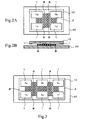
- Figs. 2A and 2B are schematic views for illustrating a semiconductor device according to a second embodiment, where Fig. 2A is a plan view and Fig. 2B is a sectional view.
- the semiconductor device includes the first functional areas 1 and the second functional area 2 provided on the chip-like substrate 10.
- the plurality of bumps B are provided in a cross-like pattern in the second functional area 2, which is an area between the first functional areas (an inner area of a circumscribed rectangle when the first functional areas 1 are viewed in a planar fashion).
- the semiconductor device is connected face-down to the external substrate 20 through the bumps B.
- the bumps B can be provided in approximately the center of the substrate 10 so as not to be situated directly above the DRAM cell arrays corresponding to the first functional areas 1. Therefore, at heat pressure connection of the semiconductor device to the external substrate 20 through the bumps B, the same functional effects as those in the previously described example are obtained. Specifically, a pressure is not applied from the bumps B to the DRAM cell arrays (the first functional areas 1) which have lower resistance against the applied pressure (lower resistance against the applied pressure than that of the area of the signal processing circuit or the driving circuit corresponding to the second functional area 2). Therefore, the DRAM cell arrays can be prevented from being damaged.
- the plurality of bumps B are arranged in a cross-like pattern.
- the bumps can be arranged in approximately the center of the substrate 10.
- a wiring distance between each of the bumps B and the first functional area 1 can be reduced as much as possible, so that a signal delay can be prevented.
- Fig. 3 is a schematic plan view for illustrating a semiconductor device according to a third embodiment.
- the semiconductor device is an example of application of the semiconductor device shown in Figs. 2A and 2B according to the second embodiment, and includes the first functional areas 1 and the second functional area 2 provided on the chip-like substrate 10.
- the plurality of bumps B are provided in a contiguous cross-like pattern in the second functional area 2, which is an area between the first functional areas 1 (an inner area of a circumscribed rectangle when the first functional areas 1 are viewed in a planar fashion).
- any number of the first functional areas 1 may be provided.
- the bumps B are provided at the position in the second functional area 2, which is an area between the first functional areas (for example, 1a to 1f).
- the arrangement of the bumps in approximately the center of the substrate 10 and the reduction of the wiring distance between each of the bumps B and the first functional areas 1 can be achieved at the same time.
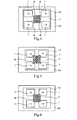
- Fig. 4 is a schematic plan view for illustrating a semiconductor device according to a fourth embodiment.
- the semiconductor device is an example of application of the semiconductor device shown in Fig. 2 according to the second embodiment, and includes the first functional areas 1 and the second functional area 2 provided on the chip-like substrate 10.
- the plurality of bumps B are provided in a rectangular pattern in the second functional area 2, which is an area between the first functional areas (an inner area of a circumscribed rectangle when the first functional areas 1 are viewed in a planar fashion).
- the bumps can be arranged in approximately the center of the substrate 10 while the reduction of the wiring distance between each of the bumps B and the first functional areas 1 can be made possible.
- Fig. 5 is a schematic plan view for illustrating a semiconductor device according to a fifth embodiment.
- the semiconductor device is an example of application of the semiconductor device shown in Fig. 4 according to the fourth embodiment, and includes the first functional areas 1 and the second functional area 2 provided on the chip-like substrate 10.
- the plurality of bumps B are provided in a rectangular pattern in the second functional area 2, which is an area between the first functional areas (an inner area of a circumscribed rectangle when the first functional areas 1 are viewed in a planar fashion).
- the first functional areas 1 (1a to 1d), each being cut, are arranged so as to surround the bumps B arranged in approximately the center of the substrate 10 in a rectangular pattern.
- the bumps can be arranged in approximately the center of the substrate 10 while the reduction of the wiring distance between each of the bumps B and the first functional areas 1 can be made possible.
- layout efficiency of the substrate 10 can be enhanced.
- Fig. 6 is a schematic plan view for illustrating a semiconductor device according to a sixth embodiment.
- the semiconductor device is an example of application of the semiconductor device shown in Fig. 5 according to the fifth embodiment, and includes the first functional areas 1 and the second functional area 2 provided on the chip-like substrate 10.
- the plurality of bumps B are provided in a rectangular pattern in the second functional area 2, which is an area between the first functional areas (an inner area of a circumscribed rectangle when the first functional areas 1 are viewed in a planar fashion).
- This embodiment particularly differs from the other embodiments in that the corners of the bumps B partially overlap the first functional areas 1. Specifically, it is apparent that an overlap part of the first functional areas 1 with the bumps B is subjected to a pressure upon connection. Therefore, from the very beginning of design, a part of the first functional areas 1, which is pressurized by the bumps B, is set as an invalid area (a non-functioning area) in advance. As a result, the area of the bumps B and the first functional areas 1 can come closer to each other. Therefore, in addition to the effects of the semiconductor device according the fifth embodiment, layout efficiency can also be enhanced.
- Fig. 7 is a schematic plan view for illustrating a semiconductor device according to a seventh embodiment.
- the semiconductor device is arranged so that the second functional area 2 is surrounded by the first functional area 1.
- the bumps B are arranged in the second functional area 2 surrounded by the first functional area 1.
- the first functional area 1 has a continuous annular pattern.
- the second functional area 2 and the bumps B are arranged.
- the bumps B can be arranged in approximately the center of the substrate 10. Moreover, the wiring distance between each of the bumps B and the first functional area 1 can be reduced.
- the plurality of first functional areas 1 may be obtained by dividing a single functional area to be arranged or arranging a plurality of functional areas.
- the DRAM cell array may be divided into a plurality of DRAM cell arrays to be arranged so as to achieve 256 Mbit in total (in this case, a single DRAM cell array obtained by the division corresponds to one first functional area 1).
- a plurality of DRAM cell arrays each being a 256-Mbit DRAM cell array serving as a single first functional area 1, may be arranged (in this case, a total capacity is obtained by: the number of first functional areas 1 ⁇ 256 Mbit).
- the first functional area may include a curve area such as a circle. Furthermore, the same effects can be achieved if an electrode other than the bump B is used as long as it allows connection by the heat pressure.
- the semiconductor device is to be connected to the external substrate by the heat pressure, a pressure through the electrodes is no longer applied to the first functional area, so that and the first functional area is prevented from being damaged. Furthermore, since the arrangement of the electrodes concentrates in approximately the center of the substrate, uniform connection to the electrodes provides a highly reliable apparatus.
Landscapes
- Semiconductor Integrated Circuits (AREA)
- Internal Circuitry In Semiconductor Integrated Circuit Devices (AREA)
- Wire Bonding (AREA)
- Semiconductor Memories (AREA)
Applications Claiming Priority (3)
| Application Number | Priority Date | Filing Date | Title |
|---|---|---|---|
| JP2003040730 | 2003-02-19 | ||
| JP2003040730A JP2004265940A (ja) | 2003-02-19 | 2003-02-19 | 半導体装置 |
| PCT/JP2004/001079 WO2004075280A1 (ja) | 2003-02-19 | 2004-02-03 | 半導体装置 |
Publications (2)
| Publication Number | Publication Date |
|---|---|
| EP1608009A1 true EP1608009A1 (de) | 2005-12-21 |
| EP1608009A4 EP1608009A4 (de) | 2010-05-19 |
Family
ID=32905262
Family Applications (1)
| Application Number | Title | Priority Date | Filing Date |
|---|---|---|---|
| EP04707668A Withdrawn EP1608009A4 (de) | 2003-02-19 | 2004-02-03 | Halbleiterbauelement |
Country Status (6)
| Country | Link |
|---|---|
| US (1) | US20060186403A1 (de) |
| EP (1) | EP1608009A4 (de) |
| JP (1) | JP2004265940A (de) |
| KR (1) | KR20050100663A (de) |
| TW (1) | TWI246132B (de) |
| WO (1) | WO2004075280A1 (de) |
Cited By (1)
| Publication number | Priority date | Publication date | Assignee | Title |
|---|---|---|---|---|
| EP2249381A4 (de) * | 2008-02-19 | 2012-11-21 | Liquid Design Systems Inc | Halbleiterchip und halbleiteranordnung |
Families Citing this family (2)
| Publication number | Priority date | Publication date | Assignee | Title |
|---|---|---|---|---|
| JP2009295740A (ja) * | 2008-06-04 | 2009-12-17 | Elpida Memory Inc | メモリチップ及び半導体装置 |
| JP6963448B2 (ja) * | 2017-09-13 | 2021-11-10 | 太陽誘電株式会社 | 電子部品 |
Family Cites Families (13)
| Publication number | Priority date | Publication date | Assignee | Title |
|---|---|---|---|---|
| JPH0752762B2 (ja) * | 1985-01-07 | 1995-06-05 | 株式会社日立製作所 | 半導体樹脂パッケージ |
| US4731643A (en) * | 1985-10-21 | 1988-03-15 | International Business Machines Corporation | Logic-circuit layout for large-scale integrated circuits |
| JPH07111971B2 (ja) * | 1989-10-11 | 1995-11-29 | 三菱電機株式会社 | 集積回路装置の製造方法 |
| JPH05343634A (ja) * | 1992-06-06 | 1993-12-24 | Hitachi Ltd | 半導体記憶装置 |
| JP3383081B2 (ja) * | 1994-07-12 | 2003-03-04 | 三菱電機株式会社 | 陽極接合法を用いて製造した電子部品及び電子部品の製造方法 |
| JPH0888253A (ja) * | 1994-09-16 | 1996-04-02 | Nippon Steel Corp | 半導体装置用端子接触装置 |
| US5842628A (en) * | 1995-04-10 | 1998-12-01 | Fujitsu Limited | Wire bonding method, semiconductor device, capillary for wire bonding and ball bump forming method |
| JP3494502B2 (ja) * | 1995-05-12 | 2004-02-09 | 株式会社ルネサステクノロジ | 半導体記憶装置およびそのパッド配置方法 |
| JPH11214654A (ja) * | 1998-01-28 | 1999-08-06 | Mitsubishi Electric Corp | 半導体記憶装置 |
| JP2000223657A (ja) * | 1999-02-03 | 2000-08-11 | Rohm Co Ltd | 半導体装置およびそれに用いる半導体チップ |
| US6246121B1 (en) * | 1999-04-12 | 2001-06-12 | Vlsi Technology, Inc. | High performance flip-chip semiconductor device |
| JP3572614B2 (ja) * | 2001-01-19 | 2004-10-06 | 関西日本電気株式会社 | 半導体ウエハ |
| CN1383197A (zh) * | 2001-04-25 | 2002-12-04 | 松下电器产业株式会社 | 半导体装置的制造方法及半导体装置 |
-
2003
- 2003-02-19 JP JP2003040730A patent/JP2004265940A/ja active Pending
-
2004
- 2004-02-03 US US10/543,592 patent/US20060186403A1/en not_active Abandoned
- 2004-02-03 WO PCT/JP2004/001079 patent/WO2004075280A1/ja not_active Ceased
- 2004-02-03 EP EP04707668A patent/EP1608009A4/de not_active Withdrawn
- 2004-02-03 KR KR1020057014633A patent/KR20050100663A/ko not_active Withdrawn
- 2004-02-16 TW TW093103631A patent/TWI246132B/zh not_active IP Right Cessation
Cited By (1)
| Publication number | Priority date | Publication date | Assignee | Title |
|---|---|---|---|---|
| EP2249381A4 (de) * | 2008-02-19 | 2012-11-21 | Liquid Design Systems Inc | Halbleiterchip und halbleiteranordnung |
Also Published As
| Publication number | Publication date |
|---|---|
| TW200428541A (en) | 2004-12-16 |
| KR20050100663A (ko) | 2005-10-19 |
| WO2004075280A1 (ja) | 2004-09-02 |
| US20060186403A1 (en) | 2006-08-24 |
| EP1608009A4 (de) | 2010-05-19 |
| JP2004265940A (ja) | 2004-09-24 |
| TWI246132B (en) | 2005-12-21 |
Similar Documents
| Publication | Publication Date | Title |
|---|---|---|
| US6242814B1 (en) | Universal I/O pad structure for in-line or staggered wire bonding or arrayed flip-chip assembly | |
| JP4731883B2 (ja) | ダブルスタックされたbgaパッケージ及び多重スタックされたbgaパッケージ | |
| US6118180A (en) | Semiconductor die metal layout for flip chip packaging | |
| US6858938B2 (en) | Semiconductor device | |
| US9397034B2 (en) | Multi-chip package having a stacked plurality of different sized semiconductor chips, and method of manufacturing the same | |
| US8680691B2 (en) | Semiconductor device having semiconductor member and mounting member | |
| US6462420B2 (en) | Semiconductor chip and semiconductor device having a chip-on-chip structure | |
| US6677219B2 (en) | Method of forming a ball grid array package | |
| JP2008252152A (ja) | 分布中心を有する周辺マトリックス・ボール・グリッド・アレイ回路パッケージ | |
| JP2002033441A (ja) | 半導体装置 | |
| US7105933B2 (en) | Semiconductor integrated circuit device and manufacturing method of the same | |
| EP1608009A1 (de) | Halbleiterbauelement | |
| JPH10189653A (ja) | 半導体素子およびこの半導体素子を有する回路モジュール | |
| US6743979B1 (en) | Bonding pad isolation | |
| JPH05243482A (ja) | 半導体集積回路 | |
| JP2000022079A (ja) | 半導体集積回路 | |
| KR100475740B1 (ko) | 신호 완결성 개선 및 칩 사이즈 감소를 위한 패드배치구조를 갖는 반도체 집적 회로장치 | |
| US12581932B2 (en) | Integrated circuit device and semiconductor package including the same | |
| US7999370B2 (en) | Semiconductor chip capable of increased number of pads in limited region and semiconductor package using the same | |
| JP2004079559A (ja) | 半導体チップ | |
| JP4618275B2 (ja) | 半導体装置 | |
| JP2004111543A (ja) | 半導体チップ | |
| US20050082580A1 (en) | Structure of wafer level package with area bump | |
| JP3574004B2 (ja) | 半導体装置 | |
| JP2006049637A (ja) | 半導体装置およびその製造方法 |
Legal Events
| Date | Code | Title | Description |
|---|---|---|---|
| PUAI | Public reference made under article 153(3) epc to a published international application that has entered the european phase |
Free format text: ORIGINAL CODE: 0009012 |
|
| 17P | Request for examination filed |
Effective date: 20050811 |
|
| AK | Designated contracting states |
Kind code of ref document: A1 Designated state(s): AT BE BG CH CY CZ DE DK EE ES FI FR GB GR HU IE IT LI LU MC NL PT RO SE SI SK TR |
|
| AX | Request for extension of the european patent |
Extension state: AL LT LV MK |
|
| RIN1 | Information on inventor provided before grant (corrected) |
Inventor name: EZAKI, TAKAYUKI |
|
| RIN1 | Information on inventor provided before grant (corrected) |
Inventor name: EZAKI, TAKAYUKI |
|
| DAX | Request for extension of the european patent (deleted) | ||
| RBV | Designated contracting states (corrected) |
Designated state(s): DE FR GB |
|
| A4 | Supplementary search report drawn up and despatched |
Effective date: 20100416 |
|
| RIC1 | Information provided on ipc code assigned before grant |
Ipc: H01L 27/10 20060101ALN20100412BHEP Ipc: H01L 27/04 20060101ALN20100412BHEP Ipc: H01L 21/82 20060101ALN20100412BHEP Ipc: H01L 21/60 20060101AFI20040906BHEP |
|
| STAA | Information on the status of an ep patent application or granted ep patent |
Free format text: STATUS: THE APPLICATION IS DEEMED TO BE WITHDRAWN |
|
| 18D | Application deemed to be withdrawn |
Effective date: 20100821 |