EP1619732A1 - Electrode au nickel et accumulateur alcalin l'utilisant - Google Patents
Electrode au nickel et accumulateur alcalin l'utilisant Download PDFInfo
- Publication number
- EP1619732A1 EP1619732A1 EP05016126A EP05016126A EP1619732A1 EP 1619732 A1 EP1619732 A1 EP 1619732A1 EP 05016126 A EP05016126 A EP 05016126A EP 05016126 A EP05016126 A EP 05016126A EP 1619732 A1 EP1619732 A1 EP 1619732A1
- Authority
- EP
- European Patent Office
- Prior art keywords
- powders
- oxide
- storage battery
- alkali storage
- nickel
- Prior art date
- Legal status (The legal status is an assumption and is not a legal conclusion. Google has not performed a legal analysis and makes no representation as to the accuracy of the status listed.)
- Withdrawn
Links
- PXHVJJICTQNCMI-UHFFFAOYSA-N Nickel Chemical compound [Ni] PXHVJJICTQNCMI-UHFFFAOYSA-N 0.000 title claims abstract description 192
- 239000003513 alkali Substances 0.000 title claims abstract description 87
- 238000003860 storage Methods 0.000 title claims abstract description 71
- 229910052759 nickel Inorganic materials 0.000 title claims abstract description 34
- 239000000843 powder Substances 0.000 claims abstract description 215
- 229910052751 metal Inorganic materials 0.000 claims abstract description 50
- 239000002184 metal Substances 0.000 claims abstract description 49
- 239000000463 material Substances 0.000 claims abstract description 40
- 239000007864 aqueous solution Substances 0.000 claims abstract description 20
- GUTLYIVDDKVIGB-UHFFFAOYSA-N cobalt atom Chemical compound [Co] GUTLYIVDDKVIGB-UHFFFAOYSA-N 0.000 claims abstract description 14
- 229910021508 nickel(II) hydroxide Inorganic materials 0.000 claims abstract description 14
- 239000010941 cobalt Substances 0.000 claims abstract description 13
- 229910017052 cobalt Inorganic materials 0.000 claims abstract description 13
- 239000002344 surface layer Substances 0.000 claims abstract description 11
- 238000010079 rubber tapping Methods 0.000 claims abstract description 9
- 239000011148 porous material Substances 0.000 claims abstract description 5
- 238000010248 power generation Methods 0.000 claims abstract description 3
- AIBQNUOBCRIENU-UHFFFAOYSA-N nickel;dihydrate Chemical compound O.O.[Ni] AIBQNUOBCRIENU-UHFFFAOYSA-N 0.000 claims abstract 3
- 239000011149 active material Substances 0.000 claims description 86
- 229910000480 nickel oxide Inorganic materials 0.000 claims description 47
- GNRSAWUEBMWBQH-UHFFFAOYSA-N oxonickel Chemical compound [Ni]=O GNRSAWUEBMWBQH-UHFFFAOYSA-N 0.000 claims description 47
- 239000000758 substrate Substances 0.000 claims description 39
- IVMYJDGYRUAWML-UHFFFAOYSA-N cobalt(ii) oxide Chemical compound [Co]=O IVMYJDGYRUAWML-UHFFFAOYSA-N 0.000 claims description 33
- 229910000428 cobalt oxide Inorganic materials 0.000 claims description 31
- HEMHJVSKTPXQMS-UHFFFAOYSA-M Sodium hydroxide Chemical compound [OH-].[Na+] HEMHJVSKTPXQMS-UHFFFAOYSA-M 0.000 claims description 27
- WMFOQBRAJBCJND-UHFFFAOYSA-M Lithium hydroxide Chemical compound [Li+].[OH-] WMFOQBRAJBCJND-UHFFFAOYSA-M 0.000 claims description 21
- 229910052709 silver Inorganic materials 0.000 claims description 21
- 239000000203 mixture Substances 0.000 claims description 16
- KWYUFKZDYYNOTN-UHFFFAOYSA-M Potassium hydroxide Chemical compound [OH-].[K+] KWYUFKZDYYNOTN-UHFFFAOYSA-M 0.000 claims description 14
- 229910052793 cadmium Inorganic materials 0.000 claims description 13
- 229910052791 calcium Inorganic materials 0.000 claims description 13
- 229910052748 manganese Inorganic materials 0.000 claims description 12
- 229910052727 yttrium Inorganic materials 0.000 claims description 12
- 239000011812 mixed powder Substances 0.000 claims description 11
- 229910052719 titanium Inorganic materials 0.000 claims description 11
- 229910052782 aluminium Inorganic materials 0.000 claims description 10
- XEEYBQQBJWHFJM-UHFFFAOYSA-N Iron Chemical compound [Fe] XEEYBQQBJWHFJM-UHFFFAOYSA-N 0.000 claims description 9
- 239000011230 binding agent Substances 0.000 claims description 8
- 239000003792 electrolyte Substances 0.000 claims description 8
- 239000004745 nonwoven fabric Substances 0.000 claims description 8
- 229910021503 Cobalt(II) hydroxide Inorganic materials 0.000 claims description 5
- 239000012298 atmosphere Substances 0.000 claims description 5
- 229920000098 polyolefin Polymers 0.000 claims description 5
- 150000002602 lanthanoids Chemical class 0.000 claims description 4
- ASKVAEGIVYSGNY-UHFFFAOYSA-L cobalt(ii) hydroxide Chemical compound [OH-].[OH-].[Co+2] ASKVAEGIVYSGNY-UHFFFAOYSA-L 0.000 claims description 3
- 239000011888 foil Substances 0.000 claims description 3
- 229910052747 lanthanoid Inorganic materials 0.000 claims description 3
- 229910052717 sulfur Inorganic materials 0.000 claims description 3
- 229920002994 synthetic fiber Polymers 0.000 claims description 3
- 239000012209 synthetic fiber Substances 0.000 claims description 3
- CXKCTMHTOKXKQT-UHFFFAOYSA-N cadmium oxide Inorganic materials [Cd]=O CXKCTMHTOKXKQT-UHFFFAOYSA-N 0.000 claims description 2
- 150000001875 compounds Chemical class 0.000 claims description 2
- 239000000126 substance Substances 0.000 claims description 2
- 125000000020 sulfo group Chemical group O=S(=O)([*])O[H] 0.000 claims description 2
- 238000006277 sulfonation reaction Methods 0.000 claims description 2
- 239000011575 calcium Substances 0.000 claims 4
- 239000010936 titanium Substances 0.000 claims 4
- JBQYATWDVHIOAR-UHFFFAOYSA-N tellanylidenegermanium Chemical compound [Te]=[Ge] JBQYATWDVHIOAR-UHFFFAOYSA-N 0.000 claims 3
- OYPRJOBELJOOCE-UHFFFAOYSA-N Calcium Chemical compound [Ca] OYPRJOBELJOOCE-UHFFFAOYSA-N 0.000 claims 2
- OKTJSMMVPCPJKN-UHFFFAOYSA-N Carbon Chemical compound [C] OKTJSMMVPCPJKN-UHFFFAOYSA-N 0.000 claims 2
- VYZAMTAEIAYCRO-UHFFFAOYSA-N Chromium Chemical compound [Cr] VYZAMTAEIAYCRO-UHFFFAOYSA-N 0.000 claims 2
- RTAQQCXQSZGOHL-UHFFFAOYSA-N Titanium Chemical compound [Ti] RTAQQCXQSZGOHL-UHFFFAOYSA-N 0.000 claims 2
- BDOSMKKIYDKNTQ-UHFFFAOYSA-N cadmium atom Chemical compound [Cd] BDOSMKKIYDKNTQ-UHFFFAOYSA-N 0.000 claims 2
- 229910052799 carbon Inorganic materials 0.000 claims 2
- VWQVUPCCIRVNHF-UHFFFAOYSA-N yttrium atom Chemical compound [Y] VWQVUPCCIRVNHF-UHFFFAOYSA-N 0.000 claims 2
- PWHULOQIROXLJO-UHFFFAOYSA-N Manganese Chemical compound [Mn] PWHULOQIROXLJO-UHFFFAOYSA-N 0.000 claims 1
- ZOKXTWBITQBERF-UHFFFAOYSA-N Molybdenum Chemical compound [Mo] ZOKXTWBITQBERF-UHFFFAOYSA-N 0.000 claims 1
- BQCADISMDOOEFD-UHFFFAOYSA-N Silver Chemical compound [Ag] BQCADISMDOOEFD-UHFFFAOYSA-N 0.000 claims 1
- NINIDFKCEFEMDL-UHFFFAOYSA-N Sulfur Chemical compound [S] NINIDFKCEFEMDL-UHFFFAOYSA-N 0.000 claims 1
- 229910052783 alkali metal Inorganic materials 0.000 claims 1
- 150000001340 alkali metals Chemical class 0.000 claims 1
- XAGFODPZIPBFFR-UHFFFAOYSA-N aluminium Chemical compound [Al] XAGFODPZIPBFFR-UHFFFAOYSA-N 0.000 claims 1
- CFEAAQFZALKQPA-UHFFFAOYSA-N cadmium(2+);oxygen(2-) Chemical compound [O-2].[Cd+2] CFEAAQFZALKQPA-UHFFFAOYSA-N 0.000 claims 1
- -1 cobalt oxyhydroxide Chemical compound 0.000 claims 1
- 230000005484 gravity Effects 0.000 claims 1
- WABPQHHGFIMREM-UHFFFAOYSA-N lead(0) Chemical compound [Pb] WABPQHHGFIMREM-UHFFFAOYSA-N 0.000 claims 1
- 239000011572 manganese Substances 0.000 claims 1
- 229910052987 metal hydride Inorganic materials 0.000 claims 1
- 150000004681 metal hydrides Chemical class 0.000 claims 1
- 229910052750 molybdenum Inorganic materials 0.000 claims 1
- 239000011733 molybdenum Substances 0.000 claims 1
- 239000004332 silver Substances 0.000 claims 1
- 239000011593 sulfur Substances 0.000 claims 1
- 239000010410 layer Substances 0.000 description 89
- 239000006104 solid solution Substances 0.000 description 51
- 239000010409 thin film Substances 0.000 description 31
- 239000011701 zinc Substances 0.000 description 27
- 239000002245 particle Substances 0.000 description 23
- 229910052725 zinc Inorganic materials 0.000 description 18
- QVGXLLKOCUKJST-UHFFFAOYSA-N atomic oxygen Chemical compound [O] QVGXLLKOCUKJST-UHFFFAOYSA-N 0.000 description 16
- 230000000052 comparative effect Effects 0.000 description 16
- 238000007599 discharging Methods 0.000 description 16
- 238000000034 method Methods 0.000 description 16
- 229910052760 oxygen Inorganic materials 0.000 description 16
- 239000001301 oxygen Substances 0.000 description 16
- 238000011049 filling Methods 0.000 description 12
- 238000006243 chemical reaction Methods 0.000 description 11
- 238000000576 coating method Methods 0.000 description 11
- 229910052749 magnesium Inorganic materials 0.000 description 11
- 239000000243 solution Substances 0.000 description 11
- 239000000654 additive Substances 0.000 description 10
- 239000000956 alloy Substances 0.000 description 10
- 229910045601 alloy Inorganic materials 0.000 description 10
- 239000011248 coating agent Substances 0.000 description 10
- 239000013078 crystal Substances 0.000 description 10
- 229910052804 chromium Inorganic materials 0.000 description 8
- 239000000835 fiber Substances 0.000 description 8
- 229910052742 iron Inorganic materials 0.000 description 8
- 229910052745 lead Inorganic materials 0.000 description 8
- UFHFLCQGNIYNRP-UHFFFAOYSA-N Hydrogen Chemical compound [H][H] UFHFLCQGNIYNRP-UHFFFAOYSA-N 0.000 description 7
- 230000007423 decrease Effects 0.000 description 7
- 229910052739 hydrogen Inorganic materials 0.000 description 7
- 239000001257 hydrogen Substances 0.000 description 7
- 238000010586 diagram Methods 0.000 description 6
- 150000002500 ions Chemical class 0.000 description 6
- XLOMVQKBTHCTTD-UHFFFAOYSA-N Zinc monoxide Chemical compound [Zn]=O XLOMVQKBTHCTTD-UHFFFAOYSA-N 0.000 description 5
- 238000003825 pressing Methods 0.000 description 5
- 229920005989 resin Polymers 0.000 description 5
- 239000011347 resin Substances 0.000 description 5
- 239000011734 sodium Substances 0.000 description 5
- GWEVSGVZZGPLCZ-UHFFFAOYSA-N Titan oxide Chemical compound O=[Ti]=O GWEVSGVZZGPLCZ-UHFFFAOYSA-N 0.000 description 4
- 239000011247 coating layer Substances 0.000 description 4
- 230000000694 effects Effects 0.000 description 4
- 238000011156 evaluation Methods 0.000 description 4
- 230000001965 increasing effect Effects 0.000 description 4
- 229910001416 lithium ion Inorganic materials 0.000 description 4
- 229920002134 Carboxymethyl cellulose Polymers 0.000 description 3
- 235000010948 carboxy methyl cellulose Nutrition 0.000 description 3
- 230000003247 decreasing effect Effects 0.000 description 3
- 230000002708 enhancing effect Effects 0.000 description 3
- 235000011118 potassium hydroxide Nutrition 0.000 description 3
- 238000012545 processing Methods 0.000 description 3
- 238000007789 sealing Methods 0.000 description 3
- XLYOFNOQVPJJNP-UHFFFAOYSA-N water Substances O XLYOFNOQVPJJNP-UHFFFAOYSA-N 0.000 description 3
- QGZKDVFQNNGYKY-UHFFFAOYSA-N Ammonia Chemical compound N QGZKDVFQNNGYKY-UHFFFAOYSA-N 0.000 description 2
- RTZKZFJDLAIYFH-UHFFFAOYSA-N Diethyl ether Chemical compound CCOCC RTZKZFJDLAIYFH-UHFFFAOYSA-N 0.000 description 2
- 229910018561 MmNi5 Inorganic materials 0.000 description 2
- 229910002640 NiOOH Inorganic materials 0.000 description 2
- 239000004372 Polyvinyl alcohol Substances 0.000 description 2
- 238000007664 blowing Methods 0.000 description 2
- 239000001768 carboxy methyl cellulose Substances 0.000 description 2
- 239000008112 carboxymethyl-cellulose Substances 0.000 description 2
- KTVIXTQDYHMGHF-UHFFFAOYSA-L cobalt(2+) sulfate Chemical compound [Co+2].[O-]S([O-])(=O)=O KTVIXTQDYHMGHF-UHFFFAOYSA-L 0.000 description 2
- QDOXWKRWXJOMAK-UHFFFAOYSA-N dichromium trioxide Chemical compound O=[Cr]O[Cr]=O QDOXWKRWXJOMAK-UHFFFAOYSA-N 0.000 description 2
- 238000003411 electrode reaction Methods 0.000 description 2
- 239000010408 film Substances 0.000 description 2
- 239000006260 foam Substances 0.000 description 2
- 239000007789 gas Substances 0.000 description 2
- 238000004898 kneading Methods 0.000 description 2
- 238000004519 manufacturing process Methods 0.000 description 2
- 229920000609 methyl cellulose Polymers 0.000 description 2
- 239000001923 methylcellulose Substances 0.000 description 2
- 235000010981 methylcellulose Nutrition 0.000 description 2
- 238000002156 mixing Methods 0.000 description 2
- BFDHFSHZJLFAMC-UHFFFAOYSA-L nickel(ii) hydroxide Chemical compound [OH-].[OH-].[Ni+2] BFDHFSHZJLFAMC-UHFFFAOYSA-L 0.000 description 2
- 238000012856 packing Methods 0.000 description 2
- 229920005672 polyolefin resin Polymers 0.000 description 2
- 229920002451 polyvinyl alcohol Polymers 0.000 description 2
- 239000007774 positive electrode material Substances 0.000 description 2
- 229940093932 potassium hydroxide Drugs 0.000 description 2
- 230000002265 prevention Effects 0.000 description 2
- 239000007962 solid dispersion Substances 0.000 description 2
- 238000003756 stirring Methods 0.000 description 2
- 230000008961 swelling Effects 0.000 description 2
- 239000002562 thickening agent Substances 0.000 description 2
- 239000011787 zinc oxide Substances 0.000 description 2
- 241000448280 Elates Species 0.000 description 1
- YCKRFDGAMUMZLT-UHFFFAOYSA-N Fluorine atom Chemical compound [F] YCKRFDGAMUMZLT-UHFFFAOYSA-N 0.000 description 1
- 241001397173 Kali <angiosperm> Species 0.000 description 1
- 229910018661 Ni(OH) Inorganic materials 0.000 description 1
- 229920003171 Poly (ethylene oxide) Polymers 0.000 description 1
- HCHKCACWOHOZIP-UHFFFAOYSA-N Zinc Chemical compound [Zn] HCHKCACWOHOZIP-UHFFFAOYSA-N 0.000 description 1
- 239000004480 active ingredient Substances 0.000 description 1
- 229910021529 ammonia Inorganic materials 0.000 description 1
- 230000015572 biosynthetic process Effects 0.000 description 1
- OJIJEKBXJYRIBZ-UHFFFAOYSA-N cadmium nickel Chemical compound [Ni].[Cd] OJIJEKBXJYRIBZ-UHFFFAOYSA-N 0.000 description 1
- 229920006184 cellulose methylcellulose Polymers 0.000 description 1
- 229910000361 cobalt sulfate Inorganic materials 0.000 description 1
- 229940044175 cobalt sulfate Drugs 0.000 description 1
- 239000006258 conductive agent Substances 0.000 description 1
- 238000010276 construction Methods 0.000 description 1
- 230000008602 contraction Effects 0.000 description 1
- 238000005336 cracking Methods 0.000 description 1
- 238000005520 cutting process Methods 0.000 description 1
- 238000011161 development Methods 0.000 description 1
- 238000009826 distribution Methods 0.000 description 1
- 238000001035 drying Methods 0.000 description 1
- 239000004744 fabric Substances 0.000 description 1
- 239000000945 filler Substances 0.000 description 1
- 239000011737 fluorine Substances 0.000 description 1
- 229910052731 fluorine Inorganic materials 0.000 description 1
- 238000005470 impregnation Methods 0.000 description 1
- 230000002401 inhibitory effect Effects 0.000 description 1
- 239000011229 interlayer Substances 0.000 description 1
- 239000007788 liquid Substances 0.000 description 1
- 239000002075 main ingredient Substances 0.000 description 1
- 238000012423 maintenance Methods 0.000 description 1
- 239000003550 marker Substances 0.000 description 1
- 239000011159 matrix material Substances 0.000 description 1
- 238000002844 melting Methods 0.000 description 1
- 230000008018 melting Effects 0.000 description 1
- 150000002739 metals Chemical class 0.000 description 1
- LGQLOGILCSXPEA-UHFFFAOYSA-L nickel sulfate Chemical compound [Ni+2].[O-]S([O-])(=O)=O LGQLOGILCSXPEA-UHFFFAOYSA-L 0.000 description 1
- QELJHCBNGDEXLD-UHFFFAOYSA-N nickel zinc Chemical compound [Ni].[Zn] QELJHCBNGDEXLD-UHFFFAOYSA-N 0.000 description 1
- 229910000363 nickel(II) sulfate Inorganic materials 0.000 description 1
- 229920001343 polytetrafluoroethylene Polymers 0.000 description 1
- 239000004810 polytetrafluoroethylene Substances 0.000 description 1
- 229920005749 polyurethane resin Polymers 0.000 description 1
- 239000012254 powdered material Substances 0.000 description 1
- XOFYZVNMUHMLCC-ZPOLXVRWSA-N prednisone Chemical group O=C1C=C[C@]2(C)[C@H]3C(=O)C[C@](C)([C@@](CC4)(O)C(=O)CO)[C@@H]4[C@@H]3CCC2=C1 XOFYZVNMUHMLCC-ZPOLXVRWSA-N 0.000 description 1
- 238000002360 preparation method Methods 0.000 description 1
- 238000005096 rolling process Methods 0.000 description 1
- 238000000926 separation method Methods 0.000 description 1
- 229910001415 sodium ion Inorganic materials 0.000 description 1
- 239000007787 solid Substances 0.000 description 1
- 239000002904 solvent Substances 0.000 description 1
- 238000005507 spraying Methods 0.000 description 1
- 239000000725 suspension Substances 0.000 description 1
- 230000002522 swelling effect Effects 0.000 description 1
- 229920003002 synthetic resin Polymers 0.000 description 1
- 239000000057 synthetic resin Substances 0.000 description 1
- 238000012360 testing method Methods 0.000 description 1
- OGIDPMRJRNCKJF-UHFFFAOYSA-N titanium oxide Inorganic materials [Ti]=O OGIDPMRJRNCKJF-UHFFFAOYSA-N 0.000 description 1
Images



Classifications
-
- H—ELECTRICITY
- H01—ELECTRIC ELEMENTS
- H01M—PROCESSES OR MEANS, e.g. BATTERIES, FOR THE DIRECT CONVERSION OF CHEMICAL ENERGY INTO ELECTRICAL ENERGY
- H01M4/00—Electrodes
- H01M4/02—Electrodes composed of, or comprising, active material
- H01M4/24—Electrodes for alkaline accumulators
- H01M4/32—Nickel oxide or hydroxide electrodes
-
- H—ELECTRICITY
- H01—ELECTRIC ELEMENTS
- H01M—PROCESSES OR MEANS, e.g. BATTERIES, FOR THE DIRECT CONVERSION OF CHEMICAL ENERGY INTO ELECTRICAL ENERGY
- H01M4/00—Electrodes
- H01M4/02—Electrodes composed of, or comprising, active material
- H01M4/36—Selection of substances as active materials, active masses, active liquids
- H01M4/48—Selection of substances as active materials, active masses, active liquids of inorganic oxides or hydroxides
- H01M4/52—Selection of substances as active materials, active masses, active liquids of inorganic oxides or hydroxides of nickel, cobalt or iron
-
- H—ELECTRICITY
- H01—ELECTRIC ELEMENTS
- H01M—PROCESSES OR MEANS, e.g. BATTERIES, FOR THE DIRECT CONVERSION OF CHEMICAL ENERGY INTO ELECTRICAL ENERGY
- H01M10/00—Secondary cells; Manufacture thereof
- H01M10/24—Alkaline accumulators
-
- H—ELECTRICITY
- H01—ELECTRIC ELEMENTS
- H01M—PROCESSES OR MEANS, e.g. BATTERIES, FOR THE DIRECT CONVERSION OF CHEMICAL ENERGY INTO ELECTRICAL ENERGY
- H01M4/00—Electrodes
- H01M4/02—Electrodes composed of, or comprising, active material
- H01M4/24—Electrodes for alkaline accumulators
-
- H—ELECTRICITY
- H01—ELECTRIC ELEMENTS
- H01M—PROCESSES OR MEANS, e.g. BATTERIES, FOR THE DIRECT CONVERSION OF CHEMICAL ENERGY INTO ELECTRICAL ENERGY
- H01M4/00—Electrodes
- H01M4/02—Electrodes composed of, or comprising, active material
- H01M4/24—Electrodes for alkaline accumulators
- H01M4/244—Zinc electrodes
-
- H—ELECTRICITY
- H01—ELECTRIC ELEMENTS
- H01M—PROCESSES OR MEANS, e.g. BATTERIES, FOR THE DIRECT CONVERSION OF CHEMICAL ENERGY INTO ELECTRICAL ENERGY
- H01M4/00—Electrodes
- H01M4/02—Electrodes composed of, or comprising, active material
- H01M4/24—Electrodes for alkaline accumulators
- H01M4/26—Processes of manufacture
-
- H—ELECTRICITY
- H01—ELECTRIC ELEMENTS
- H01M—PROCESSES OR MEANS, e.g. BATTERIES, FOR THE DIRECT CONVERSION OF CHEMICAL ENERGY INTO ELECTRICAL ENERGY
- H01M4/00—Electrodes
- H01M4/02—Electrodes composed of, or comprising, active material
- H01M4/36—Selection of substances as active materials, active masses, active liquids
- H01M4/362—Composites
- H01M4/366—Composites as layered products
-
- H—ELECTRICITY
- H01—ELECTRIC ELEMENTS
- H01M—PROCESSES OR MEANS, e.g. BATTERIES, FOR THE DIRECT CONVERSION OF CHEMICAL ENERGY INTO ELECTRICAL ENERGY
- H01M4/00—Electrodes
- H01M4/02—Electrodes composed of, or comprising, active material
- H01M4/36—Selection of substances as active materials, active masses, active liquids
- H01M4/38—Selection of substances as active materials, active masses, active liquids of elements or alloys
-
- H—ELECTRICITY
- H01—ELECTRIC ELEMENTS
- H01M—PROCESSES OR MEANS, e.g. BATTERIES, FOR THE DIRECT CONVERSION OF CHEMICAL ENERGY INTO ELECTRICAL ENERGY
- H01M4/00—Electrodes
- H01M4/02—Electrodes composed of, or comprising, active material
- H01M4/36—Selection of substances as active materials, active masses, active liquids
- H01M4/38—Selection of substances as active materials, active masses, active liquids of elements or alloys
- H01M4/46—Alloys based on magnesium or aluminium
-
- H—ELECTRICITY
- H01—ELECTRIC ELEMENTS
- H01M—PROCESSES OR MEANS, e.g. BATTERIES, FOR THE DIRECT CONVERSION OF CHEMICAL ENERGY INTO ELECTRICAL ENERGY
- H01M4/00—Electrodes
- H01M4/02—Electrodes composed of, or comprising, active material
- H01M4/64—Carriers or collectors
- H01M4/70—Carriers or collectors characterised by shape or form
- H01M4/72—Grids
- H01M4/74—Meshes or woven material; Expanded metal
-
- H—ELECTRICITY
- H01—ELECTRIC ELEMENTS
- H01M—PROCESSES OR MEANS, e.g. BATTERIES, FOR THE DIRECT CONVERSION OF CHEMICAL ENERGY INTO ELECTRICAL ENERGY
- H01M4/00—Electrodes
- H01M4/02—Electrodes composed of, or comprising, active material
- H01M2004/021—Physical characteristics, e.g. porosity, surface area
-
- H—ELECTRICITY
- H01—ELECTRIC ELEMENTS
- H01M—PROCESSES OR MEANS, e.g. BATTERIES, FOR THE DIRECT CONVERSION OF CHEMICAL ENERGY INTO ELECTRICAL ENERGY
- H01M4/00—Electrodes
- H01M4/02—Electrodes composed of, or comprising, active material
- H01M2004/026—Electrodes composed of, or comprising, active material characterised by the polarity
- H01M2004/028—Positive electrodes
-
- Y—GENERAL TAGGING OF NEW TECHNOLOGICAL DEVELOPMENTS; GENERAL TAGGING OF CROSS-SECTIONAL TECHNOLOGIES SPANNING OVER SEVERAL SECTIONS OF THE IPC; TECHNICAL SUBJECTS COVERED BY FORMER USPC CROSS-REFERENCE ART COLLECTIONS [XRACs] AND DIGESTS
- Y02—TECHNOLOGIES OR APPLICATIONS FOR MITIGATION OR ADAPTATION AGAINST CLIMATE CHANGE
- Y02E—REDUCTION OF GREENHOUSE GAS [GHG] EMISSIONS, RELATED TO ENERGY GENERATION, TRANSMISSION OR DISTRIBUTION
- Y02E60/00—Enabling technologies; Technologies with a potential or indirect contribution to GHG emissions mitigation
- Y02E60/10—Energy storage using batteries
Definitions
- the present invention relates to improvement in the performance of alkali storage batteries by specifically improving pasted type positive electrodes, that is, the present invention relates to improvement in properties such as energy density, high reliability, and high discharging rate, and the like.
- alkali storage batteries that have much higher capacity density than conventional batteries are desired.
- alkali storage batteries have come to be mainstream since they are most excellent in said characters and also they are low in cost.
- the mainstream of positive electrodes represented by Ni/Cd batteries or Ni/MH batteries is a nickel positive electrode in which Ni oxide is used as an active material.
- paste type nickel positive electrodes have been using powders of nickel oxides (mainly Ni(OH) 2 ) as active materials of positive electrodes, hcwever, these materials are poor in binding property and also poor in electron conductivity.
- nickel oxides mainly Ni(OH) 2
- binders are included in addition to nickel oxide powders, and further, such additives as cobalt hydroxide or zinc oxide are included in order to improve utility rate of active materials.
- a three-dimensional net-like matrix needs to be used (reference is made, for example, Patent document 1 and Non-patent document 1).
- Non-patent document 1 For the purpose of the former, as disclosed by inventors of the present invention (for example, Non-patent document 1), it is clear that the presence of cobalt around active materials (mainly Ni(OH) 2 ) increases utility rate, and new proposals of coating with Co (OH) 2 is made. Further, advancing this technique, as disclosed in Japan Unexamined publication H8-148146, hereinafter called Patent document 2 and Japan Unexamined publication H9-073900, hereinafter called Patent document 3, ether proposals are made for further stable utility rate by converting into ⁇ -type or ⁇ -type cobalt hydroxide (CoOOH) with disordered crystal i.e. expanded space of crystal phase by conducting oxidaticn treatment with high temperature under alkali atmosphere, while infusing air in Co (OH) 3 which is coated. However, high energy density is still not satisfactory when seeing positive electrodes as a whole.
- CoOOH cobalt hydroxide
- Non-patent documents 1 and T.Keily and B. W. Baxter, Power Sources 12, 393-409 pages, International Power Source Symposium, published in 1988, hereinafter called Non-patent document 2 Non-patent documents 1 and T.Keily and B. W. Baxter, Power Sources 12, 393-409 pages, International Power Source Symposium, published in 1988, hereinafter called Non-patent document 2 .
- Non-patent documents 1 and T.Keily and B. W. Baxter, Power Sources 12, 393-409 pages, International Power Source Symposium, published in 1988, hereinafter called Non-patent document 2 Thus materials which inhibit oxygen evolution by improving oxygen generating overvoltage have been researched and after that, in many cases, powders of Ca oxides or Y oxides are added to said paste. However, in high temperature for power application (60°C), satisfactory improvement has not been made.
- Patent document 4 proposes methods of solid-solving elements effective for improving oxygen generating overvoltage such as Y, Ca, stibium (Sb) in surface layers of Ni (OH) 2 or coating layers of Co (OH) 2 or adding these elements in powdery states to pastes as compounds as disclosed in Japan Unexamined publication H5-028992, hereinafter called Patent document 4, and fairly greet progress in the improvement of high-temperature charging performance has been observed, however, still, comprehensive countermeasures including improvement in utility rates have not been enough.
- Ni electrodes are required to have high energy density as prerequisite in which utility rate of active materials is improved in a temperature range for at least consumer applications.
- improvement in high-tempereture charging performance is an important problem to be solved as improvement in utility rate of active materials in high-temperature atmosphere, or in a wide temperature range in positive electrodes with high energy density.
- Ni positive electrodes have high energy density as prerequisite, it is important that utility rate of Ni oxide which is an active material is improved and that powders thereof can be filled in high density.
- Methods of coating Co oxide with disordered crystal on a surface of Ni oxide proposed next to the proposals of adding Co or Co oxide to pastes have improved utility rate of active materials at least in a temperature range for consumer applications.
- the present inventors have achieved to make alkali storage batteries with high performance, Lo be specific, to make alkali storage batteries with high energy density far exceeding that of conventional batteries and with stability, and they have found the improvement in performances such as high reliability and high discharging rate, thereby completing the invention.
- a first invention of the present invention relates to an alkali storage battery composed of a positive electrode comprising nickel (Ni) oxide as main materials, a negative electrode, a separator and an alkali aqueous solution, wherein
- the third invention of the present invention relates to an alkali storage battery composed of a positive electrode comprising nickel (Ni) oxide as main materials, a negative electrode, a separator and an alkali aqueous solution, wherein
- the third invention relates to an alkali storage batteries suitable for power applications using the first and second inventions.
- alkali storage batteries of the present invention in the wide temperature range of atmosphere required for both consumer applications and power applications, batteries with high performance far exceeding the conventional batteries in such characteristics as high energy density and the like can be obtained.
- fine powders of Co and/or Co oxide with excellent electronic conductivity and core powders mainly composed of Ni oxide powders are integrated firmly and by improving tapping density in positive electrodes which greatly affect performances of batteries, energy density and cycle life of alkali storage batteries are greatly improved.
- the use of these Ni positive electrodes no longer require additives such as Co and the like to pastes unlike conventional electrodes which used to require such additives, which further enhances the above effect.
- alkali storage batteries of the present invention are good in flexibility even when electrode groups are composed spirally rolled since positive and negative electrodes are prepared as thin films with specific thickness, thin separators with average thickness of 50 to 110 ⁇ m (conventionally, 120 tc 170 ⁇ m) can be used.
- thin separators with average thickness of 50 to 110 ⁇ m (conventionally, 120 tc 170 ⁇ m) can be used.
- crack is less likely to occur in electrodes, even when thin separators are used, short circuit does not occur and with the application of thin separators, high capacity can be maintained and high power can be achieved.
- the present invention relates to an alkali storage battery composed of a positive electrode comprising nickel (Ni) oxide as main materials, a negative electrode, a separator and an alkali aqueous solution, wherein
- the present invention is the one where the first invention is further developed, wherein
- Active material powders of the positive electrodes in the present invention form powder structures provided with thin film layers by further pressing fine powders of Co and/or Co oxide in double-layered powders in which layers of Co oxide (mainly CoOOH) are formed on surfaces of nickel oxide (Ni(OH) 2 ) with innumerable microscopic concaves and convexes or mixtures of these powders and single powders of nickel oxide (Ni(OH) 2 ).
- Co oxide mainly CoOOH
- active material particles of the positive electrode of the present invention although the shapes are not specifically limited, spherical or elliptic shapes are preferable since such shapes allow high density filling and are easy to obtain as continuation of growth of nickel hydroxide crystals on surfaces.
- nickel oxide (Ni (OH) 2 ) and cobalt oxide (CoOOH) have innumerable micropores (which correspond to increase in a surface area) for absorbing deformation of swelling and contraction of active materials generated by repeated charge and discharge, thereby inhibiting cracks in particles.
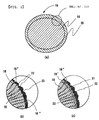
- Fig.1 is a sectional diagram of said active material in which said active material particles have innumerable micropores.
- Fig.1 (a) is a sectional diagram of said active material particles as a whole, and Fig. 1 (b) and Fig.1 (c) are partial enlarged sectional diagrams.
- Active material particles 19 are provided with core powders 16 of nickel oxide (Ni (OH) 2 ) coated with layers 20 of fine powders 22.
- fine powders 22 of Co, Co (OH) 2 , and CoOOH alone or in mixture form thin layers on surfaces pressed in microscopic concaves and convexes 23 in core powders 16.
- Surface average diameter has micropores 18 of not greater than about 1 ⁇ m.
- micropores 18 (18', 18") extend inside of core powders 16, inwardly extending length is not specifically limited as long as said micropores penetrate layers of fine powders 22 and reach core powders 16 of nickel oxide (Ni (OH) 2 ),
- Positive electrodes in the present invention are positive electrodes composed of nickel (Ni) oxide as main materials, wherein said nickel oxide is composed of core powders which are either powders alone whose main materials are spherical or elliptic type- ⁇ Ni(OH) 2 , or mixture of said powders and powders provided with layers in which Co oxide is coated on said powder surfaces in crystals and thin film layers in which fine powders of metal cobalt (Co) and/or Co oxide are pressed therein.
- powders whose main materials are type- ⁇ Ni(OH) 2 include at least one element selected from the elements designated by the symbols of Co, Zn, Mn, Ag, Mg, and Al in a solid-solution state.
- a specific surface of Ni oxide as a whole coated with said thin film layers is not less than 7m 2 /g.
- nickel oxides are not specifically limited so long as they are included as main materials which generate battery reaction.
- powdery additives such as conductive agents and the like and active material particles are preferably integrated for easy filling and coating.
- the content ratio of cobalt oxide layers in said core powders is 2 to 4 wt.
- the elements designated by the symbols of Co, Zn, Mg, Mn, Ag, and Al LhaL may be contained in the nickel oxide in a solid solution state are not specifically limited as long as one or more elements are selected from the group of the elements thereof. The inclusion of these elements enables an alkaline storage battery using a positive electrode containing the aforementioned nickel oxide to be of higher capacity.
- the elements selected from the above-mentioned group may be selected as an element, cr a plurality of elements, and in particular Mn is effective in high-order reaction fcr higher capacity; remaining Ag, Mg and other elements are effective in high power and thus are more preferable.
- the total solid solution amount of the elements designated by the symbols of Co, Zn, Mn, Ag, Mg, and Al in the a forementioned nickel oxide is preferably from 3 to 15% by weight based on the amount in terms of metal Ni.
- the total amount of the above solid solution is less than 3% by weight based on the amount in terms of metal Ni, it is difficult on a production basis to render the above-mentioned element to uniformly melt in each active material particle in the form of solid solution, and so the total solid solution amount is preferably from 3 to 15% by weight based on the amount in terms of metal Ni.
- the total amount of the above solid solution is more than 15% by weight, elements of the solid solution are separated, or the ratio of Ni oxide, the essential reaction material, is too low, which on the contrary leads to a decrease in capacity.
- the total amount is within this range, specifically the solid battery reaction of Mn or another element is allowed to be brought from 1e - reaction to 1.5 e - reaction, thereby enables still higher capacity; at this time a decrease in the voltage can be suppressed by combination of other materials.
- the elements designated by the symbols cf Ti , Y, Zn, Cd, Ca, Pb, Cr, Fe, Ag and Ln that may be contained in the aforementioned cobalt oxide layers and/or said thin film layers in solid solution state and/or in mixed state are not specifically limited as long as one or more clcments are selected from the group of the elements thereof.
- the inclusion of these elements enables an alkaline storage battery using a positive electrode containing above nickel oxide to restrain the evolution of oxygen from the surface of the cobalt oxide layer, leading to being capable of improving charging efficiency at a high temperature.
- the total solid solution amount of the elements designated by the symbols of Ti, Y, Zn, Cd, Ca, Pb, Cr, Fe, Ag and Ln in the aforementioned cobalt oxide is preferably from 3 to 15% by weight based on the amount in terms of metal Co.
- the total amount of the above solid solution is less than 3% by weight based on the amount in terms of metal Co, uniform solid solution cannot be made in the entire Co oxide layer, which decreases an improvement in charging efficiency caused by the enhancement of the aforementioned oxygen evolution over voltage; when the total amount is more than 15% by weight based on the amount in terms of metal Co, the above solid solution elements mostly deposit singly, resulting in a decrease in electric conductivity of intrinsic Co oxide.
- Ni and/or Li may be contained in micropores and the like within the cobalt oxide layer forming the solid solution in the above positive electrode.
- the inclusion of Ni and/or Li in the above-mentioned cobalt oxide layer allows an alkaline storage battery of the present invention to improve the electric conductivity in the positive electrode, further suppress the evolution of oxygen at a high temperature also, and further enhance the charging efficiency at a high temperature.
- the amount of Ni and/or Li and/or Na contained in micropores and the like in a cobalt oxide layer formed in the form of solid solution is not specifically limited, but the amount is preferably from 0.5 to 1% by weight based on the amount in terms of metal Co of cobalt oxide.
- Ni and/or Li When the content of Ni and/or Li is below 0.5% by weight, the above-described addition efficacy is decreased because of the uneven distribution; if the content is more than 1% by weight, the electric conductivity of Co oxide is decreased on the contrary.
- the above Ni and/or the above Li may be present in the Co oxide layer in a mixture form as nickel powder when the cobalt oxide is formed on the nickel oxide.
- the Li is added Lo the above-described nickel oxide coated with cobalt oxide by spraying LiOH solution at a high temperature, and therefore the Li may enter the cobalt layer.
- the aboveNi powder is general purpose Ni powder itself or slightly grinded Ni powdered material
- the Li includes Li ions contained in the interlayer within the crystal of the CoOOH layer and the Li oxide separated out within the micropores. The same can be applied for Na as well.
- Particle diameters of active material powders which are main materials of positive electrodes in an alkali storage batteries of the present invention are not specifically limited, but the average particle diameter is preferably from 10 to 20 ⁇ m in order to highly keep the packing density as an electrode and to obtain a necessary reaction area even during high discharging rate.
- a positive electrode is formed by filling or coating on an electrode substrate a paste containing an active material powder, a binding agent and a thickening agent, and no additives are required for improving utility rate.
- the aforementioned paste can utilize a well known paste-like composition as long as the paste is a paste-like composition prepared by dispersing the aforementioned active material powder and a binding agent in liquid using water as primary solvent.
- the aforementioned binding agent can use fine powders such as PTFE, PEO and polyolefins and well known binding agents such as polyvinyl alcohol.
- the aforementioned thickening agent can use CMC, MC (methyl cellulose), and the like.
- the aforementioned paste may contain Zi powder, Co powder, Ni powder, Zn oxides, and the like in addition to the above-described active material powder and binding agents.
- the aforementioned electrode substrate can use a substrate, used in a well known pasted type electrode, such as a porous metal fiber or a foam metal porous body, and in particular the fact that the substrate is a substrate three-dimensionally fabricated (hereinafter abbreviated as 3DF substrates) such that metal foils have innumerable concaves and convexes is preferable because the substrate is present within the entire electrode, has a small amount of use of the substrate, has high utilization of active material, and provides higher capacity.
- 3DF substrates substrate three-dimensionally fabricated
- the substrate three-dimensionally fabricated so as to have innumerable concaves and convexes is not specifically limited, but it is preferable that the substrate is an electrode substrate which is hollow, has innumerable concaves and convexes, and is a thin film-like, electric conductive and electrolyte resistible metal thin plate having almost the same thickness as that of the electrode, the thin plate being three-dimensionally fabricated by the concaves and convexes, and wherein the concaves and convexes are close to each other.
- FIG. 2 is a sectional view taken along the line A-A in the positive electrode of FIG. 3; the positive electrode is hollow and has innumerable concaves and convexes and uses the aforementioned electrode substrate three-dimensionally fabricated by the concaves and convexes.
- Reference numeral 9 in the figure is a nickel metal part constituting a three-dimensional nickel electrode substrate, reference numeral 10 is active material powder, primarily containing the nickel oxide (Ni (OH) 2 ) powder, filled in this electric conductive electrode substrate, and reference numeral 11 is a space part.
- the walls of convex B and concave C of the three-dimensional substrate made by processing a nickel foil have one directional slope parallel to the electrode surface, having distortion; the tip parts of the walls of convex B and concave C is small in the thickness of nickel and also is still more largely sloped in one direction. This distortion and an inclination of the tip suppress the separation of fillers such as active material powder from the electric conductive electrode substrate.
- the inclination of the tip part is a mustache so as not to cause a micro short circuit to the opposite electrode, and also has the effect of making shorter the shortest distance from the electric conductive electrode substrate of the nickel substrate to the electric conductive electrode substrate for the furthest active material powder particle (proximity to M in the drawing) than that in the case where the top is not bent (proximity to M'), i.e., the effect of enhancing the electric collection capacity of the entire electrode.
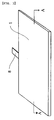
- FIG. 3 is the entire view of a nickel positive electrode 1 having structure as in FIG. 2; the electrode is a thin type nickel positive electrode having a thickness of 500 ⁇ m or less.
- 3 DF substrate produced by filling or coating therewith the above-mentioned active material powder together with a binding agent may also three-dimensionally be made using a thin film-like metal plate having electrolyte resistance; the plate is hollow, and has innumerable, fine, concave and convex bridges having open parts on the edge parts.
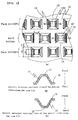
- electrode substrates having innumerable microscopic concave and convex bridges As electrode substrates having innumerable microscopic concave and convex bridges, as shown in FIG.4(a), electrode substrates with thickness of 100 to 500 ⁇ m in which nickel foils with thickness of 10 to 40 ⁇ m are subject to three dimensional treatment with innumerable microscopic concave and convex bridges can be used.
- face bridges As shown in a sectional view taken along lines E-E in FIG.4 (a) represented as FIG.4 (b), face bridges have bridge shapes composed of slope part 12 and upper edge part 11. Further, as shown in FIG. 4 (a), in face bridges, hole part of bridge edge part 15 penetrates vertically under upper edge part 11.
- Each of face bridges and back bridges may form rows consisting of several of them and said rows may be arranged alternately as shown in FIG.3.
- longitudinal direction cf most of the microscopic concave and convex bridges of groups thereof is unidirectional and that said direction is in the length direction of electrodes and width directior of electrodes for filling the amount of activematerial powders evenly, and the like.
- X, Y, P1 and P2 in FIG.4 preferably range, respectively, from 50 to 150 ⁇ m, from 100 to 250 ⁇ m, from 50 to 100 ⁇ m, and from 50 to 100 ⁇ m.
- the heights of the face bridge and/or the back bridge are respectively almost the same because of readily doing so by a roller or another means; as a result, the thickness of the substrate is preferably from 150 to 500 ⁇ m.
- the shapes of the face and back bridges can be a substantially trapezoidal and/or substantially semicircular shape with removal of the linear part of the lower edge viewing from the edge direction as in FIGS. 4B and 40, and are preferable because a shape without the linear part of the lower edge can readily be fabricated.
- a negative electrode, a separator and alkali aqueous solution, to be used in an alkali storage battery of the present invention can use well known materials.
- a pasted type electrode that contains as an active material hydrogen absorbing alloy having an AB 5 type alloy or an AB 2 type alloy is used in the case of a Ni/MH alkali storage battery, and the negative electrodes also can be used by appropriately selecting negative electrodes suitable for an alkali storage battery such as a nickel cadmium alkali storage battery, a Ni/MH alkali storage battery, or a nickel zinc alkali storage battery; as a result, a variety of alkali batteries can be obtained.
- the aforementioned separator can use a well known separator, and the fact that the separator is a thin type non-woven fabric having an average thickness of 50 to 110 ⁇ m that is comprised of a hydrophilic resin fiber can increase the ion passage speed between the positive/negative electrodes and substantially contribute to resulting in higher power. Also, the fact that the separator is a thin film enables still higher power and higher capacity.
- the above-described separator preferably has a porosity of 40 to 60% by volume from the viewpoints of mechanical strength, short circuit prevention and the like.
- alkali aqueous solution contained in an alkali storage battery of the present invention can utilize well known alkali aqueous solution, and an aqueous solution containing potassiumhydroxide (KOH) as main active ingredient ispreferable on account of small electric resistance.
- concentration of the above-described aqueous alkal solution as well as the amount thereat to be used in the above described al kali storage battery are not specifically limited as long as they are well known concentration and amount.
- the present invention relates to an alkali storage battery using a positive electrode mainly composed of nickel oxide, a negative electrode, a separator, and alkali aqueous solution, wherein
- the above-described alkali storage battery can use a thin type separator having an average thickness of 50 to 110 ⁇ m since the positive and negative electrodes are made to be a thinner film to the aforementioned thickness so that the electrode group is flexible even though the group is constructed in a spiral form, and thus the alkali storage battery is allowed to have higher capacity and further have higher power without generating a short circuit .
- the use of a thin type non-woven fabric made of a sulfonated polyolefin as a separator provides high temperature resistance and also suppresses self-discharge, and so is appropriate to power applications and other applications in which the battery comes to have a high temperature.
- the above-described positive electrode is not specifically limited as long as the electrode contains as the main material the nickel oxide on the surface of which thin layers in which fine powders of at least Co and/or Co oxide are pressed in said core powders are arranged, for the main material relating to battery reaction.
- Such active material particles are preferable since they allow filling or coating easily.
- active material powders in said positive electrodes contain in the form of a solid solution state at least one or more elements selected from the group consisting of Co, Zn, Mg, Mn, Ag, and Al and that the cobalt oxide layers and/or thin film layers of said surfaces contain as a solid solution one or more elements selected from the group consisting of the elements designated by the symbols of Ti, Y, Zn, Cd, Ca, Pb, Cr, Fe, Ag and Ln (wherein, Ln is an element of the group lantanides, or is a mixture thereof) preferably suppress the evolution of oxygen (O 2 ) even at a high temperature during charging, thereby improving the charging efficiency and enhancing the battery capacity.
- a shape thereof is preferably spherical or elliptic and it is preferable that nickel oxide (Ni(OH) 2 ), cobalt oxide (CoOOH) layers, and said thin film layers in active material particles have innumerable micropores .
- the total solid solution amount of the elements designated by the symbols of Co, Zn, Mn, Ag, Mg, and Al in the above nickel oxide is preferably from 3 to 15% by weight based on the amount in terms of the metal Ni;
- the total solid solution amount of the elements of Ti, Y, Zn, Cd, Ca, Pb, Cr, Fe, Ag and Ln in the aforementioned cobalt oxide is preferably from 3 to 15% by weight based on the amount in terms of the metal Ni.
- Ni and/or Li and/or Na may be contained in micropores.
- inclusion thereof in the above cobalt oxide layer allows an alkali storage battery of the present invention to improve the electric conductivity in the positive electrode, further suppress the evolution of oxygen at a high temperature also, and further improve the charging efficiency at a high temperature.
- the amount of Ni and/or Li and/or Na contained in the cobalt oxide layer that has been formed in the form of solid solution is not specifically limited, but the amount is preferably from 0.5 to 1% by weight based on the amount in terms of the metal Ni of the nickel oxide.
- a positive electrode in an alkali storage battery of the present invention is an electrode having an average thickness of 200 to 300 ⁇ m.
- the above average thickness is less than 200 ⁇ m, an increase in substrate material costs and complication of the production process are generated; when the above average thickness exceeds 500 ⁇ m, the resistance value of the whole electrode is increased, and also the electrode is readily cracked during construction of a spiral electrode group so that a thin type separator easily generates a micro short circuit.
- a negative electrode in an alkali storage battery of the present invention has hydrogen absorbing alloy as main material.
- the method of causing the aforementioned negative electrode to contain a hydrogen absorbing alloy is not specifically limited, but a method can do it that involves coating on an electro conductive electrode substrate a well known paste including AB 5 type alloy and AB 2 type alloy powder.
- the above negative electrode is an electrode having an average thickness of 100 to 300 ⁇ m. When the above average thickness is below 100 ⁇ m, the volume fraction of substrate increases too much leading to a decrease in packing density of hydrogen absorbing alloy; when the above average thickness exceeds 300 ⁇ m, the electric conductivity of the entire electrode decreases.
- An alkali storage battery of the present invention is provided with a separator, a non-woven fabric having an average thickness of 50 to 110 ⁇ m comprising a hydrophilic resin fiber.
- the separator comprises a hydrophilic resin fiber allows the ion passage between positive/negative electrodes to be easy as well allowing both positive and negative electrodes to be a thin type; the thicknesses of the electrodes is about a half that of a general-purpose battery resulting in being flexible; as a result, a short circuit is rarely generated on account of the electrode hardly breaking through the separator even during charging and discharging.
- the aforementioned separator has an average thickness of 50 to 110 ⁇ m.
- the average thickness is less than 50 ⁇ m, a short circuit is likely to occur, whereby the reliability of the alkali storage battery is decreased.
- the above average thickness exceeds 110 ⁇ m, the occupancy of the separator in the battery inside volume is increased, leading to a decrease in capacity.
- the use of a non-woven fabric of a polyurethane resin wilh hydrophilic treatment is preferable on account of increasing the ion passage speed between positive/negative electrodes.
- the above hydrophilic treatment is not specifically limited, but preferably the aforementioned sulfonation undergoes the addition of a sulfo group tc the proximity of the fiber surface by treatment of SO 3 , gas flow for improved hydrophilic property.
- An alkali aqueous solution to be used in an alkali storage battery of the present invention may use a well known alkali aqueous solution to be used in an alkali storage battery as long as the solution is an aqueous solution containing potassium hydroxide (KOH) as the main ingredient.
- KOH potassium hydroxide
- the concentration of the potassium hydroxide in the above alkali aqueous solution can be from 28 to 33% by weight.
- the aforementioned alkali aqueous solution may contain well known additives such as NaOH and LiOH in addition to potassium hydroxide.
- An alkali storage battery of the present invention has generating elements comprising a positive electrode, a negative electrode, a separator and an alkali aqueous solution.
- the aforementioned alkali storage battery is a cylindrical battery of AA size, it can be a battery constitution shown in FTG. 5.
- a sealed cylindrical nickel/hydrogen battery can be fabricated, as indicated in FIG.
- a three-dimensional electric conductive electrode substrate was fabricated that has innumerable fine hollow concaves and convexes obtained by passing a hoop-like nickel foil having a thickness of 30 ⁇ m through the space (may be the space between rollers) between molds having conical concaves and convexes and pressurizing.
- the concaves Those closest to the convexes (the concaves) arc all concaves (the convexes); the diameter of the hollow, substantial cone of the concaves (the convexes) is from 60 tc 80 ⁇ m in root, with the tip being from 35 to 45 ⁇ m ; the latter was made thin in thickness by strongly processing from the tip and bottom sides with two plate molds having concaves and convexes to make most of the tip ends open.
- the thickness of an electric conductive electrode substrate three-dimensionally made with concaves and convexes was set equal to 500 ⁇ m, which was thicker than that of the final electrode by 100 ⁇ m.
- the pitch between the two convex (or the pitch between the two concaves) was set equal to from 350 to 450 ⁇ m in both the hoop length direction and the vertical direction thereof.
- the angle (m) formed between the length direction of the electric conductive electrode substrate and the line of the convexes (concaves) was about 45°.
- the width directions was further placed parts worked with a flat roller; a portion of the parts were used as electrode leads.
- active material powders with thin film layers provided by pressing fine powders (about 2wt.% with respect to the total amount) mainly composed of Co (OH) 2 on a surface of core powders that are powders cf 50 wt.% of Ni oxide (Ni (OH) 2 ) and 50 wt.% of mixed powders in which CoOOII layers (3 wt.%) were arranged were filled in an electrode substrate 9 thus obtained.
- passes of active material powders of spherical powders whose diameter is about 10 ⁇ m in which said Ni oxide contains about 2 wt.% (converted to Ni metal) of Co and about 4 wt.% of Zn in a solid solution state were filled.
- the Ni (OH) 2 powder was prepared by a well known method that uses an NiSO 4 solution, NaOH and ammonia. Regarding preparation of a CoOOH layer, Co (OH) 2 layer was grown in crystal on the surface of the Ni (OH) 2 powder using a CoSO 4 solution by a similar method. Then, therewith was blcndcd NaOH and the resulting material was oxidized to CoOOH by blowing hot air from 100 to 120°C for 1 hour therethrough. Next, 2 wt.
- % of said mixed powders and Co (CH) 2 fine powders were mixed with a generally used kneading machine in a dried state and under the atmosphere at room temperature, followed by strongly stirring and mixing in a planetary ball mill for 30 minutes, thereby obtaining active material powders in which fine powders are integrated.
- Paste using this was prepared by admixing 100 parts by weight of the above active material powder with 22 parts by weight of a solution prepared by dissolving about 1% by weight of carboxymethyl cellulose in about 0.1% by weight of polyvinyl alcohol. This active material paste was filled and coated with the nickel electrode substrate 9.
- a nickel electrode substrate filled with the obtained active material paste and dried was passed through the space between a pair of rollers indicated in S, S' having a diameter of about 30 mm that was rotating at a relatively high revolution speed, while the resulting substrate surface was scrubbed, it was lightly pressurized at a revolution number of 10 revolutions/second, and then was strongly pressurized between rollers indicated in N, N' having a diameter of about 150 mm at a speed of from 50 to 100 mm/second to yield a thin type nickel positive electrode having a thickness cf 400 ⁇ m.
- the alkaline storage battery of Example 1 a sealed cylindrical Ni/MH cell having theoretical capacity of a positive electrode of 2300 mAh and the AA size, was fabricated by a procedure that entails cutting the thin type nickel positive electrode into a plate of 44 mm wide and 160 mm long, immersing the resulting plate in suspension of a fluorine resin fine powder having a concentration of about 3% by weight and drying to make a nickel positive electrode, combining the positive electrode with a well known MmNi5-based hydrogen absorbing alloy negative electrode having a thickness of 220 ⁇ m, a width of 44 nm and a length of 210 mm, inserting the combination into a batter case of the AA size, and subsequently sealing the opening with a sealing plate 6 serving also as a well known positive terminal in FIG.
- a non woven cloth made of a sulfonated polyolefin resin fiber having a thickness of 60 ⁇ m was employed and as electrolyte, KOH aqueous solution with about 30 wt % was used.
- Ni/MH battery of Example 2 was obtained as described in Example 1 with the exception that active material powders with thin film layers provided are used in which fine powders mainly composed of Co (OH) are pressed on surfaces of core powders composed of 50 wt.% of Ni oxide (Ni (OH) 2 ) and 50 wt.% of mixed powders in which CoOOH layers (3wt.%) are arranged in said Ni oxide.
- said nickel oxide contains about 2 wt.% (converted to Ni metal) of Co and about 4 wt.% of Zn in a solid-solution state and said CoOOH layers or thin film layers contain about 8 wt.% (converted to Co metal)of Ti or Y in a solid-solution state in said Co oxide layers or contain about 10 wt.% of powders of TiO or Y 2 O 3 mixed in said thin film layers, and particle diameters of powder materials are 15 to 20 ⁇ m.
- Ni/MH battery of example 3 was obtained as described in Example 1 with the exception that active material powders with thin film layers provided are used in which fine powders mainly composed of Co (OH) are pressed on surfaces of core powders composed of 50 wt.% ct Ni oxide (Ni (CH) 2 ) and 50 wt.% of mixed powders in which CoOOH layers (3wt.%) are arranged in said Ni oxide.
- said nickel oxide contains about 2 wt.% (converted to Ni metal) of Co and about 4 wt.% of Zn in a solid-solution state and said CoOOH layers or thin film layers contain about 8 wt.% (converted to Co metal) of Ca or Cd in a solid-solution state in said Co oxide layers or contain about 10 wt.% of powders of CaO or Cd0 mixed in said thin film layers, and particle diameters of powder materials are 15 to 20 ⁇ m.
- said nickel oxide contains about 2 wt. % (converted to Ni metal) of Co and about 4 wt.% of Zn in a solid-solution state and said CoOOH layers or thin film layers contain about 8 wt. % (converted to Co metal) of Pb in a solid-solution state in said Co oxide layers or contain about 10 wt.% of powders of PbO mixed in said thin film layers, and particle diameters of powder materials are 15 to 20 ⁇ m.
- Ni/MH battery of Example 5 was obtained as described in Example 1 with the exception that active material powders with thin film layers provided are used in which fine powders mainly composed of Co (OH) 2 are pressed on surfaces of core powders composed of 50 wt.% of Ni oxide (Ni (OH) 2 ) and 50 wt.% of mixed powders in which COCCH layers (3wt.%) are arranged in said Ni oxide.
- said nickel oxide contains about 2 wt.% (converted to Ni metal) of Co and about 4 wt.% of Zn in a solid-solution state and said CoOOH layers or thin film layers contain about 8 wt.% (converted to Co metal) of Ln in a solid-solution state in said Co oxide layers or contain about 10 wt.% of powders of oxide of said Ln mixed in said thin film layers, and particle diameters of powder materials are 15 to 20 ⁇ m.
- Ni/MH battery of Example 6 was obtained as described in Example 1 with the exception that active material powders were used in which fine powders mainly composed of Co (OH) (about 2 wt.% with respect to the total amount) are pressed in surfaces of core powders composed of 50 wt. % of Ni oxide (Ni (OH) 2 ) powders and 50 wt. % of mixed powders, wherein CoOOH layers are provided with said Ni oxide.
- active material powders were used in which fine powders mainly composed of Co (OH) (about 2 wt.% with respect to the total amount) are pressed in surfaces of core powders composed of 50 wt. % of Ni oxide (Ni (OH) 2 ) powders and 50 wt. % of mixed powders, wherein CoOOH layers are provided with said Ni oxide.
- said nickel oxide contains about 2 wt.% of Co and about 4 wt.% of Zn in a solid-solution state converted to Ni metal and said CoOOH layers or thin film layers contain about 8 wt.% of Cr 2 O 3 converted to Co metal in a solid-solution state in said CoOOH oxide layers or contain about 3 wt.% of AgO powders in a mixed state with said thin film layers.
- Ni/MII battery of Example 7 was obtained as described in Example 1 with the exception that active material powders were used in which fine powders mainly composed of Co (OH) 2 (about 2 wt.% with respect to the total amount) are pressed in surfaces of core powders composed of 50 wt.% of Ni oxide (Ni (OH) 2 ) powders and 50 wt.% of mixed powders, wherein CoOOH layers are provided with said Ni oxide.
- active material powders were used in which fine powders mainly composed of Co (OH) 2 (about 2 wt.% with respect to the total amount) are pressed in surfaces of core powders composed of 50 wt.% of Ni oxide (Ni (OH) 2 ) powders and 50 wt.% of mixed powders, wherein CoOOH layers are provided with said Ni oxide.
- said nickel oxide contains about 6 wt.% of Mn and about 2 wt.% of Ag in a solid-solution state converted to Ni metal and said CoOOH layers or thin film layers contain about 6 wt.% of Ti converted to metal of Co in a solid-solution state in said CoOOH oxide layers or contain about H wt.% of TiO 2 powders in a mixed state with said thin film layers.
- Ni/MH battery of Example 8 was obtained as described in Example 1 with the exception that active material powders were used in which fine powders mainly composed of Co (OH) 2 (about 2 wt. % with respect to the total amount) are pressed in surfaces of core powders composed of 50 wt. % of Ni oxide (Ni (OH) 2 ) powders and 50 wt.% of mixed powders, wherein CoOOH layers are provided with said Ni oxide.
- active material powders were used in which fine powders mainly composed of Co (OH) 2 (about 2 wt. % with respect to the total amount) are pressed in surfaces of core powders composed of 50 wt. % of Ni oxide (Ni (OH) 2 ) powders and 50 wt.% of mixed powders, wherein CoOOH layers are provided with said Ni oxide.
- said nickel oxide contains about 6 wt.% of Mn and about 2 wt.% of Ag in a solid-solution state converted to Ni metal and said COOOH layers or thin film layers contain about 6 wt.% of Ti converted to Co metal in a solid-solution state in said CoOOH oxide layers or contain about 8 wt.% of TiO 2 powders in a mixed state with said thin film layers.
- Al is trivalent ion, crystal density thereof was enhanced by making pH 11.1 while solution with pH 11.3 was used.
- Ni/MH battery of Example 9 was obtained as described in Example 1 with the exception that active material powders were used in which fine powders mainly composed of Co (OH) (about 2 wt.% with respect tc the total amount) are pressed in surfaces of core powders composed of 50 wt.% of Ni oxide (Ni (OH) 2 ) powders and 50 wt.% of mixed powders, wherein CcCCH layers are provided with said Ni oxide.
- active material powders were used in which fine powders mainly composed of Co (OH) (about 2 wt.% with respect tc the total amount) are pressed in surfaces of core powders composed of 50 wt.% of Ni oxide (Ni (OH) 2 ) powders and 50 wt.% of mixed powders, wherein CcCCH layers are provided with said Ni oxide.
- said nickel oxide contains about 2 wt.% of Co and about 4 wt.% of Zn in a solid-solution state converted to Ni metal and about 3 wt.% cf nickel powder (1 ⁇ m) converted to Co metal was mixed in said Co oxide layers or said film layers.
- the mixing of Ni. powders was conducted by making specific amount of Ni powders disperse in cobalt sulfate solution or by forming thin film layers pressing mixtures cf Co(OH) 2 powders and Ni powders in core powders.
- the Ni/MH battery of Example 10 was obtained as described in Example 2 with the exception that active material powders with particle diameter of 15 to 20 ⁇ m were used as materials.
- active material powders with particle diameter of 15 to 20 ⁇ m were used as materials.
- Ti was solid-solved in Example 2 or Ti oxide in Example 2 was mixed and said powders were stirred in the air keeping temperature about 80°C. Then 10 parts by weight of 1 mol LiOH solution or NaOH solution was poured to 100 parts by weight of said powders keeping stirring for about 30 minutes, and then washed with water.
- the Ni/MH battery of Comparative Example 1 was obtained as described in Example 1 with the exception that instead of using active material paste used in Example 1, active material pastes were used which were obtained by the following steps.
- spherical active material powders of nickel oxide with a diameter of about 10 ⁇ m in which about 2 wt.% of cobalt and about 4 wt.% of zinc were solid-solved to nickel hydroxide were mixed with 22 parts by weight of solution in which about 1 wt.% of carboxymethyl cellulose and about 0.1 wt.% of fine powders of polyolefin resin were dissolved in water, to prepare pastes, followed by further adding about 3 wt.% of cobalt oxide (CoO) and about 2 wt.% of zinc oxide (ZnO) thereby making active material paste.
- CoO cobalt oxide
- ZnO zinc oxide
- Alkali storage batteries of Comparative Example 2 were prepared as described in Example 1 with the exception that nickel oxide coated with cobalt oxide was used, wherein nickel oxide is coated with cobalt oxide and said cobalt oxide use materials which include no solid-solved metal, whereas said nickel oxide contains about 2 wt.% of Co converted to Ni metal and about 4 wt. of Zn converted to Ni metal 1 and about 8 wt.% of Ti converted to Ni metal in a solid-solution state and said cobalt oxide contains spherical active material powders whose diameter is about 15 ⁇ m when said cobalt oxide is contained in 6 wt. % with respect to nickel oxide in Example 1.
- N-1 in the table means the evaluation result of electrodes in Example 1. and batteries using them
- N-2 in the table means the evaluation result of electrodes in Example 2 and batteries using them.
- capacity density and intermediate voltage with 3C rate discharge were measured setting 3 cycles of charge and discharge as chemical conversion periods, and based on charge in fourth cycle : 0.1C ⁇ 120% at a temperature of 2.5 °C for charge, and 0.2C rate for discharge.
- cycle life was measured by repeating 1C ⁇ 100 % for charge and 1C ⁇ 80 % for discharge, and in every 50 cycle, battery capacity tests were conducted under the above measuring condition and the number of cycles was determined at the point where initial capacity gets less than 60%.
- the characteristics obtained by a Comparative Example are shown represented by C-1 by which five electrodes and five cells of batteries were prepared using conventional Ni(OH) 2 powders and to the paste thereof, adding 4 wt. % of zinc oxide powders.
- C-2 the characteristics obtained by another Comparative Example are shown represented by C-2 by which five electrodes and five cells of batteries were prepared arranging 6 wt.% layers (about 0.9 ⁇ ) in conventional Ni (OH) 2 powders, followed by blowing hol air with a temperature of 120 °C, thereby converting into CoOOH.
- Examples 1 to 6 and Comparative Examples 1 and 2 10 alkali storage batteries of each Example and of the Comparative Example were charged at 45°C, 0.1C and 130%, kept 20°C for one hour, and then discharged at 20°C and 0.2C to 0. 9 V.
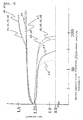
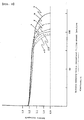
- the average values of the charging performances of each battery are illustrated in FIG. 7.
- the charging curves of the alkali storage batteries of Examples 1 to 6 are designated by the symbols of pl, ql, rl, sl, tl, and ul, respectively.
- the symbols ⁇ 1 and ⁇ 1, respectively, are used in FIG. 7. As shown in FIG.
- Examples 7 to 10 and Comparative Examples 1 and 2 the average values of the discharging performances are shown in FIG. 7 when each was discharged under the above-described conditions.
- the discharging performances when 10 battery of Examples 7 to 10 and Comparative Examples 1 and 2 are, respectively, indicated by the symbols v, w, x, y, ⁇ 3 and ⁇ 3 in FIG. 8.
- batteries using active material powders in which elements represented by Co, Zn, Mn, Ag, Mg, and Al in Ni oxide (mainly Ni(OH) 2 ) are solid-solved is found to further improve discharge capacities.
- the alkali storage batteries of Examples 2 to 6 can be charged at high voltages as compared with the alkali storage batteries of Comparative Examples 1 and 2, conventional examples that use an active material not having metals in the form of a solid solution contained in the cobalt oxide layer above the nickel oxide, at nearly 80% or higher in capacity relative to the theoretical filling amount, for charging performances as in FIG. 7. This seems to be because the oxygen evolution over voltage is improved due to elements melted in the form of the solid solution in the cobalt oxide layer. Also, the alkali storage batteries of Examples 7 to 10 exhibited discharge capacities higher than those of the alkali storage batteries of Comparative Examples 1 and 2 in discharging performances as well. The reason seems to be because the charging proceeds even at high temperatures.
- alkali batteries of the present invention were excellent in charge acceptance property at high temperature and have high capacity in wide temperature range.
- alkali storage batteries of the present invention have characteristics that supercede conventional batteries in view of cycle life characteristics and effective discharge characteristics.
- an active material prepared by melting Mn and Ag in nickel oxide in the form of a solid solution was slightly lower in discharging voltage, but has a discharge capacity near 125%;
- An active material containing Mg and Ag in the form of a solid solution was slightly lower in capacity as compared to the former, but showed a voltage similar to a conventional active material.
- the tern "theoretical capacity of 100%" stands for setting the one-electron reaction in which nickel oxide is changed from the trivalence to the divalence equal to 100%
- a Ni metal powder made to be contained in the cobalt oxide layer did not improve active material utilization as expected, but had the effect of improving variation; only impregnation of Li mainly with micropores of the cobalt oxide layer was capable of improving the utilization by about 3%.
- An alkali storage battery of the present invention suppresses the evolution of oxygen, thereby improving charging efficiency and battery capacity, and thus is suitable for electric sources of multi-functioned small electronic equipment, electric power tools and other devices, and movable power sources, i ,e., high power applications of electric vehicles (EVs), hybrid electric vehicles (HEVs), electric assisted bicycles and the like.
- EVs electric vehicles
- HEVs hybrid electric vehicles
- electric assisted bicycles electric assisted bicycles and the like.
Landscapes
- Chemical & Material Sciences (AREA)
- Chemical Kinetics & Catalysis (AREA)
- Electrochemistry (AREA)
- General Chemical & Material Sciences (AREA)
- Composite Materials (AREA)
- Inorganic Chemistry (AREA)
- Engineering & Computer Science (AREA)
- Manufacturing & Machinery (AREA)
- Battery Electrode And Active Subsutance (AREA)
Applications Claiming Priority (1)
| Application Number | Priority Date | Filing Date | Title |
|---|---|---|---|
| JP2004216389 | 2004-07-23 |
Publications (1)
| Publication Number | Publication Date |
|---|---|
| EP1619732A1 true EP1619732A1 (fr) | 2006-01-25 |
Family
ID=34937904
Family Applications (1)
| Application Number | Title | Priority Date | Filing Date |
|---|---|---|---|
| EP05016126A Withdrawn EP1619732A1 (fr) | 2004-07-23 | 2005-07-25 | Electrode au nickel et accumulateur alcalin l'utilisant |
Country Status (4)
| Country | Link |
|---|---|
| US (1) | US20060029864A1 (fr) |
| EP (1) | EP1619732A1 (fr) |
| KR (2) | KR20060046720A (fr) |
| CN (2) | CN100405658C (fr) |
Cited By (2)
| Publication number | Priority date | Publication date | Assignee | Title |
|---|---|---|---|---|
| WO2016059466A1 (fr) * | 2014-10-17 | 2016-04-21 | Toyota Jidosha Kabushiki Kaisha | Séparateur pour batterie, séparateur stratifié, batterie secondaire au lithium-ion, et bloc-batterie |
| EP3148729A4 (fr) * | 2014-05-26 | 2018-01-10 | HRL Laboratories, LLC | Microparticules revêtues d'un hydrure, et procédés pour leur fabrication |
Families Citing this family (25)
| Publication number | Priority date | Publication date | Assignee | Title |
|---|---|---|---|---|
| GB2413282B (en) * | 2004-04-23 | 2009-01-14 | Henderson Morley Plc | DNA Viral Infections |
| JP4574250B2 (ja) * | 2004-06-30 | 2010-11-04 | キヤノン株式会社 | フォトマスク |
| JP4634322B2 (ja) * | 2006-03-02 | 2011-02-16 | 住友電気工業株式会社 | 電池用電極 |
| CN100557867C (zh) * | 2006-07-27 | 2009-11-04 | 深圳市力可兴电池有限公司 | 镍基充电电池用高温复合添加剂 |
| DE102007059768A1 (de) * | 2007-12-12 | 2009-06-18 | Li-Tec Vermögensverwaltungs GmbH | Stromableiter für eine galvanische Zelle |
| CN101609889B (zh) * | 2008-06-20 | 2011-11-16 | 比亚迪股份有限公司 | 镉负极及其制备方法和含该镉负极的二次镍镉电池 |
| WO2012096294A1 (fr) | 2011-01-11 | 2012-07-19 | 株式会社Gsユアサ | Matière active d'électrode positive pour une batterie alcaline de stockage, procédé de fabrication de la matière active d'électrode positive et batterie alcaline de stockage |
| JP5700282B2 (ja) | 2011-01-11 | 2015-04-15 | 株式会社Gsユアサ | アルカリ蓄電池 |
| CN103682324A (zh) * | 2012-09-14 | 2014-03-26 | 江苏博力新能源有限公司 | 一种β相球形氢氧化镍表层功能化新方法 |
| WO2014049966A1 (fr) * | 2012-09-26 | 2014-04-03 | パナソニック株式会社 | Matière active de cathode destinée à une batterie alcaline, batterie alcaline et cathode de batterie alcaline contenant celle-ci, et batterie rechargeable nickel-hydrogène |
| JP6389468B2 (ja) * | 2012-12-19 | 2018-09-12 | シオン・パワー・コーポレーション | 電極構造体およびその製造方法 |
| CN105659416B (zh) * | 2013-12-10 | 2018-02-27 | 松下知识产权经营株式会社 | 碱性蓄电池用正极及碱性蓄电池 |
| EP3167499B1 (fr) | 2014-07-09 | 2018-09-26 | VARTA Microbattery GmbH | Cellule électrochimique secondaire |
| JP2018534722A (ja) * | 2015-09-02 | 2018-11-22 | ザ リージェンツ オブ ザ ユニヴァシティ オブ ミシガン | 3次元の電極基板を含む電気化学的装置 |
| CN105469901B (zh) * | 2015-11-20 | 2017-08-04 | 燕山大学 | 一种基于原位生长制备氢氧化镍‑氧化镍薄膜电极的方法 |
| CN106450507A (zh) * | 2016-10-31 | 2017-02-22 | 湘潭大学 | 一种氯氧化铋/氢氧化镍二次碱性电池及其制备方法 |
| CN106450287B (zh) * | 2016-10-31 | 2019-05-28 | 湘潭大学 | 一种氟氧化铋/氢氧化镍二次碱性电池及其制备方法 |
| CN106450508A (zh) * | 2016-11-30 | 2017-02-22 | 湘潭大学 | 一种钒酸铋/氢氧化镍二次碱性电池及其制备方法 |
| CN106654401A (zh) * | 2016-11-30 | 2017-05-10 | 湘潭大学 | 一种铁酸铋/氢氧化镍二次碱性电池及其制备方法 |
| CN106532143B (zh) * | 2016-11-30 | 2019-07-23 | 湘潭大学 | 一种铋酸锂/氢氧化镍二次碱性电池及其制备方法 |
| US10256459B1 (en) * | 2017-09-18 | 2019-04-09 | Nanotek Instruments, Inc. | Surface-stabilized and prelithiated anode active materials for lithium batteries and production method |
| US10673063B2 (en) | 2017-09-21 | 2020-06-02 | Global Graphene Group, Inc. | Process for prelithiating an anode active material for a lithium battery |
| CN110085852B (zh) * | 2019-05-28 | 2024-06-25 | 中国科学院重庆绿色智能技术研究院 | 导电结构及电极 |
| CN114551984B (zh) * | 2020-11-24 | 2024-09-24 | 通用汽车环球科技运作有限责任公司 | 具有厚电极的固态双极型电池组 |
| JP7208274B2 (ja) * | 2021-01-20 | 2023-01-18 | プライムプラネットエナジー&ソリューションズ株式会社 | 正極活物質及び該正極活物質を用いた非水電解質二次電池 |
Citations (14)
| Publication number | Priority date | Publication date | Assignee | Title |
|---|---|---|---|---|
| US4251603A (en) | 1980-02-13 | 1981-02-17 | Matsushita Electric Industrial Co., Ltd. | Battery electrode |
| JPH0528992A (ja) | 1991-07-18 | 1993-02-05 | Matsushita Electric Ind Co Ltd | アルカリ蓄電池用ニツケル正極とこれを用いたニツケル・水素蓄電池 |
| JPH0973900A (ja) | 1995-07-04 | 1997-03-18 | Sanyo Electric Co Ltd | アルカリ蓄電池用ニッケル電極活物質の製造方法 |
| US5707764A (en) * | 1993-06-30 | 1998-01-13 | Toshiba Battery Co., Ltd. | Alkali secondary battery |
| EP0940865A2 (fr) * | 1998-03-05 | 1999-09-08 | Matsushita Electric Industrial Co., Ltd | Materiaux actifs pour électrode positive de piles alcalines et leur méthode de fabrication |
| JP2000077070A (ja) * | 1998-08-31 | 2000-03-14 | Sumitomo Metal Mining Co Ltd | 水酸化ニッケル粉末およびその製造方法 |
| US6040007A (en) * | 1996-06-19 | 2000-03-21 | Tanaka Chemical Corporation | Nickel hydroxide particles having an α- or β-cobalt hydroxide coating layer for use in alkali batteries and a process for producing the nickel hydroxide |
| EP1054463A1 (fr) * | 1996-12-17 | 2000-11-22 | Toshiba Battery Co., Ltd. | Electrode positive, pile secondaire alcaline, et méthode de fabrication de piles secondaires alcalines |
| US6228535B1 (en) * | 1998-08-17 | 2001-05-08 | Ovonic Battery Company, Inc. | Nickel hydroxide positive electrode material exhibiting improved conductivity and engineered activation energy |
| EP1164650A2 (fr) * | 2000-06-16 | 2001-12-19 | Canon Kabushiki Kaisha | Batterie rechargeable au nickel et procédé pour sa production |
| EP1195824A2 (fr) * | 1996-09-20 | 2002-04-10 | Matsushita Electric Industrial Co., Ltd. | Materiau actif d'électrode positive pour piles alcalines |
| WO2003034520A1 (fr) * | 2001-10-17 | 2003-04-24 | Sony Corporation | Batterie alcaline |
| US20030108792A1 (en) * | 2001-12-07 | 2003-06-12 | Matsushita Electric Industrial Co., Ltd. | Positive electrode active material for alkaline storage battery, positive electrode and alkaline storage battery |
| EP1424741A1 (fr) * | 2001-09-03 | 2004-06-02 | Yuasa Corporation | Materiau pour electrode de nickel et procede de production de ce materiau, electrode de nickel et accumulateur alcalin |
Family Cites Families (9)
| Publication number | Priority date | Publication date | Assignee | Title |
|---|---|---|---|---|
| US3899350A (en) * | 1972-11-20 | 1975-08-12 | Westinghouse Electric Corp | Method of preparing high capacity nickel electrode powder |
| US4481128A (en) * | 1981-01-29 | 1984-11-06 | Westinghouse Electric Corp. | Alkali slurry ozonation to produce a high capacity nickel battery material |
| JPH0724218B2 (ja) * | 1988-04-11 | 1995-03-15 | 株式会社ユアサコーポレーション | アルカリ電池用ニッケル電極及びこれを用いた電池 |
| US5700596A (en) * | 1991-07-08 | 1997-12-23 | Matsushita Electric Industrial Co., Ltd. | Nickel hydroxide active material powder and nickel positive electrode and alkali storage battery using them |
| DE69505911T2 (de) * | 1994-08-04 | 1999-04-08 | Sanyo Electric Co., Ltd., Moriguchi, Osaka | Aktivmasse Pulver für nichtgesinterte Nickelelektrode, nichtgesinterte Nickelelektrode für alkalische Batterie und Verfahren zu ihrer Herstellung |
| KR19990015233A (ko) * | 1997-08-04 | 1999-03-05 | 손욱 | 이중구조 수산화니켈 활물질의 제조방법 |
| WO2001097305A1 (fr) * | 2000-06-16 | 2001-12-20 | Matsushita Electric Industrial Co., Ltd. | Matiere active d'anode pour accumulateur alcalin, anode comprenant cette matiere et accumulateur alcalin |
| JP2002313306A (ja) * | 2001-04-06 | 2002-10-25 | Isao Matsumoto | 電池用セパレータの製造方法、電池用セパレータ及びそれを用いたアルカリ蓄電池 |
| JP4429569B2 (ja) * | 2002-04-25 | 2010-03-10 | パナソニック株式会社 | ニッケル水素蓄電池 |
-
2005
- 2005-01-11 CN CNB2005100004906A patent/CN100405658C/zh not_active Expired - Fee Related
- 2005-07-23 KR KR1020050067048A patent/KR20060046720A/ko not_active Ceased
- 2005-07-25 US US11/189,125 patent/US20060029864A1/en not_active Abandoned
- 2005-07-25 CN CNB2005101132263A patent/CN100474666C/zh not_active Expired - Fee Related
- 2005-07-25 EP EP05016126A patent/EP1619732A1/fr not_active Withdrawn
-
2010
- 2010-06-29 KR KR1020100061966A patent/KR20100089804A/ko not_active Ceased
Patent Citations (15)
| Publication number | Priority date | Publication date | Assignee | Title |
|---|---|---|---|---|
| US4251603A (en) | 1980-02-13 | 1981-02-17 | Matsushita Electric Industrial Co., Ltd. | Battery electrode |
| JPH0528992A (ja) | 1991-07-18 | 1993-02-05 | Matsushita Electric Ind Co Ltd | アルカリ蓄電池用ニツケル正極とこれを用いたニツケル・水素蓄電池 |
| US5707764A (en) * | 1993-06-30 | 1998-01-13 | Toshiba Battery Co., Ltd. | Alkali secondary battery |
| JPH0973900A (ja) | 1995-07-04 | 1997-03-18 | Sanyo Electric Co Ltd | アルカリ蓄電池用ニッケル電極活物質の製造方法 |
| US6040007A (en) * | 1996-06-19 | 2000-03-21 | Tanaka Chemical Corporation | Nickel hydroxide particles having an α- or β-cobalt hydroxide coating layer for use in alkali batteries and a process for producing the nickel hydroxide |
| EP1195824A2 (fr) * | 1996-09-20 | 2002-04-10 | Matsushita Electric Industrial Co., Ltd. | Materiau actif d'électrode positive pour piles alcalines |
| EP1054463A1 (fr) * | 1996-12-17 | 2000-11-22 | Toshiba Battery Co., Ltd. | Electrode positive, pile secondaire alcaline, et méthode de fabrication de piles secondaires alcalines |
| EP0940865A2 (fr) * | 1998-03-05 | 1999-09-08 | Matsushita Electric Industrial Co., Ltd | Materiaux actifs pour électrode positive de piles alcalines et leur méthode de fabrication |
| US6228535B1 (en) * | 1998-08-17 | 2001-05-08 | Ovonic Battery Company, Inc. | Nickel hydroxide positive electrode material exhibiting improved conductivity and engineered activation energy |
| JP2000077070A (ja) * | 1998-08-31 | 2000-03-14 | Sumitomo Metal Mining Co Ltd | 水酸化ニッケル粉末およびその製造方法 |
| EP1164650A2 (fr) * | 2000-06-16 | 2001-12-19 | Canon Kabushiki Kaisha | Batterie rechargeable au nickel et procédé pour sa production |
| EP1424741A1 (fr) * | 2001-09-03 | 2004-06-02 | Yuasa Corporation | Materiau pour electrode de nickel et procede de production de ce materiau, electrode de nickel et accumulateur alcalin |
| WO2003034520A1 (fr) * | 2001-10-17 | 2003-04-24 | Sony Corporation | Batterie alcaline |
| EP1445812A1 (fr) * | 2001-10-17 | 2004-08-11 | Sony Corporation | Batterie alcaline |
| US20030108792A1 (en) * | 2001-12-07 | 2003-06-12 | Matsushita Electric Industrial Co., Ltd. | Positive electrode active material for alkaline storage battery, positive electrode and alkaline storage battery |
Non-Patent Citations (3)
| Title |
|---|
| PATENT ABSTRACTS OF JAPAN vol. 2000, no. 06 22 September 2000 (2000-09-22) * |
| T. KEILY; B. W. BAXTER: "International Power Source Symposium", POWER SOURCES, vol. 12, 1988, pages 203 - 220 |
| T.KEILY; B. W. BAXTER: "International Power Source Symposium", POWER SOURCES, vol. 12, 1988, pages 393 - 409 |
Cited By (6)
| Publication number | Priority date | Publication date | Assignee | Title |
|---|---|---|---|---|
| EP3148729A4 (fr) * | 2014-05-26 | 2018-01-10 | HRL Laboratories, LLC | Microparticules revêtues d'un hydrure, et procédés pour leur fabrication |
| US10030292B2 (en) | 2014-05-26 | 2018-07-24 | Hrl Laboratories, Llc | Hydride-coated microparticles and methods for making the same |
| US10787728B2 (en) | 2014-05-26 | 2020-09-29 | Hrl Laboratories, Llc | Hydride-coated microparticles and methods for making the same |
| CN106457388B (zh) * | 2014-05-26 | 2021-04-27 | Hrl实验室有限责任公司 | 氢化物包覆的微米颗粒及其制备方法 |
| WO2016059466A1 (fr) * | 2014-10-17 | 2016-04-21 | Toyota Jidosha Kabushiki Kaisha | Séparateur pour batterie, séparateur stratifié, batterie secondaire au lithium-ion, et bloc-batterie |
| US10944086B2 (en) | 2014-10-17 | 2021-03-09 | Toyota Jidosha Kabushiki Kaisha | Separator for battery, laminated separator, lithium ion secondary battery, and battery pack |
Also Published As
| Publication number | Publication date |
|---|---|
| CN100405658C (zh) | 2008-07-23 |
| KR20100089804A (ko) | 2010-08-12 |
| US20060029864A1 (en) | 2006-02-09 |
| CN1725546A (zh) | 2006-01-25 |
| CN1767249A (zh) | 2006-05-03 |
| KR20060046720A (ko) | 2006-05-17 |
| CN100474666C (zh) | 2009-04-01 |
Similar Documents
| Publication | Publication Date | Title |
|---|---|---|
| EP1619732A1 (fr) | Electrode au nickel et accumulateur alcalin l'utilisant | |
| JP5033164B2 (ja) | 電池用ペースト式薄型電極の製造法 | |
| US5698342A (en) | Electrode containing coated particles | |
| JP3604879B2 (ja) | 電池の製造方法 | |
| JP3191752B2 (ja) | ニッケル−水素二次電池およびその電極の製造方法 | |
| JP3518975B2 (ja) | アルカリ蓄電池用正極およびアルカリ蓄電池 | |
| JP2947284B2 (ja) | アルカリ蓄電池用非焼結式正極およびこれを用いたアルカリ蓄電池 | |
| JP4536289B2 (ja) | 電池用ペースト式薄型電極、その製造方法及び二次電池 | |
| US10651459B2 (en) | Nickel hydroxide composite material for alkaline rechargeable battery | |
| JP2006059807A (ja) | ニッケル電極及びそれを用いたアルカリ蓄電池 | |
| EP1137087B1 (fr) | Accumulateur alcalin et électrode positive pour accumulateur alcalin | |
| JP2004006258A (ja) | ニッケル−水素蓄電池用負極板およびその製造方法ならびにそれを用いたニッケル−水素蓄電池 | |
| JP2002298840A (ja) | アルカリ蓄電池用正極活物質およびこれを用いたアルカリ蓄電池 | |
| JP2021185560A (ja) | 亜鉛電池用負極及び亜鉛電池 | |
| JPH11135112A (ja) | アルカリ蓄電池用正極 | |
| JP3182790B2 (ja) | 水素吸蔵合金電極およびその製造法 | |
| JP2013211122A (ja) | アルカリ蓄電池 | |
| JP2004179119A (ja) | アルカリ蓄電池用正極板の製造方法 | |
| JPH09190817A (ja) | 水酸化ニッケル活物質粉末、非焼結式ニッケル電極並びにアルカリ蓄電池 | |
| JP2021185559A (ja) | 亜鉛電池用負極及び亜鉛電池 | |
| JP2005235436A (ja) | 水素吸蔵合金電極とその製造方法及びニッケル水素蓄電池 | |
| JP2007059071A (ja) | 密閉形アルカリ蓄電池及びその複数個で構成した組電池 | |
| JP2004185956A (ja) | ニッケル水素蓄電池 | |
| JPH07201325A (ja) | アルカリ蓄電池用のニッケル極及びその製造方法 | |
| JP2000164209A (ja) | アルカリ蓄電池 |
Legal Events
| Date | Code | Title | Description |
|---|---|---|---|
| PUAI | Public reference made under article 153(3) epc to a published international application that has entered the european phase |
Free format text: ORIGINAL CODE: 0009012 |
|
| AK | Designated contracting states |
Kind code of ref document: A1 Designated state(s): AT BE BG CH CY CZ DE DK EE ES FI FR GB GR HU IE IS IT LI LT LU LV MC NL PL PT RO SE SI SK TR |
|
| AX | Request for extension of the european patent |
Extension state: AL BA HR MK YU |
|
| 17P | Request for examination filed |
Effective date: 20060314 |
|
| AKX | Designation fees paid |
Designated state(s): DE FR |
|
| STAA | Information on the status of an ep patent application or granted ep patent |
Free format text: STATUS: THE APPLICATION IS DEEMED TO BE WITHDRAWN |
|
| 18D | Application deemed to be withdrawn |
Effective date: 20060905 |