EP1624105A1 - Alkanolammoniumhaltige Triazinylflavonataufheller - Google Patents
Alkanolammoniumhaltige Triazinylflavonataufheller Download PDFInfo
- Publication number
- EP1624105A1 EP1624105A1 EP05016038A EP05016038A EP1624105A1 EP 1624105 A1 EP1624105 A1 EP 1624105A1 EP 05016038 A EP05016038 A EP 05016038A EP 05016038 A EP05016038 A EP 05016038A EP 1624105 A1 EP1624105 A1 EP 1624105A1
- Authority
- EP
- European Patent Office
- Prior art keywords
- formula
- alkyl
- brightener
- size press
- weight
- Prior art date
- Legal status (The legal status is an assumption and is not a legal conclusion. Google has not performed a legal analysis and makes no representation as to the accuracy of the status listed.)
- Granted
Links
- 229910021529 ammonia Inorganic materials 0.000 title 1
- 238000002360 preparation method Methods 0.000 claims abstract description 45
- 238000000034 method Methods 0.000 claims abstract description 16
- 229920002472 Starch Polymers 0.000 claims abstract description 11
- 239000008107 starch Substances 0.000 claims abstract description 11
- 235000019698 starch Nutrition 0.000 claims abstract description 11
- 238000004513 sizing Methods 0.000 claims abstract description 10
- 229910052708 sodium Inorganic materials 0.000 claims abstract description 10
- QGZKDVFQNNGYKY-UHFFFAOYSA-O Ammonium Chemical compound [NH4+] QGZKDVFQNNGYKY-UHFFFAOYSA-O 0.000 claims abstract description 9
- 150000001768 cations Chemical class 0.000 claims abstract description 9
- 229910052700 potassium Inorganic materials 0.000 claims abstract description 9
- 150000001767 cationic compounds Chemical class 0.000 claims abstract description 8
- 239000003795 chemical substances by application Substances 0.000 claims abstract description 8
- 229910001411 inorganic cation Inorganic materials 0.000 claims abstract description 8
- 229910052791 calcium Inorganic materials 0.000 claims abstract description 7
- 229910052744 lithium Inorganic materials 0.000 claims abstract description 7
- 229910052749 magnesium Inorganic materials 0.000 claims abstract description 7
- 150000003863 ammonium salts Chemical class 0.000 claims abstract description 4
- 239000000203 mixture Substances 0.000 claims description 24
- 125000002496 methyl group Chemical group [H]C([H])([H])* 0.000 claims description 12
- 125000001495 ethyl group Chemical group [H]C([H])([H])C([H])([H])* 0.000 claims description 8
- 229910052739 hydrogen Inorganic materials 0.000 claims description 7
- 230000009021 linear effect Effects 0.000 claims description 6
- 239000001257 hydrogen Substances 0.000 claims description 5
- 150000002500 ions Chemical class 0.000 claims description 4
- 125000004435 hydrogen atom Chemical class [H]* 0.000 claims 2
- 230000003287 optical effect Effects 0.000 abstract description 8
- -1 triazinyl flavone compound Chemical class 0.000 abstract description 6
- 230000002087 whitening effect Effects 0.000 abstract description 4
- 125000000217 alkyl group Chemical group 0.000 abstract 4
- GAMYVSCDDLXAQW-AOIWZFSPSA-N Thermopsosid Natural products O(C)c1c(O)ccc(C=2Oc3c(c(O)cc(O[C@H]4[C@H](O)[C@@H](O)[C@H](O)[C@H](CO)O4)c3)C(=O)C=2)c1 GAMYVSCDDLXAQW-AOIWZFSPSA-N 0.000 abstract 2
- 229930003944 flavone Natural products 0.000 abstract 2
- 235000011949 flavones Nutrition 0.000 abstract 2
- 125000002768 hydroxyalkyl group Chemical group 0.000 abstract 2
- VHBFFQKBGNRLFZ-UHFFFAOYSA-N vitamin p Natural products O1C2=CC=CC=C2C(=O)C=C1C1=CC=CC=C1 VHBFFQKBGNRLFZ-UHFFFAOYSA-N 0.000 abstract 2
- 150000003839 salts Chemical class 0.000 description 15
- 230000000052 comparative effect Effects 0.000 description 13
- XLYOFNOQVPJJNP-UHFFFAOYSA-N water Substances O XLYOFNOQVPJJNP-UHFFFAOYSA-N 0.000 description 12
- 239000011734 sodium Substances 0.000 description 10
- 239000000243 solution Substances 0.000 description 9
- 238000012360 testing method Methods 0.000 description 9
- GSEJCLTVZPLZKY-UHFFFAOYSA-N Triethanolamine Chemical compound OCCN(CCO)CCO GSEJCLTVZPLZKY-UHFFFAOYSA-N 0.000 description 8
- 239000000126 substance Substances 0.000 description 8
- 230000000694 effects Effects 0.000 description 7
- 125000004169 (C1-C6) alkyl group Chemical group 0.000 description 6
- VEXZGXHMUGYJMC-UHFFFAOYSA-N Hydrochloric acid Chemical compound Cl VEXZGXHMUGYJMC-UHFFFAOYSA-N 0.000 description 5
- LVTYICIALWPMFW-UHFFFAOYSA-N diisopropanolamine Chemical compound CC(O)CNCC(C)O LVTYICIALWPMFW-UHFFFAOYSA-N 0.000 description 5
- 229940043276 diisopropanolamine Drugs 0.000 description 5
- 238000009472 formulation Methods 0.000 description 5
- 238000003756 stirring Methods 0.000 description 5
- GSEJCLTVZPLZKY-UHFFFAOYSA-O triethanolammonium Chemical compound OCC[NH+](CCO)CCO GSEJCLTVZPLZKY-UHFFFAOYSA-O 0.000 description 5
- 238000005282 brightening Methods 0.000 description 4
- 239000011575 calcium Substances 0.000 description 4
- 239000013078 crystal Substances 0.000 description 4
- 239000011777 magnesium Substances 0.000 description 4
- 238000004519 manufacturing process Methods 0.000 description 4
- JYEUMXHLPRZUAT-UHFFFAOYSA-N 1,2,3-triazine Chemical group C1=CN=NN=C1 JYEUMXHLPRZUAT-UHFFFAOYSA-N 0.000 description 3
- HEMHJVSKTPXQMS-UHFFFAOYSA-M Sodium hydroxide Chemical compound [OH-].[Na+] HEMHJVSKTPXQMS-UHFFFAOYSA-M 0.000 description 3
- 230000008033 biological extinction Effects 0.000 description 3
- 230000015572 biosynthetic process Effects 0.000 description 3
- 239000012141 concentrate Substances 0.000 description 3
- 150000007522 mineralic acids Chemical class 0.000 description 3
- 150000007524 organic acids Chemical class 0.000 description 3
- 125000000954 2-hydroxyethyl group Chemical group [H]C([*])([H])C([H])([H])O[H] 0.000 description 2
- 125000004200 2-methoxyethyl group Chemical group [H]C([H])([H])OC([H])([H])C([H])([H])* 0.000 description 2
- 229920002134 Carboxymethyl cellulose Polymers 0.000 description 2
- 235000010948 carboxy methyl cellulose Nutrition 0.000 description 2
- 239000000969 carrier Substances 0.000 description 2
- ZBCBWPMODOFKDW-UHFFFAOYSA-N diethanolamine Chemical compound OCCNCCO ZBCBWPMODOFKDW-UHFFFAOYSA-N 0.000 description 2
- 239000003292 glue Substances 0.000 description 2
- 150000002431 hydrogen Chemical class 0.000 description 2
- 239000007788 liquid Substances 0.000 description 2
- 229920001223 polyethylene glycol Polymers 0.000 description 2
- 229940093430 polyethylene glycol 1500 Drugs 0.000 description 2
- 229920002451 polyvinyl alcohol Polymers 0.000 description 2
- 235000019422 polyvinyl alcohol Nutrition 0.000 description 2
- 125000000020 sulfo group Chemical group O=S(=O)([*])O[H] 0.000 description 2
- 125000004178 (C1-C4) alkyl group Chemical group 0.000 description 1
- AZUYLZMQTIKGSC-UHFFFAOYSA-N 1-[6-[4-(5-chloro-6-methyl-1H-indazol-4-yl)-5-methyl-3-(1-methylindazol-5-yl)pyrazol-1-yl]-2-azaspiro[3.3]heptan-2-yl]prop-2-en-1-one Chemical compound ClC=1C(=C2C=NNC2=CC=1C)C=1C(=NN(C=1C)C1CC2(CN(C2)C(C=C)=O)C1)C=1C=C2C=NN(C2=CC=1)C AZUYLZMQTIKGSC-UHFFFAOYSA-N 0.000 description 1
- BLFGQHDZMHMURV-UHFFFAOYSA-N 4-oxo-2-phenylchromene-3-carboxylic acid Chemical compound O1C2=CC=CC=C2C(=O)C(C(=O)O)=C1C1=CC=CC=C1 BLFGQHDZMHMURV-UHFFFAOYSA-N 0.000 description 1
- 125000002853 C1-C4 hydroxyalkyl group Chemical group 0.000 description 1
- OYPRJOBELJOOCE-UHFFFAOYSA-N Calcium Chemical compound [Ca] OYPRJOBELJOOCE-UHFFFAOYSA-N 0.000 description 1
- UFHFLCQGNIYNRP-UHFFFAOYSA-N Hydrogen Chemical compound [H][H] UFHFLCQGNIYNRP-UHFFFAOYSA-N 0.000 description 1
- DGAQECJNVWCQMB-PUAWFVPOSA-M Ilexoside XXIX Chemical compound C[C@@H]1CC[C@@]2(CC[C@@]3(C(=CC[C@H]4[C@]3(CC[C@@H]5[C@@]4(CC[C@@H](C5(C)C)OS(=O)(=O)[O-])C)C)[C@@H]2[C@]1(C)O)C)C(=O)O[C@H]6[C@@H]([C@H]([C@@H]([C@H](O6)CO)O)O)O.[Na+] DGAQECJNVWCQMB-PUAWFVPOSA-M 0.000 description 1
- WHXSMMKQMYFTQS-UHFFFAOYSA-N Lithium Chemical compound [Li] WHXSMMKQMYFTQS-UHFFFAOYSA-N 0.000 description 1
- FYYHWMGAXLPEAU-UHFFFAOYSA-N Magnesium Chemical compound [Mg] FYYHWMGAXLPEAU-UHFFFAOYSA-N 0.000 description 1
- ZLMJMSJWJFRBEC-UHFFFAOYSA-N Potassium Chemical compound [K] ZLMJMSJWJFRBEC-UHFFFAOYSA-N 0.000 description 1
- 229920001131 Pulp (paper) Polymers 0.000 description 1
- QAOWNCQODCNURD-UHFFFAOYSA-L Sulfate Chemical compound [O-]S([O-])(=O)=O QAOWNCQODCNURD-UHFFFAOYSA-L 0.000 description 1
- 238000010521 absorption reaction Methods 0.000 description 1
- 239000002253 acid Substances 0.000 description 1
- 239000008186 active pharmaceutical agent Substances 0.000 description 1
- 125000000129 anionic group Chemical group 0.000 description 1
- 150000001450 anions Chemical class 0.000 description 1
- 230000002528 anti-freeze Effects 0.000 description 1
- 239000007864 aqueous solution Substances 0.000 description 1
- 239000002585 base Substances 0.000 description 1
- 239000006227 byproduct Substances 0.000 description 1
- 229920002678 cellulose Polymers 0.000 description 1
- 239000001913 cellulose Substances 0.000 description 1
- 239000008199 coating composition Substances 0.000 description 1
- 239000008139 complexing agent Substances 0.000 description 1
- 150000001875 compounds Chemical class 0.000 description 1
- 238000001816 cooling Methods 0.000 description 1
- 238000012937 correction Methods 0.000 description 1
- 238000011161 development Methods 0.000 description 1
- 230000018109 developmental process Effects 0.000 description 1
- 238000010586 diagram Methods 0.000 description 1
- 238000007865 diluting Methods 0.000 description 1
- 239000002270 dispersing agent Substances 0.000 description 1
- 238000004090 dissolution Methods 0.000 description 1
- 238000001035 drying Methods 0.000 description 1
- 238000002474 experimental method Methods 0.000 description 1
- 230000002349 favourable effect Effects 0.000 description 1
- 239000012458 free base Substances 0.000 description 1
- 238000000265 homogenisation Methods 0.000 description 1
- 230000007062 hydrolysis Effects 0.000 description 1
- 238000006460 hydrolysis reaction Methods 0.000 description 1
- 229920001477 hydrophilic polymer Polymers 0.000 description 1
- 150000007529 inorganic bases Chemical class 0.000 description 1
- 238000011835 investigation Methods 0.000 description 1
- 238000005259 measurement Methods 0.000 description 1
- 230000003472 neutralizing effect Effects 0.000 description 1
- 229920000151 polyglycol Polymers 0.000 description 1
- 239000010695 polyglycol Substances 0.000 description 1
- 229920000642 polymer Polymers 0.000 description 1
- 239000011591 potassium Substances 0.000 description 1
- 229920001592 potato starch Polymers 0.000 description 1
- 239000003755 preservative agent Substances 0.000 description 1
- 238000012545 processing Methods 0.000 description 1
- 238000006467 substitution reaction Methods 0.000 description 1
- 238000003786 synthesis reaction Methods 0.000 description 1
- 239000002562 thickening agent Substances 0.000 description 1
- 125000005209 triethanolammonium group Chemical group 0.000 description 1
- 238000000870 ultraviolet spectroscopy Methods 0.000 description 1
- 238000010626 work up procedure Methods 0.000 description 1
Classifications
-
- D—TEXTILES; PAPER
- D21—PAPER-MAKING; PRODUCTION OF CELLULOSE
- D21H—PULP COMPOSITIONS; PREPARATION THEREOF NOT COVERED BY SUBCLASSES D21C OR D21D; IMPREGNATING OR COATING OF PAPER; TREATMENT OF FINISHED PAPER NOT COVERED BY CLASS B31 OR SUBCLASS D21G; PAPER NOT OTHERWISE PROVIDED FOR
- D21H21/00—Non-fibrous material added to the pulp, characterised by its function, form or properties; Paper-impregnating or coating material, characterised by its function, form or properties
- D21H21/14—Non-fibrous material added to the pulp, characterised by its function, form or properties; Paper-impregnating or coating material, characterised by its function, form or properties characterised by function or properties in or on the paper
- D21H21/30—Luminescent or fluorescent substances, e.g. for optical bleaching
-
- D—TEXTILES; PAPER
- D21—PAPER-MAKING; PRODUCTION OF CELLULOSE
- D21H—PULP COMPOSITIONS; PREPARATION THEREOF NOT COVERED BY SUBCLASSES D21C OR D21D; IMPREGNATING OR COATING OF PAPER; TREATMENT OF FINISHED PAPER NOT COVERED BY CLASS B31 OR SUBCLASS D21G; PAPER NOT OTHERWISE PROVIDED FOR
- D21H17/00—Non-fibrous material added to the pulp, characterised by its constitution; Paper-impregnating material characterised by its constitution
- D21H17/20—Macromolecular organic compounds
- D21H17/21—Macromolecular organic compounds of natural origin; Derivatives thereof
- D21H17/24—Polysaccharides
- D21H17/28—Starch
-
- D—TEXTILES; PAPER
- D21—PAPER-MAKING; PRODUCTION OF CELLULOSE
- D21H—PULP COMPOSITIONS; PREPARATION THEREOF NOT COVERED BY SUBCLASSES D21C OR D21D; IMPREGNATING OR COATING OF PAPER; TREATMENT OF FINISHED PAPER NOT COVERED BY CLASS B31 OR SUBCLASS D21G; PAPER NOT OTHERWISE PROVIDED FOR
- D21H21/00—Non-fibrous material added to the pulp, characterised by its function, form or properties; Paper-impregnating or coating material, characterised by its function, form or properties
- D21H21/14—Non-fibrous material added to the pulp, characterised by its function, form or properties; Paper-impregnating or coating material, characterised by its function, form or properties characterised by function or properties in or on the paper
- D21H21/16—Sizing or water-repelling agents
Definitions
- the invention relates to a process for lightening paper in the size press, whitener preparations and size press liquors.
- a sizing step is usually carried out to achieve good writability and strength, which can be done on the one hand before sheet formation in the pulp (engine sizing), on the other hand after sheet formation in the size press. A combination of these two methods is possible.
- a brightening of the paper pulp or of the paper sheet is usually carried out by optical brighteners, wherein usually in the mass application, the sizing agent and the brightener of the pulp are fed separately, while incorporated in surface sizing the brightener in the size press liquor and applied together with this on the paper sheet.
- the combination of surface sizing and whitening of papers is widely used in the paper making industry. Especially in the paper segment Printing & Writing (Copy, Inkjet, Offset, etc.) this method is widely used. In addition to the more efficient lightening, a faster correction (online measurement) of the whiteness levels to be achieved is also possible. Furthermore, with the surface application, the wet end of additional anionic freights (whiteners) spared.
- triazinyl flavonate brighteners are already described as K or Na salts as optical brighteners in the size press process for lightening paper.
- K or Na salts are already described as optical brighteners in the size press process for lightening paper.
- At least 20 mol%, in particular more than 50 mol%, very particularly preferably more than 80 mol% of all cations M have the meaning of the formula II.
- brighteners containing more than 50% by weight, preferably more than 60% by weight, preferably more than 75% by weight, in particular more than 95% by weight, of a brightener Formula I exist.
- the brightener of the formula (I) may additionally be present in excess alkanolamine or alkanolammonium in the form of the free bases or corresponding salts with other, inorganic or organic, anions in the size press liquor.
- a surface application unit preferably the paper machine in which the cellulose sheet formed with an aqueous liquor containing at least one surface sizing agent, in particular starch, for example, native, derivatized or degraded, preferably oxidatively degraded starch, the so-called size press liquor brought into contact is, and in which the proportion of the fleet, which is to be absorbed by the sheet (liquor pickup) can be preferably adjusted by the roll pressure.
- the brighteners are already prepared and / or formulated in the form of their alkanolammonium salts or mixed salts of their alkanolammonium salts with their salts of inorganic bases and are finally incorporated into size press liquors in such a form which are then applied in the described preferred pH range.
- the use can, however, e.g. also be effected by reacting with an inorganic counterion, e.g.
- Lithium, sodium, potassium, calcium, magnesium, or ammonium whitening agent is contacted with the salt of an inorganic or organic acid of an alkanolamine, e.g., an alkanolamine hydrochloride or alkanolamine sulfate, and then applied in a size press liquor of suitable pH, or e.g. in that this matching only happens in the size press fleet, or z.
- an alkanolamine e.g., an alkanolamine hydrochloride or alkanolamine sulfate
- a size press liquor of suitable pH or e.g. in that this matching only happens in the size press fleet, or z.
- the alkanolamine underlying the alkanolamine is introduced in free form at any time and at any point in the manufacturing or processing and neutralized in the course with a suitable inorganic or organic acid. This of course also applies to the opposite case, namely that first the inorganic or organic acid and only then the alkanolamine is introduced
- the use according to the invention is preferably carried out by introducing into the size press liquor an aqueous solution of the brightener of suitable pH, which may possibly contain additional substances, such as carrier substances, salts or setting agents.
- Suitable carrier substances are, for example, hydrophilic polymers capable of forming hydrogen bonds.
- Preferred carrier substances are polyvinyl alcohols, carboxymethylcelluloses and polyethylene glycols having a number-average molecular weight of from 200 to 8000 g / mol, as well as any desired mixtures of these substances, these polymers optionally being able to be modified.
- Preferred polyvinyl alcohols are those with a degree of hydrolysis> 85%
- preferred carboxymethylcelluloses are those with a degree of substitution DS of> 0.5.
- Particularly preferred are polyethylene glycols having a number average molecular weight Mn of 200 to 8000 g / mol.
- carrier-free or carrier-containing formulations in smaller amounts, usually in amounts below 5 wt .-%, other auxiliaries such.
- other auxiliaries such as dispersants, thickeners, antifreeze, preservatives, complexing agents, etc., or organic by-products from the brightener synthesis, which were not completely removed in the workup, may be included.
- the brightener with only inorganic cations shows a saturation behavior with respect to the CIE from certain brightener addition amounts.
- Whiteness ie larger amounts do not lead to whiteness build-up any more and can even have a negative effect on the whiteness.
- This saturation behavior occurs when using the alkanolammonium brightener only at much higher levels, compared to the salt with only inorganic cations, on.
- the effect of saturation is also called greening.
- the greening border i. the point above which increasing brightener amounts cause virtually no increase in whiteness can e.g. are derived from the a * -b * diagram, where a * and b * are the color coordinates in the CIE-L * a * b * system.
- Aqueous whitener preparations are usually characterized by the so-called E1 / 1 value.
- E1 / 1 value the extinction of a highly diluted solution of the preparation is determined by the usual and known to the expert methods of UV / Vis spectroscopy in a 1 cm cuvette at a specific wavelength. This wavelength corresponds to the long-wavelength absorption maximum of the respective brightener molecule. For flavonate brighteners it is about 350 nm.
- the E1 / 1 value then corresponds to the imaginary extinction value extrapolated to a 1% solution of the sample to be determined.
- the invention therefore furthermore relates to a whitener preparation comprising brighteners which contain more than 50% by weight, preferably more than 60% by weight, preferably more than 75% by weight, in particular more than 95% by weight, of a brightener of the formula I exist.
- a whitener preparation comprising brighteners which contain more than 50% by weight, preferably more than 60% by weight, preferably more than 75% by weight, in particular more than 95% by weight, of a brightener of the formula I exist.
- aqueous whitener preparations which may optionally contain additional substances, such as those already mentioned, for example, above.
- the preparations according to the invention can preferably be used in the lightening process according to the invention.
- aqueous whitener preparations comprising at least one brightener of the formula (I), in particular (Ia).
- the inventive, preferably aqueous brightener preparation preferably contains at least 2.5% by weight of brightener, particularly preferably 5 to 40% by weight, in particular 10 to 30% by weight.
- the brightener preparations according to the invention may contain inorganic or organic salts, in addition free alkanolamine, in addition alkanolamine salts, carriers and other substances.
- the size press liquor may contain inorganic or organic salts, in addition free alkanolamine, in addition alkanolamine salts, carriers and other substances.
- the size press liquor contains less than 2.5% by weight of brightener, in particular from 0.01 to 2.0% by weight.
- the total brightener preferably consists, as already described for the whitener preparation, of more than 50% by weight, preferably more than 60% by weight, preferably more than 75% by weight, in particular more than 95% by weight, of one Brightener of formula I.
- the proportion of surface sizing agent, in particular starch, based on the size press liquor is preferably from 2 to 25% by weight, in particular from 5 to 15% by weight.
- the water content of the size press liquor is preferably at least 70% by weight.
- Comparative Example 3 corresponds to Example 2 of WO 00 46336.
- the procedure is up to and including the introduction of the crystals as described for Example 1b. After dissolution of the crystals, 15 g of polyethylene glycol 1500 are added, the mixture is stirred until dissolved and determines the E1 / 1 value. The mixture is then diluted at room temperature with demineralized water to a calculated E1 / 1 value of 113.
- the liquor pick-up ratio of the test paper is determined in a separate determination.
- the test of the individual brightener preparations is then carried out by diluting the respective preparation as a concentration series to a further 50.0 g of the same starch solution, diluted to 100.0 g with water, thoroughly mixed, and the resulting brightener-containing size press liquors as described above Help the Apply the laboratory size press to further test paper sheets. Finally, the papers so finished in the drying cylinder at about 100 ° C dried.
- the brightener preparations to be compared are each used in a concentration range of 0.5% by weight / 1.0% by weight / 1.5% by weight / 2.0% by weight, based on the weight of the test paper used.
- the relationship of the concentrations of brightener preparations in relation to the weight of the test paper to the corresponding concentrations in relation to the size of liquor press liquor is established using the previously separately determined liquor pick-up ratio. For example, at a liquor pick-up ratio of 0.9 in the experiment without brightener described above, the values of the above concentration series must still be divided by the divisor 0.9 to obtain their values in terms of size press liquor quantity.
- the above concentration series refers to preparations with an E1 / 1 value of 113. If preparations with a deviating E1 / 1 value are to be tested, their E1 / 1 value deviation from the guide value 113 must additionally be compensated for by: changing the concentration series in inverse proportion (for example, at an E1 / 1 value of 105, 0.538 wt% preparation is equivalent to 0.5% preparation of E1 / 1 value 113, etc.).
- Table 1 Brightener preparation from Comparative Example 1 Amount (%) CIE whiteness L * a * b * 0.50 138.08 95.95 2.96 -10.83 1.00 144.11 96.12 3.04 -12.13 1.50 145.80 96.28 2.87 -12.44 2.00 146.46 96.32 2.69 -12.57
- Table 2 Brightener preparation from Comparative Example 2a Amount (%) CIE whiteness L * a * b * 0.50 135.50 95.92 2.83 -10.26 1.00 142.76 96.12 2.98 -11.82 1.50 144.48 96.28 2.83 -12.14 2.00 145.87 96.33 2.69 -12.43
- Table 3 Brightener preparation from Comparative Example 2b Amount (%) CIE whiteness L * a * b * 0.50 135.40 95.82 2.84 -10.28 1.00 142.37 96.11 2.97 -11.73 1.50 144.24 96.22 2.87
- Table 1 Brightener preparation from Comparative Example 1 Amount (%) CIE whiteness L * a * b * 0.50 138.08 95.95 2.96 -10.83 1.00 144.11 96.12 3.04 -12.13 1.50 145.80 96.28 2.87 -12.44 2.00 146.46 96.32 2.69 -12.57
- Table 4 Brightener preparation from Example 1a Amount (%) CIE whiteness L * a * b * 0.50 138.12 96.05 2.95 -10.80 1.00 145.36 96.31 3.09 -12.33 1.50 146.98 96.34 2.96 -12.68 2.00 148.48 96.57 2.79 -12.92
- Table 5 Brightener preparation from Example 1b Amount (%) CIE whiteness L * a * b * 0.50 138.33 95.96 2.98 -10.88 1.00 145.58 96.26 3.12 -12.40 1.50 147.59 96.25 3.03
- Table 5 Brightener preparation from Example 1b Amount (%) CIE whiteness L * a * b * 0.50 138.33 95.96 2.98 -10.88 1.00 145.58 96.26 3.12 -12.40 1.50 147.59 96.25 3.03 -12.86 2.00 148.26 96.46 2.80 -12.92
- Table 6 Brightener preparation from Example 2 Amount (%) CIE whiteness L * a * b * 0.50 138.69 95.96 3.02 -10.97 1.00 145.83 96.23 3.16 -12.47 1.50 148.12 96.41 3.08 -12.92 2.00 148.74 96,39 2.86 -13.06
- Table 7 Brightener preparation from Comparative Example 3 Amount (%) CIE whiteness L * a * b * 0.50 137.64 95.95 2.89 -10.73 1.00 144.62 96.29 2.95 -12.16 1.50 146.04 96.37 2.78 -12.45 2.00 147.17 96.5 2.56 -12.65
- Table 8 Brightener preparation from Example 3 Amount (%) CIE whiteness L * a * b * 0.50 137.8 95.93 2.94 -10.78 1.00 145.6, 96.21 3.11 -12.43 1.50 147.6 96.32 2.96 -12.82 2.00 148.9 96.43 2.79 -13.08
- Table 9 Brightener preparation from Example 4 Amount (%) CIE whiteness L * a * b * 0.50 138.9 95.94 2.99 -11.02 1.00 146.3 96.29 3.11 -12.55 1.50 148.4 96,39 2.97 -12.98 2.00 149.
- a brightener preparation containing the brightener of the formula Ia (with diisopropanolamine residues on the triazine rings prepared analogously to Example 2 of WO 0046336) has a better brightening effect than the brightener preparation of Example 2 of WO 0046336, which contains a brightener mixture which additionally contains a brightener substituted with diethanolamine radicals on the triazine rings and a brightener unsymmetrically substituted with diisopropanolamine radicals and diethanolamine radicals on the triazine rings, and on the other hand that the brightening effect can be additionally increased if the free triethanolamine which is used in the procedure of Example 2 of WO 0046336 prepared whitener preparation containing the brightener of formula Ia, is neutralized by the addition of acid.
Landscapes
- Paper (AREA)
- Plural Heterocyclic Compounds (AREA)
- Cosmetics (AREA)
- Agricultural Chemicals And Associated Chemicals (AREA)
- Detergent Compositions (AREA)
Abstract

- X
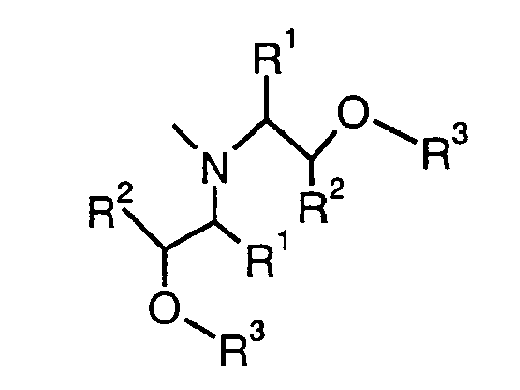
- unabhängig voneinander einen Rest der Formel

- R1
- für C1-C6-Alkyl und
- R2
- für H, oder
- R1
- für H und
- R2
- für C1-C6-Alkyl steht, und unabhängig davon
- R3
- für H, Methyl, Ethyl, CH2CH2OH oder CH2CH2OCH3 steht,
- R1'
- für C1-C6-Alkyl und
- R2'
- für H, oder
- R1'
- für H und
- R2'
- für C1-C6-Alkyl steht, und unabhängig davon
- R3'
- für H, Methyl, Ethyl, CH2CH2OH oder CH2CH2OCH3 sowie
- R4
- für C1-C4-Alkyl steht und
- M
- H, ein Äquivalent eines anorganischen Kations, insbesondere Li, Na, K, Ca, Mg oder Ammonium, oder ein substituiertes Ammonium der Formel II
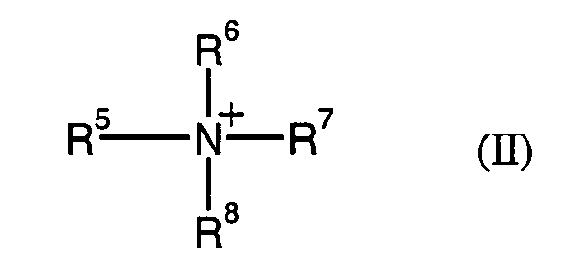
- R5 bis R7
- unabhängig voneinander Wasserstoff, einen C1-C4-Alkylrest oder einen ggf. weiter substituierten C2-C4-Hydroxyalkylrest bedeuten, und R8 einen ggf. weiter substituierten C2-C4-Hydroxyalkylrest bedeutet,
Description
- Die Erfindung betrifft ein Verfahren zum Aufhellen von Papier in der Leimpresse, Aufhellerpräparationen sowie Leimpressenflotten.
- Bei der Herstellung von Papier wird zur Erzielung von guter Beschreibbarkeit und Festigkeit in der Regel ein Leimungsschritt durchgeführt, der einerseits vor der Blattbildung in der Papiermasse erfolgen kann (Masseleimung), andererseits nach der Blattbildung in der Leimpresse. Auch eine Kombination dieser beiden Verfahren ist möglich. In einer oder beiden Herstellungsstufen des Papiers wird üblicherweise auch eine Aufhellung der Papiermasse bzw. des Papierblatts durch optische Aufheller vorgenommen, wobei in der Regel bei der Masseanwendung das Leimungsmittel und der Aufheller der Papiermasse getrennt zugeführt werden, während bei Oberflächenleimung der Aufheller in die Leimpressenflotte eingearbeitet und mit dieser zusammen auf das Papierblatt aufgebracht wird.
- Die Kombination von Oberflächenleimung und Aufhellung von Papieren ist bei der papiererzeugenden Industrie weit verbreitet. Besonders im Papiersegment Printing&Writing (Copy, Ink Jet, Offset etc.) findet diese Methode breite Anwendung. Neben der effizienteren Aufhellung ist auch eine schnellere Korrektur (Online-Messung) der zu erzielenden Weißgrade möglich. Des Weiteren wird mit der Oberflächenapplikation die Nasspartie von zusätzlichen anionischen Frachten (Weißtöner) verschont.
- In GB-A-896 533 werden bereits Triazinylflavonataufheller als K oder Na-Salze als optische Aufheller im Leimpressenverfahren zum Aufhellen von Papier beschrieben. Diese haben aber noch einige anwendungstechnische Nachteile, insbesondere im Weißgrad.
- Es besteht ein fortgesetzter Trend zu obenflächengeleimten Papieren mit hohen Weißgraden und daher der Wunsch nach möglichst effektiven optischen Aufhellern als Leimpressenflottenbestandteil, insbesondere solchen Aufhellern, die die Nachteile des Standes der Technik nicht besitzen.
- Die Erfindung betrifft daher ein Verfahren zum Aufhellen von Papier in der Leimpresse, dadurch gekennzeichnet, dass die Leimpressenflotte einen Aufheller der Formel I enthält,

worin - X
- unabhängig voneinander einen Rest der Formel

oder
- R1
- für C1-C6-Alkyl und
- R2
- für H, oder
- R1
- für H und
- R2
- für C1-C6-Alkyl steht, und unabhängig davon
- R3
- für H, Methyl, Ethyl, CH2CH2OH oder CH2CH2OCH3 steht,
- R1'
- für C1-C6-Alkyl und
- R2'
- für H, oder
- R1'
- für H und
- R2'
- für C1-C6-Alkyl steht, und unabhängig davon
- R3'
- für H, Methyl, Ethyl, CH2CH2OH oder CH2CH2OCH3 sowie
- R4
- für C1-C4-Alkyl steht und
- M
- H, ein Äquivalent eines anorganischen Kations, insbesondere Li, Na, K, Ca, Mg oder Ammonium, oder ein substituiertes Ammonium der Formel II

- R5 bis R7
- unabhängig voneinander Wasserstoff, einen C1-C4-Alkylrest oder einen ggf. weiter substituierten C2-C4-Hydroxyalkylrest bedeuten, und R8 einen ggf. weiter substituierten C2-C4-Hydroxyalkylrest bedeutet,
- Bevorzugt besitzen wenigstens 20 mol-%, insbesondere mehr als 50 mol-%, ganz besonders bevorzugt mehr als 80 mol-% aller Kationen M die Bedeutung der Formel II.
- Ganz besonders bevorzugt ist es, Aufheller zu verwenden, die zu mehr als 50 Gew.-%, bevorzugt mehr als 60 Gew.-%, vorzugsweise mehr als 75 Gew.-%, insbesondere mehr als 95 Gew.-% aus einem Aufheller der Formel I bestehen.
- Bevorzugte optische Aufheller entsprechen der Formel (I) mit
- R1 = H,
- R2 = lineares C1-C6-Alkyl sowie
- R3 = H;
- R1' = H,
- R2' = lineares C1-C6-Alkyl sowie
- R3' = H und R4 = H oder Methyl,
- Besonders bevorzugt ist der Aufheller der Formel (Ia)

worin - M
- eine Mischung enthaltend das Kation der Formel II

- Die besondere Eignung der alkanolammoniumhaltigen Aufheller der Formel I für die erfindungsgemäße Verwendung bedeutet, dass für den Fall, dass mindestens einer der Reste R5-R7 Wasserstoff ist, der pH-Wert in der Leimpressenflotte vorzugsweise so eingestellt wird, dass eine für die vorliegende Menge an Aufhelleranionen optimale Mindestmenge an protoniertem Alkanolamin zur Verfügung steht. Dies ist im Allgemeinen im Bereich von pH <= 7,5 der Fall; vorzugsweise wird im Anwendungsmedium ein pH-Wert eingestellt, bei dem möglichst alles vorliegende Alkanolamin protoniert ist, d.h. ein pH-Bereich von 4-7.
- Bei der erfindungsgemäßen Verwendung der Aufheller der Formel (I) kann zusätzlich überschüssiges Alkanolamin bzw. Alkanolammonium in Form der freien Basen bzw. entsprechender Salze mit anderen, anorganischen oder organischen, Anionen in der Leimpressenflotte anwesend sein.
- Unter Leimpresse wird im Rahmen dieser Erfindung ein Oberflächenauftragungsaggregat vorzugsweise der Papiermaschine verstanden, in dem das gebildete Celluloseblatt mit einer wässrigen Flotte, enthaltend wenigstens ein Oberflächenleimungsmittel, insbesondere Stärke, beispielsweise native, derivatisierte oder abgebaute, vorzugsweise oxidativ abgebaute Stärke, der sogenannten Leimpressenflotte in Kontakt gebracht wird, und in dem der Anteil der Flotte, der von dem Blatt aufgenommen werden soll (Flottenaufnahme) vorzugsweise durch den Walzenpressdruck eingestellt werden kann.
- Neuere Entwicklungen der Leimpresse namentlich der Speedsizer als auch der Symsizer werden ebenfalls unter dem Begriff Leimpresse verstanden.
- So können z.B. die Aufheller bereits in Form ihrer Alkanolammoniumsalze oder Mischsalze ihrer Alkanolammoniumsalze mit ihren Salzen anorganischer Basen hergestellt und / oder formuliert werden und in einer solchen Form schließlich in Leimpressenflotten eingebracht werden, die dann in dem beschriebenen bevorzugten pH-Bereich angewendet werden. Die Verwendung kann aber z.B. auch dadurch erfolgen, dass ein mit einem anorganischen Gegenion, wie z.B. Lithium, Natrium, Kalium, Calcium, Magnesium, oder Ammonium vorliegender Aufheller mit dem Salz einer anorganischen oder organischen Säure eines Alkanolamins zusammengebracht wird, beispielsweise einem Alkanolaminhydrochlorid oder Alkanolaminsulfat, und diese Mischung dann in einer Leimpressenflotte von geeignetem pH-Wert angewendet wird, oder z.B. dadurch, dass dieses Zusammenbringen erst in der Leimpressenflotte geschieht, oder z. B. auch dadurch, dass das dem Alkanolaminsalz zu Grunde liegende Alkanolamin in freier Form zu einem beliebigen Zeitpunkt und an einer beliebigen Stelle in den Herstellungs- oder Verarbeitungsgang eingebracht und im weiteren Verlauf mit einer geeigneten anorganischen oder organischen Säure neutralisiert wird. Dies gilt natürlich auch für den umgekehrten Fall, dass nämlich zuerst die anorganische oder organische Säure und erst danach das Alkanolamin eingebracht wird.
- Bevorzugt erfolgt die erfindungsgemäße Verwendung dadurch, dass eine wässrige Lösung des erfindungsgemäß eingesetzten Aufhellers von geeignetem pH-Wert, die ggf. zusätzliche Stoffe enthalten kann, wie z.B. Carriersubstanzen, Salze oder Stellmittel, in die Leimpressenflotte eingebracht wird.
- Als Carriersubstanzen kommen beispielsweise hydrophile Polymere mit der Fähigkeit zur Ausbildung von Wasserstoffbrückenbindungen in Frage. Bevorzugte Carriersubstanzen sind Polyvinylalkohole, Carboxymethylcellulosen sowie Polyethylenglykole mit einem zahlenmittleren Molgewicht von 200 bis 8000 g/mol, als auch beliebige Mischungen dieser Substanzen, wobei diese Polymere gegebenenfalls modifiziert sein können. Bevorzugte Polyvinylalkohole sind solche mit einem Hydrolysegrad >85%, bevorzugte Carboxymethylcellulosen solche mit einem Substitutionsgrad DS von >0,5. Besonders bevorzugt sind Polyethylenglykole mit einem zahlenmittleren Molgewicht Mn von 200 bis 8000 g/mol.
- Mit solchen Formulierungen können in der Regel günstigere Weißgradaufbaukurven und höhere Vergrünungsgrenzen realisiert werden als mit carrierfreien Aufhellerpräparationen.
- Zusätzlich können in den carrierfreien oder auch carrierhaltigen Formulierungen in kleineren Mengen, üblicherweise in Mengen unter 5 Gew.-%, weitere Hilfsstoffe wie z. B. Dispergiermittel, Verdicker, Frostschutzmittel, Konservierungsmittel, Komplexbildner etc. oder auch organische Nebenprodukte aus der Aufhellersynthese, die bei der Aufarbeitung nicht vollständig entfernt wurden, enthalten sein.
- Vergleicht man den extinktionsgleichen Einsatz der in Formel (I) gezeigten Aufheller in einer Leimpressenanwendung in Form ihrer Salze, worin M nur anorganische Kationen sind, mit ihren alkanolammoniumhaltigen Salzen, so zeigt ab bestimmten Aufhellerzusatzmengen der Aufheller mit nur anorganischen Kationen ein Sättigungsverhalten bezüglich des CIE-Weißgrades, d.h. größere Einsatzmengen führen zu keinem Weißgradaufbau mehr und können sich sogar negativ auf den Weißgrad auswirken. Dieses Sättigungsverhalten tritt bei Verwendung der alkanolammoniumhaltigen Aufheller erst bei deutlich höheren Einsatzmengen, verglichen zum Salz mit nur anorganischen Kationen, auf. Dadurch können mit den alkanolammoniumhaltigen Formulierungen überraschend höhere Weißgrade realisiert werden als mit Formulierungen, die lediglich anorganische Kationen enthalten. Der Effekt der Sättigung wird auch als Vergrünung bezeichnet. Die Vergrünungsgrenze, d.h. der Punkt, ab dem steigende Aufheller-Einsatzmengen praktisch keinen Weißgradzuwachs mehr bewirken, kann z.B. aus dem a*-b*-Diagramm abgeleitet werden, wobei a* und b* die Farbkoordinaten im CIE-L*a*b*-System sind.
- Wässrige Aufhellerzubereitungen werden üblicherweise durch den sogenannten E1/1-Wert charakterisiert. Dazu wird die Extinktion einer stark verdünnten Lösung der Zubereitung nach den üblichen und dem Fachmann bekannten Methoden der UV/Vis-Spektroskopie in einer lcm-Küvette bei einer bestimmten Wellenlänge bestimmt. Diese Wellenlänge entspricht dem langwelligen Absorptionsmaximum des jeweiligen Aufhellermoleküls. Bei Flavonataufhellern beträgt sie ca. 350 nm. Der E1/1-Wert entspricht dann dem fiktiven, auf eine 1 %ige Lösung der zu bestimmenden Probe hochgerechneten Extinktionswert.
- Da die Vergrünung der alkanolammoniumhaltigen Typen erst bei relativ hohen Einsatzmengen auftritt, eignet sich ihre erfindungsgemäße Verwendung besonders zur Herstellung hochweißer Papiere. Die genauen Einsatzbedingungen, bei denen die Vergrünung in der Leimpressenanwendung einsetzt, hängen von der Zusammensetzung der jeweiligen Leimpressenflotte ab.
- In EP-A-1355004 werden ebenfalls Aufheller der Formel (I) beschrieben, allerdings werden sie dort lediglich im Zusammenhang mit der Verwendung in Streichmassen erwähnt.
- In WO 0046336 werden Mischungen von Aufhellern beschrieben, die unter Anderem bis zu 45 mol-% Aufheller der Formel (I) mit R1=R3=H; R2= Methyl; M = Na, Li, Ca, Mg, Ammonium oder Ammonium, das mono-, di-, tri- oder tetrasubstituiert ist durch C1-C4-Alkyl oder C1-C4-Hydroxyalkyl, enthalten können , unter Anderem zur Aufhellung von Papier. Ob diese Mischungen besonders gut für eine Anwendung in der Leimpresse geeignet sind, wird jedoch nirgends erwähnt. Darüber hinaus konnte durch vergleichende Untersuchungen gezeigt werden, dass die in der vorliegenden Erfindung beschriebenen Aufheller der Formel Ia (entspricht 1b aus WO 00/46336), wenn man sie gemäß der in WO 0046336, Beispiel 2 beschriebenen Methode als Einzelverbindung herstellt, in der Leimpressenanwendung eine deutlich besser aufhellende Wirkung zeigt als die auf ebensolche Weise hergestellte Mischung gemäß WO 0046336, und dass sich diese Wirkung nochmals steigern lässt, wenn man das vorliegende überschüssige Alkanolamin neutralisiert.
- Die Erfindung betrifft daher weiterhin Aufhellerpräparation enthaltend Aufheller, die zu mehr als 50 Gew.-%, bevorzugt mehr als 60 Gew.-%, vorzugsweise zu mehr als 75 Gew.-%, insbesondere zu mehr als 95 Gew.-% aus einem Aufheller der Formel I bestehen. Bevorzugt sind wässrige Aufhellerpräparationen die gegebenenfalls noch zusätzliche Stoffe enthalten können, wie sie beispielsweise oben bereits genannt sind.
- Die erfindungsgemäßen Präparationen lassen sich vorzugsweise in dem erfindungsgemäßen Aufhellungsverfahren einsetzen.
- Besonders bevorzugt sind wässrige Aufhellerpräparationen, enthaltend wenigstens einen Aufheller der Formel (I) insbesondere (Ia).
- Bevorzugt enthalten die erfindungsgemäßen, vorzugsweise wässrigen Aufhellerpräparation wenigstens 2,5 Gew.-% an Aufheller, besonders bevorzugt 5 bis 40 Gew.-%, insbesondere 10 bis 30 Gew.-%.
- Weiterhin können die erfindungsgemäßen Aufhellerpräparationen anorganische oder organische Salze, zusätzlich freies Alkanolamin, zusätzlich Alkanolaminsalze, Carrier sowie weitere Stoffe enthalten.
- Ein weiterer Gegenstand der Erfindung sind Leimpressenflotten, enthaltend
- a) wenigstens einen Aufheller der Formel (I) insbesondere (Ia) oder eine erfindungsgemäße Aufhellerpräparation und
- b) wenigstens ein Oberflächenleimungsmittel, vorzugsweise Stärke.
- Weiterhin kann die Leimpressenflotte anorganische oder organische Salze, zusätzlich freies Alkanolamin, zusätzlich Alkanolaminsalze, Carrier sowie weitere Stoffe enthalten.
- Bevorzugt enthält die Leimpressenflotte weniger als 2,5 Gew.-% Aufheller, insbesondere von 0,01 bis 2,0 Gew.-%. Der Gesamtaufheller besteht dabei vorzugsweise wie bereits für die Aufhellerpräparation beschrieben, zu mehr als 50 Gew.-%, bevorzugt mehr als 60 Gew.-%, vorzugsweise mehr als 75 Gew.-%, insbesondere zu mehr als 95 Gew.-% aus einem Aufheller der Formel I.
- Der Anteil an Oberflächenleimungsmittel, insbesondere Stärke, bezogen auf die Leimpressenflotte, beträgt vorzugsweise 2 bis 25 Gew.-%, insbesondere 5 bis 15 Gew.-%.
- Der Wasseranteil der Leimpressenflotte beträgt vorzugsweise wenigstens 70 Gew.-%.
- 229 g eines membranfiltrierten wässrigen Konzentrats mit einem E1/1-Wert von 148 und einem pH-Wert von 8,5, das den Aufheller der Formel I mit R1= R3 = H, R2 = CH3 , M ausschließlich Na enthält, wobei die beiden anilingebundenen Sulfogruppen p-ständig sind, werden unter Rühren bei Raumtemperatur mit 71g demineralisiertem Wasser versetzt und mit ca. 10 %iger Natronlauge auf pH 9,0 gestellt. Man erhält eine wässrige Aufhellerpräparation mit einem E1/1-Wert von 113 in Form einer gelb-bräunlichen homogenen Flüssigkeit. Dies entspricht einem Gehalt an Aufheller von ca. 21%
- Je 229 g des membranfiltrierten wässrigen Konzentrats aus Vergleichsbeispiel 1 werden unter Rühren bei Raumtemperatur mit a) 15,0 b) 30,0 sowie a) 56 g b) 41 g demineralisiertem Wasser versetzt und anschließend 10 min verrührt. Man erhält triethanolaminhaltige Aufhellerpräparationen mit einem E1/1-Wert von 113 in Form von gelb-bräunlichen homogenen Flüssigkeiten. Dies entspricht einem Gehalt an Aufheller von ca. 21 % und einem Gehalt an Triethanolamin von a) 5 % b) 10 %.
- 1200 g des membranfiltrierten wässrigen Konzentrats aus Vergleichsbeispiel 1 werden im Vakuum eingedampft. Das erhaltene Kristallisat hat nach Homogenisierung einen E1/1-Wert von 472.
- Jeweils eine Mischung aus a) 140g demineralisiertem Wasser und 15 g Triethanolamin, b) 90 g demineralisiertem Wasser und 30 g Triethanolamin, wird durch Zusatz von a) ca. 36 g b) ca. 73 g, 10 %iger Salzsäure auf pH 6 eingestellt. Anschließend trägt man bei ca. 60°C unter Rühren jeweils 71,8 g des oben beschriebenen Kristallisats ein. Man rührt bis zur Auflösung des Kristallisats nach, bestimmt den jeweiligen E1/1-Wert und verdünnt anschließend bei Raumtemperatur mit demineralisiertem Wasser jeweils auf den gleichen rechnerischen E1/1-Wert von 113.
- Man erhält jeweils ca. 300 g einer Aufhellereinstellung, welche die gleiche Molzahl Aufheller wie die Vergleichsbeispiele 1 bzw. 2a, 2b und a) ca. 5 Gew.-% (entspricht einem M mit ca. 50 mol-% Triethanolammonium Rest Na+) b) ca. 10 Gew.-% (entspricht einem M mit ca. 100 mol-% Triethanolammonium) Triethanolammoniumionen enthält.
- Man verfährt bis einschließlich des Eintragens des Kristallisats wie für Beispiel 1b beschrieben. Nach Auflösen des Kristallisats trägt man 15g Polyethylenglykol 1500 ein, verrührt bis zu dessen Auflösung und bestimmt den E1/1-Wert. Anschließend verdünnt man bei Raumtemperatur mit demineralisiertem Wasser auf einen rechnerischen E1/1-Wert von 113.
- Man erhält ca. 300 g einer Aufhellerformulierung, welche die gleiche Molzahl Aufheller und Triethanolammoniumionen wie im Beispiel 1b und außerdem 5 % Polyethylenglykol 1500 als Carrier enthält.
- Beispiel 3 entspricht Beispiel 2 aus WO 0046336 mit dem Unterschied, dass die Herstellung der Stufe 2 nicht mit dem dort beschriebenen Gemisch aus Diethanolamin und Diisopropanolamin erfolgt, sondern mit einer diesem Gemisch äquimolaren Menge Diisopropanolamin. (M = ca. 50 mol-% Triethanolammonium).
- Beispiel 4 (entspricht Beispiel 2 aus WO 0046336 mit dem Unterschied, dass die Herstellung der Stufe 2 nicht mit dem dort beschriebenen Gemisch aus Diethanolamin und Diisopropanolamin erfolgt, sondern mit einer dem Gemisch äquimolaren Menge Diisopropanolamin, und zusätzlich überschüssiges Triethanolamin durch Einstellung von pH 6 mit Salzsäure neutralisiert worden ist. (M = ca. 100 mol-% Triethanolammonium)
-
- Stärkelösung 10 %ig:
- Perfectamyl A 4692 der Fa. Avebe (oxidativ abgebaute Kartoffelstärke)
- Prüfpapier:
- Schleicher und Schuell MicroSience 3014, Zuschnitte 240X250 mm, Ref. Nr. 10344684
- Laborleimpresse, Foulard:
- Fa. Mathis, Typ HF 52499, Zürich Oberhasli, Schweiz
- Ca. 120 g Perfectamyl A 4692 werden mit ca. 200 ml kaltem Wasser klumpenfrei angeschlämmt. Anschl. gibt man unter Rühren ca. 700 ml heißes Wasser zur Vorlage und rührt so lange nach, bis eine klare Stärkelösung entsteht. Nach dem Abkühlen auf Raumtemperatur erfolgt eine Konzentrations-Kontrolle per Handrefraktometer. Evtl. durch zusätzliche Wasserzugabe auf 10 % einstellen.
- Zunächst wird in einer separaten Bestimmung das Flottenaufnahmeverhältnis des Prüfpapiers bestimmt.
- Dazu verdünnt man 50,0 g der 10 %igen Stärkelösung mit Wasser auf 100,0 g, durchmischt gründlich, überführt die Lösung in die Laborleimpresse und führt ein abgewogenes Blatt (Gewicht 1 = m1 g) des o.b. Prüfpapiers durch die Leimpresse. Dabei sollte die Leimpressengeschwindigkeit bei ca. 4m/min und der Walzenanpressdruck bei ca. 3 bar liegen. Unmittelbar nach dem Durchgang durch die Leimpresse wird das nun feuchte Blatt erneut abgewogen (Gewicht 2 = m2 g). Die Differenz m2-m1 ergibt die aufgenommene Flottenmenge; bezogen auf das Gewicht des eingesetzten Blattes erhält man das Flottenaufnahmeverhältnis = (m2-m1) / m1.
- Anschließend erfolgt die Prüfung der einzelnen Aufhellerpräparationen dadurch, dass man die betreffende Präparation als Konzentrationsreihe zu jeweils weiteren 50,0 g der selben Stärkelösung gibt, mit Wasser auf 100,0 g verdünnt, gründlich durchmischt, und die erhaltenen, aufhellerhaltigen Leimpressenflotten wie oben beschrieben mit Hilfe der Laborleimpresse auf weitere Prüfpapierblätter aufbringt. Zum Schluss werden die so ausgerüsteten Papiere im Trockenzylinder bei ca. 100°C getrocknet.
- Die zu vergleichenden Aufhellerpräparationen werden jeweils in einer Konzentrationsreihe von 0,5 Gew.% / 1,0 Gew.% / 1,5 Gew.% / 2,0 Gew.% eingesetzt, bezogen auf das Gewicht des verwendeten Prüfpapiers. Der Zusammenhang der Konzentrationen der Aufhellerpräparationen in Bezug auf das Gewicht des Prüfpapiers zu den entsprechenden Konzentrationen in Bezug auf die Leimpressenflottenmenge wird über das vorher separat ermittelte Flottenaufnahmeverhältnis hergestellt. So müssen beispielsweise bei einem Flottenaufnahmeverhältnis von 0,9 im oben beschriebenen Versuch ohne Aufheller die Werte der obigen Konzentrationsreihe noch durch den Divisor 0,9 geteilt werden, um ihre Werte in Bezug auf die Leimpressenflottenmenge zu erhalten.
- So ergibt sich beispielsweise bei Einsatz von 0,5 Gew.-% Aufhellerpräparation bezogen auf Prüfpapier, bei einen Flottenaufnahmeverhältnis von 0,9 eine Menge von 0,55 Gew.-% Aufhellerpräparation, bezogen auf die Menge an Leimpressenflotte.
- Des Weiteren bezieht sich obige Konzentrationsreihe auf Präparationen mit einem E1/1-Wert von 113. Wenn Präparationen mit einem abweichenden E1/1-Wert zu prüfen sind, muss zusätzlich deren E1/1-Wert-Abweichung vom Richtwert 113 dadurch kompensiert werden, dass man die Konzentrationsreihe im umgekehrt proportionalen Verhältnis abändert (Beispiel: bei einem E1/1-Wert von 105 sind 0,538 Gew.-% Präparation äquivalent zu 0,5 % Präparation vom E1/1-Wert 113 usw.).
-
Tabelle 1: Aufhellerpräparation aus Vergleichsbeispiel 1 Menge (%) CIE-Weißgrad L* a* b* 0,50 138,08 95,95 2,96 -10,83 1,00 144,11 96,12 3,04 -12,13 1,50 145,80 96,28 2,87 -12,44 2,00 146,46 96,32 2,69 -12,57 Tabelle 2: Aufhellerpräparation aus Vergleichsbeispiel 2a Menge (%) CIE-Weißgrad L* a* b* 0,50 135,50 95,92 2,83 -10,26 1,00 142,76 96,12 2,98 -11,82 1,50 144,48 96,28 2,83 -12,14 2,00 145,87 96,33 2,69 -12,43 Tabelle 3: Aufhellerpräparation aus Vergleichsbeispiel 2b Menge (%) CIE-Weißgrad L* a* b* 0,50 135,40 95,82 2,84 -10,28 1,00 142,37 96,11 2,97 -11,73 1,50 144,24 96,22 2,87 -12,11 2,00 145,10 96,31 2,69 -12,26 - Man erkennt, dass die Anwesenheit von Triethanolamin in Form der freien Base keine Verbesserung der Aufhellung bewirkt.
-
Tabelle 1: Aufhellerpräparation aus Vergleichsbeispiel 1 Menge (%) CIE-Weißgrad L* a* b* 0,50 138,08 95,95 2,96 -10,83 1,00 144,11 96,12 3,04 -12,13 1,50 145,80 96,28 2,87 -12,44 2,00 146,46 96,32 2,69 -12,57 Tabelle 4: Aufhellerpräparation aus Beispiel 1a Menge (%) CIE-Weißgrad L* a* b* 0,50 138,12 96,05 2,95 -10,80 1,00 145,36 96,31 3,09 -12,33 1,50 146,98 96,34 2,96 -12,68 2,00 148,48 96,57 2,79 -12,92 Tabelle 5: Aufhellerpräparation aus Beispiel 1b Menge (%) CIE-Weißgrad L* a* b* 0,50 138,33 95,96 2,98 -10,88 1,00 145,58 96,26 3,12 -12,40 1,50 147,59 96,25 3,03 -12,86 2,00 148,26 96,46 2,80 -12,92 - Man erkennt, dass die Anwesenheit von Triethanolammonium eine deutliche Verbesserung der Aufhellung bewirkt.
-
Tabelle 5: Aufhellerpräparation aus Beispiel 1b Menge (%) CIE-Weißgrad L* a* b* 0,50 138,33 95,96 2,98 -10,88 1,00 145,58 96,26 3,12 -12,40 1,50 147,59 96,25 3,03 -12,86 2,00 148,26 96,46 2,80 -12,92 Tabelle 6: Aufhellerpräparation aus Beispiel 2 Menge (%) CIE-Weißgrad L* a* b* 0,50 138,69 95,96 3,02 -10,97 1,00 145,83 96,23 3,16 -12,47 1,50 148,12 96,41 3,08 -12,92 2,00 148,74 96,39 2,86 -13,06 - Man erkennt, dass der durch Triethanolammonium verbesserte Aufhelleffekt durch Zusatz von Polyglykol weiter gesteigert werden kann.
-
Tabelle 7: Aufhellerpräparation aus Vergleichsbeispiel 3 Menge (%) CIE-Weißgrad L* a* b* 0,50 137,64 95,95 2,89 -10,73 1,00 144,62 96,29 2,95 -12,16 1,50 146,04 96,37 2,78 -12,45 2,00 147,17 96,5 2,56 -12,65 Tabelle 8: Aufhellerpräparation aus Beispiel 3 Menge (%) CIE-Weißgrad L* a* b* 0,50 137,8 95,93 2,94 -10,78 1,00 145,6, 96,21 3,11 -12,43 1,50 147,6 96,32 2,96 -12,82 2,00 148,9 96,43 2,79 -13,08 Tabelle 9: Aufhellerpräparation aus Beispiel 4 Menge (%) CIE-Weißgrad L* a* b* 0,50 138,9 95,94 2,99 -11,02 1,00 146,3 96,29 3,11 -12,55 1,50 148,4 96,39 2,97 -12,98 2,00 149,6 96,53 2,80 -13,19 - Man erkennt einerseits, dass bei extinktionsgleichem Einsatz eine Aufhellerpräparation, die den Aufheller der Formel Ia enthält (mit Diisopropanolaminresten an den Triazinringen, hergestellt analog Beispiel 2 der WO 0046336) eine bessere Aufhellwirkung zeigt als die Aufhellerpräparation des Beispiels 2 der WO 0046336, die ein Aufhellergemisch enthält, das zusätzlich einen mit Diethanolaminresten an den Triazinringen substituierten Aufheller und einen unsymmetrisch mit Diisopropanolaminresten und Diethanolaminresten an den Triazinringen substituierten Aufheller enthält, und andererseits, dass sich der Aufhelleffekt zusätzlich steigern lässt, wenn das freie Triethanolamin, das in der analog Beispiel 2 der WO 0046336 hergestellten Aufhellerpräparation, die den Aufheller der Formel Ia enthält , enthalten ist, durch Zusatz von Säure neutralisiert wird.
bedeutet und
bedeutet, wobei
wobei wenigstens 10 mol-% aller Kationen M der Formel II entsprechen.
weiterhin der Formel (I) mit
und Na+ oder K+ bedeutet.
Claims (6)
- Verfahren zum Aufhellen von Papier in der Leimpresse, dadurch gekennzeichnet, dass die Leimpressenflotte einen Aufheller der Formel I enthält,

worinX unabhängig voneinander einen Rest der Formel
oder
bedeutet undR1 für C1-C6-Alkyl undR2 für H, oderR1 für H undR2 für C1-C6-Alkyl steht, und unabhängig davonR3 für H, Methyl, Ethyl, CH2CH2OH oder CH2CH2OCH3 steht,R1' für C1-C6-Alkyl undR2' für H, oderR1' für H undR2' für C1-C6-Alkyl steht, und unabhängig davonR3' für H, Methyl, Ethyl, CH2CH2OH oder CH2CH2OCH3 sowieR4 für C1-C4-Alkyl steht undM H, ein Äquivalent eines anorganischen Kations, insbesondere Li, Na, K, Ca, Mg oder Ammonium, oder ein substituiertes Ammonium der Formel II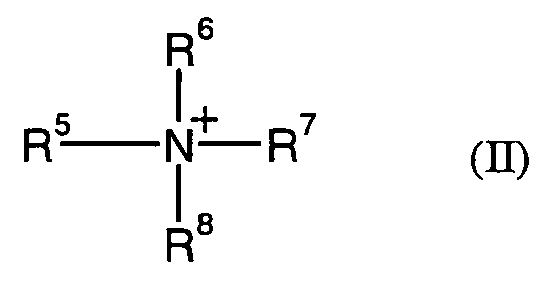
bedeutet, wobeiR5 bis R7 unabhängig voneinander Wasserstoff, einen C1-C4-Alkylrest oder einen ggf. weiter substituierten C2-C4-Hydroxyalkylrest bedeuten, und R8 einen ggf. weiter substituierten C2-C4-Hydroxyalkylrest bedeutet,
wobei wenigstens 10 mol-% aller Kationen M der Formel II entsprechen. - Verfahren gemäß Anspruch 1, dadurch gekennzeichnet, dass die Leimpressenflotte Aufheller enthält, die zu mehr als 50 Gew.-%, bevorzugt mehr als 60 Gew.-%, vorzugsweise mehr als 75 Gew.-%, insbesondere mehr als 95 Gew.-% aus einem Aufheller der Formel I bestehen.
- Verfahren nach wenigstens einem der Ansprüche 1 oder 2, dadurch gekennzeichnet, dassR1= H,R2 = lineares C1-C6-Alkyl sowieR3 = H;
weiterhin der Formel (I) mitR1 = H,R2' = lineares C1-C6-Alkyl sowieR3' = H und R4 = H oder Methyl,
in denen M jeweils eine Mischung von Kationen enthaltend Alkanolammoniumionen der Formel II, wobei die Reste R5 für H; R6 für H oder C2-C4-Hydroxyalkyl und R7 und R8 für C2-C4-Hydroxyalkyl stehen und Na- oder K-Ionen bedeutet. - Verfahren nach wenigstens einem der Ansprüche 1 bis 4, dadurch gekennzeichnet, dass ein Aufheller der Formel Ia eingesetzt wird

worinM eine Mischung enthaltend das Kation der Formel II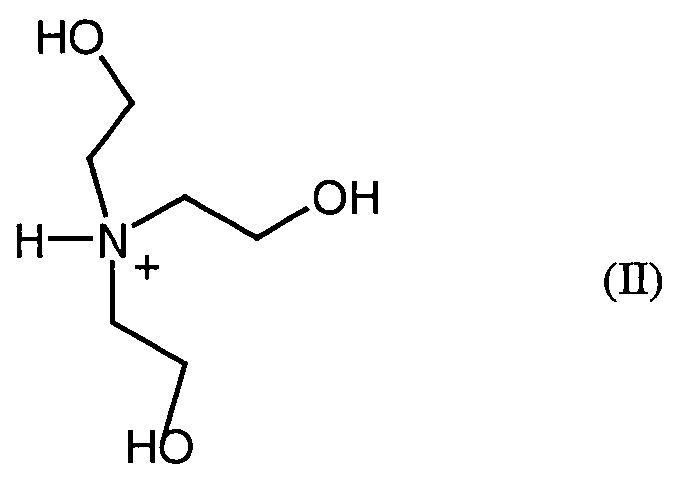
und Na+ oder K+ bedeutet. - Aufhellerpräparation enthaltend Aufheller, die zu mehr als 50 Gew.-%, bevorzugt zu mehr als 60 Gew.-%, vorzugsweise zu mehr als 75 Gew.-%, insbesondere zu mehr als 95 Gew.-% aus einem Aufheller der Formel I bestehen

worinX unabhängig voneinander einen Rest der Formel
oder
bedeutet undR1 für C1-C6-Alkyl undR2 für H, oderR1 für H undR2 für C1-C6-Alkyl steht, und unabhängig davonR3 für H, Methyl, Ethyl, CH2CH2OH oder CH2CH2OCH3 steht,R1' für C1-C6-Alkyl undR2' für H, oderR1' für H undR2' für C1-C6-Alkyl steht, und unabhängig davonR3' für H, Methyl, Ethyl, CH2CH2OH oder CH2CH2OCH3 sowieR4 für C1-C4-Alkyl steht undM H, ein Äquivalent eines anorganischen Kations, insbesondere Li, Na, K, Ca, Mg oder Ammonium, oder ein substituiertes Ammonium der Formel II
bedeutet, wobeiR5 bis R7 unabhängig voneinander Wasserstoff, einen C1-C4-Alkylrest oder einen ggf. weiter substituierten C2-C4-Hydroxyalkylrest bedeuten, und R8 einen ggf. weiter substituierten, C2-C4-Hydroxyalkylrest bedeutet,
wobei wenigstens 10 mol-% aller Kationen M der Formel II entsprechen. - Leimpressenflotte enthaltenda) wenigstens einen Aufheller der Formel (1) insbesondere (Ia) oder eine Aufhellerpräparation gemäß Anspruch 5 undb) wenigstens ein Oberflächenleimungsmittel, insbesondere Stärke.
Applications Claiming Priority (1)
| Application Number | Priority Date | Filing Date | Title |
|---|---|---|---|
| DE102004038578A DE102004038578A1 (de) | 2004-08-06 | 2004-08-06 | Alkanolammoniumhaltige Triazinylflavonataufheller |
Publications (2)
| Publication Number | Publication Date |
|---|---|
| EP1624105A1 true EP1624105A1 (de) | 2006-02-08 |
| EP1624105B1 EP1624105B1 (de) | 2009-03-25 |
Family
ID=35241181
Family Applications (1)
| Application Number | Title | Priority Date | Filing Date |
|---|---|---|---|
| EP05016038A Expired - Lifetime EP1624105B1 (de) | 2004-08-06 | 2005-07-23 | Alkanolammoniumhaltige Triazinylflavonataufheller |
Country Status (9)
| Country | Link |
|---|---|
| US (1) | US7608168B2 (de) |
| EP (1) | EP1624105B1 (de) |
| JP (1) | JP4768349B2 (de) |
| CN (1) | CN1730816B (de) |
| AT (1) | ATE426705T1 (de) |
| BR (1) | BRPI0503370B1 (de) |
| DE (2) | DE102004038578A1 (de) |
| ES (1) | ES2325164T3 (de) |
| PT (1) | PT1624105E (de) |
Cited By (1)
| Publication number | Priority date | Publication date | Assignee | Title |
|---|---|---|---|---|
| EP2192230B2 (de) † | 2008-11-27 | 2020-01-01 | Clariant Finance (BVI) Limited | Optische Aufhellungszusammensetzungen für den Tintenstrahldruck mit hoher Qualität |
Families Citing this family (4)
| Publication number | Priority date | Publication date | Assignee | Title |
|---|---|---|---|---|
| BRPI0416687A (pt) * | 2003-11-18 | 2007-01-30 | Ciba Sc Holding Ag | pigmentos branqueadores fluorescentes |
| DE602008004328D1 (de) * | 2008-06-11 | 2011-02-17 | Kemira Germany Gmbh | Zusammensetzung und Verfahren zur Papierbleichung |
| CN101922124A (zh) * | 2010-07-21 | 2010-12-22 | 东营市联成化工有限责任公司 | 一种液体增白剂的配方及生产工艺 |
| ES2583481T3 (es) * | 2013-04-29 | 2016-09-21 | Blankophor Gmbh & Co. Kg | Uso de celulosa micronizada y agente de blanqueamiento fluorescente para el tratamiento de superficie de materiales celulósicos |
Citations (5)
| Publication number | Priority date | Publication date | Assignee | Title |
|---|---|---|---|---|
| GB896533A (en) | 1958-11-05 | 1962-05-16 | Sandoz Ltd | New stilbene derivatives and process for their manufacture |
| GB1211812A (en) * | 1968-04-26 | 1970-11-11 | Geigy Ag J R | Asymmetrically substituted bistriazinylamino stilbene compounds |
| WO2000046336A1 (en) | 1999-02-05 | 2000-08-10 | Ciba Specialty Chemicals Holding Inc. | Fluorescent whitening agent, its preparation and use |
| WO2002097193A1 (en) * | 2001-05-29 | 2002-12-05 | Ciba Specialty Chemicals Holding Inc. | A composition for the fluorescent whitening of paper |
| EP1355004A1 (de) | 2002-04-19 | 2003-10-22 | Bayer Aktiengesellschaft | Verwendung von Aufhellern zur Herstellung von Streichmassen |
Family Cites Families (13)
| Publication number | Priority date | Publication date | Assignee | Title |
|---|---|---|---|---|
| CH583212A5 (de) * | 1973-07-02 | 1976-12-31 | Sandoz Ag | |
| US3931422A (en) * | 1974-10-04 | 1976-01-06 | Standard Oil Company | Polyester/starch paper sizing |
| DE3502038A1 (de) * | 1985-01-23 | 1986-07-24 | Sandoz-Patent-GmbH, 7850 Lörrach | Waessrige aufhellerpraeparate und deren verwendung im papierstrich |
| US5478631A (en) * | 1992-09-09 | 1995-12-26 | Kanzaki Paper Mfg. Co., Ltd. | Ink jet recording sheet |
| JP3307013B2 (ja) * | 1992-09-09 | 2002-07-24 | 王子製紙株式会社 | インクジェット記録用シート |
| GB2277749B (en) * | 1993-05-08 | 1996-12-04 | Ciba Geigy Ag | Fluorescent whitening of paper |
| GB9412590D0 (en) * | 1994-06-23 | 1994-08-10 | Sandoz Ltd | Organic compounds |
| ATE244227T1 (de) * | 1997-03-25 | 2003-07-15 | Ciba Sc Holding Ag | 4,4'-diaminostilben-2,2'-disulfonsäurederivate |
| EP1200675A1 (de) * | 1999-08-05 | 2002-05-02 | Ciba SC Holding AG | Verwendung von aufhellerpigmenten zum weisstönen von papierstreichmassen |
| AU6842600A (en) * | 1999-09-10 | 2001-04-17 | Ciba Specialty Chemicals Holding Inc. | Triazinylaminostilbene derivative as fluorescent whitening agents |
| GB0100610D0 (en) * | 2001-01-10 | 2001-02-21 | Clariant Int Ltd | Improvements in or relating to organic compounds |
| CA2459235C (en) * | 2001-09-03 | 2009-11-10 | Basf Aktiengesellschaft | Method for increasing the whiteness of paper by means of cationic polyelectrolytes |
| GB0127903D0 (en) * | 2001-11-21 | 2002-01-16 | Clariant Int Ltd | Improvements relating to organic compounds |
-
2004
- 2004-08-06 DE DE102004038578A patent/DE102004038578A1/de not_active Withdrawn
-
2005
- 2005-07-22 US US11/187,735 patent/US7608168B2/en not_active Expired - Fee Related
- 2005-07-23 AT AT05016038T patent/ATE426705T1/de active
- 2005-07-23 PT PT05016038T patent/PT1624105E/pt unknown
- 2005-07-23 ES ES05016038T patent/ES2325164T3/es not_active Expired - Lifetime
- 2005-07-23 DE DE502005006927T patent/DE502005006927D1/de not_active Expired - Lifetime
- 2005-07-23 EP EP05016038A patent/EP1624105B1/de not_active Expired - Lifetime
- 2005-08-04 JP JP2005227116A patent/JP4768349B2/ja not_active Expired - Fee Related
- 2005-08-05 BR BRPI0503370A patent/BRPI0503370B1/pt not_active IP Right Cessation
- 2005-08-05 CN CN200510091692.6A patent/CN1730816B/zh not_active Expired - Fee Related
Patent Citations (5)
| Publication number | Priority date | Publication date | Assignee | Title |
|---|---|---|---|---|
| GB896533A (en) | 1958-11-05 | 1962-05-16 | Sandoz Ltd | New stilbene derivatives and process for their manufacture |
| GB1211812A (en) * | 1968-04-26 | 1970-11-11 | Geigy Ag J R | Asymmetrically substituted bistriazinylamino stilbene compounds |
| WO2000046336A1 (en) | 1999-02-05 | 2000-08-10 | Ciba Specialty Chemicals Holding Inc. | Fluorescent whitening agent, its preparation and use |
| WO2002097193A1 (en) * | 2001-05-29 | 2002-12-05 | Ciba Specialty Chemicals Holding Inc. | A composition for the fluorescent whitening of paper |
| EP1355004A1 (de) | 2002-04-19 | 2003-10-22 | Bayer Aktiengesellschaft | Verwendung von Aufhellern zur Herstellung von Streichmassen |
Cited By (1)
| Publication number | Priority date | Publication date | Assignee | Title |
|---|---|---|---|---|
| EP2192230B2 (de) † | 2008-11-27 | 2020-01-01 | Clariant Finance (BVI) Limited | Optische Aufhellungszusammensetzungen für den Tintenstrahldruck mit hoher Qualität |
Also Published As
| Publication number | Publication date |
|---|---|
| ES2325164T3 (es) | 2009-08-27 |
| US20060065381A1 (en) | 2006-03-30 |
| DE102004038578A1 (de) | 2006-03-16 |
| CN1730816B (zh) | 2011-04-13 |
| BRPI0503370B1 (pt) | 2016-01-05 |
| CN1730816A (zh) | 2006-02-08 |
| JP4768349B2 (ja) | 2011-09-07 |
| US7608168B2 (en) | 2009-10-27 |
| JP2006045761A (ja) | 2006-02-16 |
| PT1624105E (pt) | 2009-06-30 |
| EP1624105B1 (de) | 2009-03-25 |
| BRPI0503370A (pt) | 2006-03-21 |
| DE502005006927D1 (de) | 2009-05-07 |
| ATE426705T1 (de) | 2009-04-15 |
Similar Documents
| Publication | Publication Date | Title |
|---|---|---|
| EP1355004B1 (de) | Verwendung von Aufhellern zur Herstellung von Streichmassen | |
| DE69807397T2 (de) | Triazinylaminostilben Verbindungen | |
| EP0043790B1 (de) | Verfahren zur Erhöhung bzw. Verbesserung des Weisseffekts beim optischen Aufhellen von Streichmassen | |
| DE3537724A1 (de) | Waessrige strahldrucktinte | |
| DD297180A5 (de) | Zugabe eines polycarboxylischen agens mit phosphatierter oder phosphonierter funktio zu waessrigen pigmentsuspensionen von calciumcarbonat zur hemmung des durch die zugabe eines elektrolyten in konzentrierter form hervorgerufenen schockeffekts | |
| EP0274666B1 (de) | Weisstönerhaltige Papierstreichmassen | |
| DE2828461A1 (de) | Verfahren zum herstellen kationischer staerkesubstanzen und danach hergestellte staerkematerialien | |
| DE3882033T2 (de) | Füllstoff für wärmeempfindliches Aufzeichnungspapier und Verfahren zu deren Herstellung. | |
| DE4237545A1 (de) | Kupferphthalocyanin-Flüssigformierung | |
| EP1624105B1 (de) | Alkanolammoniumhaltige Triazinylflavonataufheller | |
| DE60026323T2 (de) | Formulierungen fluoreszierender optischer aufheller | |
| DE3643331A1 (de) | Fettabstossende zusammensetzung fuer flachdruckformen | |
| EP0409028A1 (de) | Verfahren zum Weisstönen von Papierstreichmassen sowie Weisstönerpräparationen für dieses Verfahren | |
| DE3341394A1 (de) | Verfahren zur herstellung einer waessrigen pigmentdispersion | |
| EP1013721A2 (de) | Feste Phthalocyaninpräparationen | |
| DE19920784A1 (de) | Stilbenaufheller | |
| DE69419151T2 (de) | 4-hydroxy-4'-isopropoxydiphenylsulfon-entwicklerzusammensetzungen, nasspulverisierungsverfahren und dispersion | |
| EP1761523B1 (de) | Verwendung von triazinylflavonataufhellern | |
| DE2524801A1 (de) | Optische aufhellungsmittel und verfahren zu ihrer herstellung | |
| EP0061623A1 (de) | Verfahren zum Färben oder Bedrucken von Papier und neue kationische Phthalocyaninfarbstoffe | |
| DE19916078A1 (de) | Verfahren zur Verbesserung von Weißgrad, Helligkeit und Farbort von Faserstoffen, von anorganischen Füllstoffen und Pigmenten sowie von Bindemitteln für die Papierherstellung | |
| EP1024178B1 (de) | Farbstoffmischungen | |
| DE19846098A1 (de) | Disazofarbstoffe | |
| DE69203447T2 (de) | Verfahren zum Leimen von Papier. | |
| DE2335756C3 (de) | Wäßrige Dispersion von Keten-dimeren zum Leimen von Zellulosefasern |
Legal Events
| Date | Code | Title | Description |
|---|---|---|---|
| PUAI | Public reference made under article 153(3) epc to a published international application that has entered the european phase |
Free format text: ORIGINAL CODE: 0009012 |
|
| AK | Designated contracting states |
Kind code of ref document: A1 Designated state(s): AT BE BG CH CY CZ DE DK EE ES FI FR GB GR HU IE IS IT LI LT LU LV MC NL PL PT RO SE SI SK TR |
|
| AX | Request for extension of the european patent |
Extension state: AL BA HR MK YU |
|
| 17P | Request for examination filed |
Effective date: 20060710 |
|
| 17Q | First examination report despatched |
Effective date: 20060814 |
|
| AKX | Designation fees paid |
Designated state(s): AT BE BG CH CY CZ DE DK EE ES FI FR GB GR HU IE IS IT LI LT LU LV MC NL PL PT RO SE SI SK TR |
|
| AXX | Extension fees paid |
Extension state: YU Payment date: 20060710 Extension state: BA Payment date: 20060710 Extension state: AL Payment date: 20060710 Extension state: HR Payment date: 20060710 Extension state: MK Payment date: 20060710 |
|
| RAP1 | Party data changed (applicant data changed or rights of an application transferred) |
Owner name: KEMIRA OYJ |
|
| RAP1 | Party data changed (applicant data changed or rights of an application transferred) |
Owner name: KEMIRA OYJ |
|
| GRAP | Despatch of communication of intention to grant a patent |
Free format text: ORIGINAL CODE: EPIDOSNIGR1 |
|
| GRAS | Grant fee paid |
Free format text: ORIGINAL CODE: EPIDOSNIGR3 |
|
| GRAA | (expected) grant |
Free format text: ORIGINAL CODE: 0009210 |
|
| AK | Designated contracting states |
Kind code of ref document: B1 Designated state(s): AT BE BG CH CY CZ DE DK EE ES FI FR GB GR HU IE IS IT LI LT LU LV MC NL PL PT RO SE SI SK TR |
|
| AX | Request for extension of the european patent |
Extension state: AL BA HR MK YU |
|
| REG | Reference to a national code |
Ref country code: GB Ref legal event code: FG4D Free format text: NOT ENGLISH |
|
| REG | Reference to a national code |
Ref country code: CH Ref legal event code: EP |
|
| REG | Reference to a national code |
Ref country code: IE Ref legal event code: FG4D Free format text: LANGUAGE OF EP DOCUMENT: GERMAN |
|
| REF | Corresponds to: |
Ref document number: 502005006927 Country of ref document: DE Date of ref document: 20090507 Kind code of ref document: P |
|
| REG | Reference to a national code |
Ref country code: PT Ref legal event code: SC4A Free format text: AVAILABILITY OF NATIONAL TRANSLATION Effective date: 20090623 |
|
| REG | Reference to a national code |
Ref country code: CH Ref legal event code: NV Representative=s name: ING. MARCO ZARDI C/O M. ZARDI & CO. S.A. |
|
| REG | Reference to a national code |
Ref country code: SE Ref legal event code: TRGR |
|
| PG25 | Lapsed in a contracting state [announced via postgrant information from national office to epo] |
Ref country code: LT Free format text: LAPSE BECAUSE OF FAILURE TO SUBMIT A TRANSLATION OF THE DESCRIPTION OR TO PAY THE FEE WITHIN THE PRESCRIBED TIME-LIMIT Effective date: 20090325 Ref country code: SI Free format text: LAPSE BECAUSE OF FAILURE TO SUBMIT A TRANSLATION OF THE DESCRIPTION OR TO PAY THE FEE WITHIN THE PRESCRIBED TIME-LIMIT Effective date: 20090325 |
|
| REG | Reference to a national code |
Ref country code: ES Ref legal event code: FG2A Ref document number: 2325164 Country of ref document: ES Kind code of ref document: T3 |
|
| PG25 | Lapsed in a contracting state [announced via postgrant information from national office to epo] |
Ref country code: PL Free format text: LAPSE BECAUSE OF FAILURE TO SUBMIT A TRANSLATION OF THE DESCRIPTION OR TO PAY THE FEE WITHIN THE PRESCRIBED TIME-LIMIT Effective date: 20090325 Ref country code: LV Free format text: LAPSE BECAUSE OF FAILURE TO SUBMIT A TRANSLATION OF THE DESCRIPTION OR TO PAY THE FEE WITHIN THE PRESCRIBED TIME-LIMIT Effective date: 20090325 |
|
| NLV1 | Nl: lapsed or annulled due to failure to fulfill the requirements of art. 29p and 29m of the patents act | ||
| REG | Reference to a national code |
Ref country code: IE Ref legal event code: FD4D |
|
| PG25 | Lapsed in a contracting state [announced via postgrant information from national office to epo] |
Ref country code: EE Free format text: LAPSE BECAUSE OF FAILURE TO SUBMIT A TRANSLATION OF THE DESCRIPTION OR TO PAY THE FEE WITHIN THE PRESCRIBED TIME-LIMIT Effective date: 20090325 Ref country code: CZ Free format text: LAPSE BECAUSE OF FAILURE TO SUBMIT A TRANSLATION OF THE DESCRIPTION OR TO PAY THE FEE WITHIN THE PRESCRIBED TIME-LIMIT Effective date: 20090325 |
|
| PG25 | Lapsed in a contracting state [announced via postgrant information from national office to epo] |
Ref country code: SK Free format text: LAPSE BECAUSE OF FAILURE TO SUBMIT A TRANSLATION OF THE DESCRIPTION OR TO PAY THE FEE WITHIN THE PRESCRIBED TIME-LIMIT Effective date: 20090325 Ref country code: NL Free format text: LAPSE BECAUSE OF FAILURE TO SUBMIT A TRANSLATION OF THE DESCRIPTION OR TO PAY THE FEE WITHIN THE PRESCRIBED TIME-LIMIT Effective date: 20090325 Ref country code: IS Free format text: LAPSE BECAUSE OF FAILURE TO SUBMIT A TRANSLATION OF THE DESCRIPTION OR TO PAY THE FEE WITHIN THE PRESCRIBED TIME-LIMIT Effective date: 20090725 Ref country code: RO Free format text: LAPSE BECAUSE OF FAILURE TO SUBMIT A TRANSLATION OF THE DESCRIPTION OR TO PAY THE FEE WITHIN THE PRESCRIBED TIME-LIMIT Effective date: 20090325 |
|
| PG25 | Lapsed in a contracting state [announced via postgrant information from national office to epo] |
Ref country code: IE Free format text: LAPSE BECAUSE OF FAILURE TO SUBMIT A TRANSLATION OF THE DESCRIPTION OR TO PAY THE FEE WITHIN THE PRESCRIBED TIME-LIMIT Effective date: 20090325 Ref country code: BG Free format text: LAPSE BECAUSE OF FAILURE TO SUBMIT A TRANSLATION OF THE DESCRIPTION OR TO PAY THE FEE WITHIN THE PRESCRIBED TIME-LIMIT Effective date: 20090625 Ref country code: DK Free format text: LAPSE BECAUSE OF FAILURE TO SUBMIT A TRANSLATION OF THE DESCRIPTION OR TO PAY THE FEE WITHIN THE PRESCRIBED TIME-LIMIT Effective date: 20090325 |
|
| PLBE | No opposition filed within time limit |
Free format text: ORIGINAL CODE: 0009261 |
|
| STAA | Information on the status of an ep patent application or granted ep patent |
Free format text: STATUS: NO OPPOSITION FILED WITHIN TIME LIMIT |
|
| PG25 | Lapsed in a contracting state [announced via postgrant information from national office to epo] |
Ref country code: MC Free format text: LAPSE BECAUSE OF NON-PAYMENT OF DUE FEES Effective date: 20090731 |
|
| 26N | No opposition filed |
Effective date: 20091229 |
|
| PG25 | Lapsed in a contracting state [announced via postgrant information from national office to epo] |
Ref country code: GR Free format text: LAPSE BECAUSE OF FAILURE TO SUBMIT A TRANSLATION OF THE DESCRIPTION OR TO PAY THE FEE WITHIN THE PRESCRIBED TIME-LIMIT Effective date: 20090626 |
|
| PG25 | Lapsed in a contracting state [announced via postgrant information from national office to epo] |
Ref country code: LU Free format text: LAPSE BECAUSE OF NON-PAYMENT OF DUE FEES Effective date: 20090723 |
|
| PG25 | Lapsed in a contracting state [announced via postgrant information from national office to epo] |
Ref country code: HU Free format text: LAPSE BECAUSE OF FAILURE TO SUBMIT A TRANSLATION OF THE DESCRIPTION OR TO PAY THE FEE WITHIN THE PRESCRIBED TIME-LIMIT Effective date: 20090926 |
|
| REG | Reference to a national code |
Ref country code: DE Ref legal event code: R081 Ref document number: 502005006927 Country of ref document: DE Owner name: BLANKOPHOR GMBH & CO. KG, DE Free format text: FORMER OWNER: KEMIRA OYJ, HELSINKI, FI Effective date: 20110519 |
|
| PG25 | Lapsed in a contracting state [announced via postgrant information from national office to epo] |
Ref country code: TR Free format text: LAPSE BECAUSE OF FAILURE TO SUBMIT A TRANSLATION OF THE DESCRIPTION OR TO PAY THE FEE WITHIN THE PRESCRIBED TIME-LIMIT Effective date: 20090325 |
|
| REG | Reference to a national code |
Ref country code: CH Ref legal event code: PUE Owner name: BLANKOPHOR GMBH & CO. KG Free format text: KEMIRA OYJ#PORKKALANKATU 3#00180 HELSINKI (FI) -TRANSFER TO- BLANKOPHOR GMBH & CO. KG#MARIE-CURIE-STRASSE 10#51377 LEVERKUSEN (DE) |
|
| PG25 | Lapsed in a contracting state [announced via postgrant information from national office to epo] |
Ref country code: CY Free format text: LAPSE BECAUSE OF FAILURE TO SUBMIT A TRANSLATION OF THE DESCRIPTION OR TO PAY THE FEE WITHIN THE PRESCRIBED TIME-LIMIT Effective date: 20090325 |
|
| REG | Reference to a national code |
Ref country code: PT Ref legal event code: PC4A Owner name: BLANKOPHOR GMBH & CO. KG, DE Effective date: 20110908 |
|
| PGFP | Annual fee paid to national office [announced via postgrant information from national office to epo] |
Ref country code: CH Payment date: 20110725 Year of fee payment: 7 |
|
| REG | Reference to a national code |
Ref country code: GB Ref legal event code: 732E Free format text: REGISTERED BETWEEN 20111006 AND 20111012 |
|
| REG | Reference to a national code |
Ref country code: FR Ref legal event code: TP Owner name: BLANKOPHOR GMBH & CO. KG, DE Effective date: 20111021 |
|
| REG | Reference to a national code |
Ref country code: ES Ref legal event code: PC2A Owner name: BLANKOPHOR GMBH & CO.KG Effective date: 20120118 |
|
| REG | Reference to a national code |
Ref country code: DE Ref legal event code: R082 Ref document number: 502005006927 Country of ref document: DE Representative=s name: PATENT- UND RECHTSANWAELTE BARDEHLE PAGENBERG, DE |
|
| REG | Reference to a national code |
Ref country code: DE Ref legal event code: R082 Ref document number: 502005006927 Country of ref document: DE Representative=s name: BARDEHLE PAGENBERG PARTNERSCHAFT MBB PATENTANW, DE Effective date: 20120227 Ref country code: DE Ref legal event code: R081 Ref document number: 502005006927 Country of ref document: DE Owner name: BLANKOPHOR GMBH & CO. KG, DE Free format text: FORMER OWNER: BLANKOPHOR GMBH & CO. KG, 51377 LEVERKUSEN, DE Effective date: 20120227 |
|
| PGFP | Annual fee paid to national office [announced via postgrant information from national office to epo] |
Ref country code: SE Payment date: 20120723 Year of fee payment: 8 Ref country code: GB Payment date: 20120723 Year of fee payment: 8 |
|
| PGFP | Annual fee paid to national office [announced via postgrant information from national office to epo] |
Ref country code: FR Payment date: 20120803 Year of fee payment: 8 Ref country code: BE Payment date: 20120724 Year of fee payment: 8 |
|
| PGFP | Annual fee paid to national office [announced via postgrant information from national office to epo] |
Ref country code: PT Payment date: 20120124 Year of fee payment: 8 |
|
| PGFP | Annual fee paid to national office [announced via postgrant information from national office to epo] |
Ref country code: AT Payment date: 20120720 Year of fee payment: 8 |
|
| REG | Reference to a national code |
Ref country code: PT Ref legal event code: MM4A Free format text: LAPSE DUE TO NON-PAYMENT OF FEES Effective date: 20140123 |
|
| BERE | Be: lapsed |
Owner name: BLANKOPHOR G.M.B.H. & CO. K.G. Effective date: 20130731 |
|
| REG | Reference to a national code |
Ref country code: CH Ref legal event code: PL |
|
| REG | Reference to a national code |
Ref country code: SE Ref legal event code: EUG |
|
| REG | Reference to a national code |
Ref country code: AT Ref legal event code: MM01 Ref document number: 426705 Country of ref document: AT Kind code of ref document: T Effective date: 20130723 |
|
| GBPC | Gb: european patent ceased through non-payment of renewal fee |
Effective date: 20130723 |
|
| REG | Reference to a national code |
Ref country code: FR Ref legal event code: ST Effective date: 20140331 |
|
| PG25 | Lapsed in a contracting state [announced via postgrant information from national office to epo] |
Ref country code: GB Free format text: LAPSE BECAUSE OF NON-PAYMENT OF DUE FEES Effective date: 20130723 Ref country code: LI Free format text: LAPSE BECAUSE OF NON-PAYMENT OF DUE FEES Effective date: 20130731 Ref country code: CH Free format text: LAPSE BECAUSE OF NON-PAYMENT OF DUE FEES Effective date: 20130731 Ref country code: BE Free format text: LAPSE BECAUSE OF NON-PAYMENT OF DUE FEES Effective date: 20130731 Ref country code: SE Free format text: LAPSE BECAUSE OF NON-PAYMENT OF DUE FEES Effective date: 20130724 |
|
| PG25 | Lapsed in a contracting state [announced via postgrant information from national office to epo] |
Ref country code: AT Free format text: LAPSE BECAUSE OF NON-PAYMENT OF DUE FEES Effective date: 20130723 Ref country code: FR Free format text: LAPSE BECAUSE OF NON-PAYMENT OF DUE FEES Effective date: 20130731 |
|
| PG25 | Lapsed in a contracting state [announced via postgrant information from national office to epo] |
Ref country code: PT Free format text: LAPSE BECAUSE OF NON-PAYMENT OF DUE FEES Effective date: 20140123 |
|
| PGFP | Annual fee paid to national office [announced via postgrant information from national office to epo] |
Ref country code: FI Payment date: 20210720 Year of fee payment: 17 Ref country code: IT Payment date: 20210730 Year of fee payment: 17 |
|
| PGFP | Annual fee paid to national office [announced via postgrant information from national office to epo] |
Ref country code: ES Payment date: 20210819 Year of fee payment: 17 Ref country code: DE Payment date: 20210730 Year of fee payment: 17 |
|
| REG | Reference to a national code |
Ref country code: DE Ref legal event code: R119 Ref document number: 502005006927 Country of ref document: DE |
|
| PG25 | Lapsed in a contracting state [announced via postgrant information from national office to epo] |
Ref country code: FI Free format text: LAPSE BECAUSE OF NON-PAYMENT OF DUE FEES Effective date: 20220723 |
|
| PG25 | Lapsed in a contracting state [announced via postgrant information from national office to epo] |
Ref country code: DE Free format text: LAPSE BECAUSE OF NON-PAYMENT OF DUE FEES Effective date: 20230201 |
|
| PG25 | Lapsed in a contracting state [announced via postgrant information from national office to epo] |
Ref country code: IT Free format text: LAPSE BECAUSE OF NON-PAYMENT OF DUE FEES Effective date: 20220723 |
|
| REG | Reference to a national code |
Ref country code: ES Ref legal event code: FD2A Effective date: 20230830 |
|
| PG25 | Lapsed in a contracting state [announced via postgrant information from national office to epo] |
Ref country code: ES Free format text: LAPSE BECAUSE OF NON-PAYMENT OF DUE FEES Effective date: 20220724 |