EP1628540B1 - Procede permettant de produire du chocolat en ajoutant un ester d'acide carboxylique d'un diglyceride a une masse de chocolat et une composition de chocolat obtenue a l'aide de ce procede - Google Patents
Procede permettant de produire du chocolat en ajoutant un ester d'acide carboxylique d'un diglyceride a une masse de chocolat et une composition de chocolat obtenue a l'aide de ce procede Download PDFInfo
- Publication number
- EP1628540B1 EP1628540B1 EP04735445A EP04735445A EP1628540B1 EP 1628540 B1 EP1628540 B1 EP 1628540B1 EP 04735445 A EP04735445 A EP 04735445A EP 04735445 A EP04735445 A EP 04735445A EP 1628540 B1 EP1628540 B1 EP 1628540B1
- Authority
- EP
- European Patent Office
- Prior art keywords
- chocolate
- diglyceride
- acid ester
- carboxylic acid
- emulsifying agent
- Prior art date
- Legal status (The legal status is an assumption and is not a legal conclusion. Google has not performed a legal analysis and makes no representation as to the accuracy of the status listed.)
- Expired - Lifetime
Links
- 235000019219 chocolate Nutrition 0.000 title claims abstract description 200
- 238000000034 method Methods 0.000 title claims abstract description 51
- 239000000203 mixture Substances 0.000 title claims abstract description 35
- 125000003262 carboxylic acid ester group Chemical class [H]C([H])([*:2])OC(=O)C([H])([H])[*:1] 0.000 title description 10
- KRKNYBCHXYNGOX-UHFFFAOYSA-N citric acid Natural products OC(=O)CC(O)(C(O)=O)CC(O)=O KRKNYBCHXYNGOX-UHFFFAOYSA-N 0.000 claims abstract description 153
- 239000003995 emulsifying agent Substances 0.000 claims abstract description 93
- -1 citric acid ester Chemical class 0.000 claims abstract description 59
- FEWJPZIEWOKRBE-UHFFFAOYSA-N Tartaric acid Natural products [H+].[H+].[O-]C(=O)C(O)C(O)C([O-])=O FEWJPZIEWOKRBE-UHFFFAOYSA-N 0.000 claims abstract description 12
- 239000011975 tartaric acid Substances 0.000 claims abstract description 12
- 235000002906 tartaric acid Nutrition 0.000 claims abstract description 12
- 150000001733 carboxylic acid esters Chemical class 0.000 claims abstract 9
- 244000299461 Theobroma cacao Species 0.000 claims description 202
- BVKZGUZCCUSVTD-UHFFFAOYSA-N carbonic acid Chemical compound OC(O)=O BVKZGUZCCUSVTD-UHFFFAOYSA-N 0.000 claims description 64
- LDVVTQMJQSCDMK-UHFFFAOYSA-N 1,3-dihydroxypropan-2-yl formate Chemical compound OCC(CO)OC=O LDVVTQMJQSCDMK-UHFFFAOYSA-N 0.000 claims description 42
- 235000019197 fats Nutrition 0.000 claims description 24
- 239000002245 particle Substances 0.000 claims description 19
- 235000014113 dietary fatty acids Nutrition 0.000 claims description 18
- 229930195729 fatty acid Natural products 0.000 claims description 18
- 239000000194 fatty acid Substances 0.000 claims description 18
- 150000004665 fatty acids Chemical class 0.000 claims description 17
- 239000007787 solid Substances 0.000 claims description 13
- 235000000346 sugar Nutrition 0.000 claims description 13
- 235000009470 Theobroma cacao Nutrition 0.000 claims description 11
- 229940110456 cocoa butter Drugs 0.000 claims description 9
- 235000019868 cocoa butter Nutrition 0.000 claims description 9
- 235000019484 Rapeseed oil Nutrition 0.000 claims description 7
- 150000002148 esters Chemical class 0.000 claims description 7
- 150000003904 phospholipids Chemical class 0.000 claims description 7
- 238000005496 tempering Methods 0.000 claims description 7
- 239000002253 acid Substances 0.000 claims description 5
- 239000000654 additive Substances 0.000 claims description 5
- 235000013336 milk Nutrition 0.000 claims description 5
- 239000008267 milk Substances 0.000 claims description 5
- 210000004080 milk Anatomy 0.000 claims description 5
- 230000000996 additive effect Effects 0.000 claims description 4
- 239000001809 ammonium phosphatide Substances 0.000 claims description 4
- 235000010986 ammonium phosphatide Nutrition 0.000 claims description 4
- 238000002156 mixing Methods 0.000 claims description 4
- 229920000223 polyglycerol Polymers 0.000 claims description 4
- ZCYVEMRRCGMTRW-UHFFFAOYSA-N 7553-56-2 Chemical compound [I] ZCYVEMRRCGMTRW-UHFFFAOYSA-N 0.000 claims description 3
- 235000019482 Palm oil Nutrition 0.000 claims description 3
- 235000019485 Safflower oil Nutrition 0.000 claims description 3
- 235000019486 Sunflower oil Nutrition 0.000 claims description 3
- 239000004359 castor oil Substances 0.000 claims description 3
- 235000019438 castor oil Nutrition 0.000 claims description 3
- 235000019878 cocoa butter replacer Nutrition 0.000 claims description 3
- 235000005687 corn oil Nutrition 0.000 claims description 3
- 235000012343 cottonseed oil Nutrition 0.000 claims description 3
- 239000002385 cottonseed oil Substances 0.000 claims description 3
- ZEMPKEQAKRGZGQ-XOQCFJPHSA-N glycerol triricinoleate Natural products CCCCCC[C@@H](O)CC=CCCCCCCCC(=O)OC[C@@H](COC(=O)CCCCCCCC=CC[C@@H](O)CCCCCC)OC(=O)CCCCCCCC=CC[C@H](O)CCCCCC ZEMPKEQAKRGZGQ-XOQCFJPHSA-N 0.000 claims description 3
- 229910052740 iodine Inorganic materials 0.000 claims description 3
- 239000011630 iodine Substances 0.000 claims description 3
- 239000004006 olive oil Substances 0.000 claims description 3
- 235000008390 olive oil Nutrition 0.000 claims description 3
- 239000002540 palm oil Substances 0.000 claims description 3
- 235000005713 safflower oil Nutrition 0.000 claims description 3
- 239000003813 safflower oil Substances 0.000 claims description 3
- 239000008159 sesame oil Substances 0.000 claims description 3
- 235000011803 sesame oil Nutrition 0.000 claims description 3
- 239000003549 soybean oil Substances 0.000 claims description 3
- 235000012424 soybean oil Nutrition 0.000 claims description 3
- 239000002600 sunflower oil Substances 0.000 claims description 3
- 235000019877 cocoa butter equivalent Nutrition 0.000 claims description 2
- 235000019879 cocoa butter substitute Nutrition 0.000 claims description 2
- 230000001105 regulatory effect Effects 0.000 claims description 2
- 238000007127 saponification reaction Methods 0.000 claims description 2
- 150000001735 carboxylic acids Chemical class 0.000 abstract description 3
- 239000000787 lecithin Substances 0.000 description 35
- 235000010445 lecithin Nutrition 0.000 description 35
- IIZPXYDJLKNOIY-JXPKJXOSSA-N 1-palmitoyl-2-arachidonoyl-sn-glycero-3-phosphocholine Chemical compound CCCCCCCCCCCCCCCC(=O)OC[C@H](COP([O-])(=O)OCC[N+](C)(C)C)OC(=O)CCC\C=C/C\C=C/C\C=C/C\C=C/CCCCC IIZPXYDJLKNOIY-JXPKJXOSSA-N 0.000 description 34
- 229940067606 lecithin Drugs 0.000 description 34
- 239000004033 plastic Substances 0.000 description 26
- 238000006243 chemical reaction Methods 0.000 description 24
- 239000003925 fat Substances 0.000 description 22
- 150000001875 compounds Chemical class 0.000 description 16
- PEDCQBHIVMGVHV-UHFFFAOYSA-N Glycerol Natural products OCC(O)CO PEDCQBHIVMGVHV-UHFFFAOYSA-N 0.000 description 13
- 235000019220 whole milk chocolate Nutrition 0.000 description 12
- IJGRMHOSHXDMSA-UHFFFAOYSA-N Atomic nitrogen Chemical compound N#N IJGRMHOSHXDMSA-UHFFFAOYSA-N 0.000 description 10
- 125000005456 glyceride group Chemical group 0.000 description 10
- 238000010438 heat treatment Methods 0.000 description 9
- PZNPLUBHRSSFHT-RRHRGVEJSA-N 1-hexadecanoyl-2-octadecanoyl-sn-glycero-3-phosphocholine Chemical compound CCCCCCCCCCCCCCCCCC(=O)O[C@@H](COP([O-])(=O)OCC[N+](C)(C)C)COC(=O)CCCCCCCCCCCCCCC PZNPLUBHRSSFHT-RRHRGVEJSA-N 0.000 description 8
- 230000008901 benefit Effects 0.000 description 8
- 239000008347 soybean phospholipid Substances 0.000 description 8
- 235000011187 glycerol Nutrition 0.000 description 7
- 239000000047 product Substances 0.000 description 7
- 239000011541 reaction mixture Substances 0.000 description 7
- 239000000126 substance Substances 0.000 description 7
- XLYOFNOQVPJJNP-UHFFFAOYSA-N water Substances O XLYOFNOQVPJJNP-UHFFFAOYSA-N 0.000 description 7
- DNIAPMSPPWPWGF-UHFFFAOYSA-N Propylene glycol Chemical class CC(O)CO DNIAPMSPPWPWGF-UHFFFAOYSA-N 0.000 description 6
- 229930006000 Sucrose Natural products 0.000 description 6
- CZMRCDWAGMRECN-UGDNZRGBSA-N Sucrose Chemical compound O[C@H]1[C@H](O)[C@@H](CO)O[C@@]1(CO)O[C@@H]1[C@H](O)[C@@H](O)[C@H](O)[C@@H](CO)O1 CZMRCDWAGMRECN-UGDNZRGBSA-N 0.000 description 6
- 238000005886 esterification reaction Methods 0.000 description 6
- 239000004615 ingredient Substances 0.000 description 6
- 238000004519 manufacturing process Methods 0.000 description 6
- 238000005259 measurement Methods 0.000 description 6
- 239000005720 sucrose Substances 0.000 description 6
- 238000013019 agitation Methods 0.000 description 5
- 238000004458 analytical method Methods 0.000 description 5
- 239000013078 crystal Substances 0.000 description 5
- 238000002425 crystallisation Methods 0.000 description 5
- 230000000694 effects Effects 0.000 description 5
- 230000032050 esterification Effects 0.000 description 5
- 230000001965 increasing effect Effects 0.000 description 5
- 229910052757 nitrogen Inorganic materials 0.000 description 5
- OGBUMNBNEWYMNJ-UHFFFAOYSA-N batilol Chemical class CCCCCCCCCCCCCCCCCCOCC(O)CO OGBUMNBNEWYMNJ-UHFFFAOYSA-N 0.000 description 4
- 125000004432 carbon atom Chemical group C* 0.000 description 4
- 230000007423 decrease Effects 0.000 description 4
- 239000013543 active substance Substances 0.000 description 3
- 230000015572 biosynthetic process Effects 0.000 description 3
- 239000000356 contaminant Substances 0.000 description 3
- 230000008025 crystallization Effects 0.000 description 3
- 238000004821 distillation Methods 0.000 description 3
- 235000004213 low-fat Nutrition 0.000 description 3
- 238000011020 pilot scale process Methods 0.000 description 3
- 239000000725 suspension Substances 0.000 description 3
- 239000003765 sweetening agent Substances 0.000 description 3
- 239000006188 syrup Substances 0.000 description 3
- 235000020357 syrup Nutrition 0.000 description 3
- 238000012360 testing method Methods 0.000 description 3
- 150000003626 triacylglycerols Chemical class 0.000 description 3
- QSJXEFYPDANLFS-UHFFFAOYSA-N Diacetyl Chemical group CC(=O)C(C)=O QSJXEFYPDANLFS-UHFFFAOYSA-N 0.000 description 2
- WQZGKKKJIJFFOK-GASJEMHNSA-N Glucose Natural products OC[C@H]1OC(O)[C@H](O)[C@@H](O)[C@@H]1O WQZGKKKJIJFFOK-GASJEMHNSA-N 0.000 description 2
- 235000010469 Glycine max Nutrition 0.000 description 2
- GUBGYTABKSRVRQ-QKKXKWKRSA-N Lactose Natural products OC[C@H]1O[C@@H](O[C@H]2[C@H](O)[C@@H](O)C(O)O[C@@H]2CO)[C@H](O)[C@@H](O)[C@H]1O GUBGYTABKSRVRQ-QKKXKWKRSA-N 0.000 description 2
- BGNXCDMCOKJUMV-UHFFFAOYSA-N Tert-Butylhydroquinone Chemical compound CC(C)(C)C1=CC(O)=CC=C1O BGNXCDMCOKJUMV-UHFFFAOYSA-N 0.000 description 2
- WQZGKKKJIJFFOK-VFUOTHLCSA-N beta-D-glucose Chemical compound OC[C@H]1O[C@@H](O)[C@H](O)[C@@H](O)[C@@H]1O WQZGKKKJIJFFOK-VFUOTHLCSA-N 0.000 description 2
- 238000009835 boiling Methods 0.000 description 2
- 150000001720 carbohydrates Chemical class 0.000 description 2
- 235000014633 carbohydrates Nutrition 0.000 description 2
- 239000011248 coating agent Substances 0.000 description 2
- 238000000576 coating method Methods 0.000 description 2
- 238000011161 development Methods 0.000 description 2
- 230000000183 esterificating effect Effects 0.000 description 2
- CBOQJANXLMLOSS-UHFFFAOYSA-N ethyl vanillin Chemical compound CCOC1=CC(C=O)=CC=C1O CBOQJANXLMLOSS-UHFFFAOYSA-N 0.000 description 2
- 239000010419 fine particle Substances 0.000 description 2
- 239000000796 flavoring agent Substances 0.000 description 2
- 235000019634 flavors Nutrition 0.000 description 2
- 235000013305 food Nutrition 0.000 description 2
- 235000003599 food sweetener Nutrition 0.000 description 2
- 150000002314 glycerols Chemical class 0.000 description 2
- 239000008101 lactose Substances 0.000 description 2
- 239000003921 oil Substances 0.000 description 2
- 235000019198 oils Nutrition 0.000 description 2
- 235000010958 polyglycerol polyricinoleate Nutrition 0.000 description 2
- 239000000843 powder Substances 0.000 description 2
- 239000012925 reference material Substances 0.000 description 2
- 238000000518 rheometry Methods 0.000 description 2
- 229920006395 saturated elastomer Polymers 0.000 description 2
- 150000004671 saturated fatty acids Chemical class 0.000 description 2
- 235000003441 saturated fatty acids Nutrition 0.000 description 2
- 150000008163 sugars Chemical class 0.000 description 2
- UFTFJSFQGQCHQW-UHFFFAOYSA-N triformin Chemical compound O=COCC(OC=O)COC=O UFTFJSFQGQCHQW-UHFFFAOYSA-N 0.000 description 2
- 150000004670 unsaturated fatty acids Chemical class 0.000 description 2
- 235000021122 unsaturated fatty acids Nutrition 0.000 description 2
- PORPENFLTBBHSG-MGBGTMOVSA-N 1,2-dihexadecanoyl-sn-glycerol-3-phosphate Chemical class CCCCCCCCCCCCCCCC(=O)OC[C@H](COP(O)(O)=O)OC(=O)CCCCCCCCCCCCCCC PORPENFLTBBHSG-MGBGTMOVSA-N 0.000 description 1
- OWEGMIWEEQEYGQ-UHFFFAOYSA-N 100676-05-9 Natural products OC1C(O)C(O)C(CO)OC1OCC1C(O)C(O)C(O)C(OC2C(OC(O)C(O)C2O)CO)O1 OWEGMIWEEQEYGQ-UHFFFAOYSA-N 0.000 description 1
- 241000208140 Acer Species 0.000 description 1
- GUBGYTABKSRVRQ-XLOQQCSPSA-N Alpha-Lactose Chemical compound O[C@@H]1[C@@H](O)[C@@H](O)[C@@H](CO)O[C@H]1O[C@@H]1[C@@H](CO)O[C@H](O)[C@H](O)[C@H]1O GUBGYTABKSRVRQ-XLOQQCSPSA-N 0.000 description 1
- 235000016068 Berberis vulgaris Nutrition 0.000 description 1
- 241000335053 Beta vulgaris Species 0.000 description 1
- KRKNYBCHXYNGOX-UHFFFAOYSA-K Citrate Chemical compound [O-]C(=O)CC(O)(CC([O-])=O)C([O-])=O KRKNYBCHXYNGOX-UHFFFAOYSA-K 0.000 description 1
- 206010013911 Dysgeusia Diseases 0.000 description 1
- 239000001422 FEMA 4092 Substances 0.000 description 1
- 229930091371 Fructose Natural products 0.000 description 1
- 239000005715 Fructose Substances 0.000 description 1
- RFSUNEUAIZKAJO-ARQDHWQXSA-N Fructose Chemical compound OC[C@H]1O[C@](O)(CO)[C@@H](O)[C@@H]1O RFSUNEUAIZKAJO-ARQDHWQXSA-N 0.000 description 1
- JZNWSCPGTDBMEW-UHFFFAOYSA-N Glycerophosphorylethanolamin Natural products NCCOP(O)(=O)OCC(O)CO JZNWSCPGTDBMEW-UHFFFAOYSA-N 0.000 description 1
- GUBGYTABKSRVRQ-PICCSMPSSA-N Maltose Natural products O[C@@H]1[C@@H](O)[C@H](O)[C@@H](CO)O[C@@H]1O[C@@H]1[C@@H](CO)OC(O)[C@H](O)[C@H]1O GUBGYTABKSRVRQ-PICCSMPSSA-N 0.000 description 1
- 229910019142 PO4 Inorganic materials 0.000 description 1
- HVUMOYIDDBPOLL-XWVZOOPGSA-N Sorbitan monostearate Chemical compound CCCCCCCCCCCCCCCCCC(=O)OC[C@@H](O)[C@H]1OC[C@H](O)[C@H]1O HVUMOYIDDBPOLL-XWVZOOPGSA-N 0.000 description 1
- 244000290333 Vanilla fragrans Species 0.000 description 1
- 235000009499 Vanilla fragrans Nutrition 0.000 description 1
- 235000012036 Vanilla tahitensis Nutrition 0.000 description 1
- 240000008042 Zea mays Species 0.000 description 1
- 235000005824 Zea mays ssp. parviglumis Nutrition 0.000 description 1
- 235000002017 Zea mays subsp mays Nutrition 0.000 description 1
- 150000003863 ammonium salts Chemical class 0.000 description 1
- 239000003963 antioxidant agent Substances 0.000 description 1
- 235000006708 antioxidants Nutrition 0.000 description 1
- 239000007961 artificial flavoring substance Substances 0.000 description 1
- GUBGYTABKSRVRQ-QUYVBRFLSA-N beta-maltose Chemical compound OC[C@H]1O[C@H](O[C@H]2[C@H](O)[C@@H](O)[C@H](O)O[C@@H]2CO)[C@H](O)[C@@H](O)[C@@H]1O GUBGYTABKSRVRQ-QUYVBRFLSA-N 0.000 description 1
- 239000006227 byproduct Substances 0.000 description 1
- 239000011362 coarse particle Substances 0.000 description 1
- 235000016213 coffee Nutrition 0.000 description 1
- 235000013353 coffee beverage Nutrition 0.000 description 1
- 235000009508 confectionery Nutrition 0.000 description 1
- 238000001816 cooling Methods 0.000 description 1
- 235000005822 corn Nutrition 0.000 description 1
- 230000003247 decreasing effect Effects 0.000 description 1
- 238000000151 deposition Methods 0.000 description 1
- 230000001627 detrimental effect Effects 0.000 description 1
- 239000008121 dextrose Substances 0.000 description 1
- 150000005690 diesters Chemical class 0.000 description 1
- 238000004945 emulsification Methods 0.000 description 1
- 239000000839 emulsion Substances 0.000 description 1
- 238000005516 engineering process Methods 0.000 description 1
- 229940073505 ethyl vanillin Drugs 0.000 description 1
- 238000011156 evaluation Methods 0.000 description 1
- 238000001704 evaporation Methods 0.000 description 1
- 235000013861 fat-free Nutrition 0.000 description 1
- 238000009472 formulation Methods 0.000 description 1
- 235000021588 free fatty acids Nutrition 0.000 description 1
- 239000008103 glucose Substances 0.000 description 1
- 238000009499 grossing Methods 0.000 description 1
- 235000012907 honey Nutrition 0.000 description 1
- 230000002209 hydrophobic effect Effects 0.000 description 1
- XSEOYPMPHHCUBN-FGYWBSQSSA-N hydroxylated lecithin Chemical compound CCCCCCCCCCCCCCCCCC(=O)OC(COP([O-])(=O)OCC[N+](C)(C)C)COC(=O)CCCCCCC[C@@H](O)[C@H](O)CCCCCCCC XSEOYPMPHHCUBN-FGYWBSQSSA-N 0.000 description 1
- 230000001939 inductive effect Effects 0.000 description 1
- 239000011261 inert gas Substances 0.000 description 1
- 229960004903 invert sugar Drugs 0.000 description 1
- 238000004898 kneading Methods 0.000 description 1
- 239000007788 liquid Substances 0.000 description 1
- 239000006194 liquid suspension Substances 0.000 description 1
- 235000013379 molasses Nutrition 0.000 description 1
- 238000000465 moulding Methods 0.000 description 1
- 238000010899 nucleation Methods 0.000 description 1
- 230000006911 nucleation Effects 0.000 description 1
- 230000000050 nutritive effect Effects 0.000 description 1
- NBIIXXVUZAFLBC-UHFFFAOYSA-K phosphate Chemical compound [O-]P([O-])([O-])=O NBIIXXVUZAFLBC-UHFFFAOYSA-K 0.000 description 1
- 239000010452 phosphate Substances 0.000 description 1
- WTJKGGKOPKCXLL-RRHRGVEJSA-N phosphatidylcholine Chemical compound CCCCCCCCCCCCCCCC(=O)OC[C@H](COP([O-])(=O)OCC[N+](C)(C)C)OC(=O)CCCCCCCC=CCCCCCCCC WTJKGGKOPKCXLL-RRHRGVEJSA-N 0.000 description 1
- 150000008104 phosphatidylethanolamines Chemical class 0.000 description 1
- 230000000704 physical effect Effects 0.000 description 1
- 239000003996 polyglycerol polyricinoleate Substances 0.000 description 1
- 239000001818 polyoxyethylene sorbitan monostearate Substances 0.000 description 1
- 235000010989 polyoxyethylene sorbitan monostearate Nutrition 0.000 description 1
- 238000002360 preparation method Methods 0.000 description 1
- 239000003755 preservative agent Substances 0.000 description 1
- 238000012545 processing Methods 0.000 description 1
- 102000004169 proteins and genes Human genes 0.000 description 1
- 108090000623 proteins and genes Proteins 0.000 description 1
- 238000005086 pumping Methods 0.000 description 1
- 239000002994 raw material Substances 0.000 description 1
- 239000000376 reactant Substances 0.000 description 1
- 230000035484 reaction time Effects 0.000 description 1
- 238000007670 refining Methods 0.000 description 1
- 150000003839 salts Chemical class 0.000 description 1
- 238000010008 shearing Methods 0.000 description 1
- 238000005549 size reduction Methods 0.000 description 1
- AJPJDKMHJJGVTQ-UHFFFAOYSA-M sodium dihydrogen phosphate Chemical class [Na+].OP(O)([O-])=O AJPJDKMHJJGVTQ-UHFFFAOYSA-M 0.000 description 1
- 239000001587 sorbitan monostearate Substances 0.000 description 1
- 235000011076 sorbitan monostearate Nutrition 0.000 description 1
- 229940035048 sorbitan monostearate Drugs 0.000 description 1
- 235000013599 spices Nutrition 0.000 description 1
- 238000003860 storage Methods 0.000 description 1
- 150000003445 sucroses Chemical class 0.000 description 1
- 235000021092 sugar substitutes Nutrition 0.000 description 1
- 239000004250 tert-Butylhydroquinone Substances 0.000 description 1
- 235000019281 tert-butylhydroquinone Nutrition 0.000 description 1
- 229930003799 tocopherol Natural products 0.000 description 1
- 239000011732 tocopherol Substances 0.000 description 1
- 235000019149 tocopherols Nutrition 0.000 description 1
- PHYFQTYBJUILEZ-IUPFWZBJSA-N triolein Chemical compound CCCCCCCC\C=C/CCCCCCCC(=O)OCC(OC(=O)CCCCCCC\C=C/CCCCCCCC)COC(=O)CCCCCCC\C=C/CCCCCCCC PHYFQTYBJUILEZ-IUPFWZBJSA-N 0.000 description 1
- 239000011882 ultra-fine particle Substances 0.000 description 1
- MWOOGOJBHIARFG-UHFFFAOYSA-N vanillin Chemical compound COC1=CC(C=O)=CC=C1O MWOOGOJBHIARFG-UHFFFAOYSA-N 0.000 description 1
- FGQOOHJZONJGDT-UHFFFAOYSA-N vanillin Natural products COC1=CC(O)=CC(C=O)=C1 FGQOOHJZONJGDT-UHFFFAOYSA-N 0.000 description 1
- 235000012141 vanillin Nutrition 0.000 description 1
- 235000015112 vegetable and seed oil Nutrition 0.000 description 1
- 239000008158 vegetable oil Substances 0.000 description 1
- 235000013311 vegetables Nutrition 0.000 description 1
- 235000008939 whole milk Nutrition 0.000 description 1
- QUEDXNHFTDJVIY-UHFFFAOYSA-N γ-tocopherol Chemical class OC1=C(C)C(C)=C2OC(CCCC(C)CCCC(C)CCCC(C)C)(C)CCC2=C1 QUEDXNHFTDJVIY-UHFFFAOYSA-N 0.000 description 1
Images



Classifications
-
- A—HUMAN NECESSITIES
- A23—FOODS OR FOODSTUFFS; TREATMENT THEREOF, NOT COVERED BY OTHER CLASSES
- A23G—COCOA; COCOA PRODUCTS, e.g. CHOCOLATE; SUBSTITUTES FOR COCOA OR COCOA PRODUCTS; CONFECTIONERY; CHEWING GUM; ICE-CREAM; PREPARATION THEREOF
- A23G1/00—Cocoa; Cocoa products, e.g. chocolate; Substitutes therefor
- A23G1/30—Cocoa products, e.g. chocolate; Substitutes therefor
- A23G1/32—Cocoa products, e.g. chocolate; Substitutes therefor characterised by the composition containing organic or inorganic compounds
- A23G1/36—Cocoa products, e.g. chocolate; Substitutes therefor characterised by the composition containing organic or inorganic compounds characterised by the fats used
Definitions
- the present invention relates to a method of producing chocolate.
- the method comprising adding a chocolate emulsifying agent comprising at least 10% wt. of a hydroxy carboxylic acid ester of a diglyceride to a chocolate mass, the hydroxy carboxylic acid not being tartaric acid.
- the invention also provides a chocolate composition comprising a chocolate emulsifying agent comprising at least 10% wt. of a hydroxy carboxylic acid ester of a diglyceride, the hydroxy carboxylic acid not being tartaric acid.
- the hydroxy carboxylic acid ester of a diglyceride in the present invention is a citric acid ester of a diglyceride, preferably added to the chocolate mass before or during conching.
- Interface active substances are used in the food industry to ensure the right suspension of one phase in another, as in the mixture of oil and water.
- the amphiphilic character of interface active substances allows more or less hydrophobic substances to be suspended with more or less hydrophilic substances. Thereby, interface active substances contribute to more appetising food qualities by improving appearance and consistency.
- Emulsifiers are also used in the chocolate industry as additives in the production of chocolate to improve the appearance and consistency of chocolate products.
- the appearance and consistency are in the same way improved when using emulsifiers in chocolate imitations, so called compounds.
- the flow properties of a chocolate mass are characterised by the plastic viscosity and the yield value.
- the yield value is related to the force to start the flow of the chocolate
- the plastic viscosity is related to the work that is required to keep the chocolate flowing.
- Chocolate is pseudo plastic in that the apparent viscosity decreases when the shearing stress is increased.
- Chocolate has a positive yield value, which means that an initial amount of energy is required to start flow of the chocolate.
- Substances such as soy lecithin, ammonium phosphatide and PGPR are generally used within the chocolate and candy industry to adjust the flow properties of chocolate.
- Soy lecithin and other vegetable lecithin's are glycerol phospholipids, a group of substances coming out as by-products from the refining of vegetable oils.
- the biggest fractions of glycerol phospholipids are characterised by its chemical structure as being glycerol esterified in the 1-position and in the 2-position with fatty acids, while the 3-position is esterified with a group of phosphate.
- Lecithin is effective in improving the flow properties of chocolate and is widely used for commercial benefit as a partial cocoa butter replacer. It has been reported that the addition of 0.1-0.3% soy lecithin reduces the viscosity by more than 10 times its own weight of cocoa butter.
- soy lecithin is characterised by an intense taste and smell of soy. Especially during storage, soy lecithin gives the chocolate a bad taste. Also, lecithin is frequently based on GMO soy, which at the moment is not allowed in all countries. The effect by adding lecithin is a reduction of the viscosity with increasing addition up to 0,7% wt. after which addition of lecithin gives a negative effect on viscosity. Lecithin does generally not influence and thus reduce the yield value, which may be a drawback using lecithin.
- EP 1069831 A1 One such alternative emulsifier is described in the European patent application, EP 1069831 A1 , in which a low fat chocolate and a low fat chocolate product is prepared. The main focus is to improve the emulsification of the chocolate to achieve better plastic viscosity and yield value.
- the emulsifiers used to obtain the effect is lecithin and diacetyl tartaric esters of mono- and diglycerides.
- EP 0667746 B1 describes a chocolate composition with a low fat content and a process to prepare the composition.
- the composition comprises at the most 1% of an emulsifier to improve the flow properties of the chocolate.
- Applicable emulsifiers are mono- and diglycerides, lecithin and also diacetyl tartaric esters of mono- and diglycerides.
- the Danish patent application, DK A 9700390 describes the application of a citric acid ester of a monoglyceride as viscosity regulating emulsifier in chocolate.
- the citric acid ester is added to a compound, a vecao, and the plastic viscosity and the yield value are determined versus a soy lecithin reference.
- the present invention provides a method of producing chocolate, the method comprising adding a chocolate emulsifying agent comprising at least 10% wt. of a hydroxy carboxylic acid ester of a diglyceride, to a chocolate mass, the hydroxy carboxylic acid not being tartaric acid.
- the present invention provides a chocolate composition comprising a chocolate emulsifying agent comprising at least 10% wt. of a hydroxy carboxylic acid ester of a diglyceride, the hydroxy carboxylic acid not being tartaric acid.
- the hydroxy carboxylic acid ester of a diglyceride in the present invention is a citric acid ester of a diglyceride, preferably added to the chocolate mass before or during conching.
- One object according to the present invention is to obtain a reduction and/or a control of the flow properties including the plastic viscosity and the yield value, which will imply a number of advantages.
- a hydroxy carboxylic acid ester of a diglyceride such as a citric acid ester of a diglyceride
- Another object is to obtain process advantages owing to the fact that a reduction/adjustment of the viscosity and the yield value of the melted chocolate will make it far more easy to mould the chocolate in bars or figures. Also, the use of chocolate as Cosmetic, enrobing fillings, nuts, etc may be easier.
- Chocolate moulded generally may be somewhat more viscous than coating chocolates since the chocolate may be vibrated into a mould over a longer period of time than allowed in enrobing.
- a hydroxy carboxylic acid ester of a diglyceride such as a citric acid ester of a diglyceride, ensures homogeneity between the individual productions securing a uniform quality of the chocolate products.
- Another advantage of the present invention may be the emulsifier's effect on the temper of the chocolate compared to other emulsifiers used in chocolate , i.e. the crystallization of the cocoa butter.
- the emulsifier of the present invention ensures easy formation of, and a high fraction of, the correct crystallization form of the cocoa fat, as this may be important for the texture and for the organoleptic qualities of high quality chocolates. Also, considerations must be made to the fact that the crystallized article will shrink in the moulds, which means that there is a need for easy release from the moulds.
- the present invention relates to a method of producing chocolate, the method comprising adding a chocolate emulsifying agent comprising at least 10% wt. of a hydroxy carboxylic acid ester of a diglyceride to a chocolate mass, the hydroxy carboxylic acid not being tartaric acid.
- chocolate relates to what is traditionally regarded as “real chocolate” and so called “compounds”, which are chocolate imitations.
- the term “chocolate” in the present context may comprise cocoa mass, cocoa fat and sugar. Cocoa fat accordingly should be interpreted as being selected from the group consisting of cocoa butter, cocoa butter substitute, cocoa butter equivalent, cocoa butter replacer, and any mixture thereof such as used in the application of vecao.
- the chocolate mass may comprise a milk additive.
- the chocolate mass may additionally comprise any other additive to alter the physical or chemical properties of the chocolate, such as non-fat cocoa solids, sugar substitutes, natural and artificial flavors (e.g., vanillin, spices, coffee, ethyl vanillin, salt, brown nut-meats, natural vanilla, etc., as well as mixtures of these), antioxidants (e.g., preservatives such as TBHQ, tocopherols and the like), proteins, and the like.
- natural and artificial flavors e.g., vanillin, spices, coffee, ethyl vanillin, salt, brown nut-meats, natural vanilla, etc., as well as mixtures of these
- antioxidants e.g., preservatives such as TBHQ, tocopherols and the like
- proteins and the like.
- the chocolate mass undergoes a mechanic conching process.
- the mechanical conching process takes place after the ingredients have been well mixed and the chocolate mass subsequently has been rolled.
- the chocolate mass obtains its physical properties and characteristic aroma.
- the crumbled chocolate mass is subjected to an intensive mixing ensuring that all dry particles are coated by fat, thus converting the chocolate mass to a liquid suspension with solid coated sugar particles, which gives the chocolate a good smooth texture when eaten.
- a mixing-kneading process allows moisture and volatile components to escape while smoothing the chocolate paste and is critical to the flavour and texture development of the chocolate.
- a liquefying step mixes refined flakes under high shear over a short period of time.
- the refined flakes are quickly converted to a suspension of solids in a continuous fat phase.
- the lack of flavour development can be corrected by pretreating the liquor and cocoa butter.
- the final step in obtaining the desired rheology of the chocolate is tempering, a process of inducing satisfactory crystal nucleation of the liquid fat in the chocolate. If the chocolate is improperly cooled, the resulting chocolate will have a grainy texture as well as poor color and appearance.
- Finished chocolate is a suspension of very fine particles (usually less than 50 microns) in fat.
- the particles usually consist of cocoa solids and crystalline sucrose as well as milk solids in the case of milk chocolate.
- the cocoa solids in the chocolate liquor and the milk solids have normally been processed so that they are fine enough to be incorporated into a chocolate mixture.
- Sucrose requires considerable size reduction since extra fine grade sucrose, for example, typically varies in crystal size from about 40 to 1000 microns. To fulfil the function as an ingredient in chocolate, therefore, these sucrose crystals should be reduced in size to less than about 50 microns.. It is known that at least about 50% of the surface area of particles in milk chocolate are produced by the presence of particles below two microns in size. The presence of these ultra fine particles increases viscosity and increasing amounts of fat, e.g., cocoa butter, are required to coat such particles in order for the chocolate to flow properly in manufacturing operations.
- Chocolates contain a very large amount of small sugar particles. Fat does not cover the surface of the sugar particles very easily and consequently, anything which will form an interface between the sugar and fat will aid in the flow of the chocolate.
- Emulsifiers may produce such an interface by coating the surface of the solid particles, in particular, the sugar. Thus, an emulsifying agent may be added to the chocolate mass.
- carbohydrate sweeteners in the following termed sugars, with varying degrees of sweetness intensity are useful as additives in the preparation of chocolate and may be any of those typically used in the art.
- sugars include, but are not limited to, sucrose, (e.g., from cane or beet), dextrose, fructose, lactose, maltose, glucose syrup solids, corn syrup solids, invert sugar, hydrolysed lactose, honey, maple sugar, brown sugar, molasses and the like.
- the nutritive carbohydrate sweetener preferably sucrose, will be present in the chocolate as crystals or particles.
- Particle size of ingredients is also known to influence the viscosity of chocolate. As a general rule, viscosity will increase with decreasing particle size. An excess of fine particles below 5 microns whether derived from the sugar, milk, or chocolate liquor/powder component, will make the chocolate extremely thick and difficult to manage during pumping, depositing, and enrobing operations. Coarse particles which exceed 60 microns will tend, however, to give the chocolate a gritty sandy texture which is unacceptable to consumers.
- the particle size is around 20 microns, but in some applications it is suitable with particles in the range between 20 to 60 microns.
- a chocolate emulsifying agent is added to the chocolate mass.
- the term "chocolate emulsifying agent” should be interpreted as an emulsifying agent applicable in chocolate, which is able to alter the flow properties of the chocolate mass and which is edible.
- An emulsifying agent in the following is abbreviated an emulsifier.
- the emulsifier is preferably added during conching of the chocolate mass according to the present invention.
- the emulsifier may be added in the beginning of the conching.
- the emulsifier alternatively may be added in one or more doses while conching or it may be added in the end of the conching, for example if the viscosity of the chocolate mass should not be lowered too much.
- the emulsifier may be added to the chocolate mass before conching. This addition may have some advantages, for instance practical advantages.
- the emulsifier of the present invention is a hydroxy carboxylic acid ester of a diglyceride, the hydroxy carboxylic acid not being tartaric acid, more preferably the carboxylic acid is a hydroxy tricarboxylic acid ester of a diglyceride and most preferably the emulsifier is a citric acid ester of a diglyceride.
- Tartaric acid is not comprised in the group of hydroxy carboxylic acid ester of a diglyceride and for brevity, the following text does not disclaim tartaric acid, though it should be understood as such.
- the emulsifier preferably comprises at least 10% wt. of a hydroxy carboxylic acid ester of a diglyceride in the present invention.
- the emulsifier comprises at least 20% wt. of a hydroxy carboxylic acid ester of a diglyceride, such as at least 30% wt., 40% wt., 50% wt., 60% wt., 70% wt., 80% wt., 90% wt., or at least 95% wt.
- the emulsifier comprises at least 11% wt., 12% wt., 13% wt., 14% wt., 15% wt., 16% wt., 17% wt., 18% wt., 19% wt. of a hydroxy carboxylic acid ester of a diglyceride, or at least 21% wt., 22% wt., 23% wt., 24% wt., 25% wt., 26% wt., 27% wt., 28% wt., 29% wt.
- a hydroxy carboxylic acid ester of a diglyceride or at least 31% wt., 32% wt., 33% wt., 34% wt., 35% wt., 36% wt., 37% wt., 38% wt., 39% wt. of a hydroxy carboxylic acid ester of a diglyceride, or at least 41% wt., 42% wt., 43% wt., 44% wt., 45% wt., 46% wt., 47% wt., 48% wt., 49% wt.
- a hydroxy carboxylic acid ester of a diglyceride or at least 51% wt., 52% wt., 53% wt., 54% wt., 55% wt., 56% wt., 57% wt., 58% wt., 59% wt. of a hydroxy carboxylic acid ester of a diglyceride, or at least 61% wt., 62% wt., 63% wt., 64% wt., 65% wt., 66% wt., 67% wt., 68% wt., 69% wt.
- a hydroxy carboxylic acid ester of a diglyceride or at least 71% wt., 72% wt., 73% wt., 74% wt., 75% wt., 76% wt., 77% wt., 78% wt., 79% wt. of a hydroxy carboxylic acid ester of a diglyceride, or at least 81% wt., 82% wt., 83% wt., 84% wt., 85% wt., 86% wt., 87% wt., 88% wt., 89% wt.
- a hydroxy carboxylic acid ester of a diglyceride or at least 91% wt., 92% wt., 93% wt., 94% wt., 95% wt., 96% wt., 97% wt., 98% wt., 99% wt. of a hydroxy carboxylic acid ester of a diglyceride.
- the emulsifier may comprise a further emulsifying agent.
- This further emulsifying agent is selected from the group consisting of a carboxylic acid ester of a monoglyceride, a carboxylic acid ester of a diglyceride, a phospholipid, a phospholipid derivative, a polyglycerol ester of polyricinolic acid, an ammonium phosphatide and any combination thereof.
- Phospholipids may preferably be lecithin.
- this further emulsifying agent may be lecithins enriched in either phosphatidyl choline or phosphatidyl ethanolamine or both, mono- and diglycerides, diacetyl tartaric acid esters of mono- and diglycerides, monosodium phosphate derivatives of mono- and diglycerides of edible fats or oils, sorbitan monostearate, polyoxyethylene sorbitan monostearate, hydroxylated lecithin, lactylated fatty acid esters of glycerol and propylene glycol, polyglycerol esters of fatty acids, propylene glycol mono- and diester of fats.
- emulsifiers that can be used in the present invention, include ammonium salts of phosphatidic acid, sucrose esters, oat extract, etc., any emulsifier found to be suitable in chocolate or similar fat/solid system or any blend provided the total amount of emulsifier does not exceed 1% by weight.
- any combination between the hydroxy carboxylic acid ester of a diglyceride and a further emulsifying agent is comprised in the present invention.
- This combination may be between the hydroxy carboxylic acid ester of a diglyceride and one, two, or more of the further emulsifying agents.
- the combination may be a hydroxy carboxylic acid ester of a diglyceride and a further carboxylic acid ester of a monoglyceride.
- the selection of a suitable further emulsifying agent may depend on the required flow properties in the final chocolate product.
- the further emulsifying agent may be added to the chocolate mass up to the missing amount of emulsifier. If e.g. the hydroxy carboxylic acid ester of a diglyceride is added in an amount of 10% wt., then the further emulsifying agent may be added in an amount of up to 90% wt. If a further emulsifying agent is added to the chocolate mass, the further emulsifying agent may comprise up to 90% wt. of the chocolate mass in any individual specified amount. On the other hand if the hydroxy carboxylic acid ester of a diglyceride is added in an amount of 20% wt., the further emulsifying agent may comprise up to 80% wt. of the added emulsifiers, etc.
- the further emulsifying agent in the present invention is a carboxylic acid ester of a monoglyceride.
- the carboxylic acid ester of a monoglyceride may preferably be a hydroxy carboxylic acid ester of a monoglyceride, and most preferably be a citric acid ester of a monoglyceride.
- the chocolate emulsifying agent essentially consists of a carboxylic acid ester of a monoglyceride and a hydroxy carboxylic acid ester of a diglyceride.
- a presently more preferred embodiment of the invention is to add a citric acid ester of a diglyceride and as a further emulsifying agent add a citric acid ester of a monoglyceride.
- the chocolate emulsifying agent essentially consists of a citric acid ester of a monoglyceride and a citric acid ester of a diglyceride.
- the term "essentially” it is understood in the art that the purity of the fractions may never be 100%. There may be contaminants or other residues in the fractions, such as triglycerides, free glycerols, etc.
- the chocolate when the chocolate essentially consists of a hydroxy carboxylic acid ester of a diglyceride and a further emulsifying agent, such as carboxylic acid ester of a monoglyceride, the hydroxy carboxylic acid ester of a diglyceride preferably is in the range of 30 to 90% wt., more preferably 40 to 90% wt., still more preferably 50 to 90% wt., still more preferably 50 to 80% wt., still more preferably 50 to 70% wt., most preferable 50 to 60% wt. such as around 50% wt.
- the ratio between hydroxy carboxylic acid ester of a diglyceride and a further emulsifying agent, such as carboxylic acid ester of a monoglyceride, comprising the emulsifier is from 3:7 to 9: 1, more preferably from 4:6 to 9: 1, still more preferably from 1:1 to 9: 1, still more preferably from 1:1 to 8:2, still more preferably from 1:1 to 7:3, most preferable from 1:1 to 6:4, such as around 1:1.
- Disregarded in the ratios are contaminants, other residues in the fractions, or free fatty acids such as triglycerides, free glycerols, etc.
- the emulsifier applied in the present invention may be derived from a natural occurring fatty acid or derivatives thereof.
- the naturally occurring fatty acids may be selected from the group consisting of rapeseed oil, castor oil, maize oil, cottonseed oil, olive oil, palm oil, safflower oil, sesame oil, soybean oil, sunflower oil, and any mixture thereof and any derivative thereof.
- the fatty acid is rapeseed oil or a derivative thereof. It should though be understood that the fatty acids might be derived from other sources in the present invention.
- the emulsifier is derived from rapeseed oil or a derivative thereof.
- the hydroxy carboxylic acid ester applied in the present invention preferably is derived from naturally occurring fatty acids with iodine values of at least 45.
- the iodine value of the fatty acids is at least 55, preferably around 55.
- Characteristic to the fatty acids is that the esterificating fatty acids preferably are saturated or unsaturated fatty acids with 14 to 18 carbon atoms, more preferably with 16-18 carbon atoms.
- the esterificating fatty acids are saturated or unsaturated fatty acids with up to 22 carbon atoms, such as up to 20 carbon atoms.
- the hydroxy carboxylic acid ester of a diglyceride preferably has a saponification value of between 260 to 330, more preferably between 300-330.
- the hydoxy carboxylic acid ester of a diglyceride furthermore preferably has an acid value of between 10-80, more preferably between 50-70.
- citric acid ester of a diglyceride may be prepared by a reaction between citric acid and diglyceride.
- the ratio between the reactants, the reaction temperature and the reaction time is determining the degree of esterfication.
- Diglyceride traditionally is prepared by trans esterfication of triglycerides with glycerol, by the invention is though not limited to this reaction.
- Diglyceride may be preheated before the addition of citric acid, and then the heating preferably is continued until reaction temperature is obtained.
- the temperature of the preheated diglyceride may generally be 80°C to 120°C and preferably 90°C to 110°C and more preferably 100°C.
- the reaction temperature may generally 100°C to 160°C and preferably 120°C 150°C and more preferably about 140°C.
- the reaction mixture is typically maintained at a pressure of 10 to about 760 mmHg and more preferably maintained at a pressure form about 20 to 200 mmHg and most preferably about 50 mmHg.
- the reaction mixture Prior to and/or during the reaction, the reaction mixture may advantageously be covered with an inert gas such as nitrogen.
- an inert gas such as nitrogen.
- the water being released during the reaction may continuously be removed from the reaction mixture by evaporating and condensing the water vapour.
- the weight ratio of citric acid to diglyceride in the reaction mixture broadly may range from 1:10 to about 1:2. Preferably the weight ratio is from 1:10 to about 1:4 and more preferably about 1:5.
- the esterification reaction may be performed for about 1-20 hours and preferably 5-10 hours and more preferably 8-10 hours.
- Conching for extended periods of time (longer than 4 hrs.) at elevated temperatures (above 100 DEG F.) is well known to be an effective method for removing water and offlavours from chocolate paste.
- the initial ingredients should be selected to have low moisture, and chocolate processing should be done so that moisture uptake from the atmosphere by hygroscopic ingredients is kept to a minimum.
- the addition of chocolate emulsifying agents in the present invention is in the amount of between 0,2 to 1,0% wt. of the chocolate mass, more preferably between 0,4 to 0,8% wt., most preferably between 0,5 to 0,6% wt.
- the amount of added emulsifier depends for instance of the flow requirement of the chocolate mass.
- the chocolates of the present invention may contain a trace of water. It is preferred that they contain less than 1% moisture, preferably less than 0.75% by weight, in order to meet the flow requirements. Higher moisture is very detrimental to the yield value and plastic viscosity.
- the second aspect of the present invention is a chocolate composition
- a chocolate emulsifying agent comprising at least 10% wt. of a hydroxy carboxylic acid ester of a diglyceride.
- the functionality of the citric acid esters in chocolate was determined by measure of yield value and plastic viscosity. The measure was made on a Haake Viscometer RV1 by a rotor-cup system. The rotor was a Z38 DIN53018.
- the yield value and plastic viscosity were determined by the use of the rheology casson-model.
- Example 1 Citric acid esters with variation of the ratio of monoglyceride and diglyceride.
- Glycerides in varying ratio of monoglyceride and diglyceride were charged to a reaction flask.
- the reaction flask was equipped with a mechanical stirrer, nitrogen inlet, vacuum capabilities to 1 mmHg, steam outlet, thermometer and temperature controlled heating mantel.
- the glycerides were heated until 100°C with good agitation. Citric acid, 20% in weight, was added to the glyceride, and then the heating was continued until 140°C. After the addition of citric acid, the pressure in the reaction flask was gradually reduced to 50 mmHg. The reaction was continued for 5 hours. Then the reaction mixture was cooled to below 80°C before discharge.
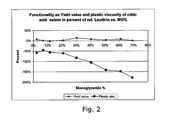
- MG is the fraction of monoglyceride, and positive signs in last two columns mean a better result compared to the reference compound Lecithin.
- the corresponding citric acid ester derivative thus has shown to be surprisingly efficient reducing both viscosity and yield value in a chocolate mass.
- the reduction is in the order of between 0.5 to 1 time compared to traditionally applied emulsifiers, such as soy lecithin.
- Lecithin YV (Pa) Ref.
- ⁇ PV (PVref-PVsample)/PVref
- Example 2 Mixtures of a citric acid ester of a monoglyceride and a citric acid ester of a diglyceride, with variation of the ratio.
- a citric acid ester of a monoglyceride (96%) and a citric acid ester of a diglyceride (97%) were made according to Example 1. From the two citric acid esters, mixtures with a varying ratio of monoglyceride and diglyceride were separately mixed in a reaction flask. The reaction flask was equipped with a mechanical stirrer, a nitrogen inlet, a thermometer and temperature controlled heating mantel. The mixtures were heated until 80°C, when good agitation. After 5 min. of agitation at 80°C, the mixtures were discharged. After the completion of the mixing, the resulting citric acid esters mixtures were analysed for functionality in a milk chocolate.
- MG is the fraction of monoglyceride, and positive signs in last two columns mean a better result compared to the reference compound Lecithin.
- Table 2 MG Sample YV(Pa) Sample PV (Pa s) Ref. Lecithin YV(Pa) Ref.
- Example 3 Functionality of citric acid esters, with different dosage, in chocolate.
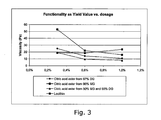
- the result of the analyses of functionality is summarised in the below table 3 and figure 3-4 .
- MG is the fraction of monoglyceride
- DG is the fraction of diglyceride
- positive signs in last two columns mean a better result compared to the reference compound Lecithin.
- esterification with the citric acid can be done on the pure components, i.e. diglyceride and monoglyceride. Esterification can also be done as prebelended mixtures of the two types of glycerides. No difference in the functionality of two corresponding formulations is observed.
- the diglycerides can e.g. be produced as a residue fraction (heavily boiling) from the distillation of the monoglycerides (light boiling).
- the monoglyceride citric acid ester can then be mixed in the required ratio to obtain the optimal point as to the functionality.
- Example 4 Temper ability of milk chocolate, Lecithin versus citric-acid-ester
- a standard milk chocolate system is chosen as the chocolate model system to demonstrate in any of the tested emulsifiers is affecting the tempering application of chocolate.
- the total fat content is around 32% wt. fat, and the amount of whole milk powder is 23% wt.
- Particle size of the milk chocolate is max 25 micron. Since milk chocolate is the most difficult type of chocolate to temper, this is the system that is chosen. It is tested if it is possible to temper all milk chocolates (added different emulsifiers) to a practical and producible state and furthermore if some of the emulsifiers course changes in the temperature settings needed to obtain a well tempered chocolate.
- Palsgaard is using a Aasted AK-10 pilot plant tempering machine to conduct the tempering process.
- a Exotherm 7400 is used for evaluation of the degree of temper.
- the cooling cell of the temper-meter is set at 8,0°C.
- All the 4 emulsifier can be tempered at both 0,60 and at 1,0% without any serious difficulties, but of the four tested emulsifiers, the citric acid ester of diglyceride is found to be the easiest to temper. There is a general tendency in all the 4 tested emulsifiers and that is that they all are slightly easier to temper at 0,60% compared to 1,0% dosage. Also slightly colder water settings should be selected at the high emulsifier dosage in order to obtain good inflexion curves this is another indication of a beginning influence of the crystallisation of the chocolate fat phase.
- Citric acid ester (DG) 0.60% Slight under tempered 0 2 6 1 9 Citric acid ester (DG) 1.0% Under tempered 0 1 6 0 7 Citric acid ester (MDG) 0.6% Slight under tempered 0 2 4 1 7 Citric acid ester (MDG) 1.0% Under tempered 0 3 4 0 7 Citric acid ester (MG) 0.60% Slight under tempered 0 2 4 1 7 Citric acid ester (MG) 1.0% Under tempered 0 3 5 0 8
- Example 5 Functionality of citric acid esters in compound.
- Lecithin was used as reference material. The result is summarised in the below table 5 and figure 5 . Negative sign in the last two columns mean a bad result compared to the reference material Lecithin.
- Table 5 Sample Sample YV(Pa) Sample PV (Pa s) Ref.
- YV Yield Value
- ⁇ PV (PVref-PVsample)/PVref
- Example 6 Citric acid esters of monodiglyceride in pilot scale.
- a monodiglyceride (40kg), with the composition of 43% monoglyceride, 42% diglyceride and 15% triglyceride, was charged to a reaction vessel.
- the reaction vessel was equipped with a mechanical stirrer, nitrogen Inlet, vacuum capabilities to 50 mbar, steam outlet, thermometer and temperature controlled heating system.
- the glyceride was heated until 100°C, under good agitation.
- Citric acid (10kg) was added to the glyceride, and then the heating was continued until 140°C. After the addition of citric acid, the pressure in the reaction flask was gradually reduced to 90 mbar. The reaction was continued for 12 hours. Then the reaction mixture was cooled to below 80°C before discharge.
- Example 7 Citric acid esters of diglyceride in pilot scale.
- a diglyceride (42kg) with the composition of 4% monoglyceride 91% diglyceride and 5% triglyceride was charged to a reaction vessel.
- the reaction vessel was equipped with a mechanical stirrer, nitrogen inlet, vacuum capabilities to 50 mbar, steam outlet, thermometer and temperature controlled heating system.
- the glyceride was heated until 100°C, under good agitation.
- Citric acid (10,5kg) was added to the glyceride, and then the heating was continued until 140°C. After the addition of citric acid, the pressure in the reaction flask was gradually reduced to 90 mbar. The reaction was continued for 9 hours. Then the reaction mixture was cooled to below 80°C before discharge.
Landscapes
- Chemical & Material Sciences (AREA)
- Inorganic Chemistry (AREA)
- Life Sciences & Earth Sciences (AREA)
- Engineering & Computer Science (AREA)
- Food Science & Technology (AREA)
- Polymers & Plastics (AREA)
- Confectionery (AREA)
Claims (41)
- Procédé de fabrication de chocolat consistant à ajouter à une pâte à chocolat un émulsifiant pour chocolat contenant au moins 10% en poids d'un ester d'acide hydroxycarboxylique d'un diglycéride, ledit acide hydroxycarboxylique n'étant pas de l'acide tartrique.
- Procédé selon la revendication 1, dans lequel l'ester d'acide hydroxycarboxylique d'un diglycéride est un ester d'acide hydroxytricarboxylique d'un diglycéride.
- Procédé selon la revendication 1 ou 2, dans lequel le procédé comporte également une étape de conchage ou une étape de liquéfaction durant laquelle des flocons raffinés sont mélangés avec une force d'entraînement importante sur une brève période de temps.
- Procédé selon l'une quelconque des revendications précédentes, dans lequel le procédé comporte également une étape de tempérage de la pâte à chocolat.
- Procédé selon l'une quelconque des revendications précédentes, dans lequel le diamètre des particules de matière sèche de la pâte à chocolat est compris entre 20 et 60 microns.
- Procédé selon l'une quelconque des revendications précédentes, dans lequel l'émulsifiant pour chocolat régule le fluage.
- Procédé selon l'une quelconque des revendications précédentes, dans lequel l'ester d'acide hydroxycarboxylique d'un diglycéride est ajouté à la pâte à chocolat pendant le conchage de celle-ci.
- Procédé selon l'une quelconque des revendications précédentes, dans lequel l'ester d'acide hydroxycarboxylique d'un diglycéride est ajouté à la pâte à chocolat avant le conchage de celle-ci.
- Procédé selon l'une quelconque des revendications précédentes, dans lequel l'acide hydroxycarboxylique est un acide hydroxytricarboxylique.
- Procédé selon la revendication 9, dans lequel l'acide hydroxytricarboxylique est de l'acide citrique.
- Procédé selon l'une quelconque des revendications précédentes, dans lequel l'émulsifiant pour chocolat contient un émulsifiant supplémentaire.
- Procédé selon la revendication 11, dans lequel l'émulsifiant supplémentaire est choisi parmi le groupe suivant : un ester d'acide carboxylique d'un monoglycéride, un ester d'acide carboxylique d'un diglycéride, un phospholipide, un dérivé d'un phospholipide, un polyricinoléate de polyglycérol, un phosphatide d'ammonium ou toute combinaison de ceux-ci.
- Procédé selon l'une quelconque des revendications précédentes, dans lequel l'émulsifiant pour chocolat contient au moins 20% en poids d'un ester d'acide hydroxycarboxylique d'un diglycéride.
- Procédé selon l'une quelconque des revendications précédentes, dans lequel l'émulsifiant pour chocolat est essentiellement composé d'un ester d'acide carboxylique d'un monoglycéride et d'un ester d'acide hydroxycarboxylique d'un diglycéride.
- Procédé selon l'une quelconque des revendications précédentes, dans lequel l'émulsifiant pour chocolat contient une quantité d'ester d'acide hydroxycarboxylique d'un diglycéride comprise entre 30 et 90% en poids.
- Procédé selon l'une quelconque des revendications précédentes, dans lequel l'ester d'acide hydroxycarboxylique d'un diglycéride est dérivé d'un acide gras naturel ou de dérivés de celui-ci.
- Procédé selon la revendication 16, dans lequel l'acide gras naturel est choisi parmi le groupe suivant : huile de colza, huile de ricin, huile de maïs, huile de coton, huile d'olive, huile de palme, huile de carthame, huile de sésame, huile de soja, huile de tournesol et tout mélange ou dérivé de celles-ci.
- Procédé selon la revendication 16, dans lequel l'acide gras est de l'huile de colza ou un dérivé de celle-ci.
- Procédé selon l'une quelconque des revendications précédentes, dans lequel la proportion d'émulsifiant pour chocolat est comprise entre 0,2 et 1,0% en poids de la pâte à chocolat.
- Procédé selon l'une quelconque des revendications précédentes, dans lequel l'ester d'acide hydroxycarboxylique d'un diglycéride possède un indice d'iode au moins égal à 55.
- Procédé selon l'une quelconque des revendications précédentes, dans lequel l'ester d'acide hydroxycarboxylique d'un diglycéride possède un indice de saponification compris entre 300 et 330.
- Procédé selon l'une quelconque des revendications précédentes, dans lequel l'ester d'acide hydroxycarboxylique d'un diglycéride possède un indice d'acide compris entre 50 et 70.
- Chocolat contenant un émulsifiant pour chocolat contenant au moins 10% en poids d'un ester d'acide hydroxycarboxylique d'un diglycéride, ledit acide hydroxycarboxylique n'étant pas de l'acide tartrique.
- Chocolat selon la revendication 23, dans lequel l'ester d'acide hydroxycarboxylique d'un diglycéride est un ester d'acide hydroxytricarboxylique d'un diglycéride.
- Chocolat selon l'une quelconque des revendications 23 ou 24, dans lequel le chocolat est préparé selon une méthode comportant une étape de conchage ou une étape de liquéfaction durant laquelle des flocons raffinés sont mélangés avec une force d'entraînement importante sur une brève période de temps.
- Chocolat selon l'une quelconque des revendications 23 à 25, dans lequel le chocolat est préparé selon une méthode comportant une étape de tempérage du chocolat.
- Chocolat selon l'une quelconque des revendications 23 à 26, dans lequel le diamètre des particules de matière sèche de la pâte à chocolat se situe entre 20 et 60 microns.
- Chocolat selon la revendication 23, dans lequel l'acide hydroxycarboxylique est un acide hydroxytricarboxylique.
- Chocolat selon la revendication 28, dans lequel l'acide hydroxytricarboxylique est de l'acide citrique.
- Chocolat selon l'une quelconque des revendications 23 à 29, dans lequel l'émulsifiant pour chocolat contient un émulsifiant supplémentaire.
- Chocolat selon la revendication 30, dans lequel l'émulsifiant supplémentaire est choisi parmi le groupe suivant : un ester d'acide carboxylique d'un monoglycéride, un ester d'acide carboxylique d'un diglycéride, un phospholipide, un dérivé d'un phospholipide, un polyricinoléate de polyglycérol, un phosphatide d'ammonium ou toute combinaison de ceux-ci.
- Chocolat selon l'une quelconque des revendications 23 à 31, dans lequel l'émulsifiant pour chocolat contient au moins 20% en poids d'un ester d'acide hydroxycarboxylique d'un diglycéride.
- Chocolat selon l'une quelconque des revendications 23 à 32, dans lequel l'émulsifiant pour chocolat est essentiellement composé d'un ester d'acide carboxylique d'un monoglycéride et d'un ester d'acide hydroxycarboxylique d'un diglycéride.
- Chocolat selon la revendication 33, dans lequel l'émulsifiant pour chocolat contient une quantité d'ester d'acide hydroxycarboxylique d'un diglycéride comprise entre 30 et 90% en poids.
- Chocolat selon l'une quelconque des revendications 23 à 34, dans lequel l'ester d'acide hydroxycarboxylique d'un diglycéride est dérivé d'un acide gras naturel ou de dérivés de celui-ci.
- Chocolat selon la revendication 35, dans lequel l'acide gras naturel est choisi parmi le groupe suivant : huile de colza, huile de ricin, huile de maïs, huile de coton, huile d'olive, huile de palme, huile de carthame, huile de sésame, huile de soja, huile de tournesol et tout mélange ou dérivé de celles-ci.
- Chocolat selon la revendication 35, dans lequel l'acide gras est de l'huile de colza ou un dérivé de celle-ci.
- Chocolat selon l'une quelconque des revendications 23 à 37, dans lequel le chocolat est essentiellement composé de pâte de cacao, de graisse de cacao et de sucre.
- Chocolat selon la revendication 38 contenant également un additif à base de lait.
- Chocolat selon l'une quelconque des revendications 38 à 39, dans lequel la graisse de cacao est choisie parmi le groupe suivant : beurre de cacao, substitut du beurre de cacao, équivalent du beurre de cacao, succédané du beurre de cacao ou tout mélange de ceux-ci.
- Chocolat selon l'une quelconque des revendications 23 à 40, dans lequel la proportion d'émulsifiant est comprise entre 0,2 et 1,0% en poids de la pâte à chocolat.
Applications Claiming Priority (3)
| Application Number | Priority Date | Filing Date | Title |
|---|---|---|---|
| DKPA200300831 | 2003-06-04 | ||
| US45373203P | 2003-06-05 | 2003-06-05 | |
| PCT/DK2004/000377 WO2004107871A1 (fr) | 2003-06-04 | 2004-05-29 | Procede permettant de produire du chocolat en ajoutant un ester d'acide carboxylique d'un diglyceride a une masse de chocolat et une composition de chocolat obtenue a l'aide de ce procede |
Publications (2)
| Publication Number | Publication Date |
|---|---|
| EP1628540A1 EP1628540A1 (fr) | 2006-03-01 |
| EP1628540B1 true EP1628540B1 (fr) | 2008-08-13 |
Family
ID=33512560
Family Applications (1)
| Application Number | Title | Priority Date | Filing Date |
|---|---|---|---|
| EP04735445A Expired - Lifetime EP1628540B1 (fr) | 2003-06-04 | 2004-05-29 | Procede permettant de produire du chocolat en ajoutant un ester d'acide carboxylique d'un diglyceride a une masse de chocolat et une composition de chocolat obtenue a l'aide de ce procede |
Country Status (9)
| Country | Link |
|---|---|
| EP (1) | EP1628540B1 (fr) |
| AT (1) | ATE404068T1 (fr) |
| BR (1) | BRPI0410934B1 (fr) |
| DE (1) | DE602004015774D1 (fr) |
| DK (1) | DK1628540T3 (fr) |
| EA (1) | EA011422B1 (fr) |
| ES (1) | ES2313009T3 (fr) |
| MX (1) | MXPA05012933A (fr) |
| WO (1) | WO2004107871A1 (fr) |
Families Citing this family (3)
| Publication number | Priority date | Publication date | Assignee | Title |
|---|---|---|---|---|
| PL2873330T3 (pl) * | 2007-05-16 | 2017-08-31 | Kraft Foods R & D, Inc. | Jadalna kompozycja spożywcza jako struktura barierowa przeciw wilgoci i odporna na wilgoć |
| KR102538782B1 (ko) * | 2020-05-28 | 2023-06-02 | 주식회사 일신웰스 | 기포안정성 아이스크림 조성물 및 그 제조 방법 |
| JP7146294B2 (ja) * | 2020-08-31 | 2022-10-04 | 日新化工株式会社 | チョコレート |
Family Cites Families (5)
| Publication number | Priority date | Publication date | Assignee | Title |
|---|---|---|---|---|
| CH650647A5 (de) * | 1982-12-10 | 1985-08-15 | Knorr Naehrmittel Ag | Lagerfaehiges, zu einer dessert-mousse aufschlagbares produkt und verfahren zu dessen herstellung. |
| US5124166A (en) * | 1987-08-13 | 1992-06-23 | Nabisco, Inc. | Carboxy/carboxylate disubstituted esters as edible fat mimetics |
| US5464649A (en) * | 1992-10-30 | 1995-11-07 | Hershey Foods Corporation | Reduced fat confectionery products and process |
| DK174644B1 (da) * | 1997-04-07 | 2003-08-04 | Danisco | Fremgangsmåde tilopnåelse af forbedrede flydeegenskaber af en chokolademasse |
| DE69907898T2 (de) * | 1998-03-12 | 2004-02-26 | Mars, Inc. | Fettreduzierte suessigkeiten enthaltend kombinationen von emulgiermitteln sowie herstellung derselben |
-
2004
- 2004-05-29 BR BRPI0410934-1A patent/BRPI0410934B1/pt not_active IP Right Cessation
- 2004-05-29 MX MXPA05012933A patent/MXPA05012933A/es active IP Right Grant
- 2004-05-29 EA EA200501884A patent/EA011422B1/ru not_active IP Right Cessation
- 2004-05-29 AT AT04735445T patent/ATE404068T1/de not_active IP Right Cessation
- 2004-05-29 EP EP04735445A patent/EP1628540B1/fr not_active Expired - Lifetime
- 2004-05-29 ES ES04735445T patent/ES2313009T3/es not_active Expired - Lifetime
- 2004-05-29 DE DE602004015774T patent/DE602004015774D1/de not_active Expired - Lifetime
- 2004-05-29 DK DK04735445T patent/DK1628540T3/da active
- 2004-05-29 WO PCT/DK2004/000377 patent/WO2004107871A1/fr not_active Ceased
Also Published As
| Publication number | Publication date |
|---|---|
| BRPI0410934A (pt) | 2006-06-27 |
| ES2313009T3 (es) | 2009-03-01 |
| ATE404068T1 (de) | 2008-08-15 |
| MXPA05012933A (es) | 2006-05-17 |
| EP1628540A1 (fr) | 2006-03-01 |
| BRPI0410934B1 (pt) | 2015-06-09 |
| EA011422B1 (ru) | 2009-02-27 |
| DK1628540T3 (da) | 2008-11-17 |
| DE602004015774D1 (de) | 2008-09-25 |
| WO2004107871A1 (fr) | 2004-12-16 |
| EA200501884A1 (ru) | 2006-06-30 |
Similar Documents
| Publication | Publication Date | Title |
|---|---|---|
| US8906441B2 (en) | Peanut spread | |
| US5268192A (en) | Low calorie nut products and process of making | |
| US8357421B2 (en) | Composition comprising triglycerides | |
| CN101835386B (zh) | 用于耐热巧克力的脂肪混合物 | |
| EP2873330B1 (fr) | Composition comestible en tant que pare-vapeur et structure résistante à l'humidité | |
| US5240726A (en) | Product and process of making low calorie nuts | |
| WO1997038588A1 (fr) | Produits alimentaires contenant des triglycerides structurees | |
| KR20100039409A (ko) | 제과류 조성물 | |
| KR20100038300A (ko) | 저함량의 포화 및 트랜스 불포화 지방을 갖는 구조화된 식제품 | |
| EP0980650B1 (fr) | Procede de production de chocolats a l'eau | |
| WO2017073480A1 (fr) | Aliment huileux | |
| EP3900545B1 (fr) | Procédé de fabrication de chocolat | |
| JP2003508072A (ja) | ピーナッツバター安定剤 | |
| EP2152091B1 (fr) | Procédé | |
| JP3461062B2 (ja) | 製菓用油脂組成物及び菓子類の製造方法 | |
| EP0651947B1 (fr) | Substituts réduits en calories du beurre de cacao | |
| EP1628540A1 (fr) | Procede permettant de produire du chocolat en ajoutant un ester d'acide carboxylique d'un diglyceride a une masse de chocolat et une composition de chocolat obtenue a l'aide de ce procede | |
| US20040247774A1 (en) | Method of producing chocolate adding a carboxlic acid ester of a diglyceride to a chocolate mass, and a chocolate composition produced by said method | |
| JPH0870776A (ja) | 油中水型の含水チョコレート類の製法 | |
| CN109953167B (zh) | 具有良好热稳定性的减糖健康型巧克力及其制备方法 | |
| WO2022104368A1 (fr) | Composition et utilisation de la composition comme enrobage ou garniture comestible pour des produits froids ou congelés | |
| KR102534283B1 (ko) | 장식용 초콜릿 제조방법 및 이의 제조방법 | |
| CN111836548A (zh) | 可可脂相容性提高剂及其制造方法、以及非调温型巧克力及其油脂组合物 | |
| WO2025193515A1 (fr) | Composition de matière grasse | |
| WO2025193516A1 (fr) | Composition de matière grasse |
Legal Events
| Date | Code | Title | Description |
|---|---|---|---|
| PUAI | Public reference made under article 153(3) epc to a published international application that has entered the european phase |
Free format text: ORIGINAL CODE: 0009012 |
|
| 17P | Request for examination filed |
Effective date: 20051124 |
|
| AK | Designated contracting states |
Kind code of ref document: A1 Designated state(s): AT BE BG CH CY CZ DE DK EE ES FI FR GB GR HU IE IT LI LU MC NL PL PT RO SE SI SK TR |
|
| AX | Request for extension of the european patent |
Extension state: AL HR LT LV MK |
|
| 17Q | First examination report despatched |
Effective date: 20061206 |
|
| RAP1 | Party data changed (applicant data changed or rights of an application transferred) |
Owner name: PALSGAARD A/S |
|
| GRAP | Despatch of communication of intention to grant a patent |
Free format text: ORIGINAL CODE: EPIDOSNIGR1 |
|
| RIC1 | Information provided on ipc code assigned before grant |
Ipc: A23G 1/00 20060101AFI20070523BHEP Ipc: A23G 1/36 20060101ALN20070523BHEP |
|
| GRAS | Grant fee paid |
Free format text: ORIGINAL CODE: EPIDOSNIGR3 |
|
| GRAA | (expected) grant |
Free format text: ORIGINAL CODE: 0009210 |
|
| AK | Designated contracting states |
Kind code of ref document: B1 Designated state(s): AT BE BG CH CY CZ DE DK EE ES FI FR GB GR HU IE IT LI LU MC NL PL PT RO SE SI SK TR |
|
| AX | Request for extension of the european patent |
Extension state: AL HR LT LV MK |
|
| REG | Reference to a national code |
Ref country code: GB Ref legal event code: FG4D |
|
| REG | Reference to a national code |
Ref country code: CH Ref legal event code: EP |
|
| REG | Reference to a national code |
Ref country code: IE Ref legal event code: FG4D |
|
| REF | Corresponds to: |
Ref document number: 602004015774 Country of ref document: DE Date of ref document: 20080925 Kind code of ref document: P |
|
| REG | Reference to a national code |
Ref country code: CH Ref legal event code: NV Representative=s name: N&G PATENT SERVICES SA |
|
| REG | Reference to a national code |
Ref country code: DK Ref legal event code: T3 |
|
| LTIE | Lt: invalidation of european patent or patent extension |
Effective date: 20080813 |
|
| PG25 | Lapsed in a contracting state [announced via postgrant information from national office to epo] |
Ref country code: SI Free format text: LAPSE BECAUSE OF FAILURE TO SUBMIT A TRANSLATION OF THE DESCRIPTION OR TO PAY THE FEE WITHIN THE PRESCRIBED TIME-LIMIT Effective date: 20080813 Ref country code: AT Free format text: LAPSE BECAUSE OF FAILURE TO SUBMIT A TRANSLATION OF THE DESCRIPTION OR TO PAY THE FEE WITHIN THE PRESCRIBED TIME-LIMIT Effective date: 20080813 Ref country code: FI Free format text: LAPSE BECAUSE OF FAILURE TO SUBMIT A TRANSLATION OF THE DESCRIPTION OR TO PAY THE FEE WITHIN THE PRESCRIBED TIME-LIMIT Effective date: 20080813 |
|
| REG | Reference to a national code |
Ref country code: ES Ref legal event code: FG2A Ref document number: 2313009 Country of ref document: ES Kind code of ref document: T3 |
|
| PG25 | Lapsed in a contracting state [announced via postgrant information from national office to epo] |
Ref country code: BG Free format text: LAPSE BECAUSE OF FAILURE TO SUBMIT A TRANSLATION OF THE DESCRIPTION OR TO PAY THE FEE WITHIN THE PRESCRIBED TIME-LIMIT Effective date: 20081113 |
|
| PG25 | Lapsed in a contracting state [announced via postgrant information from national office to epo] |
Ref country code: RO Free format text: LAPSE BECAUSE OF FAILURE TO SUBMIT A TRANSLATION OF THE DESCRIPTION OR TO PAY THE FEE WITHIN THE PRESCRIBED TIME-LIMIT Effective date: 20080813 Ref country code: PT Free format text: LAPSE BECAUSE OF FAILURE TO SUBMIT A TRANSLATION OF THE DESCRIPTION OR TO PAY THE FEE WITHIN THE PRESCRIBED TIME-LIMIT Effective date: 20090113 Ref country code: CZ Free format text: LAPSE BECAUSE OF FAILURE TO SUBMIT A TRANSLATION OF THE DESCRIPTION OR TO PAY THE FEE WITHIN THE PRESCRIBED TIME-LIMIT Effective date: 20080813 Ref country code: SK Free format text: LAPSE BECAUSE OF FAILURE TO SUBMIT A TRANSLATION OF THE DESCRIPTION OR TO PAY THE FEE WITHIN THE PRESCRIBED TIME-LIMIT Effective date: 20080813 |
|
| PLBE | No opposition filed within time limit |
Free format text: ORIGINAL CODE: 0009261 |
|
| STAA | Information on the status of an ep patent application or granted ep patent |
Free format text: STATUS: NO OPPOSITION FILED WITHIN TIME LIMIT |
|
| 26N | No opposition filed |
Effective date: 20090514 |
|
| PG25 | Lapsed in a contracting state [announced via postgrant information from national office to epo] |
Ref country code: EE Free format text: LAPSE BECAUSE OF FAILURE TO SUBMIT A TRANSLATION OF THE DESCRIPTION OR TO PAY THE FEE WITHIN THE PRESCRIBED TIME-LIMIT Effective date: 20080813 |
|
| PG25 | Lapsed in a contracting state [announced via postgrant information from national office to epo] |
Ref country code: IT Free format text: LAPSE BECAUSE OF FAILURE TO SUBMIT A TRANSLATION OF THE DESCRIPTION OR TO PAY THE FEE WITHIN THE PRESCRIBED TIME-LIMIT Effective date: 20080813 |
|
| PG25 | Lapsed in a contracting state [announced via postgrant information from national office to epo] |
Ref country code: MC Free format text: LAPSE BECAUSE OF NON-PAYMENT OF DUE FEES Effective date: 20090531 |
|
| PG25 | Lapsed in a contracting state [announced via postgrant information from national office to epo] |
Ref country code: SE Free format text: LAPSE BECAUSE OF FAILURE TO SUBMIT A TRANSLATION OF THE DESCRIPTION OR TO PAY THE FEE WITHIN THE PRESCRIBED TIME-LIMIT Effective date: 20081113 |
|
| PG25 | Lapsed in a contracting state [announced via postgrant information from national office to epo] |
Ref country code: PL Free format text: LAPSE BECAUSE OF FAILURE TO SUBMIT A TRANSLATION OF THE DESCRIPTION OR TO PAY THE FEE WITHIN THE PRESCRIBED TIME-LIMIT Effective date: 20080813 |
|
| PG25 | Lapsed in a contracting state [announced via postgrant information from national office to epo] |
Ref country code: GR Free format text: LAPSE BECAUSE OF FAILURE TO SUBMIT A TRANSLATION OF THE DESCRIPTION OR TO PAY THE FEE WITHIN THE PRESCRIBED TIME-LIMIT Effective date: 20081114 |
|
| PG25 | Lapsed in a contracting state [announced via postgrant information from national office to epo] |
Ref country code: LU Free format text: LAPSE BECAUSE OF NON-PAYMENT OF DUE FEES Effective date: 20090529 |
|
| PG25 | Lapsed in a contracting state [announced via postgrant information from national office to epo] |
Ref country code: HU Free format text: LAPSE BECAUSE OF FAILURE TO SUBMIT A TRANSLATION OF THE DESCRIPTION OR TO PAY THE FEE WITHIN THE PRESCRIBED TIME-LIMIT Effective date: 20090214 |
|
| PG25 | Lapsed in a contracting state [announced via postgrant information from national office to epo] |
Ref country code: TR Free format text: LAPSE BECAUSE OF FAILURE TO SUBMIT A TRANSLATION OF THE DESCRIPTION OR TO PAY THE FEE WITHIN THE PRESCRIBED TIME-LIMIT Effective date: 20080813 |
|
| PG25 | Lapsed in a contracting state [announced via postgrant information from national office to epo] |
Ref country code: CY Free format text: LAPSE BECAUSE OF FAILURE TO SUBMIT A TRANSLATION OF THE DESCRIPTION OR TO PAY THE FEE WITHIN THE PRESCRIBED TIME-LIMIT Effective date: 20080813 |
|
| REG | Reference to a national code |
Ref country code: FR Ref legal event code: PLFP Year of fee payment: 12 |
|
| REG | Reference to a national code |
Ref country code: FR Ref legal event code: PLFP Year of fee payment: 13 |
|
| REG | Reference to a national code |
Ref country code: FR Ref legal event code: PLFP Year of fee payment: 14 |
|
| REG | Reference to a national code |
Ref country code: FR Ref legal event code: PLFP Year of fee payment: 15 |
|
| PGFP | Annual fee paid to national office [announced via postgrant information from national office to epo] |
Ref country code: CH Payment date: 20180523 Year of fee payment: 15 Ref country code: ES Payment date: 20180626 Year of fee payment: 15 Ref country code: IE Payment date: 20180523 Year of fee payment: 15 Ref country code: DK Payment date: 20180518 Year of fee payment: 15 Ref country code: DE Payment date: 20180522 Year of fee payment: 15 |
|
| PGFP | Annual fee paid to national office [announced via postgrant information from national office to epo] |
Ref country code: NL Payment date: 20180518 Year of fee payment: 15 Ref country code: BE Payment date: 20180518 Year of fee payment: 15 Ref country code: FR Payment date: 20180522 Year of fee payment: 15 |
|
| PGFP | Annual fee paid to national office [announced via postgrant information from national office to epo] |
Ref country code: GB Payment date: 20180518 Year of fee payment: 15 |
|
| REG | Reference to a national code |
Ref country code: DE Ref legal event code: R119 Ref document number: 602004015774 Country of ref document: DE |
|
| REG | Reference to a national code |
Ref country code: CH Ref legal event code: PL |
|
| REG | Reference to a national code |
Ref country code: DK Ref legal event code: EBP Effective date: 20190531 |
|
| REG | Reference to a national code |
Ref country code: NL Ref legal event code: MM Effective date: 20190601 |
|
| GBPC | Gb: european patent ceased through non-payment of renewal fee |
Effective date: 20190529 |
|
| PG25 | Lapsed in a contracting state [announced via postgrant information from national office to epo] |
Ref country code: CH Free format text: LAPSE BECAUSE OF NON-PAYMENT OF DUE FEES Effective date: 20190531 Ref country code: LI Free format text: LAPSE BECAUSE OF NON-PAYMENT OF DUE FEES Effective date: 20190531 |
|
| REG | Reference to a national code |
Ref country code: BE Ref legal event code: MM Effective date: 20190531 |
|
| PG25 | Lapsed in a contracting state [announced via postgrant information from national office to epo] |
Ref country code: DE Free format text: LAPSE BECAUSE OF NON-PAYMENT OF DUE FEES Effective date: 20191203 Ref country code: NL Free format text: LAPSE BECAUSE OF NON-PAYMENT OF DUE FEES Effective date: 20190601 Ref country code: GB Free format text: LAPSE BECAUSE OF NON-PAYMENT OF DUE FEES Effective date: 20190529 Ref country code: DK Free format text: LAPSE BECAUSE OF NON-PAYMENT OF DUE FEES Effective date: 20190531 Ref country code: IE Free format text: LAPSE BECAUSE OF NON-PAYMENT OF DUE FEES Effective date: 20190529 |
|
| PG25 | Lapsed in a contracting state [announced via postgrant information from national office to epo] |
Ref country code: BE Free format text: LAPSE BECAUSE OF NON-PAYMENT OF DUE FEES Effective date: 20190531 |
|
| PG25 | Lapsed in a contracting state [announced via postgrant information from national office to epo] |
Ref country code: FR Free format text: LAPSE BECAUSE OF NON-PAYMENT OF DUE FEES Effective date: 20190531 |
|
| REG | Reference to a national code |
Ref country code: ES Ref legal event code: FD2A Effective date: 20200930 |
|
| PG25 | Lapsed in a contracting state [announced via postgrant information from national office to epo] |
Ref country code: ES Free format text: LAPSE BECAUSE OF NON-PAYMENT OF DUE FEES Effective date: 20190530 |