EP1645580A2 - Polyharnstoffe - Google Patents
Polyharnstoffe Download PDFInfo
- Publication number
- EP1645580A2 EP1645580A2 EP05027700A EP05027700A EP1645580A2 EP 1645580 A2 EP1645580 A2 EP 1645580A2 EP 05027700 A EP05027700 A EP 05027700A EP 05027700 A EP05027700 A EP 05027700A EP 1645580 A2 EP1645580 A2 EP 1645580A2
- Authority
- EP
- European Patent Office
- Prior art keywords
- polymer
- hair
- weight
- acid
- bis
- Prior art date
- Legal status (The legal status is an assumption and is not a legal conclusion. Google has not performed a legal analysis and makes no representation as to the accuracy of the status listed.)
- Withdrawn
Links
Classifications
-
- A—HUMAN NECESSITIES
- A61—MEDICAL OR VETERINARY SCIENCE; HYGIENE
- A61K—PREPARATIONS FOR MEDICAL, DENTAL OR TOILETRY PURPOSES
- A61K8/00—Cosmetics or similar toiletry preparations
- A61K8/18—Cosmetics or similar toiletry preparations characterised by the composition
- A61K8/72—Cosmetics or similar toiletry preparations characterised by the composition containing organic macromolecular compounds
- A61K8/84—Cosmetics or similar toiletry preparations characterised by the composition containing organic macromolecular compounds obtained by reactions otherwise than those involving only carbon-carbon unsaturated bonds
- A61K8/87—Polyurethanes
-
- A—HUMAN NECESSITIES
- A61—MEDICAL OR VETERINARY SCIENCE; HYGIENE
- A61Q—SPECIFIC USE OF COSMETICS OR SIMILAR TOILETRY PREPARATIONS
- A61Q5/00—Preparations for care of the hair
- A61Q5/02—Preparations for cleaning the hair
-
- A—HUMAN NECESSITIES
- A61—MEDICAL OR VETERINARY SCIENCE; HYGIENE
- A61Q—SPECIFIC USE OF COSMETICS OR SIMILAR TOILETRY PREPARATIONS
- A61Q5/00—Preparations for care of the hair
- A61Q5/06—Preparations for styling the hair, e.g. by temporary shaping or colouring
-
- A—HUMAN NECESSITIES
- A61—MEDICAL OR VETERINARY SCIENCE; HYGIENE
- A61Q—SPECIFIC USE OF COSMETICS OR SIMILAR TOILETRY PREPARATIONS
- A61Q5/00—Preparations for care of the hair
- A61Q5/12—Preparations containing hair conditioners
-
- C—CHEMISTRY; METALLURGY
- C08—ORGANIC MACROMOLECULAR COMPOUNDS; THEIR PREPARATION OR CHEMICAL WORKING-UP; COMPOSITIONS BASED THEREON
- C08G—MACROMOLECULAR COMPOUNDS OBTAINED OTHERWISE THAN BY REACTIONS ONLY INVOLVING UNSATURATED CARBON-TO-CARBON BONDS
- C08G18/00—Polymeric products of isocyanates or isothiocyanates
- C08G18/06—Polymeric products of isocyanates or isothiocyanates with compounds having active hydrogen
- C08G18/08—Processes
- C08G18/0804—Manufacture of polymers containing ionic or ionogenic groups
- C08G18/0819—Manufacture of polymers containing ionic or ionogenic groups containing anionic or anionogenic groups
- C08G18/0823—Manufacture of polymers containing ionic or ionogenic groups containing anionic or anionogenic groups containing carboxylate salt groups or groups forming them
-
- C—CHEMISTRY; METALLURGY
- C08—ORGANIC MACROMOLECULAR COMPOUNDS; THEIR PREPARATION OR CHEMICAL WORKING-UP; COMPOSITIONS BASED THEREON
- C08G—MACROMOLECULAR COMPOUNDS OBTAINED OTHERWISE THAN BY REACTIONS ONLY INVOLVING UNSATURATED CARBON-TO-CARBON BONDS
- C08G18/00—Polymeric products of isocyanates or isothiocyanates
- C08G18/06—Polymeric products of isocyanates or isothiocyanates with compounds having active hydrogen
- C08G18/08—Processes
- C08G18/0804—Manufacture of polymers containing ionic or ionogenic groups
- C08G18/0833—Manufacture of polymers containing ionic or ionogenic groups containing cationic or cationogenic groups together with anionic or anionogenic groups
-
- C—CHEMISTRY; METALLURGY
- C08—ORGANIC MACROMOLECULAR COMPOUNDS; THEIR PREPARATION OR CHEMICAL WORKING-UP; COMPOSITIONS BASED THEREON
- C08G—MACROMOLECULAR COMPOUNDS OBTAINED OTHERWISE THAN BY REACTIONS ONLY INVOLVING UNSATURATED CARBON-TO-CARBON BONDS
- C08G18/00—Polymeric products of isocyanates or isothiocyanates
- C08G18/06—Polymeric products of isocyanates or isothiocyanates with compounds having active hydrogen
- C08G18/28—Polymeric products of isocyanates or isothiocyanates with compounds having active hydrogen characterised by the compounds used containing active hydrogen
- C08G18/30—Low-molecular-weight compounds
- C08G18/32—Polyhydroxy compounds; Polyamines; Hydroxyamines
- C08G18/3225—Polyamines
- C08G18/3228—Polyamines acyclic
-
- C—CHEMISTRY; METALLURGY
- C08—ORGANIC MACROMOLECULAR COMPOUNDS; THEIR PREPARATION OR CHEMICAL WORKING-UP; COMPOSITIONS BASED THEREON
- C08G—MACROMOLECULAR COMPOUNDS OBTAINED OTHERWISE THAN BY REACTIONS ONLY INVOLVING UNSATURATED CARBON-TO-CARBON BONDS
- C08G18/00—Polymeric products of isocyanates or isothiocyanates
- C08G18/06—Polymeric products of isocyanates or isothiocyanates with compounds having active hydrogen
- C08G18/28—Polymeric products of isocyanates or isothiocyanates with compounds having active hydrogen characterised by the compounds used containing active hydrogen
- C08G18/40—High-molecular-weight compounds
- C08G18/48—Polyethers
- C08G18/50—Polyethers having heteroatoms other than oxygen
- C08G18/5021—Polyethers having heteroatoms other than oxygen having nitrogen
- C08G18/5024—Polyethers having heteroatoms other than oxygen having nitrogen containing primary and/or secondary amino groups
-
- C—CHEMISTRY; METALLURGY
- C08—ORGANIC MACROMOLECULAR COMPOUNDS; THEIR PREPARATION OR CHEMICAL WORKING-UP; COMPOSITIONS BASED THEREON
- C08G—MACROMOLECULAR COMPOUNDS OBTAINED OTHERWISE THAN BY REACTIONS ONLY INVOLVING UNSATURATED CARBON-TO-CARBON BONDS
- C08G18/00—Polymeric products of isocyanates or isothiocyanates
- C08G18/06—Polymeric products of isocyanates or isothiocyanates with compounds having active hydrogen
- C08G18/28—Polymeric products of isocyanates or isothiocyanates with compounds having active hydrogen characterised by the compounds used containing active hydrogen
- C08G18/40—High-molecular-weight compounds
- C08G18/61—Polysiloxanes
-
- C—CHEMISTRY; METALLURGY
- C08—ORGANIC MACROMOLECULAR COMPOUNDS; THEIR PREPARATION OR CHEMICAL WORKING-UP; COMPOSITIONS BASED THEREON
- C08G—MACROMOLECULAR COMPOUNDS OBTAINED OTHERWISE THAN BY REACTIONS ONLY INVOLVING UNSATURATED CARBON-TO-CARBON BONDS
- C08G18/00—Polymeric products of isocyanates or isothiocyanates
- C08G18/06—Polymeric products of isocyanates or isothiocyanates with compounds having active hydrogen
- C08G18/28—Polymeric products of isocyanates or isothiocyanates with compounds having active hydrogen characterised by the compounds used containing active hydrogen
- C08G18/65—Low-molecular-weight compounds having active hydrogen with high-molecular-weight compounds having active hydrogen
- C08G18/66—Compounds of groups C08G18/42, C08G18/48, or C08G18/52
- C08G18/6633—Compounds of group C08G18/42
- C08G18/6659—Compounds of group C08G18/42 with compounds of group C08G18/34
-
- C—CHEMISTRY; METALLURGY
- C08—ORGANIC MACROMOLECULAR COMPOUNDS; THEIR PREPARATION OR CHEMICAL WORKING-UP; COMPOSITIONS BASED THEREON
- C08L—COMPOSITIONS OF MACROMOLECULAR COMPOUNDS
- C08L75/00—Compositions of polyureas or polyurethanes; Compositions of derivatives of such polymers
- C08L75/02—Polyureas
-
- A—HUMAN NECESSITIES
- A61—MEDICAL OR VETERINARY SCIENCE; HYGIENE
- A61Q—SPECIFIC USE OF COSMETICS OR SIMILAR TOILETRY PREPARATIONS
- A61Q19/00—Preparations for care of the skin
Definitions
- the present invention relates to polyureas, the use of these polyureas and agents containing these polyureas.
- polymers with film-forming properties are used for strengthening, improving the texture and shaping the hair.
- These hair treatment agents generally contain a solution of the film former in an alcohol or a mixture of alcohol and water.
- Hair treatment compositions in particular hair-setting agents, are generally sprayed onto the hair in the form of aqueous-alcoholic solutions. After evaporation of the solvent, the hairs are held in the desired shape by the remaining polymer at the points of mutual contact.
- the polymers should be so hydrophilic that they can be washed out of the hair, but on the other hand, they should be hydrophobic, so that the treated hair with the polymers retain their shape even at high humidity and do not stick together.
- Another current requirement of hair treatment compositions is to give the hair flexibility, a natural look and shine, e.g. even if it is naturally very strong and / or dark hair.
- the acid groups contained in these polyurethanes can be converted into the corresponding salts by neutralization with at least one base.
- These are low molecular weight amines, such as 2-amino-2-methylpropanol, diethylaminopropylamine and triisopropanolamine used.
- EP-A-619 111 describes the use of polyurethanes based on organic diisocyanates, diols and 2,2-hydroxymethyl-substituted carboxylates in hair fixatives. At least part of the carboxylic acid groups is neutralized with an organic or inorganic low molecular weight base.
- DE-A-195 41 658 describes water-soluble or water-dispersible graft polymers of a polyurethane prepolymer having terminal isocyanate groups and a protein containing free amino groups.
- EP-A-636 361 describes a cosmetic composition which comprises in a cosmetically acceptable carrier at least one pseudolatex based on a polycondensate which comprises at least one polysiloxane unit and at least one polyurethane and / or polyurea unit with anionic or cationic groups.
- the neutralizing agents used are mineral bases, low molecular weight amines and amino alcohols, mineral acids and low molecular weight carboxylic acids.
- WO 97/25021 has a comparable disclosure content. The leachability of these film formers is not satisfactory. In addition, they do not have the required for a hair polymer strengthening effect due to a high siloxane content.
- hair treatment compositions comprising a hair fixative polymer which is soluble or dispersible in water or in a water / alcohol mixture and additionally a water-soluble or dispersible siloxane-containing salt.
- Hair spray formulations based on these siloxane-containing salts, a non-siloxane-containing hair setting polymer and a silicone oil lead to very smooth films.
- DE-A-197 09 277 relates to polysiloxane-containing hair setting compositions containing 0.5 to 15 wt .-% of carboxyl-containing polymers which are water-soluble or water-dispersible in neutralized form.
- Alkali carbonates, ammonia and amines and amino alcohols having a maximum of 3 carbon atoms in the longest carbon chain are used as neutralizing agents.
- GB-A-1 321 836 describes hair fixers based on copolymers containing in copolymerized form an unsaturated dicarboxylic acid and a vinyl or vinylidene monomer. In this case, 5 to 20% of the carboxyl groups are neutralized with primary C 4 - to C 16 -amines.
- DE-A-29 17 504 describes an aerosol hairspray based on a copolymer of at least one unsaturated monocarboxylic acid and at least one vinyl or vinylidene monomer. At least 7 to 100% of the carboxyl groups are neutralized, at least half thereof having a long-chain primary, secondary and / or tertiary amine having 8 to 20 carbon atoms in the longest chain.
- WO 89/12438 describes a hair fixative based on a hair polymer having carboxyl groups neutralized to at least 40 mol% with a long chain amine selected from amidoamines, N-ethoxylated amines and ether amines.
- polyacrylates having carboxylic acid groups neutralized with fatty amines or ethoxylated fatty amines result in soft, sticky films having a drastically reduced setting effect. These polymers are therefore only very limited for use as hair fixative.
- JP-A-7127480 describes a hair treatment agent based on an amine salt solution of a copolymer containing an unsaturated carboxylic acid in copolymerized form.
- JP-A-03206023 describes a polymer resin for hair treatment compositions which comprises a) from 6 to 35% by weight of acrylic acid, methacrylic acid, itaconic acid or a mixture thereof, b) from 15 to 50% by weight of at least one C 10 to C 18 Alkyl (meth) acrylate, c) 15 to 50 wt .-% of at least one C 4 - to C 8 alkyl (meth) acrylate and d) 0 to 25 wt .-% of at least one further hydrophobic vinyl monomer in copolymerized form.
- the resulting copolymers are neutralized with a base selected from ammonia, morpholine, isopropanolamine and aminoethylpropanediol.
- JP-A-03206024 describes a JP-A-03206023 comparable hair setting polymer, which additionally 5 to 50 wt .-% of a Contains copolymerized N-alkyl-substituted acrylamide.
- the hair fixative polymers described in these two documents have a high content of hydrophobic monomers. Their leachability is therefore in need of improvement.
- DE-A-39 01 325 and DE-A-42 14 305 describe hair setting agents which contain as film former a copolymer based on tert-butyl (meth) acrylate and (meth) acrylic acid, wherein the carboxyl groups of the copolymers partially or completely neutralized by amines.
- the amines are selected from mono-, di- or trialkanolamines, alkanediolamines or primary, secondary or tertiary alkylamines. Films based on these polyacrylates are generally hard and show no flexibility and in particular with regard to their strengthening effect in need of improvement.
- DE-A-197 09 277 describes polysiloxane-containing hair setting compositions based on carboxyl group-containing polymers, polysiloxanes having primary, secondary or tertiary amino groups and low molecular weight neutralizing agents.
- the use of non-functionalized siloxane diamines in hair setting agents leads to cross-linked products that are difficult to wash out. Due to the poor adhesion, the setting effect of these formulations is in need of improvement.
- US 4761273 relates to mixtures of anionic and cationic polymers wherein the anionic polymer is a polyacrylate or a derivative thereof and the cationic polymer is a polyamine or a derivative thereof. These polymer salts are soft and stickier than the invention.
- the present invention has for its object to provide polymers available. These should be suitable as a cosmetic agent, or for use in cosmetic products, in particular hair treatment agent (s). Preferably, they are to form films having good flexible properties while being tack-free so that hair-treating agents based thereon impart elasticity to the hair.
- the polymers of the invention are said to impart special properties to hair: natural hold, good combability, good hand and suppleness. This is especially true for polymers for hair spray formulations. For certain hair types in the USA and Asia, polymers with increased flexibility are desired.
- the invention relates to a process for the preparation of the abovementioned polyureas, wherein the polymerization is carried out in alcohol or water / alcohol solution at a temperature of less than or equal to 50 ° C in hydroxy-containing polysiloxanes, first, the components b) and c) are reacted together ,
- the invention also relates to the use of neutralized polyurea as a film-forming assistant as an additive for cosmetic preparations. Furthermore, the invention relates to the use of polyurea with ionic or ionogenic groups as neutralizing agents for polymers containing ionic or ionogenic groups.
- Both the base polymer and the neutralization polymer can be (partially) neutralized by addition of neutralizing agents.
- the base polymer is first neutralized by adding a neutralizing agent (part) and then the addition of the neutralization polymer is carried out first. It is also possible to add the neutralization polymer to the base polymer and then to neutralize with neutralizing agents. Particularly preferred is the (partial) neutralization of the base polymer and the subsequent addition of the neutralization polymer.
- the neutralizing agent used is preferably a mixture of different neutralizing agents.
- the base polymer A and / or the neutralization polymer B is a polyurea or a polyurethane. In a particularly preferred embodiment, the base polymer A and / or the neutralization polymer B is a polyurea according to claim 1.
- neutralizing agent can be used: In the case of excess anionogenic or anionic groups, neutralization is carried out with an amine or amine mixture (for example amino-2-methylpropanol AMP, ethylenediamine, etc.) and / or with a base (NaOH, KOH, etc.).
- an amine or amine mixture for example amino-2-methylpropanol AMP, ethylenediamine, etc.
- a base NaOH, KOH, etc.
- mixtures which contain at least one amine, preferably a hydroxy-containing amine such as amino-2-methylpropanol, mono-, di- and triethanolamine or a diamine such as ethylenediamine, and an alkali metal hydroxide, preferably potassium hydroxide ,
- amine preferably a hydroxy-containing amine such as amino-2-methylpropanol, mono-, di- and triethanolamine or a diamine such as ethylenediamine
- an alkali metal hydroxide preferably potassium hydroxide
- preference is furthermore given to using mixtures which contain at least one amine and one amino alcohol, preferably 2-amino-2-methyl-1-propanol.
- Excess cationogenic or cationic groups are neutralized with an acid or acid mixture (e.g., lactic acid, phosphoric acid, etc.).
- an acid or acid mixture e.g., lactic acid, phosphoric acid, etc.
- the amines, acids or / and bases are preferably cosmetically acceptable.
- An amine number smaller than the acid number is particularly preferred.
- Cosmetically compatible acids and polyacids are known to the person skilled in the art and listed, for example, in WO 97/17052 and hereby inkooperated. Cosmetically compatible amines are also known to the person skilled in the art and are also listed in the present application.
- the preferred esters are C 4 or C 4 -Alkylacryl Textreester -Alkylmethacrylcicreester.
- the preferred amides are C 4 -alkylacrylic acid amides or C 4 -alkylmethacrylic acid amides.
- the neutralization polymer used is preferably a film-forming polymer which is dispersible with water.
- the neutralization polymer is composed of at least one vinyllactam and / or at least one vinylamide and at least one amine-containing monomer, the amine number being between 1 and 60.
- the neutralization polymer is composed of at least one C 1 -C 18 -alkyl methacrylate and / or C 1 -C 18 -alkyl methacrylamide and at least one amine-containing and / or COOH-containing monomer.
- the invention also relates to processes for the preparation of above-mentioned polymeric salts, wherein the base polymer is partially neutralized in a suitable solvent (water or alcohol / water) with a monovalent neutralizing agent and then the neutralizing polymer is added.
- a suitable solvent water or alcohol / water
- the organic solvents may be added after the addition of water e.g. be removed by distillation under reduced pressure.
- the aqueous solution or dispersion of the polymeric salt can be used to recover the polymeric salt (e.g., by spray-drying).
- the polymeric salts of the invention are at least partially crosslinked.
- the crosslinking takes place via ionic bonding between anionic groups of at least two different polymer chains of a polymer (base or neutralization polymer) and at least two cationic groups of the other polymer (neutralization or base polymer).
- the amines always have at least two primary, secondary and / or tertiary amino groups capable of forming cationic groups.
- the component f) of the base polymer based on polyurethanes is preferably a polymer having a number average molecular weight in the range of about 300 to 5000, preferably about 400 to 4000, in particular 500 to 3000 g / mol.
- Useful polymers f) are, for example, polyester diols, polyetherols, polyamide diamines, polysiloxane polyol / polyamines and mixtures thereof.
- Polyetherols are preferably polyalkylene glycols, for example polyethylene glycols, polypropylene glycols, polytetrahydrofurans etc., copolymers of ethylene oxide and propylene oxide or block copolymers of ethylene oxide, propylene oxide and butylene oxide, which contain the alkylene oxide randomly distributed or polymerized in the form of blocks.
- polyalkylene glycols for example polyethylene glycols, polypropylene glycols, polytetrahydrofurans etc., copolymers of ethylene oxide and propylene oxide or block copolymers of ethylene oxide, propylene oxide and butylene oxide, which contain the alkylene oxide randomly distributed or polymerized in the form of blocks.
- ⁇ , ⁇ -diaminopolyethers which can be prepared by amination of polyalkylene oxides with ammonia.
- Preferably used as component f) are polyesterdiols and mixtures containing them.
- Suitable polytetrahydrofurans can be prepared by cationic polymerization of tetrahydrofuran in the presence of acidic catalysts, e.g. Sulfuric acid or fluorosulfuric acid. Such production processes are known to the person skilled in the art.
- acidic catalysts e.g. Sulfuric acid or fluorosulfuric acid.
- Preferred polyester diols have a number average molecular weight in the range of about 400 to 5000, preferably 500 to 3000, in particular 600 to 2000, on.
- Suitable polyester diols are all those which are customarily used for the preparation of polyurethanes, in particular those based on aromatic dicarboxylic acids, such as terephthalic acid, isophthalic acid, phthalic acid, Na or K sulfoisophthalic acid, etc., aliphatic dicarboxylic acids, such as adipic acid or succinic acid, etc. and cycloaliphatic dicarboxylic acids, such as 1,2-, 1,3- or 1,4-cyclohexanedicarboxylic acid.
- aromatic dicarboxylic acids such as terephthalic acid, isophthalic acid, phthalic acid, Na or K sulfoisophthalic acid, etc.
- aliphatic dicarboxylic acids such as adipic acid or succinic acid, etc.
- cycloaliphatic dicarboxylic acids such as 1,2-, 1,3- or 1,4-cyclohexanedicarboxylic acid.
- diols are aliphatic diols, such as ethylene glycol, propylene glycol, 1,6-hexanediol, neopentyl glycol, diethylene glycol, polyethylene glycols, polypropylene glycols, 1,4-dimethylolcyclohexane.
- aliphatic diols such as ethylene glycol, propylene glycol, 1,6-hexanediol, neopentyl glycol, diethylene glycol, polyethylene glycols, polypropylene glycols, 1,4-dimethylolcyclohexane.
- polyester diols based on aromatic and aliphatic dicarboxylic acids and aliphatic diols, in particular those in which the aromatic dicarboxylic acid constitutes from 10 to 95 mol%, in particular from 40 to 90 mol%, of the total dicarboxylic acid fraction (residual aliphatic dicarboxylic acids).
- polyester diols are the reaction products Phthalic acid and diethylene glycol, Isophthalic acid / adipic acid and 1,6-hexanediol and / or neopentyl glycol, Isophthalic acid / adipic acid and 1,4-dimethylolcyclohexane and / or Neopenthylglykol Isophthalic acid / adipic acid and 1,4-dimethylolcyclohexane and / or dimethylolcyclohexane and / or diethylene glycol, Adipic acid and 1,6-hexanediol and / or neopentyl glycol and / or 1,4-dimethylolcyclohexane and / or diethylene glycol, Polyamide diamine, in particular diamine from itaconic acid / aliphatic diamines, for example, itaconic acid / hexanediamine (1,6).
- At least E 1 or E 2 is NHR 3 .
- At least E 1 or E 2 is -OH.
- Suitable alkyl radicals are e.g. Methyl, ethyl, n -propyl, isopropyl, n -butyl, t -butyl, n -pentyl, n -hexyl, etc.
- Suitable cycloalkyl radicals are e.g. Cyclopentyl, cyclohexyl, cycloheptyl, cyclooctyl, etc.
- R 1 and R 2 are both methyl.
- These polysiloxanes preferably have a number average molecular weight in the range of about 300 to 5,000, preferably 400 to 3,000.
- Suitable polysiloxanes are also the polydimethylsiloxanes described in EP-A-227 816, which are hereby incorporated by reference.
- Suitable diamines are e.g. Ethylenediamine, propylenediamine, 1,4-diaminobutane, 1,5-diaminopentane and 1,6-diaminohexane.
- polyamine of the above formula has a plurality of repeating units (N (R 6 ) -R 7 ) p, these may have the same or different meanings.
- P is preferably 1, 2 or 3, in particular 1 or 2.
- radicals R 3 and R 4 are independently a C 1 to C 40 alkyl or C 6 to C 40 alkenyl radical which in each case carries at least one ionogenic and / or ionic group.
- R 3 and R 4 are independently hydrogen, C 1 - to C 30 -alkyl, preferably C 1 - to C 12 -alkyl, in particular C 1 - to C 8 -alkyl or a radical of - ( CH 2 ) - 2 - 6 SO 3 Y . SO 3 Y, where Y is H, Li, Na, K or ammonium.
- R 3 and R 4 independently of one another represent hydrogen, methyl, ethyl, n-propyl, isopropyl, n-butyl, sec-butyl, tert-butyl, n-pentyl, n-hexyl.
- R 3 and R 4 are both hydrogen.
- R 5 is preferably a C 2 - to C 4 -alkylene radical.
- R 6 is preferably methyl, ethyl, n-propyl, isopropyl, n-butyl, sec-butyl, tert-butyl, cyclohexyl, phenyl or benzyl.
- R 7 is preferably a C 2 - to C 4 -alkylene radical.
- the polyamine used is preferably diethylenetriamine, N-methyldiethylenetriamine, N-ethyldiethylenetriamine, N, N, N ', N'-tetramethyldiethylenetriamine, N, N, N', N'-tetraethyldiethylenetriamine, dipropylenetriamine, N-methyldipropylenetriamine, N-ethyldipropylenetriamine, N, N'-bis (3-aminopropyl) -butane-1,4-diamine, triethylenetetramine, tetraethylenepentamine and mixtures thereof.
- the polyamine is N-methyldinrooylenetriamine.
- Component g) of the base polymer having two active hydrogen atoms is preferably diols, diamines, amino alcohols, and mixtures thereof.
- the molecular weight of these compounds is in a range of about 56 to 300.
- diols Preference is given to using diols.
- Useful diols are e.g. Ethylene glycol, propylene glycol, butylene glycol, neopentyl glycol, cyclohexanedimethylol, di-, tri-, tetra-, penta- or hexaethylene glycol, and mixtures thereof.
- Suitable amino alcohols are e.g. 2-aminoethanol, 2- (N-methylamino) ethanol, 3-aminopropanol, 4-aminobutanol, 1-ethylaminobutan-2-ol, 2-amino-2-methyl-1-propanol, 4-methyl-4-aminopentane-2 -ol etc.
- Suitable compounds h) of the base polymer have two active hydrogen atoms and at least one anionogenic and / or anionic group per molecule or at least one cationogenic and / or cationic group per molecule.
- Preferred compounds having two active hydrogen atoms and at least one anionogenic and / or anionic group per molecule are e.g. Compounds with Caryboxylat- and / or sulfonate groups.
- a component having two active hydrogen atoms 2,2-hydroxymethyl-substituted carboxylates, especially dimethylolpropanoic acid and mixtures containing dimethylolpropanoic acid are particularly preferred.
- Also useful as a component having two active hydrogens are compounds of the formula H 2 N (CH 2 ) w -NH- (CH 2 ) x -COO-M + H 2 N (CH 2 ) w -NH- (CH 2 ) x -SO 3 -M + wherein w and x independently of one another are an integer from 1 to 8, in particular 1 to 6, and M is Li, Na or K, and compounds of the formula H 2 N (CH 2 CH 2 O) y (CH 2 CH (CH 3 ) O) z (CH 2 ) w -NH- (CH 2 ) x -SO 3 -M + wherein w and x have the meanings given above, y and z are independently an integer from 0 to 50, wherein at least one of the two variables y or z> 0.
- the order of the alkylene oxide units is arbitrary.
- the latter compounds preferably have a number average molecular weight ranging from about 400 to 3,000.
- a suitable compound of this type
- N- (C 1 -C 6 -alkyl) diethanolamines such as methyldiethanolamine or N-alkyldialkylenetriamine, such as N-methyldipropylenetriamine.
- the component diisocyanate (component c), i) and m)) are conventional aliphatic, cycloaliphatic and / or aromatic diisocyanates, such as tetramethylene diisocyanate, hexamethylene diisocyanate, methylene diphenyl diisocyanate, tolylene 2,4- and 2,6-diisocyanate and their isomer mixtures, o-, m- and p-xylylene diisocyanate, 1,5-naphthylene diisocyanate, 1,4-cyclohexylene diisocyanate, dicyclohexylmethane diisocyanate and mixtures thereof, in particular isophorone diisocyanate, hexamethylene diisocyanate and / or dicyclohexylmethane diisocyanate. If desired, up to 3 mol% of said compounds may be replaced by triisocyanates.
- chain extenders As usual in the production of polyurethanes and polyureas, one can use chain extenders.
- suitable chain extenders are hexamethylenediamine, piperazine, 1,2-diaminocyclohexane, 1,3-diaminocyclohexane, 1,4-diaminocyclohexane, neopentanediamine and 4,4'-diaminodicyclohexylmethane.
- the described polyurethanes and polyureas are preferably obtainable by reacting the reactants for the diisocyanates under an inert gas atmosphere in an inert solvent, e.g. Methyl ethyl ketone in compounds with OH groups and water or an alcohol such as ethanol in compounds with NH groups, at temperatures of 30 ° C to 110 ° C, preferably at 40 ° C to 100 ° C for compounds having OH groups and less than 50 ° C, preferably at 5 ° C to 30 ° C for compounds having NH groups with the diisocyanates.
- This reaction may optionally be carried out in the presence of chain extenders to produce polyurethanes or polyureas having higher molecular weights.
- the reaction can be carried out by adding catalysts such as organotin compounds, e.g. Dibutyltin dilaurate, tetraalkyl titanates in particular reactants with OH groups can be accelerated.
- catalysts such as organotin compounds, e.g. Dibutyltin dilaurate, tetraalkyl titanates
- reactants for the diisocyanates and the diisocyanates themselves are expediently used in a molar ratio of 0.8 to 1.1: 1.
- the reaction can be carried out in the case of polyurethanes without a solvent or in a suitable inert solvent or solvent mixture.
- Suitable solvents are aprotic polar solvents, for example tetrahydrofuran, ethyl acetate, N-methylpyrrolidone, dimethylformamide and preferably ketones, such as acetone and methyl ethyl ketone.
- the reaction takes place under an inert gas atmosphere, such as under nitrogen.
- the reaction is preferably carried out at ambient pressure or under elevated pressure.
- the components are preferably used in amounts such that the ratio of NCO equivalent of the compounds of the diisocyanate to equivalent active hydrogen atom of the other components in a range of about 0.6: 1 to 1.4: 1, preferably 0.8: 1 to 1.2: 1, in particular 0.9: 1 to 1.1: 1, is located.
- free isocyanate groups of the polyurethanes can be inactivated by subsequent reaction with amines, preferably amino alcohols.
- Suitable amines and amino alcohols are the abovementioned, preferably 2-amino-2-methyl-1-propanol or tert-amine-containing diamine, such as N, N-dimethylaminopropyldiamine.
- the polyurethanes and polyureas described are due to their ionogenic groups, especially in the presence of charges, usually slightly alcohol and water-soluble or at least without the aid of emulsifiers in alcohol and water dispersible.
- alcohols are meant in particular short-chain C 1 -C 4 alkanols such as methanol, ethanol, isopropanol or n-propanol.
- Charged cationic groups can be generated from the present tertiary amine nitrogen atoms either by protonation, for example with phosphoric acid or carboxylic acids such as lactic acid, or by quaternization, eg with alkylating agents such as C 1 to C 4 alkyl halides or sulfates in the polyureas.
- alkylating agents examples include ethyl chloride, ethyl bromide, methyl chloride, methyl bromide, dimethyl sulfate and diethyl sulfate.
- the anionic or anionogenic groups are present in the corresponding amines. Since some of the described polyurethanes and polyureas are new substances, the present invention further relates to these new substances.
- Suitable neutralizing agents for (partial) neutralization of the anionic base polymers are all amines listed under the neutralizing agents, these can each be used individually or in the form of mixtures.
- mixtures which comprise at least one amine and at least one further base are also possible to use mixtures which comprise at least one amine and at least one further base.
- Suitable further bases for the neutralization of the polymers are alkali metal bases, such as sodium hydroxide, caustic soda, sodium carbonate, potassium carbonate, sodium bicarbonate, potassium bicarbonate and alkaline earth metal bases, such as calcium hydroxide, calcium oxide, magnesium hydroxide or magnesium carbonate, and ammonia and amines, which do not form counterion B).
- the base polymer used is a polyurethane, poly (urethane-urea) or polyurea which additionally has amine groups as cationogenic groups, these can be converted partially or completely into the corresponding cationic groups by neutralization with an acid such as lactic acid or phosphoric acid or by quaternization.
- Polyurethanes, poly (urethane-urea) or polyurea having both cationogenic and anionic groups may be successively subjected to neutralization with at least one acid, neutralization with at least one base, and optionally, in addition, quaternization.
- the order of neutralization steps is generally arbitrary.
- cationogenic groups can also be partially or completely quaternized.
- the quaternization can be carried out, for example, with alkylating agents, such as C 1 - to C 4 -alkyl halides or sulfates.
- alkylating agents are ethyl chloride, ethyl bromide, methyl chloride, methyl bromide, dimethyl sulfate and diethyl sulfate.
- the proportion of the neutralization polymer in the polymeric salt is preferably at least about 1% by weight, in particular at least 3% by weight.
- the proportion of the neutralization polymer to the polymeric salt is at most about 50% by weight, preferably at most about 40% by weight.
- the water-soluble or water-dispersible polymeric salts according to the invention are obtainable by reacting the base polymers comprising anionogenic and / or anionic groups bonded to the polymer chain with at least one neutralization polymer.
- the reaction may preferably be carried out subsequent to the preparation of the base polymers and generally in the same reaction vessel.
- a separately prepared or commercially available base polymer can also be used to prepare the salts according to the invention.
- Suitable polyurethanes are e.g. in DE-A-42 41 118, DE-A-42 25 045 and EP-A 0 619 111, to which reference is made in its entirety.
- Suitable acrylate copolymers are e.g. in DE-A-39 01 325 and DE-A-43 14 305, to which reference is made in its entirety.
- Suitable solvents for the reaction are those mentioned above in the preparation of the polyurethanes.
- the neutralization of acid group-containing base polymers can be achieved by adding a base or a base mixture.
- a water-miscible organic solvent is used in the preparation of the polymeric salts, this can subsequently be removed by customary methods known to the person skilled in the art, for example by distillation under reduced pressure.
- water can additionally be added to the polymeric salt.
- a solution or dispersion of the polymeric salt is obtained, from which, if desired, the polymeric salt can be recovered in a conventional manner, e.g. by spray drying.
- the pH of the aqueous solutions or dispersions of the polymeric salts can be adjusted by adding an acid or base. Suitable acids and bases are those previously mentioned as additional neutralizing agents.
- the pH for anionic polymeric salts in the alkaline range, in particular> 7.5.
- the pH for cationic polymeric salts is in the acidic range, especially 5.5 to 6.5.
- the polymeric salts according to the invention are water-soluble or water-dispersible. They generally form clear and tack-free films and can be washed out very well with water. Advantageously, films having a very good elasticity are also obtained with the polymeric salts according to the invention. This is generally higher than the elasticity usually obtained in prior art polyurethanes with short chain neutralizing agents.
- alkyl and alkylene include straight-chain and branched alkyl or alkylene groups. These are preferably straight-chain or branched, C 1 - to C 40 - and particularly preferably C 2 - to C 30 -alkyl and alkylene groups.
- C 1 - to C 6 -alkyl or is preferably methyl, ethyl, isopropyl, n-butyl, 2-butyl, sec-butyl, tert-butyl, n-pentyl, 2-pentyl, 2-methylbutyl, 3 Methylbutyl, 1,2-dimethylpropyl, 1,1-dimethylpropyl, 2,2-dimethylpropyl, 1-ethylpropyl, n-hexyl, 2-hexyl, 2-methylpentyl, 3-methylpentyl, 4-methylpentyl, 1,2-dimethylbutyl , 1,3-dimethylbutyl, 2,3-dimethylbutyl, 1,1-dimethylbutyl, 2,2-dimethylbutyl, 3,3-dimethylbutyl, 1,1,2-trimethylpropyl, 1,2,2-trimethylpropyl, 1-ethylbutyl , 2-ethylbutyl,
- C 2 - to C 6 -alkylene represents straight-chain and branched C 2 - to C 6 -alkylene radicals, preferably C 2 - to C 4 -alkylene radicals.
- These include preferably ethylene, propylene, propane-1,3-diyl, butane-1,4-diyl, butane-1,3-diyl, butane-1,2-diyl, butane-2,3-diyl, 2-methylpropane 1,3-diyl, pentane-1,5-diyl, pentane-1,4-diyl, pentane-1,3-diyl, pentane-1,2-diyl, 1-methylbutane-1,4-diyl, 2 Methylbutane-1,4-diyl, hexane-1,6-diyl, hexane-1,5-diyl, hexane-1,4-
- C 6 - to C 40 -alkenyl preferably represents straight-chain and branched alkenyl groups which may be mono-, di- or polyunsaturated. It is preferably Cg to C 35 -, in particular C 10 - to C 30 - and especially C 12 - to C 26 alkenyl groups.
- the anionogenic groups are carboxylic acid groups and / or sulfonic acid groups and / or phosphate and / or phosphonate groups.
- the anionic groups are preferably carboxylate and / or sulfonate groups. These preferably have as counterion an alkali metal, in particular Na or K, or an ammonium ion which is derived from ammonia or one of the amines used as a neutralizing agent different primary, secondary or tertiary amine.
- the cationogenic groups are primary, secondary and especially tertiary amines.
- Cationic groups are protonation and / or quaternization products of an amine and preferably the product of the reaction with a mineral acid, such as hydrochloric acid or sulfuric acid, or the product of the reaction with a quaternizing agent.
- a mineral acid such as hydrochloric acid or sulfuric acid
- the usual alkylating agents are suitable.
- the quaternizing agents introduce a C 1 -C 6 alkyl, C 5 -C 8 cycloalkyl, phenyl, phenyl C 1 -C 4 alkyl.
- N-vinylamides are N-vinylformamide, N-vinylacetamide, N-vinylpropionamide, etc. Preference is given to using N-vinylformamide.
- Suitable N-vinyllactams and derivatives thereof are, for example, one or more C 1 -C 6 -alkyl substituents, such as methyl, ethyl, n-propyl, isopropyl, n-butyl, sec-butyl, tert-butyl, etc. may have.
- N-vinylpyrrolidone N-vinylpiperidine, N-vinylcaprolactam
- N-vinyl-5-methyl-2-pyrrolidone N-vinyl-5-ethyl-2-pyrrolidone
- N-vinyl-6-methyl-2-piperidine N-vinyl-6-ethyl-2-piperidine
- N-vinyl-7-methyl-2-caprolactam N-vinyl-7-ethyl-2-caprolactam, etc.
- Suitable COOH-containing monomers are, for example, ⁇ -, ⁇ -ethylenically unsaturated mono- and dicarboxylic acids, such as e.g. Acrylic acid, methacrylic acid, fumaric acid, maleic acid, itaconic acid, crotonic acid and mixtures thereof. Preference is given to acrylic acid, methacrylic acid and mixtures thereof.
- polymeric salts according to the invention and the polyureas according to the invention are particularly suitable as or in hair-setting polymer (s) which impart flexibility to the hair.
- the polymers according to the invention are suitable as auxiliaries in cosmetics.
- Another object of the invention therefore relates to the use of the polymers according to the invention in cosmetic compositions, in particular as film formers and / or coating compositions and / or binders.
- Their use is particularly useful in cosmetic compositions for the treatment of keratinous and keratin analogous surfaces, such as hair, skin and nails.
- hair cosmetics preferably as a setting polymer in hair sprays, mousses, hair mousse, hair gel and shampoos.
- They are furthermore preferably suitable for use in pigment-containing cosmetic agents, for example in decorative cosmetics, in particular in mascara and eye shadow.
- They are also suitable for the production of stick-shaped cosmetic products, such as deodorant sticks, make-up sticks etc.
- the polymers according to the invention are furthermore suitable as auxiliaries in pharmacy, preferably as or in coating agent (s) or binder (s) for solid drug forms.
- Another object of the invention therefore relates to the use of the polymers of the invention in pharmaceutical compositions, in particular as film formers and / or coating compositions and / or binders.
- the aforementioned polymers can be used as tablet coating agents and tablet binders.
- the polymers according to the invention are furthermore preferably suitable for use as or in coating compositions for the textile, paper, printing, leather and adhesives industries.
- the polymers according to the invention are suitable as constituent, as active polymer, film former, coating agent, binder, (co) emulsifier, penetration inhibitor, crystallization inhibitor, moisture-retaining additives.
- the polymers according to the invention are furthermore suitable as viscosity-adjusting agents.
- viscosity-adjusting agents such as, for example, creams or lotions
- the viscosity can be adjusted specifically to the desired size, depending on the particular oil or water content by addition of the polymers according to the invention.
- the composition will contain the polymers of the present invention in an amount ranging from about 0.2 to 30 weight percent, more preferably from 0.5 to 20 weight percent, based on the total weight of the composition.
- novel polymeric salts used in the agents according to the invention are water-dispersible, they can be used in the form of aqueous dispersions having particle diameters of usually from 1 to 350 nm, preferably from 1 to 250 nm.
- the solids contents of the preparations are usually in a range of about 0.2 to 30, in particular 0.5 to 20 wt .-%, preferably 1 to 12 wt .-%.
- these microdispersions do not require emulsifiers or surfactants for their stabilization.
- agents according to the invention may preferably be present in the form of a hair treatment agent such as mousse, hair mousse, hair gel, shampoo and in particular in the form of a hair spray.
- agents are preferred which contain the inventive polymers polymeric salts which have at least one glass transition temperature T g ⁇ 10 ° C, preferably ⁇ 20 ° C.
- T g ⁇ 10 ° C preferably ⁇ 20 ° C.
- the K value of these polymers is preferably in a range of 23 to 90, in particular 25 to 60.
- the siloxane content of these polymers is generally from 0.05 to 20% by weight, based on the total weight of the incorporated components.
- the cosmetic compositions according to the invention are preferably hair treatment agents. These are usually in the form of an aqueous dispersion or in the form of an alcoholic or aqueous-alcoholic solution. Examples of suitable alcohols are ethanol, propanol, isopropanol, etc.
- the hair treatment compositions according to the invention may generally contain conventional cosmetic auxiliaries, for example plasticizers, such as glycerol and glycol; emollients; perfumes; surfactants; UV absorbers; dyes; antistatic agents; Means for improving combability; Preservatives; and defoamer.
- plasticizers such as glycerol and glycol
- emollients such as glycerol and glycol
- perfumes such as glycerol and glycol
- surfactants such as glycerol and glycol
- UV absorbers such as glycerol and glycol
- dyes such as dyes, antistatic agents; Means for improving combability; Preservatives; and defoamer.
- the cosmetic compositions of the present invention contain a sufficient amount of a propellant, for example a low boiling hydrocarbon or ether, such as propane, butane, isobutane or dimethyl ether.
- a propellant for example a low boiling hydrocarbon or ether, such as propane, butane, isobutane or dimethyl ether.
- compressed gases such as nitrogen, air or carbon dioxide.
- the amount of blowing agent can be kept low in order not to unnecessarily increase the VOC content. It is then generally not more than 55% by weight, based on the total weight of the composition. If desired, however, higher VOC contents of 85% by weight and above are also possible.
- the polymers according to the invention can also be used in combination with other polymers in the compositions.
- the polymers according to the invention are therefore also suitable for improving the elasticity of conventional hair treatment agents, in particular hair fixatives. These then give the hair in general a very good flexibility and smoothness.
- the polymers according to the invention can be used as a mixture with an amide-containing polymer.
- amide-containing polymer include, for example, the polyurethanes described in DE-A-42 25 045, the above-described vinylpyrrolidone / acrylate terpolymers and acrylic acid / ethyl acrylate / N-tert-butylacrylamide terpolymers (eg Ultrahold® strong der BASF AG), the above-described amide group-containing amphoteric polymers (eg Amphomer®) and in particular copolymers which have a proportion of amide group-containing monomers such as N-vinyl lactams of at least 30 wt .-% (eg Luviskol®plus and Luviskol®VA37 BASF AG).
- the other polymers are preferably contained in amounts of up to 10% by weight, based on the total weight of the composition.
- composition according to the invention may contain as additional component at least one water-insoluble silicone, in particular a polydimethylsiloxane, for example the Abil® grades from Goldschmidt.
- the proportion of this component is then generally about 0.0001 to 0.2 wt .-%, preferably 0.001 to 0.1 wt .-%, based on the total weight of the composition.
- the agent according to the invention may additionally optionally comprise a defoamer, e.g. based on silicone.
- a defoamer e.g. based on silicone.
- the amount of defoamer is generally up to about 0.001% by weight, based on the total amount of the agent.
- the neutralization polymer is polymerized either from diol components / diisocyanate in methyl ethyl ketone or acetone / under pressure at 80 ° C for about 5 h, or from diamine / diisocyanate at a temperature of 10 to 40 ° C in ethanol.
- PEG1500 A-Si2122 PEG-DA MDPTA Hex-DA IPDI 1 3 - - 1 1.2 5 2 3 0.5 - 1 0.7 5 3 - 0.5 3 1 0.7 5 4 - - 3 1 1.2 5
- Feed 1 vinylpyrrolidone 59.5 g vinylcaprolactam 102.0 g dimethylaminopropylmethacrylamide 8.5 g
- Feed 2 ethanol 80.0 g t-butyl perpivalate 0.4 g
- Feed 3 ethanol 80.0 g t-butyl perpivalate 1.6 g
- Template ethanol 95.0 g Inlet 1 32.0 g Inlet 2 10.0 g
- reaction product was quenched with 132.6 g [1.48 moles] of 2-amino-2-methyl-1-propanol (AMP) / water at a temperature ⁇ 40 ° C and neutralized to 90%.
- AMP 2-amino-2-methyl-1-propanol
- powdered polyurethanes can be obtained by spray dryers.
- Feed 1 n-butyl acrylate (nBA) 120.0 g t-butyl acrylate (TBA) 105.0 g Methacrylic acid (MAS) 75.0 g
- Feed 2 ethanol 100.0 g t-butyl perpivalate.
- Template Inlet 1 32.0 g
- Inlet 2 10.0 g
- Feed 3 ethanol 150.0 g t-butyl perpivalate.
- Inlet 4 ethanol 200.0 g
- This product can be prepared according to the general manufacturing instructions of Besipiel 10.
- Example 10 This product may after the alig.
- Preparation of Example 10 are prepared.
Landscapes
- Chemical & Material Sciences (AREA)
- Health & Medical Sciences (AREA)
- Organic Chemistry (AREA)
- Chemical Kinetics & Catalysis (AREA)
- Medicinal Chemistry (AREA)
- Polymers & Plastics (AREA)
- Life Sciences & Earth Sciences (AREA)
- Animal Behavior & Ethology (AREA)
- Veterinary Medicine (AREA)
- General Health & Medical Sciences (AREA)
- Public Health (AREA)
- Manufacturing & Machinery (AREA)
- Engineering & Computer Science (AREA)
- Birds (AREA)
- Dermatology (AREA)
- Epidemiology (AREA)
- Cosmetics (AREA)
- Polyurethanes Or Polyureas (AREA)
- Medicinal Preparation (AREA)
- Compositions Of Macromolecular Compounds (AREA)
- Addition Polymer Or Copolymer, Post-Treatments, Or Chemical Modifications (AREA)
- Paper (AREA)
Abstract
Description
- Die vorliegende Erfindung betrifft Polyharnstoffe, die Verwendung dieser Polyharnstoffe sowie Mittel, die diese Polyharnstoffe enthalten.
- In der Kosmetik werden Polymere mit filmbildenden Eigenschaften zur Festigung, Strukturverbesserung und Formgebung der Haare verwendet. Diese Haarbehandlungsmittel enthalten im Allgemeinen eine Lösung des Filmbildners in einem Alkohol oder einem Gemisch aus Alkohol und Wasser.
- Haarbehandlungsmittel, insbesondere Haarfestigungsmittel werden im Allgemeinen in Form von wäßrig-alkoholischen Lösungen auf die Haare aufgesprüht. Nach dem Verdampfen des Lösungsmittels werden die Haare an den gegenseitigen Berührungspunkten vom zurückbleibenden Polymer in der gewünschten Form gehalten. Die Polymere sollen einerseits so hydrophil sein, daß sie aus dem Haar ausgewaschen werden können, andererseits aber sollen sie hydrophob sein, damit die mit den Polymeren behandelten Haare auch bei hoher Luftfeuchtigkeit ihre Form behalten und nicht miteinander verkleben. Um eine möglichst effiziente Haarfestigerwirkung zu erzielen, ist es außerdem wünschenswert, Polymere einzusetzen, welche ein relativ hohes Molekulargewicht und eine relativ hohe Glastemperatur (mindestens 10°C) besitzen.
- Ein weiterer aktueller Anspruch an Haarbehandlungsmittel ist es, dem Haar Flexibilität, ein natürliches Aussehen und Glanz zu verleihen, z.B. auch dann, wenn es sich um von Natur aus besonders kräftiges und/oder dunkles Haar handelt.
- Bei der Formulierung von Haarfestigern ist außerdem zu berücksichtigen, daß aufgrund der Umweltbestimmungen zur Kontrolle der Emission flüchtiger organischer Verbindungen (VOC = volatile organic compounds) in die Atmosphäre eine Verringerung des Alkohol- und Treibmittelgehalts erforderlich ist.
- Es ist bekannt, wasserlösliche oder dispergierbare Polyurethane in der Kosmetik einzusetzen. So eignen sie sich z.B. aufgrund ihrer filmbildenden Eigenschaften und einer im Allgemeinen niedrigen Viskosität in Wasser/Ethanol für den Einsatz in der Haarkosmetik, wie z.B. zur Formulierung von lösungsmittelarmen Haarsprays.
- Die DE-A-42 25 045 und die WO 94/03515 beschreiben die Verwendung von wasserlöslichen oder in Wasser dispergierbaren, anionischen Polyurethanen als Haarfestiger.
- Die in diesen Polyurethanen enthaltenen Säuregruppen können durch Neutralisation mit wenigstens einer Base in die entsprechenden Salze überführt werden. Dazu werden niedermolekulare Amine, wie 2-Amino-2-methylpropanol, Diethylaminopropylamin und Triisopropanolamin eingesetzt.
- Die EP-A-619 111 beschreibt die Verwendung von Polyurethanen auf Basis von organischen Diisocyanaten, Diolen und 2,2-Hydroxymethyl-substituierten Carboxylaten in Haarfixierungsmitteln. Zumindest ein Teil der Carbonsäuregruppen wird dabei mit einer organischen oder anorganischen niedermolekularen Base neutralisiert.
- Die DE-A-195 41 658 beschreibt wasserlösliche bzw. wasserdispergierbare Pfropfpolymere aus einem Polyurethanpräpolymer mit endständigen Isocyanatgruppen und einem freie Aminogruppen enthaltenden Protein.
- Die EP-A-636 361 beschreibt eine kosmetische Zusammensetzung, welche in einem kosmetisch verträglichen Träger mindestens einen Pseudolatex auf Basis eines Polykondensates umfasst, das mindestens eine Polysiloxaneinheit und mindestens eine Polyurethan- und/oder Polyharnstoffeinheit mit anionischen oder kationischen Gruppen umfasst. Als Neutralisierungsmittel werden dabei Mineralbasen, niedermolekulare Amine und Aminoalkohole, Mineralsäuren und niedermolekulare Carbonsäuren eingesetzt. Die WO 97/25021 hat einen vergleichbaren Offenbarungsgehalt. Die Auswaschbarkeit dieser Filmbildner ist nicht zufriedenstellend. Zudem besitzen sie aufgrund eines hohen Siloxananteils auch nicht die für ein Haarpolymer erforderliche Festigungswirkung.
- Die DE-A-195 41 329 und die WO 97/17052 beschreiben Haarbehandlungsmittel, enthaltend ein in Wasser oder in einem Wasser/Alkohol-Gemisch lösliches oder dispergierbares Haarfestigerpolymer und zusätzlich ein in Wasser lösliches oder dispergierbares siloxanhaltiges Salz. Haarspray-Formulierungen auf Basis dieser siloxanhaltigen Salze, einem nicht siloxanhaltigen Haarfestigerpolymer und einem Siliconöl führen zu sehr glatten Filmen.
- Die DE-A-195 41 326 und die WO 97/17386 beschreiben wasserlösliche oder wasserdispergierbare Polyurethane mit endständigen Säuregruppen, ihre Herstellung und ihre Verwendung. Dabei wird ein in Wasser lösliches oder dispergierbares Polyurethanpräpolymer mit endständigen Isocyanatgruppen mit einer Aminosulfonsäure oder Aminocarbonsäure, insbesondere Taurin, Asparaginsäure und Glutaminsäure, umgesetzt.
- Die DE-A-197 09 277 betrifft polysiloxanhaltige Haarfestigungsmittel, enthaltend 0,5 bis 15 Gew.-% carboxylgruppenhaltige Polymere, die in neutralisierter Form wasserlöslich oder wasserdispergierbar sind. Als Neutralisierungsmittel werden dabei Alkalicarbonate, Ammoniak sowie Amine und Aminoalkohole mit maximal 3 Kohlenstoffatomen in der längsten Kohlensfoffkette eingesetzt.
- Keines der zuvor genannten Dokumente beschreibt polymere Salze aus einem polymeren Kation und einem polymeren Anion, wobei Polyharnstoff oder Polyurethan, das polymere Anion und/oder das polymere Kation ist. Die zuvor beschriebenen Polyurethane führen zu Filmen, die in Bezug auf ihre Flexibilität und somit in Bezug auf die dem Haar verliehene Geschmeidigkeit noch verbesserungswürdig sind.
- Es ist bekannt, Copolymere auf der Basis α,β-ethylenisch ungesättigter Mono- und/oder Dicarbonsäuren in Haarpflegemitteln einzusetzen.
- Die GB-A-1 321 836 beschreibt Haarfestiger auf der Basis von Copolymeren, die eine ungesättigte Dicarbonsäure und ein Vinyl- oder Vinylidenmonomer einpolymerisiert enthalten. Dabei sind 5 bis 20 % der Carboxylgruppen mit primären C4- bis C16-Aminen neutralisiert.
- Die DE-A-29 17 504 beschreibt ein Aerosol-Haarspray auf der Basis eines Copolymers aus mindestens einer ungesättigten Monocarbonsäure und mindestens einem Vinyl- oder Vinylidenmonomer. Dabei sind mindestens 7 bis 100 % der Carboxylgruppen neutralisiert, davon mindestens die Hälfte mit einem langkettigen primären, sekundären und/oder tertiären Amin mit 8 bis 20 Kohlenstoffatomen in der längsten Kette.
- Die WO 89/12438 beschreibt einen Haarfestiger auf Basis eines Haarpolymers mit Carboxylgruppen, die zu mindestens 40 Mol-% mit einem langkettigen Amin, das ausgewählt ist unter Amidoaminen, N-ethoxylierten Aminen und Etheraminen, neutralisiert sind.
- Die zuvor genannten Polyacrylate mit Carbonsäuregruppen, die mit Fettaminen oder ethoxylierten Fettaminen neutralisiert sind, führen zu weichen, klebrigen Filmen mit einer drastisch reduzierten Festigungswirkung. Diese Polymere eignen sich daher nur sehr eingeschränkt für einen Einsatz als Haarfestiger.
- Die JP-A-7127480 beschreibt ein Haarbehandlungsmittel auf Basis einer Aminsalz-Lösung eines Copolymers, das eine ungesättigte Carbonsäure einpolymerisiert enthält.
- Die JP-A-03206023 beschreibt ein Polymerharz für Haarbehandlungsmittel, welches a) 6 bis 35 Gew.-% Acrylsäure, Methacrylsäure, Itaconsäure oder eine Mischung davon, b) 15 bis 50 Gew.-% wenigstens eines C10- bis C18-Alkyl(meth)- acrylats, c) 15 bis 50 Gew.-% wenigstens eines C4- bis C8-Alkyl(meth)- acrylats und d) 0 bis 25 Gew.-% wenigstens eines weiteren hydrophoben Vinylmonomers einpolymerisiert enthält. Die erhaltenen Copolymere werden mit einer Base, ausgewählt unter Ammoniak, Morpholin, Isopropanolamin und Aminoethylpropandiol, neutralisiert.
- Die JP-A-03206024 beschreibt ein der JP-A-03206023 vergleichbares Haarfestigerpolymer, das zusätzlich 5 bis 50 Gew.-% eines
N-Alkyl-substituierten Acrylamids einpolymerisiert enthält. Die in diesen beiden Dokumenten beschriebenen Haarfestigerpolymere weisen einen hohen Anteil an hydrophoben Monomeren auf. Ihre Auswaschbarkeit ist daher verbesserungswürdig. - Die DE-A-39 01 325 und die DE-A-42 14 305 beschreiben Haarfestigungsmittel, die als Filmbildner ein Copolymerisat auf Basis von tert.-Butyl(meth)acrylat und (Meth)acrylsäure enthalten, wobei die Carboxylgruppen der Copolymerisate teilweise oder vollständig durch Amine neutralisiert sind. Dabei sind die Amine ausgewählt unter Mono-, Di- oder Trialkanolaminen, Alkandiolaminen oder primären, sekundären oder tertiären Alkylaminen. Filme auf Basis dieser Polyacrylate sind im Allgemeinen hart und zeigen keine Flexibilität und insbesondere in Bezug auf ihre Festigungswirkung verbesserungswürdig.
- Die DE-A-197 09 277 beschreibt polysiloxanhaltige Haarfestigungsmittel auf Basis von Carboxylgruppen-haltigen Polymeren, Polysiloxanen mit primären, sekundären oder tertiären Aminogruppen sowie niedermolekularen Neutralisierungsmitteln. Der Einsatz von nicht weiter funktionalisierten Siloxandiaminen in Haarfestigungsmitteln führt zu vernetzten Produkten, die schlecht auswaschbar sind. Aufgrund der schlechten Haftung ist die Festigungswirkung dieser Formulierungen verbesserungswürdig.
- US 4761273 betrifft Gemische aus anionischem und kationischem Polymer, wobei das anionische Polymer ein Polyacrylat oder ein Derivat davon ist und das kationische Polymer ein Polyamin oder ein Derivat davon ist. Diese Polymersalze sind weich und klebriger als die erfindungsgemäßen.
- Der vorliegenden Erfindung liegt die Aufgabe zugrunde, Polymere zur Verfügung zu stellen. Diese sollen sich als kosmetisches Mittel, beziehungsweise für einen Einsatz in kosmetischen Mitteln, insbesondere Haarbehandlungsmittel(n), eignen. Vorzugsweise sollen sie Filme mit guten flexiblen Eigenschaften bilden und dabei klebfrei sein, so daß auf ihnen basierende Haarbehandlungsmittel dem Haar Elastizität verleihen. Die erfindungsgemäßen Polymere sollenverleihen dem Haar besondere Eigenschaften verleihen: natürlichen Halt, gute Kämmbarkeit, guter Griff und Geschmeidigkeit. Dies gilt besonders für Polymere für Haarspray-Formulierungen. Für gewisse Haartypen in USA und Asien werden Polymere mit erhöhter Flexibilität gewünscht.
- Überraschenderweise wurde nun gefunden, daß diese Aufgabe durch bestimmte Polyharnstoffe sowie wasserlösliche oder wasserdispergierbare polymere Salze gelöst wird.
- Gegenstand der vorliegenden Erfindung ist daher ein Polyharnstoff, aufgebaut aus:
- a) einem Diamin, das eine Gruppe -(-CH2CH2O-)n-(C3H6-O-)m enthält, wobei die Reihenfolge der Alkylenoxideinheiten beliebig ist und m und n unabhängig voneinander für eine ganze Zahl zwischen 0 und 50 stehen, und m+n zwischen 5 und 60 liegen und
- b) mindestens einem aminohaltigen oder hydroxyhaltigen Polysiloxan und
- c) mindestens einem Diisocyanat, und
- d) optional einem Di-, Tri-, Tetraamin oder Polyamin, das mindestens eine ionogene Gruppe enthält, und
- e) optional einem oder mehreren Diaminen mit einem Molekulargewicht von 60 bis 6000 g/mol,
- Bevorzugt sind solche Polyharnstoffe, die mindestens eine freie Amingruppierung enthalten.
- Des weiteren betrifft die Erfindung ein Verfahren zur Herstellung der oben genannten Polyharnstoffe, wobei die Polymerisation in Alkohol oder Wasser/Alkohol-Lösung bei einer Temperatur kleiner gleich 50°C durchgeführt wird, bei hydroxyhaltigen Polysiloxanen werden zuerst die Komponenten b) und c) miteinander umgesetzt.
- Die Erfindung betrifft außerdem die Verwendung von neutralisiertem Polyharnstoff als filmbildendes Hilfsmittel als Additiv
füor kosmetische Präparate. Des weiteren betrifft die Erfindung die Verwendung von Polyharnstoff mit ionischen oder ionogenen Gruppen als Neutralisationsmittel für Polymere, die ionische oder ionogene Gruppen enthalten. - Gegenstand der Erfindung sind wasserlösliche oder wasserdispergierbare Salze enthaltend
- A) ein Grundpolymer, das eine ionische oder ionogene Gruppe enthält und
- B) ein Neutralisationspoiymer, das die ionische oder ionogene Gruppe des Grundpolymers A zum Teil neutralisiert, wobei die ionogenen oder ionischen Gruppen von A um einen Faktor 2 bis 30 häufiger sind als die ionogenen Gruppen des Neutralisationspolymers B.
- Sowohl das Grundpolymer als auch das Neutralisationspolymer können durch Zugabe von Neutralisationsmitteln (teil)neutralisiert werden. Dabei wird in der Regel zunächst das Grundpolymer durch Zugabe eines Neutralisationsmittels (teil)neutralisiert und dann erfolgt die Zugabe des Neutralisationspolymers. Ebenso ist es möglich das Neutralisationspolymer zu dem Grundpolymer zu zugeben und anschließend mit Neutralisationsmitteln zu neutralisieren. Besonders bevorzugt ist die (Teil)neutralisation des Grundpolymers und die anschließende Zugabe des Neutralisationspolymers. Als Neutralisationsmittel wird vorzugsweise ein Gemisch unterschiedlicher Neutralisationsmittel eingesetzt.
- In einer bevorzugten Ausführungsform ist das Grundpolymer A und/oder das Neutralisationspolymer B ein Polyharnstoff oder ein Polyurethan. In einer besonders bevorzugten Ausführungsform ist das Grundpolymer A und/oder das Neutralisationspolymer B ein Polyharnstoff nach Anspruch 1.
- Als Neutralisationsmittel können eingesetzt werden:
Bei überschüssigen anionogenen oder anionischen Gruppen wird mit einem Amin oder Amingemisch (z.B. Amino-2-methyl-propanol AMP, Ethylendiamin etc.) und/oder mit einer Base (NaOH, KOH etc.) neutralisiert. - Vorzugsweise werden zur Neutralisation der Polymere mit anionogenen Gruppen Gemische eingesetzt, die wenigstens ein Amin, bevorzugt ein hydroxyhaltiges Amin, wie Amino-2-methylpropanol, Mono-, Di- und Triethanolamin oder ein Diamin wie Ethylendiamin, und ein Alkalimetallhydroxid, bevorzugt Kaliumhydroxid, enthalten. Vorzugsweise werden zur Neutralisation der Polyurethane mit anionogenen Gruppen weiterhin Gemische eingesetzt, die wenigstens ein Amin und einen Aminoalkohol, bevorzugt 2-Amino-2-methyl-1-propanol, enthalten.
- Bei überschüssigen kationogenen oder kationischen Gruppen wird mit einer Säure oder Säuremischung (z.B. Milchsäure, Phosphorsäure etc.) neutralisiert.
- Die Amine, Säuren oder/und Basen sind bevorzugt kosmetisch verträglich.
- Eine Aminzahl kleiner als die Säurezahl ist besonders bevorzugt.
- Kosmetisch verträgliche Säuren und Polysäuren sind dem Fachmann bekannt und z.B. in WO 97/17052 aufgeführt und hiermit inkooperiert. Kosmetisch verträgliche Amine sind dem Fachmann ebenfalls bekannt und auch in der vorliegenden Anmeldung aufgeführt.
- Das Grundpolymer A kann ein Polyurethan, Polyharnstoff, Poly-(urethan/harnstoff) aufgebaut aus:
- f) mindestens einer Verbindung, die zwei (oder mehrere) aktive Wasserstoffatome pro Molekül,
- g) mindestens einer Verbindung, die zwei aktive Wasserstoffatome pro Molekül mit Molekulargewicht von 56 bis 300 g/mol,
- h) mindestens eine Phosphat-, Phosphonat-,Carboxylat-, Sulfat und/oder tert.-Amin-haltigen Verbindung oder deren Verbindungen, die die freien Säuren enthalten, die zwei aktive Wasserstoffatome pro Molekül enthält und
- i) mindestens einem Diisocyanat, sein.
- Oder das Grundpolymer A ist ein Polyacrylat, aufgebaut aus:
- mindestens einem C1-C4-Alkylacrylsäureester oder C1-C4-Alkylenmmethacrylsäureester oder Acrylamid oder Methacrylamid oder, C1-C4-Alkylacrylamid oder C1-C4-Alkylmethacrylamid,
- mindestens einem COOH-haltigen Monomer.
- Bevorzugt sind Polyacrylate enthaltend 65 - 90 Gew.-% Ester oder Amid und 10-35 Gew.-% COOH-haltigen Monomer.
- Die bevorzugten Ester sind C4-Alkylacrylsäureester bzw. C4-Alkylmethacrylsäureester.
- Die bevorzugten Amide sind C4-Alkylacrylsäureamide bzw. C4-Alkylmethacrylsäureamide.
- Als Neutralisationspolymer wird bevorzugt ein filmbildendes Polymer eingesetzt, welches mit Wasser dispergierbar ist.
- Die Erfindung betrifft außerdem Polyurethan, Poly(urethan-urea) oder Polyharnstoff als Neutralisationspolymer B, aufgebaut aus:
- j) mindestens einer Verbindung oder einem Gemisch aus Verbindungen mit wenigstens zwei aktiven Wasserstoffatomen pro Molekül und mit einem Molekulargewicht von 56 bis 6000 g/mol, wobei mindestens eine Verbindung eine der folgenden Gruppen enthält:
- (-CH2-CH2O-)m-(C3H6O-)n-, wobei die Reihenfolge der Alkylenoxydeinheiten beliebig ist und m sowie n unabhängig voneinander für eine ganze Zahl von 0 bis 50 stehen, und die Summe aus m und n in dem Bereich von 5 bis 60 liegt,
- COO-, -SO3- oder
- N+-Gruppierung (quatemierte Amine),
- k) eventuell einer Verbindung mit wenigstens zwei aktiven Wasserstoffatomen pro Molekül und mindestens eine ionogene Gruppe,
- l) mindestens einem aminohaltigen Poly(dimethylsiloxan) und
- m) mindestens einem Diisocyanat,
- In diesem Neutralisationspolymer liegen die Komponenten bevorzugt in folgenden Mengen vor:
- j) 10 bis 90 Gew.-%, bevorzugt 15 bis 80 Gew.-%,
- k) 0 bis 20 Gew.-%, bevorzugt 0 bis 10 Gew.-%,
- l) 0,1 bis 30 Gew.-%, bevorzugt 0,3 bis 20 Gew.-%,
- m) 5 bis 30 Gew.-%,
- In einer bevorzugten Ausführungsform der Erfindung ist das Neutralisationspolymer aufgebaut aus mindestens einem Vinyllactam und/oder mindestens einem Vinylamid und mindestens einem Amin-haltigen Monomer, wobei die Aminzahl zwischen 1 und 60 liegt.
- Insbesondere kann ein solches Neutralisationspolymer aufgebaut sein aus:
- a) 25 bis 80 Gew.-% mindestens eines Vinyllactams und/oder Vinylamids, bevorzugt Vinylpyrrolidon und/oder Vinylcaprolactam,
- b) 1 bis 20-Gew.-% mindestens eines Amin-haltigen Monomers,
- c) 0 bis 40 Gew.-% eines C1-C4-Alkylacrylsäureesters oder C1-C4-Alkylmethacrylsäureesters oder Acrylamid oder Methacrylamid oder C1-C4-Alkylacrylamid oder C1-C4-Alkylmethacrylamid, bevorzugt ein entsprechender C4-Alkyl-Ester und C4-Alkylamide,
- In einer weiteren bevorzugten Ausführungsform ist das Neutralisationspolymer aufgebaut aus mindestens einem C1-C18-Alkylmethacrylsäureester und/oder C1-C18-Alkylmethacrylamid und mindestens einem Amin-haltigen und/oder COOH-haltigen Monomer.
- Die Erfindung betrifft auch Verfahren zur Herstellung von oben genannten polymeren Salzen, wobei das Grundpolymer in einem geeigneten Lösungsmittel (Wasser oder Alkohol/Wasser) mit einem einwertigen Neutralisationsmittel teilneutralisiert wird und anschließend das Neutralisationspolymer zugegeben wird.
- Bevorzugt ist ein Verfahren zur Herstellung eines polymeren Salzes, bei dem ein Vinyllactam tragendes Polymer als Neutralisationspolymer eingesetzt wird, wobei ein anionisches oder anionogenes Grundpolymer (bevorzugt Carboxylatgruppen tragend) vorzugsweise bei einer Temperatur von etwa 80°C etwa 1 h in Wasser oder Alkohol/Wasser neutralisiert wird und anschließend mit niedermolekularem Amin neutralisiert wird. Die organischen Lösungsmittel können nach dem Zusatz von Wasser z.B. durch Destillation unter vermindertem Druck entfernt werden. Die wäßrige Lösung oder Dispersion des polymeren Salzes kann zur Gewinnung des polymeren Salzes verwendet werden (z.B. durch Sprühtrocknung).
- Die erfindungsgemäßen polymeren Salze sind zumindest teilweise vernetzt. Die Vernetzung erfolgt dabei über lonenbindung zwischen anionischen Gruppen von mindestens zwei verschiedenen Polymerketten eines Polymers (Grund- oder Neutralisationspolymer) und wenigstens zwei kationischen Gruppen des anderen Polymers (Neutralisations- oder Grundpolymer).
- Die Amine weisen immer wenigstens zwei zur Ausbildung von kationischen Gruppen befähigte primäre, sekundäre und/oder tertiäre Aminogruppen auf.
- Bei der Komponente f) des Grundpolymers auf Basis von Polyurethanen handelt es sich bevorzugt um ein Polymerisat mit einem zahlenmittleren Molekulargewicht im Bereich von etwa 300 bis 5000, bevorzugt etwa 400 bis 4000, insbesondere 500 bis 3 000 g/mol. Brauchbare Polymerisate f) sind z.B, Polyesterdiole, Polyetherole, Polyamiddiamine, Polysiloxanpolyol/-polyamine und Mischungen davon. Polyetherole sind vorzugsweise Polyalkylenglykole, z.B. Polyethylenglykole, Polypropylenglykole, Polytetrahydrofurane etc., Copolymerisate aus Ethylenoxid und Propylenoxid oder Blockcopolymerisate aus Ethylenoxid, Propylenoxid und Butylenoxid, die die Alkylenoxideinheiten statistisch verteilt oder in Form von Blöcken einpolymerisiert enthalten. Geeignet sind auch α,ω-Diaminopolyether, die durch Aminierung von Polyalkylenoxiden mit Ammoniak herstellbar sind. Vorzugsweise werden als Komponente f) Polyesterdiole und Mischungen, die diese enthalten, eingesetzt.
- Geeignete Polytetrahydrofurane können durch kationische Polymerisation von Tetrahydrofuran in Gegenwart von sauren Katalysatoren, wie z.B. Schwefelsäure oder Fluoroschwefelsäure, hergestellt werden. Derartige Herstellungsverfahren sind dem Fachmann bekannt.
- Bevorzugte Polyesterdiole weisen ein zahlenmittleres Molekulargewicht im Bereich von etwa 400 bis 5000, bevorzugt 500 bis 3000, insbesondere 600 bis 2000, auf.
- Als Polyesterdiole kommen alle diejenigen in Betracht, die üblicherweise zur Herstellung von Polyurethanen eingesetzt werden, insbesondere solche auf Basis aromatischer Dicarbonsäuren, wie Terephthalsäure, Isophthalsäure, Phthalsäure, Na- oder K-Sulfoisophthalsäure etc., aliphatischer Dicarbonsäuren, wie Adipinsäure oder Bernsteinsäure etc., und cycloaliphatischer Dicarbonsäuren, wie 1,2-, 1,3- oder 1,4-Cyclohexandicarbonsäure. Als Diole kommen insbesondere aliphatische Diole in Betracht, wie Ethylenglykol, Propylenglykol, 1,6-Hexandiol, Neopentylglykol, Diethylenglykol, Polyethylenglykole, Polypropylenglykole, 1,4-Dimethylolcyclohexan.
- Bevorzugt sind Polyesterdiole auf Basis von aromatischen und aliphatischen Dicarbonsäuren und aliphatischen Diolen, insbesondere solche, bei denen die aromatische Dicarbonsäure 10 bis 95 Mol-%, insbesondere 40 bis 90 Mol-% des gesamten Dicarbonsäureanteils (Rest aliphatische Dicarbonsäuren) ausmacht.
- Besonders bevorzugte Polyesterdiole sind die Umsetzungsprodukte
Phthalsäure und Diethylenglykol,
Isophthalsäure/Adipinsäure und 1,6-Hexandiol und/oder Neopentylglykol,
Isophthalsäure/Adipinsäure und 1,4-Dimethylolcyclohexan und/oder Neopenthylglykol
Isophthalsäure/Adipinsäure und 1,4-Dimethylolcyclohexan und/oder Dimethylolcyclohexan und/oder Diethylenglykol,
Adipinsäure und 1,6-Hexandiol und/oder Neopentylglykol und/oder 1,4-Dimethylolcyclohexan und/oder Diethylenglykol,
Polyamiddiamin, insbesondere Diamin aus itaconsäure/aliphatische Diamine z B. Itaconsäure/Hexandiamin (1,6). - Bei den Polysiloxanen handelt es sich vorzugsweise um eine Verbindung der Formel I
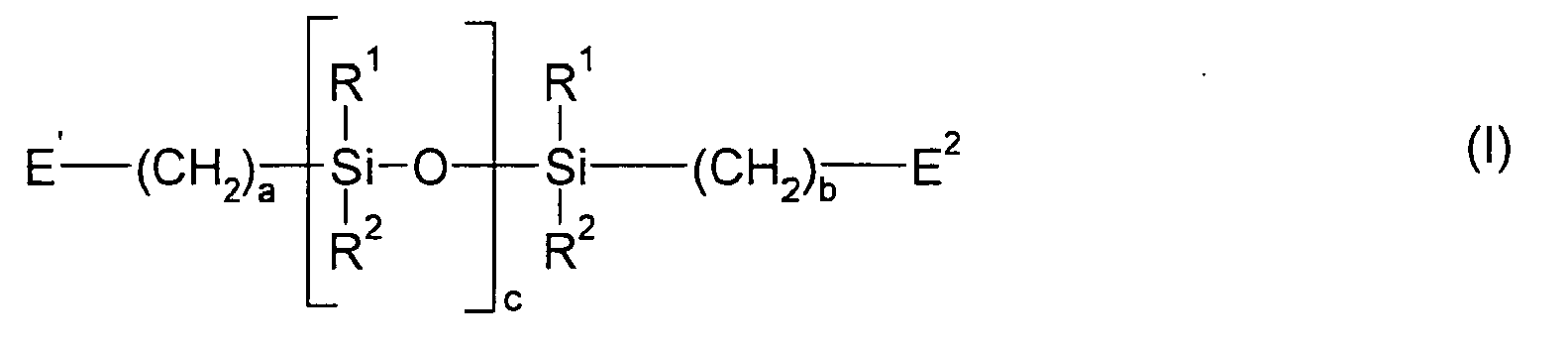
- R1 und R2 unabhängig voneinander für C1- bis C4-Alkyl, Benzyl oder Phenyl stehen,
- E1 und E2 unabhängig voneinander für OH oder NHR3 stehen, wobei R3 für Wasserstoff, C1- bis C6-Alkyl oder C5- bis C8-Cycloalkyl steht,
- a und b unabhängig voneinander für 2 bis 8 stehen,
- c für 3 bis 50 steht,
- Bei den aminohaltigen Polysiloxanen ist zumindest E1 oder E2 gleich NHR3.
- Bei den hydroxyhaltigen Polysiloxanen ist zumindest E1 oder E2 gleich -OH.
- Geeignete Alkylreste sind z.B. Methyl, Ethyl, n-Propyl, Isopropyl, n-Butyl, t.-Butyl, n-Pentyl, n-Hexyl etc. Geeignete Cycloalkylreste sind z.B. Cyclopentyl, Cyclohexyl, Cycloheptyl, Cyclooctyl etc.
- Vorzugsweise stehen R1 und R2 beide für Methyl.
- Diese Polysiloxane weisen vorzugsweise ein zahlenmittleres Molekulargewicht im Bereich von etwa 300 bis 5 000, bevorzugt 400 bis 3 000, auf.
- Bei den Polysiloxanen handelt es sich weiterhin vorzugsweise um eine Verbindung der Formel II

- d für einen Wert von 5 bis 200, bevorzugt 10 bis 100, steht,
- e für einen Wert von 1 bis 20, bevorzugt 2 bis 10, steht,
- Z für einen Rest der Formel -(CH2)f-NH2 steht, worin f für eine ganze Zahl von 1 bis 10, bevorzugt 2 bis 6 steht, oder
- Z für einen Rest der Formel -(CH2)g-NH-(CH2)h-NH2 steht, worin g und h unabhängig voneinander für 0 bis 6, bevorzugt 2 bis 3, stehen, oder.
- z für (CH2)f-(CH2-CH2O)n-(C3H6O)m-H, worin n + m im Bereich zwischen 5 und 60 liegen und m und n unabhängig voneinander zwischen 0 und 50 liegen.
- Dazu zählen z.B. die MAN- und MAR-Marken der Fa. Degussa-Hüls sowie die Finish-Marken der Fa. Wacker, z.B. Finish WT 1270 und Belsil 6031 der Fa. Wacker.
- Geeignete Polysiloxane sind auch die in der EP-A-227 816 beschriebenen Polydimethylsiloxane, auf die hiermit Bezug genommen wird.
- Geeignete Diamine sind z.B. Ethylendiamin, Propylendiamin, 1,4-Diaminobutan, 1,5-Diaminopentan und 1,6-Diaminohexan.
- Als Polyamine sind Verbindungen der folgenden Formel geeignet:

- p für eine ganze Zahl von 0 bis 4 steht,
- R3 und R4 unabhängig voneinander für Wasserstoff, C1- bis C40-Alkyl oder C6- bis C40-Alkenyl stehen wobei die Alkyl- und Alkenylreste wenigstens eine ionogene und/oder ionische Gruppe tragen können, die ausgewählt ist unter -COOY, -SO3Y und -PO3Y, wobei Y für H, Li, Na, K oder Ammonium steht, wobei für p =0 wenigstens einer der Reste R3 oder R4 für einen C1- bis C40-Alkyl- oder C6- bis C40-Alkenylrest steht, der wenigstens eine ionogene und/oder ionische Gruppe trägt,
- R5 und R7 für einen C2- bis C6-Alkylenrest stehen, wobei für p > 1 die Reste R7 unabhängig unter C2- bis C6-Alkylenresten ausgewählt sind,
- R6 für C1- bis C6-Alkyl, C5- bis C8-Cycloalkyl, Phenyl oder Phenyl-C1-C4-alkyl steht,
- Weist das Polyamin der obigen Formel mehrere Wiederholungseinheiten (N(R6)-R7)p auf, so können diese gleiche oder verschiedene Bedeutungen haben.
- Bevorzugt steht p für 1, 2 oder 3, insbesondere für 1 oder 2.
- Wenn p für 0 steht, so stehen bevorzugt die Reste R3 und R4 unabhängig für einen C1-bis C40-Alkyl- oder C6- bis C40-Alkenylrest, der jeweils wenigstens eine ionogene und/oder ionische Gruppe trägt.
- Bevorzugt stehen R3 und R4 unabhängig voneinander für Wasserstoff, C1- bis C30-Alkyl, bevorzugt C1- bis C12-Alkyl, insbesondere C1- bis C8-Alkyl oder einen Rest der

- Insbesondere stehen R3 und R4 unabhängig voneinander für Wasserstoff, Methyl, Ethyl, n-Propyl, Isopropyl, n-Butyl, sec.-Butyl, tert.-Butyl, n-Pentyl, n-Hexyl. Speziell stehen R3 und R4 beide für Wasserstoff.
- Bevorzugt steht R5 für einen C2- bis C4-Alkylenrest.
- Bevorzugt steht R6 für Methyl, Ethyl, n-Propyl, Isopropyl, n-Butyl, sec.-Butyl, tert.-Butyl, Cyclohexyl, Phenyl oder Benzyl.
- Bevorzugt steht R7 für einen C2- bis C4-Alkylenrest.
- Als Polyamin wird vorzugsweise Diethylentriamin, N-Methyldiethylentriamin, N-Ethyldiethylentriamin, N,N,N',N'-Tetramethyldiethylentriamin, N,N,N',N'-Tetraethyldiethylentriamin, Dipropylentriamin, N-Methyldipropylentriamin, N-Ethyldipropylentriamin, N,N'-Bis(3-aminopropyl)-butan-1,4-diamin, Triethylentetramin, Tetraethylenpentamin und Mischungen davon eingesetzt. Besonders bevorzugt handelt es sich bei dem Polyamin um N-Methyldinrooylentriamin.
- Bei der Komponente g) des Grundpolymers mit zwei aktiven Wasserstoffatomen handelt es sich bevorzugt um Diole, Diamine, Aminoalkohole, und Mischungen davon. Das Molekulargewicht dieser Verbindungen liegt in einem Bereich von etwa 56 bis 300.
- Gewünschtenfalls können bis zu 3 Mol-% der genannten Verbindungen durch Triole oder Triamine ersetzt sein.
- Bevorzugt werden hierbei Diole eingesetzt. Brauchbare Diole sind z.B. Ethylenglykol, Propylenglykol, Butylenglykol, Neopentylglykol, Cyclohexandimethylol, Di-, Tri-, Tetra-, Penta- oder Hexaethylenglykol und Mischungen davon. Bevorzugt werden Neopentylglykol und/oder Cyclohexandimethylol eingesetzt.
- Geeignete Aminoalkohole sind z.B. 2-Aminoethanol, 2-(N-Methylamino)ethanol, 3-Aminopropanol, 4-Aminobutanol, 1-Ethylaminobutan-2-ol, 2-Amino-2-methyl-1-propanol, 4-Methyl-4-aminopentan-2-ol etc.
- Geeignete Diamine sind z.B. Ethylendiamin, Propylendiamin, 1,4-Diaminobutan, 1,5-Diaminopentan und 1,6-Diaminohexan sowie Fettdiamine der Struktur R-NH-(CH2)2-3-NH2 mit R = C8-C22-Alkyl oder C8-C22-Alkenyl-Rest.
- Geeignete Verbindungen h) des Grundpolymers weisen zwei aktive Wasserstoffatome und mindestens eine anionogene und/oder anionische Gruppe pro Molekül auf bzw. mindestens eine kationogene und/oder kationische Gruppe pro Molekül auf.
- Bevorzugte Verbindungen mit zwei aktiven Wasserstoffatomen und mindestens einer anionogenen und/oder anionischen Gruppe pro Molekül sind z.B. Verbindungen mit Cärboxylat- und/oder Sulfonatgruppen. Als Komponente mit zwei aktiven Wasserstoffatomen sind 2,2-Hydroxymethyl-substituierte Carboxylate, insbesondere Dimethylolpropansäure und Mischungen, die Dimethylolpropansäure enthalten, besonders bevorzugt.
- Als Komponente mit zwei aktiven Wasserstoffatomen brauchbar sind auch Verbindungen der Formel
H2N(CH2)w-NH-(CH2)x-COO-M+
H2N(CH2)w-NH-(CH2)x-SO3-M+
worin w und x unabhängig voneinander für eine ganze Zahl von 1 bis 8, insbesondere 1 bis 6, stehen und M für Li, Na oder K steht, und Verbindungen der Formel
H2N(CH2CH2O)y(CH2CH(CH3)O)z(CH2)w-NH-(CH2)x-SO3-M+
worin w und x die zuvor angegebenen Bedeutungen besitzen, y und z unabhängig voneinander für eine ganze Zahl von 0 bis 50 stehen, wobei wenigstens eine der beiden Variablen y oder z > 0 ist. Die Reihenfolge der Alkylenoxideinheiten ist dabei beliebig. Die zuletzt genannten Verbindungen weisen vorzugsweise ein zahlenmittleres Molekulargewicht im Bereich von etwa 400 bis 3 000 auf. Eine geeignete Verbindung dieses Typs ist z.B. Poly ESP 520 der Fa. Raschig. - Gewünschtenfalls können die Polyurethane zusätzlich oder anstatt den Verbindungen mit anionogenen und/oder anionischen Gruppen auch Verbindungen eingebaut enthalten, die zwei aktive Wasserstoffatome und mindestens eine kationogene und/oder kationische Gruppe, bevorzugt mindestens eine stickstoffhaltige Gruppe, pro Molekül aufweisen. Bevorzugt handelt es sich bei der stickstoffhaltigen Gruppe um eine tertiäre Aminogruppe oder eine quaternäre Ammoniumgruppe. Bevorzugt sind z.B. Verbindungen der allgemeinen Formeln


- R8 und R9, die gleich oder verschieden sein können, für C2-C8-Alkylen stehen,
- R10, R13 und R14, die gleich oder verschieden sein können, für C1-C6-Alkyl, Phenyl oder Phenyl-C1-C4-alkyl stehen, R11 und R12, die gleich oder verschieden sein können, für H oder C1-C6-Alkyl stehen,
o für 1, 2 oder 3 steht,
X⊖ für Chlorid, Bromid, Jodid, C1-C6-Alkylsulfat oder SO4 2-/2 steht. - Besonders bevorzugt sind N-(C1- bis C6-alkyl)diethanolamine, wie Methyldiethanolamin oder N-Alkyl-dialkylentriamin, wie N-Methyldipropylentriamin.
- Bei der Komponente Diisocyanat (Komponente c), i) sowie m)) handelt es sich um übliche aliphatische, cycloaliphatische und/oder aromatische Diisocyanate, wie Tetramethylendiisocyanat, Hexamethylendiisocyanat, Methylendiphenyldiisocyanat, 2,4- und 2,6-Toluylendiisocyanat und deren Isomerengemische, o-, m- und p-Xylylendiisocyanat, 1,5-Naphthylendiisocyanat, 1,4-Cyclohexylendiisocyanat, Dicyclohexylmethandiisocyanat und Mischungen davon, insbesondere Isophorondiisocyanat, Hexamethylendiisocyanat und/oder Dicyclohexylmethandiisocyanat. Gewünschtenfalls können bis zu 3 Mol-% der genannten Verbindungen durch Triisocyanate ersetzt sein.
- Wie bei der Herstellung von Polyurethanen und Polyharnstoffen üblich, kann man Kettenverlängerer verwenden. Geeignete Kettenverlängerer sind beispielsweise Hexamethylendiamin, Piperazin, 1,2-Diaminocyclohexan, 1,3-Diaminocyclohexan, 1,4-Diaminocyclohexan, Neopentandiamin und 4,4'-Diaminodicyclohexylmethan.
- Die beschriebenen Polyurethane und Polyharnstoffe sind vorzugsweise dadurch erhältlich, daß man die Reaktionspartner für die Diisocyanate unter einer Inertgasatmosphäre in einem inerten Lösungsmittel, z.B. Methylethylketon bei Verbindungen mit OH-Gruppen und Wasser oder einem Alkohol wie Ethanol bei Verbindungen mit NH-Gruppen, bei Temperaturen von 30°C bis 110°C, bevorzugt bei 40°C bis 100°C bei Verbindungen mit OH-Gruppen und unter 50°C, bevorzugt bei 5°C bis 30°C bei Verbindungen mit NH-Gruppen mit den Diisocyanaten umsetzt. Diese Umsetzung kann gegebenenfalls in Gegenwart von Kettenverlängerern durchgeführt werden, um Polyurethane bzw. Polyharnstoffe mit höheren Molekulargewichten herzustellen. Die Umsetzung kann durch Zugabe von Katalysatoren wie zinnorganischen Verbindungen, z.B. Dibutylzinndilaurat, Tetraalkyltitanate insbesondere bei Reaktanden mit OH-Gruppen, beschleunigt werden. Wie bei der Herstellung von Polyurethanen üblich, werden die Reaktionspartner für die Diisocyanate und die Diisocyanate selbst zweckmäßigerweise im molaren Verhältnis von 0,8 bis 1,1 : 1 eingesetzt.
- Die Reaktion kann bei Polyurethanen ohne Lösungsmittel oder in einem geeigneten inerten Lösungsmittel oder Lösungsmittelgemisch erfolgen. Geeignete Lösungsmittel sind aprotische polare Lösungsmittel, z.B. Tetrahydrofuran, Essigsäureethylester, N-Methylpyrrolidon, Dimethylformamid und bevorzugt Ketone, wie Aceton und Methylethylketon. Vorzugsweise erfolgt die Reaktion unter einer Inertgasatmosphäre, wie z.B. unter Stickstoff. Des Weiteren erfolgt die Reaktion vorzugsweise bei Umgebungsdruck oder unter erhöhtem Druck. Die Komponenten werden bevorzugt in solchen Mengen eingesetzt, daß das Verhältnis von NCO-Äquivalent der Verbindungen des Diisocyanats zu Äquivalent aktives Wasserstoffatom der übrigen Komponenten in einem Bereich von etwa 0,6:1 bis 1,4:1, bevorzugt 0,8:1 bis 1,2:1, insbesondere 0,9:1 bis 1,1:1, liegt. Gegebenenfalls noch vorhandene freie Isocyanatgruppen der Polyurethane können durch anschließende Umsetzung mit Aminen, vorzugsweise Aminoalkoholen, inaktiviert werden. Geeignete Amine und Aminoalkohole sind die zuvor genannten, bevorzugt 2-Amino-2-methyl-1-propanol oder tert.-Aminhaltiges Diamin, wie N,N-Dimethylaminopropyldiamin.
- Die beschriebenen Polyurethane und Polyharnstoffe sind aufgrund ihrer ionogenen Gruppierungen, insbesondere beim Vorliegen von Ladungen, in der Regel leicht alkohol- und wasserlöslich oder zumindest ohne Zuhilfenahme von Emulgatoren in Alkohol und Wasser dispergierbar. Als Alkohole sind hier insbesondere kurzkettige C1-C4-Alkanole wie Methanol, Ethanol, iso-Propanol oder n-Propanol gemeint. Geladene kationische Gruppierungen lassen sich aus den vorliegenden tertiären Aminstickstoffatomen entweder durch Protonierung, z.B. mit Phosphorsäure oder Carbonsäuren wie Milchsäure, oder durch Quaternisierung, z.B. mit Alkylierungsmitteln wie C1- bis C4-Alkylhalogeniden oder -sulfaten in den Polyharnstoffen erzeugen. Beispiele solcher Alkylierungsmittel sind Ethylchlorid, Ethylbromid, Methylchlorid, Methylbromid, Dimethylsulfat und Diethylsulfat. Die anionischen bzw. anionogenen Gruppierungen sind in den entsprechenden Aminen vorhanden. Da ein Teil der beschriebenen Polyurethane und Polyharnstoffe neue Stoffe darstellen, betrifft die vorliegende Erfindung weiterhin diese neuen Stoffe.
- Durch Neutralisation anionogener Gruppen unterschiedlicher Grundpolymere A) durch je eine Aminogruppe eines Amins (Neutralisationsmittels) wird zumindest ein Teil der Polymerketten unter Salzbildung vernetzt.
- Als Neutralisationsmittel zur (Teil)neutralisation der anionogenen Grundpolymere sind alle unter den Neutralsationsmitteln aufgeführten Amine geeignet, diese können jeweils einzeln oder in Form von Gemischen eingesetzt werden. Zur Neutralisation der anionogenen Gruppen der Grundpolymere können auch Mischungen eingesetzt werden, die mindestens ein Amin sowie mindestens eine weitere Base enthalten. Geeignete weitere Basen für die Neutralisation der Polymere sind Alkalimetallbasen, wie Natroniauge, Kaiiiauge, Natriumcarbonat, Kaliumcarbonat, Natriumhydrogencarbonat, Kaliumhydrogencarbonat und Erdalkalimetallbasen, wie Kalziumhydroxid, Kalziumoxid, Magnesiumhydroxid oder Magnesiumcarbonat sowie Ammoniak und Amine, die kein Gegenion B) ausbilden.
- Wird als Grundpolymer ein Polyurethan, Poly(urethan-urea) oder Polyharnstoff eingesetzt, deras zusätzlich Amingruppen als kationogene Gruppen aufweist, so können diese durch Neutralisation mit einer Säure wie Milchsäure oder Phosphorsäure oder durch Quaternisierung teilweise oder vollständig in die entsprechenden kationischen Gruppen überführt werden.
- Polyurethane, Poly(urethan-urea) oder Polyharnstoff, die sowohl kationogene als auch anionogene Gruppen aufweisen, können nacheinander einer Neutralisation mit wenigstens einer Säure, einer Neutralisation mit wenigstens einer Base und gewünschtenfalls zusätzlich einer Quaternisierung unterzogen werden. Die Reihenfolge der Neutralisationsschritte ist dabei im Allgemeinen beliebig.
- Gewünschtenfalls können kationogene Gruppen auch teilweise oder vollständig quaternisiert werden. Die Quaternisierung kann z.B. mit Alkylierungsmitteln, wie C1- bis C4-Alkylhalogeniden oder Sulfaten erfolgen. Bevorzugte Alkylierungsmittel sind Ethylchlorid, Ethylbromid, Methylchlorid, Methylbromid, Dimethylsulfat und Diethylsulfat.
- Bevorzugt beträgt der Anteil des Neutralisationspolymers an dem polymeren Salz mindestens etwa 1 Gew.-%, insbesondere mindestens 3 Gew.-%.
- Bevorzugt beträgt der Anteil des Neutralisationspolymers an dem polymeren Salz höchstens etwa 50 Gew.-%, bevorzugt höchstens etwa 40 Gew.-%.
- Die erfindungsgemäßen wasserlöslichen oder wasserdispergierbaren polymeren Salze sind erhältlich durch Umsetzung der Grundpolymere, enthaltend an die Polymerkette gebundene anionogene und/oder anionische Gruppen, mit wenigstens einem Neutralisationspolymer. Die Umsetzung kann vorzugsweise im Anschluß an die Herstellung der Grundpolymere und im Allgemeinen im gleichen Reaktionsgefäß erfolgen. Gewünschtenfalls kann zur Herstellung der erfindungsgemäßen Salze auch ein separat hergestelltes oder kommerziell erhältliches Grundpolymer eingesetzt werden. Geeignete Polyurethane werden z.B. in der DE-A-42 41 118, DE-A-42 25 045 und EP-A 0 619 111 beschrieben, auf die in vollem Umfang Bezug genommen wird. Geeignete Acrylatcopolymere werden z.B. in der DE-A-39 01 325 und der DE-A-43 14 305 beschrieben, auf die in vollem Umfang Bezug genommen wird. Geeignete Lösungsmittel für die Umsetzung sind die zuvor bei der Herstellung der Polyurethane genannten.
- Die Neutralisation von Säuregruppen enthaltenden Grundpolymeren kann durch Zugabe einer Base oder eines Basengemischs erfoigen.
- Wird bei der Herstellung der polymeren Salze ein wassermischbares organisches Lösungsmittel eingesetzt, so kann dieses im Anschluss durch übliche, dem Fachmann bekannte Verfahren, z.B. durch Destillation bei vermindertem Druck, entfernt werden.
- Vor dem Abtrennen des Lösungsmittels kann dem polymeren Salz zusätzlich Wasser zugegeben werden. Nach Ersatz des Lösungsmittels durch Wasser erhält man eine Lösung oder Dispersion des polymeren Salzes, aus der, falls gewünscht, das polymere Salz in üblicher Weise gewonnen werden kann, z.B. durch Sprühtrocknung.
- Der pH-Wert der wäßrigen Lösungen oder Dispersionen der polymeren Salze kann durch Zugabe einer Säure oder Base eingestellt werden. Geeignete Säuren und Basen sind die zuvor als zusätzliche Neutralisierungsmittel genannten. Vorzugsweise liegt der pH-Wert für anionische polymere Salze im alkalischen Bereich, insbesondere > 7,5. Vorzugsweise liegt der pH-Wert für kationische polymere Salze im sauren Bereich, insbesondere bei 5,5 bis 6,5.
- Die erfindungsgemäßen polymeren Salze sind wasserlöslich oder wasserdispergierbar. Sie bilden im Allgemeinen klare und klebfreie Filme und lassen sich mit Wasser sehr gut auswaschen. Vorteilhafterweise werden mit den erfindungsgemäßen polymeren Salzen auch Filme mit einer sehr guten Elastizität erhalten. Diese ist im Allgemeinen höher als die Elastizität, die üblicherweise bei aus dem Stand der Technik bekannten Polyurethanen mit kurzkettigen Neutralisationsmitteln erhalten wird.
- Im Rahmen der vorliegenden Erfindung umfassen die Ausdrücke Alkyl und Alkylen geradkettige und verzweigte Alkyl- bzw. Alkylengruppen. Vorzugsweise handelt es sich dabei um geradkettige oder verzweigte, C1- bis C40- und besonders bevorzugt C2- bis C30-Alkyl- und Alkylengruppen.
- C1- bis C6-Alkyl bzw. steht vorzugsweise für Methyl, Ethyl, Isopropyl, n-Butyl, 2-Butyl, sec.-Butyl, tert.-Butyl, n-Pentyl, 2-Pentyl, 2-Methylbutyl, 3-Methylbutyl, 1,2-Dimethylpropyl, 1,1-Dimethylpropyl, 2,2-Dimethylpropyl, 1-Ethylpropyl, n-Hexyl, 2-Hexyl, 2-Methylpentyl, 3-Methylpentyl, 4-Methylpentyl, 1,2-Dimethylbutyl, 1,3-Dimethylbutyl, 2,3-Dimethylbutyl, 1,1-Dimethylbutyl, 2,2-Dimethylbutyl, 3,3-Dimethylbutyl, 1,1,2-Trimethylpropyl, 1,2,2-Trimethylpropyl, 1-Ethylbutyl, 2-Ethylbutyl, 1-Ethyl-2-methylpropyl etc.
- C2- bis C6-Alkylen steht für geradkettige und verzweigte C2- bis C6-Alkylenreste, bevorzugt C2- bis C4-Alkylenreste. Dazu zählen vorzugsweise Ethylen, Propylen, Propan-1,3-diyl, Butan-1,4-diyl, Butan-1,3-diyl, Butan-1,2-diyl, Butan-2,3-diyl, 2-Methylpropan-1,3-diyl, Pentan-1,5-diyl, Pentan-1,4-diyl, Pentan-1,3-diyl, Pentan-1,2-diyl, 1-Methylbutan-1,4-diyl, 2-Methylbutan-1,4-diyl, Hexan-1,6-diyl, Hexan-1,5-diyl, Hexan-1,4-diyl, Hexan-1,3-diyl, Hexan-1,2-diyl etc.
- C6- bis C40-Alkenyl steht vorzugsweise für geradkettige und verzweigte Alkenylgruppen, die einfach, zweifach oder mehrfach ungesättigt sein können. Bevorzugt handelt es sich um Cg- bis C35-, insbesondere um C10- bis C30- und speziell um C12- bis C26-Alkenylgruppen. Dazu zählen insbesondere Hexenyl, Heptenyl, Octenyl, Nonenyl, Decenyl, Undecenyl, Dodecenyl, Tridecenyl, Tetradecenyl, Pentadecenyl, Hexadecenyl, Heptadecenyl, Octadecenyl, Nonadecenyl, Linolyl, Linolenyl, Elaostearylyl etc.
- Bei den anionogenen Gruppen handelt es sich um Carbonsäuregruppen und/oder Sulfonsäuregruppen und/oder Phosphat und/oder Phosphonatgruppen.
- Bei den anionischen Gruppen handelt es sich vorzugsweise um Carboxylat- und/oder Sulfonatgruppen. Diese weisen als Gegenion vorzugsweise ein Alkalimetall, insbesondere Na oder K, oder ein Ammoniumion auf, das von Ammoniak oder einem von den als Neutralisationsmittel eingesetzten Aminen verschiedenen primären, sekundären oder tertiären Amin abgeleitet ist.
- Bei den kationogenen Gruppen handelt es sich um primäre, sekundäre und besonders tertiäre Amine. Als kationische Gruppen handelt es sich um Protonierungs- und/oder Quaternisierungsprodukt eines Amins und vorzugsweise um das Produkt der Umsetzung mit einer Mineralsäure, wie Salzsäure oder Schwefelsäure, oder das Produkt der Umsetzung mit einem Quaternisierungsmittel. Zur Quaternisierung eignen sich die üblichen Alkylierungsmittel.
- Die Quaternierungsmittel führen eine C1-C6-Alkyl, C5-C8-Cycloalkyl, Phenyl, Phenyl-C1-C4-Alkyl ein.
- Geeignete N-Vinylamide sind N-Vinylformamid, N-Vinylacetamid, N-Vinylpropionamid etc. Bevorzugt wird N-Vinylformamid eingesetzt.
- Geeignete N-Vinyllactame und deren Derivate sind die z.B. einen oder mehrere C1-C6-Alkylsubstituenten, wie Methyl, Ethyl, n-Propyl, Isopropyl, n-Butyl, sec.-Butyl, tert.-Butyl etc. aufweisen können. Dazu zählen z.B. N-Vinylpyrrolidon, N-Vinylpiperidin, N-Vinylcaprolactam, N-Vinyl-5-methyl-2-pyrrolidon, N-Vinyl-5-ethyl-2-pyrrolidon, N-Vinyl-6-methyl-2-piperidin, N-Vinyl-6-ethyl-2-piperidin, N-Vinyl-7-methyl-2-caprolactam, N-Vinyl-7-ethyl-2-caprolactam etc.
- Geeignete Amin-haltige Monomere sind beispielsweise die der folgenden Formel

- R'
- = H, CH3
- X
- = O, NH
- R"', R""
- = gleich oder verschieden sind und für CH3, -C2H5, -C3H7, -C4H9, -tert.-C4H9 stehen können
- p
- = 1 bis 5
- N,N-Dimethylaminoethyl(meth)acrylat
- N,N-Dimethylaminopropyl(meth)acrylat
- N,N-Dimethylaminoethyl(meth)acrylamid
- N,N-Dimethylaminopropyl(meth)acrylamid.
- N,N-Dimethylaminoethylmethacrylat
- N,N-Dimethylaminoethylmethacrylamid
- N,N-Dimethylaminopropylmethacrylamid.
- Geeignete COOH-haltige Monomere sind beispielsweise α-,β-ethylenisch ungesättigte Mono-und Dicarbonsäuren, wie z.B. Acrylsäure, Methacrylsäure, Fumarsäure, Maleinsäure, Itaconsäure, Crotonsäure und Mischungen davon. Bevorzugt werde Acrylsäure, Methacrylsäure und Mischungen davon eingesetzt.
- Die erfindungsgemäßen polymeren Salze sowie die erfindungsgemäßen Polyharnstoffe (zusammengefaßt unter dem Begriff erfindungsgemäße Polymere) eignen sich besonders gut als oder in Haarfestigerpolymer(en), die dem Haar Flexibilität verleihen.
- Die erfindungsgemäßen Polymere eignen sich als Hilfsmittel in der Kosmetik. Ein weiterer Gegenstand der Erfindung betrifft daher die Verwendung der erfindungsgemäßen Polymere in kosmetischen Mitteln, insbesondere als Filmbildner und/oder Beschichtungsmittel und/oder Bindemittel. Hierbei ist ihr Einsatz insbesondere in kosmetischen Mittel zur Behandlung von keratinhaltigen und keratinanalogen Oberflächen, wie Haar, Haut und Nägel, brauchbar. Sie eignen sich insbesondere für die Haarkosmetik, vorzugsweise als Festigerpolymer in Haarsprays, Schaumfestigern, Haarmousse, Haargel und Shampoos. Sie eignen sich weiterhin bevorzugt für eine Verwendung in pigmenthaltigen kosmetischen Mitteln, wie beispielsweise in der dekorativen Kosmetik, insbesondere in Mascara und Lidschatten. Auch eignen sie sich zur Herstellung von stiftförmigen kosmetischen Produkte, wie Deostifte, Schminkstifte etc..
- Die erfindungsgemäßen Polymere eignen sich weiterhin als Hilfsmittel in der Pharmazie, bevorzugt als oder in Beschichtungsmittel(n) oder Bindemittel(n) für feste Arzneiformen brauchbar. Ein weiterer Gegenstand der Erfindung betrifft daher die Verwendung der erfindungsgemäßen Polymere in pharmazeutischen Mitteln, insbesondere als Filmbildner und/oder Beschichtungsmittel und/oder Bindemittel. So können die zuvor genannten Polymere als Tablettenüberzugmittel und Tablettenbindemittel verwendet werden.
- Die erfindungsgemäßen Polymeren eignen sich weiterhin vorzugsweise für die Verwendung als oder in Beschichtungsmittel(n) für die Textil-, Papier-, Druck-, Leder-, und Klebstoffindustrie.
- Die erfindungsgemäßen Polymere eignen sich als Bestandteil, als Wirkpolymer, Filmbildner, Beschichtungsmittel, Bindemittel, (Co-)Emulgator, Penetrationsinhibitor, Kristallisationsinhibitor, feuchtigkeitshaltende Additive.
- Die erfindungsgemäßen Polymere eignen sich weiterhin als Viskositätseinstellende Mittel. Insbesondere bei Öl- und Wasserhaltigen kosmetischen Mitteln, wie beispielsweise Cremes oder Lotionen kann, in Abhängigkeit von dem jeweiligen Öl- bzw. Wasseranteil durch Zusatz der erfindungsgemäßen Polymere die Viskosität gezielt auf die gewünschte Größe eingestellt werden.
- Ein weiterer Gegenstand der Erfindung ist ein kosmetisches und/oder pharmazeutisches Mittel, das wenigstens ein erfindungsgemäßes Polymer (= Polyharnstoff nach Anspruch 1 oder polymeres Salz) enthält. Im Allgemeinen enthält das Mittel die erfindungsgemäßen Polymere in einer Menge im Bereich von etwa 0,2 bis 30 Gew.-%, insbesondere von 0,5 bis 20 Gew.-%, bezogen auf das Gesamtgewicht des Mittels.
- Sind die in den erfindungsgemäßen Mitteln eingesetzten erfindungsgemäßen polymeren Salze wasserdispergierbar, können sie in Form von wäßrigen Dispersionen mit Teilchendurchmessern von üblicherweise 1 bis 350 nm, bevorzugt 1 bis 250 nm, zur Anwendung gebracht werden. Die Feststoffgehalte der Präparate liegen dabei üblicherweise in einem Bereich von etwa 0,2 bis 30, insbesondere 0,5 bis 20 Gew.-%, bevorzugt 1 bis 12 Gew.-%. Diese Mikrodispersionen benötigen in der Regel keine Emulgatoren oder Tenside zu ihrer Stabilisierung.
- Bevorzugt können die erfindungsgemäßen Mittel in Form eines Haarbehandlungsmittels, wie Schaumfestiger, haarmousse, Haargel, Shampoo und insbesondere in Form eines Haarsprays vorliegen. Zur Verwendung als Konditionspolymer oder Festigerpolymer sind dabei Mittel bevorzugt, welche die erfindungsgemäßen Ppolymere polymeren Salze enthalten, die wenigstens eine Glasübergangstemperatur Tg ≥ 10°C, bevorzugt ≥ 20°C, aufweisen. Der K-Wert dieser Polymere (gemessen nach E. Fikentscher, Cellulose-Chemie 13 (1932), S. 58-64) an einer 1 gew.-%igen Lösung in N-Methylpyrrolidon, liegt vorzugsweise in einem Bereich von 23 bis 90, insbesondere 25 bis 60.
- Weisen die erfindungsgemäßen Polymere Salze Siloxangruppen auf, so beträgt der Siloxangehalt dieser Polymere im Allgemeinen 0,05 bis 20 Gew.-%, bezogen auf das Gesamtgewicht der eingebauten Komponenten.
- Bei den erfindungsgemäßen kosmetischen Mitteln handelt es sich vorzugsweise um Haarbehandlungsmittel. Diese liegen üblicherweise in Form einer wäßrigen Dispersion oder in Form einer alkoholischen oder wäßrig-alkoholischen Lösung vor. Beispiele geeigneter Alkohole sind Ethanol, Propanol, Isopropanol etc.
- Weiter können die erfindungsgemäßen Haarbehandlungsmittel im Allgemeinen übliche kosmetische Hilfsstoffe enthalten, beispielsweise Weichmacher, wie Glycerin und Glykol; Emollienzien; Parfüms; Tenside; UV-Absorber; Farbstoffe; antistatische Mittel; Mittel zur Verbesserung der Kämmbarkeit; Konservierungsmittel; und Entschäumer.
- Wenn die erfindungsgemäßen kosmetischen Mittel als Haarspray formuliert sind, enthalten sie eine ausreichende Menge eines Treibmittels, beispielsweise einen niedrigsiedenden Kohlenwasserstoff oder Ether, wie Propan, Butan, Isobutan oder Dimethylether. Als Treibmittel sind auch komprimierte Gase brauchbar, wie Stickstoff, Luft oder Kohlendioxid. Die Menge an Treibmittel kann dabei gering gehalten werden, um den VOC-Gehalt nicht unnötig zu erhöhen. Sie beträgt dann im Allgemeinen nicht mehr als 55 Gew.-%, bezogen auf das Gesamtgewicht des Mittels. Gewünschtenfalls sind aber auch höhere VOC-Gehalte von 85 Gew.-% und darüber möglich.
- Die erfindungsgemäßen Polymere können auch in Kombination mit anderen Polymeren in den Mitteln zur Anwendung kommen. Die erfindungsgemäßen Polymere eigenen sich somit auch zur Verbesserung der Elastizität herkömmlicher Haarbehandlungsmittel, insbesondere Haarfestigungsmittel. Diese verleihen den Haaren dann im Allgemeinen eine sehr gute Flexibilität und Geschmeidigkeit.
- Solche anderen Polymere sind insbesondere:
- nicht-ionische, wasserlösliche bzw. wasserdispergierbare Polymere oder Oligomere, wie Polyvinylcaprolactam, z.B. Luviskol Plus (BASF), oder Polyvinylpyrrolidon und deren Copolymere, insbesondere mit Vinylestern, wie Vinylacetat, z.B. Luviskol VA 37 (BASF); Polyamide, z.B. auf Basis von Itaconsäure und aliphatischen Diaminen;
- amphotere oder zwitterionische Polymere, wie die unter den Bezeichnungen Amphomer® (National Starch) erhältlichen Octylacrylamid/Methylmethacrylat/tert.-Butylaminoethylmethacrylat/2-Hydroxypropylmethacrylat-Copolymere sowie zwitterionische Polymere, wie sie beispielsweise in den deutschen Patentanmeldungen DE 39 29 973, DE 21 50 557, DE 28 17 369 und DE 37 08 451 offenbart sind. Acrylamidopropyltrimethylammoniumchlorid/Acrylsäure- bzw. -Methacrylsäure-Copolymerisate und deren Alkali- und Ammoniumsalze sind bevorzugte zwitterionische Polymere. Weiterhin geeignete zwitterionische Polymere sind Methacroylethylbetain/Methacrylat-Copolymere, die unter der Bezeichnung AmersetteR (AMERCHOL) im Handel erhältlich sind, und Copolymere aus Hydroxyethylmethacrylat, Methylmethacrylat, N,N-Dimethylaminoethylmethacrylat und Acrylsäure (Jordapon®);
- anionische Polymere, wie Vinylacetat/Crotonsäure-Copolymere, wie sie beispielsweise unter den Bezeichnungen Resyn® (NATIONAL STARCH), Luviset® (BASF) und Gafset® (GAF) im Handel sind, Vinylpyrrolidon/Vinylacrylat-Copolymere, erhältlich beispielsweise unter dem Warenzeichen Luviflex® (BASF). Ein bevorzugtes Polymer ist das unter der Bezeichnung Luviflex®VBM-35 (BASF) erhältliche Vinylpyrrolidon/Acrylat-Terpolymer. Acrylsäure/Ethylacrylat/N-tert.Butylacrylamid-Terpolymere, die beispielsweise unter der Bezeichnung Ultrahold® strong (BASF) vertrieben werden, sowie Luvimer® (BASF, Terpolymer aus t-Butylacrylat, Ethylacrylat und Meth- acrylsäure), Natriumsulfonat-haltige Amide oder Natriumsulfonat-haltige Polyester, oder
- kationische (quaternisierte) Polymere, z.B. kationische Polyacrylatcopolymere auf Basis von N-Vinyllactamen und deren Derivaten (N-Vinylpyrrolidon, N-Vinylcaprolactam etc.) sowie übliche kationische Haarconditionerpolymere, z.B. Luviquat® (Copolymer aus Vinylpyrrolidon und Vinylimidazoliummethochlorid), Luviquat® Hold (Copolymerisat aus quaternisiertem N-Vinylimidazol, N-Vinylpyrrolidon und N-Vinylcaprolactam), Merquat® (Polymer auf Basis von Dimethyldiallylammoniumchlorid), Gafquat® (quaternäre Polymere, die durch Reaktion von Polyvinylpyrrolidon mit quaternären Ammoniumverbindungen entstehen), Polymer JR (Hydroxyethylcellulose mit kationischen Gruppen), Polyquaternium-Typen (CTFA-Bezeichnungen) etc.;
- nichtionische, siloxanhaltige, wasserlösliche oder -dispergierbare Polymere, z.B. Polyethersiloxane, wie Tegopren® (Fa. Goldschmidt) oder Belsil® (Fa. Wacker).
- Die erfindungsgemäßen Polymere können als Mischung mit einem amidgruppenhaltigen Polymer eingesetzt werden. Dazu zählen z.B. die in der DE-A-42 25 045 beschriebenen Polyurethane, die zuvor beschriebenen Vinylpyrrolidon/Acrylat-Terpolymere und Acrylsäure/Ethylacrylat/N-tert.-Butylacrylamid-Terpolymere (z.B. Ultrahold® strong der BASF AG), die zuvor beschriebenen amidgruppenhaltigen amphoteren Polymere (z.B. Amphomer®) und insbesondere Copolymerisate, die einen Anteil an amidgruppenhaltigen Monomeren, wie N-Vinyllactamen, von mindestens 30 Gew.-% aufweisen (z.B. Luviskol®plus und Luviskol®VA37 der BASF AG).
- Die anderen Polymere sind vorzugsweise in Mengen bis zu 10 Gew.-%, bezogen auf das Gesamtgewicht des Mittels enthalten.
- Ein bevorzugtes Haarbehandlungsmittel enthält:
- 0,2 bis 30, insbesondere 0,5 bis 20 Gew.-%, bevorzugt 1 bis 10 Gew.-%, mindestens eines erfindungsgemäßen Polymers (= Polyharnstoff nach Anspruch 1 sowie polymeren Salzes nach Anspruch 5),
- 50 bis 99,5 Gew.-%, bevorzugt 55 bis 99 Gew.-%, eines Lösungsmittels, bevorzugt ausgewählt unter Wasser und wassermischbarens Lösungsmitteln, bevorzugt C2- bis C5-Alkoholen, insbesondere Ethanol, und Mischungen davon,
- 0 bis 70 Gew.-%, bevorzugt 0,1 bis 50 Gew.-%, eines Treibmittels,
Als Treibmittel wird üblicherweise Propan/Butan, vorzugsweise Dimethylether, eingesetzt, - 0 bis 10 Gew.-%, bevorzugt 0,1 bis 10 Gew.-%, mindestens eines von den erfindungsgemäßen Polymeren verschiedenes, in Wasser löslichen oder dispergierbaren Polymers,
- 0 bis 0,5 Gew.-%, bevorzugt 0,001 bis 2 Gew.-%, mindestens einer wasserlöslichen oder wasserdispergierbaren Siliconverbindung.
Das erfindungsgemäße Mittel kann als Siliconverbindung mindestens ein nichtionisches, siloxanhaltiges, wasserlösliches oder -dispergierbares Polymer, insbesondere ausgewählt unter den zuvor beschriebenen Polyethersiloxanen, enthalten. Der Anteil dieser Komponente beträgt dann im Allgemeinen etwa 0,001 bis 2 Gew.-%, bezogen auf das Gesamtgewicht des Mittels. - Das erfindungsgemäße Mittel kann als zusätzliche Komponente mindestens ein wasserunlösliches Silicon, insbesondere ein Polydimethylsiloxan, z.B. die Abil®-Typen der Fa. Goldschmidt, enthalten. Der Anteil dieser Komponente beträgt dann im Allgemeinen etwa 0,0001 bis 0,2 Gew.-%, bevorzugt 0,001 bis 0,1 Gew.-%, bezogen auf das Gesamtgewicht des Mittels.
- Das erfindungsgemäße Mittel kann zusätzlich gegebenenfalls einen Entschäumer, z.B. auf Silicon-Basis, enthalten. Die Menge des Entschäumers beträgt im Allgemeinen bis zu etwa 0,001 Gew.-%, bezogen auf die Gesamtmenge des Mittels.
- Das erfindungsgemäße Mittel enthält vorzugsweise zusätzlich zu den zuvor genannten Komponenten:
- 0 bis 40 Gew.-%, bevorzugt 0,1 bis 35 Gew.-%, wenigstens eines Tensids,
- 0 bis 5,0 Gew.-% eines Emulgators,
- 0 bis 3 Gew.-%, bevorzugt 0,05 bis 2,5 Gew.-%, wenigstens eines Salzes,
- 0 bis 3 Gew.-%, bevorzugt 0,05 bis 2,5 Gew.-%, wenigstens eines Verdickers, sowie gegebenenfalls weitere übliche Zusatzstoffe. Als weitere Zusatzstoffe seien genannt: Farbstoffe, Pigmente, UV-Absorber (die jeweils in Mengen von 0 bis 5,0 Gew.-% eingesetzt werden) sowie Konservierungsmittel und Parfümstoffe. Diese liegen dann im Allgemeinen jeweils in einer Menge von etwa 0 bis 0,2 Gew.-%, bevorzugt 0,001 bis 0,2 Gew.-% vor.
Alle genannten Gewichtsangaben beziehen sich auf das Gesamtgewicht des Mittels.
Die erfindungsgemäßen Mittel besitzen den Vorteil, daß sie einerseits den Haaren die gewünschte Festigkeit verleihen und die Polymere leicht auswaschbar (redispergierbar) sind und das Haar andererseits elastisch, geschmeidig und klebfrei bleibt.
Die Erfindung wird anhand der folgenden, nicht einschränkenden Beispiele näher erläutert. - Die Beurteilung der Flexibilität der Polymere wurde wie folgt bestimmt:
- Aus 20%iger Polymerlösung mit einer Schichtdicke von 90 bis 140 mm werden 2 bis 5 mm breite Streifen ausgestanzt und bezüglich Griff, Festigkeit und Flexibilität getestet. Bei der Prüfung von Klebrigkeit, Klarheit und Auswaschbarkeit wird zur Testung eine Glasplatte mit den Filmen beschichtet.
- Für die Bewertung werden
- entweder aus einer 20%-igen ethanolischen. Lösung auf PE-Foile 500 mmm-Film gerackelt und getrocknet.
- Elastizität: Spröde (4)/hart (3)/mäßig (2)/sehr weich (1)
- Zug-Festigkeit: verfliessen (4)/schlecht (3)/mäßig (2)/fest (1)
- Griff: rauh, hemmend (4)/hemmend (3)/gut (2)/geschmeidig-glatt (1)
- oder aus einer 5%-igen wäßrigen ethanolischen Lösung auf Glasplatte Filme beschichten
- Klebrigkeit: klebrig (4)/leicht klebrig (3)/befriedigen (2)/nicht klebrig (1)
- Auswaschbarkeit: nicht löslich (4)/schlecht (3)/befriedigen (2)/klar (1)
- entweder aus einer 20%-igen ethanolischen. Lösung auf PE-Foile 500 mmm-Film gerackelt und getrocknet.
- Das Neutralisationspolymer wird entweder aus Diol-Komponenten/Diisocyanat in Methylethylketon oder Aceton/ unter Druck bei 80°C ca. 5 h, oder aus Diamin/Diisocyanat bei einer Temperatur von 10 bis 40°C in Ethanol polymerisiert.
-
PEG1500 A-Si2122 PEG-DA MDPTA Hex-DA IPDI 1 3 - - 1 1.2 5 2 3 0.5 - 1 0.7 5 3 - 0.5 3 1 0.7 5 4 - - 3 1 1.2 5 - PEG 1500:
- Polyethylenglykol, Mn ≈ 1500 (BASF)
- A-Si 2122:
- P(Dimethylsiloxan-diamin), Mn ≈ 900 (Tegomer, Fa. Goldschmidt)
- PEG-DA:
- O,O'-Bis(2-aminopropyl)polyethylenglykol 800; Mn ≈ 900 (Fluka)
- MDPTA;
- N-Methyldipropylentriamin
- Hex-DA:
- Hexandiamin (1,6)
- IPDI:
- Isophorondiisocyanat
- Kationisches Neutralisationspolymer auf Basis von Polyurethan (PUR) für COOH-haltige Polymere:
- Allgemeine Herstellungsvorschriften:
- In einem 4-Halskolben, der unter N2-Atmosphäre mit Rührer, Tropftrichter, Thermometer und Rückflußkühler ausgestattet war, wurden 88,9 g (0,4 Mol) Isophorondiisocyanat in 20 g Ethanol vorgelegt. Bei einer Temperatur von ca. 10°C wurde unter Rühren und Eiskühlung eine Mischung aus 90 g (0,1 Mol) Tegomer A-Si 2122 (Mn = 900 g/Mol) und 30 g Ethanol bei einer Temperatur ≤ 40°C zugetropft. Die Reaktion wurde unter Rühren noch 30 Minuten bei etwa 30 bis 40°C gehalten. Nach dem Abkühlen auf ca. 10°C wurde eine Mischung aus 70 g (0,3 Mol) 0,0'-Bis-(2-aminopropyl)polyetherglykol 800; Mn ≈ 900 (Fluka) und 2,9 g (0,02 Mol) N-Methyldipropylentriamin in 50 g Ethanol zugegeben, wobei die Reaktionstemperatur auf ca. 45°C anstieg. Anschließend verdünnte man das Reaktionsgemisch mit 600 g Ethanol. Man erhielt nach dem Filtrieren eine klare hellgelbe ca. 40%ige ethanolische Polymerlösung.
- Analog wurden die Neutralisationspolymere der Beispiele 5, 6, 8, 9 sowie 12 und 13 hergestellt.
Bsp. Neutralisationspolymer PEG-DA (mol) MDPT A (mol) A-Si2122 (mol) SO3NA-PPG-DA (mol) MAN 0078 (mol) IPDI (mol) freie AZ 5 A 3.5 1 - - - 4 ca.20 6 B 4.0 - 0.5 - - 4 11.4 7 C 3.0 0.2 1 - - 4 7.5 8 D 3.0 - 1 0.2 - 4 4.8 9 E 3.5 2-3 - - 0.2 6 10 - PEG-DA:
- O,O'Bis(2-amino-propyl)polyethylenglykol 800; Mn ≈ 900 (Fluka)
- MDPTA:
- N-Methyl-dipropylentriamin
- A-Si 2122:
- P(Dimethylsiloxan diamin), Mn ≈ 900 (Tegomer, Fa. Goldschmidt)
- SO3Na-PPG-DA:
- α,ω-Polypropylenglykeldiamin, sulfopropyliert; Mn≈ 700 (Raschig)
- MAN 00078:
- Poly(aminopropyl)dimethylsiloxan (Fa. Hüls Silicone) Amin-Zahl von ca. 28 (entspricht Diamin mit Molekulargewidcht von ca. 4000)
- AZ:
- Amin-Zahl
- IPDI:
- Isophorondiisocyanat
- Kationisches Neutralisationspolymer auf Basis von Polyacrylaten (PA) für COOH-haltige Polymere:
-
Zulauf 1: Vinylpyrrolidon 59,5 g Vinylcaprolactam 102,0 g Dimethylaminopropylmethacrylamid 8,5 g Zulauf 2: Ethanol 80,0 g t-Butylperpivalat 0,4 g Zulauf 3: Ethanol 80,0 g t-Butylperpivalat 1,6 g Vorlage: Ethanol 95,0 g Zulauf 1 32,0 g Zulauf 2 10,0 g - Vorlage unter N2 in einer Rührapparatur mit 3 Zulaufeinheiten unter Rührung auf 80°C aufheizen. Dann Zulauf 1 und 2 starten. Zulauf 1 in 3 h, Zulauf 2 in 4 h zudosieren. 5h bei 80°C nachpolymerisieren. Zulauf 3 starten und in 1 h bei 80°C zugeben, 5 h bei 80°C nachpolymerisieren. Eine farblose 40%ige ethanolische Polyacrylat-Lösung wurde erhalten.
-
Bsp. PNeutralisationspolymer VP VCap nBA DMA PMA AZ 10 F 35 60 - 5 16,5 11 G 55 - 40 5 16,5 - VP:
- Vinylpyrrolidon
- VCap:
- Vinylcaprolactam
- DMAPMA:
- Dimethylamino-propylmethacrylamid
- nBA:
- n-Butylacrtylat
- Anionisches Neutralisationspolymer auf Basis von Polyurethan (PUR) für aminogruppen-haltige Polymere:
Bsp. PNeutralisationspolymer PEG-DA A-Si 2122 DMP A IPDI (mol) freie SZ 12 H 3,0 - 1 4 15 13 J 2,5 0,5 1 4 15 - A-Si 2122:
- P(Dimethylsiloxan-diamin), Mn ≈ 900 (Tegomer, Fa. Goldschmidt)
- PEG-DA:
- 0,0'-Bis(2-amino-propyl)polyethylenglykol 800; Mn ≈ 900 (Fluka)
- SZ:
- Säure-Zahl
- DMPA:
- Dimethylolpropansäure
- IPDI:
- Isophorondüsocyanat
-
Bsp. Neutralisationspolymer VP nBA TBA DMAP MA MAS Belsil 6031 AZ 14 K 70 - 21 6 3 - 19,8 15 L - 90 - 5 5 - 16,5 16 M - - 70 3 22 5 9,9 - TBA:
- t-Butylacrylat
- NAS:
- Methacrylsäure
- Belsil 6031:
- wasserlösliches ethoxiliertes Silikontensid (Wacker Belsil DMC 6031)
- In einem 4-Halskolben, der mit Rührer, Tropftrichter, Thermometer, Rückflußkühler und einer Vorrichtung für das Arbeiten unter Stickstoff ausgestattet war, wurden 500 g [0,5 Mol] Polyesterdiol aus Isophtalsäure/Adipinsäure und Hexandiol 1,6 (Mw = 1000 g/mol), 201 g [1,5 Mol] Dimethylolpropansäure (DMPA) und 104 g [1 Mol] Neopentylglykol (NPG) in 370 g Methylethylketon unter Erhitzen auf einer Temperatur von 80°C und unter Rühren gelöst. Sobald sich alles gelöst hatte, wurde das Reaktionsgemisch auf ca. 50°C abgekühlt. Anschließend wurden unter Rühren 699,3 g [3,15 Mol] Isophorondiisocyanat zugetropft, wobei die Reaktionstemperatur anstieg. Unter Rückfluß wurde das Reaktionsgemisch dann solange gerührt, bis der NCO-Gehalt des Gemisches praktisch konstant blieb. Danach kühlte man das Gemisch auf RT ab. Das Reaktionsprodukt wurde mit 132,6 g [1,48 Mol] 2-Amino-2-methyl-1-propanol (AMP)/Wasser bei einer Temperatur ≤ 40°C abgestoppt und zu 90 % neutralisiert. Das Lösungsmittel wurde dann im Vakuum bei 40°C abdestilliert, wobei man eine wäßrige Dispersion erhielt. Pulverförmige Polyurethane können durch Sprühtrockner erhalten werden.
- In einem 4-Halskolben, der mit Rührer, Tropftrichter, Thermometer, Rückflußkühler und einer Vorrichtung für das Arbeiten unter Stickstoff ausgestattet war, wurden 500 g [0,5 Mol] Polyesterdiol aus Isophthalsäure/Adipinsäure und Hexandiol 1,6 (Mw = 1000 g/mol), 201 g [1,5 Mol] Dimethylol-propansäure (DMPA) und 104 g [1 Mol] Neopentylglykol (NPG) in 370g Methylethylketon unter Erhitzen auf einer Temperatur von 80°C und unter Rühren gelöst. Sobald sich alles gelöst hatte, wurde das Reaktionsgemisch auf ca. 50°C abgekühlt. Anschließend wurden unter Rühren ein Gemisch aus 444 g [2 Mol] Isophorondiisocyanat und 193,4 g [1,15 Mol] Hexamethylendiisocyanat zugetropft, wobei die Reaktionstemperatur anstieg. Unter Rückfluß wurde das Reaktionsgemisch dann solang gerührt, bis der NCO-Gehalt des Gemisches praktisch konstant blieb. Danach kühlte man das Gemisch auf RT ab.
- Das Reaktionsprodukt wurde mit 132,6 g [1,48 Mol] 2-Amino-2-methyl-1-propanol (AMP)/Wasser bei einer Temperatur ≤ 40°C abgestoppt und zu 90 % neutralisiert.
- Das Lösungsmittel wurde dann im Vakuum bei 40°C abdestilliert, wobei man eine wäßrige Dispersion erhielt. Pulverförmige Polyurethane können durch Sprühtrockner erhalten werden.
-
Zulauf 1: n-Butylacrylat (nBA) 120,0 g t-Butylacrylat (TBA) 105,0 g Methacrylsäure (MAS) 75,0 g Zulauf 2: Ethanol 100,0 g t-Butylperpivalat. 0,9 g Vorlage: Zulauf 1 32,0 g Zulauf 2 10,0 g Zulauf 3: Ethanol 150,0 g t-Butylperpivalat. 1,6 g Zulauf 4: Ethanol 200,0 g - Fahrweise: Vorlage unter N2 in einer Rührapparatur mit 4 Zulaufeinheiten unter Rührung auf 80°C aufheizen. Dann Zulauf 1 und 2 starten, Zulauf 1 in 3 h Zulauf 2 in 4 h zudossieren. 2 h bei 80°C nachpolymerisieren. Zulauf 3 starten und in 1 h bei 80°C zugeben, 5 h bei 80°C nachpolymeriesieren. Beim Abkühlen mit Zulauf 4 verdünnen.
- Dieses Produkt kann nach der allg. Herstellungsvorschrift von Besipiel 10 hergestellt werden.
- Dieses Produkt kann nach der alig. Herstellungsvorschrift von Beispiel 10 hergestellt werden.
-
Nr. Elatizitätsnote Zug-Festigkeit Griff Klebrigkeit Auswaschbar Klarheit V1 Grundpolymer (I) PU mit AMP neutral. 3 2 2 1-2 1-2 1 V2 Grundpolymer (II) PU mit AMP neutral. 2 2-3 2-3 2-3 1 1 V3 Grundpolymer (III) PA mit AMP neutral. 2-3 2-3 2 2-3 1 1 V4 Neutral.-polymer (C) 2 3 1-2 3-4 2 1 V5 Neutral.-polymer (G) 2-3 2-3 2 3 1-2 1-2 -
Nr. *) Grundpolymer: Neutralisationspolymer [Gewicht-Verhältnis] Elatizitätsnote Zug-Festigkeit Griff Klebrigkeit Auswaschbar Klarheit 1 (I):(A)=[9:1] 2 1-2 2 1 1-2 1-2 2 (I):(B)=[9:1] 1-2 2 1 1 1-2 1 3 (I):(C)=[9:1] 1-2 2 1 1 1-2 1 4 (I):(C)=[8:2] 1 2 1 1-2 1 1 5 (I):(C)=[7:3] 1 2-3 1 2 1 1 6 (I):(D)=[9:1] 2 2 1-2 1 1 1 7 (I):(E)=[9:1] 1-2 1-2 1 1 1-2 1 8 (11):(A) = [9:1] 1-2 2 2 2 1 1-2 9 (II):(B)=[9:1] 1 2-3 1-2 1-2 1 1 10 (II):(C)=[9:1] 1 2 1-2 1-2 1 1 11 (II):(D)=[9:1] 1-2 2 1-2 1-2 1 1 12 (II):(E)=[9:1] 1 2 1 1-2 1 1 13 (III):(A)=[9:1] 2 2 2 2 1 1-2 14 (III):(B)=[9:1] 2 2-3 1-2 1-2 1 1 15 (III):(C)=[9:1] 2 2-3 1-2 1-2 1 1 16 (III):(D)=[9:1] 2 2-3 1-2 1-2 1 1-2 17 (III):(E)=[9:1] 2 2 1-2 1-2 1 1 18 (I):(F)=[7:3] 2-3 2 1-2 2 1 1 19 (I):(G)=[7:3] 2-3 2 2 1-2 1 1 20 (II):(F)=[8:2] 2 2-3 2 2 1 1 21 (II):(G)=[8:2] 2 2-3 2 1-2 1 1 22 (II): (G)= [6:4] 1-2 2-3 2 1-2 1 1 22a (I): (K) =[5:5] 3 2 1-2 1-2 1 1 22b (II): (K) =[5:5] 2 2 1-2 1-2 1 22c (II):(K)=[4:6] 2 2 1-2 1-2 1 1 22d (II): (L) = [5:5] 1-2 2 1-2 1-2 2-3 2 22e (II):(M)=[7:3] 1-2 2 1-2 1-2 1-2 1 *) : Alle Produkte wurden mit Neutralisationspolymer und Amino-2-methylpropanol bis pH 8 bis 9 neutralisiert 
- Verwendung als Haarfestigerpolymer
Aerosol-Haarspray [%] Polymer Nr. 1-22 3,00 Dimethylether 40,00 Ethanol 57,00 Weiterer Zusatz: Silikon, Parfüm, Entschäumer ... Aerosol-Haarspray [%] Polymer Nr. 13-22 3,00 Propan/Butan-Gas 40,00 Ethanol 57,00 Weiterer Zusatz: Silikon, Parfüm, Entschäumer ... VOC 80 Aerosol-Haarspray [%] Polymer Nr. 1-22 5,00 Wasser 15,00 Dimethylether 40,00 Ethanol 40,00 Weiterer Zusatz: Silikon, Parfüm, Entschäumer ... VOC 55 Aerosol-Haarspray [%] Polymer Nr. 1-12 und 18-22 und 22a-e 3,00 Wasser 42,00 Dimethylether 35,00 Ethanol 20,00 Weiterer Zusatz: Silikon, Parfüm, Entschäumer ... VOC 55 Handpumpe-Spray [%] Polymer Nr. 1-12 und 18-22 und 22a-e 5,00 Wasser 40,00 Ethanol 55,00 Weiterer Zusatz: Silikon, Parfüm, Entschäumer ... Schaumfestiger (= Mousse) [%] Polymer Nr. 8-22 und 22a-e (25%ige wäßrige Lösung) 20,00 Cremophor A 25 (Ceteareth 25/BASF) 0,20 Comperlan KD (Cocamide DEA/Henkel) 0,10 Wasser 69,70 Propan/Butan 10,00 Weiterer Zusatz: Parfüm, Konservierungsmittel ... - Herstellung:
- Einwiegen und unter Rühren lösen. Abfüllen und Treibgas zusetzen.
- Herstellung:
- Einwiegen und unter Rühren Phasen A und B getrennt lösen und mischen. Phase B langsam in Phase A einrühren.
-
Öl-Phase [%] Paraffinöl 7,50 Ceteareth-6 und Stearyl-Alkohol 3,50 Ceteareth-25 3,50 Cetylalkohol 3,50 Glycerinmonostearat s.e. 2,50 Cetearyloctanoat 3,20 Methyl- und Propyl-4-hydroxybenzoat (7 : 3) Tocopheryl Acetat 1,00 Wasser-Phase [%] Polymer 1-22 und 22a-e 1,50 Wasser 74,60 Imidazolidinyl-Urea 0,10 - Herstellung:
- Einwiegen und unter Rühren der Öl-Phasen und Wasser-Phase getrennt bei einer Temperatur von ca. 80°C homogenisieren. Wasser-Phase langsam in Öl-Phase einrühren. Unter Rühren langsam auf RT abkühlen.
| Conditioner Shampoo | [%] | |
| A) | Texapon NSO 28%ig (Sodium Laureth Sulphate/ Henkel) | 50,00 |
| Comperlan KD (Cocamide DEA / Henkel) | 1,00 | |
| Polymer 22, 22a-e (25%ige wäßrige Lösung) | 20,00 | |
| q.s. Parfümöl | ||
| B) | Wasser | 27,50 |
| Natriumchlorid | 1,50 | |
| q.s. Konservierungsmittel ... | ||
Claims (11)
- Polyharnstoff, aufgebaut aus:a) einem Diamin, das eine Gruppe -(-CH2CH2O-)n-(C3H6-O-)m enthält, wobei die Reihenfolge der Alkylenoxideinheiten beliebig ist und m und n unabhängig voneinander für eine ganze Zahl zwischen 0 und 50 stehen, und m+n zwischen 5 und 60 liegen undb) mindestens einem aminohaltigen oder hydroxyhaltigen Polysiloxan undc) mindestens einem Diisocyanat, undd) optional einem Di-, Tri- oder Tetraamin oder Polyamin, das mindestens eine ionogene Gruppe enthält, unde) optional einem oder mehreren Diaminen mit einem Molekulargewicht von 6056 bis 6000 g/mol,wobei der Polyharnstoff mindestens eine ionogene oder ionische Gruppe enthält.
- Verfahren zur Herstellung von Polyharnstoff nach Anspruch 1, wobei die Polymerisation in Alkohol oder Wasser/Alkohol-Lösung bei einer Temperatur kleiner gleich 50°C durchgeführt wird, bei hydroxyhaltigen Polysiloxanen werden zuerst die Komponenten b) und c) miteinander umgesetzt.
- Verwendung von neutralisiertem Polyharnstoff nach Anspruch 1 als filmbildendes Hilfsmittel oder als Additiv für kosmetische Präparate.
- Verwendung von Polyharnstoff nach Anspruch 1 mit ionischen oderfreien ionogenen Gruppen als Neutralisationspolymermittel für Polymere, die ionische oder ionogene Gruppen enthalten.
- Verwendung eines Polyharnstoffs nach einem der vorhergehenden Ansprüche, dadurch gekennzeichnet, daß das neutralisierte Produkt eine Glasübergangstemperatur von > 10°C aufweist, als Festigerpolymer oder als Konditionspolymer in der Haarkosmetik, insbesondere für Haarsprays, Haarschäume und Shampoos.
- Kosmetisches und/oder pharmazeutisches Mittel, enthaltend mindestens einen Polyharnstoff nach einem der vorhergehenden Ansprüche.
- Haarbehandlungsmittel, enthaltend- 0,5-20 Gew.-% eines Polyharnstoffs nach einem der vorhergehenden Ansprüche,- 50-99,5 Gew.-% eines Lösungsmittels- 0-70 Gew.-% eines Treibmittels- 0-10 Gew.-% eines handelsüblichen Haarpolymers,- 0-0,5 Gew.% einer wasserlöslichen oder dispergierbaren Silikonverbindung,- 0-40 Gew.-% eines Tensids,- 0-5,0 Gew.-% eines Emulgators,- 0-3,0 Gew.-% eines Salzes,- 0-3,0 Gew.-% eines Verdickers.
- Verwendung eines Polyharnstoffs nach einem der vorhergehenden Ansprüche in kosmetischen und/oder pharmazeutischen Mitteln.
- Verwendung eines Polyharnstoffs nach einem der vorhergehenden Ansprüche in der Textil-, Druck-, Papier-, Leder-, Klebstoff- und Agrarindustrie.
- Verwendung nach Anspruch 8 und/oder 9 als Bestandteil, als Wirkpolymer, Filmbildner, Beschichtungsmittel, Bindemittel, (Co-)Emulgator, Penetrationsinhibitor, Kristallisationsinhibitor und/oder feuchtigkeitshaltende Additive.
- Verwendung nach Anspruch 8 und/oder 9 als viskositätseinstellendes Mittel.
Applications Claiming Priority (2)
| Application Number | Priority Date | Filing Date | Title |
|---|---|---|---|
| DE19910996 | 1999-03-12 | ||
| EP00104984A EP1035144B1 (de) | 1999-03-12 | 2000-03-09 | Wasserlösliche oder wasserdispergierbare polymere Salze |
Related Parent Applications (1)
| Application Number | Title | Priority Date | Filing Date |
|---|---|---|---|
| EP00104984A Division EP1035144B1 (de) | 1999-03-12 | 2000-03-09 | Wasserlösliche oder wasserdispergierbare polymere Salze |
Publications (2)
| Publication Number | Publication Date |
|---|---|
| EP1645580A2 true EP1645580A2 (de) | 2006-04-12 |
| EP1645580A3 EP1645580A3 (de) | 2007-03-28 |
Family
ID=7900696
Family Applications (2)
| Application Number | Title | Priority Date | Filing Date |
|---|---|---|---|
| EP05027700A Withdrawn EP1645580A3 (de) | 1999-03-12 | 2000-03-09 | Polyharnstoffe |
| EP00104984A Expired - Lifetime EP1035144B1 (de) | 1999-03-12 | 2000-03-09 | Wasserlösliche oder wasserdispergierbare polymere Salze |
Family Applications After (1)
| Application Number | Title | Priority Date | Filing Date |
|---|---|---|---|
| EP00104984A Expired - Lifetime EP1035144B1 (de) | 1999-03-12 | 2000-03-09 | Wasserlösliche oder wasserdispergierbare polymere Salze |
Country Status (7)
| Country | Link |
|---|---|
| US (2) | US6410004B1 (de) |
| EP (2) | EP1645580A3 (de) |
| JP (1) | JP2000336141A (de) |
| CN (1) | CN100391993C (de) |
| AT (1) | ATE321081T1 (de) |
| DE (1) | DE50012421D1 (de) |
| ES (1) | ES2261111T3 (de) |
Cited By (1)
| Publication number | Priority date | Publication date | Assignee | Title |
|---|---|---|---|---|
| CN110540629A (zh) * | 2019-09-30 | 2019-12-06 | 陕西科技大学 | 一种有机硅改性阳离子水性聚氨酯防水剂的制备方法 |
Families Citing this family (51)
| Publication number | Priority date | Publication date | Assignee | Title |
|---|---|---|---|---|
| FR2816209B1 (fr) | 2000-11-08 | 2005-02-25 | Oreal | Composition de decoloration pour fibres keratiniques comprenant un polyurethane associatif cationique |
| FR2816208B1 (fr) | 2000-11-08 | 2003-01-03 | Oreal | Composition de teinture directe pour fibres keratiniques comprenant un polyurethane associatif cationique |
| FR2816210B1 (fr) | 2000-11-08 | 2005-02-25 | Oreal | Composition pour la decoloration ou la deformation permanente des fibres keratiniques comprenant un polyurethane associatif cationique |
| FR2816207B1 (fr) | 2000-11-08 | 2003-01-03 | Oreal | Composition de teinture d'oxydation pour fibres keratiniques comprenant un polyurethane associatif cationique |
| FR2821621B1 (fr) * | 2001-03-05 | 2004-11-05 | Oreal | Polyurethannes anioniques a caractere elastique et leur utilisation dans des compositions cosmetiques |
| FR2831437B1 (fr) * | 2001-10-26 | 2004-02-06 | Oreal | Composition de traitement cosmetique des cheveux comprenant un polyurethane fixant non associatif et un polyurethane associatif anionique ou non ionique, et procede de traitement cosmetique |
| US7854925B2 (en) | 2002-04-04 | 2010-12-21 | Akzo Nobel N.V. | Use of solubilized, anionic polyurethanes in skin care compositions |
| JP2004067703A (ja) * | 2002-04-24 | 2004-03-04 | Japan Science & Technology Corp | 架橋ポリマー、微粒子および製造方法 |
| US20040042974A1 (en) * | 2002-05-31 | 2004-03-04 | L'oreal | Two-compartment aerosol device comprising a hair-styling aqueous composition and hair-styling method |
| US20040028621A1 (en) * | 2002-05-31 | 2004-02-12 | L'oreal | Aerosol device containing a styling composition, and styling process |
| FR2863884B1 (fr) * | 2003-12-19 | 2007-06-29 | Oreal | Composition coiffante comprenant, dans un milieu majoritairement aqueux, un polyurethane cationique elastique, procedes la mettant en oeuvre et utilisations |
| US20060002877A1 (en) * | 2004-07-01 | 2006-01-05 | Isabelle Rollat-Corvol | Compositions and methods for permanently reshaping hair using elastomeric film-forming polymers |
| US20060005325A1 (en) * | 2004-07-01 | 2006-01-12 | Henri Samain | Leave-in cosmetic composition comprising at least one elastomeric film-forming polymer and use thereof for conditioning keratin materials |
| US20060000485A1 (en) * | 2004-07-01 | 2006-01-05 | Henri Samain | Pressurized hair composition comprising at least one elastomeric film-forming polymer |
| FR2872421B1 (fr) * | 2004-07-01 | 2006-09-15 | Oreal | Procede de deformation permanente des cheveux mettant en oeuvre des polymeres filmogenes elastomeres |
| US20060002882A1 (en) * | 2004-07-01 | 2006-01-05 | Isabelle Rollat-Corvol | Rinse-out cosmetic composition comprising elastomeric film-forming polymers, use thereof for conditioning keratin materials |
| US20060005326A1 (en) * | 2004-07-01 | 2006-01-12 | Isabelle Rollat-Corvol | Dyeing composition comprising at least one elastomeric film-forming polymer and at least one dyestuff |
| DE102004051541A1 (de) | 2004-10-22 | 2006-05-04 | Basf Ag | Amphotere Ethylmethacrylat-Copolymere und deren Verwendung |
| DE102004051648A1 (de) | 2004-10-22 | 2006-04-27 | Basf Ag | Anionische Ethylmethacrylat-Copolymere und deren Verwendung |
| DE102004058193A1 (de) * | 2004-12-02 | 2006-06-08 | Wacker Chemie Ag | Vernetzbare Siloxan-Harnstoff-Copolymere |
| DE102004062201A1 (de) * | 2004-12-23 | 2006-07-13 | Basf Ag | Urethanverbindung, die ein Polyethergruppen-haltiges Siliconderivat und einen Stickstoffheterocyclus eingebaut enthält |
| US8076518B2 (en) * | 2005-03-28 | 2011-12-13 | Albemarle Corporation | Chain extenders |
| DE102005020879A1 (de) * | 2005-05-04 | 2006-11-16 | Consortium für elektrochemische Industrie GmbH | Siloxan-Organo-Copolymere enthaltende Dispersionen, deren Herstellung und Verwendung |
| EP1915122B1 (de) | 2005-08-11 | 2013-12-04 | Basf Se | Copolymere für kosmetische anwendungen |
| US20080219934A1 (en) * | 2005-08-19 | 2008-09-11 | Basf Aktiengesellschaft | Anionic, Ampholytic Copolymers for Low-Voc-Compositions |
| US20080260658A1 (en) * | 2005-10-07 | 2008-10-23 | Basf Se | Hair Setting Compositions Based on T-Butyl Acrylate and Hydroxyalkyl Methacrylate |
| US20090010865A1 (en) * | 2006-01-23 | 2009-01-08 | Basf Se | Process for Preparing Polymers in Aqueous Solvents |
| WO2007113129A1 (de) | 2006-03-31 | 2007-10-11 | Basf Se | Verfahren zur herstellung von acrylatcopolymeren |
| JP2009535382A (ja) * | 2006-05-04 | 2009-10-01 | ビーエーエスエフ ソシエタス・ヨーロピア | 中和された酸基含有ポリマーおよびその使用 |
| US7919074B2 (en) * | 2006-05-18 | 2011-04-05 | Akzo Nobel N.V. | Polyetheramide compositions |
| FR2907677B1 (fr) | 2006-10-25 | 2013-10-11 | Oreal | Utilisation d'un copolymere bloc polysiloxane/polyuree pour le traitement des cheveux |
| FR2907678B1 (fr) * | 2006-10-25 | 2012-10-26 | Oreal | Composition de coloration des fibres keratiniques comprenant un copolymere bloc polysiloxane/polyuree |
| FR2907676B1 (fr) * | 2006-10-25 | 2012-10-19 | Oreal | Composition cosmetique comprenant un copolymere organopolysiloxane/polyuree destinee aux maquillages |
| FR2924938B1 (fr) * | 2007-12-13 | 2009-12-25 | Oreal | Procede de traitement des fibres capillaires au moyen de polysiloxane polyuree |
| JP2011521114A (ja) * | 2008-05-15 | 2011-07-21 | ビーエーエスエフ ソシエタス・ヨーロピア | 高い乾燥強度を有する紙、板紙及び厚紙の製造法 |
| CN101531861B (zh) * | 2009-04-17 | 2011-01-12 | 苏州中材非金属矿工业设计研究院有限公司 | 一种双组份喷涂聚脲防水涂料,其制备方法及施工方法 |
| DE102010063927A1 (de) * | 2010-12-22 | 2012-06-21 | Henkel Ag & Co. Kgaa | Haarbehandlungsmittel |
| DE102010063923A1 (de) * | 2010-12-22 | 2012-06-28 | Henkel Ag & Co. Kgaa | Haarbehandlungsmittel |
| CN103304769A (zh) * | 2013-06-06 | 2013-09-18 | 广东伊诗德新材料科技有限公司 | 合成革用高耐磨耗聚氨酯树脂及其制备方法 |
| WO2017059280A1 (en) | 2015-10-02 | 2017-04-06 | The University Of North Carolina At Chapel Hill | Novel pan-tam inhibitors and mer/axl dual inhibitors |
| US20170172869A1 (en) | 2015-12-17 | 2017-06-22 | Sidiram S. Ragoonath | Hair Growth Product |
| US11622929B2 (en) | 2016-03-08 | 2023-04-11 | Living Proof, Inc. | Long lasting cosmetic compositions |
| CN107236407B (zh) * | 2017-06-07 | 2019-04-02 | 福建禾欣中裕新材料有限公司 | 阻燃、耐磨耗、仿真皮感的合成革浆料的制备方法 |
| EP3681920B1 (de) | 2017-09-13 | 2025-06-25 | Living Proof, Inc. | Kosmetische zusammensetzungen mit langzeitwirkung |
| EP3681921A2 (de) | 2017-09-13 | 2020-07-22 | Living Proof, Inc. | Farbschutzmittelzusammensetzungen |
| AU2018370210B2 (en) | 2017-11-20 | 2024-09-26 | Living Proof, Inc. | Properties for achieving long-lasting cosmetic performance |
| EP3784711A1 (de) | 2018-04-27 | 2021-03-03 | Living Proof, Inc. | Kosmetische zusammensetzungen mit langzeitwirkung |
| CN109535374B (zh) * | 2018-11-28 | 2021-05-11 | 厦门誉匠复合材料有限公司 | 一种聚氨酯弹性体及其制备方法 |
| US20220041888A1 (en) * | 2018-12-19 | 2022-02-10 | Dainichiseika Color & Chemicals Mfg. Co., Ltd. | Polyurethane urea water dispersion, matte coating material, and surface treatment agent |
| WO2020177068A1 (en) * | 2019-03-05 | 2020-09-10 | Dow Global Technologies Llc | Waterborne polyurethane dispersion and method for preparing the same |
| CN112266457B (zh) * | 2020-11-06 | 2022-04-05 | 广州市嵩达新材料科技有限公司 | 一种光固化亲水型聚脲纳米粒子及其制备方法和应用 |
Family Cites Families (32)
| Publication number | Priority date | Publication date | Assignee | Title |
|---|---|---|---|---|
| US3223751A (en) * | 1960-10-05 | 1965-12-14 | Nopco Chem Co | Treating agents comprising carboxyl containing copolymers and amino resin or amino resin base |
| US3565973A (en) * | 1967-11-14 | 1971-02-23 | Amicon Corp | Purifying cross-linked polyelectrolytes |
| GB1321836A (en) | 1969-07-07 | 1973-07-04 | Ici Ltd | Hair setting compositions |
| DE1951329A1 (de) | 1969-10-11 | 1971-04-22 | Mais Adolf Rolf | Stecksockel fuer elektrische Geraete |
| US3836537A (en) | 1970-10-07 | 1974-09-17 | Minnesota Mining & Mfg | Zwitterionic polymer hairsetting compositions and method of using same |
| US4237253A (en) | 1977-04-21 | 1980-12-02 | L'oreal | Copolymers, their process of preparation, and cosmetic compounds containing them |
| US4299817A (en) * | 1977-08-24 | 1981-11-10 | Union Carbide Corporation | Hair care compositions |
| US4192861A (en) | 1978-05-05 | 1980-03-11 | National Starch And Chemical Corporation | Hydrocarbon propelled aerosol hair spray compositions |
| LU83349A1 (fr) * | 1981-05-08 | 1983-03-24 | Oreal | Composition sous forme de mousse aerosol a base de polymere cationique et de polymere anionique |
| US4501834A (en) * | 1983-12-22 | 1985-02-26 | Colgate-Palmolive Company | Gels formed from anionic and cationic polymers |
| DE3708451A1 (de) | 1987-03-16 | 1988-10-06 | Henkel Kgaa | Zwitterionische polymere und deren verwendung in haarbehandlungsmitteln |
| US4970484A (en) | 1987-12-04 | 1990-11-13 | Vernay Laboratories, Inc. | Composite elastomer-tipped tubular metallic device for armature and needle valve applications |
| US4874604A (en) | 1988-06-23 | 1989-10-17 | S. C. Johnson & Son, Inc. | Hairspray with improved adhesion/removability upon washing |
| DE3901325A1 (de) | 1989-01-18 | 1990-07-19 | Basf Ag | Haarfestigungsmittel |
| CA2007162C (en) * | 1989-01-23 | 2000-03-14 | Charles M. Leir | Block copolymer, method of making the same, diamine precursors of the same, method of making such diamines and end products comprising the block copolymer |
| DE3929973A1 (de) | 1989-09-08 | 1991-03-14 | Henkel Kgaa | Haarpflegemittel |
| JP2759835B2 (ja) | 1989-12-30 | 1998-05-28 | 互応化学工業株式会社 | 整髪用樹脂組成物 |
| JPH03206023A (ja) | 1989-12-30 | 1991-09-09 | Goou Kagaku Kogyo Kk | 整髪用樹脂組成物 |
| DE4214305C2 (de) | 1991-05-02 | 1999-08-19 | Mitsubishi Electric Corp | Steuervorrichtung für einen Schiffsmotor |
| DE4225045A1 (de) | 1992-07-29 | 1994-02-03 | Basf Ag | Verwendung von wasserlöslichen oder in Wasser dispergierbaren Polyurethanen als Hilfsmittel in kosmetischen und pharmazeutischen Zubereitungen und Polyurethane, die Polymilchsäurepolyole einpolymerisiert enthalten |
| CA2141735C (en) | 1992-08-04 | 2004-07-06 | Wilhelm Lamberts | Process for the production of hard polyurethane foams |
| DE4241118A1 (de) * | 1992-12-07 | 1994-06-09 | Basf Ag | Verwendung von kationischen Polyurethanen und Polyharnstoffen als Hilfsmittel in kosmetischen und pharmazeutischen Zubereitungen |
| DE69401230T3 (de) | 1993-04-06 | 2006-02-16 | National Starch And Chemical Investment Holding Corp., Wilmington | Verwendung von Polyurethanen, die funktionelle Carboxylatogruppe enthalt, zur Haarfestigung |
| DE4314305A1 (de) | 1993-04-30 | 1994-11-03 | Basf Ag | Haarfestigungsmittel |
| FR2708199B1 (fr) | 1993-07-28 | 1995-09-01 | Oreal | Nouvelles compositions cosmétiques et utilisations. |
| JPH07127480A (ja) | 1993-11-04 | 1995-05-16 | Hitachi Ltd | ガスタービンの吸気構造 |
| US6365697B1 (en) * | 1995-11-06 | 2002-04-02 | Basf Aktiengesellschaft | Water-soluble or water-dispersible polyurethanes with terminal acid groups, the production and the use thereof |
| DE19541329A1 (de) | 1995-11-06 | 1997-05-07 | Basf Ag | Haarbehandlungsmittel |
| DE19541658A1 (de) | 1995-11-08 | 1997-05-15 | Basf Ag | Wasserlösliche oder wasserdispergierbare Pfropfpolymere, ihre Herstellung und ihre Verwendung |
| FR2743297B1 (fr) * | 1996-01-05 | 1998-03-13 | Oreal | Composition cosmetiques a base de polycondensats ionisables multisequences polysiloxane/polyurethane et/ou polyuree en solution et utilisation |
| DE19709277A1 (de) | 1997-03-07 | 1998-09-10 | Basf Ag | Polysiloxanhaltige Haarfestigungsmittel |
| US6313335B1 (en) * | 1997-11-25 | 2001-11-06 | 3M Innovative Properties | Room temperature curable silane terminated and stable waterborne polyurethane dispersions which contain fluorine and/or silicone and low surface energy coatings prepared therefrom |
-
2000
- 2000-03-09 EP EP05027700A patent/EP1645580A3/de not_active Withdrawn
- 2000-03-09 EP EP00104984A patent/EP1035144B1/de not_active Expired - Lifetime
- 2000-03-09 AT AT00104984T patent/ATE321081T1/de not_active IP Right Cessation
- 2000-03-09 ES ES00104984T patent/ES2261111T3/es not_active Expired - Lifetime
- 2000-03-09 DE DE50012421T patent/DE50012421D1/de not_active Expired - Fee Related
- 2000-03-11 CN CNB001086065A patent/CN100391993C/zh not_active Expired - Fee Related
- 2000-03-13 JP JP2000069199A patent/JP2000336141A/ja active Pending
- 2000-03-13 US US09/523,695 patent/US6410004B1/en not_active Expired - Fee Related
-
2002
- 2002-03-28 US US10/107,382 patent/US6800276B2/en not_active Expired - Fee Related
Cited By (1)
| Publication number | Priority date | Publication date | Assignee | Title |
|---|---|---|---|---|
| CN110540629A (zh) * | 2019-09-30 | 2019-12-06 | 陕西科技大学 | 一种有机硅改性阳离子水性聚氨酯防水剂的制备方法 |
Also Published As
| Publication number | Publication date |
|---|---|
| ES2261111T3 (es) | 2006-11-16 |
| US6410004B1 (en) | 2002-06-25 |
| CN100391993C (zh) | 2008-06-04 |
| DE50012421D1 (de) | 2006-05-11 |
| US20020155079A1 (en) | 2002-10-24 |
| EP1035144A2 (de) | 2000-09-13 |
| US6800276B2 (en) | 2004-10-05 |
| EP1035144B1 (de) | 2006-03-22 |
| CN1269374A (zh) | 2000-10-11 |
| ATE321081T1 (de) | 2006-04-15 |
| EP1035144A3 (de) | 2001-09-05 |
| JP2000336141A (ja) | 2000-12-05 |
| EP1645580A3 (de) | 2007-03-28 |
Similar Documents
| Publication | Publication Date | Title |
|---|---|---|
| EP1035144B1 (de) | Wasserlösliche oder wasserdispergierbare polymere Salze | |
| EP0938889B1 (de) | Verwendung von Polyurethan in Haarfestigungsmitteln oder in Bindemitteln der pharmazeutischen Industrie sowie Beschichtungsmittel für die Textil- und Papierindustrie | |
| EP0859804B1 (de) | Wasserlösliche oder wasserdispergierbare polyurethane mit endständigen säuregruppen, ihre herstellung und ihre verwendung | |
| EP1117726B1 (de) | Haarbehandlungsmittel auf basis radikalisch polymerisierbarer, siloxangruppenhaltiger urethan(meth)acrylate und deren polymerisationsprodukten | |
| EP2271304B1 (de) | Haarfestiger-zusammensetzung | |
| EP1218430B1 (de) | Kosmetisches mittel auf basis von urethan- und/oder harnstoffgruppen-haltigen oligomeren | |
| EP1038891B1 (de) | Wasserlösliche oder wasserdispergierbare polymere Salze | |
| EP2688929B1 (de) | Polyurethanharnstoff-mischung für die haarkosmetik | |
| EP0859585B2 (de) | Haarbehandlungsmittel | |
| WO1999058100A1 (de) | Kosmetisches mittel | |
| EP2221043A1 (de) | Haarfestiger-Zusammensetzung | |
| DE10214971A1 (de) | Vernetzte Polyurethane | |
| DE102009042727A1 (de) | Haarkosmetik-Zusammensetzung, enthaltend Nitrocellulose-Polyurethanpolyharnstoff-Teilchen |
Legal Events
| Date | Code | Title | Description |
|---|---|---|---|
| PUAI | Public reference made under article 153(3) epc to a published international application that has entered the european phase |
Free format text: ORIGINAL CODE: 0009012 |
|
| AC | Divisional application: reference to earlier application |
Ref document number: 1035144 Country of ref document: EP Kind code of ref document: P |
|
| AK | Designated contracting states |
Kind code of ref document: A2 Designated state(s): AT BE CH CY DE DK ES FI FR GB GR IE IT LI LU MC NL PT SE |
|
| AX | Request for extension of the european patent |
Extension state: RO SI |
|
| PUAL | Search report despatched |
Free format text: ORIGINAL CODE: 0009013 |
|
| AK | Designated contracting states |
Kind code of ref document: A3 Designated state(s): AT BE CH CY DE DK ES FI FR GB GR IE IT LI LU MC NL PT SE |
|
| AX | Request for extension of the european patent |
Extension state: RO SI |
|
| RIC1 | Information provided on ipc code assigned before grant |
Ipc: C08G 18/75 20060101ALI20070219BHEP Ipc: C08G 18/08 20060101ALI20070219BHEP Ipc: C08G 18/61 20060101ALI20070219BHEP Ipc: C08G 18/50 20060101ALI20070219BHEP Ipc: C08G 18/32 20060101AFI20060209BHEP |
|
| AKX | Designation fees paid | ||
| STAA | Information on the status of an ep patent application or granted ep patent |
Free format text: STATUS: THE APPLICATION IS DEEMED TO BE WITHDRAWN |
|
| RAP1 | Party data changed (applicant data changed or rights of an application transferred) |
Owner name: BASF SE |
|
| 18D | Application deemed to be withdrawn |
Effective date: 20070929 |
|
| REG | Reference to a national code |
Ref country code: DE Ref legal event code: 8566 |