EP1669480B1 - Méthode pour obtenir des fils ou des feuilles à base de fibre de carbon à partir d'un précurseur cellulosique - Google Patents
Méthode pour obtenir des fils ou des feuilles à base de fibre de carbon à partir d'un précurseur cellulosique Download PDFInfo
- Publication number
- EP1669480B1 EP1669480B1 EP04292902A EP04292902A EP1669480B1 EP 1669480 B1 EP1669480 B1 EP 1669480B1 EP 04292902 A EP04292902 A EP 04292902A EP 04292902 A EP04292902 A EP 04292902A EP 1669480 B1 EP1669480 B1 EP 1669480B1
- Authority
- EP
- European Patent Office
- Prior art keywords
- yarn
- filaments
- carbonization
- cellulose
- range
- Prior art date
- Legal status (The legal status is an assumption and is not a legal conclusion. Google has not performed a legal analysis and makes no representation as to the accuracy of the status listed.)
- Expired - Lifetime
Links
- 229920002678 cellulose Polymers 0.000 title claims abstract description 33
- 239000001913 cellulose Substances 0.000 title claims abstract description 33
- 238000000034 method Methods 0.000 title claims abstract description 27
- 239000000835 fiber Substances 0.000 title claims abstract description 19
- OKTJSMMVPCPJKN-UHFFFAOYSA-N Carbon Chemical compound [C] OKTJSMMVPCPJKN-UHFFFAOYSA-N 0.000 title claims abstract description 18
- 229910052799 carbon Inorganic materials 0.000 title claims abstract description 18
- 239000002243 precursor Substances 0.000 title claims abstract description 17
- 238000003763 carbonization Methods 0.000 claims abstract description 34
- 239000000654 additive Substances 0.000 claims abstract description 21
- 229920000297 Rayon Polymers 0.000 claims abstract description 19
- 230000000996 additive effect Effects 0.000 claims abstract description 17
- 238000001035 drying Methods 0.000 claims abstract description 12
- 239000000839 emulsion Substances 0.000 claims abstract description 12
- XLYOFNOQVPJJNP-UHFFFAOYSA-N water Substances O XLYOFNOQVPJJNP-UHFFFAOYSA-N 0.000 claims abstract description 9
- 238000009987 spinning Methods 0.000 claims abstract description 6
- 238000005406 washing Methods 0.000 claims abstract description 5
- 238000000197 pyrolysis Methods 0.000 claims description 23
- 229920000049 Carbon (fiber) Polymers 0.000 claims description 17
- 239000004917 carbon fiber Substances 0.000 claims description 17
- 238000010000 carbonizing Methods 0.000 claims description 10
- 238000010438 heat treatment Methods 0.000 claims description 8
- IJGRMHOSHXDMSA-UHFFFAOYSA-N Atomic nitrogen Chemical compound N#N IJGRMHOSHXDMSA-UHFFFAOYSA-N 0.000 description 6
- 239000004744 fabric Substances 0.000 description 6
- 239000002964 rayon Substances 0.000 description 6
- CYTYCFOTNPOANT-UHFFFAOYSA-N Perchloroethylene Chemical group ClC(Cl)=C(Cl)Cl CYTYCFOTNPOANT-UHFFFAOYSA-N 0.000 description 4
- 238000005470 impregnation Methods 0.000 description 4
- 230000006872 improvement Effects 0.000 description 4
- 239000002904 solvent Substances 0.000 description 4
- 229950011008 tetrachloroethylene Drugs 0.000 description 4
- 238000011144 upstream manufacturing Methods 0.000 description 4
- 239000012298 atmosphere Substances 0.000 description 3
- 230000008901 benefit Effects 0.000 description 3
- 239000000463 material Substances 0.000 description 3
- VNWKTOKETHGBQD-UHFFFAOYSA-N methane Chemical compound C VNWKTOKETHGBQD-UHFFFAOYSA-N 0.000 description 3
- 229910052757 nitrogen Inorganic materials 0.000 description 3
- 239000003960 organic solvent Substances 0.000 description 3
- -1 polysiloxane Polymers 0.000 description 3
- 229920001296 polysiloxane Polymers 0.000 description 3
- 229920005989 resin Polymers 0.000 description 3
- 239000011347 resin Substances 0.000 description 3
- 229910052814 silicon oxide Inorganic materials 0.000 description 3
- 230000006641 stabilisation Effects 0.000 description 3
- 238000011105 stabilization Methods 0.000 description 3
- 239000004753 textile Substances 0.000 description 3
- OVSKIKFHRZPJSS-UHFFFAOYSA-N 2,4-D Chemical compound OC(=O)COC1=CC=C(Cl)C=C1Cl OVSKIKFHRZPJSS-UHFFFAOYSA-N 0.000 description 2
- 101100493711 Caenorhabditis elegans bath-41 gene Proteins 0.000 description 2
- UFHFLCQGNIYNRP-UHFFFAOYSA-N Hydrogen Chemical compound [H][H] UFHFLCQGNIYNRP-UHFFFAOYSA-N 0.000 description 2
- 238000002679 ablation Methods 0.000 description 2
- 239000007900 aqueous suspension Substances 0.000 description 2
- 125000004432 carbon atom Chemical group C* 0.000 description 2
- 125000004122 cyclic group Chemical group 0.000 description 2
- 239000007789 gas Substances 0.000 description 2
- 239000001257 hydrogen Substances 0.000 description 2
- 229910052739 hydrogen Inorganic materials 0.000 description 2
- 230000001976 improved effect Effects 0.000 description 2
- 229910052909 inorganic silicate Inorganic materials 0.000 description 2
- 239000007788 liquid Substances 0.000 description 2
- 238000005259 measurement Methods 0.000 description 2
- 239000000203 mixture Substances 0.000 description 2
- 150000003961 organosilicon compounds Chemical class 0.000 description 2
- 230000008569 process Effects 0.000 description 2
- 230000003014 reinforcing effect Effects 0.000 description 2
- NLXLAEXVIDQMFP-UHFFFAOYSA-N Ammonium chloride Substances [NH4+].[Cl-] NLXLAEXVIDQMFP-UHFFFAOYSA-N 0.000 description 1
- VEXZGXHMUGYJMC-UHFFFAOYSA-M Chloride anion Chemical compound [Cl-] VEXZGXHMUGYJMC-UHFFFAOYSA-M 0.000 description 1
- 239000002841 Lewis acid Substances 0.000 description 1
- 239000002879 Lewis base Substances 0.000 description 1
- LFTLOKWAGJYHHR-UHFFFAOYSA-N N-methylmorpholine N-oxide Chemical compound CN1(=O)CCOCC1 LFTLOKWAGJYHHR-UHFFFAOYSA-N 0.000 description 1
- BPQQTUXANYXVAA-UHFFFAOYSA-N Orthosilicate Chemical compound [O-][Si]([O-])([O-])[O-] BPQQTUXANYXVAA-UHFFFAOYSA-N 0.000 description 1
- 150000007513 acids Chemical class 0.000 description 1
- 235000019270 ammonium chloride Nutrition 0.000 description 1
- LFVGISIMTYGQHF-UHFFFAOYSA-N ammonium dihydrogen phosphate Chemical compound [NH4+].OP(O)([O-])=O LFVGISIMTYGQHF-UHFFFAOYSA-N 0.000 description 1
- 239000012736 aqueous medium Substances 0.000 description 1
- 238000010923 batch production Methods 0.000 description 1
- 239000006227 byproduct Substances 0.000 description 1
- 238000002485 combustion reaction Methods 0.000 description 1
- 150000001875 compounds Chemical class 0.000 description 1
- 238000010924 continuous production Methods 0.000 description 1
- 230000018044 dehydration Effects 0.000 description 1
- 238000006297 dehydration reaction Methods 0.000 description 1
- KPUWHANPEXNPJT-UHFFFAOYSA-N disiloxane Chemical class [SiH3]O[SiH3] KPUWHANPEXNPJT-UHFFFAOYSA-N 0.000 description 1
- 230000007613 environmental effect Effects 0.000 description 1
- IXCSERBJSXMMFS-UHFFFAOYSA-N hcl hcl Chemical compound Cl.Cl IXCSERBJSXMMFS-UHFFFAOYSA-N 0.000 description 1
- 125000004435 hydrogen atom Chemical group [H]* 0.000 description 1
- 150000002484 inorganic compounds Chemical class 0.000 description 1
- 229910010272 inorganic material Inorganic materials 0.000 description 1
- 238000012432 intermediate storage Methods 0.000 description 1
- 150000007527 lewis bases Chemical class 0.000 description 1
- 238000004519 manufacturing process Methods 0.000 description 1
- 125000002496 methyl group Chemical group [H]C([H])([H])* 0.000 description 1
- 238000001000 micrograph Methods 0.000 description 1
- 239000012299 nitrogen atmosphere Substances 0.000 description 1
- 230000008520 organization Effects 0.000 description 1
- 230000000149 penetrating effect Effects 0.000 description 1
- 125000001997 phenyl group Chemical group [H]C1=C([H])C([H])=C(*)C([H])=C1[H] 0.000 description 1
- 229920002239 polyacrylonitrile Polymers 0.000 description 1
- 230000001737 promoting effect Effects 0.000 description 1
- 238000004064 recycling Methods 0.000 description 1
- 230000002040 relaxant effect Effects 0.000 description 1
- 230000008521 reorganization Effects 0.000 description 1
- 230000000630 rising effect Effects 0.000 description 1
- 238000007789 sealing Methods 0.000 description 1
- 238000004513 sizing Methods 0.000 description 1
- 238000005507 spraying Methods 0.000 description 1
- 238000010408 sweeping Methods 0.000 description 1
- 238000009941 weaving Methods 0.000 description 1
Images


Classifications
-
- D—TEXTILES; PAPER
- D01—NATURAL OR MAN-MADE THREADS OR FIBRES; SPINNING
- D01F—CHEMICAL FEATURES IN THE MANUFACTURE OF ARTIFICIAL FILAMENTS, THREADS, FIBRES, BRISTLES OR RIBBONS; APPARATUS SPECIALLY ADAPTED FOR THE MANUFACTURE OF CARBON FILAMENTS
- D01F9/00—Artificial filaments or the like of other substances; Manufacture thereof; Apparatus specially adapted for the manufacture of carbon filaments
- D01F9/08—Artificial filaments or the like of other substances; Manufacture thereof; Apparatus specially adapted for the manufacture of carbon filaments of inorganic material
- D01F9/12—Carbon filaments; Apparatus specially adapted for the manufacture thereof
- D01F9/14—Carbon filaments; Apparatus specially adapted for the manufacture thereof by decomposition of organic filaments
- D01F9/16—Carbon filaments; Apparatus specially adapted for the manufacture thereof by decomposition of organic filaments from products of vegetable origin or derivatives thereof, e.g. from cellulose acetate
Definitions
- the invention relates to obtaining yarns or unidirectional fiber sheets of carbon by continuously carbonizing a cellulose precursor.
- cellulose-precursor carbon fibers are used in particular for fabricating ablation materials, typically for internal wall linings for nozzles and/or for combustion chambers of rocket engines.
- ablation material is used to mean a material which, in operation, is progressively eroded by being exposed to a stream of gas at high temperature.
- Other applications for cellulose-precursor carbon fibers exist or could be envisaged.
- the cellulose precursor used did not enable carbon fibers to be obtained having remarkable mechanical properties.
- the carbon fibers obtained had breaking strength in traction of about 600 megapascals (MPa) and a Young's modulus of about 40 gigapascals (GPa).
- the cost of such carbon fibers was high, in particular about 10 to 15 times greater than the cost of high-strength carbon fibers obtained with a polyacrylonitrile precursor.
- Those known processes consist in impregnating the precursor fibers prior to carbonization with an organosilicon additive in solution in an organic solvent such as perchloroethylene.
- the cellulose precursor used is in the form of yarns or woven cloth in which the fibers are coated in oil that is put in place during fabrication of the yarn in order to facilitate the textile operations to which the yarn is subjected, in particular weaving. It is necessary, or at least preferable to eliminate the oil, or sizing, prior to impregnation with the organosilicon additive(s). That is done by washing using organic solvents such as solvents of the tetrachloroethylene type.
- the solvents used for removing the oil or for dissolving the organosilicon additives raise environmental problems and they are expensive to recycle.
- the conditions under which the woven cloth is carbonized are the result of a compromise between the desire to optimize a temperature profile for carbonizing the cellulose precursor, and the desire to avoid deforming the weft of the cloth as caused by shrinkage during carbonization.
- the cloth cannot be carbonized under tension which, in known manner, would enable the mechanical properties of the carbon fibers to be improved. Tension cannot be applied simultaneously in the warp direction and in the weft direction.
- An object of the invention is to remedy those drawbacks, and for this purpose the invention provides a method of obtaining yarn or unidirectional fiber sheets of carbon from a cellulose precursor, the method being remarkable in that it comprises the steps consisting in:
- An important advantage of the present invention is to enable organosilicon additives to be used in an aqueous medium, so that they do not require an organic solvent whose use would raise the difficulties mentioned above.
- the Applicant has also found that organosilicon additives in an aqueous emulsion can be deposited in much more uniform manner on filaments of washed viscose after spinning and before drying than on dried viscose filaments.
- Another major advantage of the invention lies in the fact that the yarns or unidirectional fiber sheets can be carbonized under tension, thereby achieving a very substantial improvement in their mechanical properties.
- the aqueous emulsion may contain 5% to 50% by weight of organosilicon additive(s).
- the filaments After being impregnated by the aqueous emulsion, and before drying, the filaments may be squeezed so as to have a liquid content lying in the range 10% to 50% of the weight of the dry filaments.
- the organosilicon additive content present on the filaments lies in the range about 2.5% to about 15% by weight relative to the total weight of the filaments.
- a yarn may be formed by twisting a plurality of impregnated and dried filaments prior to carbonization.
- a unidirectional fiber sheet may be formed, prior to carbonization, of a plurality of impregnated and dried filaments disposed substantially parallel to one another, or of a plurality of yarns formed of impregnated and dried filaments and disposed substantially parallel to one another.
- a stage of relaxation or stabilization in air can be performed at a temperature below 200°C, preferably lying in the range 160°C to 190°C.
- the carbonization step comprises a stage of slow pyrolysis followed by final carbonization at high temperature.
- the temperature is raised progressively up to a value lying in the range 360°C to 750°C.
- Tension may be applied to the yarn or to the fiber sheet so that variation in its longitudinal dimension after pyrolysis lies in the range -30% to +40%.
- the final carbonization stage is performed by heat treatment at a high temperature lying in the range 1000°C to 2800°C.
- tension may be applied to the yarn or the unidirectional sheet in such a manner as to obtain elongation in the longitudinal direction of at most 200%.
- a further subsequent heat treatment may be carried out at a temperature greater than 2500°C and during a duration of at least 15 min, preferably at least 30 min, to cause carbon whiskers to develop in the carbon fibers of the yarn or unidirectional sheet.
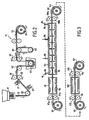
- a first step 10 of the method of Figure 1 consists in spinning a plurality of filaments from a solution of viscose or of cellulose.
- the viscose is of the same type as those that are used for making rayon yarns and that are in widespread use in the textile industry or for reinforcing tires, such as a viscose having an ⁇ -cellulose content of at least 95%, and preferably of at least 98%.
- a cellulose solution may also be used such as a cellulose in a solvent of the n-methyl morpholine oxide type.
- Viscose spinning is well known.
- a yarn 12 is obtained that is made up of a plurality of filaments, typically several hundred filaments, e.g. 1000, thereby forming a 1K filament viscose yarn.
- the yarn 12 is washed (step 20) by spraying water through nozzles 21 on the path of the yarn between deflector rollers 22 and 42.
- the yarn may optionally be squeezed (step 30) by being passed between rollers 31, 32 in order to reduce its water content prior to subsequently impregnating it with an organosilicon additive in aqueous suspension. If squeezing is performed, it is done in such a manner as to obtain a water content lying in the range 10% to 50% of the dry weight of the yarn.
- the washed and non-dried yarn is impregnated with an organosilicon additive in aqueous emulsion by passing through a bath 41 (step 40).
- organosilicon additives that enhance subsequent carbonization of the viscose to obtain a carbon yarn with good mechanical properties are described in the above-cited documents US 2002/0182138 and US 2002/0182139 in the name of the Applicant.
- the organosilicon additive may be a polysiloxane selected from the following families:
- the organosilicon compound may be a siloxane resin made up of motifs of formula SiO 4 (referred to as Q 4 motifs), motifs of formula SiO 3 -OH (referred to Q 3 motifs), and motifs of formula O-Si-R 3 (referred to as M motifs), advantageously constituted by n 1 Q 4 motifs, n 2 Q 3 motifs, and n 3 M motifs, with 2 ⁇ n 1 ⁇ 70, 3 ⁇ n 2 ⁇ 50, and 3 ⁇ n 3 ⁇ 50, and presenting a number average molecular mass lying in the range 2500 to 5000.
- Q 4 motifs motifs of formula SiO 4
- Q 3 motifs motifs of formula SiO 3 -OH
- M motifs motifs of formula O-Si-R 3
- the organosilicon compound may also be selected from oligomers of a partially hydrolyzed organic silicate, advantageously selected from the oligomers of a partially hydrolyzed alkyl silicate, and preferably selected from the oligomers of partially hydrolyzed ethyl silicates.
- the quantity of organosilicon additive amounts to 5% to 50% of the weight of the aqueous suspension.
- inorganic compounds for promoting dehydration of cellulose can also be incorporated in order to increase the carbon yield.
- Such compounds are Lewis bases or acids, for example acid ammonium phosphate or chloride.
- Such an objective can also be achieved by proceeding subsequently with relaxation under an atmosphere of hydrochloric acid HCl.
- the impregnated yarn is squeezed (step 50) by passing between squeezing rollers 51, 52. These are arranged to reduce the liquid content to a value lying in the range 10% to 50% of the dry weight of the yarn.
- the impregnated yarn is dried (step 60) by passing one or more times over heater rollers 61, 62.
- the organosilicon additive content present on the yarn 12 lies in the range 2.5% to 15% by weight, relative to the total weight of the dry yarn.
- the impregnated and dried yarn 12 is then taken to a twisting device 71 to form a twisted yarn 72 (step 70).
- the yarn 12 can be twisted at a rate of 20 turns per minute (tpm) to 100 tpm.
- tpm turns per minute
- a twisted yarn of greater weight may also be obtained by twisting together a plurality of yarns such as the yarn 12.
- the resulting yarn 72 is stored (step 80) by being wound onto a reel 81.
- the yarn 72 is taken from the reel 81 and is inserted in succession into a tunnel furnace 91 in air for relaxation and into a pyrolysis tunnel furnace 93 in nitrogen.
- the yarn 72 is subjected to slow pyrolysis by raising its temperature in a plurality of stages. It is possible to undertake the following:
- the furnace 93 is subdivided into a plurality of zones through which the yarn passes in succession.
- the temperature in each zone is controlled by powering electrical heater resistance elements (such as 94) as a function of information delivered by temperature sensors (not shown).
- Sealing boxes may be provided at the inlet and the outlet of the furnace 93.
- This furnace also presents ducts 95 for exhausting the gaseous byproducts of carbonization and ducts 96 for feeding the furnace with an inert sweeping gas such as nitrogen.
- the number of zones in the furnace and the temperatures thereof are selected in such a manner as to comply with the pre-established temperature rise profile, it being observed that the number of steps during slow pyrolysis could be other than eight, and in particular it could be less than eight by combining successive steps in order to limit the number of zones in the furnace.
- the total transit time through the furnace 93 may lie in the range 30 minutes (min) to 2 h 30 min, for example.
- the slow pyrolysis of the yarn 72 is performed under tension.
- the yarn 72 passes between two drive rollers 97a, 97b upstream from the inlet to the furnace 91, and the resulting carbon yarn 92 passes between two other drive rollers 98a, 98b downstream from the outlet of the furnace 93.
- the speeds of the drive rollers are selected so as to obtain the desired elongation, while avoiding any slip.
- the yarn is the subject of dimensional shrinkage which may be as great as 35% to 40% of its initial size.
- Tension is exerted on the yarn by compensating shrinkage in the longitudinal direction, at least in part, for even compensating shrinkage completely, and possibly causing the yarn to lengthen from its initial state.
- the variation in the longitudinal dimension of the yarn during slow pyrolysis preferably lies in the range -30% to +40%, with this being obtained by differential control of the downstream rollers 98a, 98b relative to the upstream rollers 97a, 97b.
- the yarn 92 is subsequently subjected to final carbonization treatment at high temperature (step 110), in continuity with the pyrolysis stage, or possibly after intermediate storage on a reel 111.
- the treatment is performed in a carbonization furnace 112 at a temperature lying in the range 1200°C to 2800°C for a few minutes, and it may be accompanied by the yarn lengthening, where said elongation lies in the range 0% to 200%, for example.
- the high temperature treatment is performed under an inert atmosphere, e.g. under nitrogen.
- the resulting yarn is stored (step 120) on a reel 121 for subsequent use.
- the fibers of the yarns that have been subjected to final carbonization treatment at a temperature greater than 2500°C under elongation preferably at least equal to 100%, not only become graphitizable, but also develop internal carbon whiskers during subsequent heat treatment when carried out at a temperature greater than 2500°C for a duration ⁇ 15 min, preferably ⁇ 30 min.
- Such subsequent heat treatment may be performed in batch.
- Figure 4 shows such whiskers developed in a carbon fiber of cellulose precursor having been subjected to a heat treatment at 2800°C during 2 min and under elongation of 200% in a continuous process, followed by a further heat treatment at 2800°C during about 1 h in a batch process.
- a sheet may be constituted by filaments or yarns disposed substantially parallel to one another, each yarn itself being made up of a plurality of filaments.
- a sheet may be formed of a plurality of yarns 72 for subsequent continuous carbonization.
- a "Super 2" type rayon yarn was formed by uniting 1000 filaments at the outlet from a spinneret. The yarn was washed in water. The non-squeezed and non-dried yarn was impregnated by passing through a bath of an aqueous emulsion constituted by 60% by weight water and 40% by weight of a mixture of equal parts of emulsions sold under the references Rhodorsil EMUL 55 (based on silicone) and Rhodorsil EMUL 1803 from the supplier Rhodia Silicones. The yarn was squeezed, and then dried by passing over heater rollers at 120°C, prior to being taken to a twisting device in order to obtain a twisted yarn. The organosilicon additive content was about 5% by weight relative to the total weight of the yarn.
- the yarn obtained in that way was relaxed by being passed continuously through a furnace in air at 180°C for 90 min, and was then pyrolyzed by passing continuously through a pyrolysis furnace in a nitrogen atmosphere.
- the pyrolysis furnace was subdivided into six zones of about same length with temperatures set respectively at 210°C, 250°C, 280°C, 310°C, 340°C, and 370°C.
- the yarn spent a period of about 1 h in the pyrolysis furnace.
- the yarn was subjected to tension so as to present elongation of 10% at the outlet from the pyrolysis furnace relative to its state prior to entering the furnace with an atmosphere of air, by causing the outlet speed to be 10% above the inlet speed.
- the yarn was subsequently carbonized at high temperature by passing continuously through a carbonization furnace without being elongated.
- a rayon yarn obtained by uniting 1000 filaments as in Example 1 was dried after washing, and was subjected to textile oiling so as to make the yarn suitable for handling, without being impregnated by an emulsion. After de-oiling, the yarn was thermally stabilized and pyrolyzed by applying the same temperature profile as in Example 1, but without applying tension (pyrolysis with free shrinkage). The pyrolyzed yarn was subsequently carbonized at 1200°C without elongation.
- Example 2 The procedure was as in Example 2, except that the de-oiled yarn was impregnated prior to thermal stabilization and pyrolysis with an organosilicon additive supplied under the reference RTV 121 by the French supplier Rhodia, in solution in tetrachloroethylene. Impregnation was performed so as to leave a quantity of organosilicon additive on the yarn representing 3% of the weight of the dry yarn.
Landscapes
- Chemical & Material Sciences (AREA)
- Chemical Kinetics & Catalysis (AREA)
- General Chemical & Material Sciences (AREA)
- Engineering & Computer Science (AREA)
- Textile Engineering (AREA)
- Inorganic Fibers (AREA)
- Yarns And Mechanical Finishing Of Yarns Or Ropes (AREA)
- Woven Fabrics (AREA)
- Artificial Filaments (AREA)
- Treatment Of Fiber Materials (AREA)
- Paper (AREA)
Claims (14)
- Procédé pour l'obtention de fils ou nappes fibreuses unidirectionnelles en carbone à partir d'un précurseur cellulose, le procédé étant caractérisé en ce qu'il comprend les étapes consistant à :- filer des filaments de cellulose à partir d'une solution de viscose ou d'une solution de cellulose ;- soumettre les filaments de cellulose à un lavage à l'eau ;- imprégner les filaments de cellulose lavés et non séchés par une émulsion aqueuse d'au moins un additif organo-silicié ;- sécher les filaments de cellulose imprégnés ;- obtenir au moins un fil ou une nappe fibreuse unidirectionnelle fait de filaments de cellulose imprégnés et séchés ; et- carboniser le fil ou la nappe fibreuse unidirectionnelle.
- Procédé selon la revendication 1, caractérisé en ce que l'émulsion aqueuse contient 5 % à 50 % en poids d'additif(s) organo-silicié(s).
- Procédé selon la revendication 1 ou 2, caractérisé en ce qu'après imprégnation par l'émulsion aqueuse et avant séchage, les filaments sont essorés pour laisser une quantité d'eau se situant dans la plage de 10 % à 50 % en poids de filaments secs.
- Procédé selon l'une quelconque des revendications 1 à 3, caractérisé en ce que la quantité d'additif organo-silicié se situe dans la plage de 2,5 % à 15 % en poids par rapport au poids total des filaments après séchage.
- Procédé selon l'une quelconque des revendications 1 à 4, caractérisé en ce qu'après séchage et avant carbonisation, un fil est formé par torsion d'une pluralité de filaments imprégnés.
- Procédé selon l'une quelconque des revendications 1 à 4, caractérisé en ce qu'après séchage et avant carbonisation, une nappe fibreuse unidirectionnelle est formée comprenant une pluralité de filaments imprégnés disposés sensiblement parallèlement les uns aux autres.
- Procédé selon la revendication 5, caractérisé en ce qu'avant carbonisation, une nappe unidirectionnelle est formée comprenant une pluralité de fils disposés sensiblement parallèlement les uns aux autres.
- Procédé selon l'une quelconque des revendications 1 à 7, caractérisé en ce que la carbonisation comporte une étape de pyrolyse lente pendant laquelle la température est élevée progressivement jusqu'à une valeur comprise dans la plage de 360°C à 750°C.
- Procédé selon la revendication 8, caractérisé en ce que pendant l'étape de pyrolyse lente, une tension est appliquée au fil ou à la nappe fibreuse de sorte qu'après pyrolyse la variation en dimension longitudinale se situe dans la plage de -30 % à +40 %.
- Procédé selon l'une quelconque des revendications 8 et 9, caractérisé en ce qu'après l'étape de pyrolyse lente, une étape de carbonisation finale est réalisée par traitement thermique à température élevée se situant dans la plage de 1200°C à 2800°C.
- Procédé selon la revendication 10, caractérisé en ce que pendant l'étape de carbonisation finale à température élevée, une tension est appliquée sur le fil ou sur la nappe unidirectionnelle de manière à obtenir un allongement de pas plus de 200 % en direction longitudinale.
- Procédé selon la revendication 11, caractérisé en ce que, après une étape finale de carbonisation à une température supérieure à 2500°C, le fil ou la nappe unidirectionnelle est soumis à un traitement thermique supplémentaire à une température supérieure à 2500°C et pendant une durée d'au moins 15 minutes pour provoquer le développement de whiskers dans les fibres de carbone du fil ou de la nappe unidirectionnelle.
- Procédé selon l'une quelconque des revendications 8 à 12, caractérisé en ce qu'avant pyrolyse lente, une étape de relaxation est réalisée sous air à une température inférieure à 200°C.
- Procédé selon la revendication 13, caractérisé en ce que l'étape de relaxation est réalisée à une température située dans la plage de 160°C à 190°C.
Priority Applications (14)
| Application Number | Priority Date | Filing Date | Title |
|---|---|---|---|
| AT04292902T ATE361383T1 (de) | 2004-12-07 | 2004-12-07 | Verfahren zur herstellung von garnen oder faserblättern aus kohlenstoff ausgehend von einem cellulosematerial |
| EP04292902A EP1669480B1 (fr) | 2004-12-07 | 2004-12-07 | Méthode pour obtenir des fils ou des feuilles à base de fibre de carbon à partir d'un précurseur cellulosique |
| DE602004006285T DE602004006285T2 (de) | 2004-12-07 | 2004-12-07 | Verfahren zur Herstellung von Garnen oder Faserblättern aus Kohlenstoff ausgehend von einem Cellulosematerial |
| JP2007544902A JP5253811B2 (ja) | 2004-12-07 | 2005-12-06 | セルロース前駆体を炭化することにより炭素の繊維テクスチャーを得ること |
| EP05816104A EP1819852B1 (fr) | 2004-12-07 | 2005-12-06 | Procede destine a obtenir des feuilles de carbone en fibre ou en fil a partir de precurseur cellulosique |
| MX2007006773A MX2007006773A (es) | 2004-12-07 | 2005-12-06 | Metodo para obtener hilos o laminados de fibras de carbono a partir de un precursor de celulosa. |
| AT05816104T ATE414806T1 (de) | 2004-12-07 | 2005-12-06 | Verfahren zur herstellung von carbongarnen oder vliesen aus einem celluloseprecursor |
| RU2007119609/04A RU2394949C2 (ru) | 2004-12-07 | 2005-12-06 | Способ получения углеродных волокнистых структур путем карбонизации целлюлозного предшественника |
| UAA200706286A UA88489C2 (uk) | 2004-12-07 | 2005-12-06 | Спосіб одержання вуглецевої волокнистої структури з целюлозного попередника |
| CNB2005800419546A CN100564622C (zh) | 2004-12-07 | 2005-12-06 | 通过碳化纤维素前体获得碳纤维结构 |
| BRPI0519062A BRPI0519062B1 (pt) | 2004-12-07 | 2005-12-06 | método de obtenção de uma textura de fibra de carbono de um precursor de celulose |
| DE602005011172T DE602005011172D1 (de) | 2004-12-07 | 2005-12-06 | Verfahren zur herstellung von carbongarnen oder vliesen aus einem celluloseprecursor |
| US11/792,451 US7879271B2 (en) | 2004-12-07 | 2005-12-06 | Obtaining fiber textures of carbon by carbonizing a cellulose precursor |
| PCT/EP2005/056524 WO2006061386A1 (fr) | 2004-12-07 | 2005-12-06 | Procede destine a obtenir des feuilles de carbone en fibre ou en fil a partir de precurseur cellulosique |
Applications Claiming Priority (1)
| Application Number | Priority Date | Filing Date | Title |
|---|---|---|---|
| EP04292902A EP1669480B1 (fr) | 2004-12-07 | 2004-12-07 | Méthode pour obtenir des fils ou des feuilles à base de fibre de carbon à partir d'un précurseur cellulosique |
Publications (2)
| Publication Number | Publication Date |
|---|---|
| EP1669480A1 EP1669480A1 (fr) | 2006-06-14 |
| EP1669480B1 true EP1669480B1 (fr) | 2007-05-02 |
Family
ID=34931585
Family Applications (2)
| Application Number | Title | Priority Date | Filing Date |
|---|---|---|---|
| EP04292902A Expired - Lifetime EP1669480B1 (fr) | 2004-12-07 | 2004-12-07 | Méthode pour obtenir des fils ou des feuilles à base de fibre de carbon à partir d'un précurseur cellulosique |
| EP05816104A Expired - Lifetime EP1819852B1 (fr) | 2004-12-07 | 2005-12-06 | Procede destine a obtenir des feuilles de carbone en fibre ou en fil a partir de precurseur cellulosique |
Family Applications After (1)
| Application Number | Title | Priority Date | Filing Date |
|---|---|---|---|
| EP05816104A Expired - Lifetime EP1819852B1 (fr) | 2004-12-07 | 2005-12-06 | Procede destine a obtenir des feuilles de carbone en fibre ou en fil a partir de precurseur cellulosique |
Country Status (11)
| Country | Link |
|---|---|
| US (1) | US7879271B2 (fr) |
| EP (2) | EP1669480B1 (fr) |
| JP (1) | JP5253811B2 (fr) |
| CN (1) | CN100564622C (fr) |
| AT (2) | ATE361383T1 (fr) |
| BR (1) | BRPI0519062B1 (fr) |
| DE (2) | DE602004006285T2 (fr) |
| MX (1) | MX2007006773A (fr) |
| RU (1) | RU2394949C2 (fr) |
| UA (1) | UA88489C2 (fr) |
| WO (1) | WO2006061386A1 (fr) |
Families Citing this family (20)
| Publication number | Priority date | Publication date | Assignee | Title |
|---|---|---|---|---|
| FR2909920B1 (fr) * | 2006-12-15 | 2009-03-20 | Snecma Propulsion Solide Sa | Procede de realisation d'un ensemble carter-divergent |
| KR101427813B1 (ko) | 2008-12-23 | 2014-08-08 | 주식회사 효성 | 탄소섬유용 아크릴로니트릴계 전구체 섬유의 제조방법 |
| JP5271887B2 (ja) * | 2009-05-08 | 2013-08-21 | 国防科学研究所 | ライオセル系炭素繊維及び炭素織物の製造方法 |
| MX339655B (es) * | 2010-04-07 | 2016-06-02 | Dsm Ip Assets B V * | Ovillo con hilo de módulo elástico longitudinal alto y método para bobinar el ovillo de hilo. |
| RU2494109C2 (ru) * | 2010-09-20 | 2013-09-27 | Российская Федерация, От Имени Которой Выступает Министерство Промышленности И Торговли Российской Федерации | Способ получения гидрогеля нанокристаллической целлюлозы |
| US9181134B1 (en) | 2011-04-27 | 2015-11-10 | Israzion Ltd. | Process of converting textile solid waste into graphite simple or complex shaped manufacture |
| EP2524980A1 (fr) * | 2011-05-18 | 2012-11-21 | Fraunhofer-Gesellschaft zur Förderung der angewandten Forschung e.V. | Procédé de fabrication de fibres de précurseur contenant de la lignine et de fibres de carbone |
| EA022544B1 (ru) * | 2012-04-26 | 2016-01-29 | Открытое Акционерное Общество "Светлогорскхимволокно" | Способ получения углеродных волокнистых материалов из гидратцеллюлозных волокон |
| RU2506356C1 (ru) * | 2012-07-13 | 2014-02-10 | Открытое акционерное общество "Научно-исследовательский институт конструкционных материалов на основе графита "НИИграфит" | Установка карбонизации волокнистых вискозных материалов для получения комбинированных углеродных нитей |
| SI2783764T1 (sl) * | 2013-03-28 | 2016-11-30 | Elg Carbon Fibre International Gmbh | Pirolizna naprava in postopek za ponovno pridobivanje ogljikovih vlaken iz umetnih snovi, ki vsebujejo ogljikova vlakna, in ponovno pridobljena ogljikova vlakna |
| DE102013218639A1 (de) * | 2013-09-17 | 2015-03-19 | Bayerische Motoren Werke Aktiengesellschaft | Verfahren zur Herstellung eines Faserverbundhalbzeuges sowie Faserverbundhalbzeug |
| EP3143187B1 (fr) * | 2014-05-16 | 2020-11-11 | Deutsche Institute für Textil- und Faserforschung Denkendorf | Procédé de production de fibres de carbone à partir de fibres de cellulose |
| AU2016276410B2 (en) | 2015-06-11 | 2020-06-18 | Stora Enso Oyj | A fiber and a process for the manufacture thereof |
| CN108138380B (zh) * | 2015-10-08 | 2021-09-21 | 斯道拉恩索公司 | 制造前体纱线的方法 |
| FR3058167B1 (fr) * | 2016-10-28 | 2019-11-22 | Arkema France | Nouveau procede de fabrication de materiaux hautement carbones et materiau hautement carbone obtenu |
| FR3058166B1 (fr) * | 2016-10-28 | 2018-11-23 | Arkema France | Procede de fabrication de fibres de carbone a partir de precurseurs biosources et fibres de carbone obtenues |
| WO2018186923A2 (fr) | 2017-01-16 | 2018-10-11 | Spectre Enterprises, Inc. | Agent propulsif |
| FR3083547B1 (fr) | 2018-07-09 | 2021-07-30 | Inst De Rech Tech Jules Verne | Fibre de carbone et procede de fabrication d’une telle fibre de carbone a partir de cellulose |
| FR3096691B1 (fr) * | 2019-05-29 | 2021-06-25 | Inst De Rech Tech Jules Verne | Procédé de fabrication d’une fibre de carbone à partir d’une fibre de cellulose |
| KR102894677B1 (ko) * | 2024-12-09 | 2025-12-03 | 올리브씨엔에스 주식회사 | 탄소소재 전환용 셀룰로오스 연속식 안정화로 |
Family Cites Families (18)
| Publication number | Priority date | Publication date | Assignee | Title |
|---|---|---|---|---|
| US2978788A (en) * | 1955-07-13 | 1961-04-11 | Du Pont | Process for treating synthetic yarn |
| US3969268A (en) * | 1974-12-31 | 1976-07-13 | Toyobo Co., Ltd. | Process for preparing active carbon fibers |
| US4076932A (en) * | 1976-02-27 | 1978-02-28 | International Telephone And Telegraph Corporation | Process for producing regenerated cellulosic articles |
| FR2372268A1 (fr) * | 1976-11-30 | 1978-06-23 | Rhone Poulenc Ind | Procede de lubrification du fil a coudre par impregnation en bains aqueux contenant des polymeres organosiliciques |
| US4123398A (en) * | 1977-05-25 | 1978-10-31 | International Telephone And Telegraph Corporation | Flame resistant cellulosic product containing antimony pentoxide and polyvinyl bromide |
| JPS5795313A (en) * | 1981-10-16 | 1982-06-14 | Toyobo Co Ltd | Production of carbon fiber |
| JPS59179885A (ja) * | 1983-03-31 | 1984-10-12 | 松本油脂製薬株式会社 | 炭素繊維原糸用処理剤 |
| JPS62191518A (ja) * | 1986-02-10 | 1987-08-21 | Toa Nenryo Kogyo Kk | 炭素繊維及び黒鉛繊維の製造方法 |
| JPH11204114A (ja) * | 1998-01-20 | 1999-07-30 | Daikin Ind Ltd | 電極材料 |
| FR2801907B1 (fr) * | 1999-12-06 | 2002-03-01 | Snecma | Carbonisation de materiaux fibreux cellulosiques en presence d'un compose organosilicie |
| FR2801906B1 (fr) * | 1999-12-06 | 2002-03-01 | Snecma | Carbonisation de materiaux fibreux cellulosiques en presence d'un compose organosilicie |
| FR2801908B1 (fr) | 1999-12-06 | 2002-03-01 | Snecma | Procede pour l'obtention de tissu en fibres de carbone par carbonisation en continu d'un tissu en fibres cellulosiques |
| CN1116454C (zh) * | 2000-02-02 | 2003-07-30 | 中国人民解放军国防科学技术大学 | 高强度粘胶碳纤维的制备方法 |
| DE10036678A1 (de) * | 2000-07-27 | 2002-02-14 | Wacker Chemie Gmbh | Ammoniumgruppen aufweisende Organosiliciumverbindungen |
| DE10115476A1 (de) * | 2001-03-29 | 2002-10-10 | Wacker Chemie Gmbh | Verfahren zur Behandlung von organischen Fasern |
| JP2002355538A (ja) * | 2001-05-30 | 2002-12-10 | Asahi Medical Co Ltd | 炭素繊維中空糸膜用セルロース中空糸膜およびその製造方法 |
| DE10238818A1 (de) * | 2002-08-23 | 2004-03-04 | Wacker-Chemie Gmbh | Cyclodextrinreste aufweisende Organosiliciumverbindungen |
| JP2004084147A (ja) * | 2002-08-29 | 2004-03-18 | Mitsubishi Chemicals Corp | 炭素質繊維織布 |
-
2004
- 2004-12-07 EP EP04292902A patent/EP1669480B1/fr not_active Expired - Lifetime
- 2004-12-07 AT AT04292902T patent/ATE361383T1/de active
- 2004-12-07 DE DE602004006285T patent/DE602004006285T2/de not_active Expired - Lifetime
-
2005
- 2005-12-06 AT AT05816104T patent/ATE414806T1/de active
- 2005-12-06 US US11/792,451 patent/US7879271B2/en active Active
- 2005-12-06 UA UAA200706286A patent/UA88489C2/uk unknown
- 2005-12-06 BR BRPI0519062A patent/BRPI0519062B1/pt not_active IP Right Cessation
- 2005-12-06 EP EP05816104A patent/EP1819852B1/fr not_active Expired - Lifetime
- 2005-12-06 JP JP2007544902A patent/JP5253811B2/ja not_active Expired - Fee Related
- 2005-12-06 DE DE602005011172T patent/DE602005011172D1/de not_active Expired - Lifetime
- 2005-12-06 MX MX2007006773A patent/MX2007006773A/es active IP Right Grant
- 2005-12-06 CN CNB2005800419546A patent/CN100564622C/zh not_active Expired - Fee Related
- 2005-12-06 RU RU2007119609/04A patent/RU2394949C2/ru not_active IP Right Cessation
- 2005-12-06 WO PCT/EP2005/056524 patent/WO2006061386A1/fr not_active Ceased
Also Published As
| Publication number | Publication date |
|---|---|
| CN100564622C (zh) | 2009-12-02 |
| EP1819852B1 (fr) | 2008-11-19 |
| ATE414806T1 (de) | 2008-12-15 |
| RU2007119609A (ru) | 2009-01-20 |
| MX2007006773A (es) | 2007-08-06 |
| CN101072903A (zh) | 2007-11-14 |
| DE602004006285D1 (de) | 2007-06-14 |
| BRPI0519062A2 (pt) | 2008-12-23 |
| JP2008523261A (ja) | 2008-07-03 |
| BRPI0519062B1 (pt) | 2016-05-17 |
| WO2006061386A1 (fr) | 2006-06-15 |
| US20090121380A1 (en) | 2009-05-14 |
| ATE361383T1 (de) | 2007-05-15 |
| RU2394949C2 (ru) | 2010-07-20 |
| EP1819852A1 (fr) | 2007-08-22 |
| EP1669480A1 (fr) | 2006-06-14 |
| DE602005011172D1 (de) | 2009-01-02 |
| JP5253811B2 (ja) | 2013-07-31 |
| DE602004006285T2 (de) | 2007-12-20 |
| UA88489C2 (uk) | 2009-10-26 |
| US7879271B2 (en) | 2011-02-01 |
Similar Documents
| Publication | Publication Date | Title |
|---|---|---|
| EP1669480B1 (fr) | Méthode pour obtenir des fils ou des feuilles à base de fibre de carbon à partir d'un précurseur cellulosique | |
| CA2968266C (fr) | Procede de carbonisation continue et systeme de production de fibres de carbone | |
| EP1179096B1 (fr) | Procede pour l'obtention de tissu en fibres de carbone par carbonisation en continu d'un tissu en fibres cellulosiques | |
| US20020182139A1 (en) | Carbonization of cellulosic fibrous materials in the presence of an organosilicon compound | |
| RU2741012C1 (ru) | Способ получения углеродного волокна и материалов на его основе | |
| EP0163339B1 (fr) | Fibres de carbone et méthodes pour leur fabrication | |
| JPS59223315A (ja) | ピツチ系炭素繊維の製造法 | |
| JP2596092B2 (ja) | 炭素繊維用原糸の製法 | |
| JP2582848B2 (ja) | ピッチ系炭素繊維の製造方法 | |
| JP2763001B2 (ja) | ピツチ系炭素繊維の製造方法 | |
| JP2708055B2 (ja) | ピッチ系炭素繊維の製造法 | |
| JPH04257323A (ja) | ピッチ系炭素繊維及び黒鉛繊維の製造方法 | |
| JPH08246250A (ja) | 炭素繊維の製造方法 | |
| JPH04272234A (ja) | ピッチ系炭素繊維及び黒鉛繊維の製造方法 | |
| KR20020054001A (ko) | 고강력, 저수축 폴리에스터사 및 그 제조방법 | |
| JPH04257322A (ja) | ピッチ系炭素繊維及び黒鉛繊維の製造方法 | |
| JPH04245923A (ja) | ピッチ系炭素繊維及び黒鉛繊維の製造方法 | |
| JPH04272235A (ja) | ピッチ系炭素繊維及び黒鉛繊維の製造方法 | |
| JPH04119126A (ja) | ピッチ系炭素繊維及び黒鉛繊維の製造方法 | |
| JPH04272232A (ja) | ピッチ系炭素繊維及び黒鉛繊維の製造方法 | |
| JPH04272233A (ja) | ピッチ系炭素繊維及び黒鉛繊維の製造方法 | |
| JPH04119125A (ja) | ピッチ系炭素繊維及び黒鉛繊維の製造方法 |
Legal Events
| Date | Code | Title | Description |
|---|---|---|---|
| PUAI | Public reference made under article 153(3) epc to a published international application that has entered the european phase |
Free format text: ORIGINAL CODE: 0009012 |
|
| 17P | Request for examination filed |
Effective date: 20041215 |
|
| AK | Designated contracting states |
Kind code of ref document: A1 Designated state(s): AT BE BG CH CY CZ DE DK EE ES FI FR GB GR HU IE IS IT LI LT LU MC NL PL PT RO SE SI SK TR |
|
| AX | Request for extension of the european patent |
Extension state: AL BA HR LV MK YU |
|
| 17Q | First examination report despatched |
Effective date: 20060803 |
|
| GRAP | Despatch of communication of intention to grant a patent |
Free format text: ORIGINAL CODE: EPIDOSNIGR1 |
|
| AKX | Designation fees paid |
Designated state(s): AT BE BG CH CY CZ DE DK EE ES FI FR GB GR HU IE IS IT LI LT LU MC NL PL PT RO SE SI SK TR |
|
| GRAS | Grant fee paid |
Free format text: ORIGINAL CODE: EPIDOSNIGR3 |
|
| GRAA | (expected) grant |
Free format text: ORIGINAL CODE: 0009210 |
|
| AK | Designated contracting states |
Kind code of ref document: B1 Designated state(s): AT BE BG CH CY CZ DE DK EE ES FI FR GB GR HU IE IS IT LI LT LU MC NL PL PT RO SE SI SK TR |
|
| PG25 | Lapsed in a contracting state [announced via postgrant information from national office to epo] |
Ref country code: CH Free format text: LAPSE BECAUSE OF FAILURE TO SUBMIT A TRANSLATION OF THE DESCRIPTION OR TO PAY THE FEE WITHIN THE PRESCRIBED TIME-LIMIT Effective date: 20070502 Ref country code: LI Free format text: LAPSE BECAUSE OF FAILURE TO SUBMIT A TRANSLATION OF THE DESCRIPTION OR TO PAY THE FEE WITHIN THE PRESCRIBED TIME-LIMIT Effective date: 20070502 Ref country code: FI Free format text: LAPSE BECAUSE OF FAILURE TO SUBMIT A TRANSLATION OF THE DESCRIPTION OR TO PAY THE FEE WITHIN THE PRESCRIBED TIME-LIMIT Effective date: 20070502 |
|
| REG | Reference to a national code |
Ref country code: GB Ref legal event code: FG4D |
|
| REG | Reference to a national code |
Ref country code: CH Ref legal event code: EP |
|
| REG | Reference to a national code |
Ref country code: IE Ref legal event code: FG4D |
|
| REF | Corresponds to: |
Ref document number: 602004006285 Country of ref document: DE Date of ref document: 20070614 Kind code of ref document: P |
|
| PG25 | Lapsed in a contracting state [announced via postgrant information from national office to epo] |
Ref country code: SE Free format text: LAPSE BECAUSE OF FAILURE TO SUBMIT A TRANSLATION OF THE DESCRIPTION OR TO PAY THE FEE WITHIN THE PRESCRIBED TIME-LIMIT Effective date: 20070802 |
|
| PG25 | Lapsed in a contracting state [announced via postgrant information from national office to epo] |
Ref country code: ES Free format text: LAPSE BECAUSE OF FAILURE TO SUBMIT A TRANSLATION OF THE DESCRIPTION OR TO PAY THE FEE WITHIN THE PRESCRIBED TIME-LIMIT Effective date: 20070813 |
|
| PG25 | Lapsed in a contracting state [announced via postgrant information from national office to epo] |
Ref country code: IS Free format text: LAPSE BECAUSE OF FAILURE TO SUBMIT A TRANSLATION OF THE DESCRIPTION OR TO PAY THE FEE WITHIN THE PRESCRIBED TIME-LIMIT Effective date: 20070902 |
|
| ET | Fr: translation filed | ||
| NLV1 | Nl: lapsed or annulled due to failure to fulfill the requirements of art. 29p and 29m of the patents act | ||
| REG | Reference to a national code |
Ref country code: CH Ref legal event code: PL |
|
| PG25 | Lapsed in a contracting state [announced via postgrant information from national office to epo] |
Ref country code: PL Free format text: LAPSE BECAUSE OF FAILURE TO SUBMIT A TRANSLATION OF THE DESCRIPTION OR TO PAY THE FEE WITHIN THE PRESCRIBED TIME-LIMIT Effective date: 20070502 |
|
| PG25 | Lapsed in a contracting state [announced via postgrant information from national office to epo] |
Ref country code: BE Free format text: LAPSE BECAUSE OF FAILURE TO SUBMIT A TRANSLATION OF THE DESCRIPTION OR TO PAY THE FEE WITHIN THE PRESCRIBED TIME-LIMIT Effective date: 20070502 |
|
| PG25 | Lapsed in a contracting state [announced via postgrant information from national office to epo] |
Ref country code: NL Free format text: LAPSE BECAUSE OF FAILURE TO SUBMIT A TRANSLATION OF THE DESCRIPTION OR TO PAY THE FEE WITHIN THE PRESCRIBED TIME-LIMIT Effective date: 20070502 Ref country code: BG Free format text: LAPSE BECAUSE OF FAILURE TO SUBMIT A TRANSLATION OF THE DESCRIPTION OR TO PAY THE FEE WITHIN THE PRESCRIBED TIME-LIMIT Effective date: 20070802 Ref country code: DK Free format text: LAPSE BECAUSE OF FAILURE TO SUBMIT A TRANSLATION OF THE DESCRIPTION OR TO PAY THE FEE WITHIN THE PRESCRIBED TIME-LIMIT Effective date: 20070502 Ref country code: SI Free format text: LAPSE BECAUSE OF FAILURE TO SUBMIT A TRANSLATION OF THE DESCRIPTION OR TO PAY THE FEE WITHIN THE PRESCRIBED TIME-LIMIT Effective date: 20070502 |
|
| PG25 | Lapsed in a contracting state [announced via postgrant information from national office to epo] |
Ref country code: LT Free format text: LAPSE BECAUSE OF FAILURE TO SUBMIT A TRANSLATION OF THE DESCRIPTION OR TO PAY THE FEE WITHIN THE PRESCRIBED TIME-LIMIT Effective date: 20070502 Ref country code: SK Free format text: LAPSE BECAUSE OF FAILURE TO SUBMIT A TRANSLATION OF THE DESCRIPTION OR TO PAY THE FEE WITHIN THE PRESCRIBED TIME-LIMIT Effective date: 20070502 |
|
| PLBE | No opposition filed within time limit |
Free format text: ORIGINAL CODE: 0009261 |
|
| STAA | Information on the status of an ep patent application or granted ep patent |
Free format text: STATUS: NO OPPOSITION FILED WITHIN TIME LIMIT |
|
| 26N | No opposition filed |
Effective date: 20080205 |
|
| PG25 | Lapsed in a contracting state [announced via postgrant information from national office to epo] |
Ref country code: GR Free format text: LAPSE BECAUSE OF FAILURE TO SUBMIT A TRANSLATION OF THE DESCRIPTION OR TO PAY THE FEE WITHIN THE PRESCRIBED TIME-LIMIT Effective date: 20070803 |
|
| PG25 | Lapsed in a contracting state [announced via postgrant information from national office to epo] |
Ref country code: RO Free format text: LAPSE BECAUSE OF FAILURE TO SUBMIT A TRANSLATION OF THE DESCRIPTION OR TO PAY THE FEE WITHIN THE PRESCRIBED TIME-LIMIT Effective date: 20070502 |
|
| PG25 | Lapsed in a contracting state [announced via postgrant information from national office to epo] |
Ref country code: MC Free format text: LAPSE BECAUSE OF NON-PAYMENT OF DUE FEES Effective date: 20071231 |
|
| PG25 | Lapsed in a contracting state [announced via postgrant information from national office to epo] |
Ref country code: IE Free format text: LAPSE BECAUSE OF NON-PAYMENT OF DUE FEES Effective date: 20071207 |
|
| PG25 | Lapsed in a contracting state [announced via postgrant information from national office to epo] |
Ref country code: EE Free format text: LAPSE BECAUSE OF FAILURE TO SUBMIT A TRANSLATION OF THE DESCRIPTION OR TO PAY THE FEE WITHIN THE PRESCRIBED TIME-LIMIT Effective date: 20070502 |
|
| PG25 | Lapsed in a contracting state [announced via postgrant information from national office to epo] |
Ref country code: CY Free format text: LAPSE BECAUSE OF FAILURE TO SUBMIT A TRANSLATION OF THE DESCRIPTION OR TO PAY THE FEE WITHIN THE PRESCRIBED TIME-LIMIT Effective date: 20070502 |
|
| PG25 | Lapsed in a contracting state [announced via postgrant information from national office to epo] |
Ref country code: HU Free format text: LAPSE BECAUSE OF FAILURE TO SUBMIT A TRANSLATION OF THE DESCRIPTION OR TO PAY THE FEE WITHIN THE PRESCRIBED TIME-LIMIT Effective date: 20071103 Ref country code: TR Free format text: LAPSE BECAUSE OF FAILURE TO SUBMIT A TRANSLATION OF THE DESCRIPTION OR TO PAY THE FEE WITHIN THE PRESCRIBED TIME-LIMIT Effective date: 20070502 |
|
| PG25 | Lapsed in a contracting state [announced via postgrant information from national office to epo] |
Ref country code: PT Free format text: LAPSE BECAUSE OF FAILURE TO SUBMIT A TRANSLATION OF THE DESCRIPTION OR TO PAY THE FEE WITHIN THE PRESCRIBED TIME-LIMIT Effective date: 20070502 |
|
| REG | Reference to a national code |
Ref country code: DE Ref legal event code: R082 Ref document number: 602004006285 Country of ref document: DE Representative=s name: CBDL PATENTANWAELTE, DE |
|
| REG | Reference to a national code |
Ref country code: DE Ref legal event code: R081 Ref document number: 602004006285 Country of ref document: DE Owner name: HERAKLES, FR Free format text: FORMER OWNER: SNECMA PROPULSION SOLIDE, LE HAILLAN, FR Effective date: 20130114 Ref country code: DE Ref legal event code: R082 Ref document number: 602004006285 Country of ref document: DE Representative=s name: CBDL PATENTANWAELTE, DE Effective date: 20130114 Ref country code: DE Ref legal event code: R081 Ref document number: 602004006285 Country of ref document: DE Owner name: SAFRAN CERAMICS, FR Free format text: FORMER OWNER: SNECMA PROPULSION SOLIDE, LE HAILLAN, FR Effective date: 20130114 |
|
| REG | Reference to a national code |
Ref country code: GB Ref legal event code: 732E Free format text: REGISTERED BETWEEN 20130221 AND 20130227 |
|
| REG | Reference to a national code |
Ref country code: FR Ref legal event code: TP Owner name: HERAKLES, FR Effective date: 20130513 |
|
| REG | Reference to a national code |
Ref country code: AT Ref legal event code: PC Ref document number: 361383 Country of ref document: AT Kind code of ref document: T Owner name: HERAKLES, FR Effective date: 20140311 |
|
| REG | Reference to a national code |
Ref country code: FR Ref legal event code: PLFP Year of fee payment: 12 |
|
| REG | Reference to a national code |
Ref country code: FR Ref legal event code: PLFP Year of fee payment: 13 |
|
| REG | Reference to a national code |
Ref country code: FR Ref legal event code: CD Owner name: HERAKLES, FR Effective date: 20170725 |
|
| REG | Reference to a national code |
Ref country code: FR Ref legal event code: PLFP Year of fee payment: 14 |
|
| REG | Reference to a national code |
Ref country code: DE Ref legal event code: R082 Ref document number: 602004006285 Country of ref document: DE Representative=s name: CBDL PATENTANWAELTE, DE Ref country code: DE Ref legal event code: R081 Ref document number: 602004006285 Country of ref document: DE Owner name: SAFRAN CERAMICS, FR Free format text: FORMER OWNER: HERAKLES, LE HAILLAN, FR |
|
| REG | Reference to a national code |
Ref country code: GB Ref legal event code: 732E Free format text: REGISTERED BETWEEN 20180628 AND 20180706 |
|
| REG | Reference to a national code |
Ref country code: AT Ref legal event code: HC Ref document number: 361383 Country of ref document: AT Kind code of ref document: T Owner name: SAFRAN CERAMICS, FR Effective date: 20180810 Ref country code: AT Ref legal event code: HC Ref document number: 361383 Country of ref document: AT Kind code of ref document: T Owner name: C/O CBDL PATENTANWAELTE, DE Effective date: 20180810 |
|
| REG | Reference to a national code |
Ref country code: LU Ref legal event code: HC Owner name: SAFRAN CERAMICS; FR Free format text: FORMER OWNER: HERAKLES Effective date: 20180803 Ref country code: LU Ref legal event code: PD Owner name: ARIANEGROUP SAS; FR Free format text: FORMER OWNER: SAFRAN CERAMICS Effective date: 20180803 |
|
| REG | Reference to a national code |
Ref country code: FR Ref legal event code: TP Owner name: ARIANEGROUP SAS, FR Effective date: 20181008 |
|
| PGFP | Annual fee paid to national office [announced via postgrant information from national office to epo] |
Ref country code: LU Payment date: 20181120 Year of fee payment: 15 |
|
| REG | Reference to a national code |
Ref country code: AT Ref legal event code: PC Ref document number: 361383 Country of ref document: AT Kind code of ref document: T Owner name: C/O CBDL PATENTANWAELTE, DE Effective date: 20181121 Ref country code: AT Ref legal event code: PC Ref document number: 361383 Country of ref document: AT Kind code of ref document: T Owner name: ARIANEGROUP SAS, FR Effective date: 20181121 |
|
| PGFP | Annual fee paid to national office [announced via postgrant information from national office to epo] |
Ref country code: AT Payment date: 20181120 Year of fee payment: 15 Ref country code: DE Payment date: 20181211 Year of fee payment: 15 Ref country code: CZ Payment date: 20181121 Year of fee payment: 15 |
|
| PGFP | Annual fee paid to national office [announced via postgrant information from national office to epo] |
Ref country code: IT Payment date: 20181123 Year of fee payment: 14 Ref country code: GB Payment date: 20181218 Year of fee payment: 15 |
|
| REG | Reference to a national code |
Ref country code: DE Ref legal event code: R119 Ref document number: 602004006285 Country of ref document: DE |
|
| PG25 | Lapsed in a contracting state [announced via postgrant information from national office to epo] |
Ref country code: CZ Free format text: LAPSE BECAUSE OF NON-PAYMENT OF DUE FEES Effective date: 20191207 |
|
| REG | Reference to a national code |
Ref country code: AT Ref legal event code: MM01 Ref document number: 361383 Country of ref document: AT Kind code of ref document: T Effective date: 20191207 |
|
| GBPC | Gb: european patent ceased through non-payment of renewal fee |
Effective date: 20191207 |
|
| PG25 | Lapsed in a contracting state [announced via postgrant information from national office to epo] |
Ref country code: LU Free format text: LAPSE BECAUSE OF NON-PAYMENT OF DUE FEES Effective date: 20191207 Ref country code: IT Free format text: LAPSE BECAUSE OF NON-PAYMENT OF DUE FEES Effective date: 20191207 Ref country code: DE Free format text: LAPSE BECAUSE OF NON-PAYMENT OF DUE FEES Effective date: 20200701 Ref country code: GB Free format text: LAPSE BECAUSE OF NON-PAYMENT OF DUE FEES Effective date: 20191207 |
|
| PG25 | Lapsed in a contracting state [announced via postgrant information from national office to epo] |
Ref country code: AT Free format text: LAPSE BECAUSE OF NON-PAYMENT OF DUE FEES Effective date: 20191207 |
|
| PGFP | Annual fee paid to national office [announced via postgrant information from national office to epo] |
Ref country code: FR Payment date: 20201223 Year of fee payment: 17 |
|
| PG25 | Lapsed in a contracting state [announced via postgrant information from national office to epo] |
Ref country code: FR Free format text: LAPSE BECAUSE OF NON-PAYMENT OF DUE FEES Effective date: 20211231 |