EP1677148A2 - Vorrichtung zur Korrektur einer ungleichmässigen Beleuchtung in einem lithographischen Apparat - Google Patents
Vorrichtung zur Korrektur einer ungleichmässigen Beleuchtung in einem lithographischen Apparat Download PDFInfo
- Publication number
- EP1677148A2 EP1677148A2 EP05027804A EP05027804A EP1677148A2 EP 1677148 A2 EP1677148 A2 EP 1677148A2 EP 05027804 A EP05027804 A EP 05027804A EP 05027804 A EP05027804 A EP 05027804A EP 1677148 A2 EP1677148 A2 EP 1677148A2
- Authority
- EP
- European Patent Office
- Prior art keywords
- gap
- correction
- optical compensation
- compensation plate
- pattern
- Prior art date
- Legal status (The legal status is an assumption and is not a legal conclusion. Google has not performed a legal analysis and makes no representation as to the accuracy of the status listed.)
- Withdrawn
Links
Images





Classifications
-
- H—ELECTRICITY
- H10—SEMICONDUCTOR DEVICES; ELECTRIC SOLID-STATE DEVICES NOT OTHERWISE PROVIDED FOR
- H10P—GENERIC PROCESSES OR APPARATUS FOR THE MANUFACTURE OR TREATMENT OF DEVICES COVERED BY CLASS H10
- H10P76/00—Manufacture or treatment of masks on semiconductor bodies, e.g. by lithography or photolithography
- H10P76/20—Manufacture or treatment of masks on semiconductor bodies, e.g. by lithography or photolithography of masks comprising organic materials
- H10P76/204—Manufacture or treatment of masks on semiconductor bodies, e.g. by lithography or photolithography of masks comprising organic materials of organic photoresist masks
-
- G—PHYSICS
- G03—PHOTOGRAPHY; CINEMATOGRAPHY; ANALOGOUS TECHNIQUES USING WAVES OTHER THAN OPTICAL WAVES; ELECTROGRAPHY; HOLOGRAPHY
- G03F—PHOTOMECHANICAL PRODUCTION OF TEXTURED OR PATTERNED SURFACES, e.g. FOR PRINTING, FOR PROCESSING OF SEMICONDUCTOR DEVICES; MATERIALS THEREFOR; ORIGINALS THEREFOR; APPARATUS SPECIALLY ADAPTED THEREFOR
- G03F7/00—Photomechanical, e.g. photolithographic, production of textured or patterned surfaces, e.g. printing surfaces; Materials therefor, e.g. comprising photoresists; Apparatus specially adapted therefor
- G03F7/70—Microphotolithographic exposure; Apparatus therefor
- G03F7/70058—Mask illumination systems
- G03F7/70191—Optical correction elements, filters or phase plates for controlling intensity, wavelength, polarisation, phase or the like
-
- G—PHYSICS
- G02—OPTICS
- G02B—OPTICAL ELEMENTS, SYSTEMS OR APPARATUS
- G02B5/00—Optical elements other than lenses
- G02B5/003—Light absorbing elements
-
- G—PHYSICS
- G03—PHOTOGRAPHY; CINEMATOGRAPHY; ANALOGOUS TECHNIQUES USING WAVES OTHER THAN OPTICAL WAVES; ELECTROGRAPHY; HOLOGRAPHY
- G03B—APPARATUS OR ARRANGEMENTS FOR TAKING PHOTOGRAPHS OR FOR PROJECTING OR VIEWING THEM; APPARATUS OR ARRANGEMENTS EMPLOYING ANALOGOUS TECHNIQUES USING WAVES OTHER THAN OPTICAL WAVES; ACCESSORIES THEREFOR
- G03B27/00—Photographic printing apparatus
- G03B27/72—Controlling or varying light intensity, spectral composition, or exposure time in photographic printing apparatus
- G03B27/727—Optical projection devices wherein the contrast is controlled optically (e.g. uniform exposure, two colour exposure on variable contrast sensitive material)
-
- G—PHYSICS
- G03—PHOTOGRAPHY; CINEMATOGRAPHY; ANALOGOUS TECHNIQUES USING WAVES OTHER THAN OPTICAL WAVES; ELECTROGRAPHY; HOLOGRAPHY
- G03F—PHOTOMECHANICAL PRODUCTION OF TEXTURED OR PATTERNED SURFACES, e.g. FOR PRINTING, FOR PROCESSING OF SEMICONDUCTOR DEVICES; MATERIALS THEREFOR; ORIGINALS THEREFOR; APPARATUS SPECIALLY ADAPTED THEREFOR
- G03F1/00—Originals for photomechanical production of textured or patterned surfaces, e.g., masks, photo-masks, reticles; Mask blanks or pellicles therefor; Containers specially adapted therefor; Preparation thereof
- G03F1/26—Phase shift masks [PSM]; PSM blanks; Preparation thereof
- G03F1/32—Attenuating PSM [att-PSM], e.g. halftone PSM or PSM having semi-transparent phase shift portion; Preparation thereof
-
- G—PHYSICS
- G03—PHOTOGRAPHY; CINEMATOGRAPHY; ANALOGOUS TECHNIQUES USING WAVES OTHER THAN OPTICAL WAVES; ELECTROGRAPHY; HOLOGRAPHY
- G03F—PHOTOMECHANICAL PRODUCTION OF TEXTURED OR PATTERNED SURFACES, e.g. FOR PRINTING, FOR PROCESSING OF SEMICONDUCTOR DEVICES; MATERIALS THEREFOR; ORIGINALS THEREFOR; APPARATUS SPECIALLY ADAPTED THEREFOR
- G03F1/00—Originals for photomechanical production of textured or patterned surfaces, e.g., masks, photo-masks, reticles; Mask blanks or pellicles therefor; Containers specially adapted therefor; Preparation thereof
- G03F1/36—Masks having proximity correction features; Preparation thereof, e.g. optical proximity correction [OPC] design processes
-
- G—PHYSICS
- G03—PHOTOGRAPHY; CINEMATOGRAPHY; ANALOGOUS TECHNIQUES USING WAVES OTHER THAN OPTICAL WAVES; ELECTROGRAPHY; HOLOGRAPHY
- G03F—PHOTOMECHANICAL PRODUCTION OF TEXTURED OR PATTERNED SURFACES, e.g. FOR PRINTING, FOR PROCESSING OF SEMICONDUCTOR DEVICES; MATERIALS THEREFOR; ORIGINALS THEREFOR; APPARATUS SPECIALLY ADAPTED THEREFOR
- G03F1/00—Originals for photomechanical production of textured or patterned surfaces, e.g., masks, photo-masks, reticles; Mask blanks or pellicles therefor; Containers specially adapted therefor; Preparation thereof
- G03F1/68—Preparation processes not covered by groups G03F1/20 - G03F1/50
- G03F1/72—Repair or correction of mask defects
-
- G—PHYSICS
- G03—PHOTOGRAPHY; CINEMATOGRAPHY; ANALOGOUS TECHNIQUES USING WAVES OTHER THAN OPTICAL WAVES; ELECTROGRAPHY; HOLOGRAPHY
- G03F—PHOTOMECHANICAL PRODUCTION OF TEXTURED OR PATTERNED SURFACES, e.g. FOR PRINTING, FOR PROCESSING OF SEMICONDUCTOR DEVICES; MATERIALS THEREFOR; ORIGINALS THEREFOR; APPARATUS SPECIALLY ADAPTED THEREFOR
- G03F7/00—Photomechanical, e.g. photolithographic, production of textured or patterned surfaces, e.g. printing surfaces; Materials therefor, e.g. comprising photoresists; Apparatus specially adapted therefor
- G03F7/70—Microphotolithographic exposure; Apparatus therefor
- G03F7/70058—Mask illumination systems
- G03F7/70066—Size and form of the illuminated area in the mask plane, e.g. reticle masking blades or blinds
-
- G—PHYSICS
- G03—PHOTOGRAPHY; CINEMATOGRAPHY; ANALOGOUS TECHNIQUES USING WAVES OTHER THAN OPTICAL WAVES; ELECTROGRAPHY; HOLOGRAPHY
- G03F—PHOTOMECHANICAL PRODUCTION OF TEXTURED OR PATTERNED SURFACES, e.g. FOR PRINTING, FOR PROCESSING OF SEMICONDUCTOR DEVICES; MATERIALS THEREFOR; ORIGINALS THEREFOR; APPARATUS SPECIALLY ADAPTED THEREFOR
- G03F7/00—Photomechanical, e.g. photolithographic, production of textured or patterned surfaces, e.g. printing surfaces; Materials therefor, e.g. comprising photoresists; Apparatus specially adapted therefor
- G03F7/70—Microphotolithographic exposure; Apparatus therefor
- G03F7/70058—Mask illumination systems
- G03F7/70083—Non-homogeneous intensity distribution in the mask plane
-
- G—PHYSICS
- G03—PHOTOGRAPHY; CINEMATOGRAPHY; ANALOGOUS TECHNIQUES USING WAVES OTHER THAN OPTICAL WAVES; ELECTROGRAPHY; HOLOGRAPHY
- G03F—PHOTOMECHANICAL PRODUCTION OF TEXTURED OR PATTERNED SURFACES, e.g. FOR PRINTING, FOR PROCESSING OF SEMICONDUCTOR DEVICES; MATERIALS THEREFOR; ORIGINALS THEREFOR; APPARATUS SPECIALLY ADAPTED THEREFOR
- G03F7/00—Photomechanical, e.g. photolithographic, production of textured or patterned surfaces, e.g. printing surfaces; Materials therefor, e.g. comprising photoresists; Apparatus specially adapted therefor
- G03F7/70—Microphotolithographic exposure; Apparatus therefor
- G03F7/70058—Mask illumination systems
- G03F7/70091—Illumination settings, i.e. intensity distribution in the pupil plane or angular distribution in the field plane; On-axis or off-axis settings, e.g. annular, dipole or quadrupole settings; Partial coherence control, i.e. sigma or numerical aperture [NA]
Definitions
- the present invention is generally related to uniformity correction in lithography systems.
- lithography systems include, among other things, an illumination system to produce a uniform intensity distribution of a received laser beam. It is desirable that the resulting illumination be as uniform as possible and that any uniformity errors be kept as small as possible. Illumination uniformity influences the ability of an illumination system to produce uniform line widths across an entire exposure field. Illumination uniformity errors can significantly impact the quality of devices produced by the lithography system.
- Techniques for correcting uniformity include correction systems that have multiple correction elements such as plates inserted from opposites of an illumination slot. These correction elements have non-zero attenuation (e.g., 90%). However, due to various constraints, a gap exists between adjacent correction elements. The gaps between adjacent correction elements generate unwanted optical effects such as gap ripples and shadows. Because each gap has a 0% attenuation (or 100% transmission) and the correction elements have non-zero attenuation, light through the gaps generate streaks or bands of greater intensity on the substrate. The bands of greater intensity impact the width of lines in the exposure field. Furthermore, each correction element has a finite thickness. Thus, each correction elements has a plurality of edges. If light is coming in on an angle (i.e., larger sigma), part of the light reflects off the edge, casting a shadow on the substrate.
- the present invention is directed to a system and method for uniformity correction having light leak and shadow compensation.
- the system for uniformity correction includes a plurality of correction elements and an optical compensation plate.
- the correction elements are moveable within an illumination slot. Adjacent correction elements are separated by a gap.
- the optical compensation plate includes a pattern having multiple gap compensation segments. The pattern has an attenuation which is different than the attenuation of the remaining portions of the optical compensation plate.
- Each gap compensation segment corresponds to one of the gaps between adjacent correction elements.
- the location of each gap compensation segment on the optical compensation plate substantially corresponds to the location of the corresponding gap between adjacent correction elements in the illumination slot.
- the width of each gap compensation segment is dependent upon the angle of the light incident on the correction system. In aspect of the invention, the width of each gap compensation segment is larger than the width of the corresponding gap.
- a gap compensation segment can have any length. In an aspect of the invention, a gap compensation segment extends from a first edge of the optical compensation plate to a second edge of the optical compensation plate.
- the pattern is on the top (or upper) surface of the optical compensation plate. In an alternate aspect of the invention, the pattern is on the bottom (or lower) surface of the optical compensation plate.
- the pattern can be formed from any material having an attenuation.
- the optical compensation plate is located above the plurality of correction elements. In an alternate aspect of the invention, the optical compensation plate is located below the plurality of correction elements.
- FIG. 1 illustrates an exemplary lithography system having uniformity correction, according to an embodiment of the present invention.
- FIGs. 2A-D depict high level block diagrams of exemplary uniformity correction systems, according to embodiments of the present invention.
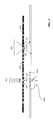
- FIG. 3 depicts optical effects created by the gaps between adjacent correction elements.
- FIG. 4 further illustrates the cause of gap ripple.
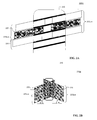
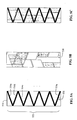
- FIG. 5A-C depict a correction system having a chevron configuration and an exemplary optical compensation plate, according to an embodiment of the present invention.
- FIG. 6 depicts an exemplary uniformity correction system having a titled configuration of correction elements 620 and an optical compensation plate 650, according to an embodiment of the present invention.
- FIG. 7 depicts an exemplary optical compensation plate, according to an embodiment of the present invention.
- FIG. 1 is an illustration of an exemplary lithography system 100, according to an embodiment of the invention.
- lithography system 100 is a system using a reticle or mask.
- system 100 is a maskless lithography system.
- Lithography system 100 includes an illumination system 110, a uniformity correction system 120, a contrast device 130, projection optics 150, a substrate stage 160, and a correction module 170.
- Illumination system 110 illuminates contrast device 130.
- Illumination system 110 may use any type of illumination (e.g., quadrapole, annular, etc.) as required by the lithography system.
- illumination system 110 may support the modification of various illumination properties such as partial coherence or fill geometry. The details of illumination systems are well known to those skilled in the art and thus are not explained further herein.
- Contrast device 130 is used to image a pattern onto a portion of a substrate 165 (e.g., wafer or glass plate) held by substrate stage 160.
- contrast device 135 is a static mask such as a reticle and substrate 165 is a wafer.
- contrast device 135 is a programmable array.
- the programmable array may include a spatial light modulator (SLM) or some other suitable micro-mirror array.
- the SLM can comprise a reflective or transmissive liquid crystal display (LCD) or a grading light value (GLV).
- substrate 165 may be a piece of glass, flat panel display, or similar.
- Projection optics 150 is configured to project an image of the pattern (defined by the contrast device) on the substrate.
- the details of projection optics 150 are dependent upon the type of lithography system used. Specific functional details of projection optics are well known to those skilled in the art and therefore are not explained further herein.
- Substrate stage 160 is located at the image plane 180. Substrate stage 160 supports a substrate 165.
- the substrate is a resist coated wafer. In an alternate embodiment, the substrate is a piece of glass, flat pane display or similar.
- Uniformity correction system 120 is a device that controls illumination levels within specific sections of illumination fields associated with system 100.
- the uniformity correction system 120 is positioned between the illumination optics 110 and the contrast device stage 130 at the correction plane.
- the correction plane is located proximate to the contrast device stage (e.g., reticle stage). In alternative embodiments, the correction plane can be located at any position between illumination optics 110 and contrast device stage 130.
- FIGs. 2A-D depict high level block diagrams of exemplary uniformity correction systems 220.
- a uniformity correction system includes multiple correction elements 220a-n, optional multiple correction elements 222a-n, and a optical compensation plate 250.
- Multiple correction elements 220a-n and 222 a-n are inserted into the illumination slot in a defined configuration.
- Multiple correction elements 220, 222 can be any mechanisms that effect uniformity.
- multiple correction elements 220a-n and 222a-n are plates (also referred to as fingers) constructed of a transmissive material.
- each finger has a 10% attenuation (i.e., 90% transmission).
- the fingers are opaque (i.e., 0% transmissibility).
- the correction elements could have variable attenuation.
- FIG. 2A is a top down view of correction system 220A.
- the multiple correction elements 220a-n and 222a-n have a tilted configuration.
- multiple correction elements 220a-n are inserted from a first side (e.g., the left side) of the illumination slot at an angle ⁇ with respect to the scan direction (or Y-axis).
- Multiple correction elements 222a-n are inserted from the opposite side (e.g., right side) of the illumination slot at an angle - ⁇ with respect to the scan direction (or Y-axis).
- the maximum insertion of correction elements 220a-n and 222an is to a neutral point.
- each correction element can be inserted any amount up to a point at which the tip of a correction element 220 is proximate to the tip of a correction element 222.
- correction elements 220a-n do not overlap correction elements 222a-n.
- each correction element 220a-n is opposed to its corresponding correction element 222a-n (e.g., correction element 220a is opposed to correction element 222a, correction element 220b is opposed to correction element 222b, etc.).
- each correction element 220a-n and its corresponding correction element 222a-n can be considered as being in the same correction slot.
- FIG. 2A only depicts four correction elements per side, any number of fingers per side could be used in the present invention.
- FIG. 2B is a top down view of correction system 220B.
- the multiple correction elements 220a-n and 222a-n have a chevron configuration.
- multiple correction elements 220a-n are inserted from a first side (e.g., the left side) of the illumination slot at an angle ⁇ with respect to the scan direction (or Y-axis).
- Multiple correction elements 222a-n are inserted from the opposite side (e.g., right side) of the illumination slot at the same angle, ⁇ , with respect to the scan direction (or Y-axis).
- correction elements 220 and 222 can be inserted to a depth such that correction elements 220 overlap correction elements 222.
- each correction element can be inserted any amount up to a maximum insertion point.
- FIG. 2C is a high level block diagram of a side view of portion of correction system 220C.
- optical compensation plate 250 is parallel to the plane containing the multiple correction elements 220, 222.
- the bottom surface of the correction elements are proximate to the upper surface of the optical compensation plate.
- the separation between the bottom surface of the correction elements and the upper surface of the optical compensation plate is less than O.lmm. As would be appreciated by a person of skill in the art, other separation distances could be used with the present invention.
- FIG. 2D a high level block diagram of a side view of portion of correction system 220D.
- the bottom surface of the optical compensation plate is proximate to the upper surfaces of the multiple correction elements 220, 222.
- the separation between the bottom surface of the correction elements and the upper surface of the optical compensation plate is less than 0.1mm. As would be appreciated by a person of skill in the art, other separation distances could be used with the present invention.
- optical compensation plate 250 has 0% attenuation (i.e., 100% transmission). As would be appreciated by a person of skill in the art, an optical compensation plate having other attenuation values could be used with the present invention.
- adjacent correction elements e.g. 220a-n, 222a-n
- a gap 225a-n As can be seen in FIGs. 2A through D, adjacent correction elements (e.g. 220a-n, 222a-n) are separated by a gap 225a-n.
- adjacent fingers can be separated by any size gap, as required by the constraints of the compensation system.
- each gap 225a-n are equal in size.
- FIG. 3 depicts a portion of a correction system 330 having a plurality of adjacent correction elements 320a-c. Adjacent correction elements 320a-c are separated by gaps 325a,b. Because each gap has a 0% attenuation (or 100% transmission), light through the gaps generate streaks or bands of greater intensity on the substrate. The intensity of the streaks is dependent upon the angle of the incident light. For example, when the light beams are substantially parallel as shown by light 390 in FIG. 3 (i.e., the light has a small sigma), the maximum amount of light comes through the gap.
- Area 360a is the area of greater intensity due to the gap when the incident light has the smallest sigma.
- Area 360b is the area of greater intensity due to the gap when the incident light has the largest sigma. As illustrated, area 360a is narrower than area 360b. However, light in area 360a has a greater intensity than light in area 360b.
- each correction element has a finite thickness.
- each correction elements has a plurality of edges 322. If light is coming in on an angle (i.e., larger sigma), part of the light reflects off the edge 322, casting a shadow on the substrate.
- a shadow is cast by the edge 322 of the first finger 320b and a second shadow is cast by the edge 322 of the second finger 320c.
- the shadow effect can be exacerbated by the illumination mode being used. For example, if dipole illumination is used, light is incident on the correction elements from a first direction and from a second direction opposite the first direction.
- the edges of adjacent fingers cause four shadows to be cast on the substrate in addition to the streak of greater intensity caused by the gap.
- FIG. 4 further illustrates the cause of gap ripple.
- FIG. 4 depicts a portion 435 of an illumination slot having multiple adjacent correction elements 420a-c inserted from the left side. The adjacent correction elements 420a-c are separated by gaps 425a, b.
- FIG. 4 further depicts the cross-slot averaged attenuation 480 associated with the correction system.
- scan lines 442 do not enter or cross the gap region 425a.
- cross slot attenuation is normal (at approximately 8% attenuation).
- Scan lines 444 cross gap region 425a.
- Scan lines 446 enter gap region 425b but do not cross a gap region 425a or b.
- Scan lines 448 also enter gap region 425b but do not cross a gap region 425a or b.
- cross slot attenuation is variable.
- FIG. 5A depicts an exemplary optical compensation plate 550 for use with a correction system having a chevron configuration, according to an embodiment of the present invention.
- Optical compensation plate 550 includes a pattern 552 having a plurality of gap compensation segments 554a-j.
- the gap compensation segments 554a-j have a different attenuation than the remaining areas of optical compensation plate 550.
- the gap compensation segments 554 may have an 3% attenuation (i.e., 97% transmission) while the remaining areas of the optical compensation plate 550 have a 0% attenuation (i.e., 100% transmission).
- Optical compensation plate 550 has a first surface 502 and a second surface 504. In an embodiment, pattern 552 is on first surface 502. In an alternative embodiment, pattern 552 is on second surface. In a further embodiment, pattern 552 is included within optical compensation plate.
- Pattern 552 can be formed of any material having a non-zero attenuation.
- pattern 552 may be a coating comprised of a series of dots.
- pattern 552 can be coupled to optical compensation plate 550 by a variety of methods.
- Each gap compensation segment 554a-j corresponds to a gap between adjacent correction elements.
- FIG. 5B depicts an exemplary chevron configuration of correction elements.
- the angle, ⁇ , 556 of the gap compensation segment 554a-j with respect to the bottom edge of the compensation plate is equal to the angle, ⁇ , 526 of its corresponding gap with respect to the Y-axis of the illumination slot.
- the location of each gap compensation segment 554 on the optical compensation plate 550 corresponds to the location of its corresponding gap in the illumination slot.
- each gap compensation segment 554 is dependent upon the angle of the incident light. For example, if the incident light has a small sigma, the gap compensation segment 554 can have a width equal to or slightly larger than the width of the gap between adjacent correction elements. If the incident light has a large sigma, the gap compensation segment has a greater width. In general, the width of each gap compensation segment 554 is greater than the width of the gap between adjacent correction elements.
- each gap compensation segment 554 is dependent on a variety of factors including the configuration of the correction elements and the maximum depth of insertion of each element. As can be seen in FIG. 5A and 5C, the gap compensation segments extend across the optical compensation plate 550. As would be appreciated by persons of skill in the art, any length could be used for a gap compensation segment, as required by the lithography system.
- FIG. 6 depicts an exemplary uniformity correction system having a titled configuration of correction elements 620 and an optical compensation plate 650, according to an embodiment of the present invention.
- Optical compensation plate 650 includes a pattern 652. Because the correction elements are opposed in this embodiment, pattern 652 includes a plurality of parallel gap compensation segments 654 that extend across the optical compensation plate 650.
- FIG. 7 depicts an exemplary optical compensation plate 750, according to an embodiment of the present invention.
- Optical compensation plate 750 includes a pattern 752 having a plurality of gap compensation segments 754.
- the gap compensation segments 754 do not extend across the optical compensation plate and in fact do not extend to the center of the optical compensation segment.
- the length of each gap compensation segment is less than width of the optical compensation plate and less than the maximum insertion depth of the correction elements.
- FIGs. 5-7 describe the pattern on optical compensation plate with respect to the tilted and chevron configuration of correction elements
- the present invention can be used with any configuration of correction elements having a gap between adjacent correction elements.
- the pattern on the optical compensation plate corresponds to the gap between adjacent correction elements.
- the location of the gap compensation segments on the plate can be associated with the location of the gaps.
- a center axis for each gap can be defined by the intersection of a first plane coincident with the center of the gap with a second plane including the adjacent correction members which define the gap.
- the first plane is perpendicular to the second plane.
- the center axis of each gap compensation segment is then approximately coincident with the line defined by the intersection of the first plane and the optical compensation plate.
Landscapes
- Physics & Mathematics (AREA)
- General Physics & Mathematics (AREA)
- Optics & Photonics (AREA)
- Spectroscopy & Molecular Physics (AREA)
- Exposure Of Semiconductors, Excluding Electron Or Ion Beam Exposure (AREA)
- Exposure And Positioning Against Photoresist Photosensitive Materials (AREA)
- Microscoopes, Condenser (AREA)
- Optical Elements Other Than Lenses (AREA)
- Polarising Elements (AREA)
Applications Claiming Priority (1)
| Application Number | Priority Date | Filing Date | Title |
|---|---|---|---|
| US11/022,837 US7088527B2 (en) | 2004-12-28 | 2004-12-28 | Uniformity correction system having light leak and shadow compensation |
Publications (2)
| Publication Number | Publication Date |
|---|---|
| EP1677148A2 true EP1677148A2 (de) | 2006-07-05 |
| EP1677148A3 EP1677148A3 (de) | 2008-01-23 |
Family
ID=35999492
Family Applications (1)
| Application Number | Title | Priority Date | Filing Date |
|---|---|---|---|
| EP05027804A Withdrawn EP1677148A3 (de) | 2004-12-28 | 2005-12-19 | Vorrichtung zur Korrektur einer ungleichmässigen Beleuchtung in einem lithographischen Apparat |
Country Status (7)
| Country | Link |
|---|---|
| US (3) | US7088527B2 (de) |
| EP (1) | EP1677148A3 (de) |
| JP (1) | JP4271190B2 (de) |
| KR (1) | KR100673504B1 (de) |
| CN (1) | CN100524036C (de) |
| SG (1) | SG123771A1 (de) |
| TW (1) | TWI317055B (de) |
Families Citing this family (19)
| Publication number | Priority date | Publication date | Assignee | Title |
|---|---|---|---|---|
| US20060139784A1 (en) * | 2004-12-28 | 2006-06-29 | Asml Holding N.V. | Uniformity correction system having light leak compensation |
| US7088527B2 (en) * | 2004-12-28 | 2006-08-08 | Asml Holding N.V. | Uniformity correction system having light leak and shadow compensation |
| DE102006038455A1 (de) * | 2006-08-16 | 2008-02-21 | Carl Zeiss Smt Ag | Optisches System für die Halbleiterlithographie |
| NL1036162A1 (nl) * | 2007-11-28 | 2009-06-02 | Asml Netherlands Bv | Lithographic apparatus and method. |
| DE102008013229B4 (de) * | 2007-12-11 | 2015-04-09 | Carl Zeiss Smt Gmbh | Beleuchtungsoptik für die Mikrolithographie |
| CN101221373B (zh) * | 2008-01-25 | 2010-06-02 | 上海微电子装备有限公司 | 一种照明均匀性校正装置 |
| CN101221374B (zh) * | 2008-01-25 | 2010-06-09 | 上海微电子装备有限公司 | 一种照明均匀性校正装置 |
| WO2009099280A2 (en) * | 2008-02-05 | 2009-08-13 | Lg Electronics Inc. | Input unit and control method thereof |
| KR101258344B1 (ko) * | 2008-10-31 | 2013-04-30 | 칼 짜이스 에스엠티 게엠베하 | Euv 마이크로리소그래피용 조명 광학 기기 |
| NL2004770A (nl) * | 2009-05-29 | 2010-11-30 | Asml Holding Nv | Lithographic apparatus and method for illumination uniformity correction and uniformity drift compensation. |
| DE102011077234A1 (de) | 2011-06-08 | 2012-12-13 | Carl Zeiss Smt Gmbh | EUV-Spiegelanordnung, optisches System mit EUV-Spiegelanordnung und Verfahren zum Betreiben eines optischen Systems mit EUV-Spiegelanordnung |
| WO2012126954A1 (en) | 2011-03-23 | 2012-09-27 | Carl Zeiss Smt Gmbh | Euv mirror arrangement, optical system comprising euv mirror arrangement and method for operating an optical system comprising an euv mirror arrangement |
| DE102011005940A1 (de) | 2011-03-23 | 2012-09-27 | Carl Zeiss Smt Gmbh | EUV-Spiegelanordnung, optisches System mit EUV-Spiegelanordnung und Verfahren zum Betreiben eines optischen Systems mit EUV-Spiegelanordnung |
| CN107885038A (zh) * | 2016-09-30 | 2018-04-06 | 上海微电子装备(集团)股份有限公司 | 照明均匀性校正装置、校正方法以及一种曝光投影系统 |
| DE102017203647A1 (de) | 2017-03-07 | 2018-09-13 | Carl Zeiss Smt Gmbh | Spiegel mit einer piezoelektrisch aktiven Schicht |
| CN109991815B (zh) * | 2017-12-29 | 2020-10-16 | 上海微电子装备(集团)股份有限公司 | 一种泛曝补偿板、泛曝装置以及光刻装置 |
| KR102894806B1 (ko) * | 2019-04-26 | 2025-12-04 | 에이에스엠엘 홀딩 엔.브이. | 리소그래피 장치 및 조명 균일성 보정 시스템 |
| JP7249207B2 (ja) * | 2019-05-28 | 2023-03-30 | シャープ株式会社 | シェーディング補正信号生成装置、複合機及びシェーディング補正信号生成方法 |
| CN115729047B (zh) * | 2021-08-30 | 2025-11-04 | 上海芯上微装科技股份有限公司 | 照明均匀性补偿装置和方法 |
Family Cites Families (20)
| Publication number | Priority date | Publication date | Assignee | Title |
|---|---|---|---|---|
| JPH0532311A (ja) | 1991-02-13 | 1993-02-09 | Kanebo Ltd | 物品横倒装置 |
| KR930006480A (ko) * | 1991-09-11 | 1993-04-21 | 원본미기재 | 콘트라스트가 개선된 액정 표시판넬 |
| US5508803A (en) * | 1994-12-20 | 1996-04-16 | International Business Machines Corporation | Method and apparatus for monitoring lithographic exposure |
| JP3883601B2 (ja) * | 1996-03-27 | 2007-02-21 | 富士通株式会社 | 光イコライザ |
| JP4310816B2 (ja) * | 1997-03-14 | 2009-08-12 | 株式会社ニコン | 照明装置、投影露光装置、デバイスの製造方法、及び投影露光装置の調整方法 |
| JPH10282635A (ja) | 1997-04-09 | 1998-10-23 | Sony Corp | パターンデータ補正方法、電子線描画方法、フォトマスク及びその作製方法、露光方法、半導体装置及びその製造方法、並びにパターンデータ補正装置 |
| US5981962A (en) | 1998-01-09 | 1999-11-09 | International Business Machines Corporation | Distributed direct write lithography system using multiple variable shaped electron beams |
| US6741394B1 (en) * | 1998-03-12 | 2004-05-25 | Nikon Corporation | Optical integrator, illumination optical apparatus, exposure apparatus and observation apparatus |
| US6404499B1 (en) * | 1998-04-21 | 2002-06-11 | Asml Netherlands B.V. | Lithography apparatus with filters for optimizing uniformity of an image |
| US6021009A (en) * | 1998-06-30 | 2000-02-01 | Intel Corporation | Method and apparatus to improve across field dimensional control in a microlithography tool |
| JP2000232056A (ja) | 1999-02-10 | 2000-08-22 | Minolta Co Ltd | 露光装置 |
| JP2001217171A (ja) | 2000-01-21 | 2001-08-10 | Promos Technol Inc | 高密度パターンと低密度パターンとの変差を解消する方法と装置 |
| US6566016B1 (en) | 2000-06-28 | 2003-05-20 | Koninklijke Philips Electronics N.V. | Apparatus and method for compensating critical dimension deviations across photomask |
| US6771350B2 (en) * | 2000-02-25 | 2004-08-03 | Nikon Corporation | Exposure apparatus and exposure method capable of controlling illumination distribution |
| JP2001319871A (ja) * | 2000-02-29 | 2001-11-16 | Nikon Corp | 露光方法、濃度フィルタの製造方法、及び露光装置 |
| JP3633506B2 (ja) | 2001-05-24 | 2005-03-30 | ソニー株式会社 | 露光方法および半導体装置の製造方法 |
| DE60225216T2 (de) * | 2001-09-07 | 2009-03-05 | Asml Netherlands B.V. | Lithographischer Apparat und Verfahren zur Herstellung einer Vorrichtung |
| US7030958B2 (en) * | 2003-12-31 | 2006-04-18 | Asml Netherlands B.V. | Optical attenuator device, radiation system and lithographic apparatus therewith and device manufacturing method |
| US7088527B2 (en) * | 2004-12-28 | 2006-08-08 | Asml Holding N.V. | Uniformity correction system having light leak and shadow compensation |
| US20060139784A1 (en) * | 2004-12-28 | 2006-06-29 | Asml Holding N.V. | Uniformity correction system having light leak compensation |
-
2004
- 2004-12-28 US US11/022,837 patent/US7088527B2/en not_active Expired - Fee Related
-
2005
- 2005-12-13 TW TW094144138A patent/TWI317055B/zh not_active IP Right Cessation
- 2005-12-19 EP EP05027804A patent/EP1677148A3/de not_active Withdrawn
- 2005-12-23 SG SG200508378A patent/SG123771A1/en unknown
- 2005-12-27 KR KR1020050130317A patent/KR100673504B1/ko not_active Expired - Fee Related
- 2005-12-27 JP JP2005375975A patent/JP4271190B2/ja not_active Expired - Fee Related
- 2005-12-28 CN CNB2005101377966A patent/CN100524036C/zh not_active Expired - Fee Related
-
2006
- 2006-07-25 US US11/492,067 patent/US7545585B2/en not_active Expired - Fee Related
-
2007
- 2007-11-20 US US11/984,622 patent/US20080137217A1/en not_active Abandoned
Also Published As
| Publication number | Publication date |
|---|---|
| EP1677148A3 (de) | 2008-01-23 |
| JP4271190B2 (ja) | 2009-06-03 |
| KR20060076700A (ko) | 2006-07-04 |
| TWI317055B (en) | 2009-11-11 |
| US20080137217A1 (en) | 2008-06-12 |
| CN1797218A (zh) | 2006-07-05 |
| US7545585B2 (en) | 2009-06-09 |
| US7088527B2 (en) | 2006-08-08 |
| TW200625029A (en) | 2006-07-16 |
| SG123771A1 (en) | 2006-07-26 |
| KR100673504B1 (ko) | 2007-01-25 |
| JP2006191067A (ja) | 2006-07-20 |
| US20060262426A1 (en) | 2006-11-23 |
| US20060139769A1 (en) | 2006-06-29 |
| CN100524036C (zh) | 2009-08-05 |
Similar Documents
| Publication | Publication Date | Title |
|---|---|---|
| US20080137217A1 (en) | Uniformity correction system having light leak and shadow compensation | |
| EP1947513B1 (de) | Durchgehende optische Direktbeschriftungslithografie | |
| KR101581479B1 (ko) | 조명 장치, 조명 방법, 노광 장치, 노광 방법 및 디바이스 제조 방법 | |
| JP7337877B2 (ja) | 非ブレーズドdmdを伴う解像度強化型のデジタルリソグラフィ | |
| US8913227B2 (en) | Illumination optical system, aligner, and process for fabricating device | |
| US10866521B2 (en) | Exposure apparatus and exposure method | |
| CN102129180B (zh) | 微镜器件的筛选方法、微镜器件筛选装置以及无掩膜曝光装置 | |
| US20050068509A1 (en) | Methods and systems to compensate for a stitching disturbance of a printed pattern in a maskless lithography system utilizing overlap without an explicit attenuation | |
| KR101626644B1 (ko) | 노광 장치, 노광 방법, 디바이스의 제조 방법 및 개구판 | |
| JP5598733B2 (ja) | 空間光変調ユニット、照明光学系、露光装置、およびデバイス製造方法 | |
| US7012674B2 (en) | Maskless optical writer | |
| JP2008294442A (ja) | フィールドに依存する楕円度および均一性の補正のための光減衰フィルタ | |
| US20060139784A1 (en) | Uniformity correction system having light leak compensation | |
| JP4815461B2 (ja) | リソグラフィスキャナのための瞳の残留非対称補償器 | |
| JP2019028084A (ja) | 露光装置 | |
| KR20050006832A (ko) | 노광 장치 | |
| KR102902254B1 (ko) | 노광 장치, 노광 방법 및 물품의 제조 방법 | |
| JP2012073420A (ja) | 表示装置の製造方法 | |
| JP2010028088A (ja) | 照明光学系、露光装置、およびデバイス製造方法 | |
| JP3316710B2 (ja) | 露光装置 | |
| WO2024209952A1 (ja) | フィルタユニット、照明ユニット、露光装置、及び露光方法 | |
| JP2007049208A (ja) | 露光装置、露光方法及びデバイス製造方法 | |
| TWI486726B (zh) | 曝光設備及製造裝置之方法 | |
| KR20160084539A (ko) | Ghi라인 차단용 반사 필터 |
Legal Events
| Date | Code | Title | Description |
|---|---|---|---|
| PUAI | Public reference made under article 153(3) epc to a published international application that has entered the european phase |
Free format text: ORIGINAL CODE: 0009012 |
|
| AK | Designated contracting states |
Kind code of ref document: A2 Designated state(s): AT BE BG CH CY CZ DE DK EE ES FI FR GB GR HU IE IS IT LI LT LU LV MC NL PL PT RO SE SI SK TR |
|
| AX | Request for extension of the european patent |
Extension state: AL BA HR MK YU |
|
| PUAL | Search report despatched |
Free format text: ORIGINAL CODE: 0009013 |
|
| AK | Designated contracting states |
Kind code of ref document: A3 Designated state(s): AT BE BG CH CY CZ DE DK EE ES FI FR GB GR HU IE IS IT LI LT LU LV MC NL PL PT RO SE SI SK TR |
|
| AX | Request for extension of the european patent |
Extension state: AL BA HR MK YU |
|
| RIC1 | Information provided on ipc code assigned before grant |
Ipc: G02B 27/09 20060101ALI20071218BHEP Ipc: G02F 1/1335 20060101ALI20071218BHEP Ipc: G03F 7/20 20060101AFI20060321BHEP |
|
| 17P | Request for examination filed |
Effective date: 20080722 |
|
| AKX | Designation fees paid |
Designated state(s): DE FR GB IT NL |
|
| 17Q | First examination report despatched |
Effective date: 20080910 |
|
| STAA | Information on the status of an ep patent application or granted ep patent |
Free format text: STATUS: THE APPLICATION IS DEEMED TO BE WITHDRAWN |
|
| 18D | Application deemed to be withdrawn |
Effective date: 20090702 |