EP1705515B1 - Guide à onde optique, dispositif optique et procédé de fabrication de guide à onde optique - Google Patents
Guide à onde optique, dispositif optique et procédé de fabrication de guide à onde optique Download PDFInfo
- Publication number
- EP1705515B1 EP1705515B1 EP06014368.2A EP06014368A EP1705515B1 EP 1705515 B1 EP1705515 B1 EP 1705515B1 EP 06014368 A EP06014368 A EP 06014368A EP 1705515 B1 EP1705515 B1 EP 1705515B1
- Authority
- EP
- European Patent Office
- Prior art keywords
- curved
- optical waveguide
- ridge structure
- optical
- guide portion
- Prior art date
- Legal status (The legal status is an assumption and is not a legal conclusion. Google has not performed a legal analysis and makes no representation as to the accuracy of the status listed.)
- Expired - Lifetime
Links
Images





Classifications
-
- G—PHYSICS
- G02—OPTICS
- G02F—OPTICAL DEVICES OR ARRANGEMENTS FOR THE CONTROL OF LIGHT BY MODIFICATION OF THE OPTICAL PROPERTIES OF THE MEDIA OF THE ELEMENTS INVOLVED THEREIN; NON-LINEAR OPTICS; FREQUENCY-CHANGING OF LIGHT; OPTICAL LOGIC ELEMENTS; OPTICAL ANALOGUE/DIGITAL CONVERTERS
- G02F1/00—Devices or arrangements for the control of the intensity, colour, phase, polarisation or direction of light arriving from an independent light source, e.g. switching, gating or modulating; Non-linear optics
- G02F1/01—Devices or arrangements for the control of the intensity, colour, phase, polarisation or direction of light arriving from an independent light source, e.g. switching, gating or modulating; Non-linear optics for the control of the intensity, phase, polarisation or colour
- G02F1/21—Devices or arrangements for the control of the intensity, colour, phase, polarisation or direction of light arriving from an independent light source, e.g. switching, gating or modulating; Non-linear optics for the control of the intensity, phase, polarisation or colour by interference
- G02F1/225—Devices or arrangements for the control of the intensity, colour, phase, polarisation or direction of light arriving from an independent light source, e.g. switching, gating or modulating; Non-linear optics for the control of the intensity, phase, polarisation or colour by interference in an optical waveguide structure
- G02F1/2255—Devices or arrangements for the control of the intensity, colour, phase, polarisation or direction of light arriving from an independent light source, e.g. switching, gating or modulating; Non-linear optics for the control of the intensity, phase, polarisation or colour by interference in an optical waveguide structure controlled by a high-frequency electromagnetic component in an electric waveguide structure
-
- G—PHYSICS
- G02—OPTICS
- G02B—OPTICAL ELEMENTS, SYSTEMS OR APPARATUS
- G02B6/00—Light guides; Structural details of arrangements comprising light guides and other optical elements, e.g. couplings
- G02B6/10—Light guides; Structural details of arrangements comprising light guides and other optical elements, e.g. couplings of the optical waveguide type
- G02B6/12—Light guides; Structural details of arrangements comprising light guides and other optical elements, e.g. couplings of the optical waveguide type of the integrated circuit kind
- G02B6/12007—Light guides; Structural details of arrangements comprising light guides and other optical elements, e.g. couplings of the optical waveguide type of the integrated circuit kind forming wavelength selective elements, e.g. multiplexer, demultiplexer
-
- G—PHYSICS
- G02—OPTICS
- G02B—OPTICAL ELEMENTS, SYSTEMS OR APPARATUS
- G02B6/00—Light guides; Structural details of arrangements comprising light guides and other optical elements, e.g. couplings
- G02B6/10—Light guides; Structural details of arrangements comprising light guides and other optical elements, e.g. couplings of the optical waveguide type
- G02B6/12—Light guides; Structural details of arrangements comprising light guides and other optical elements, e.g. couplings of the optical waveguide type of the integrated circuit kind
- G02B6/122—Basic optical elements, e.g. light-guiding paths
- G02B6/1228—Tapered waveguides, e.g. integrated spot-size transformers
-
- G—PHYSICS
- G02—OPTICS
- G02B—OPTICAL ELEMENTS, SYSTEMS OR APPARATUS
- G02B6/00—Light guides; Structural details of arrangements comprising light guides and other optical elements, e.g. couplings
- G02B6/10—Light guides; Structural details of arrangements comprising light guides and other optical elements, e.g. couplings of the optical waveguide type
- G02B6/12—Light guides; Structural details of arrangements comprising light guides and other optical elements, e.g. couplings of the optical waveguide type of the integrated circuit kind
- G02B6/122—Basic optical elements, e.g. light-guiding paths
- G02B6/125—Bends, branchings or intersections
-
- G—PHYSICS
- G02—OPTICS
- G02B—OPTICAL ELEMENTS, SYSTEMS OR APPARATUS
- G02B6/00—Light guides; Structural details of arrangements comprising light guides and other optical elements, e.g. couplings
- G02B6/10—Light guides; Structural details of arrangements comprising light guides and other optical elements, e.g. couplings of the optical waveguide type
- G02B6/12—Light guides; Structural details of arrangements comprising light guides and other optical elements, e.g. couplings of the optical waveguide type of the integrated circuit kind
- G02B6/13—Integrated optical circuits characterised by the manufacturing method
- G02B6/134—Integrated optical circuits characterised by the manufacturing method by substitution by dopant atoms
- G02B6/1342—Integrated optical circuits characterised by the manufacturing method by substitution by dopant atoms using diffusion
-
- G—PHYSICS
- G02—OPTICS
- G02B—OPTICAL ELEMENTS, SYSTEMS OR APPARATUS
- G02B6/00—Light guides; Structural details of arrangements comprising light guides and other optical elements, e.g. couplings
- G02B6/24—Coupling light guides
- G02B6/42—Coupling light guides with opto-electronic elements
- G02B6/4201—Packages, e.g. shape, construction, internal or external details
- G02B6/4204—Packages, e.g. shape, construction, internal or external details the coupling comprising intermediate optical elements, e.g. lenses, holograms
- G02B6/4206—Optical features
-
- G—PHYSICS
- G02—OPTICS
- G02B—OPTICAL ELEMENTS, SYSTEMS OR APPARATUS
- G02B6/00—Light guides; Structural details of arrangements comprising light guides and other optical elements, e.g. couplings
- G02B6/10—Light guides; Structural details of arrangements comprising light guides and other optical elements, e.g. couplings of the optical waveguide type
- G02B6/12—Light guides; Structural details of arrangements comprising light guides and other optical elements, e.g. couplings of the optical waveguide type of the integrated circuit kind
- G02B2006/12083—Constructional arrangements
- G02B2006/12097—Ridge, rib or the like
-
- G—PHYSICS
- G02—OPTICS
- G02B—OPTICAL ELEMENTS, SYSTEMS OR APPARATUS
- G02B6/00—Light guides; Structural details of arrangements comprising light guides and other optical elements, e.g. couplings
- G02B6/10—Light guides; Structural details of arrangements comprising light guides and other optical elements, e.g. couplings of the optical waveguide type
- G02B6/12—Light guides; Structural details of arrangements comprising light guides and other optical elements, e.g. couplings of the optical waveguide type of the integrated circuit kind
- G02B2006/12083—Constructional arrangements
- G02B2006/12119—Bend
-
- G—PHYSICS
- G02—OPTICS
- G02B—OPTICAL ELEMENTS, SYSTEMS OR APPARATUS
- G02B6/00—Light guides; Structural details of arrangements comprising light guides and other optical elements, e.g. couplings
- G02B6/10—Light guides; Structural details of arrangements comprising light guides and other optical elements, e.g. couplings of the optical waveguide type
- G02B6/12—Light guides; Structural details of arrangements comprising light guides and other optical elements, e.g. couplings of the optical waveguide type of the integrated circuit kind
- G02B2006/12133—Functions
- G02B2006/12142—Modulator
-
- G—PHYSICS
- G02—OPTICS
- G02B—OPTICAL ELEMENTS, SYSTEMS OR APPARATUS
- G02B6/00—Light guides; Structural details of arrangements comprising light guides and other optical elements, e.g. couplings
- G02B6/24—Coupling light guides
- G02B6/26—Optical coupling means
- G02B6/32—Optical coupling means having lens focusing means positioned between opposed fibre ends
-
- G—PHYSICS
- G02—OPTICS
- G02B—OPTICAL ELEMENTS, SYSTEMS OR APPARATUS
- G02B6/00—Light guides; Structural details of arrangements comprising light guides and other optical elements, e.g. couplings
- G02B6/24—Coupling light guides
- G02B6/26—Optical coupling means
- G02B6/32—Optical coupling means having lens focusing means positioned between opposed fibre ends
- G02B6/322—Optical coupling means having lens focusing means positioned between opposed fibre ends and having centering means being part of the lens for the self-positioning of the lightguide at the focal point, e.g. holes, wells, indents, nibs
-
- G—PHYSICS
- G02—OPTICS
- G02B—OPTICAL ELEMENTS, SYSTEMS OR APPARATUS
- G02B6/00—Light guides; Structural details of arrangements comprising light guides and other optical elements, e.g. couplings
- G02B6/24—Coupling light guides
- G02B6/42—Coupling light guides with opto-electronic elements
- G02B6/4201—Packages, e.g. shape, construction, internal or external details
- G02B6/4204—Packages, e.g. shape, construction, internal or external details the coupling comprising intermediate optical elements, e.g. lenses, holograms
- G02B6/4214—Packages, e.g. shape, construction, internal or external details the coupling comprising intermediate optical elements, e.g. lenses, holograms the intermediate optical element having redirecting reflective means, e.g. mirrors, prisms for deflecting the radiation from horizontal to down- or upward direction toward a device
-
- G—PHYSICS
- G02—OPTICS
- G02F—OPTICAL DEVICES OR ARRANGEMENTS FOR THE CONTROL OF LIGHT BY MODIFICATION OF THE OPTICAL PROPERTIES OF THE MEDIA OF THE ELEMENTS INVOLVED THEREIN; NON-LINEAR OPTICS; FREQUENCY-CHANGING OF LIGHT; OPTICAL LOGIC ELEMENTS; OPTICAL ANALOGUE/DIGITAL CONVERTERS
- G02F2201/00—Constructional arrangements not provided for in groups G02F1/00 - G02F7/00
- G02F2201/06—Constructional arrangements not provided for in groups G02F1/00 - G02F7/00 integrated waveguide
- G02F2201/063—Constructional arrangements not provided for in groups G02F1/00 - G02F7/00 integrated waveguide ridge; rib; strip loaded
Definitions
- the present invention relates to an optical waveguide that is used for optical communication.
- the present invention relates to an optical waveguide of a diffusion type waveguide capable of reducing a curvature of a curved portion and capable of making an optical device small, an optical device that uses the optical waveguide, and a method of manufacturing the optical waveguide.
- An optical device formed with an optical waveguide is provided using an electrooptic crystal such as an LN substrate (LiNbO3: lithium niobate), forming a metal film such as titanium (Ti) on a part of the crystal substrate, and thermally diffusing the metal film.
- an electrooptic crystal such as an LN substrate (LiNbO3: lithium niobate)
- a metal film such as titanium (Ti) on a part of the crystal substrate
- a curved optical waveguide is formed on a part of the optical waveguide. Based on the provision of the curved optical waveguide, the direction of a straight optical waveguide can be turned. Therefore, it becomes possible to make the optical device small, and, particularly, make a size in its length direction small.
- An apparatus on which the optical waveguide is mounted can also be provided in compact.
- an optical loss i.e., a radiation loss
- a technique is so far proposed to combine light that is radiated at the curved optical waveguide portion again on the optical waveguide, by providing a reflector on the external periphery of the curved optical waveguide (see Japanese Patent Application Laid-open No. H11-167032 , for example).
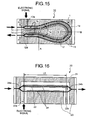
- FIG. 16 is a top plan view of an optical modulator that illustrates an example of the conventional optical device.
- This optical modulator 20 is a Mach-Zehnder interruption type optical modulator, and has a straight optical waveguide.
- a data line 22 that is supplied with an electronic signal such as DC is formed to have a predetermined length L0 in its longitudinal direction on a substrate 21. Both ends of the data line 22 are led out to one side of the substrate 21 respectively, and signal electrodes 22a and 22b are formed.
- a ground electrode 23 is formed on other partition of the substrate 21 excluding the data line 22.
- An optical waveguide 24 is disposed linearly along the data line 22, and two optical waveguides 24 are disposed in parallel between branch portions 24a and 24b.
- a phase difference due to mutual interference can be generated between the two optical waveguides 24 in a state that a speed of a progressive wave of the electronic signal (microwave) that is supplied to the data line 22 and a speed of an optical wave that flows through the two optical waveguides 24 are matched.
- a predetermined work length (corresponding to the length L0) is necessary as a length of the parallel two optical waveguides 24. A few centimeters are necessary for the length of L0.
- the curvature of the curved optical waveguide cannot be set small.
- the curvature of the curved optical waveguide is set small to a few millimeters, the recombining of the light becomes insufficient, and the optical loss increases remarkably.
- the curvature of the curved optical waveguide cannot be set small, the total optical waveguide cannot be made small, which makes it impossible to make small the optical device that is formed with the optical waveguide or to integrate the optical device.
- the optical device cannot be made compact.
- US patent application US-A-5455876 relates to an improved high-speed external optical modulator, modulated by RF waves, which velocity matches the RF waves with the optical waves.
- the apparatus includes a lithium niobate substrate on which is formed an optical waveguide, electrically floating electrodes, a low dielectric buffer layer and electrodes carrying the modulating RF energy. At least one floating electrode may comprise a series of spaced electrode segments.
- European patent application EP-A2-0905836 describes a ridge waveguide semiconductor laser structure fabricated by etching and wet oxidation.
- the upper cladding layer is partially etched forming a ridge and a native oxide layer is wet oxidized from the remaining upper cladding layer and the active region outside the ridge.
- the active region can be narrower than the ridge waveguide in the laser structure.
- the ridge waveguide semiconductor laser structures with native oxide layers can also be curved geometry lasers such as ring lasers.
- US patent application US2002/0048433 describes an optical component including a base having a pocket and a light transmitting medium having a ridge.
- the ridge defines a portion of a light signal carrying region in the light transmitting medium.
- the light transmitting medium is positioned adjacent to the base such that the ridge extends into the pocket.
- the light transmitting medium includes a second ridge extending away from the pocket.
- International patent application WO-A1-0235267 relates to a hybrid waveguide structure comprising a combination of buried waveguide sections and ridge waveguide sections on the same substrate, sharing a common core layer.
- the ridge waveguide sections provide high index contrast needed for efficient low-loss tightly curved waveguides.
- the devices are fabricated starting from a low index contrast buried waveguide. Cladding material is then selectively removed by etching.
- European patent application EP-B1-0570124 pertains to an integrated nonlinear parametric waveguide spectrometer with a polyimide waveguide focusing mirror.
- the waveguide spectrometer uses nonlinear counter-propagating chi ⁇ 2> interaction to simulate the action of a grating and produce the required chromatic dispersion.
- an organic-dielectric and a 45 DEG RIE etched mirror were fabricated to simulate a concave focusing integrated mirror.
- European patent application EP-B1-0364214 relates to an optical wavelength conversion device, which is provided with a ridge type waveguide for converting a fundamental wave into the secondary harmonic wave and emitting the latter in the form of a beam of circular or elliptic section, comprising an optical waveguide formed on a substrate of a non-linear optical material so as to generate a secondary harmonic wave by Cerenkov radiation, and which has a first wavelength passage for confining a fundamental wave and converting it into the second harmonic wave, and a second waveguide passage for confining the generated secondary harmonic wave and propagating it towards an end face for emission therefrom.
- a manufacturing process for the device is also disclosed.
- an optical waveguide that is formed on a substrate according to appended independent claim 1, a method of manufacturing an optical waveguide according to appended independent claim 15, and a method of manufacturing an optical waveguide according to appended independent claim 16.
- Preferred embodiments are defined in the appended dependent claims.
- Embodiments of the present invention have been achieved in order to solve the above problems, and have objects of providing a compact optical waveguide according to claim 1 and a method of manufacturing the optical waveguide according to claims 15 and 16, capable of suppressing the optical loss. It is an object of embodiments of the present invention to at least solve the problems in the conventional technology.
- an optical waveguide that is formed on a lithium-niobate substrate, comprising: a curved ridge structure that is formed on the substrate so as to have a curvature in a longitudinal direction of the curved ridge structure; a curved optical guide portion that is formed in and along the curved ridge structure; and a buffer layer that covers a side of the curved ridge structure and that has a lower refractive index than a refractive index of the substrate, wherein the optical guide portion is formed on a top side of the curved ridge structure with a pattern width by diffusing titanium or by proton exchange in benzoic acid into the substrate such that the optical guide portion has a cross-section in approximately a semicircle shape inside the substrate, the curved ridge structure is dug out from the substrate by etching with a ridge width and a ridge depth such that the ridge width is larger than the pattern width, and wherein a center line of the curved optical guide portion is shifted from a
- a method of manufacturing an optical waveguide according to claim 15, comprising: forming a pattern of titanium on a lithium-niobate substrate, the pattern including a curved pattern for forming a curved optical guide portion with a pattern width; thermally diffusing the pattern at a high temperature such that an optical guide portion is formed with a cross-section in approximately a semicircle shape inside the substrate; forming a ridge structure, by etching the substrate positioned at a side of the curved pattern, along a shape of the curved pattern with a ridge width and a ridge depth such that the ridge width is larger than the pattern width; and forming a buffer layer on a side of the ridge structure, the buffer layer being made of a material that has a lower refractive index than a refractive index of the substrate.
- a method of manufacturing an optical waveguide according to claim 16, comprising: forming a proton exchange pattern on a lithium-niobate substrate by proton exchange in benzoic acid, the pattern including a curved pattern for forming a curved optical guide portion with a pattern width such that the optical guide portion is formed with a cross-section in approximately a semicircle shape inside the substrate; forming a ridge structure, by etching the substrate positioned at a side of the curved pattern, along a shape of the curved pattern with a ridge width and a ridge depth such that the ridge width is larger than the pattern width; and forming a buffer layer on a side of the ridge structure, the buffer layer being made of a material that has a lower refractive index than a refractive index of the substrate.
- Fig. 1 is a top plan view of the optical waveguide according to the first embodiment.
- Fig. 2 is a cross-sectional view of the optical waveguide shown in Fig. 1.
- Fig. 1 mainly illustrates a curved portion as a key portion of the optical waveguide.
- An optical waveguide 1 is a titanium diffusion lithium niobate (Ti-LiNbO3) diffusion waveguide.
- a curved portion 1a shown in the drawing has an arc shape with a central angle of 180 degrees.
- a pattern width L of the optical waveguide 1 is set to 5 to 9 micrometers to have a small mode field of light.
- An optical wave that propagates through the optical waveguide 1 is generally a single mode (hereinafter, "SM") light, but the optical propagation mode of the optical waveguide 1 according to this invention is not limited to the SM.
- SM single mode
- a substrate 2 is dug out to form a ridge structure 3 at both sides of at least the curved portion 1 a of the optical waveguide 1.
- the substrate 2 is etched to form the ridge structure 3.
- the power of the light that propagates through the optical waveguide 1 becomes a maximum at a position of about 3 micrometers from the surface. Therefore, a depth d of the ridge structure 3 that is formed by etching is set to equal to or larger than 3 micrometers.
- air reffractive index 1 corresponds to a cladding.
- the ridge structure 3 that is formed by digging down the substrate 2 has a rough surface and not smooth on the side surface 3a.
- an optical loss occurs at the curved portion 1 a.
- a scattering loss becomes large among the optical loss.
- a film-shaped buffer layer 4 is formed on the surface of the side surface 3a of the ridge structure 3.
- a material having a smaller refractive index than that of the substrate 2 can be used such as silicon oxide (SiO 2 ) and titanium oxide (TiO 2 ).
- the width W of the ridge structure 3 is preferably equal to or smaller than the width L of the optical waveguide 1 plus 6 micrometers (i.e., both sides are equal to or less than 3 micrometers from the center of the optical waveguide 1 respectively).
- Fig. 3 is a graph indicating the optical loss of the optical waveguide .
- the abscissa represents a curvature (a radius) R of the curved portion 1a of the optical waveguide 1
- the ordinate represents the optical loss (excessive loss).
- the optical loss can be suppressed even when the curvature R is set small to 4 millimeters or below.
- the optical loss is large in the total range of the curvature R equal to or smaller than 4 millimeters.
- the optical loss can be suppressed as compared with the conventional method.
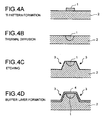
- Figs. 4A to 4D are illustrates for process of manufacturing the optical waveguide.
- a Ti pattern is first formed as shown in Fig. 4A .
- a resist pattern is formed along the layout of the optical waveguide 1 including the ridge structure 1 a.
- the optical waveguide 1 is formed by etching.
- a thermal diffusion is then carried out as shown in Fig. 4B .
- the optical waveguide 1 of Ti is thermally diffused to have a cross section in approximately a semicircle shape inside the substrate 2.
- the optical waveguide 1 has a highest refractive index at approximately the center of the circle, and can guide the wave in confinement.
- the optical waveguide 1 can be formed by proton exchange in benzoic acid, in place of carrying out the thermal diffusion.
- the etching is carried out as shown in Fig. 4C .
- the ridge structure 3 is formed by digging out the substrate 2 positioned at least at the curved portion 1a of the optical waveguide 1 by etching.
- This etching process may be a reactive ion etching (RIE) or the like.
- RIE reactive ion etching
- the width W and the height d required for the ridge structure 3 are satisfied based on the pattern width L (refer to Fig. 2 ) of the optical waveguide 1.
- a buffer layer is formed as shown in Fig. 4D .
- the buffer layer 4 is formed to cover the side surface 3a of the ridge structure 3 by sputtering or the like.
- the optical waveguide 1 can be formed in the state that the ridge structure 3 and the buffer layer 4 are formed on the substrate 2.
- the ridge structure 3 and the buffer layer 4 are provided on only the ridge structure 1a of the optical waveguide 1, the ridge structure 3 and the buffer layer 4 may also be provided on a straight line portion that continues from the curved portion 1 a.
- the optical waveguide 1 shown in Fig. 1 has the ridge structure 1a configured in the arc shape having a central angle of 180 degrees, the curve angle of the curved portion 1a is not limited to this configuration.
- an output of the optical wave can be directed to a different direction from the input direction at an angle of 90 degrees or above.
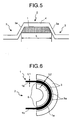
- Fig. 5 is a cross-sectional view of an optical waveguide for use of understanding the present invention.
- the width L of the optical waveguide 1 coincides with the width of the ridge structure 3.
- This optical waveguide 1 is formed by expanding the width of the resist pattern to be larger than the width W of the ridge structure 3 at the time of forming the Ti pattern of the optical waveguide 1, and then executing a diffusion at the diffusion time so that the diffusion depth is approximately constant in a normal direction of the substrate.
- the optical waveguide 1 formed in this way has a flat surface as compared with the cross-sectional shape shown in Fig. 2 .
- Fig. 6 is a top plan view of a modification of the optical waveguide.
- a pattern width L1 of the straight line portion 1b and a pattern width L2 of the ridge structure 1a may be differentiated in order to minimize the optical loss at respective positions.
- a coupler 5 is provided at a coupling portion between the straight line portion 1b and the curved portion 1a.
- the coupler 5 shown in Fig. 6 is formed to have a stage.
- Fig. 7 is a partial top plan view of another example of a configuration of the transformation section. As shown in Fig.
- the coupler 5 may be formed in tapered shape.
- the coupler 5 is an optical path whose width gradually changes from a width of the straight line portion 1 b to a width of the curved portion 1 a , the coupling loss at the coupler 5 can be reduced.
- Fig. 8 is a top plan view of a modification of the optical waveguide according to the present invention.
- the position of the curved portion 1 a of the optical waveguide 1 is shifted to the inside relative to the ridge structure 3.
- the position of the curved portion 1a is not limited to pass through the center of the ridge structure 3 as shown in Fig. 1 .
- the curved portion 1a having the pattern width L is shifted toward the inside from the center of the ridge structure 3 having the width W. In this state, the internal periphery of the curved portion 1 a is close to or is connected to the side surface 3a of the inside ridge structure 3.
- the external periphery of the curved portion 1a is separated from the side surface 3a of the outside ridge structure 3 by a predetermined distance.
- the curved portion 1 a may be shifted to the outside, in addition to a configuration of shifting the curved portion 1 a to the inside of the ridge structure 3.
- the shift is carried out by a predetermined amount to a direction of reducing the radiation loss.
- the radiation loss can be suppressed by setting a distance between the curved portion 1 a and the side surface 3a of the ridge structure 3 that is disposed at the external peripheral side of the curved portion 1 a.
- optical losses that are important in the optical waveguide are the radiation loss and the scattering loss.
- the width W of the ridge structure 3 is made smaller, the influence of the radiation loss can be decreased, but the influence of the scattering loss increases.
- the width W of the ridge structure 3 is made larger, the influence of the scattering loss can be decreased, but the influence of the radiation loss increases.
- the scattering loss occurs because of the roughness of the side surface 3a of the ridge structure 3 as described above. Based on this condition, the shift amount capable of suppressing the radiation loss without having the influence of the scattering loss can be set.
- Fig. 9 is a top plan view of another modification of the optical waveguide according to the present invention.
- the center position of the curved portion 1 a and the center position of the straight line portion 1 b are shifted at the portion of the coupler 5.
- the coupling loss offset
- the coupling loss occurs due to the difference between the optical propagation state (field) of the straight line portion and the optical field of the curved portion.
- a configuration of shifting the mutual coupling by a predetermined amount is employed (for example, see Japanese Patent Application Laid-open No. H11-167032 ).
- the coupling loss can be suppressed by making the distributions of the field (or magnetic field) of the respective propagation light approximately equal.
- the coupling loss and the radiation loss of the curved portion 1a can be suppressed.
- Fig. 9 also illustrates the configuration of shifting the center position of the curved portion 1a relative to the center position of the ridge structure 3 (refer to Fig. 8 ). In this way, the scattering loss and the radiation loss can be suppressed more.
- Fig. 10 is a top plan view of still another modification of the optical waveguide according to the present invention.
- the configuration shown in Fig. 10 is a modification of the ridge structure 3.
- a stage having a predetermined shift amount is formed in the ridge structure 3 at the coupling portion between the curved portion 1 a and the straight line portion 1b of the optical waveguide 1.
- the width of the curved portion 1 a and that of the straight line portion 1b that constitute the optical waveguide 1 are constant.
- Fig. 10 also illustrates the configuration of shifting the center position of the curved portion 1 a relative to the center position of the ridge structure 3, in a similar manner to that shown in Fig. 9 .
- the center position of the straight line portion 1 b of the optical waveguide 1 coincides with the center position of the ridge structures 3c and 3d respectively that are provided at both sides of the straight line portion 1 b.
- a stage having a predetermined shift amount is formed at the coupling portion between the ridge structure 3 of the curved portion 1 a and the ridge structures 3c and 3d of the straight line portion 1 b of the optical waveguide 1.
- the ridge structure 3 provided at the side of the optical waveguide 1 can be formed individually by matching the optimum layout state at the curved portion 1a with the optimum layout state at the straight line portion 1b.
- Fig. 11 is a top plan view of still another modification of the optical waveguide.
- the configuration shown in Fig. 11 is a modification of the ridge structure 3.
- a coupling loss may occur at a starting point of the ridge, that is, at the coupling portion between the straight line portion 1 b and the curved portion 1 a of the optical waveguide 1 (i.e., the position of the coupler 5).
- the ridge structure 3 is not provided at only the curved portion 1 a but is also stretched as extension portions 3c and 3d to a direction of the straight line portion 1 b by a predetermined amount.
- the extension portions 3c and 3d are formed to gradually leave the straight line portion 1b as they leave the position of the coupling portion.
- the extension portion 3c positioned at the inside of the optical waveguide 1 is formed toward the inside at same curvature as that of the ridge structure 3.
- the extension portion 3d positioned at the outside of the optical waveguide 1 has the same curvature as that of the extension 3c, and is formed toward the outside.
- Fig. 12 is a top plan view of still another modification of the optical waveguide.
- the configuration shown in Fig. 12 out of the extension portions explained with reference to Fig. 11 , only the external extension portion 3d is provided.
- the extension portion 3d is provided on the ridge structure 3 that is positioned at the outside of the optical waveguide 1, the coupling loss can be minimized.
- optical device that uses the optical waveguide 1 explained in the first embodiment includes an optical switch and an optical modulator.
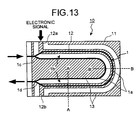
- Fig. 13 is a top plan view of an optical modulator as an optical device.
- This optical modulator has a curved portion at a part of the optical waveguide that is provided in the conventional Mach-Zehnder interference type optical modulator shown in Fig. 16 .
- a data line 12 On a substrate 11 of an optical modulator 10 shown in Fig. 13 , a data line 12, signal electrodes 12a and 12b, and a ground electrode 13 are provided.
- the data line 12 has a length that satisfies the length of the operation length L0, and has a curved portion that is curved in approximately a U-shape.
- the optical waveguide 1 is disposed along the data line 12, and branch portions 1 c and 1 d are formed on a portion that is superimposed with the data line 12. Two optical waveguides are disposed in parallel between these branch portions 1c and 1d.
- the optical waveguide 1 has the curved portion 1a and the straight line portion 1b in a similar manner to that of the first embodiment. These branch portions 1a and 1 b become an interaction section between light and microwave.
- Figs. 14A and 14B are cross-sectional views of the configuration shown in Fig. 13 .
- the ridge structure 3 and the buffer layer 4 are provided over the whole length of the optical waveguide 1.
- the width W of the ridge structure 3 is constant at the curved portion 1a, thereby to make it possible to align the speed of the microwave with the speed of light over the whole region of the interaction section.
- the center position of the ridge structure 3 coincides with the center position of the optical waveguide 1, at the portion of the straight line portion 1b of the optical waveguide 1 (cross-section of A-A). Further, as shown in Fig.
- the center position of the optical waveguide 1 is disposed with a predetermined shift amount from the center position of the ridge structure 3 to a direction of the external ridge structure 3, at the portion of the curved portion 1 a of the optical waveguide 1 (cross-section of B-B).
- the curved portion 1 a of the optical waveguide 1 can also be shifted by a predetermined amount to the internal periphery side of the ridge structure 3 when the radiation loss can be reduced in this direction, in a similar manner to that explained above with reference to Fig. 8 .
- the length in the lateral direction can be made shorter than the conventional length shown in Fig. 16 , and the device can be made compact.
- Fig. 15 is a top plan view of another configuration example of the optical modulator as an optical device.
- the configuration is different from that shown in Fig. 13 in that the curvature of the curved portion 1a of the optical waveguide 1 is set large. Further, the total width (in the vertical direction in the drawing) is set small.
- the straight line portions 1b of the optical waveguide 1 for input and output are set closer to each other.
- approximately a half of a part of the straight line portion 1 b facing the curved portion 1 a side is not linear, and forms an arc portion 1 e that connects between the curved portion 1 a and the straight line portion 1 b.
- the optical waveguide 1 can be formed freely within a range of the size of the optical device (substrate 2) to match the size (vertical and lateral sizes) of the optical device and conditions of connector connection and the like.
- the ridge structure 3 and the buffer layer 4 are also formed along the optical waveguide 1 as shown in Fig. 14 . With this arrangement, the optical loss (radiation loss and scattering loss) can be suppressed without depending on the shape of the optical waveguide 1.
- the optical waveguide 1 according to the second embodiment is explained taking the example of the configuration of an approximately the U-shape so that the input direction of an optical signal is turned to the output direction of the optical signal by 180 degrees at one position.
- the light input section and the output section of the optical waveguide 1 are disposed on the same one side surface of the optical device.
- the optical waveguide 1 can also have a configuration of approximately an S-shape having a turning at two positions or a turning at three or more positions.
- the work length L0 can be set long, and a variable region of a phase difference can be increased.
- the turning is provided by an even number of times, the light input section and the output section of the optical waveguide 1 are disposed on different side surfaces of the optical device.
- the optical waveguide 1 can also be applied to a phase modulator.
- the configuration of the phase modulator is different from that of the optical modulator only in that one optical waveguide is provided without using branch portions.
- This phase modulator also has electrodes disposed on the optical waveguide 1.
- the optical waveguide 1 explained above can also be applied to other electronic device such as an optical switch in addition to the optical modulator such as the phase modulator.
- the optical loss in the electronic device can also be suppressed, and the device can be made compact.
- a curved portion is formed on an optical waveguide. Even when a curvature of the curved portion is small, there is an effect that optical loss can be suppressed, and that the optical waveguide and an optical device using the optical waveguide can be made compact.
- an optical waveguide is formed on a substrate, comprising a curved ridge structure that is formed on the substrate so as to have a curvature in a longitudinal direction of the curved ridge structure, a curved optical path that is formed along the curved ridge structure, and a buffer layer that covers a side of the curved ridge structure and that has a lower refractive index than a refractive index of the substrate.
- the curved optical path is formed on a top side of the curved ridge structure.
- the curved ridge structure is formed outside the curved ridge structure.
- the buffer layer is silicon oxide.
- the substrate is made from lithium niobate.
- the curved optical path has a curvature of not more than 4 millimeters.
- the curved optical path has a width in a range from 5 micrometers to 9 micrometers.
- the curved optical path has a turning angle in a range from 90 degrees to 180 degrees.
- a center line of the curved optical path is shifted from a center line of the curved ridge structure.
- the curved ridge structure has a width of at most 6 micrometers plus a width of the curved portion.
- the curved ridge structure has a height of at least 3 micrometers.
- the optical waveguide further comprises a straight optical path that is coupled with the curved optical path, a second ridge structure that is formed on the substrate along the straight optical path, and a second buffer layer that covers a side of the second ridge structure and that has a lower refractive index than a refractive index of the substrate, wherein the straight optical path is formed in and along the second ridge structure, and the second ridge structure has a width increased along the straight optical path.
- the optical waveguide further comprises an optical path that is coupled with the curved optical path and that has a width different from a width of the curved optical path, and a coupler that optically couples the curved optical path with the optical path.
- the coupler is an optical path whose width gradually changes from a width of the curved optical path to a width of the optical path.
- the optical waveguide further comprises an optical path that is coupled with the curved optical path and that has a width different from a width of the curved optical path, wherein the optical path is coupled with the curved optical path so that an axis of the optical path is shifted from an axis of the curved optical path.
- the optical waveguide further comprises a straight optical path that is coupled with the curved optical path, a second ridge structure that is formed on the substrate along the straight optical path, and second buffer layer that covers a side of the second ridge structure and that has a lower refractive index than a refractive index of the substrate, wherein the straight optical path is formed in and along the second ridge structure, and the second ridge structure is connected to the curved ridge structure so that an axis of the second ridge structure is shifted from an axis of the curved ridge structure.
- an optical device for performing phase modulation comprises an optical waveguide that includes a curved ridge structure that is formed on a substrate so as to have a curvature in a longitudinal direction of the curved ridge structure, a curved optical path that is formed in and along the curved ridge structure, and a buffer layer that covers a side of the ridge structure and that has a lower refractive index than a refractive index of the substrate, and a signal electrode that is disposed on and along the optical waveguide.
- the optical waveguide includes two optical paths that are parallel to each other, and the signal electrode is disposed on and along each of the two optical paths.
- the optical waveguide further includes a second ridge structure that is formed on the substrate straight in a longitudinal direction of the second ridge structure, a straight optical path that is coupled with the curved optical path and that is formed in and along the second ridge structure, and a second buffer layer that covers a side of the second ridge structure and that has a lower refractive index than a refractive index of the substrate, optical signals transmitted through the curved optical path and the straight optical path interact with electric signals transmitted through the signal electrode, and the curved ridge structure and the second ridge structure have a constant width.
- the optical waveguide further includes a first straight optical path that has an input end and a first connecting end that is coupled with one end of the curved optical path, and a second straight optical path that has an output end and a second connecting end is coupled with another end of the curved optical path, and that is parallel to the first straight optical path, and the input end and the output end are disposed on a side of the substrate.
- the curved optical path has a first curved portion and a second curved portion, the first curved portion has a constant curvature, and the second curved portion has a curvature gradually changing to be connected with one of the first connecting end and the second connecting end.
- a method of manufacturing an optical waveguide comprises forming a pattern of titanium on a substrate, the pattern including a curved pattern for forming a curved optical path, thermally diffusing the pattern at a high temperature, forming a ridge structure by etching the substrate positioned at a side of the curved pattern, along a shape of the curved pattern, and forming a buffer layer on a side of the ridge structure, the buffer layer being made of a material that has a lower refractive index than a refractive index of the substrate.
- a method of manufacturing an optical waveguide comprises forming a proton exchange pattern on a substrate by proton exchange, the pattern including a curved pattern for forming a curved optical path, forming a ridge structure by etching the substrate positioned at a side of the curved pattern, along a shape of the curved pattern, and forming a buffer layer on a side of the ridge structure, the buffer layer being made of a material that has a lower refractive index than a refractive index of the substrate.
- Fig. 5 shows a cross-sectional view of an optical waveguide arrangement wherein the width L of the optical waveguide 1 coincides with the width of the ridge structure 3.
- This optical waveguide 1 is formed by expanding the width of the resist pattern to be larger than the width W of the ridge structure 3 at the time of forming the Ti pattern of the optical waveguide 1, and then executing a diffusion at the diffusion time so that the diffusion depth is approximately constant in a normal direction of the substrate.
- the optical waveguide 1 formed in this way has a flat surface as compared with the cross-sectional shape shown in Fig. 2 .
Landscapes
- Physics & Mathematics (AREA)
- General Physics & Mathematics (AREA)
- Optics & Photonics (AREA)
- Engineering & Computer Science (AREA)
- Microelectronics & Electronic Packaging (AREA)
- Nonlinear Science (AREA)
- Power Engineering (AREA)
- Electromagnetism (AREA)
- Optical Integrated Circuits (AREA)
- Optical Modulation, Optical Deflection, Nonlinear Optics, Optical Demodulation, Optical Logic Elements (AREA)
Claims (16)
- Guide d'onde optique qui est formé sur un substrat lithium-niobate (2), comportant :une structure à arête courbée (3) qui est formée sur le substrat (2) de manière à avoir une courbure dans une direction longitudinale de la structure à arête courbée (3);une partie de guide optique courbé (1, 1a) qui est formée dans et 1e long de la structure à arête courbée (3) ; etune couche tampon (4) qui recouvre un côté (3a) de 1a structure à arête courbée (3) et qui possède un indice de réfraction inférieur à un indice de réfraction du substrat (2), dans lequella partie de guide optique (1, 1a) est formée sur un côté supérieur de la structure à arête courbée (3) avec une largeur de motif (L) par diffusion de titane ou par échange de protons dans un acide benzoïque dans le substrat (2) de sorte que la partie de guide optique (1, 1a) possède une section en coupe de forme approximativement semi-circulaire à l'intérieur du substrat (2),caractérisé en ce quela structure à arête courbée (3) est creusée depuis le substrat (2) par gravure avec une largeur d'arête (W) et une profondeur d'arête (d) de sorte que la largeur d'arête (W) est supérieure à la largeur de motif (L), et dans lequelune ligne centrale de la partie de guide optique courbée (1, 1a) est décalée d'une ligne centrale de 1a structure à arête courbée (3).
- Guide d'onde optique selon la revendication 1, dans lequel la structure à arête courbée comprend à la fois les régions inclinées vers le bas gauche et droite.
- Guide d'onde optique selon la revendication 1, dans lequel la couche tampon est un oxyde de silicium.
- Guide d'onde optique selon la revendication 1, dans lequel la partie de guide optique courbée possède une courbure présentant un rayon non supérieur à 4 millimètres.
- Guide d'onde optique selon la revendication 1, dans lequel la largeur de la structure à arête courbée (3) est égale à ou inférieure à la largeur de motif (L) plus 6 microns.
- Guide d'onde optique selon la revendication 1, dans lequel la partie de guide optique courbée possède un angle de rotation compris entre 90° et 180°.
- Guide d'onde optique selon la revendication 1, dans lequel la structure à arête courbée possède une largeur égale à ou inférieure à la somme de 6 microns plus une largeur (L) du guide d'onde optique courbée (1).
- Guide d'onde optique selon la revendication 1, dans lequel la structure à arête courbée possède une hauteur d'au moins 3 microns.
- Guide d'onde optique selon la revendication 1, comportant en outre :une partie de guide optique rectiligne qui est couplée à la partie de guide optique courbée ;une seconde structure à arête qui est formée sur le substrat le long de la partie de guide optique rectiligne; etune seconde couche tampon qui recouvre un côté de la seconde structure à arête et qui possède un indice de réfraction inférieur à un indice de réfraction du substrat, dans lequel la partie de guide optique rectiligne est formée dans et selon la seconde structure à arête, etla seconde structure à arête est reliée à la structure à arête courbée de sorte qu'un axe de la seconde structure à arête est décalé d'un axe de la structure à arête courbée.
- Guide d'onde optique selon la revendication 1, comportant en outre :une électrode de signal qui est disposée sur et le long du guide d'onde optique.
- Guide d'onde optique selon la revendication 10, dans lequel le guide d'onde optique comprend deux parties de guide optique qui sont parallèles l'une à l'autre, et l'électrode de signal est disposée sur et le long de chacune des deux parties de guide optique.
- Guide d'onde optique selon la revendication 10, dans lequel le guide d'onde optique comporte en outre
une seconde structure à arête qui est formée sur le substrat de façon rectiligne dans une direction longitudinale ;
une partie de guide optique rectiligne qui est couplée à la partie de guide optique courbée et qui est formée dans et le long de la seconde structure à arête ; et
une seconde couche tampon qui recouvre un côté de la seconde structure à arête et qui possède un indice de réfraction inférieur à un indice de réfraction du substrat,
dans lequel le guide d'onde optique est agencé de sorte que des signaux optiques transmis par l'intermédiaire de la partie de guide optique courbée et de la partie de guide optique rectiligne interagissent avec des signaux électriques transmis par l'intermédiaire de l'électrode de signal, et
la structure à arête courbée et la seconde structure à arête possèdent une largeur constante. - Guide d'onde optique selon la revendication 10, dans lequel le guide d'onde optique comporte en outre :une première partie de guide optique rectiligne qui possède une extrémité d'entrée et une première extrémité de connexion qui est couplée avec une extrémité de la partie de guide optique courbée ; etune seconde partie de guide optique rectiligne qui possède une extrémité de sortie et une seconde extrémité de connexion est couplée avec l'autre extrémité de la partie de guide optique courbée, et qui est parallèle à la première partie de guide optique rectiligne, etl'extrémité d'entrée et l'extrémité de sortie sont disposées sur un côté du substrat.
- Guide d'onde optique selon la revendication 13, dans lequel la partie de guide optique courbée possède une première partie courbée et une seconde partie courbée, la première partie courbée possède une courbure constante, et la seconde partie courbée possède une courbure changeant progressivement pour être reliée à l'une de la première extrémité de connexion ou de la seconde extrémité de connexion.
- Procédé de fabrication d'un guide d'onde optique, comportant :la formation d'un motif de titane sur un substrat de lithium-niobate (2), le motif comprenant un motif courbé pour former une partie de guide optique courbée (1, 1a) avec une largeur de motif (L) ;la diffusion thermique du motif à une température élevée de sorte qu'une partie de guide optique (1, 1a) est formée avec une section en coupe de forme approximativement semi-circulaire à l'intérieur du substrat (2) ;la formation d'une structure à arête (3), en gravant le substrat (2) positionné sur un côté du motif courbé, selon une forme du motif courbée avec une largeur d'arête (W) et une profondeur d'arête (d) caractérisées en ce que la largeur d'arête (W) est plus grande que la largeur de motif (L) et avec une ligne centrale de la partie de guide optique courbée (1, 1a) décalée d'une ligne centrale de la structure à arête courbée (3) ; etla formation d'une couche tampon (4) sur un côté (3a) de la structure à arête (3), la couche tampon étant réalisée en un matériau qui possède un indice de réfraction inférieur à un indice de réfraction du substrat (2).
- Procédé de fabrication d'un guide d'onde optique, comportant :la formation d'un motif d'échange de proton sur un substrat de lithium-niobate (2) par échange de protons dans un acide benzoïque, le motif comprenant un motif courbé pour former une partie de guide optique courbée (1, 1a) avec une largeur de motif (L) de sorte que la partie de guide optique (1, 1a) est formée avec une section en coupe de forme approximativement semi-circulaire à l'intérieur du substrat (2) ;la formation d'une structure à arête (3), en gravant le substrat (2) positionné sur un côté du motif courbé, selon une forme du motif courbé et avec une largeur d'arête (W) et une profondeur d'arête (d) caractérisées en ce que la largeur d'arête (W) est supérieure à la largeur de motif (L) et avec une ligne centrale de la partie de guide optique courbée (1, 1a) décalée d'une ligne centrale de la structure à arête courbée (3) ; etla formation d'une couche tampon sur un côté (3a) de la structure à arête (3), la couche tampon étant réalisée en un matériau qui possède un indice de réfraction inférieur à un indice de réfraction du substrat (2).
Applications Claiming Priority (2)
| Application Number | Priority Date | Filing Date | Title |
|---|---|---|---|
| JP2003079116A JP2004287093A (ja) | 2003-03-20 | 2003-03-20 | 光導波路、光デバイスおよび光導波路の製造方法 |
| EP04002068A EP1460458B1 (fr) | 2003-03-20 | 2004-01-30 | Guide d'ondes courbé à nervures, dispositif optique, et méthode de fabrication |
Related Parent Applications (2)
| Application Number | Title | Priority Date | Filing Date |
|---|---|---|---|
| EP04002068.7 Division | 2004-01-30 | ||
| EP04002068A Division EP1460458B1 (fr) | 2003-03-20 | 2004-01-30 | Guide d'ondes courbé à nervures, dispositif optique, et méthode de fabrication |
Publications (3)
| Publication Number | Publication Date |
|---|---|
| EP1705515A2 EP1705515A2 (fr) | 2006-09-27 |
| EP1705515A3 EP1705515A3 (fr) | 2006-10-18 |
| EP1705515B1 true EP1705515B1 (fr) | 2013-08-28 |
Family
ID=32821406
Family Applications (3)
| Application Number | Title | Priority Date | Filing Date |
|---|---|---|---|
| EP04002068A Expired - Lifetime EP1460458B1 (fr) | 2003-03-20 | 2004-01-30 | Guide d'ondes courbé à nervures, dispositif optique, et méthode de fabrication |
| EP05013464A Expired - Lifetime EP1589360B1 (fr) | 2003-03-20 | 2004-01-30 | Guide d'ondes courbé à nervures, dispositif optique, et méthode de fabrication |
| EP06014368.2A Expired - Lifetime EP1705515B1 (fr) | 2003-03-20 | 2004-01-30 | Guide à onde optique, dispositif optique et procédé de fabrication de guide à onde optique |
Family Applications Before (2)
| Application Number | Title | Priority Date | Filing Date |
|---|---|---|---|
| EP04002068A Expired - Lifetime EP1460458B1 (fr) | 2003-03-20 | 2004-01-30 | Guide d'ondes courbé à nervures, dispositif optique, et méthode de fabrication |
| EP05013464A Expired - Lifetime EP1589360B1 (fr) | 2003-03-20 | 2004-01-30 | Guide d'ondes courbé à nervures, dispositif optique, et méthode de fabrication |
Country Status (4)
| Country | Link |
|---|---|
| US (2) | US7054512B2 (fr) |
| EP (3) | EP1460458B1 (fr) |
| JP (1) | JP2004287093A (fr) |
| DE (1) | DE602004023276D1 (fr) |
Families Citing this family (44)
| Publication number | Priority date | Publication date | Assignee | Title |
|---|---|---|---|---|
| US7212326B2 (en) | 2003-05-30 | 2007-05-01 | Jds Uniphase Corporation | Optical external modulator |
| US7171063B2 (en) * | 2004-12-01 | 2007-01-30 | Jds Uniphase Corporation | Controllable electro-optic device having substrate trenches between electrodes |
| JP2007133135A (ja) * | 2005-11-10 | 2007-05-31 | Ngk Insulators Ltd | 光導波路デバイス |
| WO2007058366A1 (fr) * | 2005-11-16 | 2007-05-24 | Ngk Insulators, Ltd. | Dispositif de guide d’ondes optiques |
| JP2007328257A (ja) * | 2006-06-09 | 2007-12-20 | Fujitsu Ltd | 光導波路、光デバイスおよび光導波路の製造方法 |
| JP2008026374A (ja) * | 2006-07-18 | 2008-02-07 | Fujitsu Ltd | 光導波路、光デバイスおよび光導波路の製造方法 |
| JP4899730B2 (ja) * | 2006-09-06 | 2012-03-21 | 富士通株式会社 | 光変調器 |
| JP5123528B2 (ja) * | 2007-01-11 | 2013-01-23 | 富士通オプティカルコンポーネンツ株式会社 | 光導波路、光デバイスおよび光導波路の製造方法 |
| JP5117082B2 (ja) * | 2007-03-08 | 2013-01-09 | アンリツ株式会社 | 光変調器 |
| WO2008111407A1 (fr) | 2007-03-09 | 2008-09-18 | Nec Corporation | Déphaseur thermo-optique |
| JP5076726B2 (ja) * | 2007-08-13 | 2012-11-21 | 富士通株式会社 | 光変調器および光送信器 |
| JPWO2009090687A1 (ja) * | 2008-01-18 | 2011-05-26 | アンリツ株式会社 | 光変調器 |
| WO2009096237A1 (fr) * | 2008-01-31 | 2009-08-06 | Ngk Insulators, Ltd. | Dispositif de guide d'ondes optique |
| JP5374882B2 (ja) * | 2008-02-08 | 2013-12-25 | 富士通株式会社 | 光デバイス |
| JP4842987B2 (ja) * | 2008-03-19 | 2011-12-21 | 富士通株式会社 | 光デバイス |
| JP5320840B2 (ja) * | 2008-06-17 | 2013-10-23 | 富士通株式会社 | 光デバイス及びその製造方法 |
| JP4992837B2 (ja) | 2008-06-30 | 2012-08-08 | 富士通株式会社 | 光デバイスの製造方法 |
| JP2010151973A (ja) * | 2008-12-24 | 2010-07-08 | Fujitsu Ltd | 光半導体装置及びその製造方法、光伝送装置 |
| JP5176150B2 (ja) | 2009-01-13 | 2013-04-03 | 富士通株式会社 | 光デバイスおよび光送信器 |
| JP2012008160A (ja) * | 2010-06-22 | 2012-01-12 | Nec Corp | 光導波路デバイスおよび光導波路デバイスの製造方法 |
| JP5195998B2 (ja) * | 2011-11-30 | 2013-05-15 | 富士通株式会社 | 光デバイス |
| JP5708465B2 (ja) * | 2011-12-12 | 2015-04-30 | 日立金属株式会社 | 光ファイバ接続部品及び光ファイバ接続モジュール |
| TW201426151A (zh) * | 2012-12-19 | 2014-07-01 | Hon Hai Prec Ind Co Ltd | 電光調製器 |
| US9696015B2 (en) | 2014-07-23 | 2017-07-04 | Powerarc, Inc. | Changeable emergency warning light assembly |
| US9638981B2 (en) * | 2015-02-24 | 2017-05-02 | Huawei Technologies Co., Ltd. | Optical switch with improved switching efficiency |
| GB2558307B (en) * | 2016-12-30 | 2021-05-05 | Lumentum Tech Uk Limited | Waveguide array |
| JP7115483B2 (ja) * | 2017-08-24 | 2022-08-09 | Tdk株式会社 | 光変調器 |
| JP6950400B2 (ja) | 2017-09-22 | 2021-10-13 | 住友電気工業株式会社 | マッハツェンダ変調器 |
| JP7027787B2 (ja) * | 2017-10-13 | 2022-03-02 | Tdk株式会社 | 光変調器 |
| WO2019082347A1 (fr) * | 2017-10-26 | 2019-05-02 | フォトンリサーチ株式会社 | Dispositif guide de lumière, dispositif guide d'ondes optique, module de source de lumière à longueurs d'onde multiples et procédé de fabrication de dispositif guide d'ondes optique |
| JP7397567B2 (ja) | 2017-12-20 | 2023-12-13 | 富士通オプティカルコンポーネンツ株式会社 | 光変調器及び光モジュール |
| JP7056236B2 (ja) * | 2018-03-02 | 2022-04-19 | 富士通オプティカルコンポーネンツ株式会社 | 光変調器、及びこれを用いた光トランシーバモジュール |
| JP7117869B2 (ja) * | 2018-03-22 | 2022-08-15 | 株式会社日立製作所 | 分析装置 |
| US12080651B2 (en) | 2018-03-27 | 2024-09-03 | Nielson Scientific, Llc | Three-dimensional micro-electro-mechanical, microfluidic, and micro-optical systems |
| JP2019219484A (ja) * | 2018-06-19 | 2019-12-26 | 日本電気株式会社 | 偏波クリーナ及び光モジュール |
| JP2020134876A (ja) * | 2019-02-25 | 2020-08-31 | Tdk株式会社 | 電気光学素子 |
| JP7183878B2 (ja) * | 2019-03-13 | 2022-12-06 | 住友大阪セメント株式会社 | 光導波路素子 |
| CN111863590B (zh) * | 2019-04-24 | 2023-05-16 | 世界先进积体电路股份有限公司 | 衬底结构及包含其半导体结构的制造方法 |
| US10935738B1 (en) | 2019-08-08 | 2021-03-02 | Stmicroelectronics S.R.L. | Architecture of an integrated optics device |
| US10989872B1 (en) * | 2019-10-18 | 2021-04-27 | Globalfoundries U.S. Inc. | Waveguide bends with mode confinement |
| US12306438B2 (en) | 2019-11-26 | 2025-05-20 | Nippon Telegraph And Telephone Corporation | Optical waveguide |
| JP7447559B2 (ja) | 2020-03-05 | 2024-03-12 | 富士通オプティカルコンポーネンツ株式会社 | 光デバイスおよび光送受信機 |
| CN111240052B (zh) * | 2020-03-10 | 2023-03-21 | Nano科技(北京)有限公司 | 一种共面波导传输线及带有该共面波导传输线的硅基电光调制器 |
| CN119087580B (zh) * | 2024-09-29 | 2025-09-30 | 华中科技大学 | 一种基于薄膜铌酸锂光子集成平台的光学陀螺集成芯片 |
Family Cites Families (48)
| Publication number | Priority date | Publication date | Assignee | Title |
|---|---|---|---|---|
| US4116530A (en) * | 1976-07-29 | 1978-09-26 | Texas Instruments Incorporated | Optical waveguides grown by selective liquid phase epitaxy |
| JP2594895B2 (ja) * | 1983-07-08 | 1997-03-26 | 株式会社日立製作所 | 光集積回路素子の製造方法 |
| JPS6053904A (ja) | 1983-09-05 | 1985-03-28 | Hitachi Ltd | リッジ型光導波路 |
| JPH0627914B2 (ja) * | 1985-03-15 | 1994-04-13 | 日本放送協会 | 光学素子 |
| US4827866A (en) * | 1986-02-24 | 1989-05-09 | Northrop Corporation | Method and apparatus for treating an article in a heated environment |
| US4810049A (en) | 1987-04-02 | 1989-03-07 | American Telephone And Telegraph Company, At&T Bell Laboratories | Reducing bend and coupling losses in integrated optical waveguides |
| US4851368A (en) * | 1987-12-04 | 1989-07-25 | Cornell Research Foundation, Inc. | Method of making travelling wave semi-conductor laser |
| DE68920537T2 (de) | 1988-10-11 | 1995-06-14 | Sony Corp | Vorrichtungen zur Umwandlung von optischen Wellenlängen. |
| JPH05297333A (ja) | 1992-04-20 | 1993-11-12 | Sumitomo Cement Co Ltd | 光変調器 |
| US5216727A (en) | 1992-05-08 | 1993-06-01 | At&T Bell Laboratories | Integrated nonlinear waveguide spectrometer |
| JPH06209293A (ja) | 1992-07-31 | 1994-07-26 | American Teleph & Telegr Co <Att> | 光伝送システムにおける変調装置 |
| US5455876A (en) * | 1992-10-23 | 1995-10-03 | General Microwave Israel Corporation | High-speed external integrated optical modulator |
| FR2715232B1 (fr) * | 1994-01-19 | 1996-02-16 | Commissariat Energie Atomique | Procédé d'optimisation d'un trajet d'un guide optique et guide optique obtenu par ce procédé. |
| AU686318B2 (en) * | 1994-05-20 | 1998-02-05 | Iot Integrierte Optik Gmbh | Integrated optical branching arrangement |
| JPH0954291A (ja) | 1995-08-11 | 1997-02-25 | Nippon Telegr & Teleph Corp <Ntt> | 光位相シフタ及びこれを用いた光スイッチ |
| JPH09145943A (ja) * | 1995-11-28 | 1997-06-06 | Mitsubishi Gas Chem Co Inc | 曲がり光導波路およびその製造法 |
| JPH09218384A (ja) | 1996-02-14 | 1997-08-19 | Nippon Telegr & Teleph Corp <Ntt> | 光制御素子及びその使用方法 |
| JP3446929B2 (ja) | 1996-09-18 | 2003-09-16 | 日本電信電話株式会社 | 半導体偏波回転素子 |
| JPH1114850A (ja) | 1997-06-23 | 1999-01-22 | Oki Electric Ind Co Ltd | 光学素子の製造方法 |
| JPH1114849A (ja) | 1997-06-23 | 1999-01-22 | Oki Electric Ind Co Ltd | 光学素子の製造方法 |
| JP4012367B2 (ja) * | 1997-08-04 | 2007-11-21 | インターナショナル・ビジネス・マシーンズ・コーポレーション | 単一モード光ウェーブガイド結合要素 |
| JPH1152155A (ja) | 1997-08-05 | 1999-02-26 | Oki Electric Ind Co Ltd | リッジ構造を有する光導波路およびその製造方法 |
| JPH1164664A (ja) | 1997-08-27 | 1999-03-05 | Oki Electric Ind Co Ltd | 光導波路の製造方法 |
| US6044098A (en) | 1997-08-29 | 2000-03-28 | Xerox Corporation | Deep native oxide confined ridge waveguide semiconductor lasers |
| US5991475A (en) * | 1997-09-26 | 1999-11-23 | Gte Laboratories Incorporated | Tightly curved digital optical switches |
| JPH11167032A (ja) | 1997-12-03 | 1999-06-22 | Nippon Telegr & Teleph Corp <Ntt> | 曲がり光導波路回路 |
| JP2000147289A (ja) | 1998-11-13 | 2000-05-26 | Nippon Telegr & Teleph Corp <Ntt> | 光導波路およびその製造方法 |
| AU779759B2 (en) * | 1999-05-21 | 2005-02-10 | Ipg Photonics Corporation | Planar optical waveguides with double grooves |
| JP2001004851A (ja) | 1999-06-24 | 2001-01-12 | Kdd Corp | 光回路 |
| US6614966B2 (en) * | 2000-03-22 | 2003-09-02 | Matsushita Electric Industrial Co., Ltd. | Optical waveguide device integrated module and method of manufacturing the same |
| JP4318381B2 (ja) * | 2000-04-27 | 2009-08-19 | 本田技研工業株式会社 | 繊維強化複合材からなる胴体構造体の製造方法、及びそれにより製造される胴体構造体 |
| US6304685B1 (en) * | 2000-05-05 | 2001-10-16 | The United States Of America As Represented By The Secretary Of The Navy | Low drive voltage LiNbO3 intensity modulator with reduced electrode loss |
| JP2001318253A (ja) | 2000-05-12 | 2001-11-16 | Furukawa Electric Co Ltd:The | 光導波路型方向性結合器およびこの光導波路型方向性結合器を用いた光導波回路 |
| KR100763829B1 (ko) * | 2000-06-08 | 2007-10-05 | 니치아 카가쿠 고교 가부시키가이샤 | 반도체 레이저 소자 및 그 제조방법 |
| US6579068B2 (en) * | 2000-08-09 | 2003-06-17 | California Institute Of Technology | Method of manufacture of a suspended nitride membrane and a microperistaltic pump using the same |
| US20020048433A1 (en) * | 2000-10-10 | 2002-04-25 | Chi Wu | Optical component having a protected ridge |
| JP2004512551A (ja) | 2000-10-13 | 2004-04-22 | マサチューセッツ インスティテュート オブ テクノロジー | トレンチ構造体を有する光導波管 |
| ATE403885T1 (de) | 2000-10-27 | 2008-08-15 | Pirelli & C Spa | Hybride planare vergrabene / steg-wellenleiter |
| US6580843B2 (en) * | 2001-04-05 | 2003-06-17 | Fujitsu Limited | Optical device |
| JP2005508513A (ja) * | 2001-04-27 | 2005-03-31 | サーノフ・コーポレーション | 光導波路クロッシングおよびそれを形成する方法 |
| JP2002328348A (ja) | 2001-04-27 | 2002-11-15 | Toshiba Corp | 光変調装置および交番位相化パルス発生装置 |
| JP2002350915A (ja) | 2001-05-30 | 2002-12-04 | Ngk Insulators Ltd | 波長変換素子、波長変換用光導波路デバイス、高調波発生装置および波長変換素子の製造方法 |
| US6680961B2 (en) * | 2001-08-01 | 2004-01-20 | Binoptics, Inc. | Curved waveguide ring laser |
| US20030044152A1 (en) * | 2001-09-04 | 2003-03-06 | Redfern Integrated Optics Pty Ltd | Waveguide formation |
| JP2003307603A (ja) * | 2002-02-15 | 2003-10-31 | Omron Corp | 光学素子及び当該素子を用いた光学部品 |
| JP2003264334A (ja) * | 2002-03-08 | 2003-09-19 | Hitachi Ltd | 半導体レーザ素子及び半導体レーザモジュール |
| JP3543138B2 (ja) * | 2002-04-24 | 2004-07-14 | Tdk株式会社 | 光分岐回路及び装置 |
| US20040184704A1 (en) * | 2003-03-17 | 2004-09-23 | Bakir Muhannad S. | Curved metal-polymer dual-mode/function optical and electrical interconnects, methods of fabrication thereof, and uses thereof |
-
2003
- 2003-03-20 JP JP2003079116A patent/JP2004287093A/ja active Pending
-
2004
- 2004-01-29 US US10/766,019 patent/US7054512B2/en not_active Expired - Lifetime
- 2004-01-30 EP EP04002068A patent/EP1460458B1/fr not_active Expired - Lifetime
- 2004-01-30 EP EP05013464A patent/EP1589360B1/fr not_active Expired - Lifetime
- 2004-01-30 DE DE602004023276T patent/DE602004023276D1/de not_active Expired - Lifetime
- 2004-01-30 EP EP06014368.2A patent/EP1705515B1/fr not_active Expired - Lifetime
-
2006
- 2006-01-30 US US11/341,593 patent/US7177490B2/en not_active Expired - Lifetime
Also Published As
| Publication number | Publication date |
|---|---|
| EP1589360A2 (fr) | 2005-10-26 |
| DE602004023276D1 (de) | 2009-11-05 |
| US20060133726A1 (en) | 2006-06-22 |
| EP1705515A3 (fr) | 2006-10-18 |
| US7054512B2 (en) | 2006-05-30 |
| EP1460458B1 (fr) | 2011-07-20 |
| JP2004287093A (ja) | 2004-10-14 |
| EP1589360A3 (fr) | 2005-11-02 |
| EP1460458A1 (fr) | 2004-09-22 |
| EP1589360B1 (fr) | 2009-09-23 |
| EP1705515A2 (fr) | 2006-09-27 |
| US7177490B2 (en) | 2007-02-13 |
| US20040184755A1 (en) | 2004-09-23 |
Similar Documents
| Publication | Publication Date | Title |
|---|---|---|
| EP1705515B1 (fr) | Guide à onde optique, dispositif optique et procédé de fabrication de guide à onde optique | |
| JP4485218B2 (ja) | 光変調器 | |
| US7787717B2 (en) | Optical waveguide device | |
| EP3978993A1 (fr) | Élément de guide d'onde optique, et dispositif de modulation optique et appareil de transmission optique utilisant un élément de guide d'onde optique | |
| JP5467414B2 (ja) | 光機能導波路 | |
| CN115857201A (zh) | 一种基于薄膜铌酸锂密集双波导的偏振无关的电光调制器 | |
| JP5117082B2 (ja) | 光変調器 | |
| US7509003B2 (en) | Optical waveguide, optical device, and manufacturing method of the optical waveguide | |
| US20050196092A1 (en) | Optical modulator and communications system | |
| CN117092836A (zh) | 一种电光开关 | |
| JP2001350046A (ja) | 集積型光導波路素子 | |
| JP5123528B2 (ja) | 光導波路、光デバイスおよび光導波路の製造方法 | |
| US7463808B2 (en) | Optical waveguide, optical device, and manufacturing method of the optical waveguide | |
| EP1840633A1 (fr) | Dispositif optique à guide d'ondes | |
| RU2781367C1 (ru) | Гибридное интегрально-оптическое устройство | |
| US12353071B1 (en) | Multilayer thin film lithium-containing optical devices | |
| JP2006178275A (ja) | 光導波路および光変調素子および通信システム | |
| WO2025188664A1 (fr) | Modulateur contenant du lithium à couche mince ayant des courbures étanches | |
| CN118409392A (zh) | 光波导元件、使用光波导元件的光调制器件及光发送装置 | |
| WO2026019362A1 (fr) | Modulateur optique | |
| JP2005141156A (ja) | 光変調素子及び通信システム | |
| CN120266024A (zh) | 光波导元件及使用其的光调制器件以及光发送装置 | |
| JP2011112670A (ja) | マッハツェンダ光導波路とそれを用いた光変調器 | |
| JPH11167033A (ja) | 曲がり光導波路回路 | |
| WO2005045512A1 (fr) | Modulateur optique et systeme de communication |
Legal Events
| Date | Code | Title | Description |
|---|---|---|---|
| PUAI | Public reference made under article 153(3) epc to a published international application that has entered the european phase |
Free format text: ORIGINAL CODE: 0009012 |
|
| PUAL | Search report despatched |
Free format text: ORIGINAL CODE: 0009013 |
|
| AC | Divisional application: reference to earlier application |
Ref document number: 1460458 Country of ref document: EP Kind code of ref document: P |
|
| AK | Designated contracting states |
Kind code of ref document: A2 Designated state(s): DE FR GB |
|
| AK | Designated contracting states |
Kind code of ref document: A3 Designated state(s): DE FR GB |
|
| 17P | Request for examination filed |
Effective date: 20070418 |
|
| AKX | Designation fees paid |
Designated state(s): DE FR GB |
|
| 17Q | First examination report despatched |
Effective date: 20080125 |
|
| REG | Reference to a national code |
Ref country code: DE Ref legal event code: R079 Ref document number: 602004043204 Country of ref document: DE Free format text: PREVIOUS MAIN CLASS: G02F0001225000 Ipc: G02B0006122000 |
|
| RIC1 | Information provided on ipc code assigned before grant |
Ipc: G02F 1/225 20060101ALI20121210BHEP Ipc: G02B 6/134 20060101ALI20121210BHEP Ipc: G02B 6/122 20060101AFI20121210BHEP Ipc: G02B 6/125 20060101ALI20121210BHEP Ipc: G02B 6/12 20060101ALI20121210BHEP Ipc: G02B 6/42 20060101ALI20121210BHEP |
|
| GRAP | Despatch of communication of intention to grant a patent |
Free format text: ORIGINAL CODE: EPIDOSNIGR1 |
|
| GRAS | Grant fee paid |
Free format text: ORIGINAL CODE: EPIDOSNIGR3 |
|
| GRAA | (expected) grant |
Free format text: ORIGINAL CODE: 0009210 |
|
| AC | Divisional application: reference to earlier application |
Ref document number: 1460458 Country of ref document: EP Kind code of ref document: P |
|
| AK | Designated contracting states |
Kind code of ref document: B1 Designated state(s): DE FR GB |
|
| REG | Reference to a national code |
Ref country code: GB Ref legal event code: FG4D |
|
| REG | Reference to a national code |
Ref country code: DE Ref legal event code: R082 Ref document number: 602004043204 Country of ref document: DE Representative=s name: HOFFMANN - EITLE PATENT- UND RECHTSANWAELTE PA, DE Ref country code: DE Ref legal event code: R082 Ref document number: 602004043204 Country of ref document: DE Representative=s name: HOFFMANN - EITLE, DE |
|
| REG | Reference to a national code |
Ref country code: DE Ref legal event code: R096 Ref document number: 602004043204 Country of ref document: DE Effective date: 20131024 |
|
| REG | Reference to a national code |
Ref country code: DE Ref legal event code: R097 Ref document number: 602004043204 Country of ref document: DE |
|
| PLBE | No opposition filed within time limit |
Free format text: ORIGINAL CODE: 0009261 |
|
| STAA | Information on the status of an ep patent application or granted ep patent |
Free format text: STATUS: NO OPPOSITION FILED WITHIN TIME LIMIT |
|
| 26N | No opposition filed |
Effective date: 20140530 |
|
| REG | Reference to a national code |
Ref country code: DE Ref legal event code: R097 Ref document number: 602004043204 Country of ref document: DE Effective date: 20140530 |
|
| REG | Reference to a national code |
Ref country code: FR Ref legal event code: PLFP Year of fee payment: 13 |
|
| PGFP | Annual fee paid to national office [announced via postgrant information from national office to epo] |
Ref country code: FR Payment date: 20151208 Year of fee payment: 13 |
|
| PGFP | Annual fee paid to national office [announced via postgrant information from national office to epo] |
Ref country code: DE Payment date: 20160127 Year of fee payment: 13 |
|
| PGFP | Annual fee paid to national office [announced via postgrant information from national office to epo] |
Ref country code: GB Payment date: 20160127 Year of fee payment: 13 |
|
| REG | Reference to a national code |
Ref country code: DE Ref legal event code: R119 Ref document number: 602004043204 Country of ref document: DE |
|
| GBPC | Gb: european patent ceased through non-payment of renewal fee |
Effective date: 20170130 |
|
| REG | Reference to a national code |
Ref country code: FR Ref legal event code: ST Effective date: 20170929 |
|
| PG25 | Lapsed in a contracting state [announced via postgrant information from national office to epo] |
Ref country code: FR Free format text: LAPSE BECAUSE OF NON-PAYMENT OF DUE FEES Effective date: 20170131 |
|
| PG25 | Lapsed in a contracting state [announced via postgrant information from national office to epo] |
Ref country code: DE Free format text: LAPSE BECAUSE OF NON-PAYMENT OF DUE FEES Effective date: 20170801 Ref country code: GB Free format text: LAPSE BECAUSE OF NON-PAYMENT OF DUE FEES Effective date: 20170130 |