EP1739112B1 - Flammhemmende Harzzusammensetzung und die daraus hergestellte Halbleitervorrichtung - Google Patents
Flammhemmende Harzzusammensetzung und die daraus hergestellte Halbleitervorrichtung Download PDFInfo
- Publication number
- EP1739112B1 EP1739112B1 EP06018889A EP06018889A EP1739112B1 EP 1739112 B1 EP1739112 B1 EP 1739112B1 EP 06018889 A EP06018889 A EP 06018889A EP 06018889 A EP06018889 A EP 06018889A EP 1739112 B1 EP1739112 B1 EP 1739112B1
- Authority
- EP
- European Patent Office
- Prior art keywords
- epoxy resin
- resin
- cured article
- formula
- represented
- Prior art date
- Legal status (The legal status is an assumption and is not a legal conclusion. Google has not performed a legal analysis and makes no representation as to the accuracy of the status listed.)
- Expired - Lifetime
Links
- 0 *Oc1ccccc1 Chemical compound *Oc1ccccc1 0.000 description 7
- OVOKPKWAFHLDSV-UHFFFAOYSA-N C[O](N1)N1N=C Chemical compound C[O](N1)N1N=C OVOKPKWAFHLDSV-UHFFFAOYSA-N 0.000 description 1
- VMBUUPYAGAQZMM-UHFFFAOYSA-N OC1=CC=CCC1 Chemical compound OC1=CC=CCC1 VMBUUPYAGAQZMM-UHFFFAOYSA-N 0.000 description 1
Images

Classifications
-
- C—CHEMISTRY; METALLURGY
- C08—ORGANIC MACROMOLECULAR COMPOUNDS; THEIR PREPARATION OR CHEMICAL WORKING-UP; COMPOSITIONS BASED THEREON
- C08L—COMPOSITIONS OF MACROMOLECULAR COMPOUNDS
- C08L61/00—Compositions of condensation polymers of aldehydes or ketones; Compositions of derivatives of such polymers
- C08L61/04—Condensation polymers of aldehydes or ketones with phenols only
- C08L61/06—Condensation polymers of aldehydes or ketones with phenols only of aldehydes with phenols
-
- C—CHEMISTRY; METALLURGY
- C08—ORGANIC MACROMOLECULAR COMPOUNDS; THEIR PREPARATION OR CHEMICAL WORKING-UP; COMPOSITIONS BASED THEREON
- C08L—COMPOSITIONS OF MACROMOLECULAR COMPOUNDS
- C08L63/00—Compositions of epoxy resins; Compositions of derivatives of epoxy resins
-
- H—ELECTRICITY
- H10—SEMICONDUCTOR DEVICES; ELECTRIC SOLID-STATE DEVICES NOT OTHERWISE PROVIDED FOR
- H10W—GENERIC PACKAGES, INTERCONNECTIONS, CONNECTORS OR OTHER CONSTRUCTIONAL DETAILS OF DEVICES COVERED BY CLASS H10
- H10W74/00—Encapsulations, e.g. protective coatings
- H10W74/40—Encapsulations, e.g. protective coatings characterised by their materials
-
- H—ELECTRICITY
- H10—SEMICONDUCTOR DEVICES; ELECTRIC SOLID-STATE DEVICES NOT OTHERWISE PROVIDED FOR
- H10W—GENERIC PACKAGES, INTERCONNECTIONS, CONNECTORS OR OTHER CONSTRUCTIONAL DETAILS OF DEVICES COVERED BY CLASS H10
- H10W74/00—Encapsulations, e.g. protective coatings
- H10W74/40—Encapsulations, e.g. protective coatings characterised by their materials
- H10W74/47—Encapsulations, e.g. protective coatings characterised by their materials comprising organic materials, e.g. plastics or resins
Definitions
- the present invention relates to an epoxy resin composition according to claim 1 which can suitably be used as a semiconductor encapsulating resin, and more specifically, it relates to a flame retardant epoxy resin composition according to claim 1 which is excellent in flame retardancy and reliability as a semiconductor encapsulating resin, particularly resistance to crack due to soldering, humidity resistance and wire corrosion resistance at a high temperature. Furthermore, the present invention relates to a semiconductor device according to claim 9 in which the above flame retardant epoxy resin composition is used.
- epoxy resin compositions In order to secure safety, it is required as obligation by UL standards to impart flame retardancy to the epoxy resin composition which can be used as this semiconductor encapsulating resin. Accordingly, the above epoxy resin composition is usually blended with a halogen-based flame retardant material as a flame retardant material and diantimony trioxide as a flame retardant auxiliary.
- a high safety is required for the flame retardant material and the flame retardant auxiliary which are used in the encapsulating resins of various kinds of semiconductor devices.
- the halogen-based flame retardant material generates a harmful halogen-based gas and the like during combustion, and there is anxiety that diantimony trioxide which is the flame retardant auxiliary has chronic toxicity. Accordingly, environmental and sanitary problems of the flame retardant material and the flame retardant auxiliary have been indicated, and so it is now considered that the conventional semiconductor encapsulating resins are insufficient for the safety.
- a halogen and antimony derived from the above flame retardant material and flame retardant auxiliary accelerate the corrosion of wires in the semiconductor device at a high temperature, particularly the corrosion of an interface between a gold (Au) wire and an aluminum (Al) pad (an interface between different kinds of metals) and the like, so that contact resistance between the Au wire and the Al pad increases.
- phosphorus-based flame retardant materials such as red phosphorus and phosphates, which have now been begun to be used in some fields, are useful to make the epoxy resin composition flame retardant, but each of these compounds tends to react with a trace amount of water to produce phosphine and corrosive phosphoric acids, and hence, humidity resistance is poor. Therefore, these phosphorus-based flame retardant materials are not suitable for the encapsulate of electronic parts in which the humidity resistance is extremely strictly required.
- an epoxy resin composition for encapsulating a semiconductor and a semiconductor device in which an inorganic filler is highly filled into the epoxy resin composition in a high ratio of, e.g., 87 to 95 wt% to improve the flame retardancy Japanese Patent Application Laid-Open No. 301984/1996
- an epoxy resin composition and a semiconductor encapsulating device in which the inorganic filler is highly filled into the epoxy resin composition in a ratio of 83 vol% (91 wt% in terms of spherical silica powder) or more to improve burning resistance Japanese Patent Application Laid-Open No. 208808/1997 .
- the inorganic filler is highly filled, and hence, the moldability of the epoxy resin composition which is used to encapsulate the semiconductor device is inconveniently poor.
- the present invention has been developed in view of the above inconveniences, and an object of the present invention is to provide an epoxy resin composition in which the improvement of flame retardancy can be attained by suitably adapting a crosslinked structure itself of a cured article of the above composition without using any flame retardant material and without highly filling an inorganic filler.
- the cured article of this flame retardant epoxy resin composition can form a foamed layer, which can retard heat transfer and oxygen passage to an unburned portion, during thermal decomposition or at ignition to exert the high flame retardancy, and is excellent in reliability as a semiconductor encapsulating resin, for example, resistance to crack due to soldering, humidity resistance and particularly wire corrosion resistance at a high temperature.
- another object of the present invention is to provide a semiconductor device in which the above flame retardant epoxy resin composition is used.
- the present invention provides a flame retardant epoxy resin composition as claimed in claim 1.
- Preferred embodiments of the flame retardant epoxy resin composdition are defined in the depending claims.
- the flame retardent epoxy resin composition according to the present invention is comprising an epoxy resin (A), a phenolic resin (B), an inorganic filler (C) and a curing accelerator (D) :
- the present invention provides a semiconductor device in which the epoxy resin composition described above is used as a encapsulating resin.
- a flame retardant mechanism of the flame retardant epoxy resin composition according to the present invention will be described hereinafter.
- a cured article of the epoxy resin composition regarding the present invention can possess a high flame retardancy, and this reason is that when a flexural modulus E of this cured article at a high temperature (240 ⁇ 20 deg. C) is a value within the predetermined range, a thermal decomposition gas generated in the cured article during thermal decomposition or at ignition expands a layer of the cured article like a rubber to form a foamed layer, so that the cured article shows self-extinguishing characteristics owing to the block of oxygen to an unburned portion and a thermal insulating function by this foamed layer.
- the above foamed layer is utterly different from such a layer artificially formed by a foam molding method as contained.in a phenol foam resin, and it is the layer newly generated during the thermal decomposition or at the ignition of the cured article of the epoxy resin according to the present invention.
- the flexural modulus E is a higher value than the predetermined range, so that the layer of the cured article is too hard, so that the decomposition gas generated in the cured article during the thermal decomposition or at the ignition cannot expand the layer of the cured article like the rubber, and instead of forming the foamed layer, some cracks occur in the cured article, with the result that the flame retardancy noticeably deteriorates.
- the flexural modulus E is a lower value than the predetermined range, it would be presumed that the foamed layer is formed at an early stage of the thermal decomposition or the ignition, but since the layer of the cured article is too soft, the foamed layer easily breaks, so that the whole cured article exhibits a high flowability and a drip phenomenon takes place. In consequence, the combustion continues, which means that the flame retardancy noticeably lowers.
- Adjusting the flexural modulus E of the cured article of the epoxy resin at the high temperature (240 ⁇ 20 deg. C) within the predetermined range in which the foamed layer can be formed during the thermal decomposition or at the ignition can be achieved by a technique of introducing an aromatic moiety and/or a polyaromatic moiety, preferably an aromatic moiety and/or a polyaromatic moiety selected from the group consisting of phenyl derivatives and biphenyl derivatives into a crosslinked structure of the cured article of the epoxy resin.
- the resin layer can be expanded like the rubber by the gas component generated by the decomposition of the resin components during the thermal decomposition or at the ignition to form the foamed layer, but if this decomposition gas breaks the foamed layer and comes out to the outside, a combustible component contained in the decomposition gas, i.e., a low-boiling organic component ignites and the combustion continues'. Therefore, the amount of the generated organic component has a large influence on the flame retardancy of the cured article of the epoxy resin.
- Q 1 ⁇ 5 wherein Q 1 (wt%) is a weight ratio to components (resin components) other than an inorganic filler (C), of carbon monoxide and carbon dioxide (i.e., non-organic components in the decomposition gas) generated by placing a heat-resistant container including the weighed cured article in a tubular furnace purged with an inert gas at a constant flow rate to bring the atmosphere in the furnace into an inert state, and then thermally decomposing the cured article at 700 ⁇ 10 deg.
- An epoxy resin composition of the present invention contains the above components (A) to (D) as essential components, and a flexural modulus E (kgf/mm 2 ) at 240 ⁇ 20°C of a cured article obtained by curing this composition is a value satisfying 0.30W - 13 ⁇ E ⁇ 3.7W - 184 in the case of 60 ⁇ W ⁇ 95 wherein W (wt%) is a content of the inorganic filler (C) in the cured article.
- the flexural modulus E is a value satisfying E ⁇ 0.30W - 13 in the case of 60 ⁇ W ⁇ 95, a foamed layer is too soft and easily breaks, so that the formation of the foamed layer cannot effectively be performed and hence a sufficient flame retardancy can scarcely be achieved.
- the flexural modulus E is a value satisfying E > 3.7W - 184 in the case of 60 ⁇ W ⁇ 95, the layer of the foamed layer is too hard, so that the formation of the foamed layer is not effectively performed and hence similarly the sufficient flame retardancy can scarcely be achieved.
- the more preferable value of the flexural modulus E is a value satisfying 0.30W - 10 ⁇ E ⁇ 3.7W - 199 in the case of 60 ⁇ W ⁇ 95.
- the content W (wt%) of the inorganic filler (C) in its cured article is within the range of 60 ⁇ W ⁇ 95. If the above content W is within the range of W > 95, the layer of the cured article is too hard, so that the formation of the foamed layer is not effectively performed and hence similarly the sufficient flame retardancy can scarcely be achieved.
- the more preferable value of the content W of the inorganic filler (C) is within the range of 60 ⁇ W ⁇ 87. If W ⁇ 87, the moldability of the epoxy resin composition deteriorates inconveniently in few case.
- the above value Q 1 corresponds to a weight ratio of carbon monoxide and carbon dioxide generated from the resin components, i.e., non-organic components (flame retardant components) in the decomposition gas to the resin components
- the above value Q 2 corresponds to a weight ratio of gas components other than carbon monoxide and carbon dioxide generated from the resin components, i.e., organic components (combustible components) in the decomposition gas to the resin components
- the above resin components mean an epoxy resin, a phenolic resin (a curing agent) and additives (a mold release agent, a coupling agent, carbon black and the like) which are organic components.
- the foaming of the resin layer of the cured article is insufficient, so that the foamed layer is not formed enough to make the cured article flame retardant, and hence the flame retardancy is poor.
- the above value Q 2 is within the range of Q 2 > 50, the combustible components are present in a high ratio in the decomposition gas, so that the decomposition gas secondarily ignites and the combustion easily continues. In consequence, even though the foamed layer is formed, the flame retardancy of the cured article of the epoxy resin tends to lower.
- the preferable values of the above Q 1 and Q 2 are values satisfying Q 1 ⁇ 10 and 5 ⁇ Q 2 ⁇ 45.
- the ratio (OH/Ep) of a phenolic hydroxyl group number (OH) of the total phenolic resin to an epoxy group number (Ep) of the total epoxy resin is 1.0 ⁇ (OH/Ep) ⁇ 2. 5. If the ratio (OH/Ep) is less than 1.0, there increase a generation amount of combustible components such as allyl alcohol derived from the epoxy group which remains in a crosslinked structure formed by the epoxy resin and the phenolic resin in the cured article during the thermal decomposition or at the ignition of the cured article, so that the improvement of the flame retardancy is liable to be impaired.
- the inorganic filler (C) is selected from fused silica powder, crystalline silica powder, alumina powder, silicon nitride and glass fiber.
- the inorganic fillers (C) may be used singly or in the form of a mixture of two or more thereof.
- curing accelerator (D) there can widely be used curing accelerators which are usually utilized for the semiconductor encapsulating resin and which can accelerate the curing reaction between the epoxy group and the phenolic hydroxyl group, and examples of the curing accelerators include triphenylphosphine, 2-methylimidazole and 1,8-diazabicyclo[5.4.0]undecene-7.
- the curing accelerators (D) may be used singly or in the form of a mixture of two or more thereof.
- additives may be suitably added in addition to the above components (A) to (D), and examples of the additives include a colorant such as carbon black, a silane coupling agent such as ( ⁇ -glycidoxypropyl)trimethoxysilane, a low-stress component such as silicone oil or silicone rubber, and a mold release agent such as a natural wax, a synthetic wax, a higher fatty acid and its metallic salt, or a paraffin.
- a colorant such as carbon black
- silane coupling agent such as ( ⁇ -glycidoxypropyl)trimethoxysilane
- a low-stress component such as silicone oil or silicone rubber
- a mold release agent such as a natural wax, a synthetic wax, a higher fatty acid and its metallic salt, or a paraffin.
- the epoxy resin composition of the present invention can be prepared by preliminarily kneading constitutional materials by a ribbon blender, a Henschel mixer or the like, and then mixing them by the use of a heating roller or a kneader. If necessary, an organic solvent and water are volatilized, and the epoxy resin composition is then heated under predetermined conditions by a transfer molding machine or a heating press molding machine to carry out a crosslinking reaction and curing, thereby obtaining a molded article of the cured epoxy resin having the high flame retardancy.
- a semiconductor device of the present invention can be prepared by encapsulating an electronic part such as a semiconductor with the epoxy resin composition of the present invention.
- examples of the semiconductor device of the present invention include a semiconductor device prepared by mounting a semiconductor element on a die pad of a lead frame, bonding a wire thereto, and then encapsulating it with the resin, a resin encapsulating type semiconductor device of a lead on-chip system, and a resin encapsulating type semiconductor device of ball grid array, but they are not restrictive.
- the semiconductor device of the present invention covers all of electronic parts such as semiconductors encapsulated with the epoxy resin composition of the present invention.
- Epoxy resin 4 16.58% of Epoxy resin 4, 20.23% of Phenolic resin 2, 60.0% of fused flake silica powder, 0.51% of carnauba wax, 0.40% of triphenylphosphine (T.P.P.), 1.57% of a silane coupling agent and 0.71% of carbon black were preliminarily mixed at ordinary temperature, and then kneaded for 5 minutes on a roll at 100 °C. The thus kneaded material was cooled and then ground to obtain a resin composition.
- T.P.P. triphenylphosphine
- a molded plate for the measurement of flexural modulus was prepared in accordance with JIS K6911, and a molded plate for the test of flame retardancy was prepared in accordance with flame retardant standards of UL94 by the use of the above cured articles, respectively.
- the measurement of the flexural modulus and the test of the flame retardancy were carried out.
- the molded plate which had undergone the test of the flame retardancy was cut and worked, and its section was then observed by a reflective fluorescent microscope.
- the above cured article was subjected to a gas analysis (measurement of Q 1 and Q 2 ).
- Humidity resistance and wire corrosion resistance were evaluated as follows.
- a molded plate for the measurement of flexural modulus was prepared in accordance with JIS K6911, and a molded plate for the test of flame retardancy was prepared in accordance with flame retardant standards of UL94 by the use of the above cured articles of Example 21 and Comparative Example 11, respectively
- the measurement of the flexural modulus and the test of the flame retardancy were carried out.
- the molded plate which had undergone the test of the flame retardancy was cut and worked, and its section was then observed by a reflective fluorescent microscope.
- the above cured articles were subjected to a gas analysis (measurement of Q 1 and Q 2 ).
- the measurement test of the flexural modulus E (kgf/mm 2 ) at 240°C was carried out in accordance with JIS K6911.
- the evaluation standards are as follows.
- the flame retardancy was evaluated by carrying out a UL-94 vertical test.
- the procedure of this test was as follows.
- the molded plate (length 127 mm ⁇ width 12.7 mm ⁇ thickness 1.6 mm) was fixed by a sample cramp so that the lengthwise direction of the molded plate might be vertical to the surface of the ground
- Ten of encapsulated 16 pin DIP type semiconductor devices for the test were subjected to a treatment for a predetermined time (500 hours, 720 hours) in a thermostatic chamber at 185°C, and a resistance between pins symmetrically arranged across a chip of each device was then measured (at 8 points in total) to calculate an average value.
- the device in which a difference between this average value and a resistance (blank) of an untreated device was 20% or more based on the resistance of the blank was regarded as a defective.
- a failure ratio was calculated from the number of the devices regarded as the defectives, and it was utilized as an index of the high temperature storage resistance. That is to say, it is apparent that the lower this failure ratio is, the more excellent the wire corrosion resistance is.
- a generated gas component was collected in a gas bag, and a weight ratio q 1 (wt%) of generated carbon monoxide and carbon dioxide to a unit weight of the cured article was measured by a gas chromatography/thermal conductivity detector (GC/TCD).
- GC/TCD gas chromatography/thermal conductivity detector
- a ratio of a residue to the cured article at the time of the completion of the thermal decomposition i.e., a weight ratio q 2 (wt%) of undecomposed and left carbides and the inorganic filler among resin components (e.g., an epoxy resin, a phenolic resin, carnauba wax, T.P.P., a silane coupling agent and carbon black) to the cured article was measured.
- resin components e.g., an epoxy resin, a phenolic resin, carnauba wax, T.P.P., a silane coupling agent and carbon black
- Example 1 Samples were prepared in the same manner as in Example 1 in accordance with blend ratios in Tables 1 to 8, and characteristics were then evaluated by the same procedure as in Example 1. The results of the evaluation are shown in Tables 1 to 8 and Fig. 1 .
- Example 21 Samples were prepared in the same manner as in Example 21 -for explanatory reasons- in accordance with blend ratios in Table 5, and characteristics were then evaluated by the same procedure as in Example 21. The results of the evaluation are shown in Table 5 and Fig. 1 .
- Examples 1 to 4 are preferable embodiments employing the combination (ii); Examples 5 to 8 are preferable embodiments employing the combination (i); Examples 9 to 12 are preferable embodiments employing the combination (iiI); and Examples 18 to 20 are preferable embodiments employing the combination (iv), which preferable embodiments embody subject-matter according to claim 1.
- Examples 13 to 17 and Example 23 are presented for explanatory reasons in relation to the combination (iv). Comparative Examples 1 to 10 and 13 to 15 are also presented for explanatory reasons.
- each of the cured articles of the epoxy resin compositions according to the present invention has a flexural modulus at a high temperature (240 20 deg. C) within a predetermined range, and so a foamed layer can be formed during thermal decomposition or at ignition. Accordingly, it is understandable that, in the cured articles regarding the present invention, a higher flame retardancy can be attained than in cured articles of epoxy resin compositions described in the comparative examples in which the flexural modulus at the high temperature is outside the predetermined range.
- the resin layer can be expanded like a rubber owing to a gas component generated by the' decomposition of the resin components during the thermal decomposition or at the ignition to form the foam layer, but if this decomposition gas breaks the foamed layer and comes out to the outside, a combustible component contained in the decomposition gas, i.e., a low-boiling organic component ignites and the combustion continues. Therefore, an amount of the generated organic component has a large influence on the flame retardancy.
- the cured articles of the epoxy resin compositions according to the present invention have the values Q 1 and Q 2 satisfying Q 1 ⁇ 5 and 5 ⁇ Q 2 ⁇ 50, and for this reason, the good flame retardancy can be obtained.
- the cured articles of the epoxy resin compositions described in the comparative examples have the values Q 1 and Q 2 outside the above range, so that it is apparent that particularly the flame retardancy is poor.
- semiconductor devices in which the epoxy resin compositions having the good flame retardancy are used are excellent in reliability, for example, solder crack resistance, humidity resistance and wire corrosion resistance at a high temperature.
- the effects of the present invention are to be able to provide an epoxy resin composition having a high flame retardancy and reliability, particularly excellent solder crack resistance and humidity resistance without using any flame retardant material such as a conventional halogen-based or phosphorus-based flame retardant material and without particularly highly filling an inorganic filler, and to be able to provide a semiconductor device in which the above epoxy resin composition is used.
- neither the halogen-based flame retardant material nor diantimony trioxide is used, so that there can be overcome a problem that a halogen or antimony derived from the flame retardant material or a flame retardant auxiliary at a high temperature accelerates the corrosion of wires in the semiconductor device, whereby the reliability of the semiconductor device can be improved.
Landscapes
- Chemical & Material Sciences (AREA)
- Health & Medical Sciences (AREA)
- Chemical Kinetics & Catalysis (AREA)
- Medicinal Chemistry (AREA)
- Polymers & Plastics (AREA)
- Organic Chemistry (AREA)
- Epoxy Resins (AREA)
- Compositions Of Macromolecular Compounds (AREA)
- Structures Or Materials For Encapsulating Or Coating Semiconductor Devices Or Solid State Devices (AREA)
Claims (9)
- Schwerentflammbare Epoxidhard-Zusammensetzung, welche Epoxidharz (A), Phenolharz (B), einen anorganischen Füllstoff (C) und einen Aushärtungsbeschleuniger (D) aufweist:- welche keinen schwerentflammbaren Werkstoff aufweist;- wobei die Kombination aus Epoxidharz (A) und Phenolharz (B) aus der Gruppe bestehend aus den folgenden Kombinationen (i) bis (iv) ausgewählt wird;- Kombination (i), wobei
das Epoxidharz (A) ein Epoxidharz von der Art Tetraphenylolethan ist, welches durch die folgende Formel (3) dargestellt ist: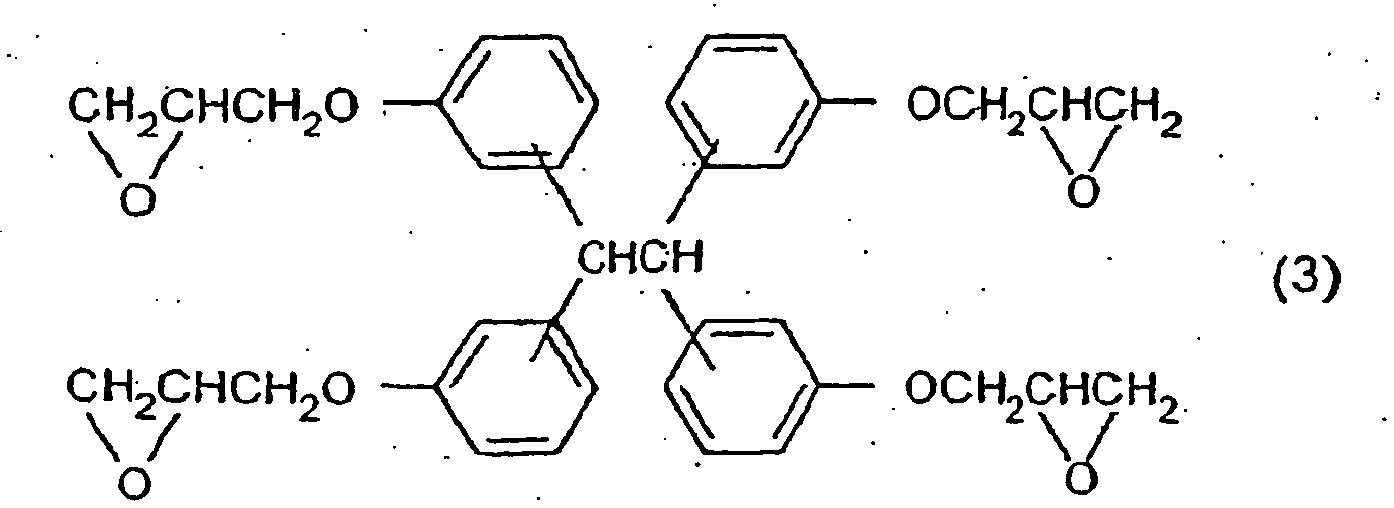
das Phenolharz (B) ein Phenolbiphenylaralkyl-Harz ist, das durch die folgende Formel (10) dargestellt ist:
Kombination (ii): wobei
das Epoxidharz (A) ein Kombinationsgemisch aus Biphenyl-4,4'-diglycidylether-Epoxidharz und 3,3',5,5'-tetramethylbiphenyl-4,4'-diglycidylether-Epoxidharz ist, welches durch die folgende Formel (4) dargestellt ist:
das Phenolharz (B) ein Phenolbiphenylaralkyl-Harz ist, welches durch die folgende Formel (10) dargestellt ist:
Kombination (iii), wobei:das Epoxidharz (A) ein Phenolphenylaralkyl-Epoxidharz ist, welches durch die folgende Formel (1) dargestellt ist:wobei n = 0 bis 10; und
das Phenolharz (B) ein Phenolphenylaralkyl-Harz ist, welches durch folgende Formel (9) dargestellt ist:
Kombination (iv), wobei:das Epoxidharz (A) ein Kombinationsgemisch aus einem Phenolbiphenylaralkyl-Epoxidharz ist, welches durch die folgende Formel (2) dargestellt ist:wobei n = 0 bis 10, mit einem Epoxidharz von der Art eines Tetraphenylolethans, welches durch die folgende Formel (3) dargestellt ist:

wobei das Phenolharz (B) ein Phenolbiphenylaralkyl-Harz ist, welches durch die folgende Formel (10) dargestellt ist: - wobei 60 ≤ W ≤ 95, wobei W (Gew.-%) der Gehalt von W (Gew.-%) für den anorganischen Füllstoff (C) in einem ausgehärteten Gegenstand ist, welcher durch Aushärten der Zusammensetzung erhalten werden kann;- wobei der anorganische Füllstoff (C) ein einzelner Füllstoff oder ein Gemisch aus zwei oder mehr Füllstoffen ist, welche aus der Gruppe bestehend aus geschmolzenem Kieselerde- bzw. Quarzpulver, kristallinem Kieselerde- bzw. Quarzpulver oder Siliziumnitrid ausgewählt werden;- wobei das Verhältnis (OH/Ep) einer Anzahl von phenolischen Hydroxyl-Gruppen (OH) des gesamten Phenolharzes zu einer Anzahl von Epoxid-Gruppen (Ep) des gesamten Epoxidharzes 1 ≤ (OH/Ep) ≤ 2.5 ist;- wobei der Biege- bzw. Elastizitätsmodul E (kgf/mm2) bei 240 ± 20°C eines ausgehärteten Gegenstandes, welcher welcher durch Aushärten der Zusammensetzung erhalten wird, ein Wert ist, welcher die Gleichung 0.3W - 13 ≤ E ≤ 3.7W - 184 erfüllt;- wobei die Werte von Q1 und Q2, welche durch die nachfolgenden Gleichungen dargestellt werden, Q1 ≥ 5 bzw. 5 ≤ Q2 ≤ 50 erfüllen:

wobei q1 (Gew.-%) ein Gewichtsverhältnis zu dem ausgehärteten Gegenstand ist, und zwar von Kohlenmonoxid und Kohlendioxid, welche erzeugt werden, indem ein wärmebeständiger Behälter mit dem gewichteten ausgehärteten Gegenstand in einem rohrförmigen Ofen angeordnet wird, welcher mit Edelgas bei einer konstanten Durchflussrate gereinigt bzw. durchspült wird, um die Atmosphäre in dem Ofen in einen inaktiven bzw. inerten Zustand zu bringen, und anschließend der ausgehärtete Gegenstand bei einer Temperatur von 700 ± 10°C 10 Minuten lang thermisch zersetzt wird; q2 (Gew.-%) ist ein Gewichtsverhältnis eines Rückstandes bei der Beendigung der thermischen Zersetzung zu dem ausgehärteten Gegenstand, wobei es sich bei dem Rückstand genauer gesagt um den anorganischen Füllstoff handelt, welcher zu Kohlenstoff zersetzt zurückbleibt und unter den Harzbestandteilen [Bestandteile abgesehen von dem organischen Füllstoff (C)] in dem ausgehärteten Gegenstand thermisch nicht zersetzt wird; und q3 (Gew.-%) ist ein Gewichtsverhältnis der in dem ausgehärteten Gegenstand enthaltenenHarzbestandteile zu dem ausgehärteten Artikel; und- wobei der ausgehärtete Gegenstand während der thermischen Zersetzung oder bei Entflammung eine aufgeschäumte Schicht zur Ausübung einer Flammenhemmung bildet. - Schwerentflammbare Epoxidharz-Zusammensetzung nach Anspruch 1,
dadurch gekennzeichnet, dass
der Biege- bzw. Elastizitätsmodul E (kgf/mm2) bei 240 ± 20°C eines ausgehärteten Gegenstandes, welcher durch Aushärten der Zusammensetzung erhalten wird, ein Wert ist, welcher die Gleichung 0.30W - 10 ≤ E ≤ 3.7W - 199 erfüllt, und
die durch die folgenden Gleichungen dargestellten Werte Q1 und Q2 Folgendes erfüllen: Q1 ≥ 10 bzw. 5 ≤ Q2 ≤ 45; und
der ausgehärtete Gegenstand während der thermischen Zersetzung oder bei Entflammung eine aufgeschäumte Schicht zur Ausübung einer Flammenhemmung bildet. - Schwerentflammbare Epoxidharz-Zusammensetzung nach Anspruch 1 oder 2, dadurch gekennzeichnet, dass das Verhältnis (OH/Ep) 1.0 ist.
- Schwerentflammbare Epoxidharz-Zusammensetzung nach einem der Ansprüche 1 bis 3,
dadurch gekennzeichnet, dass
das Epoxidharz (A) ein Epoxidharz von der Art eines Tetraphenylolethans ist, welches durch die folgende Formel (3) dargestellt ist:
das Phenolharz (B) ein Phenolbiphenylaralkyl-Harz ist, welcher durch die folgende Formel (10) dargestellt ist:
- Schwerentflammbare Epoxidharz-Zusammensetzung nach einem der Ansprüche 1 bis 3, dadurch gekennzeichnet, dass
das Epoxidharz (A) ein Kombinationsgemisch aus Biphenyl-4,4'-diglycidylether-Epoxidharz und 3,3',5,5'-Tetramethylbiphenyl-4,4'-diglycidylether-Epoxidharz ist, welches durch die folgende Formel (4) dargestellt ist:
das Phenolharz (B) ein Phenolbiphenylaralkyl-Harz ist, welches durch die folgende Formel (10) dargestellt ist:
- Schwerentflammbare Epoxidharz-Zusammensetzung nach einem der Ansprüche 1 bis 3,
dadurch gekennzeichnet, dass
das Epoxidharz (A) ein Phenolphenylaralkyl-Epoxidharz ist, welches durch die folgende Formel (1) dargestellt ist:
das Phenolharz (B) ein Phenolphenylaralkyl-Harz ist, welches durch die folgende Formel (9) dargestellt ist:
- Schwerentflammbare Epoxidharz-Zusammensetzung nach einem der Ansprüche 1 bis 3,
dadurch gekennzeichnet, dass
das Epoxidharz (A) ein Kombinationsgemisch eines Phenolbiphenylaralkyl-Epoxidharzes ist, welches durch die folgende Formel (2) dargestellt ist:
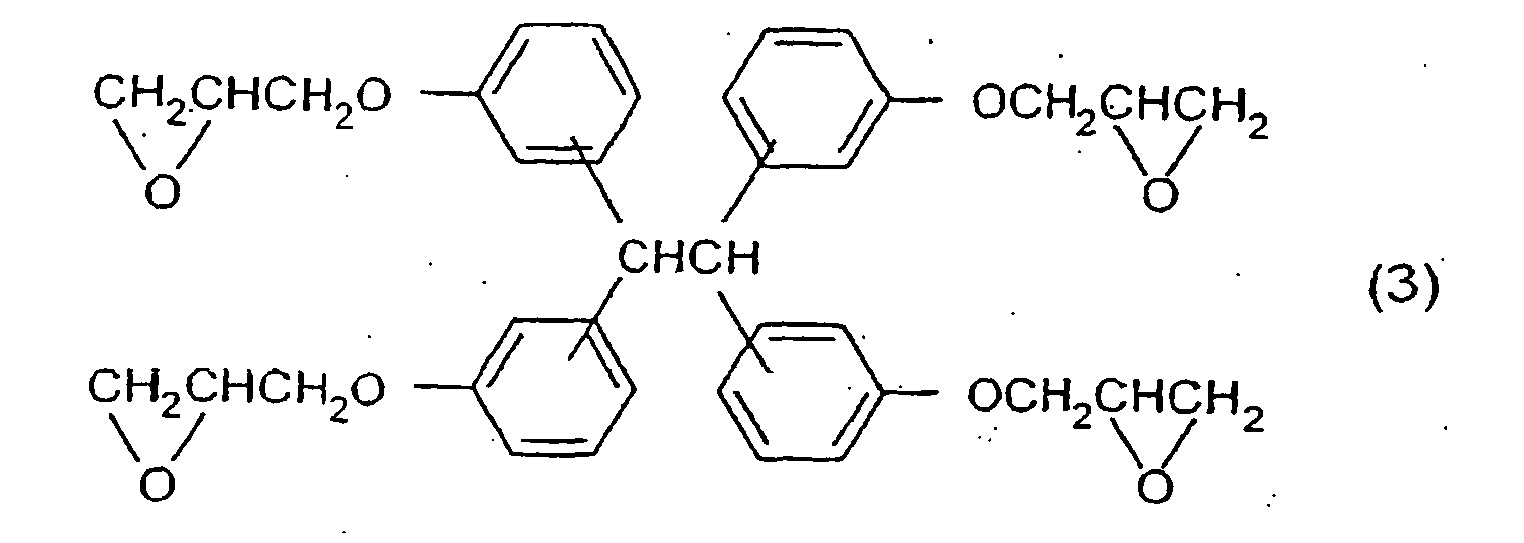
das Phenolharz (B) ein Phenolbiphenylaralkyl-Harz ist, welches durch die folgende Formel (10) dargestellt ist:
- Schwerentflammbare Epoxidharz-Zusammensetzung nach einem der Ansprüche 1 bis 7,
dadurch gekennzeichnet, dass W folgendermaßen gewählt wird: 60 ≤ W < 87. - Halbleitervorrichtung, in welcher die in einem der Ansprüche 1 bis 8 beschriebene schwerentflammbare Epoxidharz-Zusammensetzung als Ein- bzw. Verkapselungsharz verwendet wird.
Applications Claiming Priority (2)
| Application Number | Priority Date | Filing Date | Title |
|---|---|---|---|
| JP29960698A JP3349963B2 (ja) | 1998-10-21 | 1998-10-21 | 難燃性エポキシ樹脂組成物及びそれを用いた半導体装置 |
| EP99949323A EP1142923B1 (de) | 1998-10-21 | 1999-10-20 | Flammhemmende harzzusammensetzung und die daraus hergestellte halbleitervorrichtung |
Related Parent Applications (1)
| Application Number | Title | Priority Date | Filing Date |
|---|---|---|---|
| EP99949323A Division EP1142923B1 (de) | 1998-10-21 | 1999-10-20 | Flammhemmende harzzusammensetzung und die daraus hergestellte halbleitervorrichtung |
Publications (2)
| Publication Number | Publication Date |
|---|---|
| EP1739112A1 EP1739112A1 (de) | 2007-01-03 |
| EP1739112B1 true EP1739112B1 (de) | 2009-09-09 |
Family
ID=17874818
Family Applications (2)
| Application Number | Title | Priority Date | Filing Date |
|---|---|---|---|
| EP99949323A Expired - Lifetime EP1142923B1 (de) | 1998-10-21 | 1999-10-20 | Flammhemmende harzzusammensetzung und die daraus hergestellte halbleitervorrichtung |
| EP06018889A Expired - Lifetime EP1739112B1 (de) | 1998-10-21 | 1999-10-20 | Flammhemmende Harzzusammensetzung und die daraus hergestellte Halbleitervorrichtung |
Family Applications Before (1)
| Application Number | Title | Priority Date | Filing Date |
|---|---|---|---|
| EP99949323A Expired - Lifetime EP1142923B1 (de) | 1998-10-21 | 1999-10-20 | Flammhemmende harzzusammensetzung und die daraus hergestellte halbleitervorrichtung |
Country Status (9)
| Country | Link |
|---|---|
| US (2) | US7098276B1 (de) |
| EP (2) | EP1142923B1 (de) |
| JP (1) | JP3349963B2 (de) |
| KR (1) | KR100443110B1 (de) |
| AT (2) | ATE350411T1 (de) |
| DE (2) | DE69934716T8 (de) |
| MY (1) | MY145752A (de) |
| TW (1) | TWI225074B (de) |
| WO (1) | WO2000023494A1 (de) |
Families Citing this family (18)
| Publication number | Priority date | Publication date | Assignee | Title |
|---|---|---|---|---|
| JP3349963B2 (ja) | 1998-10-21 | 2002-11-25 | 日本電気株式会社 | 難燃性エポキシ樹脂組成物及びそれを用いた半導体装置 |
| JP3460820B2 (ja) | 1999-12-08 | 2003-10-27 | 日本電気株式会社 | 難燃性エポキシ樹脂組成物 |
| JP4743932B2 (ja) * | 2000-02-17 | 2011-08-10 | 住友ベークライト株式会社 | エポキシ樹脂組成物及び半導体装置 |
| JP2002012741A (ja) * | 2000-06-27 | 2002-01-15 | Sumitomo Bakelite Co Ltd | エポキシ樹脂組成物及び半導体装置 |
| JP4742414B2 (ja) * | 2000-10-04 | 2011-08-10 | 住友ベークライト株式会社 | 半導体装置 |
| JP2002226557A (ja) * | 2001-01-30 | 2002-08-14 | Dainippon Ink & Chem Inc | 難燃性エポキシ樹脂組成物 |
| JP2003268079A (ja) * | 2002-03-18 | 2003-09-25 | Sumitomo Bakelite Co Ltd | エポキシ樹脂組成物及び半導体装置 |
| JP4251612B2 (ja) * | 2003-01-30 | 2009-04-08 | ローム・アンド・ハース・エレクトロニック・マテリアルズ,エル.エル.シー. | エポキシ含有物質を含むネガ型感光性樹脂組成物 |
| JP4397601B2 (ja) * | 2003-02-06 | 2010-01-13 | ローム・アンド・ハース・エレクトロニック・マテリアルズ,エル.エル.シー. | フェノール−ビフェニレン樹脂を含むネガ型感光性樹脂組成物 |
| US7300796B2 (en) * | 2003-09-09 | 2007-11-27 | International Business Machines Corporation | Pressurized oxygen for evaluation of molding compound stability in semiconductor packaging |
| BRPI0418907A (pt) | 2004-05-20 | 2007-11-27 | Albemarle Corp | aglomerados de polìmeros estirênicos aniÈnicos bromatadas inalterados e método de preparação |
| JP5170493B2 (ja) | 2005-10-14 | 2013-03-27 | エア・ウォーター株式会社 | フェノール系重合体、その製法及びその用途 |
| US20110221017A1 (en) * | 2008-11-07 | 2011-09-15 | Sumitomo Bakelite Company, Ltd. | Photosensitive resin composition, photosensitive adhesive film, and light-receiving device |
| CN104334597B (zh) | 2012-02-23 | 2016-06-22 | 新日铁住金化学株式会社 | 多元羟基树脂、环氧树脂、它们的制造方法、环氧树脂组合物及其固化物 |
| KR101385005B1 (ko) | 2012-04-25 | 2014-04-16 | 국도화학 주식회사 | 에폭시몰딩컴파운드용 자기소화성 에폭시 수지 및 그 제법, 에폭시몰딩컴파운드용 에폭시 수지 조성물 |
| JP6406847B2 (ja) | 2014-03-26 | 2018-10-17 | 新日鉄住金化学株式会社 | 変性多価ヒドロキシ樹脂、エポキシ樹脂、エポキシ樹脂組成物及びその硬化物 |
| JP6546527B2 (ja) | 2015-04-27 | 2019-07-17 | エア・ウォーター株式会社 | 組成物、エポキシ樹脂硬化剤、エポキシ樹脂組成物、熱硬化性組成物、硬化物、半導体装置、および層間絶縁材料 |
| JP6867894B2 (ja) | 2017-06-22 | 2021-05-12 | エア・ウォーター株式会社 | 組成物、エポキシ樹脂硬化剤、エポキシ樹脂組成物、熱硬化性組成物、硬化物、半導体装置、および層間絶縁材料 |
Family Cites Families (51)
| Publication number | Priority date | Publication date | Assignee | Title |
|---|---|---|---|---|
| JPS5738814A (en) * | 1980-08-20 | 1982-03-03 | Mitsubishi Petrochem Co Ltd | Production of polyepoxy compound |
| JPS58150581A (ja) * | 1982-03-02 | 1983-09-07 | Mitsubishi Petrochem Co Ltd | ポリエポキシ化合物の製造方法 |
| JPH0788418B2 (ja) * | 1987-05-08 | 1995-09-27 | 宇部興産株式会社 | エポキシ樹脂組成物 |
| JP2568584B2 (ja) * | 1987-10-15 | 1997-01-08 | 日東電工株式会社 | 半導体装置 |
| JP2843612B2 (ja) * | 1989-09-21 | 1999-01-06 | 東レ・ダウコーニング・シリコーン株式会社 | エポキシ樹脂組成物 |
| JPH03210322A (ja) * | 1990-01-11 | 1991-09-13 | Toshiba Chem Corp | 封止用樹脂組成物および半導体装置 |
| JP2823633B2 (ja) * | 1990-02-20 | 1998-11-11 | 住友ベークライト株式会社 | エポキシ樹脂組成物 |
| KR950011902B1 (ko) | 1990-04-04 | 1995-10-12 | 도오레 가부시끼가이샤 | 반도체 장치 캡슐 봉입 에폭시 수지 조성물 |
| JP3210322B2 (ja) | 1990-07-31 | 2001-09-17 | 株式会社スタンレー滋賀製作所 | エッジライト用面光源パネル |
| JPH08333428A (ja) | 1990-07-10 | 1996-12-17 | Mitsui Toatsu Chem Inc | 低軟化点フェニルフェノールアラルキル樹脂およびその樹脂を用いたエポキシ樹脂組成物 |
| JP3205566B2 (ja) | 1991-02-08 | 2001-09-04 | 新日鐵化学株式会社 | 多官能エポキシ樹脂及びその製造方法 |
| JPH04258624A (ja) * | 1991-02-09 | 1992-09-14 | Toshiba Chem Corp | 封止用樹脂組成物及び半導体封止装置 |
| JP2922672B2 (ja) | 1991-05-08 | 1999-07-26 | 日東電工株式会社 | 半導体装置の製法 |
| JPH0597965A (ja) | 1991-10-04 | 1993-04-20 | Mitsui Toatsu Chem Inc | エポキシ樹脂組成物 |
| JPH0597970A (ja) * | 1991-10-07 | 1993-04-20 | Shin Etsu Chem Co Ltd | 熱硬化性樹脂組成物及び半導体装置 |
| JP2978313B2 (ja) | 1991-11-15 | 1999-11-15 | 日東電工株式会社 | 半導体装置およびそれに用いる半導体封止用エポキシ樹脂組成物 |
| JP3147317B2 (ja) | 1991-12-24 | 2001-03-19 | 三井化学株式会社 | エポキシ樹脂組成物 |
| SG87725A1 (en) * | 1992-09-21 | 2002-04-16 | Sumitomo Bakelite Co | Epoxy resin composition |
| US5416138A (en) * | 1992-09-24 | 1995-05-16 | Sumitomo Bakelite Company Limited | Epoxy resin composition |
| JP2948056B2 (ja) | 1993-05-12 | 1999-09-13 | 住金ケミカル株式会社 | 半導体封止用樹脂組成物 |
| JP3010110B2 (ja) | 1993-11-04 | 2000-02-14 | 日東電工株式会社 | 半導体装置 |
| JPH07153873A (ja) | 1993-11-26 | 1995-06-16 | Nitto Denko Corp | 半導体装置 |
| JPH07196772A (ja) * | 1993-12-30 | 1995-08-01 | Hitachi Chem Co Ltd | 電子部品封止用エポキシ樹脂成形材料 |
| JPH07216059A (ja) | 1994-01-26 | 1995-08-15 | Mitsui Toatsu Chem Inc | エポキシ樹脂組成物およびこれを用いた半導体装置 |
| JP3305097B2 (ja) * | 1994-03-02 | 2002-07-22 | 住友ベークライト株式会社 | エポキシ樹脂組成物 |
| DE69533393T2 (de) * | 1995-01-05 | 2005-09-01 | Sumitomo Bakelite Co. Ltd. | Epoxyharzzusammensetzung |
| JP3632936B2 (ja) * | 1995-01-18 | 2005-03-30 | 住友ベークライト株式会社 | 半導体封止用エポキシ樹脂組成物及び半導体装置 |
| JP2896634B2 (ja) * | 1995-03-02 | 1999-05-31 | 富士ゼロックス株式会社 | 全文登録語検索装置および全文登録語検索方法 |
| JPH08301984A (ja) | 1995-03-09 | 1996-11-19 | Toray Ind Inc | 半導体封止用エポキシ樹脂組成物および半導体装置 |
| JPH08245754A (ja) * | 1995-03-13 | 1996-09-24 | Toshiba Chem Corp | エポキシ樹脂組成物および半導体封止装置 |
| JPH08253551A (ja) * | 1995-03-14 | 1996-10-01 | Yuka Shell Epoxy Kk | 半導体封止用エポキシ樹脂組成物 |
| JPH093161A (ja) * | 1995-06-20 | 1997-01-07 | Toshiba Chem Corp | エポキシ樹脂組成物および半導体封止装置 |
| JP3573530B2 (ja) * | 1995-06-22 | 2004-10-06 | 日本化薬株式会社 | エポキシ樹脂混合物、エポキシ樹脂組成物およびその硬化物 |
| US5854316A (en) * | 1995-07-10 | 1998-12-29 | Toray Industries, Inc. | Epoxy resin composition |
| JPH09208808A (ja) | 1996-02-07 | 1997-08-12 | Toshiba Chem Corp | エポキシ樹脂組成物および半導体封止装置 |
| JPH09268219A (ja) * | 1996-03-29 | 1997-10-14 | Nippon Kayaku Co Ltd | ノボラック型樹脂、エポキシ樹脂、エポキシ樹脂組成物及びその硬化物 |
| US5790679A (en) | 1996-06-06 | 1998-08-04 | Northern Telecom Limited | Communications terminal having a single transducer for handset and handsfree receive functionality |
| JP3611002B2 (ja) | 1996-08-08 | 2005-01-19 | 信越化学工業株式会社 | エポキシ樹脂組成物、その製造方法及び半導体装置 |
| JP3618182B2 (ja) | 1996-10-29 | 2005-02-09 | 日東電工株式会社 | 半導体封止用エポキシ樹脂組成物 |
| JP3649540B2 (ja) * | 1996-12-27 | 2005-05-18 | 住友ベークライト株式会社 | エポキシ樹脂組成物 |
| US6054222A (en) * | 1997-02-20 | 2000-04-25 | Kabushiki Kaisha Toshiba | Epoxy resin composition, resin-encapsulated semiconductor device using the same, epoxy resin molding material and epoxy resin composite tablet |
| JP3806222B2 (ja) * | 1997-04-18 | 2006-08-09 | 新日鐵化学株式会社 | エポキシ樹脂組成物及びその硬化物 |
| JP3074155B2 (ja) | 1997-10-20 | 2000-08-07 | 日東電工株式会社 | 半導体装置 |
| JPH11140277A (ja) * | 1997-11-10 | 1999-05-25 | Sumitomo Bakelite Co Ltd | エポキシ樹脂組成物及びこれを用いた半導体装置 |
| JPH11140166A (ja) * | 1997-11-11 | 1999-05-25 | Shin Etsu Chem Co Ltd | 半導体封止用エポキシ樹脂組成物及び半導体装置 |
| JP3388537B2 (ja) * | 1998-05-15 | 2003-03-24 | 信越化学工業株式会社 | 半導体封止用エポキシ樹脂組成物及び半導体装置 |
| JP2000103839A (ja) | 1998-09-25 | 2000-04-11 | Matsushita Electric Works Ltd | 封止用樹脂組成物及び半導体装置 |
| JP3349963B2 (ja) | 1998-10-21 | 2002-11-25 | 日本電気株式会社 | 難燃性エポキシ樹脂組成物及びそれを用いた半導体装置 |
| JP4421810B2 (ja) | 2002-06-24 | 2010-02-24 | 日本電気株式会社 | 難燃性エポキシ樹脂組成物及びそれを用いた半導体装置 |
| JP4255714B2 (ja) | 2003-02-19 | 2009-04-15 | 富士通マイクロエレクトロニクス株式会社 | Bist回路、半導体装置及びbist回路のコマンドパターン生成方法 |
| JP4258624B2 (ja) | 2003-07-08 | 2009-04-30 | 新オプトウエア株式会社 | 光情報記録装置 |
-
1998
- 1998-10-21 JP JP29960698A patent/JP3349963B2/ja not_active Expired - Lifetime
-
1999
- 1999-10-20 AT AT99949323T patent/ATE350411T1/de not_active IP Right Cessation
- 1999-10-20 US US09/830,016 patent/US7098276B1/en not_active Expired - Lifetime
- 1999-10-20 EP EP99949323A patent/EP1142923B1/de not_active Expired - Lifetime
- 1999-10-20 DE DE69934716T patent/DE69934716T8/de active Active
- 1999-10-20 KR KR10-2001-7004927A patent/KR100443110B1/ko not_active Expired - Lifetime
- 1999-10-20 AT AT06018889T patent/ATE442394T1/de not_active IP Right Cessation
- 1999-10-20 WO PCT/JP1999/005787 patent/WO2000023494A1/ja not_active Ceased
- 1999-10-20 EP EP06018889A patent/EP1739112B1/de not_active Expired - Lifetime
- 1999-10-20 DE DE69941409T patent/DE69941409D1/de not_active Expired - Lifetime
- 1999-10-21 MY MYPI99004547A patent/MY145752A/en unknown
- 1999-10-21 TW TW088118357A patent/TWI225074B/zh not_active IP Right Cessation
-
2006
- 2006-06-30 US US11/477,524 patent/US7799852B2/en not_active Expired - Fee Related
Also Published As
| Publication number | Publication date |
|---|---|
| EP1142923B1 (de) | 2007-01-03 |
| EP1739112A1 (de) | 2007-01-03 |
| MY145752A (en) | 2012-03-30 |
| WO2000023494A1 (fr) | 2000-04-27 |
| ATE350411T1 (de) | 2007-01-15 |
| KR20010080252A (ko) | 2001-08-22 |
| EP1142923A1 (de) | 2001-10-10 |
| US20060247393A1 (en) | 2006-11-02 |
| TWI225074B (en) | 2004-12-11 |
| DE69934716T8 (de) | 2008-04-30 |
| ATE442394T1 (de) | 2009-09-15 |
| DE69941409D1 (de) | 2009-10-22 |
| US7098276B1 (en) | 2006-08-29 |
| DE69934716D1 (de) | 2007-02-15 |
| JP2000129092A (ja) | 2000-05-09 |
| KR100443110B1 (ko) | 2004-08-04 |
| US7799852B2 (en) | 2010-09-21 |
| EP1142923A4 (de) | 2002-06-26 |
| JP3349963B2 (ja) | 2002-11-25 |
| DE69934716T2 (de) | 2007-10-25 |
Similar Documents
| Publication | Publication Date | Title |
|---|---|---|
| EP1142923B1 (de) | Flammhemmende harzzusammensetzung und die daraus hergestellte halbleitervorrichtung | |
| Kinjo et al. | Epoxy molding compounds as encapsulation materials for microelectronic devices | |
| KR101254524B1 (ko) | 에폭시 수지 조성물 및 반도체 장치 | |
| EP0783025A2 (de) | Epoxidharzzusammensetzung | |
| JPH0597969A (ja) | 熱硬化性樹脂組成物及び半導体装置 | |
| JP4421810B2 (ja) | 難燃性エポキシ樹脂組成物及びそれを用いた半導体装置 | |
| CN110791052B (zh) | 一种高可靠性环氧树脂组合物及其应用 | |
| KR100739363B1 (ko) | 반도체 소자 밀봉용 에폭시 수지 조성물 | |
| KR0136373B1 (ko) | 성형용 페놀수지 조성물, 이의 제조방법 및 이 조성물로 밀봉된 반도체 장치 | |
| JPH08311159A (ja) | エポキシ樹脂組成物、その製造方法及びそれを用いた半導体装置 | |
| JPH05166974A (ja) | エポキシ樹脂組成物 | |
| JP2003192769A (ja) | エポキシ樹脂組成物及び半導体装置 | |
| JPH05206330A (ja) | エポキシ樹脂組成物 | |
| JP2003040981A (ja) | エポキシ樹脂組成物及び半導体装置 | |
| JPH05175366A (ja) | エポキシ樹脂組成物 | |
| JPH10287731A (ja) | ポリアルキルフェノール樹脂および/またはポリアルキルフェノールエポキシ樹脂含有エポキシ樹脂組成物 | |
| KR100826105B1 (ko) | 반도체 소자 밀봉용 에폭시 수지 조성물 | |
| JP2019044013A (ja) | エポキシ樹脂組成物および半導体装置 | |
| KR100673612B1 (ko) | 난연성, 흐름성 및 신뢰성이 우수한 반도체 소자 밀봉용에폭시 수지 조성물 | |
| KR100798677B1 (ko) | 반도체 소자 밀봉용 에폭시 수지 조성물 및 이를 이용한반도체 소자 | |
| KR20050070622A (ko) | 반도체 소자 밀봉용 에폭시 수지 조성물 | |
| JPH05175373A (ja) | エポキシ樹脂組成物 | |
| KR100908925B1 (ko) | 반도체 소자 밀봉용 에폭시 수지 조성물 및 이를 이용한 반도체 소자 | |
| JP2002293886A (ja) | エポキシ樹脂組成物及び半導体装置 | |
| JPH09316176A (ja) | 半導体封止用エポキシ樹脂組成物 |
Legal Events
| Date | Code | Title | Description |
|---|---|---|---|
| PUAI | Public reference made under article 153(3) epc to a published international application that has entered the european phase |
Free format text: ORIGINAL CODE: 0009012 |
|
| AC | Divisional application: reference to earlier application |
Ref document number: 1142923 Country of ref document: EP Kind code of ref document: P |
|
| AK | Designated contracting states |
Kind code of ref document: A1 Designated state(s): AT BE CH CY DE DK ES FI FR GB GR IE IT LI LU MC NL PT SE |
|
| 17P | Request for examination filed |
Effective date: 20070421 |
|
| AKX | Designation fees paid |
Designated state(s): AT BE CH CY DE DK ES FI FR GB GR IE IT LI LU MC NL PT SE |
|
| 17Q | First examination report despatched |
Effective date: 20071026 |
|
| GRAP | Despatch of communication of intention to grant a patent |
Free format text: ORIGINAL CODE: EPIDOSNIGR1 |
|
| GRAS | Grant fee paid |
Free format text: ORIGINAL CODE: EPIDOSNIGR3 |
|
| GRAA | (expected) grant |
Free format text: ORIGINAL CODE: 0009210 |
|
| AC | Divisional application: reference to earlier application |
Ref document number: 1142923 Country of ref document: EP Kind code of ref document: P |
|
| AK | Designated contracting states |
Kind code of ref document: B1 Designated state(s): AT BE CH CY DE DK ES FI FR GB GR IE IT LI LU MC NL PT SE |
|
| REG | Reference to a national code |
Ref country code: GB Ref legal event code: FG4D |
|
| REG | Reference to a national code |
Ref country code: CH Ref legal event code: EP |
|
| REG | Reference to a national code |
Ref country code: IE Ref legal event code: FG4D |
|
| REF | Corresponds to: |
Ref document number: 69941409 Country of ref document: DE Date of ref document: 20091022 Kind code of ref document: P |
|
| PG25 | Lapsed in a contracting state [announced via postgrant information from national office to epo] |
Ref country code: FI Free format text: LAPSE BECAUSE OF FAILURE TO SUBMIT A TRANSLATION OF THE DESCRIPTION OR TO PAY THE FEE WITHIN THE PRESCRIBED TIME-LIMIT Effective date: 20090909 Ref country code: SE Free format text: LAPSE BECAUSE OF FAILURE TO SUBMIT A TRANSLATION OF THE DESCRIPTION OR TO PAY THE FEE WITHIN THE PRESCRIBED TIME-LIMIT Effective date: 20090909 |
|
| PG25 | Lapsed in a contracting state [announced via postgrant information from national office to epo] |
Ref country code: CY Free format text: LAPSE BECAUSE OF FAILURE TO SUBMIT A TRANSLATION OF THE DESCRIPTION OR TO PAY THE FEE WITHIN THE PRESCRIBED TIME-LIMIT Effective date: 20090909 |
|
| REG | Reference to a national code |
Ref country code: NL Ref legal event code: SD Effective date: 20100318 |
|
| REG | Reference to a national code |
Ref country code: GB Ref legal event code: 732E Free format text: REGISTERED BETWEEN 20100401 AND 20100407 |
|
| PG25 | Lapsed in a contracting state [announced via postgrant information from national office to epo] |
Ref country code: ES Free format text: LAPSE BECAUSE OF FAILURE TO SUBMIT A TRANSLATION OF THE DESCRIPTION OR TO PAY THE FEE WITHIN THE PRESCRIBED TIME-LIMIT Effective date: 20091220 Ref country code: PT Free format text: LAPSE BECAUSE OF FAILURE TO SUBMIT A TRANSLATION OF THE DESCRIPTION OR TO PAY THE FEE WITHIN THE PRESCRIBED TIME-LIMIT Effective date: 20100111 |
|
| PG25 | Lapsed in a contracting state [announced via postgrant information from national office to epo] |
Ref country code: MC Free format text: LAPSE BECAUSE OF NON-PAYMENT OF DUE FEES Effective date: 20091031 |
|
| REG | Reference to a national code |
Ref country code: CH Ref legal event code: PL |
|
| REG | Reference to a national code |
Ref country code: FR Ref legal event code: TP |
|
| PG25 | Lapsed in a contracting state [announced via postgrant information from national office to epo] |
Ref country code: BE Free format text: LAPSE BECAUSE OF FAILURE TO SUBMIT A TRANSLATION OF THE DESCRIPTION OR TO PAY THE FEE WITHIN THE PRESCRIBED TIME-LIMIT Effective date: 20090909 Ref country code: AT Free format text: LAPSE BECAUSE OF FAILURE TO SUBMIT A TRANSLATION OF THE DESCRIPTION OR TO PAY THE FEE WITHIN THE PRESCRIBED TIME-LIMIT Effective date: 20090909 |
|
| PLBE | No opposition filed within time limit |
Free format text: ORIGINAL CODE: 0009261 |
|
| STAA | Information on the status of an ep patent application or granted ep patent |
Free format text: STATUS: NO OPPOSITION FILED WITHIN TIME LIMIT |
|
| PG25 | Lapsed in a contracting state [announced via postgrant information from national office to epo] |
Ref country code: DK Free format text: LAPSE BECAUSE OF FAILURE TO SUBMIT A TRANSLATION OF THE DESCRIPTION OR TO PAY THE FEE WITHIN THE PRESCRIBED TIME-LIMIT Effective date: 20090909 |
|
| 26N | No opposition filed |
Effective date: 20100610 |
|
| PG25 | Lapsed in a contracting state [announced via postgrant information from national office to epo] |
Ref country code: LI Free format text: LAPSE BECAUSE OF NON-PAYMENT OF DUE FEES Effective date: 20091031 Ref country code: IE Free format text: LAPSE BECAUSE OF NON-PAYMENT OF DUE FEES Effective date: 20091020 Ref country code: GR Free format text: LAPSE BECAUSE OF FAILURE TO SUBMIT A TRANSLATION OF THE DESCRIPTION OR TO PAY THE FEE WITHIN THE PRESCRIBED TIME-LIMIT Effective date: 20091210 Ref country code: CH Free format text: LAPSE BECAUSE OF NON-PAYMENT OF DUE FEES Effective date: 20091031 |
|
| PG25 | Lapsed in a contracting state [announced via postgrant information from national office to epo] |
Ref country code: LU Free format text: LAPSE BECAUSE OF NON-PAYMENT OF DUE FEES Effective date: 20091020 |
|
| REG | Reference to a national code |
Ref country code: FR Ref legal event code: PLFP Year of fee payment: 18 |
|
| REG | Reference to a national code |
Ref country code: DE Ref legal event code: R082 Ref document number: 69941409 Country of ref document: DE Representative=s name: SPLANEMANN BARONETZKY KNITTER PATENTANWAELTE R, DE Ref country code: DE Ref legal event code: R081 Ref document number: 69941409 Country of ref document: DE Owner name: NEC CORP., JP Free format text: FORMER OWNERS: SUMITOMO BAKELITE CO. LTD., TOKIO/TOKYO, JP; NEC CORP., TOKYO, JP |
|
| REG | Reference to a national code |
Ref country code: FR Ref legal event code: PLFP Year of fee payment: 19 |
|
| REG | Reference to a national code |
Ref country code: FR Ref legal event code: PLFP Year of fee payment: 20 |
|
| PGFP | Annual fee paid to national office [announced via postgrant information from national office to epo] |
Ref country code: FR Payment date: 20180913 Year of fee payment: 20 |
|
| PGFP | Annual fee paid to national office [announced via postgrant information from national office to epo] |
Ref country code: NL Payment date: 20180912 Year of fee payment: 20 |
|
| PGFP | Annual fee paid to national office [announced via postgrant information from national office to epo] |
Ref country code: DE Payment date: 20181009 Year of fee payment: 20 |
|
| PGFP | Annual fee paid to national office [announced via postgrant information from national office to epo] |
Ref country code: GB Payment date: 20181017 Year of fee payment: 20 Ref country code: IT Payment date: 20181018 Year of fee payment: 20 |
|
| REG | Reference to a national code |
Ref country code: DE Ref legal event code: R071 Ref document number: 69941409 Country of ref document: DE |
|
| REG | Reference to a national code |
Ref country code: NL Ref legal event code: MK Effective date: 20191019 |
|
| REG | Reference to a national code |
Ref country code: GB Ref legal event code: PE20 Expiry date: 20191019 |
|
| PG25 | Lapsed in a contracting state [announced via postgrant information from national office to epo] |
Ref country code: GB Free format text: LAPSE BECAUSE OF EXPIRATION OF PROTECTION Effective date: 20191019 |