EP1749725A2 - Vorrichtung und Methode zur Antriebskraftverteilung - Google Patents
Vorrichtung und Methode zur Antriebskraftverteilung Download PDFInfo
- Publication number
- EP1749725A2 EP1749725A2 EP06118274A EP06118274A EP1749725A2 EP 1749725 A2 EP1749725 A2 EP 1749725A2 EP 06118274 A EP06118274 A EP 06118274A EP 06118274 A EP06118274 A EP 06118274A EP 1749725 A2 EP1749725 A2 EP 1749725A2
- Authority
- EP
- European Patent Office
- Prior art keywords
- heat generating
- temperature
- generating portion
- coupling
- drive
- Prior art date
- Legal status (The legal status is an assumption and is not a legal conclusion. Google has not performed a legal analysis and makes no representation as to the accuracy of the status listed.)
- Granted
Links
Images

Classifications
-
- B—PERFORMING OPERATIONS; TRANSPORTING
- B60—VEHICLES IN GENERAL
- B60W—CONJOINT CONTROL OF VEHICLE SUB-UNITS OF DIFFERENT TYPE OR DIFFERENT FUNCTION; CONTROL SYSTEMS SPECIALLY ADAPTED FOR HYBRID VEHICLES; ROAD VEHICLE DRIVE CONTROL SYSTEMS FOR PURPOSES NOT RELATED TO THE CONTROL OF A PARTICULAR SUB-UNIT
- B60W30/00—Purposes of road vehicle drive control systems not related to the control of a particular sub-unit, e.g. of systems using conjoint control of vehicle sub-units
- B60W30/18—Propelling the vehicle
- B60W30/184—Preventing damage resulting from overload or excessive wear of the driveline
- B60W30/1843—Overheating of driveline components
-
- B—PERFORMING OPERATIONS; TRANSPORTING
- B60—VEHICLES IN GENERAL
- B60W—CONJOINT CONTROL OF VEHICLE SUB-UNITS OF DIFFERENT TYPE OR DIFFERENT FUNCTION; CONTROL SYSTEMS SPECIALLY ADAPTED FOR HYBRID VEHICLES; ROAD VEHICLE DRIVE CONTROL SYSTEMS FOR PURPOSES NOT RELATED TO THE CONTROL OF A PARTICULAR SUB-UNIT
- B60W2510/00—Input parameters relating to a particular sub-units
- B60W2510/02—Clutches
- B60W2510/0291—Clutch temperature
Definitions
- the present invention relates to a drive force distribution device and a method for distributing drive force.
- a typical drive force distribution device is capable of changing a drive force distribution ratio of a main drive wheel to a sub drive wheel.
- a torque coupling is provided in a drive force transmission system. Operation of the torque coupling is controlled in such a manner as to change the torque transmission rate (the transmitted torque) from an input to an outlet of the torque coupling. This regulates the drive force distribution ratio of the main drive wheel to the sub drive wheel.
- the torque coupling employs a friction clutch, which generates heat through frictional engagement of clutch plates. Also, a transfer case or a differential, which are arranged in the drive force transmission system of a vehicle, generate heat through friction caused by engagement of gears. Overheating of these heat generating portions thus must be suppressed.
- Japanese Laid-Open Patent Publication No. 2003-136990 describes a drive force distribution device that detects the temperatures of a differential or a transfer case provided in a drive force transmission system. If the temperature of the differential or the transfer case exceeds a corresponding predetermined level, the drive force distribution device controls operation of a torque coupling in such a manner as to suppress overheating of the differential or the transfer case.
- Japanese Laid-Open Patent Publication No. 7-12155 describes a method for estimating the temperature of a torque coupling in correspondence with the rotational speeds of an input shaft and an output shaft provided in the torque coupling, and the torque transmission rate. By employing the method, overheating of the heat generating portions is effectively suppressed through a simplified structure.
- heat generating energy accumulated in the torque coupling is determined basically in correspondence with the load acting on the torque coupling.
- the heat generating energy is then accumulated.
- the accumulated heat generating energy, or the estimated temperature of the torque coupling is cleared (deleted) once the engine, or the drive source, is stopped, or the ignition is turned off.
- the temperature of the torque coupling which rises when the engine operates, drops when the engine is held in a deactivated state. When the engine is re-started, or the ignition is turned on, estimation of the temperature of the torque coupling is resumed. If the temperature of the torque coupling has not decreased sufficiently in the engine deactivation period, there may be a difference between the actual temperature of the torque coupling and an initial value set for the temperature estimation.
- the actual temperature of the torque coupling may remain relatively high when the engine is re-started, indicating necessity of suppression of overheating.
- the temperature of the torque coupling may be determined to be lower than the actual level. This may cause increased load to act on the torque coupling continuously, making it impossible to effectively protect the torque coupling.
- a drive force distribution device of a vehicle including a main drive wheel, a sub drive wheel, and a drive force transmission system that transmits a drive force generated by a drive source to the drive wheels.
- the device includes a coupling, a control section, and a memory portion, and a timer portion.
- the coupling is arranged in the drive force transmission system.
- the coupling changes a torque transmission rate of a torque transmitted from an input of the coupling to an output of the coupling, thereby varying a drive force distribution ratio of the main drive wheel to the sub drive wheel.
- the control section controls operation of the coupling.
- the control section estimates the temperature of at least one of heat generating portions of the drive force transmission system by accumulating a heat generating energy accumulated in the heat generating portion in correspondence with the load acting on the heat generating portion. If the estimated temperature exceeds a predetermined temperature, the control section controls the operation of the coupling to reduce the load acting on the heat generating portion, thereby suppressing overheating of the heat generating portion.
- the memory portion memorizes the estimated temperature as a memorized temperature before the drive source is stopped.
- the timer portion measures the time since stopping of the drive source.
- the control section controls the operation of the coupling in correspondence with the time and the memorized temperature immediately after the drive source is re-started.
- a method for distributing drive force of a vehicle including a main drive wheel, a sub drive wheel, and a drive force transmission system that transmits a drive force generated by a drive source to the drive wheels is provided.
- the method includes: transmitting a torque from an input of a coupling arranged in the drive force transmission system to an output of the coupling; varying a drive force distribution ratio of the main drive wheel to the sub drive wheel by changing a torque transmission rate of the coupling; estimating a temperature of at least one of heat generating portions of the drive force transmission system by accumulating a heat generating energy accumulated in the heat generating portion in correspondence with the load acting on the heat generating portion; determining whether the estimated temperature exceeds a predetermined temperature; controlling the operation of the coupling to reduce the load acting on the heat generating portion, thereby suppressing overheating of the heat generating portion if the estimated temperature of the heat generating portion exceeds the predetermined temperature; memorizing the estimated temperature as a memorized temperature before the drive source is stopped; measuring the time since the drive source is stopped; and controlling the operation of the coupling in correspondence with the time and the memorized temperature immediately after the drive source is re-started.
- a vehicle 1 is a front-wheel-drive based four-wheel-drive vehicle.
- the present invention is embodied as a drive force distribution device of a four-wheel-drive vehicle.
- a transaxle 3 is provided in an engine 2.
- a pair of front axles 4 and a propeller shaft 5 are connected to the transaxle 3.
- the propeller shaft 5 is also connected to a drive pinion shaft 7.
- the pinion shaft 7 is connected to a pair of rear axles 9 through a rear differential 8, or a differential.
- the drive force generated by the engine 2 is transmitted sequentially to the transaxle 3 and the front axle 4 in this order and then reaches front wheels 10f. Meanwhile, the drive force of the engine 2 is transmitted sequentially to the transaxle 3, the propeller shaft 5, the pinion shaft 7, the rear differential 8, and the rear axle 9 in this order and thus received by rear wheels 10r.
- the vehicle 1 includes a torque coupling 11 and an ECU 12.
- the torque coupling 11 is arranged in the above-described drive force transmission system.
- the torque coupling 11 changes the rate of the torque transmitted from the input to the outlet of the torque coupling 11 (the torque transmission rate). This alters the drive force distribution ratio of the front wheels 10f, which are main drive wheels, to the rear wheels 10r, or sub drive wheels.
- the ECU 12 functions as a control section that controls operation of the torque coupling 11.
- the torque coupling 11 and the ECU 12 form a drive force distribution device 13.
- the torque coupling 11 of the illustrated embodiment is arranged between the propeller shaft 5 and the pinion shaft 7. That is, the rear differential 8, or the differential, is provided between the torque coupling 11 and the rear wheels 10r, the sub drive wheels.
- the transaxle 3 includes a transfer case portion, which is arranged between the engine 2, or a drive source, and the torque coupling 11.
- the torque coupling 11, the pinion shaft 7, and the rear differential 8 are accommodated in a differential carrier 14.
- the torque coupling 11 has an electromagnetic clutch 15.
- the electromagnetic clutch 15 has a pair of clutch plates, or an input clutch plate and an output clutch plate, and an electromagnetic coil.
- the input clutch plate is connected to the propeller shaft 5 and the output clutch plate is connected to the pinion shaft 7.
- the force generated by friction engagement between the clutch plates changes in correspondence with the amount of the current supplied to the electromagnetic coil.
- the torque is caused in correspondence with the friction engagement force of the clutch plates.
- the electromagnetic clutch 15 transmits the torque from the input clutch plate to the outlet clutch plate.
- the ECU 12 controls operation of the torque coupling 11, or regulates the torque transmission rate. In this manner, the ECU 12 adjusts the drive force distribution ratio of the front wheels 10f, or the main drive wheels, to the rear wheels 10r, or the sub drive wheels.
- a throttle opening degree sensor 16 and wheel speed sensors 17f, 17r are connected to the ECU 12.
- the ECU 12 detects a throttle opening degree Ra, a vehicle speed V, and a wheel speed difference Wdiff, which is a difference between the wheel speed of each front wheel 10f and the wheel speed of each rear wheel 10r.
- the drive force distribution ratio is determined in correspondence with the detection results.
- the ECU 12 controls operation of the torque coupling 11 in such a manner as to adjust the torque transmission rate to a value corresponding to the determined drive force distribution ratio.
- the transaxle 3, the rear differential 8, and the torque coupling 11 are each a heat generating portion of the drive force transmission system.
- the drive force distribution device 13 suppresses overheating of the heat generating portions. If the temperature H of any of the heat generating portions exceeds the corresponding predetermined temperature Hth, operation of the torque coupling 11 is controlled to decrease the load acting on the heat generating portion. This suppresses overheating of the heat generating portion.
- the temperatures of the heat generating portions (3, 8, 11) are estimated separately, the temperatures of the heat generating portions are referred to commonly as the "temperature H”.
- the predetermined temperature is set independently for each of the heat generating portions (3, 8, 11), the values are referred to commonly as the "predetermined temperature Hth".
- the wheel speed sensors 17f, 17r and an outside temperature sensor 18 are connected to the ECU 12.
- the ECU 12 estimates the temperatures H.
- the outside temperature sensor 18 is a temperature sensor arranged in the vicinity of an outside air inlet for the air conditioning of the passenger compartment or an intake air temperature sensor installed in an intake pipe of the engine.
- the ECU 12 calculates the heat generating energy accumulated in each of the heat generating portions in correspondence with the rotational speed of the heat generating portion and the transmitted torque. The heat generating energy is then accumulated. By reflecting cooling effect by the outside temperature Tmp in the accumulation result, the ECU 12 estimates the temperature H of the heat generating portion. More specifically, such computation by the ECU 12 involves an equation based on the equation (1), or an equation obtained by adding a cooling term that includes the outside temperature Tmp as a variable to the equation (1). In this manner, the temperature H of each of the heat generating portions (3, 8, 11) is estimated.
- H n K ⁇ 1 ⁇ ⁇ ⁇ K ⁇ 2 ⁇ Transmitted Torque ⁇ Rotational Speed ⁇ K ⁇ 3 ⁇ H ⁇ n ⁇ 1
- H(n-1) corresponds to a value obtained in a previous calculation cycle.
- K1, K2, and K3 are constants.
- the "rotational speed” is calculated from the front wheel speed Vf detected by the wheel speed sensor 17f and the rear wheel speed Vr detected by the wheel speed sensor 17r.
- the transaxle 3 is arranged between the engine 2, or the drive source, and the front wheels 10f, or the main drive wheels and between the engine 2 and the torque coupling 11.
- the rotational speed of the transaxle 3 is determined in correspondence with the front wheel speed Vf.
- the rotational speed of the rear differential 8 is determined in correspondence with the rear wheel speed Vr.
- the rotational speed (the differential rotational speed) of the torque coupling 11 is obtained from the difference between the front wheel speed Vf and the rear wheel speed Vr.
- the ECU 12 determines whether the estimated temperature H of each heat generating portion exceeds the respective predetermined temperature Hth. If the determination is positive, the ECU 12 controls operation of the torque coupling 11 to reduce the load acting on the heat generating portion. This suppresses overheating of the heat generating portion.
- the ECU 12 controls the operation of the torque coupling 11 to reduce the torque transmission rate. That is, heat generation in the transaxle 3 and the rear differential 8 becomes significantly great when the drive force is distributed dominantly to the rear wheels 10r, or the sub drive wheels.
- overheating suppression is performed by changing a map by which the torque transmission rate is determined. That is, a normal map by which the drive force distribution ratio of the front wheels 10f to the rear wheels 10r is determined is switched to an overheating suppression map that sets the torque transmission rate to lower values.
- the ECU 12 controls the operation of the torque coupling 11 to maximize the torque transmission rate. If, in addition to this condition, the temperature of at least one of the transaxle 3 and the rear differential 8 becomes relatively high, the ECU 12 controls the operation of the torque coupling 11 to minimize the torque transmission rate. Specifically, by maximizing the torque transmission rate, the torque coupling 11 is fully engaged and the differential rotational speed of the torque coupling 11 becomes substantially zero. This suppresses generation of friction heat and thus effectively prevents overheating of the torque coupling 11. Further, by minimizing the torque transmission rate, the drive force distributed to the rear wheels 10r becomes substantially zero. The torque coupling 11 is thus disengaged. This suppresses heat generation caused by friction of the torque coupling 11, minimizing the load acting on the transaxle 3 and the rear differential 8.
- the drive force distribution device 13 of the illustrated embodiment resumes the above-described temperature estimation in the following manner.
- the drive force distribution device 13 of the illustrated embodiment includes an IG-off-timer 20.
- the IG-off-timer 20 measures the time t_off since the engine 2 is stopped (the ignition is turned off).
- the ECU 12 sequentially memorizes the estimated temperature H of each of the heat generating portions (3, 8, 11) as a memorized temperature Hm.
- the memorized temperature Hm of each heat generating portion (3, 8, 11) represents the temperature of the heat generating portion before the engine 2 has been stopped.
- the ECU 12 estimates the temperature H of each heat generating portion in correspondence with an initial value H0.
- the initial value H0 is set in such a manner as to reflect a temperature drop of the heat generating portion in the engine deactivation period, or a temperature drop of the heat generating portion from the memorized temperature Hm.
- the temperatures are sequentially memorized independently for each of the heat generating portions (3, 8, 11), the memorized temperatures of the heat generating portions are referred to commonly as the “memorized temperatures Hm", like the “temperatures H” and the "predetermined temperatures Hth".
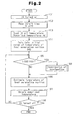
- the engine 2, or the drive source is started, or the ignition is turned on (in step 101).
- the ECU 12 then reads out the time t_off, which has been measured since stopping of the engine 2, or off-turning of the ignition, from the IG-off-timer 20 (in step 102).
- the ECU 12 reads out the memorized temperature Hm of each heat generating portion (in step 103).
- the memorized temperature Hm of each heat generating portion corresponds to the temperature of the heat generating portion estimated immediately before the ignition has been turned off.
- the ECU 12 calculates the initial value H0 of each heat generating portion in correspondence with the time t_off and the memorized temperature Hm, which have been obtained in steps 101 and 102 (in step 104). Accordingly, the initial value H0 is set in such a manner as to reflect the temperature drop of each heat generating portion (3, 8, 11) in the deactivation period of the engine 2.
- the equation by which the initial value H0 of the temperature H of each heat generating portion is obtained includes the equation (1) for obtaining the estimated temperature H, which is the base of the equation, and the cooling term added to the equation (1).
- the cooling item includes the outside temperature Tmp as a variable.
- the ECU 12 calculates the initial values H0 of the heat generating portions (3, 8, 11) while taking into consideration the temperature drops of the heat generating portions in the time t_off.
- the initial value H0 of each heat generating portion (3, 8, 11) is determined in such a manner as to reflect the temperature drop of the heat generating portion caused by the influence by the outside temperature Tmp.
- the ECU 12 determines whether the temperature H of each heat generating portion exceeds the respective predetermined temperature Hth (in step 105).
- the temperature H corresponds to the initial value H0, which has been calculated in step 104. That is, the ECU 12 performs a pass/fail determination whether the initial value H0 of each heat generating portion exceeds the respective predetermined temperature Hth. If the temperature H (the initial value H0) of the heat generating portion is not greater than the predetermined temperature Hth (H ⁇ Hth (H0 ⁇ Hth), NO in step 105), the ECU 12 estimates the temperature of the heat generating portion (in step 106). In correspondence with the thus obtained estimated temperature H, the memorized temperature Hm is updated (in step 107).
- the ECU 12 has a non-volatile memory 21 (see Fig. 1).
- the temperature H of each heat generating portion that has been estimated in step 106 is sequentially memorized in a memory 21, or a memory portion.
- the ECU 12 determines whether the engine 2 has been stopped, or the ignition has been turned off (in step 108). If the determination is negative (NO in step 108), the ECU 12 repeats the pass/fail determination of step 105. If the temperature H of each heat generating portion that has been estimated in step 106 (or the initial value H0 that has been calculated in step 104) exceeds the predetermined temperature Hth (H > Hth (H0 > Hth), YES in step 105), the above-described overheating suppression is carried out (in step 109).
- the illustrated embodiment has the following advantages.
- each heat generating portion (3, 8, 11) is estimated simply by accumulating the heat generating energy of the heat generating portion, the estimated temperatures H are cleared when the engine 2, or the drive source, is stopped, or the ignition is turned off. This may cause a difference between the initial value for estimation of the temperature of each heat generating portion and the actual temperature of the heat generating portion when the engine 2 is re-started. Thus, the temperature of each heat generating portion (3, 8, 11) may be underestimated even if the actual temperature of the heat generating portion is relatively high, indicating necessity of overheating suppression. In this case, increased load may continuously act on the heat generating portion.
- the drive force distribution device 13 of the illustrated embodiment has the IG-off-timer 20 that measures the time t_off since the engine 2 is stopped, or the ignition is turned off.
- the ECU 12 sequentially stores the estimated temperature H of each heat generating portion as the memorized temperature Hm.
- the initial value H0 in correspondence with which the temperature H of each heat generating portion (3, 8, 11) is estimated immediately after the engine 2 is re-started, reflects the temperature drop of the heat generating portion that has been caused since stopping of the engine 2.
- the initial value H0 reflects the temperature drop of each heat generating portion from the memorized temperature Hm, which has been stored before stopping of the engine 2.
- the initial value H0 for resuming estimation of the temperature of each heat generating portion immediately after the engine 2 is re-started coincides with the actual temperature H of the heat generating portion.
- the temperature of each heat generating portion (3, 8, 11) is thus accurately estimated even immediately after the engine 2 is re-started. Accordingly, even if the actual temperature of the heat generating portion is relatively high, indicating necessity of overheating suppression, underestimation of such temperature is prevented. This prevents the heat generating portion from continuously receiving increased load. Further, overestimation of the temperature of each heat generating portion, or estimation of the temperature of the heat generating portion to be higher than the actual value, is suppressed. This prevents unnecessary overheating suppression. As a result, the heat generating portions are protected further appropriately.
- the present invention is embodied as the drive force distribution device 13 of the vehicle 1 in which the front wheels 10f are the main drive wheels.
- the invention may be applied to a drive force distribution device of a vehicle in which the rear wheels 10r are the main drive wheels.
- the invention may be applied to a four-wheel drive device including a center differential device combined with an ECU or a device for distributing torque between front and rear wheels and/or right and left wheels.
- the transaxle 3, the rear differential 8, and the torque coupling 11 correspond to the heat generating portions of the drive force transmission system.
- only at least one of the transaxle 3, the rear differential 8, and the torque coupling 11 may be defined as a heat generating portion, which is a target of suppression of overheating.
- the drive source of the vehicle 1 is the engine 2 in the illustrated embodiment, the drive source may be an electric motor other than an internal combustion engine.
- the equation for obtaining the initial value H0 includes the equation (1) by which the estimated temperature H is obtained, or the base of the equation, and the cooling term added to the equation (1).
- the cooling term includes the outside temperature Tmp as a variable.
- the ECU 12 computes the initial values H0 of the heat generating portions (3, 8, 11) while taking into consideration the temperature drops of the heat generating portions in the time t_off.
- the initial value H0 may be determined with reference to a map in which the initial value H0, the memorized temperature Hm, the outside temperature Tmp, and the time t_off are mutually related.
- a theoretical temperature of each heat generating portion may be obtained using the equation (1). The theoretical temperature is then corrected by a correction value set in correspondence with the outside temperature Tmp, thus obtaining the estimated temperature H of the heat generating portion.
- the outside temperature Tmp is employed as a parameter for determining the estimated temperature H and the initial value H0.
- the outside temperature Tmp does not necessarily have to be employed as the parameter, as long as the estimated temperature H of each heat generating portion is determined by accumulating the heat generating energy accumulated in the heat generating portion in correspondence with the load acting on the heat generating portion. That is, the estimated temperature H may be obtained solely based on the rotational speed of the heat generating portion and the torque transmission rate.
- the temperature of the fluid supplied to each heat generating portion may be employed as a parameter.
- the initial value H0 of the estimated temperature H of each heat generating portion which is determined immediately after the engine 2 is re-started, reflects the temperature drop of the heat generating portion in the deactivation period of the drive source (the engine 2).
- the ECU 12 may perform overheating suppression to reduce the load acting on the heat generating portion if the memorized temperature Hm of the heat generating portion is higher than the predetermined temperature and the time t_off since stopping of the drive source is shorter than a predetermined level.
- An IG-off-timer (20) measures the time t_off from when an engine (2) is stopped, or an ignition is turned off.
- An ECU (12) sequentially memorizes an estimated temperature of each of heat generating portions (3, 8, 11) as a memorized temperature Hm.
- the ECU (12) sets an initial value (H0) of the estimated temperature of each heat generating portion in such a manner that the initial value (H0) reflects a temperature drop of the heat generating portion in the deactivation period of the engine (2).
- the temperature of the heat generating portion is thus accurately estimated even after re-starting of the engine (2).
- the heat generating portions are thus appropriately protected (Fig. 1).
Landscapes
- Engineering & Computer Science (AREA)
- Automation & Control Theory (AREA)
- Transportation (AREA)
- Mechanical Engineering (AREA)
- Arrangement And Driving Of Transmission Devices (AREA)
- Valve Device For Special Equipments (AREA)
Applications Claiming Priority (1)
| Application Number | Priority Date | Filing Date | Title |
|---|---|---|---|
| JP2005224300A JP4542964B2 (ja) | 2005-08-02 | 2005-08-02 | 駆動力配分装置 |
Publications (3)
| Publication Number | Publication Date |
|---|---|
| EP1749725A2 true EP1749725A2 (de) | 2007-02-07 |
| EP1749725A3 EP1749725A3 (de) | 2007-07-04 |
| EP1749725B1 EP1749725B1 (de) | 2009-09-23 |
Family
ID=37400963
Family Applications (1)
| Application Number | Title | Priority Date | Filing Date |
|---|---|---|---|
| EP06118274A Ceased EP1749725B1 (de) | 2005-08-02 | 2006-08-01 | Vorrichtung und Methode zur Antriebskraftverteilung |
Country Status (4)
| Country | Link |
|---|---|
| US (1) | US7581612B2 (de) |
| EP (1) | EP1749725B1 (de) |
| JP (1) | JP4542964B2 (de) |
| DE (1) | DE602006009347D1 (de) |
Cited By (2)
| Publication number | Priority date | Publication date | Assignee | Title |
|---|---|---|---|---|
| FR2958587A1 (fr) * | 2010-04-12 | 2011-10-14 | Renault Sa | Procede de gestion d'un dispositif de repartition du couple moteur entre des trains de roues avant et arriere d'un vehicule. |
| GB2488239A (en) * | 2011-02-18 | 2012-08-22 | Land Rover Uk Ltd | Vehicle having an auxiliary driveline with temperature responsive clutches |
Families Citing this family (15)
| Publication number | Priority date | Publication date | Assignee | Title |
|---|---|---|---|---|
| JP4542964B2 (ja) | 2005-08-02 | 2010-09-15 | 株式会社ジェイテクト | 駆動力配分装置 |
| JP4840566B2 (ja) * | 2005-11-11 | 2011-12-21 | スズキ株式会社 | 車両の駆動力配分制御装置 |
| GB0603452D0 (en) * | 2006-02-22 | 2006-04-05 | Ford Global Tech Llc | Hybrid motor vehicle driveline |
| JP5125384B2 (ja) * | 2007-10-10 | 2013-01-23 | 株式会社ジェイテクト | 駆動力伝達装置及び駆動力伝達装置の調整方法 |
| JP5012400B2 (ja) * | 2007-10-18 | 2012-08-29 | 株式会社ジェイテクト | 駆動力伝達装置 |
| JP5067243B2 (ja) * | 2008-03-31 | 2012-11-07 | 株式会社ジェイテクト | 駆動力伝達装置、駆動力伝達装置の制御方法及び差動制限装置 |
| DE102008026553A1 (de) * | 2008-06-03 | 2009-12-10 | Magna Powertrain Ag & Co Kg | Verfahren zum rechnerischen Ermitteln der Öltemperatur in einer Kupplungseinheit |
| JP4965537B2 (ja) * | 2008-09-30 | 2012-07-04 | 本田技研工業株式会社 | 車体構造 |
| JP5333066B2 (ja) * | 2009-08-28 | 2013-11-06 | スズキ株式会社 | 車両の駆動力配分制御装置 |
| US8708074B1 (en) * | 2010-06-15 | 2014-04-29 | Hydro-Gear Limited Partnership | Selectable four-wheel drive system |
| JP6589579B2 (ja) * | 2015-11-11 | 2019-10-16 | 株式会社ジェイテクト | 駆動力伝達制御装置 |
| DE102018209786A1 (de) * | 2018-06-18 | 2019-12-19 | Zf Friedrichshafen Ag | Verfahren zum Steuern und Steuergerät zum Betreiben eines automatischen Getriebes in einem Kraftfahrzeug |
| JP7210106B2 (ja) * | 2019-01-31 | 2023-01-23 | ダイハツ工業株式会社 | 車両用制御装置 |
| JP7604161B2 (ja) * | 2020-10-12 | 2024-12-23 | 株式会社アドヴィックス | 車両の制御装置および車両の制御プログラム |
| CN113675824B (zh) * | 2021-08-11 | 2025-03-04 | 北京小米移动软件有限公司 | 电机的过载保护方法和装置、存储介质及电子装置 |
Citations (2)
| Publication number | Priority date | Publication date | Assignee | Title |
|---|---|---|---|---|
| JPH0712155A (ja) | 1993-06-25 | 1995-01-17 | Komatsu Ltd | 湿式摩擦伝動装置の損傷防止方法およびその装置 |
| JP2003136990A (ja) | 2001-10-31 | 2003-05-14 | Toyoda Mach Works Ltd | 車両における駆動力配分方法及び駆動力配分制御装置 |
Family Cites Families (24)
| Publication number | Priority date | Publication date | Assignee | Title |
|---|---|---|---|---|
| JPH0759886B2 (ja) * | 1985-10-21 | 1995-06-28 | 本田技研工業株式会社 | エンジン冷却システム |
| US5623914A (en) * | 1994-05-09 | 1997-04-29 | Nissan Motor Co., Ltd. | Air/fuel ratio control apparatus |
| JP3602599B2 (ja) | 1995-03-02 | 2004-12-15 | 本田技研工業株式会社 | 車両用油圧作動式変速機の制御装置 |
| JP3035185B2 (ja) | 1995-03-02 | 2000-04-17 | 本田技研工業株式会社 | 車両用油圧作動式変速機の制御装置 |
| NO970288L (no) * | 1996-01-29 | 1997-07-30 | Luk Getriebe Systeme Gmbh | Betjeningsanordning |
| DE19625889A1 (de) * | 1996-06-27 | 1998-01-02 | Bayerische Motoren Werke Ag | Verfahren zur modellgestützten Nachbildung der Kühlmitteltemperatur bei einem Fahrzeug |
| JP3596433B2 (ja) * | 2000-06-29 | 2004-12-02 | 株式会社デンソー | 車載用電子制御装置 |
| DE10033600A1 (de) * | 2000-07-11 | 2002-01-24 | Zahnradfabrik Friedrichshafen | Verfahren zur Ermittlung der aktuellen Belastung einer Trockenkupplung für ein Kraftfahrzeug |
| JP2002061737A (ja) * | 2000-08-23 | 2002-02-28 | Toyota Motor Corp | 駆動装置用油の加熱手段 |
| US7077783B2 (en) * | 2000-09-15 | 2006-07-18 | Robert Bosch Gmbh | Method and device for operating a clutch |
| KR100466380B1 (ko) | 2000-09-19 | 2005-01-13 | 닛산 지도우샤 가부시키가이샤 | 클러치 온도 추정 장치 및 방법 |
| KR100380493B1 (ko) | 2000-12-28 | 2003-04-18 | 현대자동차주식회사 | 자동변속기의 댐퍼클러치 제어방법 |
| DE10291374D2 (de) | 2001-04-02 | 2004-04-29 | Luk Lamellen & Kupplungsbau | Verfahren zur Steuerung einer automatisierten Kupplung |
| JP3988405B2 (ja) * | 2001-05-28 | 2007-10-10 | 株式会社ジェイテクト | 駆動力伝達制御装置、プログラム、記録媒体 |
| JP3775245B2 (ja) * | 2001-06-11 | 2006-05-17 | コベルコ建機株式会社 | 建設機械のポンプ制御装置 |
| JP3642041B2 (ja) | 2001-06-26 | 2005-04-27 | 日産自動車株式会社 | 4輪駆動車の駆動力制御装置 |
| JP3857568B2 (ja) | 2001-10-31 | 2006-12-13 | 株式会社ジェイテクト | 4輪駆動車の駆動力配分制御装置 |
| JP4207457B2 (ja) * | 2002-05-13 | 2009-01-14 | 日産自動車株式会社 | 4輪駆動車の前後輪トルク配分制御装置 |
| JP4317716B2 (ja) * | 2003-07-08 | 2009-08-19 | 株式会社ジェイテクト | 4輪駆動車の駆動力配分制御装置 |
| JP4105086B2 (ja) * | 2003-12-22 | 2008-06-18 | 本田技研工業株式会社 | 温度センサの故障診断装置 |
| JP4131253B2 (ja) * | 2004-06-10 | 2008-08-13 | 日産自動車株式会社 | 車両の発進摩擦要素制御装置 |
| JP4529555B2 (ja) * | 2004-06-22 | 2010-08-25 | 日産自動車株式会社 | 車両用発電機の制御装置 |
| JP4542964B2 (ja) | 2005-08-02 | 2010-09-15 | 株式会社ジェイテクト | 駆動力配分装置 |
| JP4551291B2 (ja) * | 2005-08-02 | 2010-09-22 | 株式会社ジェイテクト | 駆動力配分装置 |
-
2005
- 2005-08-02 JP JP2005224300A patent/JP4542964B2/ja not_active Expired - Fee Related
-
2006
- 2006-08-01 EP EP06118274A patent/EP1749725B1/de not_active Ceased
- 2006-08-01 US US11/496,513 patent/US7581612B2/en active Active
- 2006-08-01 DE DE602006009347T patent/DE602006009347D1/de active Active
Patent Citations (2)
| Publication number | Priority date | Publication date | Assignee | Title |
|---|---|---|---|---|
| JPH0712155A (ja) | 1993-06-25 | 1995-01-17 | Komatsu Ltd | 湿式摩擦伝動装置の損傷防止方法およびその装置 |
| JP2003136990A (ja) | 2001-10-31 | 2003-05-14 | Toyoda Mach Works Ltd | 車両における駆動力配分方法及び駆動力配分制御装置 |
Cited By (8)
| Publication number | Priority date | Publication date | Assignee | Title |
|---|---|---|---|---|
| FR2958587A1 (fr) * | 2010-04-12 | 2011-10-14 | Renault Sa | Procede de gestion d'un dispositif de repartition du couple moteur entre des trains de roues avant et arriere d'un vehicule. |
| WO2011128564A1 (fr) * | 2010-04-12 | 2011-10-20 | Renault S.A.S. | Procede de gestion d'un dispositif de repartition du couple moteur entre des trains de roues avant et arriere d'un vehicule |
| US8918259B2 (en) | 2010-04-12 | 2014-12-23 | Renault S.A.S. | Method of managing a device that splits drive torque between the front and rear wheelset of a vehicle |
| RU2561485C2 (ru) * | 2010-04-12 | 2015-08-27 | Рено С.А.С. | Способ управления устройством распределения крутящего момента между передней и задней колесными осями транспортного средства |
| GB2488239A (en) * | 2011-02-18 | 2012-08-22 | Land Rover Uk Ltd | Vehicle having an auxiliary driveline with temperature responsive clutches |
| GB2488525A (en) * | 2011-02-18 | 2012-09-05 | Land Rover Uk Ltd | Vehicle having an auxiliary driveline with a temperature responsive clutch |
| GB2488239B (en) * | 2011-02-18 | 2013-12-04 | Land Rover Uk Ltd | Vehicle and method of controlling a vehicle |
| US9180859B2 (en) | 2011-02-18 | 2015-11-10 | Jaguar Land Rover Limited | Vehicle and method of controlling a vehicle |
Also Published As
| Publication number | Publication date |
|---|---|
| US7581612B2 (en) | 2009-09-01 |
| DE602006009347D1 (de) | 2009-11-05 |
| JP4542964B2 (ja) | 2010-09-15 |
| EP1749725A3 (de) | 2007-07-04 |
| JP2007038798A (ja) | 2007-02-15 |
| US20070029126A1 (en) | 2007-02-08 |
| EP1749725B1 (de) | 2009-09-23 |
Similar Documents
| Publication | Publication Date | Title |
|---|---|---|
| EP1749725B1 (de) | Vorrichtung und Methode zur Antriebskraftverteilung | |
| EP0707998B1 (de) | Vorrichtung zum Steuern des Schlupfes einer Kraftfahrzeugkupplung während des Anfahrens | |
| JP3573202B2 (ja) | ハイブリッド車両のトルク制御装置 | |
| US7920950B2 (en) | Vehicle drive torque estimation device and drive torque estimation method, and four-wheel drive vehicle | |
| US6463749B2 (en) | Air-conditioning device for a vehicle and device for controlling an engine for a vehicle | |
| US20020019691A1 (en) | Automatic start controlling apparatus of internal combustion engine and detector for detecting engagement of clutch | |
| EP1749726A2 (de) | Vorrichtung und Methode zur Antriebskraftverteilung | |
| US20070286747A1 (en) | Drive control device of fuel pump | |
| EP2206617B1 (de) | Klimaanlage für ein fahrzeug | |
| US6752742B2 (en) | Power distribution method and power distribution control apparatus for vehicle | |
| EP1897712B1 (de) | Klimaanlagensystem für ein Fahrzeug | |
| US7920953B2 (en) | Four-wheel drive vehicle running control device | |
| EP1548314A2 (de) | Steuervorrichtung und Steuerverfahren zur Drehmomentübertragung | |
| JP2000257656A (ja) | 車両の発進制御装置 | |
| CN107428330A (zh) | 混合动力车辆的控制装置以及控制方法 | |
| US7124850B2 (en) | Four wheel drive assembly and a method for utilizing the same | |
| JP3627566B2 (ja) | 車両の外気温推定装置 | |
| WO2019023169A1 (en) | FREE WHEEL MOVEMENT MANAGEMENT CONTROL OF A ROAD SPEED LIMITER VEHICLE | |
| US6397995B1 (en) | Method for controlling a clutch for an engine-powered system in an automotive vehicle | |
| KR100440142B1 (ko) | 하이브리드 전기 자동차의 동력 분배 제어방법 | |
| JPH0925951A (ja) | クラッチの発進制御装置 | |
| KR100916388B1 (ko) | 하이브리드 차량의 엔진 연소 안정화 판정 방법 | |
| JP7626086B2 (ja) | 車両用報知制御装置 | |
| JP7626087B2 (ja) | 車両の制御装置 | |
| JP2765125B2 (ja) | 車両のスリップ制御装置 |
Legal Events
| Date | Code | Title | Description |
|---|---|---|---|
| PUAI | Public reference made under article 153(3) epc to a published international application that has entered the european phase |
Free format text: ORIGINAL CODE: 0009012 |
|
| AK | Designated contracting states |
Kind code of ref document: A2 Designated state(s): AT BE BG CH CY CZ DE DK EE ES FI FR GB GR HU IE IS IT LI LT LU LV MC NL PL PT RO SE SI SK TR |
|
| AX | Request for extension of the european patent |
Extension state: AL BA HR MK YU |
|
| RAP1 | Party data changed (applicant data changed or rights of an application transferred) |
Owner name: JTEKT CORPORATION Owner name: MITSUBISHI JIDOSHA KOGYO KABUSHIKI KAISHA |
|
| PUAL | Search report despatched |
Free format text: ORIGINAL CODE: 0009013 |
|
| AK | Designated contracting states |
Kind code of ref document: A3 Designated state(s): AT BE BG CH CY CZ DE DK EE ES FI FR GB GR HU IE IS IT LI LT LU LV MC NL PL PT RO SE SI SK TR |
|
| AX | Request for extension of the european patent |
Extension state: AL BA HR MK YU |
|
| RIC1 | Information provided on ipc code assigned before grant |
Ipc: B60W 10/06 20060101ALI20070531BHEP Ipc: B60W 10/02 20060101ALI20070531BHEP Ipc: B60K 23/08 20060101ALI20070531BHEP Ipc: B60W 30/18 20060101AFI20061122BHEP |
|
| 17P | Request for examination filed |
Effective date: 20071219 |
|
| AKX | Designation fees paid |
Designated state(s): DE |
|
| 17Q | First examination report despatched |
Effective date: 20081010 |
|
| GRAP | Despatch of communication of intention to grant a patent |
Free format text: ORIGINAL CODE: EPIDOSNIGR1 |
|
| GRAS | Grant fee paid |
Free format text: ORIGINAL CODE: EPIDOSNIGR3 |
|
| GRAA | (expected) grant |
Free format text: ORIGINAL CODE: 0009210 |
|
| RIN1 | Information on inventor provided before grant (corrected) |
Inventor name: MURAKAMI, TSUYOSHI Inventor name: SHIGETA, RYOUHEI Inventor name: OHNO, AKIHIRO Inventor name: TANAKA, SHUNZO Inventor name: YOSHIOKA, TADASHI Inventor name: KATO, TOMOAKI Inventor name: YAMADA, YASUSHI |
|
| AK | Designated contracting states |
Kind code of ref document: B1 Designated state(s): DE |
|
| REF | Corresponds to: |
Ref document number: 602006009347 Country of ref document: DE Date of ref document: 20091105 Kind code of ref document: P |
|
| PLBE | No opposition filed within time limit |
Free format text: ORIGINAL CODE: 0009261 |
|
| STAA | Information on the status of an ep patent application or granted ep patent |
Free format text: STATUS: NO OPPOSITION FILED WITHIN TIME LIMIT |
|
| 26N | No opposition filed |
Effective date: 20100624 |
|
| PGFP | Annual fee paid to national office [announced via postgrant information from national office to epo] |
Ref country code: DE Payment date: 20200722 Year of fee payment: 15 |
|
| REG | Reference to a national code |
Ref country code: DE Ref legal event code: R119 Ref document number: 602006009347 Country of ref document: DE |
|
| PG25 | Lapsed in a contracting state [announced via postgrant information from national office to epo] |
Ref country code: DE Free format text: LAPSE BECAUSE OF NON-PAYMENT OF DUE FEES Effective date: 20220301 |