EP1752888A2 - Recherche d'une base de données - Google Patents
Recherche d'une base de données Download PDFInfo
- Publication number
- EP1752888A2 EP1752888A2 EP06024774A EP06024774A EP1752888A2 EP 1752888 A2 EP1752888 A2 EP 1752888A2 EP 06024774 A EP06024774 A EP 06024774A EP 06024774 A EP06024774 A EP 06024774A EP 1752888 A2 EP1752888 A2 EP 1752888A2
- Authority
- EP
- European Patent Office
- Prior art keywords
- information
- broadcast
- time
- input device
- search
- Prior art date
- Legal status (The legal status is an assumption and is not a legal conclusion. Google has not performed a legal analysis and makes no representation as to the accuracy of the status listed.)
- Granted
Links
Images






Classifications
-
- H—ELECTRICITY
- H04—ELECTRIC COMMUNICATION TECHNIQUE
- H04H—BROADCAST COMMUNICATION
- H04H60/00—Arrangements for broadcast applications with a direct linking to broadcast information or broadcast space-time; Broadcast-related systems
- H04H60/35—Arrangements for identifying or recognising characteristics with a direct linkage to broadcast information or to broadcast space-time, e.g. for identifying broadcast stations or for identifying users
- H04H60/37—Arrangements for identifying or recognising characteristics with a direct linkage to broadcast information or to broadcast space-time, e.g. for identifying broadcast stations or for identifying users for identifying segments of broadcast information, e.g. scenes or extracting programme ID
-
- G—PHYSICS
- G06—COMPUTING OR CALCULATING; COUNTING
- G06F—ELECTRIC DIGITAL DATA PROCESSING
- G06F16/00—Information retrieval; Database structures therefor; File system structures therefor
- G06F16/60—Information retrieval; Database structures therefor; File system structures therefor of audio data
- G06F16/63—Querying
- G06F16/638—Presentation of query results
- G06F16/639—Presentation of query results using playlists
-
- G—PHYSICS
- G06—COMPUTING OR CALCULATING; COUNTING
- G06F—ELECTRIC DIGITAL DATA PROCESSING
- G06F16/00—Information retrieval; Database structures therefor; File system structures therefor
- G06F16/60—Information retrieval; Database structures therefor; File system structures therefor of audio data
- G06F16/68—Retrieval characterised by using metadata, e.g. metadata not derived from the content or metadata generated manually
-
- G—PHYSICS
- G06—COMPUTING OR CALCULATING; COUNTING
- G06F—ELECTRIC DIGITAL DATA PROCESSING
- G06F17/00—Digital computing or data processing equipment or methods, specially adapted for specific functions
-
- H—ELECTRICITY
- H04—ELECTRIC COMMUNICATION TECHNIQUE
- H04H—BROADCAST COMMUNICATION
- H04H60/00—Arrangements for broadcast applications with a direct linking to broadcast information or broadcast space-time; Broadcast-related systems
- H04H60/35—Arrangements for identifying or recognising characteristics with a direct linkage to broadcast information or to broadcast space-time, e.g. for identifying broadcast stations or for identifying users
- H04H60/38—Arrangements for identifying or recognising characteristics with a direct linkage to broadcast information or to broadcast space-time, e.g. for identifying broadcast stations or for identifying users for identifying broadcast time or space
- H04H60/40—Arrangements for identifying or recognising characteristics with a direct linkage to broadcast information or to broadcast space-time, e.g. for identifying broadcast stations or for identifying users for identifying broadcast time or space for identifying broadcast time
-
- H—ELECTRICITY
- H04—ELECTRIC COMMUNICATION TECHNIQUE
- H04H—BROADCAST COMMUNICATION
- H04H60/00—Arrangements for broadcast applications with a direct linking to broadcast information or broadcast space-time; Broadcast-related systems
- H04H60/35—Arrangements for identifying or recognising characteristics with a direct linkage to broadcast information or to broadcast space-time, e.g. for identifying broadcast stations or for identifying users
- H04H60/49—Arrangements for identifying or recognising characteristics with a direct linkage to broadcast information or to broadcast space-time, e.g. for identifying broadcast stations or for identifying users for identifying locations
- H04H60/52—Arrangements for identifying or recognising characteristics with a direct linkage to broadcast information or to broadcast space-time, e.g. for identifying broadcast stations or for identifying users for identifying locations of users
-
- H—ELECTRICITY
- H04—ELECTRIC COMMUNICATION TECHNIQUE
- H04H—BROADCAST COMMUNICATION
- H04H60/00—Arrangements for broadcast applications with a direct linking to broadcast information or broadcast space-time; Broadcast-related systems
- H04H60/68—Systems specially adapted for using specific information, e.g. geographical or meteorological information
- H04H60/73—Systems specially adapted for using specific information, e.g. geographical or meteorological information using meta-information
- H04H60/74—Systems specially adapted for using specific information, e.g. geographical or meteorological information using meta-information using programme related information, e.g. title, composer or interpreter
-
- Y—GENERAL TAGGING OF NEW TECHNOLOGICAL DEVELOPMENTS; GENERAL TAGGING OF CROSS-SECTIONAL TECHNOLOGIES SPANNING OVER SEVERAL SECTIONS OF THE IPC; TECHNICAL SUBJECTS COVERED BY FORMER USPC CROSS-REFERENCE ART COLLECTIONS [XRACs] AND DIGESTS
- Y10—TECHNICAL SUBJECTS COVERED BY FORMER USPC
- Y10S—TECHNICAL SUBJECTS COVERED BY FORMER USPC CROSS-REFERENCE ART COLLECTIONS [XRACs] AND DIGESTS
- Y10S707/00—Data processing: database and file management or data structures
- Y10S707/99941—Database schema or data structure
- Y10S707/99944—Object-oriented database structure
- Y10S707/99945—Object-oriented database structure processing
-
- Y—GENERAL TAGGING OF NEW TECHNOLOGICAL DEVELOPMENTS; GENERAL TAGGING OF CROSS-SECTIONAL TECHNOLOGIES SPANNING OVER SEVERAL SECTIONS OF THE IPC; TECHNICAL SUBJECTS COVERED BY FORMER USPC CROSS-REFERENCE ART COLLECTIONS [XRACs] AND DIGESTS
- Y10—TECHNICAL SUBJECTS COVERED BY FORMER USPC
- Y10S—TECHNICAL SUBJECTS COVERED BY FORMER USPC CROSS-REFERENCE ART COLLECTIONS [XRACs] AND DIGESTS
- Y10S707/00—Data processing: database and file management or data structures
- Y10S707/99941—Database schema or data structure
- Y10S707/99948—Application of database or data structure, e.g. distributed, multimedia, or image
Definitions
- the present invention relates to searching a data base.
- Embodiments of the invention relate to: a search system for searching a data base for information associated with segments of broadcast information; a search device for searching a data base for information associated with segments of broadcast information; an input device for searching a data base; a method of searching a data base for information associated with segments of broadcast information; and a method of inputting search parameters.
- a user retrieves desired information by operating a terminal device which is connected to a data base system directly or through a network. For example, the user inputs from the terminal device a keyword representing the desired information; and the data base system carries out a search operation on the basis of the input keyword. The search results are supplied through the terminal device to the user. When the amount of information thus supplied is large, the user inputs additional keywords to perform a narrower search operation on the supplied information.
- the music data is information related to the music pieces, and it constitutes various information such as the titles of the music pieces, the names of the artists, the record album title, that is, the title of the music CD, the year of recording or public performance, the selling agency, etc.
- the music data may contain the audio data of the music data themselves.
- keywords such as the artist's name, the title of the music piece, the record album title, and the like are appended to the music data as appendant information.
- the appendant information may be superposed on the broadcasted music data and may not be part of the announcer's introduction.
- the user can obtain the appendant information from the broadcasted digital data.
- this requires that appendant information be created and superposed on every music data to be transmitted from a broadcast station, and thus a large load is imposed on the broadcast station.
- This also requires the user's reception device be designed to pick up the appendant information thus superposed.
- An embodiment of the present invention seeks to provide a technique to perform a search operation on a data base that is searchable by keywords associated with the contents of that data base even when the user does not know a correct keyword when the contents are searched.
- a search system for searching a data base for information associated with segments of broadcast information.
- An input device includes a store for storing time information representing a broadcast time at which a segment is broadcast.
- a communication device transmits the stored time information to a search device which accumulates a data base representing the segments and the broadcast times of respective segments.
- the data base is searched for information associated with those segments having broadcast times that match the transmitted time information.
- Another embodiment of the present invention searches a data base for information associated with segments of broadcasted material.
- a data base representing the segments and broadcast times at which respective segments are broadcasted is accumulated.
- the data base is searched for information associated with those segments having broadcast times that match time information which is input from an input device and represents the broadcast time at which a segment is broadcasted.
- an input device for searching a data base comprised of accumulated information representing broadcast segments and broadcast times at which the segments are broadcasted.
- the input device inputs time information to a search device for searching the data base for information associated with a broadcast segment on the basis of the broadcast time at which the segment is broadcasted. At least the time information representing the broadcast time at which the segment was broadcasted is stored; and the stored time information is transmitted as a search parameter.
- the time information is represented by the count value of a counter that counts predetermined clock signals.
- Fig. 1 schematically shows an illustrative information search system of the present invention.
- the system comprises two data bases 1 and 2, a search engine 3 for performing a search operation on these data bases 1 and 2, and an assistance terminal 4 for supplying an assistance on a search condition to a user.
- the data base 1 is accumulated information relevant to broadcast media of contents, also referred to herein as segments, which are broadcasted by broadcast media such as a radio broadcast or the like.
- segments which are broadcasted by broadcast media such as a radio broadcast or the like.
- the titles of music pieces broadcasted by radio broadcast stations, the broadcast time information of the music pieces and broadcast station information are accumulated in association with one another in the data base 1.
- information on segments of broadcast media other than the radio broadcast may be accumulated in the data base 1, or the contents are not limited to the information on the music pieces, but they may be information on commercial articles.
- the broadcast media is a radio broadcast and the segment supplied from the broadcast media is a music piece.
- the data base 2 is accumulated information on the conteht, or segment, itself to be accumulated in the data base 1.
- information on the segment itself such as the title of an album (CD) in which the music piece is recorded, player information, a selling agency, a selling: date, etc. is accumulated in association with the title of the music piece.
- information on this system may be accumulated in the data base 2.
- ID information of users based on identification information inherent to an assistance terminal 4 described later, and other information on the users are accumulated in the data base 2.
- the search engine 3 searches information accumulated in the data base on the basis of a search condition indicated by a user.
- the engine described here means an assembly for supplying specific functions, and the search engine 3 supplies a predetermined search function to the user.
- the search engine 3 searches the data base 1 on the basis of the search condition thus set, and outputs the title of the music piece as a search result.
- the data base 2 is searched while the title of the music piece is set as the search condition, and, for example, the title of an album in which the music piece is recorded, the information on the selling agency and performing artists of the album, etc. are output.
- the search result of the data base 2 is returned to the user.
- the assistance terminal 4 is dedicated to the user who may operate it for obtaining the time information 7 in advance.
- the place information 5 and the broadcast station information 6 which corresponds to the user are registered as user information in the data base 2 in advance.
- the user when the user likes the broadcasted music piece, the user operates the assistance terminal 4 and stores the time information 7' at that time into the assistance terminal 4. Thereafter, on the basis of the time information 7' stored in the assistance terminal 4, the user instructs the search engine 3 to perform the search operation.
- the search engine 3 searches the data base 1 by using as the search condition the time information 7' ahd the place information 5 and the broadcast information 6 of the user which are beforehand registered in the data base 2.
- the data base 2 is searched on the basis of the title of the music piece obtained as the search result.
- the search result thus output is returned to the user as a candidate of information desired by the user.
- the user can operate the assistance terminal 4 to store the time information 7' into the assistance terminal 4 to obtain desired information when the user likes a music piece broadcasted.
- Fig. 2 shows an example of the construction of a music piece data search system according to the first embodiment.
- the common parts as shown in Fig. 1 are represented by the same reference numerals, and the detailed description thereof is omitted.
- a book mark search engine 10 is formed of the data base 1, the data base 2 and the search engine 3.
- the book mark search engine 10 is connected to another site-(not shown) through a communication line such as the Internet or the like.
- the is a place at which information open to the public on the network is placed and the book mark search engine 10 is also one site.
- the book mark search engine 10 is connected to a data base (not shown) at another site.
- the broadcast station 12 is a radio broadcast station, for example, and it broadcasts music pieces as segments on the basis of a play list which is prepared in advance. As an alternative, the play list may be prepared after the broadcast. It is needless to say that not only music pieces, but also article or other information may be broadcasted as segments. Further, the broadcast station 12 is not limited to a radio broadcast station, but may be a television broadcast station or CATV (Cable Television) station which performs a television broadcast in a radio or wire mode, a wire broadcast station for broadcasting mainly music pieces in a wire mode or the like.
- CATV Consumer Television
- the book mark search engine 10 and the broadcast station 12 are connected to each other through a communication line such as Internet or the like.
- the above-described play list is transmitted from the broadcast station 12 to the book mark search engine 10.
- the play list thus received is accumulated in the data base 1.
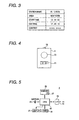
- Fig. 3 shows an example of the play list.
- one segment that is, the music corresponding to one broadcasted music piece, is associated with the name of the broadcast station 12 from which the segment is broadcasted (Station Name), the broadcast area of the broadcast station 12 (Area), a broadcast start time (Start Time) of the segment (music piece), a broadcast end time (-End Time) of the segment and the name of the segment (Content).
- the play list to be accumulated in the data base 1 is not necessarily transmitted from the broadcast station 12 from which the segment is actually broadcasted.
- a play list which is prepared by manually collecting broadcasted information may be supplied to the data base 1 through a predetermined storage medium and accumulated therein.
- a play list may be prepared by a system different from that of the broadcast station 12, and then transmitted to the book mark search engine 10. Play lists of plural different broadcast stations 12 may be accumulated in the data base 1 with the respective broadcast stations 12 being identified.
- the book mark search engine 10 and the gateway device 11 are interactively connected to each other through the communication line 8 such as Internet or the like.
- the gateway device 11 is a personal computer, for example. It interactively communicates with the book mark search engine 10, while communicating with the assistance terminal 4 owned by the user. -
- the gateway device 11 is not limited to personal computers.
- a set top box for connecting a television receiver to a digital network may be used as the gateway device 11, for example.
- IRD Integrated Receiver Decoder
- serving as a digital broadcast receiver may be used as the gateway device 11.
- Fig. 4 shows an example of the general appearance of the assistance terminal 4 according to the first embodiment.
- the assistance terminal 4 is referred to as a book marker 4.
- the book marker 4 has, for example, an input unit 20 comprising a button, and a display unit 21 on which the current time is displayed. Further, it is provided with a connector 22 which serves as an electrical connection point for communication with the gateway device 11.
- the book marker 4 is of a relatively simple construction as described later, and can be accommodated in a compact housing, such as one used as a key holder.
- the book marker 4 is not limited to this embodiment, and may be installed in various other electronic devices.
- the book marker 4 may be incorporated in a radio receiver. It may be mounted in a car stereo system.
- the target in which the book marker 4 is installed is not limited to an electronic device.
- the book marker 4 is preferably installed in something which is used while moving or portably used.
- FIG. 5 shows an example of the construction of the book marker 4 according to the first embodiment.
- CPU (Central Processing Unit) 25 has a memory, a bus, a predetermined interface, etc., which, for the purpose of simplification are not shown.
- CPU 25 is connected to a button 20, a display unit 21, a memory 26, a timer 28 and an interface 29.
- the timer 28 is designed to output the current time, and can be corrected by the control of the CPU 25, as described below.
- the display unit 21 comprises, for example, an LCD (Liquid Crystal Display), and the display thereof is controlled by CPU 25. Time information output from the timer 28 is supplied to the display unit 21 through CPU 25, and displayed. In an alternative embodiment, the display unit 21 may be omitted.
- a user's operation of the button 20 is detected by CPU 25, and the time information present at that time in timer 28 is stored in the memory 26.
- a plurality of time information pieces may be stored-in the memory 26. Symbols based on serial numbers may be provided with the respective time information pieces so as to discriminate the time information pieces from one another.
- a terminal ID 27 stored in a predetermined area of the memory 26 is a,unique ID to specify each individual book marker 4.
- the interface 29 controls the communication with the external, that is, the gateway device 11 through the connector 22.
- USB Universal Serial Bus
- the interface protocol defined in IEEE-1394 may be used.
- RS-232C may be used as the interface for communication.
- the communication is not limited to wire communication, and communication between the book marker 4 and the gateway device 11 may be performed with infrared ray signals by using an interface protocol based on IrDA (Infrared Data Association).
- IrDA Infrared Data Association
- the connector 22 and the interface 29 are designed to communicate by infrared ray signals.
- the book marker 4 may be constructed as an IC card obtained by embedding an integrated circuit and a communication device in a card, or a PC card defined by PCMCIA (Personal Computer Memory Card International association) and JEIDA (Japan Electronic Industry Development Association).
- PCMCIA Personal Computer Memory Card International association
- JEIDA Joint Electronic Industry Development Association
- the interface protocol of interface 29 conforms to the IC card construction.
- the gateway device 11 a connector compatible with the PC card is provided in the gateway device 11, for example. Communication between the book marker 4 and the gateway device 11 can be performed by directly mounting the book marker 4 (as the PC card) in the compatible connector.
- the terminal ID 27 and the time information stored in the memory 26 can be read out from the memory 26 and output through the interface 29 to the outside on the basis of an instruction of CPU 25.
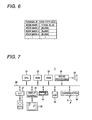
- Fig. 7 shows an example of the construction of the gateway device 11.
- a general personal computer may be used as the gateway device 11
- Fig. 7 illustrates an embodiment where a general personal computer, or alternatively, a laptop or notebook computer, is used as the gateway device 11.
- CPU 31, ROM (Read Only Memory) 32, RAM (Random Access Memory) 33, a display control circuit 34 and a storage medium, for example, a hard disc 36 are connected to a bus 30.
- An input 91 comprising, for example, a key board and a prescribed type of pointing device which can output a control signal based on the user's operation is also connected to the bus 30.
- CPU 31 operates on the basis of a program stored in ROM 32 or a hard disc 36, and performs predetermined processing on the basis of the operation of the input means 91 by the user.
- RAM 33 is used, for example, as a work memory for CPU 31.
- the display control signal output from CPU 31 is supplied to the display control circuit 34 to perform a display operation based on the display control signal on a display 35.
- an interface 37 to communicate with the book marker 4 is connected to the bus 30.
- the interface 37 is compatible with the interface protocol supporting the interface 29 of the book marker 4, such as USB, IEEE-1394, RS-232C, IrDA, etc.
- a communication device 38 to communicate with the book mark search engine 10 through the communication line 8 also is connected to the bus 30.
- the communication device 38 is a modem or the like, connected to a public telephone line as the communication line 8.
- the gateway device 11 is connected to the Internet through the public telephone line, for example, by using the modem, and can perform interactive communication with the book mark search engine 10 through the Internet.
- a sound processor 39 connected to the bus 30 converts digital audio data supplied through the bus 30 to analog audio signals.
- the analog audio signals output from the sound processor 39 are reproduced by a speaker 90.
- the user it is necessary for the user to register information which identifies himself into the client data base 2 of the book mark search engine 10 in advance.
- the registration may be performed by using the gateway device 11.
- the user connects the book marker 4 to the gateway device 11 by a prescribed interface.
- the user then operates the gateway device 11 to register the user and the book marker 4 dedicated to the user.
- Fig. 8 shows an example of a display on a registration frame 40 of the display 35 when the user and the book marker 4 dedicated to the user are registered.
- the name of the user is input to a "Name" column 41.
- the terminal ID 27 of the book marker 4 is input to a "book mark ID” column 42.
- the input of the terminal ID 27 described above is performed by the communication between the gateway device 11 and the book marker 4. That is, a request for reading out the terminal ID 27 is transmitted from the gateway device 11 to the book marker 4. Under the control of CPU 25 based on this request, the terminal ID 27 is read out from the memory 26 in the book marker. The terminal ID 27 thus read out is transmitted to the gateway device 11 whereat it is displayed on the "book mark ID" column 42 of the display 35, and also stored in RAM 33.
- a post code such as zip code
- a telephone number for toll call of the place at which the user resides are input to a "post code” column 43 and a "telephone number for toll call” column 44, respectively.
- the geographic area at which the user is located is schematically shown as the user's activity area on the basis of the contents input to the columns 43 and 44.
- An area name which is independently set in advance may be input and accessed as a result of this post code and toll call number.
- Information specifyihg a radio station which is frequently selected by the user is input to a "radio station" column 45. In this case, the name of the broadcast station (e.g. its call letters) is input. However, it is not limited to the broadcast station name, but the frequency band of a radio broadcast may be input.
- a user's credit card number or cash dard number is input to a "card No.” column 46.
- the address of the user is accurately input to an "address” column 47. This information is used when a service using the book marker 4 is followed by money charging processing, as described below.
- Each information segment input to the columns 41 to 47 as described above is stored in RAM 33.
- this information is read out from RAM 33, and transmitted to the book mark search engine 10 by the communication device 38.
- the information to be transmitted is encrypted.
- the timer 28 of book marker 4 may be corrected when the book marker and the gateway device 11 are connected to each other, for example, to register the terminal ID 27.
- the timer 28 of the book marker 4 can be corrected by using the time information output from the timer (not shown) resident in the gateway device 11.
- the same processing may be performed by unidirectional communication from the book marker 4 to the gateway device 11.
- time information from the timer 28 is transmitted to the gateway device.
- the time information from timer 28 and the time information represented by the timer resident in the gateway device 11 may be compared with each other and the difference therebetween is used to calculate the correct time for timer 28.
- the time information of the timer resident in the gateway device 11 needs to be maintained at a correct time.
- the book marker 4 has a timer.
- a counter which operates with a predetermine clock period may be provided to determine time information representing the time button 20 is pushed.
- This time information may be the count value of the counter.
- the count value when the user operates the button 20 is stored in the memory 26.
- the count value at the transmission time also is transmitted to the gateway device 11 along with the count value read out from the memory 26.
- the timer of the gateway device 11 may be corrected by using a master clock located at the book mark search engine 10. Master clock time information is obtained when the gateway device communicates therewith through the communication line 8 by the communication device 38, and the timer of the gateway device 11 is corrected on the basis of this master time information.
- the gateway device 11 may-be provided with a predetermined receiver to receive time information cohtained in a television broadcast or a radio broadcast, and this received time information is used to correct the timer of the gateway device 11.
- the gateway device 11 calculates the differential count value between the count value which is obtained when the user pushes the button 20 and the count value when transmission from the book marker 4 is carried out. If the count period of the book marker counter is known, the differential count value is readily converted into time and from which the time at which the user pushes the button 20 in the book marker 4 is calculated Alternatively, the count value of the counter of the book marker 4 may be measured in the gateway device after a fixed period of time following the connection of the book marker 4 to the gateway device 11, thereby calculating the differential count value even when the period of the counter of the book marker 4 is unclear.
- the display unit 21 need not display the clock information from timer 28 and there would be no need to correct timer 28 of the book marker 4.
- the book marker counter performs its counting operation with a predetermined clock period.
- the counter may be operated with a clock signal generated at any timing because the count value at the time button 20 is pushed and the time that transmission to the gateway device begins are associated with each other.
- the counter can be operated with a clock signal based on M sequence which is generated by using a shift register and an exclusive OR circuit.
- the clock signal may be periodically varied to operate the counter.
- the gateway device 11 needs to know the type of clock signal used by the counter in the book marker 4. Use of these clock signals to operate the counter can prevent unauthorized manufacture or use of the book marker 4.
- the time at which the button 20 is pushed in the book marker 4 is determined on the gateway device 11.
- the gateway device 11 simply may provide time information representing the time at which the button 20 is pushed, and time information representing the time at which this time information is transmitted from the book marker to the gateway device; and this time information is transmitted to the search engine 10 from which the accurate time at which the button is pushed can be determined as a function of the master clock of the search engine.
- step S10 the terminal ID 27 of the user's book marker 4 is registered to the book mark search engine 10 described above.
- the user can use his book marker at any place, such as on a street or in a car. For example, if the user likes a music piece received by a radio mounted in a car, the user pushes the button 20 of the book marker at the time and place he hears that music piece.
- the time information when the button 20 is pushed is stored in the memory 26 of the book marker 4 (step S11).
- a plurality of time information pieces may be stored in the memory 26 of book marker 4 (step S12).
- step S13 When the book marker 4 and the gateway device 11 (abbreviated as G.D in Fig. 9) are connected to each other as in step S13, the time information stored in the memory 26 of the book marker is read out together with the terminal ID 27, and transmitted to the gateway device through interface 29 and 37 (step S14).
- the processing of the step S 14 may be set to be automatically started when the book marker 4 and the gateway device 11 are connected to each other in step S13.
- step S15 the time information and the terminal ID 27 which are transmitted from the book marker to the gateway device are transmitted from the gateway device to the bookmark search engine 10 through the communication line.
- step S16 in the bookmark search engine 10 performs the information search on the basis of the time information and the terminal ID transmitted from the gateway device 11, wherein the time information is used as the search parameter. For example, if the user wishes to know music piece information, the data base 1 is searched on the basis of the time information, and the title of each music piece broadcasted by each radio station at the time represented by the time information is output on the basis of the play list of each broadcast station accumulated in the data base 1.
- the search condition is narrowed by using the registration information of the user, that is, the terminal ID27, such that the search of the data base is carried out on the basis of the terminal ID 27 transmitted from the gateway device 11, and the registration information of the user which is registered as the terminal ID 27 (see Fig. 8).
- the play list is searched in the data base 1
- only the play list of a specific broadcast station is targeted for the search operation by using the broadcast station information ("radio station" column 45) when the-terminal ID 27 is registered in the book mark search engine 10.
- the search result in the bookmark search engine 10 is transmitted to the gateway device 11 and displayed on the display frame, an example of which is described later.
- the displayed search result is checked to determine if this information is desired by the user (step S18). If no information desired by the user is contained in the search result, the gateway device I 1 so apprises the book mark search engine 10, and in step S19 the search condition is altered to perform the search operation again.
- the target broadcast station (as a search condition) is extended to all broadcast stations which can be received within the range defined by the post code and toll call telephone number.
- the target broadcast station as the search condition is hot limited to this, and may be extended to a geographic area adjacent to the area represented by columns 43 and 44.
- the search condition can be automatically set at the book mark search engine 10.
- the registration content registered by the user is stepwise applied to the search condition.
- the search condition in the re-searching operation may be directly set by the user who inputs a new search parameter to the gateway device 11. The search parameter thus input is transmitted from the gateway device to the book mark search engine 10.
- the search result is transmitted from the book mark search engine to the gateway device in step S20.
- the audio data of the music piece that is found is transmitted from the book mark search engine 10 to the gateway device 11.
- the audio data of the music piece may have been accumulated in the data base 2 of the book mark search-engine.
- the other site which is connected to the book mark search engine through the Internet may be requested to transmit the audio data of that music piece.
- the user can store the transmitted audio data on the hard disc 36 of the gateway device 11, for example, and reproduce the audio data by sound processor 39 and speaker 90. If the user likes the music piece represented by the audio data, the user can communicate with the book mark search engine 10 by using the gateway device 11 and request to purchase the album (CD or the like) on which the music piece is recorded.
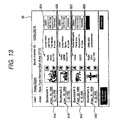
- Fig. 10 shows an example of the display frame of the gateway device 11 which displays the search results.
- the user name 51 On the upper portion of the frame are displayed the user name 51, the terminal ID 27 and the user's activity area 52 as derived from his registration information.
- four broadcast stations in his activity area consisting of three radio broadcast stations "AAAA”, “BBBB” and “CCCC” and one CATV (Cable Television) broadcast station "DDD" are registered.
- the search results on the four broadcast stations in the book mark search engine 10 are displayed as displays 54, 55, 56 and 57, respectively.
- the music pieces that were broadcasted at the broadcast stations "AAAA”, “BBBB” and “DDD" at the time shown in the time information 53 are displayed.
- display 54 shows that a commercial was broadcasted by the broadcast station "CCCC”.
- the display 54 indicating music piece broadcasted by the broadcast station "AAAA” is a jacket image 54A of the CD on which that music piece-is recorded and this jacket image is displayed below the name of the broadcast station and the frequency band of the broadcast. Also displayed are the title of the music piece, the name of the singer and the selling price of the CD.
- buttons 58, 59 and 60 Disposed below the selling price 54C are graphical user interface buttons 58, 59 and 60 which can be operated by the user of the gateway device 11.
- the audio data of the music piece are transmitted from the book mark search engine 10 to the gateway device, processed by the sound processor 39 and then reproduced by the speaker 90.
- the audio data thus transmitted is not stored in, for example, the hard disc 36 of the gateway device.
- the user can select a desired music piece from the music pieces broadcasted by the respective broadcast stations "AAAA”, “BBBB”, “CCCC” or “DDD”on the basis of the jacket image 54A, the title of the music piece, the singer name 54B and the audio data of the music piece.
- the button 59 is used when the user wishes to purchase the CD in which the desired musie piece is recorded.
- the button 60 is used when the user wishes to down-load the audio data of the desired music piece and store the data on the hard disc 36.
- the charge therefor is paid through a credit card or cash card using the card number shown in Fig. 8.
- buttons 58, 59 and 60 preferably are not displayed for the commercial broadcast by the broadcast station "CCCC", however, a button to purchase an advertised article may be provided separately.
- the book marker 4 is a dedicated device for storing time information.
- the function of the book marker may be implemented in portable communication equipment such as a cellular phone, PHS (Personal Hand-Phone System), global positioning system (GPS) or the like.
- the button 20 may be disposed together with dial keys or the like in such apparatus and the telephone number registered for that apparatus may function as terminal ID 27.
- the function of the button 20 may be implemented by a prescribed combination of the dial keys or by a separate function key.
- the button 20 may be implemented in software in the gateway device 11.
- the function of the button 20 for storing the time information may be allocated to a predetermined key of the gateway device 11 or to a predetermined position on the display frame, such as a. predetermined icon so that time information is stored by clicking on the icon with a pointing device such as a mouse or the like.
- the terminal ID 27 may be stored in a predetermined area of ROM 32, RAM 33 or the hard disc.36 of the gateway device 11.
- the time information representing the time at which this operation is carried out is stored in a predetermined area of RAM 33 or the hard disc 36.
- the time information thus stored is read out, and both the time information and the terminal ID 27 are transmitted to the book mark search engine 10 through the communication line 8.
- the searching operation is carried out on the basis of the information thus transmitted, and the search result is transmitted from the book mark search engine to the gateway device through the communication line 8.
- a unique terminal ID 27 is supplied from each book marker 4 to the book mark search engine. Therefore, by using the terminal ID 27, it is known how many persons request and down-load each specific music piece, and this may be used for market research, etc.
- the book marker 4 is of a simple construction, and the time information is stored therein by pushing the button 20.
- the book marker 4 is installed in a radio receiver.
- Fig. 11 shows an example of the construction of the book marker installed in the common housing of a radio receiver 70.
- those parts of book marker 4 shown in Fig. 5 are represented by the same reference numerals, and the detailed description thereof is omitted.
- a radio wave received by an antenna 71 is supplied to a tuner 72 which selects a predetermined frequency band on the basis of user operation to select the reception of a desired broadcast station.
- the signal thus selected is subjected to conventional processings such as detection, demodulation and the like to be converted to an audio signal which is supplied to a signal processing circuit 73 whereat it is subjected to amplification processing, etc., and then reproduced by a speaker 74.
- the station-selecting information in the tuner 72 is supplied to CPU 25.
- the frequency band information of a selected broadcast station is supplied to CPU 25.
- time information is stored in the memory 26 when the button 20 is pushed along with the supplied station-selecting information.
- the terminal ID 27 is pre-stored in a predetermined area of the memory 26. The stored station-selecting information, the time information and the terminal ID 27 are read out by the CPU 25 and coupled to interface 29.
- the memory 26 also may store a table representing the corresponding relationship between the frequency band and the name of the broadcast station. This table may be used to convert the supplied frequency band information to the name of the broadcast station.
- the tuner 72 may be designed so that desired frequency bands of plural broadcast stations are preset and the frequency bands of these plural broadcast stations are switched at the time of reception so that the broadcast station name data is supplied directly from the tuner 72 to CPU 25.
- Fig. 12 shows an example of the search system according to this embodiment.
- those parts of the search system of Fig. 2 are represented by the same reference numerals, and the detailed description thereof is omitted.
- the radio receiver 70 a broadcast station is selected by the user who selects a specific frequency band, and the radio wave broadcasted from the broadcast station 12 is received. Audio output is reproduced by the speaker 74.
- the user pushes the button 20, whereupon the time information representing the time at which the button is pushed is stored in the memory 26.
- the station-selecting information of the radio receiver 70 is stored in the memory and is associated with the time information.
- the radio receiver 70 and the gateway device 11 are connected to each other by a specific interface.
- the connection may be performed by using USB, IEEE-1394, RS-232C or IrDA as the interface protocol.
- software 75 for controlling communication between the radio receiver 70 and the book mark search engine 10 and the display of the display frame (described later) is resident in the gateway device 11.
- the time information, the station-selecting information and the terminal ID 27 which are stored in the memory 26 of the radio receiver 70 are transmitted from the radio receiver 70 through the interface to the gateway device 11. Further, the time information, the station-selecting information and the terminal ID 27 are supplied from the gateway device 11 through the communication line 8 to the book mark search engine 10.
- the station-selecting information is used as a search parameter together with the time information and the terminal ID 27. Accordingly, in the book mark search engine 10, both the broadcast time and the selected broadcast station can be specified, so that the searching operation can be performed quickly and with higher precision.
- the search result is transmitted from the book mark search engine 10 through the communication line 8 to the gateway device 11 for predetermined processing, and then displayed on the display means of the gateway device.
- Fig. 13 shows an example of such a search result display. Since the station-identifying information is contained in the search parameter, a broadcast received by the radio receiver at any time can be uniquely specified. Accordingly, as shown in Fig. 13, time information 81 A, 81B, 81C and 81 D and search results 82A, 82B, 82C and 82D are displayed in one-to-one correspondence, respectively, from which the user can obtain his/her favorite information.
- Fig. 14 shows an example of a search system according to a modification of the second embodiment.
- the function of the book marker 4 is incorporated into a radio receiver 100 to obtain a reception time and broadcast station information, and also the software 75 mounted in the gateway device 11 is mounted in the radio receiver 100.
- the radio receiver 100 is provided with the memory 26 in which the time information, the broadcast station information and the terminal ID (not shown) are stored.
- the operation of this system is substantially the same as the operation of the embodiment described with reference to Fig. 9. That is, the user receives a radio broadcast from a broadcast station 12 through the radio receiver 100, and reproduces the broadcasted segments through a speaker 111. The user listens to the reproduced sound, and pushes the button 20 if he likes a music piece being broadcasted. When the button 20 is pushed, the time information representing the time at which the button is pushed, and the broadcast station information such as the frequency band of the received broadcast are stored in the memory 26 in the radio receiver.
- the radio receiver and the book mark search engine 10 are connected to each other through a communication line 8 such as the Internet or the like.
- the time information, broadcast station information and terminal ID 27 stored in the memory 26 of the radio receiver 100 are transmitted over communication line 8 to the book mark search engine 10.
- the information searching operation is carried out on the basis of the time information, the broadcast station information and the terminal ID 27 thus transmitted; and the search result is returned to the radio receiver through the communication line 8 for display as a display frame (similar to that of Fig. 13) on display means (not shown).
- the user can down-load audio data or request the purchase of an article through the communication line 8 by carrying out an operation based on the display frame.
- the radio receiver 100 may be of a similar construction as the radio receiver 70 above, wherein communication between the radio receiver and the book mark search engine 10 is carried out by using an interface similar to interface 29.
- the search result of the book mark search engine 10 is readily displayed on the display unit 21; and a response to the displayed search result can be transmitted to the book mark search engine by using input means, such as switches, a keyboard, a mouse, or the like (not shown).
- the radio receiver 100 may be incorporated into a general personal computer, a lap top computer, by including in the computer a tuner unit 109 which is adapted to receive radio broadcasts.
- the tuner unit selects the frequency band of a desired broadcast station from the electromagnetic waves received by the antenna 114, performs conventional processing such as detection, demodulation, etc. and then outputs an audio signal.
- the audio signal output from the tuner unit 109 is amplified by an amplifier 110, for example, and reproduced by a speaker 111.
- the tuner unit is connected to a bus 112 such that station information representing the broadcast station to which the tuner unit is tuned is supplied through the bus to CPU 101, etc.
- the CPU, ROM 102 and RAM 103 are connected to the bus 112.
- ROM 102 are stored the terminal ID 27 and a predetermined operating program.
- RAM 103 are stored time information representing the activation time of the button 20 and broadcast station information supplied from the tuner unit.
- a display control circuit 104, a storage medium 106, an input interface 107 and a communication interface 108 are further connected to the bus 112.
- the display control circuit 104 is connected to a display 105 (such as an LCD) and drives the display on the basis of a display control signal supplied from the CPU 101 through the bus 112.
- the storage medium 106 is an auxiliary storage medium in which predetermined data and programs are stored, and may comprise a semiconductor memory, a hard disc, or other removable medium
- the communication device 108 comprises a modem, for example, and controls the communication over the communication line 8.
- the input interface 107 serves as an interface with the CPU 101.
- a keyboard 113 and a pointing device such as a mouse, a touch pad device or the like (not shown) are connected to the input interface 107 along with button 20.
- the display 105 may include a touch panel whose output is supplied to the input interface 107.
- the communication device 108 serves as an interface with the book mark search engine 10 over the Internet.
- the time information and the broadcast station information stored in the memory 26 of the book marker 4 are output through the interface 29 to the gateway device 11 or directly to the book mark search engine 10.
- the book marker 4 may be provided with communication means for communicating with another book marker 4' to transmit the time information and the broadcast station information stored in the memory of the book marker 4 to the book marker 4' which may be used by another user.
- the transmission of the time information and the broadcast station information to the other book marker 4' enables the user of the book marker 4' to search the data base using search parameters obtained by another person, such as a friend or expert.
- Communication between the book markers may be based on infrared ray signals such as IrDA, electromagnetic waves or direct connection through a connector and a cable, etc.
- the protocol may be USB, IEEE-1394, RS-232C or the like; and communication between the book markers 4 and 4' can be performed by using other wire or wireless (radio) communication methods.
- the book marker 4 should display or store an accurate representation of time.
- the book marker 4 may be provided with reception means for receiving a standard electromagnetic (or radio) wave on which accurate time information is superposed.
- the timer 28 (Figs. 5 and 11) is corrected on the basis of the time information superposed on the electromagnetic wave, whereby accurate time information can be obtained at all times.
- a standard time wave JG2AS
- the time casting of television radio broadcasts may be used as the standard electromagnetic wave.
- the book marker 4 may be adapted to detect low-level electromagnetic waves corresponding to the reception frequency to which a radio receiver or television receiver is tuned.
- the wave thus detected is a wave based on a signal generated in the local oscillation circuit of the receiver, for example.
- the user pushes the button of the book marker having the low-level wave detection function.
- the radio wave received by the television receiver or radio receiver is detected, the frequency of the detected wave is determined, and frequency information thus obtained is stored in the book marker memory together with the time information representing the time at which the button is pushed.
- Fig. 16 shows an example of the low-level detection circuit of the book marker.
- the radio wave received by an antenna 150 is supplied to tuners 151A, 151B and 151C which are designed to selectively receive the radio waves of specific broadcast stations.
- the outputs of the tuners 150A, 150B and 150C are detected by detection circuits 152A, 152B and 152C respectively, and then supplied to a maximum value detection circuit 153.
- the maximum value detection circuit includes a differential circuit as shown in Fig. 16, and outputs an output signal only from the channel whose detected signal has the maximum level of the input signals.
- the output of the maximum value detection circuit 153 is supplied to a latch circuit 154.
- the latch circuit latches the output of the maximum value detection circuit, thereby providing a signal corresponding to the channel of maximum level.
- This signal is decoded by CPU 25 to be converted to broadcast station information, and then stored in the memory 26 together with the time information representing the time at which the button 20 is pushed.
- the book marker 4 may be used in combination with a GPS (Global Positioning System).
- a GPS Global Positioning System
- a built-in GPS may be provided in the book marker 4, and latitude and longitude information at the time the button 20 is pushed is stored in the memory 26 along with the time information.
- the stored latitude and longitude information thus stored and the time information are afterwards transmitted to the gateway device 11 and used as search parameters.
- the gateway device 11 may be programmed to correct the time information according to the time zone on the basis of the latitude and longitude information thus transmitted from the GPS, thereby permitting a data base search on the basis of accurate time information.
- the area in which the user is located can be specified by using the latitude and longitude information obtained by the GPS, and thus radio station identification can be determined more precisely.
- the gateway device is provided with a map-plotting application based upon time information and latitude and longitude information, the user can display a schematic route along which he passed, and at what time and at which store he stopped that day.
- Providing a data base comprising, shop information in the search engine 10 permits detailed information to be accumulated on shops at which the user stops. This provides advantageous marketing information.
- the book mark search engine may include one data base which accumulates a play list containing the broadcast segment (e.g. titles of music pieces) of each broadcast station and the broadcast time of that segment, and another data base which accumulates information associated with the broadcast-segment (e.g. title of the album oh which the music piece is recorded, the name of artist, cost of CD, etc.). Therefore, if the user likes a broadcasted music piece, the user merely operates the button of the book marker to store the time information representing the time at which that piece was broadcasted, whereby the user can afterward search the data base for information associated with that piece or entry. Hence, the user can easily obtain information on the music piece and can readily purchase an article relevant to or associated with that piece.
- the broadcast segment e.g. titles of music pieces
- the search of the data base is performed on the basis of only the time information which is stored by the user in the book marker, it is unnecessary to transmit information other than the music piece itself from the broadcast station, and thus the broadcast station suffers little load, Also, since the receiver merely stores time information to identify the desired segment, it suffers extremely little load.
- the terminal ID resident in each book marker may be transmitted automatically to the book mark search engine together with the time information. Therefore, marketing information relating to how many persons requested and purchased specific items may be compiled.
Landscapes
- Engineering & Computer Science (AREA)
- Theoretical Computer Science (AREA)
- Physics & Mathematics (AREA)
- Data Mining & Analysis (AREA)
- Databases & Information Systems (AREA)
- General Engineering & Computer Science (AREA)
- General Physics & Mathematics (AREA)
- Multimedia (AREA)
- Library & Information Science (AREA)
- Signal Processing (AREA)
- Mathematical Physics (AREA)
- Software Systems (AREA)
- Information Retrieval, Db Structures And Fs Structures Therefor (AREA)
- Two-Way Televisions, Distribution Of Moving Picture Or The Like (AREA)
- Computer And Data Communications (AREA)
- Circuits Of Receivers In General (AREA)
Applications Claiming Priority (2)
| Application Number | Priority Date | Filing Date | Title |
|---|---|---|---|
| JP8153399 | 1999-03-25 | ||
| EP99307710A EP1039400B1 (fr) | 1999-03-25 | 1999-09-29 | Chercher dans une base de données |
Related Parent Applications (2)
| Application Number | Title | Priority Date | Filing Date |
|---|---|---|---|
| EP99307710A Division EP1039400B1 (fr) | 1999-03-25 | 1999-09-29 | Chercher dans une base de données |
| EP99307710.6 Division | 1999-09-29 |
Publications (3)
| Publication Number | Publication Date |
|---|---|
| EP1752888A2 true EP1752888A2 (fr) | 2007-02-14 |
| EP1752888A3 EP1752888A3 (fr) | 2009-06-17 |
| EP1752888B1 EP1752888B1 (fr) | 2011-04-27 |
Family
ID=13748962
Family Applications (5)
| Application Number | Title | Priority Date | Filing Date |
|---|---|---|---|
| EP99307710A Expired - Lifetime EP1039400B1 (fr) | 1999-03-25 | 1999-09-29 | Chercher dans une base de données |
| EP06024775A Expired - Lifetime EP1768037B1 (fr) | 1999-03-25 | 1999-09-29 | Recherche d'une base de données |
| EP06024774A Expired - Lifetime EP1752888B1 (fr) | 1999-03-25 | 1999-09-29 | Recherche d'une base de données |
| EP06024778A Expired - Lifetime EP1752890B1 (fr) | 1999-03-25 | 1999-09-29 | Recherche d'une base de données |
| EP06024773A Expired - Lifetime EP1768036B1 (fr) | 1999-03-25 | 1999-09-29 | Recherche d'une base de données |
Family Applications Before (2)
| Application Number | Title | Priority Date | Filing Date |
|---|---|---|---|
| EP99307710A Expired - Lifetime EP1039400B1 (fr) | 1999-03-25 | 1999-09-29 | Chercher dans une base de données |
| EP06024775A Expired - Lifetime EP1768037B1 (fr) | 1999-03-25 | 1999-09-29 | Recherche d'une base de données |
Family Applications After (2)
| Application Number | Title | Priority Date | Filing Date |
|---|---|---|---|
| EP06024778A Expired - Lifetime EP1752890B1 (fr) | 1999-03-25 | 1999-09-29 | Recherche d'une base de données |
| EP06024773A Expired - Lifetime EP1768036B1 (fr) | 1999-03-25 | 1999-09-29 | Recherche d'une base de données |
Country Status (11)
| Country | Link |
|---|---|
| US (2) | US6578047B1 (fr) |
| EP (5) | EP1039400B1 (fr) |
| JP (2) | JP2000339345A (fr) |
| KR (2) | KR100682806B1 (fr) |
| CN (1) | CN1119762C (fr) |
| AU (2) | AU775628B2 (fr) |
| CA (1) | CA2281266C (fr) |
| DE (3) | DE69943399D1 (fr) |
| ES (5) | ES2370777T3 (fr) |
| SG (2) | SG110997A1 (fr) |
| TW (1) | TW476893B (fr) |
Families Citing this family (118)
| Publication number | Priority date | Publication date | Assignee | Title |
|---|---|---|---|---|
| JPH1155201A (ja) * | 1997-07-29 | 1999-02-26 | Sony Corp | 情報処理装置および方法、情報処理システム、並びに伝送媒体 |
| KR100582501B1 (ko) * | 1998-11-19 | 2006-10-24 | 엘지전자 주식회사 | 정보자동검색방법 |
| JP2000339345A (ja) * | 1999-03-25 | 2000-12-08 | Sony Corp | 検索システム、検索装置および方法、ならびに、入力装置および方法 |
| US7266343B1 (en) * | 1999-09-29 | 2007-09-04 | Nokia Corporation | Method of and system for providing identification of a piece of information |
| JP2001125908A (ja) | 1999-10-26 | 2001-05-11 | Sony Corp | 入力装置および方法 |
| US7257536B1 (en) * | 1999-11-23 | 2007-08-14 | Radiant Systems, Inc. | Audio request interaction system |
| US7444353B1 (en) | 2000-01-31 | 2008-10-28 | Chen Alexander C | Apparatus for delivering music and information |
| US20030097338A1 (en) * | 2000-02-03 | 2003-05-22 | Piotrowski Tony E. | Method and system for purchasing content related material |
| US7133924B1 (en) * | 2000-03-08 | 2006-11-07 | Music Choice | Personalized audio system and method |
| US8463780B1 (en) | 2000-03-08 | 2013-06-11 | Music Choice | System and method for providing a personalized media service |
| US7856485B2 (en) | 2000-03-08 | 2010-12-21 | Music Choice | Systems and methods for providing customized media channels |
| US6819267B1 (en) * | 2000-05-31 | 2004-11-16 | International Business Machines Corporation | System and method for proximity bookmarks using GPS and pervasive computing |
| KR20000058998A (ko) * | 2000-07-08 | 2000-10-05 | 강승일 | 웹상에서의 음악 선호도 분석 시스템을 이용한 인터넷방송 시스템 및 방법 |
| US20020010652A1 (en) * | 2000-07-14 | 2002-01-24 | Sony Corporation | Vendor ID tracking for e-marker |
| US7062528B2 (en) * | 2000-07-14 | 2006-06-13 | Sony Corporation | Method and system for identifying a time specific event |
| KR101464403B1 (ko) | 2000-09-13 | 2014-11-28 | 스트라토스 오디오, 인코포레이티드 | 미디어 콘텐츠 주문 및 배달 방법 및 시스템 |
| KR20020029686A (ko) * | 2000-10-13 | 2002-04-19 | 조정남 | 인터넷 음악 방송에서의 음악 파일 데이터 베이스 구축시스템 및 방법과 음악 파일 판매 시스템 및 방법 |
| JP2002222302A (ja) * | 2000-12-15 | 2002-08-09 | Buzzhits Inc | 需要刺激に対する消費者の反応に、オンデマンドで対応するためのシステム及び方法 |
| KR100767173B1 (ko) * | 2000-12-29 | 2007-10-15 | 엘지전자 주식회사 | 인터넷을 통한 음악 정보 수신 및 제공 방법 |
| JP2002236489A (ja) * | 2001-02-09 | 2002-08-23 | Kddi Research & Development Laboratories Inc | 音楽配信システム |
| US20020145589A1 (en) * | 2001-04-06 | 2002-10-10 | Sony Corporation Of Japan | User interface for an e-marker |
| JP2003032390A (ja) * | 2001-05-07 | 2003-01-31 | Katsutoshi Kitamura | 情報提供方法 |
| JP4507462B2 (ja) * | 2001-06-07 | 2010-07-21 | ソニー株式会社 | 情報配信システム、移動情報機器、情報配信装置、配信要求方法および情報配信方法 |
| KR20030008402A (ko) * | 2001-07-18 | 2003-01-29 | 엘지전자 주식회사 | 데이터 저장 및 검색을 위한 장치와 방법. |
| JP2003051798A (ja) * | 2001-08-06 | 2003-02-21 | Sharp Corp | 放送配信装置、その方法、そのコンピュータ・プログラム、そのプログラムを記録した記録媒体、放送受信装置およびそれらを接続した放送配信システム |
| US20030036352A1 (en) * | 2001-08-17 | 2003-02-20 | Sony Corporation | Embedded e-marker and communication system |
| US7127454B2 (en) * | 2001-08-17 | 2006-10-24 | Sony Corporation | E-marker find music |
| JP2003060594A (ja) * | 2001-08-17 | 2003-02-28 | Ntt Docomo Inc | サービス提供システム、サービス提供方法、サーバ装置、コンピュータプログラム及び記録媒体 |
| US20030034956A1 (en) * | 2001-08-17 | 2003-02-20 | Yuichiro Deguchi | Virtual e-marker |
| US7107234B2 (en) * | 2001-08-17 | 2006-09-12 | Sony Corporation | Electronic music marker device delayed notification |
| JP4171962B2 (ja) * | 2001-09-17 | 2008-10-29 | ソニー株式会社 | コンテンツ詳細情報提供システム、詳細情報提供装置、携帯通信端末、詳細情報提供装置の詳細情報提供方法及び携帯通信端末の詳細情報取得方法 |
| JP2003091536A (ja) * | 2001-09-19 | 2003-03-28 | Toshiba Corp | 位置情報提示装置および位置情報提示方法 |
| CN1319001C (zh) * | 2001-09-27 | 2007-05-30 | 雅虎公司 | 互联网关键字的解析方法及系统 |
| US20030093785A1 (en) * | 2001-11-14 | 2003-05-15 | Sony Corporation | Apparatus for storing information associated with a broadcast segment and method and system utilizing such stored information |
| JP2003158498A (ja) * | 2001-11-20 | 2003-05-30 | Alpine Electronics Inc | デジタル放送受信機及びデジタル放送受信機を用いた楽曲リクエスト方法 |
| US6915176B2 (en) | 2002-01-31 | 2005-07-05 | Sony Corporation | Music marking system |
| JP4235460B2 (ja) * | 2002-02-22 | 2009-03-11 | キヤノン株式会社 | ネットワークデバイス管理方法、ネットワークデバイス管理プログラム及びネットワーク制御装置 |
| US20030186645A1 (en) * | 2002-04-02 | 2003-10-02 | Robert Mori | Method for marking a portion of a media broadcast for later use |
| US7551888B2 (en) * | 2002-04-22 | 2009-06-23 | Nokia Corporation | Method and system of displaying content associated with broadcast program |
| US7599689B2 (en) | 2002-04-22 | 2009-10-06 | Nokia Corporation | System and method for bookmarking radio stations and associated internet addresses |
| US7623824B2 (en) | 2002-12-16 | 2009-11-24 | Nokia Corporation | Broadcast media bookmarks |
| US20050181722A1 (en) * | 2002-04-22 | 2005-08-18 | Toni Kopra | Method, system and user terminal for collecting information on audience of broadcast media stream |
| BR0309408A (pt) * | 2002-04-22 | 2005-02-01 | Nokia Corp | Método e sistema de mìdia para prover um ou mais itens de contéudo para ao menos um terminal do usuário do sistema de rádio, e, terminal do usuário |
| EP1504265B1 (fr) * | 2002-04-29 | 2011-11-30 | Affibody AB | Dosage en sandwich |
| WO2003102828A1 (fr) * | 2002-06-04 | 2003-12-11 | International Business Machines Coporation | Systeme et procede de selection et de recuperation d'information a partir d'une presentation audiovisuelle |
| US6972698B2 (en) * | 2002-06-28 | 2005-12-06 | Sony Corporation | GPS e-marker |
| US20040002938A1 (en) * | 2002-06-28 | 2004-01-01 | Sony Corporation And Sony Electronics Inc. | Device and method for exchanging information |
| CN100530175C (zh) * | 2002-09-27 | 2009-08-19 | 国际商业机器公司 | 用从万维网访问的信息增强实时语音的系统和方法 |
| US7917130B1 (en) | 2003-03-21 | 2011-03-29 | Stratosaudio, Inc. | Broadcast response method and system |
| US20060235864A1 (en) * | 2005-04-14 | 2006-10-19 | Apple Computer, Inc. | Audio sampling and acquisition system |
| US20050076383A1 (en) * | 2003-08-29 | 2005-04-07 | Manish Upendran | System and method for providing a user interface |
| US20050050576A1 (en) * | 2003-08-29 | 2005-03-03 | Manish Upendran | System and method for integrating broadcast content and non-broadcast content |
| US7346556B2 (en) * | 2003-08-29 | 2008-03-18 | Yahoo! Inc. | System and method for performing purchase transactions utilizing a broadcast-based device |
| US20050076384A1 (en) * | 2003-08-29 | 2005-04-07 | Manish Upendran | System and method for presenting non-broadcast content on a broadcast-based device |
| US20070110397A1 (en) * | 2003-09-25 | 2007-05-17 | Kentaro Tanikawa | Playback apparatus and bookmark system |
| JP4502369B2 (ja) * | 2004-03-22 | 2010-07-14 | キヤノン株式会社 | カタログ管理方法及び情報処理装置 |
| JP4578475B2 (ja) * | 2004-06-30 | 2010-11-10 | ソフトバンクモバイル株式会社 | 連係動作方法及び移動通信端末装置 |
| JP2006072744A (ja) * | 2004-09-02 | 2006-03-16 | Canon Inc | 文書処理装置、その制御方法、プログラム、及び記憶媒体 |
| JP4243862B2 (ja) * | 2004-10-26 | 2009-03-25 | ソニー株式会社 | コンテンツ利用装置およびコンテンツ利用方法 |
| WO2006049424A1 (fr) * | 2004-11-02 | 2006-05-11 | Yong-Seok Jeong | Procede et appareil permettant de demander un service au moyen d'un code d'acces |
| US20060174268A1 (en) * | 2004-11-22 | 2006-08-03 | Jyrki Matero | Media device and enhancing use of media device |
| JP4229058B2 (ja) * | 2004-12-10 | 2009-02-25 | ヤマハ株式会社 | 端末装置および記録媒体 |
| US20060128418A1 (en) * | 2004-12-14 | 2006-06-15 | Nokia Corporation | Phone functions triggered by broadcast data |
| US20060141962A1 (en) * | 2004-12-23 | 2006-06-29 | Sony Ericsson Mobile Communications Ab | Selecting/acquiring desired multimedia content |
| JP4247626B2 (ja) * | 2005-01-20 | 2009-04-02 | ソニー株式会社 | 再生装置および再生方法 |
| JP4595555B2 (ja) * | 2005-01-20 | 2010-12-08 | ソニー株式会社 | コンテンツ再生装置およびコンテンツ再生方法 |
| US7210307B2 (en) * | 2005-02-08 | 2007-05-01 | Whirlpool Corporation | Refrigerator ice storage bin with lid |
| JP2006270527A (ja) * | 2005-03-24 | 2006-10-05 | Clarion Co Ltd | データ処理装置、制御方法、制御プログラム及び記録媒体 |
| JP4741267B2 (ja) * | 2005-03-28 | 2011-08-03 | ソニー株式会社 | コンテンツ推薦システム、通信端末およびコンテンツ推薦方法 |
| JP2007011928A (ja) * | 2005-07-04 | 2007-01-18 | Sony Corp | コンテンツ提供システム、コンテンツ提供装置、コンテンツ配信サーバ、コンテンツ受信端末およびコンテンツ提供方法 |
| JP5133508B2 (ja) * | 2005-07-21 | 2013-01-30 | ソニー株式会社 | コンテンツ提供システム、コンテンツ提供装置、コンテンツ配信サーバ、コンテンツ受信端末およびコンテンツ提供方法 |
| US7761400B2 (en) * | 2005-07-22 | 2010-07-20 | John Reimer | Identifying events |
| US10390212B2 (en) | 2016-09-15 | 2019-08-20 | Proximity Grid, Inc. | Tracking system having an option of not being trackable |
| US10015630B2 (en) | 2016-09-15 | 2018-07-03 | Proximity Grid, Inc. | Tracking people |
| JP4811046B2 (ja) | 2006-02-17 | 2011-11-09 | ソニー株式会社 | コンテンツの再生装置、オーディオ再生機およびコンテンツの再生方法 |
| US20070239675A1 (en) * | 2006-03-29 | 2007-10-11 | Microsoft Corporation | Web search media service |
| JP2007265341A (ja) | 2006-03-30 | 2007-10-11 | Sony Corp | コンテンツ利用方法、コンテンツ利用装置、コンテンツ記録方法、コンテンツ記録装置、コンテンツ提供システム、コンテンツ受信方法、コンテンツ受信装置およびコンテンツデータフォーマット |
| CN100401300C (zh) * | 2006-04-29 | 2008-07-09 | 上海世纪互联信息系统有限公司 | 具有自动分类功能的搜索引擎 |
| JP2007304933A (ja) * | 2006-05-12 | 2007-11-22 | Sony Corp | 情報処理システム、端末装置、情報処理方法、プログラム |
| US8296315B2 (en) * | 2006-11-03 | 2012-10-23 | Microsoft Corporation | Earmarking media documents |
| US20080109404A1 (en) * | 2006-11-03 | 2008-05-08 | Sony Ericsson Mobile Communications Ab | Location dependent music search |
| AU2007336832B2 (en) * | 2006-12-22 | 2012-05-24 | Apple Inc. | Communicating and storing information associated with media broadcasts |
| US8554265B1 (en) * | 2007-01-17 | 2013-10-08 | At&T Mobility Ii Llc | Distribution of user-generated multimedia broadcasts to mobile wireless telecommunication network users |
| US8751475B2 (en) * | 2007-02-14 | 2014-06-10 | Microsoft Corporation | Providing additional information related to earmarks |
| US8391775B2 (en) * | 2007-03-09 | 2013-03-05 | Airbiquity Inc. | Mobile digital radio playlist system |
| US8570922B2 (en) * | 2007-04-13 | 2013-10-29 | Hart Communication Foundation | Efficient addressing in wireless hart protocol |
| US8942219B2 (en) | 2007-04-13 | 2015-01-27 | Hart Communication Foundation | Support for network management and device communications in a wireless network |
| US20080273486A1 (en) * | 2007-04-13 | 2008-11-06 | Hart Communication Foundation | Wireless Protocol Adapter |
| US8356431B2 (en) * | 2007-04-13 | 2013-01-22 | Hart Communication Foundation | Scheduling communication frames in a wireless network |
| US8230108B2 (en) | 2007-04-13 | 2012-07-24 | Hart Communication Foundation | Routing packets on a network using directed graphs |
| US8325627B2 (en) | 2007-04-13 | 2012-12-04 | Hart Communication Foundation | Adaptive scheduling in a wireless network |
| US8499316B2 (en) | 2007-05-11 | 2013-07-30 | Sony Corporation | Program identification using a portable communication device |
| US8145727B2 (en) * | 2007-10-10 | 2012-03-27 | Yahoo! Inc. | Network accessible media object index |
| US8959085B2 (en) * | 2007-10-10 | 2015-02-17 | Yahoo! Inc. | Playlist resolver |
| US20090177736A1 (en) | 2007-12-14 | 2009-07-09 | Christensen Kelly M | Systems and methods for outputting updated media |
| WO2009079417A1 (fr) | 2007-12-14 | 2009-06-25 | Stratosaudio, Inc. | Systèmes et procédés de programmation de supports et d'événements interactifs |
| US9130686B2 (en) * | 2007-12-20 | 2015-09-08 | Apple Inc. | Tagging of broadcast content using a portable media device controlled by an accessory |
| US8875188B2 (en) | 2008-02-05 | 2014-10-28 | Stratosaudio, Inc. | Systems, methods, and devices for scanning broadcasts |
| WO2009100240A1 (fr) | 2008-02-05 | 2009-08-13 | Stratosaudio, Inc. | Système et procédé pour la transmission et l'affichage d'annonce publicitaire |
| JP4788739B2 (ja) | 2008-06-09 | 2011-10-05 | ソニー株式会社 | 端末装置、情報送信方法 |
| WO2010008867A2 (fr) * | 2008-06-23 | 2010-01-21 | Hart Communication Foundation | Analyseur de réseau de communication sans fil |
| TWI458286B (zh) * | 2008-07-18 | 2014-10-21 | Wistron Corp | 行動媒體播放裝置及其方法 |
| JP2010087594A (ja) * | 2008-09-29 | 2010-04-15 | Hitachi Ltd | コンテンツ管理方法、コンテンツ管理システム、録画再生装置、および管理サーバ |
| WO2010053803A1 (fr) | 2008-10-28 | 2010-05-14 | Airbiquity Inc. | Achat d’un morceau de musique lu au même moment sur la radio d’un véhicule |
| US8954348B2 (en) * | 2009-03-11 | 2015-02-10 | Avaya Inc. | Electronically ordering a product |
| JP5310250B2 (ja) * | 2009-05-14 | 2013-10-09 | ソニー株式会社 | 情報処理装置および情報処理方法 |
| JP2011008636A (ja) * | 2009-06-26 | 2011-01-13 | Hitachi Ltd | 表示装置を備えるシステム、端末及び表示装置の検索方法 |
| US8705933B2 (en) * | 2009-09-25 | 2014-04-22 | Sony Corporation | Video bookmarking |
| US8942888B2 (en) | 2009-10-15 | 2015-01-27 | Airbiquity Inc. | Extensible scheme for operating vehicle head unit as extended interface for mobile device |
| US8838332B2 (en) * | 2009-10-15 | 2014-09-16 | Airbiquity Inc. | Centralized management of motor vehicle software applications and services |
| US9002574B2 (en) | 2009-10-15 | 2015-04-07 | Airbiquity Inc. | Mobile integration platform (MIP) integrated handset application proxy (HAP) |
| US8831823B2 (en) * | 2009-10-15 | 2014-09-09 | Airbiquity Inc. | Centralized management of motor vehicle software applications and services |
| US9047286B2 (en) * | 2009-12-17 | 2015-06-02 | Iheartmedia Management Services, Inc. | Program and syndicated content detection |
| KR101667232B1 (ko) * | 2010-04-12 | 2016-10-19 | 삼성전자주식회사 | 의미기반 검색 장치 및 그 방법과, 의미기반 메타데이터 제공 서버 및 그 동작 방법 |
| JP6154894B2 (ja) | 2012-06-08 | 2017-06-28 | エアビクティ インコーポレイテッド | 電子センサデータを評価して、自動車を遠隔的に識別し運転者の挙動を監視する方法 |
| CN104919833B (zh) | 2012-12-20 | 2019-11-08 | 爱尔比奎特公司 | 高效头单元通信集成 |
| US20160132600A1 (en) * | 2014-11-07 | 2016-05-12 | Shazam Investments Limited | Methods and Systems for Performing Content Recognition for a Surge of Incoming Recognition Queries |
| WO2016162723A1 (fr) * | 2015-04-09 | 2016-10-13 | Airshr Pty Ltd | Systèmes et procédés pour fournir des informations et/ou un contenu associés à des segments de diffusion |
Citations (2)
| Publication number | Priority date | Publication date | Assignee | Title |
|---|---|---|---|---|
| WO1996016491A1 (fr) | 1994-11-22 | 1996-05-30 | Mankovitz Roy J | Procede et dispositif d'acces a des informations relatives a des emissions de radio et de television |
| EP0933901A1 (fr) | 1997-08-15 | 1999-08-04 | Sony Corporation | Emetteur de donnees, procede de reproduction de donnees et procede de transfert de l'emetteur de donnees |
Family Cites Families (57)
| Publication number | Priority date | Publication date | Assignee | Title |
|---|---|---|---|---|
| JP3131208B2 (ja) * | 1989-06-29 | 2001-01-31 | ソニー株式会社 | ビデオ番組検索装置 |
| JPH0413184A (ja) | 1990-05-02 | 1992-01-17 | Kunishige Ootsu | 曲名調査装置 |
| US5808608A (en) | 1990-09-10 | 1998-09-15 | Starsight Telecast, Inc. | Background television schedule system |
| JPH0537986A (ja) * | 1991-08-02 | 1993-02-12 | Fujitsu Ltd | 監視情報の時刻通知方式 |
| US5903454A (en) * | 1991-12-23 | 1999-05-11 | Hoffberg; Linda Irene | Human-factored interface corporating adaptive pattern recognition based controller apparatus |
| JPH05290088A (ja) * | 1992-02-25 | 1993-11-05 | Hitachi Ltd | 情報サービスシステム、原稿取扱装置及び原稿問合せ装置 |
| US5223924A (en) | 1992-05-27 | 1993-06-29 | North American Philips Corporation | System and method for automatically correlating user preferences with a T.V. program information database |
| EP0604639B1 (fr) * | 1992-06-22 | 1998-08-26 | MANKOVITZ, Roy J. | Appareil et procede permettant d'identifier des emissions radiodiffusees et d'acceder a des informations les concernant |
| JPH0644752A (ja) | 1992-07-22 | 1994-02-18 | Ui Kiyan:Kk | 曲名の選出方法および曲名の選出装置 |
| JP3083652B2 (ja) | 1992-08-20 | 2000-09-04 | シャープ株式会社 | 文字放送送信及び受信装置 |
| US5604744A (en) * | 1992-10-05 | 1997-02-18 | Telefonaktiebolaget Lm Ericsson | Digital control channels having logical channels for multiple access radiocommunication |
| US5579537A (en) * | 1993-04-08 | 1996-11-26 | Digital D.J. Inc. | Broadcast system with associated data capabilities |
| US5481296A (en) * | 1993-08-06 | 1996-01-02 | International Business Machines Corporation | Apparatus and method for selectively viewing video information |
| US5515490A (en) * | 1993-11-05 | 1996-05-07 | Xerox Corporation | Method and system for temporally formatting data presentation in time-dependent documents |
| US5534913A (en) * | 1994-03-31 | 1996-07-09 | At&T Corp. | Apparatus and method for integrating downstream data transfer over a cable television channel with upstream data carrier by other media |
| AU2290295A (en) * | 1994-04-13 | 1995-11-10 | Roy J. Mankovitz | Apparatus and method for accessing broadcast information |
| JP3264350B2 (ja) * | 1994-05-17 | 2002-03-11 | 白山工業株式会社 | 時刻発生装置及び方法 |
| JPH0832538A (ja) | 1994-07-21 | 1996-02-02 | Sony Corp | データ提供システム |
| JPH0897784A (ja) | 1994-09-21 | 1996-04-12 | Nippon Telegr & Teleph Corp <Ntt> | 情報検索システム |
| US5530939A (en) * | 1994-09-29 | 1996-06-25 | Bell Communications Research, Inc. | Method and system for broadcasting and querying a database using a multi-function module |
| US5661787A (en) * | 1994-10-27 | 1997-08-26 | Pocock; Michael H. | System for on-demand remote access to a self-generating audio recording, storage, indexing and transaction system |
| JPH08127187A (ja) | 1994-11-01 | 1996-05-21 | Ekushingu:Kk | カラオケ曲の早見本 |
| JPH08149429A (ja) * | 1994-11-18 | 1996-06-07 | Sanyo Electric Co Ltd | テレビジョン受信機 |
| US5758257A (en) * | 1994-11-29 | 1998-05-26 | Herz; Frederick | System and method for scheduling broadcast of and access to video programs and other data using customer profiles |
| US6005561A (en) * | 1994-12-14 | 1999-12-21 | The 3Do Company | Interactive information delivery system |
| CA2166434A1 (fr) | 1995-01-04 | 1996-07-05 | Fujio Noguchi | Methode et appareil d'information sur les programmes |
| US6052145A (en) * | 1995-01-05 | 2000-04-18 | Gemstar Development Corporation | System and method for controlling the broadcast and recording of television programs and for distributing information to be displayed on a television screen |
| US6246767B1 (en) * | 1995-04-03 | 2001-06-12 | Scientific-Atlanta, Inc. | Source authentication of download information in a conditional access system |
| US5699107A (en) * | 1995-05-05 | 1997-12-16 | Microsoft Corporation | Program reminder system |
| EP0742670B1 (fr) * | 1995-05-08 | 2002-04-03 | The Box Worldwide, Inc. | Système vidéo interactif |
| JPH09102827A (ja) | 1995-10-05 | 1997-04-15 | Sony Corp | 遠隔制御装置および通信装置 |
| US5790958A (en) * | 1995-10-16 | 1998-08-04 | Mmgt Enterprises, Inc. | Radio reception system for general purpose computer |
| JPH09160852A (ja) * | 1995-12-05 | 1997-06-20 | Nippon Telegr & Teleph Corp <Ntt> | 情報提供装置 |
| JP3757452B2 (ja) * | 1996-01-25 | 2006-03-22 | ソニー株式会社 | 情報処理装置および情報処理方法、並びに放送装置および放送方法 |
| US5774664A (en) * | 1996-03-08 | 1998-06-30 | Actv, Inc. | Enhanced video programming system and method for incorporating and displaying retrieved integrated internet information segments |
| US5991737A (en) * | 1996-03-11 | 1999-11-23 | Connexus Corporation | Automated consumer response to publicly broadcast information |
| JP3875310B2 (ja) * | 1996-05-27 | 2007-01-31 | 富士通株式会社 | 放送番組情報送信装置 |
| DK0932398T3 (da) * | 1996-06-28 | 2006-09-25 | Ortho Mcneil Pharm Inc | Anvendelse af topiramat eller derivater deraf til fremstilling af et lægemiddel til behandling af maniodepressive bipolære forstyrrelser |
| US6199076B1 (en) * | 1996-10-02 | 2001-03-06 | James Logan | Audio program player including a dynamic program selection controller |
| US5732216A (en) * | 1996-10-02 | 1998-03-24 | Internet Angles, Inc. | Audio message exchange system |
| US5907322A (en) * | 1996-10-16 | 1999-05-25 | Catch Tv Acquisition Corp. | Television event marking system |
| JP3384940B2 (ja) * | 1996-11-01 | 2003-03-10 | 株式会社日立製作所 | 情報提供コンピュータおよび情報提供システム |
| JP4381486B2 (ja) * | 1996-11-28 | 2009-12-09 | ソニー株式会社 | 送受信装置および送受信方法、受信装置および受信方法、並びに送信装置および送信方法 |
| US5991799A (en) * | 1996-12-20 | 1999-11-23 | Liberate Technologies | Information retrieval system using an internet multiplexer to focus user selection |
| US6005565A (en) * | 1997-03-25 | 1999-12-21 | Sony Corporation | Integrated search of electronic program guide, internet and other information resources |
| JP4073522B2 (ja) * | 1997-05-30 | 2008-04-09 | シャープ株式会社 | 情報処理装置、情報処理プログラムを記録したコンピュータ読み取り可能な記録媒体およびコンピュータが情報を表示する方法 |
| JPH1115887A (ja) * | 1997-06-23 | 1999-01-22 | Fuji Xerox Co Ltd | 電子商品取引システム |
| JPH1155201A (ja) * | 1997-07-29 | 1999-02-26 | Sony Corp | 情報処理装置および方法、情報処理システム、並びに伝送媒体 |
| JP2001513587A (ja) * | 1997-07-31 | 2001-09-04 | サイエンティフィック−アトランタ・インコーポレーテッド | 条件付きアクセスシステムにおける情報のプログラムのソースの検証 |
| US5990890A (en) * | 1997-08-25 | 1999-11-23 | Liberate Technologies | System for data entry and navigation in a user interface |
| US6298482B1 (en) * | 1997-11-12 | 2001-10-02 | International Business Machines Corporation | System for two-way digital multimedia broadcast and interactive services |
| US6725461B1 (en) * | 1998-04-30 | 2004-04-20 | Wink Communications, Inc. | Reminder system for broadcast and non-broadcast events based on broadcast interactive applications |
| US6268849B1 (en) * | 1998-06-30 | 2001-07-31 | United Video Properties, Inc. | Internet television program guide system with embedded real-time data |
| US6453339B1 (en) * | 1999-01-20 | 2002-09-17 | Computer Associates Think, Inc. | System and method of presenting channelized data |
| JP2000339345A (ja) * | 1999-03-25 | 2000-12-08 | Sony Corp | 検索システム、検索装置および方法、ならびに、入力装置および方法 |
| US6674993B1 (en) | 1999-04-30 | 2004-01-06 | Microvision, Inc. | Method and system for identifying data locations associated with real world observations |
| KR100350706B1 (ko) * | 2001-04-30 | 2002-08-29 | 전재정 | 음원데이터 제공 방법 및 그 장치 |
-
1999
- 1999-07-19 JP JP11204639A patent/JP2000339345A/ja active Pending
- 1999-08-21 TW TW088114343A patent/TW476893B/zh not_active IP Right Cessation
- 1999-08-24 CA CA2281266A patent/CA2281266C/fr not_active Expired - Fee Related
- 1999-08-30 AU AU44837/99A patent/AU775628B2/en not_active Ceased
- 1999-08-30 SG SG9904408A patent/SG110997A1/en unknown
- 1999-08-30 KR KR1019990036298A patent/KR100682806B1/ko not_active Expired - Fee Related
- 1999-08-30 CN CN99118193A patent/CN1119762C/zh not_active Expired - Fee Related
- 1999-08-30 SG SG200503531A patent/SG127777A1/en unknown
- 1999-09-22 US US09/401,103 patent/US6578047B1/en not_active Ceased
- 1999-09-29 DE DE69943399T patent/DE69943399D1/de not_active Expired - Lifetime
- 1999-09-29 ES ES06024773T patent/ES2370777T3/es not_active Expired - Lifetime
- 1999-09-29 ES ES06024775T patent/ES2370834T3/es not_active Expired - Lifetime
- 1999-09-29 EP EP99307710A patent/EP1039400B1/fr not_active Expired - Lifetime
- 1999-09-29 EP EP06024775A patent/EP1768037B1/fr not_active Expired - Lifetime
- 1999-09-29 DE DE69942198T patent/DE69942198D1/de not_active Expired - Lifetime
- 1999-09-29 ES ES06024778T patent/ES2363983T3/es not_active Expired - Lifetime
- 1999-09-29 EP EP06024774A patent/EP1752888B1/fr not_active Expired - Lifetime
- 1999-09-29 ES ES06024774T patent/ES2364072T3/es not_active Expired - Lifetime
- 1999-09-29 EP EP06024778A patent/EP1752890B1/fr not_active Expired - Lifetime
- 1999-09-29 ES ES99307710T patent/ES2340010T3/es not_active Expired - Lifetime
- 1999-09-29 DE DE69943398T patent/DE69943398D1/de not_active Expired - Lifetime
- 1999-09-29 EP EP06024773A patent/EP1768036B1/fr not_active Expired - Lifetime
-
2004
- 2004-08-04 AU AU2004203581A patent/AU2004203581B2/en not_active Ceased
-
2005
- 2005-05-30 JP JP2005158125A patent/JP4375284B2/ja not_active Expired - Lifetime
- 2005-06-10 US US11/149,854 patent/USRE41957E1/en not_active Expired - Lifetime
-
2006
- 2006-05-17 KR KR1020060044076A patent/KR100766741B1/ko not_active Expired - Fee Related
Patent Citations (2)
| Publication number | Priority date | Publication date | Assignee | Title |
|---|---|---|---|---|
| WO1996016491A1 (fr) | 1994-11-22 | 1996-05-30 | Mankovitz Roy J | Procede et dispositif d'acces a des informations relatives a des emissions de radio et de television |
| EP0933901A1 (fr) | 1997-08-15 | 1999-08-04 | Sony Corporation | Emetteur de donnees, procede de reproduction de donnees et procede de transfert de l'emetteur de donnees |
Also Published As
Similar Documents
| Publication | Publication Date | Title |
|---|---|---|
| EP1768037B1 (fr) | Recherche d'une base de données | |
| US7251475B2 (en) | Information processing apparatus and method, information processing system, and transmission medium | |
| US20150168182A1 (en) | Searching system, searching unit, searching method, displaying method for search results, terminal unit, inputting unit, and record medium | |
| JP2001297086A (ja) | 検索システム、検索装置および検索方法、ならびに、入力装置および入力方法 | |
| JP2001273305A (ja) | 検索システム、検索装置および検索方法、ならびに、入力端末および入力方法 | |
| JP2001144704A (ja) | 情報処理方法および装置、並びに記録媒体 | |
| MXPA99007804A (en) | System of search, device and method of search, and device and method of introduction of da |
Legal Events
| Date | Code | Title | Description |
|---|---|---|---|
| PUAI | Public reference made under article 153(3) epc to a published international application that has entered the european phase |
Free format text: ORIGINAL CODE: 0009012 |
|
| AC | Divisional application: reference to earlier application |
Ref document number: 1039400 Country of ref document: EP Kind code of ref document: P |
|
| AK | Designated contracting states |
Kind code of ref document: A2 Designated state(s): DE ES FR GB |
|
| PUAL | Search report despatched |
Free format text: ORIGINAL CODE: 0009013 |
|
| AK | Designated contracting states |
Kind code of ref document: A3 Designated state(s): DE ES FR GB |
|
| 17P | Request for examination filed |
Effective date: 20090603 |
|
| 17Q | First examination report despatched |
Effective date: 20090724 |
|
| AKX | Designation fees paid |
Designated state(s): DE ES FR GB |
|
| GRAP | Despatch of communication of intention to grant a patent |
Free format text: ORIGINAL CODE: EPIDOSNIGR1 |
|
| GRAS | Grant fee paid |
Free format text: ORIGINAL CODE: EPIDOSNIGR3 |
|
| GRAA | (expected) grant |
Free format text: ORIGINAL CODE: 0009210 |
|
| AC | Divisional application: reference to earlier application |
Ref document number: 1039400 Country of ref document: EP Kind code of ref document: P |
|
| AK | Designated contracting states |
Kind code of ref document: B1 Designated state(s): DE ES FR GB |
|
| REG | Reference to a national code |
Ref country code: GB Ref legal event code: FG4D |
|
| REF | Corresponds to: |
Ref document number: 69943398 Country of ref document: DE Date of ref document: 20110609 Kind code of ref document: P |
|
| REG | Reference to a national code |
Ref country code: DE Ref legal event code: R096 Ref document number: 69943398 Country of ref document: DE Effective date: 20110609 |
|
| REG | Reference to a national code |
Ref country code: ES Ref legal event code: FG2A Ref document number: 2364072 Country of ref document: ES Kind code of ref document: T3 Effective date: 20110824 |
|
| PLBE | No opposition filed within time limit |
Free format text: ORIGINAL CODE: 0009261 |
|
| STAA | Information on the status of an ep patent application or granted ep patent |
Free format text: STATUS: NO OPPOSITION FILED WITHIN TIME LIMIT |
|
| 26N | No opposition filed |
Effective date: 20120130 |
|
| REG | Reference to a national code |
Ref country code: DE Ref legal event code: R097 Ref document number: 69943398 Country of ref document: DE Effective date: 20120130 |
|
| PGFP | Annual fee paid to national office [announced via postgrant information from national office to epo] |
Ref country code: ES Payment date: 20140926 Year of fee payment: 16 |
|
| REG | Reference to a national code |
Ref country code: DE Ref legal event code: R084 Ref document number: 69943398 Country of ref document: DE |
|
| REG | Reference to a national code |
Ref country code: GB Ref legal event code: 746 Effective date: 20150424 |
|
| REG | Reference to a national code |
Ref country code: DE Ref legal event code: R084 Ref document number: 69943398 Country of ref document: DE Effective date: 20150410 |
|
| REG | Reference to a national code |
Ref country code: FR Ref legal event code: PLFP Year of fee payment: 18 |
|
| REG | Reference to a national code |
Ref country code: ES Ref legal event code: FD2A Effective date: 20170203 |
|
| PG25 | Lapsed in a contracting state [announced via postgrant information from national office to epo] |
Ref country code: ES Free format text: LAPSE BECAUSE OF NON-PAYMENT OF DUE FEES Effective date: 20150930 |
|
| REG | Reference to a national code |
Ref country code: FR Ref legal event code: PLFP Year of fee payment: 19 |
|
| REG | Reference to a national code |
Ref country code: FR Ref legal event code: PLFP Year of fee payment: 20 |
|
| PGFP | Annual fee paid to national office [announced via postgrant information from national office to epo] |
Ref country code: DE Payment date: 20180920 Year of fee payment: 20 Ref country code: FR Payment date: 20180924 Year of fee payment: 20 |
|
| REG | Reference to a national code |
Ref country code: DE Ref legal event code: R079 Ref document number: 69943398 Country of ref document: DE Free format text: PREVIOUS MAIN CLASS: G06F0017300000 Ipc: G06F0016000000 |
|
| PGFP | Annual fee paid to national office [announced via postgrant information from national office to epo] |
Ref country code: GB Payment date: 20180919 Year of fee payment: 20 |
|
| REG | Reference to a national code |
Ref country code: DE Ref legal event code: R071 Ref document number: 69943398 Country of ref document: DE |
|
| REG | Reference to a national code |
Ref country code: GB Ref legal event code: PE20 Expiry date: 20190928 |
|
| PG25 | Lapsed in a contracting state [announced via postgrant information from national office to epo] |
Ref country code: GB Free format text: LAPSE BECAUSE OF EXPIRATION OF PROTECTION Effective date: 20190928 |