EP1763559B1 - Hochkonzentrierte, wässrige formulierungen von oligo-und polyestern - Google Patents
Hochkonzentrierte, wässrige formulierungen von oligo-und polyestern Download PDFInfo
- Publication number
- EP1763559B1 EP1763559B1 EP05751663A EP05751663A EP1763559B1 EP 1763559 B1 EP1763559 B1 EP 1763559B1 EP 05751663 A EP05751663 A EP 05751663A EP 05751663 A EP05751663 A EP 05751663A EP 1763559 B1 EP1763559 B1 EP 1763559B1
- Authority
- EP
- European Patent Office
- Prior art keywords
- polyester
- water
- formulation
- acid
- oligo
- Prior art date
- Legal status (The legal status is an assumption and is not a legal conclusion. Google has not performed a legal analysis and makes no representation as to the accuracy of the status listed.)
- Expired - Lifetime
Links
Classifications
-
- C—CHEMISTRY; METALLURGY
- C08—ORGANIC MACROMOLECULAR COMPOUNDS; THEIR PREPARATION OR CHEMICAL WORKING-UP; COMPOSITIONS BASED THEREON
- C08L—COMPOSITIONS OF MACROMOLECULAR COMPOUNDS
- C08L63/00—Compositions of epoxy resins; Compositions of derivatives of epoxy resins
-
- C—CHEMISTRY; METALLURGY
- C08—ORGANIC MACROMOLECULAR COMPOUNDS; THEIR PREPARATION OR CHEMICAL WORKING-UP; COMPOSITIONS BASED THEREON
- C08L—COMPOSITIONS OF MACROMOLECULAR COMPOUNDS
- C08L33/00—Compositions of homopolymers or copolymers of compounds having one or more unsaturated aliphatic radicals, each having only one carbon-to-carbon double bond, and only one being terminated by only one carboxyl radical, or of salts, anhydrides, esters, amides, imides or nitriles thereof; Compositions of derivatives of such polymers
Definitions
- the invention relates to aqueous, highly concentrated, flowable and storage-stable formulations of oligo- and polyesters and their use in detergents and cleaners, in the textile industry and in cosmetics.
- Water-soluble or water-dispersible polyesters have been known for a long time. They are used in textile finishing (finishing) for hydrophilization, to improve the moisture transport, to improve the washability of hydrophobic stains, such as fats and oils, and to improve the antistatic properties of polyester fabrics. Also known is their use as so-called soil release polymers in detergents and cleaners for textiles. Again, they serve to improve the soil release of synthetic fibers, especially polyester and polyester blend fabrics. Furthermore, the use of certain water-soluble oligo- or polyesters in cosmetic preparations such as skin creams or shower gels are known in which they serve to improve the skin feel (skin conditioner).
- These water-soluble or water-dispersible polyesters are polycondensates based on dicarboxylic acids and educts which have two or more hydroxyl groups.
- dicarboxylic acid terephthalic acid is usually used.
- further two or more basic carboxylic acids such as isophthalic acid, may be included.
- starting materials with several hydroxyl groups polyols
- ethylene glycol, propylene glycol, butylene glycol, their dimers, trimers, oligomers or polymers are used.
- components which have three or more hydroxy groups such as glycerol or pentaerythritol may be included.
- Monofunctional starting materials, such as methyl polyethylene glycols are used as endcaps to control the molecular weight of the polyesters.
- polyesters for the use of the polyester as soil release polymers in liquid detergents and cleaning agents, these are offered in undiluted form, as pasty or waxy products, or in the form of aqueous preparations.
- the undiluted products have the disadvantage that they must first be melted, so that they can then be added in a liquid, pourable or pumpable form of a liquid detergent or cleaning agent formulation.
- heated storage containers and pipelines must be provided, which represents a not inconsiderable technical effort.
- aqueous preparations in turn have the disadvantage that they can be produced only with relatively low active substance contents.
- Another disadvantage of all aqueous polyester formulations is that they have only a very limited physical storage stability. Thus, e.g. clear preparations, especially at elevated storage temperature, cloud already after a short time and it can precipitate in the consequence of a precipitate. Aqueous dispersions tend to phase separate, with the polymer particles dispersed in water slowly sedimenting.
- the object of the present invention is to provide a highly concentrated, aqueous preparation of oligo- and polyesters which has good physical stability and low viscosity and is therefore easy for the user to store and process.
- the invention relates to highly concentrated, aqueous formulations of oligo- and polyesters containing substantially 30 to 90 wt .-% of a soil release polyester and 0.1 to 40 wt .-% of a polycarboxylic acid or polycarboxylate.
- the water-soluble or water-dispersible oligo- or polyesters for the highly concentrated, aqueous formulations may be nonionic or anionic.
- Nonionic oligo- and polyesters are described, for example, in the following patents: US 3,712,873 . US 3,959,230 . US 4,116,885 . EP 0 442 101 . DE 44 03 866 . EP 253 567 . EP 357,280 and DE 195 22 431 ,
- Polyhydric alcohols in particular glycerol, pentaerythritol, oligoglycerols and their alkoxylated secondary products.
- Addition products of from 1 to 5 moles of ethylene oxide and / or propylene oxide with 1 mole of the above-mentioned at least dihydric alcohols e.g. Ethylenediglycol, propylene, addition products of 1 to 3 moles of ethylene oxide and / or propylene oxide to 1 mole of glycerol, addition products of 1 to 4 moles of ethylene oxide and / or propylene oxide with pentaerythritol.
- Polyalkylene These are preferably derived from ethylene oxide, propylene oxide, n-butylene oxide or isobutylene oxide. These may be homopolymers, copolymers or terpolymers of said alkylene oxides. The copolymers may be block copolymers, random copolymers or alternating copolymers. Polyethylene glycol, polypropylene glycol or their block copolymers are preferably used.
- Alkylene oxide addition products in particular water-soluble addition products of from 5 to 80 mol of alkylene oxide (s) with 1 mol of C 8 - to C 24 -alcohols, C 6 - to C 18 -alkylphenols or C 8 - to C 24 -alkylamines.
- Preferred alkylene oxides are ethylene oxide, propylene oxide, butylene oxide and mixtures thereof.
- Aliphatic dicarboxylic acids contain, for example, 2 to 10 carbon atoms. Examples of these are oxalic acid, malonic acid, succinic acid, glutaric acid, adipic acid, maleic acid, fumaric acid, itaconic acid and citraconic acid. They can be used individually or in mixture. Mixtures with the aromatic dicarboxylic acids mentioned below are also possible.
- Aromatic dicarboxylic acids in particular terephthalic acid, isophthalic acid. Phthalic acid.
- Monohydroxymonocarboxylic acids in particular glycolic acid, lactic acid, ⁇ -hydroxy-stearic acid and ⁇ -hydroxycaproic acid.
- Monocarboxylic acids e.g. Benzoic acid
- Benzoic acid can also be used as monofunctional starting materials for controlling the molecular weight.
- esters and anhydrides may also be used in the form of their esters or, if available, their anhydrides. Examples of these are dimethyl terephthalate, diethyl terephthalate, diethyl oxalate, dimethyl adipate, phthalic anhydride, maleic anhydride, succinic anhydride.
- anionic oligo- and polyesters for the preparation of anionic oligo- and polyesters, in addition to the abovementioned components used for the preparation of nonionic polyesters, there are additionally used, for example, hydroxyethanesulfonic acid, hydroxypropanesulfonic acid, their reaction products with alkylene oxides, preferably condensed with ethylene oxide and / or propylene oxide, Glycerinsulfoethylether, Glycerinsulfopropylether, sulfoisophthalic acid and sulfobenzoic acid.
- Preferred oligo- or polyesters are also those of the formula (2) wherein R 1 and R 7 are linear or branched C 1 -C 18 alkyl, R 2 and R 6 are ethylene, R 3 is 1,4-phenylene, 1,3-phenylene, R 4 is ethylene, R 5 is ethylene, 1,2-propylene or statistical mixtures of arbitrary composition of both, x and y independently of one another a number between 1 and 500, z a number between 10 and 140, a a number between 1 and 12, b a number between 7 and 40, mean, where a + b is at least 11.
- R 1 and R 7 are linear or branched C 1 -C 4 -alkyl
- x and y are a number between 3 and 45
- z is a number between 18 and 70
- a is a number between 2 and 5
- b is a number between 8 and 12
- a + b is a number between 12 and 18 or between 25 and 35.
- the formulations according to the invention contain, in addition to the oligo- and polyesters, polycarboxylic acids or polycarboxylates.
- suitable polycarboxylic acids or polycarboxylates are compounds of the formula (3)
- B is hydrogen, C 1 -C 4 -alkyl, in particular methyl, ethyl, propyl, -COOM, -CH 2 -COOM
- D is hydrogen, C 1 -C 4 -alkyl, in particular methyl or -COOM
- E is hydrogen, C 1 -C 4 -alkyl, especially methyl, ethyl; Cycloalkyl, especially cyclohexyl;
- Halogen in particular chlorine or -CN,
- the polycarboxylic acids of the general formula (3) may be homopolymers, copolymers and terpolymers.
- Homopolymers are, in particular, polyacrylic acids having a molecular weight of up to 250,000, preferably from 2,000 to 100,000, and polymaleic acid.
- polycarboxylic acids composed of two or more monomers it may they may be random copolymers, block copolymers, alternating copolymers or graft copolymers.
- Copolymers contain, for example, two carboxyl-containing monomers and optionally further co-monomers. However, they may also contain only one carboxyl group-containing monomer polymerized together with other vinylic monomers.
- ether polycarboxylates are also suitable according to the invention.
- Etherpolycarboxylate are described for example in US 3,128,287 and US 3,635,830 , These are oxydisuccinates.
- a specific group of ether polycarboxylates which can be used according to the present invention correspond to the general formula (4): wherein A is H or -OH, BH or a group of the formula MH, Li, Na, K, ammonium or substituted ammonium.
- ether polycarboxylates examples include, for example:
- cyclic ether carboxylates can be used, as described, for example, in US Pat US 3,923,679 ; US 3,835,163 ; US 4,158,635 ; US 4,120,874 and US 4,102,903 ,
- ether hydroxypolycarboxylates according to formula (5) can be used. wherein MH, Li, Na, K, ammonium, substituted ammonium, x is a number from 2 to 15 and R is hydrogen or C 1 -C 4 alkyl.
- the formulations according to the invention may contain from 30 to 90, preferably from 50 to 90, particularly preferably from 70 to 80,% by weight of oligo- or polyesters.
- the content of polycarboxylic acid or polycarboxylate can be 0.1 to 40, preferably 0.1 to 25, particularly preferably 0.1 to 10 and very particularly preferably 0.5 to 5 wt .-% in the formulation according to the invention.
- the highly concentrated aqueous oligo- and polyester preparations according to the invention are generally used in concentrations of less than 5% by weight, preferably less than 1.5% by weight and more preferably from 0.5 to 1% by weight, in washing and Detergent formulations used (concentration data here based on the polyester content in the preparation).
- the washing and cleaning agent formulations in which the aqueous, highly concentrated oligo- and polyester formulations according to the invention can be used are preferably liquid detergents, washing gels and washing pastes, but also powders, granules, pellets, tablets and "blocks".
- liquid detergents, washing gels and washing pastes the preparations mentioned can be easily incorporated by means of mechanical homogenizing devices such as stirrers.
- solid detergents, such as washing powders the preparations mentioned can be applied by spraying, optionally in admixture with other liquid detergent components, to the washing powder or to individual pulverulent constituents, such as, for example, zeolites, sodium sulfate, soda.
- the detergents containing the highly concentrated poly- or oligoester preparations may be packaged in films which either have a protective function during storage or also serve as dosing aid.
- the films can be water-soluble.
- the highly concentrated, aqueous polyester formulations can also be used in special laundry treatment agents, such as stain removers or wash boosters.
- Detergents and cleaners which contain the highly concentrated, aqueous oligo- or polyester preparations according to the invention may additionally contain further customary constituents. These are described below:
- Suitable anionic surfactants are sulfates, sulfonates, carboxylates, phosphates and mixtures thereof.
- Suitable cations here are alkali metals, such as sodium or potassium or alkaline earth metals, such as calcium or magnesium and ammonium, substituted ammonium compounds, including mono-, di- or triethanolammonium cations, and mixtures thereof.
- anionic surfactants are particularly preferred: alkyl ester sulfonates, alkyl sulfates, alkyl ether sulfates, alkylbenzenesulfonates, alkanesulfonates and soaps, as described below.
- Alkyl ester sulfonates include linear esters of C 8 -C 20 carboxylic acids (ie, fatty acids) which are sulfonated by means of gaseous SO 3 as described in U.S. Pat. The Journal of the American Oil Chemists Society "52 (1975), pp. 323-329 is described.
- Suitable starting materials are natural fats, e.g. Sebum, coconut oil and palm oil, but can also be synthetic.
- Preferred alkyl ester sulfonates are compounds of the formula wherein R 1 is a C 8 -C 20 hydrocarbon radical, preferably alkyl, and R is a C 1 -C 6 hydrocarbon radical, preferably alkyl.
- M is a cation which forms a water-soluble salt with the alkyl ester sulfonate. Suitable cations are sodium, potassium, lithium or ammonium cations, such as monoethanolamine, diethanolamine and triethanolamine.
- R 1 is C 10 -C 16 -alkyl and R is methyl, ethyl or isopropyl. Particularly preferred are methyl ester sulfonates in which R 1 is C 10 -C 16 alkyl.
- Alkyl sulfates are here water-soluble salts or acids of the formula ROSO 3 M, wherein R is a C 10 -C 24 hydrocarbon radical, preferably an alkyl or hydroxyalkyl radical with C 10 -C 20 alkyl, more preferably a C 12 -C 18 alkyl or Hydroxyalkyl radical.
- M is hydrogen or a cation, for example an alkali metal cation (eg sodium, potassium, lithium) or ammonium or substituted ammonium, eg methyl, dimethyl and trimethylammonium cations and quaternary ammonium cations such as tetramethylammonium and dimethylpiperidinium cations and quaternary ammonium cations derived from alkylamines such as ethylamine , Diethylamine, triethylamine and mixtures thereof.
- Alkyl chains of C 12 -C 16 are preferred for lower wash temperatures (eg below about 50 ° C) and alkyl chains of C 16 -C 18 for higher wash temperatures (eg above about 50 ° C).
- Alkyl ether sulfates are water-soluble salts or acids of the formula RO (A) m SO 3 M where R is an unsubstituted C 10 -C 24 -alkyl or hydroxyalkyl radical, preferably a C 12 -C 20 -alkyl or hydroxyalkyl radical, more preferably C 12 -C 18 Alkyl or hydroxyalkyl radical.
- A is an ethoxy or propoxy moiety
- m is a number greater than 0, preferably between about 0.5 and about 6, more preferably between about 0.5 and about 3
- M is a hydrogen atom or a cation, such as For example, sodium, potassium, lithium, calcium, magnesium, ammonium or a substituted ammonium cation.
- substituted ammonium cations are methyl, dimethyl, trimethylammonium and quaternary ammonium cations such as tetramethylammonium and dimethylpiperidinium cations and those derived from alkylamines such as ethylamine, diethylamine, triethylamine or mixtures thereof.
- Examples C 12 were - to C 18 called fatty alcohol ether sulfates wherein the content of EO is 1, 2, 2.5, 3, or 4 mol per mol of fatty alcohol ether sulfate, and in which M is sodium or potassium.
- the alkyl group may be either saturated or unsaturated, branched or linear and optionally substituted with a hydroxyl group.
- the sulfo group can be at any position of the C chain, with the primary methyl groups at the beginning and end of the chain having no sulfonate groups.
- the preferred secondary alkanesulfonates contain linear alkyl chains of about 9 to 25 carbon atoms, preferably about 10 to about 20 carbon atoms, and more preferably about 13 to 17 carbon atoms.
- the cation is, for example, sodium, potassium, ammonium, mono-, di- or triethanolammonium, calcium or magnesium, and mixtures thereof. Sodium as a cation is preferred.
- secondary alkanesulfonates it is also possible to use primary alkanesulfonates in the detergents according to the invention.
- the preferred alkyl chains and cations are the same as those of the secondary alkanesulfonates.
- the preparation of primary alkanesulfonic acid, from which the corresponding surfactant sulfonates are obtained, is for example in EP 854 136-A1 described.
- alkenyl or alkylbenzenesulfonates are alkenyl or alkylbenzenesulfonates.
- the alkenyl or alkyl group may be branched or linear and optionally substituted with a hydroxyl group.
- the preferred alkylbenzenesulfonates contain linear alkyl chains of about 9 to 25 carbon atoms, preferably from about 10 to about 13 carbon atoms, the cation being sodium, potassium, ammonium, mono-, di- or triethanolammonium, calcium or magnesium and mixtures thereof.
- magnesium is preferred as a cation
- sodium is preferred for standard washing applications. The same applies to alkenylbenzenesulfonates.
- anionic surfactants also includes olefin sulfonates obtained by sulfonation of C 8 -C 24 , preferably C 14 -C 16, ⁇ -olefins with sulfur trioxide and subsequent neutralization. Due to the preparation process, these olefin sulfonates may contain minor amounts of hydroxyalkanesulfonates and alkanedisulfonates. Specific mixtures of ⁇ -olefin sulfonates are in US 3,332,880 described.
- Suitable anionic surfactants are carboxylates, e.g. Fatty acid soaps and comparable surfactants.
- the soaps may be saturated or unsaturated and may contain various substituents such as hydroxyl groups or ⁇ -sulfonate groups.
- Preferred are linear saturated or unsaturated hydrocarbon radicals as hydrophobic moiety with about 6 to about 30, preferably about 10 to about 18 carbon atoms.
- acylaminocarboxylic acids which are acylsarcosinates formed by reaction of fatty acid chlorides with sodium sarcosinate in an alkaline medium; Fatty acid-protein condensation products obtained by reacting fatty acid chlorides with oligopeptides; Salts of alkylsulfamidocarboxylic acids; Salts of alkyl and alkylaryl ether carboxylic acids; sulfonated polycarboxylic acids prepared by sulfonation of the pyrolysis products of alkaline earth metal citrates, as described, for example, in US Pat GB 1,082,179 ; Alkyl and alkenyl glycerol sulfates such as oleyl glycerol sulfates, alkyl phenol ether sulfates, alkyl phosphates, alkyl ether phosphates, isethionates such as acyl isethionates, N
- Nonionic surfactants are nonionic surfactants.
- the alkyl chain of the aliphatic alcohols may be linear or branched, primary or secondary, and generally contains from about 8 to about 22 carbon atoms.
- condensation products of C 10 - to C 20 -alcohols with about 2 to about 18 moles of ethylene oxide per mole of alcohol are particularly preferred.
- the alkyl chain can be saturated or unsaturated.
- the alcohol ethoxylates may have a narrow range (“narrow range ethoxylates") or a broad homolog distribution of the ethylene oxide (“Broad Range Ethoxylates").
- nonionic surfactants of this type are Tergitol ® 5-S-9 (the condensation product of a linear secondary C 11 -C 15 alcohol with 9 moles ethylene oxide), Tergitol ® 24-L-NMW (the condensation product of a linear primary C 12 -C 14- alcohol with 6 moles of ethylene oxide with a narrow molecular weight distribution). Also included in this product class are Genapol ® brands from Clariant GmbH.
- the hydrophobic part of these compounds preferably has a molecular weight between about 1500 and about 1800.
- the addition of ethylene oxide to this hydrophobic part leads to an improvement in water solubility.
- the product is liquid up to a polyoxyethylene content of about 50% of the total weight of the condensation product, which corresponds to a condensation with up to about 40 moles of ethylene oxide.
- Commercially available examples of this product class are the Pluronic ® brands from BASF and the ® Genapol PF brands of Clariant GmbH. Condensation products of ethylene oxide with a reaction product of propylene oxide and ethylenediamine.
- the hydrophobic moiety of these compounds consists of the reaction product of ethylenediamine with excess propylene oxide and generally has a molecular weight of about 2500 to 3000. Ethylene oxide is added to this hydrophobic unit to a content of about 40 to about 80 wt .-% polyoxyethylene and a molecular weight of about 5000 to 11000.
- this class of compounds are the ® Tetronic brands of BASF and the ® Genapol PN brands of Clariant GmbH.
- This category of nonionic compounds includes water-soluble amine oxides, water-soluble phosphine oxides, and water-soluble sulfoxides each having an alkyl group of about 10 to about 18 carbon atoms.
- Semi-polar nonionic surfactants are also amine oxides of the formula R here is an alkyl, hydroxyalkyl or alkylphenol group having a chain length of about 8 to about 22 carbon atoms, R 2 is an alkylene or hydroxyalkylene group having about 2 to 3 carbon atoms or mixtures thereof, each R 1 is an alkyl or hydroxyalkyl group having from about 1 to about 3 carbon atoms or a polyethylene oxide group having from about 1 to about 3 ethylene oxide units and x represents a number from 0 to about 10.
- the R 'groups may be linked to each other via an oxygen or nitrogen atom and thus form a ring.
- Amine oxides of this type are especially C 10 -C 18 -alkyldimethylamine oxides and C 8 -C 12 -alkoxyethyl-dihydroxyethylamine oxides.
- Fatty acid amides have the formula wherein R is an alkyl group having from about 7 to about 21, preferably about 9 to about 17 carbon atoms and each R 1 is hydrogen, C 1 -C 4 alkyl, C 1 -C 4 hydroxyalkyl or (C 2 H 4 O) x H, where x varies from about 1 to about 3.
- R is an alkyl group having from about 7 to about 21, preferably about 9 to about 17 carbon atoms and each R 1 is hydrogen, C 1 -C 4 alkyl, C 1 -C 4 hydroxyalkyl or (C 2 H 4 O) x H, where x varies from about 1 to about 3.
- C 8 -C 20 -amides, -monoethanolamides, -diethanolamides and -isopropanolamides are preferred.
- nonionic surfactants are alkyl and Alkenyloligoglycoside and Fettchurepolyglykolester or Fettaminpolyglykolester having in each case 8 to 20, preferably 12 to 18 carbon atoms in the fatty alkyl, alkoxylated triglycamides, mixed ethers or Mischformyle, Alkyloligoglycoside, Alkenyloligoglycoside, fatty acid N-alkylglucamides, phosphine oxides, dialkyl sulfoxides and protein.
- Polyethylene, polypropylene and polybutylene oxide condensates of alkylphenols.
- These compounds include the condensation products of alkylphenols having a C 6 to C 20 alkyl group, which may be either linear or branched, with alkene oxides. Preference is given to compounds having about 5 to 25 mol of alkene oxide per mole of alkylphenol.
- Commercially available surfactants of this type include lgepal CO-630 ®, Triton ® X-45, X-114, X-100 and X102, and the Arkopal N ® brands from Clariant GmbH. These surfactants are referred to as Alkylphenolalkoxilate, eg Alkylphenolethoxilate.
- amphoteric or zwitterionic surfactants are alkylbetaines, alkylamidbetaines, aminopropionates, aminoglycinates, or amphoteric imidazounium compounds of the formula wherein R 1 is C 8 -C 22 alkyl or alkenyl, R 2 is hydrogen or CH 2 CO 2 M, R 3 is CH 2 CH 2 OH or CH 2 CH 2 OCH 2 CH 2 CR 4 is hydrogen, CH 2 CH 2 OH or CH 2 CH 2 COOM, Z CO 2 or CH 2 CO 2 M, n 2 or 3, preferably 2, M is hydrogen or a cation such as alkali metal, alkaline earth metal, ammonium or alkanolammonium.
- Preferred amphoteric surfactants of this formula are monocarboxylates and dicarboxylates. Examples of these are cocoamphocarboxypropionate, cocoamidocarboxypropionic acid, cocoamphocarboxyglycinate (also referred to as cocoamphodiacetate) and cocoamphoacetate.
- amphoteric surfactants are Alkyldimethylbetaine ( ® Genagen LAB / Clariant GmbH) and Alkyldipolyethoxybetaine having an alkyl radical having from about 8 to about 22 carbon atoms, which may be linear or branched, preferably having 8 to 18 carbon atoms and more preferably with about 12 to about 18 carbon atoms.
- Suitable cationic surfactants are substituted or unsubstituted straight-chain or branched quaternary ammonium salts of the type R 1 N (CH 3 ) 3 + X - , R 1 R 2 N (CH 3 ) 2 + X - , R 1 R 2 R 3 N (CH 3 ) + X - or R 1 R 2 R 3 R 4 N + X - .
- the radicals R 1 , R 2 , R 3 and R 4 may preferably independently of one another unsubstituted alkyl having a chain length between 8 and 24 carbon atoms, in particular between 10 and 18 carbon atoms, hydroxyalkyl having from about 1 to about 4 C Atoms, phenyl, C 2 - to C 18 -alkenyl, C 7 - to C 24 -aralkyl, (C 2 H 4 O) x H, where x is from about 1 to about 3, one or more ester groups-containing alkyl radicals or cyclic quaternary ammonium salts.
- X is a suitable anion.
- detergent ingredients that may be included in the present invention include inorganic and / or organic builders to reduce the degree of hardness of the water.
- Inorganic builders include, for example, alkali, ammonium and alkanolammonium salts of polyphosphates such as tripolyphosphates, pyrophosphates and glassy polymeric metaphosphates, phosphonates, silicates, Carbonates including bicarbonates and sesquicarbonates, sulfates and aluminosilicates.
- silicate builders are the alkali metal silicates, in particular those having a SiO 2 : Na 2 O ratio of between 1.6: 1 and 3.2: 1, and phyllosilicates, for example sodium layer silicates, as described in US Pat US 4,664,839 , available from Clariant GmbH under the trademark SKS® .
- SKS- 6® is a particularly preferred phyllosilicate builder.
- Aluminosilicate builders are particularly preferred for the present invention. These are, in particular, zeolites of the formula Na z [(AlO 2 ) z (SiO 2 ) y ] .xH 2 O, where z and y are integers of at least 6, the ratio of z to y is between 1.0 is about 0.5, and x is an integer of about 15 to about 264.
- Suitable aluminosilicate-based ion exchangers are commercially available. These aluminosilicates may be of crystalline or amorphous structure, and may be naturally occurring or synthetically produced. Methods for the preparation of aluminosilicate-based ion exchangers are described in US Pat US 3,985,669 and US 4,605,509 , Preferred ion exchangers based on synthetic crystalline aluminosilicates are available under the designation zeolite A, zeolite P (B) (including those described in US Pat EP-A-0 384 070 aluminosilicate having a particle diameter between 0.1 and 10 ⁇ m.
- Suitable organic builders include polycarboxylic compounds such as, for example, ether polycarboxylates and oxydisuccinates, such as, for example, in US Pat US 3,128,287 and US 3,635,830 described. Likewise on “TMS / TDS" equipment from US 4,663,071 to get expelled.
- Suitable builders include the ether hydroxypolycarboxylates, copolymers of maleic anhydride with ethylene or vinyl methyl ether, 1,3,5-trihydroxybenzene-2,4,6-trisulfonic acid, and carboxymethyloxysuccinic acid Alkali, ammonium and substituted ammonium salts of polyacetic acids, such as ethylenediamine tetraacetic acid and nitrilotriacetic acid and polycarboxylic acids, such as mellitic acid, succinic acid, oxydisuccinic acid, polymaleic acid, benzene-1,3,5-tricarboxylic acid, Carboxymethyloxybernsteinklare and their soluble salts.
- polyacetic acids such as ethylenediamine tetraacetic acid and nitrilotriacetic acid
- polycarboxylic acids such as mellitic acid, succinic acid, oxydisuccinic acid, polymaleic acid, benzene-1,
- Important organic builders are also polycarboxylates based on acrylic acid and maleic acid, e.g. the Sokalan CP brands from BASF.
- Citric acid and its soluble salts, in particular the sodium salt are preferred polycarboxylic acid builders which can also be used in granulated formulations, in particular together with zeolites and / or sheet silicates.
- phosphorus-based builders can be used, and particularly if laundry soap bars are to be manually formulated, various alkali metal phosphates such as sodium tripolyphosphate, sodium pyrophosphate, and sodium orthophosphate can be used.
- alkali metal phosphates such as sodium tripolyphosphate, sodium pyrophosphate, and sodium orthophosphate can be used.
- phosphonate builders such as ethane-1-hydroxy-1,1-diphosphonate and other known phosphonates, as described, for example, in U.S. Pat US 3,159,581 . US 3,213,030 . US 3,422,021 . US 3,400,148 and US 3,422,137 are disclosed.
- the detergents and cleaners which comprise the highly concentrated, aqueous oligo- or polyester formulations according to the invention may also contain the customary auxiliaries which enhance the cleaning action, serve for the care of the textile to be washed or change the performance properties of the detergent composition.
- Suitable adjuvants include those in US 3,936,537 substances, for example enzymes, in particular proteases, lipases, cellulases and amylases, mannanases, glycosidases, enzyme stabilizers, foam boosters, foam inhibitors, tarnish and / or corrosion inhibitors, suspending agents, dyes, dye transfer inhibitors, fillers, optical brighteners, disinfectants, alkalis, hydrotropes, Antioxidants, perfumes, solvents, solubilizers, anti-redeposition agents, dispersants, processing aids, plasticizers and antistatic agents.
- enzymes in particular proteases, lipases, cellulases and amylases, mannanases, glycosidases, enzyme stabilizers, foam boosters, foam inhibitors, tarnish and / or corrosion inhibitors, suspending agents, dyes, dye transfer inhibitors, fillers, optical brighteners, disinfectants, alkalis, hydrotropes, Antioxidants, perfumes, solvents
- the detergent compositions of the present invention may optionally contain one or more conventional bleaching agents, as well as bleach activators, bleach catalysts and suitable stabilizers. In general, it must be ensured that the bleaching agents used are compatible with the detergent ingredients. Conventional test methods, such as the determination of the bleach activity of the final formulated detergent as a function of storage time, can be used for this purpose.
- Peroxyacids may be used either as the free peroxyacid, or a combination of an inorganic persalt, for example, sodium perborate or sodium percarbonate, and an organic peroxyacid precursor may be used.
- an inorganic persalt for example, sodium perborate or sodium percarbonate
- an organic peroxyacid precursor may be used.
- organic peroxyacid precursors are often referred to in the art as bleach activators.
- suitable organic peroxyacids are disclosed in US 4,374,035 . US 4,681,592 . US 4,634,551 . US 4,686,063 . US 4,606,838 and US 4,671,891 ,
- compositions which are suitable for bleaching laundry and which contain perborate bleaches and activators are described in US Pat US 4,412,934 . US 4,536,314 . US 4,681,695 and US 4,539,130 .
- peroxyacids preferred for use in this invention include peroxydodecanedioic acid (DPDA), nonylamide of Peroxysuccinic acid (NAPSA), the nonylamide of peroxyadipic acid (NAPAA) and decyldiperoxysuccinic acid (DDPSA), nonanoyl-amidocaproyl-oxybenzenesulfonic acid and alkanoyloxybenzenesulfonic acids such as nonanoyloxybenzenesulfonic acid (NOBS) and lauroyloxybenzenesulfonic acid (LOBS).
- DPDA peroxydodecanedioic acid
- NAPSA nonylamide of Peroxysuccinic acid
- NAPAA
- Bleaching systems based on a persalt such as perborates or percarbonates with the bleach activator tetraacetylethylenediamine (TAED) are particularly preferably used in the detergents and laundry treatment compositions according to the invention.
- formulations according to the invention can also be used in cosmetic preparations, such as skin cleansing agents, for example in shower gels, shampoos, soaps and in skin care products.
- Skin care products include, for example, day creams, night creams, skin care creams, nutritional creams, body lotions and ointments.
- a further field of application of the formulations according to the invention is the treatment (for example the finishing) of synthetic fibers, in particular polyester fibers, or fabrics which contain synthetic fibers, in particular polyester fibers, in the textile industry.
- a 70% aqueous preparation of the polyester TexCare SRN-100 with addition of 0.5% by weight (WS) of acrylic acid-maleic acid copolymer Sokalan CP 12 S was prepared.
- the polyester was melted and in the melt, water and the copolymer were stirred. The temperature of the melt and the water were varied. The mixtures were stirred at the respective resulting mixing temperature for 15 minutes and then cooled with stirring to room temperature.
- the polyester preparations were stored at 40 ° C and visually assessed after 8 weeks. Comparatively, the polyester preparation was prepared without the addition of Sokalan CP 12 S and evaluated. Table 1: Stability of an aqueous polyester preparation with addition of 0.5% by weight (active ingredient) Sokalan CP 12 S.
- polyester composition melt T (° C) water T (° C) Visual assessment after production after 8 weeks A) without addition 80 20 clear, homogeneous dregs A) with Sokalan CP 12S 80 20 clear, homogeneous clear, homogeneous B) without addition 60 20 clear, homogeneous dregs B) with Sokalan CP 12S 60 20 clear, homogeneous clear, homogeneous C) without addition 45 30 clear, homogeneous dregs C) with Sokalan CP 12S 45 30 clear, homogeneous clear, homogeneous D) without addition 40 75 clear, homogeneous dregs D) with Sokalan CP 12S 40 75 clear, homogeneous clear, homogeneous 2.
- a 70% strength aqueous preparation of the polyester TexCare SRN-100 with addition of 0.5% by weight (WS) of polyacrylic acid Sokalan PA 20 PN was prepared.
- the polyester was melted and water and the polyacrylic acid were stirred into the melt. The temperature of the melt and the water were varied. The mixture was stirred at the respective resulting mixing temperature for 15 minutes and then cooled to room temperature with stirring.
- the polyester preparations were stored at 40 ° C and visually assessed after 8 weeks.
- the polyester preparation was prepared without the addition of Sokalan PA 20 PN and evaluated. Stability of an aqueous polyester preparation with addition of 0.5% by weight (active ingredient) Sokalan PA 20 PN. Comparative Examples without Sokalan PA 20 PN.
- polyester composition melt T (° C) water T (° C) Visual assessment after production after 8 weeks A) without addition 80 20 clear, homogeneous dregs A) with Sokalan PA 20 PN 80 20 clear, homogeneous clear, homogeneous B) without addition 60 20 clear, homogeneous dregs B) with Sokalan PA 20 PN 60 20 clear, homogeneous clear, homogeneous C) without addition 45 30 clear, homogeneous dregs C) with Sokalan PA 20 PN 45 30 clear, homogeneous clear, homogeneous D) without addition 40 75 clear, homogeneous dregs D) with Sokalan PA 20 PN 40 75 clear, homogeneous clear, homogeneous 3.
- a 70% aqueous preparation of the polyester TexCare SRN-100 with addition of 0.5% by weight (WS) of the maleic acid copolymer Sokalan PM 10 l was prepared.
- the polyester was melted and in the melt, water and the maleic acid copolymer were stirred.
- the temperature of the melt was 45 ° C and that of the water 30 ° C.
- the mixture was stirred for 1 hour and then cooled to room temperature with stirring.
- the polyester preparation was stored at 40 ° C and visually assessed after 8 weeks. Comparatively, the polyester preparation was prepared and evaluated without the addition of Sokalan PM 10 l. Stability of an aqueous polyester preparation with addition of 0.5% by weight (active ingredient) Sokalan PM 10 l.
- polyester composition melt T (° C) water T (° C) Visual assessment after production after 8 weeks A) without addition 45 30 clear, homogeneous dregs A) with Sokalan PM 10 l 45 30 clear, homogeneous clear, homogeneous 4.
- a 70% aqueous formulation of the polyester TexCare SRN-100 with addition of 0.5% by weight (WS) of the polycarboxylate Sokalan PM 70 was prepared.
- the polyester was melted and water and the polycarboxylate were stirred into the melt. The temperature of the melt was 45 ° C and that of the water 30 ° C. The mixture was stirred for 1 hour and then cooled to room temperature with stirring.
- polyester preparation was stored at 40 ° C and visually assessed after 8 weeks.
- the polyester preparation was prepared without the addition of Sokalan PM 70 and evaluated. Stability of an aqueous polyester preparation with addition of 0.5% by weight (active ingredient) Sokalan PM 70. Comparative Examples without Sokalan PM 70.
- polyester composition melt T (° C) water T (° C) Visual assessment after production after 8 weeks A) without addition 45 30 clear, homogeneous dregs A) with Sokalan PM 70 45 30 clear, homogeneous clear, homogeneous 5.
- An 80% aqueous preparation of the polyester TexCare SRN-100 with addition of 0.5% by weight (WS) of acrylic acid-maleic acid copolymer Sokalan CP 12 S was prepared.
- the polyester was melted and in the melt, water and the copolymer were stirred.
- the temperature of the Melt was 60 ° C and the water 20 ° C.
- the mixture was stirred for 1 hour and then cooled to room temperature with stirring.
- the polyester preparation was stored at 40 ° C and visually assessed after 8 weeks. Comparatively, the polyester preparation was prepared without the addition of Sokalan CP 12 S and evaluated. Stability of an aqueous polyester preparation with addition of 0.5% by weight (active ingredient) Sokalan CP 12 S. Comparative Examples without Sokalan CP 12 S.
- polyester composition melt T (° C) water T (° C) Visual assessment after production after 8 weeks A) without addition 60 20 clear, homogeneous dregs A) with Sokalan CP 12 S 60 20 clear, homogeneous clear, homogeneous 6.
- a 33% strength aqueous preparation of the polyester TexCare SRN-100 with addition of 33% by weight (WS) of acrylic acid-maleic acid copolymer Sokalan CP 12 S was prepared.
- the polyester was melted and the copolymer was stirred into the melt tel quel.
- the temperature of the melt was 60 ° C.
- the mixture was stirred at the resulting mixing temperature for 15 minutes and then cooled to room temperature with stirring.
- polyester preparation was stored at 40 ° C and visually assessed after 8 weeks. Comparatively, the polyester preparation was prepared without the addition of Sokalan CP 12 S and evaluated. Stability of an aqueous polyester preparation with the addition of 33% by weight (active ingredient) Sokalan CP 12 S. Comparative Examples without Sokalan CP 12 S.
- polyester composition melt T (° C) Sokalan CP 12 S T (° C) Visual assessment after production after 8 weeks A) without addition 60 20 clear, homogeneous dregs A) with Sokalan CP 12S 60 20 clear, homogeneous clear, homogeneous 7.
- a 50% aqueous preparation of the polyester TexCare SRN-100 was prepared with the addition of 25% by weight of (WS) acrylic acid-maleic acid copolymer Sokalan CP 12S.
- the polyester was melted and the copolymer was stirred into the melt tel quel. The temperature of the melt was 60 ° C. The mixture was stirred at the resulting mixing temperature for 15 minutes and then cooled to room temperature with stirring.
- the polyester preparation was stored at 40 ° C and visually assessed after 8 weeks. Comparatively, the polyester preparation was prepared without the addition of Sokalan CP 12 S and evaluated. Stability of an aqueous polyester preparation with addition of 25% by weight (active ingredient) Sokalan CP 12 S.
- polyester composition melt T (° C) Sokalan CP 12 S T (° C) Visual assessment after production after 8 weeks A) without addition 60 20 clear, homogeneous dregs A) with Sokalan CP 12S 60 20 clear, homogeneous clear, homogeneous
Landscapes
- Chemical & Material Sciences (AREA)
- Health & Medical Sciences (AREA)
- Chemical Kinetics & Catalysis (AREA)
- Medicinal Chemistry (AREA)
- Polymers & Plastics (AREA)
- Organic Chemistry (AREA)
- Detergent Compositions (AREA)
- Compositions Of Macromolecular Compounds (AREA)
Abstract
Description
- Die Erfindung betrifft wässrige, hochkonzentrierte, fließfähige und lagerstabile Formulierungen von Oligo- und Polyestern und deren Verwendung in Wasch- und Reinigungsmitteln, in der Textilindustrie und in Kosmetika.
- Wasserlösliche oder wasserdispergierbare Polyester sind seit langem bekannt. Sie werden in der textilen Ausrüstung (Finishing) zur Hydrophilisierung, zur Verbesserung des Feuchtigkeitstransports, zur Verbesserung der Auswaschbarkeit von hydrophoben Anschmutzungen, wie z.B. Fetten und Ölen, und zur Verbesserung der Antistatik von Polyestergeweben eingesetzt.
Bekannt ist auch deren Verwendung als so genannte Soil Release Polymere in Wasch- und Reinigungsmitteln für Textilien. Auch hier dienen sie zur Verbesserung der Schmutzablösung von Synthesefasern, insbesondere von Polyester und Polyestermischgeweben.
Ferner ist die Anwendung bestimmter wasserlöslicher Oligo- bzw. Polyester in kosmetischen Zubereitungen wie Hautcremes oder Duschgelen bekannt, in denen sie zur Verbesserung des Hautgefühls (skin conditioner) dienen. - Bei diesen wasserlöslichen oder wasserdispergierbaren Polyestern handelt es sich um Polykondensate auf der Basis von Dicarbonsäuren und Edukten, welche über zwei oder mehr Hydroxygruppen verfügen. Als Dicarbonsäure wird üblicherweise Terephthalsäure verwendet. Neben dieser können weitere zwei oder mehrbasische Carbonsäuren, wie z.B. Isophthalsäure, enthalten sein. Als Edukte mit mehreren Hydroxygruppen (Polyole) werden z.B. Ethylenglykol, Propylenglykol, Butylenglykol, deren Dimere, Trimere, Oligomere oder Polymere eingesetzt. Auch Komponenten, welche über drei oder mehrere Hydroxygruppen verfügen, wie z.B. Glycerin oder Pentaerythrit können enthalten sein. Monofunktionelle Edukte, wie z.B. Methylpolyethylenglykole werden als Endcaps zur Steuerung des Molekulargewichts der Polyester eingesetzt.
- Für die Verwendung der Polyester als Soil Release Polymere in flüssigen Wasch- und Reinigungsmitteln werden diese in unverdünnter Form, als pastenförmige oder wachsartige Produkte, oder in der Form wässriger Zubereitungen angeboten.
- Die unverdünnten Produkte haben den Nachteil, dass Sie zunächst geschmolzen werden müssen, damit sie anschließend in flüssiger, gieß- oder pumpbarer Form einer flüssigen Wasch-oder Reinigungsmittelformulierung zudosiert werden können.
Hierfür müssen aber beheizbare Lagerbehältnisse und Rohrleitungen bereitgestellt werden, was einen nicht unerheblichen technischen Aufwand darstellt. - Die handelsüblich verfügbaren wässrigen Zubereitungen haben wiederum den Nachteil, dass sie nur mit relativ niedrigen Wirkstoffgehalten herstellbar sind. Ein weiterer Nachteil aller wässrigen Polyesterzubereitungen ist es, dass sie nur eine sehr beschränkte physikalische Lagerstabilität besitzen. So können z.B. klare Zubereitungen, insbesondere bei erhöhter Lagertemperatur, schon nach kurzer Zeit eintrüben und es kann sich in der Folge ein Niederschlag abscheiden. Wässrige Dispersionen neigen zur Phasentrennung, wobei die in Wasser dispergierten Polymerteilchen langsam sedimentieren.
- Aufgabe der vorliegenden Erfindung ist es, eine hochkonzentrierte, wässrige Zubereitung von Oligo- und Polyestern bereitzustellen, welche eine gute physikalische Stabilität und eine niedrige Viskosität besitzt und somit vom Anwender einfach zu lagern und zu verarbeiten ist.
- Es wurde nun überraschenderweise gefunden, dass dieses Ziel durch die Zugabe einer Polycarbonsäure oder eines Polycarboxylats erreicht werden kann.
- Gegenstand der Erfindung sind hochkonzentrierte, wässrige Formulierungen von Oligo- und Polyestern, die im wesentlichen 30 bis 90 Gew.-% eines Soil Release Polyesters und 0,1 bis 40 Gew.-% einer Polycarbonsäure oder Polycarboxylats enthalten.
- Die wasserlöslichen oder wasserdispergierbaren Oligo- bzw. Polyester für die hochkonzentrierten, wässrigen Formulierungen können nichtionisch oder anionisch sein.
Nichtionische Oligo- und Polyester werden z.B. in den folgenden Patentschriften beschrieben:US 3,712,873 ,US 3,959,230 ,US 4,116,885 ,EP 0 442 101 ,DE 44 03 866 ,EP 253 567 EP 357 280 DE 195 22 431 . - Nichtionische Oligo- und Polyester können auf Basis der folgenden Monomere aufgebaut sein:
- Zweiwertige Alkohole (Glykole), insbesondere Ethylenglykol; 1,2-Propylenglykol; 1,3-Propylenglykol; 1,2-Butylenglykol; 2,3-Butylenglykol; 1,4-Butylenglykol; Pentandiole; 3-Methoxy-1,2-propylenglykol.
- Mehrwertige Alkohole, insbesondere Glycerin, Pentaerythrit, Oligoglycerine sowie deren alkoxylierte Folgeprodukte.
- Additionsprodukte, von 1 bis 5 mol Ethylenoxid und/oder Propylenoxid an 1 mol der oben genannten mindestens zweiwertigen Alkohole, wie z.B. Ethylendiglykol, Propylendiglykol, Additionsprodukte von 1 bis 3 mol Ethylenoxid und/oder Propylenoxid an 1 mol Glycerin, Additionsprodukte von 1 bis 4 mol Ethylenoxid und/oder Propylenoxid an Pentaerythrit.
- Polyalkylenglykole. Diese leiten sich bevorzugt von Ethylenoxid, Propylenoxid, n-Butylenoxid oder Isobutylenoxid ab. Dabei kann es sich um Homopolymere, Copolymere oder Terpolymere der genannten Alkylenoxide handeln. Bei den Copolymeren kann es sich um Blockcopolymere, um statistische Copolymere oder um alternierende Copolymere handeln. Bevorzugt verwendet man Polyethylenglykol, Polypropylenglykol oder deren Blockcopolymere.
- Alkylenoxidanlagerungsprodukte, insbesondere wasserlösliche Anlagerungsprodukte von 5 bis 80 mol Alkylenoxid(en) an 1 mol C8- bis C24-Alkohole, C6- bis C18-Alkylphenole oder C8- bis C24-Alkylamine. Bevorzugte Alkylenoxide sind Ethylenoxid, Propylenoxid, Butylenoxid sowie deren Mischungen.
Aliphatische Dicarbonsäuren. Geeignete aliphatische Dicarbonsäuren enthalten z.B. 2 bis 10 Kohlenstoffatome. Beispiele hierfür sind Oxalsäure, Malonsäure, Bernsteinsäure, Glutarsäure, Adipinsäure, Maleinsäure, Fumarsäure, Itaconsäure und Citraconsäure. Sie können einzeln oder in Mischung eingesetzt werden. Auch Mischungen mit den im Folgenden genannten aromatischen Dicarbonsäuren sind möglich. - Aromatische Dicarbonsäuren, insbesondere Terephthalsäure, Isophthalsäure. Phthalsäure.
- Monohydroxymonocarbonsäuren, insbesondere Glykolsäure, Milchsäure, ω-Hydroxy-stearinsäure und w-Hydroxycapronsäure.
- Monocarbonsäuren, wie z.B. Benzoesäure, können ebenfalls als monofunktionelle Edukte zur Steuerung des Molekulargewichts eingesetzt werden.
- Ester und Anhydride. Die vorgenannten Carbonsäuren können auch in der Form ihrer Ester oder, falls zugänglich, ihrer Anhydride eingesetzt werden. Beispiele hierfür sind Dimethyl-terephthalat, Diethyl-terephthalat, Oxalsäurediethylester, Adipinsäure-dimethylester, Phthalsäureanhydrid, Maleinsäureanhydrid, Bernsteinsäureanhydrid.
- Anionische Oligo- und Polyester werden z.B. beschrieben in
US 4,427,557 ;US 4,721,580 ;US 5,691,298 ;US 5,700,386 ;US 5,843,878 ;WO 96/18715 WO 95/02028 WO 95/02029 EP 707627 - Zur Herstellung anionischer Oligo- und Polyester werden neben den zuvor genannten, für die Herstellung nichtionischer Polyester verwendeten Komponenten zusätzlich z.B. Hydroxyethansulfonsäure, Hydroxypropansulfonsäure, deren Umsetzungsprodukte mit Alkylenoxiden, bevorzugt mit Ethylenoxid und/ oder Propylenoxid, Glycerinsulfoethylether, Glycerinsulfopropylether, Sulfoisophthalsäure und Sulfobenzoesäure einkondensiert.
- Oligo- und Polyester, die erfindungsgemäß eingesetzt werden können, haben vorzugsweise folgende Struktur:

- R1 und R7
- lineares oder verzweigtes C1-C18 Alkyl
- R2, R4, R6
- unabhängig voneinander Alkylen, z.B. Ethylen, Propylen, Butylen und/oder Cycloalkylen, z.B. 1,4-Cyclohexylen oder 1,4-Dimethylen-cyclohexylen sowie deren Gemische
- R3 und R5
- Arylen oder Alkarylen, wie z.B. 1,4-Phenylen, 1,3-Phenylen, 1,2-Phenylen, 1,8-Naphthylen, 1,4-Naphthylen, 2,2'-Biphenylen, 4,4'-Biphenylen und deren Mischungen und/oder Alkylen oder Alkenylen, wie z.B. Methylen, Ethylen, Propylen, Butylen, Pentylen, Hexylen und deren Mischungen
- a, b und d
- eine Zahl zwischen 1 und 200
- c
- eine Zahl zwischen 1 und 20.
- Bevorzugt sind Oligo- und Polyester der Formel (1), worin
- R1 und R7
- Methyl und/oder Ethyl,
- R2, R4, R6
- Ethylen, 1,2-Propylen, oder deren Gemische
- R3 und R5
- 1,4-Phenylen und 1,3-Phenylen und
- a, b und d
- eine Zahl zwischen 1 und 100
- c
- eine Zahl zwischen 1 und 10
- Bevorzugte Oligo- bzw. Polyester sind auch solche der Formel (2)
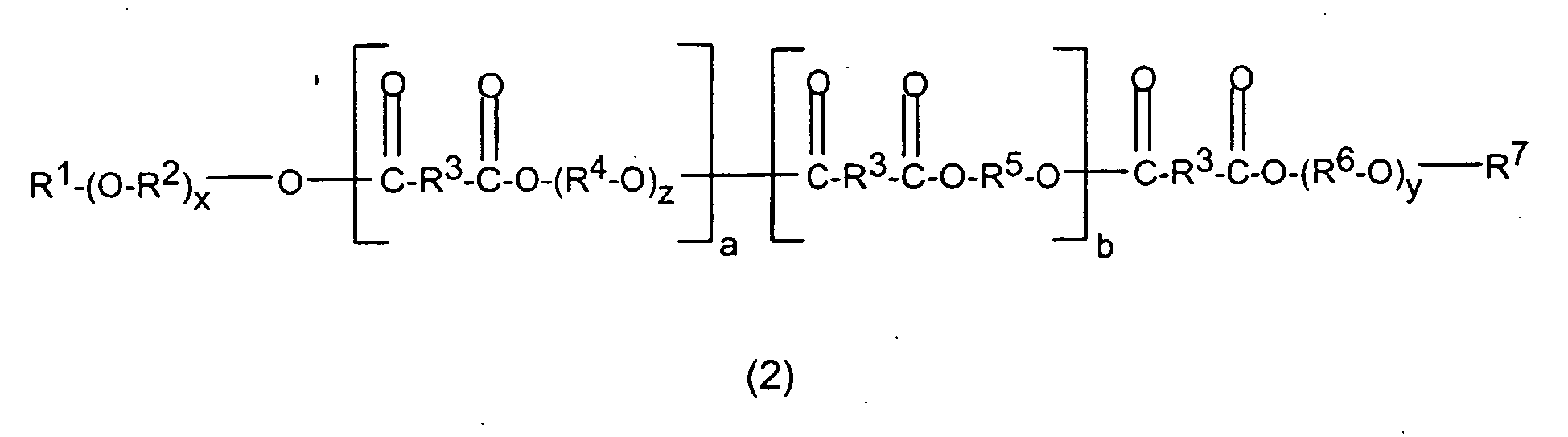
R1 und R7 lineares oder verzweigtes C1-C18-Alkyl, R2 und R6 Ethylen, R3 1,4-Phenylen, 1,3-Phenylen, R4 Ethylen, R5 Ethylen, 1,2-Propylen oder statistische Gemische von beliebiger Zusammensetzung von beiden, x und y unabhängig voneinander eine Zahl zwischen 1 und 500, z eine Zahl zwischen 10 und 140, a eine Zahl zwischen 1 und 12, b eine Zahl zwischen 7 und 40,
bedeuten, wobei
a + b mindestens gleich 11 ist. - Bevorzugt bedeuten unabhängig voneinander in der Formel (2)
R1 und R7 lineares oder verzweigtes C1-C4-Alkyl, x und y eine Zahl zwischen 3 und 45, z eine Zahl zwischen 18 und 70, a eine Zahl zwischen 2 und 5, b eine Zahl zwischen 8 und 12, a + b eine Zahl zwischen 12 und 18 oder zwischen 25 und 35. - Die erfindungsgemäßen Formulierungen enthalten neben den Oligo- und Polyestern Polycarbonsäuren oder Polycarboxylate. Als Polycarbonsäuren bzw. Polycarboxylate kommen beispielsweise Verbindungen der Formel (3) in Frage

D Wasserstoff, C1-C4-Alkyl, insbesondere Methyl oder -COOM,
E Wasserstoff, C1-C4-Alkyl, insbesondere Methyl, Ethyl; Cycloalkyl, insbesondere Cyclohexyl; Aryl, insbesondere Phenyl, -COOM, -CH2-COOM, C1-C4-Acyl, insbesondere Acetyl; -OH, C1-C4-Alkoxy, insbesondere -OCH3; Halogen, insbesondere Chlor oder -CN, x eine Zahl von 0 bis 3.500, y eine Zahl von 0 bis 3.500, z eine Zahl von 0 bis 3.500, M Wasserstoff, Natrium, Kalium, Lithium, Ammonium oder substituiertes Ammonium bedeuten, wobei mindestens ein Index x, y oder z größer Null ist. Die Substituenten B, D und E können gleich oder verschieden sein. - Die folgenden Monomere können beispielsweise in den Polycarbonsäuren bzw. Polycarboxylaten der Formel (3) enthalten sein:
- Acrylsäure, Methacrylsäure, Maleinsäure, Fumarsäure, Itaconsäure,
- Citraconsäure, Mesaconsäure, Aconitsäure, Methylenmalonsäure.
- Bei den Polycarbonsäuren der allgemeinen Formel (3) kann es sich um Homopolymere, Copolymere und Terpolymere handeln.
Homopolymere sind insbesondere Polyacrylsäuren mit einer Molmasse bis 250.000, bevorzugt von 2.000 bis 100.000 und Polymaleinsäure. Bei Polycarbonsäuren, die aus zwei oder mehr Monomeren aufgebaut sind, kann es sich um statistische Copolymere, Blockcopolymere, alternierende Copolymere oder Pfropfcopolymere handeln.
Copolymere enthalten beispielsweise zwei carboxylgruppenhaltige Monomere und gegebenenfalls weitere Co-Monomere. Sie können aber auch nur ein carboxylgruppenhaltiges Monomer zusammen mit anderen vinylischen Monomeren polymerisiert enthalten. - Besonders bevorzugt sind Copolymere auf Basis Acrylsäure und Maleinsäure, Maleinsäure und Olefinen (insbesondere Ethylen), Maleinsäure und Vinylmethylether, Acrylsäure und Olefinen (insbesondere Ethylen) sowie Acrylsäure und Vinylmethylether.
- Erfindungsgemäß kommen auch Etherpolycarboxylate in Frage. Etherpolycarboxylate werden z.B. beschrieben in
US 3,128,287 undUS 3,635,830 . Dabei handelt es sich um Oxydisuccinate.
Eine spezielle Gruppe von Etherpolycarboxylaten, die gemäß der vorliegenden Erfindung eingesetzt werden können, entsprechen der allgemeinen Formel (4):
B H oder eine Gruppe der Formel
- Oxy-dibernsteinsäure und ihre Salze (A und B = H); Tartrat-monobernsteinsäure und ihre Salze (A = -OH und B = H); Tartrat-dibernsteinsäure und ihre Salze

- Auch Mischungen verschiedener Ether-polycarboxylate können eingesetzt werden.
- Ferner können cyclische Ethercarboxylate verwendet werden, wie z.B. beschrieben in
US 3,923,679 ;US 3,835,163 ;US 4,158,635 ;US 4,120,874 undUS 4,102,903 . - Weiterhin können Etherhydroxypolycarboxylate gemäß Formel (5) eingesetzt werden.

- Die erfindungsgemäßen Formulierungen können 30 bis 90, bevorzugt 50 bis 90, besonders bevorzugt 70 bis 80 Gew.-% Oligo- bzw. Polyester enthalten. Der Gehalt an Polycarbonsäure bzw. Polycarboxylat kann 0,1 bis 40, bevorzugt 0,1 bis 25, besonders bevorzugt 0,1 bis 10 und ganz besonders bevorzugt 0,5 bis 5 Gew.-% in der erfindungsgemäßen Formulierung betragen.
- Die erfindungsgemäßen hochkonzentrierten, wässrigen Oligo- und Polyesterzubereitungen werden in der Regel in Konzentrationen von kleiner 5 Gew.-%, bevorzugt zu kleiner 1,5 Gew.-% und besonders bevorzugt zu 0,5 bis 1 Gew.-% in Wasch- und Reinigungsmittelformulierungen eingesetzt (Konzentrationsangaben hier bezogen auf den Polyesteranteil in der Zubereitung).
- Die Wasch- und Reinigungsmittelformulierungen, in denen die erfindüngsgemäßen wässrigen, hochkonzentrierten Oligo- und Polyesterzubereitungen eingesetzt werden können, sind bevorzugt Flüssigwaschmittel, Waschgele und Waschpasten, aber auch Pulver, Granulate, Pellets, Tabletten und Waschstücke ("Bars", "Blocks").
In Flüssigwaschmitteln, Waschgelen und Waschpasten können die genannten Zubereitungen mittels mechanischen Homogenisiereinrichtungen wie Rührern einfach eingearbeitet werden.
In festen Waschmitteln, wie Waschpulvern, können die genannten Zubereitungen mittels Aufsprühen, ggf. in Mischung mit anderen flüssigen Waschmittelkomponenten, auf das Waschpulver oder auf einzelne pulverförmige Bestandteile, wie z.B. Zeolite, Natriumsulfat, Soda aufgebracht werden.
Die Waschmittel enthaltend die hochkonzentrierten Poly- oder Oligoesterzubereitungen können in Folien verpackt sein, die entweder eine Schutzfunktion bei der Lagerung besitzen oder auch als Dosierhilfe dienen. Die Folien können wasserlöslich sein.
Die hochkonzentrierten, wässrigen Polyesterzubereitungen können außerdem in speziellen Wäschebehandlungsmitteln, wie z.B. Flecklösern oder Waschboostern eingesetzt werden. - Wasch- und Reinigungsmittel, welche die erfindungsgemäßen hochkonzentrierten, wässrigen Oligo- oder Polyesterzubereitungen enthalten, können darüber hinaus weitere übliche Bestandteile enthalten. Diese werden im Folgenden beschrieben:
- Als anionische Tenside kommen Sulfate, Sulfonate, Carboxylate, Phosphate und Mischungen daraus in Betracht. Geeignete Kationen sind hierbei Alkalimetalle, wie z.B. Natrium oder Kalium oder Erdalkalimetalle, wie z.B. Calcium oder Magnesium sowie Ammonium, substituierte Ammoniumverbindungen, einschließlich Mono-, Di- oder Triethanolammoniumkationen, und Mischungen daraus.
- Folgende Typen von anionischen Tensiden sind besonders bevorzugt: Alkylestersulfonate, Alkylsulfate, Alkylethersulfate, Alkylbenzolsulfonate, Alkansulfonate und Seifen, wie im Folgenden beschrieben.
- Alkylestersulfonate sind unter anderem lineare Ester von C8-C20-Carboxylsäuren (d.h. Fettsäuren), welche mittels gasförmigem SO3 sulfoniert werden, wie in "The Journal of the American Oil Chemists Society" 52 (1975), pp. 323-329 beschrieben wird.
- Geeignete Ausgangsmaterialien sind natürliche Fette, wie z.B. Talg, Kokosöl und Palmöl, können aber auch synthetischer Natur sein.
- Bevorzugte Alkylestersulfonate, speziell für Waschmittelanwendungen, sind Verbindungen der Formel

- Alkylsulfate sind hier wasserlösliche Salze oder Säuren der Formel ROSO3M, worin R ein C10-C24-Kohlenwasserstoffrest, bevorzugt ein Alkyl- oder Hydroxyalkylrest mit C10-C20-Alkylkomponente, besonders bevorzugt ein C12-C18 Alkyl- oder Hydroxyalkylrest ist.
- M ist Wasserstoff oder ein Kation, z.B. ein Alkalimetallkation (z.B. Natrium, Kalium, Lithium) oder Ammonium oder substituiertes Ammonium, z.B. Methyl-, Dimethyl- und Trimethylammoniumkationen und quaternäre Ammoniumkationen wie Tetramethylammonium- und Dimethylpiperidiniumkationen und quartäre Ammoniumkationen, abgeleitet von Alkylaminen, wie Ethylamin, Diethylamin, Triethylamin und Mischungen davon.
Alkylketten mit C12-C16 sind für niedrige Waschtemperaturen (z.B. unter ca. 50°C) und Alkylketten mit C16-C18 für höhere Waschtemperaturen (z.B. oberhalb ca. 50°C) bevorzugt. - Alkylethersulfate sind wasserlösliche Salze oder Säuren der Formel RO(A)m SO3M worin R einen unsubstituierten C10-C24-Alkyl- oder Hydroxyalkylrest, bevorzugt einen C12-C20 Alkyl- oder Hydroxyalkylrest, besonders bevorzugt C12-C18-Alkyl- oder Hydroxyalkylrest darstellt.
- A ist eine Ethoxy- oder Propoxyeinheit, m ist eine Zahl größer als 0, vorzugsweise zwischen ca. 0,5 und ca. 6, besonders bevorzugt zwischen ca. 0,5 und ca. 3 und M ist ein Wasserstoffatom oder ein Kation, wie z.B. Natrium, Kalium, Lithium, Calcium, Magnesium, Ammonium oder ein substituiertes Ammoniumkation. Spezifische Beispiele von substituierten Ammoniumkationen sind Methyl-, Dimethyl-, Trimethylammonium- und quarternäre Ammoniumkationen wie Tetramethylammonium und Dimethylpiperidiniumkationen sowie solche, die von Alkylaminen, wie Ethylamin, Diethylamin, Triethylamin oder Mischungen davon abgeleitet sind. Als Beispiele seien C12- bis C18-Fettalkoholethersulfate genannt wobei der Gehalt an EO 1, 2, 2.5, 3 oder 4 mol pro mol des Fettalkoholethersulfats beträgt, und in denen M Natrium oder Kalium ist.
- In sekundären Alkansulfonaten kann die Alkylgruppe entweder gesättigt oder ungesättigt, verzweigt oder linear und gegebenenfalls mit einer Hydroxylgruppe substituiert sein.
Die Sulfogruppe kann an einer beliebigen Position der C-Kette sein, wobei die primären Methylgruppen am Kettenanfang und Kettenende keine Sulfonatgruppen besitzen. - Die bevorzugten sekundären Alkansulfonate enthalten lineare Alkylketten mit ca. 9 bis 25 Kohlenstoffatomen, bevorzugt ca. 10 bis ca. 20 Kohlenstoffatome und besonders bevorzugt ca. 13 bis 17 Kohlenstoffatome. Das Kation ist beispielsweise Natrium, Kalium, Ammonium, Mono-, Di- oder Triethanolammonium, Calcium oder Magnesium, und Mischungen davon. Natrium als Kation ist bevorzugt.
Neben sekundären Alkansulfonaten können auch primäre Alkansulfonate in den erfindungsgemäßen Waschmitteln eingesetzt werden. - Die bevorzugten Alkylketten und Kationen entsprechen denen der sekundären Alkansulfonaten.
Die Herstellung von primärer Alkansulfonsäure, aus der die als Tensid wirksamen entsprechenden Sulfonate erhalten werden, ist z.B. inEP 854 136-A1 - Weitere geeignete anionische Tenside sind Alkenyl- oder Alkylbenzolsulfonate. Die Alkenyl- oder Alkylgruppe kann verzweigt oder linear und gegebenenfalls mit einer Hydroxylgruppe substituiert sein. Die bevorzugten Alkylbenzolsulfonate enthalten lineare Alkylketten mit ca. 9 bis 25 Kohlenstoffatomen, bevorzugt von ca. 10 bis ca. 13 Kohlenstoffatome, das Kation ist Natrium, Kalium, Ammonium, Mono-, Di- oder Triethanolammonium, Calcium oder Magnesium und Mischungen davon.
Für milde Tensidsysteme ist Magnesium als Kation bevorzugt, für Standardwaschanwendungen dagegen Natrium. Gleiches gilt für Alkenylbenzolsulfonate. - Der Begriff anionische Tenside schließt auch Olefinsulfonate mit ein, die durch Sulfonierung von C8-C24-, vorzugsweise C14-C16-α-Olefinen mit Schwefeltrioxid und anschließende Neutralisation erhalten werden. Bedingt durch das Herstellverfahren, können diese Olefinsulfonate kleinere Mengen an Hydroxyalkansulfonaten und Alkandisulfonaten enthalten. Spezielle Mischungen von α-Olefinsulfonaten sind in
US-3,332,880 beschrieben. - Weitere bevorzugte anionische Tenside sind Carboxylate, z.B. Fettsäureseifen und vergleichbare Tenside. Die Seifen können gesättigt oder ungesättigt sein und können verschiedene Substituenten, wie Hydroxylgruppen oder α-Sulfonatgruppen enthalten. Bevorzugt sind lineare gesättigte oder ungesättigte Kohlenwasserstoffreste als hydrophober Anteil mit ca. 6 bis ca. 30, bevorzugt ca. 10 bis ca. 18 Kohlenstoffatomen.
- Als anionische Tenside kommen weiterhin Salze von Acylaminocarbonsäuren in Frage, die durch Umsetzung von Fettsäurechloriden mit Natriumsarkosinat im alkalischen Medium entstehenden Acylsarcosinate; Fettsäure-Eiweiß-Kondensationsprodukte, die durch Umsetzung von Fettsäurechloriden mit Oligopeptiden erhalten werden; Salze von Alkylsulfamidocarbonsäuren; Salze von Alkyl- und Alkylarylethercarbonsäuren; sulfonierte Polycarboxylsäuren, hergestellt durch Sulfonierung der Pyrolyseprodukte von Erdalkalimetallcitraten, wie z.B. beschrieben in
GB-1,082,179
Weitere Beispiele sind in "Surface Active Agents and Detergents" (Vol. I und II, Schwartz, Perry und Berch) beschrieben. - Kondensationsprodukte von aliphatischen Alkoholen mit ca. 1 bis ca. 25 mol Ethylenoxid.
- Die Alkylkette der aliphatischen Alkohole kann linear oder verzweigt, primär oder sekundär sein, und enthält im Allgemeinen ca. 8 bis ca. 22 Kohlenstoffatome.
- Besonders bevorzugt sind die Kondensationsprodukte von C10- bis C20-Alkoholen mit ca. 2 bis ca. 18 mol Ethylenoxid pro mol Alkohol. Die Alkylkette kann gesättigt oder auch ungesättigt sein. Die Alkoholethoxylate können eine enge ("Narrow Range Ethoxylates") oder eine breite Homologenverteilung des Ethylenoxides ("Broad Range Ethoxylates") aufweisen.
- Beispiele von kommerziell erhältlichen nichtionischen Tensiden dieses Typs sind Tergitol® 5-S-9 (Kondensationsprodukt eines linearen sekundären C11-C15-Alkohols mit 9 mol Ethylenoxid), Tergitol® 24-L-NMW (Kondensationsprodukt eines linearen primären C12-C14-Alkohols mit 6 mol Ethylenoxid bei enger Molgewichtsverteilung). Ebenfalls unter diese Produktklasse fallen die Genapol®-Marken der Clariant GmbH.
- Kondensationsprodukte von Ethylenoxid mit einer hydrophoben Basis, gebildet durch Kondensation von Propylenoxid mit Propylenglykol.
- Der hydrophobe Teil dieser Verbindungen weist bevorzugt ein Molekulargewicht zwischen ca. 1500 und ca. 1800 auf. Die Anlagerung von Ethylenoxid an diesen hydrophoben Teil führt zu einer Verbesserung der Wasserlöslichkeit. Das Produkt ist flüssig bis zu einem Polyoxyethylengehalt von ca. 50 % des Gesamtgewichtes des Kondensationsproduktes, was einer Kondensation mit bis zu ca. 40 mol Ethylenoxid entspricht. Kommerziell erhältliche Beispiele dieser Produktklasse sind die Pluronic®-Marken der BASF und die ®Genapol PF-Marken der Clariant GmbH.
Kondensationsprodukte von Ethylenoxid mit einem Reaktionsprodukt von Propylenoxid und Ethylendiamin. - Die hydrophobe Einheit dieser Verbindungen besteht aus dem Reaktionsprodukt von Ethylendiamin mit überschüssigem Propylenoxid und weist im Allgemeinen ein Molekulargewicht von ca. 2500 bis 3000 auf. An diese hydrophobe Einheit wird Ethylenoxid bis zu einem Gehalt von ca. 40 bis ca. 80 Gew.-% Polyoxyethylen und einem Molekulargewicht von ca. 5000 bis 11000 addiert.
- Kommerziell erhältliche Beispiele dieser Verbindungsklasse sind die ®Tetronic-Marken der BASF und die ®Genapol PN-Marken der Clariant GmbH.
- Diese Kategorie von nichtionischen Verbindungen umfasst wasserlösliche Aminoxide, wasserlösliche Phosphinoxide und wasserlösliche Sulfoxide, jeweils mit einem Alkylrest von ca. 10 bis ca. 18 Kohlenstoffatomen. Semipolare nichtionische Tenside sind auch Aminoxide der Formel

- Fettsäureamide besitzen die Formel

- Weitere geeignete nichtionische Tenside sind Alkyl- und Alkenyloligoglycoside sowie Fettsäurepolyglykolester oder Fettaminpolyglykolester mit jeweils 8 bis 20, vorzugsweise 12 bis 18 C-Atomen im Fettalkylrest, alkoxylierte Triglycamide, Mischether oder Mischformyle, Alkyloligoglycoside, Alkenyloligoglycoside, Fettsäure-N-alkylglucamide, Phosphinoxide, Dialkylsulfoxide und Proteinhydrolysate.
- Polyethylen-, Polypropylen- und Polybutylenoxidkondensate von Alkylphenolen.
- Diese Verbindungen umfassen die Kondensationsprodukte von Alkylphenolen mit einer C6- bis C20-Alkylgruppe, die entweder linear oder verzweigt sein kann, mit Alkenoxiden. Bevorzugt sind Verbindungen mit ca. 5 bis 25 mol Alkenoxid pro mol Alkylphenol. Kommerziell erhältliche Tenside dieses Typs sind z.B. lgepal® CO-630, Triton® X-45, X-114, X-100 und X102, und die ®Arkopal-N-Marken der Clariant GmbH. Diese Tenside werden als Alkylphenolalkoxilate, z.B. Alkylphenolethoxilate, bezeichnet.
- Typische Beispiele für amphotere bzw. zwitterionische Tenside sind Alkylbetaine, Alkylamidbetaine, Aminopropionate, Aminoglycinate, oder amphotere Imidazoünium-Verbindungen der Formel

- Bevorzugte amphotere Tenside dieser Formel sind Monocarboxylate und Dicarboxylate. Beispiele hierfür sind Cocoamphocarboxypropionat, Cocoamidocarboxypropionsäure, Cocoamphocarboxyglycinat (oder auch als Cocoamphodiacetat bezeichnet) und Cocoamphoacetat.
- Weitere bevorzugte amphotere Tenside sind Alkyldimethylbetaine (®Genagen LAB/ Clariant GmbH) und Alkyldipolyethoxybetaine mit einem Alkylrest mit ca. 8 bis ca. 22 Kohlenstoffatomen, der linear oder verzweigt sein kann, bevorzugt mit 8 bis 18 Kohlenstoffatomen und besonders bevorzugt mit ca. 12 bis ca. 18 Kohlenstoffatomen.
- Geeignete kationische Tenside sind substituierte oder unsubstituierte geradkettige oder verzweigte quartäre Ammoniumsalze vom Typ R1N(CH3)3 +X-, R1R2N(CH3)2 +X-, R1R2R3N(CH3)+X- oder R1R2R3R4N+X-. Die Reste R1, R2, R3 und R4 können vorzugsweise unabhängig voneinander unsubstituiertes Alkyl mit einer Kettenlänge zwischen 8 und 24 C-Atomen, insbesondere zwischen 10 und 18 C-Atomen, Hydroxyalkyl mit ca. 1 bis ca. 4 C-Atomen, Phenyl, C2- bis C18-Alkenyl, C7- bis C24-Aralkyl, (C2H4O)xH, wobei x von ca. 1 bis ca. 3 bedeutet, ein oder mehrere Estergruppen enthaltende Alkylreste oder cyclische quartäre Ammoniumsalze sein. X ist ein geeignetes Anion.
- Weitere Waschmittelinhaltsstoffe, die in der vorliegenden Erfindung enthalten sein können, umfassen anorganische und/oder organische Gerüststoffe, um den Härtegrad des Wassers zu mindern.
- Diese Gerüststoffe können mit Gewichtsanteilen von etwa 5 % bis etwa 80 % in den Wasch- und Reinigungsmittelzusammensetzungen enthalten sein. Anorganische Gerüststoffe umfassen beispielsweise Alkali-, Ammonium- und Alkanolammoniumsalze von Polyphosphaten wie etwa Tripolyphosphate, Pyrophosphate und glasartige polymere Metaphosphate, Phosphonaten, Silikaten, Carbonaten einschließlich Bicarbonate und Sesquicarbonate, Sulfaten und Aluminosilikaten.
- Beispiele für Silikatgerüststoffe sind die Alkalimetallsilikate, insbesondere diejenigen mit einem SiO2:Na2O-Verhältnis zwischen 1,6:1 und 3,2:1 sowie Schichtsilikate, beispielsweise Natriumschichtsilikate, wie beschrieben in
US-4,664,839 , erhältlich von Clariant GmbH unter der Marke SKS®. SKS-6® ist ein besonders bevorzugter Schichtsilikatgerüststoff. - Aluminosilikatgerüststoffe sind für die vorliegende Erfindung besonders bevorzugt. Es handelt sich dabei insbesondere um Zeolithe mit der Formel Naz[(AlO2)z(SiO2)y]·xH2O, worin z und y ganze Zahlen von mindestens 6 bedeuten, das Verhältnis von z zu y zwischen 1,0 bis etwa 0,5 liegt, und x eine ganze Zahl von etwa 15 bis etwa 264 bedeutet.
- Geeignete Ionentauscher auf Aluminosilikatbasis sind im Handel erhältlich. Diese Aluminosilikate können von kristalliner oder amorpher Struktur sein, und können natürlich vorkommend oder auch synthetisch hergestellt sein. Verfahren für die Herstellung von Ionentauschern auf Aluminosilikatbasis werden beschrieben in
US-3,985,669 undUS-4,605,509 . Bevorzugte Ionentauscher auf der Basis synthetischer kristalliner Aluminosilikate sind erhältlich unter der Bezeichnung Zeolith A, Zeolith P(B) (einschließlich der inEP-A-0 384 070 offenbarten) und Zeolith X. Bevorzugt sind Aluminosilikate mit einem Partikeldurchmesser zwischen 0,1 und 10 µm.
Geeignete organische Gerüststoffe (Co-Builder) umfassen Polycarboxylverbindungen, wie beispielsweise Etherpolycarboxylate und Oxydisuccinate, wie beispielsweise in
US-3,128,287 undUS-3,635,830 beschrieben. Ebenfalls soll auf "TMS/TDS"-Gerüststoffe ausUS-4,663,071 verwiesen werden. - Andere geeignete Gerüststoffe umfassen die Etherhydroxypolycarboxylate, Copolymere von Maleinsäureanhydrid mit Ethylen oder Vinylmethylether, 1,3,5-Trihydroxybenzol-2,4,6-trisulfonsäure und Carboxymethyloxybernsteinsäure, die Alkali-, Ammonium- und substituierten Ammoniumsalze von Polyessigsäuren, wie z.B. Ethylendiamin-tetraessigsäure und Nitrilotriessigsäure sowie Polycarbonsäuren, wie Mellithsäure, Bernsteinsäure, Oxydibernsteinsäure, Polymaleinsäure, Benzol-1,3,5-tricarbonsäure, Carboxymethyloxybernsteinsäure sowie deren lösliche Salze.
- Wichtige organische Gerüststoffe sind auch Polycarboxylate auf Basis von Acrylsäure und Maleinsäure, wie z.B. die Sokalan CP-Marken der BASF.
- Gerüststoffe auf Citratbasis, z.B. Zitronensäure und ihre löslichen Salze, insbesondere das Natriumsalz, sind bevorzugte Polycarbonsäuregerüststoffe, die auch in granulierten Formulierungen, insbesondere zusammen mit Zeolithen und/oder Schichtsilikaten verwendet werden können.
- Weitere geeignete Gerüststoffe sind die 3,3-Dicarboxy-4-oxa-1,6-hexandioate und die verwandten Verbindungen, die in
US-4,566,984 offenbart sind. - Wenn Gerüststoffe auf Phosphorbasis verwendet werden können, und insbesondere wenn Seifenstücke für die Wäsche von Hand formuliert werden sollen, können verschiedene Alkalimetallphosphate wie etwa Natriumtripolyphosphat, Natriumpyrophosphat und Natriumorthophosphat verwendet werden. Ebenfalls können Phosphonatgerüststoffe, wie Ethan-1-hydroxy-1,1-diphosphonat und andere bekannte Phosphonate, wie sie beispielsweise in
US-3,159,581 ,US-3,213,030 ,US-3,422,021 ,US-3,400,148 undUS-3,422,137 offenbart sind, verwendet werden. - Die Wasch- und Reinigungsmittel, welche die erfindungsgemäßen hochkonzentrierten, wässrigen Oligo- bzw. Polyesterformulierungen enthalten, können ferner die üblichen Hilfsstoffe enthalten, die die Reinigungswirkung verstärken, zur Pflege des zu waschenden Textils dienen oder die Gebrauchseigenschaften der Waschmittelzusammensetzung ändern.
- Geeignete Hilfsmittel umfassen die in
US-3,936,537 genannten Stoffe, beispielsweise Enzyme, insbesondere Proteasen, Lipasen, Cellulasen und Amylasen, Mannanasen, Glycosidasen, Enzymstabilisatoren, Schaumverstärker, Schaumbremsen, Anlauf- und/oder Korrosionsschutzmittel, Suspensionsmittel, Farbstoffe, Farbübertragungsinhibitoren, Füllmittel, optische Aufheller, Desinfektionsmittel, Alkalien, hydrotrope Verbindungen, Antioxidantien, Parfüme, Lösungsmittel, Lösungsvermittler, Wiederablagerungsverhinderer, Dispergiermittel, Verarbeitungshilfsmittel, Weichmacher und Antistatika. - Die Waschmittelzusammensetzungen der vorliegenden Erfindung können gegebenenfalls eines oder mehrere konventionelle Bleichmittel enthalten, sowie Bleichaktivatoren, Bleichkatalysatoren und geeignete Stabilisatoren. Im Allgemeinen muss sichergestellt sein, dass die verwendeten Bleichmittel mit den Reinigungsmittelinhaltsstoffen verträglich sind. Konventionelle Prüfmethoden, wie etwa die Bestimmung der Bleichaktivität des fertig formulierten Reinigungsmittels in Abhängigkeit von der Lagerungszeit können für diesen Zweck verwendet werden.
- Peroxysäuren können entweder als freie Peroxysäure eingesetzt werden, oder es kann eine Kombination aus einem anorganischen Persalz, beispielsweise Natriumperborat oder Natriumpercarbonat und einem organischen Peroxysäure-Vorläufer verwendet werden.
- Die organischen Peroxysäure-Vorläufer werden im Stand der Technik oft als Bleichaktivatoren bezeichnet.
Beispiele geeigneter organischer Peroxysäuren sind offenbart inUS-4,374,035 ,US-4,681,592 ,US-4,634,551 ,US-4,686,063 ,US-4,606,838 undUS-4,671,891 . - Beispiele für Zusammensetzungen, die zum Bleichen von Wäsche geeignet sind und die Perboratbleichmittel und Aktivatoren enthalten, werden beschrieben in
US-4,412,934 ,US-4,536,314 ,US-4,681,695 undUS-4,539,130 .
Beispiele für Peroxysäuren, die für die Verwendung in dieser Erfindung bevorzugt sind, umfassen die Peroxydodecandisäure (DPDA), das Nonylamid der Peroxybernsteinsäure (NAPSA), das Nonylamid der Peroxyadipinsäure (NAPAA) und Decyldiperoxybernsteinsäure (DDPSA), Nonanoyl-amidocaproyl-oxybenzolsulfonsäure und Alkanoyloxybenzolsulfonsäuren wie die Nonanoyloxybenzolsulfonsäure (NOBS) und die Lauroyloxybenzolsulfonsäure (LOBS). - Besonders bevorzugt werden in den erfindungsgemäßen Waschmitteln und Wäschebehandlungsmitteln Bleichsysteme auf Basis eines Persalzes wie Perboraten oder Percarbonaten mit dem Bleichaktivator Tetraacetylethylendiamin (TAED) eingesetzt.
- Weiterhin können die erfindungsgemäßen Formulierungen auch in kosmetischen Zubereitungen wie Hautreinigungsmittein, beispielsweise in Duschgelen, Schampoos, Seifen und in Hautpflegemitteln eingesetzt werden. Hautpflegemittel sind beispielsweise Tagescremes, Nachtcremes, Pflegecremes, Nährcreme, Bodylotions und Salben.
- Ein weiteres Anwendungsgebiet der erfindungsgemäßen Formulierungen sind die Behandlung (z.B. das Finishing) von Synthesefasern, insbesondere Polyesterfasern, oder Geweben, welche Synthesefasern, insbesondere Polyesterfasern, enthalten, in der Textilindustrie.
-
1. Es wurde eine 70 %ige wässrige Zubereitung des Polyesters TexCare SRN-100 mit Zusatz von 0,5 Gew.-% (WS) Acrylsäure-Maleinsäure-Copolymer Sokalan CP 12 S hergestellt. Dazu wurde der Polyester geschmolzen und in die Schmelze wurden Wasser und das Copolymer eingerührt. Die Temperatur der Schmelze und des Wassers wurden variiert. Die Mischungen wurden bei der jeweils resultierenden Mischtemperatur 15 Minuten nachgerührt und sodann unter Rühren auf Raumtemperatur abgekühlt.
Zur Untersuchung der thermischen Lagerstabilität wurden die Polyesterzubereitungen bei 40°C eingelagert und nach 8 Wochen visuell beurteilt. Vergleichend wurde die Polyesterzubereitung ohne Zusatz von Sokalan CP 12 S hergestellt und beurteilt.Tabelle 1: Stabilität einer wässrigen Polyesterzubereitung mit Zusatz von 0,5 Gew.-% (Wirkstoff) Sokalan CP 12 S. Vergleichsbeispiele ohne Sokalan CP 12 S. Polyesterzubereitung Schmelze
T (°C)Wasser
T(°C)Visuelle Beurteilung nach der Herstellung nach 8 Wochen A) ohne Zusatz 80 20 klar, homogen Bodensatz A) mit Sokalan CP 12S 80 20 klar, homogen klar, homogen B) ohne Zusatz 60 20 klar, homogen Bodensatz B) mit Sokalan CP 12S 60 20 klar, homogen klar, homogen C) ohne Zusatz 45 30 klar, homogen Bodensatz C) mit Sokalan CP 12S 45 30 klar, homogen klar, homogen D) ohne Zusatz 40 75 klar, homogen Bodensatz D) mit Sokalan CP 12S 40 75 klar, homogen klar, homogen
2. Es wurde eine 70 %ige wässrige Zubereitung des Polyesters TexCare SRN-100 mit Zusatz von 0,5 Gew.-% (WS) Polyacrylsäure Sokalan PA 20 PN hergestellt. Dazu wurde der Polyester geschmolzen und in die Schmelze wurden Wasser und die Polyacrylsäure eingerührt. Die Temperatur der Schmelze und des Wassers wurden variiert.
Die Mischung wurde bei der jeweils resultierenden Mischtemperatur 15 Minuten nachgerührt und sodann unter Rühren auf Raumtemperatur abgekühlt.
Zur Untersuchung der thermischen Lagerstabilität wurden die Polyesterzubereitungen bei 40°C eingelagert und nach 8 Wochen visuell beurteilt. Vergleichend wurde die Polyesterzubereitung ohne Zusatz von Sokalan PA 20 PN hergestellt und beurteilt.Tabelle 2: Stabilität einer wässrigen Polyesterzubereitung mit Zusatz von 0,5 Gew.-% (Wirkstoff) Sokalan PA 20 PN. Vergleichsbeispiele ohne Sokalan PA 20 PN. Polyesterzubereitung Schmelze
T (°C)Wasser
T (°C)Visuelle Beurteilung nach der Herstellung nach 8 Wochen A) ohne Zusatz 80 20 klar, homogen Bodensatz A) mit Sokalan PA 20 PN 80 20 klar, homogen klar, homogen B) ohne Zusatz 60 20 klar, homogen Bodensatz B) mit Sokalan PA 20 PN 60 20 klar, homogen klar, homogen C) ohne Zusatz 45 30 klar, homogen Bodensatz C) mit Sokalan PA 20 PN 45 30 klar, homogen klar, homogen D) ohne Zusatz 40 75 klar, homogen Bodensatz D) mit Sokalan PA 20 PN 40 75 klar, homogen klar, homogen
3. Es wurde eine 70 %ige wässrige Zubereitung des Polyesters TexCare SRN-100 mit Zusatz von 0,5 Gew.-% (WS) des Maleinsäure-Copolymers Sokalan PM 10 l hergestellt. Dazu wurde der Polyester geschmolzen und in die Schmelze wurden Wasser und das Maleinsäure-Copolymer eingerührt. Die Temperatur der Schmelze betrug 45°C und die des Wassers 30°C. Die Mischung wurde 1 Stunde nachgerührt und sodann unter Rühren auf Raumtemperatur abgekühlt.
Zur Untersuchung der thermischen Lagerstabilität wurde die Polyesterzubereitung bei 40°C eingelagert und nach 8 Wochen visuell beurteilt.
Vergleichend wurde die Polyesterzubereitung ohne Zusatz von Sokalan PM 10 l hergestellt und beurteilt.Tabelle 3: Stabilität einer wässrigen Polyesterzubereitung mit Zusatz von 0,5 Gew.-% (Wirkstoff) Sokalan PM 10 l. Vergleichsbeispiele ohne Sokalan PM 10 l. Polyesterzubereitung Schmelze
T(°C)Wasser
T(°C)Visuelle Beurteilung nach der Herstellung nach 8 Wochen A) ohne Zusatz 45 30 klar, homogen Bodensatz A) mit Sokalan PM 10 l 45 30 klar, homogen klar, homogen
4. Es wurde eine 70%-ige wässrige Zubereitung des Polyesters TexCare SRN-100 mit Zusatz von 0,5 Gew.-% (WS) des Polycarboxylats Sokalan PM 70 hergestellt. Dazu wurde der Polyester geschmolzen und in die Schmelze wurden Wasser und das Polycarboxylat eingerührt. Die Temperatur der Schmelze betrug 45°C und die des Wassers 30°C. Die Mischung wurde 1 Stunde nachgerührt und sodann unter Rühren auf Raumtemperatur abgekühlt.
Zur Untersuchung der thermischen Lagerstabilität wurde die Polyesterzubereitung bei 40°C eingelagert und nach 8 Wochen visuell beurteilt.
Vergleichend wurde die Polyesterzubereitung ohne Zusatz von Sokalan PM 70 hergestellt und beurteilt.Tabelle 4: Stabilität einer wässrigen Polyester-zubereitung mit Zusatz von 0,5 Gew.-% (Wirkstoff) Sokalan PM 70. Vergleichsbeispiele ohne Sokalan PM 70. Polyesterzubereitung Schmelze
T (°C)Wasser
T (°C)Visuelle Beurteilung nach der Herstellung nach 8 Wochen A) ohne Zusatz 45 30 klar, homogen Bodensatz A) mit Sokalan PM 70 45 30 klar, homogen klar, homogen
5. Es wurde eine 80 %ige wässrige Zubereitung des Polyesters TexCare SRN-100 mit Zusatz von 0,5 Gew.-% (WS) Acrylsäure-Maleinsäure-Copolymer Sokalan CP 12 S hergestellt. Dazu wurde der Polyester geschmolzen und in die Schmelze wurden Wasser und das Copolymer eingerührt. Die Temperatur der Schmelze betrug 60°C und die des Wassers 20°C. Die Mischung wurde 1 Stunde nachgerührt und sodann unter Rühren auf Raumtemperatur abgekühlt.
Zur Untersuchung der thermischen Lagerstabilität wurde die Polyesterzubereitung bei 40°C eingelagert und nach 8 Wochen visuell beurteilt.
Vergleichend wurde die Polyesterzubereitung ohne Zusatz von Sokalan CP 12 S hergestellt und beurteilt.Tabelle 5: Stabilität einer wässrigen Polyesterzubereitung mit Zusatz von 0,5 Gew.-% (Wirkstoff) Sokalan CP 12 S. Vergleichsbeispiele ohne Sokalan CP 12 S. Polyesterzubereitung Schmelze
T(°C)Wasser
T(°C)Visuelle Beurteilung nach der Herstellung nach 8 Wochen A) ohne Zusatz 60 20 klar, homogen Bodensatz A) mit Sokalan CP 12 S 60 20 klar, homogen klar, homogen
6. Es wurde eine 33 %ige wässrige Zubereitung des Polyesters TexCare SRN-100 mit Zusatz von 33 Gew.-% (WS) Acrylsäure-Maleinsäure-Copolymer Sokalan CP 12 S hergestellt. Dazu wurde der Polyester geschmolzen und in die Schmelze wurde das Copolymer tel quel eingerührt. Die Temperatur der Schmelze betrug 60°C. Die Mischung wurde bei der resultierenden Mischtemperatur 15 Minuten nachgerührt und sodann unter Rühren auf Raumtemperatur abgekühlt.
Zur Untersuchung der thermischen Lagerstabilität wurde die Polyesterzubereitung bei 40°C eingelagert und nach 8 Wochen visuell beurteilt.
Vergleichend wurde die Polyesterzubereitung ohne Zusatz von Sokalan CP 12 S hergestellt und beurteilt.Tabelle 6: Stabilität einer wässrigen Polyesterzubereitung mit Zusatz von 33 Gew.-% (Wirkstoff) Sokalan CP 12 S. Vergleichsbeispiele ohne Sokalan CP 12 S. Polyesterzubereitung Schmelze
T (°C)Sokalan CP 12 S
T (°C)Visuelle Beurteilung nach der Herstellung nach 8 Wochen A) ohne Zusatz 60 20 klar, homogen Bodensatz A) mit Sokalan CP 12S 60 20 klar, homogen klar, homogen
7. Es wurde eine 50 %ige wässrige Zubereitung des Polyesters TexCare SRN-100 mit Zusatz von 25 Gew.-% (WS) Acrylsäure-Maleinsäure-Copolymer Sokalan CP 12 S hergestellt. Dazu wurde der Polyester geschmolzen und in die Schmelze wurde das Copolymer tel quel eingerührt. Die Temperatur der Schmelze betrug 60°C. Die Mischung wurde bei der resultierenden Mischtemperatur 15 Minuten nachgerührt und sodann unter Rühren auf Raumtemperatur abgekühlt.
Zur Untersuchung der thermischen Lagerstabilität wurde die Polyesterzubereitung bei 40°C eingelagert und nach 8 Wochen visuell beurteilt.
Vergleichend wurde die Polyesterzubereitung ohne Zusatz von Sokalan CP 12 S hergestellt und beurteilt.Tabelle 7: Stabilität einer wässrigen Polyesterzubereitung mit Zusatz von 25 Gew.-% (Wirkstoff) Sokalan CP 12 S. Vergleichsbeispiele ohne Sokalan CP 12 S. Polyesterzubereitung Schmelze
T (°C)Sokalan CP 12 S
T (°C)Visuelle Beurteilung nach der Herstellung nach 8 Wochen A) ohne Zusatz 60 20 klar, homogen Bodensatz A) mit Sokalan CP 12S 60 20 klar, homogen klar, homogen - Verzeichnis der verwendeten Handelsnamen:
TexCare® SRN-100 (Clariant) Nichtionischer Soil Release Polyester, 100 %ig. Sokalan® CP 12 S (BASF) Acrylsäure-Maleinsäure-Copolymer, MM = 3000 g/mol, 50 %ig. Sokalan PA 20 PN (BASF) Teilneutralisierte Polyacrylsäure, MM = 2500 g/mol, 54 %ig. Sokalan PM 10 l (BASF) Copolymerisat auf Basis Maleinsäure, Na-Salz, MM = 4000 g/mol, 44 %ig Sokalan PM 70 (BASF) Polycarboxylat, MM = 20.000 g/mol, 40 %ig.
Des weiteren können beispielsweise die folgenden carboxylgruppenfreien Co-Monomere enthalten sein: Olefine, bevorzugt Ethylen, Propylen und Butylen, Vinylacetat, Vinylalkohol, Styrol, Vinylmethylether, Vinylcyclohexan, Vinylchlorid, Acrylnitril, Vinylimidazolin, Vinylpyrrolidon.
Claims (21)
- Hochkonzentrierte wässrige Formulierungen von Oligo- und Polyestern, enthaltend im Wesentlichen 30 bis 90 Gew.-% eines Oligo- und Polyesters und 0,1 bis 40 Gew.-% einer Polycarbonsäure oder Polycarboxylats.
- Formulierung gemäß Anspruch 1, wobei der Oligo- und Polyester ein wasserlöslicher oder wasserdispergierbarer Polyester ist.
- Formulierung gemäß Anspruch 1, wobei der Oligo- und Polyester ein wasserlöslicher oder wasserdispergierbarer Polyester mit einer Molmasse von kleiner 20.000.
- Formulierung gemäß Anspruch 1, wobei der Oligo- und Polyester ein wasserlöslicher oder wasserdispergierbarer Polyester ist, der durch Alkylpolyalkylenglykole endverschlossen ist.
- Formulierung gemäß Anspruch 1, wobei der Oligo- und Polyester ein wasserlöslicher oder wasserdispergierbarer Polyester ist, der durch Methylpolyethylenglykole endverschlossen ist, wobei die Anzahl der Ethylenglykoleinheiten </= 90.
- Formulierung gemäß Anspruch 1, wobei der Oligo- und Polyester ein wasserlöslicher oder wasserdispergierbarer Polyester ist, der </= 60 Massen-% veresterte Terephthalsäureeinheiten besitzt.
- Formulierung gemäß Anspruch 1, wobei der Oligo- und Polyester ein wasserlöslicher oder wasserdispergierbarer Polyester ist, der Ethylenglykol- oder Polyethylenglykoleinheiten enthält.
- Formulierung gemäß Anspruch 1, wobei der Oligo- und Polyester ein wasserlöslicher oder wasserdispergierbarer Polyester ist, der Propylenglykol- oder Polypropylenglykoleinheiten enthält.
- Formulierung gemäß Anspruch 1, wobei der Oligo- und Polyester ein wasserlöslicher oder wasserdispergierbarer Polyester ist, der sowohl Ethylenglykol oder Polyethylenglykol als auch Propylenglykol- oder Polypropylenglykoleinheiten enthält.
- Formulierung gemäß Anspruch 1, wobei der Oligo- und Polyester ein wasserlöslicher oder wasserdispergierbarer Polyester ist, der mittels einkondensierten Sulfoisophthalsäure- und/oder Glycerinsulfoethylethereinheiten und/ oder Glycerinsulfopropylethereinheiten anionisch modifiziert ist.
- Formulierung gemäß Anspruch 1, wobei der Oligo- und Polyester ein wasserlöslicher oder wasserdispergierbarer Polyester ist, der mittels Isethionsäure, Hydroxypropansulfonsäure oder deren Umsetzungsprodukten mit Ethylenoxid bzw. Ethylenglykol oder dessen Oligomeren und/oder Propylenoxid bzw. Propylenglykol oder dessen Oligomeren endverschlossen ist.
- Formulierung nach Anspruch 1, wobei die Polycarbonsäure oder das Polycarboxylat eine Verbindung der Formel

D Wasserstoff, C1-C4-Alkyl, insbesondere Methyl oder -COOM,
E Wasserstoff, C1-C4-Alkyl, insbesondere Methyl, Ethyl; Cycloalkyl, insbesondere Cyclohexyl; Aryl, insbesondere Phenyl, -COOM, -CH2-COOM, C1-C4-Acyl, insbesondere Acetyl; -OH, C1-C4-Alkoxy, insbesondere -OCH3; Halogen, insbesondere Chlor oder -CN, x eine Zahl von 0 bis 3.500, y eine Zahl von 0 bis 3.500, z eine Zahl von 0 bis 3.500, M Wasserstoff, Natrium, Kalium, Lithium, Ammonium oder substituiertes Ammonium bedeuten, wobei mindestens ein Index x, y oder z größer Null ist. - Formulierung nach Anspruch 1, wobei die Polycarbonsäure oder das Polycarboxylat Polyacrylsäure oder Polymaleinsäure ist und diese in freier, teilneutralisierter oder vollständig neutralisierter Form vorliegen kann.
- Formulierung nach Anspruch 1, wobei die Polycarbonsäure oder das Polycarboxylat ein Copolymer auf Basis Acrylsäure und Maleinsäure, Maleinsäure und Olefinen, insbesondere Ethylen, Maleinsäure und Vinylmethylether, Acrylsäure und Olefinen, insbesondere Ethylen, Acrylsäure und Vinylmethylether ist und das Copolymer in freier, teilneutralisierter oder vollständig neutralisierter Form vorliegen kann.
- Formulierung nach Anspruch 1, wobei die Polycarbonsäure oder das Polycarboxylat eine Verbindung der Formel


- Formulierung nach Anspruch 1, wobei die Polycarbonsäure oder das Polycarboxylat eine Verbindung der Formel

- Formulierung nach Anspruch 1, enthaltend 50 bis 90 Gew.-% Oligo- und Polyester.
- Formulierung nach Anspruch 1, enthaltend 0,1 bis 40 Gew.-% Polycarbonsäure oder Polycarboxylat.
- Wasch- und Reinigungsmittel, enthaltend eine Formulierung nach Anspruch 1.
- Kosmetische Zubereitungen, enthaltend eine Formulierung nach Anspruch 1.
- Textilhilfsmittel zur Behandlung von Synthesefasern, insbesondere Polyesterfasern oder von textilen Geweben enthaltend Synthesefasern, insbesondere Polyesterfasern, enthaltend eine Formulierung nach Anspruch 1.
Priority Applications (1)
| Application Number | Priority Date | Filing Date | Title |
|---|---|---|---|
| PL05751663T PL1763559T3 (pl) | 2004-06-17 | 2005-06-14 | Wysoko stężone wodne preparaty oligo-i poliestrów |
Applications Claiming Priority (2)
| Application Number | Priority Date | Filing Date | Title |
|---|---|---|---|
| DE102004029310A DE102004029310A1 (de) | 2004-06-17 | 2004-06-17 | Hochkonzentrierte, wässrige Formulierungen von Oligo-und Polyestern |
| PCT/EP2005/006344 WO2005123835A1 (de) | 2004-06-17 | 2005-06-14 | Hochkonzentrierte, wässrige formulierungen von oligo-und polyestern |
Publications (2)
| Publication Number | Publication Date |
|---|---|
| EP1763559A1 EP1763559A1 (de) | 2007-03-21 |
| EP1763559B1 true EP1763559B1 (de) | 2007-11-21 |
Family
ID=34970221
Family Applications (1)
| Application Number | Title | Priority Date | Filing Date |
|---|---|---|---|
| EP05751663A Expired - Lifetime EP1763559B1 (de) | 2004-06-17 | 2005-06-14 | Hochkonzentrierte, wässrige formulierungen von oligo-und polyestern |
Country Status (8)
| Country | Link |
|---|---|
| US (1) | US7790665B2 (de) |
| EP (1) | EP1763559B1 (de) |
| JP (1) | JP2008502752A (de) |
| DE (2) | DE102004029310A1 (de) |
| DK (1) | DK1763559T3 (de) |
| ES (1) | ES2296191T3 (de) |
| PL (1) | PL1763559T3 (de) |
| WO (1) | WO2005123835A1 (de) |
Families Citing this family (13)
| Publication number | Priority date | Publication date | Assignee | Title |
|---|---|---|---|---|
| DE102006019509A1 (de) * | 2006-04-26 | 2007-10-31 | Clariant International Limited | Wasserbasierende Flammschutzmitteldispersionen |
| DE102007005532A1 (de) * | 2007-02-03 | 2008-08-07 | Clariant International Limited | Wässrige Oligo- und Polyesterzubereitungen |
| JP5201931B2 (ja) * | 2007-10-01 | 2013-06-05 | ユニチカ株式会社 | ポリエステル樹脂水分散体混合物、および、それから得られる皮膜形成物ならびに該皮膜を利用した積層体 |
| RU2470069C2 (ru) | 2008-01-04 | 2012-12-20 | Дзе Проктер Энд Гэмбл Компани | Композиция средства для стирки, содержащая гликозилгидролазу |
| EP2242830B2 (de) * | 2008-01-04 | 2020-03-11 | The Procter & Gamble Company | Enzym- und stofffärbemittelhaltige zusammensetzungen |
| CN101910391B (zh) * | 2008-01-04 | 2013-04-17 | 宝洁公司 | 包含糖基水解酶和包含有益剂递送颗粒的衣物洗涤剂组合物 |
| EP2235154B1 (de) * | 2008-01-04 | 2012-05-02 | The Procter & Gamble Company | Verwendung einer cellulase für schmutzabweisende wirkung bei baumwolle während eines nachfolgenden waschvorgangs |
| EP4545638A3 (de) | 2008-06-06 | 2025-07-16 | The Procter & Gamble Company | Waschmittelzusammensetzung mit einer variante einer xyloglucanase der familie 44 |
| EP2277982B1 (de) * | 2009-07-17 | 2012-01-18 | Clariant Finance (BVI) Limited | Reinigungsmittel, welches die Farbe ändert |
| ES2492500T3 (es) * | 2009-11-27 | 2014-09-09 | Clariant Finance (Bvi) Limited | Utilización de unos concentrados de poliésteres que tienen una alta estabilidad en solución y un efecto inhibidor del agrisamiento en agentes de lavado y limpieza |
| EP3489340A1 (de) | 2017-11-28 | 2019-05-29 | Clariant International Ltd | Erneuerbar beschaffte schmutzablösungspolyester |
| HUE066006T2 (hu) * | 2018-01-25 | 2024-07-28 | Procter & Gamble | Eljárás átlátszatlan folyékony mosószerkészítmény elõállítására |
| EP4509588A3 (de) | 2018-05-24 | 2025-05-28 | Clariant International Ltd | Schmutzlösende polyester zur verwendung in waschmittelzusammensetzungen |
Family Cites Families (59)
| Publication number | Priority date | Publication date | Assignee | Title |
|---|---|---|---|---|
| NL132418C (de) | 1962-04-13 | |||
| US3128287A (en) | 1963-01-31 | 1964-04-07 | Pfizer & Co C | 2,2'-oxodisuccinic acid, derivatives thereof, and process for preparing |
| US3213030A (en) | 1963-03-18 | 1965-10-19 | Procter & Gamble | Cleansing and laundering compositions |
| CA777769A (en) | 1963-03-18 | 1968-02-06 | H. Roy Clarence | Substituted methylene diphosphonic acid compounds and detergent compositions |
| US3332880A (en) | 1965-01-04 | 1967-07-25 | Procter & Gamble | Detergent composition |
| GB1082179A (en) | 1965-07-19 | 1967-09-06 | Citrique Belge Nv | Unsaturated carboxylic salt materials and derivatives thereof |
| US3400148A (en) | 1965-09-23 | 1968-09-03 | Procter & Gamble | Phosphonate compounds |
| US3422131A (en) | 1966-02-10 | 1969-01-14 | Us Agriculture | Fluoroalkoxyalkyl silanes |
| US3635830A (en) | 1968-05-24 | 1972-01-18 | Lever Brothers Ltd | Detergent compositions containing oxydisuccing acid salts as builders |
| US3712873A (en) | 1970-10-27 | 1973-01-23 | Procter & Gamble | Textile treating compositions which aid in the removal of soil from polyester and polyamide synthetic textile materials |
| US4605509A (en) | 1973-05-11 | 1986-08-12 | The Procter & Gamble Company | Detergent compositions containing sodium aluminosilicate builders |
| US3835163A (en) | 1973-08-02 | 1974-09-10 | Monsanto Co | Tetrahydrofuran polycarboxylic acids |
| US3985669A (en) | 1974-06-17 | 1976-10-12 | The Procter & Gamble Company | Detergent compositions |
| US3959230A (en) | 1974-06-25 | 1976-05-25 | The Procter & Gamble Company | Polyethylene oxide terephthalate polymers |
| US3936537A (en) | 1974-11-01 | 1976-02-03 | The Procter & Gamble Company | Detergent-compatible fabric softening and antistatic compositions |
| US4102903A (en) | 1977-01-05 | 1978-07-25 | Monsanto Company | Tetrahydropyran and 1,4-dioxane polycarboxylate compounds, methods for making such compounds and compositions and methods employing same |
| US4120874A (en) | 1977-01-05 | 1978-10-17 | Monsanto Company | Diesters of 6-cyano-2,2-tetrahydropyrandicarboxylates |
| US4116885A (en) | 1977-09-23 | 1978-09-26 | The Procter & Gamble Company | Anionic surfactant-containing detergent compositions having soil-release properties |
| US4158635A (en) | 1977-12-05 | 1979-06-19 | Monsanto Company | Detergent formulations containing tetrahydropyran or 1,4-dioxane polycarboxylates and method for using same |
| US4427557A (en) | 1981-05-14 | 1984-01-24 | Ici Americas Inc. | Anionic textile treating compositions |
| US4374035A (en) | 1981-07-13 | 1983-02-15 | The Procter & Gamble Company | Accelerated release laundry bleach product |
| US4412934A (en) | 1982-06-30 | 1983-11-01 | The Procter & Gamble Company | Bleaching compositions |
| GB8304990D0 (en) | 1983-02-23 | 1983-03-30 | Procter & Gamble | Detergent ingredients |
| US4671891A (en) | 1983-09-16 | 1987-06-09 | The Procter & Gamble Company | Bleaching compositions |
| US4539130A (en) | 1983-12-22 | 1985-09-03 | The Procter & Gamble Company | Peroxygen bleach activators and bleaching compositions |
| US4684592A (en) * | 1984-04-06 | 1987-08-04 | Fuji Photo Film Co., Ltd. | Stimulable phosphor sheet |
| DE3413571A1 (de) | 1984-04-11 | 1985-10-24 | Hoechst Ag, 6230 Frankfurt | Verwendung von kristallinen schichtfoermigen natriumsilikaten zur wasserenthaertung und verfahren zur wasserenthaertung |
| GB8415909D0 (en) | 1984-06-21 | 1984-07-25 | Procter & Gamble Ltd | Peracid compounds |
| US4634551A (en) | 1985-06-03 | 1987-01-06 | Procter & Gamble Company | Bleaching compounds and compositions comprising fatty peroxyacids salts thereof and precursors therefor having amide moieties in the fatty chain |
| GB8422158D0 (en) | 1984-09-01 | 1984-10-03 | Procter & Gamble Ltd | Bleach compositions |
| US4569772A (en) * | 1984-09-04 | 1986-02-11 | Colgate-Palmolive | Stabilization of polyethylene terephthalate-polyoxyethylene terephthalate soil release promoting polymers |
| US4566984A (en) | 1984-11-16 | 1986-01-28 | The Procter & Gamble Company | Ether polycarboxylates |
| US4606838A (en) | 1985-03-14 | 1986-08-19 | The Procter & Gamble Company | Bleaching compositions comprising alkoxy substituted aromatic peroxyacids |
| JPS61291622A (ja) * | 1985-06-18 | 1986-12-22 | Toyobo Co Ltd | ポリエステル系繊維加工剤 |
| JPS6290312A (ja) * | 1985-10-14 | 1987-04-24 | Teijin Ltd | 改質ポリエステル繊維 |
| US4663071A (en) | 1986-01-30 | 1987-05-05 | The Procter & Gamble Company | Ether carboxylate detergent builders and process for their preparation |
| GB8617255D0 (en) | 1986-07-15 | 1986-08-20 | Procter & Gamble Ltd | Laundry compositions |
| US4686063A (en) | 1986-09-12 | 1987-08-11 | The Procter & Gamble Company | Fatty peroxyacids or salts thereof having amide moieties in the fatty chain and low levels of exotherm control agents |
| US4721580A (en) * | 1987-01-07 | 1988-01-26 | The Procter & Gamble Company | Anionic end-capped oligomeric esters as soil release agents in detergent compositions |
| US4968451A (en) | 1988-08-26 | 1990-11-06 | The Procter & Gamble Company | Soil release agents having allyl-derived sulfonated end caps |
| GB8825783D0 (en) | 1988-11-03 | 1988-12-07 | Unilever Plc | Novel aluminosilicates & detergent compositions containing them |
| DE4001415A1 (de) | 1990-01-19 | 1991-07-25 | Basf Ag | Polyester, die nichtionische tenside einkondensiert enthalten, ihre herstellung und ihre verwendung in waschmitteln |
| US5798366A (en) | 1993-05-13 | 1998-08-25 | Monsanto Company | Method for treatment of CNS-involved lysosomal storage diseases |
| CN1128542A (zh) | 1993-07-08 | 1996-08-07 | 普罗格特-甘布尔公司 | 含去污剂的洗涤剂组合物 |
| US5415807A (en) | 1993-07-08 | 1995-05-16 | The Procter & Gamble Company | Sulfonated poly-ethoxy/propoxy end-capped ester oligomers suitable as soil release agents in detergent compositions |
| US5843878A (en) | 1993-07-08 | 1998-12-01 | Procter & Gamble Company | Detergent compositions comprising soil release agents |
| DE4403866A1 (de) | 1994-02-08 | 1995-08-10 | Basf Ag | Amphiphile Polyester, Verfahren zu ihrer Herstellung und ihre Verwendung in Waschmitteln |
| DE19522431A1 (de) | 1994-08-11 | 1996-02-15 | Huels Chemische Werke Ag | Schmutzlösepolymere auf Basis von Oligoestern als Bestandteil von Formulierungen zur Ablösung von Öl- und Fettschmutz |
| US5691298A (en) | 1994-12-14 | 1997-11-25 | The Procter & Gamble Company | Ester oligomers suitable as soil release agents in detergent compositions |
| DE19506634A1 (de) * | 1995-02-25 | 1996-08-29 | Basf Ag | Verfahren zur Herstellung von feinteiligen Mischungen aus amphiphilen Polymeren und Polycarboxylaten und ihre Verwendung |
| DE19510684A1 (de) * | 1995-03-27 | 1996-10-02 | Basf Ag | Verwendung von carboxylgruppenhaltigen Polykondensaten als Hilfsmittel in kosmetischen Zubereitungen |
| US5562283A (en) | 1995-05-11 | 1996-10-08 | Prince Sports Group, Inc. | Sports racquet having power ring |
| GB9524491D0 (en) * | 1995-11-30 | 1996-01-31 | Unilever Plc | Detergent compositions containing soil release polymers |
| JP3469033B2 (ja) * | 1996-03-08 | 2003-11-25 | ユニチカ株式会社 | ポリエステル樹脂水分散体及びその製造方法 |
| US5700386A (en) | 1996-08-08 | 1997-12-23 | The Procter & Gamble Company | Process for making soil release polymer granules |
| JP3981430B2 (ja) | 1997-01-20 | 2007-09-26 | 株式会社Adeka | 純粋なアルカンスルホン酸の製造方法 |
| JP4324820B2 (ja) * | 1999-04-07 | 2009-09-02 | 東洋紡績株式会社 | 難燃性および抗菌性に優れるポリエステル系繊維 |
| DE19959119A1 (de) * | 1999-12-08 | 2001-06-13 | Clariant Gmbh | Emulsionen |
| DE10350556A1 (de) | 2003-10-29 | 2005-06-02 | Clariant Gmbh | Wasserbasierende Pigmentpräparationen |
-
2004
- 2004-06-17 DE DE102004029310A patent/DE102004029310A1/de not_active Withdrawn
-
2005
- 2005-06-14 US US11/629,104 patent/US7790665B2/en not_active Expired - Fee Related
- 2005-06-14 WO PCT/EP2005/006344 patent/WO2005123835A1/de not_active Ceased
- 2005-06-14 DK DK05751663T patent/DK1763559T3/da active
- 2005-06-14 PL PL05751663T patent/PL1763559T3/pl unknown
- 2005-06-14 DE DE502005002061T patent/DE502005002061D1/de not_active Expired - Lifetime
- 2005-06-14 JP JP2007515856A patent/JP2008502752A/ja active Pending
- 2005-06-14 ES ES05751663T patent/ES2296191T3/es not_active Expired - Lifetime
- 2005-06-14 EP EP05751663A patent/EP1763559B1/de not_active Expired - Lifetime
Also Published As
| Publication number | Publication date |
|---|---|
| US20080139442A1 (en) | 2008-06-12 |
| PL1763559T3 (pl) | 2008-02-29 |
| WO2005123835A1 (de) | 2005-12-29 |
| EP1763559A1 (de) | 2007-03-21 |
| US7790665B2 (en) | 2010-09-07 |
| DE502005002061D1 (de) | 2008-01-03 |
| DK1763559T3 (da) | 2008-03-03 |
| JP2008502752A (ja) | 2008-01-31 |
| DE102004029310A1 (de) | 2005-12-29 |
| ES2296191T3 (es) | 2008-04-16 |
Similar Documents
| Publication | Publication Date | Title |
|---|---|---|
| EP2118192B1 (de) | Wässrige oligo- und polyesterzubereitungen | |
| EP0964015B1 (de) | Schmutzablösevermögende Oligoester | |
| EP1035194B1 (de) | Verwendung von Kammpolymeren als Schmutzablösepolymere | |
| EP1966273B1 (de) | Anionische soil release polymere | |
| EP2276824B1 (de) | Additive für wasch- und reinigungsmittel | |
| EP3222647B1 (de) | Polyester, verfahren zu deren herstellung und deren verwendung | |
| EP1735416A1 (de) | Wasch- und reinigungsmittel enthaltend farbfixiermittel und soil release polymere | |
| EP1236793B1 (de) | Waschmittel und Wäschebehandlungsmittel enthaltend ein oder mehrere farbübertragungsinhibierende Farbfixiermittel | |
| EP2454296B1 (de) | Copolymere, ihre verwendung als verdicker, und verfahren zu ihrer herstellung | |
| EP1763559A1 (de) | Hochkonzentrierte, wässrige formulierungen von oligo-und polyestern | |
| EP2427512B1 (de) | Kammpolymere und deren verwendung in wasch- und reinigungsmitteln | |
| DE102007013217A1 (de) | Anionische Soil Release Polymere | |
| EP0915945A1 (de) | Verwendung von anionischen geminitensiden in formulierungen für wasch-, reinigungs- und körperpflegemittel | |
| WO2006133867A1 (de) | Geschirrspülmittelformulierungen enthaltend oligoester | |
| WO2011063944A1 (de) | Soil release polymere mit vergrauungsinhibierender wirkung und hoher lösungsstabilität | |
| US6051544A (en) | Granular secondary alkanesulfonate | |
| DE69624014T2 (de) | Waschmittel mit schmutzlösenden polymeren | |
| WO1998020853A1 (de) | Verwendung von anionischen geminitensiden in formulierungen für wasch-, reinigungs- und körperpflegemittel | |
| DE19852973C1 (de) | Herstellung niedrigviskoser wäßriger Detergenszubereitungen | |
| DE69607651T2 (de) | Waschmittel mit schmutzlösenden polymeren | |
| EP1050575B1 (de) | Alkalische Wasch- und Reinigungsmittelzusammensetzung enthaltend Alkylbenzolsulfonate und Alkanolamine |
Legal Events
| Date | Code | Title | Description |
|---|---|---|---|
| PUAI | Public reference made under article 153(3) epc to a published international application that has entered the european phase |
Free format text: ORIGINAL CODE: 0009012 |
|
| 17P | Request for examination filed |
Effective date: 20070117 |
|
| AK | Designated contracting states |
Kind code of ref document: A1 Designated state(s): AT BE BG CH CY CZ DE DK EE ES FI FR GB GR HU IE IS IT LI LT LU MC NL PL PT RO SE SI SK TR |
|
| GRAP | Despatch of communication of intention to grant a patent |
Free format text: ORIGINAL CODE: EPIDOSNIGR1 |
|
| GRAJ | Information related to disapproval of communication of intention to grant by the applicant or resumption of examination proceedings by the epo deleted |
Free format text: ORIGINAL CODE: EPIDOSDIGR1 |
|
| GRAP | Despatch of communication of intention to grant a patent |
Free format text: ORIGINAL CODE: EPIDOSNIGR1 |
|
| RBV | Designated contracting states (corrected) |
Designated state(s): AT BE CH CZ DE DK ES FI FR GB GR HU IE IT LI LT NL PL SE SK |
|
| DAX | Request for extension of the european patent (deleted) | ||
| GRAS | Grant fee paid |
Free format text: ORIGINAL CODE: EPIDOSNIGR3 |
|
| GRAA | (expected) grant |
Free format text: ORIGINAL CODE: 0009210 |
|
| AK | Designated contracting states |
Kind code of ref document: B1 Designated state(s): AT BE CH CZ DE DK ES FI FR GB GR HU IE IT LI LT NL PL SE SK |
|
| REG | Reference to a national code |
Ref country code: GB Ref legal event code: FG4D Free format text: NOT ENGLISH |
|
| REG | Reference to a national code |
Ref country code: IE Ref legal event code: FG4D Free format text: LANGUAGE OF EP DOCUMENT: GERMAN |
|
| REG | Reference to a national code |
Ref country code: CH Ref legal event code: EP |
|
| REF | Corresponds to: |
Ref document number: 502005002061 Country of ref document: DE Date of ref document: 20080103 Kind code of ref document: P |
|
| REG | Reference to a national code |
Ref country code: SE Ref legal event code: TRGR |
|
| REG | Reference to a national code |
Ref country code: GR Ref legal event code: EP Ref document number: 20070403697 Country of ref document: GR |
|
| GBT | Gb: translation of ep patent filed (gb section 77(6)(a)/1977) |
Effective date: 20080206 |
|
| REG | Reference to a national code |
Ref country code: PL Ref legal event code: T3 |
|
| REG | Reference to a national code |
Ref country code: DK Ref legal event code: T3 |
|
| REG | Reference to a national code |
Ref country code: ES Ref legal event code: FG2A Ref document number: 2296191 Country of ref document: ES Kind code of ref document: T3 |
|
| ET | Fr: translation filed | ||
| REG | Reference to a national code |
Ref country code: HU Ref legal event code: AG4A Ref document number: E003133 Country of ref document: HU |
|
| PLBE | No opposition filed within time limit |
Free format text: ORIGINAL CODE: 0009261 |
|
| STAA | Information on the status of an ep patent application or granted ep patent |
Free format text: STATUS: NO OPPOSITION FILED WITHIN TIME LIMIT |
|
| 26N | No opposition filed |
Effective date: 20080822 |
|
| PGFP | Annual fee paid to national office [announced via postgrant information from national office to epo] |
Ref country code: CH Payment date: 20100506 Year of fee payment: 6 |
|
| PGFP | Annual fee paid to national office [announced via postgrant information from national office to epo] |
Ref country code: IE Payment date: 20110329 Year of fee payment: 7 |
|
| PGFP | Annual fee paid to national office [announced via postgrant information from national office to epo] |
Ref country code: SK Payment date: 20110325 Year of fee payment: 7 |
|
| PGFP | Annual fee paid to national office [announced via postgrant information from national office to epo] |
Ref country code: GR Payment date: 20110427 Year of fee payment: 7 Ref country code: SE Payment date: 20110418 Year of fee payment: 7 Ref country code: LT Payment date: 20110606 Year of fee payment: 7 |
|
| PGFP | Annual fee paid to national office [announced via postgrant information from national office to epo] |
Ref country code: NL Payment date: 20110420 Year of fee payment: 7 Ref country code: DK Payment date: 20110412 Year of fee payment: 7 Ref country code: FI Payment date: 20110617 Year of fee payment: 7 |
|
| REG | Reference to a national code |
Ref country code: CH Ref legal event code: PL |
|
| PG25 | Lapsed in a contracting state [announced via postgrant information from national office to epo] |
Ref country code: CH Free format text: LAPSE BECAUSE OF NON-PAYMENT OF DUE FEES Effective date: 20110630 Ref country code: LI Free format text: LAPSE BECAUSE OF NON-PAYMENT OF DUE FEES Effective date: 20110630 |
|
| REG | Reference to a national code |
Ref country code: NL Ref legal event code: V1 Effective date: 20130101 |
|
| REG | Reference to a national code |
Ref country code: DK Ref legal event code: EBP |
|
| REG | Reference to a national code |
Ref country code: LT Ref legal event code: MM4D Effective date: 20120614 |
|
| REG | Reference to a national code |
Ref country code: SE Ref legal event code: EUG |
|
| PG25 | Lapsed in a contracting state [announced via postgrant information from national office to epo] |
Ref country code: LT Free format text: LAPSE BECAUSE OF NON-PAYMENT OF DUE FEES Effective date: 20120614 Ref country code: FI Free format text: LAPSE BECAUSE OF NON-PAYMENT OF DUE FEES Effective date: 20120614 |
|
| PG25 | Lapsed in a contracting state [announced via postgrant information from national office to epo] |
Ref country code: SE Free format text: LAPSE BECAUSE OF NON-PAYMENT OF DUE FEES Effective date: 20120615 |
|
| REG | Reference to a national code |
Ref country code: SK Ref legal event code: MM4A Ref document number: E 4363 Country of ref document: SK Effective date: 20120614 Ref country code: GR Ref legal event code: ML Ref document number: 20070403697 Country of ref document: GR Effective date: 20130104 |
|
| REG | Reference to a national code |
Ref country code: IE Ref legal event code: MM4A |
|
| PG25 | Lapsed in a contracting state [announced via postgrant information from national office to epo] |
Ref country code: NL Free format text: LAPSE BECAUSE OF NON-PAYMENT OF DUE FEES Effective date: 20130101 Ref country code: IE Free format text: LAPSE BECAUSE OF NON-PAYMENT OF DUE FEES Effective date: 20120614 |
|
| PG25 | Lapsed in a contracting state [announced via postgrant information from national office to epo] |
Ref country code: GR Free format text: LAPSE BECAUSE OF NON-PAYMENT OF DUE FEES Effective date: 20130104 Ref country code: SK Free format text: LAPSE BECAUSE OF NON-PAYMENT OF DUE FEES Effective date: 20120614 |
|
| PG25 | Lapsed in a contracting state [announced via postgrant information from national office to epo] |
Ref country code: DK Free format text: LAPSE BECAUSE OF NON-PAYMENT OF DUE FEES Effective date: 20120702 |
|
| REG | Reference to a national code |
Ref country code: FR Ref legal event code: PLFP Year of fee payment: 12 |
|
| PGFP | Annual fee paid to national office [announced via postgrant information from national office to epo] |
Ref country code: CZ Payment date: 20160420 Year of fee payment: 12 |
|
| PGFP | Annual fee paid to national office [announced via postgrant information from national office to epo] |
Ref country code: HU Payment date: 20160414 Year of fee payment: 12 Ref country code: AT Payment date: 20160418 Year of fee payment: 12 |
|
| REG | Reference to a national code |
Ref country code: FR Ref legal event code: PLFP Year of fee payment: 13 |
|
| PG25 | Lapsed in a contracting state [announced via postgrant information from national office to epo] |
Ref country code: CZ Free format text: LAPSE BECAUSE OF NON-PAYMENT OF DUE FEES Effective date: 20170614 |
|
| REG | Reference to a national code |
Ref country code: AT Ref legal event code: MM01 Ref document number: 379074 Country of ref document: AT Kind code of ref document: T Effective date: 20170614 |
|
| PG25 | Lapsed in a contracting state [announced via postgrant information from national office to epo] |
Ref country code: HU Free format text: LAPSE BECAUSE OF NON-PAYMENT OF DUE FEES Effective date: 20170615 |
|
| PG25 | Lapsed in a contracting state [announced via postgrant information from national office to epo] |
Ref country code: AT Free format text: LAPSE BECAUSE OF NON-PAYMENT OF DUE FEES Effective date: 20170614 |
|
| REG | Reference to a national code |
Ref country code: FR Ref legal event code: PLFP Year of fee payment: 14 |
|
| PGFP | Annual fee paid to national office [announced via postgrant information from national office to epo] |
Ref country code: PL Payment date: 20190603 Year of fee payment: 15 Ref country code: IT Payment date: 20190624 Year of fee payment: 15 |
|
| PGFP | Annual fee paid to national office [announced via postgrant information from national office to epo] |
Ref country code: BE Payment date: 20190625 Year of fee payment: 15 Ref country code: FR Payment date: 20190626 Year of fee payment: 15 |
|
| PGFP | Annual fee paid to national office [announced via postgrant information from national office to epo] |
Ref country code: ES Payment date: 20190725 Year of fee payment: 15 Ref country code: DE Payment date: 20190830 Year of fee payment: 15 Ref country code: GB Payment date: 20190627 Year of fee payment: 15 |
|
| REG | Reference to a national code |
Ref country code: DE Ref legal event code: R119 Ref document number: 502005002061 Country of ref document: DE |
|
| GBPC | Gb: european patent ceased through non-payment of renewal fee |
Effective date: 20200614 |
|
| REG | Reference to a national code |
Ref country code: BE Ref legal event code: MM Effective date: 20200630 |
|
| PG25 | Lapsed in a contracting state [announced via postgrant information from national office to epo] |
Ref country code: GB Free format text: LAPSE BECAUSE OF NON-PAYMENT OF DUE FEES Effective date: 20200614 Ref country code: FR Free format text: LAPSE BECAUSE OF NON-PAYMENT OF DUE FEES Effective date: 20200630 |
|
| PG25 | Lapsed in a contracting state [announced via postgrant information from national office to epo] |
Ref country code: BE Free format text: LAPSE BECAUSE OF NON-PAYMENT OF DUE FEES Effective date: 20200630 Ref country code: DE Free format text: LAPSE BECAUSE OF NON-PAYMENT OF DUE FEES Effective date: 20210101 |
|
| PG25 | Lapsed in a contracting state [announced via postgrant information from national office to epo] |
Ref country code: IT Free format text: LAPSE BECAUSE OF NON-PAYMENT OF DUE FEES Effective date: 20200614 |
|
| REG | Reference to a national code |
Ref country code: ES Ref legal event code: FD2A Effective date: 20211102 |
|
| PG25 | Lapsed in a contracting state [announced via postgrant information from national office to epo] |
Ref country code: ES Free format text: LAPSE BECAUSE OF NON-PAYMENT OF DUE FEES Effective date: 20200615 |
|
| PG25 | Lapsed in a contracting state [announced via postgrant information from national office to epo] |
Ref country code: PL Free format text: LAPSE BECAUSE OF NON-PAYMENT OF DUE FEES Effective date: 20200614 |