EP1768155A1 - Plasmaanzeigetafel - Google Patents
Plasmaanzeigetafel Download PDFInfo
- Publication number
- EP1768155A1 EP1768155A1 EP06119872A EP06119872A EP1768155A1 EP 1768155 A1 EP1768155 A1 EP 1768155A1 EP 06119872 A EP06119872 A EP 06119872A EP 06119872 A EP06119872 A EP 06119872A EP 1768155 A1 EP1768155 A1 EP 1768155A1
- Authority
- EP
- European Patent Office
- Prior art keywords
- electrodes
- grooves
- pdp
- discharge
- substrate
- Prior art date
- Legal status (The legal status is an assumption and is not a legal conclusion. Google has not performed a legal analysis and makes no representation as to the accuracy of the status listed.)
- Withdrawn
Links
Images

Classifications
-
- H—ELECTRICITY
- H01—ELECTRIC ELEMENTS
- H01J—ELECTRIC DISCHARGE TUBES OR DISCHARGE LAMPS
- H01J11/00—Gas-filled discharge tubes with alternating current induction of the discharge, e.g. alternating current plasma display panels [AC-PDP]; Gas-filled discharge tubes without any main electrode inside the vessel; Gas-filled discharge tubes with at least one main electrode outside the vessel
- H01J11/20—Constructional details
- H01J11/22—Electrodes, e.g. special shape, material or configuration
- H01J11/24—Sustain electrodes or scan electrodes
-
- H—ELECTRICITY
- H01—ELECTRIC ELEMENTS
- H01J—ELECTRIC DISCHARGE TUBES OR DISCHARGE LAMPS
- H01J11/00—Gas-filled discharge tubes with alternating current induction of the discharge, e.g. alternating current plasma display panels [AC-PDP]; Gas-filled discharge tubes without any main electrode inside the vessel; Gas-filled discharge tubes with at least one main electrode outside the vessel
- H01J11/20—Constructional details
- H01J11/34—Vessels, containers or parts thereof, e.g. substrates
- H01J11/38—Dielectric or insulating layers
-
- H—ELECTRICITY
- H01—ELECTRIC ELEMENTS
- H01J—ELECTRIC DISCHARGE TUBES OR DISCHARGE LAMPS
- H01J11/00—Gas-filled discharge tubes with alternating current induction of the discharge, e.g. alternating current plasma display panels [AC-PDP]; Gas-filled discharge tubes without any main electrode inside the vessel; Gas-filled discharge tubes with at least one main electrode outside the vessel
- H01J11/10—AC-PDPs with at least one main electrode being out of contact with the plasma
- H01J11/12—AC-PDPs with at least one main electrode being out of contact with the plasma with main electrodes provided on both sides of the discharge space
-
- H—ELECTRICITY
- H01—ELECTRIC ELEMENTS
- H01J—ELECTRIC DISCHARGE TUBES OR DISCHARGE LAMPS
- H01J11/00—Gas-filled discharge tubes with alternating current induction of the discharge, e.g. alternating current plasma display panels [AC-PDP]; Gas-filled discharge tubes without any main electrode inside the vessel; Gas-filled discharge tubes with at least one main electrode outside the vessel
- H01J11/20—Constructional details
- H01J11/34—Vessels, containers or parts thereof, e.g. substrates
- H01J11/36—Spacers, barriers, ribs, partitions or the like
Definitions
- the present invention relates to a Plasma Display Panel (PDP).
- PDP Plasma Display Panel
- Plasma Display Panels have recently replaced conventional Cathode Ray Tubes (CRTs) displays.
- CTRs Cathode Ray Tubes
- a discharge gas is sealed between two substrates on which a plurality of discharge electrodes are formed, a discharge voltage is supplied, phosphors formed in a predetermined pattern by ultraviolet rays generated by the discharge voltage are excited whereby a desired image is obtained.
- a typical AC Plasma Display Panel includes a front panel that displays images, and a rear panel combined with the front panel to be parallel thereto.
- a plurality of pairs of sustain electrodes each having a Y-electrode and an X-electrode are disposed on a front substrate.
- a plurality of address electrodes are disposed on a rear substrate opposite to a surface of the front substrate, to cross the Y-electrodes and the X-electrodes.
- Each of the Y-electrodes and the X-electrodes include transparent electrodes and bus electrodes.
- a space formed by a pair of Y-electrodes and X-electrodes and the address electrodes that cross the pair of Y-electrodes and X-electrodes defines a unit discharge cell that forms one discharge space.
- a front dielectric layer and a rear dielectric layer are respectively formed on a surface of the front substrate and the rear substrate to cover respective electrodes.
- a protective layer formed of MgO is formed on the front dielectric layer, and barrier ribs that keep a discharge distance and prevent electrical and optical cross-talk between discharge cells are formed on a front surface of the rear dielectric layer. Red, green, and blue phosphor layers are coated on both sides of each of the barrier ribs and on a front surface of the rear dielectric layer on which the barrier ribs are not formed.
- a distance between the Y-electrodes and X-electrodes should be increased so as to improve brightness and luminous efficiency. This is because a discharge area is increased whereby a plasma discharge occurs briskly. However, as the distance increases, a voltage for starting a discharge also increases. Since a rating voltage of electronic elements for driving the Y-electrodes and X-electrodes increases, costs increase.
- the present invention provides a Plasma Display Panel (PDP) that may be capable of operating at a reduced discharge voltage.
- PDP Plasma Display Panel
- the present invention also provides a PDP that may have improved brightness and luminous efficiency.
- a Plasma Display Panel including: a substrate; pairs of sustain electrodes arranged on the substrate; and a dielectric layer covering the pairs of sustain electrodes, the dielectric layer having grooves and the grooves having a plurality of protrusions arranged thereon.
- the grooves are preferably arranged between electrodes of the pairs of sustain electrodes.
- the protrusions are preferably arranged on side surfaces of the grooves.
- the protrusions are preferably arranged on bottom surfaces of the grooves.
- the PDP preferably further includes a protective layer covering the protrusions.
- the grooves are preferably arranged to expose the substrate through the grooves.
- the grooves preferably extend along one direction to be parallel to each other.
- the grooves are preferably discontinuously arranged along one direction.
- a Plasma Display Panel including: a rear substrate; a front substrate opposing the rear substrate; a plurality of barrier ribs arranged between the front substrate and the rear substrate and partitioning a plurality of discharge cells; pairs of sustain electrodes arranged on the front substrate opposing the rear substrate and separated from each other; address electrodes crossing the pairs of sustain electrodes and arranged on the rear substrate opposing the front substrate; a front dielectric layer covering the pairs of sustain electrodes, the front dielectric layer having grooves and the grooves having a plurality of protrusions arranged thereon; a rear dielectric layer covering the address electrodes; phosphor layers arranged in the discharge cells; and a discharge gas contained within the discharge cells.
- PDP Plasma Display Panel
- the grooves are preferably arranged between electrodes of the pairs of sustain electrodes.
- the protrusions are preferably arranged on side surfaces of the grooves.
- the protrusions are preferably arranged on bottom surfaces of the grooves.
- the PDP preferably further includes a protective layer covering the protrusions.
- the grooves are preferably arranged to expose the front substrate through the grooves.
- the grooves preferably extend across the discharge cells.
- the grooves are preferably discontinuously arranged in each of the discharge cells.
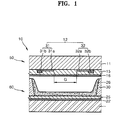
- an AC Plasma Display Panel (PDP) 10 includes a front panel 50 that displays images, and a rear panel 60 combined with the front panel 50 to be parallel thereto.
- a plurality of pairs of sustain electrodes 12 each having a Y-electrode 31 and an X-electrode 32 are disposed on a front substrate 11.
- a plurality of address electrodes 22 are disposed on a rear substrate 21 opposite to a surface of the front substrate 11, to cross the Y-electrodes 31 and the X-electrodes 32.
- Each of the Y-electrodes 31 and the X-electrodes 32 include transparent electrodes 31 a and 32a and bus electrodes 31 b and 32b.
- a space formed by a pair of Y-electrodes 31 and X-electrodes 32 and the address electrodes 22 that cross the pair of Y-electrodes 31 and X-electrodes 32 defines a unit discharge cell that forms one discharge space.
- a front dielectric layer 15 and a rear dielectric layer 25 are respectively formed on a surface of the front substrate 11 and the rear substrate 21 to cover respective electrodes.
- a protective layer 16 formed of MgO is formed on the front dielectric layer 15, and barrier ribs 30 that keep a discharge distance and prevent electrical and optical cross-talk between discharge cells are formed on a front surface of the rear dielectric layer 25.
- Red, green, and blue phosphor layers 26 are coated on both sides of each of the barrier ribs 30 and on a front surface of the rear dielectric layer 25 on which the barrier ribs 30 are not formed.
- a distance G between the Y-electrodes 31 and X-electrodes 32 should be increased so as to improve brightness and luminous efficiency. This is because a discharge area is increased whereby a plasma discharge occurs briskly. However, as the distance G increases, a voltage for starting a discharge also increases. Since a rating voltage of electronic elements for driving the Y-electrodes 31 and X-electrodes 32 increases, costs increase.
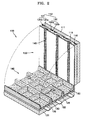
- FIGS. 2 through 4 A Plasma Display Panel (PDP) 100 according to an embodiment of the present invention is illustrated in FIGS. 2 through 4.
- FIG. 2 is an exploded perspective view of a PDP according to an embodiment of the present invention
- FIG. 3 is a cross-sectional view taken along line III-III of FIG. 2.
- FIG. 4 is an enlarged cross-sectional view of portion A of FIG. 3.
- the PDP 100 includes a front panel 150 and a rear panel 160 combined with the front panel 150 to be parallel thereto.
- the front panel 150 includes a front substrate 111, a front dielectric layer 115, a plurality of pairs of sustain electrodes 112, and a protective layer 116.
- the rear panel 160 includes a rear substrate 121, a plurality of address electrodes 122, a rear dielectric layer 125, barrier ribs 130, and phosphor layers 126.
- the front substrate 111 and the rear substrate 121 are separated from each other by a predetermined distance and define a discharge space in which a discharge occurs between the front substrate 111 and the rear substrate 121.
- the front substrate 111 and the rear substrate 121 can be formed of glass having excellent visible light transmission. However, in order to improve contrast, the front substrate 111 and/or the rear substrate 121 can also be coloured.
- the barrier ribs 130 are disposed between the front substrate 111 and the rear substrate 121.
- the barrier ribs 130 can be disposed on the rear dielectric layer 125.
- the barrier ribs 130 partition the discharge space into a plurality of discharge cells 180 and prevent optical/electrical cross-talk between the discharge cells 180.
- the barrier ribs 130 partition the discharge space into discharge cells 180 arranged in a rectangular matrix when viewed in cross-section.
- the present invention is not limited thereto. That is, the cross-sections of the discharge cells 180 can have polygonal shapes, such as triangular or pentagonal shapes or circular shapes or elliptical shapes.
- the barrier ribs can be open-type barrier ribs, such as stripes.
- the barrier ribs 130 can also partition the discharge cells 180 in a waffle or delta arrangement.
- the pairs of sustain electrodes 112 are disposed on the front substrate 111 that opposes the rear substrate 121.
- Each of the pairs of sustain electrodes 112 are a pair of sustain electrodes 131 and 132 formed on a rear surface of the front substrate 111 so as to cause a sustain discharge.
- the pairs of sustain electrodes 112 are arranged on the front substrate 111 to be parallel to each other and spaced apart by a predetermined distance.
- One sustain electrode of the pair of sustain electrodes 112 is an X-electrode 131 and acts as a common electrode, and the other sustain electrode thereof is a Y-electrode 132 and serves as a scan electrode.
- the pairs of sustain electrodes 112 are disposed on the front substrate 111.
- the position of the sustain electrodes 112 is not limited thereto.
- the pairs of sustain electrodes 112 can be disposed on the front substrate 111 to be separated from each other by a predetermined distance toward the rear substrate 121.
- Each of the X-electrodes 131 and Y-electrodes 132 includes transparent electrodes 131a and 132a and bus electrodes 131b and 132b.
- the transparent electrodes 131a and 132a are formed of a transparent material, such as Indium-Tin-Oxide (ITO), that is a conductor causing a discharge and allowing light emitted from the phosphor layers 126 to proceed toward the front substrate 111.
- ITO Indium-Tin-Oxide
- a transparent conductor such as ITO, has large resistance.
- the sustain electrodes 112 are formed by only transparent electrodes, a large voltage drop occurs in a lengthwise direction of the sustain electrodes 112 such that a large driving power is consumed and the response speed is reduced.
- bus electrodes 131b and 132b are formed of a metallic material and have small line widths, the bus electrodes 131b and 132b being arranged on the transparent electrodes 131a and 132a.
- the bus electrodes can be formed as a single layer structure using a metal, such as Ag, Al or Cu, but can also be formed as a multi-layered structure using a metal, such as Cr/Al/Cr.
- the transparent electrodes 131a and 132a and the bus electrodes 131b and 132b are formed by either photoetching or photolithography.
- the bus electrodes 131b and 132b are separated from the unit discharge cells 180 by a predetermined distance to be parallel to each other and extend across the discharge cells 180.
- the transparent electrodes 131a and 132a are respectively electrically connected to the bus electrodes 131b and 132b.
- the transparent electrodes 131a and 132a having rectangular shapes and are discontinuously disposed in each of the unit discharge cells 180.
- One side of the transparent electrodes 131a and 132a is respectively connected to the bus electrodes 131b and 132b, and the other side of the transparent electrodes 131a and 132a is disposed toward a central direction of the discharge cells 180.
- the front dielectric layer 115 is formed on the front substrate 111 to cover the pairs of sustain electrodes 112.
- the front dielectric layer 115 prevents adjacent X-electrodes 131 and Y-electrodes 132 from being electrically shorted during a discharge, prevents positive ions or electrons from directly colliding with the X-electrodes 131 and the Y-electrodes 132 and prevents the X-electrodes 131 and the Y-electrodes 132 from being damaged.
- the front dielectric layer 115 induces charges.
- the front dielectric layer 115 is formed of PbO, B 2 O 3 , or SiO 2 , for example.
- a plurality of grooves 145 are formed in the front dielectric layer 115 between the X-electrodes 131 and the Y-electrodes 132.
- the grooves 145 are formed to a predetermined depth of the front dielectric layer 115. Depths of the grooves 145 are determined in consideration of the possibility of damage of the front dielectric layer 115 caused by a plasma discharge, the arrangement of wall charges, and the size of a discharge voltage.
- the grooves 145 can be formed so that the front substrate 111 is exposed through the grooves 145.
- one groove 145 corresponds to each discharge cell 180.
- the present invention is not limited to this, and the grooves 145 respectively correspond to the discharge cells 180.
- the same number of grooves 145 does not need to correspond to each of the discharge cells 180.
- a different number of grooves 145 can be formed in red light-emitting discharge cells, green light-emitting discharge cells, and blue light-emitting discharge cells.
- the grooves 145 have substantially rectangular cross-sections. However, the present invention is not limited to this and the grooves 145 can be formed in various shapes.
- the grooves 145 extend across the discharge cells 180 between the X-electrodes 131 and the Y-electrodes 132.
- the grooves 145 provides an exhausting path of an impurity gas filled in the discharge space during an exhausting process and provides an inlet path of a discharge gas during an injecting process.
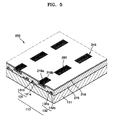
- the grooves 245 can be discontinuously formed in a front dielectric layer 215 in each of the discharge cells 280.
- a protective layer 216 is formed on the front dielectric layer 215 and protrusions 219a and 219b.
- a plurality of protrusions 119a and 119b are formed on the grooves 145.
- the protrusions 119a and 119b can have conical or semicircular shapes. However, the present invention is not limited to this. In addition, the protrusions 119a and 119b do not need to have the same shape.
- voltages are supplied to the X-electrodes 131 and the Y-electrodes 132, electric fields are intensively generated in the protrusions 119a and 119b having sharp shapes. A detailed description thereof is described later.
- the protrusions 119a and 119b can be formed in various positions of the grooves 145.
- the protrusions 119a and 119b can be formed on both side surfaces 145a and bottom surfaces 145b of the grooves 145. Referring to FIG. 4, the protrusions 119a are formed on the side surfaces 145a of the grooves 145 and the protrusions 119b are formed on the bottom surfaces 145b of the grooves 145.
- the present invention is not limited to this.
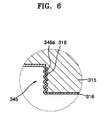
- protrusions 319 can be formed only on both sides 345a of the grooves 345 formed in the front dielectric layer 315.
- a protective layer 316 is formed on the front dielectric layer 315.
- the PDP 100 can further include a protective layer 116 that covers the front dielectric layer 115.
- the protective layer 116 prevents charged particles or electrons from colliding with the front dielectric layer 115 and prevents the front dielectric layer 115 from being damaged during a discharge.
- the front dielectric layer 115 can be covered by the protective layer 116 so as to prevent damages.
- the protective layer 116 emits a large amount of secondary electrons during a discharge so that a plasma discharge is briskly performed.
- the protective layer 116 that performs this function is formed of a material having a high secondary electron emission coefficient and excellent visible light transmission. After the front dielectric layer 116 is formed, the protective layer 116 is formed of a thin layer using sputtering or electron beam deposition.
- the address electrodes 122 are disposed on the rear substrate 121 that opposes the front substrate 111.
- the address electrodes 122 extend across the discharge cells 180 to intersect the X-electrodes 131 and the Y-electrodes 132.
- the address electrodes 122 are used to generate an address discharge in order to more easily effect a sustain discharge between the X-electrodes 131 and the Y-electrodes 132. More specifically, the address electrodes 122 reduce voltage required for a sustain discharge. The address discharge occurs between the Y-electrodes 132 and the address electrodes 122. If the address discharge is terminated, wall charges are accumulated on the Y-electrodes 132 and the X-electrodes 131 such that a sustain discharge between the X-electrodes 131 and the Y-electrodes 132 occurs more easily.
- a space formed by the pair of X-electrode 131 and Y-electrode 132 and the address electrodes 122 intersecting the pair of X-electrode 131 and Y-electrode 132 forms the unit discharge cells 180.
- the rear dielectric layer 125 is disposed on the rear substrate 121 so as to cover the address electrodes 122.
- the rear dielectric layer 125 is formed of a dielectric substance that prevents charged particles or electrons from colliding with the address electrodes 122 during a discharge, prevents the address electrodes 122 from being damaged and that induces charges.
- the dielectric substance can be PbO, B 2 O 3 , or SiO 2 .
- Phosphor layers 126 producing red, green, and blue light are disposed on both sides of the barrier ribs 130 formed on the rear dielectric layer 125 and on a front surface of the rear dielectric layer 125 on which the barrier ribs 130 are not formed.
- the phosphor layers 126 include components that emit visible light rays from ultraviolet (UV) rays.
- the phosphor layers 126 formed in red discharge cells include phosphors such as Y(V,P)O 4 :Eu
- the phosphor layers 126 formed in green discharge cells include phosphors such as Zn 2 SiO 4 :Mn
- the phosphor layers 126 formed in blue discharge cells include phosphors such as BAM:Eu.
- a discharge gas in which neon (Ne) and xenon (Xe) are mixed is contained within the discharge cells 180.
- the front and rear substrates 111 and 121 are sealed and combined using a sealing member, such as frit glass, formed at edges of the front and rear substrates 111 and 121.
- a plasma discharge that occurs in the PDP 100 includes an address discharge and a sustain discharge.
- the address discharge occurs when an address discharge voltage is supplied between the address electrodes 122 and the Y-electrodes 132.
- Discharge cells 180 in which a sustain discharge will occur as a result of the address discharge are selected.
- a sustain voltage is supplied between the X-electrodes 131 and the Y-electrodes 132 of the selected discharge cells 180.
- Electric fields are intensively generated in the grooves 145 formed in the front dielectric layer 115. This is because a discharge path between the X-electrodes 131 and the Y-electrodes 132 is reduced, electric fields are intensively generated on the discharge path and densities of charges, charged particles, and excited species are high.
- the protrusions 119a and 119b have relatively sharp shapes, relatively strong electric fields are generated in sharp portions of the protrusions 119a and 119b.
- a sustain discharge between the protrusions 119a and 119b starts, a discharge start voltage can be reduced.
- the discharge is gradually spread outside the grooves 145. Even when the discharge is spread, since charged particles are briskly formed by forming the grooves 145 and the protrusions 119a and 119b, the discharge sustain voltage can be reduced.
- the energy level of the excited discharge gas during the sustain discharge is reduced and UV rays are emitted.
- the UV rays excite the phosphor layers 126 in the discharge cells 180.
- the energy level of the excited phosphor layers 126 is reduced, visible light is emitted, and the emitted visible light passes through the front dielectric layer 115 and the front substrate 111, thereby forming an image that a user can recognize.
- the PDP according to the present invention has the following effects.
- the discharge start voltage and the discharge sustain voltage are reduced.
Landscapes
- Engineering & Computer Science (AREA)
- Physics & Mathematics (AREA)
- Plasma & Fusion (AREA)
- Chemical & Material Sciences (AREA)
- Materials Engineering (AREA)
- Gas-Filled Discharge Tubes (AREA)
Applications Claiming Priority (1)
| Application Number | Priority Date | Filing Date | Title |
|---|---|---|---|
| KR1020050080627A KR100683796B1 (ko) | 2005-08-31 | 2005-08-31 | 플라즈마 디스플레이 패널 |
Publications (1)
| Publication Number | Publication Date |
|---|---|
| EP1768155A1 true EP1768155A1 (de) | 2007-03-28 |
Family
ID=37714374
Family Applications (1)
| Application Number | Title | Priority Date | Filing Date |
|---|---|---|---|
| EP06119872A Withdrawn EP1768155A1 (de) | 2005-08-31 | 2006-08-31 | Plasmaanzeigetafel |
Country Status (5)
| Country | Link |
|---|---|
| US (1) | US7557506B2 (de) |
| EP (1) | EP1768155A1 (de) |
| JP (1) | JP4323495B2 (de) |
| KR (1) | KR100683796B1 (de) |
| CN (1) | CN1925094A (de) |
Cited By (1)
| Publication number | Priority date | Publication date | Assignee | Title |
|---|---|---|---|---|
| EP2219201A2 (de) | 2009-02-13 | 2010-08-18 | Samsung SDI Co., Ltd. | Plasmaanzeigetafel |
Families Citing this family (1)
| Publication number | Priority date | Publication date | Assignee | Title |
|---|---|---|---|---|
| CN102496549A (zh) * | 2011-12-31 | 2012-06-13 | 四川虹欧显示器件有限公司 | 等离子显示屏及其前基板介质层的制作工艺 |
Citations (5)
| Publication number | Priority date | Publication date | Assignee | Title |
|---|---|---|---|---|
| US6531820B1 (en) * | 1999-03-31 | 2003-03-11 | Samsung Sdi Co., Ltd. | Plasma display device including grooves concentrating an electric field |
| WO2003038853A1 (fr) * | 2001-10-29 | 2003-05-08 | Thomson Licensing S.A. | Dalle de panneau a plasma comprenant des moyens pour re-dif fuser les rayonnements uv |
| US20030146886A1 (en) * | 2002-02-06 | 2003-08-07 | Pioneer Corporation And Shizuoka Pioneer Corporation | Plasma display panel |
| EP1435638A2 (de) * | 2002-12-31 | 2004-07-07 | Samsung SDI Co., Ltd. | Plasmaanzeigetafel mit Aufrechterhaltungselektroden mit Doppelspalt und Herstellungsverfahren derselben |
| US20040212305A1 (en) * | 2001-05-28 | 2004-10-28 | Morio Fujitani | Plasma display pane, its manufacturing method, and transfer film |
Family Cites Families (35)
| Publication number | Priority date | Publication date | Assignee | Title |
|---|---|---|---|---|
| JP2917279B2 (ja) | 1988-11-30 | 1999-07-12 | 富士通株式会社 | ガス放電パネル |
| US6097357A (en) * | 1990-11-28 | 2000-08-01 | Fujitsu Limited | Full color surface discharge type plasma display device |
| JP3259253B2 (ja) * | 1990-11-28 | 2002-02-25 | 富士通株式会社 | フラット型表示装置の階調駆動方法及び階調駆動装置 |
| EP1231590A3 (de) * | 1991-12-20 | 2003-08-06 | Fujitsu Limited | Vorrichtung zur Steuerung einer Anzeigetafel |
| EP0554172B1 (de) * | 1992-01-28 | 1998-04-29 | Fujitsu Limited | Plasma Farbanzeige-Vorrichtung von Oberflächenentladungs-Typ |
| JP3025598B2 (ja) * | 1993-04-30 | 2000-03-27 | 富士通株式会社 | 表示駆動装置及び表示駆動方法 |
| JP3476217B2 (ja) * | 1993-07-26 | 2003-12-10 | 富士通株式会社 | プラズマディスプレイパネル |
| JP2891280B2 (ja) * | 1993-12-10 | 1999-05-17 | 富士通株式会社 | 平面表示装置の駆動装置及び駆動方法 |
| JP3163563B2 (ja) * | 1995-08-25 | 2001-05-08 | 富士通株式会社 | 面放電型プラズマ・ディスプレイ・パネル及びその製造方法 |
| JP2845183B2 (ja) | 1995-10-20 | 1999-01-13 | 富士通株式会社 | ガス放電パネル |
| WO1998043270A1 (en) | 1997-03-21 | 1998-10-01 | Hitachi, Ltd. | Plasma display |
| JPH11297209A (ja) | 1998-04-13 | 1999-10-29 | Mitsubishi Electric Corp | プラズマディスプレイパネル |
| JP3424587B2 (ja) * | 1998-06-18 | 2003-07-07 | 富士通株式会社 | プラズマディスプレイパネルの駆動方法 |
| KR20000065742A (ko) * | 1999-04-08 | 2000-11-15 | 구자홍 | 플라즈마 디스플레이 패널의 구조 |
| JP4030685B2 (ja) | 1999-07-30 | 2008-01-09 | 三星エスディアイ株式会社 | プラズマディスプレイおよびその製造方法 |
| JP4096466B2 (ja) | 1999-08-03 | 2008-06-04 | 松下電器産業株式会社 | Ac型プラズマディスプレイパネルの駆動方法 |
| JP2001176405A (ja) | 1999-12-22 | 2001-06-29 | Fujitsu Ltd | Ac型プラズマディスプレイパネル |
| JP2001325888A (ja) | 2000-03-09 | 2001-11-22 | Samsung Yokohama Research Institute Co Ltd | プラズマディスプレイ及びその製造方法 |
| JP2001282185A (ja) | 2000-03-31 | 2001-10-12 | Matsushita Electric Ind Co Ltd | Ac型プラズマディスプレイパネルおよびその駆動方法 |
| KR100400372B1 (ko) * | 2001-04-02 | 2003-10-08 | 엘지전자 주식회사 | 플라즈마 디스플레이 패널의 하판 제조방법 |
| JP4145054B2 (ja) * | 2002-02-06 | 2008-09-03 | パイオニア株式会社 | プラズマディスプレイパネル |
| JP2003257320A (ja) | 2002-02-28 | 2003-09-12 | Pioneer Electronic Corp | プラズマディスプレイパネル |
| JP2003282008A (ja) | 2002-03-25 | 2003-10-03 | Nec Kagoshima Ltd | プラズマディスプレイパネル及びその製造方法 |
| JP2004006307A (ja) | 2002-04-18 | 2004-01-08 | Matsushita Electric Ind Co Ltd | プラズマディスプレイ装置 |
| JP2004284934A (ja) | 2002-04-24 | 2004-10-14 | Central Glass Co Ltd | 無鉛低融点ガラス |
| JP2005005189A (ja) | 2003-06-13 | 2005-01-06 | Matsushita Electric Ind Co Ltd | プラズマディスプレイパネルおよびその駆動方法 |
| JP2005011743A (ja) | 2003-06-20 | 2005-01-13 | Matsushita Electric Ind Co Ltd | プラズマディスプレイパネル |
| JP4329460B2 (ja) * | 2003-09-03 | 2009-09-09 | パナソニック株式会社 | プラズマディスプレイパネル |
| JP2005093155A (ja) | 2003-09-16 | 2005-04-07 | Matsushita Electric Ind Co Ltd | プラズマディスプレイパネルおよびその製造方法 |
| JP2005340133A (ja) * | 2004-05-31 | 2005-12-08 | Sony Corp | カソードパネル処理方法、並びに、冷陰極電界電子放出表示装置及びその製造方法 |
| KR20060019696A (ko) * | 2004-08-28 | 2006-03-06 | 삼성에스디아이 주식회사 | 플라즈마 디스플레이 패널 |
| KR100658749B1 (ko) * | 2004-11-30 | 2006-12-15 | 삼성에스디아이 주식회사 | 플라즈마 디스플레이 패널 |
| KR100787443B1 (ko) * | 2005-12-31 | 2007-12-26 | 삼성에스디아이 주식회사 | 플라즈마 디스플레이 패널 |
| KR100777730B1 (ko) * | 2005-12-31 | 2007-11-19 | 삼성에스디아이 주식회사 | 플라즈마 디스플레이 패널 |
| KR100730213B1 (ko) * | 2006-03-28 | 2007-06-19 | 삼성에스디아이 주식회사 | 플라즈마 디스플레이 패널 |
-
2005
- 2005-08-31 KR KR1020050080627A patent/KR100683796B1/ko not_active Expired - Fee Related
-
2006
- 2006-04-03 JP JP2006102033A patent/JP4323495B2/ja not_active Expired - Fee Related
- 2006-08-29 US US11/511,256 patent/US7557506B2/en not_active Expired - Fee Related
- 2006-08-31 EP EP06119872A patent/EP1768155A1/de not_active Withdrawn
- 2006-08-31 CN CNA2006101123714A patent/CN1925094A/zh active Pending
Patent Citations (5)
| Publication number | Priority date | Publication date | Assignee | Title |
|---|---|---|---|---|
| US6531820B1 (en) * | 1999-03-31 | 2003-03-11 | Samsung Sdi Co., Ltd. | Plasma display device including grooves concentrating an electric field |
| US20040212305A1 (en) * | 2001-05-28 | 2004-10-28 | Morio Fujitani | Plasma display pane, its manufacturing method, and transfer film |
| WO2003038853A1 (fr) * | 2001-10-29 | 2003-05-08 | Thomson Licensing S.A. | Dalle de panneau a plasma comprenant des moyens pour re-dif fuser les rayonnements uv |
| US20030146886A1 (en) * | 2002-02-06 | 2003-08-07 | Pioneer Corporation And Shizuoka Pioneer Corporation | Plasma display panel |
| EP1435638A2 (de) * | 2002-12-31 | 2004-07-07 | Samsung SDI Co., Ltd. | Plasmaanzeigetafel mit Aufrechterhaltungselektroden mit Doppelspalt und Herstellungsverfahren derselben |
Cited By (2)
| Publication number | Priority date | Publication date | Assignee | Title |
|---|---|---|---|---|
| EP2219201A2 (de) | 2009-02-13 | 2010-08-18 | Samsung SDI Co., Ltd. | Plasmaanzeigetafel |
| EP2219201A3 (de) * | 2009-02-13 | 2010-12-29 | Samsung SDI Co., Ltd. | Plasmaanzeigetafel |
Also Published As
| Publication number | Publication date |
|---|---|
| US7557506B2 (en) | 2009-07-07 |
| JP2007066872A (ja) | 2007-03-15 |
| KR100683796B1 (ko) | 2007-02-20 |
| JP4323495B2 (ja) | 2009-09-02 |
| US20070046207A1 (en) | 2007-03-01 |
| CN1925094A (zh) | 2007-03-07 |
Similar Documents
| Publication | Publication Date | Title |
|---|---|---|
| US7196470B2 (en) | Plasma display panel having sustain electrode arrangement | |
| JP4339298B2 (ja) | プラズマディスプレイパネル | |
| CN100565762C (zh) | 等离子体显示板 | |
| CN100565763C (zh) | 等离子体显示面板 | |
| US7327084B2 (en) | Plasma display panel | |
| US7564187B2 (en) | Plasma display panel (PDP) | |
| US7557506B2 (en) | Plasma display panel | |
| JP2006140144A (ja) | プラズマディスプレイパネル | |
| US7781968B2 (en) | Plasma display panel | |
| EP1701373B1 (de) | Plamaanzeigetafel | |
| US20060170352A1 (en) | Plasma display panel | |
| KR100777730B1 (ko) | 플라즈마 디스플레이 패널 | |
| US20070228968A1 (en) | Plasma display panel and flat panel display device including the same | |
| KR100659074B1 (ko) | 플라즈마 디스플레이 패널 | |
| KR100647601B1 (ko) | 플라즈마 디스플레이 패널 | |
| US7268493B2 (en) | Plasma display panel with dual material sustain electrodes | |
| US7605539B2 (en) | Plasma display panel with reduced electrode defect rate | |
| KR100647642B1 (ko) | 플라즈마 디스플레이 패널 | |
| US20070228493A1 (en) | Plasma display panel | |
| US20050264478A1 (en) | Plasma Display Panel (PDP) | |
| KR100615337B1 (ko) | 플라즈마 디스플레이 패널 | |
| KR100768219B1 (ko) | 플라즈마 디스플레이 패널 및 이의 제조 방법 | |
| JP2006108071A (ja) | プラズマディスプレイパネル | |
| EP1804264A1 (de) | Plasma-Bildschirm | |
| US20070152590A1 (en) | Plasma display panel |
Legal Events
| Date | Code | Title | Description |
|---|---|---|---|
| PUAI | Public reference made under article 153(3) epc to a published international application that has entered the european phase |
Free format text: ORIGINAL CODE: 0009012 |
|
| 17P | Request for examination filed |
Effective date: 20060831 |
|
| AK | Designated contracting states |
Kind code of ref document: A1 Designated state(s): AT BE BG CH CY CZ DE DK EE ES FI FR GB GR HU IE IS IT LI LT LU LV MC NL PL PT RO SE SI SK TR |
|
| AX | Request for extension of the european patent |
Extension state: AL BA HR MK YU |
|
| 17Q | First examination report despatched |
Effective date: 20070726 |
|
| AKX | Designation fees paid |
Designated state(s): DE FR GB |
|
| RAP1 | Party data changed (applicant data changed or rights of an application transferred) |
Owner name: SAMSUNG SDI CO., LTD. |
|
| GRAP | Despatch of communication of intention to grant a patent |
Free format text: ORIGINAL CODE: EPIDOSNIGR1 |
|
| RIN1 | Information on inventor provided before grant (corrected) |
Inventor name: HAN, JIN-WON Inventor name: SOH, HYUN Inventor name: KIM, YUN-HEE Inventor name: KIM, SE-JONG Inventor name: KANG, KYOUNG-DOO Inventor name: KIM, HYUN |
|
| STAA | Information on the status of an ep patent application or granted ep patent |
Free format text: STATUS: THE APPLICATION IS DEEMED TO BE WITHDRAWN |
|
| 18D | Application deemed to be withdrawn |
Effective date: 20100302 |