EP1776347B1 - Sulfonamidderivate, ihre herstellung und ihre therapeutische anwendung - Google Patents
Sulfonamidderivate, ihre herstellung und ihre therapeutische anwendung Download PDFInfo
- Publication number
- EP1776347B1 EP1776347B1 EP05796062A EP05796062A EP1776347B1 EP 1776347 B1 EP1776347 B1 EP 1776347B1 EP 05796062 A EP05796062 A EP 05796062A EP 05796062 A EP05796062 A EP 05796062A EP 1776347 B1 EP1776347 B1 EP 1776347B1
- Authority
- EP
- European Patent Office
- Prior art keywords
- group
- phenyl
- alkyl group
- compound
- chloro
- Prior art date
- Legal status (The legal status is an assumption and is not a legal conclusion. Google has not performed a legal analysis and makes no representation as to the accuracy of the status listed.)
- Expired - Lifetime
Links
- 0 Cc1cc(S(N(CC(N*)=O)c(cc2)c(Cc3ccccc3Cl)cc2Cl)(=O)=O)cc(*)c1 Chemical compound Cc1cc(S(N(CC(N*)=O)c(cc2)c(Cc3ccccc3Cl)cc2Cl)(=O)=O)cc(*)c1 0.000 description 17
- ZXPUFQAQUGTEOH-UHFFFAOYSA-N CC1(CC[n]2nnc(CN(c(cc3)c(Cc4ccccc4Cl)cc3Cl)S(c3cc(C)cc(C)c3)(=O)=O)n2)CC1 Chemical compound CC1(CC[n]2nnc(CN(c(cc3)c(Cc4ccccc4Cl)cc3Cl)S(c3cc(C)cc(C)c3)(=O)=O)n2)CC1 ZXPUFQAQUGTEOH-UHFFFAOYSA-N 0.000 description 1
- LPPMKJQWCAPWJN-UHFFFAOYSA-N CCOc1cc(S(N(CC(N)=O)c2c(Cc(c(F)ccc3)c3[I]=C)cc(C)cc2)(=O)=O)ccc1OCl Chemical compound CCOc1cc(S(N(CC(N)=O)c2c(Cc(c(F)ccc3)c3[I]=C)cc(C)cc2)(=O)=O)ccc1OCl LPPMKJQWCAPWJN-UHFFFAOYSA-N 0.000 description 1
- XIPACSPXVBOSQG-UHFFFAOYSA-N CN(c(cc1)c(Cc(c(F)ccc2)c2F)cc1Cl)[SH-](c(cc1O[ClH]I)ccc1O[ClH]I)=O Chemical compound CN(c(cc1)c(Cc(c(F)ccc2)c2F)cc1Cl)[SH-](c(cc1O[ClH]I)ccc1O[ClH]I)=O XIPACSPXVBOSQG-UHFFFAOYSA-N 0.000 description 1
- OZVRQYVERKHEKE-UHFFFAOYSA-N CN(c1ccccc1)c(cc(cc1)Cl)c1N(CC(N)=O)S(c(cc1OC)ccc1OC)=O Chemical compound CN(c1ccccc1)c(cc(cc1)Cl)c1N(CC(N)=O)S(c(cc1OC)ccc1OC)=O OZVRQYVERKHEKE-UHFFFAOYSA-N 0.000 description 1
- PNFGKALZKFTQMJ-UHFFFAOYSA-N C[ClH]Oc1cc(S(N(CC(N)=O)c(cc2)c(C(c3cccc(F)c3F)O)cc2Cl)(=O)=O)ccc1O[IH2] Chemical compound C[ClH]Oc1cc(S(N(CC(N)=O)c(cc2)c(C(c3cccc(F)c3F)O)cc2Cl)(=O)=O)ccc1O[IH2] PNFGKALZKFTQMJ-UHFFFAOYSA-N 0.000 description 1
- OOQCIQREHLIUFB-UHFFFAOYSA-N C[N]=1(C)=CC=C2OC(C[N]=3(C)=CC=C4OCOC4=CC=3)COC2=CC=1 Chemical compound C[N]=1(C)=CC=C2OC(C[N]=3(C)=CC=C4OCOC4=CC=3)COC2=CC=1 OOQCIQREHLIUFB-UHFFFAOYSA-N 0.000 description 1
- NJZHRFYQOLKWMM-UHFFFAOYSA-N Cc1cc(S(N(CC(N)=O)c(cc2)c(C(c3ccccc3Cl)O)cc2Cl)(=O)=O)cc(C)c1 Chemical compound Cc1cc(S(N(CC(N)=O)c(cc2)c(C(c3ccccc3Cl)O)cc2Cl)(=O)=O)cc(C)c1 NJZHRFYQOLKWMM-UHFFFAOYSA-N 0.000 description 1
- MFHOXYIXIGEFTK-UHFFFAOYSA-N NC(CN(c(cc1)c(Cc(c(F)c2)ccc2Cl)cc1Cl)S(c(cc1O)ccc1O[Cl]=[IH])(=O)=O)=O Chemical compound NC(CN(c(cc1)c(Cc(c(F)c2)ccc2Cl)cc1Cl)S(c(cc1O)ccc1O[Cl]=[IH])(=O)=O)=O MFHOXYIXIGEFTK-UHFFFAOYSA-N 0.000 description 1
Classifications
-
- C—CHEMISTRY; METALLURGY
- C07—ORGANIC CHEMISTRY
- C07D—HETEROCYCLIC COMPOUNDS
- C07D213/00—Heterocyclic compounds containing six-membered rings, not condensed with other rings, with one nitrogen atom as the only ring hetero atom and three or more double bonds between ring members or between ring members and non-ring members
- C07D213/02—Heterocyclic compounds containing six-membered rings, not condensed with other rings, with one nitrogen atom as the only ring hetero atom and three or more double bonds between ring members or between ring members and non-ring members having three double bonds between ring members or between ring members and non-ring members
- C07D213/04—Heterocyclic compounds containing six-membered rings, not condensed with other rings, with one nitrogen atom as the only ring hetero atom and three or more double bonds between ring members or between ring members and non-ring members having three double bonds between ring members or between ring members and non-ring members having no bond between the ring nitrogen atom and a non-ring member or having only hydrogen or carbon atoms directly attached to the ring nitrogen atom
- C07D213/24—Heterocyclic compounds containing six-membered rings, not condensed with other rings, with one nitrogen atom as the only ring hetero atom and three or more double bonds between ring members or between ring members and non-ring members having three double bonds between ring members or between ring members and non-ring members having no bond between the ring nitrogen atom and a non-ring member or having only hydrogen or carbon atoms directly attached to the ring nitrogen atom with substituted hydrocarbon radicals attached to ring carbon atoms
- C07D213/36—Radicals substituted by singly-bound nitrogen atoms
- C07D213/42—Radicals substituted by singly-bound nitrogen atoms having hetero atoms attached to the substituent nitrogen atom
-
- A—HUMAN NECESSITIES
- A61—MEDICAL OR VETERINARY SCIENCE; HYGIENE
- A61P—SPECIFIC THERAPEUTIC ACTIVITY OF CHEMICAL COMPOUNDS OR MEDICINAL PREPARATIONS
- A61P1/00—Drugs for disorders of the alimentary tract or the digestive system
-
- A—HUMAN NECESSITIES
- A61—MEDICAL OR VETERINARY SCIENCE; HYGIENE
- A61P—SPECIFIC THERAPEUTIC ACTIVITY OF CHEMICAL COMPOUNDS OR MEDICINAL PREPARATIONS
- A61P1/00—Drugs for disorders of the alimentary tract or the digestive system
- A61P1/04—Drugs for disorders of the alimentary tract or the digestive system for ulcers, gastritis or reflux esophagitis, e.g. antacids, inhibitors of acid secretion, mucosal protectants
-
- A—HUMAN NECESSITIES
- A61—MEDICAL OR VETERINARY SCIENCE; HYGIENE
- A61P—SPECIFIC THERAPEUTIC ACTIVITY OF CHEMICAL COMPOUNDS OR MEDICINAL PREPARATIONS
- A61P1/00—Drugs for disorders of the alimentary tract or the digestive system
- A61P1/08—Drugs for disorders of the alimentary tract or the digestive system for nausea, cinetosis or vertigo; Antiemetics
-
- A—HUMAN NECESSITIES
- A61—MEDICAL OR VETERINARY SCIENCE; HYGIENE
- A61P—SPECIFIC THERAPEUTIC ACTIVITY OF CHEMICAL COMPOUNDS OR MEDICINAL PREPARATIONS
- A61P1/00—Drugs for disorders of the alimentary tract or the digestive system
- A61P1/14—Prodigestives, e.g. acids, enzymes, appetite stimulants, antidyspeptics, tonics, antiflatulents
-
- A—HUMAN NECESSITIES
- A61—MEDICAL OR VETERINARY SCIENCE; HYGIENE
- A61P—SPECIFIC THERAPEUTIC ACTIVITY OF CHEMICAL COMPOUNDS OR MEDICINAL PREPARATIONS
- A61P13/00—Drugs for disorders of the urinary system
- A61P13/02—Drugs for disorders of the urinary system of urine or of the urinary tract, e.g. urine acidifiers
-
- A—HUMAN NECESSITIES
- A61—MEDICAL OR VETERINARY SCIENCE; HYGIENE
- A61P—SPECIFIC THERAPEUTIC ACTIVITY OF CHEMICAL COMPOUNDS OR MEDICINAL PREPARATIONS
- A61P15/00—Drugs for genital or sexual disorders; Contraceptives
- A61P15/08—Drugs for genital or sexual disorders; Contraceptives for gonadal disorders or for enhancing fertility, e.g. inducers of ovulation or of spermatogenesis
-
- A—HUMAN NECESSITIES
- A61—MEDICAL OR VETERINARY SCIENCE; HYGIENE
- A61P—SPECIFIC THERAPEUTIC ACTIVITY OF CHEMICAL COMPOUNDS OR MEDICINAL PREPARATIONS
- A61P21/00—Drugs for disorders of the muscular or neuromuscular system
- A61P21/04—Drugs for disorders of the muscular or neuromuscular system for myasthenia gravis
-
- A—HUMAN NECESSITIES
- A61—MEDICAL OR VETERINARY SCIENCE; HYGIENE
- A61P—SPECIFIC THERAPEUTIC ACTIVITY OF CHEMICAL COMPOUNDS OR MEDICINAL PREPARATIONS
- A61P25/00—Drugs for disorders of the nervous system
-
- A—HUMAN NECESSITIES
- A61—MEDICAL OR VETERINARY SCIENCE; HYGIENE
- A61P—SPECIFIC THERAPEUTIC ACTIVITY OF CHEMICAL COMPOUNDS OR MEDICINAL PREPARATIONS
- A61P25/00—Drugs for disorders of the nervous system
- A61P25/02—Drugs for disorders of the nervous system for peripheral neuropathies
-
- A—HUMAN NECESSITIES
- A61—MEDICAL OR VETERINARY SCIENCE; HYGIENE
- A61P—SPECIFIC THERAPEUTIC ACTIVITY OF CHEMICAL COMPOUNDS OR MEDICINAL PREPARATIONS
- A61P25/00—Drugs for disorders of the nervous system
- A61P25/18—Antipsychotics, i.e. neuroleptics; Drugs for mania or schizophrenia
-
- A—HUMAN NECESSITIES
- A61—MEDICAL OR VETERINARY SCIENCE; HYGIENE
- A61P—SPECIFIC THERAPEUTIC ACTIVITY OF CHEMICAL COMPOUNDS OR MEDICINAL PREPARATIONS
- A61P25/00—Drugs for disorders of the nervous system
- A61P25/22—Anxiolytics
-
- A—HUMAN NECESSITIES
- A61—MEDICAL OR VETERINARY SCIENCE; HYGIENE
- A61P—SPECIFIC THERAPEUTIC ACTIVITY OF CHEMICAL COMPOUNDS OR MEDICINAL PREPARATIONS
- A61P25/00—Drugs for disorders of the nervous system
- A61P25/24—Antidepressants
-
- A—HUMAN NECESSITIES
- A61—MEDICAL OR VETERINARY SCIENCE; HYGIENE
- A61P—SPECIFIC THERAPEUTIC ACTIVITY OF CHEMICAL COMPOUNDS OR MEDICINAL PREPARATIONS
- A61P25/00—Drugs for disorders of the nervous system
- A61P25/28—Drugs for disorders of the nervous system for treating neurodegenerative disorders of the central nervous system, e.g. nootropic agents, cognition enhancers, drugs for treating Alzheimer's disease or other forms of dementia
-
- A—HUMAN NECESSITIES
- A61—MEDICAL OR VETERINARY SCIENCE; HYGIENE
- A61P—SPECIFIC THERAPEUTIC ACTIVITY OF CHEMICAL COMPOUNDS OR MEDICINAL PREPARATIONS
- A61P25/00—Drugs for disorders of the nervous system
- A61P25/30—Drugs for disorders of the nervous system for treating abuse or dependence
-
- A—HUMAN NECESSITIES
- A61—MEDICAL OR VETERINARY SCIENCE; HYGIENE
- A61P—SPECIFIC THERAPEUTIC ACTIVITY OF CHEMICAL COMPOUNDS OR MEDICINAL PREPARATIONS
- A61P29/00—Non-central analgesic, antipyretic or antiinflammatory agents, e.g. antirheumatic agents; Non-steroidal antiinflammatory drugs [NSAID]
-
- A—HUMAN NECESSITIES
- A61—MEDICAL OR VETERINARY SCIENCE; HYGIENE
- A61P—SPECIFIC THERAPEUTIC ACTIVITY OF CHEMICAL COMPOUNDS OR MEDICINAL PREPARATIONS
- A61P3/00—Drugs for disorders of the metabolism
- A61P3/04—Anorexiants; Antiobesity agents
-
- A—HUMAN NECESSITIES
- A61—MEDICAL OR VETERINARY SCIENCE; HYGIENE
- A61P—SPECIFIC THERAPEUTIC ACTIVITY OF CHEMICAL COMPOUNDS OR MEDICINAL PREPARATIONS
- A61P3/00—Drugs for disorders of the metabolism
- A61P3/06—Antihyperlipidemics
-
- A—HUMAN NECESSITIES
- A61—MEDICAL OR VETERINARY SCIENCE; HYGIENE
- A61P—SPECIFIC THERAPEUTIC ACTIVITY OF CHEMICAL COMPOUNDS OR MEDICINAL PREPARATIONS
- A61P3/00—Drugs for disorders of the metabolism
- A61P3/08—Drugs for disorders of the metabolism for glucose homeostasis
- A61P3/10—Drugs for disorders of the metabolism for glucose homeostasis for hyperglycaemia, e.g. antidiabetics
-
- A—HUMAN NECESSITIES
- A61—MEDICAL OR VETERINARY SCIENCE; HYGIENE
- A61P—SPECIFIC THERAPEUTIC ACTIVITY OF CHEMICAL COMPOUNDS OR MEDICINAL PREPARATIONS
- A61P35/00—Antineoplastic agents
-
- A—HUMAN NECESSITIES
- A61—MEDICAL OR VETERINARY SCIENCE; HYGIENE
- A61P—SPECIFIC THERAPEUTIC ACTIVITY OF CHEMICAL COMPOUNDS OR MEDICINAL PREPARATIONS
- A61P43/00—Drugs for specific purposes, not provided for in groups A61P1/00-A61P41/00
-
- A—HUMAN NECESSITIES
- A61—MEDICAL OR VETERINARY SCIENCE; HYGIENE
- A61P—SPECIFIC THERAPEUTIC ACTIVITY OF CHEMICAL COMPOUNDS OR MEDICINAL PREPARATIONS
- A61P5/00—Drugs for disorders of the endocrine system
- A61P5/06—Drugs for disorders of the endocrine system of the anterior pituitary hormones, e.g. TSH, ACTH, FSH, LH, PRL, GH
- A61P5/08—Drugs for disorders of the endocrine system of the anterior pituitary hormones, e.g. TSH, ACTH, FSH, LH, PRL, GH for decreasing, blocking or antagonising the activity of the anterior pituitary hormones
-
- A—HUMAN NECESSITIES
- A61—MEDICAL OR VETERINARY SCIENCE; HYGIENE
- A61P—SPECIFIC THERAPEUTIC ACTIVITY OF CHEMICAL COMPOUNDS OR MEDICINAL PREPARATIONS
- A61P5/00—Drugs for disorders of the endocrine system
- A61P5/14—Drugs for disorders of the endocrine system of the thyroid hormones, e.g. T3, T4
-
- A—HUMAN NECESSITIES
- A61—MEDICAL OR VETERINARY SCIENCE; HYGIENE
- A61P—SPECIFIC THERAPEUTIC ACTIVITY OF CHEMICAL COMPOUNDS OR MEDICINAL PREPARATIONS
- A61P9/00—Drugs for disorders of the cardiovascular system
-
- A—HUMAN NECESSITIES
- A61—MEDICAL OR VETERINARY SCIENCE; HYGIENE
- A61P—SPECIFIC THERAPEUTIC ACTIVITY OF CHEMICAL COMPOUNDS OR MEDICINAL PREPARATIONS
- A61P9/00—Drugs for disorders of the cardiovascular system
- A61P9/10—Drugs for disorders of the cardiovascular system for treating ischaemic or atherosclerotic diseases, e.g. antianginal drugs, coronary vasodilators, drugs for myocardial infarction, retinopathy, cerebrovascula insufficiency, renal arteriosclerosis
-
- A—HUMAN NECESSITIES
- A61—MEDICAL OR VETERINARY SCIENCE; HYGIENE
- A61P—SPECIFIC THERAPEUTIC ACTIVITY OF CHEMICAL COMPOUNDS OR MEDICINAL PREPARATIONS
- A61P9/00—Drugs for disorders of the cardiovascular system
- A61P9/12—Antihypertensives
-
- C—CHEMISTRY; METALLURGY
- C07—ORGANIC CHEMISTRY
- C07C—ACYCLIC OR CARBOCYCLIC COMPOUNDS
- C07C311/00—Amides of sulfonic acids, i.e. compounds having singly-bound oxygen atoms of sulfo groups replaced by nitrogen atoms, not being part of nitro or nitroso groups
- C07C311/15—Sulfonamides having sulfur atoms of sulfonamide groups bound to carbon atoms of six-membered aromatic rings
- C07C311/21—Sulfonamides having sulfur atoms of sulfonamide groups bound to carbon atoms of six-membered aromatic rings having the nitrogen atom of at least one of the sulfonamide groups bound to a carbon atom of a six-membered aromatic ring
-
- C—CHEMISTRY; METALLURGY
- C07—ORGANIC CHEMISTRY
- C07C—ACYCLIC OR CARBOCYCLIC COMPOUNDS
- C07C311/00—Amides of sulfonic acids, i.e. compounds having singly-bound oxygen atoms of sulfo groups replaced by nitrogen atoms, not being part of nitro or nitroso groups
- C07C311/22—Sulfonamides, the carbon skeleton of the acid part being further substituted by singly-bound oxygen atoms
- C07C311/29—Sulfonamides, the carbon skeleton of the acid part being further substituted by singly-bound oxygen atoms having the sulfur atom of at least one of the sulfonamide groups bound to a carbon atom of a six-membered aromatic ring
-
- C—CHEMISTRY; METALLURGY
- C07—ORGANIC CHEMISTRY
- C07C—ACYCLIC OR CARBOCYCLIC COMPOUNDS
- C07C311/00—Amides of sulfonic acids, i.e. compounds having singly-bound oxygen atoms of sulfo groups replaced by nitrogen atoms, not being part of nitro or nitroso groups
- C07C311/30—Sulfonamides, the carbon skeleton of the acid part being further substituted by singly-bound nitrogen atoms, not being part of nitro or nitroso groups
- C07C311/37—Sulfonamides, the carbon skeleton of the acid part being further substituted by singly-bound nitrogen atoms, not being part of nitro or nitroso groups having the sulfur atom of at least one of the sulfonamide groups bound to a carbon atom of a six-membered aromatic ring
- C07C311/38—Sulfonamides, the carbon skeleton of the acid part being further substituted by singly-bound nitrogen atoms, not being part of nitro or nitroso groups having the sulfur atom of at least one of the sulfonamide groups bound to a carbon atom of a six-membered aromatic ring having sulfur atoms of sulfonamide groups and amino groups bound to carbon atoms of six-membered rings of the same carbon skeleton
- C07C311/44—Sulfonamides, the carbon skeleton of the acid part being further substituted by singly-bound nitrogen atoms, not being part of nitro or nitroso groups having the sulfur atom of at least one of the sulfonamide groups bound to a carbon atom of a six-membered aromatic ring having sulfur atoms of sulfonamide groups and amino groups bound to carbon atoms of six-membered rings of the same carbon skeleton having the nitrogen atom of at least one of the sulfonamide groups bound to a carbon atom of a six-membered aromatic ring
-
- C—CHEMISTRY; METALLURGY
- C07—ORGANIC CHEMISTRY
- C07D—HETEROCYCLIC COMPOUNDS
- C07D217/00—Heterocyclic compounds containing isoquinoline or hydrogenated isoquinoline ring systems
- C07D217/02—Heterocyclic compounds containing isoquinoline or hydrogenated isoquinoline ring systems with only hydrogen atoms or radicals containing only carbon and hydrogen atoms, directly attached to carbon atoms of the nitrogen-containing ring; Alkylene-bis-isoquinolines
- C07D217/06—Heterocyclic compounds containing isoquinoline or hydrogenated isoquinoline ring systems with only hydrogen atoms or radicals containing only carbon and hydrogen atoms, directly attached to carbon atoms of the nitrogen-containing ring; Alkylene-bis-isoquinolines with the ring nitrogen atom acylated by carboxylic or carbonic acids, or with sulfur or nitrogen analogues thereof, e.g. carbamates
-
- C—CHEMISTRY; METALLURGY
- C07—ORGANIC CHEMISTRY
- C07D—HETEROCYCLIC COMPOUNDS
- C07D233/00—Heterocyclic compounds containing 1,3-diazole or hydrogenated 1,3-diazole rings, not condensed with other rings
- C07D233/54—Heterocyclic compounds containing 1,3-diazole or hydrogenated 1,3-diazole rings, not condensed with other rings having two double bonds between ring members or between ring members and non-ring members
- C07D233/64—Heterocyclic compounds containing 1,3-diazole or hydrogenated 1,3-diazole rings, not condensed with other rings having two double bonds between ring members or between ring members and non-ring members with substituted hydrocarbon radicals attached to ring carbon atoms, e.g. histidine
-
- C—CHEMISTRY; METALLURGY
- C07—ORGANIC CHEMISTRY
- C07D—HETEROCYCLIC COMPOUNDS
- C07D233/00—Heterocyclic compounds containing 1,3-diazole or hydrogenated 1,3-diazole rings, not condensed with other rings
- C07D233/54—Heterocyclic compounds containing 1,3-diazole or hydrogenated 1,3-diazole rings, not condensed with other rings having two double bonds between ring members or between ring members and non-ring members
- C07D233/66—Heterocyclic compounds containing 1,3-diazole or hydrogenated 1,3-diazole rings, not condensed with other rings having two double bonds between ring members or between ring members and non-ring members with hetero atoms or with carbon atoms having three bonds to hetero atoms with at the most one bond to halogen, e.g. ester or nitrile radicals, directly attached to ring carbon atoms
-
- C—CHEMISTRY; METALLURGY
- C07—ORGANIC CHEMISTRY
- C07D—HETEROCYCLIC COMPOUNDS
- C07D257/00—Heterocyclic compounds containing rings having four nitrogen atoms as the only ring hetero atoms
- C07D257/02—Heterocyclic compounds containing rings having four nitrogen atoms as the only ring hetero atoms not condensed with other rings
- C07D257/04—Five-membered rings
-
- C—CHEMISTRY; METALLURGY
- C07—ORGANIC CHEMISTRY
- C07D—HETEROCYCLIC COMPOUNDS
- C07D271/00—Heterocyclic compounds containing five-membered rings having two nitrogen atoms and one oxygen atom as the only ring hetero atoms
- C07D271/02—Heterocyclic compounds containing five-membered rings having two nitrogen atoms and one oxygen atom as the only ring hetero atoms not condensed with other rings
- C07D271/06—1,2,4-Oxadiazoles; Hydrogenated 1,2,4-oxadiazoles
-
- C—CHEMISTRY; METALLURGY
- C07—ORGANIC CHEMISTRY
- C07D—HETEROCYCLIC COMPOUNDS
- C07D277/00—Heterocyclic compounds containing 1,3-thiazole or hydrogenated 1,3-thiazole rings
- C07D277/02—Heterocyclic compounds containing 1,3-thiazole or hydrogenated 1,3-thiazole rings not condensed with other rings
- C07D277/20—Heterocyclic compounds containing 1,3-thiazole or hydrogenated 1,3-thiazole rings not condensed with other rings having two or three double bonds between ring members or between ring members and non-ring members
- C07D277/22—Heterocyclic compounds containing 1,3-thiazole or hydrogenated 1,3-thiazole rings not condensed with other rings having two or three double bonds between ring members or between ring members and non-ring members with only hydrogen atoms, hydrocarbon or substituted hydrocarbon radicals, directly attached to ring carbon atoms
- C07D277/28—Radicals substituted by nitrogen atoms
-
- C—CHEMISTRY; METALLURGY
- C07—ORGANIC CHEMISTRY
- C07D—HETEROCYCLIC COMPOUNDS
- C07D317/00—Heterocyclic compounds containing five-membered rings having two oxygen atoms as the only ring hetero atoms
- C07D317/08—Heterocyclic compounds containing five-membered rings having two oxygen atoms as the only ring hetero atoms having the hetero atoms in positions 1 and 3
- C07D317/44—Heterocyclic compounds containing five-membered rings having two oxygen atoms as the only ring hetero atoms having the hetero atoms in positions 1 and 3 ortho- or peri-condensed with carbocyclic rings or ring systems
- C07D317/46—Heterocyclic compounds containing five-membered rings having two oxygen atoms as the only ring hetero atoms having the hetero atoms in positions 1 and 3 ortho- or peri-condensed with carbocyclic rings or ring systems condensed with one six-membered ring
- C07D317/48—Methylenedioxybenzenes or hydrogenated methylenedioxybenzenes, unsubstituted on the hetero ring
- C07D317/62—Methylenedioxybenzenes or hydrogenated methylenedioxybenzenes, unsubstituted on the hetero ring with hetero atoms or with carbon atoms having three bonds to hetero atoms with at the most one bond to halogen, e.g. ester or nitrile radicals, directly attached to atoms of the carbocyclic ring
-
- C—CHEMISTRY; METALLURGY
- C07—ORGANIC CHEMISTRY
- C07D—HETEROCYCLIC COMPOUNDS
- C07D319/00—Heterocyclic compounds containing six-membered rings having two oxygen atoms as the only ring hetero atoms
- C07D319/10—1,4-Dioxanes; Hydrogenated 1,4-dioxanes
- C07D319/14—1,4-Dioxanes; Hydrogenated 1,4-dioxanes condensed with carbocyclic rings or ring systems
- C07D319/16—1,4-Dioxanes; Hydrogenated 1,4-dioxanes condensed with carbocyclic rings or ring systems condensed with one six-membered ring
- C07D319/18—Ethylenedioxybenzenes, not substituted on the hetero ring
-
- C—CHEMISTRY; METALLURGY
- C07—ORGANIC CHEMISTRY
- C07D—HETEROCYCLIC COMPOUNDS
- C07D333/00—Heterocyclic compounds containing five-membered rings having one sulfur atom as the only ring hetero atom
- C07D333/02—Heterocyclic compounds containing five-membered rings having one sulfur atom as the only ring hetero atom not condensed with other rings
- C07D333/04—Heterocyclic compounds containing five-membered rings having one sulfur atom as the only ring hetero atom not condensed with other rings not substituted on the ring sulphur atom
- C07D333/06—Heterocyclic compounds containing five-membered rings having one sulfur atom as the only ring hetero atom not condensed with other rings not substituted on the ring sulphur atom with only hydrogen atoms, hydrocarbon or substituted hydrocarbon radicals, directly attached to the ring carbon atoms
- C07D333/14—Radicals substituted by singly bound hetero atoms other than halogen
- C07D333/20—Radicals substituted by singly bound hetero atoms other than halogen by nitrogen atoms
Definitions
- the present invention relates to sulfonamide derivatives, process for their preparation and their use in therapy.
- Orexins A and B are hypothalamic neuropeptides of 33 and 28 amino acids respectively, recently identified as the endogenous ligands of two receptors with seven transmembrane domains, called orexin 1 and orexin 2 receptors ( Sakurai T., Cell, Vol 92, 573-585, 1998 ; From Lecea L., Proc. Natl. Acad. Sci., Vol. 95, 322-327, 1998 ).
- the orexin 2 receptor has the property of recognizing both forms of orexin A and B in an equivalent manner.
- the orexin 1 receptor which has 64% homology with the orexin 2 receptor, is more selective and binds orexin A 10 times better than orexin B ( Sakurai T., Cell, Vol 92, 573-585, 1998 ).
- orexins control various central and peripheral functions, including food and drink intake, certain cardiovascular endocrine functions and the wake / sleep cycle ( Sakurai T., Regulatory Peptides, Vol 85, 25-30, 1999 ).
- Thiourea and sulphonyl derivatives are known from the prior art as having an affinity for orexin receptors ( WO 03/032991 ; EP 1 144 409 ).
- the compounds of general formula (I) may comprise one or more asymmetric carbons. They can therefore exist as enantiomers or diastereoisomers. These enantiomers, diastereoisomers, and mixtures thereof, including racemic mixtures, form part of the invention.
- the compounds of general formula (I) can also exist in the form of rotamers.
- rotamers are understood to mean compounds which have identical developed formulas but different fixed spatial conformations. These differences in the fixed spatial conformations of these compounds may give them different physicochemical properties and, even in some cases, different biological activities.
- the compounds of general formula (I) may still exist in the form of atropoisomers.
- the atropoisomers are compounds of identical developed formulas, but which have a particular spatial configuration, resulting from a restricted rotation around a single bond, due to a large steric hindrance on either side of this simple bond.
- Atropioisomerism is independent of the presence of stereogenic elements, such as asymmetric carbon.
- the compounds of formula (I) may exist in the form of bases or addition salts with acids. Such addition salts are part of the invention.
- salts are advantageously prepared with pharmaceutically acceptable acids, but the salts of other acids that are useful, for example, for the purification or separation of the compounds of general formula (I) are also part of the invention.
- the compounds of general formula (I) may, in addition, be in the form of hydrates or solvates, namely in the form of combinations or combinations with one or more water molecules or with a solvent. Such hydrates and solvates are also part of the invention.
- the term "leaving group” is intended to mean a group that can be easily cleaved from a molecule, with a departure from an electronic pair, by breaking a heterolytic bond. This group can thus be easily replaced by another group during a substitution reaction for example.
- Such leaving groups are, for example, halogens, or an activated hydroxy group such as mesylate, tosylate, triflate, acetyl, etc. Examples of starting groups as well as references for their preparation are given in "Advanced Organic Chemistry", J. March, 3rd Edition, Wiley Interscience, pp 310-316 .
- the present invention also relates to the process for preparing the compounds of general formula (I).
- Ar 1 , Ar 2 , Ar 3 , T and R 1 are as defined in formula (I) and Z is a leaving group such that a halogen atom selected from bromine, chlorine and iodine; or a mesylate, a tosylate, a triflate.
- the base may be an organic base such as, for example, potassium tert- butylate or inorganic, for example potassium carbonate, or else a phase transfer agent such as, for example, tetrabutylammonium bromide.
- organic base such as, for example, potassium tert- butylate or inorganic, for example potassium carbonate, or else a phase transfer agent such as, for example, tetrabutylammonium bromide.
- diisopropylazodicarboxylate (DIAD) can be replaced by its analogs such as diethylazodicarboxylate and diterbutylazodicarboxylate, and triphenylphosphine can be grafted onto a resin ( RG Gentles et al., J. Comb. Chem. 2002, 4, 442-456 ).
- R 9 NH 2 by the action of carboxylic acids of formula ( C 1 -C 4 ) alkyl-COOH or their acid chlorides of formula (C 1 -C 4 ) alkyl-COCl with n, R 7 , R 8 , R 10 , R 11 , as defined above.
- hydride for example triethylsilane
- Structural compounds (I), for which with R 2 being a hydroxyl group, can in certain cases be obtained from the corresponding compounds for which by hydride action, for example sodium borohydride.
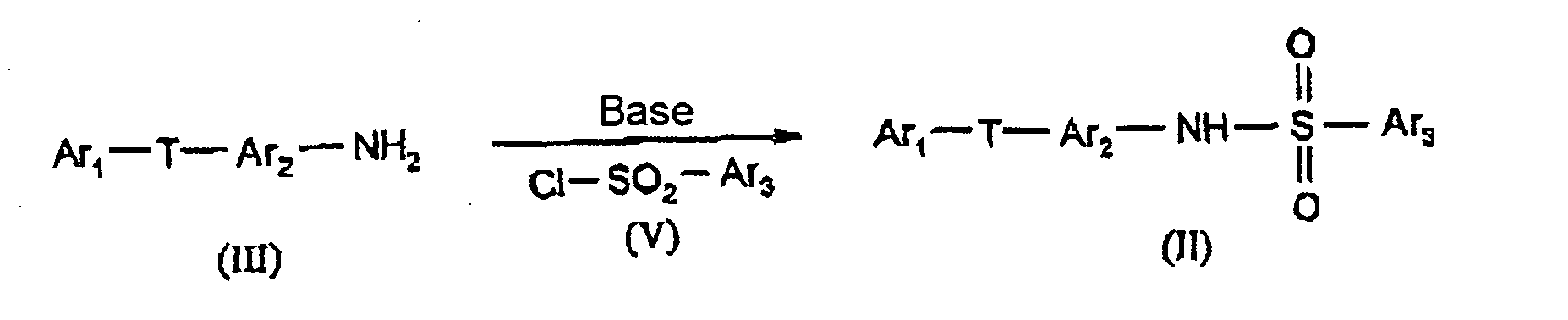
- the compounds of structure (II) are obtained beforehand according to Scheme 2, by the sulphonylation of the compound of formula (III) with sulphonyl chlorides of formula (V) in the presence of a base chosen from tertiary amines such as pyridine according to the process described by Stauffer et al., Bioorg. Med. Chem., 2000, EN 8, 6, 1293-1316 .
- a base chosen from tertiary amines such as pyridine according to the process described by Stauffer et al., Bioorg. Med. Chem., 2000, EN 8, 6, 1293-1316 .
- tertiary amines it is also possible to use triethylamine or diisopropylethylamine.
- Ar 1 , Ar 2 , Ar 3 , and T are as defined in formula (I).
- the compounds of formula (IIIa), (IIIb) and (IIIf) are prepared according to schemes 3 to 5.
- the 2-nitro aldehyde derivatives of formula (VI) react with organometallic compounds of formula (VII) in which M represents a MgBr, Mgl, ZnI or Li group to give compounds of structure (VIII).
- the organometallic compounds of formula (VII) are commercial, or formed according to the conventional methods described in the literature.
- the nitro alcohols of formula (VIII) are reduced by hydrogenation, for example under the action of tin metal and concentrated hydrochloric acid in ethanol, to give the compounds of structure (IIIb).
- the derivatives of formula (IIIb) are reduced by the action of hydrides, for example by a mixture of triethylsilane and trifluoroacetic acid in dichloromethane to give derivatives of formula (IIIa).
- nitroaldehydes of formula (VI) are commercially available or can be prepared, for example, according to an adaptation of the process described by J. Kenneth Horner et al., J. Med. Chem., 1968, 11; 5; 946 .
- the anilines of formula (IX) are condensed with nitriles of formula (XII), in the presence of Lewis acid, for example boron trichloride with aluminum trichloride or with gallium trichloride to give the compounds of formula (IIIf), according to the method described by T. Sugasawa et al JACS1978; 100; 4842 .
- the compounds of formula (IIIf) can be obtained by condensation of aminonitriles (XI) with organometallic derivatives (VII), according to the process described by R. Fryer et al., J. Heterocycl. Chem, 1991, EN 28; 7, 1661 .
- the compounds of formula (IIIf) can also be obtained from intermediate (XIV) according to an adaptation of the process described by D. Lednicer, J. Heterocyclic. Chem, 1971; 903 .
- the carbonyl function of the compounds (IIIf) is reduced by the action of a hydride, for example sodium borohydride in ethanol, to give the compounds of structure (IIIb).
- a hydride for example sodium borohydride in ethanol
- Another method for preparing the compounds of formula (IIIb) consists in condensing anilines of formula (IX) on benzaldehyde derivatives of formula (XIII) in the presence of phenyl-dichloroborane and triethylamine according to the method described by T. Toyoda et al., Tet. Lett, 1980, 21, 173 .
- nitrophenyls of formula (XVII) are condensed on chloro methyl heteroaryls of formula (XVIII) in the presence of a base, for example potassium tert- butylate, to yield derivatives (XIX) according to the method described by Florio.S et al., Eur.J.Org.Chem.2004, 2118 which are reduced for example by the action of metal tin in the presence of 12M hydrochloric acid, to give derivatives of formula (IIIa).
- a base for example potassium tert- butylate
- the compounds of formula (IIIe) are prepared according to scheme 7.
- the nitro group of these derivatives can be reduced, for example, in the presence of metal tin and hydrochloric acid in ethanol to give the compounds of formula (IIIe).
- the compounds of formula (IIIg) are prepared according to scheme 8.
- These derivatives are reduced for example by catalytic hydrogenation to palladium to give the compounds of formula (IIIg).
- a compound When a compound has a reactive function, for example a hydroxyl group, it may require prior protection before reaction. Those skilled in the art may determine the need for prior protection.
- the compounds of formula (II) to (XXI) are useful as synthetic intermediates for the preparation of the compounds of general formula (I) and form an integral part of the present invention.
- Table I illustrates the chemical structures and the physical properties of some compounds of the invention obtained according to this example ⁇ b> Table I ⁇ / b> N ° -composed Nature and position of substituents F (° C) MH + / retention time Ar 1 Ar 2 R 1 Ar 3 8 H H CH 2 CO 2 And 3,4-DIOME 58.8 486 / 8.15 7 H 4-Cl CH 2 CO 2 And 3,4-DIOME 152 521 / 8.78 9 2-Cl 4-Cl CH 2 CO 2 And 2,4-DIOME 155 555 / 9.34 10 2-Cl 4-Cl CH 2 CO 2 And H 109.8 495 / 9.40 13 2-Cl 4-Cl CH 2 CO 2 And 4-OMe 98.2 52419.47 18 2-Cl 4-Cl CH 2 CO 2 And 3,4-diCl 140 562 / 10.46 19.
- Table II illustrates the chemical structures and the physical properties of some compounds of the invention obtained according to this example ⁇ b> Table II ⁇ / b> Dialed number Nature and position of substituents MH + / retention time
- Ar 1 Ar 2 R 1 Ar 3 F (° C) 21 2-Cl 4-Cl CH 2 COCH 3 3,4-DIOME 158.5 540 / 8.72 23 2-Cl 4-Cl (CH 2 ) 2 OMe 3,4-DIOME 112.2 526 / 8.77 29 2-Cl 4-Cl CH 2 CONH 2 naphthyl 218 515 / 8.52 30 2-Cl 4-Cl CH 2 CONH 2 3-OMe 114.8 495 / 7.87
- Table III illustrates the chemical structures and the physical properties of some compounds of the invention obtained according to this example.
- Table III ⁇ b> Table III ⁇ / b> Dialed number Nature and position of substituents F (° C) MH + / retention time
- Ar 1 Ar 2 R 1 Ar 3 36 2-Cl 4-Cl CH 2 CONH 2 2,5-DIOME 109 525 / 7.57 38 2-Cl 4-Cl CH 2 CONH 2 2,5-DiMe, 4-Cl 126.3 527 / 9.16
- Table IV illustrates the chemical structures and the physical properties of some compounds of the invention obtained according to this process.
- Table IV ⁇ / b> Dialed number Nature and position of substituents F (° C) MH * / retention time
- Ar 1 Ar 2 R 1 Ar 3 35 2-Cl 4-Cl CH 2 CONH 2 4-Cl 130 499 / 8.41 37 2-Cl 4-Cl CH 2 CONH 2 2-Cl 137 4997.75 41 2-Cl 4-Cl CH 2 CONH 2 2,3-DIOME 222 526 / 8.76 64 2-Cl 4-Cl CH 2 CONH 2 3,4-ethylenedioxy 102.1 523 / 7.64 79 2-Cl 4-Cl CH 2 CONH 2 2-Me 134 479 / 8.24 106 2-Cl 4-Cl CH 2 CONH 2 2,4,5 -triMe 150.2 507 / 8.95 110 2-Cl 4-Cl CH 2 CONHMe 2,4,5 -triMe 171.7 521 / 9.25 113 2-Cl 4-Cl CH 2 CONHMe 2,
- Table V illustrates the chemical structures and the physical properties of some compounds of the invention obtained according to this process.
- Table V ⁇ / b> Dialed number Nature and position of substituents MH + / retention time
- Table VI illustrates the chemical structures and the physical properties of some compounds of invention obtained according to this process.
- Table VI ⁇ b> Table VI ⁇ / b> No compound Nature and position of substituents F (° C) MH + / retention time Ar 1 Ar 2 R 1 Ar 3 16 3-Cl 4-Cl CH 2 CO 2 And 3,4-DIOME 149 554 / 9.48 17 2-OMe 4-Cl CH 2 CO 2 And 3,4-DIOME 119.6 550 / 8.98 26 2-Me 4-Cl CH 2 CO 2 And 3,4-DIOME 85.4 534 / 9.04 44 3-Cl 4-Cl CH 2 CONH 2 3.4 DIOME 120.1 525 / 8.95 59 4-OMe 4-Cl CH 2 CONH 2 3,4-DIOME 181 521 / 7.30 68 2-OMe 4-Cl CH 2 CONH 2 3.4 DIOME 104.6 521 / 7.26 131 2-Me 4-Cl CH 2 CONH 2 3,4-DIOME 144.6 487 / 8.42 76
- Table VII illustrates the chemical structures and the physical properties of some compounds of the invention obtained according to Example 8 (activation of the reaction by addition of trimethylsilane and chromium trichloride described in Example 8.1 is not was used for compounds 69, 136, 175).
- Table VIII illustrates the chemical structures and the physical properties of some compounds of the invention obtained according to Example 9 (for all the compounds, the reduction described in Example 9.2 is carried out using metal tin and water. 12M hydrochloric acid instead of ammonium formate and platinum oxide) ⁇ b> Table VIII ⁇ / b> Dialed number Nature and position of substituents F (° C) MH + / retention time Ar 1 Ar 2 R 1 Ar 3 147 2,6-diF 4-Cl CH 2 CONH 2 3.5 -diMe 108.7 477 / 8.59 198 2,6-diF 4-Me CH 2 CONH 2 3,4-DIOME 175.7 489 * / 7.40 206 2,6-diF 4-F CH 2 CONH 2 3,4-DIOME 178.8 511 / 6.65 209 2,6-dif- 4-OMe CH 2 CONH 2 3.4 DIOME 114.2 523 / 7.14 221 2,6-diF 4.5-diCl CH 2 CONH 2 3,4-
- Table IX illustrates the chemical structures and the physical properties of some compounds of the invention obtained according to Example 10 (for all these compounds in Example 10.1 gallium trichloride is replaced by aluminum trichloride).
- Table IX ⁇ / b> Dialed number Nature and position of substituents F (° C) MH + / retention time Ar 1 Ar 2 R 1 Ar 3 77 2-Cl 4-OCF 3 CH 2 CONH 2 3,4-DIOME 116 nd 120 2-thiazolyl 4-Cl CH 2 CONH 2 3,4-DIOME 93 49716.42 121 2-thiazolyl 4-Cl CH 2 CONHMe 3,4-DIOME 225 511 / 6.72 126 2,3-diF 4-Cl CH 2 CONH 2 3,4-DIOME 184.9 531 ** / 8.16 127 2,3-diF 4-Cl CH 2 CONHEt 3,4-DIOME 93.4 555 / 8.86 128 2,3-diF 4-Cl CH 2 CON (Me) 2 3,4-
- Example 11.3 N 2 - ⁇ 2 - [(2,6-difluorophenyl) (hydroxy) methyl] -5-methoxy-4-methylphenyl ⁇ -N 2 - [(3,4-dimethoxyphenyl) sulfonyl] glycinamide
- Table X illustrates the chemical structures and the physical properties of some compounds of the invention obtained according to Example 11.
- Table X ⁇ / b> No compound Nature and position of substituents F (° C) MH + / retention time
- Table XI illustrates the chemical structures and the physical properties of some compounds of the invention obtained according to Example 12.
- Table XI ⁇ / b> Dialed number Nature and position of substituents F (° C) MH + / retention time
- Ar 1 Ar 2 R 1 Ar 3 2 H 4-Cl CH 2 CO 2 And 3,4-DIOME 139 504 / 9.06 4
- Example 14 N- ⁇ 4-chloro-2 - [(2-chlorophenyl) (hydroxy) methyl] phenyl ⁇ -3,4-dimethoxy-N - [(2-methyl-2H-tetrazol-5-yl) methyl] Benzenesulfonamide (Compound 14) and N- ⁇ 4-chloro-2 - [(2-chlorophenyl) (hydroxy) methyl] phenyl ⁇ -3,4-dimethoxy-N - [(1-methyl-1H-tetrazol-5-yl) ) methyl] benzenesulfonamide (compound 15)
- Example 14.4 N- ⁇ 4-chloro-2 - [(2-chlorophenyl) (hydroxy) methyl] phenyl ⁇ -3,4-dimethoxy-N - [(2-methyl-2H-tetrazol-5-yl) methyl] ] Benzenesulfonamide (Compound 14) and N- ⁇ 4-chloro-2 - [(2-chlorophenyl) (hydroxy) methylphenyl ⁇ -3,4-dimethoxy-N - [(1-methyl-1H-tetrazol-5-yl)] methyl] benzenesulfonamide (compound 15)
- Table XII illustrates the chemical structures and the physical properties of some compounds of the invention obtained according to an adaptation of Example 15.
- Table XII illustrates the chemical structures and the physical properties of some compounds of the invention obtained according to an adaptation of Example 15.
- Table XII ⁇ / b> Dialed number Nature and position of substituents F (° C) MH + / retention time
- Ar 1 Ar 2 R 1 Ar 3 40 2-Cl 4-Cl CH 2 CONH 2 2,5-DIOME 125 509 / 8.93 42
- 2-Cl 4-Cl CH 2 CONH 2 3-OCF3 129 533 / 9.38 45
- 2-Cl 4-Cl CH 2 CONH 2 2-OMe 114 479 / 8.18 46
- Compound 84 is obtained by alkylation with the 5-bromomethyl-3-methyl- [1,2,4] oxadiazole derivative (synthesis described from Example 4.3).
- Compound 135 is obtained from 1.25 g of compound 134 by reduction of the nitro function as described in Example 8.2.
- Compounds 188 and 189 are obtained by alkylation reaction with iodomethane in the presence of cesium carbonate in THF of N 2 - [3-aminophenyl) sulfonyl] -N 2 - [4-chloro-2- (2, 6-difluorobenzyl) phenyl] glycinamide.
- Table XIII illustrates the chemical structures and the physical properties of some compounds of the invention obtained according to Example 16.
- Table XIII ⁇ / b> Dialed number Nature and position of substituents F (° C) MH + / retention time
- Ar 1 Ar 2 R 1 Ar 3 3-OMe phenyl 4-Cl CH 2 CONH 2 3,4-DIOME 109 50517.79 60
- 2-Me thienyl 4-Cl CH 2 CONH 2 3,4-DIOME 100.1 495 / 8.86
- Table XIV illustrates the chemical structures and the physical properties of some compounds of the invention obtained according to Example 17 ⁇ b> Table XIV ⁇ / b> Dialed number Nature and position of substituents F (° C) MH + / retention time Ar 1 Ar 2 R 1 Ar 3 130 2,6-diCl 4-Cl CH 2 CONHMe 3,4-DIOME 149.3 557 / 9.13 166 2,6-diCl 4-Cl CH 2 CON (Me) 2 3,4-DIOME 102.7 571 / 9.63 67 2-Cl H CH 2 CONH 2 3,4-DIOME 240.2 475 / 7.45 91 2,6-diF 4-Cl CH 2 CONH 2 3,4-DIOME 231.6 511 / 8.48 242 2,6-diF 4-Br CH 2 CONH 2 3,4-DIOME 209.7 55518.31 280 2,6-diF 4-Me CH 2 CONH 2 3,4-DIOME 180.4 490 / 88.80 286 2,
- Table XV illustrates the chemical structures and the physical properties of some compounds of the invention obtained according to Example 18.
- Table XV ⁇ b> Table XV ⁇ / b> Dialed number Nature and position of substituents F (° C) MH + / retention time Ar 1 Ar 2 R 1 Ar 3 140 2,6-diF 4-Cl propyl -3,4-DIOME 135.1 496 / 10.82 150 2,6-diF 4-Cl CH 2 CON (Me) 2 3,4-DIOME 130.2 539 / 9.2 145 2,6-diF 4-Cl (CH 2 ) 2 N (Me) 2 3,4-DIOME 121.2 525 / 6.47 144 2,6-diF 4-Cl Me 3,4-DIOME 191.8 468 / 10.05 156 2,6-diF 4-Cl 3,4-DIOME 128.2 687 / 9.78 169 2,6-diF 4-Cl CH 2 CONH 2 3.5 -diMe 146 479
- potassium tert-butoxide is replaced by sodium hydride.
- Table XVI illustrates the chemical structures and the physical properties of some compounds of the invention obtained according to Example 19.
- Table XVI ⁇ b> Table XVI ⁇ / b> Dialed number Nature and position of substituents F (° C) MH + / retention time Ar 1 Ar 2 R 1 Ar 3 142 2,3-diFphényle 4-Cl CH 2 CONH 2 3,4-DIOME 172.2 511 / 8.70 143 2,3-diFphénylé 4-Cl CH 2 CON (Me) 2 3,4-DIOME 88.2 539 / 9.43 141 2,3-diFphényle 4-Cl CH 2 CONHMe 3,4-DIOME 150.9 525 / 9.01 170 2-F, 6-OMe phenyl 4-Cl CH 2 CONH 2 3,4-DIOME 160 523 / 8.56 180 2-thienyl 4-Cl CH 2 CONH 2 3,4-DIOME 183.9 481 / 8.41 192 2-Cl, 6-OMe phen
- Table XVII illustrates the chemical structures and the physical properties of some compounds of the invention obtained according to Example 20.
- Table XVII illustrates the chemical structures and the physical properties of some compounds of the invention obtained according to Example 20.
- Table XVII ⁇ / b> Dialed number Nature and position of substituents F (° C) MH + / retention time
- Ar 1 Ar 2 R 1 Ar 3 177 2,5-diF 4-Cl CH 2 CONH 2 3,4-DIOME 216.5 511 / 8.75 182 2-F, 5-Cl 4-Cl CH 2 CONH 2 3,4-DIOME 210.3 527 / 9.09 183 3,5-diF 4-Cl CH 2 CONH 2 3,4-DIOME 184 511 / 8.96 196 2-F, 5-Me 4-Cl CH 2 CONH 2 3,4-DIOME 231.6 507 / 8.98 100 2-Cl 4-Cl CH 2 CONH 2 2,4-diCl, 5-Me 228.3 531 / 9.72 168 2-
- Example 21 N- [4-chloro-2- (2,6-difluorobenzyl) phenyl] -3,4-dimethoxy-N - [(1-methyl-1H-tetrazol-5-yl) methyl] benzenesulfonamide (Compound 152 and N- [4-chloro-2- (2,6-difluorobenzyl) phenyl] -3,4-dimethoxy-N - [(2-methyl-2H-tetrazol-5-yl) methyl] benzene sulfonamide (Compound 151) )
- Table XVIII illustrates the chemical structures and the physical properties of some compounds of the invention obtained according to Example 21.
- Table XVIII illustrates the chemical structures and the physical properties of some compounds of the invention obtained according to Example 21.
- Table XVIII ⁇ / b> Dialed number Nature and position of substituents F (° C) MH + / retention time Ar 1 Ar 2 R 1 Ar 3 153 2,6-diF 4-Cl (2-ethyl-2H-tetrazol-5-yl) methyl 3,4-DIOME 139.7 564 / 9.81 154 2,6-diF 4-Cl (1-ethyl-1H-tetrazol-5-yl) methyl 3,4-DIOME 150.9 564 / 9.48 159 2,6-diF 4-Cl (2-ethyl-2H-tetrazol-5-yl) methyl 3.5 -diMe 105.5 532 / 10.84 160 2,6-diF 4-Cl (1-ethyl-1H
- Example 22.2 N 2 - [2- (2-chlorobenzyl) -4-methylphenyl] -N 2 - [(3,4-dimethoxyphenyl) sulfonyl] glycinamide
- the reaction medium is poured into water and extracted with ethyl acetate.
- the organic phase is dried over anhydrous sodium sulphate and concentrated.
- the residue is chromatographed on a column of silica gel, eluting with a 99/1 (v / v) dichloromethane / methanol mixture.
- the oil obtained is dissolved in methanol and poured into a 0.5M solution of sodium hydroxide, the precipitate formed is filtered and dried under vacuum to obtain 0.504 g of expected product.
- Table XIX illustrates the chemical structures and the physical properties of some compounds of the invention obtained according to Example 23.
- Table XIX illustrates the chemical structures and the physical properties of some compounds of the invention obtained according to Example 23.
- Table XIX ⁇ / b> Nature and position of substituents F (° C) MH + / retention time Ar 1 Ar 2 R 1 Ar 3 199 2,6-diF 4-Cl 2-pyrrolidin-1-ylethyl 3,4-DIOME 131.4 551 / 6.61 201 2,6-diF 4-Cl 2- (dimethylamino) -1-methylethyl 3,4-DIOME 128.6 539 / 6.44 203 2,6-diF 4-Cl 2- [benzyl (methyl) amino] ethyl 3,4-DIOME 104.8 601 / 7.18 231 2,6-diF 4-Cl (CH 2 ) 2 NHCONH 2 3,4-DIOME 124.5 539 / 8.27 229 2,
- Example 24.1 N- ⁇ 4-chloro-2 - [(2-chlorophenyl) (hydroxy) methyl] phenyl ⁇ -3,4-dimethoxy-N- [2- (tetrahydro-2H-pyran-2-yloxy) ethyl] ] benzenesulfonamide
- Example 25 N 2 - ⁇ 4-chloro-2- [1- (2-chlorophenyl) -1-hydroxyethyl] phenyl ⁇ -N 2 - [(3,4-dimethoxyphenyl) sulfonyl] glycinamide (comose 172)
- Table XX illustrates the chemical structures and the physical properties of some compounds of the invention obtained according to Example 28.
- Table XX illustrates the chemical structures and the physical properties of some compounds of the invention obtained according to Example 28.
- Table XX illustrates the chemical structures and the physical properties of some compounds of the invention obtained according to Example 28.
- Table XX illustrates the chemical structures and the physical properties of some compounds of the invention obtained according to Example 28.
- Table XX illustrates the chemical structures and the physical properties of some compounds of the invention obtained according to Example 28.
- Table XX illustrates the chemical structures and the physical properties of some compounds of the invention obtained according to Example 28.
- Table XX illustrates the chemical structures and the physical properties of some compounds of the invention obtained according to Example 28.
- Table XX illustrates the chemical structures and the physical properties of some compounds of the invention obtained according to Example 28.
- Table XX illustrates the chemical structures and the physical properties of some compounds of the invention obtained according to Example 28.
- Table XX illustrates the chemical structures and the
- Table XXI illustrates the chemical structures and the physical properties of some compounds of the invention obtained according to Example 28.
- Table XXI illustrates the chemical structures and the physical properties of some compounds of the invention obtained according to Example 28.
- Table XXI illustrates the chemical structures and the physical properties of some compounds of the invention obtained according to Example 28.
- Table XXI illustrates the chemical structures and the physical properties of some compounds of the invention obtained according to Example 28.
- Table XXI illustrates the chemical structures and the physical properties of some compounds of the invention obtained according to Example 28.
- Table XXI illustrates the chemical structures and the physical properties of some compounds of the invention obtained according to Example 28.
- Table XXI illustrates the chemical structures and the physical properties of some compounds of the invention obtained according to Example 28.
- Table XXI illustrates the chemical structures and the physical properties of some compounds of the invention obtained according to Example 28.
- Table XXI illustrates the chemical structures and the physical properties of some compounds of the invention obtained according to Example 28.
- Example 31.1 4 - ⁇ [4-chloro-2 - ⁇ [2- (2,6-difluorobenzyl) phenyl] [((3,4-dimethoxyphenyl) sulfonyl] amino ⁇ butanoic acid
- Example 31.2 ⁇ [4-chloro-2- (2,6-difluorobenzyl) phenyl] [(3,4-dimethoxyphenyl) sulfonyl] amino ⁇ butanamide
- Table XXII illustrates the chemical structures and the physical properties of some compounds of the invention obtained according to this example.
- Table XXII illustrates the chemical structures and the physical properties of some compounds of the invention obtained according to this example.
- Table XXII ⁇ / b> Dialed number Nature and position of substituents F (° C) MH + / retention time
- Ar 1 Ar 2 R 1 Ar 3 235 2,6-diF 4-Cl CH 2 CH 2 CH 2 CONH 2 2,5-DiMe, 4-Cl nd 541 / 10.03 266 2,5-diF 4-Cl CH 2 CH 2 CH 2 CONH 2 3,4-DIOME 150 539 / 9.15 272 2,6-diF 6-OMe CH 2 CH 2 CH 2 CONH 2 3,4-DIOME 207.8 535 / 8.42 299 2,5-diF 6-OMe CH 2 CH 2 CH 2 CONH 2 3,4-DIOME 189.3 535 / 8.54
- Table XXIII illustrates the chemical structures and the physical properties of some compounds of the invention obtained according to this example.
- Table XXIII illustrates the chemical structures and the physical properties of some compounds of the invention obtained according to this example.
- Table XXIII ⁇ / b> Dialed number Nature and position of substituents F (° C) MH + / retention temp side Ar 1 Ar 2 R 1 Ar 3 245 2,6- diF 4-Cl 3-pyridin-3-ylpropyl 3,4-DIOME 102.8 573 / 8.10 250 2,6- diF 4-Cl 2-pyridin-2-ylethyl 3,4-DIOME 75.1 559 / 8.24 254 2,6- diF 4-Cl 2-pyridin-3-ylethyl 3,4-DIOME 90.3 559 / 7.14 255 2,6- diF 4-Cl 2-pyridin-4-ylethyl 3,4-DIOME 164.3 559 / 8.29 260 2,6- diF 4-Cl 2-phenoxyethyl
- Atropoisomers 315/316 and 317/318 are pairs of atropoisomers. Each atropoisomer is characterized by its rotatory power ( ⁇ D ). The center of atropoisomerism is generated by the steric hindrance around the N-aromatic bond.
- Table XXIV illustrates the chemical structures and the physical properties of some compounds of the invention obtained according to this example.
- Table XXIV illustrates the chemical structures and the physical properties of some compounds of the invention obtained according to this example.
- Table XXIV ⁇ / b> Dialed number Nature and position of substituents F (° C) MH + / retention time Ar 1 Ar 2 R 1 Ar 3 277 2,6-diF 4-Cl 2- (1H-1,2,4-triazol-1-yl) ethyl 3,4-DIOME 129.1 nd 282 2,6-diF 6-OMe methylaminoethyl 3,4-DIOME 262.9 507 / 6.54 284 2,6-diF 4-Cl methylaminoethyl 3,4-DIOME 54 511 / 6.94 306 2,6-diF 6-OMe 2- (1H-1,2,4-triazol-1-yl) ethyl 3,4-DIOME 132.1 545 / 8.76
- Example 37.2 N- [4-chloro-2- (2,6-difluorobenzyl) phenyl] -N- (3-hydroxypropyl) -3,4-dimethoxybenzenesulfonamide
- Example 39.1 ⁇ [4-chloro-2- (2,6-difluorobenzyl) phenyl] [(3,4-dimethoxyphenyl) sulfonyl] amino (fluoro) ethyl acetate
- Example 39.3 2 - ⁇ [4-chloro-2- (2,6-difluorobenzyl) phenyl] [(3,4-dimethoxyphenyl) sulfonyl] amino ⁇ -2-ethoxyacetamide
- Example 44.1 methyl N- [4-chloro-2- (2,6-difluorobenzyl) phenyl] -N - [(3,4-dimethoxyphenyl) sulfonyl] alaninate
- Table XXV illustrates the chemical structures and physical properties of some compounds of the invention obtained according to this example.
- Table XXV illustrates the chemical structures and physical properties of some compounds of the invention obtained according to this example.
- Table XXV ⁇ b> Table XXV ⁇ / b> Dialed number Nature and position of substituents F (° C) MH + / retention time
- Table XXVI illustrates the chemical structures and the physical properties of some compounds of the invention obtained according to this example.
- Table XXVI illustrates the chemical structures and the physical properties of some compounds of the invention obtained according to this example.
- Table XXVI ⁇ b> Table XXVI ⁇ / b> Dialed number Nature and position of substituents F (° C) MH + - / retention time Ar 1 Ar 2 .
- R 1 Ar 3 302 2,6-diF 4-Cl, 6-OMe CH 2 CONH 2 3,4-DIOME 238.5 541 / 8.89 303 2,6-diF 4-Cl, 6-Me CH 2 CONH 2 3,4-DIOME 217 521 / 8.61
- Example 49.2 N 2 - [2- (2,6-difluorobenzyl) -6, methoxyphenyl], N 2 - [(3,4-dimethoxyphenyl) sulfonyl] -N-ethylglycinamide
- Example 51.4 N 2 - [4-chloro-2- (pyridin-2-ylmethyl) phenyl] -N 2 - [(3,4-di (methoxylphenyl) sulfonyl] glycinamide
- N 2 - [2- (2,6-difluorobenzyl) -6-methoxyphenyl] -N 2 - [(3,4-dimethoxyphenyl) sulfonyl] - (S) -alaninamide (compound 322) is synthesized.
- the compounds of the invention have been the subject of pharmacological studies which have shown their interest as active substances in therapeutics.
- the affinity of the compounds of the invention for the orexin receptors 2 was determined in an in vitro binding assay according to the technique described below. This method consists of studying the displacement of radioiodinated orexin A bound to human orexin 2 receptors expressed in CHO cells. The test is carried out on membranes in 50 mM Hepes incubation buffer, 1 mM MgCl 2 , 25 mM CaCl 2 , 0.025% NaN 3 , 1% bovine serum albumin (BSA) and 100 ⁇ M of ligand for 30 minutes. 25 ° C. The reaction is stopped by filtration and washing on Wathman GF / C filter.
- BSA bovine serum albumin
- Non-specific binding is measured in the presence of 10 -6 M human orexin B.
- the IC 50 (inhibitory concentration of 50% of the binding of radioiodinated orexin A to its receptors) are low, less than 300 nM, in particular less than 100 nM and more particularly less than 30 nM.
- the affinity of the compounds according to the invention for the orexin receptors 1 was also studied in an in vitro binding assay according to the same technique using orexin A iodinated radio as a ligand in a membrane preparation of CHO cells expressing human orexin 1 receptors.
- the compounds according to the invention have little or no affinity for the orexin 1 receptors.
- the agonist or antagonist character of the compounds is determined in vitro in an intracellular calcium measurement test (FLIPR) on a cell preparation expressing the orexin 2 receptors according to the general technique described in FIG. Sullivan et al, Methods Mol. Biol., 1999, vol. 114, 125-133 using 1 ⁇ M Fluo-4 AM as a fluorescent calcium indicator.
- FLIPR intracellular calcium measurement test
- the compounds are preincubated for 30 minutes before addition of 0.25 nM of orexin B.
- the IC 50 values for the orexin 2 receptors measured in these studies are low and more particularly less than 100 nM.
- the compounds of the present invention can be used in the prophylaxis and treatment of any diseases involving a dysfunction related to these receptors.
- the compounds of the invention can be used for the preparation of a medicament for the prophylaxis or the treatment of any diseases involving a dysfunction related to the orexin 2 receptor, and more particularly in the prophylaxis or the treatment of pathologies in which an antagonist orexin 2 receptor provides therapeutic benefit.
- pathologies are, for example, obesity, disturbances of appetite or taste, including cachexia, anorexia, bulimia ( Smart et al., Eur. J. Pharmacol., 2002, 440, 2-3, 199-212 ), diabetes ( Ouedraogo et al., Diabetes, 2002, 52, 111-117 ), metabolic syndromes ( Sakurai, Curr. Opin. Nutr. Metab.
- the invention also relates to medicaments which comprise a compound of formula (I). These drugs find their use in therapy, especially in the prophylaxis or treatment of the aforementioned pathologies.
- the present invention relates to pharmaceutical compositions containing, as active ingredient, at least one compound according to the invention.
- These pharmaceutical compositions contain an effective dose of a compound according to the invention and optionally one or more pharmaceutically acceptable excipients.
- Said excipients are chosen according to the pharmaceutical form and the desired mode of administration, from the usual excipients which are known to those skilled in the art.
- compositions of the present invention for oral, sublingual, subcutaneous, intramuscular, intravenous, topical, local, intratracheal, intranasal, transdermal or rectal administration the active ingredient of formula (I) above, or its salt, solvate or hydrate, may be administered in unit dosage form, in admixture with conventional pharmaceutical excipients, to animals and humans for the prophylaxis or treatment of the above disorders or diseases.
- Suitable unit dosage forms include oral forms such as tablets, soft or hard capsules, powders, granules, chewing gums and oral solutions or suspensions, sublingual, oral, Intratracheal, intraocular, intranasal, inhalation, subcutaneous, intramuscular or intravenous administration forms and rectal or vaginal administration forms.
- oral forms such as tablets, soft or hard capsules, powders, granules, chewing gums and oral solutions or suspensions, sublingual, oral, Intratracheal, intraocular, intranasal, inhalation, subcutaneous, intramuscular or intravenous administration forms and rectal or vaginal administration forms.
- the compounds according to the invention can be used in creams, ointments or lotions.
- the main active ingredient is mixed with a pharmaceutical excipient, such as gelatin, starch, lactose, magnesium stearate, talc, gum arabic. or the like.
- a pharmaceutical excipient such as gelatin, starch, lactose, magnesium stearate, talc, gum arabic. or the like.
- the tablets may be coated with sucrose, a cellulosic derivative, or other materials.
- the tablets can be made by different techniques, direct compression, dry granulation, wet granulation or hot melt.
- the dose of active principle may vary between 0.1 mg and 200 mg per kg of body weight per day.
- these assays are examples of average conditions, there may be special cases where higher or lower dosages are appropriate, such assays also belong to the invention.
- the dosage appropriate to each patient is determined by the physician according to the mode of administration, the weight and the response of said patient.
- Each unit dose may contain from 0.1 to 1000 mg, preferably from 0.1 to 500 mg, of active ingredient in combination with one or more pharmaceutical excipients. This unit dose can be administered 1 to 5 times per day so as to administer a daily dosage of 0.5 to 5000 mg, preferably 0.5 to 2500 mg.
Landscapes
- Chemical & Material Sciences (AREA)
- Organic Chemistry (AREA)
- Health & Medical Sciences (AREA)
- Bioinformatics & Cheminformatics (AREA)
- Engineering & Computer Science (AREA)
- Public Health (AREA)
- Veterinary Medicine (AREA)
- Chemical Kinetics & Catalysis (AREA)
- General Chemical & Material Sciences (AREA)
- Medicinal Chemistry (AREA)
- Nuclear Medicine, Radiotherapy & Molecular Imaging (AREA)
- General Health & Medical Sciences (AREA)
- Pharmacology & Pharmacy (AREA)
- Life Sciences & Earth Sciences (AREA)
- Animal Behavior & Ethology (AREA)
- Neurology (AREA)
- Biomedical Technology (AREA)
- Neurosurgery (AREA)
- Diabetes (AREA)
- Psychiatry (AREA)
- Endocrinology (AREA)
- Cardiology (AREA)
- Hematology (AREA)
- Obesity (AREA)
- Heart & Thoracic Surgery (AREA)
- Reproductive Health (AREA)
- Pain & Pain Management (AREA)
- Hospice & Palliative Care (AREA)
- Urology & Nephrology (AREA)
- Gynecology & Obstetrics (AREA)
- Vascular Medicine (AREA)
- Addiction (AREA)
- Rheumatology (AREA)
- Otolaryngology (AREA)
- Nutrition Science (AREA)
- Child & Adolescent Psychology (AREA)
- Pregnancy & Childbirth (AREA)
- Emergency Medicine (AREA)
- Orthopedic Medicine & Surgery (AREA)
- Physical Education & Sports Medicine (AREA)
Claims (9)
- Verbindung der allgemeinen Formel (I):
 • Ar1 für- eine Arylgruppe wie eine Phenylgruppe, die gegebenenfalls durch eine oder mehrere unabhängig voneinander unter den folgenden Gruppen ausgewählte Gruppen substituiert ist: ein Halogenatom, eine (C1-C4) -Alkylgruppe, eine (C1-C4)-Alkoxygruppe, eine Fluor-(C1-C4)-alkylgruppe, eine Cyanogruppe, eine -CO-NRaRb-Gruppe, eine -NRaRb-Gruppe, wobei Ra und Rb unabhängig voneinander für ein Wasserstoffatom oder eine (C1-C4)-Alkylgruppe stehen,- eine unter Pyridinyl, Pyrimidinyl, Thiazolyl und Thienyl ausgewählte Heterocyclylgruppe, wobei die Heterocyclylgruppen gegebenenfalls durch ein Halogenatom, eine (C1-C4)-Alkylgruppe oder eine (C1-C4)-Alkoxygruppe substituiert sind,- eine (C3-C6) -Cycloalkylgruppe
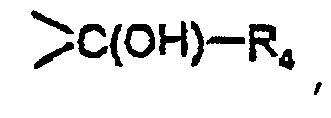
steht,• T für- eine Gruppe -(CH2)n- mit n = 0, 1 oder 2,- eine Gruppe - eine Gruppe
 - eine Gruppe

steht,• Ar2 für- eine Arylgruppe wie Phenyl, die gegebenenfalls durch eine oder mehrere unabhängig voneinander unter den folgenden Gruppen ausgewählte Gruppen substituiert ist: ein Halogenatom, eine (C1-C4)-Alkylgruppe, eine (C1-C4)-Alkoxygruppe, eine Fluor-(C1-C4) -alkylgruppe, eine Fluor-(C1-C4)-alkoxygruppe,
oder auch durch eine -NRcRd-Gruppe, wobei Rc und Rd unabhängig voneinander für ein Wasserstoffatom oder eine (C1-C4)-Alkylgruppe stehen,- eine Heterocyclylgruppe wie Pyridinyl, die gegebenenfalls durch eine (C1-C4)-Alkylgruppe oder eine (C1-C4)-Alkoxygruppe substituiert ist,
steht,• Ar3 für- eine unter Phenyl und Naphthyl ausgewählte Arylgruppe, wobei die Arylgruppen gegebenenfalls durch eine oder mehrere unabhängig voneinander unter den folgenden Gruppen ausgewählte Gruppen substituiert sind: ein Halogenatom, eine (C1-C4)-Alkylgruppe, eine (C1-C4)-Alkoxygruppe, eine Fluor-(C1-C4)-alkylgruppe, eine Fluor-(C1-C4) -alkoxygruppe, eine Nitrogruppe, eine Hydroxygruppe,
oder auch durch eine -NR5R6-Gruppe, wobei R5 und R6 unabhängig voneinander für ein Wasserstoffatom oder eine (C1-C4)-Alkylgruppe stehen,- eine Heterocyclylgruppe wie Pyridinyl, die gegebenenfalls durch eine (C1-C4)-Alkylgruppe oder eine (C1-C4)-Alkoxygruppe
oder auch durch eine -NRxRy-Gruppe, wobei Rx und Ry unabhängig voneinander für ein Wasserstoffatom, eine (C1-C4)-Alkylgruppe oder eine (C1-C4)-Alkoxygruppe stehen, substituiert ist,- eine unter
steht,• R1 für- eine -C(O)-CF3-Gruppe,- eine Gruppe der Formel:
n = 0, 1, 2 oder 3,o R7 für- ein Wasserstoffatom, eine (C1-C4)-Alkylgruppe, ein Fluoratom oder eine (C1-C4)-Alkoxygruppe,- eine -(CH2)m-Arylgruppe mit m = 1 oder 2, wobei die Arylgruppe, bei der es sich um eine Phenylgruppe handelt, gegebenenfalls durch ein Halogenatom, eine (C1-C4)-Alkylgruppe oder eine (C1-C4)-Alkoxygruppe substituiert ist,
steht,o R8 für- ein Wasserstoffatom, ein Fluoratom oder eine (C1-C4) -Alkylgruppe
steht,o R9 für- ein Wasserstoffatom, eine (C1-C4)-Alkylgruppe, eine Hydroxylgruppe, eine (C3-C6)-Cycloalkylgruppe, eine (C1-C4)-Alkoxygruppe, eine Fluor-(C1-C4)-alkylgruppe, eine -C≡CH-Gruppe, eine -C≡N-Gruppe, eine Phenoxygruppe, eine (C1-C4)-Alkenylgruppe,- eine -NR10R11-Gruppe, wobei R10 und R11 unabhängig voneinander für ein Wasserstoffatom, eine (C1-C4)-Alkylgruppe, eine (C1-C4)-Alkyl-carbonylgruppe, eine (C1-C4)-Alkylsulfonylgruppe, eine Benzylgruppe oder eine -(CH2)2-N(CH3)2-Gruppe stehen,
oder R10 und R11 zusammen mit dem Stickstoffatom, an das sie gebunden sind, ein Pyrrolidin, ein Pyrrolidinon, ein Morpholin oder ein Piperidin bilden,- eine -CO-NR12R13-Gruppe, wobei R12 und R13 unabhängig voneinander füro ein Wasserstoffatom,o eine (C1-C4)-Alkylgruppe, gegebenenfalls substituiert durch eine -C≡N-Gruppe, eine Arylgruppe wie Phenyl oder eine Heterocyclylgruppe wie Pyridinyl, wobei die Aryl- und Heterocyclylgruppen gegebenenfalls durch eine (C1-C4)-Alkylgruppe oder eine Hydroxylgruppe substituiert sind,
stehen,
oder R12 und R13 zusammen mit dem Stickstoffatom, an das sie gebunden sind, eine Gruppe - eine -COOR14-Gruppe, wobei R14 für eine (C1-C4)-Alkylgruppe steht,- eine -NH-CO-NR15R16-Gruppe, wobei R15 und R16 unabhängig voneinander für ein Wasserstoffatom, eine (C1-C4)-Alkylgruppe, eine Phenylgruppe oder eine Benzylgruppe stehen, wobei die Phenyl- und Benzylgruppen gegebenenfalls durch einen oder mehrere unter einem Halogenatom, einer (C1-C4)-Alkylgruppe und einer (C1-C4-Alkoxygruppe ausgewählte Substituenten substituiert sind,- eine -SO2-NR17R18-Gruppe, wobei R17 und R18 unabhängig voneinander für ein Wasserstoffatom oder eine (C1-C4)-Alkylgruppe stehen,- eine -SO2-R19-Gruppe, wobei R19 für eine (C1-C4)-Alkylgruppe oder eine Arylgruppe wie Phenyl steht,- eine unter 1,3-Dioxolanyl, Imidazolyl, Tetrazolyl, gegebenenfalls durch eine (C1-C4)-Alkylgruppe substituiertem Triazolyl, Thiazolyl, Pyrimidinyl, Oxadiazolyl oder Pyridinyl, wobei das Imidazolyl gegebenenfalls am Stickstoffatom durch eine (C1-C4)-Alkylgruppe oder eine Benzylgruppe substituiert ist, das Tetrazolyl gegebenenfalls durch eine (C1-C4)-Alkylgruppe oder eine Benzylgruppe substituiert ist und das Oxadiazolyl gegebenenfalls durch eine (C1-C4)-Alkylgruppe substituiert ist, ausgewählte Heterocyclylgruppe steht,- eine -NH-CO-OR15-Gruppe, wobei R15 die oben angegebene Bedeutung besitzt,
steht,
wobei die folgende Verbindung ausgeschlossen ist: N-Methylbenzyl-2'-chlor-4'-tosanilid,
in Basen-, Säureadditionssalz-, Hydrat- oder Solvatform, in Form von Enantiomeren, Diastereoisomeren, Rotameren, Atropisomeren oder Gemischen davon. - Verbindung der allgemeinen Formel (I) nach Anspruch 1, worin• Ar1 für- eine Arylgruppe wie eine Phenylgruppe, die gegebenenfalls durch eine oder mehrere unabhängig voneinander unter den folgenden Gruppen ausgewählte Gruppen substituiert ist: ein Halogenatom, eine (C1-C4)-Alkylgruppe, eine (C1-C4)-Alkoxygruppe, eine Fluor-(C1-C4)-alkylgruppe,- eine unter Pyridinyl, Thiazolyl und Thienyl ausgewählte Heterocyclylgruppe, wobei das Thienyl gegebenenfalls durch eine (C1-C4)-Alkylgruppe substituiert ist,- eine (C3-C6)-Cycloalkylgruppe
steht,• T für- eine Gruppe -(CH2)n- mit n = 1,- eine Gruppe - eine Gruppe
 - eine Gruppe
steht,• Ar2 für- eine Arylgruppe wie Phenyl, die gegebenenfalls durch eine oder mehrere unabhängig voneinander unter den folgenden Gruppen ausgewählte Gruppen substituiert ist: ein Halogenatom, eine (C1-C4)-Alkylgruppe, eine (C1-C4)-Alkoxygruppe, eine Fluor-(C1-C4)-alkoxygruppe, eine -NRcRd-Gruppe, wobei Rc und Rd unabhängig voneinander für ein Wasserstoffatom oder eine (C1-C4)-Alkylgruppe stehen,
steht,• Ar3 für- eine unter Phenyl und Naphthyl ausgewählte Arylgruppe, wobei die Phenylgruppe gegebenenfalls durch eine oder mehrere unabhängig voneinander unter den folgenden Gruppen ausgewählte Gruppen substituiert ist: ein Halogenatom, eine (C1-C4)-Alkylgruppe, eine (C1-C4) -Alkoxygruppe, eine Fluor-(C1-C4) -alkylgruppe, eine Fluor-(C1-C4)-alkoxygruppe, eine Nitrogruppe,
oder auch durch eine -NR5R6-Gruppe, wobei R5 und R6 unabhängig voneinander für ein Wasserstoffatom oder eine (C1-C4)-Alkylgruppe stehen,- eine unter
steht,• R1 für- eine -C(O)-CF3-Gruppe,- eine Gruppe der Formel:
n = 0, 1 oder 2,
o R7 für- ein Wasserstoffatom oder eine (C1-C4)-Alkylgruppe
steht,o R8 für- ein Wasserstoffatom
steht,o R9 für- ein Wasserstoffatom, eine (C1-C4)-Alkylgruppe, eine Hydroxylgruppe, eine (C1-C4)-Alkoxygruppe, eine Fluor-(C1-C4)-alkylgruppe, eine -C≡CH-Gruppe, eine -C≡N-Gruppe,- eine -NR10R11-Gruppe, wobei R10 und R11 unabhängig voneinander für ein Wasserstoffatom, eine (C1-C4) -Alkylgruppe, eine (C1-C4) -Alkylcarbonylgruppe oder eine Benzylgruppe stehen, oder R10 und R11 zusammen mit dem Stickstoffatom, an das sie gebunden sind, ein Pyrrolidin, ein Piperidin oder ein Pyrrolidinon bilden,- eine -CO-NR12R13-Gruppe, wobei R12 und R13 unabhängig voneinander für ein Wasserstoffatom oder eine (C1-C4)-Alkylgruppe stehen,
oder R12 und R13 zusammen mit dem Stickstoffatom, an das sie gebunden sind, eine Gruppe - eine -COOR14-Gruppe, wobei R14 für eine (C1-C4)-Alkylgruppe steht,- eine -NH-CO-NR15R16-Gruppe, wobei R15 und R16 unabhängig voneinander für ein Wasserstoffatom, eine (C1-C4)-Alkylgruppe, eine Phenylgruppe oder eine Benzylgruppe stehen,- eine unter gegebenenfalls am Stickstoffatom durch eine (C1-C4)-Alkylgruppe substituiertem Imidazolyl, gegebenenfalls durch eine (C1-C4)-Alkylgruppe substituiertem Tetrazolyl und Triazolyl ausgewählte Heterocyclylgruppe steht,steht,
in Basen-, Säureadditionssalz-, Hydrat- oder Solvatform, in Form von Enantiomeren, Diastereoisomeren, Rotameren, Atropisomeren oder Gemischen davon. - Verbindung der allgemeinen Formel (I) nach Anspruch 1 oder 2, worin• Ar1 für- eine Arylgruppe wie Phenyl, die gegebenenfalls durch eine oder mehrere unabhängig voneinander unter den folgenden Gruppen ausgewählte Gruppen substituiert ist: ein Halogenatom, eine (C1-C4)-Alkylgruppe, eine (C1-C4)-Alkoxygruppe, eine Fluor-(C1-C4)-alkylgruppe,- eine unter Pyridinyl, Thiazolyl und Thienyl ausgewählte Heterocyclylgruppe, wobei das Thienyl gegebenenfalls durch eine (C1-C4)-Alkylgruppe substituiert ist,
steht,• T für- eine Gruppe -(CH2)n- mit n = 1,- eine Gruppe
steht,• Ar2 für- eine Arylgruppe wie Phenyl, die gegebenenfalls durch eine oder mehrere unabhängig voneinander unter den folgenden Gruppen ausgewählte Gruppen substituiert ist: ein Halogenatom, eine (C1-C4)-Alkylgruppe, eine (C1-C4)-Alkoxygruppe, eine -NRcRd-Gruppe, wobei Rc und Rd unabhängig voneinander für ein Wasserstoffatom oder eine (C1-C4)-Alkylgruppe stehen,
steht,• Ar3 für- eine Arylgruppe wie Phenyl, wobei die Phenylgruppe gegebenenfalls durch eine oder mehrere unabhängig voneinander unter den folgenden Gruppen ausgewählte Gruppen substituiert ist: ein Halogenatom, eine (C1-C4)-Alkylgruppe, eine (C1-C4) - Alkoxygruppe,
oder auch durch eine -NR5R6-Gruppe, wobei R5 und R6 unabhängig voneinander für ein Wasserstoffatom oder eine (C1-C4)-Alkylgruppe stehen,
steht,• R1 für- eine Gruppe der Formel:
n = 0, 1 oder 2,
o R7 für- ein Wasserstoffatom oder eine (C1-C4)-Alkylgruppe
steht,o R8 für- ein Wasserstoffatom
steht,o R9 für- ein Wasserstoffatom, eine -C≡CH-Gruppe, eine -C≡N-Gruppe,- eine -CO-NR12R13-Gruppe, wobei R12 und R13 unabhängig voneinander für ein Wasserstoffatom oder eine (C1-C4)-Alkylgruppe stehen,- ein unter gegebenenfalls am Stickstoffatom durch eine (C1-C4)-Alkylgruppe substituiertem Imidazolyl, gegebenenfalls durch eine (C1-C4)-Alkylgruppe substituiertem Tetrazolyl und Triazolyl ausgewähltes Heterocyclyl steht,steht,
in Basen-, Säureadditionssalz-, Hydrat- oder Solvatform, in Form von Enantiomeren, Diastereoisomeren, Rotameren, Atropisomeren oder Gemischen davon. - Verbindung der allgemeinen Formel (I) nach einem der Ansprüche 1 bis 3, worin• Ar1 für- eine Arylgruppe wie Phenyl, die gegebenenfalls durch eine oder mehrere unabhängig voneinander unter den folgenden Gruppen ausgewählte Gruppen substituiert ist: ein Halogenatom, eine (C1-C4)-Alkylgruppe, eine (C1-C4)-Alkoxygruppe,- eine Heterocyclylgruppe wie Thienyl, die gegebenenfalls durch eine (C1-C4)-Alkylgruppe substituiert ist,
steht,• T für- eine Gruppe - (CH2)n- mit n = 1
steht,• Ar2 für- eine Phenylgruppe, die gegebenenfalls durch eine oder mehrere unabhängig voneinander unter den folgenden Gruppen ausgewählte Gruppen substituiert ist: ein Halogenatom, eine (C1-C4)-Alkylgruppe, eine (C1-C4)-Alkoxygruppe, eine -NRcRd-Gruppe, wobei Rc und Rd unabhängig voneinander für ein Wasserstoffatom oder eine (C1-C4)-Alkylgruppe stehen,
steht,• Ar3 für- eine Phenylgruppe, die gegebenenfalls durch eine oder mehrere unabhängig voneinander unter den folgenden Gruppen ausgewählte Gruppen substituiert ist: ein Halogenatom, eine (C1-C4)-Alkylgruppe, eine (C1-C4)-Alkoxygruppe,
oder auch durch eine -NR5R6-Gruppe, wobei R5 und R6 unabhängig voneinander für ein Wasserstoffatom oder eine (C1-C4)-Alkylgruppe stehen,
steht,• R1 für- eine Gruppe der Formel: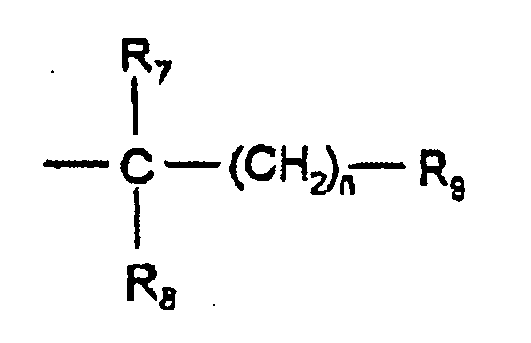
n = 0, 1 oder 2,o R7 für- ein Wasserstoffatom oder eine (C1-C4)-Alkylgruppe
steht,o R8 für- ein Wasserstoffatom
steht,o R9 für- eine -CO-NR12R13-Gruppe, wobei R12 und R13 unabhängig voneinander für ein Wasserstoffatom oder eine (C1-C4)-Alkylgruppe stehen,- ein unter am Stickstoffatom durch eine (C1-C4)-Alkylgruppe substituiertem Imidazolyl, durch eine (C1-C4)-Alkylgruppe substituiertem Tetrazolyl und Triazolyl ausgewähltes Heterocyclylsteht,
steht,
in Basen-, Säureadditionssalz-, Hydrat- oder Solvatform, in Form von Enantiomeren, Diastereoisomeren, Rotameren, Atropisomeren oder Gemischen davon. - Verfahren zur Herstellung einer Verbindung der Formel (I) nach einem der Ansprüche 1 bis 4, dadurch gekennzeichnet, daß man:- entweder die Verbindung der allgemeinen Formel (II) in Gegenwart einer Base mit der Verbindung der allgemeinen Formel (IV) alkyliert;- oder eine Mitsunobu-Reaktion zwischen einem Alkohol der Formel (X) und einer Verbindung der allgemeinen Formel (II) durchführt:

- Herstellungsverfahren nach Anspruch 5, dadurch gekennzeichnet, daß man die Verbindung der Formel (II) durch Sulfonylierung der Verbindung der Formel (III) mit Sulfonylchloriden der Formel (V) in Gegenwart einer Base erhält:
- Verwendung einer Verbindung der Formel (I) nach einem der Ansprüche 1 bis 4 zur Herstellung eines Arzneimittels zur Prophylaxe oder Behandlung von Pathologien wie Obesitas, Appetit- oder Geschmacksstörungen einschließlich Kachexie, Anorexie, Bulimie, Diabetes, metabolischen Syndromen, Erbrechen und Übelkeit, Depression und Angst, Abhängigkeiten, Gemüts- und Verhaltensstörungen, Schizophrenie, Schlafstörungen, Syndrom der unruhigen Beine, Gedächtnislernstörungen, sexuellen und psychosexuellen Dysfunktionen, Schmerzen, viszeralen und neuropathischen Schmerzen, Hyperalgesie, Allodynie, Verdauungsstörungen, Reizkolon, neuronaler Degeneration, ischämischen und hämorrhagischen Attacken, Morbus Cushing, Guillain-Barre-Syndrom, myotonischer Dystrophie, Harninkontinenz, Hyperthyreoidismus, Hypophysenfunktionsstörungen, Hypertonie oder Hypotonie.
- Arzneimittel, dadurch gekennzeichnet, daß es eine Verbindung der Formel (I) nach einem der Ansprüche 1 bis 4 enthält.
- Pharmazeutische Zusammensetzung, enthaltend mindestens eine Verbindung der Formel (I) nach einem der Ansprüche 1 bis 4 und gegebenenfalls einen oder mehrere pharmazeutisch unbedenkliche Hilfsstoffe.
Applications Claiming Priority (2)
| Application Number | Priority Date | Filing Date | Title |
|---|---|---|---|
| FR0408546A FR2874011B1 (fr) | 2004-08-03 | 2004-08-03 | Derives de sulfonamides, leur preparation et leur application en therapeutique |
| PCT/FR2005/002017 WO2006024779A1 (fr) | 2004-08-03 | 2005-08-02 | Derives de sulfonamides, leur preparation et leur application en therapeutique |
Publications (2)
| Publication Number | Publication Date |
|---|---|
| EP1776347A1 EP1776347A1 (de) | 2007-04-25 |
| EP1776347B1 true EP1776347B1 (de) | 2010-05-26 |
Family
ID=34947042
Family Applications (1)
| Application Number | Title | Priority Date | Filing Date |
|---|---|---|---|
| EP05796062A Expired - Lifetime EP1776347B1 (de) | 2004-08-03 | 2005-08-02 | Sulfonamidderivate, ihre herstellung und ihre therapeutische anwendung |
Country Status (22)
| Country | Link |
|---|---|
| US (1) | US7396958B2 (de) |
| EP (1) | EP1776347B1 (de) |
| JP (1) | JP2008509115A (de) |
| KR (1) | KR20070053726A (de) |
| CN (1) | CN101090892A (de) |
| AR (1) | AR050364A1 (de) |
| AT (1) | ATE469131T1 (de) |
| AU (1) | AU2005279088A1 (de) |
| BR (1) | BRPI0513068A (de) |
| CA (1) | CA2577220A1 (de) |
| DE (1) | DE602005021501D1 (de) |
| EA (1) | EA200700112A1 (de) |
| FR (1) | FR2874011B1 (de) |
| IL (1) | IL181069A0 (de) |
| MA (1) | MA28752B1 (de) |
| MX (1) | MX2007001437A (de) |
| NO (1) | NO20071197L (de) |
| PE (1) | PE20060689A1 (de) |
| TW (1) | TW200609204A (de) |
| UY (1) | UY29047A1 (de) |
| WO (1) | WO2006024779A1 (de) |
| ZA (1) | ZA200701482B (de) |
Families Citing this family (30)
| Publication number | Priority date | Publication date | Assignee | Title |
|---|---|---|---|---|
| KR20080016649A (ko) | 2005-06-16 | 2008-02-21 | 화이자 인코포레이티드 | N-(피리딘-2-일)-술폰아미드 유도체 |
| PL1922430T3 (pl) * | 2005-09-08 | 2019-06-28 | Erasteel Kloster Aktiebolag | Stal szybkotnąca wytwarzana w technologii metalurgii proszków |
| FR2896798A1 (fr) * | 2006-01-27 | 2007-08-03 | Sanofi Aventis Sa | Derives de sulfonamides, leur preparation et leur application en therapeutique |
| FR2896799B1 (fr) * | 2006-02-02 | 2008-03-28 | Sanofi Aventis Sa | Derives de sulfonamides, leur preparation et leur application en therapeutique |
| EA015256B1 (ru) | 2006-03-15 | 2011-06-30 | Актелион Фармасьютикалз Лтд. | Производные тетрагидроизохинолина для повышения функции памяти |
| JP2009533419A (ja) * | 2006-04-11 | 2009-09-17 | アクテリオン ファーマシューティカルズ リミテッド | 新規スルホンアミド化合物 |
| DE602007012072D1 (de) | 2006-04-26 | 2011-03-03 | Actelion Pharmaceuticals Ltd | Orantagonisten |
| JP5208963B2 (ja) | 2007-01-10 | 2013-06-12 | エフ.ホフマン−ラ ロシュ アーゲー | キマーゼ阻害剤としてのスルホンアミド誘導体 |
| DE102007007751A1 (de) * | 2007-02-16 | 2008-08-21 | Boehringer Ingelheim Pharma Gmbh & Co. Kg | Neue substituierte Arylsulfonylglycine, deren Herstellung und deren Verwendung als Arzneimittel |
| KR101366980B1 (ko) | 2007-06-01 | 2014-02-24 | 엘지디스플레이 주식회사 | 유기전계발광소자 |
| ATE511500T1 (de) | 2008-01-21 | 2011-06-15 | Hoffmann La Roche | Sulfonamide als orexin-antagonisten |
| PE20091825A1 (es) * | 2008-04-04 | 2009-12-04 | Merck & Co Inc | Hidroximetil pirrolidinas como agonistas del receptor adrenergico beta 3 |
| DE102008019838A1 (de) * | 2008-04-19 | 2009-12-10 | Boehringer Ingelheim International Gmbh | Neue Arylsulfonylglycin-Derivate, deren Herstellung und deren Verwendung als Arzneimittel |
| CN102427810A (zh) * | 2009-05-01 | 2012-04-25 | 拉夸里亚创药株式会社 | 作为trpm8拮抗剂的氨磺酰基苯甲酸衍生物 |
| ME03452B (de) | 2009-10-23 | 2020-01-20 | Janssen Pharmaceutica Nv | Disubstituierte octahy-dropyrrolo [3,4-c]pyrrole als orexinrezeptormodulatoren |
| CA2796711A1 (en) * | 2010-04-22 | 2011-10-27 | Board Of Regents, The University Of Texas System | Fluorescent nitric oxide probes and associated methods |
| CN103209960A (zh) | 2010-07-26 | 2013-07-17 | 百时美施贵宝公司 | 用作cyp17抑制剂的磺酰胺化合物 |
| MX2013002208A (es) | 2010-08-23 | 2013-05-30 | Amgen Inc | Derivados de sulfonilpiperazina que interactuan con la proteina reguladora de glucocinasa para el tratamiento de diabetes. |
| ES2584427T3 (es) | 2011-10-27 | 2016-09-27 | Merck Sharp & Dohme Corp. | Proceso para la preparación de agonistas beta 3 y productos intermedios |
| WO2013062881A1 (en) | 2011-10-27 | 2013-05-02 | Merck Sharp & Dohme Corp. | Process for making beta 3 agonists and intermediates |
| JP6383403B2 (ja) | 2013-03-15 | 2018-08-29 | メルク・シャープ・アンド・ドーム・コーポレーションMerck Sharp & Dohme Corp. | β−3作動薬および中間体の製造方法 |
| AU2015222917A1 (en) | 2014-02-27 | 2016-09-15 | Lycera Corporation | Adoptive cellular therapy using an agonist of retinoic acid receptor-related orphan receptor gamma and related therapeutic methods |
| WO2015171558A2 (en) * | 2014-05-05 | 2015-11-12 | Lycera Corporation | BENZENESULFONAMIDO AND RELATED COMPOUNDS FOR USE AS AGONISTS OF RORγ AND THE TREATEMENT OF DISEASE |
| EP3140291A4 (de) | 2014-05-05 | 2018-01-10 | Lycera Corporation | Tetrahydrochinolinsulfonamid und verwandte verbindungen zur verwendung als rory-agonisten und behandlung von krankheiten |
| WO2016179343A1 (en) | 2015-05-05 | 2016-11-10 | Lycera Corporation | DIHYDRO-2H-BENZO[b][1,4]OXAZINE SULFONAMIDE AND RELATED COMPOUNDS FOR USE AS AGONISTS OF RORy AND THE TREATMENT OF DISEASE |
| CN107980042B (zh) | 2015-06-11 | 2021-10-08 | 莱斯拉公司 | 用作RORγ激动剂和用于治疗疾病的芳基二氢-2H-苯并[b][1,4]噁嗪磺酰胺和相关化合物 |
| KR20230116948A (ko) | 2016-03-10 | 2023-08-04 | 얀센 파마슈티카 엔.브이. | 오렉신-2 수용체 길항제를 사용한 우울증의 치료 방법 |
| TW201811766A (zh) | 2016-08-29 | 2018-04-01 | 瑞士商諾華公司 | N-(吡啶-2-基)吡啶-磺醯胺衍生物及其用於疾病治療之用途 |
| KR20250099259A (ko) | 2017-06-06 | 2025-07-01 | 유로반트 사이언시즈 게엠베하 | 과민성 방광의 치료를 위한 비베그론의 용도 |
| TW202038963A (zh) | 2018-12-05 | 2020-11-01 | 瑞士商優洛凡特科學公司 | 維貝隆(vibegron)於治療患有良性前列腺增生之男性中膀胱過動症症狀之用途 |
Family Cites Families (6)
| Publication number | Priority date | Publication date | Assignee | Title |
|---|---|---|---|---|
| FR2636064B1 (fr) * | 1988-09-08 | 1990-12-07 | Fabre Sa Pierre | Thioformamidines, leur preparation et leur application en tant que medicaments |
| PL338983A1 (en) * | 1997-09-05 | 2000-12-04 | Warner Lambert Co | Some dioxides of benzothiazine as antagonists of endothelin and methods of obtaining them |
| DE60015927T2 (de) * | 1999-02-12 | 2005-04-07 | Smithkline Beecham P.L.C., Brentford | Phenylharnstoff und phenylthioharnstoffderivate |
| JP2001261649A (ja) * | 2000-03-15 | 2001-09-26 | Sankyo Co Ltd | スルホンアミド誘導体 |
| EP1296950A2 (de) * | 2000-04-20 | 2003-04-02 | NPS Allelix Corp. | Aminopiperidine zur verwendung als glyt-1-inhibitoren |
| GB0124463D0 (en) * | 2001-10-11 | 2001-12-05 | Smithkline Beecham Plc | Compounds |
-
2004
- 2004-08-03 FR FR0408546A patent/FR2874011B1/fr not_active Expired - Fee Related
-
2005
- 2005-08-01 AR ARP050103194A patent/AR050364A1/es unknown
- 2005-08-02 EP EP05796062A patent/EP1776347B1/de not_active Expired - Lifetime
- 2005-08-02 KR KR1020077004992A patent/KR20070053726A/ko not_active Withdrawn
- 2005-08-02 CN CNA2005800297106A patent/CN101090892A/zh active Pending
- 2005-08-02 PE PE2005000897A patent/PE20060689A1/es not_active Application Discontinuation
- 2005-08-02 JP JP2007524373A patent/JP2008509115A/ja active Pending
- 2005-08-02 MX MX2007001437A patent/MX2007001437A/es not_active Application Discontinuation
- 2005-08-02 BR BRPI0513068-9A patent/BRPI0513068A/pt not_active IP Right Cessation
- 2005-08-02 WO PCT/FR2005/002017 patent/WO2006024779A1/fr not_active Ceased
- 2005-08-02 AU AU2005279088A patent/AU2005279088A1/en not_active Abandoned
- 2005-08-02 ZA ZA200701482A patent/ZA200701482B/xx unknown
- 2005-08-02 AT AT05796062T patent/ATE469131T1/de not_active IP Right Cessation
- 2005-08-02 DE DE602005021501T patent/DE602005021501D1/de not_active Expired - Lifetime
- 2005-08-02 CA CA002577220A patent/CA2577220A1/fr not_active Abandoned
- 2005-08-02 UY UY29047A patent/UY29047A1/es not_active Application Discontinuation
- 2005-08-02 EA EA200700112A patent/EA200700112A1/ru unknown
- 2005-08-02 TW TW094126209A patent/TW200609204A/zh unknown
-
2007
- 2007-01-29 MA MA29636A patent/MA28752B1/fr unknown
- 2007-01-30 IL IL181069A patent/IL181069A0/en unknown
- 2007-02-02 US US11/670,586 patent/US7396958B2/en not_active Expired - Fee Related
- 2007-03-02 NO NO20071197A patent/NO20071197L/no not_active Application Discontinuation
Also Published As
| Publication number | Publication date |
|---|---|
| UY29047A1 (es) | 2006-03-31 |
| MA28752B1 (fr) | 2007-07-02 |
| JP2008509115A (ja) | 2008-03-27 |
| IL181069A0 (en) | 2007-07-04 |
| FR2874011A1 (fr) | 2006-02-10 |
| ZA200701482B (en) | 2008-10-29 |
| EP1776347A1 (de) | 2007-04-25 |
| BRPI0513068A (pt) | 2008-04-22 |
| ATE469131T1 (de) | 2010-06-15 |
| CA2577220A1 (fr) | 2006-03-09 |
| MX2007001437A (es) | 2007-04-19 |
| US20070185136A1 (en) | 2007-08-09 |
| KR20070053726A (ko) | 2007-05-25 |
| NO20071197L (no) | 2007-03-27 |
| WO2006024779A1 (fr) | 2006-03-09 |
| US7396958B2 (en) | 2008-07-08 |
| AU2005279088A1 (en) | 2006-03-09 |
| AR050364A1 (es) | 2006-10-18 |
| DE602005021501D1 (de) | 2010-07-08 |
| TW200609204A (en) | 2006-03-16 |
| CN101090892A (zh) | 2007-12-19 |
| EA200700112A1 (ru) | 2007-08-31 |
| FR2874011B1 (fr) | 2007-06-15 |
| PE20060689A1 (es) | 2006-08-10 |
Similar Documents
| Publication | Publication Date | Title |
|---|---|---|
| US7396958B2 (en) | Sulphonamide derivatives, their preparation and their therapeutic application | |
| JP5362565B2 (ja) | オピオイド受容体のアンタゴニストまたはインバースアゴニストである新規化合物 | |
| US6613942B1 (en) | Glucagon antagonists/inverse agonists | |
| TWI398249B (zh) | 神經治療用唑類化合物 | |
| EP1242083B1 (de) | Phenoxypropanolamin-derivate, ihre herstellung und therapeutische verwendung | |
| WO2007085718A1 (fr) | Derives de sulfonamides, leur preparation et leur application en tant qu'antagonistes des recepteurs de l'orexine 2 | |
| SK12892001A3 (sk) | Zlúčeniny a prostriedky ako inhibítory proteázy | |
| US7615651B2 (en) | Diaryl, dipyridinyl and aryl-pyridinyl derivatives and uses thereof | |
| TW201043603A (en) | Substituted phenylureas and phenylamides as vanilloid receptor ligands | |
| TWI355938B (en) | Amide derivatives as therapeutic agents | |
| TW201000460A (en) | Amide compound | |
| CN1298386A (zh) | 在肥胖症和其它病症的治疗中用作神经肽yy5受体配体的n-取代的氨基1,2,3,4-四氢化萘 | |
| WO2004013100A2 (fr) | Derives de n-[phenyl(piperidin-2-yl)methyl]benzamide, leur preparation et leur application en therapeutique | |
| JP2003523356A (ja) | アリール−アミジンを持つXa因子阻害剤とその誘導体、及びそれらのプロドラッグ | |
| CN102056902A (zh) | 咪唑烷衍生物 | |
| CN102304104B (zh) | 一类trpv1拮抗剂、其制备方法及其医疗用途 | |
| JP2558208B2 (ja) | インダン誘導体及び該化合物を含有するトロンボキサン拮抗剤 | |
| JP2003527395A (ja) | ヒスタミンh3受容体リガンドとしての縮環イミダゾール | |
| US8153647B2 (en) | Aryl- and heteroaryl-ethyl-acylguanidine derivatives, their preparation and their application in therapeutics | |
| CA2429267C (fr) | Cyclohexyl(alkyl)-propanolamines, leur preparation et compositions pharmaceutiques en contenant | |
| HK1115870A (en) | Sulphonamide derivatives, their preparation and their therapeutic application | |
| JP2005513124A (ja) | 新規なアミジン誘導体および製剤におけるそれらの使用 | |
| JP2002302439A (ja) | シクロブテン誘導体を含有する回腸型胆汁酸トランスポーター阻害剤 | |
| JPH05262736A (ja) | フェノキシ酢酸誘導体 | |
| FR2654100A1 (fr) | Arylalkylenediamines, procede pour leur preparation et compositions pharmaceutiques les contenant. |
Legal Events
| Date | Code | Title | Description |
|---|---|---|---|
| PUAI | Public reference made under article 153(3) epc to a published international application that has entered the european phase |
Free format text: ORIGINAL CODE: 0009012 |
|
| 17P | Request for examination filed |
Effective date: 20070305 |
|
| AK | Designated contracting states |
Kind code of ref document: A1 Designated state(s): AT BE BG CH CY CZ DE DK EE ES FI FR GB GR HU IE IS IT LI LT LU LV MC NL PL PT RO SE SI SK TR |
|
| AX | Request for extension of the european patent |
Extension state: AL BA HR MK YU |
|
| 17Q | First examination report despatched |
Effective date: 20070608 |
|
| GRAP | Despatch of communication of intention to grant a patent |
Free format text: ORIGINAL CODE: EPIDOSNIGR1 |
|
| GRAS | Grant fee paid |
Free format text: ORIGINAL CODE: EPIDOSNIGR3 |
|
| GRAA | (expected) grant |
Free format text: ORIGINAL CODE: 0009210 |
|
| AK | Designated contracting states |
Kind code of ref document: B1 Designated state(s): AT BE BG CH CY CZ DE DK EE ES FI FR GB GR HU IE IS IT LI LT LU LV MC NL PL PT RO SE SI SK TR |
|
| AX | Request for extension of the european patent |
Extension state: AL BA HR MK YU |
|
| REG | Reference to a national code |
Ref country code: GB Ref legal event code: FG4D Free format text: NOT ENGLISH |
|
| REG | Reference to a national code |
Ref country code: CH Ref legal event code: EP |
|
| REG | Reference to a national code |
Ref country code: IE Ref legal event code: FG4D Free format text: LANGUAGE OF EP DOCUMENT: FRENCH |
|
| REF | Corresponds to: |
Ref document number: 602005021501 Country of ref document: DE Date of ref document: 20100708 Kind code of ref document: P |
|
| REG | Reference to a national code |
Ref country code: NL Ref legal event code: VDEP Effective date: 20100526 |
|
| LTIE | Lt: invalidation of european patent or patent extension |
Effective date: 20100526 |
|
| PG25 | Lapsed in a contracting state [announced via postgrant information from national office to epo] |
Ref country code: LT Free format text: LAPSE BECAUSE OF FAILURE TO SUBMIT A TRANSLATION OF THE DESCRIPTION OR TO PAY THE FEE WITHIN THE PRESCRIBED TIME-LIMIT Effective date: 20100526 Ref country code: SE Free format text: LAPSE BECAUSE OF FAILURE TO SUBMIT A TRANSLATION OF THE DESCRIPTION OR TO PAY THE FEE WITHIN THE PRESCRIBED TIME-LIMIT Effective date: 20100526 |
|
| PG25 | Lapsed in a contracting state [announced via postgrant information from national office to epo] |
Ref country code: AT Free format text: LAPSE BECAUSE OF FAILURE TO SUBMIT A TRANSLATION OF THE DESCRIPTION OR TO PAY THE FEE WITHIN THE PRESCRIBED TIME-LIMIT Effective date: 20100526 Ref country code: SI Free format text: LAPSE BECAUSE OF FAILURE TO SUBMIT A TRANSLATION OF THE DESCRIPTION OR TO PAY THE FEE WITHIN THE PRESCRIBED TIME-LIMIT Effective date: 20100526 Ref country code: LV Free format text: LAPSE BECAUSE OF FAILURE TO SUBMIT A TRANSLATION OF THE DESCRIPTION OR TO PAY THE FEE WITHIN THE PRESCRIBED TIME-LIMIT Effective date: 20100526 Ref country code: IS Free format text: LAPSE BECAUSE OF FAILURE TO SUBMIT A TRANSLATION OF THE DESCRIPTION OR TO PAY THE FEE WITHIN THE PRESCRIBED TIME-LIMIT Effective date: 20100926 Ref country code: FI Free format text: LAPSE BECAUSE OF FAILURE TO SUBMIT A TRANSLATION OF THE DESCRIPTION OR TO PAY THE FEE WITHIN THE PRESCRIBED TIME-LIMIT Effective date: 20100526 |
|
| PG25 | Lapsed in a contracting state [announced via postgrant information from national office to epo] |
Ref country code: PL Free format text: LAPSE BECAUSE OF FAILURE TO SUBMIT A TRANSLATION OF THE DESCRIPTION OR TO PAY THE FEE WITHIN THE PRESCRIBED TIME-LIMIT Effective date: 20100526 Ref country code: GR Free format text: LAPSE BECAUSE OF FAILURE TO SUBMIT A TRANSLATION OF THE DESCRIPTION OR TO PAY THE FEE WITHIN THE PRESCRIBED TIME-LIMIT Effective date: 20100827 Ref country code: CY Free format text: LAPSE BECAUSE OF FAILURE TO SUBMIT A TRANSLATION OF THE DESCRIPTION OR TO PAY THE FEE WITHIN THE PRESCRIBED TIME-LIMIT Effective date: 20100526 |
|
| REG | Reference to a national code |
Ref country code: IE Ref legal event code: FD4D |
|
| PG25 | Lapsed in a contracting state [announced via postgrant information from national office to epo] |
Ref country code: NL Free format text: LAPSE BECAUSE OF FAILURE TO SUBMIT A TRANSLATION OF THE DESCRIPTION OR TO PAY THE FEE WITHIN THE PRESCRIBED TIME-LIMIT Effective date: 20100526 Ref country code: PT Free format text: LAPSE BECAUSE OF FAILURE TO SUBMIT A TRANSLATION OF THE DESCRIPTION OR TO PAY THE FEE WITHIN THE PRESCRIBED TIME-LIMIT Effective date: 20100927 Ref country code: DK Free format text: LAPSE BECAUSE OF FAILURE TO SUBMIT A TRANSLATION OF THE DESCRIPTION OR TO PAY THE FEE WITHIN THE PRESCRIBED TIME-LIMIT Effective date: 20100526 Ref country code: EE Free format text: LAPSE BECAUSE OF FAILURE TO SUBMIT A TRANSLATION OF THE DESCRIPTION OR TO PAY THE FEE WITHIN THE PRESCRIBED TIME-LIMIT Effective date: 20100526 Ref country code: IE Free format text: LAPSE BECAUSE OF FAILURE TO SUBMIT A TRANSLATION OF THE DESCRIPTION OR TO PAY THE FEE WITHIN THE PRESCRIBED TIME-LIMIT Effective date: 20100526 |
|
| BERE | Be: lapsed |
Owner name: SANOFI-AVENTIS Effective date: 20100831 |
|
| PG25 | Lapsed in a contracting state [announced via postgrant information from national office to epo] |
Ref country code: SK Free format text: LAPSE BECAUSE OF FAILURE TO SUBMIT A TRANSLATION OF THE DESCRIPTION OR TO PAY THE FEE WITHIN THE PRESCRIBED TIME-LIMIT Effective date: 20100526 Ref country code: RO Free format text: LAPSE BECAUSE OF FAILURE TO SUBMIT A TRANSLATION OF THE DESCRIPTION OR TO PAY THE FEE WITHIN THE PRESCRIBED TIME-LIMIT Effective date: 20100526 Ref country code: CZ Free format text: LAPSE BECAUSE OF FAILURE TO SUBMIT A TRANSLATION OF THE DESCRIPTION OR TO PAY THE FEE WITHIN THE PRESCRIBED TIME-LIMIT Effective date: 20100526 |
|
| PG25 | Lapsed in a contracting state [announced via postgrant information from national office to epo] |
Ref country code: IT Free format text: LAPSE BECAUSE OF FAILURE TO SUBMIT A TRANSLATION OF THE DESCRIPTION OR TO PAY THE FEE WITHIN THE PRESCRIBED TIME-LIMIT Effective date: 20100526 Ref country code: MC Free format text: LAPSE BECAUSE OF NON-PAYMENT OF DUE FEES Effective date: 20100831 |
|
| REG | Reference to a national code |
Ref country code: CH Ref legal event code: PL |
|
| PLBE | No opposition filed within time limit |
Free format text: ORIGINAL CODE: 0009261 |
|
| STAA | Information on the status of an ep patent application or granted ep patent |
Free format text: STATUS: NO OPPOSITION FILED WITHIN TIME LIMIT |
|
| PG25 | Lapsed in a contracting state [announced via postgrant information from national office to epo] |
Ref country code: CH Free format text: LAPSE BECAUSE OF NON-PAYMENT OF DUE FEES Effective date: 20100831 Ref country code: LI Free format text: LAPSE BECAUSE OF NON-PAYMENT OF DUE FEES Effective date: 20100831 |
|
| 26N | No opposition filed |
Effective date: 20110301 |
|
| REG | Reference to a national code |
Ref country code: DE Ref legal event code: R097 Ref document number: 602005021501 Country of ref document: DE Effective date: 20110228 |
|
| PG25 | Lapsed in a contracting state [announced via postgrant information from national office to epo] |
Ref country code: BE Free format text: LAPSE BECAUSE OF NON-PAYMENT OF DUE FEES Effective date: 20100831 |
|
| PGFP | Annual fee paid to national office [announced via postgrant information from national office to epo] |
Ref country code: GB Payment date: 20110727 Year of fee payment: 7 Ref country code: FR Payment date: 20110818 Year of fee payment: 7 Ref country code: DE Payment date: 20110727 Year of fee payment: 7 |
|
| PG25 | Lapsed in a contracting state [announced via postgrant information from national office to epo] |
Ref country code: BG Free format text: LAPSE BECAUSE OF FAILURE TO SUBMIT A TRANSLATION OF THE DESCRIPTION OR TO PAY THE FEE WITHIN THE PRESCRIBED TIME-LIMIT Effective date: 20100526 Ref country code: LU Free format text: LAPSE BECAUSE OF NON-PAYMENT OF DUE FEES Effective date: 20100802 Ref country code: HU Free format text: LAPSE BECAUSE OF FAILURE TO SUBMIT A TRANSLATION OF THE DESCRIPTION OR TO PAY THE FEE WITHIN THE PRESCRIBED TIME-LIMIT Effective date: 20101127 |
|
| PG25 | Lapsed in a contracting state [announced via postgrant information from national office to epo] |
Ref country code: TR Free format text: LAPSE BECAUSE OF FAILURE TO SUBMIT A TRANSLATION OF THE DESCRIPTION OR TO PAY THE FEE WITHIN THE PRESCRIBED TIME-LIMIT Effective date: 20100526 |
|
| REG | Reference to a national code |
Ref country code: DE Ref legal event code: R081 Ref document number: 602005021501 Country of ref document: DE Owner name: SANOFI, FR Free format text: FORMER OWNER: SANOFI-AVENTIS, PARIS, FR Effective date: 20130205 Ref country code: DE Ref legal event code: R081 Ref document number: 602005021501 Country of ref document: DE Owner name: SANOFI-AVENTIS, FR Free format text: FORMER OWNER: SANOFI-AVENTIS, PARIS, FR Effective date: 20130205 |
|
| GBPC | Gb: european patent ceased through non-payment of renewal fee |
Effective date: 20120802 |
|
| REG | Reference to a national code |
Ref country code: FR Ref legal event code: ST Effective date: 20130430 |
|
| PG25 | Lapsed in a contracting state [announced via postgrant information from national office to epo] |
Ref country code: GB Free format text: LAPSE BECAUSE OF NON-PAYMENT OF DUE FEES Effective date: 20120802 Ref country code: DE Free format text: LAPSE BECAUSE OF NON-PAYMENT OF DUE FEES Effective date: 20130301 |
|
| PG25 | Lapsed in a contracting state [announced via postgrant information from national office to epo] |
Ref country code: FR Free format text: LAPSE BECAUSE OF NON-PAYMENT OF DUE FEES Effective date: 20120831 |
|
| REG | Reference to a national code |
Ref country code: DE Ref legal event code: R119 Ref document number: 602005021501 Country of ref document: DE Effective date: 20130301 |
|
| PG25 | Lapsed in a contracting state [announced via postgrant information from national office to epo] |
Ref country code: BG Free format text: LAPSE BECAUSE OF FAILURE TO SUBMIT A TRANSLATION OF THE DESCRIPTION OR TO PAY THE FEE WITHIN THE PRESCRIBED TIME-LIMIT Effective date: 20100826 |
|
| PG25 | Lapsed in a contracting state [announced via postgrant information from national office to epo] |
Ref country code: ES Free format text: LAPSE BECAUSE OF FAILURE TO SUBMIT A TRANSLATION OF THE DESCRIPTION OR TO PAY THE FEE WITHIN THE PRESCRIBED TIME-LIMIT Effective date: 20100906 |