EP1776347B1 - Derives de sulfonamides, leur preparation et leur application en therapeutique - Google Patents
Derives de sulfonamides, leur preparation et leur application en therapeutique Download PDFInfo
- Publication number
- EP1776347B1 EP1776347B1 EP05796062A EP05796062A EP1776347B1 EP 1776347 B1 EP1776347 B1 EP 1776347B1 EP 05796062 A EP05796062 A EP 05796062A EP 05796062 A EP05796062 A EP 05796062A EP 1776347 B1 EP1776347 B1 EP 1776347B1
- Authority
- EP
- European Patent Office
- Prior art keywords
- group
- phenyl
- alkyl group
- compound
- chloro
- Prior art date
- Legal status (The legal status is an assumption and is not a legal conclusion. Google has not performed a legal analysis and makes no representation as to the accuracy of the status listed.)
- Expired - Lifetime
Links
- 0 Cc1cc(S(N(CC(N*)=O)c(cc2)c(Cc3ccccc3Cl)cc2Cl)(=O)=O)cc(*)c1 Chemical compound Cc1cc(S(N(CC(N*)=O)c(cc2)c(Cc3ccccc3Cl)cc2Cl)(=O)=O)cc(*)c1 0.000 description 17
- ZXPUFQAQUGTEOH-UHFFFAOYSA-N CC1(CC[n]2nnc(CN(c(cc3)c(Cc4ccccc4Cl)cc3Cl)S(c3cc(C)cc(C)c3)(=O)=O)n2)CC1 Chemical compound CC1(CC[n]2nnc(CN(c(cc3)c(Cc4ccccc4Cl)cc3Cl)S(c3cc(C)cc(C)c3)(=O)=O)n2)CC1 ZXPUFQAQUGTEOH-UHFFFAOYSA-N 0.000 description 1
- LPPMKJQWCAPWJN-UHFFFAOYSA-N CCOc1cc(S(N(CC(N)=O)c2c(Cc(c(F)ccc3)c3[I]=C)cc(C)cc2)(=O)=O)ccc1OCl Chemical compound CCOc1cc(S(N(CC(N)=O)c2c(Cc(c(F)ccc3)c3[I]=C)cc(C)cc2)(=O)=O)ccc1OCl LPPMKJQWCAPWJN-UHFFFAOYSA-N 0.000 description 1
- XIPACSPXVBOSQG-UHFFFAOYSA-N CN(c(cc1)c(Cc(c(F)ccc2)c2F)cc1Cl)[SH-](c(cc1O[ClH]I)ccc1O[ClH]I)=O Chemical compound CN(c(cc1)c(Cc(c(F)ccc2)c2F)cc1Cl)[SH-](c(cc1O[ClH]I)ccc1O[ClH]I)=O XIPACSPXVBOSQG-UHFFFAOYSA-N 0.000 description 1
- OZVRQYVERKHEKE-UHFFFAOYSA-N CN(c1ccccc1)c(cc(cc1)Cl)c1N(CC(N)=O)S(c(cc1OC)ccc1OC)=O Chemical compound CN(c1ccccc1)c(cc(cc1)Cl)c1N(CC(N)=O)S(c(cc1OC)ccc1OC)=O OZVRQYVERKHEKE-UHFFFAOYSA-N 0.000 description 1
- PNFGKALZKFTQMJ-UHFFFAOYSA-N C[ClH]Oc1cc(S(N(CC(N)=O)c(cc2)c(C(c3cccc(F)c3F)O)cc2Cl)(=O)=O)ccc1O[IH2] Chemical compound C[ClH]Oc1cc(S(N(CC(N)=O)c(cc2)c(C(c3cccc(F)c3F)O)cc2Cl)(=O)=O)ccc1O[IH2] PNFGKALZKFTQMJ-UHFFFAOYSA-N 0.000 description 1
- OOQCIQREHLIUFB-UHFFFAOYSA-N C[N]=1(C)=CC=C2OC(C[N]=3(C)=CC=C4OCOC4=CC=3)COC2=CC=1 Chemical compound C[N]=1(C)=CC=C2OC(C[N]=3(C)=CC=C4OCOC4=CC=3)COC2=CC=1 OOQCIQREHLIUFB-UHFFFAOYSA-N 0.000 description 1
- NJZHRFYQOLKWMM-UHFFFAOYSA-N Cc1cc(S(N(CC(N)=O)c(cc2)c(C(c3ccccc3Cl)O)cc2Cl)(=O)=O)cc(C)c1 Chemical compound Cc1cc(S(N(CC(N)=O)c(cc2)c(C(c3ccccc3Cl)O)cc2Cl)(=O)=O)cc(C)c1 NJZHRFYQOLKWMM-UHFFFAOYSA-N 0.000 description 1
- MFHOXYIXIGEFTK-UHFFFAOYSA-N NC(CN(c(cc1)c(Cc(c(F)c2)ccc2Cl)cc1Cl)S(c(cc1O)ccc1O[Cl]=[IH])(=O)=O)=O Chemical compound NC(CN(c(cc1)c(Cc(c(F)c2)ccc2Cl)cc1Cl)S(c(cc1O)ccc1O[Cl]=[IH])(=O)=O)=O MFHOXYIXIGEFTK-UHFFFAOYSA-N 0.000 description 1
Classifications
-
- C—CHEMISTRY; METALLURGY
- C07—ORGANIC CHEMISTRY
- C07D—HETEROCYCLIC COMPOUNDS
- C07D213/00—Heterocyclic compounds containing six-membered rings, not condensed with other rings, with one nitrogen atom as the only ring hetero atom and three or more double bonds between ring members or between ring members and non-ring members
- C07D213/02—Heterocyclic compounds containing six-membered rings, not condensed with other rings, with one nitrogen atom as the only ring hetero atom and three or more double bonds between ring members or between ring members and non-ring members having three double bonds between ring members or between ring members and non-ring members
- C07D213/04—Heterocyclic compounds containing six-membered rings, not condensed with other rings, with one nitrogen atom as the only ring hetero atom and three or more double bonds between ring members or between ring members and non-ring members having three double bonds between ring members or between ring members and non-ring members having no bond between the ring nitrogen atom and a non-ring member or having only hydrogen or carbon atoms directly attached to the ring nitrogen atom
- C07D213/24—Heterocyclic compounds containing six-membered rings, not condensed with other rings, with one nitrogen atom as the only ring hetero atom and three or more double bonds between ring members or between ring members and non-ring members having three double bonds between ring members or between ring members and non-ring members having no bond between the ring nitrogen atom and a non-ring member or having only hydrogen or carbon atoms directly attached to the ring nitrogen atom with substituted hydrocarbon radicals attached to ring carbon atoms
- C07D213/36—Radicals substituted by singly-bound nitrogen atoms
- C07D213/42—Radicals substituted by singly-bound nitrogen atoms having hetero atoms attached to the substituent nitrogen atom
-
- A—HUMAN NECESSITIES
- A61—MEDICAL OR VETERINARY SCIENCE; HYGIENE
- A61P—SPECIFIC THERAPEUTIC ACTIVITY OF CHEMICAL COMPOUNDS OR MEDICINAL PREPARATIONS
- A61P1/00—Drugs for disorders of the alimentary tract or the digestive system
-
- A—HUMAN NECESSITIES
- A61—MEDICAL OR VETERINARY SCIENCE; HYGIENE
- A61P—SPECIFIC THERAPEUTIC ACTIVITY OF CHEMICAL COMPOUNDS OR MEDICINAL PREPARATIONS
- A61P1/00—Drugs for disorders of the alimentary tract or the digestive system
- A61P1/04—Drugs for disorders of the alimentary tract or the digestive system for ulcers, gastritis or reflux esophagitis, e.g. antacids, inhibitors of acid secretion, mucosal protectants
-
- A—HUMAN NECESSITIES
- A61—MEDICAL OR VETERINARY SCIENCE; HYGIENE
- A61P—SPECIFIC THERAPEUTIC ACTIVITY OF CHEMICAL COMPOUNDS OR MEDICINAL PREPARATIONS
- A61P1/00—Drugs for disorders of the alimentary tract or the digestive system
- A61P1/08—Drugs for disorders of the alimentary tract or the digestive system for nausea, cinetosis or vertigo; Antiemetics
-
- A—HUMAN NECESSITIES
- A61—MEDICAL OR VETERINARY SCIENCE; HYGIENE
- A61P—SPECIFIC THERAPEUTIC ACTIVITY OF CHEMICAL COMPOUNDS OR MEDICINAL PREPARATIONS
- A61P1/00—Drugs for disorders of the alimentary tract or the digestive system
- A61P1/14—Prodigestives, e.g. acids, enzymes, appetite stimulants, antidyspeptics, tonics, antiflatulents
-
- A—HUMAN NECESSITIES
- A61—MEDICAL OR VETERINARY SCIENCE; HYGIENE
- A61P—SPECIFIC THERAPEUTIC ACTIVITY OF CHEMICAL COMPOUNDS OR MEDICINAL PREPARATIONS
- A61P13/00—Drugs for disorders of the urinary system
- A61P13/02—Drugs for disorders of the urinary system of urine or of the urinary tract, e.g. urine acidifiers
-
- A—HUMAN NECESSITIES
- A61—MEDICAL OR VETERINARY SCIENCE; HYGIENE
- A61P—SPECIFIC THERAPEUTIC ACTIVITY OF CHEMICAL COMPOUNDS OR MEDICINAL PREPARATIONS
- A61P15/00—Drugs for genital or sexual disorders; Contraceptives
- A61P15/08—Drugs for genital or sexual disorders; Contraceptives for gonadal disorders or for enhancing fertility, e.g. inducers of ovulation or of spermatogenesis
-
- A—HUMAN NECESSITIES
- A61—MEDICAL OR VETERINARY SCIENCE; HYGIENE
- A61P—SPECIFIC THERAPEUTIC ACTIVITY OF CHEMICAL COMPOUNDS OR MEDICINAL PREPARATIONS
- A61P21/00—Drugs for disorders of the muscular or neuromuscular system
- A61P21/04—Drugs for disorders of the muscular or neuromuscular system for myasthenia gravis
-
- A—HUMAN NECESSITIES
- A61—MEDICAL OR VETERINARY SCIENCE; HYGIENE
- A61P—SPECIFIC THERAPEUTIC ACTIVITY OF CHEMICAL COMPOUNDS OR MEDICINAL PREPARATIONS
- A61P25/00—Drugs for disorders of the nervous system
-
- A—HUMAN NECESSITIES
- A61—MEDICAL OR VETERINARY SCIENCE; HYGIENE
- A61P—SPECIFIC THERAPEUTIC ACTIVITY OF CHEMICAL COMPOUNDS OR MEDICINAL PREPARATIONS
- A61P25/00—Drugs for disorders of the nervous system
- A61P25/02—Drugs for disorders of the nervous system for peripheral neuropathies
-
- A—HUMAN NECESSITIES
- A61—MEDICAL OR VETERINARY SCIENCE; HYGIENE
- A61P—SPECIFIC THERAPEUTIC ACTIVITY OF CHEMICAL COMPOUNDS OR MEDICINAL PREPARATIONS
- A61P25/00—Drugs for disorders of the nervous system
- A61P25/18—Antipsychotics, i.e. neuroleptics; Drugs for mania or schizophrenia
-
- A—HUMAN NECESSITIES
- A61—MEDICAL OR VETERINARY SCIENCE; HYGIENE
- A61P—SPECIFIC THERAPEUTIC ACTIVITY OF CHEMICAL COMPOUNDS OR MEDICINAL PREPARATIONS
- A61P25/00—Drugs for disorders of the nervous system
- A61P25/22—Anxiolytics
-
- A—HUMAN NECESSITIES
- A61—MEDICAL OR VETERINARY SCIENCE; HYGIENE
- A61P—SPECIFIC THERAPEUTIC ACTIVITY OF CHEMICAL COMPOUNDS OR MEDICINAL PREPARATIONS
- A61P25/00—Drugs for disorders of the nervous system
- A61P25/24—Antidepressants
-
- A—HUMAN NECESSITIES
- A61—MEDICAL OR VETERINARY SCIENCE; HYGIENE
- A61P—SPECIFIC THERAPEUTIC ACTIVITY OF CHEMICAL COMPOUNDS OR MEDICINAL PREPARATIONS
- A61P25/00—Drugs for disorders of the nervous system
- A61P25/28—Drugs for disorders of the nervous system for treating neurodegenerative disorders of the central nervous system, e.g. nootropic agents, cognition enhancers, drugs for treating Alzheimer's disease or other forms of dementia
-
- A—HUMAN NECESSITIES
- A61—MEDICAL OR VETERINARY SCIENCE; HYGIENE
- A61P—SPECIFIC THERAPEUTIC ACTIVITY OF CHEMICAL COMPOUNDS OR MEDICINAL PREPARATIONS
- A61P25/00—Drugs for disorders of the nervous system
- A61P25/30—Drugs for disorders of the nervous system for treating abuse or dependence
-
- A—HUMAN NECESSITIES
- A61—MEDICAL OR VETERINARY SCIENCE; HYGIENE
- A61P—SPECIFIC THERAPEUTIC ACTIVITY OF CHEMICAL COMPOUNDS OR MEDICINAL PREPARATIONS
- A61P29/00—Non-central analgesic, antipyretic or antiinflammatory agents, e.g. antirheumatic agents; Non-steroidal antiinflammatory drugs [NSAID]
-
- A—HUMAN NECESSITIES
- A61—MEDICAL OR VETERINARY SCIENCE; HYGIENE
- A61P—SPECIFIC THERAPEUTIC ACTIVITY OF CHEMICAL COMPOUNDS OR MEDICINAL PREPARATIONS
- A61P3/00—Drugs for disorders of the metabolism
- A61P3/04—Anorexiants; Antiobesity agents
-
- A—HUMAN NECESSITIES
- A61—MEDICAL OR VETERINARY SCIENCE; HYGIENE
- A61P—SPECIFIC THERAPEUTIC ACTIVITY OF CHEMICAL COMPOUNDS OR MEDICINAL PREPARATIONS
- A61P3/00—Drugs for disorders of the metabolism
- A61P3/06—Antihyperlipidemics
-
- A—HUMAN NECESSITIES
- A61—MEDICAL OR VETERINARY SCIENCE; HYGIENE
- A61P—SPECIFIC THERAPEUTIC ACTIVITY OF CHEMICAL COMPOUNDS OR MEDICINAL PREPARATIONS
- A61P3/00—Drugs for disorders of the metabolism
- A61P3/08—Drugs for disorders of the metabolism for glucose homeostasis
- A61P3/10—Drugs for disorders of the metabolism for glucose homeostasis for hyperglycaemia, e.g. antidiabetics
-
- A—HUMAN NECESSITIES
- A61—MEDICAL OR VETERINARY SCIENCE; HYGIENE
- A61P—SPECIFIC THERAPEUTIC ACTIVITY OF CHEMICAL COMPOUNDS OR MEDICINAL PREPARATIONS
- A61P35/00—Antineoplastic agents
-
- A—HUMAN NECESSITIES
- A61—MEDICAL OR VETERINARY SCIENCE; HYGIENE
- A61P—SPECIFIC THERAPEUTIC ACTIVITY OF CHEMICAL COMPOUNDS OR MEDICINAL PREPARATIONS
- A61P43/00—Drugs for specific purposes, not provided for in groups A61P1/00-A61P41/00
-
- A—HUMAN NECESSITIES
- A61—MEDICAL OR VETERINARY SCIENCE; HYGIENE
- A61P—SPECIFIC THERAPEUTIC ACTIVITY OF CHEMICAL COMPOUNDS OR MEDICINAL PREPARATIONS
- A61P5/00—Drugs for disorders of the endocrine system
- A61P5/06—Drugs for disorders of the endocrine system of the anterior pituitary hormones, e.g. TSH, ACTH, FSH, LH, PRL, GH
- A61P5/08—Drugs for disorders of the endocrine system of the anterior pituitary hormones, e.g. TSH, ACTH, FSH, LH, PRL, GH for decreasing, blocking or antagonising the activity of the anterior pituitary hormones
-
- A—HUMAN NECESSITIES
- A61—MEDICAL OR VETERINARY SCIENCE; HYGIENE
- A61P—SPECIFIC THERAPEUTIC ACTIVITY OF CHEMICAL COMPOUNDS OR MEDICINAL PREPARATIONS
- A61P5/00—Drugs for disorders of the endocrine system
- A61P5/14—Drugs for disorders of the endocrine system of the thyroid hormones, e.g. T3, T4
-
- A—HUMAN NECESSITIES
- A61—MEDICAL OR VETERINARY SCIENCE; HYGIENE
- A61P—SPECIFIC THERAPEUTIC ACTIVITY OF CHEMICAL COMPOUNDS OR MEDICINAL PREPARATIONS
- A61P9/00—Drugs for disorders of the cardiovascular system
-
- A—HUMAN NECESSITIES
- A61—MEDICAL OR VETERINARY SCIENCE; HYGIENE
- A61P—SPECIFIC THERAPEUTIC ACTIVITY OF CHEMICAL COMPOUNDS OR MEDICINAL PREPARATIONS
- A61P9/00—Drugs for disorders of the cardiovascular system
- A61P9/10—Drugs for disorders of the cardiovascular system for treating ischaemic or atherosclerotic diseases, e.g. antianginal drugs, coronary vasodilators, drugs for myocardial infarction, retinopathy, cerebrovascula insufficiency, renal arteriosclerosis
-
- A—HUMAN NECESSITIES
- A61—MEDICAL OR VETERINARY SCIENCE; HYGIENE
- A61P—SPECIFIC THERAPEUTIC ACTIVITY OF CHEMICAL COMPOUNDS OR MEDICINAL PREPARATIONS
- A61P9/00—Drugs for disorders of the cardiovascular system
- A61P9/12—Antihypertensives
-
- C—CHEMISTRY; METALLURGY
- C07—ORGANIC CHEMISTRY
- C07C—ACYCLIC OR CARBOCYCLIC COMPOUNDS
- C07C311/00—Amides of sulfonic acids, i.e. compounds having singly-bound oxygen atoms of sulfo groups replaced by nitrogen atoms, not being part of nitro or nitroso groups
- C07C311/15—Sulfonamides having sulfur atoms of sulfonamide groups bound to carbon atoms of six-membered aromatic rings
- C07C311/21—Sulfonamides having sulfur atoms of sulfonamide groups bound to carbon atoms of six-membered aromatic rings having the nitrogen atom of at least one of the sulfonamide groups bound to a carbon atom of a six-membered aromatic ring
-
- C—CHEMISTRY; METALLURGY
- C07—ORGANIC CHEMISTRY
- C07C—ACYCLIC OR CARBOCYCLIC COMPOUNDS
- C07C311/00—Amides of sulfonic acids, i.e. compounds having singly-bound oxygen atoms of sulfo groups replaced by nitrogen atoms, not being part of nitro or nitroso groups
- C07C311/22—Sulfonamides, the carbon skeleton of the acid part being further substituted by singly-bound oxygen atoms
- C07C311/29—Sulfonamides, the carbon skeleton of the acid part being further substituted by singly-bound oxygen atoms having the sulfur atom of at least one of the sulfonamide groups bound to a carbon atom of a six-membered aromatic ring
-
- C—CHEMISTRY; METALLURGY
- C07—ORGANIC CHEMISTRY
- C07C—ACYCLIC OR CARBOCYCLIC COMPOUNDS
- C07C311/00—Amides of sulfonic acids, i.e. compounds having singly-bound oxygen atoms of sulfo groups replaced by nitrogen atoms, not being part of nitro or nitroso groups
- C07C311/30—Sulfonamides, the carbon skeleton of the acid part being further substituted by singly-bound nitrogen atoms, not being part of nitro or nitroso groups
- C07C311/37—Sulfonamides, the carbon skeleton of the acid part being further substituted by singly-bound nitrogen atoms, not being part of nitro or nitroso groups having the sulfur atom of at least one of the sulfonamide groups bound to a carbon atom of a six-membered aromatic ring
- C07C311/38—Sulfonamides, the carbon skeleton of the acid part being further substituted by singly-bound nitrogen atoms, not being part of nitro or nitroso groups having the sulfur atom of at least one of the sulfonamide groups bound to a carbon atom of a six-membered aromatic ring having sulfur atoms of sulfonamide groups and amino groups bound to carbon atoms of six-membered rings of the same carbon skeleton
- C07C311/44—Sulfonamides, the carbon skeleton of the acid part being further substituted by singly-bound nitrogen atoms, not being part of nitro or nitroso groups having the sulfur atom of at least one of the sulfonamide groups bound to a carbon atom of a six-membered aromatic ring having sulfur atoms of sulfonamide groups and amino groups bound to carbon atoms of six-membered rings of the same carbon skeleton having the nitrogen atom of at least one of the sulfonamide groups bound to a carbon atom of a six-membered aromatic ring
-
- C—CHEMISTRY; METALLURGY
- C07—ORGANIC CHEMISTRY
- C07D—HETEROCYCLIC COMPOUNDS
- C07D217/00—Heterocyclic compounds containing isoquinoline or hydrogenated isoquinoline ring systems
- C07D217/02—Heterocyclic compounds containing isoquinoline or hydrogenated isoquinoline ring systems with only hydrogen atoms or radicals containing only carbon and hydrogen atoms, directly attached to carbon atoms of the nitrogen-containing ring; Alkylene-bis-isoquinolines
- C07D217/06—Heterocyclic compounds containing isoquinoline or hydrogenated isoquinoline ring systems with only hydrogen atoms or radicals containing only carbon and hydrogen atoms, directly attached to carbon atoms of the nitrogen-containing ring; Alkylene-bis-isoquinolines with the ring nitrogen atom acylated by carboxylic or carbonic acids, or with sulfur or nitrogen analogues thereof, e.g. carbamates
-
- C—CHEMISTRY; METALLURGY
- C07—ORGANIC CHEMISTRY
- C07D—HETEROCYCLIC COMPOUNDS
- C07D233/00—Heterocyclic compounds containing 1,3-diazole or hydrogenated 1,3-diazole rings, not condensed with other rings
- C07D233/54—Heterocyclic compounds containing 1,3-diazole or hydrogenated 1,3-diazole rings, not condensed with other rings having two double bonds between ring members or between ring members and non-ring members
- C07D233/64—Heterocyclic compounds containing 1,3-diazole or hydrogenated 1,3-diazole rings, not condensed with other rings having two double bonds between ring members or between ring members and non-ring members with substituted hydrocarbon radicals attached to ring carbon atoms, e.g. histidine
-
- C—CHEMISTRY; METALLURGY
- C07—ORGANIC CHEMISTRY
- C07D—HETEROCYCLIC COMPOUNDS
- C07D233/00—Heterocyclic compounds containing 1,3-diazole or hydrogenated 1,3-diazole rings, not condensed with other rings
- C07D233/54—Heterocyclic compounds containing 1,3-diazole or hydrogenated 1,3-diazole rings, not condensed with other rings having two double bonds between ring members or between ring members and non-ring members
- C07D233/66—Heterocyclic compounds containing 1,3-diazole or hydrogenated 1,3-diazole rings, not condensed with other rings having two double bonds between ring members or between ring members and non-ring members with hetero atoms or with carbon atoms having three bonds to hetero atoms with at the most one bond to halogen, e.g. ester or nitrile radicals, directly attached to ring carbon atoms
-
- C—CHEMISTRY; METALLURGY
- C07—ORGANIC CHEMISTRY
- C07D—HETEROCYCLIC COMPOUNDS
- C07D257/00—Heterocyclic compounds containing rings having four nitrogen atoms as the only ring hetero atoms
- C07D257/02—Heterocyclic compounds containing rings having four nitrogen atoms as the only ring hetero atoms not condensed with other rings
- C07D257/04—Five-membered rings
-
- C—CHEMISTRY; METALLURGY
- C07—ORGANIC CHEMISTRY
- C07D—HETEROCYCLIC COMPOUNDS
- C07D271/00—Heterocyclic compounds containing five-membered rings having two nitrogen atoms and one oxygen atom as the only ring hetero atoms
- C07D271/02—Heterocyclic compounds containing five-membered rings having two nitrogen atoms and one oxygen atom as the only ring hetero atoms not condensed with other rings
- C07D271/06—1,2,4-Oxadiazoles; Hydrogenated 1,2,4-oxadiazoles
-
- C—CHEMISTRY; METALLURGY
- C07—ORGANIC CHEMISTRY
- C07D—HETEROCYCLIC COMPOUNDS
- C07D277/00—Heterocyclic compounds containing 1,3-thiazole or hydrogenated 1,3-thiazole rings
- C07D277/02—Heterocyclic compounds containing 1,3-thiazole or hydrogenated 1,3-thiazole rings not condensed with other rings
- C07D277/20—Heterocyclic compounds containing 1,3-thiazole or hydrogenated 1,3-thiazole rings not condensed with other rings having two or three double bonds between ring members or between ring members and non-ring members
- C07D277/22—Heterocyclic compounds containing 1,3-thiazole or hydrogenated 1,3-thiazole rings not condensed with other rings having two or three double bonds between ring members or between ring members and non-ring members with only hydrogen atoms, hydrocarbon or substituted hydrocarbon radicals, directly attached to ring carbon atoms
- C07D277/28—Radicals substituted by nitrogen atoms
-
- C—CHEMISTRY; METALLURGY
- C07—ORGANIC CHEMISTRY
- C07D—HETEROCYCLIC COMPOUNDS
- C07D317/00—Heterocyclic compounds containing five-membered rings having two oxygen atoms as the only ring hetero atoms
- C07D317/08—Heterocyclic compounds containing five-membered rings having two oxygen atoms as the only ring hetero atoms having the hetero atoms in positions 1 and 3
- C07D317/44—Heterocyclic compounds containing five-membered rings having two oxygen atoms as the only ring hetero atoms having the hetero atoms in positions 1 and 3 ortho- or peri-condensed with carbocyclic rings or ring systems
- C07D317/46—Heterocyclic compounds containing five-membered rings having two oxygen atoms as the only ring hetero atoms having the hetero atoms in positions 1 and 3 ortho- or peri-condensed with carbocyclic rings or ring systems condensed with one six-membered ring
- C07D317/48—Methylenedioxybenzenes or hydrogenated methylenedioxybenzenes, unsubstituted on the hetero ring
- C07D317/62—Methylenedioxybenzenes or hydrogenated methylenedioxybenzenes, unsubstituted on the hetero ring with hetero atoms or with carbon atoms having three bonds to hetero atoms with at the most one bond to halogen, e.g. ester or nitrile radicals, directly attached to atoms of the carbocyclic ring
-
- C—CHEMISTRY; METALLURGY
- C07—ORGANIC CHEMISTRY
- C07D—HETEROCYCLIC COMPOUNDS
- C07D319/00—Heterocyclic compounds containing six-membered rings having two oxygen atoms as the only ring hetero atoms
- C07D319/10—1,4-Dioxanes; Hydrogenated 1,4-dioxanes
- C07D319/14—1,4-Dioxanes; Hydrogenated 1,4-dioxanes condensed with carbocyclic rings or ring systems
- C07D319/16—1,4-Dioxanes; Hydrogenated 1,4-dioxanes condensed with carbocyclic rings or ring systems condensed with one six-membered ring
- C07D319/18—Ethylenedioxybenzenes, not substituted on the hetero ring
-
- C—CHEMISTRY; METALLURGY
- C07—ORGANIC CHEMISTRY
- C07D—HETEROCYCLIC COMPOUNDS
- C07D333/00—Heterocyclic compounds containing five-membered rings having one sulfur atom as the only ring hetero atom
- C07D333/02—Heterocyclic compounds containing five-membered rings having one sulfur atom as the only ring hetero atom not condensed with other rings
- C07D333/04—Heterocyclic compounds containing five-membered rings having one sulfur atom as the only ring hetero atom not condensed with other rings not substituted on the ring sulphur atom
- C07D333/06—Heterocyclic compounds containing five-membered rings having one sulfur atom as the only ring hetero atom not condensed with other rings not substituted on the ring sulphur atom with only hydrogen atoms, hydrocarbon or substituted hydrocarbon radicals, directly attached to the ring carbon atoms
- C07D333/14—Radicals substituted by singly bound hetero atoms other than halogen
- C07D333/20—Radicals substituted by singly bound hetero atoms other than halogen by nitrogen atoms
Definitions
- the present invention relates to sulfonamide derivatives, process for their preparation and their use in therapy.
- Orexins A and B are hypothalamic neuropeptides of 33 and 28 amino acids respectively, recently identified as the endogenous ligands of two receptors with seven transmembrane domains, called orexin 1 and orexin 2 receptors ( Sakurai T., Cell, Vol 92, 573-585, 1998 ; From Lecea L., Proc. Natl. Acad. Sci., Vol. 95, 322-327, 1998 ).
- the orexin 2 receptor has the property of recognizing both forms of orexin A and B in an equivalent manner.
- the orexin 1 receptor which has 64% homology with the orexin 2 receptor, is more selective and binds orexin A 10 times better than orexin B ( Sakurai T., Cell, Vol 92, 573-585, 1998 ).
- orexins control various central and peripheral functions, including food and drink intake, certain cardiovascular endocrine functions and the wake / sleep cycle ( Sakurai T., Regulatory Peptides, Vol 85, 25-30, 1999 ).
- Thiourea and sulphonyl derivatives are known from the prior art as having an affinity for orexin receptors ( WO 03/032991 ; EP 1 144 409 ).
- the compounds of general formula (I) may comprise one or more asymmetric carbons. They can therefore exist as enantiomers or diastereoisomers. These enantiomers, diastereoisomers, and mixtures thereof, including racemic mixtures, form part of the invention.
- the compounds of general formula (I) can also exist in the form of rotamers.
- rotamers are understood to mean compounds which have identical developed formulas but different fixed spatial conformations. These differences in the fixed spatial conformations of these compounds may give them different physicochemical properties and, even in some cases, different biological activities.
- the compounds of general formula (I) may still exist in the form of atropoisomers.
- the atropoisomers are compounds of identical developed formulas, but which have a particular spatial configuration, resulting from a restricted rotation around a single bond, due to a large steric hindrance on either side of this simple bond.
- Atropioisomerism is independent of the presence of stereogenic elements, such as asymmetric carbon.
- the compounds of formula (I) may exist in the form of bases or addition salts with acids. Such addition salts are part of the invention.
- salts are advantageously prepared with pharmaceutically acceptable acids, but the salts of other acids that are useful, for example, for the purification or separation of the compounds of general formula (I) are also part of the invention.
- the compounds of general formula (I) may, in addition, be in the form of hydrates or solvates, namely in the form of combinations or combinations with one or more water molecules or with a solvent. Such hydrates and solvates are also part of the invention.
- the term "leaving group” is intended to mean a group that can be easily cleaved from a molecule, with a departure from an electronic pair, by breaking a heterolytic bond. This group can thus be easily replaced by another group during a substitution reaction for example.
- Such leaving groups are, for example, halogens, or an activated hydroxy group such as mesylate, tosylate, triflate, acetyl, etc. Examples of starting groups as well as references for their preparation are given in "Advanced Organic Chemistry", J. March, 3rd Edition, Wiley Interscience, pp 310-316 .
- the present invention also relates to the process for preparing the compounds of general formula (I).
- Ar 1 , Ar 2 , Ar 3 , T and R 1 are as defined in formula (I) and Z is a leaving group such that a halogen atom selected from bromine, chlorine and iodine; or a mesylate, a tosylate, a triflate.
- the base may be an organic base such as, for example, potassium tert- butylate or inorganic, for example potassium carbonate, or else a phase transfer agent such as, for example, tetrabutylammonium bromide.
- organic base such as, for example, potassium tert- butylate or inorganic, for example potassium carbonate, or else a phase transfer agent such as, for example, tetrabutylammonium bromide.
- diisopropylazodicarboxylate (DIAD) can be replaced by its analogs such as diethylazodicarboxylate and diterbutylazodicarboxylate, and triphenylphosphine can be grafted onto a resin ( RG Gentles et al., J. Comb. Chem. 2002, 4, 442-456 ).
- R 9 NH 2 by the action of carboxylic acids of formula ( C 1 -C 4 ) alkyl-COOH or their acid chlorides of formula (C 1 -C 4 ) alkyl-COCl with n, R 7 , R 8 , R 10 , R 11 , as defined above.
- hydride for example triethylsilane
- Structural compounds (I), for which with R 2 being a hydroxyl group, can in certain cases be obtained from the corresponding compounds for which by hydride action, for example sodium borohydride.
- the compounds of structure (II) are obtained beforehand according to Scheme 2, by the sulphonylation of the compound of formula (III) with sulphonyl chlorides of formula (V) in the presence of a base chosen from tertiary amines such as pyridine according to the process described by Stauffer et al., Bioorg. Med. Chem., 2000, EN 8, 6, 1293-1316 .
- a base chosen from tertiary amines such as pyridine according to the process described by Stauffer et al., Bioorg. Med. Chem., 2000, EN 8, 6, 1293-1316 .
- tertiary amines it is also possible to use triethylamine or diisopropylethylamine.
- Ar 1 , Ar 2 , Ar 3 , and T are as defined in formula (I).
- the compounds of formula (IIIa), (IIIb) and (IIIf) are prepared according to schemes 3 to 5.
- the 2-nitro aldehyde derivatives of formula (VI) react with organometallic compounds of formula (VII) in which M represents a MgBr, Mgl, ZnI or Li group to give compounds of structure (VIII).
- the organometallic compounds of formula (VII) are commercial, or formed according to the conventional methods described in the literature.
- the nitro alcohols of formula (VIII) are reduced by hydrogenation, for example under the action of tin metal and concentrated hydrochloric acid in ethanol, to give the compounds of structure (IIIb).
- the derivatives of formula (IIIb) are reduced by the action of hydrides, for example by a mixture of triethylsilane and trifluoroacetic acid in dichloromethane to give derivatives of formula (IIIa).
- nitroaldehydes of formula (VI) are commercially available or can be prepared, for example, according to an adaptation of the process described by J. Kenneth Horner et al., J. Med. Chem., 1968, 11; 5; 946 .
- the anilines of formula (IX) are condensed with nitriles of formula (XII), in the presence of Lewis acid, for example boron trichloride with aluminum trichloride or with gallium trichloride to give the compounds of formula (IIIf), according to the method described by T. Sugasawa et al JACS1978; 100; 4842 .
- the compounds of formula (IIIf) can be obtained by condensation of aminonitriles (XI) with organometallic derivatives (VII), according to the process described by R. Fryer et al., J. Heterocycl. Chem, 1991, EN 28; 7, 1661 .
- the compounds of formula (IIIf) can also be obtained from intermediate (XIV) according to an adaptation of the process described by D. Lednicer, J. Heterocyclic. Chem, 1971; 903 .
- the carbonyl function of the compounds (IIIf) is reduced by the action of a hydride, for example sodium borohydride in ethanol, to give the compounds of structure (IIIb).
- a hydride for example sodium borohydride in ethanol
- Another method for preparing the compounds of formula (IIIb) consists in condensing anilines of formula (IX) on benzaldehyde derivatives of formula (XIII) in the presence of phenyl-dichloroborane and triethylamine according to the method described by T. Toyoda et al., Tet. Lett, 1980, 21, 173 .
- nitrophenyls of formula (XVII) are condensed on chloro methyl heteroaryls of formula (XVIII) in the presence of a base, for example potassium tert- butylate, to yield derivatives (XIX) according to the method described by Florio.S et al., Eur.J.Org.Chem.2004, 2118 which are reduced for example by the action of metal tin in the presence of 12M hydrochloric acid, to give derivatives of formula (IIIa).
- a base for example potassium tert- butylate
- the compounds of formula (IIIe) are prepared according to scheme 7.
- the nitro group of these derivatives can be reduced, for example, in the presence of metal tin and hydrochloric acid in ethanol to give the compounds of formula (IIIe).
- the compounds of formula (IIIg) are prepared according to scheme 8.
- These derivatives are reduced for example by catalytic hydrogenation to palladium to give the compounds of formula (IIIg).
- a compound When a compound has a reactive function, for example a hydroxyl group, it may require prior protection before reaction. Those skilled in the art may determine the need for prior protection.
- the compounds of formula (II) to (XXI) are useful as synthetic intermediates for the preparation of the compounds of general formula (I) and form an integral part of the present invention.
- Table I illustrates the chemical structures and the physical properties of some compounds of the invention obtained according to this example ⁇ b> Table I ⁇ / b> N ° -composed Nature and position of substituents F (° C) MH + / retention time Ar 1 Ar 2 R 1 Ar 3 8 H H CH 2 CO 2 And 3,4-DIOME 58.8 486 / 8.15 7 H 4-Cl CH 2 CO 2 And 3,4-DIOME 152 521 / 8.78 9 2-Cl 4-Cl CH 2 CO 2 And 2,4-DIOME 155 555 / 9.34 10 2-Cl 4-Cl CH 2 CO 2 And H 109.8 495 / 9.40 13 2-Cl 4-Cl CH 2 CO 2 And 4-OMe 98.2 52419.47 18 2-Cl 4-Cl CH 2 CO 2 And 3,4-diCl 140 562 / 10.46 19.
- Table II illustrates the chemical structures and the physical properties of some compounds of the invention obtained according to this example ⁇ b> Table II ⁇ / b> Dialed number Nature and position of substituents MH + / retention time
- Ar 1 Ar 2 R 1 Ar 3 F (° C) 21 2-Cl 4-Cl CH 2 COCH 3 3,4-DIOME 158.5 540 / 8.72 23 2-Cl 4-Cl (CH 2 ) 2 OMe 3,4-DIOME 112.2 526 / 8.77 29 2-Cl 4-Cl CH 2 CONH 2 naphthyl 218 515 / 8.52 30 2-Cl 4-Cl CH 2 CONH 2 3-OMe 114.8 495 / 7.87
- Table III illustrates the chemical structures and the physical properties of some compounds of the invention obtained according to this example.
- Table III ⁇ b> Table III ⁇ / b> Dialed number Nature and position of substituents F (° C) MH + / retention time
- Ar 1 Ar 2 R 1 Ar 3 36 2-Cl 4-Cl CH 2 CONH 2 2,5-DIOME 109 525 / 7.57 38 2-Cl 4-Cl CH 2 CONH 2 2,5-DiMe, 4-Cl 126.3 527 / 9.16
- Table IV illustrates the chemical structures and the physical properties of some compounds of the invention obtained according to this process.
- Table IV ⁇ / b> Dialed number Nature and position of substituents F (° C) MH * / retention time
- Ar 1 Ar 2 R 1 Ar 3 35 2-Cl 4-Cl CH 2 CONH 2 4-Cl 130 499 / 8.41 37 2-Cl 4-Cl CH 2 CONH 2 2-Cl 137 4997.75 41 2-Cl 4-Cl CH 2 CONH 2 2,3-DIOME 222 526 / 8.76 64 2-Cl 4-Cl CH 2 CONH 2 3,4-ethylenedioxy 102.1 523 / 7.64 79 2-Cl 4-Cl CH 2 CONH 2 2-Me 134 479 / 8.24 106 2-Cl 4-Cl CH 2 CONH 2 2,4,5 -triMe 150.2 507 / 8.95 110 2-Cl 4-Cl CH 2 CONHMe 2,4,5 -triMe 171.7 521 / 9.25 113 2-Cl 4-Cl CH 2 CONHMe 2,
- Table V illustrates the chemical structures and the physical properties of some compounds of the invention obtained according to this process.
- Table V ⁇ / b> Dialed number Nature and position of substituents MH + / retention time
- Table VI illustrates the chemical structures and the physical properties of some compounds of invention obtained according to this process.
- Table VI ⁇ b> Table VI ⁇ / b> No compound Nature and position of substituents F (° C) MH + / retention time Ar 1 Ar 2 R 1 Ar 3 16 3-Cl 4-Cl CH 2 CO 2 And 3,4-DIOME 149 554 / 9.48 17 2-OMe 4-Cl CH 2 CO 2 And 3,4-DIOME 119.6 550 / 8.98 26 2-Me 4-Cl CH 2 CO 2 And 3,4-DIOME 85.4 534 / 9.04 44 3-Cl 4-Cl CH 2 CONH 2 3.4 DIOME 120.1 525 / 8.95 59 4-OMe 4-Cl CH 2 CONH 2 3,4-DIOME 181 521 / 7.30 68 2-OMe 4-Cl CH 2 CONH 2 3.4 DIOME 104.6 521 / 7.26 131 2-Me 4-Cl CH 2 CONH 2 3,4-DIOME 144.6 487 / 8.42 76
- Table VII illustrates the chemical structures and the physical properties of some compounds of the invention obtained according to Example 8 (activation of the reaction by addition of trimethylsilane and chromium trichloride described in Example 8.1 is not was used for compounds 69, 136, 175).
- Table VIII illustrates the chemical structures and the physical properties of some compounds of the invention obtained according to Example 9 (for all the compounds, the reduction described in Example 9.2 is carried out using metal tin and water. 12M hydrochloric acid instead of ammonium formate and platinum oxide) ⁇ b> Table VIII ⁇ / b> Dialed number Nature and position of substituents F (° C) MH + / retention time Ar 1 Ar 2 R 1 Ar 3 147 2,6-diF 4-Cl CH 2 CONH 2 3.5 -diMe 108.7 477 / 8.59 198 2,6-diF 4-Me CH 2 CONH 2 3,4-DIOME 175.7 489 * / 7.40 206 2,6-diF 4-F CH 2 CONH 2 3,4-DIOME 178.8 511 / 6.65 209 2,6-dif- 4-OMe CH 2 CONH 2 3.4 DIOME 114.2 523 / 7.14 221 2,6-diF 4.5-diCl CH 2 CONH 2 3,4-
- Table IX illustrates the chemical structures and the physical properties of some compounds of the invention obtained according to Example 10 (for all these compounds in Example 10.1 gallium trichloride is replaced by aluminum trichloride).
- Table IX ⁇ / b> Dialed number Nature and position of substituents F (° C) MH + / retention time Ar 1 Ar 2 R 1 Ar 3 77 2-Cl 4-OCF 3 CH 2 CONH 2 3,4-DIOME 116 nd 120 2-thiazolyl 4-Cl CH 2 CONH 2 3,4-DIOME 93 49716.42 121 2-thiazolyl 4-Cl CH 2 CONHMe 3,4-DIOME 225 511 / 6.72 126 2,3-diF 4-Cl CH 2 CONH 2 3,4-DIOME 184.9 531 ** / 8.16 127 2,3-diF 4-Cl CH 2 CONHEt 3,4-DIOME 93.4 555 / 8.86 128 2,3-diF 4-Cl CH 2 CON (Me) 2 3,4-
- Example 11.3 N 2 - ⁇ 2 - [(2,6-difluorophenyl) (hydroxy) methyl] -5-methoxy-4-methylphenyl ⁇ -N 2 - [(3,4-dimethoxyphenyl) sulfonyl] glycinamide
- Table X illustrates the chemical structures and the physical properties of some compounds of the invention obtained according to Example 11.
- Table X ⁇ / b> No compound Nature and position of substituents F (° C) MH + / retention time
- Table XI illustrates the chemical structures and the physical properties of some compounds of the invention obtained according to Example 12.
- Table XI ⁇ / b> Dialed number Nature and position of substituents F (° C) MH + / retention time
- Ar 1 Ar 2 R 1 Ar 3 2 H 4-Cl CH 2 CO 2 And 3,4-DIOME 139 504 / 9.06 4
- Example 14 N- ⁇ 4-chloro-2 - [(2-chlorophenyl) (hydroxy) methyl] phenyl ⁇ -3,4-dimethoxy-N - [(2-methyl-2H-tetrazol-5-yl) methyl] Benzenesulfonamide (Compound 14) and N- ⁇ 4-chloro-2 - [(2-chlorophenyl) (hydroxy) methyl] phenyl ⁇ -3,4-dimethoxy-N - [(1-methyl-1H-tetrazol-5-yl) ) methyl] benzenesulfonamide (compound 15)
- Example 14.4 N- ⁇ 4-chloro-2 - [(2-chlorophenyl) (hydroxy) methyl] phenyl ⁇ -3,4-dimethoxy-N - [(2-methyl-2H-tetrazol-5-yl) methyl] ] Benzenesulfonamide (Compound 14) and N- ⁇ 4-chloro-2 - [(2-chlorophenyl) (hydroxy) methylphenyl ⁇ -3,4-dimethoxy-N - [(1-methyl-1H-tetrazol-5-yl)] methyl] benzenesulfonamide (compound 15)
- Table XII illustrates the chemical structures and the physical properties of some compounds of the invention obtained according to an adaptation of Example 15.
- Table XII illustrates the chemical structures and the physical properties of some compounds of the invention obtained according to an adaptation of Example 15.
- Table XII ⁇ / b> Dialed number Nature and position of substituents F (° C) MH + / retention time
- Ar 1 Ar 2 R 1 Ar 3 40 2-Cl 4-Cl CH 2 CONH 2 2,5-DIOME 125 509 / 8.93 42
- 2-Cl 4-Cl CH 2 CONH 2 3-OCF3 129 533 / 9.38 45
- 2-Cl 4-Cl CH 2 CONH 2 2-OMe 114 479 / 8.18 46
- Compound 84 is obtained by alkylation with the 5-bromomethyl-3-methyl- [1,2,4] oxadiazole derivative (synthesis described from Example 4.3).
- Compound 135 is obtained from 1.25 g of compound 134 by reduction of the nitro function as described in Example 8.2.
- Compounds 188 and 189 are obtained by alkylation reaction with iodomethane in the presence of cesium carbonate in THF of N 2 - [3-aminophenyl) sulfonyl] -N 2 - [4-chloro-2- (2, 6-difluorobenzyl) phenyl] glycinamide.
- Table XIII illustrates the chemical structures and the physical properties of some compounds of the invention obtained according to Example 16.
- Table XIII ⁇ / b> Dialed number Nature and position of substituents F (° C) MH + / retention time
- Ar 1 Ar 2 R 1 Ar 3 3-OMe phenyl 4-Cl CH 2 CONH 2 3,4-DIOME 109 50517.79 60
- 2-Me thienyl 4-Cl CH 2 CONH 2 3,4-DIOME 100.1 495 / 8.86
- Table XIV illustrates the chemical structures and the physical properties of some compounds of the invention obtained according to Example 17 ⁇ b> Table XIV ⁇ / b> Dialed number Nature and position of substituents F (° C) MH + / retention time Ar 1 Ar 2 R 1 Ar 3 130 2,6-diCl 4-Cl CH 2 CONHMe 3,4-DIOME 149.3 557 / 9.13 166 2,6-diCl 4-Cl CH 2 CON (Me) 2 3,4-DIOME 102.7 571 / 9.63 67 2-Cl H CH 2 CONH 2 3,4-DIOME 240.2 475 / 7.45 91 2,6-diF 4-Cl CH 2 CONH 2 3,4-DIOME 231.6 511 / 8.48 242 2,6-diF 4-Br CH 2 CONH 2 3,4-DIOME 209.7 55518.31 280 2,6-diF 4-Me CH 2 CONH 2 3,4-DIOME 180.4 490 / 88.80 286 2,
- Table XV illustrates the chemical structures and the physical properties of some compounds of the invention obtained according to Example 18.
- Table XV ⁇ b> Table XV ⁇ / b> Dialed number Nature and position of substituents F (° C) MH + / retention time Ar 1 Ar 2 R 1 Ar 3 140 2,6-diF 4-Cl propyl -3,4-DIOME 135.1 496 / 10.82 150 2,6-diF 4-Cl CH 2 CON (Me) 2 3,4-DIOME 130.2 539 / 9.2 145 2,6-diF 4-Cl (CH 2 ) 2 N (Me) 2 3,4-DIOME 121.2 525 / 6.47 144 2,6-diF 4-Cl Me 3,4-DIOME 191.8 468 / 10.05 156 2,6-diF 4-Cl 3,4-DIOME 128.2 687 / 9.78 169 2,6-diF 4-Cl CH 2 CONH 2 3.5 -diMe 146 479
- potassium tert-butoxide is replaced by sodium hydride.
- Table XVI illustrates the chemical structures and the physical properties of some compounds of the invention obtained according to Example 19.
- Table XVI ⁇ b> Table XVI ⁇ / b> Dialed number Nature and position of substituents F (° C) MH + / retention time Ar 1 Ar 2 R 1 Ar 3 142 2,3-diFphényle 4-Cl CH 2 CONH 2 3,4-DIOME 172.2 511 / 8.70 143 2,3-diFphénylé 4-Cl CH 2 CON (Me) 2 3,4-DIOME 88.2 539 / 9.43 141 2,3-diFphényle 4-Cl CH 2 CONHMe 3,4-DIOME 150.9 525 / 9.01 170 2-F, 6-OMe phenyl 4-Cl CH 2 CONH 2 3,4-DIOME 160 523 / 8.56 180 2-thienyl 4-Cl CH 2 CONH 2 3,4-DIOME 183.9 481 / 8.41 192 2-Cl, 6-OMe phen
- Table XVII illustrates the chemical structures and the physical properties of some compounds of the invention obtained according to Example 20.
- Table XVII illustrates the chemical structures and the physical properties of some compounds of the invention obtained according to Example 20.
- Table XVII ⁇ / b> Dialed number Nature and position of substituents F (° C) MH + / retention time
- Ar 1 Ar 2 R 1 Ar 3 177 2,5-diF 4-Cl CH 2 CONH 2 3,4-DIOME 216.5 511 / 8.75 182 2-F, 5-Cl 4-Cl CH 2 CONH 2 3,4-DIOME 210.3 527 / 9.09 183 3,5-diF 4-Cl CH 2 CONH 2 3,4-DIOME 184 511 / 8.96 196 2-F, 5-Me 4-Cl CH 2 CONH 2 3,4-DIOME 231.6 507 / 8.98 100 2-Cl 4-Cl CH 2 CONH 2 2,4-diCl, 5-Me 228.3 531 / 9.72 168 2-
- Example 21 N- [4-chloro-2- (2,6-difluorobenzyl) phenyl] -3,4-dimethoxy-N - [(1-methyl-1H-tetrazol-5-yl) methyl] benzenesulfonamide (Compound 152 and N- [4-chloro-2- (2,6-difluorobenzyl) phenyl] -3,4-dimethoxy-N - [(2-methyl-2H-tetrazol-5-yl) methyl] benzene sulfonamide (Compound 151) )
- Table XVIII illustrates the chemical structures and the physical properties of some compounds of the invention obtained according to Example 21.
- Table XVIII illustrates the chemical structures and the physical properties of some compounds of the invention obtained according to Example 21.
- Table XVIII ⁇ / b> Dialed number Nature and position of substituents F (° C) MH + / retention time Ar 1 Ar 2 R 1 Ar 3 153 2,6-diF 4-Cl (2-ethyl-2H-tetrazol-5-yl) methyl 3,4-DIOME 139.7 564 / 9.81 154 2,6-diF 4-Cl (1-ethyl-1H-tetrazol-5-yl) methyl 3,4-DIOME 150.9 564 / 9.48 159 2,6-diF 4-Cl (2-ethyl-2H-tetrazol-5-yl) methyl 3.5 -diMe 105.5 532 / 10.84 160 2,6-diF 4-Cl (1-ethyl-1H
- Example 22.2 N 2 - [2- (2-chlorobenzyl) -4-methylphenyl] -N 2 - [(3,4-dimethoxyphenyl) sulfonyl] glycinamide
- the reaction medium is poured into water and extracted with ethyl acetate.
- the organic phase is dried over anhydrous sodium sulphate and concentrated.
- the residue is chromatographed on a column of silica gel, eluting with a 99/1 (v / v) dichloromethane / methanol mixture.
- the oil obtained is dissolved in methanol and poured into a 0.5M solution of sodium hydroxide, the precipitate formed is filtered and dried under vacuum to obtain 0.504 g of expected product.
- Table XIX illustrates the chemical structures and the physical properties of some compounds of the invention obtained according to Example 23.
- Table XIX illustrates the chemical structures and the physical properties of some compounds of the invention obtained according to Example 23.
- Table XIX ⁇ / b> Nature and position of substituents F (° C) MH + / retention time Ar 1 Ar 2 R 1 Ar 3 199 2,6-diF 4-Cl 2-pyrrolidin-1-ylethyl 3,4-DIOME 131.4 551 / 6.61 201 2,6-diF 4-Cl 2- (dimethylamino) -1-methylethyl 3,4-DIOME 128.6 539 / 6.44 203 2,6-diF 4-Cl 2- [benzyl (methyl) amino] ethyl 3,4-DIOME 104.8 601 / 7.18 231 2,6-diF 4-Cl (CH 2 ) 2 NHCONH 2 3,4-DIOME 124.5 539 / 8.27 229 2,
- Example 24.1 N- ⁇ 4-chloro-2 - [(2-chlorophenyl) (hydroxy) methyl] phenyl ⁇ -3,4-dimethoxy-N- [2- (tetrahydro-2H-pyran-2-yloxy) ethyl] ] benzenesulfonamide
- Example 25 N 2 - ⁇ 4-chloro-2- [1- (2-chlorophenyl) -1-hydroxyethyl] phenyl ⁇ -N 2 - [(3,4-dimethoxyphenyl) sulfonyl] glycinamide (comose 172)
- Table XX illustrates the chemical structures and the physical properties of some compounds of the invention obtained according to Example 28.
- Table XX illustrates the chemical structures and the physical properties of some compounds of the invention obtained according to Example 28.
- Table XX illustrates the chemical structures and the physical properties of some compounds of the invention obtained according to Example 28.
- Table XX illustrates the chemical structures and the physical properties of some compounds of the invention obtained according to Example 28.
- Table XX illustrates the chemical structures and the physical properties of some compounds of the invention obtained according to Example 28.
- Table XX illustrates the chemical structures and the physical properties of some compounds of the invention obtained according to Example 28.
- Table XX illustrates the chemical structures and the physical properties of some compounds of the invention obtained according to Example 28.
- Table XX illustrates the chemical structures and the physical properties of some compounds of the invention obtained according to Example 28.
- Table XX illustrates the chemical structures and the physical properties of some compounds of the invention obtained according to Example 28.
- Table XX illustrates the chemical structures and the
- Table XXI illustrates the chemical structures and the physical properties of some compounds of the invention obtained according to Example 28.
- Table XXI illustrates the chemical structures and the physical properties of some compounds of the invention obtained according to Example 28.
- Table XXI illustrates the chemical structures and the physical properties of some compounds of the invention obtained according to Example 28.
- Table XXI illustrates the chemical structures and the physical properties of some compounds of the invention obtained according to Example 28.
- Table XXI illustrates the chemical structures and the physical properties of some compounds of the invention obtained according to Example 28.
- Table XXI illustrates the chemical structures and the physical properties of some compounds of the invention obtained according to Example 28.
- Table XXI illustrates the chemical structures and the physical properties of some compounds of the invention obtained according to Example 28.
- Table XXI illustrates the chemical structures and the physical properties of some compounds of the invention obtained according to Example 28.
- Table XXI illustrates the chemical structures and the physical properties of some compounds of the invention obtained according to Example 28.
- Example 31.1 4 - ⁇ [4-chloro-2 - ⁇ [2- (2,6-difluorobenzyl) phenyl] [((3,4-dimethoxyphenyl) sulfonyl] amino ⁇ butanoic acid
- Example 31.2 ⁇ [4-chloro-2- (2,6-difluorobenzyl) phenyl] [(3,4-dimethoxyphenyl) sulfonyl] amino ⁇ butanamide
- Table XXII illustrates the chemical structures and the physical properties of some compounds of the invention obtained according to this example.
- Table XXII illustrates the chemical structures and the physical properties of some compounds of the invention obtained according to this example.
- Table XXII ⁇ / b> Dialed number Nature and position of substituents F (° C) MH + / retention time
- Ar 1 Ar 2 R 1 Ar 3 235 2,6-diF 4-Cl CH 2 CH 2 CH 2 CONH 2 2,5-DiMe, 4-Cl nd 541 / 10.03 266 2,5-diF 4-Cl CH 2 CH 2 CH 2 CONH 2 3,4-DIOME 150 539 / 9.15 272 2,6-diF 6-OMe CH 2 CH 2 CH 2 CONH 2 3,4-DIOME 207.8 535 / 8.42 299 2,5-diF 6-OMe CH 2 CH 2 CH 2 CONH 2 3,4-DIOME 189.3 535 / 8.54
- Table XXIII illustrates the chemical structures and the physical properties of some compounds of the invention obtained according to this example.
- Table XXIII illustrates the chemical structures and the physical properties of some compounds of the invention obtained according to this example.
- Table XXIII ⁇ / b> Dialed number Nature and position of substituents F (° C) MH + / retention temp side Ar 1 Ar 2 R 1 Ar 3 245 2,6- diF 4-Cl 3-pyridin-3-ylpropyl 3,4-DIOME 102.8 573 / 8.10 250 2,6- diF 4-Cl 2-pyridin-2-ylethyl 3,4-DIOME 75.1 559 / 8.24 254 2,6- diF 4-Cl 2-pyridin-3-ylethyl 3,4-DIOME 90.3 559 / 7.14 255 2,6- diF 4-Cl 2-pyridin-4-ylethyl 3,4-DIOME 164.3 559 / 8.29 260 2,6- diF 4-Cl 2-phenoxyethyl
- Atropoisomers 315/316 and 317/318 are pairs of atropoisomers. Each atropoisomer is characterized by its rotatory power ( ⁇ D ). The center of atropoisomerism is generated by the steric hindrance around the N-aromatic bond.
- Table XXIV illustrates the chemical structures and the physical properties of some compounds of the invention obtained according to this example.
- Table XXIV illustrates the chemical structures and the physical properties of some compounds of the invention obtained according to this example.
- Table XXIV ⁇ / b> Dialed number Nature and position of substituents F (° C) MH + / retention time Ar 1 Ar 2 R 1 Ar 3 277 2,6-diF 4-Cl 2- (1H-1,2,4-triazol-1-yl) ethyl 3,4-DIOME 129.1 nd 282 2,6-diF 6-OMe methylaminoethyl 3,4-DIOME 262.9 507 / 6.54 284 2,6-diF 4-Cl methylaminoethyl 3,4-DIOME 54 511 / 6.94 306 2,6-diF 6-OMe 2- (1H-1,2,4-triazol-1-yl) ethyl 3,4-DIOME 132.1 545 / 8.76
- Example 37.2 N- [4-chloro-2- (2,6-difluorobenzyl) phenyl] -N- (3-hydroxypropyl) -3,4-dimethoxybenzenesulfonamide
- Example 39.1 ⁇ [4-chloro-2- (2,6-difluorobenzyl) phenyl] [(3,4-dimethoxyphenyl) sulfonyl] amino (fluoro) ethyl acetate
- Example 39.3 2 - ⁇ [4-chloro-2- (2,6-difluorobenzyl) phenyl] [(3,4-dimethoxyphenyl) sulfonyl] amino ⁇ -2-ethoxyacetamide
- Example 44.1 methyl N- [4-chloro-2- (2,6-difluorobenzyl) phenyl] -N - [(3,4-dimethoxyphenyl) sulfonyl] alaninate
- Table XXV illustrates the chemical structures and physical properties of some compounds of the invention obtained according to this example.
- Table XXV illustrates the chemical structures and physical properties of some compounds of the invention obtained according to this example.
- Table XXV ⁇ b> Table XXV ⁇ / b> Dialed number Nature and position of substituents F (° C) MH + / retention time
- Table XXVI illustrates the chemical structures and the physical properties of some compounds of the invention obtained according to this example.
- Table XXVI illustrates the chemical structures and the physical properties of some compounds of the invention obtained according to this example.
- Table XXVI ⁇ b> Table XXVI ⁇ / b> Dialed number Nature and position of substituents F (° C) MH + - / retention time Ar 1 Ar 2 .
- R 1 Ar 3 302 2,6-diF 4-Cl, 6-OMe CH 2 CONH 2 3,4-DIOME 238.5 541 / 8.89 303 2,6-diF 4-Cl, 6-Me CH 2 CONH 2 3,4-DIOME 217 521 / 8.61
- Example 49.2 N 2 - [2- (2,6-difluorobenzyl) -6, methoxyphenyl], N 2 - [(3,4-dimethoxyphenyl) sulfonyl] -N-ethylglycinamide
- Example 51.4 N 2 - [4-chloro-2- (pyridin-2-ylmethyl) phenyl] -N 2 - [(3,4-di (methoxylphenyl) sulfonyl] glycinamide
- N 2 - [2- (2,6-difluorobenzyl) -6-methoxyphenyl] -N 2 - [(3,4-dimethoxyphenyl) sulfonyl] - (S) -alaninamide (compound 322) is synthesized.
- the compounds of the invention have been the subject of pharmacological studies which have shown their interest as active substances in therapeutics.
- the affinity of the compounds of the invention for the orexin receptors 2 was determined in an in vitro binding assay according to the technique described below. This method consists of studying the displacement of radioiodinated orexin A bound to human orexin 2 receptors expressed in CHO cells. The test is carried out on membranes in 50 mM Hepes incubation buffer, 1 mM MgCl 2 , 25 mM CaCl 2 , 0.025% NaN 3 , 1% bovine serum albumin (BSA) and 100 ⁇ M of ligand for 30 minutes. 25 ° C. The reaction is stopped by filtration and washing on Wathman GF / C filter.
- BSA bovine serum albumin
- Non-specific binding is measured in the presence of 10 -6 M human orexin B.
- the IC 50 (inhibitory concentration of 50% of the binding of radioiodinated orexin A to its receptors) are low, less than 300 nM, in particular less than 100 nM and more particularly less than 30 nM.
- the affinity of the compounds according to the invention for the orexin receptors 1 was also studied in an in vitro binding assay according to the same technique using orexin A iodinated radio as a ligand in a membrane preparation of CHO cells expressing human orexin 1 receptors.
- the compounds according to the invention have little or no affinity for the orexin 1 receptors.
- the agonist or antagonist character of the compounds is determined in vitro in an intracellular calcium measurement test (FLIPR) on a cell preparation expressing the orexin 2 receptors according to the general technique described in FIG. Sullivan et al, Methods Mol. Biol., 1999, vol. 114, 125-133 using 1 ⁇ M Fluo-4 AM as a fluorescent calcium indicator.
- FLIPR intracellular calcium measurement test
- the compounds are preincubated for 30 minutes before addition of 0.25 nM of orexin B.
- the IC 50 values for the orexin 2 receptors measured in these studies are low and more particularly less than 100 nM.
- the compounds of the present invention can be used in the prophylaxis and treatment of any diseases involving a dysfunction related to these receptors.
- the compounds of the invention can be used for the preparation of a medicament for the prophylaxis or the treatment of any diseases involving a dysfunction related to the orexin 2 receptor, and more particularly in the prophylaxis or the treatment of pathologies in which an antagonist orexin 2 receptor provides therapeutic benefit.
- pathologies are, for example, obesity, disturbances of appetite or taste, including cachexia, anorexia, bulimia ( Smart et al., Eur. J. Pharmacol., 2002, 440, 2-3, 199-212 ), diabetes ( Ouedraogo et al., Diabetes, 2002, 52, 111-117 ), metabolic syndromes ( Sakurai, Curr. Opin. Nutr. Metab.
- the invention also relates to medicaments which comprise a compound of formula (I). These drugs find their use in therapy, especially in the prophylaxis or treatment of the aforementioned pathologies.
- the present invention relates to pharmaceutical compositions containing, as active ingredient, at least one compound according to the invention.
- These pharmaceutical compositions contain an effective dose of a compound according to the invention and optionally one or more pharmaceutically acceptable excipients.
- Said excipients are chosen according to the pharmaceutical form and the desired mode of administration, from the usual excipients which are known to those skilled in the art.
- compositions of the present invention for oral, sublingual, subcutaneous, intramuscular, intravenous, topical, local, intratracheal, intranasal, transdermal or rectal administration the active ingredient of formula (I) above, or its salt, solvate or hydrate, may be administered in unit dosage form, in admixture with conventional pharmaceutical excipients, to animals and humans for the prophylaxis or treatment of the above disorders or diseases.
- Suitable unit dosage forms include oral forms such as tablets, soft or hard capsules, powders, granules, chewing gums and oral solutions or suspensions, sublingual, oral, Intratracheal, intraocular, intranasal, inhalation, subcutaneous, intramuscular or intravenous administration forms and rectal or vaginal administration forms.
- oral forms such as tablets, soft or hard capsules, powders, granules, chewing gums and oral solutions or suspensions, sublingual, oral, Intratracheal, intraocular, intranasal, inhalation, subcutaneous, intramuscular or intravenous administration forms and rectal or vaginal administration forms.
- the compounds according to the invention can be used in creams, ointments or lotions.
- the main active ingredient is mixed with a pharmaceutical excipient, such as gelatin, starch, lactose, magnesium stearate, talc, gum arabic. or the like.
- a pharmaceutical excipient such as gelatin, starch, lactose, magnesium stearate, talc, gum arabic. or the like.
- the tablets may be coated with sucrose, a cellulosic derivative, or other materials.
- the tablets can be made by different techniques, direct compression, dry granulation, wet granulation or hot melt.
- the dose of active principle may vary between 0.1 mg and 200 mg per kg of body weight per day.
- these assays are examples of average conditions, there may be special cases where higher or lower dosages are appropriate, such assays also belong to the invention.
- the dosage appropriate to each patient is determined by the physician according to the mode of administration, the weight and the response of said patient.
- Each unit dose may contain from 0.1 to 1000 mg, preferably from 0.1 to 500 mg, of active ingredient in combination with one or more pharmaceutical excipients. This unit dose can be administered 1 to 5 times per day so as to administer a daily dosage of 0.5 to 5000 mg, preferably 0.5 to 2500 mg.
Landscapes
- Chemical & Material Sciences (AREA)
- Organic Chemistry (AREA)
- Health & Medical Sciences (AREA)
- Engineering & Computer Science (AREA)
- Bioinformatics & Cheminformatics (AREA)
- Animal Behavior & Ethology (AREA)
- Public Health (AREA)
- General Health & Medical Sciences (AREA)
- Veterinary Medicine (AREA)
- Chemical Kinetics & Catalysis (AREA)
- General Chemical & Material Sciences (AREA)
- Medicinal Chemistry (AREA)
- Nuclear Medicine, Radiotherapy & Molecular Imaging (AREA)
- Pharmacology & Pharmacy (AREA)
- Life Sciences & Earth Sciences (AREA)
- Neurology (AREA)
- Biomedical Technology (AREA)
- Neurosurgery (AREA)
- Diabetes (AREA)
- Endocrinology (AREA)
- Psychiatry (AREA)
- Hematology (AREA)
- Cardiology (AREA)
- Heart & Thoracic Surgery (AREA)
- Obesity (AREA)
- Hospice & Palliative Care (AREA)
- Urology & Nephrology (AREA)
- Reproductive Health (AREA)
- Pain & Pain Management (AREA)
- Gynecology & Obstetrics (AREA)
- Rheumatology (AREA)
- Emergency Medicine (AREA)
- Addiction (AREA)
- Nutrition Science (AREA)
- Otolaryngology (AREA)
- Child & Adolescent Psychology (AREA)
- Pregnancy & Childbirth (AREA)
- Vascular Medicine (AREA)
- Orthopedic Medicine & Surgery (AREA)
- Physical Education & Sports Medicine (AREA)
Abstract
Description
- La présente invention a pour objet des dérivés de sulfonamides, leur procédé de préparation et leur utilisation en thérapeutique.
- Les orexines A et B (ou hypocrétines 1 et 2) sont des neuropeptides hypothalamiques de 33 et de 28 acides aminés respectivement, récemment identifiés comme les ligands endogènes de deux récepteurs à sept domaines transmembranaires, nommés récepteurs orexine 1 et orexine 2 (Sakurai T., Cell, Vol 92, 573-585, 1998; De Lecea L., Proc. Natl. Acad. Sci., Vol. 95, 322-327, 1998).
- Le récepteur d'orexine 2 a la propriété de reconnaître les deux formes d'orexine A et B de façon équivalente. Par contre, le récepteur orexine 1, qui présente 64% d'homologie avec le récepteur orexine 2, est plus sélectif et lie dix fois mieux l'orexine A que l'orexine B (Sakurai T., Cell, Vol 92, 573-585, 1998).
- Via ces récepteurs, les orexines controlent diverses fonctions centrales et périphériques, notamment la prise de nourriture et de boisson, certaines fonctions endocrines cardiovasculaires et le cycle d'éveil/sommeil (Sakurai T., Regulatory Peptides, Vol 85, 25-30, 1999). Des derivés thiourées et sulfonyles sont connus de l'art antérieur comme ayant une affinité pour les récepteurs de l'orexine (
WO 03/032991 EP 1 144 409 ). - Il a maintenant été trouvé que certains dérivés de sulfonamides présentent une grande affinité vis-à-vis des récepteurs de l'orexine 2 et sont de puissants antagonistes de ces récepteurs.
- Ainsi, la présente invention a pour objet des composés répondant à la formule générale (I)

- Ar1 représente
- un groupe aryle tel qu'un groupe phényle éventuellement substitué par un ou plusieurs groupes choisis indépendamment les uns des autres parmi les groupes suivants un atome d'halogène, un groupe (C1-C4) alkyle, un groupe (C1-C4) alcoxy, un groupe fluoro(C1-C4)alkyle, un groupe cyano, un groupe -CO-NRaRb, un groupe -NRaRb,
avec Ra et Rb étant indépendamment l'un de l'autre un atome d'hydrogène, un groupe (C1-C4)alkyle, - un groupe hétérocyclyle choisi parmi le pyridinyle, le pyrimidinyle, le thiazolyle, le thiényle, lesdits groupes hétérocyclyles étant éventuellement substitués par un atome d'halogène, un groupe (C1-C4) alkyle, un groupe (C1-C4) alcoxy,
- un groupe (C3-C6) cycloalkyle ;
- un groupe aryle tel qu'un groupe phényle éventuellement substitué par un ou plusieurs groupes choisis indépendamment les uns des autres parmi les groupes suivants un atome d'halogène, un groupe (C1-C4) alkyle, un groupe (C1-C4) alcoxy, un groupe fluoro(C1-C4)alkyle, un groupe cyano, un groupe -CO-NRaRb, un groupe -NRaRb,
- T représente
- un groupe -(CH2)n- avec n = 0,1,2,
- un groupe

- un groupe

- un groupe

- Ar2 représente
- un groupe aryle tel que le phényle éventuellement substitué par un ou plusieurs groupes choisis indépendamment les uns des autres parmi les groupes suivants : un atome d'halogène, un groupe (C1-C4) alkyle, un groupe (C1-C4) alcoxy, un groupe fluoro(C1-C4)alkyle, un groupe fluoro(C1-C4)alcoxy,
ou bien par un groupe -NRcRd avec Rc et Rd étant indépendamment l'un de l'autre un atome d'hydrogène, un groupe (C1-C4)alkyle, - un groupe hétérocyclyle tel que le pyridinyle éventuellement substitué par un groupe (C1-C4)alkyle, un groupe (C1-C4) alcoxy ;
- un groupe aryle tel que le phényle éventuellement substitué par un ou plusieurs groupes choisis indépendamment les uns des autres parmi les groupes suivants : un atome d'halogène, un groupe (C1-C4) alkyle, un groupe (C1-C4) alcoxy, un groupe fluoro(C1-C4)alkyle, un groupe fluoro(C1-C4)alcoxy,
- Ar3 représente
- un groupe aryle choisi parmi le phényle et le naphtyle, lesdits groupes aryles étant éventuellement substitués par un ou plusieurs groupes choisis indépendamment les uns des autres parmi les groupes suivants : un atome d'halogène, un groupe (C1-C4) alkyle, un groupe (C1-C4) alcoxy, un groupe fluoro(C1-C4)alkyle, un groupe fluoro(C1-C4)alcoxy, un groupe nitro, un groupe hydroxy,
ou bien par un groupe -NR5R6 avec R5 et R6 étant, indépendamment l'un de l'autre, un atome d'hydrogène, un groupe (C1-C4) alkyle, - un groupe hétérocyclyle tel que le pyridinyle éventuellement substitué par un groupe (C1-C4) alkyle ou un (C1-C4) alcoxy,
ou bien par un groupe -NRxRy avec Rx et Ry étant indépendemment l'un de l'autre un atome d'hydrogène, un groupe (C1-C4) alkyle, un groupe (C1-C4) alcoxy, - un groupe choisi parmi

- un groupe aryle choisi parmi le phényle et le naphtyle, lesdits groupes aryles étant éventuellement substitués par un ou plusieurs groupes choisis indépendamment les uns des autres parmi les groupes suivants : un atome d'halogène, un groupe (C1-C4) alkyle, un groupe (C1-C4) alcoxy, un groupe fluoro(C1-C4)alkyle, un groupe fluoro(C1-C4)alcoxy, un groupe nitro, un groupe hydroxy,
- R1 représente
- un groupe -C(O)-CF3,
- un groupe de formule

n=0,1,2,3- o R7 représente
- un atome d'hydrogène, un groupe (C1-C4) alkyle, un atome de fluor, un groupe (C1-C4) alcoxy,
- un groupe -(CH2)m-aryle, avec m=1, 2, et le groupe aryle étant un groupe phényle éventuellement substitué par un atome d'halogène, un groupe (C1-C4) alkyle, un groupe (C1-C4)alcoxy,
- o R8 repésente
- un atome d'hydrogène, un atome de fluor, un groupe (C1-C4) alkyle,
- o R9 représente
- un atome d'hydrogène, un groupe (C1-C4) alkyle, un groupe (C3-C6) cycloalkyle, un groupe hydroxyle, un groupe (C1-C4) alcoxy, un groupe fluoro(C1-C4)alkyle, un groupe -C≡CH, un groupe -C≡N, un groupe phénoxy, un groupe (C1-C4)alcényle,
- un groupe -NR10R11 avec R10 et R11 étant indépendamment l'un de l'autre un atome d'hydrogène, un groupe (C1-C4) alkyle, un groupe (C1-C4) alkylcarbonyle, un groupe (C1-C4) alkylsulfonyle, un benzyle, un groupe -(CH2)2-N(CH3)2,
ou bien R10 et R11 forment ensemble avec l'atome d'azote qui les porte une pyrrolidine, une pyrrolidinone, une morpholine ou une pipéridine, - un groupe -CO-NR12R13 avec R12 et R13 étant indépendamment l'un de l'autre
- o un atome d'hydrogène,
- o un groupe (C1-C4) alkyle éventuellement substitué par un groupe -C≡N, un groupe aryle tel que le phényle, un groupe hétérocyclyle tel que le pyridinyle, lesdits groupes aryle et hétérocyclyle étant éventuellement substitués par un groupe (C1-C4) alkyle, un groupe hydroxyle,
ou bien R12 et R13 forment ensemble avec l'atome d'azote qui les porte un groupe
- un groupe -COOR14 avec R14 étant un groupe (C1-C4) alkyle,
- un groupe -NH-CO-NR15R18 avec R15 et R16 étant indépendamment l'un de l'autre un atome d'hydrogène, un groupe (C1-C4) alkyle, un groupe phényle, un groupe benzyle, lesdits groupes phényle et benzyle étant éventuellement substitués par un ou plusieurs substituants choisis parmi un atome d'halogène, un groupe (C1-C4)alkyle, un groupe (C1-C4) alcoxy,
- un groupe -SO2-NR17R18 avec R17 et R18 étant indépendamment l'un de l'autre un atome d'hydrogène, un groupe (C1-C4) alkyle,
- un groupe -SO2-R19 avec R19 étant un groupe (C1-C4) alkyle, un groupe aryle tel que le phényle,
- un groupe hétérocyclyle choisi parmi le 1,3-dioxolanyle, l'imidazolyle, le tétrazolyle, le triazolyle éventuellement substitué par un groupe (C1-C4) alkyle, le thiazolyle, le pyrimidinyle, l'oxadiazolyle, le pyridinyle, l'imidazolyle étant éventuellement substitué sur l'atome d'azote par un groupe (C1-C4) alkyle ou un benzyle, le tétrazolyle étant éventuellement substitué par un groupe (C1-C4) alkyle ou un benzyle, l'oxadiazolyle étant éventuellement substitué par un (C1-C4) alkyle,
- un groupe -NH-CO-OR15, R15 répondant à la définition ci-dessus,
à l'état de base, de sel d'addition à un acide, d'hydrate ou de solvat, sous forme d'énantiomères, de diastéréoisomères, de rotamères, d'atropoisomères ou de leurs mélanges.
- o R7 représente
- Parmi les composés objets de l'invention, on peut citer un premier groupe de composés de formule générale (I), dans laquelle
- Ar1 représente
- un groupe aryle tel qu'un groupe phényle éventuellement substitué par un ou plusieurs groupes choisis indépendamment les uns des autres parmi les groupes suivants : un atome d'halogène, un groupe (C1-C4) alkyle, un groupe (C1-C4) alcoxy, un groupe fluoro(C1-C4)alkyle,
- un groupe hétérocyclyle choisi parmi le pyridinyle, le thiazolyle, le thiényle, le thiényle étant éventuellement substitué par un groupe (C1-C4) alkyle,
- un groupe (C3-C6) cycloalkyle ;
- T représente
- un groupe -(CH2)n- avec n = 1
- un groupe

- un groupe

- un groupe

- Ar2 représente
- un groupe aryle tel que le phényle éventuellement substitué par un ou plusieurs groupes choisis indépendamment les uns des autres parmi les groupes suivants : un atome d'halogène, un groupe (C1-C4) alkyle, un groupe (C1-C4) alcoxy, un groupe fluoro(C1-C4)alcoxy, un groupe -NRcRd avec Rc et Rd étant, indépendamment l'un de l'autre, un atome d'hydrogène, un groupe (C1-C4) alkyle ;
- Ar3 représente
- un groupe aryle choisi parmi le phényle et le naphtyle, le groupe phényle étant éventuellement substitué par un ou plusieurs groupes choisis indépendamment les uns des autres parmi les groupes suivants : un atome d'halogène, un groupe (C1-C4) alkyle, un groupe (C1-C4) alcoxy, un groupe fluoro(C1-C4)alkyle, groupe fluoro(C1-C4)alcoxy, un groupe nitro,
ou bien un groupe -NR5R6 avec R5 et R6 étant, indépendamment l'un de l'autre, un atome d'hydrogène, un groupe (C1-C4) alkyle, - un groupe choisi parmi

- un groupe aryle choisi parmi le phényle et le naphtyle, le groupe phényle étant éventuellement substitué par un ou plusieurs groupes choisis indépendamment les uns des autres parmi les groupes suivants : un atome d'halogène, un groupe (C1-C4) alkyle, un groupe (C1-C4) alcoxy, un groupe fluoro(C1-C4)alkyle, groupe fluoro(C1-C4)alcoxy, un groupe nitro,
- R1 représente
- un groupe -C(O)-CF3,
- un groupe de formule

n = 0, 1, 2,- o R7 représente
- un atome d'hydrogène, un groupe (C1-C4) alkyle
- o R8 repésente
- un atome d'hydrogène,
- o R9 représente
- un atome d'hydrogène, un groupe (C1-C4) alkyle, un groupe hydroxyle, un groupe (C1-C4) alcoxy, un groupe fluoro(C1-C4) alkyle, un groupe -C≡CH, un groupe -C≡N,
- un groupe -NR10R11 avec R10 et R11 étant indépendamment l'un de l'autre un atome d'hydrogène, un groupe (C1-C4) alkyle, un groupe (C1-C4) alkylcarbonyle, un benzyle,
ou bien R10 et R11 forment ensemble avec l'atome d'azote qui les porte une pyrrolidine une pipéridine ou une pyrrolidinone, - un groupe -CO-NR12R13 avec R12 et R13 étant indépendamment l'un de l'autre un atome d'hydrogène, un groupe (C1-C4) alkyle,
ou bien R12 et R13 forment ensemble avec l'atome d'azote qui les porte un groupe
- un groupe -COOR14 avec R14 étant un groupe (C1-C4) alkyle,
- un groupe -NH-CO-NR15R16 avec R15 et R16 étant indépendamment l'un de l'autre un atome d'hydrogène, un groupe (C1-C4) alkyle, un phényle, un benzyle,
- un groupe hétérocyclyle choisi parmi l'imidazolyle éventuellement substitué sur l'atome d'azote par un groupe (C1-C4) alkyle, le tétrazolyle éventuellement substitué par un groupe (C1-C4) alkyle, le triazolyle,
- o R7 représente
- Parmi les composés objets de l'invention, on peut citer un second groupe de composés de formule générale (I), dans laquelle
- Ar1 représente
- un groupe aryle tel que le phényle éventuellement substitué par un ou plusieurs groupes choisis indépendamment les uns des autres parmi les groupes suivants : un atome d'halogène, un groupe (C1-C4) alkyle, un groupe (C1-C4) alcoxy, un groupe fluoro(C1-C4)alkyle,
- un groupe hétérocyclyle choisi parmi le pyridinyle, le thiazolyle, le thiényle, le thiényle étant éventuellement substitué par un groupe (C1-C4) alkyle ;
- T représente
- un groupe -(CH2)n- avec n = 1
- un groupe

- Ar2 représente
- un groupe aryle tel que le phényle éventuellement substitué par un ou plusieurs groupes choisis indépendamment les uns des autres parmi les groupes suivants : un atome d'halogène, un groupe (C1-C4) alkyle, un groupe (C1-C4) alcoxy ; un groupe
- NRcRd avec Re et Rd étant, indépendamment l'un de l'autre, un atome d'hydrogène, un groupe (C1-C4) alkyle ;
- Ar 3 représente
- un groupe aryle tel que le phényle, le groupe phényle étant éventuellement substitué par.un ou plusieurs groupes choisis indépendamment les uns des autres parmi les groupes suivants : un atome d'halogène, un groupe (C1-C4) alkyle, un groupe (C1-C4) alcoxy,
- R1 représente
- un groupe de formule

n = 0, 1, 2,- o R7 représente
- un atome d'hydrogène, un groupe (C1-C4) alkyle,
- o R8 repésente
- un atome d'hydrogène,
- o R9 représente
- un atome d'hydrogène, un groupe -C≡CH, un groupe -C≡N,
- un groupe -CO-NR12R13 avec R12 et R13 étant indépendamment l'un de l'autre un atome d'hydrogène, un groupe (C1-C4) alkyle
- un hétérocyclyle choisi parmi l'imidazolyle éventuellement substitué sur l'atome d'azote par un groupe (C1-C4) alkyle, le tétrazolyle éventuellement substitué par un groupe (C1-C4) alkyle, le triazolyle,
- o R7 représente
- un groupe de formule
- Parmi les composés objets de l'invention, on peut citer un troisième groupe de composés de formule générale (I), dans laquelle
- Ar1 représente
- un groupe aryle tel que le phényle éventuellement substitué par un ou plusieurs groupes choisis indépendamment les uns des autres parmi les groupes suivants : un atome d'halogène, un groupe (C1-C4) alkyle, un groupe (C1-C4) alcoxy,
- un groupe hétérocyclyle tel que le thiényle éventuellement substitué par un groupe (C1-C4) alkyle,
- T représente
- un groupe -(CH2)n- avec n = 1
- Ar2 représente
- un groupe phényle éventuellement substitué par un ou plusieurs groupes choisis indépendamment les uns des autres parmi les groupes suivants : un atome d'halogène, un groupe (C1-C4) alkyle, un groupe (C1-C4) alcoxy, un groupe -NRcRd avec Rc et Rd étant, indépendamment l'un de l'autre, un atome d'hydrogène, un groupe (C1-C4) alkyle;
- Ar3 représente
- un groupe phényle éventuellement substitué par un ou plusieurs groupes choisis indépendamment les uns des autres parmi les groupes suivants : un atome d'halogène, un groupe (C1-C4) alkyle, un groupe (C1-C4) alcoxy,
ou bien un groupe -NR5R6 avec R5 et R6 étant, indépendamment l'un de l'autre, un atome d'hydrogène, un groupe (C1-C4) alkyle;
- un groupe phényle éventuellement substitué par un ou plusieurs groupes choisis indépendamment les uns des autres parmi les groupes suivants : un atome d'halogène, un groupe (C1-C4) alkyle, un groupe (C1-C4) alcoxy,
- R1 représente
- un groupe de formule

n = 0, 1, 2,- o R7 représente
- un atome d'hydrogène, un groupe (C1-C4) alkyle ;
- o R8 repésente
- un atome d'hydrogène ;
- o R9 représente
- un groupe -CO-NR12R13 avec R12 et R13 étant indépendamment l'un de l'autre un atome d'hydrogène, un groupe (C1-C4) alkyle,
- un hétérocycle choisi parmi l'imidazolyle substitué sur l'atome d'azote par un groupe (C1-C4) alkyle, le tétrazolyle substitué par un groupe (C1-C4) alkyle, le triazolyle,
- o R7 représente
- un groupe de formule
- Lorsque Ar2 est un groupe phényle éventuellement substitué, les liaisons T-Ar2 d'une part et Ar2-N d'autre part sont en position ortho. Autrement dit, l'atome d'azote et le substituant T sont sur deux atomes de carbone adjacents.
- A titre d'exemple de composés selon l'invention, on peut citer les composés suivants :
Composé 1 :
Ethyl N-{4-chloro-2-[(2-chlorophényl)(hydroxy)méthyl]phényl}-N-[(3,4-diméthoxyphényl)sulfonyl]glycinate
Composé 2 :
Ethyl N-(2-benzyl-4-chlorophényl)-N-[(3,4-diméthoxyphényl)sulfonyl]glycinate
Composé 3 :
Ethyl N-[4-chloro-2-(2-chlorobenzyl)phényl]-N-[(3-méthoxyphényl)sulfonyl]glycinate
Composé 4 :
Ethyl N-[4-chloro-2-(2-chlorobenzyl)phényl]-N-[(2-méthoxyphényl)sulfonyl]glycinate
Composé 5 :
Ethyl N-[4-chloro-2-(2-chlorobenzyl)phényl]-N-[(2,5-diméthoxyphényl)sulfonyl]glycinate
Composé 6 :
Ethyl N-[4-chloro-2-(2-chlorobenzyl)phényl]-N-[(2,4-diméthoxyphényl)sulfonyl]glycinate
Composé 7 :
Ethyl N-{4-chloro-2-[hydroxy(phényl)méthyl]phényl}-N-[(3,4-diméthoxyphényl)sulfonyl]glycinate
Composé 8 :
Ethyl N-[(3,4-diméthoxyphényl)sulfonyl]-N-{2-[hydroxy(phényl)méthyl]phényl}glycinate
Composé 9 :
Ethyl N-{4-chloro-2-[(2-chlorophényl)(hydroxy)méthyl]phényl}-N-[(2,4-diméthoxyphényl)sulfonyl]glycinate
Composé 10 :
Ethyl N-{4-chloro-2-[(2-chlorophényl)(hydroxy)méthyl]phényl}-N-(phénylsulfonyl)glycinate
Composé 11 :
N-{4-chloro-2-[(2-chlorophényl)(hydroxy)méthyl]phényl}-N-[(2-éthyl-2H-tétrazol-5-yl)méthyl]-3,4-diméthoxybenzènesulfonamide
Composé 12 :
N-{4-chloro-2-[(2-chlorophényl)(hydroxy)méthyl]phényl}-N-[(1-éthyl-1H-tétrazol-5-yl)méthyl]-3,4-diméthoxybenzènesulfonamide
Composé 13 :
Ethyl N-{4-chloro-2-[(2-chlorophényl)(hydroxy)méthyl]phényl}-N-[(4-méthoxyphényl)sulfonyl]glycinate
Composé 14 :
N-{4-chloro-2-[(2-chlorophényl)(hydroxy)méthyl]phényl}-3,4-diméthoxy-N-[(2-méthyl-2H-tétrazol-5-yl)méthyl]benzènesulfonamide
Composé 15 :
N-{4-chloro-2-[(2-chlorophényl)(hydroxy)méthyl]phényl}-3,4-diméthoxy-N-[(1-méthyl-1H-tétrazol-5-yl)méthyl]benzènesulfonamide
Composé 16 :
Ethyl N-{4-chloro-2-[(3-chlorophényl)(hydroxy)méthyl]phényl}-N-[(3,4-diméthoxyphényl)sulfonyl]glycinate
Composé 17 :
Ethyl N-{4-chloro-2-[hydroxy(2-méthoxyphényl)méthyl]phényl}-N-[(3,4-diméthoxyphényl)sulfonyl]glycinate
Composé 18 :
Ethyl N-{4-chloro-2-[(2-chlorophényl)(hydroxy)méthyl]phényl}-N-[(3,4-dichlorophényl)sulfonyl]glycinate
Composé 19 :
N2-{4-chloro-2-[(2-chlorophényl)(hydroxy)méthyl]phényl}-N~2~-[(3,4-diméthoxyphényl)sulfonyl]glycinamide
Composé 20 :
N-{4-chloro-2-[(2-chlorophényl)(hydroxy)méthyl]phényl}-N-éthyl-3,4-diméthoxybenzènesulfonamide
Composé 21 :
Méthyl N-{4-chloro-2-[(2-chlorophényl)(hydroxy)méthyl]phényl}-N-[(3,4-diméthoxyphényl)sulfonyl]glycinate
Composé 22 :
N-{4-chloro-2-[(2-chlorophényl)(hydroxy)méthyl]phényl}-3,4-diméthoxy-N-[(1-méthyl-1H-imidazol-2-yl)méthyl]benzènesulfonamide
Composé 23 :
N-{4-chloro-2-[(2-chlorophényl)(hydroxy)méthyl]phényl}-3,4-diméthoxy-N-(2-méthoxyéthyl)benzènesulfonamide
Composé 24:
N-{4-chloro-2-[(2-chlorophényl)(hydroxy)méthyl]phényl}-N-(2-hydroxyéthyl)-3,4-diméthoxybenzènesulfonamide
Composé 25 :
N-{4-chloro-2-[(2-chlorophényl)(hydroxy)méthyl]phényl}-3,4-diméthoxy-N-méthylbenzènesulfonamide
Composé 26 :
Ethyl N-{4-chloro-2-[hydroxy(2-méthylphényl)méthyl]phényl}-N-[(3,4-diméthoxyphényl)sulfonyl]glycinate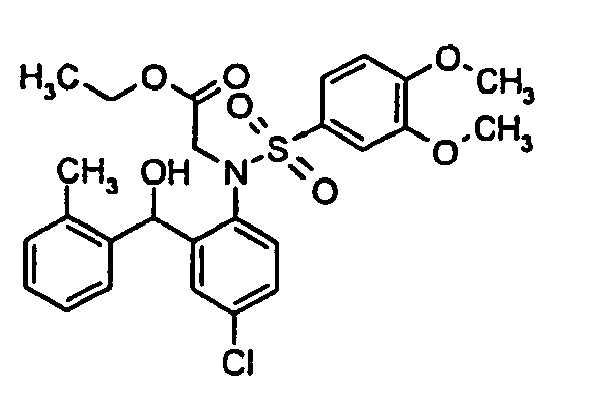
Composé 27 :
N2-[4-chloro-2-(2-chlorobenzyl)phényl]-N2 -[(3-méthoxyphényl)sulfonyl]glycinamide
Composé 28 :
N2 -{4-chloro-2-[(2-chlorophényl)(hydroxy)méthyl]phényl}-N2 -[(3,4-diméthylphényl)sulfonyl]glycinamide
Composé 29 :
N2 -{4-chloro-2-[(2-chlorophényl)(hydroxy)méthyl]phényl}-N2 -(2-naphthylsulfonyl)glycinamide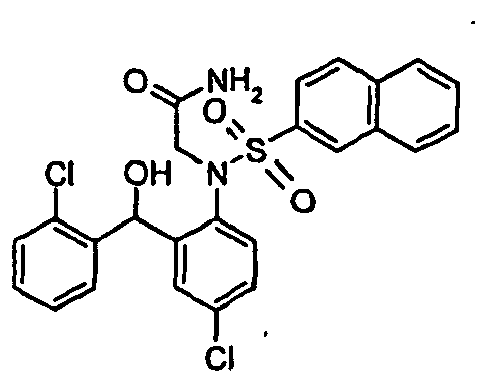
Composé 30 :
N2 -{4-chloro-2-[(2-chlorophényl)(hydroxy)méthyl]phényl}-N2 -[(3-méthoxyphényl)sulfonyl]glycinamide
Composé 31 :
N2 -{4-chloro-2-[(2-chlorophényl)(hydroxy)méthyl]phényl}-N2 -[(3-chlorophényl)sulfonyl]glycinamide
Composé 32:
N2 -{4-chloro-2-[(2-chlorophényl)(hydroxy)méthyl]phényl}-N2 -[(4-méthoxyphényl)sulfonyl]glycinamide
Composé 33 :
N2 -{4-chloro-2-[(2-chlorophényl)(hydroxy)méthyl]phényl}-N2-[(2,4-diméthoxyphényl)sulfonyl]glycinamide
Composé 34 :
N2 -{4-chloro-2-[(2-chlorophényl)(hydroxy)méthyl]phényl}-N2 -[(3,4-dichlorophényl)sulfonyl]glycinamide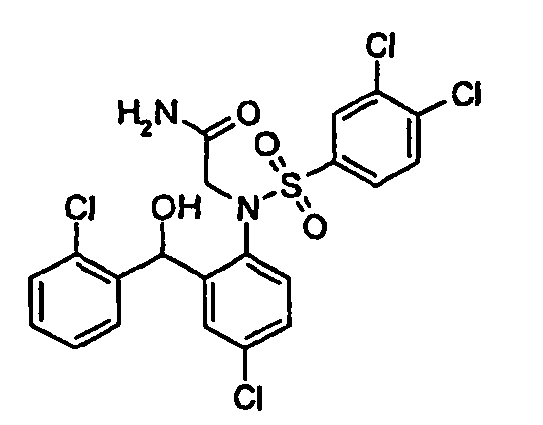
Composé 35:
N2 -{4-chloro-2-[(2-chlorophényl)(hydroxy)méthyl]phényl}-N N2 -[(4-chlorophényl)sulfonyl]glycinamide
Composé 36 :
N2 {4-chloro-2-[(2-chlorophényl)(hydroxy)méthyl]phényl}-N2 -[(2,5-diméthoxyphényl)sulfonyl]glycinamide
Composé 37 :
N2 -{4-chloro-2-[(2-chlorophényl)(hydroxy)méthyl]phényl}-N2 -[(2-chlorophényl)sulfonyl]glycinamide
Composé 38 :
N2 -{4-chloro-2-[(2-chlorophényl)(hydroxy)méthyl]phényl}-N2 -[(4-chloro-2,5-diméthylphényl)sulfonyl]glycinamide
Composé 39 :
N2 -[4-chloro-2-(2-chlorobenzyl)phényl]-N 2-[(4-méthoxyphényl)sulfonyl]glycinamide
Composé 40 :
N2 -[4-chloro-2-(2-chlorobenzyl)phényl]-N2 -[(2,5-diméthoxyphényl)sulfonyl]glycinamide
Composé 41 :
N2 -{4-chloro-2-[(2-chlorophényl)(hydroxy)méthyl]phényl}-N2 -[(2,3-diméthoxyphényl)sulfonyl]glycinamide
Composé 42 :
N2 -[4-chloro-2-(2-chlorobenzyl)phényl]-N2 -{[3-(trifluorométhyl)phényl]sulfonyl}glycinamide
Composé 43 :
N2 -[4-chloro-2-(2-chlorobenzyl)phényl]-N2 -{[3-(trifluorométhoxy)phényl]sulfonyl}glycinamide
Composé 44:
N2 -{4-chloro-2-[(3-chlorophényl)(hydroxy)méthyl]phényl}- N2 -[(3,4-diméthoxyphényl)sulfonyl]glycinamide
Composé 45 :
N2 -[4-chloro-2-(2-chlorobenzyl)phényl]-N2 -[(2-méthoxyphényl)sulfonyl]glycinamide
Composé 46 :
N2 -[4-chloro-2-(2-chlorobenzyl)phény]-N2 -[(3,4-diméthoxyphényl)sulfonyl]-N1 -méthylglycinamide
Composé 47 :
N2 -[4-chloro-2-(2-chlorobenzyl)phényl]-N2 -[(4-chlorophényl)sulfonyl]glycinamide
Composé 48 :
N2 -[4-chloro-2-(2-chlorobenzyl)phényl]-N2 -[(3,4-dichlorophényl)sulfonyl]glycinamide
Composé 49 :
N2 -[4-chloro-2-(2-chlorobenzyl)phényl]-N2 -[(4-chloro-2,5-diméthylphényl)sulfonyl]glycinamide
Composé 50 :
N2 -[4-chloro-2-(2-chlorobenzyl)phényl]-N2 -[(2-chlorophényl)sulfonyl]glycinamide
Composé 51 :
N2 -{4-chloro-2-[hydroxy(3-méthoxyphényl)méthyl]phényl}-N2 -[(3,4-diméthoxyphényl)sulfonyl]glycinamide
Composé 52 :
N2 -{4-chloro-2-[(2-chlorophényl)(hydroxy)méthyl]phényl}-N2 -(phénylsulfonyl)glycinamide
Composé 53 :
N2 -[4-chloro-2-(2-chlorobenzyl)phényl]-N2 -(phénylsulfonyl)glycinamide
Composé 54 :
N-[4-chloro-2-(2-chlorobenzyl)phényl]-3,4-diméthoxy-N-méthylbenzènesulfonamide
Composé 55 :
N2 -[4-chloro-2-(2-fluorobenzyl)phényl]-N2 -[(3,4-diméthoxyphényl)sulfonyl]glycinamide
Composé 56 :
N2 -[4-chloro-2-(2-méthoxybenzyl)phényl]-N2 -[(3,4-diméthoxyphényl)sulfonyl]glycinamide
Composé 57 :
N2 -{4-chloro-2-[(2-fluorophényl)(hydroxy)méthyl]phényl}-N2 -[(3,4-diméthoxyphényl)sulfonyl]glycinamide
Composé 58 :
N~2~-[4-chloro-2-(3-méthoxybenzyl)phènyl]-N~2~-[(3,4-diméthoxyphényl)sulfonyl]glycinamide
Composé 59 :
N2 -{4-chloro-2-[hydroxy(4-méthoxyphényl)méthyl]phényl}-N2 -[(3,4-diméthoxyphényl)sulfonyl]glycinamide
Composé 60 :
N2 -[4-chloro-2-(4-méthoxybenzyl)phényl]-N2 -[(3,4-diméthoxyphényl)sulfonyl]glycinamide
Composé 61 :
N2 -{2-[(2-chlorophényl)(hydroxy)méthyl]-4-fluorophényl}-N2 -[(3,4-diméthoxyphényl)sulfonyl]glycinamide
Composé 62 :
N2 -[4-chloro-2-(2-chlorobenzyl)phényl]-N2 -[(3-méthylphényl)sulfonyl]glycinamide
Composé 63 :
N2 -[4-chloro-2-(2-chlorobenzyl)phényl]-N2 -(2,3-dihydro-1,4-benzodioxin-6-ylsulfonyl)glycinamide
Composé 64 :
N2 -{4-chloro-2-[(2-chlorophényl)(hydroxy)méthyl]phényl}- N2 -(2,3-dihydro-1,4-benzodioxin-6-ylsulfonyl)glycinamide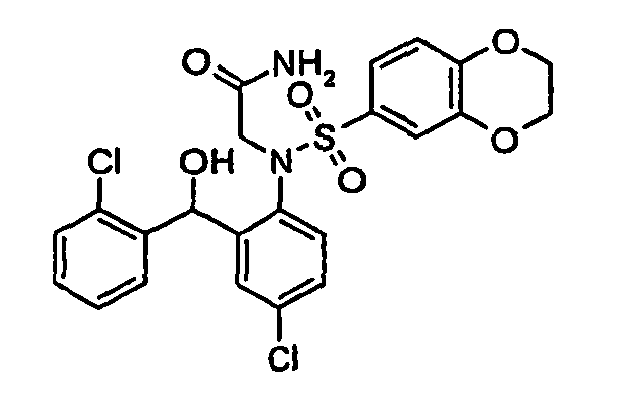
Composé 65 :
N2 -(2-benzyl-4-chlorophényl)-N2 -[(3,4-diméthoxyphényl)sulfonyl]glycinamide
Composé 66 :
N2 -{4-chloro-2-[hydroxy(phényl)méthyl]phényl}-N2 -[(3,4-diméthoxyphényl)sulfonyl]glycinamide
Composé 67 :
N2 -[2-(2-chlorobenzyl)phényl]-N2 -[(3,4-diméthoxyphényl)sulfonyl]glycinamide
Composé 68 :
N2 -{4-chloro-2-[hydroxy(2-méthoxyphényl)méthyl]phényl}-N2 -[(3,4-diméthoxyphényl)sulfonyl]glycinamide
Composé 69 :
N2 -{2-[(2-chlorophényl)(hydroxy)méthyl]-4-méthoxyphényl}-N2 -[(3,4-diméthoxyphényl)sulfonyl]glycinamide
Composé 70 :
N2 -[4-chloro-2-(2-chlorobenzyl)phényl]-N2 -[(3,4-diméthoxyphényl)sulfonyl]-N1 ,N1 -diméthylglycinamide
Composé 71 :
N2 -(1,3-benzodioxol-5-ylsulfonyl)-N2 -[4-chloro-2-(2-chlorobenzyl)phényl]glycinamide
Composé 72 :
N2 -{4-chloro-2-[(2-chlorophényl)(hydroxy)méthyl]phényl}-N2 -[(3,4-diméthoxyphényl)sulfonyl]-N-méthylglycinamide
Composé 73 :
N2 -[4-chloro-2-(2-méthylbenzyl)phényl]-N2 -[(3,4-diméthoxyphényl)sulfonyl]glycinamide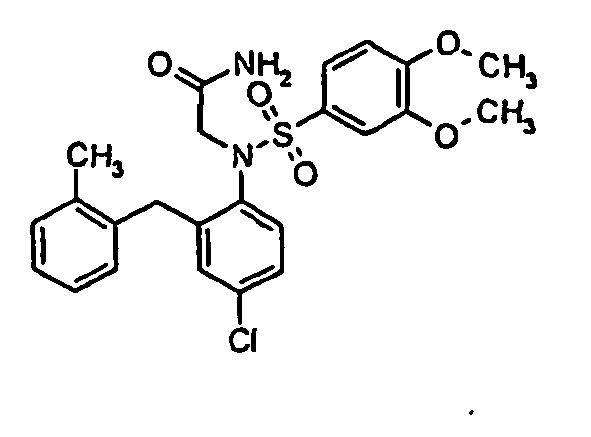
Composé 74 :
N2 -{4-chloro-2-[(2,5-dichlorophényl)(hydroxy)méthyl]phényl}-N2 -[(3,4-diméthoxyphényl)sulfonyl]glycinamide
Composé 75 :
N2 -[4-chloro-2-(2-chlorobenzyl)phényl]-N2 -[(3,4-diméthoxyphényl)sulfonyl]-N-éthylglycinamide
Composé 76 :
N2 -(1,3-benzodioxol-5-ylsulfonyl)-N2 -{4-chloro-2-[(2-chlorophényl)(hydroxy)méthyl]phényl}glycinamide
Composé 77 :
N2 -[2-[(2-chlorophényl)(hydroxy)méthyl]-4-(trifluorométhoxy)phényl]-N2 -[(3,4-diméthoxyphényl)sulfonyl]glycinamide
Composé 78 :
N2 -[4-chloro-2-(2,6-dichlorobenzyl)phényl]-N2 -[(3,4-diméthoxyphényl)sulfonyl]glycinamide
Composé 79 :
N2 -{4-chloro-2-[(2-chlorophényl)(hydroxy)méthyl]phényl}-N2 -[(2-méthylphényl)sulfonyl]glycinamide
Composé 80 :
N2 -[4-chloro-2-(2,5-dichlorobenzyl)phényl]-N2 -[(3,4-diméthoxyphényl)sulfonyl]glycinamide
Composé 81 :
N2 -[4-chloro-2-(2-chlorobenzyl)phényl]-N2 -[(2-méthylphényl)sulfonyl]glycinamide
Composé 82 :
N2 -[4-chloro-2-(2-chlorobenzyl)phényl]-N2 -[(3,4-diméthylphényl)sulfonyl]glycinamide
Composé 83:
N-{4-chloro-2-[(2-chlorophényl)(hydroxy)méthyl]phényl}-3,4-diméthoxy-N-[(3-méthyl-1,2,4-oxadiazol-5-yl)méthyl]benzènesulfonamide
Composé 84 :
N-[4-chloro-2-(2-chlorobenzyl)phényl]-3,4-diméthoxy-N-[(3-méthyl-1,2,4-oxadiazol-5-yl)méthyl]benzénesulfonamide
Composé 85 :
N2 -{4-chloro-2-[(2-chlorophényl)(hydroxy)méthyl]phényl}-N2 -[(2,6-dichlorophényl)sulfonyl]glycinamide
Composé 86 :
N2 -{4-chloro-2-[(2-chlorophényl)(hydroxy)méthyl]phényl}-N2 -[(3,5-diméthylphényl)sulfonyl]glycinamide
Composé 87 :
N2 -[4-chloro-2-(2-chlorobenzyl)phényl]-N2 -[(2,6-dichlorophényl)sulfonyl]glycinamide
Composé 88 :
N-[4-chloro-2-(2-chlorobenzyl)phényl]-3,4-diméthoxy-N-[(1-méthyl-1H-tétrazol-5-yl)méthyl]benzènesulfonamide
Composé 89 :
N2 -[4-chloro-2-(2-chlorobenzyl)phényl]-N2 -[(3,5-diméthylphényl)sulfonyl]glycinamide
Composé 90 :
N-[4-chloro-2-(2-chlorobenzyl)phényl]-N-[(1-éthyl-1H-tétrazol-5-yl)méthyl]-3,4-diméthoxybenzènesulfonamide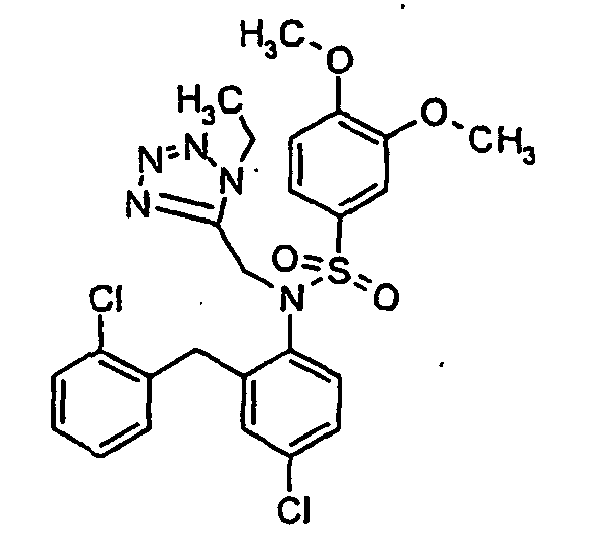
Composé 91 :
N2 -[4-chloro-2-(2,6-difluorobenzyl)phényl]-N2 -[(3,4-diméthoxyphényl)sulfonyl]glycinamide
Composé 92 :
N2 -{4-chloro-2-[méthyl(phényl)amino]phényl}- N2 -[(3,4-diméthoxyphényl)sulfonyl]glycinamide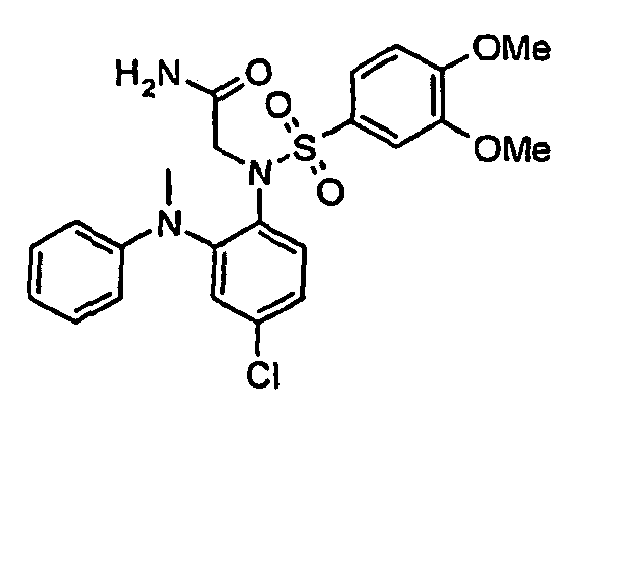
Composé 93 :
N2 -[2-(2-chlorobenzyl)-4-éthylphényl]-N2 -[(3,4-diméthoxyphényl)sulfonyl]glycinamide
Composé 94 :
N2 -{4-chloro-2-[(2-chlorophényl)(hydroxy)méthyl]phényl}-N2 -[(2,5-diméthoxy-4-méthylphényl)sulfonyl]glycinamide
Composé 95 :
N2 -(2-benzyl-4-chlorophényl)-N2 -[(3,4-diméthoxyphényl)sulfonyl]-N1,N1 -diméthylglycinamide
Composé 96 :
N2 -(2-benzyl-4-chlorophényl)-N2 -[(3,4-diméthoxyphényl)sulfonyl]-N1 -méthylglycinamide
Composé 97 :
N2 -[4-chloro-2-(2-fluorobenzyl)phényl]-N2 -[(3,4-diméthoxyphényl)sulfonyl]-N1,N1 -diméthylglycinamide
Composé 98 :
N2 -[4-chloro-2-(2-fluorobenzyl)phényl]-N 2-[(3,4-diméthoxyphényl)sulfonyl]-N1 -méthylglycinamide
Composé 99 :
N2 -[4-chloro-2-(2-chlorobenzyl)phényl]-N2 -[(2,5-diméthoxy-4-méthylphényl)sulfonyl]glycinamide
Composé 100 :
N2 -[4-chloro-2-(2-chlorobenzyl)phényl]-N2 -[(2,4-dichloro-5-méthylphényl)sulfonyl]glycinamide
Composé 101 :
N2 -{4-chloro-2-[(2,6-difluorophényl)(hydroxy)méthyl]phényl}-N2 -[(3,4-diméthoxyphényl)sulfonyl]glycinamide
Composé 102 :
N2 -{4-chloro-2-[(2-chlorophényl)(hydroxy)méthyl]phényl}-N2 -[(2,4,5-triméthoxyphényl)sulfonyl]glycinamide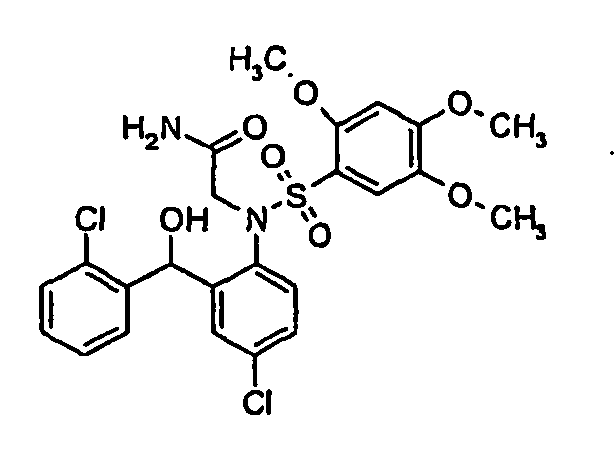
Composé 103 :
N2 -[2-(2-chlorobenzyl)-4-éthylphényl]-N2 -[(3,4-diméthoxyphényl)sulfonyl]-N1 ,N1 -diméthylglycinamide
Composé 104 :
N2 -[4-chloro-2-(2-chlorobenzyl)phényl]-N2 -[(2,4,5-triméthoxyphényl)sulfonyl]glycinamide
Composé 105:
N2 -[4-chloro-2-(2-chlorobenzyl)phényl]-N2 -[(4-chloro-2,5-diméthylphényl)sulfonyl]-N1 -méthylglycinamide
Composé 106 :
N2 -{4-chloro-2-[(2-chlorophènyl)(hydroxy)méthyl]phényl}-N2 -[(2,4,5-triméthylphényl)sulfonyl]glycinamide
Composé 107 :
N-[4-chloro-2-(2-chlorobenzyl)phényl]-3,4-diméthoxy-N-[(1-méthyl-1H-imidazol-2-yl)méthyl]benzènesulfonamide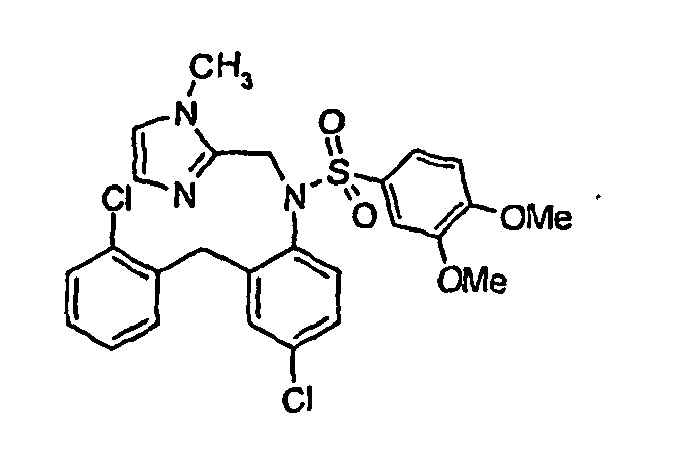
Composé 108 :
N-[4-chloro-2-(2-chlorobenzyl)phényl]-N-[(1-isopropyl-1H-tétrazol-5-yl)méthyl]-3,4-diméthoxybenzènesulfonamide
Composé 109 :
N2 -[4-chloro-2-(2-chlorobenzyl)phényl]-N'-méthyl-N2 -[(2,4,5-triméthoxyphényl)sulfonyl]glycinamide
Composé110 :
N2 -{4-chloro-2-[(2-chlorophényl)(hydroxy)méthyl]phényl}-N1 -méthyl- N2 -[(2,4,5-triméthylphényl)sulfonyl]glycinamide
Composé 111 :
N-[(1-benzyl-1H-tétrazol-5-yl)méthyl]-N-[4-chloro-2-(2-chlorobenzyl)phényl]-3,4-diméthoxybenzènesulfonamide
Composé 112 :
N-[4-chloro-2-(2-chlorobenzyl)phényl]-3,5-diméthyl-N-[(1-méthyl-1H-imidazol-2-yl)méthyl]benzènesulfonamide
Composé 113 :
N2 -{4-chloro-2-[(2-chlorophényl)(hydroxy)méthyl]phényl}-N1 -méthyl- N2 -[(2,4,5-triméthoxyphényl)sulfonyl]glycinamide
Composé 114 :
N2 -[4-chloro-2-(2-chlorobenzyl)phényl]-N2 -[(2,4,5-triméthylphényl)sulfonyl]glycinamide
Composé 115 :
N2 -[4-chloro-2-(2-chlorobenzyl)phényl]-N1 -méthyl-N2 -[(2,4,5-triméthylphényl)sulfonyl]glycinamide
Composé-116 :
N2 -[4-chloro-2-(3-chlorobenzyl)phényl]-N2 -[(3,4-diméthoxyphényl)sulfonyl]glycinamide
Composé 117 :
N2 -{4-chloro-2-[(2,6-dichlorophényl)(hydroxy)méthyl]phényl}-N2 -[(3,4-diméthoxyphényl)sulfonyl]glycinamide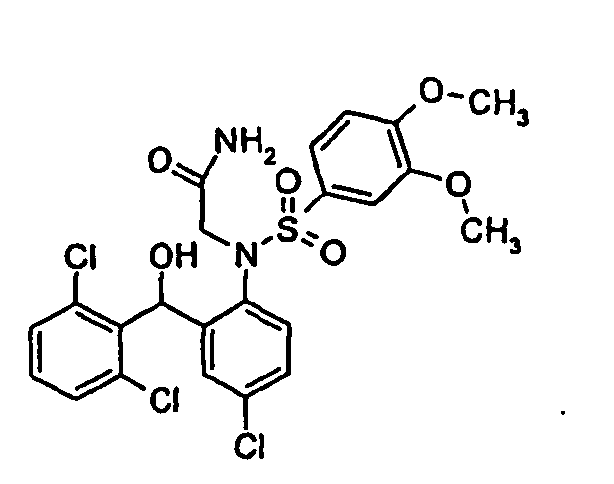
Composé 118 :
N2 -[4-chloro-2-(2-chlorobenzyl)-phényl]-N2 -[(4-chloro-2,5-diméthylphényl)sulfonyl]-N1 ,N1 -diméthylglycinamide
Composé 119 :
N2 -[4-chloro-2-(2-chlorobenzyl)phényl]-N2 -[(3,5-diméthoxyphényl)sulfonyl]glycinamide
Composé 120 :
N2 -{4-chloro-2-[hydroxy(1,3-thiazol-2-yl)méthyl]phényl}-N2 -[(3,4-diméthoxyphényl)sulfonyl]glycinamide
Composé 121 :
N2 -{4-chloro-2-[hydroxy(1,3-thiazol-2-yl)méthyl]phényl}-N2 -[(3,4-diméthoxyphényl)sulfonyl]-N1 -méthylglycinamide
Composé 122 :
N-[4-chloro-2-(2-chlorobenzyl)phényl]-N-[(2-éthyl-2H-tétrazol-5-yl)méthyl]-3,5-diméthylbenzènesulfonamide
Composé 123 :
N-[4-chloro-2-(2-chlorobenzyl)phényl]-N-[(1-éthyl-1H-tètrazol-5-yl)méthyl]-3,5-diméthylbenzènesulfonamide
Composé 124 :
N2 -{4-chloro-2-[méthyl(phényl)amino]phényl}-N2 -[(3,4-diméthoxyphényl)sulfonyl]-N1 -méthylglycinamide
Composé 125 :
N2 -(4-chloro-2-{hydroxy[2-(trifluorométhyl)phényl]méthyl}phényl)-N2 -[(3,4-diméthoxyphényl)sulfonyl]glycinamide
Composé 126:
N2 -{4-chloro-2-[(2,3-difluorophényl)(hydroxy)méthyl]phényl}-N2 -[(3,4-diméthoxyphényl)sulfonyl]glycinamide
Composé 127 :
N2 -{4-chloro-2-[(2,3-difluorophényl)(hydroxy)méthyl]phényl}-N2 -[(3,4-diméthoxyphényl)sulfonyl]-N1 -éthylglycinamide
Composé 128 :
N2 -{4-chloro-2-[(2,3-difluorophényl)(hydroxy)méthyl]phényl}-N2 -[(3,4-diméthoxyphényl)sulfonyl]-N1 ,N1 -diméthylglycinamide
Composé 129 :
N2 -{4-chloro-2-[(2-chlorophényl)(hydroxy)méthyl]phényl}-N2 -[(2,4-dichloro-5-méthylphényl)sulfonyl]-N1 ,N1 -diméthylglycinamide
Composé 130 :
N2 -[4-chloro-2-(2,6-dichlorobenzyl)phényl]-N2 -[(3,4-diméthoxyphényl)sulfonyl]-N1 -méthylglycinamide
Composé 131 :
N2 -{4-chloro-2-[hydroxy(2-méthylphényl)méthyl]phényl}-N2 -[(3,4-diméthoxyphényl)sulfonyl]glycinamide
Composé 132 :
N2 -{4-chloro-2-[(2-chlorophényl)(hydroxy)méthyl]phényl}-N2 -[(3,5-diméthylphényl)sulfonyl]-N1 -méthylglycinamide
Composé 133 :
N2 -{4-chloro-2-[(2-chlorophényl)(hydroxy)méthyl]phényl}-N2 -[(3,5-diméthylphényl)sulfonyl]-N1 ,N1 -diméthylglycinamide
Composé 134 :
N2 -[4-chloro-2-(2-chlorobenzyl)phényl]- N2 -[(3-nitrophényl)sulfonyl]glycinamide
Composé 135 :
N2 -[(3-aminophényl)sulfonyl]-N2 -[4-chloro-2-(2-chlorobenzyl)phényl]glycinamide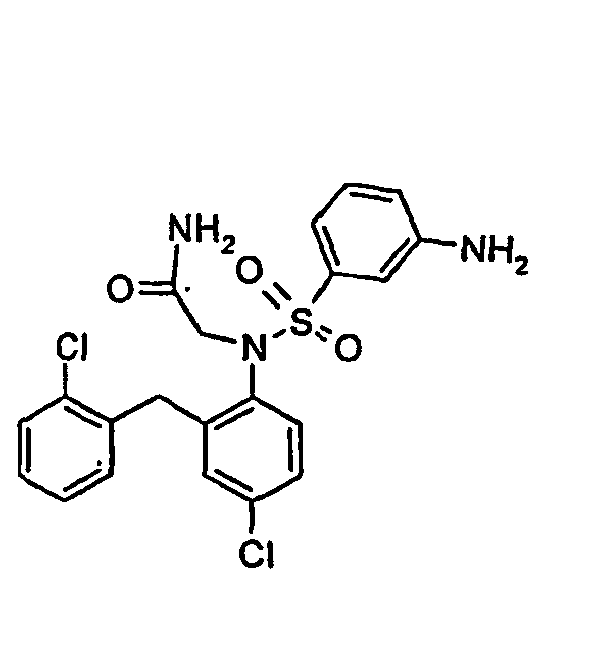
Composé 136 :
N2 -{2-[(2-chlorophényl)(hydroxy)méthyl]-4-méthylphényl}-N2 -[(3,4-diméthoxyphényl)sulfonyl]glycinamide
Composé 137 :
N2 -{4-chloro-2-[hydroxy(phényl)méthyl]phényl}-N2 -[(3,4-diméthoxyphényl)sulfonyl]-N1 -méthylglycinamide
Composé 138 :
N2 -[2-(2-chlorobenzyl)-4-méthoxyphényl]-N2 -[(3,4-diméthoxyphényl)sulfonyl]glycinamide
Composé 139 :
N2 -[4-chloro-2-(2,6-difluorobenzyl)phényl]-N2 -[(3,4-diméthoxyphényl)sulfonyl]-N1 -méthylglycinamide
Composé 140 :
N-[4-chloro-2-(2,6-difluorobenzyl)phényl]-3,4-diméthoxy-N-propylbenzènesulfonamide
Composé 141 :
N2 -[4-chloro-2-(2,3-difluorobenzyl)phényl]-N2 -[(3,4-diméthoxyphényl)sulfonyl]-N1 -méthylglycinamide
Composé 142 :
N2 -[4-chloro-2-(2,3-difluorobenzyl)phényl]-N2 -[(3,4-diméthoxyphényl)sulfonyl]glycinamide
Composé 143 :
N2 -[4-chloro-2-(2,3-difluorobenzyl)phényl]-N2 -[(3,4-diméthoxyphényl)sulfonyl]-N1 ,N1 -diméthylglycinamide
Composé 144 :
N-[4-chloro-2-(2,6-difluorobenzyl)phényl]-3,4-diméthoxy-N-méthylbenzènesulfonamide
Composé 145 :
N-[4-chloro-2-(2,6-difluorobenzyl)phényl]-N-[2-(diméthylamino)éthyl]-3,4-diméthoxybenzènesulfonamide
Composé 146 :
N2 -{4-chloro-2-[hydroxy(2-thiènyl)méthyl]phényl}-N2 -[(3,4-diméthoxyphényl)sulfonyl]-N1 -méthylglycinamide
Composé 147 :
N2 -{4-chloro-2-[(2,6-difluorophényl)(hydroxy)méthyl]phényl}-N2 -[(3,5-diméthylphényl)sulfonyl]glycinamide
Composé 148 :
N2 -[(3-aminophényl)sulfonyl]-N2 -{4-chloro-2-[(2-chlorophényl)(hydroxy)méthyl]phényl}glycinamide
Composé 149 :
N2 -{4-chloro-2-[(2-fluoro-6-méthoxyphényl)(hydroxy)méthyl]phényl}-N2 -[(3,4-diméthoxyphényl)sulfonyl]glycinamide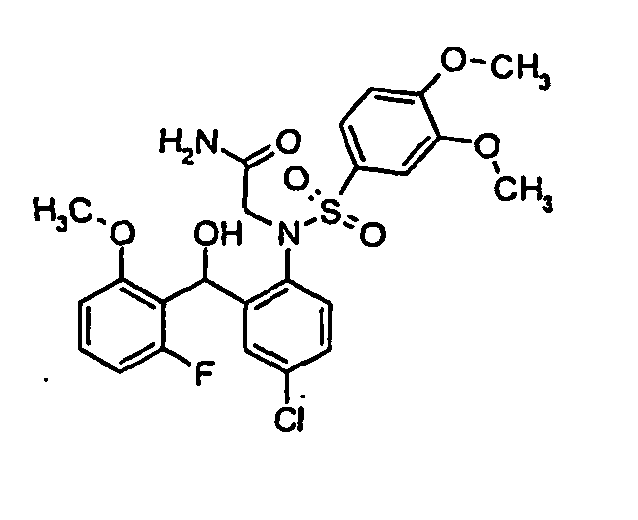
Composé 150 :
N2 -[4-chloro-2-(2,6-difluorobenzyl)phényl]-N2 -[(3,4-diméthoxyphényl)sulfonyl]-N1 ,N1 -diméthylglycinamide
Composé 151 :
N-[4-chloro-2-(2,6-difluorobenzyl)phényl]-3,4-diméthoxy-N-[(2-méthyl-2H-tétrazol-5-yl)méthyl]benzénesulfonamide
Composé 152 :
N-[4-chloro-2-(2,6-difluorobenzyl)phényl]-3,4-diméthoxy-N-[(1-méthyl-1H-tétrazol-5-yl)méthyl]benzènesulfonamide
Composé 153 :
N-[4-chloro-2-(2,6-difluorobenzyl)phényl]-N-[(2-éthyl-2H-tétrazol-5-yl)méthyl]-3,4-diméthoxybenzènesulfonamide
Composé 154 :
N-[4-chloro-2-(2,6-difluorobenzyl)phényl]-N-[(1-éthyl-1H-tétrazol-5-yl)méthyl]-3,4-diméthoxybenzénesulfonamide
Composé 155 :
N2 -{4-chloro-2-[hydroxy(2-thiènyl)méthyl]phényl}-N2 -[(3,4-diméthoxyphényl)sulfonyl]glycinamide
Composés 156 :
N-[4-chloro-2-(2,6-difluorobenzyl)phényl]-N-[2-(6,7-diméthoxy-3,4-dihydroisoquinolin-2(1H)-yl)-2-oxoéthyl]-3,4-diméthoxybenzènesulfonamide
Composé 157 :
N-[4-chloro-2-(2,6-difluorobenzyl)phényl]-3,5-diméthyl-N-[(2-méthyl-2H-tétrazol-5-yl)méthyl]benzènesulfonamide
Composé 158 :
N-[4-chloro-2-(2,6-difluorobenzyl)phényl]-3,5-diméthyl-N-[(1-méthyl-1H-tétrazol-5-yl)méthyl]benzènesulfonamide
Composé 159 :
N-[4-chloro-2-(2,6-difluorobenzyl)phényl]-N-[(2-éthyl-2H-tétrazol-5-yl)méthyl]-3,5-diméthylbenzènesulfonamide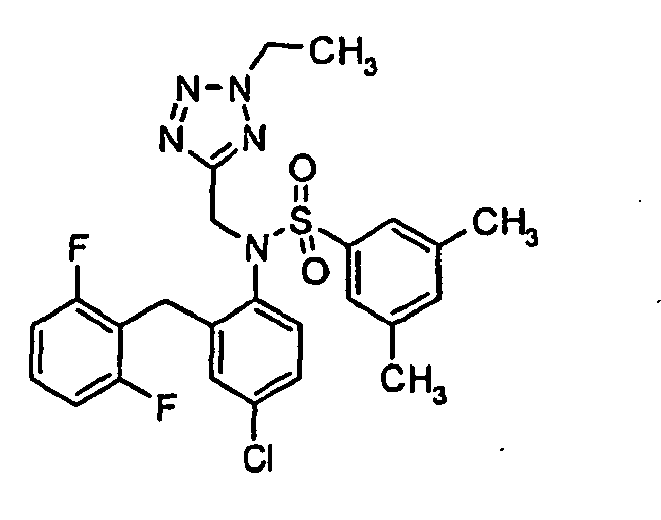
Composé 160 :
N-[4-chloro-2-(2,6-difluorobenzyl)phényl]-N-[(1-éthyl-1H-tétrazol-5-yl)méthyl]-3,5-diméthylbenzènesulfonamide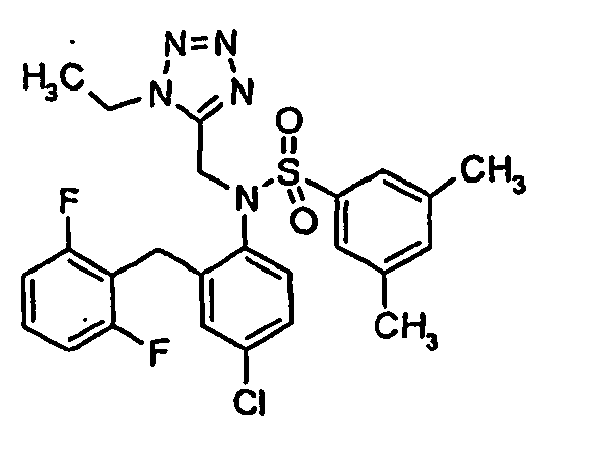
Composé 161 :
N2 -[4,5-dichloro-2-(2-chlorobenzyl)phényl]-N2 -[(3,4-diméthoxyphényl)sulfonyl]glycinamide
Composé 162:
N2 -{4-chloro-2-[hydroxy(2,4,6-trifluorophényl)méthyl]phényl}-N2 -[(3,4-diméthoxyphényl)sulfonyl]glycinamide
Composé 163 :
N2 -{4-chloro-2-[(2,4-difluorophényl)(hydroxy)méthyl]phényl}-N2 -[(3,4-diméthoxyphényl)sulfonyl]glycinamide
Composé 164 :
N2 -{4,5-dichloro-2-[(2-chlorophényl)(hydroxy)méthyl]phényl}-N2 -[(3,4-diméthoxyphényl)sulfonyl]glycinamide
Composé 165:
N2 -[2-(2-chlorobenzyl)-4-méthylphényl]-N2 -[(3,4-diméthoxyphényl)sulfonyl]glycinamide
Composé 166:
N2 -[4-chloro-2-(2,6-dichlorobenzyl)phényl]-N2 -[(3,4-diméthoxyphényl)sulfonyl]-N1 ,N1 -diméthylglycinamide
Composé 167 :
N2 -{4-chloro-2-[(4-chloro-2-fluorophényl)(hydroxy)méthyl]phényl}-N2 -[(3,4-diméthoxyphényl)sulfonyl]glycinamide
Composé 168 :
N2 -[4-chloro-2-(4-chloro-2-fluorobenzyl)phényl]-N2 -[(3,4-diméthoxyphényl)sulfonyl]glycinamide
Composé 169 :
N2 -[4-chloro-2-(2,6-difluorobenzyl)phényl]-N2 -[(3,5-diméthylphényl)sulfonyl]glycinamide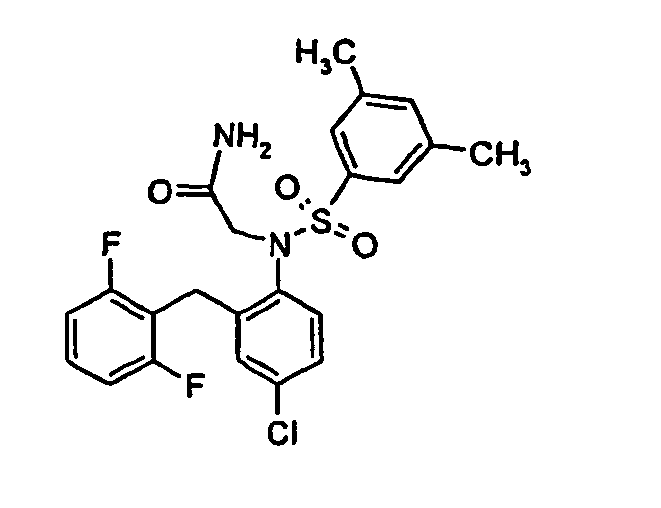
Composé 170 :
N2 -[4-chloro-2-(2-fluoro-6-méthoxybenzyl)phényl]-N2 -[(3,4-diméthoxyphényl)sulfonyl]glycinamide
Composé 171 :
N2 -[4-chloro-2-(2,6-difluorobenzyl)phényl]-N2 -[(3,5-diméthylphényl)sulfonyl]-N1 -méthylglycinamide
Composé 172 :
N2 -{4-chloro-2-[1-(2-chlorophényl)-1-hydroxyéthyl]phényl}-N2 -[(3,4-diméthoxyphényl)sulfonyl]glycinamide
Composé 173 :
N2 -[4-chloro-2-(2-chlorobenzyl)phényl]-N2 -[(2,4-dichloro-5-méthylphényl)sulfonyl]-N1 -méthylglycinamide
Composé 174 :
N2 -[4-chloro-2-(2-chlorobenzyl)phényl]-N2 -[(2,4-dichloro-5-méthylphényl)sulfonyl]-N∼1∼,N∼1∼-diméthylglycinamide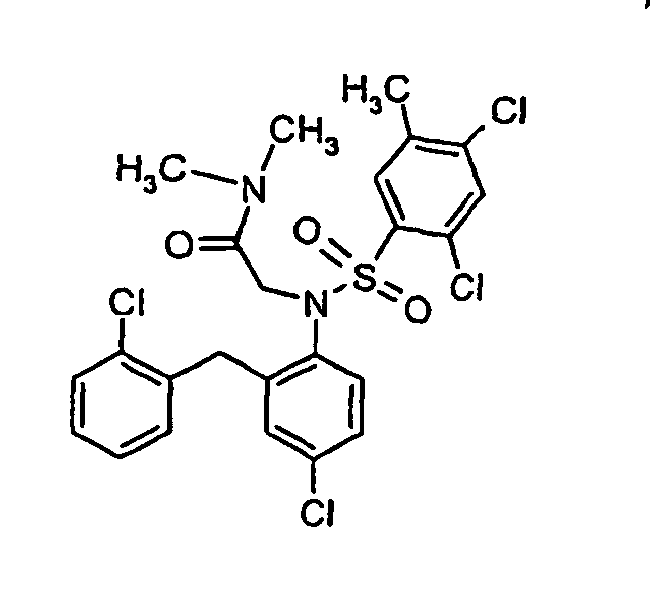
Composé 175 :
N2 -{5-chloro-2-[(2-chlorophényl)(hydroxy)méthyl]phényl}-N∼2∼-[(3,4-diméthoxyphényl)sulfonyl]glycinamide
Composé 176:
N2 -{4-chloro-2-[(5-chloro-2-fluorophényl)(hydroxy)méthyl]phényl}-N2 -[(3,4-diméthoxyphényl)sulfonyl]glycinamide
Composé 177 :
N2 -[4-chloro-2-(2,5-difluorobenzyl)phényl]-N2 -[(3,4-diméthoxyphényl)sulfonyl]glycinamide
Composé 178 :
N2 -{4-chloro-2-[(3,5-difluorophényl)(hydroxy)méthyl]phenyl}-N2 -[(3,4-diméthoxyphényl)sulfonyl]glycinamide
Composé 179 :
N2 -[5-chloro-2-(2-chlorobenzyl)phényl]-N2 -[(3,4-diméthoxyphényl)sulfonyl]glycinamide
Composé 180:
N2 -[4-chloro-2-(2-thiènylméthyl)phényl]-N2 -[(3,4-diméthoxyphényl)sulfonyl]glycinamide
Composé 181 :
N-[4-chloro-2-(2,6-difluorobenzyl)phényl]-3,4-diméthoxy-N-[(1-méthyl-1H-imidazol-2-yl)méthyl]benzénesulfonamide
Composé 182 :
N2 -[4-chloro-2-(5-chloro-2-fluorobenzyl)phényl]-N2 -[(3,4-diméthoxyphényl)sulfonyl]glycinamide
Composé 183 :
N2 -[4-chloro-2-(3,5-difluorobenzyl)phényl]-N2 -[(3,4-diméthoxyphényl)sulfonyl]glycinamide
Composé 184 :
N2 -{4-chloro-2-[hydroxy(pyridin-4-yl)méthyl]phényl}-N2 -[(3,4-diméthoxyphényl)sulfonyl]glycinamide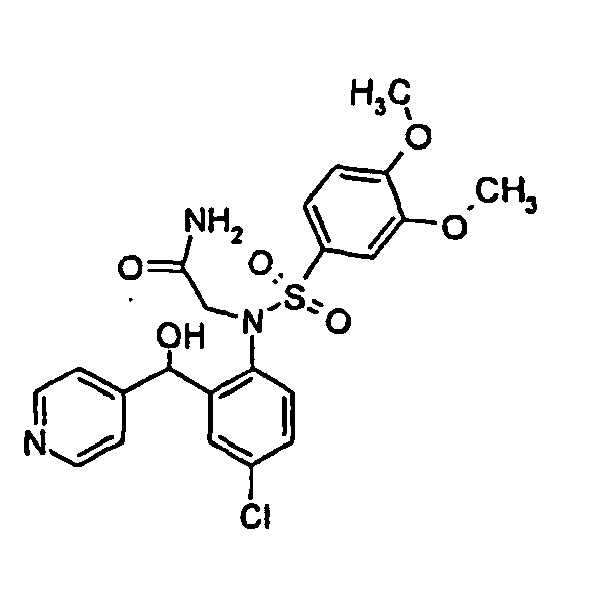
Composé 185 :
N-[4-chloro-2-(2,6-difluorobenzyl)phényl]-3,4-diméthoxy-N-prop-2-yn-1-ylbenzènesulfonamide
Composé 186 :
N2 -{4-chloro-2-[1-(2-chlorophényl)éthyl]phényl}-N2 -[(3,4-diméthoxyphényl)sulfonyl]glycinamide
Composé 187 :
N2 -{4-chloro-2-[1-(2-chlorophényl)éthyl]phényl}-N2 -[(3,4-diméthoxyphényl)sulfonyl]-N1 -méthylglycinamide
Composé 188 :
N2 -[4-chloro-2-(2,6-difluorobenzyl)phényl]-N2 -{[3-(diméthylamino)phényl]sulfonyl}glycinamide
Composé 189 :
N2 -[4-chloro-2-(2,6-difluorobenzyl)phényl]-N2 -{[3-(méthylamino)phényl]sulfonyl}glycinamide
Composé 190 :
N-[4-chloro-2-(2,6-difluorobenzyl)phényl]-3,4-diméthoxy-N-(2,2,2-trifluoroéthyl)benzènesulfonamide
Composé 191 :
N 2-{4-chloro-2-[(2-chloro-6-méthoxyphényl)(hydroxy)méthyl]phényl}- N 2-[(3,4-diméthoxyphényl)sulfonyl]glycinamide
Composé 192 :
N 2-[4-chloro-2-(2-chloro-6-méthoxybenzyl)phényl]-N 2-[(3,4-diméthoxyphényl)sulfonyl]glycinamide
Composé 193 :
N 2-[2-(2,6-difluorobenzyl)-4-méthoxyphényl]-N 2-[(3,4-diméthoxyphényl)sulfonyl]glycinamide
Composé 194 :
N 2-{4-chloro-2-[(2-fluoro-5-méthylphényl)(hydroxy)méthyl]phényl}-N 2-[(3,4-diméthoxyphényl)sulfonyl]glycinamide
Composé 195 :
N 2-[3-chloro-2-(2,6-difluorobenzyl)phényl]-N 2-[(3,4-diméthoxyphényl)sulfonyl]glycinamide
Composé 196 :
N 2-[4-chloro-2-(2-fluoro-5-méthylbenzyl)phényl]-N 2-[(3,4-diméthoxyphényl)sulfonyl]glycinamide
Composé 197 :
N-[4-chloro-2-(2,6-difluorobenzyl)phényl]-N-[3-(diméthylamino)propyl]-3,4-diméthoxybenzènesulfonamide
Composé 198 :
N 2-{2-[(2,6-difluorophényl)(hydroxy)méthyl]-4-méthylphényl}- N 2-[(3,4-diméthoxyphényl)sulfonyl]glycinamide
Composé 199 :
N-[4-chloro-2-(2,6-difluorobenzyl)phényl]-3,4-diméthoxy-N-(2-pyrrolidin-1-yléthyl)benzènesulfonamide
Composé 200 :
N 2-[2-(2,6-difluorobenzyl)-4-méthylphényl]-N 2-[(3,4-diméthoxyphényl)sulfonyl]glycinamide
Composé 201 :
N-[4-chloro-2-(2,6-difluorobenzyl)phényl]-N-[2-(diméthylamino)-1-méthyléthyl]-3,4-diméthoxybenzènesulfonamide
Composé 202 :
N 2-[2-(2,6-difluorobenzyl)-5-(diméthylamino)phényl]-N 2-[(3,4-diméthoxyphényl)sulfonyl]glycinamide
Composé 203 :
N-{2-[benzyl(méthyl)amino]éthyl}-N-[4-chloro-2-(2,6-difluorobenzyl)phényl]-3,4-diméthoxybenzènesulfonamide
Composé 204 :
4-{[4-chloro-2-(2,6-difluorobenzyl)phényl][(3,4-diméthoxyphényl)sulfonyl]amino}butanamide
Composé 205 :
2-{[2-(2,6-difluorobenzyl)-4-méthylphényl)[(3,4-diméthoxyphényl)sulfonyl]amino}butanamide
Composé 206 :
N 2-{2-[(2,6-difluorophényl)(hydroxy)méthyl]-4-fluorophényl}- N 2-[(3,4-diméthoxyphényl)sulfonyl]glycinamide
Composé 207 :
N2 -{4-chloro-2-[2-(trifluorométhyl)benzyl]phényl}-N2 -[(3,4-diméthoxyphényl)sulfonyl]glycinamide
Composé 208 :
N2 -[2-(2,6-difluorobenzyl)-4,6-diméthoxyphényl]-N2 -[(3,4-diméthoxyphényl)sulfonyl]glycinamide
Composé 209 :
N2 -{2-[(2,6-difluorophényl)(hydroxy)méthyl]-4-méthoxyphényl}-N2 -[(3,4-diméthoxyphényl)sulfonyl]glycinamide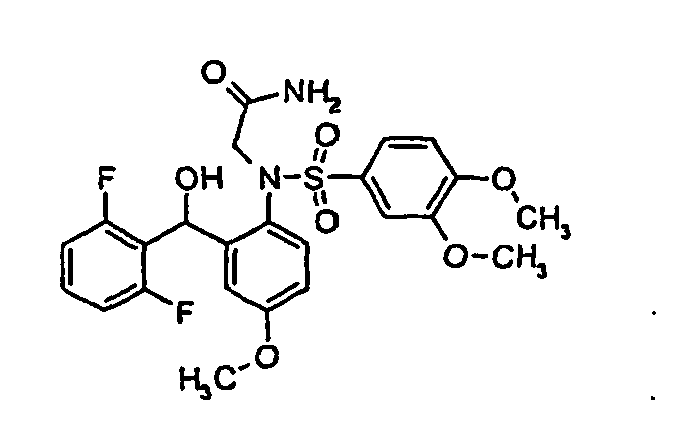
Composé 210 :
N2 -[2-(2,6-difluorabenzyl)-3,6-diméthoxyphényl]-N2 -[(3,4-diméthoxyphényl)sulfonyl]glycinamide
Composé 211 :
N-[4-chloro-2-(2,6-difluorobenzyl)phényl]-N-(cyanométhyl)-3,4-diméthoxybenzènesulfonamide
Composé 212 :
N2 -{4-chloro-2-[(5-méthyl-2-thiènyl)méthyl]phényl}-N2 -[(3,4-diméthoxyphényl)sulfonyl]glycinamide
Composé 213 :
N2 -{4-chloro-2-[(2-chloro-6-méthylphényl)(hydroxy)méthyl]phényl}-N2 -[(3,4-diméthoxyphényl)sulfonyl]glycinamide
Composé 214 :
N2 -{2,4-dichloro-6-[(2,6-difluorophényl)(hydroxy)méthyl]phényl}-N2 -[(3,4-diméthoxyphényl)sulfonyl]glycinamide
Composé 215 :
N-(2-aminoéthyl)-N-[2-(2,6-difluorobenzyl)-4-méthylphényl]-3,4-diméthoxybenzénesulfonamide
Composé 216:
N2 -{2,4-dichloro-6-[(2,6-difluorophényl)(hydroxy)méthyl]phényl}-N2 -[(3,4-diméthoxyphényl)sulfonyl]glycinamide
Composé 217 :
N-{2-[(anilinocarbonyl)amino]éthyl}-N-[2-(2,6-difluorobenzyl)-4-méthylphényl]-3,4-diméthoxybenzènesulfonamide
Composé 218 :
N-(2-{[(benzylamino)carbonyl]amino}éthyl)-N-[2-(2,6-difluorobenzyl)-4-méthylphényl]-3,4-diméthoxybenzènesulfonamide
Composé 219 :
N-(2-{[2-(2,6-difluorobenzyl)-4-méthylphényl][(3,4-diméthoxyphényl)sulfonyl]amino}éthyl)acétamide
Composé 220 :
N2 -[2-(2,6-difluorobenzyl)-4-fluorophényl]-N2 -[(3,4-diméthoxyphényl)sulfonyl]glycinamide
Composé 221 :
N2 -{4,5-dichloro-2-[(2,6-difluorophényl)(hydroxy)méthyl]phényl}-N2 -[(3,4-diméthoxyphényl)sulfonyl]glycinamide
Composé 222 :
N2 -{4-chloro-2-[(2-chloro-6-fluorophényl)(hydroxy)méthyl]phényl}-N2 -[(3,4-diméthoxyphényl)sulfonyl]glycinamide
Composé 223 :
N-[4-chloro-2-(2,6-difluorobenzyl)phényl]-N-[(3,4-diméthoxyphényl)sulfonyl]-2,2,2-trifluoroacétamide
Composé 224 :
N2 -[4-chloro-2-(2-chloro-6-fluorobenzyl)phényl]-N2 -[(3,4-diméthoxyphényl)sulfonyl]glycinamide
Composé 225 :
N2 -(2-[(2,6-difluorophényl)(hydroxy)méthyl]-6-méthoxyphényl)-N2 -[(3,4-diméthoxyphényl)sulfonyl]glycinamide
Composé 226 :
N2 -{2-[(2,6-difluorophényl)(hydroxy)méthyl]-6-méthoxyphényl}-N2 -[(3,4-diméthoxyphényl)sulfonyl]glycinamide
Composé 227 :
N2 -{2-[(2,6-difluorophényl)(hydroxy)méthyl]-5-méthoxy-4-méthylphényl}-N2 -[(3,4-diméthoxyphényl)sulfonyl]glycinamide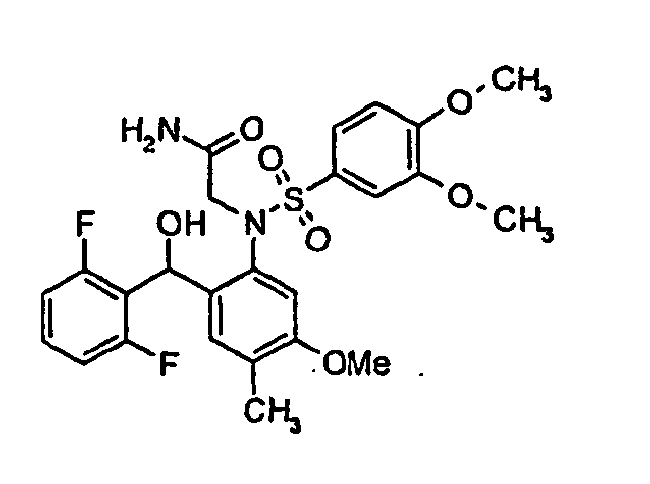
Composé 228 :
N2 -[4,5-dichloro-2-(2,6-difluorobenzyl)phényl]-N2 -[(3,4-diméthoxyphényl)sulfonyl]glycinamide
Composé 229 :
N-[4-chloro-2-(2,6-difluorobenzyl)phényl]-N-{3-[(diéthylamino)sulfonyl]propyl}-3,4-diméthoxybenzènesulfonamide
Composé 230 :
N-[4-chloro-2-(2,6-difluorobenzyl)phényl]-N-{3-[(diméthylamino)sulfonyl]propyl}-3,4-diméthoxybenzènesulfonamide
Composé 231 :
N-{2-[(aminocarbonyl)amino]éthyl}-N-[4-chloro-2-(2,6-difluorobenzyl)phényl]-3,4-diméthoxybenzènesulfonamide
Composé 232 :
N-[4-chloro-2-(2,6-difluorobenzyl)phényl]-3,4-diméthoxy-N-(3-pyridin-3-ylpropyl)benzènesulfonamide
Composé 233 :
N2 -[4-chloro-2-(2-chlorobenzyl)phényl]-N2 -[(3,4-diméthoxyphényl)sulfonyl]glycinamide
Composé 234 :
N-[4-chloro-2-(2,6-difluorobenzyl)phényl]-3,4-diméthoxy-N-[2-(2-oxopyrrolidin-1-yl)éthyl]benzènesulfonamide
Composé 235 :
4-{[4-chloro-2-(2,6-difluorobenzyl)phényl][(4-chloro-2,5-diméthylphényl)sulfonyl]amino}butanamide
Composé 236 :
N-[4-chloro-2-(2,6-difluorobenzyl)phényl]-3,4-diméthoxy-N-(2-méthoxyéthyl)benzènesulfonamide
Composé 237 :
N-[4-chloro-2-(2,6-difluorobenzyl)phényl]-N-(2-hydroxyéthyl)-3,4-diméthoxybenzènesulfonamide
Composé 238 :
N-[4-chloro-2-(2,6-difluorobenzyl)phényl]-N-[2-({[(3-chlorophényl)amino]carbonyl}amino)éthyl]-3,4-diméthoxybenzènesulfonamide
Composé 239 :
N-[4-chloro-2-(2,6-difluorobenzyl)phényl]-N-(2-{[(diméthylamino)carbonyl]amino}éthyl)-3,4-diméthoxybenzènesulfonamide
Composé 240 :
N-[4-chloro-2-(2,6-difluorobenzyl)phényl]-N-[2-({[(2-chlorophényl)amino]carbonyl}amino)éthyl]-3,4-diméthoxybenzènesulfonamide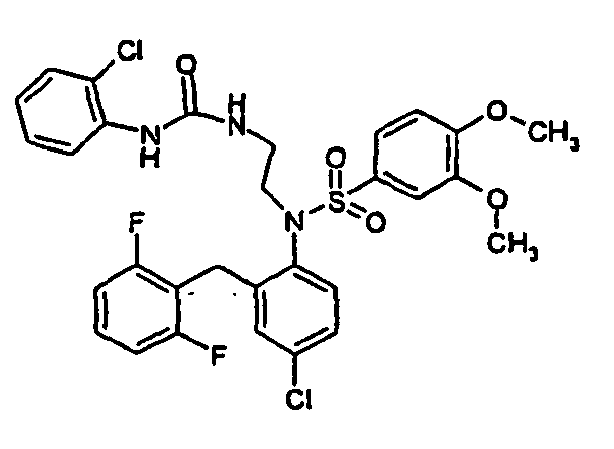
Composé 241 :
N∼2∼-[5-bromo-2-(2,6-difluorobenzyl)phényl]-N∼2∼-[(3,4-diméthoxyphényl)sulfonyl]glycinamide
Composé 242 :
N∼2∼-[4-bromo-2-(2,6-difluorobenzyl)phényl]-N∼-2∼-[(3,4-diméthoxyphényl)sulfonyl]glycinamide
Composé 243 :
N-[4-chloro-2-(2,6-difluorobenzyl)phényl]-3,4-diméthoxy-N-[1-(2-méthyl-2H-tétrazol-5-yl)éthyl]benzènesulfonamide
Composé 244 :
N-[4-chloro-2-(2,6-difluorobenzyl)phényl]-3,4-diméthoxy-N-[1-(1-méthyl-1H-tétrazol-5-yl)éthyl]benzènesulfonamide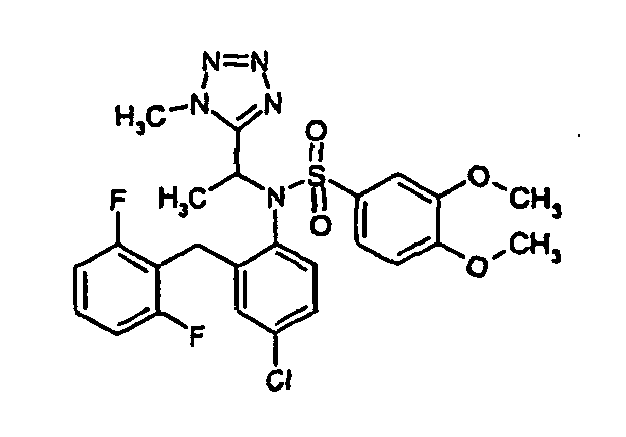
Composé 245 :
N-[4-chloro-2-(2,6-difluorobenzyl)phényl]-3,4-diméthoxy-N-(3-pyridin-3-ylpropyl)benzènesulfonamide
Composé 246 :
N-[4-chloro-2-(2,6-difluorobenzyl)phényl]-N-(1-cyanoéthyl)-3,4-diméthoxybenzènesulfonamide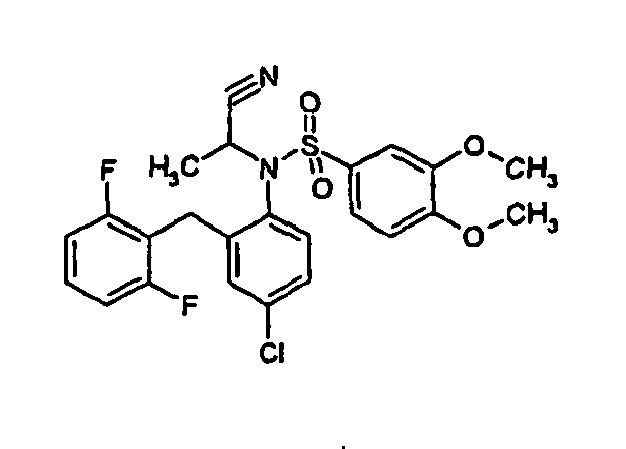
Composé 247 :
N~2~-[2-(2,6-difluorobenzyl)-6-méthoxyphényl]-N~2~-[(3,4-diméthoxyphényl)sulfonyl]glycinamide
Composé 248 :
N-[4-chloro-2-(2,6-difluorobenzyl)phényl]-N-(cyclopropylméthyl)-3,4-diméthoxybenzènesulfonamide
Composé 249 :
N∼2∼-[4-chloro-2-(2,6-difluorobenzyl)phényl]-N∼2∼-[(4-chloro-2,5-diméthylphényl)sulfonyl]glycinamide
Composé 250 :
N-[4-chloro-2-(2,6-difluorobenzyl)phényl]-3,4-diméthoxy-N-(2-pyridin-2-yléthyl)benzènesulfonamide
Composé 251 :
N∼2∼-{4-chloro-2-[(2,6-difluorophényl)(hydroxy)méthyl]phényl}-N∼2∼-[(3,4-diméthoxyphényl)sulfonyl]glycinamide
Composé 252 :
N-[4-chloro-2-(2,6-difluorobenzyl)phényl]-N-[2-({[(3,4-diméthoxyphényl)amino]carbonyl}amino)éthyl]-3,4-diméthoxybenzènesulfonamide
Composé 253 :
N-[4-chloro-2-(2,6-difluorobenzyl)phényl]-3,4-diméthoxy-N-(2-{[(méthylamino)carbonyl]amino}éthyl)benzènesulfonamide
Composé 254 :
N-[4-chloro-2-(2,6-difluorobenzyl)phényl]-3,4-diméthoxy-N-(2-pyridin-3-yléthyl)benzénesulfonamide
Composé 255 :
N-[4-chloro-2-(2,6-difluorobenzyl)phényl]-3,4-diméthoxy-N-(2-pyridin-4-yléthyl)benzènesulfonamide
Composé 256 :
N-(2-aminoéthyl)-N-[4-chloro-2-(2,6-difluorobenzyl)phényl]-3,4-diméthoxybenzènesulfonamide
Composé 257 :
N-(2-aminoéthyl)-N-[2-(2,5-difluorobenzyl)-4-méthylphényl]-3,4-diméthoxybenzènesulfonamide
Composé 258 :
N-[2-(2,6-difluorobenzyl)-4-méthylphényl]-3,4-diméthoxy-N-[2-(méthylamino)éthyl]benzénesulfonamide
Composé 259 :
N∼2∼-[4-chloro-2-(2,6-difluorobenzyl)phényl]-N∼2∼-[(4-méthoxy-3-méthylphényl)sulfonyl]glycinamide
Composé 260 :
N-[4-chloro-2-(2,6-difluorobenzyl)phényl]-3,4-diméthoxy-N-(2-phénoxyéthyl)benzènesutfonamide
Composé 261 :
N∼2∼-[4-chloro-2-(2,6-difluorobenzyl)phényl]-N∼2∼-[(3,4-diméthoxyphényl)sulfonylJalaninamide
Composé 262 :
N-(2-aminoéthyl)-N-[4-chloro-2-(2,5-difluorobenzyl)phényl]-3,4-diméthoxybenzènesulfonamide
Composé 263 :
N~2~-[(4-tert-butylphényl)sulfonyl]-N~2~-[4-chloro-2-(2,6-difluorobenzyl)phényl]glycinamide
Composé 264 :
N-[4-chloro-2-(2,6-difluorobenzyl)phényl]-N-(2-hydroxy-1-méthyléthyl)-3,4-diméthoxybenzènesulfonamide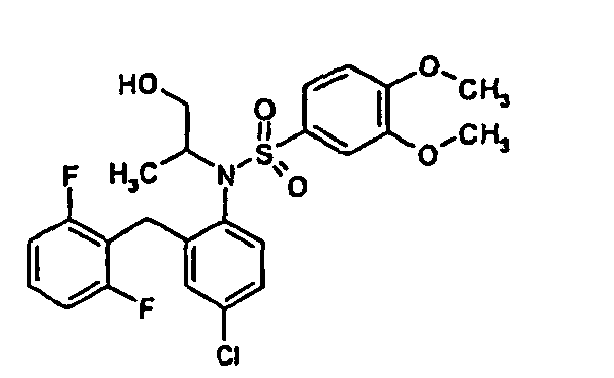
Composé 265 :
N∼2∼-[2-(2-chlorobenzyl)-4-(diméthylamino)phényl]-N∼2∼-[(3,4-diméthoxyphényl)sulfonyl]glycinamide
Composé 266 :
4-{[4-chloro-2-(2,5-difluorobenzyl)phényl][(3,4-diméthoxyphényl)sulfonyl]amino}butanamide
Composé 267 :
N∼2∼-[4-chloro-2-(2,5-difluorobenzyl)phényl]-N∼2∼-[(4-chloro-2,5-diméthylphényl)sulfonyl]glycinamide
Composé 268 :
N-[4-chloro-2-(2,6-difluorobenzyl)phényl]-N-[2-(1,3-dioxolan-2-yl)éthyl]-3,4-diméthoxybenzènesutfonamide
Composé 269 :
phényl (2-{[4-chloro-2-(2,6-difluorobenzyl)phényl][(3,4-diméthoxyphényl)sulfonyl]amino}éthyl)carbamate
Composé 270 :
N-[4-chloro-2-(2,6-difluorobenzyl)phényl]-N-(3-hydroxypropyl)-3,4-diméthoxybenzènesulfonamide
Composé 271 :
N-[4-chloro-2-(2,6-difluorobenzyl)phényl]-N-[2-(1H-imidazol-1-yl)éthyl]-3,4-diméthoxybenzènesulfonamide
Composé 272 :
4-{[2-(2,6-difluorobenzyl)-6-méthoxyphényl][(3,4-diméthoxyphényl)sulfonyl]amino}butanamide
Composé 273 :
N∼3∼-[4-chloro-2-(2,6-difluorobenzyl)phényl]-N∼3∼-[(3,4-diméthoxyphényl)sulfonyl]-béta-alaninamide
Composé 274 :
N-[4-chloro-2-(2,6-difluorobenzyl)phényl]-3,4-diméthoxy-N-[(2R)-pyrrolidin-2-ylméthyl]benzénesulfonamide
Composé 275 :
N-[4-chloro-2-(2,6-difluorobenzyl)phényl]-3,4-diméthoxy-N-[(2S)-pyrrolidin-2-ylméthyl]benzènesulfonamide
Composé 276 :
2-{[4-chloro-2-(2,6-difluorobenzyl)phényl][(3,4-diméthoxyphényl)sulfonyl]amino}-2-éthoxyacétamide
Composé 277 :
N-[4-chloro-2-(2,6-difluorobenzyl)phényl]-3,4-diméthoxy-N-[2-(1H-1,2,4-triazol-1-yl)éthyl]benzènesulfonamide
Composé 278 :
N-[4-chloro-2-(2,6-difluorobenzyl)phényl]-N-(2-{[2-(diméthylamino)éthyl]amino}éthyl)-3,4-diméthoxybenzènesulfonamide
Composé 279 :
N∼2∼-[(4-aminophényl)sulfonyl]-N∼2∼-[4-chloro-2-(2,6-difluorobenzyl)phényl]glycinamide
Composé 280 :
N∼2∼--[2-(2,5-difluorobenzyl)-4-méthylphényl]-N∼2∼-[(3,4-diméthoxyphényl)sulfonyl]glycinamide
Composé 281 :
N-(2-aminoéthyl)-N-[2-(2,6-difluorobenzyl)-6-méthoxyphényl]-3,4-diméthoxybenzènesulfonamide
Composé 282 :
N-[2-(2,6-difluorobenzyl)-6-méthoxyphényl]-3,4-diméthoxy-N-[2-(méthylamino)éthyl]benzènesulfonamide
Composé 283 :
N∼2∼-[4-chloro-2-(2,6-difluorobenzyl)phényl]-N∼2∼-[(6-méthoxypyridin-3-yl)sulfonyl]glycinamide
Composé 284 : N-[4-chloro-2-(2,6-difluorobenzyl)phényl]-3,4-diméthoxy-N-[2-(m éthylamino)éthyl]benzènesulfonam ide 
Composé 285 :
N∼2∼-[2-(2,5-difluorobenzyl)-6-méthoxyphényl]-N∼2~-[(3,4-diméthoxyphényl)sulfonyl]glycinamide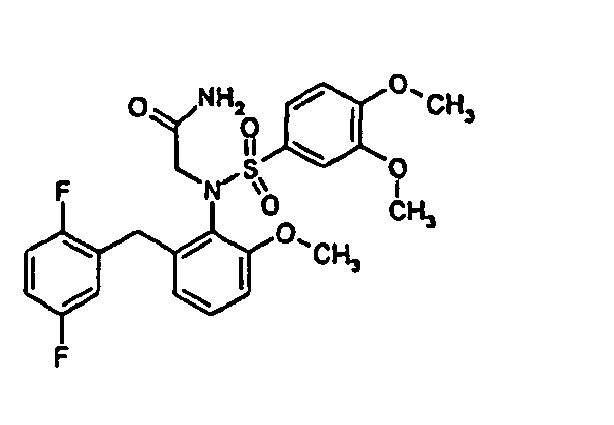
Composé 286 :
N∼2∼-[5-chloro-2-(2,6-difluorobenzyl)phényl]-N∼2∼-[(3,4-diméthoxyphényl)sulfonyl]glycinamide
Composé 287 :
N-(3-aminopropyl)-N-[4-chloro-2-(2,6-difluorobenzyl)phényl]-3,4-diméthoxybenzènesulfonamide
Composé 288 :
N∼2∼-[2-(2,6-difluorobenzyl)-6-méthylphényl]-N∼2∼-[(3,4-diméthoxyphényl)sulfonyl]glycinamide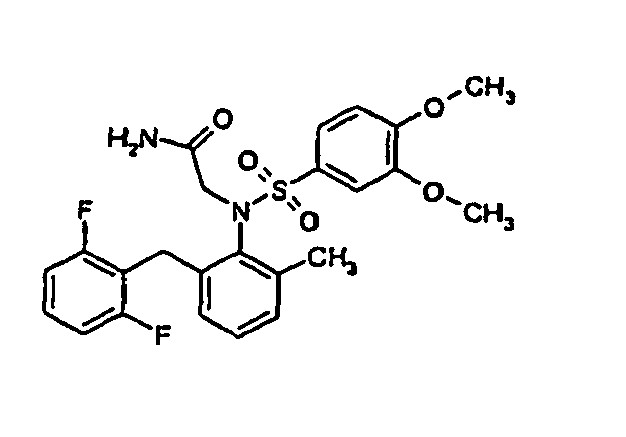
Composé 289 :
N-[4-chloro-2-(2,6-difluorobenzyl)phényl]-3,4-diméthoxy-N-vinylbenzènesulfonamide
Composé 290 :
N-[4-chloro-2-(2,6-difluorobenzyl)phényl]-3,4-diméthoxy-N-(1,3-thiazol-2-ylméthyl)benzènesulfonamide
Composé 291 :
N-[4-chloro-2-(2,6-difluorobenzyl)phényl]-3,4-diméthoxy-N-(pyrimidin-2-ylméthyl)benzènesulfonamide
Composé 292 :
N-[4-chloro-2-(2,6-difluorobenzyl)phényl]-3,4-diméthoxy-N-(2-morpholin-4-yléthyl)benzènesulfonamide
Composé 293 :
N∼2∼-[2-chloro-6-(2,6-difluorobenzyl)phényl]-N∼2∼-[(3,4-diméthoxyphényl)sulfonyl]glycinamide
Composé 294 :
N-(2-aminoéthyl)-N-[2-(2,5-difluorobenzyl)-6-méthoxyphényl]-3,4-diméthoxybenzènesulfonamide
Composé 295 :
N-[4-chloro-2-(2,6-difluorobenzyl)phényl]-3,4-diméthoxy-N-(pyridin-2-ylméthyl)benzènesulfonamide
Composé 296 :
N∼2∼-[2-(2,6-difluorobenzyl)-5-méthoxyphényl]-N∼2∼-[(3,4-diméthoxyphényl)sulfonyl]glycinamide
Composé 297 :
N-[2-(2,6-difluorobenzyl)-6-méthoxyphényl]-3,4-diméthoxy-N-méthylbenzènesulfonamide
Composé 298 :
3-{[4-chloro-2-(2,6-difluorobenzyl)phényl][(3,4-diméthoxyphényl)sulfonyl]amino}butanamide
Composé 299 :
4-{[2-(2,5-difluorobenzyl)-6-méthoxyphényl][(3,4-diméthoxyphényl)sulfonyl]amino}butanamide
Composé 300 :
N-(2-aminoéthyl)-N-[4-chloro-2-(2,6-difluorobenzyl)-6-méthoxyphényl]-3,4-diméthoxybenzènesulfonamide
Composé 301 :
N-[2-(2,6-difluorobenzyl)-6-méthoxyphényl]-N-[2-(1H-imidazol-1-yl)éthyl]-3,4-diméthoxybenzènesulfonamide
Composé 302 :
N∼2∼-[4-chloro-2-(2,6-difluorobenzyl)-6-méthoxyphényl]-N∼2∼-[(3,4-diméthoxyphényl)sulfonyl]glycinamide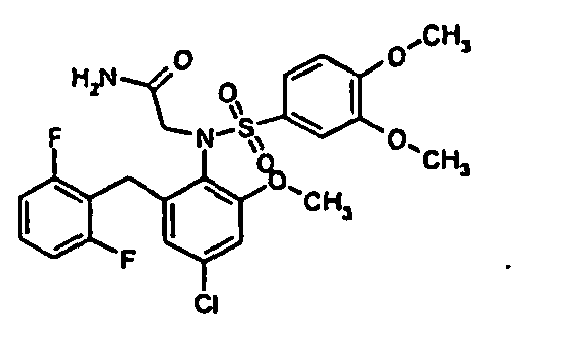
Composé 303 :
N∼2∼-[2-(2,6-difluorobenzyl)-6-méthoxy-4-méthylphényl]-N∼2∼-[(3,4-diméthoxyphényl)sulfonyl]glycinamide
Composé 304 :
(+)N∼2∼-[4-chloro-2-(2,6-difluorobenzyl)phényl]-N∼2∼[(3,4-diméthoxyphényl)sulfonyl]alaninamide
Composé 305 :
(-)N∼2∼-[4-chloro-2-(2,6-difluorobenzyl)phényl]-N∼2∼-[(3,4-diméthoxyphényl)sulfonyl]alaninamide
Composé 306 :
N-[2-(2,6-difluorobenzyl)-6-méthoxyphényl]-3,4-diméthoxy-N-[2-(1H-1,2,4-triazol-1-yl)éthyl]benzènesulfonamide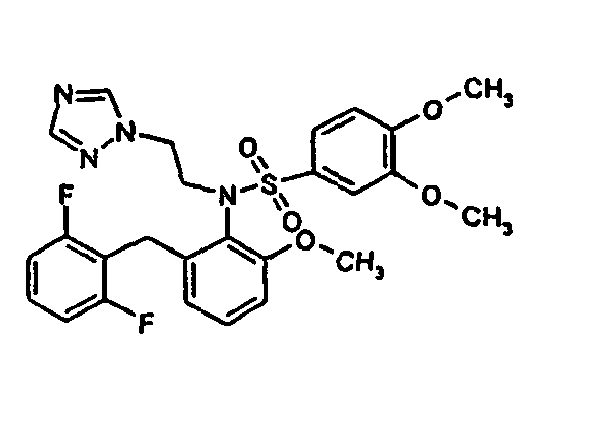
Composé 307 :
N∼2∼-[4-chloro-2-(2,6-difluorobenzyl)phényl]-N∼2∼-[(3,5-diméthoxyphényl)sulfonyl]glycinamide
Composé 308 :
N~2~-[4-chloro-2-(2,6-difluorobenzyl)phényl]-N~2~-[(3-méthoxy-4-méthylphényl)sulfonyl]glycinamide
Composé 309 :
N∼2∼-[2-(2,6-difluorobenzyl)-6-méthoxyphényl]-N∼2∼-[(3,4-diméthoxyphényl)sulfonyl]-N-éthylglycinamide
Composé 310 :
N-[2-(2,6-difluorobenzyl)-6-méthoxyphényl]-N-[(2-éthyl-2H-tétrazol-5-yl)méthyl]-3,4-diméthoxybenzènesulfonamide
Composé 311 :
N-[2-(2,6-difluorobenzyl)-6-méthoxyphényl]-N-[(1-éthyl-1H-tétrazol-5-yl)méthyl]-3,4-diméthoxybenzènesulfonamide
Composé 312 :
N∼2∼-[(3,4-diméthoxyphényl)sulfonyl]-N-2--(3-méthoxybiphényl-2-yl)glycinamide
Composé 313 :
N-[4-chloro-2-(2,6-difluorobenzyl)phényl]-3,4-diméthoxy-N-{2-[(méthylsulfonyl)amino]éthyl}benzènesulfonamide
Composé 314 :
N∼2∼-[4-chloro-2-(2,6-difluorobenzyl)phényl]-N∼2∼-[(2-fluoro-4,5-diméthoxyphényl)sulfonyljglycinamide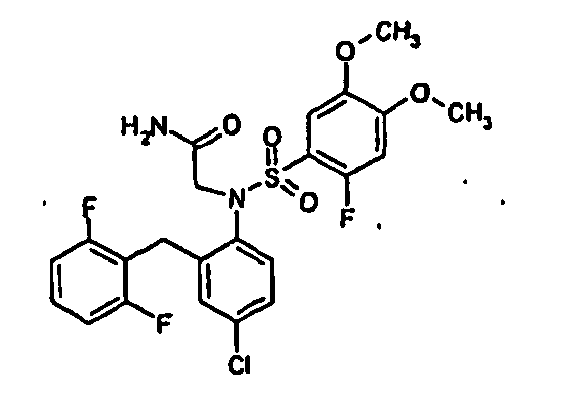
Composé 315 :
méthyl N-[2-(2,6-difluorobenzyl)-6-méthoxyphényl]-N-[(3,4-diméthoxyphényl)sulfonyl]-L-alaninate
Composé 316 :
méthyl N-[2-(2,6-difluorobenzyl)-6-méthoxyphényl]-N-[(3,4 diméthoxyphényl)sulfonyl]-L-alaninate
Composé 317 :
méthyl N-[2-(2,6-difluorobenzyl)-6-méthoxyphényl]-N-[(3,4-diméthoxyphényl)sulfonyl]-D-alaninate
Composé 318 :
méthyl N-[2-(2,6-difluorobenzyl)-6-méthoxyphényl]-N-[(3,4-diméthoxyphényl)sulfonyl]-D-alaninate
Composé 319 :
N∼2∼-[(4-tert-butylphényl)sulfonyl]-N∼2∼-[2-(2,6-difluorobenzyl)-6-méthoxyphényl]glycinamide
Composé 320 :
N∼2∼-[2-(2,6-difluorobenzyl)-6-méthoxyphényl]-N∼2∼-[(3,4-difluorophényl)sulfonyl]glycinamide
Com posé 321 :
N2-[2-(2,6-difluorobenzyl)-6-méthoxyphényl]-N2-[(3,4-diméthoxy phényl)sulfonyl]-R-alaninamide
Composé 322 :
N2-[2-(2,6-difluorobenzyl)-6-méthoxyphényl]-N2-[(3,4-diméthoxyphényl)sulfonyl]-S-alaninamide
Composé 323 :
N2-[2-méthoxy-6-(2-phényléthyl)phényl]-N2-[(3,4-diméthoxy phényl)sulfonyl]glycinamide
- Dans le cadre de l'invention, on entend par :
- un groupe (C1-C4) alkyle : un groupe aliphatique saturé, linéaire ou ramifié comprenant de 1 à 4 atomes de carbone, tel que le méthyle, l'éthyle, le propyle, l'isopropyle, le butyle, l'isobutyle, le sec-butyle, le tert-butyle ;
- un groupe (C1-C4) alkyle éventuellement substitué : un groupe alkyle tel que défini ci-dessus dans lequel un ou plusieurs atomes d'hydrogène ont été substitués par un substituant ;
- un groupe (C3-C8) cycloalkyle : un groupe alkyle cyclique saturé, comprenant de 3 à 6 atomes de carbone, par exemple le cyclopropyle, le cyclobutyle, le cyclopentyle, le cyclohexyle. Le groupe cycloalkyle peut éventuellement être substitué par un groupe (C1-C4) alkyle, par exemple le méthylcyclopropyl, diméthylcyclopropyl, méthylcyclobutyl, méthyl-cyclopentyl, méthyl-cyclohexyl, diméthyl-cyclohexyl ;
- un groupe (C1-C4) alcoxy : un radical (C1-C4)alkyl-O- où le groupe (C1-C4) alkyle est tel que défini précédemment, par exemple le méthoxy, l'éthoxy, le propoxy, l'isopropoxy, le butoxy, l'isobutoxy, le sec-butoxy, le tert-butoxy ;
- un groupe (C1-C4) alkylcarbonyle : un groupe (C1-C4)alkyl-C(O)- où le groupe (C1-C4) alkyle est tel que défini précédemment ;
- un groupe fluoro(C1-C4)alkyle : un groupe (C1-C4)alkyle tel que défini précédemment dont un ou plusieurs atomes d'hydrogène ont été substitués par un ou plusieurs atomes de fluor. A titre d'exemples, on peut citer les groupes -CF3, -CH2-CF3 ;
- un groupe (C1-C4)alcényle : un groupe aliphatique mono- ou poly-insaturé, linéaire ou ramifié comprenant de 1 à 4 atomes de carbone, présentant par exemple une ou deux insaturations éthyléniques ;
- un groupe fluoro(C1-C4)alcoxy : un groupe (C1-C4)alcoxy tel que défini précédemment dont un ou plusieurs atomes d'hydrogène ont été substitués par un ou plusieus atomes de fluor. A titre d'exemples, on peut citer les groupes -O-CF3, -O-CH2-CF3 ;
- un atome d'halogène : un atome de fluor, un atome de chlore, un atome de brome ou un atome d'iode ;
- un groupe aryle : un groupe aromatique monocyclique ou bicyclique comprenant entre 6 et 10 atomes de carbone, par exemple le phényle, le naphtyle. Le groupe aryle peut éventuellement être substitué par 1, 2, 3 ou 4 substituants. A titre de substituants on peut citer par exemple un atome d'halogène, un groupe (C1-C4) alkyle, un groupe (C1-C4) alcoxy, un groupe fluoro(C1-C4)alkyle, un groupe fluoro(C1-C4)alcoxy, un groupe hydroxyle, un groupe -CN, un groupe nitro, un groupe -CO-NRaRb avec Ra et Rb étant, indépendamment l'un de l'autre, un atome d'hydrogène, un groupe (C1-C4) alkyle ;
- un groupe hétérocyclyle : un groupe monocyclique ou bicyclique saturé, insaturé ou aromatique comprenant entre 5 et 10 atomes et comprenant de 1 à 4 hétéroatomes choisis parmi l'azote, l'oxygène ou le soufre. A titre d'exemple on peut citer le 1,3-dioxolanyle, l'imidazolyle, le tétrazolyle, l'oxadiazolyle, le pyridinyle, le thiazolyle, le thiényle, le pyrimidinyle, le triazolyle. Le groupe hétérocyclyle peut éventuellement être substitués par 1, 2, 3, 4 ou 5 substituants. A titre de substituants on peut citer par exemple, un atome d'halogène, un groupe (C1-C4) alkyle, un groupe (C1-C4) alcoxy, un groupe hydroxyle, un groupe -CN.
- Comme déjà indiqué, les composés de formule générale (I) peuvent comporter un ou plusieurs carbones asymétriques. Ils peuvent donc exister sous forme d'énantiomères ou de diastéréoisomères. Ces énantiomères, diastéréoisomères, ainsi que leurs mélanges, y compris les mélanges racémiques, font partie de l'invention.
- De par leur structure, les composés de formule générale (I) peuvent également exister sous forme de rotamères. Dans le cadre de l'invention, on entend par rotamères des composés qui ont des formules dévéloppées identiques mais des conformations spatiales figées différentes. Ces différences dans les conformations spatiales figées de ces composés peuvent leur conférer des propriétés physicochimiques différentes et, même dans certains cas, des activités biologiques différentes.
- Les composés de formule générale (I) peuvent encore exister sous forme d'atropoisomères. Les atropoisomères sont des composés de formules développées identiques, mais qui présentent une configuration spatiale particulière, résultant d'une rotation restreinte autour d'une liaison simple, due à un encombrement stérique important de part et d'autre de cette liaison simple. L'atropioisomérie est indépendante de la présence d'éléments stéréogènes, tel qu'un carbone asymétrique.
- Les composés de formule (I) peuvent exister à l'état de bases ou de sels d'addition à des acides. De tels sels d'addition font partie de l'invention.
- Ces sels sont avantageusement préparés avec des acides pharmaceutiquement acceptable, mais les sels d'autres acides utiles, par exemple, pour la purification ou la séparation des composés de formule générale (I) font également partie de l'invention.
- Les composés de formule générale (I) peuvent, en outre, se trouver sous forme d'hydrates ou de solvats, à savoir sous forme d'associations ou de combinaisons avec une ou plusieurs molécules d'eau ou avec un solvant. De tels hydrates et solvats font également partie de l'invention. Dans ce qui suit, on entend par groupe partant, un groupe pouvant être facilement clivé d'une molécule, avec départ d'une paire électronique, par rupture d'une liaison hétérolytique. Ce groupe peut ainsi être remplacé facilement par un autre groupe lors d'une réaction de substitution par exemple. De tels groupes partants sont, par exemple, les halogènes, ou un groupe hydroxy activé tel qu'un mésylate, tosylate, triflate, acétyle, etc. Des exemples de groupes partants ainsi que des références pour leur préparation sont donnés dans « Advanced Organic Chemistry », J. March, 3rd Edition, Wiley Interscience, p 310-316.
- La présente invention a également pour objet le procédé de préparation des composés de formule générale (I).
- Ainsi, les composés de formule générale (I) peuvent être préparés par les procédés illustrés dans le schéma 1. Selon ce schéma, les composés de formule (I), peuvent être obtenus :
- soit par l'alkylation des composés de formule générale (II) avec des composés de formule générale (IV), en présence d'une base, selon une adaptation du procédé décrit par Levin et al., Bioorg. Med. Chem., 2001, EN 11 ; 22 ; 2975-2978 ;
- soit par une réaction de Mitsunobu entre les alcools de formule (X) et les composés de formule générale (II).
- Dans les composés de formule (II), (IV) et (X), Ar1, Ar2, Ar3, T et R1 sont tels que définis dans la formule (I) et Z est un groupe partant tel qu'un atome d'halogène choisi parmi le brome, le chlore et l'iode ; ou encore un mésylate, un tosylate, un triflate.
- La base peut être une base organique comme par exemple le tert-butylate de potassium ou inorganique comme par exemple le carbonate de potassium ou encore un agent de transfert de phase comme par exemple le bromure de tétrabutylammonium.
- Dans la réaction de Mitsunobu, le diisopropylazodicarboxylate (DIAD) peut être remplacé par ses analogues comme le diéthylazodicarboxylate et le diterbutylazodicarboxylate, et la triphénylphosphine peut être greffée sur une résine (R. G. Gentles et al., J. Comb. Chem. 2002, 4, 442-456).

- Les composés de structure (I) pour lesquels R1 est un enchaînement de type -CR7R8-(CH2)n-R9, avec R9 = -CONR12R13, peuvent être obtenus à partir des ester correspondants de formule -CR7R8-(CH2)nCOOR14, selon la séquence de réaction suivante : saponification de la fonction carboxylate -COOR14 ; activation de la fonction acide carboxylique générée, par exemple par des chloroformiates pour former des anhydrides mixtes ; réaction d'amidation avec des amines de types NHR12R13 avec n, R7, R8, R12, R13, R14 comme définis précédemment.
- Les composés de structure (I) pour lesquels R1 est un enchaînement de type -CR7R8-(CH2)n-R9, avec R9 = -NH-CO-NR15R16, peuvent être obtenus à partir des composés (I) pour lesquels R9 = NH2 par action d'isocyanates de types R15NCO ou R16NCO avec n, R7, R8, R15, R16 comme définis précédemment.
- Les composés de structure (I) pour lesquels R1 est un enchaînement de type -CR7R8-(CH2)n-R9, R9 = -NR10R11 dans lequel R10 et R11, indépendamment l'un de l'autre, représentent un atome d'hydrogène et un groupe (C1-C4) alkylcarbonyle, peuvent être obtenus à partir des composés (I) pour lesquels R9 = NH2 par action d'acides carboxyliques de formule (C1-C4)alkyl-COOH ou de leurs chlorures d'acides de formule (C1-C4)alkyl-COCl avec n, R7, R8, R10, R11, comme définis précédemment.
- Les composés (I) pour lesquels R9 est un groupe hétérocyclyle tel que le tétrazolyle substitué sont obtenus par réactions chimiques classiques, connues de l'homme du métier, à partir des composés (I) pour lesquels R9 est un groupement cyano.
- Les composés de structure (I), pour lesquels T = -(CH2)n avec n = 1, peuvent dans certains cas être obtenus à partir des composés de structure (I), pour lesquels T = -CHOH, par action d'hydrure, par exemple le triéthylsilane, en présence d'éthérate de trifluorure de bore.
- Les composés de structure (I), pour lesquels


- Les composés de structure (II) sont obtenus au préalable selon le schéma 2, par la sulfonylation du composé de formule (III) avec des chlorures de sulfonyle de formule (V) en présence d'une base choisie parmi les amines tertiaires telle que la pyridine selon le procédé décrit par Stauffer et al., Bioorg. Med. Chem., 2000, EN 8, 6, 1293-1316. Comme amines tertiaires on peut également utiliser la triéthylamine ou la diisopropyléthylamine.
- Dans certains cas, on peut même envisager d'utiliser un mélange d'amines tertiaires. Les composés de formule (V) sont commerciaux ou peuvent être obtenus par adaptation des procédés décrits, par exemple, par A. J. Prinsen et al, Recl. Trav. Chim. Pays-Bas 1965, EN 84, 24.
- Dans les composés de formule (III) et (V), Ar1, Ar2, Ar3, et T sont tels que définis dans la formule (I).

- Les composés de formule (IIIa), (IIIb) et (IIIf) sont préparés selon les schémas 3 à 5. Les dérivés 2-nitro aldéhydes de formule (VI) réagissent avec des composés organométalliques de formule (VII) dans laquelle M représente un groupe MgBr, Mgl, Znl ou Li pour conduire aux composés de structure (VIII). Les composés organométalliques de formule (VII) sont commerciaux, ou formés selon les procédés classiques décrits dans la littérature. Les nitro alcools de formule (VIII) sont réduits par hydrogénation, par exemple sous l'action d'étain métallique et d'acide chlorhydrique concentré dans l'éthanol, pour donner les composés de structure (IIIb). Les dérivés de formule (IIIb) sont réduits par l'action d'hydrures, par exemple par un mélange de triéthylsilane et d'acide trifluoroacétique dans le dichlorométhane pour aboutir aux dérivés de formule (IIIa).
- Les nitroaldéhydes de formule (VI) sont commerciaux ou peuvent être préparés, par exemple, selon une adaptation du procédé décrit par J. Kenneth Horner et al., J. Med. Chem., 1968, 11; 5; 946.

- D'autres possibilités pour synthétiser les composés de formules générales (IIIb) et (IIIf) sont présentées dans le schéma 4.

- Les anilines de formule (IX) sont condensées avec des nitriles de formule (XII), en présence d'acide de Lewis comme par exemple le trichlorure de bore avec le trichlorure d'aluminium ou avec le trichlorure de gallium pour donner les composés de formule (IIIf), selon le procédé décrit par T. Sugasawa et al J.A.C.S.1978; 100; 4842. Les composés de formule (IIIf) peuvent être obtenus par condensation d'aminonitriles (XI) avec les dérivés organométalliques (VII), selon le procédé décrit par R. Fryer et al., J. Heterocycl. Chem, 1991, EN 28; 7, 1661. Les composés de formule (IIIf) peuvent aussi être obtenus à partir de l'intermédiaire (XIV) selon une adaptation du procédé décrit par D. Lednicer, J. Heterocyclic. Chem, 1971; 903.
- La fonction carbonyle des composés (IIIf) est réduite par l'action d'un hydrure, par exemple le borohydrure de sodium dans l'éthanol, pour conduire aux composés de structure (IIIb).
- Une autre méthode de préparation des composés de formule (IIIb) consiste à condenser des anilines de formule (IX) sur des dérivés benzaldéhydes de formule (XIII) en présence de phényl-dichloro-borane et de triéthylamine selon le procédé décrit par T. Toyoda et al., Tet. Lett, 1980, 21, 173.
- Il est à noter que les composés de formule (IIIf) sous l'action de triéthylsilane et d'acide trifluoroacétique par exemple, peuvent conduire aux composés de formule (IIIa).
- Une autre possibilité pour synthétiser les composés de formules générales (IIIa), dans lequel Ar1 représente un héteroaryle, est présentée dans le schéma 5.

- Les nitrophényles de formule (XVII) sont condensés sur des chloro méthyl hétéroaryles de formule (XVIII) en présence d'une base, par exemple le tert-butylate de potassium, pour conduire aux dérivés (XIX) selon le procédé décrit par Florio.S et al., Eur.J.Org.Chem.2004, 2118, qui sont réduit par exemple par l'action de l'étain métallique en présence d'acide chlorhydrique 12M, pour conduire aux dérivés de formule (IIIa).
- Les composés de formule (IIIc) et (IIId) sont préparés selon le schéma 6.
- Les composés de formule (IIIf), sous l'action d'un (C1-C4)alkylmagnésien conduisent aux dérivés de formule (IIIc). Ces composés sont déhydroxylés sous l'action de trichlorure d'aluminium et d'hydrure mixte de lithium et d'aluminium pour conduire aux composés (IIId).
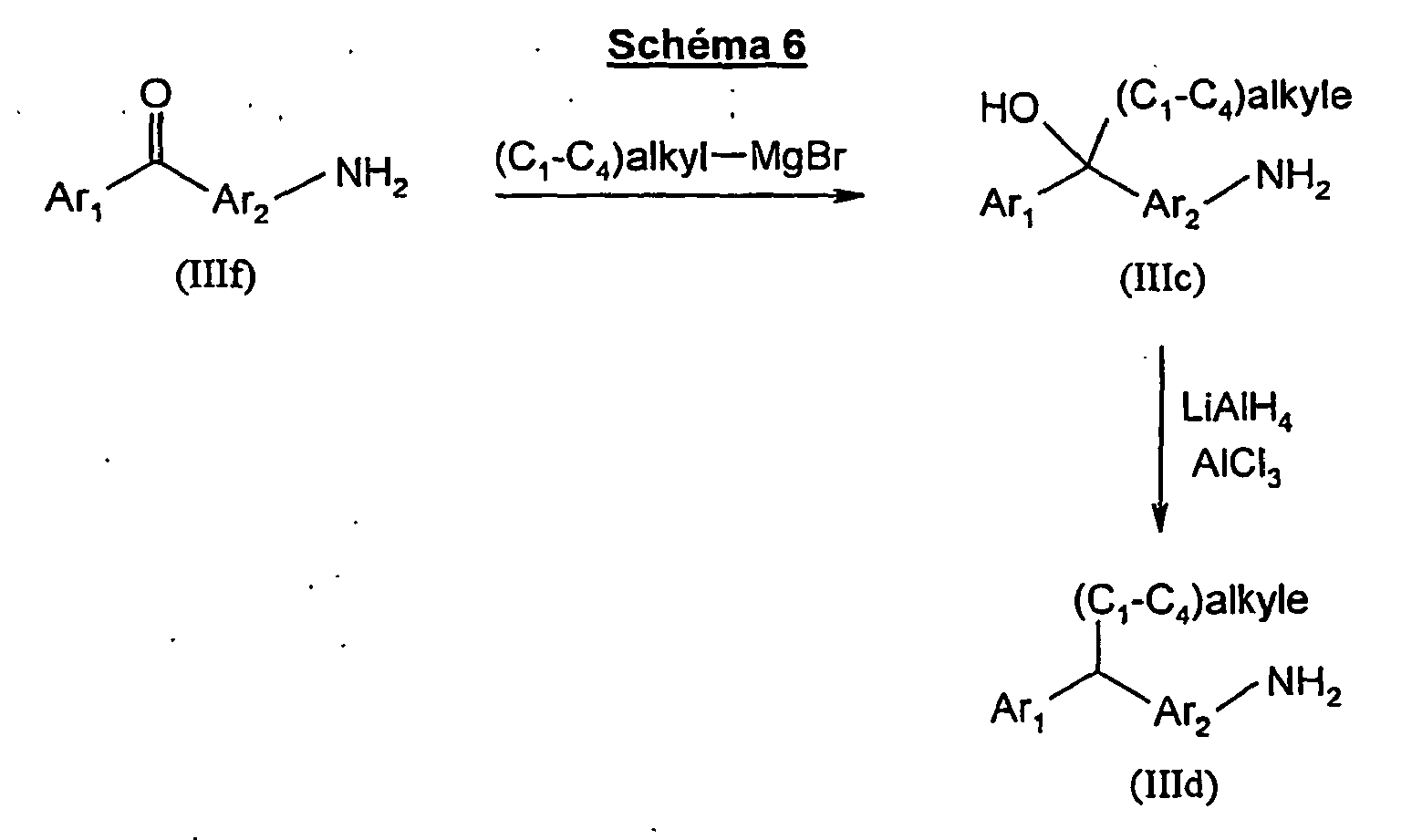
- Les composés de formule (IIIe) sont préparés selon le schéma 7. Les dérivés (XV), sous l'action d'une base, par exemple le carbonate de césium et d'un halogenure d'alkyle en C1-C4, conduisent aux dérivés (XVI). Le groupement nitro de ces dérivés peut être réduit, par exemple, en présence d'étain métallique et d'acide chlorhydrique dans l'éthanol pour conduire aux composés de formule (IIIe)..

- Les composés de formule (IIIg) sont préparés selon le schéma 8. Les nitroaldehydes (VI), par condensation avec les dérivés (XX) selon une réaction de wittig conduisent aux composés (XXI). Ces dérivés sont réduits par exemple par hydrogénation catalytique au palladium pour donner les composés de formule (IIIg).
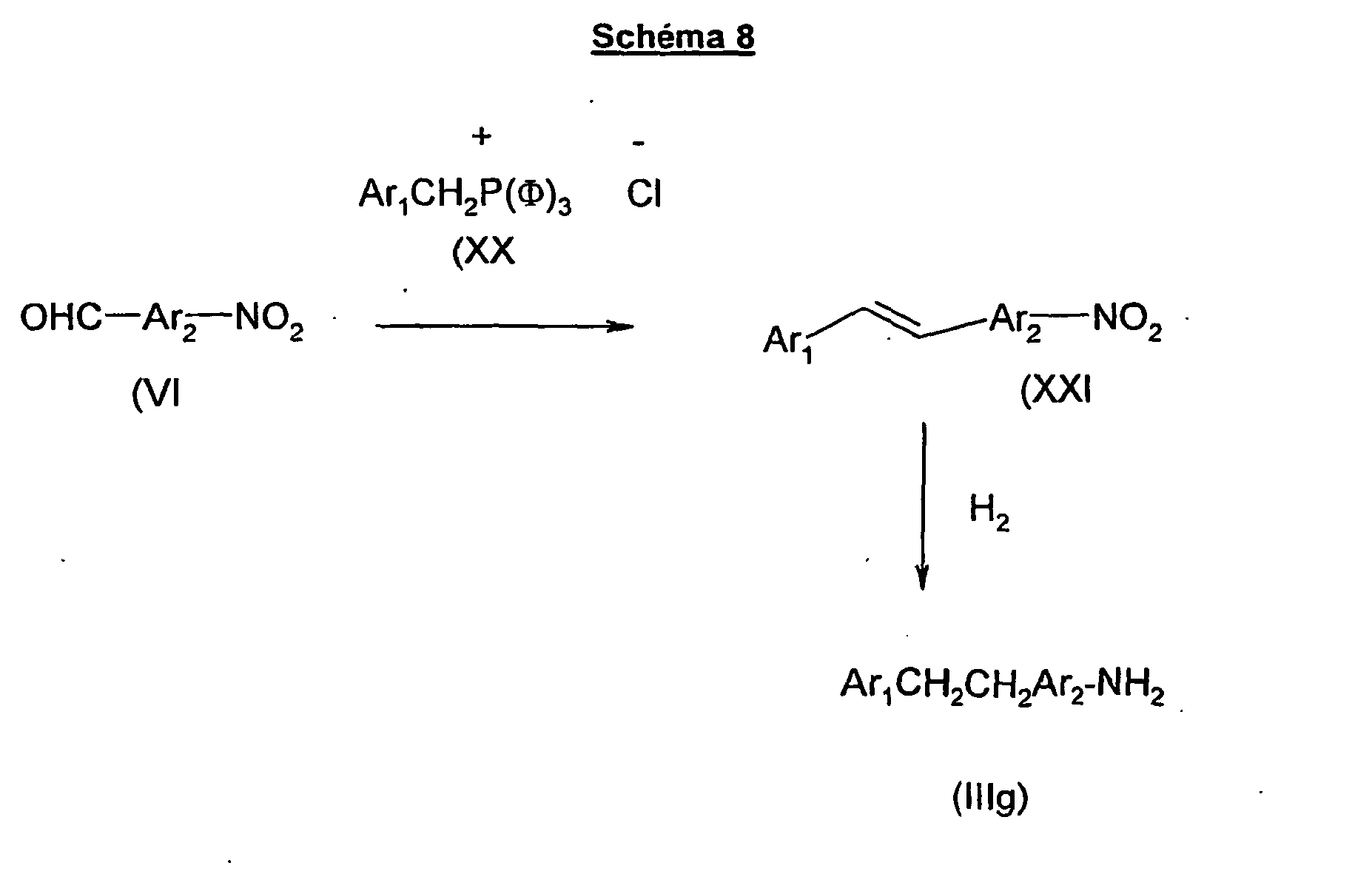
- Dans tous les schémas et pour tous les composés de formules (II) à (XXI), les significations de Ar1, T, Ar2, Ar3, R1 sont telles que définies pour les composés de formule générale (I).
- Dans les schémas 1 à 8, les composés de départ et les réactifs, lorsque leur mode de préparation n'est pas décrit, sont disponibles dans le commerce ou décrits dans la littérature, ou bien peuvent être préparés par des méthodes qui y sont décrites ou qui sont connues de l'homme du métier.
- Lorsqu'un composé comporte une fonction réactive, par exemple un groupe hydroxyle, elle peut nécessiter une protection préalable avant réaction. L'homme du métier pourra déterminer la nécessité d'une protection préalable.
- Les composés de formule (II) à (XXI) sont utiles en tant qu'intermédiaires de synthèse pour la préparation des composés de formule générale (I) et font partie intégrante de la présente invention.
- Les exemples suivants décrivent la préparation des composés conformes à l'invention. Ces exemples ne sont pas limitatifs et ne font qu'illustrer l'invention.
- Les numéros des composés exemplifiés renvoient à ceux donnés dans le tableau ci-avant. Les micro-analyses élémentaires, les spectres de masse, et les spectres RANZ confirment les structures des composés obtenus.
- Les conditions d'analyse par chromatographie liquide couplée à une spectrométrie de masse LC/MS sont les suivantes:
- pour la partie chromatographie liquide : Colonne symetry C18 (2,1x 50mm) 3-5µm. Eluant A= H2O +0,005% de TFA, pH=3,14; Eluant B=CH3CN +0,005% de TFA, avec un gradient de 100% de A à 90% de B en 10 minutes, puis 5 minutes à 90% de B
- pour la partie spectrométrie de masse : mode d'ionisation électrospray positif. Lorsque le spectre de RMN1H met en évidence des rotamères, seule l'interprétation correspondant au rotamère majoritaire est décrite.
- Dans les tableaux suivants:
- F(°C) représente le point de fusion du composé en degré Celsius
- MH+ représente le pic de masse du produit ionisé
- Le temps de rétention est exprimé en minutes
- n.d. signifie « non déterminé ».
- A 5,3g de (2-amino-5-chlorophényl)(2-chlorophényl)méthanone en solution dans 50ml de pyridine on additionne 5,29g de 3,4-diméthoxybenzène sulfonylchlorure et laisse 3 heures à température ambiante. On concentre le milieu réactionnel, le résidu est repris à l'éther diisopropylique, le précipité formé est filtré pour obtenir après séchage 5,2g de produit attendu
RMN 1H δ en ppm (DMSO d 6): 3,75(s, 3H); 3,83(s, 3H); 7,06-7,69(massif, 11H). - A 16g de N-[4-chloro-2-(2-chlorobenzoyl)phényl]-3,4-diméthoxybenzènesulfonamide en solution dans 900ml d'éthanol on additionne par portions 3,93g de borohydrure de sodium et laisse 18 heures à température ambiante. Le milieu réactionnel est concentré, Le résidu est repris par de l'acétate d'éthyle et lavé à l'eau. La phase organique est séchée sur sulfate de sodium anhydre et concentrée. Le résidu est concrété à l'éther diisopropylique; après filtration et séchage du précipité on obtient 14,66g de produit attendu.
RMN 1H δ en ppm (DMSO d 6): 3,77(s, 3H); 3,84(s, 3H); 6,27(s, 1H); 6,96-7,44(massif, 10H). - A 6g de N-{4-chloro-2-[(2-chlorophényl)(hydroxy)méthyl]phényl}-3,4-diméthoxybenzène sulfonamide en solution dans 50ml de DMF à 0°C on additionne par portions 0,674g d'hydrure de sodium. Après 1 heure à 0 °C on intoduit 1,4ml de 2-bromoacétate d'éthyle et laisse 18 heures à température ambiante. Le milieu réactionnel est repris à l'acétate d'éthyle et lavé à l'eau. La phase organique est séchée sur sulfate de sodium anhydre et concentrée. Le résidu est chromatographié sur une colonne de gel de silice en éluant au dichlorométhane pour obtenir 1,3g de produit attendu.
RMN 1H δ en ppm (DMSO d6): 1,03(t, 3H); 2,90(d, 1H); 3,77(s, 3H); 3,87(t, 3H); 4,11 (d, 1H); 4,73(q, 2H); 5,94(d, 1H); 6,47(s, 1H); 7,10 - 7,77(massif, 10H). F= 86°C. - Le tableau I illustre les structures chimiques et les propriétés physiques de quelques composés de l'invention obtenus selon cet exemple

Tableau I N° -composé Nature et position des substituants F(°C) MH+/ temps de rétention Ar1 Ar2 R1 Ar3 8 H H CH2CO2Et 3,4-diOMe 58,8 486/8,15 7 H 4-Cl CH2CO2Et 3,4-diOMe 152 521/8,78 9 2-Cl 4-Cl CH2CO2Et 2,4-diOMe 155 555/9,34 10 2-Cl 4-Cl CH2CO2Et H 109,8 495/9,40 13 2-Cl 4-Cl CH2CO2Et 4-OMe 98,2 52419,47 18 2-Cl 4-Cl CH2CO2Et 3,4-diCl 140 562/10,46 19. 2-CI 4-Cl CH2CONH2. 3,4-diOMe 154,7 526/7,52 28 2-Cl 4-Cl CH2CONH2 3,4-diMe 205 n.d. 31 2-Cl 4-Cl CH2CONH2 3-Cl 187 499/8,32 32 2-Cl 4-Cl CH2CONH2 4-OMe 207 495/7,86 - A 1g de N-{4-chloro-2-[(2-chlorophényl)(hydroxy)méthyl]phényl}-3,4-diméthoxy benzènesulfonamide, obtenu à l'exemple 1.2 en solution dans 43 ml d'acétonitrile on additionne successivement, 1,2 ml de triéthylamine , 0,68 ml de iodoéthane et porte à reflux 8 heures . Le milieu réactionnel est repris à l'acétate d'éthyle et lavé à l'eau. La phase organique est séchée sur sulfate de sodium anhydre et concentrée. Le résidu est chromatographié sur une colonne de gel de silice en éluant avec un mélange de solvant cyclohexane / acétate d'éthyle 4 / 6 (v/v) pour obtenir après cristallisation dans le cyclohexane 0,418 g de produit attendu.
RMN 1H δ en ppm (DMSO d6): 0,12(t, 3H); 2,94(m, 1H); 3,21 (m, 1H); 3,75(s, 3H); 3,88(s, 3H); 6,02(d, 1H); 6,51 (d, 1H); 6,80(d, 1H); 6,96-7,49(massif, 8H); 7,91 (d, 1H). F = 153,9 °C - Le tableau II illustre les structures chimiques et les propriétés physiques de quelques composés de l'invention obtenus selon cet exemple

Tableau II N° composé Nature et position des substituants MH+/ temps de rétention Ar1 Ar2 R1 Ar3 F(°C) 21 2-Cl 4-Cl CH2COCH3 3,4-diOMe 158,5 540/8,72 23 2-Cl 4-Cl (CH2)2OMe 3,4-diOMe 112,2 526/8,77 29 2-Cl 4-Cl CH2CONH2 naphtyle 218 515/8,52 30 2-Cl 4-Cl CH2CONH2 3-OMe 114,8 495/7,87 - A 1,5g de N-{4-chloro-2-[(2-chlorophényl)(hydroxy)méthyl]phényl}-3,4-diméthoxybenzènesulfonamide, obtenu à l'exemple 1.2 en solution dans 15 ml de DMF on additionne à température ambiante 1,25g de carbonate de césium, 0,68g de 2-bromoacétamide et porte 2 heures à 100°C. Le milieu réactionnel est repris à l'acétate d'éthyle et lavé à l'eau. La phase organique est séchée sur sulfate de sodium anhydre et concentrée. Le résidu est chromatographié sur une colonne de gel de silice en éluant avec un gradient de solvant dichlorométhane / méthanol pour obtenir 0,601 g de produit attendu.
RMN 1H δ en ppm (DMSO d6): 3,85(s, 6H); 4,40(d, 1H); 4,66(d, 1H); 6,45-7,62(massif, 14H).
F=158 °C - Le tableau III illustre les structures chimiques et les propriétés physiques de quelques composés de l'invention obtenus selon cet exemple.

Tableau III N° composé Nature et position des substituants F(°C) MH+/temps de rétention Ar1 Ar2 R1 Ar3 36 2-Cl 4-Cl CH2CONH2 2,5-diOMe 109 525/7,57 38 2-Cl 4-Cl CH2CONH2 2,5-diMe, 4-Cl 126,3 527/9,16 - A 20g (2-amino-5-chlorophényl)(2-chlorophényl)méthanone en solution dans 80ml d'éthanol on introduit par portions 8,6g de borohydrure de sodium et laisse 18 heures à température ambiante. Le milieu réactionnel est repris à l'acétate d'éthyle et lavé à l'eau. La phase organique est séchée sur sulfate de sodium anhydre et concentrée, pour obtenir 21,63g de produit attendu
RMN 1H δ en ppm (DMSO d6): 5,16(s, 2H); 5,70(d, 1H); 5,98(d, 1H); 6,63(d, 1H); 6,85-7,29(massif, 6H). - A 0,9g de (2-amino-5-chlorophényl)(2-chlorophényl)méthanol en solution dans 4ml de pyridine on additionne 0,822g de 3,4-dichlorobenzènesulfonylchlorure et laisse 30minutes à température ambiante. Le milieu réactionnel est repris à l'acétate d'éthyle et lavé à l'eau, puis avec une solution M d'acide chlorhydrique. La phase organique est séchée sur sulfate de sodium anhydre et concentrée. Le résidu est chromatographié sur une colonne de gel de silice en éluant au dichlorométhane pour obtenir 0,601 g de produit attendu
RMN 1H δ en ppm (DMSO d 6): 6,07(s, 1H); 6,25(s, 1H); 7,06-7,69(massif, 11H). - A 1,315g de N-{4-chloro-2-[(2-chlorophényl)(hydroxy)méthyl]phényl}-3,4-diméthoxy benzènesulfonamide obtenu à l'exemple 1.2 en solution dans 10 ml de tétrahydrofurane on additionne à température ambiante 0,37g de tert-butylate de potassium, 0,46g de 2-bromoacétamide et porte 3 heures à reflux. Après 18 heures à température ambiante, le milieu réactionnel est repris à l'acétate d'éthyle et lavé à l'eau. La phase organique est séchée sur sulfate de sodium anhydre et concentrée. Le résidu est chromatographié sur une colonne de gel de silice en éluant avec un gradient de solvant dichlorométhane / méthanol pour obtenir 1,06g de produit attendu.
RMN 1H δ en ppm (DMSO d6): 4,41(q, 2H); 6,42(d, 1H); 6,67(s, 2H); 7,02(m, 1H); 7,18-7,92(massif, 10H).
F=135 °C - Le tableau IV illustre les structures chimiques et les propriétés physiques de quelques composés de l'invention obtenus selon ce procédé

Tableau IV N° composé Nature et position des substituants F(°C) MH*/ temps de rétention Ar1 Ar2 R1 Ar3 35 2-Cl 4-Cl CH2CONH2 4-Cl 130 499/8,41 37 2-Cl 4-Cl CH2CONH2 2-Cl 137 4997,75 41 2-Cl 4-Cl CH2CONH2 2,3-diOMe 222 526/8,76 64 2-Cl 4-Cl CH2CONH2 3,4-éthylènedioxy 102,1 523/7,64 79 2-Cl 4-Cl CH2CONH2 2-Me 134 479/8,24 106 2-Cl 4-Cl CH2CONH2 2,4,5 -triMe 150,2 507/8,95 110 2-Cl 4-Cl CH2CONHMe 2,4,5 -triMe 171,7 521/9,25 113 2-Cl 4-Cl CH2CONHMe 2,4,5 -triOMe 119,6 569/7,67 129 2-Cl 4-Cl CH2CON(Me)2 2,4-diCl-5-Me 204,8 557/10,35 132 2-Cl 4-Cl CH2CONHMe 3,5-diMe 109 489*/9,48 133 2-Cl 4-Cl CH2CON(Me)2 3,5-diMe 142 520/9,85 52 2-Cl 4-Cl CH2CONH2 H 170,6 465/7,75 85 2-Cl 4-Cl CH2CONH2 2,6-diCl 149 533/8,01 72 2-Cl 4-Cl CH2CONHMe 3.4-diOMe 88 539/7,89 86 2-Cl 4-Cl CH2CONH2 3,5-diMe 137 493/8,60 94 2-Cl 4-Cl CH2CONH2 2,5-diOMe,4-Me 180,8 539/8,25 102 2-Cl 4-Cl CH2CONH2 2,4,5-triOMe 123,5 55517,36 83 2-Cl 4-Cl (3-méthyl-1,2,4-oxadiazol-5-yl) méthyle 3,4-diOMe 90 564/9,15 22 2-Cl 4-Cl (1-méthyl-1H-imidazol-2-yl) méthyle 3,4-diOMe 199 562/5,30 148 2-Cl 4-Cl CH2CONH2 3-NH2 189,6 462*/7,86 *: l'ion observé est le M-H2O + H+ - Le composé 83 est obtenu par alkylation avec le dérivé 5-bromométhyl-3-méthyl-[1,2,4]oxadiazole, qui est synthétisé comme suit :
- Synthèse de (1,3-dioxo-1,3-dihydro-2H-isoindol-2-yl)acétylchloride
- A 10,25g d'acide(1,3-dioxo-1,3-dihydro-2H-isoindol-2-yl)acétique en solution dans 50ml de dichlorométhane on additionne à température ambiante 4,6ml de chlorure d'oxalyle et 2 gouttes de DMF, on laisse 18 heures à température ambiante. On évapore à sec pour obtenir 11g de produit attendu.
- • Synthèse de 2-(3-méthyl-[1,2,4]oxadiazol-5-yl)-isoindol-1,3-dione
- A 4,4g de (1,3-dioxo-1,3-dihydro-2H-isoindol-2-yl)acétylchloride dans 20ml de pyridine on additionne 1,48g d'acétamidoxime et porte à reflux 1 heure. Le milieu réactionnel est concentré et repris par de l'acétate d'éthyle et de l'eau.La phase organique est séchée sur sulfate de sodium anhydre et concentrée. Le résidu est chromatographié sur une colonne de gel de silice en éluant avec un mélange toluéne / acétate d'éthyle 7/3 (v/v) pour obtenir 1,2g de produit attendu.
RMN1H δ en ppm (DMSO d6): 2,26(s, 2H); 2,34(s, 3H); 3,92(s, 2H). - • Synthèse de 1-(3-méthyl-[1,2,4]oxadiazol-5-yl)-méthanamine
- A 5g de 2-(3-méthyl-[1,2,4]oxadiazol-5-yl)-isoindol-1,3-dione en solution dans 100ml d'éthanol on additionne 2ml d'hydrate d'hydrazine et porte à reflux 2 heures. On filtre l'insoluble et concentre le filtrat. Le résidu est repris à l'éther diéthylique, l'insoluble est filté et le filtrat concentré pour obtenir 2g de produit attendu.
RMN1H δ en ppm (DMSO d6): 2,39(s, 3H); 4,88(s, 2H). - • Synthèse de 5-bromométhyl-3-méthyl-[1,2,4]oxadiazole
- A 2,26g de 1-(3-méthyl-[1,2,4]oxadiazol-5-yl)-méthanamine en solution dans 10 ml d'eau et 20 ml d'acide bromhydrique 6M on ajoute goutte àgoutte à 70° C, 2,76g de nitrite de sodium en solution dans 10ml d'eau. Après 1 heure à 80°C, on revient à température ambiante, reprend le milieu à l'acétate d'éthyle et lave à l'eau. La phase organique est séchée sur sulfate de sodium anhydre et concentrée, pour obtenir 2,6g de produit attendu.
RMN1H δ en ppm (DMSO d6): 2,39(s, 3H); 4,88(s, 2H). - Le composé 22 est obtenu par alkylation avec le dérivé 2-chlorométhyl-1-méthylimidazole, qui est synthétisé comme suit :
- Synthèse de 1-méthyl-2-imidazolméthanol
- A 10 g de 1-méthyl-2-imidazole carboxaldéhyde en solution dans 200 ml de méthanol on additionne 5,2g de borohydrure de sodium et laisse 48 heures à température ambiante. On évapore les solvants, reprend le résidu à l'acétate d'éthyle et lave à l'eau. La phase organique est séchée sur sulfate de sodium anhydre et concentrée. pour obtenir 6,5g de produit attendu.
RMN 1H δ en ppm (DMSO d6): 3,67(s, 3H); 4,49(d, 2H); 5,36(t, 1H); 6,78(d, 1H); 7,08(d,1H).
F=108,2 °C - • Synthèse de 2-chlorométhyl-1-méthylimidazole
- A 1,12g de 1-méthyl-2-imidazolméthanol on additionne goute à goutte 1,8ml de chlorure de thionyle à 0°C. Après 18 heures à 20°C, on chauffe 2 heures à 70°C. On concentre le milieu réactionnel pour obtenir quantitativement le produit attendu.
RMN 1H δ en ppm (DMSO d6): 3,90(s, 3H); 5,22(s, 2H); 5,36(t, 1H); 7,77(d, 1H); 7,80(d, 1H).
Le composé 148 est obtenu à partir du dérivé nitro correspondant par une réaction de réduction par de l'hydrogène naissant. - A 1g de N-[4-chloro-2-(2-chlorobenzoyl)phényl]-3,4-diméthoxybenzènesulfonamide obtenu à l'exemple 1.1 en solution dans 20 ml de diméthylformamide on additionne à 0°C 0,094g d'hydrure de sodium; après une heure à cette température, on introduit 0,16ml d'iodométhane et laisse à température ambiante 18 heures. On filtre le précipité, le reprend à l'acétate d'éthyle, séche sur sulfate de sodium anhydre et concentre. Le résidu est lavé à l'éther diéthylique et filtré pour donner après séchage 0,735 g de produit attendu.
RMN 1H δ en ppm (DMSO d6): 2,75(s, 3H); 3,69(s, 3H); 3,86(s, 3H); 6,76-7,15(massif, 4H); 7,51-7,75(massif, 6H).
F=136,6 °C - A 0,152g du composé obtenu en 5.1 en solution dans 5ml d'éthanol on additionne 0,036g borohydrure de sodium et laisse 18 heures à température ambiante. Le milieu réactionnel est repris à l'acétate d'éthyle et lavé à l'eau. La phase organique est séchée sur sulfate de sodium anhydre et concentrée. Le résidu est repris par un minimum d'acétate d'éthyle, on filtre le précipité formé et le sèche pour obtenir 0,067g de produit attendu. RMN 1H δ en ppm (DMSO d6) : 2,33(s, 3H); 3,75(s, 3H); 3,88(s, 3H); 6,06 (d, 1H);
6,45 (d, 1H); 6,68 (m, 1H); 6,96-7,81 (massif, 9H).
F = 173,2 °C - Le tableau V illustre les structures chimiques et les propriétés physiques de quelques composés de l'invention obtenus selon ce procédé.

Tableau V N° composé Nature et position des substituants MH+/temps de rétention Ar1 Ar2 R1 Ar3 F(°C) 66 H 4-Cl CH2CONH2 3,4-diOMe 201,6 491/7,39 137 H 4-Cl CH2CONHMe 3,4-diOMe 111,5 487*/8.58 57 2-F 4-Cl CH2CONH2 3,4-diOMe 192,1 509/7,10 * : l'ion observé est le M-H2O + H+ - A 5g de 2-amino-5-chlorobenzonitrile en solution dans 100 ml d'éther diéthylique, on additionne goutte à goutte à -5°C 100ml d'une solution molaire dans le tétrahydrofurane du magnésien du 3-bromobenzène et abandonne 18 Heures à température ambiante. Le milieu réactionnel est hydrolysé par de la glace additionnée d'acide chlorhydrique 6M. On extrait à l'acétate d'éthyle. La phase organique est séchée sur sulfate de sodium anhydre et concentrée. Le résidu est chromatographié sur une colonne de gel de silice en éluant avec un gradient cyclohexane 100 à cyclohexane/dichlorométhane 60/40 (v/v) pour obtenir 7,26g de produit attendu.
RMN1H δ en ppm (DMSO d6) : 3,83(s, 3H); 6,92(d, 1H); 7,10-7,50(massif, 8H). - A 3,66g de (2-amino-5-chlorophényf)(3-méthoxyphényl)méthanone en solution dans 15ml d'éthanol, on additionne à 20°C 1,59g de borohydrure de sodium. Après 24 heures à 20°C, le milieu réactionnel est concentré, repris à l'acétate d'éthyle et lavé 2 fois à l'eau. La phase organique est séchée sur sulfate de sodium anhydre et concentrée. Le résidu est concrété au dichlorométhane pour obtenir 2,37g de produit attendu.
RMN 1H δ en ppm (DMSO d6): 3,74(s, 3H); 5,14(s, 2H); 5,70(d, 1H); 5,94(d, 1H); 6,61 (d, 1H); 6,81-7,27(massif, 6H). - A 1g de (2-amino-5-chlorophényl)(3-méthoxyphényl)méthanol en solution dans 6ml de pyridine à température ambiante on additionne 1,08g de 3,4-diméthoxybenzène sulfonylchlorure. Après 18 heures le milieu réactionnel est repris à l'acétate d'éthyle et lavé à l'eau. La phase organique est séchée sur sulfate de sodium anhydre et concentrée. Le résidu est chromatographié sur une colonne de gel de silice en éluant au dichlorométhane pour obtenir 1,65g de produit attendu.
RMN 1H δ en ppm (DMSO d6): 3,74(s, 3H); 3,75(s, 3H); 3,85(s, 3H); 6,07(s, 1H); 6,25(s, 1H); 6,76-7,33(massif, 10H); 9,43(s, 1H). - A 0,7 g de N-{4-chloro-2-[(3-méthoxyphényl)(hydroxy)méthyl]phényl}-3,4-diméthoxybenzènesulfonamide en solution dans 5ml de THF on additionne à température ambiante 0,2g de tert-butylate de potassium, 0,25g de 2-bromoacétamide. Après 48 heures à 20°C, le milieu réactionnel est concentré, repris à l'acétate d'éthyle et lavé à l'eau. La phase organique est séchée sur sulfate de sodium anhydre et concentrée. Le résidu est chromatographié sur une colonne de gel de silice en éluant au dichlorométhane pour obtenir 0,4g de produit attendu.
RMN 1H δ en ppm (DMSO d6): 3,76(s, 3H); 3,78(s, 3H); 3,90(s, 3H); 4,12-4,53(massif, 2H); 6,16(d, 1H); 6,47(d, 1H); 6,81-7,42(massif, 11H); 7,76(s, 1H).
F=100 °C - Le tableau VI illustre les structures chimiques et les propriétés physiques de quelques composés de invention obtenus selon ce procédé.

Tableau VI No composé Nature et position des substituants F(°C) MH+/temps de rétention Ar1 Ar2 R1 Ar3 16 3-Cl 4-Cl CH2CO2Et 3,4-diOMe 149 554/9,48 17 2-OMe 4-Cl CH2CO2Et 3,4-diOMe 119,6 550/8,98 26 2-Me 4-Cl CH2CO2Et 3,4-diOMe 85,4 534/9,04 44 3-Cl 4-Cl CH2CONH2 3.4-diOMe 120,1 525/8,95 59 4-OMe 4-Cl CH2CONH2 3,4-diOMe 181 521/7,30 68 2-OMe 4-Cl CH2CONH2 3.4-diOMe 104,6 521/7,26 131 2-Me 4-Cl CH2CONH2 3,4-diOMe 144,6 487/8,42 76 3-Cl 4-Cl CH2CONH2 3,4-méthylènedioxy 229 509/7,73 - A 15g d'acide 2-amino-5-chlorobenzoïque on additionne 80 ml d'anhydride acétique et porte 2 heures à reflux. On concentre le milieu réactionnel et recristallise le résidu dans de l'éthanol. Après filtration et rinçage du précipité on obtient 10,25g de produit attendu.
RMN1H δ en ppm (DMSO d6): 2,40(s, 3H); 7,58(d,1H); 7,97(m, 2H). - A 1,1g de magnésium dans 22ml de diéthyléther on additionne goutte à goutte 6,05 ml de 2-trifluorométhylbromobenzène. Au magnésien formé on additionne en 15 minutes 8g de 6-chloro-2-méthyl-benzo[d][1,3]oxazin-4-one en solution dans 60ml de dichlorométhane et laisse 18 heures à température ambiante. On hydrolyse avec une solution de chlorure d'ammonium saturée et extrait le milieu réactionnel à l'éther diéthylique. Après concentration de la phase organique on additionne au résidu 7 ml d'éthanol, 7ml d'une solution 3M d'hydroxyde de sodium et porte à reflux 1 heure 30,
A température ambiante le milieu est extrait à l'éther diéthylique, la phase éthérée est séchée sur sulfate de sodium anhydre et concentée. Le résidu est chromatographié pour obtenir 3,3g de produit attendu.
RMN 1H δ en ppm (DMSO d6) : 6,98(d, 1H); 7,08-7,58(massif, 8H). - A partir de 3,295g de (2-amino-5-chlorophényl)(2-trifluorométhyl-phényl)méthanone selon le procédé décrit à l'exemple 1.1 on obtient 1,22g de produit attendu.
- A partir de 3 g de N-[4-chloro-2-(2-trifluorométhylbenzoyl)phényl]-3,4-diméthoxybenzènesulfonamide selon le procédé décrit à l'exemple 1.2, on obtient 1,566g de produit attendu.
RMN 1H δ en ppm (DMSO d6) : 3,76(s, 3H); 3,84(s, 3H); 6,27(s, 1H); 6,96-7,44(massif, 12H). - A partir de 0,7g de N-{4-chloro-2-[(2-triffuorométhylphényl)(hydroxy)méthyl]phényl}-3,4-diméthoxybenzènesulfonamide selon le procédé décrit à l'exemple 1.3, on obtient 0,265g de produit attendu.
RMN 1H δ en ppm (DMSO d6): 3,77(s, 3H); 3,94(s,3H); 4,14-4,41(massif,2H); 6,50(s,1H);6,80(d, 1H); 6,80-7,88(massif,12H).
F=128,8°C - A 2,6g de triclorure de chrome en suspension dans 50ml de THF, on additionne successivement 30ml d'une solution 0,5M dans le THF de 2-chlorophényliodozincique ; 2,54g de 2-nitro-5-fluorobenzaldéhyde, 5,7ml de chlorure de triméthylsilane. On porte à 65°C 1 heure puis 18 heures à température ambiante. Au milieu réactionnel on additionne une solution 1 M d'acide chlorhydrique, filtre le précipité formé et concentre le filtrat. Le résidu est repris à l'acétate d'éthyle et lavé à l'eau. La phase organique est séchée sur sulfate de sodium anhydre et concentrée. Le résidu est chromatographié sur une colonne de gel de silice en éluant au cyclohexane pour obtenir 1g de produit attendu.
RMN1H δ en ppm (DMSO d6) : 6,95(d, 1H); 7,05-7,57(massif, 8H) - A 0,5 g de (2-nitro-5-fluorophényl)-(2-chlorophényl)méthanone en solution dans 10 ml d'éthanol on additionne 0,44g d'étain, 1,5ml d'acide chlorhydrique 12M et laisse 3 heures à température ambiante. Le milieu réactionnel est concentré, le résidu est repris à l'acétate d'éthyle et lavé avec une solution 2M d'hydroxyde de sodium puis avec une solution saturée de chlorure d'ammonium. La phase organique est séchée sur sulfate de sodium anhydre et concentrée, pour obtenir 0,453g de produit attendu. RMN 1H δ en ppm (DMSO d6) : 5,16(s, 2H); 5,77(d, 1H); 5,98(d, 1H); 6,83-7,34(massif, 7H).
- A partir de 0,45 g de (2-amino-5-fluorophényl)-(2-chlorophényl)méthanol selon le procédé décrit à l'exemple 1.1 on obtient 0,56g de produit attendu.
RMN1H δ en ppm (DMSO d6) : n.d. - A partir de 0,56g de N-{4-fluoro-2-[(2-chlorophényl)(hydroxy)méthyl]phényl}-3,4-diméthoxybenzènesulfonamide, selon le procédé décrit à l'exemple 4.3 on obtient 0,3g de produit attendu.
RMN 1H δ en ppm (DMSO d6): 3,76(s,3H); 3,86(s,3H); 4,05-4,46(massif,2H); 6,31 (d,1H); 6,63(m,1H); 6,95-7,80(massif, 1 2H).
F= 232°C - Le tableau VII illustre les structures chimiques et les propriétés physiques de quelques composés de l'invention obtenus selon l'exemple 8 (l'activation de la réaction par addition de triméthylsilane et de trichlorure de chrome décrite dans l'exemple 8.1 n'a pas été utilisée pour les composés 69, 136, 175).

Tableau VII N° composé Nature et position des substituants F(°C) MH+/temps de rétention Ar1 Ar2 R1 Ar3 69 2-Cl 4-OMe CH2CONH2 3,4-diOMe 235,3 521/6,88 136 2-Cl 4-Me CH2CONH2 3,4-diOMe 189,2 487/7,90 175 2-Cl 5-Cl CH2CONH2 3,4-diOMe 197,1 507*/8,15 * : l'ion observé est le M-H2O + H+ - A 16,75g de 1,3-dichlorobenzène en solution dans 250ml de THF on additionne goutte à goutte à -70°C, 68ml de solution 1,6M dans l'hexane de n-butyllithium. Après une heure à -70°C, on introduit 10g de 5-chloro-2-nitrobenzaldéhyde en solution dans du THF et laisse 3 heures à cette température. On hydrolyse par addition de 5ml d'acide acétique et revient à température ambiante. On concentre et chromatographie le résidu sur une colonne de gel de silice en éluant avec un mélange cyclohexane/acétate d'éthyle 90/10 (v/v) pour obtenir 7,975g de produit attendu.
RMN 1H δ en ppm (DMSO d6) : 6,82(s, 2H); 7,32-7,46(massif, 3H); 7,65(d, 1H); 7,90(m, 1H). - A 3,9g de (2-nitro-5-chlorophényl)(2,6-dichlorophényl)méthanol en solution dans 37 ml de méthanol on additionne 5,25g de formiate d'ammonium, 0,374g d'oxyde de platine. On laisse 5 heures à température ambiante, puis chauffe 18 heures à 50°C. On filtre sur célite, concentre le filtrat. Le résidu est repris à l'acétate d'éthyle et lavé à l'eau. La phase organique est séchée sur sulfate de sodium anhydre et concentrée. Le résidu est chromatographié sur une colonne de gel de silice en éluant avec un mélange cyclohexane/acétate d'éthyle 90/10 (v/v) pour obtenir 1,378g de produit attendu.
RMN1H δ en ppm (DMSO d6) : 5,16(s, 2H); 6,17(d, 1H); 6,35(d, 1H); 6,64(d, 1H); 6,72(s, 1H); 7,01 (m, 1H); 7,38-7,55(massif, 3H). - A partir de 1,9g de (2-amino-5-chlorophényl)(2,6-dichlorophényl)méthanol selon le procédé décrit à l'exemple 4.2 on obtient 1,47g de produit attendu.
RMN 1H δ en ppm (DMSO d6) : 3,76(s, 3H); 3,84(s, 3H); 6,53(s, 1H); 6,83-7,48(massif, 10H); 9,29(s, 1H). - A partir de 0,7g de N-(4-chloro-2-[(2,6-dichlorophényi)(hydroxy)méthyl]phényl)-3,4-diméthoxybenzènesulfonamide selon le procédé décrit à l'exemple 4.3 on obtient 0,23g de produit attendu.
RMN 1H δ en ppm (DMSO d6): 3,76(s, 3H); 3,86(s, 3H); 4,27(q, 2H); 6,42(s, 1H); 6,91-7,89(massif, 9H); 8,02(s, 1H).
F=128,3 °C - Le tableau VIII illustré les structures chimiques et les propriétés physiques de quelques composés de l'invention obtenus selon l'exemple 9 (pour tous les composés, la réduction décrite dans l'exemple 9.2 est réalisée en utilisant de l'étain métallique et de l'acide chlorhydrique 12M à la place du formiate d'ammonium et de l'oxyde de platine)

Tableau VIII N° composé Nature et position des substituants F(°C) MH+/temps de rétention Ar1 Ar2 R1 Ar3 147 2,6-diF 4-Cl CH2CONH2 3,5-diMe 108,7 477/8,59 198 2,6-diF 4-Me CH2CONH2 3,4-diOMe 175,7 489*/7,40 206 2,6-diF 4-F CH2CONH2 3,4-diOMe 178,8 511/6,65 209 2,6-diF- 4-OMe CH2CONH2 3.4-diOMe 114,2 523/7,14 221 2,6-diF 4.5-diCl CH2CONH2 3,4-diOMe 149,9 543/8,15 222 2-Cl,6-F 4-Cl CH2CONH2 3,4-diOMe 147 565**/8,20 225# 2,6-diF 6-OMe CH2CONH2 3,4-diOMe 228,7 523*/6,81 226# 2,6-diF 6-OMe CH2CONH2 3,4-diOMe 210,1 523*/7,25 101 2.6-diF 4-Cl CH2CONH2 3,4-diOMe 134,1 527/7,02 • * : l'ion observé est le M-H2O + H+,
•** : l'ion observé est le MNa+,
• # : rotamèresEnantiomères du composé 101 Enantiomère lévogyre Enantiomère dextrogyre composé 251 [Pouvoir rotatoire [α]D * -64,4 +62,4 • C = 0,5g/100ml dans le méthanol, à 25°C, à 589nm. - A 28ml d'une solution 1 M de trichloroborane à -5°c on additionne 5,6g de 4-chloroaniline en solution dans 30ml de 1,2-dichloroéthane. Après 45 minutes à +15°c, on introduit 3,8g de 2,5-dichlorobenzonitrile et 5g de gallium trichloride et porte à reflux 3 heures. A température ambiante, on hydrolyse avec une solution 2M d'acide chlorhydrique et porte 2heures à 80°C. Le milieu réactionnel est repris à l'acétate d'éthyle et lavé à l'eau. La phase organique est séchée sur sulfate de sodium anhydre et concentrée. Le résidu est chromatographié sur une colonne de gel de silice en éluant avec un gradient cyclohexane/dichlorométhane pour obtenir 6,38g de produit attendu.
RMN1H δ en ppm (DMSO d6) : 6,90-6,96(m, 2H); 7,37(d, 1H); 7,60-7,72(massif, 5H). - A 6,38g de (2-amino-5-chlorophényi)(2,5-dichidrophényl)méthanone en solution dans 50ml d'éthanol on additionne 2,4g de borohydrure de sodium et laisse 18 heures à température ambiante. On concentre, reprend le résidu à l'acétate d'éthyle et lave à l'eau. La phase organique est séchée sur sulfate de sodium anhydre et concentrée pour obtenir 2,016g de produit attendu.
RMN1H δ en ppm (DMSO d6) : 5,27(s, 2H); 5,89(d, 1H); 6,15(d, 1H); 6,51(d, 1H); 6,73(d, 1H); 7,03(d, 1H); 7,42-7,51 (m, 2H); 7,66(s, 1H). - A partir de 2g de (2-amino-5-chlorophényl)(2,5-dichlorophényl)méthanol selon le procédé décrit à l'exemple 4.2 on obtient 1,389g de produit attendu.
RMN1H δ en ppm (DMSO d6) : 3,77(s, 3H); 3,84(s, 3H); 6,29(s, 2H); 6,91(d, 1H); 7,06-7,50(massif, 8H); 9,25(s, 1H). - A partir de 2,42g de N-{4-chloro-2-[(2,5-dichlorophényl)(hydroxy)méthyl]phényl}-3,4-diméthoxybenzènesulfonamide, selon le procédé décrit à l'exemple 4.3 on obtient 1,5g de produit attendu.
RMN 1H δ en ppm (DMSO d6): 3,77(s, 3H); 3,88(s, 3H); 4,30(q, 2H); 6,57-6,63(m, 2H); 6,94-7,78(massif, 11H).
F=132 °C - Le tableau IX illustre les structures chimiques et les propriétés physiques de quelques composés de l'invention obtenus selon l'exemple 10 (pour tout ces composés à l'exemple 10.1 on remplace le trichlorure de gallium par le trichlorure d'aluminium).

Tableau IX N° composé Nature et position des substituants F(°C) MH+/temps de rétention Ar1 Ar2 R1 Ar3 77 2-Cl 4-OCF3 CH2CONH2 3,4-diOMe 116 n.d. 120 2-thiazolyl 4-Cl CH2CONH2 3,4-diOMe 93 49716,42 121 2-thiazolyl 4-Cl CH2CONHMe 3,4-diOMe 225 511/6,72 126 2,3-diF 4-Cl CH2CONH2 3,4-diOMe 184,9 531**/8,16 127 2,3-diF 4-Cl CH2CONHEt 3,4-diOMe 93,4 555/8,86 128 2,3-diF 4-Cl CH2CON(Me)2 3,4-diOMe 100,5 537**/8,88 149 2-F, 6-OMe 4-Cl CH2CONH2 3,4-diOMe 197,3 521*/7,66 146 2-thiényle 4-Cl CH2CONHMe 3,4-diOMe 121,2 493**/8,20 155 2-thiényle 4-Cl CH2CONH2 3,4-diOMe 119 479**17,87 162 2,4,6-triF 4-Cl CH2CONH2 3,4-diOMe 118,8 527*/7,96 163 2,4-diF 4-Cl CH2CONH2 3,4-diOMe 161,9 509*/8.28 164 2-Cl 4,5-diCl CH2CONH2 3,4-diOMe 146,7 541*/8,79 167 2-F,4-Cl 4-Cl CH2CONH2 3,4-diOMe 205,1 525*/8,79 176 2-F,5-Cl 4-Cl CH2CONH2 3,4-diOMe 195,2 525*/8,71 178 3,5-diF 4-Cl CH2CONH2 3,4-diOMe 205,7 509*/8,93 184 4-pyridyle 4-Cl CH2CONH2 3,4-diOMe 122 492/5,14 191 2-Cl,6-Ome 4-Cl CH2CONH2 3,4-diOMe 143,6 537*/8,10 194 2-F,5-Me 4-Cl CH2CONH2 3,4-diOMe 120,5 505*/8,40 • * : l'ion observé est le M-H2O + H+,
• ** : l'ion observé est le MNa+ - A 6,05g de dichlorophénylborane en solution dans 40ml de dichlorométhane à - 20°C, on additionne successivement 5,226g de 3-méthoxy-4-méthylaniline en solution dans 50ml de dichlorométhane ; 13,4ml de triéthylamine en solution dans 25ml de dichlorométhane. Après 30 minutes à -20°C on introduit 5,412g de 2,6-difluorobenzaldéhyde en solution dans 60ml de dichlorométhane. Après 24 heures à température ambiante on hydrolyse à l'eau. La phase organique est séchée sur sulfate de sodium anhydre et concentrée. A l'huile obtenue, en solution dans 80ml d'éther diéthylique, on additionne 80ml d'une solution 2M d'hydroxyde de sodium et abandonne sous agitation 18 heures. On décante, sèche la phase organique sur sulfate de sodium anhydre et concentré. Le résidu est concrété au n-pentane, pour obtenir 5,069g de produit attendu.
RMN1H δ en ppm (DMSO d6): 1,98 (s, 3H); 3,69(s, 3H); 4,74(s, 2H); 5,79(d, 1H); 5,98 (d, 1H); 6,30(s, 1H); 6,75(s, 1H);7,06(m, 2H);7,41 (m, 1H). - A partir de 5,06g de (2-amino-4-méthoxy-5-méthylphényl)(2,6-difluorophényl) méthanol selon le procédé décrit à l'exemple 4.2 on obtient 8,5g de produit attendu. RMN 1H δ en ppm (DMSO d6): 2,03(s, 3H); 3,38(s, 3H); 3,78(s, 3H); 3,84(s, 3H); 5,99(s, 1H); 6,17(s, 1H); 6,42(s, 1H); 6,98-7,40(massif, 7H); 8,98(s, 1H).
- A partir de 4,5g de N-{2-[(2,6-difluorophényl)(hydroxy)méthyl]-5-méthoxy-4-méthylphényl}-3,4-diméthoxybenzènesulfonamide, selon le procédé décrit à l'exemple 4.3, on obtient 3,8g de produit attendu.
RMN 1H δ en ppm (DMSO d6): 2,18(s, 3H); 3,43(s, 3H); 3,79(s, 3H); 3,87(s, 3H); 4,09-4,37(massif, 2H); 6,60(d, 1H); 6,77-7,75(massif, 11H).
F= 203,8 °C - Le tableau X illustre les structures chimiques et les propriétés physiques de quelques composés de l'invention obtenus selon l'exemple 11.

Tableau X No composé Nature et position des substituants F(°C) MH+/temps de rétention Ar1 Ar2 R1 Ar3 213 2-Cl,6-Me 4-Cl CH2CONH2 3,4-diOMe 130 521/8,67 214 # 2,6-diF 2,4-diCl CH2CONH2 3,4-diOMe 160,6 583**/7,80 216 # 2,6-diF 2,4-diCl CH2CONH2 3,4-diOMe 235,1 583**/8,24 ** : l'ion observé est le MNa+, #: rotamères - Caractétistiques physiques des rotamères 214 et 216

Composé 214 tR = 7,80 min 543 uma (M-H2O)H+ 583 uma (MNa+) δ = 3,78, s, 3H, OCH 323; δ = 3,85, s, 3H, OCH 324; δ = 3,82, q, 2H, CH 221; δ = 6,21, d, 1H, JH7OH = 5.2; OH; δ =6,57, d, 1H, J H7OH = 5,2, H7; δ = 6,62, s, 1H, NH 2; δ = 6,90, t, 2H, JH3H4 = JH5H4 = Jh3F = JH5F = 8,4 Hz, H3 et H5; δ = 7,11, s, 1H, NH 2; δ = 7,13, d, 1H, JH19H2O = 8,4, H19; δ = 7,29, m, 3H, H4, H16 et H2O, δ = 7,51, s, 1H, JH11H13= 2,8, H11; δ = 7,88, s, 1H, H13 Composé 216 tR = 8,24 min 543 uma (M-H2O)H+ 583 uma (MNa+) δ = 3,76, s, 3H, OCH 323; δ = 3,86, s, 3H, OCH 324; δ = 4,04 et 4,53, d, 2H, CH 221; δ = 7,04, d, 1H, JH7OH = 5,6, H7; δ =7,07, s, 1H, H13; δ = 7,13, m, 4H, H3, H5, H16, H19; δ = 7,30, dd, 1H, JH2OH19 = 8,8, JH2OH16 = 1,6, H2O; δ = 7,47, m, 1H, H4; δ = 7,58, s, 1H, NH 2; δ = 7,63, d, 1H, JH11H13 = 2,4, H11; δ = 7,70, d, 1H, JOHH7 = 5,6, OH; δ = 8,05, s, 1H, NH 2. Spectres RMN1H réalisés dans le DMSO, à la fréquence de 400 Mz, les déplacements chimiques δ sont exprimés en ppm, les constantes de couplage J en Hertz. Echantillon en solution 1 mg/ml de MeOH, 2µL injecté. Spectrométrie de masse : électrospray positif, balayage de 120 à 1500 uma, - A 10g de (2-amino-5-chlorophényl)(2-chlorophényl)méthanone en solution dans 100ml de dichlorométhane on additionne à température ambiante 18,7ml de triéthylsilane, 14,4ml d'éthérate de trifluoroborane et porte 18 heures à reflux, puis 72 heures à température ambiante. On hydrolyse avec une solution 2M d'hydroxyde de sodium, décante. La phase organique est séchée sur sulfate de sodium anhydre et concentrée. Le résidu est chromatographié sur une colonne de gel de silice en éluant avec un mélange de solvant cyclohexane/acétate d'éthyle pour obtenir 4,46g de produit attendu.
RMN1H δ en ppm (DMSO d6) : 3,86(s, 2H); 5,17(s, 2H); 6,50(d, 1H); 6,70(d, 1H); 7,00-7,53(massif, 5H). - A partir de 0,71g de [4-chloro-2-(2-chlorobenzyl)phényl]amine en solution dans 5ml de THF on additionne 0,4ml de pyridine, 0,8g de 3-méthoxybenzènesulfonylchlorure et laisse 18 heures à température ambiante. Le milieu réactionnel est repris à l'acétate d'éthyle, lavé à l'eau. La phase organique est séchée sur sulfate de sodium anhydre et concentrée. Le résidu est chromatographié sur une colonne de gel de silice en éluant avec un mélange de solvant cyclohexane/acétate d'éthyle 90 / 10 (v/v) pour obtenir 0,666g de produit attendu.
RMN 1H δ en ppm (DMSO d6) : 3,78(s, 3H); 3,97(s, 2H); 6,71(d, 1H); 6,96(m, 2H); 7,23-7,34(massif, 6H); 7,46-7,54(massif, 2H); 9,89(s, 1H). - A 0,525g de N-[4-chloro-2-(2-chlorobenzyl)phényl]-2-méthoxybenzènesulfonamide en solution dans 6ml de DMF on additionne à 0°C, 0,065g d'hydrure de sodium, après 40 minutes à cette température on introduit 0,14ml de 2-bromoacétate d'éthyle et laisse 18 heures à température ambiante. Le milieu réactionnel est repris à l'acétate d'éthyle, lavé à l'eau. La phase organique est séchée sur sulfate de sodium anhydre et concentrée. Le résidu est chromatographié sur une colonne de gel de silice en éluant avec un mélange de solvant cyclohexane/acétate d'éthyle 90/10 (v/v) pour obtenir 0,272g de produit attendu, sous forme d'huile.
RMN 1H δ en ppm (DMSO d6) : 1,18(t, 3H); 3,82(s, 3H); 3,98-4,12(massif, 3H); 4,36(s, 1H); 4,40(q, 2H); 6,73(d, 1H); 7,10-7,55(massif, 10H). - Le tableau XI illustre les structures chimiques et les propriétés physiques de quelques composés de l'invention obtenus selon l'exemple 12.
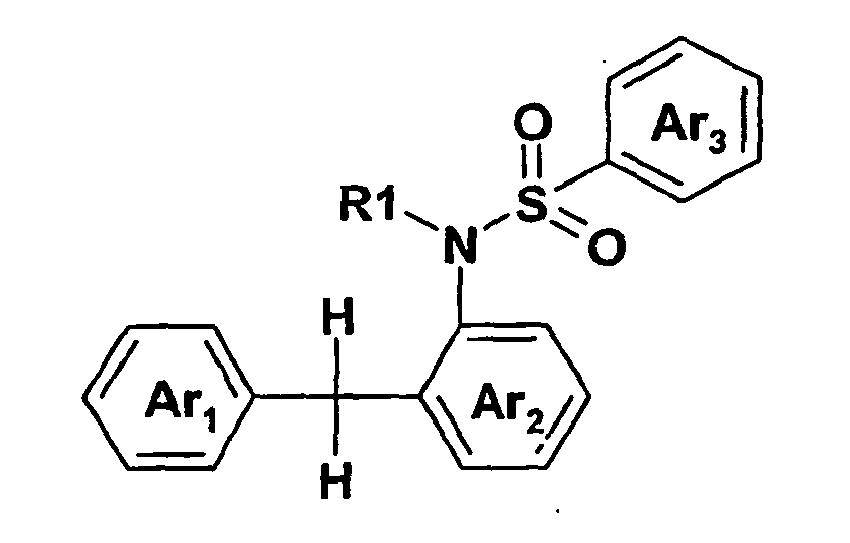
Tableau XI N° composé Nature et position des substituants F(°C) MH+/temps de rétention Ar1 Ar2 R1 Ar3 2 H 4-Cl CH2CO2Et 3,4-diOMe 139 504/9,06 4 2-Cl 4-Cl CH2CO2Et 2-OMe huile 508/10,03 5 2-Cl 4-Cl CH2CO2Et 2,5-diOMe 80 538/9,91 6 2-Cl 4-Cl CH2CO2Et 2,4-diOMe 80 538/9,98 - A 1g de N-[4-chlpro-2-(2-chlorobenzyl)phényl]-3-méthoxybenzènesulfonamide obtenu à l'exemple 12.2, en solution dans 40ml d'acétonitrile, on additionne à température ambiante 1,34ml de triéthylamine puis 0,89g de 2-bromoacétamide et porte à reflux 18 heures. Le milieu réactionnel est repris à l'acétate d'éthyle, lavé à l'eau. La phase organique est séchée sur sulfate de sodium anhydre et concentrée. Le résidu est chromatographié sur une colonne de gel de silice en éluant avec un mélange de solvant cyclohexane/acétate d'éthyle 90 / 10 (v/v) pour obtenir 0,58g de produit attendu.
RMN 1H δ en ppm (DMSO d6) : 3,82(s, 3H); 4,08-4,58(massif, 4H); 6,65(s, 1H); 6,91 (d, 1H); 7,08-7,57(massif, 11H).
F=65,7 °C - A 5,4 g de N-[4-chloro-2-(2-chlorobenzoyl)phényl]-3,4-diméthoxybenzènesulfonamide obtenu à l'exemple 1.1 en solution dans 60ml de DMF, on additionne à 0°C, 0,57g d'hydrure de sodium; après 40 minutes à cette température, on introduit 0,9ml de 2-bromoacétonitrile et laisse 18 heures à température ambiante. Le milieu réactionnel est repris à l'acétate d'éthyle, lavé à l'eau. La phase organique est séchée sur sulfate de sodium anhydre et concentrée, pour obtenir 5,3g de produit attendu.
RMN 1H δ en ppm (DMSO d6) : 3,76(s, 3H); 3,85(s, 3H); 4,71(m, 2H); 7,08-7,63 (massif, 9H); 7,81 (m, 1H).
F=164 °C - A 1g de N-[4-chloro-2-(2-chlorobenzoyl)phényl]-N-(cyanométhyl)-3,4-diméthoxy benzènesulfonamide en solution dans 20ml de THF on additionne successivement, 0,3g de d'oxyde de dibutylétain, 2,6ml d'azidotriméthylsilane et porte à reflux 18 heures. Le milieu réactionnel est repris à l'acétate d'éthyle, lavé à l'eau. La phase organique est séchée sur sulfate de sodium anhydre et concentrée. On purifie par filtration sur silice H, en éluant au dichlorométhane pour obtenir 0,95g de produit attendu.
RMN 1H δ en ppm (DMSO d6) : 3,87(s, 3H); 5,00(s, 2H); 6,88-7,76(massif, 10H). - A 0,95g de N-[4-chloro-2-(2-chlorobenzoyl)phényl]-3,4-diméthoxy-N-(1H-tétrazol-5-ylméthyl)benzènesulfonamide en solution dans 40ml d'éthanol on additionne 0,38g de borohydrure de sodium et porte 18 heures à reflux. On évapore les solvants, reprend le résidu à l'acétate d'éthyle et le lave à l'eau. La phase organique est séchée sur sulfate de sodium anhydre et concentrée, pour obtenir 0,93g de produit attendu.
- A 0,93g de N-{4-chloro-2-[(2-chlorophényl)(hydroxy)méthyl]phényl}-3,4-diméthoxy-N-(1H-tétrazol-5-ylméthyl)benzènesulfonamide en solution dans 25ml de DMF , on additionne successivement 0,2ml de iodométhane, 0,32g de carbonate de potassium et laisse 18 heures à température ambiante. Le milieu réactionnel est repris à l'acétate d'éthyle, lavé à l'eau. La phase organique est séchée sur sulfate de sodium anhydre et concentrée. Le résidu est chromatographié sur une colonne de gel de silice en éluant avec un mélange de solvant dichlorométhane / méthanol 99 / 1 (v/v) pour obtenir 0,34 g de composé 14.
RMN 1H δ en ppm (DMSO d6): 3,77(s, 3H); 3,87(s, 3H); 4,15(s, 3H); 4,70(d, 1H); 5,15(d, 1H); 6,01(d, 1H); 6,60-7,83(massif, 11H).
F=94,8 °C - On obtient 0,19 g de composé 15 dont les caractériqtiques sont les suivantes : RMN 1H δ en ppm (DMSO d6): 3,60(s, 3H); 3,79(s, 3H); 3,88(s, 3H); 4,25(d, 1H); 4,77(d, 1H); 5,96(d, 1H); 6,36(d, 1H); 6,65-7,79(massif, 10H).
F=118,3 °C - Les composés suivants ont été synthétisés selon ce procédé :
- Composé 11 : N-{4-chloro-2-[(2-chlorophényl)(hydroxy)méthyl]phényl}-N-[(2-éthyl-2H-tétrazol-5-yl)méthyl]-3,4-diméthoxybenzènesulfonamide. F= 113°C
- Composé 12 : N-{4-chloro-2-[(2-chlorophényl)(hydroxy)méthyl]phényl}-N-[(1-éthyl-1H-tétrazol-5-yl)méthyl]-3,4-diméthoxybenzènesulfonamide. F= 75°C
- A 0,766g de N-[4-chloro-2-(2-chlorobenzyl)phényl]-4-méthoxybenzènesulfonamide obtenu selon l'exemple 12,2 en solution dans 5ml de THF on additionne successivement 0,214g de tert-butylate de potassium, 0,263g de 2-bromoacétamide et laisse 18 heures à température ambiante. Le milieu réactionnel est repris à l'acétate d'éthyle, lavé à l'eau. La phase organique est séchée sur sulfate de sodium anhydre et concentrée. Le résidu est chromatographié sur une colonne de gel de silice en éluant avec gradient dichlorométhane / méthanol pour obtenir 0,50g de produit attendu.
RMN 1H δ en ppm (DMSO d6) : 3,89(s, 3H); 4,02-4,29(m, 3H); 4,58(d, 1H); 6,66(d, 1H); 6,89(d, 1H); 7,14-7,65(massif, 11H).
F=150 °C - Le tableau XII illustre les structures chimiques et les propriétés physiques de quelques composés de l'invention obtenus selon une adaptation de l'exemple 15.

Tableau XII N° composé Nature et position des substituants F(°C) MH+/temps de rétention Ar1 Ar2 R1 Ar3 40 2-Cl 4-Cl CH2CONH2 2,5-diOMe 125 509/8,93 42 2-Cl 4-Cl CH2CONH2 3-CF3 119 517/9,25 43 2-Cl 4-Cl CH2CONH2 3-OCF3 129 533/9,38 45 2-Cl 4-Cl CH2CONH2 2-OMe 114 479/8,18 46 2-Cl 4-Cl CH2CONHMe 3,4-diOMe 146 523/8,42 47 2-Cl 4-Cl CH2CONH2 4-Cl 205 483/9,06 48 2-Cl 4-Cl CH2CONH2 3,4-diCl 166 517/9,64 49 2-Cl 4-Cl CH2CONH2 2,5-diMe ,4-Cl 214,5 511/9,76 50 2-Cl 4-Cl CH2CONH2 2-Cl 97 483/8,44 53 2-Cl 4-Cl CH2CONH2 H 150 449/8,40 55 2-F 4-Cl CH2CONH2 3,4-diOMe 183,3 49317,80 62 2-Cl 4-Cl CH2CONH2 3-Me 95 463/8,66 63 2-Cl 4-Cl CH2CONH2 3,4-éthylènedioxy 111,6 507/8,19 71 2-Cl 4-Cl CH2CONH2 3,4-méthylènedioxy 89 493/8,29 75 2-Cl 4-Cl CH2CONHEt 3,4-diOMe 101 537/8,79 81 2-Cl 4-Cl CH2CONH2 2-Me 160 463/9,32 82 2-Cl 4-Cl CH2CONH2 3,4-diMe 166 477/9,64 89 2-Cl 4-Cl CH2CONH2 3,5-diMe 84 477/9,24 105 2-Cl 4-Cl CH2CONHMe 2,5-diMe ,4-Cl 172,6 525/10,24 109 2-Cl 4-Cl CH2CONHMe 2,4,5-triOMe 160,4 553/8,17 104 2-Cl 4-Cl CH2CONH2 2,4,5-triOMe 221,2 539/7,80 119 2-Cl 4-Cl CH2CONH2 3,5-diOMe 110 509/8,71 118 2-Cl 4-Cl CH2CON(Me)2 2,5-diMe ,4-Cl 166,4 539/10,71 134 2-Cl 4-Cl CH2CONH2 3-NO2 91 494/8,72 173 2-Cl 4-Cl CH2CONHMe 2,4-diCl, 5-Me 108 545/10,74 174 2-Cl 4-Cl CH2CON(Me)2 2,4-diCl, 5-Me 204 559/11,27 54 2-Cl 4-Cl Me 3,4-diOMe 106,6 466/9,73 65 H 4-Cl CH2CONH2 3,4-diOMe 184 475/7,75 70 2-Cl 4-Cl CH2CON(Me)2 3,4-diOMe 157,6 537/8,88 87 2-Cl 4-Cl CH2CONH2 2,6-diCl 163 517/8,70 95 H 4-Cl CH2CON(Me)2 3,4-diOMe 144,2 503/8,67 96 H 4-Cl CH2CONHMe 3,4-diOMe 89,6 489/8,25 97 2-F 4-Cl CH2CON(Me)2 3,4-diOMe huile 521/8,63 98 2-F 4-Cl CH2CONHMe 3,4-diOMe 107,5 507/8,23 99 2-Cl 4-Cl CH2CONH2 2,5-diOMe,4-Me 172,5 523/8,70 114 2-Cl 4-Cl CH2CONH2 2,4,5-triMe 184,9 491/9,48 115 2-Cl 4-Cl CH2CONHMe 2,4,5-triMe 188,5 505/9,82 84 2-Cl 4-Cl (3-méthyl-1,2,4-oxadiazol-5-yl) méthyle 3,4-diOMe 111,4 548/10,20 107 2-Cl 4-Cl (1-méthyl-1H-imidazol-2-yl)méthyle 3,4-diOMe 105 546/6,32 112 2-Cl 4-Cl (1-méthyl-1H-imidazol-2-yl)méthyle 3,5-diMe 112 514/6,98 135 2-Cl 4-Cl CH2CONH2 3-NH2 103 464/8,44 188 2,6-diF 4-Cl CH2CONH2 3-NMe2 190 494/9,17 189 2,6-diF 4-Cl CH2CONH2 3-NHMe 195 480/8,65 249 2,6-diF 4-Cl CH2CONH2 2,5-diMe,4-Cl 196,8 513/9,50 263 2,6-diF 4-Cl CH2CONH2 4-tBut 161,4 507/10,74 279 2,6-diF 4-Cl CH2CONH2 4-NH2 111 n.d. 307 2,6-diF 4-Cl CH2CONH2 3,5-diOMe 170,2 511/9,48 319 2,6-diF 6-OMe CH2CONH2 4-tBut 173 503/10.1 320 2,6-diF 6-OMe CH2CONH2 3,4-diF 259 483/9,13 - Le composé 84 est obtenu par alkylation avec le dérivé 5-bromométhyl-3-méthyl-[1,2,4]oxadiazole (synthèse décrite d'après l'exemple 4.3).
- Le composé 135 est obtenu à partir de 1,25g de composé 134 par réduction de la fonction nitro comme décrit à l'exemple 8.2.
- Les composés 188 et 189 sont obtenus par réaction d'alkylation par l'iodométhane en présence de carbonate de césium dans le THF du N2 -[3-aminophényl)sulfonyl]-N2 -[4-chloro-2-(2,6-difluorobenzyl)phényl]glycinamide.
- Pour les composés 54, 65, 95, 96, 97, 98 le tert-butylate de potassium est remplacé par l'hydrure de sodium.
- Le composé 312 est obtenu selon ce procédé en partant du 3-méthoxybiphényl-2-amine
MH+=457; le temps de rétention est de 8,04 minutes
F= 86,8°C - A 1,438g de (2-amino-5-chlorophényl)-(2-méthoxyphényl)méthanone obtenu selon le procédé décrit à l'exemple 10,1 en solution dans 16ml de dichlorométhane on additionne successivement 2,61 ml de triéthylsilane, 4ml d'étherate de trifluorure de bore et porte à reflux 18 heures. Le milieu réactionnel refroidi est versé sur de la glace additionée d'une solution 2M d'hydroxyde de sodium, après décantation, la phase organique est séchée sur sulfate de sodium anhydre et concentrée. Le résidu est chromatographié sur une colonne de gel de silice pour obtenir 0,571g de produit attendu.
RMN 1H δ en ppm (DMSO d6) : 3,70(s, 2H); 3,80(s, 3H); 5,05(s, 2H); 6,65(m, 2H); 6,88-7,29(massif, 5H). - A 0,57g de (2-amino-5-chlorophényl)(2-méthoxyphényl)méthane en solution dans 5ml de THF on additionne successivement 0,2ml de pyridine, 0,547g de 3,4-diméthoxybenzènesulfonylchlorure et laisse 18 heures à température ambiante. Le milieu réactionnel est repris à l'acétate d'éthyle, lavé à l'eau. La phase organique est séchée sur sulfate de sodium anhydre et concentrée. Le résidu est chromatographié sur une colonne de gel de silice en éluant au dichlorométhane pour obtenir 0,832g de produit attendu.
RMN 1H δ en ppm (DMSO d6)) : 3,70(s, 2H); 3,76(s, 3H); 3,85(s, 3H); 6,77-7,28(massif, 10H) 9,52(s, 1H). - A 0,83g de N-[4-chloro-2-(2-méthoxybenzyl)phényl]-3,4-méthoxybenzène sulfonamide en solution dans 10ml de DMF on additionne à 0°C 0,081g d'hydrure de sodium. Après 40 minutes à cette température on introduit 0,28g de 2-bromo acétamide et laisse 18 heures à température ambiante. Le milieu réactionnel est repris à l'acétate d'éthyle, lavé à l'eau. La phase organique est séchée sur sulfate de sodium anhydre et concentrée. Le résidu est chromatographié sur une colonne de gel de silice en éluant au dichlorométhane pour obtenir 0,77g de produit attendu.
RMN 1H δ en ppm (DMSO d6) : 3,80(s, 6H); 3,88(s, 3H); 3,91(d, 1H);4,18(s, 2H); 4,30(d, 1H); 6,75(d, 1H); 6,91-7,28(s, 11H). - Le tableau XIII illustre les structures chimiques et les propriétés physiques de quelques composés de l'invention obtenus selon l'exemple 16.

Tableau XIII N° composé Nature et position des substituants F(°C) MH+/temps de rétention Ar1 Ar2 R1 Ar3 58 3-OMe phényle 4-Cl CH2CONH2 3,4-diOMe 109 50517,79 60 4-OMe phényle 4-Cl CH2CONH2 3,4-diOMe 214 50517,73 73 2-Me phényle 4-Cl CH2CONH2 3,4-diOMe 88 489/8,12 116 3-Cl phényle 4-Cl CH2CONH2 3,4-diOMe 181,8 509/8,39 212 2-Me thiényle 4-Cl CH2CONH2 3,4-diOMe 100,1 495/8,86 - A 4,85g de (2-nitro-5-chlorophényl)(2,6-dichlorophényl)méthanol obtenu à l'exemple 9,1 en solution dans 58ml d'éthanol on additionne 5,042g d'étain, 19ml d'acide chlorhydrique 12M et porte à reflux la nuit. On concentre le milieu réactionnel, le reprend par de l'acétate d'éthyle et lave à l'eau additionée d'une solution 2M d'hydroxyde de sodium. La phase organique est séchée sur sulfate de sodium anhydre et concentrée, pour obtenir 3,71g de produit attendu.
RMN 1H δ en ppm (DMSO d6) : 3,99(s, 2H); 6,00(d, 1H); 6,73(d, 1H); 6,98(d, 1H) ; 7,39-7,61(massif, 3H). - A partir de 2g de (2-amino-5-chlorophényl)(2,6-dichlorophényl)méthane selon le procédé décrit à l'exemple 12,2 on obtient 0,389g de produit attendu.
- A 0,38g de N-[4-chloro-2-(2,6-dichlorobenzyl)phényl]-3,4-méthoxybenzène sulfonamide en solution dans 4ml de DMF on additionne à 0°C 0,035g d'hydrure de sodium; après 40 minutes à cette température on introduit 0,121g de 2-bromoacétamide et laisse 18 heures à température ambiante. Le milieu réactionnel est repris à l'acétate d'éthyle, lavé à l'eau. La phase organique est séchée sur sulfate de sodium anhydre et concentrée. Le résidu est chromatographié sur une colonne de gel de silice en éluant avec un mélange dichlorométhane / méthanol 98/2 (v/v) pour obtenir 0,225g de produit attendu.
RMN 1H δ en ppm (DMSO d6) : 3,80(s, 3H); 3,88(s, 3H); 4,10-4,70(massif, 4H); 6,30(d, 1H); 7,03-7,61 (massif, 10H).
F=195,3 °C - Le tableau XIV illustre les structures chimiques et les propriétés physiques de quelques composés de l'invention obtenus selon l'exemple 17

Tableau XIV N° composé Nature et position des substituants F(°C) MH+/temps de rétention Ar1 Ar2 R1 Ar3 130 2,6-diCl 4-Cl CH2CONHMe 3,4-diOMe 149,3 557/9,13 166 2,6-diCl 4-Cl CH2CON(Me)2 3,4-diOMe 102,7 571/9,63 67 2-Cl H CH2CONH2 3,4-diOMe 240,2 475/7.45 91 2,6-diF 4-Cl CH2CONH2 3,4-diOMe 231,6 511/8,48 242 2,6-diF 4-Br CH2CONH2 3,4-diOMe 209,7 55518,31 280 2,6-diF 4-Me CH2CONH2 3,4-diOMe 180,4 490/88,80 286 2,6-diF 4-Cl CH2CONH2 3,4-diOMe 165,3 511/8,89 297 2,6-diF 6-OMe CH3 3,4-diOMe 116 46419,92 308 2,6-diF 4-Cl CH2CONH2 3,4-diOMe 169 495/9,84 314 2,6-diF 4-Cl CH2CONH2 2-F;4,5-diOMe 212.3 525/8,96 - A 1g de (2-amino-5-chlorophényf)(2,6-fluorophényl)méthanol obtenu selon l'exemple 9,2 en solution dans 10ml de dichlorométhane, on additionne 1,8ml de triéthylsilane, 0,86ml d'acide trifluoroacétique et porte 6 heures à 50°C. Le milieu réactionnel est additionée sur de la glace, repris par du dichlorométhane et 100ml d'une solution 2M d'hydroxyde de sodium. La phase organique est séchée sur sulfate de sodium anhydre et concentrée. Le résidu est chromatographié sur une colonne de gel de silice en éluant avec un mélange dichlorométhane / cyclohexane, pour obtenir 0,997g de produit attendu.
RMN 1H δ en ppm (DMSO d6): 3,77(s, 2H); 5,26(s, 2H); 6,36(s, 1H); 6,70(d, 1H); 6,99(m, 1H) ; 7,18(t, 2H); 7,48(m, 1H). - A partir de 0,97g de (2-amino-5-chlorophényl)(2,6-ftuorophényl)méthane selon une adaptation du procédé décrit a l'exemple 12.2 on obtient 1,58g de produit attendu. RMN 1H δ en ppm (DMSO d6): 3,76(s, 3H); 3,85(s, 3H); 3,96(s, 2H); 6,64(s, 1H); 6,90(d, 1H); 7,10-7,50(massif, 7H); 9,69(s, 1H).
F=144 °C - • Exemple 18.3 : N2 -[4-chloro-2-(2,6-difluorobenzyl)phényl]-N2 -[(3,4-diméthoxy phényl)sulfonyl]-N1 -méthylglycinamide
- A partir de 0,7g de N-[4-chloro-2-(2,6-difluorobenzyl)phényl]-3,4-diméthoxybenzène sulfonamide selon une adaptation du procédé 15 (présence de co solvant telque le DMF et d'iodure de sodium), on obtient 0,669g de produit attendu.
RMN 1H δ en ppm (DMSO d6): 2,53(s, 3H); 3,81 (s, 3H); 3,89(s, 3H); 4,02-4,61 (massif, 4H); 6,62(s, 1H); 6,86(d, 1H); 7,15-7,31 (massif, 6H); 7,47(m, 1H); 7,90(m, 1H).
F = 92,9°C - Le tableau XV illustre les structures chimiques et les propriétés physiques de quelques composés de l'invention obtenus selon l'exemple 18.

Tableau XV N° composé Nature et position des substituants F(°C) MH+/ temps de rétention Ar1 Ar2 R1 Ar3 140 2,6-diF 4-Cl propyle -3,4-diOMe 135,1 496/10,82 150 2,6-diF 4-Cl CH2CON(Me)2 3,4-diOMe 130,2 539/9,2 145 2,6-diF 4-Cl (CH2)2N(Me)2 3,4-diOMe 121,2 525/6,47 144 2,6-diF 4-CI Me 3,4-diOMe 191,8 468/10,05 156 2,6-diF 4-Cl 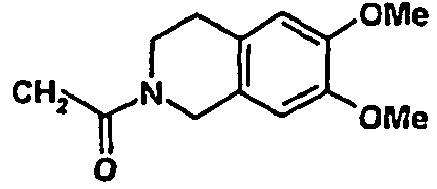
3,4-diOMe 128,2 687/9,78 169 2,6-diF 4-Cl CH2CONH2 3,5-diMe 146 479/9,49 171 2,6-diF 4-Cl CH2CONHMe 3,5-diMe 196 493/9,80 185 2,6-diF 4-Cl prop-2-yn-1-yle 3,4-diOMe 172 492/10,13 193 2,6-diF 4-OMe CH2CONH2 3,4-diOMe 189,7 507/7,93 195 2,6-diF 3-Cl CH2CONH2 3,4-diOMe 193,5 511/8,33 285 2.5-diF 6-OMe CH2CONH2 3,4-diOMe 193 507/8,58 200 2,6-diF 4-Me CH2CONH2 3.4-diOMe 196 491/8,20 202 2,6-diF 5-N(Me)2 CH2CONH2 3,4-diOMe 141 520/7,84 205 2,6-diF 4-Me CH(Et)CONH2 3,4-diOMe 197,6 519/8,84 211 2,6-diF 4-Cl CH2CN 3,4-diOMe 61,7 493/9,84 220 2,6-diF 4-F CH2CONH2 3,4-diOMe 184,7 495/8,16 224 2-Cl,6-F 4-Cl CH2CONH2 3,4-diOme 230 527/8,77 181 2,6-diF 4-Cl (1-méthyl-1H-imidazol-2yl)méthyle 3,4-diOMe 87 547/6,65 210 2,6-diF 3,6- diOMe CH2CONH2 3,4-diOMe 242,9 537/7,88 246 2,6-diF 4-Cl CH(CH3)CN 3,4-diOMe 143,4 507/10,82 288 2,6-diF 6-Me CH2CONH2 3,4-diOMe 225,6 491/8,61 293 2,6-diF 6-Cl CH2CONH2 3,4-diOMe 227,4 511/8,63 - Pour les composés 193,195 et 220 on remplace le tert-butylate de potassium par de l'hydrure de sodium.
- A partir de 1,72g de (2-amino-5-chlorophényl)(2,5-dichlorophényl)méthanol obtenu à l'exemple 10,2 selon le procédé décrit à l'exemple 18.1, on obtient 1,41g de produit attendu.
- A partir de 1,41g de (2-amino-5-chlorophényl)(2,5-dichlorophényl)méthane selon une adaptation du procédé décrit à l'exemple 12.2 on obtient 2,3g de produit attendu.
- A partir de 2,3g N-[4-chloro-2-(2,5-chlororobenzyl)phényl]-3,4-méthoxy benzène sulfonamide selon une adaptation du procédé décrit à l'exemple 15 on obtient 1g de produit attendu.
RMN 1H δ en ppm (DMSO d6): 3,80(s, 3H); 3,89(s, 3H); 4,01-4,69(massif, 4H); 6,72(s, 1H); 6,89(d, 1H); 7,15-7,61 (massif, 9H).
F=200 °C - Le tableau XVI illustre les structures chimiques et les propriétés physiques de quelques composés de l'invention obtenus selon l'exemple 19.

Tableau XVI N° composé Nature et position des substituants F(°C) MH+/temps de rétention Ar1 Ar2 R1 Ar3 142 2,3-diFphényle 4-Cl CH2CONH2 3,4-diOMe 172,2 511/8,70 143 2,3-diFphénylé 4-CI CH2CON(Me)2 3,4-diOMe 88,2 539/9,43 141 2,3-diFphényle 4-Cl CH2CONHMe 3,4-diOMe 150,9 525/9,01 170 2-F,6-OMe phényle 4-Cl CH2CONH2 3,4-diOMe 160 523/8,56 180 2-thiényle 4-Cl CH2CONH2 3,4-diOMe 183,9 481/8,41 192 2-Cl,6-OMe phényle 4-Cl CH2CONH2 3,4-diOMe 180,6 539/8,82 - A 0,9g de (N2-{4,5-dichloro-2-[(2-chlorophényl)(hydroxy)méthyl]phényl}-N2[(phényl)sulfonyl]glycinamide obtenu selon l'exemple 10,4, en solution dans 10ml de dichlorométhane on additionne 0,77ml de triéthylsilane, 1,2ml d'étherate de tri fluoroborane et porte 3 heures à 40°C. Le milieu réactionnel est repris du dichlorométhane et 100ml d'une solution 2M d'hydroxyde de sodium. Après décantation la phase organique est séchée sur sulfate de sodium anhydre et concentrée. Le résidu est chromatographié sur une colonne de gel de silice en éluant avec un mélange dichlorométhane / acétate d'éthyle, pour obtenir 0,622g de produit attendu.
RMN 1H δ en ppm (DMSO d6): 3,81(s, 3H); 3,90(s, 3H); 4,07-4,19(massif, 3H); 4,51 (d, 1H); 6,87(s, 1H); 7,14-7,57(massif, 10H).
F=163 °C - Le tableau XVII illustre les structures chimiques et les propriétés physiques de quelques composés de l'invention obtenus selon l'exemple 20.

Tableau XVII N° composé Nature et position des substituants F(°C) MH+/ temps de rétention Ar1 Ar2 R1 Ar3 177 2,5-diF 4-Cl CH2CONH2 3,4-diOMe 216,5 511/8,75 182 2-F,5-Cl 4-Cl CH2CONH2 3,4-diOMe 210,3 527/9,09 183 3,5-diF 4-Cl CH2CONH2 3,4-diOMe 184 511/8,96 196 2-F,5-Me 4-Cl CH2CONH2 3,4-diOMe 231,6 507/8,98 100 2-Cl 4-Cl CH2CONH2 2,4-diCl,5-Me 228,3 531/9,72 168 2-F,4-Cl 4-Cl CH2CONH2 3,4-diOMe 195,2 527/9,32 208 2,6-diF 4,6-diOMe CH2CONH2 3,4-diOMe 191 537/7,98 228 2,6-diF 4,5-diCl CH2CONH2 3,4-diOMe 181,1 545/8,98 103 2-Cl 4-Et CH2CONMe2 3,4-diOMe 142,7 531/8,99 93 2-Cl 4-Et CH2CONH2 3,4-diOMe 86 503/8,21 - Le composé 247 est préparé à partir de (N2-{2-[(2,6-difluorophényl)(hydroxy)méthyl]-6-méthoxyphényl}-N2-[(3,4-diméthoxyphényl)sulfonyl]glycinamide obtenu selon l'exemple 9,4.
F= 244,9 ;MH+= 507; le temps de rétention est de 8,37 minutes. - Exemple 21 : N-[4-chloro-2-(2,6-difluorobenzyl)phényl]-3,4-diméthoxy-N-[(1-méthyl-1H-tétrazol-5-yl)méthyl]benzènesulfonamide (composé 152) et N-[4-chloro-2-(2,6-difluorobenzyl)phényl]-3,4-diméthoxy-N-[(2-méthyl-2H-tétrazol-5-yl)méthyl]benzène sulfonamide (composé 151)
- A 8,7g de N-[4-chloro-2-(2,6-difluorobenzyl)phényl]-N-(cyanométhyl)-3,4-diméthoxybenzène sulfonamide (composé 211) obtenu à l'exemple 18 en solution dans 100ml de THF on additionne à température ambiante, 10g d'azidotriméthylsilane, 2,29g d'oxyde de dibutylétain et porte à reflux 8 heures. Le milieu réactionnel est concentré et le résidu chromatographié sur une colonne de gel de silice en éluant avec un mélange dichlorométhane / méthanol 99/1 (v/v) pour obtenir 7g de produit attendu.
RMN 1H δ en ppm (DMSO d6): 3,82(s, 3H); 3,90(s, 3H); 4,05(q, 2H); 4,88(d, 1H); 5,29(d, 1H); 6,60(s, 1H); 6,85(d, 1H); 7,12-7,49(massif, 7H). - A 2,7g de N-[4-chloro-2-(2,6-difluorobenzyl)phényl]-3,4-diméthoxy-N-[(-1H-tétrazol-5-yl)méthyl]benzènesulfonamide en solution dans 50ml de DMF, on additionne à température ambiante, 1,07g d'iodométhane, 1,04g de carbonate de potassium. Après 48 heures à température ambiante, le milieu est versé sur de l'eau puis extrait à l'acétate d'éthyle. La phase organique est séchée sur sulfate de sodium anhydre et concentrée. Le résidu est chromatographié sur une colonne de gel de silice en éluant avec un mélange toluéne / acétate d'éthyle 90/10 (v/v) pour obtenir 1g de N-[4-chloro-2-(2,6-difluorobenzyl)phényl]-3,4-diméthoxy-N-[(1-méthyl-1H-tétrazol-5-yl) méthyl]benzènesulfonamide (composé 152)
RMN 1H δ en ppm (DMSO d6): 3,81(s, 3H); 3,90(s, 3H); 3,93(q, 1H); 4,05(m, 4H); 4,93(d, 1H); 5,42(d, 1H); 6,58(s, 1H); 7,00(d,1H); 7,10-7,46(massif, 7H).
F=180,8 °C
Et 0,71g de N-[4-chloro-2-(2,6-difluorobenzyl)phényl]-3,4-diméthoxy-N-[(2-méthyl-2H-tétrazol-5-yl)méthyl]benzènesulfonamide (composé 151)
RMN 1H δ en ppm (DMSO d6) : 3,81 (s, 3H); 3,89(s, 3H); 4,13(s, 2H); 4,26(s, 3H); 4,77(d, 1H); 5,25(d, 1H); 6,57(s, 1H); 6,86(d, 1H);7,11-7,47(massif, 7H).
F=136,3°C - Le tableau XVIII illustre les structures chimiques et les propriétés physiques de quelques composés de l'invention obtenus selon l'exemple 21.

Tableau XVIII N° composé Nature et position des substituants F(°C) MH+/ temps de rétention Ar1 Ar2 R1 Ar3 153 2,6-diF 4-Cl (2-éthyl-2H-tétrazol -5-yl)méthyle 3,4-diOMe 139,7 564/9,81 154 2,6-diF 4-Cl (1-éthyl-1H-tétrazol -5-yl)méthyle 3,4-diOMe 150,9 564/9,48 159 2,6-diF 4-Cl (2-éthyl-2H- tétrazol -5-yl)méthyle 3,5-diMe 105,5 532/10,84 160 2,6-diF 4-Cl (1-éthyl-1H- tétrazol -5-yl)méthyle 3,5-diMe 134 532/10,46 157 2,6-diF 4-Cl (2-méthyl-2H-tétrazol-5-yl)méthyle 3,5-diMe 159 518/10,53 158 2,6-diF 4-Cl (1-méthyl-1H-tétrazol-5-yl)méthyle 3,5-diMe 240 518/10,20 122 2-Cl 4-Cl (2-éthyl-2H- tétrazol -5-yl)méthyle 3,5-diMe huile 530/10,65 123 2-Cl 4-Cl (1-éthyl-1H- tétrazol -5-yl)méthyle 3,5-diMe 158 530/10,27 108 2-Cl 4-Cl (1-isopropyl-1H-tétrazol-5-yl)méthyle 3,4-diOMe 79 576/9,52 111 2-Cl 4-Cl (1-benzyl-1H-tétrazol-5-yl)méthyle 3,4-diOMe 98 624/9,89 90 2-Cl 4-Cl (1-éthyl-1H-tétrazol -5-yl)méthyle 3,4-diOMe 168,3 562/9,25 88 2-Cl 4-Cl (1-méthyl-1H-tétrazol-5-yl)méthyle 3,4-diOMe 200,6 548/8,96 243 2,6-diF 4-Cl 1-(2-méthyl-2H-tétrazol-5-yl) éthyle 3,4-diOMe 259,3 564/9,85 244 2,6-diF 4-Cl 1-(1-méthyl-1H-tétrazol-5-yl) éthyle 3,4-diOMe 178,1 564/10,44 310 2,6-diF 6- OMe (2-éthyl-2H- tétrazol -5-yl)méthyle 3,4-diOMe 136,3 560/9,61 311 2,6-diF 6- OMe (1-éthyl-1H-tétrazol -5-yl)méthyle 3,4-diOMe 161,4 560/9,30 - A partir de 1g de N-{4-méthyl-2-[(2-chlorophényl)(hydroxy)méthyl]phényl}-3,4-diméthoxybenzènesulfonamide obtenu selon l'exemple 8, selon une adaptation du procédé décrit à l'exemple 18.1, on obtient 0,47g de produit attendu.
RMN 1H δ en ppm (DMSO d6): 2,14(s, 3H); 3,73(s, 3H); 3,84(s, 3H); 4,04(s, 2H); 6,60(s, 1H); 6,81-7,47(massif, 9H); 9,43(s, 1H). - A 0,47g de N-{4-méthyl-2-[(2-chlorophényl)(hydroxy)méthyl]phényl}-3,4-diméthoxy benzènesulfonamide en solution dans 5,7ml de DMF, on additionne à 0°C, 0,048g d'hydrure de sodium. Après 1 heure à cette température on introduit 0,166g de 2-bromoacétamide et laisse 18 heures à température ambiante. Le milieu est versé sur de l'eau puis extrait à l'acétate d'éthyle. La phase organique est séchée sur sulfate de sodium anhydre et concentrée. Le résidu est chromatographié sur une colonne de gel de silice en éluant avec un mélange cyclohexane / acétate d'éthyle 90/10 (v/v) pour obtenir 0,4g de produit attendu.
RMN 1H δ en ppm (DMSO d6) : 2,16(s, 3H); 3,79(s, 3H); 3,88(s, 3H); 4,05-4,25(massif, 3H); 4,52(d, 1H); 6,54(s, 1H); 6,76(d, 1H); 6,94-7,53(massif, 10H). F=140,6°C
Le N2 -[5-chloro-2-(2-chlorobenzyl)phényl]-N2 -[(3,4-diméthoxyphényl)sulfonyl] glycinamide (composé 179) est syntétisé selon ce procédé à partir du N-{5-chloro-2-[(2-chlorophényl)(hydroxy)méthyl]phényl}-3,4-diméthoxybenzènesulfonamide obtenu selon l'exemple 9.3, F=86,4°C
Le N2 -[2-(2-chtorobenzyl)-4-méthoxyphényl]-N2 -[(3,4-diméthoxyphényl)sulfonyl] glycinamide (composé 138) est synthétisé selon ce procédé. F= 184,6°C - A 0,45g de [4-chloro-2-(2,6-difluorobenzyl)phényl]-3,4-diméthoxybenzènesulfonamide (préparé selon 18.2) on additionne successivement, 0,207g de carbonate de potassium, 0,1g de bromure de tétrabutylammonium, 20ml de toluéne, 0,237g de 3-diméthylamino-1-bromopropane et porte 24 heures à reflux. On additionne 0, 168g de tert-butylate de potassium, 0,237g de 3-diméthylamino-1-bromopropane et chauffe à reflux 4 heures. Le milieu réactionnel est versé sur de l'eau et extrait à l'acétate d'éthyle. La phase organique est séchée sur sulfate de sodium anhydre et concentrée. Le résidu est chromatographié sur une colonne de gel de silice en éluant avec un mélange dichlorométhane /méthanol 99/1 (v/v). L'huile obtenue est dissoute dans du méthanol et versé sur une solution 0,5M d'hydroxyde de sodium, le précipité formé est filtré, séché sous vide pour obtenir 0,504g de produit attendu.
RMN 1H δ en ppm (DMSO d6): 1,34-1,48(massif, 2H); 2,01 (s, 6H); 2,14(t, 2H); 3,13(m, 1H); 3,75(s, 3H); 3,78(m, 1H); 3,85(s, 3H); 4,13(d, 1H); 4,31 (d, 1H); 6,72-7,51 (massif, 9H).
F=134 °C - Le tableau XIX illustre les structures chimiques et les propriétés physiques de quelques composés de l'invention obtenus selon l'exemple 23.

Tableau XIX Nature et position des substituants F(°C) MH+/temps de rétention Ar1 Ar2 R1 Ar3 199 2,6-diF 4-Cl 2-pyrrolidin-1-yléthyle 3,4-diOMe 131,4 551/6,61 201 2,6-diF 4-Cl 2-(diméthylamino)-1-méthyléthyle 3,4-diOMe 128,6 539/6,44 203 2,6-diF 4-Cl 2-[benzyl(méthyl) amino]éthyle 3,4-diOMe 104,8 601/7,18 231 2,6-diF 4-Cl (CH2)2NHCONH2 3,4-diOMe 124,5 539/8,27 229 2,6-diF 4-Cl (CH2)3SO2NEt2 3,4-diOMe 71,2 630/10,27 230 2,6-diF 4-Cl (CH2)3SO2NMe2 3,4-diOMe 76,8 602/9,71 234 2,6-diF 4-Cl 2-(2-oxopyrrolidin-1-yl)éthyl 3,4-diOMe 138,6 565/8,80 236 2,6-diF 4-Cl 2-méthoxyéthyl 3,4-diOMe 83,8 512/9,38 241 2,6-diF 5-Br CH3CONH2 3,4-diOMe 93,5 555/8,99 248 2,6-diF 4-Cl cyclopropylméthyl 3,4-diOMe 163,4 508/11,42 259 2,6-diF 4-Cl CH3CONH2 3-Me,4- OMe 156,6 495/9,07 268 2,6-diF 4-Cl 2-(1,3-dioxolan-2-yl)éthyl 3,4-diOMe 288,8 554/10,50 283 2,6-diF 4-Cl CH3CONH2 6-OMe pyridin-3-yl 164 482/9,27 - A 1g de N-{4-chloro-2-[(2-chlorophényl)(hydroxy)méthyl]phényl}-3,4-diméthoxy benzènesulfonamide, obtenu à l'exemple 1.2 en solution dans 40ml d'acétonitrile on additionne successivement 1,2ml de triéthylamine, 1,29ml de 2-(2-bromo éthoxy terahydro-2H-pyrane et porte à reflux 18 heures. Le milieu réactionnel est repris à l'acétate d'éthyle et lavé à l'eau. La phase organique est séchée sur sulfate de sodium anhydre et concentrée. Le résidu est chromatographié sur une colonne de gel de silice en éluant avec un mélange de solvant cyclohexane / acétate d'éthyle, pour obtenir 0,479g de produit attendu.
- A 0,479g de N-{4-chloro-2-[(2-chlorophényl)(hydroxy)méthyl]phényl}-3,4-diméthoxy-N-[2-(tétrahydro-2H-pyran-2-yloxy)éthyl]benzènesulfonamide en solution dans 4,7ml de THF , on additionne 9,15ml d'acide acétique, 2,25ml d'eau et porte 48 heures à 40°C. Le milieu réactionnel est repris à l'acétate d'éthyle et lavé à l'eau. La phase organique est séchée sur sulfate de sodium anhydre et concentrée. Le résidu est chromatographié sur une colonne de gel de silice en éluant avec un mélange de solvant cyclohexane / acétate d'éthyle, pour obtenir 0,209g de produit attendu.
RMN 1H δ en ppm (DMSO d6): 3,02(m, 2H); 3,40(m, 2H); 3,75(s, 3H); 3,88(s, 3H); 4,40(t, 1H); 6,01(d, 1H); 6,70-7,51 (massif, 10H); 7,86(s, 1H).
F= 86,2°C - De la même façon, on prépare le composé 237, dont les propriétés physiques sont les suivantes :
- MH+=498, le temps de rétention est de 8,99 minutes
- F= 165,3°C
- A 5g de 2-amino-2',5-dichlorobenzophénone en solution dans 100ml, de diéthyléther à -30°C, on additionne 12,5ml d'une solution 3M de bromure de méthylmagnésium et porte 18 heures à température ambiante. On additionne 6ml d'une solution 3M de bromure de méthylmagnésium et laisse 1 heure à température ambiante. On hydrolyse avec une solution 2M d'acide chlorhydrique et lave à l'eau. La phase organique est séchée sur sulfate de sodium anhydre pour obtenir 4,3g de produit attendu.
RMN 1H δ en ppm (DMSO d6): 1,99(s, 3H); 4,91(s, 2H);6,11(s, 1H); 6,53(d, 1H);6,97-7,42(massif, 5H); 7,97(d, 1H). - A 1,5g de 1-(2-amino-5-chlorophényl)-1-(2-chlorophényl)éthanol selon une adaptation du procédé décrit à l'exemple 1.1 on obtient 2,9g de produit attendu. RMN 1H δ en ppm (DMSO d6): 1,78(s, 3H); 3,75(s, 3H); 3,83(s, 3H); 4,05(q, 1H); 6,87(s, 1H); 7,04-7,54(massif, 5H); 7,82(m, 2H); 8,60(d, 2H); 10,00(s, 1H).
- A 1,3g de N-{4-chloro-2-[1-(2-chlorophényl)-1-hydroxyéthyl]phényl}-3,4-diméthoxy benzènesulfonamide en solution dans du diéthyléther on additionne successivement à -5°C, 1,3ml d'une solution 2M dans l'hexane de lithium diisopropylamine, 0,45g de 2-bromoacétamide. Après 18 heures à température ambiante, on additionne successivement 0,5g de 2-bromoacétamide, 1,4g d'iodure de sodium et porte à reflux 4 heures. Le milieu réactionnel est repris à l'acétate d'éthyle et lavé à l'eau. La phase organique est séchée sur sulfate de sodium anhydre et concentré. Le résidu est chromatographié sur une colonne de gel de silice en éluant avec un mélange dichlorométhane / méthanol 95/5 (v/v), pour obtenir 0,51g de produit attendu.
RMN 1H δ en ppm (DMSO d6): 2,11 (s, 3H); 3,74-3,98(massif, 8H); 6,25(s, 1H); 6,96-7.97(massif, 12H). - A 54ml d'une solution M d'hydrure mixte d'aluminium et de lithium dans le THF, on additionne par portions 7,1g de trichlorure d'aluminium. A cette solution on additionne 4g de 1-(2-amino-5-chlorophényl)-1-(2-chlorophényl)éthanol obtenu à l'exemple 25.1. en solution dans de l'éther diéthylique et agite 18 heures à température ambiante puis porte à reflux 4 heures. Le milieu réactionnel est repris à l'acétate d'éthyle et lavé à l'eau. La phase organique est séchée sur sulfate de sodium anhydre et concentré. Le résidu est chromatographié sur une colonne de gel de silice en éluant avec un mélange dichlorométhane / cyclohexane 40/60 (v/v), pour obtenir 0,9g de produit attendu.
RMN 1H δ en ppm (DMSO d6): 1,45(d, 3H); 4,43(q, 1H); 4,96(s, 2H); 6,65(m, 2H); 6,94(d, 1H); 7,30-7,47(massif, 4H). - A partir de 0,9g de 4-chloro-2-[1-(2-chlorophényl)éthyl]phénylamine selon le procédé décrit à l'exemple 1.1 on obtient 1,7g de produit attendu.
- A partir de 0,9g N-{4-chloro-2-[1-(2-chlorophényl)éthyl]-phényl}-3,4-diméthoxy benzènesulfonamide selon le procédé décrit à l'exemple 12.3 on obtient 0,9g de produit attendu.
RMN 1H δ en ppm (DMSO d6): 1,35(d, 3H); 2,75(d, 1H); 3,79(s, 3H); 3,86(s, 3H); 4,25(d, 1H); 4,74(q, 1H); 6,92-7,64(massif, 12H).
F=150 °C - Le composé 187 est obtenu suivant ce procédé. F=151 °C
- A 1g de N-[4-méthyl-2-(2,6-difluorobenzyl)phényl]-N-[2-(phtalimido)éthyl]-3,4-diméthoxybenzènesulfonamide, obtenu selon une adaptation du procédé décrit à l'exemple 18, en solution dans 15ml d'éthanol on additionne 0,4g d'hydrate d'hydrazine et porte à reflux 3 heures. A température ambiante on filtre l'insoluble et concentre le filtrat. Le résidu est chromatographié sur une colonne de gel de silice en éluant avec un mélange dichlorométhane /méthanol 99/1 (v/v) pour obtenir 0,26g de produit attendu.
RMN 1H δ en ppm (DMSO d6) : 1,62(s, 2H); 2,17(s, 3H); 2,40-2,67(massif, 2H); 3,12(m, 1H); 3,69(m, 1H); 3,75(s, 3H); 3,88(s, 3H); 4,09(d, 1H); 4,26(d, 1H); 6,56(m, 2H); 6,97-7,43(massif, 7H).
F= 251,8°C - Le tableau XX illustre les structures chimiques et les propriétés physiques de quelques composés de l'invention obtenus selon l'exemple 28.

Tableau XX N° composé Nature et position des substituants F(°C) MH+/temps de rétention Ar1 Ar2 R1 Ar3 256 2,6-diF 4-Cl 2-aminoéthyle 3,4-diOMe 163,4 497/6,82 257 2,5-diF 4-Me 2-aminoéthyle 3,4-diOMe 61,1 477/6,69 262 2,5-diF 4-Cl 2-aminoéthyle 3,4-diOMe 141,1 497/6,88 281 2,6-diF 6-OMe 2-aminoéthyle 3,4-diOMe 137,8 493/6,47 287 2,6-diF 4-Cl 3-aminopropyle 3,4-diOMe 149,1 511/6,91 294 2,5-diF 6-OMe 2-aminoéthyle 3,4-diOMe 114,8 493/6,47 300 2,6-diF 4-Cl,6- OMe 2-aminoéthyle 3,4-diOMe 185,4 527/6,82 - A 1g de N-(2-aminoéthy)-N-[2-(2,6-difluorobenzyl)-4-méthylphényl]-3,4-diméthoxy benzènesulfonamide (composé 215) en solution dans 20ml de THF on additionne 0,266g de benzyl isocyanate, après 3 heures à reflux, le milieu est évaporé à sec. Le résidu est chromatographie sur une colonne de gel de silice en éluant avec un mélange toluène /acétate d'éthyle 8/2 (v/v) pour obtenir 0,65g de produit attendu.
RMN 1H δ en ppm (DMSO d6): 2,17(s, 3H); 3,05(m, 2H); 3,24(m, 1H); 3,74(s, 3H); 3,78 (m, 1H); 3,87(s, 3H); 4,07-4,25(massif, 4H); 5,99(t, 1H); 6,50(t, 1H); 6,58(d, 2H); 6,98-7,43(massif, 12H).
F= 100,4 °C - Le tableau XXI illustre les structures chimiques et les propriétés physiques de quelques composés de l'invention obtenus selon l'exemple 28.

Tableau XXI N° composé Nature et position des substituants F(°C) MH+/temps de rétention Ar1 Ar2 R1 Ar3 217 2,6-diF 4-Me 2-[(anilinocarbonyl) amino]éthyle 3,4-diOMe 163,4 n.d 238 2,6-diF 4-Cl 2-({[(3-chlorophényl)amino] carbonyl}amino)éthyle 3,4-diOMe 149,3 650/10,87 240 2,6-diF 4-Cl 2-({[(2-chlorophényl)amino] carbonyl}amino)éthyle 3,4-diOMe 136,3 650/10,77 252 2,6-diF 4-Cl 2-({[(3,4diméthoxyphényl) amino]carbonyl}amino) éthyle 3,4-diOMe 169,7 676/9,80 - A 1g de N-(2-aminoéthyl)N-[2-(2,6-difluorobenzyl)-4-méthylphényl]-3,4-diméthoxybenzènesulfonamide (composé 215) en solution dans 25ml de THF, on additionne 0,167ml de pyridine, 0,22g d'anhydride acétique. Après 48 heures à température ambiante, on concentre le milieu réactionnel. Le résidu est chromatographié sur une colonne de gel de silice en éluant avec un mélange dichlorométhane /méthanol 99/1 (v/v) pour obtenir 0,505g de produit attendu.
RMN 1H 8 en ppm (DMSO d6): 1,74(s, 3H); 2,17(s, 3H); 3,05-3,28(m, 3H); 3,72(m, 1H); 3,76(s, 3H); 3,87(s, 3H); 4,05(d, 1H); 4,22(d, 1H); 6,60(d, 2H); 6,99-7.46(massif, 7H); 7,85(t, 1H).
F= 79,7 °C - A 10g de 5-chloro-2-nitrodiphénylamine en solution dans 20ml de DMF, on additionne successivement 2,8ml de iodométhane, 14,71g de carbonate de césium et agite 18 heures à température ambiante. Le milieu réactionnel est repris à l'acétate d'éthyle et lavé à l'eau. La phase organique est séchée sur sulfate de sodium anhydre et concentrée. Le résidu est chromatographié sur une colonne de gel de silice en éluant avec un mélange cyclohexane / acétate d'éthyle 97/3 (v/v), pour obtenir 10,51g de produit attendu.
RMN 1H δ en ppm (DMSO d6) : 3,32(s, 3H); 6,78-6,93(massif, 3H); 7,19-7,26 (m, 2H); 7,40(d, 1H); 7,65 (d, 1H); 7,93(d, 1H). - A 10,49g de 5-chloro-2-nitro-N-diphényl-N-méthylamine en solution dans 100ml d'éthanol, on additionne successivement 14,22g d'étain métallique, 50ml d'une solution 12M d'acide chlorhydrique et porte 1 heure à reflux. Après évaporation de l'éthanol, le milieu réactionnel est repris à l'acétate d'éthyle, basifié et lavé à l'eau. La phase organique est séchée sur sulfate de sodium anhydre et concentrée pour obtenir 9,37g de produit attendu.
RMN 1H δ en ppm (DMSO d6) : 3,11(s, 3H); 5,07(s, 2H); 6,57-7,21 (massif, 8H). - A partir de 1,5g de 2-amino-5-chloro-N-diphényl-N-méthylamine on procède suivant l'exemple 1.1 pour obtenir 1,122g de produit attendu.
RMN 1H δ en ppm (DMSO d 6) : 2,93(s, 3H); 3,67(s, 3H); 3,84(s, 3H); 6,37 (d, 2H); 6,74(t, 1H); 7,05-7,37(massif, 7H); 7,54(d, 1H); 9,46(s, 1H). - A partir de 0,8g de N-{4-chloro-2-[méthyl(phényl)amino]phényl}-3,4diméthoxybenzènesulfonamide suivant le procédé décrit à l'exemple 4.3 on obtient 0,766g de produit attendu.
RMN 1H δ en ppm (DMSO d6): 2,41(d, 3H); 3,16(s, 3H); 3,77(s, 3H); 3,88(s, 3H); 4,12(s, 2H); 6,66-6,84(massif, 3H); 7,10-7,43(massif, 8H); 7,72(t, 1H).
F= 148,6 °C - Le composé 92 est obtenu par ce procédé : F= 192,5 °C
- A 2,6g de éthyl4-{[4-chloro-2-{[2-(2,6-difluorobenzyl)phényl][((3,4-diméthoxyphényl) sulfonyl]amino}butanoate obtenu selon l'exemple 18, en solution dans 50ml d'éthanol, on additionne 22,8ml d'hydroxyde de sodium et laisse 18 heures à température ambiante. On évapore le solvant, reprend le résidu avec 40ml d'une solution 1 M d'acide chlorhydrique et extrait à l'acétate d'éthyle. La phase organique est séchée sur sulfate de sodium anhydre et concentrée. Le résidu est concrété à l'éther diisopropylique, pour obtenir 1,7g de produit attendu.
RMN 1H δ en ppm (DMSO d6): 1,54(m, 2H); 2,27(t, 2H); 3,27(m, 1H); 3,76(s, 3H); 3,85(s, 3H); 4,23(m, 2H); 6,75-7,51(massif, 10H); 12,09(s, 1H). - A 1,7g d'acide 4-{[4-chloro-2-{[2-(2,6-difluorobenzyl)phényl][((3,4-diméthoxyphényl) sulfonyl]amino}butanoïque en solution dans 30ml de THF, à 0°C, on additionne 0,42ml de N-éthylmorpholine, 0,42ml de chloroformiate d'éthyle, après 30 minutes à cette température, on introduit goutte à goutte une solution d'ammoniac dans le THF, et laisse 1 heure à 20°C. On verse sur une solution saturée d'hydrogénocarbonate de sodium, reprend à l'acétate d'éthyle. La phase organique est séchée sur sulfate de sodium anhydre, concentrée, le résidu est concrété à l'éther diéthylique, pour obtenir après séchage 1,41 g de produit attendu.
RMN 1H δ en ppm (DMSO d6): 1,51(m, 2H); 2,07(t, 2H); 3,21(m, 1H); 3,74(m, 1H); 3,78(s, 3H); 3,89(s, 3H); 4,23(q, 2H); 6,75(m, 3H); 7,04-7,51 (massif, 8H).
F= 197 °C - Le tableau XXII illustre les structures chimiques et les propriétés physiques de quelques composés de l'invention obtenus selon cet exemple.

Tableau XXII N° composé Nature et position des substituants F(°C) MH+/temps de rétention Ar1 Ar2 R1 Ar3 235 2,6-diF 4-Cl CH2CH2CH2CONH2 2,5-diMe, 4-Cl n.d 541/10,03 266 2,5-diF 4-Cl CH2CH2CH2CONH2 3,4-diOMe 150 539/9,15 272 2,6-diF 6-OMe CH2CH2CH2CONH2 3,4-diOMe 207,8 535/8,42 299 2,5-diF 6-OMe CH2CH2CH2CONH2 3,4-diOMe 189,3 535/8,54 - A 1,9g de (2-amino-5-chlorophényl)(2-trifluorométhylphényl)méthanone obtenu à l'exemple 7.2 en solution dans 87ml d'éthanol on additionne 0,775g de borohydrure de sodium et laisse 18 heures à 20°C. On évapore le solvant, reprend le résidu à l'acétate d'éthyle et lave à l'eau. La phase organique est séchée sur sulfate de sodium anhydre, et concentrée pour obtenir 1,96g de produit attendu.
RMN 1H δ en ppm (DMSO d6): 5,15(s, 2H); 5,97(d, 1H); 6,11(d, 1H); 6,35(d, 1H); 6,72(d, 1H) ; 6,99(d, 1H); 7,53-7,81 (massif, 4H). - A partir de 1,28g de (2-amino-5-chlorophényl)(2-trifluorométhylphényl)méthanol selon le procédé décrit à l'exemple 1.1 on obtient 2,06g de produit attendu.
RMN 1H δ en ppm (DMSO d6): 3,76(s, 3H); 3,85(s, 3H); 6,34(s, 2H); 6,89(d, 1H); 6,98(s, 1H); 7,08(d, 1H); 7,23-7,33(massif, 4H); 7,53-7,77(massif, 3H); 9,25(s, 1H). - A partir de 2,06g de N-{4-chloro-2-[(2-trifluorométhylphényl)(hydroxy)méthyl]phényl}-3,4-diméthoxybenzènesulfonamide selon la méthode décrite à l'exemple 22.1 on obtient 0,94g de produit attendu.
RMN 1H δ en ppm (DMSO d6): 3,73(s, 3H); 3,85(s, 3H); 4,06(s, 2H); 6,64(s, 1H); 6,89-7,28(massif, 6H); 7,48-7,60(m, 2H); 7,75(d, 1H); 9,72(s, 1H). - A partir de 0,94g de N-[4-chloro-2-(2-trifluorométhylbenzyl)phényl]-3-méthoxybenzène sulfonamide selon l'exemple 16.3 on obtient 0,723g de produit attendu.
RMN 1H δ en ppm (DMSO d6): 3,80(s, 3H); 3,89(s, 3H); 4,03(d, 1H); 4,27(q, 2H); 4,74(d, 1H); 6,55(s, 1H); 6,88(d, 1H); 7,12-7,63(massif, 9H); 7,82(d, 1H).
F=133°e - A 2,2g de N-[4-chloro-2-(2,6-difluorobenzyl)phényl]-3,4-diméthoxybenzène sulfonamide obtenu à l'exemple 18.2 en solution dans 40ml de dichlorométhane on additionne 0,8ml de triéthylamine, 1,46g trifluoroacétyltriflate, après 10 minutes on hydrolyse le milieu et le concentre. Le résidu est chromatographié sur une colonne de gel de silice en éluant avec un mélange dichlrométhane /cyclohexane pour obtenir 1,1 g de produit attendu.
RMN 1H δ en ppm (DMSO d6): 3,86(s, 3H); 3,93(s, 3H); 4,19(s, 2H); 6,92(s, 1H); 7,17-7,54(massif, 7H); 7,71 (d, 1H).
F= 79,7 °C - A 1,48g de N-[4-chloro-2-(2,6-difluorobenzyl)phényl]-3,4-diméthoxybenzène sulfonamide obtenu à l'exemple 18.2 en solution dans 40ml de xylène on additionne, 2,3g de 2,2,2-trifluoroéthyltriclorométhanesulfonate, 0,44g de tert-butylate de potassium, 20ml de N-méthylpyrrolidone et porte à 150°C 8 heures. Le milieu réactionnel est repris à l'acétate d'éthyle et lavé à l'eau. La phase organique est séchée sur sulfate de sodium anhydre et concentrée. Le résidu est chromatographié sur une colonne de gel de silice en éluant au dichlorométhane, pour obtenir 0,455g de produit attendu.
RMN 1H δ en ppm (DMSO d6): 3,82(s, 3H); 3,90(s, 3H); 4,14-4,35(massif, 3H); 4,82(m, 1H); 6,63(s, 1H); 6,80(d, 1H); 7,17-7,54 (massif, 7H).
F=70°C - A 1,5g de triphénylphospine en solution, dans 25ml de THF, on additionne 0,909g de diisopropylazodicarboxylate. Après 15 minutes à température ambiante on introduit 0,61g de 3-pyridin-3-ylpropan-1-ol et abandonne 15 minutes à 20°C. On introduit 1,36g de N-[4-chloro-2-(2,6-difluorobenzyl)phényl]-3,4-diméthoxybenzène sulfonamide et laisse 18 heures à température ambiante. Le milieu est concentré, le résidu est chromatographié sur une colonne de gel de silice en éluant avec un mélange toluène / acétate d'éthyle passant d'un ration 9/1 à 5/5 (v/v). Au produit obtenu en solution dans de l'étherdiéthylique, 5ml d'acide chlorhydrique 2M sont additionnés puis les solvants sont évaporés. Le résidu est repris dans l'éther diisopropylique pour obtenir, après filtration, 0,55g de produit attendu.
F = 102,8°C - Le tableau XXIII illustre les structures chimiques et les propriétés physiques de quelques composés de l'invention obtenus selon cet exemple.

Tableau XXIII N° composé Nature et position des substituants F(°C), MH+/temp side rétention Ar1 Ar2 R1 Ar3 245 2,6- diF 4-Cl 3-pyridin-3-ylpropyle 3,4-diOMe 102,8 573/8,10 250 2,6- diF 4-Cl 2-pyridin-2-yléthyle 3,4-diOMe 75,1 559/8,24 254 2,6- diF 4-Cl 2-pyridin-3-yléthyle 3,4-diOMe 90,3 559/7,14 255 2,6- diF 4-Cl 2-pyridin-4-yléthyle 3,4-diOMe 164,3 559/8,29 260 2,6- diF 4-Cl 2-phénoxyéthyle 3,4-diOMe 64,3 574/10,88 274 2,6- diF 4-Cl (2R)-pyrrolidin-2-ylméthyle 3,4-diOMe 204,8 537/7,07 275 2,6- diF 4-Cl (2S)-pyrrolidin-2-ylméthyle 3,4-diOMe 214,1 537/7,07 278 2,6- diF 4-Cl {(2-(diméthylamino)éthyl) amino}éthyle 3,4-diOMe 103 568/6,29 290 2,6- diF 4-Cl 1,3-thizol-2-ylméthyle 3,4-diOMe 184 551/10,26 291 2,6- diF 4-Cl Pyrimidin-2-ylméthyle 3,4-diOMe 104 546/9,89 292 2,6- diF 4-Cl 2-morpholino-4-yléthyle 3,4-diOMe 185,3 567/7,35 295 2,6- diF 4-Cl Pyridin-2-ylméthyle 3,4-diOMe 200,8 545/16,9 315 2,6- diF 6- OMe CH(CH3)COOEt 3,4-diOMe 94,3 536/9,98 316 2,6- diF 6- OMe CH(CH3)COOEt 3,4-diOMe 130,2 536/9,89 317 2,6- diF 6- OMe CH(CH3)COOEt 3,4-diOMe 73,3 536/9,98 318 2,6- diF 6- OMe CH(CH3)COOEt 3,4-diOMe 130,8 536/9,89 

composé 315 composé 316 [αD]20= +97,59 c=0,66 (CH2Cl2) [αD]20= -106,25 c=0,66 (CH2Cl2) 

composé 317 composé 318 [αD]20= -101,53 c=0,45(CH2Cl2) [αD]20= +106,66 c=0,66 (CH2Cl2) - Les composés 315 / 316 et 317 / 318 sont des couples d'atropoisoméres. Chaque atropoisomère est caractérisé par son pouvoir rotatoire (αD). Le centre d'atropoisomérie est généré par l'encombrement stérique autour de la liaison N-aromatique.
- A 1g N-[2-(2,6-difluorobenzyl)-4-méthylphényl]-3,4-diméthoxybenzènesuifonamide en solution dans 1,1ml de diméthylformamide on additionne successivement 0,38g de carbonate de potassium, 0,48ml de 1,2-dibromoéthane et porte à 100° 4 heures. Après retour à température ambiante, on hydrolyse le milieu réactionnel et l'extrait à l'acétate d'éthyle. La phase organique est séchée sur sulfate de sodium anhydre et concentrée pour donner 1,24 g de produit attendu
RMN 1H δ en ppm (DMSO d. 6): 2,17(s,3H); 3,42(m,2H);3,73(m,1H) ;3,76(s,3H);3,88(s,3H); 4,03-4,15(massif,2H); 4,45(d,1H);6,63(d,1H) ;6,98-7,48 (massif,8H). - A 1,24g d' éthyl N-(2-bromoéthyl)-N-[2-(2,6-difluorobenzyl)-4-méthylphényl]-3,4-diméthoxybenzènesulfonamide on additionne 10,7ml d'une solution 2M de méthylamine dans le méthanol et porte 4 heures à 105°. La réaction est complétée par addition de 10ml d'une solution 2M de méthylamine dans le méthanol et chauffage à reflux durant 8 heures. Après retour à température ambiante le milieu est concentré et le résidu chromatographié pour obtenir 0,849 g de produit attendu F= 208.5°C
RMN 1H δ en ppm (DMSO d 6): 2,20(s,3H); 2,58(s,3H); 2,85(m,1H); 3,06(m,1H); 3,52(m,1H);3,77(s,3H);3,90(s,3H);3,99-4,07(massif,2H);4,27(d,1H);6,58-6,64(massif,2H); 7,01-7,49 (massif ,2H);8,48(s,2H). - Le tableau XXIV illustre les structures chimiques et les propriétés physiques de quelques composés de l'invention obtenus selon cet exemple.

Tableau XXIV N° composé Nature et position des substituants F(°C) MH+/temp s de rétention Ar1 Ar2 R1 Ar3 277 2,6-diF 4-Cl 2-(1H-1,2,4-triazol-1-yl)éthyle 3,4-diOMe 129,1 n.d. 282 2,6-diF 6-OMe méthylaminoéthyle 3,4-diOMe 262,9 507/6,54 284 2,6-diF 4-Cl méthylaminoéthyle 3,4-diOMe 54 511/6,94 306 2,6-diF 6-OMe 2-(1H-1,2,4-triazol-1-yl)éthyle 3,4-diOMe 132,1 545/8,76 - A 4,3g de triphénylphosphine dans 20 ml de tétrahydrofurane on additionne à température ambiante 3,25ml de diisopropylazodicarboxylate. Après 30 minutes on introduit 3,5ml de 3-[tert-butyl(diméthyl)silyloxy]propanol en solution dans 30 ml de tétrahydrofurane. On laisse 30 minutes à température ambiante puis introduit 5g de N-[4-chloro-2-(2,6-difluorobenzyl)phényl]-3,4-diméthoxybenzènesulfonamide. Après 48 heures à température ambiante le milieu réactionnel est concentré puis chromatographié sur une colonne de gel de silice pour donner 8,09 g de produit attendu.
RMN 1H δ en ppm (DMSO d 6): -0,04(s,3H);-0,02(s,3H);0,82(s,9H);1,40-1,56 (massif,2H);3,18(m,1H);3,54(m,2H);3,76(s,3H);3,82(m,1H);3,90(s,3H);4,13(d,1H);4,2 6(d,1H);6,72-7,23(massif,9H). - A 8g de N-(3-{[tert-butyl(dimétyl)silyl]oxy}propyl)-N-[4-chloro-2-(2,6-difluorobenzyl) phényl]-3,4-diméthoxybenzènesulfonamide dans 80 ml de tétrahydrofurane à 0°c on additionne 2,98 g de trihydrate de tétrabutylamonium fluorure. Après 40 minutes à 25°c, le milieu réactionnel est concentré puis chromatographié sur une colonne de gel de silice en éluant au dichlorométhane pour obtenir 3,28 g de produit attendu.
F=138,30°c
RMN 1H δ en ppm (DMSO d 6): 1,35-1,55(massif,2H); 3,18(m,1H); 3,41(m,1H); 3,77(s,3H);3,85(m,2H);3,88(s,3H);4,13(d,1H);4,29(d,1H);4,48(t,1H);6,71-7,50(massif,9H) - A 1,1g de méthyl N-[4-chloro-2-(2,6-difluorobenzyl)phényl]-N-[(3,4-diméthoxyphényl) sulfonyl]alaninate dans 15 ml de tétrahydrofurane on additionne à température ambiante 158mg d'hydrure de lithium et d'aluminium. Après 5 heures à reflux, on revient à température ambiante et hydrolyse avec une solution à 15% d'hydroxyde de sodium. Le milieu est repris à l'acétate d'éthyle, lavé à l'eau, décanté et séché sur sulfate de sodium anhydre. La phase organique est concentrée, le résidu est chromatographié sur une colonne de gel de silice en éluant avec un mélange toluéne /acétate d'éthyle 90/10 (v/v) pour obtenir O,215g de produit attendu.
F=169,2°c
RMN 1H δ en ppm (DMSO d 6): 1,18(d,3H); 3,47(m,2H); 3,77(s,3H);3,88(s,3H);4,07-4,52(massif,3H);4,98(t,1H); 6,61-7,49(massif,9H) - A 2g de N-[4-chloro-2-(2,6-difluorobenzyl) phényl]-3,4-diméthoxybenzènesulfonamide dans 15 ml de tétrahydrofurane on additionne successivement à température ambiante 0,742g de tert-butylate de potassium, 0,78ml d'acétate d'éthylbromo (fluoro) et laisse 18 heures à température ambiante. Pour compléter la réaction on additionne 0,742g de tert-butylate de potassium, et 0,6ml d'acétate d'éthylbromo(fluoro). Après 24 heures à température ambiante le milieu réactionnel est concentré, le résidu est repris à l'acétate d'éthyle et lavé à l'eau. La phase organique est séchée sur sulfate de sodium anhydre et concentrée. Le résidu est chromatographié sur une colonne de gel de silice en éluant avec un mélange toluène /acétate d'éthyle (100% en toluène à 80% toluène/20% acétate d'éthyle) pour donner 0,825 g de produit (pureté HPLC 77%)
RMN 1H δ en ppm (DMSO d 6): 0,92(t,3H);3,78(s,3H);3,87(s,3H);4,12-4,38(massif,5H);6,73-7,33(massif,9H). - A 0,825g de éthyl{[4-chloro-2-(2,6-difluorobenzyl)phényl][(3,4-diméthoxyphényl) sulfonyl]amino(fluoro)acétate dans 10 ml de d'éthanol et 10 ml de 1,4-dioxane on additionne à température ambiante 0,062g d'hydrate d'hydroxyde de lithium, et laisse 6 heures à température ambiante. Le milieu réactionnel est concentré, le résidu est repris à l'acétate d'éthyle et avec une solutiom 1 M d'acide chlorhydrique. La phase organique est séchée sur sulfate de sodium anhydre et concentrée. Le résidu est chromatographié sur une colonne de gel de silice en éluant avec un mélange dichlorométhane/méthanol (100% en dichlorométhane à 90% dichlorométhane/10% méthanol) pour donner 0,345 g de produit (pureté HPLC 50%)
RMN 1H δ en ppm (DMSO d 6): 3,74(s,3H);3,84(s,3H);4,17(d,1H) ;4,40(d,1H) ;5,57 (s,1H);6,49(s,1H);6,78-7,47(massif,8H). - A 0,34g d' acide 5-chloro-3-(2,6-difluorophényl)-1-[(3,4-diméthoxyphényl) sulfonyl]indoline-2-carboxylique dans 10 ml de tétrahydrofurane on additionne successivement à 0°c 90µl de N-éthylmorpholine, 68µl de chloroformate d'éthyle, laisse 30 minutes à cette température, et introduit 0,5ml d'une solution aqueuse 6M d'ammoniaque. Le milieu réactionnel est concentré, le résidu est repris à l'acétate d'éthyle et lavé à l'eau. La phase organique est séchée sur sulfate de sodium anhydre et concentrée. Le résidu est chromatographié sur une colonne de gel de silice en éluant avec un mélange dichlorométhane/méthanol (100% en dichlorométhane à 98% dichlorométhane/2% méthanol) pour donner 0,256 g de produit (pureté HPLC 99,6%)
F=153,6°C
RMN 1H δ en ppm (DMSO d 6):1,25(t,3H); 3,57(m,2H); 3,84(s,3H); 3,87(s,3H); 4,31(q,2H); 6,53(s,1H);6,52-7,55(massif,11H) - A 1,4g d'éthyl N-[2,6-difluorobenzyl)-4-chlorophényl]-3,4-diméthoxy-N-[2-(méthylamino)éthyl]benzènesulfonamide dans 6 ml de tétrahydrofurane on additionne à 0°C successivement 0,29ml de pyridine, 0,37ml de phénylchloroformate et laisse 18 heures à température ambiante. Le milieu réactionnel est repris à l'acétate d'éthyle et lavé successivement avec une solution 1 M d'acide chlorhydrique, une solution d'hydrogénocarbonate de sodium, et à l'eau. La phase organique est séchée sur sulfaté de sodium anhydre et concentrée. Le résidu est chromatographié sur une colonne de gel de silice pour obtenir 1,07 g de produit attendu
F=137,5°c
RMN 1H δ en ppm (DMSO d6):3,05-3,24(massif, 4H);3,76(s,3H);3,87(s,3H);4,09(d,1H) ;4,30(d,1H);6,78-7,46(massif,14H);7,77(t,1H). - A 0;42g de phényl(2-{[4-chloro-2-(2,6-difluorobenzyl)phényl][(3,4-diméthoxyphényl) sulfonyl]amino}éthylcarbamate dans 1,2 ml de diméthylsulfoxyde on additionne à température ambiante 0,053ml d'une solution aqueuse de méthylamine et laisse 18 heures à température ambiante. Le milieu réactionnel est repris à l'acétate d'éthyle et lavé à l'eau. La phase organique est séchée sur sulfate de sodium anhydre et concentrée. Le résidu est chromatographié sur une colonne de gel de silice pour obtenir 0,326 g de produit attendu.
F=105,7°c
RMN 1H δ en ppm (DMSOd6):
2,48(s,3H);3,18(q,2H);3,24(m;1H);3,68(m,1H);3,76(s,3H);3,88(s,3H);4,20(q,2H) ;5,75-5,94(massif,2H);6,73-7,51 (massif,9H). - De la même façon, on prépare le composé 239, dont les propriétés physiques sont les suivantes :
- MH+= 568 ; le temps de rétention est de 9,44 minutes
- F=99,5°C
- A 2ml de diméthylformamide oh additionne à température ambiante 51mg d'hydrure de sodium à 50% dans l'huile puis 72mg d'imidazole. Aprés 30 minutes à cette température, on introduit 0,4g d'éthyl N-(2-bromoéthyl)-N-[2-(2,6-difluorobenzyl)-4-chlorophényl]-3,4diméthoxybenzènesulfonamide en solution dans 5ml de diméthylformamide. Le milieu réactionnel est laissé 18 heures à température ambiante et repris à l'acétate d'éthyle et lavé à l'eau. La phase organique est séchée sur sulfate de sodium anhydre et concentrée. Le résidu est chromatographié sur une colonne de gel de silice en éluant avec un mélange toluène/acétate d'éthyle 97/3 (v/v) pour obtenir 0,082 g de produit attendu.
F=159,5°c
RMN 1H δ en ppm (DMSO d 6):3,66(m,1H);3,76(s,3H);3,89(s,3H);3,99-4,15(massif,5H);6,72-7,56(massif,12H). - De la même façon, on prépare le composé 301, dont les propriétés physiques sont les suivantes :
- MH+= 544; le temps de rétention est de 6,62 minutes
- F=153,6°C
- A 2,63g dé N-[4-chloro-2-(2,6-difluorobenzyl)phényl]-N-(3-hydroxypropyl)-3,4-diméthoxybenzènesulfonamide (exemple 37) en solution dans 35ml d'acétonitrile on additionne à température ambiante 0,069g de trichlorure de ruthénium, 1,65g de périodate de sodium, 2,7ml d'eau. On laisse 10 heures à température ambiante. Le milieu réactionnel est filtré sur talc, concentré. Le résidu est repris au dichlorométhane et lavé avec une solution 1 M d'acide chlorhydrique. La phase organique est séchée sur sulfate de sodium anhydre est concentrée pour obtenir 3,13g de produit attendu.
RMN 1H δ en ppm (DMSO d6):
2,3(m,2H);3,45(m,1H);3,71(s,3H);3,86(m,1H);3,90(s,3H);4,1-4,35(massif,2H);6,74-7,47(massif,9H);12,3(s,1H). - A 0,8g de N-[4-chloro-2-(2,6-difluorobenzyl)phényl]-N-[(3,4-diméthoxyphényl) sulfonyl]- β-alanine en solution dans 16ml de tétrahydrofurane on additionne à 0°C 0,21ml de N-éthylmorpholine, 0,16ml de chloroformate d'éthyle. On laisse 1 heure à température ambiante, puis introduit 1,36ml d'ammoniaque (20%) dans l'eau. Après 48 heures à température ambiante le milieu réactionnel est repris à l'acétate d'éthyle et lavé à l'eau. La phase organique est séchée sur sulfate de sodium anhydre et concentrée, le résidu est chromatographié sur une colonne de gel de silice en éluant avec un mélange dichlorométhane/méthanol 98/2 (v/v) pour obtenir 0,295g de produit attendu.
F=189,4°C
RMN 1H δ en ppm (DMSO d 6): 2,08-2,25(massif,2H); 3,42(m,1H); 3,76(s,3H); 3,88(s,3H) 3,92(m,1H);;4,13(d,1H);4,27(d,1H); 6,75-7,51 (massif,11H) - De la même façon, on prépare le composé 298, dont les propriétés physiques sont les suivantes :
- MH+= 539; le temps de rétention est de 9,15 minutes
- F= 189,3 °C
- Par réaction de 2g de N-[4-chloro-2-(2,6-difluorobenzyl)phényl]-3,4-diméthoxy benzènesulfonamide avec du méthyl lactate selon le procédé 35 on obtient 1,393g de produit attendu.
RMN 1H δ en ppm (DMSO d 6):1,12(t,3H); 1,25(d,3H); 3,75(s,3H); 3,86(s,3H); 3,98(d,1H) ;4,19 (q,2H);4,65(d, 1H); 4,87(q, 1H); 6,55(s, 1H)7,04-7,48(massif,8H). - A 1,373g de méthyl N-[4-chloro-2-(2,6-difluorobenzyl)phényl]-N-[(3,4-diméthoxy phényl)sulfonyl]alaninate en solution dans 20 ml d'éthanol on additionne 0,52 g d'hydroxyde de lithium monohydrate et laisse 18 heures à température ambiante. Le milieu est concentré, repris à l'acétate d'éthyle et lavé avec une solution à 5% d'hydrogénosulfate de potassium. La phase organique est séchée sur sulfate de sodium anhydre et concentrée. Le résidu est chromatographié sur une colonne de gel de silice en éluant avec un mélange dichlorométhane/méthanol 90/10 (v/v) pour obtenir 0,494g de produit attendu.
RMN 1H δ en ppm (DMSO d 6): 1,17(d,3H); 3,76(s,3H); 3,87(s,3H); 3,92(d,1H) ;4,19 (d,1H); 4,75(q,1H); 6,53-7,52(massif,9H); 12,9(s,1H). - A 0,47g de N-[4-chloro-2-(2,6-difluorobenzyl)phényl]-N-[(3,4-diméthoxyphényl) sulfonyl]alanine en solution dans 20ml de tétrahydrofurane on additionne à 0°C 0,13ml de N-éthyl morpholine, 0,094ml de chloroformate d'éthyle. On laisse 1 heure à température ambiante, puis introduit 0é75ml d'ammoniaque (20%) dans l'eau. Après 24 heures à température ambiante le milieu réactionnel est repris à l'acétate d'éthyle et lavé à l'eau. La phase organique est séchée sur sulfate de sodium anhydre et concentrée, le résidu est chromatographié sur une colonne de gel de silice en éluant avec un mélange dichlorométhane/méthanol 95/5 (v/v) pour obtenir 0,295g de produit attendu.
F=108°C
RMN 1H δ en ppm (DMSO d 6): 1,04(d,3H); 3,77(s,3H); 3,84(s,3H); 3,93(d,1H) ;4,19 (d,1H); 4,85(q,1H); 4,89 (d,1H); 6,53-7,52(massif,9H). - Les énantioméres du composé 261 sont séparés par chromatographie chirale Enantiomére lévogyre composé 305
[α]D (C=0,5g/100ml dans le méthanol) = -28,2
Enantiomére dextrogyre composé 304
[α]D (C=0,5g/100ml dans le méthanol) = +25,4 - Le tableau XXV illustre les structures chimiques et les propriétés physiques de quelques composés de l'invention obtenus selon cet exemple.
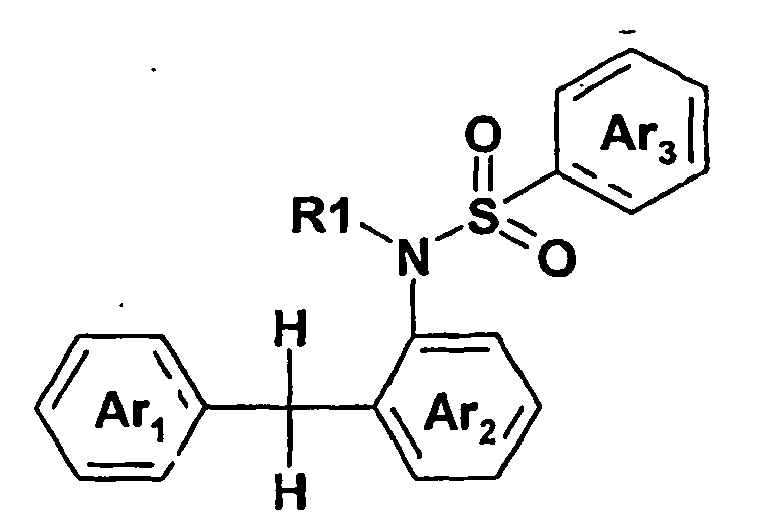
Tableau XXV N° composé Nature et position des substituants F(°C) MH+/temps de rétention Ar1 Ar2 R1 Ar3 304 2,6-diF 4-Cl CH(CH3)CONH2 3,4-diOMe 105,3 525/9,29 305 2,6-diF 4-Cl CH(CH3)CONH2 3,4-diOMe 94,1 525/9,29 - A 2g de N2-[2(2-chlorobenzyl)-4-nitrophényl]-N2-[(3,4-diméthoxyphényl)sulfonyl] glycinamide obtenu selon l'exemple 15 en solution dans 150 ml d'éthanol on additionne successivement à température ambiante, 0,91g d'étain, 3,2ml d'acide chlorhydrique 12M. Après 18 heures, le milieu est concentré, repris à l'acétate d'éthyle et avec une solution d'hydroxyde de sodium (PH14). La phase organique est séchée sur sulfate de sodium anhydre et concentrée. Le résidu est chromatographié sur une colonne de gel de silice en éluant avec un mélange dichlorométhane/méthanol 95/5 (v/v) pour obtenir 0,287g de produit attendu.
RMN 1H δ en ppm (DMSO d 6):3,79(s,3H);3,88(s,3H);3,94-4,40(massif,4H);5,15(s,2H );5,94(d,1H);6,22(d, 1H);6,50(d,1H);7,04-7,49(massif,9H). - A 0,6g de N2-[4-amino-2-(2-chlorobenzyl)phényl]-N2-[(3,4-diméthoxyphényl)sulfonyl] glycinamide en solution dans la N-méthylpyrrolidine on additionne 0,42 g de carbonate de caesium, 0,9ml de iodométhane et laisse 18 heures à température ambiante. Le milieu est repris à l'acétate d'éthyle et lavé avec à l'eau. La phase organique est séchée sur sulfate de sodium anhydre et concentrée. Le résidu est chromatographié sur une colonne de gel de silice en éluant avec un gradiant dichlorométhane/acétone 100 % à 90%/10% pour obtenir le produit attendu.
F=130,4°C
RMN 1H δ en ppm (DMSO d 6):2,73(s,6H);3,78(s,3H);3,84(s,3H);3,98-4,08(massif,3H);4,40(d,1H);6,04(d, 1H);6,43(d, 1H);6,70(d, 1H);7,02-7,51 (massif,9H). - A 0,18g de 1-méthyl-2-imidazolidone en solution dans la N-méthylpyrrolidine on additionne 0,086g d'hydrure de sodium à 50% dans l'huile, on laisse 15 minutes à température ambiante et introduit 1g d'éthyl N-(2-bromoéthyl)-N-[2-(2,6-difluorobenzyl)-4-chlorophényl]-3,4-diméthoxybenzènesulfonamide. Après 18 heures le milieu réactionnel et repris à l'acétate d'éthyle et lavé à l'eau. La phase organique est séchée sur sulfate de sodium anhydre et concentrée, le résidu est chromatographié sur une colonne de gel de silice en éluant au dichlorométhane pour obtenir 0,67g de produit attendu.
F=153°C
RMN 1H δ en ppm (DMSO d. 6):3,54(d,1H);3,79(s,3H);3,89(s,3H);3,94-4,20(massif,2H);4,22(d,1H);6,50(d,1H);7,06-7,45(massif,9H). - A 6,22g de (2-amino-4-méthoxyphényl)(2,6-difluorophényl) méthanol obtenu selon l'exemple 11.1 en solution dans 95 ml de dichlorométhane on additionne successivement à température ambiante, 11,7ml de triéthylsilane, 10,7ml d'acide trifluoroacétique. Après 4 heures à reflux, le milieu est hydrolysé par une solution 6M d'hydroxyde de sodium. La phase organique est séchée sur sulfate de sodium anhydre et concentrée. Le résidu est chromatographié sur une colonne de gel de silice en éluant au dichlorométhane pour obtenir 1,505g de produit attendu.
RMN 1H δ en ppm (DMSO d 6):
3,69(s,3H);4,93(s,2H);6,04(d,1H);6,21(s,1H);6,48(d,1H);7,01-7,35(massif,3H). - A partir de 1,5g de (2-amino-4-méthoxyphényl)(2,6-difluorophényl) méthane, selon l'exemple 12.2 on obtient 0,32g de produit attendu.
RMN 1H δ en ppm (DMSO d6): - 3,55(s,3H);3,74(s,3H);3,82(s,3H);3,85(d,2H);6,42(d,1H);6,56-7,42 (massif, 8H); 9, 54(s, 1H).
- A partir de 0,312g de N-[2-(2,6-difluorobenzyl)-5-méthoxyphényl]-3,4-diméthoxy benzènesulfonamide, selon l'exemple 12.3 on obtient 0,219g de produit attendu.
F=188,2°C
RMN 1H δ en ppm (DMSO d 6):3,55(s,3H);3,78(s,3H);3,88(s,3H);4,10-4,24 (massif, 3H);4,43(d,1H);6,41 (d, 1H);6,57(d, 1H);6,83(d, 1H);7,05-7,48(massif,8H). - Le tableau XXVI illustre les structures chimiques et les propriétés physiques de quelques composés de l'invention obtenus selon cet exemple.

Tableau XXVI N° composé Nature et position des substituants F(°C) MH+-/temps de rétention Ar1 Ar2 . R1 Ar3 302 2,6-diF 4-Cl,6-OMe CH2CONH2 3,4-diOMe 238,5 541/8,89 303 2,6-diF 4-Cl,6-Me CH2CONH2 3,4-diOMe 217 521/8,61 - A 0,543g du composé 256 en solution dans 10ml de tétrahydrofurane on additionne 106µl de pyridine, 102µl de chlorure de méthane sulfonyle et laisse 18 heures à température ambiante. Le milieu réactionnel est concentrée, le résidu est chromatographié sur une colonne de gel de silice en éluant avec un mélange dichlorométhane/méthanol pour obtenir 0,425g de produit attendu.
F=133,2°C
RMN 1H δ en ppm (DMSO d 6):2,85(s,3H),2,90(m,1H);3,12(m,1H);3,35(m,1H); ;3,78(s,3H);3,83(m,1H);3,86 (s,3H);4,09(d,1H);4,31(d,1H);6,78-7,51(massif,10H). - A 1,8g de éthyl N-[2-(2,6-difluorobenzyl)-6-méthoxyphényl]-N-[(3,4-diméthoxyphényl) sulfonyl]glycinate en solution dans 50 ml d'éthanol on additionne 10ml d'une solution 2M d'hydroxyde de sodium. Après 18 heures à température ambiante, le milieu est extrait à l'éther diéthylique, la phase aqueuse est acidifiée est extraite au dichlorométhane. La phase organique est séchée sur sulfate de sodium anhydre, puis concentrée pour obtenir 1,8g de produit attendu.
RMN 1H δ en ppm (DMSO d 6):3,18(s,3H);3,72(s,3H);3,82(d,1H);3,90(s,3H) ;4,29(d,1H);4,53(d,1H);5,01(d,1H);6,26(d,1H);6,78(d,1H);7,01-7,47(massif,7H);12,75(s,1H). - A 1,8g de N-[2-(2,6-difluorobenzyl)-6-méthoxyphényl]-N-[(3,4-diméthoxyphényl) sulfonyl]glycine en solution dans 30ml de tétrahydrofurane à 0°C, on introduit 0,5ml de N-éthylmorpholine, 0,38ml de chloroformate d'éthyle. Après 15 minutes à 10°C, on additionne 0,8g d'éthylamine en solution dans du tétrahydrofurane et laisse 30 minutes à température ambiante. Le milieu est repris à l'acétate d'éthyle, lavé à l'eau, la phase organique est séchée sur sulfate de sodium anhydre et concentrée pour obtenir 1,4g de produit attendu.
F=180°C
RMN 1H δ en ppm (DMSO d 6):0,98(t,3H),3,07(m,2H);3,26(s,3H);3,76(s,3H) ;3,79(m,1H);3,87(s,3H);4,26(d,1H);4,43(d,1H);4,94(d,1H);6,20(d,1H);6,81(d,1H);7,09-7,45(massif,7H);7,88(t,1H). - A 15g de 2,5-difluorobenzène en solution dans 150ml de tétrahydrofurane on additionne à -70°c 50ml d'une solution 1,6M de butyllithium. Après 2 heures à -70°c, on introduit 9,616g de 2-nitro,5-chlorobenzaldehyde et abandonne 3 heures à cette température, puis 18 heures à température ambiante le milieu est hydrolysé avec une solution de chlorure d'ammonium et extrait à l'acétate d'éthyle, La phase organique est séchée sur sulfate de sodium anhydre et concentrée. Le résidu est filtré sur silice en éluant au dichlorométhane pour obtenir 8,89g de produit attendu.
- A partir de 8,55g de (2-nitro-5-chlorophényl)(2,5-diflulorophényl)méthanol selon le procédé 8.2 on obtient 2,7g de produit attendu
RMN 1H δ en ppm (DMSO d 6): 5,18 (s,2H);5,89(d,1H);6,15(d,1H);6,68-7,36(massif,6H) - A partir de 2,7g de (2-amino-5-chlorophényl)(2,5-diflulorophényl)méthanol selon le procédé 18.1 on obtient 1.947g de produit attendu
RMN-1H δ en ppm (DMSO d 6): 3,80(s,2H);5,18(s,2H);6,60(massif,6H) - A partir de 0,484g de (2-amino-5-chlorophényl)(2,5-diflulorophényl)méthane selon le procédé décrit à l'exemple 12.2 on obtient 0,837g de produit attendu
RMN 1H δ en ppm (DMSO d 6):2,28(s,3H);2,45(s,3H);3,98(s,2H);6,60(m,1H);6,94-7,61 (massif,8H),9, 93(s,1H) - A partir de 0,83g de N-[4-chloro-2-(2,5-difluorobenzyl)phényl]-2,5-diméthyl-4-chloro benzènesulfonamide selon l'exemple 15 on obtient 0,424g de produit attendu RMN 1H δ en ppm (DMSO d 6):
- 2,16(s,3H);2,36(s,3H);3,92(d,1H);4,23(d,1H);4,40(d,1H);6,87(s,1H)6,96-7,75(massif,8H)
- F=169,7°C
- A 22,44g de tert-butylate de potassium dans 500ml de diméthylsulfoxyde on additionne lentement 8,66g de 4-chloronitrobenzène et 8,2g de 2clorométhylpyridine en solution dans 100ml de diméthylsulfoxyde. Après 18 heures à température ambiante on hydrolyse avec une solution saturée de chlorure d'ammonium, et extrait trois fois au dichlorométhane. La phase organique est séchée sur sulfate de sodium anhydre et concentrée. Le résidu est filtré sur silice H éluant dichlorométhane pour obtenir 10,695g de produit attendu
RMN 1H δ en ppm (DMSO d 6): 4,49(s,2H);7,20-7,31(massif,2H);7,60-7,78(masif, 3H); 8,03(d,1H);8,41 (d,1H)
F=69°C - • Exemple 51.2 : 4-chloro-2-(pyridin-2-ylméthyl)aniline
- A 5g de 2-(5-chloro-2-nitrobenzyl)pyridine selon l'exemple 8.2 on obtient 3,86g de produit attendu
RMN 1H δ en ppm (DMSO d 6): 3,93(s,2H);5,33(s,2H);6,66(d,1H);6,93-7,06(massif,2H);7,21-7,38(masif,2H);7,76(m, 1H);8,47(d,1H) - A 1,86g de 4-chloro-2-(pyridin-2-ylméthyl)aniline selon l'exemple 12.2 on obtient 2,12g de produit attendu
RMN 1H δ en ppm (DMSO d 6): 3,71(s,3H);3,83(s,3H); 3,94(s,2H); 7,07-7,32(massif,8H); 7,74(m,1H);8,54(d,1H) - A 0,5g de N-[4-chloro-2-(pyridin-2-ylméthyl)phényl]-3,4-diméthoxy benzène sulfonamide selon l'exemple 12.3 on obtient 0,257g de produit attendu RMN 1H δ en ppm (DMSO d 6): 3,79(s,3H);3,88(s,3H);4,03-4,48(massif,4H)); 6,93-7,37(massif,10H); 7,74(t,1H); 8,54(d,1H)
F=88°C -

- A 0,164g de méthyl N-[2-(2,6-difluorobenzyl)-6-méthoxyphényl]-N-[(3,4-diméthoxyphényl)sulfonyl]-(R)-alaninate en solution dans 8ml d'un mélange1,4-dioxane/eau (4/1) on additionne à température ambiante. 0,015g d'hydroxyde de lithium monohydrate. On laisse 48 heures à température ambiante. Le milieu réactionnel est lavé avec une solution 1 M d'acide chlorhydrique, et extrait à l'acétate d'éthyle. La phase organique est séchée sur sulfate de sodium anhydre et concentrée. Le résidu est chromatographié sur une colonne de gel de silice en éluant avec un mélange dichlorométhane/éthanol pour obtenir 0,08g du produit attendu RMN 1H δ en ppm (DMSO d6):1,64(d,3H);3,22(s,3H);3,70(s,3H);3,85(s,3H) ;4,11 (d,1H); 4,22(q,1H);4,77(d,1H);6,31 (d,1H);6,78(d,1H);7,02-7,44(massif,7H),12,5(s,1H).
- A partir de 0,098g de N-[2-(2,6-difluorobenzyl)-6-méthoxyphényl]-N-[(3,4-diméthoxyphényl)sulfonyl]-(R)-alanine selon l'exemple 43.2 on obtient 0,08g de produit attendu
RMN 1H δ en ppm (DMSO d6):1,34(d,3H);3,32(s,3H);3,74(s,3H);3,85(s,3H) ;4,22 (d,2H);4,41 (q,1H); 6,27(d, 1H);6,88(d,1H);7,07-7,44(massif,9H). - Suivant ce procédé on synthètise le N2-[2-(2,6-difluorobenzyl)-6-méthoxyphényl]-N2-[(3,4-diméthoxyphényl)sulfonyl] -(S)-alaninamide (composé 322).
RMN 1H δ en ppm (DMSO d6):1,34(d,3H);3,32(s,3H);3,74(s,3H);3,85(s,3H);4,22 (d,2H);4,41 (q,1H); 6,27(d,1H);6,88(d,1H);7,07-7,44(massif;9H).
-

- A 10 ml d'éthanol on additionne à température ambiante 0,31g de sodium. On laisse 15 minutes à température ambiante et introduit successivement 4,05g de chlorure de benzyl triphényl phosphonium et 2g de 2-nitro 3-méthoxy benzaldéhyde Après 18 heures à température ambiante, le milieu réactionnel est repris au dichlorométhane et lavé à l'eau. La phase organique est séchée sur sulfate de sodium anhydre et concentrée. Le résidu est chromatographié sur une colonne de gel de silice pour obtenir 2,254g du produit attendu.
RMN 1H δ en ppm (DMSO d6):3,92(s,3H) ; 6,55-7,56(massif,10H). - 2,25g de 1-méthoxy-2-nitro-3-[(E)-2-phénylvinyl]benzène sont additionnés sur 0,18g de palladium sur charbon (10%) en suspension dans 90 ml de méthanol et portés sous 4 bars d'hydrogéne. Après 18 heures on filtre le milieu réactionnel sur talc et concentre le filtrat pour obtenir 2,115g de produit attendu.
RMN 1H δ en ppm (DMSO d6):2,74-2,88 (massif,4H);3,78(s,3H); 4,55(s,2H);6,55-7,31(massif,8H). - A partir de 2,11g de 2-méthoxy-6-(2-phényléthyl)aniline selon l'exemple 12.2 on obtient 0,5g de produit attendu.
RMN 1H δ en ppm (DMSO d6): 2,83(m,2H),3,01 (m,2H); 3,22(s,3H); 3,73 (s,3H) ;3,84(s,3H);6,71-7,33(massif,11H);8,99(s,1H). - A partir de 0,5g de N-[2-méthoxy-6-(2-phényléthyl)phényl](3,4-diméthoxy phényl)sulfonamideselon l'exemple 12.3 on obtient 0,187 g de produit attendu.
RMN 1H δ en ppm (DMSO d6): 2,83(m,3H),3,26(s,3H);3,40(m,1H); 3,73 (s,3H) ;3,84(s,3H);6,76(d,1H);7,03-7,36(massif,12H).
F=243, 9° C - Les composés de l'invention ont fait l'objet d'études pharmacologiques qui ont montré leur intérêt comme substances actives en thérapeutique.
- Ils ont en particulier été testés quant à leurs effets. Plus particulièrement, l'affinité des composés de l'invention pour les récepteurs 2 de l'orexine a été déterminée dans un test de liaison in vitro selon la technique décrite ci-dessous. Cette méthode consiste à étudier le déplacement de l'orexine A radioiodée fixée aux récepteurs de l'orexine 2 humains exprimés dans des cellules CHO. Le test s'effectue sur membranes dans un tampon d'incubation Hépès 50 mM, MgCl2 1 mM, CaCl2 25 mM, NaN3 0,025 %, le sérum albumine bovin (BSA) 1 % et 100 pM de ligand pendant 30 minutes à 25°C. La réaction est arrêtée par filtration et lavage sur filtre Wathman GF/C. La liaison non , spécifique est mesurée en présence de 10-6M d'orexine B humaine. Les CI50 (concentration inhibitrice de 50% de la liaison de l'orexine A radioiodée à ses récepteurs) sont faibles, inférieures à 300 nM, en particulier inférieures à 100 nM et plus particulièrement inférieures à 30 nM.
- L'affinité des composés selon l'invention pour les récepteurs 1 de l'orexine a également été étudiée dans un test de liaison in vitro selon la même technique en utilisant l'orexine A radio iodée comme ligand dans une préparation membranaire de cellules CHO exprimant les récepteurs orexine 1 humains. Les composés selon l'invention sont peu ou pas affins pour les récepteurs orexine 1.
- Le caractère agoniste ou antagoniste des composés est déterminé in vitro dans un test de mesure de calcium intracellulaire (FLIPR) sur une préparation cellulaire exprimant les récepteurs 2 de l'orexine selon la technique générale décrite dans Sullivan et al, Methods Mol. Biol., 1999, vol. 114, 125-133, en utilisant 1 µM de Fluo-4 AM en tant qu'indicateur fluorescent de calcium. Pour le test antagoniste les composés sont préincubés 30 minutes avant ajout de 0,25 nM d'orexine B. Les CI50 pour les récepteurs orexine 2 mesurées dans ces études sont faibles et plus particulièrement inférieures à 100 nM.
- Le tableau suivant illustre l'affinité de quelques composés selon l'invention pour les précepteurs de l'orexine dans un test de liaison in nitro selon la technique décrite ci-dessus ainsi que leur caractère antagoniste déterminé in vitro dans un test de mesure de calcium intracellulaire (FLIPR) selon la technique générale mentionnée ci-dessus.
N° composé Cl50 OX 2 (nM) Cl50 OX 1 (nM) Mesure de [Ca2+]i Cl50 OX 2 (nM) - FLIPR 1 13 446 5 28 62 1500 19 30 82 966 26. 44 85 > 10 µM 54 107 20 899 11 124 50 > 10 µM 65 137 19 > 10 µM 10 138 8 4760 11 202 9 1870 7 - Les résultats biologiques montrent que les composés selon l'invention sont bien des antagonistes spécifiques des récepteurs orexine 2.
- Ainsi, les composés de la présente invention, en tant qu'antagonistes des récepteurs orexine 2, peuvent être utilisés dans la prophylaxie et le traitement de toutes maladies impliquant un dysfonctionnement lié à ces récepteurs.
- Les composés de l'invention peuvent être utilisés pour la préparation d'un médicament destiné à la prophylaxie ou au traitement de toutes maladies impliquant un dysfonctionnement lié au récepteur orexine 2, et plus particulièrement dans la prophylaxie ou le traitement des pathologies dans lesquelles un antagoniste de récepteur orexine 2 apporte un bénéfice thérapeutique. De telles pathologies sont par exemple l'obésité, les perturbations de l'appétit ou du goût dont la cachexie, l'anorexie, la boulimie (Smart et al., Eur. J. Pharmacol., 2002, 440, 2-3, 199-212), le diabète (Ouedraogo et al., Diabètes, 2002, 52, 111-117), les syndromes métaboliques (Sakurai, Curr. Opin. Nutr. Metab. Care, 2003, 6, 353-360), les vomissements et la nausée (
US 6, 506, 774 ), la dépression et l'anxiété (Salomon et al., Biol. Psychiatry, 2003, 54, 96-104 ; Jaszberenyi et al., J. Neuroendocrinol., 2000, 12, 1174-1178), les addictions (Georgescu et al., J. Neurosci., 2003, 23, 8, 3106-3111 ; Kane et al., Endocrinology, 2000, 141, 10, 3623-3629), les troubles de l'humeur et du comportement, la schizophrénie (Nishino et al., Psychiatry Res., 2002, 110, 1-7), les troubles du sommeil (Sakurai, Neuroreport, 2002, 13, 8, 987-995), la maladie des jambes sans repos (Allen et al., Neurology, 2002, 59, 4, 639-641), les troubles de l'apprentissage de la mémoire (van den Pol et al., 2002, J. Physiol., 541(1), 169-185 jauger et al., Peptides, 2003, 23, 1683-1688 ; Telegdy etc Adamik, Regul. Pept., 2002, 104, 105-110), les dysfonctions sexuelles et psychosexuelles (Gulia et al., Neuroscience, 2003, 116, 921-923), la douleur, la douleur viscérale ou neuropathique, l'hyperalgésie, l'allodynie (US 6,506,774 ; Suyama et al., in vivo, 2004, 18, 2, 119-123); les troubles digestifs (Takakashi et al., Biochem. Biophy. Res. Comm ., 1999, 254, 623-627 ; Matsuo et al., Eur. J. Pharmacol., 2002, 105-109), le syndrome des intestins irrités (US 6,506,774 ), la dégénérescence neuronale (van den Pol, Neuron, 2000, 27, 415-418), les attaques ischémiques ou hémorrhagiques (Irving et al., Neurosci. Lett., 2002, 324, 53-56), la maladie de Cushing, le syndrome de Guillain-Barré (Kanbayashi et al., Psychiatry Clin. Neurosci., 2002, 56, 3, 273-274), la dystrophie myotonique (Martinez-Rodriguez et al., Sleep, 2003, 26, 3, 287-290), l'incontinence urinaire (Blackstone et al., AGS Annual Meeting, poster P491,2002), l'hyperthyroïdie (Malendowicz et al., Biomed. Res., 2001, 22, 5, 229-233), les troubles de la fonction hypophysaire (Voisin et al., Cell. Mol. Life Sci., 2003, 60, 72-78), l'hypertension ou l'hypotension (Samson et al, Brain Res., 1999, 831, 1-2, 248-253). - L'utilisation des composés selon l'invention pour la préparation d'un médicament destiné à prévenir ou à traiter les pathologies ci-dessus mentionnées, fait partie intégrante de l'invention.
- L'invention a également pour objet des médicaments qui comprennent un composé de formule (I). Ces médicaments trouvent leur emploi en thérapeutique, notamment dans la prophylaxie ou le traitement des pathologies ci-dessus mentionnées.
- Selon un autre de ses aspects, la présente invention concerne des compositions pharmaceutiques renfermant en tant que principe actif, au moins un composé selon l'invention. Ces compositions pharmaceutiques contiennent une dose efficace d'un composé selon l'invention et éventuellement un ou plusieurs excipients pharmaceutiquement acceptables.
Lesdits excipients sont choisis selon la forme pharmaceutique et le mode d'administration souhaité, parmi les excipients habituels qui sont connus de l'homme du métier. - Dans les compositions pharmaceutiques de la présente invention pour l'administration orale, sublinguale, sous-cutanée, intramusculaire, intra-veineuse, topique, locale, intratrachéale, intranasale, transdermique ou rectale, le principe actif de formule (I) ci-dessus, ou son sel, solvat ou hydrate éventuel, peut être administré sous forme unitaire d'administration, en mélange avec des excipients pharmaceutiques classiques, aux animaux et aux êtres humains pour la prophylaxie ou le traitement des troubles ou des maladies ci-dessus.
- Les formes unitaires d'administration appropriées comprennent les formes par voie orale telles que les comprimés, les gélules molles ou dures, les poudres, les granules, les chewing-gums et les solution ou suspensions orales, les formes d'administration sublinguale, buccale, intratrachéale, intraoculaire, intranasale, par inhalation, les formes d'administration sous-cutanée, intramusculaire ou intraveineuse et les formes d'administration rectale ou vaginale. Pour l'application topique, on peut utiliser les composés selon l'invention dans des crèmes, pommades ou lotions.
- Par exemple, lorsqu'on prépare une composition solide sous forme de comprimés, on mélange l'ingrédient actif principal avec un excipient pharmaceutique, tel que la gélatine, l'amidon, le lactose, le stéarate de magnésium, le talc, la gomme arabique ou analogues. On peut enrober les comprimés de saccharose, d'un dérivé cellulosique, ou d'autres matières. Les comprimés peuvent être réalisés par différentes techniques, compression directe, granulation sèche, granulation humide ou fusion à chaud.
- Afin d'obtenir l'effet prophylactique ou thérapeutique désiré, la dose de principe actif peut varier entre 0,1 mg et 200 mg par kg de poids du corps et par jour. Bien que ces dosages soient des exemples de situation moyenne, il peut y avoir des cas particuliers où des dosages plus élevés ou plus faibles sont appropriés, de tels dosages appartiennent également à l'invention. Selon la pratique habituelle, le dosage approprié à chaque patient est déterminé par le médecin selon le mode d'administration, le poids et la réponse dudit patient.
- Chaque dose unitaire peut contenir de 0,1 à 1000 mg, de préférence de 0,1 à 500 mg, de principe actif en combinaison avec un ou plusieurs excipients pharmaceutiques. Cette dose unitaire peut être administrée 1 à 5 fois par jour de façon à administrer un dosage journalier de 0,5 à 5000 mg, de préférence de 0,5 à 2500 mg.
Claims (9)
- Composé répondant à la formule générale (I) :
 • Ar1 représente :- un groupe aryle tel qu'un groupe phényle éventuellement substitué par un ou plusieurs groupes choisis indépendamment les uns des autres parmi les groupes suivants : un atome d'halogène, un groupe (C1-C4) alkyle, un groupe (C1-C4) alcoxy, un groupe fluoro(C1-C4)alkyle, un groupe cyano, un groupe -CO-NRaRb, un groupe - NRaRb,
avec Ra et Rb étant indépendamment l'un de l'autre un atome d'hydrogène, un groupe (C1-C4) alkyle,- un groupe hétérocyclyle choisi parmi le pyridinyle, le pyrimidinyle, le thiazolyle, le thiényle, lesdits groupes hétérocyclyles étant éventuellement substitués par un atome d'halogène, un groupe (C1-C4) alkyle, un groupe (C1-C4) alcoxy,- un groupe (C3-C6) cycloalkyle ;• T représente :- un groupe -(CH2)n- avec n = 0,1,2,- un groupe - un groupe
 - un groupe
 • Ar2 représente :- un groupe aryle tel que le phényle éventuellement substitué par un ou plusieurs groupes choisis indépendamment les uns des autres parmi les groupes suivants : un atome d'halogène, un groupe (C1-C4) alkyle, un groupe (C1-C4) alcoxy, un groupe fluoro(C1-C4)alkyle, un groupe fluoro(C1-C4)alcoxy,
ou bien par un groupe -NRcRd avec Rc et Rd étant indépendamment l'un de l'autre un atome d'hydrogène, un groupe (C1-C4) alkyle,- un groupe hétérocyclyle tel que le pyridinyle éventuellement substitué par un groupe (C1-C4)alkyle, un groupe (C1-C4) alcoxy ;• Ar3 représente :- un groupe aryle choisi parmi le phényle et le naphtyle, lesdits groupes aryles étant éventuellement substitués par un ou plusieurs groupes choisis indépendamment les uns des autres parmi les groupes suivants : un atome d'halogène, un groupe (C1-C4) alkyle, un groupe (C1-C4) alcoxy, un groupe fluoro(C1-C4)alkyle, un groupe fluoro(C1-C4)alcoxy, un groupe nitro, groupe hydroxy,
ou bien par un groupe -NR5R6 avec R5 et R6 étant, indépendamment l'un de l'autre, un atome d'hydrogène, un groupe (C1-C4) alkyle,- un groupe hétérocyclyle tel que le pyridinyle éventuellement substitué par un groupe (C1-C4) alkyle ou un (C1-C4) alcoxy,
ou bien par un groupe -NRxRy avec Rx et Ry étant indépendamment l'un de l'autre un atome d'hydrogène, un groupe (C1-C4) alkyle, un groupe (C1-C4) alcoxy,- un groupe choisi parmi : • R1 représente :- un groupe -C(O)-CF3,- un groupe de formule :
n = 0, 1, 2, 3,o R7 représente :- un atome d'hydrogène, un groupe (C1-C4) alkyle, un atome de fluor, un groupe (C1-C4) alcoxy,- un groupe -(CH2)m-aryle, avec m=1, 2, et le groupe aryle étant un groupe phényle éventuellement substitué par un atome d'halogène, un groupe (C1-C4) alkyle, un groupe (C1-C4)alcoxy,o R8 représente :- un atome d'hydrogène, un atome de fluor, un groupe (C1-C4) alkyle,o R9 représente: .- un atome d'hydrogène, un groupe (C1-C4) alkyle, un groupe hydroxyle, un groupe (C3-C6) cycloalkyle, un groupe (C1-C4) alcoxy, un groupe fluoro(C1-C4)alkyle, un groupe -C=CH, un groupe -C=N, un groupe phénoxy, un groupe (C1-C4)alcényle,- un groupe -NR10R11 avec R10 et R11 étant indépendamment l'un de l'autre un atome d'hydrogène, un groupe (C1-C4) alkyle, un groupe (C1-C4) alkylcarbonyle, un groupe (C1-C4) alkylsulfonyle, un benzyle ou un groupe -(CH2)2-N(CH3)2,
ou bien R10 et R11 forment ensemble avec l'atome d'azote qui les porte une pyrrolidine, une pyrrolidinone, une morpholine ou une pipéridine,- un groupe -CO-NR12R13 avec R12 et R13 étant indépendamment l'un de l'autre :o un atome d'hydrogène,o un groupe (C1-C4) alkyle éventuellement substitué par un groupe -C≡N, un groupe aryle tel que le phényle, un groupe hétérocyclyle tel que le pyridinyle, lesdits groupes aryle et hétérocyclyle étant éventuellement substitués par un groupe (C1-C4) alkyle, un groupe hydroxyle,
ou bien R12 et R13 forment ensemble avec l'atome d'azote qui les porte un groupe - un groupe -COOR14 avec R14 étant un groupe (C1-C4) alkyle,- un groupe -NH-CO-NR15R16 avec R15 et R16 étant indépendamment l'un de l'autre un atome d'hydrogène, un groupe (C1-C4) alkyle, un groupe phényle, un groupe benzyle, lesdits groupes phényle et benzyle étant éventuellement substitués par un ou plusieurs substituants choisis parmi un atome d'halogène, un groupe (C1-C4)alkyle, un groupe (C1-C4) alcoxy,- un groupe -SO2-NR17R18 avec R17 et R18 étant indépendamment l'un de l'autre un atome d'hydrogène, un groupe (C1-C4) alkyle,- un groupe -SO2-R19 avec R19 étant un groupe (C1-C4) alkyle, un groupe aryle tel que le phényle,- un groupe hétérocyclyle choisi parmi, 1,3-dioxolanyle, l'imidazolyle, le tétrazolyle, le triazolyle éventuellement substitué par un groupe (C1-C4) alkyle, le thiazolyle, le pyrimidinyle, l'oxadiazolyle, le pyridinyle, l'imidazolyle étant éventuellement substitué sur l'atome d'azote par un groupe (C1-C4) alkyle ou un benzyle, le tétrazolyle étant éventuellement substitué par un groupe (C1-C4) alkyle ou un benzyle, l'oxadiazolyle étant éventuellement substitué par un (C1-C4) alkyle,- un groupe -NH-CO-OR15, R15 répondant à la définition ci-dessus,le composé suivant étant exclu : N-méthyl benzyl-2' chloro-4' tosanilide, à l'état de base, de sel d'addition à un acide, d'hydrate ou de solvat, sous forme d'énantiomères, de diastéréoisomères, de rotamères, d'atropoisoméres ou de leurs mélanges.
 - Composé de formule générale (I) selon la revendication 1, dans laquelle• Ar1 représente :- un groupe aryle tel qu'un groupe phényle éventuellement substitué par un ou plusieurs groupes choisis indépendamment les uns des autres parmi les groupes suivants : un atome d'halogène, un groupe (C1-C4) alkyle, un groupe (C1-C4) alcoxy, un groupe fluoro(C1-C4)alkyle,- un groupe hétérocyclyle choisi parmi le pyridinyle, le thiazolyle, le thiényle, le thiényle étant éventuellement substitué par un groupe (C1-C4) alkyle,- un groupe (C3-C6) cycloalkyle :• T représente :- un groupe -(CH2)n- avec n = 1- un groupe
 - un groupe
 - un groupe
 • Ar2 représente :- un groupe aryle tel que le phényle éventuellement substitué par un ou plusieurs groupes choisis indépendamment les uns des autres parmi les groupes suivants : un atome d'halogène, un groupe (C1-C4) alkyle, un groupe (C1-C4) alcoxy, un groupe fluoro(C1-C4)alcoxy, un groupe -NRcRd avec Rc et Rd étant, indépendamment l'un de l'autre, un atome d'hydrogène, un groupe (C1-C4) alkyle ;• Ar3 représente :- un groupe aryle choisi parmi le phényle et le naphtyle, le groupe phényle étant éventuellement substitué par un ou plusieurs groupes choisis indépendamment les uns des autres parmi les groupes suivants : un atome d'halogène, un groupe (C1-C4) alkyle, un groupe (C1-C4) alcoxy, un groupe fluoro(C1-C4)alkyle, groupe fluoro(C1-C4)alcoxy, un groupe nitro,
ou bien un groupe -NR5R6 avec R5 et R6 étant, indépendamment l'un de l'autre, un atome d'hydrogène, un groupe (C1-C4) alkyle,- un groupe choisi parmi : • R1 représente :- un groupe -C(O)-CF3,- un groupe de formule
n = 0, 1, 2,o R7 représente :- un atome d'hydrogène, un groupe (C1-C4) alkyle,o R8 repésente :- un atome d'hydrogène,o R9 représente :- un atome d'hydrogène, un groupe (C1-C4) alkyle, un groupe hydroxyle, un groupe (C1-C4) alcoxy, un groupe fluoro(C1-C4) alkyle, un groupe -C≡CH, un groupe -C≡N,- un groupe -NR10R11 avec R10 et R11 étant indépendamment l'un de l'autre un atome d'hydrogène, un groupe (C1-C4) alkyle, un groupe (C1-C4) alkylcarbonyle, un benzyle,
ou bien R10 et R11 forment ensemble avec l'atome d'azote qui les porte une pyrrolidine, une pipéridine ou une pyrrolidinone,- un groupe -CO-NR12R13 avec R12 et R13 étant indépendamment l'un de l'autre un atome d'hydrogène, un groupe (C1-C4) alkyle,
ou bien R12 et R13 forment ensemble avec l'atome d'azote qui les porte un groupe : - un groupe -COOR14 avec R14 étant un groupe (C1-C4) alkyle,- un groupe -NH-CO-NR15R16 avec R15 et R16 étant indépendamment l'un de l'autre un atome d'hydrogène, un groupe (C1-C4) alkyle, un phényle, un benzyle,- un groupe hétérocyclyle choisi parmi l'imidazolyle éventuellement substitué sur l'atome d'azote par un groupe (C1-C4) alkyle, le tétrazolyle éventuellement substitué par un groupe (C1-C4) alkyle, le triazolyle,à l'état de base, de sel d'addition à un acide, d'hydrate ou de solvat, sous forme d'énantiomères, de diastéréoisomères, de rotamères, d'atropoisoméres ou de leurs mélanges.
 - Composé de formule générale (I) selon l'une des revendications 1 ou 2 dans laquelle :• Ar1 représente :- un groupe aryle tel que le phényle éventuellement substitué par un ou plusieurs groupes choisis indépendamment les uns des autres parmi les groupes suivants : un atome d'halogène, un groupe (C1-C4) alkyle, un groupe (C1-C4) alcoxy, un groupe fluoro(C1-C4)alkyle,- un groupe hétérocyclyle choisi parmi le pyridinyle, le thiazolyle, le thiényle, le thiényle étant éventuellement substitué par un groupe (C1-C4) alkyle ;• T représente :- un groupe -(CH2)n- avec n = 1- un groupe
 • Ar2 représente :- un groupe aryle tel que le phényle éventuellement substitué par un ou plusieurs groupes choisis indépendamment les uns des autres parmi les groupes suivants : un atome d'halogène, un groupe (C1-C4) alkyle, un groupe (C1-C4) alcoxy ; un groupe - NRcRd avec Rc et Rd étant, indépendamment l'un de l'autre, un atome d'hydrogène, un groupe (C1-C4) alkyle ;• Ar3 représente :- un groupe aryle tel que le phényle, le groupe phényle étant éventuellement substitué par un ou plusieurs groupes choisis indépendamment les uns des autres parmi les groupes suivants : un atome d'halogène, un groupe (C1-C4) alkyle, un groupe (C1-C4) alcoxy,
ou bien un groupe -NR5R6 avec R5 et R6 étant, indépendamment l'un de l'autre, un atome d'hydrogène, un groupe (C1-C4) alkyle ;• R1 représente :- un groupe de formule :
n =0, 1, 2,o R7 représente :- un atome d'hydrogène, un groupe (C1-C4) alkyle,o R8 représente :- un atome d'hydrogène,o R9 représente :- un atome d'hydrogène, un groupe -C≡CH, un groupe -C≡N,- un groupe -CO-NR12R13 avec R12 et R13 étant indépendamment l'un de l'autre un atome d'hydrogène, un groupe (C1-C4) alkyle,- un hétérocyclyle choisi parmi l'imidazolyle éventuellement substitué sur l'atome d'azote par un groupe (C1-C4) alkyle, le tétrazolyle éventuellement substitué par un groupe (C1-C4) alkyle, le triazolyleà l'état de base, de sel d'addition à un acide, d'hydrate ou de solvat, sous forme d'énantiomères, de diastéréoisomères, de rotamères , d'atropoisoméres ou de leurs mélanges. - Composé de formule générale (I) selon l'une quelconque des revendications 1 à 3 dans laquelle :• Ar1 représente :- un groupe aryle tel que le phényle éventuellement substitué par un ou plusieurs groupes choisis indépendamment les uns des autres parmi les groupes suivants : un atome d'halogène, un groupe (C1-C4) alkyle, un groupe (C1-C4) alcoxy,- un groupe hétérocyclyle tel que le thiényle éventuellement substitué par un groupe (C1-C4) alkyle,• T représente :- un groupe -(CH2)n- avec n = 1,• Ar2 représente :- un groupe phényle éventuellement substitué par un ou plusieurs groupes choisis indépendamment les uns des autres parmi les groupes suivants : un atome d'halogène, un groupe (C1-C4) alkyle, un groupe (C1-C4) alcoxy, un groupe -NRcRd avec Rc et Rd étant, indépendamment l'un de l'autre, un atome d'hydrogène, un groupe (C1-C4) alkyle ;• Ar3 représente :- un groupe phényle éventuellement substitué par un ou plusieurs groupes choisis indépendamment les uns des autres parmi les groupes suivants : un atome d'halogène, un groupe (C1-C4) alkyle, un groupe (C1-C4) alcoxy,
ou bien un groupe -NR5R6 avec R5 et R6 étant, indépendamment l'un de l'autre, un atome d'hydrogène, un groupe (C1-C4) alkyle;• R1 représente :- un groupe de formule :
n = 0, 1, 2,o R7 représente:- un atome d'hydrogène, un groupe (C1-C4) alkyle ;o R8 représente :- un atome d'hydrogène ;o R9 représente :- un groupe -CO-NR12R13 avec R12 et R13 étant indépendamment l'un de l'autre un atome d'hydrogène, un groupe (C1-C4) alkyle,- un hétérocycle choisi parmi l'imidazolyle substitué sur l'atome d'azote par un groupe (C1-C4) alkyle, le tétrazolyle substitué par un groupe (C1-C4) alkyle, le triazolyle,à l'état de base, de sel d'addition à un acide, d'hydrate ou de solvat, sous forme d'énantiomères, de diastéréoisomères, de rotamères, d'atropoisoméres ou de leurs mélanges. - Procédé de préparation d'un composé de formule (I) selon l'une quelconque des revendications 1 à 4, caractérisé en ce que :- soit l'on alkyle le composé de formule générale (II) avec le composé de formule générale (IV), en présence d'une base ;- soit l'on effectue une réaction de Mitsunobu entre un alcool de formule (X) et un composé de formule générale (II) :

- Procédé de préparation selon la revendication 5, caractérisé en ce que l'on obtient le composé de formule (II) par la sulfonylation de composé de formule (III) avec des chlorures de sulfonyle de formule (V), en présence d'une base :

- Utilisation d'un composé de formule (I) selon l'une quelconque des revendications 1 à 4 pour la préparation d'un médicament destiné à la prophylaxie ou au traitement des pathologies telles que l'obésité, les perturbations de l'appétit ou du goût dont la cachexie, l'anorexie, la boulimie, le diabète, les syndromes métaboliques, les vomissements et la nausée, la dépression et l'anxiété, les addictions, les troubles de l'humeur et du comportement, la schizophrénie, les troubles du sommeil, la maladie des jambes sans repos, les troubles de l'apprentissage de la mémoire, les dysfonctions sexuelles et psychosexuelles, la douleur, la douleur viscérale ou neuropathique, l'hyperalgésie, l'allodynie, les troubles digestifs, le syndrome des intestins irrités, la dégénérescence neuronale, les attaques ischémiques ou hémorrhagiques, la maladie de Cushing, le syndrome de Guillain-Barré, la dystrophie myotonique, l'incontinence urinaire, l'hyperthyroïdie, les troubles de la fonction hypophysaire, l'hypertension ou l'hypotension.
- Médicament caractérisé en ce qu'il comprend un composé de formule (I) selon l'une quelconque des revendications 1 à 4.
- Composition pharmaceutique contenant au moins un composé de formule (I) selon l'une quelconque des revendications 1 à 4 et éventuellement un ou plusieurs excipients pharmaceutiquement acceptables.
Applications Claiming Priority (2)
| Application Number | Priority Date | Filing Date | Title |
|---|---|---|---|
| FR0408546A FR2874011B1 (fr) | 2004-08-03 | 2004-08-03 | Derives de sulfonamides, leur preparation et leur application en therapeutique |
| PCT/FR2005/002017 WO2006024779A1 (fr) | 2004-08-03 | 2005-08-02 | Derives de sulfonamides, leur preparation et leur application en therapeutique |
Publications (2)
| Publication Number | Publication Date |
|---|---|
| EP1776347A1 EP1776347A1 (fr) | 2007-04-25 |
| EP1776347B1 true EP1776347B1 (fr) | 2010-05-26 |
Family
ID=34947042
Family Applications (1)
| Application Number | Title | Priority Date | Filing Date |
|---|---|---|---|
| EP05796062A Expired - Lifetime EP1776347B1 (fr) | 2004-08-03 | 2005-08-02 | Derives de sulfonamides, leur preparation et leur application en therapeutique |
Country Status (22)
| Country | Link |
|---|---|
| US (1) | US7396958B2 (fr) |
| EP (1) | EP1776347B1 (fr) |
| JP (1) | JP2008509115A (fr) |
| KR (1) | KR20070053726A (fr) |
| CN (1) | CN101090892A (fr) |
| AR (1) | AR050364A1 (fr) |
| AT (1) | ATE469131T1 (fr) |
| AU (1) | AU2005279088A1 (fr) |
| BR (1) | BRPI0513068A (fr) |
| CA (1) | CA2577220A1 (fr) |
| DE (1) | DE602005021501D1 (fr) |
| EA (1) | EA200700112A1 (fr) |
| FR (1) | FR2874011B1 (fr) |
| IL (1) | IL181069A0 (fr) |
| MA (1) | MA28752B1 (fr) |
| MX (1) | MX2007001437A (fr) |
| NO (1) | NO20071197L (fr) |
| PE (1) | PE20060689A1 (fr) |
| TW (1) | TW200609204A (fr) |
| UY (1) | UY29047A1 (fr) |
| WO (1) | WO2006024779A1 (fr) |
| ZA (1) | ZA200701482B (fr) |
Families Citing this family (30)
| Publication number | Priority date | Publication date | Assignee | Title |
|---|---|---|---|---|
| EA200702498A1 (ru) | 2005-06-16 | 2008-06-30 | Пфайзер Инк. | N-(пиридин-2-ил)сульфонамидные производные |
| ES2719592T3 (es) * | 2005-09-08 | 2019-07-11 | Erasteel Kloster Ab | Acero de alta velocidad fabricado mediante metalurgia de polvos |
| FR2896798A1 (fr) * | 2006-01-27 | 2007-08-03 | Sanofi Aventis Sa | Derives de sulfonamides, leur preparation et leur application en therapeutique |
| FR2896799B1 (fr) * | 2006-02-02 | 2008-03-28 | Sanofi Aventis Sa | Derives de sulfonamides, leur preparation et leur application en therapeutique |
| EP1998774A1 (fr) * | 2006-03-15 | 2008-12-10 | Actelion Pharmaceuticals Ltd. | Derives de tetrahydroisoquinoleine pour renforcer la fonction de la memoire |
| CN101460453B (zh) * | 2006-04-11 | 2012-10-03 | 埃科特莱茵药品有限公司 | 磺酰胺化合物 |
| ATE496051T1 (de) | 2006-04-26 | 2011-02-15 | Actelion Pharmaceuticals Ltd | Pyrazolotetrahydropyridinderivate als orexinrezeptorantagonisten |
| CA2674644A1 (fr) | 2007-01-10 | 2008-07-17 | F. Hoffmann-La Roche Ag | Derives de sulfonamide en tant qu'inhibiteurs de la chymase |
| DE102007007751A1 (de) * | 2007-02-16 | 2008-08-21 | Boehringer Ingelheim Pharma Gmbh & Co. Kg | Neue substituierte Arylsulfonylglycine, deren Herstellung und deren Verwendung als Arzneimittel |
| KR101366980B1 (ko) | 2007-06-01 | 2014-02-24 | 엘지디스플레이 주식회사 | 유기전계발광소자 |
| CA2709050C (fr) * | 2008-01-21 | 2016-06-14 | F. Hoffmann-La Roche Ag | Sulfonamides en tant qu'antagonistes de l'orexine |
| PE20091825A1 (es) * | 2008-04-04 | 2009-12-04 | Merck & Co Inc | Hidroximetil pirrolidinas como agonistas del receptor adrenergico beta 3 |
| DE102008019838A1 (de) * | 2008-04-19 | 2009-12-10 | Boehringer Ingelheim International Gmbh | Neue Arylsulfonylglycin-Derivate, deren Herstellung und deren Verwendung als Arzneimittel |
| MX2011011428A (es) * | 2009-05-01 | 2011-11-29 | Raqualia Pharma Inc | Derivados de acido sulfamoilbenzoico como antagonistas de trpm8. |
| ES2585806T3 (es) | 2009-10-23 | 2016-10-10 | Janssen Pharmaceutica N.V. | Octahidropirrolo [3,4-c] pirroles disustituidos como moduladores de receptores de orexina |
| WO2011133366A1 (fr) * | 2010-04-22 | 2011-10-27 | Board Of Regents, The University Of Texas System | Sondes fluorescentes pour la mesure de l'oxyde nitrique et procédés correspondants |
| JP2013532688A (ja) | 2010-07-26 | 2013-08-19 | ブリストル−マイヤーズ スクイブ カンパニー | Cyp17阻害剤として有用なスルホンアミド化合物 |
| WO2012027261A1 (fr) | 2010-08-23 | 2012-03-01 | Amgen Inc. | Dérivés de sulfonylpipérazine qui interagissent avec la protéine régulatrice de la glucokinase pour le traitement du diabète |
| ES2584427T3 (es) | 2011-10-27 | 2016-09-27 | Merck Sharp & Dohme Corp. | Proceso para la preparación de agonistas beta 3 y productos intermedios |
| JP6063948B2 (ja) | 2011-10-27 | 2017-01-18 | メルク・シャープ・アンド・ドーム・コーポレーションMerck Sharp & Dohme Corp. | ベータ3アゴニストおよび中間体を製造するプロセス |
| JP6383403B2 (ja) | 2013-03-15 | 2018-08-29 | メルク・シャープ・アンド・ドーム・コーポレーションMerck Sharp & Dohme Corp. | β−3作動薬および中間体の製造方法 |
| AU2015222917A1 (en) | 2014-02-27 | 2016-09-15 | Lycera Corporation | Adoptive cellular therapy using an agonist of retinoic acid receptor-related orphan receptor gamma and related therapeutic methods |
| JP6728061B2 (ja) | 2014-05-05 | 2020-07-22 | リセラ・コーポレイションLycera Corporation | RORγアゴニストとして用いるテトラヒドロキノリンスルホンアミド及び関連化合物ならびに疾患の治療 |
| JP6523337B2 (ja) | 2014-05-05 | 2019-05-29 | リセラ・コーポレイションLycera Corporation | RORγのアゴニストとしての使用及び疾患治療のためのベンゼンスルホンアミド及び関連化合物 |
| AU2016257997A1 (en) | 2015-05-05 | 2017-11-09 | Lycera Corporation | Dihydro-2H-benzo[b][1,4]oxazine sulfonamide and related compounds for use as agonists of RORy and the treatment of disease |
| US10611740B2 (en) | 2015-06-11 | 2020-04-07 | Lycera Corporation | Aryl dihydro-2H-benzo[b][1,4]oxazine sulfonamide and related compounds for use as agonists of RORγ and the treatment of disease |
| HRP20220642T1 (hr) | 2016-03-10 | 2022-06-24 | Janssen Pharmaceutica Nv | Postupci za liječenje depresije uporabom antagonista receptora oreksina 2 |
| TW201811766A (zh) | 2016-08-29 | 2018-04-01 | 瑞士商諾華公司 | N-(吡啶-2-基)吡啶-磺醯胺衍生物及其用於疾病治療之用途 |
| EP4410295A3 (fr) | 2017-06-06 | 2024-10-16 | Urovant Sciences GmbH | Utilisation de vibegron pour traiter une vessie hyperactive |
| SG11202103662VA (en) | 2018-12-05 | 2021-06-29 | Urovant Sciences Gmbh | Vibegron for the treatment of overactive bladder symptoms |
Family Cites Families (6)
| Publication number | Priority date | Publication date | Assignee | Title |
|---|---|---|---|---|
| FR2636064B1 (fr) * | 1988-09-08 | 1990-12-07 | Fabre Sa Pierre | Thioformamidines, leur preparation et leur application en tant que medicaments |
| US6265399B1 (en) * | 1997-09-05 | 2001-07-24 | Warner-Lambert Company | Certain benzothiazine dioxide endothelin antagonists and processes for their preparation |
| JP2002536447A (ja) * | 1999-02-12 | 2002-10-29 | スミスクライン・ビーチャム・パブリック・リミテッド・カンパニー | フェニル尿素およびフェニルチオ尿素誘導体 |
| JP2001261649A (ja) * | 2000-03-15 | 2001-09-26 | Sankyo Co Ltd | スルホンアミド誘導体 |
| WO2001081308A2 (fr) * | 2000-04-20 | 2001-11-01 | Nps Allelix Corp. | Aminopiperidines |
| GB0124463D0 (en) * | 2001-10-11 | 2001-12-05 | Smithkline Beecham Plc | Compounds |
-
2004
- 2004-08-03 FR FR0408546A patent/FR2874011B1/fr not_active Expired - Fee Related
-
2005
- 2005-08-01 AR ARP050103194A patent/AR050364A1/es unknown
- 2005-08-02 EA EA200700112A patent/EA200700112A1/ru unknown
- 2005-08-02 CN CNA2005800297106A patent/CN101090892A/zh active Pending
- 2005-08-02 DE DE602005021501T patent/DE602005021501D1/de not_active Expired - Lifetime
- 2005-08-02 MX MX2007001437A patent/MX2007001437A/es not_active Application Discontinuation
- 2005-08-02 BR BRPI0513068-9A patent/BRPI0513068A/pt not_active IP Right Cessation
- 2005-08-02 EP EP05796062A patent/EP1776347B1/fr not_active Expired - Lifetime
- 2005-08-02 AU AU2005279088A patent/AU2005279088A1/en not_active Abandoned
- 2005-08-02 TW TW094126209A patent/TW200609204A/zh unknown
- 2005-08-02 KR KR1020077004992A patent/KR20070053726A/ko not_active Withdrawn
- 2005-08-02 JP JP2007524373A patent/JP2008509115A/ja active Pending
- 2005-08-02 ZA ZA200701482A patent/ZA200701482B/xx unknown
- 2005-08-02 AT AT05796062T patent/ATE469131T1/de not_active IP Right Cessation
- 2005-08-02 CA CA002577220A patent/CA2577220A1/fr not_active Abandoned
- 2005-08-02 PE PE2005000897A patent/PE20060689A1/es not_active Application Discontinuation
- 2005-08-02 UY UY29047A patent/UY29047A1/es not_active Application Discontinuation
- 2005-08-02 WO PCT/FR2005/002017 patent/WO2006024779A1/fr not_active Ceased
-
2007
- 2007-01-29 MA MA29636A patent/MA28752B1/fr unknown
- 2007-01-30 IL IL181069A patent/IL181069A0/en unknown
- 2007-02-02 US US11/670,586 patent/US7396958B2/en not_active Expired - Fee Related
- 2007-03-02 NO NO20071197A patent/NO20071197L/no not_active Application Discontinuation
Also Published As
| Publication number | Publication date |
|---|---|
| FR2874011A1 (fr) | 2006-02-10 |
| EP1776347A1 (fr) | 2007-04-25 |
| DE602005021501D1 (de) | 2010-07-08 |
| WO2006024779A1 (fr) | 2006-03-09 |
| CA2577220A1 (fr) | 2006-03-09 |
| KR20070053726A (ko) | 2007-05-25 |
| AR050364A1 (es) | 2006-10-18 |
| US7396958B2 (en) | 2008-07-08 |
| US20070185136A1 (en) | 2007-08-09 |
| IL181069A0 (en) | 2007-07-04 |
| NO20071197L (no) | 2007-03-27 |
| ATE469131T1 (de) | 2010-06-15 |
| PE20060689A1 (es) | 2006-08-10 |
| MX2007001437A (es) | 2007-04-19 |
| AU2005279088A1 (en) | 2006-03-09 |
| FR2874011B1 (fr) | 2007-06-15 |
| TW200609204A (en) | 2006-03-16 |
| BRPI0513068A (pt) | 2008-04-22 |
| MA28752B1 (fr) | 2007-07-02 |
| EA200700112A1 (ru) | 2007-08-31 |
| ZA200701482B (en) | 2008-10-29 |
| UY29047A1 (es) | 2006-03-31 |
| JP2008509115A (ja) | 2008-03-27 |
| CN101090892A (zh) | 2007-12-19 |
Similar Documents
| Publication | Publication Date | Title |
|---|---|---|
| US7396958B2 (en) | Sulphonamide derivatives, their preparation and their therapeutic application | |
| JP5362565B2 (ja) | オピオイド受容体のアンタゴニストまたはインバースアゴニストである新規化合物 | |
| US6613942B1 (en) | Glucagon antagonists/inverse agonists | |
| TWI398249B (zh) | 神經治療用唑類化合物 | |
| EP1242083B1 (fr) | Phenoxypropanolamines, procede pour leur preparation et compositions pharmaceutiques les contenant | |
| WO2007085718A1 (fr) | Derives de sulfonamides, leur preparation et leur application en tant qu'antagonistes des recepteurs de l'orexine 2 | |
| SK12892001A3 (sk) | Zlúčeniny a prostriedky ako inhibítory proteázy | |
| US7615651B2 (en) | Diaryl, dipyridinyl and aryl-pyridinyl derivatives and uses thereof | |
| TW201043603A (en) | Substituted phenylureas and phenylamides as vanilloid receptor ligands | |
| TWI355938B (en) | Amide derivatives as therapeutic agents | |
| TW201000460A (en) | Amide compound | |
| CN1298386A (zh) | 在肥胖症和其它病症的治疗中用作神经肽yy5受体配体的n-取代的氨基1,2,3,4-四氢化萘 | |
| WO2004013100A2 (fr) | Derives de n-[phenyl(piperidin-2-yl)methyl]benzamide, leur preparation et leur application en therapeutique | |
| JP2003523356A (ja) | アリール−アミジンを持つXa因子阻害剤とその誘導体、及びそれらのプロドラッグ | |
| CN102056902A (zh) | 咪唑烷衍生物 | |
| CN102304104B (zh) | 一类trpv1拮抗剂、其制备方法及其医疗用途 | |
| JP2558208B2 (ja) | インダン誘導体及び該化合物を含有するトロンボキサン拮抗剤 | |
| JP2003527395A (ja) | ヒスタミンh3受容体リガンドとしての縮環イミダゾール | |
| US8153647B2 (en) | Aryl- and heteroaryl-ethyl-acylguanidine derivatives, their preparation and their application in therapeutics | |
| CA2429267C (fr) | Cyclohexyl(alkyl)-propanolamines, leur preparation et compositions pharmaceutiques en contenant | |
| HK1115870A (en) | Sulphonamide derivatives, their preparation and their therapeutic application | |
| JP2005513124A (ja) | 新規なアミジン誘導体および製剤におけるそれらの使用 | |
| JP2002302439A (ja) | シクロブテン誘導体を含有する回腸型胆汁酸トランスポーター阻害剤 | |
| JPH05262736A (ja) | フェノキシ酢酸誘導体 | |
| FR2654100A1 (fr) | Arylalkylenediamines, procede pour leur preparation et compositions pharmaceutiques les contenant. |
Legal Events
| Date | Code | Title | Description |
|---|---|---|---|
| PUAI | Public reference made under article 153(3) epc to a published international application that has entered the european phase |
Free format text: ORIGINAL CODE: 0009012 |
|
| 17P | Request for examination filed |
Effective date: 20070305 |
|
| AK | Designated contracting states |
Kind code of ref document: A1 Designated state(s): AT BE BG CH CY CZ DE DK EE ES FI FR GB GR HU IE IS IT LI LT LU LV MC NL PL PT RO SE SI SK TR |
|
| AX | Request for extension of the european patent |
Extension state: AL BA HR MK YU |
|
| 17Q | First examination report despatched |
Effective date: 20070608 |
|
| GRAP | Despatch of communication of intention to grant a patent |
Free format text: ORIGINAL CODE: EPIDOSNIGR1 |
|
| GRAS | Grant fee paid |
Free format text: ORIGINAL CODE: EPIDOSNIGR3 |
|
| GRAA | (expected) grant |
Free format text: ORIGINAL CODE: 0009210 |
|
| AK | Designated contracting states |
Kind code of ref document: B1 Designated state(s): AT BE BG CH CY CZ DE DK EE ES FI FR GB GR HU IE IS IT LI LT LU LV MC NL PL PT RO SE SI SK TR |
|
| AX | Request for extension of the european patent |
Extension state: AL BA HR MK YU |
|
| REG | Reference to a national code |
Ref country code: GB Ref legal event code: FG4D Free format text: NOT ENGLISH |
|
| REG | Reference to a national code |
Ref country code: CH Ref legal event code: EP |
|
| REG | Reference to a national code |
Ref country code: IE Ref legal event code: FG4D Free format text: LANGUAGE OF EP DOCUMENT: FRENCH |
|
| REF | Corresponds to: |
Ref document number: 602005021501 Country of ref document: DE Date of ref document: 20100708 Kind code of ref document: P |
|
| REG | Reference to a national code |
Ref country code: NL Ref legal event code: VDEP Effective date: 20100526 |
|
| LTIE | Lt: invalidation of european patent or patent extension |
Effective date: 20100526 |
|
| PG25 | Lapsed in a contracting state [announced via postgrant information from national office to epo] |
Ref country code: LT Free format text: LAPSE BECAUSE OF FAILURE TO SUBMIT A TRANSLATION OF THE DESCRIPTION OR TO PAY THE FEE WITHIN THE PRESCRIBED TIME-LIMIT Effective date: 20100526 Ref country code: SE Free format text: LAPSE BECAUSE OF FAILURE TO SUBMIT A TRANSLATION OF THE DESCRIPTION OR TO PAY THE FEE WITHIN THE PRESCRIBED TIME-LIMIT Effective date: 20100526 |
|
| PG25 | Lapsed in a contracting state [announced via postgrant information from national office to epo] |
Ref country code: AT Free format text: LAPSE BECAUSE OF FAILURE TO SUBMIT A TRANSLATION OF THE DESCRIPTION OR TO PAY THE FEE WITHIN THE PRESCRIBED TIME-LIMIT Effective date: 20100526 Ref country code: SI Free format text: LAPSE BECAUSE OF FAILURE TO SUBMIT A TRANSLATION OF THE DESCRIPTION OR TO PAY THE FEE WITHIN THE PRESCRIBED TIME-LIMIT Effective date: 20100526 Ref country code: LV Free format text: LAPSE BECAUSE OF FAILURE TO SUBMIT A TRANSLATION OF THE DESCRIPTION OR TO PAY THE FEE WITHIN THE PRESCRIBED TIME-LIMIT Effective date: 20100526 Ref country code: IS Free format text: LAPSE BECAUSE OF FAILURE TO SUBMIT A TRANSLATION OF THE DESCRIPTION OR TO PAY THE FEE WITHIN THE PRESCRIBED TIME-LIMIT Effective date: 20100926 Ref country code: FI Free format text: LAPSE BECAUSE OF FAILURE TO SUBMIT A TRANSLATION OF THE DESCRIPTION OR TO PAY THE FEE WITHIN THE PRESCRIBED TIME-LIMIT Effective date: 20100526 |
|
| PG25 | Lapsed in a contracting state [announced via postgrant information from national office to epo] |
Ref country code: PL Free format text: LAPSE BECAUSE OF FAILURE TO SUBMIT A TRANSLATION OF THE DESCRIPTION OR TO PAY THE FEE WITHIN THE PRESCRIBED TIME-LIMIT Effective date: 20100526 Ref country code: GR Free format text: LAPSE BECAUSE OF FAILURE TO SUBMIT A TRANSLATION OF THE DESCRIPTION OR TO PAY THE FEE WITHIN THE PRESCRIBED TIME-LIMIT Effective date: 20100827 Ref country code: CY Free format text: LAPSE BECAUSE OF FAILURE TO SUBMIT A TRANSLATION OF THE DESCRIPTION OR TO PAY THE FEE WITHIN THE PRESCRIBED TIME-LIMIT Effective date: 20100526 |
|
| REG | Reference to a national code |
Ref country code: IE Ref legal event code: FD4D |
|
| PG25 | Lapsed in a contracting state [announced via postgrant information from national office to epo] |
Ref country code: NL Free format text: LAPSE BECAUSE OF FAILURE TO SUBMIT A TRANSLATION OF THE DESCRIPTION OR TO PAY THE FEE WITHIN THE PRESCRIBED TIME-LIMIT Effective date: 20100526 Ref country code: PT Free format text: LAPSE BECAUSE OF FAILURE TO SUBMIT A TRANSLATION OF THE DESCRIPTION OR TO PAY THE FEE WITHIN THE PRESCRIBED TIME-LIMIT Effective date: 20100927 Ref country code: DK Free format text: LAPSE BECAUSE OF FAILURE TO SUBMIT A TRANSLATION OF THE DESCRIPTION OR TO PAY THE FEE WITHIN THE PRESCRIBED TIME-LIMIT Effective date: 20100526 Ref country code: EE Free format text: LAPSE BECAUSE OF FAILURE TO SUBMIT A TRANSLATION OF THE DESCRIPTION OR TO PAY THE FEE WITHIN THE PRESCRIBED TIME-LIMIT Effective date: 20100526 Ref country code: IE Free format text: LAPSE BECAUSE OF FAILURE TO SUBMIT A TRANSLATION OF THE DESCRIPTION OR TO PAY THE FEE WITHIN THE PRESCRIBED TIME-LIMIT Effective date: 20100526 |
|
| BERE | Be: lapsed |
Owner name: SANOFI-AVENTIS Effective date: 20100831 |
|
| PG25 | Lapsed in a contracting state [announced via postgrant information from national office to epo] |
Ref country code: SK Free format text: LAPSE BECAUSE OF FAILURE TO SUBMIT A TRANSLATION OF THE DESCRIPTION OR TO PAY THE FEE WITHIN THE PRESCRIBED TIME-LIMIT Effective date: 20100526 Ref country code: RO Free format text: LAPSE BECAUSE OF FAILURE TO SUBMIT A TRANSLATION OF THE DESCRIPTION OR TO PAY THE FEE WITHIN THE PRESCRIBED TIME-LIMIT Effective date: 20100526 Ref country code: CZ Free format text: LAPSE BECAUSE OF FAILURE TO SUBMIT A TRANSLATION OF THE DESCRIPTION OR TO PAY THE FEE WITHIN THE PRESCRIBED TIME-LIMIT Effective date: 20100526 |
|
| PG25 | Lapsed in a contracting state [announced via postgrant information from national office to epo] |
Ref country code: IT Free format text: LAPSE BECAUSE OF FAILURE TO SUBMIT A TRANSLATION OF THE DESCRIPTION OR TO PAY THE FEE WITHIN THE PRESCRIBED TIME-LIMIT Effective date: 20100526 Ref country code: MC Free format text: LAPSE BECAUSE OF NON-PAYMENT OF DUE FEES Effective date: 20100831 |
|
| REG | Reference to a national code |
Ref country code: CH Ref legal event code: PL |
|
| PLBE | No opposition filed within time limit |
Free format text: ORIGINAL CODE: 0009261 |
|
| STAA | Information on the status of an ep patent application or granted ep patent |
Free format text: STATUS: NO OPPOSITION FILED WITHIN TIME LIMIT |
|
| PG25 | Lapsed in a contracting state [announced via postgrant information from national office to epo] |
Ref country code: CH Free format text: LAPSE BECAUSE OF NON-PAYMENT OF DUE FEES Effective date: 20100831 Ref country code: LI Free format text: LAPSE BECAUSE OF NON-PAYMENT OF DUE FEES Effective date: 20100831 |
|
| 26N | No opposition filed |
Effective date: 20110301 |
|
| REG | Reference to a national code |
Ref country code: DE Ref legal event code: R097 Ref document number: 602005021501 Country of ref document: DE Effective date: 20110228 |
|
| PG25 | Lapsed in a contracting state [announced via postgrant information from national office to epo] |
Ref country code: BE Free format text: LAPSE BECAUSE OF NON-PAYMENT OF DUE FEES Effective date: 20100831 |
|
| PGFP | Annual fee paid to national office [announced via postgrant information from national office to epo] |
Ref country code: GB Payment date: 20110727 Year of fee payment: 7 Ref country code: FR Payment date: 20110818 Year of fee payment: 7 Ref country code: DE Payment date: 20110727 Year of fee payment: 7 |
|
| PG25 | Lapsed in a contracting state [announced via postgrant information from national office to epo] |
Ref country code: BG Free format text: LAPSE BECAUSE OF FAILURE TO SUBMIT A TRANSLATION OF THE DESCRIPTION OR TO PAY THE FEE WITHIN THE PRESCRIBED TIME-LIMIT Effective date: 20100526 Ref country code: LU Free format text: LAPSE BECAUSE OF NON-PAYMENT OF DUE FEES Effective date: 20100802 Ref country code: HU Free format text: LAPSE BECAUSE OF FAILURE TO SUBMIT A TRANSLATION OF THE DESCRIPTION OR TO PAY THE FEE WITHIN THE PRESCRIBED TIME-LIMIT Effective date: 20101127 |
|
| PG25 | Lapsed in a contracting state [announced via postgrant information from national office to epo] |
Ref country code: TR Free format text: LAPSE BECAUSE OF FAILURE TO SUBMIT A TRANSLATION OF THE DESCRIPTION OR TO PAY THE FEE WITHIN THE PRESCRIBED TIME-LIMIT Effective date: 20100526 |
|
| REG | Reference to a national code |
Ref country code: DE Ref legal event code: R081 Ref document number: 602005021501 Country of ref document: DE Owner name: SANOFI, FR Free format text: FORMER OWNER: SANOFI-AVENTIS, PARIS, FR Effective date: 20130205 Ref country code: DE Ref legal event code: R081 Ref document number: 602005021501 Country of ref document: DE Owner name: SANOFI-AVENTIS, FR Free format text: FORMER OWNER: SANOFI-AVENTIS, PARIS, FR Effective date: 20130205 |
|
| GBPC | Gb: european patent ceased through non-payment of renewal fee |
Effective date: 20120802 |
|
| REG | Reference to a national code |
Ref country code: FR Ref legal event code: ST Effective date: 20130430 |
|
| PG25 | Lapsed in a contracting state [announced via postgrant information from national office to epo] |
Ref country code: GB Free format text: LAPSE BECAUSE OF NON-PAYMENT OF DUE FEES Effective date: 20120802 Ref country code: DE Free format text: LAPSE BECAUSE OF NON-PAYMENT OF DUE FEES Effective date: 20130301 |
|
| PG25 | Lapsed in a contracting state [announced via postgrant information from national office to epo] |
Ref country code: FR Free format text: LAPSE BECAUSE OF NON-PAYMENT OF DUE FEES Effective date: 20120831 |
|
| REG | Reference to a national code |
Ref country code: DE Ref legal event code: R119 Ref document number: 602005021501 Country of ref document: DE Effective date: 20130301 |
|
| PG25 | Lapsed in a contracting state [announced via postgrant information from national office to epo] |
Ref country code: BG Free format text: LAPSE BECAUSE OF FAILURE TO SUBMIT A TRANSLATION OF THE DESCRIPTION OR TO PAY THE FEE WITHIN THE PRESCRIBED TIME-LIMIT Effective date: 20100826 |
|
| PG25 | Lapsed in a contracting state [announced via postgrant information from national office to epo] |
Ref country code: ES Free format text: LAPSE BECAUSE OF FAILURE TO SUBMIT A TRANSLATION OF THE DESCRIPTION OR TO PAY THE FEE WITHIN THE PRESCRIBED TIME-LIMIT Effective date: 20100906 |