EP1832178A2 - Procédé pour la conservation de viande de volaille abattue - Google Patents
Procédé pour la conservation de viande de volaille abattue Download PDFInfo
- Publication number
- EP1832178A2 EP1832178A2 EP07075233A EP07075233A EP1832178A2 EP 1832178 A2 EP1832178 A2 EP 1832178A2 EP 07075233 A EP07075233 A EP 07075233A EP 07075233 A EP07075233 A EP 07075233A EP 1832178 A2 EP1832178 A2 EP 1832178A2
- Authority
- EP
- European Patent Office
- Prior art keywords
- poultry
- chilling
- skin
- water
- moistening
- Prior art date
- Legal status (The legal status is an assumption and is not a legal conclusion. Google has not performed a legal analysis and makes no representation as to the accuracy of the status listed.)
- Granted
Links
Images


Classifications
-
- A—HUMAN NECESSITIES
- A23—FOODS OR FOODSTUFFS; TREATMENT THEREOF, NOT COVERED BY OTHER CLASSES
- A23B—PRESERVATION OF FOODS, FOODSTUFFS OR NON-ALCOHOLIC BEVERAGES; CHEMICAL RIPENING OF FRUIT OR VEGETABLES
- A23B4/00—Preservation of meat, sausages, fish or fish products
- A23B4/06—Freezing; Subsequent thawing; Cooling
- A23B4/062—Freezing; Subsequent thawing; Cooling the materials being transported through or in the apparatus with or without shaping, e.g. in the form of powder, granules or flakes
-
- A—HUMAN NECESSITIES
- A23—FOODS OR FOODSTUFFS; TREATMENT THEREOF, NOT COVERED BY OTHER CLASSES
- A23B—PRESERVATION OF FOODS, FOODSTUFFS OR NON-ALCOHOLIC BEVERAGES; CHEMICAL RIPENING OF FRUIT OR VEGETABLES
- A23B4/00—Preservation of meat, sausages, fish or fish products
- A23B4/06—Freezing; Subsequent thawing; Cooling
- A23B4/062—Freezing; Subsequent thawing; Cooling the materials being transported through or in the apparatus with or without shaping, e.g. in the form of powder, granules or flakes
- A23B4/064—Freezing; Subsequent thawing; Cooling the materials being transported through or in the apparatus with or without shaping, e.g. in the form of powder, granules or flakes with packages or with shaping in the form of blocks or portions
-
- A—HUMAN NECESSITIES
- A23—FOODS OR FOODSTUFFS; TREATMENT THEREOF, NOT COVERED BY OTHER CLASSES
- A23B—PRESERVATION OF FOODS, FOODSTUFFS OR NON-ALCOHOLIC BEVERAGES; CHEMICAL RIPENING OF FRUIT OR VEGETABLES
- A23B4/00—Preservation of meat, sausages, fish or fish products
- A23B4/14—Preserving with chemicals not covered by groups A23B4/02 or A23B4/12
- A23B4/16—Preserving with chemicals not covered by groups A23B4/02 or A23B4/12 in the form of gases, e.g. fumigation; Compositions or apparatus therefor
-
- A—HUMAN NECESSITIES
- A23—FOODS OR FOODSTUFFS; TREATMENT THEREOF, NOT COVERED BY OTHER CLASSES
- A23B—PRESERVATION OF FOODS, FOODSTUFFS OR NON-ALCOHOLIC BEVERAGES; CHEMICAL RIPENING OF FRUIT OR VEGETABLES
- A23B4/00—Preservation of meat, sausages, fish or fish products
- A23B4/26—Apparatus for preserving using liquids ; Processes therefor
- A23B4/30—Apparatus for preserving using liquids ; Processes therefor by spraying of liquids
Definitions
- the present invention relates in general to the preservation of meat, in particular by chilling slaughtered poultry or parts thereof as an element in the processing and preservation process of slaughtered poultry in a slaughterhouse.
- slaughtered poultry undergoes a number of steps that are usual in the slaughterhouse, such as stunning, killing, plucking, hanging and so forth.
- steps that are usual in the slaughterhouse, such as stunning, killing, plucking, hanging and so forth.
- the poultry On arrival in the slaughterhouse, the poultry is hung up by the legs in product carriers, which are interconnected by a chain and are moved along by means of a conveyor.
- the poultry In a subsequent step the poultry is stunned, and possibly subsequently killed, by electrical or mechanical means, or by means of a suitable stunning gas.
- the carotid artery of the poultry is then severed, so that the poultry bleeds dry.
- a subsequent step in the processing process is the scalding of the poultry.
- the poultry is prepared for the subsequent step of plucking, in the course of which the feathers are removed.
- the carcass of the poultry In a subsequent step it is usual for the carcass of the poultry to be opened near the cloaca and for the viscera to be removed through the opening that has been made in the abdominal cavity. At this point the poultry is not yet ideal for consumption.
- the meat has to undergo a hanging period. During the hanging of the meat, it is given the opportunity to go through the cooling and firming process. Were the hanging period to be skipped and an immediate start were made on boning of the carcass, the muscles would stiffen after being detached from the bone, and a very tough end product would result.
- the slaughtered poultry undergoes a chilling operation, in which the poultry is conveyed through a chilling room.
- the purpose of chilling the poultry is to preserve the fresh meat of the poultry by reducing the temperature of the meat as early as possible in the processing process and maintaining it at a low level.
- the chilling process in a poultry slaughterhouse is carried out in a number of different ways.
- Known variants are air chilling, water bath chilling or immersion chilling and spray chilling.
- air chilling the poultry to be chilled is, generally speaking, processed completely dry. The poultry is exposed to a stream of chilled air, and the heat of the poultry is released into the air.
- immersion chilling and spray chilling the poultry to be chilled is processed wet. In this case the poultry is immersed in a water bath or sprayed with a large quantity of water respectively.
- a variant used in practice is chilling the poultry by means of spray chilling combined with air chilling, sprayers being disposed in the chilling room in order to moisten the poultry.
- Chilling slaughtered poultry in such a way is known from, for example, Dutch Patent Application NL-8800567 , which has been laid open for inspection.
- This publication discloses a method and a device for chilling slaughtered poultry, in which one of the chilling methods used constitutes chilling of the poultry with chilled air combined with spraying it with chilled water.
- the known method also comprises a second chilling phase with air cooling alone, in which the poultry, and in particular the skin of the poultry, is left dry, so that the end product is dry.
- the known chilling process has a number of disadvantages.
- a first disadvantage is connected with the scalding of the poultry earlier in the processing process.
- a so-called high scalding process is used on the slaughtered poultry, in the case of which the poultry is scalded for a certain period of time at a temperature of around 55°C or more, the epidermis of the skin of the poultry has largely disappeared.
- moisture will be drawn from the bird and the skin will dry.
- the result of the drying of the skin is that the latter becomes water-repellent.
- discoloration of the skin occurs, which is undesirable from the point of view of presentation.
- chilling with air has the disadvantage that an uneven moisture distribution occurs in the bird. The fact is that some parts of the bird dry more quickly than other parts, such as the thick parts, and an unbalanced distribution of moisture therefore occurs in the bird.
- the increase in the air humidity in the chilling room will contribute in an adverse way towards more rapid and greater frosting of that part of the evaporators of the chilling plant that is located in the chilling room, than the frosting that occurs when no air chilling at all is used.
- chilling air is blown over the evaporators, which are very cold, in particular having a temperature that is below the freezing point of water. This means that water will immediately freeze on the evaporators (frosting). This therefore matters in particular when chilling air temperatures below freezing point are used, in which case additional defrosting capacity has to be provided for the evaporators.
- a method according to claim 1 in which the poultry is conveyed through a chilling room, or at least through a part of said chilling room. During the conveyance the poultry is exposed to a stream of chilling air. During this exposure of the poultry or parts thereof to the chilling air, at least the skin of the poultry or parts thereof is moistened by atomization of water. The moistening of the poultry is carried out when the poultry or parts thereof is/are separated from the stream of chilling air.
- a very focused spraying of the poultry is achieved by the method, and in particular it has the great advantage that no water in atomized form is introduced into the chilling room, where it is spread through the chilling room and can precipitate in the form of frost on the evaporators.
- chilling air at a temperature below freezing point this will be very advantageous, if only from the point of view that no additional defrosting capacity will be needed for the evaporators.
- Another important advantage that can be achieved by the method according to the invention is that, because of the fact that less or no atomized water goes into the stream of chilling air, there is no adverse effect on the degree of chilling through evaporation of atomized water in the stream of chilling air, and that it is possible to achieve lower chilling temperatures than those achieved by conventional chilling methods such as described, for example, in Veerkamp. Lower chilling temperatures in turn result in shorter chilling times, and therefore smaller chilling rooms, which leads to a considerable cost saving and time gain in the processing process.
- a water film is applied to the skin, substantially covering the entire skin of the poultry, and is maintained during the exposure to the chilling air.
- thick parts of the poultry which have a greater heat content than thin parts of the poultry, cannot dry sooner than the thin parts.
- the removal of heat from thick parts of a carcass of a slaughtered bird will be a slower process than the removal of heat from a thinner part of the bird, on account of the slower transfer of heat through the thicker part.
- the thick parts of the poultry will consequently still have a higher temperature than the thin parts, so that, as a result of a greater difference in vapour tension between the moisture in a thick part and the moisture in the environment, more moisture will evaporate from a thick part than from a thin part.
- This effect can now be counteracted by keeping the surface of the skin moistened. An uneven distribution of moisture in the poultry can therefore be prevented in this way.
- Maintaining the water film also has the advantageous effect that no moisture can be drawn from the poultry by direct evaporation from it.
- the moisture of the water film will evaporate instead of the moisture present in the meat.
- poultry is conveyed hanging by both legs at least during its moistening. This ensures that for each slaughtered bird a specific and substantially identical positioning is achieved relative to the spray elements provided in the spray station.
- the surface of the abdominal cavity of the poultry is also moistened by applying a water film to it.
- This achieves very focused and rapid cooling down of the poultry, and the poultry also reaches a predetermined temperature more quickly, while a more uniform temperature distribution is achieved in the poultry during its chilling.
- the chilling process can be regulated on the basis of a preset "average" temperature of the bird. Apart from that, the more uniform temperature distribution can prevent too rapid and/or too deep a cooling down of the outside of the slaughtered bird from occurring, which would have the risk of frozen wings and the like.
- the rapid and uniform cooling down of the poultry means that rapid control is gained over the growth of microorganisms in the meat.
- At least a disinfectant and/or antibacterial agent is added to the water for moistening the poultry, so that the growth of bacteria is inhibited.
- only a small quantity of a disinfectant and/or antibacterial agent is needed because, on the one hand, little water is needed for moistening the poultry and, on the other hand, the concentration of the agent will increase in the water film as the water film evaporates. This means that during the evaporation of the water film on the skin of the poultry an increasingly better effect is obtained from the disinfectant and/or antibacterial agent.
- the poultry or parts thereof is/are moistened periodically during the chilling.
- the water film can be kept as thin as possible, and as little water as possible is used.
- a further feature of the method that can be used advantageously is based on the insight of periodic moistening being carried out with a time interval of approximately 3 to 15 minutes. This produces rapid renewal of the water film and consequently a rapid change in the conditions for the microorganisms in the water film. Such rapid changes in the conditions ensure that the microorganisms cannot adapt sufficiently quickly to the new and constantly changing conditions in the water film.
- a normal period in which a microorganism adapts to a new environment, the so-called lag phase is approximately 20 minutes.
- a time interval of approximately 3 to 15 minutes in this respect is sufficiently short to prevent adaptation. It has also been found that in the case of small poultry such a time interval is suitable for maintaining the water film.
- the time interval increases during the conveyance of the poultry. Since the temperature of the poultry decreases as its chilling advances, the water film on the surface of the skin will evaporate increasingly less fast, and the time interval can be increased without the risk of disappearance, or local disappearance, of the water film here.
- the water is electrostatically charged during its atomization, so that the water film can be applied to and maintained on the surface of the skin with even greater accuracy and with further reduced water consumption.
- the electrostatically charged water is attracted by the uncharged or oppositely charged carcass and therefore results in better moistening of the poultry.
- the colour and/or colour change of the skin of the poultry or the parts thereof is assessed, and on the basis of that assessment the poultry is moistened or not.
- the assessment in this case can be performed by a person or, for example, by an image processing system.
- the poultry absorbs some of the water film in the skin, so that the skin colour changes.
- additional spraying for example, additional water can be absorbed and the colour of the product thereby positively affected.
- Figure 1 shows a device for chilling slaughtered poultry, indicated in its entirety by the reference numeral 1.
- a transfer station 10 the slaughtered poultry is transferred from a processing device (not shown in any further detail) upstream and hung in product carriers, which product carriers are interconnected and fitted in a movable manner in the conveyor 20.
- the poultry is moved in a direction indicated by direction arrows along the course of the conveyor 20 to a first spray station S1.
- the poultry is sprayed with chilled water and conveyed further to an intermediate area 30 by way of an entrance 31.
- a first chilling room 32 and a second chilling room 33 are provided, in which chilling rooms the conveyor 20 follows its course in a serpentine manner.
- slaughtered poultry completes a zigzag path through the chilling rooms 32, 33, and the best possible use is made of the available space.
- the slaughtered poultry first passes through the first chilling room 32 and subsequently passes through the second chilling room 33.
- Evaporators (not shown) of a chilling plant are situated in the chilling rooms 32, 33, which evaporators together with fans (not shown) blow a stream of chilled air over the slaughtered poultry.
- Various spray stations S2 - S15 are situated in the intermediate area 30 at several places along the course of the conveyor 20.
- the poultry is moistened by applying a water film to it by atomization of water with suitable spraying elements.
- the application of the water film to the poultry will be described in greater detail with reference to Figures 2 - 5.
- the intermediate area 30 is screened off from the first chilling room 32 and the second chilling room 33 by two walls 34 and 35 respectively. Passage apertures are provided in the walls 34, 35, so that at a number of points along the conveyor 20 said apertures can extend into the intermediate area 30, so that the spray stations Sn can be reached.
- the walls 34, 35 ensure that the air stream in the chilling rooms 32, 33 will not, or at any rate will barely, be perceptible in the intermediate area 30. This achieves the great advantage compared with known devices that the application of the water film is carried out in a part of the chilling room 32, 33 separated from the stream of chilling air, so that no additional water in atomized form is introduced into the chilling room 32, 33 and would be spread through the chilling room 32, 33 by the air stream, so that it could precipitate on the evaporators.
- chilling air temperatures that lie below 3°C, and in particular even below 0°C, for example -2°C. This produces a considerably improved chilling process compared with the methods known in practice, for example Veerkamp, in which a combination of air chilling and moistening of the poultry leads to chilling air temperatures that cannot be lower than approximately 4°C to approximately 6°C.
- Veerkamp method it is not possible to chill to the extent that the poultry or parts thereof is/are cooled down to the abovementioned air temperatures, which is actually possible by the method according to the invention, and is used in a preferred embodiment of the method.
- the spray stations Sn are provided along the course of the conveyor 20 in such a way that on leaving the chilling room 30 the poultry will actually have a dry skin surface. This produces an end product with the highest possible weight. It is also indicated in the figure that the spray stations Sn comprise a casing or wall 50 in which the actual application of the water film is carried out. Placing the spray elements in the casing 50 produces an even better screening-off of the chilling air, and it is even possible to dispense with the walls 34, 35 and place the spray stations Sn directly in the chilling rooms 32, 33.
- the application of a water film to at least the skin of the slaughtered poultry is controlled on the basis of an evaluation of the colour and/or colour change of its skin.
- a decision can be taken to spray the poultry in one of the spray stations Sn and to moisten the surface of the skin.
- Sensors 40 - 42 are advantageously provided along the course of the conveyor 20, for the purpose of making the evaluation.
- the sensors 40 - 42 are connected to a control device (not shown in any further detail), which is designed to control spray stations Sn situated downstream.
- slaughtered poultry it is also possible for the slaughtered poultry not to be made to pass through the entire chilling stage, but for the poultry to be removed from the chilling room 32, 33 at an earlier point at a part 20a of the conveyor 20, which is shown by broken lines in Figure 1. In this way, it can be decided to remove moist poultry from the chilling stage, instead of poultry that is in fact dry at the end of chilling stage.
- An additional passage aperture 31a is provided for this purpose.
- a bacteriostatic and/or a bactericidal agent may advantageously be added to the water used to spray the poultry, in order to inhibit the growth of bacteria.
- Such an agent can be, for example, a disinfectant.
- sensors along the course of the conveyor which sensors measure the concentration of the disinfectant, and on the basis of that measurement it can be decided whether or not to apply such a disinfectant to the poultry.
- the time interval and/or distance between two successive spray stations Sn, Sm can be adapted to the specific features of and/or ultimate requirements of the poultry.
- other features of the poultry apart from the colour are determined and recorded in evaluation stations designed for that purpose.
- the number of the product carrier in which the bird is situated the belt number, the position number, the destination in the slaughterhouse and so forth are determined and stored in the control device. On the basis of this information, it is possible to control the processing process, and in the present case the chilling process of the poultry.
- a further possibility for controlling the processing process of slaughtered poultry can be offered with such a control system if the temperature of the individual birds during the chilling stage is also measured and stored in the control device. So it is possible, for example, to remove certain birds prematurely from the line or to make them change route because these birds can, for example, be better processed at a different temperature. In this way, it is possible to make an even further breakdown into product properties.
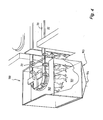
- the spray station 100 has a spray area 101, which is enclosed by a wall 50, which is open at the top in order to admit pipes for supplying water to nozzles 70.
- the wall 50 is partially cut away in order to make the figure clearer.
- the poultry 21 is moved, hanging by both legs in product carriers 75, along the conveyor 20 in a direction indicated by arrow A.
- the conveyor 20 passes a wall 34 that forms a division between the chilling room 32 and the area 30 in which the spray station 100 is situated.
- the wall 34 ensures that the stream of chilling air circulated in the chilling room 32 cannot go near the spray area 101 of the spray station 100.
- the wall 50 of the spray station 100 here provides an even further improved screening-off of the spray area 101 relative to the chilling air.
- a quantity of chilled water 80 is atomized and sprayed onto the surface of the poultry 21.
- the poultry 21 passes the various nozzles 70 in such a way that each part of the skin of the poultry 21 can be reached by the atomized water 80.
- the nozzles 70 preferably produce a conical jet and/or mist of water.
- FIG 3 shows a variant of the spray station 100, in which, apart from the skin of the poultry 21, its abdominal cavity is also moistened with the aid of tilting nozzles 71.
- the nozzles 71 are fitted on a rotatably driven central shaft 91, so that the nozzles 71 can move along with the poultry 21 during its movement along the conveyor 20.
- the tilting of the nozzles 71 from and to an inserted position of said nozzles is indicated by means of a double arrow 72.
- a cover plate 102 In order to obtain an even further improved screening-off of the spray area 101, it is possible, as shown in Figure 4, to shut off the top of the spray area 101 by means of a cover plate 102.
- the pipes 60 and nozzles 70, 71 are not shown.
- the cover plate 102 is preferably provided just below the conveyor 20, so that the water 80 from the nozzles 70, 71 is prevented as far as possible from going onto the pulleys 22 of the conveyor 20. In this way it can be ensured that moisture is prevented from being conveyed by means of the pulleys 22 to the chilling room 32 and, in addition, the running surface of the conveyor 20 along which the pulleys 22 roll is prevented from becoming soiled.
- the spray station 100 On its underside 103 the spray station 100 is provided with an outlet 104 for discharging any excess water.
- the moistening of the poultry 21 can be carried out by means of nozzles 70, 71 known in practice, which nozzles apply a conical mist of water (droplets) to the surface of the skin of the poultry 21, but other ways of moistening the surface of the skin of the poultry 21 are also possible. It is important for the entire surface of the skin of the poultry 21 to remain moistened during its stay in the chilling room 32 by maintaining a water film on the skin.
- the invention provides an improved chilling process for chilling moistened poultry, by means of which process chilling can be carried out with a stream of chilled air at a considerably lower temperature than is possible in the case of known chilling processes for chilling moistened poultry.
- This is achieved by the invention by applying a water film to at least the entire external surface of a bird in a part of a chilling room where no - or at least hardly any - circulation of chilling air occurs. This means that a water film can still be applied in a very focused way and with a small quantity of water to the bird to be chilled, enclosing the entire bird, without atomized water being entrained in the strongly circulating stream of chilling air.
- the method according to the invention does not suffer the adverse effect of greater frosting on the evaporators of the chilling plants, and there are no undesirable evaporation phenomena of the atomized water that is entrained in the stream of chilling air. Furthermore, owing to the lower percentage of water in the chilling air, it is possible to work with air at a lower temperature.
- the surface of the skin of slaughtered poultry remains moistened during the chilling process, or at any rate during the last phase of said process, while at the end of the chilling stage the surface of the skin is precisely dry.
- the fact that the skin is kept moistened has the advantage that no moisture loss, and thus no weight loss, will occur in the poultry. Furthermore, no brown discoloration of the skin will occur, and the skin is prevented from becoming water-repellent. Besides, the distribution of the moisture in the poultry is more uniform, and the skin also has a more even colour.
Landscapes
- Life Sciences & Earth Sciences (AREA)
- Engineering & Computer Science (AREA)
- Chemical & Material Sciences (AREA)
- Wood Science & Technology (AREA)
- Zoology (AREA)
- Food Science & Technology (AREA)
- Polymers & Plastics (AREA)
- Chemical Kinetics & Catalysis (AREA)
- General Chemical & Material Sciences (AREA)
- Processing Of Meat And Fish (AREA)
- Fodder In General (AREA)
- Meat, Egg Or Seafood Products (AREA)
Applications Claiming Priority (2)
| Application Number | Priority Date | Filing Date | Title |
|---|---|---|---|
| NL1019298A NL1019298C2 (nl) | 2001-11-05 | 2001-11-05 | Werkwijze voor het conserveren van vlees van een geslachte vogel of deel daarvan. |
| EP02770328A EP1441595B1 (fr) | 2001-11-05 | 2002-11-05 | Procede de conservation de la viande de volaille abattue |
Related Parent Applications (2)
| Application Number | Title | Priority Date | Filing Date |
|---|---|---|---|
| EP02770328A Division EP1441595B1 (fr) | 2001-11-05 | 2002-11-05 | Procede de conservation de la viande de volaille abattue |
| EP02770328.9 Division | 2002-11-05 |
Publications (3)
| Publication Number | Publication Date |
|---|---|
| EP1832178A2 true EP1832178A2 (fr) | 2007-09-12 |
| EP1832178A3 EP1832178A3 (fr) | 2010-07-21 |
| EP1832178B1 EP1832178B1 (fr) | 2014-03-05 |
Family
ID=19774257
Family Applications (2)
| Application Number | Title | Priority Date | Filing Date |
|---|---|---|---|
| EP07075233.2A Expired - Lifetime EP1832178B1 (fr) | 2001-11-05 | 2002-11-05 | Procédé pour la conservation de viande de volaille abattue |
| EP02770328A Expired - Lifetime EP1441595B1 (fr) | 2001-11-05 | 2002-11-05 | Procede de conservation de la viande de volaille abattue |
Family Applications After (1)
| Application Number | Title | Priority Date | Filing Date |
|---|---|---|---|
| EP02770328A Expired - Lifetime EP1441595B1 (fr) | 2001-11-05 | 2002-11-05 | Procede de conservation de la viande de volaille abattue |
Country Status (9)
| Country | Link |
|---|---|
| US (3) | US7128937B2 (fr) |
| EP (2) | EP1832178B1 (fr) |
| AT (1) | ATE390848T1 (fr) |
| BR (3) | BRPI0216129B1 (fr) |
| DE (1) | DE60225936T2 (fr) |
| DK (2) | DK1441595T3 (fr) |
| ES (1) | ES2305295T3 (fr) |
| NL (1) | NL1019298C2 (fr) |
| WO (1) | WO2003039263A1 (fr) |
Families Citing this family (36)
| Publication number | Priority date | Publication date | Assignee | Title |
|---|---|---|---|---|
| NL1019298C2 (nl) * | 2001-11-05 | 2003-05-07 | Stork Pmt | Werkwijze voor het conserveren van vlees van een geslachte vogel of deel daarvan. |
| FR2867027B1 (fr) * | 2004-03-05 | 2008-04-11 | Europ Food Proc | Procede et unite de refroidissement d'organes d'animaux, tels que des foies gras d'oies ou de canards, preleves sur des animaux venant d'etre abattus |
| ES2339785T3 (es) * | 2004-09-03 | 2010-05-25 | Linco Food Systems A/S | Metodo y sistema para escaldar aves de corral muertas. |
| JP4562149B2 (ja) * | 2005-03-16 | 2010-10-13 | 株式会社前川製作所 | 枝肉の冷却方法及び冷却システム |
| US20100055270A1 (en) * | 2008-06-10 | 2010-03-04 | Zee Company | Method and process for the controll of water weight loss in spray chill operations with the subsequent reduction of airborne bacterial load in air utilizing specialized chemistry in an air wash system in protein-based food processing plants |
| US7740527B1 (en) | 2009-04-24 | 2010-06-22 | Grover Harben | Poultry stunner |
| US8482073B2 (en) * | 2010-03-25 | 2013-07-09 | Taiwan Semiconductor Manufacturing Company, Ltd. | Integrated circuit including FINFETs and methods for forming the same |
| US8629478B2 (en) * | 2009-07-31 | 2014-01-14 | Taiwan Semiconductor Manufacturing Company, Ltd. | Fin structure for high mobility multiple-gate transistor |
| US8632380B2 (en) | 2010-01-26 | 2014-01-21 | Foodmate B.V. | Method and apparatus for removing a sleeve of meat from an animal part having bone with knuckles on each of its opposite ends |
| US8157625B2 (en) | 2010-01-26 | 2012-04-17 | Foodmate Bv | Method and apparatus for collecting meat from an animal part |
| NL2006075C2 (en) | 2011-01-26 | 2012-07-30 | Foodmate B V | Rotationally indexed article support for a conveyor system having an alignment station. |
| US8757354B2 (en) | 2010-04-19 | 2014-06-24 | Foodmate Bv | Turning block alignment |
| NL2004574C2 (en) | 2010-04-19 | 2011-10-20 | Foodmate B V | Rotatable article support for a conveyor. |
| NL2004573C2 (en) | 2010-04-19 | 2011-10-20 | Foodmate B V | Turning block alignment. |
| US8789684B2 (en) | 2010-04-19 | 2014-07-29 | Foodmate Bv | Rotatable article support for a conveyor |
| US8727839B2 (en) | 2011-01-21 | 2014-05-20 | Foodmate Bv | Poultry wing cutter for narrow pitch poultry lines |
| US8267241B2 (en) | 2011-01-26 | 2012-09-18 | Foodmate Bv | Rotationally indexed article support for a conveyor system having an alignment station |
| US8882571B2 (en) | 2011-01-26 | 2014-11-11 | Foodmate Bv | Method of deboning animal thighs for separating and collecting meat therefrom and apparatus for performing the method |
| EP2667728B1 (fr) | 2011-01-26 | 2015-07-29 | Foodmate B.V. | Procédé de désossage de cuisses d'animaux pour en séparer et en recueillir la viande et appareil pour mettre en oeuvre le procédé |
| US8430728B2 (en) | 2011-02-14 | 2013-04-30 | Foodmate Bv | Special cut poultry wing cutter |
| US8431453B2 (en) | 2011-03-31 | 2013-04-30 | Taiwan Semiconductor Manufacturing Company, Ltd. | Plasma doping to reduce dielectric loss during removal of dummy layers in a gate structure |
| GB201115555D0 (en) * | 2011-09-08 | 2011-10-26 | Linde Aktiengesellshcaft | A tunnel |
| NL2009033C2 (en) | 2012-06-19 | 2013-12-23 | Foodmate B V | Weighing method and apparatus. |
| NL2009718C2 (en) | 2012-10-29 | 2014-05-01 | Foodmate B V | Method of mechanically removing skin from animal parts. |
| US8808068B2 (en) | 2012-10-29 | 2014-08-19 | Foodmate Bv | Method of and system for automatically removing meat from an animal extremity |
| GB2509137A (en) | 2012-12-21 | 2014-06-25 | Linde Aktiengesellshcaft | Tunnel for treatment of animal carcasses |
| EA039354B1 (ru) | 2013-03-14 | 2022-01-18 | Стамикарбон Б.В. Эктин Андер Те Нейм Оф Мт Инновейшн Сентр | Реакторная система для удаления cos и cs2 |
| NL2010580C2 (en) * | 2013-04-05 | 2014-10-07 | Marel Stork Poultry Proc Bv | Shackle for hanging poultry transportation, poultry cooling unit, method for cooling of hanging poultry and method for hanging poultry carcasses to poultry shackles. |
| PL3024335T3 (pl) * | 2013-07-25 | 2018-02-28 | Air Products And Chemicals, Inc. | System chłodzenia kriogenicznego drobiu i sposób |
| US9078453B2 (en) | 2013-11-01 | 2015-07-14 | Foodmate B.V. | Method and system for automatically deboning poultry breast caps containing meat and a skeletal structure to obtain breast fillets therefrom |
| US8961274B1 (en) | 2013-12-18 | 2015-02-24 | Foodmate Bv | Selective tendon cutter and method |
| PL3203850T3 (pl) * | 2014-10-09 | 2022-05-16 | Devrone Unlimited Company | Chłodzenie tusz mięsnych |
| US11419340B2 (en) * | 2019-05-03 | 2022-08-23 | Graco Minnesota Inc. | Electrostatic spray chilling of foodstuffs |
| CN111437952B (zh) * | 2020-04-07 | 2021-08-27 | 肇庆市高要区奥力体育用品有限公司 | 一种橡胶粉碎机 |
| DK181648B1 (en) * | 2023-05-10 | 2024-08-30 | Scandi Standard Ab | A method of chilling poultry carcasses and a chilling system |
| CN121498304B (zh) * | 2026-01-12 | 2026-03-27 | 福建闽威食品有限公司 | 一种鱼肠生产加工用冷却装置及工艺 |
Citations (8)
| Publication number | Priority date | Publication date | Assignee | Title |
|---|---|---|---|---|
| US3729773A (en) | 1971-11-26 | 1973-05-01 | Fei Inc | Method for washing and chilling eviscerated fowl |
| US4199958A (en) | 1978-03-30 | 1980-04-29 | Daiken Kogyo Co., Ltd. | Chilling apparatus for broiler carcasses |
| DE3311437A1 (de) | 1983-03-29 | 1984-10-04 | Agrober Mezögazdasági és Elelmiszeripari Tervezö, Beruházási Vállalat, Budapest | Verfahren und anlage zur vorkuehlung von geschlachteten, ausgenommenen und geputzten tieren, insbesondere gefluegel, kaninchen, kleinwild und aehnliches, sowie haengewerk zur aufhaengung solcher tiere |
| DE3727079A1 (de) | 1987-08-14 | 1989-02-23 | Enco Gepesztechnologiai Mernoe | Verfahren und einrichtung zum vorkuehlen des zerlegten und/oder ausgenommenen fleisches von geschlachteten tieren, insbesondere grossem gefluegel, z. b. mastgaensen und puten sowie schweinen, rindern und schafen |
| US4810515A (en) | 1985-12-20 | 1989-03-07 | Cooperative Agricole Des Eleveurs De La Region De Lamba L Amballe Dite C.O.O.P.E.R.L. | Process for the treatment of meat during refrigeration |
| GB2280093A (en) | 1993-07-22 | 1995-01-25 | Monaghan Poultry Research Limi | A method of processing poultry |
| NL9301244A (nl) | 1993-07-15 | 1995-02-01 | Coveco Vlees B V | Werkwijze voor het afkoelen van slachtdelen. |
| US6167709B1 (en) | 1996-09-10 | 2001-01-02 | The Boc Group, Inc. | Food processing method and system |
Family Cites Families (12)
| Publication number | Priority date | Publication date | Assignee | Title |
|---|---|---|---|---|
| US2808093A (en) * | 1954-03-10 | 1957-10-01 | Martin J Gilman | Frozen food shipping containers |
| US3745026A (en) * | 1971-03-31 | 1973-07-10 | Swift & Co | Carcass chilling process |
| US4196221A (en) * | 1977-06-10 | 1980-04-01 | Dew Denise R | Method and equipment for processing food products |
| HU193680B (en) * | 1984-05-18 | 1987-11-30 | Monori Mezoegazdasagi Es Elelm | Method and apparatus for rapid precooling materials treatable on surface by water particularly slaughtered poultry and slaughterhouse produces |
| JPH02100629A (ja) * | 1988-10-06 | 1990-04-12 | Aipii:Kk | 屠体の冷却装置 |
| EP0719089B1 (fr) * | 1993-09-14 | 1998-09-30 | Minnesota Mining And Manufacturing Company | Composition desinfectante |
| NL9400060A (nl) * | 1994-01-13 | 1995-08-01 | Stork Pmt | Werkwijze en inrichting voor het conserveren van het vlees van een slachtdier. |
| BE1006973A6 (fr) * | 1994-12-06 | 1995-02-07 | Melchior Limited | Procede de traitement de volaille. |
| US6063425A (en) * | 1997-10-09 | 2000-05-16 | Alcide Corporation | Method for optimizing the efficacy of chlorous acid disinfecting sprays for poultry and other meats |
| US6010729A (en) * | 1998-08-20 | 2000-01-04 | Ecolab Inc. | Treatment of animal carcasses |
| DE60102369T3 (de) * | 2000-05-09 | 2011-02-24 | Topkip B.V. | Verfahren und einrichtung zum kühlen von schlachtgeflügel |
| NL1019298C2 (nl) * | 2001-11-05 | 2003-05-07 | Stork Pmt | Werkwijze voor het conserveren van vlees van een geslachte vogel of deel daarvan. |
-
2001
- 2001-11-05 NL NL1019298A patent/NL1019298C2/nl not_active IP Right Cessation
-
2002
- 2002-11-05 EP EP07075233.2A patent/EP1832178B1/fr not_active Expired - Lifetime
- 2002-11-05 BR BRPI0216129A patent/BRPI0216129B1/pt not_active IP Right Cessation
- 2002-11-05 BR BRPI0216130A patent/BRPI0216130B1/pt not_active IP Right Cessation
- 2002-11-05 BR BR0213881-6A patent/BR0213881A/pt not_active Application Discontinuation
- 2002-11-05 ES ES02770328T patent/ES2305295T3/es not_active Expired - Lifetime
- 2002-11-05 EP EP02770328A patent/EP1441595B1/fr not_active Expired - Lifetime
- 2002-11-05 WO PCT/NL2002/000704 patent/WO2003039263A1/fr not_active Ceased
- 2002-11-05 DK DK02770328T patent/DK1441595T3/da active
- 2002-11-05 AT AT02770328T patent/ATE390848T1/de not_active IP Right Cessation
- 2002-11-05 DE DE60225936T patent/DE60225936T2/de not_active Expired - Lifetime
- 2002-11-05 DK DK07075233.2T patent/DK1832178T3/da active
-
2004
- 2004-05-05 US US10/840,214 patent/US7128937B2/en not_active Expired - Lifetime
-
2006
- 2006-09-28 US US11/540,205 patent/US20070026115A1/en not_active Abandoned
- 2006-09-28 US US11/540,204 patent/US7891209B2/en not_active Expired - Fee Related
Patent Citations (8)
| Publication number | Priority date | Publication date | Assignee | Title |
|---|---|---|---|---|
| US3729773A (en) | 1971-11-26 | 1973-05-01 | Fei Inc | Method for washing and chilling eviscerated fowl |
| US4199958A (en) | 1978-03-30 | 1980-04-29 | Daiken Kogyo Co., Ltd. | Chilling apparatus for broiler carcasses |
| DE3311437A1 (de) | 1983-03-29 | 1984-10-04 | Agrober Mezögazdasági és Elelmiszeripari Tervezö, Beruházási Vállalat, Budapest | Verfahren und anlage zur vorkuehlung von geschlachteten, ausgenommenen und geputzten tieren, insbesondere gefluegel, kaninchen, kleinwild und aehnliches, sowie haengewerk zur aufhaengung solcher tiere |
| US4810515A (en) | 1985-12-20 | 1989-03-07 | Cooperative Agricole Des Eleveurs De La Region De Lamba L Amballe Dite C.O.O.P.E.R.L. | Process for the treatment of meat during refrigeration |
| DE3727079A1 (de) | 1987-08-14 | 1989-02-23 | Enco Gepesztechnologiai Mernoe | Verfahren und einrichtung zum vorkuehlen des zerlegten und/oder ausgenommenen fleisches von geschlachteten tieren, insbesondere grossem gefluegel, z. b. mastgaensen und puten sowie schweinen, rindern und schafen |
| NL9301244A (nl) | 1993-07-15 | 1995-02-01 | Coveco Vlees B V | Werkwijze voor het afkoelen van slachtdelen. |
| GB2280093A (en) | 1993-07-22 | 1995-01-25 | Monaghan Poultry Research Limi | A method of processing poultry |
| US6167709B1 (en) | 1996-09-10 | 2001-01-02 | The Boc Group, Inc. | Food processing method and system |
Also Published As
| Publication number | Publication date |
|---|---|
| BRPI0216130B1 (pt) | 2016-05-03 |
| US7128937B2 (en) | 2006-10-31 |
| EP1441595B1 (fr) | 2008-04-02 |
| DK1441595T3 (da) | 2008-04-21 |
| EP1832178A3 (fr) | 2010-07-21 |
| US7891209B2 (en) | 2011-02-22 |
| US20070026114A1 (en) | 2007-02-01 |
| ES2305295T3 (es) | 2008-11-01 |
| EP1441595A1 (fr) | 2004-08-04 |
| BRPI0216129B1 (pt) | 2016-04-19 |
| BR0213881A (pt) | 2004-08-31 |
| US20040241295A1 (en) | 2004-12-02 |
| ATE390848T1 (de) | 2008-04-15 |
| DK1832178T3 (da) | 2014-05-19 |
| WO2003039263A1 (fr) | 2003-05-15 |
| EP1832178B1 (fr) | 2014-03-05 |
| NL1019298C2 (nl) | 2003-05-07 |
| US20070026115A1 (en) | 2007-02-01 |
| DE60225936D1 (de) | 2008-05-15 |
| DE60225936T2 (de) | 2009-05-14 |
Similar Documents
| Publication | Publication Date | Title |
|---|---|---|
| EP1441595B1 (fr) | Procede de conservation de la viande de volaille abattue | |
| EP0667102B1 (fr) | Procédé et appareil de conservation pour viande de volaille abattue | |
| US5651730A (en) | Pasteurization of carcasses with directed sheets of heated water | |
| US9314049B2 (en) | Tunnel | |
| US20090215368A1 (en) | Device and method for scalding poultry | |
| US20150313247A1 (en) | A tunnel | |
| US7625271B2 (en) | Method and system for cooling of dressed carcasses | |
| DK181648B1 (en) | A method of chilling poultry carcasses and a chilling system | |
| EP1511390B1 (fr) | Procede et appareil servant a refroidir les carcasses et des parties de carcasses d'animaux abattus | |
| NL8800567A (nl) | Werkwijze en inrichting voor het voorkoelen van getrancheerd en/of schoongemaakt vlees van geslachte dieren, in het bijzonder groot gevogelte, bijvoorbeeld mestganzen en kalkoenen, alsmede varkens, runderen en schapen. | |
| GB2526634A (en) | Cryogenic treatment apparatus and method for campylobacter | |
| JPS5816855B2 (ja) | ブロイラ−の冷却装置 | |
| PL232343B1 (pl) | Sposób poubojowego wychładzania półtusz zwierząt rzeźnych i instalacja do poubojowego wychładzania półtusz zwierząt rzeźnych | |
| HU201232B (en) | Method and apparatus for decreasing the precooling, cooling, cold storing, freezing, frozen storing mass loss of animal bodies | |
| HU194039B (en) | Method and apparatus for precooling parted or/and drawn meat of slaughtered animals particularly large-bodied poultry e.g. fattened goose and turkey as well as pig, cattle and sheep |
Legal Events
| Date | Code | Title | Description |
|---|---|---|---|
| PUAI | Public reference made under article 153(3) epc to a published international application that has entered the european phase |
Free format text: ORIGINAL CODE: 0009012 |
|
| AC | Divisional application: reference to earlier application |
Ref document number: 1441595 Country of ref document: EP Kind code of ref document: P |
|
| AK | Designated contracting states |
Kind code of ref document: A2 Designated state(s): AT BE BG CH CY CZ DE DK EE ES FI FR GB GR IE IT LI LU MC NL PT SE SK TR |
|
| AX | Request for extension of the european patent |
Extension state: AL LT LV MK RO SI |
|
| 17P | Request for examination filed |
Effective date: 20100316 |
|
| PUAL | Search report despatched |
Free format text: ORIGINAL CODE: 0009013 |
|
| AK | Designated contracting states |
Kind code of ref document: A3 Designated state(s): AT BE BG CH CY CZ DE DK EE ES FI FR GB GR IE IT LI LU MC NL PT SE SK TR |
|
| AX | Request for extension of the european patent |
Extension state: AL LT LV MK RO SI |
|
| RAP1 | Party data changed (applicant data changed or rights of an application transferred) |
Owner name: MAREL STORK POULTRY PROCESSING B.V. |
|
| AKX | Designation fees paid |
Designated state(s): AT BE BG CH CY CZ DE DK EE ES FI FR GB GR IE IT LI LU MC NL PT SE SK TR |
|
| 17Q | First examination report despatched |
Effective date: 20111012 |
|
| REG | Reference to a national code |
Ref country code: DE Ref legal event code: R079 Ref document number: 60246054 Country of ref document: DE Free format text: PREVIOUS MAIN CLASS: A23B0004060000 Ipc: A23B0004160000 |
|
| GRAP | Despatch of communication of intention to grant a patent |
Free format text: ORIGINAL CODE: EPIDOSNIGR1 |
|
| RIC1 | Information provided on ipc code assigned before grant |
Ipc: A23B 4/30 20060101ALI20130904BHEP Ipc: A23B 4/06 20060101ALI20130904BHEP Ipc: A23B 4/16 20060101AFI20130904BHEP |
|
| INTG | Intention to grant announced |
Effective date: 20131001 |
|
| GRAS | Grant fee paid |
Free format text: ORIGINAL CODE: EPIDOSNIGR3 |
|
| GRAA | (expected) grant |
Free format text: ORIGINAL CODE: 0009210 |
|
| AC | Divisional application: reference to earlier application |
Ref document number: 1441595 Country of ref document: EP Kind code of ref document: P |
|
| AK | Designated contracting states |
Kind code of ref document: B1 Designated state(s): AT BE BG CH CY CZ DE DK EE ES FI FR GB GR IE IT LI LU MC NL PT SE SK TR |
|
| REG | Reference to a national code |
Ref country code: GB Ref legal event code: FG4D |
|
| REG | Reference to a national code |
Ref country code: CH Ref legal event code: EP |
|
| REG | Reference to a national code |
Ref country code: AT Ref legal event code: REF Ref document number: 654242 Country of ref document: AT Kind code of ref document: T Effective date: 20140315 |
|
| REG | Reference to a national code |
Ref country code: IE Ref legal event code: FG4D |
|
| REG | Reference to a national code |
Ref country code: DE Ref legal event code: R096 Ref document number: 60246054 Country of ref document: DE Effective date: 20140417 |
|
| REG | Reference to a national code |
Ref country code: NL Ref legal event code: T3 |
|
| REG | Reference to a national code |
Ref country code: DK Ref legal event code: T3 Effective date: 20140512 |
|
| REG | Reference to a national code |
Ref country code: AT Ref legal event code: MK05 Ref document number: 654242 Country of ref document: AT Kind code of ref document: T Effective date: 20140305 |
|
| PG25 | Lapsed in a contracting state [announced via postgrant information from national office to epo] |
Ref country code: CY Free format text: LAPSE BECAUSE OF FAILURE TO SUBMIT A TRANSLATION OF THE DESCRIPTION OR TO PAY THE FEE WITHIN THE PRESCRIBED TIME-LIMIT Effective date: 20140305 Ref country code: SE Free format text: LAPSE BECAUSE OF FAILURE TO SUBMIT A TRANSLATION OF THE DESCRIPTION OR TO PAY THE FEE WITHIN THE PRESCRIBED TIME-LIMIT Effective date: 20140305 Ref country code: AT Free format text: LAPSE BECAUSE OF FAILURE TO SUBMIT A TRANSLATION OF THE DESCRIPTION OR TO PAY THE FEE WITHIN THE PRESCRIBED TIME-LIMIT Effective date: 20140305 Ref country code: FI Free format text: LAPSE BECAUSE OF FAILURE TO SUBMIT A TRANSLATION OF THE DESCRIPTION OR TO PAY THE FEE WITHIN THE PRESCRIBED TIME-LIMIT Effective date: 20140305 |
|
| PG25 | Lapsed in a contracting state [announced via postgrant information from national office to epo] |
Ref country code: EE Free format text: LAPSE BECAUSE OF FAILURE TO SUBMIT A TRANSLATION OF THE DESCRIPTION OR TO PAY THE FEE WITHIN THE PRESCRIBED TIME-LIMIT Effective date: 20140305 Ref country code: BE Free format text: LAPSE BECAUSE OF FAILURE TO SUBMIT A TRANSLATION OF THE DESCRIPTION OR TO PAY THE FEE WITHIN THE PRESCRIBED TIME-LIMIT Effective date: 20140305 Ref country code: CZ Free format text: LAPSE BECAUSE OF FAILURE TO SUBMIT A TRANSLATION OF THE DESCRIPTION OR TO PAY THE FEE WITHIN THE PRESCRIBED TIME-LIMIT Effective date: 20140305 Ref country code: BG Free format text: LAPSE BECAUSE OF FAILURE TO SUBMIT A TRANSLATION OF THE DESCRIPTION OR TO PAY THE FEE WITHIN THE PRESCRIBED TIME-LIMIT Effective date: 20140605 |
|
| PG25 | Lapsed in a contracting state [announced via postgrant information from national office to epo] |
Ref country code: ES Free format text: LAPSE BECAUSE OF FAILURE TO SUBMIT A TRANSLATION OF THE DESCRIPTION OR TO PAY THE FEE WITHIN THE PRESCRIBED TIME-LIMIT Effective date: 20140305 Ref country code: SK Free format text: LAPSE BECAUSE OF FAILURE TO SUBMIT A TRANSLATION OF THE DESCRIPTION OR TO PAY THE FEE WITHIN THE PRESCRIBED TIME-LIMIT Effective date: 20140305 |
|
| REG | Reference to a national code |
Ref country code: DE Ref legal event code: R097 Ref document number: 60246054 Country of ref document: DE |
|
| PG25 | Lapsed in a contracting state [announced via postgrant information from national office to epo] |
Ref country code: PT Free format text: LAPSE BECAUSE OF FAILURE TO SUBMIT A TRANSLATION OF THE DESCRIPTION OR TO PAY THE FEE WITHIN THE PRESCRIBED TIME-LIMIT Effective date: 20140707 |
|
| PLBE | No opposition filed within time limit |
Free format text: ORIGINAL CODE: 0009261 |
|
| STAA | Information on the status of an ep patent application or granted ep patent |
Free format text: STATUS: NO OPPOSITION FILED WITHIN TIME LIMIT |
|
| 26N | No opposition filed |
Effective date: 20141208 |
|
| REG | Reference to a national code |
Ref country code: DE Ref legal event code: R097 Ref document number: 60246054 Country of ref document: DE Effective date: 20141208 |
|
| PG25 | Lapsed in a contracting state [announced via postgrant information from national office to epo] |
Ref country code: IT Free format text: LAPSE BECAUSE OF FAILURE TO SUBMIT A TRANSLATION OF THE DESCRIPTION OR TO PAY THE FEE WITHIN THE PRESCRIBED TIME-LIMIT Effective date: 20140305 |
|
| PG25 | Lapsed in a contracting state [announced via postgrant information from national office to epo] |
Ref country code: MC Free format text: LAPSE BECAUSE OF FAILURE TO SUBMIT A TRANSLATION OF THE DESCRIPTION OR TO PAY THE FEE WITHIN THE PRESCRIBED TIME-LIMIT Effective date: 20140305 Ref country code: LU Free format text: LAPSE BECAUSE OF FAILURE TO SUBMIT A TRANSLATION OF THE DESCRIPTION OR TO PAY THE FEE WITHIN THE PRESCRIBED TIME-LIMIT Effective date: 20141105 |
|
| REG | Reference to a national code |
Ref country code: CH Ref legal event code: PL |
|
| GBPC | Gb: european patent ceased through non-payment of renewal fee |
Effective date: 20141105 |
|
| PG25 | Lapsed in a contracting state [announced via postgrant information from national office to epo] |
Ref country code: CH Free format text: LAPSE BECAUSE OF NON-PAYMENT OF DUE FEES Effective date: 20141130 Ref country code: LI Free format text: LAPSE BECAUSE OF NON-PAYMENT OF DUE FEES Effective date: 20141130 |
|
| REG | Reference to a national code |
Ref country code: IE Ref legal event code: MM4A |
|
| REG | Reference to a national code |
Ref country code: FR Ref legal event code: ST Effective date: 20150731 |
|
| PG25 | Lapsed in a contracting state [announced via postgrant information from national office to epo] |
Ref country code: IE Free format text: LAPSE BECAUSE OF NON-PAYMENT OF DUE FEES Effective date: 20141105 Ref country code: GB Free format text: LAPSE BECAUSE OF NON-PAYMENT OF DUE FEES Effective date: 20141105 |
|
| PG25 | Lapsed in a contracting state [announced via postgrant information from national office to epo] |
Ref country code: FR Free format text: LAPSE BECAUSE OF NON-PAYMENT OF DUE FEES Effective date: 20141201 |
|
| PG25 | Lapsed in a contracting state [announced via postgrant information from national office to epo] |
Ref country code: GR Free format text: LAPSE BECAUSE OF FAILURE TO SUBMIT A TRANSLATION OF THE DESCRIPTION OR TO PAY THE FEE WITHIN THE PRESCRIBED TIME-LIMIT Effective date: 20140606 |
|
| PG25 | Lapsed in a contracting state [announced via postgrant information from national office to epo] |
Ref country code: TR Free format text: LAPSE BECAUSE OF FAILURE TO SUBMIT A TRANSLATION OF THE DESCRIPTION OR TO PAY THE FEE WITHIN THE PRESCRIBED TIME-LIMIT Effective date: 20140305 |
|
| PGFP | Annual fee paid to national office [announced via postgrant information from national office to epo] |
Ref country code: NL Payment date: 20201126 Year of fee payment: 19 |
|
| PGFP | Annual fee paid to national office [announced via postgrant information from national office to epo] |
Ref country code: DK Payment date: 20201125 Year of fee payment: 19 Ref country code: DE Payment date: 20201127 Year of fee payment: 19 |
|
| REG | Reference to a national code |
Ref country code: DE Ref legal event code: R119 Ref document number: 60246054 Country of ref document: DE |
|
| REG | Reference to a national code |
Ref country code: DK Ref legal event code: EBP Effective date: 20211130 |
|
| REG | Reference to a national code |
Ref country code: NL Ref legal event code: MM Effective date: 20211201 |
|
| PG25 | Lapsed in a contracting state [announced via postgrant information from national office to epo] |
Ref country code: NL Free format text: LAPSE BECAUSE OF NON-PAYMENT OF DUE FEES Effective date: 20211201 |
|
| PG25 | Lapsed in a contracting state [announced via postgrant information from national office to epo] |
Ref country code: DK Free format text: LAPSE BECAUSE OF NON-PAYMENT OF DUE FEES Effective date: 20211130 Ref country code: DE Free format text: LAPSE BECAUSE OF NON-PAYMENT OF DUE FEES Effective date: 20220601 |