EP1838314B1 - Verfahren zur zubereitung von lansoprazol - Google Patents
Verfahren zur zubereitung von lansoprazol Download PDFInfo
- Publication number
- EP1838314B1 EP1838314B1 EP06706233A EP06706233A EP1838314B1 EP 1838314 B1 EP1838314 B1 EP 1838314B1 EP 06706233 A EP06706233 A EP 06706233A EP 06706233 A EP06706233 A EP 06706233A EP 1838314 B1 EP1838314 B1 EP 1838314B1
- Authority
- EP
- European Patent Office
- Prior art keywords
- lansoprazole
- process according
- water
- vanadium
- solution
- Prior art date
- Legal status (The legal status is an assumption and is not a legal conclusion. Google has not performed a legal analysis and makes no representation as to the accuracy of the status listed.)
- Expired - Lifetime
Links
- CCHLMSUZHFPSFC-UHFFFAOYSA-N Cc(c(CSc1nc2ccccc2[nH]1)ncc1)c1OCC(F)(F)F Chemical compound Cc(c(CSc1nc2ccccc2[nH]1)ncc1)c1OCC(F)(F)F CCHLMSUZHFPSFC-UHFFFAOYSA-N 0.000 description 1
- MJIHNNLFOKEZEW-UHFFFAOYSA-N Cc1c(CS(c2nc(cccc3)c3[nH]2)=O)nccc1OCC(F)(F)F Chemical compound Cc1c(CS(c2nc(cccc3)c3[nH]2)=O)nccc1OCC(F)(F)F MJIHNNLFOKEZEW-UHFFFAOYSA-N 0.000 description 1
Images
Classifications
-
- C—CHEMISTRY; METALLURGY
- C07—ORGANIC CHEMISTRY
- C07D—HETEROCYCLIC COMPOUNDS
- C07D401/00—Heterocyclic compounds containing two or more hetero rings, having nitrogen atoms as the only ring hetero atoms, at least one ring being a six-membered ring with only one nitrogen atom
- C07D401/02—Heterocyclic compounds containing two or more hetero rings, having nitrogen atoms as the only ring hetero atoms, at least one ring being a six-membered ring with only one nitrogen atom containing two hetero rings
- C07D401/12—Heterocyclic compounds containing two or more hetero rings, having nitrogen atoms as the only ring hetero atoms, at least one ring being a six-membered ring with only one nitrogen atom containing two hetero rings linked by a chain containing hetero atoms as chain links
-
- A—HUMAN NECESSITIES
- A61—MEDICAL OR VETERINARY SCIENCE; HYGIENE
- A61P—SPECIFIC THERAPEUTIC ACTIVITY OF CHEMICAL COMPOUNDS OR MEDICINAL PREPARATIONS
- A61P1/00—Drugs for disorders of the alimentary tract or the digestive system
-
- A—HUMAN NECESSITIES
- A61—MEDICAL OR VETERINARY SCIENCE; HYGIENE
- A61P—SPECIFIC THERAPEUTIC ACTIVITY OF CHEMICAL COMPOUNDS OR MEDICINAL PREPARATIONS
- A61P1/00—Drugs for disorders of the alimentary tract or the digestive system
- A61P1/04—Drugs for disorders of the alimentary tract or the digestive system for ulcers, gastritis or reflux esophagitis, e.g. antacids, inhibitors of acid secretion, mucosal protectants
Definitions
- the present invention relates to a process for preparing lansoprazole.
- Lansoprazole having a specific surface area and a pharmaceutical composition comprising lansoprazole are also disclosed.
- Lansoprazole is the generic name for 2-[[[3-methyl-4-(2,2,2-trifluoroethoxy)-2-pyridinyl]methyl]sulfinyl]-1 H -benzimidazole and it has the following formula (I):
- Lansoprazole is a well-known gastric proton pump inhibitor and thus it can inhibit gastric acid secretion and is used as an antiulcer agent.
- lansoprazole precursor having a thioether group which is subjected to an oxidation.
- EP 0 174 726 B1 discloses the use of a peracid such as m-chloroperbenzoic acid, sodium bromite, sodium hypochlorite or hydrogen peroxide as an oxidizing agent.
- a peracid such as m-chloroperbenzoic acid, sodium bromite, sodium hypochlorite or hydrogen peroxide
- the oxidation is carried out in halogenated hydrocarbons, amides, alcohols or mixtures thereof.
- EP 0 302 720 A1 describes a process for preparing lansoprazole using hydrogen peroxide in the presence of a vanadium compound such as vanadium pentoxide, sodium metavanadate or vanadium acetylacetonate.
- a vanadium compound such as vanadium pentoxide, sodium metavanadate or vanadium acetylacetonate.
- A1 lansoprazole is prepared by using tert-butyl hydroperoxide (TBHP) in the presence of vanadium pentoxide, sodium metavanadate or vanadium acetylacetonate.
- TBHP tert-butyl hydroperoxide
- the oxidation is performed in toluene or isopropanol.
- WO 2004/011455 A1 discloses a process for preparing lansoprazole using tert-butyl hydroperoxide (TBHP) in the presence of vanadium oxytrichloride as catalyst wherein the reaction is carried out in a solvent such as a C 1 - to C 5 -alcohol, decane, nonane, toluene or a mixture with water.
- TBHP tert-butyl hydroperoxide
- the vanadium oxytrichloride is used in the presence of an alcohol.
- the reaction is preferably performed in the presence of a weak base. Crude lansoprazole is obtained in a yield of at most 90%.
- WO 03/008406 A1 refers to a process for preparing benzimidazole-type compounds by reacting a corresponding precursor with an oxidizing agent in a suitable solvent, extracting the sulphone by-product and isolating the product.
- a suitable solvent Preferably, m-chloroperbenzoic acid is used as oxidizing agent.
- the processes according to the prior art for preparing lansoprazole suffer from a low yield of the produced lansoprazole as well as a high content of impurities of the lansoprazole. This may be due to the fact that the selectivity in the oxidation step is low and thus by-products such as the corresponding benzimidazole N-oxide and the corresponding sulphone can be formed by an oxidation of the nitrogen and an overoxidation of the sulfide, respectively.
- the control of impurities is even more difficult resulting in extensive isolation procedures in order to obtain pure lansoprazole.
- step (a) can also be carried out in the presence of the vanadium catalyst and acetanhydride.
- a specific vanadium catalyst selected from the group consisting of vanadium(V) oxytrifluoride, vanadium(V) triesters, such as vanadium(V) oxytriethoxide, vanadium(V) oxytripropoxide and vanadium(V) oxytriisopropoxide, and mixtures thereof and optionally the use of acetanhydride allows the production of lansoprazole in high yields and leads to lansoprazole which contains only small amounts of impurities, even in a high scale production.
- step (a) of the process according to the invention a compound of formula (II) or a derivative thereof is reacted.
- a hydrate of compound (II) is used which can be obtained by the following reaction scheme:
- the oxidation of the thioether group of the compound of formula (II), a hydrate, solvate or salt thereof is effected by an oxidizing agent.
- an oxidizing agent It is possible to use 3-chloroperbenzoic acid.
- the oxidizing agent is preferably selected from hydrogen peroxide or a source of hydrogen peroxide. Particulary preferred is the use of an urea adduct of hydrogen peroxide as a source of hydrogen peroxide.
- the amount of the oxidizing agent used is generally about 0.5 to 3.0 equivalents, preferably 0.7 to 2.0 equivalents and most preferably 0.9 to 1.5 equivalents relative to compound (II).
- the reaction mixture of step (a) further comprises a vanadium compound and/or acetanhydride.
- the vanadium catalyst is selected from the group consisting of vanadium(V) oxytrifluoride, vanadium(V) triesters, such as vanadium(V) oxytriethoxide, vanadium(V) oxytripropoxide and vanadium(V) oxytriisopropoxide, and mixtures thereof.
- vanadium(V) oxytriisopropoxide is used.
- the amount of the vanadium catalyst is usually about 0.001 to 0.05 equivalents, preferably 0.002 to 0.02 equivalents and most preferred 0.005 to 0.015 equivalents relative to compound (II).
- the amount of acetanhydride is usually about 0.5 to 2.0 equivalents, and preferably 0.5 to 1.0 equivalents relative to compound (II).
- step (a) is usually carried out in an organic solvent.
- this solvent is selected from the group consisting of 1-methyl-2-pyrrolidone, N,N-dimethylacetamide, N,N-dimethylformamide, alcohols and mixtures thereof.
- 1-methyl-2-pyrrolidone is used as solvent.
- the intermediates as well as the product are highly soluble in the solvents preferably used according to the invention.
- the concentration of lansoprazole in the reaction mixture of step (a) is from 10 to 30 % by weight at the end of the reaction.
- reaction of step (a) is performed for 1 to 5 hours.
- step (b) of the process according to the invention the produced lansoprazole can optionally be recovered from the reaction mixture of step (a). This is preferably effected by use of at least one and most preferred by use of all of the following steps:
- step (i) of this recovery procedure a solution of a thiosulphate salt, preferably sodium thiosulphate dissolved in water, is added to the reaction mixture of step (a), in order to decompose any excess of hydrogen peroxide after the reaction.
- a thiosulphate salt preferably sodium thiosulphate dissolved in water
- an inorganic base such as sodium hydroxide or potassium hydroxide or an organic base, such as triethylamine, is added.
- triethylamine is used.
- step (ii) water is added to the mixture of step (a) to precipitate lansoprazole, which can be separated in a conventional manner in step (iii).
- the lansoprazole obtained in step (ii) is filtered of and recrystallized.
- recrystallization is performed in a mixture of water and an organic solvent.
- organic solvent an alkanol, such as ethanol, 1-methyl-2-pyrrolidone, N,N-dimethylacetamide, N,N-dimethylformamide or a mixture thereof can be used.
- a mixture of water and 1-methyl-2-pyrrolidone with a ratio of 9:1 to 1:3 (vol/vol) is used.
- the recrystallization is carried out in a mixture of water and ethanol in the presence of a weak base, such as triethylamine or ammonia.
- the recrystallized lansoprazole can be suspended in water, preferably at a temperature of 15 to 20°C and stirred for a certain period of time, such as 2 hours.
- the obtained product can be collected by filtration and dried, e.g. under reduced pressure at a temperature of 40°C.
- the water used for the suspension of lansoprazole has a pH of 8 to 11 which can be adjusted by the addition of a base, such as sodium hydroxide, potassium hydroxide, triethylamine or ammonia. Further, it is preferred that the suspension of lansoprazole in water is slowly cooled to 5°C before filtration. It is also preferred that the maceration step is carried out several times, in order to enhance the purity of the lansoprazole.
- the process can further comprise
- a solution of lansoprazole is provided.
- lansoprazole is suspended in water, ethanol, acetone or a mixture thereof and heated to give a solution of lansoprazole.
- a mixture of water and ethanol is used.
- the solvent or solvent mixture further comprises a base selected from sodium hydroxide, potassium hydroxide, triethylamine or ammonia. It is also preferred that the dissolution temperature does not exceed 55 °C. Any insoluble residues can be filtered off.
- step (a') lansoprazole is dissolved in 1-methyl-2-pyrrolidone.
- step (b') lansoprazole is precipitated from the solution of (a').
- the solution of step (a') is cooled and stirred to effect the crystallization of lansoprazole. It is also possible to effect the precipitation of lansoprazole by the addition of water.
- the solution is vigorously stirred when the crystallization of lansoprazole starts. It is further preferred that the solution is gradually cooled to a temperature of 20 °C and more preferably to a temperature of from 0 to 5 °C.
- the solution is cooled within 20 minutes to a temperature of from 35 to 40 °C, then within one hour to a temperature of 20 °C and finally within one hour to a temperature of from 0 to 5 °C.
- the resulting suspension of lansoprazole is stirred for an additional period of time ranging from 0.5 to 10 hours.
- lansoprazole is separated and preferably washed with a solvent or solvent mixture comprising water, ethanol, aceton or a mixture thereof.
- a solvent or solvent mixture comprising water, ethanol, aceton or a mixture thereof.
- solid lansoprazole is filtered off and washed with a cold mixture of water and ethanol (1:9 vol/vol).
- step (d') the lansoprazole obtained in step (c') is suspended in a solvent or mixture of solvents.
- a solvent or mixture of solvents Preferably, water, potable water, ethanol, acetone or a mixture thereof is used.
- lansoprazole is suspended in water having a pH value ranging from 8 to 11, preferably from 9 to 10 and more preferably from 9.25 to 9.75.
- the pH of the solvent can preferably be adjusted by a base such as sodium hydroxide, potassium hydroxide, triethylamine or ammonia.
- the temperature of the suspension of step (d') is less than 25 °C, preferably less than 20°C and more preferably between 15 to 20 °C. In particular, a temperature of about 20 °C is used.
- step (e') the obtained suspension is stirred for a certain period of time ranging from 0.5 to 10 hours, preferably for 2 hours. During this stirring the temperature is preferably in the range from 15 to 25 °C and more preferably about 20 °C. In a preferred embodiment, the suspension is then cooled in one hour to a temperature of 5 °C.
- the lansoprazole can be filtered off or collected by centrifugal filtration and preferably washed with a solvent or solvent mixture comprising water having a pH of 9.0 to obtain wet lansoprazole. It is further preferred that steps (d') and (e') are repeated to obtain lansoprazole of a higher purity.
- the wet lansoprazole can be dried in a vacuum at a slightly elevated temperature such as about 40 °C.
- the solvents used in step (a') and (d') can independently be selected from water, ethanol, acetone or mixtures thereof, i.e. the solvent used in step (a') can be identical or different from the solvent used in step (d').
- the solvents used in steps (a'), (c') and (d') can independently from each other comprise a base, preferably sodium hydroxide, potassium hydroxide, triethylamine or ammonia.
- the solid lansoprazole obtained by a process involving steps (a') to (e') has an unexpectedly high BET-surface area.
- the BET-surface area of the prepared lansoprazole is from 1.5 to 7.0 m 2 /g and more preferably from 2.5 to 5.2 m 2 /g.
- the BET-surface areas of the produced lansoprazole are determined by calculation from desorption data of nitrogen obtained on a BET FlowSorb II 2300 (Micromeritics Instrument Corp., USA) using a mixture of 30 vol.% nitrogen and 70 vol.% helium at 77 K.
- the lansoprazole obtained by the process of the invention is particularly suitable for inclusion in pharmaceutical compositions, particularly pharmaceutical compositions comprising lansoprazole having a BET-surface area of 1.5 to 7.0 m 2 /g, preferably of 2.5 to 5.2 m 2 /g.
- the pharmaceutical compositions comprise, besides lansoprazole, at least one excipient selected from a stabilizer, a filler, a disintegrant, a wetting agent, a carrier and a binder.
- the pharmaceutical compositions can also be further coated by a separating layer and/or a gastro-resistant coating.
- the coated pharmaceutical composition can be further coated with an overcoat soluble in water.
- the stabilizer is selected from the group consisting of alkaline and earth alkaline metal carbonates such as sodium carbonate and magnesium carbonate or magnesium carbonate heavy, alkaline metal phosphates such as disodium hydrogen phosphate and trisodium phosphate, glucosamine, alkaline reacting aminoacids, natural silicates and mixtures thereof.
- alkaline and earth alkaline metal carbonates such as sodium carbonate and magnesium carbonate or magnesium carbonate heavy
- alkaline metal phosphates such as disodium hydrogen phosphate and trisodium phosphate
- glucosamine alkaline reacting aminoacids
- natural silicates and mixtures thereof.
- the filler is preferably selected from the group consisting of microcrystalline cellulose, sucrose, starch, lactose, mannitol, sorbitol and mixtures thereof.
- the disintegrant is selected from the group consisting of starch, starch derivatives such as sodium starch glycolate and pregelatinized starch, low-substituted hydroxypropyl cellulose, crospovidone, polacrilin potassium, croscarmelose sodium and mixtures thereof.
- the wetting agent is preferably selected from the group consisting of sodium dodecyl sulfate, polyoxyethylene sorbitan fatty acid esters, poloxamers and mixtures thereof.
- the carrier is selected from the group consisting of sugar beads, such as neutral pellets made of sucrose and starch, and microcrystalline cellulose beads.
- the binder is selected from the group consisting of polyvinyl pyrrolidone, hydroxypropyl cellulose, hydroxypropylmethyl cellulose, hydroxyethyl cellulose, methyl cellulose and mixtures thereof.
- compositions comprising lansoprazole prepared by the process according to the invention show a fast release of lansoprazole.
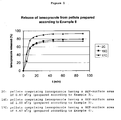
- the release of lansoprazole was spectrophotometricaly determined using Hewlett Packard 8452 A Diode array spectrophotometer and automatic sampling system Multicell Transport System. Dissolution profiles were obtained at 37 °C using 900 ml phosphate buffer solution having pH 6.8 and Ph. Eur. Paddle method (100 rpm). Before analysis, the pellet samples were treated with artificial gastric juice (500 ml) having a pH of 1.2 for one hour, washed and quantitatively transferred into the phosphate buffer.
- FIG. 1 The result of this test is displayed in Figure 1 showing the release of lansoprazole having different surface areas from pellets.
- the release of lansoprazole having a BET-surface area of 4.67 m 2 /g is clearly faster compared to that of lansoprazole having a BET-surface area of 0.87m 2 /g and 1.00 m 2 /g, respectively.
- Preferably more than 80 %, more preferably more than 85 % and most preferred more than 90 % of lansoprazole are released from the compositions comprising lansoprazole prepared by the process according to the invention within 30 minutes.
- compositions comprising lansoprazole prepared by the process according to invention can be in form of pellets, tablets, capsules, sachets, powders, granulates and aggregates.
- the dosage form of a tablet or pellets filled into capsules or sachets is preferably used.
- the pharmaceutical composition comprises pellet cores, optionally a separating coating, an enteric coating and optionally an overcoat.
- Suitable pellet cores are formed from powders comprising lansoprazole and at least one excipient by extrusion-spheronization or direct pelletization in a high-shear mixer or a rotor granulator.
- said pellet cores can also be formed by coating of inert cores prepared from sucrose, starch, microcrystalline cellulose, lactose or mixtures thereof.
- a convenient manner of coating the inert cores with lansoprazole is the "powder layering" process performed in centrifugal equipment, i.e. rotor fluid bed equipment (e.g. a Glatt Rotor Granulator), or a coating pan (e.g. Pellegrini Coating Pan, GS Coating System).
- rotor fluid bed equipment e.g. a Glatt Rotor Granulator
- a coating pan e.g. Pellegrini Coating Pan, GS Coating System
- the inert cores are moistened with a solution of binder, and then lansoprazole together with other excipients is added as a powder, and the layered pellets are dried in the same equipment in which the coating is performed or in other specialized equipment for drying, such as a drying chamber with or without vacuum.
- the coating of lansoprazole can also be effected in the "suspension layering" process by spraying the lansopra
- the enteric coating of pharmaceutical compositions comprising lansoprazole prepared by the process of the invention comprises
- the thickness of the enteric coating is 20-60 ⁇ m and in particular 25-50 ⁇ m.
- the final enteric coated pellets can additionally be thermally treated.
- This post-drying procedure is carried out for 2-24 hours at an elevated temperature from 30 to 50 °C, preferably from 35 to 45 °C, and more preferably from 38 to 42 °C, in a suitable type of dryer, e.g. a tray dryer or a vacuum dryer.
- enteric coated pellet cores can comprise one or more separating layers.
- the seperating layer(s) comprise at least one of water-soluble polymers, alkaline reacting compounds such as alkaline or earth alkaline metal carbonates, alkaline metal phosphates, glucosamine, alkaline reacting aminoacids, natural silicates, talc, plasticizers, such as propylene glycol, coloring agents, such as pigments (e.g. iron oxide, titanium dioxide) and mixtures thereof.
- compositions comprising lansoprazole prepared by the process of the invention may be further coated by an overcoat to increase the plasticity of the pellet surface.
- the components forming the enteric coating or the overcoating are mixed with purified water to give a suspension.
- This supension is preferably sprayed in a fluidized-bed equipment on pellet cores. To avoid settling, the mixture is stirred during the spraying process.
- the obtained coated pellets can be used for the production of capsules, sachets and tablets which can also be orally fast-disintegrating tablets.
- the wet product obtained in the previous step was suspended in acetone / water, then 1.14 g of disodium EDTA were added and the pH was adjusted between 7.0 -7.5 using an aqueous potassium hydroxide solution (50 %). The resulting suspension was stirred for two hours at room temperature. The product was filtered off, then macerated in 220 ml of water for two hours at room temperature, once again filtered and dried in air or a vacuuum dryer to obtain 15.97 g (93.6 %, KF: 4.5%) of the desired product.
- the suspension was heated to 45 °C to obtain a clear solution, then gradually cooled to 5 °C and stirred for one hour at 0 °C. Finally, the product was filtered, washed with 0.4 1 of cold ethanol and a mixture of 0.1 l of ethanol and 0.5 ml of triethylamine and dried at 40°C to obtain 0.41 kg of lansoprazole form A having a BET-surface area of 0.25 m 2 /g.
- the lansoprazole was further milled to obtain a solid with a BET-surface area of 0.87 m 2 /g.
- the suspension was stirred for two hours at 20 ⁇ 2 °C, then cooled in one hour to 5 °C, filtered and washed with 1.0 1 of water with a pH of 9.0 to obtain 1.55 kg of wet product. Maceration in water was once again repeated.
- the wet product (1.48 kg) was dried in vacuo at 40 °C to give 0.71 kg of lansoprazole form A having a BET-surface area of 4.67 m 2 /g.
- Example 4 was repeated with the exception that the temperature of the suspension of lansoprazole in water is 30 °C instead of 20 ⁇ 2 °C. 0.76 g of lansoprazole form A having a BET-surface area of 1.0 m 2 /g was obtained.
- the lansoprazole used in this example was prepared according to any one of examples 2 or 4.
- Such coated cores were additionally coated with a dispersion containing 1500.0 g of Eudragit L-30D, 45.0 g of polyethylene glycol 6000, 144.0 g of talc, 43.5 g of titanium dioxide and 1500.0 g of water.
- Eudragit L-30D dispersion was diluted with 1160.0 g of water. Then, the suspension of talc and titanium dioxide in 240.0 g of water was added. Finally, the solution of polyethylene glycol in 100.0 g of water was added to give the dispersion for coating.
- Example 7 Preparation of pellets comprising lansoprazole
- Example 6 was repeated except that between both coatings a separating layer was applied.
- Pellets coated with a separating layer were finally coated with an enteric coating using the same procedure as described in Example 6.
- Example 8 Preparation of pellets comprising lansoprazole
- Such coated cores were additionally coated with a separating layer.
- Pellets having such a seperating layer were additionally coated with a dispersion containing 1450.0 g of Eudragit L-30D, 43.4 g of polyethylene glycol 6000, 85.2 g of talc, 25.6 g of titanium dioxide and 1450.0 g of water.
- Eudragit L-30D dispersion was diluted with 1190.0 g of water.
- the suspension of talc and titanium dioxide in 160.0 g of water was added.
- the solution of polyethylene glycol in 100.0 g of water was added while stirring to give the dispersion for manufacturing the enteric-coated pellets.
- lansoprazole The release of lansoprazole from pellets prepared according to this example is shown in the Figure 1 . If a lansoprazole prepared according to example 4 having a BET-surface area of 4.76 m 2 /g is used, more than 90 % of the drug is released within the first 30 minutes (upper curve). The use of a lansoprazole described in examples 3 and 5 having a BET-surface area of 0.87 m 2 /g and 1.0 m 2 /g, respectively, results in a clearly smaller release of lansoprazole.
- lansoprazole having a BET-surface area as defined above is particulary suitable for the preparation of pharmaceutical compositions showing a fast release of lansoprazole.
- the lansoprazole used in this example was prepared according to any one of examples 2 or 4.
- Example 8 was repeated with the exception that hydroxypropyl cellulose was dissolved in 1100.0 g of purified water and sodium dodecyl sulfate was dissolved in 200.0 g of purified water. Moreover, no separating layer was applied on the cores having a first layer.
- Example 10 Preparation of pellets comprising lansoprazole
- Example 6 was repeated except that 28.9 g of disodium hydrogen phosphate dihydrate were used instead of 57.8 g.
- Example 11 Preparation of pellets comprising lansoprazole
- Example 6 was repeated with the exception that the pellet cores having a first layer were additionally coated with a dispersion containing 1500.0 g of Eudragit L-30D, 22.5 g of polyethylene glycol 6000, 144.0 g of talc, 45.0 g of triethyl citrate, 43.5 g of titanium dioxide and 1500.0 g of water.
- Eudragit L-30D dispersion was diluted with 1160.0 g of water. Then, the suspension of talc and titanium dioxide in 240.0 g of water was added. Polyethylene glycol 6000 was dissolved in 100.0 g of water and then triethyl citrate was dispersed in this solution. The obtained dispersion was finally added to the suspension of Eudragit L-30D, talc and pigment to give the dispersion which was sprayed onto cores having the first layer.
- Example 12 Preparation of pellets comprising lansoprazole
- the lansoprazole used in this example was prepared according to any one of examples 2 or 4.
- coated cores were then coated with a dispersion containing 83.4 g of polyvinyl pyrrolidone K-30, 195.0 g of magnesium carbonate heavy and 1300.0 g of purified water.
- Example 13 Preparation of pellets comprising lansoprazole
- Example 12 was repeated except that for preparing cores having a first layer additionally 375.0 g of sucrose and 225.0 g of maize starch were added to the solution of hydroxypropyl cellulose.
- Example 14 Preparation of pellets comprising lansoprazole
- Neutral pellets made from microcrystaline cellulose were used instead of neutral pellets made from starch and sucrose as inert cores which were coated by the procedure of Example 12.
- Example 15 Preparation of pellets comprising lansoprazole
- the lansoprazole used in this example was prepared according to any one of examples 2 or 4.
- Such coated cores were additionally coated with a separating layer.
- 114.3 g of hydroxypropyl methylcellulose 6 cp were dissolved in 1780.0 g of water and then 171.4 g of magnesium carbonate heavy were suspended in this solution to give the suspension for coating.
- Pellets having such a separating layer were additionally coated with a dispersion containing 1450.0 g of Eudragit L-30D, 43.4 g of polyethylene glycol 6000, 85.2 g of talc, 25.6 g of titanium dioxide, 2.73 g of sodium hydroxyde and 1450.0 g of water.
- Eudragit L-30D dispersion was diluted with 1110.0 g of water. Then, the suspension of talc and titanium dioxide in 160.0 g of water was added. Finally, solution of polyethylene glycol in 100.0 g of water and solution of sodium hydroxide in 80.0 g of water were added while stirring to give the dispersion for manufacturing the enteric-coated pellets.
- Example 16 Preparation of pellets comprising lansoprazole
- Neutral pellets made from microcrystaline cellulose were used as inert cores instead of those made from starch and sucrose and were then coated by the procedure of Example 13.
- Example 17 Preparation of pellets comprising lansoprazole
- the lansoprazole used in this example was prepared according to any one of examples 2 or 4.
- Such pellet cores were additionally coated in a Wurster fludized-bed equipment to manufacture enteric-coated pellets.
- Example 18 Preparation of pellets comprising lansoprazole
- the lansoprazole used in this example was prepared according to any one of examples 2 or 4.
- Example 19 Preparation of pellets comprising lansoprazole
- the lansoprazole used in this example was prepared according to any one of examples 2 or 4.
- Lansoprazole was layered on 990.0 g of neutral pellets in a rotor fluidized-bed equipment. For this purpose, 300.0 g lansoprazole, 201.6 g magnesium carbonate heavy, 450.0 g sucrose, 328.0 g maize starch and 360.0 g low-substituted hydroxypropyl cellulose were blended in an appropriate mixer to give a powder mixture. 54.0 g of hydroxypropyl cellulose were dissolved in 3000.0 g of purified water, and the solution was slowly sprayed onto the agitated batch of neutral pellets, while adding the powder mixture.
- Example 20 Preparation of pellets comprising lansoprazole
- the lansoprazole used in this example was prepared according to any one of examples 2 or 4.
- An enteric coating was added in a fluid bed coater granulator provided with a bottom-spray system.
- Such enteric coated pellets were additionally post-dried at 40 °C for 24 hours in a vacuum dryer.
- Example 21 Preparation of pellets comprising lansoprazole
- hydroxypropylmethyl cellulose (Pharmacoat 603) were dissolved in 520.0 g of water.
- 52.0 g of lansoprazole were suspended in the obtained solution and the mixture was homogenized with a homogenizer.
- a solution of 210 mg of sodium dodecyl sulfate dissolved in 50.0 g of purified water was added while gently stirring.
- the obtained suspension was sprayed onto 300.0 g of inert cores (0.500-0.600 mm) using a Wurster type fluidized-bed equipment.
- Such coated cores were additionally coated with a dispersion containing 500.0 g of Eudragit L-30D, 20.0 g of propylene glycol, 100.0 g of talc, 15.0 g of titanium dioxide and 450.0 g of purified water.
- Example 22 Comparison between the process for preparing lansoprazole according to the invention and that according to WO 2004/011455
- Example 2 a)(i) of the invention was repeated, with the exception that after the addition of hydrogen peroxide urea adduct the reaction was carried out for 0.5 h at 0-5 °C and then for 2.5 h at 10-15 °C. 39.29 g of wet lansoprazole (assay: 76.02 %; yield: 75 %) were obtained.
- Example 2 of WO 2004/011455 was repeated.
Landscapes
- Chemical & Material Sciences (AREA)
- Organic Chemistry (AREA)
- Health & Medical Sciences (AREA)
- Chemical Kinetics & Catalysis (AREA)
- Life Sciences & Earth Sciences (AREA)
- General Chemical & Material Sciences (AREA)
- Medicinal Chemistry (AREA)
- Nuclear Medicine, Radiotherapy & Molecular Imaging (AREA)
- Bioinformatics & Cheminformatics (AREA)
- Pharmacology & Pharmacy (AREA)
- Engineering & Computer Science (AREA)
- Animal Behavior & Ethology (AREA)
- General Health & Medical Sciences (AREA)
- Public Health (AREA)
- Veterinary Medicine (AREA)
- Pharmaceuticals Containing Other Organic And Inorganic Compounds (AREA)
- Plural Heterocyclic Compounds (AREA)
- Compounds Of Unknown Constitution (AREA)
- Medicinal Preparation (AREA)
Claims (21)
- Verfahren zur Herstellung von Lansoprazol, dargestellt durch die Formel (I)
 (a) eine Verbindung der Formel (II)
 (b) gegebenenfalls das Lansoprazol gewonnen wird.
 - Verfahren nach Anspruch 1, bei dem die Reaktion von Schritt (a) in Gegenwart des Vanadiumkatalysators und Acetanhydrid durchgeführt wird.
- Verfahren nach Anspruch 1 oder 2, bei dem der Vanadium(V)-triester Vanadium(V)oxytriethoxid, Vanadium(V)oxytripropoxid oder Vanadium(V)oxytriisopropoxid ist.
- Verfahren nach einem der Ansprüche 1 bis 3, bei dem der Vanadiumkatalysator in einer Menge von 0,001 bis 0,05 Äquivalenten, vorzugsweise 0,002 bis 0,02 Äquivalenten und am meisten bevorzugt 0,005 bis 0,015 Äquivalenten relativ zu Verbindung (II) vorliegt.
- Verfahren nach einem der Ansprüche 1 bis 4, bei dem das Oxidationsmittel Wasserstoffperoxid oder eine Quelle davon ist.
- Verfahren nach Anspruch 5, bei dem die Wasserstoffperoxidquelle ein Harnstoffaddukt von Wasserstoffperoxid ist.
- Verfahren nach einem der Ansprüche 1 bis 6, bei dem das Oxidationsmittel in einer Menge von 0,5 bis 3,0 Äquivalenten, vorzugsweise 0,7 bis 2,0 Äquivalenten und am meisten bevorzugt 0,9 bis 1,5 Äquivalenten relativ zu Verbindung (II) vorliegt.
- Verfahren nach einem der Ansprüche 1 bis 7, bei dem Schritt (a) in einem organischen Lösungsmittel durchgeführt wird, das ausgewählt ist aus der Gruppe bestehend aus 1-Methyl-2-pyrrolidon, N,N-Dimethylacetamid, N,N-Dimethylformamid, Alkoholen und Mischungen davon.
- Verfahren nach Anspruch 8, bei dem das organische Lösungsmittel 1-Methyl-2-pyrrolidon ist.
- Verfahren nach einem der Ansprüche 1 bis 9, bei dem Schritt (a) bei einer Temperatur im Bereich von 0 bis 20°C durchgeführt wird.
- Verfahren nach Anspruch 10, bei dem die Temperatur in einem Bereich von 0 bis 10°C liegt.
- Verfahren nach einem der Ansprüche 1 bis 11, bei dem Schritt (b) durch mindestens einen der folgenden Schritte durchgeführt wird:(i) Zugabe einer Lösung von einem Thiosulfatsalz und einer Base zu der Reaktionsmischung von Schritt (a),(ii) Zugabe von Wasser zu der Mischung von Schritt (i), um festes Lansoprazol auszufällen und(iii) Abtrennen von Lansoprazole.
- Verfahren nach einem der Ansprüche 1 bis 12, bei dem ferner(a') eine Lösung von Lansoprazol in einem Lösungsmittel zur Verfügung gestellt wird,(b') Lansoprazol aus der Lösung von (a') ausgefällt wird,(c') das ausgefällte Lansoprazol abgetrennt und gegebenenfalls gewaschen wird,(d') das ausgefällte Lansoprazol von Schritt (c') in einem Lösungsmittel bei einer Temperatur von weniger als 25°C, vorzugsweise weniger als 20°C und besonders bevorzugt von 15 bis 20°C suspendiert wird, und(e') die Suspension von (d') gerührt wird und das erhaltene Lansoprazol abgetrennt wird.
- Verfahren nach Anspruch 13, bei dem das in Schritt (a') und (d') verwendete Lösungsmittel unabhängig ausgewählt ist aus Wasser, Ethanol, Aceton, 1-Methyl-2-pyrrolidon oder Mischungen davon.
- Verfahren nach Anspruch 13 oder 14, bei dem in Schritt (c') Lansoprazol mit einem Lösungsmittel gewaschen wird, das aus Wasser, Ethanol, Aceton oder Mischungen davon ausgewählt ist.
- Verfahren nach Anspruch 14 oder 15, bei dem das Lösungsmittel ferner eine Base, vorzugsweise Natriumhydroxid, Kaliumhydroxid, Triethylamin oder Ammoniak enthält.
- Verfahren nach einem der Ansprüche 13 bis 16, bei dem das Lösungsmittel in Schritt (d') einen pH-Wert von 8 bis 11 hat.
- Verfahren nach einem der Ansprüche 13 bis 17, bei dem in Schritt (e') die Suspension von Lansoprazol bei einer Temperatur von 15 bis 25°C gerührt wird.
- Verfahren nach Anspruch 18, bei dem die Suspension für 0,5 bis 10 h gerührt wird.
- Verfahren nach einem der Ansprüche 13 bis 19, bei dem das hergestellte Lansoprazol eine BET-Oberfläche von 1,5 bis 7,0 m2/g hat.
- Verfahren nach Anspruch 20, bei dem das hergestellte Lansoprazol eine BET-Oberfläche von 2,5 bis 5,2 m2/g hat.
Priority Applications (3)
| Application Number | Priority Date | Filing Date | Title |
|---|---|---|---|
| SI200630799T SI1838314T1 (sl) | 2005-01-14 | 2006-01-13 | Postopek za pripravo lansoprazola |
| EP06706233A EP1838314B1 (de) | 2005-01-14 | 2006-01-13 | Verfahren zur zubereitung von lansoprazol |
| EP10007788.2A EP2308492B1 (de) | 2005-01-14 | 2006-01-13 | Verfahren zur Herstellung von Lansoprazol |
Applications Claiming Priority (4)
| Application Number | Priority Date | Filing Date | Title |
|---|---|---|---|
| EP05000663A EP1681056A1 (de) | 2005-01-14 | 2005-01-14 | Verfahren zur Herstellung von Lansoprazol |
| US11/269,211 US7662968B2 (en) | 2005-01-14 | 2005-11-08 | Process for preparing lansoprazole |
| PCT/EP2006/000285 WO2006074952A1 (en) | 2005-01-14 | 2006-01-13 | Process for preparing lansoprazole |
| EP06706233A EP1838314B1 (de) | 2005-01-14 | 2006-01-13 | Verfahren zur zubereitung von lansoprazol |
Related Child Applications (1)
| Application Number | Title | Priority Date | Filing Date |
|---|---|---|---|
| EP10007788.2A Division EP2308492B1 (de) | 2005-01-14 | 2006-01-13 | Verfahren zur Herstellung von Lansoprazol |
Publications (2)
| Publication Number | Publication Date |
|---|---|
| EP1838314A1 EP1838314A1 (de) | 2007-10-03 |
| EP1838314B1 true EP1838314B1 (de) | 2010-07-28 |
Family
ID=34933288
Family Applications (3)
| Application Number | Title | Priority Date | Filing Date |
|---|---|---|---|
| EP05000663A Withdrawn EP1681056A1 (de) | 2005-01-14 | 2005-01-14 | Verfahren zur Herstellung von Lansoprazol |
| EP10007788.2A Expired - Lifetime EP2308492B1 (de) | 2005-01-14 | 2006-01-13 | Verfahren zur Herstellung von Lansoprazol |
| EP06706233A Expired - Lifetime EP1838314B1 (de) | 2005-01-14 | 2006-01-13 | Verfahren zur zubereitung von lansoprazol |
Family Applications Before (2)
| Application Number | Title | Priority Date | Filing Date |
|---|---|---|---|
| EP05000663A Withdrawn EP1681056A1 (de) | 2005-01-14 | 2005-01-14 | Verfahren zur Herstellung von Lansoprazol |
| EP10007788.2A Expired - Lifetime EP2308492B1 (de) | 2005-01-14 | 2006-01-13 | Verfahren zur Herstellung von Lansoprazol |
Country Status (14)
| Country | Link |
|---|---|
| US (1) | US7662968B2 (de) |
| EP (3) | EP1681056A1 (de) |
| CN (2) | CN101824028A (de) |
| AT (1) | ATE475419T1 (de) |
| AU (1) | AU2006205818A1 (de) |
| CA (1) | CA2594821A1 (de) |
| DE (1) | DE602006015771D1 (de) |
| EA (1) | EA015043B1 (de) |
| NO (1) | NO20074086L (de) |
| NZ (1) | NZ556706A (de) |
| SI (2) | SI2308492T1 (de) |
| UA (1) | UA90293C2 (de) |
| WO (1) | WO2006074952A1 (de) |
| ZA (1) | ZA200706691B (de) |
Families Citing this family (27)
| Publication number | Priority date | Publication date | Assignee | Title |
|---|---|---|---|---|
| EP1790647B1 (de) | 2004-09-13 | 2013-05-08 | Takeda Pharmaceutical Company Limited | Verfahren zur herstellung von oxidierter verbindung |
| WO2008035189A1 (en) * | 2006-09-22 | 2008-03-27 | Orchid Chemicals & Pharmaceuticals Limited | A method for the purification of lansoprazole |
| ITMI20062481A1 (it) * | 2006-12-22 | 2008-06-23 | Recordati Chem Pharm | Processo per la preparazione di lansoprazolo forma i microcristallino |
| WO2008132727A2 (en) * | 2007-04-26 | 2008-11-06 | Technion Research And Development Foundation Ltd | Oral delivery of proteins and peptides |
| SI22806A (sl) * | 2008-06-23 | 2009-12-31 | Krka, Tovarna Zdravil, D.D., Novo Mesto | Nove kristalinične oblike natrijevega rabeprazola |
| WO2011063150A2 (en) * | 2009-11-20 | 2011-05-26 | Handa Pharmaceuticals, Llc | Oral formulation for dexlansoprazole |
| US20120039999A1 (en) * | 2010-08-11 | 2012-02-16 | Ashish Chatterji | Pharmaceutical compositions of metabotropic glutamate 5 receptor (mglu5) antagonists |
| US20120040008A1 (en) * | 2010-08-11 | 2012-02-16 | Ashish Chatterji | Pharmaceutical compositions of metabotropic glutamate 5 receptor (mglu5) antagonists |
| CN102180865B (zh) * | 2011-03-17 | 2013-01-16 | 浙江工业大学 | 一种兰索拉唑的合成方法 |
| CN102558154B (zh) * | 2012-02-24 | 2014-01-08 | 海南锦瑞制药股份有限公司 | 一种兰索拉唑结晶化合物及其肠溶胶囊、及制备方法 |
| CN102838537B (zh) * | 2012-09-18 | 2014-04-09 | 寿光富康制药有限公司 | 一种兰索拉唑中间体的制备方法 |
| CN103539729A (zh) * | 2013-10-14 | 2014-01-29 | 安徽国星生物化学有限公司 | 一种氯甲基吡啶衍生物的工业化生产方法 |
| CN103539728A (zh) * | 2013-10-14 | 2014-01-29 | 安徽国星生物化学有限公司 | 一种拉唑类药物中间体氯甲基吡啶衍生物的合成方法 |
| CN103664750A (zh) * | 2013-12-09 | 2014-03-26 | 惠州市莱佛士制药技术有限公司 | 一种拉唑氯代物的合成方法 |
| CN104083330A (zh) * | 2014-02-21 | 2014-10-08 | 杭州长典医药科技有限公司 | 兰索拉唑钠特种超细粉体冻干制剂及其制备方法 |
| CN104447696B (zh) * | 2014-11-19 | 2016-08-17 | 上海泰坦科技股份有限公司 | 兰索拉唑的合成工艺 |
| CN104557693B (zh) * | 2015-01-16 | 2017-01-04 | 江苏中邦制药有限公司 | 一种3,5-二甲基-4-硝基吡啶-n-氧化物的合成方法 |
| CN104592107B (zh) * | 2015-01-16 | 2017-01-11 | 江苏中邦制药有限公司 | 一种2,3-二甲基-4-硝基吡啶-n-氧化物的合成方法 |
| CN104817492B (zh) * | 2015-05-22 | 2018-05-18 | 抚州三和医药化工有限公司 | 兰索拉唑中间体2-羟甲基-3-甲基-4-(2,2,2-三氟乙氧基)吡啶的分离纯化方法 |
| CN106928191B (zh) * | 2015-12-30 | 2019-09-03 | 河南康达制药有限公司 | 一种兰索拉唑的制备工艺 |
| CN106543146A (zh) * | 2016-11-10 | 2017-03-29 | 石家庄市度智医药科技有限公司 | 一种右兰索拉唑的制备方法 |
| CN106619520B (zh) * | 2016-12-29 | 2019-08-06 | 南京海融制药有限公司 | 一种右兰索拉唑钠的干混悬剂及其制备方法 |
| CN106749186B (zh) * | 2016-12-29 | 2019-03-05 | 南京海融制药有限公司 | 一种右兰索拉唑钠的新晶型及其制备方法 |
| CN106727381B (zh) * | 2016-12-29 | 2020-07-07 | 南京海融制药有限公司 | 一种右兰索拉唑钠的口崩片及其制备方法 |
| CN108947967B (zh) * | 2018-08-24 | 2020-10-30 | 迪嘉药业集团有限公司 | 一种兰索拉唑的制备方法 |
| US12097204B2 (en) | 2018-09-03 | 2024-09-24 | Chia Tai Tianqing Pharmaceutical Group Co., Ltd. | Solid pharmaceutical composition containing 1,3,5-triazine derivative or salt thereof |
| CN114163419A (zh) * | 2021-12-24 | 2022-03-11 | 辰欣药业股份有限公司 | 一种兰索拉唑的制备方法 |
Family Cites Families (13)
| Publication number | Priority date | Publication date | Assignee | Title |
|---|---|---|---|---|
| JPS6150978A (ja) | 1984-08-16 | 1986-03-13 | Takeda Chem Ind Ltd | ピリジン誘導体およびその製造法 |
| DK171989B1 (da) * | 1987-08-04 | 1997-09-08 | Takeda Chemical Industries Ltd | Fremgangsmåde til fremstilling af 2-(2-pyridylmethylsulfinyl)-benzimidazoler |
| TW385306B (en) * | 1996-11-14 | 2000-03-21 | Takeda Chemical Industries Ltd | Method for producing crystals of benzimidazole derivatives |
| US6313303B1 (en) * | 1997-07-11 | 2001-11-06 | Eisai Co., Ltd. | Process for the preparation of pyridine derivatives |
| WO2000072827A2 (en) * | 1999-05-27 | 2000-12-07 | Acusphere, Inc. | Porous drug matrices and methods of manufacture thereof |
| PL333847A1 (en) * | 1999-06-18 | 2001-01-02 | Inst Farmaceutyczny | Crystalline forms of lansoprozole and method of obtaining lansoprazole in pharmacologically advanthageous crystalline form |
| KR20100002278A (ko) * | 2000-12-01 | 2010-01-06 | 다케다 야쿠힌 고교 가부시키가이샤 | (r)- 또는 (s)-란소프라졸의 결정 |
| CN1876647A (zh) * | 2001-02-02 | 2006-12-13 | 特瓦制药工业有限公司 | 苯并咪唑化合物产品 |
| KR100433735B1 (ko) * | 2001-06-27 | 2004-06-04 | 주식회사 씨트리 | 결정형 ⅰ을 갖는 란소프라졸의 제조방법 |
| WO2003008406A1 (en) | 2001-07-16 | 2003-01-30 | Janssen Pharmaceutica N.V. | Improved process for preparing benzimidazole-type compounds |
| AU2003224779A1 (en) * | 2002-03-27 | 2003-10-13 | Teva Pharmaceutical Industries Ltd. | Lansoprazole polymorphs and processes for preparation thereof |
| JP4115751B2 (ja) * | 2002-05-31 | 2008-07-09 | 株式会社パーマケム・アジア | 微水ベンズイミダゾール系化合物の製法 |
| EP1467987A1 (de) * | 2002-07-26 | 2004-10-20 | Teva Pharmaceutical Industries Ltd. | Herstellung von lansoprazol und derivaten |
-
2005
- 2005-01-14 EP EP05000663A patent/EP1681056A1/de not_active Withdrawn
- 2005-11-08 US US11/269,211 patent/US7662968B2/en not_active Expired - Fee Related
-
2006
- 2006-01-13 UA UAA200709253A patent/UA90293C2/ru unknown
- 2006-01-13 CN CN200910262567A patent/CN101824028A/zh active Pending
- 2006-01-13 EP EP10007788.2A patent/EP2308492B1/de not_active Expired - Lifetime
- 2006-01-13 NZ NZ556706A patent/NZ556706A/en not_active IP Right Cessation
- 2006-01-13 DE DE602006015771T patent/DE602006015771D1/de not_active Expired - Lifetime
- 2006-01-13 SI SI200632122A patent/SI2308492T1/sl unknown
- 2006-01-13 SI SI200630799T patent/SI1838314T1/sl unknown
- 2006-01-13 EA EA200701461A patent/EA015043B1/ru not_active IP Right Cessation
- 2006-01-13 CN CN2006800077986A patent/CN101137371B/zh not_active Expired - Fee Related
- 2006-01-13 EP EP06706233A patent/EP1838314B1/de not_active Expired - Lifetime
- 2006-01-13 AU AU2006205818A patent/AU2006205818A1/en not_active Abandoned
- 2006-01-13 CA CA002594821A patent/CA2594821A1/en not_active Abandoned
- 2006-01-13 AT AT06706233T patent/ATE475419T1/de not_active IP Right Cessation
- 2006-01-13 WO PCT/EP2006/000285 patent/WO2006074952A1/en not_active Ceased
-
2007
- 2007-08-07 NO NO20074086A patent/NO20074086L/no not_active Application Discontinuation
- 2007-08-13 ZA ZA200706691A patent/ZA200706691B/xx unknown
Also Published As
| Publication number | Publication date |
|---|---|
| US20070259049A1 (en) | 2007-11-08 |
| EP2308492A1 (de) | 2011-04-13 |
| CN101137371A (zh) | 2008-03-05 |
| US7662968B2 (en) | 2010-02-16 |
| ATE475419T1 (de) | 2010-08-15 |
| EP1681056A1 (de) | 2006-07-19 |
| WO2006074952A1 (en) | 2006-07-20 |
| SI2308492T1 (sl) | 2017-02-28 |
| CN101137371B (zh) | 2011-05-25 |
| ZA200706691B (en) | 2008-09-25 |
| NZ556706A (en) | 2009-11-27 |
| SI1838314T1 (sl) | 2010-11-30 |
| CA2594821A1 (en) | 2006-07-20 |
| DE602006015771D1 (de) | 2010-09-09 |
| EP1838314A1 (de) | 2007-10-03 |
| AU2006205818A1 (en) | 2006-07-20 |
| EP2308492B1 (de) | 2016-09-14 |
| EA015043B1 (ru) | 2011-04-29 |
| NO20074086L (no) | 2007-10-10 |
| UA90293C2 (en) | 2010-04-26 |
| CN101824028A (zh) | 2010-09-08 |
| EA200701461A1 (ru) | 2008-02-28 |
Similar Documents
| Publication | Publication Date | Title |
|---|---|---|
| EP2308492B1 (de) | Verfahren zur Herstellung von Lansoprazol | |
| AU764642B2 (en) | Improved omeprazole process and compositions thereof | |
| CA2436825C (en) | Process for the crystallization of (r)- or (s)-lansoprazole | |
| SA05260296B1 (ar) | عملية جديدة لتحضير تراي هيدرات ملح الماغنسيوم trihydrate of the magnesium salt من أوميبرازول S-omeprazole | |
| EP2262790B1 (de) | Kristall einer benzimidazolverbindung | |
| NZ579136A (en) | Process for the preparation of esomeprazole magnesium dihydrate | |
| EP2030973A1 (de) | Verfahren zur Herstellung von 2-Sulfinyl-1H-Benzimidazolen | |
| JP2003516985A (ja) | 改良されたオメプラゾール工程および該化合物の組成物 | |
| JP2006516261A (ja) | 光学的に純粋な有効化合物の製造方法 | |
| EP2303866B1 (de) | Kristalline formen von rabeprazol-natrium | |
| US7301030B2 (en) | Process for preparing (S)-pantoprazole | |
| WO2008001392A2 (en) | An improved process for the preparation of pantoprazole and its pharmaceutically acceptable salts | |
| SK2812002A3 (en) | Alkoxy substituted benzimidazole compounds, pharmaceutical preparations containing the same, and methods of using the same | |
| WO2008017020A2 (en) | Process for preparing proton pump inhibitors | |
| EP1801110A1 (de) | Argininsalz des Esomeprazols | |
| EP1664044A1 (de) | S-tenatoprazolnatrium-monohydrat-salz und dessen verwendung in form eines protonenpumpenhemmers | |
| HK1159110A (en) | Amorphous (r)-2-[[[3-methyl-4-(2,2,2-trifluoroethoxy)-2-pyridinyl]methyl]sulfinyl]-1h-benzimidazole as anti-ulcer agent | |
| HK1078863B (en) | Process for preparing (s)-pantoprazole | |
| ME00197B (me) | Novi postupak dobijanja trihidrata soli magnezijum-s-omeprazola |
Legal Events
| Date | Code | Title | Description |
|---|---|---|---|
| PUAI | Public reference made under article 153(3) epc to a published international application that has entered the european phase |
Free format text: ORIGINAL CODE: 0009012 |
|
| 17P | Request for examination filed |
Effective date: 20070803 |
|
| AK | Designated contracting states |
Kind code of ref document: A1 Designated state(s): AT BE BG CH CY CZ DE DK EE ES FI FR GB GR HU IE IS IT LI LT LU LV MC NL PL PT RO SE SI SK TR |
|
| AX | Request for extension of the european patent |
Extension state: AL BA HR MK YU |
|
| 17Q | First examination report despatched |
Effective date: 20090105 |
|
| GRAP | Despatch of communication of intention to grant a patent |
Free format text: ORIGINAL CODE: EPIDOSNIGR1 |
|
| GRAS | Grant fee paid |
Free format text: ORIGINAL CODE: EPIDOSNIGR3 |
|
| GRAA | (expected) grant |
Free format text: ORIGINAL CODE: 0009210 |
|
| AK | Designated contracting states |
Kind code of ref document: B1 Designated state(s): AT BE BG CH CY CZ DE DK EE ES FI FR GB GR HU IE IS IT LI LT LU LV MC NL PL PT RO SE SI SK TR |
|
| AX | Request for extension of the european patent |
Extension state: AL BA HR MK YU |
|
| REG | Reference to a national code |
Ref country code: GB Ref legal event code: FG4D |
|
| REG | Reference to a national code |
Ref country code: CH Ref legal event code: EP |
|
| REG | Reference to a national code |
Ref country code: IE Ref legal event code: FG4D |
|
| REF | Corresponds to: |
Ref document number: 602006015771 Country of ref document: DE Date of ref document: 20100909 Kind code of ref document: P |
|
| REG | Reference to a national code |
Ref country code: NL Ref legal event code: VDEP Effective date: 20100728 |
|
| LTIE | Lt: invalidation of european patent or patent extension |
Effective date: 20100728 |
|
| PG25 | Lapsed in a contracting state [announced via postgrant information from national office to epo] |
Ref country code: NL Free format text: LAPSE BECAUSE OF FAILURE TO SUBMIT A TRANSLATION OF THE DESCRIPTION OR TO PAY THE FEE WITHIN THE PRESCRIBED TIME-LIMIT Effective date: 20100728 Ref country code: AT Free format text: LAPSE BECAUSE OF FAILURE TO SUBMIT A TRANSLATION OF THE DESCRIPTION OR TO PAY THE FEE WITHIN THE PRESCRIBED TIME-LIMIT Effective date: 20100728 Ref country code: FI Free format text: LAPSE BECAUSE OF FAILURE TO SUBMIT A TRANSLATION OF THE DESCRIPTION OR TO PAY THE FEE WITHIN THE PRESCRIBED TIME-LIMIT Effective date: 20100728 Ref country code: LT Free format text: LAPSE BECAUSE OF FAILURE TO SUBMIT A TRANSLATION OF THE DESCRIPTION OR TO PAY THE FEE WITHIN THE PRESCRIBED TIME-LIMIT Effective date: 20100728 |
|
| PG25 | Lapsed in a contracting state [announced via postgrant information from national office to epo] |
Ref country code: CY Free format text: LAPSE BECAUSE OF FAILURE TO SUBMIT A TRANSLATION OF THE DESCRIPTION OR TO PAY THE FEE WITHIN THE PRESCRIBED TIME-LIMIT Effective date: 20100728 Ref country code: PL Free format text: LAPSE BECAUSE OF FAILURE TO SUBMIT A TRANSLATION OF THE DESCRIPTION OR TO PAY THE FEE WITHIN THE PRESCRIBED TIME-LIMIT Effective date: 20100728 Ref country code: PT Free format text: LAPSE BECAUSE OF FAILURE TO SUBMIT A TRANSLATION OF THE DESCRIPTION OR TO PAY THE FEE WITHIN THE PRESCRIBED TIME-LIMIT Effective date: 20101129 Ref country code: IS Free format text: LAPSE BECAUSE OF FAILURE TO SUBMIT A TRANSLATION OF THE DESCRIPTION OR TO PAY THE FEE WITHIN THE PRESCRIBED TIME-LIMIT Effective date: 20101128 Ref country code: BG Free format text: LAPSE BECAUSE OF FAILURE TO SUBMIT A TRANSLATION OF THE DESCRIPTION OR TO PAY THE FEE WITHIN THE PRESCRIBED TIME-LIMIT Effective date: 20101028 |
|
| PG25 | Lapsed in a contracting state [announced via postgrant information from national office to epo] |
Ref country code: GR Free format text: LAPSE BECAUSE OF FAILURE TO SUBMIT A TRANSLATION OF THE DESCRIPTION OR TO PAY THE FEE WITHIN THE PRESCRIBED TIME-LIMIT Effective date: 20101029 Ref country code: SE Free format text: LAPSE BECAUSE OF FAILURE TO SUBMIT A TRANSLATION OF THE DESCRIPTION OR TO PAY THE FEE WITHIN THE PRESCRIBED TIME-LIMIT Effective date: 20100728 Ref country code: LV Free format text: LAPSE BECAUSE OF FAILURE TO SUBMIT A TRANSLATION OF THE DESCRIPTION OR TO PAY THE FEE WITHIN THE PRESCRIBED TIME-LIMIT Effective date: 20100728 Ref country code: BE Free format text: LAPSE BECAUSE OF FAILURE TO SUBMIT A TRANSLATION OF THE DESCRIPTION OR TO PAY THE FEE WITHIN THE PRESCRIBED TIME-LIMIT Effective date: 20100728 |
|
| PG25 | Lapsed in a contracting state [announced via postgrant information from national office to epo] |
Ref country code: DK Free format text: LAPSE BECAUSE OF FAILURE TO SUBMIT A TRANSLATION OF THE DESCRIPTION OR TO PAY THE FEE WITHIN THE PRESCRIBED TIME-LIMIT Effective date: 20100728 |
|
| PG25 | Lapsed in a contracting state [announced via postgrant information from national office to epo] |
Ref country code: RO Free format text: LAPSE BECAUSE OF FAILURE TO SUBMIT A TRANSLATION OF THE DESCRIPTION OR TO PAY THE FEE WITHIN THE PRESCRIBED TIME-LIMIT Effective date: 20100728 Ref country code: CZ Free format text: LAPSE BECAUSE OF FAILURE TO SUBMIT A TRANSLATION OF THE DESCRIPTION OR TO PAY THE FEE WITHIN THE PRESCRIBED TIME-LIMIT Effective date: 20100728 Ref country code: IT Free format text: LAPSE BECAUSE OF FAILURE TO SUBMIT A TRANSLATION OF THE DESCRIPTION OR TO PAY THE FEE WITHIN THE PRESCRIBED TIME-LIMIT Effective date: 20100728 Ref country code: EE Free format text: LAPSE BECAUSE OF FAILURE TO SUBMIT A TRANSLATION OF THE DESCRIPTION OR TO PAY THE FEE WITHIN THE PRESCRIBED TIME-LIMIT Effective date: 20100728 Ref country code: SK Free format text: LAPSE BECAUSE OF FAILURE TO SUBMIT A TRANSLATION OF THE DESCRIPTION OR TO PAY THE FEE WITHIN THE PRESCRIBED TIME-LIMIT Effective date: 20100728 |
|
| PLBE | No opposition filed within time limit |
Free format text: ORIGINAL CODE: 0009261 |
|
| STAA | Information on the status of an ep patent application or granted ep patent |
Free format text: STATUS: NO OPPOSITION FILED WITHIN TIME LIMIT |
|
| PG25 | Lapsed in a contracting state [announced via postgrant information from national office to epo] |
Ref country code: ES Free format text: LAPSE BECAUSE OF FAILURE TO SUBMIT A TRANSLATION OF THE DESCRIPTION OR TO PAY THE FEE WITHIN THE PRESCRIBED TIME-LIMIT Effective date: 20101108 |
|
| 26N | No opposition filed |
Effective date: 20110429 |
|
| REG | Reference to a national code |
Ref country code: DE Ref legal event code: R097 Ref document number: 602006015771 Country of ref document: DE Effective date: 20110429 |
|
| PG25 | Lapsed in a contracting state [announced via postgrant information from national office to epo] |
Ref country code: MC Free format text: LAPSE BECAUSE OF NON-PAYMENT OF DUE FEES Effective date: 20110131 |
|
| REG | Reference to a national code |
Ref country code: CH Ref legal event code: PL |
|
| GBPC | Gb: european patent ceased through non-payment of renewal fee |
Effective date: 20110113 |
|
| REG | Reference to a national code |
Ref country code: FR Ref legal event code: ST Effective date: 20110930 |
|
| REG | Reference to a national code |
Ref country code: IE Ref legal event code: MM4A |
|
| PG25 | Lapsed in a contracting state [announced via postgrant information from national office to epo] |
Ref country code: CH Free format text: LAPSE BECAUSE OF NON-PAYMENT OF DUE FEES Effective date: 20110131 Ref country code: FR Free format text: LAPSE BECAUSE OF NON-PAYMENT OF DUE FEES Effective date: 20110131 Ref country code: LI Free format text: LAPSE BECAUSE OF NON-PAYMENT OF DUE FEES Effective date: 20110131 |
|
| PG25 | Lapsed in a contracting state [announced via postgrant information from national office to epo] |
Ref country code: GB Free format text: LAPSE BECAUSE OF NON-PAYMENT OF DUE FEES Effective date: 20110113 |
|
| PG25 | Lapsed in a contracting state [announced via postgrant information from national office to epo] |
Ref country code: IE Free format text: LAPSE BECAUSE OF NON-PAYMENT OF DUE FEES Effective date: 20110113 |
|
| PG25 | Lapsed in a contracting state [announced via postgrant information from national office to epo] |
Ref country code: LU Free format text: LAPSE BECAUSE OF NON-PAYMENT OF DUE FEES Effective date: 20110113 |
|
| PG25 | Lapsed in a contracting state [announced via postgrant information from national office to epo] |
Ref country code: TR Free format text: LAPSE BECAUSE OF FAILURE TO SUBMIT A TRANSLATION OF THE DESCRIPTION OR TO PAY THE FEE WITHIN THE PRESCRIBED TIME-LIMIT Effective date: 20100728 |
|
| PG25 | Lapsed in a contracting state [announced via postgrant information from national office to epo] |
Ref country code: HU Free format text: LAPSE BECAUSE OF FAILURE TO SUBMIT A TRANSLATION OF THE DESCRIPTION OR TO PAY THE FEE WITHIN THE PRESCRIBED TIME-LIMIT Effective date: 20100728 |
|
| PGFP | Annual fee paid to national office [announced via postgrant information from national office to epo] |
Ref country code: DE Payment date: 20170110 Year of fee payment: 12 |
|
| PGFP | Annual fee paid to national office [announced via postgrant information from national office to epo] |
Ref country code: SI Payment date: 20161222 Year of fee payment: 12 |
|
| REG | Reference to a national code |
Ref country code: DE Ref legal event code: R119 Ref document number: 602006015771 Country of ref document: DE |
|
| REG | Reference to a national code |
Ref country code: SI Ref legal event code: KO00 Effective date: 20180925 |
|
| PG25 | Lapsed in a contracting state [announced via postgrant information from national office to epo] |
Ref country code: DE Free format text: LAPSE BECAUSE OF NON-PAYMENT OF DUE FEES Effective date: 20180801 |
|
| PG25 | Lapsed in a contracting state [announced via postgrant information from national office to epo] |
Ref country code: SI Free format text: LAPSE BECAUSE OF NON-PAYMENT OF DUE FEES Effective date: 20180114 |