EP1857564A2 - Plaque d'acier à forte traction, procédé d'assemblage de plaques d'acier et pièce automobile de haute résistante - Google Patents
Plaque d'acier à forte traction, procédé d'assemblage de plaques d'acier et pièce automobile de haute résistante Download PDFInfo
- Publication number
- EP1857564A2 EP1857564A2 EP07009820A EP07009820A EP1857564A2 EP 1857564 A2 EP1857564 A2 EP 1857564A2 EP 07009820 A EP07009820 A EP 07009820A EP 07009820 A EP07009820 A EP 07009820A EP 1857564 A2 EP1857564 A2 EP 1857564A2
- Authority
- EP
- European Patent Office
- Prior art keywords
- steel sheet
- mass
- tensile steel
- tensile
- strength
- Prior art date
- Legal status (The legal status is an assumption and is not a legal conclusion. Google has not performed a legal analysis and makes no representation as to the accuracy of the status listed.)
- Withdrawn
Links
Images
Classifications
-
- C—CHEMISTRY; METALLURGY
- C22—METALLURGY; FERROUS OR NON-FERROUS ALLOYS; TREATMENT OF ALLOYS OR NON-FERROUS METALS
- C22C—ALLOYS
- C22C38/00—Ferrous alloys, e.g. steel alloys
- C22C38/02—Ferrous alloys, e.g. steel alloys containing silicon
-
- B—PERFORMING OPERATIONS; TRANSPORTING
- B23—MACHINE TOOLS; METAL-WORKING NOT OTHERWISE PROVIDED FOR
- B23K—SOLDERING OR UNSOLDERING; WELDING; CLADDING OR PLATING BY SOLDERING OR WELDING; CUTTING BY APPLYING HEAT LOCALLY, e.g. FLAME CUTTING; WORKING BY LASER BEAM
- B23K11/00—Resistance welding; Severing by resistance heating
- B23K11/16—Resistance welding; Severing by resistance heating taking account of the properties of the material to be welded
-
- C—CHEMISTRY; METALLURGY
- C21—METALLURGY OF IRON
- C21D—MODIFYING THE PHYSICAL STRUCTURE OF FERROUS METALS; GENERAL DEVICES FOR HEAT TREATMENT OF FERROUS OR NON-FERROUS METALS OR ALLOYS; MAKING METAL MALLEABLE, e.g. BY DECARBURISATION OR TEMPERING
- C21D8/00—Modifying the physical properties of ferrous metals or ferrous alloys by deformation combined with, or followed by, heat treatment
- C21D8/02—Modifying the physical properties of ferrous metals or ferrous alloys by deformation combined with, or followed by, heat treatment during manufacturing of plates or strips
- C21D8/0221—Modifying the physical properties of ferrous metals or ferrous alloys by deformation combined with, or followed by, heat treatment during manufacturing of plates or strips characterised by the working steps
- C21D8/0226—Hot rolling
-
- C—CHEMISTRY; METALLURGY
- C21—METALLURGY OF IRON
- C21D—MODIFYING THE PHYSICAL STRUCTURE OF FERROUS METALS; GENERAL DEVICES FOR HEAT TREATMENT OF FERROUS OR NON-FERROUS METALS OR ALLOYS; MAKING METAL MALLEABLE, e.g. BY DECARBURISATION OR TEMPERING
- C21D9/00—Heat treatment, e.g. annealing, hardening, quenching or tempering, adapted for particular articles; Furnaces therefor
- C21D9/46—Heat treatment, e.g. annealing, hardening, quenching or tempering, adapted for particular articles; Furnaces therefor for sheet metals
-
- C—CHEMISTRY; METALLURGY
- C21—METALLURGY OF IRON
- C21D—MODIFYING THE PHYSICAL STRUCTURE OF FERROUS METALS; GENERAL DEVICES FOR HEAT TREATMENT OF FERROUS OR NON-FERROUS METALS OR ALLOYS; MAKING METAL MALLEABLE, e.g. BY DECARBURISATION OR TEMPERING
- C21D9/00—Heat treatment, e.g. annealing, hardening, quenching or tempering, adapted for particular articles; Furnaces therefor
- C21D9/50—Heat treatment, e.g. annealing, hardening, quenching or tempering, adapted for particular articles; Furnaces therefor for welded joints
-
- C—CHEMISTRY; METALLURGY
- C22—METALLURGY; FERROUS OR NON-FERROUS ALLOYS; TREATMENT OF ALLOYS OR NON-FERROUS METALS
- C22C—ALLOYS
- C22C38/00—Ferrous alloys, e.g. steel alloys
- C22C38/04—Ferrous alloys, e.g. steel alloys containing manganese
-
- C—CHEMISTRY; METALLURGY
- C22—METALLURGY; FERROUS OR NON-FERROUS ALLOYS; TREATMENT OF ALLOYS OR NON-FERROUS METALS
- C22C—ALLOYS
- C22C38/00—Ferrous alloys, e.g. steel alloys
- C22C38/18—Ferrous alloys, e.g. steel alloys containing chromium
-
- C—CHEMISTRY; METALLURGY
- C22—METALLURGY; FERROUS OR NON-FERROUS ALLOYS; TREATMENT OF ALLOYS OR NON-FERROUS METALS
- C22C—ALLOYS
- C22C38/00—Ferrous alloys, e.g. steel alloys
- C22C38/18—Ferrous alloys, e.g. steel alloys containing chromium
- C22C38/40—Ferrous alloys, e.g. steel alloys containing chromium with nickel
-
- C—CHEMISTRY; METALLURGY
- C22—METALLURGY; FERROUS OR NON-FERROUS ALLOYS; TREATMENT OF ALLOYS OR NON-FERROUS METALS
- C22C—ALLOYS
- C22C38/00—Ferrous alloys, e.g. steel alloys
- C22C38/18—Ferrous alloys, e.g. steel alloys containing chromium
- C22C38/40—Ferrous alloys, e.g. steel alloys containing chromium with nickel
- C22C38/42—Ferrous alloys, e.g. steel alloys containing chromium with nickel with copper
-
- Y—GENERAL TAGGING OF NEW TECHNOLOGICAL DEVELOPMENTS; GENERAL TAGGING OF CROSS-SECTIONAL TECHNOLOGIES SPANNING OVER SEVERAL SECTIONS OF THE IPC; TECHNICAL SUBJECTS COVERED BY FORMER USPC CROSS-REFERENCE ART COLLECTIONS [XRACs] AND DIGESTS
- Y10—TECHNICAL SUBJECTS COVERED BY FORMER USPC
- Y10T—TECHNICAL SUBJECTS COVERED BY FORMER US CLASSIFICATION
- Y10T428/00—Stock material or miscellaneous articles
- Y10T428/12—All metal or with adjacent metals
- Y10T428/12493—Composite; i.e., plural, adjacent, spatially distinct metal components [e.g., layers, joint, etc.]
- Y10T428/12771—Transition metal-base component
- Y10T428/12785—Group IIB metal-base component
- Y10T428/12792—Zn-base component
- Y10T428/12799—Next to Fe-base component [e.g., galvanized]
Definitions
- the present invention relates to a high-tensile steel sheet, a joining process for the high-tensile steel sheet and a high-strength automotive part using the high-tensile steel sheet.
- Automotive steel sheets have undergone tensile strength improvements for vehicle weight reduction. There is however a detrimental problem that, when such high-tensile steel sheets are joined by resistance welding, the resistance welded joint portions of the steel sheets deteriorate in toughness during rapid heating and quenching steps of the resistance welding process so that the steel sheets may not be able to show sufficient and stable joint strength.
- Japanese Laid-Open Patent Publication No. 03-180445 proposes a high-tensile automotive steel sheet formed with a limited content of additive elements, notably carbon.
- the steel sheets increase in resistance weldabllity but decrease in tensile strength with decrease in carbon content.
- the tensile strength of the steel sheets has thus remained at around 980 MPa under present circumstances due to the difficulty of increasing the tensile strength of the steel sheets to a higher level without a loss of resistance weldability.
- a high-tensile steel sheet comprising 0.15 to 0.25 mass% of C, 0.1 to 2.0 mass% of Si, 0.10 to 1.0 mass% of Mn, 0.5 to 3.5 mass% of Cr and the balance being Fe and unavoidable impurities based on the total mass of the steel sheet and satisfying a content ratio of Mn/(Mn+Cr) ⁇ 0.50.
- a high-tensile steel sheet comprising 0.15 to 0.25 mass% of C, 0.1 to 2.0 mass% of Si, 0.10 to 1.0 mass% of Mn, 0.5 to 3.5 mass% of Cr, 0.02 mass% or less of P, 0.01 mass% or less of S and the balance being Fe and unavoidable impurities based on the total mass of the steel sheet and satisfying a content ratio of Mn/(Mn+Cr) ⁇ 0.50.
- a joining process for the above high-tensile steel sheet comprising subjecting a joint portion of the high-tensile steel sheet to resistance welding.
- an automotive part produced from the above high-tensile steel sheet.
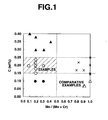
- FIG. 1 is a diagram showing the carbon, manganese and chromium content percentages of high-tensile steel sheets according to the present invention and according to the earlier technology.
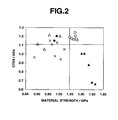
- FIG. 2 is a diagram showing the relationship of joint strength and material strength of the high-tensile steel sheets according the present invention and according to the earlier technology.
- a high-tensile steel sheet according to the present invention will be described in detail below. In the following description, all percentages are by mass unless otherwise specified.
- the high-tensile steel sheet of the present invention comprises 0.15 to 0.25% of C, 0.1 to 2.0% of Si, 0.10 to 1.0% of Mn, 0.5 to 3.5% of Cr and the balance being Fe and unavoidable impurities based on the total mass of the steel sheet and satisfies a content ratio of Mn/(Mn+Cr) ⁇ 0.50.
- the high-tensile steel sheet of the present invention may further comprise 0.1 to 3.0% of Ni, 0.01 to 3.0% of Cu and 0.001 to 0.1 % of A1 based on the total mass of the steel sheet.
- the C content of the high-tensile steel sheet is particularly effective in increasing the strength of the high-tensile steel sheet. If the C content of the high-tensile steel sheet is less than 0.15%, the high-tensile steel sheet fails to secure desired strength. If the C content of the high-tensile steel sheet exceeds 0.25%, the high-tensile steel sheet deteriorates in toughness during resistance welding. In the present invention, the C content of the high-tensile steel sheet is thus controlled to within the range of 0.15 to 0.25%, preferably 0.18 to 0.22%, more preferably 0.19 to 0.21 %, in order for the high-tensile steel sheet to secure desired strength without deteriorating in toughness due to resistance welding.
- Si silicon is effective in deoxidation and strength improvement. If the Si content of the high-tensile steel sheet is less than 0.1 %, the high-tensile steel sheet cannot obtain a desired deoxidation and strength improvement effect. If the Si content of the high-tensile steel sheet exceeds 2.0%, the high-tensile steel sheet may deteriorate in toughness. The Si content of the high-tensile steel sheet is thus controlled to within the range of 0.10 to 2.0% in the present invention.
- Mn manganese
- Mn manganese
- the Mn content of the high-tensile steel sheet is thus controlled to within the range of 0.10 to 1.0%, preferably 0.1 to 0.5%, more preferably 0.1 to 0.3%, in the present invention.
- Cr chromium
- Cr is effective in hardenability improvement and capable of replacing the other component in cementite so as to retard temper softening of the high-tensile steel sheet.
- the addition of Cr in an amount of more than 3.5% may cause not only a saturation of the hardenability improvement effect but a deterioration in steel sheet toughness.
- the Cr content of the high-tensile steel sheet is thus controlled to within the range of 0.5 to 3.5% in the present invention.
- Ni nickel
- Ni nickel
- the Ni content of the high-tensile steel sheet is thus preferably controlled to within the range of 0.1 to 3.0% in the present invention.
- Cu copper
- Cu copper
- the Cu content of the high-tensile steel sheet is thus preferably controlled to within the range of 0.01 to 3.0% in the present invention.
- Al (aluminum) is effective in deoxidation. It is desirable to add 0.001% or more of A1 into the high-tensile steel sheet as necessity. However, there arises a possibility of inclusion formation and/or workability deterioration when Al is added excessively into the high-tensile steel sheet.
- the Al content of the high-tensile steel sheet is thus preferably controlled to within the range of 0.001 to 0.1% in the present invention.
- P (phosphorous) and S (sulfur) are generally contained as impurities in the high-tensile steel sheet. Both of these impurity elements P and S can cause a deterioration in grain boundary strength. In the present invention, it is thus desirable to minimize the P and S contents of the high-tensile steel sheet, and more specifically, to control the P content of the high-tensile steel sheet to 0.2% or less and control the S content of the high-tensile steel sheet to 0.1 % or less.
- the high-tensile steel sheet deteriorates in hardenability when the Mn content of the high-tensile steel sheet is limited to 0.10 to 1.0%.
- the Cr content becomes increased according to the decrease in the Mn content so that Cr contributes to steel hardenability in place of Mn in the present invention.
- the Mn content of the high-tensile steel sheet is made lower than the Cr content of the high-tensile steel sheet to satisfy a content ratio of Mn / (Mn + Cr) ⁇ 0.5 in the present invention. If the Mn content is greater than or equal to the Cr content so that the content ratio Mn / (Mn + Cr) becomes higher than or equal to 0.5, the high-tensile steel sheet undesirably deteriorates in toughness during resistance welding.
- the high-tensile steel sheet secures sufficient hardenability even when the C content of the high-tensile steel sheet increases up to 0.25%, and thus shows a tensile strength of 1180 MPa or higher by hot rolling.
- the high-tensile steel sheet may have a surface treated with zinc plating so as to attain excellent rust resistance.
- zinc plating can be performed by any know technique such as electroplating, hot dipping or thermal spraying.
- the high-tensile steel sheet also secures excellent resistance weldability and thus can be applied to various mechanical parts by resistance welding e.g. resistance spot welding or resistance seam welding.
- the high-tensile steel sheet is suitable for automotive parts, notably vehicle body parts, for vehicle weight reduction and strength improvement.
- the resistance welded joint may preferably be cooled, heated again to a temperature range from an AC3 transformation temperature (at which the steel completes change from ferrite or pearlite to austenite under heating or begins change from austenite to ferrite or pearlite upon cooling) to a temperature 100°C higher than the AC3 transformation temperature, and then, recooled so as to provide the resistance welded joint portion of the high-tensile steel sheet with a finer prior austenite grain size for stable welding joint strength.
- an AC3 transformation temperature at which the steel completes change from ferrite or pearlite to austenite under heating or begins change from austenite to ferrite or pearlite upon cooling
- the resistance welded joint may preferably be further tempered at a temperature range from 150°C to an AC1 transformation temperature (at which austenite begins to form on heating), after the above recooling step, so as to provide the resistance welded joint portion of the high-tensile steel sheet with excellent toughness and ductility for more stable joint strength.
- the metal member may be or may not be a high-tensile steel sheet according to the present invention.
- steel sheets were formed with a thickness of 2.0 mm by heating steel materials at 1200°C, subjecting the steel materials to hot rolling of which the finishing temperature was 900 to 1000°C, cooling the steel materials at about 30°C/sec and keeping the steel sheets at 400 to 600°C.
- the chemical compositions of the steel sheets are indicated in TABLE 1 and FIG. 1. In FIG.
- the open circles represent the steel compositions of Examples 1-8 (intermediate carbon, low manganese, high-Cr steels according to the present invention); the filled circles represent the steel compositions of Comparative Examples 1-2 (low carbon, low manganese, high chromium steels); the filled triangles represent the steel compositions of Comparative Examples 3-7 (high carbon, low manganese, high chromium steels); the open triangles represents the steel compositions of Comparative Examples 8-11 (ordinary low carbon steels); and the crosses represent the steel compositions of Comparative Examples 12-18 (ordinary intermediate carbon steels).
- the C-Mn-Cr content range (0.15% ⁇ C ⁇ 0.25%, Mn/(Mn+Cr) ⁇ 0.5) according to the present invention is indicated by hatching in FIG. 1.
- the open circles represent the mechanical steel properties of Examples 1-8 (intermediate carbon, low manganese, high-Cr steels according to the present invention); the filled circles represent the mechanical steel properties of Comparative Examples 1-2 (low carbon, low manganese, high chromium steels); the filled triangles represent the mechanical steel properties of Comparative Examples 3-7 (high carbon, low manganese, high chromium steels); the open triangles represents the mechanical steel properties of Comparative Examples 8-11 (ordinary low carbon steels); and the crosses represent the mechanical steel properties of Comparative Examples 12-18 (ordinary intermediate carbon steels) as is the case with FIG. 1.
- test specimens were cut into test specimens. Joint surfaces of the test specimens were degreased and subjected to spot welding with a welding current of 10 to 14 kA for 19 to 23 cycles under a pressure of 4950 to 6450 kN.
- Tensile shear test and cross tension test were conducted on the spot welded test specimens according to JIS Z 3136 and JIS Z 3137 to determine a tensile shear strength TSS and a cross tension strength CTS of each test specimen.
- Section test was also conducted on the spot welded test specimens according to JIS Z 3139.
- the cross sections of the test specimens before and after the spot welding were subjected to grinding and etching with a natal solution and observed by an optical microscope with a magnification of 100 to 1000 times and by a scanning electron microscope (SEM) with a magnification of 1000 to 5000 times, thereby determining the nugget diameter ND of each test specimen to see the influence of welding heat on the steel structure.
- SEM scanning electron microscope
- the resistance welded joint portion of the steel sheet shows an increase in tensile shear strength TSS but does not show an increase in cross tension strength CTS when the steel material strength exceeds 590 MPa. For this reason, it is desirable to evaluate the joint strength (resistance welding strength) of the steel sheets by comparison of the test results of the cross tension strength CTS.
- the tensile shear strength TSS and the cross tension strength CTS were measured in loads in the tensile shear test and cross tension test and thus converted to a tensile shear stress TSS' and a cross tension stress CTS' by dividing these strength measurement values by a nugget area ⁇ (ND/2) 2 , respectively, in order to evaluate the joint strength of each test specimen in terms of the sum of CTS components of the tensile shear stress TSS' and the cross tension stress CTS' (referred to as "stress intensity factor").
- the tensile shear stress TSS', the cross tension stress CTS' and the stress intensity factor CTSS were determined according to the following equations. The evaluation results are also indicated in TABLE 2.
- TSS ⁇ TSS / ⁇ ⁇ ND / 2 2
- CTS ⁇ CTS / ⁇ ⁇ ND / 2
- the rupture pattern of the resistance welded joint portion of the steel sheet is one of factors having the greatest influence on the joint strength stability.
- the resistance welding strength of the steel sheet is in general stable in the case where the resistance welded joint portion of the steel sheet undergoes plug rupture according to JIS Z 3136.
- the steel sheets of Comparative Examples 1-18 were not within the C-Mn-Cr content range of the present invention and were poor in tensile strength and/or welding performance.
- the steel sheets of Examples 1-8 fell within the C-Mn-Cr content range of the present invention and had a tensile strength TS of 1180 MPa or higher and a stress drop degree SD of 2.2 GPa.
- the spot welded portions of these steel sheets had good weldability performance in all aspects (welding joint strength, no steel softening and plug rupture). It has been thus shown that the steel sheets of Examples 1-8 according to the present invention combined high strength, toughness and ductility with excellent resistance weldability.
- the spot welded test specimen of the steel sheet of Example 1 was further subjected to heat treatment, for tempering, by reheating the test specimen to 800°C by high-frequency heating and, immediately after the reheating (e.g. after a lapse of 10 seconds), cooling the test specimen. Subsequently, the steel structure of the test specimen was observed to determine the prior austenite grain size of the test specimen according to JIS G 0551. The spot welded test specimen was also tested again for its weldabilty performance in the same manner as above.
- the test specimen of the steel sheet of sample 1 had a martensite structure with an average prior austenite grain size of 3 ⁇ m after the post-welding heat treatment.
- the weldability performance of the test specimen after the post-welding heat treatment was equal to or better than before the post-welding heat treatment. It is thus estimated that the spot welded portion of the steel sheet of Example 1 showed high toughness and ductility after the post-welding heat treatment.
- the present invention provides the high-tensile steel sheet with both of high strength and excellent resistance weldability by controlling the C content to within 0.15 to 0.25% and increasing the Cr content according to the decrease in the Mn content to satisfy the content ratio of Mn/(Mn+Cr) ⁇ 0.5.
Landscapes
- Chemical & Material Sciences (AREA)
- Engineering & Computer Science (AREA)
- Mechanical Engineering (AREA)
- Materials Engineering (AREA)
- Metallurgy (AREA)
- Organic Chemistry (AREA)
- Physics & Mathematics (AREA)
- Thermal Sciences (AREA)
- Crystallography & Structural Chemistry (AREA)
- Heat Treatment Of Sheet Steel (AREA)
- Body Structure For Vehicles (AREA)
Applications Claiming Priority (2)
| Application Number | Priority Date | Filing Date | Title |
|---|---|---|---|
| JP2006137229 | 2006-05-17 | ||
| JP2007043384A JP5142068B2 (ja) | 2006-05-17 | 2007-02-23 | 抵抗スポット溶接用高張力鋼板及びその接合方法 |
Publications (2)
| Publication Number | Publication Date |
|---|---|
| EP1857564A2 true EP1857564A2 (fr) | 2007-11-21 |
| EP1857564A3 EP1857564A3 (fr) | 2013-03-27 |
Family
ID=38457911
Family Applications (1)
| Application Number | Title | Priority Date | Filing Date |
|---|---|---|---|
| EP07009820A Withdrawn EP1857564A3 (fr) | 2006-05-17 | 2007-05-16 | Plaque d'acier à forte traction, procédé d'assemblage de plaques d'acier et pièce automobile de haute résistante |
Country Status (3)
| Country | Link |
|---|---|
| US (1) | US20070269678A1 (fr) |
| EP (1) | EP1857564A3 (fr) |
| JP (1) | JP5142068B2 (fr) |
Families Citing this family (13)
| Publication number | Priority date | Publication date | Assignee | Title |
|---|---|---|---|---|
| JP5175470B2 (ja) * | 2006-11-30 | 2013-04-03 | 株式会社神戸製鋼所 | マグネシウム合金材およびその製造方法 |
| US9040865B2 (en) | 2007-02-27 | 2015-05-26 | Exxonmobil Upstream Research Company | Corrosion resistant alloy weldments in carbon steel structures and pipelines to accommodate high axial plastic strains |
| AT505877B1 (de) * | 2007-10-05 | 2010-04-15 | Vae Eisenbahnsysteme Gmbh | Zwischenstück und verfahren zum verbinden von manganstahlformkörpern mit regelschienen |
| JP5182855B2 (ja) * | 2007-11-28 | 2013-04-17 | 日産自動車株式会社 | 抵抗溶接鋼板 |
| US8820615B2 (en) * | 2008-07-11 | 2014-09-02 | Aktiebolaget Skf | Method for manufacturing a steel component, a weld seam, a welded steel component, and a bearing component |
| CN102227283B (zh) * | 2008-09-30 | 2013-11-13 | 高周波热炼株式会社 | 金属构件的焊接装置以及金属构件的焊接方法 |
| JP5704721B2 (ja) | 2011-08-10 | 2015-04-22 | 株式会社神戸製鋼所 | シーム溶接性に優れた高強度鋼板 |
| MX374818B (es) * | 2012-04-25 | 2025-03-06 | Nippon Steel Corp Star | Junta de soldadura por puntos. |
| JP6036438B2 (ja) * | 2013-03-21 | 2016-11-30 | 新日鐵住金株式会社 | 高強度抵抗溶接継手およびその製造方法 |
| JP6379819B2 (ja) * | 2014-07-31 | 2018-08-29 | 新日鐵住金株式会社 | 重ね溶接部材、重ね溶接部材の重ね抵抗シーム溶接方法及び重ね溶接部を備える自動車用重ね溶接部材 |
| KR20220152215A (ko) | 2020-03-13 | 2022-11-15 | 고꾸리쯔 다이가꾸 호우징 오사까 다이가꾸 | 고상 점접합 방법 및 고상 점접합 장치 |
| CN115673501A (zh) * | 2021-07-30 | 2023-02-03 | 上海汽车集团股份有限公司 | 一种钢带的塔接电阻焊方法 |
| CN115074488B (zh) * | 2022-07-18 | 2023-12-15 | 江苏顺得利金属有限公司 | 一种防锈且耐腐蚀的辐条及其加工方法 |
Family Cites Families (22)
| Publication number | Priority date | Publication date | Assignee | Title |
|---|---|---|---|---|
| US3544393A (en) * | 1967-08-11 | 1970-12-01 | Nat Steel Corp | Method of manufacturing low carbon high tensile strength alloy steel |
| US4388122A (en) * | 1980-08-11 | 1983-06-14 | Kabushiki Kaisha Kobe Seiko Sho | Method of making high strength hot rolled steel sheet having excellent flash butt weldability, fatigue characteristic and formability |
| JPS57137426A (en) * | 1981-02-20 | 1982-08-25 | Kawasaki Steel Corp | Production of low yield ratio, high tensile hot rolled steel plate by mixed structure |
| JPS61124554A (ja) * | 1984-11-20 | 1986-06-12 | Nippon Steel Corp | 耐サワ−性の優れた高靭性電縫鋼管用鋼 |
| JPH07116554B2 (ja) * | 1989-12-07 | 1995-12-13 | 新日本製鐵株式会社 | 被削性の優れた機械構造用電気抵抗溶接鋼管 |
| JPH03177540A (ja) * | 1989-12-07 | 1991-08-01 | Nippon Steel Corp | 被削性の優れた機械構造用電気抵抗溶接鋼管 |
| JP2960771B2 (ja) * | 1990-11-15 | 1999-10-12 | 株式会社神戸製鋼所 | 圧壊強度の優れたドアーガードバー |
| JPH0559493A (ja) * | 1991-08-30 | 1993-03-09 | Nkk Corp | 車輛ドアにおけるインパクトバー用高強度電縫鋼管およびその製造法 |
| JP2845020B2 (ja) * | 1992-03-03 | 1999-01-13 | 日本鋼管株式会社 | アズロール型超高張力電縫鋼管の製造方法 |
| US5470529A (en) * | 1994-03-08 | 1995-11-28 | Sumitomo Metal Industries, Ltd. | High tensile strength steel sheet having improved formability |
| JPH08120346A (ja) * | 1994-10-25 | 1996-05-14 | Sumitomo Metal Ind Ltd | 耐硫化物応力割れ性に優れる油井用溶接鋼管の製造方法 |
| JPH0953145A (ja) * | 1995-08-15 | 1997-02-25 | Nkk Corp | 耐炭酸ガス腐食性に優れた電縫溶接鋼管及びその製造方法 |
| JP3745567B2 (ja) * | 1998-12-14 | 2006-02-15 | 新日本製鐵株式会社 | 電縫溶接性に優れたボイラ用鋼およびそれを用いた電縫ボイラ鋼管 |
| JP3545980B2 (ja) * | 1999-12-06 | 2004-07-21 | 株式会社神戸製鋼所 | 耐遅れ破壊特性の優れた自動車用超高強度電縫鋼管およびその製造方法 |
| JP3537039B2 (ja) * | 2000-02-28 | 2004-06-14 | Jfeスチール株式会社 | 熱延下地の溶融亜鉛メッキ鋼板及びその製造方法 |
| JP4418077B2 (ja) * | 2000-03-29 | 2010-02-17 | 新日本製鐵株式会社 | 成形性に優れた鋼管およびその製造方法 |
| KR100545621B1 (ko) * | 2001-03-07 | 2006-01-24 | 신닛뽄세이테쯔 카부시키카이샤 | 중공 스태빌라이저용 전봉 용접 강관 |
| EP1375683B1 (fr) * | 2001-03-29 | 2012-02-08 | Sumitomo Metal Industries, Ltd. | Tube en acier a haute resistance pour coussin d'air et procede pour la production de ce tube |
| US20050034795A1 (en) * | 2001-08-17 | 2005-02-17 | Takashi Motoyoshi | Highly impact-resistant steel pipe and method for producing the same |
| FR2830260B1 (fr) * | 2001-10-03 | 2007-02-23 | Kobe Steel Ltd | Tole d'acier a double phase a excellente formabilite de bords par etirage et procede de fabrication de celle-ci |
| US20050000601A1 (en) * | 2003-05-21 | 2005-01-06 | Yuji Arai | Steel pipe for an airbag system and a method for its manufacture |
| KR100895163B1 (ko) * | 2004-10-29 | 2009-05-04 | 수미도모 메탈 인더스트리즈, 리미티드 | 에어백 인플레이터용 강관과 그 제조 방법 |
-
2007
- 2007-02-23 JP JP2007043384A patent/JP5142068B2/ja not_active Expired - Fee Related
- 2007-05-16 EP EP07009820A patent/EP1857564A3/fr not_active Withdrawn
- 2007-05-16 US US11/798,674 patent/US20070269678A1/en not_active Abandoned
Non-Patent Citations (1)
| Title |
|---|
| None * |
Also Published As
| Publication number | Publication date |
|---|---|
| JP2007332452A (ja) | 2007-12-27 |
| US20070269678A1 (en) | 2007-11-22 |
| JP5142068B2 (ja) | 2013-02-13 |
| EP1857564A3 (fr) | 2013-03-27 |
Similar Documents
| Publication | Publication Date | Title |
|---|---|---|
| EP1857564A2 (fr) | Plaque d'acier à forte traction, procédé d'assemblage de plaques d'acier et pièce automobile de haute résistante | |
| EP3719149B1 (fr) | Produit d'acier à dureté élevée et son procédé de fabrication | |
| KR100996395B1 (ko) | 자동차 구조 부재용 고장력 용접 강관 및 그 제조 방법 | |
| EP2540854B1 (fr) | Feuille d'acier laminée à froid de super-haute résistance ayant d'excellentes propriétés de flexion | |
| EP2708612A1 (fr) | Acier pour composant ressort de suspension d'automobile, composant ressort de suspension d'automobile, et procédé de fabrication correspondant | |
| EP2325346A1 (fr) | Plaque d'acier à haute résistance et son procédé de fabrication | |
| KR20210091755A (ko) | 열간 압연 강철 스트립 및 그 제조 방법 | |
| EP2527484B1 (fr) | Procédé de production d'une tôle en acier galvanisé à haute résistance présentant une excellente aptitude au traitement et une excellente soudabilité par points | |
| JP2005171337A (ja) | 自動車構造部材用鋼材およびその製造方法 | |
| EP2813596A1 (fr) | Tôle d'acier à haute résistance à la traction possédant une excellente ténacité à basse température dans des zones affectées thermiquement par la soudure, et son procédé de production | |
| KR102948514B1 (ko) | 자동차용 부재 및 그 저항 스폿 용접 방법 | |
| KR101908818B1 (ko) | 저온에서의 파괴 개시 및 전파 저항성이 우수한 고강도 강재 및 그 제조방법 | |
| KR101811159B1 (ko) | 강 부재 및 그의 제조 방법 | |
| EP4574324A1 (fr) | Procédé de soudage par points par résistance | |
| KR102398709B1 (ko) | 고강도 강판 및 그 제조 방법 | |
| JP2009127119A (ja) | 抵抗溶接鋼板 | |
| US12365958B2 (en) | Electric resistance-welded steel tube for hollow stabilizer, hollow stabilizer, and manufacturing methods of same | |
| KR20200076788A (ko) | 굽힘 가공성이 우수한 고강도 냉연강판 및 그 제조방법 | |
| CN100562599C (zh) | 高抗拉钢板、钢板接合方法及高强度汽车零件 | |
| EP4640886A1 (fr) | Feuille d'acier laminée à chaud et son procédé de fabrication | |
| JP5008173B2 (ja) | 抵抗溶接用高張力鋼板及びその接合方法 | |
| JPH11270531A (ja) | 遅れ破壊特性の優れた高強度ボルトおよびその製造方法 | |
| KR102492994B1 (ko) | 균일한 인장재질 및 용접부 횡크랙 저항성이 우수한 강판, 강관 및 이들의 제조방법 | |
| JP5008172B2 (ja) | 抵抗溶接用高張力鋼板及びその接合方法 | |
| EP4653119A1 (fr) | Joint de soudure par bossage et son procédé de fabrication |
Legal Events
| Date | Code | Title | Description |
|---|---|---|---|
| PUAI | Public reference made under article 153(3) epc to a published international application that has entered the european phase |
Free format text: ORIGINAL CODE: 0009012 |
|
| 17P | Request for examination filed |
Effective date: 20070810 |
|
| AK | Designated contracting states |
Kind code of ref document: A2 Designated state(s): AT BE BG CH CY CZ DE DK EE ES FI FR GB GR HU IE IS IT LI LT LU LV MC MT NL PL PT RO SE SI SK TR |
|
| AX | Request for extension of the european patent |
Extension state: AL BA HR MK YU |
|
| RIC1 | Information provided on ipc code assigned before grant |
Ipc: C22C 38/18 20060101ALI20110630BHEP Ipc: C22C 38/02 20060101AFI20110630BHEP Ipc: C22C 38/40 20060101ALI20110630BHEP Ipc: C22C 38/04 20060101ALI20110630BHEP Ipc: C21D 8/02 20060101ALI20110630BHEP Ipc: C21D 9/46 20060101ALI20110630BHEP Ipc: C22C 38/42 20060101ALI20110630BHEP |
|
| PUAL | Search report despatched |
Free format text: ORIGINAL CODE: 0009013 |
|
| AK | Designated contracting states |
Kind code of ref document: A3 Designated state(s): AT BE BG CH CY CZ DE DK EE ES FI FR GB GR HU IE IS IT LI LT LU LV MC MT NL PL PT RO SE SI SK TR |
|
| AX | Request for extension of the european patent |
Extension state: AL BA HR MK RS |
|
| RIC1 | Information provided on ipc code assigned before grant |
Ipc: C21D 9/50 20060101ALI20130215BHEP Ipc: C21D 8/02 20060101ALI20130215BHEP Ipc: C22C 38/04 20060101ALI20130215BHEP Ipc: C22C 38/02 20060101AFI20130215BHEP Ipc: C22C 38/40 20060101ALI20130215BHEP Ipc: C22C 38/18 20060101ALI20130215BHEP Ipc: C21D 9/46 20060101ALI20130215BHEP Ipc: C22C 38/42 20060101ALI20130215BHEP Ipc: B23K 11/16 20060101ALI20130215BHEP |
|
| AKX | Designation fees paid |
Designated state(s): DE FR GB |
|
| GRAP | Despatch of communication of intention to grant a patent |
Free format text: ORIGINAL CODE: EPIDOSNIGR1 |
|
| INTG | Intention to grant announced |
Effective date: 20171206 |
|
| STAA | Information on the status of an ep patent application or granted ep patent |
Free format text: STATUS: THE APPLICATION IS DEEMED TO BE WITHDRAWN |
|
| 18D | Application deemed to be withdrawn |
Effective date: 20180417 |