EP1868942B1 - Fällungscalciumcarbonat-pigment, insbesondere zur verwendung beim tintenstrahldruck von papierbeschichtungen - Google Patents
Fällungscalciumcarbonat-pigment, insbesondere zur verwendung beim tintenstrahldruck von papierbeschichtungen Download PDFInfo
- Publication number
- EP1868942B1 EP1868942B1 EP06744542.9A EP06744542A EP1868942B1 EP 1868942 B1 EP1868942 B1 EP 1868942B1 EP 06744542 A EP06744542 A EP 06744542A EP 1868942 B1 EP1868942 B1 EP 1868942B1
- Authority
- EP
- European Patent Office
- Prior art keywords
- steps
- slurry
- pcc
- aggregates
- agglomerates
- Prior art date
- Legal status (The legal status is an assumption and is not a legal conclusion. Google has not performed a legal analysis and makes no representation as to the accuracy of the status listed.)
- Expired - Lifetime
Links
Images



Classifications
-
- C—CHEMISTRY; METALLURGY
- C01—INORGANIC CHEMISTRY
- C01F—COMPOUNDS OF THE METALS BERYLLIUM, MAGNESIUM, ALUMINIUM, CALCIUM, STRONTIUM, BARIUM, RADIUM, THORIUM, OR OF THE RARE-EARTH METALS
- C01F11/00—Compounds of calcium, strontium, or barium
- C01F11/18—Carbonates
- C01F11/181—Preparation of calcium carbonate by carbonation of aqueous solutions and characterised by control of the carbonation conditions
-
- C—CHEMISTRY; METALLURGY
- C01—INORGANIC CHEMISTRY
- C01F—COMPOUNDS OF THE METALS BERYLLIUM, MAGNESIUM, ALUMINIUM, CALCIUM, STRONTIUM, BARIUM, RADIUM, THORIUM, OR OF THE RARE-EARTH METALS
- C01F11/00—Compounds of calcium, strontium, or barium
- C01F11/18—Carbonates
-
- B—PERFORMING OPERATIONS; TRANSPORTING
- B82—NANOTECHNOLOGY
- B82Y—SPECIFIC USES OR APPLICATIONS OF NANOSTRUCTURES; MEASUREMENT OR ANALYSIS OF NANOSTRUCTURES; MANUFACTURE OR TREATMENT OF NANOSTRUCTURES
- B82Y30/00—Nanotechnology for materials or surface science, e.g. nanocomposites
-
- C—CHEMISTRY; METALLURGY
- C01—INORGANIC CHEMISTRY
- C01F—COMPOUNDS OF THE METALS BERYLLIUM, MAGNESIUM, ALUMINIUM, CALCIUM, STRONTIUM, BARIUM, RADIUM, THORIUM, OR OF THE RARE-EARTH METALS
- C01F11/00—Compounds of calcium, strontium, or barium
- C01F11/18—Carbonates
- C01F11/182—Preparation of calcium carbonate by carbonation of aqueous solutions and characterised by an additive other than CaCO3-seeds
-
- C—CHEMISTRY; METALLURGY
- C01—INORGANIC CHEMISTRY
- C01F—COMPOUNDS OF THE METALS BERYLLIUM, MAGNESIUM, ALUMINIUM, CALCIUM, STRONTIUM, BARIUM, RADIUM, THORIUM, OR OF THE RARE-EARTH METALS
- C01F11/00—Compounds of calcium, strontium, or barium
- C01F11/18—Carbonates
- C01F11/185—After-treatment, e.g. grinding, purification, conversion of crystal morphology
-
- C—CHEMISTRY; METALLURGY
- C09—DYES; PAINTS; POLISHES; NATURAL RESINS; ADHESIVES; COMPOSITIONS NOT OTHERWISE PROVIDED FOR; APPLICATIONS OF MATERIALS NOT OTHERWISE PROVIDED FOR
- C09C—TREATMENT OF INORGANIC MATERIALS, OTHER THAN FIBROUS FILLERS, TO ENHANCE THEIR PIGMENTING OR FILLING PROPERTIES ; PREPARATION OF CARBON BLACK ; PREPARATION OF INORGANIC MATERIALS WHICH ARE NO SINGLE CHEMICAL COMPOUNDS AND WHICH ARE MAINLY USED AS PIGMENTS OR FILLERS
- C09C1/00—Treatment of specific inorganic materials other than fibrous fillers; Preparation of carbon black
- C09C1/02—Compounds of alkaline earth metals or magnesium
-
- D—TEXTILES; PAPER
- D21—PAPER-MAKING; PRODUCTION OF CELLULOSE
- D21H—PULP COMPOSITIONS; PREPARATION THEREOF NOT COVERED BY SUBCLASSES D21C OR D21D; IMPREGNATING OR COATING OF PAPER; TREATMENT OF FINISHED PAPER NOT COVERED BY CLASS B31 OR SUBCLASS D21G; PAPER NOT OTHERWISE PROVIDED FOR
- D21H19/00—Coated paper; Coating material
- D21H19/36—Coatings with pigments
- D21H19/38—Coatings with pigments characterised by the pigments
-
- B—PERFORMING OPERATIONS; TRANSPORTING
- B41—PRINTING; LINING MACHINES; TYPEWRITERS; STAMPS
- B41M—PRINTING, DUPLICATING, MARKING, OR COPYING PROCESSES; COLOUR PRINTING
- B41M5/00—Duplicating or marking methods; Sheet materials for use therein
- B41M5/50—Recording sheets characterised by the coating used to improve ink, dye or pigment receptivity, e.g. for ink-jet or thermal dye transfer recording
- B41M5/52—Macromolecular coatings
- B41M5/5218—Macromolecular coatings characterised by inorganic additives, e.g. pigments, clays
-
- C—CHEMISTRY; METALLURGY
- C01—INORGANIC CHEMISTRY
- C01P—INDEXING SCHEME RELATING TO STRUCTURAL AND PHYSICAL ASPECTS OF SOLID INORGANIC COMPOUNDS
- C01P2004/00—Particle morphology
- C01P2004/10—Particle morphology extending in one dimension, e.g. needle-like
-
- C—CHEMISTRY; METALLURGY
- C01—INORGANIC CHEMISTRY
- C01P—INDEXING SCHEME RELATING TO STRUCTURAL AND PHYSICAL ASPECTS OF SOLID INORGANIC COMPOUNDS
- C01P2004/00—Particle morphology
- C01P2004/50—Agglomerated particles
-
- C—CHEMISTRY; METALLURGY
- C01—INORGANIC CHEMISTRY
- C01P—INDEXING SCHEME RELATING TO STRUCTURAL AND PHYSICAL ASPECTS OF SOLID INORGANIC COMPOUNDS
- C01P2004/00—Particle morphology
- C01P2004/51—Particles with a specific particle size distribution
-
- C—CHEMISTRY; METALLURGY
- C01—INORGANIC CHEMISTRY
- C01P—INDEXING SCHEME RELATING TO STRUCTURAL AND PHYSICAL ASPECTS OF SOLID INORGANIC COMPOUNDS
- C01P2004/00—Particle morphology
- C01P2004/54—Particles characterised by their aspect ratio, i.e. the ratio of sizes in the longest to the shortest dimension
-
- C—CHEMISTRY; METALLURGY
- C01—INORGANIC CHEMISTRY
- C01P—INDEXING SCHEME RELATING TO STRUCTURAL AND PHYSICAL ASPECTS OF SOLID INORGANIC COMPOUNDS
- C01P2004/00—Particle morphology
- C01P2004/60—Particles characterised by their size
- C01P2004/61—Micrometer sized, i.e. from 1-100 micrometer
-
- C—CHEMISTRY; METALLURGY
- C01—INORGANIC CHEMISTRY
- C01P—INDEXING SCHEME RELATING TO STRUCTURAL AND PHYSICAL ASPECTS OF SOLID INORGANIC COMPOUNDS
- C01P2004/00—Particle morphology
- C01P2004/60—Particles characterised by their size
- C01P2004/64—Nanometer sized, i.e. from 1-100 nanometer
-
- C—CHEMISTRY; METALLURGY
- C01—INORGANIC CHEMISTRY
- C01P—INDEXING SCHEME RELATING TO STRUCTURAL AND PHYSICAL ASPECTS OF SOLID INORGANIC COMPOUNDS
- C01P2006/00—Physical properties of inorganic compounds
- C01P2006/12—Surface area
Definitions
- the present invention relates to novel mineral pigments of the precipitated calcium carbonate species (PCC).
- the invention relates to novel and innovative PCC pigments, able to be used in a paper coating formulations to manufacture coated high-quality matt papers, in particular for inkjet applications, whose print qualities would be identical to commercially-available coated high-quality matt inkjet papers, but coated using pigments having a reduced production cost.
- the invention also relates to the production of said novel mineral pigments of the PCC species in slurry form, present in a solids content appropriate for inkjet paper coating on a coater such as a VaribarTM, airknife, curtain or blade off-line coater.
- a coater such as a VaribarTM, airknife, curtain or blade off-line coater.
- One of the main hurdles to achieve an increase in print quality is to increase the optical density of the ink applied to the paper surface, in particular following full colour spectrum dye ink application.
- Inkjet printers form images by applying a series of ink dots on the paper surface.
- the dye inks used in inkjet printing are generally anionic and in a low solids formulation that is naturally very mobile. Good print quality is only obtained if the ink dye remains on the paper surface as the ink solvent penetrates into the paper, leaving a uniform circular dot at the point of application.
- one solution to increase optical density lies in increasing the number of cationic sites near the paper surface. If the paper surface is coated, the number of cations present near the surface can be increased by adding cationic additives to the coating formulation. However, adding cationic additives in order to obtain a given optical density adds significantly to the final paper cost.
- coating holdout Increasing the fraction of cationic additive retained in a thin layer near the paper surface, characterised by the coating holdout, is a second solution to increase optical density.
- Higher coating holdout can be achieved through the use of a narrower coating particle size distribution, which is a technically difficult and expensive solution.
- PCC is present in the coating formulation
- the inherent adsorptive properties of PCC particles towards ink dyes can offer another alternative to reduce the quantity of cationic additives necessary to ensure a given optical density.
- decreasing the primary PCC particle size increases the positively-charged pigment surface area available to interact with and bind ink dye. This promotes ink dye adsorption on the PCC particles near the site of ink application, which leads to an increase in optical density.
- a second challenge in increasing print quality is to reduce the bleeding phenomenon observed following ink application to the paper surface.
- Ink dye bleeding of one colour into another adjacent colour occurs as a result of latent ink dye binding to and drying on the paper surface, and is partly due to delayed ink solvent absorption into the base paper, which serves to bring the ink dye in contact with the surface for rapid binding.
- Bleeding has as a consequence that printed images are distorted and appear less sharp.
- feathering also results in blurred images and occurs when deposited ink follows the contours of the paper. As with ink bleeding, it is rectified by rapid ink drying, preferring dye absorption to adsorption when using porous media.
- a third challenge in obtaining a high print quality is to decrease the print unevenness in the final paper product.
- Print unevenness is the result of the inhomogeneous penetration of the ink-binding elements (cationic additive or coating pigment) of the coating formulation into the base paper.
- Coating formulations having a low solids content present an increased risk of solvent entraining the ink-binding elements away from the paper surface during two phenomena: as the formulation solvent passes into the base paper following paper coating and during the later movement of the solvent to the paper surface during drying.
- Such surface unevenness can be limited by using a slurry presenting a high solids content, which limits the quantity of solvent passing into and out of the base paper.
- such a high solids content in incompatible with some of the above objectives or theoretical solutions.
- Known multipurpose inkjet papers are characterized by surface sized or slightly pigmented qualities and generally surface sized or coated on a cost-efficient on-line coater, such as the Metered Size Press (MSP) or Film Press, allowing a high coating application speed and coating a lower coat weight than their off-line-counterparts.
- MSP Metered Size Press
- Film Press allowing a high coating application speed and coating a lower coat weight than their off-line-counterparts.
- Speciality grade inkjet papers are characterized by a superior high-resolution print quality relative to multipurpose papers. Such papers are generally coated at a high coat weight with formulations including special high quality binders and additives via more costly coating techniques, employing for example VaribarTM, airknife, curtain or blade off-line coaters.
- the cost of a known multipurpose inkjet paper is inferior to the cost of a high resolution matt inkjet paper by an order of magnitude which is roughly 6 to 20 times.
- the man skilled in the art recognises the benefits of being able to obtain a high quality paper coating using a low cost coating solution.
- cost reduction can be attained by promoting a more rapid paper drying step following coating. More rapid drying translates to a higher paper machine speed and increased productivity since the risk of wet coating material deposits on the papermaking machine is reduce. More rapid drying is possible through the use of a maximum solids content coating formulation.
- a high solids coating formulation also reduces the cost associated with transporting said coating formulation from the pigment manufacturer to the paper mill, respectively coating plant.
- a final concern of the man skilled in the art is to ensure an equal or improved runnability (number of sheets produced without failure) on coating machines such as the Varibar or airknife. It is known that these coaters demonstrate an improved runnability when using an increased coating slurry solids content, while maintaining a low (500 to 1500 mPAs) slurry viscosity.
- the overall technical problem, and technical challenge is to develop a novel class of PCC pigments structured to be used in a paper coating process to manufacture a paper which is "technically speaking" a coated high-quality matt paper, in particular for inkjet applications, but at lower cost relative to other coated papers of the same grade, while maintaining print quality.
- Pigment options for use in high quality inkjet paper coatings currently on the market include specialty PCC inkjet pigments, such as those of EP 0 815 174 , or expensive fumed or precipitated silica.
- silica is generally limited to low solids coating formulation, whose use considerably reduces the coating line speed, further increasing to overall coating cost. The man skilled in the art is therefore motivated to seek lower cost coating alternatives available in higher solids formulations.
- an organophosphonate compound such as an amine-containing phosphoric acid or ethanol amine bis-(methylenephosphonic acid)
- a PCC slurry in a quantity corresponding to 0.4 to 0.85% by weight relative to the weight of PCC.
- Said slurry is then heat aged over a sufficient time period (1 to 10 hours at a temperature exceeding 75°C, or 2 to 5 hours at 80 to 85°C) to impart a specific surface area exceeding 60 m 2 /g.
- Alum or other inorganic, aluminium-containing compounds can be coprecipitated during the synthesis of PCC.
- addition of aluminium sulphate octadecahydrate is performed just prior to the carbon dioxide introduction.
- up to 10% by weight of hydrated aluminium sulphate can also be introduced.
- the heat ageing and/or milling of the PCC are regarded as critical in order to reach an appropriate level of ink binding to the PCC.
- EP 1 246 729 is presented as an improvement over the above mentioned patent, and the product of this patent is said to feature a surface area of 60 to 65 m 2 /g, preferably 80 to 90 m 2 /g, and generally no more than 95 to 100 m 2 /g. That surface area is said to be obtained by heat ageing in the presence of an organophosphonate compound, as indicated above.
- the PCC particles are said to be individually spherical in shape, with a diameter of the order of 0.02 to 0.03 ⁇ m. This high specific surface area PCC presenting a narrow particle size is obtained in a 25% solids slurry.
- EP 1 246 729 comes from the combination of a finely divided PCC, presenting a surface area exceeding 60 m 2 /g, in a major proportion, and a minor proportion of a gel-type silica, along with a binder.
- the resulting composition can be blade coated, or less preferably coated using an air knife and Meyer bar.
- USP 5,750,086 describes a process for manufacturing ultrafine particles of colloidal calcium carbonate (PCC), in which magnesium sulphate is added to a 3 to 14% by weight aqueous suspension of calcium hydroxide, followed by carbonation with the introduction of zinc sulphate alone or together with sulphuric acid.
- PCC colloidal calcium carbonate
- the introduced metal salts solutions or sulphuric acid have a concentration of 10 % by weight.
- the process is said to lead to chain-structured ultrafine particles of colloidal calcium carbonate having an average diameter of 0.01 ⁇ m of smaller, an average length of 0.05 ⁇ m or smaller, and a BET specific surface area of 70 m 2 /g or greater.
- the obtained ultrafine particles are said to "show lower affinity of aggregation". Indeed, the applicant primarily targets applications requiring non-aggregated fillers, such as plastic applications wherein the dispersibility of the end product is important.
- the present invention targets an aggregated/agglomerated product for inkjet paper applications.
- Example 1 a problem with the slurry produced in Example 1 is the low solids content which is useful in many applications in the considered industries, but is not suitable for high quality paper coating. This represented an additional problem to be solved, as will be seen herebelow.
- Japanese patent 2004 - 299302 teaches an inkjet record form featuring an "ink acceptance layer", said layer comprising calcium carbonate as a principal pigment, which leads to improved feathering and bleeding. There is no specific indication as to the properties or structure of said calcium carbonate to be used. This document instead focuses on the use of a dispersant and the cationic charge density of said dispersant.
- EP 0 761 782 , Japanese patent 10 - 265 725 and Japanese patent 2004 - 197 055 each describe improved inks for inkjet printing, namely used to improve optical density, bleeding and/or feathering upon printing. None of these patents give a specific indication as to the coating pigment to be used when preparing the paper sheet.
- US 2003/0227 531 A1 discloses a paper coating of a polyvalent metal salt, such as calcium, magnesium or aluminium onto one surface of the base paper, in order to improve feathering and bleeding.
- a polyvalent metal salt such as calcium, magnesium or aluminium
- the objectives of the invention can only be fully reached by the combination of the specific process for preparing porous, stable, agglomerates of PCC, using a decisively reduced gas flow rate for the carbonation step, and of the selected upconcentration steps to produce a high solids PCC slurry suitable for inkjet paper coating applications.
- PCC is generally obtained in the prior art via the following steps: a calcium hydroxide slurry at about 13 % solids is bubbled through, optionally with air, precipitating PCC.
- the PCC slurry leaves the carbonation tank when appropriate in view of an appropriate drop in pH and/or conductivity.
- EP 0 768 344 WO 98/52870 ( PCT/US98/09019 ) and WO 99/51691 ( PCT/US99/07233 ).
- the present invention resides in a series of first steps (Steps A) leading to the production of a low solids PCC slurry, comprising essentially porous, stable, agglomerates/aggregates of PCC particles, followed by the upconcentration of said slurry (Steps B) without loss of said agglomerates/aggregates.
- Steps A of the invention relate to a process for the preparation of porous, stable agglomerates/aggregates of PCC as a low solids slurry, and the so-obtained PCC product, which is a new industrial product.
- the invention therefore covers a new process for producing a PCC slurry via the carbonation route, characterized in that the carbonation step is conducted with a carbonation gas flow rate decisively reduced to below 30 litres per minute at standard temperature and pressure per kilogram calcium hydroxide during precipitation (Steps A).
- the present invention also covers a new process for producing a PCC slurry via the carbonation route, additionally characterized in that the production of PCC as described in the above paragraph is conducted in the presence of magnesium sulphate, in combination with one or more group II or III metal sulphates, said metal sulphate(s) being in particular aluminium based and/or zinc based, preferably aluminium based or zinc based.
- steps are based on those described in USP 5,750,086 ,, however with the much lower carbonation gas flow rate as mentioned above.
- the pigment obtained is not a non-agglomerating, ultrafine particular, discrete product, but rather coarse (1 to 5 ⁇ m range) porous and stable agglomerates/aggregates.
- the produced agglomerates/aggregates are surprisingly so stable that they are substantially maintained in agglomerated/aggregated form during a subsequent "upconcentration” step, and astonishingly the finally produced PCC agglomerates/aggregates impart equal print properties when incorporated in high-quality matt inkjet paper coatings, as compared to the print quality of other market papers of higher production cost.
- Steps A of the present invention are additionally characterized by the use of the inventive combination of magnesium sulphate and aluminium sulphate, or magnesium sulphate and zinc sulphate.
- the process of the invention uses the combination of magnesium sulphate and zinc sulphate, to which is added aluminium sulphate, or the combination of magnesium sulphate and aluminium sulphate, to which is added zinc sulphate.
- a less preferred embodiment includes the use of magnesium sulphate and one or more sulphates of group II and/or III metals.
- the invention additionally lies in the combination of the PCC production process (Steps A), with subsequent particular upconcentration (dewatering/redispersion) steps without dispersant or in the presence of a cationic dispersant (Steps B).
- the final product is, quite surprisingly, a PCC in the form of stable agglomerates/aggregates having an average diameter in the ⁇ m range, namely between 1 and 5 ⁇ m, forming a PCC pigment which, when used in a standard high quality matt inkjet coating formulation, leads to a equal or similar print qualities at reduced cost.
- the invention also covers novel PCC pigments per se, as new industrial products, in the form of stable agglomerates/aggregates in the ⁇ m range, namely between 1 and 5 ⁇ m, as obtained at the end of Steps A or at the end of Steps A and B. This is entirely different from the commercial technologies and prior patents.
- the invention also covers the novel pigment slurries containing said pigments as new industrial products, namely the low solids slurry obtained at the end of Steps A and the high solids slurry obtained at the end of Steps A and B.
- the invention additionally covers novel coating formulations for coating ink jet paper containing said pigments or pigment slurries
- the invention also covers coated ink jet papers, coated with such novel coating formulations.
- the invention relates to:
- the invention also relates to a process as above, in which: A2 In a PCC production process as described above under A1 or A2, the slurry of calcium hydroxide leaving said stainless steel reactor after said separation of said residual impurities and/or non-reactive unburnt lime is treated by a combination of magnesium sulphate and Group II and/or Group III metal sulphates, most preferably in the presence of an acid, said acid being most preferably sulphuric acid, until stable, porous agglomerates/aggregates are obtained at a concentration of 5 to 25% solids, preferably 15 to 20% solids ("precursor").
- the invention also relates to a process as above, in which: A3 In a PCC production process as described above under A1, A2 or A3, the slurry of calcium hydroxide is first prepared by mixing quicklime with water in a stirring reactor or tank ("slake") in a weight ratio of CaO:water between 1:3 and 1:20, preferably between 1:5 and 1:12, most preferably between 1:7 and 1:10.
- the invention also relates to a process as above, in which: A4 In a PCC production process as described above under A1, the temperature is preferably adjusted to between 15 and 50°C, most preferably to between 15 and 30°C, before the slurry is directed towards the carbonation reactor or tank.
- Steps A are followed by the upconcentration of the PCC produced during Steps A, without dispersant or in the presence of cationic dispersant, under sufficiently gentle or mild conditions for the aggregates/agglomerates not to be substantially destroyed, until a concentration of 15 to 50%, preferably in the range 20 to 30%, most preferably 23 to 26% solids by weight is reached.
- the amount of any cationic dispersant added is controlled so that the PCC agglomerates/aggregates of the precursor are just coated, this quantity corresponding that added prior to a slurry viscosity increase.
- the concentrated material is optionally washed with water and a redispersion is performed until the final material substantially consists of stable, porous agglomerates/aggregates identical with or very similar to those obtained in Steps A.
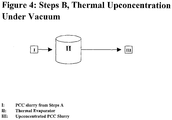
- the upconcentration can be performed in a thermal evaporation step with the final material substantially remaining in the form of the stable, porous agglomerates/aggregates obtained in Steps A.
- the upconcentration of part or all of the precursor may lead to a dry product, and in such a case, the dry product is redispersed until the final material substantially consists of stable, porous agglomerates/aggregates identical with or very similar to those obtained in Steps A.
- the carbonation gas flow rate is preferably selected in the range of 1 to 30, preferably 10 to 20, most preferably around 19.7 litres per minute at standard temperature and pressure per kilogram calcium hydroxide during precipitation.
- Said carbonation gas is CO 2 or a mixture of CO 2 and one or more other gases, such as air and/or nitrogen.
- the slurry of calcium hydroxide is most preferably treated by a combination of magnesium sulphate and aluminium sulphate, or a combination of magnesium sulphate and zinc sulphate.
- zinc sulphate can be added to the combination of magnesium sulphate and aluminium sulphate, or aluminium sulphate can be added to the combination of magnesium sulphate and zinc sulphate.
- magnesium sulphate is most preferably performed before carbonation.
- Magnesium sulphate can be added, in a less preferred option, either before the addition of other sulphates or during that addition.
- magnesium sulphate can be added during carbonation along with aluminium and/or zinc sulphate.
- magnesium sulphate can be added during carbonation or just at the beginning of carbonation.
- aluminium sulphate and/or zinc sulphate most preferably takes place over the period of carbonation.
- the addition of the acid namely sulphuric acid, most preferably in the form of a 10% by weight solution of sulphuric acid, takes place preferably at the beginning of the carbonation. Most preferably, however, the addition of sulphuric acid takes place simultaneously with the addition of aluminium sulphate or zinc sulphate.
- sulphates of Group II and/or III can be added in addition to aluminium sulphate and/or zinc sulphate, or as a substitute for aluminium sulphate and/or zinc sulphate.
- the temperature in the carbonation tank is observed to rise up to between 40 and 80°C, preferably up to between 50 and 60°C, most preferably up to between 56 and 57°C.
- the final slurry product substantially consists of stable, porous agglomerates/aggregates.
- Steps B are optional and/or preferred features in Steps B, to be taken alone or in combination.
- deagglomeration/deaggregation it is meant that the agglomerates/aggregates obtained at the end of Steps A by the specific process of the invention are disintegrated, the disintegrated product being ultrafine PCC of the same kind (with the exception of the contained or deposited metal salts) as the one obtained in USP '086.
- the deagglomeration/deaggregation of the agglomerates/aggregates is kept to a minimum, so that said agglomerates/aggregates are not “substantially destroyed”. More precisely, this means that it is most preferred that during the upconcentration steps, the increase in the fraction of particles below 2 ⁇ m) is limited to less than 30%, preferably less than 20%, most preferably less than 10%, and/or the decrease of the mean aggregate diameter is limited to less than 20%, preferably less than 15%, most preferably less than 10%, as measured according to the means described below.
- the upconcentration step can be performed in the form of any thermal or mechanical separation technology for solid/liquid suspensions provided the aggregates/agglomerates obtained in Steps A ("precursor") are sufficiently stable and are not “substantially destroyed” by said technology.
- a common cationic dispersant may be added in the customary proportions, in order to increase the slurry solids content without overly increasing the viscosity of the slurry.
- the amount of any cationic dispersant added is controlled so that the PCC agglomerates/aggregates of the precursor are just coated, this quantity corresponding that added prior to a slurry viscosity increase.
- a 20% solution of a cationic copolymer such as a cationic copolymer of [2-(methacryloyloxy)ethyl] trimethyl ammonium chloride and [3-(methacrylamido)propyl]trimethyl ammonium chloride
- a cationic copolymer such as a cationic copolymer of [2-(methacryloyloxy)ethyl] trimethyl ammonium chloride and [3-(methacrylamido)propyl]trimethyl ammonium chloride
- upconcentrations with a cationic dispersant or without dispersant are by vacuum filtration or by thermal upconcentration or by centrifuge or by pressurised filter.
- the present invention covers the stable, porous aggregates/agglomerates of PCC produced at the end of Steps A alone ("precursor"), and the final stable, porous aggregates/agglomerates of PCC, as obtained by the above processes, at the end of Steps A in combination with Steps B, said PCC featuring quite innovative properties which in turn make it of particular value for ink-jet applications.
- the stable, porous aggregates/agglomerates of PCC obtained at the end of Steps A as well as those obtained after the upconcentration Steps B can be characterized by a selection of the following: a specific surface area of 30 to 100 m 2 /g, preferably 50 to 80 m 2 /g, and/or a mean aggregate diameter of 1 to 5 ⁇ m, with an average diameter of 2 ⁇ m, and/or a fraction of fines below 2 ⁇ m of less than 20%, preferably of less than 15%, and/or a primary acicular particle size of 20 to 50 nm, with an aspect ratio between 1:2 and 1:10,, and/or a solids content, by weight from 5 to 25%, preferably 15 to 20% at the end of Steps A, and a solids content of 15 to 50%, preferably 20 to 30% solids, in particular 23 to 26% solids at the end of Steps B.
- the final slurry concentration may be partially or wholly obtained by the addition of one or more additional pigments or pigment slurries during Steps B.
- the invention covers the novel pigments characterized in that they comprise stable, porous PCC aggregates/agglomerates as described herein, and novel pigment or PCC slurries characterized in that they comprise stable, porous PCC aggregates/agglomerates as described herein.
- the invention also covers novel pigments and PCC slurries characterized in that their solids concentration is, by weight, from 5 to 25%, preferably 15 to 20% solids at the end of Steps A, and from 15 to 50%, preferably 20 to 30% solids, in particular 23 to 26% solids at the end of Steps B.
- the functional pigment or pigment slurry with a high surface area and integrated cations is incorporated in the coating formulation in a way known to the skilled man, in order to increase namely the optical density upon printing without an increase in bleeding or feathering: this is one of the major achievements of the invention.
- the invention therefore also covers novel coating formulations for the paper making industry characterized in that they comprise novel aggregates/agglomerates of PCC, novel pigments and/or novel slurries described herein.
- the invention also covers coating formulations as described herein characterized in that the PCC slurry which it contains features the following properties: a solids content of 15 to 50%, preferably 20 to 30% solids, in particular 23 to 26%, and/or a high surface area PCC, namely featuring a specific surface area of 30 to 100 m 2 /g, preferably 50 to 80 m 2 /g.
- the invention also covers the applications of the coating formulations according to any of claims 19 or 20 relating to the coating of inkjet paper, namely to the coating of "multipurpose” inkjet paper or of specialty, high quality, paper.
- the most preferred (according to its best mode as of this date) invention relies on the selection of a reduced carbonation gas flow rate during the precipitation of the PCC, the specific combination of cations introduced in the PCC crystal lattice during PCC synthesis, the use of a high solids coating slurry, upconcentrated with dispersant to 15 to 50%, preferably 20 to 30%, in particular around 23 to 26% by weight, in particular for use in paper coatings to be coated on Varibar, airknife or blade off-line coaters, the use a high surface area PCC in the range of 30 to 100 m 2 /g, preferably 50 to 80 m 2 /g at the end of Steps A and at the end of Steps B, the use of small diameter PCC primary crystals, agglomerated/aggregated to form a porous PCC agglomerate.
- the resulting functional pigment surface chemistry ensures an increased ink dye fixation and increased pigment surface area resulting in increased optical density, or a lower cationic additive demand in coating formulation for an equal optical density. No increase or even a decrease in bleeding and/or feathering relative to commercial alternatives is observed.
- the possibility of obtaining a high solids content slurry with the invention pigment leads to better runnability when incorporated in a paper coating formulation and coated on base paper.
- the high solids content leads to less drying energy demand and easier and faster drying; a higher paper machine speed is possible without an increase in deposits on the rolls in paper machine after-drying section.
- the invention leads to a high solids content coating slurry meaning that less energy must be introduced during the drying step, thereby reducing the cost.
- inventive aggregates/agglomerates limits the quantity of binder needed, thereby limiting cost.
- Examples 1, 5, 7 and 10 were prepared according to Steps A of the invention.
- Examples 2, 3, 4, 6, 8, 9, 11 and 12 were upconcentrations of one of Examples 1, 5, 7 and 10, upconcentrated according to the invention (Steps B).
- the quicklime was slaked for 25 minutes under continuous stirring and the resulting slurry of calcium hydroxide ("milk of lime”) at 13.1% w/w solids was then screened on a 100 ⁇ m screen.
- the calcium carbonate precipitation was conducted to a 1000 litre, baffled cylindrical stainless steel reactor equipped with an gasing agitator having a gas dispersion unit, a stainless steel carbonation tube to direct a carbon dioxide/air gas stream to the impeller, and probes for monitoring the pH and conductivity of the suspension.
- the agitator was then adjusted to 1480 rpm, and the slurry was carbonated by passing a gas mixture of 26 volume percent carbon dioxide in air at 118 Nm 3 /h, corresponding to 19.7 litres per minute at standard temperature and pressure per kilogram of calcium hydroxide, through the slurry.
- a gas mixture of 26 volume percent carbon dioxide in air at 118 Nm 3 /h, corresponding to 19.7 litres per minute at standard temperature and pressure per kilogram of calcium hydroxide, through the slurry.
- 100 kg of 10% w/w aqueous solution of zinc sulphate (ZnSO 4 .7H 2 O) and 30 kg of 10% w/w aqueous solution of sulphuric acid were added to the reaction mixture in a continuous manner over the total carbonation time.
- the slurry temperature was allowed to rise due to the exothermic nature of the reaction to a final slurry temperature of 57°C.
- the residual impurities and/or non-reactive unburnt lime was then removed by passing the aqueous slurry through a 45 ⁇ m screen.
- the product of the above carbonation was an aqueous suspension of 15.6% w/w solids content of ultrafine primary calcium carbonate particles bound together to form stable porous spherical aggregates.
- the single crystals as constituents of the aggregates featured a particle diameter of 20 to 50 nm and an aspect ratio between 1:2 and 1:10 according to SEM pictures.
- the porous aggregates formed from these single crystals showed diameters between 1 to 5 ⁇ m, with an average diameter of 2 ⁇ m, also according to SEM pictures.
- Example 1 confirm the high aggregate surface area and appropriate aggregate dimensions, but an insufficient solids content for subsequent coating applications. Indeed, the results of a coating trial with a low solids formulation run according to the general coating conditions described hereafter, demonstrate that for an equal solids addition per paper surface area, coating with a lower solids formulation leads to a decrease in optical density (Table 1).
- Table 1 Effect of total slurry solids content on 100% black optical density
- the filtrate was collected and used for redispersion of the filter cake.
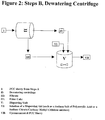
- the filtercake having 57% w/w residual moisture content as obtained in dewatering step described above, was added stepwise into the dispersing unit under continuous mixing.
- the product of the upconcentration process described above was an aqueous suspension with 28.4% w/w solids content ultrafine primary calcium carbonate particles bound together to form stable porous spherical aggregates of 1 to 5 ⁇ m.
- the crystalline structure of the product was determined by SEM pictures.
- the obtained pigment features a high BET specific surface area value, which shows that one has obtained the high surface needed to interact and bind the ink, along with appropriate aggregate dimensions (1 to 2 ⁇ m according to SEM) and yellowing index.
- the final product additionally features a sufficient solids content for subsequent ink jet paper coating applications.
- filtercake having residual moisture of 36.4% w/w obtained in dewatering step described above was added stepwise to the dispersing unit under continuous mixing. After each addition of filter cake and subsequent homogenization, the slurry Brookfield viscosity at 100 rpm was determined. The addition of filter cake was stopped when the Brookfield viscosity reached a defined maximum limit of approximately 1000 mPas.
- the product of the upconcentration process described above was an aqueous suspension with 22.5% w/w solids content of ultrafine primary calcium carbonate particles bound together to form stable porous spherical aggregates.
- the crystalline structure of the product was determined by SEM pictures.
- the quicklime was slaked for 25 minutes under continuous stirring and the resulting slurry of calcium hydroxide ("milk of lime”) at 12.8% w/w solids was then screened on a 100 ⁇ m screen.
- the calcium carbonate precipitation was conducted to a 1000 litre baffled cylindrical stainless steel reactor equipped with an gasing agitator having a gas dispersion unit, a stainless steel carbonation tube to direct a carbon dioxide/air gas stream to the impeller, and probes for monitoring the pH and conductivity of the suspension.
- the agitator was then adjusted to 1480 rpm, and the slurry was carbonated by passing a gas mixture of 26 volume percent carbon dioxide in air at 118 Nm 3 /h, corresponding to 19.7 litres per minute at standard temperature and pressure per kilogram of calcium hydroxide, through the slurry.
- the slurry was then screened on a 45 ⁇ m screen before being fed to a dewatering centrifuge (operating at 4440 rpm) at a rate of 350 l/h. No dispersant was added to the resulting filter cake. This filter cake was collected and then redispersed in a mixing unit and the upconcentrated product was recovered as an aqueous slurry of the pigment.
- Product of the carbonation and upconcentration steps as stated above was an aqueous suspension of 19.5 % w/w solids content of ultrafine primary calcium carbonate particles bound together to form stable porous spherical aggregates.
- the single crystals as constituents of the aggregates had acicular particle shape with a diameter of 20 to 50 nm and aspect ratios between 1:2 and 1:10.
- the porous aggregates formed from these single crystals showed diameters between 1 and 5 ⁇ m, with an average diameter of 2 ⁇ m.
- the crystalline structure of the product was determined by SEM pictures.
- the quicklime was slaked for 25 minutes under continuous stirring and the resulting slurry of calcium hydroxide ("milk of lime”) at 12.7% w/w solids was then screened on a 100 ⁇ m screen.
- the calcium carbonate precipitate was conducted in a 1000 litre baffled cylindrical stainless steel reactor equipped with an gasing agitator having a gas dispersion unit, a stainless steel carbonation tube to direct a carbon dioxide/air gas stream to the impeller, and probes for monitoring the pH and conductivity of the suspension.
- the agitator was then adjusted to 1480 rpm, and the slurry was carbonated by passing a gas mixture of 26 volume percent carbon dioxide in air at 118 Nm 3 /h, corresponding to 19.7 litres per minute at standard temperature and pressure per kilogram of calcium hydroxide, through the slurry.
- the slurry temperature was allowed to rise resulting in a final slurry temperature of 61°C due to the heat generated during the exothermic reaction.
- the slurry was then screened on a 45 ⁇ m screen and the product recovered as an aqueous slurry of the pigment.
- the product of the carbonation step described above was an aqueous suspension with 14.3% w/w solids content of ultrafine primary calcium carbonate particles bound together to form stable porous spherical aggregates.
- the single crystals as constituents of the aggregates featured acicular particle shapes with a diameter of 20 to 50 nm and aspect ratios between 1:2 and 1:10.
- the porous aggregates formed from these single crystals showed diameters between 1 to 5 ⁇ m, with an average diameter of 2 ⁇ m.
- the crystalline structure of the product was determined by SEM pictures.
- the evaporator consisted of a cylindrical stainless steel vessel equipped with an agitator and a double mantle heating unit operating with 120°C hot synthetic oil as heating media.
- the product of the upconcentration process described above was an aqueous suspension with 23.8% w/w solids content of ultrafine primary calcium carbonate particles, bound together to form stable porous spherical aggregates.
- the crystalline structure of the product was determined by SEM pictures.
- Steps A (option magnesium sulphate and zinc sulphate):
- the quicklime was slaked for 25 minutes under continuous stirring and the resulting slurry of calcium hydroxide ("milk of lime”) at 12.5% w/w solids was then screened on a 100 ⁇ m screen.
- the calcium carbonate precipitate was conducted to a 1000 litre baffled cylindrical stainless steel reactor equipped with an gasing agitator having a gas dispersion unit, a stainless steel carbonation tube to direct a carbon dioxide/air gas stream to the impeller, and probes for monitoring the pH and conductivity of the suspension.
- the agitator was then adjusted to 1480 rpm, and the slurry was carbonated by passing a gas mixture of 26 volume percent carbon dioxide in air at 118 Nm 3 /h, corresponding to 19.7 litres per minute at standard temperature and pressure per kilogram of calcium hydroxide, through the slurry.
- the slurry temperature was allowed to rise resulting in a final slurry temperature of 62°C due to the heat generated during the exothermic reaction.
- the slurry was then screened on a 45 ⁇ m screen and the product recovered as an aqueous slurry of the pigment.
- the product of the carbonation step described above was an aqueous suspension with 13.7% w/w solids content of ultrafine primary calcium carbonate particles bound together to form stable porous spherical aggregates.
- the single crystals as constituents of the aggregates featured acicular particle shapes with a diameter of 20 to 50 nm and aspect ratios between 1:2 and 1:10.
- the porous aggregates formed from these single crystals showed diameters between 1 and 5 ⁇ m, with an average diameter of 2 ⁇ m
- the crystalline structure of the product was determined by SEM pictures.
- the evaporator consisted of a cylindrical stainless steel vessel equipped with an agitator and a double mantle heating unit operating with 120°C hot synthetic oil as heating media.
- the product of the upconcentration process described above was an aqueous suspension with 27.1% w/w solids content of ultrafine primary calcium carbonate particles, bound together to form stable porous spherical aggregates.
- the crystalline structure of the product was determined by SEM pictures.
- Step A option magnesium sulphate and zinc sulphate
- Step B upconcentration
- the quicklime was slaked for 25 minutes under continuous stirring and the resulting slurry of calcium hydroxide ("milk of lime”) at 13.5% w/w solids was then screened on a 100 ⁇ m screen.
- the calcium carbonate precipitation was conducted to a 1000 litre baffled cylindrical stainless steel reactor equipped with an gasing agitator featuring a gas dispersion unit, a stainless steel carbonation tube to direct a carbon dioxide/air gas stream to the impeller, and probes for monitoring the pH and conductivity of the suspension.
- the agitator was then adjusted to 1480 rpm, and the slurry was carbonated by passing a gas mixture of 26 volume percent carbon dioxide in air at 118 Nm 3 /h, corresponding to 19.7 litres per minute at standard temperature and pressure per kilogram of calcium hydroxide, through the slurry.
- a gas mixture of 26 volume percent carbon dioxide in air at 118 Nm 3 /h, corresponding to 19.7 litres per minute at standard temperature and pressure per kilogram of calcium hydroxide, through the slurry.
- 100 kg of 10% w/w aqueous solution of zinc sulphate (ZnSO 4 .7H 2 O) and 30 kg of 10% w/w aqueous solution of sulphuric acid were added continuously to the reaction mixture over the total carbonation time.
- the slurry temperature was allowed to rise resulting in a final slurry temperature of 56°C due to heat generated during the exothermic reaction.
- the slurry was then screened on a 45 ⁇ m screen.
- the screened slurry was then fed at a rate of 400 l/h to a dewatering centrifuge operating at 4440 rpm. No dispersant was added to the upconcentrated filtercake discharged by the dewatering centrifuge.
- the mixture was then redispersed in a mixing unit and the upconcentrated product was recovered as an aqueous slurry of the pigment.
- the product of the carbonation and upconcentration steps described above was an aqueous suspension with 24.9% w/w solids content of ultrafine primary calcium carbonate particles, bound together to form stable porous spherical aggregates.
- the single crystals as constituents of the aggregates had acicular particle shape with a diameter of 20 to 50 nm and aspect ratios between 1:2 and 1:10.
- the porous aggregates formed from these single crystals showed diameters between 1 and 5 ⁇ m with an average diameter of 2 ⁇ m.
- the crystalline structure of the product was determined by SEM pictures.
- the quicklime was slaked for 25 minutes under continuous stirring and the resulting slurry of calcium hydroxide ("milk of lime”) at 12,9% w/w solids was then screened on a 100 ⁇ m screen.
- the calcium carbonate precipitation was conducted in a 1000 litre baffled cylindrical stainless steel reactor equipped with an gasing agitator having a gas dispersion unit, a stainless steel carbonation tube to direct a carbon dioxide/air gas stream to the impeller and probes for monitoring the pH and conductivity of the suspension.
- the agitator was then adjusted to 1480 rpm, and the slurry was carbonated by passing a gas mixture of 26 volume percent carbon dioxide in air at 100 Nm 3 /h through the slurry.
- a gas mixture of 26 volume percent carbon dioxide in air at 100 Nm 3 /h through the slurry.
- 100 kg of 10% w/w aqueous solution of Al 2 (SO 4 ) 3 .18H 2 O and 30 kg of 10% w/w aqueous solution of sulphuric acid were added continuously over total carbonation time to the reaction mixture.
- Product of the carbonation step as stated above was an aqueous suspension with 13.8% w/w solids content of ultrafine primary calcium carbonate particles bond together to form stable porous spherical aggregates.
- the single crystals as constituents of the aggregates had acicular particle shape with a diameter of 20 to 50 nm and aspect ratios between 1:2 and 1:10.
- the porous aggregates formed from these single crystals showed diameters between 1 - 5 ⁇ m with an average of 2 ⁇ m
- the crystalline structure of the product was determined by SEM pictures.
- Product of this upconcentration process as stated above was an aqueous suspension with 28.1% w/w solids content of ultrafine primary calcium carbonate particles bond together to form stable porous spherical aggregates.
- the crystalline structure of the product was determined by SEM pictures.
- Step A option magnesium sulphate and aluminium sulphate
- Step B upconcentration
- the mixture was then put on a heating plate for thermal upconcentration via evaporation.
- Product of this upconcentration process as stated above was an an aqueous suspension with 21.3% w/w solids content of ultrafine primary calcium carbonate particles bond together to form stable porous spherical aggregates.
- the crystalline structure of the product was determined by SEM pictures.
- SSA specific surface area
- Table 4 Coating formulation compositions (by parts) Coating Slurry Solids content (% w/w) Coating Slurry 1 Coating Slurry 2 Coating Slurry 3 Coating Slurry 4 Example 3 22.5 100 Example 9 24.9 100 Example 11 28.1 100 Example 12 21.3 100 Additives Mowiol 26-88 7.6 12 12 12 12 Printofix 43.0 5 5 5 5 Cartafix VXT01 20.0 3 3 3 Cartabond TS1 43.0 1.5 1.5 1.5 1.5 1.5 Final slurry characteristics Final slurry pH % 8.1 8.2 8.2 8.0 Final slurry solids content - 27.8 27.8 27.8 27.8 Final slurry Brookfield viscosity at 20°C mPas 140 220 300 100
- Table 5 Base Paper Characteristics, Coating Slurries 1-4 Grammage 89.2 g/m 2 Filler content (otro) 12.9% Tension length 5.26km Surface contact angle OS (1 ⁇ ) 109.3 Surface contact angle OS (10 ⁇ ) 106.4 Yellow index OS -18.3%
- Printing trials were conducted on the same three different inkjet printers as previously, namely the Epson Stylus Photo 950, the HP Deskjet 5550 and the Canon i950.
- the test card was designed to assess the optical density, as well as the degree of feathering and bleeding.
- the HP Bright White paper is marketed as a multipurpose inkjet papers.
- the debutform 2585 and Epson S041061 papers are considered to represent high quality matt inkjet papers, offering a higher print quality than standard multipurpose inkjet papers.
- Optical density was measured using the Gretag D 186 densitometer according to the standard procedures indicated by the manufacturer. For an equal quantity of applied ink, the higher the optical density, the better the coating maintains the dyes on the paper surface.
- Bleeding and feathering were measured using the Personal IAS® (Image Analysis System) instrumentation from Quality Engineering Association, Inc., according to the standard procedures given by the manufacturer. The lower the measured value, the better the bleeding and feathering.
- the above table shows that the optical density obtained with the product of the invention approaches the quality of a superior inkjet paper.
- the bleeding obtained with the product of the invention is equal or inferior to other equivalent market papers.
- the feathering obtained with the product of the invention is inferior to other market papers.
- the improved optical density, bleeding and feathering attest to an improved balance of absorption/adsorption properties relative to competing market products.
- optical density results of the invention were superior to comparable market papers. A decreased bleeding and an increase in feathering relative to comparable papers were also noted.
- optical density results of the invention approached the values given by superior quality papers.
- a decreased bleeding and similar degree of feathering relative to comparable market papers was noted.
- the present invention also covers the technical equivalents of the above description, as well as options that would be easily available to the skilled man when reading the present application.
Landscapes
- Chemical & Material Sciences (AREA)
- Organic Chemistry (AREA)
- Geology (AREA)
- Inorganic Chemistry (AREA)
- Life Sciences & Earth Sciences (AREA)
- Engineering & Computer Science (AREA)
- Nanotechnology (AREA)
- Composite Materials (AREA)
- Condensed Matter Physics & Semiconductors (AREA)
- General Physics & Mathematics (AREA)
- Materials Engineering (AREA)
- Crystallography & Structural Chemistry (AREA)
- Physics & Mathematics (AREA)
- Paper (AREA)
- Compounds Of Alkaline-Earth Elements, Aluminum Or Rare-Earth Metals (AREA)
- Ink Jet Recording Methods And Recording Media Thereof (AREA)
- Pigments, Carbon Blacks, Or Wood Stains (AREA)
- Ink Jet (AREA)
Claims (32)
- Verfahren zum Bereitstellen von PCC, das für Tintenstrahldruckanwendungen nützlich ist,- des Typs, gemäß dem eine Calciumhydroxidaufschlämmung zuerst durch Mischen von Branntkalk (CaO) mit Wasser in einem Rührreaktor oder Tank ("Löschvorgang") hergestellt wird, wonach die Calciumhydroxidaufschlämmung gesiebt wird, beispielsweise auf einem 100 µm-Sieb, um restliche Verunreinigungen und/oder nichtreaktiven ungebrannten Kalk zu entfernen, die gesiebte Aufschlämmung dann in einen mit einem Rührer ausgestatteten Reaktor aus rostfreiem Stahl geleitet wird; die Temperatur im Allgemeinen auf zwischen 10 und 70 ° C eingestellt wird, und anschließend die Aufschlämmung zu einem Carbonisierungsreaktor oder -tank geleitet wird, in dem kohlendioxidhaltiges Gas durch die Aufschlämmung geblasen wird, wobei die Aufschlämmung den Carbonisierungstank verlässt, wenn dies im Hinblick auf Leitfähigkeit und pH-Wert angebracht ist, allgemein wenn die Leitfähigkeit ein Minimum erreicht und der pH-Wert unter 8 fällt, werden die Partikel die ein 45 µm-Sieb passieren, rückgewonnen, so dass die Aufschlämmung nur die ultrafeinen PCC-Agglomerate der Erfindung enthält,- gekennzeichnet durch die Implementierung von Prozessschritten, die Folgendes umfassen:A Erste Schritte, Herstellung des PCC:A1- der Carbonisierungsschritt wird bei einer Carbonisierungsgasströmungsrate von unter 30 Litern pro Minute bei Standardtemperatur und -druck pro Kilogramm Calciumhydroxid während der Fällung durchgeführt, und- die Partikel, die ein 45 µm-Sieb passieren, werden rückgewonnen, so dass die Aufschlämmung nur die ultrafeinen PCC-Agglomerate enthält,
undA2- die gesiebte Calciumhydroxidaufschlämmung wird mit einer Kombination aus Magnesiumsulfat und Aluminiumsulfat und/oder mit einer Kombination aus Magnesiumsulfat und Zinksulfat behandelt,- gegebenenfalls in der Anwesenheit einer Säure, bevorzugt Schwefelsäure,- bis stabile, poröse Agglomerate/Aggregate bei einer Konzentration von 5 bis 25 % Feststoffen, bevorzugt 15 bis 20 % Feststoffen ("Vorläufer"), erhalten werden. - Verfahren nach Anspruch 1, dadurch gekennzeichnet, dass
A3- die Aufschlämmung von Calciumhydroxid zunächst durch Mischen von Branntkalk mit Wasser in einem Rührreaktor oder Tank ("Löschvorgang") in einem Gewichtsverhältnis von CaO:Wasser zwischen 1:3 und 1:20, bevorzugt zwischen 1:5 und 1:12, am meisten bevorzugt zwischen 1:7 und 1:10, hergestellt wird. - Verfahren nach einem der Ansprüche 1 oder 2, dadurch gekennzeichnet, dass
A4- die Temperatur bevorzugt auf zwischen 15 und 50 °C, am meisten bevorzugt auf zwischen 15 und 30 °C, eingestellt wird, bevor die Aufschlämmung in Richtung des Carbonisierungsreaktors oder -tanks geleitet wird. - Verfahren nach einem der Ansprüche 1 bis 3, dadurch gekennzeichnet, dass auf die Schritte A folgende Schritte folgen, Schritte B:
B Aufkonzentration des "Vorläufers": Entwässerungs/Redispergierungsschritte nach den obigen "Schritten A"- die Aufkonzentration des in den Schritten A erzeugten PCC wird unter ausreichend schonenden oder milden Bedingungen durchgeführt, damit die Aggregate/Agglomerate nicht wesentlich zerstört werden, wobei mit "schonenden oder milden Bedingungen" gemeint ist, dass die Desagglomeration/Desaggregation der Agglomerate/Aggregate bei einem Minimum gehalten wird, so dass die Agglomerate/Aggregate nicht "wesentlich zerstört" werden; genauer bedeutet dies, dass es während den Aufkonzentrationsschritten am meisten bevorzugt ist, dass die Fraktion von Partikeln unter 2 µm auf weniger als 30 %, bevorzugt weniger als 20 %, am meisten bevorzugt weniger als 10 %, beschränkt ist und/oder die Abnahme des mittleren Aggregatdurchmessers auf weniger als 20 %, bevorzugt weniger als 15 %, mehr bevorzugt weniger als 10 %, beschränkt ist,- die Aufkonzentration wird ohne die Verwendung eines Dispergierhilfsmittels oder mit einem kationischen Dispergierhilfsmittel durchgeführt,- und die Menge eines beliebigen zugesetzten kationischen Dispergiermittels wird so gesteuert, dass die PCC-Agglomerate/Aggregate des Vorläufers gerade beschichtet werden, wobei diese Menge derjenigen entspricht, die vor einem Anstieg der Aufschlämmungsviskosität zugegeben wird,- bis eine Konzentration von 15 bis 50 Gew.-%, bevorzugt im Bereich von 20 bis 30 Gew.-%, am meisten bevorzugt 23 bis 26 Gew.-%, erreicht wird. - Verfahren nach einem der Ansprüche 1 bis 4, dadurch gekennzeichnet, dass in Schritt A wenigstens einer der folgenden Parameter angewendet wird:- die Carbonisierungsgasströmungsrate wird bevorzugt im Bereich von 1 bis 30, bevorzugt 10 bis 20, am meisten bevorzugt um 19,7 Liter pro Minute, bei Normaltemperatur und -druck pro Kilogramm Calciumhydroxid während der Fällung gewählt,- das Carbonisierungsgas ist CO2 oder ein Gemisch aus CO2 und einem oder mehreren anderen Gasen wie Luft und/oder Stickstoff,- die Aufschlämmung von Calciumhydroxid wird am meisten bevorzugt mit einer Kombination aus Magnesiumsulfat und Aluminiumsulfat behandelt,- oder einer Kombination aus Magnesiumsulfat und Zinksulfat.
- Verfahren nach einem der Ansprüche 1 bis 5, dadurch gekennzeichnet, dass in Schritt A wenigstens einer der folgenden Parameter angewendet wird:- Zinksulfat kann der Kombination aus Magnesiumsulfat und Aluminiumsulfat zugesetzt werden.
- Verfahren nach einem der Ansprüche 1 bis 5, dadurch gekennzeichnet, dass in Schritt A wenigstens einer der folgenden Parameter angewendet wird:- Aluminiumsulfat kann der Kombination aus Magnesiumsulfat und Zinksulfat zugesetzt werden.
- Verfahren nach einem der Ansprüche 1 bis 5, dadurch gekennzeichnet, dass in Schritt A wenigstens einer der folgenden Parameter angewendet wird:- die Zugabe von Magnesiumsulfat wird am meisten bevorzugt vor der Carbonisierung durchgeführt.
- Verfahren nach einem der Ansprüche 1 bis 5, dadurch gekennzeichnet, dass in Schritt A wenigstens einer der folgenden Parameter angewendet wird:- Magnesiumsulfat kann in einer weniger bevorzugten Option entweder vor der Zugabe anderer Sulfate oder während dieser Zugabe zugegeben werden.
- Verfahren nach einem der Ansprüche 1 bis 5, dadurch gekennzeichnet, dass in Schritt A wenigstens einer der folgenden Parameter angewendet wird:- Magnesiumsulfat kann als weniger bevorzugte Option während der Carbonisierung zusammen mit Aluminium- und/oder Zinksulfat zugegeben werden.
- Verfahren nach einem der Ansprüche 1 bis 5, dadurch gekennzeichnet, dass in Schritt A wenigstens einer der folgenden Parameter angewendet wird:- Magnesiumsulfat kann während der Carbonisierung oder zu Beginn der Carbonisierung zugegeben werden.
- Verfahren nach einem der Ansprüche 1 bis 5, dadurch gekennzeichnet, dass in Schritt A wenigstens einer der folgenden Parameter angewendet wird:- die Zugabe von Aluminiumsulfat und/oder Zinksulfat erfolgt während der Carbonisierung.
- Verfahren nach einem der Ansprüche 1 bis 5, dadurch gekennzeichnet, dass in Schritt A wenigstens einer der folgenden Parameter angewendet wird:- die Zugabe der Säure, nämlich der Schwefelsäure, am meisten bevorzugt in Form einer 10 Gew.-%igen Lösung von H2SO4, findet zu Beginn der Carbonisierung statt.
- Verfahren nach einem der Ansprüche 1 bis 5, dadurch gekennzeichnet, dass in Schritt A wenigstens einer der folgenden Parameter angewendet wird:- am meisten bevorzugt erfolgt die Zugabe von H2SO4 gleichzeitig mit der Zugabe von Aluminium- oder Zinksulfat.
- Verfahren nach einem der Ansprüche 1 bis 5, dadurch gekennzeichnet, dass in Schritt A wenigstens einer der folgenden Parameter angewendet wird:- es wird beobachtet, dass die Temperatur im Carbonisierungstank auf bis zu zwischen 40 bis 80 °C, bevorzugt bis zu zwischen 50 bis 60 °C, am meisten bevorzugt bis zu zwischen 56 und 57 °C, ansteigt.
- Verfahren nach einem der Ansprüche 1 bis 5, dadurch gekennzeichnet, dass in Schritt A wenigstens einer der folgenden Parameter angewendet wird:- das Entfernen von restlichen Verunreinigungen und/oder unreaktivem ungebranntem Kalk findet auf einem Sieb mit 45 µm Maschenweite statt, wenn die Brookfield-Viskosität des Materials, das den Carbonisierungstank verlässt, ausreichend niedrig ist, nämlich weniger als 100 mPas bei 100 rpm.
- Verfahren nach Anspruch 4, dadurch gekennzeichnet, dass in Schritt B- mit "schonenden oder milden Bedingungen" gemeint ist, dass die Desagglomeration/Desaggregation der Agglomerate/Aggregate auf einem Minimum gehalten wird, so dass die Agglomerate/Aggregate nicht "wesentlich zerstört" werden, d.h. während der Aufkonzentrierungsschritte,- die Zunahme der Fraktion von Partikeln unter 2 µm auf weniger als 30 %, bevorzugt weniger als 20 %, am meisten bevorzugt weniger als 10 %, begrenzt ist, und/oder- die Abnahme des mittleren Aggregatdurchmessers auf weniger als 20 %, bevorzugt weniger als 15 %, am meisten bevorzugt weniger als 10 %, begrenzt ist, gemessen unter Verwendung einer Helos-Vorrichtung,- mit "Desagglomeration/Desaggregation" gemeint ist, dass die Agglomerate/Aggregate, die am Ende der Schritte A durch das spezifische Verfahren der Erfindung erhalten werden, desintegriert werden,- der Aufkonzentrierungsschritt in Form einer beliebigen thermischen oder mechanischen Trenntechnologie für Feststoff/Flüssigkeit-Suspensionen durchgeführt werden kann, vorausgesetzt, die in den Schritten A ("Vorläufer") erhaltenen Aggregate/Agglomerate sind ausreichend stabil und werden durch diese Technologie nicht "wesentlich zerstört".
- Verfahren nach einem der Ansprüche 4 bis 17, dadurch gekennzeichnet, dass- die Aufkonzentration in einer Zentrifuge oder einem Druckfilter oder einer Vakuumfiltration oder durch thermische Aufkonzentration ohne Dispergiermittel oder in Gegenwart eines kationischen Dispergiermittels durchgeführt wird,- und dadurch gekennzeichnet, dass die Aufschlämmungsendkonzentration etwa 23 bis 26 Gew.-% Feststoff beträgt.
- Verfahren nach einem der Ansprüche 4 bis 18, dadurch gekennzeichnet, dass- die Aufkonzentration zu einem Filterkuchen führt, beispielsweise durch Aufkonzentration in einem Druckfilter oder in einer Zentrifuge oder durch Vakuumfiltration, und in einem solchen Fall:- das konzentrierte Material optional mit Wasser gewaschen wird,- eine Redispersion durchgeführt wird,- bis das Endmaterial im Wesentlichen aus stabilen, porösen Agglomeraten/Aggregaten besteht, die mit den in den Schritten A der Ansprüche 1 bis 3 erhaltenen identisch oder sehr ähnlich sind, d.h. die Zunahme der Fraktion von Partikeln unter 2 µm auf weniger als 30 %, bevorzugt weniger als 20 %, am meisten bevorzugt weniger als 10 %, begrenzt ist und/oder die Abnahme des mittleren Aggregatdurchmessers auf weniger als 20 %, bevorzugt weniger als 15 %, am meisten bevorzugt weniger als 10 %, begrenzt ist,- die Aufkonzentration in einem thermischen Verdampfungsschritt durchgeführt werden kann, wobei das Endmaterial im Wesentlichen unter der Form der stabilen, porösen Agglomerate/Aggregate verbleibt, die in den Schritten A der Ansprüche 1 bis 3 erhalten werden.
- Verfahren nach einem der Ansprüche 4 bis 18, dadurch gekennzeichnet, dass- die Aufkonzentration eines Teils oder der gesamten Vorstufe zu einem trockenen Produkt führt und in einem solchen Fall:- eine Redispersion durchgeführt wird,- bis das Endmaterial im Wesentlichen aus stabilen, porösen Agglomeraten/Aggregaten besteht, die mit den in den Schritten A der Ansprüche 1 bis 3 erhaltenen identisch oder sehr ähnlich sind, d.h. die Zunahme der Fraktion von Partikeln unter 2 µm auf weniger als 30 %, bevorzugt weniger als 20 %, am meisten bevorzugt weniger als 10 %, begrenzt ist und/oder die Abnahme des mittleren Aggregatdurchmessers auf weniger als 20 %, bevorzugt weniger als 15 %, am meisten bevorzugt weniger als 10 %, begrenzt ist.
- Verfahren nach einem der Ansprüche 4 bis 20, dadurch gekennzeichnet, dass etwa 5 bis 9 Gew.-% eines kationischen Dispergiermittels, wie ein kationisches Copolymer von [2-(Methacryloyloxy)ethyl]trimethyl-ammoniumchlorid und [3-(Methacrylamido)propyl]trimethyl-ammoniumchlorid, relativ zu trockenem Calciumcarbonat zusammen mit Hydroxyethycellulose der Aufschlämmung zugesetzt wird, die das in einem der Ansprüche 1 bis 3 (Schritte A) erhaltene Pigment enthält.
- Verfahren nach einem der Ansprüche 4 bis 21, dadurch gekennzeichnet, dass die Aufschlämmungsendkonzentration teilweise oder vollständig durch Zugabe eines oder mehrerer zusätzlicher Pigmente oder Pigmentaufschlämmungen während der Schritte B erhalten wird.
- Stabile, poröse Aggregate/Agglomerate von PCC, dadurch gekennzeichnet, dass sie gemäß einem der Ansprüche 1 bis 22 erhalten wurden und dass sie eine der folgenden Eigenschaften aufweisen:- eine spezifische Oberfläche von 50 bis 80 m2/g, und- eine Primärpartikelgröße der nadelförmigen Partikel von 20 bis 50 nm mit einem Aspektverhältnis zwischen 1:2 und 1:10, und- einen gewichtsbezogenen Feststoffgehalt von 5 bis 25 %, bevorzugt 15 bis 20 %, am Ende der Schritte A,und gegebenenfalls:- einen mittleren Aggregatdurchmesser von 1 bis 5 µm mit einem durchschnittlichen Durchmesser von 2 µm, und/oder- einen Feinkornanteil unter 2 µm von weniger als 20 %, bevorzugt weniger als 15 % (gemessen an einem Helos Sympatec).
- Stabile, poröse Aggregate/Agglomerate von PCC, dadurch gekennzeichnet, dass sie gemäß einem der Ansprüche 4 bis 22 erhalten wurden und dass sie eine der folgenden Eigenschaften aufweisen:- eine spezifische Oberfläche von 50 bis 80 m2/g, und- eine Primärpartikelgröße der nadelförmigen Partikel von 20 bis 50 nm mit einem Aspektverhältnis zwischen 1:2 und 1:10, und- einen Feststoffgehalt von 15 bis 50 %, bevorzugt 20 bis 30 %, insbesondere 23 bis 26 %, am Ende der Schritte B,und gegebenenfalls:- einen mittleren Aggregatdurchmesser von 1 bis 5 µm mit einem durchschnittlichen Durchmesser von 2 µm und/oder- einen Feinkornanteil unter 2 µm von weniger als 20 %, bevorzugt weniger als 15 % (gemessen an einem Helos Sympatec).
- Pigmente, dadurch gekennzeichnet, dass sie stabile, poröse PCC-Aggregate/- Agglomerate gemäß den Ansprüchen 23 bis 24 enthalten.
- Pigmentschlämmungen oder PCC-Aufschlämmungen, dadurch gekennzeichnet, dass sie stabile, poröse PCC-Aggregate/Agglomerate gemäß den Ansprüchen 23 bis 25 enthalten.
- Pigmentaufschlämmungen oder PCC-Aufschlämmungen gemäß Anspruch 4, dadurch gekennzeichnet, dass ihre gewichtsbezogene Feststoffkonzentration beträgt:- wenn in Form des "Vorläufers" am Ende der Schritte A, von 5 bis 25 % Feststoffe, bevorzugt von 15 bis 20 % Feststoffe,- wenn in Form des finalen aufkonzentrierten PCC (Schritte B), von 15 bis 50 % Feststoffe, bevorzugt von 20 bis 30 % Feststoffe, insbesondere von 23 bis 26 % Feststoffe.
- Beschichtungsformulierungen für die Papierindustrie, dadurch gekennzeichnet, dass sie Aggregate/Agglomerate von PCC, Pigmente und/oder Aufschlämmungen gemäß einem der Ansprüche 25 bis 27 enthalten.
- Beschichtungsformulierungen nach Anspruch 28, dadurch gekennzeichnet, dass die PCC-Aufschlämmung, die sie enthält, die folgenden Eigenschaften aufweist:- einen Feststoffgehalt von 15 bis 50 %, bevorzugt 20 bis 30, insbesondere um 23 bis 26 %/Gewicht, und/oder- ein PCC mit hoher spezifischer Oberfläche mit einer spezifischen Oberfläche von 30 bis 100 m2/g, bevorzugt von 50 bis 80 m2/g.
- Anwendungen der Beschichtungsformulierungen gemäß einem der Ansprüche 28 oder 29 für das Beschichten von Tintenstrahlpapier, nämlich Spezial- oder hochwertiges Tintenstrahlpapier.
- Anwendungen der Beschichtungsformulierungen gemäß Anspruch 30 für die Beschichtung von mattem Tintenstrahlpapier.
- Tintenstrahlpapier, nämlich Spezial- oder hochwertiges Tintenstrahlpapier, nämlich mattes Tintenstrahlpapier, dadurch gekennzeichnet, dass es mit wenigstens einem Beschichtungsmittel gemäß den Ansprüchen 28 oder 29 beschichtet ist.
Priority Applications (2)
| Application Number | Priority Date | Filing Date | Title |
|---|---|---|---|
| EP06744542.9A EP1868942B1 (de) | 2005-04-11 | 2006-03-29 | Fällungscalciumcarbonat-pigment, insbesondere zur verwendung beim tintenstrahldruck von papierbeschichtungen |
| SI200632367T SI1868942T1 (sl) | 2005-04-11 | 2006-03-29 | Pigment iz oborjenega kalcijevega karbonata, zlasti za uporabo v premazih papirja za kapljični tisk |
Applications Claiming Priority (3)
| Application Number | Priority Date | Filing Date | Title |
|---|---|---|---|
| EP05075901A EP1712523A1 (de) | 2005-04-11 | 2005-04-11 | Gefälltes Kalziumkarbonatpigment zur Verwendung in Tintenstrahldruckpapierbeschichtungen |
| EP06744542.9A EP1868942B1 (de) | 2005-04-11 | 2006-03-29 | Fällungscalciumcarbonat-pigment, insbesondere zur verwendung beim tintenstrahldruck von papierbeschichtungen |
| PCT/IB2006/000975 WO2006109171A1 (en) | 2005-04-11 | 2006-03-29 | Precipitated calcium carbonate pigment, especially for use in inkjet printing paper coatings |
Publications (2)
| Publication Number | Publication Date |
|---|---|
| EP1868942A1 EP1868942A1 (de) | 2007-12-26 |
| EP1868942B1 true EP1868942B1 (de) | 2019-12-11 |
Family
ID=34938180
Family Applications (2)
| Application Number | Title | Priority Date | Filing Date |
|---|---|---|---|
| EP05075901A Withdrawn EP1712523A1 (de) | 2005-04-11 | 2005-04-11 | Gefälltes Kalziumkarbonatpigment zur Verwendung in Tintenstrahldruckpapierbeschichtungen |
| EP06744542.9A Expired - Lifetime EP1868942B1 (de) | 2005-04-11 | 2006-03-29 | Fällungscalciumcarbonat-pigment, insbesondere zur verwendung beim tintenstrahldruck von papierbeschichtungen |
Family Applications Before (1)
| Application Number | Title | Priority Date | Filing Date |
|---|---|---|---|
| EP05075901A Withdrawn EP1712523A1 (de) | 2005-04-11 | 2005-04-11 | Gefälltes Kalziumkarbonatpigment zur Verwendung in Tintenstrahldruckpapierbeschichtungen |
Country Status (18)
| Country | Link |
|---|---|
| US (1) | US8883098B2 (de) |
| EP (2) | EP1712523A1 (de) |
| JP (2) | JP5230007B2 (de) |
| KR (1) | KR101312806B1 (de) |
| CN (1) | CN101160262B (de) |
| AR (1) | AR056967A1 (de) |
| AU (1) | AU2006233333B2 (de) |
| BR (1) | BRPI0609115A2 (de) |
| CA (1) | CA2599681C (de) |
| IL (1) | IL185704A0 (de) |
| MX (1) | MX2007012416A (de) |
| MY (1) | MY160705A (de) |
| NO (1) | NO20075657L (de) |
| RU (1) | RU2432374C2 (de) |
| SI (1) | SI1868942T1 (de) |
| TW (1) | TWI432529B (de) |
| WO (1) | WO2006109171A1 (de) |
| ZA (1) | ZA200707957B (de) |
Families Citing this family (77)
| Publication number | Priority date | Publication date | Assignee | Title |
|---|---|---|---|---|
| EP1712597A1 (de) | 2005-04-11 | 2006-10-18 | Omya Development AG | Verfahren zur Herstellung von Gefälltem Calcium Carbonat, insbesondere zur Verwendung als Beschichtung für Tintenstrahldruckerpapier und das gefällte Calcium Carbonate |
| DE102006026965A1 (de) | 2006-06-09 | 2007-12-13 | Omya Development Ag | Komposits aus anorganischen und/oder organischen Mikropartikeln und Nano-Calciumcarbonatpartikeln |
| AR061138A1 (es) | 2006-06-09 | 2008-08-06 | Omya Development Ag | Compuestos de microparticulas inorganicas y/u organicas y nanoparticulas de dolomita |
| DE102007059736A1 (de) | 2007-12-12 | 2009-06-18 | Omya Development Ag | Oberflächenmineralisierte organische Fasern |
| US8361572B2 (en) * | 2009-10-30 | 2013-01-29 | Hewlett-Packard Development Company, L.P. | Coated medium for inkjet printing |
| CN101838005B (zh) * | 2010-04-30 | 2012-02-01 | 汪晋强 | 一种生产超细微轻质碳酸钙和白炭黑联产氯化钠和碳粉的方法 |
| PT2402167E (pt) | 2010-07-02 | 2013-12-11 | Omya Int Ag | Papel para gravação a jato de tinta |
| ES2540248T3 (es) | 2010-10-26 | 2015-07-09 | Omya Development Ag | Producción de carbonato de calcio precipitado de alta pureza |
| PT2537900E (pt) | 2011-06-21 | 2016-01-22 | Omya Int Ag | Processo para a produção de carbonato de cálcio precipitado, carbonato de cálcio precipitado e sua utilização |
| FI126571B (fi) * | 2012-06-28 | 2017-02-28 | Nordkalk Oy Ab | Päällystyskoostumuksen käyttö maalina |
| ES2584628T3 (es) * | 2012-07-13 | 2016-09-28 | Omya International Ag | Minerales que contienen carbonato de calcio de superficie modificada y su uso |
| FI126543B (fi) * | 2013-05-17 | 2017-02-15 | Fp-Pigments Oy | Menetelmä pigmenttejä sisältävän kationisen, korkean kuiva-aineen vesidispersion valmistamiseksi, pigmenttejä käsittävä vesidispersio ja sen käyttö |
| FI128521B (en) | 2013-06-20 | 2020-07-15 | Fp Pigments Oy | Composition of precipitated calcium carbonate, method of producing the same and the uses thereof |
| WO2015164589A1 (en) | 2014-04-23 | 2015-10-29 | Calera Corporation | Methods and systems for utilizing carbide lime or slag |
| EP3012223A1 (de) | 2014-10-24 | 2016-04-27 | Omya International AG | PCC mit reduziertem Portlanditgehalt |
| BR112017015112A2 (pt) * | 2015-01-14 | 2018-04-17 | Imerys Usa Inc | processo controlado para precipitar carbonato de cálcio e composições de carbonato de cálcio precipitado de vaterita formadas por meio do dito processo |
| FR3033163B1 (fr) | 2015-02-27 | 2019-08-23 | Coatex | Production de carbonate de calcium precipite |
| NO3067214T3 (de) | 2015-03-13 | 2018-05-19 | ||
| ES2655290T3 (es) | 2015-03-13 | 2018-02-19 | Omya International Ag | Método de impresión por inyección de tinta |
| EP3334282B1 (de) | 2015-08-14 | 2022-12-21 | Imertech Sas | Inorganische partikeln enthaltend antimikrobielles metall |
| CN107922277B (zh) * | 2015-08-31 | 2020-12-22 | 株式会社Gc | 含有碳酸钙的多孔质体的制造方法、含有碳酸磷灰石的多孔质体的制造方法 |
| PL3156369T3 (pl) * | 2015-10-16 | 2019-01-31 | Omya International Ag | PCC o dużej zawartości części stałych z dodatkiem kopolimerowym |
| EP3153549A1 (de) * | 2015-10-30 | 2017-04-12 | Kronos International, Inc. | Herstellung von matten lacken und druckfarben |
| EP3173247A1 (de) | 2015-11-24 | 2017-05-31 | Omya International AG | Gedrucktes wasserzeichen |
| EP3173522A1 (de) | 2015-11-24 | 2017-05-31 | Omya International AG | Verfahren zur markierung eines substrats |
| EP3183965A1 (de) | 2015-12-23 | 2017-06-28 | Omya International AG | Zusammensetzung zur bekämpfung aquatischer schädlinge |
| EP3275948A1 (de) | 2016-07-25 | 2018-01-31 | Omya International AG | Verfahren zur herstellung von oberflächenreaktivem calciumcarbonat |
| EP3275947A1 (de) | 2016-07-25 | 2018-01-31 | Omya International AG | Oberflächenreaktives calciumcarbonat mit funktionellen kationen |
| EP3293011A1 (de) | 2016-09-13 | 2018-03-14 | Omya International AG | Verfahren zur herstellung eines wasserunlöslichen musters |
| EP3293322A1 (de) | 2016-09-13 | 2018-03-14 | Omya International AG | Rutschfestes produkt |
| EP3360601A1 (de) | 2017-02-09 | 2018-08-15 | Omya International AG | Funktionalisiertes calciumcarbonat für sonnenschutzverstärkung |
| EP3366740A1 (de) | 2017-02-24 | 2018-08-29 | Omya International AG | Mineralölsperre |
| EP3378502A1 (de) * | 2017-03-23 | 2018-09-26 | Omya International AG | Verwendung von zinkbehandeltem gefälltem calciumcarbonat in hygieneprodukten |
| JP7319926B2 (ja) * | 2017-04-13 | 2023-08-02 | イメルテック ソシエテ パル アクシオン サンプリフィエ | 揮発性有機化合物の排出を削減するための沈降炭酸カルシウム |
| EP3400810A1 (de) | 2017-05-11 | 2018-11-14 | Omya International AG | Oberflächenreaktives kalziumkarbonat in lebensmitteln |
| EP3406455A1 (de) | 2017-05-23 | 2018-11-28 | Omya International AG | Verfahren zur herstellung von wasserunlöslichen quantenpunktmustern |
| EP3418064A1 (de) | 2017-06-22 | 2018-12-26 | Omya International AG | Fälschungssicheres medium für thermodruck |
| EP3461651A1 (de) | 2017-09-28 | 2019-04-03 | Omya International AG | Beschichtungsformulierung für digitale druckmedien |
| EP3517178A1 (de) | 2018-01-26 | 2019-07-31 | Omya International AG | Oberflächenreaktives calciumkarbonat zur modifizierung der biomechanischen eigenschaften der haut |
| EP3517176A1 (de) | 2018-01-26 | 2019-07-31 | Omya International AG | Oberflächenreaktives calciumkarbonat zur verwendung als modifikator des hautaussehens |
| EP3594289A1 (de) | 2018-07-13 | 2020-01-15 | Omya International AG | Oberflächenreaktives calciumkarbonat zur stabilisierung von minzöl |
| EP3598105A1 (de) | 2018-07-20 | 2020-01-22 | Omya International AG | Verfahren zur detektion von phosphat- und/oder sulfatsalzen auf der oberfläche eines substrats oder innerhalb eines substrats, verwendung einer lwir-erfassungsvorrichtung und eines lwir-bildgebungssystems |
| EP3622966A1 (de) | 2018-09-17 | 2020-03-18 | Omya International AG | Hochleistungsfähiger hilfsstoff mit co-verarbeiteter mikrokristalliner cellulose und oberflächenreagiertes calciumcarbonat |
| EP3682901A1 (de) | 2019-01-21 | 2020-07-22 | Omya International AG | Hochleistungsfähiger hilfsstoff mit co-verarbeiteter mikrokristalliner cellulose und oberflächenreagiertes calciumcarbonat |
| MX2021001562A (es) | 2018-09-17 | 2021-06-08 | Omya Int Ag | Excipiente de alto rendimiento que comprende celulosa microcristalina co-procesada y carbonato de calcio reaccionado en superficie. |
| EP3693339A1 (de) | 2019-02-01 | 2020-08-12 | Omya International AG | Herstellung von oberflächenreagierten kalziumsalzen durch mahlinduzierte umwandlung |
| EP3725851A1 (de) * | 2019-04-16 | 2020-10-21 | Omya International AG | Verfahren zur herstellung von oberflächenreaktivem calciumcarbonat |
| AR119243A1 (es) | 2019-07-08 | 2021-12-01 | Omya Int Ag | Composición seca cosmética y/o para el cuidado de la piel |
| EP3789460A1 (de) | 2019-09-04 | 2021-03-10 | Omya International AG | Mit funktionalisierten poly- und / oder perfluorierten verbindungen behandeltes calciumcarbonat |
| CN110484023B (zh) * | 2019-09-30 | 2021-05-14 | 建德市华宇纳米科技有限公司 | 一种高分散纳米碳酸钙制备设备及制备方法 |
| EP3855162A1 (de) | 2020-01-21 | 2021-07-28 | Omya International AG | Lwir-bildgebungssystem zum nachweis einer amorphen und/oder kristallinen struktur von phosphat- und/oder sulfatsalzen auf der oberfläche eines substrats oder innerhalb eines substrats und verwendung des lwir-bildgebungssystems |
| WO2021173784A1 (en) | 2020-02-25 | 2021-09-02 | Arelac, Inc. | Methods and systems for treatment of limestone to form vaterite |
| CN115038342B (zh) | 2020-03-03 | 2024-02-02 | 欧米亚国际集团 | 抗结块剂 |
| FI4146743T3 (fi) | 2020-05-08 | 2024-10-01 | Omya Int Ag | Antimikrobisia aktiivisia ainesosia käsittävät pinnoitteet elintarvikepakkausta varten |
| EP4157944B1 (de) | 2020-05-27 | 2025-10-01 | Omya International AG | Hydrophobe antimikrobielle mittel |
| US20230233424A1 (en) | 2020-05-29 | 2023-07-27 | Omya International Ag | Use of a mineral blend as cosmetic agent for wet cosmetic compositions |
| GB2613474B (en) | 2020-06-30 | 2025-01-01 | Arelac Inc | Methods and systems for forming vaterite from calcined limestone using electric kiln |
| MX2023000613A (es) | 2020-07-16 | 2023-02-13 | Omya Int Ag | Composicion de elastomero reforzado. |
| CN116157454A (zh) | 2020-07-16 | 2023-05-23 | Omya国际股份公司 | 由包含碳酸钙或碳酸镁的材料和包含至少一种可交联化合物的表面处理组合物形成的组合物 |
| CA3178667A1 (en) | 2020-07-16 | 2022-01-20 | Tobias Keller | Alkaline earth metal minerals as carriers for surfactants in drilling fluids |
| CN116157458A (zh) | 2020-07-16 | 2023-05-23 | Omya国际股份公司 | 由包含碳酸钙的材料和接枝聚合物形成的组合物 |
| CN115996978A (zh) | 2020-07-16 | 2023-04-21 | Omya国际股份公司 | 增强的含氟聚合物 |
| KR20230041684A (ko) | 2020-07-16 | 2023-03-24 | 옴야 인터내셔널 아게 | 엘라스토머 조성물의 기체 투과성을 감소시키기 위한 다공성 충전제의 용도 |
| AR123009A1 (es) | 2020-07-20 | 2022-10-19 | Omya Int Ag | Agente estabilizante para composición probiótica |
| EP3974385A1 (de) | 2020-09-24 | 2022-03-30 | Omya International AG | Feuchtigkeitshärtende einkomponenten-polymerzusammensetzung mit einem natürlichen gemahlenen calciumcarbonat (gcc) |
| CN116457215A (zh) | 2020-11-02 | 2023-07-18 | Omya国际股份公司 | 在存在天然研磨的碳酸钙的情况下生产沉淀碳酸钙的方法 |
| WO2022136490A1 (en) | 2020-12-23 | 2022-06-30 | Omya International Ag | Method and apparatus for detecting an amorphous and/or crystalline structure of phosphate and/or sulphate salts on the surface of a substrate or within a substrate |
| EP4294353A1 (de) | 2021-02-18 | 2023-12-27 | Omya International AG | Mittel zur bekämpfung von schadstoffen |
| EP4067424A1 (de) | 2021-03-29 | 2022-10-05 | Omya International AG | Wärmeleitende füllstoffe |
| US12145884B2 (en) | 2021-11-09 | 2024-11-19 | Omya International Ag | Asphalt slurry seal composition |
| EP4532610A1 (de) | 2022-05-25 | 2025-04-09 | Omya International AG | Weisses uv-absorbierendes oberflächenreaktives und mit einer titanspezies dotiertes calciumcarbonat |
| EP4532611A1 (de) | 2022-05-25 | 2025-04-09 | Omya International AG | Verfahren zur herstellung eines weissen uv-absorbierenden oberflächenreagierten calciumcarbonats mit einer titanspezies, weisses uv-absorbierendes oberflächenreagiertes calciumcarbonat und verwendung davon |
| CN120051604A (zh) | 2022-10-18 | 2025-05-27 | 欧米亚国际集团 | 液体浸渍的经表面改性的材料 |
| CN120476178A (zh) | 2023-01-05 | 2025-08-12 | Omya国际股份公司 | 聚乙烯醇作为矿物分散体的助分散剂 |
| EP4702083A1 (de) | 2023-04-28 | 2026-03-04 | Omya International AG | Polypropylen-(pp)-caco3-masterbatch in pet-fasern |
| WO2024251828A1 (en) | 2023-06-06 | 2024-12-12 | Omya International Ag | Method for producing a bioceramic material |
| EP4663618A1 (de) | 2024-06-12 | 2025-12-17 | Omya International AG | Wärmeleitfähige mineralmischung |
Citations (1)
| Publication number | Priority date | Publication date | Assignee | Title |
|---|---|---|---|---|
| JPS6418911A (en) * | 1987-07-14 | 1989-01-23 | Maruo Calcium | Production of calcium carbonate for paper making |
Family Cites Families (32)
| Publication number | Priority date | Publication date | Assignee | Title |
|---|---|---|---|---|
| BE556147A (de) * | 1957-03-26 | |||
| GB1341742A (en) * | 1971-05-07 | 1973-12-25 | English Clays Lovering Pochin | Processing of calcium carbonate |
| JPS52126697A (en) * | 1976-04-16 | 1977-10-24 | Toyo Soda Mfg Co Ltd | Production of chain calcium carbonate |
| JPS59199731A (ja) * | 1983-04-27 | 1984-11-12 | Maruo Calcium Kk | 分散良好な連鎖状炭酸カルシウムの製造方法 |
| EP0179597B1 (de) * | 1984-10-18 | 1993-02-03 | Pfizer Inc. | Kugelförmiges ausgefälltes Calciumcarbonat, seine Herstellung und seine Verwendung |
| JPH01230424A (ja) * | 1988-03-09 | 1989-09-13 | Shiraishi Chuo Kenkyusho:Kk | 炭酸カルシウム、炭酸カルシウム顔料、その製造法、情報記録紙用塗被組成物及び情報記録紙 |
| JPH0699149B2 (ja) * | 1990-02-05 | 1994-12-07 | 東洋電化工業株式会社 | 湿り粉状炭酸カルシウムの製造方法 |
| US5342600A (en) * | 1990-09-27 | 1994-08-30 | Ecc International Limited | Precipitated calcium carbonate |
| JPH07509684A (ja) * | 1992-04-03 | 1995-10-26 | ミネラルズ・テクノロジーズ・インコーポレーテッド | クラスター状沈降炭酸カルシウム粒子 |
| US5759258A (en) * | 1995-03-15 | 1998-06-02 | Minerals Technologies Inc. | Recycling of mineral fillers from the residue of a paper deinking plant |
| US5643631A (en) | 1995-03-17 | 1997-07-01 | Minerals Tech Inc | Ink jet recording paper incorporating novel precipitated calcium carbonate pigment |
| US6372818B1 (en) | 1995-08-31 | 2002-04-16 | Canon Kabushiki Kaisha | Water-based ink for ink-jet, and ink-jet recording method and instruments using the same |
| GB9520703D0 (en) | 1995-10-10 | 1995-12-13 | Ecc Int Ltd | Paper coating pigments and their production and use |
| KR0182788B1 (ko) * | 1996-02-02 | 1999-04-15 | 유규재 | 초미세 교질 탄산칼슘의 제조방법 |
| US6071336A (en) * | 1996-09-05 | 2000-06-06 | Minerals Technologies Inc. | Acicular calcite and aragonite calcium carbonate |
| JPH10265725A (ja) | 1997-03-24 | 1998-10-06 | Canon Inc | 水性インク、これを用いたインクジェット記録方法及び機器類 |
| US6156286A (en) | 1997-05-21 | 2000-12-05 | Imerys Pigments, Inc. | Seeding of aragonite calcium carbonate and the product thereof |
| US6221146B1 (en) * | 1998-04-03 | 2001-04-24 | Imerys Pigments, Inc. | Method for the production of precipitated calcium carbonate having a selected crystal form, products produced thereby and their uses |
| JP4157202B2 (ja) * | 1998-09-09 | 2008-10-01 | 日鉄鉱業株式会社 | 紡錘状炭酸カルシウムの製造方法 |
| US6251356B1 (en) * | 1999-07-21 | 2001-06-26 | G. R. International, Inc. | High speed manufacturing process for precipitated calcium carbonate employing sequential perssure carbonation |
| JP4439041B2 (ja) * | 1999-08-31 | 2010-03-24 | 奥多摩工業株式会社 | 軽質炭酸カルシウム及びそれを用いたインクジェット用記録紙 |
| KR20010080481A (ko) * | 1999-10-26 | 2001-08-22 | 추후제출 | 탄산칼슘 및 그 제조방법 |
| GB9930127D0 (en) | 1999-12-22 | 2000-02-09 | Arjo Wiggins Fine Papers Ltd | Ink jet printing paper |
| JP3902718B2 (ja) * | 2000-03-28 | 2007-04-11 | 日本製紙株式会社 | アラゴナイト結晶系炭酸カルシウムの製造方法 |
| JP4034982B2 (ja) * | 2002-03-29 | 2008-01-16 | 日鉄鉱業株式会社 | 炭酸カルシウムの製造方法、及び排煙脱硫方法又は硫酸中和方法 |
| JP3925316B2 (ja) * | 2002-06-11 | 2007-06-06 | 富士ゼロックス株式会社 | インクジェット記録方法 |
| WO2004035476A1 (ja) * | 2002-10-15 | 2004-04-29 | Maruo Calcium Company Limited | 凝集粒子及びそれを配合してなる樹脂組成物 |
| JP4311010B2 (ja) | 2002-12-20 | 2009-08-12 | 富士ゼロックス株式会社 | インクジェット記録方法及びインクジェット記録装置 |
| FR2852600B1 (fr) * | 2003-03-18 | 2005-06-10 | Nouveau pigment mineral contenant du carbonate de calcium, suspension aqueuse le contenant et ses usages | |
| JP2004299302A (ja) | 2003-03-31 | 2004-10-28 | Nippon Paper Industries Co Ltd | インクジェット記録用紙 |
| US7135157B2 (en) * | 2003-06-06 | 2006-11-14 | Specialty Minerals (Michigan) Inc. | Process for the production of platy precipitated calcium carbonates |
| EP1712597A1 (de) | 2005-04-11 | 2006-10-18 | Omya Development AG | Verfahren zur Herstellung von Gefälltem Calcium Carbonat, insbesondere zur Verwendung als Beschichtung für Tintenstrahldruckerpapier und das gefällte Calcium Carbonate |
-
2005
- 2005-04-11 EP EP05075901A patent/EP1712523A1/de not_active Withdrawn
-
2006
- 2006-03-07 MY MYPI20060967A patent/MY160705A/en unknown
- 2006-03-29 RU RU2007141649/05A patent/RU2432374C2/ru not_active IP Right Cessation
- 2006-03-29 AU AU2006233333A patent/AU2006233333B2/en not_active Ceased
- 2006-03-29 EP EP06744542.9A patent/EP1868942B1/de not_active Expired - Lifetime
- 2006-03-29 JP JP2008505982A patent/JP5230007B2/ja not_active Expired - Fee Related
- 2006-03-29 ZA ZA200707957A patent/ZA200707957B/xx unknown
- 2006-03-29 CA CA2599681A patent/CA2599681C/en not_active Expired - Fee Related
- 2006-03-29 US US11/887,748 patent/US8883098B2/en active Active
- 2006-03-29 MX MX2007012416A patent/MX2007012416A/es active IP Right Grant
- 2006-03-29 BR BRPI0609115-6A patent/BRPI0609115A2/pt not_active IP Right Cessation
- 2006-03-29 SI SI200632367T patent/SI1868942T1/sl unknown
- 2006-03-29 WO PCT/IB2006/000975 patent/WO2006109171A1/en not_active Ceased
- 2006-03-29 CN CN2006800127561A patent/CN101160262B/zh not_active Expired - Fee Related
- 2006-03-29 KR KR1020077022949A patent/KR101312806B1/ko not_active Expired - Fee Related
- 2006-04-07 TW TW095112361A patent/TWI432529B/zh not_active IP Right Cessation
- 2006-04-11 AR ARP060101412A patent/AR056967A1/es not_active Application Discontinuation
-
2007
- 2007-09-04 IL IL185704A patent/IL185704A0/en unknown
- 2007-11-06 NO NO20075657A patent/NO20075657L/no not_active Application Discontinuation
-
2012
- 2012-12-10 JP JP2012269620A patent/JP5840597B2/ja not_active Expired - Lifetime
Patent Citations (1)
| Publication number | Priority date | Publication date | Assignee | Title |
|---|---|---|---|---|
| JPS6418911A (en) * | 1987-07-14 | 1989-01-23 | Maruo Calcium | Production of calcium carbonate for paper making |
Also Published As
| Publication number | Publication date |
|---|---|
| RU2007141649A (ru) | 2009-05-20 |
| TWI432529B (zh) | 2014-04-01 |
| CA2599681C (en) | 2014-03-04 |
| MX2007012416A (es) | 2007-12-05 |
| AU2006233333B2 (en) | 2012-09-13 |
| KR101312806B1 (ko) | 2013-09-27 |
| ZA200707957B (en) | 2009-07-29 |
| JP5840597B2 (ja) | 2016-01-06 |
| US8883098B2 (en) | 2014-11-11 |
| US20090017233A1 (en) | 2009-01-15 |
| JP5230007B2 (ja) | 2013-07-10 |
| NO20075657L (no) | 2008-01-03 |
| KR20070120522A (ko) | 2007-12-24 |
| JP2013079192A (ja) | 2013-05-02 |
| SI1868942T1 (sl) | 2020-03-31 |
| IL185704A0 (en) | 2008-01-06 |
| JP2008537926A (ja) | 2008-10-02 |
| CA2599681A1 (en) | 2006-10-19 |
| WO2006109171A1 (en) | 2006-10-19 |
| CN101160262A (zh) | 2008-04-09 |
| AR056967A1 (es) | 2007-11-07 |
| TW200706607A (en) | 2007-02-16 |
| MY160705A (en) | 2017-03-15 |
| CN101160262B (zh) | 2012-02-22 |
| RU2432374C2 (ru) | 2011-10-27 |
| EP1868942A1 (de) | 2007-12-26 |
| EP1712523A1 (de) | 2006-10-18 |
| AU2006233333A1 (en) | 2006-10-19 |
| BRPI0609115A2 (pt) | 2010-11-16 |
Similar Documents
| Publication | Publication Date | Title |
|---|---|---|
| EP1885804B1 (de) | Verfahren zur herstellung von gefälltem calcium carbonat, insbesondere zur verwendung als beschichtung für tintenstrahldruckerpapier und das gefällte calcium carbonate | |
| US8883098B2 (en) | Precipitated calcium carbonate pigment, especially for use in inkjet printing paper coatings | |
| FI128521B (en) | Composition of precipitated calcium carbonate, method of producing the same and the uses thereof | |
| AU2012220526B2 (en) | Precipitated calcium carbonate pigment, especially for use in inkjet printing paper coatings | |
| MX2007012417A (es) | Pigmento de carbonato calcico precipitado, especialmente para uso en recubrimiento de papel para impresion por chorro de tinta | |
| BRPI0609117B1 (pt) | Process for providing a PCC useful for inkjet printing applications, stable porous pcc aggregates / agglomerates, pigments, pcc suspensions, papermaking formulations for the papermaking industry, coating formulations applications, and paper for inkjet |
Legal Events
| Date | Code | Title | Description |
|---|---|---|---|
| PUAI | Public reference made under article 153(3) epc to a published international application that has entered the european phase |
Free format text: ORIGINAL CODE: 0009012 |
|
| 17P | Request for examination filed |
Effective date: 20071112 |
|
| AK | Designated contracting states |
Kind code of ref document: A1 Designated state(s): AT BE BG CH CY CZ DE DK EE ES FI FR GB GR HU IE IS IT LI LT LU LV MC NL PL PT RO SE SI SK TR |
|
| DAX | Request for extension of the european patent (deleted) | ||
| 17Q | First examination report despatched |
Effective date: 20111201 |
|
| RAP1 | Party data changed (applicant data changed or rights of an application transferred) |
Owner name: OMYA INTERNATIONAL AG |
|
| STAA | Information on the status of an ep patent application or granted ep patent |
Free format text: STATUS: EXAMINATION IS IN PROGRESS |
|
| GRAP | Despatch of communication of intention to grant a patent |
Free format text: ORIGINAL CODE: EPIDOSNIGR1 |
|
| STAA | Information on the status of an ep patent application or granted ep patent |
Free format text: STATUS: GRANT OF PATENT IS INTENDED |
|
| RIC1 | Information provided on ipc code assigned before grant |
Ipc: B41M 5/52 20060101ALI20190108BHEP Ipc: C01F 11/18 20060101AFI20190108BHEP Ipc: D21H 19/38 20060101ALI20190108BHEP Ipc: C09C 1/02 20060101ALI20190108BHEP Ipc: B82Y 30/00 20110101ALI20190108BHEP |
|
| INTG | Intention to grant announced |
Effective date: 20190123 |
|
| GRAJ | Information related to disapproval of communication of intention to grant by the applicant or resumption of examination proceedings by the epo deleted |
Free format text: ORIGINAL CODE: EPIDOSDIGR1 |
|
| STAA | Information on the status of an ep patent application or granted ep patent |
Free format text: STATUS: EXAMINATION IS IN PROGRESS |
|
| GRAP | Despatch of communication of intention to grant a patent |
Free format text: ORIGINAL CODE: EPIDOSNIGR1 |
|
| STAA | Information on the status of an ep patent application or granted ep patent |
Free format text: STATUS: GRANT OF PATENT IS INTENDED |
|
| INTC | Intention to grant announced (deleted) | ||
| INTG | Intention to grant announced |
Effective date: 20190702 |
|
| GRAS | Grant fee paid |
Free format text: ORIGINAL CODE: EPIDOSNIGR3 |
|
| GRAA | (expected) grant |
Free format text: ORIGINAL CODE: 0009210 |
|
| STAA | Information on the status of an ep patent application or granted ep patent |
Free format text: STATUS: THE PATENT HAS BEEN GRANTED |
|
| AK | Designated contracting states |
Kind code of ref document: B1 Designated state(s): AT BE BG CH CY CZ DE DK EE ES FI FR GB GR HU IE IS IT LI LT LU LV MC NL PL PT RO SE SI SK TR |
|
| REG | Reference to a national code |
Ref country code: GB Ref legal event code: FG4D |
|
| REG | Reference to a national code |
Ref country code: CH Ref legal event code: EP |
|
| REG | Reference to a national code |
Ref country code: AT Ref legal event code: REF Ref document number: 1212008 Country of ref document: AT Kind code of ref document: T Effective date: 20191215 |
|
| REG | Reference to a national code |
Ref country code: DE Ref legal event code: R096 Ref document number: 602006058932 Country of ref document: DE |
|
| REG | Reference to a national code |
Ref country code: IE Ref legal event code: FG4D |
|
| REG | Reference to a national code |
Ref country code: FI Ref legal event code: FGE |
|
| REG | Reference to a national code |
Ref country code: NL Ref legal event code: MP Effective date: 20191211 |
|
| REG | Reference to a national code |
Ref country code: LT Ref legal event code: MG4D |
|
| PG25 | Lapsed in a contracting state [announced via postgrant information from national office to epo] |
Ref country code: BG Free format text: LAPSE BECAUSE OF FAILURE TO SUBMIT A TRANSLATION OF THE DESCRIPTION OR TO PAY THE FEE WITHIN THE PRESCRIBED TIME-LIMIT Effective date: 20200311 Ref country code: ES Free format text: LAPSE BECAUSE OF FAILURE TO SUBMIT A TRANSLATION OF THE DESCRIPTION OR TO PAY THE FEE WITHIN THE PRESCRIBED TIME-LIMIT Effective date: 20191211 Ref country code: LV Free format text: LAPSE BECAUSE OF FAILURE TO SUBMIT A TRANSLATION OF THE DESCRIPTION OR TO PAY THE FEE WITHIN THE PRESCRIBED TIME-LIMIT Effective date: 20191211 Ref country code: SE Free format text: LAPSE BECAUSE OF FAILURE TO SUBMIT A TRANSLATION OF THE DESCRIPTION OR TO PAY THE FEE WITHIN THE PRESCRIBED TIME-LIMIT Effective date: 20191211 Ref country code: LT Free format text: LAPSE BECAUSE OF FAILURE TO SUBMIT A TRANSLATION OF THE DESCRIPTION OR TO PAY THE FEE WITHIN THE PRESCRIBED TIME-LIMIT Effective date: 20191211 Ref country code: GR Free format text: LAPSE BECAUSE OF FAILURE TO SUBMIT A TRANSLATION OF THE DESCRIPTION OR TO PAY THE FEE WITHIN THE PRESCRIBED TIME-LIMIT Effective date: 20200312 |
|
| PG25 | Lapsed in a contracting state [announced via postgrant information from national office to epo] |
Ref country code: CZ Free format text: LAPSE BECAUSE OF FAILURE TO SUBMIT A TRANSLATION OF THE DESCRIPTION OR TO PAY THE FEE WITHIN THE PRESCRIBED TIME-LIMIT Effective date: 20191211 Ref country code: NL Free format text: LAPSE BECAUSE OF FAILURE TO SUBMIT A TRANSLATION OF THE DESCRIPTION OR TO PAY THE FEE WITHIN THE PRESCRIBED TIME-LIMIT Effective date: 20191211 Ref country code: RO Free format text: LAPSE BECAUSE OF FAILURE TO SUBMIT A TRANSLATION OF THE DESCRIPTION OR TO PAY THE FEE WITHIN THE PRESCRIBED TIME-LIMIT Effective date: 20191211 Ref country code: EE Free format text: LAPSE BECAUSE OF FAILURE TO SUBMIT A TRANSLATION OF THE DESCRIPTION OR TO PAY THE FEE WITHIN THE PRESCRIBED TIME-LIMIT Effective date: 20191211 Ref country code: PT Free format text: LAPSE BECAUSE OF FAILURE TO SUBMIT A TRANSLATION OF THE DESCRIPTION OR TO PAY THE FEE WITHIN THE PRESCRIBED TIME-LIMIT Effective date: 20200506 |
|
| PG25 | Lapsed in a contracting state [announced via postgrant information from national office to epo] |
Ref country code: IS Free format text: LAPSE BECAUSE OF FAILURE TO SUBMIT A TRANSLATION OF THE DESCRIPTION OR TO PAY THE FEE WITHIN THE PRESCRIBED TIME-LIMIT Effective date: 20200411 Ref country code: SK Free format text: LAPSE BECAUSE OF FAILURE TO SUBMIT A TRANSLATION OF THE DESCRIPTION OR TO PAY THE FEE WITHIN THE PRESCRIBED TIME-LIMIT Effective date: 20191211 |
|
| REG | Reference to a national code |
Ref country code: DE Ref legal event code: R097 Ref document number: 602006058932 Country of ref document: DE |
|
| REG | Reference to a national code |
Ref country code: AT Ref legal event code: MK05 Ref document number: 1212008 Country of ref document: AT Kind code of ref document: T Effective date: 20191211 |
|
| PLBE | No opposition filed within time limit |
Free format text: ORIGINAL CODE: 0009261 |
|
| STAA | Information on the status of an ep patent application or granted ep patent |
Free format text: STATUS: NO OPPOSITION FILED WITHIN TIME LIMIT |
|
| PG25 | Lapsed in a contracting state [announced via postgrant information from national office to epo] |
Ref country code: DK Free format text: LAPSE BECAUSE OF FAILURE TO SUBMIT A TRANSLATION OF THE DESCRIPTION OR TO PAY THE FEE WITHIN THE PRESCRIBED TIME-LIMIT Effective date: 20191211 Ref country code: MC Free format text: LAPSE BECAUSE OF FAILURE TO SUBMIT A TRANSLATION OF THE DESCRIPTION OR TO PAY THE FEE WITHIN THE PRESCRIBED TIME-LIMIT Effective date: 20191211 |
|
| REG | Reference to a national code |
Ref country code: CH Ref legal event code: PL |
|
| 26N | No opposition filed |
Effective date: 20200914 |
|
| PG25 | Lapsed in a contracting state [announced via postgrant information from national office to epo] |
Ref country code: PL Free format text: LAPSE BECAUSE OF FAILURE TO SUBMIT A TRANSLATION OF THE DESCRIPTION OR TO PAY THE FEE WITHIN THE PRESCRIBED TIME-LIMIT Effective date: 20191211 Ref country code: AT Free format text: LAPSE BECAUSE OF FAILURE TO SUBMIT A TRANSLATION OF THE DESCRIPTION OR TO PAY THE FEE WITHIN THE PRESCRIBED TIME-LIMIT Effective date: 20191211 |
|
| REG | Reference to a national code |
Ref country code: BE Ref legal event code: MM Effective date: 20200331 |
|
| PG25 | Lapsed in a contracting state [announced via postgrant information from national office to epo] |
Ref country code: LU Free format text: LAPSE BECAUSE OF NON-PAYMENT OF DUE FEES Effective date: 20200329 |
|
| PG25 | Lapsed in a contracting state [announced via postgrant information from national office to epo] |
Ref country code: CH Free format text: LAPSE BECAUSE OF NON-PAYMENT OF DUE FEES Effective date: 20200331 Ref country code: LI Free format text: LAPSE BECAUSE OF NON-PAYMENT OF DUE FEES Effective date: 20200331 Ref country code: IE Free format text: LAPSE BECAUSE OF NON-PAYMENT OF DUE FEES Effective date: 20200329 |
|
| PG25 | Lapsed in a contracting state [announced via postgrant information from national office to epo] |
Ref country code: BE Free format text: LAPSE BECAUSE OF NON-PAYMENT OF DUE FEES Effective date: 20200331 |
|
| PGFP | Annual fee paid to national office [announced via postgrant information from national office to epo] |
Ref country code: FR Payment date: 20210323 Year of fee payment: 16 Ref country code: FI Payment date: 20210322 Year of fee payment: 16 Ref country code: IT Payment date: 20210329 Year of fee payment: 16 |
|
| PGFP | Annual fee paid to national office [announced via postgrant information from national office to epo] |
Ref country code: GB Payment date: 20210326 Year of fee payment: 16 Ref country code: SI Payment date: 20210318 Year of fee payment: 16 Ref country code: DE Payment date: 20210319 Year of fee payment: 16 |
|
| PG25 | Lapsed in a contracting state [announced via postgrant information from national office to epo] |
Ref country code: TR Free format text: LAPSE BECAUSE OF FAILURE TO SUBMIT A TRANSLATION OF THE DESCRIPTION OR TO PAY THE FEE WITHIN THE PRESCRIBED TIME-LIMIT Effective date: 20191211 Ref country code: CY Free format text: LAPSE BECAUSE OF FAILURE TO SUBMIT A TRANSLATION OF THE DESCRIPTION OR TO PAY THE FEE WITHIN THE PRESCRIBED TIME-LIMIT Effective date: 20191211 |
|
| REG | Reference to a national code |
Ref country code: DE Ref legal event code: R119 Ref document number: 602006058932 Country of ref document: DE |
|
| REG | Reference to a national code |
Ref country code: FI Ref legal event code: MAE |
|
| PG25 | Lapsed in a contracting state [announced via postgrant information from national office to epo] |
Ref country code: FI Free format text: LAPSE BECAUSE OF NON-PAYMENT OF DUE FEES Effective date: 20220329 |
|
| GBPC | Gb: european patent ceased through non-payment of renewal fee |
Effective date: 20220329 |
|
| REG | Reference to a national code |
Ref country code: SI Ref legal event code: KO00 Effective date: 20221122 |
|
| PG25 | Lapsed in a contracting state [announced via postgrant information from national office to epo] |
Ref country code: GB Free format text: LAPSE BECAUSE OF NON-PAYMENT OF DUE FEES Effective date: 20220329 Ref country code: FR Free format text: LAPSE BECAUSE OF NON-PAYMENT OF DUE FEES Effective date: 20220331 Ref country code: DE Free format text: LAPSE BECAUSE OF NON-PAYMENT OF DUE FEES Effective date: 20221001 |
|
| PG25 | Lapsed in a contracting state [announced via postgrant information from national office to epo] |
Ref country code: SI Free format text: LAPSE BECAUSE OF NON-PAYMENT OF DUE FEES Effective date: 20220330 |
|
| PG25 | Lapsed in a contracting state [announced via postgrant information from national office to epo] |
Ref country code: IT Free format text: LAPSE BECAUSE OF NON-PAYMENT OF DUE FEES Effective date: 20220329 |