EP1869089B1 - Phosphorylierte wachskartoffelstärke - Google Patents
Phosphorylierte wachskartoffelstärke Download PDFInfo
- Publication number
- EP1869089B1 EP1869089B1 EP06723985.5A EP06723985A EP1869089B1 EP 1869089 B1 EP1869089 B1 EP 1869089B1 EP 06723985 A EP06723985 A EP 06723985A EP 1869089 B1 EP1869089 B1 EP 1869089B1
- Authority
- EP
- European Patent Office
- Prior art keywords
- starch
- potato
- seq
- plants
- plant
- Prior art date
- Legal status (The legal status is an assumption and is not a legal conclusion. Google has not performed a legal analysis and makes no representation as to the accuracy of the status listed.)
- Expired - Lifetime
Links
Images
Classifications
-
- C—CHEMISTRY; METALLURGY
- C12—BIOCHEMISTRY; BEER; SPIRITS; WINE; VINEGAR; MICROBIOLOGY; ENZYMOLOGY; MUTATION OR GENETIC ENGINEERING
- C12N—MICROORGANISMS OR ENZYMES; COMPOSITIONS THEREOF; PROPAGATING, PRESERVING, OR MAINTAINING MICROORGANISMS; MUTATION OR GENETIC ENGINEERING; CULTURE MEDIA
- C12N15/00—Mutation or genetic engineering; DNA or RNA concerning genetic engineering, vectors, e.g. plasmids, or their isolation, preparation or purification; Use of hosts therefor
- C12N15/09—Recombinant DNA-technology
- C12N15/63—Introduction of foreign genetic material using vectors; Vectors; Use of hosts therefor; Regulation of expression
- C12N15/79—Vectors or expression systems specially adapted for eukaryotic hosts
- C12N15/82—Vectors or expression systems specially adapted for eukaryotic hosts for plant cells, e.g. plant artificial chromosomes (PACs)
- C12N15/8241—Phenotypically and genetically modified plants via recombinant DNA technology
- C12N15/8242—Phenotypically and genetically modified plants via recombinant DNA technology with non-agronomic quality (output) traits, e.g. for industrial processing; Value added, non-agronomic traits
- C12N15/8243—Phenotypically and genetically modified plants via recombinant DNA technology with non-agronomic quality (output) traits, e.g. for industrial processing; Value added, non-agronomic traits involving biosynthetic or metabolic pathways, i.e. metabolic engineering, e.g. nicotine, caffeine
- C12N15/8245—Phenotypically and genetically modified plants via recombinant DNA technology with non-agronomic quality (output) traits, e.g. for industrial processing; Value added, non-agronomic traits involving biosynthetic or metabolic pathways, i.e. metabolic engineering, e.g. nicotine, caffeine involving modified carbohydrate or sugar alcohol metabolism, e.g. starch biosynthesis
-
- C—CHEMISTRY; METALLURGY
- C12—BIOCHEMISTRY; BEER; SPIRITS; WINE; VINEGAR; MICROBIOLOGY; ENZYMOLOGY; MUTATION OR GENETIC ENGINEERING
- C12N—MICROORGANISMS OR ENZYMES; COMPOSITIONS THEREOF; PROPAGATING, PRESERVING, OR MAINTAINING MICROORGANISMS; MUTATION OR GENETIC ENGINEERING; CULTURE MEDIA
- C12N9/00—Enzymes; Proenzymes; Compositions thereof; Processes for preparing, activating, inhibiting, separating or purifying enzymes
- C12N9/10—Transferases (2.)
- C12N9/1048—Glycosyltransferases (2.4)
- C12N9/1051—Hexosyltransferases (2.4.1)
- C12N9/107—1,4-Alpha-glucan branching enzyme (2.4.1.18)
Definitions
- the present invention relates to potato starches having an amylose content of less than 10% by weight, a phosphate content in the C6 position of between 35 and 100 nmol of phosphate per milligram of starch and an increased content of side chains having a DP of from 12 to 19 as compared with the potato starch from corresponding wild-type potato plants.
- polysaccharide starch is composed of chemically uniform basic units, i.e. the glucose molecules, it is a complex mixture of different molecular forms which exhibit differences with regard to the degree of polymerization and branching and consequently differ greatly from each other in their physicochemical properties.
- amylose starch an essentially unbranched polymer composed of alpha-1,4-glycosidically linked glucose units
- amylopectin starch a branched polymer in which the branches are formed as a result of the appearance of additional alpha-1,6-glycosidic linkages.
- amylose starch an essentially unbranched polymer composed of alpha-1,4-glycosidically linked glucose units
- amylopectin starch a branched polymer in which the branches are formed as a result of the appearance of additional alpha-1,6-glycosidic linkages.
- Another important difference between amylose and amylopectin lies in their molecular weights.
- amylose depending on the origin of the starch, has a molecular weight of 5 ⁇ 10 5 - 10 6 Da, the molecular weight of amylopectin is between 10 7 and 10 8 Da.
- the two macromolecules can be differentiated by their molecular weight and their different physicochemical properties, something which can most readily be visualized by their different iodine-binding properties.
- Amylose was regarded for a long time as being a linear polymer which consisted of alpha-1,4-glycosidically linked alpha-D-glucose monomers. However, more recent studies have demonstrated the presence of a small proportion of alpha-1,6-glycosidic branching points (approx. 0.1 %) ( Hizukuri and Takagi, Carbohydr. Res. 134 (1984), 1-10 ; Takeda et al., Carbohydr. Res. 132, (1984), 83-92 ).
- Amylopectin constitutes a complex mixture composed of glucose chains which are branched differently. Amylopectin is more strongly branched than amylose. Side chains are linked by way of ⁇ -1,6-glycosidic bonds to the main chain, which is composed of ⁇ -1,4-glycosidically linked ⁇ -D-glucose monomers. According to textbook data ( Voet and Voet, Biochemistry, John Wiley & Sons, 1990 ), the ⁇ -1,6 branches occur every 24 to 30 glucose residues on average. This corresponds to a degree of branching of approx. 3%-4%. The data with regard to the degree of branching are variable and depend on the origin (e.g.
- the functional properties such as the solubility, the retrogradation behavior, the ability to bind water, the film-forming properties, the viscosity, the pasting properties, the freeze/thaw stability, the acid stability, the gel strength and the starch grain size of starches are influenced, inter alia, by the amylose/amylopectin ratio, the molecular weight, the pattern of side chain distribution of the amylopectin, the content of ions, the content of lipid and protein, the mean starch grain size, the starch grain morphology, etc.
- the functional properties of starch are also influenced by the content of phosphate, in the starch.
- starch phosphate The content of starch phosphate varies in dependence on the plant type. Thus, for example, certain corn mutants synthesize a starch having an elevated content of starch phosphate (waxy corn 0.002% and high-amylose corn 0.013%) whereas conventional corn types only exhibit traces of starch phosphate. Small quantities of starch phosphate are also found in wheat (0.001%) whereas it has not been possible to detect any starch phosphate in oats and sorghum. Relatively large quantities of starch phosphate have thus far been detected in tuber or root storage starch, for example tapioca (0.008%), sweet potato (0.011%), arrowroot (0.021 %) or potato (0.089%).
- Starch phosphate can be present in the form of monoesters at the C2, C3 or C6 position in the polymerized glucose monomers ( Takeda and Hizukuri, 1971, Starch/Stärke 23, 267-272 ). In general, from about 30% to 40% of the covalently bound starch phosphate groups are located in the C3 position, and from about 60% to 70% are located in the C6 position, in the glucose monomers ( Blennow et al., 2000, Int. J. of Biological Macromolecules 27, 211-218 ).
- Potato amylopectin starches i.e. starches having an amylopectin content of more than 90% and an amylose content of less than 10%, can be obtained from potato plants in which the activity of the starch granule-bound starch synthase GBSSI (" G ranule- B ound S tarch S ynthase I") is reduced ( Shure et al., 1983, Cell 35, 225-233 ; Hovenkamp-Hermelink et al., 1987, Theoretical and Applied Genetics 75, 217-221 ; Visser et al., 1991, Mol. Gen. Genet. 225, 289-296 ). GBSSI is involved in the formation of amylose.
- starch from these plants exhibits a relative shift of the amylopectin side chains from relatively long chains to short chains ( Lloyd et al., 1999, Biochemical Journal 338, 515-521 ), an increased content of phosphate, no change in the amylose content ( Abel et al., 1996, The Plant Journal 10(6), 9891-9991 ) and a reduced final viscosity in the RVA analysis ( Abel, 1995, Berlin Free University thesis ).
- WO 01/19975 describes plants in which the GBSSI and the SSII and/or SSIII activities are reduced. As compared with starch from wild-type potatoes, starch from potatoes having reduced activities of GBSSI, SSII and SSIII exhibit a lower amylose content, altered swellability and pasting properties and higher freeze/thaw stability.
- WO 01/12782 describes plants in which both the GBSSI activity and the BEI activity are reduced. Starch from these potato plants exhibits a reduced amylose content as compared with potato starch from wild-type plants and an elevated phosphate content and/or a reduced pasting temperature in the RVA analysis as compared with potato starch from plants having the waxy phenotype.
- WO 00/08184 describes, inter alia, plants in which both the SSIII activity and the BEI activity are reduced. Starch from these plants exhibits a markedly elevated phosphate content as compared with starch from wild-type plants.
- the present invention is based on the object of making available potato amylopectin starches having novel properties, novel plant cells and/or plants which produce the starches, as well as means and methods for generating said plant cells and/or plants.
- the present invention relates to potato starches which have an amylose content, as measured by the method of Hovenkamp-Hermelink et al. (1988, Potato Research 31, 241-246 ), of less than 10% by weight, a phosphate content in the C6 position, as measured by method b) "Determining the phosphate content in the C6 position" described in section “General methods", 2.
- Starch analysis of between 35 and 100 nmol of phosphate per milligram of starch (dry weight), and a content of side chains, as measured by method f) "Using gel permeation chromatography to analyze the side chain distribution in total starch” described in section “General methods", 2.
- Starch analysis having a DP of from 12 to 19 which is increased to 125%-200%, as compared with that in potato starch from corresponding wild-type potato plants.
- the present invention furthermore discloses potato starches which have an amylose content, as measured by the method ("General methods") of Hovenkamp-Hermelink et al. (1988, Potato Research 31, 241-246 ), of less than 10% by weight, a phosphate content in the C6 position of between 35 and 100 nmol of phosphate per mg of starch (dry weight) and a total phosphate content to phosphate content in the C6 position ratio of 1.10-1.60.
- an amylose content as measured by the method (“General methods") of Hovenkamp-Hermelink et al. (1988, Potato Research 31, 241-246 ), of less than 10% by weight, a phosphate content in the C6 position of between 35 and 100 nmol of phosphate per mg of starch (dry weight) and a total phosphate content to phosphate content in the C6 position ratio of 1.10-1.60.
- the present invention furthermore discloses potato starches which have an amylose content, as measured by the method ("General methods") of Hovenkamp-Hermelink et al. (1988, Potato Research 31, 241-246 ), of less than 10% by weight, a phosphate content in the C6 position of between 35 and 100 nmol of phosphate per mg of starch (dry weight) and a shear stability of 58% to 80%, in particular of 60% to 78%, preferably of 66% to 77%, particularly preferably of 67% to 75%.
- an amylose content as measured by the method (“General methods") of Hovenkamp-Hermelink et al. (1988, Potato Research 31, 241-246 ), of less than 10% by weight, a phosphate content in the C6 position of between 35 and 100 nmol of phosphate per mg of starch (dry weight) and a shear stability of 58% to 80%, in particular of 60% to 78%, preferably of 66% to 77%, particularly preferably of 67% to 75%.
- the present invention furthermore discloses potato starches which have an amylose content, as measured by the method ("General methods") of Hovenkamp-Hermelink et al. (1988, Potato Research 31, 241-246 ), of less than 10% by weight and a peak viscosity determined by the Rotovisko method of 332 SKT to 500 SKT, in particular of 345 SKT - 450 SKT, preferably of 360 SKT to 420 SKT and particularly preferably of 370 SKT to 400 SKT.
- an amylose content as measured by the method (“General methods") of Hovenkamp-Hermelink et al. (1988, Potato Research 31, 241-246 ), of less than 10% by weight and a peak viscosity determined by the Rotovisko method of 332 SKT to 500 SKT, in particular of 345 SKT - 450 SKT, preferably of 360 SKT to 420 SKT and particularly preferably of 370 SKT to 400 SKT.
- the present invention furthermore discloses potato starches which have an amylose content, as measured by the method ("General methods") of Hovenkamp-Hermelink et al. (1988, Potato Research 31, 241-246 ), of less than 10% by weight, a phosphate content in the C6 position of between 35 and 100 nmol of phosphate per mg of starch (dry weight) and a peak viscosity determined by the Rotovisko method of 332 SKT to 500 SKT, in particular of 345 SKT - 450 SKT, preferably of 360 SKT to 420 SKT and particularly preferably of 370 SKT to 400 SKT.
- an amylose content as measured by the method (“General methods") of Hovenkamp-Hermelink et al. (1988, Potato Research 31, 241-246 ), of less than 10% by weight, a phosphate content in the C6 position of between 35 and 100 nmol of phosphate per mg of starch (dry weight) and a peak viscosity determined by the Rotovisko method of 332 S
- amylose content is determined using the method of Hovenkamp-Hermelink et al. (1988, Potato Research 31, 241-246 ), which is described below for potato starch. This method can also be applied to starches which are isolated from other plant species. Methods for isolating starches are known to the skilled person and are described in detail below in the "General methods" section.
- the term "phosphate content in the C6 position" is to be understood as meaning the content of phosphate groups which are covalently bonded to carbon atom position 6 in the glucose monomers in the starch.
- the C2, C3 and C6 positions in the glucose units can be phosphorylated in the starch in vivo.
- total phosphate content is to be understood as meaning the quantity of starch phosphate which is in total covalently bonded to glucose molecules in the starch.
- the total phosphate content is determined using the method which is described below ("General methods: determining the total phosphate content").
- DP degree of polymerization
- the side chain distribution in the starch is determined as described below in the section entitled "General methods: using gel permeation chromatography to analyze the side chain distribution in total starch".
- wild-type potato plant cell means that the cells are potato plant cells which were used as the starting material for producing the plant cells according to the invention, i.e. their genetic information corresponds, apart from the genetic modification which has been introduced, to that of a plant cell according to the invention.
- wild-type potato plant means that the plants are plants which were used as the starting material for producing the plants according to the invention which are described below, i.e. their genetic information corresponds, apart from the genetic modification which has been introduced, to that of a plant according to the invention.
- the term “corresponding” means that, when comparing several objects, the objects in question, which are being compared with each other, were maintained under identical conditions.
- the term “corresponding” means, with regard to wild-type plant cells or wild-type plants, in particular, that the plant cells or plants which are being compared with each other were grown under identical culture conditions and that they are of the same (culture) age.
- the potato starches according to the invention have an amylose content, as measured using the method of Hovenkamp-Hermelink et al. (1988, Potato Research 31, 241-246 ), of less than 5% by weight, particularly preferably of less than 3% by weight.
- the potato starch according to the invention has an elevated phosphate content in the C6 position of 40-85 nmol of C6-P per mg of starch, particularly preferably of 45-70 nmol of C6-P per mg of starch, very particularly preferably of 50-65 nmol of C6-P per mg of starch.
- the potato starch according to the invention exhibits an elevated phosphate content as compared with that in potato starch derived from corresponding wild-type potato plants.
- the term "elevated phosphate content” means that the phosphate content in the C6 position in the starch according to the invention is elevated, in particular elevated by 415%-520%, preferably by 430%-500%, and particularly preferably by 440%-490%, as compared with that in starch which is derived from corresponding wild-type plant cells or plants.
- the potato starch according to the invention exhibits an "elevated content of side chains having a DP of ⁇ 12".
- the potato starch according to the invention exhibits an "elevated content of side chains having a DP of 20-25".
- this means an increase in the proportion of the sum of side chains in the starch having a DP ( degree of polymerization) of 20-25 to 132%-160%, preferably to 136%-150%, and particularly preferably to 139%-148%, as compared with the proportion of side chains having a DP of 20-25 (100%) in potato starch which is derived from corresponding wild-type potato plants.
- the potato starch according to the invention exhibits a "reduced content of side chains having a DP of 63-123".
- this means a reduction in the proportion of the sum of side chains in the starch having a DP ( degree of polymerization) of 63-123 to 50%-95%, preferably to 65%-90%, and particularly preferably to 73%-85%, as compared with the proportion of side chains having a DP of 63-123 (100%) in potato starch which is derived from corresponding wild-type potato plants.
- the potato starches according to the invention exhibit a "reduced content of side chains having a DP of >123".
- this means a reduction in the proportion of the sum of side chains in the starch having a DP ( degree of polymerization) of greater than 123 to 0.1%-3.8%, preferably to 0.3%-3.0%, and particularly preferably to 0.5%-2.5%, as compared with the proportion of side chains having a DP greater than 123 (100%) in potato starch which is derived from corresponding wild-type potato plants.
- the potato starches according to the invention exhibit a total phosphate content to phosphate content in the C6 position ratio of 1.20-1.50, particularly preferably of 1.30-1.40.
- the potato starches according to the invention exhibit high freeze/thaw stability.
- high freeze/thaw stability means a freeze/thaw stability of at least 60%, in particular of at least 70%, preferably of at least 80%, and particularly preferably of at least 95%.
- the freeze/thaw stability is determined using the method which is described below ("General methods").
- the potato starches according to the invention exhibit a high degree of heat stability.
- the term "high degree of heat stability” means a heat stability of at least 30%, in particular of at least 40%, and preferably of at least 50%.
- the heat stability is determined using the method which is described below ("General methods").
- the potato starches according to the invention exhibit a high degree of shear stability.
- the term "high degree of shear stability” means a shear stability of 58% to 80%, in particular of 60% to 78%, preferably of 66% to 77%, particularly preferably of 67% to 75%.
- the shear stability is determined using the method which is described below ("General methods: Method k).
- the potato starches according to the invention exhibit a viscosity behavior (e.g. pasting temperature, final viscosity) which is altered as compared with that of potato starch which is derived from corresponding wild-type potato plants.
- a viscosity behavior e.g. pasting temperature, final viscosity
- the viscosity properties are determined using the RVA or the Rotovisko method which is described below ("General methods").
- the potato starches according to the invention exhibit an increased peak viscosity determined by the Rotovisko method ("General methods: Method I").
- the term "increased peak viscosity determined by the Rotovisko method” means an increase of the peak viscosity by 23% to 70%, in particular by 27% to 60%, preferably by 35% to 55%, particularly preferably by 40% to 50% compared with the peak viscosity of potato starch which is derived from corresponding wild-type potato plants (100%).
- the potato starches according to the invention exhibit a peak viscosity determined by the Rotovisko method of 332 SKT to 500 SKT, in particular of 345 SKT - 450 SKT, preferably of 360 SKT to 420 SKT and particularly preferably of 370 SKT to 400 SKT.
- the potato starches according to the invention exhibit a DSC peak temperature which is altered as compared with that of potato starch which is derived from corresponding wild-type potato plants.
- the DSC peak temperature is determined using the method which is described below ("General methods").
- the potato starches according to the invention exhibit a gel strength which is reduced as compared with that of potato starch which is derived from corresponding wild-type potato plants.
- the gel strength is determined using the method which is described below ("General methods").
- the potato starches according to the invention exhibit a gel strength of 1,0 g to 10,0 g , in particular of 3,5 g to 7,5 g, preferably of 3,7 g to 6,5 g and particularly preferably of 4,0 g to 6,0 g.
- the potato starches according to the invention are preferably native potato starches.
- native starch means that methods known to the skilled person are used to extract the starch from plants or starch-storing parts of plants without the extracted starch being chemically modified following the extraction.
- the present invention discloses to a method for the manufacture of the (potato) starch according to the invention, including the step of extracting the starch from a plant cell or from a plant, from propagation material of such a plant and/or from harvestable plant parts of such a plant, preferably from starch-storing parts of such a plant.
- a method for the manufacture of the (potato) starch according to the invention including the step of extracting the starch from a plant cell or from a plant, from propagation material of such a plant and/or from harvestable plant parts of such a plant, preferably from starch-storing parts of such a plant.
- such a method also includes the step of harvesting the cultivated plants or plant parts and/or the propagation material of these plants before the extraction of the starch and, further, particularly preferably the step of cultivating plants before harvesting.
- the present invention also discloses potato starches according to the invention which possess one or more of the above-described properties. That is, this invention description discloses any combination of the following starch properties: amylose content or amylose/amylopectin ratio, phosphate content, side chain distribution, freeze/thaw stability and heat stability. Any combinations of two, three, four, five, six, seven, eight, nine and all the properties are to be regarded as being disclosed.
- the starches according to the invention exhibit properties which appear to make them particularly suitable for being used in processes in which a pronounced ability to swell, a high degree of freeze/thaw stability and/or a high charge density are advantageous. These requirements apply, for example, to thickeners in the foodstuffs industry, especially when these thickeners are frozen for storage or processing and/or a particularly high thickening efficiency is desirable.
- the starches according to the invention are particularly well suited for being used in the paper industry.
- the high charge density is advantageous since it makes it possible to produce frequently employed amphoteric starches in what is only a one-step derivatization reaction and to a large extent dispense with additional derivatization reactions for introducing negative charges into the starches.
- Standard methods which are known to the skilled person, can be used to chemically and/or physically modify the potato starches according to the invention, preferably native potato starches, after they have been extracted from the potato tubers.
- native potato starch can be altered by, e.g., physical (e.g. thermal or mechanical) and/or chemical derivatization and/or breakdown products of the starch (e.g. dextrins) which are obtained by enzymic, acid-hydrolytic or thermal degradation.
- physical e.g. thermal or mechanical
- chemical derivatization and/or breakdown products of the starch e.g. dextrins
- dextrins chemical derivatization and/or breakdown products of the starch
- the native potato starches according to the invention are better suited than are conventional potato starches (derived from wild-type potato plants) for being used as starting substance for preparing the derivatized potato starches because this starting substance exhibits, for example, a higher proportion of reactive functional groups, as a result of the higher content of covalently bonded starch phosphate, is more strongly hydrophilic and is more accessible to chemical agents.
- the present invention therefore also relates to derivatized potato starches which contain the, preferably native, potato starches according to the invention and to methods for preparing such a derivatized starch, in which methods potato starch according to the invention, which is preferably native, is subsequently, i.e. after having been extracted from the potato tuber, chemically and/or physically modified, preferably in vitro.
- the derivatized starch according to the invention is, in particular, heat-treated starch.
- the present invention preferably relates to acid-modified starch which has preferably been treated with acid, preferably with hydrochloric acid (at a concentration of up to 1 M) in an aqueous system at temperatures of up to 50°C.
- the present invention relates to derivatized starches which were obtained by subjecting the, preferably native, potato starch according to the invention to a temperature treatment in a dry system, preferably at temperatures of from preferably 120°C to 140°C.
- the derivatized starches are starch ethers, in particular starch alkyl ethers, O-allyl ethers, hydroxyalkyl ethers, O-carboxymethyl ethers, nitrogen-containing starch ethers, phosphate-containing starch ethers or sulfur-containing starch ethers.
- the derivatized starches are crosslinked starches.
- the derivatized starches are starch graft polymers.
- the derivatized starches are oxidized starches.
- the derivatized starches are starch esters, in particular starch esters which were introduced into the starch using organic acids.
- the starch esters are particularly preferably phosphate, nitrate, sulfate, xanthate, acetate or citrate starches.
- the derivatized starches according to the invention are suitable for a variety of uses in the pharmaceutical industry and in the foodstuffs and/or nonfoodstuffs spheres.
- Methods for preparing derivatized starches according to the invention are known to the skilled person and are adequately described in the general literature. A review regarding the preparation of derivatized starches can be found, for example, in Orthoefer (in: Corn, Chemistry and Technology, 1987, eds. Watson and Ramstad, Chapter 16, 479-499 ).
- the present invention likewise relates to derivatized starch which can be obtained using the method according to the invention for preparing a derivatized starch.
- the present disclosure furthermore relates to the use of potato starches according to the invention, which are preferably native, for preparing derivatized potato starch.
- the potato starches according to the invention are suitable, in native or derivatized form, for a variety of uses in the foodstuffs or nonfoodstuffs sphere.
- the possibilities for using the starch can be divided into two large areas.
- One of the areas comprises the hydrolysis products of the starch, principally glucose and glucan building blocks, which are obtained using enzymic or chemical methods. They serve as starting compounds for further chemical modifications and processes such as fermentation.
- the simplicity and economical implementation of a hydrolysis process can be of importance for reducing the cost.
- the process proceeds essentially enzymatically using amyloglucosidase. It will be possible to conceive of saving costs by making less use of enzymes.
- a change in the structure of the starch e.g. an increase in the surface of the granule, easier digestibility as a result of a lower degree of branching, or a steric structure which limits accessibility for the enzymes employed, could bring this about.
- starch When compared with other substances such as talc, it is uncompetitive to use the starch simply as a filler. The situation is different when the specific properties of the starch come into play and the property profiles of the final products are markedly altered as a result.
- An example of this is the use of starch products in the finishing of thermoplastics such as polyethylene.
- the starch and the synthetic polymer are combined, by being coexpressed in a ratio of 1:1, into a "masterbatch", from which various products are produced using granular polyethylene and conventional process technology.
- starch into polyethylene films makes it possible to achieve an increase in substance permeability in the case of hollow bodies, an improvement in water vapor permeability, an improvement in antistatic behavior, an improvement in antiblocking behavior and an improvement in printability when using aqueous pigments.
- starch in polyurethane foams.
- polyurethane films which are given the following property profiles as a result of starch being used: a reduction in the thermal expansion coefficient, a reduction in the shrinkage behavior, an improvement in the pressure/tension behavior, an increase in water vapor permeability without any change in water uptake, a reduction in flammability and cracking density, no dripping-off of combustible parts, freedom from halogens and diminished aging.
- Disadvantages which still exist at present are a reduction in compression strength and a reduction in impact strength.
- Solid plastic products such as pots, plates and bowls, having a starch content of more than 50% can also be produced.
- starch/polymer mixtures are to be judged as being advantageous since they exhibit a very much higher degree of biodegradability.
- starch graft polymers have become exceptionally important. These polymers are products having a starch backbone and a side lattice of a synthetic monomer which is grafted on in accordance with the principle of the free-radical chain mechanism.
- the starch graft polymers which are nowadays available are characterized by an improved ability to bind and retain up to 1000 g of water per g of starch in association with high viscosity.
- the areas in which these superabsorbers can be used have expanded greatly in recent years and lie in the hygiene sphere, involving products such as diapers and paddings, and in the agricultural sector, for example in connection with seed pelleting.
- Factors which are crucially relevant for using the novel starches are, on the one hand, the structure, water content, protein content, lipid content, fiber content, ash/phosphate content, amylose/amylopectin ratio, molar mass distribution, degree of branching, granule size and shape, and crystallinity, and also, on the other hand, the properties which lead to the following features: flow and sorption behavior, pasting temperature, viscosity, thickening efficiency, solubility, paste structure and transparency, heat, shearing and acid stability, retrogradation tendency, gel formation, freeze/thaw stability, complex formation, iodine binding, film formation, adhesive strength, enzyme stability, digestibility and reactivity.
- the potato starch according to the invention which is preferably native, can be prepared by isolating it from genetically modified potato plants in which the genetic modification leads to a reduction in the GBSSI, SSIII and BEI activities and to a reduction in the expression of the gene specified under SEQ ID NO 11 or SEQ ID NO 13, as compared with the activities of the corresponding wild-type potato plant cells or wild-type potato plants.
- the present disclosure therefore also relates to plant cells and plants which are genetically modified, with the genetic modification leading to a reduction in the GBSSI, SSIII and BEI activities, and to a reduction in the expression of the gene specified under SEQ ID NO 11 or SEQ ID NO 13, as compared with the activities of corresponding wild-type plant cells or wild-type plants.
- GBSSI is to be understood as meaning any enzyme which belongs to the isoform I class of starch granule-bound starch synthases (EC 2.4.1.21).
- GBSSI gene is to be understood as meaning a nucleic acid molecule or polynucleotide (cDNA or DNA) which encodes GBSSI.
- Polynucleotides encoding GBSSI have been described in the case of a variety of plant species, such as corn (Genbank Acc. Nos. AF079260, AF079261), wheat (Genbank Acc. Nos. AB019622, AB019623, AB019624), rice (Genbank Acc. Nos. AF092443, AF09244, AF031162), barley (Genbank Acc. Nos. X07931, X07932), and potato (Genbank Acc. No.
- the GBSSI gene exhibits an identity of at least 70%, in particular of at least 80%, of at least 90%, preferably of at least 95%, with the coding region of the nucleotide sequence which is depicted in SEQ ID NO 6.
- the GBSSI gene is, in connection with the present invention, a nucleic acid molecule (cDNA or DNA) which encodes potato plant GBSSI; particular preference is given to the GBSSI gene which is specified under SEQ ID NO 6.
- Soluble starch synthases catalyze a glycosylation reaction in which glucose residues of the substrate ADP-glucose are transferred to ⁇ -1,4-linked glucan chains with the formation of an ⁇ -1,4 linkage (ADP-glucose + ⁇ (1,4)- ⁇ -D-glucosy
- SSIIIs are described, for example, in Marshall et al. (1996, The Plant Cell 8, 1121-1135 ), Li et al. (2000, Plant Physiology 123, 613-624 ), Abel et al. (1996, The Plant Journal 10(6), 981-991 ) and in WO 00/66745 .
- the structure of SSIIIs frequently exhibits a sequence of particular domains and possesses a signal peptide, for transport into plastids, at its N terminus. There then follow, in the direction of the C terminus, an N-terminal region, an SSIII-specific region and a catalytic domain ( Li et al., 2000, Plant Physiology 123, 613-624 ).
- an SSIII protein exhibits what is termed a carbohydrate binding domain (CBM).
- CBM carbohydrate binding domain
- an SSIII protein is to be understood as being a protein which exhibits an identity of at least 70%, preferably of at least 80%, particularly preferably of at least 90%, very particularly preferably of at least 95%, with the sequence depicted in SEQ ID NO 2.
- SSIII gene is to be understood as meaning a nucleic acid molecule (DNA or cDNA) which encodes an SSIII protein. Nucleic acid molecules encoding SSIIIs have been described in the case of a variety of plant species, for example the potato ( Abel et al., 1996, The Plant Journal 10(6), 981-991 ).
- an "SSIII gene” is to be understood as meaning a nucleic acid molecule which exhibits an identity of least 70%, in particular of at least 80%, preferably of at least 90%, very particularly preferably of at least 95%, with the coding region of the sequence depicted in SEQ ID NO 1.
- the SSIII gene is, in connection with the present invention, a nucleic acid molecule (cDNA or DNA) which encodes potato plant SSIII; particular preference is given to the potato SSIII gene which is specified under SEQ ID NO 1.
- BEI is to be understood as meaning an isoform I branching enzyme (BE) ( ⁇ -1,4-glucan: ⁇ -1,4-glucan 6-glycosyltransferase; E.C. 2.4.1.18), which catalyzes a transglycosylation reaction in which ⁇ -1,4-linkages in an ⁇ -1,4-glucan donor are hydrolyzed and the ⁇ -1,4-glucan chains which are released in this connection are transferred to an a-1,4-glucan acceptor chain and, in association with this, converted into ⁇ -1,6 linkages.
- BEI is preferably derived from potato plants.
- BEI gene is to be understood as meaning a nucleic acid molecule or polynucleotide (cDNA or DNA) which encodes BEI.
- Polynucleotides encoding BEIs have been described in the case of a variety of plant species, for example in the case of corn (Genbank Acc. Nos. D11081, AF072724), rice (Genbank Acc. No. D11082) and potato.
- Various forms of the potato BEI gene or potato BEI have, for example, been described by Khoshnoodi et al. (1996, Eur. J. Biochem. 242 (1), 148-155 , Genbank Acc. No. Y08786) and by Kossmann et al. (1991, Mol. Gen. Genet. 230, 39-44 ).
- the BEI gene exhibits an identity of at least 70%, in particular of at least 80%, of at least 90%, preferably at least 95%, with the coding region of the nucleotide sequence depicted in SEQ ID NO 4.
- the BEI gene is, in connection with the present invention, a nucleic acid molecule (cDNA or DNA) which encodes potato plant BEI; particular preference is given to the BEI gene specified under SEQ ID NO 4.
- the BEI gene is principally expressed in the tubers and hardly at all in the leaves ( Larsson et al., 1998, Plant Mol. Biol. 37, 505-511 ).
- identity is to be understood as meaning the number of amino acids/nucleotides which concur with those of other proteins/nucleic acids, expressed as a percentage.
- the identity is preferably determined using computer programs. If sequences which are being compared with each other are of differing lengths, the identity is to be determined such that the number of amino acids which the shorter sequence has in common with the longer sequence determines the percentage identity.
- the identity is preferably determined using the ClustalW computer program ( Thompson et al., 1994, Nucleic Acids Research 22, 4673-4680 ), which is known and available to the public.
- ClustalW is made publicly available by Julie Thompson (Thompson@EMBL-Heidelberg.de) and Toby Gibson (Gibson@EMBL-Heidelberg.de), European Molecular Biology Laboratory, Meyerhofstrasse 1, 69117 Heidelberg, Germany.
- ClustalW can also be downloaded from a variety of internet sites, including from IGBMC (Institut de Génétique et de Biologie Molé Diagram et Cellulaire, B.P.163, 67404 Illkirch Cedex, France; (ftp://ftp-igbmc.u.-strasbg.fr/pub/) and from EBI (ftp://ftp.ebi.ac.uk/pub/software/) and from all mirrored internet sites belonging to the EBI (European Bioinformatics Institute, Wellcome Trust Genome Campus, Hinxton, Cambridge CB10 ISD, UK).
- sequence database searches One option for finding similar sequences is to carry out sequence database searches.
- sequence database searches one or more sequences are predetermined to be what is termed the query.
- Statistical computer programs are then used to compare this query sequence with sequences which are contained in the chosen databases.
- database searches blast searches
- Such database searches are known to the skilled person and can be carried out using the databases provided by different suppliers. If such a database search is carried out using the NCBI (National Center for Biotechnology Information, http://www.ncbi.nim.nih.gov/) database, the standard settings which are predetermined for the given comparison query should then be used.
- the genetic modification of the plant cells or of the plants is elicited by mutagenesis of one or more genes.
- the nature of the mutation is immaterial in this regard as long as it leads to a reduction in the GBSSI and/or SSIII and/or BEI activities(-ies) and to a reduction in the expression of the gene specified under SEQ ID NO 11 or SEQ ID NO 13.
- mutagenesis is to be understood as meaning any type of introduced mutations, such as deletions, point mutations (nucleotide substitutions), insertions, inversions, gene conversions or chromosome translocations.
- a mutation which leads to a reduction in the GBSSI and/or SSIII and/or BEI activities(-ies) and to a reduction in the expression of the gene specified under SEQ ID NO 11 or SEQ ID NO 13 can arise spontaneously in a plant and the corresponding plants can be selected and propagated using the methods which are described below.
- a mutation which leads to a reduction the GBSSI and/or SSIII and/or BEI activities(-ies) and to a reduction in the expression of the gene specified under SEQ ID NO 11 or SEQ ID NO 13 can also be produced by using chemical agents or energy-rich radiation (e.g. x-radiation, neutron radiation, gamma radiation or UV radiation).
- chemical agents or energy-rich radiation e.g. x-radiation, neutron radiation, gamma radiation or UV radiation.
- Scarascia-Mugnozza et al. (1993, Mutation Breeding Review 10, 1-28 ) provide a review of the generation of wheat mutants using different types of energy-rich radiation and chemical agents.
- Svec et al. (1998, Cereal Research Communications 26 (4), 391-396 ) describe the use of N-ethyl-N-nitrosourea for generating mutants in triticale.
- MMS methylmethanesulfonic acid
- gamma radiation for generating millet mutants has been described by Shashidhara et al. (1990, Journal of Maharashtra Agricultural Universities 15 (1), 20-23 ).
- mutants in plant species which chiefly multiply vegetatively has been described, for example, in the case of potatoes which produce an altered starch (Hovenkamp-Hermelink et al., 1987, see above) and in the case of mint in which the oil yield is increased or the oil quality is altered ( Dwivedi et al., 2000, Journal of Medicinal and Aromatic Plant Sciences 22, 460-463 ).
- a method for identifying mutations with the aid of hybridization patterns is, for example, that of searching for restriction fragment length differences (restriction fragment length polymorphisms, RFLPs) ( Nam et al., 1989, The Plant Cell 1, 699-705 ; Leister and Dean, 1993, The Plant Journal 4 (4), 745-750 ).
- restriction fragment length differences restriction fragment length polymorphisms, RFLPs
- An example of a PCR-based method is that of analyzing amplified fragment length differences (amplified fragment length polymorphisms, AFLPs) ( Castiglioni et al., 1998, Genetics 149, 2039-2056 ; Meksem et al., 2001, Molecular Genetics and Genomics 265, 207-214 ; Meyer et al., 1998, Molecular and General Genetics 259, 150-160 ).
- amplified fragment length polymorphisms amplified fragment length polymorphisms, AFLPs
- restriction endonuclease-cut amplified fragments cleaved amplified polymorphic sequences, CAPS
- CAPS restriction endonuclease-cut amplified polymorphic sequences
- TILLING targeting-induced local lesions in genomes
- Hoogkamp et al. 2000, Potato Research 43, 179-189 ) have produced stable monoploid mutants from a potato mutant ( amf ) which was produced by means of chemical mutagenesis. These plants no longer synthesize any active GBSSI and therefore produce a starch which is amylose-free. The monoploid potato plants which are obtained can be used as the starting material for further mutageneses.
- a reduction in the GBSSI and/or SSIII and/or BEI activities(-ies), and a reduction in the expression of the gene specified under SEQ ID NO 11 or SEQ ID No 13, can be achieved by reducing the expression of one or more of the gene(s) which encode(s) GBSSI or SSIII or BEI and which exhibit(s) the nucleotide sequence specified under SEQ ID NO 11 or SEQ ID NO 13 and/or by reducing the quantity of relevant enzyme material in the plant cells and/or by reducing the enzymic activity of the relevant proteins in the plant cells.
- the reduction in the expression can, for example, be determined by measuring the quantity of transcripts which encode the relevant enzymes, e.g. by means of Northern blot analysis or RT-PCR.
- a reduction preferably denotes a reduction in the quantity of transcripts by at least 50%, in particular by at least 70%, preferably by at least 85%, and particularly preferably by at least 95%, as compared with the quantity in corresponding wild-type plant cells.
- a reduction preferably denotes a reduction in the quantity of relevant protein by at least 50%, in particular by at least 70%, preferably by at least 85%, and particularly preferably by at least 95%, as compared with that in corresponding wild-type plant cells.
- the genetic modification of the plant cell comprises introducing one or more foreign nucleic acid molecules/polynucleotides whose presence and/or expression leads to a reduction in the GBSSI and/or SSIII and/or BEI activities(-ies), and to a reduction in the expression of the gene specified under SEQ ID NO 11 or SEQ ID NO 13, as compared with that/those in corresponding wild-type plant cells.
- the term genetic modification is understood as meaning the introduction of homologous and/or heterologous and/or mutagenized foreign nucleic acid molecules/polynucleotides into a plant cell, with said introduction of these molecules leading to a reduction in the GBSSI and/or SSIII and/or BEI activities(-ies) and to a reduction in the expression of the gene which is specified under SEQ ID NO 11 or SEQ ID NO 13. In this way, it is consequently possible to generate transgenic plant cells.
- transgenic means that the genetic information in the plant cells differs from that of corresponding wild-type plant cells as a result of the introduction of a foreign nucleic acid molecule/polynucleotide, or several foreign nucleic acid molecules/polynucleotides, into the cell.
- the term "foreign nucleic acid molecule/polynucleotide” or “foreign nucleic acid molecules/polynucleotides” is to be understood as meaning such a molecule which either naturally does not occur in corresponding wild-type plant cells or which does not occur naturally in the specific spatial arrangement in corresponding wild-type plant cells, or which is located at a site in the genome of the plant cell at which it does not naturally occur. Preference is given to the foreign nucleic acid molecule/polynucleotide being a recombinant molecule which is composed of different elements whose combination, or specific spatial arrangement, does not occur naturally in plant cells.
- the foreign nucleic acid molecule(s)/polynucleotide(s) which is/are used for the genetic modification can be one integrated nucleic acid construct or several separate nucleic acid constructs, in particular what are termed single, double, triple or quadruple constructs.
- the foreign nucleic acid molecule/polynucleotide can, for example, be what is termed a "quadruple construct", which is understood as meaning a single vector for plant transformation, which vector contains the genetic information for inhibiting the expression of one or more endogenous GBSSI genes, for inhibiting the expression of one or more SSIII genes, for inhibiting the expression of one or more BEI genes and for inhibiting the expression of the gene specified under SEQ ID NO 11 or SED ID NO 13, or whose presence or whose expression leads to a reduction in the GBSSI, SSIII and BEI activities and to a reduction in the expression of the gene specified under SEQ ID NO 11 or SEQ ID NO 13.
- a quaddruple construct which is understood as meaning a single vector for plant transformation, which vector contains the genetic information for inhibiting the expression of one or more endogenous GBSSI genes, for inhibiting the expression of one or more SSIII genes, for inhibiting the expression of one or more BEI genes and for inhibiting the expression of the gene specified under S
- the foreign nucleic acid molecule/polynucleotide can be what is termed a "double construct", which is understood as meaning a vector for plant transformation which contains the genetic information for inhibiting the expression of two of the four target genes (GBSSI gene, SSIII gene, BEI gene, gene having the nucleotide sequence specified under SEQ ID NO 11 or SEQ ID NO 13) or whose presence or whose expression leads to a reduction in the activity of two of the four enzymes (GBSSI, SSIII, BEI or protein having the amino acid sequence specified under SEQ ID NO 12 or SEQ ID NO 14).
- double construct which is understood as meaning a vector for plant transformation which contains the genetic information for inhibiting the expression of two of the four target genes (GBSSI gene, SSIII gene, BEI gene, gene having the nucleotide sequence specified under SEQ ID NO 11 or SEQ ID NO 13) or whose presence or whose expression leads to a reduction in the activity of two of the four enzymes (GBSSI, SSIII, BEI
- the expression of the third and fourth target genes is inhibited, and/or the activities of the third and fourth enzymes are reduced, using a separate foreign nucleic acid molecule/polynucleotide which contains the appropriate genetic information for inhibiting these two additional target genes.
- foreign nucleic acid molecules/polynucleotides are introduced into the genome of the plant cell, with one of these foreign nucleic acid molecules being, for example, a DNA molecule which, for example, constitutes a cosuppression construct which brings about a reduction in the expression of one or more endogenous GBSSI genes and leads to the inhibition of the expression of the gene specified under SEQ ID NO 11 or SEQ ID NO 13, and another foreign nucleic acid molecule being a DNA molecule which, for example, encodes an antisense RNA which beings about a reduction in the expression of one or more endogenous SSIII and/or BEI genes.
- a DNA molecule which, for example, constitutes a cosuppression construct which brings about a reduction in the expression of one or more endogenous GBSSI genes and leads to the inhibition of the expression of the gene specified under SEQ ID NO 11 or SEQ ID NO 13
- another foreign nucleic acid molecule being a DNA molecule which, for example, encodes an antisense RNA
- any combination of antisense, cosuppression, ribozyme and double-stranded RNA constructs or in-vivo mutagenesis which leads to a simultaneous reduction in the expression of endogenous genes which encode BGSSI, SSIII and BEI or which exhibit the nucleotide sequence specified under SEQ ID NO 11 or SEQ ID NO 13, or which leads to a simultaneous reduction in the GBSSI, SSIII or BEI activities and to inhibition of the expression of the gene specified under SEQ ID NO 11 or SEQ ID NO 13, is also suitable when constructing the foreign nucleic acid molecules.
- the foreign nucleic acid molecules can either be inserted into the genome of the plant cell simultaneously (cotransformation) or consecutively, that is chronologically one after the other (supertransformation).
- the foreign nucleic acid molecules/polynucleotides can also be introduced into different individual plants belonging to a species.
- Subsequent crossing can then be used to generate plants in which the activities of all three enzymes (GBSSI, SSIII and BEI) are reduced and the expression of the gene specified under SEQ ID NO 11 or SEQ ID NO 13 is reduced.
- mutants instead of a wild-type plant cell or wild-type plant, with the mutant being distinguished by the fact that it already exhibits a reduced activity of one or more enzymes (GBSSI, SSIII, BEI and protein having the amino acid sequence specified under SEQ ID NO 12 or SEQ ID NO 14).
- the mutants can be either spontaneously arising mutants or else mutants which have been generated by the selective use of mutagens. Possibilities for generating such mutants have been described above.
- the plant cells can also be produced by using what is termed insertion mutagenesis (review article: Thomeycroft et al., 2001, Journal of Experimental Botany 52 (361), 1593-1601 ).
- Insertion mutagenesis is to be understood, in particular, as being the insertion of transposons or of what is termed transfer DNA (T-DNA) into a gene which encodes GBSSI and/or SSIII and/or BEI and/or has the nucleotide sequence specified under SEQ ID NO 11 or SEQ NO 13.
- the transposons can be either those which naturally occur in a wild-type plant cell (endogenous transposons) or those which do not naturally occur in said cell but which are introduced into the cell using genetic methods such as transformation of the cell (heterologous transposons).
- endogenous transposons or those which do not naturally occur in said cell but which are introduced into the cell using genetic methods such as transformation of the cell (heterologous transposons).
- heterologous transposons The skilled person is familiar with using transposons to change the expression of genes.
- Ramachandran and Sundaresan (2001, Plant Physiology and Biochemistry 39, 234-252 ) have provided a review regarding the use of endogenous and heterologous transposons as tools in plant biotechnology. The possibility of identifying mutants in which specific genes have been inactivated by transposon insertion mutagenesis is described in a review by Maes et al. (1999, Trends in Plant Science 4 (3), 90-96 ).
- the plant cells and the plants can be produced using either homologous or heterologous transposons, with the use of homologous transposons also having to be understood as meaning the transposons which are already naturally present in the plant genome.
- T-DNA insertion mutagenesis is based on specific segments (T-DNA) of Agrobacterium Ti plasmids being able to integrate into the genome of plant cells.
- the site for the integration into the plant chromosome is not fixed; rather, integration can take place at any arbitrary site. If the T-DNA integrates into a segment of the chromosome which constitutes a gene function, the integration can then lead to a change in the expression of the gene and consequently also to a change in the activity of a protein which is encoded by the gene in question.
- T-DNA insertions for generating mutants has been described, for example, in the case of Arabidopsis thaliana ( Krysan et al., 1999, The Plant Cell 11, 2283-2290 ; Atipiroz-Leehan and Feldmann, 1997, Trends in Genetics 13 (4), 152-156 ; Parinov and Sundaresan, 2000, Current Opinion in Biotechnology 11, 157-161 ) and rice ( Jeon and An, 2001, Plant Science 161, 211-219 ; Jeon et al., 2000, The Plant Journal 22 (6), 561-570 ).
- T-DNA mutagenesis is in principle suitable for generating the plant cells and the plants.
- the presence and/or the expression of one or more foreign nucleic acid molecules/polynucleotides leads to the expression of endogenous genes which encode GBSSI and/or SSIII and/or BEI, and/or which exhibit the nucleotide sequence specified under SEQ ID NO 11 or SEQ ID NO 13, being inhibited.
- a reduction in the GBSSI and/or SSIII and/or BEI activities(-ies) and/or a reduction in the expression of the gene specified under SEQ ID NO 11 or SEQ ID NO 13 in the plant cells can also be elicited by simultaneously expressing sense and antisense RNA molecules of the respective target gene to be repressed, preferably of the GBSSI and/or SSIII and/or BEI gene and/or of the gene having the nucleotide sequence which is specified under SEQ ID NO 11 or SEQ ID NO 13.
- the skilled person is familiar with these methods.
- a DNA molecule which comprises the entire sequence encoding GBSSI and/or SSIII and/or BEI and/or the nucleotide sequence which is specified under SEQ ID NO 11 or SEQ ID NO 13, including any flanking sequences which may possibly be present, or else use DNA molecules which only comprise parts of the coding sequence, with these parts having to be sufficiently long to bring about an antisense effect or cosuppression effect in the cells.
- sequences having a minimum length of 15 bp preferably having a minimum length of 20-30 bp, particularly preferably having a length of 100-500 bp, in particular sequences having a length of more than 500 bp, are suitable for exerting very efficient antisense or cosuppression inhibition.
- polynucleotide sequences which have a high degree of identity with the sequences which occur endogenously in the plant cell and which encode GBSSI or SSIII or BEI, or which are depicted under SEQ ID NO 11 or SEQ ID NO 13, is also suitable for antisense or cosuppression approaches.
- the minimum identity should be greater than approx. 65%.
- sequences having identifies of at least 90%, in particular of between 95 and 100%, is to be preferred.
- introns i.e. noncoding regions of genes which encode GBSSI or SSIII or BEI or which exhibit the nucleotide sequence depicted under SEQ ID NO 11 or SEQ ID NO 13, for achieving an antisense or cosuppression effect.
- ribozymes for the purpose of reducing the activity of particular enzymes in cells is also known to the skilled person and is described, for example, in EP-B1 0321201 .
- the expression of ribozymes in plant cells has been described, for example, by Feyter et al. (1996, Mol. Gen. Genet. 250, 329-338 ).
- a reduction in the GBSSI and/or SSIII and/or BEI activities(-ies) and/or a reduction in the expression of the gene depicted under SEQ ID NO 11 or SEQ ID NO 13 in the plant cells can also be achieved by what is termed "in-vivo mutagenesis", in which transformation of cells is used to introduce a hybrid RNA-DNA oligonucleotide ("chimeroplast”) into cells ( Kipp et al., poster session at the 5th International Congress of Plant Molecular Biology, 21-27 September 1997, Singapore ; R.A. Dixon and C.J.
- RNA-DNA oligonucleotide While a part of the DNA component of the RNA-DNA oligonucleotide is homologous with a polynucleotide sequence in an endogenous GBSSI and/or SSIII and/or BEI gene and/or a gene depicted under SEQ ID NO 11 or SEQ ID NO 13, it exhibits a mutation as compared with the polynucleotide sequence of an endogenous GBSSI or SSIII or BEI gene or contains a heterologous region which is surrounded by the homolgous regions.
- the mutation or heterologous region contained in the DNA component of the RNA-DNA oligonucleotide can be transferred into the genome of a plant cell. This leads to a reduction in the activities(-ies) of GBSSI and/or SSIII and/or BEI and/or to a reduction in the expression of the gene which is specified under SEQ ID NO 11 or SEQ ID NO 13.
- a reduction in the GBSSI and/or SSIII and/or BEI activities(-ies) in the plant cells can also be elicited by simultaneously expressing sense and antisense RNA molecules of the respective target gene to be repressed, preferably of the GBSSI and/or SSIII and/or BEI gene and/or of the gene which is specified in SEQ ID NO 11 or SEQ ID NO 13.
- chimeric constructs which contain inverted repeats of the respective target gene or parts of the target gene.
- the chimeric constructs encode sense and antisense RNA molecules of the respective target gene.
- sense and antisense RNA are synthesized simultaneously as one RNA molecule, with sense and antisense RNA being separated from each other by a spacer and being able to form a double-stranded RNA molecule (RNAi technology).
- Sense and antisense sequences of the target gene or the target genes can also be expressed separately from each other using identical or different promoters ( Nap et al., 6th International Congress of Plant Molecular Biology, 18-24 June 2000, Quebec, poster S7-27, lecture session S7 ).
- DNA molecules which are derived from GBSSI or SSIII or BEI genes or genes having the nucleotide sequence depicted under SEQ ID NO 11 or SEQ ID NO 13, or cDNAs, into the genome of plants, with the DNA molecules which are to be transcribed being under the control of a promoter which regulates the expression of said DNA molecules.
- RNA molecules of promoter DNA molecules can lead in trans to methylation and transcriptional inactivation of homolgous copies of these promoters, which will be termed target promoters in that which follows ( Mette et al., 2000, EMBO J. 19, 5194-5201 ).
- target promoter it is consequently possible to use inactivation of the target promoter to reduce the expression of a particular target gene (e.g. GBSSI, SSIII or BEI gene; gene having the nucleotide sequence depicted under SEQ ID NO 11 or SEQ ID NO 13) which is naturally under the control of this target promoter.
- a particular target gene e.g. GBSSI, SSIII or BEI gene; gene having the nucleotide sequence depicted under SEQ ID NO 11 or SEQ ID NO 13
- the DNA molecules which comprise the target promoters of the genes (target genes) to be repressed are not, in contrast to the original function of promoters in plants, being used as elements for regulating the expression of genes or cDNAs but, instead, themselves being used as transcribable DNA molecules.
- RNA hairpin molecules In order to generate the double-stranded target promoter RNA molecules in planta, where the molecules can be present as RNA hairpin molecules, preference is given to using constructs which contain inverted repeats of the target promoter DNA molecules, with the target promoter DNA molecules being under the control of a promoter which regulates the expression of said target promoter DNA molecules. These constructs are then introduced into the genome of plants. The expression of the inverted repeats of said target promoter DNA molecules leads, in planta, to the formation of double-stranded target promoter RNA molecules ( Mette et al., EMBO J. 19, 5194-5201 ). These molecules can inactivate the target promoter.
- Reduction of the GBSSI and/or SSIII and/or BEI activities(-ies), and inhibition of the expression of the gene specified under SEQ ID NO 11 or SEQ ID NO 13, in the plant cells can consequently also be achieved by generating double-stranded RNA molecules of promoter sequences of GBSSI or SSIII or BEI genes or of genes having the nucleotide sequence depicted under SEQ ID NO 11 or SEQ ID NO 13.
- GBSSI and/or SSIII and/or BEI promoters preference is given to introducing inverted repeats of promoter DNA molecules of GBSSI and/or SSIII and/or BEI promoters into the genome of plants, with the target promoter DNA molecules (GBSSI, SSIII or BEI promoter) to be transcribed being under the control of a promoter which regulates the expression of said target promoter DNA molecules.
- the skilled person also knows that he can reduce the GBSSI and/or SSIII and/or BEI activities(-ies), and inhibit the expression of the gene specified under SEQ ID NO 11 or SEQ ID NO 13, by expressing nonfunctional derivatives, in particular transdominant mutants, of the enzymes and/or by expressing antagonists/inhibitors of the enzymes.
- Antagonists/inhibitors of the enzymes can, for example, be antibodies, antibody fragments or molecules having similar binding properties.
- a cytoplasmic scFv antibody has been used to modulate the activity of the phytochrome A protein in recombinantly altered tobacco plants ( Owen, 1992, Bio/Technology 10, 790-794 ; Review: Franken et al., 1997, Current Opinion in Biotechnology 8, 411-416 ; Whitelam, 1996, Trends Plant Sci. 1, 268-272 ).
- any promoter which is active in plant cells is suitable for expressing the foreign nucleic acid molecule/polynucleotide (the foreign nucleic acid molecules/polynucleotides).
- the promoter can be selected such that the expression takes place constitutively in the plants according to the invention or only in one particular tissue, at a particular timepoint in the development of the plant or at a timepoint which is determined by external influences.
- the promoter can be homologous or heterologous in relation to the plant.
- Examples of appropriate promoters for expressing nucleic acids/polynucleotides which reduce the activity of a target gene are the promoter of the cauliflower mosaic virus 35S RNA and the corn ubiquitin promoter for constitutive expression, the patatin gene promoter B33 ( Rocha-Sosa et al., 1989, EMBO J. 8, 23-29 ), the MCPI promoter of the potato metallocarboxypeptidase inhibitor gene ( HU 9801674 ) or the potato GBSSI promoter ( WO 92/11376 ) for tuber-specific expression in potatoes or a promoter which allows expression only in photosynthetically active tissues, e.g.
- the ST-LS1 promoter Stockhaus et al., 1987, Proc. Natl. Acad. Sci. USA 84, 7943-7947 ; Stockhaus et al., 1989, EMBO J. 8, 2445-2451
- the Ca/b promoter see, for example, US 5,656,496 ; US 5,639,952 ; Bansal et al., 1992, Proc. Natl. Acad. Sci. USA 89, 3654-3658
- the Rubisco SSU promoter see, for example, US 5,034,322 ; US 4,962,028
- glutelin promoter Leisy et al., 1990, Plant Mol.
- the potato patatin gene, MCPI and GBSSI promoters are promoters which are preferred for expressing the foreign nucleic acid molecule/polynucleotide (the foreign nucleic acid molecules/polynucleotides).
- the foreign nucleic acid molecule/polynucleotide (the foreign nucleic acid molecules/polynucleotides) in those organs in the plant which store starch.
- the examples of these organs are the tuber of the potato plant or the grains or endosperm of corn, wheat or rice plants. Preference is therefore given to using promoters which mediate expression in these organs.
- promoters which are only activated at a timepoint which is determined by external influences (see, for example, WO 93/07279 ). Promoters of heat shock proteins, which permit simple induction, may be of particular interest in this connection. It is furthermore possible to use seed-specific promoters, such as the Vicia faba USP promoter, which ensures seed-specific expression in Vicia faba and other plants ( Fiedler et al., 1993, Plant Mol. Biol. 22, 669-679 ; Bäumlein et al., 1991, Mol. Gen. Genet. 225, 459-467 ), and also fruit-specific promoters, as described, for example, in WO 91/01373 .
- a termination sequence which serves the purpose of correctly terminating the transcription and of adding a poly A tail to the transcript, with the tail being attributed a function in stabilizing the transcripts, to be present.
- a large number of techniques are available for introducing DNA into a host plant cell. These techniques include transforming plant cells with T-DNA using Agrobacterium tumefaciens or Agrobacterium rhizogenes as transforming agent, fusing protoplasts, injecting, electroporating the DNA, introducing the DNA by means of a biolistic approach, and also other possibilities.
- the present disclosure also relates to a plant cell which is genetically modified, with the genetic modification leading to reduction of the GBSSI, SSIII and BEI activities and to inhibition of the expression of the gene specified under SEQ ID NO 11 or SEQ NO 13 as compared with those of corresponding wild-type plant cells or wild-type plants, and which contains at least one foreign nucleic acid which is selected from the group consisting of
- the present disclosure also relates to any type of material for propagating plants according to the invention.
- the plant cells can be used for regenerating whole plants.
- the present disclosure likewise relates to the plants which can be obtained by regenerating the plant cells.
- the plants or the plant cells can belong to any arbitrary plant species, that is either to monocotyledonous or to dicotyledonous plants.
- the plants are preferably agriculturally useful plants, i.e. plants which are cultivated by man for purposes of nutrition or for technical, in particular, industrial purposes, and their cells.
- the disclosure fiber-forming (e.g. flax, hemp and cotton), oil-storing (e.g. rape, sunflower and soybean), sugar-storing (e.g. sugar beet, sugar cane and sweet sorghum) and protein-storing plants (e.g. leguminosae) and their cells.
- the disclosure relates to forage plants, in particular forage grasses and pasture grasses (alfalfa, clover, etc.) and vegetable plants (e.g. tomato, salad and chicory) and their cells.
- forage grasses and pasture grasses alfalfa, clover, etc.
- vegetable plants e.g. tomato, salad and chicory
- the disclosure relates to starch-storing plants (e.g. wheat, barley, oats, rye, potato, corn, rice, pea and tapioca), particularly preferably potatoes, and their cells.
- starch-storing plants e.g. wheat, barley, oats, rye, potato, corn, rice, pea and tapioca
- potatoes particularly preferably potatoes, and their cells.
- potato plant or “potato” means plant species of the genus Solanum , particularly tuber-producing species of the genus Solanum and, in particular, Solanum tuberosum .
- the present disclosure furthermore relates to a method for producing a plant in which
- the genetic modification which is introduced into the plant cell in accordance with step a) can in principle be any type of modification which leads to a reduction in the activity of one or more SSIII proteins which occur(s) endogenously in the plant and of one or more BEI proteins which occur(s) endogenously in the plant and of one or more GBSSI proteins which occur(s) endogenously in the plant and of one or more proteins which occur(s) endogenously in the plant and which exhibit(s) at least 80%, preferably 90%, particularly preferably 95%, identity with the nucleic acid molecule specified under SEQ ID NO 12 or SEQ ID NO 14.
- step (b) can be regenerated using methods which are known to the skilled person (e.g. described in "Plant Cell Culture Protocols", 1999, edtd. by R.D. Hall, Humana Press, ISBN 0-89603-549-2). Further plants can be regenerated in accordance with step (c) of the method by means, for example, of vegetative propagation (for example using cuttings or tubers or using a callus culture and regenerating whole plants) or by means of sexual propagation.
- the sexual propagation preferably takes place in a controlled manner, i.e. selected plants possessing particular properties are crossed with each other and propagated.
- the selection is preferably made such that the further plants which are obtained in accordance with step c) exhibit the genetic modification which was introduced in step a).
- Starch was isolated from potato plants, as described above, and the amylose to amylopectin ratio was determined using the method described by Hovenkamp-Hermelink et al. (1988, Potato Research 31, 241-246 ). The amylose content is calculated by applying the formula cited on page 243 of this article.
- the C2, C3 and C6 positions of the glucose units can be phosphorylated.
- 50 mg of starch were hydrolyzed, at 95°C for 4 h, in 500 ⁇ l of 0.7 M HCl. The mixtures were then centrifuged at 15500 g for 10 min and the supernatants were taken off. 7 ⁇ l volumes of the supernatants were mixed with 193 ⁇ l of imidazole buffer (100 mM imidazole, pH 6.9; 5 mM MgCl 2 , 1 mM EDTA and 0.4 mM NAD). The measurement was carried out at 340 nm in a photometer.
- glucose-6-phosphate dehydrogenase from Leuconostoc mesenteroides, Boehringer Mannheim.
- the change in absorption is directly proportional to the concentration of the G-6-P content in the starch.
- the viscosity properties were determined following the method which is described in WO 01/19975 .
- step 2 the temperature was increased from 50°C to 95°C at a heating rate of 12°C per min while the stirring rate remained the same (step 2).
- the temperature was then kept at 95°C for 2.5 min while the stirring rate remained the same (step 3).
- the solution was cooled down from 95°C to 50°C at a cooling rate of 12°C per min while the stirring rate remained the same (step 4).
- the last step (step 5) maintains the temperature of 50°C for 2 min while the stirring rate remains the same. The viscosity was determined during the entire period.
- the samples were fixed under the probe (cylindrical plunger having a planar surface) of a TA-XT2 texture analyzer supplied by Stable Micro Systems (Surrey, UK), and the gel strength was determined using the following parameters:
- the supernatant was treated with 3 volumes of ethanol and the amylopectin which precipitated out was separated off by centrifuging at 2000 g (RT) for 5 minutes.
- the pellet (amylopectin) was then washed with ethanol and dried using acetone.
- a 1% solution of amylopectin was then prepared in 10 mM sodium acetate, pH 3.5, with the amylopectin being dissolved at 65-95°C for 1-2 h. In each case 100 ⁇ l of this solution were treated, for the digestion, with 180 ⁇ l of 10 mM sodium acetate, pH 3.5, and 1 ⁇ l of isoamylase (Megazyme) and the mixture was incubated at 37°C for about 16 h.
- the relative proportion of short side chains in the total content of all the side chains was determined by determining the content of a particular side chain as a percentage of the total content of all the side chains.
- the total content of all the detectable side chains was elucidated by determining the total area under the peaks which represent the DP6 to 34 degrees of polymerization in the HPLC chromatogram.
- the content of a particular side chain expressed as a percentage of the total content of all the side chains was elucidated by determining the ratio of the area of the peak which represents this side chain in the HPLC chromatogram to the total area. Version 6.20 of the Chromelion 6.20 program supplied by Dionex, USA, was used for determining the peak areas.
- a refraction index detector (RI 71, Shodex) was used for the detection.
- the column was equilibrated with 90% (v/v) DMSO, 90 mM sodium acetate.
- the column was eluted with 90% (v/v) DMSO, 90 mM sodium acetate at a flow rate of 0.7 ml/min and over a period of 1 h.
- the total area of the GPC chromatogram was divided into individual sections which represented respective groups of side chains of differing lengths.
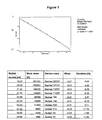
- the dextrans which were used, their appurtenant molar masses, and the elution volumes, are shown in Tab. 1.
- the resulting calibration straight lines are used to depict the elution plot as a molecular weight distribution ( Fig. 1 ).
- glucose was specified to have a molecular weight of 162.
- the total area in the GPC chromatogram is stipulated to be 100% and the amounts represented by the area of the individual sections are calculated based on the amount represented by the total area:
- Shear stability was determined using a "Viskotester VT 550" (Type 002 - 7026), Gebrüder Haake, Diesel No 4, D 76227 Düsseldorf.
- 70 g of a starch suspension (5% w/v) were transferred to the container that is used for the measurements. This container was transferred to the heating device which had been adjusted to 90°C prior to that.
- the slurry was stirred by a paddle agitator at 128 rpm (revolutions per minute) while the viscosity was recorded (software version 2.30.P). After 15 minutes the speed of the stirrer was increased to 512 rpm. After 5 minutes stirrer speed again was reduced to 128 rpm. Total time for the measurement was 21 minutes.
- Viscosity is expressed as a relative viscosity having the unit "Skalenmaschine" (SKT).
- Shear stability is expressed as the ratio of the viscosities after 21 min of the starch slurry that was stirred at 512 rpm to the slurry that was stirred at 128 rpm only.
- Shear stability % Viscosity 21 min stirred at 512 rpm x 100 Viscosity 21 min stirred at 128 rpm
- Peak viscosity was determined using a "Viskotester VT 550" (Type 002-7026) Gebrüder Haake, Diesel No 4, D 76227 Düsseldorf.
- 70 g of a starch suspension (5% w/v) were transferred to the container that is used for the measurements. This container was transferred to the heating device which had been adjusted to 90°C prior to that. Upon starting the measurement the slurry was stirred by a paddle agitator at 128 rpm (revolutions per minute) while the viscosity was recorded (software version 2.30.P). The measurement was terminated after 15 minutes.
- Viscosity is expressed as a relative viscosity having the unit "Skalenmaschine" (SKT).
- Peak viscosity is the maximum viscosity as recorded during the period of measurement.
- Fig. 1 Calibration curve for GPC
- transgenic plants which exhibit reduced BEI, SSIII and GBSSI activities transgenic plants which exhibited reduced BEI and SSIII activities were first of all generated.
- agrobacteria were used, as described in Rocha-Sosa et al. (1989, EMBO J. 8, 23-29 ), to transfer the T-DNA of the plasmid pB33-aBEI-aSSIII-Kan into potato plants.
- the expression vector pBin33-Kan was first of all constructed.
- the promoter of the Solanum tuberosum patatin gene B33 (Rocha-Sosa et al., 1989, see above) was ligated, as a Dra I fragment (nucleotides -1512 - +14), into the vector pUC19 (Genbank Acc. No. M77789), which had been cut with Sst I and whose ends had been smoothed using T4 DNA polymerase. This resulted in the plasmid pUC19-B33.
- the B33 promoter was excised from this plasmid using Eco RI and Sma I and ligated into the vector pBinAR, which had been cut correspondingly. This resulted in the plant expression vector pBin33-Kan.
- the plasmid pBinAR is a derivative of the vector plasmid pBin19 ( Bevan, 1984, Nucl. Acid Research 12, 8711-8721 ) and was constructed by Höfgen and Willmitzer (Plant Sci. 66 (1990), 221-230 ).
- a HindII fragment of 1631 bp in length which contains a partial cDNA encoding the potato BEI enzyme (Kossmann et al., 1991, Mol. Gen. Genet.
- tissue samples of potato tubers were disrupted in 50 mM Tris-HCl, pH 7.6, 2 mM DTT, 2.5 mM EDTA, 10% glycerol and 0.4 mM PMSF.
- the electrophoresis was carried out in a MiniProtean II chamber (BioRAD).
- the monomer concentration of the gels which were 1.5 mm thick, was 7.5% (w/v), while 25 mM Tris-glycine, pH 8.4, served as the gel buffer and running buffer.
- Equal quantities of protein extract were loaded on and fractionated for 2 h at 10 mA per gel.
- the activity gels were then incubated in 50 mM Tricine-NaOH, pH 8.5, 25 mM potassium acetate, 2 mM EDTA, 2 mM DTT, 1 mM ADP-glucose, 0.1% (w/v) amylopectin and 0.5 M sodium citrate. Glucans which were formed were stained with Lugol's solution.
- BEI activity was likewise detected using nondenaturing gel electrophoresis: in order to isolate proteins from plants, the sample material was triturated in liquid nitrogen, taken up in extraction buffer (50 mM Na citrate, pH 6.5; 1 mM EDTA, 4 mM DTT) and, after centrifugation (10 min, 14 000 g, 4°C), used directly for measuring the protein concentration as described by Bradford. From 5 to 20 ⁇ g, as required, of total protein extract were then treated with 4-fold loading buffer (20% glycerol, 125 mM Tris HCl, pH 6.8) and loaded onto a "BE activity gel".
- the gels were in each case incubated overnight at 37°C in 25 ml of "phosphorylase buffer" (25 ml of 1 M Na citrate, pH 7.0, 0.47 g of glucose-1-phosphate, 12.5 mg of AMP, 2.5 mg of rabbit phosphorylase a/b). The gels were stained with Lugol's solution.
- "phosphorylase buffer” 25 ml of 1 M Na citrate, pH 7.0, 0.47 g of glucose-1-phosphate, 12.5 mg of AMP, 2.5 mg of rabbit phosphorylase a/b.
- Plasmid p35SaGBSSI-Met was prepared by inserting an Asp718/Xbal fragment of 1921 bp in length, containing a partial cDNA encoding potato GBSSI (Hergersberg, 1988, see above) into the vector pBinAR-Met, which had also been opened, in the antisense orientation with regard to the 35S promoter.
- Vector pBinAR-Met is derived from the plasmid pGPTV-DHFR, which is a derivative of the vector pBin19 ( Becker et al., 1992, Plant Mol. Biol. 20, 1195-1197 ).
- pBinAR-Met contains the dhfr gene, which mediates resistance to methotrexate, instead of the nptll gene and the 3' end of gene 7 of the T-DNA of the Ti plasmid pTiACH5 (nucleotides 2106-2316; Gielen et al., 1984, EMBO J. 3, 835-846 ) instead of the 3' end of the nopaline synthase gene.
- plasmid pA7 (compare description of vector pBinAR above) as the starting point, the EcoRI/HindIII fragment, comprising the 35S promoter, the ocs terminator and the intercollated part of the polylinker, was ligated into plasmid pGPTV-DHFR, which was cut correspondingly.
- the resulting vector was designated pBinAR-Met.
- Tissue samples were taken from tubers derived from the independent transformants among the plants which were obtained by transformation with the plasmid p35SaGBSSI-Met, and which were designated asBEI-asSSIII-asGBSSI plants, and the samples were stained with iodine solution and examined under the microscope.
- the starches of the independent lines whose granules stained brown were used for further analysis of the starch properties.
- the nucleotide sequence (SEQ ID No. 11 or SEQ ID No.13) encoding a Solanum tuberosum protein having the amino acid sequence specified under SEQ ID No. 12 or SEQ ID No.14 has not been previously described. By making sequence comparisons using different branching enzymes, it was possible to identify a domain which was used to screen EST databases.
- Primers were now prepared once again in order to also amplify previously unknown sequences of the protein having the amino acid sequence depicted under SEQ ID NO 12 or SEQ ID NO 14.
- the resulting fragment of approx.
- the resulting fragment of approx. 2 kb in size, was cloned in an undirected manner into the pCR4-TOPO Invitrogen vector (product number: 45-0030).
- the resulting plasmid was designated AN 47-196.
- the sequence of the fragment inserted in plasmid AN 47-196 is depicted under SEQ ID NO 10.
- sequence information in the nucleic acid sequence depicted under SEQ ID No. 13 was obtained by joining the nucleic acid sequences described under SEQ ID NO 9 and SEQ ID NO 10.
- This nucleic acid sequence is an allelic variant of the nucleic acid sequence described under SEQ ID No 11 encoding a protein (SEQ ID No. 14) which is involved in starch biosynthesis.
- Agrobacteria were used, as described in Rocha-Sosa et al. (EMBO J. 8, (1989), 23-29 ), to the T-DNA of the plasmid AN 54-196 (see below) into the potato plants having a reduced expression of the BEI, SSIII and GBSSI genes, which plants were described in example 1 and designated, in that example, as asBEI-asSSIII-asGBSSI plants.
- the plants which were obtained by transformation with plasmid AN 54-196 were designated asBEI-asSSIII-asGBSSI-iBE3 and, in addition to exhibiting reduced expression of the BEI, SSIII and GBSSI genes, also exhibited a reduction in the expression of the gene described under SEQ ID No.
- Tissue samples were taken from tubers derived from independent transformants, stained with iodine and examined under the microscope. The phosphate content in the C6 position was also determined. The starches from the independent lines whose granules stained brown and which exhibited a phosphate content which was greater than that of the starting lines (see example 1) were used for further analysis of the starch properties.
- AN 54-196 is a derivative of plasmid pBinB33-Hyg, into which a constituent sequence of the coding nucleic acid sequence specified under SEQ ID NO 11 or SEQ ID NO 13 was inserted as an inverted repeat (RNAi technology) under the control of the promoter of the Solanum tuberosum patatin gene B33 (Rocha-Sosa et al., 1989).
- a PCR product was first of all amplified from a tuber-specific Solanum tuberosum (cv Désirée) cDNA library using the primers B1_Asp (GAT GGG TAC CAG CAC TTC TAC TTG GCA GAG G) and B2_Sal (TCA AGT CGA CCA CAA CCA GTC CAT TTC TGG) resulting in the cleavage sites Asp 718 and Sal I being added.
- the PCR product (625 bp) which was obtained was cloned, in the antisense orientation with regard to the B33 promoter, by way of these two cleavage sites.
- the Eco RI- Hind III fragment comprising the B33 promoter, a part of the polylinker and the ocs terminator, was excised from plasmid pBinB33 and ligated into the vector pBIB-Hyg (Becker, 1990), which had been cut correspondingly.
- the plasmid pBinB33 was obtained by ligating the promoter of the Solanum tuberosum patatin gene B33 (Rocha-Sosa et al., 1989), as a Dra I fragment (nucleotides -1512 - +14), into the Sst I-cut vector pUC19, whose ends had been smoothed using T4 DNA polymerase. This resulted in the plasmid pUC19-B33.
- the B33 promoter was excised from this plasmid using Eco RI and Sma l and ligated into vector pBinAR, which had been cut correspondingly. This resulted in the plant expression vector pBinB33.
- the plasmid pBinAR is a derivative of the vector plasmid pBin19 (Bevan, 1984) and was constructed as follows:
- the starches were isolated from the tubers obtained from different independent lines of the asBEI-asSSIII-asGBSSI-iBE3 potato transformants described in example 3. The physicochemical properties of these starches were then analyzed. The results which were obtained on the basis of the starches which were prepared from the plant cells or plants according to the invention are given below either as absolute values or as percentage values based on starch from corresponding wild-type plant cells or wild-type plants (designated WT starch in that which follows) (table 2).
- the table contains starch data from "single” or “double” combinations disclosed in WO 00/08184 and WO 01/12782 : Table 2 % based on WT starch Phosphate in C6 Amylose Gel strength asSSIII 197 123 84 cosSSIII 210 - 83 asBEI 170 91 91 asGBSSI 110 ⁇ 18 - asBEI-asSSIII 292 89 100 asGBSSI-asBEI 181 ⁇ 18 21 asBEI-asSSIII-asGBSSI 360 ⁇ 18 16 asBEI-asSSIII-asGBSSI-iBE3 462 ⁇ 18 -
- the side-chain profile of the potato starch was analyzed by determining the content of a particular group of side chains expressed as a percentage of the total content of all the side chains in the GPC chromatogram (table 4) (see General methods "Using gel permeation chromatography to analyze the side-chain distribution of total starch"): Table 4: Distribution of the side-chain profile of total starch in the lines asBEI-asSIII, asBEI-asSSIII-asGBSSI asBEI-asSSIII-asGBSSI-iBE3 and the corresponding wild type, divided into groups having different degrees of polymerization Degree of polymerization (dp) % based on WT starch asBEI-asSSIII asBEI-asSSIII-asGBSSI asBEI-asSSIII-asGBSSIiBE3 dp ⁇ 12 119.71 156.57 153.27 dp 12-19 103.83 119.00 147.90 dp 20-25 120.36 131.79
- the ratio of the total phosphate content to the phosphate content in the C6 position was also determined: Genotype Total phosphate content/ C6 phosphate content Desiree (wild type) 1.88 asBEI-asSSIII-asGBSSI 1.62 asBEI-asSSIII-asGBSSI-iBE3 1.37
- the gel strength of the potato starches according to the invention was analyzed by the method described above (see General Methods, Method d) "Determining the gel strength (texture analyzer)"): Genotype Gel strength (g) Desiree (wild type) 26,0 asBEI-asSSIII-asGBSSI 3,3 asBEI-asSSIII-asGBSSI-iBE3 4,5
- the shear stability of the potato starches according to the invention was analyzed by the method described above (see General Methods, Method k): Genotype Shear stability (%) Desiree (wild type) 56 asBEI-asSSIII-asGBSSI-iBE3 70
- the peak viscosity of the potato starches according to the invention was analyzed by the Rotovisko method described above (see General Methods, Method l): Genotype Peak Viscosity (SKT) Desiree (wild type) 269 asBEI-asSSIII-asGBSSI 330 asBEI-asSSIII-asGBSSI-iBE3 385
- freeze/thaw stability of the potato starches according to the invention was analyzed by the method described above (see General Methods, Method g) "Determining the freeze/thaw stability"): Genotype freeze/thaw stability (%) Desiree (wild type) 10,5 asBEI-asSSIII-asGBSSI-iBE3 95,0
Landscapes
- Health & Medical Sciences (AREA)
- Life Sciences & Earth Sciences (AREA)
- Genetics & Genomics (AREA)
- Engineering & Computer Science (AREA)
- Chemical & Material Sciences (AREA)
- Organic Chemistry (AREA)
- Bioinformatics & Cheminformatics (AREA)
- Biotechnology (AREA)
- Molecular Biology (AREA)
- Wood Science & Technology (AREA)
- Zoology (AREA)
- Biomedical Technology (AREA)
- General Engineering & Computer Science (AREA)
- Microbiology (AREA)
- Biochemistry (AREA)
- General Health & Medical Sciences (AREA)
- Nutrition Science (AREA)
- Medicinal Chemistry (AREA)
- Cell Biology (AREA)
- Physics & Mathematics (AREA)
- Biophysics (AREA)
- Plant Pathology (AREA)
- Polysaccharides And Polysaccharide Derivatives (AREA)
Claims (10)
- Kartoffelstärke, die einen Amylosegehalt gemessen nach der Methode von Hovenkamp-Hermelink et al. (1988, Potato Research 31, 241-246) von weniger als 10 Gew.-%, einen Phosphatgehalt in C6-Position gemessen nach der im Abschnitt "Allgemeine Methoden", 2. Stärkeanalytik, beschriebenen Methode b) "Bestimmung des Phosphatgehaltes in C6-Position" zwischen 35 und 100 nmol Phosphat pro Milligramm Stärke (Trockengewicht) und einen auf 125%-200% erhöhten Gehalt an Seitenketten gemessen nach der im Abschnitt "Allgemeine Methoden", 2. Stärkeanalytik, beschriebenen Methode f) "Analyse der Seitenkettenverteilung von Gesamtstärke mittels Gelpermeationschromatographie" mit einem DP von 12 bis 19 im Vergleich zu Kartoffelstärke aus entsprechenden Kartoffel-Wildtyp-Pflanzen aufweist.
- Kartoffelstärke nach Anspruch 1, die einen Phosphatgehalt in C6-Position zwischen 40 und 85 nmol Phosphat pro Milligramm Stärke (Trockengewicht) aufweist.
- Kartoffelstärke nach Anspruch 1, die einen Phosphatgehalt in C6-Position zwischen 45 und 70 nmol Phosphat pro Milligramm Stärke (Trockengewicht) aufweist.
- Kartoffelstärke nach Anspruch 1, die einen Phosphatgehalt in C6-Position zwischen 50 und 65 nmol Phosphat pro Milligramm Stärke (Trockengewicht) aufweist.
- Kartoffelstärke nach einem der Ansprüche 1 bis 4, die einen Amylosegehalt gemessen nach der Methode von Hovenkamp-Hermelink et al. (1988, Potato Research 31, 241-246) von weniger als 5 Gew.-% aufweist.
- Kartoffelstärke nach einem der Ansprüche 1 bis 4, die einen Amylosegehalt gemessen nach der Methode von Hovenkamp-Hermelink et al. (1988, Potato Research 31, 241-246) von weniger als 3 Gew.-% aufweist.
- Kartoffelstärke nach einem der Ansprüche 1 bis 6, wobei der Anteil der Seitenketten mit einem DP von 12 bis 19 auf 130%-180% erhöht ist im Vergleich zu Kartoffelstärke aus entsprechenden Kartoffel-Wildtyp-Pflanzen.
- Kartoffelstärke nach einem der Ansprüche 1 bis 7, wobei der Anteil der Seitenketten mit einem DP von 63 bis 123 verringert ist im Vergleich zu Kartoffelstärke aus entsprechenden Kartoffel-Wildtyp-Pflanzen.
- Kartoffelstärke nach Anspruch 8, wobei der Anteil der Seitenketten mit einem DP von 63 bis 123 auf 50%-95% verringert ist im Vergleich zu Kartoffelstärke aus entsprechenden Kartoffel-Wildtyp-Pflanzen.
- Derivatisierte Kartoffelstärke enthaltend Kartoffelstärke nach einem der Ansprüche 1 bis 9.
Priority Applications (1)
| Application Number | Priority Date | Filing Date | Title |
|---|---|---|---|
| EP06723985.5A EP1869089B1 (de) | 2005-04-01 | 2006-03-30 | Phosphorylierte wachskartoffelstärke |
Applications Claiming Priority (4)
| Application Number | Priority Date | Filing Date | Title |
|---|---|---|---|
| EP05090085A EP1707632A1 (de) | 2005-04-01 | 2005-04-01 | Phosphorylierte waxy-Kartoffelstärke |
| US66966505P | 2005-04-08 | 2005-04-08 | |
| PCT/EP2006/003027 WO2006103107A1 (en) | 2005-04-01 | 2006-03-30 | Phosphorylated waxy potato starch |
| EP06723985.5A EP1869089B1 (de) | 2005-04-01 | 2006-03-30 | Phosphorylierte wachskartoffelstärke |
Publications (2)
| Publication Number | Publication Date |
|---|---|
| EP1869089A1 EP1869089A1 (de) | 2007-12-26 |
| EP1869089B1 true EP1869089B1 (de) | 2014-12-10 |
Family
ID=34938422
Family Applications (2)
| Application Number | Title | Priority Date | Filing Date |
|---|---|---|---|
| EP05090085A Withdrawn EP1707632A1 (de) | 2005-04-01 | 2005-04-01 | Phosphorylierte waxy-Kartoffelstärke |
| EP06723985.5A Expired - Lifetime EP1869089B1 (de) | 2005-04-01 | 2006-03-30 | Phosphorylierte wachskartoffelstärke |
Family Applications Before (1)
| Application Number | Title | Priority Date | Filing Date |
|---|---|---|---|
| EP05090085A Withdrawn EP1707632A1 (de) | 2005-04-01 | 2005-04-01 | Phosphorylierte waxy-Kartoffelstärke |
Country Status (5)
| Country | Link |
|---|---|
| US (1) | US8148517B2 (de) |
| EP (2) | EP1707632A1 (de) |
| AU (1) | AU2006228670B2 (de) |
| CA (1) | CA2600989C (de) |
| WO (1) | WO2006103107A1 (de) |
Families Citing this family (184)
| Publication number | Priority date | Publication date | Assignee | Title |
|---|---|---|---|---|
| CL2007003743A1 (es) * | 2006-12-22 | 2008-07-11 | Bayer Cropscience Ag | Composicion que comprende fenamidona y un compuesto insecticida; y metodo para controlar de forma curativa o preventiva hongos fitopatogenos de cultivos e insectos. |
| CL2007003744A1 (es) | 2006-12-22 | 2008-07-11 | Bayer Cropscience Ag | Composicion que comprende un derivado 2-piridilmetilbenzamida y un compuesto insecticida; y metodo para controlar de forma curativa o preventiva hongos fitopatogenos de cultivos e insectos. |
| EP1969934A1 (de) | 2007-03-12 | 2008-09-17 | Bayer CropScience AG | 4-Cycloalkyl-oder 4-arylsubstituierte Phenoxyphenylamidine und deren Verwendung als Fungizide |
| EP2120558B1 (de) | 2007-03-12 | 2016-02-10 | Bayer Intellectual Property GmbH | 3,4-Disubstituierte Phenoxyphenylamidin-Derivate und deren Verwendung als Fungizide |
| WO2008110280A2 (de) | 2007-03-12 | 2008-09-18 | Bayer Cropscience Ag | Phenoxy-substitutierte phenylamidin-derivativen und deren verwendung als fungiziden |
| EP1969931A1 (de) | 2007-03-12 | 2008-09-17 | Bayer CropScience Aktiengesellschaft | Fluoalkylphenylamidine und deren Verwendung als Fungizide |
| BRPI0808786A2 (pt) | 2007-03-12 | 2014-09-16 | Bayer Cropscience Ag | Di-halogenofenoxifenilamidinas e seu uso como fungicidas |
| EP1969930A1 (de) | 2007-03-12 | 2008-09-17 | Bayer CropScience AG | Phenoxyphenylamidine und deren Verwendung als Fungizide |
| EP1969929A1 (de) | 2007-03-12 | 2008-09-17 | Bayer CropScience AG | Substituierte Phenylamidine und deren Verwendung als Fungizide |
| US8168567B2 (en) | 2007-04-19 | 2012-05-01 | Bayer Cropscience Ag | Thiadiazolyl oxyphenyl amidines and the use thereof as a fungicide |
| DE102007045920B4 (de) | 2007-09-26 | 2018-07-05 | Bayer Intellectual Property Gmbh | Synergistische Wirkstoffkombinationen |
| DE102007045956A1 (de) | 2007-09-26 | 2009-04-09 | Bayer Cropscience Ag | Wirkstoffkombination mit insektiziden und akariziden Eigenschaften |
| DE102007045953B4 (de) | 2007-09-26 | 2018-07-05 | Bayer Intellectual Property Gmbh | Wirkstoffkombinationen mit insektiziden und akariziden Eigenschaften |
| DE102007045919B4 (de) | 2007-09-26 | 2018-07-05 | Bayer Intellectual Property Gmbh | Wirkstoffkombinationen mit insektiziden und akariziden Eigenschaften |
| DE102007045922A1 (de) | 2007-09-26 | 2009-04-02 | Bayer Cropscience Ag | Wirkstoffkombinationen mit insektiziden und akariziden Eigenschaften |
| BRPI0818691A2 (pt) * | 2007-10-02 | 2014-09-30 | Bayer Cropscience Ag | Métodos para melhorar o crescimento vegetal. |
| EP2090168A1 (de) | 2008-02-12 | 2009-08-19 | Bayer CropScience AG | Methode zur Verbesserung des Pflanzenwachstums |
| EP2072506A1 (de) | 2007-12-21 | 2009-06-24 | Bayer CropScience AG | Thiazolyloxyphenylamidine oder Thiadiazolyloxyphenylamidine und deren Verwendung als Fungizide |
| EP2168434A1 (de) | 2008-08-02 | 2010-03-31 | Bayer CropScience AG | Verwendung von Azolen zur Steigerung der Resistenz von Pflanzen oder Pflanzenteilen gegenüber abiotischem Stress |
| US20110190365A1 (en) | 2008-08-14 | 2011-08-04 | Bayer Crop Science Ag | Insecticidal 4-phenyl-1H-pyrazoles |
| DE102008041695A1 (de) | 2008-08-29 | 2010-03-04 | Bayer Cropscience Ag | Methoden zur Verbesserung des Pflanzenwachstums |
| EP2201838A1 (de) | 2008-12-05 | 2010-06-30 | Bayer CropScience AG | Wirkstoff-Nützlings-Kombinationen mit insektiziden und akariziden Eigenschaften |
| EP2198709A1 (de) | 2008-12-19 | 2010-06-23 | Bayer CropScience AG | Verfahren zur Bekämpfung resistenter tierischer Schädlinge |
| EP2223602A1 (de) | 2009-02-23 | 2010-09-01 | Bayer CropScience AG | Verfahren zur verbesserten Nutzung des Produktionspotentials genetisch modifizierter Pflanzen |
| EP2204094A1 (de) | 2008-12-29 | 2010-07-07 | Bayer CropScience AG | Verfahren zur verbesserten Verwendung des Herstellungspotentials von transgenen Pflanzen |
| CN102333445B (zh) | 2008-12-29 | 2014-09-03 | 拜尔农作物科学股份公司 | 改善利用转基因植物生产潜力的方法 |
| EP2039771A2 (de) | 2009-01-06 | 2009-03-25 | Bayer CropScience AG | Verfahren zur verbesserten Nutzung des Produktionspotentials transgener Pflanzen |
| EP2039770A2 (de) | 2009-01-06 | 2009-03-25 | Bayer CropScience AG | Verfahren zur verbesserten Nutzung des Produktionspotentials transgener Pflanzen |
| EP2039772A2 (de) | 2009-01-06 | 2009-03-25 | Bayer CropScience AG | Verfahren zur verbesserten Nutzung des Produktionspotentials transgener Pflanzen |
| CN102355820B (zh) | 2009-01-19 | 2013-10-16 | 拜尔农作物科学股份公司 | 环状二酮及其用作杀昆虫剂、杀螨剂和/或杀菌剂的用途 |
| EP2227951A1 (de) | 2009-01-23 | 2010-09-15 | Bayer CropScience AG | Verwendung von Enaminocarbonylverbindungen zur Bekämpfung von durch Insekten übertragenen Viren |
| BRPI1004930B1 (pt) | 2009-01-28 | 2017-10-17 | Bayer Intellectual Property Gmbh | Compounds, fungicidal composition and method for controlling phytopathogenic fungi of crops. |
| AR075126A1 (es) | 2009-01-29 | 2011-03-09 | Bayer Cropscience Ag | Metodo para el mejor uso del potencial de produccion de plantas transgenicas |
| EP2218717A1 (de) | 2009-02-17 | 2010-08-18 | Bayer CropScience AG | Fungizide N-((HET)Arylethyl)Thiocarboxamid-Derivative |
| JP5728735B2 (ja) | 2009-02-17 | 2015-06-03 | バイエル・インテレクチュアル・プロパティ・ゲゼルシャフト・ミット・ベシュレンクテル・ハフツングBayer Intellectual Property GmbH | 殺菌性n−(フェニルシクロアルキル)カルボキサミド、n−(ベンジルシクロアルキル)カルボキサミド及びチオカルボキサミド誘導体 |
| TW201031331A (en) | 2009-02-19 | 2010-09-01 | Bayer Cropscience Ag | Pesticide composition comprising a tetrazolyloxime derivative and a fungicide or an insecticide active substance |
| EP2232995A1 (de) | 2009-03-25 | 2010-09-29 | Bayer CropScience AG | Verfahren zur verbesserten Nutzung des Produktionspotentials transgener Pflanzen |
| US8828906B2 (en) | 2009-03-25 | 2014-09-09 | Bayer Cropscience Ag | Active compound combinations having insecticidal and acaricidal properties |
| US8846567B2 (en) | 2009-03-25 | 2014-09-30 | Bayer Cropscience Ag | Active compound combinations having insecticidal and acaricidal properties |
| UA104887C2 (uk) | 2009-03-25 | 2014-03-25 | Баєр Кропсаєнс Аг | Синергічні комбінації активних речовин |
| EP2410849A1 (de) | 2009-03-25 | 2012-02-01 | Bayer CropScience AG | Wirkstoffkombinationen mit insektiziden und akariziden eigenschaften |
| MX2011009830A (es) | 2009-03-25 | 2011-10-06 | Bayer Cropscience Ag | Combinaciones de principios activos con propiedades insecticidas y acaricidas. |
| EP2239331A1 (de) | 2009-04-07 | 2010-10-13 | Bayer CropScience AG | Verfahren zur verbesserten Verwendung des Herstellungspotentials von transgenen Pflanzen |
| CN102458125B (zh) | 2009-05-06 | 2015-04-29 | 拜尔农作物科学股份公司 | 环戊二酮化合物及其用作杀昆虫剂、杀螨剂和/或杀菌剂的用途 |
| EP2251331A1 (de) | 2009-05-15 | 2010-11-17 | Bayer CropScience AG | Fungizide Pyrazolcarboxamid-Derivate |
| AR076839A1 (es) | 2009-05-15 | 2011-07-13 | Bayer Cropscience Ag | Derivados fungicidas de pirazol carboxamidas |
| EP2255626A1 (de) | 2009-05-27 | 2010-12-01 | Bayer CropScience AG | Verwendung von Succinat Dehydrogenase Inhibitoren zur Steigerung der Resistenz von Pflanzen oder Pflanzenteilen gegenüber abiotischem Stress |
| HRP20190216T1 (hr) | 2009-06-02 | 2019-03-22 | Bayer Cropscience Aktiengesellschaft | Uporaba fluopirama za suzbijanje sclerotinia ssp |
| JP5642786B2 (ja) | 2009-07-16 | 2014-12-17 | バイエル・クロップサイエンス・アーゲーBayer Cropscience Ag | フェニルトリアゾール類を含む相乗的活性化合物組み合わせ |
| WO2011015524A2 (en) | 2009-08-03 | 2011-02-10 | Bayer Cropscience Ag | Fungicide heterocycles derivatives |
| JP5768252B2 (ja) * | 2009-08-12 | 2015-08-26 | 公立大学法人大阪府立大学 | 抗脂血及び内臓脂肪予防食品 |
| EP2292094A1 (de) | 2009-09-02 | 2011-03-09 | Bayer CropScience AG | Wirkstoffkombinationen |
| EP2319872A1 (de) | 2009-11-04 | 2011-05-11 | BASF Plant Science GmbH | Amylopektinähnliche Stärke mit verbesserter Retrogradationsstabilität |
| EP2343280A1 (de) | 2009-12-10 | 2011-07-13 | Bayer CropScience AG | Fungizid-Chinolinderivate |
| US9000012B2 (en) | 2009-12-28 | 2015-04-07 | Bayer Cropscience Ag | Fungicide hydroximoyl-heterocycles derivatives |
| CN102724879B (zh) | 2009-12-28 | 2015-10-21 | 拜尔农科股份公司 | 杀真菌剂肟基-四唑衍生物 |
| US20130012546A1 (en) | 2009-12-28 | 2013-01-10 | Christian Beier | Fungicide hydroximoyl-tetrazole derivatives |
| NZ601341A (en) | 2010-01-22 | 2014-02-28 | Bayer Ip Gmbh | Acaricide and/or insecticide active substance combinations |
| AR080443A1 (es) | 2010-03-04 | 2012-04-11 | Bayer Cropscience Ag | 2-amidobencimidazoles sustituidos con fluruoalquilo |
| EP2555619A2 (de) | 2010-04-06 | 2013-02-13 | Bayer Intellectual Property GmbH | Verwendung der 4-phenylbuttersäure und/oder ihrer salze zur steigerung der stresstoleranz in pflanzen |
| JP6046604B2 (ja) | 2010-04-09 | 2016-12-21 | バイエル・インテレクチュアル・プロパティ・ゲゼルシャフト・ミット・ベシュレンクテル・ハフツングBayer Intellectual Property GmbH | 非生物的ストレスに対する植物の耐性を増強させるための(1−シアノシクロプロピル)フェニルホスフィン酸の誘導体、それらのエステル及び/又はそれらの塩の使用 |
| WO2011134913A1 (en) | 2010-04-28 | 2011-11-03 | Bayer Cropscience Ag | Fungicide hydroximoyl-heterocycles derivatives |
| WO2011134912A1 (en) | 2010-04-28 | 2011-11-03 | Bayer Cropscience Ag | Fungicide hydroximoyl-heterocycles derivatives |
| WO2011134911A2 (en) | 2010-04-28 | 2011-11-03 | Bayer Cropscience Ag | Fungicide hydroximoyl-tetrazole derivatives |
| CA2796194A1 (en) | 2010-06-03 | 2011-12-08 | Bayer Cropscience Ag | N-[(het)arylalkyl)] pyrazole (thio)carboxamides and their heterosubstituted analogues |
| UA110703C2 (uk) | 2010-06-03 | 2016-02-10 | Байєр Кропсайнс Аг | Фунгіцидні похідні n-[(тризаміщений силіл)метил]-карбоксаміду |
| KR20130109940A (ko) | 2010-06-03 | 2013-10-08 | 바이엘 크롭사이언스 아게 | N-[(헤트)아릴에틸] 피라졸(티오)카르복사미드 및 이의 헤테로치환된 유사체 |
| AU2011264074B2 (en) | 2010-06-09 | 2015-01-22 | Bayer Cropscience Nv | Methods and means to modify a plant genome at a nucleotide sequence commonly used in plant genome engineering |
| MX347575B (es) | 2010-06-09 | 2017-05-03 | Bayer Cropscience N V * | Metodos y medios para modificar un genoma vegetal en una secuencia de nucleotidos usada comunmente en la ingenieria genetica de genomas vegetales. |
| RU2013107369A (ru) | 2010-07-20 | 2014-08-27 | Байер Кропсайенс Аг | Бензоциклоалкеныв качестве противогрибковых средств |
| BR112013005223A2 (pt) | 2010-09-03 | 2016-05-03 | Bayer Ip Gmbh | "pirimidinonas e dihidropirimidinonas fusionadas substituídas." |
| EP2460406A1 (de) | 2010-12-01 | 2012-06-06 | Bayer CropScience AG | Verwendung von Fluopyram zum Steuern von Nematoden in nematodresistentem Pflanzen |
| BR112013006612A2 (pt) | 2010-09-22 | 2017-10-24 | Bayer Ip Gmbh | uso de agentes de controle biológico ou químico para controle de insetos e nematódeos em culturas resistentes |
| PL2624699T3 (pl) | 2010-10-07 | 2019-05-31 | Bayer Cropscience Ag | Kompozycja grzybobójcza zawierająca pochodną tetrazolilooksymu i pochodną tiazolilopiperydyny |
| EP2630135B1 (de) | 2010-10-21 | 2020-03-04 | Bayer Intellectual Property GmbH | 1-(heterocyclische carbonyl)-piperidine |
| BR112013009580B1 (pt) | 2010-10-21 | 2018-06-19 | Bayer Intellectual Property Gmbh | Composto de fómrula (i), composição fungicida e método para controlar fungos fitopatogênicos |
| CA2815117A1 (en) | 2010-11-02 | 2012-05-10 | Bayer Intellectual Property Gmbh | N-hetarylmethyl pyrazolylcarboxamides |
| JP5860471B2 (ja) | 2010-11-15 | 2016-02-16 | バイエル・インテレクチュアル・プロパティ・ゲゼルシャフト・ミット・ベシュレンクテル・ハフツングBayer Intellectual Property GmbH | N−アリールピラゾール(チオ)カルボキサミド類 |
| MX2013005410A (es) | 2010-11-15 | 2013-07-03 | Bayer Ip Gmbh | 5-halopirazol (tio)carboxamidas). |
| JP5833663B2 (ja) | 2010-11-15 | 2015-12-16 | バイエル・インテレクチュアル・プロパティ・ゲゼルシャフト・ミット・ベシュレンクテル・ハフツングBayer Intellectual Property GmbH | 5−ハロゲノピラゾールカルボキサミド類 |
| EP2460407A1 (de) | 2010-12-01 | 2012-06-06 | Bayer CropScience AG | Wirkstoffkombinationen umfassend Pyridylethylbenzamide und weitere Wirkstoffe |
| JP6412311B2 (ja) | 2010-12-01 | 2018-10-24 | バイエル・インテレクチュアル・プロパティ・ゲゼルシャフト・ミット・ベシュレンクテル・ハフツングBayer Intellectual Property GmbH | 作物において線虫類を防除するための、及び、収量を増加させるための、フルオピラムの使用 |
| EP2474542A1 (de) | 2010-12-29 | 2012-07-11 | Bayer CropScience AG | Fungizide Hydroximoyl-Tetrazol-Derivate |
| US20130289077A1 (en) | 2010-12-29 | 2013-10-31 | Juergen Benting | Fungicide hydroximoyl-tetrazole derivatives |
| EP2471363A1 (de) | 2010-12-30 | 2012-07-04 | Bayer CropScience AG | Verwendung von Aryl-, Heteroaryl- und Benzylsulfonamidocarbonsäuren, -carbonsäureestern, -carbonsäureamiden und -carbonitrilen oder deren Salze zur Steigerung der Stresstoleranz in Pflanzen |
| EP2494867A1 (de) | 2011-03-01 | 2012-09-05 | Bayer CropScience AG | Halogen-substituierte Verbindungen in Kombination mit Fungiziden |
| JP2014513061A (ja) | 2011-03-10 | 2014-05-29 | バイエル・インテレクチユアル・プロパテイー・ゲー・エム・ベー・ハー | 処理された種子の種子安全性を保護するためのリポキト−オリゴ糖化合物の使用 |
| BR112013023502A2 (pt) | 2011-03-14 | 2016-08-02 | Bayer Ip Gmbh | composto fórmula (i), composição fungicida, método para o controle de fungos fitopatogênicos de culturas, utilização dos compostos de fórmula (i) e processo para a produção das composições |
| WO2012136581A1 (en) | 2011-04-08 | 2012-10-11 | Bayer Cropscience Ag | Fungicide hydroximoyl-tetrazole derivatives |
| AR090010A1 (es) | 2011-04-15 | 2014-10-15 | Bayer Cropscience Ag | 5-(ciclohex-2-en-1-il)-penta-2,4-dienos y 5-(ciclohex-2-en-1-il)-pent-2-en-4-inos sustituidos como principios activos contra el estres abiotico de las plantas, usos y metodos de tratamiento |
| EP2511255A1 (de) | 2011-04-15 | 2012-10-17 | Bayer CropScience AG | Substituierte Prop-2-in-1-ol- und Prop-2-en-1-ol-Derivate |
| AR085568A1 (es) | 2011-04-15 | 2013-10-09 | Bayer Cropscience Ag | 5-(biciclo[4.1.0]hept-3-en-2-il)-penta-2,4-dienos y 5-(biciclo[4.1.0]hept-3-en-2-il)-pent-2-en-4-inos sustituidos como principios activos contra el estres abiotico de las plantas |
| AR085585A1 (es) | 2011-04-15 | 2013-10-09 | Bayer Cropscience Ag | Vinil- y alquinilciclohexanoles sustituidos como principios activos contra estres abiotico de plantas |
| ES2561296T3 (es) | 2011-04-22 | 2016-02-25 | Bayer Intellectual Property Gmbh | Combinaciones de un compuesto activo que comprenden un derivado de carboximida y un compuesto fungicida |
| WO2012168124A1 (en) | 2011-06-06 | 2012-12-13 | Bayer Cropscience Nv | Methods and means to modify a plant genome at a preselected site |
| BR112014000267A2 (pt) | 2011-07-04 | 2016-09-20 | Bayer Ip Gmbh | utilização de isoquinolinonas, isoquinolinedionas, isoquinolinetrionas e dihidroisoquinolinonas substituídas ou, em cada caso, sais das mesmas como agentes ativos contra o stress abiótico em plantas |
| CN103717076B (zh) | 2011-08-10 | 2016-04-13 | 拜耳知识产权股份有限公司 | 含有特定特特拉姆酸衍生物的活性化合物组合物 |
| WO2013026836A1 (en) | 2011-08-22 | 2013-02-28 | Bayer Intellectual Property Gmbh | Fungicide hydroximoyl-tetrazole derivatives |
| BR112014003919A2 (pt) | 2011-08-22 | 2017-03-14 | Bayer Cropscience Ag | métodos e meios para modificar um genoma de planta |
| EP2561759A1 (de) | 2011-08-26 | 2013-02-27 | Bayer Cropscience AG | Fluoralkyl-substituierte 2-amidobenzimidazole und ihre Wirkung auf das Pflanzenwachstum |
| BR112014005262A2 (pt) | 2011-09-09 | 2017-04-04 | Bayer Ip Gmbh | método para aprimorar um vegetal e utilização de um composto de fórmula (i) ou (ii) |
| US9090600B2 (en) | 2011-09-12 | 2015-07-28 | Bayer Intellectual Property Gmbh | Fungicidal 4-substituted-3-{phenyl[(heterocyclylmethoxy)imino]methyl}-1,2,4-oxadizol-5(4H)-one derivatives |
| BR112014006217B1 (pt) | 2011-09-16 | 2019-01-15 | Bayer Intellectual Property Gmbh | utilização de acilsulfonamidas para melhorar o rendimento de plantas,método para induzir respostas de regulação de crescimento em plantas úteis ou plantas de cultura e composição. |
| CN107897194A (zh) | 2011-09-16 | 2018-04-13 | 拜耳知识产权有限责任公司 | 5‑苯基‑或5‑苄基‑2‑异噁唑啉‑3‑甲酸酯用于改善植物产量的用途 |
| CN103781352A (zh) | 2011-09-16 | 2014-05-07 | 拜耳知识产权有限责任公司 | 苯基吡唑啉-3-甲酸酯类用于提高植物产量的用途 |
| EP2757886A1 (de) | 2011-09-23 | 2014-07-30 | Bayer Intellectual Property GmbH | Verwendung 4-substituierter 1-phenyl-pyrazol-3-carbonsäurederivate als wirkstoffe gegen abiotischen pflanzenstress |
| UA115132C2 (uk) | 2011-10-04 | 2017-09-25 | Байєр Інтелекчуал Проперті Гмбх | Спосіб боротьби з грибами та ооміцетами шляхом інгібування гена сахаропіндегідрогенази |
| WO2013050324A1 (de) | 2011-10-06 | 2013-04-11 | Bayer Intellectual Property Gmbh | Abiotischen pflanzenstress-reduzierende kombination enthaltend 4- phenylbuttersäure (4-pba) oder eines ihrer salze (komponente (a)) und eine oder mehrere ausgewählte weitere agronomisch wirksame verbindungen (komponente(n) (b) |
| RU2014125077A (ru) | 2011-11-21 | 2015-12-27 | Байер Интеллекчуал Проперти Гмбх | Фунгицидные n-[(тризамещенный силил)этил]-карбоксамидные производные |
| AR089656A1 (es) | 2011-11-30 | 2014-09-10 | Bayer Ip Gmbh | Derivados de n-bicicloalquil- y n-tricicloalquil-(tio)-carboxamida fungicidas |
| CN104270946B (zh) | 2011-12-19 | 2017-05-10 | 拜耳农作物科学股份公司 | 邻氨基苯甲酸二酰胺衍生物用于防治转基因作物中的害虫的用途 |
| WO2013098146A1 (en) | 2011-12-29 | 2013-07-04 | Bayer Intellectual Property Gmbh | Fungicidal 3-[(1,3-thiazol-4-ylmethoxyimino)(phenyl)methyl]-2-substituted-1,2,4-oxadiazol-5(2h)-one derivatives |
| MX343871B (es) | 2011-12-29 | 2016-11-25 | Bayer Ip Gmbh | Derivados de 3-[(piridin-2-ilmetoxiimino)(fenil)metil]-2-sustituid o-1,2,4-oxadiazol-5(2h)-ona fungicidas. |
| HUE036328T2 (hu) | 2012-02-22 | 2018-06-28 | Bayer Cropscience Ag | Fluopirám alkalmazása fabetegségek leküzdésére szõlõn |
| AP2014007876A0 (en) | 2012-02-27 | 2014-08-31 | Bayer Ip Gmbh | Active compound combinations containing a thiazoylisoxazoline and a fungicide |
| WO2013139949A1 (en) | 2012-03-23 | 2013-09-26 | Bayer Intellectual Property Gmbh | Compositions comprising a strigolactame compound for enhanced plant growth and yield |
| CN104245687B (zh) | 2012-04-12 | 2016-12-14 | 拜尔农科股份公司 | 作为杀真菌剂的n-酰基-2-(环)烷基吡咯烷和哌啶 |
| KR102062517B1 (ko) | 2012-04-20 | 2020-01-06 | 바이엘 크롭사이언스 악티엔게젤샤프트 | N-시클로알킬-n-[(헤테로시클릴페닐)메틸렌]-(티오)카르복사미드 유도체 |
| JP2015516396A (ja) | 2012-04-20 | 2015-06-11 | バイエル・クロップサイエンス・アーゲーBayer Cropscience Ag | N−シクロアルキル−n−[(三置換シリルフェニル)メチレン]−(チオ)カルボキサミド誘導体 |
| CA2871008C (en) | 2012-04-23 | 2022-11-22 | Bayer Cropscience Nv | Targeted genome engineering in plants |
| EP2662360A1 (de) | 2012-05-09 | 2013-11-13 | Bayer CropScience AG | 5-Halogenpyrazol-Indanyl-Carboxamide |
| EP2662362A1 (de) | 2012-05-09 | 2013-11-13 | Bayer CropScience AG | Pyrazol-Indanyl-Carboxamide |
| EP2662363A1 (de) | 2012-05-09 | 2013-11-13 | Bayer CropScience AG | 5-Halogenpyrazol-Biphenyl-Carboxamide |
| US9249104B2 (en) | 2012-05-09 | 2016-02-02 | Bayer Cropscience Ag | Pyrazole indanyl carboxamides |
| EP2662361A1 (de) | 2012-05-09 | 2013-11-13 | Bayer CropScience AG | Pyrazol-Indanyl-Carboxamide |
| BR112014027644A2 (pt) | 2012-05-09 | 2017-06-27 | Bayer Cropscience Ag | 5-halogenopirazol-indanil-carboxamidas |
| EP2662370A1 (de) | 2012-05-09 | 2013-11-13 | Bayer CropScience AG | 5-Halogenpyrazol-Benzofuranyl-Carboxamide |
| EP2662364A1 (de) | 2012-05-09 | 2013-11-13 | Bayer CropScience AG | Pyrazol-Tetrahydronaphthyl-Carboxamide |
| AR091104A1 (es) | 2012-05-22 | 2015-01-14 | Bayer Cropscience Ag | Combinaciones de compuestos activos que comprenden un derivado lipo-quitooligosacarido y un compuesto nematicida, insecticida o fungicida |
| WO2014009322A1 (en) | 2012-07-11 | 2014-01-16 | Bayer Cropscience Ag | Use of fungicidal combinations for increasing the tolerance of a plant towards abiotic stress |
| WO2014037340A1 (de) | 2012-09-05 | 2014-03-13 | Bayer Cropscience Ag | Verwendung substituierter 2-amidobenzimidazole, 2-amidobenzoxazole und 2-amidobenzothiazole oder deren salze als wirkstoffe gegen abiotischen pflanzenstress |
| CA2888559C (en) | 2012-10-19 | 2021-03-02 | Bayer Cropscience Ag | Method for enhancing tolerance to abiotic stress in plants using carboxamide or thiocarboxamide derivatives |
| MX380476B (es) | 2012-10-19 | 2025-03-12 | Bayer Cropscience Ag | Método de promoción de crecimiento de planta usando derivados de carboxamida. |
| CA2888600C (en) | 2012-10-19 | 2021-08-10 | Bayer Cropscience Ag | Active compound combinations comprising carboxamide derivatives |
| AU2013333847B2 (en) | 2012-10-19 | 2017-04-20 | Bayer Cropscience Ag | Method for treating plants against fungi resistant to fungicides using carboxamide or thiocarboxamide derivatives |
| WO2014079957A1 (de) | 2012-11-23 | 2014-05-30 | Bayer Cropscience Ag | Selektive inhibition der ethylensignaltransduktion |
| EP2735231A1 (de) | 2012-11-23 | 2014-05-28 | Bayer CropScience AG | Wirkstoffkombinationen |
| UA117819C2 (uk) | 2012-11-30 | 2018-10-10 | Байєр Кропсайєнс Акцієнгезелльшафт | Подвійні пестицидні і фунгіцидні суміші |
| UA116223C2 (uk) | 2012-11-30 | 2018-02-26 | Байєр Кропсайєнс Акцієнгезелльшафт | Подвійна фунгіцидна суміш |
| BR122020019349B1 (pt) | 2012-11-30 | 2021-05-11 | Bayer Cropscience Ag | composição, seu processo de preparação, método para controlar um ou mais microrganismos nocivos, semente resistente a microorganismos nocivos e seu método de tratamento |
| WO2014083089A1 (en) | 2012-11-30 | 2014-06-05 | Bayer Cropscience Ag | Ternary fungicidal and pesticidal mixtures |
| BR112015012054A2 (pt) | 2012-11-30 | 2017-07-11 | Bayer Cropscience Ag | mistura fungicida ou pesticida binária |
| EP2740356A1 (de) | 2012-12-05 | 2014-06-11 | Bayer CropScience AG | Substituierte (2Z)-5(1-Hydroxycyclohexyl)pent-2-en-4-insäure-Derivate |
| US20150305334A1 (en) | 2012-12-05 | 2015-10-29 | Bayer Cropscience Ag | Use of substituted 1-(aryl ethynyl)-, 1-(heteroaryl ethynyl)-, 1-(heterocyclyl ethynyl)- and 1-(cycloalkenyl ethynyl)-cyclohexanols as active agents against abiotic plant stress |
| EP2740720A1 (de) | 2012-12-05 | 2014-06-11 | Bayer CropScience AG | Substituierte bicyclische- und tricyclische Pent-2-en-4-insäure -Derivate und ihre Verwendung zur Steigerung der Stresstoleranz in Pflanzen |
| WO2014090765A1 (en) | 2012-12-12 | 2014-06-19 | Bayer Cropscience Ag | Use of 1-[2-fluoro-4-methyl-5-(2,2,2-trifluoroethylsulfinyl)phenyl]-5-amino-3-trifluoromethyl)-1 h-1,2,4 tfia zole for controlling nematodes in nematode-resistant crops |
| AR093996A1 (es) | 2012-12-18 | 2015-07-01 | Bayer Cropscience Ag | Combinaciones bactericidas y fungicidas binarias |
| US9428459B2 (en) | 2012-12-19 | 2016-08-30 | Bayer Cropscience Ag | Difluoromethyl-nicotinic- tetrahydronaphtyl carboxamides |
| TW201446759A (zh) | 2013-03-07 | 2014-12-16 | Bayer Cropscience Ag | 殺真菌之3-{苯基[(雜環基甲氧基)亞胺]甲基}-雜環衍生物 |
| CN105121650A (zh) | 2013-04-02 | 2015-12-02 | 拜尔作物科学公司 | 真核生物中的靶向基因组工程 |
| WO2014167009A1 (en) | 2013-04-12 | 2014-10-16 | Bayer Cropscience Ag | Novel triazole derivatives |
| EP2984080B1 (de) | 2013-04-12 | 2017-08-30 | Bayer CropScience Aktiengesellschaft | Neuartige triazolderivate |
| WO2014170345A2 (en) | 2013-04-19 | 2014-10-23 | Bayer Cropscience Ag | Method for improved utilization of the production potential of transgenic plants |
| CN105307492B (zh) | 2013-04-19 | 2018-03-30 | 拜耳作物科学股份公司 | 二元杀虫或除虫混合物 |
| TW201507722A (zh) | 2013-04-30 | 2015-03-01 | Bayer Cropscience Ag | 做為殺線蟲劑及殺體內寄生蟲劑的n-(2-鹵素-2-苯乙基)-羧醯胺類 |
| WO2014177514A1 (en) | 2013-04-30 | 2014-11-06 | Bayer Cropscience Ag | Nematicidal n-substituted phenethylcarboxamides |
| US9770022B2 (en) | 2013-06-26 | 2017-09-26 | Bayer Cropscience Ag | N-cycloalkyl-N-[(bicyclylphenyl)methylene]-(thio)carboxamide derivatives |
| EP3019012A1 (de) | 2013-07-09 | 2016-05-18 | Bayer CropScience AG | Verwendung ausgewählter pyridoncarboxamide oder deren salzen als wirkstoffe gegen abiotischen pflanzenstress |
| EP3077377B1 (de) | 2013-12-05 | 2020-01-22 | Bayer CropScience Aktiengesellschaft | N-cycloalkyl-n-{[2-(1-cycloalkylsubstituierten)phenyl]methylene}-(thio)carboxamide derivativen |
| TW201609661A (zh) | 2013-12-05 | 2016-03-16 | 拜耳作物科學公司 | N-環烷基-n-{[2-(1-經取代環烷基)苯基]亞甲基}-(硫代)甲醯胺衍生物 |
| AR101214A1 (es) | 2014-07-22 | 2016-11-30 | Bayer Cropscience Ag | Ciano-cicloalquilpenta-2,4-dienos, ciano-cicloalquilpent-2-en-4-inas, ciano-heterociclilpenta-2,4-dienos y ciano-heterociclilpent-2-en-4-inas sustituidos como principios activos contra el estrés abiótico de plantas |
| AR103024A1 (es) | 2014-12-18 | 2017-04-12 | Bayer Cropscience Ag | Piridoncarboxamidas seleccionadas o sus sales como sustancias activas contra estrés abiótico de las plantas |
| WO2016166077A1 (en) | 2015-04-13 | 2016-10-20 | Bayer Cropscience Aktiengesellschaft | N-cycloalkyl-n-(biheterocyclyethylene)-(thio)carboxamide derivatives |
| AU2016279062A1 (en) | 2015-06-18 | 2019-03-28 | Omar O. Abudayyeh | Novel CRISPR enzymes and systems |
| SE1650598A1 (en) * | 2016-05-03 | 2017-11-04 | Lyckeby Starch Ab | Amylopectin potato starch with improved stability against retrogradation and improved freeze and thaw stability |
| EP3490379A1 (de) | 2016-07-29 | 2019-06-05 | Bayer CropScience Aktiengesellschaft | Wirkstoffkombinationen und verfahren zum schutz des vermehrungsmaterials von pflanzen |
| BR112019005660A2 (pt) | 2016-09-22 | 2019-06-04 | Bayer Cropscience Ag | novos derivados de triazol e seu uso como fungicidas |
| BR112019005668A2 (pt) | 2016-09-22 | 2019-06-04 | Bayer Ag | novos derivados de triazol |
| US20190225974A1 (en) | 2016-09-23 | 2019-07-25 | BASF Agricultural Solutions Seed US LLC | Targeted genome optimization in plants |
| US12499971B2 (en) | 2016-09-28 | 2025-12-16 | The Broad Institute, Inc. | Systematic screening and mapping of regulatory elements in non-coding genomic regions, methods, compositions, and applications thereof |
| RU2019115286A (ru) | 2016-10-26 | 2020-11-27 | Байер Кропсайенс Акциенгезельшафт | Применение ниразифлумида для борьбы с sclerotinia spp при обработке семян |
| JP2020500905A (ja) | 2016-12-08 | 2020-01-16 | バイエル・クロップサイエンス・アクチェンゲゼルシャフト | ハリガネムシを防除するための殺虫剤の使用 |
| WO2018108627A1 (de) | 2016-12-12 | 2018-06-21 | Bayer Cropscience Aktiengesellschaft | Verwendung substituierter indolinylmethylsulfonamide oder deren salze zur steigerung der stresstoleranz in pflanzen |
| EP3332645A1 (de) | 2016-12-12 | 2018-06-13 | Bayer Cropscience AG | Verwendung substituierter pyrimidindione oder jeweils deren salze als wirkstoffe gegen abiotischen pflanzenstress |
| US11591601B2 (en) | 2017-05-05 | 2023-02-28 | The Broad Institute, Inc. | Methods for identification and modification of lncRNA associated with target genotypes and phenotypes |
| EP3625342B1 (de) | 2017-05-18 | 2022-08-24 | The Broad Institute, Inc. | Systeme, verfahren und zusammensetzungen zur gezielten nukleinsäureeditierung |
| WO2019025153A1 (de) | 2017-07-31 | 2019-02-07 | Bayer Cropscience Aktiengesellschaft | Verwendung von substituierten n-sulfonyl-n'-aryldiaminoalkanen und n-sulfonyl-n'-heteroaryldiaminoalkanen oder deren salzen zur steigerung der stresstoleranz in pflanzen |
| KR102338449B1 (ko) | 2017-09-21 | 2021-12-10 | 더 브로드 인스티튜트, 인코퍼레이티드 | 표적화된 핵산 편집을 위한 시스템, 방법, 및 조성물 |
| US20230193242A1 (en) | 2017-12-22 | 2023-06-22 | The Broad Institute, Inc. | Cas12b systems, methods, and compositions for targeted dna base editing |
| US10968257B2 (en) | 2018-04-03 | 2021-04-06 | The Broad Institute, Inc. | Target recognition motifs and uses thereof |
| CN112513033A (zh) | 2018-06-04 | 2021-03-16 | 拜耳公司 | 除草活性的双环苯甲酰基吡唑 |
| WO2020131862A1 (en) | 2018-12-17 | 2020-06-25 | The Broad Institute, Inc. | Crispr-associated transposase systems and methods of use thereof |
| CN113116747A (zh) * | 2020-01-14 | 2021-07-16 | 罗盖特公司 | 天然和多孔淀粉在牙膏中作为白色颜料 |
| CN114933661B (zh) * | 2022-06-27 | 2022-12-20 | 上海交通大学 | 一种三偏磷酸钠交联淀粉的制备方法 |
Citations (1)
| Publication number | Priority date | Publication date | Assignee | Title |
|---|---|---|---|---|
| WO2005123927A1 (en) * | 2004-06-21 | 2005-12-29 | Bayer Cropscience Gmbh | Plants that produce amylopectin starch with novel properties |
Family Cites Families (27)
| Publication number | Priority date | Publication date | Assignee | Title |
|---|---|---|---|---|
| US2845368A (en) * | 1954-05-27 | 1958-07-29 | Staley Mfg Co A E | Dextrinization process |
| US5034322A (en) * | 1983-01-17 | 1991-07-23 | Monsanto Company | Chimeric genes suitable for expression in plant cells |
| NL8300698A (nl) | 1983-02-24 | 1984-09-17 | Univ Leiden | Werkwijze voor het inbouwen van vreemd dna in het genoom van tweezaadlobbige planten; agrobacterium tumefaciens bacterien en werkwijze voor het produceren daarvan; planten en plantecellen met gewijzigde genetische eigenschappen; werkwijze voor het bereiden van chemische en/of farmaceutische produkten. |
| US4962028A (en) * | 1986-07-09 | 1990-10-09 | Dna Plant Technology Corporation | Plant promotors |
| EP0292435B1 (de) | 1987-05-20 | 1995-07-26 | Ciba-Geigy Ag | Zeamays-Pflanzen und transgenetische Zeamays-Pflanzen, die aus Protoplasten oder aus von Protoplasten erhaltenen Zellen regeneriert wurden |
| ATE115999T1 (de) | 1987-12-15 | 1995-01-15 | Gene Shears Pty Ltd | Ribozyme. |
| US5639952A (en) * | 1989-01-05 | 1997-06-17 | Mycogen Plant Science, Inc. | Dark and light regulated chlorophyll A/B binding protein promoter-regulatory system |
| EP0409625A1 (de) | 1989-07-19 | 1991-01-23 | Calgene, Inc. | Obstspezifische Transkriptionsfaktoren |
| US7705215B1 (en) | 1990-04-17 | 2010-04-27 | Dekalb Genetics Corporation | Methods and compositions for the production of stably transformed, fertile monocot plants and cells thereof |
| EP0873682B1 (de) | 1990-06-23 | 2002-09-04 | Aventis CropScience GmbH | Verbesserte Genotypen von Zea mays (L.) mit der Veranlagung zur langfristigen, höchst effizienten Pflanzenregeneration |
| SE467358B (sv) | 1990-12-21 | 1992-07-06 | Amylogene Hb | Genteknisk foeraendring av potatis foer bildning av staerkelse av amylopektintyp |
| DE4104782B4 (de) | 1991-02-13 | 2006-05-11 | Bayer Cropscience Gmbh | Neue Plasmide, enthaltend DNA-Sequenzen, die Veränderungen der Karbohydratkonzentration und Karbohydratzusammensetzung in Pflanzen hervorrufen, sowie Pflanzen und Pflanzenzellen enthaltend dieses Plasmide |
| JPH05199877A (ja) | 1991-10-03 | 1993-08-10 | Sumitomo Chem Co Ltd | バレイショおよびイネの誘導型植物防御遺伝子の制御領域、その用途およびアッセイ法 |
| DK0733059T3 (da) | 1993-12-09 | 2000-10-16 | Univ Jefferson | Forbindelser og fremgangsmåder til site-rettede mutationer i eukaryote celler |
| GB9514437D0 (en) | 1995-07-14 | 1995-09-13 | Danisco | Inhibition of gene expression |
| GB9514435D0 (en) | 1995-07-14 | 1995-09-13 | Danisco | Inhibition of gene expression |
| DE19628705A1 (de) * | 1996-07-08 | 1998-01-15 | Fresenius Ag | Neue Sauerstoff-Transport-Mittel, diese enthaltende Hämoglobin-Hydroxyethylstärke-Konjugate, Verfahren zu deren Herstellung, sowie deren Verwendung als Blutersatzstoffe |
| WO1998037213A1 (en) | 1997-02-21 | 1998-08-27 | Danisco A/S | Antisense intron inhibition of starch branching enzyme expression |
| WO1998037214A1 (en) | 1997-02-21 | 1998-08-27 | Danisco A/S | Sense intron inhibition of starch branching enzyme expression |
| AU761784B2 (en) * | 1997-12-09 | 2003-06-12 | Biomedical Frontiers, Inc. | Modified polysaccharides exhibiting altered biological recognition |
| DK1068311T3 (da) | 1998-04-08 | 2011-08-08 | Commw Scient Ind Res Org | Fremgangsmåder og midler til opnåelse af modificerede fænotyper |
| DE19836098A1 (de) * | 1998-07-31 | 2000-02-03 | Hoechst Schering Agrevo Gmbh | Pflanzen, die eine modifizierte Stärke synthetisieren, Verfahren zur Herstellung der Pflanzen, ihre Verwendung sowie die modifizierte Stärke |
| AUPQ005299A0 (en) | 1999-04-29 | 1999-05-27 | Commonwealth Scientific And Industrial Research Organisation | Novel genes encoding wheat starch synthases and uses therefor |
| DE19937643A1 (de) * | 1999-08-12 | 2001-02-22 | Aventis Cropscience Gmbh | Transgene Zellen und Pflanzen mit veränderter Aktivität des GBSSI- und des BE-Proteins |
| GB9921830D0 (en) * | 1999-09-15 | 1999-11-17 | Nat Starch Chem Invest | Plants having reduced activity in two or more starch-modifying enzymes |
| CA2463928A1 (en) * | 2001-10-17 | 2003-04-24 | Basf Plant Science Gmbh | Starch |
| ATE491784T1 (de) * | 2003-09-30 | 2011-01-15 | Bayer Cropscience Ag | Pflanzen mit reduzierter aktivität eines klasse-3-verzweigungsenzyms |
-
2005
- 2005-04-01 EP EP05090085A patent/EP1707632A1/de not_active Withdrawn
-
2006
- 2006-03-30 EP EP06723985.5A patent/EP1869089B1/de not_active Expired - Lifetime
- 2006-03-30 WO PCT/EP2006/003027 patent/WO2006103107A1/en not_active Ceased
- 2006-03-30 CA CA2600989A patent/CA2600989C/en not_active Expired - Lifetime
- 2006-03-30 AU AU2006228670A patent/AU2006228670B2/en not_active Expired
- 2006-03-30 US US11/909,926 patent/US8148517B2/en active Active
Patent Citations (1)
| Publication number | Priority date | Publication date | Assignee | Title |
|---|---|---|---|---|
| WO2005123927A1 (en) * | 2004-06-21 | 2005-12-29 | Bayer Cropscience Gmbh | Plants that produce amylopectin starch with novel properties |
Non-Patent Citations (4)
| Title |
|---|
| DECKWER ET AL.: "Römpp Lexikon. Biotechnologie und Gentechnik", vol. 2, 1999, THIEME, Stuttgart, ISBN: 3137364027, article "Stärke", pages: 746 - 747 * |
| FALBE ET AL.: "Römpp Chemie Lexikon", vol. 9, 1995, THIEME, Stuttgart, ISBN: 3-13-735009-3, article "Stärke", pages: 4268 - 4269 * |
| JACOBS HEIDI ET AL: "Hydrothermal modifications of granular starch, with retention of the granular structure: A review", JOURNAL OF AGRICULTURAL AND FOOD CHEMISTRY, vol. 46, no. 8, August 1998 (1998-08-01), pages 2895 - 2905, ISSN: 0021-8561 * |
| OBANNI MOHAMED ET AL: "Properties of some starch blends", CEREAL CHEMISTRY, vol. 74, no. 4, July 1997 (1997-07-01), pages 431 - 436, ISSN: 0009-0352 * |
Also Published As
| Publication number | Publication date |
|---|---|
| WO2006103107A1 (en) | 2006-10-05 |
| EP1707632A1 (de) | 2006-10-04 |
| AU2006228670A1 (en) | 2006-10-05 |
| EP1869089A1 (de) | 2007-12-26 |
| US8148517B2 (en) | 2012-04-03 |
| US20090105469A1 (en) | 2009-04-23 |
| CA2600989C (en) | 2014-02-04 |
| AU2006228670B2 (en) | 2012-05-17 |
| CA2600989A1 (en) | 2006-10-05 |
Similar Documents
| Publication | Publication Date | Title |
|---|---|---|
| US8148517B2 (en) | Phosphorylated waxy potato starch | |
| US8067670B2 (en) | Plants that produce amylopectin starch with novel properties | |
| CA2603919C (en) | High-phosphate starch | |
| CA2505776C (en) | Plant cells and plants which synthesize a starch with an increased final viscosity | |
| AU782182B2 (en) | Transgenically modified plant cells and plants having modified GBSSI- and BE-protein activity | |
| US7626080B2 (en) | Plants with reduced activity of a class 3 branching enzyme | |
| AU772364B2 (en) | Plants which synthesize a modified starch, methods for producing the plants, their use, and the modified starch | |
| WO2002101059A2 (en) | Transgenic plants synthesising high amylose starch | |
| AU2002316971C1 (en) | Transgenic plants synthesising high amylose starch | |
| AU2002316971A1 (en) | Transgenic plants synthesising high amylose starch |
Legal Events
| Date | Code | Title | Description |
|---|---|---|---|
| PUAI | Public reference made under article 153(3) epc to a published international application that has entered the european phase |
Free format text: ORIGINAL CODE: 0009012 |
|
| 17P | Request for examination filed |
Effective date: 20071102 |
|
| AK | Designated contracting states |
Kind code of ref document: A1 Designated state(s): AT BE BG CH CY CZ DE DK EE ES FI FR GB GR HU IE IS IT LI LT LU LV MC NL PL PT RO SE SI SK TR |
|
| 17Q | First examination report despatched |
Effective date: 20080310 |
|
| DAX | Request for extension of the european patent (deleted) | ||
| GRAP | Despatch of communication of intention to grant a patent |
Free format text: ORIGINAL CODE: EPIDOSNIGR1 |
|
| INTG | Intention to grant announced |
Effective date: 20140728 |
|
| GRAS | Grant fee paid |
Free format text: ORIGINAL CODE: EPIDOSNIGR3 |
|
| GRAA | (expected) grant |
Free format text: ORIGINAL CODE: 0009210 |
|
| RAP1 | Party data changed (applicant data changed or rights of an application transferred) |
Owner name: BAYER INTELLECTUAL PROPERTY GMBH |
|
| AK | Designated contracting states |
Kind code of ref document: B1 Designated state(s): AT BE BG CH CY CZ DE DK EE ES FI FR GB GR HU IE IS IT LI LT LU LV MC NL PL PT RO SE SI SK TR |
|
| REG | Reference to a national code |
Ref country code: GB Ref legal event code: FG4D |
|
| REG | Reference to a national code |
Ref country code: CH Ref legal event code: EP |
|
| REG | Reference to a national code |
Ref country code: IE Ref legal event code: FG4D |
|
| REG | Reference to a national code |
Ref country code: AT Ref legal event code: REF Ref document number: 700609 Country of ref document: AT Kind code of ref document: T Effective date: 20150115 |
|
| REG | Reference to a national code |
Ref country code: DE Ref legal event code: R096 Ref document number: 602006043943 Country of ref document: DE Effective date: 20150122 |
|
| REG | Reference to a national code |
Ref country code: NL Ref legal event code: T3 |
|
| REG | Reference to a national code |
Ref country code: AT Ref legal event code: MK05 Ref document number: 700609 Country of ref document: AT Kind code of ref document: T Effective date: 20141210 |
|
| PG25 | Lapsed in a contracting state [announced via postgrant information from national office to epo] |
Ref country code: ES Free format text: LAPSE BECAUSE OF FAILURE TO SUBMIT A TRANSLATION OF THE DESCRIPTION OR TO PAY THE FEE WITHIN THE PRESCRIBED TIME-LIMIT Effective date: 20141210 Ref country code: LT Free format text: LAPSE BECAUSE OF FAILURE TO SUBMIT A TRANSLATION OF THE DESCRIPTION OR TO PAY THE FEE WITHIN THE PRESCRIBED TIME-LIMIT Effective date: 20141210 Ref country code: FI Free format text: LAPSE BECAUSE OF FAILURE TO SUBMIT A TRANSLATION OF THE DESCRIPTION OR TO PAY THE FEE WITHIN THE PRESCRIBED TIME-LIMIT Effective date: 20141210 |
|
| REG | Reference to a national code |
Ref country code: LT Ref legal event code: MG4D |
|
| PG25 | Lapsed in a contracting state [announced via postgrant information from national office to epo] |
Ref country code: LV Free format text: LAPSE BECAUSE OF FAILURE TO SUBMIT A TRANSLATION OF THE DESCRIPTION OR TO PAY THE FEE WITHIN THE PRESCRIBED TIME-LIMIT Effective date: 20141210 Ref country code: GR Free format text: LAPSE BECAUSE OF FAILURE TO SUBMIT A TRANSLATION OF THE DESCRIPTION OR TO PAY THE FEE WITHIN THE PRESCRIBED TIME-LIMIT Effective date: 20150311 Ref country code: AT Free format text: LAPSE BECAUSE OF FAILURE TO SUBMIT A TRANSLATION OF THE DESCRIPTION OR TO PAY THE FEE WITHIN THE PRESCRIBED TIME-LIMIT Effective date: 20141210 Ref country code: SE Free format text: LAPSE BECAUSE OF FAILURE TO SUBMIT A TRANSLATION OF THE DESCRIPTION OR TO PAY THE FEE WITHIN THE PRESCRIBED TIME-LIMIT Effective date: 20141210 |
|
| PG25 | Lapsed in a contracting state [announced via postgrant information from national office to epo] |
Ref country code: CZ Free format text: LAPSE BECAUSE OF FAILURE TO SUBMIT A TRANSLATION OF THE DESCRIPTION OR TO PAY THE FEE WITHIN THE PRESCRIBED TIME-LIMIT Effective date: 20141210 Ref country code: EE Free format text: LAPSE BECAUSE OF FAILURE TO SUBMIT A TRANSLATION OF THE DESCRIPTION OR TO PAY THE FEE WITHIN THE PRESCRIBED TIME-LIMIT Effective date: 20141210 Ref country code: SK Free format text: LAPSE BECAUSE OF FAILURE TO SUBMIT A TRANSLATION OF THE DESCRIPTION OR TO PAY THE FEE WITHIN THE PRESCRIBED TIME-LIMIT Effective date: 20141210 Ref country code: PT Free format text: LAPSE BECAUSE OF FAILURE TO SUBMIT A TRANSLATION OF THE DESCRIPTION OR TO PAY THE FEE WITHIN THE PRESCRIBED TIME-LIMIT Effective date: 20150410 Ref country code: RO Free format text: LAPSE BECAUSE OF FAILURE TO SUBMIT A TRANSLATION OF THE DESCRIPTION OR TO PAY THE FEE WITHIN THE PRESCRIBED TIME-LIMIT Effective date: 20141210 |
|
| PG25 | Lapsed in a contracting state [announced via postgrant information from national office to epo] |
Ref country code: PL Free format text: LAPSE BECAUSE OF FAILURE TO SUBMIT A TRANSLATION OF THE DESCRIPTION OR TO PAY THE FEE WITHIN THE PRESCRIBED TIME-LIMIT Effective date: 20141210 Ref country code: IS Free format text: LAPSE BECAUSE OF FAILURE TO SUBMIT A TRANSLATION OF THE DESCRIPTION OR TO PAY THE FEE WITHIN THE PRESCRIBED TIME-LIMIT Effective date: 20150410 |
|
| REG | Reference to a national code |
Ref country code: DE Ref legal event code: R097 Ref document number: 602006043943 Country of ref document: DE |
|
| PLBE | No opposition filed within time limit |
Free format text: ORIGINAL CODE: 0009261 |
|
| STAA | Information on the status of an ep patent application or granted ep patent |
Free format text: STATUS: NO OPPOSITION FILED WITHIN TIME LIMIT |
|
| PG25 | Lapsed in a contracting state [announced via postgrant information from national office to epo] |
Ref country code: LU Free format text: LAPSE BECAUSE OF FAILURE TO SUBMIT A TRANSLATION OF THE DESCRIPTION OR TO PAY THE FEE WITHIN THE PRESCRIBED TIME-LIMIT Effective date: 20150330 Ref country code: MC Free format text: LAPSE BECAUSE OF FAILURE TO SUBMIT A TRANSLATION OF THE DESCRIPTION OR TO PAY THE FEE WITHIN THE PRESCRIBED TIME-LIMIT Effective date: 20141210 Ref country code: DK Free format text: LAPSE BECAUSE OF FAILURE TO SUBMIT A TRANSLATION OF THE DESCRIPTION OR TO PAY THE FEE WITHIN THE PRESCRIBED TIME-LIMIT Effective date: 20141210 |
|
| REG | Reference to a national code |
Ref country code: CH Ref legal event code: PL |
|
| 26N | No opposition filed |
Effective date: 20150911 |
|
| GBPC | Gb: european patent ceased through non-payment of renewal fee |
Effective date: 20150330 |
|
| PG25 | Lapsed in a contracting state [announced via postgrant information from national office to epo] |
Ref country code: IT Free format text: LAPSE BECAUSE OF FAILURE TO SUBMIT A TRANSLATION OF THE DESCRIPTION OR TO PAY THE FEE WITHIN THE PRESCRIBED TIME-LIMIT Effective date: 20141210 |
|
| REG | Reference to a national code |
Ref country code: IE Ref legal event code: MM4A |
|
| PG25 | Lapsed in a contracting state [announced via postgrant information from national office to epo] |
Ref country code: GB Free format text: LAPSE BECAUSE OF NON-PAYMENT OF DUE FEES Effective date: 20150330 Ref country code: IE Free format text: LAPSE BECAUSE OF NON-PAYMENT OF DUE FEES Effective date: 20150330 Ref country code: LI Free format text: LAPSE BECAUSE OF NON-PAYMENT OF DUE FEES Effective date: 20150331 Ref country code: CH Free format text: LAPSE BECAUSE OF NON-PAYMENT OF DUE FEES Effective date: 20150331 |
|
| REG | Reference to a national code |
Ref country code: FR Ref legal event code: PLFP Year of fee payment: 11 |
|
| PG25 | Lapsed in a contracting state [announced via postgrant information from national office to epo] |
Ref country code: SI Free format text: LAPSE BECAUSE OF FAILURE TO SUBMIT A TRANSLATION OF THE DESCRIPTION OR TO PAY THE FEE WITHIN THE PRESCRIBED TIME-LIMIT Effective date: 20141210 |
|
| PG25 | Lapsed in a contracting state [announced via postgrant information from national office to epo] |
Ref country code: BE Free format text: LAPSE BECAUSE OF FAILURE TO SUBMIT A TRANSLATION OF THE DESCRIPTION OR TO PAY THE FEE WITHIN THE PRESCRIBED TIME-LIMIT Effective date: 20141210 |
|
| REG | Reference to a national code |
Ref country code: FR Ref legal event code: PLFP Year of fee payment: 12 |
|
| PG25 | Lapsed in a contracting state [announced via postgrant information from national office to epo] |
Ref country code: HU Free format text: LAPSE BECAUSE OF FAILURE TO SUBMIT A TRANSLATION OF THE DESCRIPTION OR TO PAY THE FEE WITHIN THE PRESCRIBED TIME-LIMIT; INVALID AB INITIO Effective date: 20060330 Ref country code: BG Free format text: LAPSE BECAUSE OF FAILURE TO SUBMIT A TRANSLATION OF THE DESCRIPTION OR TO PAY THE FEE WITHIN THE PRESCRIBED TIME-LIMIT Effective date: 20141210 |
|
| PG25 | Lapsed in a contracting state [announced via postgrant information from national office to epo] |
Ref country code: CY Free format text: LAPSE BECAUSE OF FAILURE TO SUBMIT A TRANSLATION OF THE DESCRIPTION OR TO PAY THE FEE WITHIN THE PRESCRIBED TIME-LIMIT Effective date: 20141210 |
|
| PG25 | Lapsed in a contracting state [announced via postgrant information from national office to epo] |
Ref country code: TR Free format text: LAPSE BECAUSE OF FAILURE TO SUBMIT A TRANSLATION OF THE DESCRIPTION OR TO PAY THE FEE WITHIN THE PRESCRIBED TIME-LIMIT Effective date: 20141210 |
|
| REG | Reference to a national code |
Ref country code: FR Ref legal event code: PLFP Year of fee payment: 13 |
|
| PGFP | Annual fee paid to national office [announced via postgrant information from national office to epo] |
Ref country code: NL Payment date: 20250227 Year of fee payment: 20 |
|
| PGFP | Annual fee paid to national office [announced via postgrant information from national office to epo] |
Ref country code: DE Payment date: 20250218 Year of fee payment: 20 |
|
| PGFP | Annual fee paid to national office [announced via postgrant information from national office to epo] |
Ref country code: FR Payment date: 20250224 Year of fee payment: 20 |
|
| REG | Reference to a national code |
Ref country code: DE Ref legal event code: R071 Ref document number: 602006043943 Country of ref document: DE |
|
| REG | Reference to a national code |
Ref country code: NL Ref legal event code: MK Effective date: 20260329 |