EP1931973B1 - Verfahren und vorrichtung zur optischen inspektion eines gegenstands - Google Patents
Verfahren und vorrichtung zur optischen inspektion eines gegenstands Download PDFInfo
- Publication number
- EP1931973B1 EP1931973B1 EP05783093A EP05783093A EP1931973B1 EP 1931973 B1 EP1931973 B1 EP 1931973B1 EP 05783093 A EP05783093 A EP 05783093A EP 05783093 A EP05783093 A EP 05783093A EP 1931973 B1 EP1931973 B1 EP 1931973B1
- Authority
- EP
- European Patent Office
- Prior art keywords
- image
- light
- processing
- detected
- video camera
- Prior art date
- Legal status (The legal status is an assumption and is not a legal conclusion. Google has not performed a legal analysis and makes no representation as to the accuracy of the status listed.)
- Expired - Lifetime
Links
Images




Classifications
-
- G—PHYSICS
- G06—COMPUTING OR CALCULATING; COUNTING
- G06T—IMAGE DATA PROCESSING OR GENERATION, IN GENERAL
- G06T7/00—Image analysis
- G06T7/0002—Inspection of images, e.g. flaw detection
- G06T7/0004—Industrial image inspection
-
- G—PHYSICS
- G01—MEASURING; TESTING
- G01B—MEASURING LENGTH, THICKNESS OR SIMILAR LINEAR DIMENSIONS; MEASURING ANGLES; MEASURING AREAS; MEASURING IRREGULARITIES OF SURFACES OR CONTOURS
- G01B11/00—Measuring arrangements characterised by the use of optical techniques
- G01B11/24—Measuring arrangements characterised by the use of optical techniques for measuring contours or curvatures
- G01B11/25—Measuring arrangements characterised by the use of optical techniques for measuring contours or curvatures by projecting a pattern, e.g. one or more lines, moiré fringes on the object
-
- G—PHYSICS
- G01—MEASURING; TESTING
- G01N—INVESTIGATING OR ANALYSING MATERIALS BY DETERMINING THEIR CHEMICAL OR PHYSICAL PROPERTIES
- G01N21/00—Investigating or analysing materials by the use of optical means, i.e. using sub-millimetre waves, infrared, visible or ultraviolet light
- G01N21/84—Systems specially adapted for particular applications
- G01N21/88—Investigating the presence of flaws or contamination
- G01N21/90—Investigating the presence of flaws or contamination in a container or its contents
- G01N21/9036—Investigating the presence of flaws or contamination in a container or its contents using arrays of emitters or receivers
-
- G—PHYSICS
- G01—MEASURING; TESTING
- G01N—INVESTIGATING OR ANALYSING MATERIALS BY DETERMINING THEIR CHEMICAL OR PHYSICAL PROPERTIES
- G01N21/00—Investigating or analysing materials by the use of optical means, i.e. using sub-millimetre waves, infrared, visible or ultraviolet light
- G01N21/84—Systems specially adapted for particular applications
- G01N21/88—Investigating the presence of flaws or contamination
- G01N21/90—Investigating the presence of flaws or contamination in a container or its contents
- G01N21/9081—Inspection especially designed for plastic containers, e.g. preforms
-
- G—PHYSICS
- G06—COMPUTING OR CALCULATING; COUNTING
- G06T—IMAGE DATA PROCESSING OR GENERATION, IN GENERAL
- G06T7/00—Image analysis
- G06T7/40—Analysis of texture
- G06T7/41—Analysis of texture based on statistical description of texture
- G06T7/42—Analysis of texture based on statistical description of texture using transform domain methods
-
- G—PHYSICS
- G01—MEASURING; TESTING
- G01N—INVESTIGATING OR ANALYSING MATERIALS BY DETERMINING THEIR CHEMICAL OR PHYSICAL PROPERTIES
- G01N21/00—Investigating or analysing materials by the use of optical means, i.e. using sub-millimetre waves, infrared, visible or ultraviolet light
- G01N21/84—Systems specially adapted for particular applications
- G01N21/88—Investigating the presence of flaws or contamination
- G01N21/8806—Specially adapted optical and illumination features
- G01N2021/8829—Shadow projection or structured background, e.g. for deflectometry
- G01N2021/8832—Structured background, e.g. for transparent objects
-
- G—PHYSICS
- G01—MEASURING; TESTING
- G01N—INVESTIGATING OR ANALYSING MATERIALS BY DETERMINING THEIR CHEMICAL OR PHYSICAL PROPERTIES
- G01N21/00—Investigating or analysing materials by the use of optical means, i.e. using sub-millimetre waves, infrared, visible or ultraviolet light
- G01N21/84—Systems specially adapted for particular applications
- G01N21/88—Investigating the presence of flaws or contamination
- G01N21/8851—Scan or image signal processing specially adapted therefor, e.g. for scan signal adjustment, for detecting different kinds of defects, for compensating for structures, markings, edges
- G01N2021/8896—Circuits specially adapted for system specific signal conditioning
-
- G—PHYSICS
- G01—MEASURING; TESTING
- G01N—INVESTIGATING OR ANALYSING MATERIALS BY DETERMINING THEIR CHEMICAL OR PHYSICAL PROPERTIES
- G01N21/00—Investigating or analysing materials by the use of optical means, i.e. using sub-millimetre waves, infrared, visible or ultraviolet light
- G01N21/84—Systems specially adapted for particular applications
- G01N21/88—Investigating the presence of flaws or contamination
- G01N21/8851—Scan or image signal processing specially adapted therefor, e.g. for scan signal adjustment, for detecting different kinds of defects, for compensating for structures, markings, edges
Definitions
- the invention relates to a method for visually inspecting an object, in particular made of in transparent plastics, for example a container, like a bottle, or a container preform, such a visual inspection enabling defects in the object to be identified.
- the invention furthermore relates to an apparatus for visually inspecting an object.
- EP0491555 discloses a method and an apparatus for inspecting a transparent object for detecting a defect.
- a pitch of stripes of a reference pattern is detected first.
- an inspection object is placed in position and light having the reference pattern is projected upon the object to photograph transmission light by an image sensor.
- the picture element data thus obtained are stored into a memory and individually compared with a threshold value to determine the bright or the dark thereof.
- a threshold value is set from an average value between data of two picture elements spaced from each other by one half the pitch of the reference pattern.
- a defect of the object is discriminated from numbers of thus determined bright and dark picture elements.
- US6239870 discloses a method for identifying defects in items made from transparent material, e.g. bottles.
- the items are inspected using a light source and a camera, a contrast pattern being arranged between the light source and the item to be inspected. Diffusely scattering defects are detected by a decrease in the contrast of the contrast pattern reproduced through the item.
- US6424414 discloses a method and an apparatus for inspecting a transparent container for refractive defects that include positioning a light source in spaced relationship with respect to a detector which is operatively associated with a processor for receiving electrical signals from the detectors responsive to light passing through the container being received b the detector.
- the method includes positioning a grid filter having a plurality of alternating dark and light bands adjacent the light source so as to provide a multiple intensity gradient to the container.
- the container is positioned between the light source and the detector with the grid filter serving to provide adjacent alternate light and dark bands of light impinging on the container. Refractive defects cause a distortion of the intensity gradient received by the detector.
- EP1006350 discloses a method for detecting defects in a barrel portion of a bottle.
- the defect in the barrel portion of the bottle includes a thin blister and a longitudinal streak.
- the defect in the bottle barrel is detected by imaging the bottle barrel with a CCD camera based on light which has passed through a light shield plate having a plurality of oblique slits and the bottle barrel, and processing the image of the bottle barrel generated by the CCD camera to.determine whether or not the defect is present.
- Methods and apparatuses are known for detecting defects in a transparent object, for example a bottle or container preform, that provide a light source such as to illuminate the object and a light receiving device, for example a video camera, arranged in such a way as to receive the light that traverses the object, thus detecting an image of the object.
- a transparent object for example a bottle or container preform
- a light source such as to illuminate the object
- a light receiving device for example a video camera
- a drawback of the known methods and apparatuses is that they enable only some types of defects to be identified that may be present in the object such as, for example, air bubbles, inclusions of foreign bodies, colour deviations and opaque zones.
- zones of the object at which one of the aforesaid defects is present absorb light in a different manner from further zones of the object that are free of such defects.
- Apparatuses are furthermore known that enable defects to be detected that do not influence the absorption of light by a transparent object, such apparatuses providing a light polarising filter arranged between a light source and the object to be illuminated and a light receiving device, generally a video camera arranged opposite the light source, to detect an image of the object.
- the detected image has iridescent portions where there are defects, such as, for example, concentrations of stress.
- the apparatuses that use polarised light enable defects to be detected that are due to stress or deformation of the material that forms the object, they require an operator to qualitatively analyse the detected image, such an analysis being substantially based on the experience and the skill of the aforementioned operator.
- the images obtained with the use of polarised light are not suitable for being inspected automatically.
- the aforementioned apparatuses cannot therefore be used to check defects in all the objects produced by a production line, but are useable only to carry out spot checks.
- An object of the invention is to improve known methods and apparatuses to visually inspecting an object.
- a further object is to obtain a method and apparatus that enable a wide range of defects to be detected in an object.
- Another object is to obtain a method and apparatus for detecting defects in an object without the intervention of an operator being necessary.
- Still another object is to obtain an apparatus for detecting defects in objects, which apparatus can be used for checking all the objects processed by a production or conveying line.
- a method comprising:
- an apparatus comprising:
- the processed image is particularly suitable for being analysed automatically.
- Figure 1 shows a device 1 for visually inspecting an object, such as, for example, a preform 2 from which to obtain a container, in particular a bottle, in such a way as to identify any defects on the object.
- an object such as, for example, a preform 2 from which to obtain a container, in particular a bottle, in such a way as to identify any defects on the object.
- the object to be inspected is made of material that is substantially transparent to visible light, such as glass, or, in the case of the preform 2, plastics, for example polyethyleneterephthalate (PET).
- PET polyethyleneterephthalate
- the device 1 can also be used to inspect a container, in particular a bottle, this container being obtainable from the preform 2 by stretch-blow moulding.
- the preform 2 comprises a substantially cylindrical body 3, that extends along a longitudinal axis Z and is closed at a first end 4 by a curved wall and open at a second end 5, in which protrusions are provided that are suitable for defining a thread of a neck of a container.
- the device 1 comprises a light source, in particular an illuminating device 6, preferably comprising an emitting surface, for example a surface that emits light in an equal and uniform manner at each portion of the aforementioned surface.
- a light source in particular an illuminating device 6, preferably comprising an emitting surface, for example a surface that emits light in an equal and uniform manner at each portion of the aforementioned surface.
- the illuminating device 6 is arranged for illuminating the body 3 of the preform 2.
- the device 1 furthermore comprises a light receiving device, for example a camera or a video camera 7, arranged in such a way as to receive the light that traverses the preform 2, thus detecting an image of the preform 2.
- a light receiving device for example a camera or a video camera 7, arranged in such a way as to receive the light that traverses the preform 2, thus detecting an image of the preform 2.
- a grid 8 is provided that comprises a grid-shaped pattern 9, provided with a plurality of stripes 10 that are substantially parallel to one another.
- the grid 8 is arranged in such a way that the stripes 10 are substantially orthogonal to the longitudinal axis Z.
- Each stripe 10 comprises a band that is substantially not transparent to the light emitted by the illuminating device 6, for example black in colour, having thickness S, measured in a direction that is orthogonal to an extension direction of the stripe 10, i.e. parallel to the longitudinal axis Z.
- the stripes 10 have the same thicknesses S and are arranged in a substantially constant pitch P.
- the grid 8 is obtained on an emission surface 11 of the illuminating device 6, this emission surface 11 being arranged for directing outside the illuminating device 6 the light produced by the light source.
- the grid-shaped pattern 9 can be arranged by printing a striped pattern on the emission surface 11, for example according to a known silkscreen-printing technique.
- the illuminating device 6 cooperates with the grid 8 to project a light and shade pattern defined by preset optic parameters - the thickness S and the pitch P - through the body 3.
- the grid 8 is distinct from the illuminating device 6 and is distanced from it.
- the video camera 7 detects an image of the grid-shaped pattern 9 projected from the illuminating device 6 through the preform 2.
- a first image 12 of a preform 2 is shown that is free of defects, as detected by the device 1.
- the first image 12 comprises two black vertical lines 13, corresponding to edges of a profile of the body 3, and a plurality of white lines 14 that alternate with a plurality of black lines 15, that define the detected light and shade pattern.
- the white lines 14 and the black lines 15 are parallel to one another and substantially orthogonal to the two black vertical lines 13, i.e. to the longitudinal axis Z. Outside the two black vertical lines 13 a further plurality of white lines 16 and a further plurality of black lines 17 are present, the white lines 16 the and black lines 17, alternating, being arranged parallel to one another and substantially orthogonally to the two black vertical lines 13.
- the plurality of black lines 15 defines an image of the stripes 10 that is detected through a cylindrical lens formed by the body 3 and the further plurality of black lines 17 defines an image of the stripes 10 that is detected outside the body 3, i.e. by detecting rays of light that traverse the grid 8 but do not traverse the preform 2.
- Each black line of the plurality of black lines 15 has a thickness S' that is substantially the same for all the black lines of the plurality of black lines 15, which are distributed according to a substantially constant pitch P'.
- each further black line of the further plurality of black lines 17 has a thickness S" that is substantially the same as for all the further black lines of the further plurality of black lines 17, these further black lines being arranged according to a substantially constant pitch P".
- the thicknesses S' and S" are substantially the same as one another and the pitches P' and P" are substantially the same as one another. Furthermore, the thicknesses S' and S" are substantially the same as the thickness S and the pitches P' and P" are substantially the same as the pitch P.
- the body 3 that is free of defects thus acts substantially like a theoretical lens.
- An advantage of the grid-shaped pattern 9 - i.e. with stripes 10 substantially orthogonal to the longitudinal axis Z of the body 3 - is that the cylindrical lens defined by a body 3 free of defects enables an image of the stripes 10 to be obtained that is substantially the same as an image of the stripes 10 detected without interposing between the grid 8 and the video camera 7 the cylindrical lens defined by the body 3.
- the preform 2 comprises on the other hand defects, such as, for example deformation of the surface of the body 3, zones of the body 3 having a different thickness in relation to a set thickness, zones of the body 3 in which stress is concentrated inside the material of which the preform 2 is made, the cylindrical lens defined by the body 3 deforms the appearance of the stripes 10 at the points at which the defects are present.
- Figure 5 shows a second image 18 of a preform 2 that comprises defects of the aforementioned types.
- distortion zones 19 are identifiable in which the plurality of lines is irregular and distorted. Such distortion zones 19 show the presence of defects in the preform 2.
- the preform 2 is arranged in a reference position opposite the grid 8, in which the longitudinal axis Z is substantially orthogonal to the stripes 10.
- the video camera 7 is connected to an image-processing device, for example a computer, that is not shown, in which a processing algorithm is implemented that enables the detected images to be transformed in processed images in such a way as to highlight any irregularities in the light and shade pattern that may be present in the detected image.
- an image-processing device for example a computer, that is not shown, in which a processing algorithm is implemented that enables the detected images to be transformed in processed images in such a way as to highlight any irregularities in the light and shade pattern that may be present in the detected image.
- the detected image for example the first image 12 or the second image 18, is filtered by the processing algorithm in such a way as to delete the plurality of black lines 15 and the further plurality of black lines 17, so as to obtain from the first image 12 a first processed image 20, shown in Figure 6 , and from the second image 18 a second processed image 21, shown in Figure 7 .
- the first processed image 20 and the second processed image 21 respectively comprise a pair of black vertical lines 22, 22', between which a region with a substantially uniform colour 23, 23' is interposed, this pair of black vertical lines 22, 22' corresponding to the two black vertical lines 13 of the detected image, i.e. of the first image 12 and of the second image 18, respectively.
- the second processed image 21 furthermore comprises, in the region with a substantially uniform colour 23', portions 24 having a colour that is distinct from a background colour of the region with a substantially uniform colour 23'. These portions 24 correspond, in shape and size, to the distortion zones 19 of the second image 18 detected by the video camera 7.
- these portions 24 are not present inasmuch as the processed image is associated with a preform 2 that is free of defects.
- the effect that is obtained by deleting the image of the grid-shaped pattern 9 from the detected image is thus that of obtaining a processed image in which the defects in the body 3 of the preform 2 are highlighted in the form of specks.
- defect-recognition algorithms can also be implemented that analyse the processed image 20, 21.
- one of these algorithms comprises a blob-analysis technique (“blob analysis”) that is based on an analysis of pixels that form an image and that enables dimensional and distribution features of the specks to be obtained and the identified specks to be classified, i.e. the type of defect associated with a speck to be classified.
- blob analysis a blob-analysis technique
- the processed images can be analysed by a technique that analyses a histogram of the image, or by comparison of an image with a sample image.
- the image-processing device in addition to filtering the detected image, is thus able to establish whether defects are present in a preform 2 and to classify the type of detected defect.
- the image-processing device can also make a comparison between the processed image and a sample image stored in a memory unit of the image-processing device and thus establish whether the preform 2 inspected can be considered to conform to a preset quality level.
- an analysing device distinct from the image-processing device but connected to it, comprises the defect-recognition algorithm and carries out the analysis of the processed image and identifies whether the processed image conforms to the sample image, i.e. if the preform 2 conforms to the prescribed level of quality.
- the device 1 Owing to the device 1 it is thus possible to visually inspecting the defects present in an object without the intervention of an operator being required to analyse the detected images and decide which are the objects that cannot be processed in subsequent processing steps, as occurs in prior-art apparatuses.
- the device 1 can therefore be used to carry out an inspection of a plurality of objects processed on a line of a system. In particular, it is possible to inspect all the objects conveyed along a production and/or working line.
- the image-processing device may not comprise the defect-recognition algorithm or may not be provided with an analysing device distinct from the image-processing device.
- an operator examines the image processed by the image-processing device and identifies, on the basis of a comparison between the processed image an a sample image, the preforms that do not conform to the preset level of quality.
- the processed images are easier to read also for the naked eye, i.e. it is easier to identify any differences between the processed image and the sample image, compared with cases in which iridescent images have to be analysed that are obtained with the known techniques that use polarised light. Consequently, the outcome of the inspection conducted by the operator of the processed image is less subject to the personal skill of the operator.
- the colours of the detected image may be different from black and white as disclosed above. Images that are easier for both the computer and/or the analysing device and the operator to read can be obtained by choosing two colours that strongly contrast with each other.
- the image-processing device can use a filtering technique that involves the use of Gabor filters.
- the Gabor filter is substantially a Gaussian filter (with sx variance and sy variance along the x and y axes respectively) modulated by a complex sinusoid (with central frequencies U and V along the axis x and y respectively) described by the following equations:
- G real x ⁇ y ⁇ ⁇ ⁇ f e - 1 2 x ⁇ sx ⁇ 2 + y ⁇ sy ⁇ 2 ⁇ cos 2 ⁇ ⁇ ⁇ f ⁇ x ⁇
- G imm x ⁇ y ⁇ ⁇ ⁇ f e - 1 2 x ⁇ sx ⁇ 2 + y ⁇ sy ⁇ 2 ⁇ sin 2 ⁇ ⁇ ⁇ f ⁇ x ⁇
- the period - i.e. the reciprocal of the frequency f - of the grid-shaped pattern 9 (as the average of the distance between the black lines) and the variance, defined here below:
- the dimension of the kernel of the filter is calculated so that it comprises 99.8% of the Gaussian envelope in all directions.
- Figure 10 shows the images of the real part GaborReal and of the imaginary part GaborImm of the Gabor filter the equations of which are set out above.
- the Gabor filter is constructed by knowing the thickness S and the pitch P of the stripes 10 of the grid-shaped pattern 9.
- the Gabor filter eliminates the image of the grid 9 at the points in which the plurality of black lines 15 is regular and shows the defects with specks, generally black in colour, at the points in which the distortion zones 19 are present.
- the combination of the Gabor with the particular grid-shaped pattern 9 is rather advantageous inasmuch as the image of the grid-shaped pattern 9, namely the plurality of black lines 15, does not undergo deformation when there are no deformation defects in the preform 2 and when the preform 2 moves little from the reference position, i.e. if the longitudinal axis Z is slightly tilted in relation to a preset plane.
- An advantage of the grid-shaped pattern 9 is that if the preform 2 has a position that is little different from the reference position, the detected image does not undergo substantial variation in relation to an image of the preform 2 obtained with the preform 2 located in the reference position. This means that the device 1 is not affected, within a certain limit - by possible variations of the position of the preform 2.
- Patterns of the grid 8 that are different from the grid-shaped pattern 9 supply through the cylindrical lens defined by the body 3, if free of defects, an image that is significantly affected by possible shifts of the preform 2 from the reference position.
- the body 3 if the grid 8 comprises a vertical striped pattern - i.e. with stripes parallel to the longitudinal axis Z - the stripes having a constant thickness and being equidistant from one another, the body 3, if free of defects, transforms the aforesaid pattern into an image comprising two black vertical lines, corresponding to edges of the preform 2, and central vertical lines interposed between the two black vertical lines, having a greater distance from each other than further vertical lines arranged near the two black vertical lines.
- the detected image is thus rather different from the equal and equidistant vertical striped pattern.
- the preform 2 were not located correctly in the reference position, an image of the grid 8 through the body 3 that was different for each position reached by the preform 2 would be obtained.
- the processing algorithm and the defect-recognition algorithm enable operation according to the following steps: a first step in which the Gabor filter is defined, a second step in which the image detected by the video camera 7 is processed by the Gabor filter and the image that is thus processed that arises from filtering is analysed by a known image-analysis technique such as, for example, a comparison of the processed image with a sample image, or analysis of the histogram of the processed image, or segmentation of the image and blob analysis.
- a known image-analysis technique such as, for example, a comparison of the processed image with a sample image, or analysis of the histogram of the processed image, or segmentation of the image and blob analysis.
- the first step furthermore provides for storing of a sequence of images of preforms that are free of defects from which it is possible to obtain statistical information that is significant for subsequent detection of defects.
- a processed image is compared with the statistical information acquired in the first step.
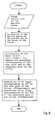
- Figure 8 illustrates a flow-chart in which a sequence of procedures is indicated that can be comprised in the first step - also called "train".
- the first step is run for a first and only time, in such a way as to define the filter, which, depending on the thickness S and on the pitch P of the grid-shaped pattern 9, is subsequently used to process all the detected images.
- the first step provides for acquiring an image of the grid 8, i.e. of the grid-shaped pattern 9, without any preform 2 being interposed between the grid 8 and the video camera 7.
- the detected image is interpreted as a matrix.
- the spatial period of the pattern is calculated, i.e. the thickness S and the pitch P, and the coefficients that define a filter operator is calculated, being the total of these coefficients also called "kernel" of the filter.
- the coefficients of the Gabor filter are then calculated, which comprises a real part and an imaginary part, i.e. coefficients of two ;matrices corresponding respectively to the real part and to the imaginary part of the Gabor filter are calculated.
- the fast Fourier transforms are calculated both for the imaginary part of the filter and for the real part of the filter and, from the fast Fourier transforms, an image is obtained corresponding to the fast Fourier transform of the real part of the filter (FFTGaborReal) and an image is obtained corresponding to the fast Fourier transform of the imaginary part of the filter (FFTGaborImm).
- the filter operator is defined and can be applied to images detected by the video camera 7.
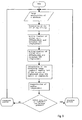
- Figure 9 shows a flow-chart that summarises an image-processing procedure, also called "run", which is carried out on each image acquired by the video camera 7.
- an image (img) of a preform 2 is acquired, by interpreting the image as a matrix.
- the fast Fourier transform of the detected image (fftImg) is then calculated.
- the fast Fourier transform of the detected image (fftImg) is multiplied by the fast Fourier transform of the real part of the filter (FFTGaborReal) and the antitransform (inverted FFT) of the resulting product is calculated so as the real part of the resulting image (imgResReal) is obtained.
- the fast Fourier transform of the detected image (fftImg) is multiplied by the fast Fourier transform of the imaginary part of the filter (FFTGaborImm) and the antitransform (inverted FFT) of the resulting product is calculated so as an imaginary part of the resulting image (imgResImm) is obtained.
- the multiplication between the fast Fourier transform of the detected image (fftImg) and the fast Fourier transform of the real part of the filter (FFTGaborReal) and the subsequent antitransform, and the multiplication between the fast Fourier transform of the detected image (fftImg) and the fast Fourier transform of the imaginary part of the filter (FFTGaborImm) and the subsequent antitransform enable the method to be simplified inasmuch as they avoid to calculate the convolution product.
- the resulting processing image (imgRes) is obtained by calculation of the square root of the sum of the squares of the real part of the image and of the imaginary part of the image.
- the resulting image (imgRes) is analysed by prior-art image-analysis, for example by segmentation of the resulting image (imgRes). Segmentation provides an image (imgResBin) on the basis of which it is established whether the inspected preform is to be considered to be acceptable, i.e. substantially conforming to the desired quality requirements, or is to be considered to be defective and therefore no longer processable.
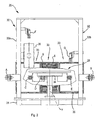
- Figures 2 and 3 show an apparatus 25 provided with a device 1 for the visual inspection of a preform 2 of the type disclosed above.
- the apparatus 25 in fact comprises an illuminating device 6 provided with a grid 8, which comprises a grid-shaped pattern 9 of the type disclosed above, to which a preform 2 is periodically faced.
- the apparatus 25 comprises a carousel 28 that is rotatable around a substantially vertical axis Y and is provided with grippers 29 associated with an edge zone of the carousel 28 according to a substantially constant angular pitch.
- the grippers 29 are suitable for interacting with the second end 5 of each preform 2 to support the preform 2 and convey it from a removing position that is not shown, through inspection positions of the preform 2, in which the preform 2 is subjected to visual inspection, to a delivery position, in which the preform 2 is delivered to another apparatus or is deposited in a collecting container.
- the grippers 29 are shaped in such a way that the longitudinal axis Z of the preforms 2 is substantially parallel to the axis Y and substantially perpendicular to the stripes 10 of the grid-shaped pattern 9.
- the apparatus 25 is provided with a frame 30 comprising a base 31 with a substantially square shape and uprights 32 arranged near vertexes of the base 31.
- the carousel 28 is assembled in a central zone of the base 31.
- the illuminating device 6 comprises three illuminating surfaces 33 assembled substantially parallel to two uprights 32c, 32d, of the frame 30 and near the base 31 in such a way that the preforms 2, in each inspection position, face a central portion of at least an illuminating surface of the three illuminating surfaces 33.
- the grid 8 is obtained on one of the illuminating surfaces 33, in particular on a central illuminating surface interposed between the other two.
- the apparatus 25 comprises a first video camera A arranged opposite the illuminating device 6 in relation to the carousel 28 to detect an image of a preform 2 in a reference position Q, the reference position Q being provided opposite the grid 8 and near the latter.
- the first video camera A is fixed to a first upright 32a arranged on a side of the base 31 that is more distant from the illuminating device 6.
- the first video camera A is tilted by a first angle ⁇ , which is an acute angle, in relation to a plane containing the three illuminating surfaces 33.
- the apparatus 25 furthermore comprises a second video camera B arranged opposite the illuminating device 6 in relation to the carousel 28 to detect an image of a preform 2 in the reference position Q.
- the second video camera B is fixed to a second upright 32b and is tilted by a second angle ⁇ , which is an acute angle, in relation to the plane containing the three illuminating surfaces 33.
- first angle ⁇ and the second angle ⁇ are substantially equal to each other, in such a way that the first video camera A and the second video camera B are substantially symmetrical to a plane passing through the Y axis and the reference position Q.
- first video camera A and the second video camera B arranged in such a way as to interact simultaneously with a preform 2 in the reference position Q, enables a significant portion of the body 3 of the preform 2 to be inspected.
- the first video camera A and the second video camera B are comprised in the system of visual inspection of the device 1 and are therefore connected to an image-processing device that is not shown that enables to detect whether preforms 2 comprise defects such as surface deformation, thickness differing from the prescribed thickness, or concentration of stress.
- the apparatus 25 furthermore comprises further video cameras for also detecting other types of defects, for example air bubbles, inclusions of foreign bodies, colour deviations, opaque zones.
- a third video camera C and a fourth video camera D are provided that are suitable for inspecting the body 3 of the preform 2 when it is positioned in a first position Q1, near a third upright 32c, and a fifth video camera E that is suitable for inspecting the body 3 when the preform 2 is located in a second position Q2 near a fourth upright 32d.
- the video cameras C, D and E are fitted to a support 34 arranged below the carousel 28.
- the apparatus 25 comprises a sixth video camera F, arranged for inspecting the second end 5 of the preform 2, when the preform 2 is in the first position Q1, so as to check whether the protrusions of the second end 5 are complete, whether there are flaws or flushes or whether the second end 5 is cylindrical or oval.
- the sixth video camera F is assembled on the third upright 32c above the first position Q1 with the lens facing the first position Q1. Between the sixth video camera F and the position Q1 a further illuminating device 35 is interposed that illuminates the second end 5.
- the apparatus 25 comprises a seventh video camera G arranged for inspecting the first end 4 of the preform 2, when the preform 2 is in the second position Q2, so as to identify any flashes on the bottom of the body 3, inclusions of foreign bodies, specks, points at which crystallisation of the plastics has occurred, holes at the injection points.
- the seventh video camera G is fixed on the fourth upright 32d above the second position Q2 with the lens facing that position.
- the apparatus 25 furthermore comprises a still further illuminating device 36 positioned in such a way that the preform 2, when it is in the second position Q2, is interposed between the seventh video camera G and the further illuminating device 36.
- the apparatus 25 thus enables a wide range of defects that may occur in the preforms 2 to be identified and analysed.
Landscapes
- Engineering & Computer Science (AREA)
- Physics & Mathematics (AREA)
- General Physics & Mathematics (AREA)
- Computer Vision & Pattern Recognition (AREA)
- Chemical & Material Sciences (AREA)
- Pathology (AREA)
- Health & Medical Sciences (AREA)
- Life Sciences & Earth Sciences (AREA)
- Theoretical Computer Science (AREA)
- Analytical Chemistry (AREA)
- Biochemistry (AREA)
- General Health & Medical Sciences (AREA)
- Immunology (AREA)
- Quality & Reliability (AREA)
- Probability & Statistics with Applications (AREA)
- Investigating Materials By The Use Of Optical Means Adapted For Particular Applications (AREA)
- Length Measuring Devices By Optical Means (AREA)
- Instruments For Viewing The Inside Of Hollow Bodies (AREA)
- Testing Of Optical Devices Or Fibers (AREA)
Claims (46)
- Verfahren zum visuellen Inspizieren eines Körpers mit den folgenden Schritten:- Projizieren eines durch vorgegebene optische Parameter (P, S) definierten Licht- und Schattenmusters durch den Körper (39;- Detektieren eines Bildes des Licht- und Schattenmusters durch den Körper (3), um ein detektiertes Bild (12; 18) zu erhalten;- Verarbeiten des detektierten Bildes (12; 18), um irgendwelche Irregularitäten des Licht- und Schattenmusters in dem detektierten Bild (12; 18) hervorzuheben, dadurch gekennzeichnet, dass das Verarbeiten das Filtern des detektierten Bildes (12; 18) mithilfe eines Gabor-Filters umfasst, um ein verarbeitetes Bild (20; 21) zu erhalten.
- Verfahren nach Anspruch 1, bei dem das Licht- und Schattenmuster ein gestreiftes Muster aufweist.
- Verfahren nach Anspruch 2, bei dem das gestreifte Muster Streifen umfasst, die im Wesentlichen senkrecht zu einer Längsachse (Z) des Körpers (3) sind.
- Verfahren nach Anspruch 3, bei dem das detektierte Bild eine Mehrzahl von Linien (14, 15, 16, 17) aufweist, wobei die Linien der Mehrzahl von Linien im Wesentlichen senkrecht zu der Längsachse (Z) sind.
- Verfahren nach irgendeinem vorhergehenden Anspruch, bei dem das Filtern das Entfernen eines weiteren Bildes des Licht- und Schattenmusters aus dem detektierten Bild (12;18) umfasst, das durch das Detektieren des Licht- und Schattenmusters in der Abwesenheit des Körpers bereitgestellt wird, um das weitere Bild zu erhalten.
- Verfahren nach Anspruch 5, soweit von Anspruch 4 abhängig, bei dem das weitere Bild eine weitere Mehrzahl von Linien (16, 17) der Linien der weiteren Mehrzahl von Linien umfasst, die im Wesentlichen senkrecht zu der Längsachse (Z) sind.
- Verfahren nach irgendeinem vorhergehenden Anspruch, bei dem das Gabor-Filter einen realen Teil (GaborReal) sowie einen imaginären Teil (GaborImm) aufweist.
- Verfahren nach irgendeinem vorhergehenden Anspruch, bei dem das Verarbeiten das Berechnen der Fourier-Transformierten des detektierten Bildes (fftImg) umfasst.
- Verfahren nach Anspruch 8, soweit von Anspruch 7 abhängig, bei dem das Verarbeiten ferner das Berechnen der Fourier-Transformierten des realen Teils (FFTGaborReal) umfasst.
- Verfahren nach Anspruch 9, bei dem das Verarbeiten das Multiplizieren der Fourier-Transformierten des detektierten Bildes (fftImg) mit der Fourier-Transformierten des realen Teils (FFTGaborReal) umfasst, um ein Produkt zu erhalten.
- Verfahren nach Anspruch 10, bei dem das Verarbeiten das Berechnen der Antitransformierten des Produktes umfasst, um einen realen Teil des verarbeiteten Bildes (imgResReal) umfasst.
- Verfahren nach Anspruch 7 oder nach Anspruch 8, soweit von Anspruch 7 abhängig, oder nach irgendeinem der Ansprüche 9 bis 11, bei denen das Verarbeiten ferner das Berechnen der Fourier-Transformierten des imaginären Teils (FFTGaborImm) umfasst.
- Verfahren nach Anspruch 12, bei dem das Verarbeiten das Multiplizieren der Fourier-Transformierten des detektierten Bildes (fftImg) mit der Fourier-Transformierten des imaginären Teils (FFTGaborImm) umfasst, um ein weiteres Produkt zu erhalten.
- Verfahren nach Anspruch 13, bei dem das Verarbeiten das Berechnen der Antitransformierten des weiteren Produktes umfasst, um einen imaginären Teil des verarbeiteten Bildes (imgResImm) zu erhalten.
- Verfahren nach Anspruch 14, soweit von Anspruch 11 abhängig, oder nach Anspruch 12 oder 13, soweit Anspruch 12 von Anspruch 11 abhängig ist, bei dem das Verarbeiten das Extrahieren der Quadratwurzel aus der Summe der Quadrate des realen Teils des verarbeiteten Bildes (imgResReal) und des imaginären Teils des verarbeiteten Bildes (imgResImm) umfasst, um ein resultierendes Bild (imgRes) zu erhalten.
- Verfahren nach Anspruch 15, das ferner das Analysieren des resultierenden Bildes (imgRes) umfasst.
- Verfahren nach Anspruch 16, bei dem das Analysieren das Anwenden eines Bildanalyseverfahrens umfasst, das zu der Gruppe gehört, die Folgendes aufweist: Segmentieren des resultierenden Bildes und Blob-Analyse des segmentierten Bildes, das Analysieren eines Histogramms des resultierenden Bildes und das Vergleichen des resultierenden Bildes mit einem Beispielbild.
- Verfahren nach Anspruch 17, das ferner das Klassifizieren des Körpers (3) auf der Basis des Ergebnisses des Analysierens umfasst.
- Verfahren nach irgendeinem vorhergehenden Anspruch, bei dem vor dem Filtern mithilfe des Gabor-Filters ein solches Gabor-Filter bereitgestellt wird.
- Verfahren nach Anspruch 19, soweit von Anspruch 5 oder 6 abhängig, oder gemäß irgendeinem der Ansprüche 7 bis 18, soweit von Anspruch 5 oder 6 abhängig, bei dem das Erhalten ein Erhalten des weiteren Bildes umfasst.
- Verfahren nach Anspruch 20, bei dem das Erhalten das Berechnen von Koeffizienten des Gabor-Filters auf der Basis des weiteren Bildes umfasst.
- Verfahren nach irgendeinem vorhergehenden Anspruch, bei dem der Körper im Wesentlichen als ein Zylinder (3) geformt ist.
- Verfahren nach Anspruch 22, bei dem der Zylinder (3) hohl ist.
- Verfahren nach irgendeinem vorhergehenden Anspruch, bei dem der Körper (3) aus einem im Wesentlichen gegenüber sichtbarem Licht transparentem Material hergestellt ist.
- Verfahren nach irgendeinem vorhergehenden Anspruch, bei dem der Körper (3) einen Bereich einer Vorform (2) eines Behälters definiert.
- Verfahren nach irgendeinem der Ansprüche 1 bis 24, bei dem der Körper (3) einen Bereich eines Behälters definiert.
- Vorrichtung zum visuellen Inspizieren eines Körpers mit:- einem Lichtquellenmittel (6) zum Projizieren eines Licht- und Schattenmusters, das durch optische Parameter (P, S) definiert ist, durch den Körper (3);- einem Bilddetektionsmittel (7; A, B) zum Detektieren eines Bildes des Licht- und Schattenmusters durch den Körper (3), um ein detektiertes Bild (12; 18) zu erhalten;- einem Verarbeitungsmittel, dadurch gekennzeichnet, dass das Verarbeitungsmittel das detektierte Bild (12; 18) mithilfe eines Gabor-Filters zur Verarbeitung des detektierten Bildes (12; 18) auf eine solche Weise filtert, dass irgendwelche Unregelmäßigkeiten des Licht- und Schattenmusters in dem detektierten Bild hervorgehoben werden.
- Vorrichtung nach Anspruch 27, bei der das Licht- und Schattenmuster von einem Gittermittel (8) erhalten wird, das zwischen dem Lichtquellenmittel (6) und dem Bilddetektionsmittel (7; A, B) angeordnet ist.
- Vorrichtung nach Anspruch 28, bei der das Gittermittel (8) eine Mehrzahl von Streifen (10) umfasst, die auf eine solche Weise angeordnet sind, dass sie im Wesentlichen senkrecht zu einer Längsachse (Z) des Körpers (3) sind.
- Vorrichtung nach Anspruch 29, bei der die Streifen der Mehrzahl von Streifen (10) ein Dicke (S) haben, die im Wesentlichen einander gleich sind.
- Vorrichtung nach Anspruch 29 oder 30, bei der die Streifen der Mehrzahl von Streifen (10) in einem vorbestimmten Abstand (P) angeordnet sind.
- Vorrichtung nach Anspruch 31, bei der der Abstand (P) im Wesentlichen konstant ist.
- Vorrichtung nach Anspruch 31 oder 32, soweit Anspruch 31 von Anspruch 30 abhängig ist, bei der die vorgegebenen optischen Parameter (P, S) mit den Dicken (S) und dem Abstand (P) korreliert sind.
- Vorrichtung nach irgendeinem der Ansprüche 28 bis 33, bei der das Gittermittel (8) an einer Emissionsfläche (11; 33) des Lichtquellenmittels (6) vorgesehen ist.
- Vorrichtung nach Anspruch 34, bei der die Emissionsfläche (11; 33) im Wesentlichen eben ist.
- Vorrichtung nach irgendeinem der Ansprüche 27 bis 35, bei der der Körper (3) aus einem Material besteht, das im Wesentlichen transparent gegenüber sichtbarem Licht ist.
- Vorrichtung nach irgendeinem der Ansprüche 27 bis 36, bei der der Körper im Wesentlichen als ein Zylinder (3) ausgebildet ist.
- Vorrichtung nach Anspruch 37, bei der der Zylinder (3) hohl ist.
- Vorrichtung nach irgendeinem der Ansprüche 27 bis 38, bei der der Körper (3) einen Bereich einer Behältervorform (2) definiert.
- Vorrichtung nach irgendeinem der Ansprüche 27 bis 38, bei der der Körper (3) einen Bereich eines Behälters definiert.
- Vorrichtung nach irgendeinem der Ansprüche 27 bis 40, bei der das Bilddetektionsmittel (7; A, B) eine Videokamera (7; A) umfasst.
- Vorrichtung nach Anspruch 41, soweit von Anspruch 34 oder 35 abhängig, oder nach irgendeinem der Ansprüche 36 bis 41, soweit von Anspruch 34 oder 35 abhängig, bei der die Videokamera (7) eine optische Achse aufweist, die im Wesentlichen senkrecht zu der Emissionsfläche (11; 33) ist.
- Vorrichtung nach Anspruch 41 oder 42, bei der das Bilddetektionsmittel (7; A, B) eine weitere Videokamera (B) umfasst, wobei die Videokamera (A) und die weitere Videokamera (B) auf eine solche Weise orientiert sind, dass die erste Videokamera (A) und die zweite Videokamera (B) dem Körper (3) zugewandt sind, wenn der Körper in einer Referenzposition (Q) ist.
- Vorrichtung nach irgendeinem der Ansprüche 27 bis 43, bei der das Verarbeitungsmittel mit dem Bilddetektionsmittel (7; A, B) verbunden ist.
- Programm, das einen Code zum Implementieren des Verfahrens gemäß der Ansprüche 1 bis 26 aufweist, wenn das Programm in einem Computersystem angewandt wird.
- Träger, der von einem Computer lesbar ist, der ein Programm nach Anspruch 45 trägt.
Applications Claiming Priority (1)
| Application Number | Priority Date | Filing Date | Title |
|---|---|---|---|
| PCT/IB2005/002664 WO2007029048A1 (en) | 2005-09-09 | 2005-09-09 | Method and apparatus for visually inspecting an object |
Publications (2)
| Publication Number | Publication Date |
|---|---|
| EP1931973A1 EP1931973A1 (de) | 2008-06-18 |
| EP1931973B1 true EP1931973B1 (de) | 2008-12-31 |
Family
ID=36190736
Family Applications (1)
| Application Number | Title | Priority Date | Filing Date |
|---|---|---|---|
| EP05783093A Expired - Lifetime EP1931973B1 (de) | 2005-09-09 | 2005-09-09 | Verfahren und vorrichtung zur optischen inspektion eines gegenstands |
Country Status (7)
| Country | Link |
|---|---|
| US (1) | US8254659B2 (de) |
| EP (1) | EP1931973B1 (de) |
| CN (1) | CN101297192B (de) |
| AT (1) | ATE419519T1 (de) |
| DE (1) | DE602005012163D1 (de) |
| TW (1) | TW200728712A (de) |
| WO (1) | WO2007029048A1 (de) |
Cited By (1)
| Publication number | Priority date | Publication date | Assignee | Title |
|---|---|---|---|---|
| FR2958751A1 (fr) * | 2010-04-13 | 2011-10-14 | Iris Inspection Machines | Procede de detection de defauts dans des articles verriers et installation pour la mise en oeuvre dudit procede |
Families Citing this family (32)
| Publication number | Priority date | Publication date | Assignee | Title |
|---|---|---|---|---|
| CA2546758C (en) * | 2006-05-12 | 2009-07-07 | Alberta Research Council Inc. | A system and a method for detecting a damaged or missing machine part |
| DE102009020919A1 (de) * | 2009-05-12 | 2010-11-18 | Krones Ag | Vorrichtung zum Erkennen von Erhebungen und/oder Vertiefungen auf Flaschen, insbesondere in einer Etikettiermaschine |
| DE102009020920A1 (de) * | 2009-05-12 | 2010-11-18 | Krones Ag | Inspektionsvorrichtung zur Erkennung von Embossings und/oder Etiketten auf transparenten Gefäßen, insbesondere Getränkeflaschen |
| IT1394886B1 (it) * | 2009-07-17 | 2012-07-20 | Sacmi | Sistema di ispezione e pesatura di oggetti, in particolare preforme. |
| WO2011145351A1 (ja) * | 2010-05-20 | 2011-11-24 | パナソニック株式会社 | 薬液判定装置及び薬液判定方法 |
| GB2482473A (en) * | 2010-06-29 | 2012-02-08 | Constar Internat Uk Ltd | Inspection of articles |
| US20120098959A1 (en) * | 2010-10-20 | 2012-04-26 | Glasstech, Inc. | Method and apparatus for measuring transmitted optical distortion in glass sheets |
| CN102519979B (zh) * | 2011-12-10 | 2013-12-04 | 山东明佳包装检测科技有限公司 | Pet瓶检测定位中消除水珠影响的方法 |
| US20140286563A1 (en) * | 2013-03-19 | 2014-09-25 | Industrial Video Solutions, Inc. | Accurate detection of low-contrast defects in transparent material |
| CH707559A2 (de) * | 2013-03-22 | 2014-09-30 | Finatec Holding Ag | Verfahren und System zur Prüfung der Farbbeschaffenheit von Preforms. |
| CN105444683B (zh) * | 2014-08-26 | 2018-07-03 | 达观科技有限公司 | 透光膜的检测系统及其检测方法 |
| US20160178535A1 (en) * | 2014-12-17 | 2016-06-23 | Xerox Corporation | Inspection Device And Method |
| FI20155171L (fi) * | 2015-03-13 | 2016-09-14 | Conexbird Oy | Kontin tarkastusjärjestely, -menetelmä, -laitteisto ja -ohjelmisto |
| CH711104A2 (de) * | 2015-05-18 | 2016-11-30 | Finatec Holding Ag | Prüfverfahren und Prüfsystem zur Prüfung von Werkstücken. |
| US9952037B2 (en) | 2015-06-26 | 2018-04-24 | Glasstech, Inc. | System and method for developing three-dimensional surface information corresponding to a contoured sheet |
| US9470641B1 (en) | 2015-06-26 | 2016-10-18 | Glasstech, Inc. | System and method for measuring reflected optical distortion in contoured glass sheets |
| US9841276B2 (en) | 2015-06-26 | 2017-12-12 | Glasstech, Inc. | System and method for developing three-dimensional surface information corresponding to a contoured glass sheet |
| US9851200B2 (en) | 2015-06-26 | 2017-12-26 | Glasstech, Inc. | Non-contact gaging system and method for contoured panels having specular surfaces |
| US9952039B2 (en) | 2015-06-26 | 2018-04-24 | Glasstech, Inc. | System and method for measuring reflected optical distortion in contoured panels having specular surfaces |
| US9933251B2 (en) | 2015-06-26 | 2018-04-03 | Glasstech, Inc. | Non-contact gaging system and method for contoured glass sheets |
| JP7046819B2 (ja) * | 2016-02-24 | 2022-04-04 | ベクトン ディキンソン フランス | 透明シリンダを検査するためのシステムおよび方法 |
| US10422755B2 (en) * | 2016-12-07 | 2019-09-24 | Applied Vision Corporation | Identifying defects in transparent containers |
| US20190238796A1 (en) | 2017-05-11 | 2019-08-01 | Jacob Nathaniel Allen | Object Inspection System And Method For Inspecting An Object |
| DE102019208299A1 (de) | 2019-06-06 | 2020-12-10 | Krones Ag | Verfahren und Vorrichtung zur optischen Inspektion von Behältern |
| DE102019208295A1 (de) | 2019-06-06 | 2020-12-10 | Krones Ag | Verfahren und Vorrichtung zur optischen Inspektion von Behältern |
| CN110243831B (zh) * | 2019-06-06 | 2022-02-15 | 锐捷网络股份有限公司 | 表面缺陷采集系统、表面缺陷检测方法、装置及存储介质 |
| DE102019208296A1 (de) | 2019-06-06 | 2020-12-10 | Krones Ag | Verfahren und Vorrichtung zur optischen Inspektion von Behältern |
| CN111107257A (zh) * | 2020-01-20 | 2020-05-05 | 成都德图福思科技有限公司 | 针对透明介质表面刻蚀或浮雕图案进行高对比度成像的方法 |
| KR20230024390A (ko) | 2020-06-17 | 2023-02-20 | 이노비전 소프트웨어 솔루션즈, 인크. | 결함 복원을 위한 시스템 및 방법 |
| CN112955844A (zh) * | 2020-06-30 | 2021-06-11 | 深圳市大疆创新科技有限公司 | 目标跟踪方法、设备、系统及存储介质 |
| US12293506B2 (en) | 2021-07-20 | 2025-05-06 | Inovision Software Solutions, Inc. | Method to locate defects in e-coat |
| DE102022104990A1 (de) | 2022-03-03 | 2023-09-07 | Emhart Glass Sa | VORRICHTUNG UND VERFAHREN ZUM INSPIZIEREN VON GEFÄßEN |
Family Cites Families (14)
| Publication number | Priority date | Publication date | Assignee | Title |
|---|---|---|---|---|
| JPH06100555B2 (ja) | 1990-12-19 | 1994-12-12 | 東洋ガラス株式会社 | 透明物体の欠陥検査方法とその装置 |
| US5291560A (en) * | 1991-07-15 | 1994-03-01 | Iri Scan Incorporated | Biometric personal identification system based on iris analysis |
| US5659626A (en) * | 1994-10-20 | 1997-08-19 | Calspan Corporation | Fingerprint identification system |
| DE19741384A1 (de) * | 1997-09-19 | 1999-03-25 | Heuft Systemtechnik Gmbh | Verfahren zum Erkennen von diffus streuenden Materialien, Verunreinigungen und sonstigen Fehlern bei transparenten Gegenständen |
| EP1006350A1 (de) | 1998-11-30 | 2000-06-07 | Kirin Techno-System Corporation | Verfahren zur Detektion von Fehlern in Flaschen |
| US6100990A (en) * | 1999-06-14 | 2000-08-08 | Ford Motor Company | Method and apparatus for determining reflective optical quality using gray-scale patterns |
| US6633831B2 (en) * | 2000-09-20 | 2003-10-14 | Kla Tencor Technologies | Methods and systems for determining a critical dimension and a thin film characteristic of a specimen |
| US6424414B1 (en) * | 2000-10-16 | 2002-07-23 | Agr International, Inc. | Method and apparatus for detecting refractive defects in transparent containers |
| JP2004146782A (ja) * | 2002-08-29 | 2004-05-20 | Advanced Lcd Technologies Development Center Co Ltd | 結晶化状態のin−situモニタリング方法 |
| JP2006510105A (ja) * | 2002-12-16 | 2006-03-23 | コーニンクレッカ フィリップス エレクトロニクス エヌ ヴィ | 筋状構造を有する画像のフィルタリング方法 |
| ES2290422T5 (es) | 2003-05-22 | 2011-04-08 | M. & G. POLYMERS U.S.A. LLC | Aparato y método para controlar la calidad de preformas que tienen cada una un cuerpo de material plástico. |
| CN1272734C (zh) * | 2004-05-20 | 2006-08-30 | 上海交通大学 | 基于非负矩阵分解的相关反馈图像检索方法 |
| US7251033B1 (en) * | 2004-06-02 | 2007-07-31 | Advanced Micro Devices, Inc. | In-situ reticle contamination detection system at exposure wavelength |
| US7463367B2 (en) * | 2004-07-13 | 2008-12-09 | Micron Technology, Inc. | Estimating overlay error and optical aberrations |
-
2005
- 2005-09-09 EP EP05783093A patent/EP1931973B1/de not_active Expired - Lifetime
- 2005-09-09 WO PCT/IB2005/002664 patent/WO2007029048A1/en not_active Ceased
- 2005-09-09 DE DE602005012163T patent/DE602005012163D1/de not_active Expired - Lifetime
- 2005-09-09 CN CN200580051960XA patent/CN101297192B/zh not_active Expired - Lifetime
- 2005-09-09 AT AT05783093T patent/ATE419519T1/de not_active IP Right Cessation
- 2005-09-09 US US11/991,716 patent/US8254659B2/en active Active
-
2006
- 2006-09-05 TW TW095132685A patent/TW200728712A/zh unknown
Cited By (2)
| Publication number | Priority date | Publication date | Assignee | Title |
|---|---|---|---|---|
| FR2958751A1 (fr) * | 2010-04-13 | 2011-10-14 | Iris Inspection Machines | Procede de detection de defauts dans des articles verriers et installation pour la mise en oeuvre dudit procede |
| WO2011128580A1 (fr) * | 2010-04-13 | 2011-10-20 | Iris - Inspection Machines | Procédé de détection de défauts dans des articles verriers et installation pour la mise en oeuvre dudit procédé |
Also Published As
| Publication number | Publication date |
|---|---|
| CN101297192A (zh) | 2008-10-29 |
| TW200728712A (en) | 2007-08-01 |
| US20080310701A1 (en) | 2008-12-18 |
| ATE419519T1 (de) | 2009-01-15 |
| EP1931973A1 (de) | 2008-06-18 |
| CN101297192B (zh) | 2012-05-30 |
| US8254659B2 (en) | 2012-08-28 |
| DE602005012163D1 (de) | 2009-02-12 |
| WO2007029048A1 (en) | 2007-03-15 |
Similar Documents
| Publication | Publication Date | Title |
|---|---|---|
| EP1931973B1 (de) | Verfahren und vorrichtung zur optischen inspektion eines gegenstands | |
| CN109816644B (zh) | 一种基于多角度光源影像的轴承缺陷自动检测系统 | |
| CN101566582B (zh) | 基于机器视觉的粉针剂生产中药瓶标贴信息在线检测系统 | |
| CN102713579B (zh) | 外观检查装置 | |
| RU2762130C2 (ru) | Система и связанный способ измерения оптических характеристик листа стекла на технологической линии | |
| CN102224412A (zh) | 成形片材的缺陷检查装置 | |
| CN110246122A (zh) | 基于机器视觉的小型轴承质量检测方法、装置及系统 | |
| JP2002513463A (ja) | 成形容器内の応力検出システムおよび方法 | |
| WO1997046329A9 (en) | System and method for stress detection in a molded container | |
| US20140286563A1 (en) | Accurate detection of low-contrast defects in transparent material | |
| CN104458764B (zh) | 基于大景深条带图像投影的弯曲粗糙表面缺陷鉴别方法 | |
| TW201736831A (zh) | 利用各容器之複數影像以檢測容器之系統及方法 | |
| CN103743757A (zh) | 一种玻璃瓶内壁异物的检测装置及方法 | |
| CN102713580B (zh) | 外观检查装置 | |
| CN111239142A (zh) | 膏体外观缺陷检测设备及方法 | |
| CN113019973A (zh) | 一种易拉罐制造缺陷在线视觉检测方法 | |
| KR20180092901A (ko) | 플라스틱 쉘 내에서의 컨택트 렌즈 검사 | |
| Gong et al. | Adaptive visual inspection method for transparent label defect detection of curved glass bottle | |
| CN120374520A (zh) | 一种饮料包装缺陷的视觉检测方法及系统 | |
| JP2002148195A (ja) | 表面検査装置及び表面検査方法 | |
| CN120035757A (zh) | 根据至少两种模态检查玻璃容器以通过其玻璃缺陷对容器进行分类的方法和装置 | |
| KR20250077380A (ko) | 물체의 광학 검사를 위한 방법 및 장치 | |
| CN111458344A (zh) | 一种口罩缺陷视觉检测方法、设备、存储介质 | |
| JP2006343138A (ja) | 検査装置 | |
| CN117347384A (zh) | 塑料桶质量的检测方法、装置、电子设备及存储介质 |
Legal Events
| Date | Code | Title | Description |
|---|---|---|---|
| PUAI | Public reference made under article 153(3) epc to a published international application that has entered the european phase |
Free format text: ORIGINAL CODE: 0009012 |
|
| 17P | Request for examination filed |
Effective date: 20080320 |
|
| AK | Designated contracting states |
Kind code of ref document: A1 Designated state(s): AT BE BG CH CY CZ DE DK EE ES FI FR GB GR HU IE IS IT LI LT LU LV MC NL PL PT RO SE SI SK TR |
|
| GRAP | Despatch of communication of intention to grant a patent |
Free format text: ORIGINAL CODE: EPIDOSNIGR1 |
|
| 17Q | First examination report despatched |
Effective date: 20080624 |
|
| GRAS | Grant fee paid |
Free format text: ORIGINAL CODE: EPIDOSNIGR3 |
|
| GRAA | (expected) grant |
Free format text: ORIGINAL CODE: 0009210 |
|
| AK | Designated contracting states |
Kind code of ref document: B1 Designated state(s): AT BE BG CH CY CZ DE DK EE ES FI FR GB GR HU IE IS IT LI LT LU LV MC NL PL PT RO SE SI SK TR |
|
| REG | Reference to a national code |
Ref country code: GB Ref legal event code: FG4D Ref country code: CH Ref legal event code: EP |
|
| REG | Reference to a national code |
Ref country code: CH Ref legal event code: NV Representative=s name: FIAMMENGHI-FIAMMENGHI |
|
| REF | Corresponds to: |
Ref document number: 602005012163 Country of ref document: DE Date of ref document: 20090212 Kind code of ref document: P |
|
| REG | Reference to a national code |
Ref country code: IE Ref legal event code: FG4D |
|
| PG25 | Lapsed in a contracting state [announced via postgrant information from national office to epo] |
Ref country code: SI Free format text: LAPSE BECAUSE OF FAILURE TO SUBMIT A TRANSLATION OF THE DESCRIPTION OR TO PAY THE FEE WITHIN THE PRESCRIBED TIME-LIMIT Effective date: 20081231 Ref country code: LV Free format text: LAPSE BECAUSE OF FAILURE TO SUBMIT A TRANSLATION OF THE DESCRIPTION OR TO PAY THE FEE WITHIN THE PRESCRIBED TIME-LIMIT Effective date: 20081231 Ref country code: PL Free format text: LAPSE BECAUSE OF FAILURE TO SUBMIT A TRANSLATION OF THE DESCRIPTION OR TO PAY THE FEE WITHIN THE PRESCRIBED TIME-LIMIT Effective date: 20081231 Ref country code: NL Free format text: LAPSE BECAUSE OF FAILURE TO SUBMIT A TRANSLATION OF THE DESCRIPTION OR TO PAY THE FEE WITHIN THE PRESCRIBED TIME-LIMIT Effective date: 20081231 Ref country code: FI Free format text: LAPSE BECAUSE OF FAILURE TO SUBMIT A TRANSLATION OF THE DESCRIPTION OR TO PAY THE FEE WITHIN THE PRESCRIBED TIME-LIMIT Effective date: 20081231 |
|
| NLV1 | Nl: lapsed or annulled due to failure to fulfill the requirements of art. 29p and 29m of the patents act | ||
| PG25 | Lapsed in a contracting state [announced via postgrant information from national office to epo] |
Ref country code: EE Free format text: LAPSE BECAUSE OF FAILURE TO SUBMIT A TRANSLATION OF THE DESCRIPTION OR TO PAY THE FEE WITHIN THE PRESCRIBED TIME-LIMIT Effective date: 20081231 Ref country code: ES Free format text: LAPSE BECAUSE OF FAILURE TO SUBMIT A TRANSLATION OF THE DESCRIPTION OR TO PAY THE FEE WITHIN THE PRESCRIBED TIME-LIMIT Effective date: 20090411 Ref country code: RO Free format text: LAPSE BECAUSE OF FAILURE TO SUBMIT A TRANSLATION OF THE DESCRIPTION OR TO PAY THE FEE WITHIN THE PRESCRIBED TIME-LIMIT Effective date: 20081231 Ref country code: BE Free format text: LAPSE BECAUSE OF FAILURE TO SUBMIT A TRANSLATION OF THE DESCRIPTION OR TO PAY THE FEE WITHIN THE PRESCRIBED TIME-LIMIT Effective date: 20081231 Ref country code: LT Free format text: LAPSE BECAUSE OF FAILURE TO SUBMIT A TRANSLATION OF THE DESCRIPTION OR TO PAY THE FEE WITHIN THE PRESCRIBED TIME-LIMIT Effective date: 20081231 |
|
| PG25 | Lapsed in a contracting state [announced via postgrant information from national office to epo] |
Ref country code: SE Free format text: LAPSE BECAUSE OF FAILURE TO SUBMIT A TRANSLATION OF THE DESCRIPTION OR TO PAY THE FEE WITHIN THE PRESCRIBED TIME-LIMIT Effective date: 20090331 Ref country code: IS Free format text: LAPSE BECAUSE OF FAILURE TO SUBMIT A TRANSLATION OF THE DESCRIPTION OR TO PAY THE FEE WITHIN THE PRESCRIBED TIME-LIMIT Effective date: 20090430 Ref country code: AT Free format text: LAPSE BECAUSE OF FAILURE TO SUBMIT A TRANSLATION OF THE DESCRIPTION OR TO PAY THE FEE WITHIN THE PRESCRIBED TIME-LIMIT Effective date: 20081231 Ref country code: PT Free format text: LAPSE BECAUSE OF FAILURE TO SUBMIT A TRANSLATION OF THE DESCRIPTION OR TO PAY THE FEE WITHIN THE PRESCRIBED TIME-LIMIT Effective date: 20090601 Ref country code: CZ Free format text: LAPSE BECAUSE OF FAILURE TO SUBMIT A TRANSLATION OF THE DESCRIPTION OR TO PAY THE FEE WITHIN THE PRESCRIBED TIME-LIMIT Effective date: 20081231 |
|
| PG25 | Lapsed in a contracting state [announced via postgrant information from national office to epo] |
Ref country code: SK Free format text: LAPSE BECAUSE OF FAILURE TO SUBMIT A TRANSLATION OF THE DESCRIPTION OR TO PAY THE FEE WITHIN THE PRESCRIBED TIME-LIMIT Effective date: 20081231 |
|
| PG25 | Lapsed in a contracting state [announced via postgrant information from national office to epo] |
Ref country code: DK Free format text: LAPSE BECAUSE OF FAILURE TO SUBMIT A TRANSLATION OF THE DESCRIPTION OR TO PAY THE FEE WITHIN THE PRESCRIBED TIME-LIMIT Effective date: 20081231 |
|
| PLBE | No opposition filed within time limit |
Free format text: ORIGINAL CODE: 0009261 |
|
| STAA | Information on the status of an ep patent application or granted ep patent |
Free format text: STATUS: NO OPPOSITION FILED WITHIN TIME LIMIT |
|
| 26N | No opposition filed |
Effective date: 20091001 |
|
| PG25 | Lapsed in a contracting state [announced via postgrant information from national office to epo] |
Ref country code: BG Free format text: LAPSE BECAUSE OF FAILURE TO SUBMIT A TRANSLATION OF THE DESCRIPTION OR TO PAY THE FEE WITHIN THE PRESCRIBED TIME-LIMIT Effective date: 20090331 |
|
| PG25 | Lapsed in a contracting state [announced via postgrant information from national office to epo] |
Ref country code: MC Free format text: LAPSE BECAUSE OF NON-PAYMENT OF DUE FEES Effective date: 20090930 |
|
| GBPC | Gb: european patent ceased through non-payment of renewal fee |
Effective date: 20090909 |
|
| REG | Reference to a national code |
Ref country code: IE Ref legal event code: MM4A |
|
| PG25 | Lapsed in a contracting state [announced via postgrant information from national office to epo] |
Ref country code: IE Free format text: LAPSE BECAUSE OF NON-PAYMENT OF DUE FEES Effective date: 20090909 |
|
| PG25 | Lapsed in a contracting state [announced via postgrant information from national office to epo] |
Ref country code: GR Free format text: LAPSE BECAUSE OF FAILURE TO SUBMIT A TRANSLATION OF THE DESCRIPTION OR TO PAY THE FEE WITHIN THE PRESCRIBED TIME-LIMIT Effective date: 20090401 |
|
| PG25 | Lapsed in a contracting state [announced via postgrant information from national office to epo] |
Ref country code: GB Free format text: LAPSE BECAUSE OF NON-PAYMENT OF DUE FEES Effective date: 20090909 |
|
| PG25 | Lapsed in a contracting state [announced via postgrant information from national office to epo] |
Ref country code: LU Free format text: LAPSE BECAUSE OF NON-PAYMENT OF DUE FEES Effective date: 20090909 |
|
| PG25 | Lapsed in a contracting state [announced via postgrant information from national office to epo] |
Ref country code: HU Free format text: LAPSE BECAUSE OF FAILURE TO SUBMIT A TRANSLATION OF THE DESCRIPTION OR TO PAY THE FEE WITHIN THE PRESCRIBED TIME-LIMIT Effective date: 20090701 |
|
| PG25 | Lapsed in a contracting state [announced via postgrant information from national office to epo] |
Ref country code: TR Free format text: LAPSE BECAUSE OF FAILURE TO SUBMIT A TRANSLATION OF THE DESCRIPTION OR TO PAY THE FEE WITHIN THE PRESCRIBED TIME-LIMIT Effective date: 20081231 |
|
| PG25 | Lapsed in a contracting state [announced via postgrant information from national office to epo] |
Ref country code: CY Free format text: LAPSE BECAUSE OF FAILURE TO SUBMIT A TRANSLATION OF THE DESCRIPTION OR TO PAY THE FEE WITHIN THE PRESCRIBED TIME-LIMIT Effective date: 20081231 |
|
| REG | Reference to a national code |
Ref country code: FR Ref legal event code: PLFP Year of fee payment: 12 |
|
| REG | Reference to a national code |
Ref country code: FR Ref legal event code: PLFP Year of fee payment: 13 |
|
| REG | Reference to a national code |
Ref country code: FR Ref legal event code: PLFP Year of fee payment: 14 |
|
| P01 | Opt-out of the competence of the unified patent court (upc) registered |
Effective date: 20230508 |
|
| PGFP | Annual fee paid to national office [announced via postgrant information from national office to epo] |
Ref country code: DE Payment date: 20240820 Year of fee payment: 20 |
|
| PGFP | Annual fee paid to national office [announced via postgrant information from national office to epo] |
Ref country code: FR Payment date: 20240820 Year of fee payment: 20 |
|
| PGFP | Annual fee paid to national office [announced via postgrant information from national office to epo] |
Ref country code: IT Payment date: 20240820 Year of fee payment: 20 |
|
| PGFP | Annual fee paid to national office [announced via postgrant information from national office to epo] |
Ref country code: CH Payment date: 20241001 Year of fee payment: 20 |
|
| REG | Reference to a national code |
Ref country code: DE Ref legal event code: R071 Ref document number: 602005012163 Country of ref document: DE |
|
| REG | Reference to a national code |
Ref country code: CH Ref legal event code: PL |