EP1997922B1 - Alliage a memoire de forme haute temperature, actionneur et moteur associes - Google Patents
Alliage a memoire de forme haute temperature, actionneur et moteur associes Download PDFInfo
- Publication number
- EP1997922B1 EP1997922B1 EP06833961A EP06833961A EP1997922B1 EP 1997922 B1 EP1997922 B1 EP 1997922B1 EP 06833961 A EP06833961 A EP 06833961A EP 06833961 A EP06833961 A EP 06833961A EP 1997922 B1 EP1997922 B1 EP 1997922B1
- Authority
- EP
- European Patent Office
- Prior art keywords
- alloys
- shape memory
- transformation temperature
- alloy
- balance
- Prior art date
- Legal status (The legal status is an assumption and is not a legal conclusion. Google has not performed a legal analysis and makes no representation as to the accuracy of the status listed.)
- Not-in-force
Links
Images

Classifications
-
- C—CHEMISTRY; METALLURGY
- C22—METALLURGY; FERROUS OR NON-FERROUS ALLOYS; TREATMENT OF ALLOYS OR NON-FERROUS METALS
- C22C—ALLOYS
- C22C30/00—Alloys containing less than 50% by weight of each constituent
-
- C—CHEMISTRY; METALLURGY
- C22—METALLURGY; FERROUS OR NON-FERROUS ALLOYS; TREATMENT OF ALLOYS OR NON-FERROUS METALS
- C22C—ALLOYS
- C22C14/00—Alloys based on titanium
-
- C—CHEMISTRY; METALLURGY
- C22—METALLURGY; FERROUS OR NON-FERROUS ALLOYS; TREATMENT OF ALLOYS OR NON-FERROUS METALS
- C22C—ALLOYS
- C22C19/00—Alloys based on nickel or cobalt
- C22C19/03—Alloys based on nickel or cobalt based on nickel
-
- C—CHEMISTRY; METALLURGY
- C22—METALLURGY; FERROUS OR NON-FERROUS ALLOYS; TREATMENT OF ALLOYS OR NON-FERROUS METALS
- C22C—ALLOYS
- C22C27/00—Alloys based on rhenium or a refractory metal not mentioned in groups C22C14/00 or C22C16/00
- C22C27/02—Alloys based on vanadium, niobium, or tantalum
-
- C—CHEMISTRY; METALLURGY
- C22—METALLURGY; FERROUS OR NON-FERROUS ALLOYS; TREATMENT OF ALLOYS OR NON-FERROUS METALS
- C22F—CHANGING THE PHYSICAL STRUCTURE OF NON-FERROUS METALS AND NON-FERROUS ALLOYS
- C22F1/00—Changing the physical structure of non-ferrous metals or alloys by heat treatment or by hot or cold working
- C22F1/006—Resulting in heat recoverable alloys with a memory effect
-
- C—CHEMISTRY; METALLURGY
- C22—METALLURGY; FERROUS OR NON-FERROUS ALLOYS; TREATMENT OF ALLOYS OR NON-FERROUS METALS
- C22F—CHANGING THE PHYSICAL STRUCTURE OF NON-FERROUS METALS AND NON-FERROUS ALLOYS
- C22F1/00—Changing the physical structure of non-ferrous metals or alloys by heat treatment or by hot or cold working
- C22F1/10—Changing the physical structure of non-ferrous metals or alloys by heat treatment or by hot or cold working of nickel or cobalt or alloys based thereon
-
- C—CHEMISTRY; METALLURGY
- C22—METALLURGY; FERROUS OR NON-FERROUS ALLOYS; TREATMENT OF ALLOYS OR NON-FERROUS METALS
- C22F—CHANGING THE PHYSICAL STRUCTURE OF NON-FERROUS METALS AND NON-FERROUS ALLOYS
- C22F1/00—Changing the physical structure of non-ferrous metals or alloys by heat treatment or by hot or cold working
- C22F1/16—Changing the physical structure of non-ferrous metals or alloys by heat treatment or by hot or cold working of other metals or alloys based thereon
- C22F1/18—High-melting or refractory metals or alloys based thereon
-
- F—MECHANICAL ENGINEERING; LIGHTING; HEATING; WEAPONS; BLASTING
- F02—COMBUSTION ENGINES; HOT-GAS OR COMBUSTION-PRODUCT ENGINE PLANTS
- F02K—JET-PROPULSION PLANTS
- F02K1/00—Plants characterised by the form or arrangement of the jet pipe or nozzle; Jet pipes or nozzles peculiar thereto
- F02K1/54—Nozzles having means for reversing jet thrust
- F02K1/76—Control or regulation of thrust reversers
- F02K1/763—Control or regulation of thrust reversers with actuating systems or actuating devices; Arrangement of actuators for thrust reversers
-
- F—MECHANICAL ENGINEERING; LIGHTING; HEATING; WEAPONS; BLASTING
- F03—MACHINES OR ENGINES FOR LIQUIDS; WIND, SPRING, OR WEIGHT MOTORS; PRODUCING MECHANICAL POWER OR A REACTIVE PROPULSIVE THRUST, NOT OTHERWISE PROVIDED FOR
- F03G—SPRING, WEIGHT, INERTIA OR LIKE MOTORS; MECHANICAL-POWER PRODUCING DEVICES OR MECHANISMS, NOT OTHERWISE PROVIDED FOR OR USING ENERGY SOURCES NOT OTHERWISE PROVIDED FOR
- F03G7/00—Mechanical-power-producing mechanisms, not otherwise provided for or using energy sources not otherwise provided for
- F03G7/06—Mechanical-power-producing mechanisms, not otherwise provided for or using energy sources not otherwise provided for using expansion or contraction of bodies due to heating, cooling, moistening, drying or the like
- F03G7/061—Mechanical-power-producing mechanisms, not otherwise provided for or using energy sources not otherwise provided for using expansion or contraction of bodies due to heating, cooling, moistening, drying or the like characterised by the actuating element
- F03G7/0614—Mechanical-power-producing mechanisms, not otherwise provided for or using energy sources not otherwise provided for using expansion or contraction of bodies due to heating, cooling, moistening, drying or the like characterised by the actuating element using shape memory elements
-
- F—MECHANICAL ENGINEERING; LIGHTING; HEATING; WEAPONS; BLASTING
- F03—MACHINES OR ENGINES FOR LIQUIDS; WIND, SPRING, OR WEIGHT MOTORS; PRODUCING MECHANICAL POWER OR A REACTIVE PROPULSIVE THRUST, NOT OTHERWISE PROVIDED FOR
- F03G—SPRING, WEIGHT, INERTIA OR LIKE MOTORS; MECHANICAL-POWER PRODUCING DEVICES OR MECHANISMS, NOT OTHERWISE PROVIDED FOR OR USING ENERGY SOURCES NOT OTHERWISE PROVIDED FOR
- F03G7/00—Mechanical-power-producing mechanisms, not otherwise provided for or using energy sources not otherwise provided for
- F03G7/06—Mechanical-power-producing mechanisms, not otherwise provided for or using energy sources not otherwise provided for using expansion or contraction of bodies due to heating, cooling, moistening, drying or the like
- F03G7/061—Mechanical-power-producing mechanisms, not otherwise provided for or using energy sources not otherwise provided for using expansion or contraction of bodies due to heating, cooling, moistening, drying or the like characterised by the actuating element
- F03G7/0616—Mechanical-power-producing mechanisms, not otherwise provided for or using energy sources not otherwise provided for using expansion or contraction of bodies due to heating, cooling, moistening, drying or the like characterised by the actuating element characterised by the material or the manufacturing process, e.g. the assembly
-
- F—MECHANICAL ENGINEERING; LIGHTING; HEATING; WEAPONS; BLASTING
- F05—INDEXING SCHEMES RELATING TO ENGINES OR PUMPS IN VARIOUS SUBCLASSES OF CLASSES F01-F04
- F05C—INDEXING SCHEME RELATING TO MATERIALS, MATERIAL PROPERTIES OR MATERIAL CHARACTERISTICS FOR MACHINES, ENGINES OR PUMPS OTHER THAN NON-POSITIVE-DISPLACEMENT MACHINES OR ENGINES
- F05C2201/00—Metals
- F05C2201/04—Heavy metals
- F05C2201/0433—Iron group; Ferrous alloys, e.g. steel
- F05C2201/0466—Nickel
-
- F—MECHANICAL ENGINEERING; LIGHTING; HEATING; WEAPONS; BLASTING
- F05—INDEXING SCHEMES RELATING TO ENGINES OR PUMPS IN VARIOUS SUBCLASSES OF CLASSES F01-F04
- F05C—INDEXING SCHEME RELATING TO MATERIALS, MATERIAL PROPERTIES OR MATERIAL CHARACTERISTICS FOR MACHINES, ENGINES OR PUMPS OTHER THAN NON-POSITIVE-DISPLACEMENT MACHINES OR ENGINES
- F05C2201/00—Metals
- F05C2201/90—Alloys not otherwise provided for
-
- F—MECHANICAL ENGINEERING; LIGHTING; HEATING; WEAPONS; BLASTING
- F05—INDEXING SCHEMES RELATING TO ENGINES OR PUMPS IN VARIOUS SUBCLASSES OF CLASSES F01-F04
- F05D—INDEXING SCHEME FOR ASPECTS RELATING TO NON-POSITIVE-DISPLACEMENT MACHINES OR ENGINES, GAS-TURBINES OR JET-PROPULSION PLANTS
- F05D2300/00—Materials; Properties thereof
- F05D2300/50—Intrinsic material properties or characteristics
- F05D2300/505—Shape memory behaviour
Definitions
- the present invention relates to a high temperature shape memory alloy which can be used at high temperature in excess of 100°C, as well as an actuator and a motor using the said shape memory alloy.
- the present invention relates to a high temperature shape memory alloy with a peak and reverse martensite transformation temperature higher than 100°C, as well as an actuator and a motor using the said shape memory alloy.
- Ti- Ni base alloys are widely known shape memory alloys consisting of Titanium (Ti) and Nickel(Ni) which reverts back to its original configuration upon application of heat up to its prescribed operating temperature, therefore, to remember their original shape.
- Ti-Ni-Cu alloys are generally known to exhibit shape memory effect at temperature in the range of 200K to 360K (Patent document.1, Kokai publication Tokukai No. 2002-294371 ).
- Patent document.1 Kokai publication Tokukai No. 2002-294371
- Ms martensite start temperature
- the peak transformation temperature (M *) is below 70°C(343K), in the meanwhile the reverse peak transformation temperature (A*) is below 100°C (373K), therefore the operating temperature of shape memory alloy does not exceed 100°C. Accordingly, conventional Ti-Ni base alloys are difficult for high temperature operation as shape memory alloys.
- the below mentioned alloys are generally well known as high temperature shape memory alloys obtained by adding additive elements to the said Ti-Ni base alloys for operation at high temperature exceeding 100°C.
- Titanium is substituted by 0-20 mol% (atomic percent) Zirconium (Zr) to obtain a corresponding martensite start temperature (Ms) in the range of 373(K) to 550(K).
- Titanium is substituted by 0-20 mol% Hafnium (Hf) to obtain a corresponding martensite start temperature (Ms) in the range of 373(K) to 560(K).
- Nickel is substituted by 0-50 mol% Palladium (Pd) to obtain a corresponding martensite start temperature (Ms) from 280(K) to 800(K).
- Nickel(Ni) is substituted by 0-50 mol% Gold(Au) to obtain a corresponding martensite start temperature (Ms) from 300(K) to 850(K).
- Nickel is substituted by 0-50 mol% Platinium(Pt) to obtain a corresponding martensite start temperature (Ms) from 280(K) to 1300(K).
- Ti- Pd base alloys comprising 48at%-50at% palladium (Pd) and 50at%-52 at% Ti possesses a reverse transformation finish temperature (Af) in excess of 560°C (833K).
- alloys comprising Tantalum 50 mass% (less than 30mol% if converted to mol percentage) and the balance Titanium, or Ti-Ta based alloys with 4 mass% Tin (Sn) or 410 mass% Zircon (Zr) molten into, possess a shape recovery start temperature in excess of 150°C (423K).
- the conventional high temperature shape memory alloys No.1 and 2 described above are brittle thus break easily, which results in poor machinability leading to failure in cold working.
- the present invention addresses the problems of the prior art and provide a high temperature shape memory alloy which has good machinability and in the meanwhile, suitable for repeated high temperature operation.
- the high temperature shape memory alloy in invention 1 to solve the said technical problem, wherein said alloy consists of 34.7mol%-48.5 mol% Nickel; and at least one of Zircon or Hafnium as transformation temperature increasing additive element, with its total content of 6.8mol%-22.5mol%; and at least one of Niobium or Tantalum as machinability improving additive element, with its total content of 1mol%-30mol%; and Boron below 2 mol%; and the balance Titanium; and unavoidable impurity.
- the said alloy consists of 34.7mol%- 48.5 mol% Nickel; and at least one of Zircon or Hafnium as transformation temperature increasing additive element, with its total content of 6.8mol%-22.5mol%; and at least one of Niobium or Tantalum as machinability improving additive elements, with its total content of 1mol%-30mol%; and Boron below 2 mol%; and the balance Titanium, high transformation temperature (peak transformation temperature (M*) or peak reverse transformation temperature (A*)) in excess of 100°C is obtained, and cold ductility is also improved. Consequently, it provides a high temperature shape memory alloy for repeated high temperature operation with improved cold working machinability.
- the said actuator in Invention 2 having the said components, since the said actuator is made of the high temperature shape memory alloy of either the said invention 1 or form 1 through 4 of invention 1, it is capable to perform cold working, and in addition, high temperature application is possible with the help of its high transformation temperature and shape memory effect.
- the present invention as mentioned above provides shape memory alloys capable of repeated high temperature operation with high machinability.
- Machinability evaluation test was carried out to evaluate machinability of the alloys manufactured by means of the above mentioned method. Machinability evaluation test was carried out through cold rolling at deformation up to 60%. The break rolling ratio of test pieces with test pieces breaking down at deformation up to 60% was measured to evaluate machinability.
- the composition of well known ternary Ti-Ni-Zr alloys Nos. 1 to 4, along with the mol ratio of Ti plus Zr to Ni, break rolling ratio (%), martensite peak transformation temperature (M *,°C) and peak reverse transformation temperature (A*,°C) is provided in Table 1.
- Table 1 Machinability of Ti-Ni-Zr alloys and transformation temperature No.
- composition Component (mol%) (Ti+Zr)/Ni Break rolling ratio(%) transformation temperature Ti Ni Zr Nb M*
- the composition of quaternary Ti-Ni-Zr-Nb alloys Nos. 5 to 7, along with the mol ratio of Ti plus Zr to Ni, break rolling ratio (%), martensite peak transformation temperature (M*,°C) and peak reverse transformation temperature (A*,°C) is shown respectively in Table 2.
- alloys No.5-7 are derived by fixing Ti and Zr content ( mol%) of alloy No.3, and then substituting Ni content by Nb.
- the composition of quaternary Ti-Ni-Zr-Nb alloys Nos. 8 to 12, along with the mol ratio of Ti plus Zr to Ni, break rolling ratio (%), martensite peak transformation temperature (M*,°C) and peak reverse transformation temperature (A*, °C) is shown respectively in Table 3.
- alloys No.8-12 are derived by fixing mol ratio of Ti ,Ni and Zr to 35.5mol%, 49.5% and 15mol% respectively, and then substituting Ti, Ni, and Zr as a whole by Nb.
- Table 3 Machinability of Ti-Ni-Zr-Nb alloys and transformation temperature No.
- composition Component(mol%) (Ti+Zr)/Ni Break rolling ratio(%) transformation temperature Ti Ni Zr Nb M*
- A* Embodiment 8 (Ti-Ni 49.5 -Zr 15 ) 95 -Nb 5 balance 47.0 14.3 5 1.02 35 134 180 9 (Ti-Ni 49.5 -Zr 15 ) 90 -Nb 10 balance 44.6 13.5 10 1.02 Over 60 110 162 10 (Ti-Ni 49.5 -Zr 15 ) 80 -Nb 20 balance 39.6 12.0 20 1.02 Over 60 90 139 11 (Ti-Ni 49.5 -Zr 15 ) 70 -Nb 30 balance 34.7 10.5 30 1.02 Over 60 72 122 Comparative example 12 (Ti-Ni 49.5 -Zr 15 ) 99 -Nb 1 balance 49.0 14.9 1 1.02 10 157 198
- the composition of quaternary Ti-Ni-Zr-Nb alloys Nos. 13 to 17, along with the mol ratio of Ti plus Zr to Ni, break rolling ratio (%), martensite peak transformation temperature (M*,°C) and peak reverse transformation temperature (A*, °C) is shown respectively in Table 4.
- the composition of quaternary Ti-Ni-Zr-Nb alloys Nos. 18 to 26, as well as the mol ratio of Ti plus Zr to Ni, break rolling ratio (%), martensite peak transformation temperature (M*,°C) and peak reverse transformation temperature (A*, °C) is shown respectively in Table 5.
- Table 5 Machinability of Ti-Ni-Zr-Nb alloys and transformation temperature No.
- the composition of quaternary Ti-Ni-Hf-Nb alloys and quinary Ti-Ni-Zr-Hf-Nb Nos. 27 to 37, along with the mol ratio of Ti plus Zr and Hf to Ni, break rolling ratio (%), martensite peak transformation temperature (M*,°C) and peak reverse transformation temperature (A*,°C) is given respectively in Table 6.
- alloys No. 28 and 29 correspond to alloys 9 and 10 respectively in which Zr is substituted by Hf
- alloy No. 30 corresponds to alloy 20 in which Zr is substituted by Hf
- alloy No. 31 corresponds to alloy No. 7 in which Zr is substituted by Hf
- alloy No. 32 corresponds to alloy No. 19 in which half of Zr content (10mol%) is substituted by Hf.
- the total content of Zr and Hf is 9mo%1 in alloy No. 32 and 12mol% in alloy No. 33 respectively.
- Table 6 Machinability of Ti-Ni-Zr-Nb alloys and transformation temperature No.
- the composition of quaternary Ti-Ni-Zr-Ta alloys Nos. 38 to 42, along with the mol ratio of Ti plus Zr to Ni, break rolling ratio (%), martensite peak transformation temperature (M*,°C) and peak reverse transformation temperature (A*,°C) is shown respectively in Table 7.
- alloys 38-42 are derived by fixing mol ratio of Ti ,Ni and Zr to 40.5mol%, 49.5% and 10mol% respectively, and then substituting Ti, Ni, and Zr as a whole by Ta. Table 7. Machinability of Ti-Ni-Zr-Ta alloys and transformation temperature No.
- composition Component(mol%) (Ti+Zr)/Ni Break rolling ratio(%) transformation temperature Ti Ni Zr Nb Ta M* A* Embodiment 38 (Ti-Ni 49.5 -Zr 10 ) 95 -Ta 5 balance 47.0 9.5 - 5 1.02 40 97 155 39 (Ti-Ni 49.5 -Zr 10 ) 90 -Ta 10 balance 44.6 9 - 10 1.02 Over 60 98 156 40 (Ti-Ni 49.5 -Zr 10 ) 85 -Nb 15 balance 42.1 8.5 - 15 1.02 Over 60 98 161 41 (Ti-Ni 49.5 -Zr 10 ) 80 -Ta 20 balance 39.6 8 - 20 1.02 Over 60 111 171 42 (Ti-Ni 49.5 -Zr 10 ) 70 -Ta 30 balance 34.7 7 - 30 1.02 Over 60 117 175
- the composition of quaternary Ti-Ni-Zr-Ta alloys and quinary Ti-Ni-Zr-Nb-Ta Nos. 43 to 48, along with the mol ratio of Ti plus Zr to Ni, break rolling ratio (%), martensite peak transformation temperature (M*,°C) and peak reverse transformation temperature (A*,°C) is shown respectively in Table 8.
- Nb and Ta machinability improving additive elements
- Table 8 Machinability of Ti-Ni-Zr-Ta-(Nb) alloys and transformation temperature No. composition Content(mol%) (Ti+Zr)/Ni Break rolling ratio(%) transformation temperature Ti Ni Zr Nb Ta M* A* Embodiment 43 (Ti-Ni 49.5 -Zr 15 ) 95 -Ta 5 balance 47.0 14.3 - 5 1.02 15 180 229 44 (Ti-Ni 49.5 -Zr 15 ) 90 -Ta 10 balance 44.6 13.5 - 10 1.02 23 165 219 45 (Ti-Ni 49.5 -Zr 15 ) 85 -Ta 15 balance 42.1 12.8 - 15 1.02 30 169 224 46 (Ti-Ni 49.5 -Zr 15 ) 80 -Ta 20 balance 39.6 12.0 - 20 1.02 Over 60 179 231 47 (Ti-Ni 49.5 -Zr 25 )
- the composition of quinary Ti-Ni-Zr-Nb-B alloys Nos. 49 to 52, along with the mol ratio of Ti plus Zr to Ni, break rolling ratio (%), martensite peak transformation temperature (M*,°C) and peak reverse transformation temperature (A*,°C) are shown respectively in Table 9.
- alloys No. 49 to 52 are derived by adding element B (Baron) into Ti-Ni-Zr-Nb based alloys.
- the composition of Ti-Ni-Zr-Hf-Nb-Ta-B based multicomponent alloys No. 53 to 55, along with the mol ratio of Ti plus Zr and Hf to Ni, break rolling ratio (%), martensite peak transformation temperature (M*,°C) and peak reverse transformation temperature (A*,°C), is shown in Table 10.
- Table 10 Machinability of Ti-Ni-Zr-Hf-Nb-Ta-B alloys and transformation temperature No.
- composition Content(mol%) (Ti+ Zr+H f)/Ni Break rolling ratio(%) Transformation temperature Ti Ni Zr Hf N b Ta B M* A* Embodiment 53 (Ti-Ni 49.5 -Hf 1 5 ) 85 -Nb 5 -Ta 10 Balance 42.1 - 12.8 5 10 - 1.02 Over 60 125 178 54 (Ti-Ni 49.5 -Zr 7. 5 -Hf 7.5 ) 90 -Nb 5 -Ta 5 Balance 44.6 6.8 6.8 5 5 - 1.02 45 112 168 55 (Ti-Ni 49.5 -Zr 7. 5 -Hf 7.5 ) 91.5 -N b 5 -Ta 3 -B 0.5 Balance 45.3 6.9 6.9 5 3 0.5 1.02 42 118 171
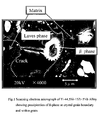
- Fig.1 shows a scanning electron microscope image of alloy No. 7 in embodiment of the present invention.
- alloys No. 5 to 7 are suitable for high temperature operation as high temperature shape memory alloys. Furthermore, even though with improved break rolling ratio, existence of a large amount of fine cracks are observed in alloys No. 5 to 7. As shown in Fig. 1 of the SEM image by Scanning Electric Microscope, together with the hard brittle Laves phase that forms in alloy No.7 after rolling, soft ⁇ phase liable to plastic deformation precipitates which hinders the development of cracks appeared on the interfaces of said Laves phase, as a result, machinability is improved.
- Fig.2 shows a scanning electron microscope image of alloy No. 8 in embodiment of the present invention.
- alloys Nos. 38 and 39 possess higher transformation temperature; besides, as we compare alloys Nos. 43, 44 and 46 with alloys Nos. 8, 9, 10 and 3, even though adding Ta to alloys No. 43, 44 and 46 exhibits little effect to improve rolling ratio compared with adding Nb to alloys Nos. 8 to 10, better rolling ratio and higher transformation temperature were obtained compared respectively with alloy No. 3 and alloys Nos. 8 to 10 with added Nb.
- alloy No. 48 was compared with alloys Nos. 44, 9 and 3 in the case of alloy 48 with combined addition of Ta and Nb, the rolling ratio is improved compared with alloy No. 44 with only Ta added, and yet the transformation temperature is increased compared with alloy No. 9 while only Nb is added.
- the afore-described shape memory alloy does not lose its shape memory effect during repeated use at high temperature, it can be used as a valve inside gas channel of a motor (engine of automobile, aircrafts, or gas turbine) for high temperature operation, when heated, channel area is regulated with the help of the shape memory effect; when cooled, channel area is reversed back by a spring used for deforming the valve.
- a motor engine of automobile, aircrafts, or gas turbine
- it can also be used as lubricant supplying valve of high speed rotating shaft.
- it can be used as safety device for power supply of household electric appliance at high temperature operation.
- it can also be used as an actuator for high temperature operation. In the case of an actuator, it also exhibits improved responsiveness resulting from increased cooling speed.
Landscapes
- Chemical & Material Sciences (AREA)
- Engineering & Computer Science (AREA)
- Mechanical Engineering (AREA)
- Materials Engineering (AREA)
- Metallurgy (AREA)
- Organic Chemistry (AREA)
- Combustion & Propulsion (AREA)
- General Engineering & Computer Science (AREA)
- Physics & Mathematics (AREA)
- Thermal Sciences (AREA)
- Crystallography & Structural Chemistry (AREA)
- Manufacturing & Machinery (AREA)
- Heat Treatment Of Steel (AREA)
- Temperature-Responsive Valves (AREA)
Abstract
Claims (7)
- Alliage à mémoire de forme à haute température, ledit alliage étant constitué de 34,7 % en mol à 48,5 % en mol de Ni, d'au moins soit du zircon soit de l'hafnium en tant qu'additifs augmentant la température de transformation, dont la somme s'élève à 6,8 % en mol à 22,5 % en mol ; d'au moins soit du niobium soit du tantale en tant qu'additifs améliorant l'usinabilité, dont la somme s'élève à 1 % en mol à 30 % en mol ; du bore dans une quantité inférieure à 2 % en mol ; du titane pour le reste ; et des impuretés inévitables.
- Alliage à mémoire de forme à haute température selon la revendication 1, ledit alliage étant constitué de 6,8 % en mol à 22,5 % de zircon en tant qu'additif augmentant la température de transformation ; et de 3 % en mol à 30 % en mol de niobium en tant qu'additif améliorant l'usinabilité.
- Alliage à mémoire de forme à haute température selon la revendication 1, ledit alliage étant constitué de 6,8 % en mol à 18 % d'hafnium en tant qu'additif augmentant la température de transformation ; et de 3 % en mol à 20 % en mol de niobium en tant qu'additif améliorant l'usinabilité.
- Alliage à mémoire de forme à haute température selon la revendication 1, ledit alliage étant constitué de 6,8 % en mol à 20 % desdits additifs augmentant la température de transformation ; et de 3 % en mol à 30 % en mol de tantale en tant qu'additif améliorant l'usinabilité.
- Alliage à mémoire de forme à haute température selon les revendications 1 à 4, dans lequel le rapport molaire du titane associé au zircon et de l'hafnium associé au nickel se situe dans la gamme allant de 0,98 à 1,14.
- Actionneur, lequel actionneur est constitué d'un alliage à mémoire de forme à haute température décrit dans les revendications 1 à 5.
- Moteur équipé d'une soupape de régulation de l'écoulement, dans lequel la soupape de régulation de l'écoulement est constituée d'un alliage à mémoire de forme à haute température décrit dans les revendications 1 à 5.
Applications Claiming Priority (2)
| Application Number | Priority Date | Filing Date | Title |
|---|---|---|---|
| JP2006076560 | 2006-03-20 | ||
| PCT/JP2006/324206 WO2007108180A1 (fr) | 2006-03-20 | 2006-12-05 | Alliage a memoire de forme haute temperature, actionneur et moteur associes |
Publications (3)
| Publication Number | Publication Date |
|---|---|
| EP1997922A1 EP1997922A1 (fr) | 2008-12-03 |
| EP1997922A4 EP1997922A4 (fr) | 2011-04-20 |
| EP1997922B1 true EP1997922B1 (fr) | 2012-06-13 |
Family
ID=38522217
Family Applications (1)
| Application Number | Title | Priority Date | Filing Date |
|---|---|---|---|
| EP06833961A Not-in-force EP1997922B1 (fr) | 2006-03-20 | 2006-12-05 | Alliage a memoire de forme haute temperature, actionneur et moteur associes |
Country Status (4)
| Country | Link |
|---|---|
| US (1) | US20090218013A1 (fr) |
| EP (1) | EP1997922B1 (fr) |
| JP (1) | JP4910156B2 (fr) |
| WO (1) | WO2007108180A1 (fr) |
Families Citing this family (9)
| Publication number | Priority date | Publication date | Assignee | Title |
|---|---|---|---|---|
| JP5337963B2 (ja) | 2006-03-17 | 2013-11-06 | 国立大学法人 筑波大学 | チタン−タンタル系形状記憶合金、アクチュエータおよび発動機 |
| RU2397732C2 (ru) * | 2008-07-21 | 2010-08-27 | Учреждение Российской академии наук Институт физики прочности и материаловедения Сибирское отделение РАН (ИФПМ СО РАН) | Дентальный внутрикостный имплантат и материал с эффектом памяти формы для его изготовления |
| RU2529472C2 (ru) * | 2013-01-10 | 2014-09-27 | Общество с ограниченной ответственностью "Медико-инженерный центр сплавов с памятью формы" | Дентальный внутрикостно-поднадкостничный имплантат и способ его установки |
| KR101614409B1 (ko) | 2014-10-27 | 2016-04-22 | 한국기계연구원 | 형상기억합금 및 이의 제조방법 |
| US10774407B2 (en) | 2015-06-19 | 2020-09-15 | University Of Florida Research Foundation, Inc. | Nickel titanium alloys, methods of manufacture thereof and article comprising the same |
| US10690123B2 (en) * | 2017-08-08 | 2020-06-23 | The Boeing Company | Cooperative shape memory alloy torque tubes for continuous-action turning motor |
| CN111020338B (zh) * | 2019-12-16 | 2021-07-30 | 四川大学 | 超低温服役镍钛铌形状记忆合金 |
| JP7713215B2 (ja) * | 2021-01-27 | 2025-07-25 | 国立研究開発法人物質・材料研究機構 | 高温形状記憶合金、その製造方法、それを用いたアクチュエータおよびエンジン |
| CN117721347A (zh) * | 2023-11-16 | 2024-03-19 | 四川华能太平驿水电有限责任公司 | 一种换热自动检测机器人用轴承合金材料及其制备方法 |
Family Cites Families (17)
| Publication number | Priority date | Publication date | Assignee | Title |
|---|---|---|---|---|
| JPS58157934A (ja) * | 1982-03-13 | 1983-09-20 | Hitachi Metals Ltd | 形状記憶合金 |
| JPS5928548A (ja) * | 1982-08-06 | 1984-02-15 | Kazuhiro Otsuka | 超弾性、非可逆形状記憶性Ni−Ti基合金材とその製造方法 |
| JPS6026648A (ja) * | 1983-07-21 | 1985-02-09 | Furukawa Electric Co Ltd:The | 形状記憶NiTi系合金板の製造法 |
| US4770725A (en) * | 1984-11-06 | 1988-09-13 | Raychem Corporation | Nickel/titanium/niobium shape memory alloy & article |
| CA1259826A (fr) * | 1984-11-06 | 1989-09-26 | John A. Simpson | Alliage et article de nickel-titane-niobium a memoire de forme |
| JPS6237353A (ja) * | 1986-06-13 | 1987-02-18 | Hitachi Metals Ltd | 形状記憶合金の製造方法 |
| JPS6313898A (ja) * | 1986-07-07 | 1988-01-21 | 大同特殊鋼株式会社 | 与圧室用隔壁 |
| JPS6396234A (ja) * | 1986-10-09 | 1988-04-27 | Tokin Corp | 形状記憶合金材料 |
| JPH03219037A (ja) * | 1989-10-03 | 1991-09-26 | Taiji Nishizawa | Ni基形状記憶合金およびその製造方法 |
| US5114504A (en) * | 1990-11-05 | 1992-05-19 | Johnson Service Company | High transformation temperature shape memory alloy |
| US5273116A (en) * | 1992-02-14 | 1993-12-28 | Baker Hughes Incorporated | Firing mechanism for actuating wellbore tools |
| JPH108168A (ja) * | 1996-06-24 | 1998-01-13 | Daido Steel Co Ltd | 加工性の改善されたNi−Ti−Zr(Hf)系形状記憶合金 |
| US6312455B2 (en) * | 1997-04-25 | 2001-11-06 | Nitinol Devices & Components | Stent |
| JPH1136024A (ja) | 1997-07-18 | 1999-02-09 | Kazuhiro Otsuka | 高温作動型形状記憶合金およびその製造方法 |
| JP3521253B2 (ja) * | 2000-05-18 | 2004-04-19 | 株式会社東北テクノアーチ | 生体用形状記憶合金 |
| JP4222444B2 (ja) | 2001-03-28 | 2009-02-12 | 独立行政法人科学技術振興機構 | Ti−Ni−Cu系形状記憶合金 |
| US8617141B2 (en) * | 2005-11-09 | 2013-12-31 | The Invention Science Fund I, Llc | Remote controlled in situ reaction device |
-
2006
- 2006-12-05 JP JP2008506165A patent/JP4910156B2/ja active Active
- 2006-12-05 WO PCT/JP2006/324206 patent/WO2007108180A1/fr not_active Ceased
- 2006-12-05 EP EP06833961A patent/EP1997922B1/fr not_active Not-in-force
-
2008
- 2008-09-22 US US12/235,528 patent/US20090218013A1/en not_active Abandoned
Also Published As
| Publication number | Publication date |
|---|---|
| WO2007108180A1 (fr) | 2007-09-27 |
| JPWO2007108180A1 (ja) | 2009-08-06 |
| EP1997922A4 (fr) | 2011-04-20 |
| JP4910156B2 (ja) | 2012-04-04 |
| US20090218013A1 (en) | 2009-09-03 |
| EP1997922A1 (fr) | 2008-12-03 |
Similar Documents
| Publication | Publication Date | Title |
|---|---|---|
| US20090218013A1 (en) | High temperature shape memory alloy, actuator and motor | |
| EP1925683B1 (fr) | Alliage à base de cobalt ayant une résistance à la chaleur élevée et une résistance élevée et procédé servant à produire celui-ci | |
| EP2479302B1 (fr) | Alliage thermorésistant à base de Ni, composant de turbine à gaz et turbine à gaz | |
| EP0484805A1 (fr) | Alliage à mémoire de forme ayant une température de transformation élevée | |
| EP0358211B1 (fr) | Alliage à base de nickel | |
| EP3561093B1 (fr) | Alliage résistant à la chaleur à base de ni | |
| US8007604B2 (en) | Titanium-tantalum base shape memory alloys, actuator and engine | |
| JP4768672B2 (ja) | 組織安定性と高温強度に優れたNi基合金およびNi基合金材の製造方法 | |
| EP1736560B1 (fr) | Alliage titane type alpha+beta de haute résistance | |
| JP5512145B2 (ja) | 形状記憶合金 | |
| JP7176692B2 (ja) | 高温形状記憶合金、その製造方法、それを用いたアクチュエータおよびエンジン | |
| CN1150826A (zh) | 金属间的镍-铝基合金 | |
| JP4275334B2 (ja) | 銅系合金及びその製造方法 | |
| EP3561094B1 (fr) | Alliage à base de ni résistant à la chaleur | |
| KR20100056635A (ko) | Cu-Ti계 구리 합금판재 및 그 제조법 | |
| JP2737500B2 (ja) | 耐熱チタン合金 | |
| CN119410956B (zh) | 一种具有高强度和高韧性的钛合金棒材及其制备方法 | |
| JP2573499B2 (ja) | TiNiCuV4元形状記憶合金 | |
| JP4035617B2 (ja) | イリジウム基合金とその製造方法 | |
| KR102758393B1 (ko) | 니켈기 초내열합금 및 그의 제조 방법 | |
| JP7713215B2 (ja) | 高温形状記憶合金、その製造方法、それを用いたアクチュエータおよびエンジン | |
| CN122061044A (en) | TA11 titanium alloy bar with high creep resistance and high fatigue performance and preparation method thereof | |
| Kainuma et al. | Ishida et al. | |
| JPH0344136B2 (fr) |
Legal Events
| Date | Code | Title | Description |
|---|---|---|---|
| PUAI | Public reference made under article 153(3) epc to a published international application that has entered the european phase |
Free format text: ORIGINAL CODE: 0009012 |
|
| 17P | Request for examination filed |
Effective date: 20080924 |
|
| AK | Designated contracting states |
Kind code of ref document: A1 Designated state(s): DE FR GB |
|
| RIN1 | Information on inventor provided before grant (corrected) |
Inventor name: TOMOZAWA, MASANARI Inventor name: MIYAZAKI, SHUICHI Inventor name: KIM, HEEYOUNG Inventor name: PIO, BUENCONSEJO Inventor name: TAKEDA, YOSHINARI |
|
| DAX | Request for extension of the european patent (deleted) | ||
| RBV | Designated contracting states (corrected) |
Designated state(s): DE FR GB |
|
| RIN1 | Information on inventor provided before grant (corrected) |
Inventor name: MIYAZAKI, SHUICHI Inventor name: PIO, BUENCONSEJO Inventor name: TAKEDA, YOSHINARI Inventor name: KIM, HEEYOUNG Inventor name: TOMOZAWA, MASANARI |
|
| A4 | Supplementary search report drawn up and despatched |
Effective date: 20110318 |
|
| RIC1 | Information provided on ipc code assigned before grant |
Ipc: F03G 7/06 20060101ALI20110314BHEP Ipc: C22C 14/00 20060101ALI20110314BHEP Ipc: C22F 1/10 20060101ALI20110314BHEP Ipc: C22F 1/18 20060101ALI20110314BHEP Ipc: C22C 27/02 20060101ALI20110314BHEP Ipc: F01D 25/00 20060101ALI20110314BHEP Ipc: C22F 1/00 20060101ALI20110314BHEP Ipc: C22C 19/03 20060101AFI20071009BHEP |
|
| RIC1 | Information provided on ipc code assigned before grant |
Ipc: C22C 19/03 20060101AFI20110930BHEP Ipc: C22F 1/00 20060101ALI20110930BHEP Ipc: C22F 1/18 20060101ALI20110930BHEP Ipc: F03G 7/06 20060101ALI20110930BHEP Ipc: C22C 14/00 20060101ALI20110930BHEP Ipc: C22F 1/10 20060101ALI20110930BHEP Ipc: C22C 27/02 20060101ALI20110930BHEP Ipc: F01D 25/00 20060101ALI20110930BHEP |
|
| GRAP | Despatch of communication of intention to grant a patent |
Free format text: ORIGINAL CODE: EPIDOSNIGR1 |
|
| RAP1 | Party data changed (applicant data changed or rights of an application transferred) |
Owner name: UNIVERSITY OF TSUKUBA |
|
| GRAS | Grant fee paid |
Free format text: ORIGINAL CODE: EPIDOSNIGR3 |
|
| GRAA | (expected) grant |
Free format text: ORIGINAL CODE: 0009210 |
|
| AK | Designated contracting states |
Kind code of ref document: B1 Designated state(s): DE FR GB |
|
| REG | Reference to a national code |
Ref country code: GB Ref legal event code: FG4D |
|
| REG | Reference to a national code |
Ref country code: DE Ref legal event code: R096 Ref document number: 602006030234 Country of ref document: DE Effective date: 20120809 |
|
| PLBE | No opposition filed within time limit |
Free format text: ORIGINAL CODE: 0009261 |
|
| STAA | Information on the status of an ep patent application or granted ep patent |
Free format text: STATUS: NO OPPOSITION FILED WITHIN TIME LIMIT |
|
| 26N | No opposition filed |
Effective date: 20130314 |
|
| REG | Reference to a national code |
Ref country code: DE Ref legal event code: R097 Ref document number: 602006030234 Country of ref document: DE Effective date: 20130314 |
|
| PGFP | Annual fee paid to national office [announced via postgrant information from national office to epo] |
Ref country code: GB Payment date: 20131227 Year of fee payment: 8 |
|
| PGFP | Annual fee paid to national office [announced via postgrant information from national office to epo] |
Ref country code: DE Payment date: 20140228 Year of fee payment: 8 |
|
| PGFP | Annual fee paid to national office [announced via postgrant information from national office to epo] |
Ref country code: FR Payment date: 20131230 Year of fee payment: 8 |
|
| REG | Reference to a national code |
Ref country code: DE Ref legal event code: R119 Ref document number: 602006030234 Country of ref document: DE |
|
| GBPC | Gb: european patent ceased through non-payment of renewal fee |
Effective date: 20141205 |
|
| REG | Reference to a national code |
Ref country code: FR Ref legal event code: ST Effective date: 20150831 |
|
| PG25 | Lapsed in a contracting state [announced via postgrant information from national office to epo] |
Ref country code: GB Free format text: LAPSE BECAUSE OF NON-PAYMENT OF DUE FEES Effective date: 20141205 Ref country code: DE Free format text: LAPSE BECAUSE OF NON-PAYMENT OF DUE FEES Effective date: 20150701 |
|
| PG25 | Lapsed in a contracting state [announced via postgrant information from national office to epo] |
Ref country code: FR Free format text: LAPSE BECAUSE OF NON-PAYMENT OF DUE FEES Effective date: 20141231 |