EP2006278B2 - Composé de benzofluorène et utilisation de celui-ci - Google Patents
Composé de benzofluorène et utilisation de celui-ci Download PDFInfo
- Publication number
- EP2006278B2 EP2006278B2 EP07741549.5A EP07741549A EP2006278B2 EP 2006278 B2 EP2006278 B2 EP 2006278B2 EP 07741549 A EP07741549 A EP 07741549A EP 2006278 B2 EP2006278 B2 EP 2006278B2
- Authority
- EP
- European Patent Office
- Prior art keywords
- group
- compound
- carbon atoms
- mmol
- substituted
- Prior art date
- Legal status (The legal status is an assumption and is not a legal conclusion. Google has not performed a legal analysis and makes no representation as to the accuracy of the status listed.)
- Ceased
Links
- 0 **[C@](*)(C1C2=C3)*(C=CC4)=C4C1C=BC2=C[C@@]3Nc1c(*=CCC2)c2c[o]1 Chemical compound **[C@](*)(C1C2=C3)*(C=CC4)=C4C1C=BC2=C[C@@]3Nc1c(*=CCC2)c2c[o]1 0.000 description 6
- MGNZXYYWBUKAII-UHFFFAOYSA-N C1C=CC=CC1 Chemical compound C1C=CC=CC1 MGNZXYYWBUKAII-UHFFFAOYSA-N 0.000 description 2
Classifications
-
- C—CHEMISTRY; METALLURGY
- C07—ORGANIC CHEMISTRY
- C07C—ACYCLIC OR CARBOCYCLIC COMPOUNDS
- C07C211/00—Compounds containing amino groups bound to a carbon skeleton
- C07C211/43—Compounds containing amino groups bound to a carbon skeleton having amino groups bound to carbon atoms of six-membered aromatic rings of the carbon skeleton
- C07C211/57—Compounds containing amino groups bound to a carbon skeleton having amino groups bound to carbon atoms of six-membered aromatic rings of the carbon skeleton having amino groups bound to carbon atoms of six-membered aromatic rings being part of condensed ring systems of the carbon skeleton
- C07C211/61—Compounds containing amino groups bound to a carbon skeleton having amino groups bound to carbon atoms of six-membered aromatic rings of the carbon skeleton having amino groups bound to carbon atoms of six-membered aromatic rings being part of condensed ring systems of the carbon skeleton with at least one of the condensed ring systems formed by three or more rings
-
- C—CHEMISTRY; METALLURGY
- C09—DYES; PAINTS; POLISHES; NATURAL RESINS; ADHESIVES; COMPOSITIONS NOT OTHERWISE PROVIDED FOR; APPLICATIONS OF MATERIALS NOT OTHERWISE PROVIDED FOR
- C09K—MATERIALS FOR MISCELLANEOUS APPLICATIONS, NOT PROVIDED FOR ELSEWHERE
- C09K11/00—Luminescent materials, e.g. electroluminescent or chemiluminescent
- C09K11/06—Luminescent materials, e.g. electroluminescent or chemiluminescent containing organic luminescent materials
-
- H—ELECTRICITY
- H05—ELECTRIC TECHNIQUES NOT OTHERWISE PROVIDED FOR
- H05B—ELECTRIC HEATING; ELECTRIC LIGHT SOURCES NOT OTHERWISE PROVIDED FOR; CIRCUIT ARRANGEMENTS FOR ELECTRIC LIGHT SOURCES, IN GENERAL
- H05B33/00—Electroluminescent light sources
- H05B33/12—Light sources with substantially two-dimensional [2D] radiating surfaces
- H05B33/14—Light sources with substantially two-dimensional [2D] radiating surfaces characterised by the chemical or physical composition or the arrangement of the electroluminescent material, or by the simultaneous addition of the electroluminescent material in or onto the light source
-
- H—ELECTRICITY
- H10—SEMICONDUCTOR DEVICES; ELECTRIC SOLID-STATE DEVICES NOT OTHERWISE PROVIDED FOR
- H10K—ORGANIC ELECTRIC SOLID-STATE DEVICES
- H10K50/00—Organic light-emitting devices
- H10K50/10—OLEDs or polymer light-emitting diodes [PLED]
- H10K50/11—OLEDs or polymer light-emitting diodes [PLED] characterised by the electroluminescent [EL] layers
-
- H—ELECTRICITY
- H10—SEMICONDUCTOR DEVICES; ELECTRIC SOLID-STATE DEVICES NOT OTHERWISE PROVIDED FOR
- H10K—ORGANIC ELECTRIC SOLID-STATE DEVICES
- H10K50/00—Organic light-emitting devices
- H10K50/10—OLEDs or polymer light-emitting diodes [PLED]
- H10K50/14—Carrier transporting layers
-
- H—ELECTRICITY
- H10—SEMICONDUCTOR DEVICES; ELECTRIC SOLID-STATE DEVICES NOT OTHERWISE PROVIDED FOR
- H10K—ORGANIC ELECTRIC SOLID-STATE DEVICES
- H10K50/00—Organic light-emitting devices
- H10K50/10—OLEDs or polymer light-emitting diodes [PLED]
- H10K50/17—Carrier injection layers
-
- H—ELECTRICITY
- H10—SEMICONDUCTOR DEVICES; ELECTRIC SOLID-STATE DEVICES NOT OTHERWISE PROVIDED FOR
- H10K—ORGANIC ELECTRIC SOLID-STATE DEVICES
- H10K85/00—Organic materials used in the body or electrodes of devices covered by this subclass
- H10K85/60—Organic compounds having low molecular weight
- H10K85/615—Polycyclic condensed aromatic hydrocarbons, e.g. anthracene
- H10K85/622—Polycyclic condensed aromatic hydrocarbons, e.g. anthracene containing four rings, e.g. pyrene
-
- H—ELECTRICITY
- H10—SEMICONDUCTOR DEVICES; ELECTRIC SOLID-STATE DEVICES NOT OTHERWISE PROVIDED FOR
- H10K—ORGANIC ELECTRIC SOLID-STATE DEVICES
- H10K85/00—Organic materials used in the body or electrodes of devices covered by this subclass
- H10K85/60—Organic compounds having low molecular weight
- H10K85/631—Amine compounds having at least two aryl rest on at least one amine-nitrogen atom, e.g. triphenylamine
- H10K85/633—Amine compounds having at least two aryl rest on at least one amine-nitrogen atom, e.g. triphenylamine comprising polycyclic condensed aromatic hydrocarbons as substituents on the nitrogen atom
-
- C—CHEMISTRY; METALLURGY
- C07—ORGANIC CHEMISTRY
- C07C—ACYCLIC OR CARBOCYCLIC COMPOUNDS
- C07C2603/00—Systems containing at least three condensed rings
- C07C2603/02—Ortho- or ortho- and peri-condensed systems
- C07C2603/40—Ortho- or ortho- and peri-condensed systems containing four condensed rings
-
- C—CHEMISTRY; METALLURGY
- C07—ORGANIC CHEMISTRY
- C07C—ACYCLIC OR CARBOCYCLIC COMPOUNDS
- C07C2603/00—Systems containing at least three condensed rings
- C07C2603/93—Spiro compounds
- C07C2603/94—Spiro compounds containing "free" spiro atoms
-
- C—CHEMISTRY; METALLURGY
- C07—ORGANIC CHEMISTRY
- C07C—ACYCLIC OR CARBOCYCLIC COMPOUNDS
- C07C2603/00—Systems containing at least three condensed rings
- C07C2603/93—Spiro compounds
- C07C2603/95—Spiro compounds containing "not free" spiro atoms
- C07C2603/96—Spiro compounds containing "not free" spiro atoms containing at least one ring with less than six members
- C07C2603/97—Spiro compounds containing "not free" spiro atoms containing at least one ring with less than six members containing five-membered rings
-
- C—CHEMISTRY; METALLURGY
- C09—DYES; PAINTS; POLISHES; NATURAL RESINS; ADHESIVES; COMPOSITIONS NOT OTHERWISE PROVIDED FOR; APPLICATIONS OF MATERIALS NOT OTHERWISE PROVIDED FOR
- C09K—MATERIALS FOR MISCELLANEOUS APPLICATIONS, NOT PROVIDED FOR ELSEWHERE
- C09K2211/00—Chemical nature of organic luminescent or tenebrescent compounds
- C09K2211/10—Non-macromolecular compounds
- C09K2211/1003—Carbocyclic compounds
- C09K2211/1007—Non-condensed systems
-
- C—CHEMISTRY; METALLURGY
- C09—DYES; PAINTS; POLISHES; NATURAL RESINS; ADHESIVES; COMPOSITIONS NOT OTHERWISE PROVIDED FOR; APPLICATIONS OF MATERIALS NOT OTHERWISE PROVIDED FOR
- C09K—MATERIALS FOR MISCELLANEOUS APPLICATIONS, NOT PROVIDED FOR ELSEWHERE
- C09K2211/00—Chemical nature of organic luminescent or tenebrescent compounds
- C09K2211/10—Non-macromolecular compounds
- C09K2211/1003—Carbocyclic compounds
- C09K2211/1011—Condensed systems
-
- C—CHEMISTRY; METALLURGY
- C09—DYES; PAINTS; POLISHES; NATURAL RESINS; ADHESIVES; COMPOSITIONS NOT OTHERWISE PROVIDED FOR; APPLICATIONS OF MATERIALS NOT OTHERWISE PROVIDED FOR
- C09K—MATERIALS FOR MISCELLANEOUS APPLICATIONS, NOT PROVIDED FOR ELSEWHERE
- C09K2211/00—Chemical nature of organic luminescent or tenebrescent compounds
- C09K2211/10—Non-macromolecular compounds
- C09K2211/1003—Carbocyclic compounds
- C09K2211/1014—Carbocyclic compounds bridged by heteroatoms, e.g. N, P, Si or B
-
- Y—GENERAL TAGGING OF NEW TECHNOLOGICAL DEVELOPMENTS; GENERAL TAGGING OF CROSS-SECTIONAL TECHNOLOGIES SPANNING OVER SEVERAL SECTIONS OF THE IPC; TECHNICAL SUBJECTS COVERED BY FORMER USPC CROSS-REFERENCE ART COLLECTIONS [XRACs] AND DIGESTS
- Y02—TECHNOLOGIES OR APPLICATIONS FOR MITIGATION OR ADAPTATION AGAINST CLIMATE CHANGE
- Y02E—REDUCTION OF GREENHOUSE GAS [GHG] EMISSIONS, RELATED TO ENERGY GENERATION, TRANSMISSION OR DISTRIBUTION
- Y02E10/00—Energy generation through renewable energy sources
- Y02E10/50—Photovoltaic [PV] energy
- Y02E10/549—Organic PV cells
Definitions
- the present invention relates to a novel benzofluorene compound and a use thereof, in particular, an organic electroluminescent element.
- the benzofluorene compound is usable as a photosensitive material and an organic photoconductive material and, more specifically, can be used as a hole-transporting or hole-injecting material and a luminescent material in organic EL elements for use as flat light sources or displays or in electrophotographic photoreceptors, etc.
- Organic photoconductive materials which have been developed as photosensitive materials or hole-transporting materials have many advantages including low cost, variety of processability, and non-polluting nature. Many compounds have been proposed. For example, materials such as oxadiazole derivatives (see, for example, patent document 1), oxazole derivatives (see, for example, patent document 2), hydrazone derivatives (see, for example, patent document 3), triarylpyrazoline derivatives (see, for example, patent documents 4 and 5), arylamine derivatives (see, for example, patent documents 6 and 7), and stilbene derivatives (see, for example, patent documents 8 and 9) have been disclosed.
- materials such as oxadiazole derivatives (see, for example, patent document 1), oxazole derivatives (see, for example, patent document 2), hydrazone derivatives (see, for example, patent document 3), triarylpyrazoline derivatives (see, for example, patent documents 4 and 5), arylamine derivatives (see, for example, patent documents 6 and 7),
- starburst materials such as 4,4',4"-tris [N, N- (1-naphthyl)phenylamino]triphenylamine (1-TNATA) and 4, 4',4"-tris [N, N- (m-tolyl)phenylamino]triphenylamine (MTDATA) and biphenyl type arylamine derivatives such as 4,4'-bis[N-(1-naphthyl)-N-phenylamino]biphenyl (NPD) and 4,4'-bis[N-(m-tolyl)-N-phenylamino]biphenyl (TPD) are frequently used as hole-transporting or hole-injecting materials (see, for example, non-patent documents 1 and 2).
- patent document 12 an organic electroluminescent material having the same benzofluorene framework as in this patent has also been proposed (see, for example, patent document 12).
- this patent document includes no statement concerning a compound having an amino group directly bonded to the benzofluorenyl group.
- patent document 12 includes a statement to the effect that a polymeric material having benzofluorenyl groups is especially useful as a luminescent material, there is no statement therein to the effect that the polymeric material is useful as a hole-transporting material and a hole-injecting material.
- WO-A-2006/025273 discloses a specified aromatic amine derivative having a chrysene structure and organoluminescent device using the same.
- the compound D-272 disclosed in this document have two tertiary amines linked via a chrysene bridging structure, wherein one of the amino groups linked to the chrysene structure bears a benzo[b]fluorene.
- WO-A-2005/056633 discloses halobenzofluorene compounds for use in the preparation of a polymer compound useful as a light emitting material or charge transporting material, said halobenzofluorene compounds having at least two bromo substituents.
- NPD which is a typical hole-transporting material and is presently superior in efficiency, etc.
- NPD has a problem that it has a low glass transition temperature and this arouses troubles concerning element life.
- the organic electroluminescent element abruptly ends its life.
- a property required for this purpose is a lower operating voltage. With respect to this requirement, a fully satisfactory element has not been obtained with NPD. Consequently, there is a strong desire for a material which realizes a lower operating voltage and a longer life.
- An object of the invention is to provide a novel material having a lower operating voltage and longer-lasting durability than conventional materials. More specifically, the object is to provide a novel benzofluorene compound suitable for use as a hole-injecting material, hole-transporting material, and luminescent material in organic EL elements, etc.
- the present inventors diligently made investigations. As a result, they have found that a benzofluorene compound represented by formula (1) is highly excellent in efficiency and durability.
- the invention has been thus completed. Namely, the invention relates to a benzofluorene compound represented by formula (1) and a use of the compound. Constitutions of the invention are described below.
- Formula (1) is as defined in claim 1:
- the benzofluorene compound represented by formula (1) according to the invention has a lower operating voltage, higher power efficiency, and higher glass transition temperature than conventional materials. This compound can hence be expected to improve the life of elements or the like. Because of this, the compound can be used as, e.g., a hole-transporting material, hole-injecting material, or luminescent material in an organic EL element or an electrophotographic photoreceptor, etc.
- M is a disubstituted biphenyl framework.
- M may have one or more substituents selected, for example, from alkyl groups such as methyl group, ethyl group, and propyl group, aryl groups such as phenyl group, naphthyl group, and biphenyl group.
- the benzofluorene compound preferably is one represented by formula (4) in which M is a disubstituted biphenyl framework. Because this compound is high in hole mobility, which is a factor necessary for realizing a voltage reduction.
- Ar 1 to Ar 4 are each independently a substituted or unsubstituted aryl group having 6-40 carbon atoms, at least one of Ar 1 to Ar 4 is a substituent represented by any of the following formulae (2) to (5).
- R 1 to R 4 are each independently a hydrogen , a linear, branched, or cyclic alkyl group, having 1-18 carbon atoms or a substituted or unsubstituted aryl group having 6-40 carbon atoms, and R 1 and R 2 may be bonded to each other to form a ring.
- Examples of the substituted or unsubstituted aryl groups having 6-40 carbon atoms represented by Ar 1 to Ar 4 include phenyl group, 1-naphthyl group, 2-naphthyl group, 2-anthryl group, 9-anthryl group, 2-fluorenyl group, 4-methylphenyl group, 3-methylphenyl group, 2-methylphenyl group, 4-ethylphenyl group, 3-ethylphenyl group, 2-ethylphenyl group, 4-n-propylphenyl group, 4-isopropylphenyl group, 2-isopropylphenyl group, 4-n-butylphenyl group, 4-isobutylphenyl group, 4-sec-butylphenyl group, 2-sec-butylphenyl group, 4-tert-butylphenyl group, 3-tert-butylphenyl group, 2-tert-butylphenyl group, 4-n-pentylphenyl group,
- R 1 to R 4 are each independently a hydrogen atom, a linear, branched, or cyclic alkyl group, having 1-18 carbon atoms or a substituted or unsubstituted aryl group having 6-40 carbon atoms, and R 1 and R 2 may be bonded to each other to form a ring.
- examples of the linear, branched, or cyclic alkyl groups represented by R 1 to R 4 include methyl group, ethyl group, propyl group, isopropyl group, butyl group, sec-butyl group, tert-butyl group, pentyl group, hexyl group, heptyl group, octyl group, stearyl group, trichloromethyl group, trifluoromethyl group, cyclopropyl group, cyclohexylgroup,1,3-cyclohexadienyl group, and 2-cyclopenten-1-yl group.
- Examples of the substituted or unsubstitutedaryl groups having 6-40 carbon atoms represented by R 1 to R 4 include phenyl group, 4-methylphenyl group, 3-methylphenyl group, 2-methylphenyl group, 4-ethylphenyl group, 3-ethylphenyl group, 2-ethylphenyl group, 4-n-propylphenyl group, 4-n-butylphenyl group, 4-isobutylphenyl group, 4-tert-butylphenyl group, 4-cyclopentylphenyl group, 4-cyclohexylphenyl group, 2,4-dimethylphenyl group, 3,5-dimethylphenyl group, 3,4-dimethylphenyl group, 4-(1-naphthyl)phenyl group, 4-(9-anthryl)phenyl group, 4-(10-phenyl-9-anthryl)phenyl group, 4-biphenyl group, 1-naphthyl group, 2-
- the invention are benzofluorene compounds represented by formula (1) in which p is 1 and M is a disubstituted biphenyl framework, i.e., ones represented by formula (6).
- benzofluorene compounds represented by formula (6) in which either of Ar 1 and Ar 2 and either of Ar 3 and Ar 4 are groups each represented by any of formulae (2) to (5).
- R 1 and R 2 may be bonded to each other to form a ring.
- examples of such compound include a benzofluorene compound represented by any of the following formulae (7) to (10). This compound is especially preferred from the standpoints of element efficiency and durability.
- Benzofluorene compounds having as a partial structure a substituent represented by formula (2), among the substituents represented by formulae (2) to (5), are preferred because they can be easily synthesized. Especially preferred of these are benzofluorene compounds having a substituent represented by the following formula (2') as a partial structure.
- R 1 to R 4 are each independently a hydrogen atom, a linear, branched, or cyclic alkyl group, having 1-18 carbon atoms, or a substituted or unsubstituted aryl group having 6-40 carbon atoms, and that R 1 and R 2 may be bonded to each other to form a ring.
- R 7 , R 8 , R 11 , and R 12 are each independently a hydrogen atom, a linear, branched, or cyclic alkyl group having 1-18 carbon atoms or a a substituted or unsubstituted aryl group having 6-40 carbon atoms
- R 3 - and R 20 represent an alkylene group having 1-6 carbon atoms or an arylene group having 6-12 carbon atoms
- Ar 5 represents a substituted or unsubstituted aryl group having 6-40 carbon atoms
- examples of R 7 , R 8 , R 11 , and R 12 include the same substituents as R 3 to R 6 represented by formulae (2) to (6).
- examples of R 9 and R 10 include alkylene groups such as methylene group, ethylene group, trimethylene group, and tetraethylene group and arylene groups such as phenylene group and naphthylene group.
- Examples of the substituted or unsubstituted aryl group having 6-40 carbon atoms each represented by Ar 5 include the same substituents as M represented by formula (1).
- the benzofluorene compound represented by formula (1) can be synthesized by a known method ( Tetrahedron Letters, 39, 2367 (1998 )). For example, it can be synthesized by reacting a dihalobiphenyl compound represented by the following formula (15), in which M is biphenyl, with an amine compound represented by any of the following formulae (16) to (19) in the presence of a base using a copper catalyst or palladium catalyst.
- X represents a halogen atom and R 13 and R 14 represent the same substituents as R 5 and R 6 represented by formula (6).
- R 15 to R 18 represent the same substituents as R 1 to R 4 represented by formula (2).
- the benzofluorene compound of the invention is expected to attain a more improved operating voltage and a higher power efficiency than conventional materials. Furthermore, the benzofluorene compound has a high glass transition temperature and is hence expected to further attain an improvement in element life. Consequently, the benzofluorene compound is applicable not only as a hole-injecting material, hole-transporting material, or luminescent material in an organic EL element, electrophotographic photoreceptor, etc., but also in the field of organic photoconductive materials in photo-electric converting elements, solar cells, image sensors, etc.
- the compounds obtained in the Examples were identified by 1 H-NMR spectroscopy, 13 C-NMR spectroscopy, and FDMS.
- the 1 H-NMR and 13 C-NMR spectroscopy and the FDMS were conducted respectively with Gemini 200, manufactured by Varian Inc., and M-80B, manufactured by Hitachi, Ltd.
- the organic layer obtained was washed with saturated aqueous sodium chloride solution, subsequently dried with anhydrous magnesium sulfate, and then concentrated to obtain light-brown crystals. Furthermore, the crystals were purified by silica gel chromatography (solvent: hexane/toluene) to isolate 7.1 g of colorless crystals (yield, 82%). These crystals were ascertained to be the target compound through 1 H-NMR spectroscopy.
- This reaction mixture was treated in an ordinary manner and then treated by silica gel chromatography (solvent: hexane/toluene) to thereby isolate 1.5 g of colorless crystals (yield, 54%) as compound 1a.
- This reaction product had a melting point of 158-160°C, which agreed with the value in the literature ( J. Org. Chem., 56, 5, 1683 (1991 )). It was hence identified as benzo[c]fluorenone.
- the reaction product was identified by 1 H-NMR spectroscopy.
- Tetrahydrofuran was added to the reaction mixture to extract it.
- the organic layer obtained was washed with water and saturated aqueous sodium chloride solution and dried with magnesium sulfate.
- the solvent was distilled off, and the residue was recrystallized with hexane to obtain 7.68 g of Compound 3a (yield, 90% assuming that the purity was 100%; colorless crystals; melting point, 116-118°C).
- this compound was purified by silica gel chromatography (solvent:hexane/toluene) to obtain 3.34 g of 7-methylbenzo[c]fluorene as colorless crystals (yield, 60%; melting point, 81-83°C).
- the reaction product was identified by 1 H-NMR spectroscopy.
- the extract was washed with water and saturated aqueous sodium chloride solution and then dried with magnesium sulfate.
- the organic layer obtained was concentrated to thereby obtain light-brown crystals.
- the crystals were purified by silica gel chromatography (solvent: hexane/toluene) to thereby obtain Compound 4a as the target compound in a yield of 77%.
- the reaction product was identified by 1 H-NMR spectroscopy and FDMS.
- the reaction product was identified by 1 H-NMR spectroscopy.
- the reaction product was identified by 1 H-NMR spectroscopy and 13 C-NMR spectroscopy.
- the reaction product was identified by 1 H-NMR spectroscopy and 13 C-NMR spectroscopy.
- the Compounds 2b and 3b were identified by 1 H-NMR spectroscopy and 13 C-NMR spectroscopy.
- reaction products were identified by 1 H-NMR spectroscopy, 13 C-NMR spectroscopy, and FDMS.
- the reaction product was identified by 1 H-NMR spectroscopy and FDMS.
- This compound was identified by FDMS.
- the reaction product was identified by 1 H-NMR spectroscopy and FDMS.
- the compound (A1) had a glass transition temperature of 162°C, which was higher by at least about 40°C than the glass transition temperatures of 4,4'-bis[N-(1-naphthyl)-N-phenylamino]biphenyl, 2,7-bis[N-(1-naphthyl)-N-phenylamino]-9,9'-dimethylfluorene, and N,N'-di[2-(9,9-dimethylfluorenyl)]-N,N'-di(4-biphenyl)benzi dine (i.e., 96°C, 110°C, and 120°C, respectively), which are conventional materials.
- This compound was identified by 1 H-NMR spectroscopy and FDMS.
- This compound was identified by 1 H-NMR spectroscopy and FDMS.
- the Compound (F1) had a glass transition temperature of 172°C, which was higher by at least about 50°C than the glass transition temperatures of 4, 4'-bis (N-(1-naphthyl)-N-phenylamino]biphenyl, 2,7-bis[N-(1-naphthyl)-N-phenylamino]-9,9'-dimethylfluorene, and N,N'-di(2-(9,9-dimethylfluorenyl)]-N,N'-di(4-biphenyl)benzidine (i.e., 96°C, 110°C, and 120°C, respectively), which are conventional materials.
- This compound was identified by FDMS.
- This compound was identified by FDMS.
- a glass substrate having an ITO transparent electrode having a thickness of 130 nm was subjected to ultrasonic cleaning successively in acetone and isopropyl alcohol. Subsequently, the glass substrate was cleaned with boiling isopropyl alcohol and then dried. Furthermore, the substrate was treated with UV/ozone. The substrate thus treated was used as a transparent conductive supporting substrate. Copper phthalocyanine was deposited in a film thickness of 25 nm on the ITO transparent electrode by vacuum deposition. Subsequently, Compound (A1) was deposited in a film thickness of 45 nm by vacuum deposition to form a hole-transporting layer.
- Aluminum trisquinolinol complex was then deposited in a film thickness of 60 nm by vacuum deposition to form an electron-transporting layer.
- the same deposition conditions were used which included a degree of vacuum of 1.0 ⁇ 10 -4 Pa and a deposition rate of 0.3 nm/sec.
- LiF and aluminum were deposited as a cathode in thicknesses of 0.5 nm and 100 nm, respectively.
- a metallic electrode was formed.
- a glass substrate for protection was superposed on the coated substrate, and the resultant assemblage was sealed with a UV-curing resin.
- a direct-current voltage of 4.5 V was applied to the element thus obtained, with the ITO electrode and the LiF-Al electrode as the positive electrode and the negative electrode, respectively.
- a current density of 7.5 mA/cm 2 was obtained and a green luminescence having a luminance of 401 cd/m 2 was observed.
- Example 6 The same procedure as in Example 6 was conducted, except that Compound (F1) was used in place of the Compound (A1) for forming a hole-transporting layer. Thus, an organic EL element was produced. This element was examined under the conditions of a constant current density of 20 mA/cm 2 . As a result, the element showed an operating voltage of 5.67 V, current efficiency of 4.5 cd/A, and power efficiency of 2.5 lm/W. The results of the evaluation are shown in Table 2.
- Example 7 The same element as in Example 7 was produced, except that the Compound (F1) was replaced by Compound (A1). This element was operated under the conditions of a constant current density of 20 mA/cm 2 . Values in this operation are shown in Table 2.
- Example 7 The same element as in Example 7 was produced, except that the Compound (F1) was replaced by NPD. This element was operated under the conditions of a constant current density of 20 mA/cm 2 . Values in this operation are shown in Table 2. [Table 2] Table 2 Compound Tg Luminance Color of luminescence Operating voltage Current efficiency Power efficiency Luminance half-life period °C cd/m 2 V cd/A Im/W hr Example 7 (F1) 172 925 green 5.67 4.5 2.5 2850 Example 8 (A1) 162 1035 green 5.24 5.18 3.12 1900 Comparative Example 3 NPD 96 928 green 6.09 4.5 2.4 1420
- a glass substrate having an ITO transparent electrode having a thickness of 130 nm was subjected to ultrasonic cleaning successively in acetone and isopropyl alcohol. Subsequently, the glass substrate was cleaned with boiling isopropyl alcohol and then dried. Furthermore, the substrate was treated with UV/ozone. The substrate thus treated was used as a transparent conductive supporting substrate. Copper phthalocyanine was deposited in a film thickness of 25 nm on the ITO transparent electrode by vacuum deposition. Subsequently, Compound (A1) was deposited in a film thickness of 45 nm by vacuum deposition to form a hole-transporting layer.
- TBADN and TBPe were co-deposited by vapor deposition as a host and a dopant, respectively, in a weight ratio of 99:1 to form a film having a thickness of 40 nm.
- Aluminum trisquinolinol complex was then deposited in a film thickness of 20 nm by vacuum deposition to form an electron-transporting layer.
- the same deposition conditions were used which included a degree of vacuum of 1.0 ⁇ 10 -4 Pa and a deposition rate of 0.3 nm/sec.
- LiF and aluminum were deposited as a cathode in thicknesses of 0.5 nm and 100 nm, respectively.
- a metallic electrode was formed.
- Example 9 The same element as in Example 9 was produced, except that the Compound (A1) was replaced by Compound (F1). This element was operated under the conditions of a constant current density of 20 mA/cm 2 . Values in this operation are shown in Table 3.
- Example 9 The same element as in Example 9 was produced, except that the Compound (A1) was replaced by Compound (F6). This element was operated under the conditions of a constant current density of 20 mA/cm 2 . Values in this operation are shown in Table 3.
- Example 9 The same element as in Example 9 was produced, except that the Compound (A1) was replaced by NPD. This element was operated under the conditions of a constant current density of 20 mA/cm 2 . Values in this operation are shown in Table 3. [Table 3] Table 3 Compound Luminance Color of luminescence Operating voltage Current efficiency, Power efficiency Luminance half-life period cd/m 2 V cd/A Im/W hr Example 9 (A1) 940 blue 5.51 4.7 2.7 450 Example 10 (F1) 740 blue 6.22 3.5 1.9 650 Example 11 (F6) 758 blue 6.17 3.7 2.2 740 Comparative Example 4 NPD 773 blue 6.54 3.9 1.9 460
- This compound was identified by FDMS and 1 H-NMR spectroscopy.
- the Compound (M1) had a glass transition temperature of 154°C, which was higher by at least about 30°C than the glass transition temperatures of 4,4'-bis[N-(1-naphthyl)-N-phenylamino]biphenyl, 2,7-bis[N-(1-naphthyl)-N-phenylamino]-9,9'-dimethylfluorene, and N,N'-di[2-(9,9-dimethylfluorenyl)]-N,N'-di(4-biphenyl)benzidine (i.e., 96°C, 110°C, and 120°C, respectively), which are conventional materials.
- Aglass substrate coated with an ITO transparent electrode (anode) having a thickness of 110 nm was subjected to ultrasonic cleaning in a neutral detergent, pure water, and acetone. Thereafter, the glass substrate was cleaned with boiling isopropyl alcohol. Furthermore, the substrate was cleaned with ultraviolet and ozone. The glass substrate cleaned was set in a vacuum deposition apparatus, which was then evacuated with a vacuum pump to 1 ⁇ 10 -4 Pa. Copper phthalocyanine was vapor-deposited on the ITO transparent electrode at a deposition rate of 0.3 nm/sec to form a 20-nm hole-injecting layer.
- compound (M1) was vapor-deposited at a deposition rate of 0.3 nm/sec in a thickness of 30 nm to form a hole-transporting layer.
- Tris(8-quinolinolato)aluminum was successively vapor-deposited at a deposition rate of 0.3 nm/sec in a thickness of 50 nm to forma luminescent layer.
- silver and magnesium were co-deposited by vapor deposition (weight ratio, 10:1) at a deposition rate of 0.33 nm/sec in a thickness of 100 nm, and silver was further vapor-deposited at a deposition rate of 0.2 nm/sec in a thickness of 10 nm to form a cathode.
- an organic EL element was produced.
- the luminance, operating voltage, current efficiency, and power efficiency of the element operated at current densities of 10 mA/cm 2 and 20 mA/cm 2 are shown in Table 4.
- Example 13 The same element as in Example 13 was produced, except that the Compound (M1) was replaced by NPD.
- a novel material having a lower operating voltage and longer-lasting durability than conventional materials can be provided. More specifically, a novel benzofluorene compound suitable for use as a hole-injecting material, hole-transporting material, and luminescent material in organic EL elements can be provided.
Landscapes
- Chemical & Material Sciences (AREA)
- Organic Chemistry (AREA)
- Physics & Mathematics (AREA)
- Engineering & Computer Science (AREA)
- Materials Engineering (AREA)
- Spectroscopy & Molecular Physics (AREA)
- Optics & Photonics (AREA)
- Organic Low-Molecular-Weight Compounds And Preparation Thereof (AREA)
- Electroluminescent Light Sources (AREA)
- Indole Compounds (AREA)
Claims (4)
- Composé de benzofluorène représenté par la formule (6) suivante, qui est un composé de benzofluorène de formule (1) :


- Composé de benzofluorène représenté par l'une des formules (7) à (10) :


- Utilisation d'un composé d'halobenzofluorène représenté par l'une des formules (11) à (14) comme composé intermédiaire pour la préparation du composé de benzofluorène représenté par la formule (6) :
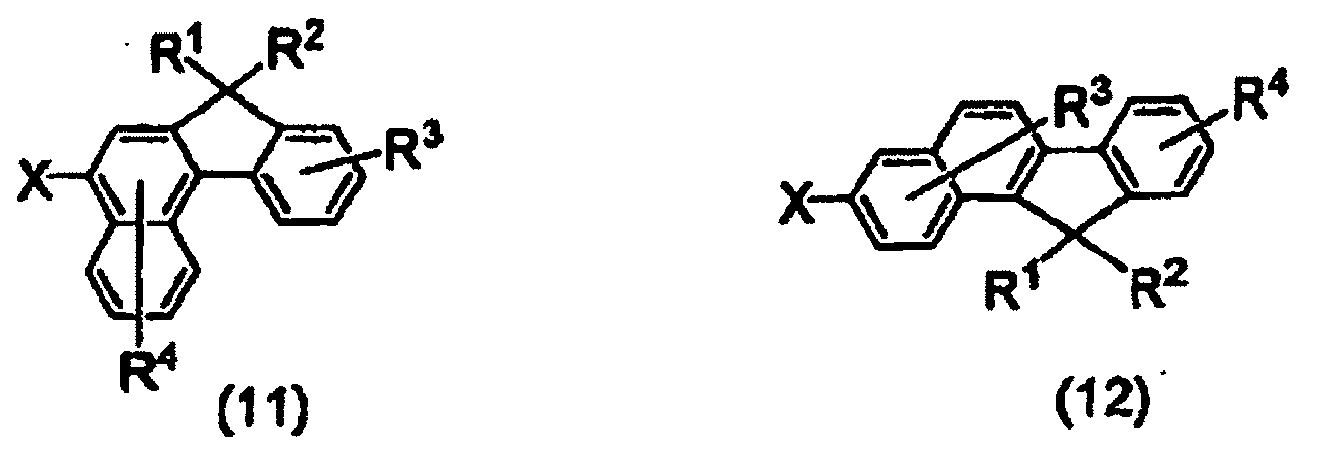

- Elément électroluminescent organique caractérisé par l'utilisation du composé de benzofluorène selon la revendication 1 ou 2 dans l'une d'une couche luminescente, d'une couche de transport de trous, et d'une couche d'injection de trous.
Applications Claiming Priority (3)
| Application Number | Priority Date | Filing Date | Title |
|---|---|---|---|
| JP2006110765 | 2006-04-13 | ||
| JP2006201097 | 2006-07-24 | ||
| PCT/JP2007/058113 WO2007119800A1 (fr) | 2006-04-13 | 2007-04-12 | Composé de benzofluorène et utilisation de celui-ci |
Publications (5)
| Publication Number | Publication Date |
|---|---|
| EP2006278A2 EP2006278A2 (fr) | 2008-12-24 |
| EP2006278A9 EP2006278A9 (fr) | 2009-08-05 |
| EP2006278A4 EP2006278A4 (fr) | 2010-08-04 |
| EP2006278B1 EP2006278B1 (fr) | 2012-12-26 |
| EP2006278B2 true EP2006278B2 (fr) | 2016-10-12 |
Family
ID=38609560
Family Applications (1)
| Application Number | Title | Priority Date | Filing Date |
|---|---|---|---|
| EP07741549.5A Ceased EP2006278B2 (fr) | 2006-04-13 | 2007-04-12 | Composé de benzofluorène et utilisation de celui-ci |
Country Status (6)
| Country | Link |
|---|---|
| US (1) | US8993805B2 (fr) |
| EP (1) | EP2006278B2 (fr) |
| KR (2) | KR101166809B1 (fr) |
| CN (2) | CN102643161B (fr) |
| TW (1) | TW200804237A (fr) |
| WO (1) | WO2007119800A1 (fr) |
Families Citing this family (44)
| Publication number | Priority date | Publication date | Assignee | Title |
|---|---|---|---|---|
| US8465848B2 (en) * | 2006-12-29 | 2013-06-18 | E I Du Pont De Nemours And Company | Benzofluorenes for luminescent applications |
| JP5374833B2 (ja) * | 2007-05-16 | 2013-12-25 | 東ソー株式会社 | 有機エレクトロルミネセンス材料およびそれを用いた有機エレクトロルミネセンス素子 |
| KR100940938B1 (ko) * | 2007-12-04 | 2010-02-08 | 다우어드밴스드디스플레이머티리얼 유한회사 | 신규한 유기 발광 화합물 및 이를 발광재료로서 채용하고있는 유기 전기 발광 소자 |
| JP5217476B2 (ja) * | 2008-02-08 | 2013-06-19 | Jnc株式会社 | ベンゾフルオレン化合物、該化合物を用いた発光層用材料及び有機電界発光素子 |
| KR100964223B1 (ko) * | 2008-02-11 | 2010-06-17 | 삼성모바일디스플레이주식회사 | 유기 발광 소자 및 이를 구비한 평판 표시 장치 |
| JP5428253B2 (ja) * | 2008-09-09 | 2014-02-26 | 東ソー株式会社 | アミン誘導体及びその用途 |
| JP5428263B2 (ja) * | 2008-09-18 | 2014-02-26 | 東ソー株式会社 | アミン誘導体及びその用途 |
| JP5439807B2 (ja) * | 2008-12-24 | 2014-03-12 | 東ソー株式会社 | アミン誘導体及びその用途 |
| JP5446247B2 (ja) * | 2008-12-24 | 2014-03-19 | 東ソー株式会社 | アミン誘導体及びその用途 |
| JP2011012047A (ja) * | 2009-06-05 | 2011-01-20 | Tosoh Corp | アミン誘導体及び有機エレクトロルミネッセンス素子 |
| KR101053466B1 (ko) * | 2011-02-16 | 2011-08-03 | 덕산하이메탈(주) | 화합물 및 이를 이용한 유기전기소자, 그 전자장치, 내열성 측정법 |
| JP5780132B2 (ja) | 2011-05-19 | 2015-09-16 | Jnc株式会社 | ベンゾフルオレン化合物、該化合物を用いた発光層用材料および有機電界発光素子 |
| JP6024259B2 (ja) * | 2011-07-25 | 2016-11-16 | 東ソー株式会社 | 新規なナフタルアルデヒド化合物、その製造法、および該化合物からトリアリールアミン化合物を製造する方法 |
| JP5982966B2 (ja) * | 2011-08-17 | 2016-08-31 | Jnc株式会社 | ベンゾフルオレン化合物、該化合物を用いた発光層用材料および有機電界発光素子 |
| TWI570095B (zh) * | 2011-11-04 | 2017-02-11 | 捷恩智股份有限公司 | 苯并茀化合物、使用了該化合物的發光層用材料以及有機電場發光元件 |
| TWI454444B (zh) * | 2011-11-25 | 2014-10-01 | Innolux Corp | 芴衍生物與其所組成之有機發光二極體顯示器 |
| KR101517093B1 (ko) * | 2012-06-07 | 2015-05-06 | 덕산네오룩스 주식회사 | 벤조플루오렌을 포함하는 유기전기소자용 화합물, 이를 이용한 유기전기소자 및 그 전자 장치 |
| EP2889296A4 (fr) | 2012-08-21 | 2016-06-15 | Cheil Ind Inc | Composé pour dispositif optoélectrique organique, diode électroluminescente organique le contenant et dispositif d'affichage contenant la diode électroluminescente organique |
| WO2014065391A1 (fr) * | 2012-10-26 | 2014-05-01 | Jnc株式会社 | Composé de benzofluorène, matière pour une couche luminescente utilisant celui-ci, et élément électroluminescent organique |
| US9748492B2 (en) | 2012-11-02 | 2017-08-29 | Idemitsu Kosan Co., Ltd. | Organic electroluminescent device |
| JP6278894B2 (ja) * | 2012-11-02 | 2018-02-14 | 出光興産株式会社 | 有機エレクトロルミネッセンス素子 |
| CN104884572B (zh) * | 2013-01-03 | 2017-09-19 | 默克专利有限公司 | 用于电子器件的材料 |
| KR101939552B1 (ko) | 2013-12-06 | 2019-01-17 | 롬엔드하스전자재료코리아유한회사 | 유기 전계 발광 화합물 및 이를 포함하는 유기 전계 발광 소자 |
| WO2016079944A1 (fr) * | 2014-11-18 | 2016-05-26 | 保土谷化学工業株式会社 | Élément électroluminescent organique |
| EP3333170B1 (fr) * | 2016-12-06 | 2020-04-29 | Merck Patent GmbH | Composés polycyliques asymmetriques à être utilisés dans des semi-conducteurs organiques |
| TWI633327B (zh) * | 2017-01-25 | 2018-08-21 | 國立高雄科技大學 | 含芴的化合物、製備含芴的化合物的方法、可固化組成物及固化物 |
| KR102867206B1 (ko) | 2017-02-03 | 2025-10-01 | 삼성디스플레이 주식회사 | 아민계 화합물 및 이를 포함한 유기 발광 소자 |
| KR102657641B1 (ko) * | 2017-06-30 | 2024-04-17 | 듀폰스페셜티머터리얼스코리아 유한회사 | 유기 전계 발광 화합물 및 이를 포함하는 유기 전계 발광 소자 |
| KR102048920B1 (ko) | 2017-08-18 | 2019-11-27 | 삼성디스플레이 주식회사 | 아민계 화합물 및 이를 포함한 유기 발광 소자 |
| KR102790454B1 (ko) * | 2018-01-25 | 2025-04-08 | 듀폰스페셜티머터리얼스코리아 유한회사 | 유기 전계 발광 화합물 및 이를 포함하는 유기 전계 발광 소자 |
| WO2019147030A1 (fr) * | 2018-01-25 | 2019-08-01 | Rohm And Haas Electronic Materials Korea Ltd. | Composé électroluminescent organique et dispositif électroluminescent organique comprenant celui-ci |
| KR20190140549A (ko) | 2018-06-11 | 2019-12-20 | 삼성디스플레이 주식회사 | 아민 화합물 및 이를 포함한 유기 발광 소자 |
| CN108892601B (zh) * | 2018-08-10 | 2021-04-27 | 武汉理工大学 | 一种苯并芴结构的稠环芳烃的制备方法 |
| KR102252884B1 (ko) * | 2018-08-29 | 2021-05-17 | 주식회사 엘지화학 | 신규한 화합물 및 이를 이용한 유기발광 소자 |
| KR20190007506A (ko) | 2019-01-09 | 2019-01-22 | 롬엔드하스전자재료코리아유한회사 | 유기 전계 발광 화합물 및 이를 포함하는 유기 전계 발광 소자 |
| CN111662187A (zh) * | 2019-03-08 | 2020-09-15 | 江苏三月光电科技有限公司 | 一种含胺基的有机化合物及其应用 |
| KR102321559B1 (ko) | 2019-10-21 | 2021-11-05 | 롬엔드하스전자재료코리아유한회사 | 유기 전계 발광 화합물 및 이를 포함하는 유기 전계 발광 소자 |
| KR102192497B1 (ko) | 2019-10-21 | 2020-12-17 | 롬엔드하스전자재료코리아유한회사 | 유기 전계 발광 화합물 및 이를 포함하는 유기 전계 발광 소자 |
| KR20210150996A (ko) * | 2020-06-04 | 2021-12-13 | 주식회사 동진쎄미켐 | 신규한 캡핑층용 화합물 및 이를 포함하는 유기 발광 소자 |
| CN114075115A (zh) * | 2020-08-20 | 2022-02-22 | 江苏三月科技股份有限公司 | 一种胺类化合物和包含该化合物的有机电致发光器件 |
| CN114075114A (zh) * | 2020-08-20 | 2022-02-22 | 江苏三月科技股份有限公司 | 一种均苯芳胺类化合物及包含其的有机电致发光器件 |
| KR20220054488A (ko) | 2020-10-23 | 2022-05-03 | 삼성디스플레이 주식회사 | 유기 전계 발광 소자 및 유기 전계 발광 소자용 아민 화합물 |
| CN114591139A (zh) * | 2022-03-31 | 2022-06-07 | 陕西维世诺新材料有限公司 | 一种苯并[a]芴衍生物的制备方法及苯并[a]芴衍生物 |
| KR20240111689A (ko) | 2023-01-10 | 2024-07-17 | 듀폰스페셜티머터리얼스코리아 유한회사 | 유기 전계 발광 화합물 및 이를 포함하는 유기 전계 발광 소자 |
Citations (3)
| Publication number | Priority date | Publication date | Assignee | Title |
|---|---|---|---|---|
| US5587392A (en) † | 1994-05-27 | 1996-12-24 | Mochida Pharmaceutical Co., Ltd. | Azolyl methyl phenyl derivatives having aromatase inhibitory activity |
| JPH10161327A (ja) † | 1996-12-04 | 1998-06-19 | Mitsubishi Chem Corp | 電子写真用感光体 |
| WO2004020387A1 (fr) † | 2002-08-30 | 2004-03-11 | Canon Kabushiki Kaisha | Compose de monoaminofluorene et dispositif electroluminescent organique utilisant un tel compose |
Family Cites Families (24)
| Publication number | Priority date | Publication date | Assignee | Title |
|---|---|---|---|---|
| LU35193A1 (fr) * | 1956-06-04 | |||
| NL242505A (fr) | 1958-08-20 | |||
| GB1505409A (en) | 1974-12-20 | 1978-03-30 | Eastman Kodak Co | Photoconductive compositions |
| US4150987A (en) | 1977-10-17 | 1979-04-24 | International Business Machines Corporation | Hydrazone containing charge transport element and photoconductive process of using same |
| JPS55108667A (en) | 1979-02-13 | 1980-08-21 | Ricoh Co Ltd | Electrophotographic receptor |
| US4233384A (en) | 1979-04-30 | 1980-11-11 | Xerox Corporation | Imaging system using novel charge transport layer |
| US4273846A (en) | 1979-11-23 | 1981-06-16 | Xerox Corporation | Imaging member having a charge transport layer of a terphenyl diamine and a polycarbonate resin |
| JPS58190953A (ja) | 1982-04-30 | 1983-11-08 | Ricoh Co Ltd | 電子写真用感光体 |
| JPS59195658A (ja) | 1983-04-21 | 1984-11-06 | Ricoh Co Ltd | 電子写真用感光体 |
| US5147880A (en) * | 1991-07-22 | 1992-09-15 | Eli Lilly And Company | Benzo[a]fluorene compounds |
| JP3824385B2 (ja) | 1996-08-02 | 2006-09-20 | 三井化学株式会社 | 有機電界発光素子 |
| CA2214935A1 (fr) * | 1996-09-26 | 1998-03-26 | Henry Uhlman Bryant | Benzofluorenes, intermediaires, compositions et methodes |
| JP3508984B2 (ja) | 1997-05-19 | 2004-03-22 | キヤノン株式会社 | 有機化合物及び該有機化合物を用いた発光素子 |
| DE10109463B4 (de) | 2001-02-27 | 2009-04-16 | Sensient Imaging Technologies Gmbh | Neue Triarylamin-Tetramere und ihr Einsatz in elektrofotografischen und organischen elektroluminiszenten Vorrichtungen |
| US6686065B2 (en) * | 2001-12-12 | 2004-02-03 | Canon Kabushiki Kaisha | [5]-helicene and dibenzofluorene materials for use in organic light emitting devices |
| JP3979217B2 (ja) | 2002-07-31 | 2007-09-19 | 松下電器産業株式会社 | 温風暖房機 |
| US20040131881A1 (en) * | 2002-12-31 | 2004-07-08 | Eastman Kodak Company | Complex fluorene-containing compounds for use in OLED devices |
| US6849348B2 (en) * | 2002-12-31 | 2005-02-01 | Eastman Kodak Company | Complex fluorene-containing compounds |
| TW200530373A (en) * | 2003-12-12 | 2005-09-16 | Sumitomo Chemical Co | Polymer and light-emitting element using said polymer |
| KR20060129065A (ko) | 2004-02-26 | 2006-12-14 | 스미또모 가가꾸 가부시키가이샤 | 고분자 화합물 및 이를 사용한 고분자 발광 소자 |
| WO2006025273A1 (fr) * | 2004-08-31 | 2006-03-09 | Idemitsu Kosan Co., Ltd. | Dérivé d'amine aromatique et dispositif organique électroluminescent l'utilisant |
| JP4589074B2 (ja) | 2004-10-12 | 2010-12-01 | 東洋機械金属株式会社 | 射出成形機の遠隔監視システム |
| JP4570971B2 (ja) | 2005-01-24 | 2010-10-27 | 日本電信電話株式会社 | 酒気帯びチェッカーおよび酒気帯び検知方法 |
| JP5233228B2 (ja) * | 2006-10-05 | 2013-07-10 | Jnc株式会社 | ベンゾフルオレン化合物、該化合物を用いた発光層用材料及び有機電界発光素子 |
-
2007
- 2007-04-12 US US12/296,622 patent/US8993805B2/en active Active
- 2007-04-12 CN CN201210113455.5A patent/CN102643161B/zh not_active Expired - Fee Related
- 2007-04-12 KR KR1020117013541A patent/KR101166809B1/ko not_active Expired - Fee Related
- 2007-04-12 EP EP07741549.5A patent/EP2006278B2/fr not_active Ceased
- 2007-04-12 KR KR1020087024196A patent/KR101142293B1/ko not_active Expired - Fee Related
- 2007-04-12 WO PCT/JP2007/058113 patent/WO2007119800A1/fr not_active Ceased
- 2007-04-12 CN CN2007800133317A patent/CN101421226B/zh not_active Expired - Fee Related
- 2007-04-13 TW TW096113001A patent/TW200804237A/zh not_active IP Right Cessation
Patent Citations (3)
| Publication number | Priority date | Publication date | Assignee | Title |
|---|---|---|---|---|
| US5587392A (en) † | 1994-05-27 | 1996-12-24 | Mochida Pharmaceutical Co., Ltd. | Azolyl methyl phenyl derivatives having aromatase inhibitory activity |
| JPH10161327A (ja) † | 1996-12-04 | 1998-06-19 | Mitsubishi Chem Corp | 電子写真用感光体 |
| WO2004020387A1 (fr) † | 2002-08-30 | 2004-03-11 | Canon Kabushiki Kaisha | Compose de monoaminofluorene et dispositif electroluminescent organique utilisant un tel compose |
Non-Patent Citations (2)
| Title |
|---|
| HARTWIG J.F.: "Transition metal catalyzed synthesis of arylamines and aryl ethers from aryl halides and triflates: scope and mechanism", ANGEW. CHEM. INT., vol. 37, 1998, pages 2046 - 2067 † |
| LITTKE A.F. ET AL: "Palladium-catalyzed coupling reactions of aryl chlorides", ANGEW. CHEM. INT., vol. 41, 2000, pages 4176 - 4211 † |
Also Published As
| Publication number | Publication date |
|---|---|
| TWI352692B (fr) | 2011-11-21 |
| KR101142293B1 (ko) | 2012-05-08 |
| KR101166809B1 (ko) | 2012-07-26 |
| US8993805B2 (en) | 2015-03-31 |
| EP2006278A4 (fr) | 2010-08-04 |
| KR20110077032A (ko) | 2011-07-06 |
| US20090184312A1 (en) | 2009-07-23 |
| CN101421226A (zh) | 2009-04-29 |
| EP2006278A9 (fr) | 2009-08-05 |
| WO2007119800A1 (fr) | 2007-10-25 |
| TW200804237A (en) | 2008-01-16 |
| CN102643161A (zh) | 2012-08-22 |
| EP2006278A2 (fr) | 2008-12-24 |
| EP2006278B1 (fr) | 2012-12-26 |
| CN101421226B (zh) | 2013-05-22 |
| CN102643161B (zh) | 2015-10-14 |
| KR20080108115A (ko) | 2008-12-11 |
Similar Documents
| Publication | Publication Date | Title |
|---|---|---|
| EP2006278B2 (fr) | Composé de benzofluorène et utilisation de celui-ci | |
| EP1885818B1 (fr) | Dispositif electroluminescent | |
| JP5439711B2 (ja) | ベンゾフルオレン化合物及びその用途 | |
| EP2174932B1 (fr) | Dérivé hétérocyclique contenant de l'azote et élément électroluminescent organique utilisant ce dérivé | |
| KR102006506B1 (ko) | 유기 일렉트로 루미네선스 소자 및 그것에 사용하는 화합물 | |
| EP2415752B1 (fr) | Dérivé d'amine aromatique et élément électroluminescent organique l'utilisant | |
| JP5066945B2 (ja) | 新規なベンゾ[c]フルオレン誘導体及びその用途 | |
| EP2700696A1 (fr) | Dérivé du pyrène, milieu organique émetteur de lumière, et élément électroluminescent organique contenant un dérivé du pyrène ou un milieu organique émetteur de lumière | |
| EP2527334A1 (fr) | Dérivé d'amine aromatique, et élément électroluminescent organique comprenant celui-ci | |
| JP2000309566A (ja) | 有機エレクトロルミネッセンス素子およびフェニレンジアミン誘導体 | |
| EP1748045A1 (fr) | Matériau pour dispositif luminescent et dispositif luminescent | |
| EP2492260A1 (fr) | Composé carbazole et son utilisation | |
| JP5145717B2 (ja) | ベンゾフルオレン化合物及びその用途 | |
| KR20100025544A (ko) | 청색 발광 용도를 위한 크라이센 | |
| US20210167304A1 (en) | New emitter materials and matrix materials for optoelectronic and electronic components, in particular organic light-emitting diodes (oleds) | |
| US7482490B2 (en) | Amine compound having fluorene group as framework, process for producing the amine compound, and use of the amine compound | |
| JP5205858B2 (ja) | 新規なベンゾ[c]フルオレン誘導体及びその用途 | |
| KR101503986B1 (ko) | 유기 발광 소자 | |
| JP7780868B2 (ja) | インデノアクリジン化合物及びその用途 | |
| JP5205859B2 (ja) | 新規なベンゾ[c]フルオレン誘導体及びその用途 | |
| JP4810830B2 (ja) | フルオレン基を母核とするアミン化合物並びにその製造方法及び用途 | |
| US9073812B2 (en) | Organic compound |
Legal Events
| Date | Code | Title | Description |
|---|---|---|---|
| PUAI | Public reference made under article 153(3) epc to a published international application that has entered the european phase |
Free format text: ORIGINAL CODE: 0009012 |
|
| PUAB | Information related to the publication of an a document modified or deleted |
Free format text: ORIGINAL CODE: 0009199EPPU |
|
| 17P | Request for examination filed |
Effective date: 20080905 |
|
| AK | Designated contracting states |
Kind code of ref document: A2 Designated state(s): DE FR GB NL |
|
| RBV | Designated contracting states (corrected) |
Designated state(s): DE FR GB NL |
|
| A4 | Supplementary search report drawn up and despatched |
Effective date: 20100705 |
|
| 17Q | First examination report despatched |
Effective date: 20110321 |
|
| GRAP | Despatch of communication of intention to grant a patent |
Free format text: ORIGINAL CODE: EPIDOSNIGR1 |
|
| DAX | Request for extension of the european patent (deleted) | ||
| GRAS | Grant fee paid |
Free format text: ORIGINAL CODE: EPIDOSNIGR3 |
|
| GRAP | Despatch of communication of intention to grant a patent |
Free format text: ORIGINAL CODE: EPIDOSNIGR1 |
|
| GRAA | (expected) grant |
Free format text: ORIGINAL CODE: 0009210 |
|
| AK | Designated contracting states |
Kind code of ref document: B1 Designated state(s): DE FR GB NL |
|
| REG | Reference to a national code |
Ref country code: GB Ref legal event code: FG4D |
|
| REG | Reference to a national code |
Ref country code: DE Ref legal event code: R096 Ref document number: 602007027631 Country of ref document: DE Effective date: 20130228 |
|
| REG | Reference to a national code |
Ref country code: NL Ref legal event code: T3 |
|
| PLBI | Opposition filed |
Free format text: ORIGINAL CODE: 0009260 |
|
| 26 | Opposition filed |
Opponent name: MERCK PATENT GMBH Effective date: 20130925 |
|
| PLAX | Notice of opposition and request to file observation + time limit sent |
Free format text: ORIGINAL CODE: EPIDOSNOBS2 |
|
| REG | Reference to a national code |
Ref country code: DE Ref legal event code: R026 Ref document number: 602007027631 Country of ref document: DE Effective date: 20130925 |
|
| PLAF | Information modified related to communication of a notice of opposition and request to file observations + time limit |
Free format text: ORIGINAL CODE: EPIDOSCOBS2 |
|
| PLBB | Reply of patent proprietor to notice(s) of opposition received |
Free format text: ORIGINAL CODE: EPIDOSNOBS3 |
|
| REG | Reference to a national code |
Ref country code: FR Ref legal event code: PLFP Year of fee payment: 10 |
|
| APAH | Appeal reference modified |
Free format text: ORIGINAL CODE: EPIDOSCREFNO |
|
| APBM | Appeal reference recorded |
Free format text: ORIGINAL CODE: EPIDOSNREFNO |
|
| APBP | Date of receipt of notice of appeal recorded |
Free format text: ORIGINAL CODE: EPIDOSNNOA2O |
|
| APBU | Appeal procedure closed |
Free format text: ORIGINAL CODE: EPIDOSNNOA9O |
|
| PUAH | Patent maintained in amended form |
Free format text: ORIGINAL CODE: 0009272 |
|
| STAA | Information on the status of an ep patent application or granted ep patent |
Free format text: STATUS: PATENT MAINTAINED AS AMENDED |
|
| 27A | Patent maintained in amended form |
Effective date: 20161012 |
|
| AK | Designated contracting states |
Kind code of ref document: B2 Designated state(s): DE FR GB NL |
|
| REG | Reference to a national code |
Ref country code: DE Ref legal event code: R102 Ref document number: 602007027631 Country of ref document: DE |
|
| REG | Reference to a national code |
Ref country code: NL Ref legal event code: FP |
|
| REG | Reference to a national code |
Ref country code: FR Ref legal event code: PLFP Year of fee payment: 11 |
|
| REG | Reference to a national code |
Ref country code: FR Ref legal event code: PLFP Year of fee payment: 12 |
|
| PGFP | Annual fee paid to national office [announced via postgrant information from national office to epo] |
Ref country code: NL Payment date: 20210312 Year of fee payment: 15 Ref country code: FR Payment date: 20210309 Year of fee payment: 15 |
|
| PGFP | Annual fee paid to national office [announced via postgrant information from national office to epo] |
Ref country code: GB Payment date: 20210318 Year of fee payment: 15 |
|
| REG | Reference to a national code |
Ref country code: NL Ref legal event code: MM Effective date: 20220501 |
|
| GBPC | Gb: european patent ceased through non-payment of renewal fee |
Effective date: 20220412 |
|
| PG25 | Lapsed in a contracting state [announced via postgrant information from national office to epo] |
Ref country code: NL Free format text: LAPSE BECAUSE OF NON-PAYMENT OF DUE FEES Effective date: 20220501 Ref country code: GB Free format text: LAPSE BECAUSE OF NON-PAYMENT OF DUE FEES Effective date: 20220412 Ref country code: FR Free format text: LAPSE BECAUSE OF NON-PAYMENT OF DUE FEES Effective date: 20220430 |
|
| P01 | Opt-out of the competence of the unified patent court (upc) registered |
Effective date: 20230523 |
|
| PGFP | Annual fee paid to national office [announced via postgrant information from national office to epo] |
Ref country code: DE Payment date: 20240227 Year of fee payment: 18 |
|
| REG | Reference to a national code |
Ref country code: DE Ref legal event code: R119 Ref document number: 602007027631 Country of ref document: DE |
|
| PG25 | Lapsed in a contracting state [announced via postgrant information from national office to epo] |
Ref country code: DE Free format text: LAPSE BECAUSE OF NON-PAYMENT OF DUE FEES Effective date: 20251104 |