EP2174932B1 - Dérivé hétérocyclique contenant de l'azote et élément électroluminescent organique utilisant ce dérivé - Google Patents
Dérivé hétérocyclique contenant de l'azote et élément électroluminescent organique utilisant ce dérivé Download PDFInfo
- Publication number
- EP2174932B1 EP2174932B1 EP10152087.2A EP10152087A EP2174932B1 EP 2174932 B1 EP2174932 B1 EP 2174932B1 EP 10152087 A EP10152087 A EP 10152087A EP 2174932 B1 EP2174932 B1 EP 2174932B1
- Authority
- EP
- European Patent Office
- Prior art keywords
- group
- organic
- carbon atoms
- compound
- substituent
- Prior art date
- Legal status (The legal status is an assumption and is not a legal conclusion. Google has not performed a legal analysis and makes no representation as to the accuracy of the status listed.)
- Expired - Lifetime
Links
- MGKPDVRJFZOSFV-UHFFFAOYSA-N Cc1nc(cccc2)c2[n]1-c1ccccc1 Chemical compound Cc1nc(cccc2)c2[n]1-c1ccccc1 MGKPDVRJFZOSFV-UHFFFAOYSA-N 0.000 description 1
- BDRFIFZITJTSER-UHFFFAOYSA-N Cc1nc2cccc(C)c2[n]1-c1ccccc1 Chemical compound Cc1nc2cccc(C)c2[n]1-c1ccccc1 BDRFIFZITJTSER-UHFFFAOYSA-N 0.000 description 1
Classifications
-
- H—ELECTRICITY
- H10—SEMICONDUCTOR DEVICES; ELECTRIC SOLID-STATE DEVICES NOT OTHERWISE PROVIDED FOR
- H10K—ORGANIC ELECTRIC SOLID-STATE DEVICES
- H10K85/00—Organic materials used in the body or electrodes of devices covered by this subclass
- H10K85/60—Organic compounds having low molecular weight
- H10K85/615—Polycyclic condensed aromatic hydrocarbons, e.g. anthracene
-
- C—CHEMISTRY; METALLURGY
- C09—DYES; PAINTS; POLISHES; NATURAL RESINS; ADHESIVES; COMPOSITIONS NOT OTHERWISE PROVIDED FOR; APPLICATIONS OF MATERIALS NOT OTHERWISE PROVIDED FOR
- C09K—MATERIALS FOR MISCELLANEOUS APPLICATIONS, NOT PROVIDED FOR ELSEWHERE
- C09K11/00—Luminescent materials, e.g. electroluminescent or chemiluminescent
- C09K11/06—Luminescent materials, e.g. electroluminescent or chemiluminescent containing organic luminescent materials
-
- C—CHEMISTRY; METALLURGY
- C07—ORGANIC CHEMISTRY
- C07D—HETEROCYCLIC COMPOUNDS
- C07D235/00—Heterocyclic compounds containing 1,3-diazole or hydrogenated 1,3-diazole rings, condensed with other rings
- C07D235/02—Heterocyclic compounds containing 1,3-diazole or hydrogenated 1,3-diazole rings, condensed with other rings condensed with carbocyclic rings or ring systems
- C07D235/04—Benzimidazoles; Hydrogenated benzimidazoles
- C07D235/06—Benzimidazoles; Hydrogenated benzimidazoles with only hydrogen atoms, hydrocarbon or substituted hydrocarbon radicals, directly attached in position 2
- C07D235/08—Radicals containing only hydrogen and carbon atoms
-
- C—CHEMISTRY; METALLURGY
- C07—ORGANIC CHEMISTRY
- C07D—HETEROCYCLIC COMPOUNDS
- C07D235/00—Heterocyclic compounds containing 1,3-diazole or hydrogenated 1,3-diazole rings, condensed with other rings
- C07D235/02—Heterocyclic compounds containing 1,3-diazole or hydrogenated 1,3-diazole rings, condensed with other rings condensed with carbocyclic rings or ring systems
- C07D235/04—Benzimidazoles; Hydrogenated benzimidazoles
- C07D235/18—Benzimidazoles; Hydrogenated benzimidazoles with aryl radicals directly attached in position 2
-
- C—CHEMISTRY; METALLURGY
- C07—ORGANIC CHEMISTRY
- C07D—HETEROCYCLIC COMPOUNDS
- C07D235/00—Heterocyclic compounds containing 1,3-diazole or hydrogenated 1,3-diazole rings, condensed with other rings
- C07D235/02—Heterocyclic compounds containing 1,3-diazole or hydrogenated 1,3-diazole rings, condensed with other rings condensed with carbocyclic rings or ring systems
- C07D235/04—Benzimidazoles; Hydrogenated benzimidazoles
- C07D235/20—Two benzimidazolyl-2 radicals linked together directly or via a hydrocarbon or substituted hydrocarbon radical
-
- C—CHEMISTRY; METALLURGY
- C07—ORGANIC CHEMISTRY
- C07D—HETEROCYCLIC COMPOUNDS
- C07D401/00—Heterocyclic compounds containing two or more hetero rings, having nitrogen atoms as the only ring hetero atoms, at least one ring being a six-membered ring with only one nitrogen atom
- C07D401/02—Heterocyclic compounds containing two or more hetero rings, having nitrogen atoms as the only ring hetero atoms, at least one ring being a six-membered ring with only one nitrogen atom containing two hetero rings
- C07D401/04—Heterocyclic compounds containing two or more hetero rings, having nitrogen atoms as the only ring hetero atoms, at least one ring being a six-membered ring with only one nitrogen atom containing two hetero rings directly linked by a ring-member-to-ring-member bond
-
- C—CHEMISTRY; METALLURGY
- C07—ORGANIC CHEMISTRY
- C07D—HETEROCYCLIC COMPOUNDS
- C07D401/00—Heterocyclic compounds containing two or more hetero rings, having nitrogen atoms as the only ring hetero atoms, at least one ring being a six-membered ring with only one nitrogen atom
- C07D401/02—Heterocyclic compounds containing two or more hetero rings, having nitrogen atoms as the only ring hetero atoms, at least one ring being a six-membered ring with only one nitrogen atom containing two hetero rings
- C07D401/10—Heterocyclic compounds containing two or more hetero rings, having nitrogen atoms as the only ring hetero atoms, at least one ring being a six-membered ring with only one nitrogen atom containing two hetero rings linked by a carbon chain containing aromatic rings
-
- H—ELECTRICITY
- H10—SEMICONDUCTOR DEVICES; ELECTRIC SOLID-STATE DEVICES NOT OTHERWISE PROVIDED FOR
- H10K—ORGANIC ELECTRIC SOLID-STATE DEVICES
- H10K50/00—Organic light-emitting devices
-
- H—ELECTRICITY
- H10—SEMICONDUCTOR DEVICES; ELECTRIC SOLID-STATE DEVICES NOT OTHERWISE PROVIDED FOR
- H10K—ORGANIC ELECTRIC SOLID-STATE DEVICES
- H10K85/00—Organic materials used in the body or electrodes of devices covered by this subclass
- H10K85/60—Organic compounds having low molecular weight
- H10K85/649—Aromatic compounds comprising a hetero atom
- H10K85/657—Polycyclic condensed heteroaromatic hydrocarbons
- H10K85/6572—Polycyclic condensed heteroaromatic hydrocarbons comprising only nitrogen in the heteroaromatic polycondensed ring system, e.g. phenanthroline or carbazole
-
- C—CHEMISTRY; METALLURGY
- C09—DYES; PAINTS; POLISHES; NATURAL RESINS; ADHESIVES; COMPOSITIONS NOT OTHERWISE PROVIDED FOR; APPLICATIONS OF MATERIALS NOT OTHERWISE PROVIDED FOR
- C09K—MATERIALS FOR MISCELLANEOUS APPLICATIONS, NOT PROVIDED FOR ELSEWHERE
- C09K2211/00—Chemical nature of organic luminescent or tenebrescent compounds
- C09K2211/10—Non-macromolecular compounds
- C09K2211/1018—Heterocyclic compounds
- C09K2211/1025—Heterocyclic compounds characterised by ligands
- C09K2211/1044—Heterocyclic compounds characterised by ligands containing two nitrogen atoms as heteroatoms
-
- H—ELECTRICITY
- H10—SEMICONDUCTOR DEVICES; ELECTRIC SOLID-STATE DEVICES NOT OTHERWISE PROVIDED FOR
- H10K—ORGANIC ELECTRIC SOLID-STATE DEVICES
- H10K2102/00—Constructional details relating to the organic devices covered by this subclass
- H10K2102/10—Transparent electrodes, e.g. using graphene
- H10K2102/101—Transparent electrodes, e.g. using graphene comprising transparent conductive oxides [TCO]
- H10K2102/103—Transparent electrodes, e.g. using graphene comprising transparent conductive oxides [TCO] comprising indium oxides, e.g. ITO
-
- H—ELECTRICITY
- H10—SEMICONDUCTOR DEVICES; ELECTRIC SOLID-STATE DEVICES NOT OTHERWISE PROVIDED FOR
- H10K—ORGANIC ELECTRIC SOLID-STATE DEVICES
- H10K85/00—Organic materials used in the body or electrodes of devices covered by this subclass
- H10K85/60—Organic compounds having low molecular weight
- H10K85/615—Polycyclic condensed aromatic hydrocarbons, e.g. anthracene
- H10K85/622—Polycyclic condensed aromatic hydrocarbons, e.g. anthracene containing four rings, e.g. pyrene
-
- H—ELECTRICITY
- H10—SEMICONDUCTOR DEVICES; ELECTRIC SOLID-STATE DEVICES NOT OTHERWISE PROVIDED FOR
- H10K—ORGANIC ELECTRIC SOLID-STATE DEVICES
- H10K85/00—Organic materials used in the body or electrodes of devices covered by this subclass
- H10K85/60—Organic compounds having low molecular weight
- H10K85/631—Amine compounds having at least two aryl rest on at least one amine-nitrogen atom, e.g. triphenylamine
- H10K85/633—Amine compounds having at least two aryl rest on at least one amine-nitrogen atom, e.g. triphenylamine comprising polycyclic condensed aromatic hydrocarbons as substituents on the nitrogen atom
-
- H—ELECTRICITY
- H10—SEMICONDUCTOR DEVICES; ELECTRIC SOLID-STATE DEVICES NOT OTHERWISE PROVIDED FOR
- H10K—ORGANIC ELECTRIC SOLID-STATE DEVICES
- H10K85/00—Organic materials used in the body or electrodes of devices covered by this subclass
- H10K85/60—Organic compounds having low molecular weight
- H10K85/649—Aromatic compounds comprising a hetero atom
- H10K85/654—Aromatic compounds comprising a hetero atom comprising only nitrogen as heteroatom
-
- Y—GENERAL TAGGING OF NEW TECHNOLOGICAL DEVELOPMENTS; GENERAL TAGGING OF CROSS-SECTIONAL TECHNOLOGIES SPANNING OVER SEVERAL SECTIONS OF THE IPC; TECHNICAL SUBJECTS COVERED BY FORMER USPC CROSS-REFERENCE ART COLLECTIONS [XRACs] AND DIGESTS
- Y10—TECHNICAL SUBJECTS COVERED BY FORMER USPC
- Y10S—TECHNICAL SUBJECTS COVERED BY FORMER USPC CROSS-REFERENCE ART COLLECTIONS [XRACs] AND DIGESTS
- Y10S428/00—Stock material or miscellaneous articles
- Y10S428/917—Electroluminescent
Definitions
- the present invention relates to a novel nitrogen-containing heterocycle derivative, i.e., a novel derivative of heterocyclic compound having nitrogen atom as defined in the claims and to an organic electroluminescent element as defined in the claims (an electroluminescent element will be referred to as an electroluminescence device, hereinafter) which utilizes the novel compound.
- the present invention relates to a derivative of heterocyclic compound having nitrogen atom useful as constituting component of an organic electroluminescence ("electroluminescence" will be occasionally referred to as "EL", hereinafter) device, i.e., an organic EL device achieving elevation of luminance and of efficiency in light emission even under low driving voltage in accordance with an employment of the derivative of heterocyclic compound having nitrogen atom for at least one layer composing organic compound layers of the EL device.
- an organic electroluminescence will be occasionally referred to as "EL”, hereinafter
- Organic EL devices which utilize organic substances are expected to be useful for application as an inexpensive full color display device of the solid light emission type having a great size and various developments on the organic EL devices are being conducted.
- an organic EL device has a construction comprising a light emitting layer and a pair of electrodes sandwiching the light emitting layer.
- the light emission of the organic EL device is a phenomenon in which, when an electric field is applied between the two electrodes, electrons are injected from the cathode side and holes are injected from the anode side, the electrons are recombined with the holes in the light emitting layer to form an excited state, and energy generated when the excited state returns to the ground state is emitted as light.
- United States Patent No. 5,645,948 discloses an organic EL device with the use of a compound having benzimidazole structure as an light emitting material describing that the organic EL device emits light with a luminance of 200 nit at a voltage of 9 V.
- Japanese Unexamined Patent Application Laid-Open No. 2002-38141 discloses a compound having benzimidazole ring and anthracene skeleton.
- an organic EL device with further enhanced luminance and with further improved efficiency of light emission than the organic EL device with the use of the above compounds is required.
- WO 03/060956 is prior art under Art. 54(3) EPC.
- the document discloses a new material for transporting electrons and an organic electroluminescent display using them.
- the novel materials include compounds in which 1 to 2 imidazole functional groups are introduced in the 2 or 2,6 site of 9,10 substituted anthracene.
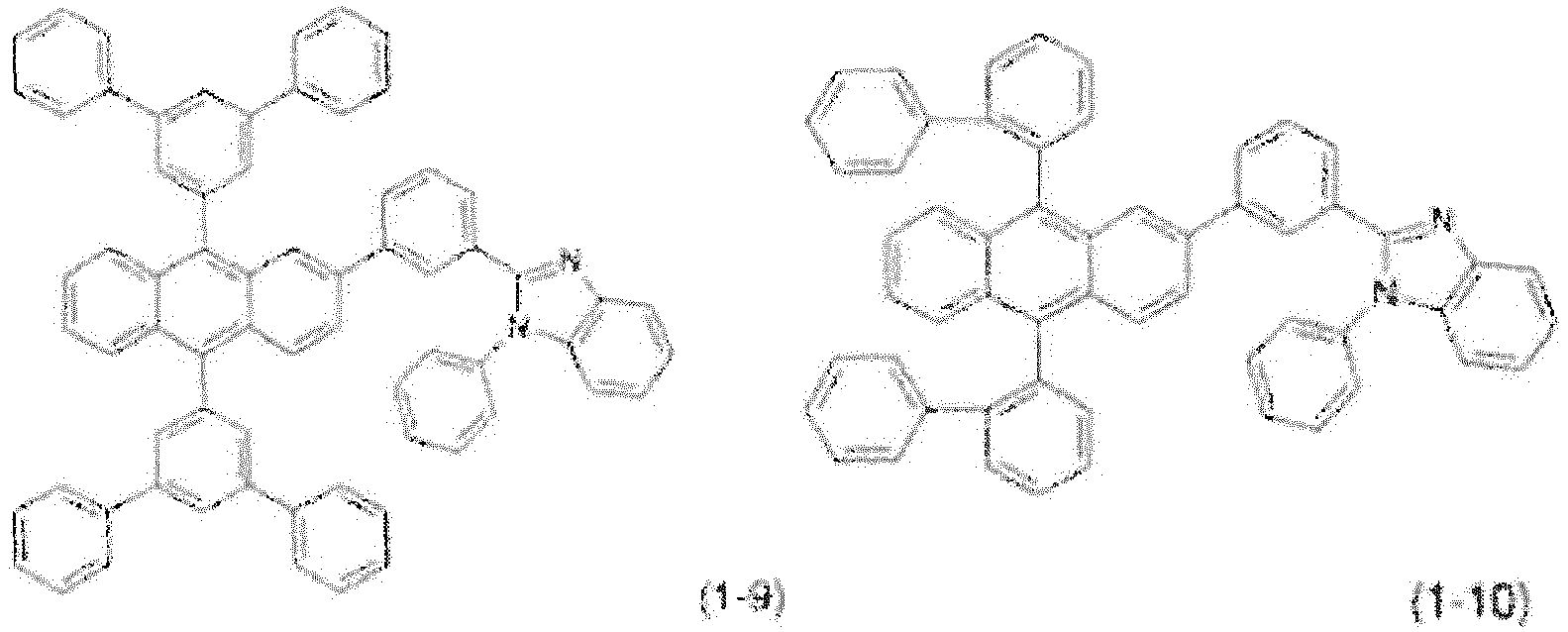
- Compounds (1-1) to (1-10) disclosed in the document are excluded from present claim 1 by a disclaimer.
- WO 02/088274 discloses double-spiro organic compounds and electroluminescent devices including them.
- the double-spiro organic compounds have a structure including at least three planar moieties, which are substantially linearly configured such that one planar moiety is interveningly located between two neighbouring planar moieties and that the intervening planar moiety shares an atom with each of the two neighbouring planar moieties.
- the intervening planar moiety is substantially perpendicular to the two neighbouring planar moieties.
- the object of the present invention is to provide a novel derivative of heterocyclic compound having nitrogen atom useful as a constitutional component of an organic EL device.
- Another object of the present invention is to provide an organic EL device achieving elevation of luminance and of efficiency in light emission in accordance with an employment of the derivative of heterocyclic compound having nitrogen atom for at least one layer composing organic compound layers of the EL device.
- a derivative of heterocyclic compound having nitrogen atom was found to be a novel compound with specific structure useful as a material for an organic El device.
- the present invention provides a derivative of heterocyclic compound having nitrogen atom represented by general formulae (I):
- the present invention provides a material for the organic EL device comprising the above derivative of heterocyclic compound having nitrogen atom.
- the present invention provides an organic EL device comprising at least one of organic compound layers including a light emitting layer sandwiched between a pair of electrode, wherein the organic EL device comprises the foregoing derivative of heterocyclic compound having nitrogen atom of the invention in at least one of the organic compound layers.
- R represents an aryl group having 6 to 60 carbon atoms which aryl group may have a substituent, an alkyl group having 1 to 20 carbon atoms which alkyl group may have a substituent, wherein the substituent of the groups for R is independently a halogen atom, an alkyl group having 1 to 20 carbon atoms or an aryl group having 6 to 40 carbon atoms.
- the aryl group having 6 to 60 carbon atoms is preferably an aryl group having 6 to 40 carbon atoms, more preferably an aryl group having 6 to 20 carbon atoms.
- Specific examples of the aryl group having 6 to 20 carbon atoms include phenyl group, naphthyl group, anthryl group, phenanthryl group, naphthacenyl group, chrysenyl group, pyrenyl group, biphenyl group, terphenyl group, tolyl group, t-butylphenyl group, (2-phenylpropyl) phenyl group, fluoranthenyl group, fluorenyl group, monovalent group consisting of spirobifluorene, perfluorophenyl group, perfluoronaphthyl group, perfluoro anthryl group, perfluorinated biphenyl group, monovalent group consisting of 9-phenylanthracene, monovalent group consisting of 9
- the alkyl group having 1 to 20 carbon atoms is preferably an alkyl group having 1 to 6 carbon atoms. Specific examples of the alkyl group having 1 to 6 carbon atoms include methyl group, ethyl group, propyl group, butyl group, pentyl group, hexyl group, etc.
- the alkyl group having 3 or more carbon atoms may be linear, cyclic or branched.
- the optional substituent of R is independently a halogen atom, an alkyl group having 1 to 20 carbon atoms, an aryl group having 6 to 40 carbon atoms.
- halogen atom examples include fluorine atom, chlorine atom, bromine atom and iodine atom.
- n represents an integer of 0 to 4 and is preferably 0 to 2.
- R 1 represents an aryl group having 6 to 60 carbon atoms which aryl group may have a substituent, an alkyl group selected from the group consisting of a methyl group, an ethyl group, a butyl group, a pentyl group and a hexyl group which alkyl groups may have a substituent, wherein the substituent of the groups for R 1 is independently a halogen atom, an alkoxy group having 1 to 20 carbon atoms, or an aryl group having 6 to 40 carbon atoms.
- L represents a group selected from the following groups:
- Ar 1 represents a condensed ring group represented by the following general formula (3): which may have a substituent and said substituent is independently a halogen atom, an alkyl group having 1 to 20 carbon atoms, or an aryl group having 6 to 40 carbon atoms. Specific examples of these groups are the same as the above description.
- general formula (3) represented by Ar 1 is a condensed ring group represented by the following general formulae (11) to (25).
- each condensed ring groups may be bonded with a bonding group of a halogen atom, an alkyl group having 1 to 20 carbon atoms, an aryl group having 6 to 40 carbon atoms. Specific examples of these groups are the same as the above description.
- Ar 2 represents a group selected from the following groups: which may have a substituent, and said substituent is independently a halogen atom, an alkyl group having 1 to 20 carbon atoms, or an aryl group having 6 to 20 carbon atoms.
- HAr represents compounds: HAr L Ar 1 Ar 2 1-1 2 3 4 5 6 7 8 9 10 11 2-1 2 3 4 5 6 7 8 9 4- 2 3 5-1 2 3 4 5 6 7-1 2 3 4 5 6 7 8
- novel derivative of heterocyclic compound having nitrogen atom represented by general formula (I) of the present invention is preferably employed as a material for the organic EL devices.
- Employing the compound of the present invention as at least one layer among the organic compound layers of the organic EL devices enables to achieve elevation of luminance and current efficiency.
- the compound of the present invention is employed to a light emitting zone, a light emitting layer and/or an electron transporting layer of the organic EL device.
- the compound of the present invention is employed as an electron injecting material and/or an electron transporting material.
- a layer containing the electron injecting material and/or the electron transporting material comprises reductive dopant.
- the light emitting zone means the whole area containing a luminescent material which emits light when an electric field is applied to the organic EL device.
- the organic EL device has, in general, a laminated structure of each thin film comprising materials having different function and role, and in many cases, only an organic thin film layer named as a light emitting layer comprises the luminescent material. In this case, the light emitting layer corresponds to the light emitting zone. Further, explanations about the light emitting layer, the electron transporting layer and the electron injecting material will be described below.
- the organic EL device of the present invention comprises at least one of organic compound layers containing a light emitting layer sandwiched between a pair of electrodes, wherein the organic compound layers comprises at least one layer containing a derivative of heterocyclic compound having nitrogen atom represented by any one of general formula (I) of the present invention.
- Typical examples of the construction of the organic EL device of the present invention include:
- the organic EL device of the present invention it is preferable for the organic EL device of the present invention to employ the compound of the present invention as a constituting material for the light emitting layer and/or the electron injecting layer.
- the hole injecting layer or the electron injecting layer is not always necessary for the device structure, an organic EL device having these layers has an advantage of improving light emitting property.
- the hole injecting layer, the light emitting layer and the electron injecting layer may be mixedly sandwiched between a pair of electrodes.
- a mixed layer may be made with the use of a binder such as a high molecular compound in order that each constituting component exists stably.
- the organic EL device is produced on a substrate which transmits light.
- the substrate which transmits light is the substrate which supports the organic EL device.
- the substrate which transmits light for example, glass sheet, synthetic resin sheet and quartzes are advantageously employed.
- an electrode made of a material such as a metal, an alloy, a conductive compound and a mixture of these materials which has a great work function (4 eV or more) is preferable.
- the material for the anode include metals such as Au and conductive materials such as CuI, ITO (indium tin oxide), SnO 2 , ZnO and In-Zn-O.
- the anode can be prepared by forming a thin film of the electrode material described above in accordance with a process such as the vapor deposition process and the sputtering process.
- the anode When the light emitted from the light emitting layer is obtained through the anode, it is preferable that the anode has a transmittance of the emitted light greater than 10 %. It is also preferable that the sheet resistivity of the anode is several hundred ⁇ / ⁇ or smaller.
- the thickness of the anode is, in general, selected in the range of from 10 nm to 1 m and preferably in the range of from 10 to 200 nm although the preferable range may be different depending on the adopted material.
- an electrode made of a material such as a metal, an alloy, a conductive compound and a mixture of these materials which has a small work function (4 eV or smaller) is employed.
- the material for the cathode include sodium, sodium-potassium alloys, magnesium, magnesium-silver alloys, lithium, magnesium/copper mixture, magnesium-indium alloys, Al/Al 2 O 3 , indium, aluminum-lithium alloys, etc.
- the cathode can be prepared by forming a thin film of the electrode material described above in accordance with a process such as the vapor deposition process and the sputtering process.
- the sheet resistivity of the cathode is several hundred ⁇ / ⁇ or smaller.
- the thickness of the cathode is, in general, selected in the range of from 10 nm to 500 nm and preferably in the range of from 50 to 200 nm. Additionally, it is convenient that either the anode or the cathode of the organic EL device is transparent or translucent in order to transmit light because an efficiency of light emission improves.
- the foregoing compound of the present invention as the light emitting material composing the light emitting layer in the organic EL device of the present invention.
- the compound may be used alone or in combination with any of publicly known light emitting materials.
- the light emitting material in the light emitting layer is not particularly restricted but may be selectively employed in option from among the conventional well known light emitting materials.
- polycyclic condensed aromatics for example, polycyclic condensed aromatics, fluorescent whitening agents such as benzoxazole base, benzthiazole base, benzimidazole base or so, and compounds having favorable thin film formation property such as metal chelated oxanoid compound, distyrylbenzene-based compound and so on are employed as the light emitting material.
- the polycyclic condensed aromatics include condensed ring light emitting substances containing anthracene, naphthalene, phenanthrene, pyrene, chrysene and perylene backbone structure, other condensed ring light emitting substances containing about 8 condensed rings, etc.
- the light emitting layer may be composed of single layer comprising one or more kind of these light emitting materials or may be laminated with a light emitting layer comprising another kind of compound.
- a hole injecting layer in the organic EL device of the present invention consists of a hole transfer compound, and is capable of transferring hole which is injected from the anode to the light emitting layer.
- By intervening the hole injecting layer between the anode and the light emitting layer large numbers of holes are injected into the light emitting layer even though a relatively lower electric field is applied.
- electrons injected into the light emitting layer from the cathode or the electron injecting layer are, with the influence of an electronic barrier existing on interfacial area between the light emitting layer and the hole injecting layer, a superior organic EL device with favorable light emitting property such as improving an efficiency of light emission can be obtained.
- the hole transfer compound used for such a hole injecting layer which is deployed between the two electrodes is capable of transferring holes adequately into the light emitting layer when the holes are injected from the anode.
- a compound which exhibits, for example, a mobility of holes of at least 10 -6 cm 2 /V ⁇ second under application of an electric field of from 10 4 to 10 6 V/cm is preferable as the hole transfer compound.
- the hole transfer compound it is not particularly specified as long as it has the above favorable light emitting property. Namely, any compound may be selectively employed as the hole transfer compound from among compounds such as used in custom as charge injection and charge transport material of holes among a light conducting material or publicly known as the hole injecting layer of the organic EL device.
- Examples of the above hole transfer compound include copper phthalocyanine, N,N,N',N'-tetraphenyl-4,4'-diaminophenyl, N,N'-diphenyl-N,N'-di(3-methylphenyl)-4,4'-diaminobiphenyl (TPDA), 2,2-bis(4-di-p-tolylaminophenyl)propane, 1,1-bis(4-di-p-tolylaminophenyl) cyclohexane, N,N,N',N'-tetra-p-tolyl-4,4'-diaminobiphenyl, etc.
- TPDA 2,2-bis(4-di-p-tolylaminophenyl)propane
- 1,1-bis(4-di-p-tolylaminophenyl) cyclohexane N,N,N',N'-tetra-p-tolyl-4,
- crystals of inorganic semiconductor such as Si, SiC or CdS and amorphous material may be also employed as the hole transfer compound.
- the hole injecting layer may be composed of single layer comprising one or more kind of these hole injecting materials or may be laminated with a hole injecting layer comprising another kind of compound.
- An electron injecting layer in the organic EL device of the present invention consists of an electron transfer material, and is capable of transferring electron which is injected from the cathode to the light emitting layer.
- the organic EL device of the present invention it is preferable to employ the foregoing compound of the present invention as the electron injecting material.
- the electron injecting material is not particularly restricted but may be selectively employed in option from among the conventional well known electron injecting material compounds.
- the organic EL device in the present invention there is a device containing a reductive dopant in an electron transport zone or an interfacial zone between a cathode and an organic compound layer.
- a reductive dopant used in the present invention is defined as a compound which is added to the interfacial region between the electron injecting layer and the cathode and enhances the effect of electron injection.
- Examples of the reductive dopant include at least one compound selected from alkali metals, alkali metal complexes, alkali metal compounds, alkaline earth metals, alkaline earth metal complexes, alkaline earth metal compounds, rare earth metals, rare earth metal complexes and rare earth metal compounds.
- Preferable reductive dopant has a work function of 2.9 eV or smaller.
- Specific examples of preferable reductive dopant include at least one kind or more of the alkaline metal selected from a group consisting of Na (the work function: 2.36 eV), K (the work function: 2.28 eV), Rb (the work function: 2.16 eV) and Cs (the work function: 1.95 eV).
- the examples include at least one kind or more of the alkaline earth metal selected from a group consisting of Ca (the work function: 2.9 eV), Sr (the work function: 2.0 - 2.5 eV) and Ba (the work function: 2.52 eV).
- more preferable reductive dopants include at least one kind or more selected from the group consisting of K, Rb and Cs, the latter Rb or Cs being farther more preferable and the last Cs being the most preferable.
- These alkaline metals have particularly high reducing capability, and only an addition of relatively small amount of them into an electron injection zone enables to achieve both improvement of luminance and lifetime extension of the organic EL device.
- a combination including Cs for example, combinations of Cs and Na, Cs and K, Cs and Rb or Cs, Na and K are preferable. Containing Cs in combination enables to reveal reducing capability effectively, and the addition into the electron injection zone achieves both improvement of luminance and lifetime extension of the organic EL device.
- alkali metals aside from the alkali metals, even an employment of at least one or more kinds of metal compound selected from the group consisting of alkali metal chalcogenide, alkaline earth metal chalcogenide, halide of alkali metal and halide of alkaline earth metal also achieves similar effects. Still further, an employment of alkali metal organic complexes or alkaline earth metal organic complexes also achieves similar effects.
- an electron injecting layer comprising electric insulating material, semiconductor and inorganic compound may be disposed between the cathode and the organic layer.
- the disposition of the electron injecting layer enables to effectively prevent a leak of electric current and to improve the electron injection property.
- at least one metal compound selected from the group consisting of alkali metal chalcogenides, alkaline earth metal chalcogenides, alkali metal halides and alkaline earth metal halides is used as the insulating material.
- the electron injecting layer is constituted with the above alkali metal chalcogenide since the electron injecting property can be improved.
- Preferable examples of the alkali metal chalcogenide include Li 2 O, LiO, Na 2 S, Na 2 Se and NaO.
- Preferable examples of the alkaline earth metal chalcogenide include CaO, BaO, SrO, BeO, BaS and CaSe.
- Preferable examples of the alkali metal halide include LiF, NaF, KF, LiCl, KCl and NaCl.
- Preferable examples of the alkaline earth metal halide include fluorides such as CaF 2 , BaF 2 , SrF 2 , MgF 2 and BeF 2 and halides other than the fluorides.
- the semiconductor constituting the electron transporting layer examples include oxides, nitrides and oxide nitrides containing at least one element selected from Ba, Ca, Sr, Yb, Al, Ga, In, Li, Na, Cd, Mg, Si, Ta, Sb and Zn, which are used singly or in combination of two or more. It is preferable that the inorganic compound constituting the electron injection layer is in the form of a fine crystalline or amorphous insulating thin film. When the electron injection layer is constituted with the above inorganic compound, a more uniform thin film can be formed and defective pixels such as dark spots can be decreased.
- the inorganic compound include the alkali metal chalcogenides, the alkaline earth metal chalcogenides, the alkali metal halides and the alkaline earth metal halides which are described above.
- the electron injecting layer in the organic EL device of the present invention can be formed in accordance with the publicly known thin-film formation method such as the vacuum vapor deposition process, the spin coating process, the casting process or the LB process employing the compound of the present invention or other electron injection material.
- the thickness of the electron injecting layer is not particularly limited, the thickness is usually from 5 nm to 5 ⁇ m.
- the electron injecting layer may be composed of single layer comprising one or more kind of these electron injecting materials or may be laminated with an electron injecting layer comprising another kind of compound.
- inorganic hole injection materials such as p type-Si and p type-SiC
- inorganic electron injection materials such as n type ⁇ -Si and n type ⁇ -SiC are employed as the electron injection material for composing electron injecting layer.
- Specific examples of the above electron injection material correspond to inorganic semiconductors disclosed in International Patent Publication No. WO 90/05998 , etc.
- a thin film consisting of a desired electrode substance for example, a substance for the anode is formed over a suitable substrate so as to finally achieve a film thickness of 1 ⁇ m or thinner, preferably within a range from 10 nm to 200 nm in accordance with a vapor deposition method, a sputtering method, etc.
- the hole injecting layer, the light emitting layer and the electron injecting layer which are all EL device composing elements are made by successively forming thin films consisting of each composing material into multi layers.
- a thin film formation process to be used there are the spin coating process, the casting process or the vapor deposition process as the foregoing description.
- a vacuum vapor deposition process is preferable because a uniform film can be easily obtained and the possibility of formation of pin holes is small.
- the vacuum vapor deposition process is adopted as the thin film formation process, the vapor deposition condition is different according to the kind of the compound employed, a crystal structure or an association structure each as an object of molecular pile membrane.
- a thin film consisting of a cathode substance is formed thereupon into a film thickness of 1 ⁇ m or thinner, preferably within a range from 50 to 200 nm, in accordance with, for example, the vapor deposition process or the sputtering process, thereby making cathode and resultantly obtaining a desired organic EL device.
- reversing the formation order a formation in order of the cathode, the electron injecting layer, the light emitting layer, the hole injecting (transporting) layer and the anode may be applicable.
- a preparation of an organic EL device of the anode / the light emitting layer / the cathode type wherein a hole injecting layer, a light emitting layer and an electron injecting layer as coexisting sandwiched between a pair of electrode is as the following: For example, forming a thin film consisting of anode substance over a suitable substrate, making a light emitting layer (or, a light emission area) by applying or dip coating a solution comprising a hole injection material, a light emitting material, electron injection material and a binder such as polyvinylcarbazole, polycarbonate, polyacrylate, polyester and polyether or so and, thereupon, forming a film consisting of cathode substance. After further vacuum vapor deposition of device materials which correspond to the light emitting layer or the electron injecting layer over the formed light emitting layer, the film consisting of cathode substance may be formed thereupon.
- the organic EL device which can be produced as described above emits light when a direct voltage of 3 to 50 V is applied in the condition that the anode is connected to a positive electrode (+) and the cathode is connected to a negative electrode (-). When the connection is reversed, no electric current is observed and no light is emitted at all.
- an alternating voltage is applied to the organic EL device, the uniform light emission is observed only in the condition that the polarity of the anode is positive and the polarity of the cathode is negative.
- any type of wave shape can be employed.
- the organic EL device of the present invention prepared as the foregoing description achieves elevated luminance and excellent efficiency of light emission.
- the benzamide was stirred with heating under reduced pressure (about 20 mmHg) and at the temperature of about 300 °C for 30 minutes. After completion of the reaction, the resultant solution was further dissolved in dichloro-methane, and by refining with the use of silicagel column chromatography, 3.5 g of 2-(4-bromophenyl-1-phenyl-1H) -benzimidazole was obtained (yield: 80 %).
- step (2) in Synthesis Example 1 Almost the same procedure as step (2) in Synthesis Example 1 was carried out except that 2-(3-bromophenyl)-1-phenyl-1H-benzimidazole obtained in the above step (1) was used instead of -(4-bromo-phenyl)-1-phenyl-1H-benzimidazole, resultantly obtaining 3.7 g of yellowish white solids (yield: 74 %).
- Example 1 (Preparation of the organic EL device employing the compound of the present invention in an electron injecting layer)
- a glass substrate manufactured by GEOMATEC Company with a dimension of 25 mm ⁇ 75 mm and 1.1 mm in thickness having an ITO transparent electrode was cleaned by application of ultrasonic wave in isopropyl alcohol for 5 minutes and then by exposure to ozone generated by ultraviolet light for 30 minutes.
- the glass substrate having the transparent electrode line which had been cleaned was adhered to a substrate holder of a vacuum vapor deposition apparatus.
- a film of N,N'-bis(N,N'-diphenyl-4-aminophenyl)-N,N-diphenyl-4,4'-diamino-1,1'-biphenyl (referred to as a "film of TPD232", hereinafter) having a thickness of 60 nm was formed in accordance with the resistance heating deposition method in a manner such that the formed film covered the transparent electrode.
- the formed film of TPD232 worked as the hole injecting layer.
- a film of 4,4'-bis [N-(1-naphthyl)-N-phenylamino] biphenyl (referred to as a "film of NPD", hereinunder) having a thickness of 20 nm was formed over the film of TPD232 in accordance with the resistance heating deposition method.
- the formed film of NPD worked as a hole transporting layer.
- 4',4"-bis(2,2-diphenylvinyl)-9,10-biphenylanthracene referred to as "DPVDPAN”, hereinafter
- DPVDPAN 4',4"-bis(2,2-diphenylvinyl)-9,10-biphenylanthracene
- the formed film of DPVDPAN worked as the light emitting layer.
- a film of Compound (1-7) of the present invention having a thickness of 10 nm was formed over the film of DPVDPAN in accordance with the vapor deposition method.
- the formed film of the compound (1-7) worked as the electron injecting layer.
- Li the source of lithium: produced by SAES GETTERS Company
- Compound (1-7) Li film having a thickness of 10 nm was formed as the electron injecting layer (or, the cathode) with the film-forming rate of 1.6 ⁇ /second: 1 ⁇ /minute.
- metallic aluminum having the film thickness of 130 nm was vapor deposited to form a metal cathode and an organic EL device was prepared.
- a glass substrate manufactured by GEOMATEC Company with a dimension of 25 mm ⁇ 75 mm and 1.1 mm in thickness having an ITO transparent electrode was cleaned by application of ultrasonic wave in isopropyl alcohol for 5 minutes and then by exposure to ozone generated by ultraviolet light for 30 minutes.
- the glass substrate having the transparent electrode line which had been cleaned was adhered to a substrate holder of a vacuum vapor deposition apparatus.
- a film of TPD232 having a thickness of 60 nm was formed in accordance with the resistance heating deposition method in a manner such that the formed film covered the transparent electrode.
- the formed film of TPD232 worked as the hole injecting layer.
- a film of NPD having a thickness of 20 nm was formed over the film of TPD232 in accordance with the resistance heating deposition method.
- the formed film of NPD worked as a hole transporting layer.
- each film of the compound described in Table 1 was formed as an electron transporting layer having a film thickness of 20 nm.
- a film of LiF (the source of lithium: available from SAES GETTERS Company) having a thickness of 1 nm was further formed.
- metallic aluminum was vapor deposited to form a metal cathode having a thickness of 150 nm and an organic EL device was prepared.
- An organic EL device was prepared in a similar manner as Example 1 except that Alq (aluminum complex of 8-hydroxyquinoline) was employed instead of Compound (1-7).
- An organic EL device was prepared in a similar manner as Example 1 except that Compound A below that is described in United States Patent No. 5,645,948 was employed instead of Compound (1-7).
- An organic EL device was prepared in a similar manner as Example 1 except that Compound B below that is described in Japanese Unexamined Patent Application Laid Open No. 2002-38141 was employed instead of Compound (1-7).
- the organic EL devices prepared in Examples 1 to 8 and in Comparative Examples 1 to 2 were subjected to measurements of luminance, current efficiency and chromaticity while applying DC voltages described in Table 1 below and further, colors of emitted light were observed. Further, the organic EL devices prepared in Examples 1 to 3, 5 and 6 and in Comparative Examples 1 to 2 were subjected to measurements of half lifetime in the condition that luminence at primary stage was 500 nit. The results are shown in Table 1.
- Table 1-1 Compound in Electron Injecting Layer Voltage (V) Current Density (mA/cm 2 ) Luminance (nit) Ex. 1 1-7 7.0 20.0 795 Ex. 2 4-2 7.0 25.0 1,000 Ex. 3 1-7 6.5 18.6 1,050 Ex.
- an organic EL device achieving elevation of luminance and of efficiency in light emission even under low driving voltage is obtainable by an employment of the derivative of heterocyclic compound having nitrogen atom for at least one layer composing organic compound layers of the organic EL device.
Landscapes
- Chemical & Material Sciences (AREA)
- Organic Chemistry (AREA)
- Engineering & Computer Science (AREA)
- Materials Engineering (AREA)
- Physics & Mathematics (AREA)
- Spectroscopy & Molecular Physics (AREA)
- Optics & Photonics (AREA)
- Electroluminescent Light Sources (AREA)
- Plural Heterocyclic Compounds (AREA)
Claims (9)
- Dérivé d'un composé hétérocyclique ayant un atome d'azote représenté par la formule générale (I) suivante
 dans laquelle R représente un groupe aryle ayant 6 à 60 atomes de carbone, lequel groupe aryle peut avoir un substituant, un groupe alkyle ayant 1 à 20 atomes de carbone, lequel groupe alkyle peut avoir un substituant ;dans lequel le substituant des groupes pour R est indépendamment un atome d'halogène, un groupe alkyle ayant 1 à 20 atomes de carbone ou un groupe aryle ayant 6 à 40 atomes de carbone ;n représente un nombre entier allant de 0 à 4 ;R1 représente un groupe aryle ayant 6 à 60 atomes de carbone lequel groupe aryle peut avoir un substituant, un groupe alkyle sélectionné dans le groupe constitué d'un groupe méthyle, d'un groupe éthyle, d'un groupe butyle, d'un groupe pentyle et d'un groupe hexyle lesquels groupes alkyle peuvent avoir un substituant;dans lequel le substituant des groupes pour R1 est indépendamment un atome d'halogène, un groupe alcoxy ayant 1 à 20 atomes de carbone, ou un groupe aryle ayant 6 à 40 atomes de carbone ;L est sélectionné parmi les groupes suivants :
 Ar1 représente un groupe à cycles condensés représenté par la formule générale (3) suivante :
 Ar2 représente un groupe sélectionné parmi les groupes suivants :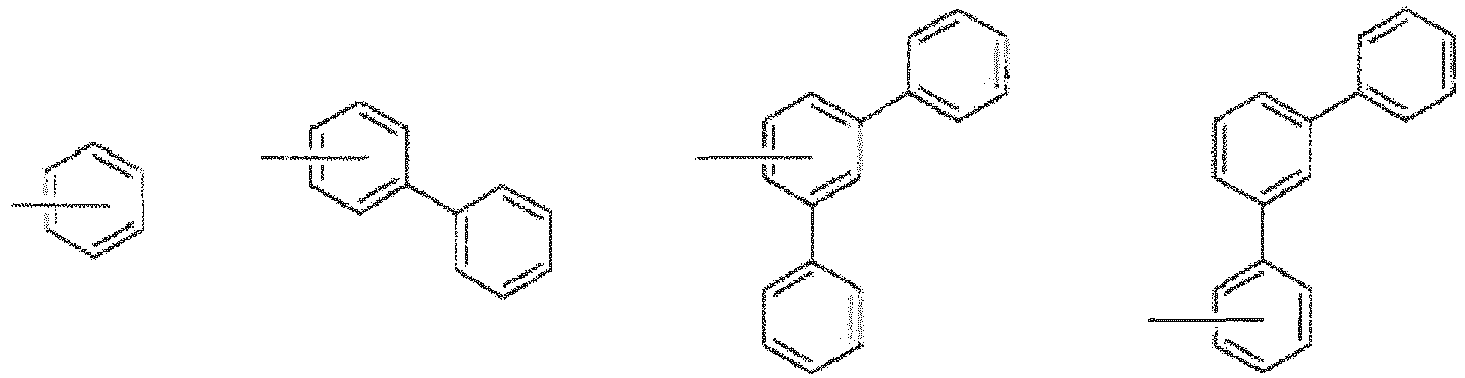
 à condition que le dérivé du composé hétérocyclique ayant un atome d'azote n'inclut pas les composés suivants représentés par les formules chimiques (1-1) à (1-10) :


- Dérivé d'un composé hétérocyclique ayant un atome d'azote selon la revendication 1, dans lequel Ar2 est un groupe cyclique représenté par le groupe suivant :

- Matériau pour un dispositif électroluminescent organique comprenant le dérivé d'un composé hétérocyclique ayant un atome d'azote selon l'une quelconque des revendications 1 et 2.
- Dispositif électroluminescent organique comprenant au moins une couche de composé organique contenant une couche émettant de la lumière intercalée entre une paire d'électrodes, dans lequel le dispositif contient le dérivé d'un composé hétérocyclique ayant un atome d'azote selon l'une quelconque des revendications 1 et 2 parmi la couche de composé.
- Dispositif électroluminescent organique selon la revendication 4, dans lequel une région d'émission de lumière contient ledit dérivé d'un composé hétérocyclique ayant un atome d'azote.
- Dispositif électroluminescent organique selon la revendication 4, dans lequel la couche émettant de la lumière contient ledit dérivé d'un composé hétérocyclique ayant un atome d'azote.
- Dispositif électroluminescent organique selon la revendication 4, dans lequel au moins l'une parmi une couche d'injection d'électrons et une couche de transport d'électrons contient ledit dérivé d'un composé hétérocyclique ayant un atome d'azote.
- Dispositif électroluminescent organique selon la revendication 7, dans lequel au moins l'une parmi la couche d'injection d'électrons et la couche de transport d'électrons comprend en outre un dopant réducteur.
- Dispositif électroluminescent organique selon la revendication 8, dans lequel ledit dopant réducteur est au moins l'un sélectionné dans le groupe constitué d'un métal alcalin, d'un métal alcalino-terreux, d'un métal des terres rares, d'un oxyde de métal alcalin, d'un halogénure de métal alcalin, d'un oxyde de métal alcalino-terreux, d'un halogénure de métal alcalino-terreux, d'un oxyde de métal des terres rares, d'un halogénure de métal des terres rares, des complexes organiques de métal alcalin, des complexes organiques de métal alcalino-terreux et des complexes organiques de métal des terres rares.
Applications Claiming Priority (3)
| Application Number | Priority Date | Filing Date | Title |
|---|---|---|---|
| JP2003067847 | 2003-03-13 | ||
| PCT/JP2004/000682 WO2004080975A1 (fr) | 2003-03-13 | 2004-01-27 | Derive heterocyclique contenant de l'azote et element electroluminescent organique utilisant ce derive |
| EP04705503.3A EP1602648B2 (fr) | 2003-03-13 | 2004-01-27 | Dérivé hétérocyclique contenant de l'azote et element electroluminescent organique utilisant ce dérivé |
Related Parent Applications (3)
| Application Number | Title | Priority Date | Filing Date |
|---|---|---|---|
| EP04705503.3 Division | 2004-01-27 | ||
| EP04705503.3A Division EP1602648B2 (fr) | 2003-03-13 | 2004-01-27 | Dérivé hétérocyclique contenant de l'azote et element electroluminescent organique utilisant ce dérivé |
| EP04705503.3A Division-Into EP1602648B2 (fr) | 2003-03-13 | 2004-01-27 | Dérivé hétérocyclique contenant de l'azote et element electroluminescent organique utilisant ce dérivé |
Publications (3)
| Publication Number | Publication Date |
|---|---|
| EP2174932A2 EP2174932A2 (fr) | 2010-04-14 |
| EP2174932A3 EP2174932A3 (fr) | 2011-09-21 |
| EP2174932B1 true EP2174932B1 (fr) | 2019-07-03 |
Family
ID=32984572
Family Applications (3)
| Application Number | Title | Priority Date | Filing Date |
|---|---|---|---|
| EP10152089.8A Expired - Lifetime EP2174933B1 (fr) | 2003-03-13 | 2004-01-27 | Derivés du benzimidazole pour utilisation comme dispositifs électroluminescents |
| EP10152087.2A Expired - Lifetime EP2174932B1 (fr) | 2003-03-13 | 2004-01-27 | Dérivé hétérocyclique contenant de l'azote et élément électroluminescent organique utilisant ce dérivé |
| EP04705503.3A Expired - Lifetime EP1602648B2 (fr) | 2003-03-13 | 2004-01-27 | Dérivé hétérocyclique contenant de l'azote et element electroluminescent organique utilisant ce dérivé |
Family Applications Before (1)
| Application Number | Title | Priority Date | Filing Date |
|---|---|---|---|
| EP10152089.8A Expired - Lifetime EP2174933B1 (fr) | 2003-03-13 | 2004-01-27 | Derivés du benzimidazole pour utilisation comme dispositifs électroluminescents |
Family Applications After (1)
| Application Number | Title | Priority Date | Filing Date |
|---|---|---|---|
| EP04705503.3A Expired - Lifetime EP1602648B2 (fr) | 2003-03-13 | 2004-01-27 | Dérivé hétérocyclique contenant de l'azote et element electroluminescent organique utilisant ce dérivé |
Country Status (7)
| Country | Link |
|---|---|
| US (2) | US7851071B2 (fr) |
| EP (3) | EP2174933B1 (fr) |
| JP (3) | JP4185097B2 (fr) |
| KR (3) | KR101020350B1 (fr) |
| CN (3) | CN1784388B (fr) |
| TW (3) | TWI499653B (fr) |
| WO (1) | WO2004080975A1 (fr) |
Families Citing this family (309)
| Publication number | Priority date | Publication date | Assignee | Title |
|---|---|---|---|---|
| WO2004063159A1 (fr) * | 2003-01-10 | 2004-07-29 | Idemitsu Kosan Co., Ltd. | Derive heterocyclique azote et element electroluminescent organique utilisant ce derive |
| KR101020350B1 (ko) * | 2003-03-13 | 2011-03-08 | 이데미쓰 고산 가부시키가이샤 | 신규한 질소 함유 헤테로환 유도체 및 이를 이용한 유기 전기발광 소자 |
| JP4528013B2 (ja) * | 2004-04-01 | 2010-08-18 | 三井化学株式会社 | アントラセン化合物、および該アントラセン化合物を含有する有機電界発光素子 |
| ATE447558T1 (de) * | 2004-04-07 | 2009-11-15 | Idemitsu Kosan Co | Stickstoffhaltiges heterocyclusderivat und organisches elektrolumineszentes element, bei dem dieses verwendung findet |
| US20060269782A1 (en) * | 2005-05-25 | 2006-11-30 | Eastman Kodak Company | OLED electron-transporting layer |
| JP4986451B2 (ja) * | 2005-06-30 | 2012-07-25 | 信一郎 礒部 | マーキング剤 |
| WO2007007464A1 (fr) * | 2005-07-11 | 2007-01-18 | Idemitsu Kosan Co., Ltd. | Dérivé hétérocyclique contenant de l'azote et élément électroluminescent organique l’utilisant |
| WO2007007463A1 (fr) * | 2005-07-11 | 2007-01-18 | Idemitsu Kosan Co., Ltd. | Dérivé hétérocyclique contenant de l'azote comprenant un substituant attirant les électrons et élément à électroluminescence organique l'utilisant |
| JP2007039406A (ja) * | 2005-08-05 | 2007-02-15 | Idemitsu Kosan Co Ltd | 含窒素複素環誘導体及びそれを用いた有機エレクトロルミネッセンス素子 |
| EP1937616B1 (fr) | 2005-10-21 | 2014-12-17 | LG Chem, Ltd. | Derives binaphtalene, procede d'elaboration et dispositif organique electronique l'utilisant |
| US20070104977A1 (en) * | 2005-11-07 | 2007-05-10 | Idemitsu Kosan Co., Ltd. | Organic electroluminescent device |
| JP2007149941A (ja) * | 2005-11-28 | 2007-06-14 | Idemitsu Kosan Co Ltd | 有機エレクトロルミネッセンス素子 |
| JP2007153778A (ja) | 2005-12-02 | 2007-06-21 | Idemitsu Kosan Co Ltd | 含窒素複素環誘導体及びそれを用いた有機エレクトロルミネッセンス素子 |
| EP1976814B1 (fr) * | 2006-01-27 | 2016-07-13 | LG Chem, Ltd. | Nouveaux dérivés d'anthracène, leur procédé de préparation et diode électroluminescente organique faisant intervenir ceux-ci |
| WO2007099872A1 (fr) * | 2006-02-23 | 2007-09-07 | Idemitsu Kosan Co., Ltd. | Dispositif electroluminescent organique |
| JPWO2007099802A1 (ja) * | 2006-02-23 | 2009-07-16 | 出光興産株式会社 | 赤色系有機エレクトロルミネッセンス素子 |
| TW200740290A (en) * | 2006-02-28 | 2007-10-16 | Idemitsu Kosan Co | Organic electroluminescent device using fluoranthene derivative and indenoperylene derivative |
| CN101410380A (zh) * | 2006-03-27 | 2009-04-15 | 出光兴产株式会社 | 含氮杂环衍生物及使用其的有机电致发光元件 |
| EP2000464A4 (fr) | 2006-03-27 | 2010-06-30 | Idemitsu Kosan Co | Dérivé hétérocyclique azoté et dispositif électroluminescent organique utilisant celui-ci |
| US8076839B2 (en) | 2006-05-11 | 2011-12-13 | Idemitsu Kosan Co., Ltd. | Organic electroluminescence device |
| WO2007132704A1 (fr) * | 2006-05-11 | 2007-11-22 | Idemitsu Kosan Co., Ltd. | Élément électroluminescent organique |
| KR20090051163A (ko) * | 2006-08-04 | 2009-05-21 | 이데미쓰 고산 가부시키가이샤 | 유기 전계 발광 소자 |
| JP4942448B2 (ja) * | 2006-10-13 | 2012-05-30 | 三井化学株式会社 | アントラセン化合物および該化合物を含有する有機電界発光素子 |
| TW200840110A (en) * | 2006-11-20 | 2008-10-01 | Idemitsu Kosan Co | Organic electroluminescent device |
| KR100989467B1 (ko) * | 2006-12-06 | 2010-10-22 | 주식회사 엘지화학 | 신규한 플루오렌 유도체 및 이를 이용한 유기 전자 소자 |
| TWI437075B (zh) * | 2006-12-28 | 2014-05-11 | 半導體能源研究所股份有限公司 | 蒽衍生物及使用該蒽衍生物之發光裝置 |
| KR20100014803A (ko) | 2007-02-19 | 2010-02-11 | 이데미쓰 고산 가부시키가이샤 | 유기 전계발광 소자 |
| JPWO2008105294A1 (ja) | 2007-02-28 | 2010-06-03 | 出光興産株式会社 | 有機el素子 |
| TWI373987B (en) * | 2007-03-07 | 2012-10-01 | Sony Corp | Organic electroluminescent device and display device |
| US8278819B2 (en) * | 2007-03-09 | 2012-10-02 | Idemitsu Kosan Co., Ltd. | Organic electroluminescence device and display |
| US20080241588A1 (en) * | 2007-03-09 | 2008-10-02 | Idemitsu Kosan Co., Ltd. | Organic electroluminescence device and display |
| EP2141158B1 (fr) | 2007-04-12 | 2014-05-07 | Tosoh Corporation | Composé de 1,3,5-triazine substitué par phényle, son procédé de fabrication et dispositif électroluminescent organique le contenant comme composant |
| US8541111B2 (en) * | 2007-05-21 | 2013-09-24 | Sony Corporation | Organic electroluminescent device and display apparatus |
| CN101414661B (zh) * | 2007-10-17 | 2011-11-16 | 中国科学院理化技术研究所 | 有机电子传输和/或空穴阻挡材料及其合成方法和用途 |
| KR101528241B1 (ko) * | 2007-12-07 | 2015-06-15 | 삼성디스플레이 주식회사 | 방향족 복소환 화합물, 이를 포함한 유기막을 구비한 유기발광 소자 및 상기 유기발광 소자의 제조 방법 |
| JP5355421B2 (ja) * | 2007-12-21 | 2013-11-27 | 出光興産株式会社 | 有機エレクトロルミネッセンス素子 |
| WO2009084544A1 (fr) * | 2007-12-27 | 2009-07-09 | Idemitsu Kosan Co., Ltd. | Dérivé hétérocyclique contenant de l'azote et dispositif organique électroluminescent l'utilisant |
| CN101959867A (zh) | 2007-12-27 | 2011-01-26 | 出光兴产株式会社 | 含氮杂环衍生物及使用该衍生物的有机电致发光元件 |
| CN101250405B (zh) * | 2008-02-26 | 2011-01-19 | 南京大学 | 一种新型巯基荧光探针及其应用 |
| JP5491383B2 (ja) * | 2008-03-19 | 2014-05-14 | 出光興産株式会社 | アントラセン誘導体、発光材料および有機エレクトロルミネッセンス素子 |
| JP5748948B2 (ja) | 2008-10-03 | 2015-07-15 | 東ソー株式会社 | 1,3,5−トリアジン誘導体、その製造方法、及びこれを構成成分とする有機電界発光素子 |
| JP2010092960A (ja) * | 2008-10-06 | 2010-04-22 | Sony Corp | 有機電界発光素子および表示装置 |
| JP5629970B2 (ja) * | 2008-11-14 | 2014-11-26 | コニカミノルタ株式会社 | 有機エレクトロルミネッセンス素子、表示装置及び照明装置 |
| KR101257695B1 (ko) * | 2008-12-24 | 2013-04-24 | 제일모직주식회사 | 신규한 유기광전소자용 화합물 및 이를 포함하는 유기광전소자 |
| DE102009005746A1 (de) | 2009-01-23 | 2010-07-29 | Merck Patent Gmbh | Materialien für organische Elektrolumineszenzvorrichtungen |
| DE102009009277B4 (de) | 2009-02-17 | 2023-12-07 | Merck Patent Gmbh | Organische elektronische Vorrichtung, Verfahren zu deren Herstellung und Verwendung von Verbindungen |
| DE102009012346B4 (de) | 2009-03-09 | 2024-02-15 | Merck Patent Gmbh | Organische Elektrolumineszenzvorrichtung und Verfahren zu deren Herstellung |
| DE102009014513A1 (de) | 2009-03-23 | 2010-09-30 | Merck Patent Gmbh | Organische Elektrolumineszenzvorrichtung |
| DE102009017064A1 (de) | 2009-04-09 | 2010-10-14 | Merck Patent Gmbh | Organische Elektrolumineszenzvorrichtung |
| US20120104380A1 (en) | 2009-06-22 | 2012-05-03 | Merck Patent Gmbh | Conducting formulation |
| US8581262B2 (en) | 2009-08-04 | 2013-11-12 | Merck Patent Gmbh | Electronic devices comprising multi cyclic hydrocarbons |
| DE102009042680A1 (de) | 2009-09-23 | 2011-03-24 | Merck Patent Gmbh | Organische Elektrolumineszenzvorrichtung |
| CN102574790A (zh) | 2009-10-02 | 2012-07-11 | 出光兴产株式会社 | 芳胺衍生物及有机电致发光元件 |
| JP5836970B2 (ja) | 2009-12-22 | 2015-12-24 | メルク パテント ゲーエムベーハー | 機能性材料を含む調合物 |
| EP2517537B1 (fr) | 2009-12-22 | 2019-04-03 | Merck Patent GmbH | Surfactants fonctionnels électroluminescents |
| WO2011076314A1 (fr) | 2009-12-22 | 2011-06-30 | Merck Patent Gmbh | Formulations électroluminescentes |
| WO2011076324A1 (fr) | 2009-12-23 | 2011-06-30 | Merck Patent Gmbh | Compositions comprenant des composés semi-conducteurs organiques |
| US9178156B2 (en) | 2009-12-23 | 2015-11-03 | Merck Patent Gmbh | Compositions comprising polymeric binders |
| KR20120100709A (ko) | 2010-01-15 | 2012-09-12 | 이데미쓰 고산 가부시키가이샤 | 유기 전계 발광 소자 |
| KR101153910B1 (ko) * | 2010-02-19 | 2012-06-07 | 덕산하이메탈(주) | 인돌 유도체를 핵심으로 하는 화합물 및 이를 이용한 유기전기소자, 그 단말 |
| DE102010010481A1 (de) | 2010-03-06 | 2011-09-08 | Merck Patent Gmbh | Organische Elektrolumineszenzvorrichtung |
| JP2013522816A (ja) | 2010-03-11 | 2013-06-13 | メルク パテント ゲーエムベーハー | 発光ファイバー |
| WO2011110277A1 (fr) | 2010-03-11 | 2011-09-15 | Merck Patent Gmbh | Fibres en thérapie et cosmétique |
| JP2011222831A (ja) | 2010-04-12 | 2011-11-04 | Idemitsu Kosan Co Ltd | 有機エレクトロルミネッセンス素子 |
| CN102859738B (zh) | 2010-04-12 | 2016-08-03 | 默克专利有限公司 | 具有改进的性能的组合物 |
| JP6073216B2 (ja) | 2010-04-12 | 2017-02-01 | メルク パテント ゲーエムベーハー | 有機電子デバイスを作製するための組成物および方法 |
| DE102010020044A1 (de) | 2010-05-11 | 2011-11-17 | Merck Patent Gmbh | Organische Elektrolumineszenzvorrichtung |
| JP5944380B2 (ja) | 2010-05-27 | 2016-07-05 | メルク パテント ゲーエムベーハー | 量子ドットを含む組成物 |
| RU2012156386A (ru) | 2010-05-27 | 2014-07-10 | Мерк Патент Гмбх | Состав и способ получения органических электронных устройств |
| US9105847B2 (en) * | 2010-06-24 | 2015-08-11 | Joled Inc. | Organic EL display and method of manufacturing the same |
| CN103026525B (zh) | 2010-07-26 | 2016-11-09 | 默克专利有限公司 | 在器件中的纳米晶体 |
| EP2599141B1 (fr) | 2010-07-26 | 2019-12-11 | Merck Patent GmbH | Boîtes quantiques et hôtes |
| KR101466150B1 (ko) * | 2010-12-31 | 2014-11-27 | 제일모직 주식회사 | 유기광전소자용 화합물 및 이를 포함하는 유기광전소자 |
| JP6351974B2 (ja) | 2011-02-14 | 2018-07-04 | メルク パテント ゲーエムベーハー | 細胞および細胞組織の処置のためのデバイスおよび方法 |
| JP2012195054A (ja) | 2011-03-14 | 2012-10-11 | Idemitsu Kosan Co Ltd | 有機エレクトロルミネッセンス素子 |
| WO2012126566A1 (fr) | 2011-03-24 | 2012-09-27 | Merck Patent Gmbh | Matériaux fonctionnels ioniques organiques |
| EP2707911B1 (fr) | 2011-05-12 | 2017-07-05 | Merck Patent GmbH | Compositions et dispositifs électroniques |
| WO2012163464A1 (fr) | 2011-06-01 | 2012-12-06 | Merck Patent Gmbh | Tft ambipolaires hybrides |
| KR101511168B1 (ko) | 2011-06-16 | 2015-04-10 | 삼성디스플레이 주식회사 | 축합환 화합물 및 이를 포함한 유기 발광 소자 |
| WO2013013754A1 (fr) | 2011-07-25 | 2013-01-31 | Merck Patent Gmbh | Copolymères ayant des chaînes latérales fonctionnalisées |
| KR101474797B1 (ko) * | 2011-08-08 | 2014-12-19 | 제일모직 주식회사 | 유기광전자소자용 화합물 및 이를 포함하는 유기발광소자 |
| JP6129075B2 (ja) * | 2011-08-18 | 2017-05-17 | 出光興産株式会社 | ビスカルバゾール誘導体およびこれを用いた有機エレクトロルミネッセンス素子 |
| DE102012016192A1 (de) | 2011-08-19 | 2013-02-21 | Merck Patent Gmbh | Neue Materialien für organische Elektrolumineszenzvorrichtungen |
| JP6282114B2 (ja) * | 2011-10-04 | 2018-02-21 | 株式会社Joled | 有機エレクトロルミネッセンス素子 |
| JP2013093541A (ja) | 2011-10-06 | 2013-05-16 | Udc Ireland Ltd | 有機電界発光素子とそれに用いることができる化合物および有機電界発光素子用材料、並びに該素子を用いた発光装置、表示装置及び照明装置 |
| EP2764558B1 (fr) | 2011-10-06 | 2019-02-27 | Merck Patent GmbH | Dispositif électroluminescents organiques |
| JP2013084732A (ja) | 2011-10-07 | 2013-05-09 | Udc Ireland Ltd | 有機電界発光素子及び該素子用発光材料並びに発光装置、表示装置及び照明装置 |
| JP2013118349A (ja) | 2011-11-02 | 2013-06-13 | Udc Ireland Ltd | 有機電界発光素子、有機電界発光素子用材料並びに該有機電界発光素子を用いた発光装置、表示装置及び照明装置 |
| JP2013103918A (ja) | 2011-11-15 | 2013-05-30 | Udc Ireland Ltd | 電荷輸送材料、有機電界発光素子及び該素子を用いたことを特徴とする発光装置、表示装置または照明装置 |
| DE102012022880B4 (de) | 2011-12-22 | 2024-12-24 | Merck Patent Gmbh | Elektronische Vorrichtungen enthaltend organische Schichten |
| JP5978843B2 (ja) | 2012-02-02 | 2016-08-24 | コニカミノルタ株式会社 | イリジウム錯体化合物、有機エレクトロルミネッセンス素子材料、有機エレクトロルミネッセンス素子、照明装置及び表示装置 |
| JP6118034B2 (ja) * | 2012-02-06 | 2017-04-19 | ユー・ディー・シー アイルランド リミテッド | 有機電界発光素子とそれに用いることができる化合物および有機電界発光素子用材料、並びに該素子を用いた発光装置、表示装置及び照明装置 |
| KR102268696B1 (ko) | 2012-03-15 | 2021-06-23 | 메르크 파텐트 게엠베하 | 전자 소자 |
| JP6006008B2 (ja) * | 2012-06-14 | 2016-10-12 | ユー・ディー・シー アイルランド リミテッド | 化合物、有機電界発光素子並びに該有機電界発光素子を用いた発光装置、表示装置及び照明装置 |
| WO2014030666A1 (fr) | 2012-08-24 | 2014-02-27 | コニカミノルタ株式会社 | Electrode transparente, dispositif électronique, et procédé de fabrication d'une électrode transparente |
| JP6469579B2 (ja) | 2012-10-31 | 2019-02-13 | メルク パテント ゲーエムベーハー | 電子素子 |
| EP3378857B1 (fr) | 2012-11-12 | 2021-03-24 | Merck Patent GmbH | Matériaux pour dispositifs électroniques |
| US10065959B2 (en) | 2012-11-30 | 2018-09-04 | Merck Patent Gmbh | Electronic device |
| WO2014106524A2 (fr) | 2013-01-03 | 2014-07-10 | Merck Patent Gmbh | Matériaux pour dispositifs électroniques |
| EP2941470B1 (fr) | 2013-01-03 | 2018-09-05 | Merck Patent GmbH | Dispositif électronique |
| WO2014106522A1 (fr) | 2013-01-03 | 2014-07-10 | Merck Patent Gmbh | Matériaux pour dispositifs électroniques |
| KR102051952B1 (ko) * | 2013-01-08 | 2019-12-04 | 에스에프씨주식회사 | 헤테로아릴 치환기를 갖는 나프틸기를 포함하는 안트라센 유도체 및 이를 포함하는 유기 발광 소자 |
| KR102030388B1 (ko) * | 2013-01-08 | 2019-10-10 | 에스에프씨주식회사 | 두 개의 나프틸기를 포함하는 비대칭 안트라센 유도체 및 이를 포함하는 유기 발광 소자 |
| KR102030584B1 (ko) * | 2013-01-08 | 2019-10-10 | 에스에프씨주식회사 | 헤테로아릴 치환기를 갖는 페닐기를 포함하는 안트라센 유도체 및 이를 포함하는 유기 발광 소자 |
| KR102030587B1 (ko) * | 2013-01-09 | 2019-10-10 | 에스에프씨주식회사 | 두 개의 나프틸기를 포함하는 비대칭 안트라센 유도체 및 이를 포함하는 유기 발광 소자 |
| KR102090707B1 (ko) * | 2013-02-25 | 2020-03-19 | 삼성디스플레이 주식회사 | 파이렌계 화합물 및 이를 포함한 유기 발광 소자 |
| JP6269655B2 (ja) | 2013-03-29 | 2018-01-31 | コニカミノルタ株式会社 | 有機エレクトロルミネッセンス素子用材料、有機エレクトロルミネッセンス素子、表示装置及び照明装置 |
| EP2980878B1 (fr) | 2013-03-29 | 2019-05-01 | Konica Minolta, Inc. | Élément électroluminescent organique, et dispositif d'éclairage et dispositif d'affichage le comportant |
| WO2014157610A1 (fr) | 2013-03-29 | 2014-10-02 | コニカミノルタ株式会社 | Elément électroluminescent organique, dispositif d'éclairage, dispositif d'affichage, couche mince électroluminescente et composition pour élément électroluminescent organique, et procédé d'électroluminescence |
| WO2015014429A1 (fr) | 2013-07-29 | 2015-02-05 | Merck Patent Gmbh | Dispositif électroluminescent |
| US20160163987A1 (en) | 2013-07-29 | 2016-06-09 | Merck Patent Gmbh | Electro-optical device and the use thereof |
| KR102717935B1 (ko) | 2013-07-30 | 2024-10-16 | 메르크 파텐트 게엠베하 | 전자 소자용 물질 |
| KR102202756B1 (ko) | 2013-07-30 | 2021-01-13 | 메르크 파텐트 게엠베하 | 전자 소자용 물질 |
| JP6585048B2 (ja) | 2013-12-06 | 2019-10-02 | メルク パテント ゲーエムベーハー | 置換オキセピン |
| JP6716457B2 (ja) | 2013-12-06 | 2020-07-01 | メルク パテント ゲーエムベーハー | アクリル酸エステルおよび/またはメタクリル酸エステル単位を含むポリマーバインダーを含む組成物 |
| CN106255687B (zh) | 2014-04-30 | 2020-06-05 | 默克专利有限公司 | 用于电子器件的材料 |
| DE102014008722B4 (de) | 2014-06-18 | 2024-08-22 | Merck Patent Gmbh | Zusammensetzungen für elektronische Vorrichtungen, Formulierung diese enthaltend, Verwendung der Zusammensetzung, Verwendung der Formulierung sowie organische elektronische Vorrichtung enthaltend die Zusammensetzung |
| WO2016034262A1 (fr) | 2014-09-05 | 2016-03-10 | Merck Patent Gmbh | Formulations et dispositifs électroniques |
| KR20160049500A (ko) * | 2014-10-27 | 2016-05-09 | 주식회사 엘지화학 | 유기 전계 발광 소자 |
| EP3241248A1 (fr) | 2014-12-30 | 2017-11-08 | Merck Patent GmbH | Formulations et dispositifs électroniques |
| WO2016120007A1 (fr) | 2015-01-30 | 2016-08-04 | Merck Patent Gmbh | Formulations à faible teneur en particules |
| CN107108578A (zh) | 2015-01-30 | 2017-08-29 | 默克专利有限公司 | 电子器件的材料 |
| JP5831654B1 (ja) | 2015-02-13 | 2015-12-09 | コニカミノルタ株式会社 | 芳香族複素環誘導体、それを用いた有機エレクトロルミネッセンス素子、照明装置及び表示装置 |
| US9929361B2 (en) | 2015-02-16 | 2018-03-27 | Universal Display Corporation | Organic electroluminescent materials and devices |
| EP3093288A1 (fr) * | 2015-05-12 | 2016-11-16 | Novaled GmbH | Diode électroluminescente organique comprenant différents composés matriciels dans la première et la seconde couche de transport d'électrons |
| US11056657B2 (en) | 2015-02-27 | 2021-07-06 | University Display Corporation | Organic electroluminescent materials and devices |
| US10651382B2 (en) | 2015-03-30 | 2020-05-12 | Merck Patent Gmbh | Formulation of an organic functional material comprising a siloxane solvent |
| US9859510B2 (en) | 2015-05-15 | 2018-01-02 | Universal Display Corporation | Organic electroluminescent materials and devices |
| US10418568B2 (en) | 2015-06-01 | 2019-09-17 | Universal Display Corporation | Organic electroluminescent materials and devices |
| CN111477766B (zh) | 2015-06-12 | 2023-04-07 | 默克专利有限公司 | 作为用于oled制剂的溶剂的含有非芳族环的酯 |
| JP7019559B2 (ja) | 2015-07-15 | 2022-02-15 | メルク パテント ゲーエムベーハー | 有機半導体化合物を含む組成物 |
| TWI697485B (zh) * | 2015-07-21 | 2020-07-01 | 日商捷恩智股份有限公司 | 含唑啉環的化合物、含有其的電子輸送/注入層用材料、使用其的有機電致發光元件、顯示裝置及照明裝置 |
| GB201513037D0 (en) | 2015-07-23 | 2015-09-09 | Merck Patent Gmbh | Phenyl-derived compound for use in organic electronic devices |
| US11127905B2 (en) | 2015-07-29 | 2021-09-21 | Universal Display Corporation | Organic electroluminescent materials and devices |
| JP6786591B2 (ja) | 2015-08-14 | 2020-11-18 | メルク、パテント、ゲゼルシャフト、ミット、ベシュレンクテル、ハフツングMerck Patent GmbH | 有機エレクトロルミネッセンス素子のためのフェノキサジン誘導体 |
| US11046884B2 (en) | 2015-08-28 | 2021-06-29 | Merck Patent Gmbh | Formulation of an organic functional material comprising an epoxy group containing solvent |
| US10361381B2 (en) | 2015-09-03 | 2019-07-23 | Universal Display Corporation | Organic electroluminescent materials and devices |
| CA3002752A1 (fr) | 2015-10-26 | 2017-05-04 | Oti Lumionics Inc. | Procede de creation de motifs sur un revetement sur une surface et dispositif incluant un revetement a motifs |
| US11005042B2 (en) | 2015-12-10 | 2021-05-11 | Merck Patent Gmbh | Formulations containing ketones comprising non-aromatic cycles |
| US11171294B2 (en) | 2015-12-15 | 2021-11-09 | Merck Patent Gmbh | Esters containing aromatic groups as solvents for organic electronic formulations |
| US11407916B2 (en) | 2015-12-16 | 2022-08-09 | Merck Patent Gmbh | Formulations containing a mixture of at least two different solvents |
| KR102723604B1 (ko) | 2015-12-16 | 2024-10-29 | 메르크 파텐트 게엠베하 | 고체 용매를 함유하는 제형 |
| JP6788314B2 (ja) | 2016-01-06 | 2020-11-25 | コニカミノルタ株式会社 | 有機エレクトロルミネッセンス素子、有機エレクトロルミネッセンス素子の製造方法、表示装置及び照明装置 |
| KR20180111905A (ko) | 2016-02-05 | 2018-10-11 | 메르크 파텐트 게엠베하 | 전자 소자용 재료 |
| US20170229663A1 (en) | 2016-02-09 | 2017-08-10 | Universal Display Corporation | Organic electroluminescent materials and devices |
| EP3417033B1 (fr) | 2016-02-17 | 2021-02-24 | Merck Patent GmbH | Formulation de substance fonctionnelle organique |
| JP6659067B2 (ja) * | 2016-02-18 | 2020-03-04 | 出光興産株式会社 | 有機エレクトロルミネッセンス素子及び電子機器 |
| DE102016003104A1 (de) | 2016-03-15 | 2017-09-21 | Merck Patent Gmbh | Behälter umfassend eine Formulierung enthaltend mindestens einen organischen Halbleiter |
| US10236456B2 (en) | 2016-04-11 | 2019-03-19 | Universal Display Corporation | Organic electroluminescent materials and devices |
| KR102065817B1 (ko) * | 2016-06-02 | 2020-01-13 | 주식회사 엘지화학 | 유기 발광 소자 |
| JP2019523997A (ja) | 2016-06-16 | 2019-08-29 | メルク パテント ゲーエムベーハー | 有機機能材料の調合物 |
| US11041083B2 (en) | 2016-06-17 | 2021-06-22 | Merck Patent Gmbh | Formulation of an organic functional material |
| US10862054B2 (en) | 2016-06-20 | 2020-12-08 | Universal Display Corporation | Organic electroluminescent materials and devices |
| US11482683B2 (en) | 2016-06-20 | 2022-10-25 | Universal Display Corporation | Organic electroluminescent materials and devices |
| US10672997B2 (en) | 2016-06-20 | 2020-06-02 | Universal Display Corporation | Organic electroluminescent materials and devices |
| TW201815998A (zh) | 2016-06-28 | 2018-05-01 | 德商麥克專利有限公司 | 有機功能材料之調配物 |
| WO2018024719A1 (fr) | 2016-08-04 | 2018-02-08 | Merck Patent Gmbh | Formulation d'une matière fonctionnelle organique |
| US10608186B2 (en) | 2016-09-14 | 2020-03-31 | Universal Display Corporation | Organic electroluminescent materials and devices |
| US10680187B2 (en) | 2016-09-23 | 2020-06-09 | Universal Display Corporation | Organic electroluminescent materials and devices |
| US11196010B2 (en) | 2016-10-03 | 2021-12-07 | Universal Display Corporation | Organic electroluminescent materials and devices |
| US11011709B2 (en) | 2016-10-07 | 2021-05-18 | Universal Display Corporation | Organic electroluminescent materials and devices |
| TWI764942B (zh) | 2016-10-10 | 2022-05-21 | 德商麥克專利有限公司 | 電子裝置 |
| DE102017008794A1 (de) | 2016-10-17 | 2018-04-19 | Merck Patent Gmbh | Materialien zur Verwendung in elektronischen Vorrichtungen |
| CN109863223B (zh) | 2016-10-31 | 2023-06-20 | 默克专利有限公司 | 有机功能材料的制剂 |
| CN109890939B (zh) | 2016-10-31 | 2023-07-11 | 默克专利有限公司 | 有机功能材料的制剂 |
| KR102683884B1 (ko) | 2016-11-02 | 2024-07-11 | 메르크 파텐트 게엠베하 | 전자 소자용 재료 |
| CN110088112A (zh) | 2016-11-08 | 2019-08-02 | 默克专利有限公司 | 用于电子器件的化合物 |
| US12317745B2 (en) | 2016-11-09 | 2025-05-27 | Universal Display Corporation | Organic electroluminescent materials and devices |
| US10680188B2 (en) | 2016-11-11 | 2020-06-09 | Universal Display Corporation | Organic electroluminescent materials and devices |
| TW201833118A (zh) | 2016-11-22 | 2018-09-16 | 德商麥克專利有限公司 | 用於電子裝置之材料 |
| WO2018104202A1 (fr) | 2016-12-06 | 2018-06-14 | Merck Patent Gmbh | Procédé de préparation d'un dispositif électronique |
| CN110168047B (zh) | 2016-12-13 | 2023-08-08 | 默克专利有限公司 | 有机功能材料的制剂 |
| KR102504432B1 (ko) | 2016-12-22 | 2023-02-27 | 메르크 파텐트 게엠베하 | 적어도 2종의 유기-기능성 화합물을 포함하는 혼합물 |
| TWI761406B (zh) | 2016-12-22 | 2022-04-21 | 德商麥克專利有限公司 | 電子裝置用材料 |
| CN108264487A (zh) * | 2016-12-30 | 2018-07-10 | 吉林奥来德光电材料股份有限公司 | 一种新颖的咪唑类化合物及其应用 |
| CN108264504A (zh) * | 2016-12-30 | 2018-07-10 | 吉林奥来德光电材料股份有限公司 | 一种新颖的有机发光化合物和包含它的有机发光器件 |
| CN108264486B (zh) * | 2016-12-30 | 2020-11-13 | 吉林奥来德光电材料股份有限公司 | 一种新颖的咪唑类化合物及其制备和电致发光器件 |
| US11780865B2 (en) | 2017-01-09 | 2023-10-10 | Universal Display Corporation | Organic electroluminescent materials and devices |
| TWI763772B (zh) | 2017-01-30 | 2022-05-11 | 德商麥克專利有限公司 | 電子裝置之有機元件的形成方法 |
| CN110291064B (zh) | 2017-02-02 | 2023-04-28 | 默克专利有限公司 | 用于电子器件的材料 |
| KR102713236B1 (ko) | 2017-02-09 | 2024-10-04 | 페머시스 인크. | 생분해성 시아노아크릴레이트를 포함하는 조성물 및 방법 |
| US11393987B2 (en) | 2017-03-01 | 2022-07-19 | Merck Patent Gmbh | Organic electroluminescent device |
| CN110325524A (zh) | 2017-03-02 | 2019-10-11 | 默克专利有限公司 | 用于有机电子器件的材料 |
| US10844085B2 (en) | 2017-03-29 | 2020-11-24 | Universal Display Corporation | Organic electroluminescent materials and devices |
| KR20190131554A (ko) | 2017-03-31 | 2019-11-26 | 메르크 파텐트 게엠베하 | 유기 발광 다이오드 (oled) 를 위한 인쇄 방법 |
| CN110494514A (zh) | 2017-04-10 | 2019-11-22 | 默克专利有限公司 | 有机功能材料的制剂 |
| US11778907B2 (en) | 2017-04-13 | 2023-10-03 | Merck Patent Gmbh | Composition for organic electronic devices |
| KR102585423B1 (ko) | 2017-04-25 | 2023-10-05 | 메르크 파텐트 게엠베하 | 전자 디바이스용 화합물 |
| KR102563713B1 (ko) | 2017-04-26 | 2023-08-07 | 오티아이 루미오닉스 인크. | 표면의 코팅을 패턴화하는 방법 및 패턴화된 코팅을 포함하는 장치 |
| WO2018202603A1 (fr) | 2017-05-03 | 2018-11-08 | Merck Patent Gmbh | Formulation d'un matériau fonctionnel organique |
| TW201920343A (zh) | 2017-06-21 | 2019-06-01 | 德商麥克專利有限公司 | 電子裝置用材料 |
| CN110753685A (zh) | 2017-06-23 | 2020-02-04 | 默克专利有限公司 | 用于有机电致发光器件的材料 |
| WO2019002198A1 (fr) | 2017-06-26 | 2019-01-03 | Merck Patent Gmbh | Mélanges homogènes |
| CN110799484B (zh) | 2017-06-28 | 2023-09-26 | 默克专利有限公司 | 用于电子器件的材料 |
| TWI813576B (zh) | 2017-07-03 | 2023-09-01 | 德商麥克專利有限公司 | 具有低含量苯酚類雜質的調配物 |
| TWI786143B (zh) | 2017-07-03 | 2022-12-11 | 德商麥克專利有限公司 | 有機電致發光裝置及其產製方法 |
| CN110785415A (zh) | 2017-07-05 | 2020-02-11 | 默克专利有限公司 | 用于有机电子器件的组合物 |
| KR102653984B1 (ko) | 2017-07-05 | 2024-04-02 | 메르크 파텐트 게엠베하 | 유기 전자 디바이스용 조성물 |
| WO2019016184A1 (fr) | 2017-07-18 | 2019-01-24 | Merck Patent Gmbh | Formulation d'un matériau fonctionnel organique |
| WO2019020654A1 (fr) | 2017-07-28 | 2019-01-31 | Merck Patent Gmbh | Dérivés de spirobifluorène à utiliser dans des dispositifs électroniques |
| US11744142B2 (en) | 2017-08-10 | 2023-08-29 | Universal Display Corporation | Organic electroluminescent materials and devices |
| KR102746068B1 (ko) | 2017-09-08 | 2024-12-24 | 메르크 파텐트 게엠베하 | 전자 디바이스용 재료 |
| CN108675975A (zh) | 2017-10-17 | 2018-10-19 | 默克专利有限公司 | 用于有机电致发光器件的材料 |
| TWI785142B (zh) | 2017-11-14 | 2022-12-01 | 德商麥克專利有限公司 | 用於有機電子裝置之組成物 |
| EP3714022B1 (fr) | 2017-11-23 | 2023-06-07 | Merck Patent GmbH | Matériaux pour dispositifs électroniques |
| TWI820057B (zh) | 2017-11-24 | 2023-11-01 | 德商麥克專利有限公司 | 用於有機電致發光裝置的材料 |
| TWI838352B (zh) | 2017-11-24 | 2024-04-11 | 德商麥克專利有限公司 | 用於有機電致發光裝置的材料 |
| US12180230B2 (en) | 2017-11-28 | 2024-12-31 | University Of Southern California | Carbene compounds and organic electroluminescent devices |
| EP3492480B1 (fr) | 2017-11-29 | 2021-10-20 | Universal Display Corporation | Matériaux et dispositifs électroluminescents organiques |
| US11937503B2 (en) | 2017-11-30 | 2024-03-19 | Universal Display Corporation | Organic electroluminescent materials and devices |
| KR102666621B1 (ko) | 2017-12-15 | 2024-05-16 | 메르크 파텐트 게엠베하 | 유기 기능성 재료의 제형 |
| KR20250086795A (ko) | 2017-12-15 | 2025-06-13 | 메르크 파텐트 게엠베하 | 유기 전계 발광 디바이스용 치환된 방향족 아민 |
| CN111479815A (zh) | 2017-12-20 | 2020-07-31 | 默克专利有限公司 | 杂芳族化合物 |
| CN109962166B (zh) * | 2017-12-25 | 2022-06-07 | 固安鼎材科技有限公司 | 有机电致发光器件及其制备方法 |
| KR102478677B1 (ko) | 2017-12-29 | 2022-12-16 | 엘지디스플레이 주식회사 | 유기 발광 소자 및 이를 이용한 유기 발광 표시 장치 |
| US11751415B2 (en) | 2018-02-02 | 2023-09-05 | Oti Lumionics Inc. | Materials for forming a nucleation-inhibiting coating and devices incorporating same |
| CN111712551A (zh) | 2018-02-26 | 2020-09-25 | 默克专利有限公司 | 有机功能材料的制剂 |
| TW201938761A (zh) | 2018-03-06 | 2019-10-01 | 德商麥克專利有限公司 | 用於有機電致發光裝置的材料 |
| TWI802656B (zh) | 2018-03-06 | 2023-05-21 | 德商麥克專利有限公司 | 用於有機電致發光裝置之材料 |
| KR20200132912A (ko) | 2018-03-16 | 2020-11-25 | 메르크 파텐트 게엠베하 | 유기 전계발광 디바이스용 재료 |
| KR102804818B1 (ko) | 2018-05-30 | 2025-05-09 | 메르크 파텐트 게엠베하 | 유기 전자 디바이스용 조성물 |
| TWI835803B (zh) | 2018-06-15 | 2024-03-21 | 德商麥克專利有限公司 | 有機功能性材料之調配物 |
| US12453279B2 (en) | 2018-08-22 | 2025-10-21 | Universal Display Corporation | Organic electroluminescent materials and devices |
| TWI837167B (zh) | 2018-08-28 | 2024-04-01 | 德商麥克專利有限公司 | 用於有機電致發光裝置之材料 |
| EP3844243B1 (fr) | 2018-08-28 | 2022-06-22 | Merck Patent GmbH | Matériaux pour dispositifs électroluminescents organiques |
| TWI823993B (zh) | 2018-08-28 | 2023-12-01 | 德商麥克專利有限公司 | 用於有機電致發光裝置之材料 |
| JP7459065B2 (ja) | 2018-09-12 | 2024-04-01 | メルク パテント ゲーエムベーハー | 有機エレクトロルミネッセンスデバイス用の材料 |
| EP3857621B1 (fr) | 2018-09-24 | 2025-10-29 | Merck Patent GmbH | Procédé de production de granulat |
| JP2022509407A (ja) | 2018-10-31 | 2022-01-20 | メルク パテント ゲゼルシャフト ミット ベシュレンクテル ハフツング | 有機エレクトロルミネッセンス素子のための材料 |
| JP2022506510A (ja) | 2018-11-06 | 2022-01-17 | メルク パテント ゲーエムベーハー | 電子デバイスの有機素子を形成する方法 |
| US12477890B2 (en) | 2019-02-01 | 2025-11-18 | Universal Display Corporation | Organic electroluminescent materials and devices |
| JP7621955B2 (ja) | 2019-02-18 | 2025-01-27 | メルク パテント ゲーエムベーハー | 有機電子デバイス用の組成物 |
| US20220127286A1 (en) | 2019-03-04 | 2022-04-28 | Merck Patent Gmbh | Ligands for nano-sized materials |
| KR20250160226A (ko) | 2019-03-07 | 2025-11-11 | 오티아이 루미오닉스 인크. | 핵생성 억제 코팅물 형성용 재료 및 이를 포함하는 디바이스 |
| CN113646315A (zh) | 2019-04-11 | 2021-11-12 | 默克专利有限公司 | 用于有机电致发光器件的材料 |
| JP7555600B2 (ja) | 2019-04-18 | 2024-09-25 | オーティーアイ ルミオニクス インコーポレーテッド | 核生成抑制コーティングを形成するための材料およびそれを組み込んだデバイス |
| JP7576337B2 (ja) | 2019-05-08 | 2024-11-01 | オーティーアイ ルミオニクス インコーポレーテッド | 核生成抑制コーティングを形成するための材料およびそれを組み込んだデバイス |
| WO2021052921A1 (fr) | 2019-09-19 | 2021-03-25 | Merck Patent Gmbh | Mélange de deux matériaux hôtes et dispositif électroluminescent organique l'utilisant |
| TW202130783A (zh) | 2019-11-04 | 2021-08-16 | 德商麥克專利有限公司 | 有機電致發光裝置 |
| CN114641482A (zh) | 2019-11-04 | 2022-06-17 | 默克专利有限公司 | 用于有机电致发光器件的材料 |
| TW202134252A (zh) | 2019-11-12 | 2021-09-16 | 德商麥克專利有限公司 | 有機電致發光裝置用材料 |
| TW202136181A (zh) | 2019-12-04 | 2021-10-01 | 德商麥克專利有限公司 | 有機電致發光裝置用的材料 |
| CN111170993B (zh) * | 2020-01-08 | 2020-12-22 | 上海传勤新材料有限公司 | 一种含有氮原子杂环的有机电子材料及其制备方法和应用 |
| TW202200753A (zh) | 2020-03-11 | 2022-01-01 | 德商麥克專利有限公司 | 有機電致發光裝置 |
| KR102943498B1 (ko) | 2020-03-11 | 2026-03-24 | 메르크 파텐트 게엠베하 | 유기 전계 발광 장치 |
| TW202200529A (zh) | 2020-03-13 | 2022-01-01 | 德商麥克專利有限公司 | 有機電致發光裝置 |
| WO2021191058A1 (fr) | 2020-03-23 | 2021-09-30 | Merck Patent Gmbh | Matériaux pour dispositifs électroluminescents organiques |
| EP4139971A1 (fr) | 2020-04-21 | 2023-03-01 | Merck Patent GmbH | Émulsions comprenant des matériaux fonctionnels organiques |
| EP4158704B1 (fr) | 2020-05-29 | 2024-12-25 | Merck Patent GmbH | Appareil électroluminescent organique |
| KR102914927B1 (ko) | 2020-06-23 | 2026-01-19 | 메르크 파텐트 게엠베하 | 혼합물의 제조 방법 |
| KR20230043106A (ko) | 2020-07-22 | 2023-03-30 | 메르크 파텐트 게엠베하 | 유기 전계 발광 디바이스용 재료 |
| CN115885599A (zh) | 2020-07-22 | 2023-03-31 | 默克专利有限公司 | 用于有机电致发光器件的材料 |
| US12113279B2 (en) | 2020-09-22 | 2024-10-08 | Oti Lumionics Inc. | Device incorporating an IR signal transmissive region |
| US12187748B2 (en) | 2020-11-02 | 2025-01-07 | Universal Display Corporation | Organic electroluminescent materials and devices |
| CN112552270B (zh) * | 2020-11-16 | 2022-10-25 | 南京高光半导体材料有限公司 | 一种有机电致发光化合物及有机电致发光器件 |
| TW202237797A (zh) | 2020-11-30 | 2022-10-01 | 德商麥克專利有限公司 | 用於有機電致發光裝置之材料 |
| US11985841B2 (en) | 2020-12-07 | 2024-05-14 | Oti Lumionics Inc. | Patterning a conductive deposited layer using a nucleation inhibiting coating and an underlying metallic coating |
| KR20230114756A (ko) | 2020-12-08 | 2023-08-01 | 메르크 파텐트 게엠베하 | 잉크 시스템 및 잉크젯 인쇄를 위한 방법 |
| US12624055B2 (en) | 2021-03-01 | 2026-05-12 | Universal Display Corporation | Organic electroluminescent materials and devices |
| US12428599B2 (en) | 2021-03-09 | 2025-09-30 | Universal Display Corporation | Organic electroluminescent materials and devices |
| EP4320649A1 (fr) | 2021-04-09 | 2024-02-14 | Merck Patent GmbH | Matériaux pour dispositifs électroluminescents organiques |
| CN117084000A (zh) | 2021-04-09 | 2023-11-17 | 默克专利有限公司 | 用于有机电致发光器件的材料 |
| TW202309243A (zh) | 2021-04-09 | 2023-03-01 | 德商麥克專利有限公司 | 用於有機電致發光裝置之材料 |
| US12480042B2 (en) | 2021-04-09 | 2025-11-25 | Universal Display Corporation | Organic electroluminescent materials and devices |
| WO2022243403A1 (fr) | 2021-05-21 | 2022-11-24 | Merck Patent Gmbh | Procédé de purification continue d'au moins un matériau fonctionnel et dispositif de purification continue d'au moins un matériau fonctionnel |
| KR20240045247A (ko) | 2021-08-02 | 2024-04-05 | 메르크 파텐트 게엠베하 | 잉크들을 결합하는 것에 의한 프린팅 방법 |
| US12550611B2 (en) | 2021-08-03 | 2026-02-10 | Universal Display Corporation | Organic electroluminescent materials and devices |
| EP4402141A1 (fr) | 2021-09-13 | 2024-07-24 | Merck Patent GmbH | Matériaux pour dispositifs électroluminescents organiques |
| WO2023052275A1 (fr) | 2021-09-28 | 2023-04-06 | Merck Patent Gmbh | Matériaux pour dispositifs électroniques |
| WO2023052313A1 (fr) | 2021-09-28 | 2023-04-06 | Merck Patent Gmbh | Matériaux pour dispositifs électroniques |
| KR20240075888A (ko) | 2021-09-28 | 2024-05-29 | 메르크 파텐트 게엠베하 | 전자 디바이스용 재료 |
| KR20240075872A (ko) | 2021-09-28 | 2024-05-29 | 메르크 파텐트 게엠베하 | 전자 디바이스용 재료 |
| TW202349760A (zh) | 2021-10-05 | 2023-12-16 | 德商麥克專利有限公司 | 電子裝置之有機元件的形成方法 |
| US12473318B2 (en) | 2021-10-08 | 2025-11-18 | Universal Display Corporation | Organic electroluminescent materials and devices |
| WO2023094412A1 (fr) | 2021-11-25 | 2023-06-01 | Merck Patent Gmbh | Matériaux pour dispositifs électroniques |
| KR20240128020A (ko) | 2021-12-21 | 2024-08-23 | 메르크 파텐트 게엠베하 | 중수소화 유기 화합물의 제조 방법 |
| KR20240150795A (ko) | 2022-02-14 | 2024-10-16 | 메르크 파텐트 게엠베하 | 전자 디바이스용 재료 |
| EP4265247A1 (fr) * | 2022-04-22 | 2023-10-25 | Université Paris Cité | Composés induisant la production de protéines par les cellules immunitaires |
| US20250275349A1 (en) | 2022-04-28 | 2025-08-28 | Merck Patent Gmbh | Materials for organic electroluminescent devices |
| WO2023222559A1 (fr) | 2022-05-18 | 2023-11-23 | Merck Patent Gmbh | Procédé de préparation de composés organiques deutérés |
| TW202411366A (zh) | 2022-06-07 | 2024-03-16 | 德商麥克專利有限公司 | 藉由組合油墨來印刷電子裝置功能層之方法 |
| CN118235543A (zh) | 2022-06-24 | 2024-06-21 | 默克专利有限公司 | 用于有机电子器件的组合物 |
| CN118202815A (zh) | 2022-06-24 | 2024-06-14 | 默克专利有限公司 | 用于有机电子器件的组合物 |
| WO2024013004A1 (fr) | 2022-07-11 | 2024-01-18 | Merck Patent Gmbh | Matériaux pour dispositifs électroniques |
| CN120379993A (zh) | 2022-08-09 | 2025-07-25 | 默克专利有限公司 | 用于有机电致发光器件的材料 |
| KR20240034107A (ko) | 2022-09-05 | 2024-03-13 | 롬엔드하스전자재료코리아유한회사 | 유기 전계 발광 소자 |
| KR20250110873A (ko) | 2022-11-17 | 2025-07-21 | 메르크 파텐트 게엠베하 | 유기 전계발광 디바이스용 재료 |
| TW202440819A (zh) | 2022-12-16 | 2024-10-16 | 德商麥克專利有限公司 | 有機功能性材料之調配物 |
| TW202438505A (zh) | 2022-12-19 | 2024-10-01 | 德商麥克專利有限公司 | 有機電致發光裝置之材料 |
| KR20250124370A (ko) | 2022-12-19 | 2025-08-19 | 메르크 파텐트 게엠베하 | 전자 디바이스용 재료 |
| CN120379953A (zh) | 2022-12-20 | 2025-07-25 | 默克专利有限公司 | 用于制备氘化芳族化合物的方法 |
| EP4665715A1 (fr) | 2023-02-17 | 2025-12-24 | Merck Patent GmbH | Matériaux pour dispositifs électroluminescents organiques |
| KR20260015809A (ko) | 2023-04-20 | 2026-02-03 | 메르크 파텐트 게엠베하 | 전자 디바이스들을 위한 재료들 |
| WO2024240725A1 (fr) | 2023-05-25 | 2024-11-28 | Merck Patent Gmbh | Dérivés de tris[1,2,4]triazolo[1,5-a:1',5'-c:1'',5''-e][1,3,5]triazine destinés à être utilisés dans des dispositifs électroluminescents organiques |
| EP4743463A1 (fr) | 2023-07-12 | 2026-05-20 | Merck Patent Gmbh | Matériaux pour dispositifs électroniques |
| KR20260044229A (ko) | 2023-07-27 | 2026-04-01 | 메르크 파텐트 게엠베하 | 유기 발광 디바이스 및 유기 센서를 위한 재료 |
| WO2025032039A1 (fr) | 2023-08-07 | 2025-02-13 | Merck Patent Gmbh | Procédé de préparation d'un dispositif électronique |
| CN121773745A (zh) | 2023-08-30 | 2026-03-31 | 默克专利有限公司 | 用于有机发光器件的材料 |
| CN121753521A (zh) | 2023-08-30 | 2026-03-27 | 默克专利有限公司 | 用于有机发光器件的材料 |
| CN121753522A (zh) | 2023-08-30 | 2026-03-27 | 默克专利有限公司 | 用于有机发光器件的材料 |
| WO2025119821A1 (fr) | 2023-12-05 | 2025-06-12 | Merck Patent Gmbh | Composition de matériau pour dispositifs électroluminescents organiques |
| WO2025132547A1 (fr) | 2023-12-21 | 2025-06-26 | Merck Patent Gmbh | Procédé mécanochimique de deutération de composés organiques |
| WO2025132551A1 (fr) | 2023-12-22 | 2025-06-26 | Merck Patent Gmbh | Matériaux pour dispositifs électroniques |
| WO2025195961A1 (fr) | 2024-03-19 | 2025-09-25 | Merck Patent Gmbh | Dispositifs électroluminescents organiques |
| WO2025196145A1 (fr) | 2024-03-22 | 2025-09-25 | Merck Patent Gmbh | Matériaux pour dispositifs électroluminescents organiques |
| WO2025210013A1 (fr) | 2024-04-04 | 2025-10-09 | Merck Patent Gmbh | Composés pour dispositifs électroniques, en particulier composés pour oled |
| WO2026008710A1 (fr) | 2024-07-05 | 2026-01-08 | Merck Patent Gmbh | Composés de silicium cyclique pour dispositifs électroluminescents organiques |
| WO2026041632A1 (fr) | 2024-08-21 | 2026-02-26 | Merck Patent Gmbh | Matériaux hétérocycliques pour dispositifs électroluminescents organiques |
| WO2026073855A1 (fr) | 2024-10-01 | 2026-04-09 | Merck Patent Gmbh | Composés de silicium pour dispositifs électroluminescents organiques |
Family Cites Families (42)
| Publication number | Priority date | Publication date | Assignee | Title |
|---|---|---|---|---|
| GB1174493A (en) * | 1967-05-10 | 1969-12-17 | Manufactures J R Bottu | New Benzimidazoles and process for their preparation |
| US4331671A (en) * | 1981-01-09 | 1982-05-25 | Sterling Drug Inc. | 5-(Pyridinyl)-1H-benzimidazoles and 1-hydroxy-6-(pyridinyl)-1H-benzimidazoles and their cardiotonic use |
| EP0138750B1 (fr) * | 1983-08-12 | 1987-09-09 | Ciba-Geigy Ag | Procédé de préparation de benzimidazoles substitués |
| GB8709448D0 (en) * | 1987-04-21 | 1987-05-28 | Pfizer Ltd | Heterobicyclic quinoline derivatives |
| US5200668A (en) | 1988-11-21 | 1993-04-06 | Mitsui Toatsu Chemicals, Inc. | Luminescence element |
| JPH0772181B2 (ja) * | 1989-06-26 | 1995-08-02 | 株式会社大塚製薬工場 | ベンズイミダゾール誘導体 |
| JPH04273849A (ja) * | 1991-02-27 | 1992-09-30 | Nissan Chem Ind Ltd | フッ素含有化合物 |
| DK40192D0 (da) * | 1992-03-26 | 1992-03-26 | Neurosearch As | Imidazolforbindelser, deres fremstilling og anvendelse |
| DE4430861A1 (de) * | 1994-08-31 | 1996-03-07 | Merck Patent Gmbh | Heterocyclyl-benzoylguanidine |
| US6022978A (en) * | 1996-06-11 | 2000-02-08 | Pfizer Inc. | Benzimidazole derivatives |
| US5645948A (en) | 1996-08-20 | 1997-07-08 | Eastman Kodak Company | Blue organic electroluminescent devices |
| GB9702524D0 (en) * | 1997-02-07 | 1997-03-26 | Merck Sharp & Dohme | Therapeutic agents |
| JP3266573B2 (ja) * | 1998-04-08 | 2002-03-18 | 出光興産株式会社 | 有機エレクトロルミネッセンス素子 |
| JP4105429B2 (ja) * | 1998-04-08 | 2008-06-25 | 出光興産株式会社 | 有機エレクトロルミネッセンス素子 |
| US6124463A (en) * | 1998-07-02 | 2000-09-26 | Dupont Pharmaceuticals | Benzimidazoles as corticotropin release factor antagonists |
| JP4120059B2 (ja) * | 1998-09-24 | 2008-07-16 | コニカミノルタホールディングス株式会社 | 新規ベンゾイミダゾール化合物、その製造法および用途 |
| US6479524B1 (en) * | 1998-12-16 | 2002-11-12 | Boehringer Ingelheim Pharma Kg | Substituted aryl and heteroaryl derivatives, their production and their use as medicines |
| EP1165517A1 (fr) * | 1999-04-02 | 2002-01-02 | Neurogen Corporation | N-benzimidazolylmethyl- et n-indolylmethyl-benzamides et leur application comme modulateurs de corticoliberine |
| DE19950898A1 (de) * | 1999-10-22 | 2001-04-26 | Aventis Pharma Gmbh | Heterocyclisch substituierte Benzoylguanidine, Verfahren zu ihrer Herstellung, ihre Verwendung als Medikament oder Diagnostikum sowie sie enthaltendes Medikament |
| JP4105358B2 (ja) * | 2000-03-07 | 2008-06-25 | 富士フイルム株式会社 | ベンズイミダゾール誘導体、発光素子材料及び発光素子 |
| SE9904045D0 (sv) * | 1999-11-09 | 1999-11-09 | Astra Ab | Compounds |
| US20020037427A1 (en) | 2000-03-31 | 2002-03-28 | Toshiki Taguchi | Organic light emitting device material, amine compound, heterocyclic compound and organic light emitting devices using the same |
| JP2001288172A (ja) * | 2000-03-31 | 2001-10-16 | Fuji Photo Film Co Ltd | 有機発光素子材料、新規ヘテロ環化合物、およびそれらを用いた有機発光素子 |
| AU7102201A (en) * | 2000-07-05 | 2002-01-14 | Yamanouchi Pharma Co Ltd | Propane-1,3-dione derivatives |
| JP4712232B2 (ja) * | 2000-07-17 | 2011-06-29 | 富士フイルム株式会社 | 発光素子及びアゾール化合物 |
| ATE482476T1 (de) * | 2000-07-17 | 2010-10-15 | Fujifilm Corp | Lichtemittierendes element und azolverbindung |
| KR20030026979A (ko) * | 2000-07-18 | 2003-04-03 | 야마노우치세이야쿠 가부시키가이샤 | 디시아노피리딘 유도체를 포함하는 의약 |
| JP2002038141A (ja) * | 2000-07-28 | 2002-02-06 | Fuji Photo Film Co Ltd | 新規縮合へテロ環化合物、発光素子材料およびそれを使用した発光素子 |
| JP4590072B2 (ja) | 2000-08-02 | 2010-12-01 | パナソニック株式会社 | ベンゾイミダゾール誘導体 |
| JP4344494B2 (ja) * | 2000-08-24 | 2009-10-14 | 富士フイルム株式会社 | 発光素子及び新規重合体子 |
| JP2002124385A (ja) * | 2000-10-19 | 2002-04-26 | Idemitsu Kosan Co Ltd | 有機エレクトロルミネッセンス素子 |
| HN2001000224A (es) * | 2000-10-19 | 2002-06-13 | Pfizer | Compuestos de imidazol condensado con arilo o heteroarilo como agentes anti - inflamatorios y analgesicos. |
| US6747405B2 (en) | 2000-11-28 | 2004-06-08 | Demitsu Kosan Co., Ltd. | Organic EL display device having conductive color changing layers |
| JP2002231452A (ja) * | 2000-11-28 | 2002-08-16 | Idemitsu Kosan Co Ltd | 有機el表示装置及びその製造方法 |
| DE10111842A1 (de) * | 2001-03-13 | 2002-09-19 | Boehringer Ingelheim Pharma | Antithrombotische Carbonsäureamide, deren Herstellung und deren Verwendung als Arzneimittel |
| CN1266112C (zh) * | 2001-04-24 | 2006-07-26 | 麻省理工学院 | 铜-催化的碳-杂原子键和碳-碳键的形成 |
| US6998487B2 (en) * | 2001-04-27 | 2006-02-14 | Lg Chem, Ltd. | Double-spiro organic compounds and organic electroluminescent devices using the same |
| KR100691543B1 (ko) * | 2002-01-18 | 2007-03-09 | 주식회사 엘지화학 | 새로운 전자 수송용 물질 및 이를 이용한 유기 발광 소자 |
| JP4239463B2 (ja) * | 2002-04-09 | 2009-03-18 | 大正製薬株式会社 | 3−トリフルオロメチルアニリド誘導体 |
| IL164263A0 (en) * | 2002-04-12 | 2005-12-18 | Pfizer | Use of ep4 receptor ligands on the treatment of il-6 involved diseases |
| US6908935B2 (en) * | 2002-05-23 | 2005-06-21 | Amgen Inc. | Calcium receptor modulating agents |
| KR101020350B1 (ko) * | 2003-03-13 | 2011-03-08 | 이데미쓰 고산 가부시키가이샤 | 신규한 질소 함유 헤테로환 유도체 및 이를 이용한 유기 전기발광 소자 |
-
2004
- 2004-01-27 KR KR1020097026201A patent/KR101020350B1/ko not_active Expired - Lifetime
- 2004-01-27 EP EP10152089.8A patent/EP2174933B1/fr not_active Expired - Lifetime
- 2004-01-27 US US10/547,312 patent/US7851071B2/en not_active Expired - Lifetime
- 2004-01-27 CN CN200480012355.7A patent/CN1784388B/zh not_active Expired - Lifetime
- 2004-01-27 CN CN201010120090.XA patent/CN101812021B/zh not_active Expired - Lifetime
- 2004-01-27 WO PCT/JP2004/000682 patent/WO2004080975A1/fr not_active Ceased
- 2004-01-27 EP EP10152087.2A patent/EP2174932B1/fr not_active Expired - Lifetime
- 2004-01-27 EP EP04705503.3A patent/EP1602648B2/fr not_active Expired - Lifetime
- 2004-01-27 JP JP2005503458A patent/JP4185097B2/ja not_active Expired - Lifetime
- 2004-01-27 KR KR1020107010263A patent/KR101036391B1/ko not_active Expired - Lifetime
- 2004-01-27 KR KR1020057017034A patent/KR100998838B1/ko not_active Expired - Lifetime
- 2004-01-27 CN CN200910128518.2A patent/CN101503393B/zh not_active Expired - Lifetime
- 2004-02-02 TW TW100130092A patent/TWI499653B/zh not_active IP Right Cessation
- 2004-02-02 TW TW093102315A patent/TWI363054B/zh not_active IP Right Cessation
- 2004-02-02 TW TW100130093A patent/TWI485137B/zh not_active IP Right Cessation
-
2008
- 2008-05-02 JP JP2008120361A patent/JP5166961B2/ja not_active Expired - Lifetime
-
2010
- 2010-04-07 US US12/662,251 patent/US8097349B2/en not_active Expired - Lifetime
-
2011
- 2011-08-08 JP JP2011173309A patent/JP5572134B2/ja not_active Expired - Lifetime
Non-Patent Citations (1)
| Title |
|---|
| None * |
Also Published As
Similar Documents
| Publication | Publication Date | Title |
|---|---|---|
| EP2174933B1 (fr) | Derivés du benzimidazole pour utilisation comme dispositifs électroluminescents | |
| EP1582516B1 (fr) | Dérivé hétérocyclique azoté et élément électroluminescent organique utilisant ce dérivé | |
| EP1734038B1 (fr) | Derive heterocycle azote et element électroluminescent organique employant ledit derive | |
| CN101874021B (zh) | 氮杂茚并芴二酮衍生物、有机电致发光元件用材料和有机电致发光元件 | |
| JP5583349B2 (ja) | 新規なアントラセン誘導体およびこれを用いた有機電子素子 | |
| US6541129B1 (en) | Organic electroluminescence device and phenylenediamine derivative | |
| KR101838372B1 (ko) | 유기 전계발광 장치용 인데노트리페닐렌계 아민 유도체 | |
| JP4435990B2 (ja) | 有機金属錯体分子およびこれを用いる有機電子発光素子 | |
| CN106083610B (zh) | 有机材料及使用其的有机电激发光装置 | |
| JP2000309566A (ja) | 有機エレクトロルミネッセンス素子およびフェニレンジアミン誘導体 | |
| CN101331627A (zh) | 有机电致发光元件 | |
| CN106397223A (zh) | 一种有机化合物,包含该化合物的有机电致发光器件材料及包含该材料的有机电致发光器件 | |
| JP2009269909A (ja) | 新規な電子材料用化合物及びこれを使用する有機電子素子 | |
| JPWO2011096506A1 (ja) | アミノアントラセン誘導体及びそれを用いた有機エレクトロルミネッセンス素子 | |
| CN107652307B (zh) | 有机电致发光材料及其应用 | |
| TWI719456B (zh) | 雜芳族化合物及使用該雜芳族化合物的有機電激發光組件 | |
| WO2011138907A1 (fr) | Nouveau composé organique |
Legal Events
| Date | Code | Title | Description |
|---|---|---|---|
| PUAI | Public reference made under article 153(3) epc to a published international application that has entered the european phase |
Free format text: ORIGINAL CODE: 0009012 |
|
| AC | Divisional application: reference to earlier application |
Ref document number: 1602648 Country of ref document: EP Kind code of ref document: P |
|
| AK | Designated contracting states |
Kind code of ref document: A2 Designated state(s): AT BE BG CH CY CZ DE DK EE ES FI FR GB GR HU IE IT LI LU MC NL PT RO SE SI SK TR |
|
| PUAL | Search report despatched |
Free format text: ORIGINAL CODE: 0009013 |
|
| AK | Designated contracting states |
Kind code of ref document: A3 Designated state(s): AT BE BG CH CY CZ DE DK EE ES FI FR GB GR HU IE IT LI LU MC NL PT RO SE SI SK TR |
|
| RIC1 | Information provided on ipc code assigned before grant |
Ipc: C07D 235/18 20060101AFI20110812BHEP Ipc: H01L 51/00 20060101ALI20110812BHEP Ipc: H05B 33/14 20060101ALI20110812BHEP Ipc: C07D 401/10 20060101ALI20110812BHEP Ipc: C07D 401/04 20060101ALI20110812BHEP Ipc: C09K 11/06 20060101ALI20110812BHEP Ipc: C07D 235/20 20060101ALI20110812BHEP Ipc: H05B 33/22 20060101ALI20110812BHEP |
|
| 17P | Request for examination filed |
Effective date: 20111110 |
|
| 17Q | First examination report despatched |
Effective date: 20121019 |
|
| STAA | Information on the status of an ep patent application or granted ep patent |
Free format text: STATUS: EXAMINATION IS IN PROGRESS |
|
| GRAP | Despatch of communication of intention to grant a patent |
Free format text: ORIGINAL CODE: EPIDOSNIGR1 |
|
| STAA | Information on the status of an ep patent application or granted ep patent |
Free format text: STATUS: GRANT OF PATENT IS INTENDED |
|
| INTG | Intention to grant announced |
Effective date: 20181219 |
|
| GRAS | Grant fee paid |
Free format text: ORIGINAL CODE: EPIDOSNIGR3 |
|
| GRAA | (expected) grant |
Free format text: ORIGINAL CODE: 0009210 |
|
| STAA | Information on the status of an ep patent application or granted ep patent |
Free format text: STATUS: THE PATENT HAS BEEN GRANTED |
|
| AC | Divisional application: reference to earlier application |
Ref document number: 1602648 Country of ref document: EP Kind code of ref document: P |
|
| AK | Designated contracting states |
Kind code of ref document: B1 Designated state(s): AT BE BG CH CY CZ DE DK EE ES FI FR GB GR HU IE IT LI LU MC NL PT RO SE SI SK TR |
|
| REG | Reference to a national code |
Ref country code: GB Ref legal event code: FG4D |
|
| REG | Reference to a national code |
Ref country code: CH Ref legal event code: EP Ref country code: AT Ref legal event code: REF Ref document number: 1150840 Country of ref document: AT Kind code of ref document: T Effective date: 20190715 |
|
| REG | Reference to a national code |
Ref country code: IE Ref legal event code: FG4D |
|
| REG | Reference to a national code |
Ref country code: DE Ref legal event code: R096 Ref document number: 602004054113 Country of ref document: DE |
|
| REG | Reference to a national code |
Ref country code: NL Ref legal event code: MP Effective date: 20190703 |
|
| REG | Reference to a national code |
Ref country code: AT Ref legal event code: MK05 Ref document number: 1150840 Country of ref document: AT Kind code of ref document: T Effective date: 20190703 |
|
| PG25 | Lapsed in a contracting state [announced via postgrant information from national office to epo] |
Ref country code: AT Free format text: LAPSE BECAUSE OF FAILURE TO SUBMIT A TRANSLATION OF THE DESCRIPTION OR TO PAY THE FEE WITHIN THE PRESCRIBED TIME-LIMIT Effective date: 20190703 Ref country code: BG Free format text: LAPSE BECAUSE OF FAILURE TO SUBMIT A TRANSLATION OF THE DESCRIPTION OR TO PAY THE FEE WITHIN THE PRESCRIBED TIME-LIMIT Effective date: 20191003 Ref country code: PT Free format text: LAPSE BECAUSE OF FAILURE TO SUBMIT A TRANSLATION OF THE DESCRIPTION OR TO PAY THE FEE WITHIN THE PRESCRIBED TIME-LIMIT Effective date: 20191104 Ref country code: NL Free format text: LAPSE BECAUSE OF FAILURE TO SUBMIT A TRANSLATION OF THE DESCRIPTION OR TO PAY THE FEE WITHIN THE PRESCRIBED TIME-LIMIT Effective date: 20190703 Ref country code: CZ Free format text: LAPSE BECAUSE OF FAILURE TO SUBMIT A TRANSLATION OF THE DESCRIPTION OR TO PAY THE FEE WITHIN THE PRESCRIBED TIME-LIMIT Effective date: 20190703 Ref country code: SE Free format text: LAPSE BECAUSE OF FAILURE TO SUBMIT A TRANSLATION OF THE DESCRIPTION OR TO PAY THE FEE WITHIN THE PRESCRIBED TIME-LIMIT Effective date: 20190703 Ref country code: FI Free format text: LAPSE BECAUSE OF FAILURE TO SUBMIT A TRANSLATION OF THE DESCRIPTION OR TO PAY THE FEE WITHIN THE PRESCRIBED TIME-LIMIT Effective date: 20190703 |
|
| PG25 | Lapsed in a contracting state [announced via postgrant information from national office to epo] |
Ref country code: GR Free format text: LAPSE BECAUSE OF FAILURE TO SUBMIT A TRANSLATION OF THE DESCRIPTION OR TO PAY THE FEE WITHIN THE PRESCRIBED TIME-LIMIT Effective date: 20191004 Ref country code: ES Free format text: LAPSE BECAUSE OF FAILURE TO SUBMIT A TRANSLATION OF THE DESCRIPTION OR TO PAY THE FEE WITHIN THE PRESCRIBED TIME-LIMIT Effective date: 20190703 |
|
| PG25 | Lapsed in a contracting state [announced via postgrant information from national office to epo] |
Ref country code: TR Free format text: LAPSE BECAUSE OF FAILURE TO SUBMIT A TRANSLATION OF THE DESCRIPTION OR TO PAY THE FEE WITHIN THE PRESCRIBED TIME-LIMIT Effective date: 20190703 |
|
| PG25 | Lapsed in a contracting state [announced via postgrant information from national office to epo] |
Ref country code: DK Free format text: LAPSE BECAUSE OF FAILURE TO SUBMIT A TRANSLATION OF THE DESCRIPTION OR TO PAY THE FEE WITHIN THE PRESCRIBED TIME-LIMIT Effective date: 20190703 Ref country code: EE Free format text: LAPSE BECAUSE OF FAILURE TO SUBMIT A TRANSLATION OF THE DESCRIPTION OR TO PAY THE FEE WITHIN THE PRESCRIBED TIME-LIMIT Effective date: 20190703 Ref country code: IT Free format text: LAPSE BECAUSE OF FAILURE TO SUBMIT A TRANSLATION OF THE DESCRIPTION OR TO PAY THE FEE WITHIN THE PRESCRIBED TIME-LIMIT Effective date: 20190703 Ref country code: RO Free format text: LAPSE BECAUSE OF FAILURE TO SUBMIT A TRANSLATION OF THE DESCRIPTION OR TO PAY THE FEE WITHIN THE PRESCRIBED TIME-LIMIT Effective date: 20190703 |
|
| PG25 | Lapsed in a contracting state [announced via postgrant information from national office to epo] |
Ref country code: SK Free format text: LAPSE BECAUSE OF FAILURE TO SUBMIT A TRANSLATION OF THE DESCRIPTION OR TO PAY THE FEE WITHIN THE PRESCRIBED TIME-LIMIT Effective date: 20190703 |
|
| REG | Reference to a national code |
Ref country code: DE Ref legal event code: R097 Ref document number: 602004054113 Country of ref document: DE |
|
| PLBE | No opposition filed within time limit |
Free format text: ORIGINAL CODE: 0009261 |
|
| STAA | Information on the status of an ep patent application or granted ep patent |
Free format text: STATUS: NO OPPOSITION FILED WITHIN TIME LIMIT |
|
| 26N | No opposition filed |
Effective date: 20200603 |
|
| PG25 | Lapsed in a contracting state [announced via postgrant information from national office to epo] |
Ref country code: SI Free format text: LAPSE BECAUSE OF FAILURE TO SUBMIT A TRANSLATION OF THE DESCRIPTION OR TO PAY THE FEE WITHIN THE PRESCRIBED TIME-LIMIT Effective date: 20190703 Ref country code: MC Free format text: LAPSE BECAUSE OF FAILURE TO SUBMIT A TRANSLATION OF THE DESCRIPTION OR TO PAY THE FEE WITHIN THE PRESCRIBED TIME-LIMIT Effective date: 20190703 |
|
| REG | Reference to a national code |
Ref country code: CH Ref legal event code: PL |
|
| REG | Reference to a national code |
Ref country code: BE Ref legal event code: MM Effective date: 20200131 |
|
| PG25 | Lapsed in a contracting state [announced via postgrant information from national office to epo] |
Ref country code: LU Free format text: LAPSE BECAUSE OF NON-PAYMENT OF DUE FEES Effective date: 20200127 |
|
| PG25 | Lapsed in a contracting state [announced via postgrant information from national office to epo] |
Ref country code: CH Free format text: LAPSE BECAUSE OF NON-PAYMENT OF DUE FEES Effective date: 20200131 Ref country code: LI Free format text: LAPSE BECAUSE OF NON-PAYMENT OF DUE FEES Effective date: 20200131 Ref country code: BE Free format text: LAPSE BECAUSE OF NON-PAYMENT OF DUE FEES Effective date: 20200131 |
|
| PG25 | Lapsed in a contracting state [announced via postgrant information from national office to epo] |
Ref country code: IE Free format text: LAPSE BECAUSE OF NON-PAYMENT OF DUE FEES Effective date: 20200127 |
|
| PG25 | Lapsed in a contracting state [announced via postgrant information from national office to epo] |
Ref country code: CY Free format text: LAPSE BECAUSE OF FAILURE TO SUBMIT A TRANSLATION OF THE DESCRIPTION OR TO PAY THE FEE WITHIN THE PRESCRIBED TIME-LIMIT Effective date: 20190703 |
|
| PGFP | Annual fee paid to national office [announced via postgrant information from national office to epo] |
Ref country code: GB Payment date: 20221208 Year of fee payment: 20 Ref country code: FR Payment date: 20221208 Year of fee payment: 20 |
|
| PGFP | Annual fee paid to national office [announced via postgrant information from national office to epo] |
Ref country code: DE Payment date: 20221130 Year of fee payment: 20 |
|
| P01 | Opt-out of the competence of the unified patent court (upc) registered |
Effective date: 20230522 |
|
| REG | Reference to a national code |
Ref country code: DE Ref legal event code: R071 Ref document number: 602004054113 Country of ref document: DE |
|
| REG | Reference to a national code |
Ref country code: GB Ref legal event code: PE20 Expiry date: 20240126 |
|
| PG25 | Lapsed in a contracting state [announced via postgrant information from national office to epo] |
Ref country code: GB Free format text: LAPSE BECAUSE OF EXPIRATION OF PROTECTION Effective date: 20240126 |