EP2007496B1 - Filtre céramique composé d'argile et procédé de préparation afférent - Google Patents
Filtre céramique composé d'argile et procédé de préparation afférent Download PDFInfo
- Publication number
- EP2007496B1 EP2007496B1 EP07745769.5A EP07745769A EP2007496B1 EP 2007496 B1 EP2007496 B1 EP 2007496B1 EP 07745769 A EP07745769 A EP 07745769A EP 2007496 B1 EP2007496 B1 EP 2007496B1
- Authority
- EP
- European Patent Office
- Prior art keywords
- ceramic
- clay
- ceramic filter
- paper
- layer
- Prior art date
- Legal status (The legal status is an assumption and is not a legal conclusion. Google has not performed a legal analysis and makes no representation as to the accuracy of the status listed.)
- Not-in-force
Links
- 239000000919 ceramic Substances 0.000 title claims description 203
- 239000004927 clay Substances 0.000 title claims description 64
- 238000004519 manufacturing process Methods 0.000 title claims description 13
- 239000000835 fiber Substances 0.000 claims description 64
- 238000000034 method Methods 0.000 claims description 53
- 239000011247 coating layer Substances 0.000 claims description 43
- 230000008569 process Effects 0.000 claims description 33
- 239000000440 bentonite Substances 0.000 claims description 31
- 229910000278 bentonite Inorganic materials 0.000 claims description 31
- 239000002002 slurry Substances 0.000 claims description 28
- XLYOFNOQVPJJNP-UHFFFAOYSA-N water Substances O XLYOFNOQVPJJNP-UHFFFAOYSA-N 0.000 claims description 25
- SVPXDRXYRYOSEX-UHFFFAOYSA-N bentoquatam Chemical compound O.O=[Si]=O.O=[Al]O[Al]=O SVPXDRXYRYOSEX-UHFFFAOYSA-N 0.000 claims description 24
- ILRRQNADMUWWFW-UHFFFAOYSA-K aluminium phosphate Chemical compound O1[Al]2OP1(=O)O2 ILRRQNADMUWWFW-UHFFFAOYSA-K 0.000 claims description 23
- 238000010438 heat treatment Methods 0.000 claims description 21
- VEXZGXHMUGYJMC-UHFFFAOYSA-N Hydrochloric acid Chemical compound Cl VEXZGXHMUGYJMC-UHFFFAOYSA-N 0.000 claims description 18
- VYPSYNLAJGMNEJ-UHFFFAOYSA-N Silicium dioxide Chemical compound O=[Si]=O VYPSYNLAJGMNEJ-UHFFFAOYSA-N 0.000 claims description 18
- YKTSYUJCYHOUJP-UHFFFAOYSA-N [O--].[Al+3].[Al+3].[O-][Si]([O-])([O-])[O-] Chemical compound [O--].[Al+3].[Al+3].[O-][Si]([O-])([O-])[O-] YKTSYUJCYHOUJP-UHFFFAOYSA-N 0.000 claims description 18
- 239000010410 layer Substances 0.000 claims description 17
- LFQSCWFLJHTTHZ-UHFFFAOYSA-N Ethanol Chemical compound CCO LFQSCWFLJHTTHZ-UHFFFAOYSA-N 0.000 claims description 16
- BNGXYYYYKUGPPF-UHFFFAOYSA-M (3-methylphenyl)methyl-triphenylphosphanium;chloride Chemical compound [Cl-].CC1=CC=CC(C[P+](C=2C=CC=CC=2)(C=2C=CC=CC=2)C=2C=CC=CC=2)=C1 BNGXYYYYKUGPPF-UHFFFAOYSA-M 0.000 claims description 15
- 238000001035 drying Methods 0.000 claims description 15
- 238000001354 calcination Methods 0.000 claims description 14
- PNEYBMLMFCGWSK-UHFFFAOYSA-N aluminium oxide Inorganic materials [O-2].[O-2].[O-2].[Al+3].[Al+3] PNEYBMLMFCGWSK-UHFFFAOYSA-N 0.000 claims description 13
- 239000000843 powder Substances 0.000 claims description 13
- NBIIXXVUZAFLBC-UHFFFAOYSA-N Phosphoric acid Chemical compound OP(O)(O)=O NBIIXXVUZAFLBC-UHFFFAOYSA-N 0.000 claims description 12
- 239000000377 silicon dioxide Substances 0.000 claims description 10
- MCMNRKCIXSYSNV-UHFFFAOYSA-N Zirconium dioxide Chemical compound O=[Zr]=O MCMNRKCIXSYSNV-UHFFFAOYSA-N 0.000 claims description 8
- 229910000147 aluminium phosphate Inorganic materials 0.000 claims description 6
- 239000005995 Aluminium silicate Substances 0.000 claims description 5
- 235000012211 aluminium silicate Nutrition 0.000 claims description 5
- NLYAJNPCOHFWQQ-UHFFFAOYSA-N kaolin Chemical compound O.O.O=[Al]O[Si](=O)O[Si](=O)O[Al]=O NLYAJNPCOHFWQQ-UHFFFAOYSA-N 0.000 claims description 5
- 239000000454 talc Substances 0.000 claims description 5
- 229910052623 talc Inorganic materials 0.000 claims description 5
- 229910003465 moissanite Inorganic materials 0.000 claims description 4
- RMAQACBXLXPBSY-UHFFFAOYSA-N silicic acid Chemical compound O[Si](O)(O)O RMAQACBXLXPBSY-UHFFFAOYSA-N 0.000 claims description 4
- 229910010271 silicon carbide Inorganic materials 0.000 claims description 4
- BPQQTUXANYXVAA-UHFFFAOYSA-N Orthosilicate Chemical compound [O-][Si]([O-])([O-])[O-] BPQQTUXANYXVAA-UHFFFAOYSA-N 0.000 claims 1
- 239000000243 solution Substances 0.000 description 53
- 239000011248 coating agent Substances 0.000 description 22
- 238000000576 coating method Methods 0.000 description 22
- 239000011230 binding agent Substances 0.000 description 18
- 239000000203 mixture Substances 0.000 description 16
- 239000000463 material Substances 0.000 description 12
- 238000002360 preparation method Methods 0.000 description 11
- -1 alumino borosilicate Chemical compound 0.000 description 10
- KGBXLFKZBHKPEV-UHFFFAOYSA-N boric acid Chemical compound OB(O)O KGBXLFKZBHKPEV-UHFFFAOYSA-N 0.000 description 9
- 239000004327 boric acid Substances 0.000 description 9
- 230000000052 comparative effect Effects 0.000 description 8
- 230000000694 effects Effects 0.000 description 7
- 238000009413 insulation Methods 0.000 description 7
- 238000010422 painting Methods 0.000 description 7
- 238000007493 shaping process Methods 0.000 description 7
- 238000003756 stirring Methods 0.000 description 7
- 239000000853 adhesive Substances 0.000 description 6
- 230000001070 adhesive effect Effects 0.000 description 6
- 239000007787 solid Substances 0.000 description 6
- BOTDANWDWHJENH-UHFFFAOYSA-N Tetraethyl orthosilicate Chemical compound CCO[Si](OCC)(OCC)OCC BOTDANWDWHJENH-UHFFFAOYSA-N 0.000 description 5
- 239000012153 distilled water Substances 0.000 description 5
- 229920002472 Starch Polymers 0.000 description 4
- 229910000323 aluminium silicate Inorganic materials 0.000 description 4
- HNPSIPDUKPIQMN-UHFFFAOYSA-N dioxosilane;oxo(oxoalumanyloxy)alumane Chemical compound O=[Si]=O.O=[Al]O[Al]=O HNPSIPDUKPIQMN-UHFFFAOYSA-N 0.000 description 4
- KZHJGOXRZJKJNY-UHFFFAOYSA-N dioxosilane;oxo(oxoalumanyloxy)alumane Chemical compound O=[Si]=O.O=[Si]=O.O=[Al]O[Al]=O.O=[Al]O[Al]=O.O=[Al]O[Al]=O KZHJGOXRZJKJNY-UHFFFAOYSA-N 0.000 description 4
- 239000007789 gas Substances 0.000 description 4
- 229910052863 mullite Inorganic materials 0.000 description 4
- 230000000704 physical effect Effects 0.000 description 4
- 235000019698 starch Nutrition 0.000 description 4
- KFZMGEQAYNKOFK-UHFFFAOYSA-N Isopropanol Chemical compound CC(C)O KFZMGEQAYNKOFK-UHFFFAOYSA-N 0.000 description 3
- OKKJLVBELUTLKV-UHFFFAOYSA-N Methanol Chemical compound OC OKKJLVBELUTLKV-UHFFFAOYSA-N 0.000 description 3
- 229910019142 PO4 Inorganic materials 0.000 description 3
- FFBHFFJDDLITSX-UHFFFAOYSA-N benzyl N-[2-hydroxy-4-(3-oxomorpholin-4-yl)phenyl]carbamate Chemical compound OC1=C(NC(=O)OCC2=CC=CC=C2)C=CC(=C1)N1CCOCC1=O FFBHFFJDDLITSX-UHFFFAOYSA-N 0.000 description 3
- 239000002537 cosmetic Substances 0.000 description 3
- 239000006185 dispersion Substances 0.000 description 3
- 230000002708 enhancing effect Effects 0.000 description 3
- 239000010452 phosphate Substances 0.000 description 3
- NBIIXXVUZAFLBC-UHFFFAOYSA-K phosphate Chemical compound [O-]P([O-])([O-])=O NBIIXXVUZAFLBC-UHFFFAOYSA-K 0.000 description 3
- 239000011148 porous material Substances 0.000 description 3
- 239000008107 starch Substances 0.000 description 3
- 244000025254 Cannabis sativa Species 0.000 description 2
- 235000012766 Cannabis sativa ssp. sativa var. sativa Nutrition 0.000 description 2
- 235000012765 Cannabis sativa ssp. sativa var. spontanea Nutrition 0.000 description 2
- 229920000271 Kevlar® Polymers 0.000 description 2
- 239000004677 Nylon Substances 0.000 description 2
- 239000004698 Polyethylene Substances 0.000 description 2
- 239000004743 Polypropylene Substances 0.000 description 2
- 229920000297 Rayon Polymers 0.000 description 2
- 239000004760 aramid Substances 0.000 description 2
- 229920006231 aramid fiber Polymers 0.000 description 2
- 235000009120 camo Nutrition 0.000 description 2
- 235000005607 chanvre indien Nutrition 0.000 description 2
- 239000003795 chemical substances by application Substances 0.000 description 2
- 210000003477 cochlea Anatomy 0.000 description 2
- 238000001125 extrusion Methods 0.000 description 2
- 239000006260 foam Substances 0.000 description 2
- 239000011487 hemp Substances 0.000 description 2
- 238000006460 hydrolysis reaction Methods 0.000 description 2
- 239000011261 inert gas Substances 0.000 description 2
- 239000004761 kevlar Substances 0.000 description 2
- 229910052751 metal Inorganic materials 0.000 description 2
- 239000002184 metal Substances 0.000 description 2
- 229920001778 nylon Polymers 0.000 description 2
- 230000035699 permeability Effects 0.000 description 2
- 238000007517 polishing process Methods 0.000 description 2
- 229920000728 polyester Polymers 0.000 description 2
- 229920000573 polyethylene Polymers 0.000 description 2
- 229920001155 polypropylene Polymers 0.000 description 2
- 239000002964 rayon Substances 0.000 description 2
- 229920002994 synthetic fiber Polymers 0.000 description 2
- 239000012209 synthetic fiber Substances 0.000 description 2
- 229920002972 Acrylic fiber Polymers 0.000 description 1
- 229920003043 Cellulose fiber Polymers 0.000 description 1
- 239000004593 Epoxy Substances 0.000 description 1
- 239000004372 Polyvinyl alcohol Substances 0.000 description 1
- 229920002522 Wood fibre Polymers 0.000 description 1
- 230000002411 adverse Effects 0.000 description 1
- 229940037003 alum Drugs 0.000 description 1
- 229910052782 aluminium Inorganic materials 0.000 description 1
- DIZPMCHEQGEION-UHFFFAOYSA-H aluminium sulfate (anhydrous) Chemical compound [Al+3].[Al+3].[O-]S([O-])(=O)=O.[O-]S([O-])(=O)=O.[O-]S([O-])(=O)=O DIZPMCHEQGEION-UHFFFAOYSA-H 0.000 description 1
- LCQXXBOSCBRNNT-UHFFFAOYSA-K ammonium aluminium sulfate Chemical compound [NH4+].[Al+3].[O-]S([O-])(=O)=O.[O-]S([O-])(=O)=O LCQXXBOSCBRNNT-UHFFFAOYSA-K 0.000 description 1
- 239000007864 aqueous solution Substances 0.000 description 1
- 229920003235 aromatic polyamide Polymers 0.000 description 1
- 238000000498 ball milling Methods 0.000 description 1
- 238000009924 canning Methods 0.000 description 1
- 125000004432 carbon atom Chemical group C* 0.000 description 1
- 125000002091 cationic group Chemical group 0.000 description 1
- 230000008859 change Effects 0.000 description 1
- 230000000295 complement effect Effects 0.000 description 1
- 238000005260 corrosion Methods 0.000 description 1
- 230000007797 corrosion Effects 0.000 description 1
- 238000010586 diagram Methods 0.000 description 1
- GUJOJGAPFQRJSV-UHFFFAOYSA-N dialuminum;dioxosilane;oxygen(2-);hydrate Chemical compound O.[O-2].[O-2].[O-2].[Al+3].[Al+3].O=[Si]=O.O=[Si]=O.O=[Si]=O.O=[Si]=O GUJOJGAPFQRJSV-UHFFFAOYSA-N 0.000 description 1
- 238000007598 dipping method Methods 0.000 description 1
- 230000007613 environmental effect Effects 0.000 description 1
- 238000001914 filtration Methods 0.000 description 1
- 239000010419 fine particle Substances 0.000 description 1
- 238000010304 firing Methods 0.000 description 1
- 239000000446 fuel Substances 0.000 description 1
- 230000009477 glass transition Effects 0.000 description 1
- 239000012510 hollow fiber Substances 0.000 description 1
- 230000007062 hydrolysis Effects 0.000 description 1
- 238000005470 impregnation Methods 0.000 description 1
- 229910052500 inorganic mineral Inorganic materials 0.000 description 1
- 239000011707 mineral Substances 0.000 description 1
- 229910052901 montmorillonite Inorganic materials 0.000 description 1
- 229920002451 polyvinyl alcohol Polymers 0.000 description 1
- 239000002243 precursor Substances 0.000 description 1
- BDERNNFJNOPAEC-UHFFFAOYSA-N propan-1-ol Chemical compound CCCO BDERNNFJNOPAEC-UHFFFAOYSA-N 0.000 description 1
- 238000005507 spraying Methods 0.000 description 1
- 239000000758 substrate Substances 0.000 description 1
- LFQCEHFDDXELDD-UHFFFAOYSA-N tetramethyl orthosilicate Chemical compound CO[Si](OC)(OC)OC LFQCEHFDDXELDD-UHFFFAOYSA-N 0.000 description 1
- 239000002025 wood fiber Substances 0.000 description 1
Images

Classifications
-
- B—PERFORMING OPERATIONS; TRANSPORTING
- B01—PHYSICAL OR CHEMICAL PROCESSES OR APPARATUS IN GENERAL
- B01D—SEPARATION
- B01D39/00—Filtering material for liquid or gaseous fluids
- B01D39/14—Other self-supporting filtering material ; Other filtering material
- B01D39/20—Other self-supporting filtering material ; Other filtering material of inorganic material, e.g. asbestos paper, metallic filtering material of non-woven wires
- B01D39/2068—Other inorganic materials, e.g. ceramics
- B01D39/2082—Other inorganic materials, e.g. ceramics the material being filamentary or fibrous
- B01D39/2086—Other inorganic materials, e.g. ceramics the material being filamentary or fibrous sintered or bonded by inorganic agents
-
- B—PERFORMING OPERATIONS; TRANSPORTING
- B01—PHYSICAL OR CHEMICAL PROCESSES OR APPARATUS IN GENERAL
- B01D—SEPARATION
- B01D39/00—Filtering material for liquid or gaseous fluids
- B01D39/14—Other self-supporting filtering material ; Other filtering material
- B01D39/20—Other self-supporting filtering material ; Other filtering material of inorganic material, e.g. asbestos paper, metallic filtering material of non-woven wires
-
- B—PERFORMING OPERATIONS; TRANSPORTING
- B01—PHYSICAL OR CHEMICAL PROCESSES OR APPARATUS IN GENERAL
- B01D—SEPARATION
- B01D39/00—Filtering material for liquid or gaseous fluids
- B01D39/14—Other self-supporting filtering material ; Other filtering material
- B01D39/20—Other self-supporting filtering material ; Other filtering material of inorganic material, e.g. asbestos paper, metallic filtering material of non-woven wires
- B01D39/2068—Other inorganic materials, e.g. ceramics
- B01D39/2093—Ceramic foam
-
- B—PERFORMING OPERATIONS; TRANSPORTING
- B01—PHYSICAL OR CHEMICAL PROCESSES OR APPARATUS IN GENERAL
- B01D—SEPARATION
- B01D46/00—Filters or filtering processes specially modified for separating dispersed particles from gases or vapours
- B01D46/0001—Making filtering elements
-
- B—PERFORMING OPERATIONS; TRANSPORTING
- B01—PHYSICAL OR CHEMICAL PROCESSES OR APPARATUS IN GENERAL
- B01D—SEPARATION
- B01D46/00—Filters or filtering processes specially modified for separating dispersed particles from gases or vapours
- B01D46/24—Particle separators, e.g. dust precipitators, using rigid hollow filter bodies
- B01D46/2403—Particle separators, e.g. dust precipitators, using rigid hollow filter bodies characterised by the physical shape or structure of the filtering element
- B01D46/2418—Honeycomb filters
-
- B—PERFORMING OPERATIONS; TRANSPORTING
- B01—PHYSICAL OR CHEMICAL PROCESSES OR APPARATUS IN GENERAL
- B01D—SEPARATION
- B01D46/00—Filters or filtering processes specially modified for separating dispersed particles from gases or vapours
- B01D46/24—Particle separators, e.g. dust precipitators, using rigid hollow filter bodies
- B01D46/2403—Particle separators, e.g. dust precipitators, using rigid hollow filter bodies characterised by the physical shape or structure of the filtering element
- B01D46/2418—Honeycomb filters
- B01D46/2451—Honeycomb filters characterized by the geometrical structure, shape, pattern or configuration or parameters related to the geometry of the structure
- B01D46/2486—Honeycomb filters characterized by the geometrical structure, shape, pattern or configuration or parameters related to the geometry of the structure characterised by the shapes or configurations
-
- C—CHEMISTRY; METALLURGY
- C04—CEMENTS; CONCRETE; ARTIFICIAL STONE; CERAMICS; REFRACTORIES
- C04B—LIME, MAGNESIA; SLAG; CEMENTS; COMPOSITIONS THEREOF, e.g. MORTARS, CONCRETE OR LIKE BUILDING MATERIALS; ARTIFICIAL STONE; CERAMICS; REFRACTORIES; TREATMENT OF NATURAL STONE
- C04B35/00—Shaped ceramic products characterised by their composition; Ceramics compositions; Processing powders of inorganic compounds preparatory to the manufacturing of ceramic products
- C04B35/622—Forming processes; Processing powders of inorganic compounds preparatory to the manufacturing of ceramic products
- C04B35/62218—Forming processes; Processing powders of inorganic compounds preparatory to the manufacturing of ceramic products obtaining ceramic films, e.g. by using temporary supports
-
- C—CHEMISTRY; METALLURGY
- C04—CEMENTS; CONCRETE; ARTIFICIAL STONE; CERAMICS; REFRACTORIES
- C04B—LIME, MAGNESIA; SLAG; CEMENTS; COMPOSITIONS THEREOF, e.g. MORTARS, CONCRETE OR LIKE BUILDING MATERIALS; ARTIFICIAL STONE; CERAMICS; REFRACTORIES; TREATMENT OF NATURAL STONE
- C04B35/00—Shaped ceramic products characterised by their composition; Ceramics compositions; Processing powders of inorganic compounds preparatory to the manufacturing of ceramic products
- C04B35/622—Forming processes; Processing powders of inorganic compounds preparatory to the manufacturing of ceramic products
- C04B35/62222—Forming processes; Processing powders of inorganic compounds preparatory to the manufacturing of ceramic products obtaining ceramic coatings
-
- C—CHEMISTRY; METALLURGY
- C04—CEMENTS; CONCRETE; ARTIFICIAL STONE; CERAMICS; REFRACTORIES
- C04B—LIME, MAGNESIA; SLAG; CEMENTS; COMPOSITIONS THEREOF, e.g. MORTARS, CONCRETE OR LIKE BUILDING MATERIALS; ARTIFICIAL STONE; CERAMICS; REFRACTORIES; TREATMENT OF NATURAL STONE
- C04B35/00—Shaped ceramic products characterised by their composition; Ceramics compositions; Processing powders of inorganic compounds preparatory to the manufacturing of ceramic products
- C04B35/622—Forming processes; Processing powders of inorganic compounds preparatory to the manufacturing of ceramic products
- C04B35/626—Preparing or treating the powders individually or as batches ; preparing or treating macroscopic reinforcing agents for ceramic products, e.g. fibres; mechanical aspects section B
- C04B35/62605—Treating the starting powders individually or as mixtures
- C04B35/62625—Wet mixtures
- C04B35/6263—Wet mixtures characterised by their solids loadings, i.e. the percentage of solids
-
- C—CHEMISTRY; METALLURGY
- C04—CEMENTS; CONCRETE; ARTIFICIAL STONE; CERAMICS; REFRACTORIES
- C04B—LIME, MAGNESIA; SLAG; CEMENTS; COMPOSITIONS THEREOF, e.g. MORTARS, CONCRETE OR LIKE BUILDING MATERIALS; ARTIFICIAL STONE; CERAMICS; REFRACTORIES; TREATMENT OF NATURAL STONE
- C04B37/00—Joining burned ceramic articles with other burned ceramic articles or other articles by heating
- C04B37/003—Joining burned ceramic articles with other burned ceramic articles or other articles by heating by means of an interlayer consisting of a combination of materials selected from glass, or ceramic material with metals, metal oxides or metal salts
- C04B37/005—Joining burned ceramic articles with other burned ceramic articles or other articles by heating by means of an interlayer consisting of a combination of materials selected from glass, or ceramic material with metals, metal oxides or metal salts consisting of glass or ceramic material
-
- C—CHEMISTRY; METALLURGY
- C04—CEMENTS; CONCRETE; ARTIFICIAL STONE; CERAMICS; REFRACTORIES
- C04B—LIME, MAGNESIA; SLAG; CEMENTS; COMPOSITIONS THEREOF, e.g. MORTARS, CONCRETE OR LIKE BUILDING MATERIALS; ARTIFICIAL STONE; CERAMICS; REFRACTORIES; TREATMENT OF NATURAL STONE
- C04B38/00—Porous mortars, concrete, artificial stone or ceramic ware; Preparation thereof
- C04B38/0006—Honeycomb structures
-
- C—CHEMISTRY; METALLURGY
- C04—CEMENTS; CONCRETE; ARTIFICIAL STONE; CERAMICS; REFRACTORIES
- C04B—LIME, MAGNESIA; SLAG; CEMENTS; COMPOSITIONS THEREOF, e.g. MORTARS, CONCRETE OR LIKE BUILDING MATERIALS; ARTIFICIAL STONE; CERAMICS; REFRACTORIES; TREATMENT OF NATURAL STONE
- C04B38/00—Porous mortars, concrete, artificial stone or ceramic ware; Preparation thereof
- C04B38/008—Bodies obtained by assembling separate elements having such a configuration that the final product is porous or by spirally winding one or more corrugated sheets
- C04B38/0083—Bodies obtained by assembling separate elements having such a configuration that the final product is porous or by spirally winding one or more corrugated sheets from one or more corrugated sheets or sheets bearing protrusions by winding or stacking
-
- C—CHEMISTRY; METALLURGY
- C04—CEMENTS; CONCRETE; ARTIFICIAL STONE; CERAMICS; REFRACTORIES
- C04B—LIME, MAGNESIA; SLAG; CEMENTS; COMPOSITIONS THEREOF, e.g. MORTARS, CONCRETE OR LIKE BUILDING MATERIALS; ARTIFICIAL STONE; CERAMICS; REFRACTORIES; TREATMENT OF NATURAL STONE
- C04B41/00—After-treatment of mortars, concrete, artificial stone or ceramics; Treatment of natural stone
- C04B41/009—After-treatment of mortars, concrete, artificial stone or ceramics; Treatment of natural stone characterised by the material treated
-
- C—CHEMISTRY; METALLURGY
- C04—CEMENTS; CONCRETE; ARTIFICIAL STONE; CERAMICS; REFRACTORIES
- C04B—LIME, MAGNESIA; SLAG; CEMENTS; COMPOSITIONS THEREOF, e.g. MORTARS, CONCRETE OR LIKE BUILDING MATERIALS; ARTIFICIAL STONE; CERAMICS; REFRACTORIES; TREATMENT OF NATURAL STONE
- C04B41/00—After-treatment of mortars, concrete, artificial stone or ceramics; Treatment of natural stone
- C04B41/45—Coating or impregnating, e.g. injection in masonry, partial coating of green or fired ceramics, organic coating compositions for adhering together two concrete elements
- C04B41/52—Multiple coating or impregnating multiple coating or impregnating with the same composition or with compositions only differing in the concentration of the constituents, is classified as single coating or impregnation
-
- C—CHEMISTRY; METALLURGY
- C04—CEMENTS; CONCRETE; ARTIFICIAL STONE; CERAMICS; REFRACTORIES
- C04B—LIME, MAGNESIA; SLAG; CEMENTS; COMPOSITIONS THEREOF, e.g. MORTARS, CONCRETE OR LIKE BUILDING MATERIALS; ARTIFICIAL STONE; CERAMICS; REFRACTORIES; TREATMENT OF NATURAL STONE
- C04B41/00—After-treatment of mortars, concrete, artificial stone or ceramics; Treatment of natural stone
- C04B41/80—After-treatment of mortars, concrete, artificial stone or ceramics; Treatment of natural stone of only ceramics
- C04B41/81—Coating or impregnation
- C04B41/89—Coating or impregnation for obtaining at least two superposed coatings having different compositions
-
- B—PERFORMING OPERATIONS; TRANSPORTING
- B01—PHYSICAL OR CHEMICAL PROCESSES OR APPARATUS IN GENERAL
- B01D—SEPARATION
- B01D2239/00—Aspects relating to filtering material for liquid or gaseous fluids
- B01D2239/04—Additives and treatments of the filtering material
- B01D2239/0464—Impregnants
-
- B—PERFORMING OPERATIONS; TRANSPORTING
- B01—PHYSICAL OR CHEMICAL PROCESSES OR APPARATUS IN GENERAL
- B01D—SEPARATION
- B01D2239/00—Aspects relating to filtering material for liquid or gaseous fluids
- B01D2239/04—Additives and treatments of the filtering material
- B01D2239/0471—Surface coating material
- B01D2239/0478—Surface coating material on a layer of the filter
-
- B—PERFORMING OPERATIONS; TRANSPORTING
- B01—PHYSICAL OR CHEMICAL PROCESSES OR APPARATUS IN GENERAL
- B01D—SEPARATION
- B01D2239/00—Aspects relating to filtering material for liquid or gaseous fluids
- B01D2239/06—Filter cloth, e.g. knitted, woven non-woven; self-supported material
- B01D2239/0604—Arrangement of the fibres in the filtering material
- B01D2239/0636—Two or more types of fibres present in the filter material
-
- B—PERFORMING OPERATIONS; TRANSPORTING
- B01—PHYSICAL OR CHEMICAL PROCESSES OR APPARATUS IN GENERAL
- B01D—SEPARATION
- B01D2239/00—Aspects relating to filtering material for liquid or gaseous fluids
- B01D2239/06—Filter cloth, e.g. knitted, woven non-woven; self-supported material
- B01D2239/0604—Arrangement of the fibres in the filtering material
- B01D2239/064—The fibres being mixed
-
- B—PERFORMING OPERATIONS; TRANSPORTING
- B01—PHYSICAL OR CHEMICAL PROCESSES OR APPARATUS IN GENERAL
- B01D—SEPARATION
- B01D2239/00—Aspects relating to filtering material for liquid or gaseous fluids
- B01D2239/08—Special characteristics of binders
- B01D2239/086—Binders between particles or fibres
-
- B—PERFORMING OPERATIONS; TRANSPORTING
- B01—PHYSICAL OR CHEMICAL PROCESSES OR APPARATUS IN GENERAL
- B01D—SEPARATION
- B01D2239/00—Aspects relating to filtering material for liquid or gaseous fluids
- B01D2239/10—Filtering material manufacturing
-
- B—PERFORMING OPERATIONS; TRANSPORTING
- B01—PHYSICAL OR CHEMICAL PROCESSES OR APPARATUS IN GENERAL
- B01D—SEPARATION
- B01D2279/00—Filters adapted for separating dispersed particles from gases or vapours specially modified for specific uses
- B01D2279/30—Filters adapted for separating dispersed particles from gases or vapours specially modified for specific uses for treatment of exhaust gases from IC Engines
-
- B—PERFORMING OPERATIONS; TRANSPORTING
- B01—PHYSICAL OR CHEMICAL PROCESSES OR APPARATUS IN GENERAL
- B01D—SEPARATION
- B01D46/00—Filters or filtering processes specially modified for separating dispersed particles from gases or vapours
- B01D46/24—Particle separators, e.g. dust precipitators, using rigid hollow filter bodies
- B01D46/2403—Particle separators, e.g. dust precipitators, using rigid hollow filter bodies characterised by the physical shape or structure of the filtering element
- B01D46/2418—Honeycomb filters
- B01D46/2451—Honeycomb filters characterized by the geometrical structure, shape, pattern or configuration or parameters related to the geometry of the structure
-
- B—PERFORMING OPERATIONS; TRANSPORTING
- B01—PHYSICAL OR CHEMICAL PROCESSES OR APPARATUS IN GENERAL
- B01D—SEPARATION
- B01D46/00—Filters or filtering processes specially modified for separating dispersed particles from gases or vapours
- B01D46/24—Particle separators, e.g. dust precipitators, using rigid hollow filter bodies
- B01D46/2403—Particle separators, e.g. dust precipitators, using rigid hollow filter bodies characterised by the physical shape or structure of the filtering element
- B01D46/2418—Honeycomb filters
- B01D46/2451—Honeycomb filters characterized by the geometrical structure, shape, pattern or configuration or parameters related to the geometry of the structure
- B01D46/2462—Honeycomb filters characterized by the geometrical structure, shape, pattern or configuration or parameters related to the geometry of the structure the outer peripheral sealing
-
- C—CHEMISTRY; METALLURGY
- C04—CEMENTS; CONCRETE; ARTIFICIAL STONE; CERAMICS; REFRACTORIES
- C04B—LIME, MAGNESIA; SLAG; CEMENTS; COMPOSITIONS THEREOF, e.g. MORTARS, CONCRETE OR LIKE BUILDING MATERIALS; ARTIFICIAL STONE; CERAMICS; REFRACTORIES; TREATMENT OF NATURAL STONE
- C04B2111/00—Mortars, concrete or artificial stone or mixtures to prepare them, characterised by specific function, property or use
- C04B2111/00474—Uses not provided for elsewhere in C04B2111/00
- C04B2111/00793—Uses not provided for elsewhere in C04B2111/00 as filters or diaphragms
-
- C—CHEMISTRY; METALLURGY
- C04—CEMENTS; CONCRETE; ARTIFICIAL STONE; CERAMICS; REFRACTORIES
- C04B—LIME, MAGNESIA; SLAG; CEMENTS; COMPOSITIONS THEREOF, e.g. MORTARS, CONCRETE OR LIKE BUILDING MATERIALS; ARTIFICIAL STONE; CERAMICS; REFRACTORIES; TREATMENT OF NATURAL STONE
- C04B2235/00—Aspects relating to ceramic starting mixtures or sintered ceramic products
- C04B2235/02—Composition of constituents of the starting material or of secondary phases of the final product
- C04B2235/50—Constituents or additives of the starting mixture chosen for their shape or used because of their shape or their physical appearance
- C04B2235/52—Constituents or additives characterised by their shapes
- C04B2235/5208—Fibers
- C04B2235/5216—Inorganic
- C04B2235/522—Oxidic
- C04B2235/5228—Silica and alumina, including aluminosilicates, e.g. mullite
-
- C—CHEMISTRY; METALLURGY
- C04—CEMENTS; CONCRETE; ARTIFICIAL STONE; CERAMICS; REFRACTORIES
- C04B—LIME, MAGNESIA; SLAG; CEMENTS; COMPOSITIONS THEREOF, e.g. MORTARS, CONCRETE OR LIKE BUILDING MATERIALS; ARTIFICIAL STONE; CERAMICS; REFRACTORIES; TREATMENT OF NATURAL STONE
- C04B2235/00—Aspects relating to ceramic starting mixtures or sintered ceramic products
- C04B2235/60—Aspects relating to the preparation, properties or mechanical treatment of green bodies or pre-forms
- C04B2235/614—Gas infiltration of green bodies or pre-forms
-
- C—CHEMISTRY; METALLURGY
- C04—CEMENTS; CONCRETE; ARTIFICIAL STONE; CERAMICS; REFRACTORIES
- C04B—LIME, MAGNESIA; SLAG; CEMENTS; COMPOSITIONS THEREOF, e.g. MORTARS, CONCRETE OR LIKE BUILDING MATERIALS; ARTIFICIAL STONE; CERAMICS; REFRACTORIES; TREATMENT OF NATURAL STONE
- C04B2237/00—Aspects relating to ceramic laminates or to joining of ceramic articles with other articles by heating
- C04B2237/02—Aspects relating to interlayers, e.g. used to join ceramic articles with other articles by heating
- C04B2237/04—Ceramic interlayers
- C04B2237/06—Oxidic interlayers
- C04B2237/062—Oxidic interlayers based on silica or silicates
-
- C—CHEMISTRY; METALLURGY
- C04—CEMENTS; CONCRETE; ARTIFICIAL STONE; CERAMICS; REFRACTORIES
- C04B—LIME, MAGNESIA; SLAG; CEMENTS; COMPOSITIONS THEREOF, e.g. MORTARS, CONCRETE OR LIKE BUILDING MATERIALS; ARTIFICIAL STONE; CERAMICS; REFRACTORIES; TREATMENT OF NATURAL STONE
- C04B2237/00—Aspects relating to ceramic laminates or to joining of ceramic articles with other articles by heating
- C04B2237/30—Composition of layers of ceramic laminates or of ceramic or metallic articles to be joined by heating, e.g. Si substrates
- C04B2237/32—Ceramic
- C04B2237/38—Fiber or whisker reinforced
-
- C—CHEMISTRY; METALLURGY
- C04—CEMENTS; CONCRETE; ARTIFICIAL STONE; CERAMICS; REFRACTORIES
- C04B—LIME, MAGNESIA; SLAG; CEMENTS; COMPOSITIONS THEREOF, e.g. MORTARS, CONCRETE OR LIKE BUILDING MATERIALS; ARTIFICIAL STONE; CERAMICS; REFRACTORIES; TREATMENT OF NATURAL STONE
- C04B2237/00—Aspects relating to ceramic laminates or to joining of ceramic articles with other articles by heating
- C04B2237/50—Processing aspects relating to ceramic laminates or to the joining of ceramic articles with other articles by heating
- C04B2237/84—Joining of a first substrate with a second substrate at least partially inside the first substrate, where the bonding area is at the inside of the first substrate, e.g. one tube inside another tube
Definitions
- the present invention relates to a ceramic filter and a process for preparing the same. More specifically, the present invention relates to the ceramic filter having an improved efficiency and performance that may optimize the process of coating and calcining inorganic binders by forming an outer wall thereon, using clay, and thus increase the insulation effect and mechanical strength represented by the clay layer, and the process for preparing thereof.
- DPF diesel particulate filters
- said honeycomb monolith filters have disadvantage of very little resistance to heat impact at high temperature and low durability, and said metal filters have disadvantage of low thermal resistance and low resistance to corrosion despite low cost and easiness for production. Therefore, study is recently carried out about fiber filters using ceramic fibers.
- Such ceramic fiber filters are prepared in the forms of foam, extrusion, and non-woven paper. Foam and extrusion forms have low resistance to heat impact and extruded honeycomb forms have disadvantage of low gas permeability due to low porosity rate, whereas non-woven paper forms are known to have high porosity rate and high removal efficiency of particulates.
- an object of the present invention is to provide a ceramic filter which can complement a phenomenon of changing the shape of filters, using the property of clay that hardens after drying and heat treatment and has excellent insulation effect and mechanical strength by clay.
- Another object of the present invention is to provide a ceramic filter which minimizes cracks that may be caused on an outer wall during drying and calcining process by using the ceramic paper formed the coating layer of clay as an outer wall, and has a uniform thickness of the outer wall and thus does not need any polishing process.
- the other object of the present invention is to provide a process for preparing said ceramic filter.
- US-A-2003/165638 and US-A-2004/231307 disclose methods for rigidifying a paper substrate comprising ceramic fibers and an organic binder, the methods comprising impregnating the paper with an impregnating material and firing the impregnated paper at least once.
- the impregnating material is an inorganic binder having a ceramic component.
- the present invention provides a ceramic filter comprising:
- the third coating layer formed on the second coating layer and containing aluminum phosphate is formed on the third coating layer and containing aluminum phosphate.
- the present invention provides a process for preparing a ceramic filter comprising the steps of:
- Figure 1 is a schematic perspective view of the ceramic filter according to the present invention.
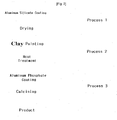
- Figure 2 is a brief diagram of process for preparing the ceramic filter according to the present invention.
- the present invention relates a ceramic filter comprising:
- the third coating layer formed on the second coating layer and containing aluminum phosphate is formed on the third coating layer and containing aluminum phosphate.
- One embodiment of the ceramic filter according to the present invention is characterized in that it is capable of complementing a phenomenon of changing the filter shape, by adding to the outside of ceramic filter a coating layer containing clay that hardens after drying and heat treatment, and thus has excellent insulation effect and mechanical strength.
- Another embodiment of the ceramic filter according to the present invention is characterized in that it minimizes cracks that may be caused on the outer wall during drying and calcining process by adding to the outside of the ceramic filter ceramic paper impregnated in the slurry containing clay, and has a uniform thickness of the outer wall and thus is not needed any polishing process.
- the shape of ceramic filter according to the present invention includes preferably, but not limited to, the honeycomb structure including a wave-shaped ceramic paper and a plate-shaped ceramic paper.
- Said ceramic paper is not specifically limited as long as it is prepared by paper making methods commonly used in this field. However, considering the strength and porosity property after calcining, it includes one or more ceramic fibers selected from the group consisting of alumina, alumino silicate, alumino borosilicate and mullite.
- the second coating layer of ceramic filter comprises one or more clays consisting of bentonite, kaolin, agalmatolite and talc, and ceramic fibers.
- the amount of clay to ceramic fibers is not limited, but preferably a ratio by weight of 6 - 60: 1. If the ratio of clay is less than 6, the outer wall of clay may be separated from the filter. If the ratio is in excess of 60, cracks may be caused during drying process.
- the second coating layer of ceramic filter comprises ceramic papers, and the clay coating layer, formed on said ceramic paper, containing one or more clays selected from the group consisting of bentonite, kaolin, agalmatolite and talc; silica sol; and ceramic powders.
- said ceramic paper uses the same materials as those of ceramic filter body. Specifically, it comprises one or more ceramic fibers selected from the group consisting of alumina, alumino silicate, alumino borosilicate and mullite.
- said ceramic powder may provide additional functions, such as strength, heat transfer efficiency or insulation efficiency, using one or more selected from the group consisting of SiC, alumina, zirconia, and silica.
- the present invention also relates to a process for preparing a ceramic filter comprising the steps of
- the step (a) above is a process in which a porous ceramic filter obtained by bonding a wave-shaped ceramic paper and a plate-shaped ceramic paper is firstly coated with an aluminum silicate solution having good adhesion and affinity to said ceramic paper to form a primer layer.
- the porous ceramic paper used in the step (a) above may be prepared by common paper-making methods used in this field.
- the slurry solution used in said paper-making methods contains 5 to 30 parts by weight of an organic fiber and 0.1 to 20 parts by weight of an organic binder relative to 100 parts by weight of the ceramic fiber.
- Said ceramic fiber is obtained by materials which can stand at a temperature of 1200 °C or more, and use those that at least one of alumina or silica is contained, such as alumina, alumino silicate, and the like.
- the ceramic fiber selected from the group consisting of alumina, alumino silicate, alumino borosilicate, and mullite may be used.
- the ceramic fiber has a diameter of 1-20 microns, and more preferably 2-7 microns, and a length of 0.1-10 mm.
- the amount of ceramic fiber is 50-80 parts by weight, and preferably 70-80 parts by weight, based on total solid contents in the slurry.
- the amount of ceramic fiber is less than 50 parts by weight, it may have adverse effect on strength and porosity property after calcining. If the amount is in excess of 80 parts by weight, the amounts of organic fiber and organic binder are so low that tensile strength may be lowered in the wave-shaping step.
- Said organic fiber may be selected from the group consisting of natural fiber such as cellulose fiber, and hemp; synthetic fiber such as nylon, rayon, polyester, polypropylene, polyethylene, aramid, and acryl fiber; and mixtures thereof, wherein a specific example of aramid fiber includes Kevlar fiber which is commercially available from DuPont.
- the amount of organic fiber is preferably 5-30 parts by weight relative to 100 parts by weight of the ceramic fiber in the slurry. If the amount is less than 5 parts by weight, tensile strength may be lowered. If the amount is in excess of 30 parts by weight, strength may be lowered since an excess of alumina phosphate hollow fiber is present after heat treatment.
- Organic binders include acryl based binders, polyvinyl alcohol, cationic starches, epoxy based binders, and the like. They may be used alone or in admixture of each other, and improve bonding strength between fibers in the paper-making process.
- the amount of organic binder is 0.1 to 20 parts by weight relative to 100 parts by weight of the ceramic fiber. When the amount is less than 0.1 parts by weight, fibers are not bonded to each other. When the amount is in excess of 20 parts by weight, the ceramic paper has high fluidity and shows adhesiveness. Therefore, it is not easy to handle it.
- Organic binders should have flexibility for higher glass transition temperature than room temperature and the three dimensional structure.
- water may be included in said slurry solution.
- the amount of water used in the slurry solution is not critical, but is as much as all steps are smoothly maintained.
- the present invention may remove an excess amount of water through a vacuum pump connected to a paper-making machine, and the remaining excess amount of water through a press machine.
- the slurry solution of the present invention may further comprise a common pH controlling agent for improving bonding strength of the organic binder to the ceramic fiber or the organic fiber.
- pH controlling agents are not specifically limited as long as they are conventionally used in this field.
- pH of the slurry solution may be maintained between 5.5 and 6.5 by using alum (aluminum sulfate).
- the ceramic filter according to the present invention is prepared in the honeycomb forms by wave-shaping the ceramic green paper prepared as above and then bonding the wave-shaped ceramic paper and the plate-shaped ceramic paper together.
- the third step to provide an outer wall of ceramic filter according to the present invention is preferably carried out after preparing the ceramic filter with honeycomb forms.
- the wave-shaping process may be conducted by using a wave-shaping machine conventionally used in this field.
- the aluminum silicate solution in the step (a) above comprises a mixture of alcohol, aluminum nitrate, tetra-alkyl orthosilicate and hydrochloric acid. Boric acid may be further added thereto.
- the amount of each component in the aluminum silicate solution is preferably 0.2-0.5 moles of alcohol, 0.01-0.02 moles of aluminum nitrate, and 0.1x10 -3 ⁇ 0.2x10 -3 moles of hydrochloric acid, based on 1 mole of tetra-alkyl orthosilicate.
- tetra-alkyl orthosilicate is not specifically limited, and preferably includes tetra-methyl orthosilicate or terta-ethyl orthosilicate (TEOS, below).
- TEOS terta-ethyl orthosilicate
- an example of said alcohol is not specifically limited, and selected from the group consisting of lower alcohol with 1 to 6 of carbon atoms, such as ethanol, methanol, isopropyl alcohol and propanol. If the amount of said alcohol is increased, concentration of total aluminum silicate solution is lowered and thus, the coating layer with an appropriate thickness is not easy formed. If the amount of said alcohol is less than 0.2 moles, there is a problem that viscosity of the coating solution is too high upon forming gel. Also, if the amount of aluminum nitrate is less than 0.01 moles, it is difficult to form aluminum silicate. If the amount of aluminum nitrate is in excess of 0.02 moles, it is not dissolved well in alcohol.
- lower alcohol with 1 to 6 of carbon atoms such as ethanol, methanol, isopropyl alcohol and propanol.
- boric acid is added in a minimal amount and has actions that it increases bonding strength of the inorganic binder by replacing partially with aluminum ions and contributes to thermal stability at high temperature. Preferably, it is added in the minimal amount of 0.01 to 0.02 moles relative to 1 mole of tetra-alkyl orthosilicate.
- the ceramic filter coated with said aluminum silicate solution When the ceramic filter coated with said aluminum silicate solution is subjected to a drying step, it is carried out at room temperature to 200°C regardless of time. It is sufficient to dry for 1 hr at 150°C, considering normal schedule in the process.
- the step (b) comprises forming the second coating layer on the first coating layer with a composition containing clay.
- the step (b) may use a method of direct forming the second coating layer containing clay on the first coating layer and a method of providing a ceramic paper having the same material as the ceramic filter with the coating layer containing clay thereon followed by attaching it to the first coating layer.
- the method of direct forming said second coating layer on the first coating layer refers to a process that the clay composition is applied to the outer wall of ceramic filter on which the first coating layer is formed, dried and then, heat treated to increase strength of the filter and give insulation effect to the filter.
- the clay applied in the above process should not be caused to crack during drying and heat treatment.
- the outer wall is prepared by using the clay composition comprising water in which bentonite and ceramic fibers are dispersed
- the viscosity that clay does not cause to crack during the above process may be obtained.
- components of clay 12 to 25 parts by weight of clay selected from the group consisting of bentonite, kaolin, agalmatolite and talc and 0.2 to 2 parts by weight, more preferably 0.5 to 1.5 parts by weight, of ceramic fibers are added, based on 100 parts by weight of water.
- the viscosity of the clay composition may depend on a kind of bentonite. Most preferably, clay is bentonite.
- Bentonite is a mineral including montmorilloinite as a main component. Swellability and gel-forming ability of bentonite upon absorbing water vary with a kind of cationic ions present between layers of bentonite. Bentonite includes roughly Ca-bentonite and Na-bentonite. Na-bentonite has fine particles, high swellability, and high gel-forming ability upon absorbing water as well. Therefore, as the bentonite used in the present process, Na-bentonite having high content of montmorillonite is more preferably used. Specifically, it is advantageous to use bentonite having less than 1% of Ca and 1% or more of Na for preparing the clay composition with a viscosity appropriate to painting.
- ceramic fibers used in said clay composition are not limited, and may use those used in preparing the ceramic filter. That is, the ceramic fiber comprises preferably a material which can stand at high temperature of 1200 °C or more, considering that it is used as the filter at high temperature.
- the length of ceramic fiber is 0.1 ⁇ 0.5 mm. If the amount of ceramic fiber is less than 0.2 parts by weight, cracks may be caused during drying process. If the amount of ceramic fiber is more than 2.0 parts by weight, the outer wall of clay may be separated from the filter after the final heat treatment in the third step.
- water is not limited, but preferably the distilled water is used in that it does not change physical properties of bentonite.
- the ceramic filter coated with said aluminum silicate solution When the ceramic filter coated with said aluminum silicate solution is subjected to a drying step, it is carried out at room temperature to 200°C regardless of time. It is sufficient to dry at 150°C for 1 hr, considering normal schedule in the process.
- the heat treatment is preferably carried out at a temperature of 400 to 1100°C in air for burning organics. Since it is sufficient to solidify the outer wall material of clay in the second step, the heat treatment at least 400°C is effective.
- the method of providing a ceramic paper having the same material as the ceramic filter with the coating layer containing clay thereon followed by attaching it on the first coating layer comprises the following steps:
- step 1 preparing a ceramic paper from the slurry solution containing ceramic fibers
- step 2 impregnating the ceramic paper into the slurry containing clay
- step 3 attaching the ceramic paper impregnated in the slurry to the first coating layer (step 3).
- the outer wall ceramic paper attached to the ceramic filter body is characterized in that it comprises the same materials as those of the filter body. Therefore, as described previously about the filter body, the outer wall of filter as ceramic paper may be prepared from the slurry for preparing the ceramic paper including 5 to 30 parts by weight of an organic fiber and 0.1 to 20 parts by weight of an organic binder, relative to 100 parts by weight of ceramic fibers.
- the ceramic paper of the filter outer wall used in the present invention may be prepared by a conventional ceramic green paper-making method used in this field.
- the slurry solution may comprise, in addition to the ceramic fibers, an organic fiber, preferably one or more organic fibers selected from the group consisting of natural fiber such as needle-leaf tree pulp, wood fiber, and hemp; synthetic fiber such as nylon, rayon, polyester, polypropylene, polyethylene, aramid, and acryl; and mixtures thereof.
- the slurry solution may further comprise a small amount of the organic binder. Components contained in the slurry solution for preparing the ceramic green paper are described in the filter body above.
- the slurry containing clay includes preferably 1 to 5 parts by weight of clay selected from the group consisting of bentonite, kaolin, agalmatolite and talc; 1 to 5 parts by weight of silica sol; and 10 to 15 parts by weight of one or more ceramic powders selected from the group consisting of SiC, alumina, zirconia, and silica relative to 100 parts by weight of water.
- said solid content contained in the slurry is preferably ceramic powders such as SiC, alumina, zirconia, silica and the like.
- the viscosity of said slurry is not specifically limited as long as impregnation may be smoothly carried out.
- the outer wall impregnated in the slurry obtained in the step 2) is attached to the outside of ceramic filter body.
- the slurry containing clay present on ceramic paper for the outer wall can be attached to the body by itself, but if desired, an additional adhesive may be used.
- the adhesive includes starch powders. More preferably, it uses together with silica powder for enhancing bonding strength after heat treatment at high temperature.
- the method of providing ceramic paper having the same material as the ceramic filter with the coating layer containing clay thereon followed by attaching it to the first coating layer may comprises further a step in which the ceramic filter formed in the step 3) is dried at room temperature to 200°C, and is subjected to heat treatment at a temperature of 400 to 1100°C. Said heat treatment is preferably carried out in vacuum, inert gas or air. If said heat treatment temperature is lower than 400 °C, organic components are not removed fully. If it is in excess of 1100 °C, the strength of ceramic filter may be lowered.
- the present invention prevents from causing cracks by impregnating filter outer wall having the same material as the ceramic filter body into the slurry, bonding it to the ceramic filter body, and being subject to heat treatment to in-corporate both without difference of the coefficient of thermal expansion.
- the step (c) is a process obtaining the final ceramic filter with excellent mechanical strength and porosity by secondary coating it with the aluminum phosphate solution having excellent bonding strength to the layer comprising said aluminum silicate and low viscosity, to form a precursor of the inorganic binder, and being subjected to heat treatment at high temperature.
- Said step (c) comprises secondary coating the ceramic filter obtained through steps (a) and (b) with aluminum phosphate and finally calcining it.
- the aluminum phosphate solution used in the present invention contains aluminum nitrate and phosphoric acid, and preferably has a P/A1 atomic ratio of 3-50. If the atomic ratio is less than 3, solubility of alumina is very low, and aluminum phosphate cannot be smoothly formed. If the atomic ratio is in excess of 50, then the concentration of alumina is low due to the excess amount of phosphoric acid to deteriorate the performance, and the surface of fiber is damaged to lower the strength.
- the weight of aluminum phosphate in the aluminum phosphate solution is preferably 1-80 parts by weight, based on the solid contents.
- the coating should be repeated several times to coat a required amount. If the weight is in excess of 80 parts by weight, the closure of pores may be caused due to the excessive amount of aluminum phosphate remaining in the pores.
- the step of calcining the final ceramic filter in the third step is preferably calcined in vacuum, inert gas or air at a temperature of 800 to 1100°C. If said calcining temperature is lower than 800 °C, organic components are not removed fully. If it is in excess of 1100 °C, said aluminum phosphate may be modified to lower the strength.
- the method of coating coiled ceramic papers with a solution of aluminum silicate and aluminum phosphate is not specifically limited, but may be carried out, for example, by impregnating or spraying.
- steps (a) to (c) in the present invention can be carried out only one time, but aluminum phosphate coating and calcining processes of the step (c) may be additionally carried out for improving the strength.
- 3g of alumina-silica fiber having an average length of 300 ⁇ was added to 2000 ml of water, and the mixture was dispersed with vigorously stirring. Then, pulp of needle-leaf tree as an organic fiber was introduced into the resulting dispersion in the amount of 25 % by weight relative to the ceramic fiber, and an acryl binder was added thereto in the amount of 10 % by weight relative to the ceramic fiber for flexibility of ceramic papers, and 1 ml of 1 % aqueous solution of ammonium aluminum sulfate with pH 3 was added thereto to adjust the pH of the total slurry solution to about 5.5.
- the slurry solution was mildly continued to stirring to evenly mix solid contents therein, followed by preparing a ceramic green paper with 9.5 cm of diameter and 800 ⁇ of thickness using a paper-making machine. Then, the ceramic green paper prepared above was dried in air at room temperature for 30 minutes, and then further dried in a vacuum oven at 100 °C to remove the remaining water.
- the ceramic green paper was wave-shaped using drum whose lengths of valley and pitch are manufactured by 3 mm, and wave-shaping machine whose surface temperature and feeding rate are adjusted, to prepare the ceramic wave-shaped paper.
- the plate-shaped ceramic paper was prepared by the same method as example 1-(1), except for not wave-shaping.
- the plate-shaped ceramic paper was placed on the underlying part of the wave-shaped ceramic paper prepared above, and applied an adhesive to both contacting surfaces to bond them. At that time, starch powder was used as the adhesive, and silica powders were added thereto for enhancing the bonding strength after heat treatment at high temperature. In such state that upper lying part and underlying part were bonded, the bonded paper was coiled to the shape of cochlea, and heated at 100°C to dryness to prepare the coiled ceramic filter.
- the degree of forming cracks according to contents of water and ceramic fiber was identified using three types of bentonite (Volclay-NF-BC, Cosmetic bentonite, Laundry bentonite) contents of Ca and Na as indicated in Table 1 below. Specific compositions thereof were as follows:
- Swellability of each bentonite was slightly different from each other and thus the viscosity appropriate for painting was selected by slightly varying the amount of water.
- As a ceramic fiber 0.1 to 0.5 mm of mullite fiber was used, and each amount was changed to 0, 0.25 parts by weight, 0.5 parts by weight, 1 part by weight, 2 parts by weight, 4 parts by weight, based on 100 parts by weight of water.
- the ceramic filter painted by clay was dried at 150°C.
- volclay-NF-BC when 12 parts by weight of volclay-NF-BC was added, it showed to be slightly thin, whereas when 25 parts by weight of volclay-NF-BC was added, it showed a paste form. When 18 g of volclay-NF-BC was added, the optimal viscosity useful in painting was obtained.
- the clay composition was prepared by the same method as Example 2 to measure the physical property, except that the amount of volclay-NF-BC was less than 12 g. As a result, cracks were not caused during drying, but the clay showed a phenomenon that it was stripped from the filter after final calcining.
- the clay composition was prepared by the same method as Example 2 to measure the physical property, except that the amount of volclay-NF-BC was in excess of 25 g. As a result, the viscosity was so high that it was disadvantageous in painting, and cracks were caused during drying and heat treatment procedures.
- Process 1 process of coating the filter with aluminum silicate solution (Primary coating solution)
- the coiled ceramic paper filter prepared in Example 1 above was dipped in aluminum silicate solution for 30 seconds, removed and dried at 150°C.
- the aluminum silicate solution above was prepared by dissolving 40 g of aluminum nitrate and 0.4 g of boric acid in 100 ml of ethanol, adding 16 ml of 0.1M hydrochloric acid to the mixture with stirring, and adding 100 ml of TEOS thereto.
- the clay prepared in Example 2 by adding 0.5 parts by weight of the ceramic fiber and 18 parts by weight of volclay-NF-BC to 100 parts by weight was used.
- the ceramic filter was prepared through heat treatment at 400°C.
- the outer wall thickness of clay is not important. However, the thicker its thickness is, the heavier its weight is, whereas the thinner its thickness is, the lower its strength is. Therefore, the appropriate thickness is preferably 2 mm.
- Process 3 step of coating the filter with aluminum phosphate solution
- the coiled ceramic filter was impregnated in the aluminum phosphate solution for 30 seconds.
- the aluminum phosphate solution with a P/Al atomic ratio of 7.5 was prepared by dissolving 75 g of aluminum nitrate and 5 g of boric acid in 100 ml of distilled water and adding 100 ml of 85 % phosphate solution thereto.
- the particular drying procedure is not required for the ceramic filter impregnated in the aluminum phosphate solution.
- the solution is boiled to show a phenomenon that the ceramic filter has a rough surface. Therefore, the ceramic filter was subjected to heat treatment by calcining it at 1000°C in air to prepare the coiled ceramic filter.
- the ceramic filter was prepared by the same method as Example 2 above, except that in Process 1 of Example 3, the amounts of aluminum nitrate and boric acid in the primary coating solution were fixed and the amounts of TEOS and hydrochloric acid were reduced. That is, the primary coating solution prepared by dissolving 40 g of aluminum nitrate and 0.4 g of boric acid in 100 ml of ethanol, adding 1 ml of 0.1M hydrochloric acid thereto with stirring, and adding 50 ml of TEOS thereto, was used.
- the ceramic filter was prepared by the same method as Example 2 above, except that in Process 3 of Example 3, the amount of phosphoric acid in the aluminum phosphate solution was fixed, the amount of distilled water was increased and the amount of aluminum nitrate was reduced. That is, the secondary coating solution with a P/Al atomic ratio of 15 was prepared by dissolving 37.5 g of aluminum nitrate and 3 g of boric acid in 200 ml of distilled water, adding 100 ml of 85% phosphoric acid solution thereto. The ceramic filter completing Process 2 was dipped in the secondary coating solution for 30 seconds, removed, and calcined at 1,000°C to prepare the coiled ceramic filter.
- Example 3 The same method as Example 3 above was carried out except that the clay coating of Process 2 in Example 3 was not practiced.
- alumina-silica fiber having an average length of 300 ⁇ was added to 2000 ml of water, 0.09 g of Kevlar organic fiber was added thereto and the fiber was dispersed with vigorously stirring. Then, pulp of needle-leaf tree as organic fiber was introduced into the resulting dispersion in the amount of 26.4 % by weight relative to the ceramic fiber, and an organic binder was added thereto in each amount of 0.3 % by weight, 0.1 % by weight, 0.1 % by weight and 0.1 % by weight relative to the ceramic fiber for flexibility of the ceramic paper.
- the slurry solution was mildly continued to stirring to evenly mix solid contents therein, followed by preparing a ceramic green paper with 400 ⁇ of thickness using a paper-making machine. Then, the ceramic green paper prepared above was dried at room temperature, and then the remaining water was dried by drum dryer to use the outer wall of filter.
- the ceramic green paper prepared in Preparation of outer wall of filter above was wave-shaped in a feeding rate of 2-10 m/minute at the surface temperature of 150°C, using a wave-shaping machine (Model: KIER, manufacturer: Wha-Sung Instrument, lengths of valley and pitch: 2 mm and 3 mm, respectively).
- the ceramic green paper prepared in Preparation of outer wall of filter above was used as plate type ceramic paper.
- the plate-shaped ceramic paper prepared by the method above was placed on the underlying part of the wave-shaped ceramic paper prepared above, and applied an adhesive to both contacting surfaces to bond them. At that time, starch powders were used as the adhesive, and silica powder was added thereto for enhancing the bonding strength after heat treatment at high temperature. In such state that upper lying part and underlying part were bonded, the bonded paper was coiled to the shape of cochlea, and heated at 100°C to dryness to prepare the honeycomb type ceramic filter.
- the first coating solution was prepared by dissolving 5 g of aluminum nitrate and 0.5 g of boric acid in 10 ml of alcohol, adding 1.6 ml of 0.1 M hydrochloric acid thereto with stirring, and adding 10 ml of TEOS thereto.
- the honeycomb type ceramic filter prepared above was dipped in the first coating solution for 5 seconds, removed and dried at 120°C.
- the outer wall of filter prepared in the step (1) above was dipped in the slurry for outer wall, which was prepared by ball milling the aqueous slurry for outer wall containing 3 parts by weight of bentonite clay, 3 parts by weight of silica sol and 15 parts by weight of solid contents (SiC powder) and water as a medium of slurry for 3 hours. After the end of dipping, the resulting outer wall was adhered to the outside of ceramic filter body prepared in the step (2) above, dried overnight at room temperature to prepare the ceramic filter that the outer wall was bonded to be integrated.
- the secondary coating solution with a P/A1 atomic ratio of 7.5 was prepared by dissolving 7.5 g of aluminum nitrate and 0.5 g of boric acid in 10 ml of distilled water and adding 10 ml of 85% phosphoric acid solution thereto.
- Said ceramic filter that the outer wall was bonded to be integrated was dipped in the secondary coating solution for 5 seconds, removed, dried at 120°C, and calcined at 800°C in air to prepare the honeycomb type ceramic filter.
- the outer wall of ceramic filter according to the present invention is prepared using clay. Therefore, conventional heat treatment processes may be largely reduced by optimizing coating with inorganic binder and calcining processes, and thus the cost may be reduced.
- the ceramic filter has high operating efficiency of filter due to insulation effect of the outer wall of clay as well as increase of strength.
Landscapes
- Chemical & Material Sciences (AREA)
- Engineering & Computer Science (AREA)
- Ceramic Engineering (AREA)
- Organic Chemistry (AREA)
- Structural Engineering (AREA)
- Materials Engineering (AREA)
- Manufacturing & Machinery (AREA)
- Chemical Kinetics & Catalysis (AREA)
- Inorganic Chemistry (AREA)
- Geometry (AREA)
- Physics & Mathematics (AREA)
- Geology (AREA)
- Life Sciences & Earth Sciences (AREA)
- Filtering Materials (AREA)
- Producing Shaped Articles From Materials (AREA)
- Devices For Post-Treatments, Processing, Supply, Discharge, And Other Processes (AREA)
Claims (14)
- Filtre céramique, comprenant :une première couche qui est formée à l'extérieur du corps de filtre céramique et qui contient du silicate d'aluminium ;une deuxième couche qui est formée sur la première couche et qui contient de l'argile et une fibre céramique ; etune troisième couche qui est formée sur la deuxième couche et qui contient du phosphate d'aluminium.
- Filtre céramique selon la revendication 1, dans lequel le filtre céramique a une structure en nid d'abeille comprenant un papier céramique en forme de vague et un papier céramique en forme de plaque.
- Filtre céramique selon la revendication 1, dans lequel l'argile est au moins un élément choisi dans le groupe constitué de bentonite, kaolin, agalmatolite et talc.
- Filtre céramique selon la revendication 3, dans lequel l'argile est la Na-bentonite ayant 1% ou plus de Na.
- Filtre céramique selon la revendication 1, dans lequel la deuxième couche comprend un papier céramique, et une couche de revêtement contenant de l'argile formée sur ledit papier céramique.
- Filtre céramique selon la revendication 5, dans lequel la couche de revêtement contenant de l'argile comprend de l'argile, du sol silicieux et de la poudre céramique.
- Filtre céramique selon la revendication 6, dans lequel la poudre céramique est au moins un élément choisi dans le groupe constitué de SiC, d'alumine, de zircone et de silice.
- Processus de préparation d'un filtre céramique, comprenant l'étape qui consiste à :(a) former une première couche à l'extérieur du corps de filtre céramique avec une solution contenant du silicate d'aluminium ;(b) former une deuxième couche sur la première couche avec une solution contenant de l'argile et une fibre céramique ; et(c) former une troisième couche sur la deuxième couche avec une solution contenant du phosphate d'aluminium.
- Processus selon la revendication 8, dans lequel la solution dans l'étape (a) comprend de l'orthosilicate de tétraalkyle, de l'alcool, du nitrate d'aluminium et de l'acide chlorhydrique.
- Processus selon la revendication 8, dans lequel la solution dans l'étape (b) comprend 100 parties en poids d'eau ; 12 à 25 parties en poids d'argile ; et 0,2 à 2 parties en poids de fibres céramiques.
- Processus selon la revendication 8, dans lequel l'étape (b) comprend l'étape qui consiste à :(1) imprégner un papier céramique dans la suspension contenant de l'argile ; et(2) fixer le papier céramique sur la première couche.
- Processus selon la revendication 8, comprenant en outre l'étape qui consiste à :sécher le filtre céramique à température ambiante à 200°C après l'étape (b) ; etsoumettre le filtre céramique à un traitement thermique à une température de 400 à 1100°C.
- Processus selon la revendication 8, dans lequel la solution contenant du phosphate d'aluminium comprend du nitrate d'aluminium et de l'acide phosphorique.
- Processus selon la revendication 8, comprenant en outre l'étape qui consiste à calciner le papier céramique sur lequel est formée la troisième couche à une température de 800 à 1100°C.
Applications Claiming Priority (2)
| Application Number | Priority Date | Filing Date | Title |
|---|---|---|---|
| KR1020060029764A KR100836059B1 (ko) | 2006-03-31 | 2006-03-31 | 점토를 포함하는 세라믹 필터 및 그 제조 방법 |
| PCT/KR2007/001606 WO2007114626A1 (fr) | 2006-03-31 | 2007-04-02 | Filtre céramique composé d'argile et procédé de préparation afférent |
Publications (3)
| Publication Number | Publication Date |
|---|---|
| EP2007496A1 EP2007496A1 (fr) | 2008-12-31 |
| EP2007496A4 EP2007496A4 (fr) | 2009-07-08 |
| EP2007496B1 true EP2007496B1 (fr) | 2013-11-06 |
Family
ID=38563857
Family Applications (1)
| Application Number | Title | Priority Date | Filing Date |
|---|---|---|---|
| EP07745769.5A Not-in-force EP2007496B1 (fr) | 2006-03-31 | 2007-04-02 | Filtre céramique composé d'argile et procédé de préparation afférent |
Country Status (6)
| Country | Link |
|---|---|
| US (1) | US8388719B2 (fr) |
| EP (1) | EP2007496B1 (fr) |
| JP (1) | JP5091226B2 (fr) |
| KR (1) | KR100836059B1 (fr) |
| CN (1) | CN101443093B (fr) |
| WO (1) | WO2007114626A1 (fr) |
Families Citing this family (17)
| Publication number | Priority date | Publication date | Assignee | Title |
|---|---|---|---|---|
| KR101228278B1 (ko) * | 2009-04-21 | 2013-01-30 | (주)엘지하우시스 | 다공성 세라믹 구조체 및 이를 포함하는 제습/가습 장치 |
| KR20110113880A (ko) * | 2010-04-12 | 2011-10-19 | (주)엘지하우시스 | 수명 특성이 우수한 가습 매체 및 그 제조 방법 |
| KR20120025112A (ko) * | 2010-09-07 | 2012-03-15 | 웅진코웨이주식회사 | 필터카트리지 |
| WO2012051621A2 (fr) * | 2010-10-15 | 2012-04-19 | Set Industries Corporation | Procédé et dispositif d'éclairage |
| ES2521022T3 (es) * | 2010-11-09 | 2014-11-12 | Atech Innovations Gmbh | Cerámica a partir de estructuras de papel y/o de cartón precerámicas |
| US20140199482A1 (en) * | 2011-09-27 | 2014-07-17 | Dow Global Technologies Llc | Cement and skinning material for ceramic honeycomb structures |
| KR20140104482A (ko) | 2011-12-15 | 2014-08-28 | 다우 글로벌 테크놀로지스 엘엘씨 | 수-팽윤성 점토에 기반한 시멘트 및 스키닝 물질, 및 세그먼트화 또는 스키닝된 세라믹 허니컴 구조의 제조 방법 |
| KR101417243B1 (ko) * | 2012-01-05 | 2014-07-09 | (주)엘지하우시스 | 무기바인더를 포함한 유리섬유 보드 및 그의 제조 방법 |
| CN106693551A (zh) * | 2015-11-16 | 2017-05-24 | 株式会社昌承 | 高密集开槽式陶瓷过滤器及其制造方法 |
| FR3078533B1 (fr) * | 2018-03-01 | 2023-04-21 | Prayon | Procede de fabrication d'un materiau ceramique pour le stockage thermique d'energie |
| CA3132555A1 (fr) | 2019-03-08 | 2020-09-17 | Steve C. Benesi | Appareil de filtre, secteurs de disque de filtre, elements de filtre et utilisations |
| CN110937924A (zh) * | 2019-11-28 | 2020-03-31 | 宜兴王子制陶有限公司 | 一种高捕集率低背压蜂窝陶瓷孔道内壁涂层及其制备方法 |
| CN110922201B (zh) * | 2019-12-05 | 2021-11-30 | 新乡市天诚航空净化设备有限公司 | 一种陶瓷纤维滤芯制备方法、滤芯及制备系统 |
| CN111203032B (zh) * | 2020-01-13 | 2022-10-14 | 南京公诚节能新材料研究院有限公司 | 一种微孔纤维球生物滤料及其制备方法 |
| CN111704446B (zh) * | 2020-06-03 | 2022-08-05 | 蒙娜丽莎集团股份有限公司 | 一种钠基膨润土型发泡陶瓷坯体、钠基膨润土型发泡陶瓷砖及其制备方法 |
| CN112159239B (zh) * | 2020-09-28 | 2022-07-15 | 景德镇陶瓷大学 | 一种卷式陶瓷膜支撑体的制备方法及其陶瓷膜制品 |
| CN115246744A (zh) * | 2021-12-29 | 2022-10-28 | 浙江理工大学 | 一种耐火隔热碳化硅纳米纤维-蒙脱土陶瓷无纺布的制备方法 |
Family Cites Families (27)
| Publication number | Priority date | Publication date | Assignee | Title |
|---|---|---|---|---|
| US4142864A (en) * | 1977-05-31 | 1979-03-06 | Engelhard Minerals & Chemicals Corporation | Catalytic apparatus |
| JPS58223420A (ja) * | 1982-06-21 | 1983-12-26 | Matsushita Electric Ind Co Ltd | 繊維セラミツクフイルタ素子の製造方法 |
| US4961917A (en) * | 1989-04-20 | 1990-10-09 | Engelhard Corporation | Method for reduction of nitrogen oxides with ammonia using promoted zeolite catalysts |
| JPH04301402A (ja) * | 1991-03-29 | 1992-10-26 | Matsushita Electric Ind Co Ltd | ハニカム構造セラミックス |
| US5145825A (en) * | 1991-04-08 | 1992-09-08 | Engelhard Corporation | Oxidation catalyst resistant to sulfation |
| CZ241993A3 (en) * | 1991-05-13 | 1994-04-13 | Minnesota Mining & Mfg | Composite filter based on ceramic matrix and ceramic fibers |
| JPH04354543A (ja) * | 1991-05-31 | 1992-12-08 | Matsushita Electric Ind Co Ltd | ハニカム構造セラミックス |
| JPH05306614A (ja) * | 1992-04-28 | 1993-11-19 | Matsushita Electric Ind Co Ltd | 排気ガスフィルタとその製造方法 |
| JP2816098B2 (ja) * | 1994-08-02 | 1998-10-27 | 日本碍子株式会社 | ハニカム構造体及びその製造方法 |
| ATE322327T1 (de) * | 1997-01-31 | 2006-04-15 | Takasago Thermal Engineering | Reinigungsvorrichtung, filter und methode zu ihrer herstellung |
| EP0884459A3 (fr) * | 1997-06-13 | 2002-12-11 | Corning Incorporated | Substrats de convertisseurs catalytiques enduits et supports |
| JP3977514B2 (ja) * | 1998-05-26 | 2007-09-19 | 高砂熱学工業株式会社 | 空気浄化フィルタ及びその製造方法及び高度清浄装置 |
| JP2001280124A (ja) * | 2000-03-31 | 2001-10-10 | Ngk Insulators Ltd | セル構造体収納容器及びそのアッセンブリ |
| US20030165638A1 (en) * | 2001-07-06 | 2003-09-04 | Louks John W. | Inorganic fiber substrates for exhaust systems and methods of making same |
| EP1423345A2 (fr) | 2001-07-06 | 2004-06-02 | 3M Innovative Properties Company | Substrats en fibres inorganiques pour systemes d'echappement et leurs procedes de production |
| JP2003055028A (ja) * | 2001-08-10 | 2003-02-26 | Tokiwa Electric Co Ltd | 無機バインダ組成物、耐熱性シート材料、三次元中空構造体及び三次元中空構造体の製造方法 |
| US6606478B2 (en) * | 2001-08-27 | 2003-08-12 | Xerox Corporation | Composite transfer assist blade |
| US7541005B2 (en) * | 2001-09-26 | 2009-06-02 | Siemens Energy Inc. | Catalytic thermal barrier coatings |
| US6913059B2 (en) * | 2002-05-13 | 2005-07-05 | Industrial Ceramic Solutions | Ceramic fiber-based filter web and method |
| KR100690573B1 (ko) * | 2002-12-05 | 2007-03-09 | 주식회사 이비에스아이 | 세라믹 필터 및 그 제조방법 |
| KR100469066B1 (ko) * | 2003-04-14 | 2005-02-02 | 에스케이 주식회사 | 디젤차량 입자상 물질 제거용 필터 및 이의 제조방법 |
| US7083842B2 (en) * | 2003-07-28 | 2006-08-01 | Ngk Insulators, Ltd. | Honeycomb structure and process for production thereof |
| US7615194B2 (en) * | 2005-01-26 | 2009-11-10 | Nichias Corporation | Purification composition and filter for ozone-containing exhaust gas |
| JP2006298745A (ja) * | 2005-03-24 | 2006-11-02 | Ngk Insulators Ltd | ハニカム構造体の製造方法及びハニカム構造体 |
| KR100704010B1 (ko) * | 2005-07-25 | 2007-04-04 | 주식회사 엘지화학 | 세라믹 필터의 제조방법 및 이에 의해 제조된 세라믹 필터 |
| WO2007037222A1 (fr) * | 2005-09-28 | 2007-04-05 | Ibiden Co., Ltd. | Filtre en nid d’abeille |
| KR100784483B1 (ko) * | 2005-12-13 | 2007-12-11 | 주식회사 엘지화학 | 세라믹 필터 및 이의 제조방법 |
-
2006
- 2006-03-31 KR KR1020060029764A patent/KR100836059B1/ko not_active Expired - Fee Related
-
2007
- 2007-04-02 EP EP07745769.5A patent/EP2007496B1/fr not_active Not-in-force
- 2007-04-02 US US12/225,759 patent/US8388719B2/en not_active Expired - Fee Related
- 2007-04-02 WO PCT/KR2007/001606 patent/WO2007114626A1/fr not_active Ceased
- 2007-04-02 JP JP2009502695A patent/JP5091226B2/ja not_active Expired - Fee Related
- 2007-04-02 CN CN2007800170937A patent/CN101443093B/zh not_active Expired - Fee Related
Also Published As
| Publication number | Publication date |
|---|---|
| WO2007114626A1 (fr) | 2007-10-11 |
| EP2007496A4 (fr) | 2009-07-08 |
| CN101443093A (zh) | 2009-05-27 |
| JP2009532310A (ja) | 2009-09-10 |
| CN101443093B (zh) | 2011-12-07 |
| KR100836059B1 (ko) | 2008-06-09 |
| JP5091226B2 (ja) | 2012-12-05 |
| EP2007496A1 (fr) | 2008-12-31 |
| US8388719B2 (en) | 2013-03-05 |
| US20100115899A1 (en) | 2010-05-13 |
| KR20070098289A (ko) | 2007-10-05 |
Similar Documents
| Publication | Publication Date | Title |
|---|---|---|
| EP2007496B1 (fr) | Filtre céramique composé d'argile et procédé de préparation afférent | |
| EP2358359B1 (fr) | Revêtement céramique de peau à structure en nid d'abeille | |
| EP2328674B1 (fr) | Mat de montage avec protection de bord flexible et dispositif de traitement des gaz d échappement intégrant le mat de montage | |
| US7138168B2 (en) | Honeycomb structure body and method for manufacturing the same | |
| WO2004063539A2 (fr) | Substrats de fibres inorganiques destines a des systemes d'echappement et leurs procedes de production | |
| JP5841541B2 (ja) | ディーゼル粒状物のフィルター中の結合材の移行を軽減してフィルターの圧力低下と温度勾配とを減少するための、重合体のバリヤー被膜を製造する方法 | |
| KR100704010B1 (ko) | 세라믹 필터의 제조방법 및 이에 의해 제조된 세라믹 필터 | |
| EP2603676B1 (fr) | Matelas de fixation présentant une protection de bord flexible et dispositif de traitement des gaz d'échappement comprenant le matelas de fixation | |
| US8585908B2 (en) | Ceramic structure for water treatment, water treatment apparatus and method | |
| JPS5910345A (ja) | 触媒の担体 | |
| US20090035512A1 (en) | Honeycomb structure, process for producing the same, and bonding material | |
| US20140319742A1 (en) | Cement and skinning material based on a water-swellable clay, and method for producing segmented or skinned ceramic honeycomb structures | |
| CA2766653A1 (fr) | Procede de production de structures en nid d'abeille en mullite aciculaire cimentees et munies d'une peau | |
| KR101322153B1 (ko) | 다공질 세라믹 구조체, 그 제조방법 및 이를 포함하는 가습장치 | |
| KR101251228B1 (ko) | 외벽 일체형 세라믹 필터의 제조 방법 | |
| KR100826762B1 (ko) | 세라믹 필터 및 그 제조방법 | |
| KR100784483B1 (ko) | 세라믹 필터 및 이의 제조방법 | |
| JPH03193336A (ja) | 耐熱性ハニカム構造体 | |
| KR100817109B1 (ko) | 허니컴 구조체용 세라믹 페이퍼의 제조방법 및 이를 이용한허니컴 구조체 | |
| WO2007115275A1 (fr) | Filtres à liaison de carbone comprenant un frevêtement résistant à l'oxydation | |
| HK1160796B (en) | Ceramic honeycomb structure skin coating |
Legal Events
| Date | Code | Title | Description |
|---|---|---|---|
| PUAI | Public reference made under article 153(3) epc to a published international application that has entered the european phase |
Free format text: ORIGINAL CODE: 0009012 |
|
| 17P | Request for examination filed |
Effective date: 20081021 |
|
| AK | Designated contracting states |
Kind code of ref document: A1 Designated state(s): AT BE BG CH CY CZ DE DK EE ES FI FR GB GR HU IE IS IT LI LT LU LV MC MT NL PL PT RO SE SI SK TR |
|
| AX | Request for extension of the european patent |
Extension state: AL BA HR MK RS |
|
| A4 | Supplementary search report drawn up and despatched |
Effective date: 20090608 |
|
| 17Q | First examination report despatched |
Effective date: 20090928 |
|
| DAX | Request for extension of the european patent (deleted) | ||
| GRAP | Despatch of communication of intention to grant a patent |
Free format text: ORIGINAL CODE: EPIDOSNIGR1 |
|
| INTG | Intention to grant announced |
Effective date: 20130606 |
|
| GRAS | Grant fee paid |
Free format text: ORIGINAL CODE: EPIDOSNIGR3 |
|
| GRAA | (expected) grant |
Free format text: ORIGINAL CODE: 0009210 |
|
| AK | Designated contracting states |
Kind code of ref document: B1 Designated state(s): AT BE BG CH CY CZ DE DK EE ES FI FR GB GR HU IE IS IT LI LT LU LV MC MT NL PL PT RO SE SI SK TR |
|
| RAP1 | Party data changed (applicant data changed or rights of an application transferred) |
Owner name: LG CHEM, LTD. |
|
| REG | Reference to a national code |
Ref country code: GB Ref legal event code: FG4D |
|
| REG | Reference to a national code |
Ref country code: CH Ref legal event code: EP |
|
| REG | Reference to a national code |
Ref country code: AT Ref legal event code: REF Ref document number: 639039 Country of ref document: AT Kind code of ref document: T Effective date: 20131215 |
|
| REG | Reference to a national code |
Ref country code: IE Ref legal event code: FG4D |
|
| REG | Reference to a national code |
Ref country code: DE Ref legal event code: R096 Ref document number: 602007033662 Country of ref document: DE Effective date: 20140102 |
|
| REG | Reference to a national code |
Ref country code: NL Ref legal event code: VDEP Effective date: 20131106 |
|
| REG | Reference to a national code |
Ref country code: AT Ref legal event code: MK05 Ref document number: 639039 Country of ref document: AT Kind code of ref document: T Effective date: 20131106 |
|
| REG | Reference to a national code |
Ref country code: LT Ref legal event code: MG4D |
|
| PG25 | Lapsed in a contracting state [announced via postgrant information from national office to epo] |
Ref country code: FI Free format text: LAPSE BECAUSE OF FAILURE TO SUBMIT A TRANSLATION OF THE DESCRIPTION OR TO PAY THE FEE WITHIN THE PRESCRIBED TIME-LIMIT Effective date: 20131106 Ref country code: IS Free format text: LAPSE BECAUSE OF FAILURE TO SUBMIT A TRANSLATION OF THE DESCRIPTION OR TO PAY THE FEE WITHIN THE PRESCRIBED TIME-LIMIT Effective date: 20140306 Ref country code: LT Free format text: LAPSE BECAUSE OF FAILURE TO SUBMIT A TRANSLATION OF THE DESCRIPTION OR TO PAY THE FEE WITHIN THE PRESCRIBED TIME-LIMIT Effective date: 20131106 Ref country code: NL Free format text: LAPSE BECAUSE OF FAILURE TO SUBMIT A TRANSLATION OF THE DESCRIPTION OR TO PAY THE FEE WITHIN THE PRESCRIBED TIME-LIMIT Effective date: 20131106 Ref country code: SE Free format text: LAPSE BECAUSE OF FAILURE TO SUBMIT A TRANSLATION OF THE DESCRIPTION OR TO PAY THE FEE WITHIN THE PRESCRIBED TIME-LIMIT Effective date: 20131106 |
|
| PG25 | Lapsed in a contracting state [announced via postgrant information from national office to epo] |
Ref country code: LV Free format text: LAPSE BECAUSE OF FAILURE TO SUBMIT A TRANSLATION OF THE DESCRIPTION OR TO PAY THE FEE WITHIN THE PRESCRIBED TIME-LIMIT Effective date: 20131106 Ref country code: BE Free format text: LAPSE BECAUSE OF FAILURE TO SUBMIT A TRANSLATION OF THE DESCRIPTION OR TO PAY THE FEE WITHIN THE PRESCRIBED TIME-LIMIT Effective date: 20131106 Ref country code: ES Free format text: LAPSE BECAUSE OF FAILURE TO SUBMIT A TRANSLATION OF THE DESCRIPTION OR TO PAY THE FEE WITHIN THE PRESCRIBED TIME-LIMIT Effective date: 20131106 Ref country code: AT Free format text: LAPSE BECAUSE OF FAILURE TO SUBMIT A TRANSLATION OF THE DESCRIPTION OR TO PAY THE FEE WITHIN THE PRESCRIBED TIME-LIMIT Effective date: 20131106 |
|
| PG25 | Lapsed in a contracting state [announced via postgrant information from national office to epo] |
Ref country code: PT Free format text: LAPSE BECAUSE OF FAILURE TO SUBMIT A TRANSLATION OF THE DESCRIPTION OR TO PAY THE FEE WITHIN THE PRESCRIBED TIME-LIMIT Effective date: 20140306 |
|
| PG25 | Lapsed in a contracting state [announced via postgrant information from national office to epo] |
Ref country code: EE Free format text: LAPSE BECAUSE OF FAILURE TO SUBMIT A TRANSLATION OF THE DESCRIPTION OR TO PAY THE FEE WITHIN THE PRESCRIBED TIME-LIMIT Effective date: 20131106 |
|
| REG | Reference to a national code |
Ref country code: DE Ref legal event code: R097 Ref document number: 602007033662 Country of ref document: DE |
|
| PG25 | Lapsed in a contracting state [announced via postgrant information from national office to epo] |
Ref country code: IT Free format text: LAPSE BECAUSE OF FAILURE TO SUBMIT A TRANSLATION OF THE DESCRIPTION OR TO PAY THE FEE WITHIN THE PRESCRIBED TIME-LIMIT Effective date: 20131106 Ref country code: CZ Free format text: LAPSE BECAUSE OF FAILURE TO SUBMIT A TRANSLATION OF THE DESCRIPTION OR TO PAY THE FEE WITHIN THE PRESCRIBED TIME-LIMIT Effective date: 20131106 Ref country code: PL Free format text: LAPSE BECAUSE OF FAILURE TO SUBMIT A TRANSLATION OF THE DESCRIPTION OR TO PAY THE FEE WITHIN THE PRESCRIBED TIME-LIMIT Effective date: 20131106 Ref country code: SK Free format text: LAPSE BECAUSE OF FAILURE TO SUBMIT A TRANSLATION OF THE DESCRIPTION OR TO PAY THE FEE WITHIN THE PRESCRIBED TIME-LIMIT Effective date: 20131106 Ref country code: RO Free format text: LAPSE BECAUSE OF FAILURE TO SUBMIT A TRANSLATION OF THE DESCRIPTION OR TO PAY THE FEE WITHIN THE PRESCRIBED TIME-LIMIT Effective date: 20131106 |
|
| PLBE | No opposition filed within time limit |
Free format text: ORIGINAL CODE: 0009261 |
|
| STAA | Information on the status of an ep patent application or granted ep patent |
Free format text: STATUS: NO OPPOSITION FILED WITHIN TIME LIMIT |
|
| PG25 | Lapsed in a contracting state [announced via postgrant information from national office to epo] |
Ref country code: DK Free format text: LAPSE BECAUSE OF FAILURE TO SUBMIT A TRANSLATION OF THE DESCRIPTION OR TO PAY THE FEE WITHIN THE PRESCRIBED TIME-LIMIT Effective date: 20131106 |
|
| 26N | No opposition filed |
Effective date: 20140807 |
|
| REG | Reference to a national code |
Ref country code: DE Ref legal event code: R097 Ref document number: 602007033662 Country of ref document: DE Effective date: 20140807 |
|
| PG25 | Lapsed in a contracting state [announced via postgrant information from national office to epo] |
Ref country code: MC Free format text: LAPSE BECAUSE OF FAILURE TO SUBMIT A TRANSLATION OF THE DESCRIPTION OR TO PAY THE FEE WITHIN THE PRESCRIBED TIME-LIMIT Effective date: 20131106 Ref country code: LU Free format text: LAPSE BECAUSE OF FAILURE TO SUBMIT A TRANSLATION OF THE DESCRIPTION OR TO PAY THE FEE WITHIN THE PRESCRIBED TIME-LIMIT Effective date: 20140402 |
|
| REG | Reference to a national code |
Ref country code: CH Ref legal event code: PL |
|
| GBPC | Gb: european patent ceased through non-payment of renewal fee |
Effective date: 20140402 |
|
| REG | Reference to a national code |
Ref country code: IE Ref legal event code: MM4A |
|
| PG25 | Lapsed in a contracting state [announced via postgrant information from national office to epo] |
Ref country code: CH Free format text: LAPSE BECAUSE OF NON-PAYMENT OF DUE FEES Effective date: 20140430 Ref country code: LI Free format text: LAPSE BECAUSE OF NON-PAYMENT OF DUE FEES Effective date: 20140430 Ref country code: GB Free format text: LAPSE BECAUSE OF NON-PAYMENT OF DUE FEES Effective date: 20140402 |
|
| PG25 | Lapsed in a contracting state [announced via postgrant information from national office to epo] |
Ref country code: SI Free format text: LAPSE BECAUSE OF FAILURE TO SUBMIT A TRANSLATION OF THE DESCRIPTION OR TO PAY THE FEE WITHIN THE PRESCRIBED TIME-LIMIT Effective date: 20131106 |
|
| PG25 | Lapsed in a contracting state [announced via postgrant information from national office to epo] |
Ref country code: IE Free format text: LAPSE BECAUSE OF NON-PAYMENT OF DUE FEES Effective date: 20140402 |
|
| REG | Reference to a national code |
Ref country code: FR Ref legal event code: PLFP Year of fee payment: 10 |
|
| PG25 | Lapsed in a contracting state [announced via postgrant information from national office to epo] |
Ref country code: MT Free format text: LAPSE BECAUSE OF FAILURE TO SUBMIT A TRANSLATION OF THE DESCRIPTION OR TO PAY THE FEE WITHIN THE PRESCRIBED TIME-LIMIT Effective date: 20131106 |
|
| PG25 | Lapsed in a contracting state [announced via postgrant information from national office to epo] |
Ref country code: BG Free format text: LAPSE BECAUSE OF FAILURE TO SUBMIT A TRANSLATION OF THE DESCRIPTION OR TO PAY THE FEE WITHIN THE PRESCRIBED TIME-LIMIT Effective date: 20131106 |
|
| PG25 | Lapsed in a contracting state [announced via postgrant information from national office to epo] |
Ref country code: GR Free format text: LAPSE BECAUSE OF FAILURE TO SUBMIT A TRANSLATION OF THE DESCRIPTION OR TO PAY THE FEE WITHIN THE PRESCRIBED TIME-LIMIT Effective date: 20140207 Ref country code: CY Free format text: LAPSE BECAUSE OF FAILURE TO SUBMIT A TRANSLATION OF THE DESCRIPTION OR TO PAY THE FEE WITHIN THE PRESCRIBED TIME-LIMIT Effective date: 20131106 |
|
| PG25 | Lapsed in a contracting state [announced via postgrant information from national office to epo] |
Ref country code: TR Free format text: LAPSE BECAUSE OF FAILURE TO SUBMIT A TRANSLATION OF THE DESCRIPTION OR TO PAY THE FEE WITHIN THE PRESCRIBED TIME-LIMIT Effective date: 20131106 Ref country code: HU Free format text: LAPSE BECAUSE OF FAILURE TO SUBMIT A TRANSLATION OF THE DESCRIPTION OR TO PAY THE FEE WITHIN THE PRESCRIBED TIME-LIMIT; INVALID AB INITIO Effective date: 20070402 |
|
| REG | Reference to a national code |
Ref country code: FR Ref legal event code: PLFP Year of fee payment: 11 |
|
| PGFP | Annual fee paid to national office [announced via postgrant information from national office to epo] |
Ref country code: DE Payment date: 20170406 Year of fee payment: 11 Ref country code: FR Payment date: 20170410 Year of fee payment: 11 |
|
| REG | Reference to a national code |
Ref country code: DE Ref legal event code: R119 Ref document number: 602007033662 Country of ref document: DE |
|
| PG25 | Lapsed in a contracting state [announced via postgrant information from national office to epo] |
Ref country code: DE Free format text: LAPSE BECAUSE OF NON-PAYMENT OF DUE FEES Effective date: 20181101 |
|
| PG25 | Lapsed in a contracting state [announced via postgrant information from national office to epo] |
Ref country code: FR Free format text: LAPSE BECAUSE OF NON-PAYMENT OF DUE FEES Effective date: 20180430 |