EP2011846A1 - Appareil de chauffage des aliments - Google Patents
Appareil de chauffage des aliments Download PDFInfo
- Publication number
- EP2011846A1 EP2011846A1 EP07738311A EP07738311A EP2011846A1 EP 2011846 A1 EP2011846 A1 EP 2011846A1 EP 07738311 A EP07738311 A EP 07738311A EP 07738311 A EP07738311 A EP 07738311A EP 2011846 A1 EP2011846 A1 EP 2011846A1
- Authority
- EP
- European Patent Office
- Prior art keywords
- water
- heat
- food
- amount
- bag
- Prior art date
- Legal status (The legal status is an assumption and is not a legal conclusion. Google has not performed a legal analysis and makes no representation as to the accuracy of the status listed.)
- Withdrawn
Links
- 235000013305 food Nutrition 0.000 title claims abstract description 54
- 238000010438 heat treatment Methods 0.000 title claims abstract description 52
- XLYOFNOQVPJJNP-UHFFFAOYSA-N water Substances O XLYOFNOQVPJJNP-UHFFFAOYSA-N 0.000 claims abstract description 139
- 239000000843 powder Substances 0.000 claims abstract description 72
- AXCZMVOFGPJBDE-UHFFFAOYSA-L calcium dihydroxide Chemical compound [OH-].[OH-].[Ca+2] AXCZMVOFGPJBDE-UHFFFAOYSA-L 0.000 claims abstract description 50
- ODINCKMPIJJUCX-UHFFFAOYSA-N calcium oxide Inorganic materials [Ca]=O ODINCKMPIJJUCX-UHFFFAOYSA-N 0.000 claims abstract description 49
- XAGFODPZIPBFFR-UHFFFAOYSA-N aluminium Chemical compound [Al] XAGFODPZIPBFFR-UHFFFAOYSA-N 0.000 claims abstract description 47
- 239000000920 calcium hydroxide Substances 0.000 claims abstract description 47
- 229910001861 calcium hydroxide Inorganic materials 0.000 claims abstract description 47
- BRPQOXSCLDDYGP-UHFFFAOYSA-N calcium oxide Chemical compound [O-2].[Ca+2] BRPQOXSCLDDYGP-UHFFFAOYSA-N 0.000 claims abstract description 46
- 239000000292 calcium oxide Substances 0.000 claims abstract description 46
- 239000000203 mixture Substances 0.000 claims abstract description 44
- 239000000463 material Substances 0.000 claims abstract description 32
- 239000004745 nonwoven fabric Substances 0.000 claims abstract description 24
- 238000012856 packing Methods 0.000 claims abstract description 11
- 238000005259 measurement Methods 0.000 claims description 17
- 238000005342 ion exchange Methods 0.000 claims description 5
- 230000005484 gravity Effects 0.000 claims description 2
- 238000006243 chemical reaction Methods 0.000 abstract description 34
- 229940087373 calcium oxide Drugs 0.000 description 44
- 235000012255 calcium oxide Nutrition 0.000 description 44
- 230000035699 permeability Effects 0.000 description 31
- 241000209094 Oryza Species 0.000 description 20
- 235000007164 Oryza sativa Nutrition 0.000 description 20
- 235000009566 rice Nutrition 0.000 description 20
- 238000000034 method Methods 0.000 description 18
- -1 polyethylene terephthalate Polymers 0.000 description 10
- 229910052782 aluminium Inorganic materials 0.000 description 9
- 239000010410 layer Substances 0.000 description 7
- HEMHJVSKTPXQMS-UHFFFAOYSA-M Sodium hydroxide Chemical compound [OH-].[Na+] HEMHJVSKTPXQMS-UHFFFAOYSA-M 0.000 description 6
- 235000013339 cereals Nutrition 0.000 description 6
- 235000021438 curry Nutrition 0.000 description 6
- 238000009826 distribution Methods 0.000 description 6
- 238000006703 hydration reaction Methods 0.000 description 6
- 230000007062 hydrolysis Effects 0.000 description 5
- 238000006460 hydrolysis reaction Methods 0.000 description 5
- 235000008733 Citrus aurantifolia Nutrition 0.000 description 4
- 239000004743 Polypropylene Substances 0.000 description 4
- 229920000297 Rayon Polymers 0.000 description 4
- 244000269722 Thea sinensis Species 0.000 description 4
- 235000011941 Tilia x europaea Nutrition 0.000 description 4
- 239000004571 lime Substances 0.000 description 4
- 239000004033 plastic Substances 0.000 description 4
- 229920003023 plastic Polymers 0.000 description 4
- 229920001155 polypropylene Polymers 0.000 description 4
- 239000005871 repellent Substances 0.000 description 4
- 229920005989 resin Polymers 0.000 description 4
- 239000011347 resin Substances 0.000 description 4
- 229920003002 synthetic resin Polymers 0.000 description 4
- 239000000057 synthetic resin Substances 0.000 description 4
- 244000005894 Albizia lebbeck Species 0.000 description 3
- 238000004090 dissolution Methods 0.000 description 3
- 239000000835 fiber Substances 0.000 description 3
- 239000011812 mixed powder Substances 0.000 description 3
- 239000002964 rayon Substances 0.000 description 3
- CURLTUGMZLYLDI-UHFFFAOYSA-N Carbon dioxide Chemical compound O=C=O CURLTUGMZLYLDI-UHFFFAOYSA-N 0.000 description 2
- KCXVZYZYPLLWCC-UHFFFAOYSA-N EDTA Chemical compound OC(=O)CN(CC(O)=O)CCN(CC(O)=O)CC(O)=O KCXVZYZYPLLWCC-UHFFFAOYSA-N 0.000 description 2
- UFHFLCQGNIYNRP-UHFFFAOYSA-N Hydrogen Chemical compound [H][H] UFHFLCQGNIYNRP-UHFFFAOYSA-N 0.000 description 2
- 239000004698 Polyethylene Substances 0.000 description 2
- VYPSYNLAJGMNEJ-UHFFFAOYSA-N Silicium dioxide Chemical compound O=[Si]=O VYPSYNLAJGMNEJ-UHFFFAOYSA-N 0.000 description 2
- PNEYBMLMFCGWSK-UHFFFAOYSA-N aluminium oxide Inorganic materials [O-2].[O-2].[O-2].[Al+3].[Al+3] PNEYBMLMFCGWSK-UHFFFAOYSA-N 0.000 description 2
- 238000009529 body temperature measurement Methods 0.000 description 2
- 239000011575 calcium Substances 0.000 description 2
- 229920001577 copolymer Polymers 0.000 description 2
- 229910052593 corundum Inorganic materials 0.000 description 2
- 230000000694 effects Effects 0.000 description 2
- 230000007613 environmental effect Effects 0.000 description 2
- 239000004744 fabric Substances 0.000 description 2
- 239000012535 impurity Substances 0.000 description 2
- 238000010030 laminating Methods 0.000 description 2
- 238000004519 manufacturing process Methods 0.000 description 2
- VLTRZXGMWDSKGL-UHFFFAOYSA-N perchloric acid Chemical compound OCl(=O)(=O)=O VLTRZXGMWDSKGL-UHFFFAOYSA-N 0.000 description 2
- 229920006122 polyamide resin Polymers 0.000 description 2
- 229920001225 polyester resin Polymers 0.000 description 2
- 239000004645 polyester resin Substances 0.000 description 2
- 229920000573 polyethylene Polymers 0.000 description 2
- 229910001220 stainless steel Inorganic materials 0.000 description 2
- 239000010935 stainless steel Substances 0.000 description 2
- 239000000126 substance Substances 0.000 description 2
- 238000004448 titration Methods 0.000 description 2
- 229910001845 yogo sapphire Inorganic materials 0.000 description 2
- CSDQQAQKBAQLLE-UHFFFAOYSA-N 4-(4-chlorophenyl)-4,5,6,7-tetrahydrothieno[3,2-c]pyridine Chemical compound C1=CC(Cl)=CC=C1C1C(C=CS2)=C2CCN1 CSDQQAQKBAQLLE-UHFFFAOYSA-N 0.000 description 1
- 229920000742 Cotton Polymers 0.000 description 1
- 229920002292 Nylon 6 Polymers 0.000 description 1
- 229920002302 Nylon 6,6 Polymers 0.000 description 1
- 239000004952 Polyamide Substances 0.000 description 1
- 229920000954 Polyglycolide Polymers 0.000 description 1
- 238000004847 absorption spectroscopy Methods 0.000 description 1
- NIXOWILDQLNWCW-UHFFFAOYSA-N acrylic acid group Chemical group C(C=C)(=O)O NIXOWILDQLNWCW-UHFFFAOYSA-N 0.000 description 1
- 230000003213 activating effect Effects 0.000 description 1
- 230000004913 activation Effects 0.000 description 1
- 239000002390 adhesive tape Substances 0.000 description 1
- 239000007864 aqueous solution Substances 0.000 description 1
- 230000015572 biosynthetic process Effects 0.000 description 1
- 235000013605 boiled eggs Nutrition 0.000 description 1
- DQXBYHZEEUGOBF-UHFFFAOYSA-N but-3-enoic acid;ethene Chemical compound C=C.OC(=O)CC=C DQXBYHZEEUGOBF-UHFFFAOYSA-N 0.000 description 1
- 125000004432 carbon atom Chemical group C* 0.000 description 1
- 239000001569 carbon dioxide Substances 0.000 description 1
- 229910002092 carbon dioxide Inorganic materials 0.000 description 1
- 238000004140 cleaning Methods 0.000 description 1
- 238000010276 construction Methods 0.000 description 1
- 230000001276 controlling effect Effects 0.000 description 1
- 230000002596 correlated effect Effects 0.000 description 1
- 238000000354 decomposition reaction Methods 0.000 description 1
- 230000007423 decrease Effects 0.000 description 1
- 238000011161 development Methods 0.000 description 1
- 238000009792 diffusion process Methods 0.000 description 1
- 238000007599 discharging Methods 0.000 description 1
- 239000005038 ethylene vinyl acetate Substances 0.000 description 1
- 230000020169 heat generation Effects 0.000 description 1
- XLYOFNOQVPJJNP-ZSJDYOACSA-N heavy water Substances [2H]O[2H] XLYOFNOQVPJJNP-ZSJDYOACSA-N 0.000 description 1
- 230000036571 hydration Effects 0.000 description 1
- 239000011810 insulating material Substances 0.000 description 1
- 150000002500 ions Chemical class 0.000 description 1
- UQSXHKLRYXJYBZ-UHFFFAOYSA-N iron oxide Inorganic materials [Fe]=O UQSXHKLRYXJYBZ-UHFFFAOYSA-N 0.000 description 1
- 230000002045 lasting effect Effects 0.000 description 1
- 239000000395 magnesium oxide Substances 0.000 description 1
- CPLXHLVBOLITMK-UHFFFAOYSA-N magnesium oxide Inorganic materials [Mg]=O CPLXHLVBOLITMK-UHFFFAOYSA-N 0.000 description 1
- AXZKOIWUVFPNLO-UHFFFAOYSA-N magnesium;oxygen(2-) Chemical compound [O-2].[Mg+2] AXZKOIWUVFPNLO-UHFFFAOYSA-N 0.000 description 1
- TWNQGVIAIRXVLR-UHFFFAOYSA-N oxo(oxoalumanyloxy)alumane Chemical compound O=[Al]O[Al]=O TWNQGVIAIRXVLR-UHFFFAOYSA-N 0.000 description 1
- NDLPOXTZKUMGOV-UHFFFAOYSA-N oxo(oxoferriooxy)iron hydrate Chemical compound O.O=[Fe]O[Fe]=O NDLPOXTZKUMGOV-UHFFFAOYSA-N 0.000 description 1
- 239000012466 permeate Substances 0.000 description 1
- 231100000614 poison Toxicity 0.000 description 1
- 230000007096 poisonous effect Effects 0.000 description 1
- 229920001200 poly(ethylene-vinyl acetate) Polymers 0.000 description 1
- 229920000747 poly(lactic acid) Polymers 0.000 description 1
- 229920002647 polyamide Polymers 0.000 description 1
- 229920001748 polybutylene Polymers 0.000 description 1
- 229920000728 polyester Polymers 0.000 description 1
- 229920000139 polyethylene terephthalate Polymers 0.000 description 1
- 239000005020 polyethylene terephthalate Substances 0.000 description 1
- 239000004633 polyglycolic acid Substances 0.000 description 1
- 239000004626 polylactic acid Substances 0.000 description 1
- 229920000098 polyolefin Polymers 0.000 description 1
- 229920005672 polyolefin resin Polymers 0.000 description 1
- 229920005990 polystyrene resin Polymers 0.000 description 1
- 239000004800 polyvinyl chloride Substances 0.000 description 1
- 229920000915 polyvinyl chloride Polymers 0.000 description 1
- 230000002940 repellent Effects 0.000 description 1
- 238000007789 sealing Methods 0.000 description 1
- 239000000377 silicon dioxide Substances 0.000 description 1
- 235000012239 silicon dioxide Nutrition 0.000 description 1
- 239000002356 single layer Substances 0.000 description 1
- 229920002994 synthetic fiber Polymers 0.000 description 1
- 239000012209 synthetic fiber Substances 0.000 description 1
- 238000013022 venting Methods 0.000 description 1
- 210000002268 wool Anatomy 0.000 description 1
Images


Classifications
-
- C—CHEMISTRY; METALLURGY
- C09—DYES; PAINTS; POLISHES; NATURAL RESINS; ADHESIVES; COMPOSITIONS NOT OTHERWISE PROVIDED FOR; APPLICATIONS OF MATERIALS NOT OTHERWISE PROVIDED FOR
- C09K—MATERIALS FOR MISCELLANEOUS APPLICATIONS, NOT PROVIDED FOR ELSEWHERE
- C09K5/00—Heat-transfer, heat-exchange or heat-storage materials, e.g. refrigerants; Materials for the production of heat or cold by chemical reactions other than by combustion
- C09K5/16—Materials undergoing chemical reactions when used
- C09K5/18—Non-reversible chemical reactions
-
- A—HUMAN NECESSITIES
- A47—FURNITURE; DOMESTIC ARTICLES OR APPLIANCES; COFFEE MILLS; SPICE MILLS; SUCTION CLEANERS IN GENERAL
- A47J—KITCHEN EQUIPMENT; COFFEE MILLS; SPICE MILLS; APPARATUS FOR MAKING BEVERAGES
- A47J36/00—Parts, details or accessories of cooking-vessels
- A47J36/24—Warming devices
- A47J36/28—Warming devices generating the heat by exothermic reactions, e.g. heat released by the contact of unslaked lime with water
-
- B—PERFORMING OPERATIONS; TRANSPORTING
- B65—CONVEYING; PACKING; STORING; HANDLING THIN OR FILAMENTARY MATERIAL
- B65D—CONTAINERS FOR STORAGE OR TRANSPORT OF ARTICLES OR MATERIALS, e.g. BAGS, BARRELS, BOTTLES, BOXES, CANS, CARTONS, CRATES, DRUMS, JARS, TANKS, HOPPERS, FORWARDING CONTAINERS; ACCESSORIES, CLOSURES, OR FITTINGS THEREFOR; PACKAGING ELEMENTS; PACKAGES
- B65D81/00—Containers, packaging elements, or packages, for contents presenting particular transport or storage problems, or adapted to be used for non-packaging purposes after removal of contents
- B65D81/34—Containers, packaging elements, or packages, for contents presenting particular transport or storage problems, or adapted to be used for non-packaging purposes after removal of contents for packaging foodstuffs or other articles intended to be cooked or heated within the package
-
- B—PERFORMING OPERATIONS; TRANSPORTING
- B65—CONVEYING; PACKING; STORING; HANDLING THIN OR FILAMENTARY MATERIAL
- B65D—CONTAINERS FOR STORAGE OR TRANSPORT OF ARTICLES OR MATERIALS, e.g. BAGS, BARRELS, BOTTLES, BOXES, CANS, CARTONS, CRATES, DRUMS, JARS, TANKS, HOPPERS, FORWARDING CONTAINERS; ACCESSORIES, CLOSURES, OR FITTINGS THEREFOR; PACKAGING ELEMENTS; PACKAGES
- B65D81/00—Containers, packaging elements, or packages, for contents presenting particular transport or storage problems, or adapted to be used for non-packaging purposes after removal of contents
- B65D81/34—Containers, packaging elements, or packages, for contents presenting particular transport or storage problems, or adapted to be used for non-packaging purposes after removal of contents for packaging foodstuffs or other articles intended to be cooked or heated within the package
- B65D81/3484—Packages having self-contained heating means, e.g. heating generated by the reaction of two chemicals
-
- C—CHEMISTRY; METALLURGY
- C09—DYES; PAINTS; POLISHES; NATURAL RESINS; ADHESIVES; COMPOSITIONS NOT OTHERWISE PROVIDED FOR; APPLICATIONS OF MATERIALS NOT OTHERWISE PROVIDED FOR
- C09K—MATERIALS FOR MISCELLANEOUS APPLICATIONS, NOT PROVIDED FOR ELSEWHERE
- C09K5/00—Heat-transfer, heat-exchange or heat-storage materials, e.g. refrigerants; Materials for the production of heat or cold by chemical reactions other than by combustion
- C09K5/16—Materials undergoing chemical reactions when used
Definitions
- the present invention relates to a food heating device to heat a food (cooked food such as a retort-packed food and canned drink) using a heat source activated by reaction with water. More particularly, it relates a food heating device improved in heat-generating property when temperature of water to be used is low.
- a heat source activated by reaction with water As a heat source activated by reaction with water, a mixture of aluminum powder and calcium oxide powder has been popularly used for a heat-generating composition (referring to Patent literature 1, for example). And, a food heating device to heat a lunch bag or Japanese sake, or to re-heat a cooked food such as a retort-packed food in emergency situations, which uses the heat source, has been also known.
- the calcium oxide powder is reacted with the water to generate heat and also calcium hydroxide produced by the reaction is reacted with the aluminum powder to generate heat.
- the group of reactions makes it possible to generate enough amounts of heat to warm the food within a short period.
- the above Japanese Patent shows that the disclosed heat-generating composition generates heat of about 100°C after about 30 seconds from the reaction and the temperature is kept for 20 minutes or longer. And, the heat-generating composition has advantages in which it reacts without generating odor, and a small amount of the composition is enough for generating sufficient amounts of heat.
- the heat-generating composition is enclosed in an inner bag made by nonwoven fabric and further tightly enclosed in a watertight outer bag.
- the enclosed heat-generating composition is taken out of the outer bag and comes in contact with water, resulting in that the heat-generating composition in the inner bag contacts the water to be reacted.
- the water permeates the inner bag made by nonwoven fabric and reacts with the heat-generating composition in the inner bag.
- the faster the water contacts the heat-generating composition the faster the heat-generating reaction proceeds.
- the generated heat diffuses through the heated water and water vapor.
- the higher the water permeability of the inner bag is, the faster the rate of the heat diffusion is.
- Such a food heating device is sometimes used under a condition in which temperature of the water to be reacted is low. Therefore, such a food heating device is required which has excellent heat-generating abilities (rate of temperature rise, heat retaining period and the like) even under a condition in which temperature of the water to be reacted is low.
- a food heating device comprises a heat source and a container having an exhaust vent, in which said heat source is put in said container together with a food to be heated and water is added to said container so that said heat source is reacted with said water to generate heat and to heat the food by the generated heat.
- said heat source comprises: a bag formed by a packing material made of a base material of nonwoven fabric of which one surface is laminated with a waterproof layer, said packing material being punched with a plurality of pinholes, and a heat-generating composition containing aluminum powder in an amount of 40 to 60% by weight, calcium hydroxide powder in an amount of 10 to 40% by weight and calcium oxide powder in an amount of 10 to 40% by weight, enclosed in said bag, said packing material has a water permeable rate of 13 to 81 milliliter/min/lcm 2 measured under the following measurement conditions (1) to (4):
- NaOH and KOH can not be used as an alkaline material because of the poisonous property.
- substances which are easily dissociated by hydrolysis are also not suitable for heating a retort-packed rice and the like because the reaction terminates quickly. It means that an amount of heat which is discharged out of the food heating device is so large that the reaction can not proceed continuously.
- calcium hydroxide as an alkaline material in view of cost and manufacturing method.
- the proceeding of the heat-generating reaction can be controlled. That is, when a water permeable rate of the inner bag is set to 13 to 81 milliliter/min/1cm 2 , preferably 13 to 65milliliter/min/lcm 2 , and more preferably 22 to 44 milliliter/min/1cm 2 measured when head of water is 27cm, preferable heating conditions including rate of temperature rise of a food, risen temperature and duration of the risen temperature under conditions in which a food heating device is typically used can be obtained. And, leakage of the heat-generating composition from the bag can be prevented.
- the heat-generating composition contains calcium oxide powder in an amount of 10 to 40% by weight.
- the calciumoxide (CaO) causes the following hydration reaction; CaO+H 2 O ⁇ Ca(OH) 2 +15.6Kcal.
- the hydration reaction also generates heat and the produced Ca (OH) 2 reacts with aluminum to generate heat because it is an alkaline material. Accordingly, rate of temperature rise becomes fast.
- the heat-generating composition contains aluminum powder in an amount of 40 to 60% by weight and calcium oxide powder in an amount of 10 to 40% by weight.
- a heating device in which a heat-generating composition containing aluminum powder and calcium oxide (CaO) powder is reacted with water to generate heat has been widely known.
- the present inventors have found that an addition of calcium hydroxide (Ca(OH) 2 ) to the above heat-generating composition allows an excellent heat-generating abilities even if temperature of water to be reacted is low.
- Examples of the heat-generating composition and nonwoven fabric for use in the prevent invention are described below.
- Examples of the nonwoven fabric include natural fabric such as cotton and wool; regenerated fiber such as viscose (rayon) and cupra; polyamide such as nylon 6, nylon6, 6; straight-chain or branched polyesters having 20 or less carbon atoms such as polyethylene terephthalate, polytrimethylen terephthalate, polybutylene terephalate, polylactic acid and polyglycolic acid; polyolefins such as polyethylene and polypropylene; and synthetic fiber such as acrylic. Two or more kinds of those materials may be used together.
- the nonwoven fabric may be made by a spunlaced method, spunbond method and the like.
- the watertight layer may be formed by laminating a synthetic-resin film on the nonwoven fabric.
- Exemplary synthetic-resin films include polyolefin resin such as polyethylene and polypropylene; polyamide resin; polyester resin; polyvinyl chloride resin; polystyrene resin; copolymer polyamide resin; copolymer polyester resin; ethylene-vinyl acetate resin; elastmer; and mixed resin of two or more of those resins.
- the synthetic-resin film may be a single layer or laminated layer.
- the synthetic-resin film has a thickness of 0.01 to 0.3mm, preferably 0.02 to 0.1mm
- the heat-generating composition preferably has a weight of 30g or more.
- a weight ratio of the aluminum powder, the calcium hydroxide powder and the calcium oxide powder of the heat-generating composition is set to 40 ⁇ 60:10-40:10 ⁇ 40.
- a weight ratio of the aluminum powder, the calcium hydroxide powder and the calcium oxide powder is preferably set to 40 ⁇ 50:15 ⁇ 40:20 ⁇ 40.
- the aluminum powder preferably has following grain size distribution: ⁇ 45 ⁇ m; 70 ⁇ 95%, 45 ⁇ 63 ⁇ m; 5-20%, 63 ⁇ 75 ⁇ m; 0-5% and +75 ⁇ m; 0-5%.
- the calcium hydroxide powder preferably has following grain size distribution: ⁇ 45 ⁇ m; 0 ⁇ 10%, 45 ⁇ 75 ⁇ m; 0-30%, 75 ⁇ 150 ⁇ m; 20 ⁇ 45% and +150 ⁇ m; 30 ⁇ 78%
- the calcium oxide powder preferably has following grain size distribution: ⁇ 75 ⁇ m; 5 ⁇ 25%, 75 ⁇ 150 ⁇ m; 20 ⁇ 40% and +150 ⁇ m; 45-65% or ⁇ 75 ⁇ m; 25-90%, 75 ⁇ 150 ⁇ m; 5 ⁇ 70% and +150 ⁇ m; 0 ⁇ 15%.
- Examples of the food to be heated include a food such as a retort-packed food, canned drink, boiled egg and lunch bag.
- the container may have any forms including a bag, box and pan.
- the exhaust vent is for discharging H 2 and H 2 O produced by the aforesaid heat-generating reaction. A size and number of the vent is selected such that expansion and breakage of the container can be prevented while keeping heat-retaining property.
- a food heating device utilizing a heat source having preferable heating conditions including rate of temperature rise of the food, risen temperature of the food and duration of the risen temperature under conditions in which a food heating device is typically used, can be provided.
- a food heating device can be provided which has excellent heat-generating abilities even if temperature of the water to be reacted is low.
- the present invention shows that heat-generating ability of the heat source can be controlled by water permeability of the inner bag as well as the property of the heat-generating composition.
- a non water-repellent nonwoven fabric made by 100% rayon, MR-50/PP40, manufactured by Kokko Paper Mfg. Co., Ltd.
- the nonwoven fabric has the followingproperties: basisweight (g/m 2 ); 50, thickness ( ⁇ m); 400, longitudinal tensile strength (N/25cm); 41, transverse tensile strength (N/25cm); 9.5, longitudinal extensibility (%); 27 and below and transverse extensibility (%); 120 and below.
- the nonwoven fabric is made by a spunlaced method in which columnar water flow injects toward fibers at high pressure to entwine the fibers and thus to produce a nonwoven fabric.
- the spunlaced method allows a production of a highly flexible napless nonwoven fabric having high drape property.
- a nonwoven fabric produced by the method is used for livelihood materials such as diaper, medical supplies, food supplies and cleaning supplies.
- a water-resistant layer (made by polypropylene) was laminated.
- the water-resistant layer may be made by a heating bonding and the like in exchange for the laminating.
- the water-resistant layer had a thickness of 40 ⁇ m.
- Each of the prepared base materials was punched with pinholes in various densities using a pinhole opening machine, which comprised a roller on which needles were arranged at intervals of 3.0mm in the transverse direction and at intervals of about 2.9mm in the longitudinal direction and a base material supporting roller confronting to the former roller.
- a pinhole opening machine which comprised a roller on which needles were arranged at intervals of 3.0mm in the transverse direction and at intervals of about 2.9mm in the longitudinal direction and a base material supporting roller confronting to the former roller.
- another type of the pinhole opening machine may be used, which is provided with needles capable of being heated and the heated needles are made to contact the laminated film to fuse the film, resulting in opening pinholes.
- the pinhole diameters varied over a range of 0.05 to 0.4mm.
- the pinhole density was 1150/100cm 2 . If the diameter of the pinhole is larger, the small particulate heat-generating composition may be leaked through the pinhole from the bag, causing unfavorable situation. Accordingly, the pinhole diameter should be small (0.05 to 0.4mm) within the scope showing excellent heat-generating property.
- Each of the base materials was cut into a piece having a size of 50mm by 50mm to prepare a sample for measuring water permeability.
- FIG.3 is a drawing showing the water permeable rate measuring method in the present invention.
- a stainless-steel measuring tank 51 (inside dimension of 335x535x178mm) was prepared and filled with ion-exchange water of 23 ⁇ 3°C.
- An inflowpipe 53 fromwhich the ion-exchange water flowed in the tank 51 was formed at the under portion of the side wall of the tank 51 and an overflow pipe 55 was formed at the upper portion of the side wall of the tank 51.
- the pipes 53 and 55 were openable and closable by cocks 54 and 56, respectively.
- the ion-exchange water was poured into the tank 51 from the inflow pipe 53 and overflowed through the overflow pipe 55.
- An outflow pipe 57 (diameter of 19.05mm) extending downward was formed on the bottom of the tank 51.
- the outflow pipe 57 was openable and closable by a cock 58.
- the sample base materials S was temporarily attached to the opening of the outflow pipe 57 by a rubber band 59 with the watertight surface of the sample S being upside. Then, the periphery of the sample was closely attached to the pipe by a sealing tape to block the opening with the sample S and then further tightly attached by a water impermeable adhesive tape made by polypropylene.
- a distance H between the opening of the outflow pipe 57 and the overflow port of the overflow pipe 55 was 270 ⁇ 9.5mm (head of water).
- a collection vessel 61 was disposed under the opening of the outflow pipe 57.
- the collection vessel 61 was set on a measurement apparatus (not shown, GF-3000, manufactured by A&D Co., Ltd.).
- the tank 51 was kept the overflow state with the both cocks 54 and 56 opened.
- the cock 58 of the outflow pipe 57 was opened, the water was collected by the vessel 61. And, the amount (milliliter) of the collected water was weighed. In this case, after an amount of the permeated water per unit time had got constant (after a variation in amount of the permeated water per 10 seconds was within 5% at least consecutive three times), an amount of the permeated water measured in any one minute during the measurement for one minute or more was defined as a water permeable amount (milliliter). And, a water permeable amount per one minuet per 1cm 2 of the sample was converted to water permeable rate (milliliter/min/cm 2 ). Aspecificgravity oftheion-exchange water is set to 1.000 (g/cm 3 ).
- the air permeability was measured using a gurley type densometer (range;300ml, timer; s, t ⁇ 1, a diameter of measuring section; 30mm, manufactured by Toyo Seiki Seisaku-Sho, Ltd., based on JIS P8117). The measured value (sec/300ml) was converted to an air permeable rate (milliliter/min/cm 2 ).
- the prepared six samples having various pinhole diameters were examined for water permeability using the aforesaid measuring apparatus and also for air permeability using the gurley type densometer.
- Table 1 shows the measured air permeability, air permeable rate converted from the measured air permeability, the measured water permeability and water permeable rate converted from the measured water permeability.
- Table 1 Sample No. air permeability water permeability measured value air permeable rate measured value water permeable rate (sec/300ml) (ml/min./cm 2 ) (ml/min.) (ml/min./cm 2 ) 1 31.4 81.1 37.05 13 2 18.3 139.15 67.6 23.72 3 11.4 223.38 114.34 40.12 4 9.3 273.81 126 44.21 5 6.3 404.2 185.35 65.03 6 5 509.3 233.01 81.75
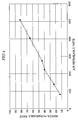
- Fig.4 is a graph showing a relation between the air permeable rate and the water permeable rate.
- the vertical axis indicates the water permeable rate converted from the measured water permeability
- the horizontal axis indicates the air permeable rate converted from the air permeability measured by the gurley type densometer.
- the water permeable rate can be expressed by a direct function of the air permeable rate. From the direct function, a ratio of the water permeable rate to the air permeable rate is substantially equal to 1/5.5 in a case of the packing material of the present invention.
- a heat source was produced using each of the prepared bags. And, a relation between the temperature of the heat source and the air permeability of the bags was examined.
- the heat-generating composition As the heat-generating composition, a mixed powder of aluminum powder (#280A, manufactured by MINALCO Co., Ltd.) of 20g, calcium hydroxide powder (tokusen, manufactured by Tage lime industry) of 10g and calcium oxide powder (manufactured by Tage lime industry) of 20g and was used.
- the aluminum powder has the following grain size distribution: ⁇ 45 ⁇ m; 90.80%, 45 ⁇ 63 ⁇ m; 8.30%, 63 ⁇ 75 ⁇ m; 0.64% and +75 ⁇ m; 0.25%.
- the calcium hydroxide powder has the following grain size distribution: ⁇ 45 ⁇ m; 4.60%, 45 ⁇ 75 ⁇ m; 21.90%; 75 ⁇ 150 ⁇ m; 35.92% and +150 ⁇ m; 37.58%.
- the calcium oxide powder has the following grain size distribution : ⁇ 75 ⁇ m; 15.68%, 75 ⁇ 150 ⁇ m; 34.24% and +150 ⁇ m; 50.07%.
- the calcium oxide powder includes the following elements: calcium oxide (measured by an EDTA titration method (NN indicator)); 93% or more, carbon dioxide (measured by a Storelain method); 2.0% and below and impurities (measured by an EDTA titration method, perchloric acid method, absorption spectroscopy); 3.2% or less.
- the impurities include silicon dioxide, aluminum oxide, ferric oxide and magnesium oxide.
- Fig.5 is a drawing showing the method for measuring the temperature.
- the heat source 1 a food F (a retort-packed cooked rice and a 350millilitter-plastic bottled tea, or a retort-packed cooked rice and a retort-packed curry) and water of 130g were put in a heating bag 31 having exhaust vents 32.
- the heating bag 31 was openable and closable and had two exhaust vents 32 having a diameter of 5mm.
- the heating bag 31 was supported in a stainless-steel container 73 set on a heat insulating material 71. And, for 20 minutes after the heat-generating reaction, a temperature T1 in the heating bag 31 (steam temperature), a temperature T2 of the heated water, an environmental temperature T3 and a temperature T4 of the food were measured by the measuring apparatus D.
- Table 2 shows a result whether the samples satisfied the heating conditions.
- Table 2 Sample No. condition A 40°C or higher after 5 min. 60°C or higher after 10 min. and 60°C or higher after 20 min.
- condition B 50°C or higher after 5 min. 60°C or higher after 10 min. and 65°C or higher after 20 min.
- condition C 60°C or higher after 5 min. 65°C or higher after 10 min. and 65°C or higher after 15 min. 1 ⁇ ⁇ ⁇ 2 ⁇ ⁇ ⁇ 3 ⁇ ⁇ ⁇ 4 ⁇ ⁇ ⁇ 5 ⁇ ⁇ ⁇ 6 ⁇ ⁇ ⁇
- the heat-generation of the heat-generating composition is caused by a heat-generating reaction of the aluminum after a formation of alkaline environment resulting from hydrolysis of the calcium hydroxide, as described above, and also by a heat-generating reaction of the aluminum activated by a heat-generating resulting from a hydration reaction of the calcium oxide.
- a low-temperature (low-water temperature) condition either one of the heat-generating reactions alone will not generate sufficient amount of heat.
- rate of temperature rise becomes better.
- Ca(OH) 2 produced by a hydration reaction of CaO does not have so high water-solubility because the water temperature rises rapidly to 70 to 80°C due to heat generated by the aforesaid hydration reaction. Accordingly, although hydrolysis rate is rapid, it requires a longer time until the pH sifts toward alkalis.
- each of the sample heat-generating compositions was enclosed with the bag made of base material (a non water-repellent nonwoven fabric (made by 100% rayon, MR-50/PP40, manufactured by Kokko Paper Mfg. Co. , Ltd.) having a water permeable rate of about 40 to 44 milliliter/min/cm 2 ) used for measurement of the water permeability.
- base material a non water-repellent nonwoven fabric (made by 100% rayon, MR-50/PP40, manufactured by Kokko Paper Mfg. Co. , Ltd.) having a water permeable rate of about 40 to 44 milliliter/min/cm 2 ) used for measurement of the water permeability.
- a temperature of the food was measured.
- a retort-packed rice was measured in temperature in such a manner that a stick type temperature sensor was inserted into the center of the retort-packed rice. Then, whether the samples satisfied the heating condition D (to heat the retort-packed rice to 60°
- Table 3 shows results whether the samples satisfied the heating conditions.
- Table 3 Sample No. amount ratio temperature (°C) after 25 min. condition D 60°C or higher after 25 min. condition E 65°C or higher after 25 min. aluminum calcium hydroxide calcium oxide 1 50 15 35 67.3 ⁇ ⁇ 2 60 10 30 72.7 ⁇ ⁇ 3 60 20 20 66.5 ⁇ ⁇ 4 40 40 20 64.3 ⁇ ⁇ 5 40 20 40 60.2 ⁇ ⁇ 6 50 30 20 62.4 ⁇ ⁇ 7 60 30 10 60.7 ⁇ ⁇ 8 30 30 40 51.3 ⁇ ⁇ 9 30 20 50 51.2 ⁇ ⁇ 10 35 30 35 53.5 ⁇ ⁇ 11 35 20 45 55.3 ⁇ ⁇ 12 40 50 10 56.6 ⁇ ⁇ 13 45 10 45 57.7 ⁇ ⁇ 14 45 5 50 59.0 ⁇ ⁇ 15 60 5 35 58.7 ⁇ ⁇ ⁇
- the heat-generating composition containing the aluminum powder, calcium hydroxide powder and calcium oxide powder with an amount ratio of the aluminum powder, calcium hydroxide powder and calcium oxide powder being 50:15:35 was enclosed in the bag to prepare the heat sources each having a weight of 30g, 40g, 50g and 60g.
- Each of the heat sources was examined in temperature measurement. As a result, all of the heat sources showed substantially the same heat-generating ability. Therefore, a weight of the heat-generating composition is preferably 30g or larger.
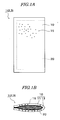
- Fig.1 is a drawing showing a structure of a heat source according to the present invention
- Fig.1A is a plane drawing
- Fig.1B is a cross-section drawing.
- the heat source 1 comprises a bag 10 and a heat-generating composition 20 enclosed in the bag 10.
- the bag 10 is made of a non water-repellent nonwoven fabric 11 (100% rayon, MR-50/PP40, manufactured by Kokko Paper Mfg. Co., Ltd.). Almost full area of the bag 10 is punched with pinholes 15 in substantially the uniform density.
- the pinhole 15 has a diameter of 0.1 to 0.3mm.
- the bag 10 has a water permeable rate, measured by the aforesaid method (as shown in Fig.3 ), of about 40 milliliter/min/cm 2 .
- the water permeable rate can be converted from the air permeable rate measured by the gurley type densometer.
- the bag 10 has a size of 70mmx170mm.
- the heat-generating composition 30 is a mixed powder of aluminum powder (#280A, manufactured by MINALCO Co. , Ltd.) of 25g, calcium hydroxide powder (tokusen, manufactured by Tage lime industry) of 7.5g and calcium oxide powder (manufactured by Tage lime industry) of 17.5g (an amount ratio ofaluminum:calcium hydroxide: calcium oxide is 50:15:35. A total weight is 50g).
- the heat-generating composition 20 is enclosed in the bag 10 to produce the heat source 1.
- Example 2 The same heat-generating composition as that of Example 1 (an amount ratio of aluminum:calcium hydroxide:calcium oxide is 50:15:35. A total weight is 50g) was enclosed in the bag 10 having a water permeable rate of about 81 milliliter/min/cm 2 to produce another heat source 3.
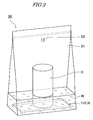
- Fig.2 is a drawing showing a heating device according to the present invention.
- the heating device is used for heating a retort-packed cooked rice and a retort-packed cooked curry.
- the food heating device 30 comprises a heating bag (container) 31 having exhaust vents 32; the heat source 1 shown in Fig.1 and water W for activating a heat-generating reaction.
- two circular exhaust vents 32 having a diameter of 5mm are formed.
- two to four exhaust vents 32 having a diameter of 3 to 7mm may be formed.
- one to two exhaust vents having a diameter of 10 to 15mm, or eight to ten exhaust vents having a diameter of 1 to 2mm may be formed.
- the shape of the exhaust vent is not limited to a circular shape; may be any shape capable of venting water vapor and hydrogen gas.
- the exhaust vent may have a shape formed by turning the opening of the back.
- the heat source 1 is enclosed in an air-tight outer bag during storing in order to prevent the heat-generating composition from contacting moisture in air.
- the heat source 1 taken out of the outer bag, the retort-packed cooked rice and the retort-packed cooked curry D were put in the heating bag (container) 31, water of about 5°C in an amount of 130g was added and then the container 31 was sealed.
- the heat source 1 caused a heat-generating reaction to heat the retort-packed cooked rice and retort-packed cooked curry D in the container 31. Water vapor and hydrogen gas produced by the heat-generating reaction were vent through the exhaust vents 32. And, after 25 minutes from the activation of the heat-generating reaction, the retort-packed cocked rice was heated to 67.3°C. And, leakage of the heat-generating composition did not occur.
- the heat source 3 was used in exchange for the heat source 1.
- the heat source 3, taken out of the outer bag, and 350 milliliter-plastic bottled tea D were put in the heating bag (container) 31, water of about 20°C in an amount of 130g was added and then the container 31 was sealed.
- the heat source 3, taken out of the outer bag, and a retort-packed cooked rice D were put in the heating bag (container) 31, water of about 5°C in an amount of 130g was added and then the container 31 was sealed.
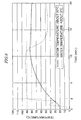
- Fig.6 is a graph showing a relation between the measurement time and temperatures.
- an initial temperature of the water to be reacted is 20°C
- the water temperature rises to 60°C or higher after 5 minutes from the heat-generating reaction and the risen temperature higher than 80°C is kept after 10 minutes from the reaction.
- an initial temperature of the water to be reacted is 5°C
- the water temperature rises to 90°C after 2 minutes from the heat-generating reaction and the risen temperature higher than 90°C is kept for about 10 minutes after the reaction.
- the temperature falls down rapidly after 10 minutes and decreases to 50°C or less after 20 minutes.
- the temperature of the retort-packed rice which was measured by inserting the stick type temperature sensor into the center of the retort-packed rice after 25 minutes, was 60.4°C. This shows that the retort-packed rice was sufficiently heated.
- non water repellent nonwoven fabric In exchange for the aforesaid non water-repellant nonwoven fabric, another type of non water repellent nonwoven fabricmaybeused, for example, CO40s (manufacturedbyUnitika Co., Ltd.), which has the following properties: basis weight (g/m 2 ); 40, thickness ( ⁇ m); 330, longitudinal tensile strength (N/5mm); 35, transverse tensile strength (N/5mm); 15, longitudinal extensibility (%); 25 and transverse extensibility (%); 75.
- the nonwoven fabric was made by a spunlaced method.
- a weight ratio of the aluminum power, calcium hydroxide powder and calcium oxide powder, weight of the heat-generating composition and properties are not limited to the aforesaid values.
Landscapes
- Engineering & Computer Science (AREA)
- Chemical & Material Sciences (AREA)
- Chemical Kinetics & Catalysis (AREA)
- Food Science & Technology (AREA)
- Thermal Sciences (AREA)
- Combustion & Propulsion (AREA)
- Physics & Mathematics (AREA)
- Materials Engineering (AREA)
- Organic Chemistry (AREA)
- Life Sciences & Earth Sciences (AREA)
- Mechanical Engineering (AREA)
- General Chemical & Material Sciences (AREA)
- Cookers (AREA)
- Package Specialized In Special Use (AREA)
- Packages (AREA)
Applications Claiming Priority (2)
| Application Number | Priority Date | Filing Date | Title |
|---|---|---|---|
| JP2006117741A JP3921550B1 (ja) | 2006-04-21 | 2006-04-21 | 食品加熱装置 |
| PCT/JP2007/054839 WO2007122900A1 (fr) | 2006-04-21 | 2007-03-12 | Appareil de chauffage des aliments |
Publications (1)
| Publication Number | Publication Date |
|---|---|
| EP2011846A1 true EP2011846A1 (fr) | 2009-01-07 |
Family
ID=38156665
Family Applications (1)
| Application Number | Title | Priority Date | Filing Date |
|---|---|---|---|
| EP07738311A Withdrawn EP2011846A1 (fr) | 2006-04-21 | 2007-03-12 | Appareil de chauffage des aliments |
Country Status (6)
| Country | Link |
|---|---|
| US (1) | US20100147282A1 (fr) |
| EP (1) | EP2011846A1 (fr) |
| JP (1) | JP3921550B1 (fr) |
| KR (1) | KR20080110982A (fr) |
| CN (1) | CN101356249A (fr) |
| WO (1) | WO2007122900A1 (fr) |
Families Citing this family (15)
| Publication number | Priority date | Publication date | Assignee | Title |
|---|---|---|---|---|
| JP2010222006A (ja) * | 2007-07-17 | 2010-10-07 | Maikooru Kk | 物品加熱装置 |
| RU2350244C1 (ru) * | 2008-01-16 | 2009-03-27 | Общество с ограниченной ответственностью "БАРГАН ПРОДАКШН ГРУПП" (BARGAN PRODUCTION GROUP) | Контактный нагреватель упакованных пищевых продуктов |
| JP5339888B2 (ja) * | 2008-12-24 | 2013-11-13 | ダイニック株式会社 | 発熱性成形体 |
| KR101102502B1 (ko) | 2010-04-29 | 2012-01-05 | 주식회사 다인 | 발열제 조성물 |
| US9642974B2 (en) * | 2010-09-15 | 2017-05-09 | The General Hospital Corporation | Method and apparatus for warming intravenous fluids |
| GB201106457D0 (en) * | 2011-04-15 | 2011-06-01 | Goding Philip | Heater |
| US9574764B2 (en) | 2012-05-25 | 2017-02-21 | S. C. Johnson & Son, Inc. | Portable steam generating device |
| JP6028182B2 (ja) * | 2012-07-06 | 2016-11-16 | 株式会社光未来 | 水素ガスの密封袋、及び水素ガスの溶解方法 |
| US10863848B2 (en) | 2013-03-15 | 2020-12-15 | Iceburg Point Ventures, LLC | Cooking apparatus using liquid bath |
| WO2015119313A1 (fr) * | 2014-02-07 | 2015-08-13 | (주)크라우젠 | Poche |
| CN103844891A (zh) * | 2014-03-12 | 2014-06-11 | 南华大学 | 快速煮蛋装置 |
| WO2015166940A1 (fr) * | 2014-04-28 | 2015-11-05 | 高木 毅 | Contenant pour emballage |
| CN106833547B (zh) * | 2017-02-07 | 2019-11-01 | 宁波工程学院 | 一种食品加热用自热剂及其包装 |
| JP7110690B2 (ja) * | 2017-04-13 | 2022-08-02 | ライオン株式会社 | 非水系発熱組成物及び温熱製品 |
| CN110902158A (zh) * | 2019-12-11 | 2020-03-24 | 安徽省三车节能科技有限公司 | 一种提高氧化钙热源在自热食品中的加热效率的方法 |
Family Cites Families (27)
| Publication number | Priority date | Publication date | Assignee | Title |
|---|---|---|---|---|
| US3545457A (en) * | 1968-09-26 | 1970-12-08 | Nunziato Schepis | Hair curling packages |
| US3766079A (en) * | 1970-10-13 | 1973-10-16 | Smith Inland A O | Exothermic composition |
| US3980070A (en) * | 1975-01-08 | 1976-09-14 | Scotty Manufacturing Company | Heating pack containing a granular chemical composition |
| US4080953A (en) * | 1976-12-08 | 1978-03-28 | Minnesota Mining And Manufacturing Company | Electrochemical heating device |
| JPS6443594A (en) * | 1987-08-10 | 1989-02-15 | Yoshikazu Munakata | Heat-generating composition |
| JPS6443216A (en) * | 1987-08-12 | 1989-02-15 | Yoshikazu Munakata | Food heating and warmth keeping structure |
| JPH01135889A (ja) * | 1987-11-20 | 1989-05-29 | Mayekawa Mfg Co Ltd | 可逆反応が可能な蓄熱物質並に蓄放熱方法 |
| JPH09192026A (ja) * | 1996-01-24 | 1997-07-29 | Ebaa Corp:Kk | 発熱体 |
| US5935486A (en) * | 1996-08-02 | 1999-08-10 | Tda Research, Inc. | Portable heat source |
| JPH11146835A (ja) * | 1997-11-18 | 1999-06-02 | Kaihatsu Kogyo Kk | レトルト食品加熱剤 |
| JP2000107039A (ja) * | 1998-09-30 | 2000-04-18 | Hisao Horiguchi | 携帯用加熱容器 |
| US6341602B1 (en) * | 1999-03-09 | 2002-01-29 | Fred Fulcher | Package for flameless heating and heater for the package |
| JP2001171755A (ja) * | 1999-12-14 | 2001-06-26 | Hosokawa Yoko Co Ltd | 包装容器 |
| JP2001238906A (ja) * | 1999-12-24 | 2001-09-04 | Lion Corp | 発熱体組成物、発熱体及びその製造方法 |
| US6309598B1 (en) * | 2000-02-08 | 2001-10-30 | Thomas J. Tully | Electrochemical heater and method for sterilizing |
| JP3467729B2 (ja) * | 2000-02-17 | 2003-11-17 | 株式会社協同 | 発熱剤及び発熱剤を使用する方法 |
| JP2002162184A (ja) * | 2000-11-28 | 2002-06-07 | Asahi Denka Kogyo Kk | 蓄熱材料、蓄熱方法ならびに放熱方法 |
| JP2004534699A (ja) * | 2001-06-29 | 2004-11-18 | ザ プロクター アンド ギャンブル カンパニー | 自己加熱/自己冷却パッケージ |
| JP2003336042A (ja) * | 2002-05-20 | 2003-11-28 | Maikooru Kk | 吸水性ポリマー入り発熱組成物及び発熱体 |
| JP2003342558A (ja) * | 2002-05-24 | 2003-12-03 | Kyodo:Kk | 発熱剤 |
| KR20060107534A (ko) * | 2003-10-17 | 2006-10-13 | 이노포스 인코퍼레이티드 | 열 발생 집적체, 및 이를 이용한 무화염 히터 및 자체가열패키징 |
| JP2005248383A (ja) * | 2004-03-04 | 2005-09-15 | Habikkusu Kk | 透水性不織布 |
| JP2005290127A (ja) * | 2004-03-31 | 2005-10-20 | Iwatani Nobuhide | 発熱剤 |
| US20060005827A1 (en) * | 2004-05-04 | 2006-01-12 | Candle Corporation Of America | Heater product, system and composition |
| US7971585B2 (en) * | 2006-02-01 | 2011-07-05 | Tilak Bommaraju | Hydrogen elimination and thermal energy generation in water-activated chemical heaters |
| US8205608B2 (en) * | 2006-02-01 | 2012-06-26 | Tilak Bommaraju | Hydrogen elimination and thermal energy generation in water-activated chemical heaters |
| US20090090350A1 (en) * | 2007-10-05 | 2009-04-09 | James A. Donovan | Combined food and wipe heater |
-
2006
- 2006-04-21 JP JP2006117741A patent/JP3921550B1/ja not_active Expired - Lifetime
-
2007
- 2007-03-12 KR KR1020087010967A patent/KR20080110982A/ko not_active Withdrawn
- 2007-03-12 US US12/085,887 patent/US20100147282A1/en not_active Abandoned
- 2007-03-12 WO PCT/JP2007/054839 patent/WO2007122900A1/fr not_active Ceased
- 2007-03-12 CN CNA2007800014110A patent/CN101356249A/zh active Pending
- 2007-03-12 EP EP07738311A patent/EP2011846A1/fr not_active Withdrawn
Non-Patent Citations (1)
| Title |
|---|
| See references of WO2007122900A1 * |
Also Published As
| Publication number | Publication date |
|---|---|
| WO2007122900A1 (fr) | 2007-11-01 |
| JP2007291163A (ja) | 2007-11-08 |
| JP3921550B1 (ja) | 2007-05-30 |
| CN101356249A (zh) | 2009-01-28 |
| US20100147282A1 (en) | 2010-06-17 |
| KR20080110982A (ko) | 2008-12-22 |
Similar Documents
| Publication | Publication Date | Title |
|---|---|---|
| US20100147282A1 (en) | Food Heating Device | |
| CN101523125B (zh) | 氧气激活的加热设备及其制造方法 | |
| US9004059B2 (en) | Reusable heater in a package | |
| US9851125B2 (en) | Transportable device for heating foodstuffs, and a transportable heating element | |
| US20090229594A1 (en) | Heat source and heating device | |
| TW403720B (en) | Oxygen generating agent, carbon dioxide gas absorbent, the transport system and the transport method of living fish | |
| US4038148A (en) | Anaerobic environmental system for bacteria culture testing | |
| US4013422A (en) | Gas generating apparatus | |
| CN1703603A (zh) | 用于自加热罐的插入式热模块 | |
| KR100407582B1 (ko) | 발열제 및 그 사용방법 | |
| JP5314975B2 (ja) | 化学発熱剤発熱装置および化学発熱剤発熱装置を組み入れた携帯食品用容器 | |
| CA3196833A1 (fr) | Appareil de generation de gaz et procede utilisant un reacteur a poche a membrane hydrophobe | |
| EP1935437A1 (fr) | Dispositif d'evaporation et procede d'evaporation | |
| JPH09192026A (ja) | 発熱体 | |
| JP2010183925A (ja) | 物品加熱装置 | |
| KR100961458B1 (ko) | 화학발열제 발열장치 및 화학발열제 발열장치를 조립한 휴대 식품용 용기 | |
| JP2006346329A (ja) | 加熱装置及び加熱装置を組み込んだ携帯食品用容器。 | |
| KR102693056B1 (ko) | 일회용 젖병 발열장치 | |
| KR20110007566U (ko) | 발열체 | |
| JP6786094B2 (ja) | 水素発生ユニット | |
| KR20110086684A (ko) | 발열체 | |
| KR830000773B1 (ko) | 발열제 조성물 | |
| JPH0232622Y2 (fr) | ||
| JPH01279078A (ja) | 加熱食品容器 | |
| JPH01254580A (ja) | 加熱剤組成物および加熱食品容器 |
Legal Events
| Date | Code | Title | Description |
|---|---|---|---|
| PUAI | Public reference made under article 153(3) epc to a published international application that has entered the european phase |
Free format text: ORIGINAL CODE: 0009012 |
|
| 17P | Request for examination filed |
Effective date: 20080520 |
|
| AK | Designated contracting states |
Kind code of ref document: A1 Designated state(s): AT BE BG CH CY CZ DE DK EE ES FI FR GB GR HU IE IS IT LI LT LU LV MC MT NL PL PT RO SE SI SK TR |
|
| AX | Request for extension of the european patent |
Extension state: AL BA HR MK RS |
|
| STAA | Information on the status of an ep patent application or granted ep patent |
Free format text: STATUS: THE APPLICATION HAS BEEN WITHDRAWN |
|
| 18W | Application withdrawn |
Effective date: 20110203 |