EP2029145B1 - Pyrrolopyrimidinverbindungen und ihre verwendungen - Google Patents
Pyrrolopyrimidinverbindungen und ihre verwendungen Download PDFInfo
- Publication number
- EP2029145B1 EP2029145B1 EP07811927.8A EP07811927A EP2029145B1 EP 2029145 B1 EP2029145 B1 EP 2029145B1 EP 07811927 A EP07811927 A EP 07811927A EP 2029145 B1 EP2029145 B1 EP 2029145B1
- Authority
- EP
- European Patent Office
- Prior art keywords
- alkyl
- substituted
- compound
- group
- compounds
- Prior art date
- Legal status (The legal status is an assumption and is not a legal conclusion. Google has not performed a legal analysis and makes no representation as to the accuracy of the status listed.)
- Active
Links
- 0 CCC(CC)C(C1)c2nc(Nc3ccc(*4CCN(C)CC4)cc3)ncc2C=C1C(Nc1ccccc1)=O Chemical compound CCC(CC)C(C1)c2nc(Nc3ccc(*4CCN(C)CC4)cc3)ncc2C=C1C(Nc1ccccc1)=O 0.000 description 3
- QUZJXKQQMDVZGQ-ISLYRVAYSA-N C/C(/C(N(C)C)=O)=C(/C)\c1cnc(Nc(cc2)ncc2N2CCNCC2)nc1NC1CCCC1 Chemical compound C/C(/C(N(C)C)=O)=C(/C)\c1cnc(Nc(cc2)ncc2N2CCNCC2)nc1NC1CCCC1 QUZJXKQQMDVZGQ-ISLYRVAYSA-N 0.000 description 1
- FHVFCKKZCLSMAJ-UHFFFAOYSA-N CCC(CC)N1C2=NC(Nc(cc3)ccc3N3CCNCC3)NC=C2C=C1C(CC1NC1c1n[nH]cc1)O Chemical compound CCC(CC)N1C2=NC(Nc(cc3)ccc3N3CCNCC3)NC=C2C=C1C(CC1NC1c1n[nH]cc1)O FHVFCKKZCLSMAJ-UHFFFAOYSA-N 0.000 description 1
- XIYOMHDXTLIYIN-UHFFFAOYSA-N CCC(CC)[n]1c2nc(Nc(cc3)ccc3N3CCNCC3)ncc2cc1C(NC1CCCC1)=O Chemical compound CCC(CC)[n]1c2nc(Nc(cc3)ccc3N3CCNCC3)ncc2cc1C(NC1CCCC1)=O XIYOMHDXTLIYIN-UHFFFAOYSA-N 0.000 description 1
- OSUOJHYJZNTIML-UHFFFAOYSA-N CCC(CC)[n]1c2nc(Nc3ccc(CN(CC4)CCN4C(OC(C)(C)C)=O)cc3)ncc2cc1C(N(C)C)=O Chemical compound CCC(CC)[n]1c2nc(Nc3ccc(CN(CC4)CCN4C(OC(C)(C)C)=O)cc3)ncc2cc1C(N(C)C)=O OSUOJHYJZNTIML-UHFFFAOYSA-N 0.000 description 1
- NCYAJOUTVMEWEN-UHFFFAOYSA-N CCCC(CCN)c(cc1)ccc1Nc1ncc(cc(C(N(C)C)=O)[n]2C3CCCC3)c2n1 Chemical compound CCCC(CCN)c(cc1)ccc1Nc1ncc(cc(C(N(C)C)=O)[n]2C3CCCC3)c2n1 NCYAJOUTVMEWEN-UHFFFAOYSA-N 0.000 description 1
- GIEZCFPNBLPSOM-UHFFFAOYSA-N CN(C)C(c1cc2cnc(Nc(cc3)ccc3N3CCNCC3)nc2[n]1C1CCCC1)=O Chemical compound CN(C)C(c1cc2cnc(Nc(cc3)ccc3N3CCNCC3)nc2[n]1C1CCCC1)=O GIEZCFPNBLPSOM-UHFFFAOYSA-N 0.000 description 1
- PABYFLKZMQSOAR-UHFFFAOYSA-O Cc1c(C(N(C)C)=O)[n](C2CCCC2)c2nc(Nc(cc3)ncc3[NH+]3CCNCC3)ncc12 Chemical compound Cc1c(C(N(C)C)=O)[n](C2CCCC2)c2nc(Nc(cc3)ncc3[NH+]3CCNCC3)ncc12 PABYFLKZMQSOAR-UHFFFAOYSA-O 0.000 description 1
Classifications
-
- C—CHEMISTRY; METALLURGY
- C07—ORGANIC CHEMISTRY
- C07D—HETEROCYCLIC COMPOUNDS
- C07D473/00—Heterocyclic compounds containing purine ring systems
- C07D473/02—Heterocyclic compounds containing purine ring systems with oxygen, sulphur, or nitrogen atoms directly attached in positions 2 and 6
- C07D473/18—Heterocyclic compounds containing purine ring systems with oxygen, sulphur, or nitrogen atoms directly attached in positions 2 and 6 one oxygen and one nitrogen atom, e.g. guanine
-
- A—HUMAN NECESSITIES
- A61—MEDICAL OR VETERINARY SCIENCE; HYGIENE
- A61K—PREPARATIONS FOR MEDICAL, DENTAL OR TOILETRY PURPOSES
- A61K31/00—Medicinal preparations containing organic active ingredients
- A61K31/33—Heterocyclic compounds
- A61K31/395—Heterocyclic compounds having nitrogen as a ring hetero atom, e.g. guanethidine or rifamycins
- A61K31/495—Heterocyclic compounds having nitrogen as a ring hetero atom, e.g. guanethidine or rifamycins having six-membered rings with two or more nitrogen atoms as the only ring heteroatoms, e.g. piperazine or tetrazines
- A61K31/505—Pyrimidines; Hydrogenated pyrimidines, e.g. trimethoprim
- A61K31/519—Pyrimidines; Hydrogenated pyrimidines, e.g. trimethoprim ortho- or peri-condensed with heterocyclic rings
-
- A—HUMAN NECESSITIES
- A61—MEDICAL OR VETERINARY SCIENCE; HYGIENE
- A61K—PREPARATIONS FOR MEDICAL, DENTAL OR TOILETRY PURPOSES
- A61K31/00—Medicinal preparations containing organic active ingredients
- A61K31/33—Heterocyclic compounds
- A61K31/395—Heterocyclic compounds having nitrogen as a ring hetero atom, e.g. guanethidine or rifamycins
- A61K31/495—Heterocyclic compounds having nitrogen as a ring hetero atom, e.g. guanethidine or rifamycins having six-membered rings with two or more nitrogen atoms as the only ring heteroatoms, e.g. piperazine or tetrazines
- A61K31/505—Pyrimidines; Hydrogenated pyrimidines, e.g. trimethoprim
- A61K31/519—Pyrimidines; Hydrogenated pyrimidines, e.g. trimethoprim ortho- or peri-condensed with heterocyclic rings
- A61K31/52—Purines, e.g. adenine
-
- A—HUMAN NECESSITIES
- A61—MEDICAL OR VETERINARY SCIENCE; HYGIENE
- A61K—PREPARATIONS FOR MEDICAL, DENTAL OR TOILETRY PURPOSES
- A61K31/00—Medicinal preparations containing organic active ingredients
- A61K31/33—Heterocyclic compounds
- A61K31/395—Heterocyclic compounds having nitrogen as a ring hetero atom, e.g. guanethidine or rifamycins
- A61K31/495—Heterocyclic compounds having nitrogen as a ring hetero atom, e.g. guanethidine or rifamycins having six-membered rings with two or more nitrogen atoms as the only ring heteroatoms, e.g. piperazine or tetrazines
- A61K31/505—Pyrimidines; Hydrogenated pyrimidines, e.g. trimethoprim
- A61K31/519—Pyrimidines; Hydrogenated pyrimidines, e.g. trimethoprim ortho- or peri-condensed with heterocyclic rings
- A61K31/52—Purines, e.g. adenine
- A61K31/522—Purines, e.g. adenine having oxo groups directly attached to the heterocyclic ring, e.g. hypoxanthine, guanine, acyclovir
-
- A—HUMAN NECESSITIES
- A61—MEDICAL OR VETERINARY SCIENCE; HYGIENE
- A61P—SPECIFIC THERAPEUTIC ACTIVITY OF CHEMICAL COMPOUNDS OR MEDICINAL PREPARATIONS
- A61P1/00—Drugs for disorders of the alimentary tract or the digestive system
-
- A—HUMAN NECESSITIES
- A61—MEDICAL OR VETERINARY SCIENCE; HYGIENE
- A61P—SPECIFIC THERAPEUTIC ACTIVITY OF CHEMICAL COMPOUNDS OR MEDICINAL PREPARATIONS
- A61P1/00—Drugs for disorders of the alimentary tract or the digestive system
- A61P1/02—Stomatological preparations, e.g. drugs for caries, aphtae, periodontitis
-
- A—HUMAN NECESSITIES
- A61—MEDICAL OR VETERINARY SCIENCE; HYGIENE
- A61P—SPECIFIC THERAPEUTIC ACTIVITY OF CHEMICAL COMPOUNDS OR MEDICINAL PREPARATIONS
- A61P1/00—Drugs for disorders of the alimentary tract or the digestive system
- A61P1/04—Drugs for disorders of the alimentary tract or the digestive system for ulcers, gastritis or reflux esophagitis, e.g. antacids, inhibitors of acid secretion, mucosal protectants
-
- A—HUMAN NECESSITIES
- A61—MEDICAL OR VETERINARY SCIENCE; HYGIENE
- A61P—SPECIFIC THERAPEUTIC ACTIVITY OF CHEMICAL COMPOUNDS OR MEDICINAL PREPARATIONS
- A61P11/00—Drugs for disorders of the respiratory system
- A61P11/06—Antiasthmatics
-
- A—HUMAN NECESSITIES
- A61—MEDICAL OR VETERINARY SCIENCE; HYGIENE
- A61P—SPECIFIC THERAPEUTIC ACTIVITY OF CHEMICAL COMPOUNDS OR MEDICINAL PREPARATIONS
- A61P15/00—Drugs for genital or sexual disorders; Contraceptives
-
- A—HUMAN NECESSITIES
- A61—MEDICAL OR VETERINARY SCIENCE; HYGIENE
- A61P—SPECIFIC THERAPEUTIC ACTIVITY OF CHEMICAL COMPOUNDS OR MEDICINAL PREPARATIONS
- A61P15/00—Drugs for genital or sexual disorders; Contraceptives
- A61P15/06—Antiabortive agents; Labour repressants
-
- A—HUMAN NECESSITIES
- A61—MEDICAL OR VETERINARY SCIENCE; HYGIENE
- A61P—SPECIFIC THERAPEUTIC ACTIVITY OF CHEMICAL COMPOUNDS OR MEDICINAL PREPARATIONS
- A61P17/00—Drugs for dermatological disorders
-
- A—HUMAN NECESSITIES
- A61—MEDICAL OR VETERINARY SCIENCE; HYGIENE
- A61P—SPECIFIC THERAPEUTIC ACTIVITY OF CHEMICAL COMPOUNDS OR MEDICINAL PREPARATIONS
- A61P17/00—Drugs for dermatological disorders
- A61P17/06—Antipsoriatics
-
- A—HUMAN NECESSITIES
- A61—MEDICAL OR VETERINARY SCIENCE; HYGIENE
- A61P—SPECIFIC THERAPEUTIC ACTIVITY OF CHEMICAL COMPOUNDS OR MEDICINAL PREPARATIONS
- A61P17/00—Drugs for dermatological disorders
- A61P17/10—Anti-acne agents
-
- A—HUMAN NECESSITIES
- A61—MEDICAL OR VETERINARY SCIENCE; HYGIENE
- A61P—SPECIFIC THERAPEUTIC ACTIVITY OF CHEMICAL COMPOUNDS OR MEDICINAL PREPARATIONS
- A61P19/00—Drugs for skeletal disorders
- A61P19/02—Drugs for skeletal disorders for joint disorders, e.g. arthritis, arthrosis
-
- A—HUMAN NECESSITIES
- A61—MEDICAL OR VETERINARY SCIENCE; HYGIENE
- A61P—SPECIFIC THERAPEUTIC ACTIVITY OF CHEMICAL COMPOUNDS OR MEDICINAL PREPARATIONS
- A61P19/00—Drugs for skeletal disorders
- A61P19/08—Drugs for skeletal disorders for bone diseases, e.g. rachitism, Paget's disease
- A61P19/10—Drugs for skeletal disorders for bone diseases, e.g. rachitism, Paget's disease for osteoporosis
-
- A—HUMAN NECESSITIES
- A61—MEDICAL OR VETERINARY SCIENCE; HYGIENE
- A61P—SPECIFIC THERAPEUTIC ACTIVITY OF CHEMICAL COMPOUNDS OR MEDICINAL PREPARATIONS
- A61P25/00—Drugs for disorders of the nervous system
-
- A—HUMAN NECESSITIES
- A61—MEDICAL OR VETERINARY SCIENCE; HYGIENE
- A61P—SPECIFIC THERAPEUTIC ACTIVITY OF CHEMICAL COMPOUNDS OR MEDICINAL PREPARATIONS
- A61P25/00—Drugs for disorders of the nervous system
- A61P25/14—Drugs for disorders of the nervous system for treating abnormal movements, e.g. chorea, dyskinesia
-
- A—HUMAN NECESSITIES
- A61—MEDICAL OR VETERINARY SCIENCE; HYGIENE
- A61P—SPECIFIC THERAPEUTIC ACTIVITY OF CHEMICAL COMPOUNDS OR MEDICINAL PREPARATIONS
- A61P25/00—Drugs for disorders of the nervous system
- A61P25/28—Drugs for disorders of the nervous system for treating neurodegenerative disorders of the central nervous system, e.g. nootropic agents, cognition enhancers, drugs for treating Alzheimer's disease or other forms of dementia
-
- A—HUMAN NECESSITIES
- A61—MEDICAL OR VETERINARY SCIENCE; HYGIENE
- A61P—SPECIFIC THERAPEUTIC ACTIVITY OF CHEMICAL COMPOUNDS OR MEDICINAL PREPARATIONS
- A61P29/00—Non-central analgesic, antipyretic or antiinflammatory agents, e.g. antirheumatic agents; Non-steroidal antiinflammatory drugs [NSAID]
-
- A—HUMAN NECESSITIES
- A61—MEDICAL OR VETERINARY SCIENCE; HYGIENE
- A61P—SPECIFIC THERAPEUTIC ACTIVITY OF CHEMICAL COMPOUNDS OR MEDICINAL PREPARATIONS
- A61P3/00—Drugs for disorders of the metabolism
-
- A—HUMAN NECESSITIES
- A61—MEDICAL OR VETERINARY SCIENCE; HYGIENE
- A61P—SPECIFIC THERAPEUTIC ACTIVITY OF CHEMICAL COMPOUNDS OR MEDICINAL PREPARATIONS
- A61P3/00—Drugs for disorders of the metabolism
- A61P3/08—Drugs for disorders of the metabolism for glucose homeostasis
- A61P3/10—Drugs for disorders of the metabolism for glucose homeostasis for hyperglycaemia, e.g. antidiabetics
-
- A—HUMAN NECESSITIES
- A61—MEDICAL OR VETERINARY SCIENCE; HYGIENE
- A61P—SPECIFIC THERAPEUTIC ACTIVITY OF CHEMICAL COMPOUNDS OR MEDICINAL PREPARATIONS
- A61P35/00—Antineoplastic agents
-
- A—HUMAN NECESSITIES
- A61—MEDICAL OR VETERINARY SCIENCE; HYGIENE
- A61P—SPECIFIC THERAPEUTIC ACTIVITY OF CHEMICAL COMPOUNDS OR MEDICINAL PREPARATIONS
- A61P35/00—Antineoplastic agents
- A61P35/02—Antineoplastic agents specific for leukemia
-
- A—HUMAN NECESSITIES
- A61—MEDICAL OR VETERINARY SCIENCE; HYGIENE
- A61P—SPECIFIC THERAPEUTIC ACTIVITY OF CHEMICAL COMPOUNDS OR MEDICINAL PREPARATIONS
- A61P37/00—Drugs for immunological or allergic disorders
-
- A—HUMAN NECESSITIES
- A61—MEDICAL OR VETERINARY SCIENCE; HYGIENE
- A61P—SPECIFIC THERAPEUTIC ACTIVITY OF CHEMICAL COMPOUNDS OR MEDICINAL PREPARATIONS
- A61P37/00—Drugs for immunological or allergic disorders
- A61P37/02—Immunomodulators
- A61P37/06—Immunosuppressants, e.g. drugs for graft rejection
-
- A—HUMAN NECESSITIES
- A61—MEDICAL OR VETERINARY SCIENCE; HYGIENE
- A61P—SPECIFIC THERAPEUTIC ACTIVITY OF CHEMICAL COMPOUNDS OR MEDICINAL PREPARATIONS
- A61P37/00—Drugs for immunological or allergic disorders
- A61P37/08—Antiallergic agents
-
- A—HUMAN NECESSITIES
- A61—MEDICAL OR VETERINARY SCIENCE; HYGIENE
- A61P—SPECIFIC THERAPEUTIC ACTIVITY OF CHEMICAL COMPOUNDS OR MEDICINAL PREPARATIONS
- A61P43/00—Drugs for specific purposes, not provided for in groups A61P1/00-A61P41/00
-
- A—HUMAN NECESSITIES
- A61—MEDICAL OR VETERINARY SCIENCE; HYGIENE
- A61P—SPECIFIC THERAPEUTIC ACTIVITY OF CHEMICAL COMPOUNDS OR MEDICINAL PREPARATIONS
- A61P5/00—Drugs for disorders of the endocrine system
- A61P5/14—Drugs for disorders of the endocrine system of the thyroid hormones, e.g. T3, T4
-
- A—HUMAN NECESSITIES
- A61—MEDICAL OR VETERINARY SCIENCE; HYGIENE
- A61P—SPECIFIC THERAPEUTIC ACTIVITY OF CHEMICAL COMPOUNDS OR MEDICINAL PREPARATIONS
- A61P9/00—Drugs for disorders of the cardiovascular system
-
- C—CHEMISTRY; METALLURGY
- C07—ORGANIC CHEMISTRY
- C07D—HETEROCYCLIC COMPOUNDS
- C07D473/00—Heterocyclic compounds containing purine ring systems
- C07D473/02—Heterocyclic compounds containing purine ring systems with oxygen, sulphur, or nitrogen atoms directly attached in positions 2 and 6
- C07D473/24—Heterocyclic compounds containing purine ring systems with oxygen, sulphur, or nitrogen atoms directly attached in positions 2 and 6 one nitrogen and one sulfur atom
-
- C—CHEMISTRY; METALLURGY
- C07—ORGANIC CHEMISTRY
- C07D—HETEROCYCLIC COMPOUNDS
- C07D487/00—Heterocyclic compounds containing nitrogen atoms as the only ring hetero atoms in the condensed system, not provided for by groups C07D451/00 - C07D477/00
- C07D487/02—Heterocyclic compounds containing nitrogen atoms as the only ring hetero atoms in the condensed system, not provided for by groups C07D451/00 - C07D477/00 in which the condensed system contains two hetero rings
- C07D487/04—Ortho-condensed systems
Definitions
- Protein kinases constitute a large family of structurally related enzymes that are responsible for the control of a variety of signal transduction processes within the cell. ( Hardie, G. and Hanks, S. The Protein Kinase Facts Book, I and II, Academic Press, San Diego, Calif.: 1995 ). Protein kinases are thought to have evolved from a common ancestral gene due to the conservation of their structure and catalytic function. Almost all kinases contain a similar 250-300 amino acid catalytic domain. The kinases may be categorized into families by the substrates they phosphorylate (e . g ., protein-tyrosine, protein-serine/threonine, lipids).
- protein kinases mediate intracellular signaling by affecting a phosphoryl transfer from a nucleoside triphosphate to a protein acceptor that is involved in a signaling pathway. These phosphorylation events act as molecular on/off switches that can modulate or regulate the target protein biological function. These pliosphorylation events are ultimately triggered in response to a variety of extracellular and other stimuli. Examples of such stimuli include environmental and chemical stress signals ( e . g ., osmotic shock, heat shock, ultraviolet radiation, bacterial endotoxin, and H 2 O 2 ), cytokines ( e .
- environmental and chemical stress signals e . g ., osmotic shock, heat shock, ultraviolet radiation, bacterial endotoxin, and H 2 O 2
- cytokines e .
- An extracellular stimulus may affect one or more cellular responses related to cell growth, migration, differentiation, secretion of hormones, activation of transcription factors, muscle contraction, glucose metabolism, control of protein synthesis, and regulation of the cell cycle.
- IL-1 interleukin-1
- TNF- ⁇ tumor necrosis factor- ⁇
- growth factors e . g ., granulocyte macrophage-colony-stimulating factor (GM-CSF), and fibroblast growth factor (FGF)
- An extracellular stimulus may affect one or more cellular responses related to cell growth, migration, differentiation, secretion of hormones, activation of transcription factors, muscle contraction, glucose metabolism, control of protein synthesis, and regulation of the cell cycle.
- diseases are associated with abnormal cellular responses triggered by protein kinase-mediated events as described above. These diseases include, but are not limited to, autoimmune diseases, inflammatory diseases, bone diseases, metabolic diseases, neurological and neurodegenerative diseases, cancer, cardiovascular diseases, allergies and asthma, Alzheimer's disease, and hormone-related diseases. Accordingly, there has been a substantial effort in medicinal chemistry to find protein kinase inhibitors that are effective as therapeutic agents.
- the Janus kinases are a family of tyrosine kinases consisting of JAK1, JAK2, JAK3 and TYK2.
- the JAKs play a critical role in cytokine signaling.
- the down-stream substrates of the JAK family of kinases include the signal transducer and activator of transcription (STAT) proteins.
- STAT signal transducer and activator of transcription
- JAK/STAT signaling has been implicated in the mediation of many abnormal immune responses such as allergies, asthma, autoimmune diseases such as transplant rejection, rheumatoid arthritis, amyotrophic lateral sclerosis and multiple sclerosis as well as in solid and hematologic malignancies such as leukemias and lymphomas.
- the pharmaceutical intervention in the JAK/STAT pathway has been reviewed [ Frank Mol. Med. 5: 432-456 (1999 ) & Seidel, et al, Oncogene 19: 2645-2656 (2000 )].
- JAK1, JAK2, and TYK2 are ubiquitously expressed, while JAK3 is predominantly expressed in hematopoietic cells.
- JAK3 binds exclusively to the common cytokine receptor gamma chain ( ⁇ c ) and is activated by IL-2, IL-4, IL-7, IL-9, and IL-15.
- ⁇ c common cytokine receptor gamma chain
- the proliferation and survival of murine mast cells induced by IL-4 and IL-9 have, in fact, been shown to be dependent on JAK3- and 65 c -signaling [ Suzuki et al, Blood 96: 2172-2180 (2000 )].
- the JAK family of tyrosine kinases have also been shown to play a role in immunosuppression and allograft acceptance [ Kirken, Transpl. Proc. 33: 3268-3270 (2001 )], rheumatoid arthritis [ Muller-Ladner, et al., J. Immunol. 164: 3894-3901 (2000 )], Familial amyotrophic lateral sclerosis [ Trieu, et al., Biochem. Biophys. Res. Commun., 267: 22-25 (2000 )], and leukemia [ Sudbeck, et al., Clin. Cancer Res. 5: 1569-1582 (1999 )].
- CDK cyclin-dependent kinase
- CDK1-also known as cdc2, and CDK2 cyclin A
- CDK1-B3 cyclin B1-B3
- CDK2 cyclin D1-D3
- CDK4 CDK5, CDK6
- CDK2 cyclin E
- CDKs 7, 8, and 9 are implicated in the regulation of transcription
- CDK5 plays a role in neuronal and secretory cell function.
- CDKs The activity of CDKs is regulated post-translationally, by transitory associations with other proteins, and by alterations of their intracellular localization. Tumor development is closely associated with genetic alteration and deregulation of CDKs and their regulators, suggesting that inhibitors of CDKs may be useful anti-cancer therapeutics. Indeed, early results suggest that transformed and normal cells differ in their requirement for, e.g., cyclin A/CDK2 and that it may be possible to develop novel antineoplastic agents devoid of the general host toxicity observed with conventional cytotoxic and cytostatic drugs. While inhibition of cell cycle-related CDKs is clearly relevant in, e . g ., oncology applications, this may not be the case for the inhibition of RNA polymerase-regulating CDKs.
- CDK9/cyclin T function was recently linked to prevention of HIV replication and the discovery of new CDK biology thus continues to open up new therapeutic indications for CDK inhibitors ( Sausville, E. A. Trends Molec. Med. 2002, 8, S32-S37 ).
- CDKs The function of CDKs is to phosphorylate and thus activate or deactivate certain proteins, including e.g. retinoblastoma proteins, lamins, histone H1, and components of the mitotic spindle.
- the catalytic step mediated by CDKs involves a phospho-transfer reaction from ATP to the macromolecular enzyme substrate.
- Several groups of compounds (reviewed in e.g. Fischer, P. M. Curr. Opin. Drug Discovery Dev. 2001, 4, 623-634 ) have been found to possess anti-proliferative properties by virtue of CDK-specific ATP antagonism.
- the invention provides a compound of Formula I:
- the description provides a method of treating a protein kinase-associated disorder, wherein the method includes administering to a subject in need thereof a pharmaceutically acceptable amount of a compound of the Formula I, such that the protein kinase-associated disorder is treated.
- the protein kinase-associated disorder is selected from the group consisting of blood vessel proliferative disorders, fibrotic disorders, mesangial cell proliferative disorders, metabolic disorders, allergies, asthma, thrombosis, nervous system diseases and cancer.
- the protein kinase-associated disorder is cancer.
- the cancer is selected from the group consisting of breast, stomach, ovary, colon, lung, brain, larynx, lymphatic system, genitourinary tract (including bladder and prostate), ovarian, gastric, bone, and pancreatic cancer.
- the protein kinase-associated disorder is selected from the group consisting of organ transplant rejection, xeno transplantation, lupus, multiple sclerosis, rheumatoid arthritis, psoriasis, Type 1 diabetes and complications from diabetes, cancer, asthma, atopic dermatitis, autoimmune thyroid disorders, ulcerative colitis, Crohn's disease, Alzheimer's disease and leukemia.
- the disease is selected from an immune response, an autoimmune disease, a neurodegenerative disease, or a solid or hematologic malignancy.
- the disease is selected from an allergic or type I hypersensitivity reaction, asthma, graft versus host disease, rheumatoid arthritis, amyotrophic lateral sclerosis, multiple sclerosis, Familial amyotrophic lateral sclerosis, leukemia, or lymphoma
- the invention provides a a compound of formula I for use in a method of treating an autoimmune disease, wherein the treatment includes administering to a subject in need thereof a pharmaceutically acceptable amount of a compound of the Formula I, such that the autoimmune disease is treated.
- the autoimmune disease is selected from the group consisting of autoimmune hemolytic anemia, autoimmune neonatal thrombocytopenia, idiopathic thrombocytopenia purpura, autoimmunocytopenia, hemolytic anemia, antiphospholipid syndrome, dermatitis, allergic encephalomyelitis, myocarditis, relapsing polychondritis, rheumatic heart disease, glomerulonephritis, multiple sclerosis, neuritis, uveitis ophthalmia, polyendocrinopathies, purpura, Reiter's Disease, Stiff-Man Syndrome, autoimmune pulmonary inflammation, autism, Guillain-Barre Syndrome, insulin dependent diabetes mellitis, autoimmune inflammatory eye, autoimmune thyroiditis, hypothyroidism, systemic lupus erhythematosus, Goodpasture's syndrome, Pemphigus, Receptor autoimmunities, autoinunune hemolytic anemia, autoimmune thro
- the invention provides a compound of formula I for use in a method of treating transplant rejection, wherein the treatment includes administering to a subject in need thereof a pharmaceutically acceptable amount of a compound of the Formula I such that the transplant rejection is treated.
- the transplant rejection is selected from the group consisting of graft versus host disease, rejection related to xeno transplantation, rejection related to organ transplant, rejection related to acute transplant, heterograft or homograft rejection and ischemic or reperfusion injury incurred during organ transplantation.
- the invention provides a compound of formula I for use in a method of treating cancer, wherein the method includes administering to a subject in need thereof a pharmaceutically acceptable amount of a compound of the Formula I such that the cancer disease or disorder is treated.
- the cancer is selected from the group consisting of bladder, head and neck, breast, stomach, ovary, colon, lung, brain, larynx, lymphatic system, genitourinary tract, gastrointestinal, ovarian, prostate, gastric, bone, small-cell lung, glioma, colorectal and pancreatic cancer.
- the Formula I or salt thereof is for simultaneous or sequential administration with an antiinflammatory, antiproliferative, chemotherapeutic agent, immunosuppressant, anti-cancer, cytotoxic agent or kinase inhibitor other than a compound of the Formula I or salt thereof.
- the compound of the Formula I or salt thereof is administered, simultaneously or sequentially, with one or more of a PTK inhibitor, cyclosporin A, CTLA4-Ig, antibodies selected from anti-ICAM-3, anti-IL-2 receptor, anti-CD45RB, anti-CD2, anti-CD3, anti-CD4, anti-CD80, anti-CD86, and monoclonal antibody OKT3, agents blocking the interaction between CD40 and gp39, fusion proteins constructed from CD40 and gp39, inhibitors of NF-kappa B function, non-steroidal antiinflammatory drugs, steroids, gold compounds, antiproliferative agents, FK506, mycophenolate mofetil, cytotoxic drugs, TNF- ⁇ inhibitors, anti-TNF antibodies or soluble TNF receptor, rapamycin, leflunimide, cyclooxygenase-2 inhibitors, paclitaxel, cisplatin, carboplatin, doxorubicin, carminomycin, daunorubicin, aminopterin
- the invention provides a packaged protein kinase-associated disorder treatment, wherein the treatment includes a protein kinase-modulating compound of the Formula 1, packaged with instructions for using an effective amount of the protein kinase-modulating compound to treat a protein kinase-associated disorder.
- This invention is directed to compounds, e . g ., pyrrolopyrimidine compounds, and intermediates thereto, as well as pharmaceutical compositions containing the compounds for use in treatment of protein kinase-associated disorders.
- the present invention is also directed to the compounds of the invention or pharmaceutical compositions, or kits thereof for use in methods of combination therapy for inhibiting protein kinase activity in cells, or for treating, preventing or ameliorating of one or more symptoms of cancer, transplant rejections, and autoimmune diseases in patients using the compounds of the invention or pharmaceutical compositions, or kits thereof.
- the invention provides compounds of the Formula I: or a pharmaceutically acceptable salt or solvate thereof, wherein:
- A is N.
- the dashed line is a double bond
- X is CH, N, C-C(O)C 1 -C 3 -alkyl or C-(C 1 -C 3 -alkyl).
- R 2 is H.
- R 3 is an aryl group, which is further independently substituted one or more times by halogen, C 1 -C 4 -alkoxy, R 15 -amine, R 15 -heterocycle, or R 15 -heteroaryl, wherein R 15 is a bond, C(O), N(H)C(O), N(H)SO 2 , OC(O) or (CH 2 ) 1-4 , wherein the (CH 2 ) 1-4 group may be interrupted by O, N(CH 3 ) or N(H).
- the aryl group is phenyl
- the phenyl group is independently substituted one or more times with fluoro, methoxy, diethylamine, R 15 -piperazinyl, R 15 -morpholinyl, R 15 -piperidinyl, R 15 -triazolyl, R 15 -phenyl, R 15 -pyridinyl, R 15 -piperazinyl, R 15 -indazolyl, R 15 -pyrrolidinyl or R 15 -imidazolyl, wherein the piperazinyl, morpholinyl, piperidinyl, triazolyl, phenyl, pyridinyl, piperazinyl, indazolyl, pyrrolidinyl or imidazolyl groups may be further substituted with C 1 -C 4 -alkyl, C(O)C 1 -C 4 -alkyl, S(O) 2 C 1 -C 4 -alkyl, OH, C(O)(CH 2
- the phenyl group is substituted by N(H)C(O)aryl, C(O)N(H)C 1 -C 4 -alkyl, C(O)N(C 1 -C 4 -alkyl) 2 or C(O)N(H)C 3 -C 6 -cycloalkyl.
- the compounds of the invention are also referred to herein as "protein kinase inhibitors.”
- the compounds of the present invention are for use in the treatment of protein kinase-associated disorders.
- protein kinase-associated disorder includes disorders and states (e . g ., a disease state) that are associated with the activity of a protein kinase, e . g ., CDK4 and Jak3.
- disorders and states e . g ., a disease state
- Non-limiting examples of a protein kinase-associated disorder include blood vessel proliferative disorders, fibrotic disorders, mesangial cell proliferative disorders, metabolic disorders, allergies, asthma, thrombosis, nervous system diseases, organ transplant rejection, autoimmune diseases, and cancer.
- a compound of the present invention is for use in protein kinase-associated diseases, and use of the compound of the present invention as an inhibitor of any one or more protein kinases. It is envisioned that a use can be a treatment of inhibiting one or more isoforms of protein kinases.
- the compounds of the invention are inhibitors of cyclin-dependent kinase enzymes (CDKs).
- CDKs cyclin-dependent kinase enzymes
- inhibition of the CDK4/cyclin D1 complex blocks phosphorylation of the Rb/inactive E2F complex, thereby preventing release of activated E2F and ultimately blocking E2F-dependent DNA transcription. This has the effect of inducing G 1 cell cycle arrest.
- the CDK4 pathway has been shown to have tumor-specific deregulation and cytotoxic effects.
- the compounds of this invention have the potential to block the expansion of auto- or alloreactive T cells, and thus have beneficial effects on autoimmune diseases, as well as transplant rejections.
- the present invention includes treatment of one or more symptoms of cancer, transplant rejections, and autoimmune diseases, as well as protein kinase-associated disorders, as described above, but the invention is not intended to be limited to the manner by which the compound performs its intended function of treatment of a disease.
- the present invention includes treatment of diseases described herein in any manner that allows treatment to occur, e . g ., cancer, transplant rejections, and autoimmune diseases.
- the invention provides a pharmaceutical composition of any of the compounds of the present invention.
- the invention provides a pharmaceutical composition of any of the compounds of the present invention and a pharmaceutically acceptable carrier or excipient of any of these compounds.
- the invention includes the compounds as novel chemical entities.
- the invention includes a packaged protein kinase-associated disorder treatment.
- the packaged treatment includes a compound of the invention packaged with instructions for using an effective amount of the compound of the invention for an intended use.
- the compounds of the present invention are suitable as active agents in pharmaceutical compositions that are efficacious particularly for treating protein kinase-associated disorders, e . g ., cancer, transplant rejections, and autoimmune diseases.
- the pharmaceutical composition in various embodiments has a pharmaceutically effective amount of the present active agent along with other pharmaceutically acceptable excipients, carriers, fillers, diluents and the like.
- pharmaceutically effective amount indicates an amount necessary to administer to a host, or to a cell, issue, or organ of a host, to achieve a therapeutic result, especially the regulating, modulating, or inhibiting protein kinase activity, e . g ., inhibition of the activity of a protein kinase, or treatment of cancer, transplant rejections, or autoimmune diseases.
- the present description provides a method for inhibiting the activity of a protein kinase.
- the method includes contacting a cell with any of the compounds of the present invention.
- the method further provides that the compound is present in an amount effective to selectively inhibit the activity of a protein kinase.
- the present invention provides a use of any of the compounds of the invention for manufacture of a medicament to treat cancer, transplant rejections, or autoimmune diseases in a subject.
- the description provides a method of manufacture of a medicament, including formulating any of the compounds of the present invention for treatment of a subject.
- treat includes the diminishment or alleviation of at least one symptom associated or caused by the state, disorder or disease being treated.
- the treatment comprises the induction of a protein kinase-associated disorder, followed by the activation of the compound of the invention, which would in turn diminish or alleviate at least one symptom associated or caused by the protein kinase-associated disorder being treated.
- treatment can be diminishment of one or several symptoms of a disorder or complete eradication of a disorder.
- subject is intended to include organisms, e . g ., prokaryotes and eukaryotes, which are capable of suffering from or afflicted with a disease, disorder or condition associated with the activity of a protein kinase.
- subjects include mammals, e . g ., humans, dogs, cows, horses, pigs, sheep, goats, cats, mice, rabbits, rats, and transgenic non-human animals.
- the subject is a human, e . g ., a human suffering from, at risk of suffering from, or potentially capable of suffering from cancer, transplant rejections, and autoimmune diseases, and for other diseases or conditions described herein.
- the subject is a cell.
- protein kinase-modulating compound refers to compounds that modulate, e . g ., inhibit, or otherwise alter, the activity of a protein kinase.
- protein kinase-modulating compounds include compounds of Formula I Table E, and other examples as described herein (including pharmaceutically acceptable salts thereof, as well as enantiomers, stereoisomers, rotamers, tautomers, diastereomers, atropisomers or racemates thereof).
- a method of the description includes administering to a subject an effective amount of a protein kinase-modulating compound of the invention, e . g ., protein kinase-modulating compounds of Formula I, Table E, and other examples as described herein (including pharmaceutically acceptable salts thereof, as well as enantiomers, stereoisomers, rotamers, tautomers, diastereomers, atropisomers or racemates thereof).
- a protein kinase-modulating compound of the invention e . g ., protein kinase-modulating compounds of Formula I, Table E, and other examples as described herein (including pharmaceutically acceptable salts thereof, as well as enantiomers, stereoisomers, rotamers, tautomers, diastereomers, atropisomers or racemates thereof).
- alkyl includes saturated aliphatic groups, including straight-chain alkyl groups (e . g ., methyl, ethyl, propyl, butyl, pentyl, hexyl, heptyl, octyl, nonyl, decyl), branched-chain alkyl groups (isopropyl, tert-butyl, isobutyl), cycloalkyl (alicyclic) groups (cyclopropyl, cyclopentyl, cyclohexyl, cycloheptyl, cyclooctyl), alkyl substituted cycloalkyl groups, and cycloalkyl substituted alkyl groups.
- straight-chain alkyl groups e . g ., methyl, ethyl, propyl, butyl, pentyl, hexyl, heptyl, octyl, nonyl, decyl
- alkyl also includes alkenyl groups and alkynyl groups.
- C x -C y -alkyl indicates a particular alkyl group (straight- or branched-chain) of a particular range of carbons.
- C 1 -C 4 -alkyl includes, but is not limited to, methyl, ethyl, propyl, butyl, isopropyl, tert-butyl and isobutyl.
- C 3-6 -cycloalkyl includes, but is not limited to, cyclopropyl, cyclopentyl, and cyclohexyl. As discussed below, these alkyl groups, as well as cycloalkyl groups, may be further substituted.
- halo as used herein means halogen, and includes fluorine, chlorine, bromine, or iodine, especially fluorine and chlorine.
- alkyl further includes alkyl groups which can further include oxygen, nitrogen, sulfur or phosphorous atoms replacing one or more carbons of the hydrocarbon backbone.
- a straight chain or branched chain alkyl has 10 or fewer carbon atoms in its backbone (e . g ., C 1 -C 10 for straight chain, C 3 -C 10 for branched chain), and more preferably 6 or fewer carbons.
- preferred cycloalkyls have from 4-7 carbon atoms in their ring structure, and more preferably have 5 or 6 carbons in the ring structure.
- alkyl e . g ., methyl, ethyl, propyl, butyl, pentyl, hexyl
- alkyl include both "unsubstituted alkyl” and “substituted alkyl", the latter of which refers to alkyl moieties having substituents replacing a hydrogen on one or more carbons of the hydrocarbon backbone, which allow the molecule to perform its intended function.
- substituted is intended to describe moieties having substituents replacing a hydrogen on one or more atoms, e . g . C, O or N, of a molecule.
- substituents can include, for example, oxo, alkyl, alkoxy, alkenyl, alkynyl, halogen, hydroxyl, alkylcarbonyloxy, arylcarbonyloxy, alkoxycarbonyloxy, aryloxycarbonyloxy, carboxylate, alkylcarbonyl, arylcarbonyl, alkoxycarbonyl, aminocarbonyl, alkylaminocarbonyl, dialkylaminocarbonyl, alkylthiocarbonyl, alkoxyl, phosphate, phosphonato, phosphinato, amino (including alkyl amino, dialkylamino, arylamino, diarylamino, and alkylarylamino), acylamino (including alkylcarbonylamino), acylamin
- substituents of the invention include moieties selected from straight or branched alkyl (preferably C 1 -C 5 ), cycloalkyl (preferably C 3 -C 8 ), alkoxy (preferably C 1 -C 6 ), thioalkyl (preferably C 1 -C 6 ), alkenyl (preferably C 2 -C 6 ), alkynyl (preferably C 2 -C 6 ), heterocyclic, carbocyclic, aryl ( e . g ., phenyl), aryloxy ( e . g ., phenoxy), aralkyl ( e . g ., benzyl), aryloxyalkyl ( e .
- phenyloxyalkyl arylacetamidoyl, alkylaryl, heteroaralkyl, alkylcarbonyl and arylcarbonyl or other such acyl group, heteroarylcarbonyl, or heteroaryl group, (CR'R") 0-3 NR'R" ( e . g ., -NH 2 ), (CR'R") 0-3 CN ( e . g ., -CN), -NO 2 , halogen ( e . g ., -F, -Cl, -Br, or -I), (CR'R") 0-3 C(halogen) 3 ( e .
- R' and R" are each independently hydrogen, a C 1 -C 5 alkyl, C 2 -C 5 alkenyl, C 2 -C 5 alkynyl, or aryl group.
- substituents can include, for example, halogen, hydroxyl, alkylcarbonyloxy, arylcarbonyloxy, alkoxycarbonyloxy, aryloxycarbonyloxy, carboxylate, alkylcarbonyl, alkoxycarbonyl, aminocarbonyl, alkylthiocarbonyl, alkoxyl, phosphate, phosphonato, phosphinato, cyano, amino (including alkyl amino, dialkylamino, arylamino, diarylamino, and alkylarylamino), acylamino (including alkylcarbonylamino, arylcarbonylamino, carbamoyl and ureido), amidino, imino, oxime, sulfhydryl, alkylthio, arylthio, thiocarboxylate, sulfates, sulfonato, sulfamoyl, sulfonamido, nitro,
- an oxime moiety e . g .
- Cycloalkyls can be further substituted, e . g ., with the substituents described above.
- An "aralkyl" moiety is an alkyl substituted with an aryl ( e . g ., phenylmethyl ( i . e ., benzyl)).
- alkenyl includes unsaturated aliphatic groups analogous in length and possible substitution to the alkyls described above, but which contain at least one double bond.
- alkenyl includes straight-chain alkenyl groups (e . g ., ethenyl, propenyl, butenyl, pentenyl, hexenyl, heptenyl, octenyl, nonenyl, decenyl), branched-chain alkenyl groups, cycloalkenyl (alicyclic) groups (cyclopropenyl, cyclopentenyl, cyclohexenyl, cycloheptenyl, cyclooctenyl), alkyl or alkenyl substituted cycloalkenyl groups, and cycloalkyl or cycloalkenyl substituted alkenyl groups.
- alkenyl includes straight-chain alkenyl groups (e . g ., ethenyl, propenyl, butenyl, pentenyl, hexenyl, heptenyl, octenyl, noneny
- alkenyl further includes alkenyl groups that include oxygen, nitrogen, sulfur or phosphorous atoms replacing one or more carbons of the hydrocarbon backbone.
- a straight chain or branched chain alkenyl group has 6 or fewer carbon atoms in its backbone (e . g ., C 2 -C 6 for straight chain, C 3 -C 6 for branched chain).
- cycloalkenyl groups may have from 3-8 carbon atoms in their ring structure, and more preferably have 5 or 6 carbons in the ring structure.
- C 2 -C 6 includes alkenyl groups containing 2 to 6 carbon atoms.
- alkenyl includes both "unsubstituted alkenyls" and “substituted alkenyls”, the latter of which refers to alkenyl moieties having substituents replacing a hydrogen on one or more carbons of the hydrocarbon backbone.
- substituents can include, for example, alkyl groups, alkynyl groups, halogens, hydroxyl, alkylcarbonyloxy, arylcarbonyloxy, alkoxycarbonyloxy, aryloxycarbonyloxy, carboxylate, alkylcarbonyl, arylcarbonyl, alkoxycarbonyl, aminocarbonyl, alkylaminocarbonyl, dialkylaminocarbonyl, alkylthiocarbonyl, alkoxyl, phosphate, phosphonato, phosphinato, cyano, amino (including alkyl amino, dialkylamino, arylamino, diarylamino, and alkylarylamino), acylamino (including alkylcarbonylamino, arylcarbonylamino, carbamoyl and ureido), amidino, imino, sulfhydryl, alkylthio, arylthio, thiocarboxylate,
- alkynyl includes unsaturated aliphatic groups analogous in length and possible substitution to the alkyls described above, but which contain at least one triple bond.
- alkynyl includes straight-chain alkynyl groups (e . g ., ethynyl, propynyl, butynyl, pentynyl, hexynyl, heptynyl, octynyl, nonynyl, decynyl), branched-chain alkynyl groups, and cycloalkyl or cycloalkenyl substituted alkynyl groups.
- alkynyl further includes alkynyl groups that include oxygen, nitrogen, sulfur or phosphorous atoms replacing one or more carbons of the hydrocarbon backbone.
- a straight chain or branched chain alkynyl group has 6 or fewer carbon atoms in its backbone (e . g ., C 2 -C 6 for straight chain, C 3 -C 6 for branched chain).
- the term C 2 -C 6 includes alkynyl groups containing 2 to 6 carbon atoms.
- alkynyl includes both "unsubstituted alkynyls" and “substituted alkynyls”, the latter of which refers to alkynyl moieties having substituents replacing a hydrogen on one or more carbons of the hydrocarbon backbone.
- substituents can include, for example, alkyl groups, alkynyl groups, halogens, hydroxyl, alkylcarbonyloxy, arylcarbonyloxy, alkoxycarbonyloxy, aryloxycarbonyloxy, carboxylate, alkylcarbonyl, arylcarbonyl, alkoxycarbonyl, aminocarbonyl, alkylaminocarbonyl, dialkylaminocarbonyl, alkylthiocarbonyl, alkoxyl, phosphate, phosphonato, phosphinato, cyano, amino (including alkyl amino, dialkylamino, arylamino, diarylamino, and alkylarylamino), acylamino (including alkylcarbonylamino, arylcarbonylamino, carbamoyl and ureido), amidino, imino, sulfhydryl, alkylthio, arylthio, thiocarboxylate,
- amine or “amino” should be understood as being broadly applied to both a molecule, or a moiety or functional group, as generally understood in the art, and may be primary, secondary, or tertiary.
- amine or “amino” includes compounds where a nitrogen atom is covalently bonded to at least one carbon, hydrogen or heteroatom.
- alkylamino comprises groups and compounds wherein the nitrogen is bound to at least one additional alkyl group.
- dialkyl amino includes groups wherein the nitrogen atom is bound to at least two additional alkyl groups.
- arylamino and diarylamino include groups wherein the nitrogen is bound to at least one or two aryl groups, respectively.
- alkylarylamino refers to an amino group which is bound to at least one alkyl group and at least one aryl group.
- alkaminoalkyl refers to an alkyl, alkenyl, or alkynyl group bound to a nitrogen atom which is also bound to an alkyl group.
- amide includes compounds or moieties which contain a nitrogen atom which is bound to the carbon of a carbonyl or a thiocarbonyl group.
- the term includes "alkaminocarbonyl” or “alkylaminocarbonyl” groups which include alkyl, alkenyl, aryl or alkynyl groups bound to an amino group bound to a carbonyl group. It includes arylaminocarbonyl and arylcarbonylamino groups which include aryl or heteroaryl moieties bound to an amino group which is bound to the carbon of a carbonyl or thiocarbonyl group.
- alkylaminocarbonyl alkenylaminocarbonyl
- alkynylaminocarbonyl alkynylaminocarbonyl
- arylaminocarbonyl alkylcarbonylamino
- alkenylcarbonylamino alkynylcarbonylamino
- arylcarbonylamino alkylcarbonylamino
- alkenylcarbonylamino alkynylcarbonylamino
- arylcarbonylamino alkylcarbonylamino
- aryl includes groups, including 5- and 6-membered single-ring aromatic groups that may include from zero to four heteroatoms, for example, phenyl, pyrrole, furan, thiophene, thiazole, isothiaozole, imidazole, triazole, tetrazole, pyrazole, oxazole, isoxazole, pyridine, pyrazine, pyridazine, and pyrimidine, and the like.
- aryl includes multicyclic aryl groups, e.g ., tricyclic, bicyclic, e.g ., naphthalene, benzoxazole, benzodioxazole, benzothiazole, benzoimidazole, benzothiophene, methylenedioxyphenyl, quinoline, isoquinoline, anthryl, phenanthryl, napthridine, indole, benzofuran, purine, benzofuran, deazapurine, or indolizine.
- aryl groups having heteroatoms in the ring structure may also be referred to as "aryl heterocycles", “heterocycles,” “heteroaryls” or “heteroaromatics.”
- the aromatic ring can be substituted at one or more ring positions with such substituents as described above, as for example, alkyl, halogen, hydroxyl, alkoxy, alkylcarbonyloxy, arylcarbonyloxy, alkoxycarbonyloxy, aryloxycarbonyloxy, carboxylate, alkylcarbonyl, alkylaminoacarbonyl, aralkylaminocarbonyl, alkenylaminocarbonyl, alkylcarbonyl, arylcarbonyl, aralkylcarbonyl, alkenylcarbonyl, alkoxycarbonyl, aminocarbonyl, alkylthiocarbonyl, phosphate, phosphonato, phosphinato, cyano, amino (including alkyl amino,
- heteroaryl represents a stable monocyclic or bicyclic ring of up to 7 atoms in each ring, wherein at least one ring is aromatic and contains from 1 to 4 heteroatoms selected from the group consisting of O, N and S.
- Heteroaryl groups within the scope of this definition include but are not limited to: acridinyl, carbazolyl, cinnolinyl, quinoxalinyl, pyrrazolyl, indolyl, benzotriazolyl, furanyl, thienyl, benzothienyl, benzofuranyl, quinolinyl, isoquinolinyl, oxazolyl, isoxazolyl, indolyl, pyrazinyl, pyridazinyl, pyridinyl, pyrimidinyl, pyrrolyl, tetrahydroquinoline.
- heteroaryl is also understood to include the N-oxide derivative of any nitrogen-containing heteroaryl.
- heteroaryl substituent is bicyclic and one ring is non-aromatic or contains no heteroatoms, it is understood that attachment is via the aromatic ring or via the heteroatom containing ring, respectively.
- heterocycle or “heterocyclyl” as used herein is intended to mean a 5- to 10-membered aromatic or nonaromatic heterocycle containing from 1 to 4 heteroatoms selected from the group consisting of O, N and S, and includes bicyclic groups.
- Heterocyclyl therefore includes the above mentioned heteroaryls, as well as dihydro and tetrathydro analogs thereof.
- heterocyclyl include, but are not limited to the following: benzoimidazolyl, benzofuranyl, benzofurazanyl, benzopyrazolyl, benzotriazolyl, benzothiophenyl, benzoxazolyl, carbazolyl, carbolinyl, cinnolinyl, furanyl, imidazolyl, indolinyl, indolyl, indolazinyl, indazolyl, isobenzofuranyl, isoindolyl, isoquinolyl, isothiazolyl, isoxazolyl, naphthpyridinyl, oxadiazolyl, oxazolyl, oxazoline, isoxazoline, oxetanyl, pyranyl, pyrazinyl, pyrazolyl, pyridazinyl, pyridopyridinyl, pyridazinyl, pyridazinyl
- acyl includes compounds and moieties which contain the acyl radical (CH 3 CO-) or a carbonyl group.
- substituted acyl includes acyl groups where one or more of the hydrogen atoms are replaced by for example, alkyl groups, alkynyl groups, halogens, hydroxyl, alkylcarbonyloxy, arylcarbonyloxy, alkoxycarbonyloxy, aryloxycarbonyloxy, carboxylate, alkylcarbonyl, arylcarbonyl, alkoxycarbonyl, aminocarbonyl, alkylaminocarbonyl, dialkylaminocarbonyl, alkylthiocarbonyl, alkoxyl, phosphate, phosphonato, phosphinato, cyano, amino (including alkyl amino, dialkylamino, arylamino, diarylamino, and alkylarylamino), acylamino (including alkylcarbonylamino, ary
- acylamino includes moieties wherein an acyl moiety is bonded to an amino group.
- the term includes alkylcarbonylamino, arylcarbonylamino, carbamoyl and ureido groups.
- alkoxy includes substituted and unsubstituted alkyl, alkenyl, and alkynyl groups covalently linked to an oxygen atom.
- alkoxy groups include methoxy, ethoxy, isopropyloxy, propoxy, butoxy, and pentoxy groups and may include cyclic groups such as cyclopentoxy.
- substituted alkoxy groups include halogenated alkoxy groups.
- the alkoxy groups can be substituted with groups such as alkenyl, alkynyl, halogen, hydroxy, alkylcarbonyloxy, arylcarbonyloxy, alkoxycarbonyloxy, aryloxycarbonyloxy, carboxylate, alkylcarbonyl, arylcarbonyl, alkoxycarbonyl, aminocarbonyl, alkylaminocarbonyl, dialkylaminocarbonyl, alkylthiocarbonyl, alkoxyl, phosphate, phosphonato, phosphinato, cyano, amino (including alkyl amino, dialkylamino, arylamino, diarylamino, and alkylarylamino), acylamino (including alkylcarbonylamino, arylcarbonylamino, carbamoyl and ureido), amidino, imino, sulfhydryl, alkylthio, arylthio, thiocarboxylate,
- carbonyl or “carboxy” includes compounds and moieties which contain a carbon connected with a double bond to an oxygen atom, and tautomeric forms thereof.
- moieties that contain a carbonyl include aldehydes, ketones, carboxylic acids, amides, esters, anhydrides.
- carboxy moiety refers to groups such as “alkylcarbonyl” groups wherein an alkyl group is covalently bound to a carbonyl group, "alkenylcarbonyl” groups wherein an alkenyl group is covalently bound to a carbonyl group, "alkynylcarbonyl” groups wherein an alkynyl group is covalently bound to a carbonyl group, “arylcarbonyl” groups wherein an aryl group is covalently attached to the carbonyl group.
- the term also refers to groups wherein one or more heteroatoms are covalently bonded to the carbonyl moiety.
- the term includes moieties such as, for example, aminocarbonyl moieties, (wherein a nitrogen atom is bound to the carbon of the carbonyl group, e . g ., an amide), aminocarbonyloxy moieties, wherein an oxygen and a nitrogen atom are both bond to the carbon of the carbonyl group ( e.g ., also referred to as a "carbamate").
- aminocarbonylamino groups e.g., ureas
- heteroatom can be further substituted with one or more alkyl, alkenyl, alkynyl, aryl, aralkyl, acyl moieties.
- thiocarbonyl or “thiocarboxy” includes compounds and moieties which contain a carbon connected with a double bond to a sulfur atom.
- thiocarbonyl moiety includes moieties that are analogous to carbonyl moieties.
- thiocarbonyl moieties include aminothiocarbonyl, wherein an amino group is bound to the carbon atom of the thiocarbonyl group, furthermore other thiocarbonyl moieties include, oxythiocarbonyls (oxygen bound to the carbon atom), aminothiocarbonylamino groups.
- ether includes compounds or moieties that contain an oxygen bonded to two different carbon atoms or heteroatoms.
- alkoxyalkyl refers to an alkyl, alkenyl, or alkynyl group covalently bonded to an oxygen atom that is covalently bonded to another alkyl group.
- esters includes compounds and moieties that contain a carbon or a heteroatom bound to an oxygen atom that is bonded to the carbon of a carbonyl group.
- ester includes alkoxycarboxy groups such as methoxycarbonyl, ethoxycarbonyl, propoxycarbonyl, butoxycarbonyl, pentoxycarbonyl.
- alkyl, alkenyl, or alkynyl groups are as defined above.
- thioether includes compounds and moieties which contain a sulfur atom bonded to two different carbon or hetero atoms.
- examples of thioethers include, but are not limited to alkthioalkyls, alkthioalkenyls, and alkthioalkynyls.
- alkthioalkyls include compounds with an alkyl, alkenyl, or alkynyl group bonded to a sulfur atom that is bonded to an alkyl group.
- alkthioalkenyls and alkthioalkynyls refer to compounds or moieties wherein an alkyl, alkenyl, or alkynyl group is bonded to a sulfur atom which is covalently bonded to an alkynyl group.
- hydroxy or "hydroxyl” includes groups with an -OH or -O - .
- halogen includes fluorine, bromine, chlorine, iodine.
- perhalogenated generally refers to a moiety wherein all hydrogens are replaced by halogen atoms.
- polycyclyl or “polycyclic radical” include moieties with two or more rings (e . g ., cycloalkyls, cycloalkenyls, cycloalkynyls, aryls and/or heterocyclyls) in which two or more carbons are common to two adjoining rings, e . g ., the rings are "fused rings". Rings that are joined through non-adjacent atoms are termed "bridged" rings.
- Each of the rings of the polycycle can be substituted with such substituents as described above, as for example, halogen, hydroxyl, alkylcarbonyloxy, arylcarbonyloxy, alkoxycarbonyloxy, aryloxycarbonyloxy, carboxylate, alkylcarbonyl, alkoxycarbonyl, alkylaminoacarbonyl, aralkylaminocarbonyl, alkenylaminocarbonyl, alkylcarbonyl, arylcarbonyl, aralkylcarbonyl, alkenylcarbonyl, aminocarbonyl, alkylthiocarbonyl, alkoxyl, phosphate, phosphonato, phosphinato, cyano, amino (including alkyl amino, dialkylamino, arylamino, diarylamino, and alkylarylamino), acylamino (including alkylcarbonylamino, arylcarbonylamino, carbamoyl and urei
- heteroatom includes atoms of any element other than carbon or hydrogen. Preferred heteroatoms are nitrogen, oxygen, sulfur and phosphorus.
- any combination thereof implies that any number of the listed functional groups and molecules may be combined to create a larger molecular architecture.
- bonds and/or hydrogen atoms are added to provide the following number of total bonds to each of the following types of atoms: carbon: four bonds; nitrogen: three bonds; oxygen: two bonds; and sulfur: two-six bonds.
- the structures of some of the compounds of this invention include asymmetric carbon atoms. It is to be understood accordingly that the isomers arising from such asymmetry (e . g ., all enantiomers, stereoisomers, rotamers, tautomers, diastereomers, or racemates) are included within the scope of this invention. Such isomers can be obtained in substantially pure form by classical separation techniques and by stereochemically controlled synthesis. Furthermore, the structures and other compounds and moieties discussed in this application also include all tautomers thereof. Compounds described herein may be obtained through art recognized synthesis strategies.
- substituents of some of the compounds of this invention include isomeric cyclic structures. It is to be understood accordingly that constitutional isomers of particular substituents are included within the scope of this invention, unless indicated otherwise.
- tetrazole includes tetrazole, 2 H -tetrazole, 3 H- tetrazole, 4 H -tetrazole and 5 H -tetrazole.
- the compounds of the present invention have valuable pharmacological properties and are useful in the treatment of diseases.
- compounds of the invention are useful in the treatment of a proliferative disease, or cancer.
- a proliferative disease is mainly a tumor disease (or cancer) (and/or any metastases).
- the inventive compounds are particularly useful for treating a tumor which is a breast cancer, genitourinary cancer, lung cancer, gastrointestinal cancer, epidermoid cancer, melanoma, ovarian cancer, pancreas cancer, neuroblastoma, head and/or neck cancer or bladder cancer, or in a broader sense renal, brain or gastric cancer; in particular (i) a breast tumor; an epidermoid tumor, such as an epidermoid head and/or neck tumor or a mouth tumor; a lung tumor, for example a small cell or non-small cell lung tumor; a gastrointestinal tumor, for example, a colorectal tumor; or a genitourinary tumor, for example, a prostate tumor (especially a hormone-refractory prostate tumor); or (ii) a proliferative disease that is refractory to the treatment with other chemotherapeutics; or (iii)
- a proliferative disease may furthermore be a hyperproliferative condition such as leukemias, hyperplasias, fibrosis (especially pulmonary, but also other types of fibrosis, such as renal fibrosis), angiogenesis, psoriasis, atherosclerosis and smooth muscle proliferation in the blood vessels, such as stenosis or restenosis following angioplasty.
- a hyperproliferative condition such as leukemias, hyperplasias, fibrosis (especially pulmonary, but also other types of fibrosis, such as renal fibrosis), angiogenesis, psoriasis, atherosclerosis and smooth muscle proliferation in the blood vessels, such as stenosis or restenosis following angioplasty.
- metastasis in the original organ or tissue and/or in any other location are implied alternatively or in addition, whatever the location of the tumor and/or metastasis.
- the inventive compound is selectively toxic or more toxic to rapidly proliferating cells than to normal cells, particularly in human cancer cells, e.g., cancerous tumors, the compound has significant antiproliferative effects and promotes differentiation, e.g., cell cycle arrest and apoptosis.
- compounds of the invention are useful in the treatment of transplant rejections.
- transplant rejections that may be treated by the compounds of the invention include, but are not limited to, graft versus host disease, rejection related to xeno transplantation, rejection related to organ transplant, rejection related to acute transplant, heterograft or homograft rejection and ischemic or reperfusion injury incurred during organ transplantation.
- compounds of the invention are useful in the treatment of autoimmune diseases.
- autoimmune diseases to be treated by the compounds of the invention include, but are not limited to, autoimmune hemolytic anemia, autoimmune neonatal thrombocytopenia, idiopathic thrombocytopenia purpura, autoimmunocytopenia, hemolytic anemia, antiphospholipid syndrome, dermatitis, allergic encephalomyelitis, myocarditis, relapsing polychondritis, rheumatic heart disease, glomerulonephritis, multiple sclerosis, neuritis, uveitis ophthalmia, polyendocrinopathies, purpura, Reiter's Disease, Stiff-Man Syndrome, autoimmune pulmonary inflammation, autism, Guillain-Barre Syndrome, insulin dependent diabetes mellitis, autoimmune inflammatory eye, autoimmune thyroiditis, hypothyroidism, systemic lupus erhythematosus, Goodpasture's syndrome,
- diseases to be treated and are thus preferred for use of a compound of the present invention are selected from cancer, transplant rejections, or autoimmune diseases, as well as those diseases that depend on the activity of protein kinases.
- compositions herein which bind to a protein kinase sufficiently to serve as tracers or labels, so that when coupled to a fluor or tag, or made radioactive, can be used as a research reagent or as a diagnostic or an imaging agent.
- the inhibition of protein kinase activity by the compounds of the invention may be measured using a number of assays available in the art. Examples of such assays are described in the Exemplification section below.
- an effective amount of the compound is that amount necessary or sufficient to treat or prevent a protein kinase-associated disorder, e.g . prevent the various morphological and somatic symptoms of a protein kinase-associated disorder, and/or a disease or condition described herein.
- an effective amount of the compound of the invention is the amount sufficient to treat a protein kinase-associated disorder in a subject.
- the effective amount can vary depending on such factors as the size and weight of the subject, the type of illness, or the particular compound of the invention. For example, the choice of the compound of the invention can affect what constitutes an "effective amount.”
- One of ordinary skill in the art would be able to study the factors contained herein and make the determination regarding the effective amount of the compounds of the invention without undue experimentation.
- the regimen of administration can affect what constitutes an effective amount.
- the compound of the invention can be administered to the subject either prior to or after the onset of a protein kinase-associated disorder. Further, several divided dosages, as well as staggered dosages, can be administered daily or sequentially, or the dose can be continuously infused, or can be a bolus injection. Further, the dosages of the compound(s) of the invention can be proportionally increased or decreased as indicated by the exigencies of the therapeutic or prophylactic situation.
- Compounds of the invention may be used in the treatment of states, disorders or diseases as described herein, or for the manufacture of pharmaceutical compositions for use in the treatment of these diseases.
- composition includes preparations suitable for administration to mammals, e . g ., humans.
- pharmaceutical composition containing, for example, 0.1 to 99.5% (more preferably, 0.5 to 90%) of active ingredient in combination with a pharmaceutically acceptable carrier.
- phrases "pharmaceutically acceptable carrier” is art recognized and includes a pharmaceutically acceptable material, composition or vehicle, suitable for administering compounds of the present invention to mammals.
- the carriers include liquid or solid filler, diluent, excipient, solvent or encapsulating material, involved in carrying or transporting the subject agent from one organ, or portion of the body, to another organ, or portion of the body.
- Each carrier must be “acceptable” in the sense of being compatible with the other ingredients of the formulation and not injurious to the patient.
- materials which can serve as pharmaceutically acceptable carriers include: sugars, such as lactose, glucose and sucrose; starches, such as corn starch and potato starch; cellulose, and its derivatives, such as sodium carboxymethyl cellulose, ethyl cellulose and cellulose acetate; powdered tragacanth; malt; gelatin; talc; excipients, such as cocoa butter and suppository waxes; oils, such as peanut oil, cottonseed oil, safflower oil, sesame oil, olive oil, corn oil and soybean oil; glycols, such as propylene glycol; polyols, such as glycerin, sorbitol, mannitol and polyethylene glycol; esters, such as ethyl oleate and ethyl laurate; agar; buffering agents, such as magnesium hydroxide and aluminum hydroxide; alginic acid; pyrogen-free water; isotonic saline; Ringer'
- wetting agents such as sodium lauryl sulfate and magnesium stearate, as well as coloring agents, release agents, coating agents, sweetening, flavoring and perfuming agents, preservatives and antioxidants can also be present in the compositions.
- antioxidants examples include: water soluble antioxidants, such as ascorbic acid, cysteine hydrochloride, sodium bisulfate, sodium metabisulfite, sodium sulfite and the like; oil-soluble antioxidants, such as ascorbyl palmitate, butylated hydroxyanisole (BHA), butylated hydroxytoluene (BHT), lecithin, propyl gallate, ⁇ -tocopherol, and the like; and metal chelating agents, such as citric acid, ethylenediamine tetraacetic acid (EDTA), sorbitol, tartaric acid, phosphoric acid, and the like.
- water soluble antioxidants such as ascorbic acid, cysteine hydrochloride, sodium bisulfate, sodium metabisulfite, sodium sulfite and the like
- oil-soluble antioxidants such as ascorbyl palmitate, butylated hydroxyanisole (BHA), butylated hydroxytoluene (BHT), lecithin
- Formulations of the present invention include those suitable for oral, nasal, topical, buccal, sublingual, rectal, vaginal and/or parenteral administration.
- the formulations may conveniently be presented in unit dosage form and may be prepared by any methods well known in the art of pharmacy.
- the amount of active ingredient that can be combined with a carrier material to produce a single dosage form will generally be that amount of the compound that produces a therapeutic effect. Generally, out of one hundred per cent, this amount will range from about 1 per cent to about ninety-nine percent of active ingredient, preferably from about 5 per cent to about 70 per cent, most preferably from about 10 per cent to about 30 per cent.
- Methods of preparing these formulations or compositions include the step of bringing into association a compound of the present invention with the carrier and, optionally, one or more accessory ingredients.
- the formulations are prepared by uniformly and intimately bringing into association a compound of the present invention with liquid carriers, or finely divided solid carriers, or both, and then, if necessary, shaping the product.
- Formulations of the invention suitable for oral administration may be in the form of capsules, cachets, pills, tablets, lozenges (using a flavored basis, usually sucrose and acacia or tragacanth), powders, granules, or as a solution or a suspension in an aqueous or non-aqueous liquid, or as an oil-in-water or water-in-oil liquid emulsion, or as an elixir or syrup, or as pastilles (using an inert base, such as gelatin and glycerin, or sucrose and acacia) and/or as mouth washes and the like, each containing a predetermined amount of a compound of the present invention as an active ingredient.
- a compound of the present invention may also be administered as a bolus, electuary or paste.
- the active ingredient is mixed with one or more pharmaceutically acceptable carriers, such as sodium citrate or dicalcium phosphate, and/or any of the following: fillers or extenders, such as starches, lactose, sucrose, glucose, mannitol, and/or silicic acid; binders, such as, for example, carboxymethylcellulose, alginates, gelatin, polyvinyl pyrrolidone, sucrose and/or acacia; humectants, such as glycerol; disintegrating agents, such as agar-agar, calcium carbonate, potato or tapioca starch, alginic acid, certain silicates, and sodium carbonate; solution retarding agents, such as paraffin; absorption accelerators, such as quaternary ammonium compounds; wetting agents, such as, for example, cetyl alcohol and glycerol monostea
- compositions may also comprise buffering agents.
- Solid compositions of a similar type may also be employed as fillers in soft and hard-filled gelatin capsules using such excipients as lactose or milk sugars, as well as high molecular weight polyethylene glycols and the like.
- a tablet may be made by compression or molding, optionally with one or more accessory ingredients.
- Compressed tablets may be prepared using binder (for example, gelatin or hydroxypropylmethyl cellulose), lubricant, inert diluent, preservative, disintegrant (for example, sodium starch glycolate or cross-linked sodium carboxymethyl cellulose), surface-active or dispersing agent.
- Molded tablets may be made by molding in a suitable machine a mixture of the powdered compound moistened with an inert liquid diluent.
- the tablets, and other solid dosage forms of the pharmaceutical compositions of the present invention may optionally be scored or prepared with coatings and shells, such as enteric coatings and other coatings well known in the pharmaceutical-formulating art. They may also be formulated so as to provide slow or controlled release of the active ingredient therein using, for example, hydroxypropylmethyl cellulose in varying proportions to provide the desired release profile, other polymer matrices, liposomes and/or microspheres.
- compositions may be sterilized by, for example, filtration through a bacteria-retaining filter, or by incorporating sterilizing agents in the form of sterile solid compositions that can be dissolved in sterile water, or some other sterile injectable medium immediately before use.
- These compositions may also optionally contain opacifying agents and may be of a composition that they release the active ingredient(s) only, or preferentially, in a certain portion of the gastrointestinal tract, optionally, in a delayed manner.
- embedding compositions that can be used include polymeric substances and waxes.
- the active ingredient can also be in micro-encapsulated form, if appropriate, with one or more of the above-described excipients.
- Liquid dosage forms for oral administration of the compounds of the invention include pharmaceutically acceptable emulsions, microemulsions, solutions, suspensions, syrups and elixirs.
- the liquid dosage forms may contain inert diluent commonly used in the art, such as, for example, water or other solvents, solubilizing agents and emulsifiers, such as ethyl alcohol, isopropyl alcohol, ethyl carbonate, ethyl acetate, benzyl alcohol, benzyl benzoate, propylene glycol, 1,3-butylene glycol, oils (in particular, cottonseed, groundnut, corn, germ, olive, castor and sesame oils), glycerol, tetrahydrofuryl alcohol, polyethylene glycols and fatty acid esters of sorbitan, and mixtures thereof.
- inert diluent commonly used in the art, such as, for example, water or other solvents, solubilizing agents and e
- the oral compositions can also include adjuvants such as wetting agents, emulsifying and suspending agents, sweetening, flavoring, coloring, perfuming and preservative agents.
- adjuvants such as wetting agents, emulsifying and suspending agents, sweetening, flavoring, coloring, perfuming and preservative agents.
- Suspensions in addition to the active compounds, may contain suspending agents as, for example, ethoxylated isostearyl alcohols, polyoxyethylene sorbitol and sorbitan esters, microcrystalline cellulose, aluminum metahydroxide, bentonite, agar-agar and tragacanth, and mixtures thereof.
- suspending agents as, for example, ethoxylated isostearyl alcohols, polyoxyethylene sorbitol and sorbitan esters, microcrystalline cellulose, aluminum metahydroxide, bentonite, agar-agar and tragacanth, and mixtures thereof.
- Formulations of the pharmaceutical compositions of the invention for rectal or vaginal administration may be presented as a suppository, which may be prepared by mixing one or more compounds of the invention with one or more suitable nonirritating excipients or carriers comprising, for example, cocoa butter, polyethylene glycol, a suppository wax or a salicylate, and which is solid at room temperature, but liquid at body temperature and, therefore, will melt in the rectum or vaginal cavity and release the active compound.
- suitable nonirritating excipients or carriers comprising, for example, cocoa butter, polyethylene glycol, a suppository wax or a salicylate, and which is solid at room temperature, but liquid at body temperature and, therefore, will melt in the rectum or vaginal cavity and release the active compound.
- Formulations of the present invention which are suitable for vaginal administration also include pessaries, tampons, creams, gels, pastes, foams or spray formulations containing such carriers as are known in the art to be appropriate.
- Dosage forms for the topical or transdermal administration of a compound of this invention include powders, sprays, ointments, pastes, creams, lotions, gels, solutions, patches and inhalants.
- the active compound may be mixed under sterile conditions with a pharmaceutically acceptable carrier, and with any preservatives, buffers, or propellants that may be required.
- the ointments, pastes, creams and gels may contain, in addition to an active compound of this invention, excipients, such as animal and vegetable fats, oils, waxes, paraffins, starch, tragacanth, cellulose derivatives, polyethylene glycols, silicones, bentonites, silicic acid, talc and zinc oxide, or mixtures thereof.
- excipients such as animal and vegetable fats, oils, waxes, paraffins, starch, tragacanth, cellulose derivatives, polyethylene glycols, silicones, bentonites, silicic acid, talc and zinc oxide, or mixtures thereof.
- Powders and sprays can contain, in addition to a compound of this invention, excipients such as lactose, talc, silicic acid, aluminum hydroxide, calcium silicates and polyamide powder, or mixtures of these substances.
- Sprays can additionally contain customary propellants, such as chlorofluorohydrocarbons and volatile unsubstituted hydrocarbons, such as butane and propane.
- Transdermal patches have the added advantage of providing controlled delivery of a compound of the present invention to the body.
- dosage forms can be made by dissolving or dispersing the compound in the proper medium.
- Absorption enhancers can also be used to increase the flux of the compound across the skin. The rate of such flux can be controlled by either providing a rate controlling membrane or dispersing the active compound in a polymer matrix or gel.
- Ophthalmic formulations are also contemplated as being within the scope of this invention.
- compositions of this invention suitable for parenteral administration comprise one or more compounds of the invention in combination with one or more pharmaceutically acceptable sterile isotonic aqueous or nonaqueous solutions, dispersions, suspensions or emulsions, or sterile powders which may be reconstituted into sterile injectable solutions or dispersions just prior to use, which may contain antioxidants, buffers, bacteriostats, solutes which render the formulation isotonic with the blood of the intended recipient or suspending or thickening agents.
- aqueous and nonaqueous carriers examples include water, ethanol, polyols (such as glycerol, propylene glycol, polyethylene glycol, and the like), and suitable mixtures thereof, vegetable oils, such as olive oil, and injectable organic esters, such as ethyl oleate.
- polyols such as glycerol, propylene glycol, polyethylene glycol, and the like
- vegetable oils such as olive oil
- injectable organic esters such as ethyl oleate.
- Proper fluidity can be maintained, for example, by the use of coating materials, such as lecithin, by the maintenance of the required particle size in the case of dispersions, and by the use of surfactants.
- compositions may also contain adjuvants such as preservatives, wetting agents, emulsifying agents and dispersing agents. Prevention of the action of microorganisms may be ensured by the inclusion of various antibacterial and antifungal agents, for example, paraben, chlorobutanol, phenol sorbic acid, and the like. It may also be desirable to include isotonic agents, such as sugars, sodium chloride, and the like into the compositions. In addition, prolonged absorption of the injectable pharmaceutical form may be brought about by the inclusion of agents that delay absorption such as aluminum monostearate and gelatin.
- the absorption of the drug in order to prolong the effect of a drug, it is desirable to slow the absorption of the drug from subcutaneous or intramuscular injection. This may be accomplished by the use of a liquid suspension of crystalline or amorphous material having poor water solubility. The rate of absorption of the drug then depends upon its rate of dissolution which, in turn, may depend upon crystal size and crystalline form. Alternatively, delayed absorption of a parenterally-administered drug form is accomplished by dissolving or suspending the drug in an oil vehicle.
- Injectable depot forms are made by forming microencapsule matrices of the subject compounds in biodegradable polymers such as polylactide-polyglycolide. Depending on the ratio of drug to polymer, and the nature of the particular polymer employed, the rate of drug release can be controlled. Examples of other biodegradable polymers include poly(orthoesters) and poly(anhydrides). Depot injectable formulations are also prepared by entrapping the drug in liposomes or microemulsions that are compatible with body tissue.
- the preparations of the present invention may be given orally, parenterally, topically, or rectally. They are of course given by forms suitable for each administration route. For example, they are administered in tablets or capsule form, by injection, inhalation, eye lotion, ointment, suppository, administration by injection, infusion or inhalation; topical by lotion or ointment; and rectal by suppositories. Oral and/or IV administration is preferred.
- parenteral administration and “administered parenterally” as used herein means modes of administration other than enteral and topical administration, usually by injection, and includes, without limitation, intravenous, intramuscular, intraarterial, intrathecal, intracapsular, intraorbital, intracardiac, intradermal, intraperitoneal, transtracheal, subcutaneous, subcuticular, intraarticular, subcapsular, subarachnoid, intraspinal and intrasternal injection and infusion.
- systemic administration means the administration of a compound, drug or other material other than directly into the central nervous system, such that it enters the patient's system and, thus, is subject to metabolism and other like processes, for example, subcutaneous administration.
- These compounds may be administered to humans and other animals for therapy by any suitable route of administration, including orally, nasally, as by, for example, a spray, rectally, intravaginally, parenterally, intracisternally and topically, as by powders, ointments or drops, including buccally and sublingually.
- the compounds of the present invention which may be used in a suitable hydrated form, and/or the pharmaceutical compositions of the present invention, are formulated into pharmaceutically acceptable dosage forms by conventional methods known to those of skill in the art.
- Actual dosage levels of the active ingredients in the pharmaceutical compositions of this invention may be varied so as to obtain an amount of the active ingredient which is effective to achieve the desired therapeutic response for a particular patient, composition, and mode of administration, without being toxic to the patient.
- the selected dosage level will depend upon a variety of factors including the activity of the particular compound of the present invention employed, or the ester, salt or amide thereof, the route of administration, the time of administration, the rate of excretion of the particular compound being employed, the duration of the treatment, other drugs, compounds and/or materials used in combination with the particular compound employed, the age, sex, weight, condition, general health and prior medical history of the patient being treated, and like factors well known in the medical arts.
- a physician or veterinarian having ordinary skill in the art can readily determine and prescribe the effective amount of the pharmaceutical composition required.
- the physician or veterinarian could start doses of the compounds of the invention employed in the pharmaceutical composition at levels lower than that required in order to achieve the desired therapeutic effect and gradually increase the dosage until the desired effect is achieved.
- a suitable daily dose of a compound of the invention will be that amount of the compound that is the lowest dose effective to produce a therapeutic effect. Such an effective dose will generally depend upon the factors described above.
- intravenous and subcutaneous doses of the compounds of this invention for a patient when used for the indicated analgesic effects, will range from about 0.0001 to about 100 mg per kilogram of body weight per day, more preferably from about 0.01 to about 50 mg per kg per day, and still more preferably from about 1.0 to about 100 mg per kg per day.
- An effective amount is that amount treats a protein kinase-associated disorder.
- the effective daily dose of the active compound may be administered as two, three, four, five, six or more sub-doses administered separately at appropriate intervals throughout the day, optionally, in unit dosage forms.
- a compound of the present invention While it is possible for a compound of the present invention to be administered alone, it is preferable to administer the compound as a pharmaceutical composition.
- protecting group a readily removable group that is not a constituent of the particular desired end product of the compounds of the present invention.
- the protection of functional groups by such protecting groups, the protecting groups themselves, and their cleavage reactions are described for example in standard reference works, such as e.g., Science of Synthesis: Houben-Weyl Methods of Molecular Transformation. Georg Thieme Verlag, Stuttgart, Germany. 2005. 41627 pp. (URL: http://www.science-of-synthesis.com (Electronic Version, 48 Volumes )); J. F. W. McOmie, "Protective Groups in Organic Chemistry", Plenum Press, London and New York 1973 , in T. W. Greene and P.
- Salts of compounds of the present invention having at least one salt-forming group may be prepared in a manner known per se.
- salts of compounds of the present invention having acid groups may be formed, for example, by treating the compounds with metal compounds, such as alkali metal salts of suitable organic carboxylic acids, e.g., the sodium salt of 2-ethylhexanoic acid, with organic alkali metal or alkaline earth metal compounds, such as the corresponding hydroxides, carbonates or hydrogen carbonates, such as sodium or potassium hydroxide, carbonate or hydrogen carbonate, with corresponding calcium compounds or with ammonia or a suitable organic amine, stoichiometric amounts or only a small excess of the salt-forming agent preferably being used.
- metal compounds such as alkali metal salts of suitable organic carboxylic acids, e.g., the sodium salt of 2-ethylhexanoic acid
- organic alkali metal or alkaline earth metal compounds such as the corresponding hydroxides, carbonates or hydrogen carbonates, such
- Acid addition salts of compounds of the present invention are obtained in customary manner, e . g ., by treating the compounds with an acid or a suitable anion exchange reagent.
- Internal salts of compounds of the present invention containing acid and basic salt-forming groups, e.g., a free carboxy group and a free amino group, may be formed, e . g ., by the neutralisation of salts, such as acid addition salts, to the isoelectric point, e . g ., with weak bases, or by treatment with ion exchangers.
- Salts can be converted in customary manner into the free compounds; metal and ammonium salts can be converted, for example, by treatment with suitable acids, and acid addition salts, for example, by treatment with a suitable basic agent.
- diastereoisomers can be separated in a manner known per se into the individual isomers; diastereoisomers can be separated, for example, by partitioning between polyphasic solvent mixtures, recrystallisation and/or chromatographic separation, for example over silica gel or by, e . g ., medium pressure liquid chromatography over a reversed phase column, and racemates can be separated, for example, by the formation of salts with optically pure salt-forming reagents and separation of the mixture of diastereoisomers so obtainable, for example by means of fractional crystallisation, or by chromatography over optically active column materials.
- Intermediates and final products can be worked up and/or purified according to standard methods, e.g., using chromatographic methods, distribution methods, (re-) crystallization, and the like.
- the process steps to synthesize the compounds of the invention can be carried out under reaction conditions that are known per se, including those mentioned specifically, in the absence or, customarily, in the presence of solvents or diluents, including, for example, solvents or diluents that are inert towards the reagents used and dissolve them, in the absence or presence of catalysts, condensation or neutralizing agents, for example ion exchangers, such as cation exchangers, e.g., in the H + form, depending on the nature of the reaction and/or of the reactants at reduced, normal or elevated temperature, for example in a temperature range of from about -100 °C to about 190°C, including, for example, from approximately - 80°C to approximately 150°C, for example at from -80 to -60°C, at room temperature, at from -20 to 40°C or at reflux temperature, under atmospheric pressure or in a closed vessel, where appropriate under pressure, and/or in an inert atmosphere, for example under an argon or
- mixtures of isomers that are formed can be separated into the individual isomers, for example diastereoisomers or enantiomers, or into any desired mixtures of isomers, for example racemates or mixtures of diastereoisomers, for example analogously to the methods described in Science of Synthesis: Houben-Weyl Methods of Molecular Transformation. Georg Thieme Verlag, Stuttgart, Germany. 2005 .
- solvents from which those solvents that are suitable for any particular reaction may be selected include those mentioned specifically or, for example, water, esters, such as lower alkyl-lower alkanoates, for example ethyl acetate, ethers, such as aliphatic ethers, for example diethyl ether, or cyclic ethers, for example tetrahydrofuran or dioxane, liquid aromatic hydrocarbons, such as benzene or toluene, alcohols, such as methanol, ethanol or 1-or 2-propanol, nitriles, such as acetonitrile, halogenated hydrocarbons, such as methylene chloride or chloroform, acid amides, such as dimethylformamide or dimethyl acetamide, bases, such as heterocyclic nitrogen bases, for example pyridine or N-methylpyrrolidin-2-one, carboxylic acid anhydrides, such as lower alkanoic acid anhydrides, for example acetic anhydride,
- the compounds, including their salts, may also be obtained in the form of hydrates, or their crystals may, for example, include the solvent used for crystallization. Different crystalline forms may be present.
- the invention relates also to those forms of the process in which a compound obtainable as an intermediate at any stage of the process is used as starting material and the remaining process steps are carried out, or in which a starting material is formed under the reaction conditions or is used in the form of a derivative, for example in a protected form or in the form of a salt, or a compound obtainable by the process according to the invention is produced under the process conditions and processed further in situ.
- a compound of the present invention may also be used in combination with other agents, e.g., an additional protein kinase inhibitor that is or is not a compound of the invention, for use in the treatment of a protein kinase-associated disorder in a subject.
- agents e.g., an additional protein kinase inhibitor that is or is not a compound of the invention, for use in the treatment of a protein kinase-associated disorder in a subject.
- combination is meant either a fixed combination in one dosage unit form, or a kit of parts for the combined administration where a compound of the present invention and a combination partner may be administered independently at the same time or separately within time intervals that especially allow that the combination partners show a cooperative, e . g ., synergistic, effect, or any combination thereof.
- the compounds of the invention may be for use in simultaneous or sequential administration, with an antiinflammatory, antiproliferative, chemotherapeutic agent, immunosuppressant, anti-cancer, cytotoxic agent or kinase inhibitor other than a compound of the Formula I or salt thereof.
- the compound of the invention and any additional agent may be formulated in separate dosage forms.
- the compound of the invention and any additional agent may be formulated together in any combination.
- the compound of the invention inhibitor may be formulated in one dosage form and the additional agent may be formulated together in another dosage form. Any separate dosage forms may be administered at the same time or different times.
- composition of this invention comprises an additional agent as described herein.
- Each component may be present in individual compositions, combination compositions, or in a single composition.
- an ELISA based assay can be utilized, where the enzyme is a purified active CDK4/Cyclin-D1 kinase complex and the substrate is a purified Retinoblastoma (Rb) protein.
- the active CDK4/Cyclin-D1 kinase complex phosphorylates the Rb substrate at Serine780 residue, and then the phosphorylated Rb/S780 is detected via an antibody specific to the phosphorylated site.
- the compounds that inhibit the CDK4 kinase activity would inhibit the signal output of the assay.
- the CDK2 assay is a flourescence polarization assay, where the enzyme is a purified active CDK2/Cyclin-A kinase complex and the substrate is a synthesized peptide derived from Histone H1.
- This assay utilizes the IMAP technology from Molecular Devices.
- the active CDK2/Cyclin-A complex phosphorylates the peptide substrate, which is conjugated with the TAMRA tag.
- the phosphorylated site is then recognized by a metal containing molecule that interacts with the TAMRA tag to induce a high flourescence polarization.
- the compounds that inhibit the CDK2 kinase activity would inhibit the flourescence output of the assay.
- Cells are plated at 50-60% confluency in a 96 well plate (Corning 3585) in 100uL complete media (media containing fetal bovine serum (Gibco 1600-044), 2mM L-Glutamine (Gibco 25030), and 1% Penicillin/Streptomycin (Gibco 15140-122) and grown overnight in a humidified chamber at 37°C and 5% CO 2 .
- Compounds (in DMSO) are diluted in media to create a 7 point dilution series of compound with concentrations ranging from 110uM to 0.027uM. 10ul of the diluted compounds are added to the cells, with final concentrations on cells ranging from 10uM to 0.002uM.
- Cells are treated for 24 hrs in a humidified chamber at 37°C and 5% CO 2 . Following compound incubation, cells are lysed with 40uL/well lysis buffer (50mM Tris-HCL pH 7.5 (Invitrogen 15567-027), 120mM NaCl (Promega V4221), 1mM EDTA (Gibco 15575-038), 6mM EGTA (Fisher 02783-100), 1% Nonidet P40 (Fluka R02771). Plates are placed on Titerplate shaker (Labline model 4625) for 5 minutes at 4°C to lyse cells.
- 40uL/well lysis buffer 50mM Tris-HCL pH 7.5 (Invitrogen 15567-027), 120mM NaCl (Promega V4221), 1mM EDTA (Gibco 15575-038), 6mM EGTA (Fisher 02783-100), 1% Nonidet P40 (Fluka R
- ppRbS780 antibody Cell Signaling 9307L
- 1xPBS/10% Superblock Cell Signaling 9307L
- 50ul is added to each well. Plates are then incubated 1 hour on Oribtron Rotator II (Boekel Industries Model 260250). Plates are then washed as previously described.
- Goat anti-rabbit HRP Promega W401B
- Goat anti-rabbit HRP is diluted 1:2500 1xPBS/10% Superblock (Gibco 10010 and Pierce.37535) and 50ul is added to each well. Plates are then incubated 30 minutes on Oribtron Rotator II. Plates are then washed as previously described.
- Cell Proliferation ELISA BrdU (colorimetric) kit from Roche Diagnostic (Cat. #: 11647229001, 9115 Hague Road, Indianapolis, IN 50414) is used for this assay. Briefly, cells are plated in 96 well plates at 50-60% confluency in RMPI 1640 media. The next day, cells are treated with compounds at a desired concentration range and then incubated for 24 hrs in a humidified chamber at 37°C and 5% CO 2 . Following the protocol provided by the kit, cells are labeled with BrdU labeling agent for 2 hrs, and then fixed with 200uL of FixDenat for 30 min at room temperature. 100uL of anti-BrdU antibody is added to the cells and incubated for 2 hrs at room temperature.
Landscapes
- Health & Medical Sciences (AREA)
- Chemical & Material Sciences (AREA)
- Organic Chemistry (AREA)
- Life Sciences & Earth Sciences (AREA)
- Pharmacology & Pharmacy (AREA)
- Veterinary Medicine (AREA)
- Public Health (AREA)
- General Health & Medical Sciences (AREA)
- Medicinal Chemistry (AREA)
- Animal Behavior & Ethology (AREA)
- General Chemical & Material Sciences (AREA)
- Nuclear Medicine, Radiotherapy & Molecular Imaging (AREA)
- Chemical Kinetics & Catalysis (AREA)
- Engineering & Computer Science (AREA)
- Bioinformatics & Cheminformatics (AREA)
- Epidemiology (AREA)
- Immunology (AREA)
- Diabetes (AREA)
- Neurosurgery (AREA)
- Physical Education & Sports Medicine (AREA)
- Endocrinology (AREA)
- Rheumatology (AREA)
- Biomedical Technology (AREA)
- Neurology (AREA)
- Pulmonology (AREA)
- Orthopedic Medicine & Surgery (AREA)
- Hematology (AREA)
- Dermatology (AREA)
- Obesity (AREA)
- Reproductive Health (AREA)
- Cardiology (AREA)
- Hospice & Palliative Care (AREA)
- Psychiatry (AREA)
- Psychology (AREA)
- Pain & Pain Management (AREA)
- Gynecology & Obstetrics (AREA)
- Pregnancy & Childbirth (AREA)
- Heart & Thoracic Surgery (AREA)
- Emergency Medicine (AREA)
- Transplantation (AREA)
Claims (16)
- Verbindung der Formel I:
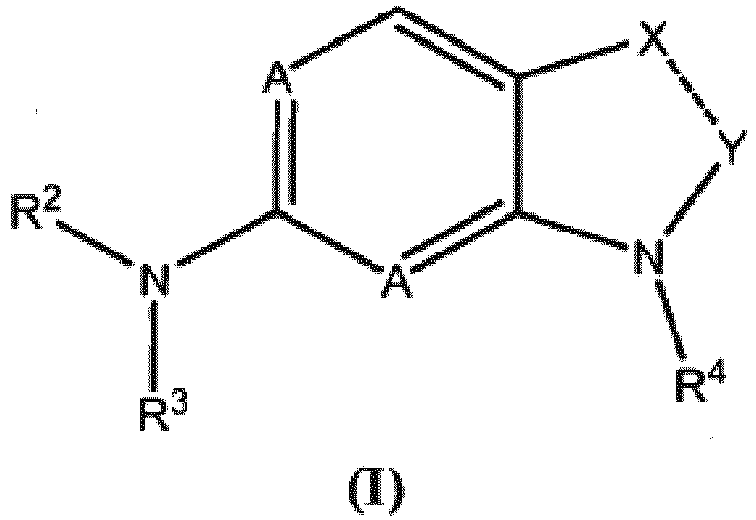 die gestrichelte Linie eine Doppelbindung bedeutet,A für N oder CR5 steht wobei R5 für Wasserstoff oder C1-C3-Alkyl steht,R2 und R3 jeweils unabhängig voneinander aus der aus Wasserstoff, Hydroxy, C1-C3-Alkyl, C3-C8-Cycloalkyl, Heterocyclyl, Aryl, Heteroaryl, substituiertem C1-C3-Alkyl, substituiertem C3-C8-Cycloalkyl, substituiertem Heterocyclyl, substituiertem Aryl und substituiertem Heteroaryl bestehenden Gruppe ausgewählt sind,R4 aus der aus C(H)(CH2CH3)2, C(H)(CH2CH3)Ph, CH2CH3, Cyclopropyl, Cyclopentyl und Cyclohexyl bestehenden Gruppe ausgewählt ist,X für N oder CR11 steht und Y für CR12 steht,R11 aus der aus Halogen, Wasserstoff, C1-C3-Alkyl, C1-C3-Alkoxy, CN, C=NOH, C=NOCH3, C(O)H, C(O)-C1-C3-Alkyl, C3-C8-Cycloalkyl, Heterocyclyl, Aryl, Heteroaryl, subsituiertem C1-C3-Alkyl, substituiertem C3-C8-Cycloalkyl, substituiertem Heterocyclyl, substituiertem Aryl, substituiertem Heteroaryl, -BNR13R14, -BOR13, -BC(O)R13, -BC(O)OR13, -BC(O)NR13R14 bestehenden Gruppe ausgewählt ist, wobei B für eine Bindung, C1-C3-Alkyl oder verzweigtes C1-C3-Alkyl steht, wobei R13 und R14 jeweils unabhängig voneinander aus der aus Wasserstoff, C1-C3-Alkyl, C3-C8-Cycloalkyl, Heterocyclyl, Aryl, Heteroaryl, substituiertem Alkyl, substituiertem Cycloalkyl, substituiertem Heterocyclyl, substituiertem Aryl und substituiertem Heteroaryl bestehenden Gruppe ausgewählt sind, undR12 für -BC(O)NR13R14 steht, wobei B für eine Bindung, C1-C3-Alkyl oder verzweigtes C1-C3-Alkyl steht, wobei R13 und R14 jeweils unabhängig voneinander aus der aus Wasserstoff, C1-C3-Alkyl, C3-C8-Cycloalkyl, Heterocyclyl, Aryl, Heteroaryl, substituiertem Alkyl, substituiertem Cycloalkyl, substituiertem Heterocyclyl, substituiertem Aryl und substituiertem Heteroaryl bestehenden Gruppe ausgewählt sind.
 - Verbindung nach Anspruch 1, wobei A für N steht.
- Verbindung nach Anspruch 1, wobei R2 für H steht.
- Verbindung nach Anspruch 1, wobei R3 für eine Arylgruppe steht, welche weiter unabhängig ein- oder mehrmals durch Halogen, C1-C4-Alkoxy, R15-Amin, R15-Heterocyclus oder R15-Heteroaryl substituiert ist, wobei R15 für eine Bindung, C(O), N(H)C(O), N(H)SO2, OC(O) oder (CH2)1-4 steht, wobei die (CH2)1-4-Gruppe durch O, N(CH3) oder N(H) unterbrochen sein kann.
- Verbindung nach Anspruch 4, wobei es sich bei der Arylgruppe um Phenyl handelt.
- Verbindung nach Anspruch 1, wobei R3 für eine Phenylgruppe steht, welche unabhängig ein- oder mehrmals durch Fluor, Methoxy, Diethylamin, R15-Piperazinyl, R15-Morpholinyl, R15-Piperidinyl, R15-Triazolyl, R15-Phenyl, Rl5-Pyridinyl, R15-Piperazinyl, R15-Indazolyl, R15-Pyrrolidinyl oder R15-Imidazolyl substituiert ist, wobei die Piperazinyl-, Morpholinyl-, Piperidinyl-, Triazolyl-, Phenyl-, Pyridinyl-, Piperazinyl-, Indazolyl-, Pyrrolidinyl- bzw. Imidazolylgruppen weiter durch C1-C4-Alkyl, C(O)-C1-C4-Alkyl, S(O)2-C1-C4-Alkyl, OH, C(O)(CH2)1-3CN oder N(H)C(O)-C1-C4-Alkyl substituiert sein können.
- Verbindung nach Anspruch 1, wobei R3 für eine Phenylgruppe steht, welche durch N(H)C(O)-Aryl, C(O)N(H)-C1-C4-Alkyl, C(O)N (C1-C4-Alkyl)2 oder C(O)N(H)-C3-C6-Cycloalkyl substituiert ist.
- Verbindung nach Anspruch 1, wobei die Verbindung aus der aus
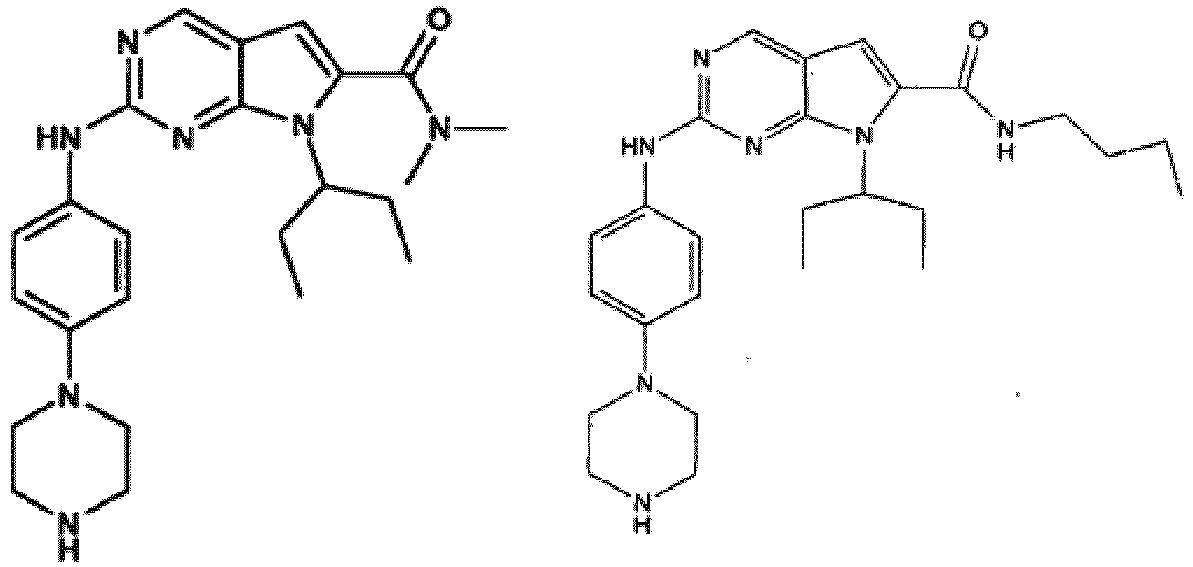


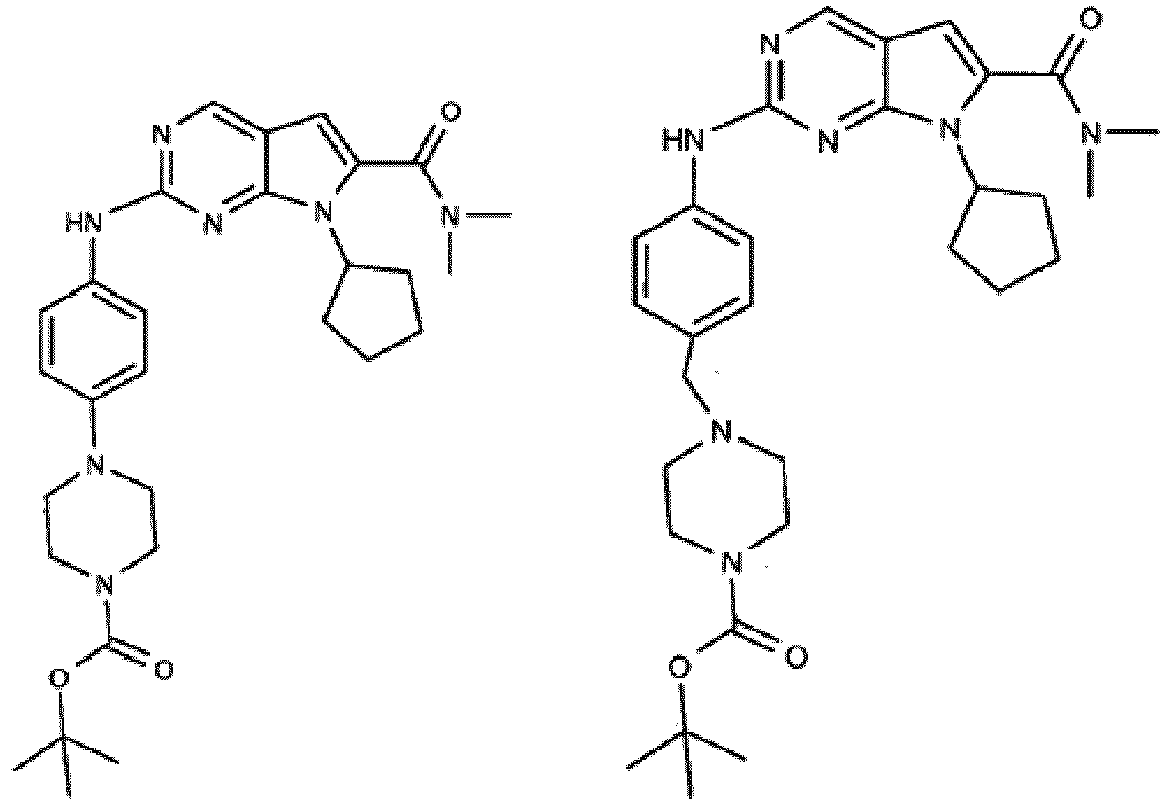


- Verbindung nach einem der Ansprüche 1 bis 8 zur Verwendung bei der Behandlung einer Autoimmun-, Transplantatabstoßungs- oder Krebserkrankung.
- Verbindung zur Verwendung nach Anspruch 9, wobei die Autoimmunkrankheit ausgewählt ist aus der Gruppe bestehend aus autoimmunhämolytischer Anämie, Autoimmuntrhombozytopenie des Neugeborenen, idiopathischer thrombozytopenischer Purpura, Autoimmunzytopenie, hämolytischer Anämie, Antiphospholipidsyndrom, Dermatitis, allergischer Enzephalomyelitis, Myokarditis, rezidivierender Polychondritis, rheumatischer Herzerkrankung, Glomerulonephritis, multipler Sklerose, Neuritis, Uveitis ophthalmia, Polyendokrinopathien, Purpura, Reiter-Krankheit, Stiff-Man-Syndrom, autoimmuner Lungenentzündung, Autismus, Guillain-Barre-Syndrom, insulinabhängigem Diabetes mellitus, autoimmuner entzündlicher Augenerkrankung, Autoimmunthyroiditis, Hyperthyroidismus, systemischem Lupus erhythematodes, Goodpasture-Syndrom, Pemphigus, Rezeptorautoimmunitäten, autoimmuner hämolytischer Anämie, autoimmuner thrombozytopenischer Purpura, rheumatoider Arthritis, gemischter Bindegewebserkrankung, Polymyositis/Dermatomyositis, perniziöser Anämie, idiopathischer Addison-Krankheit, Unfruchtbarkeit, Glomerulonephritis, bullösem Pemphigoid, Sjögren-Syndrom, Diabetes mellitus, adrenerger Arzneistoffresistenz, chronischer aktiver Hepatitis, primärer biliärer Zirrhose, Vitiligo, Vaskulitis, Post-MI, Kardiotomiesyndrom, Nesselsucht, atopischer Dermatitis, Asthma, entzündlichen Myopathien, chronischer aktiver Hepatitis, primärer biliärer Zirrhose und T-Zellvermittelten Überempfindlichkeitserkrankungen.
- Verbindung zur Verwendung nach Anspruch 9, wobei die Transplantatabstoßung ausgewählt ist aus der Gruppe bestehend aus Graft-versus-Host-Reaktion, einer mit einer Xenotransplantation in Zusammenhang stehenden Abstoßung, einer mit einer Organtransplantation in Zusammenhang stehenden Abstoßung, einer mit einem akuten Transplantat in Zusammenhang stehenden Abstoßung, Heterograft- oder Homograftabstoßung und einer während einer Organtransplantation auftretenden ischämischen oder Reperfusionsverletzung.
- Verbindung zur Verwendung nach Anspruch 9, wobei die Krebserkrankung ausgewählt ist aus der Gruppe bestehend aus Blasenkrebs, Kopf- und -Halskrebs, Brustkrebs, Magenkrebs, Eierstockkrebs, Dickdarmkrebs, Lungenkrebs, Hirnkrebs, Kehlkopfkrebs, Krebs des lymphatischen Systems, Krebs des Urogenitaltrakts, Krebs des Magen-Darm-Trakts, Ovarialkrebs, Prostatakrebs, Magenkrebs, Knochenkrebs, kleinzelligem Lungenkrebs, Gliom, Kolorektalkrebs und Bauchspeicheldrüsenkrebs.
- Pharmazeutische Zusammensetzung, umfassend eine Verbindung nach einem der Ansprüche 1 bis 8 zusammen mit einem pharmazeutisch unbedenklichen Träger und gegebenenfalls anderen therapeutischen Inhaltsstoffen.
- Pharmazeutische Zusammensetzung, umfassend eine Verbindung nach einem der Ansprüche 1 bis 8, angepasst auf die gleichzeitige oder aufeinanderfolgende Verabreichung mit einem entzündungshemmenden Mittel, antiproliferativen Mittel, Chemotherapeutikum, Immunsuppressivum, Antikrebsmittel, zytotoxischen Mittel oder Kinaseinhibitor, bei dem es sich nicht um eine Verbindung nach einem der Ansprüche 1 bis 8 oder ein Salz davon handelt.
- Pharmazeutische Zusammensetzung nach Anspruch 14, bei dem man die Verbindung nach einem der Ansprüche 1 bis 8 oder ein Salz davon gleichzeitig oder aufeinanderfolgend mit einer oder mehreren Verbindungen ausgewählt aus einem PTK-Inhibitor, Cyclosporin A, CTLA4-Ig, Antikörpern ausgewählt aus Anti-ICAM-3, Anti-IL-2-Rezeptor, Anti-CD45RB, Anti-CD2, Anti-CD3, Anti-CD4, Anti-CD80, Anti-CD86 und monoklonalem Antikörper OKT3, Mitteln, die die Wechselwirkung zwischen CD40 und gp39 blockieren, aus CD40 und gp39 konstruierten Fusionsproteinen, Inhibitoren der NF-kappa-B-Funktion, nichtsteroidalen entzündungshemmenden Arzneimitteln, Steroiden, Goldverbindungen, antiproliferativen Mitteln, FK506, Mykophenolatmofetil, zytotoxischen Arzneimitteln, TNF-α-Inhibitoren, Anti-TNF-Antikörpern oder löslichem TNF-Rezeptor, Rapamycin, Leflunimid, Cyclooxygenase-2-Inhibitoren, Paclitaxel, Cisplatin, Carboplatin, Doxorubicin, Carminomycin, Daunorubicin, Aminopterin, Methotrexat, Methopterin, Mitomycin C, Ecteinascidin 743, Porfiromycin, 5-Fluoruracil, 6-Mercaptopurin, Gemictabin, Cytosinarabinosid, Podophyllotoxin, Etoposid, Etoposidphosphat, Teniposid, Melphalan, Vinblastin, Vincristin, Leurosidin, Epothilon, Vindesin, Leurosin oder Derivaten davon verabreicht.
- Packung, umfassend eine Verbindung nach einem der Ansprüche 1 bis 8, verpackt mit Anweisungen zur Anwendung bei der Behandlung einer Autoimmun-, Transplantatabstoßungs- oder Krebserkrankung.
Priority Applications (2)
| Application Number | Priority Date | Filing Date | Title |
|---|---|---|---|
| HRP20170631TT HRP20170631T1 (hr) | 2006-05-26 | 2007-05-24 | Spojevi pirolopirimidina i njihove uporabe |
| PL07811927T PL2029145T3 (pl) | 2006-05-26 | 2007-05-24 | Związki pirolopirymidynowe i ich zastosowania |
Applications Claiming Priority (2)
| Application Number | Priority Date | Filing Date | Title |
|---|---|---|---|
| US80860506P | 2006-05-26 | 2006-05-26 | |
| PCT/US2007/069595 WO2007140222A2 (en) | 2006-05-26 | 2007-05-24 | Pyrrolopyrimidine compounds and their uses |
Publications (2)
| Publication Number | Publication Date |
|---|---|
| EP2029145A2 EP2029145A2 (de) | 2009-03-04 |
| EP2029145B1 true EP2029145B1 (de) | 2017-01-25 |
Family
ID=38779335
Family Applications (1)
| Application Number | Title | Priority Date | Filing Date |
|---|---|---|---|
| EP07811927.8A Active EP2029145B1 (de) | 2006-05-26 | 2007-05-24 | Pyrrolopyrimidinverbindungen und ihre verwendungen |
Country Status (39)
| Country | Link |
|---|---|
| US (2) | US8324225B2 (de) |
| EP (1) | EP2029145B1 (de) |
| JP (2) | JP2009538341A (de) |
| KR (1) | KR101466412B1 (de) |
| CN (1) | CN101594871B (de) |
| AR (2) | AR061124A1 (de) |
| AU (1) | AU2007267645C1 (de) |
| BR (1) | BRPI0712816B8 (de) |
| CA (1) | CA2652044C (de) |
| CL (1) | CL2007001504A1 (de) |
| CR (1) | CR10433A (de) |
| CU (1) | CU23831B1 (de) |
| EA (1) | EA016301B1 (de) |
| EC (1) | ECSP088910A (de) |
| ES (1) | ES2623133T3 (de) |
| GE (1) | GEP20115283B (de) |
| GT (1) | GT200800258A (de) |
| HN (1) | HN2008001752A (de) |
| HR (1) | HRP20170631T1 (de) |
| IL (1) | IL195086A (de) |
| JO (1) | JO3235B1 (de) |
| MA (1) | MA30557B1 (de) |
| ME (1) | ME00486B (de) |
| MX (1) | MX2008015076A (de) |
| MY (1) | MY150650A (de) |
| NO (1) | NO343182B1 (de) |
| NZ (1) | NZ572549A (de) |
| PE (1) | PE20080263A1 (de) |
| PL (1) | PL2029145T3 (de) |
| PT (1) | PT2029145T (de) |
| PY (1) | PY0715680A (de) |
| SG (1) | SG172632A1 (de) |
| SM (1) | SMP200800069B (de) |
| TN (1) | TNSN08481A1 (de) |
| TW (1) | TWI398252B (de) |
| UA (1) | UA95632C2 (de) |
| UY (1) | UY30369A1 (de) |
| WO (1) | WO2007140222A2 (de) |
| ZA (1) | ZA200809382B (de) |
Cited By (3)
| Publication number | Priority date | Publication date | Assignee | Title |
|---|---|---|---|---|
| US11434291B2 (en) | 2019-05-14 | 2022-09-06 | Provention Bio, Inc. | Methods and compositions for preventing type 1 diabetes |
| US12006366B2 (en) | 2020-06-11 | 2024-06-11 | Provention Bio, Inc. | Methods and compositions for preventing type 1 diabetes |
| US12565529B2 (en) | 2021-05-24 | 2026-03-03 | Provention Bio, Inc. | Methods for treating type 1 diabetes |
Families Citing this family (194)
| Publication number | Priority date | Publication date | Assignee | Title |
|---|---|---|---|---|
| SG10202003901UA (en) | 2005-12-13 | 2020-05-28 | Incyte Holdings Corp | Heteroaryl substituted pyrrolo[2,3-b]pyridines and pyrrolo[2,3-b]pyrimidines as janus kinase inhibitors |
| US7989459B2 (en) | 2006-02-17 | 2011-08-02 | Pharmacopeia, Llc | Purinones and 1H-imidazopyridinones as PKC-theta inhibitors |
| US7902187B2 (en) | 2006-10-04 | 2011-03-08 | Wyeth Llc | 6-substituted 2-(benzimidazolyl)purine and purinone derivatives for immunosuppression |
| TW200837064A (en) | 2006-10-04 | 2008-09-16 | Pharmacopeia Inc | 8-substituted 2-(benzimidazolyl)purine derivatives for immunosuppression |
| US7919490B2 (en) | 2006-10-04 | 2011-04-05 | Wyeth Llc | 6-substituted 2-(benzimidazolyl)purine and purinone derivatives for immunosuppression |
| KR20150036210A (ko) | 2007-06-13 | 2015-04-07 | 인사이트 코포레이션 | 야누스 키나제 억제제(R)―3―(4―(7H―피롤로[2,3-d]피리미딘―4―일)―1H―피라졸―1―일)―3―사이클로펜틸프로판니트릴의 염 |
| MX2010002115A (es) * | 2007-08-23 | 2010-06-01 | Aztrazeneca Ab | 2-anilinopurin-8-onas como inhibidores de ttk/mps1 para el tratamiento de trastornos .proliferativos. |
| EA201001030A1 (ru) * | 2007-12-19 | 2011-02-28 | Амген Инк. | Конденсированные соединения пиридина, пиримидина и триазина в качестве ингибиторов клеточного цикла |
| PE20091485A1 (es) | 2008-02-06 | 2009-10-26 | Novartis Ag | DERIVADOS DE PIRROLO-[2,3-d]-PIRIMIDINA COMO INHIBIDORES DE CINASAS |
| EP2255830A1 (de) * | 2008-03-03 | 2010-12-01 | Takeda Pharmaceutical Company Limited | Konkomitanter wirkstoff |
| US8389533B2 (en) | 2008-04-07 | 2013-03-05 | Amgen Inc. | Gem-disubstituted and spirocyclic amino pyridines/pyrimidines as cell cycle inhibitors |
| TW201002713A (en) | 2008-04-09 | 2010-01-16 | Organon Nv | Pyrrolo[2,3-d]pyrimidin-2-yl-amine derivatives as PKC-theta inhibitors |
| CA2722159C (en) | 2008-04-24 | 2016-04-05 | Newlink Genetics Corporation | Substituted phenylimidazole compounds and their use as ido inhibitors |
| WO2009152027A1 (en) * | 2008-06-12 | 2009-12-17 | Merck & Co., Inc. | 5,7-dihydro-6h-pyrrolo[2,3-d]pyrimidin-6-one derivatives for mark inhibition |
| ES2522346T3 (es) | 2008-08-22 | 2014-11-14 | Novartis Ag | Compuestos de pirrolopirimidina como inhibidores de CDK |
| WO2010045451A1 (en) * | 2008-10-16 | 2010-04-22 | Glaxosmithkline Llc | Pyrrolopyrimidine compounds |
| GB0903759D0 (en) | 2009-03-04 | 2009-04-15 | Medical Res Council | Compound |
| JP2012526850A (ja) | 2009-05-13 | 2012-11-01 | ザ ユニバーシティ オブ ノース カロライナ アット チャペル ヒル | サイクリン依存性キナーゼ阻害剤及びその用法 |
| SI2432472T1 (sl) | 2009-05-22 | 2019-11-29 | Incyte Holdings Corp | 3-(4-(7H-pirolo(2,3-d)pirimidin-4-il)-1H-pirazol-1-il)oktan- ali heptan-nitril kot inhibitorji JAK |
| AR076794A1 (es) | 2009-05-22 | 2011-07-06 | Incyte Corp | Derivados de n-(hetero)aril-pirrolidina de pirazol-4-il-pirrolo [2,3-d]pirimidinas y pirrol-3-il-pirrolo [2,3-d ]pirimidinas como inhibidores de la quinasa janus y composiciones farmaceuticas que los contienen |
| TW201113285A (en) | 2009-09-01 | 2011-04-16 | Incyte Corp | Heterocyclic derivatives of pyrazol-4-yl-pyrrolo[2,3-d]pyrimidines as janus kinase inhibitors |
| ES2629006T3 (es) | 2009-10-29 | 2017-08-07 | Vectura Limited | Derivados que contienen N-heteroarilo como inhibidores de la quinasa jak3 |
| WO2011082400A2 (en) * | 2010-01-04 | 2011-07-07 | President And Fellows Of Harvard College | Modulators of immunoinhibitory receptor pd-1, and methods of use thereof |
| PL3202460T3 (pl) | 2010-02-11 | 2019-12-31 | Celgene Corporation | Pochodne arylometoksyizoindoliny i zawierające je kompozycje oraz sposoby ich zastosowania |
| UY33227A (es) * | 2010-02-19 | 2011-09-30 | Novartis Ag | Compuestos de pirrolopirimidina como inhibidores de la cdk4/6 |
| UY33226A (es) * | 2010-02-19 | 2011-09-30 | Novartis Ag | Compuestos de pirrolopirimidina deuterada como inhibidores de la cdk4/6 |
| EP3354652B1 (de) | 2010-03-10 | 2020-05-06 | Incyte Holdings Corporation | Piperidin-4-yl azetidin-derivate als jak1-inhibitoren |
| EP2558092B1 (de) * | 2010-04-13 | 2018-06-27 | Novartis AG | Kombination mit einem hemmer der cyclin-abhängigen kinase-4 oder cyclinabhängigen kinase-6 (cdk4/6) und everolimus zur behandlung von krebs |
| GB201007286D0 (en) | 2010-04-30 | 2010-06-16 | Astex Therapeutics Ltd | New compounds |
| US9290499B2 (en) | 2010-05-19 | 2016-03-22 | The University Of North Carolina At Chapel Hill | Pyrazolopyrimidine compounds for the treatment of cancer |
| PE20130216A1 (es) | 2010-05-21 | 2013-02-27 | Incyte Corp | Formulacion topica para un inhibidor de jak |
| MX338327B (es) * | 2010-10-25 | 2016-04-12 | G1 Therapeutics Inc | Inhibidores de cdk. |
| US20120115878A1 (en) * | 2010-11-10 | 2012-05-10 | John Vincent Calienni | Salt(s) of 7-cyclopentyl-2-(5-piperazin-1-yl-pyridin-2-ylamino)-7h-pyrrolo[2,3-d]pyrimidine-6-carboxylic acid dimethylamide and processes of making thereof |
| WO2012068381A2 (en) | 2010-11-17 | 2012-05-24 | The University Of North Carolina At Chapel Hill | Protection of renal tissues from schema through inhibition of the proliferative kisses cdk4 and cdk6 |
| PE20140146A1 (es) | 2010-11-19 | 2014-02-06 | Incyte Corp | Derivados de pirrolopiridina y pirrolopirimidina sustituidos con ciclobutilo como inhibidores de jak |
| US9034884B2 (en) | 2010-11-19 | 2015-05-19 | Incyte Corporation | Heterocyclic-substituted pyrrolopyridines and pyrrolopyrimidines as JAK inhibitors |
| CN102093364B (zh) * | 2011-01-07 | 2015-01-28 | 北京赛林泰医药技术有限公司 | 作为FAK/Pyk2抑制剂的2,4-二氨基-6,7-二氢-5H-吡咯并[2,3]嘧啶衍生物 |
| CN103476776B (zh) * | 2011-01-07 | 2016-09-28 | 北京赛林泰医药技术有限公司 | 作为FAK/Pyk2抑制剂的2,4-二氨基-6,7-二氢-5H-吡咯并[2,3]嘧啶衍生物 |
| US9174946B2 (en) | 2011-02-17 | 2015-11-03 | Cancer Therapeutics Crc Pty Ltd | Selective FAK inhibitors |
| US20130324532A1 (en) | 2011-02-17 | 2013-12-05 | Cancer Therapeutics Crc Pty Limited | Fak inhibitors |
| GB201104267D0 (en) | 2011-03-14 | 2011-04-27 | Cancer Rec Tech Ltd | Pyrrolopyridineamino derivatives |
| CN103547580B (zh) | 2011-03-22 | 2016-12-07 | 阿迪维纳斯疗法有限公司 | 取代的稠合三环化合物、其组合物及医药用途 |
| EP2937349B1 (de) | 2011-03-23 | 2016-12-28 | Amgen Inc. | Fusionierte tricyclische duale inhibitoren von cdk 4/6 und flt3 |
| CN103502249A (zh) * | 2011-05-17 | 2014-01-08 | 普林斯匹亚生物制药公司 | 作为酪氨酸激酶抑制剂的氮杂吲哚衍生物 |
| CN103797010B (zh) | 2011-06-20 | 2016-02-24 | 因塞特控股公司 | 作为jak抑制剂的氮杂环丁烷基苯基、吡啶基或吡嗪基甲酰胺衍生物 |
| EP2726074B1 (de) | 2011-07-01 | 2018-04-04 | Novartis AG | Kombinationstherapie mit einem cdk4/6-hemmer und einem pi3k-hemmer zur verwendung bei der behandlung von krebs |
| KR20140040769A (ko) * | 2011-07-01 | 2014-04-03 | 노파르티스 아게 | 조합 요법 |
| ES2548414T3 (es) | 2011-07-08 | 2015-10-16 | Novartis Ag | Novedosos derivados de pirrolo pirimidina |
| WO2013017480A1 (en) * | 2011-07-29 | 2013-02-07 | Cellzome Limited | Pyrazolo[4,3-c]pyridine derivatives as jak inhibitors |
| WO2013017479A1 (en) * | 2011-07-29 | 2013-02-07 | Cellzome Limited | Pyrazolo[4,3-c]pyridine derivatives as jak inhibitors |
| TW201313721A (zh) | 2011-08-18 | 2013-04-01 | Incyte Corp | 作為jak抑制劑之環己基氮雜環丁烷衍生物 |
| UA111854C2 (uk) | 2011-09-07 | 2016-06-24 | Інсайт Холдінгс Корпорейшн | Способи і проміжні сполуки для отримання інгібіторів jak |
| MX2014004086A (es) | 2011-10-03 | 2014-09-22 | Univ North Carolina | Compuestos de pirrolopirimidina para el tratamiento del cancer. |
| US9498471B2 (en) | 2011-10-20 | 2016-11-22 | The Regents Of The University Of California | Use of CDK9 inhibitors to reduce cartilage degradation |
| TW201406761A (zh) | 2012-05-18 | 2014-02-16 | Incyte Corp | 做爲jak抑制劑之哌啶基環丁基取代之吡咯并吡啶及吡咯并嘧啶衍生物 |
| AU2013266438B2 (en) | 2012-05-22 | 2017-09-07 | The University Of North Carolina At Chapel Hill | Pyrimidine compounds for the treatment of cancer |
| AU2013274641B2 (en) | 2012-06-14 | 2015-09-24 | Eli Lilly And Company | Inhibitor of JAK1 and JAK2 |
| AU2013296237B2 (en) | 2012-08-03 | 2019-05-16 | Foundation Medicine, Inc. | Human papilloma virus as predictor of cancer prognosis |
| GB201216018D0 (en) | 2012-09-07 | 2012-10-24 | Cancer Rec Tech Ltd | Pharmacologically active compounds |
| GB201216017D0 (en) | 2012-09-07 | 2012-10-24 | Cancer Rec Tech Ltd | Inhibitor compounds |
| US9593115B2 (en) | 2012-09-21 | 2017-03-14 | Advinus Therapeutics Ltd. | Substituted fused tricyclic compounds, compositions, and medicinal applications thereof |
| JP2015531395A (ja) | 2012-10-04 | 2015-11-02 | ファイザー・リミテッドPfizer Limited | ピロロ[3,2−c]ピリジントロポミオシン関連キナーゼ阻害剤 |
| EP2909211A4 (de) | 2012-10-17 | 2016-06-22 | Univ North Carolina | Pyrazolopyrimidinverbindungen zur krebsbehandlung |
| PH12020551186B1 (en) | 2012-11-15 | 2024-03-20 | Incyte Holdings Corp | Sustained-release dosage forms of ruxolitinib |
| EP2925752A4 (de) | 2012-11-27 | 2016-06-01 | Univ North Carolina | Pyrimidinverbindungen zur krebsbehandlung |
| EP2742940B1 (de) | 2012-12-13 | 2017-07-26 | IP Gesellschaft für Management mbH | (R)-3-(6-(4-methylphenyl)-pyridin-3-yloxy)-l-aza-bicyclo-[2.2.2]octane Fumarat zur einmal, zweimal oder dreimal täglichen Verabreichung |
| US9867825B2 (en) * | 2012-12-20 | 2018-01-16 | Novartis Ag | Pharmaceutical combination comprising binimetinib |
| EP3696276A1 (de) | 2013-02-25 | 2020-08-19 | Novartis AG | Neuartige androgenrezeptormutation |
| US9708326B2 (en) | 2013-02-25 | 2017-07-18 | Pharmacyclics Llc | Inhibitors of bruton's tyrosine kinase |
| EP2964648B1 (de) * | 2013-03-05 | 2016-11-16 | Merck Patent GmbH | 9-(aryl oder heteroaryl)-2-(pyrazolyl, pyrrolidinyl oder cyclopentyl)aminopurin-derivate als antikrebsmittel |
| RS62867B1 (sr) | 2013-03-06 | 2022-02-28 | Incyte Holdings Corp | Postupci i intermedijeri za dobijanje inhibitora jak |
| MA38522A1 (fr) | 2013-03-21 | 2017-10-31 | Novartis Ag | Thérapie de combinaison comprenant un inhibiteur de b-raf et un second inhibiteur. |
| AU2014253932B2 (en) | 2013-04-16 | 2020-04-30 | Memorial Sloan-Kettering Cancer Center | Companion diagnostic for CDK4 inhibitors |
| CA2902686C (en) | 2013-04-25 | 2017-01-24 | Beigene, Ltd. | Fused heterocyclic compounds as protein kinase inhibitors |
| US8895611B1 (en) | 2013-07-17 | 2014-11-25 | King Fahd University Of Petroleum And Minerals | Cytotoxic compounds for treating cancer |
| SMT202000315T1 (it) | 2013-08-07 | 2020-07-08 | Incyte Corp | Forme di dosaggio a rilascio prolungato per un inibitore di jak1 |
| CN105828822B (zh) | 2013-08-14 | 2019-10-18 | 诺华股份有限公司 | 用于治疗癌症的组合疗法 |
| CN103408546A (zh) * | 2013-08-22 | 2013-11-27 | 中国药科大学 | 2-苯氨基嘌呤类plk1抑制剂及其用途 |
| CN112552401B (zh) | 2013-09-13 | 2023-08-25 | 广州百济神州生物制药有限公司 | 抗pd1抗体及其作为治疗剂与诊断剂的用途 |
| GB201403536D0 (en) | 2014-02-28 | 2014-04-16 | Cancer Rec Tech Ltd | Inhibitor compounds |
| JO3512B1 (ar) | 2014-03-26 | 2020-07-05 | Astex Therapeutics Ltd | مشتقات كينوكسالين مفيدة كمعدلات لإنزيم fgfr كيناز |
| HRP20210319T1 (hr) | 2014-03-26 | 2021-04-30 | Astex Therapeutics Ltd. | Kombinacije inhibitora fgfr i inhibitora igf1r |
| RU2715236C2 (ru) | 2014-03-26 | 2020-02-26 | Астекс Терапьютикс Лтд | Комбинации |
| US9555031B2 (en) | 2014-04-11 | 2017-01-31 | The University Of North Carolina At Chapel Hill | Therapeutic uses of selected pyrrolopyrimidine compounds with anti-mer tyrosine kinase activity |
| US20150320754A1 (en) | 2014-04-16 | 2015-11-12 | Infinity Pharmaceuticals, Inc. | Combination therapies |
| US10555931B2 (en) | 2014-05-28 | 2020-02-11 | Piramal Enterprises Limited | Pharmaceutical combination for the treatment of cancer |
| DK3149008T3 (en) * | 2014-05-28 | 2019-04-01 | Shanghai Fochon Pharmaceutical Co Ltd | Specific protein kinase inhibitors |
| US9498467B2 (en) | 2014-05-30 | 2016-11-22 | Incyte Corporation | Treatment of chronic neutrophilic leukemia (CNL) and atypical chronic myeloid leukemia (aCML) by inhibitors of JAK1 |
| CN106604742B (zh) | 2014-07-03 | 2019-01-11 | 百济神州有限公司 | 抗pd-l1抗体及其作为治疗剂及诊断剂的用途 |
| CA2954298A1 (en) * | 2014-07-24 | 2016-01-28 | Beta Pharma, Inc. | 2-h-indazole derivatives as cyclin-dependent kinase (cdk) inhibitors and therapeutic uses thereof |
| US9512124B2 (en) | 2014-10-06 | 2016-12-06 | Signal Pharmaceuticals, Llc | Substituted aminopurine compounds, compositions thereof, and methods of treatment therewith |
| CA3000633C (en) | 2014-10-14 | 2023-10-03 | The Regents Of The University Of California | Use of cdk9 and brd4 inhibitors to inhibit inflammation |
| CN105111215B (zh) * | 2014-12-12 | 2019-06-18 | 苏州晶云药物科技股份有限公司 | 一种周期蛋白依赖性激酶抑制剂的晶型及其制备方法 |
| CN104610265A (zh) * | 2014-12-31 | 2015-05-13 | 芜湖杨燕制药有限公司 | 一种化合物及其制备方法 |
| CN104606197A (zh) * | 2014-12-31 | 2015-05-13 | 芜湖杨燕制药有限公司 | 一种化合物的抗肿瘤用途 |
| TWI719960B (zh) | 2015-02-10 | 2021-03-01 | 英商阿斯迪克治療公司 | 新穎組成物 |
| CN107801397B (zh) * | 2015-02-13 | 2021-07-30 | 达纳-法伯癌症研究所公司 | Lrrk2抑制剂及其制备和使用方法 |
| CN106146515B (zh) * | 2015-04-17 | 2020-09-04 | 常州隆赛医药科技有限公司 | 新型激酶抑制剂的制备及应用 |
| EP3353164B1 (de) | 2015-09-23 | 2021-11-03 | Janssen Pharmaceutica, N.V. | Bi-heteroaryl-substituierte 1,4-benzodiazepine und ihre anwendung in der krebsbehandlung |
| US11155555B2 (en) | 2015-09-23 | 2021-10-26 | Janssen Pharmaceutica Nv | Compounds |
| CN108779117B (zh) * | 2015-12-27 | 2021-08-31 | 重庆复创医药研究有限公司 | 一类激酶抑制剂 |
| CN106928219B (zh) | 2015-12-31 | 2021-08-20 | 上海医药集团股份有限公司 | 含氮稠杂环化合物、制备方法、中间体、组合物和应用 |
| US11921116B2 (en) | 2016-03-09 | 2024-03-05 | Memorial Sloan Kettering Cancer Center | Enigma and CDH18 as companion diagnostics for CDK4 inhibitors |
| US10709708B2 (en) | 2016-03-17 | 2020-07-14 | The University Of North Carolina At Chapel Hill | Method of treating cancer with a combination of MER tyrosine kinase inhibitor and an epidermal growth factor receptor (EGFR) inhibitor |
| HUE056631T2 (hu) | 2016-04-01 | 2022-02-28 | Signal Pharm Llc | (1S,4S)-4-(2-(((3S,4R)-3-fluorotetrahidro-2H-PIRÁN-4-il)amino)-8-((2,4,6-triklorofenil)amino)-9H-purin- 9-il)-1-metil-ciklohexán-1-karboxamid és alkalmazási módszereik |
| MX379513B (es) | 2016-04-01 | 2025-03-11 | Signal Pharm Llc | Compuestos de aminopurina sustituida, composiciones de estos y métodos de tratamiento con estos. |
| US10864203B2 (en) | 2016-07-05 | 2020-12-15 | Beigene, Ltd. | Combination of a PD-1 antagonist and a RAF inhibitor for treating cancer |
| WO2018033853A2 (en) | 2016-08-16 | 2018-02-22 | Beigene, Ltd. | Crystalline form of (s)-7-(1-acryloylpiperidin-4-yl)-2-(4-phenoxyphenyl)-4,5,6,7-tetra-hydropyrazolo[1,5-a]pyrimidine-3-carboxamide, preparation, and uses thereof |
| WO2018033135A1 (en) | 2016-08-19 | 2018-02-22 | Beigene, Ltd. | Use of a combination comprising a btk inhibitor for treating cancers |
| BR112019003722A2 (pt) | 2016-08-23 | 2019-05-28 | Eisai R&D Man Co Ltd | terapias de combinação para o tratamento de carcinoma hepatocelular |
| IL292938A (en) | 2016-09-19 | 2022-07-01 | Mei Pharma Inc | Combined treatment |
| US10849903B2 (en) * | 2016-10-20 | 2020-12-01 | Pfizer Inc. | Anti-proliferative agents for treating PAH |
| WO2018081211A1 (en) * | 2016-10-26 | 2018-05-03 | Li George Y | Deuterated 7-cyclopentyl-n, n-dimethyl-2-((5-(piperazin-1-yl)pyridin-2-yl)amino)-7h-pyrrolo[2,3-d]pyrimdine-6-carboxamide |
| EP3541391A4 (de) * | 2016-11-17 | 2020-06-17 | The University of North Carolina at Chapel Hill | Alkyl-pyrrolopyrimidin-analoga und verfahren zur herstellung und verwendung davon |
| JP6883653B2 (ja) | 2016-12-20 | 2021-06-09 | アストラゼネカ・アクチエボラーグAstrazeneca Aktiebolag | アミノ−トリアゾロピリジン化合物および癌の治療におけるその使用 |
| ES2909234T3 (es) * | 2016-12-21 | 2022-05-05 | Ono Pharmaceutical Co | Compuestos de 6-amino-7,9-dihidro-8H-purin-8-ona como inhibidores de Brk |
| WO2018124001A1 (ja) | 2016-12-27 | 2018-07-05 | 国立研究開発法人理化学研究所 | Bmpシグナル阻害化合物 |
| US11555038B2 (en) | 2017-01-25 | 2023-01-17 | Beigene, Ltd. | Crystalline forms of (S)-7-(1-(but-2-ynoyl)piperidin-4-yl)-2-(4-phenoxyphenyl)-4,5,6,7-tetrahydropyrazolo[1,5-a]pyrimidine-3-carboxamide, preparation, and uses thereof |
| CN114921468A (zh) * | 2017-01-30 | 2022-08-19 | 国立大学法人京都大学 | 新型化合物以及调节性t细胞的制造方法 |
| MX2019010981A (es) | 2017-03-16 | 2020-09-07 | Eisai R&D Man Co Ltd | Terapias de combinacion para el tratamiento de cancer de mama. |
| WO2018218633A1 (en) | 2017-06-02 | 2018-12-06 | Beijing Percans Oncology Co. Ltd. | Combination therapies for treating cancers |
| TW201904577A (zh) | 2017-06-16 | 2019-02-01 | 美商貝達醫藥公司 | N-(2-(2-二甲胺基)乙氧基)-4-甲氧基-5-((4-(1-甲基-1h-吲哚-3-基)嘧啶-2-基)胺基)苯基)丙烯醯胺及其鹽之醫藥調配物 |
| GB201709840D0 (en) | 2017-06-20 | 2017-08-02 | Inst Of Cancer Research: Royal Cancer Hospital | Methods and medical uses |
| EP3645569A4 (de) | 2017-06-26 | 2021-03-24 | BeiGene, Ltd. | Immuntherapie für leberzellkarzinom |
| US11377449B2 (en) | 2017-08-12 | 2022-07-05 | Beigene, Ltd. | BTK inhibitors with improved dual selectivity |
| US11174254B2 (en) * | 2017-09-28 | 2021-11-16 | Yangtze River Pharmaceutical Group Co., Ltd. | Aniline-substituted 1,2-dihydropyrrol[3,4-C]pyridin/pyrimidin-3-one derivative and use thereof |
| CN111417634A (zh) | 2017-10-04 | 2020-07-14 | 细胞基因公司 | 用于制备顺式-4-[2-{[(3s,4r)-3-氟噁烷-4-基]氨基}-8-(2,4,6-三氯苯胺基)-9h-嘌呤-9-基]-1-甲基环己烷-1-甲酰胺的方法 |
| AU2018345647A1 (en) | 2017-10-04 | 2020-04-16 | Celgene Corporation | Compositions and methods of use of cis-4-(2-{((3S,4R)-3-fluorooxan-4-yl) amino}-8-(2,4,6-trichloroanilino)-9H-purin-9-yl)-1-methylcyclohexane-1-carboxamide |
| US12496338B2 (en) | 2017-10-23 | 2025-12-16 | City Of Hope | CAR for treatment of HIV infection |
| WO2019108795A1 (en) | 2017-11-29 | 2019-06-06 | Beigene Switzerland Gmbh | Treatment of indolent or aggressive b-cell lymphomas using a combination comprising btk inhibitors |
| WO2019113487A1 (en) | 2017-12-08 | 2019-06-13 | Incyte Corporation | Low dose combination therapy for treatment of myeloproliferative neoplasms |
| CN111989099A (zh) | 2018-01-29 | 2020-11-24 | 贝塔制药有限公司 | 作为cdk4和cdk6抑制剂的2h-吲唑衍生物及其治疗用途 |
| SG11202007164UA (en) | 2018-01-30 | 2020-08-28 | Incyte Corp | Processes for preparing (1 -(3-fluoro-2-(trifluoromethyl)isonicotinyl)piperidine-4-one) |
| CN112041307B (zh) | 2018-02-06 | 2024-02-09 | 伊利诺伊大学评议会 | 作为选择性雌激素受体降解剂的取代的苯并噻吩类似物 |
| SMT202400306T1 (it) | 2018-03-30 | 2024-09-16 | Incyte Corp | Trattamento dell'idrosadenite suppurativa utilizzando inibitori di jak. |
| WO2019195959A1 (en) | 2018-04-08 | 2019-10-17 | Cothera Biosciences, Inc. | Combination therapy for cancers with braf mutation |
| US10723739B2 (en) | 2018-05-14 | 2020-07-28 | Apotex Inc. | Processes for the preparation of Ribociclib and intermediates thereof |
| WO2019222524A1 (en) * | 2018-05-16 | 2019-11-21 | The University Of North Carolina At Chapel Hill | Alkyl pyrrolopyrimidines as pan-tam inhibitors and their application in cancer treatment |
| CN110577524B (zh) * | 2018-06-07 | 2022-01-28 | 北京大学深圳研究生院 | 一种激酶选择性抑制剂 |
| MX2021000895A (es) | 2018-07-27 | 2021-08-24 | California Inst Of Techn | Inhibidores de cinasas dependientes de ciclinas (cdk) y usos de los mismos. |
| CA3109605A1 (en) | 2018-08-13 | 2020-02-20 | Beijing Percans Oncology Co. Ltd. | Biomarkers for cancer therapy |
| CN109438447B (zh) * | 2018-09-11 | 2020-10-16 | 北京工业大学 | 5,7-二氢-6H-吡咯并[2,3-d]嘧啶-6-酮类衍生物制备方法和应用 |
| US11066404B2 (en) | 2018-10-11 | 2021-07-20 | Incyte Corporation | Dihydropyrido[2,3-d]pyrimidinone compounds as CDK2 inhibitors |
| WO2020140054A1 (en) * | 2018-12-28 | 2020-07-02 | Spv Therapeutics Inc. | Cyclin-dependent kinase inhibitors |
| US20220056037A1 (en) * | 2018-12-28 | 2022-02-24 | Spv Therapeutics Inc. | Cyclin-dependent kinase inhibitors |
| US12390468B2 (en) | 2019-01-23 | 2025-08-19 | Novartis Ag | Crystalline forms of a succinate salt of 7-cyclopentyl-2-(5-piperazin-1-yl-pyridin-2-ylamino)-7H-pyrrolo[2,3-d]pyrimidine-6-carboxylic acid dimethylamide |
| US11384083B2 (en) | 2019-02-15 | 2022-07-12 | Incyte Corporation | Substituted spiro[cyclopropane-1,5′-pyrrolo[2,3-d]pyrimidin]-6′(7′h)-ones as CDK2 inhibitors |
| TW202100520A (zh) | 2019-03-05 | 2021-01-01 | 美商英塞特公司 | 作為cdk2 抑制劑之吡唑基嘧啶基胺化合物 |
| WO2020205560A1 (en) * | 2019-03-29 | 2020-10-08 | Incyte Corporation | Sulfonylamide compounds as cdk2 inhibitors |
| US11447494B2 (en) | 2019-05-01 | 2022-09-20 | Incyte Corporation | Tricyclic amine compounds as CDK2 inhibitors |
| WO2020223469A1 (en) | 2019-05-01 | 2020-11-05 | Incyte Corporation | N-(1-(methylsulfonyl)piperidin-4-yl)-4,5-di hydro-1h-imidazo[4,5-h]quinazolin-8-amine derivatives and related compounds as cyclin-dependent kinase 2 (cdk2) inhibitors for treating cancer |
| CA3139277A1 (en) | 2019-05-08 | 2020-11-12 | Vimalan Biosciences, Inc. | Jak inhibitors |
| TWI899080B (zh) * | 2019-05-27 | 2025-10-01 | 大陸商迪哲(江蘇)醫藥股份有限公司 | Dna依賴性蛋白激酶抑制劑 |
| US20220249491A1 (en) | 2019-06-10 | 2022-08-11 | Beigene Switzerland Gmbh | Oral solid tablet comprising bruton's tyrosine kinase inhibitor and preparation method therefor |
| CN110305140B (zh) * | 2019-07-30 | 2020-08-04 | 上海勋和医药科技有限公司 | 二氢吡咯并嘧啶类选择性jak2抑制剂 |
| MX2022001702A (es) * | 2019-08-08 | 2022-04-20 | Vimalan Biosciences Inc | Inhibidores de jak. |
| CA3150681A1 (en) | 2019-08-14 | 2021-02-18 | Incyte Corporation | Imidazolyl pyrimidinylamine compounds as cdk2 inhibitors |
| GB201911868D0 (en) * | 2019-08-19 | 2019-10-02 | Galapagos Nv | Novel compounds and pharmaceutical compositions thereof for the treatment of inflammatory disorders |
| KR20220054347A (ko) | 2019-08-26 | 2022-05-02 | 아비나스 오퍼레이션스, 인코포레이티드 | 에스트로겐 수용체 분해제로서의 테트라히드로나프탈렌 유도체로 유방암을 치료하는 방법 |
| US20230024521A1 (en) * | 2019-09-25 | 2023-01-26 | Vimalan Biosciences, Inc. | Jak inhibitors |
| US11851426B2 (en) | 2019-10-11 | 2023-12-26 | Incyte Corporation | Bicyclic amines as CDK2 inhibitors |
| JP7667147B2 (ja) * | 2019-10-17 | 2025-04-22 | シーセン ファーマシューティカル カンパニー リミテッド | Cdk2/4/6三重阻害剤としてのアミノピリミジン化合物 |
| JP7473642B2 (ja) * | 2019-11-13 | 2024-04-23 | ジャージアン・ロングチャーム・バイオ-テック・ファーマ・カンパニー・リミテッド | Btk阻害剤としてのピロロピリミジン系化合物およびその使用 |
| CN118652252A (zh) | 2019-12-16 | 2024-09-17 | 卢内拉生物技术有限公司 | 选择性cdk4/6抑制剂型癌症治疗药物 |
| AU2020405427B2 (en) * | 2019-12-16 | 2025-01-09 | Lunella Biotech, Inc. | Selective CDK4/6 inhibitor cancer therapeutics |
| US11833155B2 (en) | 2020-06-03 | 2023-12-05 | Incyte Corporation | Combination therapy for treatment of myeloproliferative neoplasms |
| WO2021257863A1 (en) | 2020-06-19 | 2021-12-23 | Incyte Corporation | Pyrrolotriazine compounds as jak2 v617f inhibitors |
| US11691971B2 (en) | 2020-06-19 | 2023-07-04 | Incyte Corporation | Naphthyridinone compounds as JAK2 V617F inhibitors |
| KR102409595B1 (ko) * | 2020-06-29 | 2022-06-17 | 한국과학기술연구원 | 단백질 카이네이즈 csf-1r 억제제로서의 신규 퓨리논 유도체 |
| CR20230057A (es) | 2020-07-02 | 2023-08-15 | Incyte Corp | Compuestos tríciclicos de urea como inhibidores de jak2 v617f |
| US11767323B2 (en) | 2020-07-02 | 2023-09-26 | Incyte Corporation | Tricyclic pyridone compounds as JAK2 V617F inhibitors |
| US11661422B2 (en) | 2020-08-27 | 2023-05-30 | Incyte Corporation | Tricyclic urea compounds as JAK2 V617F inhibitors |
| CZ309356B6 (cs) * | 2020-09-15 | 2022-09-28 | Ústav experimentální botaniky AV ČR, v. v. i | Substituované purinové sloučeniny jako inhibitory proteinkináz, jejich použití jako léčiva a farmaceutické přípravky obsahující tyto deriváty |
| CN112375081B (zh) * | 2020-11-23 | 2022-04-12 | 中国医学科学院医药生物技术研究所 | 具有抑制CDK4、6或9活性的吡咯[2,3-d]嘧啶衍生物及其制备方法和应用 |
| CN114634521A (zh) * | 2020-12-15 | 2022-06-17 | 首药控股(北京)股份有限公司 | Dna-pk选择性抑制剂及其制备方法和用途 |
| US11919908B2 (en) | 2020-12-21 | 2024-03-05 | Incyte Corporation | Substituted pyrrolo[2,3-d]pyrimidine compounds as JAK2 V617F inhibitors |
| TW202241901A (zh) * | 2020-12-21 | 2022-11-01 | 大陸商江蘇恆瑞醫藥股份有限公司 | 嘌呤酮衍生物、其製備方法及其在醫藥上的應用 |
| AR125273A1 (es) | 2021-02-25 | 2023-07-05 | Incyte Corp | Lactamas espirocíclicas como inhibidores de jak2 v617f |
| CN115124554A (zh) * | 2021-03-26 | 2022-09-30 | 江苏恒瑞医药股份有限公司 | 吡咯酮并嘧啶类化合物、其制备方法及其在医药上的应用 |
| EP4313987B1 (de) | 2021-04-01 | 2026-01-14 | KRKA, d.d., Novo mesto | Verfahren zur herstellung von ribociclib und pharmazeutisch akzeptablen salzen davon |
| WO2022226290A1 (en) * | 2021-04-22 | 2022-10-27 | H. Lee Moffitt Cancer Center And Research Institute, Inc. | 2-phenylamino pyrrolopyrimidines as ack1 inhibitors |
| US11981671B2 (en) | 2021-06-21 | 2024-05-14 | Incyte Corporation | Bicyclic pyrazolyl amines as CDK2 inhibitors |
| CA3226162A1 (en) | 2021-07-09 | 2023-01-12 | Plexium, Inc. | Aryl compounds and pharmaceutical compositions that modulate ikzf2 |
| CN117396208A (zh) | 2021-07-16 | 2024-01-12 | 达纳-法伯癌症研究所公司 | 细胞周期蛋白依赖性激酶4/6(cdk4/6)和ikzf2(helios)的小分子降解剂及其使用方法 |
| US11976073B2 (en) | 2021-12-10 | 2024-05-07 | Incyte Corporation | Bicyclic amines as CDK2 inhibitors |
| AU2023235313A1 (en) | 2022-03-17 | 2024-10-03 | Incyte Corporation | Tricyclic urea compounds as jak2 v617f inhibitors |
| US11786531B1 (en) | 2022-06-08 | 2023-10-17 | Beigene Switzerland Gmbh | Methods of treating B-cell proliferative disorder |
| KR20250024834A (ko) * | 2022-06-14 | 2025-02-19 | 수조우 킨 테라퓨틱스 씨오., 엘티디. | 생물활성 화합물 및 그 방법 |
| CN120112291A (zh) | 2022-08-31 | 2025-06-06 | 阿尔维纳斯运营股份有限公司 | 雌激素受体降解剂的给药方案 |
| CN117720532A (zh) * | 2022-09-16 | 2024-03-19 | 华东师范大学 | 作为rsk抑制剂的吡咯并嘧啶衍生物及其应用 |
| CN116813624B (zh) * | 2023-06-29 | 2025-10-03 | 成都金瑞基业生物科技有限公司 | 一种jak2抑制剂的晶型及制备方法 |
| CN121843694A (zh) | 2023-09-06 | 2026-04-10 | 阿费克斯发展有限公司 | 用于治疗及预防口腔癌的组合物与方法 |
| WO2025106014A1 (en) * | 2023-11-14 | 2025-05-22 | Engine Biosciences Pte. Ltd. | Compounds and methods for pkmyt1 inhibition |
| WO2025124599A1 (en) * | 2023-12-14 | 2025-06-19 | Suzhou Keen Therapeutics Co., Ltd. | Biologically active compounds and methods thereof |
Family Cites Families (22)
| Publication number | Priority date | Publication date | Assignee | Title |
|---|---|---|---|---|
| JPH05306226A (ja) * | 1992-04-27 | 1993-11-19 | Takeda Chem Ind Ltd | 慢性免疫疾患治療剤 |
| ES2314224T3 (es) * | 2002-03-07 | 2009-03-16 | F. Hoffmann-La Roche Ag | Inhibidores pirimidina y piridina biciclicos de p38 quinasa. |
| AR045582A1 (es) | 2003-09-05 | 2005-11-02 | Neurogen Corp | Piridinas pirazinas y pirimidinas heteroarilo fusionadas como ligandos receptores de crf1 |
| WO2005023761A2 (en) | 2003-09-11 | 2005-03-17 | Kemia, Inc. | Cytokine inhibitors |
| US7319102B1 (en) * | 2003-12-09 | 2008-01-15 | The Procter & Gamble Company | Pyrrolo[2,3-d]pyrimidine cytokine inhibitors |
| CN1918158B (zh) * | 2004-02-14 | 2011-03-02 | Irm责任有限公司 | 作为蛋白激酶抑制剂的化合物和组合物 |
| WO2005085253A1 (en) | 2004-03-05 | 2005-09-15 | Taisho Pharmaceutical Co., Ltd. | Pyrrolopyrimidine derivatives |
| WO2005107760A1 (en) * | 2004-04-30 | 2005-11-17 | Irm Llc | Compounds and compositions as inducers of keratinocyte differentiation |
| WO2006042102A2 (en) | 2004-10-05 | 2006-04-20 | Neurogen Corporation | Pyrrolo-pyridine, pyrrolo-pyrimidine and related heterocyclic compounds |
| JP5118972B2 (ja) * | 2004-10-29 | 2013-01-16 | テイボテク・フアーマシユーチカルズ | Hiv阻害性二環式ピリミジン誘導体 |
| US7723340B2 (en) * | 2005-01-13 | 2010-05-25 | Signal Pharmaceuticals, Llc | Haloaryl substituted aminopurines, compositions thereof, and methods of treatment therewith |
| US7521446B2 (en) * | 2005-01-13 | 2009-04-21 | Signal Pharmaceuticals, Llc | Haloaryl substituted aminopurines, compositions thereof, and methods of treatment therewith |
| EP1846408B1 (de) * | 2005-01-14 | 2013-03-20 | Janssen Pharmaceutica NV | 5-gliedrige annelierte heterocyclische pyrimidine als kinaseinhibitoren |
| WO2006091737A1 (en) | 2005-02-24 | 2006-08-31 | Kemia, Inc. | Modulators of gsk-3 activity |
| JP2006241089A (ja) * | 2005-03-04 | 2006-09-14 | Astellas Pharma Inc | ピロロピリミジン誘導体またはその塩 |
| WO2007030438A2 (en) * | 2005-09-06 | 2007-03-15 | Pharmacopeia, Inc. | Aminopurine derivatives for treating neurodegenerative diseases |
| GB0520164D0 (en) | 2005-10-04 | 2005-11-09 | Novartis Ag | Organic compounds |
| WO2007058990A2 (en) * | 2005-11-14 | 2007-05-24 | Kemia, Inc. | Therapy using cytokine inhibitors |
| GB0526246D0 (en) | 2005-12-22 | 2006-02-01 | Novartis Ag | Organic compounds |
| WO2007104053A2 (en) * | 2006-03-09 | 2007-09-13 | Pharmacopeia, Inc. | 8-heteroarylpurine mnk2 inhibitors for treating metabolic disorders |
| CA2651072A1 (en) | 2006-05-01 | 2007-11-08 | Pfizer Products Inc. | Substituted 2-amino-fused heterocyclic compounds |
| PE20091485A1 (es) | 2008-02-06 | 2009-10-26 | Novartis Ag | DERIVADOS DE PIRROLO-[2,3-d]-PIRIMIDINA COMO INHIBIDORES DE CINASAS |
-
2007
- 2007-05-23 TW TW096118407A patent/TWI398252B/zh active
- 2007-05-23 JO JOP/2007/0193A patent/JO3235B1/ar active
- 2007-05-24 UA UAA200813340A patent/UA95632C2/uk unknown
- 2007-05-24 JP JP2009512291A patent/JP2009538341A/ja active Pending
- 2007-05-24 PE PE2007000646A patent/PE20080263A1/es active IP Right Grant
- 2007-05-24 SM SM200800069T patent/SMP200800069B/it unknown
- 2007-05-24 EP EP07811927.8A patent/EP2029145B1/de active Active
- 2007-05-24 CA CA2652044A patent/CA2652044C/en active Active
- 2007-05-24 PT PT78119278T patent/PT2029145T/pt unknown
- 2007-05-24 MX MX2008015076A patent/MX2008015076A/es active IP Right Grant
- 2007-05-24 WO PCT/US2007/069595 patent/WO2007140222A2/en not_active Ceased
- 2007-05-24 ME MEP-2008-766A patent/ME00486B/me unknown
- 2007-05-24 PY PY200700715680A patent/PY0715680A/es unknown
- 2007-05-24 AR ARP070102252A patent/AR061124A1/es active IP Right Grant
- 2007-05-24 MY MYPI20084701 patent/MY150650A/en unknown
- 2007-05-24 AU AU2007267645A patent/AU2007267645C1/en active Active
- 2007-05-24 GE GEAP200710989A patent/GEP20115283B/en unknown
- 2007-05-24 ES ES07811927.8T patent/ES2623133T3/es active Active
- 2007-05-24 HR HRP20170631TT patent/HRP20170631T1/hr unknown
- 2007-05-24 NZ NZ572549A patent/NZ572549A/en unknown
- 2007-05-24 EA EA200802332A patent/EA016301B1/ru not_active IP Right Cessation
- 2007-05-24 US US12/302,223 patent/US8324225B2/en active Active
- 2007-05-24 KR KR1020087031411A patent/KR101466412B1/ko active Active
- 2007-05-24 CN CN2007800193572A patent/CN101594871B/zh active Active
- 2007-05-24 BR BRPI0712816A patent/BRPI0712816B8/pt active IP Right Grant
- 2007-05-24 PL PL07811927T patent/PL2029145T3/pl unknown
- 2007-05-24 SG SG2011037637A patent/SG172632A1/en unknown
- 2007-05-25 UY UY30369A patent/UY30369A1/es active IP Right Grant
- 2007-05-25 CL CL200701504A patent/CL2007001504A1/es unknown
-
2008
- 2008-11-03 ZA ZA2008/09382A patent/ZA200809382B/en unknown
- 2008-11-03 IL IL195086A patent/IL195086A/en active IP Right Grant
- 2008-11-10 CR CR10433A patent/CR10433A/es unknown
- 2008-11-21 TN TNP2008000481A patent/TNSN08481A1/en unknown
- 2008-11-24 GT GT200800258A patent/GT200800258A/es unknown
- 2008-11-24 CU CU2008000223A patent/CU23831B1/es active IP Right Grant
- 2008-11-25 HN HN2008001752A patent/HN2008001752A/es unknown
- 2008-11-26 EC EC2008008910A patent/ECSP088910A/es unknown
- 2008-12-01 MA MA31431A patent/MA30557B1/fr unknown
- 2008-12-02 NO NO20085030A patent/NO343182B1/no unknown
-
2012
- 2012-04-20 US US13/452,100 patent/US20120207763A1/en not_active Abandoned
-
2013
- 2013-01-23 JP JP2013010317A patent/JP5740417B2/ja active Active
-
2017
- 2017-04-05 AR ARP170100874A patent/AR108179A2/es unknown
Non-Patent Citations (1)
| Title |
|---|
| None * |
Cited By (3)
| Publication number | Priority date | Publication date | Assignee | Title |
|---|---|---|---|---|
| US11434291B2 (en) | 2019-05-14 | 2022-09-06 | Provention Bio, Inc. | Methods and compositions for preventing type 1 diabetes |
| US12006366B2 (en) | 2020-06-11 | 2024-06-11 | Provention Bio, Inc. | Methods and compositions for preventing type 1 diabetes |
| US12565529B2 (en) | 2021-05-24 | 2026-03-03 | Provention Bio, Inc. | Methods for treating type 1 diabetes |
Also Published As
Similar Documents
| Publication | Publication Date | Title |
|---|---|---|
| EP2029145B1 (de) | Pyrrolopyrimidinverbindungen und ihre verwendungen | |
| US20100093776A1 (en) | Organic Compounds and Their Uses | |
| KR20090091306A (ko) | 암, 염증 및 바이러스 감염 치료용 cdk 억제제로서의 헤테로아릴-헤테로아릴 화합물 | |
| ES2374480T3 (es) | Derivados pirazol y uso de los mismos como inhibidores de quinasas dependientes de ciclina. | |
| KR102215172B1 (ko) | 이미다조피라진아민 페닐 유도체 및 그의 용도 | |
| US20200385369A1 (en) | New benzimidazoles derivatives as tec kinases family inhibitors | |
| JP7681599B2 (ja) | 選択的cdk4/6阻害剤のがん治療薬 | |
| JP7657222B2 (ja) | 選択的cdk4/6阻害剤のがん治療薬 | |
| HK1126428A (en) | Pyrrolopyrimidine compounds and their uses | |
| HK1126428B (en) | Pyrrolopyrimidine compounds and their uses | |
| US20250312335A1 (en) | Flt combination therapy for cancer and compositions therefor | |
| CN101273032A (zh) | 吡嗪激酶抑制剂 |
Legal Events
| Date | Code | Title | Description |
|---|---|---|---|
| PUAI | Public reference made under article 153(3) epc to a published international application that has entered the european phase |
Free format text: ORIGINAL CODE: 0009012 |
|
| AK | Designated contracting states |
Kind code of ref document: A2 Designated state(s): AT BE BG CH CY CZ DE DK EE ES FI FR GB GR HU IE IS IT LI LT LU LV MC MT NL PL PT RO SE SI SK TR |
|
| AX | Request for extension of the european patent |
Extension state: AL BA HR MK RS |
|
| 17P | Request for examination filed |
Effective date: 20090209 |
|
| RAX | Requested extension states of the european patent have changed |
Extension state: MK Payment date: 20090209 Extension state: BA Payment date: 20090209 Extension state: HR Payment date: 20090209 Extension state: RS Payment date: 20090209 Extension state: AL Payment date: 20090209 |
|
| RBV | Designated contracting states (corrected) |
Designated state(s): AT BE BG CH CY CZ DE DK EE ES FI FR GB GR HU IE IS IT LI LT LU LV MC MT NL PL PT RO SE SI SK TR |
|
| 17Q | First examination report despatched |
Effective date: 20090512 |
|
| REG | Reference to a national code |
Ref country code: HK Ref legal event code: DE Ref document number: 1126428 Country of ref document: HK |
|
| GRAP | Despatch of communication of intention to grant a patent |
Free format text: ORIGINAL CODE: EPIDOSNIGR1 |
|
| INTG | Intention to grant announced |
Effective date: 20160915 |
|
| GRAS | Grant fee paid |
Free format text: ORIGINAL CODE: EPIDOSNIGR3 |
|
| GRAA | (expected) grant |
Free format text: ORIGINAL CODE: 0009210 |
|
| AK | Designated contracting states |
Kind code of ref document: B1 Designated state(s): AT BE BG CH CY CZ DE DK EE ES FI FR GB GR HU IE IS IT LI LT LU LV MC MT NL PL PT RO SE SI SK TR |
|
| AX | Request for extension of the european patent |
Extension state: AL BA HR MK RS |
|
| REG | Reference to a national code |
Ref country code: GB Ref legal event code: FG4D |
|
| REG | Reference to a national code |
Ref country code: CH Ref legal event code: EP |
|
| REG | Reference to a national code |
Ref country code: AT Ref legal event code: REF Ref document number: 863720 Country of ref document: AT Kind code of ref document: T Effective date: 20170215 |
|
| REG | Reference to a national code |
Ref country code: IE Ref legal event code: FG4D |
|
| REG | Reference to a national code |
Ref country code: DE Ref legal event code: R096 Ref document number: 602007049667 Country of ref document: DE |
|
| REG | Reference to a national code |
Ref country code: HR Ref legal event code: TUEP Ref document number: P20170631 Country of ref document: HR |
|
| REG | Reference to a national code |
Ref country code: PT Ref legal event code: SC4A Ref document number: 2029145 Country of ref document: PT Date of ref document: 20170424 Kind code of ref document: T Free format text: AVAILABILITY OF NATIONAL TRANSLATION Effective date: 20170411 |
|
| REG | Reference to a national code |
Ref country code: NL Ref legal event code: FP |
|
| REG | Reference to a national code |
Ref country code: FR Ref legal event code: PLFP Year of fee payment: 11 |
|
| REG | Reference to a national code |
Ref country code: LT Ref legal event code: MG4D |
|
| REG | Reference to a national code |
Ref country code: ES Ref legal event code: FG2A Ref document number: 2623133 Country of ref document: ES Kind code of ref document: T3 Effective date: 20170710 |
|
| PG25 | Lapsed in a contracting state [announced via postgrant information from national office to epo] |
Ref country code: LT Free format text: LAPSE BECAUSE OF FAILURE TO SUBMIT A TRANSLATION OF THE DESCRIPTION OR TO PAY THE FEE WITHIN THE PRESCRIBED TIME-LIMIT Effective date: 20170125 Ref country code: IS Free format text: LAPSE BECAUSE OF FAILURE TO SUBMIT A TRANSLATION OF THE DESCRIPTION OR TO PAY THE FEE WITHIN THE PRESCRIBED TIME-LIMIT Effective date: 20170525 Ref country code: FI Free format text: LAPSE BECAUSE OF FAILURE TO SUBMIT A TRANSLATION OF THE DESCRIPTION OR TO PAY THE FEE WITHIN THE PRESCRIBED TIME-LIMIT Effective date: 20170125 |
|
| REG | Reference to a national code |
Ref country code: HR Ref legal event code: T1PR Ref document number: P20170631 Country of ref document: HR |
|
| PG25 | Lapsed in a contracting state [announced via postgrant information from national office to epo] |
Ref country code: SE Free format text: LAPSE BECAUSE OF FAILURE TO SUBMIT A TRANSLATION OF THE DESCRIPTION OR TO PAY THE FEE WITHIN THE PRESCRIBED TIME-LIMIT Effective date: 20170125 Ref country code: LV Free format text: LAPSE BECAUSE OF FAILURE TO SUBMIT A TRANSLATION OF THE DESCRIPTION OR TO PAY THE FEE WITHIN THE PRESCRIBED TIME-LIMIT Effective date: 20170125 Ref country code: LU Free format text: LAPSE BECAUSE OF NON-PAYMENT OF DUE FEES Effective date: 20170531 Ref country code: BG Free format text: LAPSE BECAUSE OF FAILURE TO SUBMIT A TRANSLATION OF THE DESCRIPTION OR TO PAY THE FEE WITHIN THE PRESCRIBED TIME-LIMIT Effective date: 20170425 |
|
| REG | Reference to a national code |
Ref country code: DE Ref legal event code: R097 Ref document number: 602007049667 Country of ref document: DE |
|
| PG25 | Lapsed in a contracting state [announced via postgrant information from national office to epo] |
Ref country code: RO Free format text: LAPSE BECAUSE OF FAILURE TO SUBMIT A TRANSLATION OF THE DESCRIPTION OR TO PAY THE FEE WITHIN THE PRESCRIBED TIME-LIMIT Effective date: 20170125 Ref country code: EE Free format text: LAPSE BECAUSE OF FAILURE TO SUBMIT A TRANSLATION OF THE DESCRIPTION OR TO PAY THE FEE WITHIN THE PRESCRIBED TIME-LIMIT Effective date: 20170125 Ref country code: CZ Free format text: LAPSE BECAUSE OF FAILURE TO SUBMIT A TRANSLATION OF THE DESCRIPTION OR TO PAY THE FEE WITHIN THE PRESCRIBED TIME-LIMIT Effective date: 20170125 Ref country code: SK Free format text: LAPSE BECAUSE OF FAILURE TO SUBMIT A TRANSLATION OF THE DESCRIPTION OR TO PAY THE FEE WITHIN THE PRESCRIBED TIME-LIMIT Effective date: 20170125 |
|
| REG | Reference to a national code |
Ref country code: GR Ref legal event code: EP Ref document number: 20170401206 Country of ref document: GR Effective date: 20171023 |
|
| PG25 | Lapsed in a contracting state [announced via postgrant information from national office to epo] |
Ref country code: DK Free format text: LAPSE BECAUSE OF FAILURE TO SUBMIT A TRANSLATION OF THE DESCRIPTION OR TO PAY THE FEE WITHIN THE PRESCRIBED TIME-LIMIT Effective date: 20170125 |
|
| PLBE | No opposition filed within time limit |
Free format text: ORIGINAL CODE: 0009261 |
|
| STAA | Information on the status of an ep patent application or granted ep patent |
Free format text: STATUS: NO OPPOSITION FILED WITHIN TIME LIMIT |
|
| REG | Reference to a national code |
Ref country code: HK Ref legal event code: GR Ref document number: 1126428 Country of ref document: HK |
|
| 26N | No opposition filed |
Effective date: 20171026 |
|
| REG | Reference to a national code |
Ref country code: IE Ref legal event code: MM4A |
|
| PG25 | Lapsed in a contracting state [announced via postgrant information from national office to epo] |
Ref country code: SI Free format text: LAPSE BECAUSE OF FAILURE TO SUBMIT A TRANSLATION OF THE DESCRIPTION OR TO PAY THE FEE WITHIN THE PRESCRIBED TIME-LIMIT Effective date: 20170125 |
|
| PG25 | Lapsed in a contracting state [announced via postgrant information from national office to epo] |
Ref country code: LU Free format text: LAPSE BECAUSE OF NON-PAYMENT OF DUE FEES Effective date: 20170524 |
|
| PG25 | Lapsed in a contracting state [announced via postgrant information from national office to epo] |
Ref country code: IE Free format text: LAPSE BECAUSE OF NON-PAYMENT OF DUE FEES Effective date: 20170524 |
|
| REG | Reference to a national code |
Ref country code: FR Ref legal event code: PLFP Year of fee payment: 12 |
|
| PG25 | Lapsed in a contracting state [announced via postgrant information from national office to epo] |
Ref country code: MT Free format text: LAPSE BECAUSE OF NON-PAYMENT OF DUE FEES Effective date: 20170524 |
|
| REG | Reference to a national code |
Ref country code: HR Ref legal event code: ODRP Ref document number: P20170631 Country of ref document: HR Payment date: 20190430 Year of fee payment: 13 |
|
| PG25 | Lapsed in a contracting state [announced via postgrant information from national office to epo] |
Ref country code: HU Free format text: LAPSE BECAUSE OF FAILURE TO SUBMIT A TRANSLATION OF THE DESCRIPTION OR TO PAY THE FEE WITHIN THE PRESCRIBED TIME-LIMIT; INVALID AB INITIO Effective date: 20070524 |
|
| REG | Reference to a national code |
Ref country code: AT Ref legal event code: UEP Ref document number: 863720 Country of ref document: AT Kind code of ref document: T Effective date: 20170125 |
|
| PG25 | Lapsed in a contracting state [announced via postgrant information from national office to epo] |
Ref country code: CY Free format text: LAPSE BECAUSE OF NON-PAYMENT OF DUE FEES Effective date: 20170125 |
|
| REG | Reference to a national code |
Ref country code: HR Ref legal event code: ODRP Ref document number: P20170631 Country of ref document: HR Payment date: 20200512 Year of fee payment: 14 |
|
| REG | Reference to a national code |
Ref country code: HR Ref legal event code: ODRP Ref document number: P20170631 Country of ref document: HR Payment date: 20210521 Year of fee payment: 15 |
|
| REG | Reference to a national code |
Ref country code: HR Ref legal event code: ODRP Ref document number: P20170631 Country of ref document: HR Payment date: 20220524 Year of fee payment: 16 |
|
| REG | Reference to a national code |
Ref country code: HR Ref legal event code: ODRP Ref document number: P20170631 Country of ref document: HR Payment date: 20230523 Year of fee payment: 17 |
|
| P01 | Opt-out of the competence of the unified patent court (upc) registered |
Effective date: 20230515 |
|
| REG | Reference to a national code |
Ref country code: HR Ref legal event code: ODRP Ref document number: P20170631 Country of ref document: HR Payment date: 20240429 Year of fee payment: 18 |
|
| PGFP | Annual fee paid to national office [announced via postgrant information from national office to epo] |
Ref country code: NL Payment date: 20250425 Year of fee payment: 19 |
|
| REG | Reference to a national code |
Ref country code: HR Ref legal event code: ODRP Ref document number: P20170631 Country of ref document: HR Payment date: 20250425 Year of fee payment: 19 |
|
| PGFP | Annual fee paid to national office [announced via postgrant information from national office to epo] |
Ref country code: MC Payment date: 20250428 Year of fee payment: 19 |
|
| PGFP | Annual fee paid to national office [announced via postgrant information from national office to epo] |
Ref country code: PL Payment date: 20250425 Year of fee payment: 19 Ref country code: DE Payment date: 20250423 Year of fee payment: 19 |
|
| PGFP | Annual fee paid to national office [announced via postgrant information from national office to epo] |
Ref country code: ES Payment date: 20250603 Year of fee payment: 19 |
|
| PGFP | Annual fee paid to national office [announced via postgrant information from national office to epo] |
Ref country code: BE Payment date: 20250425 Year of fee payment: 19 Ref country code: IT Payment date: 20250428 Year of fee payment: 19 |
|
| PGFP | Annual fee paid to national office [announced via postgrant information from national office to epo] |
Ref country code: PT Payment date: 20250521 Year of fee payment: 19 |
|
| PGFP | Annual fee paid to national office [announced via postgrant information from national office to epo] |
Ref country code: FR Payment date: 20250422 Year of fee payment: 19 |
|
| PGFP | Annual fee paid to national office [announced via postgrant information from national office to epo] |
Ref country code: GR Payment date: 20250428 Year of fee payment: 19 |
|
| PGFP | Annual fee paid to national office [announced via postgrant information from national office to epo] |
Ref country code: CH Payment date: 20250601 Year of fee payment: 19 |
|
| PGFP | Annual fee paid to national office [announced via postgrant information from national office to epo] |
Ref country code: AT Payment date: 20250425 Year of fee payment: 19 |
|
| PGFP | Annual fee paid to national office [announced via postgrant information from national office to epo] |
Ref country code: TR Payment date: 20250515 Year of fee payment: 19 |
|
| PGFP | Annual fee paid to national office [announced via postgrant information from national office to epo] |
Ref country code: GB Payment date: 20260313 Year of fee payment: 20 |