EP2038287B1 - Spiro[benzopyran]- oder spiro[benzofuran]derivate, die den sigma-rezeptor inhibieren - Google Patents
Spiro[benzopyran]- oder spiro[benzofuran]derivate, die den sigma-rezeptor inhibieren Download PDFInfo
- Publication number
- EP2038287B1 EP2038287B1 EP07724484A EP07724484A EP2038287B1 EP 2038287 B1 EP2038287 B1 EP 2038287B1 EP 07724484 A EP07724484 A EP 07724484A EP 07724484 A EP07724484 A EP 07724484A EP 2038287 B1 EP2038287 B1 EP 2038287B1
- Authority
- EP
- European Patent Office
- Prior art keywords
- substituted
- optionally
- mono
- methoxy
- cycloalkyl
- Prior art date
- Legal status (The legal status is an assumption and is not a legal conclusion. Google has not performed a legal analysis and makes no representation as to the accuracy of the status listed.)
- Not-in-force
Links
- 0 *N(CC1)CC1(c1c2cccc1)OC2O* Chemical compound *N(CC1)CC1(c1c2cccc1)OC2O* 0.000 description 5
- XQSCEUQWOJXCHG-UHFFFAOYSA-N C[N]1(CCCC1)N Chemical compound C[N]1(CCCC1)N XQSCEUQWOJXCHG-UHFFFAOYSA-N 0.000 description 1
Classifications
-
- C—CHEMISTRY; METALLURGY
- C07—ORGANIC CHEMISTRY
- C07D—HETEROCYCLIC COMPOUNDS
- C07D491/00—Heterocyclic compounds containing in the condensed ring system both one or more rings having oxygen atoms as the only ring hetero atoms and one or more rings having nitrogen atoms as the only ring hetero atoms, not provided for by groups C07D451/00 - C07D459/00, C07D463/00, C07D477/00 or C07D489/00
- C07D491/02—Heterocyclic compounds containing in the condensed ring system both one or more rings having oxygen atoms as the only ring hetero atoms and one or more rings having nitrogen atoms as the only ring hetero atoms, not provided for by groups C07D451/00 - C07D459/00, C07D463/00, C07D477/00 or C07D489/00 in which the condensed system contains two hetero rings
- C07D491/10—Spiro-condensed systems
- C07D491/107—Spiro-condensed systems with only one oxygen atom as ring hetero atom in the oxygen-containing ring
-
- A—HUMAN NECESSITIES
- A61—MEDICAL OR VETERINARY SCIENCE; HYGIENE
- A61P—SPECIFIC THERAPEUTIC ACTIVITY OF CHEMICAL COMPOUNDS OR MEDICINAL PREPARATIONS
- A61P1/00—Drugs for disorders of the alimentary tract or the digestive system
- A61P1/04—Drugs for disorders of the alimentary tract or the digestive system for ulcers, gastritis or reflux esophagitis, e.g. antacids, inhibitors of acid secretion, mucosal protectants
-
- A—HUMAN NECESSITIES
- A61—MEDICAL OR VETERINARY SCIENCE; HYGIENE
- A61P—SPECIFIC THERAPEUTIC ACTIVITY OF CHEMICAL COMPOUNDS OR MEDICINAL PREPARATIONS
- A61P1/00—Drugs for disorders of the alimentary tract or the digestive system
- A61P1/12—Antidiarrhoeals
-
- A—HUMAN NECESSITIES
- A61—MEDICAL OR VETERINARY SCIENCE; HYGIENE
- A61P—SPECIFIC THERAPEUTIC ACTIVITY OF CHEMICAL COMPOUNDS OR MEDICINAL PREPARATIONS
- A61P19/00—Drugs for skeletal disorders
- A61P19/02—Drugs for skeletal disorders for joint disorders, e.g. arthritis, arthrosis
-
- A—HUMAN NECESSITIES
- A61—MEDICAL OR VETERINARY SCIENCE; HYGIENE
- A61P—SPECIFIC THERAPEUTIC ACTIVITY OF CHEMICAL COMPOUNDS OR MEDICINAL PREPARATIONS
- A61P23/00—Anaesthetics
-
- A—HUMAN NECESSITIES
- A61—MEDICAL OR VETERINARY SCIENCE; HYGIENE
- A61P—SPECIFIC THERAPEUTIC ACTIVITY OF CHEMICAL COMPOUNDS OR MEDICINAL PREPARATIONS
- A61P25/00—Drugs for disorders of the nervous system
-
- A—HUMAN NECESSITIES
- A61—MEDICAL OR VETERINARY SCIENCE; HYGIENE
- A61P—SPECIFIC THERAPEUTIC ACTIVITY OF CHEMICAL COMPOUNDS OR MEDICINAL PREPARATIONS
- A61P25/00—Drugs for disorders of the nervous system
- A61P25/04—Centrally acting analgesics, e.g. opioids
-
- A—HUMAN NECESSITIES
- A61—MEDICAL OR VETERINARY SCIENCE; HYGIENE
- A61P—SPECIFIC THERAPEUTIC ACTIVITY OF CHEMICAL COMPOUNDS OR MEDICINAL PREPARATIONS
- A61P25/00—Drugs for disorders of the nervous system
- A61P25/06—Antimigraine agents
-
- A—HUMAN NECESSITIES
- A61—MEDICAL OR VETERINARY SCIENCE; HYGIENE
- A61P—SPECIFIC THERAPEUTIC ACTIVITY OF CHEMICAL COMPOUNDS OR MEDICINAL PREPARATIONS
- A61P25/00—Drugs for disorders of the nervous system
- A61P25/08—Antiepileptics; Anticonvulsants
-
- A—HUMAN NECESSITIES
- A61—MEDICAL OR VETERINARY SCIENCE; HYGIENE
- A61P—SPECIFIC THERAPEUTIC ACTIVITY OF CHEMICAL COMPOUNDS OR MEDICINAL PREPARATIONS
- A61P25/00—Drugs for disorders of the nervous system
- A61P25/14—Drugs for disorders of the nervous system for treating abnormal movements, e.g. chorea, dyskinesia
-
- A—HUMAN NECESSITIES
- A61—MEDICAL OR VETERINARY SCIENCE; HYGIENE
- A61P—SPECIFIC THERAPEUTIC ACTIVITY OF CHEMICAL COMPOUNDS OR MEDICINAL PREPARATIONS
- A61P25/00—Drugs for disorders of the nervous system
- A61P25/18—Antipsychotics, i.e. neuroleptics; Drugs for mania or schizophrenia
-
- A—HUMAN NECESSITIES
- A61—MEDICAL OR VETERINARY SCIENCE; HYGIENE
- A61P—SPECIFIC THERAPEUTIC ACTIVITY OF CHEMICAL COMPOUNDS OR MEDICINAL PREPARATIONS
- A61P25/00—Drugs for disorders of the nervous system
- A61P25/24—Antidepressants
-
- A—HUMAN NECESSITIES
- A61—MEDICAL OR VETERINARY SCIENCE; HYGIENE
- A61P—SPECIFIC THERAPEUTIC ACTIVITY OF CHEMICAL COMPOUNDS OR MEDICINAL PREPARATIONS
- A61P25/00—Drugs for disorders of the nervous system
- A61P25/28—Drugs for disorders of the nervous system for treating neurodegenerative disorders of the central nervous system, e.g. nootropic agents, cognition enhancers, drugs for treating Alzheimer's disease or other forms of dementia
-
- A—HUMAN NECESSITIES
- A61—MEDICAL OR VETERINARY SCIENCE; HYGIENE
- A61P—SPECIFIC THERAPEUTIC ACTIVITY OF CHEMICAL COMPOUNDS OR MEDICINAL PREPARATIONS
- A61P25/00—Drugs for disorders of the nervous system
- A61P25/30—Drugs for disorders of the nervous system for treating abuse or dependence
- A61P25/32—Alcohol-abuse
-
- A—HUMAN NECESSITIES
- A61—MEDICAL OR VETERINARY SCIENCE; HYGIENE
- A61P—SPECIFIC THERAPEUTIC ACTIVITY OF CHEMICAL COMPOUNDS OR MEDICINAL PREPARATIONS
- A61P25/00—Drugs for disorders of the nervous system
- A61P25/30—Drugs for disorders of the nervous system for treating abuse or dependence
- A61P25/34—Tobacco-abuse
-
- A—HUMAN NECESSITIES
- A61—MEDICAL OR VETERINARY SCIENCE; HYGIENE
- A61P—SPECIFIC THERAPEUTIC ACTIVITY OF CHEMICAL COMPOUNDS OR MEDICINAL PREPARATIONS
- A61P25/00—Drugs for disorders of the nervous system
- A61P25/30—Drugs for disorders of the nervous system for treating abuse or dependence
- A61P25/36—Opioid-abuse
-
- A—HUMAN NECESSITIES
- A61—MEDICAL OR VETERINARY SCIENCE; HYGIENE
- A61P—SPECIFIC THERAPEUTIC ACTIVITY OF CHEMICAL COMPOUNDS OR MEDICINAL PREPARATIONS
- A61P29/00—Non-central analgesic, antipyretic or antiinflammatory agents, e.g. antirheumatic agents; Non-steroidal antiinflammatory drugs [NSAID]
-
- A—HUMAN NECESSITIES
- A61—MEDICAL OR VETERINARY SCIENCE; HYGIENE
- A61P—SPECIFIC THERAPEUTIC ACTIVITY OF CHEMICAL COMPOUNDS OR MEDICINAL PREPARATIONS
- A61P3/00—Drugs for disorders of the metabolism
- A61P3/04—Anorexiants; Antiobesity agents
-
- A—HUMAN NECESSITIES
- A61—MEDICAL OR VETERINARY SCIENCE; HYGIENE
- A61P—SPECIFIC THERAPEUTIC ACTIVITY OF CHEMICAL COMPOUNDS OR MEDICINAL PREPARATIONS
- A61P3/00—Drugs for disorders of the metabolism
- A61P3/06—Antihyperlipidemics
-
- A—HUMAN NECESSITIES
- A61—MEDICAL OR VETERINARY SCIENCE; HYGIENE
- A61P—SPECIFIC THERAPEUTIC ACTIVITY OF CHEMICAL COMPOUNDS OR MEDICINAL PREPARATIONS
- A61P35/00—Antineoplastic agents
-
- A—HUMAN NECESSITIES
- A61—MEDICAL OR VETERINARY SCIENCE; HYGIENE
- A61P—SPECIFIC THERAPEUTIC ACTIVITY OF CHEMICAL COMPOUNDS OR MEDICINAL PREPARATIONS
- A61P37/00—Drugs for immunological or allergic disorders
- A61P37/02—Immunomodulators
- A61P37/06—Immunosuppressants, e.g. drugs for graft rejection
-
- A—HUMAN NECESSITIES
- A61—MEDICAL OR VETERINARY SCIENCE; HYGIENE
- A61P—SPECIFIC THERAPEUTIC ACTIVITY OF CHEMICAL COMPOUNDS OR MEDICINAL PREPARATIONS
- A61P43/00—Drugs for specific purposes, not provided for in groups A61P1/00-A61P41/00
-
- A—HUMAN NECESSITIES
- A61—MEDICAL OR VETERINARY SCIENCE; HYGIENE
- A61P—SPECIFIC THERAPEUTIC ACTIVITY OF CHEMICAL COMPOUNDS OR MEDICINAL PREPARATIONS
- A61P9/00—Drugs for disorders of the cardiovascular system
- A61P9/06—Antiarrhythmics
-
- A—HUMAN NECESSITIES
- A61—MEDICAL OR VETERINARY SCIENCE; HYGIENE
- A61P—SPECIFIC THERAPEUTIC ACTIVITY OF CHEMICAL COMPOUNDS OR MEDICINAL PREPARATIONS
- A61P9/00—Drugs for disorders of the cardiovascular system
- A61P9/10—Drugs for disorders of the cardiovascular system for treating ischaemic or atherosclerotic diseases, e.g. antianginal drugs, coronary vasodilators, drugs for myocardial infarction, retinopathy, cerebrovascula insufficiency, renal arteriosclerosis
-
- A—HUMAN NECESSITIES
- A61—MEDICAL OR VETERINARY SCIENCE; HYGIENE
- A61P—SPECIFIC THERAPEUTIC ACTIVITY OF CHEMICAL COMPOUNDS OR MEDICINAL PREPARATIONS
- A61P9/00—Drugs for disorders of the cardiovascular system
- A61P9/12—Antihypertensives
-
- C—CHEMISTRY; METALLURGY
- C07—ORGANIC CHEMISTRY
- C07D—HETEROCYCLIC COMPOUNDS
- C07D491/00—Heterocyclic compounds containing in the condensed ring system both one or more rings having oxygen atoms as the only ring hetero atoms and one or more rings having nitrogen atoms as the only ring hetero atoms, not provided for by groups C07D451/00 - C07D459/00, C07D463/00, C07D477/00 or C07D489/00
- C07D491/12—Heterocyclic compounds containing in the condensed ring system both one or more rings having oxygen atoms as the only ring hetero atoms and one or more rings having nitrogen atoms as the only ring hetero atoms, not provided for by groups C07D451/00 - C07D459/00, C07D463/00, C07D477/00 or C07D489/00 in which the condensed system contains three hetero rings
- C07D491/20—Spiro-condensed systems
Definitions
- the present invention relates to compounds having pharmacological activity towards the sigma ( ⁇ ) receptor, and more particularly to some spiro[benzopyran] or spiro[benzofuran] derivatives, to processes of preparation of such compounds, to pharmaceutical compositions comprising them, and to their use in therapy and prophylaxis, in particular for the treatment of psychosis.
- sigma receptor a cell surface receptor of the central nervous system (CNS) which may be related to the dysphoric, hallucinogenic and cardiac stimulant effects of opioids.
- CNS central nervous system
- sigma receptor ligands may be useful in the treatment of psychosis and movement disorders such as dystonia and tardive dyskinesia, and motor disturbances associated with Huntington's chorea or Tourette's syndrome and in Parkinson's disease ( Walker, J.M. et al, Pharmacological Reviews, 1990, 42, 355 ).
- the sigma receptor has at least two subtypes, which may be discriminated by stereoselective isomers of these pharmacoactive drugs.
- SKF 10047 has nanomolar affinity for the sigma 1 ( ⁇ -1) site, and has micromolar affinity for the sigma ( ⁇ -2) site.
- Haloperidol has similar affinities for both subtypes.
- Endogenous sigma ligands are not known, although progesterone has been suggested to be one of them.
- Possible sigma-site-mediated drug effects include modulation of glutamate receptor function, neurotransmitter response, neuroprotection, behavior, and cognition ( Quirion, R. et al. Trends Pharmacol. Sci., 1992, 13:85-86 ).
- sigma binding sites are plasmalemmal elements of the signal transduction cascade. Drugs reported to be selective sigma ligands have been evaluated as antipsychotics ( Hanner, M. et al. Proc. Natl. Acad. Sci., 1996, 93:8072-8077 ). The existence of sigma receptors in the CNS, immune and endocrine systems have suggested a likelihood that it may serve as link between the three systems.
- Some spiro-compounds have been shown to act as ligands of neuropeptide Y5-receptor and of sigma receptors ( WO 02/48152 , J. Med. Chem., 2002, p. 4923 ff .; J. Med. Chem., 2002, p. 438 ff .).
- the invention is directed to compounds of general formula la, wherein
- a non-claimed embodiment of the invention is directed to compounds according to general formula I: wherein
- a non-claimed embodiment of the invention is directed to compounds according to general formula (I) wherein
- aliphatic group or aliphatic radical includes alkyl, alkenyl and alkinyl.
- alkyl radical or group is understood as meaning saturated, linear or branched hydrocarbons, which can be unsubstituted or mono- or polysubstituted.
- C 1-2 -alkyl represents C1- or C2-alkyl
- C 1-3 -alkyl represents C 1 -, C2- or C3-alkyl
- C 1-4 -alkyl represents C1-, C2-, C3- or C4-alkyl
- C 1-5 -alkyl represents C1-, C2-, C3-, C4-, or C5-alkyl
- C 1-6 -alkyl represents C1-, C2-, C3-, C4-, C5- or C6-alkyl
- C 1-7 -alkyl represents C 1 -, C2-, C3-, C4-, C5-, C6- or C7-alkyl
- C 1-8 -alkyl represents C1-, C2-, C3-, C4-, C5-, C6-, C7- or C 8 -alkyl
- C 1-10 -alkyl represents C 1 -, C2-, C3-, C4-, C
- the alkyl radicals are preferably methyl, ethyl, propyl, methylethyl, butyl, 1-methylpropyl, 2-methylpropyl, 1,1-dimethylethyl, pentyl, 1,1-dimethylpropyl, 1,2-dimethylpropyl, 2,2-dimethylpropyl, hexyl, 1-methylpentyl, if substituted also CHF 2 . CF 3 or CH 2 OH etc.
- cycloalkyl radical or group is understood as meaning saturated and unsaturated (but not aromatic) cyclic hydrocarbons (without a heteroatom in the ring), which can be unsubstituted or mono- or polysubstituted.
- C 3-4 -cycloalkyl represents C3- or C4-cycloalkyl
- C 3-5 -cycloalkyl represents C3-, C4- or C5-cycloalkyl
- C 3-6 -cycloalkyl represents C3-, C4-, C5- or C6-cycloalkyl
- C 3-7 -cycloalkyl represents C3-, C4-, C5-, C6- or C 7 -cycloalkyl
- C 3-8 -cycloalkyl represents C3-, C4-, C5-, C6-, C7- or C8-cycloalkyl
- C 4-5 -cycloalkyl represents C4- or C5-cycloalkyl
- C 4-6 -cycloalkyl represents C4-, C5- or C6-cycloalkyl
- C 4-7 -cycloalkyl represents C4-, C5-, C6- or C7-cycloalkyl, C 5
- cycloalkyls also in particular fall under the term cycloalkyl as long as the cycloalkyl is not an aromatic system.
- the cycloalkyl radicals are preferably cyclopropyl, 2-methylcyclopropyl, cyclopropylmethyl, cyclobutyl, cyclopentyl, cyclopentylmethyl, cyclohexyl, cycloheptyl, cyclooctyl, and also adamantyl.
- alkyl-cycloalkyl is understood as meaning a cycloalkyl group (see above) being connected to another atom through a C 1-6 -alkyl group (see above), whereas the C 1-6 -alkyl-group is always saturated and unsubstituted, and linear or branched. More preferably in the context of this invention alkyl-cycloalkyl is understood as meaning one cycloalkyl group - optionally at least mono-substituted - being connected to the scaffold of a given general formula by (CH 2 ) n e.g. (CH 2 ) 1-6 ; i.e. an alkylene-group.
- (CH 2 ) 1-6 -cyloalkyl examples include (CH 2 ) 12 -cyclopropyl, (CH 2 ) 1-6 -2-methylcyclopropyl, (CH 2 ) 1-6 -cyclopropylmethyl, (CH 2 ) 1-6 -cyclobutyl, (CH 2 ) 1-6 -cyclopentyl, (CH 2 ) 1-6 -cyclopentylmethyl, (CH 2 ) 1-6 -cyclohexyl, (CH 2 ) 1-6 -cycloheptyl, (CH 2 ) 1-6 -cyclooctyl, and (CH 2 ) 1-6 -adamantyl.
- substituted in the context of this invention is understood as meaning replacement of at least one hydrogen radical by F, Cl, Br, I, NH 2 . SH or OH, and does include "mono-" (once substituted) or "polysubstituted” (more than once substituted) radicals. "Polysubstituted” being understood as meaning that the replacement takes effect both on different and on the same atoms several times with the same or different substituents, for example three times on the same C atom, as in the case of CF 3 , or at different places, as in the case of e.g. -CH(OH)-CH 2 -CH 2 -CHCl 2 -. "Optionally at least monosubstituted” means either “monosubstituted", “polysubstituted” or - if the option is not fulfilled - "unsubstituted”.
- (CH 2 ) 3-6 (an alkylen) is to be understood as meaning -CH 2 -CH 2 -CH 2 -, -CH 2 -CH 2 -CH 2 -, -CH 2 -CH 2 -CH 2 -CH 2 - and -CH 2 -CH 2 -CH 2 -CH 2 -CH 2 -;
- (CH 2 ) 1-6 is to be understood as meaning -CH 2 -, -CH 2 -CH 2 -, -CH 2 -CH 2 -CH 2 -, -CH 2 -CH 2 -CH 2 -, -CH 2 -CH 2 -CH 2 -CH 2 -, -CH 2 -CH 2 -CH 2 -CH 2 -, and -CH 2 -CH 2 -CH 2 -CH 2 -CH 2 -CH 2 -CH 2 -;
- (CH 2 ) 1-4 is to be understood as meaning -CH 2 -, -CH 2 -CH
- aryl radical or group is understood as meaning ring systems with at least one aromatic ring but without heteroatoms even in only one of the rings. Examples are phenyl, naphthyl, fluoranthenyl, fluorenyl, tetralinyl or indanyl, in particular 9H-fluorenyl or anthracenyl radicals, which can be unsubstituted or monosubstituted or polysubstituted.
- alkyl-aryl is understood as meaning an aryl group (see above) being connected to another atom through a C 1-6 -alkyl-group (see above), whereas the C 1-6 -alkyl-group is always saturated and unsubstituted, and linear or branched. More preferably in the context of this invention alkyl-aryl is understood as meaning one aryl group - optionally at least mono-substituted - being connected to the scaffold of a given general formula by (CH 2 ) n e.g. (CH 2 ) 1-6 ; i.e. an alkylene-group. Thus it can also be expressed as (CH 2 ) 1-6 -aryl. Examples include (CH 2 ) 1-6 -phenyl, e,g, benzyl, or (CH 2 ) 1-6 -naphthyl.
- a heterocyclyl radical or group is understood as meaning heterocyclic ring systems, saturated or unsaturated ring which contains one or more heteroatoms from the group consisting of nitrogen, oxygen and/or sulfur in the ring and can also be mono- or polysubstituted.
- heteroaryls are furan, benzofuran, thiophene, benzothiophene, pyrrole, pyridine, pyrimidine, pyrazine, quinoline, isoquinoline, phthalazine, benzo-1,2,5-thiadiazole, benzothiazole, indole, benzotriazole, benzodioxolane, benzodioxane, carbazole and quinazoline.
- alkyl-heterocylyl is understood as meaning a heterocyclyl group (see above) being connected to another atom through a C 1-6 -alkyl group (see above), whereas the C 1-6 -alkyl-group is always saturated and unsubstituted, and linear or branched. More preferably in the context of this invention alkyl-heteriocyclyl is understood as meaning one heterocyclyl group - optionally at least mono-substituted - being connected to the scaffold of a given general formula by (CH 2 ) n e.g. (CH 2 ) 1-6 ; i.e. an alkylene-group.
- (CH 2 ) 1-6 -heterocyclyl examples include (CH 2 ) 1-6 -furan, (CH 2 ) 1-6 -benzofuran, (CH 2 ) 1-6 -thiophene, (CH 2 ) 1-6 -benzothiophene, (CH 2 ) 1-6 -pyrrole, (CH 2 ) 1-6 -pyridine, (CH 2 ) 1-6 -pyrimidine, (CH 2 ) 1-6 -pyrazine, (CH 2 ) 1-6 -quinoline, (CH 2 ) 1-6 -isoquinoline, (CH 2 ) 1-6 -phthalazine, (CH 2 ) 1-6 -benzo-1,2,5-thiadiazole, (CH 2 ) 1-6 -benzothiazole, (CH 2 ) 1-6 -indole, (CH 2 ) 1-6 -benzotriazole, (CH 2 ) 1-6 -benzodioxolane
- Substituted does include “mono-" (once substituted) or “polysubstituted” (more than once substituted) radicals. "Polysubstituted” being understood as meaning that the replacement takes effect both on different and on the same atoms several times with the same or different substituents. "Optionally at least monosubstituted” means either “monosubstituted", “polysubstituted” or - if the option is not fulfilled - "unsubstituted”.
- salt is to be understood as meaning any form of the active compound used according to the invention in which it assumes an ionic form or is charged and is coupled with a counter-ion (a cation or anion) or is in solution.
- a counter-ion a cation or anion
- complexes of the active compound with other molecules and ions in particular complexes which are complexed via ionic interactions.
- physiologically acceptable salt means in the context of this invention any salt that is physiologically tolerated (most of the time meaning not being toxic-especially not caused by the counter-ion) if used appropriately for a treatment especially if used on or applied to humans and/or mammals.
- physiologically acceptable salts can be formed with cations or bases and in the context of this invention is understood as meaning salts of at least one of the compounds used according to the invention - usually a (deprotonated) acid - as an anion with at least one, preferably inorganic, cation which is physiologically tolerated - especially if used on humans and/or mammals.
- the salts of the alkali metals and alkaline earth metals are particularly preferred, and also those with NH4, but in particular (mono)- or (di)sodium, (mono)- or (di)potassium, magnesium or calcium salts.
- physiologically acceptable salts can also be formed with anions or acids and in the context of this invention is understood as meaning salts of at least one of the compounds used according to the invention - usually protonated, for example on the nitrogen - as the cation with at least one anion which are physiologically tolerated - especially if used on humans and/or mammals.
- the salt formed with a physiologically tolerated acid that is to say salts of the particular active compound with inorganic or organic acids which are physiologically tolerated - especially if used on humans and/or mammals.
- physiologically tolerated salts of particular acids are salts of: hydrochloric acid, hydrobromic acid, sulfuric acid, methanesulfonic acid, formic acid, acetic acid, oxalic acid, succinic acid, malic acid, tartaric acid, mandelic acid, fumaric acid, lactic acid or citric acid.
- the compounds of the invention may be in crystalline form or either as free compounds or as solvates and it is intended that those forms are within the scope of the present invention.
- Methods of solvation are generally known within the art. Suitable solvates are pharmaceutically acceptable solvates.
- the term "solvate" according to this invention is to be understood as meaning any form of the active compound according to the invention in which this compound has attached to it via non-covalent binding another molecule (most likely a polar solvent) especially including hydrates and alcoholates, e.g. methanolate.
- prodrug is used in its broadest sense and encompasses those derivatives that are converted in vivo to the compounds of the invention. Such derivatives would readily occur to those skilled in the art, and include, depending on the functional groups present in the molecule and without limitation, the following derivatives of the present compounds: esters, amino acid esters, phosphate esters, metal salts sulfonate esters, carbamates, and amides. Examples of well known methods of producing a prodrug of a given acting compound are known to those skilled in the art and can be found e.g. in Krogsgaard-Larsen et al. "Textbook of Drug design and Discovery” Taylor & Francis (April 2002 ).
- the compounds of the invention are also meant to include compounds which differ only in the presence of one or more isotopically enriched atoms.
- compounds having the present structures except for the replacement of a hydrogen by a deuterium or tritium, or the replacement of a carbon by 13 C- or 14 C-enriched carbon or 15 N-enriched nitrogen are within the scope of this invention.
- the compounds of formula (I) or their salts or solvates are preferably in pharmaceutically acceptable or substantially pure form.
- pharmaceutically acceptable form is meant, inter alia, having a pharmaceutically acceptable level of purity excluding normal pharmaceutical additives such as diluents and carriers, and including no material considered toxic at normal dosage levels.
- Purity levels for the drug substance are preferably above 50%, more preferably above 70%, most preferably above 90%. In a preferred embodiment it is above 95% of the compound of formula (I) or, or of its salts, solvates or prodrugs.
- the term "pharmacological tool” refers to the property of compounds of the invention through which they are particularly selective ligands for Sigma receptors which implies that compound of formula (I), described in this invention, can be used as a model for testing other compounds as sigma ligands, ex. a radiactive ligands being replaced, and can also be used for modeling physiological actions related to sigma receptors.
- the compounds of the present invention represented by the above described formula (I) may include enantiomers depending on the presence of chiral centres or isomers depending on the presence of multiple bonds (e.g. Z, E).
- the single isomers, enantiomers or diastereoisomers and mixtures thereof fall within the scope of the present invention.
- the compound according to the invention is having a general formula la, wherein
- the compound according to the invention is having a general formula la, wherein
- the compound according to the invention is having a general formula II, wherein
- the compound according to the invention is having a general formula III, wherein
- the compound according to the invention is having any one of general formulas IIa or IIb, wherein
- the compound according to the invention is having any one of general formulas IIIa or IIIb, wherein
- the compound according to the invention is characterized in that R 1 is selected from H, CH 3 or C 2 H 5 , especially R 1 is selected from CH 3 .
- the compound according to the invention is characterized in that R 2 is selected from
- the compound according to the invention is characterized in that R 2 is selected from
- the compound according to the invention is characterized in that R 2 forms together with the bonded Nitrogen a cycloalkyl-spiro-complex thus forming a quarternary ammonium according to formula X (with q being 1 or 2):
- the compound according to the invention is having a general formula IV. wherein
- the compound according to the invention is having any one of general formulas IVa or IVb, wherein
- the compound according to the invention according to general formula IV is characterized in that R 1 is selected from H, CH 3 or C 2 H 5 , especially R 1 is selected from CH 3 .
- the compound according to the invention is characterized in that R 2 is selected selected from C 4-12 -alkyl, saturated or unsaturated, linear or branched, substituted or unsubstituted, preferably C 4-10 -alkyl, saturated or unsaturated, linear or branched, substituted or unsubstituted, most preferably C 4-10 -alkyl, saturated, linear, substituted or unsubstituted.
- reaction products may, if desired, be purified by conventional methods, such as crystallisation and chromatography.
- these isomers may be separated by conventional techniques such as preparative chromatography. If there are chiral centers the compounds may be prepared in racemic form, or individual enantiomers may be prepared either by enantiospecific synthesis or by resolution.
- One preferred pharmaceutically acceptable form is the crystalline form, including such form in pharmaceutical composition.
- the additional ionic and solvent moieties must also be non-toxic.
- the compounds of the invention may present different polymorphic forms, it is intended that the invention encompasses all such forms.
- Another non-claimed embodiment of the invention refers to a group of compounds according to general formula V (encompassing the compounds of formula I) wherein
- a non-claimed embodiment of the invention are compounds according to general formula V wherein
- Another aspect of the invention refers to a pharmaceutical composition which comprises a compound according to the invention or a pharmaceutically acceptable salt, prodrug, isomer or solvate thereof, and a pharmaceutically acceptable carrier, adjuvant or vehicle.
- the present invention thus provides pharmaceutical compositions comprising a compound of this invention, or a pharmaceutically acceptable salt, derivative, prodrug or stereoisomers thereof together with a pharmaceutically acceptable carrier, adjuvant, or vehicle, for administration to a patient.
- compositions include any solid (tablets, pills, capsules, granules etc.) or liquid (solutions, suspensions or emulsions) composition for oral, topical or parenteral administration.
- the pharmaceutical compositions are in oral form, either solid or liquid.
- Suitable dose forms for oral administration may be tablets, capsules, syrops or solutions and may contain conventional excipients known in the art such as binding agents, for example syrup, acacia, gelatin, sorbitol, tragacanth, or polyvinylpyrrolidone; fillers, for example lactose, sugar, maize starch, calcium phosphate, sorbitol or glycine; tabletting lubricants, for example magnesium stearate; disintegrants, for example starch, polyvinylpyrrolidone, sodium starch glycollate or microcrystalline cellulose; or pharmaceutically acceptable wetting agents such as sodium lauryl sulfate.
- binding agents for example syrup, acacia, gelatin, sorbitol, tragacanth, or polyvinylpyrrolidone
- fillers for example lactose, sugar, maize starch, calcium phosphate, sorbitol or
- the solid oral compositions may be prepared by conventional methods of blending, filling or tabletting. Repeated blending operations may be used to distribute the active agent throughout those compositions employing large quantities of fillers. Such operations are conventional in the art.
- the tablets may for example be prepared by wet or dry granulation and optionally coated according to methods well known in normal pharmaceutical practice, in particular with an enteric coating.
- compositions may also be adapted for parenteral administration, such as sterile solutions, suspensions or lyophilized products in the apropriate unit dosage form.
- Adequate excipients can be used, such as bulking agents, buffering agents or surfactants.
- Administration of the compounds or compositions of the present invention may be by any suitable method, such as intravenous infusion, oral preparations, and intraperitoneal and intravenous administration. Oral administration is preferred because of the convenience for the patient and the chronic character of the diseases to be treated.
- an effective administered amount of a compound of the invention will depend on the relative efficacy of the compound chosen, the severity of the disorder being treated and the weight of the sufferer.
- active compounds will typically be administered once or more times a day for example 1, 2, 3 or 4 times daily, with typical total daily doses in the range of from 0.1 to 1000 mg/kg/day.
- the compounds and compositions of this invention may be used with other drugs to provide a combination therapy.
- the other drugs may form part of the same composition, or be provided as a separate composition for administration at the same time or at different time.
- Another aspect of the invention refers to the use of a compound according to the invention in the manufacture of a medicament.
- Another aspect of the invention refers to the use of a compound according to the invention in the manufacture of a medicament for the treatment or prophylaxis of a sigma receptor mediated disease or condition.
- the disease is diarrhoea, lipoprotein disorders, metabolic syndrome, treatment of elevated triglyceride levels, chylomicronemia, hyperlipoproteinemia; hyperlipidemia, especially mixed hyperlipidemia; hypercholesterolemia, dysbetalipoproteinemia, hypertriglyceridemia including both the sporadic and familial disorder (inherited hypertriglyceridemia), migraine, obesity, arthritis, hypertension, arrhythmia, ulcer, learning, memory and attention deficits, cognition disorders, neurodegenerative diseases, demyelinating diseases, addiction to drugs and chemical substances including cocaine, amphetamine, ethanol and nicotine, tardive diskinesia, ischemic stroke, epilepsy, stroke, depression, stress, psychotic condition, schizophrenia; inflammation, autoimmune diseases or cancer.
- a preferred embodiment of this is this use wherein the disease is pain, especially neuropathic pain, inflammatory pain or other pain conditions, allodynia and/or hyperalgesia, especially mechanical allodynia.
- Another aspect of the invention refers to the use of a compound according o the invention as pharmacological tool or as anxiolytic or immunosuppressant.
- the term "pharmacological tool” refers to the property of compounds of the invention through which they are particularly selective ligands for Sigma receptors which implies that compound of formula I, described in this invention, can be used as a model for testing other compounds as Sigma ligands, ex. a radiactive ligands being replaced, and can also be used for modeling physiological actions related to Sigma receptors.
- Another aspect of this invention relates to a method of treating or preventing a sigma receptor mediated disease which method comprises administering to a patient in need of such a treatment a therapeutically effective amount of a compound as above defined or a pharmaceutical composition thereof.
- sigma mediated diseases that can be treated are diarrhoea, lipoprotein disorders, metabolic syndrome, treatment of elevated triglyceride levels, chylomicronemia, hyperlipoproteinemia; hyperlipidemia, especially mixed hyperlipidemia; hypercholesterolemia, dysbetalipoproteinemia, hypertriglyceridemia including both the sporadic and familial disorder (inherited hypertriglyceridemia), migraine, obesity, arthritis, hypertension, arrhythmia, ulcer, learning, memory and attention deficits, cognition disorders, neurodegenerative diseases, demyelinating diseases, addiction to drugs and chemical substances including cocaine, amphetamine, ethanol and nicotine, tardive diskinesia, ischemic stroke, epilepsy, stroke, depression, stress, pain, especially neuropathic
- IR-spectra were measured using the FT-IR-480 Plus Fourier Transform Spectrometer with ATR (Fa. Jasco). All substances were either measured directly as solids or in oil.
- Examples 24 to 35 were prepared using analogous or similar procedures as in the preceeding examples 1 to 23 with example 24 being an intermediate.
- Examples 36 and 37 were prepared analogously to the processes described in Maier et Wünsch; J.Med.Chem. 2002, 45, 438-448 or Maier et Wünsch; J.Med.Chem. 2002, 45, 4923-4930 .
- Brain membrane preparation and binding assays for the ⁇ 1-receptor were performed as described (DeHaven-Hudkins et al., 1992) with some modifications.
- guinea pig brains were homogenized in 10 vols. (w/v) of Tris-HCl 50 mM 0.32 M sucrose, pH 7.4, with a Kinematica Polytron PT 3000 at 15000 r.p.m. for 30 s. The homogenate was centrifuged at 1000g for 10 min at 4°C and the supernatants collected and centrifuged again at 48000g for 15 min at 4°C.
- the pellet was resuspended in 10 volumes of Tris-HCl buffer (50 mM, pH 7.4), incubated at 37°C for 30 min, and centrifuged at 48000g for 20 min at 4°C. Following this, the pellet was resuspended in fresh Tris-HCl buffer (50 mM, pH 7.4) and stored on ice until use.
- Each assay tube contained 10 ⁇ L of [ 3 H](+)-pentazocine (final concentration of 0.5 nM), 900 ⁇ L of the tissue suspension to a final assay volume of 1 mL and a final tissue concentration of approximately 30 mg tissue net weight/mL.
- Non-specific binding was defined by addition of a final concentration of 1 ⁇ M haloperidol.
- the ⁇ 1 -receptor preparation was prepared from guinea pig brain.
- the brains were homogenized in 5 to 6 times of volume sucrose solution (0.32M) and homogenized.
- the homogenate was centrifuged at 2900 rpm, 4°C, 10 min). the supernatant was centrifuged again (23500 x g, 4°C, 20 min).
- the pellet was resuspended in Tris-buffer, incubated for 30 min at room temperature and centrifuged f (23500 x g, 4°C, 20 min).
- the pellet was resuspended in cold TRIS-buffer and homogenized. Then the protein content was measured (approx. 1.5 mg/mL) and the homogenate frozen at -80°C for later use.
- the radioligand used was [ 3 H]-(+)-Pentazocin in TRIS-buffer.
- 50 ⁇ L compound solution of varying concentration 50 ⁇ L radioligand- solution (8 nM; resulting in 2 nM in the assay) and finally 50 ⁇ L of receptor preparation (approx. 1.5 mg /mL) were given into a well of a microplate equipped with a filter.
- the plate was closed and stirred for 2.5 h at 37 °C and 500 rpm. Following that the solvents were removed by a harvester through the filter. After rinsing with H 2 O the filter was measured in a scintillation counter ([ 3 H]-protocol).
- Binding studies for ⁇ 2-receptor were performed as described (Radesca et al., 1991) with some modifications.
- brains from sigma receptor type I ( ⁇ 1) knockout mice were homogenized in a volume of 10 mUg tissue net weight of ice-cold 10 mM Tris-HCl, pH 7.4, containing 320 mM sucrose (Tris-sucrose buffer) with a Potter-Elvehjem homogenizer (10 strokes at 500 r.p.m.) The homogenates were then centrifuged at 1000g for 10 min at 4°C, and the supernatants were saved.
- the pellets were resuspended by vortexing in 2 mUg ice-cold Tris-sucrose buffer and centrifuged again at 1000g for 10 min. The combined 1000g supernatants were centrifuged at 31000g for 15 min at 4°C. The pellets were resuspended by vortexing in 3 mL/g 10 mM Tris-HCl, pH 7.4, and the suspension was kept at 25°C for 15 min. Following centrifugation at 31000g for 15 min, the pellets were resuspended by gentle Potter Elvehjem homogenization to a volume of 1.53 mUg in 10 mM Tris-HCl pH 7.4.
- the assay tubes contained 10 ⁇ L of [ 3 H]-DTG (final concentration of 3 nM), 400 ⁇ L of the tissue suspension (5.3 mUg in 50 mM Tris-HCl, pH 8.0) to a final assay volume of 0.5 mL.
- Non-specific binding was defined by addition of a final concentration of 1 ⁇ M haloperidol.
- All tubes were incubated at 25°C for 120 min before termination of the reaction by rapid filtration over Schleicher & Schuell GF 3362 glass fibre filters [previously soaked in a solution of 0,5% polyethylenimine for at least 1 h]. Filters were washed with three times with 5 mL volumes of cold Tris-HCl buffer (10 mM, pH 8.0).
- ⁇ 2 -Receptorpreparation was prepared from rat liver.
- the livers were homogenized in 5 to 6 times of volume sucrose solution (0.32M) and homogenized.
- the homogenate was centrifuged at 2900 rpm, 4°C, 10 min). the supernatant was centrifuged again (31000 x g, 4°C, 20 min). The pellet was resuspended in TRIS-buffer, incubated for 30 min at room temperature while stirring and centrifuged f (31000 x g, 4°C, 20 min). The pellet was resuspended in cold TRIS-buffer pH 8 and homogenized. Then the protein content was measured (approx. 2 mg/mL) and the homogenate frozen at -80°C for later use.
- the radioligand used was [ 3 H]-Ditolylguanidin in TRIS-buffer pH 8.
- the ⁇ 1 -receptor binding sites were masked through (+)-Pentazocin-solution in TRIS-Puffer pH 8.
- Table (I) Example % Binding ⁇ 1 10 -6 M % Binding ⁇ 1 10 -7 M % Binding ⁇ 1 10 -8 M % Binding ⁇ 2 10 -6 M (Ki nM) (Ki nM) (Ki nM) (Ki nM) 18 96.2 (70) 1 34 2 12.9 27.8 10 56 7.6 11 49 18.8 14 46.3 45.4 15 27.6 56.3 6 38.8 32.2 7 14 54.3 20 89.5 32 21 67 32 22 52 29 23 70.4 0.8 25 88 22.2 27 92.2 40.4 28 80.4 27.4 29 68.9 45.6 30 91.5 41.8 36 100.8 39.7 (2.3) 37 103.9 72.6
- This model uses the von-Frey Filaments and is a model to test the effects or symptoms of neuropathic pain, allodynia etc.
- mice were first treated with the test-compound (or solvent in controls). Then 1 ⁇ g capsaicin (1% DMSO) is injected into their paw resulting in developing pain in the effected paw. The effected paw is then treated with a mechanical stimulus and the latency time before the paw is withdrawn is measured.
- capsaicin 1% DMSO
- the compounds according to example 22 and example 25 showed a clear antiallodynic effect. They were tested at 16 mg/kg i.p. in 8 animals each and respectively achieved 45.67 ⁇ 9.62 % and 44.28 ⁇ 9.49 % of pain relief.
Landscapes
- Health & Medical Sciences (AREA)
- Organic Chemistry (AREA)
- Chemical & Material Sciences (AREA)
- Bioinformatics & Cheminformatics (AREA)
- Engineering & Computer Science (AREA)
- General Chemical & Material Sciences (AREA)
- Nuclear Medicine, Radiotherapy & Molecular Imaging (AREA)
- Pharmacology & Pharmacy (AREA)
- Life Sciences & Earth Sciences (AREA)
- Animal Behavior & Ethology (AREA)
- General Health & Medical Sciences (AREA)
- Public Health (AREA)
- Veterinary Medicine (AREA)
- Medicinal Chemistry (AREA)
- Chemical Kinetics & Catalysis (AREA)
- Neurology (AREA)
- Neurosurgery (AREA)
- Biomedical Technology (AREA)
- Addiction (AREA)
- Psychiatry (AREA)
- Pain & Pain Management (AREA)
- Immunology (AREA)
- Heart & Thoracic Surgery (AREA)
- Cardiology (AREA)
- Rheumatology (AREA)
- Hematology (AREA)
- Obesity (AREA)
- Diabetes (AREA)
- Psychology (AREA)
- Urology & Nephrology (AREA)
- Transplantation (AREA)
- Vascular Medicine (AREA)
- Child & Adolescent Psychology (AREA)
- Hospice & Palliative Care (AREA)
- Orthopedic Medicine & Surgery (AREA)
- Physical Education & Sports Medicine (AREA)
- Anesthesiology (AREA)
- Pharmaceuticals Containing Other Organic And Inorganic Compounds (AREA)
- Nitrogen Condensed Heterocyclic Rings (AREA)
Claims (15)
- Verbindung der allgemeinen Formel Ia,
 n ausgewählt ist aus 0 oder 1;p ausgewählt ist aus 1 oder 2;R1 ausgewählt ist aus H, C1-6-Alkyl;R2 ausgewählt ist aus Wasserstoff; wahlweise einer gesättigten oder ungesättigten, linearen oder verzweigten, mindestens monosubstituierten aliphatischen C1-18-Gruppe; wahlweise mindestens monosubstituiertem (CH2)1-6-Aryl, (CH2)1-6-Heteroaryl, (CH2)1-6-Cycloalkyl, Cycloalkyl, Aryl oder Heterocyclyl;oder R2 zusammen mit dem gebundenen Stickstoff den Stickstoff in einem Cycloalkyl-Spirokomplex bindet und so ein quartäres Ammonium der Formel X (wobei q 1 oder 2 ist) bildet:
- Verbindung nach Anspruch 1 mit der allgemeinen Formel II,
 p ausgewählt ist aus 1 oder 2;R1 ausgewählt ist aus H, C1-6-Alkyl;R2 ausgewählt ist aus Wasserstoff; wahlweise einer gesättigten oder ungesättigten, linearen oder verzweigten, mindestens monosubstituierten aliphatischen C1-18-Gruppe; wahlweise mindestens monosubstituiertem (CH2)1-6-Aryl, (CH2)1-6-Heteroaryl, (CH2)1-6-Cycloalkyl, Cycloalkyl, Aryl oder Heterocyclyl;oder R2 zusammen mit dem gebundenen Stickstoff den Stickstoff in einem Cycloalkyl-Spirokomplex bindet und so ein quartäres Ammonium der Formel X (wobei q 1 oder 2 ist) bildet:
- Verbindung nach Anspruch 1 mit der allgemeinen Formel III,
 p ausgewählt ist aus 1 oder 2;R1 ausgewählt ist aus H, C1-6-Alkyl;R2 ausgewählt ist aus Wasserstoff; wahlweise einer gesättigten oder ungesättigten, linearen oder verzweigten, mindestens monosubstituierten aliphatischen C1-18-Gruppe; wahlweise mindestens monosubstituiertem (CH2)1-6-Aryl, (CH2)1-6-Heteroaryl, (CH2)1-6-Cycloalkyl, Cycloalkyl, Aryl oder Heterocyclyl;oder R2 zusammen mit dem gebundenen Stickstoff den Stickstoff in einem Cycloalkyl-Spirokomplex bindet und so ein quartäres Ammonium der Formel X (wobei q 1 oder 2 ist) bildet: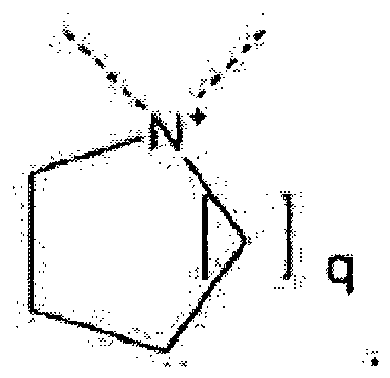
- Verbindung nach Anspruch 2 mit einer der allgemeinen Formeln IIa oder IIb,
 R1 ausgewählt ist aus H, C1-6-Alkyl;R2 ausgewählt ist aus Wasserstoff; wahlweise einer gesättigten oder ungesättigten, linearen oder verzweigten, mindestens monosubstituierten aliphatischen C1-18-Gruppe; wahlweise mindestens monosubstituiertem (CH2)1-6-Aryl, (CH2)1-6-Heteroaryl, (CH2)1-6-Cycloalkyl, Cycloalkyl, Aryl oder Heterocyclyl;oder R2 zusammen mit dem gebundenen Stickstoff den Stickstoff in einem Cycloalkyl-Spirokomplex bindet und so ein quartäres Ammonium der Formel X (wobei q 1 oder 2 ist) bildet:
- Verbindung nach Anspruch 3 mit einer der allgemeinen Formeln IIIa oder IIIb,
 R1 ausgewählt ist aus H, C1-6-Alkyl;R2 ausgewählt ist aus Wasserstoff; wahlweise einer gesättigten oder ungesättigten, linearen oder verzweigten, mindestens monosubstituierten aliphatischen C1-18-Gruppe; wahlweise mindestens monosubstituiertem (CH2)1-6-Aryl, (CH2)1-6-Heteroaryl, (CH2)1-6-Cycloalkyl, Cycloalkyl, Aryl oder Heterocyclyl;oder R2 zusammen mit dem gebundenen Stickstoff den Stickstoff in einem Cycloalkyl-Spirokomplex bindet und so ein quartäres Ammonium der Formel X (wobei q 1 oder 2 ist) bildet:
- Verbindung nach einem der Ansprüche 1 bis 5, dadurch gekennzeichnet, dass R1 ausgewählt ist aus H, CH3 oder C2H5.
- Verbindung nach einem der Ansprüche 1 bis 6, dadurch gekennzeichnet, dass R2 ausgewählt ist aus
Wasserstoff; wahlweise einer gesättigten oder ungesättigten, linearen oder verzweigten, mindestens monosubstituierten aliphatischen C1-18-Gruppe; wahlweise mindestens monosubstituiertem (CH2)1-6-Aryl; wahlweise mindestens monosubstituiertem Heteroaryl oder (CH2)1-6-Heteroaryl;
oder dadurch gekennzeichnet, dass R2 ausgewählt ist aus
Wasserstoff; wahlweise einer gesättigten oder ungesättigten, linearen oder verzweigten, mindestens monosubstituierten aliphatischen C9-12-Gruppe; wahlweise mindestens monosubstituiertem (CH2)1-6-Aryl; wahlweise mindestens monosubstituiertem (CH3)1-6-Alkylheteroaryl;
oder dadurch gekennzeichnet, dass R2 zusammen mit dem gebundenen Stickstoff einen Cycloalkyl-Spirokomplex bildet und so ein quartäres Ammonium der Formel X (wobei q 1 oder 2 ist) bildet:
- Verbindung nach Anspruch 7, wobei R2 ausgewählt ist aus Wasserstoff; wahlweise einer gesättigten oder ungesättigten, linearen oder verzweigten, mindestens monosubstituierten aliphatischen C1-18-Gruppe; wahlweise mindestens monosubstituiertem (CH2)1-6-Aryl; wahlweise mindestens monosubstituiertem (CH3)1-6-Heteroaryl.
- Verbindung nach Anspruch 7, wobei R2 ausgewählt ist aus Wasserstoff; wahlweise einer gesättigten oder ungesättigten, linearen oder verzweigten, mindestens monosubstituierten aliphatischen C4-10-Gruppe; substituiertem oder unsubstituiertem (CH2)1-4 -Aryl; substituiertem oder unsubstituiertem (CH3)1-4-Heteroaryl,
oder R2 ausgewählt ist aus wahlweise mindestens monosubstituiertem, linearen C4-10-Alkyl oder wahlweise mindestens monosubstituiertem (CH2)1-4-Alkylheteroaryl. - Verbindung nach einem der Ansprüche 1 bis 9, dadurch gekennzeichnet, dass die Verbindung ausgewählt ist aus1'-Benzyl-3-methoxy-3,4-dihydrospiro[[2]benzopyran-1,3'-piperidin] (1) (2)3-Methoxy-1'-(2-phenylethyl)-3,4-dihydrospiro[[2]benzopyran-1,3'-piperidin] (4) (5)3-Methoxy-1'-(3-phenylpropyl)-3,4-dihydrospiro[[2]benzopyran-1,3'-piperidin] (6) (7)3-Methoxy-1'-(4-phenylbutyl)-3,4-dihydrospiro[[2]benzopyran-1,3'-piperidin) (8) (9)1'-Butyl-3-methoxy-3,4-dihydrospiro[[2]benzopyran-1,3'-piperidin] (10) (11)1'-Hexyl-3-methoxy-3,4-dihydrospiro[[2]benzopyran-1,3'-piperidin] (12) (13)3-Methoxy-1'-octyl-3,4-dihydrospiro[[2]benzopyran-1,3'-piperidin] (14) (15)1'-Decyl-3-methoxy-3,4-dihydrospiro[[2]benzopyran-1,3'-piperidin] (16) (17)1'-Benzyl-3-methoxy-3,4-dihydrospiro[[2]benzopyran-1,3'-pyrrolidin](18)3-Methoxy-1'-(2-phenylethyl)-3,4-dihydrospiro([2]benzopyran-1,3'-pyrrolidin] (20)3-Methoxy-1'-(4-phenylbutyl)-3,4-dihydrospiro[[2]benzopyran-1,3'-pyrrolidin] (21)1'-Butyl-3-methoxy-3,4-dihydrospiro[[2]benzopyran-1,3'-pyrrolidin] (22)3-Methoxy-1'-octyl-3,4-dihydrospiro[[2]benzopyran-1,3'-pyrrolidin] (23)1'-Benzyl-3-methoxy-3H-spiro[[2]benzofuran-1,3'-pyrrolidin] (25)3-Methoxy-1'-(2-phenylethyl)-3H-spiro([2]benzofuran-1,3'-pyrrolidin] (27)3-Methoxy-1'-(4-phenylbutyl)-3H-spiro[[2]benzofuran-1,3'-pyrrolidin] (28)1'-Butyl-3-methoxy-3H-spiro[[2]benzofuran-1,3'-pyrrolidin] (29)3-Methoxy-1'-octyl-3H-spiro[[2]benzofuran-1,3'-pyrrolidin] (30)N,N-Cyclobutyl-3-methoxy-3H-spiro([2]benzofuran-1,3'-pyrrolidiniumbromid] (31) oder1'-(4-(1H-imidazol-1-yl)-butyl)-3-methoxy-3H-spiro[[2]benzofuran-1,3'-pyrrolidin] (34);wahlweise in Form eines der Stereoisomere, Enantiomere oder Diastereomere, eines Racemats oder in Form einer Mischung von mindestens zwei der Stereoisomere, Enantiomere und/oder Diastereomere in einem beliebigen Mischverhältnis oder eines entsprechenden Salzes davon oder eines entsprechenden Solvats davon.
- Pharmazeutische Zusammensetzung, umfassend eine Verbindung nach einem der Ansprüche 1 bis 10 oder ein pharmazeutisch annehmbares Salz oder Solvat davon und einen pharmazeutisch annehmbaren Trägerstoff, Adjuvans oder Trägersubstanz.
- Verwendung einer Verbindung nach einem der Ansprüche 1 bis 10 bei der Herstellung eines Arzneimittels für die Behandlung oder Prophylaxe einer durch Sigma-Rezeptor vermittelten Krankheit oder Zustands.
- Verwendung nach Anspruch 12, wobei die Krankheit Durchfall, Lipoproteinstörungen, metabolisches Syndrom, Behandlung von erhöhten Triglyceridwerten, Chylomikronämie, Hyperlipoproteinämie; Hyperlipidämie, insbesondere gemischte Hyperlipidämie; Hypercholesterinämie, Dysbetalipoproteinämie, Hypertriglyceridämie, einschließlich der sporadischen und familiären Störung (angeborene Hypertriglyceridämie), Migräne, Fettsucht, Arthritis, Bluthochdruck, Arrhythmie, Geschwür, Lern-, Gedächtnis- und Aufmerksamkeitsdefizite, kognitive Störungen, neurodegenerative Krankheiten, demyelinisierende Krankheiten, Abhängigkeit von Drogen und chemischen Substanzen, einschließlich Kokain, Amphetamin, Ethanol und Nikotin, tardive Dyskinesie, ischämischer Schlaganfall, Epilepsie, Schlaganfall, Depression, Stress, psychotischer Zustand, Schizophrenie; Entzündung, Autoimmunkrankheiten oder Krebs ist; oder
wobei die Krankheit Schmerz ist, neuropathischer Schmerz, Entzündungsschmerz oder andere Schmerzzustände, Allodynie und/oder Hyperalgesie oder mechanische Allodynie. - Verbindung nach einem der Ansprüche 1 bis 10 zur Verwendung bei der Behandlung oder zur Prophylaxe einer durch Sigma-Rezeptor vermittelten Krankheit oder Zustands.
- Verbindung nach einem der Ansprüche 1 bis 10 zur Verwendung bei der Behandlung oder zur Prophylaxe einer durch Sigma-Rezeptor vermittelten Krankheit oder Zustands, wobei die Krankheit Durchfall, Lipoproteinstörungen, metabolisches Syndrom, Behandlung von erhöhten Triglyceridwerten, Chylomikronämie, Hyperlipoproteinämie; Hyperlipidämie, insbesondere gemischte Hyperlipidämie; Hypercholesterinämie, Dysbetalipoproteinämie, Hypertriglyceridämie, einschließlich der sporadischen und familiären Störung (angeborene Hypertriglyceridämie), Migräne, Fettsucht, Arthritis, Bluthochdruck, Arrhythmie, Geschwür, Lern-, Gedächtnis- und Aufmerksamkeitsdefizite, kognitive Störungen, neurodegenerative Krankheiten, demyelinisierende Krankheiten, Abhängigkeit von Drogen und chemischen Substanzen, einschließlich Kokain, Amphetamin, Ethanol und Nikotin, tardive Dyskinesie, ischämischer Schlaganfall, Epilepsie, Schlaganfall, Depression, Stress, psychotischer Zustand, Schizophrenie; Entzündung, Autoimmunkrankheiten oder Krebs ist; oder
wobei die Krankheit Schmerz ist, neuropathischer Schmerz, Entzündungsschmerz oder andere Schmerzzustände, Allodynie und/oder Hyperalgesie oder mechanische Allodynie.
Priority Applications (1)
| Application Number | Priority Date | Filing Date | Title |
|---|---|---|---|
| EP07724484A EP2038287B1 (de) | 2006-04-21 | 2007-04-23 | Spiro[benzopyran]- oder spiro[benzofuran]derivate, die den sigma-rezeptor inhibieren |
Applications Claiming Priority (3)
| Application Number | Priority Date | Filing Date | Title |
|---|---|---|---|
| EP06384007A EP1847542A1 (de) | 2006-04-21 | 2006-04-21 | Spiro[benzopyran]- oder Spiro[benzofuran]derivative als Sigma Rezeptor Antagonisten |
| PCT/EP2007/003554 WO2007121976A1 (en) | 2006-04-21 | 2007-04-23 | Spiro[benzopyran] or spiro[benzofuran] derivatives which inhibit the sigma receptor |
| EP07724484A EP2038287B1 (de) | 2006-04-21 | 2007-04-23 | Spiro[benzopyran]- oder spiro[benzofuran]derivate, die den sigma-rezeptor inhibieren |
Publications (2)
| Publication Number | Publication Date |
|---|---|
| EP2038287A1 EP2038287A1 (de) | 2009-03-25 |
| EP2038287B1 true EP2038287B1 (de) | 2012-12-26 |
Family
ID=36600718
Family Applications (2)
| Application Number | Title | Priority Date | Filing Date |
|---|---|---|---|
| EP06384007A Withdrawn EP1847542A1 (de) | 2006-04-21 | 2006-04-21 | Spiro[benzopyran]- oder Spiro[benzofuran]derivative als Sigma Rezeptor Antagonisten |
| EP07724484A Not-in-force EP2038287B1 (de) | 2006-04-21 | 2007-04-23 | Spiro[benzopyran]- oder spiro[benzofuran]derivate, die den sigma-rezeptor inhibieren |
Family Applications Before (1)
| Application Number | Title | Priority Date | Filing Date |
|---|---|---|---|
| EP06384007A Withdrawn EP1847542A1 (de) | 2006-04-21 | 2006-04-21 | Spiro[benzopyran]- oder Spiro[benzofuran]derivative als Sigma Rezeptor Antagonisten |
Country Status (8)
| Country | Link |
|---|---|
| US (1) | US20090209568A1 (de) |
| EP (2) | EP1847542A1 (de) |
| JP (1) | JP2009534344A (de) |
| CN (1) | CN101410401A (de) |
| CA (1) | CA2641139A1 (de) |
| ES (1) | ES2400677T3 (de) |
| MX (1) | MX2008013479A (de) |
| WO (1) | WO2007121976A1 (de) |
Families Citing this family (32)
| Publication number | Priority date | Publication date | Assignee | Title |
|---|---|---|---|---|
| EP2070933A1 (de) | 2007-12-07 | 2009-06-17 | Laboratorios del Dr. Esteve S.A. | Trizyklische triazolische Verbindungen |
| EP2116539A1 (de) | 2008-04-25 | 2009-11-11 | Laboratorios Del. Dr. Esteve, S.A. | 1-Aryl-3-Amino-alkoxy-pyrazole als Sigma-Liganden zur Verbesserung der analgetischen Wirkung von Opioiden und zur Schwächung der Abhängigkeit davon |
| EP2353598A1 (de) | 2010-02-04 | 2011-08-10 | Laboratorios Del. Dr. Esteve, S.A. | Sigma-Liganden zur Anwendung in der Vorbeugung und/oder Behandlung von postoperativem Schmerz |
| EP2353591A1 (de) | 2010-02-04 | 2011-08-10 | Laboratorios Del. Dr. Esteve, S.A. | Sigma-Liganden zur Verstärkung der analgesischen Wirkung von Opioden und Opiaten bei postoperativem Schmerz und zur Schwächung der Abhängigkeit davon |
| EP2388005A1 (de) | 2010-05-21 | 2011-11-23 | Laboratorios Del. Dr. Esteve, S.A. | Sigma-Liganden zur Vorbeugung und/oder Behandlung von Erbrechen infolge von Chemotherapie oder Strahlentherapie |
| EP2415471A1 (de) | 2010-08-03 | 2012-02-08 | Laboratorios Del. Dr. Esteve, S.A. | Verwendung von Sigmaliganden bei opioidinduzierter Hyperalgesie |
| EP2524694A1 (de) | 2011-05-19 | 2012-11-21 | Laboratorios Del. Dr. Esteve, S.A. | Verwendung von Sigmaliganden bei Schmerz im Zusammenhang mit Typ-2-Diabetes |
| EP2548878A1 (de) | 2011-07-21 | 2013-01-23 | Laboratorios Del. Dr. Esteve, S.A. | Pyrazolo[3,4-d]pyrimidin-Verbindungen, deren Herstellung und Verwendung als Sigma-Liganden |
| EP2620438A1 (de) | 2012-01-24 | 2013-07-31 | Laboratorios Del. Dr. Esteve, S.A. | Substituierte Pyrano- und Furanochinoline, deren Herstellung sowie deren Verwendung als Medikamente |
| EP2631236A1 (de) | 2012-02-21 | 2013-08-28 | Laboratorios Del. Dr. Esteve, S.A. | Substituierte Pyazolo[1,5-a]pyridine, deren Herstellung sowie deren Verwendung als Medikamente |
| EP2682391A1 (de) | 2012-07-03 | 2014-01-08 | Laboratorios Del. Dr. Esteve, S.A. | Indenderivate, deren Herstellung und Verwendung als Arzneimittel |
| EP2682395A1 (de) | 2012-07-04 | 2014-01-08 | Laboratorios Del. Dr. Esteve, S.A. | Imidazo[1,2-b]thiazol-Derivate, deren Herstellung und Verwendung als Arzneimittel |
| EP2733143A1 (de) | 2012-11-14 | 2014-05-21 | Laboratorios Del Dr. Esteve, S.A. | Substituierte Pyrazolo[3,4-d]pyrimidin-Verbindungen, deren Herstellung und Verwendung als Sigma-Rezeptoren-Liganden |
| EP2752411A1 (de) | 2013-01-07 | 2014-07-09 | Laboratorios Del Dr. Esteve, S.A. | 1,2,3-Triazol-4-amin-Derivate zur Behandlung von Erkrankungen und Störungen im Zusammenhang mit Sigma-Rezeptoren |
| EP2792679A1 (de) | 2013-04-19 | 2014-10-22 | Laboratorios Del. Dr. Esteve, S.A. | Trizyklische triazolische Verbindungen |
| MX2015014905A (es) | 2013-04-23 | 2016-03-07 | Esteve Labor Dr | Compuestos de pirazino - [1,2-a] indol, su preparacion y su uso en medicamentos. |
| TN2015000474A1 (en) | 2013-04-23 | 2017-04-06 | Esteve Labor Dr | PYRAZINO[1,2-a]INDOLE COMPOUNDS, THEIR PREPARATION AND USE IN MEDICAMENTS |
| EP2832720A1 (de) | 2013-07-30 | 2015-02-04 | Laboratorios Del. Dr. Esteve, S.A. | 1,2-disubstituierte Cyclobutylverbindungen |
| TW201607538A (zh) | 2013-12-17 | 2016-03-01 | 以斯提夫博士實驗室股份有限公司 | 血清素-去甲腎上腺素再攝取抑制劑(SNRIS)和σ受體配體組合物 |
| WO2015091795A1 (en) | 2013-12-20 | 2015-06-25 | Laboratorios Del Dr. Esteve S.A. | Fused imidazolyl derivatives, their preparation and use as medicaments |
| TW201615643A (zh) | 2014-06-02 | 2016-05-01 | 伊史帝夫博士實驗室股份有限公司 | 具有多重模式抗疼痛活性之1-氧雜-4,9-二氮雜螺十一烷化合物之烷基與芳基衍生物 |
| EP2963041A1 (de) | 2014-07-02 | 2016-01-06 | Laboratorios Del. Dr. Esteve, S.A. | Tricyclische triazolische Verbindungen |
| JP2017535545A (ja) | 2014-11-21 | 2017-11-30 | ラボラトリオス・デル・デエレ・エステベ・エセ・ア | 疼痛に対する多様な活性を有するスピロ−イソキノリン−1,4’−ピペリジン化合物 |
| MA41177A (fr) * | 2014-12-15 | 2017-10-24 | Esteve Labor Dr | Utilisation de ligands des récepteurs sigma dans l'arthrose |
| ES2709361T3 (es) | 2015-04-28 | 2019-04-16 | Esteve Pharmaceuticals Sa | Compuestos de espiro-isoquinolin-3,4'-piperidina que tienen actividad contra el dolor |
| ES2794801T3 (es) | 2015-10-23 | 2020-11-19 | Esteve Pharmaceuticals Sa | Compuestos oxaazaespíricos con actividad contra el dolor |
| US10421750B2 (en) | 2015-10-23 | 2019-09-24 | Esteve Pharmaceuticals, S.A. | Substituted morpholine derivatives having activity against pain |
| DK3365346T3 (da) | 2015-10-23 | 2020-03-09 | Esteve Pharmaceuticals Sa | Oxa-diazaspiroforbindelser med aktivitet mod smerter |
| UA123775C2 (uk) | 2015-11-16 | 2021-06-02 | Естев Фармас'Ютікалз, С.А. | Оксадіазаспіросполуки для лікування зловживання наркотичними засобами та залежності від них |
| JP6733072B2 (ja) * | 2018-03-20 | 2020-07-29 | 大日本住友製薬株式会社 | ジヒドロクロメン誘導体 |
| CN109400618B (zh) * | 2018-11-09 | 2021-08-10 | 中国药科大学 | 一种色满衍生物及其制备方法和应用 |
| US12565504B2 (en) * | 2019-10-29 | 2026-03-03 | Biogen Ma Inc. | Spirocyclic O-glycoprotein-2-acetamido-2-deoxy-3-d-glucopyranosidase inhibitors |
Family Cites Families (6)
| Publication number | Priority date | Publication date | Assignee | Title |
|---|---|---|---|---|
| US3686186A (en) * | 1970-10-05 | 1972-08-22 | William J Houlihan | Substituted isochroman or phthalan piperidenes |
| US3962259A (en) * | 1973-12-12 | 1976-06-08 | American Hoechst Corporation | 1,3-Dihydrospiro[isobenzofuran]s and derivatives thereof |
| US3959475A (en) * | 1973-12-12 | 1976-05-25 | American Hoechst Corporation | Substituted 1,3-dihydrospiro(isobenzofuran)s |
| ID29137A (id) * | 1998-07-27 | 2001-08-02 | Schering Corp | Ligan-ligan afinitas tinggi untuk reseptor nosiseptin orl-1 |
| US6262066B1 (en) * | 1998-07-27 | 2001-07-17 | Schering Corporation | High affinity ligands for nociceptin receptor ORL-1 |
| EP1347982B1 (de) * | 2000-12-12 | 2005-11-16 | Neurogen Corporation | Spiro[isobenzofuran-1,4'-piperidin]-3-one und 3h-spiroisobenzofuran-1,4'-piperidine |
-
2006
- 2006-04-21 EP EP06384007A patent/EP1847542A1/de not_active Withdrawn
-
2007
- 2007-04-23 WO PCT/EP2007/003554 patent/WO2007121976A1/en not_active Ceased
- 2007-04-23 JP JP2009505798A patent/JP2009534344A/ja not_active Withdrawn
- 2007-04-23 US US12/226,311 patent/US20090209568A1/en not_active Abandoned
- 2007-04-23 MX MX2008013479A patent/MX2008013479A/es not_active Application Discontinuation
- 2007-04-23 CN CNA2007800105232A patent/CN101410401A/zh active Pending
- 2007-04-23 ES ES07724484T patent/ES2400677T3/es active Active
- 2007-04-23 CA CA002641139A patent/CA2641139A1/en not_active Abandoned
- 2007-04-23 EP EP07724484A patent/EP2038287B1/de not_active Not-in-force
Also Published As
| Publication number | Publication date |
|---|---|
| US20090209568A1 (en) | 2009-08-20 |
| ES2400677T3 (es) | 2013-04-11 |
| CN101410401A (zh) | 2009-04-15 |
| MX2008013479A (es) | 2008-10-29 |
| JP2009534344A (ja) | 2009-09-24 |
| WO2007121976A1 (en) | 2007-11-01 |
| CA2641139A1 (en) | 2007-11-01 |
| EP2038287A1 (de) | 2009-03-25 |
| EP1847542A1 (de) | 2007-10-24 |
Similar Documents
| Publication | Publication Date | Title |
|---|---|---|
| US20090209568A1 (en) | Spiro [Benzopyran] or Spiro [Benzofuran] Derivatives Which Inhibit the Sigma Receptor | |
| EP2144914B1 (de) | Pyranopyrazolamine | |
| EP2170903B1 (de) | Spiro[piperidin-4,4'-thieno[3,2-c]pyran]derivate und verwandte verbindungen als inhibitoren des sigma-rezeptors zur behandlung von psychosen | |
| EP2144915B1 (de) | Spiro-pyran-pyrazol-derivate | |
| US20090221572A1 (en) | 4,5,6,7-tetrahydrobenzo[b]thiophene derivatives and their use as sigma receptor ligands | |
| US9271959B2 (en) | Bicyclic tetrahydropyrrole compounds | |
| EP2029536B1 (de) | Bicyclische tetrahydropyrrolverbindungen | |
| EP1829873A1 (de) | Pyrrazolderivate als Sigma-Rezeptoren-Antagonisten | |
| US8481567B2 (en) | Sigma receptor compounds |
Legal Events
| Date | Code | Title | Description |
|---|---|---|---|
| PUAI | Public reference made under article 153(3) epc to a published international application that has entered the european phase |
Free format text: ORIGINAL CODE: 0009012 |
|
| 17P | Request for examination filed |
Effective date: 20081118 |
|
| AK | Designated contracting states |
Kind code of ref document: A1 Designated state(s): AT BE BG CH CY CZ DE DK EE ES FI FR GB GR HU IE IS IT LI LT LU LV MC MT NL PL PT RO SE SI SK TR |
|
| AX | Request for extension of the european patent |
Extension state: AL BA HR MK RS |
|
| REG | Reference to a national code |
Ref country code: HK Ref legal event code: DE Ref document number: 1124066 Country of ref document: HK |
|
| 17Q | First examination report despatched |
Effective date: 20090909 |
|
| RIC1 | Information provided on ipc code assigned before grant |
Ipc: C07D 491/10 20060101AFI20120524BHEP Ipc: C07D 491/20 20060101ALI20120524BHEP Ipc: A61P 29/00 20060101ALI20120524BHEP Ipc: A61P 25/28 20060101ALI20120524BHEP Ipc: A61K 31/407 20060101ALI20120524BHEP Ipc: A61P 23/00 20060101ALI20120524BHEP |
|
| GRAP | Despatch of communication of intention to grant a patent |
Free format text: ORIGINAL CODE: EPIDOSNIGR1 |
|
| DAX | Request for extension of the european patent (deleted) | ||
| GRAS | Grant fee paid |
Free format text: ORIGINAL CODE: EPIDOSNIGR3 |
|
| GRAA | (expected) grant |
Free format text: ORIGINAL CODE: 0009210 |
|
| AK | Designated contracting states |
Kind code of ref document: B1 Designated state(s): AT BE BG CH CY CZ DE DK EE ES FI FR GB GR HU IE IS IT LI LT LU LV MC MT NL PL PT RO SE SI SK TR |
|
| REG | Reference to a national code |
Ref country code: GB Ref legal event code: FG4D |
|
| REG | Reference to a national code |
Ref country code: CH Ref legal event code: EP |
|
| REG | Reference to a national code |
Ref country code: AT Ref legal event code: REF Ref document number: 590406 Country of ref document: AT Kind code of ref document: T Effective date: 20130115 |
|
| REG | Reference to a national code |
Ref country code: DE Ref legal event code: R096 Ref document number: 602007027621 Country of ref document: DE Effective date: 20130228 |
|
| REG | Reference to a national code |
Ref country code: ES Ref legal event code: FG2A Ref document number: 2400677 Country of ref document: ES Kind code of ref document: T3 Effective date: 20130411 |
|
| PG25 | Lapsed in a contracting state [announced via postgrant information from national office to epo] |
Ref country code: FI Free format text: LAPSE BECAUSE OF FAILURE TO SUBMIT A TRANSLATION OF THE DESCRIPTION OR TO PAY THE FEE WITHIN THE PRESCRIBED TIME-LIMIT Effective date: 20121226 Ref country code: LT Free format text: LAPSE BECAUSE OF FAILURE TO SUBMIT A TRANSLATION OF THE DESCRIPTION OR TO PAY THE FEE WITHIN THE PRESCRIBED TIME-LIMIT Effective date: 20121226 Ref country code: SE Free format text: LAPSE BECAUSE OF FAILURE TO SUBMIT A TRANSLATION OF THE DESCRIPTION OR TO PAY THE FEE WITHIN THE PRESCRIBED TIME-LIMIT Effective date: 20121226 |
|
| REG | Reference to a national code |
Ref country code: AT Ref legal event code: MK05 Ref document number: 590406 Country of ref document: AT Kind code of ref document: T Effective date: 20121226 |
|
| REG | Reference to a national code |
Ref country code: LT Ref legal event code: MG4D |
|
| REG | Reference to a national code |
Ref country code: NL Ref legal event code: VDEP Effective date: 20121226 |
|
| PG25 | Lapsed in a contracting state [announced via postgrant information from national office to epo] |
Ref country code: SI Free format text: LAPSE BECAUSE OF FAILURE TO SUBMIT A TRANSLATION OF THE DESCRIPTION OR TO PAY THE FEE WITHIN THE PRESCRIBED TIME-LIMIT Effective date: 20121226 Ref country code: LV Free format text: LAPSE BECAUSE OF FAILURE TO SUBMIT A TRANSLATION OF THE DESCRIPTION OR TO PAY THE FEE WITHIN THE PRESCRIBED TIME-LIMIT Effective date: 20121226 Ref country code: GR Free format text: LAPSE BECAUSE OF FAILURE TO SUBMIT A TRANSLATION OF THE DESCRIPTION OR TO PAY THE FEE WITHIN THE PRESCRIBED TIME-LIMIT Effective date: 20130327 |
|
| PG25 | Lapsed in a contracting state [announced via postgrant information from national office to epo] |
Ref country code: IS Free format text: LAPSE BECAUSE OF FAILURE TO SUBMIT A TRANSLATION OF THE DESCRIPTION OR TO PAY THE FEE WITHIN THE PRESCRIBED TIME-LIMIT Effective date: 20130426 Ref country code: BG Free format text: LAPSE BECAUSE OF FAILURE TO SUBMIT A TRANSLATION OF THE DESCRIPTION OR TO PAY THE FEE WITHIN THE PRESCRIBED TIME-LIMIT Effective date: 20130326 Ref country code: AT Free format text: LAPSE BECAUSE OF FAILURE TO SUBMIT A TRANSLATION OF THE DESCRIPTION OR TO PAY THE FEE WITHIN THE PRESCRIBED TIME-LIMIT Effective date: 20121226 Ref country code: CZ Free format text: LAPSE BECAUSE OF FAILURE TO SUBMIT A TRANSLATION OF THE DESCRIPTION OR TO PAY THE FEE WITHIN THE PRESCRIBED TIME-LIMIT Effective date: 20121226 Ref country code: BE Free format text: LAPSE BECAUSE OF FAILURE TO SUBMIT A TRANSLATION OF THE DESCRIPTION OR TO PAY THE FEE WITHIN THE PRESCRIBED TIME-LIMIT Effective date: 20121226 Ref country code: EE Free format text: LAPSE BECAUSE OF FAILURE TO SUBMIT A TRANSLATION OF THE DESCRIPTION OR TO PAY THE FEE WITHIN THE PRESCRIBED TIME-LIMIT Effective date: 20121226 Ref country code: SK Free format text: LAPSE BECAUSE OF FAILURE TO SUBMIT A TRANSLATION OF THE DESCRIPTION OR TO PAY THE FEE WITHIN THE PRESCRIBED TIME-LIMIT Effective date: 20121226 |
|
| PG25 | Lapsed in a contracting state [announced via postgrant information from national office to epo] |
Ref country code: RO Free format text: LAPSE BECAUSE OF FAILURE TO SUBMIT A TRANSLATION OF THE DESCRIPTION OR TO PAY THE FEE WITHIN THE PRESCRIBED TIME-LIMIT Effective date: 20121226 Ref country code: NL Free format text: LAPSE BECAUSE OF FAILURE TO SUBMIT A TRANSLATION OF THE DESCRIPTION OR TO PAY THE FEE WITHIN THE PRESCRIBED TIME-LIMIT Effective date: 20121226 Ref country code: PL Free format text: LAPSE BECAUSE OF FAILURE TO SUBMIT A TRANSLATION OF THE DESCRIPTION OR TO PAY THE FEE WITHIN THE PRESCRIBED TIME-LIMIT Effective date: 20121226 Ref country code: PT Free format text: LAPSE BECAUSE OF FAILURE TO SUBMIT A TRANSLATION OF THE DESCRIPTION OR TO PAY THE FEE WITHIN THE PRESCRIBED TIME-LIMIT Effective date: 20130426 |
|
| PG25 | Lapsed in a contracting state [announced via postgrant information from national office to epo] |
Ref country code: DK Free format text: LAPSE BECAUSE OF FAILURE TO SUBMIT A TRANSLATION OF THE DESCRIPTION OR TO PAY THE FEE WITHIN THE PRESCRIBED TIME-LIMIT Effective date: 20121226 |
|
| PLBE | No opposition filed within time limit |
Free format text: ORIGINAL CODE: 0009261 |
|
| STAA | Information on the status of an ep patent application or granted ep patent |
Free format text: STATUS: NO OPPOSITION FILED WITHIN TIME LIMIT |
|
| PG25 | Lapsed in a contracting state [announced via postgrant information from national office to epo] |
Ref country code: CY Free format text: LAPSE BECAUSE OF FAILURE TO SUBMIT A TRANSLATION OF THE DESCRIPTION OR TO PAY THE FEE WITHIN THE PRESCRIBED TIME-LIMIT Effective date: 20121226 Ref country code: MC Free format text: LAPSE BECAUSE OF FAILURE TO SUBMIT A TRANSLATION OF THE DESCRIPTION OR TO PAY THE FEE WITHIN THE PRESCRIBED TIME-LIMIT Effective date: 20121226 |
|
| REG | Reference to a national code |
Ref country code: CH Ref legal event code: PL |
|
| 26N | No opposition filed |
Effective date: 20130927 |
|
| GBPC | Gb: european patent ceased through non-payment of renewal fee |
Effective date: 20130423 |
|
| PG25 | Lapsed in a contracting state [announced via postgrant information from national office to epo] |
Ref country code: IT Free format text: LAPSE BECAUSE OF FAILURE TO SUBMIT A TRANSLATION OF THE DESCRIPTION OR TO PAY THE FEE WITHIN THE PRESCRIBED TIME-LIMIT Effective date: 20121226 |
|
| REG | Reference to a national code |
Ref country code: DE Ref legal event code: R097 Ref document number: 602007027621 Country of ref document: DE Effective date: 20130927 |
|
| REG | Reference to a national code |
Ref country code: IE Ref legal event code: MM4A |
|
| PG25 | Lapsed in a contracting state [announced via postgrant information from national office to epo] |
Ref country code: CH Free format text: LAPSE BECAUSE OF NON-PAYMENT OF DUE FEES Effective date: 20130430 Ref country code: DE Free format text: LAPSE BECAUSE OF NON-PAYMENT OF DUE FEES Effective date: 20131101 Ref country code: GB Free format text: LAPSE BECAUSE OF NON-PAYMENT OF DUE FEES Effective date: 20130423 Ref country code: LI Free format text: LAPSE BECAUSE OF NON-PAYMENT OF DUE FEES Effective date: 20130430 |
|
| REG | Reference to a national code |
Ref country code: FR Ref legal event code: ST Effective date: 20131231 |
|
| REG | Reference to a national code |
Ref country code: DE Ref legal event code: R119 Ref document number: 602007027621 Country of ref document: DE Effective date: 20131101 |
|
| PG25 | Lapsed in a contracting state [announced via postgrant information from national office to epo] |
Ref country code: FR Free format text: LAPSE BECAUSE OF NON-PAYMENT OF DUE FEES Effective date: 20130430 |
|
| PG25 | Lapsed in a contracting state [announced via postgrant information from national office to epo] |
Ref country code: IE Free format text: LAPSE BECAUSE OF NON-PAYMENT OF DUE FEES Effective date: 20130423 |
|
| PG25 | Lapsed in a contracting state [announced via postgrant information from national office to epo] |
Ref country code: MT Free format text: LAPSE BECAUSE OF FAILURE TO SUBMIT A TRANSLATION OF THE DESCRIPTION OR TO PAY THE FEE WITHIN THE PRESCRIBED TIME-LIMIT Effective date: 20121226 |
|
| PG25 | Lapsed in a contracting state [announced via postgrant information from national office to epo] |
Ref country code: TR Free format text: LAPSE BECAUSE OF FAILURE TO SUBMIT A TRANSLATION OF THE DESCRIPTION OR TO PAY THE FEE WITHIN THE PRESCRIBED TIME-LIMIT Effective date: 20121226 |
|
| PG25 | Lapsed in a contracting state [announced via postgrant information from national office to epo] |
Ref country code: HU Free format text: LAPSE BECAUSE OF FAILURE TO SUBMIT A TRANSLATION OF THE DESCRIPTION OR TO PAY THE FEE WITHIN THE PRESCRIBED TIME-LIMIT; INVALID AB INITIO Effective date: 20070423 Ref country code: LU Free format text: LAPSE BECAUSE OF NON-PAYMENT OF DUE FEES Effective date: 20130423 |
|
| REG | Reference to a national code |
Ref country code: HK Ref legal event code: WD Ref document number: 1124066 Country of ref document: HK |
|
| REG | Reference to a national code |
Ref country code: ES Ref legal event code: PC2A Owner name: ESTEVE PHARMACEUTICALS, S.A. Effective date: 20181016 |
|
| PGFP | Annual fee paid to national office [announced via postgrant information from national office to epo] |
Ref country code: ES Payment date: 20200505 Year of fee payment: 14 |
|
| REG | Reference to a national code |
Ref country code: ES Ref legal event code: FD2A Effective date: 20220704 |
|
| PG25 | Lapsed in a contracting state [announced via postgrant information from national office to epo] |
Ref country code: ES Free format text: LAPSE BECAUSE OF NON-PAYMENT OF DUE FEES Effective date: 20210424 |