EP2062290B1 - Defektreduzierung durch kontrolle des aspektverhältnisses - Google Patents
Defektreduzierung durch kontrolle des aspektverhältnisses Download PDFInfo
- Publication number
- EP2062290B1 EP2062290B1 EP07837902.1A EP07837902A EP2062290B1 EP 2062290 B1 EP2062290 B1 EP 2062290B1 EP 07837902 A EP07837902 A EP 07837902A EP 2062290 B1 EP2062290 B1 EP 2062290B1
- Authority
- EP
- European Patent Office
- Prior art keywords
- growth
- opening
- semiconductor material
- crystalline
- sidewall
- Prior art date
- Legal status (The legal status is an assumption and is not a legal conclusion. Google has not performed a legal analysis and makes no representation as to the accuracy of the status listed.)
- Active
Links
Images




Classifications
-
- H—ELECTRICITY
- H10—SEMICONDUCTOR DEVICES; ELECTRIC SOLID-STATE DEVICES NOT OTHERWISE PROVIDED FOR
- H10P—GENERIC PROCESSES OR APPARATUS FOR THE MANUFACTURE OR TREATMENT OF DEVICES COVERED BY CLASS H10
- H10P14/00—Formation of materials, e.g. in the shape of layers or pillars
- H10P14/20—Formation of materials, e.g. in the shape of layers or pillars of semiconductor materials
- H10P14/34—Deposited materials, e.g. layers
- H10P14/3466—Crystal orientation
-
- C—CHEMISTRY; METALLURGY
- C30—CRYSTAL GROWTH
- C30B—SINGLE-CRYSTAL GROWTH; UNIDIRECTIONAL SOLIDIFICATION OF EUTECTIC MATERIAL OR UNIDIRECTIONAL DEMIXING OF EUTECTOID MATERIAL; REFINING BY ZONE-MELTING OF MATERIAL; PRODUCTION OF A HOMOGENEOUS POLYCRYSTALLINE MATERIAL WITH DEFINED STRUCTURE; SINGLE CRYSTALS OR HOMOGENEOUS POLYCRYSTALLINE MATERIAL WITH DEFINED STRUCTURE; AFTER-TREATMENT OF SINGLE CRYSTALS OR A HOMOGENEOUS POLYCRYSTALLINE MATERIAL WITH DEFINED STRUCTURE; APPARATUS THEREFOR
- C30B25/00—Single-crystal growth by chemical reaction of reactive gases, e.g. chemical vapour-deposition growth
- C30B25/02—Epitaxial-layer growth
- C30B25/18—Epitaxial-layer growth characterised by the substrate
- C30B25/183—Epitaxial-layer growth characterised by the substrate being provided with a buffer layer, e.g. a lattice matching layer
-
- C—CHEMISTRY; METALLURGY
- C30—CRYSTAL GROWTH
- C30B—SINGLE-CRYSTAL GROWTH; UNIDIRECTIONAL SOLIDIFICATION OF EUTECTIC MATERIAL OR UNIDIRECTIONAL DEMIXING OF EUTECTOID MATERIAL; REFINING BY ZONE-MELTING OF MATERIAL; PRODUCTION OF A HOMOGENEOUS POLYCRYSTALLINE MATERIAL WITH DEFINED STRUCTURE; SINGLE CRYSTALS OR HOMOGENEOUS POLYCRYSTALLINE MATERIAL WITH DEFINED STRUCTURE; AFTER-TREATMENT OF SINGLE CRYSTALS OR A HOMOGENEOUS POLYCRYSTALLINE MATERIAL WITH DEFINED STRUCTURE; APPARATUS THEREFOR
- C30B29/00—Single crystals or homogeneous polycrystalline material with defined structure characterised by the material or by their shape
- C30B29/10—Inorganic compounds or compositions
- C30B29/40—AIIIBV compounds wherein A is B, Al, Ga, In or Tl and B is N, P, As, Sb or Bi
-
- C—CHEMISTRY; METALLURGY
- C30—CRYSTAL GROWTH
- C30B—SINGLE-CRYSTAL GROWTH; UNIDIRECTIONAL SOLIDIFICATION OF EUTECTIC MATERIAL OR UNIDIRECTIONAL DEMIXING OF EUTECTOID MATERIAL; REFINING BY ZONE-MELTING OF MATERIAL; PRODUCTION OF A HOMOGENEOUS POLYCRYSTALLINE MATERIAL WITH DEFINED STRUCTURE; SINGLE CRYSTALS OR HOMOGENEOUS POLYCRYSTALLINE MATERIAL WITH DEFINED STRUCTURE; AFTER-TREATMENT OF SINGLE CRYSTALS OR A HOMOGENEOUS POLYCRYSTALLINE MATERIAL WITH DEFINED STRUCTURE; APPARATUS THEREFOR
- C30B29/00—Single crystals or homogeneous polycrystalline material with defined structure characterised by the material or by their shape
- C30B29/10—Inorganic compounds or compositions
- C30B29/46—Sulfur-, selenium- or tellurium-containing compounds
- C30B29/48—AIIBVI compounds wherein A is Zn, Cd or Hg, and B is S, Se or Te
-
- H—ELECTRICITY
- H10—SEMICONDUCTOR DEVICES; ELECTRIC SOLID-STATE DEVICES NOT OTHERWISE PROVIDED FOR
- H10D—INORGANIC ELECTRIC SEMICONDUCTOR DEVICES
- H10D62/00—Semiconductor bodies, or regions thereof, of devices having potential barriers
- H10D62/10—Shapes, relative sizes or dispositions of the regions of the semiconductor bodies; Shapes of the semiconductor bodies
- H10D62/124—Shapes, relative sizes or dispositions of the regions of semiconductor bodies or of junctions between the regions
- H10D62/125—Shapes of junctions between the regions
-
- H—ELECTRICITY
- H10—SEMICONDUCTOR DEVICES; ELECTRIC SOLID-STATE DEVICES NOT OTHERWISE PROVIDED FOR
- H10D—INORGANIC ELECTRIC SEMICONDUCTOR DEVICES
- H10D62/00—Semiconductor bodies, or regions thereof, of devices having potential barriers
- H10D62/40—Crystalline structures
- H10D62/405—Orientations of crystalline planes
-
- H—ELECTRICITY
- H10—SEMICONDUCTOR DEVICES; ELECTRIC SOLID-STATE DEVICES NOT OTHERWISE PROVIDED FOR
- H10D—INORGANIC ELECTRIC SEMICONDUCTOR DEVICES
- H10D62/00—Semiconductor bodies, or regions thereof, of devices having potential barriers
- H10D62/50—Physical imperfections
- H10D62/53—Physical imperfections the imperfections being within the semiconductor body
-
- H—ELECTRICITY
- H10—SEMICONDUCTOR DEVICES; ELECTRIC SOLID-STATE DEVICES NOT OTHERWISE PROVIDED FOR
- H10D—INORGANIC ELECTRIC SEMICONDUCTOR DEVICES
- H10D62/00—Semiconductor bodies, or regions thereof, of devices having potential barriers
- H10D62/80—Semiconductor bodies, or regions thereof, of devices having potential barriers characterised by the materials
- H10D62/82—Heterojunctions
- H10D62/822—Heterojunctions comprising only Group IV materials heterojunctions, e.g. Si/Ge heterojunctions
-
- H—ELECTRICITY
- H10—SEMICONDUCTOR DEVICES; ELECTRIC SOLID-STATE DEVICES NOT OTHERWISE PROVIDED FOR
- H10P—GENERIC PROCESSES OR APPARATUS FOR THE MANUFACTURE OR TREATMENT OF DEVICES COVERED BY CLASS H10
- H10P14/00—Formation of materials, e.g. in the shape of layers or pillars
- H10P14/20—Formation of materials, e.g. in the shape of layers or pillars of semiconductor materials
- H10P14/24—Formation of materials, e.g. in the shape of layers or pillars of semiconductor materials using chemical vapour deposition [CVD]
-
- H—ELECTRICITY
- H10—SEMICONDUCTOR DEVICES; ELECTRIC SOLID-STATE DEVICES NOT OTHERWISE PROVIDED FOR
- H10P—GENERIC PROCESSES OR APPARATUS FOR THE MANUFACTURE OR TREATMENT OF DEVICES COVERED BY CLASS H10
- H10P14/00—Formation of materials, e.g. in the shape of layers or pillars
- H10P14/20—Formation of materials, e.g. in the shape of layers or pillars of semiconductor materials
- H10P14/27—Formation of materials, e.g. in the shape of layers or pillars of semiconductor materials using selective deposition, e.g. simultaneous growth of monocrystalline and non-monocrystalline semiconductor materials
- H10P14/271—Formation of materials, e.g. in the shape of layers or pillars of semiconductor materials using selective deposition, e.g. simultaneous growth of monocrystalline and non-monocrystalline semiconductor materials characterised by the preparation of substrate for selective deposition
-
- H—ELECTRICITY
- H10—SEMICONDUCTOR DEVICES; ELECTRIC SOLID-STATE DEVICES NOT OTHERWISE PROVIDED FOR
- H10P—GENERIC PROCESSES OR APPARATUS FOR THE MANUFACTURE OR TREATMENT OF DEVICES COVERED BY CLASS H10
- H10P14/00—Formation of materials, e.g. in the shape of layers or pillars
- H10P14/20—Formation of materials, e.g. in the shape of layers or pillars of semiconductor materials
- H10P14/27—Formation of materials, e.g. in the shape of layers or pillars of semiconductor materials using selective deposition, e.g. simultaneous growth of monocrystalline and non-monocrystalline semiconductor materials
- H10P14/276—Lateral overgrowth
-
- H—ELECTRICITY
- H10—SEMICONDUCTOR DEVICES; ELECTRIC SOLID-STATE DEVICES NOT OTHERWISE PROVIDED FOR
- H10P—GENERIC PROCESSES OR APPARATUS FOR THE MANUFACTURE OR TREATMENT OF DEVICES COVERED BY CLASS H10
- H10P14/00—Formation of materials, e.g. in the shape of layers or pillars
- H10P14/20—Formation of materials, e.g. in the shape of layers or pillars of semiconductor materials
- H10P14/29—Formation of materials, e.g. in the shape of layers or pillars of semiconductor materials characterised by the substrates
- H10P14/2901—Materials
- H10P14/2902—Materials being Group IVA materials
- H10P14/2905—Silicon, silicon germanium or germanium
-
- H—ELECTRICITY
- H10—SEMICONDUCTOR DEVICES; ELECTRIC SOLID-STATE DEVICES NOT OTHERWISE PROVIDED FOR
- H10P—GENERIC PROCESSES OR APPARATUS FOR THE MANUFACTURE OR TREATMENT OF DEVICES COVERED BY CLASS H10
- H10P14/00—Formation of materials, e.g. in the shape of layers or pillars
- H10P14/20—Formation of materials, e.g. in the shape of layers or pillars of semiconductor materials
- H10P14/29—Formation of materials, e.g. in the shape of layers or pillars of semiconductor materials characterised by the substrates
- H10P14/2926—Crystal orientations
-
- H—ELECTRICITY
- H10—SEMICONDUCTOR DEVICES; ELECTRIC SOLID-STATE DEVICES NOT OTHERWISE PROVIDED FOR
- H10P—GENERIC PROCESSES OR APPARATUS FOR THE MANUFACTURE OR TREATMENT OF DEVICES COVERED BY CLASS H10
- H10P14/00—Formation of materials, e.g. in the shape of layers or pillars
- H10P14/20—Formation of materials, e.g. in the shape of layers or pillars of semiconductor materials
- H10P14/34—Deposited materials, e.g. layers
- H10P14/3402—Deposited materials, e.g. layers characterised by the chemical composition
-
- H—ELECTRICITY
- H10—SEMICONDUCTOR DEVICES; ELECTRIC SOLID-STATE DEVICES NOT OTHERWISE PROVIDED FOR
- H10P—GENERIC PROCESSES OR APPARATUS FOR THE MANUFACTURE OR TREATMENT OF DEVICES COVERED BY CLASS H10
- H10P14/00—Formation of materials, e.g. in the shape of layers or pillars
- H10P14/20—Formation of materials, e.g. in the shape of layers or pillars of semiconductor materials
- H10P14/34—Deposited materials, e.g. layers
- H10P14/3402—Deposited materials, e.g. layers characterised by the chemical composition
- H10P14/3404—Deposited materials, e.g. layers characterised by the chemical composition being Group IVA materials
- H10P14/3411—Silicon, silicon germanium or germanium
-
- H—ELECTRICITY
- H10—SEMICONDUCTOR DEVICES; ELECTRIC SOLID-STATE DEVICES NOT OTHERWISE PROVIDED FOR
- H10P—GENERIC PROCESSES OR APPARATUS FOR THE MANUFACTURE OR TREATMENT OF DEVICES COVERED BY CLASS H10
- H10P14/00—Formation of materials, e.g. in the shape of layers or pillars
- H10P14/20—Formation of materials, e.g. in the shape of layers or pillars of semiconductor materials
- H10P14/34—Deposited materials, e.g. layers
- H10P14/3451—Structure
- H10P14/3452—Microstructure
- H10P14/3458—Monocrystalline
Definitions
- the invention relates generally to semiconductor processing and particularly to blocking defects by aspect ratio trapping ("ART").
- germanium (Ge) heteroepitaxy on silicon (Si) is promising both for, e.g., high-performance Ge p-channel metal-oxide-semiconductor field-effect transistors (MOSFETs) and as a potential path for integrating optoelectronic devices with Si complementary metal-oxide semiconductor (CMOS) technology.
- MOSFETs metal-oxide-semiconductor field-effect transistors
- CMOS complementary metal-oxide semiconductor
- Heteroepitaxially growing Ge on Si also is a path for providing a substitute for Ge wafers for many other applications such as photovoltaics and light-emitting diodes, provided that a sufficiently high-quality Ge surface can be obtained cost-effectively.
- Loo et al J. Electrochem. Soc. 2003 volume 150, issue 10, G638-G647 discloses a selective Si 1-x Ge x / Si growth process in a standard production-oriented chemical vapor deposition system for Ge contents between 0 and 32%.
- the process allows layer deposition with no pattern dependence of the growth rate and Ge content (no microloading) and with a wafer scale layer nonuniformity that is better than the accuracy of the measurement techniques ( ⁇ 2%). Facet formation was avoided by choosing the correct growth conditions and by preventing lateral growth over the mask material.
- Selective epitaxial layers did not show a degradation of photoluminescence characteristics.
- the layer quality is further demonstrated by the performance of Si 1-x Ge x / Si heterojunction bipolar transistors (0.35 and 0.25 ⁇ m technology), and p-type Si 1-x Ge x / Si heterojunction metal oxide semiconductor devices (effective gate length down to 70 nm).
- WO 2005/048330 discloses a method of forming a lattice-tuning semiconductor substrate comprises defining a selected area of a Si surface by means of a window extending through an isolating layer on the Si surface; defining in the isolating layer a depression separated from the Si surface by a portion of the isolating layer; growing a SiGe layer on top of the selected area of the Si surface such that dislocations are formed in the window to relieve the strain in the SiGe layer; and further growing the SiGe layer to overgrow the isolating layer and extend into the depression to form a substantially dislocation-free area of SiGe within the depression.
- the portion of the SiGe layer that has overgrown the isolating layer can then be removed by polishing so as to isolate the substantially dislocation-free area of SiGe within the depression from the area of SiGe within the window. Furthermore, the SiGe layer and the isolating layer can then be removed from the Si surface except in the vicinity of the depression so as to leave on the Si surface the substantially dislocation-free area of SiGe isolated from the Si surface by the portion of the isolating layer.
- DE 10320160 discloses production of a number of semiconductor bodies comprises forming a mask layer on the substrate or on an initial layer having windows to the substrate, back-etching the substrate and the initial layer to form trenches, growing semiconductor material on the substrate or on the initial layer, and growing a component layer sequence on the semiconductor material.
- EP 0600276 discloses a method to produce a laterally delimited, monocrystalline domain, e.g. the collector of a bipolar transistor or the active zone of a MOS transistor, wherein there is generated on the surface of a substrate a masking layer with a hole. In the hole the surface of the substrate is exposed. The cross-section of the hole parallel to the surface of the substrate at the surface of the substrate projects laterally beyond the cross-section at the surface of the masking layer. Near the surface of the masking layer, the side wall of the hole runs essentially perpendicular to the surface of the substrate, and its cross-section perpendicular to the surface of the substrate is stepped. The monocrystalline domain is formed by selective epitaxy within the hole.
- WO 2006125040 discloses fabrication of monolithic lattice-mismatched semiconductor heterostructures with limited area regions having upper portions substantially exhausted of threading dislocations, as well as fabrication of semiconductor devices based on such lattice-mismatched heterostructures.
- Langdo et al discloses pure Ge grown selectively on SiO 2 /Si substrates in 100 nm holes is highly perfect at the top surface compared to conventional Ge lattice-mismatched growth on planar Si substrates. This result is achieved through a combination of interferometric lithography SiO 2 /Si substrate patterning and ultrahigh vacuum chemical vapor deposition Ge selective epitaxial growth. Langdo et al discuss that this "epitaxial necking," in which threading dislocations are blocked at oxide sidewalls, shows promise for dislocation filtering and the fabrication of low-defect density Ge on Si.
- a method for forming a structure comprising the steps of:
- Epitaxial necking is effective for growing Ge on Si for small areas, e.g., circular regions of diameter ⁇ 200 nm.
- Epitaxial necking involves selective growth in patterned openings bounded by substantially vertical dielectric sidewalls, enabling dislocations to be trapped under certain conditions. See E. A. Fitzgerald and N. Chand, J. Electron. Mat. 20, 839 (1991 ), and T. A. Langdo, C. W. Leitz, M. T. Currie, and E. A. Fitzgerald, A. Lochtefeld and D. A. Antoniadis, Appl. Phys. Lett. 76 (25), 3700 (2000 ). Langdo et al.
- the present inventors have found that the orientation of the epitaxial layer surface during growth plays a dominant role in determining the configurations of many of the threading dislocations in the layers. These dislocations behave as "growth dislocations," which, during growth, are oriented approximately normal to the growth surface that they intersect. If the normal is not parallel to a dielectric sidewall that bounds the growth opening, then the dislocations are guided out from the central regions of the patterned opening. Thus, by properly engineering the profile of the growth surface during growth, certain kinds of threading dislocations may be caused to grow out of the epitaxial layer and terminate at the dielectric sidewalls, thereby increasing the effectiveness of defect trapping.
- aspects ratio trapping refers generally to the technique(s) of causing defects to terminate at non-crystalline, e.g., dielectric sidewalls, where the sidewalls are sufficiently high relative to the size of the growth area so as to trap most, if not all, of the defects.
- Processing conditions may be tailored to enable effective trapping of threading dislocations in trenches of arbitrary length, including, e.g., for Ge grown directly on Si via reduced pressure chemical vapor deposition (RPCVD), e.g., the deposition of Ge layers as thin as 450 nm in SiO 2 trenches having an aspect ratio > 1 ("AR," defined for trenches as the ratio of the trench height / width) >1.
- RPCVD reduced pressure chemical vapor deposition
- a variant of the disclosure features a method for forming a structure, the method including the steps of providing a crystalline semiconductor substrate comprising a first semiconductor material and having a top surface, and defining an opening having a non-crystalline sidewall proximate the top surface of the crystalline semiconductor substrate.
- An epitaxial film is formed in the opening.
- the epitaxial film includes a second semiconductor material that is lattice mismatched to the first semiconductor material.
- the epitaxial film has a growth front, the growth front including a surface having a facet substantially non-parallel to the substrate top surface.
- Forming the epitaxial film includes configuring epitaxial film formation parameters to cause formation of the facet.
- a dislocation in the epitaxial film is approximately normal to the epitaxial film surface.
- Another variant of the disclosure features a method for forming a structure, the method including the steps of providing a crystalline semiconductor substrate comprising a first semiconductor material and having a top surface, and defining an opening having a non-crystalline sidewall proximate the top surface of the crystalline semiconductor substrate.
- An epitaxial film is formed in the opening.
- the epitaxial film includes a second semiconductor material that is lattice mismatched to the first semiconductor material.
- the epitaxial film has a growth front, the growth front including a surface having a facet not parallel to the substrate top surface. A dislocation in the epitaxial film is approximately normal to the epitaxial film surface.
- Embodiments may include one or more of the following features.
- the non-crystalline sidewall may include a dielectric sidewall and/or have a sloped profile.
- the opening may be defined in a dielectric material disposed over the top surface of the substrate.
- the facet may define an angle ⁇ with the top surface of the substrate, and an aspect ratio H of a height h of the opening to a width w of the opening is greater than or equal to (tan ⁇ + 1/tan ⁇ )/2.
- the height h may be selected from the range of 0.05 micrometer ( ⁇ m) to 5 ⁇ m.
- the opening may include a trench.
- the dislocation in the epitaxial film is no more than about 8° off normal to the epitaxial film surface.
- the first semiconductor material may include a group IV element or compound, such as germanium and/or silicon, e.g., (100) silicon.
- the second semiconductor material may include at least one of a group IV element or compound, a III-V compound, or a II-VI compound.
- III-V compounds include aluminum phosphide (AIP), gallium phosphide (GaP), indium phosphide (InP), aluminum arsenide (AlAs), gallium arsenide (GaAs), indium arsenide (InAs), aluminum antimonide (AISb), gallium antimonide (OaSb), indium antimonide (InSb), aluminum nitride (AlN), gallium nitride (GaN), indium nitride (InN), and their ternary and quaternary compounds.
- AIP aluminum phosphide
- GaP gallium phosphide
- InP indium phosphide
- AlAs aluminum arsenide
- GaAs gallium arsenide
- InAs aluminum antimonide
- AISb aluminum antimonide
- OaSb gallium antimonide
- InSb aluminum nitride
- AlN aluminum nitride
- GaN
- II-VI compounds includes zinc selenide (ZnSe), zinc telluride (ZnTe), cadmium selenide (CdSe), cadmium telluride (CdTe), zinc sulfide (ZnS), and their ternary and quaternary compounds.
- Another variant of the disclosure features a structure including a substrate comprising a first semiconductor material.
- An insulator layer is disposed over the substrate and defines a trench having a sidewall.
- a second semiconductor material is disposed in the trench, with the second semiconductor material being lattice mismatched to the first semiconductor material.
- a bottom portion of the second semiconductor material includes lattice defects, the defects are normal to the top surface of the second semiconductor material, and a profile of the top surface of the second semiconductor material is configured to direct the defects towards the sidewall.
- Yet another variant of the disclosure features a method for forming a structure, the method including defining an opening in a dielectric material disposed over a crystalline semiconductor substrate comprising a first semiconductor material.
- An epitaxial film is formed in the opening, the epitaxial film including a second semiconductor material lattice-mismatched to the first semiconductor material, the epitaxial film including a growth front having a surface, a dislocation in the epitaxial film being directed in a direction generally perpendicular to the growth front surface.
- the growth front surface defines an angle ⁇ with a top surface of the substrate such that the epitaxial film growth front surface is substantially non-parallel to a top surface of the substrate, an aspect ratio H of height h of the opening to a width w of the opening is greater than or equal to (tan ⁇ + 1/tan ⁇ )/2.
- the opening defines a trench having a length at least twice the width w.
- the length of the trench may be at least 6 millimeters (mm)
- the width of the trench may be less than 400 nm
- the depth of the trench may be less than 490 nm.
- the substrate may be off-cut by up to about 6°.
- the second semiconductor material may include a first layer grown at a first set of processing conditions, and a second layer disposed over the first layer and grown at a second set of processing conditions.
- the first layer may be grown at a first temperature and the second layer may be grown over the first layer at a second temperature, with the second temperature being higher than the first temperature.
- the first semiconductor material may include a group IV material and the second semiconductor material may include a III-V compound that possibly includes a cubic structure.
- a transistor or an opto-electronic device comprising at least a portion of the second semiconductor material may be formed.
- Another variant of the disclosure features a method for forming a structure, the method including defining a trench having a longitudinal axis and a dielectric sidewall disposed adjacent a substrate comprising a first semiconductor material.
- a second semiconductor material is epitaxially grown in the trench, the second semiconductor material having a lattice mismatch with the first semiconductor material. Defects arising from the lattice mismatch between the first and second semiconductor materials propagate away from the longitudinal axis of the trench in a direction substantially perpendicular to a growth front of the second material and are trapped by a sidewall of the trench.
- the length of the trench may be at least 6 mm, the width of the trench may be less than 400 nm, and/or the depth of the trench may be less than 490 nm.
- the trench includes a first face and a second face, the longitudinal axis intersecting the first and second faces, and substantially no defects intersecting the first and second faces.
- the substrate may be off-cut by 6°.
- the second semiconductor material may include a buffer layer grown at a low temperature, and a growth layer may be disposed over the buffer layer and grown at a higher temperature.
- a transistor or an opto-electronic device comprising at least a portion of the second semiconductor material may be formed. Defining the trench may include plasma ashing.
- Another variant of the disclosure features a method for forming a structure, including defining a trench in a dielectric material disposed over a substrate comprising a first semiconductor material.
- the trench has a longitudinal axis and is filled with a second semiconductor material by growing a first layer at a first set of processing conditions and by growing a second layer over the first layer at a second set of processing conditions. Defects in the second semiconductor material are propagated away from the longitudinal axis and are trapped by a sidewall of the trench.
- the first semiconductor material may include a group IV material and the second semiconductor material may include a III-V compound.
- the III-V compound may include a cubic structure.
- the first layer may be grown at a first temperature and the second layer is grown over the first layer at a second temperature, the second temperature being higher than the first temperature.
- the invention includes a method for forming a structure, the method including the steps of performing a selective etch to expose a crystal plane of a crystalline substrate including a first semiconductor material, and forming a dielectric layer over the substrate. An opening is defined in the dielectric layer to reveal the exposed crystal plane. A second semiconductor material is formed in the opening, and dislocations lying in a plane approximately normal to a growth surface of the second semiconductor material are directed to a sidewall of the opening.
- the method includes defining an opening in a dielectric material disposed over a crystalline semiconductor substrate comprising a first semiconductor material.
- An epitaxial film is formed in the opening, the epitaxial film including a second semiconductor material lattice-mismatched to the first semiconductor material.
- a growth front of the epitaxial film includes a surface.
- a dislocation in the epitaxial film is approximately normal to the epitaxial film surface, the epitaxial film surface defines an angle ⁇ with a top surface of the substrate, and the angle ⁇ is selected to direct the dislocation.
- the epitaxial film surface may include a facet that defines the angle ⁇ with respect to the top surface of the substrate, and an aspect ratio H of a height h of the opening to a width w of the opening is greater than or equal to (tan ⁇ + 1/tan ⁇ )/2.
- the aspect ratio H may be greater than 0.5.
- the height h may be selected from the range of 0.05 ⁇ m to 5 ⁇ m.
- the angle ⁇ may be between about 0° and 90°.
- a variant of the disclosure features a method for forming a structure, the method including defining an opening in a dielectric material disposed over a crystalline semiconductor substrate comprising a first semiconductor material.
- An epitaxial film is formed in the opening, the epitaxial film including a second semiconductor material lattice-mismatched to the first semiconductor material.
- the epitaxial film also includes a growth front that includes a surface, a dislocation in the epitaxial film is being directed in a direction substantially perpendicular to the surface.
- the surface defines an angle ⁇ with a top surface of the substrate, and an aspect ratio H of a height h of the opening to a width w of the opening is greater than or equal to (tan ⁇ + 1/tan ⁇ )/2.
- a dislocation in the epitaxial film may be directed in a direction within about 8° of a line perpendicular to the surface of the growth front
- the angle ⁇ is typically selected such that the epitaxial film surface directs the dislocation to a sidewall of the opening.
- the epitaxial film surface may include a facet that defines an angle ⁇ with the top surface of the substrate.
- the aspect ratio H may be greater than 0.5.
- the height h may be selected from the range of 0.05 ⁇ m to 5 ⁇ m.
- the angle ⁇ may be selected from the range of between about 0° and 90°.
- the invention includes a method for forming a structure, the method including defining an opening in a dielectric material disposed over a crystalline semiconductor substrate comprising a first semiconductor material.
- An epitaxial film is formed in the opening, the epitaxial film including a second semiconductor material that includes a growth front that includes a facet.
- the facet is selected such that a plane normal to the facet defines an angle ⁇ with a sidewall of the opening and the facet directs the dislocation to the sidewall in a direction generally normal to the facet.
- the angle ⁇ may between about 0°and 90°.
- a variant of the disclosure includes a method for forming a structure, including defining a trench in a dielectric material disposed over a substrate comprising a first semiconductor material having a lattice mismatch with the first semiconductor material. Defects arising from the lattice mismatch between the first and second semiconductor materials propagate in a direction substantially perpendicular to a growth front of the second material are trapped by a sidewall of the trench, with the trench having an arbitrary length.
- a substrate 100 e.g., a crystalline semiconductor substrate, includes a first semiconductor material.
- the substrate 100 may be, for example, a bulk silicon wafer, a bulk germanium wafer, a semiconductor-on-insulator (SOI) substrate, or a strained semiconductor-on-insulator (SSOI) substrate.
- the substrate 100 may include or consist essentially of a first semiconductor material, such as a group IV element, e.g., Ge or Si.
- substrate 100 includes or consists essentially of (100) silicon.
- a non-crystalline material such as a dielectric layer 110 is formed over the semiconductor substrate 100.
- the dielectric layer 110 may include a dielectric material, such as silicon nitride or silicon dioxide.
- the dielectric layer 110 may be formed by a method known to one of skill in the art, e.g., thermal oxidation or plasma-enhanced chemical vapor deposition.
- the dielectric layer may have a thickness t 1 corresponding to a desired height of crystalline material to be deposited in an opening formed through the dielectric layer.
- the thickness t 1 of the dielectric layer 110 may range from, e.g., 25 nm to 2000 nm.
- a mask (not shown), such as a photoresist mask, is formed over the substrate 100 and the dielectric layer 110.
- the mask is patterned to expose at least a portion of the dielectric layer 110.
- the exposed portion of the dielectric layer 110 is removed by, e.g., reactive ion etching (RIE) to define an opening 120, which extends to a surface of the substrate 100 and may be defined by at least one sidewall 130, e.g., a non-crystalline sidewall.
- the height h of sidewall 130 may be at least equal to a predetermined vertical distance H from the surface of the substrate.
- the opening 120 may be a trench, i.e., it may be substantially rectangular in terms of cross-sectional profile, a top view, or both, and have a width w that is smaller than a length 1 (not shown) of the opening.
- the width w of the opening may be less than about 500 nm, e.g., about 10-100 nm, and the length l of the opening may exceed each of w and H.
- the height h of the opening may be selected from a range of 0.05 ⁇ m to 5 ⁇ m.
- a ratio of the height h of the opening to the width w of the opening 120 may be ⁇ 0.5, and in some embodiments, ⁇ 1.
- the length 1 may be at least twice the width w.
- a second crystalline semiconductor material 140 is formed in the opening 120.
- the second crystalline semiconductor material 140 may include or consist essentially of a group IV element or compound, a III-V compound, or a II-VI compound.
- suitable group IV elements or compounds include Ge, silicon germanium (SiGe), and silicon carbide (SiC).
- suitable III-V compounds include GaAs, GaP, GaSb, GaN, InAs, InP, InSb, InN, AlAs, AlP, AlSb, AlN, and/or their ternary or quaternary compounds.
- suitable II-VI compounds include ZnSe, ZnTe, CdSe, CdTe, ZnS, and/or their ternary or quaternary compounds.
- the second crystalline semiconductor material 140 may be formed by selective epitaxial growth in any suitable epitaxial deposition system, including, but not limited to, metal-organic chemical vapor deposition (MOCVD), atmospheric-pressure CVD (APCVD), low- (or reduced-) pressure CVD (LPCVD), ultra-high-vacuum CVD (UHVCVD), molecular beam epitaxy (MBE), or atomic layer deposition (ALD).
- MOCVD metal-organic chemical vapor deposition
- APCVD atmospheric-pressure CVD
- LPCVD low- (or reduced-) pressure CVD
- UHVCVD ultra-high-vacuum CVD
- MBE molecular beam epitaxy
- ALD atomic layer deposition
- selective epitaxial growth typically includes introducing a source gas into the chamber.
- the source gas may include at least one precursor gas and a carrier gas, such as, for example, hydrogen.
- the reactor chamber may be heated by, for example, RF-heating.
- the epitaxial growth system may be a single-wafer or multiple-wafer batch reactor.
- Suitable CVD systems commonly used for volume epitaxy in manufacturing applications include, for example, an Aixtron 2600 multi-wafer system available from Aixtron, based in Aachen, Germany; an EPI CENTURA single-wafer multi-chamber systems available from Applied Materials of Santa Clara, CA: or EPSILON single-wafer epitaxial reactors available from ASM International based in Bilthoven, The Netherlands.
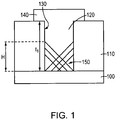
- Dislocation defects 150 in the second crystalline semiconductor material 140 reach and terminate at the sidewalls of the opening 120 in the dielectric layer 110 at or below the vertical predetermined distance H from the surface of the substrate, such that dislocations in the second crystalline semiconductor material 140 decrease in density with increasing distance from the bottom portion of the opening 120. Accordingly, the bottom portion of the second crystalline semiconductor material 140 comprises lattice defects, and the upper portion of the crystalline material is substantially exhausted of crystalline defects.
- Various crystalline defects such as threading dislocations, stacking faults, twin boundaries, or anti-phase boundaries may thus be substantially eliminated from the upper portion of the crystalline material.
- dislocations of this type are referred to herein as "slip dislocations.” These are glissile dislocations that can glide in response to epitaxial layer strain.
- a common dislocation of this type that occurs during mismatched epitaxy is the 60° dislocation (where 60° is the angle between the dislocation line and the dislocation Burgers vector) located on ⁇ 111 ⁇ glide planes.
- Figure 1 illustrates trapping of such glissile threading dislocations, which are typically oriented along ⁇ 110> crystalline directions.
- dislocation when the dislocation is directed toward a substantially vertical sidewall oriented in a ⁇ 100> direction, as shown in Figure 1 , it will be trapped at a sidewall within a vertical distance from the substrate H - w * tan(45°), where 45° is the angle between the dislocation and the substrate.
- H is slightly less straightforward; this may be understood from Figure 2 as follows.
- Figure 2 shows directions in a cubic crystal 200, indicating the expected possible line directions of 60° threading dislocations (thick lines 210) and their projections onto the (110) plane (long dashed lines 220) where w and h indicate the height and width of the opening.
- Their projections onto the (110) plane form ⁇ 55° angles with the [1 1 0] direction. Therefore, for an opening 120 with an aspect ratio larger than h/w - tan 55°, and with substantially vertical sidewalls oriented in a ⁇ 110> direction, such glissile threads may be trapped solely due to their crystallographic geometry, i.e., solely due to their preferred orientation after experiencing glide.
- threading dislocations with line direction along approximately the [001] growth direction may be created during growth. These threading dislocations will not necessarily be trapped merely by appropriate choice of sidewall orientation and sidewall height. This behavior may be understood in view of the concept of "growth dislocations," which are distinguished here from slip dislocations. Growth dislocations are connected with the growth front and proceed with it via replication during growth.
- the line direction of a growth dislocation is a function of its Burgers vector and the crystal growth direction, and is generally approximately normal (usually within ⁇ 10°, e.g., no more than about 8° off normal) to the growth face, i.e., epitaxial film surface, that the dislocation intersects; growth dislocations are assumed not to experience significant glide. This behavior is distinct from that of slip dislocations, which experience significant glide during relaxation of mismatched strain.
- a growth surface 300 (also referred to herein as a growth front) of an epitaxial film of the second crystalline semiconductor material 140 grown in the opening in dielectric material 110 may tend to form facets 310 before the sidewall is fully covered by the epitaxial film.
- "Facet” is used herein to denote any surface of the epitaxial material that is not parallel to an underlying substrate surface 315. Whether or not facets form, and what crystal planes the facets comprise if they do form, depends upon various parameters, e.g., material grown, epitaxial process conditions such as pressure and temperature, sidewall dielectric material, and sidewall dielectric profile. These epitaxial film-formation parameters may be configured to cause facet formation.
- a profile of a top surface of the second crystalline semiconductor material 140 i.e., the growth surface 300
- a growth dislocation 320 is typically oriented approximately normal, i.e., generally perpendicular, to the growth surface 300 that the dislocation intersects.
- the growth surface geometry may evolve during growth because of differences in growth rates along different crystallographic directions.
- a given growth surface may increase in area at the expense of an adjacent growth surface, as illustrated conceptually in Figures 4a and 4b .
- One may define two growth rates r 1 and r 2 , where r 1 is the growth rate of the epitaxial surface parallel to the underlying substrate and r 2 is the growth rate of the faceted epitaxial surface.
- a growth dislocation will typically experience redirection when the orientation of the surface it intersects changes. In other words, since a growth dislocation is typically replicated in a direction normal to the growth surface during epitaxy, if the growth surface orientation changes, the growth dislocation direction will also change. In the absence of faceting, if the growth surface is parallel to the substrate surface, growth dislocations will typically be oriented approximately perpendicular to the substrate. This means that they may not be trapped by substantially vertical sidewalls, regardless of the opening's aspect ratio. When faceting is present, the facets are typically initiated at the beginning of epitaxial growth at the edges of the opening; they progressively "consume" more and more of the growth surface as shown in Figures 4a and 4b .
- the threading dislocations revealed in samples prepared under these experimental conditions cannot be "slip dislocations" as the term is used herein.
- the dominant slip dislocation expected to occur in this material system is the 60° threading dislocation discussed above, typically oriented along a ⁇ 110> direction.
- the projection of such a dislocation onto the (110) TEM specimen plane would form a ⁇ 55° angle with the substrate (as can be understood from Figure 2 ), regardless of the growth surface orientation.
- the threading dislocation segments observed in these samples appear to approximately follow directions normal to the growth surface (within around 8°), and often have an angle relative to the substrate that is not substantially equal to 55°.
- a sample was thinned from the substrate side down to a thickness of -200 nm; both the Si substrate and the first -300 nm of the epitaxial layer (where the defect trapping occurred) were removed, leaving only a defect-free Ge layer.
- TEM analysis of the quality of the Ge layer showed the effectiveness of the ART technique and using facet growth to direct growth of dislocations so that they are trapped within the ART region.
- substrate 100 including a first semiconductor material, i.e., 200 mm diameter p-type Si(001) substrates, 6° off-cut along the [110] direction and dielectric layer 110 disposed thereover, i.e., a 500 non-thick thermal oxide.
- the dielectric material was patterned to define openings 120 configured as trenches along the [1 1 0] direction having 0.2 - 2.5 ⁇ m width using conventional photolithography and RIE.
- the trenches include a longitudinal axis 500.
- the trenches also include first and second faces 510, 520, with the longitudinal axis intersecting the first and second faces 510, 520.
- RIE with CF x chemistries can leave a fluorocarbon residue on the surface, causing defective epitaxial layers in subsequent growth.
- an oxygen plasma ashing step 800 W at 1.2 Torr for 30 minutes was carried out after RIE.
- the patterned substrates were then cleaned in Piranha, SC2, and dilute HF solutions sequentially.
- the final trench height i.e., depth was 490 nm after this cleaning procedure.
- the trenches were filled with second crystalline semiconductor material 140 having a lattice mismatch with the first semiconductor material.
- the second crystalline semiconductor material was deposited in 450 nm-thick Ge layers, comprising a first layer (e.g., a low-temperature buffer layer) and a second layer (e.g., a higher-temperature growth layer), which were grown at 400 and 600 °C, respectively, using an ASM Epsilon E2000 commercial-grade epitaxy reactor.
- Cross-sectional and plan-view TEM samples were prepared by mechanical polishing and Ar ion milling. TEM images were taken on a JEOL JEM 2100 microscope operating at 200 kV.
- Defects e.g., threading dislocations 150 arising from the lattice mismatch between the first and second semiconductor materials, propagated away from a longitudinal axis 500 of the trench in a direction substantially perpendicular to a growth front of the second material and were trapped by a sidewall of the trench.
- a completely defect-free region was created as the growth proceeded beyond the defect-trapping region.
- substantially no defects intersect the first and second faces 510, 520.
- a defect-free region of about 300 nm in thickness was demonstrated.
- the defect-trapping region was about 400 nm thick.
- the final thickness of the defect-free region was about 100 nm.
- a trench suitable for fabrication in accordance with embodiments of the invention may have a length l of at least 6 mm, a width of less than 400 nm and/or a depth of less than 490 nm.
- the mechanism of ART was further illustrated with plan-view TEM images of Ge layers in trenches of 360 nm width and 700 nm width.
- the AR was 1.36 and 0.7, respectively.
- the TEM captured the entire thickness of the Ge-fllled trenches. It was found that the dislocations in Ge area terminate at the oxide sidewall. For AR > 1, most of the dislocations were trapped by the oxide sidewall, which is not the case with AR ⁇ 1. For this latter case many dislocations terminate at the SiO 2 sidewall, but some terminate instead at the Ge surface.
- the TEM sample used for generation of plan views of Ge layer in trenches of 360 nm width and 700 nm width was thinned further, removing the dislocation-trapping region and imaging the overlying defect-free region.
- a wedge-shaped sample was created. Convergent beam diffraction patterns were used to measure the thickness at the center of the sample. This was found to be about 70 nm.
- trenches with a width of 290 nm multiple adjacent trenches were completely dislocation-free except for one defect in the thickest part of the sample where the sample begins to encroach on the underlying trapping region. This is consistent with the cross-section TEM results, assuming the thickness of the heavily dislocated region to be approximately equal to the width of the trench.
- regions of Ge up to 400 nm wide and free of near-surface defects were demonstrated via ART in SiO 2 trenches on Si using conventional photolithography and selective growth of Ge layers as thin as 450 nm. All of the dislocations originating at the Ge/Si interface were trapped at the oxide sidewall without the additional formation of defects at the sidewall for trenches having AR > 1. By removing the dislocation-trapping region in plan-view TEM sample preparation, it is possible to obtain defect-free Ge. This approach utilized standard commercial equipment for all parts of the fabrication process and demonstrates a commercially viable way to integrate Ge and III-V materials as well with Si CMOS technology. Transistors and/or opto-electronic devices may be formed, which in some embodiments include at least a portion of the second semiconductor material formed in trenches defined in dielectric materials.
- Growth dislocations may either be created at the substrate/epitaxial layer interface (for example, to accommodate local nonuniformity or disregistry) or by replication of pre-existing threading dislocations that intersect the growth front.
- These pre-existing threading dislocations may, for example, be segments of glissile dislocation loops that glide from the growth surface to the substrate/epitaxial layer interface under the influence of lattice-mismatch stress during the earlier stages of growth.
- a single dislocation line it is possible for a single dislocation line to have both a slip dislocation segment and a growth dislocation segment.
- Figure 6 depicts a model for the case of a single type of non- ⁇ 100 ⁇ facet nucleating immediately upon initiation of growth at the pattern edges, and assuming dislocation 320 orientation perfectly normal to the local growth surfaces 300.
- w is the width of the opening
- a is the angle between the substrate surface 315 and the dominant growth facet 310.
- the non- ⁇ 100 ⁇ facets grow and eventually consume the (001) central surface as discussed with respect to Figures 4a and 4b , assuming growth rate r 1 of the (001) surface is higher than growth rate r 2 of the non- ⁇ 100 ⁇ facet.
- h 1 is the distance from the opening bottom to the point at which the non- ⁇ 100 ⁇ facet fully consume the (001) growth surface; h 2 is the height that it takes for a dislocation 320 bent at the critical point C to be trapped by the sidewall.
- Dislocation BCD is an example of the redirection and trapping of an existing growth dislocation below point C (segment BC is of growth nature and oriented approximately along the [001] growth direction). Again, the aspect ratio for successful trapping is (h 1 +h 2 )/w. For either case, the existing threading dislocations below point C may be deflected from the middle to either side (depending on the exact location of the original dislocation) regardless of their original directions and nature.
- Figure 7 depicts graphically the aspect ratio preferred for trapping growth dislocations based on redirection via faceting, as predicted by this simple model for the case of r 1 >> r 2 .
- Epitaxial film-formation parameters may be configured to cause the formation of a facet, i.e., to enhance facet formation.
- film-formation parameters that may be configured include:
- the dielectric material of the dielectric layer 110 in which the opening 120 is defined may be selected to enhance facet formation and defect trapping.
- facets 800 with a high inclination angle with respect to the sidewall may be introduced and hence improve the trapping efficacy of dislocations.
- silicon nitride may be used as a dielectric layer 110 to encourage formation of steep facets 800.
- An exemplary process includes deposition of a silicon nitride layer, with a preferred thickness ranging from 20 nm to 5 ⁇ m, on a substrate, e.g., a (100) Si substrate.
- the silicon nitride layer may be deposited at 780°C by any LPCVD technique.
- a photoresist layer is formed to define openings, and the silicon nitride material in these openings is removed, for example by means of an RIE that stops selectively on the Si surface.
- a selective epitaxial layer of a second crystalline semiconductor material, such as Ge, at a temperature of 585°C, is deposited in these openings by, for example, MOCVD.
- the epitaxial material deposited in this structure with silicon nitride sidewalls 130 is expected to form (111) facets on the edges next to the sidewalls 130.
- silicon dioxide as the dielectric material 110 for the sidewalls, as shown in Figure 8b , can result in a lower inclination angle of the facets 800 in comparison to silicon nitride material 110 for the sidewalls 13Q.
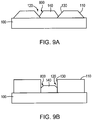
- the geometry of the dielectric sidewall 130 that bounds the opening 120 is selected to encourage the formation of facets 800. More specifically, a gradually sloped dielectric sidewall is more likely to encourage steeply inclined facet formation than a sebstantially vertical dielectric sidewall.
- Figure 9a shows such a dielectric sidewall 130 with a gradually sloped profile. In contrast to the dielectric with vertical sidewall as shown in Figure 9b , such a gradually sloped profile tends to encourage the formation of steep facets 800.
- Gradually sloped sidewalls can be obtained in a variety of ways, including, for example, sidewalls with a slope of about 25 to 40 degrees off vertical by wet etching or sidewalls with a slope of about 6 to 12 degrees off vertical by dry etching.
- Embodiments of the present invention include selective epitaxial growth of lattice-mismatched materials, such as Ge and III-V materials on Si substrates, with sidewall profiles engineered to cause formation of facets in the epitaxially grown material.
- a dielectric sidewall 130 with a gradually sloped bottom portion and a substantially vertical top portion may be used, as illustrated in Figure 10a .
- the gradually sloped bottom portion may introduce desirable, steeply inclined faceting at the early stage of the growth and enhance the dislocation trapping efficacy; the substantially vertical top portion is preferred for effectively trapping the defects that have been redirected.
- Figure 10b An alternative embodiment that is expected to have the same effect is shown in Figure 10b , in which the bottom portion of the dielectric sidewall 130 defines a step.
- Growth conditions for the lattice-mismatched epitaxial layer may be designed to encourage defect trapping by faceting.
- Epitaxial layer growth conditions such as growth temperature, may significantly affect faceting.
- a low epitaxial growth temperature such as -450-550 °C for selective Ge epitaxial growth on Si substrate, may be chosen to encourage the epitaxial layer to form a steeper facet, i.e., a facet with higher inclination angle with respect to the sidewall.
- the strong dependence of faceting of lattice-matched materials on growth temperature has been demonstrated in the literature. For example, S. Lim, et al., J. Vac. Sci. Technol.
- B 22(2), 682 (2004 ), show several samples of a selective silicon epitaxial layer grown on a Si substrate in openings bound by silicon dioxide. Images taken from samples grown at temperatures of 550 °C, 600 °C and 650 °C in sequence show that the growth conditions affect faceting.
- the (111) facet tends to form at the early growth stage at lower growth temperature, while the (211) facet forms at higher growth temperature. Again, since the angle between the (111) facet and the substrate is larger than that of the (211) facet, the dislocations are trapped more effectively in the former case.
- Embodiments of the present invention include selective epitaxial growth of lattice-mismatched materials, such as Ge and III-V materials on Si substrates, with facets being formed by the engineering of growth conditions such as growth temperature. Thus, dislocations may be trapped more effectively by desirable faceting.
- the orientation of the dielectric sidewalls 130 bounding the opening may influence the faceting of the selectively grown epitaxial layer 140. Therefore, the geometric pattern of the dielectric layer 110 may be designed to enhance the desirable faceting and hence improve the efficacy of dislocation trapping.
- growth may be substantially facet-free when the dielectric sidewalls 130 are oriented in ⁇ 100> directions (shown in Figure 11a ).
- epitaxial growth adjacent to dielectric sidewalls oriented in ⁇ 110> directions will typically introduce facets (shown in Figure 11b ). Therefore, a dielectric sidewall oriented in a ⁇ 110> direction is expected to lead to greater efficiency in trapping growth dislocations than a dielectric sidewall oriented in a ⁇ 100> direction.
- the doping of the selectively grown epitaxial material 140 may be engineered to enhance facets 800 with steeper inclination angles, thereby improving the defect trapping.
- the choice of dopants may affect the angle of facet inclination.
- a steep facet 800 may form during Si growth if a first dopant, e.g., boron is incorporated ( Figure 12a ) while a gradually sloped facet 800 may form if a second dopant, e.g., arsenic, is incorporated ( Figure 12b ).
- the steeper the facet formed in the former case is more effective in dislocation trapping than the gradually sloped facet formed in the latter case. Varying doping conditions in the epitaxial layer leads to different facet geometry and inclination angle.
- dislocations 150 may be guided even without the creation of facets.
- the growth dislocations will be guided to the sidewalls 130 in the case of convex curvature (i.e., thicker toward the middle of the opening, thinner at the edges) as illustrated in Figure 13 .
- a concave growth surface is preferably avoided, as this may guide dislocations to the centre of the opening.
- a curved growth surface may occur under certain doping condition and sidewall orientations, for example, Si epitaxial material formed in openings bound by silicon dioxide sidewalls oriented in ⁇ 100> directions, and in-situ doped with arsenic.
- facets defined in substrate, prior to epitaxial growth may be used to promote trapping of defects.
- a mask opening 1000 is defined in a photoresist layer 1010 formed over a top surface of substrate 100.
- a selective etch is performed to expose a specific crystal plane of the substrate in a bottom portion of the opening 1000.
- a wet KOH etch may be used to expose a (111) Si surface.
- the photoresist layer is subsequently removed.
- dielectric layer 110 is defined over the substrate 100 (including a first semiconductor material as described above), and opening 120 is defined in the dielectric layer 110.
- the opening 120 may be defined by a selective removal process such as RIE, stopping at the top surface of the substrate 100 to reveal the exposed crystal plane.
- the opening sidewall defines an angle ⁇ with the substrate 100, with the angle ⁇ preferably being less than 90°.
- second semiconductor material 140 is formed in the opening 120 by selective epitaxy.
- the initial epitaxial surface will form at approximately the same angle ⁇ with the opening sidewall, such that dislocations lying in a plane approximately normal to the epitaxial surface will be redirected to the opening sidewall.
- the opening 120 is filled with the second semiconductor material 140.
- Chemical-mechanical polishing (CMP) may be used to planarize a top surface of the epitaxial second semiconductor material.
- the low-dofect epitaxial area may be used for subsequent device fabrication.
Landscapes
- Chemical & Material Sciences (AREA)
- Crystallography & Structural Chemistry (AREA)
- Engineering & Computer Science (AREA)
- Materials Engineering (AREA)
- Metallurgy (AREA)
- Organic Chemistry (AREA)
- Inorganic Chemistry (AREA)
- Chemical Kinetics & Catalysis (AREA)
- General Chemical & Material Sciences (AREA)
- Recrystallisation Techniques (AREA)
Claims (10)
- Verfahren zum Bilden einer Struktur, wobei das Verfahren die folgenden Schritte umfasst:Vorsehen eines kristallinen Halbleitersubstrats (100), der ein erstes Halbleitermaterial umfasst und eine Oberseite aufweist;Bilden einer Maske (1010) über einer Oberseite des kristallinen Halbleitersubstrats und Definieren einer Maskenöffnung (1000) in der Maske, um einen Abschnitt der Oberseite des kristallinen Halbleitersubstrats freizulegen;Durchführen einer selektiven Ätzung, um eine bestimmte Kristallebene des kristallinen Halbleitersubstrats in einem unteren Abschnitt der Maskenöffnung freizulegen; Entfernen der Maske;Definieren einer nicht-kristallinen Schicht (110) über dem in den vorhergehenden Schritten erhaltenen kristallinen Halbleitersubstrat;Definieren einer in der nicht-kristallinen Schicht gebildeten Öffnung (120), die eine nicht-kristalline Seitenwand aufweist und durch einen selektiven Entfernungsprozess gebildet wird, sodass die Öffnung an der Oberseite des kristallinen Halbleitersubstrats endet, um die zuvor freigelegte spezifische Kristallebene offenzulegen und sodass die nicht-kristalline Seitenwand der Öffnung einen Winkel von weniger als 90° mit der freigelegten Kristallebene definiert;Bilden eines epitaktischen Films (140) in der Öffnung, wobei der epitaktische Film ein zweites Halbleitermaterial umfasst und eine Wachstumsfront beinhaltet, wobei die Wachstumsfront eine Oberfläche beinhaltet, die eine nicht zur Oberseite parallel verlaufende Facette umfasst, und wobei die Oberfläche annähernd den gleichen Winkel mit der nicht-kristallinen Seitenwand der Öffnung definiert, wobei das zweite Halbleitermaterial gitterunsymmetrisch zu dem ersten Halbleitermaterial ist, wobei Versetzungen (150) in dem epitaktischen Film in eine im Wesentlichen senkrecht zur Wachstumsfront liegende Richtung ausgerichtet sind, sodass die Versetzungen durch die nicht-kristalline Seitenwand der Öffnung eingeschlossen sind.
- Verfahren nach Anspruch 1, wobei die nicht-kristalline Seitenwand eine dielektrische Seitenwand umfasst.
- Verfahren nach Anspruch 1, worin die Öffnung einen Graben umfasst.
- Verfahren nach Anspruch 1, wobei das erste Halbleitermaterial ein Element oder eine Verbindung der Gruppe IV umfasst und das zweite Halbleitermaterial mindestens ein Element oder eine Verbindung der Gruppe IV, eine III-V-Verbindung oder eine II-VI-Verbindung umfasst.
- Verfahren nach Anspruch 4, wobei das zweite Halbleitermaterial die III-V-Verbindung umfasst und die III-V-Verbindung mindestens eines von AlP, GaP, InP, AlAs, GaAs, InAs, AlSb, GaSb, InSb, AlN, GaN, InN oder deren ternären oder quartären Verbindungen beinhaltet.
- Verfahren nach Anspruch 3, wobei die Länge des Grabens mindestens 6 mm beträgt.
- Verfahren nach Anspruch 3, wobei der Graben eine Breite von weniger als 400 nm aufweist.
- Verfahren nach einem der vorhergehenden Ansprüche, wobei das zweite Halbleitermaterial eine erste Schicht umfasst, die bei einem ersten Satz von Verarbeitungsbedingungen gewachsen ist, und eine zweite Schicht, die über der ersten Schicht angeordnet ist und bei einem zweiten Satz von Verarbeitungsbedingungen gewachsen ist.
- Verfahren nach einem der vorhergehenden Ansprüche, ferner umfassend: Bilden eines Transistors, wobei der Transistor mindestens einen Teil des zweiten Halbleitermaterials umfasst.
- Verfahren nach einem der vorhergehenden Ansprüche, ferner umfassend: Bilden einer optoelektronischen Vorrichtung, wobei die optoelektronische Vorrichtung mindestens einen Teil des zweiten Halbleitermaterials umfasst.
Applications Claiming Priority (3)
| Application Number | Priority Date | Filing Date | Title |
|---|---|---|---|
| US84277106P | 2006-09-07 | 2006-09-07 | |
| US87390306P | 2006-12-08 | 2006-12-08 | |
| PCT/US2007/019568 WO2008030574A1 (en) | 2006-09-07 | 2007-09-07 | Defect reduction using aspect ratio trapping |
Publications (2)
| Publication Number | Publication Date |
|---|---|
| EP2062290A1 EP2062290A1 (de) | 2009-05-27 |
| EP2062290B1 true EP2062290B1 (de) | 2019-08-28 |
Family
ID=38961470
Family Applications (1)
| Application Number | Title | Priority Date | Filing Date |
|---|---|---|---|
| EP07837902.1A Active EP2062290B1 (de) | 2006-09-07 | 2007-09-07 | Defektreduzierung durch kontrolle des aspektverhältnisses |
Country Status (3)
| Country | Link |
|---|---|
| US (4) | US8173551B2 (de) |
| EP (1) | EP2062290B1 (de) |
| WO (1) | WO2008030574A1 (de) |
Families Citing this family (133)
| Publication number | Priority date | Publication date | Assignee | Title |
|---|---|---|---|---|
| US20060292719A1 (en) * | 2005-05-17 | 2006-12-28 | Amberwave Systems Corporation | Lattice-mismatched semiconductor structures with reduced dislocation defect densities and related methods for device fabrication |
| US9153645B2 (en) | 2005-05-17 | 2015-10-06 | Taiwan Semiconductor Manufacturing Company, Ltd. | Lattice-mismatched semiconductor structures with reduced dislocation defect densities and related methods for device fabrication |
| US8324660B2 (en) | 2005-05-17 | 2012-12-04 | Taiwan Semiconductor Manufacturing Company, Ltd. | Lattice-mismatched semiconductor structures with reduced dislocation defect densities and related methods for device fabrication |
| KR101329388B1 (ko) * | 2005-07-26 | 2013-11-14 | 앰버웨이브 시스템즈 코포레이션 | 다른 액티브 영역 물질의 집적회로 집적을 위한 솔루션 |
| US7638842B2 (en) * | 2005-09-07 | 2009-12-29 | Amberwave Systems Corporation | Lattice-mismatched semiconductor structures on insulators |
| US20070054467A1 (en) * | 2005-09-07 | 2007-03-08 | Amberwave Systems Corporation | Methods for integrating lattice-mismatched semiconductor structure on insulators |
| US7777250B2 (en) | 2006-03-24 | 2010-08-17 | Taiwan Semiconductor Manufacturing Company, Ltd. | Lattice-mismatched semiconductor structures and related methods for device fabrication |
| US8173551B2 (en) | 2006-09-07 | 2012-05-08 | Taiwan Semiconductor Manufacturing Co., Ltd. | Defect reduction using aspect ratio trapping |
| WO2008036256A1 (en) * | 2006-09-18 | 2008-03-27 | Amberwave Systems Corporation | Aspect ratio trapping for mixed signal applications |
| US7875958B2 (en) * | 2006-09-27 | 2011-01-25 | Taiwan Semiconductor Manufacturing Company, Ltd. | Quantum tunneling devices and circuits with lattice-mismatched semiconductor structures |
| US7799592B2 (en) | 2006-09-27 | 2010-09-21 | Taiwan Semiconductor Manufacturing Company, Ltd. | Tri-gate field-effect transistors formed by aspect ratio trapping |
| US7498265B2 (en) * | 2006-10-04 | 2009-03-03 | Micron Technology, Inc. | Epitaxial silicon growth |
| US20080187018A1 (en) | 2006-10-19 | 2008-08-07 | Amberwave Systems Corporation | Distributed feedback lasers formed via aspect ratio trapping |
| US8304805B2 (en) | 2009-01-09 | 2012-11-06 | Taiwan Semiconductor Manufacturing Company, Ltd. | Semiconductor diodes fabricated by aspect ratio trapping with coalesced films |
| US8237151B2 (en) | 2009-01-09 | 2012-08-07 | Taiwan Semiconductor Manufacturing Company, Ltd. | Diode-based devices and methods for making the same |
| US9508890B2 (en) | 2007-04-09 | 2016-11-29 | Taiwan Semiconductor Manufacturing Company, Ltd. | Photovoltaics on silicon |
| US7825328B2 (en) | 2007-04-09 | 2010-11-02 | Taiwan Semiconductor Manufacturing Company, Ltd. | Nitride-based multi-junction solar cell modules and methods for making the same |
| US8329541B2 (en) | 2007-06-15 | 2012-12-11 | Taiwan Semiconductor Manufacturing Company, Ltd. | InP-based transistor fabrication |
| WO2009035746A2 (en) | 2007-09-07 | 2009-03-19 | Amberwave Systems Corporation | Multi-junction solar cells |
| US8183667B2 (en) | 2008-06-03 | 2012-05-22 | Taiwan Semiconductor Manufacturing Co., Ltd. | Epitaxial growth of crystalline material |
| US8274097B2 (en) | 2008-07-01 | 2012-09-25 | Taiwan Semiconductor Manufacturing Company, Ltd. | Reduction of edge effects from aspect ratio trapping |
| US20100006961A1 (en) * | 2008-07-09 | 2010-01-14 | Analog Devices, Inc. | Recessed Germanium (Ge) Diode |
| US8981427B2 (en) | 2008-07-15 | 2015-03-17 | Taiwan Semiconductor Manufacturing Company, Ltd. | Polishing of small composite semiconductor materials |
| US8304785B2 (en) * | 2008-07-29 | 2012-11-06 | Industrial Technology Research Institute | LED structure, manufacturing method thereof and LED module |
| WO2010033813A2 (en) * | 2008-09-19 | 2010-03-25 | Amberwave System Corporation | Formation of devices by epitaxial layer overgrowth |
| US8253211B2 (en) | 2008-09-24 | 2012-08-28 | Taiwan Semiconductor Manufacturing Company, Ltd. | Semiconductor sensor structures with reduced dislocation defect densities |
| SG171987A1 (en) | 2009-04-02 | 2011-07-28 | Taiwan Semiconductor Mfg | Devices formed from a non-polar plane of a crystalline material and method of making the same |
| US8338884B2 (en) | 2009-05-12 | 2012-12-25 | Taiwan Semiconductor Manufacturing Company, Ltd. | Selective epitaxial growth of semiconductor materials with reduced defects |
| US8212287B2 (en) * | 2009-09-18 | 2012-07-03 | Palo Alto Research Center Incorporated | Nitride semiconductor structure and method of making same |
| US9601328B2 (en) * | 2009-10-08 | 2017-03-21 | Taiwan Semiconductor Manufacturing Company, Ltd. | Growing a III-V layer on silicon using aligned nano-scale patterns |
| EP2743981A1 (de) * | 2009-10-30 | 2014-06-18 | Imec | Verfahren zum Herstellen einer integrierten Halbleitersubstratstruktur |
| US8242510B2 (en) * | 2010-01-28 | 2012-08-14 | Intersil Americas Inc. | Monolithic integration of gallium nitride and silicon devices and circuits, structure and method |
| TWI562195B (en) | 2010-04-27 | 2016-12-11 | Pilegrowth Tech S R L | Dislocation and stress management by mask-less processes using substrate patterning and methods for device fabrication |
| US8247249B2 (en) * | 2010-06-01 | 2012-08-21 | Palo Alto Research Center Incorporated | Semi-polar nitride-based light emitting structure and method of forming same |
| US8609517B2 (en) * | 2010-06-11 | 2013-12-17 | Taiwan Semiconductor Manufacturing Company, Ltd. | MOCVD for growing III-V compound semiconductors on silicon substrates |
| US8062963B1 (en) | 2010-10-08 | 2011-11-22 | Taiwan Semiconductor Manufacturing Company, Ltd. | Method of fabricating a semiconductor device having an epitaxy region |
| KR101205037B1 (ko) * | 2011-02-28 | 2012-11-26 | 에스케이하이닉스 주식회사 | 반도체 소자 및 그 형성방법 |
| US8445363B2 (en) * | 2011-04-21 | 2013-05-21 | United Microelectronics Corp. | Method of fabricating an epitaxial layer |
| KR101867999B1 (ko) | 2011-10-31 | 2018-06-18 | 삼성전자주식회사 | Iii-v족 물질층을 형성하는 방법, iii-v족 물질층을 포함하는 반도체 소자 및 그 제조방법 |
| US8742509B2 (en) | 2012-03-01 | 2014-06-03 | Taiwan Semiconductor Manufacturing Company, Ltd. | Apparatus and method for FinFETs |
| US9559099B2 (en) * | 2012-03-01 | 2017-01-31 | Taiwan Semiconductor Manufacturing Company, Ltd. | Apparatus and method for FinFETs |
| US8836016B2 (en) * | 2012-03-08 | 2014-09-16 | Taiwan Semiconductor Manufacturing Company, Ltd. | Semiconductor structures and methods with high mobility and high energy bandgap materials |
| US9876129B2 (en) | 2012-05-10 | 2018-01-23 | International Business Machines Corporation | Cone-shaped holes for high efficiency thin film solar cells |
| US8680576B2 (en) * | 2012-05-16 | 2014-03-25 | Taiwan Semiconductor Manufacturing Company, Ltd. | CMOS device and method of forming the same |
| US9142400B1 (en) | 2012-07-17 | 2015-09-22 | Stc.Unm | Method of making a heteroepitaxial layer on a seed area |
| EP2717316B1 (de) * | 2012-10-05 | 2019-08-14 | IMEC vzw | Verfahren zur Herstellung verspannter Germanium-Lamellenstrukturen |
| US8841177B2 (en) * | 2012-11-15 | 2014-09-23 | International Business Machines Corporation | Co-integration of elemental semiconductor devices and compound semiconductor devices |
| WO2014140082A1 (en) | 2013-03-13 | 2014-09-18 | Pilegrowth Tech S.R.L. | High efficiency solar cells on silicon substrates |
| US20140342533A1 (en) * | 2013-05-15 | 2014-11-20 | Applied Materials, Inc. | Method of strain and defect control in thin semiconductor films |
| US9748429B1 (en) * | 2013-06-11 | 2017-08-29 | National Technology & Engineering Solutions Of Sandia, Llc | Avalanche diode having reduced dark current and method for its manufacture |
| US9356147B2 (en) * | 2013-06-14 | 2016-05-31 | Globalfoundries Inc. | FinFET spacer etch for eSiGe improvement |
| US9330908B2 (en) | 2013-06-25 | 2016-05-03 | Globalfoundries Inc. | Semiconductor structure with aspect ratio trapping capabilities |
| US20150048422A1 (en) * | 2013-08-16 | 2015-02-19 | International Business Machines Corporation | A method for forming a crystalline compound iii-v material on a single element substrate |
| GB2517697A (en) | 2013-08-27 | 2015-03-04 | Ibm | Compound semiconductor structure |
| US8999779B2 (en) | 2013-09-06 | 2015-04-07 | International Business Machines Corporation | Locally raised epitaxy for improved contact by local silicon capping during trench silicide processings |
| FR3010828B1 (fr) | 2013-09-13 | 2015-09-25 | Commissariat Energie Atomique | Procede optimise de fabrication de motifs de materiau semiconducteur iii-v sur un substrat semiconducteur |
| JP5957771B2 (ja) * | 2013-10-11 | 2016-07-27 | パナソニックIpマネジメント株式会社 | 窒化物半導体積層構造、半導体発光素子および窒化物半導体積層構造を製造する方法 |
| KR102104062B1 (ko) | 2013-10-31 | 2020-04-23 | 삼성전자 주식회사 | 기판 구조체, 이를 포함한 cmos 소자 및 cmos 소자 제조 방법 |
| US9177967B2 (en) | 2013-12-24 | 2015-11-03 | Intel Corporation | Heterogeneous semiconductor material integration techniques |
| KR102168969B1 (ko) * | 2014-02-28 | 2020-10-22 | 삼성전자주식회사 | 반도체 장치 및 그 제조 방법 |
| KR20150104420A (ko) | 2014-03-05 | 2015-09-15 | 삼성전자주식회사 | 반도체 소자 및 그의 제조 방법 |
| US9064698B1 (en) | 2014-03-30 | 2015-06-23 | International Business Machines Corporation | Thin-film gallium nitride structures grown on graphene |
| US9287123B2 (en) * | 2014-04-28 | 2016-03-15 | Varian Semiconductor Equipment Associates, Inc. | Techniques for forming angled structures for reduced defects in heteroepitaxy of semiconductor films |
| JP6211999B2 (ja) * | 2014-06-25 | 2017-10-11 | 株式会社東芝 | 窒化物半導体層、窒化物半導体装置及び窒化物半導体層の製造方法 |
| US9601583B2 (en) * | 2014-07-15 | 2017-03-21 | Armonk Business Machines Corporation | Hetero-integration of III-N material on silicon |
| EP3195364A4 (de) * | 2014-09-18 | 2018-04-25 | Intel Corporation | Heteroepitaxiale wurtzit-strukturen mit geneigten seitenwandfacetten zur defektvermehrungssteuerung in cmos-kompatiblen siliciumhalbleiterbauelementen |
| CN106796952B (zh) | 2014-09-25 | 2020-11-06 | 英特尔公司 | 独立式硅台面上的ⅲ-n族外延器件结构 |
| US9349594B1 (en) | 2014-11-05 | 2016-05-24 | International Business Machines Corporation | Non-planar semiconductor device with aspect ratio trapping |
| EP3018715B1 (de) | 2014-11-05 | 2024-10-23 | IMEC vzw | Verfahren zur Herstellung einer Transistorvorrichtung mit einem Germanium-Kanalmaterial auf einem siliziumbasierten Substrat |
| US9349809B1 (en) | 2014-11-14 | 2016-05-24 | International Business Machines Corporation | Aspect ratio trapping and lattice engineering for III/V semiconductors |
| US9293530B1 (en) | 2014-11-14 | 2016-03-22 | International Business Machines Corporation | High aspect ratio trapping semiconductor with uniform height and isolated from bulk substrate |
| US10573647B2 (en) | 2014-11-18 | 2020-02-25 | Intel Corporation | CMOS circuits using n-channel and p-channel gallium nitride transistors |
| US10056456B2 (en) | 2014-12-18 | 2018-08-21 | Intel Corporation | N-channel gallium nitride transistors |
| US9601565B2 (en) * | 2014-12-22 | 2017-03-21 | Globalfoundries Inc. | Zig-zag trench structure to prevent aspect ratio trapping defect escape |
| CN107004713B (zh) * | 2014-12-24 | 2021-02-09 | 英特尔公司 | 形成具有非对称外形的鳍状物结构的装置和方法 |
| US9379184B1 (en) | 2015-02-18 | 2016-06-28 | International Business Machines Corporation | Secure chip with physically unclonable function |
| US9548319B2 (en) | 2015-03-10 | 2017-01-17 | International Business Machines Corporation | Structure for integration of an III-V compound semiconductor on SOI |
| US9608067B2 (en) | 2015-03-30 | 2017-03-28 | International Business Machines Corporation | Hybrid aspect ratio trapping |
| US9443940B1 (en) | 2015-04-07 | 2016-09-13 | Globalfoundries Inc. | Defect reduction with rotated double aspect ratio trapping |
| KR102346591B1 (ko) | 2015-05-19 | 2022-01-04 | 인텔 코포레이션 | 융기된 도핑 결정성 구조체들을 가진 반도체 디바이스들 |
| US9590107B2 (en) | 2015-06-25 | 2017-03-07 | International Business Machines Corporation | III-V gate-all-around field effect transistor using aspect ratio trapping |
| KR102349040B1 (ko) | 2015-06-26 | 2022-01-10 | 인텔 코포레이션 | 고온 안정 기판 계면 재료를 갖는 헤테로 에피택셜 구조체들 |
| EP3125273B1 (de) | 2015-07-31 | 2024-08-28 | IMEC vzw | Verspannte gruppe-iv-kanäle |
| US9646842B1 (en) | 2015-10-14 | 2017-05-09 | International Business Machines Corporation | Germanium smoothing and chemical mechanical planarization processes |
| US9916985B2 (en) | 2015-10-14 | 2018-03-13 | International Business Machines Corporation | Indium phosphide smoothing and chemical mechanical planarization processes |
| US9646841B1 (en) | 2015-10-14 | 2017-05-09 | International Business Machines Corporation | Group III arsenide material smoothing and chemical mechanical planarization processes |
| KR102379701B1 (ko) | 2015-10-19 | 2022-03-28 | 삼성전자주식회사 | 멀티-채널을 갖는 반도체 소자 및 그 형성 방법 |
| US9564494B1 (en) * | 2015-11-18 | 2017-02-07 | International Business Machines Corporation | Enhanced defect reduction for heteroepitaxy by seed shape engineering |
| US9570443B1 (en) * | 2015-11-23 | 2017-02-14 | International Business Machines Corporation | Field effect transistor including strained germanium fins |
| JP6706414B2 (ja) * | 2015-11-27 | 2020-06-10 | 国立研究開発法人情報通信研究機構 | Ge単結晶薄膜の製造方法及び光デバイス |
| US9601482B1 (en) | 2015-12-08 | 2017-03-21 | International Business Machines Corporation | Economical and environmentally friendly chemical mechanical polishing for III-V compound semiconductor device fabrication |
| US9570297B1 (en) * | 2015-12-09 | 2017-02-14 | International Business Machines Corporation | Elimination of defects in long aspect ratio trapping trench structures |
| US10658471B2 (en) | 2015-12-24 | 2020-05-19 | Intel Corporation | Transition metal dichalcogenides (TMDCS) over III-nitride heteroepitaxial layers |
| WO2017111873A1 (en) * | 2015-12-26 | 2017-06-29 | Intel Corporation | A method to achieve a uniform group iv material layer in an aspect ratio trapping trench |
| KR102430501B1 (ko) | 2015-12-29 | 2022-08-09 | 삼성전자주식회사 | 반도체 단결정구조, 반도체 디바이스 및 그 제조방법 |
| US9437427B1 (en) * | 2015-12-30 | 2016-09-06 | International Business Machines Corporation | Controlled confined lateral III-V epitaxy |
| US9564452B1 (en) | 2016-02-01 | 2017-02-07 | International Business Machines Corporation | Fabrication of hybrid semiconductor circuits |
| US9704757B1 (en) | 2016-02-25 | 2017-07-11 | International Business Machines Corporation | Fabrication of semiconductor structures |
| US11024737B2 (en) * | 2016-03-30 | 2021-06-01 | Intel Corporation | Etching fin core to provide fin doubling |
| US10249492B2 (en) | 2016-05-27 | 2019-04-02 | International Business Machines Corporation | Fabrication of compound semiconductor structures |
| US9735010B1 (en) | 2016-05-27 | 2017-08-15 | International Business Machines Corporation | Fabrication of semiconductor fin structures |
| US10181526B2 (en) | 2016-06-02 | 2019-01-15 | Samsung Electronics Co., Ltd. | Field effect transistor including multiple aspect ratio trapping structures |
| WO2017213650A1 (en) * | 2016-06-09 | 2017-12-14 | Intel Corporation | Quantum dot devices with trenched substrates |
| US10636912B2 (en) | 2016-06-30 | 2020-04-28 | Intel Corporation | FINFET transistor having a tapered subfin structure |
| US10243063B2 (en) | 2016-07-29 | 2019-03-26 | Applied Materials, Inc. | Method of uniform channel formation |
| US9728626B1 (en) | 2016-08-30 | 2017-08-08 | Globalfoundries Inc. | Almost defect-free active channel region |
| US10978590B2 (en) | 2016-09-30 | 2021-04-13 | Intel Corporation | Methods and apparatus to remove epitaxial defects in semiconductors |
| US9947793B1 (en) | 2017-02-08 | 2018-04-17 | Globalfoundries Inc. | Vertical pillar-type field effect transistor and method |
| JP2018147396A (ja) * | 2017-03-08 | 2018-09-20 | 株式会社ジャパンディスプレイ | 表示装置 |
| US10032663B1 (en) * | 2017-05-24 | 2018-07-24 | Texas Instruments Incorporated | Anneal after trench sidewall implant to reduce defects |
| US11164974B2 (en) | 2017-09-29 | 2021-11-02 | Intel Corporation | Channel layer formed in an art trench |
| US11233053B2 (en) | 2017-09-29 | 2022-01-25 | Intel Corporation | Group III-nitride (III-N) devices with reduced contact resistance and their methods of fabrication |
| US12125888B2 (en) | 2017-09-29 | 2024-10-22 | Intel Corporation | Group III-nitride (III-N) devices with reduced contact resistance and their methods of fabrication |
| US10944049B2 (en) * | 2017-11-13 | 2021-03-09 | Taiwan Semiconductor Manufacturing Company, Ltd. | MTJ device performance by controlling device shape |
| DE102018125373B4 (de) * | 2017-11-22 | 2025-02-20 | Taiwan Semiconductor Manufacturing Co., Ltd. | Verfahren zur Bildung eines SOI-Substrats |
| US10304723B1 (en) * | 2017-11-22 | 2019-05-28 | Taiwan Semiconductor Manufacturing Co., Ltd. | Process to form SOI substrate |
| US10672889B2 (en) | 2017-11-30 | 2020-06-02 | Taiwan Semiconductor Manufacturing Co., Ltd. | Semiconductor device and manufacturing method thereof |
| FR3075461B1 (fr) * | 2017-12-20 | 2020-02-14 | Commissariat A L'energie Atomique Et Aux Energies Alternatives | Procede de fabrication d'une heterostructure comportant des structures elementaires photoniques en materiau iii-v a la surface d'un substrat a base de silicium |
| US10424653B1 (en) | 2018-05-21 | 2019-09-24 | International Business Machines Corporation | Vertical transport field effect transistor on silicon with defined junctions |
| US10580966B1 (en) * | 2018-09-07 | 2020-03-03 | International Business Machines Corporation | Faceted sidewall magnetic tunnel junction structure |
| US10840093B2 (en) | 2018-09-11 | 2020-11-17 | International Business Machines Corporation | Fabrication of semiconductor substrates |
| US10366884B1 (en) * | 2018-11-08 | 2019-07-30 | Stratio | Methods for forming a germanium island using selective epitaxial growth and a sacrificial filling layer |
| EP3828918B1 (de) * | 2019-11-29 | 2025-06-11 | Imec VZW | Bipolarer transistor mit niedrigem parasitären ccb-heteroübergang |
| US10930490B1 (en) | 2019-12-26 | 2021-02-23 | Wisconsin Alumni Research Foundation | Arrays of high-aspect-ratio germanium nanostructures with nanoscale pitch and methods for the fabrication thereof |
| US11742203B2 (en) * | 2020-02-26 | 2023-08-29 | The Hong Kong University Of Science And Technology | Method for growing III-V compound semiconductor thin films on silicon-on-insulators |
| US20220139709A1 (en) * | 2020-11-05 | 2022-05-05 | International Business Machines Corporation | Confined gallium nitride epitaxial layers |
| KR102532540B1 (ko) * | 2021-01-28 | 2023-05-17 | 한국과학기술연구원 | 3차원 적층 구조의 상부층으로의 스레딩 변전위의 전파가 억제되는 트렌치 구조를 갖는 반도체 소자 |
| WO2022217541A1 (zh) * | 2021-04-15 | 2022-10-20 | 苏州晶湛半导体有限公司 | 半导体结构及其制备方法 |
| US12148613B2 (en) | 2021-04-15 | 2024-11-19 | Enkris Semiconductor, Inc. | Semiconductor structures and manufacturing methods thereof |
| US20240047207A1 (en) * | 2022-08-02 | 2024-02-08 | Infineon Technologies Ag | Technique for Forming Cubic Silicon Carbide and Heterojunction Silicon Carbide Device |
| CN118057595A (zh) * | 2022-11-18 | 2024-05-21 | 上海华力集成电路制造有限公司 | Fdsoi混合区域的外延生长方法 |
| CN118899316A (zh) * | 2023-05-04 | 2024-11-05 | 无锡晶湛半导体有限公司 | 一种复合衬底及其制作方法、一种半导体结构 |
| CN117096208B (zh) * | 2023-10-20 | 2024-02-09 | 浙桂(杭州)半导体科技有限责任公司 | 一种锗硅雪崩光电二极管 |
Citations (2)
| Publication number | Priority date | Publication date | Assignee | Title |
|---|---|---|---|---|
| WO2006125040A2 (en) * | 2005-05-17 | 2006-11-23 | Amberwave Systems Corporation | Lattice-mismatched semiconductor structures with reduced dislocation defect densities related methods for device fabrication |
| WO2007112066A2 (en) * | 2006-03-24 | 2007-10-04 | Amberwave Systems Corporation | Lattice-mismatched semiconductor structures and related methods for device fabrication |
Family Cites Families (442)
| Publication number | Priority date | Publication date | Assignee | Title |
|---|---|---|---|---|
| SE391122B (sv) * | 1971-01-25 | 1977-02-07 | Cutter Lab | Protes i form av en ryggradsbroskskiva och forfarande for framstellning derav |
| US4307510A (en) | 1980-03-12 | 1981-12-29 | The United States Of America As Represented By The Administrator Of The National Aeronautics & Space Administration | Computer circuit card puller |
| EP0191503A3 (de) * | 1980-04-10 | 1986-09-10 | Massachusetts Institute Of Technology | Verfahren zur Herstellung von Blättern aus kristallinem Material |
| US4322253A (en) | 1980-04-30 | 1982-03-30 | Rca Corporation | Method of making selective crystalline silicon regions containing entrapped hydrogen by laser treatment |
| US4370510A (en) | 1980-09-26 | 1983-01-25 | California Institute Of Technology | Gallium arsenide single crystal solar cell structure and method of making |
| US4309777A (en) * | 1980-11-13 | 1982-01-12 | Patil Arun A | Artificial intervertebral disc |
| US4651179A (en) | 1983-01-21 | 1987-03-17 | Rca Corporation | Low resistance gallium arsenide field effect transistor |
| US4545109A (en) | 1983-01-21 | 1985-10-08 | Rca Corporation | Method of making a gallium arsenide field effect transistor |
| US5091333A (en) * | 1983-09-12 | 1992-02-25 | Massachusetts Institute Of Technology | Reducing dislocations in semiconductors utilizing repeated thermal cycling during multistage epitaxial growth |
| US4860081A (en) * | 1984-06-28 | 1989-08-22 | Gte Laboratories Incorporated | Semiconductor integrated circuit structure with insulative partitions |
| US4551394A (en) | 1984-11-26 | 1985-11-05 | Honeywell Inc. | Integrated three-dimensional localized epitaxial growth of Si with localized overgrowth of GaAs |
| DE3676019D1 (de) | 1985-09-03 | 1991-01-17 | Daido Steel Co Ltd | Epitaktische gallium-arsenid-halbleiterscheibe und verfahren zu ihrer herstellung. |
| US4774205A (en) * | 1986-06-13 | 1988-09-27 | Massachusetts Institute Of Technology | Monolithic integration of silicon and gallium arsenide devices |
| JPS63149021A (ja) | 1986-07-25 | 1988-06-21 | Dai Ichi High Frequency Co Ltd | 内管挿入方式による二重管ベンドの製造方法及び装置 |
| JPS6381855A (ja) | 1986-09-25 | 1988-04-12 | Mitsubishi Electric Corp | ヘテロ接合バイポ−ラトランジスタの製造方法 |
| CH671691A5 (de) * | 1987-01-08 | 1989-09-29 | Sulzer Ag | |
| US5269876A (en) | 1987-01-26 | 1993-12-14 | Canon Kabushiki Kaisha | Process for producing crystal article |
| US5236546A (en) | 1987-01-26 | 1993-08-17 | Canon Kabushiki Kaisha | Process for producing crystal article |
| CA1283501C (en) * | 1987-02-12 | 1991-04-30 | Thomas P. Hedman | Artificial spinal disc |
| US5281283A (en) | 1987-03-26 | 1994-01-25 | Canon Kabushiki Kaisha | Group III-V compound crystal article using selective epitaxial growth |
| US5166767A (en) | 1987-04-14 | 1992-11-24 | National Semiconductor Corporation | Sidewall contact bipolar transistor with controlled lateral spread of selectively grown epitaxial layer |
| US4957992A (en) * | 1987-04-21 | 1990-09-18 | Kao Corporation | Hair cosmetic composition |
| US4876210A (en) | 1987-04-30 | 1989-10-24 | The University Of Delaware | Solution growth of lattice mismatched and solubility mismatched heterostructures |
| US4826784A (en) * | 1987-11-13 | 1989-05-02 | Kopin Corporation | Selective OMCVD growth of compound semiconductor materials on silicon substrates |
| US5272105A (en) | 1988-02-11 | 1993-12-21 | Gte Laboratories Incorporated | Method of manufacturing an heteroepitaxial semiconductor structure |
| US5079616A (en) | 1988-02-11 | 1992-01-07 | Gte Laboratories Incorporated | Semiconductor structure |
| GB2215514A (en) | 1988-03-04 | 1989-09-20 | Plessey Co Plc | Terminating dislocations in semiconductor epitaxial layers |
| US5032893A (en) | 1988-04-01 | 1991-07-16 | Cornell Research Foundation, Inc. | Method for reducing or eliminating interface defects in mismatched semiconductor eiplayers |
| US5156995A (en) | 1988-04-01 | 1992-10-20 | Cornell Research Foundation, Inc. | Method for reducing or eliminating interface defects in mismatched semiconductor epilayers |
| DE8807485U1 (de) * | 1988-06-06 | 1989-08-10 | Mecron Medizinische Produkte Gmbh, 1000 Berlin | Endoprothese der Zwischenwirbelscheibe |
| US4911718A (en) * | 1988-06-10 | 1990-03-27 | University Of Medicine & Dentistry Of N.J. | Functional and biocompatible intervertebral disc spacer |
| CA1333209C (en) * | 1988-06-28 | 1994-11-29 | Gary Karlin Michelson | Artificial spinal fusion implants |
| US5238869A (en) | 1988-07-25 | 1993-08-24 | Texas Instruments Incorporated | Method of forming an epitaxial layer on a heterointerface |
| EP0352472A3 (de) | 1988-07-25 | 1991-02-06 | Texas Instruments Incorporated | Heteroepitaxie von Halbleitermaterialien mit ungleichen Gittern |
| US5545229A (en) * | 1988-08-18 | 1996-08-13 | University Of Medicine And Dentistry Of Nj | Functional and biocompatible intervertebral disc spacer containing elastomeric material of varying hardness |
| JPH0262090A (ja) | 1988-08-29 | 1990-03-01 | Matsushita Electric Ind Co Ltd | 光半導体装置の製造方法 |
| US5061644A (en) | 1988-12-22 | 1991-10-29 | Honeywell Inc. | Method for fabricating self-aligned semiconductor devices |
| EP0380815B1 (de) | 1989-01-31 | 1994-05-25 | Agfa-Gevaert N.V. | Integration von GaAs auf Si-Unterlage |
| US5034337A (en) | 1989-02-10 | 1991-07-23 | Texas Instruments Incorporated | Method of making an integrated circuit that combines multi-epitaxial power transistors with logic/analog devices |
| US4948456A (en) | 1989-06-09 | 1990-08-14 | Delco Electronics Corporation | Confined lateral selective epitaxial growth |
| US5098850A (en) | 1989-06-16 | 1992-03-24 | Canon Kabushiki Kaisha | Process for producing substrate for selective crystal growth, selective crystal growth process and process for producing solar battery by use of them |
| US5256594A (en) | 1989-06-16 | 1993-10-26 | Intel Corporation | Masking technique for depositing gallium arsenide on silicon |
| FR2659226B1 (fr) * | 1990-03-07 | 1992-05-29 | Jbs Sa | Prothese pour disques intervertebraux et ses instruments d'implantation. |
| US5093699A (en) | 1990-03-12 | 1992-03-03 | Texas A & M University System | Gate adjusted resonant tunnel diode device and method of manufacture |
| US5164359A (en) | 1990-04-20 | 1992-11-17 | Eaton Corporation | Monolithic integrated circuit having compound semiconductor layer epitaxially grown on ceramic substrate |
| KR930006934B1 (ko) * | 1990-06-23 | 1993-07-24 | 한국과학기술연구원 | 폴리에틸렌 섬유/비닐 에스테르 수지 복합재의 접착력 증진 방법 |
| US5158907A (en) | 1990-08-02 | 1992-10-27 | At&T Bell Laboratories | Method for making semiconductor devices with low dislocation defects |
| US5105247A (en) | 1990-08-03 | 1992-04-14 | Cavanaugh Marion E | Quantum field effect device with source extension region formed under a gate and between the source and drain regions |
| JP3202223B2 (ja) | 1990-11-27 | 2001-08-27 | 日本電気株式会社 | トランジスタの製造方法 |
| US5403751A (en) * | 1990-11-29 | 1995-04-04 | Canon Kabushiki Kaisha | Process for producing a thin silicon solar cell |
| US5223043A (en) | 1991-02-11 | 1993-06-29 | The United States Of America As Represented By The United States Department Of Energy | Current-matched high-efficiency, multijunction monolithic solar cells |
| US5091767A (en) * | 1991-03-18 | 1992-02-25 | At&T Bell Laboratories | Article comprising a lattice-mismatched semiconductor heterostructure |
| JPH04299569A (ja) | 1991-03-27 | 1992-10-22 | Nec Corp | Soisの製造方法及びトランジスタとその製造方法 |
| US5269852A (en) | 1991-05-27 | 1993-12-14 | Canon Kabushiki Kaisha | Crystalline solar cell and method for producing the same |
| JP3058954B2 (ja) | 1991-09-24 | 2000-07-04 | ローム株式会社 | 絶縁層の上に成長層を有する半導体装置の製造方法 |
| JP2773487B2 (ja) | 1991-10-15 | 1998-07-09 | 日本電気株式会社 | トンネルトランジスタ |
| JPH05121317A (ja) | 1991-10-24 | 1993-05-18 | Rohm Co Ltd | Soi構造形成方法 |
| FR2693364B1 (fr) * | 1992-07-07 | 1995-06-30 | Erpios Snc | Prothese intervertebrale permettant une stabilisation des contraintes rotatoires et de flexion-extension. |
| JP3286920B2 (ja) | 1992-07-10 | 2002-05-27 | 富士通株式会社 | 半導体装置の製造方法 |
| ATE169350T1 (de) * | 1992-12-04 | 1998-08-15 | Siemens Ag | Verfahren zur herstellung eines seitlich begrenzten, einkristallinen gebietes mittels selektiver epitaxie und dessen anwendung zur herstellung eines bipolartransistors sowie eines mos-transistors |
| JP3319472B2 (ja) | 1992-12-07 | 2002-09-03 | 富士通株式会社 | 半導体装置とその製造方法 |
| US5295150A (en) * | 1992-12-11 | 1994-03-15 | Eastman Kodak Company | Distributed feedback-channeled substrate planar semiconductor laser |
| US5456722A (en) * | 1993-01-06 | 1995-10-10 | Smith & Nephew Richards Inc. | Load bearing polymeric cable |
| US5407491A (en) | 1993-04-08 | 1995-04-18 | University Of Houston | Tandem solar cell with improved tunnel junction |
| EP0627799B1 (de) * | 1993-06-04 | 1997-10-08 | Sharp Kabushiki Kaisha | Lichtmittierende Halbleitervorrichtung mit einer dritten Begrenzungsschicht |
| JP3748905B2 (ja) | 1993-08-27 | 2006-02-22 | 三洋電機株式会社 | 量子効果デバイス |
| US5792679A (en) | 1993-08-30 | 1998-08-11 | Sharp Microelectronics Technology, Inc. | Method for forming silicon-germanium/Si/silicon dioxide heterostructure using germanium implant |
| US5461243A (en) | 1993-10-29 | 1995-10-24 | International Business Machines Corporation | Substrate for tensilely strained semiconductor |
| US5405453A (en) | 1993-11-08 | 1995-04-11 | Applied Solar Energy Corporation | High efficiency multi-junction solar cell |
| US5489539A (en) | 1994-01-10 | 1996-02-06 | Hughes Aircraft Company | Method of making quantum well structure with self-aligned gate |
| US5458642A (en) * | 1994-01-18 | 1995-10-17 | Beer; John C. | Synthetic intervertebral disc |
| JPH07230952A (ja) | 1994-02-16 | 1995-08-29 | Ricoh Co Ltd | 再結晶化方法 |
| JPH0851109A (ja) | 1994-04-11 | 1996-02-20 | Texas Instr Inc <Ti> | 酸化物でパターン化されたウェーハの窓内にエピタキシャルシリコンを成長させる方法 |
| US6011271A (en) | 1994-04-28 | 2000-01-04 | Fujitsu Limited | Semiconductor device and method of fabricating the same |
| US5710436A (en) | 1994-09-27 | 1998-01-20 | Kabushiki Kaisha Toshiba | Quantum effect device |
| US5825240A (en) | 1994-11-30 | 1998-10-20 | Massachusetts Institute Of Technology | Resonant-tunneling transmission line technology |
| JP3835225B2 (ja) | 1995-02-23 | 2006-10-18 | 日亜化学工業株式会社 | 窒化物半導体発光素子 |
| JPH08306700A (ja) | 1995-04-27 | 1996-11-22 | Nec Corp | 半導体装置及びその製造方法 |
| US5528209A (en) | 1995-04-27 | 1996-06-18 | Hughes Aircraft Company | Monolithic microwave integrated circuit and method |
| TW304310B (de) * | 1995-05-31 | 1997-05-01 | Siemens Ag | |
| US5621227A (en) | 1995-07-18 | 1997-04-15 | Discovery Semiconductors, Inc. | Method and apparatus for monolithic optoelectronic integrated circuit using selective epitaxy |
| DE69609313T2 (de) | 1995-12-15 | 2001-02-01 | Koninklijke Philips Electronics N.V., Eindhoven | Halbleiterfeldeffektanordnung mit einer sige schicht |
| TW314621B (de) | 1995-12-20 | 1997-09-01 | Toshiba Co Ltd | |
| US5987590A (en) | 1996-04-02 | 1999-11-16 | Texas Instruments Incorporated | PC circuits, systems and methods |
| ZA974261B (en) | 1996-05-17 | 1997-11-17 | Canon Kk | Photovoltaic device and process for the production thereof. |
| JP3719618B2 (ja) | 1996-06-17 | 2005-11-24 | 松下電器産業株式会社 | 半導体装置及びその製造方法 |
| US6229153B1 (en) | 1996-06-21 | 2001-05-08 | Wisconsin Alumni Research Corporation | High peak current density resonant tunneling diode |
| JP3260660B2 (ja) | 1996-08-22 | 2002-02-25 | 株式会社東芝 | 半導体装置およびその製造方法 |
| JP3449516B2 (ja) | 1996-08-30 | 2003-09-22 | 株式会社リコー | 半導体多層膜反射鏡および半導体多層膜反射防止膜および面発光型半導体レーザおよび受光素子 |
| US6191432B1 (en) | 1996-09-02 | 2001-02-20 | Kabushiki Kaisha Toshiba | Semiconductor device and memory device |
| US5825049A (en) | 1996-10-09 | 1998-10-20 | Sandia Corporation | Resonant tunneling device with two-dimensional quantum well emitter and base layers |
| JPH10126010A (ja) | 1996-10-23 | 1998-05-15 | Ricoh Co Ltd | 半導体レーザ装置の製造方法 |
| SG65697A1 (en) * | 1996-11-15 | 1999-06-22 | Canon Kk | Process for producing semiconductor article |
| US5827328A (en) * | 1996-11-22 | 1998-10-27 | Buttermann; Glenn R. | Intervertebral prosthetic device |
| US5853497A (en) | 1996-12-12 | 1998-12-29 | Hughes Electronics Corporation | High efficiency multi-junction solar cells |
| US6348096B1 (en) | 1997-03-13 | 2002-02-19 | Nec Corporation | Method for manufacturing group III-V compound semiconductors |
| JP3853905B2 (ja) | 1997-03-18 | 2006-12-06 | 株式会社東芝 | 量子効果装置とblトンネル素子を用いた装置 |
| EP0874405A3 (de) | 1997-03-25 | 2004-09-15 | Mitsubishi Cable Industries, Ltd. | Element auf Basis von GaN mit niedriger Versetzungsdichte, seine Verwendung und Herstellungsverfahren |
| JP3047852B2 (ja) | 1997-04-04 | 2000-06-05 | 松下電器産業株式会社 | 半導体装置 |
| CN1131548C (zh) | 1997-04-04 | 2003-12-17 | 松下电器产业株式会社 | 半导体装置 |
| JP3184115B2 (ja) | 1997-04-11 | 2001-07-09 | 松下電器産業株式会社 | オーミック電極形成方法 |
| CN1159750C (zh) | 1997-04-11 | 2004-07-28 | 日亚化学工业株式会社 | 氮化物半导体的生长方法 |
| US5998781A (en) | 1997-04-30 | 1999-12-07 | Sandia Corporation | Apparatus for millimeter-wave signal generation |
| US5903170A (en) | 1997-06-03 | 1999-05-11 | The Regents Of The University Of Michigan | Digital logic design using negative differential resistance diodes and field-effect transistors |
| US5883549A (en) | 1997-06-20 | 1999-03-16 | Hughes Electronics Corporation | Bipolar junction transistor (BJT)--resonant tunneling diode (RTD) oscillator circuit and method |
| EP1016129B2 (de) * | 1997-06-24 | 2009-06-10 | Massachusetts Institute Of Technology | Kontrolle der verspannungsdichte durch verwendung von gradientenschichten und durch planarisierung |
| US5869845A (en) | 1997-06-26 | 1999-02-09 | Texas Instruments Incorporated | Resonant tunneling memory |
| US6015979A (en) * | 1997-08-29 | 2000-01-18 | Kabushiki Kaisha Toshiba | Nitride-based semiconductor element and method for manufacturing the same |
| JP3930161B2 (ja) | 1997-08-29 | 2007-06-13 | 株式会社東芝 | 窒化物系半導体素子、発光素子及びその製造方法 |
| US20010006249A1 (en) * | 1997-09-16 | 2001-07-05 | Eugene A Fitzgerald | Co-planar si and ge composite substrate and method of producing same |
| FR2769924B1 (fr) | 1997-10-20 | 2000-03-10 | Centre Nat Rech Scient | Procede de realisation d'une couche epitaxiale de nitrure de gallium, couche epitaxiale de nitrure de gallium et composant optoelectronique muni d'une telle couche |
| CA2311132C (en) * | 1997-10-30 | 2004-12-07 | Sumitomo Electric Industries, Ltd. | Gan single crystalline substrate and method of producing the same |
| JP3180743B2 (ja) * | 1997-11-17 | 2001-06-25 | 日本電気株式会社 | 窒化化合物半導体発光素子およびその製法 |
| FR2772594B1 (fr) * | 1997-12-19 | 2000-05-05 | Henry Graf | Prothese discale partielle posterieure |
| US6258125B1 (en) * | 1998-08-03 | 2001-07-10 | Synthes (U.S.A.) | Intervertebral allograft spacer |
| FR2775183B1 (fr) * | 1998-02-20 | 2000-08-04 | Jean Taylor | Prothese inter-epineuse |
| JP3468082B2 (ja) | 1998-02-26 | 2003-11-17 | 日亜化学工業株式会社 | 窒化物半導体素子 |
| US6150242A (en) | 1998-03-25 | 2000-11-21 | Texas Instruments Incorporated | Method of growing crystalline silicon overlayers on thin amorphous silicon oxide layers and forming by method a resonant tunneling diode |
| JPH11274467A (ja) | 1998-03-26 | 1999-10-08 | Murata Mfg Co Ltd | 光電子集積回路素子 |
| US6500257B1 (en) | 1998-04-17 | 2002-12-31 | Agilent Technologies, Inc. | Epitaxial material grown laterally within a trench and method for producing same |
| JP3338778B2 (ja) | 1998-04-24 | 2002-10-28 | 日本電気株式会社 | 窒化物系化合物半導体レーザ素子 |
| US6265289B1 (en) * | 1998-06-10 | 2001-07-24 | North Carolina State University | Methods of fabricating gallium nitride semiconductor layers by lateral growth from sidewalls into trenches, and gallium nitride semiconductor structures fabricated thereby |
| KR20010053129A (ko) * | 1998-06-23 | 2001-06-25 | 딤소 디스트리뷰숑 메디칼 두 수드 웨스트 | 고정 엘리먼트를 구비한 체벽 사이의 척추 임플란트 |
| JP4005701B2 (ja) | 1998-06-24 | 2007-11-14 | シャープ株式会社 | 窒素化合物半導体膜の形成方法および窒素化合物半導体素子 |
| JP4666295B2 (ja) | 1998-07-14 | 2011-04-06 | 富士通株式会社 | 半導体レーザ及び半導体装置の製造方法 |
| US6063121A (en) * | 1998-07-29 | 2000-05-16 | Xavier; Ravi | Vertebral body prosthesis |
| US6749635B1 (en) * | 1998-09-04 | 2004-06-15 | Sdgi Holdings, Inc. | Peanut spectacle multi discoid thoraco-lumbar disc prosthesis |
| WO2000016411A1 (en) | 1998-09-10 | 2000-03-23 | Rohm Co., Ltd. | Semiconductor light-emitting device and method for manufacturing the same |
| US6252261B1 (en) | 1998-09-30 | 2001-06-26 | Nec Corporation | GaN crystal film, a group III element nitride semiconductor wafer and a manufacturing process therefor |
| FR2787015B1 (fr) * | 1998-12-11 | 2001-04-27 | Dimso Sa | Prothese de disque intervertebral a corps compressible |
| FR2787014B1 (fr) * | 1998-12-11 | 2001-03-02 | Dimso Sa | Prothese de disque intervertebral a frottements reduits |
| FR2787016B1 (fr) * | 1998-12-11 | 2001-03-02 | Dimso Sa | Prothese de disque intervertebral |
| JP3868136B2 (ja) | 1999-01-20 | 2007-01-17 | 日亜化学工業株式会社 | 窒化ガリウム系化合物半導体発光素子 |
| JP3372226B2 (ja) | 1999-02-10 | 2003-01-27 | 日亜化学工業株式会社 | 窒化物半導体レーザ素子 |
| AU2999900A (en) * | 1999-02-18 | 2000-09-04 | Ken Y. Hsu | Hair used as a biologic disk, replacement, and/or structure and method |
| US6113638A (en) * | 1999-02-26 | 2000-09-05 | Williams; Lytton A. | Method and apparatus for intervertebral implant anchorage |
| US7145167B1 (en) | 2000-03-11 | 2006-12-05 | International Business Machines Corporation | High speed Ge channel heterostructures for field effect devices |
| JP3760663B2 (ja) | 1999-03-31 | 2006-03-29 | 豊田合成株式会社 | Iii族窒化物系化合物半導体素子の製造方法 |
| JP3702700B2 (ja) | 1999-03-31 | 2005-10-05 | 豊田合成株式会社 | Iii族窒化物系化合物半導体素子及びその製造方法 |
| DE10017137A1 (de) | 1999-04-14 | 2000-10-26 | Siemens Ag | Silizium-Aufbau und Verfahren zu dessen Herstellung |
| US6803598B1 (en) | 1999-05-07 | 2004-10-12 | University Of Delaware | Si-based resonant interband tunneling diodes and method of making interband tunneling diodes |
| JP3587081B2 (ja) | 1999-05-10 | 2004-11-10 | 豊田合成株式会社 | Iii族窒化物半導体の製造方法及びiii族窒化物半導体発光素子 |
| TW461096B (en) | 1999-05-13 | 2001-10-21 | Hitachi Ltd | Semiconductor memory |
| US6252287B1 (en) | 1999-05-19 | 2001-06-26 | Sandia Corporation | InGaAsN/GaAs heterojunction for multi-junction solar cells |
| JP3555500B2 (ja) * | 1999-05-21 | 2004-08-18 | 豊田合成株式会社 | Iii族窒化物半導体及びその製造方法 |
| GB9912178D0 (en) | 1999-05-25 | 1999-07-28 | Univ Court Of The University O | Improved optical modulator |
| US6419704B1 (en) * | 1999-10-08 | 2002-07-16 | Bret Ferree | Artificial intervertebral disc replacement methods and apparatus |
| EP1185221B1 (de) * | 1999-06-04 | 2005-03-23 | SDGI Holdings, Inc. | Künstliches zwischenwirbelimplantat |
| US20020128714A1 (en) * | 1999-06-04 | 2002-09-12 | Mark Manasas | Orthopedic implant and method of making metal articles |
| US6214653B1 (en) | 1999-06-04 | 2001-04-10 | International Business Machines Corporation | Method for fabricating complementary metal oxide semiconductor (CMOS) devices on a mixed bulk and silicon-on-insulator (SOI) substrate |
| JP2001007447A (ja) | 1999-06-18 | 2001-01-12 | Nichia Chem Ind Ltd | 窒化物半導体レーザ素子 |
| EP1192646B1 (de) | 1999-06-25 | 2008-08-13 | Massachusetts Institute Of Technology | Zyklisches thermisches ausheilverfahren zur reduktion von kristallversetzungen |
| US6228691B1 (en) | 1999-06-30 | 2001-05-08 | Intel Corp. | Silicon-on-insulator devices and method for producing the same |
| GB9919479D0 (en) | 1999-08-17 | 1999-10-20 | Imperial College | Island arrays |
| US6339232B1 (en) | 1999-09-20 | 2002-01-15 | Kabushika Kaisha Toshiba | Semiconductor device |
| US6447543B1 (en) * | 1999-09-28 | 2002-09-10 | Sulzer Orthopedics Ltd. | Basket-like container for implanting bone tissue |
| JP2001102678A (ja) | 1999-09-29 | 2001-04-13 | Toshiba Corp | 窒化ガリウム系化合物半導体素子 |
| US6264695B1 (en) * | 1999-09-30 | 2001-07-24 | Replication Medical, Inc. | Spinal nucleus implant |
| US6984571B1 (en) | 1999-10-01 | 2006-01-10 | Ziptronix, Inc. | Three dimensional device integration method and integrated device |
| FR2799638B1 (fr) * | 1999-10-14 | 2002-08-16 | Fred Zacouto | Fixateur et articulation vertebrale |
| US6812053B1 (en) | 1999-10-14 | 2004-11-02 | Cree, Inc. | Single step pendeo- and lateral epitaxial overgrowth of Group III-nitride epitaxial layers with Group III-nitride buffer layer and resulting structures |
| JP2001189483A (ja) | 1999-10-18 | 2001-07-10 | Sharp Corp | バイパス機能付太陽電池セルおよびバイパス機能付き多接合積層型太陽電池セルおよびそれらの製造方法 |
| EP1102327B1 (de) | 1999-11-15 | 2007-10-03 | Matsushita Electric Industrial Co., Ltd. | Feldeffekt-Halbleiterbauelement |
| US6521514B1 (en) * | 1999-11-17 | 2003-02-18 | North Carolina State University | Pendeoepitaxial methods of fabricating gallium nitride semiconductor layers on sapphire substrates |
| JP2001176805A (ja) | 1999-12-16 | 2001-06-29 | Sony Corp | 窒化物系iii−v族化合物の結晶製造方法、窒化物系iii−v族化合物結晶基板、窒化物系iii−v族化合物結晶膜およびデバイスの製造方法 |
| US6403451B1 (en) | 2000-02-09 | 2002-06-11 | Noerh Carolina State University | Methods of fabricating gallium nitride semiconductor layers on substrates including non-gallium nitride posts |
| AU2001233526A1 (en) | 2000-02-11 | 2001-08-20 | Novo Rps Ulc | Stent delivery system and method of use |
| US6902987B1 (en) | 2000-02-16 | 2005-06-07 | Ziptronix, Inc. | Method for low temperature bonding and bonded structure |
| US6414086B1 (en) * | 2000-02-29 | 2002-07-02 | Howmedica Osteonics Corp. | Compositions, processes and methods of improving the wear resistance of prosthetic medical devices |
| JP3512701B2 (ja) | 2000-03-10 | 2004-03-31 | 株式会社東芝 | 半導体装置及びその製造方法 |
| FR2805985B1 (fr) * | 2000-03-10 | 2003-02-07 | Eurosurgical | Prothese de disque intervertebral |
| TW504754B (en) | 2000-03-24 | 2002-10-01 | Sumitomo Chemical Co | Group III-V compound semiconductor and method of producing the same |
| US20050184302A1 (en) | 2000-04-04 | 2005-08-25 | Toshimasa Kobayashi | Nitride semiconductor device and method of manufacturing the same |
| US6362071B1 (en) | 2000-04-05 | 2002-03-26 | Motorola, Inc. | Method for forming a semiconductor device with an opening in a dielectric layer |
| US6482234B1 (en) * | 2000-04-26 | 2002-11-19 | Pearl Technology Holdings, Llc | Prosthetic spinal disc |
| JP2001338988A (ja) | 2000-05-25 | 2001-12-07 | Hitachi Ltd | 半導体装置及びその製造方法 |
| US20030229348A1 (en) * | 2000-05-25 | 2003-12-11 | Sevrain Lionel C. | Auxiliary vertebrae connecting device |
| US6841808B2 (en) | 2000-06-23 | 2005-01-11 | Toyoda Gosei Co., Ltd. | Group III nitride compound semiconductor device and method for producing the same |
| US20020030246A1 (en) | 2000-06-28 | 2002-03-14 | Motorola, Inc. | Structure and method for fabricating semiconductor structures and devices not lattice matched to the substrate |
| US20020008234A1 (en) | 2000-06-28 | 2002-01-24 | Motorola, Inc. | Mixed-signal semiconductor structure, device including the structure, and methods of forming the device and the structure |
| WO2002009187A2 (en) | 2000-07-24 | 2002-01-31 | Motorola, Inc. | Heterojunction tunneling diodes and process for fabricating same |
| US6610093B1 (en) * | 2000-07-28 | 2003-08-26 | Perumala Corporation | Method and apparatus for stabilizing adjacent vertebrae |
| US20020011612A1 (en) | 2000-07-31 | 2002-01-31 | Kabushiki Kaisha Toshiba | Semiconductor device and method for manufacturing the same |
| JP2002118255A (ja) | 2000-07-31 | 2002-04-19 | Toshiba Corp | 半導体装置およびその製造方法 |
| JP4269541B2 (ja) | 2000-08-01 | 2009-05-27 | 株式会社Sumco | 半導体基板と電界効果型トランジスタ並びにSiGe層の形成方法及びこれを用いた歪みSi層の形成方法と電界効果型トランジスタの製造方法 |
| US6579463B1 (en) | 2000-08-18 | 2003-06-17 | The Regents Of The University Of Colorado | Tunable nanomasks for pattern transfer and nanocluster array formation |
| US7301199B2 (en) | 2000-08-22 | 2007-11-27 | President And Fellows Of Harvard College | Nanoscale wires and related devices |
| US20060175601A1 (en) | 2000-08-22 | 2006-08-10 | President And Fellows Of Harvard College | Nanoscale wires and related devices |
| US20020026244A1 (en) * | 2000-08-30 | 2002-02-28 | Trieu Hai H. | Intervertebral disc nucleus implants and methods |
| US6407425B1 (en) * | 2000-09-21 | 2002-06-18 | Texas Instruments Incorporated | Programmable neuron MOSFET on SOI |
| US6456214B1 (en) | 2000-09-27 | 2002-09-24 | Raytheon Company | High-speed comparator utilizing resonant tunneling diodes and associated method |
| JP4044276B2 (ja) | 2000-09-28 | 2008-02-06 | 株式会社東芝 | 半導体装置及びその製造方法 |
| US7163864B1 (en) | 2000-10-18 | 2007-01-16 | International Business Machines Corporation | Method of fabricating semiconductor side wall fin |
| EP1341489B1 (de) * | 2000-12-15 | 2008-02-27 | Spineology, Inc. | Annulusverstärkendes band |
| US6720090B2 (en) | 2001-01-02 | 2004-04-13 | Eastman Kodak Company | Organic light emitting diode devices with improved luminance efficiency |
| JP4084544B2 (ja) | 2001-03-30 | 2008-04-30 | 豊田合成株式会社 | 半導体基板及び半導体素子の製造方法 |
| JP4084541B2 (ja) | 2001-02-14 | 2008-04-30 | 豊田合成株式会社 | 半導体結晶及び半導体発光素子の製造方法 |
| US7052979B2 (en) | 2001-02-14 | 2006-05-30 | Toyoda Gosei Co., Ltd. | Production method for semiconductor crystal and semiconductor luminous element |
| US20020111687A1 (en) * | 2001-02-15 | 2002-08-15 | Ralph James D. | Intervertebral spacer device utilizing a belleville washer having radially extending grooves |
| US6380590B1 (en) | 2001-02-22 | 2002-04-30 | Advanced Micro Devices, Inc. | SOI chip having multiple threshold voltage MOSFETs by using multiple channel materials and method of fabricating same |
| US6475869B1 (en) | 2001-02-26 | 2002-11-05 | Advanced Micro Devices, Inc. | Method of forming a double gate transistor having an epitaxial silicon/germanium channel region |
| JP3679720B2 (ja) | 2001-02-27 | 2005-08-03 | 三洋電機株式会社 | 窒化物系半導体素子および窒化物系半導体の形成方法 |
| US7229441B2 (en) * | 2001-02-28 | 2007-06-12 | Warsaw Orthopedic, Inc. | Flexible systems for spinal stabilization and fixation |
| JP2002270516A (ja) * | 2001-03-07 | 2002-09-20 | Nec Corp | Iii族窒化物半導体の成長方法、iii族窒化物半導体膜およびそれを用いた半導体素子 |
| US7205604B2 (en) | 2001-03-13 | 2007-04-17 | International Business Machines Corporation | Ultra scalable high speed heterojunction vertical n-channel MISFETs and methods thereof |
| JP3705142B2 (ja) | 2001-03-27 | 2005-10-12 | ソニー株式会社 | 窒化物半導体素子及びその作製方法 |
| EP1374309A1 (de) | 2001-03-30 | 2004-01-02 | The Regents Of The University Of California | Verfahren zur herstellung von nanostrukturen und nanoleitungen und daraus hergestellte bauelemente |
| JP3956637B2 (ja) | 2001-04-12 | 2007-08-08 | ソニー株式会社 | 窒化物半導体の結晶成長方法及び半導体素子の形成方法 |
| GB0110112D0 (en) | 2001-04-25 | 2001-06-20 | Univ Glasgow | Improved optoelectronic device |
| GB0111207D0 (en) | 2001-05-08 | 2001-06-27 | Btg Int Ltd | A method to produce germanium layers |
| US6784074B2 (en) | 2001-05-09 | 2004-08-31 | Nsc-Nanosemiconductor Gmbh | Defect-free semiconductor templates for epitaxial growth and method of making same |
| JP3819730B2 (ja) | 2001-05-11 | 2006-09-13 | 三洋電機株式会社 | 窒化物系半導体素子および窒化物半導体の形成方法 |
| US20020168802A1 (en) | 2001-05-14 | 2002-11-14 | Hsu Sheng Teng | SiGe/SOI CMOS and method of making the same |
| US7358578B2 (en) | 2001-05-22 | 2008-04-15 | Renesas Technology Corporation | Field effect transistor on a substrate with (111) orientation having zirconium oxide gate insulation and cobalt or nickel silicide wiring |
| CN1259734C (zh) | 2001-06-13 | 2006-06-14 | 松下电器产业株式会社 | 氮化物半导体、其制造方法以及氮化物半导体元件 |
| JP3515974B2 (ja) | 2001-06-13 | 2004-04-05 | 松下電器産業株式会社 | 窒化物半導体、その製造方法及び窒化物半導体素子 |
| US20030028251A1 (en) * | 2001-07-30 | 2003-02-06 | Mathews Hallett H. | Methods and devices for interbody spinal stabilization |
| US6566284B2 (en) | 2001-08-07 | 2003-05-20 | Hrl Laboratories, Llc | Method of manufacture for 80 nanometer diameter resonant tunneling diode with improved peak-to-valley ratio and resonant tunneling diode therefrom |
| ATE398430T1 (de) * | 2001-08-24 | 2008-07-15 | Zimmer Gmbh | Künstliche bandscheibe |
| JP3785970B2 (ja) | 2001-09-03 | 2006-06-14 | 日本電気株式会社 | Iii族窒化物半導体素子の製造方法 |
| JP2003077847A (ja) | 2001-09-06 | 2003-03-14 | Sumitomo Chem Co Ltd | 3−5族化合物半導体の製造方法 |
| JP2003163370A (ja) | 2001-09-11 | 2003-06-06 | Toyoda Gosei Co Ltd | 半導体結晶の製造方法 |
| TW544930B (en) | 2001-09-11 | 2003-08-01 | Toyoda Gosei Kk | Method for producing semiconductor crystal |
| US7105865B2 (en) | 2001-09-19 | 2006-09-12 | Sumitomo Electric Industries, Ltd. | AlxInyGa1−x−yN mixture crystal substrate |
| US6689650B2 (en) | 2001-09-27 | 2004-02-10 | International Business Machines Corporation | Fin field effect transistor with self-aligned gate |
| US20030064535A1 (en) * | 2001-09-28 | 2003-04-03 | Kub Francis J. | Method of manufacturing a semiconductor device having a thin GaN material directly bonded to an optimized substrate |
| US6710368B2 (en) | 2001-10-01 | 2004-03-23 | Ken Scott Fisher | Quantum tunneling transistor |
| US20030070707A1 (en) | 2001-10-12 | 2003-04-17 | King Richard Roland | Wide-bandgap, lattice-mismatched window layer for a solar energy conversion device |
| JP2003142728A (ja) * | 2001-11-02 | 2003-05-16 | Sharp Corp | 半導体発光素子の製造方法 |
| JP2003152220A (ja) | 2001-11-15 | 2003-05-23 | Sharp Corp | 半導体発光素子の製造方法および半導体発光素子 |
| US6835246B2 (en) | 2001-11-16 | 2004-12-28 | Saleem H. Zaidi | Nanostructures for hetero-expitaxial growth on silicon substrates |
| US7025787B2 (en) * | 2001-11-26 | 2006-04-11 | Sdgi Holdings, Inc. | Implantable joint prosthesis and associated instrumentation |
| US6576532B1 (en) | 2001-11-30 | 2003-06-10 | Motorola Inc. | Semiconductor device and method therefor |
| EP1363318A1 (de) | 2001-12-20 | 2003-11-19 | Matsushita Electric Industrial Co., Ltd. | Vwerfahren zur Herstellung eines Nitrid-Halbleitersubstrates und Verfahren zur Herstellung eines Nitrid-Halbleiterbauelements |
| KR100909733B1 (ko) | 2002-01-28 | 2009-07-29 | 니치아 카가쿠 고교 가부시키가이샤 | 지지기판을 갖는 질화물 반도체소자 및 그 제조방법 |
| KR100458288B1 (ko) | 2002-01-30 | 2004-11-26 | 한국과학기술원 | 이중-게이트 FinFET 소자 및 그 제조방법 |
| US7411233B2 (en) | 2002-08-27 | 2008-08-12 | E-Phocus, Inc | Photoconductor-on-active-pixel (POAP) sensor utilizing a multi-layered radiation absorbing structure |
| US6492216B1 (en) | 2002-02-07 | 2002-12-10 | Taiwan Semiconductor Manufacturing Company | Method of forming a transistor with a strained channel |
| JP3782021B2 (ja) | 2002-02-22 | 2006-06-07 | 株式会社東芝 | 半導体装置、半導体装置の製造方法、半導体基板の製造方法 |
| WO2003073517A1 (en) | 2002-02-27 | 2003-09-04 | Midwest Research Institute | Monolithic photovoltaic energy conversion device |
| JP4092927B2 (ja) | 2002-02-28 | 2008-05-28 | 豊田合成株式会社 | Iii族窒化物系化合物半導体、iii族窒化物系化合物半導体素子及びiii族窒化物系化合物半導体基板の製造方法 |
| US6635909B2 (en) | 2002-03-19 | 2003-10-21 | International Business Machines Corporation | Strained fin FETs structure and method |
| WO2003089696A1 (en) | 2002-04-15 | 2003-10-30 | The Regents Of The University Of California | Dislocation reduction in non-polar gallium nitride thin films |
| US7208393B2 (en) | 2002-04-15 | 2007-04-24 | The Regents Of The University Of California | Growth of planar reduced dislocation density m-plane gallium nitride by hydride vapor phase epitaxy |
| US8067687B2 (en) | 2002-05-21 | 2011-11-29 | Alliance For Sustainable Energy, Llc | High-efficiency, monolithic, multi-bandgap, tandem photovoltaic energy converters |
| US20060162768A1 (en) | 2002-05-21 | 2006-07-27 | Wanlass Mark W | Low bandgap, monolithic, multi-bandgap, optoelectronic devices |
| US7217882B2 (en) | 2002-05-24 | 2007-05-15 | Cornell Research Foundation, Inc. | Broad spectrum solar cell |
| CN2550906Y (zh) | 2002-05-27 | 2003-05-14 | 李映华 | 立体光双面结光电池 |
| FR2840452B1 (fr) | 2002-05-28 | 2005-10-14 | Lumilog | Procede de realisation par epitaxie d'un film de nitrure de gallium separe de son substrat |
| TWI271877B (en) | 2002-06-04 | 2007-01-21 | Nitride Semiconductors Co Ltd | Gallium nitride compound semiconductor device and manufacturing method |
| US7074623B2 (en) | 2002-06-07 | 2006-07-11 | Amberwave Systems Corporation | Methods of forming strained-semiconductor-on-insulator finFET device structures |
| US6995430B2 (en) | 2002-06-07 | 2006-02-07 | Amberwave Systems Corporation | Strained-semiconductor-on-insulator device structures |
| JP2004014856A (ja) | 2002-06-07 | 2004-01-15 | Sharp Corp | 半導体基板の製造方法及び半導体装置の製造方法 |
| US6887773B2 (en) | 2002-06-19 | 2005-05-03 | Luxtera, Inc. | Methods of incorporating germanium within CMOS process |
| US6812495B2 (en) | 2002-06-19 | 2004-11-02 | Massachusetts Institute Of Technology | Ge photodetectors |
| US7012298B1 (en) | 2002-06-21 | 2006-03-14 | Advanced Micro Devices, Inc. | Non-volatile memory device |
| US6981991B2 (en) * | 2002-06-27 | 2006-01-03 | Ferree Bret A | Arthroplasty devices configured to reduce shear stress |
| US6617643B1 (en) | 2002-06-28 | 2003-09-09 | Mcnc | Low power tunneling metal-oxide-semiconductor (MOS) device |
| US7335908B2 (en) | 2002-07-08 | 2008-02-26 | Qunano Ab | Nanostructures and methods for manufacturing the same |
| US6982204B2 (en) | 2002-07-16 | 2006-01-03 | Cree, Inc. | Nitride-based transistors and methods of fabrication thereof using non-etched contact recesses |
| US20040012037A1 (en) | 2002-07-18 | 2004-01-22 | Motorola, Inc. | Hetero-integration of semiconductor materials on silicon |
| US7375385B2 (en) | 2002-08-23 | 2008-05-20 | Amberwave Systems Corporation | Semiconductor heterostructures having reduced dislocation pile-ups |
| US20040043584A1 (en) | 2002-08-27 | 2004-03-04 | Thomas Shawn G. | Semiconductor device and method of making same |
| US7015497B1 (en) | 2002-08-27 | 2006-03-21 | The Ohio State University | Self-aligned and self-limited quantum dot nanoswitches and methods for making same |
| GB0220438D0 (en) | 2002-09-03 | 2002-10-09 | Univ Warwick | Formation of lattice-turning semiconductor substrates |
| US7122733B2 (en) | 2002-09-06 | 2006-10-17 | The Boeing Company | Multi-junction photovoltaic cell having buffer layers for the growth of single crystal boron compounds |
| US6830953B1 (en) | 2002-09-17 | 2004-12-14 | Taiwan Semiconductor Manufacturing Company, Ltd. | Suppression of MOSFET gate leakage current |
| US6815241B2 (en) | 2002-09-25 | 2004-11-09 | Cao Group, Inc. | GaN structures having low dislocation density and methods of manufacture |
| US6787864B2 (en) | 2002-09-30 | 2004-09-07 | Advanced Micro Devices, Inc. | Mosfets incorporating nickel germanosilicided gate and methods for their formation |
| US6800910B2 (en) | 2002-09-30 | 2004-10-05 | Advanced Micro Devices, Inc. | FinFET device incorporating strained silicon in the channel region |
| JP4546021B2 (ja) | 2002-10-02 | 2010-09-15 | ルネサスエレクトロニクス株式会社 | 絶縁ゲート型電界効果型トランジスタ及び半導体装置 |
| US6902991B2 (en) | 2002-10-24 | 2005-06-07 | Advanced Micro Devices, Inc. | Semiconductor device having a thick strained silicon layer and method of its formation |
| US6733533B1 (en) * | 2002-11-19 | 2004-05-11 | Zimmer Technology, Inc. | Artificial spinal disc |
| US6855990B2 (en) | 2002-11-26 | 2005-02-15 | Taiwan Semiconductor Manufacturing Co., Ltd | Strained-channel multiple-gate transistor |
| US6709982B1 (en) | 2002-11-26 | 2004-03-23 | Advanced Micro Devices, Inc. | Double spacer FinFET formation |
| US6920159B2 (en) * | 2002-11-29 | 2005-07-19 | Optitune Plc | Tunable optical source |
| WO2004054003A1 (en) | 2002-12-05 | 2004-06-24 | Blue Photonics, Inc. | High efficiency, monolithic multijunction solar cells containing lattice-mismatched materials and methods of forming same |
| US6645797B1 (en) | 2002-12-06 | 2003-11-11 | Advanced Micro Devices, Inc. | Method for forming fins in a FinFET device using sacrificial carbon layer |
| KR101086155B1 (ko) | 2002-12-16 | 2011-11-25 | 독립행정법인 과학기술진흥기구 | 수소화합물 기상 성장법에 의한 평면, 비극성 질화 갈륨의 성장 |
| JP2004200375A (ja) | 2002-12-18 | 2004-07-15 | Matsushita Electric Ind Co Ltd | 半導体レーザ装置およびその製造方法 |
| US7453129B2 (en) | 2002-12-18 | 2008-11-18 | Noble Peak Vision Corp. | Image sensor comprising isolated germanium photodetectors integrated with a silicon substrate and silicon circuitry |
| US7589380B2 (en) | 2002-12-18 | 2009-09-15 | Noble Peak Vision Corp. | Method for forming integrated circuit utilizing dual semiconductors |
| US7012314B2 (en) | 2002-12-18 | 2006-03-14 | Agere Systems Inc. | Semiconductor devices with reduced active region defects and unique contacting schemes |
| US6794718B2 (en) | 2002-12-19 | 2004-09-21 | International Business Machines Corporation | High mobility crystalline planes in double-gate CMOS technology |
| US6686245B1 (en) * | 2002-12-20 | 2004-02-03 | Motorola, Inc. | Vertical MOSFET with asymmetric gate structure |
| US7098487B2 (en) | 2002-12-27 | 2006-08-29 | General Electric Company | Gallium nitride crystal and method of making same |
| KR100513316B1 (ko) | 2003-01-21 | 2005-09-09 | 삼성전기주식회사 | 고효율 반도체 소자 제조방법 |
| US6762483B1 (en) | 2003-01-23 | 2004-07-13 | Advanced Micro Devices, Inc. | Narrow fin FinFET |
| JP2004235190A (ja) | 2003-01-28 | 2004-08-19 | Sony Corp | 光半導体装置 |
| WO2004073044A2 (en) | 2003-02-13 | 2004-08-26 | Massachusetts Institute Of Technology | Finfet device and method to make same |
| DE10320160A1 (de) * | 2003-02-14 | 2004-08-26 | Osram Opto Semiconductors Gmbh | Verfahren zum Herstellen einer Mehrzahl von Halbleiterkörper und elektronischer Halbleiterkörper |
| US6815738B2 (en) | 2003-02-28 | 2004-11-09 | International Business Machines Corporation | Multiple gate MOSFET structure with strained Si Fin body |
| WO2004081982A2 (en) | 2003-03-07 | 2004-09-23 | Amberwave Systems Corporation | Shallow trench isolation process |
| JP4695824B2 (ja) | 2003-03-07 | 2011-06-08 | 富士電機ホールディングス株式会社 | 半導体ウエハの製造方法 |
| US6936851B2 (en) * | 2003-03-21 | 2005-08-30 | Tien Yang Wang | Semiconductor light-emitting device and method for manufacturing the same |
| WO2004086461A2 (en) | 2003-03-21 | 2004-10-07 | North Carolina State University | Methods for nanoscale structures from optical lithography and subsequent lateral growth |
| US7061065B2 (en) * | 2003-03-31 | 2006-06-13 | National Chung-Hsing University | Light emitting diode and method for producing the same |
| US6900502B2 (en) | 2003-04-03 | 2005-05-31 | Taiwan Semiconductor Manufacturing Company, Ltd. | Strained channel on insulator device |
| TWI231994B (en) | 2003-04-04 | 2005-05-01 | Univ Nat Taiwan | Strained Si FinFET |
| US20050212051A1 (en) * | 2003-04-16 | 2005-09-29 | Sarnoff Corporation | Low voltage silicon controlled rectifier (SCR) for electrostatic discharge (ESD) protection of silicon-on-insulator technologies |
| US6867433B2 (en) | 2003-04-30 | 2005-03-15 | Taiwan Semiconductor Manufacturing Company, Ltd. | Semiconductor-on-insulator chip incorporating strained-channel partially-depleted, fully-depleted, and multiple-gate transistors |
| JP2004336040A (ja) | 2003-04-30 | 2004-11-25 | Osram Opto Semiconductors Gmbh | 複数の半導体チップの製造方法および電子半導体基体 |
| US6838322B2 (en) | 2003-05-01 | 2005-01-04 | Freescale Semiconductor, Inc. | Method for forming a double-gated semiconductor device |
| US6909186B2 (en) | 2003-05-01 | 2005-06-21 | International Business Machines Corporation | High performance FET devices and methods therefor |
| DE10324108B3 (de) * | 2003-05-21 | 2005-01-27 | Aesculap Ag & Co. Kg | Wirbelkörperersatzimplantat |
| US7088143B2 (en) | 2003-05-22 | 2006-08-08 | The Regents Of The University Of Michigan | Dynamic circuits having improved noise tolerance and method for designing same |
| JP4481312B2 (ja) * | 2003-05-27 | 2010-06-16 | スパイナルモーション, インコーポレイテッド | 椎間板挿入のための人工椎間板 |
| US6849487B2 (en) | 2003-05-27 | 2005-02-01 | Motorola, Inc. | Method for forming an electronic structure using etch |
| TWI242232B (en) | 2003-06-09 | 2005-10-21 | Canon Kk | Semiconductor substrate, semiconductor device, and method of manufacturing the same |
| US7262117B1 (en) | 2003-06-10 | 2007-08-28 | Luxtera, Inc. | Germanium integrated CMOS wafer and method for manufacturing the same |
| JP4105044B2 (ja) | 2003-06-13 | 2008-06-18 | 株式会社東芝 | 電界効果トランジスタ |
| US6974733B2 (en) | 2003-06-16 | 2005-12-13 | Intel Corporation | Double-gate transistor with enhanced carrier mobility |
| US6943407B2 (en) | 2003-06-17 | 2005-09-13 | International Business Machines Corporation | Low leakage heterojunction vertical transistors and high performance devices thereof |
| JP2005011915A (ja) | 2003-06-18 | 2005-01-13 | Hitachi Ltd | 半導体装置、半導体回路モジュールおよびその製造方法 |
| US7045401B2 (en) | 2003-06-23 | 2006-05-16 | Sharp Laboratories Of America, Inc. | Strained silicon finFET device |
| KR100631832B1 (ko) | 2003-06-24 | 2006-10-09 | 삼성전기주식회사 | 백색 발광소자 및 그 제조방법 |
| US7122392B2 (en) | 2003-06-30 | 2006-10-17 | Intel Corporation | Methods of forming a high germanium concentration silicon germanium alloy by epitaxial lateral overgrowth and structures formed thereby |
| US20050017351A1 (en) | 2003-06-30 | 2005-01-27 | Ravi Kramadhati V. | Silicon on diamond wafers and devices |
| US6921982B2 (en) | 2003-07-21 | 2005-07-26 | International Business Machines Corporation | FET channel having a strained lattice structure along multiple surfaces |
| EP1519420A2 (de) | 2003-09-25 | 2005-03-30 | Interuniversitaire Microelectronica Centrum vzw ( IMEC) | Halbleiterbauelement mit mehrfachem Gate und diesbezügliches Herstellungsverfahren |
| JP2005051022A (ja) * | 2003-07-28 | 2005-02-24 | Seiko Epson Corp | 半導体装置およびその製造方法 |
| US7153325B2 (en) * | 2003-08-01 | 2006-12-26 | Ultra-Kinetics, Inc. | Prosthetic intervertebral disc and methods for using the same |
| JP4322255B2 (ja) | 2003-08-05 | 2009-08-26 | 富士通マイクロエレクトロニクス株式会社 | 半導体装置及びその製造方法 |
| US6855583B1 (en) | 2003-08-05 | 2005-02-15 | Advanced Micro Devices, Inc. | Method for forming tri-gate FinFET with mesa isolation |
| US6835618B1 (en) | 2003-08-05 | 2004-12-28 | Advanced Micro Devices, Inc. | Epitaxially grown fin for FinFET |
| US7101742B2 (en) * | 2003-08-12 | 2006-09-05 | Taiwan Semiconductor Manufacturing Company, Ltd. | Strained channel complementary field-effect transistors and methods of manufacture |
| US20050035410A1 (en) | 2003-08-15 | 2005-02-17 | Yee-Chia Yeo | Semiconductor diode with reduced leakage |
| US7355253B2 (en) | 2003-08-22 | 2008-04-08 | International Business Machines Corporation | Strained-channel Fin field effect transistor (FET) with a uniform channel thickness and separate gates |
| US6815278B1 (en) | 2003-08-25 | 2004-11-09 | International Business Machines Corporation | Ultra-thin silicon-on-insulator and strained-silicon-direct-on-insulator with hybrid crystal orientations |
| US7078299B2 (en) | 2003-09-03 | 2006-07-18 | Advanced Micro Devices, Inc. | Formation of finFET using a sidewall epitaxial layer |
| US6955969B2 (en) | 2003-09-03 | 2005-10-18 | Advanced Micro Devices, Inc. | Method of growing as a channel region to reduce source/drain junction capacitance |
| JP4439358B2 (ja) | 2003-09-05 | 2010-03-24 | 株式会社東芝 | 電界効果トランジスタ及びその製造方法 |
| US7579263B2 (en) * | 2003-09-09 | 2009-08-25 | Stc.Unm | Threading-dislocation-free nanoheteroepitaxy of Ge on Si using self-directed touch-down of Ge through a thin SiO2 layer |
| US20050054164A1 (en) | 2003-09-09 | 2005-03-10 | Advanced Micro Devices, Inc. | Strained silicon MOSFETs having reduced diffusion of n-type dopants |
| US7138292B2 (en) | 2003-09-10 | 2006-11-21 | Lsi Logic Corporation | Apparatus and method of manufacture for integrated circuit and CMOS device including epitaxially grown dielectric on silicon carbide |
| US20050056827A1 (en) | 2003-09-15 | 2005-03-17 | Agency For Science, Technology And Research | CMOS compatible low band offset double barrier resonant tunneling diode |
| US7211864B2 (en) | 2003-09-15 | 2007-05-01 | Seliskar John J | Fully-depleted castellated gate MOSFET device and method of manufacture thereof |
| WO2005029583A2 (en) | 2003-09-19 | 2005-03-31 | Spinnaker Semiconductor, Inc. | Schottky barrier integrated circuit |
| US6831350B1 (en) | 2003-10-02 | 2004-12-14 | Freescale Semiconductor, Inc. | Semiconductor structure with different lattice constant materials and method for forming the same |
| US6919258B2 (en) | 2003-10-02 | 2005-07-19 | Freescale Semiconductor, Inc. | Semiconductor device incorporating a defect controlled strained channel structure and method of making the same |
| CN1868045A (zh) | 2003-10-03 | 2006-11-22 | 斯平内克半导体股份有限公司 | 使用各向同性蚀刻工艺的肖特基势垒mosfet制造方法 |
| US6900491B2 (en) | 2003-10-06 | 2005-05-31 | Hewlett-Packard Development Company, L.P. | Magnetic memory |
| WO2005038901A1 (en) | 2003-10-22 | 2005-04-28 | Spinnaker Semiconductor, Inc. | Dynamic schottky barrier mosfet device and method of manufacture |
| US7009215B2 (en) | 2003-10-24 | 2006-03-07 | General Electric Company | Group III-nitride based resonant cavity light emitting devices fabricated on single crystal gallium nitride substrates |
| US6977194B2 (en) | 2003-10-30 | 2005-12-20 | International Business Machines Corporation | Structure and method to improve channel mobility by gate electrode stress modification |
| US7057216B2 (en) * | 2003-10-31 | 2006-06-06 | International Business Machines Corporation | High mobility heterojunction complementary field effect transistors and methods thereof |
| US6902965B2 (en) | 2003-10-31 | 2005-06-07 | Taiwan Semiconductor Manufacturing Company, Ltd. | Strained silicon structure |
| GB0326321D0 (en) | 2003-11-12 | 2003-12-17 | Univ Warwick | Formation of lattice-tuning semiconductor substrates |
| US20050104156A1 (en) | 2003-11-13 | 2005-05-19 | Texas Instruments Incorporated | Forming a semiconductor structure in manufacturing a semiconductor device using one or more epitaxial growth processes |
| US7247534B2 (en) | 2003-11-19 | 2007-07-24 | International Business Machines Corporation | Silicon device on Si:C-OI and SGOI and method of manufacture |
| US7176522B2 (en) | 2003-11-25 | 2007-02-13 | Taiwan Semiconductor Manufacturing Company, Ltd. | Semiconductor device having high drive current and method of manufacturing thereof |
| JP2005191530A (ja) | 2003-12-03 | 2005-07-14 | Sumitomo Electric Ind Ltd | 発光装置 |
| JP4473710B2 (ja) | 2003-12-05 | 2010-06-02 | 株式会社東芝 | 半導体装置 |
| US7198995B2 (en) | 2003-12-12 | 2007-04-03 | International Business Machines Corporation | Strained finFETs and method of manufacture |
| US6958286B2 (en) | 2004-01-02 | 2005-10-25 | International Business Machines Corporation | Method of preventing surface roughening during hydrogen prebake of SiGe substrates |
| US7247912B2 (en) | 2004-01-05 | 2007-07-24 | International Business Machines Corporation | Structures and methods for making strained MOSFETs |
| US7705345B2 (en) | 2004-01-07 | 2010-04-27 | International Business Machines Corporation | High performance strained silicon FinFETs device and method for forming same |
| US7138302B2 (en) | 2004-01-12 | 2006-11-21 | Advanced Micro Devices, Inc. | Method of fabricating an integrated circuit channel region |
| US7268058B2 (en) * | 2004-01-16 | 2007-09-11 | Intel Corporation | Tri-gate transistors and methods to fabricate same |
| US7385247B2 (en) | 2004-01-17 | 2008-06-10 | Samsung Electronics Co., Ltd. | At least penta-sided-channel type of FinFET transistor |
| US7198970B2 (en) | 2004-01-23 | 2007-04-03 | The United States Of America As Represented By The Secretary Of The Navy | Technique for perfecting the active regions of wide bandgap semiconductor nitride devices |
| US7118987B2 (en) | 2004-01-29 | 2006-10-10 | Taiwan Semiconductor Manufacturing Co., Ltd. | Method of achieving improved STI gap fill with reduced stress |
| DE102004005506B4 (de) | 2004-01-30 | 2009-11-19 | Atmel Automotive Gmbh | Verfahren zur Erzeugung von aktiven Halbleiterschichten verschiedener Dicke in einem SOI-Wafer |
| US7180134B2 (en) | 2004-01-30 | 2007-02-20 | Taiwan Semiconductor Manufacturing Company, Ltd. | Methods and structures for planar and multiple-gate transistors formed on SOI |
| US6855982B1 (en) | 2004-02-02 | 2005-02-15 | Advanced Micro Devices, Inc. | Self aligned double gate transistor having a strained channel region and process therefor |
| US7205210B2 (en) | 2004-02-17 | 2007-04-17 | Freescale Semiconductor, Inc. | Semiconductor structure having strained semiconductor and method therefor |
| US7492022B2 (en) | 2004-02-27 | 2009-02-17 | University Of Iowa Research Foundation | Non-magnetic semiconductor spin transistor |
| US6995456B2 (en) | 2004-03-12 | 2006-02-07 | International Business Machines Corporation | High-performance CMOS SOI devices on hybrid crystal-oriented substrates |
| US7160753B2 (en) | 2004-03-16 | 2007-01-09 | Voxtel, Inc. | Silicon-on-insulator active pixel sensors |
| US6888181B1 (en) | 2004-03-18 | 2005-05-03 | United Microelectronics Corp. | Triple gate device having strained-silicon channel |
| US20050211291A1 (en) | 2004-03-23 | 2005-09-29 | The Boeing Company | Solar cell assembly |
| US7154118B2 (en) | 2004-03-31 | 2006-12-26 | Intel Corporation | Bulk non-planar transistor having strained enhanced mobility and methods of fabrication |
| US6998684B2 (en) | 2004-03-31 | 2006-02-14 | International Business Machines Corporation | High mobility plane CMOS SOI |
| US7087965B2 (en) | 2004-04-22 | 2006-08-08 | International Business Machines Corporation | Strained silicon CMOS on hybrid crystal orientations |
| US7445673B2 (en) * | 2004-05-18 | 2008-11-04 | Lumilog | Manufacturing gallium nitride substrates by lateral overgrowth through masks and devices fabricated thereof |
| US7084441B2 (en) | 2004-05-20 | 2006-08-01 | Cree, Inc. | Semiconductor devices having a hybrid channel layer, current aperture transistors and methods of fabricating same |
| KR101251443B1 (ko) | 2004-06-03 | 2013-04-08 | 재팬 사이언스 앤드 테크놀로지 에이젼시 | 수소화물 기상 에피택시법에 의한 평면의, 전위 밀도가 감소된 m-면 질화갈륨의 성장 |
| US7125785B2 (en) | 2004-06-14 | 2006-10-24 | International Business Machines Corporation | Mixed orientation and mixed material semiconductor-on-insulator wafer |
| US7807921B2 (en) | 2004-06-15 | 2010-10-05 | The Boeing Company | Multijunction solar cell having a lattice mismatched GrIII-GrV-X layer and a composition-graded buffer layer |
| US7244958B2 (en) | 2004-06-24 | 2007-07-17 | International Business Machines Corporation | Integration of strained Ge into advanced CMOS technology |
| US6991998B2 (en) * | 2004-07-02 | 2006-01-31 | International Business Machines Corporation | Ultra-thin, high quality strained silicon-on-insulator formed by elastic strain transfer |
| US7384829B2 (en) | 2004-07-23 | 2008-06-10 | International Business Machines Corporation | Patterned strained semiconductor substrate and device |
| US20060211210A1 (en) | 2004-08-27 | 2006-09-21 | Rensselaer Polytechnic Institute | Material for selective deposition and etching |
| TWI500072B (zh) | 2004-08-31 | 2015-09-11 | 學校法人上智學院 | 發光元件之製造方法 |
| US20060073681A1 (en) | 2004-09-08 | 2006-04-06 | Han Sang M | Nanoheteroepitaxy of Ge on Si as a foundation for group III-V and II-VI integration |
| US7002175B1 (en) | 2004-10-08 | 2006-02-21 | Agency For Science, Technology And Research | Method of making resonant tunneling diodes and CMOS backend-process-compatible three dimensional (3-D) integration |
| US7846759B2 (en) | 2004-10-21 | 2010-12-07 | Aonex Technologies, Inc. | Multi-junction solar cells and methods of making same using layer transfer and bonding techniques |
| US20060105533A1 (en) | 2004-11-16 | 2006-05-18 | Chong Yung F | Method for engineering hybrid orientation/material semiconductor substrate |
| US20060113603A1 (en) | 2004-12-01 | 2006-06-01 | Amberwave Systems Corporation | Hybrid semiconductor-on-insulator structures and related methods |
| US7655044B2 (en) * | 2004-12-13 | 2010-02-02 | Depuy Spine, Inc. | Artificial facet joint device having a compression spring |
| US20060131606A1 (en) | 2004-12-18 | 2006-06-22 | Amberwave Systems Corporation | Lattice-mismatched semiconductor structures employing seed layers and related fabrication methods |
| US7405436B2 (en) | 2005-01-05 | 2008-07-29 | International Business Machines Corporation | Stressed field effect transistors on hybrid orientation substrate |
| JP2006196631A (ja) | 2005-01-13 | 2006-07-27 | Hitachi Ltd | 半導体装置及びその製造方法 |
| US7138309B2 (en) | 2005-01-19 | 2006-11-21 | Sharp Laboratories Of America, Inc. | Integration of biaxial tensile strained NMOS and uniaxial compressive strained PMOS on the same wafer |
| US7344942B2 (en) * | 2005-01-26 | 2008-03-18 | Micron Technology, Inc. | Isolation regions for semiconductor devices and their formation |
| US7224033B2 (en) | 2005-02-15 | 2007-05-29 | International Business Machines Corporation | Structure and method for manufacturing strained FINFET |
| JP2006253181A (ja) | 2005-03-08 | 2006-09-21 | Seiko Epson Corp | 半導体装置および半導体装置の製造方法 |
| KR100712753B1 (ko) | 2005-03-09 | 2007-04-30 | 주식회사 실트론 | 화합물 반도체 장치 및 그 제조방법 |
| US20070267722A1 (en) | 2006-05-17 | 2007-11-22 | Amberwave Systems Corporation | Lattice-mismatched semiconductor structures with reduced dislocation defect densities and related methods for device fabrication |
| US8324660B2 (en) | 2005-05-17 | 2012-12-04 | Taiwan Semiconductor Manufacturing Company, Ltd. | Lattice-mismatched semiconductor structures with reduced dislocation defect densities and related methods for device fabrication |
| US9153645B2 (en) * | 2005-05-17 | 2015-10-06 | Taiwan Semiconductor Manufacturing Company, Ltd. | Lattice-mismatched semiconductor structures with reduced dislocation defect densities and related methods for device fabrication |
| JP2006332295A (ja) | 2005-05-26 | 2006-12-07 | Matsushita Electric Ind Co Ltd | ヘテロ接合バイポーラトランジスタ及びヘテロ接合バイポーラトランジスタの製造方法 |
| TW200703463A (en) | 2005-05-31 | 2007-01-16 | Univ California | Defect reduction of non-polar and semi-polar III-nitrides with sidewall lateral epitaxial overgrowth (SLEO) |
| KR20060127743A (ko) * | 2005-06-06 | 2006-12-13 | 스미토모덴키고교가부시키가이샤 | 질화물 반도체 기판과 그 제조 방법 |
| KR101329388B1 (ko) * | 2005-07-26 | 2013-11-14 | 앰버웨이브 시스템즈 코포레이션 | 다른 액티브 영역 물질의 집적회로 집적을 위한 솔루션 |
| US7801406B2 (en) | 2005-08-01 | 2010-09-21 | Massachusetts Institute Of Technology | Method of fabricating Ge or SiGe/Si waveguide or photonic crystal structures by selective growth |
| GB0516034D0 (en) * | 2005-08-04 | 2005-09-14 | Blacklock T | Orthopaedic medical device |
| US7638842B2 (en) | 2005-09-07 | 2009-12-29 | Amberwave Systems Corporation | Lattice-mismatched semiconductor structures on insulators |
| US20070054467A1 (en) | 2005-09-07 | 2007-03-08 | Amberwave Systems Corporation | Methods for integrating lattice-mismatched semiconductor structure on insulators |
| US7358107B2 (en) | 2005-10-27 | 2008-04-15 | Sharp Laboratories Of America, Inc. | Method of fabricating a germanium photo detector on a high quality germanium epitaxial overgrowth layer |
| WO2007053686A2 (en) | 2005-11-01 | 2007-05-10 | Massachusetts Institute Of Technology | Monolithically integrated semiconductor materials and devices |
| JP2009515344A (ja) | 2005-11-04 | 2009-04-09 | ザ リージェンツ オブ ザ ユニバーシティ オブ カリフォルニア | 高い光抽出効率の発光ダイオード(led) |
| US7629661B2 (en) | 2006-02-10 | 2009-12-08 | Noble Peak Vision Corp. | Semiconductor devices with photoresponsive components and metal silicide light blocking structures |
| KR100790869B1 (ko) * | 2006-02-16 | 2008-01-03 | 삼성전자주식회사 | 단결정 기판 및 그 제조방법 |
| US7691698B2 (en) | 2006-02-21 | 2010-04-06 | International Business Machines Corporation | Pseudomorphic Si/SiGe/Si body device with embedded SiGe source/drain |
| US8173551B2 (en) | 2006-09-07 | 2012-05-08 | Taiwan Semiconductor Manufacturing Co., Ltd. | Defect reduction using aspect ratio trapping |
| WO2008036256A1 (en) * | 2006-09-18 | 2008-03-27 | Amberwave Systems Corporation | Aspect ratio trapping for mixed signal applications |
| US7875958B2 (en) | 2006-09-27 | 2011-01-25 | Taiwan Semiconductor Manufacturing Company, Ltd. | Quantum tunneling devices and circuits with lattice-mismatched semiconductor structures |
| US7799592B2 (en) * | 2006-09-27 | 2010-09-21 | Taiwan Semiconductor Manufacturing Company, Ltd. | Tri-gate field-effect transistors formed by aspect ratio trapping |
| US20080187018A1 (en) * | 2006-10-19 | 2008-08-07 | Amberwave Systems Corporation | Distributed feedback lasers formed via aspect ratio trapping |
| US20080154197A1 (en) | 2006-12-20 | 2008-06-26 | Joel Brian Derrico | System and method for regulating the temperature of a fluid injected into a patient |
| JP2008198656A (ja) | 2007-02-08 | 2008-08-28 | Shin Etsu Chem Co Ltd | 半導体基板の製造方法 |
| US9508890B2 (en) | 2007-04-09 | 2016-11-29 | Taiwan Semiconductor Manufacturing Company, Ltd. | Photovoltaics on silicon |
| US7825328B2 (en) | 2007-04-09 | 2010-11-02 | Taiwan Semiconductor Manufacturing Company, Ltd. | Nitride-based multi-junction solar cell modules and methods for making the same |
| US8237151B2 (en) | 2009-01-09 | 2012-08-07 | Taiwan Semiconductor Manufacturing Company, Ltd. | Diode-based devices and methods for making the same |
| US8304805B2 (en) | 2009-01-09 | 2012-11-06 | Taiwan Semiconductor Manufacturing Company, Ltd. | Semiconductor diodes fabricated by aspect ratio trapping with coalesced films |
| KR20080102065A (ko) | 2007-05-18 | 2008-11-24 | 삼성전자주식회사 | 에피택시얼 실리콘 구조물 형성 방법 및 이를 이용한 반도체 소자의 형성 방법 |
| US8329541B2 (en) | 2007-06-15 | 2012-12-11 | Taiwan Semiconductor Manufacturing Company, Ltd. | InP-based transistor fabrication |
| KR20090010284A (ko) | 2007-07-23 | 2009-01-30 | 엘지이노텍 주식회사 | 반도체 발광소자 및 그 제조방법 |
| WO2009035746A2 (en) * | 2007-09-07 | 2009-03-19 | Amberwave Systems Corporation | Multi-junction solar cells |
| US8866169B2 (en) | 2007-10-31 | 2014-10-21 | Cree, Inc. | LED package with increased feature sizes |
| US7883990B2 (en) | 2007-10-31 | 2011-02-08 | International Business Machines Corporation | High resistivity SOI base wafer using thermally annealed substrate |
| US8716836B2 (en) | 2007-12-28 | 2014-05-06 | Sumitomo Chemical Company, Limited | Semiconductor wafer, semiconductor wafer manufacturing method, and electronic device |
| KR20090010284U (ko) | 2008-04-05 | 2009-10-08 | 이학진 | 지구인력회전기(地球引力廻轉機) |
| US8183667B2 (en) | 2008-06-03 | 2012-05-22 | Taiwan Semiconductor Manufacturing Co., Ltd. | Epitaxial growth of crystalline material |
| US8274097B2 (en) | 2008-07-01 | 2012-09-25 | Taiwan Semiconductor Manufacturing Company, Ltd. | Reduction of edge effects from aspect ratio trapping |
| US8981427B2 (en) | 2008-07-15 | 2015-03-17 | Taiwan Semiconductor Manufacturing Company, Ltd. | Polishing of small composite semiconductor materials |
| US20100072515A1 (en) | 2008-09-19 | 2010-03-25 | Amberwave Systems Corporation | Fabrication and structures of crystalline material |
| WO2010033813A2 (en) | 2008-09-19 | 2010-03-25 | Amberwave System Corporation | Formation of devices by epitaxial layer overgrowth |
| US8253211B2 (en) | 2008-09-24 | 2012-08-28 | Taiwan Semiconductor Manufacturing Company, Ltd. | Semiconductor sensor structures with reduced dislocation defect densities |
| SG171987A1 (en) | 2009-04-02 | 2011-07-28 | Taiwan Semiconductor Mfg | Devices formed from a non-polar plane of a crystalline material and method of making the same |
| JP3202223U (ja) | 2015-11-09 | 2016-01-28 | 株式会社千葉武道具 | 剣道用小手 |
-
2007
- 2007-09-07 US US11/852,078 patent/US8173551B2/en active Active
- 2007-09-07 EP EP07837902.1A patent/EP2062290B1/de active Active
- 2007-09-07 WO PCT/US2007/019568 patent/WO2008030574A1/en not_active Ceased
-
2012
- 2012-04-13 US US13/446,612 patent/US8847279B2/en active Active
-
2014
- 2014-07-30 US US14/447,366 patent/US9318325B2/en active Active
-
2016
- 2016-04-01 US US15/088,634 patent/US9818819B2/en active Active
Patent Citations (2)
| Publication number | Priority date | Publication date | Assignee | Title |
|---|---|---|---|---|
| WO2006125040A2 (en) * | 2005-05-17 | 2006-11-23 | Amberwave Systems Corporation | Lattice-mismatched semiconductor structures with reduced dislocation defect densities related methods for device fabrication |
| WO2007112066A2 (en) * | 2006-03-24 | 2007-10-04 | Amberwave Systems Corporation | Lattice-mismatched semiconductor structures and related methods for device fabrication |
Non-Patent Citations (1)
| Title |
|---|
| LANGDO T A ET AL: "High quality Ge on Si by epitaxial necking", APPLIED PHYSICS LETTERS, A I P PUBLISHING LLC, US, vol. 76, no. 25, 19 June 2000 (2000-06-19), pages 3700 - 3702, XP012025569, ISSN: 0003-6951, DOI: 10.1063/1.126754 * |
Also Published As
| Publication number | Publication date |
|---|---|
| US20140342536A1 (en) | 2014-11-20 |
| WO2008030574A1 (en) | 2008-03-13 |
| EP2062290A1 (de) | 2009-05-27 |
| US8173551B2 (en) | 2012-05-08 |
| US9818819B2 (en) | 2017-11-14 |
| US9318325B2 (en) | 2016-04-19 |
| US8847279B2 (en) | 2014-09-30 |
| US20120199876A1 (en) | 2012-08-09 |
| US20160218173A1 (en) | 2016-07-28 |
| US20080099785A1 (en) | 2008-05-01 |
Similar Documents
| Publication | Publication Date | Title |
|---|---|---|
| EP2062290B1 (de) | Defektreduzierung durch kontrolle des aspektverhältnisses | |
| US8822248B2 (en) | Epitaxial growth of crystalline material | |
| US9984872B2 (en) | Fabrication and structures of crystalline material | |
| US6765240B2 (en) | Bulk single crystal gallium nitride and method of making same | |
| EP0430280B1 (de) | Selektive und nicht-selektive Ablagerung von Si1-x Gex auf einem mit SiO2 teilweise beschichteten Si-Wafern | |
| US6599362B2 (en) | Cantilever epitaxial process | |
| JP5144002B2 (ja) | 減少した転位パイルアップを有する半導体ヘテロ構造および関連した方法 | |
| EP2299475A1 (de) | Verbesserte Herstellung und Strukturen von kristallinem Material | |
| US9773906B2 (en) | Relaxed semiconductor layers with reduced defects and methods of forming the same | |
| EP2047501A1 (de) | Abscheidung von gruppe-iii-nitriden auf ge | |
| US7968438B2 (en) | Ultra-thin high-quality germanium on silicon by low-temperature epitaxy and insulator-capped annealing | |
| US8242003B1 (en) | Defect removal in Ge grown on Si | |
| HK1133324B (en) | Defect reduction using aspect ratio trapping | |
| HK1133324A (en) | Defect reduction using aspect ratio trapping | |
| Cantoro et al. | Towards the monolithic integration of III-V compound semiconductors on Si: Selective area growth in high aspect ratio structures vs. strain relaxed buffer-mediated epitaxy | |
| WO2024211817A1 (en) | High quality group-iii metal nitride crystals and methods of making | |
| Zhang | MOCVD growth of GaN on 200mm Si and addressing foundry compatibility issues | |
| Han | Growth of gallium nitride layers with very low threading dislocation densities | |
| Reitmeier et al. | 2. Surface and defect microstructure of GaN and AlN on 6H-SiC (0001) substrates |
Legal Events
| Date | Code | Title | Description |
|---|---|---|---|
| PUAI | Public reference made under article 153(3) epc to a published international application that has entered the european phase |
Free format text: ORIGINAL CODE: 0009012 |
|
| 17P | Request for examination filed |
Effective date: 20090330 |
|
| AK | Designated contracting states |
Kind code of ref document: A1 Designated state(s): AT BE BG CH CY CZ DE DK EE ES FI FR GB GR HU IE IS IT LI LT LU LV MC MT NL PL PT RO SE SI SK TR |
|
| AX | Request for extension of the european patent |
Extension state: AL BA HR MK RS |
|
| RIN1 | Information on inventor provided before grant (corrected) |
Inventor name: BAI, JIE Inventor name: PARK, JI-SOO Inventor name: LOCHTEFELD, ANTHONY, J. |
|
| REG | Reference to a national code |
Ref country code: HK Ref legal event code: DE Ref document number: 1133324 Country of ref document: HK |
|
| RAP1 | Party data changed (applicant data changed or rights of an application transferred) |
Owner name: TAIWAN SEMICONDUCTOR MANUFACTURING COMPANY, LTD. |
|
| 17Q | First examination report despatched |
Effective date: 20120405 |
|
| DAX | Request for extension of the european patent (deleted) | ||
| STAA | Information on the status of an ep patent application or granted ep patent |
Free format text: STATUS: EXAMINATION IS IN PROGRESS |
|
| GRAP | Despatch of communication of intention to grant a patent |
Free format text: ORIGINAL CODE: EPIDOSNIGR1 |
|
| STAA | Information on the status of an ep patent application or granted ep patent |
Free format text: STATUS: GRANT OF PATENT IS INTENDED |
|
| INTG | Intention to grant announced |
Effective date: 20190318 |
|
| GRAJ | Information related to disapproval of communication of intention to grant by the applicant or resumption of examination proceedings by the epo deleted |
Free format text: ORIGINAL CODE: EPIDOSDIGR1 |
|
| GRAL | Information related to payment of fee for publishing/printing deleted |
Free format text: ORIGINAL CODE: EPIDOSDIGR3 |
|
| GRAS | Grant fee paid |
Free format text: ORIGINAL CODE: EPIDOSNIGR3 |
|
| STAA | Information on the status of an ep patent application or granted ep patent |
Free format text: STATUS: EXAMINATION IS IN PROGRESS |
|
| GRAR | Information related to intention to grant a patent recorded |
Free format text: ORIGINAL CODE: EPIDOSNIGR71 |
|
| STAA | Information on the status of an ep patent application or granted ep patent |
Free format text: STATUS: GRANT OF PATENT IS INTENDED |
|
| GRAJ | Information related to disapproval of communication of intention to grant by the applicant or resumption of examination proceedings by the epo deleted |
Free format text: ORIGINAL CODE: EPIDOSDIGR1 |
|
| GRAR | Information related to intention to grant a patent recorded |
Free format text: ORIGINAL CODE: EPIDOSNIGR71 |
|
| GRAA | (expected) grant |
Free format text: ORIGINAL CODE: 0009210 |
|
| STAA | Information on the status of an ep patent application or granted ep patent |
Free format text: STATUS: THE PATENT HAS BEEN GRANTED |
|
| INTC | Intention to grant announced (deleted) | ||
| INTG | Intention to grant announced |
Effective date: 20190715 |
|
| AK | Designated contracting states |
Kind code of ref document: B1 Designated state(s): AT BE BG CH CY CZ DE DK EE ES FI FR GB GR HU IE IS IT LI LT LU LV MC MT NL PL PT RO SE SI SK TR |
|
| INTG | Intention to grant announced |
Effective date: 20190722 |
|
| REG | Reference to a national code |
Ref country code: GB Ref legal event code: FG4D |
|
| REG | Reference to a national code |
Ref country code: CH Ref legal event code: EP |
|
| REG | Reference to a national code |
Ref country code: DE Ref legal event code: R096 Ref document number: 602007059132 Country of ref document: DE |
|
| REG | Reference to a national code |
Ref country code: AT Ref legal event code: REF Ref document number: 1173445 Country of ref document: AT Kind code of ref document: T Effective date: 20190915 |
|
| REG | Reference to a national code |
Ref country code: IE Ref legal event code: FG4D |
|
| REG | Reference to a national code |
Ref country code: NL Ref legal event code: MP Effective date: 20190828 |
|
| REG | Reference to a national code |
Ref country code: LT Ref legal event code: MG4D |
|
| PG25 | Lapsed in a contracting state [announced via postgrant information from national office to epo] |
Ref country code: LT Free format text: LAPSE BECAUSE OF FAILURE TO SUBMIT A TRANSLATION OF THE DESCRIPTION OR TO PAY THE FEE WITHIN THE PRESCRIBED TIME-LIMIT Effective date: 20190828 Ref country code: FI Free format text: LAPSE BECAUSE OF FAILURE TO SUBMIT A TRANSLATION OF THE DESCRIPTION OR TO PAY THE FEE WITHIN THE PRESCRIBED TIME-LIMIT Effective date: 20190828 Ref country code: SE Free format text: LAPSE BECAUSE OF FAILURE TO SUBMIT A TRANSLATION OF THE DESCRIPTION OR TO PAY THE FEE WITHIN THE PRESCRIBED TIME-LIMIT Effective date: 20190828 Ref country code: BG Free format text: LAPSE BECAUSE OF FAILURE TO SUBMIT A TRANSLATION OF THE DESCRIPTION OR TO PAY THE FEE WITHIN THE PRESCRIBED TIME-LIMIT Effective date: 20191128 Ref country code: NL Free format text: LAPSE BECAUSE OF FAILURE TO SUBMIT A TRANSLATION OF THE DESCRIPTION OR TO PAY THE FEE WITHIN THE PRESCRIBED TIME-LIMIT Effective date: 20190828 Ref country code: PT Free format text: LAPSE BECAUSE OF FAILURE TO SUBMIT A TRANSLATION OF THE DESCRIPTION OR TO PAY THE FEE WITHIN THE PRESCRIBED TIME-LIMIT Effective date: 20191230 |
|
| PG25 | Lapsed in a contracting state [announced via postgrant information from national office to epo] |
Ref country code: IS Free format text: LAPSE BECAUSE OF FAILURE TO SUBMIT A TRANSLATION OF THE DESCRIPTION OR TO PAY THE FEE WITHIN THE PRESCRIBED TIME-LIMIT Effective date: 20191228 Ref country code: ES Free format text: LAPSE BECAUSE OF FAILURE TO SUBMIT A TRANSLATION OF THE DESCRIPTION OR TO PAY THE FEE WITHIN THE PRESCRIBED TIME-LIMIT Effective date: 20190828 Ref country code: LV Free format text: LAPSE BECAUSE OF FAILURE TO SUBMIT A TRANSLATION OF THE DESCRIPTION OR TO PAY THE FEE WITHIN THE PRESCRIBED TIME-LIMIT Effective date: 20190828 Ref country code: GR Free format text: LAPSE BECAUSE OF FAILURE TO SUBMIT A TRANSLATION OF THE DESCRIPTION OR TO PAY THE FEE WITHIN THE PRESCRIBED TIME-LIMIT Effective date: 20191129 |
|
| REG | Reference to a national code |
Ref country code: AT Ref legal event code: MK05 Ref document number: 1173445 Country of ref document: AT Kind code of ref document: T Effective date: 20190828 |
|
| PG25 | Lapsed in a contracting state [announced via postgrant information from national office to epo] |
Ref country code: TR Free format text: LAPSE BECAUSE OF FAILURE TO SUBMIT A TRANSLATION OF THE DESCRIPTION OR TO PAY THE FEE WITHIN THE PRESCRIBED TIME-LIMIT Effective date: 20190828 |
|
| PG25 | Lapsed in a contracting state [announced via postgrant information from national office to epo] |
Ref country code: PL Free format text: LAPSE BECAUSE OF FAILURE TO SUBMIT A TRANSLATION OF THE DESCRIPTION OR TO PAY THE FEE WITHIN THE PRESCRIBED TIME-LIMIT Effective date: 20190828 Ref country code: EE Free format text: LAPSE BECAUSE OF FAILURE TO SUBMIT A TRANSLATION OF THE DESCRIPTION OR TO PAY THE FEE WITHIN THE PRESCRIBED TIME-LIMIT Effective date: 20190828 Ref country code: AT Free format text: LAPSE BECAUSE OF FAILURE TO SUBMIT A TRANSLATION OF THE DESCRIPTION OR TO PAY THE FEE WITHIN THE PRESCRIBED TIME-LIMIT Effective date: 20190828 Ref country code: DK Free format text: LAPSE BECAUSE OF FAILURE TO SUBMIT A TRANSLATION OF THE DESCRIPTION OR TO PAY THE FEE WITHIN THE PRESCRIBED TIME-LIMIT Effective date: 20190828 Ref country code: RO Free format text: LAPSE BECAUSE OF FAILURE TO SUBMIT A TRANSLATION OF THE DESCRIPTION OR TO PAY THE FEE WITHIN THE PRESCRIBED TIME-LIMIT Effective date: 20190828 Ref country code: IT Free format text: LAPSE BECAUSE OF FAILURE TO SUBMIT A TRANSLATION OF THE DESCRIPTION OR TO PAY THE FEE WITHIN THE PRESCRIBED TIME-LIMIT Effective date: 20190828 |
|
| PG25 | Lapsed in a contracting state [announced via postgrant information from national office to epo] |
Ref country code: SK Free format text: LAPSE BECAUSE OF FAILURE TO SUBMIT A TRANSLATION OF THE DESCRIPTION OR TO PAY THE FEE WITHIN THE PRESCRIBED TIME-LIMIT Effective date: 20190828 Ref country code: IS Free format text: LAPSE BECAUSE OF FAILURE TO SUBMIT A TRANSLATION OF THE DESCRIPTION OR TO PAY THE FEE WITHIN THE PRESCRIBED TIME-LIMIT Effective date: 20200224 Ref country code: MC Free format text: LAPSE BECAUSE OF FAILURE TO SUBMIT A TRANSLATION OF THE DESCRIPTION OR TO PAY THE FEE WITHIN THE PRESCRIBED TIME-LIMIT Effective date: 20190828 Ref country code: CZ Free format text: LAPSE BECAUSE OF FAILURE TO SUBMIT A TRANSLATION OF THE DESCRIPTION OR TO PAY THE FEE WITHIN THE PRESCRIBED TIME-LIMIT Effective date: 20190828 |
|
| REG | Reference to a national code |
Ref country code: CH Ref legal event code: PL |
|
| REG | Reference to a national code |
Ref country code: DE Ref legal event code: R097 Ref document number: 602007059132 Country of ref document: DE |
|
| PLBE | No opposition filed within time limit |
Free format text: ORIGINAL CODE: 0009261 |
|
| STAA | Information on the status of an ep patent application or granted ep patent |
Free format text: STATUS: NO OPPOSITION FILED WITHIN TIME LIMIT |
|
| PG2D | Information on lapse in contracting state deleted |
Ref country code: IS |
|
| PG25 | Lapsed in a contracting state [announced via postgrant information from national office to epo] |
Ref country code: LU Free format text: LAPSE BECAUSE OF NON-PAYMENT OF DUE FEES Effective date: 20190907 Ref country code: IE Free format text: LAPSE BECAUSE OF NON-PAYMENT OF DUE FEES Effective date: 20190907 Ref country code: LI Free format text: LAPSE BECAUSE OF NON-PAYMENT OF DUE FEES Effective date: 20190930 Ref country code: CH Free format text: LAPSE BECAUSE OF NON-PAYMENT OF DUE FEES Effective date: 20190930 |
|
| 26N | No opposition filed |
Effective date: 20200603 |
|
| REG | Reference to a national code |
Ref country code: BE Ref legal event code: MM Effective date: 20190930 |
|
| PG25 | Lapsed in a contracting state [announced via postgrant information from national office to epo] |
Ref country code: SI Free format text: LAPSE BECAUSE OF FAILURE TO SUBMIT A TRANSLATION OF THE DESCRIPTION OR TO PAY THE FEE WITHIN THE PRESCRIBED TIME-LIMIT Effective date: 20190828 Ref country code: BE Free format text: LAPSE BECAUSE OF NON-PAYMENT OF DUE FEES Effective date: 20190930 |
|
| GBPC | Gb: european patent ceased through non-payment of renewal fee |
Effective date: 20191128 |
|
| PG25 | Lapsed in a contracting state [announced via postgrant information from national office to epo] |
Ref country code: GB Free format text: LAPSE BECAUSE OF NON-PAYMENT OF DUE FEES Effective date: 20191128 |
|
| PG25 | Lapsed in a contracting state [announced via postgrant information from national office to epo] |
Ref country code: CY Free format text: LAPSE BECAUSE OF FAILURE TO SUBMIT A TRANSLATION OF THE DESCRIPTION OR TO PAY THE FEE WITHIN THE PRESCRIBED TIME-LIMIT Effective date: 20190828 |
|
| PG25 | Lapsed in a contracting state [announced via postgrant information from national office to epo] |
Ref country code: HU Free format text: LAPSE BECAUSE OF FAILURE TO SUBMIT A TRANSLATION OF THE DESCRIPTION OR TO PAY THE FEE WITHIN THE PRESCRIBED TIME-LIMIT; INVALID AB INITIO Effective date: 20070907 Ref country code: MT Free format text: LAPSE BECAUSE OF FAILURE TO SUBMIT A TRANSLATION OF THE DESCRIPTION OR TO PAY THE FEE WITHIN THE PRESCRIBED TIME-LIMIT Effective date: 20190828 |
|
| PGFP | Annual fee paid to national office [announced via postgrant information from national office to epo] |
Ref country code: DE Payment date: 20250929 Year of fee payment: 19 |
|
| PGFP | Annual fee paid to national office [announced via postgrant information from national office to epo] |
Ref country code: FR Payment date: 20250925 Year of fee payment: 19 |
|
| REG | Reference to a national code |
Ref country code: DE Ref legal event code: R079 Ref document number: 602007059132 Country of ref document: DE Free format text: PREVIOUS MAIN CLASS: H01L0021200000 Ipc: H10P0014200000 |