EP2090631A1 - Ruban adhésif très résistant - Google Patents
Ruban adhésif très résistant Download PDFInfo
- Publication number
- EP2090631A1 EP2090631A1 EP06811303A EP06811303A EP2090631A1 EP 2090631 A1 EP2090631 A1 EP 2090631A1 EP 06811303 A EP06811303 A EP 06811303A EP 06811303 A EP06811303 A EP 06811303A EP 2090631 A1 EP2090631 A1 EP 2090631A1
- Authority
- EP
- European Patent Office
- Prior art keywords
- plastic foam
- foam material
- targeted
- recess
- adhesion
- Prior art date
- Legal status (The legal status is an assumption and is not a legal conclusion. Google has not performed a legal analysis and makes no representation as to the accuracy of the status listed.)
- Withdrawn
Links
Images

Classifications
-
- C—CHEMISTRY; METALLURGY
- C09—DYES; PAINTS; POLISHES; NATURAL RESINS; ADHESIVES; COMPOSITIONS NOT OTHERWISE PROVIDED FOR; APPLICATIONS OF MATERIALS NOT OTHERWISE PROVIDED FOR
- C09J—ADHESIVES; NON-MECHANICAL ASPECTS OF ADHESIVE PROCESSES IN GENERAL; ADHESIVE PROCESSES NOT PROVIDED FOR ELSEWHERE; USE OF MATERIALS AS ADHESIVES
- C09J7/00—Adhesives in the form of films or foils
- C09J7/20—Adhesives in the form of films or foils characterised by their carriers
- C09J7/29—Laminated material
-
- C—CHEMISTRY; METALLURGY
- C09—DYES; PAINTS; POLISHES; NATURAL RESINS; ADHESIVES; COMPOSITIONS NOT OTHERWISE PROVIDED FOR; APPLICATIONS OF MATERIALS NOT OTHERWISE PROVIDED FOR
- C09J—ADHESIVES; NON-MECHANICAL ASPECTS OF ADHESIVE PROCESSES IN GENERAL; ADHESIVE PROCESSES NOT PROVIDED FOR ELSEWHERE; USE OF MATERIALS AS ADHESIVES
- C09J7/00—Adhesives in the form of films or foils
- C09J7/20—Adhesives in the form of films or foils characterised by their carriers
- C09J7/22—Plastics; Metallised plastics
- C09J7/26—Porous or cellular plastics
-
- C—CHEMISTRY; METALLURGY
- C09—DYES; PAINTS; POLISHES; NATURAL RESINS; ADHESIVES; COMPOSITIONS NOT OTHERWISE PROVIDED FOR; APPLICATIONS OF MATERIALS NOT OTHERWISE PROVIDED FOR
- C09J—ADHESIVES; NON-MECHANICAL ASPECTS OF ADHESIVE PROCESSES IN GENERAL; ADHESIVE PROCESSES NOT PROVIDED FOR ELSEWHERE; USE OF MATERIALS AS ADHESIVES
- C09J2301/00—Additional features of adhesives in the form of films or foils
- C09J2301/10—Additional features of adhesives in the form of films or foils characterized by the structural features of the adhesive tape or sheet
- C09J2301/12—Additional features of adhesives in the form of films or foils characterized by the structural features of the adhesive tape or sheet by the arrangement of layers
- C09J2301/122—Additional features of adhesives in the form of films or foils characterized by the structural features of the adhesive tape or sheet by the arrangement of layers the adhesive layer being present only on one side of the carrier, e.g. single-sided adhesive tape
-
- C—CHEMISTRY; METALLURGY
- C09—DYES; PAINTS; POLISHES; NATURAL RESINS; ADHESIVES; COMPOSITIONS NOT OTHERWISE PROVIDED FOR; APPLICATIONS OF MATERIALS NOT OTHERWISE PROVIDED FOR
- C09J—ADHESIVES; NON-MECHANICAL ASPECTS OF ADHESIVE PROCESSES IN GENERAL; ADHESIVE PROCESSES NOT PROVIDED FOR ELSEWHERE; USE OF MATERIALS AS ADHESIVES
- C09J2301/00—Additional features of adhesives in the form of films or foils
- C09J2301/10—Additional features of adhesives in the form of films or foils characterized by the structural features of the adhesive tape or sheet
- C09J2301/12—Additional features of adhesives in the form of films or foils characterized by the structural features of the adhesive tape or sheet by the arrangement of layers
- C09J2301/124—Additional features of adhesives in the form of films or foils characterized by the structural features of the adhesive tape or sheet by the arrangement of layers the adhesive layer being present on both sides of the carrier, e.g. double-sided adhesive tape
-
- C—CHEMISTRY; METALLURGY
- C09—DYES; PAINTS; POLISHES; NATURAL RESINS; ADHESIVES; COMPOSITIONS NOT OTHERWISE PROVIDED FOR; APPLICATIONS OF MATERIALS NOT OTHERWISE PROVIDED FOR
- C09J—ADHESIVES; NON-MECHANICAL ASPECTS OF ADHESIVE PROCESSES IN GENERAL; ADHESIVE PROCESSES NOT PROVIDED FOR ELSEWHERE; USE OF MATERIALS AS ADHESIVES
- C09J2301/00—Additional features of adhesives in the form of films or foils
- C09J2301/10—Additional features of adhesives in the form of films or foils characterized by the structural features of the adhesive tape or sheet
- C09J2301/16—Additional features of adhesives in the form of films or foils characterized by the structural features of the adhesive tape or sheet by the structure of the carrier layer
- C09J2301/162—Additional features of adhesives in the form of films or foils characterized by the structural features of the adhesive tape or sheet by the structure of the carrier layer the carrier being a laminate constituted by plastic layers only
-
- C—CHEMISTRY; METALLURGY
- C09—DYES; PAINTS; POLISHES; NATURAL RESINS; ADHESIVES; COMPOSITIONS NOT OTHERWISE PROVIDED FOR; APPLICATIONS OF MATERIALS NOT OTHERWISE PROVIDED FOR
- C09J—ADHESIVES; NON-MECHANICAL ASPECTS OF ADHESIVE PROCESSES IN GENERAL; ADHESIVE PROCESSES NOT PROVIDED FOR ELSEWHERE; USE OF MATERIALS AS ADHESIVES
- C09J2301/00—Additional features of adhesives in the form of films or foils
- C09J2301/20—Additional features of adhesives in the form of films or foils characterized by the structural features of the adhesive itself
- C09J2301/204—Additional features of adhesives in the form of films or foils characterized by the structural features of the adhesive itself the adhesive coating being discontinuous
-
- C—CHEMISTRY; METALLURGY
- C09—DYES; PAINTS; POLISHES; NATURAL RESINS; ADHESIVES; COMPOSITIONS NOT OTHERWISE PROVIDED FOR; APPLICATIONS OF MATERIALS NOT OTHERWISE PROVIDED FOR
- C09J—ADHESIVES; NON-MECHANICAL ASPECTS OF ADHESIVE PROCESSES IN GENERAL; ADHESIVE PROCESSES NOT PROVIDED FOR ELSEWHERE; USE OF MATERIALS AS ADHESIVES
- C09J2400/00—Presence of inorganic and organic materials
- C09J2400/20—Presence of organic materials
- C09J2400/24—Presence of a foam
- C09J2400/243—Presence of a foam in the substrate
-
- Y—GENERAL TAGGING OF NEW TECHNOLOGICAL DEVELOPMENTS; GENERAL TAGGING OF CROSS-SECTIONAL TECHNOLOGIES SPANNING OVER SEVERAL SECTIONS OF THE IPC; TECHNICAL SUBJECTS COVERED BY FORMER USPC CROSS-REFERENCE ART COLLECTIONS [XRACs] AND DIGESTS
- Y10—TECHNICAL SUBJECTS COVERED BY FORMER USPC
- Y10T—TECHNICAL SUBJECTS COVERED BY FORMER US CLASSIFICATION
- Y10T428/00—Stock material or miscellaneous articles
- Y10T428/14—Layer or component removable to expose adhesive
- Y10T428/1476—Release layer
-
- Y—GENERAL TAGGING OF NEW TECHNOLOGICAL DEVELOPMENTS; GENERAL TAGGING OF CROSS-SECTIONAL TECHNOLOGIES SPANNING OVER SEVERAL SECTIONS OF THE IPC; TECHNICAL SUBJECTS COVERED BY FORMER USPC CROSS-REFERENCE ART COLLECTIONS [XRACs] AND DIGESTS
- Y10—TECHNICAL SUBJECTS COVERED BY FORMER USPC
- Y10T—TECHNICAL SUBJECTS COVERED BY FORMER US CLASSIFICATION
- Y10T428/00—Stock material or miscellaneous articles
- Y10T428/24—Structurally defined web or sheet [e.g., overall dimension, etc.]
- Y10T428/24479—Structurally defined web or sheet [e.g., overall dimension, etc.] including variation in thickness
- Y10T428/24496—Foamed or cellular component
- Y10T428/24504—Component comprises a polymer [e.g., rubber, etc.]
Definitions
- This invention relates to a super strong adhesive tape stably adhering to a test adhesion surface by providing the tape with a suction bond function.
- the articles are often fixed with a method using adhesion such as a double-sided adherent tape or fixed with suction bond using a suction cup.
- the installed article is adhered or stuck using the double adherent tape and so forth, the installed article is not firmly stuck on a targeted surface for installation causing the installed article to slip off or strip off a surface of the installed article.
- the installed article slips off or strips off an adherent surface more evidently corresponding to the weight of the installed article due to an increased load onto the adherent surface along with a time factor after installation.
- Patent Document 1 Japanese Patent Publication No.: 3016730
- the present invention is proposed in consideration of further improvement of the adherent tape with the strong adherent structure according to Patent Document 1.
- the present invention aims to provide a super strong adherent tape capable of possessing adhesion more preferable than the strong adherent structure according to Patent Document 1.
- the super strong adhesive tape of the present invention includes a plastic foam material with openings thereon facing the targeted adhesion surface, and an adhesive layer disposed on the targeted adhesion surface of the plastic foam material in such a manner that recesses can be formed in positions corresponding to the openings. Along with the compressive transformation of the plastic foam material, the recesses are transformed, and corresponding to elasticity of the plastic foam material, the suction bond function is achieved.
- the targeted article can be more firmly adhered according to the adhesion force of the adhesive and the suction force of the recess in the shape of the suction cup.
- the recess can be of a suction cup. Consequently, in comparison with a mere suction function, when the opening is formed to be in the shape of the suction cup, shear adhesion is further improved.
- the plastic foam material is disposed on a substrate in a sheet shape. Further, according to the super strong adherent tape of the present invention, the plastic foam material is disposed on both sides of the sheet-shaped substrate in such a manner that targeted adhesion surfaces are disposed outwardly. Consequently, the super strong adherent tape can adhere in a double-sided fashion.
- a release sheet which has undergone mold release treatment is disposed in the vicinity of the adhesive layer so that the release sheet can be released from the adhesive layer for use. Consequently, the adhesive layer is prevented from temporal deterioration or contamination with dust resulting in prevention of the degradation of the adhesion force of the adhesive layer.
- the targeted article are more firmly adhered by the adhesion of the adhesive and suction force of the recess than the prior art. Additionally, by forming the opening in the shape of a suction cup, shear adhesion force remarkably higher than the prior art can be achieved.
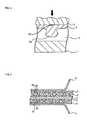
- the basic structure of the adherent tape includes a sheet-shaped substrate 1, a plastic foam material 2 having openings that are facing a targeted surface for adhesion and internal spaces, an adhesive layer 3 disposed on the targeted adhesion surface of the plastic foam material 2, and a release sheet 4 being undergone mold release treatment in the vicinity of the adhesive layer 3.
- the sheet-shaped substrate 1 is a sheet-shaped member including a strong adherent structure having the plastic foam material 2 and the adhesive layer 3.
- the material of the sheet-shaped substrate 1 may be arbitrarily modified depending on the application of the adherent tape.
- the sheet can be made of a polymer such as polyethylene terephthalate. Further, air-tightness of the recess 30 in the adhesive layer 3 described later and the suction bond function can be improved with use of a non-aeration material for the sheet-shaped substrate 1.
- the plastic foam material 2 has a porous structure including openings 20 inside and on the surface, and can be compressively transformed corresponding to pressing force against the adherent tape.
- the plastic foam material 2 is elastically reformed to the pre-compression state when the compressing force is released.
- the materials such as polyurethane foam, polyethylene foam and polyacrylic foam can be used.
- the adhesion tape such as First Embodiment, the plastic foam material is disposed on the sheet-shaped substrate 1 promoting easy application of the strong adhesion structure of the present invention.
- the plastic foam material 2 has openings 20 on at least the targeted adhesion surface.
- the openings 20 are formed upon production of the plastic foam material 20 and formed not only on the targeted adhesion surface but also formed inside of the plastic foam material 20.
- the plastic foam material 2 may be in any forms of foam bubbles provided that the plastic foam material 2 can transform when the adherent tape is pressed, and be elastically reformed upon release.
- plastic foam materials of continuous foam, independent foam, and in combination of continuous and independent foams may be arbitrarily used.
- the adhesive layer 3 is a layer formed of an adhesive, and at least disposed on the targeted adhesion surface.
- the recess 30 is formed on the adhesive layer 3 in a corresponding position to the opening 20 formed on the targeted adhesion surface of the plastic foam material 2.
- the recess 30 is formed in such a manner that the most part of the opening 20 of the plastic foam 20 is filled with the adhesive. As shown in Fig. 2 , the center of the recess 30 and the surrounding area thereof are depressed in such a manner that the center of the recess 30 gradually deepens.
- the suction cup shaped recess 30 is formed to be in the shape of a suction cup through adjustment of the amount of the adhesive and the thickness of the layer. According to the suction bond function of the recess 30, a targeted article to be adhered is bonded with suction.
- the recess 30 By forming the recess 30 in the shape of a suction cup, air-tightness between the recess 30 and the targeted article is increased, and suction force is improved. As a consequence, the performance as suction cups is improved and high shear adhesion force is achieved, and hence the targeted adhesion surface is adhered with more strength than the prior arts. In addition, strong shear adhesion force is achieved by pressing the suction cup
- the opening 20 of the plastic foam material 2 is preferably formed with one air bubble.
- the opening 20 is formed with a combination of two or more air bubbles, however, an opening 20 with a relatively shallow depression formed with one or two air bubbles is preferable.
- the opening is far deep, the depression of the approximate center of the recess 30 deepens upon formation of the adhesive layer 3. Consequently, air-tightness of the recess 30 is impaired as it is difficult for the recess 30 to be an approximate plane when the targeted article is adhered.
- a foam material with one bubble per recess namely a foam material with independent foam is preferably used.
- foam materials with continuous foam or in combination of continuous and independent foams may be preferably used provided that the thickness of the plastic foam material 2 is thinly disposed.
- the thickness of the plastic foam material 2 is preferably between 0.01 mm and 10 mm, and more preferably between 0.05 mm and 0.5 mm.
- the adhesive layer 3 may typically be formed with an agent such as a soluble adhesive from a urethane group, a soluble adhesive from an acrylic group, an emulsion adhesive from a vinyl acetate group, or an ultraviolet curable adhesive.
- the adhesive layer 3 may be formed with a method of the roller coating by applying an adhesive with relatively high viscosity on a surface to be bonded of the plastic foam 2.
- the recess 30 of the adhesive layer 3 is in an anti-airtight structure, a higher suction bond function is obtained.
- the targeted adhesion surface of the plastic foam material 2 is thinly coated with a synthetic resin in such a manner that the shape thereof is matched and the form of the recess 30 on the adhesive layer 3 is not disturbed so that the aeration to the recess 30 of the adhesive layer 30 is prevented leading to improvement of the suction function.
- a similar effect may be obtained by applying a synthetic resin agent to a surface other than the surface for bonding of the plastic foam so that the surface of the plastic foam material other than that for bonding acts as an anti-airtight resin coated surface.
- a release sheet 4 is disposed in contact with the adhesive layer 3 until the adherent tape is adhered to the targeted adhesion surface. At least the surface of the release sheet 4 in contact with the adhesive layer 3 has undergone mold release treatment, and is readily released from the adhesive layer 3.
- the adherent tape formed as above firmly adhere to a targeted article and a targeted surface for adhesion due to the joint effect of the adherent function of the adhesive and the suction bond function of the recess 30 formed on the adhesive layer 30 on a targeted article 5.
- the targeted adhesion surface of the plastic foam material 2 and the rim of the recess 30 on the adhesive layer 3 are adhered to the targeted adhesion surface with the adhesive, and therefore, the air-tightness of the openings for providing the plastic foam material 2 with the suction bond function against a suction surface is achieved.
- FIG. 2 is a diagram showing a state before the targeted article 5 to be adhered to the adherent tape.
- Fig. 3 is a diagram showing a state that the targeted article 5 is adhered to the adherent tape with pressure.
- the recess 30 in the shape of a suction cup is formed on the adhesive layer 3 of the adherent tape.
- the release sheet 4 is released from the adherent tape.
- the plastic foam material 20 is elastically compressed causing the openings 20 of the plastic foam material 20 to be transformed.
- the recesses 30 in the shape of suction cups positioned corresponding to the openings 20 are pressed against the targeted article 5.
- pressing the recess 30 against the targeted article 5 causes the portion of the recess 30 being in contact with the targeted article 5 to be an approximate plane. Consequently, the recess 30 and the targeted article 5 are bonded through releasing the air in the recess 30 existed before the targeted article 5 is pressed causing to generate negative pressure. In other words, the recess 30 is bonded to the targeted article 5.
- the adhered article 5 is bonded with the suction bond function of the recess 30. Since the adhesive layer 30 also has the adherent function, the targeted article 5 can be firmly adhered with the adherent tape.
- the recess 30 is in the shape of a suction cup, the shear adhesion force is also high.
- the adherent tape structured as above an extra firmness for a targeted article to be adhered is achieved due to the suction bond function processed by the opening with post-compression elasticity, and the adherent function of the adhesive layer having the surface with the openings.
- the shear adhesion force is improved when the recess 30 is provided with the function of the suction cup. Since the recess 30 functions as a suction cup, the targeted article can be easily removed from the adherent tape.
- the adherent tape described in First Embodiment is not limited to a single-sided adherent tape but may be, for example, a double-sided adherent tape having a plastic foam material both sides of a sheet-shaped substrate to outwardly possess a targeted surface for adhesion.
- the double-sided adherent tape has the plastic foam material 2, adhesive layers 3 and release sheets 4 on both sides of the sheet-shaped substrate 1.
- a targeted surface for adhesion of the plastic foam material 2 has openings 20.
- the adhesive layer 3 has the recesses 30 in the shape of suction cups in positions corresponding to openings 20.
- the double-sided adherent tape having the super strong adherent structure is disposed on both sides, two targeted articles 5 are adhered to the adhesive layers 30 of the adherent tape as above with pressure on the targeted articles 5 against the adherent tape.
- the recesses 30 becomes an approximate plane against the targeted articles 5 generating the suction bond function.
- the adherent tape is firmly adhered.
- the recess 30 is in the shape of a suction cup, the shear adhesion force is also high, and the targeted articles 5 can be easily removed from the double-sided adherent tape.
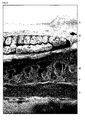
- Fig. 5 is a photograph showing the cross-section of the double-sided adherent tape in a state that one side thereof is being compressed.
- the sheet-shaped substrate 1 includes the plastic foam material 2 and the adhesive layer 3. Fibers 10 structuring the sheet-shaped substrate 1 can be identified in Fig. 5 . As seen in the lower middle part of Fig. 5 , spaces 35 are formed to face the adhesive layer 3 from the sheet-shaped substrate 1. The upper middle part of the Fig. 5 shows the plastic foam material 2 being compressed.
- the suction force is improved and the targeted article can be firmly adhered while achieving strong shear adhesion force.
Landscapes
- Chemical & Material Sciences (AREA)
- Organic Chemistry (AREA)
- Adhesive Tapes (AREA)
- Laminated Bodies (AREA)
- Adhesives Or Adhesive Processes (AREA)
- Hooks, Suction Cups, And Attachment By Adhesive Means (AREA)
Applications Claiming Priority (1)
| Application Number | Priority Date | Filing Date | Title |
|---|---|---|---|
| PCT/JP2006/319965 WO2008044266A1 (fr) | 2006-10-05 | 2006-10-05 | Ruban adhésif très résistant |
Publications (2)
| Publication Number | Publication Date |
|---|---|
| EP2090631A1 true EP2090631A1 (fr) | 2009-08-19 |
| EP2090631A4 EP2090631A4 (fr) | 2012-01-18 |
Family
ID=39282478
Family Applications (1)
| Application Number | Title | Priority Date | Filing Date |
|---|---|---|---|
| EP06811303A Withdrawn EP2090631A4 (fr) | 2006-10-05 | 2006-10-05 | Ruban adhésif très résistant |
Country Status (6)
| Country | Link |
|---|---|
| US (1) | US20100173111A1 (fr) |
| EP (1) | EP2090631A4 (fr) |
| JP (1) | JPWO2008044266A1 (fr) |
| KR (1) | KR20090086952A (fr) |
| CN (1) | CN101547986A (fr) |
| WO (1) | WO2008044266A1 (fr) |
Families Citing this family (5)
| Publication number | Priority date | Publication date | Assignee | Title |
|---|---|---|---|---|
| US20130062230A1 (en) * | 2011-09-13 | 2013-03-14 | Shannon Leigh Mattingly | Fashion adherence articles and a kit including a multiplicity of fashion adherence articles |
| US9216254B2 (en) * | 2011-11-18 | 2015-12-22 | Ryan Taylor | Medical tape |
| CN106695538B (zh) * | 2015-11-18 | 2019-07-05 | 富鼎电子科技(嘉善)有限公司 | 研磨固定装置及使用该研磨固定装置的研磨方法 |
| US10753100B2 (en) * | 2017-08-11 | 2020-08-25 | Ecointeriors Corp. | Flooring panel equipped with quick-release adhesive sheet |
| CN110673372A (zh) * | 2019-09-30 | 2020-01-10 | 京东方科技集团股份有限公司 | 一种双面胶带及显示装置 |
Family Cites Families (10)
| Publication number | Priority date | Publication date | Assignee | Title |
|---|---|---|---|---|
| JPH02279284A (ja) * | 1989-04-19 | 1990-11-15 | Okubo Masahiro | 墨打方法及び墨打具 |
| JP2811874B2 (ja) * | 1990-02-27 | 1998-10-15 | 東レ株式会社 | 止着用シート材 |
| JPH0546936U (ja) * | 1991-12-04 | 1993-06-22 | 古河電気工業株式会社 | 発泡体基材粘着テープ及びテープ用発泡体基材 |
| JP2808225B2 (ja) * | 1993-04-05 | 1998-10-08 | 三菱レイヨン株式会社 | 表装材 |
| JPH07166139A (ja) * | 1993-12-13 | 1995-06-27 | Kansai Form Kako Kk | 粘着テープもしくはシート |
| JP3016730B2 (ja) * | 1996-05-16 | 2000-03-06 | ムサシ化成工業株式会社 | 強粘構造 |
| JP4296391B2 (ja) * | 2003-03-31 | 2009-07-15 | 株式会社イノアックコーポレーション | ラテックスフォームの製造方法 |
| JP2005224888A (ja) * | 2004-02-12 | 2005-08-25 | Nitta Haas Inc | 被研磨加工物の保持材 |
| EP1803531B1 (fr) * | 2004-10-15 | 2014-07-23 | Musashi Chemicals Industry Co., Ltd. | Procédé de traitement de lentille utilisant ruban adhésif sensible à la pression |
| JP5242884B2 (ja) * | 2005-04-08 | 2013-07-24 | 株式会社富士商会 | 強粘着テープ |
-
2006
- 2006-10-05 US US12/311,547 patent/US20100173111A1/en not_active Abandoned
- 2006-10-05 WO PCT/JP2006/319965 patent/WO2008044266A1/fr not_active Ceased
- 2006-10-05 EP EP06811303A patent/EP2090631A4/fr not_active Withdrawn
- 2006-10-05 JP JP2008538507A patent/JPWO2008044266A1/ja active Pending
- 2006-10-05 KR KR1020097008028A patent/KR20090086952A/ko not_active Ceased
- 2006-10-05 CN CN200680056514A patent/CN101547986A/zh active Pending
Also Published As
| Publication number | Publication date |
|---|---|
| CN101547986A (zh) | 2009-09-30 |
| WO2008044266A1 (fr) | 2008-04-17 |
| KR20090086952A (ko) | 2009-08-14 |
| JPWO2008044266A1 (ja) | 2010-02-04 |
| EP2090631A4 (fr) | 2012-01-18 |
| US20100173111A1 (en) | 2010-07-08 |
Similar Documents
| Publication | Publication Date | Title |
|---|---|---|
| JP7372918B2 (ja) | 両面可逆接着構造 | |
| EP2489472A3 (fr) | Procédé de fabrication d'un article abrasif dépourvu de renforcement | |
| KR101440616B1 (ko) | 흡착 필름과 그 제조 방법, 및 이형 필름이 부착된 흡착필름과 그 제조 방법 | |
| EP1245851A3 (fr) | Structure de cale pour amortir les vibrations | |
| EP3342591B1 (fr) | Procédé et appareil pour former des voies d'aération dans des adhésifs sensibles à la pression pour empilements de stratifié | |
| CN103943566A (zh) | 辊 | |
| WO2004062917A3 (fr) | Carte substrat receptrice d'encre | |
| EP1955883A3 (fr) | Arrangement de position et d'étanchement d'un vitre de pare-brise à la carrosserie d'un véhiclue | |
| EP2090631A1 (fr) | Ruban adhésif très résistant | |
| EP1484199A4 (fr) | Pneu auto-obturant et procede de fabrication associe | |
| JP2002219686A (ja) | フィルム切断装置およびその付着防止方法 | |
| US6511722B1 (en) | Spacer | |
| US20180245735A1 (en) | Hardware assembly with reversible dry adhesive | |
| JP5242884B2 (ja) | 強粘着テープ | |
| US20210129480A1 (en) | Microstructured elastomeric film and method for making thereof | |
| WO2009016725A1 (fr) | Tableau de bord d'automobile et son procédé de fabrication | |
| EP1473418A3 (fr) | Bande d'étanachéité | |
| JP3016730B2 (ja) | 強粘構造 | |
| JP5430057B2 (ja) | 床材の施工構造、床材の除去方法及び床材の更新方法 | |
| JP2002146308A (ja) | 粘着テープ及びその製造方法 | |
| JP5122107B2 (ja) | 研磨装置用超強粘着シート | |
| JP2020097212A (ja) | 養生テープ | |
| JP2000213146A (ja) | 建築材 | |
| TW201016331A (en) | Method for coating surface of formwork plate and product thereof | |
| TW200817488A (en) | Superstrong adhesive tape |
Legal Events
| Date | Code | Title | Description |
|---|---|---|---|
| PUAI | Public reference made under article 153(3) epc to a published international application that has entered the european phase |
Free format text: ORIGINAL CODE: 0009012 |
|
| 17P | Request for examination filed |
Effective date: 20090506 |
|
| AK | Designated contracting states |
Kind code of ref document: A1 Designated state(s): AT BE BG CH CY CZ DE DK EE ES FI FR GB GR HU IE IS IT LI LT LU LV MC NL PL PT RO SE SI SK TR |
|
| DAX | Request for extension of the european patent (deleted) | ||
| A4 | Supplementary search report drawn up and despatched |
Effective date: 20111219 |
|
| RIC1 | Information provided on ipc code assigned before grant |
Ipc: C09J 7/02 20060101AFI20111213BHEP Ipc: C09J 201/00 20060101ALI20111213BHEP |
|
| 17Q | First examination report despatched |
Effective date: 20120820 |
|
| STAA | Information on the status of an ep patent application or granted ep patent |
Free format text: STATUS: THE APPLICATION IS DEEMED TO BE WITHDRAWN |
|
| 18D | Application deemed to be withdrawn |
Effective date: 20130716 |