EP2094710B1 - 3,4 diaminopyridin-derivate - Google Patents
3,4 diaminopyridin-derivate Download PDFInfo
- Publication number
- EP2094710B1 EP2094710B1 EP07846949A EP07846949A EP2094710B1 EP 2094710 B1 EP2094710 B1 EP 2094710B1 EP 07846949 A EP07846949 A EP 07846949A EP 07846949 A EP07846949 A EP 07846949A EP 2094710 B1 EP2094710 B1 EP 2094710B1
- Authority
- EP
- European Patent Office
- Prior art keywords
- und
- oder
- diaminopyridin
- worin
- alkyl
- Prior art date
- Legal status (The legal status is an assumption and is not a legal conclusion. Google has not performed a legal analysis and makes no representation as to the accuracy of the status listed.)
- Not-in-force
Links
- NEPUSMMANAIXNX-UHFFFAOYSA-N CC([n+]1ccccc1)=O Chemical compound CC([n+]1ccccc1)=O NEPUSMMANAIXNX-UHFFFAOYSA-N 0.000 description 1
Images
Classifications
-
- C—CHEMISTRY; METALLURGY
- C07—ORGANIC CHEMISTRY
- C07D—HETEROCYCLIC COMPOUNDS
- C07D471/00—Heterocyclic compounds containing nitrogen atoms as the only ring hetero atoms in the condensed system, at least one ring being a six-membered ring with one nitrogen atom, not provided for by groups C07D451/00 - C07D463/00
- C07D471/02—Heterocyclic compounds containing nitrogen atoms as the only ring hetero atoms in the condensed system, at least one ring being a six-membered ring with one nitrogen atom, not provided for by groups C07D451/00 - C07D463/00 in which the condensed system contains two hetero rings
- C07D471/04—Ortho-condensed systems
-
- C—CHEMISTRY; METALLURGY
- C07—ORGANIC CHEMISTRY
- C07D—HETEROCYCLIC COMPOUNDS
- C07D487/00—Heterocyclic compounds containing nitrogen atoms as the only ring hetero atoms in the condensed system, not provided for by groups C07D451/00 - C07D477/00
- C07D487/02—Heterocyclic compounds containing nitrogen atoms as the only ring hetero atoms in the condensed system, not provided for by groups C07D451/00 - C07D477/00 in which the condensed system contains two hetero rings
- C07D487/06—Peri-condensed systems
Definitions
- the present invention relates to 3,4-diaminopyridine derivatives, a process for their preparation and the use of 3,4-diaminopyridine derivatives.
- Donor-substituted pyridines play a prominent role as nucleophilic catalysts in a variety of synthetically important transformations, such as the acylation of alcohols, amines, or enolates.
- the present invention is therefore based on the object to provide compounds which allow a wide variety of structural variations as a catalyst in the context of a single synthesis strategy. It is a further object of the present invention to provide compounds that are easy to manufacture in a wide variety of structural variations. In particular, it would be desirable to know compounds which can be used as catalysts for acylation reactions and for the production of urethanes and polyurethanes.
- the 3,4-diaminopyridine derivatives of the present invention are useful as a versatile catalyst because of the wide variation in the electronic properties of the pyridine ring.
- the bridging ethylene unit between the two nitrogen atoms in the 3- and 4-position of the pyridine ring a beneficial electron-donating effect can be exerted on the pyridine ring.
- the ethylene bridge may be substituted one or more times. At least the nitrogen atom at the 4-position on the pyridine ring is completely substituted, i. it no longer carries a hydrogen atom.
- a 3,4-diaminopyridine derivative according to formula I wherein the electron donors R 1 and R 2 are each independently selected from substituted or unsubstituted, straight-chain or branched alkyl, alkenyl, alkynyl, acyl, Alkoxy and substituted or unsubstituted aryl, more preferably substituted or unsubstituted phenyl and benzyl, wherein R 2 may also be H.
- An electron donor should be understood here to mean a substituent which increases the electron density at the respective substitution centers.
- the radicals R 1 and R 2 here increase the electron density at the nitrogen atoms at positions 3 and 4 of the pyridine ring.
- alkyl is meant a saturated hydrocarbon radical.
- the alkyl is preferably substituted or unsubstituted, straight-chain or branched C 1 -C 20 -alkyl, more preferably C 1 -C 10 -alkyl, more preferably C 1 -C 8 -alkyl, even more preferably around C 2 C 6 alkyl, and most preferably C 3 -C 5 alkyl.
- alkyl substituents are methyl, ethyl, n-propyl, iso-propyl, n-butyl, sec-butyl and t-butyl.
- Alkenyl is to be understood as meaning a mono- or polyunsaturated radical, ie an alkyl radical having one or more double bonds.
- the groups is preferably substituted or unsubstituted, straight or branched C 2 -C 20 alkenyl, more preferably by C 2 -C 10 alkenyl, more preferably C 2 -C 8 alkenyl, more preferably 3 to C C 6 alkenyl, and most preferably C 3 -C 5 alkenyl.
- Alkynyl is to be understood as meaning a radical which is mono- or polysubstituted by triple bonds, ie an alkyl radical having one or more triple bonds. In this case, the radical may additionally have one or more double bonds.
- the alkynyl is preferably substituted or unsubstituted, straight-chain or branched C 2 -C 20 -alkynyl, more preferably C 2 -C 10 -alkynyl, more preferably C 2 -C 8 -alkynyl, even more preferably C 3 - C 6 alkynyl, and most preferably C 3 -C 5 alkynyl.
- acyl is meant a group -C (O) -R, where R is an alkyl, alkenyl, alkynyl or aryl as described above.
- R is an alkyl, alkenyl, alkynyl or aryl as described above.
- a particularly preferred acyl radical is the acetyl radical.
- Alkoxy is to be understood as meaning an alkyl radical bonded via an oxygen atom.
- the alkoxy is preferably a substituted or unsubstituted, straight-chain or branched C 1 -C 20 -alkoxy, more preferably C 1 -C 10 -alkoxy, more preferably C 1 -C 8 -alkoxy, even more preferably C 2 C 6 alkoxy, and most preferably C 3 -C 5 alkoxy.
- alkyl substituents are methoxy, ethoxy, n-propoxy, iso -propoxy, n-butoxy, sec-butoxy and t-butoxy.
- At least one of the radicals R 3 , R 4 , R 5 and R 6 is not H. It is preferred that at least one of R 3 , R 4 , R 5 and R 6 is phenyl. More preferably, the two radicals R 3 and R 6 are H and the two radicals R 4 and R 5 together 1,4-butanediyl to form a 6-membered ring as shown, for example, in compound 11 below. However, it is also possible that this 6-membered ring is an unsaturated or substituted ring.
- a 3,4-diaminopyridine derivative according to formula I wherein the two radicals R 4 and R 5 are arranged in a cis position to each other, a 3,4-diaminopyridine derivative according to formula Ia: in which R 1 and R 2 are each independently electron donors, where R 2 may also be H; R 3 and R 6 are each independently selected from H, substituted or unsubstituted, straight or branched alkyl, alkenyl, alkynyl, alkoxy and substituted or unsubstituted aryl; R 4 and R 5 are each independently selected from substituted or unsubstituted, straight or branched alkyl, alkenyl, alkynyl, alkoxy and substituted or unsubstituted aryl; and where the radicals R 3 and / or R 4 with the radicals R 5 and / or R 6 can form a ring.
- the two radicals R 4 and R 5 are arranged in a cis position with respect to a plane passing through the atoms of the pyridine ring, the two nitrogen atoms at positions 3 and 4 of the pyridine ring and the bridging ethylene unit having the carbon atoms 8 and 9 is formed. If there are several substituents on the carbon atoms 8 and 9, ie at least two of the radicals R 3 and R 4 or R 5 and R 6 are not H, it is particularly preferred if the radicals R 4 and R 5 form a ring such that this in cis position. If there is no ring formation, it is preferred if the two sterically more demanding substituents of the radicals R 3 , R 4 , R 5 and R 6 occupy a cis position on the carbon atoms 8 and 9.
- R 1 and R 2 are each ethyl
- R 3 and R 5 are each H
- R 4 and R 6 together are 1,4-butanediyl to form a 6-membered ring.
- This compound is designated 11 in the present application.
- R 1 and R 2 are each independently a substituted or unsubstituted, straight-chain or branched C 1 -C 10 -alkyl, preferably a substituted or unsubstituted, straight-chain or branched C 2 -C 8 -alkyl and most preferably a substituted or unsubstituted, straight or branched C 3 -C 6 alkyl.
- the 1,2-dicarbonyl compound is preferably a compound of formula II shown below
- both nitrogen atoms are substituted at positions 3 and 4 of the pyridine ring.
- an alkyl substitution on the nitrogen atoms of positions 3 and / or 4 of the pyridine ring can be effected via a two step synthesis with an acylation of the nitrogen atom and a subsequent reduction of the resulting amide to an amine. If further Substituente R 3 are inserted and R 6, this preferably takes place during the reduction of the diimine by anionic groups.
- a third aspect of the present invention relates to the use of a 3,4-diaminopyridine according to formula I above as a catalyst in a chemical reaction.
- This is preferred chemical reaction is an acylation reaction, in particular an acylation reaction of an alcohol or an amine, or a urethane and / or polyurethane synthesis.
- the 3,4-diaminopyridines of the present invention can advantageously catalyze the reaction of an isocyanate with an alcohol. Therefore, the 3,4-diaminopyridines of the present invention are useful in the synthesis of urethanes and / or polyurethanes.
- the 3,4-diaminopyridines of the present invention are added to the reagents and solvent (s) necessary for the reaction to be catalyzed. These may be the reagents necessary for an acylation reaction or urethane and / or polyurethane production.
- the compounds of the present invention may also be used to advantage for the preparation of a pharmaceutical agent or a herbicide.
- the structurally simplest 3,4-diaminopyridine considered here is 6, which is based on the tetrahydropyrido [3,4-b] pyrazine skeleton.
- the stability of the corresponding acetyl intermediate 6Ac is close to that of the catalytically highly active 5.
- Exchange of the two methyl groups in 6 for one (in 7 and 21) or two (as in 8) acetyl groups reduces the electron density in the pyridine ring and thus the Stability of the corresponding cations 7Ac and 8Ac quite clear.
- Anellation of a saturated alkyl ring on system 6 in either cis orientation (as in 9) or trans orientation (as in 10) also increases the stability of the acetyl intermediates by about 15 kJ mol -1 .
- the stability of the acetylpridinium cations derived from the tricyclic systems 9 and 10 depends on the N-substituents in a similar manner as for the bicyclic system 6. Introduction of two ethyl groups thus leads to the most stable acetyl groups.
- Tertiary alcohol 35 has been used as a model substrate in earlier studies due to its low reactivity. 10
- the acetylation of 35 with acetic anhydride ( 36 ) in the The presence of triethylamine as the auxiliary base (Reaction A ) proceeds quantitatively as long as a catalyst is used at a concentration of 10% (relative to 35 ) which has at least the reactivity of DMAP (1).
- the reaction half-life ⁇ 1/2 can be determined by integration of the signals of the reactants and products in the 1 H-NMR spectrum and is used here as a measure of the catalytic activity.
- Reaction B the same alcohol is reacted as before with isobutyric anhydride ( 38 ) as the acylating reagent. Since this reaction is significantly slower than that of 36 , a higher reaction temperature (40 ° C) was chosen for the reaction. This choice leads to approximately similar half-lives for both reactions.
- the acylpyridinium cation then reacts with the alcohol 35 to form the ester product and the deactivated catalyst. This can be regenerated by the action of the auxiliary base NEt 3 again.
- the half-lives ⁇ 1/2 (Table 2) measured here reflect the influence of the catalyst on both of these steps.
- a clear correlation of ⁇ 1/2 with the calculated stability values (Table 1) for the acetylpyridinium cations can therefore only be expected if the substituent effects on K are greater than those on k cat .
- Alkyl-substituted 3,4-diaminopyridines represent a new class of catalysts for the acylation of alcohols.
- the catalytic efficiency of these compounds can be widely varied within a single synthetic strategy by varying the nitrogen substituents.
- the catalytic activity of the best of these catalysts is comparable to the best known carbocyclic derivatives of DMAP.
- the most active 3,4-diaminopyridine catalysts are readily accessible through flexible 3 or 4 step synthesis that can be easily modified for further structural variations.
- Ethanol, dichloromethane, ethyl acetate and methanol are distilled on a rotary evaporator.
- n -BuLi is titrated with diphenylacetic acid and the molarity determined. All other reagents, unless otherwise stated in the text, are used with the highest possible quality without further purification.
- Thin-layer chromatography is carried out on fluorescent plates labeled with TLC plates Merck KGaA (silica gel 60 F 254 , layer thickness 0.2 mm) and on Fluka (basic aluminum oxide F 254 , Brockman activity 1, pH 9.5, layer thickness 0.2 mm).
- Flash chromatography is carried out with Merck KGaA silica gel 60 (particle size 0.040-0.063 mm) and Fluka basic alumina (basic aluminum oxide F 254 , Brockman activity 1, pH 9.5, particle size 0.05-0.15 mm) at a pressure of 1.5 bar for silica gel and 0.5 bar for basic alumina.
- 1 H and 13 C NMR spectra are recorded on a Varian Mercury 200, Varian 300, Varian INOVA 400 and Varian 600 instrument. NOE spectra are recorded in CDCl 3 at 27 ° C. Chemical shifts are reported in ppm relative to the solvent peak.
- EI, 70 eV electron impact ionization
- CI isobutane
- 1,4-Diethyl-1,2,3,4-tetrahydropyrido [3,4-b] pyrazine (20): In 60 ml of MTBE are suspended 1.56 g (11.69 mmol) of AlCl 3 at room temperature. After stirring for 45 min, the reaction mixture is cooled to 0 ° C and added in portions (1.32 g, 34.65 mmol) of LiXlH 4 . After completion of the addition and further stirring for 15 min, compound 8 (1.00 g, 4.56 mmol) is added and stirred for a further hour at 0 ° C. The mixture is then heated under reflux for 8 h and, after cooling to room temperature, the reaction mixture is poured into ice-water.
- the precipitated inorganic solid is filtered off with suction and washed twice with 30 ml of DCM.
- the water phase is brought to pH 12 and extracted three times with 40 ml of DCM.
- the combined extracts are dried over Na 2 SO 4 and the solvent on a rotary evaporator distilled off.
- the crude product is purified by flash chromatography on silica gel (EtOAc / MeOH / NEt 3 , 10: 0.5: 1). This gives 0.52 g (60%) of a colorless oil, which solidifies in the freezer.
- R f 0.47 (EtOAc / MeOH / NEt 3 , 10: 0.5: 1).
- 1,4-Dimethy-1,2,3,4-tetrahydro-pyrido [3,4-b] pyrazine (6) While cooling with ice to 26 tetrahydroquinoxaline (1.26 g, 9:32 mmol) 35 ml formic acid. Subsequently, 12 ml of formaldehyde solution are added ( ⁇ 37% in water) and heated for 48 h at 110 ° C oil bath temperature. Then allowed to cool to room temperature are about 120 ml of 20% sodium hydroxide added under ice cooling. The pH should not exceed 12. The mother liquor is extracted with 250 ml DCM in a liquid / liquid extractor overnight.
- reaction can also be carried out according to the instructions of Opatz et al. with NaBH 4 / BH 3 / H 2 NCH 2 CH 2 OH as the reagent, yielding 74%.
- the mixture is then heated for 8 h at reflux and then poured after cooling to room temperature on ice water.
- the inorganic precipitate is filtered off with suction and washed twice with 30 ml of DCM.
- the water phase is brought to pH 12 and extracted three times with 40 ml of DCM.
- the combined organic phases are dried over Na 2 SO 4 and the solvent is distilled off on a rotary evaporator.
- the resulting crude product is purified by flash chromatography on silica gel (EtOAc / MeOH / NEt 3 , 10: 2: 1) and basic alumina (EtOAc / MeOH, 10: 1). This gives 0.30 g (1.22 mmol, 55%) of a colorless solid.
- the inorganic precipitate is filtered off and washed twice with 30 ml of DCM.
- the mother liquor was brought to pH 12 and extracted three times with 40 ml of DCM.
- the kombiemden organic phases are dried over Na 2 SO 4 and the solvent distilled off on a rotary evaporator.
- the crude product is purified by flash chromatography on silica gel (EtOAc / NEt 3 , 10: 1). 0.430 g (1.98 mmol, 55%) of a white foam are obtained.
- R f 0.24 (EtOAc / NEt 3 , 10: 1).
- 2,3-diphenyl-pyrido [3,4- b ] quinoxaline (25) (modified method from Ref.): 5.51 g (0.026 g) of a 2.86 g (0.026 mol) of 3,4-diaminopyridine in 50 ml of ethanol are added to 5.51 g mmol) of benzil and the reaction mixture heated for 6 h at 70 ° C oil bath temperature. After cooling to room temperature, the precipitated yellow solid is filtered off (perhaps cooling with an ice-water bath is useful). Recrystallization from ethanol gives 6.91 g (0.024 mol, 94%) of a pale yellow solid.
- 2,3-Diphenyl-1,2,3,4-tetrahydropyrido [3,4-b] pyrazine (31) 25 ml (6.25 g, 22.05 mmol) and 200 ml ethanol are added to a 500 ml flask. 6.25 g (165 mmol) of powdered NaBH 4 are added to the solution, and the reaction mixture is stirred at 40 ° C. for 48 h. It is then cooled to room temperature and the reaction is stopped with 10 ml of cold water. After stirring for a further 10 minutes, the reaction mixture is extracted twice with 100 ml DCM and the combined organic phases are dried over Na 2 SO 4 .
- reaction mixture is cooled to room temperature and poured onto ice-water.
- the inorganic precipitate is filtered off and the mother liquor is extracted with DCM.
- the combined organic phases are dried over Na 2 SO 4 and the crude product obtained is purified by flash chromatography (EtOAc / MeOH / NEt 3 , 10/1 / 0.5).
- 0.580 g (1.76 mmol, 53%) of a yellow solid are obtained.
- R f 0.57 (EtOAc / MeOH / NEt 3, 10/1 / 0.5).
- GC-HR-ESI-MS RT 0.53-1.43 min, calculated for C 44 H 47 N 6 659.3862 [2M + + H], found: 659.3823, calculated for C 22 H 24 N 3 330.1970 [M + + H] found : 330.1940;
- IR (neat): ⁇ 2965 (w), 2818 (w), 1578 (s), 1518 (vs), 1492 (m), 1452 (s), 1430 (w), 1371 (m), 1356 (m ), 1308 (m), 1286 (m), 1266 (s), 1241 (s), 1215 (vs), 1165 (m), 1119 (m), 1067 (s), 1023 (s), 884 (w ), 867 (w), 828 (w), 810 (s), 764 (s), 749 (m), 705 (vs), 660 (w), 615 (w) cm -1 .
Landscapes
- Chemical & Material Sciences (AREA)
- Organic Chemistry (AREA)
- Pyridine Compounds (AREA)
- Pharmaceuticals Containing Other Organic And Inorganic Compounds (AREA)
- Plural Heterocyclic Compounds (AREA)
- Low-Molecular Organic Synthesis Reactions Using Catalysts (AREA)
- Nitrogen Condensed Heterocyclic Rings (AREA)
- Polyurethanes Or Polyureas (AREA)
- Organic Low-Molecular-Weight Compounds And Preparation Thereof (AREA)
- Agricultural Chemicals And Associated Chemicals (AREA)
Description
- Die vorliegende Erfindung betrifft 3,4-Diaminopyridin-Derivate, ein Verfahren zu deren Herstellung sowie die Verwendung der 3,4-Diaminopyridin-Derivate.
- Donor-substituierte Pyridine spielen in einer Vielzahl synthetisch wichtiger Transformationen wie der Acylierung von Alkoholen, Aminen oder Enolaten eine herausragende Rolle als nukleophile Katalysatoren.1,2
- In letzter Zeit konnten in kinetischen Racematspaltungs-Experimenten mit entsprechend substituierten Derivaten von (4-Dimethylamino)pyridin 1 (DMAP) oder (4-Pyrrolidino)pyridin 2 (PPY) (siehe Schema 1) große Fortschritte erzielt werden.[2-8] Trotz dieser Entwicklungen bleibt das Feld insgesamt etwas unausgeglichen, bieten sich doch für ausgesuchte synthetische Probleme, wie etwa die kinetische Racematspaltung sekundärer Alkohole, vielfältige Lösungswege an, während andere, scheinbar ähnlich gelagerte Herausforderungen, wie etwa die kinetische Racematspaltung primärer oder tertiärer Alkohole, kaum lösbar erscheinen.

- In dieser Situation scheint ein modulares Katalysator-Konzept höchst erstrebenswert, das im Rahmen einer einzigen Synthesestrategie eine breite strukturelle Variationsvielfalt ermöglicht. Konzepte dieser Art wurden in jüngster Zeit von Miller et al. mit Katalysatoren erprobt, die auf peptidischen Strukturen basieren und Imidazol als aktives Zentrum verwenden.2d,9 Peptide sind auch das variable Strukturelement in PPY-Derivaten, die von Kawabata et al. und von Campbell et al. entwickelt wurden.3,4 In all diesen Fällen beeinflussen die peptidischen Strukturen den Reaktionsverlauf durch zusätzliche Kontakte, die zwischen Substraten und den Seitenketten im geschwindigkeitsbestimmenden Schritt des Katalysezyklus aufgebaut werden. Der elektronische Charakter des nukleophilen Katalyse-Zentrums wird durch die Variationen der Peptidstrukturen in der Regel jedoch nicht verändert.
- Der modulare Aufbau von 3-substituierten Derivaten von 1 und 2 hat hingegen das Potential sowohl die Nucleophilie des Pyridinrings als auch dessen Seiten-Asymmetrie zu modifizieren.4-8 Bisher durchgeführte Experimente beschränken sich auf die Untersuchung stereodifferenzierender Prozesse.
- Frühere Studien zum katalytischen Potential Donor-substituierter Pyridine in Acylierungsreaktionen haben bereits auf die relative Stabilität von Acylpyridinium-Kationen 4Ac als qualitativem Kriterium für die katalytische Aktivität hingewiesen.10,11

- Der vorliegenden Erfindung liegt daher die Aufgabe zugrunde, Verbindungen bereitzustellen, die als Katalysator im Rahmen einer einzigen Synthesestrategie eine breite strukturelle Variationsvielfalt ermöglichen. Es ist eine weitere Aufgabe der vorliegenden Erfindung, Verbindungen bereitzustellen, die in einer breiten strukturellen Variationsvielfalt einfach herzustellen sind. Insbesondere wäre es wünschenswert, Verbindungen zu kennen, die als Katalysatoren für Acylierungsreaktionen und zur Herstellung von Urethanen und Polyurethanen verwendet werden können.
- Die oben genannten Aufgaben werden durch den Gegenstand der unabhängigen Ansprüche gelöst. Bevorzugte Ausführungsformen ergeben sich aus den Unteransprüchen.
- Überaschenderweise haben die Erfinder der vorliegenden Erfindung festgestellt, dass 3,4-Diaminopyridin-Derivate leicht herzustellen sind und vorteilhafte Eigenschaften als Katalysator besitzen.
- Ein erster Aspekt der vorliegenden Erfindung betrifft ein 3,4-Diaminopyridin-Derivat der folgenden Formel I

R1 und R2 jeweils unabhängig voneinander Elektronendonoren sind, wobei R2 auch H sein kann; und
R3, R4, R5 und R6 jeweils unabhängig voneinander ausgewählt sind aus H, substituiertem oder unsubstituiertem, geradkettigen oder verzweigten Alkyl, Alkenyl, Alkinyl, Alkoxy und substituiertem oder unsubstituiertem Aryl, wobei die Reste R3 und/oder R4 mit den Resten R5 und/oder R6 einen Ring bilden können. - Insbesondere sind die 3,4-Diaminopyridin-Derivate der vorliegenden Erfindung durch die breite Variation der elektronischen Eigenschaften des Pyridin-Rings als vielseitig einsetzbarer Katalysator geeignet. Durch die verbrückende Ethylen-Einheit zwischen den beiden Stickstoffatomen in 3- und 4-Position des Pyridinrings kann eine vorteilhafte Elektronenschiebende Wirkung auf den Pyridinring ausgeübt werden. Die Ethylenbrücke kann ein oder mehrfach substituiert sein. Dabei ist zumindest das Stickstoffatom an der 4-Position am Pyridinring vollständig substituiert, d.h. es trägt kein Wasserstoffatom mehr.
- Gemäß einer bevorzugten Weiterbildung der vorliegenden Erfindung wird ein 3,4-Diaminopyridin-Derivat gemäß Formel I offenbart, wobei die Elektronendonoren R1 und R2 jeweils unabhängig voneinander ausgewählt sind aus substituiertem oder unsubstituiertem, geradkettigem oder verzweigten Alkyl, Alkenyl, Alkinyl, Acyl, Alkoxy und substituiertem oder unsubstituiertem Aryl, bevorzugter substituiertem oder unsubstituiertem Phenyl und Benzyl, wobei R2 auch H sein kann.
- Unter einem Elektronendonor soll hier ein Substituent verstanden werden, der die Elektronendichte an den jeweiligen Substitutionszentren erhöhen. Die Reste R1 und R2 erhöhen hier die Elektronendichte an den Stickstoffatomen an den Positionen 3 und 4 des Pyridinrings.
- Unter den oben genannten Substituenten Alkyl, Alkenyl, Alkinyl, Acyl und Alkoxy soll jeweils unabhängig voneinander das Folgende verstanden werden.
- Unter Alkyl soll ein gesättigter Kohlenwasserstoffrest verstanden werden. Bei dem Alkyl handelt es sich bevorzugt um substituiertes oder unsubstituiertes, geradkettiges oder verzweigtes C1-C20-Alkyl, bevorzugter um C1-C10-Alkyl, weiter bevorzugt um C1-C8-Alkyl, noch weiter bevorzugt um C2-C6-Alkyl und am bevorzugtesten um C3-C5-Alkyl. Beispiele solcher Alkylsubstituenten sind Methyl, Ethyl, n-Propyl, iso-Propyl, n-Butyl, sec-Butyl und t-Butyl.
- Unter Alkenyl soll ein einfach oder mehrfach ungesättigter Rest verstanden werden, d.h. ein Alkylrest mit einer oder mehreren Doppelbindungen. Bei dem Alkenyl handelt es sich bevorzugt um substituiertes oder unsubstituiertes, geradkettiges oder verzweigtes C2-C20-Alkenyl, bevorzugter um C2-C10-Alkenyl, weiter bevorzugt um C2-C8-Alkenyl, noch weiter bevorzugt um C3-C6-Alkenyl und am bevorzugtesten um C3-C5-Alkenyl.
- Unter Alkinyl soll ein einfach oder mehrfach mit Dreifachbindungen ungesättigter Rest verstanden werden, d.h. ein Alkylrest mit einer oder mehreren Dreifachbindungen. Dabei kann der Rest zusätzlich eine oder mehrere Doppelbindungen aufweisen. Bei dem Alkinyl handelt es sich bevorzugt um substituiertes oder unsubstituiertes, geradkettiges oder verzweigtes C2-C20-Alkinyl, bevorzugter um C2-C10Alkinyl, weiter bevorzugt um C2-C8-Alkinyl, noch weiter bevorzugt um C3-C6-Alkinyl und am bevorzugtesten um C3-C5-Alkinyl.
- Unter Acyl soll eine Gruppe -C(O)-R verstanden werden, wobei R ein Alkyl, Alkenyl, Alkinyl oder Aryl wie oben beschrieben ist. Bevorzugt ist Acyl ein substituiertes oder unsubstituiertes, geradkettiges oder verzweigtes C1-C20-Acyl, bevorzugter ein C1-C10-Acyl, weiter bevorzugt ein C1-C8-Acyl, noch weiter bevorzugt ein C2-C6-Acyl und am bevorzugtesten ein C3-C5-Acyl, oder Benzoyl. Ein insbesondere bevorzugter Acyl-Rest ist der Acetyl-Rest.
- Unter Alkoxy soll ein über ein Sauerstoffatom gebundener Alkylrest verstanden werden. Bei dem Alkoxy handelt es sich bevorzugt um substituiertes oder unsubstituiertes, geradkettiges oder verzweigtes C1-C20-Alkoxy, bevorzugter um C1-C10-Alkoxy, weiter bevorzugt um C1-C8-Alkoxy, noch weiter bevorzugt um C2-C6-Alkoxy und am bevorzugtesten um C3-C5-Alkoxy. Beispiele solcher Alkylsubstituenten sind Methoxy, Ethoxy, n-Propoxy, iso-Propoxy, n-Butoxy, sec-Butoxy und t-Butoxy.
- Gemäß einer anderen Weiterbildung der vorliegenden Erfindung ist mindestens einer der Reste R3, R4, R5 und R6 nicht H. Bevorzugt ist dabei mindestens einer der Reste R3, R4, R5 und R6 Phenyl. Weiter bevorzugt sind die beiden Reste R3 und R6 H und die beiden Reste R4 und R5 gemeinsam 1,4-Butandiyl, um einen 6-Ring auszubilden, wie er beispielsweise in der Verbindung 11 unten gezeigt ist. Es ist jedoch auch möglich, dass dieser 6-Ring ein ungesättigter oder substituierter Ring ist.
- Gemäß noch einer anderen bevorzugten Weiterbildung der vorliegenden Erfindung wird ein 3,4-Diaminopyridin-Derivat gemäß Formel I offenbart, wobei die beiden Reste R4 und R5 in einer cis-Stellung zueinander angeordnet sind, um ein 3,4-Diaminopyridin-Derivat gemäß Formel Ia zu ergeben:

R1 und R2 jeweils unabhängig voneinander Elektronendonoren sind, wobei R2 auch H sein kann;
R3 und R6 jeweils unabhängig voneinander ausgewählt sind aus H, substituiertem oder unsubstituiertem, geradkettigen oder verzweigten Alkyl, Alkenyl, Alkinyl, Alkoxy und substituiertem oder unsubstituiertem Ary;
R4 und R5 jeweils unabhängig voneinander ausgewählt sind aus substituiertem oder unsubstituiertem, geradkettigen oder verzweigten Alkyl, Alkenyl, Alkinyl, Alkoxy und substituiertem oder unsubstituiertem Aryl; und
wobei die Reste R3 und/oder R4 mit den Resten R5 und/oder R6 einen Ring bilden können. - Gemäß dieser Weiterbildung sind die beiden Reste R4 und R5 in einer cis-Stellung bezüglich einer Ebene angeordnet, die durch die Atome des Pyridinrings, die beiden Stickstoffatome an den Positionen 3 und 4 des Pyridinrings sowie die verbrückende Ethyleneinheit mit den Kohlenstoffatomen 8 und 9 gebildet wird. Liegen mehrere Substituenten an den Kohlenstoffatomen 8 und 9 vor, d.h. mindestens zwei der Reste R3 und R4 oder R5 und R6 sind nicht H, ist es besonders bevorzugt, wenn die Reste R4 und R5 einen Ring bilden, dass dieser in cis-Stellung vorliegt. Liegt keine Ringbildung vor, ist es bevorzugt, wenn die beiden sterisch anspruchsvolleren Substituenten der Reste R3, R4, R5 und R6 eine cis-Stellung an den Kohlenstoffatomen 8 und 9 einnehmen.
- Bei einem insbesondere bevorzugten 3,4-Diaminopyridin-Derivat ist R1 und R2 jeweils Ethyl, R3 und R5 jeweils H und R4 und R6 gemeinsam 1,4-Butandiyl, um einen 6-Ring auszubilden. Diese Verbindung ist in der vorliegenden Anmeldung mit 11 bezeichnet.
- Gemäß noch einer anderen bevorzugten Weiterbildung der vorliegenden Erfindung sind R1 und R2 jeweils unabhängig voneinander ein substituiertes oder unsubstituiertes, geradkettiges oder verzweigtes C1-C10-Alkyl, bevorzugt ein substituiertes oder unsubstituiertes, geradkettiges oder verzweigtes C2-C8-Alkyl und am bevorzugtesten ein substituiertes oder unsubstituiertes, geradkettiges oder verzweigtes C3-C6-Alkyl.
- Ein zweiter Aspekt der vorliegenden Erfindung betrifft ein Verfahren zur Herstellung eines 3,4-Diaminopyridin-Derivates gemäß Formel I mit den Schritten:
- Umsetzen von 3,4-Diaminopyridin mit einer 1,2-Dicarbonylverbindung;
- Reduzieren des resultierenden Diimins zu dem korrespondierenden Diamin; und
- Zumindest Substituieren des Wasserstoffatoms am Stickstoff an der 4-Position des Pyridinrings.
- Bei der 1,2-Dicarbonylverbindung handelt es sich bevorzugt um eine Verbindung der unten dargestellten Formel II

- Gemäß einer bevorzugten Weiterbildung des zweiten Aspekts werden beide Stickstoffatome an den Positionen 3 und 4 des Pyridinrings substituiert.
- Bevorzugt kann eine Alkyl-Substitution an den Stickstoffatomen der Positionen 3 und/oder 4 des Pyridinrings über eine zweistufige Synthese mit einer Acylierung des Stickstoffatoms und einer anschließenden Reduktion des resultierenden Amids zu einem Amin bewirkt werden. Sollen weitere Substituente R3 und R6 eingeführt werden, erfolgt dies bevorzugt während der Reduktion des Diimins mittels anionischer Alkylgruppen.
- Ein dritter Aspekt der vorliegenden Erfindung betrifft die Verwendung eines 3,4-Diaminopyridins gemäß Formel I oben als Katalysator bei einer chemischen Umsetzung. Bevorzugt ist diese chemische Umsetzung eine Acylierungsreaktion, insbesondere eine Acylierungsreaktion eines Alkohols oder eines Amins, oder eine Urethan- und/oder Polyurethansynthese ist. Die 3,4-Diaminopyridine der vorliegenden Erfindung können vorteilhafterweise die Reaktion eines Isocyanates mit einem Alkohol katalysieren. Daher sind die 3,4-Diaminopyridine der vorliegenden Erfindung bei der Synthese von Urethanen und/oder Polyurethanen nützlich.
- Gemäß der üblichen Verwendung eines Katalysators werden die 3,4-Diaminopyridine der vorliegenden Erfindung zu den für die zu katalysierende Reaktion notwendigen Reagenzien und Lösungsmittel(n) zugegeben. Dies können die für eine Acylierungsreaktion oder eine Urethan- und/oder Polyurethanherstellung notwendigen Reagenzien sein.
- Die Verbindungen der vorliegenden Erfindung können auch vorteilhaft zur Herstellung eines pharmazeutischen Mittels oder eines Herbizids verwendet werden.
- Im Folgenden soll die vorliegende Erfindung anhand von Beispielen mit Verweis auf die begleitenden Figuren näher beschrieben werden, in denen
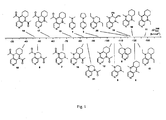
- Fig. 1
- die Reaktionsenthalpien für 3,4-Diaminopyridine 6-21 im Vergleich zu den Pyridinen 1, 2 und 5 gemäß Gleichung (1) aus Schema 1 oben; und
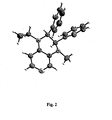
- Fig. 2
- die Einkristall-Röntgenstruktur der Verbindung 34 zeigt.
- Die Entwicklung von Katalysatoren, die auf dem 3,4-Diaminopyridin-Motiv basieren, wurden durch eine theoretische Abschätzung der Stabilität der entsprechenden Acyl-Intermediate gestützt, die quantitativ durch die Reaktionsenthalpie der homodesmischen Acyl-Transferreaktion (1) (siehe Schema 2) ausgedrückt werden kann.
- Die Reaktionsenthalpien für eine Vielzahl von 3,4-Diaminopyridinen sind in Tabelle 1 zusammen mit den Werten für andere Pyridin-Derivate zusammengestellt, deren katalytisches Potential bereits aus früheren Studien bekannt ist. Hierzu zählen Pyridin (4), DMAP (1), PPY (2) und das trizyklische DMAP-Derivat 5, die alle nicht gemäß der vorliegenden Erfindung sind. Eine graphische Darstellung der in Tabelle 1 dargestellten Ergebnisse findet sich in
Fig. 1 .Tabelle 1 System ΔHrxn(298) Ladung q(Ac)a,b Abstand r(C-N)b [kJ mol-1] [pm] 4 0.0 +0.366 153.38 18 -39.0 +0.318 149.70 14 -46.2 +0.321 149.96 8 -48.7 +0.324 150.09 17 -57.3 +0.294 148.71 7 -67.1 +0.310 149.26 13 -73.1 +0.305 148.99 16 -82.0 +0.299 148.71 1 -82.1 +0.298 148.16 21 -85.5 +0.301 148.60 2 -93.1 +0.291 147.86 12 -103.2 +0.291 148.18 6 -105.0 +0.284 147.66 5 -108.9 +0.279 147.07 20 -115.5 +0.278 147.31 19 -116.5 +0.274 147.16 10 -117.9 +0.277 147.46 9 -119.2 +0.277 147.29 15 -122.2 +0.274 147.12 11 -127.1 +0.272 147.06 - Tabelle 1. Reaktionsenthalpien ΔHrxn(298) für 298.15 K für die Acetyl-Übertragungsreaktion gemäß Gleichung (1) aus Schema 1, die auf B3LYP/6-311+G(d,p)// B3LYP/6-31G(d)-Niveau berechnet wurden (in kJ mol-1).a in Einheiten der Elementarladung e; b Ladungs- und Distanz-Parameter beziehen sich immer auf das günstigste Konformer.
- Das strukturell einfachste hier berücksichtigte 3,4-Diaminopyridin ist 6, das auf dem Tetrahydropyrido[3,4-b]pyrazin-Gerüst basiert. Die Stabilität des entsprechenden Acetyl-Intermediats 6Ac liegt nahe bei der des katalytisch hochaktiven 5. Austausch der beiden Methylgruppen in 6 gegen eine (in 7 und 21) oder zwei (wie in 8) Acetylgruppen verringert die Elektronendichte im Pyridin-Ring und somit auch die Stabilität der entsprechenden Kationen 7Ac und 8Ac recht deutlich. Die Stabilitäts-Differenz zwischen 6Ac und 21Ac (19.5 kJ mol-1) und zwischen 6Ac und 7Ac (37.9 kJ mol-1) zeigt, dass der Stickstoff in 4-Position deutlich sensibler auf Änderungen des Substitutionsmusters reagiert als der Stickstoff an 3-Position. Der kombinierte Effekt beider Substituenten in 8 (56.3 kJ mol-1 relativ zu 6) ist praktisch identisch zur Summe der beiden Einzel-Substitutionen (57.4 kJ mol-1). Austausch der beiden Methylgruppen in 6 gegen Ethyl-Gruppen erhöht die Stabilität des Acetyl-Intermediats um 10 kJ mol-1. Anellierung eines gesättigten Alkylrings an System 6 in entweder cis-Orientierung (wie in 9) oder trans-Orientierung (wie in 10) erhöht die Stabilität der Acetyl-Intermediate ebenfalls um ca. 15 kJ mol-1. Die Stabilität der Acetylpridinium-Kationen, die sich von den trizyklischen Systemen 9 und 10 ableiten, hängt von den N-Substituenten in ähnlicher Weise ab, wie bereits für das bizyklische System 6. Einführung von zwei Ethyl-Gruppen führt somit zu den stabilsten Acetyl-Intermediaten 11Ac und 15Ac. Schließlich erhöhen auch die Einführung von Aryl-Substituenten in der Ethylenbrücke von 6 (wie etwa in 19) die Stabilität des entsprechenden kationischen Intermediats, was wahrscheinlich auf induktive Elektronenübertragung auf die 3,4-Diamino-Stickstoffatome zurückzuführen ist. Die Stabilitäts-Werte der Acetyl-Intermediate der Verbindungen in
Fig. 1 decken einen Bereich von fast 90 kJ mol-1 ab. Für die Verbindungen 1, 2 und 5 wurde gefunden, dass diese Stabilitätswerte zur katalytischen Aktivität in Beziehung stehen. Ohne dabei an eine Theorie gebunden sein zu wollen, wäre zu erwarten, dass die Stabilitätswerte der 3,4-Diaminopyridine 18 und 11 (die die jeweiligen Enden der Skala markieren) sich in ihrer katalytischen Aktivität um einen Faktor 30 unterscheiden. Ein Blick auf die Ladungs- und Abstands-Daten in Tabelle 1 zeigt weiterhin, dass größere thermodynamische Stabilität mit kürzeren C-N-Bindungsabständen und kleineren Acetylgruppen-Ladungen korreliert. - Einige der in
Fig. 1 gezeigten Verbindungen können in einer 3- bis 5-stufigen Sequenz effizient aus 3,4-Diaminopyridin 22 hergestellt werden (siehe Schema 3). Kondensation von 22 mit Glyoxal, 1,2-Cyclohexadion oder Benzil führen in guten Ausbeuten zu den Diiminen 23 - 25.[12] Pyridopyrazin 23 (R=H) konnte anschliessend zum Tetrahydro-Derivat 26 reduziert13 und unter Eschweiler-Clark-Bedingungen zur Verbindung 6 alkyliert werden.14 Die Einführung längerer Alkylketten gelingt effizienter durch eine zweistufige Sequenz aus einleitender Bis-Acylierung und anschliessender Reduktion zum entsprechenden Diamin.15 Ausgehend von 26 konnte in dieser Weise die diethylierte Verbindung 20 in 48 % hergestellt werden. Ein ähnliches Vorgehen erlaubt die Synthese des Cyclohexyl-anellierten Systems 11, das vom Diamin 27 in zwei Schritten in 37 % Ausbeute erhalten wird. Das cis-anellierte Diamin 27 ist aus 24 durch selektive Reduktion mit NaBH4/BH3/H2NCH2CH2OH in 74 % Ausbeute16 oder durch Reduktion mit LiAlH3 bei -40 °C in 90% Ausbeute zugänglich. Die Anwendung des einfacheren Reduktions-Protokolls, das für die Verbindung 26 verwendet wurde, führt in diesem Fall zu einer cis-/trans-Mischung von 27.
- Schema 3. Synthese von Katalysatoren basierend auf dem 3,4-Diaminopyridin-Motiv. a) Glyoxal, 1,2-Cylohexadienon, oder Benzil, EtOH, 70 °C, 5h, 95-98 %. b) gepulvertes NaBH4, EtOH, 40 °C, 24 h, 50 %. c) 200 eq. CH2O (37% in Wasser), 100 eq. HCO2H, 110 °C, 48 h, 57 %. d) (CH3CO)2O, Pyridin, 100 °C, 24 h, 80 %. e) 4.2 eq. LiAlH4, 2.6 eq. AlCl3, MTBE, 0 °C, 1h, dann Rückfluss, 8 h, 60 %. f) LiAlH4, THF, -40 auf RT, 32 h, 90 %. g) (CH3CO)2O, 25 mol% PPY, Pyridin, 100 °C, 48 h, 68 %. h) 4.2 eq. LiAlH4, 2.6 eq. AlCl3, MTBE, 0 °C, 1h, dann Rückfluss, 8 h, 55 %. i) 1.1 eq. (CH3CO)2O, 0.2 eq. 2, NEt3, DCM, RT, 3 h, 82 %. j) 2.2 eq. LiAlH4, 1.3 eq. AlCl3, MTBE, 0 °C, 1h, dann Rückfluss, 8 h, 65 %. k) 1) 1 eq. n-BuLi, THF, -78 °C, 1h, dann 0 °C, 1h; 2) 1.1 eq. CH3COCl, THF, -78 °C bis RT, 1 h, 16%. 1) gepulvertes NaBH4, EtOH, 40 °C, 48 h, 74 %. m) 88 eq. CH2O (37% in Wasser), 200 eq. HCO2H, 110 °C, 48 h, 90 %. n) 1) 1 eq. n-BuLi, MTBE, -78 °C, 1h, dann 0 °C, 1h; 2) 1.1 eq. CH3COCl, MTBE, -78 bis 0 °C, 1 h, 36%. o) 2.2 eq. LiAlH4, 1.3 eq. AlCl3, THF, 0 °C, 1h, dann Rückfluss, 18 h, 53 %.
- Anwendung eines milderen Acylierungsverfahrens für die Umsetzung von 27 weist auf eine deutlich höhere Reaktivität der C4-Aminogruppe hin, die die bevorzugte Bildung des Amids 28 als einziges Reaktionsprodukt erklärt. Die Reduktion dieses Amids wie zuvor zum entsprechenden Amin und Acylierung der noch verbleibenden Amino-Funktion an C3 erlaubt somit den Aufbau von Katalysatoren, die zwei Donor-Substituenten unterschiedlicher Stärke enthalten. Der Einfluss von Aryl-Substituenten in der Verbindungsbrücke zwischen den beiden Amino-Stickstoffatomen an C3 und C4 wurde durch Synthese der Verbindung 34 untersucht. Während sich die Reduktion des entsprechenden Pyridopyrazins 25 unter den für 26 13 verwendeten Bedingungen gut durchführen lässt, bleibt die anschließende Eschweiler-Clark-Alkylierung auf der Stufe der Monoalkylierung zur Verbindung 32 stehen. Die Acetylierung von 32 erwies sich unter allen vorher verwendeten Bedingungen als überraschend schwierig, konnte aber letztendlich durch einleitende Deprotonierung mit n-BuLi, Abfangen des Amid-Anions mit AcCl und abschließender Reduktion zu 34 durchgeführt werden.
- Die Zusammensetzung aller in Schema 3 gezeigten Verbindungen wird durch hochauflösende Massenspektrometrie belegt. Die Struktur des Pyridin-Rings kann in allen Verbindungen direkt aus der Anwesenheit von drei Signalen (einem Singulett, zwei Dubletts) im entsprechenden Bereich des 1H-NMR-Spektrums (6.5-8 ppm) abgeleitet werden. Somit verbleibt das Problem der stereochemischen Zuordnung der Cyclohexan-Anellierung in den Verbindungen 11, 14 und 27-30, sowie die regiochemische Kontrolle der N-Alkylierungs- und N-Acylierungs-Reaktionen. Die 1H-NMR-Signale für die benachbarten Protonen Ha und He in Struktur 11 (siehe Schema 4) weisen eine Kopplungskonstante von 3 J HH=2.8 Hz auf und zeigen ein positives NOE-Signal, welches entweder mit einer axial-äqatorial- oder einer äquatorial-äquatorial-Anordnung vereinbar ist.17 Eine äquatorial-äquatorial-Orientierung der beiden Protonen kann aber ausgeschlossen werden, da die 3,4-Diaminopyridin-Einheit kaum durch diaxiale Anellierung an den Cyclohexanring angebunden sein kann.

- Die Regioselektivität der Acetylierung von 27 zu 28 konnte nicht direkt nachgewiesen werden, da die spektroskopischen Daten von 28 in dieser Hinsicht nicht aussagekräftig waren. Nach Reduktion von 28 zu 29 können jedoch positive NOE-Signale zwischen der Ethylgruppe und dem Proton an C5-Position des Pyridinrings beobachtete werden. Dies stützt die in Schema 3 gezeigte Struktur. Die Regiochemie der N-Methylierung von 31 zu 32 konnte ebenfalls durch die Beobachtung von NOE-Verstärkungen zwischen den Signalen für die Methylgruppe (2.85 ppm) und denen für das Proton an C1 des Pyridinrings (7.82 ppm) wie auch einem der benzylischen Protonen (4.44 ppm) festgelegt werden. Dass diese Regiochemie auch im doppelt alkylierten Produkt 34 noch beibehalten wird konnte zweifelsfrei durch die Einkristall-Röntgenstrukturanalyse dieser Verbindung bestätigt werden (siehe
Fig. 2 , kristallisiert aus Isohexan/Dichlormethan). - Die katalytischen Eigenschaften der Pyridine 1, 2, 5, 6, 8, 11, 20 und 34 wurden in zwei Acylierungsreaktionen A und B untersucht, die in Schema 5 dargestellt sind.

- Der tertiäre Alkohol 35 wurde bereits in früheren Studien aufgrund seiner geringen Reaktivität als Modell-Substrat verwendet.10 Die Acetylierung von 35 mit Essigsäure-Anhydrid (36) in der Gegenwart von Triethylamin als Hilfsbase (Reaktion A) verläuft quantitativ, solange ein Katalysator in einer Konzentration von 10% (relativ zu 35) eingesetzt wird, der zumindest die Reaktivität von DMAP (1) aufweist. Die Reaktions-Halbwertszeit τ1/2 kann durch Integration der Signale der Edukte und Produkte im 1H-NMR-Spektrum bestimmt werden und wird hier als Maß der katalytischen Aktivität verwendet. In Reaktion B wird der gleich Alkohol wie zuvor mit Isobuttersäure-Anhydrid (38) als Acylierungsreagenz umgesetzt. Da diese Reaktion deutlich langsamer verläuft als die von 36 wurde für Reaktion eine höhere Reaktionstemperatur (40°C) gewählt. Diese Wahl führt zu näherungsweise ähnlichen Halbwertszeiten für beide Reaktionen.
- Basierend auf neueren Untersuchungen von DMAP-katalysierten Acylierungs-Reaktionen18,19 kann in unpolaren Lösungsmitteln für beide Reaktionen der in Schema 6 gezeigte Mechanismus angenommen werden. Demnach reagieren Anhydrid und Katalysator in einem ersten (meist raschen) vorgelagerten Schritt unter Bildung eines Komplexes aus Acylpyridinium-Kation und Carboxylat-Anion. Dieser Komplex kann in der Regel unter den hier verwendeten Bedingungen nicht im 1H-NMR-Spektrum detektiert werden. Wir können deshalb annehmen, dass die entsprechende Gleichgewichtskonstante K für beide Reaktionen A und B recht klein ist.

- Im geschwindigkeitsbestimmenden Schritt reagiert dann das Acylpyridinium-Kation mit dem Alkohol 35 unter Bildung des Ester-Produkts und des deaktivierten Katalysators. Dieser kann durch Einwirkung der Hilfsbase NEt3 wieder regeneriert werden. Die hier gemessenen Halbwertszeiten τ1/2 (Tabelle 2) reflektieren den Einfluss des Katalysators auf beide diese Schritte. Eine eindeutige Korrelation von τ1/2 mit den berechneten Stabilitätswerten (Tabelle 1) für die Acetylpyridinium-Kationen kann deshalb nur erwartet werden, wenn die Substituenteneffekte auf K größer sind als die auf kcat.
Tabelle 2 Katalysator A B τ 1/2 (min) τ 1/2 (min) 1 (DMAP) 166 304 2 (PPY) 75 171 5 21 (29) 67 (86) 6 56 129 8 >38000a >100000a 11 24 (37) 63 (81) 20 53 91 30 138b 112 34 144 269 - Tabelle 2. Reaktions-Halbwertszeiten τ 1/2 (in min) für die Modell-Reaktionen A und B. Die Ergebnisse in Klammern wurden unter Verwendung von Hünig-Base (EtN(i-Pr)2) als Hilfsbase erhalten.a siehe Lit. 20. b siehe Lit. 23
- Die Reaktivitäts-Daten für die Verbindungen 1, 2 und 5 in Tabelle 2 weichen etwas von denen für die gleiche Reaktion unter identischen Bedingungen in einer früheren Publikation ab.10 Dies ist teilweise durch geringe Unterschiede in den NMR-Messungen zur Reaktionsverfolgung bedingt (siehe experimenteller Teil). Weiterhin lassen sich die Ergebnisse für aktivere Katalysatoren wie 5 nur bei Verwendung ausserordentlich reiner Proben reproduzieren. Die Durchführung der Reaktion unter strikt anaeroben Bedingungen ist hingegen nicht erforderlich. Die Ergebnisse in Tabelle 2 für die Katalysatoren 6, 11 und 20 zeigen, dass Diaminopyridine deutlich reaktiver sind als einfach substituierte Pyridine wie DMAP oder PPY. Die besten Ergebnisse konnten für Verbindung 11 erhalten werden, die ähnlich aktiv ist wie die bereits bekannte carbozyklische Verbindung 5. Vergleich der Ergebnisse für 20 und 11 zeigt einen starken Einfluss der Donor-Eigenschaften des Brücken-Motivs, während der Unterschied zwischen N-Methyl- oder N-Ethyl-Substitution (20 vs. 6) eher gering ausfällt. Während diese Ergebnisse durchaus in Einklang mit den Stabilitäswerten in Tabelle 1 und
Fig. 1 sind, ist die katalytische Aktivität von 34, gemessen am Stabilitätswert der verwandten Verbindung 19, überraschend gering. Die katalytische Aktivität wird durch die Einführung von Akzeptor-Substitutenten deutlich reduziert, was durch die geringe Aktivität von 30 (im Vergleich zu 11), wie auch der extrem langsamen Reaktion bei Verwendung der N-acylierten Verbindung 8 illustriert wird. Während dies mit Blick auf den geringen Stabilitätswert des entsprechenden Acetyl-Intermediats zu erwarten war, müssen wir doch anerkennen, dass die Stabilitäts-Skala inFig. 1 nicht in allen Fällen in Einklang mit den experimentell gefundenen Reaktivitäts-Daten in Tabelle 2 steht. Dass letztere auch von der Wahl der Substrate abhängen, wird durch Vergleich der Ergebnisse für die Reaktionen A und B deutlich. Das Reaktivitäts-Verhältnis für die aktivste Verbindung 11 und DMAP beträgt für die Reaktion A 7.0 und für die Reaktion B 4.8. Ein ähnliches Ergebnis wird für das Pyridinderivat 5 mit Reaktivitäts-Verhältnissen von 7.9 und 4.5 erhalten. Die Wahl der Hilfsbase stellt eine weitere experimentelle Variable dar, die für die Katalysatoren 5 und 11 untersucht wurde. Es stellt sich dabei überraschenderweise heraus, dass die katalytische Effizienz bei Einsatz der stärkeren Hilfsbase EtN(iPr)2 (Hünig-Base) im Vergleich zu NEt3 für beide Katalysatoren vergleichbar absinkt. - Alkyl-substituierte 3,4-Diaminopyridine stellen eine neue Klasse von Katalysatoren für die Acylierung von Alkoholen dar. Die katalytische Effizienz dieser Verbindungen kann innerhalb einer einzigen synthetischen Strategie durch Variation der Stickstoff-Substituenten in breitem Maße verändert werden. Die katalytische Aktivität der besten dieser Katalysatoren ist vergleichbar zu den besten bisher bekannten carbocyklischen Derivaten von DMAP. Im Gegensatz zu diesen letzteren Verbindungen sind die aktivsten 3,4-Diaminopyridin-Katalysatoren durch eine flexible 3-oder 4-stufige Synthese einfach zugänglich, die für weitere strukturelle Variationen leicht modifiziert werden kann.
- Geometrie-Optimierungen wurden mit dem Becke3LYP Hybrid-Funktional in Kombination mit dem split valence Basissatz 6-31 G(d) durchgeführt. Thermochemische Enthalpiekorrektur bei einer Temperatur von 298.15 K wird durch eine Frequenzrechnung auf demselben Niveau durchgeführt. Singlepoint Rechnungen werden auf dem Becke3LYP/6-311+G(d,p)-Niveau durchgeführt. Eine Kombination der erhaltenen Energie mit der thermochemischen Korrektur auf dem Becke3LYP/6-31G(d)-Niveau ergibt die H298-Werte, die im Text beschrieben werden. Alle Rechnungen werden mit Gaussian 03 durchgeführt.21
- Alle Reaktionen die unter Feuchtigkeitsausschluss durchgeführt worden sind, werden unter Stickstoffatmosphäre in trockenen Lösungsmitteln und durch Trockenschrank und Heißluftfön getrockneten Reaktionsapparaturen durchgeführt. THF wird unter Stickstoffatmosphäre von Natriumhydrid destilliert. Methyl-tert.-butylether (MTBE), Pyridin, Triethylamin und Deuterochloroform werden unter Stickstoffatmosphäre von Calciumhydrid destilliert. Acetanhydrid und Isobuttersäureanhydrid werden unter vermindertem Druck von P4O10 auf trockenes K2CO3 destilliert, filtriert und im Vakuum fraktioniert. Beide Anhydride werden über 4 Å-Molsieb unter Stickstoffatmosphäre aufbewahrt. Ethanol, Dichlormethan, Ethylacetat und Methanol wird am Rotationsverdampfer destilliert. n-BuLi wird mit Diphenylessigsäure titriert und die Molarität bestimmt. Alle anderen Reagenzien, wenn nicht anders im Text erwähnt, werden mit der höchst möglichen Qualität ohne weitere Aufreinigung verwendet. Dünnschichtchromatographie wird auf mit Fluoreszenzfarbstoff markierten DC-Platten der Firma Merck KGaA (Silikagel 60 F254, Schichtdicke 0.2 mm) und auf Fluka (basisch Aluminiumoxid F254, Brockman-Aktivität 1, pH 9.5, Schichtdicke 0.2 mm) durchgeführt. Flash-Chromatographie wird mit Merck KGaA Silikagel 60 (Korngröße 0.040-0.063 mm) und Fluka basisches Aluminiumoxid (basisch Aluminiumoxid F254, Brockman-Aktivität 1, pH 9.5, Körngröße 0.05-0.15 mm) bei einem Druck von 1.5 bar für Silikagel und 0.5 bar für basisches Aluminiumoxid durchgeführt. 1H- und 13C-NMR Spektren werden mit einem Varian Mercury 200, Varian 300, Varian INOVA 400 und Varian 600 Gerät aufgenommen. NOE-Spektren werden in CDCl3 bei 27 °C aufgenommen. Chemische Verschiebungen werden in ppm relativ zum Lösungsmittelpeak angegeben.22 Folgende Abkürzungen werden verwendet um die Multiplizitäten der Signal im 1H-NMR-Spektrum zu charakterisieren: s=Singulett, d=Dublett, t=Triplett, q=Quartett, quin=Quintett, sex=Sechstett, sep=Septett, m=Multiplett, b=breit und Kombinationen der verwendeten Abkürzungen. Alle 1H- und 13C- Signale werden mit COSY-, NOESY-, HSQC-, HMBC- und DEPT-Experimenten zugeordnet. 1H-NMR-Spektren der Kinetikmessungen werden mit dem Programm VNMR 4.3 Rev. G0194 ausgewertet. Integrale der relevanten Peaks werden automatisch mit einem selbst geschriebenen Unterprogramm ausgewertet. Die Subroutine wird mit MAGICAL™ II-Programming geschrieben. IR-Spektren werden mit KBr-Presslingen als Probenmedium mit einem Perkin-Elmer 1420 Infrarot-Spektrometer und einem Perkin-Elmer FT-IR Spectrum BX Spektrometer unter Verwendung der ATR-Technik aufgenommen. Alle Signale sind als vs=sehr intensiv, s=intensiv, m=mittel und w=schwach aufgeführt. Massenspektren sind mit einem Finnigan MAT 95 unter Verwendung von Elektronenstoß-Ionisation (EI, 70 eV) oder chemischer Ionisation (CI, Isobutan) als Ionisationsquelle aufgenommen. ESI-MS Spektren werden mit einem Thermo Finnigan LTQ FT-Instrument aufgenommen. Gaschromatogramme werden mit einem Varian 3400 GC mit einer 25 m CS-Supreme-5 Kapillarsäule und einem Finnigan MAT 95 Massenspektrometer als Detektor aufgezeichnet. Im Falle der elektronenreichen Pyridine 11, 5, 6, 20 und 32 wird das Lösungsmittel nach Flashchromatographie durch Einleiten eines Stickstoffstroms in den Rotationsverdampfer abdestilliert.
- Deutorochloroform, Triethylamin und Hünigbase werden vor der Verwendung frisch unter Stickstoffatmosphäre von Calciumhydrid destilliert. Alle kinetischen Messungen werden bei konstanter Temperatur bei 23 °C für Reaktion A und 40 °C für Reaktion B auf einem Varian Mercury 200 Spektrometer aufgenommen. In drei trockenen 5 ml Messkolben werden folgende Maßlösungen in deuteriertem Chloroform hergestellt.
- A: 1.2 M Acetanhydrid-Lösung.
- B: 0.6 M Ethinylcyclohexanol-Lösung und 1.8 M Triethylamin- oder Hünigbasen-Lösung.
- C: 0.06 M Katalysatorlösung.
- Probenvorbereitung und Kinetikmessung für Reaktion A. In einem NMR-Rörchen werden jeweils 200 µl der oben genannten Maßlösungen mittels einer Eppendorf-Pipette pipettiert. Die Reaktionsmischung wird vermischt und sofort in das NMR-Spektrometer eingeführt. Die Reaktion wird durch Aufnahmen von NMR-Spektren in einem definierten Zeitintervall bis zum 100%igen Umsatz verfolgt.
- Probenvorbereitung und Kinetikmessung für Reaktion B. Durchführung wie unter Reaktion A beschrieben nur das die NMR-Röhrchen, um ein Verdampfen des Lösungsmittels zu verhindern, mit einem Brenner zu geschmolzen worden sind.
- Bestimmung der Halbwertszeit für Reaktion A. Alle Signal die den Protonen einer AcetylGruppen zu geordnet werden können werden nach der Aufnahme der Spektren automatisch integriert. Dabei wird Acetanhydrid, Ester und Triethylammoniumacetat mit folgenden Integralgrenzen integriert: ±8, ±2 und ±6 Hz. Der Umsatz wird mit Gleichung 2 berechnet. Der Umsatz wird als Funktion der Zeit mit Gleichung 4 bis zur Selbstkonsistenz gefittet. Die Halbwertszeit wird mit Funktion 4 bei 50%igen Umsatz berechnet.
- Bestimmung der Halbwertszeit für Reaktion B. Das Dublett der Isobuttersäuregruppe als auch das Signal von Dioxan werden nach Aufnahme der NMR-Spektren automatisch integriert. Dabei wird Dioxan und Isobuttersäureanhydrid mit den gleichen Integralgrenze von ±2 Hz integriert. Der Umsatz wird mit Gleichung 3 berechnet. Der Umsatz wird als Funktion der Zeit mit Gleichung 4 bis zur Selbstkonsistenz gefittet. Die Halbwertszeit wird mit Funktion 4 bei 50%igen Umsatz berechnet.



- Pyrido[3,4-b]pyrazine (23): Zu einer Lösung von 2.82 ml Glyoxal (40 wt. % in Wasser, ρ=1.265 g/ml, 62.48 mmol) in 30 ml Ethanol gibt man 2.00 g (18.33 mmol) 3,4-Diaminopyridin. Die Reaktionsmischung wird für 5 h bei 70 °C Ölbadtemperatur gehalten und nachdem abkühlen auf Raumtemperatur wird das Lösungsmittel am Rotationsverdampfer abdestilliert. Das Rohprodukt wird durch Flashchromatographie (EtOAc/Isohexan, 9:1) gereinigt. Man erhält 2.35 g (17.96 mmol, 98%) eines weißen Pulvers. R f=0.27 (Isohexan/FtOAc, 1:9). 1H NMR (200 MHz, CDCl3): δ=7.94 (dd, 3 J=5.8 Hz, 4 J=0.6 Hz, 1H, H-7), 8.83 (d, 3 J=5.8 Hz, 1H, H-8), 8.96 (d, 3 J=1.6 Hz, 1H, H-3), 9.02 (d, 3 J=1.6 Hz, 1H, H-2), 9.56 (d, 4 J=0.6 Hz, 1H, H-5) ppm. 13C NMR (100 MHz, CDCl3): δ=121.6 (CH, C-7), 138.0 (Cq), 145.3 (Cq), 147.3 (C-H, C-8), 146.5 (C-H, C-3), 149.2 (CH, C-2), 154.8 (C-H, C-5) ppm. GC-MS (EI): RT 5.45 min, m/z (%): 132 (8), 131 (M+, 100), 104 (25), 77 (13), 50 (10) IR (KBr): □ = 3435 (vs), 3092 (w), 3023 (m), 1969 (w), 1758 (w), 1631 (w), 1598 (vs), 1562 (m), 1536 (w), 1488 (s), 1436 (vs), 1416 (m), 1381 (m), 1351 (w), 1290 (w), 1279 (m), 1212 (m), 1201 (m), 1148 (w), 1033 (s), 1014 (s), 972 (w), 959 (vs), 931 (m), 881 (vs), 838 (m), 824 (s), 773 (w), 651 (s), 623 (m), 546 (w), 524 (w), 457 (s) cm-1.
- 1,2,3,4-Tetrahydropyrido[3,4-b]pyrazin (26): Zu einer Lösung von Chinoxalin 23 (2.90 g, 0.022 mol) in 100 ml trockenen Ethanol gibt man 2.90 g (0.076 mol) NaBH4-Pulver. Man erhitzt auf 40 °C Ölbadtemperatur und hält die Reaktionslösung für 24 h bei dieser Temperatur. Anschließend wird die Reaktionslösung auf Raumtemperatur abgekühlt und 3 ml Wasser zugegeben. Der anorganische Feststoff wird abgesaugt zweimal mit 20 ml DCM gewaschen. Die vereinigten organischen Phasen werden über Natriumsulfat getrocknet und das Lösungsmittel am Rotationsverdampfer abdestilliert. Das erhaltene Rohprodukt wird durch Flashchromatographie auf basischen Aluminiumoxid (EtOAc/MeOH, 10:1) gereinigt. Man erhält einen weißen Schaum. R f = 0.15 (basisches Alox, 20:1, DCM:MeOH). 1H NMR:(200 MHz, CDCl3): δ = 3.37 (d,3 J= 5.8 Hz, 1H, H-3), 3.38 (d, 3 J= 5.8 Hz, 1H, H-2), 6.29 (d, 3 J= 5.4 Hz, 1H, H-8), 7.67 (d, 3 J= 5.4 Hz, 1H, H-7), 7.67 (s, 1H, H-5). 13C NMR: (100 MHz, CDCl3): δ = 40.1 (CH2), 41.0 (CH2), 107.8 (C5), 129.6 (Cq), 135.3 (C-H, C7), 140.1 (Cq), 141.1 (C-H, C-5). GC-MS RT 8.09 min (EI) m/z (%): 136 (8), 135 (M+ 79), 134 (M+-H+,100), 133 (10), 132 (7), 131 (2), 120 (4), 107 (7), 105 (4), 94 (2), 93 (7), 80 (2), 79 (3), 78 (4), 67 (4), 66 (2), 53 (2), 52 (2), 52 (3), 51 (2). IR (KBr): □ = 3349 (m), 2859 (m), 1593 (s), 1534 (s), 1474 (s), 1344 (s), 1311 (s), 1281 (s), 1256 (w) 1228 (m), 1182 (m), 1102 (m), 1051 (w), 1038 (m), 893 (m), 862 (m), 824 (s), 772 (m) cm-1. HRMS (EI) (%) berechnet für C7H8N3 (M-H+): 134.0718 gefunden: 134.0709.
- 1-(4-Acetyl-3,4-düiydro-2H-pyrido[3,4-b]pyrazin-1-yl)-ethanon (8): Zu einer 0°C warmen Lösung von Tetrahydrochinoxalin 26 (1.49 g, 0.011 mol) in 60 ml Pyridin werden 23 ml (24.71 g, 24.20 mol) Acetanhydrid zugegeben. Die Reaktionsmischung wird anschließend auf 100 °C für 48 h erhitzt. Nach dem abkühlen auf Raumtemperatur wird das Lösungsmittel im Vakuum abdestilliert und der gelbe Feststoff durch Flashchromatographie (EtOAc:MeOH, 10:3) gereinigt. Man erhält 1.93 g (8.80 mmol, 80 %) eines schwach gelben Feststoffs. 1H NMR (400 MHz, CDCl3): δ = 2.25 (s, 3H, CH3), 2.31 (s, 3H, CH3), 3.90 (ddd, 2 J= 12 Hz, 3 J= 4 Hz, 3 J=4 Hz, 2H, CH2), 3.94 (ddd, 2 J = 12 Hz, 3 J = 4 Hz, 3 J= 4 Hz, 2H, CH2), 7.67 (s, 1H, H-5), 7.87 (bs, 1H, H-5), 8.32 (d, 3 J = 4 Hz, 1H, H-7), 8.46 (m, 1H, H-8). 13C NMR (100 MHz, CDCl3): δ = 22.3, 22.8 (CH3), 42.1, 46.5 (CH2), 117.4 (C5), 128.2 (Cq), 139.0 (Cq), 145.7 (C-7), 146.9 (C-8), 168.6 (C=O). GC-MS(EI) RT 9.66 min, m/z (%): 220 (14), 219 (M+, 81), 178 (11), 177 (M+-AcO,100), 176 (10), 162 (3), 159 (2), 136 (7), 135 (78), 134 (M+-2AcO,99), 133 (8), 132 (9), 120 (4), 119 (2), 107 (5), 105 (2), 93 (3), 80 (2), 79 (4), 78 (4), 52 (2), 51 (2), 43 (AcO+,20); IR (neat): □ = 2960 (w), 1684 (s) 1654 (vs) 1582 (m) 1494 (s), 1407 (vs), 1330 (m), 1320 (vs), 1277 (m), 1259 (s), 1248 (m), 1217 (s), 1248 (s), 1217 (s), 1179 (m), 1150 (w), 1118 (m), 1064 (m), 1033 (s), 969 (s), 886 (w), 857 (m), 846 (s), 799 (s), 764 (w), 749 (w), 704 (w) cm-1. HRMS (EI) berechnet für C11H13N3O2 [M+]: 219.1008; gefunden: 219.0995.
- 1,4-Diethyl-1,2,3,4-tetrahydropyrido[3,4-b]pyrazin (20): In 60 ml MTBE suspendiert man 1.56 g (11.69 mmol) AlCl3 bei Raumtemperatur. Nach 45 min rühren wird die Reaktionsmischung auf 0 °C gekühlt und Portionsweise (1.32 g, 34.65 mmol) LiXlH4 zugegeben. Nach beendeter Zugabe und weiteren rühren für 15 min wird Verbindung 8 (1.00 g, 4.56 mmol) zugegeben und für eine weitere Stunde bei 0 °C gerührt. Anschließend wird für 8 h unter Rückfluß erhitzt und nachdem abkühlen auf Raumtemperatur die Reaktionsmischung auf Eiswasser gegossen. Der ausgefallene anorganische Feststoff wird abgesaugt und zweimal mit 30 ml DCM gewaschen. Die Wasserphase wird auf pH 12 gebracht und dreimal mit 40 ml DCM extrahiert. Die vereinigten Extrakte werden über Na2SO4 getrocknet und das Lösungsmittel am Rotationsverdampfer abdestilliert. Das Rohprodukt wird durch Flashchromatographie an Kieselgel gereinigt (EtOAc/MeOH/NEt3, 10:0.5:1). Man erhält 0.52 g (60%) eines farblosen Öls, was im Gefrierschrank fest wird. R f = 0.47 (EtOAc/MeOH/NEt3, 10:0.5:1). 1H NMR: (400 MHz, CDCl3): δ = 1.15 (q, 3 J = 14 Hz , 6H, CH3), 3.22 (m, 3 J = 6 Hz, 2H, H-3), 3.23 (m, 2 J = 14 Hz, 4H, CH2), 3.42 (m, 3 J= 6 Hz, 2H, H-2), 6.34 (d, 3 J= 5.2 Hz, 1H, H-8), 7.69 (s, 1H, H-5), 7.75 (d, 3 J= 5.2 Hz, 1H, H-7). 13C NMR: (100 MHz, CDCl3): δ = 10.1, 10.4 (CH3), 44.6, 46.5 (CH2, C-2, C-3), 44.9, 45.0 (CH2), 104.0 (C-8), 130.5, 130.1 (Cq), 131.8 (C-5), 140.7 (C-7). GC-MS(EI): RT 8.63 min, m/z (%): 192 (10), 191 (M+,100), 190 (4), 177 (8), 176 (95), 175 (5), 162 (11), 161 (8), 160 (5), 148 (13), 147 (10), 146 (8), 135 (2), 134 (9), 133 (6), 131 (8), 121 (2), 119 (4), 118 (3), 107 (3), 104 (2), 92 (2), 91 (2), 80 (8), 77 (4) IR (KBr): □ = 3436 (s), 3112 (w), 3019 (w), 2964 (w), 1661 (s), 1686 (vs), 1583 (m), 1497 (m), 1409 (s), 1363 (w), 1332 (m), 1311 (s), 1260 (m), 1249 (w), 1232 (m), 1220 (m), 1180 (m), 1150 (w), 1119 (m), 1064 (w), 1035 (m), 985 (m), 970 (m), 886 (s), 858 (m), 847 (m), 802 (m), 765 (w), 740 (w), 704 (w), 647 (w), 614 (w), 592 (w), 577(m), 570 (m), 507 (w) cm-1. HRMS (EI) berechnet für C11H17N3 [M+]: 191.1422; gefunden: 191.1430.
- 1,4-Dimethy-1,2,3,4-tetrahydropyrido[3,4-b]pyrazin (6): Unter Eiskühlung gibt man zu Tetrahydrochinoxalin 26 (1.26 g, 9.32 mmol) 35 ml Ameisensäure. Anschließend gibt man 12 ml Formaldehyd-Lösung hinzu (<37 % in Wasser) und man erhitzt für 48 h auf 110 °C Ölbadtemperatur. Anschließend läßt man auf Raumtemperatur abkühlen gibt unter Eiskühlung ca. 150 ml 20%ige Natronlauge hinzu. Dabei sollte der pH-Wert nicht 12 überschreiten. Die Mutterlauge wird mit 250 ml DCM in einem Flüssig/Flüssig-Extraktor über Nacht extrahiert. Die organische Phase wird über Na2SO4 getrocknet und das Lösungsmittel am Rotationsverdampfer abdestilliert. Das Rohprodukt wird durch Flashchromatographie an Kieselgel (EtOAc/MeOH/NEt3, 10:1:1) und basischen Aluminiumoxid (EtOAc/MeOH, 10:1) gereinigt. Man erhält 0.849 g (5.32 mmol, 57%) eines gelben Feststoffs. R f = 0.56 (basic alumina, EtOAc/MeOH, 10:1). 1H NMR: (400 MHz, CDCl3): δ = 2.77 (s, 3H, CH3), 2.82 (s, 3H, CH3), 3.12 (m, 2H, CH2-B), 3.37 (m, 2H, CH2-C), 6.21 (d, 3 J= 5.6 Hz, 1H, H-7), 7.56 (s, 1H, H-5), 7.74 (d, 3 J= 5.6 Hz, 1H, H-8) ppm. 13C NMR: δ = (75 MHz,CDCl3): 38.0 (N-1-CH3), 39.1 (N-4-CH3), 48.8 (C-3), 49.6 (C-2), 104.0 (C-7), 131.2 (C-5), 132.3 (C-4a), 141.6 (C-7), 142.2 (C-8a) ppm; GC-MS(EI): RT 8.05 min, m/z (%): 164 (8), 163 (M+,100), 162 (21), 161 (5), 149 (4), 148 (40) 147 (9), 146 (8), 134 (8), 133 (11), 132 (6), 121 (4), 120 (2), 119 (6), 107 (3), 105 (2), 93 (2), 92 (4), 81 (6), 80 (4), 79 (2), 78 (4), 66 (3), 51 (2), 42 (4). IR (neat): □ = 3378 (w), 3035 (w), 2979 (w), 2873 (m), 2826 (s), 2792 (w), 1581 (s), 1519 (s), 1466 (s), 1454 (s), 1435 (m), 1416 (m), 1380 (w), 1335 (vs), 1290 (s), 1250 (w), 1235 (vs), 1214 (m), 1172 (s), 1114 (s), 1099 (s), 1069 (s), 1030 (m), 936 (w), 911 (w), 883 (s), 815 (s), 800 (s), 783 (s), 746 (m), 709 (m), 622 (m) cm-1. HRMS (EI) berechnet für C9H13N3 [M+]: 163.1109; gefunden: 163.1089.
- 6,7,8,9-Tetrahydropyrido[3,4-b]chinoxalin (24): Zu einer Suspension von 1.56 g (13.93 mmol) 3,4-Diaminopyridin in 50 ml Ethanol gibt man (1.52 g, 13.93 mmol) 1,2-Cyclohexandion. Anschließend erhitzt man die Reaktionsmischung für 5 h auf 70 °C Ölbadtemperatur, kühlt danach auf Raumtemperatur ab und destilliert danach das Lösungsmittel am Rotationsverdampfer ab. Das erhaltene Rohprodukt wird durch Flashchromatopraphie mit Ethylacetat als Eluent gereinigt. Man erhält 1.84 g (71 %) eines weißen Feststoffs, der im Kühlschrank aufbewahrt und nach 1-2 Tagen weiterverarbeitet werden sollte. Durch stehen lassen im offenen Kolben im Sonnenlicht verändert sich die Farbe des Feststoff nach grau-grün. R f=0.25 (EtOAc/Hexan, 20:1). 1H NMR:(200 MHz, CDCl3): δ = 2.05 (m, 4H, H-7,8), 3.18 (m, 4H, H-6,9), 7.79 (d, 3 J= 5.8 Hz, 1H), 8.72 (d, 3 J = 5.8 Hz, 1H), 9.38 (s, 1H) ppm. 13C NMR (75 MHz, CDCl3): δ = 22.8 (CH2, C-7,8), 33.7 (CH2, C-6,9), 121.2 (CH), 136.9 (Cq), 144.1 (Cq), 146.8 (CH), 153.9 (CH), 156.8 (Cq) 159.9 (Cq) ppm. GC-MS(EI): RT 8.44 min, m/z (%) 186 (11), 185 (M+,100), 184 (39), 183 (3), 182 (3), 171 (2), 170 (21), 169 (4), 158 (2), 157 (5), 156 (5) 131 (2), 104 (2), 103 (4), 78 (3), 76 (4), 67 (2), 64 (2), 51 (2), 50 (6); IR (KBr): □ = 3435 (vs), 2947 (s), 2864 (m), 1594 (s), 1557 (w), 1461 (w), 1421 (m), 1385 (s), 1365 (w), 1330 (w), 1297 (m), 1211 (m), 1140 (w), 979 (m), 949 (w), 901 (m), 849 (m), 679 (w), 629 (w), 570 (w), 412 (w) cm-1. HRMS (EI): berechnet für C11H11N3 185.0953 [M+], gefunden: 185.0935
- 5,5a,6,7,8,9a,10-Octahydro-pyrido[3,4-b]chinoxalin (27): In einen 250 ml Schlenkkolben gibt man 6.13 g (33.09 mmol) 24 und 100 ml THF. Man kühlt die Lösung auf -40 °C und gibt 3.09 g (81.42 mmol, 2.5 eq.) LiAlH4 in kleinen Portionen hinzu. Die Reaktionsmischung wird auf Raumtemperatur aufgewärmt und 32 h bei Raumtemperatur gerührt. Anschließend gießt man auf Eiswasser und stellt die Wasserphase auf ein pH-Wert von 12 ein. Der anorganische Feststoff wird abgetrennt und zweimal mit 40 ml DCM gewaschen. Die Mutterlauge wird 8 h mit 250 ml DCM in einem Flüssig/Flüssig-Extraktor extrahiert. Die vereinigten organischen Phasen werden über Na2SO4 getrocknet und das Lösungsmittel am Rotationsverdampfer abdestillert. Flashchromatographie (EtOAc/MeOH/NEt3, 10:1:1) des erhaltenen Rohprodukts liefert 5.63 g (29.78 mmol, 90%) eines weißen Feststoffs. R f=0.36 (EtOAc/MeOH/NEt3, 10:1:1). 1H NMR:(300 MHz, CDCl3): δ = 1.32-1.40 (m, 3H), 1.56-1.75 (m, 5H), 3.41 (m, 1H), 3.46 (s, 1H, N-H), 3.51 (m, 1H), 4.20 (s, 1H, N-H), 6.29 (d, 1H, 3 J = 5.4 Hz, H-3), 7.65 (d, 1H, 3 J = 5.4 Hz, H-4), 7.68 (s, 1H, H-1) ppm. 13C NMR (75 MHz, CDCl3): δ = 22.0, 22.2 (C-7,8), 30.4, 30.8 (CH2, C-6,9), 49.2 (CH, C-5a), 50.1 (CH, C-9a), 107.7 (C-4), 128.8 (Cq, C-10a), 134.8 (C-3), 139.2 (Cq, C-4a) 140.7 (C-4) ppm. GC-MS (EI): RT 10.06 min, m/z (%) 190 (13), 189 (M+, 99), 188 (9), 187 (3), 185 (10), 184 (4), 170 (4), 160 (10), 159 (3), 158 (5), 148 (2) 147 (16), 146 (100), 145 (2), 134 (13), 133 (17), 132 (15), 120 (10), 119 (3), 105 (2) 94 (3), 93 (2), 78 (3), 66 (2), 40 (2); IR (neat): □ = 3220 (s), 2927 (s), 2852 (s), 2354 (m), 1725 (w), 1595 (vs), 1523 (vs), 1456 (w), 1443 (m), 1403 (w), 1362 (s), 1294 (s), 1269 (s), 1240 (m), 1206 (s), 1175 (s), 1087 (m), 1052 (m), 1003 (m), 938 (m), 884 (m) 810 (vs) 725 (m) cm-1. HRMS (EI): berechnet für C11H15N3 189.1266 [M+], gefunden: 189.1259.
- Die Reaktion kann alternativ auch nach der Vorschrift von Opatz et al. mit NaBH4/BH3/H2NCH2CH2OH als Reagenz durchgeführt werden, wobei eine Ausbeute von 74 % erzielt wird.16
- 1-(10-Acetyl-6,7,8,9,9a,10-hexahydro-5aH-pyrido[3,4-b]chinoxalin-5-yl)-ethanon (14): In einen 250 ml Rundkolben gibt man unter Eiskühlung 27 (1.20 g, 6.34 mmol), 40 ml Pyridin, 30 ml (32.36 g, 317 mmol, p=1.082 g/ml) Acetanhydrid und 0.234 g (25 mol%) PPY. Die Reaktionmischung wird auf 100 °C Ölbadtemperatur erhitzt und 48 h bei dieser temperatur gehalten. Durch DC-Kontrolle auf basischen Aluminiumoxid (EtOAC/MeOH, 10:1) kann die Reaktion verfolgt werden. Nach dem abkühlen auf Raumtemperatur wird das Lösungsmittel unter verminderten Druck abdestilliert und des erhaltene Rohprodukt durch Flashchromatographie auf basischen Aluminiumoxid (EtOAc/MeOH, 10:1) gereinigt. Man erhält einen dunkelgelben Feststoff (1.17 g, 4.31 mmol, 68 %). R f= 0.45 (EtOAc/MeOH, 10:1). 1H NMR:(400 MHz, CDCl3): δ = 1.34 (m, 4H), 1.60 (d, 4H), 2.23 (s, 3H, H 3C-CO-N), 2.27 (s, 3H, H 3C-CO-N), 4.74 (m, 1H), 4.85 (m, 1H), 7.25 (d, 3 J= 5.6 Hz, 1H, H-4), 8.41 (d, 3 J= 5.6 Hz, H-3), 8.49 (s, 1H, H-1) ppm. 13C NMR (75 MHz, CDCl3): δ = 21.7, 21.9 (C-7,8), 23.1, 23.6 (H3C-CO-N), 28.4, 28.5 (C-6,9), 55.2, 56.0 (CH, C-5a,9a), 119.6 (C-4), 130.8 (Cq, C-10a), 141.6 (Cq, C-4a), 147.1, 147.2 (C-1, C-3) 169.1, 169.2 (C=O) ppm. GC-MS(EI): RT 10.45 min, m/z (%) 274 (13), 273 (M+, 58), 232 (15), 231 (100), 230 (42), 216 (5), 214 (5), 213 (5), 203 (3), 202 (4), 190 (13), 189 (84), 188 (45), 173 (5), 172 (6), 160 (7), 159 (5), 158 (5), 147 (8), 146 (40) 134 (6), 133 (13), 132 (15), 120 (7), 43 (9); IR (neat): □ = 2940 (m), 1660 (vs), 1587 (m), 1559 (w), 1498 (s), 1448 (w), 1427 (w), 1388 (m), 1353 (w), 1337 (m), 1289 (s), 1270 (s), 1248 (s), 1248 (m), 1220 (w), 1183 (w), 1102 (w), 1036 (m), 978 (m), 857 (w), 839 (w) 777 (w) cm-1. HRMS (EI): berechnet für C11H15N3 273.1477 [M+], gefunden: 273.1482.
- 5,10-Diethyl-5,5a,6,7,8,9,9a,10-octahydro-pyndo[3,4-b]chinoxalim (11): Zu einer Suspension von 0.77 g (5.80 mmol) AlCl3 in 30 ml MTBE gibt man nach 45 min rühren bei Raumtemperatur und anschließendem kühlen auf 0 °C 1.32 g (9,35 mmol) LiAlH4 in kleinen Portionen. Nach beendeter Zugabe und weiterem rühren für 15 min gibt man Verbindung 14 (0.64 g, 2.23 mmol) hinzu und läßt 1 h bei 0 °C rühren. Anschließend wird für 8 h auf Rückfluß erhitzt und dann nach abkühlen auf Raumtemperatur auf Eiswasser gegossen. Der anorganische Niederschlag wird abgesaugt und zweimal mit 30 ml DCM gewaschen. Die Wasserphase wird auf pH 12 gebracht und dreimal mit 40 ml DCM extrahiert. Die kombinierten organischen Phasen werden über Na2SO4 getraocknet und das Lösungmittel am Rotationsverdampfer abdestilliert. Das erhaltene Rohprodukt wird durch Flashchromatographie an Kieselgel (EtOAc/MeOH/NEt3, 10:2:1) und an basischen Aluminiumoxid (EtOAc/MeOH, 10:1) gereinigt. Man erhält 0.30 g (1.22 mmol, 55 %) eines farblosen Feststoffs. R f=0.32 (basic alumina, EtOAc/MeOH, 10:1). 1H NMR:(400 MHz, CDCl3): δ = 1.11, 1.13 (t, 3 J = 7.2 Hz, H 3C-CH2-N-5, 3 J = 7.2 Hz, H 3C-CH2-N-10, 6-H), 1.37 (m, 2H, H-7,8), 1.56 (m, 3 J aa = 6.8 Hz, 3 J ee = 3.2 Hz, 4H, H-6, H-9, H-7, H-8), 1.76 (m, 3 J ae = 3.2 Hz, 1H, H-9), 1.89 (m, 3 J ae = 3.2 Hz, 1H), 3.18 (dq, 3 J = 7.2 Hz, 2 J = 14.4 Hz, 2-H, H3C-CHAB -N-5, H3C-CHAB -N-10), 3.23 (ddd, 3 J ae = 2.8 Hz, 3 J ae, = 3.2 Hz, 3 J aa = 6.8 Hz, 1H, H-5a), 3.34 (ddd, 3 J ae = 2.8 Hz, 3 J ae = 3.2 Hz, 3 J ae = 3.2 Hz, H-1, H-9a), 3.43 (dq, 3 J = 7.2 Hz, 2 J = 14.4 Hz, H3C-CHAB -N-5, H3C-CHAB -N-10, 2H, H-1), 6.33 (d, 3 J = 5.6 Hz, 1H, H-4), 7.67 (s, 1H, H-1), 7.72 (d, 1H, H-3) ppm. 13C NMR (100 MHz, CDCl3): δ = 10.8 (H3 C-CH2-N-5), 11.8 (H3 C-CH2-N-10), 21.7 (C-7), 22.9 (C-8), 27.3 (C-6), 27.8 (C-9), 40.4 (H3C-CH2-N-5), 41.7 (H3C-CH2-N-10), 52.8 (C-9a), 56.4 (C-5a), 104.3 (C-4), 130.6 (C-10a, C-1), 139.4 (C-3), 141.2 (C-4a) ppm. GC-MS(EI): RT 10.58 min, m/z (%) 246 (18), 245 (M+, 100), 231 (9), 230 (57), 217 (7), 216 (44), 207 (6), 186 (7), 174 (15), 162 (6), 160 (16), 158 (6), 148 (12), 146 (6), 132 (8); IR (neat): □ = 3436 (s), 2970 (m), 2860 (vs), 2860 (s), 1628 (w), 1576 (vs), 1513 (vs), 1473 (w), 1447 (m), 1348 (s), 1317 (w), 1267 (s), 1211 (s), 1167 (w), 1125 (w), 1107 (w), 1077 (w), 1059 (w), 1040 (w), 920 (w), 798 (s) 777 (m), 746 (m) cm-1. HRMS (EI): berechnet für C15H23N3 245.1892 [M+], gefunden: 245.1889.
- 1-(6,7,8,9,9a,10-Hexahydro-5aH-pyrido[3,4-b]chinoxalin-5-yl)-ethanon (28): In einem 100 ml Schlenkkolben gibt man 27 (1.0 g, 5.28 mmol), 20 ml DCM, 2.20 ml (15.84 mmol) NEt3 und 5 mol% PPY (39 mg, 0.264 mmol). Anschließend gibt man 0.54 ml (5.81 mmol) Acetanhydrid hinzu und rührt die Reaktionsmischung für 30 min. Anschließend stoppt man die Reaktion durch Zugabe von 2 ml MeOH und rührt für weitere 10 min. Man destilliert das Lösungsmittel am Rotationsverdampfer ab und reinigt das erhaltene Rohprodukt durch Flashchromatographie (EtOAc/MeOH/NEt3, 10:1:1). Man erhält 1 g (4.31 mmol, 82 %) von 28. Das erhaltene Produkt enthält Verunreinigungen von PPY und wird ohne weitere Reinigung weiter umgesetzt. R f=0.44 (EtOAc/NEt3/MeOH, 10:1:1). 1H NMR:(300 MHz, CDCl3): δ = 1.44 (m, 5H), 1.76 (m, 3H), 2.29 (s, 3H, H 3C-CO-N), 3.59 (m, 1H), 4.07 (m, 1H), 7.08 (bs, 1H, H-4), 7.85 (d, 3 J= 5.4 Hz, 1H, H-3), 7.98 (s, H-1, H-1). 13C NMR (75 MHz, CDCl3): δ = 18.5 (CH2), 23.5 (H3 C-CO-N), 24.8, 25.4 (CH2), 31.08 (CH2), 48.9 (C-9a), 118.1 (Cq, C-4a), 127.9 (Cq, C-10a), 132.2 (C-4), 136.6 (C-1), 138.0 (C-3), 169.0 (C=O) ppm HRMS (EI): berechnet für C13H17N3O 231.1372 [M+], gefunden: 231.1368.5-Ethyl-5,5a,6,7,8,9a,10-octahydro-pyrido[3,4-b]chinoxalin (29): In 30 ml THF suspendiert man 0.619 g (4.64 mmol) AlCl3 und läßt 45 min bei Raumtemperatur rühren. Anschließend kühlt man auf 0 °C und gibt 0.300 g (7.91 mmol) LiAlH4 in kleinen Portionen hinzu. Nach weiteren rühren von 15 min wird Verbindung 28 (0.832 g, 3.59 mmol) zugegeben und 1 h bei 0 °C gerührt. Anschließend wird für 8 h auf Rückfluß erhitzt und nachdem abkühlen der Reaktionsmischung auf Eiswasser gegossen. Der anorganische Niederschlag wird abfiltriert und zweimal mit 30 ml DCM gewaschen. Die Mutterlauge würde auf pH 12 gebracht und dreimal mit 40 ml DCM extrahiert. Die kombiemden organischen Phasen werden über Na2SO4 getrocknet und das Lösungsmittel am Rotationsverdampfer abdestilliert. Das Rohprodukt wird durch Flashchromatographie an Kieselgel gereinigt (EtOAc/NEt3, 10:1). Man erhält 0.430 g (1.98 mmol, 55%) eines weißen Schaums. R f=0.24 (EtOAc/NEt3, 10:1). 1H NMR:(300 MHz, CDCl3): δ = 1.06 (t, 3 J= 7.2 Hz, 3H, H 3C-CH2-N-5), 1.25 (m, 2H), 1.54 (m, 5H), 1.78 (m, 1H), 3.20 (m, 4H), 3.79 (s, 1H, N-H), 6.21 (d, 3 J= 5.7 Hz, 1H, H-4), 7.57 (s, H-1, H-1), 7.65 (d, 3 J= 5.7 Hz, 1H, H-3). 13C NMR (75 MHz, CDCl3): δ = 12.1 (H3C-CH2-N-5), 19.3 (C-7), 24.8 (C-8), 26.8 (C-6), 30.9 (C-9), 42.8 (H3C-CH2-N-5), 47.8 (C-5a), 58.4 (C-9a), 103.9 (C-4), 129.8 (Cq, C-10a), 133.4 (C-1), 138.4 (Cq, C-10a), 140.9 (C-3) ppm. GC-MS(EI): RT 10.58 min, m/z (%) 218 (17), 217 (M+, 100), 216 (7), 215 (7), 213 (5), 203 (5), 202 (51), 186 (17), 185 (5), 174 (12), 162 (6), 161 (8), 160 (9), 158 (7), 148 (5); 148 (5), 146 (16), 145 (7), 134 (8), 133 (9), 132 (25), 120 (14), 78 (4); IR (neat): □ = 3212 (m), 3093 (w), 2971 (w), 2928 (s), 2851 (s), 1589 (s), 1560 (m), 1505 (vs), 1470 (w), 1442 (m), 1419 (m), 1363 (s), 1280 (vs), 1244 (s), 1210 (m), 1194 (s), 1177 (m), 1108 (m), 1072 (m), 1039 (m), 1007 (w) 968 (w), 897 (w), 886 (w), 795 (s), 740 (m) cm-1. HRMS (EI): berechnet für C13H19N3 217.1579 [M+], gefunden: 215.1573.
- 1-(5-Ethyl-5a,6,7,8,9,9a-hexahydro-5H-pyrido[3,4-b]chinoxalin-10-yl)-ethanon (30): In einen 100 ml Schlenkkolben gibt man 29 (0.250 g, 1.15 mmol) und 10 ml THF. Die Lösung wird auf - 78 °C gekühhlt und 0.51 ml n-BuLi (1.27 mmol, 1.1 eq; 2.5 M in Hexan) zugegeben und die Reaktionslösung für 30 min ohne Kühlung gerührt. Nach 30 min wird die Reaktionslösung erneut auf -78 °C gekühlt und 0.09 ml (0.109 g, 1.4 mmol, p=1.1051 g/ml) Acetylchlorid zugegeben, das Kältebad wird entfernt und 1 h ohne Kühlung gerührt. Anschließend wird die Reaktion mit 4 ml gestoppt und dreimal mit 20 ml DCM extrahiert. Die kombinierten organischen Phasen werden über Na2SO4 getrocknet und das Lösungsmittel am Rotationsverdampfer abdestillliert. Das Rohprodukt wird an Kieselgel (EtOAc/MeOH, 10:2) gereinigt und man erhält 48 mg (0.18 mmol, 16 %) eines farblosen Feststoffs. R f=0.16 (EtOAc/NEt3, 10:1). 1H NMR:(300 MHz, CDCl3): δ = 1.19 (t, 3 J= 7.2 Hz, 3H, H 3C-CH2-N-5), 1.24 (m, 2H), 1.45 (m, 2H), 1.58 (m, 2H), 1.74 (m, 1H), 2.18 (m, 1H), 3.34 (m, 2 J=14.4 Hz, 3 J=7.2 Hz, 1H, H3C-CHAB -N-5), 3.53 (m, 1H, C-H), 3.57 (m, 2 J=15.2 Hz, 3 J=7.2 Hz, 1H, H3C-CHAB -N-5), 4.90 (bs, 1H, C-H), 6.62 (d, 3 J=5.6 Hz, 1H, H-4), 8.12 (s, 1H, H-1), 8.08 (d, 3 J=5.6 Hz, 1H, H-3). 13C NMR (100 MHz, CDCl3): δ = 12.4 (H3C-CH2-N-5), 18.9 (C-7), 22.8 (H3 C-CO-N-10), 24.7 (C-8), 25.8 (C-6), 28.5 (C-9), 40.0 (H3C-CH2-N-5), 48.7 (C-9a), 53.7 (C-5a), (C-4), 106.4 (C-4), 120.1 (Cq, C-10a), 145.1, 145.2 (C-1, Cq, C-4a), 147.1 (C-3), 167.1 (C=O) ppm. GC-MS(EI): RT 10.39 min, m/z (%) 260 (11), 259 (M+, 100), 230 (8), 218 (9), 217 (79), 216 (40), 203 (4), 202 (23), 203 (3), 202 (23), 201 (4), 189 (6), 188 (31), 187 (4), 186 (3), 174 (11), 162 (4), 161 (6), 160 (5), 158 (4), 148 (5), 146 (6), 136 (3), 132 (4), 131 (12), 120 (6), 43 (3); IR (neat): □ = 3398 (s), 2933 (s), 2863 (m), 1731 (m), 1637 (vs), 1595 (vs), 1512 (s), 1546 (w), 1449 (m), 1397 (s), 1365 (s), 1334 (m), 1285 (s), 1239 (m), 1198 (m), 1168 (vs), 1123 (w), 1067 (w), 1068 (w), 1016 (w), 802 (vs), 718 (w), 668 (m). HRMS (EI): berechnet für C15H21N3O 259.1685 [M+], gefunden: 259.1687.
- 2,3-Diphenyl-pyrido[3,4-b]chinoxalin (25) (modifizierte Vorschrift aus Lit.): Zu einer Suspension von 2.86 g (0.026 mol) 3,4-Diaminopyridin in 50 ml Ethanol werden 5.51 g (0.026 mmol) Benzil zugegeben und die Reaktionsmischung für 6 h auf 70 °C Ölbadtemperatur erhitzt. Nach Abkühlen auf Raumtemperatur wird der ausgefallene gelbe Feststoff abfiltriert (vielleicht ist das Kühlen mit einem Eiswasserbad nützlich). Umkristallisation aus Ethanol ergibt 6.91 g (0.024 mol, 94 %) eines schwach gelben Feststoffs. 1H NMR:(400 MHz, CDCl3): δ = 7.32-7.42 (m, 6H, 3,4,5-phenyl-H), 7.54-7.51(m, 4H, 2,6-phenyl-H), 7.98 (dd, 3 J = 6 Hz, 4 J = 0.8 Hz, 1H, 7-H), 8.82 (d, 3 J = 6 Hz, 1H, 8-H), 9.59 (d, 4 J=0.8 Hz, 1H, 5-H) ppm. 13C NMR (100 MHz, CDCl3): δ = 121.3 (C-7), 128.4, 129.4-129.9 (phenyl-C), 136.3 (Cq, C-4a), 143.5 (Cq, C-8a), 147.3 (C-8), 154.5 (C-5), 155.3, 157.9 (Cq, phenyl-C) ppm. GC-MS(EI): RT 12.34 min, m/z (%) 285 (3), 284 (M++H, 22), 283 (M+, 100), 282 (46), 206 (2), 181 (3), 180 (25), 179 (17), 154 (3), 153 (5), 152 (3) 142 (1), 141 (8), 140 (4), 127 (2), 104 (3), 103 (14), 102 (3), 78 (2), 77 (5), 76 (4), 51 (2), 50 (9); IR (neat): □ = 3061 (w), 1589 (m), 1577 (w), 1538 (w), 1492 (w), 1443 (m), 1419 (w), 1379 (s), 1346 (w), 1326 (m), 1315 (m), 1288 (w), 1211 (m), 1244 (w), 1227 (m), 1212 (w), 1180 (w), 1075 (m), 1058 (m), 1020 (m), 1001 (w), 976 (s), 921 (w), 892 (m), 892 (m), 830 (m), 819 (w), 811 (m), 763 (s), 735 (m), 708 (vs), 629 (s), 615 (m) cm-1.
- 2,3-Diphenyl-1,2,3,4-tetrahydro-pyrido[3,4-b]pyrazin (31): In einen 500 ml Kolben gibt man 25 (6.25 g, 22.05 mmol) und 200 ml Ethanol. Zu der Lösung gibt man 6.25 g (165 mmol) gepulvertes NaBH4 und rührt die Reaktionsmischung für 48 h bei 40 °C. Anschließend kühlt man auf Raumtemperatur ab und stoppt die Reaktion mit 10 ml kaltem Wasser. Nach weiteren rühren für 10 min wird die Reaktionsmischung zweimal mit 100 ml DCM extrahiert und die kombinierten organischen Phasen über Na2SO4 getrocknet. Das Rohprodukt wird durch Flashchromatographie an Kieselgel (EtOAc/NEt3, 10:1) gereinigt. Man erhält einen schwach gelben Feststoff. R f=0.23 (EtOAc/NEt3, 10:1); 1H NMR:(300 MHz, CDCl3): δ = 3.99 (s, 1H, N-H), 4.59 (s, 2H, 2,3-H), 4.62 (s, 1H, N-H), 6.39 (d, 3 J = 5.4 Hz, 1H, 8-H), 6.80 (dd, 4 J = 1.2 Hz, 3 J = 9.3 Hz, 2H, 2,6-phenyl-H), 6.84 (dd, 4 J = 1.2 Hz, 3 J = 9.3 Hz, 2H, 2,6-phenyl-H), 7.12 (m, 6H, 3,4,5-phenyl-H) ppm. 13C NMR (75 MHz, CDCl3): δ = 58.6, 60.1 (C-2,3), 108.0 (C-8), 127,9-128.4 (phenyl-C), 129.8 (C-4a), 139.8 (Cq, phenyl-C), 140.0 (Cq, C-8a), 134.9 (C-5), 141.3 (C-7) ppm; MS(EI): m/z (%) 288 (22), 287 (M+, 100), 286 (24), 285 (7), 284 (6), 283 (8), 282 (5), 211 (13), 210 (78), 209 (5), 208 (13), 197 (4), 196 (26), 181 (13), 179 (3), 127 (4), 104 (7), 92 (3), 91 (32), 77 (5); IR (neat): □ = 3215 (w), 2830 (w), 1596 (s), 1519 (s), 1493 (w), 1466 (w), 1452 (s), 1360 (m), 1290 (s), 1250 (m), 1231 (m), 1174 (s), 1120 (m), 1072 (m), 1050 (w), 1029 (w), 1005 (w), 989 (w), 950 (w), 905 (w), 844 (w), 810 (m), 770 (m), 723 (m), 675 (vs), 668 (w), 645 (w), 618 (m) cm-1. HRMS (EI): berechnet für C19H17N3 287.1422 [M+], gefunden: 287.1402.
- 4-Methyl-2,3-diphenyl-1,2,3,4-tetrahydro-pyrido[3,4-b]pyrazin (32): In einen 100 ml Rundkolben löst man unter Eiskühlung 0.600 g (2.08 mmol) von 31 in 15.5 ml (417.6 mmol, p=1.22 g/ml) Ameisensäure und gibt 5.1 ml Formaldehyd-Lösung (183.6 mmol, p=1.22 g/ml, <37 % in Wasser) hinzu. Anschließend entfernt man das Eisbad und erhitzt für 48 h auf 120 °C Ölbadtemperatur. Nach dem abkühlen auf 0 °C gibt unter Eiskühlung 50 %ige NaOH hinzu bis der pH-Wert der Mutterlauge auf 12 angestiegen ist. Anschließend extrahiert man dreimal mit 50 ml DCM und trocknet die vereinigten organischen Phasen über Na2SO4. Nachdem abdestillieren des Solvens am Rotationsverdampfer reinigt man das Rohprodukt an Kieselgel durch Flashchromatographie (CHCl3/Isohexan/NEt3, 10:2:1). Man erhält 0.564 g (1.87 mmol, 90 %) eines gelben Feststoffs. R f=0.40 (CHCl3/iso-hexane/NEt3, 10:2:1). 1H NMR:(400 MHz, CDCl3): δ = 2.85 (s, 3H, CH 3), 4.42 (s, 1H, N-H), 4.44 (d, 3 J = 3.6 Hz, 1H, H-3), 4.95 (d, 3 J = 3.6 Hz, 1H, H-2), 6.50 (d, 3 J = 5.2 Hz, 1H, H-8), 6.64 (dd, 4 J = 2.8 Hz, 3 J = 9.2 Hz, 2H, 2,6-phenyl-H), 6.90 (m, 2H, 2,6-phenyl-H) 7.05 (m, 2H, phenyl-H), 7.16 (m, 4H, phenyl-H), 7.82 (s, 1H, H-5), 7.84 (d, 3 J = 5.2 Hz ppm. 13C NMR (75 MHz, CDCl3): δ = 37.2 (CH3), 57.8 (C-3), 67.9 (C-2), 107.6 (C-8), 127.4-128.5 (phenyl-C), 131.3 (C-5), 131.6 (Cq, C-4a) 137.4, 138.8 (Cq, phenyl-C), 139.9 (C-7, C-8a) ppm. MS(EI): m/z (%) 302 (22), 301 (M+, 100), 300 (5), 286 (5), 224 (10), 222 (4), 211 (13), 210 (87), 209 (3), 208 (6), 195 (11), 181 (6), 179 (3), 178 (3), 178 (3), 150 (7), 132 (3), 127 (3), 120 (3), 104 (4); 92 (3), 91 (31), 85 (4), 83 (6), 78 (4), 77 (5); IR (neat): □ = 3200 (w), 3158 (w), 3029 (w), 2948 (w), 2881 (w), 2824 (w), 1578 (s), 1516 (vs), 1491 (m), 1452 (m), 1421 (m), 1374 (w), 1353 (w), 1326 (w), 1294 (w), 1256 (m), 1235 (m), 1199 (w), 1157 (m), 1131 (m), 1103 (w), 1073 (m), 1054 (m), 1031 (m), 1013 (m), 969 (w), 922 (w), 842 (w), 810 (s), 766 (s), 755 (m), 733 (m), 641 (vs) cm-1. HRMS (EI): berechnet für C20H19N3 301.1574 [M+], gefunden: 301.1559.
- 4-(Methyl-2,3-diphenyl-1,2,3,4-tetrahydro-pyrido[3,4-b]pyrazin-1-yl)-ethanon (33): In einen 250 ml Schlenkkolben gibt man 2.90 g (9.62 mmol) von 32 und 100 ml MTBE. Die Lösung wird auf -78 °C gekühlt und 4.62 ml n-BuLi (11.50 mmol, 1.1 eq; 2.5 M in Hexan) werden in einer Zeit von 10 min zugegeben. Die Reaktionsmischung wird ohne Kühlung für 30 min gerührt. Anschließend kühlt man auf -78 °C ab und gibt 1.0 ml (0.96 g, 12.55 mmol) Acetylchlorid hinzu. Der Reaktionsmischung wird erlaubt auf Raumtemperatur zu kommen und nach weiteren rühren für 30 min wird die Reaktion durch Zugabe von 10 ml Wasser gestoppt. Die Mutterlauge wird wird dreimal mit DCM extrahiert und die vereinigten organischen Phasen über Na2SO4 getrocknet. Nach abdestillieren des Solvens am Rotationsverdampfer kann das Rohprodukt entweder durch Flashchromatographie (CHCl3/Isohexan/NEt3, 10:1:1) oder Umkristallisation mit Ethylacetat gereinigt werden. Man erhält 1.2 g (3.49 mmol, 36 %) eines weißen Feststoffs. 1H NMR:(600 MHz, CDCl3): δ = 2.40 (s, 3H, H 3C-CO-N), 2.86 (s, 3H, H 3C), 4.99 (m, 1H, H-3), 5.35 (d, 3 J = 4.2 Hz, 1H, H-2), 6.53 (d, 3 J = 7.8 Hz, 2H, 2,6-phenyl-H), 6.80 (bs, 2H, 2,6-phenyl-H), 7.08 (t, 2H, 3 J = 7.2 Hz, phenyl-H) 7.17 (t, 3 J = 6.0 Hz, 2H, phenyl-H), 7.22 (t, 3 J = 6.0 Hz, 1H, phenyl-H), 7.25 (t, 3 J = 6.0 Hz, 1H, phenyl-H), 8.03 (d, 3 J = 6.6 Hz, 1H, H-8), 8.17 (s, 1H, H-5), 8.41 (d, 3 J = 6.6 Hz, 1H, H-7) ppm. 13C NMR (150 MHz, CDCl3): δ = 24.60 (H3C-CO-N), 36.9 (H3 C), 61.8 (C-3), 63.8 (C-2), 116.9 (C-8), 124.6 (C-5), 128.4-128.9 (phenyl-C), 134.7 (Cq, C-8a), 138.7 (Cq, C-4a),171.0 (C=O) ppm; GC-MS(EI): RT 1.22 min, m/z (%) 345 (3), 344 (27), 343 (M+, 100), 315 (6), 302 (7), 301 (41), 300 (84), 224 (6), 223 (4), 222 (5), 211 (4), 210 (27), 208 (9), 195 (6), 181 (9), 179 (4), 178 (4), 146 (4), 118 (15), 104 (5); 92 (9), 91 (94), 78 (4), 77 (4), 43 (6); IR (neat): □ = 2428 (m), 2039 (w), 1688 (s), 1613 (w), 1534 (s), 1492 (m), 1454 (w), 1388 (m), 1364 (m), 1345 (m), 1317 (w), 1292 (w), 1292 (w), 1272 (w), 1227 (vs), 1209 (vs), 1122 (w), 1103 (w), 1078 (m), 1028 (m), 998 (m), 822 (s), 799 (m), 768 (m), 704 (m), 691 (m), 638 (w) cm-1. HRMS (EI): berechnet für C22H23N3O 343.1685 [M+], gefunden: 343.1699.
- 1-Ethyl-4-methyl-2,3-diphenyl-1,2,3,4-tetrahydro-pyrido[3,4-b]pyrazin (34): In 20 ml THF suspendiert man bei Raumtemperatur 0.575 g (4.320 mmol) AlCl3 und rührt anschließend für 45 min bei dieser Temperatur. Anschließend kühlt man auf 0 °C ab und gibt 0.277 g (7,290 mmol) LiAlH4 in kleinen Portionen hinzu. Nach beendeter Zugabe wird die Reaktionsmischung für 15 min weiter gerührt und 33 (1.00 g, 3.32 mmol) zugegeben. Die Mischung wird für 1 h bei 0 °C gerührt und anschließend für 12 h auf Rückfluß erhitzt. Danach wird die Reaktionsmischung auf Raumtemperatur abgkühlt und auf Eiswasser gegossen. Der anorganische Niederschlag wird abfiltriert und die Mutterlauge mit DCM extrahiert. Die vereinigten organischen Phasen werden über Na2SO4 getrocknet und das erhaltene Rohprodukt durch Flashchromatographie (EtOAc/MeOH/NEt3, 10/1/0.5) gereinigt. Man erhält 0.580 g (1.76 mmol, 53 %) eines gelben Feststoffs. R f=0.57 (EtOAc/MeOH/NEt3, 10/1/0.5). 1H NMR:(400 MHz, CDCl3): δ = 1.05 (t, 3 J = 7.2 Hz, 3H, H 3C-CH2-N), 2.71 (s, 3H, H 3C), 3.17 (qd, 2 J = 14.8 Hz, 3 J = 7.2 Hz, 1H, CH3-CH AB-N), 3.38 (qd, 2 J = 14.8 Hz, 3 J = 7.2 Hz, 1H, CH3-CH AB-N), 4.40 (d, 3 J = 3.6 Hz, 1H, H-3), 4.55 (d, 3 J = 3.6 Hz, 1H, H-2), 6.52 (d, 1H, 3 J = 5.6 Hz, H-8) 6.73 (m, 4H, phenyl-H), 7.07 (t, 3 J = 7.2 Hz, 2H, phenyl-H), 7.11 (t, 3 J = 8 Hz, 2H, phenyl-H), 7.16 (m, 2H, phenyl-H), 7.92 (s, 1H, H-5), 7.96 (d, 3 J = 5.6 Hz, 1H, H-7) ppm. 13C NMR (100 MHz, CDCl3): δ = 11.1 (H3 C-CH2-N), 37.1 (H3 C-N), 43.3 (H3C-CH2-N), 65.7 (C-2), 66.0 (C-3), 104.3 (C-8), 127.7-129.3 (phenyl-C), 133.0 (C-5), 133.3 (Cq, C-8a), 137.8, 138.6 (Cq, phenyl-C), 140.8 (Cq, C-8a), 141.0 (C-7) ppm. GC-HR-ESI-MS: RT 0.53-1.43 min, berechnet für C44H47N6 659.3862 [2M++H], gefunden: 659.3823, berechnet für C22H24N3 330.1970 [M++H] gefunden: 330.1940; IR (neat): □ = 2965 (w), 2818 (w), 1578 (s), 1518 (vs), 1492 (m), 1452 (s), 1430 (w), 1371 (m), 1356 (m), 1308 (m), 1286 (m), 1266 (s), 1241 (s), 1215 (vs), 1165 (m), 1119 (m), 1067 (s), 1023 (s), 884 (w), 867 (w), 828 (w), 810 (s), 764 (s), 749 (m), 705 (vs), 660 (w), 615 (w) cm-1.
-
- 1 Für Übersichtsartikel siehe: (a) G. Höfle, W. Steglich, H. Vorbrüggen, Angew. Chem. 1978, 90, 602 - 615; Angew. Chem. Int. Ed. Engl. 1978, 17, 569 - 583; (b) E. F. V. Scriven, Chem. Soc. Rev. 1983, 12, 129 - 161; (c) A. Hassner, in Encyclopedia of Reagents for Organic Synthesis, Wiley, Chichester, 1995, 2022 - 2024; (d) U. Ragnarsson, L. Grehn, Acc. Chem. Res. 1998, 31, 494 - 501; (e) A. C. Spivey, A. Maddaford, A. Redgrave, Org. Prep. Proced. Int. 2000, 32, 331-365. (f) D. J. Berry, C. V. Digiovanna, S. S. Metrick, R. Murugan, Arkivoc 2001, 201 - 226; (g) A. C. Spivey, S. Arseniyadis, Angew. Chem. 2004, 116, 5552 - 5557; Angew. Chem. Int. Ed. Engl. 2004, 43, 5436 - 5441.
- 2 (a) E. Vedejs, M. Jure, Angew. Chem. 2005, 117, 4040 - 4069; Angew. Chem. Int. Ed. Engl. 2005, 44, 3971 - 4001. (b) P. I. Dalko, L. Moisan, Angew. Chem. 2004, 116, 5248 - 5286; Angew. Chem. Int. Ed. Engl. 2004, 43, 5138 - 5178. (c) G. Fu, Acc. Chem. Res. 2004, 37, 542 - 547. (d) S. France, D. J. Guerin, S. J. Miller, T. Lectka, Chem. Rev. 2003, 103, 2985 - 3012. (e) A. C. Spivey, A. Maddaford, A. Redgrave, Org. Prep. Proced. Int. 2000, 32, 331 - 365. (f) G. Fu, Acc. Chem. Res. 2000, 33, 412 - 420.
- 3 (a) T. Kawabata, R. Stragies, T. Fukaya, K. Fuji, Chirality 2003, 15, 71. (b) T. Kawabata, R. Stragies, T. Fukaya, Y. Nagaoka, H. Schedel, K. Fuji, Tetrahedron Lett. 2003, 44, 1545.
- 4 (a) G. Priem, B. Pelotier, S. J. F. Macdonald, M. S. Anson, I. B. Campbell, J. Org. Chem. 2003, 68, 3844. (b) B. Pelotier, G. Priem, S. J. F. Macdonald, M. S. Anson, R. J. Upton, I. B. Campbell, Tetrahedron Lett. 2005, 46, 9005.
- 5 (a) A. C. Spivey, T. Fekner, S. E. Spey, H. Adams, J. Org. Chem. 1999, 64, 9430, and literature cited there. (b) A. C. Spivey, T. Fekner, S. E. Spey, J. Org. Chem. 2000, 65, 3154. (c) A. C. Spivey, A. Maddafort, T. Fekner, A. J. Redgrave, C. S. Frampton, J. Chem. Soc. Perkin Trans. 1. 2000, 3460. (d) A. C. Spivey, A. Maddafort, T. Fekner, D. P. Leese, A. J. Redgrave, C. S. Frampton, J. Chem. Soc. Perkin Trans. 1, 2001, 1785. (e) C. Malardier-Jugroot, A. C. Spivey, M. A. Whitehead, J. Mol. Struct. (THEOCHEM) 2003, 623, 263. (f) A. C. Spivey, D. P. Leese, F. Zhu, S. G. Davey, R. L. Jarvest, Tetrahedron 2004, 60, 4513. (g) A. C. Spivey, S. Arseniyadis, T. Fekner, A. Maddaford, D. P. Lees, Tetrahedron 2006, 62, 295.
- 6 (a) C. O. Dalaigh, S. J. Hynes, D. J. Maher, S. J. Connon, Org. Biomol. Chem. 2005, 3, 981. (b) C. O. Dalaigh, S. J. Hynes, J. E. O'Brien, T. McCabe, D. J. Maher, G. W. Watson, S. J. Connon, Org. Biomol. Chem. 2006, 4, 2785.
- 7 (a) S. A. Shaw, P. Aleman, E. Vedejs, J. Am. Chem. Soc. 2003, 125, 13368-13369. (b) S. A. Shaw, P. Aleman, J. Christy, J. W. Kampf, P. Va, E. Vedejs, J. Am. Chem. Soc. 2006, 128, 925-934.
- 8 S. Yamada, T. Misono, Y. Iwai, Tet. Lett. 2005, 46, 2239.
- 9 (a) S. J. Miller, Acc. Chem. Res. 2004, 37, 601-610, and references therein. (b) M. B. Fierman, D. J. O'Leary, W. E. Steinmetz, S. J. Miller, J. Am. Chem. Soc. 2004, 126, 6967-6971. (c) J. W. Evans, M. B. Fierman, S. J. Miller, J. A. Ellman, J. Am. Chem. Soc. 2004, 126, 8134-8135. (d) B. R. Sculimbrene, Y. Xu, S. J. Miller, J. Am. Chem. Soc. 2004, 126, 13182-13183. (e) A. J. Morgan, Y. K. Wang, M. F. Roberts, S. J. Miller, J. Am. Chem. Soc. 2004, 126, 15370-15371. (f) C. A. Lewis, B. R. Sculimbrene, Y. Xu, S. J. Miller, Org. Lett. 2005, 3021. (g) Y. Xu, B. R. Sculimbrene, S. J. Miller, J. Org. Chem. 2006, 71, 4919-4928.
- 10 M. R. Heinrich, H. S. Klisa, H. Mayr, W. Steglich, H. Zipse, Angew. Chem. 2003, 115, 4975 - 4977; Angew. Chem. Int. Ed. 2003, 42, 4826 - 4828.
- 11. I.Held, A. Villinger, H. Zipse, Synthesis 2005, 1425 - 1426.
- 12 W. W. K. R. Mederski, D. Kux, M. Knoth, M. J. Schwarzkopf-Hofmann, Heterocycles, 2003, 4, 925-931.
- 13 J. Armand, L. Boulares, C. Bellec, J. Pinson, Can J. Chem. 1988, 66, 1500-1505.
- 14 M. L. Moore, Org. React. 1949, 5, 301-330.
- 15 C. Sotirou-Leventis, Z. Mao, A.-M. M. Rawashdeh, J. Org. Chem. 2000, 65, 6017-6023.
- 16 C. Kison, N. Meyer, T. Opatz, Angew. Chem. Int. Ed. 2005, 44, 5662-5664. Die dort zitierte Abhängigkeit der Reaktionsausbeute vom Alter der BH3•THF-Lösung konnte für die Synthese von Verbindung 24 bestätigt werden.
- 17 Timothy D. W. Claridge, High-Resolution NMR Techniques in Organic Chemistry, Tetrahedron Organic Chemistry Series, 1999, 19, 298-299.
- 18 S. Xu, I. Held, B. Kempf, H. Mayr, W. Steglich, H. Zipse, Chem. Eur. J. 2005, 11, 4751 - 4757.
- 19 C. B. Fischer, S. Xu, H. Zipse, Chem. Eur. J. 2006, 12, 5779 - 5784.
- 20 Die Reaktionsgeschwindigkeit unterscheidet sich in diesem Fall kaum von der der Hintergrundreaktion. Dies macht eine genau Bestimmung der Halbwertszeiten mit den hier verwendeten Methoden ausgesprochen schwierig. Die in Tabelle 2 angegebenen Daten ergeben sich aus Umsatzmessungen für Reaktion A über 25 Tagen, 17 Stunden und 30 Min. und für Reaktion B über 31 Tage, 17 Stunden und 15 Min. In beiden Fällen ist ein Umsatz von 50% zu diesen Zeiten noch nicht erreicht.
- 21 Gaussian 03, Revision B.03, M. J. Frisch, G. W. Trucks, H. B. Schlegel, G. E. Scuseria, M. A. Robb, J. R. Cheeseman, J. A. Montgomery, Jr., T. Vreven, K. N. Kudin, J. C. Burant, J. M. Millam, S. S. Iyengar, J. Tomasi, V. Barone, B. Mennucci, M. Cossi, G. Scalmani, N. Rega, G. A. Petersson, H. Nakatsuji, M. Hada, M. Ehara, K. Toyota, R. Fukuda, J. Hasegawa, M. Ishida, T. Nakajima, Y. Honda, O. Kitao, H. Nakai, M. Klene, X. Li, J. E. Knox, H. P. Hratchian, J. B. Cross, V. Bakken, C. Adamo, J. Jaramillo, R. Gomperts, R. E. Stratmann, O. Yazyev, A. J. Austin, R. Cammi, C. Pomelli, J. W. Ochterski, P. Y. Ayala, K. Morokuma, G. A. Voth, P. Salvador, J. J. Dannenberg, V. G. Zakrzewski, S. Dapprich, A. D. Daniels, M. C. Strain, O.
- 22 H. E. Gottlieb, V. Kotyar, A. Nudelman, J. Org. Chem. 1997, 21 7512-7515.
- 23 Der Umsatz dieser Reaktion stoppt bei 59%. ESI-MS-Studien der Reaktionsmischung weisen darauf hin, daß der Katalysator zu dieser Zeit nicht mehr intakt ist.
Claims (15)
- 3,4-Diaminopyridine derivative of the formula I below

R1 and R2 are each, independently of one another, electron donors, with R2 also being able to be H; and
R3, R4, R5 and R6 are each selected independently from among H, substituted or unsubstituted, straight-chain or branched alkyl, alkenyl, alkynyl, alkoxy and substituted or unsubstituted aryl, with the radicals R3 and/or R4 together with the radicals R5 and/or R6 being able to form a ring. - 3,4-Diaminopyridine derivative according to Claim 1, wherein R1 and R2 are each selected independently from among substituted or unsubstituted, straight-chain or branched alkyl, alkenyl, alkynyl, acyl, alkoxy and substituted or unsubstituted aryl, more preferably substituted or unsubstituted, straight-chain or branched C1-C20-alkyl, C2-C20-alkenyl, C2-C20-alkynyl, C1-C20-acyl, C1-C20-alkoxy, substituted or unsubstituted phenyl and benzyl, with R2 also being able to be H.
- 3,4-Diaminopyridine derivative according to Claim 1 or 2, wherein R3, R4, R5 and R6 are each selected independently from among H, substituted or unsubstituted, straight-chain or branched C1-C20-alkyl, C2-C20-alkenyl, C2-C20-alkynyl and substituted or unsubstituted phenyl and benzyl.
- 3,4-Diaminopyridine derivative according to any of the preceding claims, wherein at least one of the radicals R3, R4, R5 and R6 is not H, with preference being given to at least one of the radicals R3, R4, R5 and R6 being phenyl or the two radicals R3 and R5 each being H and the two radicals R4 and R6 together being 1,4-butanediyl so as to form a 6-membered ring.
- 3,4-Diaminopyridine derivative according to any of the preceding claims, wherein the two radicals R4 and R5 are located in a cis position relative to one another so as to give a 3,4-diaminopyridine derivative of the formula Ia:

R1 and R2 are each, independently of one another, electron donors, with R2 also being able to be H;
R3 and R6 are each selected independently from among H, substituted or unsubstituted, straight-chain or branched alkyl, alkenyl, alkynyl, alkoxy and substituted or unsubstituted aryl;
R4 and R5 are each selected independently from among substituted or unsubstituted, straight-chain or branched alkyl, alkenyl, alkynyl, alkoxy and substituted or unsubstituted aryl; and
the radicals R3 and/or R4 together with the radicals R5 and/or R6 can form a ring. - 3,4-Diaminopyridine derivative according to any of the preceding claims, wherein R1 and R2 are each, independently of one another, a substituted or unsubstituted, straight-chain or branched C1-C10-alkyl, preferably a substituted or unsubstituted, straight-chain or branched C2-C8-alkyl and most preferably a substituted or unsubstituted, straight-chain or branched C3-C6-alkyl.
- 3,4-Diaminopyridine derivative according to any of the preceding claims, wherein R1 and R2 are each ethyl, R3 and R6 are each H and R4 and R5 together are 1,4-butanediyl so as to form a 6-membered ring.
- Process for preparing a 3,4-diaminopyridine derivative of the formula I, which comprises the steps:- reaction of 3,4-diaminopyridine with a 1,2-dicarbonyl compound;- reduction of the resulting diimine to the corresponding diamine; and- replacement of at least the hydrogen atom on the nitrogen in the 4 position of the pyridine ring.
- Process according to claim 8, wherein both the nitrogen atoms in positions 3 and 4 of the pyridine ring are substituted.
- Process according to Claim 8 or 9, wherein alkyl substitution is effected by means of a two-stage synthesis comprising acylation of the nitrogen atom and subsequent reduction of the resulting amide to an amine.
- Use of a 3,4-diaminopyridine derivative according to any of Claims 1-7 as catalyst in a chemical reaction.
- Use according to Claim 11, wherein the chemical reaction is an acylation reaction, in particular an acylation reaction of an alcohol or an amine, or a urethane and/or polyurethane synthesis.
- Process for preparing an acylated alcohol or amine, wherein a 3,4-diaminopyridine derivative according to any of Claims 1-7 is added as catalyst in addtion to the reagents necessary for an acylation.
- Process for preparing polyurethane, wherein a 3,4-diaminopyridine derivative according to any of Claims 1-7 is added as catalyst in addition to the reagents necessary for the preparation of the urethane and/or polyurethane.
- Pharmaceutical composition or herbicide composition comprising a 3,4-diaminopyridine derivative according to any of Claims 1-7.
Applications Claiming Priority (2)
| Application Number | Priority Date | Filing Date | Title |
|---|---|---|---|
| DE102006057580A DE102006057580B3 (de) | 2006-12-06 | 2006-12-06 | 3,4 Diaminopyridin-Derivate |
| PCT/EP2007/010460 WO2008067965A1 (de) | 2006-12-06 | 2007-12-01 | 3,4 diaminopyridin-derivate |
Publications (2)
| Publication Number | Publication Date |
|---|---|
| EP2094710A1 EP2094710A1 (de) | 2009-09-02 |
| EP2094710B1 true EP2094710B1 (de) | 2010-05-26 |
Family
ID=39184662
Family Applications (1)
| Application Number | Title | Priority Date | Filing Date |
|---|---|---|---|
| EP07846949A Not-in-force EP2094710B1 (de) | 2006-12-06 | 2007-12-01 | 3,4 diaminopyridin-derivate |
Country Status (11)
| Country | Link |
|---|---|
| US (1) | US7994169B2 (de) |
| EP (1) | EP2094710B1 (de) |
| JP (1) | JP2010511646A (de) |
| KR (1) | KR20090102784A (de) |
| CN (1) | CN101663307A (de) |
| AT (1) | ATE469156T1 (de) |
| BR (1) | BRPI0720253A2 (de) |
| DE (2) | DE102006057580B3 (de) |
| ES (1) | ES2344326T3 (de) |
| MX (1) | MX2009005841A (de) |
| WO (1) | WO2008067965A1 (de) |
Cited By (1)
| Publication number | Priority date | Publication date | Assignee | Title |
|---|---|---|---|---|
| WO2017056115A1 (en) * | 2015-10-03 | 2017-04-06 | Sun Pharma Advanced Research Company Limited | Novel n-aryl containing fused heterocyclic compounds |
Families Citing this family (2)
| Publication number | Priority date | Publication date | Assignee | Title |
|---|---|---|---|---|
| DE102007058487A1 (de) * | 2007-12-04 | 2009-06-10 | Bayer Materialscience Ag | Herstellung von Uretdion-Polyisocyanaten |
| US11730769B2 (en) | 2017-12-22 | 2023-08-22 | Children's Medical Center Corporation | Compositions and methods for Williams Syndrome (WS) therapy |
-
2006
- 2006-12-06 DE DE102006057580A patent/DE102006057580B3/de not_active Expired - Fee Related
-
2007
- 2007-12-01 AT AT07846949T patent/ATE469156T1/de active
- 2007-12-01 DE DE502007003971T patent/DE502007003971D1/de active Active
- 2007-12-01 BR BRPI0720253-9A patent/BRPI0720253A2/pt not_active IP Right Cessation
- 2007-12-01 ES ES07846949T patent/ES2344326T3/es active Active
- 2007-12-01 CN CN200780049560A patent/CN101663307A/zh active Pending
- 2007-12-01 WO PCT/EP2007/010460 patent/WO2008067965A1/de not_active Ceased
- 2007-12-01 EP EP07846949A patent/EP2094710B1/de not_active Not-in-force
- 2007-12-01 MX MX2009005841A patent/MX2009005841A/es active IP Right Grant
- 2007-12-01 JP JP2009539650A patent/JP2010511646A/ja active Pending
- 2007-12-01 KR KR1020097013922A patent/KR20090102784A/ko not_active Withdrawn
- 2007-12-06 US US11/999,663 patent/US7994169B2/en not_active Expired - Fee Related
Cited By (1)
| Publication number | Priority date | Publication date | Assignee | Title |
|---|---|---|---|---|
| WO2017056115A1 (en) * | 2015-10-03 | 2017-04-06 | Sun Pharma Advanced Research Company Limited | Novel n-aryl containing fused heterocyclic compounds |
Also Published As
| Publication number | Publication date |
|---|---|
| ATE469156T1 (de) | 2010-06-15 |
| US20080176747A1 (en) | 2008-07-24 |
| EP2094710A1 (de) | 2009-09-02 |
| BRPI0720253A2 (pt) | 2014-01-07 |
| MX2009005841A (es) | 2009-10-26 |
| ES2344326T3 (es) | 2010-08-24 |
| US7994169B2 (en) | 2011-08-09 |
| CN101663307A (zh) | 2010-03-03 |
| DE102006057580B3 (de) | 2008-04-24 |
| JP2010511646A (ja) | 2010-04-15 |
| WO2008067965A1 (de) | 2008-06-12 |
| DE502007003971D1 (de) | 2010-07-08 |
| KR20090102784A (ko) | 2009-09-30 |
Similar Documents
| Publication | Publication Date | Title |
|---|---|---|
| DE60010988T2 (de) | Piperazinderivate und verfahren zu ihrer herstellung | |
| Suggs et al. | Synthesis and structure of anthramycin analogs via hydride reduction of dilactams | |
| Lartey et al. | Synthesis of 4''-Deoxy Motilides: Identification of a Potent and Orally Active Prokinetic Drug Candidate | |
| Schulz et al. | Pyrrolo [1, 2-a] benzimidazole-based quinones and iminoquinones. The role of the 3-substituent on cytotoxicity | |
| WO1994013637A1 (de) | Hydroxyiminoalkylindolcarbonsäure-derivate als antagoniste von exzitatorischen aminosäuren | |
| DE4217952A1 (de) | Chinoxalin-2,3(1H,4H)-dione | |
| DE69911314T2 (de) | Markierungsreagenzien und deren Verwendung | |
| Islam et al. | Synthesis and physical studies of azamitosene and iminoazamitosene reductive alkylating agents. Iminoquinone hydrolytic stability, syn/anti isomerization, and electrochemistry | |
| EP0130141B1 (de) | Neue beta-Carboline, Verfahren zu ihrer Herstellung und ihre Verwendung als Arzneimittel (H) | |
| WO2008067965A1 (de) | 3,4 diaminopyridin-derivate | |
| DE69839015T2 (de) | Seltene erden und komplex gruppe enthaltende komplex | |
| DE2802023A1 (de) | Neue ergotderivate, ihre herstellung und verwendung | |
| EP0217737B1 (de) | Tetrahydro-beta-carboline, Verfahren zu ihrer Herstellung und ihre Verwendung als Arzneimittel | |
| Vieites et al. | Selective hypoxia-cytotoxins based on vanadyl complexes with 3-aminoquinoxaline-2-carbonitrile-N1, N4-dioxide derivatives | |
| CH622531A5 (de) | ||
| DE3047749A1 (de) | 3,4-disubstituierte 1,2,5-oxdiazol-2-oxide, verfahren zu ihrer herstellung, ihre verwendung und sie enthaltende pharmazeutische zubereitungen | |
| JP2010511646A5 (de) | ||
| Kascheres et al. | Reaction of diphenylcyclopropenone with 2-aminopyridines. Synthetic and mechanistic implications | |
| Karthi et al. | Fabrication and Characterisation of 1-[(4, 5-dihydro-furan-2-yl)-morpholin-4-yl-methyl]-pyrrole-2, 5-dione and its cobalt (II) complex | |
| AT394724B (de) | Verfahren zur herstellung von n7-amidino-substituierten mitomycin-c-derivaten | |
| DE69921011T2 (de) | Neue (3,4,7,8,9,10) hexahydro-6, 10-dioxo-6H-pyridazino /1, 2-a/ /1, 2/ Diazepin-1-Carbonsäure-Derivate, Verfahren zu deren Herstellung und deren Verwendung zur Herstellung pharmazeutischer Wirkstoffe | |
| Choi et al. | Synthesis of mutidentate imidazole-containing macrocycles | |
| DE3018514A1 (de) | 6,7-secoergoline | |
| DE3831465A1 (de) | Basische spaltungsprodukte von elaiophylin und elaiophylinderivaten und verwendung derselben | |
| DE3621025A1 (de) | Neue komplexbildner und verfahren zu ihrer herstellung |
Legal Events
| Date | Code | Title | Description |
|---|---|---|---|
| PUAI | Public reference made under article 153(3) epc to a published international application that has entered the european phase |
Free format text: ORIGINAL CODE: 0009012 |
|
| 17P | Request for examination filed |
Effective date: 20090706 |
|
| AK | Designated contracting states |
Kind code of ref document: A1 Designated state(s): AT BE BG CH CY CZ DE DK EE ES FI FR GB GR HU IE IS IT LI LT LU LV MC MT NL PL PT RO SE SI SK TR |
|
| RIN1 | Information on inventor provided before grant (corrected) |
Inventor name: HELD, INGMAR Inventor name: ZIPSE, HENDRIK |
|
| GRAP | Despatch of communication of intention to grant a patent |
Free format text: ORIGINAL CODE: EPIDOSNIGR1 |
|
| DAX | Request for extension of the european patent (deleted) | ||
| GRAS | Grant fee paid |
Free format text: ORIGINAL CODE: EPIDOSNIGR3 |
|
| GRAA | (expected) grant |
Free format text: ORIGINAL CODE: 0009210 |
|
| AK | Designated contracting states |
Kind code of ref document: B1 Designated state(s): AT BE BG CH CY CZ DE DK EE ES FI FR GB GR HU IE IS IT LI LT LU LV MC MT NL PL PT RO SE SI SK TR |
|
| REG | Reference to a national code |
Ref country code: GB Ref legal event code: FG4D Free format text: NOT ENGLISH |
|
| REG | Reference to a national code |
Ref country code: CH Ref legal event code: EP |
|
| REG | Reference to a national code |
Ref country code: IE Ref legal event code: FG4D Free format text: LANGUAGE OF EP DOCUMENT: GERMAN |
|
| REF | Corresponds to: |
Ref document number: 502007003971 Country of ref document: DE Date of ref document: 20100708 Kind code of ref document: P |
|
| REG | Reference to a national code |
Ref country code: NL Ref legal event code: T3 |
|
| REG | Reference to a national code |
Ref country code: ES Ref legal event code: FG2A Ref document number: 2344326 Country of ref document: ES Kind code of ref document: T3 |
|
| LTIE | Lt: invalidation of european patent or patent extension |
Effective date: 20100526 |
|
| PG25 | Lapsed in a contracting state [announced via postgrant information from national office to epo] |
Ref country code: LT Free format text: LAPSE BECAUSE OF FAILURE TO SUBMIT A TRANSLATION OF THE DESCRIPTION OR TO PAY THE FEE WITHIN THE PRESCRIBED TIME-LIMIT Effective date: 20100526 Ref country code: SE Free format text: LAPSE BECAUSE OF FAILURE TO SUBMIT A TRANSLATION OF THE DESCRIPTION OR TO PAY THE FEE WITHIN THE PRESCRIBED TIME-LIMIT Effective date: 20100526 |
|
| PG25 | Lapsed in a contracting state [announced via postgrant information from national office to epo] |
Ref country code: LV Free format text: LAPSE BECAUSE OF FAILURE TO SUBMIT A TRANSLATION OF THE DESCRIPTION OR TO PAY THE FEE WITHIN THE PRESCRIBED TIME-LIMIT Effective date: 20100526 Ref country code: FI Free format text: LAPSE BECAUSE OF FAILURE TO SUBMIT A TRANSLATION OF THE DESCRIPTION OR TO PAY THE FEE WITHIN THE PRESCRIBED TIME-LIMIT Effective date: 20100526 Ref country code: IS Free format text: LAPSE BECAUSE OF FAILURE TO SUBMIT A TRANSLATION OF THE DESCRIPTION OR TO PAY THE FEE WITHIN THE PRESCRIBED TIME-LIMIT Effective date: 20100926 Ref country code: SI Free format text: LAPSE BECAUSE OF FAILURE TO SUBMIT A TRANSLATION OF THE DESCRIPTION OR TO PAY THE FEE WITHIN THE PRESCRIBED TIME-LIMIT Effective date: 20100526 |
|
| REG | Reference to a national code |
Ref country code: HU Ref legal event code: AG4A Ref document number: E008596 Country of ref document: HU |
|
| PG25 | Lapsed in a contracting state [announced via postgrant information from national office to epo] |
Ref country code: CY Free format text: LAPSE BECAUSE OF FAILURE TO SUBMIT A TRANSLATION OF THE DESCRIPTION OR TO PAY THE FEE WITHIN THE PRESCRIBED TIME-LIMIT Effective date: 20100616 Ref country code: PL Free format text: LAPSE BECAUSE OF FAILURE TO SUBMIT A TRANSLATION OF THE DESCRIPTION OR TO PAY THE FEE WITHIN THE PRESCRIBED TIME-LIMIT Effective date: 20100526 |
|
| REG | Reference to a national code |
Ref country code: IE Ref legal event code: FD4D |
|
| PG25 | Lapsed in a contracting state [announced via postgrant information from national office to epo] |
Ref country code: PT Free format text: LAPSE BECAUSE OF FAILURE TO SUBMIT A TRANSLATION OF THE DESCRIPTION OR TO PAY THE FEE WITHIN THE PRESCRIBED TIME-LIMIT Effective date: 20100927 Ref country code: IE Free format text: LAPSE BECAUSE OF FAILURE TO SUBMIT A TRANSLATION OF THE DESCRIPTION OR TO PAY THE FEE WITHIN THE PRESCRIBED TIME-LIMIT Effective date: 20100526 Ref country code: EE Free format text: LAPSE BECAUSE OF FAILURE TO SUBMIT A TRANSLATION OF THE DESCRIPTION OR TO PAY THE FEE WITHIN THE PRESCRIBED TIME-LIMIT Effective date: 20100526 Ref country code: DK Free format text: LAPSE BECAUSE OF FAILURE TO SUBMIT A TRANSLATION OF THE DESCRIPTION OR TO PAY THE FEE WITHIN THE PRESCRIBED TIME-LIMIT Effective date: 20100526 |
|
| PG25 | Lapsed in a contracting state [announced via postgrant information from national office to epo] |
Ref country code: RO Free format text: LAPSE BECAUSE OF FAILURE TO SUBMIT A TRANSLATION OF THE DESCRIPTION OR TO PAY THE FEE WITHIN THE PRESCRIBED TIME-LIMIT Effective date: 20100526 Ref country code: SK Free format text: LAPSE BECAUSE OF FAILURE TO SUBMIT A TRANSLATION OF THE DESCRIPTION OR TO PAY THE FEE WITHIN THE PRESCRIBED TIME-LIMIT Effective date: 20100526 Ref country code: CZ Free format text: LAPSE BECAUSE OF FAILURE TO SUBMIT A TRANSLATION OF THE DESCRIPTION OR TO PAY THE FEE WITHIN THE PRESCRIBED TIME-LIMIT Effective date: 20100526 |
|
| PLBE | No opposition filed within time limit |
Free format text: ORIGINAL CODE: 0009261 |
|
| STAA | Information on the status of an ep patent application or granted ep patent |
Free format text: STATUS: NO OPPOSITION FILED WITHIN TIME LIMIT |
|
| 26N | No opposition filed |
Effective date: 20110301 |
|
| PG25 | Lapsed in a contracting state [announced via postgrant information from national office to epo] |
Ref country code: GR Free format text: LAPSE BECAUSE OF FAILURE TO SUBMIT A TRANSLATION OF THE DESCRIPTION OR TO PAY THE FEE WITHIN THE PRESCRIBED TIME-LIMIT Effective date: 20100827 |
|
| REG | Reference to a national code |
Ref country code: DE Ref legal event code: R097 Ref document number: 502007003971 Country of ref document: DE Effective date: 20110228 |
|
| PG25 | Lapsed in a contracting state [announced via postgrant information from national office to epo] |
Ref country code: MC Free format text: LAPSE BECAUSE OF NON-PAYMENT OF DUE FEES Effective date: 20101231 |
|
| PG25 | Lapsed in a contracting state [announced via postgrant information from national office to epo] |
Ref country code: IT Free format text: LAPSE BECAUSE OF NON-PAYMENT OF DUE FEES Effective date: 20101201 Ref country code: MT Free format text: LAPSE BECAUSE OF FAILURE TO SUBMIT A TRANSLATION OF THE DESCRIPTION OR TO PAY THE FEE WITHIN THE PRESCRIBED TIME-LIMIT Effective date: 20100526 |
|
| REG | Reference to a national code |
Ref country code: CH Ref legal event code: PL |
|
| PG25 | Lapsed in a contracting state [announced via postgrant information from national office to epo] |
Ref country code: BG Free format text: LAPSE BECAUSE OF FAILURE TO SUBMIT A TRANSLATION OF THE DESCRIPTION OR TO PAY THE FEE WITHIN THE PRESCRIBED TIME-LIMIT Effective date: 20100526 Ref country code: LU Free format text: LAPSE BECAUSE OF NON-PAYMENT OF DUE FEES Effective date: 20101201 |
|
| PG25 | Lapsed in a contracting state [announced via postgrant information from national office to epo] |
Ref country code: CH Free format text: LAPSE BECAUSE OF NON-PAYMENT OF DUE FEES Effective date: 20111231 Ref country code: TR Free format text: LAPSE BECAUSE OF FAILURE TO SUBMIT A TRANSLATION OF THE DESCRIPTION OR TO PAY THE FEE WITHIN THE PRESCRIBED TIME-LIMIT Effective date: 20100526 Ref country code: LI Free format text: LAPSE BECAUSE OF NON-PAYMENT OF DUE FEES Effective date: 20111231 |
|
| PGFP | Annual fee paid to national office [announced via postgrant information from national office to epo] |
Ref country code: DE Payment date: 20121128 Year of fee payment: 6 Ref country code: HU Payment date: 20121126 Year of fee payment: 6 |
|
| PGFP | Annual fee paid to national office [announced via postgrant information from national office to epo] |
Ref country code: GB Payment date: 20121128 Year of fee payment: 6 Ref country code: ES Payment date: 20121219 Year of fee payment: 6 Ref country code: IT Payment date: 20121127 Year of fee payment: 6 |
|
| PGFP | Annual fee paid to national office [announced via postgrant information from national office to epo] |
Ref country code: NL Payment date: 20121215 Year of fee payment: 6 Ref country code: FR Payment date: 20130107 Year of fee payment: 6 Ref country code: AT Payment date: 20121127 Year of fee payment: 6 |
|
| PGFP | Annual fee paid to national office [announced via postgrant information from national office to epo] |
Ref country code: BE Payment date: 20121217 Year of fee payment: 6 |
|
| PG25 | Lapsed in a contracting state [announced via postgrant information from national office to epo] |
Ref country code: BG Free format text: LAPSE BECAUSE OF FAILURE TO SUBMIT A TRANSLATION OF THE DESCRIPTION OR TO PAY THE FEE WITHIN THE PRESCRIBED TIME-LIMIT Effective date: 20100826 |
|
| BERE | Be: lapsed |
Owner name: LUDWIG-MAXIMILIANS-UNIVERSITAT MUNCHEN Effective date: 20131231 Owner name: BAYER MATERIALSCIENCE A.G. Effective date: 20131231 |
|
| REG | Reference to a national code |
Ref country code: DE Ref legal event code: R119 Ref document number: 502007003971 Country of ref document: DE |
|
| REG | Reference to a national code |
Ref country code: NL Ref legal event code: V1 Effective date: 20140701 |
|
| REG | Reference to a national code |
Ref country code: AT Ref legal event code: MM01 Ref document number: 469156 Country of ref document: AT Kind code of ref document: T Effective date: 20131201 |
|
| GBPC | Gb: european patent ceased through non-payment of renewal fee |
Effective date: 20131201 |
|
| REG | Reference to a national code |
Ref country code: DE Ref legal event code: R119 Ref document number: 502007003971 Country of ref document: DE Effective date: 20140701 |
|
| REG | Reference to a national code |
Ref country code: FR Ref legal event code: ST Effective date: 20140829 |
|
| PG25 | Lapsed in a contracting state [announced via postgrant information from national office to epo] |
Ref country code: NL Free format text: LAPSE BECAUSE OF NON-PAYMENT OF DUE FEES Effective date: 20140701 Ref country code: BE Free format text: LAPSE BECAUSE OF NON-PAYMENT OF DUE FEES Effective date: 20131231 Ref country code: DE Free format text: LAPSE BECAUSE OF NON-PAYMENT OF DUE FEES Effective date: 20140701 |
|
| PG25 | Lapsed in a contracting state [announced via postgrant information from national office to epo] |
Ref country code: FR Free format text: LAPSE BECAUSE OF NON-PAYMENT OF DUE FEES Effective date: 20131231 Ref country code: GB Free format text: LAPSE BECAUSE OF NON-PAYMENT OF DUE FEES Effective date: 20131201 Ref country code: AT Free format text: LAPSE BECAUSE OF NON-PAYMENT OF DUE FEES Effective date: 20131201 Ref country code: HU Free format text: LAPSE BECAUSE OF NON-PAYMENT OF DUE FEES Effective date: 20131202 |
|
| REG | Reference to a national code |
Ref country code: ES Ref legal event code: FD2A Effective date: 20150708 |
|
| PG25 | Lapsed in a contracting state [announced via postgrant information from national office to epo] |
Ref country code: ES Free format text: LAPSE BECAUSE OF NON-PAYMENT OF DUE FEES Effective date: 20131202 |
|
| PG25 | Lapsed in a contracting state [announced via postgrant information from national office to epo] |
Ref country code: IT Free format text: LAPSE BECAUSE OF NON-PAYMENT OF DUE FEES Effective date: 20131231 |
|
| PG25 | Lapsed in a contracting state [announced via postgrant information from national office to epo] |
Ref country code: IT Free format text: LAPSE BECAUSE OF NON-PAYMENT OF DUE FEES Effective date: 20131201 |