EP2098543A1 - Procédé de production de polyoléfines, polyoléfines et 1-hexène destiné à être utilisé en tant que matière première pour la production de polyéthylène linéaire de faible densité - Google Patents
Procédé de production de polyoléfines, polyoléfines et 1-hexène destiné à être utilisé en tant que matière première pour la production de polyéthylène linéaire de faible densité Download PDFInfo
- Publication number
- EP2098543A1 EP2098543A1 EP07831563A EP07831563A EP2098543A1 EP 2098543 A1 EP2098543 A1 EP 2098543A1 EP 07831563 A EP07831563 A EP 07831563A EP 07831563 A EP07831563 A EP 07831563A EP 2098543 A1 EP2098543 A1 EP 2098543A1
- Authority
- EP
- European Patent Office
- Prior art keywords
- hexene
- organohalide
- raw material
- compound
- ppm
- Prior art date
- Legal status (The legal status is an assumption and is not a legal conclusion. Google has not performed a legal analysis and makes no representation as to the accuracy of the status listed.)
- Withdrawn
Links
Images
Classifications
-
- C—CHEMISTRY; METALLURGY
- C07—ORGANIC CHEMISTRY
- C07C—ACYCLIC OR CARBOCYCLIC COMPOUNDS
- C07C2/00—Preparation of hydrocarbons from hydrocarbons containing a smaller number of carbon atoms
- C07C2/02—Preparation of hydrocarbons from hydrocarbons containing a smaller number of carbon atoms by addition between unsaturated hydrocarbons
- C07C2/04—Preparation of hydrocarbons from hydrocarbons containing a smaller number of carbon atoms by addition between unsaturated hydrocarbons by oligomerisation of well-defined unsaturated hydrocarbons without ring formation
- C07C2/06—Preparation of hydrocarbons from hydrocarbons containing a smaller number of carbon atoms by addition between unsaturated hydrocarbons by oligomerisation of well-defined unsaturated hydrocarbons without ring formation of alkenes, i.e. acyclic hydrocarbons having only one carbon-to-carbon double bond
- C07C2/08—Catalytic processes
- C07C2/24—Catalytic processes with metals
-
- C—CHEMISTRY; METALLURGY
- C08—ORGANIC MACROMOLECULAR COMPOUNDS; THEIR PREPARATION OR CHEMICAL WORKING-UP; COMPOSITIONS BASED THEREON
- C08F—MACROMOLECULAR COMPOUNDS OBTAINED BY REACTIONS ONLY INVOLVING CARBON-TO-CARBON UNSATURATED BONDS
- C08F10/00—Homopolymers and copolymers of unsaturated aliphatic hydrocarbons having only one carbon-to-carbon double bond
-
- C—CHEMISTRY; METALLURGY
- C07—ORGANIC CHEMISTRY
- C07C—ACYCLIC OR CARBOCYCLIC COMPOUNDS
- C07C11/00—Aliphatic unsaturated hydrocarbons
- C07C11/02—Alkenes
- C07C11/107—Alkenes with six carbon atoms
-
- C—CHEMISTRY; METALLURGY
- C08—ORGANIC MACROMOLECULAR COMPOUNDS; THEIR PREPARATION OR CHEMICAL WORKING-UP; COMPOSITIONS BASED THEREON
- C08F—MACROMOLECULAR COMPOUNDS OBTAINED BY REACTIONS ONLY INVOLVING CARBON-TO-CARBON UNSATURATED BONDS
- C08F210/00—Copolymers of unsaturated aliphatic hydrocarbons having only one carbon-to-carbon double bond
- C08F210/16—Copolymers of ethene with alpha-alkenes, e.g. EP rubbers
-
- C—CHEMISTRY; METALLURGY
- C08—ORGANIC MACROMOLECULAR COMPOUNDS; THEIR PREPARATION OR CHEMICAL WORKING-UP; COMPOSITIONS BASED THEREON
- C08F—MACROMOLECULAR COMPOUNDS OBTAINED BY REACTIONS ONLY INVOLVING CARBON-TO-CARBON UNSATURATED BONDS
- C08F4/00—Polymerisation catalysts
- C08F4/42—Metals; Metal hydrides; Metallo-organic compounds; Use thereof as catalyst precursors
- C08F4/44—Metals; Metal hydrides; Metallo-organic compounds; Use thereof as catalyst precursors selected from light metals, zinc, cadmium, mercury, copper, silver, gold, boron, gallium, indium, thallium, rare earths or actinides
- C08F4/60—Metals; Metal hydrides; Metallo-organic compounds; Use thereof as catalyst precursors selected from light metals, zinc, cadmium, mercury, copper, silver, gold, boron, gallium, indium, thallium, rare earths or actinides together with refractory metals, iron group metals, platinum group metals, manganese, rhenium technetium or compounds thereof
- C08F4/62—Refractory metals or compounds thereof
- C08F4/69—Chromium, molybdenum, tungsten or compounds thereof
-
- C—CHEMISTRY; METALLURGY
- C08—ORGANIC MACROMOLECULAR COMPOUNDS; THEIR PREPARATION OR CHEMICAL WORKING-UP; COMPOSITIONS BASED THEREON
- C08F—MACROMOLECULAR COMPOUNDS OBTAINED BY REACTIONS ONLY INVOLVING CARBON-TO-CARBON UNSATURATED BONDS
- C08F8/00—Chemical modification by after-treatment
- C08F8/18—Introducing halogen atoms or halogen-containing groups
- C08F8/20—Halogenation
-
- C—CHEMISTRY; METALLURGY
- C08—ORGANIC MACROMOLECULAR COMPOUNDS; THEIR PREPARATION OR CHEMICAL WORKING-UP; COMPOSITIONS BASED THEREON
- C08F—MACROMOLECULAR COMPOUNDS OBTAINED BY REACTIONS ONLY INVOLVING CARBON-TO-CARBON UNSATURATED BONDS
- C08F2410/00—Features related to the catalyst preparation, the catalyst use or to the deactivation of the catalyst
- C08F2410/01—Additive used together with the catalyst, excluding compounds containing Al or B
-
- C—CHEMISTRY; METALLURGY
- C08—ORGANIC MACROMOLECULAR COMPOUNDS; THEIR PREPARATION OR CHEMICAL WORKING-UP; COMPOSITIONS BASED THEREON
- C08F—MACROMOLECULAR COMPOUNDS OBTAINED BY REACTIONS ONLY INVOLVING CARBON-TO-CARBON UNSATURATED BONDS
- C08F4/00—Polymerisation catalysts
- C08F4/42—Metals; Metal hydrides; Metallo-organic compounds; Use thereof as catalyst precursors
- C08F4/44—Metals; Metal hydrides; Metallo-organic compounds; Use thereof as catalyst precursors selected from light metals, zinc, cadmium, mercury, copper, silver, gold, boron, gallium, indium, thallium, rare earths or actinides
- C08F4/60—Metals; Metal hydrides; Metallo-organic compounds; Use thereof as catalyst precursors selected from light metals, zinc, cadmium, mercury, copper, silver, gold, boron, gallium, indium, thallium, rare earths or actinides together with refractory metals, iron group metals, platinum group metals, manganese, rhenium technetium or compounds thereof
- C08F4/62—Refractory metals or compounds thereof
- C08F4/64—Titanium, zirconium, hafnium or compounds thereof
- C08F4/659—Component covered by group C08F4/64 containing a transition metal-carbon bond
- C08F4/65908—Component covered by group C08F4/64 containing a transition metal-carbon bond in combination with an ionising compound other than alumoxane, e.g. (C6F5)4B-X+
-
- Y—GENERAL TAGGING OF NEW TECHNOLOGICAL DEVELOPMENTS; GENERAL TAGGING OF CROSS-SECTIONAL TECHNOLOGIES SPANNING OVER SEVERAL SECTIONS OF THE IPC; TECHNICAL SUBJECTS COVERED BY FORMER USPC CROSS-REFERENCE ART COLLECTIONS [XRACs] AND DIGESTS
- Y02—TECHNOLOGIES OR APPLICATIONS FOR MITIGATION OR ADAPTATION AGAINST CLIMATE CHANGE
- Y02P—CLIMATE CHANGE MITIGATION TECHNOLOGIES IN THE PRODUCTION OR PROCESSING OF GOODS
- Y02P20/00—Technologies relating to chemical industry
- Y02P20/50—Improvements relating to the production of bulk chemicals
- Y02P20/52—Improvements relating to the production of bulk chemicals using catalysts, e.g. selective catalysts
Definitions
- the present invention relates a production method of a polyolefin, a polyolefin and 1-hexene for linear low density polyethylene production raw material.
- a method of using a catalyst is known as a production method of a polyolefin.
- a linear low density polyethylene (LLDPE) is obtained.
- the representative chromium series catalyst is a chromium series catalyst comprising a combination of at least a chromium compound (a), a nitrogen-containing compound (b), an aluminum-containing compound (c) and a halogen-containing compound (d) (for example, see Patent Document 1).
- Trimerization reaction of ethylene is conducted in the presence of a reaction solvent. After completion of the reaction, 1-hexene obtained is treated in a distillation column, and separated and recovered from the reaction solvent. In such a case, 1-hexene may contain a slight amount of an organohalide.
- an organohalide in 1-hexene is removed from the fear that the organohalide adversely affects a catalyst for linear low density polyethylene production (single-site catalyst).
- various methods are known as the removal method.
- a method of using an ion-exchange resin see Patent Document 2
- a method of using zeolite having a pore size of 5 angstroms or more as an adsorbent is known as a method which is improved so as to remove under mild conditions.
- 2-chlorobutane in 1-hexene is removed up to 0.1 ppm by weight or less (0.04 ppm by weight or less in terms of a chlorine atom) (see Patent Document 4).
- an organohalide in 1-hexene does not always adversely affect a catalyst, but in the case of a specific content thereof, the organohalide increases activity of a catalyst.
- the present invention has been completed based on such a finding.
- the present invention comprises the related three inventions, and the gist of each invention is described below.
- a first aspect of the present invention resides in a production method of a polyolefin, characterized in that in producing a polyolefin by polymerization reaction of a raw material olefin in the presence of a catalyst, concentration of an organohalide to the raw material olefin is from 0.05 to 10 ppm by weight in terms of a halogen atom.
- a second aspect of the present invention resides in a polyolefin, characterized in that it contains an organohalide in an amount of from 0.005 to 1 ppm by weight in terms of a halogen atom
- a third aspect of the present invention resides in 1-hexene for linear low density polyethylene production raw material, characterized in that it contains an organohalide in an amount of from 0.05 to 10 ppm by weight in terms of a halogen atom.
- the gist of the present invention resides in the following (1) to (11).
- catalyst activity is increased, and a polyolefin such as a linear low density polyethylene can be produced industrially advantageously.
- the ⁇ -olefin used as a raw material includes substituted or unsubstituted ⁇ -olefins having from 2 to 30 carbon atoms.
- Specific examples of such an ⁇ -olefin include ethylene, propylene, 1-butene, 1-hexene, 1-octene, 3-methyl-l-butene and 4-methyl-1-pentene.
- ethylene is preferred as the ⁇ -olefin of a raw material, and when ethylene is used as the raw material, 1-hexene as a trimer of ethylene is obtained in high yield and high selectivity.
- impurity components other than ethylene may be contained in the raw material.
- Specific impurity components include methane, ethane, acetylene and carbon dioxide. Those components are preferably in an amount of 0.1 mol% or less based on ethylene of the raw material.
- 1-hexene for linear low density polyethylene production raw material is described for the sake of convenience of the description.
- 1-Hexene of the present invention is obtained by trimerization reaction of ethylene using a chromium series catalyst. The trimerization reaction of ethylene is basically conducted according to the method described in, for example, JP-A-11-060511 .
- the chromium series catalyst comprises a combination of at least a chromium compound (a), a nitrogen-containing compound (b) and an aluminum-containing compound (c). According to need, the chromium series catalyst further containing a halogen-containing compound (d) is used.
- the chromium compound (a) includes at least one compound represented by the general formula CrX n .
- X represents an optional organic group, inorganic group or negative atom
- n is an integer of from 1 to 6, and is preferably 2 or more. When n is 2 or more, Xs may be the same or different.
- Examples of the organic group include a hydrocarbon group having from 1 to 30 carbon atoms, a carbonyl group, an alkoxy group, a carboxyl group, a ⁇ -diketonate group, a ⁇ -ketocarboxyl group, a ⁇ -ketoester group and an amido group.
- Examples of the inorganic group include chromium salt-forming groups such as a nitric acid group or a sulfuric acid group.
- Examples of the negative atom include oxygen and a halogen. A halogen-containing chromium compound is not included in the halogen-containing compound (d) described hereinafter.
- the number of valency of chromium (Cr) is 0 to 6.
- the preferred chromium compound (a) includes a carboxylate of chromium (Cr).
- Specific examples of the carboxylate of chromium include chromium (II) acetate, chromium (III) acetate, chromium (III)-n-octanoate, chromium (III)-2-ethylhexanoate, chromium (III) benzoate and chromium (III) naphthenate. Of those, chromium (III)-2-ethylhexanoate is particularly preferred.
- the nitrogen-containing compound (b) includes at least one compound selected from the group consisting of an amine, an amide and an imide.
- the amine include a primary amine compound, a secondary amine compound and a mixture of those.
- the amide include a metal amide compound derived from a primary amine compound or a secondary amide compound, a mixture of those, and an acid amide compound. Of those, a secondary amine compound is preferred.
- the secondary amine compound examples include pyrroles such as pyrrole, 2,4-dimethylpyrrole, 2,5-dimethylpyrrole, 2-methyl-5-ethylpyrrole, 2,5-dimethyl-3-ethylpyrrole, 3,4-dimethylpyrrole, 3,4-dichloropyrrole, 2,3,4,5-tetrachloropyrrole, 2-acetylpyrrole and dipyrrole comprising two pyrrole rings bonded through a substituent, and their derivatives.
- the derivative include metal pyrrolide) derivatives.
- the metal pyrrolide derivative include diethylaluminum pyrrolide, ethylaluminum dipyrrolide, aluminum tripyrrolide, sodium pyrrolide, lithium pyrrolide, potassium pyrrolide, diethylaluminum(2,5-dimethylpyrrolide), ethylaluminum bis(2,5-dimethylpyrrolide), aluminum tris(2,5-dimethylpyrrolide), sodium(2,5-dimethylpyrrolide), lithium(2,5-dimethyl-pyrrolide) and potassium(2,5-dimethylpyrrolide).
- 2,5-dimethylpyrrole and diethylaluminum(2,5-dimethyl-pyrrolide) are preferred.
- the aluminum pyrrolides are not included in the aluminum-containing compound (c).
- the halogen-containing pyrrole compound (b) is not included in the halogen-containing compound (d).
- the aluminum-containing compound (c) includes at least one compound such as a trialkylaluminum compound, an alkoxyalkylaluminum compound and a hydrogenated alkylaluminum compound.
- a trialkylaluminum compound such as an alkoxyalkylaluminum compound and a hydrogenated alkylaluminum compound.
- Specific examples thereof include trimethylaluminum, triethylaluminum, triisobutylaluminum, diethylaluminum ethoxide and diethylaluminum hydride. Of those, triethylaluminum is particularly preferred.
- halogen-containing compound (d) examples include at least one compound of a halogenated alkylaluminum compound, a linear halohydrocarbon with 2 or more carbon atoms, having 3 or more halogen atoms and a cyclic halohydrocarbon with 3 or more carbon atoms, having 3 or more halogen atoms.
- the halogenated alkylaluminum compound is not included in the aluminum-containing compound (c)).
- halogen-containing compound (d) examples include diethylaluminum chloride, ethylaluminum sesquichloride, carbon tetrachloride, 1,1,1-trichloroethane, 1,1,2,2-tetrachloroethane, pentachloro-ethane, hexachloroethane, 1,2,3-trichlorocyclopropane, 1,2,3,4,5,6-hexachlorocyclohexane and 1,4-bis(trichloromethyl)-2,3,5,6-tetrachlorobenzene.
- the trimerization reaction of ethylene is conducted in the presence of a reaction solvent.
- the reaction solvent used include chain saturated hydrocarbons or alicyclic saturated hydrocarbons, having from 1 to 20 carbon atoms, such as butane, pentane, 3-methylpentane, hexane, heptane, 2-methylhexane, octane, cyclohexane, methylcyclohexane, 2,2,4-trimethylpentane and decalin; and aromatic hydrocarbons such as benzene, toluene, xylene, ethylbenzene, mesitylene and tetralin.
- 1-hexene formed by trimerization of ethylene may be used as a solvent.
- Those can be used as a mixed solvent of two or more thereof.
- the particularly preferred solvent is chain saturated hydrocarbons or alicyclic saturated hydrocarbons, having from 4 to 10 carbon atoms.
- chain saturated hydrocarbons or alicyclic saturated hydrocarbons having from 4 to 10 carbon atoms.
- the amount of the chromium compound used is generally from 1.0 ⁇ 10 -7 to 0.5 mole, preferably from 5.0 ⁇ 10 -7 to 0.2 mole, and more preferably from 1.0 ⁇ 10 -6 to 0.05 mole, per 1 liter of a solvent described hereinafter, in terms of the amount per chromium atom of the chromium compound (a).
- a chromium series catalyst for example, when ethylene is used as the raw material, hexene which is a trimer of ethylene can be obtained in selectivity of 90% or more. Furthermore, in this case, the proportion of 1-hexene occupied in hexene can be 99% or more.
- the molar ratio (a):(b):(c):(d) of the chromium compound (a), the nitrogen-containing compound (b), the aluminum-containing compound (c) and the halogen-containing compound (d) is generally 1:(1 to 50):(1 to 200):(1 to 50), and preferably 1:(1 to 30) : (10 to 150):(1 to 30).
- hexene can be produced in yield of 90% or more (proportion to the total formation amount), and purity of 1-hexene in hexene can be increased to 99% or higher.
- Molar ratio of 1-hexene to ethylene in a reaction liquid in trimerization reaction of ethylene is generally from 0.05 to 1.5, and preferably from 0.10 to 1.0. It is preferred that in the case of a continuous reaction, catalyst concentration, reaction pressure and other conditions are adjusted such that the molar ratio of ethylene and 1-hexene in the reaction liquid is fallen within the above range, and in the case of a batch reaction, the reaction is stopped at the time that the molar ratio is fallen within the above range. By this, there is the tendency that by-production of components having a boiling point higher than that of 1-hexene is suppressed, and selectivity of 1-hexene is further increased.
- the reaction temperature is in a range of generally from 0 to 250°C, preferably from 50 to 200°C, and further preferably from 80 to 170°C.
- the reaction pressure can be selected from a range of from ordinary pressures to 250 kgf/cm 2 , but in general, pressure of 100 kgf/cm 2 is sufficient.
- the reaction time is in a range of generally from 1 minute to 20 hours, and preferably from 0.5 to 6 hours.
- the reaction format may be any of a batch method, a semi-batch method and a continuous method.
- the reaction liquid is treated in a distillation column and separated into an ⁇ -olefin mainly comprising 1-hexene and a reaction solvent.
- a slight amount of ⁇ -olefin is C4 component, C6 component other than 1-hexene, C8 component, C10 component, C14 component and the like.
- 1-Hexene of the present invention is characterized by containing an organohalide in an amount of from 0.05 to 10 ppm by weight in terms of a halogen atom.
- the 1-hexene of the present invention can be obtained by remaining a slight amount of an organohalide contained in 1-hexene without removal of an organohalide that is conducted to 1-hexene (the above-described ⁇ -olefin) separated and recovered form the reaction solvent.
- a method may be employed that after removal of an organohalide, a constant amount of an organohalide is added to 1-hexene recovered.
- organohalide contained in 1-hexene of the present invention examples include organohalides by-produced by decomposition product of the halogen-containing compound (d) used as a component of the chromium series catalyst, and/or organohalides by-produced by that halogen atoms generated from the halogen-containing compound (d) is substitution reacted with hydrogen atoms of a raw material ethylene.
- organohalides examples include monochloromethane, monochloroethane, monochloroethylene, 1,1-dichloroethylene, 1,2-dichloroethylene (cis- and trans-forms), trichloroethylene, tetrachloroethylene, allyl chloride and 3,3-dichloro-1-propene.
- the organohalide contained in 1-hexene of the present invention is an organohalide that a chlorine atom is difficult to be pulled out by a single-site catalyst for polyolefin production, preferably an unsaturated organohalide, and further preferably the halogenated olefin described above as a by-produced organohalide.
- the halogenated olefin generally has a boiling point of 150°C or lower, and is therefore difficult to separate from 1-hexene by distillation.
- the amount of the organohalide contained in 1-hexene of the present invention is from 0.05 to 10 ppm by weight, preferably from 0.1 to 10 ppm by weight, and more preferably from 0.5 to 10 ppm by weight, in terms of a halogen atom. Where the content of the organohalide is too small, the effect of increasing activity of a single-site catalyst is not sufficiently exhibited, and where the amount is too large, the organohalide may act as a poisoning substance to a single-site catalyst.
- a polyolefin is produced by polymerization reaction of an olefin using a catalyst.
- the catalyst is preferably a single-site catalyst.
- the single-site catalyst can use the conventional catalysts without limitation.
- a catalyst metallocene catalyst
- component A metallocene complex
- component B co-catalyst
- component C organoaluminum compound
- a carrier component D
- component D carrier
- the metallocene complex includes metallocene complexes of transition metal compounds of groups 4 to 6 in a periodic table (short period type, hereinafter the same), having a conjugated five-membered ring ligand. Of those, complexes represented by the following general formula (1) or (2) are preferred.
- a and A' represent a cyclopentadienyl group which may have a substituent.
- Example of the substituent includes a hydrocarbon group having from 1 to 30 carbon atoms. The hydrocarbon group may be bonded as a monovalent group to the cyclopentadienyl group, and when plural hydrocarbon groups are present, two of those groups may be bonded at the respective other end ( ⁇ -end) to form a ring together with a part of cyclopentadienyl.
- Other examples of the substituent include an indenyl group, a fluorenyl group and an azrenyl group. Those groups may further have a substituent on a sub-ring. Of those, an indenyl group and an azrenyl group are preferred.
- Q represents a bonding group which crosslinks two conjugated five-membered ring legands at an arbitrary position, and specific examples thereof include an alkylene group, a silylene group and a germylene group. Those groups may further have a substituent.
- M represents a metal atom of a transition metal selected from groups 4 to 6 of the periodic table, and examples thereof include titanium, zirconium and hafnium. Of those, zirconium or hafnium is preferred.
- X and Y are an auxiliary ligand, and react with the component (B) to form an active metallocene having olefin polymerizability. Therefore, the kind of X and Y is not limited so long as this object is achieved. Specific examples of X and Y each represents a hydrogen atom, a halogen atom, a hydrocarbon group, and a hydrocarbon group which may have a hetero atom. Of those, a hydrocarbon group having from 1 to 10 carbon atoms or a halogen atom is preferred.
- the promoter (activating agent component) is a component which activates a metallocene complex, and is a compound which reacts with an auxiliary ligand of a metallocene complex and can convert the metallocene complex into an active species having an olefin polymerizability.
- Specific examples of the promoter include the following (B-1) to (B-4).
- the aluminumoxy compound can activate a metallocene complex, and specific examples thereof include compounds represented by the following general formulae (3) to (5).
- R 1 represents a hydrogen atom or a hydrocarbon residue, preferably a hydrocarbon residue having from 1 to 10 carbon atoms, and particularly preferably a hydrocarbon residue having from 1 to 6 carbon atoms.
- R 1 s may be the same or different.
- p is an integer of from 0 to 40, and preferably from 2 to 30.
- the compounds represented by the general formulae (3) and (4) are a compound called aluminoxane. Of those, methyl aluminoxane or methyl isobutyl aluminoxane is preferred.
- the aluminoxane can be used as a mixture in each group and among groups.
- the aluminoxane can be prepared under the conventional various conditions.
- the compound represented by the general formula (5) can be obtained by the reaction between one kind of a trialkyl aluminum or two kinds or more of a trialkyl aluminum, and an alkylboronic acid represented by the general formula R 2 B (OH) 2 in 10:1 to 1:1 (molar ratio).
- Examples of the ionic compound or Lewis acidic compound, which reacts with the component (A) and can convert the component (A) into a cation include compounds in which a cation such as a carbonium cation or an ammonium cation, and an anion such as tetraphenyl borate, tetrakis(3,5-difluorophenyl)borate, tetrakis(pentafluro-phenyl) borate or tetrakis(phentafluorophenyl)aluminate form an ion pair.
- a cation such as a carbonium cation or an ammonium cation
- an anion such as tetraphenyl borate, tetrakis(3,5-difluorophenyl)borate, tetrakis(pentafluro-phenyl) borate or tetrakis(phentafluorophenyl)aluminat
- Lewis acidic compound examples include various organoboron compounds such as tris (pentafluorophenyl)borate.
- organoboron compound used herein encompasses an ionic compound in which an organoboron compound is present as a part of ion pair.
- metal halides such as aluminum chloride and magnesium chloride.
- a certain kind of the Lewis acidic compound can be recognized as an ionic compound which reacts with the component (A) and can convert the component (A) into a cation.
- Metallocene catalysts using the above-described non-coordinating boron compound are illustrated in, for example, JP-A-3-234709 and JP-A-5-247128 .
- organoboron compound examples include at least one compound of compounds represented by the following general formula (6) that is a Lewis acidic compound and represented by the following formula (7) that is an ionic compound.
- R 3 to R 5 which may be the same or different each represents a C 1 to C 14 hydrocarbon containing a halogenated aryl group or a halogenated aryloxy group.
- A represents an amine or ammonium salt, a carbocation or a metal cation of valency of +1 to +4,
- R 6 to R 9 which may be the same or different each represents a C 1 to C 14 hydrocarbon group containing a halogenated aryl group or a halogenated alkyl group, and n is an integer of from 1 to 4.
- hydrocarbon groups of the general formulae (6) and (7) a pentafluorophenyl group, a pentafluorobenzyl group, tetrafluorophenyl group and a tetrafluorotolyl group are preferred.
- a in the general formula (7) N,N-dimethylanilinium or triphenylmethyl is preferred.
- solid acid examples include alumina, silica-alumina and silica-magnesia.
- the ion-exchangeable laminar compound occupies a major portion of a clay mineral, and is preferably an ion-exchangeable laminar silicate.
- the ion-changeable laminar silicate (hereinafter sometimes simply abbreviated as "silicate") has a crystal structure that faces constituted of ion bond or the like are mutually piled in parallel by bonding force, and means a silicate compound that an ion contained is exchangeable.
- Most silicates are naturally produced as mainly a main component of a clay mineral, and therefore frequently contain foreign substances (quartz, cristobalite and the like) other than the ion-exchangeable laminar silicate, but those may be contained.
- Conventional various silicates can be used as the silicate. Specifically, the following laminar silicates described in Haruo Shiromizu, Nendo Kobutsu Gaku (Clay Mineralogy), Asakura Publishing Co., Ltd. (1995 ) are illustrated.
- 2:1 type minerals include smectite group minerals such as montmorillonite, sauconite, beidellite, nontronite, saponite, hectorite and stevensite; vermiculite group minerals such as vermiculite; mica group minerals such as mica, illite, sericite or glauconite; pyrophyllite-talc group minerals such as pyrophyllite or talc; and chlorite group minerals such as Mg chlorite.
- Examples of 2:1 ribbon type minerals include sepiolite and palygorskite.
- the silicate may be a laminar silicate in which the above mixed layer is formed.
- the silicate as the main component is preferably a silicate having 2:1 type structure, more preferably smectite group, and particularly preferably montmorillonite.
- the silicate obtained as a natural product or an industrial raw material can directly be used without particular treatment, but is preferably subjected to a chemical treatment.
- a chemical treatment include an acid treatment, an alkali treatment, a salt treatment and an organic treatment.
- Those treatment conditions are not particularly limited, and can use the conventional conditions.
- the ion-exchangeable laminar silicate contains adsorbed water and interlaminar water, and is therefore preferably used after removing water by applying, for example, heat dehydration treatment under inert gas flow.
- the organoaluminum compound used according to need is an organoaluminum compound which does not contain a halogen.
- the organoaluminum compound is preferably compounds represented by the following general formula (8).
- the compounds illustrated as the aluminumoxy compound in the promoter described above can also be used.
- R represents a hydrocarbon group having from 1 to 20 carbon atoms
- X represents a hydrogen atom, an alkoxy group, a phenoxy group, a siloxy group or an amino group
- i is a number of 0 ⁇ i ⁇ 3, provided that when X is hydrogen, i is 0 ⁇ i ⁇ 3.
- the organoaluminum compound examples include trialkyl aluminum such as trimethyl aluminum, triethyl aluminum, tripropyl aluminum, triisobutyl aluminum and trioctyl aluminum; alkoxy-containing alkyl aluminum such as dimethyl aluminum methoxide, diethyl aluminum methoxide, diisobutyl aluminum methoxide, and diisobutyl aluminum ethoxide; phenoxy-containing aluminum such as dimethyl aluminum phenoxide; siloxy-containing aluminum such as dimethyl aluminum trimethyl siloxide and dimethyl aluminum triphenyl siloxide; amino-containing alkyl aluminum such as (diethylamino) diethyl aluminum and di (diethylamino) ethyl aluminum; and halide-containing alkyl aluminum such as diethyl aluminum halide.
- trialkyl aluminum is preferred, and trimethyl aluminum, triethyl aluminum, triisobutyl aluminum or trioctyl aluminum is more preferred.
- the component (A) and the component (B) are used in an optimum amount ratio in the respective combinations.
- the component (B) is an aluminumoxy compound
- the molar ratio of Al/transition metal is in a range of generally from 10 to 100,000, preferably from 100 to 20,000, and more preferably from 100 to 10,000.
- the molar ratio of transition metal is in a range of generally from 0.1 to 1,000, preferably from 0.5 to 100, and more preferably from 1 to 50.
- the amount of a transition metal complex used is in a range of generally from 0.001 to 10 mmol, and preferably from 0.001 to 1 mmol, per 1 g of the component (B).
- a catalyst for olefin production comprising a transition metal and a promoter is used as a catalyst for olefin polymerization (main polymerization)
- the catalyst is supported on a carrier according to need, and such a catalyst may be subjected to a pre-polymerization treatment which preliminarily polymerizes a small amount of an olefin.
- the pre-polymerization method can use the conventional methods.
- Examples of the raw material olefin include ethylene, propylene, 1-butene, 1-hexene, 1-octene, 4-methyl-1-pentene, 3-methyl-1-butene, vinyl cycloalkane and styrene.
- the polymerization can suitably apply random copolymerization and block copolymerization as well as homopolymerization.
- Ethylene is general as a comonomer in the case of the copolymerization.
- Examples of the polymerization reaction format include a slurry polymerization and a solution polymerization, conducting in the presence of an inert hydrocarbon solvent such as butane, pentane, hexane, heptane, toluene and cyclohexane; a bulk polymerization conducting in the presence of a solvent such as liquefied ⁇ -olefin; a high pressure ion polymerization conducting under critical condition of ⁇ -olefin; and a gas phase polymerization in the state that a liquid phase such as a solvent or a monomer is not substantially present.
- an inert hydrocarbon solvent such as butane, pentane, hexane, heptane, toluene and cyclohexane
- a bulk polymerization conducting in the presence of a solvent such as liquefied ⁇ -olefin
- a high pressure ion polymerization conducting under critical condition of ⁇ -olefin
- the gas phase polymerization can be conducted using a reaction apparatus such as a fluidized bed, a stirring bed and a stirring fluidized bed equipped with a stirring and mixing machine.
- the polymerization temperature is generally from -50 to 350°C, and preferably from 0 to 300°C.
- the polymerization pressure is in a range of generally from ordinary pressures to about 2,000 kgf/cm 2 , preferably from ordinary pressures to 1,500 kgf/cm 2 , and more preferably from ordinary pressures to 1,300 kgf/cm 2 .
- Hydrogen may be present as a molecular weight modifier in the polymerization reaction system.
- the greatest characteristic of the present invention resides in that in producing a polyolefin by polymerization reaction of an olefin using a catalyst, an organohalides is present in a polymerization reaction system in an amount of from 0.05 to 10 ppm by weight in terms of a halogen atom as a concentration of a raw material olefin.
- the concentration of the organohalide is preferably from 0.1 to 10 ppm by weight, and more preferably from 0.5 to 10 ppm by weight.
- organohalide examples include organohalides as described in 1-hexene of the present invention. Of those, an unsaturated organohalide is preferred, and a halogenated olefin is more preferred.
- organohalide is, for example, a chlorination product
- an analysis of chlorine concentration in 1-hexene can be conducted under the following conditions using a gas chromatography equipped with an atomic emission detector (AED/GC).
- AED/GC atomic emission detector
- a production method of a linear low density polyethylene comprising obtaining 1-hexene by trimerization reaction of ethylene using a chromium series catalyst, and without removal of an organohalide, polymerizing 1-hexene containing the organohalides in an amount of from 0.05 to 10 ppm by weight in terms of a halogen atom in the presence of a single-site catalyst.
- a production method of a linear low density polyethylene comprising obtaining 1-hexene by trimerization reaction of ethylene using a chromium series catalyst, removing an organohalide, adding an organohalide to 1-hexene so as to be a concentration of from 0.05 to 10 ppm by weight in terms of a halogen atom, and polymerizing it in the presence of a single-site catalyst.
- the organohalide can be added to a polymerization reaction system of a single-site catalyst.
- the organohalide may be added to the raw material olefin, and may be added to a polymerization reaction system separately from the raw material olefin.
- the organohalide can be added together with hydrogen used as a molecular weight modifier.
- the polyolefin of the present invention is described below.
- the polyolefin of the present invention is obtained by polymerizing in the presence of a given amount of an organohalide as described above, and is characterized in that the organohalide is contained in an amount of from 0.005 to 1 ppm by weight in terms of a halogen atom.
- the preferred concentration of the organohalide in a polyolefin is from 0.005 to 0.5 ppm by weight.
- the preferred polyolefin in the present invention is a linear low density polyethylene.
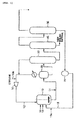
- Fig. 1 The representative example of producing 1-hexene by a continuous reaction process is shown in Fig. 1 .
- a degassing tank 20 In a process having a completely mixing and stirring type reactor 10, a degassing tank 20, an ethylene separation column 30, a high boiling separation column 40, a hexene separation column 50 and a solvent drum 70 which stores a circulation solvent as shown in Fig. 1 , continuous low polymerization reaction of ethylene is conducted to produce 1-hexene.
- Unreacted ethylene separated from the degassing tank 20 and the ethylene separation column 30 is continuously supplied together with ethylene freshly supplied from an ethylene supply piping 12a to the reactor 10 from a first supply piping 12 by a compressor 16.
- a recovered n-heptane solvent separated in the hexene separation column 50 is passed through the solvent drum 70, and is continuously supplied to the reactor 10 from a second supply piping 13 at a flow rate of 40 liters/hr.
- an n-heptane solution containing chromium (III) 2-ethylhexanoate (a) and 2,5-dimethylpyrrole (b) is supplied from a catalyst supply piping 13a at a flow rate of 0.1 liter/hr, and is continuously supplied to the reactor 10 via the second supply piping 13.
- An n-heptane solution of triethylaluminum (c) is continuously supplied to the reactor 10 from a third supply piping 14 at a flow rate of 0.03 liter/hr.
- an n-heptane solution of hexachloroethane (d) is continuously supplied to the reactor 10 from a fourth supply piping 15 at a flow rate of 0.02 liter/hr.
- the reaction conditions are 120°C and 51 kgf/cm 2 .
- 2-Ethylhexanol as a metal solubilizing agent is added to a reaction liquid continuously withdrawn from the reactor 10 from a deactivator supply piping 11 at a flow rate of 0.005 liter/hr, and such a reaction liquid is then successively treated in the degassing tank 20, the ethylene separation column 30, the high boiling separation column 40 and the hexene separation column 50.
- 1-hexene can be obtained from the top of the hexene separation column 50.
- a 2 liters autoclave dried in a dryer at 150°C was assembled in heating, and was vacuum substituted with nitrogen.
- a catalyst feed pipe equipped with a rupture disk was fitted to the autoclave.
- 750 ml of an n-heptane solution containing 26.6 mg (0.280 mmol) of 2,5-dimethylpyrrole, 320 mg (2.80 mmol) of triethylaluminum and 66.4 mg (0.280 mmol) of hexachloroethane was charged in the autoclave.
- 3 ml of an n-heptane solution containing 22.5 mg (0.0467 mmol) of chromium (III) -2-ethylhexanoate was charged in the catalyst feed pipe.
- the autoclave was heated to 120°C, and ethylene was introduced into the catalyst feed pipe.
- the rupture disk was ruptured by ethylene pressure, and ethylene and chromium (III) -2-ethylhexanoate were introduced into the autoclave, thereby low polymerization of ethylene was initiated.
- Ethylene was introduced until the total pressure reaches 51 kgf/cm 2 . Thereafter, the total pressure was maintained at 51 kgf/cm 2 and the reaction temperature was maintained at 120°C.
- 1.46 g (11.2 mmol) of 2-ethylhexanol was introduced into the autoclave, and the reaction was stopped.
- reaction liquid was lowered to 40°C, and ethylene was discharged to obtain a reaction liquid.
- the whole amount of the reaction liquid obtained was charged in a pot of Oldershaw distillation apparatus having 20 actual plates, distillation was conducted at a reflux ratio of 3 at ordinary pressures, and 1-hexene was distilled from the top.
- the top temperature was higher than the boiling point of 1-hexene, distillation of 1-hexene from the top was stopped.
- Halogen atom concentration in 1-hexene was measured in the following manner. That is, 100 ml of 1-hexene and 20 ml of an NaOH aqueous solution (20 wt%) were placed in a separatory funnel, and the separatory funnel was set to a shaker, and shaken for 1 hour. 15 ml of the NaOH aqueous solution was collected, and neutralized with a nitric acid aqueous solution. Analysis was conducted with an ion chromatography under the following measurement conditions. As a result, chlorides (in terms of a chlorine atom) in 1-hexene distilled from the top in Reference Example 2 were 1 ppm by weight.
- organochlorides such as tetrachloroethylene, trichloroethylene and cis-1,2-dischloroethylene were contained in 1-hexene.
- Tetrachloroethylene was added to the above commercially available 1-hexene (a product of Mitsubishi Chemical Corporation, Dialen 6), and concentration was adjusted to 1 ppm by weight as a concentration in terms of a chlorine atom. Such a solution was used as 1-hexene for linear low density polyethylene (LLDPE) production raw material.
- LLDPE linear low density polyethylene
- Example 2 The same operation as in Example 1 was conducted except for using cis-1,2-dicholroethylene in place of tetrachloroethylene.
- LLDPE linear low density polyethylene
- Tetrachloroethylene was added to the above commercially available 1-hexene (a product of Mitsubishi Chemical Corporation, Dialen 6), and concentration was adjusted to 1 ppm by weight as a concentration in terms of a chlorine atom. Such a solution was used as 1-hexene for a raw material of linear low density polyethylene (LLDPE) production.
- LLDPE linear low density polyethylene
- Example 4 and Comparative Example 2 it is seen from Example 4 and Comparative Example 2 that when 1-hexene obtained by trimerization reaction of ethylene using a chromium series catalyst comprising a combination of the chromium compound (a), the nitrogen-containing compound (b), the aluminum-containing compound (c) and the halogen-containing compound (d) is used as a raw material 1-hexene, and the amount of a chloride contained therein is in a range of from 0.05 to 10 ppm by weight in terms of a chlorine atom, catalyst activity is improved, and the yield of a polymer (linear low density polyethylene (LLDPE)) obtained is increased. Furthermore, it is expected that even when a linear low density polyethylene (LLDPE) is produced using 1-hexene continuously produced as in Reference Example 1 as a raw material, the same effect is exhibited.
- a linear low density polyethylene (LLDPE) is produced using 1-hexene continuously produced as in Reference Example 1 as a raw material, the same effect is exhibited.
- catalyst activity is increased, and a polyolefin such as a linear low density polyethylene can industrially advantageously be produced. Therefore, the industrial value of the present invention is remarkable.
Landscapes
- Chemical & Material Sciences (AREA)
- Organic Chemistry (AREA)
- Chemical Kinetics & Catalysis (AREA)
- Health & Medical Sciences (AREA)
- Medicinal Chemistry (AREA)
- Polymers & Plastics (AREA)
- Materials Engineering (AREA)
- Engineering & Computer Science (AREA)
- General Chemical & Material Sciences (AREA)
- Organic Low-Molecular-Weight Compounds And Preparation Thereof (AREA)
- Transition And Organic Metals Composition Catalysts For Addition Polymerization (AREA)
- Addition Polymer Or Copolymer, Post-Treatments, Or Chemical Modifications (AREA)
- Low-Molecular Organic Synthesis Reactions Using Catalysts (AREA)
- Catalysts (AREA)
- Closed-Circuit Television Systems (AREA)
- Television Signal Processing For Recording (AREA)
- Crystallography & Structural Chemistry (AREA)
Applications Claiming Priority (2)
| Application Number | Priority Date | Filing Date | Title |
|---|---|---|---|
| JP2006351967 | 2006-12-27 | ||
| PCT/JP2007/071832 WO2008078462A1 (fr) | 2006-12-27 | 2007-11-09 | Procédé de production de polyoléfines, polyoléfines et 1-hexène destiné à être utilisé en tant que matière première pour la production de polyéthylène linéaire de faible densité |
Publications (2)
| Publication Number | Publication Date |
|---|---|
| EP2098543A1 true EP2098543A1 (fr) | 2009-09-09 |
| EP2098543A4 EP2098543A4 (fr) | 2012-01-25 |
Family
ID=39562256
Family Applications (1)
| Application Number | Title | Priority Date | Filing Date |
|---|---|---|---|
| EP07831563A Withdrawn EP2098543A4 (fr) | 2006-12-27 | 2007-11-09 | Procédé de production de polyoléfines, polyoléfines et 1-hexène destiné à être utilisé en tant que matière première pour la production de polyéthylène linéaire de faible densité |
Country Status (13)
| Country | Link |
|---|---|
| US (1) | US9272961B2 (fr) |
| EP (1) | EP2098543A4 (fr) |
| JP (2) | JP5277630B2 (fr) |
| KR (1) | KR101450925B1 (fr) |
| CN (1) | CN101547944B (fr) |
| BR (1) | BRPI0720610B8 (fr) |
| CA (1) | CA2673907C (fr) |
| EA (1) | EA016590B1 (fr) |
| IN (1) | IN2015DN02831A (fr) |
| MX (1) | MX2009007056A (fr) |
| SG (1) | SG171627A1 (fr) |
| TW (1) | TWI483951B (fr) |
| WO (1) | WO2008078462A1 (fr) |
Cited By (2)
| Publication number | Priority date | Publication date | Assignee | Title |
|---|---|---|---|---|
| US20120302715A1 (en) * | 2010-01-29 | 2012-11-29 | Timur Mikhailovich Zilbershtein | Catalyst System And Processes For The (CO-) Trimerization Of Olefins And The (CO-) Polymerization Of Olefin Oligomers |
| WO2016105228A1 (fr) | 2014-12-23 | 2016-06-30 | Public Joint Stock Company "Sibur Holding" | Procédés de préparation d'oligomères d'une oléfine |
Families Citing this family (10)
| Publication number | Priority date | Publication date | Assignee | Title |
|---|---|---|---|---|
| CN104926589A (zh) * | 2010-03-26 | 2015-09-23 | 三菱化学株式会社 | α-烯烃低聚物的制造方法 |
| JP6459587B2 (ja) * | 2014-02-25 | 2019-01-30 | 三菱ケミカル株式会社 | α−オレフィン低重合体の製造方法 |
| US9175109B1 (en) | 2014-05-20 | 2015-11-03 | Chevron Phillips Chemical Company Lp | Oligomerization processes and polymer compositions produced therefrom |
| US9505675B2 (en) | 2015-02-09 | 2016-11-29 | Chevron Phillips Chemical Company Lp | Deactivation of a process by-product |
| JP6711029B2 (ja) * | 2015-03-25 | 2020-06-17 | 三菱ケミカル株式会社 | α−オレフィン低重合体の製造方法 |
| JP6733252B2 (ja) * | 2015-03-27 | 2020-07-29 | 三菱ケミカル株式会社 | α−オレフィン低重合体の製造方法 |
| WO2017010998A1 (fr) | 2015-07-14 | 2017-01-19 | Chevron Phillips Chemical Company Lp | Compositions d'oléfines |
| US10513473B2 (en) | 2015-09-18 | 2019-12-24 | Chevron Phillips Chemical Company Lp | Ethylene oligomerization/trimerization/tetramerization reactor |
| US10519077B2 (en) | 2015-09-18 | 2019-12-31 | Chevron Phillips Chemical Company Lp | Ethylene oligomerization/trimerization/tetramerization reactor |
| KR102778099B1 (ko) * | 2021-09-07 | 2025-03-10 | 한화솔루션 주식회사 | 올레핀계 중합체의 제조방법 및 이를 이용하여 제조된 올레핀계 중합체 |
Family Cites Families (64)
| Publication number | Priority date | Publication date | Assignee | Title |
|---|---|---|---|---|
| US3093612A (en) * | 1960-05-11 | 1963-06-11 | Monsanto Chemicals | Solutions of polyolefins and an alkoxyalkyl ester of an aliphatic monocarboxylic acid and a process for spinning same |
| US3423491A (en) * | 1964-09-02 | 1969-01-21 | Dow Chemical Co | Permselective hollow fibers and method of making |
| US4020230A (en) * | 1975-10-03 | 1977-04-26 | The Dow Chemical Company | Microporous polyethylene hollow fibers and process of preparing them |
| JPS53103411A (en) | 1977-02-23 | 1978-09-08 | Asahi Chem Ind Co Ltd | Recovery of organic halides |
| US4406673A (en) | 1979-12-27 | 1983-09-27 | Teijin Limited | Ultrathin solid membrane, process for production thereof, and use thereof for concentrating a specified gas in a gaseous mixture |
| FR2504914A1 (fr) | 1981-04-29 | 1982-11-05 | Inst Francais Du Petrole | Procede d'elimination d'impuretes halogenees d'oligomeres d'olefines |
| US4666763A (en) * | 1984-12-07 | 1987-05-19 | Akzona Incorporated | Fiber batts and the method of making |
| JPS63218707A (ja) * | 1987-03-07 | 1988-09-12 | Showa Denko Kk | ポリオレフインの製造方法 |
| JP2703230B2 (ja) * | 1987-07-31 | 1998-01-26 | 株式会社 細川洋行 | 包装袋 |
| US4874567A (en) * | 1987-04-24 | 1989-10-17 | Millipore Corporation | Microporous membranes from polypropylene |
| JP2579370B2 (ja) | 1989-09-11 | 1997-02-05 | 出光石油化学株式会社 | α―オレフィンのハロゲン化不純物の除去方法 |
| JP2825910B2 (ja) | 1990-02-13 | 1998-11-18 | 三井化学株式会社 | オレフィン重合用固体触媒およびオレフィンの重合方法 |
| JP2825911B2 (ja) * | 1990-02-13 | 1998-11-18 | 三井化学株式会社 | オレフィン重合用触媒およびオレフィンの重合方法 |
| JP3255716B2 (ja) | 1991-07-11 | 2002-02-12 | 出光興産株式会社 | オレフィンの重合方法及びオレフィン重合用触媒 |
| JPH05170828A (ja) | 1991-12-19 | 1993-07-09 | Mitsubishi Petrochem Co Ltd | エチレン共重合体及びそれを含有する樹脂組成物 |
| JP3290522B2 (ja) * | 1993-10-21 | 2002-06-10 | 三井化学株式会社 | 耐劣化性ポリプロピレン成形物 |
| JPH08239329A (ja) * | 1995-03-02 | 1996-09-17 | Mitsubishi Chem Corp | α−オレフイン低重合体の製造方法 |
| MY115177A (en) * | 1994-06-21 | 2003-04-30 | Mitsubishi Chem Corp | Process for producing (alpha) -olefin oligomers |
| JP3613642B2 (ja) * | 1994-09-05 | 2005-01-26 | 住友化学株式会社 | 1−ヘキセンの製造方法 |
| JP3473192B2 (ja) * | 1994-09-13 | 2003-12-02 | 三菱化学株式会社 | α−オレフィン低重合体の製造方法 |
| FR2729393B1 (fr) | 1995-01-18 | 1997-03-21 | Bp Chemicals Snc | Procede de polymerisation d'olefine |
| JPH08283325A (ja) * | 1995-04-17 | 1996-10-29 | Tonen Chem Corp | オレフィンの重合方法 |
| JPH0912627A (ja) * | 1995-06-28 | 1997-01-14 | Mitsubishi Chem Corp | α−オレフィン低重合体の製造方法 |
| JPH09194524A (ja) * | 1995-11-15 | 1997-07-29 | Tosoh Corp | オレフィン低重合触媒及びそれを用いたオレフィンの低重合方法 |
| US5856612A (en) * | 1996-02-02 | 1999-01-05 | Mitsubishi Chemical Corporation | Process for producing α-olefin oligomer |
| US6133495A (en) * | 1996-03-14 | 2000-10-17 | Mitsubishi Chemical Corporation | Process for producing α-olefin oligomer |
| JP3766170B2 (ja) * | 1996-03-14 | 2006-04-12 | 三菱化学株式会社 | α−オレフィン低重合体の製造方法 |
| JP3881418B2 (ja) * | 1996-03-15 | 2007-02-14 | 三菱化学株式会社 | α−オレフィン低重合体の製造方法 |
| JPH09268135A (ja) * | 1996-04-02 | 1997-10-14 | Tosoh Corp | 1−ヘキセンの製造方法 |
| JPH09268133A (ja) * | 1996-04-02 | 1997-10-14 | Tosoh Corp | 1−ヘキセンの製造方法 |
| JPH1036435A (ja) * | 1996-07-29 | 1998-02-10 | Mitsubishi Chem Corp | α−オレフィン低重合体の製造方法 |
| JPH10109946A (ja) * | 1996-08-12 | 1998-04-28 | Mitsubishi Chem Corp | α−オレフィン低重合体の製造方法 |
| JPH1160511A (ja) | 1997-08-25 | 1999-03-02 | Mitsubishi Chem Corp | α−オレフィン低重合体の製造方法 |
| JP3743788B2 (ja) | 1997-09-03 | 2006-02-08 | 東ソー株式会社 | 高純度薬品容器用ポリエチレン樹脂、組成物及びそれよりなる高純度薬品容器 |
| AU745419B2 (en) * | 1998-09-16 | 2002-03-21 | Japan Polyolefins Co., Ltd. | Electrical insulating resin material, electrical insulating material, and electric wire and cable using the same |
| WO2002090426A1 (fr) * | 2001-05-09 | 2002-11-14 | Mitsubishi Plastics, Inc. | Film poreux et son procede de production |
| US20020168518A1 (en) * | 2001-05-10 | 2002-11-14 | The Procter & Gamble Company | Fibers comprising starch and polymers |
| US20020168912A1 (en) * | 2001-05-10 | 2002-11-14 | Bond Eric Bryan | Multicomponent fibers comprising starch and biodegradable polymers |
| US6946506B2 (en) * | 2001-05-10 | 2005-09-20 | The Procter & Gamble Company | Fibers comprising starch and biodegradable polymers |
| US6746755B2 (en) * | 2001-09-24 | 2004-06-08 | Siemens Westinghouse Power Corporation | Ceramic matrix composite structure having integral cooling passages and method of manufacture |
| US7271209B2 (en) * | 2002-08-12 | 2007-09-18 | Exxonmobil Chemical Patents Inc. | Fibers and nonwovens from plasticized polyolefin compositions |
| US8003725B2 (en) * | 2002-08-12 | 2011-08-23 | Exxonmobil Chemical Patents Inc. | Plasticized hetero-phase polyolefin blends |
| US7998579B2 (en) * | 2002-08-12 | 2011-08-16 | Exxonmobil Chemical Patents Inc. | Polypropylene based fibers and nonwovens |
| JP2004182971A (ja) * | 2002-08-19 | 2004-07-02 | Japan Polypropylene Corp | ポリオレフィンの製造の改良方法 |
| WO2004016661A1 (fr) | 2002-08-19 | 2004-02-26 | Japan Polypropylene Corporation | Procede destine a produire une polyolefine |
| US6906137B2 (en) * | 2003-03-26 | 2005-06-14 | Dupont Dow Elastomers Llc | Process aid masterbatch for melt processable polymers |
| JP4714424B2 (ja) | 2004-04-20 | 2011-06-29 | Jx日鉱日石エネルギー株式会社 | α−オレフィン重合体の製造方法 |
| JP2006143893A (ja) | 2004-11-19 | 2006-06-08 | Unitika Ltd | 水性分散体および積層フィルム |
| JP2006351967A (ja) | 2005-06-17 | 2006-12-28 | Sony Corp | 多波長半導体レーザ素子 |
| DE102006006396A1 (de) * | 2006-02-11 | 2007-08-16 | Cognis Ip Management Gmbh | Verwendung von Triglyceriden als Weichmacher für Polyolefine |
| MX2010010831A (es) * | 2008-04-04 | 2010-10-25 | Bayer Cropscience Ag | Materiales con insecticidas y aditivos incorporados. |
| US8026188B2 (en) * | 2009-06-25 | 2011-09-27 | Techmer Pm, Llc | Hydrophobic additive for use with fabric, fiber, and film |
| IN2012DE00299A (fr) * | 2011-02-15 | 2015-04-10 | Flow Polymers Llc | |
| EP2710064B1 (fr) * | 2011-05-20 | 2018-07-04 | The Procter and Gamble Company | Fibres formées à partir de compositions polymères/cires |
| EP2710070A2 (fr) * | 2011-05-20 | 2014-03-26 | The Procter and Gamble Company | Compositions à base d'amidon, de polymères et d'huiles et procédé de fabrication et d'utilisation desdites compositions |
| RU2013156462A (ru) * | 2011-05-20 | 2015-06-27 | Дзе Проктер Энд Гэмбл Компани | Формованные изделия на основе композиций, содержащих крахмал, полимер, воск и масло |
| US20120328804A1 (en) * | 2011-05-20 | 2012-12-27 | William Maxwell Allen | Molded articles of polymer-oil compositions |
| CN103547619A (zh) * | 2011-05-20 | 2014-01-29 | 宝洁公司 | 聚合物-油组合物的纤维 |
| US20120321870A1 (en) * | 2011-05-20 | 2012-12-20 | William Maxwell Allen | Films of polymer-oil compositions |
| US20120321871A1 (en) * | 2011-05-20 | 2012-12-20 | Eric Bryan Bond | Films of starch-polymer-wax-oil compositions |
| US20130053480A1 (en) * | 2011-05-20 | 2013-02-28 | William Maxwell Allen | Polymer-oil compositions, methods of making and using the same |
| CN103562289A (zh) * | 2011-05-20 | 2014-02-05 | 宝洁公司 | 聚合物-蜡组合物的膜 |
| US20130004691A1 (en) * | 2011-05-20 | 2013-01-03 | William Maxwell Allen | Molded articles of polymer-wax compositions |
| US9155580B2 (en) * | 2011-08-25 | 2015-10-13 | Medos International Sarl | Multi-threaded cannulated bone anchors |
-
2007
- 2007-11-09 EA EA200970636A patent/EA016590B1/ru not_active IP Right Cessation
- 2007-11-09 CA CA2673907A patent/CA2673907C/fr active Active
- 2007-11-09 CN CN2007800446595A patent/CN101547944B/zh active Active
- 2007-11-09 US US12/521,467 patent/US9272961B2/en active Active
- 2007-11-09 EP EP07831563A patent/EP2098543A4/fr not_active Withdrawn
- 2007-11-09 IN IN2831DEN2015 patent/IN2015DN02831A/en unknown
- 2007-11-09 WO PCT/JP2007/071832 patent/WO2008078462A1/fr not_active Ceased
- 2007-11-09 KR KR1020097011365A patent/KR101450925B1/ko active Active
- 2007-11-09 MX MX2009007056A patent/MX2009007056A/es not_active Application Discontinuation
- 2007-11-09 SG SG201102979-0A patent/SG171627A1/en unknown
- 2007-11-09 BR BRPI0720610A patent/BRPI0720610B8/pt active IP Right Grant
- 2007-12-24 TW TW096149649A patent/TWI483951B/zh active
- 2007-12-26 JP JP2007333927A patent/JP5277630B2/ja active Active
-
2013
- 2013-03-28 JP JP2013068170A patent/JP5541390B2/ja active Active
Cited By (4)
| Publication number | Priority date | Publication date | Assignee | Title |
|---|---|---|---|---|
| US20120302715A1 (en) * | 2010-01-29 | 2012-11-29 | Timur Mikhailovich Zilbershtein | Catalyst System And Processes For The (CO-) Trimerization Of Olefins And The (CO-) Polymerization Of Olefin Oligomers |
| US8921251B2 (en) * | 2010-01-29 | 2014-12-30 | Open Joint Stock Company “Sibur Holding” | Catalyst system and processes for the (co-) trimerization of olefins and the (co-) polymerization of olefin oligomers |
| WO2016105228A1 (fr) | 2014-12-23 | 2016-06-30 | Public Joint Stock Company "Sibur Holding" | Procédés de préparation d'oligomères d'une oléfine |
| US10099970B2 (en) | 2014-12-23 | 2018-10-16 | Public Joint Stock Company “SIBUR Holding” | Methods of preparing oligomers of an olefin |
Also Published As
| Publication number | Publication date |
|---|---|
| SG171627A1 (en) | 2011-06-29 |
| US9272961B2 (en) | 2016-03-01 |
| BRPI0720610B1 (pt) | 2018-11-27 |
| JP2008179801A (ja) | 2008-08-07 |
| IN2015DN02831A (fr) | 2015-09-11 |
| BRPI0720610A2 (pt) | 2014-04-15 |
| WO2008078462A1 (fr) | 2008-07-03 |
| EP2098543A4 (fr) | 2012-01-25 |
| CN101547944B (zh) | 2013-07-24 |
| MX2009007056A (es) | 2009-09-09 |
| KR101450925B1 (ko) | 2014-10-14 |
| CA2673907C (fr) | 2014-09-23 |
| EA016590B1 (ru) | 2012-06-29 |
| KR20090093974A (ko) | 2009-09-02 |
| JP2013155378A (ja) | 2013-08-15 |
| EA200970636A1 (ru) | 2010-02-26 |
| TWI483951B (zh) | 2015-05-11 |
| JP5277630B2 (ja) | 2013-08-28 |
| US20100331503A1 (en) | 2010-12-30 |
| JP5541390B2 (ja) | 2014-07-09 |
| TW200837082A (en) | 2008-09-16 |
| BRPI0720610A8 (pt) | 2018-04-03 |
| CA2673907A1 (fr) | 2008-07-03 |
| BRPI0720610B8 (pt) | 2020-06-09 |
| CN101547944A (zh) | 2009-09-30 |
Similar Documents
| Publication | Publication Date | Title |
|---|---|---|
| US9272961B2 (en) | Production method of polyolefin, polyolefin and 1-hexene for linear low density polyethylene production raw material | |
| JP2005511867A (ja) | オレフィン重合用イミノ−アミド触媒化合物 | |
| CA1329192C (fr) | Catalyseurs prepares a partir de derives tetrakis (dialkylamide ou diarylamide) du titane et polymerisation d'olefines avec ceux-ci | |
| CA2760549A1 (fr) | Procede de production d'un polymere d'ethylene utilisant un catalyseur au chrome | |
| US5364916A (en) | Catalyst and process for the preparation of an olefin polymer | |
| EP4055070B1 (fr) | Systèmes de catalyseurs bimodaux | |
| JPH0665110A (ja) | プロペンオリゴマーの製法 | |
| US4325835A (en) | Catalyst component | |
| JP4610051B2 (ja) | エチレン系重合用触媒、エチレン系重合体およびその製造方法 | |
| US7129305B2 (en) | Heterocyclic-amide catalyst compositions for the polymerization of olefins | |
| US6852659B1 (en) | Method for preparing a catalyst composition and its use in a polymerization process | |
| US4956323A (en) | Catalysts prepared from tetrakis(dialkylamide or diarylamide) derivatives of titanium and polymerization of olefins therewith | |
| US2927103A (en) | Process for polymerizing olefins | |
| US20020035219A1 (en) | Catalyst system for alpha-olefin oligomerization | |
| WO2000032642A1 (fr) | Catalyseur pour la polymerisation d'olefines et procede de production d'un polymere d'olefines a l'aide de ce catalyseur | |
| US7001863B2 (en) | Monoamide based catalyst compositions for the polymerization of olefins | |
| HUP0204027A2 (hu) | Polimerizációs katalizátorok és az ezzel kapcsolatos eljárások | |
| EP2197922B1 (fr) | Catalyseurs de polymérisation d'oléfine, leurs synthèse et utilisation | |
| US5095080A (en) | Olefin polymerization catalyst and method for production and use | |
| US5068212A (en) | Olefin polymerization catalyst and method for production and use | |
| EP2112176A1 (fr) | Catalyseurs de polymérisation d'oléfine, leurs synthèse et utilisation |
Legal Events
| Date | Code | Title | Description |
|---|---|---|---|
| PUAI | Public reference made under article 153(3) epc to a published international application that has entered the european phase |
Free format text: ORIGINAL CODE: 0009012 |
|
| 17P | Request for examination filed |
Effective date: 20090721 |
|
| AK | Designated contracting states |
Kind code of ref document: A1 Designated state(s): AT BE BG CH CY CZ DE DK EE ES FI FR GB GR HU IE IS IT LI LT LU LV MC MT NL PL PT RO SE SI SK TR |
|
| DAX | Request for extension of the european patent (deleted) | ||
| A4 | Supplementary search report drawn up and despatched |
Effective date: 20111228 |
|
| RIC1 | Information provided on ipc code assigned before grant |
Ipc: C08F 2/44 20060101ALI20111221BHEP Ipc: C08F 210/16 20060101ALI20111221BHEP Ipc: C08F 10/00 20060101AFI20111221BHEP Ipc: C07C 2/08 20060101ALI20111221BHEP Ipc: C07C 11/107 20060101ALI20111221BHEP Ipc: C08F 4/69 20060101ALI20111221BHEP Ipc: C07C 2/24 20060101ALI20111221BHEP |
|
| RAP1 | Party data changed (applicant data changed or rights of an application transferred) |
Owner name: MITSUBISHI CHEMICAL CORPORATION |
|
| STAA | Information on the status of an ep patent application or granted ep patent |
Free format text: STATUS: THE APPLICATION IS DEEMED TO BE WITHDRAWN |
|
| 18D | Application deemed to be withdrawn |
Effective date: 20140602 |