EP2103452B1 - Pneu - Google Patents
Pneu Download PDFInfo
- Publication number
- EP2103452B1 EP2103452B1 EP07830748A EP07830748A EP2103452B1 EP 2103452 B1 EP2103452 B1 EP 2103452B1 EP 07830748 A EP07830748 A EP 07830748A EP 07830748 A EP07830748 A EP 07830748A EP 2103452 B1 EP2103452 B1 EP 2103452B1
- Authority
- EP
- European Patent Office
- Prior art keywords
- tire
- inner liner
- liner layer
- rubber
- layer
- Prior art date
- Legal status (The legal status is an assumption and is not a legal conclusion. Google has not performed a legal analysis and makes no representation as to the accuracy of the status listed.)
- Not-in-force
Links
- 229920001971 elastomer Polymers 0.000 claims abstract description 78
- 239000000203 mixture Substances 0.000 claims abstract description 41
- 229920005992 thermoplastic resin Polymers 0.000 claims abstract description 33
- 239000000806 elastomer Substances 0.000 claims abstract description 26
- 229920002725 thermoplastic elastomer Polymers 0.000 claims abstract description 26
- 239000011324 bead Substances 0.000 claims abstract description 23
- 230000003014 reinforcing effect Effects 0.000 claims abstract description 8
- 239000005060 rubber Substances 0.000 claims description 52
- 229920002367 Polyisobutene Polymers 0.000 claims description 18
- 229920003049 isoprene rubber Polymers 0.000 claims description 18
- 238000002156 mixing Methods 0.000 claims description 11
- 239000010410 layer Substances 0.000 description 96
- 239000010408 film Substances 0.000 description 34
- 229920001577 copolymer Polymers 0.000 description 13
- -1 polybutylene terephthalate Polymers 0.000 description 10
- 229920005989 resin Polymers 0.000 description 10
- 239000011347 resin Substances 0.000 description 10
- 239000000463 material Substances 0.000 description 8
- 230000035699 permeability Effects 0.000 description 8
- 238000000034 method Methods 0.000 description 7
- 238000012360 testing method Methods 0.000 description 7
- 238000004898 kneading Methods 0.000 description 6
- 230000000052 comparative effect Effects 0.000 description 5
- 239000000047 product Substances 0.000 description 5
- 229920002379 silicone rubber Polymers 0.000 description 5
- 229920000181 Ethylene propylene rubber Polymers 0.000 description 4
- 239000005062 Polybutadiene Substances 0.000 description 4
- 239000004743 Polypropylene Substances 0.000 description 4
- PPBRXRYQALVLMV-UHFFFAOYSA-N Styrene Natural products C=CC1=CC=CC=C1 PPBRXRYQALVLMV-UHFFFAOYSA-N 0.000 description 4
- 239000012790 adhesive layer Substances 0.000 description 4
- 229920006242 ethylene acrylic acid copolymer Polymers 0.000 description 4
- 229920006225 ethylene-methyl acrylate Polymers 0.000 description 4
- 238000011156 evaluation Methods 0.000 description 4
- 229920001707 polybutylene terephthalate Polymers 0.000 description 4
- 229920000728 polyester Polymers 0.000 description 4
- 229920001155 polypropylene Polymers 0.000 description 4
- 229920002451 polyvinyl alcohol Polymers 0.000 description 4
- 230000002265 prevention Effects 0.000 description 4
- 239000010409 thin film Substances 0.000 description 4
- 229920000219 Ethylene vinyl alcohol Polymers 0.000 description 3
- YCKRFDGAMUMZLT-UHFFFAOYSA-N Fluorine atom Chemical compound [F] YCKRFDGAMUMZLT-UHFFFAOYSA-N 0.000 description 3
- 229920002302 Nylon 6,6 Polymers 0.000 description 3
- 239000003795 chemical substances by application Substances 0.000 description 3
- 238000013329 compounding Methods 0.000 description 3
- UFRKOOWSQGXVKV-UHFFFAOYSA-N ethene;ethenol Chemical compound C=C.OC=C UFRKOOWSQGXVKV-UHFFFAOYSA-N 0.000 description 3
- 229920001038 ethylene copolymer Polymers 0.000 description 3
- 239000004715 ethylene vinyl alcohol Substances 0.000 description 3
- 239000011737 fluorine Substances 0.000 description 3
- 229910052731 fluorine Inorganic materials 0.000 description 3
- 229920000139 polyethylene terephthalate Polymers 0.000 description 3
- 239000005020 polyethylene terephthalate Substances 0.000 description 3
- 239000004945 silicone rubber Substances 0.000 description 3
- 229920003048 styrene butadiene rubber Polymers 0.000 description 3
- 229920000468 styrene butadiene styrene block copolymer Polymers 0.000 description 3
- 239000004709 Chlorinated polyethylene Substances 0.000 description 2
- VGGSQFUCUMXWEO-UHFFFAOYSA-N Ethene Chemical compound C=C VGGSQFUCUMXWEO-UHFFFAOYSA-N 0.000 description 2
- IMROMDMJAWUWLK-UHFFFAOYSA-N Ethenol Chemical compound OC=C IMROMDMJAWUWLK-UHFFFAOYSA-N 0.000 description 2
- 239000005977 Ethylene Substances 0.000 description 2
- GYCMBHHDWRMZGG-UHFFFAOYSA-N Methylacrylonitrile Chemical compound CC(=C)C#N GYCMBHHDWRMZGG-UHFFFAOYSA-N 0.000 description 2
- 229920002292 Nylon 6 Polymers 0.000 description 2
- 229920000305 Nylon 6,10 Polymers 0.000 description 2
- 229920000577 Nylon 6/66 Polymers 0.000 description 2
- 239000002033 PVDF binder Substances 0.000 description 2
- 239000004642 Polyimide Substances 0.000 description 2
- 239000004372 Polyvinyl alcohol Substances 0.000 description 2
- 239000002998 adhesive polymer Substances 0.000 description 2
- 150000001336 alkenes Chemical class 0.000 description 2
- 125000003118 aryl group Chemical group 0.000 description 2
- TZYHIGCKINZLPD-UHFFFAOYSA-N azepan-2-one;hexane-1,6-diamine;hexanedioic acid Chemical compound NCCCCCCN.O=C1CCCCCN1.OC(=O)CCCCC(O)=O TZYHIGCKINZLPD-UHFFFAOYSA-N 0.000 description 2
- 229920003244 diene elastomer Polymers 0.000 description 2
- 230000000694 effects Effects 0.000 description 2
- 239000005043 ethylene-methyl acrylate Substances 0.000 description 2
- 229910052736 halogen Inorganic materials 0.000 description 2
- 150000002367 halogens Chemical class 0.000 description 2
- JRZJOMJEPLMPRA-UHFFFAOYSA-N olefin Natural products CCCCCCCC=C JRZJOMJEPLMPRA-UHFFFAOYSA-N 0.000 description 2
- 229920001084 poly(chloroprene) Polymers 0.000 description 2
- 229920002493 poly(chlorotrifluoroethylene) Polymers 0.000 description 2
- 229920003229 poly(methyl methacrylate) Polymers 0.000 description 2
- 229920002239 polyacrylonitrile Polymers 0.000 description 2
- 229920006122 polyamide resin Polymers 0.000 description 2
- 229920001230 polyarylate Polymers 0.000 description 2
- 239000005023 polychlorotrifluoroethylene (PCTFE) polymer Substances 0.000 description 2
- 229920001721 polyimide Polymers 0.000 description 2
- 229920000642 polymer Polymers 0.000 description 2
- 239000004926 polymethyl methacrylate Substances 0.000 description 2
- 229920002620 polyvinyl fluoride Polymers 0.000 description 2
- 229920002981 polyvinylidene fluoride Polymers 0.000 description 2
- 230000000644 propagated effect Effects 0.000 description 2
- 238000000926 separation method Methods 0.000 description 2
- 229920001935 styrene-ethylene-butadiene-styrene Polymers 0.000 description 2
- BQCIDUSAKPWEOX-UHFFFAOYSA-N 1,1-Difluoroethene Chemical compound FC(F)=C BQCIDUSAKPWEOX-UHFFFAOYSA-N 0.000 description 1
- WERYXYBDKMZEQL-UHFFFAOYSA-N 1,4-butanediol Substances OCCCCO WERYXYBDKMZEQL-UHFFFAOYSA-N 0.000 description 1
- OEPOKWHJYJXUGD-UHFFFAOYSA-N 2-(3-phenylmethoxyphenyl)-1,3-thiazole-4-carbaldehyde Chemical compound O=CC1=CSC(C=2C=C(OCC=3C=CC=CC=3)C=CC=2)=N1 OEPOKWHJYJXUGD-UHFFFAOYSA-N 0.000 description 1
- NLHHRLWOUZZQLW-UHFFFAOYSA-N Acrylonitrile Chemical compound C=CC#N NLHHRLWOUZZQLW-UHFFFAOYSA-N 0.000 description 1
- 229920002943 EPDM rubber Polymers 0.000 description 1
- 244000043261 Hevea brasiliensis Species 0.000 description 1
- VQTUBCCKSQIDNK-UHFFFAOYSA-N Isobutene Chemical group CC(C)=C VQTUBCCKSQIDNK-UHFFFAOYSA-N 0.000 description 1
- JHWNWJKBPDFINM-UHFFFAOYSA-N Laurolactam Chemical compound O=C1CCCCCCCCCCCN1 JHWNWJKBPDFINM-UHFFFAOYSA-N 0.000 description 1
- 241000254043 Melolonthinae Species 0.000 description 1
- 239000004677 Nylon Substances 0.000 description 1
- 229920000571 Nylon 11 Polymers 0.000 description 1
- 229920000299 Nylon 12 Polymers 0.000 description 1
- 229920003189 Nylon 4,6 Polymers 0.000 description 1
- 229920000572 Nylon 6/12 Polymers 0.000 description 1
- 229920000393 Nylon 6/6T Polymers 0.000 description 1
- 229920000007 Nylon MXD6 Polymers 0.000 description 1
- 239000004952 Polyamide Substances 0.000 description 1
- 239000004698 Polyethylene Substances 0.000 description 1
- 239000004793 Polystyrene Substances 0.000 description 1
- 239000002174 Styrene-butadiene Substances 0.000 description 1
- NINIDFKCEFEMDL-UHFFFAOYSA-N Sulfur Chemical compound [S] NINIDFKCEFEMDL-UHFFFAOYSA-N 0.000 description 1
- 229920006172 Tetrafluoroethylene propylene Polymers 0.000 description 1
- 229920010741 Ultra High Molecular Weight Polyethylene (UHMWPE) Polymers 0.000 description 1
- 229920006311 Urethane elastomer Polymers 0.000 description 1
- XTXRWKRVRITETP-UHFFFAOYSA-N Vinyl acetate Chemical compound CC(=O)OC=C XTXRWKRVRITETP-UHFFFAOYSA-N 0.000 description 1
- BZHJMEDXRYGGRV-UHFFFAOYSA-N Vinyl chloride Chemical compound ClC=C BZHJMEDXRYGGRV-UHFFFAOYSA-N 0.000 description 1
- QYKIQEUNHZKYBP-UHFFFAOYSA-N Vinyl ether Chemical compound C=COC=C QYKIQEUNHZKYBP-UHFFFAOYSA-N 0.000 description 1
- BAPJBEWLBFYGME-UHFFFAOYSA-N acrylic acid methyl ester Natural products COC(=O)C=C BAPJBEWLBFYGME-UHFFFAOYSA-N 0.000 description 1
- 229920000800 acrylic rubber Polymers 0.000 description 1
- 229920000122 acrylonitrile butadiene styrene Polymers 0.000 description 1
- 239000004676 acrylonitrile butadiene styrene Substances 0.000 description 1
- 238000005452 bending Methods 0.000 description 1
- 230000005540 biological transmission Effects 0.000 description 1
- FACXGONDLDSNOE-UHFFFAOYSA-N buta-1,3-diene;styrene Chemical compound C=CC=C.C=CC1=CC=CC=C1.C=CC1=CC=CC=C1 FACXGONDLDSNOE-UHFFFAOYSA-N 0.000 description 1
- 229920002301 cellulose acetate Polymers 0.000 description 1
- 229920006217 cellulose acetate butyrate Polymers 0.000 description 1
- 239000012461 cellulose resin Substances 0.000 description 1
- 230000007547 defect Effects 0.000 description 1
- 230000002542 deteriorative effect Effects 0.000 description 1
- RAABOESOVLLHRU-UHFFFAOYSA-N diazene Chemical compound N=N RAABOESOVLLHRU-UHFFFAOYSA-N 0.000 description 1
- 229910000071 diazene Inorganic materials 0.000 description 1
- 150000001993 dienes Chemical class 0.000 description 1
- 125000000118 dimethyl group Chemical group [H]C([H])([H])* 0.000 description 1
- 239000006185 dispersion Substances 0.000 description 1
- 230000002708 enhancing effect Effects 0.000 description 1
- HQQADJVZYDDRJT-UHFFFAOYSA-N ethene;prop-1-ene Chemical group C=C.CC=C HQQADJVZYDDRJT-UHFFFAOYSA-N 0.000 description 1
- HIHIPCDUFKZOSL-UHFFFAOYSA-N ethenyl(methyl)silicon Chemical compound C[Si]C=C HIHIPCDUFKZOSL-UHFFFAOYSA-N 0.000 description 1
- 229920000840 ethylene tetrafluoroethylene copolymer Polymers 0.000 description 1
- 239000000835 fiber Substances 0.000 description 1
- 229920001973 fluoroelastomer Polymers 0.000 description 1
- 229920002681 hypalon Polymers 0.000 description 1
- 150000003949 imides Chemical class 0.000 description 1
- 238000007689 inspection Methods 0.000 description 1
- 229920000554 ionomer Polymers 0.000 description 1
- 239000004973 liquid crystal related substance Substances 0.000 description 1
- FPYJFEHAWHCUMM-UHFFFAOYSA-N maleic anhydride Chemical compound O=C1OC(=O)C=C1 FPYJFEHAWHCUMM-UHFFFAOYSA-N 0.000 description 1
- 239000011159 matrix material Substances 0.000 description 1
- 239000000178 monomer Substances 0.000 description 1
- 238000000465 moulding Methods 0.000 description 1
- GKTNLYAAZKKMTQ-UHFFFAOYSA-N n-[bis(dimethylamino)phosphinimyl]-n-methylmethanamine Chemical compound CN(C)P(=N)(N(C)C)N(C)C GKTNLYAAZKKMTQ-UHFFFAOYSA-N 0.000 description 1
- 229920003052 natural elastomer Polymers 0.000 description 1
- 229920001194 natural rubber Polymers 0.000 description 1
- 229920001778 nylon Polymers 0.000 description 1
- 239000012466 permeate Substances 0.000 description 1
- 239000002985 plastic film Substances 0.000 description 1
- 229920006255 plastic film Polymers 0.000 description 1
- 229920001483 poly(ethyl methacrylate) polymer Polymers 0.000 description 1
- 229920006111 poly(hexamethylene terephthalamide) Polymers 0.000 description 1
- 229920003214 poly(methacrylonitrile) Polymers 0.000 description 1
- 229920000058 polyacrylate Polymers 0.000 description 1
- 229920002647 polyamide Polymers 0.000 description 1
- 229920002857 polybutadiene Polymers 0.000 description 1
- 239000004417 polycarbonate Substances 0.000 description 1
- 229920000515 polycarbonate Polymers 0.000 description 1
- 229920001225 polyester resin Polymers 0.000 description 1
- 239000004645 polyester resin Substances 0.000 description 1
- 229920000573 polyethylene Polymers 0.000 description 1
- 229920000193 polymethacrylate Polymers 0.000 description 1
- 229920005554 polynitrile Polymers 0.000 description 1
- 229920002223 polystyrene Polymers 0.000 description 1
- 229920001021 polysulfide Polymers 0.000 description 1
- 239000005077 polysulfide Substances 0.000 description 1
- 150000008117 polysulfides Polymers 0.000 description 1
- 239000004800 polyvinyl chloride Substances 0.000 description 1
- 229920000915 polyvinyl chloride Polymers 0.000 description 1
- 239000005033 polyvinylidene chloride Substances 0.000 description 1
- 238000000611 regression analysis Methods 0.000 description 1
- 230000002787 reinforcement Effects 0.000 description 1
- 238000005096 rolling process Methods 0.000 description 1
- 229910052717 sulfur Inorganic materials 0.000 description 1
- 239000011593 sulfur Substances 0.000 description 1
- BFKJFAAPBSQJPD-UHFFFAOYSA-N tetrafluoroethene Chemical group FC(F)=C(F)F BFKJFAAPBSQJPD-UHFFFAOYSA-N 0.000 description 1
- 229920001169 thermoplastic Polymers 0.000 description 1
- 229920006230 thermoplastic polyester resin Polymers 0.000 description 1
- 239000004416 thermosoftening plastic Substances 0.000 description 1
- 229920002554 vinyl polymer Polymers 0.000 description 1
- 238000004073 vulcanization Methods 0.000 description 1
Images
Classifications
-
- B—PERFORMING OPERATIONS; TRANSPORTING
- B60—VEHICLES IN GENERAL
- B60C—VEHICLE TYRES; TYRE INFLATION; TYRE CHANGING; CONNECTING VALVES TO INFLATABLE ELASTIC BODIES IN GENERAL; DEVICES OR ARRANGEMENTS RELATED TO TYRES
- B60C1/00—Tyres characterised by the chemical composition or the physical arrangement or mixture of the composition
- B60C1/0008—Compositions of the inner liner
-
- B—PERFORMING OPERATIONS; TRANSPORTING
- B60—VEHICLES IN GENERAL
- B60C—VEHICLE TYRES; TYRE INFLATION; TYRE CHANGING; CONNECTING VALVES TO INFLATABLE ELASTIC BODIES IN GENERAL; DEVICES OR ARRANGEMENTS RELATED TO TYRES
- B60C15/00—Tyre beads, e.g. ply turn-up or overlap
- B60C15/0009—Tyre beads, e.g. ply turn-up or overlap features of the carcass terminal portion
- B60C15/0036—Tyre beads, e.g. ply turn-up or overlap features of the carcass terminal portion with high ply turn-up, i.e. folded around the bead core and terminating radially above the point of maximum section width
-
- B—PERFORMING OPERATIONS; TRANSPORTING
- B60—VEHICLES IN GENERAL
- B60C—VEHICLE TYRES; TYRE INFLATION; TYRE CHANGING; CONNECTING VALVES TO INFLATABLE ELASTIC BODIES IN GENERAL; DEVICES OR ARRANGEMENTS RELATED TO TYRES
- B60C5/00—Inflatable pneumatic tyres or inner tubes
- B60C5/12—Inflatable pneumatic tyres or inner tubes without separate inflatable inserts, e.g. tubeless tyres with transverse section open to the rim
- B60C5/14—Inflatable pneumatic tyres or inner tubes without separate inflatable inserts, e.g. tubeless tyres with transverse section open to the rim with impervious liner or coating on the inner wall of the tyre
-
- B—PERFORMING OPERATIONS; TRANSPORTING
- B29—WORKING OF PLASTICS; WORKING OF SUBSTANCES IN A PLASTIC STATE IN GENERAL
- B29D—PRODUCING PARTICULAR ARTICLES FROM PLASTICS OR FROM SUBSTANCES IN A PLASTIC STATE
- B29D30/00—Producing pneumatic or solid tyres or parts thereof
- B29D30/06—Pneumatic tyres or parts thereof (e.g. produced by casting, moulding, compression moulding, injection moulding, centrifugal casting)
- B29D30/0681—Parts of pneumatic tyres; accessories, auxiliary operations
- B29D2030/0682—Inner liners
-
- B—PERFORMING OPERATIONS; TRANSPORTING
- B60—VEHICLES IN GENERAL
- B60C—VEHICLE TYRES; TYRE INFLATION; TYRE CHANGING; CONNECTING VALVES TO INFLATABLE ELASTIC BODIES IN GENERAL; DEVICES OR ARRANGEMENTS RELATED TO TYRES
- B60C5/00—Inflatable pneumatic tyres or inner tubes
- B60C5/12—Inflatable pneumatic tyres or inner tubes without separate inflatable inserts, e.g. tubeless tyres with transverse section open to the rim
- B60C5/14—Inflatable pneumatic tyres or inner tubes without separate inflatable inserts, e.g. tubeless tyres with transverse section open to the rim with impervious liner or coating on the inner wall of the tyre
- B60C2005/145—Inflatable pneumatic tyres or inner tubes without separate inflatable inserts, e.g. tubeless tyres with transverse section open to the rim with impervious liner or coating on the inner wall of the tyre made of laminated layers
-
- B—PERFORMING OPERATIONS; TRANSPORTING
- B60—VEHICLES IN GENERAL
- B60C—VEHICLE TYRES; TYRE INFLATION; TYRE CHANGING; CONNECTING VALVES TO INFLATABLE ELASTIC BODIES IN GENERAL; DEVICES OR ARRANGEMENTS RELATED TO TYRES
- B60C15/00—Tyre beads, e.g. ply turn-up or overlap
- B60C15/0009—Tyre beads, e.g. ply turn-up or overlap features of the carcass terminal portion
- B60C2015/009—Height of the carcass terminal portion defined in terms of a numerical value or ratio in proportion to section height
-
- Y—GENERAL TAGGING OF NEW TECHNOLOGICAL DEVELOPMENTS; GENERAL TAGGING OF CROSS-SECTIONAL TECHNOLOGIES SPANNING OVER SEVERAL SECTIONS OF THE IPC; TECHNICAL SUBJECTS COVERED BY FORMER USPC CROSS-REFERENCE ART COLLECTIONS [XRACs] AND DIGESTS
- Y10—TECHNICAL SUBJECTS COVERED BY FORMER USPC
- Y10T—TECHNICAL SUBJECTS COVERED BY FORMER US CLASSIFICATION
- Y10T152/00—Resilient tires and wheels
- Y10T152/10—Tires, resilient
- Y10T152/10495—Pneumatic tire or inner tube
- Y10T152/10855—Characterized by the carcass, carcass material, or physical arrangement of the carcass materials
Definitions
- the present invention relates to a pneumatic tire using, in an inner liner layer, a film made of a thermoplastic resin or a thermoplastic elastomer composition obtained by blending an elastomer in a thermoplastic resin. More specifically, the present invention relates to a pneumatic tire which is improved in its internal pressure holding performance while maintaining its durability satisfactorily.
- Conventional practices for preventing air from leaking from a pneumatic radial tire including at least one carcass layer include to increase the thickness of an inner liner layer which is disposed in the innermost surface of the tire, or to use a material with a smaller air permeability coefficient for the inner liner layer.
- the inner liner layer is made thicker, the tire weighs heavier, and the rolling resistance of the tire worsens.
- a material with a smaller air permeability coefficient is used for the inner liner layer (see Patent Document 1, for example) , it is possible to prevent air from leaking from the tire without increasing the weight of the tire.
- the adhesiveness between polyisobutylene isoprene rubber and a diene rubber generally used for the sidewall parts is poor, and therefore, the disposition of the air permeation prevention layer made of the rubber composition mainly containing the polyisobutylene isoprene rubber in the sidewall parts where large deformation of bending occurs, causes a serious problem from a viewpoint of the durability of the tire.
- An object of the present invention is to provide a pneumatic tire whose inner liner layer is formed of a film made of a thermoplastic resin or a thermoplastic elastomer composition obtained by blending an elastomer in a thermoplastic resin; and which is improved in its internal pressure holding performance while maintaining its durability satisfactorily.
- a pneumatic tire according to the present invention made for the purpose of attaining the above-described object is a pneumatic tire in which: a carcass layer including a plurality of reinforcing cords is laid between paired.bead parts; and the carcass layer is wound up around each of bead cores from an inner side to an outer side of the tire.
- the pneumatic tire is characterized in that an inner liner layer including a film made of a thermoplastic resin or a thermoplastic elastomer composition obtained by blending an elastomer in a thermoplastic resin is disposed on a tire inner cavity side of the carcass layer, the inner liner layer is wound up around each bead core from the inner side to the outer side of the tire, and a winding-up height (L-TUH) of the inner liner layer is set at 30% to 50% of a sectional height (SH) of the tire.
- L-TUH winding-up height
- the present invention makes it possible to effectively prevent air having propagated to each wound-up portion of the carcass layer from leaking out to the outer surface of the tire by performing the following: the inner liner layer including the film made of the thermoplastic resin or the thermoplastic elastomer composition obtained by blending the elastomer in the thermoplastic resin is disposed on the tire inner cavity side of the carcass layer; the inner liner layer is wound up around each bead core from the inner side to the outer side of the tire; and the winding-up height (L-TUH) of the inner liner layer is set at 30% to 50% of the sectional height (SH) of the tire.
- the present invention prevents the durability of the tire from deteriorating because the adhesiveness between the rubber composition and the film made of the thermoplastic resin or the thermoplastic elastomer composition obtained by blending the elastomer in the thermoplastic resin is fine. Accordingly, the present invention makes it possible to improve the internal pressure holding performance of the tire can be improved while the durability of the tire is satisfactorily maintained.
- the location of each end of the carcass layer and the location of a corresponding end of the inner liner layer should preferably be separated away from each other by 5 mm or more in the radial direction of the tire. This makes it possible to prevent edge separation from occurring from the location of each end of the carcass layer and from the location of the corresponding end of the inner liner layer.
- the inner liner layer preferably has a structure in which the film is sandwiched between paired rubber sheets.
- each rubber sheet is preferably made of a rubber composition containing a rubber component in which the amount of blended polyisobutylene isoprene rubber is limited to 50% by weight or less. This makes it possible to further improve the adhesiveness between the inner liner layer including the film and the surrounding rubber layer.
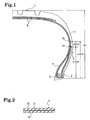
- Fig. 1 shows a pneumatic tire according to an embodiment of the present invention.
- Reference numeral 1 denotes a tread part; 2, a sidewall part; and 3, a bead part.
- a carcass layer 4 including multiple reinforcing cords is laid between paired left and right bead parts 3, 3.
- the carcass layer 4 is wound up around each bead core 5 from the inner side to the outer side of the tire.
- an organic fiber cord such as a nylon cord or a polyester cord is used as the reinforcing cords included in the carcass layer 4.
- Multiple belt layers 6 are embedded in a portion of the tread part 1, which is located on the outer circumferential side of the carcass layer 4. These belt layers 6 are disposed in a way that: the reinforcing cords tilt in the circumferential direction of the tire and cross over with each other in its neighboring belt layer 6.
- an inner liner layer 7 is disposed on the tire cavity side of the carcass layer 4. As shown in the magnified cross-sectional view of Fig. 2 , this inner liner layer 7 is configured of: a film 11 made of a thermoplastic resin or a thermoplastic elastomer composition; and rubber sheets 12, 13 laid on the respective two sides of the film 11.
- the inner liner layer 7 needs to include the film 11. However, the inner liner layer 7 may have a structure in which a rubber sheet is laid on one side of the film only. Otherwise, the inner liner 7 may include the film only.
- the inner liner layer 7 is wound up around each bead core 5 from the inner side to the outer side of the tire.
- the winding-up height (L-TUH) of the inner liner layer 7 is set at 30% to 50% of the sectional height (SH) of the tire.
- the pneumatic tire configured in the above-described manner is capable of effectively preventing air having propagated to each wound-up portion of the carcass layer 4 from leaking out to the outer surface of the tire, even in a case where the air permeates the inner liner layer 7, subsequently reaches the carcass layer 4, thereafter passes along the reinforcing cords included in the carcass layer 4, and eventually propagates to each wound-up portion of the carcass layer 4. That is because the winding-up height (L-TUH) of the inner liner layer 7 including the film 11 is set at 30% to 50% of the sectional height (SH) of the tire.
- the location 4e of each end of the carcass layer 4 and the location 7e of its corresponding end of the inner liner layer 7 should be separated away from each other by 5 mm or more.
- the inner liner layer 7 should have a sandwich structure in which the film 11 is sandwiched between paired rubber sheets 12, 13.
- the rubber composition forming the rubber sheets 12, 13 should contain a rubber component in which the amount of blended polyisobutylene isoprene rubber is limited to 50% by weight or less. It is needless to say that a rubber composition containing no polyisobutylene isoprene rubber is the most suitable.
- adhesiveness between the inner liner layer 7 including the film 11 and the surrounding rubber layer can be further improved.
- the amount of polyisobutylene isoprene rubber blended in the rubber component exceeds 50% by weight, the adhesiveness between the inner liner layer 7 and the surrounding rubber layer becomes insufficient.
- the thickness of the film 11 may be selected from a range of 0.001 mm to 0.300 mm.
- the thickness of each of the rubber sheets 12, 13 laid on the respective two sides of the film 11 should be 0.10 mm to 0.70 mm. Excessive thickness leads to increase in weight.
- This film may be made of a thermoplastic resin or a thermoplastic elastomer composition obtained by blending an elastomer in a thermoplastic resin.
- thermoplastic resin used in the present invention examples include: polyamide resins (for example, nylon 6 (N6), nylon 66 (N66), nylon 46 (N46), nylon 11 (N11), nylon 12 (N12), nylon 610 (N610), nylon 612 (N612), nylon 6/66 copolymers (N6/66), nylon 6/66/610 copolymers (N6/66/610), nylon MXD6, nylon 6T, nylon 6/6T copolymers, nylon 66/PP copolymers, and nylon 66/PPS copolymers); polyester resins (for example, aromatic polyesters such as polybutylene terephthalate (PBT), polyethylene terephthalate (PET), polyethylene isophthalate (PEI), polybutylene terephthalate/tetramethylene glycol copolymers, PET/PEI copolymers, polyarylate (PAR), polybutylene naphthalate (PBN), liquid crystal polyester, and polyoxyalkylene diimide diacid/polylene
- Examples of the elastomer used in the present invention include: diene rubbers and their hydrogenated products (for example, NR, IR, epoxidized natural rubbers, SBR, BR (high-cis BR and low-cis BR), NBR, hydrogenated NBR, and hydrogenated SBR); olefin rubbers (for example, ethylene propylene rubbers (EPDM and EPM) , maleic acid-modified ethylene propylene rubber (M-EPM) ) ; polyisobutylene isoprene rubber (IIR) ; copolymers of isobutylene and aromatic vinyl or diene monomer; acrylic rubber (ACM); ionomers; halogen-containing rubbers (for example, Br-IIR, Cl-IIR, brominated isobutylene para-methylstyrene copolymers (Br-IPMS), chloroprene rubber (CR), hydrin rubbers (CHC and CHR), chlorosulfonated poly
- the composition ratio of the thermoplastic resin component (A) to the elastomer component (B) may be determined by taking into consideration the balance between the thickness and flexibility of the film as appropriate.
- a range is preferably from 10/90 to 90/10, and more preferably from 20/80 to 85/15 in weight ratio.
- thermoplastic elastomer composition as third components, another polymer such as a compatibilizer and compounding agents may be mixed with the above essential components (A) , (B) .
- a compatibilizer and compounding agents may be mixed with the above essential components (A) , (B) .
- the purposes of mixing such other polymers include: improving the compatibility between the thermoplastic resin component and the elastomer component; enhancing the processibility with which the material is molded into the film; improving the heat resistance; and reducing costs.
- the material used for this include polyethylene, polypropylene, polystyrene, ABS, SBS, and polycarbonate.
- thermoplastic elastomer composition is obtained by beforehand melt-kneading the thermoplastic resin and the elastomer (remaining unvalcanized in a case where the elastomer is a rubber) by use of a biaxial kneader/extruder or the like, and thereby dispersing the elastomer component in the thermoplastic resin forming continuous phases.
- the elastomer component is cured, the elastomer may be dynamically vulcanized by adding a vulcanizer while kneaded.
- thermoplastic resin or the elastomer component may be added to the thermoplastic resin or the elastomer component during the kneading process
- the compounding agents should be beforehand mixed together before the kneading process.
- No specific restriction is imposed on the kneader used to knead the thermoplastic resin and the elastomer.
- a screw extruder, a kneader, a Banbury mixer, a biaxial kneader/extruder can be used as the kneader.
- the biaxial kneader/extruder is preferably used to knead the resin component and the rubber component, and to dynamically vulcanize the rubber component.
- two or more types of kneaders may be used to successively knead the resin component and the rubber component.
- the temperature is preferably equal to or higher than a temperature at which the thermoplastic resin starts to melt.
- the shear rate during the kneading process is preferably 2500 sec -1 to 7500 sec -1 .
- the total kneading time is preferably 30 seconds to 10 minutes.
- the vulcanization time after the addition is preferably 15 seconds to 5 minutes.
- the thermoplastic elastomer composition produced by the above-described method is molded into the film by use of a resin extruder or a calendar.
- the thermoplastic elastomer composition thus produced may be molded into the film in accordance with a generally-used method for forming a thermoplastic resin or a thermoplastic elastomer into a film.
- the thus-obtained thin film made of the thermoplastic elastomer composition has a structure in which as discontinuous phases, the elastomer is dispersed in the matrix of the thermoplastic resin. Because the thin film has the thus-conditioned dispersion structure, the Young's modulus of elasticity of the thin film can be set in a range of 1 MPa to 500 MPa. This makes it possible to impart a suitable rigidity to the thin film as a component member of the tire.
- thermoplastic resin or the thermoplastic elastomer composition is molded into a sheet or film.
- the resultant sheet or film may be singly embedded in the inside of the tire. Otherwise, an adhesive layer may be laid on each of the two sides of the sheet or film in order to increase the mutual adhesiveness with the adjacent rubber.
- an adhesive polymer constituting this adhesive layer include: ultra-high molecular weight polyethylene (UHMWPE) having a molecular weight of one million or more, more desirably, three million or more; acrylate copolymers such as ethylene etylacrylate copolymers (EEA), ethylene-methyl acrylate resins (EMA.), and ethylene acrylic acid copolymers (EAA); maleic anhydride products of acrylate copolymers; polypropylene (PP) and its maleic acid-modified products; ethylene propylene copolymers and their maleic acid-modified products; polybutadiene resins and their maleic anhydride-modified products; styrene-butadiene-styrene copolymers (SBS); styrene-ethylene-butadiene-styrene coplymers (SEBS); thermoplastic fluororesins; thermoplastic polyester resins, and the like.
- UHMWPE ultra-high molecular weight
- each adhesive layer There can be molded into a sheet or film, for example, by extruding the adhesive polymers by use of a resin extruder in accordance with an ordinary method. No specific restriction is imposed on the thickness of each adhesive layer. However, it is better that each adhesive layer should be formed thinner for the purpose of reducing the weight of the tire.
- the thickness is preferably 5 ⁇ m to 150 ⁇ m.
- Pneumatic tires with the following common specification were produced for Conventional Example, Examples 1 to 3, and Comparative Example 1 by variously changing: materials constituting the inner liner layer disposed on the tire inner cavity side of the carcass layer: a ratio (L-TUH/SH) of the winding-up height (L-TUH) of the inner liner layer to the sectional height (SH) of the tire; and the difference ( ⁇ TUH) between the winding-up height (C-TUH) of the carcass layer and the winding-up height (L-TUH) of the inner liner layer.
- the common specification was as follows.
- the tire size was 195/60R15.
- the carcass layer including the multiple reinforcing cords was laid between the paired bead parts.
- the carcass layer was wound up around each bead core from the inner side to the outer side of the tire.
- Example 1 represents a reference example which is not within the scope of invention.
- the tire according to Conventional Example used a 0.5-mm-thick inner liner layer made of the rubber composition mainly containing polyisobutylene isoprene rubber, and two end portions of the inner liner layer thereof were terminated in the inner side of the tire.
- the tire according to each of Examples 1 to 2 used a 0.5-mm-thick inner liner layer having a sandwich structure in which a film made of a thermoplastic elastomer composition obtained by blending an elastomer in a thermoplastic resin was sandwiched between the paired rubber sheets, and the inner liner layer was wound up around each bead core from the inner side to the outer side of the tire.
- thermoplastic elastomer composition was obtained by blending a halogen-containing rubber (bromated polyisobutylene isoprene rubber) in a polyamide resin (nylon 6, 66).
- a halogen-containing rubber bromated polyisobutylene isoprene rubber
- a polyamide resin nylon 6, 66.
- the tire according to Example 3 used a 0.4 -mm-thick inner liner layer having a sandwich structure in which a film made of a vinyl alcohol/ethylene copolymer (EVOH) was sandwiched between the paired rubber sheets, and the inner liner layer was wound up around each bead core from the inner side of the outer side of the tire.
- EVOH vinyl alcohol/ethylene copolymer
- the tire according to Comparative Example 1 used a 0.5-mm-thick inner liner layer made of the rubber composition mainly containing polyisobutylene isoprene rubber, and the inner liner layer was wound up around each bead core from the inner side to the outer side of the tire.
- Table 1 shows the degrees of air permeability of the respective inner liner layers by indices based on an index of 100 set for Conventional Example, by using the inverse number of the air permeability which was measured in accordance with JIS K7126 "testing method for gas transmission rate through plastic film and sheeting (Method A)."
- a larger index number means a better resistance to air permeation.
- Each test tire was mounted on a standard rim. Thereafter, each tire thus mounted was left for three months at a 250-kPa initial pressure, at a room temperature of 21°C and with no load imposed on the test tire.
- the internal pressure of each tire was measured every three hours.
- the thus-obtained value ⁇ was defined as a rate of internal pressure reduction per month (%/moth).
- the evaluation results are shown by indices based on an index of 100 set for Conventional Example, by using the inverse number of the rate of inner pressure reduction. A larger index number means a better internal pressure holding performance.
- Each test tire was mounted on a standard rim, and was inflated with a standard air pressure. Thereafter, each resultant test tire was caused to run on a drum at a speed of 80 km/h with a maximum load corresponding to the air pressure being imposed on the tire (see “Correspondence Table of Air Pressures and Load Carrying Capacities" in JATMA Year Book). For each test tire, this run test was terminated once a damage observable by visible inspection of the external appearance occurred on the tire, and the distance that the tire had travelled until the damage occurred was obtained. The evaluation results are shown by indices based on an index of 100 set for Conventional Example. A larger index number means better durability.
- Example 3 Comparative Example 1 Material of Inner Liner Layer Polyisobutylene isoprene rubber Sandwich Structure Sandwich Structure Sandwich Structure Polyisobutylene isoprene rubber Thermoplastic Elastomer EVOH Air Permeability of Liner (Index) 100 100 100 150 100 L-TUH/SH - 0.25 0.50 0.50 0.50 ⁇ TUH (mm) - -16 15 15 15 Internal Pressure Holding Performance (Index) 100 110 120 190 118 Durability (Index) 100 130 150 210 60 * Reference Example which is not within the scope of the invention.
- each of the tires according to Examples 1 to 3 was improved in the internal pressure holding performance while maintaining satisfactorily, in comparison with the tire according to Conventional Example.
- the tire according to Comparative Example 1 exhibited a remarkably reduced durability, because the winding-up height (L-TUH) of the inner liner layer made of the rubber composition mainly containing polyisobutylene isoprene rubber was set higher.
Landscapes
- Engineering & Computer Science (AREA)
- Mechanical Engineering (AREA)
- Tires In General (AREA)
- Compositions Of Macromolecular Compounds (AREA)
Abstract
Claims (6)
- Pneu dans lequel une nappe de carcasse (4) comprenant une pluralité de câbles de renfort est placée entre des parties de talon (3) associées par paires ; la nappe de carcasse (4) est enroulée autour de chacune des tringles de talon (5), en partant d'un côté intérieur jusqu'à un côté extérieur du pneu,
une couche de gomme intérieure (7), comprenant un film (11) constitué de n'importe quelle résine thermoplastique ou composition d'élastomère thermoplastique obtenue en mélangeant un élastomère dans une résine thermoplastique, est disposée sur la nappe de carcasse, à savoir sur un côté de la cavité intérieure du pneu, et
la couche de gomme intérieure (7) est enroulée autour de chacune des tringles de talon (5), en partant du côté intérieur jusqu'au côté extérieur du pneu,
ledit pneu étant caractérisé en ce qu'une hauteur d'enroulement (L-TUH) de la couche de gomme intérieure (7) est réglée en étant comprise entre 30 % et 50 % d'une hauteur de section (SH) du pneu. - Pneu selon la revendication 1, caractérisé en ce qu'un emplacement (4e) de chaque extrémité de la nappe de carcasse et un emplacement (7e) d'une extrémité correspondante de la couche de gomme intérieure sont séparés l'un de l'autre par 5 mm ou plus, suivant une direction radiale du pneu.
- Pneu selon la revendication 1, caractérisé en ce que la couche de gomme intérieure (7) a une structure dans laquelle le film (11) est placé en sandwich entre des feuilles de caoutchouc disposées par paires.
- Pneu selon la revendication 2, caractérisé en ce que la couche de gomme intérieure a une structure dans laquelle le film est placé en sandwich entre des feuilles de caoutchouc (12 et 13) disposées par paires.
- Pneu selon la revendication 3, caractérisé en ce que chaque feuille de caoutchouc (12 ou 13) est constituée d'une composition de caoutchouc dans laquelle une quantité de caoutchouc à base d'isoprène et de polyisobutylène mélangés, dans un composant en caoutchouc, est limitée à ne pas être supérieure à 50 % en poids.
- Pneu selon la revendication 4, caractérisé en ce que chaque feuille de caoutchouc (12 ou 13) est constituée d'une composition de caoutchouc dans laquelle une quantité de caoutchouc à base d'isoprène et de polyisobutylène mélangés, dans un composant en caoutchouc, est limitée à ne pas être supérieure à 50 % en poids.
Applications Claiming Priority (2)
| Application Number | Priority Date | Filing Date | Title |
|---|---|---|---|
| JP2007005879A JP4952263B2 (ja) | 2007-01-15 | 2007-01-15 | 空気入りタイヤ |
| PCT/JP2007/071014 WO2008087776A1 (fr) | 2007-01-15 | 2007-10-29 | Pneu |
Publications (3)
| Publication Number | Publication Date |
|---|---|
| EP2103452A1 EP2103452A1 (fr) | 2009-09-23 |
| EP2103452A4 EP2103452A4 (fr) | 2010-11-17 |
| EP2103452B1 true EP2103452B1 (fr) | 2012-06-27 |
Family
ID=39635782
Family Applications (1)
| Application Number | Title | Priority Date | Filing Date |
|---|---|---|---|
| EP07830748A Not-in-force EP2103452B1 (fr) | 2007-01-15 | 2007-10-29 | Pneu |
Country Status (5)
| Country | Link |
|---|---|
| US (1) | US8201603B2 (fr) |
| EP (1) | EP2103452B1 (fr) |
| JP (1) | JP4952263B2 (fr) |
| CN (1) | CN101583499B (fr) |
| WO (1) | WO2008087776A1 (fr) |
Families Citing this family (18)
| Publication number | Priority date | Publication date | Assignee | Title |
|---|---|---|---|---|
| JP5195310B2 (ja) * | 2008-11-05 | 2013-05-08 | 横浜ゴム株式会社 | 空気入りタイヤ |
| KR20130009974A (ko) * | 2010-02-24 | 2013-01-24 | 스미토모 고무 고교 가부시키가이샤 | 공기 타이어의 제조 방법 |
| US9068063B2 (en) | 2010-06-29 | 2015-06-30 | Eastman Chemical Company | Cellulose ester/elastomer compositions |
| US9273195B2 (en) | 2010-06-29 | 2016-03-01 | Eastman Chemical Company | Tires comprising cellulose ester/elastomer compositions |
| JP5247852B2 (ja) | 2010-11-05 | 2013-07-24 | 住友ゴム工業株式会社 | 空気入りタイヤの製造方法 |
| JP5225431B2 (ja) | 2010-12-06 | 2013-07-03 | 住友ゴム工業株式会社 | ストリップ、その製造方法および空気入りタイヤの製造方法 |
| JP5225364B2 (ja) * | 2010-12-08 | 2013-07-03 | 住友ゴム工業株式会社 | ストリップ、その製造方法および空気入りタイヤの製造方法 |
| JP5722664B2 (ja) * | 2011-03-01 | 2015-05-27 | 株式会社ブリヂストン | 積層体 |
| JP5722663B2 (ja) * | 2011-03-01 | 2015-05-27 | 株式会社ブリヂストン | ゴム積層体 |
| CN103732397A (zh) * | 2011-05-31 | 2014-04-16 | 株式会社普利司通 | 多层结构体、充气轮胎用气密层以及充气轮胎 |
| US9708474B2 (en) | 2011-12-07 | 2017-07-18 | Eastman Chemical Company | Cellulose esters in pneumatic tires |
| JP6070149B2 (ja) * | 2012-08-10 | 2017-02-01 | 横浜ゴム株式会社 | 空気入りタイヤ |
| CN107000481B (zh) * | 2014-12-01 | 2019-01-25 | 株式会社普利司通 | 充气轮胎及其制造方法 |
| JP6645111B2 (ja) * | 2015-10-14 | 2020-02-12 | 住友ゴム工業株式会社 | 空気入りタイヤ |
| US10077342B2 (en) | 2016-01-21 | 2018-09-18 | Eastman Chemical Company | Elastomeric compositions comprising cellulose ester additives |
| EP3480033B1 (fr) * | 2016-06-30 | 2021-04-07 | Kolon Industries, Inc. | Pneumatique |
| JP7163118B2 (ja) * | 2018-09-21 | 2022-10-31 | 横浜ゴム株式会社 | タイヤ用インナーライナーおよび空気入りタイヤ |
| JP7272099B2 (ja) * | 2019-05-10 | 2023-05-12 | 住友ゴム工業株式会社 | 自動二輪車用タイヤ |
Family Cites Families (22)
| Publication number | Priority date | Publication date | Assignee | Title |
|---|---|---|---|---|
| US2939503A (en) * | 1956-01-16 | 1960-06-07 | Cleveland Trust Co | Building ply for pneumatic tires |
| US4627479A (en) * | 1984-11-27 | 1986-12-09 | The Firestone Tire & Rubber Company | Tire construction utilizing low-twist body ply yarn with high turn-up ends |
| JPS62139705A (ja) | 1985-12-13 | 1987-06-23 | Yokohama Rubber Co Ltd:The | 空気入りタイヤ |
| CA1331734C (fr) * | 1988-04-11 | 1994-08-30 | Hercules Incorporated | Structure pare-gaz pour pneumatiques |
| US5156921A (en) | 1988-04-11 | 1992-10-20 | Hercules Incorporated | Tire innerliner |
| US5040583A (en) | 1988-04-11 | 1991-08-20 | Hercules Incorporated | Tire innerliner |
| JP3126148B2 (ja) * | 1995-03-24 | 2001-01-22 | 横浜ゴム株式会社 | 空気入りタイヤ |
| JP3126321B2 (ja) * | 1996-05-14 | 2001-01-22 | 横浜ゴム株式会社 | 空気入りタイヤ |
| JPH11123907A (ja) | 1997-10-24 | 1999-05-11 | Yokohama Rubber Co Ltd:The | 空気入りタイヤ |
| JP3367895B2 (ja) * | 1998-05-11 | 2003-01-20 | 住友ゴム工業株式会社 | 空気入りタイヤの製造方法 |
| JP2000190713A (ja) | 1998-12-25 | 2000-07-11 | Bridgestone Corp | 乗用車用空気入りラジアルタイヤ |
| JP4925521B2 (ja) * | 2000-05-02 | 2012-04-25 | 株式会社ブリヂストン | タイヤ構成部材の製造方法及びタイヤ |
| JP4188580B2 (ja) * | 2001-07-10 | 2008-11-26 | 住友ゴム工業株式会社 | 空気入りラジアルタイヤ |
| WO2003029029A1 (fr) * | 2001-09-05 | 2003-04-10 | The Yokohama Rubber Co., Ltd. | Pneumatique pouvant rouler a plat |
| JP4297241B2 (ja) * | 2001-10-18 | 2009-07-15 | 横浜ゴム株式会社 | 空気入りタイヤ |
| US6913053B2 (en) * | 2002-05-22 | 2005-07-05 | Bridgestone/Firestone North American Tire, Llc | Three ply layer turn-up pneumatic tire |
| US7404424B2 (en) * | 2003-07-17 | 2008-07-29 | The Yokohama Rubber Co., Ltd. | Pneumatic tire with buffer rubber layer |
| JP4487116B2 (ja) | 2003-08-29 | 2010-06-23 | 横浜ゴム株式会社 | 熱可塑樹脂とゴムとの積層体及びその積層方法 |
| JP4613508B2 (ja) * | 2004-04-06 | 2011-01-19 | 横浜ゴム株式会社 | 酸素吸収剤を含む空気入りタイヤ |
| JP2006213300A (ja) * | 2005-02-07 | 2006-08-17 | Bridgestone Corp | 空気入りタイヤ |
| JP2006256557A (ja) * | 2005-03-18 | 2006-09-28 | Bridgestone Corp | 重荷重用タイヤ |
| JP4415966B2 (ja) * | 2006-04-03 | 2010-02-17 | 横浜ゴム株式会社 | 空気入りタイヤの製造方法 |
-
2007
- 2007-01-15 JP JP2007005879A patent/JP4952263B2/ja not_active Expired - Fee Related
- 2007-10-29 CN CN2007800499342A patent/CN101583499B/zh not_active Expired - Fee Related
- 2007-10-29 US US12/518,039 patent/US8201603B2/en not_active Expired - Fee Related
- 2007-10-29 WO PCT/JP2007/071014 patent/WO2008087776A1/fr not_active Ceased
- 2007-10-29 EP EP07830748A patent/EP2103452B1/fr not_active Not-in-force
Also Published As
| Publication number | Publication date |
|---|---|
| WO2008087776A1 (fr) | 2008-07-24 |
| CN101583499B (zh) | 2012-07-04 |
| JP4952263B2 (ja) | 2012-06-13 |
| EP2103452A1 (fr) | 2009-09-23 |
| JP2008168846A (ja) | 2008-07-24 |
| CN101583499A (zh) | 2009-11-18 |
| EP2103452A4 (fr) | 2010-11-17 |
| US8201603B2 (en) | 2012-06-19 |
| US20100314020A1 (en) | 2010-12-16 |
Similar Documents
| Publication | Publication Date | Title |
|---|---|---|
| EP2103452B1 (fr) | Pneu | |
| EP2123480B1 (fr) | Pneumatique et son procédé de fabrication | |
| CN101516645B (zh) | 充气轮胎及其制造方法 | |
| EP2095972B1 (fr) | Pneu | |
| JP5277881B2 (ja) | 空気入りタイヤ | |
| CN101965270B (zh) | 充气轮胎及其制造方法 | |
| JP3620928B2 (ja) | 空気入りタイヤおよびその製造方法 | |
| JP3153093B2 (ja) | 空気入りタイヤ | |
| JPH1016509A (ja) | 空気入りタイヤおよびその製造方法 | |
| JP5071187B2 (ja) | 空気入りタイヤ及びその製造方法 | |
| JP3568322B2 (ja) | 空気入りタイヤ | |
| JP5181467B2 (ja) | 空気入りタイヤ及びその製造方法 | |
| US9902214B2 (en) | Pneumatic tire | |
| JP4779351B2 (ja) | 空気入りラジアルタイヤ | |
| JP3678500B2 (ja) | 空気入りタイヤおよびその製造方法 | |
| JP2010111337A (ja) | 空気入りタイヤ | |
| JP2007297036A (ja) | 空気入りタイヤ | |
| JPH1029404A (ja) | 空気入りタイヤおよびその製造方法 | |
| JP4661280B2 (ja) | 空気入りタイヤ及びその製造方法 | |
| JP5169350B2 (ja) | 空気入りタイヤ | |
| JP5252096B2 (ja) | 空気入りタイヤ | |
| JPH1035216A (ja) | 空気入りタイヤ |
Legal Events
| Date | Code | Title | Description |
|---|---|---|---|
| PUAI | Public reference made under article 153(3) epc to a published international application that has entered the european phase |
Free format text: ORIGINAL CODE: 0009012 |
|
| 17P | Request for examination filed |
Effective date: 20090623 |
|
| AK | Designated contracting states |
Kind code of ref document: A1 Designated state(s): AT BE BG CH CY CZ DE DK EE ES FI FR GB GR HU IE IS IT LI LT LU LV MC MT NL PL PT RO SE SI SK TR |
|
| DAX | Request for extension of the european patent (deleted) | ||
| A4 | Supplementary search report drawn up and despatched |
Effective date: 20101015 |
|
| GRAP | Despatch of communication of intention to grant a patent |
Free format text: ORIGINAL CODE: EPIDOSNIGR1 |
|
| GRAC | Information related to communication of intention to grant a patent modified |
Free format text: ORIGINAL CODE: EPIDOSCIGR1 |
|
| GRAJ | Information related to disapproval of communication of intention to grant by the applicant or resumption of examination proceedings by the epo deleted |
Free format text: ORIGINAL CODE: EPIDOSDIGR1 |
|
| GRAP | Despatch of communication of intention to grant a patent |
Free format text: ORIGINAL CODE: EPIDOSNIGR1 |
|
| GRAS | Grant fee paid |
Free format text: ORIGINAL CODE: EPIDOSNIGR3 |
|
| GRAA | (expected) grant |
Free format text: ORIGINAL CODE: 0009210 |
|
| AK | Designated contracting states |
Kind code of ref document: B1 Designated state(s): AT BE BG CH CY CZ DE DK EE ES FI FR GB GR HU IE IS IT LI LT LU LV MC MT NL PL PT RO SE SI SK TR |
|
| REG | Reference to a national code |
Ref country code: GB Ref legal event code: FG4D |
|
| REG | Reference to a national code |
Ref country code: CH Ref legal event code: EP |
|
| REG | Reference to a national code |
Ref country code: AT Ref legal event code: REF Ref document number: 563950 Country of ref document: AT Kind code of ref document: T Effective date: 20120715 |
|
| REG | Reference to a national code |
Ref country code: IE Ref legal event code: FG4D |
|
| REG | Reference to a national code |
Ref country code: DE Ref legal event code: R096 Ref document number: 602007023691 Country of ref document: DE Effective date: 20120823 |
|
| PG25 | Lapsed in a contracting state [announced via postgrant information from national office to epo] |
Ref country code: LT Free format text: LAPSE BECAUSE OF FAILURE TO SUBMIT A TRANSLATION OF THE DESCRIPTION OR TO PAY THE FEE WITHIN THE PRESCRIBED TIME-LIMIT Effective date: 20120627 Ref country code: FI Free format text: LAPSE BECAUSE OF FAILURE TO SUBMIT A TRANSLATION OF THE DESCRIPTION OR TO PAY THE FEE WITHIN THE PRESCRIBED TIME-LIMIT Effective date: 20120627 Ref country code: SE Free format text: LAPSE BECAUSE OF FAILURE TO SUBMIT A TRANSLATION OF THE DESCRIPTION OR TO PAY THE FEE WITHIN THE PRESCRIBED TIME-LIMIT Effective date: 20120627 |
|
| REG | Reference to a national code |
Ref country code: NL Ref legal event code: VDEP Effective date: 20120627 |
|
| REG | Reference to a national code |
Ref country code: AT Ref legal event code: MK05 Ref document number: 563950 Country of ref document: AT Kind code of ref document: T Effective date: 20120627 |
|
| REG | Reference to a national code |
Ref country code: LT Ref legal event code: MG4D Effective date: 20120627 |
|
| PG25 | Lapsed in a contracting state [announced via postgrant information from national office to epo] |
Ref country code: LV Free format text: LAPSE BECAUSE OF FAILURE TO SUBMIT A TRANSLATION OF THE DESCRIPTION OR TO PAY THE FEE WITHIN THE PRESCRIBED TIME-LIMIT Effective date: 20120627 Ref country code: GR Free format text: LAPSE BECAUSE OF FAILURE TO SUBMIT A TRANSLATION OF THE DESCRIPTION OR TO PAY THE FEE WITHIN THE PRESCRIBED TIME-LIMIT Effective date: 20120928 Ref country code: SI Free format text: LAPSE BECAUSE OF FAILURE TO SUBMIT A TRANSLATION OF THE DESCRIPTION OR TO PAY THE FEE WITHIN THE PRESCRIBED TIME-LIMIT Effective date: 20120627 |
|
| PG25 | Lapsed in a contracting state [announced via postgrant information from national office to epo] |
Ref country code: EE Free format text: LAPSE BECAUSE OF FAILURE TO SUBMIT A TRANSLATION OF THE DESCRIPTION OR TO PAY THE FEE WITHIN THE PRESCRIBED TIME-LIMIT Effective date: 20120627 Ref country code: CY Free format text: LAPSE BECAUSE OF FAILURE TO SUBMIT A TRANSLATION OF THE DESCRIPTION OR TO PAY THE FEE WITHIN THE PRESCRIBED TIME-LIMIT Effective date: 20120627 Ref country code: IS Free format text: LAPSE BECAUSE OF FAILURE TO SUBMIT A TRANSLATION OF THE DESCRIPTION OR TO PAY THE FEE WITHIN THE PRESCRIBED TIME-LIMIT Effective date: 20121027 Ref country code: SK Free format text: LAPSE BECAUSE OF FAILURE TO SUBMIT A TRANSLATION OF THE DESCRIPTION OR TO PAY THE FEE WITHIN THE PRESCRIBED TIME-LIMIT Effective date: 20120627 Ref country code: BE Free format text: LAPSE BECAUSE OF FAILURE TO SUBMIT A TRANSLATION OF THE DESCRIPTION OR TO PAY THE FEE WITHIN THE PRESCRIBED TIME-LIMIT Effective date: 20120627 Ref country code: AT Free format text: LAPSE BECAUSE OF FAILURE TO SUBMIT A TRANSLATION OF THE DESCRIPTION OR TO PAY THE FEE WITHIN THE PRESCRIBED TIME-LIMIT Effective date: 20120627 Ref country code: RO Free format text: LAPSE BECAUSE OF FAILURE TO SUBMIT A TRANSLATION OF THE DESCRIPTION OR TO PAY THE FEE WITHIN THE PRESCRIBED TIME-LIMIT Effective date: 20120627 Ref country code: CZ Free format text: LAPSE BECAUSE OF FAILURE TO SUBMIT A TRANSLATION OF THE DESCRIPTION OR TO PAY THE FEE WITHIN THE PRESCRIBED TIME-LIMIT Effective date: 20120627 |
|
| PG25 | Lapsed in a contracting state [announced via postgrant information from national office to epo] |
Ref country code: IT Free format text: LAPSE BECAUSE OF FAILURE TO SUBMIT A TRANSLATION OF THE DESCRIPTION OR TO PAY THE FEE WITHIN THE PRESCRIBED TIME-LIMIT Effective date: 20120627 Ref country code: PL Free format text: LAPSE BECAUSE OF FAILURE TO SUBMIT A TRANSLATION OF THE DESCRIPTION OR TO PAY THE FEE WITHIN THE PRESCRIBED TIME-LIMIT Effective date: 20120627 Ref country code: PT Free format text: LAPSE BECAUSE OF FAILURE TO SUBMIT A TRANSLATION OF THE DESCRIPTION OR TO PAY THE FEE WITHIN THE PRESCRIBED TIME-LIMIT Effective date: 20121029 |
|
| PG25 | Lapsed in a contracting state [announced via postgrant information from national office to epo] |
Ref country code: NL Free format text: LAPSE BECAUSE OF FAILURE TO SUBMIT A TRANSLATION OF THE DESCRIPTION OR TO PAY THE FEE WITHIN THE PRESCRIBED TIME-LIMIT Effective date: 20120627 |
|
| PG25 | Lapsed in a contracting state [announced via postgrant information from national office to epo] |
Ref country code: ES Free format text: LAPSE BECAUSE OF FAILURE TO SUBMIT A TRANSLATION OF THE DESCRIPTION OR TO PAY THE FEE WITHIN THE PRESCRIBED TIME-LIMIT Effective date: 20121008 Ref country code: DK Free format text: LAPSE BECAUSE OF FAILURE TO SUBMIT A TRANSLATION OF THE DESCRIPTION OR TO PAY THE FEE WITHIN THE PRESCRIBED TIME-LIMIT Effective date: 20120627 |
|
| PLBE | No opposition filed within time limit |
Free format text: ORIGINAL CODE: 0009261 |
|
| STAA | Information on the status of an ep patent application or granted ep patent |
Free format text: STATUS: NO OPPOSITION FILED WITHIN TIME LIMIT |
|
| PG25 | Lapsed in a contracting state [announced via postgrant information from national office to epo] |
Ref country code: MC Free format text: LAPSE BECAUSE OF NON-PAYMENT OF DUE FEES Effective date: 20121031 |
|
| REG | Reference to a national code |
Ref country code: CH Ref legal event code: PL |
|
| 26N | No opposition filed |
Effective date: 20130328 |
|
| GBPC | Gb: european patent ceased through non-payment of renewal fee |
Effective date: 20121029 |
|
| REG | Reference to a national code |
Ref country code: DE Ref legal event code: R097 Ref document number: 602007023691 Country of ref document: DE Effective date: 20130328 |
|
| REG | Reference to a national code |
Ref country code: FR Ref legal event code: ST Effective date: 20130628 |
|
| PG25 | Lapsed in a contracting state [announced via postgrant information from national office to epo] |
Ref country code: LI Free format text: LAPSE BECAUSE OF NON-PAYMENT OF DUE FEES Effective date: 20121031 Ref country code: CH Free format text: LAPSE BECAUSE OF NON-PAYMENT OF DUE FEES Effective date: 20121031 Ref country code: GB Free format text: LAPSE BECAUSE OF NON-PAYMENT OF DUE FEES Effective date: 20121029 Ref country code: BG Free format text: LAPSE BECAUSE OF FAILURE TO SUBMIT A TRANSLATION OF THE DESCRIPTION OR TO PAY THE FEE WITHIN THE PRESCRIBED TIME-LIMIT Effective date: 20120927 |
|
| REG | Reference to a national code |
Ref country code: IE Ref legal event code: MM4A |
|
| PG25 | Lapsed in a contracting state [announced via postgrant information from national office to epo] |
Ref country code: FR Free format text: LAPSE BECAUSE OF NON-PAYMENT OF DUE FEES Effective date: 20121031 |
|
| PG25 | Lapsed in a contracting state [announced via postgrant information from national office to epo] |
Ref country code: IE Free format text: LAPSE BECAUSE OF NON-PAYMENT OF DUE FEES Effective date: 20121029 |
|
| PG25 | Lapsed in a contracting state [announced via postgrant information from national office to epo] |
Ref country code: MT Free format text: LAPSE BECAUSE OF FAILURE TO SUBMIT A TRANSLATION OF THE DESCRIPTION OR TO PAY THE FEE WITHIN THE PRESCRIBED TIME-LIMIT Effective date: 20120627 |
|
| PG25 | Lapsed in a contracting state [announced via postgrant information from national office to epo] |
Ref country code: TR Free format text: LAPSE BECAUSE OF FAILURE TO SUBMIT A TRANSLATION OF THE DESCRIPTION OR TO PAY THE FEE WITHIN THE PRESCRIBED TIME-LIMIT Effective date: 20120627 |
|
| PG25 | Lapsed in a contracting state [announced via postgrant information from national office to epo] |
Ref country code: LU Free format text: LAPSE BECAUSE OF NON-PAYMENT OF DUE FEES Effective date: 20121029 |
|
| PG25 | Lapsed in a contracting state [announced via postgrant information from national office to epo] |
Ref country code: HU Free format text: LAPSE BECAUSE OF FAILURE TO SUBMIT A TRANSLATION OF THE DESCRIPTION OR TO PAY THE FEE WITHIN THE PRESCRIBED TIME-LIMIT Effective date: 20071029 |
|
| PGFP | Annual fee paid to national office [announced via postgrant information from national office to epo] |
Ref country code: DE Payment date: 20151020 Year of fee payment: 9 |
|
| REG | Reference to a national code |
Ref country code: DE Ref legal event code: R119 Ref document number: 602007023691 Country of ref document: DE |
|
| PG25 | Lapsed in a contracting state [announced via postgrant information from national office to epo] |
Ref country code: DE Free format text: LAPSE BECAUSE OF NON-PAYMENT OF DUE FEES Effective date: 20170503 |