EP2128176B1 - Polyvinylacetal und dessen Verwendung - Google Patents
Polyvinylacetal und dessen Verwendung Download PDFInfo
- Publication number
- EP2128176B1 EP2128176B1 EP20090166354 EP09166354A EP2128176B1 EP 2128176 B1 EP2128176 B1 EP 2128176B1 EP 20090166354 EP20090166354 EP 20090166354 EP 09166354 A EP09166354 A EP 09166354A EP 2128176 B1 EP2128176 B1 EP 2128176B1
- Authority
- EP
- European Patent Office
- Prior art keywords
- pva
- polyvinyl acetal
- ink
- paint
- vinyl
- Prior art date
- Legal status (The legal status is an assumption and is not a legal conclusion. Google has not performed a legal analysis and makes no representation as to the accuracy of the status listed.)
- Expired - Lifetime
Links
Classifications
-
- C—CHEMISTRY; METALLURGY
- C09—DYES; PAINTS; POLISHES; NATURAL RESINS; ADHESIVES; COMPOSITIONS NOT OTHERWISE PROVIDED FOR; APPLICATIONS OF MATERIALS NOT OTHERWISE PROVIDED FOR
- C09D—COATING COMPOSITIONS, e.g. PAINTS, VARNISHES OR LACQUERS; FILLING PASTES; CHEMICAL PAINT OR INK REMOVERS; INKS; CORRECTING FLUIDS; WOODSTAINS; PASTES OR SOLIDS FOR COLOURING OR PRINTING; USE OF MATERIALS THEREFOR
- C09D11/00—Inks
- C09D11/02—Printing inks
- C09D11/10—Printing inks based on artificial resins
-
- C—CHEMISTRY; METALLURGY
- C04—CEMENTS; CONCRETE; ARTIFICIAL STONE; CERAMICS; REFRACTORIES
- C04B—LIME, MAGNESIA; SLAG; CEMENTS; COMPOSITIONS THEREOF, e.g. MORTARS, CONCRETE OR LIKE BUILDING MATERIALS; ARTIFICIAL STONE; CERAMICS; REFRACTORIES; TREATMENT OF NATURAL STONE
- C04B35/00—Shaped ceramic products characterised by their composition; Ceramics compositions; Processing powders of inorganic compounds preparatory to the manufacturing of ceramic products
- C04B35/01—Shaped ceramic products characterised by their composition; Ceramics compositions; Processing powders of inorganic compounds preparatory to the manufacturing of ceramic products based on oxide ceramics
-
- C—CHEMISTRY; METALLURGY
- C04—CEMENTS; CONCRETE; ARTIFICIAL STONE; CERAMICS; REFRACTORIES
- C04B—LIME, MAGNESIA; SLAG; CEMENTS; COMPOSITIONS THEREOF, e.g. MORTARS, CONCRETE OR LIKE BUILDING MATERIALS; ARTIFICIAL STONE; CERAMICS; REFRACTORIES; TREATMENT OF NATURAL STONE
- C04B35/00—Shaped ceramic products characterised by their composition; Ceramics compositions; Processing powders of inorganic compounds preparatory to the manufacturing of ceramic products
- C04B35/01—Shaped ceramic products characterised by their composition; Ceramics compositions; Processing powders of inorganic compounds preparatory to the manufacturing of ceramic products based on oxide ceramics
- C04B35/26—Shaped ceramic products characterised by their composition; Ceramics compositions; Processing powders of inorganic compounds preparatory to the manufacturing of ceramic products based on oxide ceramics based on ferrites
- C04B35/2675—Other ferrites containing rare earth metals, e.g. rare earth ferrite garnets
-
- C—CHEMISTRY; METALLURGY
- C04—CEMENTS; CONCRETE; ARTIFICIAL STONE; CERAMICS; REFRACTORIES
- C04B—LIME, MAGNESIA; SLAG; CEMENTS; COMPOSITIONS THEREOF, e.g. MORTARS, CONCRETE OR LIKE BUILDING MATERIALS; ARTIFICIAL STONE; CERAMICS; REFRACTORIES; TREATMENT OF NATURAL STONE
- C04B35/00—Shaped ceramic products characterised by their composition; Ceramics compositions; Processing powders of inorganic compounds preparatory to the manufacturing of ceramic products
- C04B35/01—Shaped ceramic products characterised by their composition; Ceramics compositions; Processing powders of inorganic compounds preparatory to the manufacturing of ceramic products based on oxide ceramics
- C04B35/26—Shaped ceramic products characterised by their composition; Ceramics compositions; Processing powders of inorganic compounds preparatory to the manufacturing of ceramic products based on oxide ceramics based on ferrites
- C04B35/2683—Other ferrites containing alkaline earth metals or lead
-
- C—CHEMISTRY; METALLURGY
- C04—CEMENTS; CONCRETE; ARTIFICIAL STONE; CERAMICS; REFRACTORIES
- C04B—LIME, MAGNESIA; SLAG; CEMENTS; COMPOSITIONS THEREOF, e.g. MORTARS, CONCRETE OR LIKE BUILDING MATERIALS; ARTIFICIAL STONE; CERAMICS; REFRACTORIES; TREATMENT OF NATURAL STONE
- C04B35/00—Shaped ceramic products characterised by their composition; Ceramics compositions; Processing powders of inorganic compounds preparatory to the manufacturing of ceramic products
- C04B35/01—Shaped ceramic products characterised by their composition; Ceramics compositions; Processing powders of inorganic compounds preparatory to the manufacturing of ceramic products based on oxide ceramics
- C04B35/44—Shaped ceramic products characterised by their composition; Ceramics compositions; Processing powders of inorganic compounds preparatory to the manufacturing of ceramic products based on oxide ceramics based on aluminates
-
- C—CHEMISTRY; METALLURGY
- C04—CEMENTS; CONCRETE; ARTIFICIAL STONE; CERAMICS; REFRACTORIES
- C04B—LIME, MAGNESIA; SLAG; CEMENTS; COMPOSITIONS THEREOF, e.g. MORTARS, CONCRETE OR LIKE BUILDING MATERIALS; ARTIFICIAL STONE; CERAMICS; REFRACTORIES; TREATMENT OF NATURAL STONE
- C04B35/00—Shaped ceramic products characterised by their composition; Ceramics compositions; Processing powders of inorganic compounds preparatory to the manufacturing of ceramic products
- C04B35/01—Shaped ceramic products characterised by their composition; Ceramics compositions; Processing powders of inorganic compounds preparatory to the manufacturing of ceramic products based on oxide ceramics
- C04B35/44—Shaped ceramic products characterised by their composition; Ceramics compositions; Processing powders of inorganic compounds preparatory to the manufacturing of ceramic products based on oxide ceramics based on aluminates
- C04B35/443—Magnesium aluminate spinel
-
- C—CHEMISTRY; METALLURGY
- C04—CEMENTS; CONCRETE; ARTIFICIAL STONE; CERAMICS; REFRACTORIES
- C04B—LIME, MAGNESIA; SLAG; CEMENTS; COMPOSITIONS THEREOF, e.g. MORTARS, CONCRETE OR LIKE BUILDING MATERIALS; ARTIFICIAL STONE; CERAMICS; REFRACTORIES; TREATMENT OF NATURAL STONE
- C04B35/00—Shaped ceramic products characterised by their composition; Ceramics compositions; Processing powders of inorganic compounds preparatory to the manufacturing of ceramic products
- C04B35/01—Shaped ceramic products characterised by their composition; Ceramics compositions; Processing powders of inorganic compounds preparatory to the manufacturing of ceramic products based on oxide ceramics
- C04B35/46—Shaped ceramic products characterised by their composition; Ceramics compositions; Processing powders of inorganic compounds preparatory to the manufacturing of ceramic products based on oxide ceramics based on titanium oxides or titanates
- C04B35/462—Shaped ceramic products characterised by their composition; Ceramics compositions; Processing powders of inorganic compounds preparatory to the manufacturing of ceramic products based on oxide ceramics based on titanium oxides or titanates based on titanates
-
- C—CHEMISTRY; METALLURGY
- C04—CEMENTS; CONCRETE; ARTIFICIAL STONE; CERAMICS; REFRACTORIES
- C04B—LIME, MAGNESIA; SLAG; CEMENTS; COMPOSITIONS THEREOF, e.g. MORTARS, CONCRETE OR LIKE BUILDING MATERIALS; ARTIFICIAL STONE; CERAMICS; REFRACTORIES; TREATMENT OF NATURAL STONE
- C04B35/00—Shaped ceramic products characterised by their composition; Ceramics compositions; Processing powders of inorganic compounds preparatory to the manufacturing of ceramic products
- C04B35/01—Shaped ceramic products characterised by their composition; Ceramics compositions; Processing powders of inorganic compounds preparatory to the manufacturing of ceramic products based on oxide ceramics
- C04B35/46—Shaped ceramic products characterised by their composition; Ceramics compositions; Processing powders of inorganic compounds preparatory to the manufacturing of ceramic products based on oxide ceramics based on titanium oxides or titanates
- C04B35/462—Shaped ceramic products characterised by their composition; Ceramics compositions; Processing powders of inorganic compounds preparatory to the manufacturing of ceramic products based on oxide ceramics based on titanium oxides or titanates based on titanates
- C04B35/465—Shaped ceramic products characterised by their composition; Ceramics compositions; Processing powders of inorganic compounds preparatory to the manufacturing of ceramic products based on oxide ceramics based on titanium oxides or titanates based on titanates based on alkaline earth metal titanates
-
- C—CHEMISTRY; METALLURGY
- C04—CEMENTS; CONCRETE; ARTIFICIAL STONE; CERAMICS; REFRACTORIES
- C04B—LIME, MAGNESIA; SLAG; CEMENTS; COMPOSITIONS THEREOF, e.g. MORTARS, CONCRETE OR LIKE BUILDING MATERIALS; ARTIFICIAL STONE; CERAMICS; REFRACTORIES; TREATMENT OF NATURAL STONE
- C04B35/00—Shaped ceramic products characterised by their composition; Ceramics compositions; Processing powders of inorganic compounds preparatory to the manufacturing of ceramic products
- C04B35/01—Shaped ceramic products characterised by their composition; Ceramics compositions; Processing powders of inorganic compounds preparatory to the manufacturing of ceramic products based on oxide ceramics
- C04B35/46—Shaped ceramic products characterised by their composition; Ceramics compositions; Processing powders of inorganic compounds preparatory to the manufacturing of ceramic products based on oxide ceramics based on titanium oxides or titanates
- C04B35/462—Shaped ceramic products characterised by their composition; Ceramics compositions; Processing powders of inorganic compounds preparatory to the manufacturing of ceramic products based on oxide ceramics based on titanium oxides or titanates based on titanates
- C04B35/465—Shaped ceramic products characterised by their composition; Ceramics compositions; Processing powders of inorganic compounds preparatory to the manufacturing of ceramic products based on oxide ceramics based on titanium oxides or titanates based on titanates based on alkaline earth metal titanates
- C04B35/468—Shaped ceramic products characterised by their composition; Ceramics compositions; Processing powders of inorganic compounds preparatory to the manufacturing of ceramic products based on oxide ceramics based on titanium oxides or titanates based on titanates based on alkaline earth metal titanates based on barium titanates
- C04B35/4682—Shaped ceramic products characterised by their composition; Ceramics compositions; Processing powders of inorganic compounds preparatory to the manufacturing of ceramic products based on oxide ceramics based on titanium oxides or titanates based on titanates based on alkaline earth metal titanates based on barium titanates based on BaTiO3 perovskite phase
-
- C—CHEMISTRY; METALLURGY
- C04—CEMENTS; CONCRETE; ARTIFICIAL STONE; CERAMICS; REFRACTORIES
- C04B—LIME, MAGNESIA; SLAG; CEMENTS; COMPOSITIONS THEREOF, e.g. MORTARS, CONCRETE OR LIKE BUILDING MATERIALS; ARTIFICIAL STONE; CERAMICS; REFRACTORIES; TREATMENT OF NATURAL STONE
- C04B35/00—Shaped ceramic products characterised by their composition; Ceramics compositions; Processing powders of inorganic compounds preparatory to the manufacturing of ceramic products
- C04B35/01—Shaped ceramic products characterised by their composition; Ceramics compositions; Processing powders of inorganic compounds preparatory to the manufacturing of ceramic products based on oxide ceramics
- C04B35/46—Shaped ceramic products characterised by their composition; Ceramics compositions; Processing powders of inorganic compounds preparatory to the manufacturing of ceramic products based on oxide ceramics based on titanium oxides or titanates
- C04B35/462—Shaped ceramic products characterised by their composition; Ceramics compositions; Processing powders of inorganic compounds preparatory to the manufacturing of ceramic products based on oxide ceramics based on titanium oxides or titanates based on titanates
- C04B35/465—Shaped ceramic products characterised by their composition; Ceramics compositions; Processing powders of inorganic compounds preparatory to the manufacturing of ceramic products based on oxide ceramics based on titanium oxides or titanates based on titanates based on alkaline earth metal titanates
- C04B35/47—Shaped ceramic products characterised by their composition; Ceramics compositions; Processing powders of inorganic compounds preparatory to the manufacturing of ceramic products based on oxide ceramics based on titanium oxides or titanates based on titanates based on alkaline earth metal titanates based on strontium titanates
-
- C—CHEMISTRY; METALLURGY
- C04—CEMENTS; CONCRETE; ARTIFICIAL STONE; CERAMICS; REFRACTORIES
- C04B—LIME, MAGNESIA; SLAG; CEMENTS; COMPOSITIONS THEREOF, e.g. MORTARS, CONCRETE OR LIKE BUILDING MATERIALS; ARTIFICIAL STONE; CERAMICS; REFRACTORIES; TREATMENT OF NATURAL STONE
- C04B35/00—Shaped ceramic products characterised by their composition; Ceramics compositions; Processing powders of inorganic compounds preparatory to the manufacturing of ceramic products
- C04B35/01—Shaped ceramic products characterised by their composition; Ceramics compositions; Processing powders of inorganic compounds preparatory to the manufacturing of ceramic products based on oxide ceramics
- C04B35/46—Shaped ceramic products characterised by their composition; Ceramics compositions; Processing powders of inorganic compounds preparatory to the manufacturing of ceramic products based on oxide ceramics based on titanium oxides or titanates
- C04B35/462—Shaped ceramic products characterised by their composition; Ceramics compositions; Processing powders of inorganic compounds preparatory to the manufacturing of ceramic products based on oxide ceramics based on titanium oxides or titanates based on titanates
- C04B35/472—Shaped ceramic products characterised by their composition; Ceramics compositions; Processing powders of inorganic compounds preparatory to the manufacturing of ceramic products based on oxide ceramics based on titanium oxides or titanates based on titanates based on lead titanates
-
- C—CHEMISTRY; METALLURGY
- C04—CEMENTS; CONCRETE; ARTIFICIAL STONE; CERAMICS; REFRACTORIES
- C04B—LIME, MAGNESIA; SLAG; CEMENTS; COMPOSITIONS THEREOF, e.g. MORTARS, CONCRETE OR LIKE BUILDING MATERIALS; ARTIFICIAL STONE; CERAMICS; REFRACTORIES; TREATMENT OF NATURAL STONE
- C04B35/00—Shaped ceramic products characterised by their composition; Ceramics compositions; Processing powders of inorganic compounds preparatory to the manufacturing of ceramic products
- C04B35/01—Shaped ceramic products characterised by their composition; Ceramics compositions; Processing powders of inorganic compounds preparatory to the manufacturing of ceramic products based on oxide ceramics
- C04B35/48—Shaped ceramic products characterised by their composition; Ceramics compositions; Processing powders of inorganic compounds preparatory to the manufacturing of ceramic products based on oxide ceramics based on zirconium or hafnium oxides, zirconates, zircon or hafnates
- C04B35/486—Fine ceramics
-
- C—CHEMISTRY; METALLURGY
- C04—CEMENTS; CONCRETE; ARTIFICIAL STONE; CERAMICS; REFRACTORIES
- C04B—LIME, MAGNESIA; SLAG; CEMENTS; COMPOSITIONS THEREOF, e.g. MORTARS, CONCRETE OR LIKE BUILDING MATERIALS; ARTIFICIAL STONE; CERAMICS; REFRACTORIES; TREATMENT OF NATURAL STONE
- C04B35/00—Shaped ceramic products characterised by their composition; Ceramics compositions; Processing powders of inorganic compounds preparatory to the manufacturing of ceramic products
- C04B35/01—Shaped ceramic products characterised by their composition; Ceramics compositions; Processing powders of inorganic compounds preparatory to the manufacturing of ceramic products based on oxide ceramics
- C04B35/495—Shaped ceramic products characterised by their composition; Ceramics compositions; Processing powders of inorganic compounds preparatory to the manufacturing of ceramic products based on oxide ceramics based on vanadium, niobium, tantalum, molybdenum or tungsten oxides or solid solutions thereof with other oxides, e.g. vanadates, niobates, tantalates, molybdates or tungstates
-
- C—CHEMISTRY; METALLURGY
- C04—CEMENTS; CONCRETE; ARTIFICIAL STONE; CERAMICS; REFRACTORIES
- C04B—LIME, MAGNESIA; SLAG; CEMENTS; COMPOSITIONS THEREOF, e.g. MORTARS, CONCRETE OR LIKE BUILDING MATERIALS; ARTIFICIAL STONE; CERAMICS; REFRACTORIES; TREATMENT OF NATURAL STONE
- C04B35/00—Shaped ceramic products characterised by their composition; Ceramics compositions; Processing powders of inorganic compounds preparatory to the manufacturing of ceramic products
- C04B35/515—Shaped ceramic products characterised by their composition; Ceramics compositions; Processing powders of inorganic compounds preparatory to the manufacturing of ceramic products based on non-oxide ceramics
- C04B35/547—Shaped ceramic products characterised by their composition; Ceramics compositions; Processing powders of inorganic compounds preparatory to the manufacturing of ceramic products based on non-oxide ceramics based on sulfides or selenides or tellurides
-
- C—CHEMISTRY; METALLURGY
- C04—CEMENTS; CONCRETE; ARTIFICIAL STONE; CERAMICS; REFRACTORIES
- C04B—LIME, MAGNESIA; SLAG; CEMENTS; COMPOSITIONS THEREOF, e.g. MORTARS, CONCRETE OR LIKE BUILDING MATERIALS; ARTIFICIAL STONE; CERAMICS; REFRACTORIES; TREATMENT OF NATURAL STONE
- C04B35/00—Shaped ceramic products characterised by their composition; Ceramics compositions; Processing powders of inorganic compounds preparatory to the manufacturing of ceramic products
- C04B35/515—Shaped ceramic products characterised by their composition; Ceramics compositions; Processing powders of inorganic compounds preparatory to the manufacturing of ceramic products based on non-oxide ceramics
- C04B35/56—Shaped ceramic products characterised by their composition; Ceramics compositions; Processing powders of inorganic compounds preparatory to the manufacturing of ceramic products based on non-oxide ceramics based on carbides or oxycarbides
-
- C—CHEMISTRY; METALLURGY
- C04—CEMENTS; CONCRETE; ARTIFICIAL STONE; CERAMICS; REFRACTORIES
- C04B—LIME, MAGNESIA; SLAG; CEMENTS; COMPOSITIONS THEREOF, e.g. MORTARS, CONCRETE OR LIKE BUILDING MATERIALS; ARTIFICIAL STONE; CERAMICS; REFRACTORIES; TREATMENT OF NATURAL STONE
- C04B35/00—Shaped ceramic products characterised by their composition; Ceramics compositions; Processing powders of inorganic compounds preparatory to the manufacturing of ceramic products
- C04B35/515—Shaped ceramic products characterised by their composition; Ceramics compositions; Processing powders of inorganic compounds preparatory to the manufacturing of ceramic products based on non-oxide ceramics
- C04B35/58—Shaped ceramic products characterised by their composition; Ceramics compositions; Processing powders of inorganic compounds preparatory to the manufacturing of ceramic products based on non-oxide ceramics based on borides, nitrides, i.e. nitrides, oxynitrides, carbonitrides or oxycarbonitrides or silicides
-
- C—CHEMISTRY; METALLURGY
- C04—CEMENTS; CONCRETE; ARTIFICIAL STONE; CERAMICS; REFRACTORIES
- C04B—LIME, MAGNESIA; SLAG; CEMENTS; COMPOSITIONS THEREOF, e.g. MORTARS, CONCRETE OR LIKE BUILDING MATERIALS; ARTIFICIAL STONE; CERAMICS; REFRACTORIES; TREATMENT OF NATURAL STONE
- C04B35/00—Shaped ceramic products characterised by their composition; Ceramics compositions; Processing powders of inorganic compounds preparatory to the manufacturing of ceramic products
- C04B35/515—Shaped ceramic products characterised by their composition; Ceramics compositions; Processing powders of inorganic compounds preparatory to the manufacturing of ceramic products based on non-oxide ceramics
- C04B35/58—Shaped ceramic products characterised by their composition; Ceramics compositions; Processing powders of inorganic compounds preparatory to the manufacturing of ceramic products based on non-oxide ceramics based on borides, nitrides, i.e. nitrides, oxynitrides, carbonitrides or oxycarbonitrides or silicides
- C04B35/5805—Shaped ceramic products characterised by their composition; Ceramics compositions; Processing powders of inorganic compounds preparatory to the manufacturing of ceramic products based on non-oxide ceramics based on borides, nitrides, i.e. nitrides, oxynitrides, carbonitrides or oxycarbonitrides or silicides based on borides
-
- C—CHEMISTRY; METALLURGY
- C04—CEMENTS; CONCRETE; ARTIFICIAL STONE; CERAMICS; REFRACTORIES
- C04B—LIME, MAGNESIA; SLAG; CEMENTS; COMPOSITIONS THEREOF, e.g. MORTARS, CONCRETE OR LIKE BUILDING MATERIALS; ARTIFICIAL STONE; CERAMICS; REFRACTORIES; TREATMENT OF NATURAL STONE
- C04B35/00—Shaped ceramic products characterised by their composition; Ceramics compositions; Processing powders of inorganic compounds preparatory to the manufacturing of ceramic products
- C04B35/622—Forming processes; Processing powders of inorganic compounds preparatory to the manufacturing of ceramic products
- C04B35/626—Preparing or treating the powders individually or as batches ; preparing or treating macroscopic reinforcing agents for ceramic products, e.g. fibres; mechanical aspects section B
- C04B35/63—Preparing or treating the powders individually or as batches ; preparing or treating macroscopic reinforcing agents for ceramic products, e.g. fibres; mechanical aspects section B using additives specially adapted for forming the products, e.g.. binder binders
- C04B35/632—Organic additives
- C04B35/634—Polymers
- C04B35/63404—Polymers obtained by reactions only involving carbon-to-carbon unsaturated bonds
- C04B35/6342—Polyvinylacetals, e.g. polyvinylbutyral [PVB]
-
- C—CHEMISTRY; METALLURGY
- C08—ORGANIC MACROMOLECULAR COMPOUNDS; THEIR PREPARATION OR CHEMICAL WORKING-UP; COMPOSITIONS BASED THEREON
- C08F—MACROMOLECULAR COMPOUNDS OBTAINED BY REACTIONS ONLY INVOLVING CARBON-TO-CARBON UNSATURATED BONDS
- C08F216/00—Copolymers of compounds having one or more unsaturated aliphatic radicals, each having only one carbon-to-carbon double bond, and at least one being terminated by an alcohol, ether, aldehydo, ketonic, acetal or ketal radical
- C08F216/38—Copolymers of compounds having one or more unsaturated aliphatic radicals, each having only one carbon-to-carbon double bond, and at least one being terminated by an alcohol, ether, aldehydo, ketonic, acetal or ketal radical by an acetal or ketal radical
-
- C—CHEMISTRY; METALLURGY
- C08—ORGANIC MACROMOLECULAR COMPOUNDS; THEIR PREPARATION OR CHEMICAL WORKING-UP; COMPOSITIONS BASED THEREON
- C08F—MACROMOLECULAR COMPOUNDS OBTAINED BY REACTIONS ONLY INVOLVING CARBON-TO-CARBON UNSATURATED BONDS
- C08F8/00—Chemical modification by after-treatment
- C08F8/28—Condensation with aldehydes or ketones
-
- C—CHEMISTRY; METALLURGY
- C08—ORGANIC MACROMOLECULAR COMPOUNDS; THEIR PREPARATION OR CHEMICAL WORKING-UP; COMPOSITIONS BASED THEREON
- C08F—MACROMOLECULAR COMPOUNDS OBTAINED BY REACTIONS ONLY INVOLVING CARBON-TO-CARBON UNSATURATED BONDS
- C08F8/00—Chemical modification by after-treatment
- C08F8/48—Isomerisation; Cyclisation
-
- C—CHEMISTRY; METALLURGY
- C09—DYES; PAINTS; POLISHES; NATURAL RESINS; ADHESIVES; COMPOSITIONS NOT OTHERWISE PROVIDED FOR; APPLICATIONS OF MATERIALS NOT OTHERWISE PROVIDED FOR
- C09D—COATING COMPOSITIONS, e.g. PAINTS, VARNISHES OR LACQUERS; FILLING PASTES; CHEMICAL PAINT OR INK REMOVERS; INKS; CORRECTING FLUIDS; WOODSTAINS; PASTES OR SOLIDS FOR COLOURING OR PRINTING; USE OF MATERIALS THEREFOR
- C09D11/00—Inks
- C09D11/02—Printing inks
- C09D11/10—Printing inks based on artificial resins
- C09D11/106—Printing inks based on artificial resins containing macromolecular compounds obtained by reactions only involving carbon-to-carbon unsaturated bonds
-
- C—CHEMISTRY; METALLURGY
- C09—DYES; PAINTS; POLISHES; NATURAL RESINS; ADHESIVES; COMPOSITIONS NOT OTHERWISE PROVIDED FOR; APPLICATIONS OF MATERIALS NOT OTHERWISE PROVIDED FOR
- C09D—COATING COMPOSITIONS, e.g. PAINTS, VARNISHES OR LACQUERS; FILLING PASTES; CHEMICAL PAINT OR INK REMOVERS; INKS; CORRECTING FLUIDS; WOODSTAINS; PASTES OR SOLIDS FOR COLOURING OR PRINTING; USE OF MATERIALS THEREFOR
- C09D129/00—Coating compositions based on homopolymers or copolymers of compounds having one or more unsaturated aliphatic radicals, each having only one carbon-to-carbon double bond, and at least one being terminated by an alcohol, ether, aldehydo, ketonic, acetal, or ketal radical; Coating compositions based on hydrolysed polymers of esters of unsaturated alcohols with saturated carboxylic acids; Coating compositions based on derivatives of such polymers
- C09D129/14—Homopolymers or copolymers of acetals or ketals obtained by polymerisation of unsaturated acetals or ketals or by after-treatment of polymers of unsaturated alcohols
-
- C—CHEMISTRY; METALLURGY
- C04—CEMENTS; CONCRETE; ARTIFICIAL STONE; CERAMICS; REFRACTORIES
- C04B—LIME, MAGNESIA; SLAG; CEMENTS; COMPOSITIONS THEREOF, e.g. MORTARS, CONCRETE OR LIKE BUILDING MATERIALS; ARTIFICIAL STONE; CERAMICS; REFRACTORIES; TREATMENT OF NATURAL STONE
- C04B2235/00—Aspects relating to ceramic starting mixtures or sintered ceramic products
- C04B2235/02—Composition of constituents of the starting material or of secondary phases of the final product
- C04B2235/30—Constituents and secondary phases not being of a fibrous nature
- C04B2235/32—Metal oxides, mixed metal oxides, or oxide-forming salts thereof, e.g. carbonates, nitrates, (oxy)hydroxides, chlorides
- C04B2235/3231—Refractory metal oxides, their mixed metal oxides, or oxide-forming salts thereof
- C04B2235/3232—Titanium oxides or titanates, e.g. rutile or anatase
- C04B2235/3234—Titanates, not containing zirconia
- C04B2235/3236—Alkaline earth titanates
-
- C—CHEMISTRY; METALLURGY
- C04—CEMENTS; CONCRETE; ARTIFICIAL STONE; CERAMICS; REFRACTORIES
- C04B—LIME, MAGNESIA; SLAG; CEMENTS; COMPOSITIONS THEREOF, e.g. MORTARS, CONCRETE OR LIKE BUILDING MATERIALS; ARTIFICIAL STONE; CERAMICS; REFRACTORIES; TREATMENT OF NATURAL STONE
- C04B2235/00—Aspects relating to ceramic starting mixtures or sintered ceramic products
- C04B2235/02—Composition of constituents of the starting material or of secondary phases of the final product
- C04B2235/50—Constituents or additives of the starting mixture chosen for their shape or used because of their shape or their physical appearance
- C04B2235/54—Particle size related information
- C04B2235/5418—Particle size related information expressed by the size of the particles or aggregates thereof
- C04B2235/5445—Particle size related information expressed by the size of the particles or aggregates thereof submicron sized, i.e. from 0,1 to 1 micron
-
- C—CHEMISTRY; METALLURGY
- C04—CEMENTS; CONCRETE; ARTIFICIAL STONE; CERAMICS; REFRACTORIES
- C04B—LIME, MAGNESIA; SLAG; CEMENTS; COMPOSITIONS THEREOF, e.g. MORTARS, CONCRETE OR LIKE BUILDING MATERIALS; ARTIFICIAL STONE; CERAMICS; REFRACTORIES; TREATMENT OF NATURAL STONE
- C04B2235/00—Aspects relating to ceramic starting mixtures or sintered ceramic products
- C04B2235/60—Aspects relating to the preparation, properties or mechanical treatment of green bodies or pre-forms
- C04B2235/602—Making the green bodies or pre-forms by moulding
- C04B2235/6025—Tape casting, e.g. with a doctor blade
-
- C—CHEMISTRY; METALLURGY
- C04—CEMENTS; CONCRETE; ARTIFICIAL STONE; CERAMICS; REFRACTORIES
- C04B—LIME, MAGNESIA; SLAG; CEMENTS; COMPOSITIONS THEREOF, e.g. MORTARS, CONCRETE OR LIKE BUILDING MATERIALS; ARTIFICIAL STONE; CERAMICS; REFRACTORIES; TREATMENT OF NATURAL STONE
- C04B2235/00—Aspects relating to ceramic starting mixtures or sintered ceramic products
- C04B2235/60—Aspects relating to the preparation, properties or mechanical treatment of green bodies or pre-forms
- C04B2235/61—Mechanical properties, e.g. fracture toughness, hardness, Young's modulus or strength
-
- C—CHEMISTRY; METALLURGY
- C08—ORGANIC MACROMOLECULAR COMPOUNDS; THEIR PREPARATION OR CHEMICAL WORKING-UP; COMPOSITIONS BASED THEREON
- C08F—MACROMOLECULAR COMPOUNDS OBTAINED BY REACTIONS ONLY INVOLVING CARBON-TO-CARBON UNSATURATED BONDS
- C08F226/00—Copolymers of compounds having one or more unsaturated aliphatic radicals, each having only one carbon-to-carbon double bond, and at least one being terminated by a single or double bond to nitrogen or by a heterocyclic ring containing nitrogen
- C08F226/06—Copolymers of compounds having one or more unsaturated aliphatic radicals, each having only one carbon-to-carbon double bond, and at least one being terminated by a single or double bond to nitrogen or by a heterocyclic ring containing nitrogen by a heterocyclic ring containing nitrogen
- C08F226/12—N-Vinylcarbazole
Definitions
- the present invention relates to the use of polyvinyl acetal having N-vinylamide monomer units in the molecule as binder in inks or paints.
- polyvinyl acetal is obtained by acetalyzing polyvinyl alcohol with an aldehyde compound under an acidic condition.
- Polyvinyl alcohol generally has vinyl alcohol units and vinyl ester units. Therefore, polyvinyl acetal obtained through acetalization of such polyvinyl alcohol comprises at least three types of monomer units that include vinyl acetal units in addition to the two types of monomer units of the starting polyvinyl alcohol.
- polyvinyl formal to be produced from polyvinyl alcohol and formaldehyde polyvinyl acetal to be produced from polyvinyl alcohol and acetaldehyde
- polyvinyl butyral to be produced from polyvinyl alcohol and butylaldehyde stand the essential situation in trade.
- polyvinyl butyral is used not only for interlayer films for windowpanes for automobiles and buildings but also in other various industrial fields of binder for ceramic forming, photosensitive materials, dispersant for ink, etc.
- the polymer is used for paint for automobiles, baking enamel, shop primer, wash primer, adhesive lacquer, insulating coat on tar or nicotine, paint for plastics, nitrocellulose lacquer, paper varnish, etc.
- binder for printing ink for wrapping or packaging materials used is polyvinyl butyral of low solution viscosity.
- the printing ink that comprises the polymer well adheres to organic and inorganic substrates and is therefore suitable for prints on polyolefin films, metal foil, cellulose acetate films, polyamide films and polystyrene films.
- polyvinyl acetal of low polymerization which is produced through acetalization of completely hydrolyzed polyvinyl alcohol, is problematic in that the aqueous solution of the polyvinyl acetal readily gels and the pigment content of ink with the polymer could not increase.
- JP-T means a published Japanese translation of a PCT patent application
- polyvinyl acetal is used, for example, as a forming binder in the process of producing ceramic laminate capacitors or producing ceramic substrates for electronic circuits.
- polyvinyl acetal is much used as a binder in producing ceramic green sheets.
- the ceramic powder of the type causes some problems in that the surface of the ceramic green sheets formed of it is often roughened, homogeneous ceramic green sheets are difficult to obtain, and the mechanical strength of thin sheets is low. At present, these problems could not be satisfactorily solved by the polyvinyl acetal heretofore known in the art.
- An object of the invention is to provide a novel polyvinyl acetal of which the solution viscosity is low, the solid content is high (the pigment content is high) and the ink dispersibility is good, and which is suitable for producing ink or paint.
- the invention requires polyvinyl acetal that contains N-vinylamide monomer units in the molecule.
- the polyvinyl acetal for the invention must indispensably contain N-vinylamide monomer units, and the monomer unit content thereof is preferably from 0.1 to 20 mol%, more preferably from 0.5 to 15 mol%, even more preferably from 1 to 12 mol%.
- Polyvinyl acetal having an N-vinylamide monomer unit content of smaller than 0.1 mol% could not attain the subject matter of the invention to the effect that its viscosity is low when its solid content (pigment content) is high; and polyvinyl acetal having an N-vinylamide monomer unit content of larger than 20 mol% will be difficult to produce.
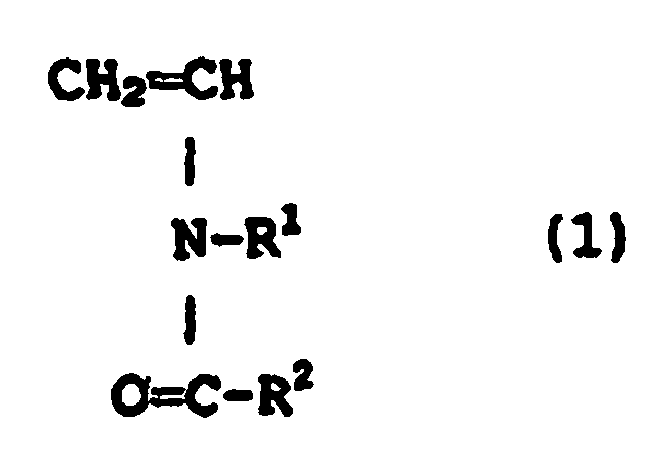
- N-vinylamide monomers for the polymer include, for example, monomers of the following formula (1), N-vinyl-2-pyrrolidones and N-vinyl-2-caprolactam.
- R 1 represents a hydrogen atom, or an alkyl group having from 1 to 3 carbon atoms
- R 2 represents a hydrogen atom, or an alkyl group having from 1 to 5 carbon atoms.
- the alkyl group having from 1 to 3 carbon atoms for R 1 includes, for example, a methyl group, an ethyl group, a propyl group, and an isopropyl group.
- the alkyl group having from 1 to 5 carbon atoms for R 2 includes, for example, a methyl group, an ethyl group, a propyl group, an isopropyl group, a butyl group, an isobutyl group, a t-butyl group, a pentyl group, and an isopentyl group.
- examples of the monomer of formula (1) are N-vinylformamide, N-methyl-N-vinylformamide, N-vinylacetamide, and N-methyl-N-vinylacetamide.
- N-vinyl-2-pyrrolidones are N-vinyl-2-pyrrolidone, N-vinyl-3-propyl-2-pyrrolidone, N-vinyl-5,5-dimethyl-2-pyrrolidone, and N-vinyl-3,5-dimethyl-2-pyrrolidone.
- N-vinylamide monomers for use herein, preferred are the monomers of formula (1) and N-vinyl-2-caprolactam from the viewpoint of the effect of the polymer for reducing viscosity at high solid content (high pigment content).
- the polyvinyl acetal for the invention employable is a known method of acetalization of a polyvinyl alcohol (hereinafter abbreviated as "PVA") that contains N-vinylamide monomer units with an aldehyde compound in an aqueous solvent under an acidic condition.
- PVA polyvinyl alcohol
- the degree of acetalization of the polymer is preferably from 45 to 80 mol%, more preferably from 50 to 78 mol%, even more preferably from 60 to 75 mol%.
- Polyvinyl acetal of which the degree of acetalization is lower than 45 mol% is unfavorable since the powdery reaction product obtained through acetalization will be difficult to recover; and polyvinyl acetal of which the degree of acetalization is higher than 80 mol% will be difficult to produce.
- acetalization of N-vinylamide-having PVA under an acidic condition for example, employable is (a) a method that comprises dissolving N-vinylamide-having PVA in water under heat to prepare an aqueous PVA solution having a concentration of from 5 to 30 %, cooling it to a temperature falling between 5 and 50°C, adding thereto a predetermined amount of aldehyde, then further cooling it to a temperature falling between -10 and 30°C, and controlling the pH of the aqueous solution to be at most 1 by adding acid thereto to thereby initiate acetalization of PVA; or (b) a method that comprises dissolving N-vinylamide-having PVA in water under heat to prepare an aqueous PVA solution having a concentration of from 5 to 30 %, cooling it to a temperature falling between 5 and 50°C, controlling the pH of the aqueous solution to be at most 1 by adding acid thereto, then further cooling it to a temperature falling between -10 and 30°
- the time for acetalization generally falls between 1 and 10 hours or so, and the reaction is preferably effected with stirring.
- the reaction may be further continued at an elevated temperature falling between 50 and 80°C or so.
- the powdery reaction product obtained through the reaction is taken out through filtration, neutralized with an aqueous alkali solution, then washed with water and dried to obtain the intended polyvinyl acetal of the invention.
- the aldehyde compound includes, for example, formaldehyde, acetaldehyde, propionaldehyde, butylaldehyde, hexylaldehyde and benzaldehyde. Their mixtures may also be used in the invention. Of those, preferred are alkylaldehydes having at most 4 carbon atoms and benzaldehyde, and more preferred is butylaldehyde.
- a carboxylic acid-containing aldehyde compound may be used along with the aldehyde compound as above.
- the acid to be used in acetalization is generally an inorganic acid such as hydrochloric acid, sulfuric acid or nitric acid, or an organic acid such as p-toluenesulfonic acid, and their mixtures may also be used.
- the alkali compound to be used as a neutralizing agent after the reaction includes, for example, alkali metal hydroxides such as sodium hydroxide and potassium hydroxide, as well as amine compounds such as ammonia, triethylamine and pyridine.
- N-vinylamide-having PVA employable is any known method of, for example, hydrolyzing a polyvinyl ester that is obtained through copolymerization of a vinyl ester monomer such as vinyl acetate with an N-vinylamide monomer, in a solution of alcohol or dimethylsulfoxide.
- the vinyl ester monomer includes, for example, vinyl formate, vinyl acetate, vinyl propionate, vinyl valerate, vinyl caprate, vinyl laurate, vinyl stearate, vinyl benzoate, vinyl pivalate and vinyl versatate. Of those, preferred is vinyl acetate for industrial PVA production.
- PVA to give the polyvinyl acetal for the invention may contain any other monomer units than vinyl alcohol monomer units, vinyl ester monomer units and N-vinylamide monomer units.
- the additional monomer units include, for example, those of ⁇ -olefins such as ethylene, propylene, 1-hexene; acrylamide and acrylamide derivatives such as N-methylacrylamide; methacrylamide and methacrylamide derivatives such as N-methylmethacrylamide; vinyl ethers such as methyl vinyl ether, ethyl vinyl ether, n-propyl vinyl ether, i-propyl vinyl ether, n-butyl vinyl ether; hydroxyl group-having vinyl ethers such as ethylene glycol vinyl ether, 1,3-propanediol vinyl ether, 1,4-butanediol vinyl ether; allyl acetate; allyl ethers such as propyl allyl ether;
- PVA to give the polyvinyl acetal for the invention may be a terminal-modified derivative that is obtained by copolymerizing a vinyl ester monomer such as vinyl acetate with an N-vinylamide monomer in the presence of a thiol compound such as thiolacetic acid or mercaptopropionic acid, followed by hydrolyzing the resulting polymer.
- a vinyl ester monomer such as vinyl acetate
- N-vinylamide monomer in the presence of a thiol compound such as thiolacetic acid or mercaptopropionic acid
- Copolymerization of vinyl ester monomer with N-vinylamide monomer may be effected in any known manner of, for example, bulk polymerization, solution polymerization, suspension polymerization or emulsion polymerization. Of those, generally employed is bulk polymerization of polymerizing the monomers in the absence of a solvent or solution polymerization of polymerizing them in a solvent such as alcohol.
- the alcohol that serves as a solvent in solution polymerization is, for example, a lower alcohol such as methanol, ethanol or propanol.
- the initiator for copolymerization of vinyl ester monomer with N-vinylamide monomer may be any known initiator, including, for example, azo initiators such as 2,2'-azobis(isobutyronitrile), 2,2'-azobis(2,4-dimethylvaleronitrile), and peroxide initiators such as benzoyl peroxide, n-propyl peroxycarbonate.
- azo initiators such as 2,2'-azobis(isobutyronitrile), 2,2'-azobis(2,4-dimethylvaleronitrile)
- peroxide initiators such as benzoyl peroxide, n-propyl peroxycarbonate.
- the polymerization temperature is suitably between 0°C and 150°C.
- the copolymer of vinyl ester monomer and N-vinylamide monomer is then hydrolyzed, while it is dissolved in alcohol or optionally in water-containing alcohol.
- Alcohol to be used for hydrolysis may be a lower alcohol such as methanol or ethanol, and methanol is especially preferred.
- the alcohol for hydrolysis may contain at most 40 % by weight of any other solvent such as acetone, methyl acetate or benzene.
- the catalyst for hydrolysis may be an alkaline catalyst such as potassium hydroxide or sodium hydroxide, or an acid catalyst such as sulfuric acid, hydrochloric acid or p-toluenesulfonic acid.
- the condition for hydrolysis may be suitably controlled depending on the structure of the polyvinyl ester and on the degree of hydrolysis of the intended PVA.
- the molar ratio of catalyst/vinyl ester monomer units falls between 0.001 and 5.0; the reaction temperature falls between 20 and 180°C; and the reaction time falls between 0.1 and 20 hours.
- Hydrolysis may be effected in any known batch process or continuous process.
- PVA is washed in any known batch process or continuous process, and then dried.
- employable is any known heating process or vacuum drying process.
- PVA is dried at 60 to 150°C for 1 to 20 hours.
- the polyvinyl acetal for the invention is obtained through acetalization of N-vinylamide-having PVA, it contains vinyl ester monomer units.
- the vinyl ester monomer unit content of the polymer is preferably from 0.01 to 20 mol%, more preferably from 0.5 to 15 mol%, even more preferably from 1 to 10 mol%.
- Polyvinyl acetal having a vinyl ester monomer unit content of smaller than 0.01 mol% is unfavorable since the starting PVA is difficult to produce; and polyvinyl acetal having a vinyl ester monomer unit content of larger than 20 mol% is also unfavorable since the subject matter of the invention of producing low-viscosity printing ink having a high solid content (high pigment content) will be difficult to attain.
- the degree of polymerization of PVA to give the polyvinyl acetal for the invention is not specifically defined.
- the degree of polymerization of PVA to give it is preferably from 100 to 700, more preferably from 120 to 600, even more preferably from 150 to 550 .
- PVA having a degree of polymerization of lower than 100 is difficult to produce on an industrial scale; and PVA having a degree of polymerization of higher than 700 is unfavorable since the subject matter of the invention of producing low-viscosity printing ink having a high solid content (high pigment content) is difficult to attain.
- the degree of polymerization of PVA to give the polyvinyl acetal for the invention means a viscosity-average degree of polymerization thereof, and it is measured according to JIS-K6726.
- the polyvinyl acetal content of printing ink or paint may vary in a broad range, depending on the intended use, but is preferably from 1 to 35 % by weight, more preferably from 5 to 25 % by weight.
- ink or paint of the invention may contain from 5 to 25 % by weight of pigment, from 5 to 25 % of polyvinyl acetal, and some solvent.
- the pigment to be in the printing ink or pigment may be any and every known organic and inorganic pigment.
- the solvent may be alcohols such as ethyl alcohol or esters such as ethyl acetate.
- the polyvinyl acetal may serve as a binder by itself, or may be combined with any other extender resin or auxiliary agent.
- the polyvinyl acetal may serve by itself as an additive to ink.
- the viscosity of the solution obtained by adding one or more pigments to a solution of the polyvinyl acetal of the invention followed by kneading the resulting pigment paste is lower than the solution viscosity that is estimated from the viscosity of the polyvinyl acetal itself. Therefore compared with any known polyvinyl acetal, the polyvinyl acetal for the invention significantly lowers the solution viscosity. Accordingly, the polyvinyl acetal for the invention may reduce the necessary amount of varnish or solvent to be used in controlling the viscosity of printing ink or paint to an optimum level, and it increases the acceptable pigment content of printing ink or paint.
- the invention satisfies the requirement of increasing the degree of coloration with ink or paint while the viscosity is kept optimum as in the related art and satisfies the requirement of lowering the ink or paint viscosity not changing the degree of coloration with it.
- the polyvinyl acetal for the invention is extremely suitable not only to production of highly-colored printing ink and high-solid paint but also to production of other pigment compositions.
- PVA is analyzed according to the method described in JIS-K6726.
- the content of N-vinylamide monomer units and the content of vinyl ester monomer units in PVA are obtained by analyzing a sample of the polymer dissolved in DMSO-d6, using a 500-MHz proton NMR device (JEOL GX-500).
- the degree of acetalization of polyvinyl acetal is obtained by analyzing a sample of the polymer dissolved in DMSO-d6, using a 500-MHz proton NMR device (JEOL GX-500).
- 16000 g of vinyl acetate monomer, 64000 g of methanol and 183.6 g of N-vinylacetamide were fed into a 200-liter reactor equipped with a stirrer, a reflux condenser, a nitrogen inlet duct, a comonomer serial addition line and a thermometer, and degassed through bubbling with nitrogen gas for 30 minutes. Heating the reactor was started, and when the inner temperature of the reactor reached 60°C, 60 g of 2,2'-azobis (isobutyronitrile) was added thereto to initiate the polymerization.
- a 10 % methanol solution of N-vinylacetamide was added to the system via the comonomer addition line, at a flow rate of 880 ml/hr.
- 5 ml of the liquid was sampled out of the polymerization system at regular intervals of 30 minutes, and its solid content was measured. From the data, the conversion of vinyl acetate was derived, and the flow rate of the 10 % methanol solution of N-vinylacetamide was so controlled that the molar ratio of the remaining vinyl acetate monomer to N-vinylacetamide could be constant, and in that controlled condition, the polymerization was continued.
- the methanol solution of polyvinyl acetate copolymer was made to have a concentration of 30 % with methanol added thereto, and 6660 g of the resulting methanol solution was hydrolyzed at 40°C with 278 g of a methanol solution of sodium hydroxide having a concentration of 10 % being added thereto (the molar ratio of sodium hydroxide/vinyl acetate units in the copolymer was 0.03). After a gel product was deposited, this was ground. One hour after the addition of sodium hydroxide, 30000 g of methyl acetate was added to the system, and this was heated in a hot water bath at 70°C for 1 hour to neutralize the non-reacted sodium hydroxide.
- the product was dewatered, and 30000 g of methanol was added thereto and heated in a hot water bath at 70°C for 1 hour. The washing operation was repeated twice. Thus washed, the product was dried under heat at 65°C for 12 hours to obtain the intended PVA. Obtained through proton NMR, the content of N-vinylacetamide monomer units and the content of vinyl ester monomer units in PVA were 3.1 mol% and 2.8 mol%, respectively. The viscosity-average degree of polymerization of PVA was obtained according to an ordinary method of JIS K6726, and it was 230.
- PVA-2 to PVA-23 were obtained in the same manner as that for PVA-1, except that the polymerization condition and the hydrolysis condition were varied so that the content of N-vinylamide monomer units and the content of vinyl ester monomer units in PVA and the degree of polymerization of PVA could be as in Table 1.
- PVA (PVA-24) was obtained in the same manner as that for PVA-1, except that 1-methylvinyl acetate was used instead of N-vinylamide monomer, and the polymerization condition and the hydrolysis condition were varied so that the content of 1-methylvinyl alcohol unit obtained by hydrolysis and the content of vinyl ester monomer unit in PVA and the degree of polymerization of PVA could be as in Table 1.
- a second step printing inks was prepared as follows: 43.2g of polyvinyl acetal were dissolved in 244.8g of ethanol at room temperature. Subsequently 72g of Hostaperm Blue B2G (pigment from Clariant GmbH) were added. The resulting mixture was dispersed in a Getzmann Dispermat, model CA 40-C, with the following settings selected:
- the pigment concentrate obtained was separated from the glass beads on a filter.
- 80g of each pigment concentrate were taken and this initial charge was diluted with a 15% strength by weight solution of the respective polyvinyl acetal until the printing ink had an efflux time of 25s (DIN 53211, Ford cup, 4mm, at 23°C).
- Table 4 contains the composition of the printing inks.
- the pigment: binder ratio which reflects the proportion of the amount of pigment to binder present in the printing ink. The greater the extent to which the pigment: binder ratio is shifted toward the pigment side, the more effectively the binder used can be pigmented and the better are the dispersing properties of the binder.
- polyvinyl acetals were produced in the same manner as in Example 1, except that the PVA and the aldehyde to be used were varied as in Table 2 and the amount of aldehyde to be used was varied so that the degree of acetalization of the polyvinyl acetals produced could be as in Table 2. Efflux times of the ethanolic solutions and composition of the printing inks with an efflux time of 25 s were measured and the data are given in Table 3 and Table 4.
- Example 1 PVA-1 BuAl 71.0 VAP-1
- Example 2 PVA-2 BuAl 60.1 VAP-2
- Example 3 PVA-7 BuAl 73.1 VAP-3
- Example 4 PVA-8 BuAl 70.2 VAP-4
- Example 5 PVA-9 BuAl 73.6 VAP-5
- Example 6 PVA-10 BuAl 65.9 VAP-6
- Example 7 PVA-11 BuAl 61.8 VAP-7
- Example 8 PVA-16 BuAl 72.0 VAP-8
- Example 9 PVA-1 PrAl 73.4 VAP-9
- Example 10 PVA-9 PrAl 70.7 VAP-10
- Example 11 PVA-1 BuAl 54.6 VAP-11
- Example 12 PVA-1 BuAl 41.6 VAP-12
- Example 13 PVA-3 BuAl 59.3 VAP-13
- Example 14 PVA-4 BuAl 68.5 VAP-14 Comp.
- Example 1 PVA-17 BuAl 72.1 VAP-15 Comp.
- Example 2 PVA-18 BuAl 72.4 VAP-16 Comp.
- Example 3 PVA-19 BuAl 70.7 VAP-17 Comp.
- Example 4 PVA-17 PrAl 70.9 VAP-18 Comp.
- Example 5 PVA-23 BuAl 68.5 VAP-19 Comp.
- Example 6 PVA-24 BuAl 68.9 VAP-20 BuAl: butylaldehyde PrAl: propylaldehyde Table 3 Efflux time of a strength by weight solution in ethanol 15% Efflux time of a 25% strength by weight solution in ethanol
- Example 1 16 s 43 s
- Example 2 15 s 42 s
- Example 3 16 s 51 s
- Example 4 15 s 40 s
- Example 5 16 s 40 s
- Example 6 14 s 38 s
- Example 7 14 s 39 s
- Example 8 16 s 42 s
- Example 9 17 s 45 s
- Example 10 17 s 46 s
- Example 11 18 s 51 s
- Example 12 19 s 52 s
- Example 13 18 s 51 s
- Table 4 Pigment content (% by weight) Polyvinyl acetal content (% by weight) Pigment:binder ratio Example 1 15.0 12.8 1 : 0.85
- Example 1 10.8 13.4 1 : 1.24 Comp.
- Example 2 12.0 13.2 1 : 1.10 Comp.
- Example 3 11.8 13.2 1 : 1.12 Comp.
- Example 4 10.6 13.6 1 : 1.28 Comp.
- Example 5 12.9 13.6 1 : 1.05 Comp.
- Example 6 13.2 13.8 1 : 1.05
- the samples satisfying the requirements that the N-vinylamide monomer unit content is from 0.1 to 20 mol%, the vinyl ester monomer unit content is from 0.01 to 20 mol% and the degree of acetalization is from 45 to 80 mol% are more effective for viscosity reduction and for pigment content increase and their effect is more remarkable, as compared with the other samples not satisfying the requirements (Examples 12 to 14).
- the polyvinyl acetal that has N-vinylamide monomer units in the molecule for the invention when used for a binder for ink or paint, the solution viscosity of the ink or paint produced can be reduced and the solid content (pigment content) thereof can be increased.
- the ink or paint has a high pigment content anytime when it has a desired viscosity for printing or painting. Even though the coating film formed through printing or painting with the ink or paint is thin, the printed or painted color intensity is high. Having the advantages, the polyvinyl acetal binder is useful for ink or paint, especially for ink for high-speed printers.
Landscapes
- Chemical & Material Sciences (AREA)
- Engineering & Computer Science (AREA)
- Ceramic Engineering (AREA)
- Organic Chemistry (AREA)
- Materials Engineering (AREA)
- Manufacturing & Machinery (AREA)
- Structural Engineering (AREA)
- Chemical Kinetics & Catalysis (AREA)
- Health & Medical Sciences (AREA)
- Wood Science & Technology (AREA)
- Life Sciences & Earth Sciences (AREA)
- Medicinal Chemistry (AREA)
- Polymers & Plastics (AREA)
- General Chemical & Material Sciences (AREA)
- Composite Materials (AREA)
- Inorganic Chemistry (AREA)
- Addition Polymer Or Copolymer, Post-Treatments, Or Chemical Modifications (AREA)
- Compositions Of Oxide Ceramics (AREA)
- Paints Or Removers (AREA)
- Inks, Pencil-Leads, Or Crayons (AREA)
- Producing Shaped Articles From Materials (AREA)
- Compositions Of Macromolecular Compounds (AREA)
Claims (9)
- Tinte oder Farbe, enthaltend 1 bis 25 Gew.% als Binder ein Polyvinylacetal aufweisend N-Vinylamid-Monomereinheiten, wobei die N-Vinylamid-Monomereinheiten durch die folgende Formel 1 repräsentiert werden
- Verfahren zur Herstellung der Tinte oder Farbe gemäß Anspruch 1 umfassend die Zugabe des Polyvinylacetals mit N-Vinylamid-Monomereinheiten im Molekül als Binder für Tinte oder Farbe.
- Tinte oder Farbe gemäß Anspruch 1, wobei das Polyvinylacetal 0,01 bis 20 Mol% Vinylester-Monomereinheiten und 0,1 bis 20 Mol% N-Vinlyamid Monomereinheiten enthält und einen Acetalisierungsgrad von 45 bis 80 Mol% aufweist, wenn die Vinylacetal-Monomereinheiten als zwei acetalisierte Vinylalkohol-Monomereinheiten gezählt werden.
- Tinte oder Farbe gemäß Anspruch 1, wobei das Polyvinylacetal erhalten wird durch Acetalisierung eines Polyvinylalkohols mit 0,01 bis 20 Mol% N-Vinylamid-Monomereinheiten und 0,01 bis 20 Mol% Vinylester-Monomereinheiten im Molekül.
- Tinte oder Farbe gemäß Anspruch 3, wobei das Polyvinylacetal 0,5 bis 15 Mol% N-Vinylamid-Monomereinheiten enthält.
- Tinte oder Farbe gemäß Anspruch 5, wobei das Polyvinylacetal 1 bis 12 Mol% N-Vinylamid-Monomereinheiten enthält.
- Tinte oder Farbe gemäß Anspruch 3, wobei der Acetalisierungsgrad 50 bis 78 Mol% beträgt.
- Tinte oder Farbe gemäß Anspruch 1, wobei das Polyvinylacetal durch mindestens einen Aldehyd, ausgewählt aus der Gruppe der Alkylaldehyde mit maximal 4 Kohlenstoffatomen und Benzaldehyd erhalten wird.
- Tinte oder Farbe gemäß Anspruch 8, wobei der Aldehyd Butyraldehyd ist.
Applications Claiming Priority (2)
| Application Number | Priority Date | Filing Date | Title |
|---|---|---|---|
| JP2003014690 | 2003-01-23 | ||
| EP20040000937 EP1447416B1 (de) | 2003-01-23 | 2004-01-17 | Polyvinylacetal und dessen Verwendung |
Related Parent Applications (2)
| Application Number | Title | Priority Date | Filing Date |
|---|---|---|---|
| EP20040000937 Division EP1447416B1 (de) | 2003-01-23 | 2004-01-17 | Polyvinylacetal und dessen Verwendung |
| EP04000937.5 Division | 2004-01-17 |
Publications (2)
| Publication Number | Publication Date |
|---|---|
| EP2128176A1 EP2128176A1 (de) | 2009-12-02 |
| EP2128176B1 true EP2128176B1 (de) | 2010-09-22 |
Family
ID=32677543
Family Applications (2)
| Application Number | Title | Priority Date | Filing Date |
|---|---|---|---|
| EP20040000937 Expired - Lifetime EP1447416B1 (de) | 2003-01-23 | 2004-01-17 | Polyvinylacetal und dessen Verwendung |
| EP20090166354 Expired - Lifetime EP2128176B1 (de) | 2003-01-23 | 2004-01-17 | Polyvinylacetal und dessen Verwendung |
Family Applications Before (1)
| Application Number | Title | Priority Date | Filing Date |
|---|---|---|---|
| EP20040000937 Expired - Lifetime EP1447416B1 (de) | 2003-01-23 | 2004-01-17 | Polyvinylacetal und dessen Verwendung |
Country Status (5)
| Country | Link |
|---|---|
| US (1) | US6984692B2 (de) |
| EP (2) | EP1447416B1 (de) |
| JP (3) | JP2004244631A (de) |
| AT (2) | ATE482238T1 (de) |
| DE (2) | DE602004029298D1 (de) |
Families Citing this family (21)
| Publication number | Priority date | Publication date | Assignee | Title |
|---|---|---|---|---|
| US8211974B2 (en) | 2005-10-07 | 2012-07-03 | Johns Manville | Curable fiberglass binder comprising a polyacetal or polyketal |
| JP4632957B2 (ja) * | 2006-01-20 | 2011-02-16 | 株式会社クラレ | 粉体塗料 |
| JP4865403B2 (ja) * | 2006-05-15 | 2012-02-01 | 株式会社クラレ | ポリビニルアセタール系粉体塗料 |
| WO2011092963A1 (ja) * | 2010-01-26 | 2011-08-04 | 株式会社クラレ | セラミックグリーンシート用スラリー組成物、セラミックグリーンシート及び積層セラミックコンデンサ |
| CN103081192B (zh) * | 2010-08-31 | 2016-01-06 | 协立化学产业株式会社 | 电池或双电层电容器集电体涂布用导电性组合物、电池或双电层电容器集电体、电池及双电层电容器 |
| US9416054B2 (en) | 2011-03-28 | 2016-08-16 | Kuraray Co., Ltd. | Alkyl-modified vinyl acetal polymer, and composition |
| WO2015122514A1 (ja) * | 2014-02-17 | 2015-08-20 | 株式会社クラレ | セラミック成形用又は導電ペースト用のバインダー、及びそれらの用途 |
| JP6221147B2 (ja) * | 2014-02-17 | 2017-11-01 | 株式会社クラレ | インキ又は塗料用バインダー及びその用途 |
| JP6427450B2 (ja) * | 2014-03-31 | 2018-11-21 | 積水化学工業株式会社 | 変性ポリビニルアセタール樹脂 |
| JP6445774B2 (ja) * | 2014-03-31 | 2018-12-26 | 積水化学工業株式会社 | 変性ポリビニルアセタール樹脂 |
| JP6437270B2 (ja) * | 2014-10-21 | 2018-12-12 | 株式会社クラレ | ビニルアセタール系重合体樹脂組成物並びにそれを用いたフィルム、セラミックグリーンシート及び積層体 |
| JP7107645B2 (ja) * | 2016-09-30 | 2022-07-27 | 積水化学工業株式会社 | 二次電池電極用組成物 |
| US12152228B2 (en) | 2017-12-27 | 2024-11-26 | Sekisui Chemical Co., Ltd. | Scaffolding material for cell cultures and cell culture method using same |
| ES2997127T3 (en) | 2017-12-27 | 2025-02-14 | Sekisui Chemical Co Ltd | Scaffolding material for stem cell cultures and stem cell culture method using same |
| US12365860B2 (en) * | 2017-12-27 | 2025-07-22 | Sekisui Chemical Co., Ltd. | Scaffolding material for stem cell cultures and stem cell culture method using same |
| CN109535285B (zh) * | 2018-12-20 | 2021-06-01 | 深圳市星河环境技术有限公司 | 一种pva废弃粘合剂的资源化利用方法和系统 |
| CN120418302A (zh) * | 2022-12-28 | 2025-08-01 | 日本瓦姆&珀巴尔株式会社 | 聚乙烯醇系聚合物、分散稳定剂及乙烯系聚合物的制备方法 |
| EP4644432A1 (de) * | 2022-12-28 | 2025-11-05 | Japan Vam & Poval Co., Ltd. | Polyvinylalkoholpolymer, dispersionsstabilisator und verfahren zur herstellung von vinylpolymer |
| JP7637303B1 (ja) | 2024-05-22 | 2025-02-27 | 積水化学工業株式会社 | ポリビニルアセタール樹脂 |
| JP7685653B1 (ja) | 2024-05-22 | 2025-05-29 | 積水化学工業株式会社 | ポリビニルアセタール樹脂 |
| JP7637302B1 (ja) * | 2024-05-22 | 2025-02-27 | 積水化学工業株式会社 | ポリビニルアセタール樹脂 |
Family Cites Families (25)
| Publication number | Priority date | Publication date | Assignee | Title |
|---|---|---|---|---|
| US3761437A (en) * | 1969-09-26 | 1973-09-25 | American Optical Corp | Laser energy absorbing composition containing a copper salt |
| US4009136A (en) * | 1974-06-05 | 1977-02-22 | Rohm And Haas Company | Multicolor coating compositions |
| FR2388032A1 (fr) * | 1977-04-22 | 1978-11-17 | Rhone Poulenc Ind | Liant pour peinture et vernis de butyral polyvinylique |
| JPS6379752A (ja) | 1986-09-22 | 1988-04-09 | 株式会社クラレ | セラミツクバインダ− |
| JPS63123858A (ja) * | 1986-11-13 | 1988-05-27 | 電気化学工業株式会社 | セラミツク粉体成形用バインダ− |
| CA1330684C (en) * | 1988-04-15 | 1994-07-12 | Robert Krantz Pinschmidt Jr. | Method for preparing poly(vinyl alcohol)- co-poly(vinylamine) via a two-phase process |
| US5194492A (en) * | 1988-04-15 | 1993-03-16 | Air Products And Chemicals, Inc. | Two-phase process for preparing poly(vinyl alcohol)-co-poly(vinylamine) |
| US5086111A (en) * | 1990-05-17 | 1992-02-04 | Air Products And Chemicals, Inc. | Amine functional polymers containing acetal groups |
| JPH0472304A (ja) * | 1990-07-11 | 1992-03-06 | Kuraray Co Ltd | ビニルアセタール系重合体および製法 |
| DE4133023A1 (de) * | 1991-10-04 | 1993-04-08 | Hoechst Ag | Polyvinylacetale mit verbessertem schmelzviskositaetsverhalten, verfahren zu ihrer herstellung und ihre verwendung |
| US5270379A (en) * | 1992-08-31 | 1993-12-14 | Air Products And Chemcials, Inc. | Amine functional polymers as thickening agents |
| BR9611735A (pt) * | 1995-11-29 | 1999-02-23 | Du Pont | Copolímero de acetal polivinílico randômico e processo para a produção de copolímero de acetal polivinílico randômico |
| JPH09323477A (ja) * | 1996-04-04 | 1997-12-16 | Canon Inc | 記録媒体、インクジェット記録方法、印字物及び画像形成方法 |
| DE19641064A1 (de) * | 1996-10-04 | 1998-04-09 | Wacker Chemie Gmbh | Modifizierte Polyvinylbutyrale mit niederer Lösungsviskosität |
| JPH1143374A (ja) * | 1997-07-24 | 1999-02-16 | Showa Denko Kk | セラミックス成形用バインダー及びセラミックス成形用組成物 |
| DE19816722A1 (de) | 1998-04-16 | 1999-10-21 | Clariant Gmbh | Druckfarben und Lacke enthaltend Polyvinylbutyrale basierend auf teilverseiften Polyvinylalkoholen |
| JP4864190B2 (ja) * | 1999-11-11 | 2012-02-01 | 株式会社クラレ | セラミックス成形用バインダー |
| US6559227B1 (en) * | 2000-07-28 | 2003-05-06 | Mitsubishi Chemical Corporation | Process for producing vinylamine-vinyl alcohol copolymer and use of the copolymer |
| DE10040171A1 (de) * | 2000-08-17 | 2002-03-07 | Wacker Chemie Gmbh | Verwendung von acetalisierten Vinylalkoholpolymerisaten als Verdickungsmittel |
| WO2002059167A1 (en) | 2001-01-25 | 2002-08-01 | Sekisui Chemical Co., Ltd. | Polyvinyl acetal, polyvinyl acetal composition, ink, coating material, dispersant, heat-developable photosensitive material, ceramic green sheet, primer for plastic lens, recording agent for water-based ink, and adhesive for metal foil |
| GB0108631D0 (en) | 2001-04-05 | 2001-05-30 | Melacure Therapeutics Ab | Novel benzylideneamino guanidines and their uses as ligands to the melanocortin receptors |
| DE60201142T2 (de) * | 2001-04-20 | 2005-10-20 | Kuraray Co., Ltd., Kurashiki | Wasserlösliche Folie und Verpackung, welche dieselbe verwendet |
| JP3913601B2 (ja) * | 2001-04-20 | 2007-05-09 | 株式会社クラレ | 水溶性フィルム |
| EP1384731B1 (de) | 2002-07-23 | 2005-12-14 | Kuraray Co., Ltd. | Polyvinylacetal und Verwendung davon |
| EP1384730B1 (de) | 2002-07-23 | 2005-11-30 | Kuraray Co., Ltd. | Polyvinylacetal und Verwendung davon |
-
2004
- 2004-01-17 EP EP20040000937 patent/EP1447416B1/de not_active Expired - Lifetime
- 2004-01-17 DE DE200460029298 patent/DE602004029298D1/de not_active Expired - Lifetime
- 2004-01-17 DE DE200460025758 patent/DE602004025758D1/de not_active Expired - Lifetime
- 2004-01-17 AT AT09166354T patent/ATE482238T1/de not_active IP Right Cessation
- 2004-01-17 AT AT04000937T patent/ATE459658T1/de not_active IP Right Cessation
- 2004-01-17 EP EP20090166354 patent/EP2128176B1/de not_active Expired - Lifetime
- 2004-01-21 US US10/760,453 patent/US6984692B2/en not_active Expired - Lifetime
- 2004-01-21 JP JP2004012933A patent/JP2004244631A/ja active Pending
-
2009
- 2009-08-17 JP JP2009188773A patent/JP5325705B2/ja not_active Expired - Fee Related
- 2009-08-17 JP JP2009188772A patent/JP5325704B2/ja not_active Expired - Fee Related
Also Published As
| Publication number | Publication date |
|---|---|
| JP5325705B2 (ja) | 2013-10-23 |
| JP5325704B2 (ja) | 2013-10-23 |
| DE602004029298D1 (de) | 2010-11-04 |
| EP1447416B1 (de) | 2010-03-03 |
| EP2128176A1 (de) | 2009-12-02 |
| DE602004025758D1 (de) | 2010-04-15 |
| JP2009270122A (ja) | 2009-11-19 |
| EP1447416A1 (de) | 2004-08-18 |
| ATE482238T1 (de) | 2010-10-15 |
| JP2010001488A (ja) | 2010-01-07 |
| US20040152835A1 (en) | 2004-08-05 |
| JP2004244631A (ja) | 2004-09-02 |
| US6984692B2 (en) | 2006-01-10 |
| ATE459658T1 (de) | 2010-03-15 |
Similar Documents
| Publication | Publication Date | Title |
|---|---|---|
| EP2128176A1 (de) | Polyvinylacetal und dessen Verwendung | |
| JP5199791B2 (ja) | 合わせガラス用中間膜 | |
| EP2679610B1 (de) | Polyoxyalkylenmodifiziertes vinylacetalpolymer und zusammensetzung damit | |
| EP2692749B1 (de) | Alkylmodifiziertes vinylacetalpolymer und zusammensetzung damit | |
| CA2259380C (en) | Modified polyvinylacetals with low solution viscosity | |
| US20170008988A1 (en) | Binder for formation of ceramic or for use in conductive paste, and use of same | |
| EP1384730B1 (de) | Polyvinylacetal und Verwendung davon | |
| JP4794121B2 (ja) | インキまたは塗料用バインダー | |
| MXPA02007638A (es) | Polivinilacetales con adhesion mejorada. | |
| EP0535643B1 (de) | Polyvinylacetale mit verbessertem Schmelzviskositätsverhalten, Verfahren zu ihrer Herstellung und ihre Verwendung | |
| US7351765B2 (en) | Method for producing polyvinylacetals | |
| JP2006104309A (ja) | ポリビニルアセタール系樹脂 | |
| EP1724288A1 (de) | Verfahren zur Herstellung von kationischen Polyvinylacetalen | |
| WO2006048132A1 (de) | Polyvinylacetale mit ungesättigten acetaleinheiten | |
| WO2005070669A1 (en) | Polyvinyl acetal and its use | |
| JP4083641B2 (ja) | インキおよび塗料用バインダー | |
| US7776962B2 (en) | Less shear-thinning polyvinyl acetals | |
| US7566751B2 (en) | Sulfonate functional polyvinyl acetals |
Legal Events
| Date | Code | Title | Description |
|---|---|---|---|
| PUAI | Public reference made under article 153(3) epc to a published international application that has entered the european phase |
Free format text: ORIGINAL CODE: 0009012 |
|
| AC | Divisional application: reference to earlier application |
Ref document number: 1447416 Country of ref document: EP Kind code of ref document: P |
|
| AK | Designated contracting states |
Kind code of ref document: A1 Designated state(s): AT BE BG CH CY CZ DE DK EE ES FI FR GB GR HU IE IT LI LU MC NL PT RO SE SI SK TR |
|
| 17P | Request for examination filed |
Effective date: 20091204 |
|
| GRAP | Despatch of communication of intention to grant a patent |
Free format text: ORIGINAL CODE: EPIDOSNIGR1 |
|
| GRAS | Grant fee paid |
Free format text: ORIGINAL CODE: EPIDOSNIGR3 |
|
| GRAA | (expected) grant |
Free format text: ORIGINAL CODE: 0009210 |
|
| AC | Divisional application: reference to earlier application |
Ref document number: 1447416 Country of ref document: EP Kind code of ref document: P |
|
| AK | Designated contracting states |
Kind code of ref document: B1 Designated state(s): AT BE BG CH CY CZ DE DK EE ES FI FR GB GR HU IE IT LI LU MC NL PT RO SE SI SK TR |
|
| REG | Reference to a national code |
Ref country code: GB Ref legal event code: FG4D |
|
| REG | Reference to a national code |
Ref country code: CH Ref legal event code: EP |
|
| REG | Reference to a national code |
Ref country code: IE Ref legal event code: FG4D |
|
| REF | Corresponds to: |
Ref document number: 602004029298 Country of ref document: DE Date of ref document: 20101104 Kind code of ref document: P |
|
| REG | Reference to a national code |
Ref country code: NL Ref legal event code: T3 |
|
| PG25 | Lapsed in a contracting state [announced via postgrant information from national office to epo] |
Ref country code: AT Free format text: LAPSE BECAUSE OF FAILURE TO SUBMIT A TRANSLATION OF THE DESCRIPTION OR TO PAY THE FEE WITHIN THE PRESCRIBED TIME-LIMIT Effective date: 20100922 Ref country code: FI Free format text: LAPSE BECAUSE OF FAILURE TO SUBMIT A TRANSLATION OF THE DESCRIPTION OR TO PAY THE FEE WITHIN THE PRESCRIBED TIME-LIMIT Effective date: 20100922 |
|
| PG25 | Lapsed in a contracting state [announced via postgrant information from national office to epo] |
Ref country code: SI Free format text: LAPSE BECAUSE OF FAILURE TO SUBMIT A TRANSLATION OF THE DESCRIPTION OR TO PAY THE FEE WITHIN THE PRESCRIBED TIME-LIMIT Effective date: 20100922 |
|
| PG25 | Lapsed in a contracting state [announced via postgrant information from national office to epo] |
Ref country code: SE Free format text: LAPSE BECAUSE OF FAILURE TO SUBMIT A TRANSLATION OF THE DESCRIPTION OR TO PAY THE FEE WITHIN THE PRESCRIBED TIME-LIMIT Effective date: 20100922 |
|
| PG25 | Lapsed in a contracting state [announced via postgrant information from national office to epo] |
Ref country code: SK Free format text: LAPSE BECAUSE OF FAILURE TO SUBMIT A TRANSLATION OF THE DESCRIPTION OR TO PAY THE FEE WITHIN THE PRESCRIBED TIME-LIMIT Effective date: 20100922 Ref country code: RO Free format text: LAPSE BECAUSE OF FAILURE TO SUBMIT A TRANSLATION OF THE DESCRIPTION OR TO PAY THE FEE WITHIN THE PRESCRIBED TIME-LIMIT Effective date: 20100922 Ref country code: PT Free format text: LAPSE BECAUSE OF FAILURE TO SUBMIT A TRANSLATION OF THE DESCRIPTION OR TO PAY THE FEE WITHIN THE PRESCRIBED TIME-LIMIT Effective date: 20110124 Ref country code: CZ Free format text: LAPSE BECAUSE OF FAILURE TO SUBMIT A TRANSLATION OF THE DESCRIPTION OR TO PAY THE FEE WITHIN THE PRESCRIBED TIME-LIMIT Effective date: 20100922 Ref country code: EE Free format text: LAPSE BECAUSE OF FAILURE TO SUBMIT A TRANSLATION OF THE DESCRIPTION OR TO PAY THE FEE WITHIN THE PRESCRIBED TIME-LIMIT Effective date: 20100922 |
|
| PG25 | Lapsed in a contracting state [announced via postgrant information from national office to epo] |
Ref country code: BE Free format text: LAPSE BECAUSE OF FAILURE TO SUBMIT A TRANSLATION OF THE DESCRIPTION OR TO PAY THE FEE WITHIN THE PRESCRIBED TIME-LIMIT Effective date: 20100922 |
|
| PG25 | Lapsed in a contracting state [announced via postgrant information from national office to epo] |
Ref country code: ES Free format text: LAPSE BECAUSE OF FAILURE TO SUBMIT A TRANSLATION OF THE DESCRIPTION OR TO PAY THE FEE WITHIN THE PRESCRIBED TIME-LIMIT Effective date: 20110102 |
|
| PLBE | No opposition filed within time limit |
Free format text: ORIGINAL CODE: 0009261 |
|
| STAA | Information on the status of an ep patent application or granted ep patent |
Free format text: STATUS: NO OPPOSITION FILED WITHIN TIME LIMIT |
|
| 26N | No opposition filed |
Effective date: 20110623 |
|
| PG25 | Lapsed in a contracting state [announced via postgrant information from national office to epo] |
Ref country code: DK Free format text: LAPSE BECAUSE OF FAILURE TO SUBMIT A TRANSLATION OF THE DESCRIPTION OR TO PAY THE FEE WITHIN THE PRESCRIBED TIME-LIMIT Effective date: 20100922 Ref country code: MC Free format text: LAPSE BECAUSE OF NON-PAYMENT OF DUE FEES Effective date: 20110131 |
|
| REG | Reference to a national code |
Ref country code: CH Ref legal event code: PL |
|
| REG | Reference to a national code |
Ref country code: DE Ref legal event code: R097 Ref document number: 602004029298 Country of ref document: DE Effective date: 20110623 |
|
| REG | Reference to a national code |
Ref country code: IE Ref legal event code: MM4A |
|
| PG25 | Lapsed in a contracting state [announced via postgrant information from national office to epo] |
Ref country code: CH Free format text: LAPSE BECAUSE OF NON-PAYMENT OF DUE FEES Effective date: 20110131 Ref country code: LI Free format text: LAPSE BECAUSE OF NON-PAYMENT OF DUE FEES Effective date: 20110131 |
|
| PG25 | Lapsed in a contracting state [announced via postgrant information from national office to epo] |
Ref country code: IE Free format text: LAPSE BECAUSE OF NON-PAYMENT OF DUE FEES Effective date: 20110117 |
|
| PG25 | Lapsed in a contracting state [announced via postgrant information from national office to epo] |
Ref country code: LU Free format text: LAPSE BECAUSE OF NON-PAYMENT OF DUE FEES Effective date: 20110117 Ref country code: CY Free format text: LAPSE BECAUSE OF FAILURE TO SUBMIT A TRANSLATION OF THE DESCRIPTION OR TO PAY THE FEE WITHIN THE PRESCRIBED TIME-LIMIT Effective date: 20100922 |
|
| PG25 | Lapsed in a contracting state [announced via postgrant information from national office to epo] |
Ref country code: BG Free format text: LAPSE BECAUSE OF FAILURE TO SUBMIT A TRANSLATION OF THE DESCRIPTION OR TO PAY THE FEE WITHIN THE PRESCRIBED TIME-LIMIT Effective date: 20101222 Ref country code: TR Free format text: LAPSE BECAUSE OF FAILURE TO SUBMIT A TRANSLATION OF THE DESCRIPTION OR TO PAY THE FEE WITHIN THE PRESCRIBED TIME-LIMIT Effective date: 20100922 |
|
| PG25 | Lapsed in a contracting state [announced via postgrant information from national office to epo] |
Ref country code: HU Free format text: LAPSE BECAUSE OF FAILURE TO SUBMIT A TRANSLATION OF THE DESCRIPTION OR TO PAY THE FEE WITHIN THE PRESCRIBED TIME-LIMIT Effective date: 20100922 |
|
| PG25 | Lapsed in a contracting state [announced via postgrant information from national office to epo] |
Ref country code: GR Free format text: LAPSE BECAUSE OF FAILURE TO SUBMIT A TRANSLATION OF THE DESCRIPTION OR TO PAY THE FEE WITHIN THE PRESCRIBED TIME-LIMIT Effective date: 20100922 |
|
| REG | Reference to a national code |
Ref country code: FR Ref legal event code: PLFP Year of fee payment: 13 |
|
| REG | Reference to a national code |
Ref country code: FR Ref legal event code: PLFP Year of fee payment: 14 |
|
| REG | Reference to a national code |
Ref country code: FR Ref legal event code: PLFP Year of fee payment: 15 |
|
| PGFP | Annual fee paid to national office [announced via postgrant information from national office to epo] |
Ref country code: FR Payment date: 20181213 Year of fee payment: 16 |
|
| PGFP | Annual fee paid to national office [announced via postgrant information from national office to epo] |
Ref country code: DE Payment date: 20190102 Year of fee payment: 16 Ref country code: IT Payment date: 20190121 Year of fee payment: 16 Ref country code: NL Payment date: 20190116 Year of fee payment: 16 Ref country code: GB Payment date: 20190116 Year of fee payment: 16 |
|
| REG | Reference to a national code |
Ref country code: DE Ref legal event code: R119 Ref document number: 602004029298 Country of ref document: DE |
|
| REG | Reference to a national code |
Ref country code: NL Ref legal event code: MM Effective date: 20200201 |
|
| GBPC | Gb: european patent ceased through non-payment of renewal fee |
Effective date: 20200117 |
|
| PG25 | Lapsed in a contracting state [announced via postgrant information from national office to epo] |
Ref country code: GB Free format text: LAPSE BECAUSE OF NON-PAYMENT OF DUE FEES Effective date: 20200117 Ref country code: NL Free format text: LAPSE BECAUSE OF NON-PAYMENT OF DUE FEES Effective date: 20200201 Ref country code: DE Free format text: LAPSE BECAUSE OF NON-PAYMENT OF DUE FEES Effective date: 20200801 Ref country code: FR Free format text: LAPSE BECAUSE OF NON-PAYMENT OF DUE FEES Effective date: 20200131 |
|
| PG25 | Lapsed in a contracting state [announced via postgrant information from national office to epo] |
Ref country code: IT Free format text: LAPSE BECAUSE OF NON-PAYMENT OF DUE FEES Effective date: 20200117 |