EP2174708A1 - Verfahren zur regenerierung eines kohlenstoffhaltigen öladsorptionsmittels - Google Patents
Verfahren zur regenerierung eines kohlenstoffhaltigen öladsorptionsmittels Download PDFInfo
- Publication number
- EP2174708A1 EP2174708A1 EP07791888A EP07791888A EP2174708A1 EP 2174708 A1 EP2174708 A1 EP 2174708A1 EP 07791888 A EP07791888 A EP 07791888A EP 07791888 A EP07791888 A EP 07791888A EP 2174708 A1 EP2174708 A1 EP 2174708A1
- Authority
- EP
- European Patent Office
- Prior art keywords
- oil
- adsorbent
- oils
- regenerating
- carbonaceous
- Prior art date
- Legal status (The legal status is an assumption and is not a legal conclusion. Google has not performed a legal analysis and makes no representation as to the accuracy of the status listed.)
- Withdrawn
Links
Images
Classifications
-
- B—PERFORMING OPERATIONS; TRANSPORTING
- B01—PHYSICAL OR CHEMICAL PROCESSES OR APPARATUS IN GENERAL
- B01J—CHEMICAL OR PHYSICAL PROCESSES, e.g. CATALYSIS OR COLLOID CHEMISTRY; THEIR RELEVANT APPARATUS
- B01J20/00—Solid sorbent compositions or filter aid compositions; Sorbents for chromatography; Processes for preparing, regenerating or reactivating thereof
- B01J20/30—Processes for preparing, regenerating, or reactivating
- B01J20/34—Regenerating or reactivating
- B01J20/3416—Regenerating or reactivating of sorbents or filter aids comprising free carbon, e.g. activated carbon
-
- B—PERFORMING OPERATIONS; TRANSPORTING
- B01—PHYSICAL OR CHEMICAL PROCESSES OR APPARATUS IN GENERAL
- B01J—CHEMICAL OR PHYSICAL PROCESSES, e.g. CATALYSIS OR COLLOID CHEMISTRY; THEIR RELEVANT APPARATUS
- B01J20/00—Solid sorbent compositions or filter aid compositions; Sorbents for chromatography; Processes for preparing, regenerating or reactivating thereof
- B01J20/02—Solid sorbent compositions or filter aid compositions; Sorbents for chromatography; Processes for preparing, regenerating or reactivating thereof comprising inorganic material
- B01J20/20—Solid sorbent compositions or filter aid compositions; Sorbents for chromatography; Processes for preparing, regenerating or reactivating thereof comprising inorganic material comprising free carbon; comprising carbon obtained by carbonising processes
-
- B—PERFORMING OPERATIONS; TRANSPORTING
- B01—PHYSICAL OR CHEMICAL PROCESSES OR APPARATUS IN GENERAL
- B01J—CHEMICAL OR PHYSICAL PROCESSES, e.g. CATALYSIS OR COLLOID CHEMISTRY; THEIR RELEVANT APPARATUS
- B01J20/00—Solid sorbent compositions or filter aid compositions; Sorbents for chromatography; Processes for preparing, regenerating or reactivating thereof
- B01J20/28—Solid sorbent compositions or filter aid compositions; Sorbents for chromatography; Processes for preparing, regenerating or reactivating thereof characterised by their form or physical properties
- B01J20/28054—Solid sorbent compositions or filter aid compositions; Sorbents for chromatography; Processes for preparing, regenerating or reactivating thereof characterised by their form or physical properties characterised by their surface properties or porosity
- B01J20/28057—Surface area, e.g. B.E.T specific surface area
- B01J20/28059—Surface area, e.g. B.E.T specific surface area being less than 100 m2/g
-
- B—PERFORMING OPERATIONS; TRANSPORTING
- B01—PHYSICAL OR CHEMICAL PROCESSES OR APPARATUS IN GENERAL
- B01J—CHEMICAL OR PHYSICAL PROCESSES, e.g. CATALYSIS OR COLLOID CHEMISTRY; THEIR RELEVANT APPARATUS
- B01J20/00—Solid sorbent compositions or filter aid compositions; Sorbents for chromatography; Processes for preparing, regenerating or reactivating thereof
- B01J20/30—Processes for preparing, regenerating, or reactivating
- B01J20/3078—Thermal treatment, e.g. calcining or pyrolizing
-
- B—PERFORMING OPERATIONS; TRANSPORTING
- B01—PHYSICAL OR CHEMICAL PROCESSES OR APPARATUS IN GENERAL
- B01J—CHEMICAL OR PHYSICAL PROCESSES, e.g. CATALYSIS OR COLLOID CHEMISTRY; THEIR RELEVANT APPARATUS
- B01J20/00—Solid sorbent compositions or filter aid compositions; Sorbents for chromatography; Processes for preparing, regenerating or reactivating thereof
- B01J20/30—Processes for preparing, regenerating, or reactivating
- B01J20/34—Regenerating or reactivating
- B01J20/345—Regenerating or reactivating using a particular desorbing compound or mixture
- B01J20/3475—Regenerating or reactivating using a particular desorbing compound or mixture in the liquid phase
-
- C—CHEMISTRY; METALLURGY
- C02—TREATMENT OF WATER, WASTE WATER, SEWAGE, OR SLUDGE
- C02F—TREATMENT OF WATER, WASTE WATER, SEWAGE, OR SLUDGE
- C02F1/00—Treatment of water, waste water, or sewage
- C02F1/28—Treatment of water, waste water, or sewage by sorption
- C02F1/283—Treatment of water, waste water, or sewage by sorption using coal, charred products, or inorganic mixtures containing them
-
- C—CHEMISTRY; METALLURGY
- C02—TREATMENT OF WATER, WASTE WATER, SEWAGE, OR SLUDGE
- C02F—TREATMENT OF WATER, WASTE WATER, SEWAGE, OR SLUDGE
- C02F1/00—Treatment of water, waste water, or sewage
- C02F1/40—Devices for separating or removing fatty or oily substances or similar floating material
-
- C—CHEMISTRY; METALLURGY
- C02—TREATMENT OF WATER, WASTE WATER, SEWAGE, OR SLUDGE
- C02F—TREATMENT OF WATER, WASTE WATER, SEWAGE, OR SLUDGE
- C02F2209/00—Controlling or monitoring parameters in water treatment
- C02F2209/02—Temperature
-
- C—CHEMISTRY; METALLURGY
- C02—TREATMENT OF WATER, WASTE WATER, SEWAGE, OR SLUDGE
- C02F—TREATMENT OF WATER, WASTE WATER, SEWAGE, OR SLUDGE
- C02F2303/00—Specific treatment goals
- C02F2303/16—Regeneration of sorbents, filters
Definitions
- the present invention relates to a method of regenerating a carbonaceous oil adsorbent. More specifically, the present invention relates to a method of regenerating a carbonaceous oil adsorbent used for treating oil-containing effluents, with oil adsorbed thereon.
- an industrial or household effluent contains oils.
- various facilities in an petroleum refining plant discharge oil-containing effluents.
- Vegetable oil manufacturing factories discharge effluents containing fats and oils, accompanying the production of soy bean oil, rape oil or cone oil.
- manufacturing plants such as automobile plants, wherein many machine tools are used, often discharge effluents containing water soluble mineral oils because such mineral oils are used as cutting oils for lubricating and cooling the cut surfaces of processed goods.
- food plants, hotels, or restaurants discharge effluents containing oils at a relatively higher concentration, originating from animal and vegetable oils. Therefore, in order to treat such oil-containing effluents, it is necessary to eliminate oils therefrom.
- activated carbons As a means for eliminating oils from effluents, activated carbons have been often used so far. However, when an activated carbon is used for effluent treatment and adsorbs a slight amount of oil, it can be regenerated by back washing using industrial water. However, for an activated carbon to which a large amount of oil is adsorbed, there is no alternative but to take out the activated carbon from the facility and regenerate it by steam activation which is very costly. As the result, it has been eagerly desired to provide a method of regenerating an adsorbent even though adsorbing a large amount of oils, without the necessity of taking out the adsorbent from the facility where it is used for treating effluents.
- the present invention was accomplished in view of the above-described situations and provides a method of regenerating an oil adsorbent, wherein a specific carbonaceous oil adsorbent is used as an adsorbent and washed by a specific method thereby enabling the adsorbent to be washed efficiently without taking out the adsorbent from the oil adsorbing treatment facility.
- the present invention relates to a method of regenerating a carbonaceous oil adsorbent, comprising washing a carbonaceous oil adsorbent made from calcined coke, with oil adsorbed thereon, with warm water of 40°C or higher or gas-bubbled warm water of 40°C or higher.
- the present invention also provides the foregoing method of regenerating a carbonaceous oil adsorbent, wherein the carbonaceous oil adsorbent is a calcined coke with a specific surface area of 20 m 2 /g or less, produced by calcining coke at a temperature of 1,000 to 1,500°C.
- the method of the present invention has a great industrial significance because an oil absorbent even though adsorbing a large amount of oils can be regenerated without taking it out from the oil adsorbing treating facility.
- the carbonaceous oil adsorbent used in the present invention is made from a calcined coke produced by subjecting a carbonaceous material to calcination.
- carbonaceous material used as the raw material of the adsorbent.
- non-porous materials such as cokes and graphites (including expanded graphites) and particularly preferred to use cokes because they can provide the resulting adsorbent with surface properties that water is easily desorbed and oil is easily adsorbed.
- cokes preferably used in the present invention.
- the cokes include coal- or petroleum-based cokes produced using heavy oils such as topped crude, vacuum residue, tar sand, bitumen, shale oil, and residue from fluid catalytic cracking units, coal tar, and coal tar pitch as the raw material; and charcoal-based cokes produced using wood, saw dust, and coconut husk as the raw material. These materials may be used alone or in combination.
- the coking process for producing the coke which may, therefore, be any process such as fluid coking, flexicoking, or delayed coking process.
- the heating temperature during the coking process is usually from 400 to 600°C. In the present invention, it is preferred to use needle coke produced through a delayed coking process.
- the heating temperature at which the carbonaceous material is calcined is preferably from 1,000 to 1,500°C, more preferably from 1,200 to 1450°C, and more preferably 1, 300 to 1, 400°C.
- a heating temperature of lower than 1,000°C would fail to provide the surface of the resulting oil adsorbent with sufficient hydrophobicity while a heating temperature in excess of 1,500°C would make it difficult to achieve a hydrophilicity-hydrophobicity balance wherein the resulting oil adsorbent is likely to desorb water and adsorb oils on its surface.
- the time for calcining the carbonaceous material is preferably from 1 minute to 5 hours, more preferably from 5 minutes to 3 hours.
- the heating rate at which the carbonaceous material is heated to the forgoing heating temperature is preferably from 180 to 220°C/h so that the calcination process can be carried out efficiently.
- the calcination of the carbonaceous material may be carried out using a horizontal calcining apparatus such as a rotary kiln or an upright calcining apparatus such as a Riedhammer furnace or a rotary hearth (rotary hearth type calciner).
- a horizontal calcining apparatus such as a rotary kiln or an upright calcining apparatus such as a Riedhammer furnace or a rotary hearth (rotary hearth type calciner).
- the atmosphere under which the calcination is carried out is not particular restriction on the atmosphere under which the calcination is carried out as far as the polar group can be eliminated from the carbonaceous material surface.
- the calcination is preferably carried out under an inert gas atmosphere such as nitrogen.
- the temperature near the outlet of the calcining apparatus is preferably 500°C or lower, more preferably 300°C or lower with the objective of prohibiting the oxidation of the calcined coke and suppressing the production of polar groups.
- the method of cooling the calcined coke Natural cooling by allowing the calcined coke to stand may be carried out.
- forced cooling such as water cooling is preferably carried out.
- the resulting calcined coke has a BET surface area of usually 20 m 2 /g or less, preferably 1 to 10 m 2 /g.
- the calcined coke used in the present invention is smaller in surface area than the conventional activated carbon and activated coke.
- an adsorbent made from the calcined coke exhibits higher adsorbability to the oils in an oil-containing effluent than the conventional activated carbon and activated coke. This comparison suggests that the adsorbability of the adsorbent of the present invention is caused by the surface properties modified by calcination.
- the adsorbent there is no particular restriction on the method of contacting the carbonaceous oil adsorbent made from calcined coke, used in the present invention (hereinafter may be referred to as "the adsorbent") with an oil-containing effluent.
- the adsorbent is filled into a treatment tank similar to an activated carbon adsorption tank which has been used for the conventional effluent treatment and then an oil-containing effluent is allowed to flow through the tank.
- the treatment conditions such as the amounts of the adsorbent to be filled and effluent to be flowed and the treating temperature may be appropriately selected, considering the adsorbability of the adsorbent or the oil content in the effluent.
- Effluent may be flowed downwardly or upwardly. However, a downward flow is preferable because the regeneration of the adsorbent by back washing (upflow) is easily carried out.
- filtration, biological treatment, coagulation, and chemical oxidation may be suitably combined so as to eliminate suspended solids (SS) and other substances such as COD and BOD contained in the oil-containing effluent.
- SS suspended solids
- COD and BOD contained in the oil-containing effluent.
- an oil-containing effluent contains substances such as SS, exhibiting adsorptivity to the carbonaceous material
- the SS is preferably eliminated by sand filtration before the effluent is contacted with the adsorbent. If an effluent containing SS is contacted with the adsorbent as it is, the adsorbability of the adsorbent would be diminished with the SS.
- the oils are preferably eliminated by an oil-water separation operation as much as possible before the effluent is contacted with the adsorbent.
- the conventional activated carbon and activated coke do not exhibit sufficient adsorbability to oils when the effluent is an emulsion or contains oils at a low concentration.
- the adsorbent exhibits excellent adsorbability even for such an emulsion or effluent containing a low concentration of oils and thus can efficiently perform oil elimination from an effluent with a high degree of accuracy in combination with the above-described oil-water separation operation.
- the carbonaceous oil adsorbent made from calcined coke, with oils adsorbed thereon, as described above is regenerated by washing with warm water of 40°C or higher or gas-bubbled warm water of 40°C or higher.
- warmed water is used as washing water upon regeneration of the adsorbent for the purpose of reducing the viscosity of the oils so that the desorption of the adsorbed oils is facilitated.
- the temperature of the washing water is 40°C or higher, preferably from 60 to 100°C. Bubbling of warm water with steam or nitrogen gas used in combination can further enhance the desorption efficiency of oils or the like by the action of bubbles.
- the adsorbent of the present invention is of a structure mainly composed of large pores or clacks of 50 nm to 300 ⁇ m, corresponding to macropores, unlike the conventional fine pores mainly composed of micropores, and of a structure having a specific surface area of 20 m 2 /g or less, unlike the conventional adsorbent, oils are adsorbed in the macropores and thus are more easily contacted with the washing water used upon regeneration, compared with the conventional activated carbon mainly composed of micropores.
- the washing (regeneration) may be carried out without taking out the oil adsorbent from the oil adsorbing facility.
- the washing water may be flowed downwardly or upwardly.
- back washing upflow is preferable because it makes it easier to regenerate the adsorbent.
- the mode of washing There is no particular restriction on the mode of washing as long as it allows for washing with warm water of 40°C or higher or gas-bubbled warm water of 40°C or higher.
- the mode may be of a batch type or a circulation type.
- a method may be employed wherein steam or nitrogen gas is circulated from a lower part of a layer formed by filling the adsorbent, filled up with warm water, which is then removed.
- a method may be employed wherein the adsorbent which is broken through is taken into a separate vessel into which warm water is added, and is washed, while the warm water is bubbled by stirring or circulating therethrough steam or nitrogen gas, followed by removal of the warm water.
- a method may be employed wherein gas and washing water are circulated at a gas/washing water volume ratio of usually 0.01 to 10, preferably 0.1 or greater.
- porous dispersing plates may be arranged in a lower part of the filled adsorbent layer.
- the method of the present invention is of a large industrial value because an oil adsorbent, even if containing a large amount of oil can be regenerated without taking it out from an oil adsorbing treatment facility.
- needle coke S-JA calcined powder coke
- the needle coke was forcedly cooled with water, and allowed to pass through the outlet of the calciner, the temperature of which outlet was maintained at 120°C thereby producing a calcined coke with a BET surface area of 3 m 2 /g.
- Into a column (volume: 150cc) was filled 100 cc of the calcined coke, and then water containing oils was flowed into the column until the calcined coke was broken through.
- the total amount of the oil adsorbed on the calcined coke was 45,000 mg/L.
- washing water of 60°C was flowed upwardly at a rate of 100 cc/minute to the column filled with the calcined coke having been broken through by the effluent treatment.
- the amount of the oil remaining in the regenerated adsorbent was 5,700 mg/L. Therefore, the amount of the desorbed oil was 39,300 mg/L, and thus the oil desorption rate was 87 percent which indicates that an excellent desorbability was exhibited.
- Example 1 The procedures of Example 1 were followed except that nitrogen was flowed from a lower part of the layer of the filled calcined coke at a rate of 100 cc/minute, while being bubbled and washing water of 60°C was flowed upwardly at a rate of 100 cc/minute.
- the amount of the oil remaining in the regenerated adsorbent was 1,500 mg/L.
- the oil desorption rate was 97 percent, thereby confirming that an excellent effect by steam bubbling was attained.
- Example 1 The procedures of Example 1 were followed except that the temperature of the washing water was changed to 100°C. The amount of the oil remaining in the regenerated adsorbent was 4,000 mg/L. The oil desorption rate was 91 percent, thereby confirming that an advantageous effect was attained by increasing the temperature of the washing water.
- Example 1 The procedures of Example 1 were followed except that washing water of 100°C was flowed, while being steam-bubbled.
- the amount of the oil remaining in the regenerated adsorbent was 400 mg/L.
- the oil desorption rate was 99 percent, which indicates that an excellent desorbability was exhibited.
- Example 1 The procedures of Example 1 were followed except that the temperature of the washing water was changed to 20°C. The amount of the oil remaining in the regenerated adsorbent was 15,400 mg/L. The oil desorption rate was 66 percent, which indicates that the desorbability was poorer than that of Example 1.
- Example 1 The procedures of Example 1 were followed except that the temperature of the washing water was changed to 30°C. The amount of the oil remaining in the regenerated adsorbent was 14,000 mg/L. The oil desorption rate was 69 percent, which indicates that the desorbability was poorer than that of Example 1.
- a commercially available activated carbon (trade name: Taiko Activated Carbon GM130A, manufactured by Futamura Chemical Co., Ltd., BET surface area: 1,000 m 2 /g) was used as an adsorbent.
- the total amount of the oil adsorbed on the activated carbon was 15, 300 mg/L.
- the activated carbon which had been broken through was regenerated by flowing therethrough washing water of 30°C upwardly at a rate of 100 cc/minute.
- the amount of the oil remaining in the regenerated activated carbon was 5,200 mg/L.
- the oil desorption rate was 66 percent, which indicates that the desorbability was poorer than those of Example 1 to 4.
- Comparative Example 3 The procedures of Comparative Example 3 were followed except that washing water of 60°C was flowed, while being steam-bubbled. The amount of the oil remaining in the regenerated activated carbon was 4,700 mg/L. The oil desorption rate was 66 percent, which indicates that the desorbability was poorer than those of Example 1 to 4.
- Example 1 Example 2
- Example 3 Example 4 Comaparative Example 1 Comaparative Example 2 Washing water temperature °C - 60 60 100 100 20 30 Steam bubbling - No Yes No Yes No No Remaining oil amount mg/L 45000 5700 1500 4000 400 15400 14000 Oil desorption amount mg/L - 39300 43500 41000 44600 29600 31000 Oil desorption rate % - 87 97 91 99 66 69
- Table 2 Items Before Regeneration After Regeneration Comaparative Example 3
- Comaparative Example 4 Washing water temperature °C - 30 60 Steam bubbling - No Yes Remaining oil amount mg/L 15300 5200 4700 Oil desorption amount mg/L - 10100 10600 Oil desorption rate % - 66 69
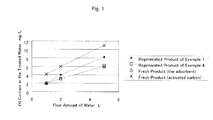
- a comparative test of adsorbability was carried out using the adsorbents regenerated in Examples 1 and 4 and fresh adsorbents. That is, into a column was filled 50 cc of each of the regenerated adsorbents and fresh adsorbent, and water to be treated, containing fuel oils A and B in an amount of 150 mg per 1 L was flowed through the column. The amount of the oil in the treated water flowed through the column was measured. The results are set forth in Table 3 and Figure 1 .
- Table 3 and Figure 1 indicate that the regenerated products of Examples 1 and 4 exhibited oil adsorbability equivalent to that of the fresh calcined coke and superior to the fresh activated carbon.
- Table 3 Flow Amount of Water Oil Content in Treated Water Regenerated Products Fresh Products L Regenerated Product of Example 1 Regenerated Product
- Example 4 Regenerated of Product of Comparative Example 1
Landscapes
- Chemical & Material Sciences (AREA)
- Analytical Chemistry (AREA)
- Organic Chemistry (AREA)
- Chemical Kinetics & Catalysis (AREA)
- Physics & Mathematics (AREA)
- Thermal Sciences (AREA)
- Inorganic Chemistry (AREA)
- Engineering & Computer Science (AREA)
- Materials Engineering (AREA)
- Solid-Sorbent Or Filter-Aiding Compositions (AREA)
- Water Treatment By Sorption (AREA)
Applications Claiming Priority (1)
| Application Number | Priority Date | Filing Date | Title |
|---|---|---|---|
| PCT/JP2007/065214 WO2009016766A1 (ja) | 2007-07-27 | 2007-07-27 | 炭素系油吸着材の再生方法 |
Publications (2)
| Publication Number | Publication Date |
|---|---|
| EP2174708A1 true EP2174708A1 (de) | 2010-04-14 |
| EP2174708A4 EP2174708A4 (de) | 2013-06-26 |
Family
ID=40304012
Family Applications (1)
| Application Number | Title | Priority Date | Filing Date |
|---|---|---|---|
| EP07791888.6A Withdrawn EP2174708A4 (de) | 2007-07-27 | 2007-07-27 | Verfahren zur regenerierung eines kohlenstoffhaltigen öladsorptionsmittels |
Country Status (4)
| Country | Link |
|---|---|
| US (1) | US20100298116A1 (de) |
| EP (1) | EP2174708A4 (de) |
| CN (1) | CN101784337A (de) |
| WO (1) | WO2009016766A1 (de) |
Families Citing this family (4)
| Publication number | Priority date | Publication date | Assignee | Title |
|---|---|---|---|---|
| JP6358232B2 (ja) * | 2015-11-10 | 2018-07-18 | 住友金属鉱山株式会社 | 活性炭充填塔のメンテナンス方法 |
| CN114804404A (zh) * | 2022-03-22 | 2022-07-29 | 河南中孚炭素有限公司 | 一种焙烧湿电含沥青焦油冲洗水无害化处理方法 |
| CN117069197A (zh) * | 2023-08-17 | 2023-11-17 | 宁夏宁平炭素有限责任公司 | 炭素工业生产冷却水处理方法及环保式炭素生产系统 |
| CN119591194A (zh) * | 2024-12-20 | 2025-03-11 | 中国科学院城市环境研究所 | 一种利用厨余水热炭处理油气田含硫污水的方法 |
Family Cites Families (9)
| Publication number | Priority date | Publication date | Assignee | Title |
|---|---|---|---|---|
| US1633871A (en) * | 1922-09-02 | 1927-06-28 | Contact Filtration Company | Method of revivifying spent adsorbents for oil treatments |
| US3840476A (en) * | 1972-06-28 | 1974-10-08 | Exxon Research Engineering Co | Process for activating carbonaceous materials |
| CA1010845A (en) * | 1972-06-28 | 1977-05-24 | Exxon Research And Engineering Company | Process for activating fluid coke and its use in purifying waste water |
| US4407725A (en) * | 1980-08-21 | 1983-10-04 | International Minerals & Chemical Corp. | Regeneration of activated carbon |
| JPH03254883A (ja) * | 1990-03-02 | 1991-11-13 | Aqua Tec Kk | 活性炭吸着による浄水処理方法 |
| JPH0679264A (ja) * | 1992-09-02 | 1994-03-22 | Sanden Corp | 浄水装置 |
| JPH0810750A (ja) * | 1994-06-27 | 1996-01-16 | Tokyo Gas Co Ltd | 浄水装置 |
| JP3528038B2 (ja) * | 1999-03-08 | 2004-05-17 | 株式会社日立製作所 | 水処理方法及びその装置 |
| JP4444051B2 (ja) * | 2004-09-17 | 2010-03-31 | 新日本石油精製株式会社 | 吸着剤及びその製造方法、並びに含油排水の処理方法 |
-
2007
- 2007-07-27 CN CN200780053840.2A patent/CN101784337A/zh active Pending
- 2007-07-27 WO PCT/JP2007/065214 patent/WO2009016766A1/ja not_active Ceased
- 2007-07-27 US US12/669,055 patent/US20100298116A1/en not_active Abandoned
- 2007-07-27 EP EP07791888.6A patent/EP2174708A4/de not_active Withdrawn
Also Published As
| Publication number | Publication date |
|---|---|
| CN101784337A (zh) | 2010-07-21 |
| WO2009016766A1 (ja) | 2009-02-05 |
| US20100298116A1 (en) | 2010-11-25 |
| EP2174708A4 (de) | 2013-06-26 |
Similar Documents
| Publication | Publication Date | Title |
|---|---|---|
| US10449512B2 (en) | Mesoporous activated carbon and methods of producing same | |
| US7666306B2 (en) | Adsorbent, method for producing same, and method for processing oil-containing waste water | |
| KR20160142275A (ko) | 정수기용 활성탄 | |
| US9925517B2 (en) | Process for reducing the content of organic nitrogen compounds from hydrotreating feedstocks for ultra-low-sulfur diesel production | |
| JP7058379B1 (ja) | 炭素質材料及びその製造方法、並びに浄水用フィルター及び浄水器 | |
| EP2174708A1 (de) | Verfahren zur regenerierung eines kohlenstoffhaltigen öladsorptionsmittels | |
| EP3579966A1 (de) | Sorptionsmittel und verfahren zur herstellung | |
| WO2014151660A1 (en) | Mesoporous activated carbon | |
| JP5485734B2 (ja) | 活性炭の製造方法及び活性炭 | |
| US4600502A (en) | Adsorbent processing to reduce basestock foaming | |
| JP5008315B2 (ja) | 炭素系油吸着材の再生方法 | |
| US2877176A (en) | Process for removing sulfur and aromatics from hydrocarbons using active carbon impregnated with alkali metals or oxides thereof as adsorbent | |
| KR20230076208A (ko) | 산화 안정화 및 스팀 활성화를 이용한 다공성 활성탄의 제조 방법 | |
| CA1323842C (en) | Simultaneous removal of aromatics and wax from lube distillate by an adsorption process | |
| KR102576958B1 (ko) | 활성탄, 및 그 활성탄의 제조 방법 | |
| CN107522314B (zh) | 净水处理方法 | |
| CN114405460A (zh) | 一种疏水型高效voc分子筛吸附剂及制备方法 | |
| KR20250019647A (ko) | 열분해 오일로부터 오염물을 제거하기 위한 흡착제 | |
| KR100514792B1 (ko) | 고비점의 탄화수소 흡착제 및 이의 재생방법 | |
| JP2008537758A (ja) | 活性炭を用いて炭化水素系燃料から有色体を除去する方法 | |
| JPH0354295A (ja) | 軽質炭化水素の精製法及び軽質炭化水素精製用吸着剤 | |
| RU2228293C1 (ru) | Способ получения дробленого активного угля из скорлупы орехов | |
| CN119569052A (zh) | 一种多孔活性炭的制备方法及其应用 | |
| KR20200076617A (ko) | 안수에 포함된 타르 제거장치 및 타르 제거방법 | |
| JPH09290257A (ja) | 乳化油含有廃水の処理方法 |
Legal Events
| Date | Code | Title | Description |
|---|---|---|---|
| PUAI | Public reference made under article 153(3) epc to a published international application that has entered the european phase |
Free format text: ORIGINAL CODE: 0009012 |
|
| 17P | Request for examination filed |
Effective date: 20100120 |
|
| AK | Designated contracting states |
Kind code of ref document: A1 Designated state(s): AT BE BG CH CY CZ DE DK EE ES FI FR GB GR HU IE IS IT LI LT LU LV MC MT NL PL PT RO SE SI SK TR |
|
| AX | Request for extension of the european patent |
Extension state: AL BA HR MK RS |
|
| RIN1 | Information on inventor provided before grant (corrected) |
Inventor name: FUJII, MASAKI Inventor name: SAKAMOTO, AKIO Inventor name: NAKANO, SUSUMU Inventor name: NAKANISHI KAZUHISA Inventor name: MUKAI, KAZUO Inventor name: OYAMA, TAKASHI Inventor name: TASAKI, MASAYUKI Inventor name: TANO, TAMOTSU |
|
| DAX | Request for extension of the european patent (deleted) | ||
| A4 | Supplementary search report drawn up and despatched |
Effective date: 20130528 |
|
| RIC1 | Information provided on ipc code assigned before grant |
Ipc: B01J 20/34 20060101AFI20130522BHEP Ipc: C02F 1/28 20060101ALI20130522BHEP Ipc: B01J 20/28 20060101ALI20130522BHEP Ipc: B01J 20/20 20060101ALI20130522BHEP |
|
| STAA | Information on the status of an ep patent application or granted ep patent |
Free format text: STATUS: THE APPLICATION IS DEEMED TO BE WITHDRAWN |
|
| 18D | Application deemed to be withdrawn |
Effective date: 20140103 |