EP2178111B1 - Herstellungsverfahren von gestapelten und selbstausgerichteten Komponenten auf einem Substrat - Google Patents
Herstellungsverfahren von gestapelten und selbstausgerichteten Komponenten auf einem Substrat Download PDFInfo
- Publication number
- EP2178111B1 EP2178111B1 EP09172758A EP09172758A EP2178111B1 EP 2178111 B1 EP2178111 B1 EP 2178111B1 EP 09172758 A EP09172758 A EP 09172758A EP 09172758 A EP09172758 A EP 09172758A EP 2178111 B1 EP2178111 B1 EP 2178111B1
- Authority
- EP
- European Patent Office
- Prior art keywords
- sacrificial layer
- resin
- substrate
- layer
- zone
- Prior art date
- Legal status (The legal status is an assumption and is not a legal conclusion. Google has not performed a legal analysis and makes no representation as to the accuracy of the status listed.)
- Not-in-force
Links
Images

Classifications
-
- H—ELECTRICITY
- H10—SEMICONDUCTOR DEVICES; ELECTRIC SOLID-STATE DEVICES NOT OTHERWISE PROVIDED FOR
- H10D—INORGANIC ELECTRIC SEMICONDUCTOR DEVICES
- H10D86/00—Integrated devices formed in or on insulating or conducting substrates, e.g. formed in silicon-on-insulator [SOI] substrates or on stainless steel or glass substrates
- H10D86/01—Manufacture or treatment
-
- H—ELECTRICITY
- H10—SEMICONDUCTOR DEVICES; ELECTRIC SOLID-STATE DEVICES NOT OTHERWISE PROVIDED FOR
- H10D—INORGANIC ELECTRIC SEMICONDUCTOR DEVICES
- H10D84/00—Integrated devices formed in or on semiconductor substrates that comprise only semiconducting layers, e.g. on Si wafers or on GaAs-on-Si wafers
- H10D84/01—Manufacture or treatment
- H10D84/02—Manufacture or treatment characterised by using material-based technologies
- H10D84/03—Manufacture or treatment characterised by using material-based technologies using Group IV technology, e.g. silicon technology or silicon-carbide [SiC] technology
- H10D84/038—Manufacture or treatment characterised by using material-based technologies using Group IV technology, e.g. silicon technology or silicon-carbide [SiC] technology using silicon technology, e.g. SiGe
-
- H—ELECTRICITY
- H10—SEMICONDUCTOR DEVICES; ELECTRIC SOLID-STATE DEVICES NOT OTHERWISE PROVIDED FOR
- H10D—INORGANIC ELECTRIC SEMICONDUCTOR DEVICES
- H10D88/00—Three-dimensional [3D] integrated devices
- H10D88/01—Manufacture or treatment
-
- H—ELECTRICITY
- H10—SEMICONDUCTOR DEVICES; ELECTRIC SOLID-STATE DEVICES NOT OTHERWISE PROVIDED FOR
- H10P—GENERIC PROCESSES OR APPARATUS FOR THE MANUFACTURE OR TREATMENT OF DEVICES COVERED BY CLASS H10
- H10P90/00—Preparation of wafers not covered by a single main group of this subclass, e.g. wafer reinforcement
- H10P90/19—Preparing inhomogeneous wafers
- H10P90/1904—Preparing vertically inhomogeneous wafers
- H10P90/1906—Preparing SOI wafers
-
- H—ELECTRICITY
- H10—SEMICONDUCTOR DEVICES; ELECTRIC SOLID-STATE DEVICES NOT OTHERWISE PROVIDED FOR
- H10W—GENERIC PACKAGES, INTERCONNECTIONS, CONNECTORS OR OTHER CONSTRUCTIONAL DETAILS OF DEVICES COVERED BY CLASS H10
- H10W10/00—Isolation regions in semiconductor bodies between components of integrated devices
- H10W10/01—Manufacture or treatment
- H10W10/061—Manufacture or treatment using SOI processes together with lateral isolation, e.g. combinations of SOI and shallow trench isolations
-
- H—ELECTRICITY
- H10—SEMICONDUCTOR DEVICES; ELECTRIC SOLID-STATE DEVICES NOT OTHERWISE PROVIDED FOR
- H10W—GENERIC PACKAGES, INTERCONNECTIONS, CONNECTORS OR OTHER CONSTRUCTIONAL DETAILS OF DEVICES COVERED BY CLASS H10
- H10W10/00—Isolation regions in semiconductor bodies between components of integrated devices
- H10W10/10—Isolation regions comprising dielectric materials
- H10W10/181—Semiconductor-on-insulator [SOI] isolation regions, e.g. buried oxide regions of SOI wafers
Definitions
- the invention relates to a method of manufacturing stacked and self-aligned components on a substrate.
- MEMS microelectronics or in other areas
- Known techniques for performing stacked functions include the following techniques.
- a first technique implements an epitaxial recovery through contact holes. Epitaxial growth is assisted by laser. This technique has been proposed as part of the realization of SRAM 3D. We can refer to this subject at the following publication: "High Speed and Highly Cost effective 72M bit density S3SRAM Technology with Doubly Stacked Si Layers, Peripheral only CoSix layers and Tungsten Shunt W / L Scheme for Standalone and Embedded Memory” by S.-M. JUNG et al., VLSI Technology, 2007 IEEE Symposium on, June 12-14, 2007, pages 82-83 .
- the present invention describes a method for stacking on several levels (at least two) self-aligned components and electrically isolated from each other (semiconductors, microresonators ...) by an insulating layer. No method of recrystallization of silicon, regrowth through a contact is necessary, thus limiting thermal budget constraints.
- the stacks are defined from the first operation by epitaxy. Selective etchings and the use of self-aligned lithography then allow working through the membrane.
- the step of providing a substrate may comprise providing a substrate selected from a bulk silicon substrate, an SOI substrate, an sSOI substrate, an XsSOI substrate, and a SiGe virtual substrate.
- Said face of the substrate may comprise at least one component or at least one component part.
- the resin deposited in the etched area of the first sacrificial layer and the resin deposited on the surface layer are a resin which is transformed into dielectric material after exposure and / or annealing, for example an HSQ resin (silsesquioxane hydrogen).
- HSQ resin silicatequioxane hydrogen
- the confinement material may be silicon nitride.
- the component element forming step comprises forming at least one transistor gate element.
- the step of selectively etching said zone of the second sacrificial layer is followed by a step of filling the etched area of the second sacrificial layer with an electrically insulating material.
- This material may be silicon oxide.
- the lithography step may be performed by means of an electron beam passing through the second sacrificial layer.
- the thickness and the nature of the resin deposited on the surface layer and the thickness of the superficial layer being chosen so that at least 50% of the electromagnetic radiation applied to the resin deposited on the surface layer is transmitted to the resin deposited in the etched area of the first sacrificial layer.
- the wavelength of the electromagnetic radiation is between 12.5 nm and 15 nm.
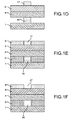
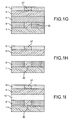
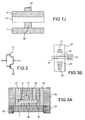
- FIGS. 1A to 1J are cross-sectional views illustrating various steps of an embodiment of the method of manufacturing stacked and self-aligned components on a substrate, according to the invention. For the sake of simplicity, the manufacture of a single component is shown.
- the Figure 1A shows a substrate 1 having a face 2 for the manufacture of a component.
- a stack of layers is formed on the face 2 of the substrate 1.
- the stack comprises a first sacrificial layer 3 formed on the face 2 of the substrate 1, a second sacrificial layer 4 formed on the first sacrificial layer 3 and a surface layer 5 making it possible to manufacture a component and formed on the second sacrificial layer 4.
- the different layers of the stack are formed so as to allow access to at least one zone of the first sacrificial layer 3 and to at least one zone of the second sacrificial layer 4.
- the surface layer 5 possesses at least one zone, not shown in FIG. 1A, making it integral with the substrate 1 outside the sacrificial layers 3 and 4.
- Access to areas to be etched selectively can be achieved by photo-lithography steps followed by etching steps. It can also be achieved by technological steps leading to the realization of architectures SON (for "Silicon On nothing") or LSOI (for "Localized Silicon On Insulator”).
- SON for "Silicon On nothing”
- LSOI for "Localized Silicon On Insulator”
- SON for the SON architecture, we can refer to the article “Silicon-on-Nothing (SON) -an innovative process for advanced CMOS” by M. JURCZAK et al., IEEE Transactions on Electron Devices, vol. 47, No. 11, pages 2179 to 2187, November 2000 .
- LSOI architecture we can refer to the article S. MONFRAY et al., Electron Devices Meeting, 2007, IEDM 2007, IEEE International, page 633 at 696, December 10-12, 2007 , and to the document US 2007/0190754 .
- the substrate 1 is a solid monocrystalline silicon substrate
- the sacrificial layers 3 and 4 are monocrystalline SiGe with different Ge concentrations and the surface layer 5 is made of monocrystalline silicon.
- the sacrificial layer 3 has a Ge concentration greater than the Ge concentration of the sacrificial layer 4.
- the sacrificial layer 3 will be said to have a high concentration of Ge whereas the sacrificial layer 4 will be said to have a low Ge concentration.
- This difference in Ge concentration of the sacrificial layers 3 and 4 will allow selective etching of the sacrificial layer 3 with respect to the sacrificial layer 4 and this in the presence of monocrystalline silicon.
- the sacrificial layers 3 and 4 and the surface layer 5 may be formed on the face 2 of the substrate 1 by epitaxy according to techniques known to those skilled in the art.
- a selective etching step is then carried out making it possible to eliminate the sacrificial layer 3 as shown in FIG. Figure 1B .
- the etching is carried out by a chemical vapor etching (CVE) method (for "Chemical Vapor Etching”) using as etching gas hydrochloric acid HCl mixed with a carrier gas, this at an etching temperature of less than or equal to 700 ° C.
- CVE chemical vapor etching
- the germanium concentration of the sacrificial layer with a high concentration of Ge is greater than or equal to 30% while the concentration of germanium of the sacrificial layer with low Ge concentration (layer 4) is greater than or equal to 10% and less than 30%.
- the difference in germanium concentration between the two sacrificial layers is at least 15%.
- the thickness of the sacrificial layer 3 is between 5 nm and 30 nm.
- the thickness of the sacrificial layer 4 is between 5 nm and 100 nm.
- the thicknesses of the SiGe sacrificial layers are chosen so as not to generate defects in the stack and to maintain good etch selectivity between the layer with a high concentration of germanium and that with a low concentration of germanium.
- the ratio of thicknesses of SiGe layer with low Ge concentration / SiGe layer with high Ge concentration can be between 1/6 and 20.
- this ratio is greater than or equal to 1. This makes it possible to maintain good etch selectivity between SiGe layers.
- the etching temperature is between 450 ° C and 900 ° C.
- the etching temperature will be chosen less than or equal to 700 ° C.
- the etching in addition to being selective between two layers of SiGe at different concentrations of Ge, is extremely selective with respect to the surrounding silicon (substrate and surface layer), the silicon etching rate being negligible (less than 0.1 nm / min).
- the total pressure of the gaseous mixture during etching is, for example, between 200 and 101,300 Pa.
- the hydrogen partial pressure may be in the range from 20 to 24,000 Pa.
- the flow of the gaseous etching mixture will be understood between a few standard liters and a few tens of standard liters per minute.
- the flow of HCl will be between a few hundred cubic centimeters per minute and a few tens of standard liters per minute.
- the burning time will be between several seconds and several hundred seconds.
- the second sacrificial layer 4 and the superficial layer 5 form a bridge over the etched area of the first sacrificial layer.
- the next step involves depositing a resin in the etched area of the first sacrificial layer and on the surface layer to coat the surface layer.
- the figure 1C shows the obtained structure which comprises a resin layer 6, between the substrate 1 and the second sacrificial layer 4, and a resin layer 7 covering the surface layer 5.
- the resin forming the layers 6 and 7 is a resin which is transformed into a dielectric material after annealing.
- the fact of obtaining a dielectric layer allows the structure to support the thermal budget of the process.
- a HSQ resin silica hydrogen
- the resin can be deposited at 2,000 rpm.
- a lithography step of the resin deposited in the preceding step is then carried out, for example, by means of an electron beam which will simultaneously sensitize the resin layer 7 and the resin layer 6, after passing through the superficial layer 5 and second sacrificial layer 4.
- the electron beam will have an energy greater than 10 keV, for example an energy of 100 keV for 700 ⁇ C / cm 2 .
- a resin zone 16, transformed into a dielectric material is obtained in the development of the resin in the etched area of the first sacrificial layer. in alignment with a resin zone 17 on the superficial layer 5 (see FIG. figure 1D ).
- the lithography step may also be carried out by means of electromagnetic radiation with a wavelength of between 0.1 nm and 41 nm, preferably with a wavelength of between 12.5 nm and 15 nm.
- the nature and thickness of the resin layer deposited on the surface layer and the thickness of the surface layer are chosen so that at least 50% of the electromagnetic radiation applied to the resin deposited on the surface layer is transmitted to the resin deposited on the etched area of the first sacrificial layer.
- the resin removed during the lithography step in the etched area of the first sacrificial layer and on the surface layer 5 is replaced by a material for confining the resin zones 16 and 17.
- the confinement material is, for example, nitride of silicon. This material can be deposited by LPCVD.
- the figure 1E shows the structure obtained, a layer 8 confining the resin zone 16 between the substrate 1 and the second sacrificial layer 4, a layer 9 confining the resin zone 17 on the surface layer 5.
- a mechanochemical polishing operation (CMP) allows reveal the resin zone 17 transformed into dielectric material.
- resin zones 16 and 17 are then etched. If the resin used is HSQ, wet HF etching may be used. We get, as shown in figure 1F engraved and aligned areas 26 and 27.
- the structure is ready to receive component elements in the engraved and aligned areas.
- component elements referenced 36 and 37 on the figure 1G , for example comprise layers deposited to form gate stacks, for example HfO 2 , TiN, polycrystalline silicon stacks.
- the etching of the resin zone 16 see figure 1E ) the constitution of the element 36 is possible from an access provided during the formation of the different layers of the stack of sacrificial layers and the surface layer.
- the second sacrificial layer is then removed to obtain the structure shown in FIG. figure 1H for example using an isotropic CF 4 plasma.
- the surface layer 5 then forms a bridge over the etched area of the second sacrificial layer.
- a dielectric material used to electrically isolate the future components from each other, is introduced to fill the space separating the confinement layer 8 from the surface layer of silicon 5.
- the figure 1I shows the structure obtained.
- the thickness of the sacrificial layer 4, defining the thickness of the dielectric layer 10, will be chosen as thick as possible to minimize the coupling between the stacked devices.
- the confinement layers are then removed by isotropic etching, for example by a solution of H 3 PO 4 , to provide the structure represented in FIG. Figure 1J and having self-aligned grid stacks 36 and 37.
- the embodiment described above started from a solid monocrystalline silicon substrate.
- silicon other substrates can be used.
- sSOI, XsSOI substrates or SiGe virtual substrates can be used to increase the degree of freedom on the thicknesses, the Ge concentrations of the intermediate layers and to obtain the best selectivities of etching.
- substrates of orientation other than (001) for example Si (110), Si (111) ...
- the inverter is the fundamental logic gate in CMOS technology. It consists of an NMOS transistor and a PMOS transistor connected as shown in the diagram of the figure 2 .
- the input of the inverter is called IN and its output is called OUT.
- FIGS. 3A and 3B are respectively cross-sectional and top views of a CMOS inverter stacked on two levels, according to the present invention.
- FIG. Figure 1J On the figure 3A , with the same references, the different elements of the structure represented in FIG. Figure 1J .
- the structure is electrically isolated from the other components made on the substrate 1 by insulation trenches 20 called STI (for "Shallow Trench Isolation").
- connection 21 connects the drain of one of the transistors to the source of the other transistor and provides the output OUT of the inverter.
- the gates of the transistors are at the same potential.
- the coating material, referenced 30 on the figure 3A can be a low density material, for example SiO 2 .
- the reference 24 represents the contact common to both grids.
- the references 31 and 32 respectively represent the active zones of the substrate, for example PMOS, and of the surface layer, for example NMOS.
- the etching temperatures applied are between 550 and 600 ° C.
- the carrier gas used was hydrogen while the etching gas was HCl.
- the partial pressures of HCl and H 2 were of the order of 24,000 Pa and 16,000 Pa, respectively.
Landscapes
- Micromachines (AREA)
- Metal-Oxide And Bipolar Metal-Oxide Semiconductor Integrated Circuits (AREA)
- Magnetic Heads (AREA)
- Formation Of Insulating Films (AREA)
- Crystals, And After-Treatments Of Crystals (AREA)
- Element Separation (AREA)
- Recrystallisation Techniques (AREA)
- Exposure Of Semiconductors, Excluding Electron Or Ion Beam Exposure (AREA)
Claims (16)
- Verfahren zur Herstellung von gestapelten und selbstausgerichteten Komponenten auf einem Substrat, umfassend die folgenden Schritte:- Bereitstellen eines Substrats (1) aus monokristallinem Silicium, das eine Fläche (2) aufweist, die die Herstellung einer Komponente ermöglicht,- Bildung eines Stapels von Schichten auf der Fläche des Substrats, wobei der Stapel eine erste Opferschicht (3) aus monokristallinem SiGe, die auf der Fläche des Substrats gebildet ist, eine zweite Opferschicht (4) aus monokristallinem SiGe, die auf der ersten Opferschicht gebildet ist, wobei die Germanium-Konzentration der ersten Opferschicht (3) zwischen 30% und 100% ist, die Germanium-Konzentration der zweiten Opferschicht (4) zwischen 10% und 30% ist, wobei die Germanium-Konzentration der ersten Opferschicht (3) mindestens 15% größer als die Germanium-Konzentration der zweiten Opferschicht (4) ist, und eine Oberflächenschicht (5) aus monokristallinem Silicium, die die Herstellung einer Komponente ermöglicht und die auf der zweiten Opferschicht gebildet ist, umfasst, wobei die Schichten des Stapels so gebildet sind, dass ein Zugang zu mindestens einem Bereich der ersten Opferschicht (3) und zu mindestens einem Bereich der zweiten Opferschicht (4) ermöglicht wird, wobei diese Bereiche gestapelt sind,- selektives Ätzen des Bereichs der ersten Opferschicht (3) mit einem Gasgemisch, das gasförmiges HCl, transportiert von einem Trägergas, umfasst, und bei einer Temperatur zwischen 450°C und 900°C, wobei die zweite Opferschicht (4) und die Oberflächenschicht (5) eine Brücke über dem geätzten Bereich der ersten Opferschicht (3) bilden,- Ablagerung von Harz (6, 7) in dem geätzten Bereich der ersten Opferschicht und auf der Oberflächenschicht (5), wobei das Harz ein Harz ist, das sich nach dem Glühen in dielektrisches Material umwandelt,- Lithographie des in dem vorhergehenden Schritt abgelagerten Harzes, um mindestens einen Harzbereich (16) in dem geätzten Bereich der ersten Opferschicht in Ausrichtung mit mindestens einem Harzbereich (17) auf der Oberflächenschicht (5) übrig zu lassen,- Ersetzen des während des Lithographie-Schritts in dem geätzten Bereich der ersten Opferschicht und auf der Oberflächenschicht (5) entfernten Harzes durch ein Material zur Begrenzung (8, 9) des übrigen Harzes,- Entfernen der übrigen Harzbereiche in dem geätzten Bereich der ersten Opferschicht und auf der Oberflächenschicht (5), um Bereiche (26, 27) bereitzustellen, die für die Herstellung von Komponenten vorgesehen sind,- Bildung von Elementen von Komponenten (36, 37) in den vorgesehenen Bereichen,- selektives Ätzen des Bereichs der zweiten Opferschicht, wobei die Oberflächenschicht (5) eine Brücke über dem geätzten Bereich der zweiten Opferschicht bildet.
- Verfahren zur Herstellung gemäß Anspruch 1, wobei der Schritt des Bereitstellens eines Substrats (1) darin besteht, ein Substrat bereitzustellen, das aus einem festen Silicium-Substrat, einem SOI-Substrat, einem sSOI-Substrat, einem XsSOI-Substrat und einem virtuellen SiGe-Substrat ausgewählt ist.
- Verfahren zur Herstellung gemäß einem der Ansprüche 1 oder 2, wobei der Schritt des Bereitstellens eines Substrats (1) darin besteht, ein Substrat bereitzustellen, bei dem die Fläche (2) mindestens eine Komponente oder mindestens einen Teil einer Komponente umfasst.
- Verfahren zur Herstellung gemäß einem der Ansprüche 1 bis 3, wobei das Verhältnis der Dicke der zweiten Opferschicht (4) zu der Dicke der ersten Opferschicht (3) zwischen 1/6 und 20 ist.
- Verfahren zur Herstellung gemäß einem der Ansprüche 1 bis 4, wobei das selektive Ätzen des Bereichs der ersten Opferschicht (3) kleiner als oder gleich 700°C ist.
- Verfahren zur Herstellung gemäß einem der Ansprüche 1 bis 5, wobei der Gesamtdruck des Gasgemischs zwischen 200 und 101 300 Pa ist.
- Verfahren zur Herstellung gemäß einem der Ansprüche 1 bis 6, wobei das in dem geätzten Bereich der ersten Opferschicht abgelagerte Harz (6, 7) und das auf der Oberflächenschicht (5) abgelagerte Harz ein Harz sind, das sich nach Belichtung und/oder Glühen in ein dielektrisches Material umwandelt.
- Verfahren zur Herstellung gemäß Anspruch 7, wobei das Harz ein HSQ- (Wasserstoff-Silsesquioxan-) Harz ist.
- Verfahren zur Herstellung gemäß einem der Ansprüche 1 bis 8, wobei das Material zur Begrenzung (8, 9) Siliciumnitrid ist.
- Verfahren zur Herstellung gemäß einem der Ansprüche 1 bis 9, wobei der Schritt der Bildung von Elementen von Komponenten die Bildung von mindestens einem Transistor-Gate-Element umfasst.
- Verfahren zur Herstellung gemäß einem der Ansprüche 1 bis 10, wobei auf den Schritt des selektiven Ätzens des Bereichs der zweiten Opferschicht ein Schritt des Auffüllens des geätzten Bereichs der zweiten Opferschicht mit einem elektrisch isolierenden Material (10) folgt.
- Verfahren zur Herstellung gemäß Anspruch 11, wobei das elektrisch isolierende Material ein Siliziumoxid ist.
- Verfahren zur Herstellung gemäß einem der Ansprüche 1 bis 12, wobei ein Schritt des Entfernens des Material zur Begrenzung (10) vorgesehen ist.
- verfahren zur Herstellung gemäß Anspruch 1, wobei die Lithographie des in dem geätzten Bereich der ersten Opferschicht und auf der Oberflächenschicht abgelagerten Harzes mittels eines Elektronenstrahls, der durch die zweite Opferschicht (4) hindurchgeht, durchgeführt wird.
- Verfahren zur Herstellung gemäß Anspruch 1, wobei die Lithographie des in dem geätzten Bereich der ersten Opferschicht und auf der Oberflächenschicht abgelagerten Harzes mittels elektromagnetischer Strahlung einer Wellenlänge zwischen 0,1 nm und 41 nm durchgeführt wird, wobei die Dicke und die Art des auf der Oberflächenschicht (5) abgelagerten Harzes (7) sowie die Dicke der Oberflächenschicht so ausgewählt werden, dass mindestens 50% der auf das auf der Oberflächenschicht abgelagerte Harz angewendeten elektromagnetischen Strahlung auf das in dem geätzten Bereich der ersten Opferschicht abgelagerte Harz (6) übertragen wird.
- Verfahren zur Herstellung gemäß Anspruch 15, wobei die Wellenlänge der elektromagnetischen Strahlung zwischen 12,5 nm, und 15 nm ist.
Applications Claiming Priority (1)
| Application Number | Priority Date | Filing Date | Title |
|---|---|---|---|
| FR0857060A FR2937463B1 (fr) | 2008-10-17 | 2008-10-17 | Procede de fabrication de composants empiles et auto-alignes sur un substrat |
Publications (2)
| Publication Number | Publication Date |
|---|---|
| EP2178111A1 EP2178111A1 (de) | 2010-04-21 |
| EP2178111B1 true EP2178111B1 (de) | 2011-08-24 |
Family
ID=40651428
Family Applications (1)
| Application Number | Title | Priority Date | Filing Date |
|---|---|---|---|
| EP09172758A Not-in-force EP2178111B1 (de) | 2008-10-17 | 2009-10-12 | Herstellungsverfahren von gestapelten und selbstausgerichteten Komponenten auf einem Substrat |
Country Status (5)
| Country | Link |
|---|---|
| US (1) | US8110460B2 (de) |
| EP (1) | EP2178111B1 (de) |
| JP (1) | JP2010098319A (de) |
| AT (1) | ATE521984T1 (de) |
| FR (1) | FR2937463B1 (de) |
Families Citing this family (4)
| Publication number | Priority date | Publication date | Assignee | Title |
|---|---|---|---|---|
| FR2953991B1 (fr) * | 2009-12-10 | 2012-01-06 | Commissariat Energie Atomique | Procede de realisation d'un revetement de surface controle tridimensionnellement dans une cavite |
| US8361907B2 (en) * | 2010-05-10 | 2013-01-29 | International Business Machines Corporation | Directionally etched nanowire field effect transistors |
| FR2989515B1 (fr) | 2012-04-16 | 2015-01-16 | Commissariat Energie Atomique | Procede ameliore de realisation d'une structure de transistor a nano-fils superposes et a grille enrobante |
| FR3037716B1 (fr) * | 2015-06-18 | 2018-06-01 | Commissariat A L'energie Atomique Et Aux Energies Alternatives | Transistors superposes avec zone active du transistor superieur auto-alignee |
Family Cites Families (9)
| Publication number | Priority date | Publication date | Assignee | Title |
|---|---|---|---|---|
| FR2838238B1 (fr) * | 2002-04-08 | 2005-04-15 | St Microelectronics Sa | Dispositif semiconducteur a grille enveloppante encapsule dans un milieu isolant |
| US7015147B2 (en) * | 2003-07-22 | 2006-03-21 | Sharp Laboratories Of America, Inc. | Fabrication of silicon-on-nothing (SON) MOSFET fabrication using selective etching of Si1-xGex layer |
| FR2858876B1 (fr) | 2003-08-12 | 2006-03-03 | St Microelectronics Sa | Procede de formation sous une couche mince d'un premier materiau de portions d'un autre materiau et/ou de zones de vide |
| KR100626372B1 (ko) * | 2004-04-09 | 2006-09-20 | 삼성전자주식회사 | 전계 효과 트랜지스터를 갖는 반도체 소자 및 그 제조 방법 |
| KR101172853B1 (ko) * | 2005-07-22 | 2012-08-10 | 삼성전자주식회사 | 반도체 소자의 형성 방법 |
| FR2893762B1 (fr) | 2005-11-18 | 2007-12-21 | Commissariat Energie Atomique | Procede de realisation de transistor a double grilles auto-alignees par reduction de motifs de grille |
| FR2897201B1 (fr) * | 2006-02-03 | 2008-04-25 | Stmicroelectronics Crolles Sas | Dispositif de transistor a doubles grilles planaires et procede de fabrication. |
| FR2897471A1 (fr) | 2006-02-10 | 2007-08-17 | St Microelectronics Sa | Formation d'une portion de couche semiconductrice monocristalline separee d'un substrat |
| US7776745B2 (en) * | 2006-02-10 | 2010-08-17 | Stmicroelectronics S.A. | Method for etching silicon-germanium in the presence of silicon |
-
2008
- 2008-10-17 FR FR0857060A patent/FR2937463B1/fr not_active Expired - Fee Related
-
2009
- 2009-10-12 AT AT09172758T patent/ATE521984T1/de not_active IP Right Cessation
- 2009-10-12 US US12/577,379 patent/US8110460B2/en not_active Expired - Fee Related
- 2009-10-12 EP EP09172758A patent/EP2178111B1/de not_active Not-in-force
- 2009-10-16 JP JP2009239536A patent/JP2010098319A/ja active Pending
Also Published As
| Publication number | Publication date |
|---|---|
| US20100099233A1 (en) | 2010-04-22 |
| US8110460B2 (en) | 2012-02-07 |
| FR2937463A1 (fr) | 2010-04-23 |
| EP2178111A1 (de) | 2010-04-21 |
| ATE521984T1 (de) | 2011-09-15 |
| JP2010098319A (ja) | 2010-04-30 |
| FR2937463B1 (fr) | 2010-12-24 |
Similar Documents
| Publication | Publication Date | Title |
|---|---|---|
| EP2562802B1 (de) | Verfahren zur Herstellung eines dreidimensionalen integrierten Schaltkreises | |
| EP1091417A1 (de) | Herstellungsverfahren für Halbleiterbauelement mit Rundherum-Gate und dadurch hergestelltes Bauelement | |
| EP2779223B1 (de) | Herstellungsverfahren eines Substrats, das mit einem Kantenschutz ausgestattet ist | |
| FR3012258A1 (fr) | Procede de realisation de transistors nmos et pmos sur un substrat du type soi, en particulier fdsoi, et circuit integre correspondant | |
| EP2178111A1 (de) | Herstellungsverfahren von gestapelten und selbstausgerichteten Komponenten auf einem Substrat | |
| EP3246948B1 (de) | Verfahren zur herstellung von transistoren, die unterschiedliche eigenschaften aufweisen, auf demselben substrat | |
| WO2007036631A1 (fr) | Procédé de fabrication d'un élément en couches minces | |
| FR2995135A1 (fr) | Procede de realisation de transistors fet | |
| EP2120258A1 (de) | Herstellungsverfahren eines Transistors mit Metallquelle und -abfluss | |
| EP1788635B1 (de) | Verfahren zum Herstellen eines Transistors mit selbst justierten Doppel-Gates durch Schrumpfung der Gatestruktur | |
| FR2799307A1 (fr) | Dispositif semi-conducteur combinant les avantages des architectures massives et soi, procede de fabrication | |
| EP3667715B1 (de) | Verfahren zur herstellung eines halbleitersubstrates mit einem verspannten halbleitergebiet | |
| EP3046143B1 (de) | Verfahren zur herstellung eines dreidimensionalen integrierten schaltkreises | |
| FR2915318A1 (fr) | Procede de realisation d'un circuit electronique integre a deux portions de couches actives ayant des orientations cristallines differentes | |
| EP1734568B1 (de) | Isolierter Transistor mit einem verspannten Kanal und Herstellungsverfahren | |
| EP3503203A1 (de) | Herstellung von transistoren mit unter spannung stehenden kanälen | |
| EP4002482B1 (de) | Verfahren zur herstellung eines bereichs, der mit einer mikroelektronischen vorrichtung dotiert ist | |
| EP4006997B1 (de) | Verfahren zur herstellung einer quantenvorrichtung | |
| WO2026017561A1 (fr) | Procédé de réalisation d'un dispositif à transistors cfet | |
| WO2025140898A1 (fr) | Procédé de réalisation d'un dispositif microélectronique sur substrat fd-soi, dispositif correspondant et circuit intégré l'incorporant | |
| FR3164835A1 (fr) | Procédé de réalisation d’un dispositif à transistors CFET | |
| WO2025108891A1 (fr) | Super reseaux doubles obtenus par transfert de couche, structure et procede de fabrication | |
| WO2025108893A1 (fr) | Super réseau obtenu par transfert de couche, structure et procédé de fabrication | |
| FR3026561A1 (fr) | Procede de realisation d'une structure microelectronique multi-niveaux | |
| FR3134235A1 (fr) | Transistor a haute mobilite electronique et son procede de fabrication |
Legal Events
| Date | Code | Title | Description |
|---|---|---|---|
| PUAI | Public reference made under article 153(3) epc to a published international application that has entered the european phase |
Free format text: ORIGINAL CODE: 0009012 |
|
| AK | Designated contracting states |
Kind code of ref document: A1 Designated state(s): AT BE BG CH CY CZ DE DK EE ES FI FR GB GR HR HU IE IS IT LI LT LU LV MC MK MT NL NO PL PT RO SE SI SK SM TR |
|
| AX | Request for extension of the european patent |
Extension state: AL BA RS |
|
| RAP1 | Party data changed (applicant data changed or rights of an application transferred) |
Owner name: COMMISSARIAT A L'ENERGIE ATOMIQUE ET AUX ENERGIES |
|
| 17P | Request for examination filed |
Effective date: 20101019 |
|
| GRAP | Despatch of communication of intention to grant a patent |
Free format text: ORIGINAL CODE: EPIDOSNIGR1 |
|
| GRAS | Grant fee paid |
Free format text: ORIGINAL CODE: EPIDOSNIGR3 |
|
| GRAA | (expected) grant |
Free format text: ORIGINAL CODE: 0009210 |
|
| AK | Designated contracting states |
Kind code of ref document: B1 Designated state(s): AT BE BG CH CY CZ DE DK EE ES FI FR GB GR HR HU IE IS IT LI LT LU LV MC MK MT NL NO PL PT RO SE SI SK SM TR |
|
| REG | Reference to a national code |
Ref country code: GB Ref legal event code: FG4D Free format text: NOT ENGLISH |
|
| REG | Reference to a national code |
Ref country code: CH Ref legal event code: EP |
|
| REG | Reference to a national code |
Ref country code: IE Ref legal event code: FG4D Free format text: LANGUAGE OF EP DOCUMENT: FRENCH |
|
| REG | Reference to a national code |
Ref country code: DE Ref legal event code: R096 Ref document number: 602009002252 Country of ref document: DE Effective date: 20111020 |
|
| REG | Reference to a national code |
Ref country code: NL Ref legal event code: VDEP Effective date: 20110824 |
|
| REG | Reference to a national code |
Ref country code: DE Ref legal event code: R082 Ref document number: 602009002252 Country of ref document: DE |
|
| LTIE | Lt: invalidation of european patent or patent extension |
Effective date: 20110824 |
|
| PG25 | Lapsed in a contracting state [announced via postgrant information from national office to epo] |
Ref country code: PT Free format text: LAPSE BECAUSE OF FAILURE TO SUBMIT A TRANSLATION OF THE DESCRIPTION OR TO PAY THE FEE WITHIN THE PRESCRIBED TIME-LIMIT Effective date: 20111226 Ref country code: NO Free format text: LAPSE BECAUSE OF FAILURE TO SUBMIT A TRANSLATION OF THE DESCRIPTION OR TO PAY THE FEE WITHIN THE PRESCRIBED TIME-LIMIT Effective date: 20111124 Ref country code: LT Free format text: LAPSE BECAUSE OF FAILURE TO SUBMIT A TRANSLATION OF THE DESCRIPTION OR TO PAY THE FEE WITHIN THE PRESCRIBED TIME-LIMIT Effective date: 20110824 Ref country code: SE Free format text: LAPSE BECAUSE OF FAILURE TO SUBMIT A TRANSLATION OF THE DESCRIPTION OR TO PAY THE FEE WITHIN THE PRESCRIBED TIME-LIMIT Effective date: 20110824 Ref country code: IS Free format text: LAPSE BECAUSE OF FAILURE TO SUBMIT A TRANSLATION OF THE DESCRIPTION OR TO PAY THE FEE WITHIN THE PRESCRIBED TIME-LIMIT Effective date: 20111224 Ref country code: FI Free format text: LAPSE BECAUSE OF FAILURE TO SUBMIT A TRANSLATION OF THE DESCRIPTION OR TO PAY THE FEE WITHIN THE PRESCRIBED TIME-LIMIT Effective date: 20110824 Ref country code: NL Free format text: LAPSE BECAUSE OF FAILURE TO SUBMIT A TRANSLATION OF THE DESCRIPTION OR TO PAY THE FEE WITHIN THE PRESCRIBED TIME-LIMIT Effective date: 20110824 Ref country code: HR Free format text: LAPSE BECAUSE OF FAILURE TO SUBMIT A TRANSLATION OF THE DESCRIPTION OR TO PAY THE FEE WITHIN THE PRESCRIBED TIME-LIMIT Effective date: 20110824 |
|
| REG | Reference to a national code |
Ref country code: AT Ref legal event code: MK05 Ref document number: 521984 Country of ref document: AT Kind code of ref document: T Effective date: 20110824 |
|
| PG25 | Lapsed in a contracting state [announced via postgrant information from national office to epo] |
Ref country code: GR Free format text: LAPSE BECAUSE OF FAILURE TO SUBMIT A TRANSLATION OF THE DESCRIPTION OR TO PAY THE FEE WITHIN THE PRESCRIBED TIME-LIMIT Effective date: 20111125 Ref country code: PL Free format text: LAPSE BECAUSE OF FAILURE TO SUBMIT A TRANSLATION OF THE DESCRIPTION OR TO PAY THE FEE WITHIN THE PRESCRIBED TIME-LIMIT Effective date: 20110824 Ref country code: AT Free format text: LAPSE BECAUSE OF FAILURE TO SUBMIT A TRANSLATION OF THE DESCRIPTION OR TO PAY THE FEE WITHIN THE PRESCRIBED TIME-LIMIT Effective date: 20110824 Ref country code: CY Free format text: LAPSE BECAUSE OF FAILURE TO SUBMIT A TRANSLATION OF THE DESCRIPTION OR TO PAY THE FEE WITHIN THE PRESCRIBED TIME-LIMIT Effective date: 20110824 Ref country code: LV Free format text: LAPSE BECAUSE OF FAILURE TO SUBMIT A TRANSLATION OF THE DESCRIPTION OR TO PAY THE FEE WITHIN THE PRESCRIBED TIME-LIMIT Effective date: 20110824 Ref country code: SI Free format text: LAPSE BECAUSE OF FAILURE TO SUBMIT A TRANSLATION OF THE DESCRIPTION OR TO PAY THE FEE WITHIN THE PRESCRIBED TIME-LIMIT Effective date: 20110824 |
|
| REG | Reference to a national code |
Ref country code: IE Ref legal event code: FD4D |
|
| BERE | Be: lapsed |
Owner name: COMMISSARIAT A L'ENERGIE ATOMIQUE ET AUX ENERGIES Effective date: 20111031 |
|
| PG25 | Lapsed in a contracting state [announced via postgrant information from national office to epo] |
Ref country code: SK Free format text: LAPSE BECAUSE OF FAILURE TO SUBMIT A TRANSLATION OF THE DESCRIPTION OR TO PAY THE FEE WITHIN THE PRESCRIBED TIME-LIMIT Effective date: 20110824 Ref country code: CZ Free format text: LAPSE BECAUSE OF FAILURE TO SUBMIT A TRANSLATION OF THE DESCRIPTION OR TO PAY THE FEE WITHIN THE PRESCRIBED TIME-LIMIT Effective date: 20110824 Ref country code: IE Free format text: LAPSE BECAUSE OF FAILURE TO SUBMIT A TRANSLATION OF THE DESCRIPTION OR TO PAY THE FEE WITHIN THE PRESCRIBED TIME-LIMIT Effective date: 20110824 |
|
| PG25 | Lapsed in a contracting state [announced via postgrant information from national office to epo] |
Ref country code: EE Free format text: LAPSE BECAUSE OF FAILURE TO SUBMIT A TRANSLATION OF THE DESCRIPTION OR TO PAY THE FEE WITHIN THE PRESCRIBED TIME-LIMIT Effective date: 20110824 Ref country code: RO Free format text: LAPSE BECAUSE OF FAILURE TO SUBMIT A TRANSLATION OF THE DESCRIPTION OR TO PAY THE FEE WITHIN THE PRESCRIBED TIME-LIMIT Effective date: 20110824 Ref country code: IT Free format text: LAPSE BECAUSE OF FAILURE TO SUBMIT A TRANSLATION OF THE DESCRIPTION OR TO PAY THE FEE WITHIN THE PRESCRIBED TIME-LIMIT Effective date: 20110824 Ref country code: MC Free format text: LAPSE BECAUSE OF NON-PAYMENT OF DUE FEES Effective date: 20111031 |
|
| PG25 | Lapsed in a contracting state [announced via postgrant information from national office to epo] |
Ref country code: DK Free format text: LAPSE BECAUSE OF FAILURE TO SUBMIT A TRANSLATION OF THE DESCRIPTION OR TO PAY THE FEE WITHIN THE PRESCRIBED TIME-LIMIT Effective date: 20110824 |
|
| PLBE | No opposition filed within time limit |
Free format text: ORIGINAL CODE: 0009261 |
|
| STAA | Information on the status of an ep patent application or granted ep patent |
Free format text: STATUS: NO OPPOSITION FILED WITHIN TIME LIMIT |
|
| PG25 | Lapsed in a contracting state [announced via postgrant information from national office to epo] |
Ref country code: BE Free format text: LAPSE BECAUSE OF NON-PAYMENT OF DUE FEES Effective date: 20111031 |
|
| 26N | No opposition filed |
Effective date: 20120525 |
|
| REG | Reference to a national code |
Ref country code: DE Ref legal event code: R097 Ref document number: 602009002252 Country of ref document: DE Effective date: 20120525 |
|
| PG25 | Lapsed in a contracting state [announced via postgrant information from national office to epo] |
Ref country code: MK Free format text: LAPSE BECAUSE OF FAILURE TO SUBMIT A TRANSLATION OF THE DESCRIPTION OR TO PAY THE FEE WITHIN THE PRESCRIBED TIME-LIMIT Effective date: 20110824 Ref country code: MT Free format text: LAPSE BECAUSE OF FAILURE TO SUBMIT A TRANSLATION OF THE DESCRIPTION OR TO PAY THE FEE WITHIN THE PRESCRIBED TIME-LIMIT Effective date: 20110824 |
|
| PG25 | Lapsed in a contracting state [announced via postgrant information from national office to epo] |
Ref country code: ES Free format text: LAPSE BECAUSE OF FAILURE TO SUBMIT A TRANSLATION OF THE DESCRIPTION OR TO PAY THE FEE WITHIN THE PRESCRIBED TIME-LIMIT Effective date: 20111205 Ref country code: SM Free format text: LAPSE BECAUSE OF FAILURE TO SUBMIT A TRANSLATION OF THE DESCRIPTION OR TO PAY THE FEE WITHIN THE PRESCRIBED TIME-LIMIT Effective date: 20110824 |
|
| PG25 | Lapsed in a contracting state [announced via postgrant information from national office to epo] |
Ref country code: LU Free format text: LAPSE BECAUSE OF NON-PAYMENT OF DUE FEES Effective date: 20111012 |
|
| PG25 | Lapsed in a contracting state [announced via postgrant information from national office to epo] |
Ref country code: BG Free format text: LAPSE BECAUSE OF FAILURE TO SUBMIT A TRANSLATION OF THE DESCRIPTION OR TO PAY THE FEE WITHIN THE PRESCRIBED TIME-LIMIT Effective date: 20111124 |
|
| PG25 | Lapsed in a contracting state [announced via postgrant information from national office to epo] |
Ref country code: TR Free format text: LAPSE BECAUSE OF FAILURE TO SUBMIT A TRANSLATION OF THE DESCRIPTION OR TO PAY THE FEE WITHIN THE PRESCRIBED TIME-LIMIT Effective date: 20110824 |
|
| PG25 | Lapsed in a contracting state [announced via postgrant information from national office to epo] |
Ref country code: HU Free format text: LAPSE BECAUSE OF FAILURE TO SUBMIT A TRANSLATION OF THE DESCRIPTION OR TO PAY THE FEE WITHIN THE PRESCRIBED TIME-LIMIT Effective date: 20110824 |
|
| REG | Reference to a national code |
Ref country code: CH Ref legal event code: PL |
|
| GBPC | Gb: european patent ceased through non-payment of renewal fee |
Effective date: 20131012 |
|
| PG25 | Lapsed in a contracting state [announced via postgrant information from national office to epo] |
Ref country code: CH Free format text: LAPSE BECAUSE OF NON-PAYMENT OF DUE FEES Effective date: 20131031 Ref country code: GB Free format text: LAPSE BECAUSE OF NON-PAYMENT OF DUE FEES Effective date: 20131012 Ref country code: LI Free format text: LAPSE BECAUSE OF NON-PAYMENT OF DUE FEES Effective date: 20131031 |
|
| PGFP | Annual fee paid to national office [announced via postgrant information from national office to epo] |
Ref country code: DE Payment date: 20141010 Year of fee payment: 6 |
|
| REG | Reference to a national code |
Ref country code: FR Ref legal event code: PLFP Year of fee payment: 7 |
|
| REG | Reference to a national code |
Ref country code: DE Ref legal event code: R119 Ref document number: 602009002252 Country of ref document: DE |
|
| PG25 | Lapsed in a contracting state [announced via postgrant information from national office to epo] |
Ref country code: DE Free format text: LAPSE BECAUSE OF NON-PAYMENT OF DUE FEES Effective date: 20160503 |
|
| REG | Reference to a national code |
Ref country code: FR Ref legal event code: PLFP Year of fee payment: 8 |
|
| REG | Reference to a national code |
Ref country code: FR Ref legal event code: PLFP Year of fee payment: 9 |
|
| REG | Reference to a national code |
Ref country code: FR Ref legal event code: PLFP Year of fee payment: 10 |
|
| PGFP | Annual fee paid to national office [announced via postgrant information from national office to epo] |
Ref country code: FR Payment date: 20201030 Year of fee payment: 12 |
|
| PG25 | Lapsed in a contracting state [announced via postgrant information from national office to epo] |
Ref country code: FR Free format text: LAPSE BECAUSE OF NON-PAYMENT OF DUE FEES Effective date: 20211031 |