EP2245037B1 - Neuartige verbindungen und therapieverfahren - Google Patents
Neuartige verbindungen und therapieverfahren Download PDFInfo
- Publication number
- EP2245037B1 EP2245037B1 EP09712645.2A EP09712645A EP2245037B1 EP 2245037 B1 EP2245037 B1 EP 2245037B1 EP 09712645 A EP09712645 A EP 09712645A EP 2245037 B1 EP2245037 B1 EP 2245037B1
- Authority
- EP
- European Patent Office
- Prior art keywords
- alkyl
- compound
- acid
- tumor
- nmr
- Prior art date
- Legal status (The legal status is an assumption and is not a legal conclusion. Google has not performed a legal analysis and makes no representation as to the accuracy of the status listed.)
- Active
Links
- 0 CCOC([C@](CCC1)N1*(C*CCC1C=Nc2c(*C3CCCCC3)nc(N)nc2C1)C(CCC1)C[C@@]1C(OCC)=*)=O Chemical compound CCOC([C@](CCC1)N1*(C*CCC1C=Nc2c(*C3CCCCC3)nc(N)nc2C1)C(CCC1)C[C@@]1C(OCC)=*)=O 0.000 description 1
Classifications
-
- C—CHEMISTRY; METALLURGY
- C07—ORGANIC CHEMISTRY
- C07F—ACYCLIC, CARBOCYCLIC OR HETEROCYCLIC COMPOUNDS CONTAINING ELEMENTS OTHER THAN CARBON, HYDROGEN, HALOGEN, OXYGEN, NITROGEN, SULFUR, SELENIUM OR TELLURIUM
- C07F9/00—Compounds containing elements of Groups 5 or 15 of the Periodic Table
- C07F9/02—Phosphorus compounds
- C07F9/547—Heterocyclic compounds, e.g. containing phosphorus as a ring hetero atom
- C07F9/6561—Heterocyclic compounds, e.g. containing phosphorus as a ring hetero atom containing systems of two or more relevant hetero rings condensed among themselves or condensed with a common carbocyclic ring or ring system, with or without other non-condensed hetero rings
- C07F9/65616—Heterocyclic compounds, e.g. containing phosphorus as a ring hetero atom containing systems of two or more relevant hetero rings condensed among themselves or condensed with a common carbocyclic ring or ring system, with or without other non-condensed hetero rings containing the ring system having three or more than three double bonds between ring members or between ring members and non-ring members, e.g. purine or analogs
-
- A—HUMAN NECESSITIES
- A61—MEDICAL OR VETERINARY SCIENCE; HYGIENE
- A61P—SPECIFIC THERAPEUTIC ACTIVITY OF CHEMICAL COMPOUNDS OR MEDICINAL PREPARATIONS
- A61P31/00—Antiinfectives, i.e. antibiotics, antiseptics, chemotherapeutics
- A61P31/12—Antivirals
- A61P31/20—Antivirals for DNA viruses
-
- A—HUMAN NECESSITIES
- A61—MEDICAL OR VETERINARY SCIENCE; HYGIENE
- A61P—SPECIFIC THERAPEUTIC ACTIVITY OF CHEMICAL COMPOUNDS OR MEDICINAL PREPARATIONS
- A61P35/00—Antineoplastic agents
-
- A—HUMAN NECESSITIES
- A61—MEDICAL OR VETERINARY SCIENCE; HYGIENE
- A61P—SPECIFIC THERAPEUTIC ACTIVITY OF CHEMICAL COMPOUNDS OR MEDICINAL PREPARATIONS
- A61P35/00—Antineoplastic agents
- A61P35/02—Antineoplastic agents specific for leukemia
-
- A—HUMAN NECESSITIES
- A61—MEDICAL OR VETERINARY SCIENCE; HYGIENE
- A61P—SPECIFIC THERAPEUTIC ACTIVITY OF CHEMICAL COMPOUNDS OR MEDICINAL PREPARATIONS
- A61P43/00—Drugs for specific purposes, not provided for in groups A61P1/00-A61P41/00
-
- G—PHYSICS
- G01—MEASURING; TESTING
- G01N—INVESTIGATING OR ANALYSING MATERIALS BY DETERMINING THEIR CHEMICAL OR PHYSICAL PROPERTIES
- G01N21/00—Investigating or analysing materials by the use of optical means, i.e. using sub-millimetre waves, infrared, visible or ultraviolet light
- G01N21/75—Systems in which material is subjected to a chemical reaction, the progress or the result of the reaction being investigated
- G01N21/76—Chemiluminescence; Bioluminescence
Definitions
- Nucleotide analogue containing phosphonate groups are disclosed for example in U.S. Patents 4,659,825 , 4,808,716 , 4,724,233 , 5,142,051 , 5,302,585 , 5,208,221 , 5,352,786 , 5,356,896 , 5,663,159 , 5,977,061 and 05459256 , in EP publication numbers EP 421,819 , 434,450 , 481,214 , 468,119 , 269,947 , 481,214 , 630,381 .
- the present invention provides a compound having structure (5): wherein
- inventions include compound (5) in combination with a pharmaceutically acceptable carrier, the use of said compound in the treatment of malignancies or for the prophylaxis or therapy of viral infections, and the combination of compound (1) with other antiviral or antitumor agents.
- the present invention provides for compounds of formula (5), pharmaceutical compositions employing such compounds and for methods of using such compounds.
- compounds of formula (5) pharmaceutical compositions employing such compounds and for methods of using such compounds.
- halo or halogen refers to fluoro, chloro, bromo, and iodo.
- Haloalkyl means alkyl as defined herein, that is substituted by one or more halo groups as defined herein.
- the haloalkyl can be monohaloalkyl, dihaloalkyl or polyhaloalkyl including perhaloalkyl.
- a monohaloalkyl can have one iodo, bromo, chloro or fluoro within the alkyl group.
- Dihaloalkyl and polyhaloalkyl groups can have two or more of the same halo atoms or a combination of different halo groups within the alkyl.
- the polyhaloalkyl contains up to 12, 10, or 8, or 6, or 4, or 3, or 2 halo groups.
- Non-limiting examples of heloalkyl include fluoromethyl, difluoromethyl, trifluoromethyl, chloromethyl, dichloromethyl, trichloromethyl, pentafluoroethyl, haptafluoropropyl, difluorochloromethyl, dichlorofluoromethyl, difluoroethyl, difluoropropyl, dichloroethyl and dichloropropyl.
- a perhaloalkyl refers to an alkyl having all hydrogen atoms replaced with halo atoms.
- Alkylamino means alkyl-NH--, wherein alkyl is defined herein.
- Heteroalkyl means a straight or branched chain hydrocarbon radical, or combinations thereof, consisting of the stated number of carbon atoms and from one to three heteroatoms selected from O, N, Si, and S, and wherein the nitrogen and sulfur atoms may optionally be oxidized and the nitrogen heteroatom may optionally be quaternized.
- the heteroatom(s) O, N and S may be placed at any interior position of the heteroalkyl group.
- aryl refers to monocyclic or bicyclic aromatic hydrocarbon groups having 6-14 carbon atoms in the ring portion, Preferably, the aryl is a (C 6 -C 10 ) aryl.
- Non-limiting examples include phenyl, biphenyl, naphthyl or tetrahydronaphthyl, each of which may optionally be substituted by 1-4 substituents, such as optionally substituted alkyl, trifluoromethyl, cycloalkyl, halo, hydroxy, alkoxy, acyl, alkyl-C(O)-O-, aryl-O-, heteroaryl-O-, optionally substituted amino, thiol, alkylthio, arylthio, nitro, cyano, carboxy, alkyl-O-C(O)--, carbamoyl, alkylthiono, sulfonyl, sulfonamido, heterocycloalkyl and the
- aryl means an aromatic substituent containing only carbon ring atoms which can be a single aromatic ring, or multiple aromatic rings that are fused together, linked covalently, or linked to a common group such as a methylene or ethylene moiety.
- the common linking group also can be a carbonyl as in benzophenone or oxygen as in diphenylether or nitrogen as in diphenylamine.
- Arylamino means aryl-NH 2 -.
- Aralkyl means aryl-alkyl-, wherein aryl and alkyl are defined herein.
- Aralkenyl means aryl-alkenyl-, wherein aryl and alkenyl are defined herein.
- Aralkynyl means aryl-alkynyl-, wherein aryl and alkynyl are defined herein.
- Cycloalkyl means saturated, monocyclic or bicyclic hydrocarbon rings, generally having a specified number of carbon atoms that comprise the ring (i.e., C 3 -C 7 cycloalkyl refers to a cycloalkyl group having 3, 4, 5, 6 or 7 carbon atoms as ring members).
- the cycloalkyl may be attached to a group or to a substrate at any ring atom, unless such attachment would violate valence requirements.
- Isomer refers to different compounds that have the same molecular formula.
- an optical isomer refers to any of the various stereo isomeric configurations which may exist for a given compound of the present invention and includes geometric isomers. It is understood that a substituent may be attached at a chiral center of a carbon atom. Therefore, the invention includes enantiomers, diastereomers or racemates of the compound.
- Enantiomers are a pair of stereoisomers that are non-superimposable mirror images of each other. A 1:1 mixture of a pair of enantiomers is a "racemic" mixture. The term is used to designate a racemic mixture where appropriate.
- Diastereoisomers are stereoisomers that have at least two asymmetric atoms, but which are not mirror images of each other.
- the absolute stereochemistry is specified according to the Cahn-Ingold-Prelog R-S system. When a compound is a pure enantiomer the stereochemistry at each chiral carbon may be specified by either R or S.
- Resolved compounds whose absolute configuration is unknown can be designated (+) or (-) depending on the direction (dextro- or levorotatory) which they rotate plane-polarized light at the wavelength of the sodium D line.
- Certain of the compounds described herein contain one or more asymmetric centers and may thus give rise to enantiomers, diastereomers, and other stereoisomeric forms that may be defined, in terms of absolute stereochemistry, as ( R )- or ( S )-.
- the present invention is meant to include all such possible isomers, including racemic mixtures, optically pure forms and intermediate mixtures.
- Optically active ( R )- and ( S )- isomers may be prepared using chiral synthons or chiral reagents, or resolved using conventional techniques, If the compound contains a double bond, the substituent may be E or Z configuration. If the compound contains a disubstituted cycloalkyl, the cycloalkyl substituent may have a cis-or trans-configuration. All tautomeric forms are also intended to be included.
- the term "pharmaceutically acceptable salts” refers to salts that retain the biological effectiveness and properties of the compounds of this invention and, which are not biologically or otherwise undesirable.
- the compounds of the present invention are capable of forming acid and/or base salts by virtue of the presence of amino and/or carboxyl groups or groups similar thereto (e.g., phenol or hdroxyamic acid).
- Pharmaceutically acceptable acid addition salts can be formed with inorganic acids and organic acids. Inorganic acids from which salts can be derived include, for example, hydrochloric acid, hydrobromic acid, sulfuric acid, nitric acid, phosphoric acid, and the like.
- Organic acids from which salts can be derived include, for example, acetic acid, propionic acid, glycolic acid, pyruvic acid, oxalic acid, maleic acid, malonic acid, succinic acid, fumaric acid, tartaric acid, citric acid, benzoic acid, cinnamic acid, mandelic acid, methanesulfonic acid, ethanesulfonic acid, p- toluenesulfonic acid, salicylic acid, and the like.
- Pharmaceutically acceptable base addition salts can be formed with inorganic and organic bases.
- Inorganic bases from which salts can be derived include, for example, sodium, potassium, lithium, ammonium, calcium, magnesium, iron, zinc, copper, manganese, aluminum, and the like; particularly preferred are the ammonium, potassium, sodium, calcium and magnesium salts.
- Organic bases from which salts can be derived include, for example, primary, secondary, and tertiary amines, substituted amines including naturally occurring substituted amines, cyclic amines, basic ion exchange resins, and the like, specifically such as isopropylamine, trimethylamine, diethylamine, triethylamine, tripropylamine, and ethanolamine.
- the pharmaceutically acceptable salts of the present invention can be synthesized from a parent compound, a basic or acidic moiety, by conventional chemical methods.
- such salts can be prepared by reacting free acid forms of these compounds with a stoichiometric amount of the appropriate base (such as Na, Ca, Mg, or K hydroxide, carbonate, bicarbonate, or the like), or by reacting free base forms of these compounds with a stoichiometric amount of the appropriate acid.
- Such reactions are typically carried out in water or in an organic solvent, or in a mixture of the two.
- non-aqueous media like ether, ethyl acetate, ethanol, isopropanol, or acetonitrile are preferred, where practicable.
- Lists of additional suitable salts can be found, e.g., in Remington's Pharmaceutical Sciences, 20th ed., Mack Publishing Company, Easton, Pa., (1985 ), which is herein incorporated by reference.
- a pharmaceutically acceptable carrier includes any and all solvents, dispersion media, coatings, surfactants, antioxidants, preservatives (e.g., antibacterial agents, antifungal agents), isotonic agents, absorption delaying agents, salts, preservatives, drugs, drug stabilizers, binders, excipients, disintegration agents, lubricants, sweetening agents, flavoring agents, dyes, such like materials and combinations thereof, as would be known to one of ordinary skill in the art (see, for example, Remington's Pharmaceutical Sciences, 18th Ed. Mack Printing Company, 1990, pp. 1289-1329 ). Except insofar as any conventional carrier is incompatible with the active ingredient, its use in the therapeutic or pharmaceutical compositions is contemplated.
- the term "pharmaceutically acceptable carrier/excipient” includes any and all solvents, dispersion media, coatings, surfactants, antioxidants, preservatives (e.g., antibacterial agents, antifungal agents), isotonic agents, absorption delaying agents, salts, preservatives, drugs, drug stabilizers, binders, excipients, disintegration agents, lubricants, sweetening agents, flavoring agents, dyes, such like materials and combinations thereof, as would be known to one of ordinary skill in the art (see, for example, Remington's Pharmaceutical Sciences, 18th Ed. Mack Printing Company, 1990, pp. 1289- 1329 ). Except in so far as any conventional carrier is incompatible with the active ingredient, its use in the therapeutic or pharmaceutical compositions is contemplated.
- terapéuticaally effective amount of a compound of the present invention refers to an amount of the compound of the present invention that will elicit the biological or medical response of a subject, or ameliorate symptoms, slow or delay disease progression, or prevent a disease, etc.
- the "effective amount” refers to the amount that inhibits or reduces proliferation of cancer cells, or inhibiting or reducing tumor/cancer growth in vitro or in vivo, or inhibiting or reducing a neoplastic disease in a subject such as a mammal.
- it also refers to the amount that reduces the primary tumor/cancer size, inhibits cancer cell infiltration into peripheral organs, slows or stops tumor metastasis, or relieves at least to some extent one or more symptoms associated with tumor or cancer, etc..
- the term "subject” refers to an animal.
- the animal is a mammal.
- a subject also refers to for example, primates (e.g., humans), cows, sheep, goats, horses, dogs, cats, rabbits, rats, mice, fish, birds and the like.
- the subject is a human.
- a disorder or "a disease” refers to any derangement or abnormality of function; a morbid physical or mental state. See Dorland's Illustrated Medical Dictionary, (W.B. Saunders Co. 27th ed. 1988 ).
- the term “inhibition” or “inhibiting” refers to the reduction or suppression of a given condition, symptom, or disease, or a significant decrease in the baseline activity of a biological activity or process. In one embodiment, it refers to ability to cause reduction of a tumor or cancer growth, or reduction of the tumor or cancer size.
- treating refers in one embodiment, to ameliorating the disease or disorder (i.e., arresting or reducing the development of the disease or at least one of the clinical symptoms thereof). in another embodiment “treating” or “treatment” refers to ameliorating at least one physical parameter, which may not be discernible by the patient. In yet another embodiment, “treating” or “treatment” refers to modulating the disease or disorder, either physically, (e.g., stabilization of a discernible symptom), physiologically, (e.g., stabilization of a physical parameter), or both. In yet another embodiment, “treating” or “treatment” refers to preventing or delaying the onset or development or progression of the disease or disorder.
- Alkaryl, alkenylaryl, alkynylaryl, arylalkyl, arylalkynyl, or aralkenyl means alkyl, alkynyl or alkenyl substituted with at least 1 (generally 1-3) aryl groups, or aryl substituted with at least 1 (generally 1-3) alkyl, alkynyl or alkenyl groups.
- any asymmetric carbon atom on the compounds of the present invention can be present in the (R)-, ( S )- or ( R,S )-configuration, preferably in the ( R )- or ( S )-configuration.
- Substituents at atoms with unsaturated bonds may, if possible, be present in cis ( Z )- or trans (E)- form. Therefore, the compounds of the present invention can be in the form of one of the possible isomers or mixtures thereof, for example, as substantially pure geometric (cis or trans) isomers, diastereomers, optical isomers (antipodes), racemates or mixtures thereof.
- Any resulting mixtures of isomers can be separated on the basis of the physicochemical differences of the constituents, into the pure geometric or optical isomers, diastereomers, racemates, for example, by chromatography and/or fractional crystallization.
- any resulting racemates of final products or intermediates can be resolved into the optical antipodes by known methods, e.g., by separation of the diastereomeric salts thereof, obtained with an optically active acid or base, and liberating the optically active acidic or basic compound.
- the hydroxamide or sulfonamide moiety may thus be employed to resolve the compounds of the present invention into their optical antipodes, e.g., by fractional crystallization of a metal (e.g., Zn 2+ ) complex formed with an optically active co-ligand, e.g., L-or D-histidine.
- Racemic products can also be resolved by chiral chromatography, e.g., high pressure liquid chromatography (HPLC) using a chiral adsorbent.
- the compounds of the present invention When a basic group is present in the compounds of the present invention (such as in a substituent group), the compounds can be converted into acid addition salts thereof, preferably pharmaceutically acceptable salts thereof. These may be formed, with inorganic acids or organic acids. Suitable inorganic acids include but are not limited to, hydrochloric acid, sulfuric acid, a phosphoric or hydrohalic acid.
- Suitable organic acids include but are not limited to, carboxylic acids, such as (C 1 -C 4 ) alkanecarboxylic acids which, for example, are unsubstituted or substituted by halogen, e.g., acetic acid, such as saturated or unsaturated dicarboxylic acids, e.g., oxalic, succinic, maleic or fumaric acid, such as hydroxycarboxylic acids, e.g., glycolic, lactic, malic, tartaric or citric acid, such as amino acids, e.g., aspartic or glutamic acid, organic sulfonic acids, such as (C 1 -C 4 ) alkylsulfonic acids, e.g., methanesulfonic acid, or arylsulfonic acids which are unsubstituted or substituted, e.g., by halogen.
- carboxylic acids such as (C 1 -C 4 ) alkanecarbox
- the compounds can be converted into salts with pharmaceutically acceptable bases.
- salts include alkali metal salts, like sodium, lithium and potassium salts; alkaline earth metal salts, such as calcium and magnesium salts; ammonium salts with organic bases, e.g., trimethylamine salts, diethylamine salts, tris (hydroxymethyl)methylamine salts, dicyclohexylamine salts and N -methyl- D -glucamine salts; salts with amino acids such as arginine, lysine and the like. Salts may be formed using conventional methods, advantageously in the presence of an ethereal or alcoholic solvent, such as a lower alkanol.
- the salts may be precipitated with diethyl ethers, e.g., diethyl ether. Resulting salts may be converted into the free compounds by treatment with acids. These or other salts can also be used for purification of the compounds obtained.
- the compounds of the present invention can also form internal salts.
- the compounds of the present invention can also be obtained in the form of their hydrates, or include other solvents used for their crystallization.
- R 10 is relatively small, on the order of 1 to 6 carbon atoms.
- R 10 generally is not a hydroxyl protecting group such as benzyl.
- R 10 is C 1 -C 6 alkyl; C 3 -C 6 cycloalkyl or C 3 -C 4 cycloalkyl; C 3 -C 4 cycloalkyl-substituted C 1 -C 2 alkyl; C 3 -C 4 cycloalkyl which is mono-, di- or tri-substituted with C 1 -C 3 alkyl; allyl; C 1 -C 6 alkyl -O- C 1 -C 6 alkyl, or C 3 -C 6 alkyl -O- C 3 -C 6 alkyl, or allyl, in each instance optionally 1 or 2 H atoms are substituted with C 1 -C 3 alkyl.
- R 10 is n-, s- or cyclo-propyl, n-, s-, t- or cyclo-butyl, n-, s-, t- or cyclo-pentyl, n-, s-, t- or cyclo-hexyl.
- R 10 groups may bear chiral C atoms. These are suitably used as the racemic or diastereomeric mixtures, or they may be chirally pure. In general, it is preferred that they be chirally pure.
- the compounds of the present invention are useful in inhibiting tumor/cancer cell growth or cell proliferation in tumor/cancer cells, slowing down cell cycle progression in tumor/cancer cells.
- the compounds of the present invention induce apoptosis. Induction of apoptosis has been used as an important chemotherapy approach in treating cancer/tumor. Accordingly, the compounds of the present invention have valuable pharmaceutical properties, and they can be useful as anti-proliferation and anti-tumor/anti-cancer agents.
- the compounds of the present invention can be used for inhibiting cell proliferation both in vitro and in vivo.
- the compounds of the present invention can used to inhibit cell proliferation in a tumor/cancer cell by contacting the tumor/cancer cell with an effective amount of said compounds.
- the compounds of the present invention can be used to treat cellular proliferation diseases or conditions. Said diseases can include, but are not limited to, cancer, autoimmune disease, fungal disorders, arthritis, graft rejection, inflammatory bowel disease, cellular proliferation induced after medical procedures, including, but not limited to, surgery, angioplasty, and the like.
- the compounds of the present invention can be used for inhibiting tumor/cancer growth both in vitro and in vivo.
- the compounds can be used for inhibiting tumor/cancer cell growth by contacting the tumor/cancer cell with an effective amount of said compounds.
- the invention provides a method of using the compounds of the present invention for inhibiting tumor or cancer growth.
- Tumors or cancers that are treatable according to the methods include, for example, hematological malignancies such as leukemia, acute lymphocytic leukemia, chronic lymphocytic leukemia, chronic granulocytic leukemia, acute granulocytic leukemia, acute myelogenous leukemia, chronic myelogenous leukemia, hairy cell leukemia and the like, tumors or cancers located in the breast, lung, thyroid, lymph node, genitourinary system, kidney, ureter, bladder, ovary, testis, prostate, musculoskeletal system, bone, skeletal muscle, bone marrow, gastrointestinal tract, stomach, esophagus, small bowel, colon, rectum, pancreas, liver, smooth muscle, central or peripheral nervous system, brain, spinal cord, nerves, head, neck, ear, eye, nasopharynx, oropharynx, salivary gland, cardiovascular system, oral cavity, tongue, larynx, hypo
- the invention provides a method of using the compounds of the present invention to treat a neoplastic disease, or a tumor/cancer.
- neoplastic disease refers to any abnormal growth of cells or tissues being either benign (non-cancerous) or malignant (cancerous).
- Neoplastic diseases that are treatable according to the methods of the invention include, for example, neoplasms from acute myelogenous leukemia, chronic lymphocytic leukemia, chronic myelogenous leukemia, cutaneous T-cell lymphoma, hairy-cell leukemia and non-Hodgkin's lymphoma.
- the compounds of this invention are useful in the treatment of cancer or tumors (including dysplasias such as uterine dysplasia). These includes hematological malignancies, oral carcinomas (for example of the lip, tongue or pharynx), digestive organs (for example esophagus, stomach, small intestine, colon, large intestine, or rectum), liver and biliary passages, pancreas, respiratory system such as larynx or lung (small cell and non-small cell), bone, connective tissue, skin (e.g., melanoma), breast, reproductive organs (uterus, cervix, testicles, ovary, or prostate), urinary tract (e.g., bladder or kidney), brain and endocrine glands such as the thyroid.
- the compounds of this invention are employed to treat any neoplasm, including not only hematologic malignancies but also solid tumors of all kinds.
- Hematological malignancies are broadly defined as proliferative disorders of blood cells and/or their progenitors, in which these cells proliferate in an uncontrolled manner.
- the hematologic malignancies are divided into two primary groups: lymphomas - malignant masses of lymphoid cells, primarily but not exclusively in lymph nodes, and leukemias - neoplasm derived typically from lymphoid or myeloid cells and primarily affecting the bone marrow and peripheral blood.
- the lymphomas can be subdivided into Hodgkin's Disease and Non-Hodgkin's lymphoma (NHL).
- the later group comprises several distinct entities, which can be distinguished clinically (e.g.
- Leukemias and related malignancies include acute myelogenous leukemia, (AML), chronic myelogenous leukemia (CML), acute lymphoblastic leukemia (ALL) and chronic lymphocytic leukemia (CLL).
- AML acute myelogenous leukemia
- CML chronic myelogenous leukemia
- ALL acute lymphoblastic leukemia
- CLL chronic lymphocytic leukemia
- Other hematological malignancies include the plasma cell dyscrasias including multiple myeloma, and the myelodysplastic syndromes.
- the present invention provides:
- the compounds of this invention also are suitable for the treatment or prophylaxis of viral infections, including DNA viruses and RNA viruses, in particular HSV and HIV.
- viral infections including DNA viruses and RNA viruses, in particular HSV and HIV.
- the viruses to be treated will depend upon the antiviral activity of the underlying parent drug.
- compounds of the PME series are useful against both DNA and retroviruses, while the PMP compounds are effective against retroviruses.
- Exemplary viral infections include infections caused by DNA or RNA viruses including herpesviruses (CMV, HSV 1, HSV 2, EBV, varicella zoster virus [VZV], bovid herpesvirus type 1, equid herpesvirus type 1, HHV-6.
- CMV herpesviruses
- HSV 1 HSV 2
- EBV varicella zoster virus
- VZV varicella zoster virus
- bovid herpesvirus type 1 equid herpesvirus type 1 HHV-6.
- papillomaviruses HPV types 1-55 including carcinogenic HPV, flaviviruses (including yellow fever virus, African swine fever virus and Japanese encephalitis virus), togaviruses (including Venezuelan equine encephalomyelitis virus), influenza viruses (types A-C), retroviruses (HIV-1, HIV-2, HTLV-I, HTLV-II, SIV, FeLV, FIV, MoMSV), adenoviruses (types 1-8), poxviruses (vaccinia virus), enteroviruses (poliovirus types 1-3, Coxsackie, hepatitis A virus, and ECHO virus), gastroenteritis viruses (Norwalk viruses, rotaviruses), hantaviruses (Hantaan virus), polyomavirus, papovaviruses, rhinoviruses, parainfluenza virus types 1-4, rabies virus, and respiratory synctial virus (RSV).
- the present invention provides a compound of the present invention for use in treating viral infections.
- the therapeutically useful compounds of this invention are useful in oral or sustained release forms.
- an ester or other group is removed in vivo , e.g., hydrolyzed or oxidized, so as to yield for example a free amino or hydroxyl group.
- Suitable protecting or precursor esters or amidates are selected based on the substrate specificity of esterases and/or peptidases expected to be found within cells where precursor hydrolysis is desired. To the extent that the specificity of these enzymes is unknown, one will screen a plurality of nucleotide analogues of this invention until the desired substrate specificity is found. This will be apparent from the appearance of free phosphonate or of antitumor or antiviral activity.
- compositions herein and their physiologically acceptable salts are formulated for administration by any route appropriate to the condition to be treated.
- the compounds and formulations preferably will be sterile.
- the active ingredients are placed into pharmaceutical formulations.
- the formulations both for veterinary and for human use, comprise at least one active ingredient, as above defined, together with one or more acceptable carriers and optionally other therapeutic ingredients.
- the carrier(s) must be "acceptable” in the sense of being compatible with the other ingredients of the formulation and not deleterious to the recipient.
- formulations conveniently are presented in unit dosage form and may be prepared by any of the methods well known in the art of pharmacy. In general the formulations are prepared by uniformly and intimately bringing into association the active ingredient with liquid carriers or finely divided solid carriers or both, and then, if necessary, shaping the product.
- Formulations of the present invention suitable for oral administration may be presented as discrete units such as capsules, cachets or tablets each containing a predetermined amount of the active ingredient; as a powder or granules; as solution or a suspension in an aqueous liquid or a non-aqueous liquid; or as an oil-in-water liquid emulsion or a water-in-oil liquid emulsion.
- the active ingredient may also be presented as a bolus, electuary or paste.
- the formulations are preferably applied as a topical ointment or cream containing the active ingredient(s) in an amount of, for example, 0.075 to 20% w/w (including active ingredient(s) in a range between 0.1% and 20% in increments of 0.1% w/w such as 0.6% w/w, 0.7% w/w, etc), typically 0.2 to 15% w/w and most typically 0.5 to 10% w/w.
- the active ingredients may be employed with either a paraffinic or a water-miscible ointment base.
- the active ingredients may be formulated in a cream with an oil-in-water cream base.
- the aqueous phase of the cream base may include, for example, at least 30% w/w of a polyhydric alcohol, i.e. an alcohol having two or more hydroxyl groups such as propylene glycol, butane 1,3-diol, mannitol, sorbitol, glycerol and polyethylene glycol (including PEG 400) and mixtures thereof.
- the topical formulations may desirably include a compound which enhances absorption or penetration of the active ingredient through the skin or other affected areas. Examples of such dermal penetration enhancers include dimethyl sulphoxide and related analogues.
- the oily phase of the emulsions of this invention may be constituted from known ingredients in a known manner.
- This phase may comprise an emulsifier alone, or a mixture of at least one emulsifier with a fat or an oil or with both a fat and an oil.
- a hydrophilic emulsifier is included together with a lipophilic emulsfier which acts as a stabilizer. It is also preferred to include both an oil and a fat.
- Emulsion stabilizers suitable for use in the formulation of the present invention include Tween ® 60, Span ® 80, cetostearyl alcohol, benzyl alcohol, myristyl alcohol, glyceryl mono-stearate and sodium lauryl sulfate.
- Suitable oils or fats include straight or branched chain, mono-or dibasic alkyl esters such as di-isoadipate, isocetyl stearate, propylene glycol diester of coconut fatty acids, isopropyl myristate, decyl oleate, isopropyl palmitate, butyl stearate or 2-ethylhexyl palmitate. These may be used alone or in combination depending on the properties required. Alternatively, high melting point lipids such as white soft paraffin and/or liquid paraffin or other mineral oils can be used.
- Formulations suitable for topical administration to the eye also include eye drops wherein the active ingredient is dissolved or suspended in a suitable carrier, especially an aqueous solvent for the active ingredient.
- a suitable carrier especially an aqueous solvent for the active ingredient.
- the active ingredient is typically is present in such formulations in a concentration of 0.01 to 20% by weight.
- Formulations suitable for nasal administration wherein the carrier is a solid include a coarse powder having a particle size for example in the range 20 to 500 microns (including particle sizes in a range between 20 and 500 microns in increments of 5 microns such as 30 microns, 35 microns, etc), which is administered by rapid inhalation through the nasal passage from a container of the powder.
- Suitable formulations wherein the carrier is a liquid, for administration as for example a nasal spray or as nasal drops include aqueous or oily solutions of the active ingredient.
- Formulations suitable for aerosol administration may be prepared according to conventional methods and may be delivered with other therapeutic agents such as pentamidine for treatment of pneumocystis pneumonia.
- Formulations suitable for vaginal administration may be presented as pessaries, tampons, creams, gels, pastes, foams or spray formulations containing in addition to the active ingredient such carriers as are known in the art to be appropriate.
- Formulations suitable for parenteral administration include aqueous and non-aqueous sterile injection solutions which may contain anti-oxidants, buffers, bacteriostats and solutes which render the formulation isotonic with the blood of the intended recipient; and aqueous and non-aqueous sterile suspensions which may include suspending agents and thickening agents.
- the formulations may be presented in unit-dose or multi-dose containers, for example sealed ampoules and vials, and may be stored in a freeze-dried (lyophilized) condition requiring only the addition of the sterile liquid carrier, for example water for injections, immediately prior to use.
- Extemporaneous injection solutions and suspensions may be prepared from sterile powders, granules and tablets of the kind previously described.
- Preferred unit dosage formulations are those containing a daily dose or unit daily sub-dose, as herein above recited, or an appropriate fraction thereof, of an active ingredient.
- the present invention further provides veterinary compositions comprising at least one active ingredient as above defined together with a veterinary carrier therefor.
- Veterinary carriers are materials for administering the composition and may be solid, liquid or gaseous materials which are otherwise inert or acceptable in the veterinary art and are compatible with the active ingredient. These veterinary compositions may be administered orally, parenterally or by any other desired route.
- Compounds herein optionally are used in controlled release pharmaceutical formulations containing as active ingredient one or more active compounds in which the release of the active ingredient is controlled and regulated to allow less frequent dosing or to improve the pharmacokinetic or toxicity profile of a given compound.
- the compounds are administered from controlled release systems such as the intravitreous implant of WO 92/14450 or U.S. Patent 5,098,443 , or the matrices of U.S. Patent 4,740,365 or U.S. Patent 5,141,752 . Many others are known and are suitable for use herein.
- Suitable routes for administration include oral, rectal, nasal, topical (including ocular, buccal and sublingual), vaginal and parenteral (including subcutaneous, intramuscular, intravitreous, intravenous, intradermal, intrathecal and epidural).
- the preferred route of administration will depend upon the condition of the patient, the toxicity of the compound and the site of infection, among other considerations known to the clinician.
- an active ingredient (as above defined) will depend upon a number of factors including whether the use is anti-tumor or anti-viral, the severity of the condition to be treated, the infectious agent, whether the use is prophylactic or to treat an acute infection, the site of infection or tumor (e.g. CMV retinitis is treated systemically or by intravitreous injection, or in the treatment of HHV-6 in multiple sclerosis patients, optionally by intrathecal administration) and other factors ultimately at the discretion of the attending physician or veterinarian.
- the site of infection or tumor e.g. CMV retinitis is treated systemically or by intravitreous injection, or in the treatment of HHV-6 in multiple sclerosis patients, optionally by intrathecal administration
- a suitable dose for consideration by the clinician will be in the range of analogous methoxyphosphonates (see supra), taking into account differences in potency, generally 0.1 to 250 mg per kilogram bodyweight of recipient per dose (including active ingredient(s) in a range between 0.1 mg and 250 mg/Kg/dose in increments of 0.5 mg/Kg/dose such as 2.5 mg/Kg/dose. 3.0 mg/Kg/dose. 3.5 mg/Kg/dose, etc), typically in the range 0.5 to 50 mg per kilogram body weight per dose and most usually in the range 1 to 15 mg per kilogram body weight per dose.
- the desired dose is administered at appropriate intervals in unit dosage forms, usually with a relatively higher induction dose and lower, less frequent maintenance doses.
- the compounds also are used prophylactically, for example, by administration on about from 1 to 7 days before viral infection.
- HPV tumors or growths and herpes lesions often are treated topically, either by local injection or by topical gels, ointments or the like.
- the compounds of the invention optionally are employed in combination with one, two, or more other therapeutic agents for the treatment or prophylaxis of the infections or tumors indicated above.
- therapeutic agents include agents that are effective for the treatment or prophylaxis of viral infections or for treatment of tumors and related conditions.
- therapeutic agents include 3'-azido-3'-deoxythymidine (zidovudine, AZT), 2'-deoxy-3'-thiacytidine (3TC), 2',3'-dideoxy-2',3'-didehydroadenosine (D4A), 2',3'-dideoxy-2',3'-didehydrothymidine (D4T), carbovir (carbocyclic 2',3'-dideoxy-2',3'-didehydroguanosine), 3'-azido-2',3'-dideoxyuridine, 5-fluorothymidine, (E)-5-(2-bromovinyl)-2'-deoxyuridine (BVDU), 2-chloro-2'-deoxyadenosine, 2-deoxycoformycin, 5-fluorouracil, 5-fluorouridine, 5-fluoro-2'-deoxyuridine, 5-trifluoromethyl-2'-deoxyuridine, 6-azauridine, 5-
- anti-tumor/cancer agents that are selected from antineoplasts including, e.g., adjuncts (e.g., levamisole, gallium nitrate, granisetron, sargramostim strontium-89 chloride, filgrastim, pilocarpine, dexrazoxane, and ondansetron); androgen inhibitors (e.g., flutamide and leuprolide acetate); antibiotic derivatives (e.g., doxorubicin, bleomycin sulfate, daunorubicin, dactinomycin, and idarubicin); antiestrogens (e.g., tamoxifen citrate, analogs thereof, and nonsteroidal antiestrogens such as toremifene, droloxifene and roloxifene); antimetabolites (e.g., fludarabine phosphate, interferon alfa-2b recombin
- adjuncts
- Other therapeutic agents further include the following anti-cancer agents: abarelix (Plenaxis depot®); aldesleukin (Prokine®); Aldesleukin (Proleukin®); Alemtuzumabb (Campath®); alitretinoin (Panretin®); allopurinol (Zyloprim®); altretamine (Hexalen®); amifostine (Ethyol®); anastrozole (Arimidex®); arsenic trioxide (Trisenox®); asparaginase (Elspar®); azacitidine (Vidaza®); bevacuzimab (Avastin®); bevacuzimab (Avastin®); bexarotene capsules (Targretin®); bexarotene gel (Targretin®); bleomycin (Blenoxane®); bortezomib (Velcade®); busulfan intravenous (Busulfex®);
- simultaneous administration can take place in the form of one fixed combination with two or more active ingredients, or by simultaneously administering two or more compounds that are formulated independently.
- Sequential administration preferably means administration of one (or more) compounds or active ingredients of a combination at one time point, other compounds or active ingredients at a different time point, that is, in a chronically staggered manner, preferably such that the combination shows more efficiency than the single compounds administered independently (especially showing synergism).
- Separate administration preferably means administration of the compounds or active ingredients of the combination independently of each other at different time points, preferably meaning that two compounds are administered such that no overlap of measurable blood levels of both compounds are present in an overlapping manner (at the same time).
- the synthesis of the 6-alkoxypurine derivatives of this invention is conveniently achieved by the displacement of a leaving group at the 6-position with the phosphonic acid protected in a suitable fashion.
- Removal of the protecting groups of the phosphonic acid is conveniently achieved, in this case, by dealkylation with a reagent such as bromotrimethyl silane or iodotrimethylsilane, optionally in the presence of an acid and cation scavenger such as a lutidine derivative and/or an aprotic solvent, at temperatures typically, but not necessarily, below ambient.
- a reagent such as bromotrimethyl silane or iodotrimethylsilane
- an acid and cation scavenger such as a lutidine derivative and/or an aprotic solvent
- the phosphonic diamides of this invention are typically generated by activation of the corresponding phosphonic acids with a coupling reagent, followed by condensation with the desired amine nucleophile.
- Suitable coupling reagents include those often used in peptide bond formation such as dicyclohexylcarbodiimide or PyBOP, as well as 2,2'-dipyridyl disulfide in combination with triphenylphosphine, in the presence of an organic base such as a trialkylamine, pyridine or lutidine and optionally in an inert solvent such as DMF.
- an organic base such as a trialkylamine, pyridine or lutidine
- an inert solvent such as DMF.
- Phsophonic acid diesters of this invention may be synthesized by alkylation of the corresponding phosphonic acids.
- Preparative HPLC chromatography was performed using a Phenomenex Synergi 4 ⁇ M Hydro Combi-HTS 30x150mm column, with water as solvent A and acetonitrile as solvent B. Typical gradient elution was from 2% to 80% B over 20 minutes, but was varied slightly to optimize each individual separation.
- Phosphonic acid, P-[[2-(2-amino-6-chloro-9H-purin-9-yl)ethoxy]methyl]-, bis(1-methylethyl)ester (727 mg, 1.86 mmol, 1 eq.) and cesium carbonate (1.21 g, 3.72 mmol, 2 eq.) were weighed into a small flask and purged with N 2 .
- 1,2-Dimethoxyethane (8 mL) and n-propanol (0.68 mL, 7.44 mmol, 4 eq.) were then added, and the mixture was stirred for 10 minutes.
- Potassium tert-butoxide (as 1.0 M solution in tetrahydrofuran, 2.05 mL, 2.05 mmol, 1.1 eq.) was then added dropwise.
- the diastereomers were separated by preparative Chiral HPLC, using a Chiral-Pak AS column and 50:50 methanol:ethanol mobile phase.
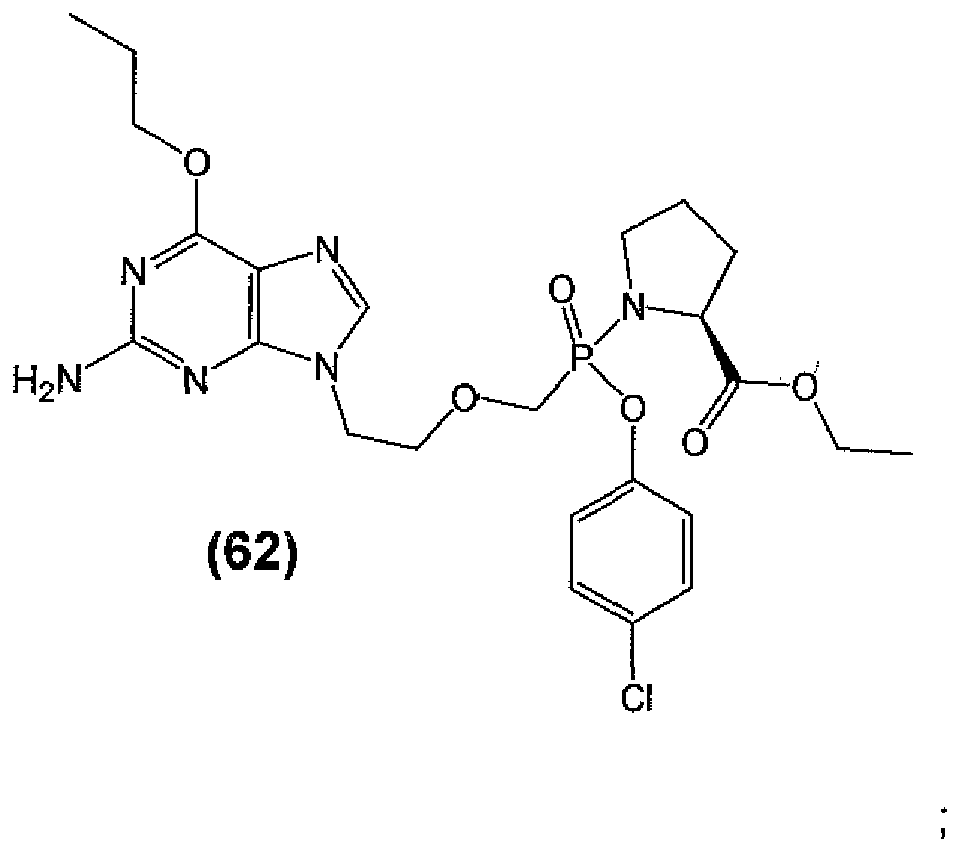
- Triphenylphosphine 60mg, 0.23mmol, 1.25eq. was weighed into a small flask and purged with N 2 then dissolved in 2mL dichlromethane.
- Diisopropyl azodicarboxylate (DIAD, 46mg, 0.23mmol, 1.25eq.) was added next and then was added L-proline ethyl ester hydrochloride (165mg, 0.92mmol, 5eq.).
- N,N-diisopropylethylamine 200uL, ⁇ 1.1 mmol, ⁇ 6eq was added and the reaction mixture stirred 15 minutes.
- Compound (63) was prepared by the same method as described in Example 62 except that p-cyanophenol was substituted for p-chorophenol. Compound (63) was isolated by reverse-phase HPLC as a white solid (31 mg, 0.056 mmol, 18%).
- the assay is based on quantification of cell counts by a colorimetric detection of the cell associated proteins.
- the assay relies on the ability of sulforhodamine B (SRB) to bind to protein components of cells that have been fixed to tissue-culture plates by trichloroacetic acid (TCA).
- SRB is a bright-pink aminoxanthene dye with two sulfonic groups that bind to basic amino-acid residues under mild acidic conditions, and dissociate under basic conditions. As the binding of SRB is stochiometric, the amount of dye extracted from stained cells is directly proportional to the cell mass.
- Cell lines All cell lines were obtained from ATCC (Manassas, VA). Cultivation media containing Glutamax, and trypsin were purchased from Invitrogen (Carlsbad, CA). Doxorubicin, Clofarabine, TCA and SRB were from Sigma-Aldrich (St. Louis, MO). Gemcitabine was obtained from Moravek Biochemicals (Brea, CA)
- GI 50 For GI 50 determination, plot a dose-response curve between the compound concentration and percent of growth inhibition. GI 50 values can be derived by fitting dose-response curves using sigmoidal dose response equation.
- the assay is based on the quantification of cell numbers by measuring the intracellular ATP levels.
- Ultra-Glo Recombinant Luciferase in the presence of cellular ATP converts beetle luciferin to oxylucifer and luminescence, which is proportional to number of cells, is recorded.
- MT4 cell line was obtained from ATCC (Manassas, VA). Cultivation media, HEPES, and bovine serum albumine were purchased from Invitrogen (Carlsbad, CA). Black 384-well Nunc cell culture plates were from VWR, and Cell Titer-Glo Luminescent Cell Viability assay was purchased from Promega.
- Non-Hodgkin's lymphoma in dogs represents a relatively homogenous population with respect to histological type as defined by the REAL/WHO or NCI-Working Formulation schema (i.e., 85% are medium- to high-grade B-cell NHL) with the majority being diffuse large B-cell lymphoma (reference Jacobs RM, Messick JB, Valli VE. Tumors of the hemolymphatic system. In: Meuten DJ. editor. Tumors in Domestic Animals. 4th Ed. Ames (IA): Iowa State Press; 2002:119-198 ).
- Cancers in pet dogs are characterized by tumor growth over long periods of time in the setting of an intact immune system, inter-individual and intra-tumoral heterogeneity, the development of recurrent or resistant disease, and metastasis to relevant distant sites.
- dog cancers capture the 'essence' of the problem of human cancer in a manner not possible with other animal model systems.
- strong similarities to human cancers are seen, including histological appearance, tumor genetics, biological behavior and response to conventional therapies.
- the compressed course of cancer progression seen in dogs allows timely assessment of new cancer therapies.
- Compound (21) was administered at a dose of 0.3 mg/kg of body weight by 30 minute IV infusion in Sterile Saline Injection (0.9% sodium chloride for injection) (total volume 2 ml/kg or 100 ml) once every 21 days to a dog that had non-Hodgkin's lymphoma involving multiple lymphnodes. Diagnosis was confirmed by histological evaluation of the tumor. The effect of treatment on the tumor was measured using the Response Evaluation Criteria in Solid Tumors (RECIST) Guideline (Therasse et al 2000). The size of the tumors and response to treatment was evaluated by in these peripherally accessible lymph nodes, by measuring the longest dimension using callipers and evaluating changes in the individual tumor measurement and their sums.
- Sterile Saline Injection (0.9% sodium chloride for injection)
- the response to treatment is shown by a significant reduction in tumor size starting on Day 7 after the first treatment and continuing with continued improvement to day 42.
- the reduction in tumor size, overall sum of all tumors was characterized as a Partial Response (PR) if at least a 30% decrease in the sum of the LD of target lesions, taking as reference the baseline sum, and as a Complete Response (CR) if lymphnodes returned to a size within normal limits;.
- PR Partial Response
- CR Complete Response
- Treatment with Compound (21) in this dog with non-Hodgkin's lymphoma resulted in a Partial Response after one treatment and with continued treatment resulted in a Complete Response with complete elimination of the tumor.
Landscapes
- Health & Medical Sciences (AREA)
- Chemical & Material Sciences (AREA)
- Life Sciences & Earth Sciences (AREA)
- Organic Chemistry (AREA)
- General Health & Medical Sciences (AREA)
- Chemical Kinetics & Catalysis (AREA)
- Animal Behavior & Ethology (AREA)
- Veterinary Medicine (AREA)
- Public Health (AREA)
- Medicinal Chemistry (AREA)
- Pharmacology & Pharmacy (AREA)
- Biochemistry (AREA)
- Molecular Biology (AREA)
- General Chemical & Material Sciences (AREA)
- Nuclear Medicine, Radiotherapy & Molecular Imaging (AREA)
- Engineering & Computer Science (AREA)
- Oncology (AREA)
- Physics & Mathematics (AREA)
- Virology (AREA)
- Hematology (AREA)
- Communicable Diseases (AREA)
- Biotechnology (AREA)
- Bioinformatics & Cheminformatics (AREA)
- Plasma & Fusion (AREA)
- Analytical Chemistry (AREA)
- General Physics & Mathematics (AREA)
- Immunology (AREA)
- Pathology (AREA)
- Pharmaceuticals Containing Other Organic And Inorganic Compounds (AREA)
- Epidemiology (AREA)
- Medicines That Contain Protein Lipid Enzymes And Other Medicines (AREA)
Claims (15)
- Verbindung der Struktur (5):

- Verbindung nach Anspruch 1, worin jedes Rb unabhängig für C1-C4-Alkyl oder Benzyl steht, R10 für C1-C4-Alkyl steht; und therapeutisch akzeptable Salze und/oder angereicherte optische Isomere davon.
- Verbindung nach Anspruch 1, ausgewählt unter:

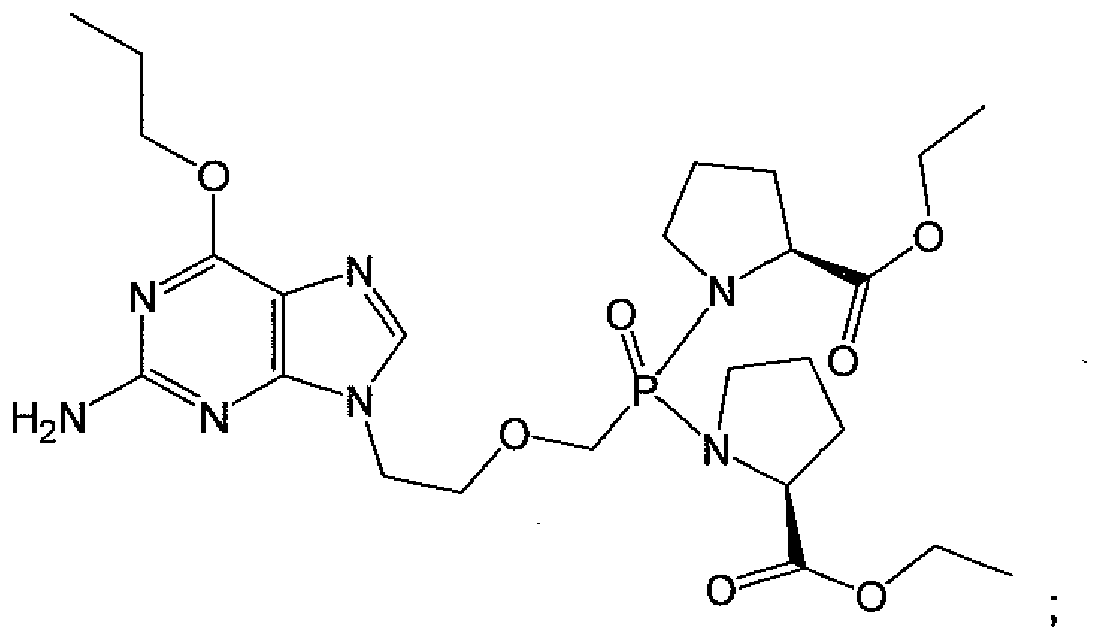


- Verbindung, ausgewählt unter:



- Pharmazeutische Zusammensetzung, umfassend eine therapeutisch wirksame Menge der Verbindung nach einem der Ansprüche 1 bis 4.
- Pharmazeutische Zusammensetzung nach Anspruch 5, weiter umfassend ein zweites therapeutisches Mittel, ausgewählt unter einem antiviralen Mittel oder einem Anti-Tumor/Krebs-Mittel.
- Pharmazeutische Zusammensetzung nach Anspruch 6, wobei das antivirale Mittel aus der Gruppe ausgewählt ist, die aus 3'-Azido-3'-deoxythymidin (Zidovudine, AZT), 2'-Deoxy-3'-thiacytidin (3TC), 2',3'-Dideoxy-2',3'-didehydroadenosin (D4A), 2',3'-Dideoxy-2',3'-didehydrothymidin (D4T), Carbovir (carbocyclisches 2',3'-Dideoxy-2',3'-didehydroguanosin), 3'-Azido-2',3'-dideoxyuridin, 5-Fluorthymidin, (E)-5-(2-Bromvinyl)-2'-deoxyuridin (BVDU), 2-Chlor-2'-deoxyadenosin, 2-Deoxycoformycin, 5-Fluoruracil, 5-Fluoruridin, 5-Fluor-2'-deoxyuridin, 5-Trifluormethyl-2'-deoxyuridin, 6-Azauridin, 5-Fluororotsäure, Methotrexat, Triacetyluridin, 1-(2'-Deoxy-2'-fluor-1-beta-D-arabinosyl)-5-iodcytidin (FIAC), Tetrahydroimidazo(4,5,1-jk)-(1,4)-benzodiazepin-2(1H)-thion (TIBO), 2'-Nor-cyclischGMP, 6-Methoxypurin-Arabinosid (ara-M), 6-Methoxypurin-Arabinosid-2'-O-valerat, Cytosin-Arabinosid (ara-C), 2',3'-Dideoxynucleosiden, acyclischen Nucleosiden, acyclischen Nucleotiden, Ribavirin (Adenin-Arabinosid), 2-Thio-6-azauridin, Tubercidin, Aurintricarbonsäure, 3-Deazaneoplanocin, Neoplanocin, Rimantidin, Adamantin, Foscarnet (Trinatriumphosphonoformiat), Zytokinen, Interferonen, einschließlich Interleukinen, makrophagen/granulozytenkolonie-stimulierenden Faktoren, Zytokinantagonisten, löslichen Interleukinrezeptoren und Proteinkinase-C-Inhibitoren besteht.
- Pharmazeutische Zusammensetzung nach Anspruch 6, wobei das Antitumor/Krebsmittel aus der Gruppe ausgewählt ist, die aus Abarelix (Plenaxis Depot®); Aldesleukin (Prokine®); Aldesleukin (Proleukin®); Alemtuzumabb (Campath®); Alitretinoin (Panretin®); Allopurinol (Zyloprim®); Altretamin (Hexalen®); Amifostin (Ethyol®); Anastrozol (Arimidex®); Arsentrioxid (Trisenox®); Asparaginase (Elspar®); Azacitidin (Vidaza®); Bevacuzimab (Avastin®); Bexarotenkapseln (Targretin®); Bexarotengel (Targretin®); Bleomycin (Blenoxane®); Bortezomib (Velcade®); Busulfan intravenös (Busulfex®); Busulfan oral (Myleran®); Calusteron (Methosarb®); Capecitabin (Xeloda®); Carboplatin (Paraplatin®); Carmustin (BCNU®, BiCNU®); carmustine (Gliadel®); Carmustine mit Polifeprosan 20 Implant (Gliadel Wafer®); Celecoxib (Celebrex®); Cetuximab (Erbitux®); Chlorambucil (Leukeran®); Cisplatin (Platinol®); Cladribin (Leustatin®, 2-CdA®); Clofarabin (Clolar®); Cyclophosphamid (Cytoxan®, Neosar®); Cyclophosphamid (Cytoxan Injektion®); Cyclophosphamid (Cytoxan Tabletet®); Cytarabin (Cytosar-U®); Cytarabin liposomal (DepoCyt®); Dacarbazin (DTIC-Dome®); Dactinomycin, ActinomycinD (Cosmegen®); Darbepoetin alfa (Aranesp®); Daunorubicin liposomal (DanuoXome®); Daunorubicin, Daunomycin (Daunorubicin®); Daunorubicin, Daunomycin (Cerubidine®); Denileukin Diftitox (Ontak®); Dexrazoxan (Zinecard®); Docetaxel (Taxotere®); Doxorubicin (Adriamycin PFS®); Doxorubicin (Adriamycin®, Rubex®); Doxorubicin (Adriamycin PFS Injektion®); Doxorubicin liposomal (Doxil®); Dromostanolonpropionat (Dromostanolone®); Dromostanolonpropionat (Masterone Injektion®); Elliott's B Lösung (Elliott's B Lösung®); Epirubicin (Ellence®); Epoetin alfa (Epogen®); Erlotinib (Tarceva®); Estramustin (Emcyt®); Etoposidphosphat (Etopophos®); Etoposid, VP- 16 (Vepesid®); Exemestan (Aromasin®); Filgrastim (Neupogen®); Floxuridin (intraarteriell) (FUDR®); Fludarabin (Fludara®); Fluorouracil, 5-FU (Adrucil®); Folvestrant (Faslodex®); Gefitinib (Iressa®); Gemcitabin (Gemzar®); Gemtuzumab Ozogamicin (Mylotarg®); Goserelinacetat (Zoladex Implant®); Goserelinacetat (Zoladex®; Histrelinacetat (Histrelin implant®); Hydroxyharnstoff (Hydrea®); Ibritumomab Tiuxetan (Zevalin®); Idarubicin (Idamycin®); Ifosfamid (IFEX®); Imatinibmesylat (Gleevec®); Interferon alfa-2a (Roferon A®); Interferon alfa-2b (Intron A®); Irinotecan (Camptosar®); Lenalidomid (Revlimid®); Letrozol (Femara®); Leucovorin (Wellcovorin®, Leucovorin®); Leuprolid Acetat (Eligard®); Levamisol (Ergamisol®); Lomustine-CCNU (CeeBU®); Meclorethamin, Stickstofflost (Mustargen®); Megestrolacetat (Megace®); Melphalan, L-PAM (Alkeran®); Mercaptopurin, 6-MP (Purinethol®); Mesna (Mesnex®); Mesna (Mesnex Tabs®); Methotrexat (Methotrexate®); Methoxsalen (Uvadex®); Mitomycin C (Mutamycin®); Mitotan (Lysodren®); Mitoxantron (Novantrone®); Nandrolonphenpropionat (Durabolin-50®); Nelarabin (Arranon®); Nofetumomab (Verluma®); Oprelvekin (Neumega®); Oxaliplatin (Eloxatin®); Paclitaxel (Paxene®); Paclitaxel (Taxol®); Paclitaxel proteingebundene Partikel (Abraxane®); Palifermin (Kepivance®); Pamidronat (Aredia®); Pegademase (Adagen (Pegademase Bovine)®); Pegaspargase (Oncaspar®); Pegfilgrastim (Neulasta®); Dinatriumpemetrexed (Alimta®); Pentostatin (Nipent®); Pipobroman (Vercyte®); Plicamycin, Mithramycin (Mithracin®); Natriumporfimer (Photofrin®); Procarbazin (Matulane®); Quinacrin (Atabrine®); Rasburicase (Elitek®); Rituximab (Rituxan®); Sargramostim (Leukine®); Sargramostim (Prokine®); Sorafenib (Nexavar®); Streptozocin (Zanosar®); Sunitinibmaleat (Sutent®); Talkum (Scierosol®); Tamoxifen (Nolvadex®); Temozolomid (Temodar®); Teniposid, VM-26 (Vumon®); Testolacton (Teslac®); Thioguanin, 6-TG (Thioguanine®); Thiotepa (Thioplex®); Topotecan (Hycamtin®); Toremifen (Fareston®); Tositumomab (Bexxar®); Tositumomab/I-131 Tositumomab (Bexxar®); Trastuzumab (Herceptin®); Tretinoin, ATRA (Vesanoid®); Uracillost (Uracil Lost Kapseln®); Valrubicin (Valstar®); Vinblastin (Velban®); Vincristin (Oncovin®); Vinorelbin (Navelbine®); und Zoledronat (Zometa®) besteht.
- Verbindung nach einem der Ansprüche 1 bis 4 zur Verwendung bei der Inhibierung von Tumor/Krebswachstum bei einem Patienten.
- Verbindung nach einem der Ansprüche 1 bis 4 zur Verwendung bei der Inhibierung der Zellproliferation in Tumor/Krebszellen bei einem Patienten.
- Verbindung nach einem der Ansprüche 1 bis 4 zur Verwendung bei der Behandlung einer zellulären Proliferationserkrankung bei einem Patienten.
- Verbindung nach einem der Ansprüche 1 bis 4 zur Verwendung bei der Behandlung einer neoplastischen Erkrankung bei einem Patienten.
- Verbindung nach einem der Ansprüche 1 bis 4 zur Verwendung bei der Behandlung einer härnatologischen Malignität bei einem Patienten.
- Verbindung nach einem der Ansprüche 1 bis 4 zur Verwendung bei der Behandlung von Non-Hodgkin Lymphom (NHL).
- Pharmazeutische Zusammensetzung nach einem der Ansprüche 5 bis 8 zur Verwendung bei der Inhibierung von Tumor/Krebswachstum bei einem Patienten.
Priority Applications (6)
| Application Number | Priority Date | Filing Date | Title |
|---|---|---|---|
| EP11151008.7A EP2308885B1 (de) | 2008-02-20 | 2009-02-19 | Neue Verbindungen und Anwendungen in der Therapie |
| SI200931021T SI2245037T1 (sl) | 2008-02-20 | 2009-02-19 | Nove spojine in postopki za zdravljenje |
| DK11151008.7T DK2308885T3 (da) | 2008-02-20 | 2009-02-19 | Nye forbindelser og fremgangsmåder for terapi |
| PL09712645T PL2245037T4 (pl) | 2008-02-20 | 2009-02-19 | Nowe związki i sposoby leczenia |
| PL11151008T PL2308885T3 (pl) | 2008-02-20 | 2009-02-19 | Nowe związki i sposoby leczenia |
| CY20141100761T CY1115571T1 (el) | 2008-02-20 | 2014-09-18 | Νεες ενωσεις και μεθοδοι για θεραπεια |
Applications Claiming Priority (2)
| Application Number | Priority Date | Filing Date | Title |
|---|---|---|---|
| US3014808P | 2008-02-20 | 2008-02-20 | |
| PCT/US2009/034471 WO2009105513A2 (en) | 2008-02-20 | 2009-02-19 | Novel compounds and methods for therapy |
Related Child Applications (2)
| Application Number | Title | Priority Date | Filing Date |
|---|---|---|---|
| EP11151008.7A Division EP2308885B1 (de) | 2008-02-20 | 2009-02-19 | Neue Verbindungen und Anwendungen in der Therapie |
| EP11151008.7A Division-Into EP2308885B1 (de) | 2008-02-20 | 2009-02-19 | Neue Verbindungen und Anwendungen in der Therapie |
Publications (2)
| Publication Number | Publication Date |
|---|---|
| EP2245037A2 EP2245037A2 (de) | 2010-11-03 |
| EP2245037B1 true EP2245037B1 (de) | 2014-06-18 |
Family
ID=40532651
Family Applications (2)
| Application Number | Title | Priority Date | Filing Date |
|---|---|---|---|
| EP11151008.7A Active EP2308885B1 (de) | 2008-02-20 | 2009-02-19 | Neue Verbindungen und Anwendungen in der Therapie |
| EP09712645.2A Active EP2245037B1 (de) | 2008-02-20 | 2009-02-19 | Neuartige verbindungen und therapieverfahren |
Family Applications Before (1)
| Application Number | Title | Priority Date | Filing Date |
|---|---|---|---|
| EP11151008.7A Active EP2308885B1 (de) | 2008-02-20 | 2009-02-19 | Neue Verbindungen und Anwendungen in der Therapie |
Country Status (18)
| Country | Link |
|---|---|
| US (1) | US8163718B2 (de) |
| EP (2) | EP2308885B1 (de) |
| JP (2) | JP5588356B2 (de) |
| KR (2) | KR101612138B1 (de) |
| CN (2) | CN105753905A (de) |
| AR (1) | AR071159A1 (de) |
| AU (3) | AU2009215547B2 (de) |
| CA (1) | CA2715885C (de) |
| CY (2) | CY1115571T1 (de) |
| DK (2) | DK2308885T3 (de) |
| ES (2) | ES2529209T3 (de) |
| HR (2) | HRP20140895T1 (de) |
| NZ (1) | NZ587464A (de) |
| PL (2) | PL2308885T3 (de) |
| PT (2) | PT2245037E (de) |
| SI (2) | SI2308885T1 (de) |
| TW (1) | TWI444384B (de) |
| WO (1) | WO2009105513A2 (de) |
Families Citing this family (66)
| Publication number | Priority date | Publication date | Assignee | Title |
|---|---|---|---|---|
| EP1831225A2 (de) | 2004-11-19 | 2007-09-12 | The Regents of the University of California | Entzündungshemmende pyrazolopyrimidine |
| WO2007114926A2 (en) | 2006-04-04 | 2007-10-11 | The Regents Of The University Of California | Kinase antagonists |
| GB2467670B (en) | 2007-10-04 | 2012-08-01 | Intellikine Inc | Chemical entities and therapeutic uses thereof |
| MX2010007419A (es) | 2008-01-04 | 2010-11-12 | Intellikine Inc | Ciertas entidades quimicas, composiciones y metodos. |
| US8193182B2 (en) | 2008-01-04 | 2012-06-05 | Intellikine, Inc. | Substituted isoquinolin-1(2H)-ones, and methods of use thereof |
| EP2252293B1 (de) | 2008-03-14 | 2018-06-27 | Intellikine, LLC | Kinasehemmer und verwendungsverfahren |
| US8993580B2 (en) | 2008-03-14 | 2015-03-31 | Intellikine Llc | Benzothiazole kinase inhibitors and methods of use |
| US20110224223A1 (en) | 2008-07-08 | 2011-09-15 | The Regents Of The University Of California, A California Corporation | MTOR Modulators and Uses Thereof |
| BRPI0915231A2 (pt) | 2008-07-08 | 2018-06-12 | Intellikine Inc | compostos inibidores de quinase e métodos de uso |
| CA2738429C (en) | 2008-09-26 | 2016-10-25 | Intellikine, Inc. | Heterocyclic kinase inhibitors |
| EP2358720B1 (de) | 2008-10-16 | 2016-03-02 | The Regents of The University of California | Heteroarylkinasehemmer mit kondensierten ringen |
| US8476431B2 (en) | 2008-11-03 | 2013-07-02 | Itellikine LLC | Benzoxazole kinase inhibitors and methods of use |
| ES2650337T3 (es) | 2009-01-08 | 2018-01-17 | International Institute Of Cancer Immunology, Inc. | Péptidos derivados de eEF2 para el tratamiento o prevención de cánceres |
| JP5789252B2 (ja) | 2009-05-07 | 2015-10-07 | インテリカイン, エルエルシー | 複素環式化合物およびその使用 |
| WO2011047384A2 (en) | 2009-10-16 | 2011-04-21 | The Regents Of The University Of California | Methods of inhibiting ire1 |
| CN102093422B (zh) * | 2009-12-10 | 2015-02-25 | 中国人民解放军军事医学科学院毒物药物研究所 | 无环核苷膦酸酯衍生物及其医药用途 |
| CA2799579A1 (en) | 2010-05-21 | 2011-11-24 | Intellikine, Inc. | Chemical compounds, compositions and methods for kinase modulation |
| JP2013545749A (ja) | 2010-11-10 | 2013-12-26 | インフィニティー ファーマシューティカルズ, インコーポレイテッド | 複素環化合物及びその使用 |
| ES2637113T3 (es) | 2011-01-10 | 2017-10-10 | Infinity Pharmaceuticals, Inc. | Procedimientos para preparar isoquinolinonas y formas sólidas de isoquinolinonas |
| US9295673B2 (en) | 2011-02-23 | 2016-03-29 | Intellikine Llc | Combination of mTOR inhibitors and P13-kinase inhibitors, and uses thereof |
| HK1198443A1 (en) | 2011-07-19 | 2015-04-24 | 无限药品股份有限公司 | Heterocyclic compounds and uses thereof |
| AR088218A1 (es) | 2011-07-19 | 2014-05-21 | Infinity Pharmaceuticals Inc | Compuestos heterociclicos utiles como inhibidores de pi3k |
| MX2014002542A (es) | 2011-08-29 | 2014-07-09 | Infinity Pharmaceuticals Inc | Compuestos heterociclicos y usos de los mismos. |
| CA2846496C (en) | 2011-09-02 | 2020-07-14 | The Regents Of The University Of California | Substituted pyrazolo[3,4-d]pyrimidines and uses thereof |
| CA2752008A1 (en) | 2011-09-13 | 2013-03-13 | Universite De Montreal | Combination therapy using ribavirin as elf4e inhibitor |
| EP3578563B1 (de) | 2011-12-22 | 2021-04-14 | Geron Corporation | Guanin-analoga als telomerasesubstrate und telomerlängenaffektoren |
| US8940742B2 (en) | 2012-04-10 | 2015-01-27 | Infinity Pharmaceuticals, Inc. | Heterocyclic compounds and uses thereof |
| AU2013202947B2 (en) * | 2012-06-13 | 2016-06-02 | Ipsen Biopharm Ltd. | Methods for treating pancreatic cancer using combination therapies comprising liposomal irinotecan |
| US8828998B2 (en) | 2012-06-25 | 2014-09-09 | Infinity Pharmaceuticals, Inc. | Treatment of lupus, fibrotic conditions, and inflammatory myopathies and other disorders using PI3 kinase inhibitors |
| CN103665043B (zh) | 2012-08-30 | 2017-11-10 | 江苏豪森药业集团有限公司 | 一种替诺福韦前药及其在医药上的应用 |
| JP2015532287A (ja) | 2012-09-26 | 2015-11-09 | ザ・リージエンツ・オブ・ザ・ユニバーシテイー・オブ・カリフオルニア | Ire1の調節 |
| AU2013337717B2 (en) | 2012-11-01 | 2018-10-25 | Infinity Pharmaceuticals, Inc. | Treatment of cancers using PI3 kinase isoform modulators |
| US9889180B2 (en) | 2012-11-19 | 2018-02-13 | Agency For Science, Technology And Research | Method of treating cancer |
| US9695212B2 (en) * | 2012-12-13 | 2017-07-04 | Aduro Biotech, Inc. | Compositions comprising cyclic purine dinucleotides having defined stereochemistries and methods for their preparation and use |
| US9481667B2 (en) | 2013-03-15 | 2016-11-01 | Infinity Pharmaceuticals, Inc. | Salts and solid forms of isoquinolinones and composition comprising and methods of using the same |
| SG10201800188SA (en) | 2013-03-15 | 2018-02-27 | Univ California | Acyclic nucleoside phosphonate diesters |
| US9751888B2 (en) | 2013-10-04 | 2017-09-05 | Infinity Pharmaceuticals, Inc. | Heterocyclic compounds and uses thereof |
| PT3052485T (pt) | 2013-10-04 | 2021-10-22 | Infinity Pharmaceuticals Inc | Compostos heterocíclicos e suas utilizações |
| CN104558035B (zh) * | 2013-10-22 | 2017-12-19 | 连云港恒运药业有限公司 | 一种替诺福韦前药的纯化方法 |
| MX382033B (es) | 2014-03-19 | 2025-03-13 | Infinity Pharmaceuticals Inc | Compuestos heterocíclicos para utilizarlos en el tratamiento de trastornos mediados por pi3k-gamma. |
| WO2015160975A2 (en) | 2014-04-16 | 2015-10-22 | Infinity Pharmaceuticals, Inc. | Combination therapies |
| CN111808136B (zh) * | 2014-09-15 | 2024-06-11 | 加利福尼亚大学董事会 | 核苷酸类似物 |
| WO2016054491A1 (en) | 2014-10-03 | 2016-04-07 | Infinity Pharmaceuticals, Inc. | Heterocyclic compounds and uses thereof |
| JP7381190B2 (ja) | 2014-12-26 | 2023-11-15 | エモリー・ユニバーシテイ | N4-ヒドロキシシチジン及び誘導体並びにそれに関連する抗ウイルス用途 |
| PE20181016A1 (es) | 2015-08-10 | 2018-06-26 | Merck Sharp & Dohme | Compuestos antivirales de fosfodiamida de ester de beta aminoacido |
| WO2017048702A1 (en) | 2015-09-14 | 2017-03-23 | Infinity Pharmaceuticals, Inc. | Solid forms of isoquinolinone derivatives, process of making, compositions comprising, and methods of using the same |
| EP3350191B9 (de) | 2015-09-15 | 2021-12-22 | The Regents of the University of California | Nukleotidanaloga |
| US10745428B2 (en) | 2015-12-10 | 2020-08-18 | Idenix Pharmaceuticals Llc | Antiviral phosphodiamide prodrugs of tenofovir |
| US10450335B2 (en) | 2015-12-15 | 2019-10-22 | Merck Sharp & Dohme Corp. | Antiviral oxime phosphoramide compounds |
| WO2017161116A1 (en) | 2016-03-17 | 2017-09-21 | Infinity Pharmaceuticals, Inc. | Isotopologues of isoquinolinone and quinazolinone compounds and uses thereof as pi3k kinase inhibitors |
| CN109311882B (zh) * | 2016-05-04 | 2022-02-11 | Bci制药公司 | 作为蛋白激酶抑制剂的腺嘌呤衍生物 |
| CN109790143A (zh) | 2016-05-10 | 2019-05-21 | C4医药公司 | 用于靶蛋白降解的胺连接的c3-戊二酰亚胺降解决定子体 |
| EP3454856B1 (de) | 2016-05-10 | 2024-09-11 | C4 Therapeutics, Inc. | Heterocyclische degronimere für zielproteinabbau |
| CN109641874A (zh) | 2016-05-10 | 2019-04-16 | C4医药公司 | 用于靶蛋白降解的c3-碳连接的戊二酰亚胺降解决定子体 |
| ES2990061T3 (es) | 2016-05-10 | 2024-11-28 | C4 Therapeutics Inc | Degronímeros espirocíclicos para la degradación de proteínas diana |
| WO2017214269A1 (en) | 2016-06-08 | 2017-12-14 | Infinity Pharmaceuticals, Inc. | Heterocyclic compounds and uses thereof |
| SG11201811237WA (en) | 2016-06-24 | 2019-01-30 | Infinity Pharmaceuticals Inc | Combination therapies |
| EP3532069A4 (de) | 2016-10-26 | 2020-05-13 | Merck Sharp & Dohme Corp. | Antivirale aryl-amid-phosphodiamidverbindungen |
| JP6938637B2 (ja) | 2016-12-22 | 2021-09-22 | メルク・シャープ・アンド・ドーム・コーポレーションMerck Sharp & Dohme Corp. | テノホビルの抗ウイルス性脂肪族エステルプロドラッグ |
| US11123355B2 (en) | 2016-12-22 | 2021-09-21 | Idenix Pharmaceuticals Llc | Antiviral benzyl-amine phosphodiamide compounds |
| CN110769822A (zh) | 2017-06-20 | 2020-02-07 | C4医药公司 | 用于蛋白降解的n/o-连接的降解决定子和降解决定子体 |
| PT3706762T (pt) | 2017-12-07 | 2024-12-05 | Univ Emory | N4-hidroxicitidina e derivados e utilizações antivirais relacionadas com os mesmos |
| CN108096562B (zh) * | 2017-12-25 | 2021-05-11 | 武汉百药联科科技有限公司 | 20s蛋白酶体抑制剂在制备治疗日本乙型脑炎病毒感染的药物中的用途 |
| WO2020018399A1 (en) | 2018-07-19 | 2020-01-23 | Merck Sharp & Dohme Corp. | Phosphinic amide prodrugs of tenofovir |
| CN112778363B (zh) * | 2019-11-05 | 2024-03-15 | 华创合成制药股份有限公司 | 一种硝基咪唑类唑衍生物及其制备方法和用途 |
| KR20250052378A (ko) * | 2022-07-21 | 2025-04-18 | 안티바 바이오사이언시즈, 인크. | Hpv 감염 및 hpv-유도 신생물의 치료를 위한 조성물 및 투여 형태 |
Family Cites Families (48)
| Publication number | Priority date | Publication date | Assignee | Title |
|---|---|---|---|---|
| DE1617457A1 (de) * | 1966-12-16 | 1972-04-20 | Erba Carlo Spa | Verfahren zur Stabilisierung von Zubereitungen interferierender Virusprodukte |
| US3665838A (en) * | 1970-01-29 | 1972-05-30 | Wilson Lighting Ltd | Air chamber assembly |
| CS233665B1 (en) | 1983-01-06 | 1985-03-14 | Antonin Holy | Processing of isomere o-phosphonylmethylderivative of anantiomere racemic vicinal diene |
| US4740365A (en) | 1984-04-09 | 1988-04-26 | Toyo Boseki Kabushiki Kaisha | Sustained-release preparation applicable to mucous membrane in oral cavity |
| CS263951B1 (en) | 1985-04-25 | 1989-05-12 | Antonin Holy | 9-(phosponylmethoxyalkyl)adenines and method of their preparation |
| CS263952B1 (en) | 1985-04-25 | 1989-05-12 | Holy Antonin | Remedy with antiviral effect |
| US5141752A (en) | 1986-05-09 | 1992-08-25 | Alza Corporation | Delayed drug delivery device |
| CS264222B1 (en) | 1986-07-18 | 1989-06-13 | Holy Antonin | N-phosphonylmethoxyalkylderivatives of bases of pytimidine and purine and method of use them |
| NZ222553A (en) | 1986-11-18 | 1991-07-26 | Bristol Myers Co | Phosphonomethoxyalkylene purine and pyrimidine derivatives and pharmaceutical compositions |
| US5650510A (en) * | 1986-11-18 | 1997-07-22 | Institute Of Organic Chemistry And Biochemistry Of The Academy Of Sciences Of The Czech Republic | Antiviral phosphonomethoxyalkylene purine and pyrimidine derivatives |
| US5459256A (en) | 1987-04-17 | 1995-10-17 | The Government Of The United States Of America As Represented By The Department Of Health And Human Services | Lipophilic, aminohydrolase-activated prodrugs |
| GB8802142D0 (en) * | 1988-02-01 | 1988-03-02 | Air Prod & Chem | Method of freezing liquid & pasty products & freezer for carrying out said method |
| CA2001715C (en) | 1988-11-14 | 1999-12-28 | Muzammil M. Mansuri | Carbocyclic nucleosides and nucleotides |
| US5098443A (en) | 1989-03-23 | 1992-03-24 | University Of Miami | Method of implanting intraocular and intraorbital implantable devices for the controlled release of pharmacological agents |
| CA2297294C (en) | 1989-05-15 | 2005-11-08 | Institute Of Organic Chemistry And Biochemistry Of The Academy Of Sciences Of The Czech Republic | Phosphonomethoxymethylpurine/pyrimidine derivatives |
| PT95516A (pt) | 1989-10-06 | 1991-08-14 | Wellcome Found | Processo para a preparacao de derivados de 2',3'-didesoxi nucleosidos 6-substituidos |
| MY104575A (en) | 1989-12-22 | 1994-04-30 | The Wellcome Foundation Ltd | Therapeutic nucleosides. |
| US5302585A (en) | 1990-04-20 | 1994-04-12 | Institute Of Organic Chemistry And Biochemistry Of The Academy Of Sciences Of The Czech Republic | Use of chiral 2-(phosphonomethoxy)propyl guanines as antiviral agents |
| CZ285420B6 (cs) | 1990-04-24 | 1999-08-11 | Ústav Organické Chemie A Biochemie Avčr | N-(3-Fluor-2-fosfonylmethoxypropyl)deriváty purinových a pyrimidinových heterocyklických bazí, způsoby jejich přípravy a použití |
| JPH05509307A (ja) | 1990-07-19 | 1993-12-22 | ビーチャム・グループ・パブリック・リミテッド・カンパニー | プリンの抗ウイルス性ホスホノ―アルケン誘導体 |
| EP0468119A1 (de) | 1990-07-24 | 1992-01-29 | Merrell Dow Pharmaceuticals Inc. | Neue Carbocyclische Analoge einiger Nukleoside |
| EP0481214B1 (de) | 1990-09-14 | 1998-06-24 | Institute Of Organic Chemistry And Biochemistry Of The Academy Of Sciences Of The Czech Republic | Wirkstoffvorläufer von Phosphonaten |
| US5208221A (en) | 1990-11-29 | 1993-05-04 | Bristol-Myers Squibb Company | Antiviral (phosphonomethoxy) methoxy purine/pyrimidine derivatives |
| US5378475A (en) | 1991-02-21 | 1995-01-03 | University Of Kentucky Research Foundation | Sustained release drug delivery devices |
| CZ284678B6 (cs) | 1991-05-20 | 1999-01-13 | Ústav Organické Chemie A Biochemie Avčr | Di(2-propyl)estery 1-fluor-2-fosfonomethoxy-3-p -toluensulfonyloxypropanů, způsob jejich přípravy a použití |
| HU225970B1 (en) | 1991-10-11 | 2008-01-28 | Acad Of Science Czech Republic | Antiviral acyclic phosphonomethoxyalkyl-substituted alkenyl purine and pyrimidine derivatives, and pharmaceutical preparations containing them |
| US6057305A (en) | 1992-08-05 | 2000-05-02 | Institute Of Organic Chemistry And Biochemistry Of The Academy Of Sciences Of The Czech Republic | Antiretroviral enantiomeric nucleotide analogs |
| DE4308096A1 (de) | 1993-03-13 | 1994-09-15 | Hoechst Ag | Prodrug-Derivate von Enzyminhibitoren mit Hydroxylgruppen, Verfahren zu deren Herstellung und ihre Verwendung |
| EP0618214A1 (de) | 1993-04-01 | 1994-10-05 | Merrell Dow Pharmaceuticals Inc. | Ungesättigte Phosphonatderivate Purinen und Pyrimidinen |
| ATE199906T1 (de) * | 1993-06-29 | 2001-04-15 | Mitsubishi Chem Corp | Phosphonat-nukleotid ester-derivate |
| EP0719273B1 (de) | 1993-09-17 | 2010-11-03 | Gilead Sciences, Inc. | Nukleotidanaloge |
| NZ283658A (en) | 1994-04-04 | 1999-09-29 | William R Freeman | Compositions and treatment of increased intraocular pressure with phosphonyl-alkyloxy-pyrimidines/purines (nucleosides) |
| FR2723740B1 (fr) * | 1994-08-16 | 1996-11-08 | Pasteur Merieux Serums Vacc | Procede de preparation d'antigenes du virus grippal, antigenes obtenus et leurs applications |
| US5977061A (en) | 1995-04-21 | 1999-11-02 | Institute Of Organic Chemistry And Biochemistry Of The Academy Of Sciences Of The Czech Republic | N6 - substituted nucleotide analagues and their use |
| IL120202A (en) * | 1996-03-07 | 2001-03-19 | Akzo Nobel Nv | Container with freeze-dried vaccine components |
| US20030072814A1 (en) | 1999-12-16 | 2003-04-17 | Maibach Howard I. | Topical pharmaceutical composition for the treatment of warts |
| IL150594A0 (en) | 2000-01-07 | 2003-02-12 | Ustav Ex Botan Adademie Ved Ce | Purine derivatives, process for their preparation and use |
| US20020119443A1 (en) | 2000-07-21 | 2002-08-29 | Gilead Sciences, Inc. | Prodrugs of phosphonate nucleotide analogues and methods for selecting and making same |
| FR2862306B1 (fr) * | 2003-11-17 | 2008-05-30 | Aventis Pasteur | Composition vaccinale |
| ATE478082T1 (de) | 2003-12-30 | 2010-09-15 | Gilead Sciences Inc | Phosphonate, monophosphonamidate, bisphosphonamidate zur behandlung von virenerkrankungen |
| AU2005263465B2 (en) * | 2004-07-23 | 2010-07-29 | Bayer Healthcare Llc | Sterile freezing, drying, storing, assaying and filling process (SFD-SAF process) (pellet freeze-drying process for parenteral biopharmaceuticals) |
| US20060165717A1 (en) * | 2005-01-25 | 2006-07-27 | Sanofi Pasteur | DCchol in newborns |
| WO2007002808A1 (en) | 2005-06-29 | 2007-01-04 | Gilead Sciences, Inc. | Anti-nonmelanoma carcinoma compounds, compositions, and methods of use thereof |
| WO2007002912A2 (en) | 2005-06-29 | 2007-01-04 | Gilead Sciences, Inc. | Anti-proliferative compounds, compositions, and methods of use thereof |
| SI2020996T1 (sl) | 2006-05-16 | 2012-03-30 | Gilead Sciences Inc | Postopek in sestavki za zdravljenje hematološkihmalignosti |
| US9521854B2 (en) * | 2006-05-31 | 2016-12-20 | Air Liquide Industrial U.S. Lp | Method and device for creating frozen pellets of a foodstuff |
| US20080008682A1 (en) * | 2006-07-07 | 2008-01-10 | Chong Lee S | Modulators of toll-like receptor 7 |
| CN101066981B (zh) * | 2007-05-25 | 2011-10-05 | 中国科学院上海药物研究所 | 非环核苷膦酸酯类化合物及其组合物、制备方法和用途 |
-
2009
- 2009-02-16 TW TW098104834A patent/TWI444384B/zh active
- 2009-02-19 KR KR1020107021189A patent/KR101612138B1/ko active Active
- 2009-02-19 CN CN201610086843.7A patent/CN105753905A/zh active Pending
- 2009-02-19 JP JP2010547740A patent/JP5588356B2/ja active Active
- 2009-02-19 EP EP11151008.7A patent/EP2308885B1/de active Active
- 2009-02-19 DK DK11151008.7T patent/DK2308885T3/da active
- 2009-02-19 CN CN200980113907.6A patent/CN102015739B/zh active Active
- 2009-02-19 ES ES11151008.7T patent/ES2529209T3/es active Active
- 2009-02-19 AU AU2009215547A patent/AU2009215547B2/en active Active
- 2009-02-19 ES ES09712645.2T patent/ES2516715T3/es active Active
- 2009-02-19 PT PT97126452T patent/PT2245037E/pt unknown
- 2009-02-19 PT PT111510087T patent/PT2308885E/pt unknown
- 2009-02-19 WO PCT/US2009/034471 patent/WO2009105513A2/en not_active Ceased
- 2009-02-19 PL PL11151008T patent/PL2308885T3/pl unknown
- 2009-02-19 EP EP09712645.2A patent/EP2245037B1/de active Active
- 2009-02-19 DK DK09712645.2T patent/DK2245037T3/da active
- 2009-02-19 CA CA2715885A patent/CA2715885C/en active Active
- 2009-02-19 US US12/388,789 patent/US8163718B2/en active Active
- 2009-02-19 SI SI200931104T patent/SI2308885T1/sl unknown
- 2009-02-19 NZ NZ587464A patent/NZ587464A/en unknown
- 2009-02-19 SI SI200931021T patent/SI2245037T1/sl unknown
- 2009-02-19 HR HRP20140895AT patent/HRP20140895T1/hr unknown
- 2009-02-19 KR KR1020167009014A patent/KR101728647B1/ko active Active
- 2009-02-19 PL PL09712645T patent/PL2245037T4/pl unknown
- 2009-02-20 AR ARP090100607A patent/AR071159A1/es active IP Right Grant
-
2014
- 2014-01-06 JP JP2014000324A patent/JP2014088416A/ja not_active Withdrawn
- 2014-07-10 AU AU2014203786A patent/AU2014203786B2/en active Active
- 2014-09-18 CY CY20141100761T patent/CY1115571T1/el unknown
-
2015
- 2015-01-07 HR HRP20150005TT patent/HRP20150005T1/hr unknown
- 2015-01-30 CY CY20151100102T patent/CY1116015T1/el unknown
-
2016
- 2016-10-28 AU AU2016250468A patent/AU2016250468A1/en not_active Abandoned
Also Published As
Similar Documents
| Publication | Publication Date | Title |
|---|---|---|
| EP2245037B1 (de) | Neuartige verbindungen und therapieverfahren | |
| EP1778251B1 (de) | Nukleosid phosphonat konjugate als anti hiv mittel | |
| KR100386685B1 (ko) | 뉴클레오타이드동족체류 | |
| CN1329404C (zh) | 具有抗病毒活性的6-2'-(膦酰基甲氧基)烷氧基嘧啶衍生物 | |
| HK1150313B (en) | Novel compounds and methods for therapy | |
| HK1156631B (en) | Novel compounds and methods for therapy | |
| HK1226740A1 (en) | Novel compounds and methods for therapy | |
| HK1226740A (en) | Novel compounds and methods for therapy | |
| AU2011224011A1 (en) | Phosphonate analogs of HIV inhibitor compounds |
Legal Events
| Date | Code | Title | Description |
|---|---|---|---|
| PUAI | Public reference made under article 153(3) epc to a published international application that has entered the european phase |
Free format text: ORIGINAL CODE: 0009012 |
|
| 17P | Request for examination filed |
Effective date: 20100819 |
|
| AK | Designated contracting states |
Kind code of ref document: A2 Designated state(s): AT BE BG CH CY CZ DE DK EE ES FI FR GB GR HR HU IE IS IT LI LT LU LV MC MK MT NL NO PL PT RO SE SI SK TR |
|
| AX | Request for extension of the european patent |
Extension state: AL BA RS |
|
| DAX | Request for extension of the european patent (deleted) | ||
| RIN1 | Information on inventor provided before grant (corrected) |
Inventor name: TUMAS, DANIEL Inventor name: BIRKUS, GABRIEL Inventor name: WATKINS, WILLIAM, J. Inventor name: RAY, ADRIAN, S. |
|
| REG | Reference to a national code |
Ref country code: HK Ref legal event code: DE Ref document number: 1150313 Country of ref document: HK |
|
| 17Q | First examination report despatched |
Effective date: 20111214 |
|
| GRAP | Despatch of communication of intention to grant a patent |
Free format text: ORIGINAL CODE: EPIDOSNIGR1 |
|
| INTG | Intention to grant announced |
Effective date: 20130715 |
|
| GRAP | Despatch of communication of intention to grant a patent |
Free format text: ORIGINAL CODE: EPIDOSNIGR1 |
|
| INTG | Intention to grant announced |
Effective date: 20131129 |
|
| GRAS | Grant fee paid |
Free format text: ORIGINAL CODE: EPIDOSNIGR3 |
|
| GRAA | (expected) grant |
Free format text: ORIGINAL CODE: 0009210 |
|
| AK | Designated contracting states |
Kind code of ref document: B1 Designated state(s): AT BE BG CH CY CZ DE DK EE ES FI FR GB GR HR HU IE IS IT LI LT LU LV MC MK MT NL NO PL PT RO SE SI SK TR |
|
| REG | Reference to a national code |
Ref country code: GB Ref legal event code: FG4D |
|
| REG | Reference to a national code |
Ref country code: CH Ref legal event code: EP |
|
| REG | Reference to a national code |
Ref country code: AT Ref legal event code: REF Ref document number: 673300 Country of ref document: AT Kind code of ref document: T Effective date: 20140715 |
|
| REG | Reference to a national code |
Ref country code: IE Ref legal event code: FG4D |
|
| REG | Reference to a national code |
Ref country code: DE Ref legal event code: R096 Ref document number: 602009024740 Country of ref document: DE Effective date: 20140731 |
|
| REG | Reference to a national code |
Ref country code: HR Ref legal event code: TUEP Ref document number: P20140895 Country of ref document: HR |
|
| REG | Reference to a national code |
Ref country code: DK Ref legal event code: T3 Effective date: 20140926 |
|
| REG | Reference to a national code |
Ref country code: CH Ref legal event code: NV Representative=s name: MARKS AND CLERK (LUXEMBOURG) LLP, CH |
|
| REG | Reference to a national code |
Ref country code: SE Ref legal event code: TRGR |
|
| REG | Reference to a national code |
Ref country code: PT Ref legal event code: SC4A Free format text: AVAILABILITY OF NATIONAL TRANSLATION Effective date: 20141015 |
|
| REG | Reference to a national code |
Ref country code: NL Ref legal event code: T3 |
|
| PG25 | Lapsed in a contracting state [announced via postgrant information from national office to epo] |
Ref country code: NO Free format text: LAPSE BECAUSE OF FAILURE TO SUBMIT A TRANSLATION OF THE DESCRIPTION OR TO PAY THE FEE WITHIN THE PRESCRIBED TIME-LIMIT Effective date: 20140918 |
|
| REG | Reference to a national code |
Ref country code: ES Ref legal event code: FG2A Ref document number: 2516715 Country of ref document: ES Kind code of ref document: T3 Effective date: 20141031 |
|
| REG | Reference to a national code |
Ref country code: GR Ref legal event code: EP Ref document number: 20140401918 Country of ref document: GR Effective date: 20141017 |
|
| REG | Reference to a national code |
Ref country code: HR Ref legal event code: T1PR Ref document number: P20140895 Country of ref document: HR |
|
| REG | Reference to a national code |
Ref country code: EE Ref legal event code: FG4A Ref document number: E009930 Country of ref document: EE Effective date: 20141027 |
|
| REG | Reference to a national code |
Ref country code: PL Ref legal event code: T3 |
|
| REG | Reference to a national code |
Ref country code: HU Ref legal event code: AG4A Ref document number: E021907 Country of ref document: HU |
|
| REG | Reference to a national code |
Ref country code: SK Ref legal event code: T3 Ref document number: E 17612 Country of ref document: SK |
|
| REG | Reference to a national code |
Ref country code: DE Ref legal event code: R097 Ref document number: 602009024740 Country of ref document: DE |
|
| PLBE | No opposition filed within time limit |
Free format text: ORIGINAL CODE: 0009261 |
|
| REG | Reference to a national code |
Ref country code: HK Ref legal event code: GR Ref document number: 1150313 Country of ref document: HK |
|
| STAA | Information on the status of an ep patent application or granted ep patent |
Free format text: STATUS: NO OPPOSITION FILED WITHIN TIME LIMIT |
|
| 26N | No opposition filed |
Effective date: 20150319 |
|
| REG | Reference to a national code |
Ref country code: PL Ref legal event code: T4 |
|
| REG | Reference to a national code |
Ref country code: RO Ref legal event code: EPE |
|
| REG | Reference to a national code |
Ref country code: FR Ref legal event code: PLFP Year of fee payment: 8 |
|
| REG | Reference to a national code |
Ref country code: NO Ref legal event code: T2 Effective date: 20140618 |
|
| REG | Reference to a national code |
Ref country code: FR Ref legal event code: PLFP Year of fee payment: 9 |
|
| PG25 | Lapsed in a contracting state [announced via postgrant information from national office to epo] |
Ref country code: NO Free format text: LAPSE BECAUSE OF FAILURE TO SUBMIT A TRANSLATION OF THE DESCRIPTION OR TO PAY THE FEE WITHIN THE PRESCRIBED TIME-LIMIT Effective date: 20140918 |
|
| PGRI | Patent reinstated in contracting state [announced from national office to epo] |
Ref country code: NO Effective date: 20160815 |
|
| REG | Reference to a national code |
Ref country code: FR Ref legal event code: PLFP Year of fee payment: 10 |
|
| REG | Reference to a national code |
Ref country code: HR Ref legal event code: ODRP Ref document number: P20140895 Country of ref document: HR Payment date: 20190206 Year of fee payment: 11 |
|
| REG | Reference to a national code |
Ref country code: HR Ref legal event code: ODRP Ref document number: P20140895 Country of ref document: HR Payment date: 20200204 Year of fee payment: 12 |
|
| REG | Reference to a national code |
Ref country code: HR Ref legal event code: ODRP Ref document number: P20140895 Country of ref document: HR Payment date: 20210211 Year of fee payment: 13 |
|
| REG | Reference to a national code |
Ref country code: HR Ref legal event code: ODRP Ref document number: P20140895 Country of ref document: HR Payment date: 20220216 Year of fee payment: 14 |
|
| REG | Reference to a national code |
Ref country code: HR Ref legal event code: ODRP Ref document number: P20140895 Country of ref document: HR Payment date: 20230119 Year of fee payment: 15 |
|
| REG | Reference to a national code |
Ref country code: HR Ref legal event code: ODRP Ref document number: P20140895 Country of ref document: HR Payment date: 20231228 Year of fee payment: 16 |
|
| REG | Reference to a national code |
Ref country code: HR Ref legal event code: ODRP Ref document number: P20140895 Country of ref document: HR Payment date: 20241224 Year of fee payment: 17 |
|
| PG25 | Lapsed in a contracting state [announced via postgrant information from national office to epo] |
Ref country code: EE Free format text: LAPSE BECAUSE OF NON-PAYMENT OF DUE FEES Effective date: 20250228 |
|
| REG | Reference to a national code |
Ref country code: EE Ref legal event code: TH4A Ref document number: E009930 Country of ref document: EE |
|
| PGFP | Annual fee paid to national office [announced via postgrant information from national office to epo] |
Ref country code: MK Payment date: 20251219 Year of fee payment: 18 |
|
| PGFP | Annual fee paid to national office [announced via postgrant information from national office to epo] |
Ref country code: FI Payment date: 20251230 Year of fee payment: 18 |
|
| PGFP | Annual fee paid to national office [announced via postgrant information from national office to epo] |
Ref country code: HR Payment date: 20251223 Year of fee payment: 18 Ref country code: FR Payment date: 20251208 Year of fee payment: 18 |
|
| PGFP | Annual fee paid to national office [announced via postgrant information from national office to epo] |
Ref country code: SE Payment date: 20251210 Year of fee payment: 18 |
|
| PGFP | Annual fee paid to national office [announced via postgrant information from national office to epo] |
Ref country code: IE Payment date: 20251209 Year of fee payment: 18 |
|
| PGFP | Annual fee paid to national office [announced via postgrant information from national office to epo] |
Ref country code: LV Payment date: 20251219 Year of fee payment: 18 |
|
| PGFP | Annual fee paid to national office [announced via postgrant information from national office to epo] |
Ref country code: PL Payment date: 20251218 Year of fee payment: 18 |
|
| PGFP | Annual fee paid to national office [announced via postgrant information from national office to epo] |
Ref country code: BG Payment date: 20251215 Year of fee payment: 18 |
|
| PGFP | Annual fee paid to national office [announced via postgrant information from national office to epo] |
Ref country code: SI Payment date: 20251226 Year of fee payment: 18 |
|
| PGFP | Annual fee paid to national office [announced via postgrant information from national office to epo] |
Ref country code: NL Payment date: 20260106 Year of fee payment: 18 |
|
| REG | Reference to a national code |
Ref country code: HR Ref legal event code: ODRP Ref document number: P20140895 Country of ref document: HR Payment date: 20251223 Year of fee payment: 18 |
|
| REG | Reference to a national code |
Ref country code: CH Ref legal event code: U11 Free format text: ST27 STATUS EVENT CODE: U-0-0-U10-U11 (AS PROVIDED BY THE NATIONAL OFFICE) Effective date: 20260301 |
|
| PGFP | Annual fee paid to national office [announced via postgrant information from national office to epo] |
Ref country code: LU Payment date: 20260216 Year of fee payment: 18 |
|
| PG2D | Information on lapse in contracting state deleted |
Ref country code: EE |
|
| PGFP | Annual fee paid to national office [announced via postgrant information from national office to epo] |
Ref country code: HU Payment date: 20260130 Year of fee payment: 18 |
|
| PGFP | Annual fee paid to national office [announced via postgrant information from national office to epo] |
Ref country code: GB Payment date: 20260106 Year of fee payment: 18 Ref country code: LT Payment date: 20260115 Year of fee payment: 18 |
|
| PGFP | Annual fee paid to national office [announced via postgrant information from national office to epo] |
Ref country code: ES Payment date: 20260305 Year of fee payment: 18 Ref country code: MC Payment date: 20260129 Year of fee payment: 18 |
|
| PGFP | Annual fee paid to national office [announced via postgrant information from national office to epo] |
Ref country code: NO Payment date: 20260211 Year of fee payment: 18 Ref country code: DE Payment date: 20251224 Year of fee payment: 18 Ref country code: DK Payment date: 20260213 Year of fee payment: 18 |
|
| PGFP | Annual fee paid to national office [announced via postgrant information from national office to epo] |
Ref country code: AT Payment date: 20260127 Year of fee payment: 18 |
|
| PGFP | Annual fee paid to national office [announced via postgrant information from national office to epo] |
Ref country code: RO Payment date: 20260127 Year of fee payment: 18 Ref country code: BE Payment date: 20260105 Year of fee payment: 18 Ref country code: IT Payment date: 20260122 Year of fee payment: 18 |
|
| PGFP | Annual fee paid to national office [announced via postgrant information from national office to epo] |
Ref country code: IS Payment date: 20260213 Year of fee payment: 18 |
|
| PGFP | Annual fee paid to national office [announced via postgrant information from national office to epo] |
Ref country code: TR Payment date: 20260218 Year of fee payment: 18 |
|
| PGFP | Annual fee paid to national office [announced via postgrant information from national office to epo] |
Ref country code: PT Payment date: 20260218 Year of fee payment: 18 Ref country code: CZ Payment date: 20260130 Year of fee payment: 18 Ref country code: CH Payment date: 20260301 Year of fee payment: 18 |
|
| PGFP | Annual fee paid to national office [announced via postgrant information from national office to epo] |
Ref country code: GR Payment date: 20260114 Year of fee payment: 18 Ref country code: CY Payment date: 20260115 Year of fee payment: 18 Ref country code: MT Payment date: 20260223 Year of fee payment: 18 |
|
| PGFP | Annual fee paid to national office [announced via postgrant information from national office to epo] |
Ref country code: EE Payment date: 20260105 Year of fee payment: 18 Ref country code: SK Payment date: 20260113 Year of fee payment: 18 |